

A staggering 44% of the S&P 500 reported this past week (per MarketWatch data), and Big Tech was well represented, but was met with divergent reactions. Alphabet’s +10% move on the back of its earnings was a major standout. The markets also moved higher (S&P 500 +0.9% and Nasdaq +1.1%) despite continued geopolitical tensions.
Also, while no surprise, rate actions emerged at Wednesday’s Fed meeting, listening to Fed Chairman Powell’s last official comments felt bitter-sweet…the end of an era!
The full list of what we focused on in this edition is below:
- Earning Scorecard - Week 3
- Alphabet’s Big Capx Investments Are Showing Clear Signs Of Returns
- All In, Amazon Continues To Execute Across Its Businesses
- Meta Beats Across The Board But The AI ROI Debate Dominates As Capx Moves Up AGAIN
- Price Hikes Help Spotify’s Q1 But Its Investment Ramp Spooks Investors
- UMG’s Business Faces A Multitude Of Moving Parts
- Verizon’s Early Progress With Its Turnaround Strategy
- T-Mobile’s Growth Vectors Remain In Place
- MSFT’s Combo Of Decelerating FQ4 Top Line Growth Y/Y + Higher CapEx Underwhelmed
- Apple Beats Across the Board But Memory Costs & Supply Constraints Will Be Key Watchpoints Ahead
- AI Disruption Fears Remain, But Booking Sees Resilient Underlying Travel Trends Ex The Middle East Conflict
Lastly, LionTree Advisors is proud to have served as exclusive financial advisor to PlayMetrics, a leading provider of operations management software for youth sports organizations, on its acquisition of substantially all the assets of SportsEngine from Versant Media Group, Inc.
Have a nice weekend.
Best,
Leslie

Earning Scorecard - Week 3
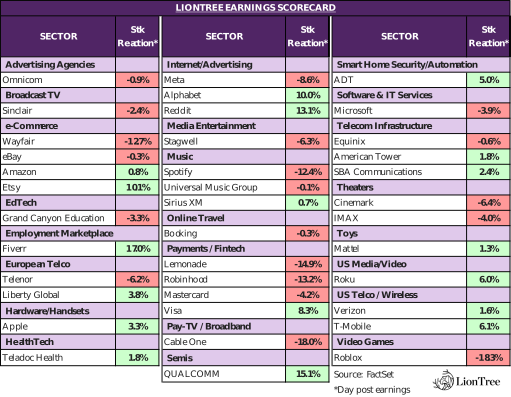
Week 3 of earnings was large cap heavy! A total of 38 stocks in our LionTree Universe reported and stock reactions were slightly biased to the negative side this week, with 20 (53%) stocks trading down and 19 (47%) stocks trading up. The best performer in reaction to earnings was Fiverr, which was up +17%, while the worst performer was Roblox, which fell -18%.
It was a pivotal week for large-cap Tech with Alphabet up +10% in reaction to earnings (see Theme #2), Amazon up +0.8% (see Theme #3), and Apple up +3.3% (see Theme #10). Meta was down -8.6% in reaction (see Theme #4) while Microsoft also down -3.9% (see Theme #9). See our deep dives for more color.
Music was also represented with Spotify down -12.4% in reaction to its earnings (see Theme #5), while UMG was flat (see Theme #6). In telcos, Verizon rose +1.6% in reaction (see Theme #7) and T-Mobile rallied +6.1% (see Theme #8). Booking was down -0.3% in reaction (see Theme #11) and was also the first OTA to shed light on travel trends, especially given the geopolitical climate.
Other notable prints that we wanted to highlight, but were not able to do our usual deep dives for include:
- eBay: Traded down flattish in reaction to results despite a strong Q1 (GMV, revenue, and adj EPS all beat consensus), slightly stronger than expected active buyers of 136mn, and Q2 GMV guidance of $21.3bn-$21.7bn that was +2% above cons at the mid-pt
- Reddit: Traded up +13.1% in reaction to strong Q1 w/ revenue (+69% y/y) and adj EPS both topping expectations, and Q2 rev & adj EBITDA both ahead of cons (by +1.3% and +5.2% respectively)
- Roku: Traded up +6% in reaction to strong Q1 (revenue and adj EBITA both beat cons by +4.2% and +13.1% respectively), strong Q2 guidance (at the mid-pt, revs beat by +1.2% and adj EBITDA beat by +28.1%) as well as better 2026 guidance (at the mid-pt, revs beat by +0.6% & adj EBITDA beat by +6.3%)
- Roblox: Traded down -18.1% in reaction to mixed Q1 results (bookings and revenue missed the Street while adj EPS beat), softer user trends (132mn DAUs and 31bn hours engaged both missed), and a cut FY2026 bookings outlook by -11%, at the mid-pt; Q2 bookings guidance was also -14% below consensus
The table below includes select mid- and large-cap TMT and consumer companies in our LionTree stock universe that reported this week.
Alphabet’s Big Capx Investments Are Showing Clear Signs Of Returns
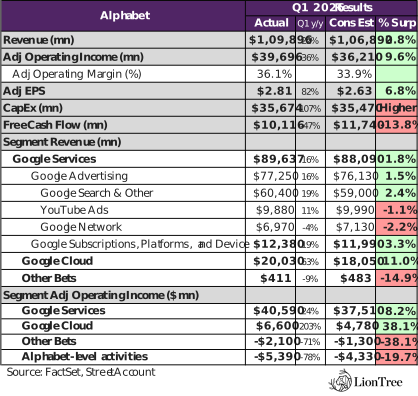
Big Tech earnings drove a volatile week with diverging stock reactions, but Alphabet stood out as its heavy capex most clearly translated into broad-based returns across its businesses in Q1. The Co’s HUGE beat in Cloud revs (grew +63% y/y with AI solutions as the primary driver) and cloud margins (32.9% vs cons 23%) coupled with a MASSIVE backlog (nearly doubled to $462bn) were all major positives. Search revenue’s acceleration to +19% y/y also topped expectations. Clearly the investments in AI are paying off and the Co wants to stay ahead of the curve. Q1 capx was +$200mn higher than consensus and 2026 capx was raised by +$5bn at the mid-pt (to $190bn) to now include investments related to the acquisition of Intersect Power (closed in March). 2027 capx is still a wild card, and is guided to be “up significantly,” but investors are giving the Co the benefit of the doubt (at least at the moment) given the strong ROI that they have been generating on incremental spend.
In addition, five of our other top takeaways from the Co’s results include: 1) Cloud revenue growth would have been even higher if they were still not capacity constrained; 2) The Co is selectively starting to sell their TPUs externally, which is a big deal (though this will be more of a 2027 story); 3) Gemini enterprise Q1 paid MAUs in subscriptions grew +40% q/q and Q1 was the strongest qtr ever for consumer AI plans, primarily driven by Gemini app adoption; 4) AI experiences are driving search usage and queries to all-time highs (including commercial queries); and 5) Agentic commerce is gaining real adoption (moving to implementation).
See more color below on all the above, in addition to other key updates across Alphabet’s businesses including YouTube, Waymo and more. Overall though, the Co’s full stack approach appears to the working…
-> GOOGL shares rallied +10% post its print, lifting Google to its best month on Wall Street since 2004 (+34% in April); YTD, the stock is up +22.1%, outperforming YTD performances of MSFT down -14.2%, META down -7.78%, and AMZN up +16.2%
-> See Themes #4, #3, and #9, for thoughts on Meta, Amazon, and Microsoft’s results, respectively
A HUGE Beat In Cloud & Upside In Search Drove A Strong Q1…Strong Operating Leverage Stood Out
- Revenue BEAT: By +2.8%, up +22% y/y (+19% FXN) vs +12% y/y in Q1:25
- Driven by stronger Search, Cloud, and Subscriptions growth
- 11th consecutive qtr of double-digit growth
- Q2 FX guidance…the FX tailwind will be ~+1pt to consolidated revs vs a +3pt FX tailwind in Q1
- Adj op Income materially BEAT: By +9.6%, up +30% y/y
- Adj op margin of 36.1% was WELL ABOVE cons 33.9%, reflecting strong topline leverage in Services + Cloud despite higher AI infra, marketing, and AI talent spend
- Adj EPS BEAT: By +6.8% to $2.81
- FCF MISSED cons by -13.8% at $10.1bn
- The Co incr’d the qtrly dividend by +4.8% to $0.22/shr
Capx Is Likely To Take Another Leg Up In 2027 Y/Y Given Strong Demand & Return On Investment
- Q1 capx came in slightly above cons: $35.7bn vs $35.5bn, but up over 100% y/y
- The overwhelming majority of spend is going to technical infrastructure; ~60% of technical infra spend was in servers and ~40% in data centers/networking
- CAPX OUTLOOK…an increase in 2026 guidance due to its recent acq, and 2027 is likely another step up
- 2026: The Co raised guidance by +$5bn at the mid pt ($180-190bn) to now incl investment related to the acq of Intersect (closed in March)
- 2027: Capx is guided to be up “significantly” y/y
- As the Co sees “unprecedented” internal + external compute demand
- The investments in AI are delivering “strong growth” …i.e., record revenue and backlog growth in Google Cloud, strong performance in Google Services
- Reminder that higher capx means higher depreciation + energy/data center operating costs
It Was A Blow-Out Quarter For Google Cloud…AI Solutions Were The Primary Growth Driver For The 1st Time, Backlog Nearly DOUBLED, And External TPU Sales (1st Time) Open A New Leg Of Growth
- Q1 Cloud revenue growth accelerated to an impressive +63% y/y, from +48% y/y in Q4 and +34% y/y in Q3 due to “strong demand for our AI products and infrastructure”
- Revenue exceeded $20bn for the 1st time
- AND “our Cloud revenue would have been higher if we were able to meet the demand”
- The backlog also nearly doubled q/q to $462bn from $240bn
- The majority of the backlog is still GCP agreements, but it also includes TPU hardware sales
- Just over 50% of backlog should convert to revenue in the next 24 months
- Enterprise AI solutions became the primary growth driver for Cloud for the 1st time in Q1: Driven by strong demand for their key models, including Gemini 3, and strong growth in infrastructure due to cont’d deployment of TPUs and GPUs in core
- Revenue from products built on Google’s AI models grew nearly +800% y/y vs nearly +400% y/y in Q4
- Growth in GCP cont’d to grow at a rate much higher than Cloud’s overall revenue growth rate, driven by demand for infrastructure and other svs such as cybersecurity and data analytics
- Workspace delivered strong DD revenue growth: Driven by an increase in the # of seats and the avg rev per seat
- New customer & deal momentum is strong
- New customer acquisition doubled y/y
- The number of $100mn to $1bn deals doubled y/y, and the Co signed multiple $1bn+ deals
- Customers outpaced initial commitments by +45%, accelerating from +30% last qtr
- External TPU monetization is a new theme: Google will begin delivering TPUs directly into select customer data centers, not just via Cloud
- This as “opportunistic” and ROIC-driven, targeted at use cases like frontier AI labs and capital markets/HPC customers that want TPUs on-prem
- The Co will begin recognizing a small % of TPU hardware sales later in 2026, with the vast majority of rev recognized in 2027 (TPU hardware sales will fluctuate qt rot qtr)
- Seeing strong demand for their Agentic defense cyber security offerings
- Closed the acq of Wiz, a leading cloud and security AI platform, in March
- “The performance of this so far has exceeded our expectations”
- Closed the acq of Wiz, a leading cloud and security AI platform, in March
- Q1 Cloud adj operating income BEAT by a large 38%, w/ margins expanding to 32.9% from 17.8% a yr ago
- Mgmt attributed this to topline leverage plus operating efficiency across technical infra + the org (to note, the market has been concerned that AI cloud revenue is lower margin)
- Outlook: Cloud margins will now include a low-SD pt headwind for the balance of 2026 from the Wiz acq
- Mgmt stressed its vertical optimized AI stack differentiation: “We are unique in the market because of our vertically optimized AI stack and the way we co-develop the components from our infrastructure and models to platforms and the tools to applications and agents”
- Owning frontier models and silicon “helps us stay ahead of the curve”
- Deep investment in the security layers “keeps everything safe”
- “I think we are the only provider in the market that offers all of these in a vertical stack”
Google AI Models Have “Great Momentum” & Gemini Adoption In Both Enterprise & Consumer Stood Out
- 1st party models now process more than 16bn tokens per minute vs 10bn in Q4
- Gemini 3.1 series of models offer more choices for developers
- Speech to text is now available in 70 languages and with 3.1 Pro
- Generative AI media models are “incredibly” popular
- Lyria 3: Generated over 150mn songs since launching on the Gemini app
- Nano Banana 2: Reached 1bn images in nearly half the time of Nano Banana 1
- Veo 3.1 Lite: The most cost-efficient video model to date
- GEMA 4 (the Co’s “most intelligent” open model) has been downloaded 50mn+ times in just a few weeks
- The Co’s open models have now been downloaded over 500mn times in total
- Gemini enterprise Q1 paid MAUs in subscriptions grew +40% q/q: That includes major global brands like Bosch, Citi Wealth, Merck, and Mars Incorporated
- Saw 9x y/y growth both in seats sold w/ partners and in the # of partners adopting it for internal use
- Q1 was the strongest qtr ever for consumer AI plans, primarily driven by Gemini app adoption
- Personal intelligence is now in the Gemini app, AI mode, and Gemini in Chrome… “early traction has been good”
- Also integrated Nano Banana 2 to make personalized image creation possible in the Gemini app
- Maps recently got its “most significant upgrade” in over a decade with Gemini…users can now have a conversation with Maps and get more personalized suggestions and intuitive directions
Search Growth Accelerated Y/Y More Than The Street Expected As AI Overviews + AI Mode Drive More Queries & Better Commercial Intent
- Q1 Search revenue growth accelerated to +19% y/y from +17% y/y in Q4 and +15% y/y in Q3 and BEAT cons by +2%: The Retail + Finance verticals were the biggest contributors…”AI Overviews are driving overall Search”
- AI Is helping with:
- Ad quality
- Advertiser tools
- Reinventing ads in new AI experiences
- AI Is helping with:
- AI experiences are driving search usage and queries to all-time highs (including commercial queries)
- Reiterated that it is still an “expansionary” moment in search
- AI is improving engagement & monetization in a more tangible ways
- Smart bidding now uses Gemini to match user intent to an advertiser’s product & services more accurately and further drive performance…this level of granularity was “previously impossible to achieve at scale”
- Gemini helps advertisers drive more efficient and effective campaigns, people no longer search in fragments
- AI has “significantly expanded” its ability to deliver ads on longer, more complex searches that were previously difficult to monetize
- More than 30% of customer search spend now uses AI-enabled campaigns through AI Max or Pmax and they are seeing more conversion for the same spend
- Direct Offers in AI Mode are “resonating with users” and getting positive customer feedback
- The Co is testing new ad formats that show retailers selling the organically recommended products surfaced in AI Mode
- AI Search is getting cheaper & faster at scale
- Search latency has fallen >35% over the past 5 yrs despite a more complex results page
- Since upgrading AI Overviews + AI Mode to Gemini 3, the cost of core AI responses has fallen >30%
- Mgmt sounded open to AI search monetization via subscriptions vs just ad-supported, but down the road
- As higher-value use cases emerge, there may be cases where users want the most powerful models but “today in the Gemini app, we’re focused on the free tier and subscriptions”
- “We’re not rushing anything here”
Also, Agentic Commerce Is Now Becoming More Of A Real Near-Term Catalyst
- UCP appears to be gaining more ecosystem traction…Amazon, Meta, Microsoft, Salesforce, and Stripe joined the UCP Tech Council this qtr
- Mgmt has received “tremendous feedback” from hundreds of tech cos, payment partners, and retailers
- Merchant adoption is moving from concept to implementation
- Sephora and Macy’s joined the companies rolling out UCP
- Ulta Beauty launched commerce inside AI Mode in Search and the Gemini app, letting shoppers review recommendations, compare options, and complete streamlined checkout for eligible purchases directly within Google’s AI experiences
- “Agentic experiences are additive” and can transform shopping from discovery to decision…by removing the “grunt work” of shopping and making the process more assistive, personal, and fluid
YouTube Ad Revs Slightly Trailed Expectations But Y/Y Growth Still Accelerated… Subscriptions Rev Was A Key Growth Driver
- YouTube (YT) ads revenue growth re-accelerated to +11% y/y from +9% y/y in Q4, though it was still a slight miss (-1.1%) vs cons
- Direct Response remained the key driver, followed by Brand
- AND YT subscriptions revenue is growing FASTER than Ads, particularly YouTube Music + Premium.
- Q1 delivered the largest quarterly increase in non-trial YouTube Music + Premium subscribers globally and in the U.S. since launch in 2018
- Premium Lite was fully launched in 23 countries by the end of Q1, with another dozen+ countries planned for Q2
- Q1 engagement/use cases remained very strong
- U.S. viewers are now watching 200mn+ hours of YouTube content daily
- 10mn+ channels were publishing Shorts each day as of March
- YouTube has led streaming watch time in the U.S. for 3 consecutive yrs
- The Co continues to build more commerce + creator tools into the platform
- Gemini now powers YT Creator Partnerships directly inside YouTube Studio and Google Ads
- The Co is curating top podcast inventory into premium ad offerings
- Supergoop’s campaign w/ creator Liza Koshy drove a +93% lift for Glowscreen and a +55% overall brand lift, highlighting the brand-commerce opportunity
- Subscriptions Platforms & Devices revenue rose +19% y/y and BEAT by +3.3%
- Paid subscriptions reached 350mn, up from 325mn last qtr
- Strong growth in both YT subscriptions, as noted above, & Google One subscriptions (given incr’d demand for AI plan)
Waymo Continues To Scale… While Portfolio Simplification Elsewhere Makes Other Bets Cleaner
- Waymo remains an important growth initiative and surpassed 500k fully autonomous rides per week, doubling in less than a year
- Nashville launched a few weeks ago, bringing six new cities so far in 2026 and operations in 11 major U.S. cities overall
- Other Bets operating loss improved seq to -$2.1bn from -$3.6bn in Q4, though still worse y/y
- The broader Other Bets portfolio is becoming more streamlined
- Verily completed an external capital raise and was deconsolidated
- GFiber annc’d plans to combine w/ Astound Broadband & is expected to deconsolidate upon close in Q4
All In, Amazon Continues To Execute Across Its Businesses
While there were a lot of positives with Amazon’s Q1 results, there were also a couple of offsets that left the stock relatively unchanged. Big picture, Q1 results showed momentum across its cloud, AI, infrastructure, and consumer businesses, but Q2 op income guidance disappointed (after beating in Q1). Also importantly, Q1 capx was ~in-line and the Co didn’t further raise the $200bn 2026 guidance provided last qtr (which we view as a plus). Our other top five takeaways from results are: 1) AWS’s growth of +28% y/y was the highest growth in 15 qtrs and a big number for a segment that has an ~$150bn annualized revenue run rate; 2) AWS’s chips biz is scaling quickly with Q1 revenues up ~40% q/q (the annual rev run rate is now over $20bn) and mgmt flagged again that there is a “good chance we’re going to sell racks over the next couple of years”; 3) The Stores’ network efficiencies also continues to improve with fulfilment network costs growing slower than unit growth; 4) Rufus (Amazon’s AI personal assistant) MAUs were up ~115% and engagement was up ~400% y/y but 3P horizontal agents have more work to do; and 5) Advertising growth remained strong at +22% y/y.
See below for more thoughts on the above, as well as other important points on key parts of the business.
All in all, we viewed results more positive than not.
-> AMZN shares closed up almost +1% after its report and ended the week up +16.3%; YTD, the stock is up +16.2%
-> See Themes #2, #4, and #9 for our takes on Alphabet, Meta, and Microsoft’s results, respectively
Amazon Delivers A Strong Q1 BEAT, Especially On Profitability & Earnings…
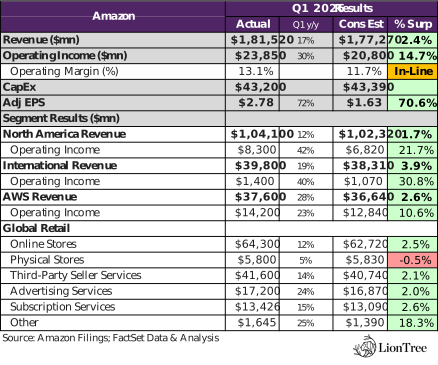
- Q1 revs, op income and adj EPS all BEAT cons
- Revs BEAT by +2.4% and grew +17% y/y (+15% y/y FXN) vs +14% y/y (+12% y/y FXN) in Q4
- NA segment BEAT by +1.7%: Sales grew +12% y/y vs +10% y/y in Q4
- Intl segment BEAT by +3.9%: Sales rose +19% y/y (+11% FXN) vs +17% y/y (+11% FXN) in Q4
- AWS BEAT by +2.6%: Rose +28% y/y vs +24% y/y in Q4
- Op income BEAT by +14.7%…with op margin of 13.1%, up +130bp y/y (highest op margin ever)
- NA op income of $8.3bn BEAT by +21.7%
- Op margin reached 8% up +160bp y/y
- Intl op income of $1.4bn BEAT by +30.8%
- Op margin reached 3.6% up +60bp y/y
- AWS op income of $14.2bn BEAT by +10.6%
- Op margin reached 37.7% down -180bp y/y
- NA op income of $8.3bn BEAT by +21.7%
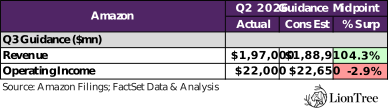
BUT Q2 Guidance Was Mixed…Better Revs & Worse Op Income Vs Expectations
- Q2 rev guidance was +4.3% AHEAD of cons and implies +16-19% y/y growth, vs the +17% y/y in Q1
- Anticipates an unfavorable impact of ~10bp from FX rates
- Strong sales trends are carrying into Q2
- Q2 op income was -2.9% BELOW the Street
- The Q2 guidance given assumes 3 things…
- That Prime Day occurs in Q2 in most of the largest geos (incl the US) and occurs in Q3 in Australia, Brazil, India and Japan
- Note that in 2025, Prime Day was in Q3 for all countries
- The seasonal step up in stk-based comp expense in Q2
- ~$1bn cost increase due to Amazon Leo (to manufacture and launch more satellites) booked in Amer
- Leo’s commercial services are on track to launch in Q3
- Expect to begin capitalizing certain costs in Q4, including production & launch costs
- Higher transportation costs related to fuel inflation, which is partially offset by the recently implemented fuel & logistics related FBA surcharge
- That Prime Day occurs in Q2 in most of the largest geos (incl the US) and occurs in Q3 in Australia, Brazil, India and Japan
Q1 Capx Was ~IN-LINE, Though Forward Spend Is Still A Question
- Q1 capx of $43.2bn was just slightly below cons
- What about the capx outlook? There were no specific comments re the previous $200bn 2026 capx guidance but when asked about capx spend looking ahead…
- Amazon already has customer commitments for a “substantial” portion of the 2026 capacity coming online
- “We still view today’s environment as a once in a lifetime opportunity…expect that we will invest a significant amount of capital over the coming years to pursue that opportunity”
- “Our customers, our shareholders and Amazon in general are going to be much better off down the road because we did so”
- The faster AWS grows, the more short-term CapEx the Co will spend
- Reminder that monetization typically lags investment by 6-24 months BUT…
- Data centers can have 30+ year useful lives
- Chips, servers, and networking gear typically have 5-6 year useful lives
- Near-term FCF can be pressured during rapid growth, but the Co expects attractive cumulative returns once capacity is utilized
- Reminder that monetization typically lags investment by 6-24 months BUT…
- The cost of memory has skyrocketed as everyone has seen but are working with partners to secure supply
- Mgmt believes this situation also pushes companies to shift faster to cloud as well
AWS’ Revenue Acceleration Was A Big Positive W/ The Print
- Q1 AWS revenue BEAT cons by +2.6% and is up +28% y/y (the fast growth rate in 15 qtrs) driven by both core and AI services (mgmt sees strong correlation btw the two and expect this to increase over time)
- Op margins reached 37.8% vs cons 35.0%
- Q1 AWS AI rev is growing “triple digits” y/y and they are bringing more capacity online: AI momentum is driven by,,,
- Broad AI capabilities across the stack
- Proximity of AI workloads to customers’ existing apps and data
- Ability to bundle AI with AWS’s broader cloud services
- Enterprise-grade security, reliability, and operational performance
- Q1 AWS backlog reached $364bn (+93% y/y) and this does NOT include the recently annc’d the $100bn Anthropic deal
- The backlog also has “reasonable breadth” and is not concentrated in just one or two customers
- AI labs are spending “an incredible amount” on compute on AI and the core side but the Co is also seeing “quite a bit of enterprise spend on AI”
- On the platform side…
- SageMaker can reduce training time by up to 40%
- Bedrock offers access to frontier models for inference
- Used by 125k+ customers
- ~80% of Fortune 100 companies are using Bedrock
- Customer spend grew +170% q/q
- Processed more tokens in Q1 than in all prior years combined
- Bringing OpenAI models to Bedrock is “a big deal”:
- GPT-5.4 was added this week
- GPT-5.5 is expected soon
- Also began previewing Bedrock managed agents powered by OpenAI
- Believe agents will drive much of the value companies get from AI, and is pushing several offerings in that area…
- Customers can build agents using proprietary data and Strands, which has been downloaded 25mn+ times and saw 3x q/q download growth
- Can also deploy agents using Agent Core, with some customers deploying an agent as often as every 10 seconds
- AWS also offers turnkey agents/products for coding, migrations, business operations, and knowledge work
- Customers can build agents using proprietary data and Strands, which has been downloaded 25mn+ times and saw 3x q/q download growth
- Other key AWS AI products stats:
- On Kiro, the number of developers using it more than doubled q/q
- Enterprise customer usage incr’d ~10x
- Transform has helped customers save over 156mn hours of manual migration/modernization effort
- Quick saw the number of new customers grow more than 4x q/q
- Recently annc’d Quick Desktop, which can query email, calendar, Slack, local files, summarize information, compose communications, and automate tasks
- On Kiro, the number of developers using it more than doubled q/q
Amazon’s Chips Story Remains A Hidden Gem (Was A New Narrative Last Qtr)
- AWS’s chips biz is scaling quickly…revs grew ~40% q/q in Q1
- Annual rev run rate is now over $20bn (vs ~10bn in Q4)
- If the biz were accounted for like a standalone chip vendor, the run rate would be $50bn
- The Co believes its custom silicon biz is now one of the “top three data center chip businesses in the world”
- Annual rev run rate is now over $20bn (vs ~10bn in Q4)
- And Trainium is maintaining its momentum… “customers always want choice “
- AWS has $225bn+ in revenue commitments for Trainium
- Trainium 2 offers ~30% better price-performance than comparable GPUs and is largely sold out
- Trainium 3, which started shipping at the start of 2026, offers 30–40% more price-performance than Trainium 2, and is nearly “fully subscribed”
- Much of Trainium 4, still ~18 months from broad availability, has already been reserved
- On the cost side, Trainium provides major cost savings
- Could save the Co “tens of billions” of dollars of capx per year
- Could provide “several hundred bp” of operating margin advantage versus relying only on 3P chips for inference
- As also signaled earlier, mgmt stated there is a “good chance we’re going to sell racks over the next couple of years”
- Bedrock runs most of its inference on Trainium
- AI is not just a “GPU story” but is also a “CPU story”…regarding Amazon’s Graviton CPU chip
- Meta has committed to using “tens of millions of Graviton cores”
- Graviton delivers up to 40% better price-performance than other x86 processors
- It is now used by 98% of the top 1,000 EC2 customers
- “Nobody has a better set of chips across AI and CPU workloads than AWS with Trainium and Graviton, and we’re unusually well positioned for this AI inflection”
The Stores Business Has Not Maxed Out On Broader Selection, Faster Speed, & Greater Efficiencies
- Unit growth in Stores reached +15% y/y vs +12% y/y in Q4 (the highest since the tail end of COVID lockdowns)
- The Co cont’d to expand selection, including 600+ new notable brands
- More items are being shipped faster (~1bn items were shipped via same-day or overnight delivery so far this year and delivery speeds are still improving) …
- Recently intro’d 1-hour & 3-hour delivery options on ~90k items
- 1-hr delivery is available in hundreds of cities and towns
- 3-hr delivery is available in more than 2,000 cities and towns
- The Co is continuing to expand Amazon Now, which offers delivery in 30 minutes or less on “thousands of items”
- The svs launched last year in India and orders there are increasing 25% m/m
- Prime members 3x their shopping frequency once they begin using the service
- Amazon Now is available to tens of millions of customers across 9 countries, with further expansion planned
- Recently intro’d 1-hour & 3-hour delivery options on ~90k items
- Amazon’s grocery biz remains a key priority across both perishables and non-perishables (it is now the 2nd-largest grocer in the US)
- The Co offers same-day delivery of perishables alongside mns of other items across more than 2,300 US cities and towns, w/ further expansion planned
- Perishable sales grew more than 40x y/y
- Perishables now account for 9 of the top 10 most-ordered same-day delivery items where the service is available
- Customers who shop same-day perishables build larger baskets, adding ~3x more items and spending 80%+ more than customers who do not
- The Co offers same-day delivery of perishables alongside mns of other items across more than 2,300 US cities and towns, w/ further expansion planned
- The Co remains focused on price competitiveness…in Q1, the avg prices of products offered on Amazon.com “declined” y/y
- Prime Day will take place in most countries in June, with addtl member savings across categories
- Network efficiency also continues to improve (fulfilment network costs grew slower than unit growth)
- Outbound shipping costs grew +12% y/y and fulfillment expense grew +9% y/y (FXN)
- “We’re able to deliver items faster and improve the customer experience, while at the same time lowering our cost to serve”
- See “meaningful opportunities” to further enhance productivity across the global fulfillment network while still increasing delivery speed (optimizing inventory placement to shorten distance traveled, reduce touches for package, and improve consolidation rates)
- Robotics and automation are creating step function efficiencies
- Whole Foods Market also continues to expand…the Co currently it has ~550 stores and plans to expand by ~100 “over the next few years”
Mgmt Is Very Bullish On What Agentic Commerce Looks Like, But 3P Agents Still Need Some Work
- Rufus (Amazon’s AI shopping assistant) has “substantially” improved and continues to gain adoption
- Monthly active users were up ~115%
- Engagement was up ~400% y/y
- But Amazon also expects to do a lot with 3P agents as well, though the experience “just hasn’t gotten great with these third-party horizontal agents yet”
- They often do not get pricing or product info right
- They don’t have any personalization data or any shopping history
- The Co is “having conversations” with these companies to “try to make that better and find something that works for customers and all the companies”
- Mgmt thinks advertising “will do well” w/ agentic commerce despite some analysts thinking otherwise (see more below on Q1 advertising performance in general)
- It will be so much easier to do advertising so there will be a lot more advertisers
- Agentic experiences tend to be interactive with multi-turns when relevant products (sponsored and non-sponsored) can be surfaced
- And will also have sponsored prompts
Advertising Growth Remains Consistently Strong
- Q1 advertising revenue reached $17.2bn in the quarter, up +22% y/y vs +22% y/y in Q4
- The Co is expanding its AI tools for advertisers
- It expanded Creative Agent, an AI tool that helps plan and execute the ad creative process
- The tool is now available in Canada, France, Germany, India, Italy, Spain, and the UK
- Intro’d new AI tools for sellers
- Intro’d a new AI experience in Seller Central and early feedback has been “strong”
- The product dynamically generates personalized data visualizations, insights, and scenarios tailored to seller goals
- A couple highlighted partnerships…
- Deepened their Netflix partnership with Amazon Audiences
- Enables advertisers to apply Amazon’s exclusive signals from shopping, browsing, and streaming to Netflix’s viewers to reach the right audiences
- Partnered with Comcast Advertising to expand local advertising to “thousands of brands”
- Expanded interactive video ad capabilities to partners, starting with Samsung TVs
- Deepened their Netflix partnership with Amazon Audiences
Several Other Notable Updates Across Prime Video, Alexa+, Leo, Zoox, & Health
- Prime video remains a key pillar for Prime membership growth and “is profitable” in its own right
- Project Hail Mary hit ~$615mn in global box office to date, and its opening weekend was the 2nd biggest for any non-sequel, non-franchise film in the last decade
- Also surpassed 100mn viewers globally for the Culpables movie trilogy, with all 3 films reaching #1 in ~170 countries at launch
- Total viewership of exclusive coverage of the NBA, SoFi play-in tournament was up +18% vs last year on cable
- Alexa+ early access expanded to “millions more” Prime members in Mexico, the UK, Italy, and Spain and stats are positive…customers are:
- Talking to Alexa Plus 2x as much and for longer durations across a wider breadth of topics
- Completing 3x more purchases on devices
- Streaming ~25% more music
- Using smart home features ~50% more often than Alexa Classic
- Very bullish on Amazon Leo w/ commercial service on track to launch in the next few months…see this as a “many billion dollar” revenue business with an attractive return profile
- The Co said Leo should offer roughly:
- ~2x better downlink performance
- ~6x better uplink performance
- Amazon said it has 20+ launches planned in 2026
- 30+ launches planned in 2027
- Mgmt believes that it will have a cost advantage
- The combination of LEO and Cloud is also very attractive for customers
- The Globalstar deal will bolster service capabilities
- The Co said Leo should offer roughly:
- Zoox has now driven ~2mn miles and carried more than 350k riders; It is publicly available in Las Vegas and San Francisco, is testing in 8 addtl cities, and will also be available through the Uber app in Las Vegas, with Los Angeles planned
- The Co launched Health AI, a 24/7 AI-powered personal health agent backed by One Medical clinicians
- Health AI can provide clinical guidance and, with customer permission, take actions such as booking appointments, managing prescriptions, and facilitating care with a One Medical provider
Meta Beats Across The Board But The AI ROI Debate Dominates As Capx Moves Up AGAIN
As mentioned above, Alphabet delivered the clearest, strong, broad-based returns on its high capx spending across its businesses, and while Meta is also reaping benefits from AI in its ads business, investors do not see the ROI on its heavy capx investments as clearly visible. That said, the core business is performing well with Q1 revenue accelerating from +24% y/y in Q4 to +33% y/y in Q1 (but this was largely expected), adj op income margin of 40.6% well ahead of cons 35.0%, EPS of $10.44 nearly double expectations, and FCF of $12.4bn was almost 3x cons. Our top 5 other takeaways from Meta’s results are: 1) While Q1 capx was $7.7bn below expectations, mgmt. raised 2026 guidance by $10bn and it sounds like 2027 could be a major step up as well given comments about previously underestimating their compute needs; 2) The Muse Spark launch is a meaningful milestone though exact timelines on future releases will remain fluid as the Co prioritizes quality over a fixed cadence; 3) the ad business continues to benefit from AI, with performance gains across the ad stack, Gen AI creative tools are now used by 8mn+ advertisers, and newer surfaces like Threads and WhatsApp Status are beginning to contribute; 4) Users were weaker than expected in Q1, but purely due to the Middle East conflict (growth would have been up q/q excluding that impact); and 5) AI glasses “continues to be one of the fastest growing categories of consumer electronics ever.”
Net net, the fundamentals of the core business remain strong (though somewhat baked into estimates), CapEx is moving higher (again), when the longer-term return profile on its AI investments is still an open question, hence, the path forward is not without uncertainty in investors’ minds.
See below for more details on the above as well as key updates on content recommendations, partnership ad product revenue, Meta AI, agents, workforce efficiency, and more.
-> Meta fell -8.6% post its print, it’s worst day since October
-> See Themes #2, #3, and #9 for our thoughts on Alphabet, Amazon, and Microsoft’s results, respectively
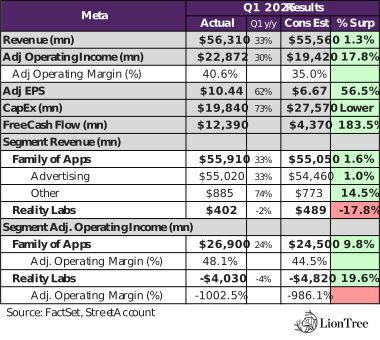
Easy Headline Beat In Q1, Driven By Much Better Profitability
- Q4 total revs BEAT cons by +1.3% and grew +33% y/y (vs +24% y/y growth in Q4)
- Family of Apps (FOA) revs BEAT w/ ad revs ~1% better than expected and Other beat by +15%
- Reality Labs MISSED by -18%
- Q4 adj op income BEAT by +8% (margin of 40.6% vs cons 35.0%)
- FOA adj op income of 48.1% BEAT vs cons 5%
- Reality Labs adj op income also MISSED -5% vs cons -986.1%
- Q4 EPS of $10.44 was well ABOVE cons $6.67
- Q4 FCF of $12.4bn was a BIG BEAT vs cons $4.4bn
- Q4 CapEx of $19.84bn was much LOWER vs cons $27.6bn
Q2 Revenue Guidance Was In-Line But All Signs Point To A Further Substantial Capx Ramp Looking Ahead
- For Q2…the mid-pt of REVENUE guidance was in-line w/ cons ($58bn-$61bn vs cons $59.48bn), implying +25% y/y growth
- Guidance assumes FX is an ~2% tailwind to y/y total rev growth, based on current exchange rates
- For 2026…reiterated EXPENSE guidance of $162bn-$169bn (vs $118bn in 2025)
- On Capx…
- For 2026…even though Q1 capx was $7.7bn below expectations, mgmt. raised the FY capx guidance by $10bn, or +8.0% at the midpt ($125bn-$145bn vs prior guidance $115bn-$135bn): This was +10% higher than cons $122.6bn
- Reflects expectations for higher component pricing this yr and, to a lesser extent, addtl data center costs to support future yr capacity
- “But every sign that we’re seeing in our own work and across the industry gives us confidence in this investment”
- For 2027…mgmt. did not provide specific CAPX guidance but noted that they are “undergoing a very dynamic planning process” as they work through what their capacity needs will be over the coming yr
- “Our experience so far has been that we have continued to underestimate our compute needs”
- “Expectation is that compute will become even more central to the business going forward”
- “If we end up not needing as much as we anticipate, we can choose to bring it online more slowly or reduce our spending in future years as we grow into the capacity that we’re building now.”
- For 2026…even though Q1 capx was $7.7bn below expectations, mgmt. raised the FY capx guidance by $10bn, or +8.0% at the midpt ($125bn-$145bn vs prior guidance $115bn-$135bn): This was +10% higher than cons $122.6bn
- A quick comment on the regulatory front… “we continue to monitor active legal and regulatory matters, including headwinds in the EU and the US that could significantly impact our business and financial results. For example, we continue to see scrutiny on youth-related issues and have additional trials scheduled for this year in the US, which may ultimately result in a material loss”
Users Were Slightly Below Expectations Due To Regional Disruptions (Though Underlying Engagement Trends Remain Strong)
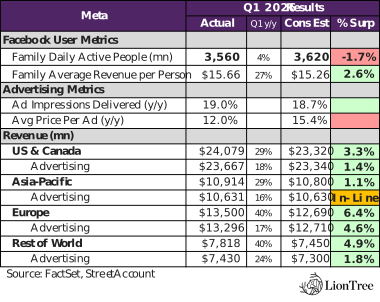
- Ended Q1 w/ 3.56bn Family DAPs using at least one of Meta’s apps everyday, which was a touch below cons 3.62bn
- Saw a “small” decrease in Dec total family DAPs due to internet disruptions in Iran and a restriction on access to WhatsApp in Russia
- Absent these impacts, growth in family DAPs would have been positive q/q
- Daily and monthly actives on Instagram and Facebook continue to grow, with video driving all time high engagement across both apps
- WhatsApp “continues to see strong momentum too, including in the US”
- Threads “continues on its trajectory to be the leading app in its category”
Muse Launch Highlights Early Progress As Meta Builds Toward Agents & Personal Superintelligence But The Product Release Cadence & Monetization Timeline Remains Vague
- Meta’s “biggest milestone so far this year” – release of Muse family of models, including their first model, Muse Spark, along w/ a “significantly” upgraded new version of Meta AI
- First release from Meta Superintelligence Labs… “it shows that our work is on track to build a leading lab”
- “Our focus this year is validating the model architectures and techniques in these domains before we scale them out in future years”
- Spark has already made Meta AI “a world-class assistant” that leads in several areas related to their vision of personal super intelligence, including visual understanding, health, shopping, social content, local, creating games and more
- Hearing “very positive” feedback on it so far
- Seeing double-digit % increases in Meta AI session per user + the Meta AI app has consistently been near the top of the app stores
- Also working on using Spark in their upcoming models to improve their recommendation systems and core business in Facebook, Instagram and advertising
- Currently…Meta’s apps primarily help 1) connect people 2) learn about the world, and 3) entertainment
- What Meta is working towards… “to understand more of people’s goals so we can help improve their lives in all of the ways that they want”
- Using their new AI models, for the first time in Meta’s history, the Co will be able to develop a first principles understanding of what users care about
- Enables them to both show and create more personalized content specifically for what people are trying to achieve
- Since Meta’s recommendation systems are operating at such a large scale, the new research and technology will be phased in “over time”
- Another key focus is to deliver agents that understand goals and work “day and night” to help achieve them
- Personal agents are focused on helping people achieve the diverse goals in their lives
- On monetization… “we think there will be clear monetization opportunities over time. You can imagine commission structures or a premium offering”
- Business agents are focused on helping entrepreneurs and bizs use Meta’s tools to grow their efforts, reach new customers and serve existing customers better
- On monetization…currently free for most bizs but expect to work towards establishing a longer-term monetization model
- Looking ahead… “these agents will work together to form an ecosystem…I believe that the future will see a massive increase in entrepreneurship from people creating new things that they’ve always wanted to exist, but previously didn’t have the tools to bring into the world”
- Already testing an early version of business AIs and weekly conversations have grown 10x since the start of this yr
- Personal agents are focused on helping people achieve the diverse goals in their lives
- The overall view is that AI is NOT going to replace people, but rather amplify people’s ability to do what they want (i.e., improve health, learning, relationships, ability to achieve career goals, etc.)
- “People will be more important in the future, not less”
- Reiterated monetization strategy for investments in models and products… “the formula for our company has always been build experiences that can get to billions of people and focus on monetizing them once you get to scale”
- On expected timeline of future releases… prioritizing quality over a fixed timeline, making exact cadence unpredictable
- “We are trying novel things. You don’t exactly know when they’re going to land…. getting to like that quality bar is something that I care about more than hitting a specific week for launching”
- Quickly on the compute side…rolling out more than 1 gigawatt of their own custom silicon being developing with Broadcom + a “significant amount” of AMD chips to complement the new NVIDIA systems that they’re rolling out as well
- “One of the primary goals of our Meta Compute initiative is to lead the industry in efficiency of building Compute. And we expect that will be a strategic advantage over time”
Advertising Momentum Continues With Surface Expansion, AI Model Advancements, And Scaling AI Tools For Businesses
- Family of App ad revs accelerated to +33% y/y (vs +25% y/y in Q4, +26% y/y in Q3, and +22% y/y in Q2) and beat cons by +1.0%; FOA adj op margins of 48.1% came in more materially ahead of cons 44.5%
- Q1 ad impressions were up +19% y/y (vs +18% y/y in Q4): Growth was healthy across all regions, driven primarily by engagement and user growth, as well as ad load optimizations
- Q4 avg price per ad was up +12% y/y (vs +6% y/y in Q4): Saw broad-based growth driven by benefits from ad performance improvements, better macro conditions vs Q1:25 and currency tailwinds in intl regions, partially offset by strong impression growth, including from lower monetizing regions
- Expanded availability of ads on newer surfaces in Q1
- Threads: Brought ads to people in more mkts
- WhatsApp: Making “good progress” w/ rollout of ads in Status, w/ hundreds of millions of people now viewing them daily
- Continue to deliver performance gains within their ad systems by deploying more complex and predictive models
- Enhancements made to Lattice’s modeling and learning techniques in Q1, along with advances in Meta’s GEM model architecture, drove a more than 6% increase in conversion rate for landing page view ads
- Also expanded coverage of their adaptive ranking model in Q1 to support off-site conversions, which drove a +1.6% increase in conversion rates across the major surfaces on Facebook and Instagram
- Also leveraging AI to make it easier for businesses to manage their customers, develop ad creative, and engage with customers
- Now have 10mn+ conversations each week being facilitated through business AIs, up from 1mn at the start of the yr
- Continue to expand access of business AIs globally
- In Q1, expanded on WhatsApp to SMBs across LatAm and Indonesia, as well as on Messenger in APAC
- Will further expand access to more countries in Q2, while adding more capabilities to the AIs
- Meta AI Business Assistant has now been fully rolled out to all eligible advertisers on supported Meta buying svs, providing personalized recommendations to advertisers, resolving account issues and servicing campaign insights to help optimize results
- Since they began testing the Assistant in Q4, common account issues have been resolved at a 20% higher rate
- Also introduced Meta Ads AI connectors in open beta, providing advertisers the ability to connect their Meta Ad account directly to an AI agent
- Usage of ad creative tools is also scaling with 8mn+ advertisers using at least one of Meta’s Gen AI ad creative tools and particularly strong adoption among small- and medium-sized advertisers
- These tools are benefiting performance as well with advertisers using the video generation feature seeing more than 3% higher conversion rates in tests
- Will also continue to invest in the value optimization suite, which helps advertisers maximize their return on ad spend by prioritizing the highest value conversions rather than optimizing solely for the most conversions at the lowest cost
- Adoption by businesses has been strong following performance improvements made over the past yr, w/ ARR now over $20bn, more than doubling y/y
Expanding Commerce Efforts Beyond Just Ads
- Partnerships ads product rev run rate more than doubled y/y in Q1 to $10bn, as brands increasingly turning to creators to promote their products
- Expanding beyond ads to support the product discovery and purchasing happening through creators
- Rolled out affiliate partnerships offering on Facebook last month to more test partners, so creators can tag products from participating retailers on their posts and earn a commission when someone makes a purchase
- Have also started testing similar experiences on Instagram
- “We see a real opportunity to help people more easily discover and buy products within our services, particularly as we incorporate AI deeply across our platforms”
Recommendation Gains Continue As AI And Next-Gen Models Scale
- Continue to see “significant” gains from content recommendation initiatives
- Instagram ranking improvements made in Q1 drove a 10% lift in real-time spent
- Facebook total video time increased 8%+ globally in Q1, the largest q/q gain in four yrs
- Within the US and Canada, ranking improvements drove a +9% increase in video watch time on Facebook in Q1
- Increasing the diversity and recency of recommended content, with same day posts now representing 30%+ of recommended reels on both Instagram and Facebook, more than double the levels from a yr-ago
- What’s driving the gains? Advances being made across the full stack
- On the data front, doubled the length of user interaction sequences used for training on Instagram in Q1, and increased the richness of how each user interaction is described, enabling their systems to develop a deeper understanding of user interests
- Within their models, have “significantly” increased speed with which their ranking models index new posts, which is enabling them to recommend sooner after they are published
- Also applying more advanced content understanding techniques, enabling them to quickly identify posts that may be interesting to someone, even if they haven’t engaged with a lot of similar content
- Using AI to auto translate and dub videos into a viewer’s local language
- Over half a billion users on each of Facebook and Instagram are now watching AI-translated videos weekly
- Looking ahead…making several investments that are expected to deliver more valuable recommendations
- Will continue to scale up their models in several dimensions this yr, including their size and complexity, while incorporating LLMs to deepen content understanding across our platform, enabling Meta to better match users to a wider variety of content aligned to their interests
- Will also execute their longer-term efforts to develop the next-generation of recommendation systems, including building foundation models that power organic content and ads recommendations, as well as developing LLM-based recommender systems
Strong Growth In AI Glasses Are Reality Labs Primary Focus As VR Takes A Back Seat
- Reality Labs Q4 revs fell -2% y/y (vs -12% y/y in Q4) and missed cons by -18%; Reality Labs Q4 op loss of -$4.0bn was more than cons -$4.8bn
- Y/Y loss in rev was due to lower Quest headset sales, which were partially offset by continued strong growth in AI glasses rev
- AI glasses “continues to be one of the fastest growing categories of consumer electronics ever”
- All glasses are designed to easily update to use Meta’s newest AI models and features
- # of people using AI glasses daily tripled y/y in Q1
- ReleasedRay-Ban Meta Optics in Q1, which are designed for all-day wear vs primarily sunglasses
- Later this yr… have some “exciting” new partnerships and styles that “are going to have the potential to reach even more people”
- Looking further ahead…expect for glasses to evolve from being able to just answer questions to becoming a personal agent
- On the broader metaverse / VR strategy…
- Meta still says it remains the biggest investor in VR across the industry
- BUT focus is on making the VR biz “sustainable” as they invest more in areas like AI and glasses
Building a Leaner Workforce to Support AI-Driven Productivity And Faster Execution
- On upcoming plans to reduce workforce… “we believe a leaner operating model will allow us to move more quickly, while also helping to offset the substantial investments we’re making”
- Seeing continued AI-driven workforce efficiencies: Witnessing “more and more” examples where 1-2 people are building something in a week that would have previously taken dozens of people months
- Building “the next evolution” of the Co
- Building the best infrastructure for creating and delivering products at scale
- Streamliningteams so they aren’t bigger than they need to be
- Recognizing and rewarding people who are having outsized impacts
- Setting themselves up to try many more ideas and take on many new projects in the future
- Expectations for ideal workforce size? “We don’t really know what the optimal size of the company will be in the future”
- “Overall, I think, the future is about building many more, higher quality things than we’ve ever built before”x
Price Hikes Help Spotify’s Q1 But Its Investment Ramp Spooks Investors
Over the last 18 quarters, 78% of the time Spotify’s shares moved double digits (up or down) in reaction to earnings, so the type of volatility we saw post Q1 results is certainly more the norm vs the exception. The strong sell-off this quarter was due to the surprise, higher than expected operating expense spend guidance and an ads business that is yet to see the rays of light. Investors are particularly sensitive given the AI disruption narrative and concerns. The most interesting updates on what we learned from Spotify’s results include: 1) The Co is increasing spend on compute and on higher sales & marketing for their new product features, which will weigh on opex over the “next qtr or two”, but mgmt. reiterated y/y op margin expansion for the full year; 2) The Co positively benefitted from its Jan price hike and did not see any negative impact from subscribers; 3) In the ads business, pressure will continue in the “near term” but mgmt still expects improved performance in H2 as billable channels continue to scale; 4) AI remains a key debate but the Co’s proprietary data is seen as a “competitive advantage”; and 5) The new Fitness vertical likely follows the same monetization path as audiobooks.
See below for more details and reminder that the Co is holding an investor day on May 21st
–> SPOT shares fell -12.4% in reaction to results and are now down -24.0% YTD
–> See Theme #6 for our perspectives on UMG’s results
Q1 Results Topped The Street…
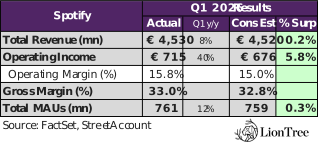
- Total revenue BEAT by +0.2%: Up +8% y/y (+14% FXN) vs +7% y/y in Q4 (+13% FXN in Q4)
- GM expanded +133bp y/y to 33.0%…due to Premium strength and revenue mix
- Premium GM gains were driven by rev growth outpacing music costs net of marketplace programs, audiobooks costs and video podcast costs
- Ad-Supported GM declined y/y driven by higher music and other content costs from elevated engagement, partially offset by podcast contribution
- Op income BEAT by +5.8%: Up +40% y/y, due to higher costs driven by marketing, as well as cloud and AI spend (excluding social changes)
- Operating expense included €39mn in Social Charges
- Op margin BEAT: 15.8% vs 15.0%
- FCF reached €824mn…LTM FCF hit €3.2bn
- MAU slightly BEAT by +0.3%…added +10m in Q1, reaching 761mn total (up +12% y/y vs +11% y/y in Q4), driven by…
- Broad-based regional growth, with outperformance led by RoW and N.Amer due to mobile free tier rollout
…BUT Q2 OpEx Spending Guidance Disappointed The Street & Could Remain Pressured Over “The Next Qtr Or Two”
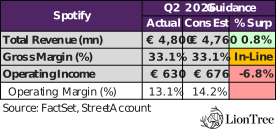
- Q2 revenue guidance BEAT cons by +0.8%: Assumes ~80 bps headwind to growth y/y (vs. ~600 bps in Q1) due to FX rate movements
- But the price hike will be a net benefit in the qtr
- Q2 gross margin guidance IN-LINE: Primarily driven by y/y favorability within the Premium segment
- BUT Q2 op income guidance MISSED cons by -6.8% which was a big focus from analysts
- Incorporates €10mn in Social Charges based on a Q1 close share price of $484.91
- Where is the Co increasing investment? Higher compute and higher sales & marketing of their latest features
- The Co is spending more compute per employee b/c “we’re seeing tremendous return in terms of productivity”
- Are also training on their proprietary data which has an upfront cost
- The Co is further accelerating their ability to ship products during the late fall
- But need to “tell our users about those features” hence the increase in sales & marketing spend (related to the Premium tier)
- The spend should remain around these elevated levels for “the next quarter or two” but mgmt continues to expect both GM and Op Margins to improve y/y in 2026 on a full year basis
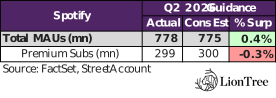
- On users, Q2 total MAU guidance was ~inline w/ cons: Implies +17mn net adds q/q to 778mn
- But Q2 Premium subs guidance MISSED by -0.3%: Implies +6mn net adds to 299mn
- 2026: Mgmt reit’d the expectations for a full year of healthy subscriber growth, weighted more to H2
- Continue to expect meaningful y/y growth in FCF into 2026, reflecting improved profitability and working capital profile “while we are also progressing towards a normalized tax rate in 2027”
Q1 Premium Biz Benefitted From The Jan Price Hike
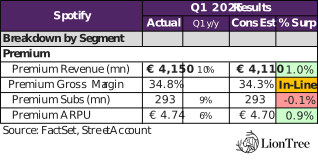
- Q1 Premium revs slightly beat cons by +1% due to higher ARPU: Revs grew +10% y/y or +15% FXN
- Premium subs grew +9% y/y to 293mn…in-line with cons
- Premium ARPU grew +6% y/y to €4.74…AHEAD of cons
- Premium GM of 34.8% was in-line with cons
- Mgmt called out that it has not seen any negative subscriber reaction to the price increases
- Engagement and churn trends remain stable
But The Ad Biz Remains A “Work In Progress” As Monetization Still Lags Engagement
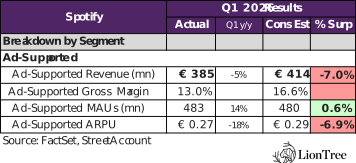
- Q1 ad-supported rev MISSED cons by -7% as ad-supported ARPU was lower than expected: Revs decl’d -5% y/y (but still grew +3% FXN)
- Ad MAUs grew +14% y/y to 483mn…roughly inline w/ cons
- Ad ARPU decl’d -18% y/y to €0.27…missing cons by ~-7%
- Ad-supported GM at 13% was meaningfully below cons 16.6%: Higher engagement drove more music and other CoR that more than offset podcast favorability
- GM fell -102bp y/y
- Ad MAUs grew +14% y/y to 483mn…roughly inline w/ cons
- Very encouraged by the new personalized free tier – “it has blown out expectations”
- It has a short-term negative y/y impact on ad biz GM but mgmt is confident that it can monetize the engagement in the coming qtrs
- Seeing more listening/watching days per month
- Mgmt remains confident in converting free subscribers to paid (this is a key deliverable for investors)
- The ads business remains a “work in progress” but mgmt remains confident in closing the engagement vs monetization gap
- The rebuilt ad stack foundation is now in place
- The new automated sales channel represents over 30% of ad supported rev in Q1
- Active advertisers are rising
- Measurement/performance are improving
- BUT legacy direct sales remains choppy
- “This finally lets us better capture the value of our audience”
- Pressure in the ad business will continue in the “near term” but still expect improved performance in H2 as billable channels continue to scale
- “The gap will close. It’s just a matter of time”
AI Remains A Key Area Of Investor/Analyst Debate But SPOT Continues To Believe They Will Be A Beneficiary
- The Co is now integrating AI across “every part” of the platform, shipping more features faster, lowering cost per feature and building a svs that is more personal
- DJ has now been used by 94mn subs and is driving “billions of hours of engagement”
- SongDNA reached 52mn users in just 4 weeks
- Prompted Playlist is expanding into podcasts
- Taste Profile (now in beta) lets users directly edit/refine how Spotify understands their preferences
- SPOT sees its proprietary data as creating a “fair advantage”
- The Co has ~20 years of listening history and is now collecting a new proprietary data set where users are telling Spotify “in plain English what they want”
- This is a “treasure trove of data”
- Its in-house large personalization model, or “taste model,” is trained on Spotify-specific behavior
- Tastes are “not a fact” (which can be more easily commoditized by LLMs) and change by user, market, and culture
- The Co’s sees its data advantage is durable because culture and user taste move so quickly that even a snapshot of behavior across 700mn+ users would lose much of its value within 2-3 weeks
- “The number one reason for why people actually engage more with Spotify is personalization,” hence their investment here
- The Co has ~20 years of listening history and is now collecting a new proprietary data set where users are telling Spotify “in plain English what they want”
- The Co believes there is a big opportunity to use AI for EXISTING artists and creators, not just for creating new music
- “We don’t think existing artists should be left out of AI”
- If you look at other industries, existing IP is the most valuable IP, not the least valuable, but because of how AI music works right now, that is not addressable. That’s the problem we want to solve”
- (UMG commented on this as well in Theme #6)
A Few Other Interesting Updates & Datapoints
- The Co sees fitness as a natural extension of its platform and biz model…their new dedicated fitness hub and bundled Peloton Premium content will be inside Spotify Premium as an ad-free format (like they did with audiobooks)
- The platform can connect creators with user demand
- ~70% of Premium users already work out monthly and users have created >150mn workout playlists
- After launching Spotify Partner Program (SPP) ~1.5 years ago, the Co noticed that many fitness instructors and creators began uploading videos on their own
- The Co expects this vertical to grow further and gave “tennis” as an example: Spotify could recommend stretching videos, instructional content, or even audiobooks to help users prepare for matches
- The platform can connect creators with user demand
- The Co has paid $11bn+ to rights holders
- Live experiences – the Co took Bad Bunny to Tokyo to perform in Asia for the 1st time…then turned around and broadcast that moment to the world
UMG’s Business Faces A Multitude Of Moving Parts
In addition to Spotify’s results (see Theme #5), Universal Music Group (UMG) also shed some light on key trends in music eco-system but from the label side, and provided an update on some company-specific dynamics. The elephant in the room was the Pershing Square merger combination proposal and mgmt is not commenting until its Board makes a decision, but is also taking concrete actions to address many of the suggestions outlined in the plan, with a new €500mn buyback authorization (on top of the €500mn annc’d in March) being one of them. More transparency on business acquisitions/underlying trends, plus the Co is monetizing ½ of its SPOT shares. Five additional key takeaways and learnings from UMG’s results include: 1) Wholesale price increases from multiple Streaming 2.0 deals contributed +3pts to subscription growth in Q1, with some agreements only partially phased in and a full-qtr benefit coming in Q2+ (and more deals are to come); 2) The advertising business continues to lag though mgmt. expects to see “sustained growth over the mid-term”; 3) The Co expects the share reduction experienced in Q1 to gradually recover as the release slate picks up during the year; 4) Artist & Label Services is viewed as an important growth extension, despite the near term margin dilution from the Downtown acq; and 5) The Co is pursuing “responsible” AI partnerships that support existing artist and monetization of catalog.
Overall, there are a lot of moving parts with UMG at the moment between internal strategic decisions and external sector trends which may take some time to play out.
-> UMG shares ended the day flat post its results and YTD is down -20%, vs Spotify down -24%, and WMG down -8%
No Comments On Pershing Proposal But Mgmt Has Been Implementing Some Of The Suggestions
- Mgmt will provide an update regarding the Pershing Square proposal once the board makes a decision
- But the Co has already made shareholder friendly changes in March and is implanting more changes….
- UMG today incr’d its share buyback authorization to €1bn, up from the previously annc’d €500mn
- The Co has already repurchased just over 1.85mn shares for €36mn through Apr. 24
- The Co is monetizing ½ of its Spotify stake (annc’d in March)
- Artists will share in the proceeds
- UMG’s share of proceeds will initially fund the buyback program
- The Co is holding the other 50% since it has “tremendous faith” in the ecosystem
- UMG will execute that sale over the course of the year
- UMG is giving more details to help investors understand their underlying business and investments
- Breaking out the results of the Downtown acq this qtr and the rest of the year
- Providing a look back at Virgin Music’s contribution to Recorded Music results through 2025
- Providing segment EBITDA this qtr and onwards
- On subsequent earnings calls, the Co will provide greater insight into the ways they have evaluated investments in their business, whether or not they be catalogs or other significant M&A activity
Mgmt Is Leaning Harder Into Artist / Label Services…It’s a Growth Vector BUT Dilutive To Near-Term Margins
- The Downtown acq’s inclusion in results (from the Feb 20th close) weighs on margins: The financial inclusions are below:
- Overall
- Revs: €86mn
- Adj EBITDA: €3mn (implying a ~3.5% margin)
- Recorded Music
- Revs: €72mn
- Adj EBITDA: €4mn
- Publishing
- Revs: €14mn
- Adj EBITDA: -€1mn loss
- Overall
- Mgmt details Virgin Music’s business trajectory as a case study…
- Formed Virgin Music Group in late 2022
- Since 2023, it has grown at +16% CAGR
- Finished 2025 w/ €790mn in rev, which represents 8.4% of total Recorded Music rev (up from 7.2% in 2023)
- While UMG’s Recorded Music margins were level from 2024 to 2025, at 25.6%, Virgin’s expanded by ~4ppt in the rev mix from 7.5% to 8.4%, which offset 20bps of y/y margin expansion in the ex-Virgin Recorded Music margin
- “The next phase of our plan for Virgin is focused on empowering independent players, raising the standard of service even higher, and growing our community of dynamic labels and entrepreneurs”
- “We remain confident in our strategy to grow our artists and label services business alongside our label business in order to increase our touchpoints with the fast-growing independent sector”
Q1 Results Reflect Touch Comps & Big FX Headwind
- Please note it is unclear if the following consensus estimates sourced from FactSet include or exclude the Downtown results, so might not be apples-to-apples
- Revenue MISSED cons by -0.7%: Flat y/y as reported, or grew +8.1% FXN
- Ex-Downtown, rev grew +4.9% FXN
- Growth was driven by initial pricing benefits from Streaming 2.0 agreements, strong physical sales, and healthy sync income
- Highlighted Q1 artist drivers
- New releases from BTS and J-Hope in the US, and Frances Theodora internationally
- UK restructuring led to big hits from Olivia Dean, Sam Fender and Mumford & Sons
- Q2 is off to a “strong start”
- With albums from Noah Kahn and a hit single from Olivia Rodrigo
- Adj EBITDA MISSED cons by -3.8%: Fell -4% y/y but grew +3.9% in FXN, excluding Downtown, adj EBITDA grew 3.4% FXN and adj EBITDA margin declined 0.3pp y/y
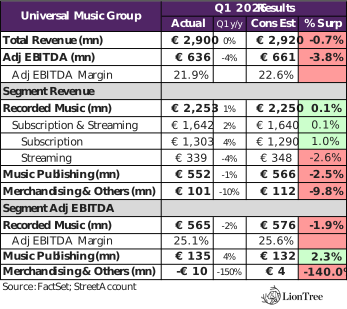
Slight Outperformance In Recorded Music Subscription Revenue Growth Offset Ad-Supported Streaming Drag
- Overall Q1 Recorded Music segment posted In-line to worse results…impacted by tough comps but the core recorded music business ex Downtown grew mid SD FXN
- Rev were ~IN-LINE: Grew +0.5% y/y, or +8.9% FXN (+5.4% FXN ex-Downtown): Strength in subscription, physical, and sync-led licensing more than offset by softer ad-supported trends and tougher live comps in license & other
- Adj EBITDA MISSED by -1.9%: Margin of 25.1% MISSED by -50bps, though ex-Downtown, margins were flat at 25.7% as Streaming 2.0 pricing / operating leverage offset negative repertoire mix
- Q1 Subscription & Streaming rev were INLINE with cons as better subscription strength offset softer ad-supported performance: Segment growth reached +2.3% y/y, or +10.9% FXN, (+6.4% FXN ex-Downtown)
- Subscription revenue BEAT cons by +1%
- Reported basis: Grew +4% y/y vs +2.4% y/y in Q4
- FXN: Grew +12.5% y/y
- FXN ex-Downtown acq: Grew +7.9% y/y
- Streaming revenue MISSED by -2.6%
- Reported: Fell -4% y/y vs +3.2% y/y in Q4
- FXN: +5.0% y/y
- FXN ex-Downtown: +1.2% y/y
- Subscription revenue BEAT cons by +1%
- The Subscription business benefited from price increases partially offset by tougher comps
- Price increases from Streaming 2.0 deals had a 3pts positive impact (see section below)
- A lighter release schedule caused ~2pts of negative impact to subscription growth vs a strong prior-yr comp / stronger competitive release slate, pressuring frontline market share in Q1
- The ads business remains in a “transitional period”…expect improvement in the “mid-term”
- Seeing uneven performance across major platforms, including ad-rate challenges at one audio platform and ongoing disruption at video from the shift toward short-form consumption
- Continue working closely with partners on better monetization of ad-supported engagement
- “Expect to see sustained growth over the mid-term”
Streaming 2.0 Pricing Is Finally Starting To Show Up…And Mgmt Expects The Benefit To Build Through 2026, Along With A Market Share Rebound
- Wholesale price increases from multiple Streaming 2.0 deals contributed +3pts to subscription growth in Q1, with some agreements only partially phased in and a full-quarter benefit is coming in Q2+
- The three annc’d Streaming 2.0 deals only cover a portion of subs / geographies today, with additional deals expected later this year, which should create further pricing benefit in coming qtrs
- 2025 was their strongest year for market share in more than a decade, and they expect the share reduction in Q1 to gradually recoveras the release slate picks up during the year
- Mgmt was adamant that the Q1 mkt share loss was not due to AI pressures but more so due to new release timing
- “Expect to see further growth in subscription” looking ahead
- How do retail pricing actions by streamers in the US transmit to UMG’s streaming revenue in terms of timing and magnitude? Have a “multi-pronged model with respect to the new deals that we’re doing and our established deals”
- Capture revenue both on the basis of an underlying per sub minimum and also with a % of retail
- “So if there’s a price increase above what’s anticipated based on the wholesale, as you know, translated to through by the per subscriber minimum that we would we would participate”
- “We are, generally speaking, doing deals where we look to fairly and comprehensively participate in the value that our artists content brings to our partners platforms”
- “As we do additional deals, we expect to layer in more benefits from pricing over time”
Mixed To Worse Performance In Music Publishing & Merchandising & Other
- Music Publishing results were MIXED…
- Rev MISSED by -2.5%: Decr’d -1% y/y as reported, but grew +7.0% FXN or +4.3% FXN ex-Downtown
- Growth driven by stronger advertising / trailers / motion picture sync, performance growth, and mechanical strength in Japan
- Adj EBITDA BEAT by +2.3%, up +4% y/y, +11.6% FXN or +12.4% FXN ex-Downtown
- Adj EBITDA margin rose to 24.5%, or 25.3% ex-Downtown, on favorable rev mix, partly offset by higher copyright-enforcement legal fees
- Rev MISSED by -2.5%: Decr’d -1% y/y as reported, but grew +7.0% FXN or +4.3% FXN ex-Downtown
- Merchandising & Other MISSED on topline and profitability…
- Rev MISSED by -9.8%: Decr’d -10% y/y, -1.9% FXN or -1.9% FXN ex-Downtown
- Growth driven by lower DTC due to release timing and weaker retail sales, partly offset by strong touring income
- Adj EBITDA MISSED by -140%: Decr’d -150% y/y, -233% FXN or -233% FXN ex-Downtown
- Due to seasonally lower revenue against fixed overhead, unfavorable revenue mix with proportionally higher touring revenues and higher marketing spend, largely due to timing
- Rev MISSED by -9.8%: Decr’d -10% y/y, -1.9% FXN or -1.9% FXN ex-Downtown
UMG’s AI Focus Is Centered Around Creating New Products And Experiences From Their Existing Catalog Vs. Replacing Artistry
- “Applying AI to preserve, restore and unlock the value of UMG’s vast archives and library. We hold one of the world’s most important music archives”
- The new partnership w/ Nvidia is “exactly the kind of responsible AI partnership we believe in protecting the artists, preserving culture, and creating new value from the amazing assets already within the organization”
- It will create a deeper understanding of the music, video and related materials stored across their vaults across a plethora of formats dating back to the early 20th century
- Accelerates high quality restoration, digitization, and discovery at a scale that would simply not be possible through traditional methods alone
- Emphasized that the partnership is NOT meant to replace artistry or expertise but rather to help protect, understand and responsibly activate their catalogs
- I.e., Uncover recordings and videos that had never been commercially released
- “Over time, we believe this work can preserve irreplaceable assets”
- …while relationship w/ existing DSP partners (like Spotify) is about helping existing artists leverage AI for use cases that will also drive consumer engagement
- Artists want products that allow remixing, mashups, and custom songs that enable hyper personalization and co-creation experience with existing IP, which UMG’s research has found has much more support vs generic AI output
- Consumers want AI that makes music svs work better (i.e., better discovery, better personalization) + gives them a deeper relationship with the artists
- This is directed at the SuperFan opportunity
Verizon’s Early Progress With Its Turnaround Strategy
It has been a volatile earnings season for the major Connectivity companies, with diverging reactions across AT&T, Comcast and Charter last week, but Verizon and even more so T-Mobile were on the positive side of the stock performance ledger this week, especially the latter. First focusing on Verizon, the Co surprised on the upside with better-than-expected profitability performance, offsetting slightly lower than anticipated top-line growth (though the Jan service outage was a 1x drag).
The top 5 most important incrementals in our view from Verizon’s results include: 1) Not only were Q1 postpaid phone net adds much better than expected and mgmt raised its full-yr outlook, but the quality and economics of those subs improved; 2) The Mobility & Broadband service revenue growth rate y/y will accelerate post Q1; 3) The Co expects to remain aggressive in broadband, though prioritizing fiber over FWA where they have coverage; 4) Mgmt thinks the competitive intensity is coming down but “will defend itself” if it needs to; and 5) Verizon has seen some impressive tangible gains from its early AI implementations;
All in all, new CEO Dan Schulman has been in place for ~7 months and has driven some quick wins.
See below for more details.
-> Verizon shares rose +1.6% on the back of results and is leading the Big 3 telcos YTD (Verizon +18.1%, AT&T +5.2%, and TMUS -3.4%); Shares of cable Co Charter also traded down -3.1% in reaction to Verizon’s earnings as well
-> See Theme #8 for our thoughts on T-Mobile USA’s results as well
Verizon’s Weaker Q1 Top-Line Was More Than Offset By Stronger Profitability Momentum
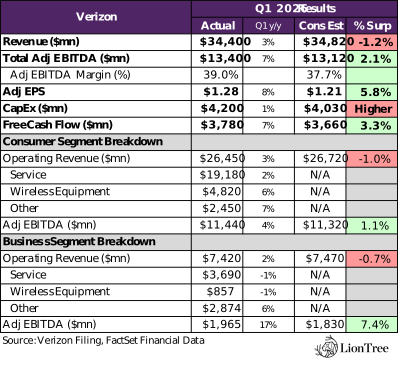
- Total revs MISSED cons by -1.2%: Up +2.9% y/y
- BUT results also included an 80bp impact to wireless svs rev growth due to the Jan. network outage which is one-off
- Adj EBITDA BEAT by +2.1%: Up +6.7% y/y…the highest ever reported adj EBITDA performance
- Margins expanded +140bp y/y to 39.0% (vs cons 37.7%)
- Savings were driven by advertising efficiencies, network cost reductions, third party spend savings, and workforce actions
- By segment – Consumer & Biz rev both fell short of the Street while adj EBITDA beat
- Consumer revs MISSED by -1.0%; Adj EBITDA BEAT by +1.1%
- Biz revs MISSED by -0.7%; Adj EBITDA BEAT by +7.4%
- Adj EPS BEAT by +5.8%: $1.28 vs $1.21 grew +7.6% y/y
- Highest adj EPS growth rate in over 4 YRS
- FCF BEAT by +3.3%: $3.8bn (+4% y/y) despite higher capx
- Driven by better customer experience and operating efficiency
The Co Positively Raised Its 2026 Adj EPS & Net Add Outlook
- Raised 2026 adj EPS guidance to +5-6% y/y ($4.95-4.99) from previous +4-5%
- “The data supports a higher level of confidence”
- But the revised guidance continues to reflect a “prudent view” of competitive dynamics & the macro political and economic environment
- Raised the 2026 total retail postpaid phone net additions guidance to be in “the top half” of the 750k-1.0mn range (see more below)
- Expect 2026 adj EBITDA to grow at a faster rate than adj EPS (factoring in both the frontier acq interest expense of ~$1bn and also the depreciation from the asset base of ~$1.5bn)
- “On track” for $5bn of opex savings in 2026
- Also expect more than $1bn of run-rate operating cost synergies by 2028 from Frontier
- Addtl opppties exist in IT rationalization, real estate, and network simplification
- The Co also aims to drive incremental margin by “eliminating, sunsetting or creating structures to dramatically reduce our exposure to non-core assets”
- Will share more details “shortly”
- Maintained the following 2026 Guidance…
- Mobility & broadband svs rev growth guidance of +2-3% (Q1 will be the low point)
- Wireless service revenue growth will be approximately flat in 2026
- FCF of $21.5bn+ (~+7% y/y)
- Will mark the highest FCF generated since 2020
- CapEx of $16–16.5bn
- Buyback of $3bn (despite buying back $2.5bn in Q1- could there be upside?)
- Mobility & broadband svs rev growth guidance of +2-3% (Q1 will be the low point)
- “Firmly on track” to achieve the net unsecured leverage ratio target of 2-2.25x during the 2027 time-frame
While Revenue Growth Was Constrained Near-Term, Growth Is Set To Accelerate As Quality Mix + Promo Amortization Headwinds Roll-Off
- Q1 mobility & bband service revs of +1.6% y/y will be the “low point of 2026”
- Q1 had an ~80 bps headwind from outage-related customer credits
- W-less service revs were ~1% y/y
- Also continue to absorb elevated promo amortization pressure and lapping prior pricing actions (~180 bps) implemented in the prior year
- “The less we spend on promotions, the lower our amortization headwinds enabling a step function change in our future revenue growth”
- Seeing strong adoption with perks, growth in premium base, and prepaid
- Q1 had an ~80 bps headwind from outage-related customer credits
- “Highly confident” in the +2-3% mobility & bband service revs growth guidance for the year
- “Expect to have an even stronger and more sustainable revenue profile by the end of 2026”
The Wireless KPIs Showed Strong Y/Y Improvement, Though The Street Was Expecting More W/ Some Metrics
- The big highlight was that postpaid phone net adds of +55k was much better than the cons -87k decline projection… postpaid phone adds were positive for the first time ever Q1 since 2013
- Growth was driven by improved retention and higher mix of new-to-Verizon gross adds
- The Co posted improvement in both consumer and business
- The Co is making an explicit shift away from reliance on free handset promotions and aggressive subsidies
- Outlook comment – they have “cont’d momentum” into Q2
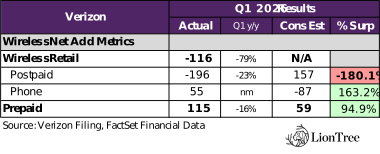
- As such the Co is now guiding for 2026 total retail postpaid phone net additions in “the top half” of the 750k-1.0mn range
- Mgmt highlighted that “at least half if not more” of net adds going forward will come from churn improvement
- Focus is on shifting from “line growth only” to account growth and ARPA expansion
- “No longer giving away lines for free”
- Mgmt still expects postpaid phone net adds to be 10-15% net new
- In addition to higher volumes, the Co is improving the quality, economics & lifetime value of subscribers: The improvements in costs of acq and retention are “structural changes” and not seasonal changes
- Lowered churn…postpaid phone churn fell -5bp seq to 0.97% (though the Street was expecting 0.95%)
- Consumer postpaid phone churn fell -5bps seq to 0.90% and it “improved” throughout the qtr…in March it was below 85bp
- “Stopped improving blunt price increase without net new value”
- Cost of acquisition and retention in March was down ~35% relative to the end of Q4
- “Expect to maintain a lower cost of acq & retention as we look forward”
- “We accomplished these meaningful cost reductions while still delivering increasingly positive postpaid phone net adds versus a year ago. In other words, we are no longer predominantly reliant on expensive promotions to drive our growth”
- The lifetime value for consumers “is increasing” due to better churn and customer economics
- Lowered churn…postpaid phone churn fell -5bp seq to 0.97% (though the Street was expecting 0.95%)
- Postpaid ARPA missed expectations ($166.66 vs cons $169.66), but the majority of the ARPA decline in Q1 came from the network outage
- Positive longer-term outlook…mgmt expects account net adds & ARPA to “continue improve in 2026 and 2027”… exited the qtr with momentum
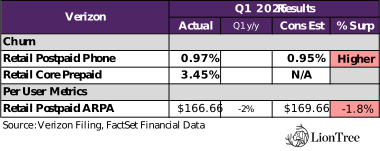
- The upgrade rate of growth has “slowed” the last couple of months and into Q2 (absorbed a ~6% higher upgrade volumes y/y in Q1)
- Micro segmentation of the subscriber base is an important new initiative
- “Really listen to what a customer wants and not just give them a free handset for everything”
- On competition…mgmt thinks the competitive intensity is coming down but “will defend itself” if it needs to
- “We think right now that the competitive intensity in the industry is moderating”
- “BUT…we have a substantial war chest…and we will defend our base whenever we see any competitive activity on that”
- “We are leaning into converged value mobility plus broadband, a simplified customer experience and features that matter to customers rather than chasing every promotion in the market”
Overall Broadband Adds Slightly Missed Wall Street But Should “See An Improvement” Throughout The Year & Expect To See A Greater Mix Towards Fiber
- Total broadband net adds of +341k missed cons by -1.4% (reached 8mn bband subs in total) …with fiber adds stronger & FWA weaker
- FWA net adds: +214k vs cons +288k, though up +182% y/y
- Wireline bband net adds: +127k vs cons +58k, though down -32% y/y
- Note that bband doesn’t include a full qtr of Frontier (excluded 20 days)
- The Co is expanding the bband footprint “aggressively”…on track for more than 32mn fiber passings by the end of this year
- Frontier integration is on track
- Also closed the Stary transaction, which will help drive further bband growth opportunities in multi-dwelling units within urban area
- Are looking for more bband partnerships
- “In Q1, we cont’d to take broadband share…and we have absolutely no intention to slow down”
- But expect a mix shift from FWA and fiber where they have coverage due to the better economics
- But sounds like the Co is still sticking w/ their 8-9mn FWA subs by 2028… “you shouldn’t really adjust any of your thoughts around that
- “We’re going to drive quite aggressively on the broadband front…There may be more of a shift to fiber than FWA…We’ve had a lot of progress on FWA over the years, and we’ll continue to drive it”
- But expect a mix shift from FWA and fiber where they have coverage due to the better economics
- The attachment rate of wireless when a customer has broadband “I think is best in the industry at 55%…expect that you’ll see improvement in our broadband numbers as we go through the year”
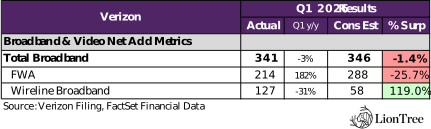
Verizon Has Realized Some Impressive Tangible Benefits from AI & Sees A Multi-Billion Opportunity
- The Co wants to be positioned as a “AI native company” (vs AI-first) …the 3 areas where AI will be used to the “fullest”
- Operational efficiency (taking out costs, improving productivity, delivering more value to customers)
- Improvements in customer satisfaction
- Fully ingesting AI capabilities into their value proposition
- Tangible benefits, or expected benefits, from LLM implementations include:
- A 1,280bp improvement in Customer satisfaction scores y/y
- Opportunities to do an increase in software delivery by 40%+
- Reduce software vendor costs by over 70%
- 85% of all their network issues right now are autonomously resolved (before customers see any issues)
- Network bill-of-material complexity has declined from more than 1mn combinations to roughly 20 kits w/ AI
- The Co has already delivered more than $200mn of energy savings by using AI to optimize the network
- Commercially, they are in “quite deep discussions” with hyperscalers, alternative cloud providers, and large enterprises to integrate their fiber, both dark and lit, and their 5G assets to support their AI infrastructure, efforts (includes data center connectivity)
- Mgmt sees a potential for “multi-billions” in revenues and will have more specifics on that in the next 3-6 months
T-Mobile’s Growth Vectors Remain In Place
After a choppy Connectivity earnings season, T-Mobile closed out earnings for the sub-sector on the most positive note regarding stock reactions in the group. The Co delivered a solid Q1 and modestly raised the full year guidance for postpaid net accounts, core adj EBITDA, adj FCF, and the buyback authorization. While subscriber KPIs are now more limited, the stats show that the Co continues to gain share in postpaid wireless across both urban and underpenetrated rural market (has only 24% penetration) and they added “over 500k” broadband subscribers, with growth in 5G bband accelerating y/y in Q1. Our top 5 additional learnings from TMUS’s results include: 1) Wireless competitive intensity has recently eased (as others have been saying as well)…postpaid churn improved in March; 2) Mgmt remains confident in double-digit IRRs in its fiber partnerships (which has been questioned by analysts); 3) The Co is firmly committed to its FWA targets and see a very visible path; 4) While the 2026 ARPA growth of 2.5-3% was reiterated, Q2’s growth will be slower; and 5) Integration and cost synergies are progressing largely as expected w/ still upside potential.
All in all, results and the outlook were a net positive. See below for more of our thoughts on what was most important from T-Mobiles results (including comments on M&A, satellite, AI, and more).
-> TMUS shares rallied +4.9% in reaction to results which has helped it narrow the underperformance of the shares YTD vs its telco peers (Verizon is up +18.1% YTD, AT&T is up +5.2%, and TMUS is still down -3.4%)
-> See Theme #7 for our thoughts on Verizon’s results as well
TMUS Delivers A Solid Q1 Vs The Street
- Revenue BEAT by +0.6%: Up +11% y/y (vs +11% y/y in Q4)
- Total service revenues was IN-LINE while equip revs beat by +1.4%
- Core adj EBITDA BEAT by +2.1% (+12% y/y) and margins were slightly ahead (40% vs cons 39.4%)
- EPS of $2.27 BEAT cons $2.01
- FCF BEAT by 6.7% despite higher CapEx by $290mn
- Shareholder returns = $6bn (div and $4.9bn buyback)
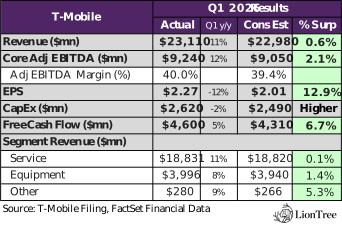
The Co Modestly Raised Guidance For Postpaid Net Accounts, Core Adj EBITDA, Adj FCF & The Buyback Authorization
- Raised 2026 guidance for…
- Postpaid net account adds raised +50k at the mid pt to 950k – 1.05mn
- Core adj EBITDA raised +$50mn at the low end / midpoint increase (+~10% y/y)
- Raised to $37.1bn – $37.5bn
- From $37.0bn – $37.5bn
- Adj FCF raised +$50mn increase at midpoint to $18.1bn – $18.7bn
- Buyback authorization raised by $3.6bn to $18.2bn
- Maintained 2026 guidance for…
- Service revenue growth of 8% y/y (and guided for +9% y/y in Q2 – NEW)
- ARPA growth of 5-3% (though Q2 will be a slower pace)
- CapEx ~$10.0bn
- Effective tax rate 25% – 26% (unchanged)
- Service revenue growth of 8% y/y (and guided for +9% y/y in Q2 – NEW)
Mgmt Still Sees Ample Room To Grow Wireless Penetration & FY ARPA Growth Is On Track, Though Q2 Will Be Slower
- Q1 service revs grew +11% y/y & postpaid service revs grew +15% y/y, driven by:
- Higher avg postpaid accounts incl. UScellular / Metronet / Lumos
- Higher postpaid ARPA
- Partially offset by higher account deactivations due to higher industry switching & a larger base
- Q1 postpaid net account adds were +217k while postpaid account churn was 1.04% (+11% y/y)
- The Co is growing share in postpaid HHs “in each of our cohorts in the top 100 cities and smaller markets and rural areas where we have only 24% share of households”
- The Co is accelerating & capturing more switching share with word of mouth driving strong momentum
- The low share in T-Mobile for business also continues to “give us a substantial growth runway”
- Q1 postpaid ARPA of $151.9 BEAT cons by +1.2%: Grew +3.9% y/y, driven by…
- Y/Y impact from rate plan optimizations in Q2 last year
- Increasing lines per account (across all product categories)
- Over 60% of new account lines are on premium tier rate plans w/ value add service attached
- Also, the Co has an advantage given their backbook pricing is lower than current pricing
- ARPA outlook…while 2026 ARPA growth is maintained at 2.5-3%, Q2 ARPA will be “closer to near 2% y/y” b/c of the rate optimization plans impact and the dilutive effect of US Cellular and Metronet and Lumos which impact Q2 this year and not last year
- Then will see acceleration for H2
- “The underlying organic growth of ARPA is even stronger than that 2.5-3%”
- Q1 postpaid account churn incr’d +10bp y/y to 1.04%… underlying PP phone churn was up +3pbs…but line churn got better in March (as it does seasonally anyway)
- This is the 1st time they are reporting this metric
- Why is account churn higher and gone up more line churn? “It’s pure math”
- New customers and bband only customers are higher churning grps than the avg
- The weighting of these customers in accounts is higher than the weighting in lines
- Lines per account with newer customers tends to be less so than the avg
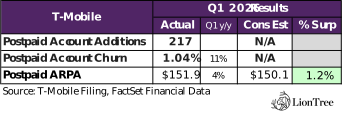
- Competition cooled down later in Q1
- “January was particularly competitive and particularly heavy in one-dimensional competition based on subsidies”
- “I think Feb and March and going into April, we’ve seen some cooling down of that environment
- The 20mn+ families and business that are not with TMUS and = a huge oppty
Mgmt Is Committed To FWA Targets & Are Confident In The IRRs Of Fiber Deals, Which Was A Focus
- “Fastest growing ISP in America”
- Added over 500k+ total bband adds (vs +558k in Q4) and 5G broadband net add growth accelerated y/y
- Mgmt is still very confident in the FWA target of 15mn customers by 2030 (and previously guided for 3-4mn fiber subs by 2030 as well)
- All leading indicators w/ capacity & NPS continues to go up
- The avg speeds keep going up
- They have done all this while increasing customers by 80%
- “Have a very detailed plan for the next 4-5 yrs in terms of the capacity of the business and beyond that time frame, to make sure that this is completely sustainable, long, long term”
- Mgmt is “very, very confident on the runway”
- Fiber is “tracking great” and mgmt is confident in the economics (which is an analyst concern/focus area)
- Their fiber JVs are well on track and delivering what they expected
- Very confident of DD IRRs on the new annc’d JVs
- They “are not chasing a homes passed number”, they want to build local scale
- See “equity value creation” for fiber vs “the myth of convergence”
- Their fiber JVs are well on track and delivering what they expected
-> TMUS agreed to form two strategic fiber JVs, consisting of a 50/50 partnership w/ Oak Hill Capital to acquire and combine GoNetspeed and Greenlight Networks, and a separate 50/50 JV w/ Wren House to acquire i3 Broadband; The Oak Hill platform is expected to pass over 1.3mn HHs by the end of 2026, while the i3 one is seen at 500k; TMUS is expected to pay a combined $2.7bn for the JV interests.
- The Co’s new “SuperBroadband” service w/ Starlink expands the business internet opportunity
- It is a bband product and not a direct to cell product and it is only B2B
- The product integrates 5G, FWA for Business, and satellite
- Gives redundancy, coverage, and businesses just need one contract
TMUS Is On Track Regarding Cost Synergies & US Cellular Overall Integreation Should Be Done By YE
- The Co is progressing against the $2.7bn cost synergies target exiting 2027: “It is going really well”
- The source of synergies:
- Customer care
- Retail
- Back-office efficiencies from AI and transformation
- Cadence:
- Most of that will come towards the latter part of 2026
- And then fully into 2027 and beyond
- There is “a lot more runway and opportunity than $2.7bn” so there is “runway” into 2028
- The source of synergies:
- US Cellular overall integration efforts should be wrapped up by this year: Will leave TMUS with a stronger position in smaller and rural markets where they have only a 24% share
- The network-oriented migration is behind them
- Now handling the customer migration but it is a relatively small based of 4mn or so customer
- All of this is “going extremely well”
A Few Other Key Updates / Comments
- Mgmt would not comment on the press reports that they are considering a merger but did say…
- “There [is not] anything to talk about anyway”
- “Hypothetically, if someone were to ever consider such a transaction reported in the article, that would specifically require a separate approval process by disinterested shareholders, what many of you refer to as majority of the minority”
- The Co’s NPS score hit 45 which mgmt says is 20% higher than next closest competitor
- Satellite will become a “standard complementary feature”
- The partnership with SpaceX is “strong” and they are putting an end to dead zones
- Most of the use they are seeing is national parks
- TMUS is seeing a lot less usage than they were originally thinking
- “It’s a great complementary product” and “will become a standard complementary feature”
- Regarding broader cable M&A? Mgmt doesn’t sound interested: “We’re not going to go, go do scale for scale sake. Specifically, cable is not something we’re interested in. We see our strength as attacking incumbents rather than becoming an incumbent. We see a huge opportunity to attack incumbents across fiber and FWA. That’ll be our key play”
- Rolling out their live translation “soon”: Post the beta in Feb
- Bullish on physical AI creating opportunity for TMUS…annc’d Figure AI partnership
- “The network is the connective tissue for physical AI and accommodates inferencing at the edge”
- Annc’d that they are connecting their 5G advanced network to Figure AI’s F3 humanoid robots
- T-Life continues to scale as a core engagement platform (~25mn MAUs engaging w/the app multile times per month), enabling deeper customer relationships and cross-sell opportunities
- T-Life will also serve as the unified platform to support growth into considered adjacencies like financial services and advertising
MSFT’s Combo Of Decelerating FQ4 Top Line Growth Y/Y + Higher CapEx Underwhelmed
Microsoft delivered a strong FQ3, with revenue growing +18% y/y to $82.9bn, beating across the board and driven by an AI business that surpassed $37bn ARR, up +123% y/y. Azure re-accelerated ahead of expectations, and M365 Copilot posted its strongest growth since launch with paid seats now exceeding 20mn.
Turning to the outlook, FQ4 revenue growth guidance reflects a y/y deceleration vs FQ3 and capx was revised up (spend is expected to exceed $40bn, up from $31.9bn in FQ3) and CY26 CapEx is guided to reach ~$190bn, up +61% y/y. Mgmt’s message on the investment was largely consistent with prior quarters, highlighting that demand is strong, supply remains the constraint, and the spend is necessary to capture the opportunity ahead.
The call also included some commentary on the OpenAI partnership restructuring, with mgmt feeling “very good” about where things landed, framing it as a natural evolution of the relationship as both companies have grown and customer demand for model diversity has increased. Worth noting is the continued outsized impact the relationship has on reported financial metrics, with Commercial RPO growing nearly +100% y/y including OpenAI but only +26% y/y excluding it.
See below for what we viewed as the most incremental takeaways from the call.
-> MSFT shares closed down -4% in reaction and is down -14.4% YTD (vs up +13% in 2025)
Microsoft Posted Solid FQ3 Headline #s
- Total revs BEAT by +1.9% and grew +18% y/y (+15% FXN), vs FQ2 +17% y/y (+15% FXN)
- PBO rev BEAT by +1.7% and grew +17% y/y (+13% FXN)
- Intelligent Cloud rev BEAT by +1.2% and grew +30% y/y (+28% FXN)
- Azure rev growth FXN rose +40.0% y/y vs cons +39.3% y/y
- MPC rev BEAT by +3.6% and fell -1% y/y (-3% FXN)
- Microsoft Cloud gross margins decreased due to AI infrastructure investment (similar to last qtr)
- Microsoft Cloud rev of $54.5bn, up +29% (up +25% FXN), vs +26% y/y in FQ2:26
- Microsoft Cloud gross margin decreased y/y to 66% due to continued investments in AI, partially offset by the ongoing efficiency gains
- Gross margins beat (yet again) at 67.6% vs cons 67.1%
- Was down y/y, driven by continued investment in AI infrastructure and growing AI product usage
- Op margins were +100bp ahead
- Adj EPS beat by +5% (+21% y/y, +18% FXN vs FQ2 +24% y/y, +21% FXN)
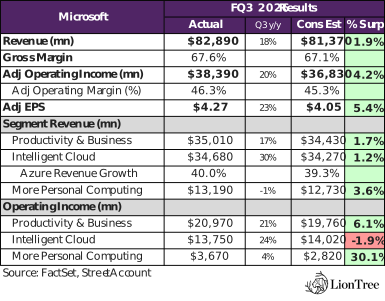
Guidance Reflects Decelerating Top-Line Growth in FQ4 But A Material Y/Y Increase in CapEx In 2026
- For FQ4… total REV at the midpt was slightly BELOW cons, and reflects +13-15% y/y growth (a decel from the +18% y/y in FQ3)
- Productivity & Biz processes rev guidance BEAT
- Intelligent Cloud rev guidance BEAT
- Personal Computing rev guidance MISSED
- For FQ4…expects CAPEX spend to increase to >$40bn (up from $31.9bn in FQ3) as they continue to bring more capacity online
- Seq increase includes ~$5bn from higher component pricing as well as the impact from finance leases
- Expect the mix of short-lived assets to remain similar to FQ3
- For CY26…guided for CAPEX spend of ~$190bn (+61% y/y vs 2025)
- Includes ~$25bn from the impact of higher component pricing
- For FY27…expect another yr of double-digit REV and OP INCOME growth; Also expect OPEX growth in the mid to high-single digits, reflecting ongoing investments in R&D, inclusive of AI investment in compute, data, and talent to accelerate product innovation
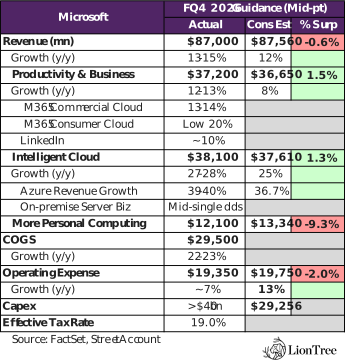
Azure Growth Is Reaccelerating As They Continue To Build Out Capacity, Though Supply Constraints To Persist Through At Least 2026
- FQ4 Azure rev growth expected to be b/w +39-40% CC (vs +39% y/y CC in FQ3 and above cons +37.0%)
- Added an additional +1 gigawatt of capacity in FQ3 and remain on track to double their overall footprint in just two yrs
- Expect to remain supply constrained “at least” through 2026, despite addtl investments and continued efforts to bring GPU, CPU, and storage capacity online faster
- Looking into CY26… expect Azure growth to show “modest” acceleration in H2:CY26 vs H1:CY26
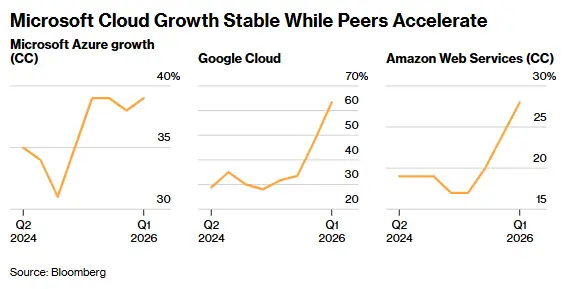
Source: Bloomberg
Despite Partnership Restructuring, OpenAI Relationship Remains a Significant Financial and Strategic Factor
- FQ3 Commercial remaining performance obligation (RPO) of $627bn incr’d +99% y/y (vs +110% y/y in FQ2:26) with a weighted average duration of ~2.5 years when including OpenAI (in-line w/ FQ2)
- ~25% will be recognized in rev in the next 12 months, up +39% y/y
- The remaining portion, recognized beyond the next 12 months, is up +138% y/y
- Note that when EXLUDING OpenAI, Commercial RPO grew +26% y/y, in-line w/ historic seasonality
- On restructured OpenAI partnership… secured royalty-free access to OpenAI’s frontier models w/ full IP rights through 2032, which mgmt noted they “fully plan to exploit”, w/ the elimination of MSFT’s rev share payments to OpenAI being part of the new construct
- OpenAI remains a “large” MSFT customer, spanning both AI accelerator and broader compute infrastructure
- MSFT will also continue to receive rev share from OpenAI through 2030, the predictability of which is “a real positive”
- Feel “very good” about where things landed: Was a natural evolution of the partnership as both Cos have grown + customer demand for model diversity has increased (“We offer the broadest selection of models of any hyperscaler…[and] over 10,000 customers have used more than one model”)
Record CoPilot Uptake Was A Positive Surprise
- It was a record qtr for Microsoft 365 Copilot seat adds, which was a continued acceleration q/q and increased +250% y/y, representing their fastest growth since launch
- Now have 20mn+ Microsoft 365 Copilot paid seats
- # of customers w/ 50,000+ seats quadrupled y/y
- Accenture now has 740k+, their largest Copilot win to-date
- Bayer, Johnson & Johnson, Mercedes, and Roche all committed to 90k or more seats
- Seeing record usage intensity across Copilot…weekly engagement is now at the same level as Outlook
- Have seen a surge in usage of their first-party agents, with monthly active usage up 6x YTD
- Copilot queries per user were up nearly +20% q/q
Addtl Quick Comments On Headcount + Shift To “User + Usage” Pricing Model
- Expect headcount to decrease y/y as they continue to evolve how they operate to increase “pace and agility”
- More broadly across the portfolio…transitioning from pure seat-based to a “user + usage” construct: Any per-user biz is expected to become a per-user and usage biz over time
- Seats are essentially bundled consumption packs, with usage above that base level billed as pure consumption overages; Customers making longer-term consumption commitments would receive volume discounting
- Shift is most visible today in customer service, where nearly 60% of service customers are already purchasing usage-based credits, and in coding, where MSFT announced a move to usage-based pricing for GitHub Copilot this qtr
- As the model evolves, bookings metrics may become a less complete picture of demand, since consumption-based revenue is billed as it’s used rather than committed upfront like traditional seat licenses
Apple Beats Across the Board But Memory Costs & Supply Constraints Will Be Key Watchpoints Ahead
Somewhat unsurprisingly, a record-setting March qtr headlined Apple’s FQ2 results, with rev surging +17% y/y to $111.2bn, powered by the iPhone 17 family and the newly launched iPhone 17e, now the “most popular” iPhone lineup in Apple’s history. Despite supply constraints on advanced node SoCs weighing on both iPhone and Mac, the Co still managed to beat across every major segment. Looking ahead, FQ3 guidance of +14-17% y/y rev growth came in well above expectations of +9.3%, though margins will face a headwind from “significantly higher” memory costs in the June qtr, a pressure that will have an “increasing impact” on the biz and one mgmt is evaluating “a range of options” to manage. Gross margin guidance of 47.5-48.5% came in slightly below cons at the midpt as a result.
On AI, Apple Intelligence continued to be framed as being deeply embedded across the platform rather than a standalone feature, with R&D investment ramping “rather significantly” y/y to support it. Apple CEO Tim Cook also spoke to the September 1st CEO transition to John Ternus, framing the timing as the “right moment” given strong business momentum and an “incredible” product roadmap ahead.
See below for what we viewed as the most incremental takeaways from the call.
-> Apple traded up +3.3% post its report and ended the week up +3.4%; YTD, the stock is up +3.1%
Kicked Off With Leadership Chg Commentary… “This Moment For The Transition Is The Right One”
- Current Apple CEO Tim Cook will become Executive Chairman on Sept. 1, while John Ternus will step into the CEO role
- Why is this moment the “right one” for the transition? Per current CEO Tim Cook…
- Biz has been performing “extremely well” (called out H1:26 has been “very strong”, growing double-digits y/y)
- Roadmap is “incredible”
- Most importantly… “we have the right leader ready to step into the role”: “There is no one on this planet I trust more to lead Apple into the future than John Ternus. John is a brilliant engineer, a deep thinker, a person of remarkable character, and a born leader. I know he will push us to go further than we think is possible in order to deliver the greatest products and services for our users”
- Incoming CEO John Ternus also shared a few words…
- “One of the hallmarks of Tim’s tenure has been a deep thoughtfulness, deliberateness and discipline when it comes to the financial decision-making of the company…it’s something Kevan and I intend to continue when I transition into the role in September”
- “This is the most exciting time in my 25-year career at Apple to be building products and services. There are so many opportunities before us, and I couldn’t be more optimistic about what’s to come”
FQ2 Was A March Qtr Record, With Broad-Based Strength Offsetting Supply Constraints
- Overall rev BEAT by +1.6%: Up +17% y/y
- Supply constraints weighed on rev growth: Impacted the iPhone the most followed Macs; Ex the FX benefit and ex the supply constraints headwind, underlying revenue growth would have been higher
- Product rev BEAT by +1.5%: Rose +17% y/y (accel from +16% y/y in FQ1), driven by double-digit growth in iPhone, setting a March qtr record
- iPhone BEAT by +0.6%: Up +22% y/y (decel from +23% y/y in FQ2)
- Achieved a March qtr record, driven by the iPhone 17 family and the launch of iPhone 17e (lineup is now the “most popular” in Apple’s history through the March qtr)
- Mac BEAT by +2.9%: Up +6% y/y (accel from -7% y/y in FQ1), driven by the strength of the recent product launches, including MacBook Neo
- iPad BEAT by +3.0%: Up +8% y/y (accel from +6% y/y in FQ1), driven by cont’d strength in the A16-powered iPad and M5-powered iPad Pro
- Wearables, Home and Accessories BEAT by +1.3%: Up +5% y/y (accel from -2% y/y in FQ1), driven by strength in wearables and accessories
- iPhone BEAT by +0.6%: Up +22% y/y (decel from +23% y/y in FQ2)
- Svs rev BEAT by +2.1%: Reached a new all-time rev record and rose +16% y/y (accel from +14% y/y in FQ1)
- Set all-time records in both developed and emerging mkts
- Also set all-time records across most services categories
- Both transacting and paid accounts also reached new all-time highs in the qtr
- Gross margin of 49.3% BEAT cons 48.4% and was up +110bp seq (vs 48.2% in FQ1), driven by favorable mix, lower tariff-related costs, and was partly offset by seasonal deleverage and higher memory costs; Did NOT see any seq FX related impact as a factor going from FQ1 to FQ2 gross margin
- Products gross margin of 38.7% BEAT cons 37.0%, down -200bp seq, driven by seasonal loss of leverage and higher memory costs
- Services gross margin of 76.7% BEAT cons 76.4%, up +20bp seq, primarily driven by mix
- Tariff-related impact on gross margins?
- Tariffs in FQ2 vs FQ1 were lower seq b/c of lower product volume + full qtr benefit from reduction in the IEEPA tariff rates + reduced global tariff rate under Section 122
- Following the established processes refund applications for tariffs paid and plan to reinvest any amount received back into “US innovation and advanced manufacturing” …these would new investments and would be in addition to prior commitments in the US
- Op margin of 32.3% BEAT cons 31.8%
- Adj EPS BEAT by +3.1%: Set a March qtr record of $2.01 vs cons of $1.95
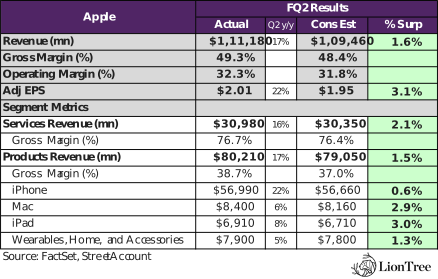
FQ3 Guidance Implies Another Double-Digit Growth Qtr, BUT Memory Costs And Constrained Supply Will Be Headwinds
- Expect FQ3 total Co rev to grow +14-17% y/y, which was ABOVE expectations of +9.3% y/y
- Includes the Co’s “best view” of constrained supply
- Also on iPad specifically, they face difficult compare, driven by the launch of the A16-powered iPad in the prior yr
- FQ3 Svs rev is expected to grow at a y/y rate similar to FQ2, after removing the favorable y/y impact from FX tailwinds
- FQ3 gross margin guidance of 47.5-48.5% was BELOW cons 48.4% at the midpt and would be down seq from 49.3% in FQ2
- Key point on memory costs weighing on margins…
- Dec qtr saw “minimal” impact due to memory
- March qtr saw memory costs that were “a bit more” higher and were partially offset by benefits from carry-on inventory
- June qtr is expected to see “significantly higher” memory costs, partially offset by the benefit of carry-on inventory
- Did not provide formal guidance beyond June qtr but believe memory costs will have an “increasing impact” on their biz, for which they will evaluate “a range of options”
- Key point on memory costs weighing on margins…
- FQ3 OpEx guide of $18.8-19.1bn was AHEAD of cons $18.55bn
- FQ3 OI&E is expected to be ~$250mn, excl. any MTM impact from minority investments
- FQ3 tax rate is expected to be ~17%
- A quick update on capital allocation strategy… will no longer provide net cash neutral as a formal target and will instead evaluate cash and debt independently
- Why the change?
- Believe that the Co is at a stage where evaluating cash and debt independently is the right approach
- Allows them to make more optimal economic decisions around how they best utilize their debt and cash portfolios to support the biz based on business factors and market conditions
- Also believe they can manage this flexibility while also being very efficient and remaining disciplined
- Emphasized that they remain “very committed” to returning excess cash to shareholders
- On that note…also authorized an addtl $100bn for share repurchases and + raised our dividend by +4% to $0.27/shr of common stock
- Why the change?
China And India Continue To Be Major Share Gain Opportunities
- Geographic callouts –
- Set March qtr rev records and grew double digits in every geographic segment
- Also achieved March qtr rev records in both developed and emerging mkts, and saw double-digit growth in nearly every emerging market they track
- Greater China revenue grew +28% y/y in FQ2 (vs +38% y/y in FQ1), a March qtr record, and +33% in H1:26
- Performance was driven by iPhone, which was the top-selling model in urban China and also set a March qtr record
- Also, Mac Mini was the top-selling desktop and MacBook Air was the top-selling laptop model
- In-store traffic grew by double-digits in March
- India continues to be a “huge opportunity” (Apple still has only “modest” share in the mkt)
- Saw double-digit y/y growth in FQ2
- Is the second-largest smartphone mkt and the third-largest PC mkt
- “There are a lot of people moving into the middle class there. And we’ve got some great products for them, both currently and coming”
- Majority of customers in all their categories are new to the product there, “so it speaks very well to growing the installed base there”
- Also opened their sixth store in the country in FQ2
Supply Constraints Are Particularly Weighing On iPhone, But Also And Mac
- On iPhone and Mac supply constraints…
- iPhone and “to a lesser extent” Mac were supply constrained in FQ2, primarily driven by the availability of the advanced nodes Apple’s SoCs are produced on (NOT memory)
- Looking into FQ3, the majority of supply constraints will be on several Mac models, given the continued high levels of demand that they’re seeing and lesser than normal flexibility in the supply chain
- On Mac mini and Mac Studio being supply-constrained… both are “amazing” platforms for AI and agentic tools, and the customer recognition of that is happening faster than they predicted, which is driving higher-than-expected demand in FQ3
- May take “several months” to reach supply/demand balance
- On Macbook Neo specifically being supply-constrained… “we under-called the level of enthusiasm that would be with it”
- “Very focused” on customers new to the Mac and customers that have been holding on to their Mac a very long period of time
- Seeing school systems switching from Chromebooks and Windows PCs to the MacBook Neo, including Kansas City Public Schools
Accelerating Investments In AI As It Becomes More Deeply Embedded Across The Platform
- On AI strategy… “this is not AI as a standalone feature, but AI as an essential intuitive part of the experience across our devices”
- “What truly sets Apple apart is how Apple Intelligence is woven into the core of our platforms, powered by Apple silicon and designed from the ground up to deliver intelligence that is fast, personal and private”
- “We believe AI is a really important investment area for Apple and we’re going to be doing that incrementally on top of what we normally invest in our product roadmap”
- AI investment is ramping: OpEx and particularly R&D has scaled “rather significantly” y/y; R&D is accelerating much higher than the Co is
- Collaboration w/ Google is also “going well” and “happy with where things are”
- No new update on personalized Siri…“we look forward to bringing a more personalized Siri to users coming this year”
AI Disruption Fears Remain, But Booking Sees Resilient Underlying Travel Trends Ex The Middle East Conflict
The conflict in the Middle East and its impact on travel was top of mind for analysts heading into Booking’s earnings call. While the disruption weighed on headline metrics and guidance, the key takeaway was that underlying travel demand remains resilient across regions, and that the Co has successfully navigated similar temporary disruptions in the past. There was a lot of detail shared on the call, but we thought that the top 5 most important incrementals from Bookings results were: 1) The Middle East conflict impacted Q1 gross bookings growth by ~2ppts and excluding this impact, mgmt believes that room nights would have been up by ~8%; 2) The ME disruption is expected to last ~4 months, with a higher impact in Q2 vs Q1; 3) Cancellations are expected to have peaked in March; 4) The Co is working hard to embed AI capabilities across its offerings but the rollouts are intentionally at a gradual pace to ensure quality and compliance, NOT due to compute or cost limitation; and 5) There is a concerted push internally to bring Connected Trip and Genius even more fully together.
All in, while the near-term outlook reflects geopolitical uncertainty, the underlying fundamentals of the business remain strong, with continued progress across product, loyalty, and AI initiatives though the broader investors AI disruption overhang likely remains in the forefront. See below for more.
-> Booking was up +0.4% after its earnings report but YTD, Booking and Expedia are both still down -20.8% and -11.1%, respectively
Mixed Headline #s For Booking As ME Conflict Weighed On The Qtr
- Gross Bookings slightly MISSED by -0.4%: Up +15% y/y or +8% FXN
- Revenue BEAT by +6.5%: Up +16% y/y or +10% FXN
- Rev benefited from higher payment revenues
- Rev as a % of gross bookings was 10.3%, which was up ~10bp vs last yr, driven by differences in the est’d impact of the situation in the Middle East on rev vs gross bookings
- Adj EBITDA BEAT by +4.0%: Up +19% y/y
- Adj EBITDA Margin BEAT vs cons of 22.6%
- Adj EPS BEAT by +6.5%: Up +14% y/y
- EPS growth lagged EBITDA growth due to a higher tax rate from discrete items, partly offset by a 4% lower share count
- FCF MISSED by -11.7%: Down -2% y/y
- The Co still returned ~ $4.0bn of capital in Q1 incl. a record $3.6bn of buybacks
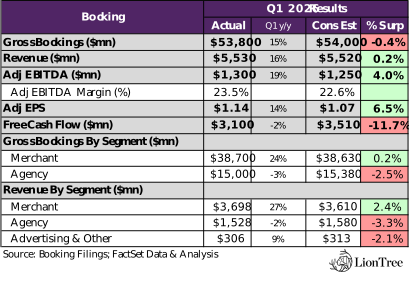
Q2 / FY26 Guidance Was Reset Lower At The Midpoint…BUT The High-End Of FY Gross Bookings & EPS Is Still Intact
- Q2 guidance was below the Street across all the key metrics
- Gross Bookings growth of 4-6% MISSED cons +8%
- Revenue growth of 4-6% MISSED cons +11%
- Adj EBITDA growth of 4-6% MISSED cons +14%
- Room night growth of 2-4% MISSED cons +4%
- Expect ~300bps of headwind in Q2 to room night growth and gross bookings from ME conflict
- Includes impact of Middle East inbound, outbound, intra-regional travel, the corridors between Europe and Asia and vice versa, and that ADRs will be slightly down as a result of the ME conflict
- Guidance assumes that conflict will continue from a “direct and indirect” impact perspective for the full Q2, and then some kind of a recovery in H2
- Impact will be higher in Q2 vs Q1, though this is partially offset by their expectation that March had the highest concentration of cancellations which drove Q1 marketing deleverage
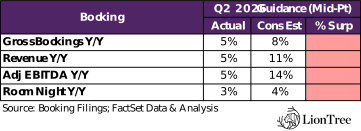
- Lowered FY26 guidance at the midpt, “reflecting the assumption that the direct and indirect impacts from the situation in the Middle East continue for 4 months”
- Gross bookings growth now HSD-LDD vs prior LDD
- Revenue growth now HSD vs prior LDD
- Adj EBITDA growth still slightly faster than revenue
- Adj EBITDA margin expansion now 0-25bp vs prior ~50bp
- Adj EPS growth now Low-Mid-teens vs prior Mid-teens
- To support these targets, will aim to grow rev faster than both marketing and adjusted fixed operating expenses, while maintaining sales and other expenses as a flat percentage of gross bookings y/y
- Note that Q2 and FY26 guidance does NOT include assumptions of sustained disruption that could introduce broader inflationary pressures, including fluctuations in jet fuel prices, airline capacity reductions, as well as weigh on traveler sentiment more broadly
- Assuming, recent FX rates remain steady for the remainder of the yr, estimate changes in FX will positively impact these FY reported growth rates by –
- ~2% for gross bookings
- ~1.5% for revenue
- ~1% for adj EBITDA and adj EPS
- Given the uncertain macro backdrop, they have begun executing targeted cost management actions, including strictly managing discretionary spend and recalibrating business-as-usual hiring
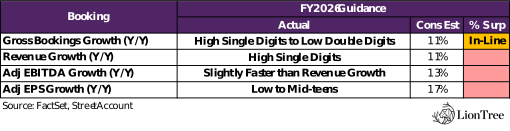
Middle East Disruption Weighed On Q1, But Broader Travel Demand Remains Strong
- Booked 338mn room nights, representing +6% y/y growth
- Estimate that the Middle East conflict impacted gross bookings growth by ~2ppts (accounting for directly impacted countries in the region, as well as bookers whose travel was affected by the conflict)
- Excluding this impact, they believe room nights would have been up by ~8%
- In March specifically…saw an increase in cancellation rates and lower travel demand, resulting in March room night growth of +1% y/y
- Estimate that the impact of the conflict on Marchroom night growth was ~6%, with about half the impact coming from reduced bookings, and the other half coming from incr’d cancellations, which have historically been the highest in the first month after the start of a conflict
- Estimate that the Middle East conflict impacted gross bookings growth by ~2ppts (accounting for directly impacted countries in the region, as well as bookers whose travel was affected by the conflict)
- By region… outside of the Middle East, travel mkts globally have remained “very healthy”
- In the US…room night growth accel’d for the 4th consecutive qtr to the low teens, driven primarily by strong domestic demand
- Encouraged by the continued momentum of their direct channel in the US, which saw double-digit growth
- Saw strength in the US not only in accommodations, but across flights, cars, and packages
- Taking share by building a better product and making people aware of it
- Also in the US…the high-end segment continues to perform well (as it has over the past few qtrs) and now the lower-end segment, which has been “quite weak”, is starting to show improvement
- Booking window is now stable
- ADRs are flat, an improvement after several qtrs of declines in the lower-end segment, though trip lengths remain slightly shorter
- In Asia…the region saw room night growth in the HSD, including LDD growth for travel
- Have been investing in localization at the granular level, adapting their product, payments, and go-to-market strategies to meet the specific needs of each mkt
- Distribution strategy is designed to meet travelers where they are increasingly spending their time, including engaging through social and messaging platforms, where they are seeing “encouraging” traction across channels such as KakaoTalk in Korea, LINE in Thailand and Taiwan, and through WhatsApp in India
- Europe was up MSD including the impact from the conflict on bookers traveling to the Middle East and Asia; Intra-European travel was up HSD (consistent w/ Q4:25)
- RoW, which includes the Middle East, was down LDD
- In the Middle East, including Turkey and Egypt, represented ~4% of our global room nights booked in 2025
- If they include inbound travel to the Middle East in addition to the bookers in the region, the Middle East represents ~7% of 2025 global room nights
- In the US…room night growth accel’d for the 4th consecutive qtr to the low teens, driven primarily by strong domestic demand
- Alternative accommodations room nights were also impacted by the Middle East situation and growth was “about in line” with their total room night growth (vs +~9% y/y in Q4)
- The global mix of alternative accommodation room nights was ~38% of room nights in Q1, which was up ~1% y/y (vs ~36% in Q4:25)
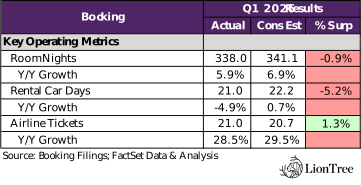
AI Disruption Remains An Investor Hot Button But Mgmt Continues To Layer AI Capabilities Thoughtfully
- On building out AI capabilities – “vision has always been treat the customer like they used to be treated when they used to go to the human travel agent back in the day who knew so much about you and offered you up what you really wanted and was able to get you the value that really matched up with what you could afford”
- What’s stopping the Co from scaling AI features faster? “Definitely NOT” a compute or cost issue” but rather wanting to make sure they do things right
- Prioritizing product quality and customer experience, and making sure to test thoroughly before broad rollout
- Also want to ensure full regulatory compliance which adds complexity and time
- At Booking.com, introduced addtl AI-driven capabilities to support travelers earlier in their journey
- Includes enhanced natural language search and more dynamic, inspiration-led discovery features
- Smart Filters have now been rolled out globally in accommodations, and are beginning to extend and test these capabilities within the Cars vertical
- Agentic svs flows for complaints and cancellation capabilities are improving the post-booking experience, reducing customer service contacts and increasing self-svs adoption
- Priceline’s Penny continues to evolve into a more interactive, end-to-end AI-driven journey w/ increasingly advanced shopping and discovery capabilities
- Enables conversational search and brings a multi-product trip together in a single, integrated view, including a dynamic travel map
- Also becoming more personalized, with the ability for travelers to build trips with an understanding of their preferences, with recommendations that improve over time
- In very early testing from a small sample set, seeing a “noticeable” uplift from users who engage with Penny compared to non-Penny users
- Building on the launch of AI Concierge at OpenTable
- Expanding it beyond answering diner questions into a broader discovery tool, starting with natural language search
- Also developing capabilities to better support restaurant partners through more streamlined operations and actionable, revenue-focused, insights, including voice-enabled reservation tools and table turnover data that help bring more offline tables online, and support higher utilization and revenue
- Agoda saw double-digit y/y reduction in customer svs costs per booking, driven by AI-assisted automation, helping them reduce costs and operate more effectively at scale
Building a Stronger Loyalty Flywheel Via Connected Trip And Genius
- Seeing “encouraging” progress w/ Connected Trip
- In Q1, connected transactions (trips that included bookings across more than one vertical) grew in the high-teens range and represented a LDD %age of Booking.com’s total transactions
- Continue to see “strong” engagement from higher-tier Genius members, who book and return more frequently that non-Genius travelers
- Over the last four qtrs, Level 2 and Level 3 Genius members represented 30%+ of their active base and accounted for a high-50% share of room nights, up from the prior yr
- See an oppty to further strengthen Genius this yr
- “I believe Connected Trip by itself is fantastic, Connected Trip with Genius is superpower, and we need to bring it together. And we’re working on this”
- “We’re going to bring together Genius in a much better way down the road that will create even more loyalty, make people enjoy and feel they got a better value”
Stock Market Check
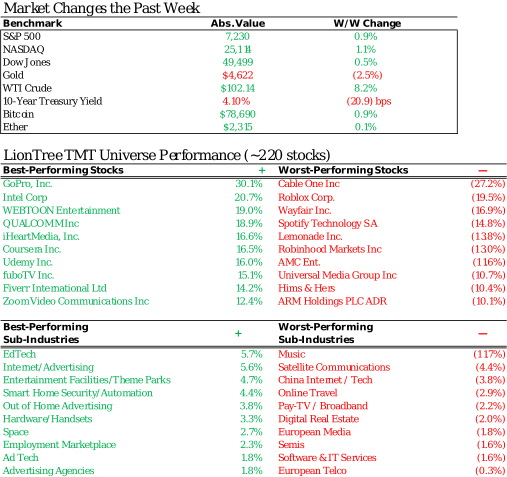
This Week's Other Curated News
Advertising/Ad Agencies/Ad Tech
- Meta is laying groundwork to extend performance ads into CTV to drive its next ad growth, sources say. Talks since early 2025 w/ SSPs like Magnite and Comcast’s FreeWheel and TV OEMs suggest a FAN-like model accessing third‑party inventory at scale. (Digiday)
Artificial Intelligence/Machine Learning
- Anthropic evaluates Claude’s bioinformatics research skills using BioMysteryBench, a new benchmark built on messy real‑world datasets. Across 99 expert‑written questions, Claude performs on par w/ human experts on most human‑solvable tasks and solves some human‑difficult ones. (Anthropic)
- SoftBank plans to create and potentially IPO a standalone AI and robotics Co, Roze, in the U. S. w/ a target valuation of ~$100bn, FT reported. The biz would build data centers and use robotics to boost AI infrastructure efficiency. Founder Masayoshi Son is driving the effort as part of expanded AI bets, including OpenAI, while bundling assets such as energy, land and ABB Robotics; timing and valuation remain uncertain. (CNBC)
- Anthropic PBC is weighing early-stage funding offers that could value the AI Co at over $900bn, potentially leapfrogging OpenAI and more than doubling its current valuation. Talks follow surging demand for its Claude software and a push to secure more infrastructure, w/ no offers accepted yet. Google and Amazon have major prior stakes, though participation is unclear. (Bloomberg)
- OpenAI annc’d it secured contracts for 10 gigawatts of AI computing capacity, hitting a key milestone yrs ahead of its 2029 target. The Co said 3 gigawatts were signed in the past 90 days, incl 2 gigawatts from Amazon. The move boosts its data‑center expansion plans under the Stargate brand, despite pulling back from some US, UK and Europe projects due to cost and regulatory concerns, and signals plans to further expand compute capacity. (Bloomberg)
- Meta unveiled Muse Spark, a more advanced AI model marking a shift from free Llama releases to a closed-source, monetizable approach. Investors say early results look promising, but want CEO Mark Zuckerberg to clearly outline the cos broader AI strategy on earnings, beyond boosting ads. (CNBC)
- YouTube is testing an AI-powered search feature called “Ask YouTube” that delivers guided, step-by-step answers blending text, short clips, and longer videos, rather than only video results. The tool lets users ask multi-part questions and follow-ups for tasks like trip planning or food searches. (TechCrunch)
- Google annc’d a classified deal w/ the US Pentagon allowing use of its AI for “any lawful” govt purpose, per reports. The pact gives Google no veto power and requires help adjusting AI safety filters on request. While it bars domestic mass surveillance or autonomous weapons w/o human oversight, those limits may be nonbinding, prompting internal employee backlash over potential harmful uses. (The Verge)
- Disney internal docs show growing AI use among tech staff, w/ ~4,800 employees across Disney Entertainment and ESPN tracked via an AI Adoption Dashboard. Over nine workdays in mid‑, workers used ~3.1bn Claude tokens and 13.3bn Cursor tokens. (Business Insider)
- OpenAI annc’d models, Codex, and Amazon Bedrock Managed Agents are coming to AWS in limited preview. The expansion lets enterprises use frontier models via Bedrock inside existing security, compliance, and procurement workflows. (OpenAI)
- Anthropic annc’d Claude for Creative Work, positioning its AI to support creative pros by integrating w/ tools they already use. New connectors link Claude to Adobe, Autodesk, Blender, Ableton, Canva/Affinity, SketchUp, Splice and others, enabling tutoring, code generation, asset bridging and automation of repetitive production tasks. (Anthropic)
- An internal guide for OpenAI’s Codex coding agent shows repeated rules banning mentions of goblins, gremlins, raccoons, trolls, ogres, pigeons, or other creatures unless clearly relevant. The instructions, embedded in Codex CLI, aim to limit random, off-topic behavior during code generation. (Wired)
- Stanford-led research shows ~35% of new websites were AI-generated by mid-2025, rising from near zero before ChatGPT’s Nov. 2022 debut. Analyzing 33 months of archived sites, the study finds rapid AI adoption reshaping the web. While AI content cuts semantic diversity and skews “cheery,” researchers found no rise in misinformation, with citation rates similar to human sites. (Yahoo)
- Google exited a $100mn Pentagon challenge to build voice controlled, autonomous drone swarm tech despite its proposal advancing, people briefed said. The Co informed the gov’t on Feb. 11 that it would stop participating, weeks after submitting the bid. Bloomberg reviewed records link the withdrawal to an internal ethics review, while Alphabet’s Google cited insufficient resourcing as the reason for leaving the program. (Bloomberg)
- Trump White House is drafting guidance to let agencies bypass an OMB supply‑chain risk label on Anthropic and regain access to its AI models, including Mythos. The move seeks to cool a Pentagon legal fight that followed Anthropic’s refusal to allow ‘all lawful purposes’ use. Officials say agencies want access while talks continue; Pentagon access remains limited and updates withheld. (Axios)
- A data-center developer backed by Tract Capital and Fleet Data Centers is seeking $4. 54bn in junk debt for an AI project expected to be leased by Nvidia. The five-yr notes, led by JPMorgan, would fund part of a 200‑MW Nevada facility and reimburse equity. A prior $3.8bn sale drew strong demand, underscoring resilient appetite for AI-linked infrastructure financing amid capacity and power shortages. (Yahoo Finance)
- Microsoft annc’d an amended agreement setting the next phase of its OpenAI partnership, aimed at flexibility. Microsoft remains OpenAI’s primary cloud partner, w/ products shipping first on Azure, while OpenAI can sell svs across any cloud. (Microsoft)
- OpenAI is exploring a smartphone concept where AI agents replace traditional apps, letting users accomplish tasks through natural language across svs. The idea would center on an AI-first interface, reducing reliance on app mkts. The report says the project is early-stage, w/ no annc’d timeline, partners or pricing, and significant tech and biz hurdles remain. (TechCrunch)
- OpenAI annc’d a renegotiated pact w/ Microsoft that removes exclusive rights and ends legal peril tied to its up-to-$50bn Amazon deal, TechCrunch reports. Microsoft now holds a nonexclusive license to OpenAI IP through 2032, remains primary cloud partner via Azure, and changes rev sharing. (TechCrunch)
- OpenAI missed internal targets for new users and rev as growth slowed, prompting scrutiny of heavy data‑center spending ahead of a possible IPO by yr end. CFO Sarah Friar warned leaders cash flow may not cover future compute contracts if rev lags. Board members questioned CEO Sam Altman’s push for more computing power, while execs seek stronger cost discipline. (The Wall Street Journal)
- Over 600 Google employees sent a letter urging CEO Sundar Pichai to reject plans to let the Pentagon use its AI for classified work. Signers, incl. staff from DeepMind and senior leaders, warned such deals could link Google to hidden harms and remove employee oversight. (The Verge)
- OpenAI CEO Sam Altman annc’d five principles to guide AGI development, stressing benefits for all humanity. In a blog post, he argued power should be decentralised, not held by a few cos. The framework covers democratisation of access and governance, individual empowerment via safe, useful tools, universal prosperity backed by govts and infra investment, resilience through shared safety efforts, and adaptability as tech evolves. (The Economic Times)
Cable/Pay-TV/Wireless
- Charter Communications President and CEO Christopher Winfrey disclosed a Form 4 open-mkt purchase of 6,936 shares for ~$1. 19mn, signaling confidence. The filing, pub. Apr. 29, showed CHTR shares down ~4% midweek. Charter serves ~59mn U.S. homes/biz under Spectrum after prior mergers. Recent 3-mo results showed ~1% rev decline, though margins and valuation suggest potential undervaluation. (Benzinga)
- KPN saw Q1 rev rise 2. 1% YoY to €1.45bn, driven by retail growth w/ net adds of 10k broadband and 41k postpaid subs in the quarter. Adj EBITDA after leases increased 3.1% to €653mn as indirect costs fell, lifting margin to 45.1%. Capex declined 5.1% to €279mn, while free cash flow dropped 21% to €101mn due to timing impacts. (Telecompaper)
- Rogers Communications Inc. annc’d voluntary buyouts for ~10,000 employees, nearly half its staff, as it moves to cut costs amid regulatory and competitive pressure. The Co plans to reduce capital spending by 30% yr over yr after reporting cost pressures following its $26bn Shaw acquisition. (CBC)
Capital Market Updates
- Bill Ackman moved closer to a public listing as Pershing Square USA and the mgmt Co raised ~$5bn, hitting the low end of a $10bn goal, after a failed IPO two yrs ago. Ackman seeks perpetual capital and steady fees, pitching a “modern-day” Berkshire Hathaway. (Financial Times)
Cloud/DataCenters/IT Infrastructure
- AWS annc’d Amazon Quick, a desktop AI assistant that works across apps, tools, and data to streamline work. The app runs locally, connects to files, email, calendars, and svs like Microsoft 365, Google Workspace, Zoom, and Salesforce. Quick learns user context, builds dashboards, presentations, and images, automates workflows, and stays always-on while meeting enterprise security standards. (About Amazon)
- A BloombergNEF report says surging data center electricity demand has driven a 66% jump in natural gas power plant costs in two yrs. CCGT builds rose from <$1,500/kW in 2023 to $2,157/kW last yr and now take 23% longer. Shortages pushed gas turbine prices up 195% vs 2019, with waitlists into early 2030s, while some tech cos explore renewables w/ long-duration storage. (TechCrunch)
Crypto/Blockchain/web3/NFTs
- Jack Dorsey-led Block annc’d in its Q1 proof-of-reserves report that it held 28,355 $BTC worth ~$2. 2bn as of Mar. 2026. Customer balances totaled 19,357 $BTC (~$1.5bn), while the cos treasury held 8,997 $BTC (~$692mn). Block said holdings can be independently verified via on-chain signatures, reflecting wider post-FTX adoption of transparency practices. (Crypto News)
- Polymarket said it sought CFTC approval to bring its main crypto-native prediction exchange onshore in the US, expanding beyond broker-mediated access via QCX. Approval would let US users trade directly on-chain using USDC on Polygon and place DeFi infra under federal oversight. The push follows a 2025 regulatory thaw, $112mn QCEX deal, new market-conduct rules, and fresh funding talks, amid competition w/ rival Kalshi. (Yahoo Finance)
Cybersecurity/Security
- Hasbro annc’d an update that a Mar. cyberattack will impact Q2 rev and operating profit. The attack, now contained, took some systems offline, delaying order processing, shipping and invoicing. Hasbro is restoring systems, reviewing files w/ forensics experts, and expects most delays to be recovered in H2. (Retail Dive)
eCommerce/Social Commerce/Retail
- Lululemon Athletica founder Chip Wilson questioned the Co’s appointment of former Nike exec Heidi O’Neill as CEO amid an unresolved proxy fight. Wilson, who owns ~8.6%, said the board lacks brand and product expertise needed to revive the biz and attract talent. Shares are down ~47% YoY, w/ a 15% drop after the CEO annc’d. Some investors back O’Neill’s experience, while talks cont’d w/o settlement. (Reuters)
- Retailers are flocking to TikTok Shop as Americans increasingly buy shampoo, jewelry and apparel through the app. Brands including Ralph Lauren, Olaplex and Ulta Beauty launched storefronts recently, joining early adopters like Crocs and L’Oréal. Executives see the platform as a way to reach scrolling shoppers and boost sales as higher everyday prices curb spending, highlighting TikTok Shop’s rapid growth since its U.S. launch in 2023. (The Wall Street Journal)
- Amazon India annc’d plans to expand its Amazon Now quick commerce biz to 100 cities, scaling its network to 1,000+ micro-fulfillment centers from ~300, currently in Delhi NCR, Mumbai and Bengaluru. The move follows a Rs 2,800 crore investment as part of a $35bn commitment through 2030 to boost infra, speed and selection, intensifying competition w/ Blinkit, Instamart and Zepto, the Co said. (Economic Times)
- Nate Berg recounted a one‑night stay at Ikea’s only hotel, the Ikea Hotell in Älmhult, Sweden. The property immerses guests in the brand, w/ rooms and common areas furnished entirely w/ Ikea items, doubling as a try‑before‑you‑buy experience. The stay coincided w/ a visit to Ikea’s prototype lab, and the hotel’s proximity to HQ and the Ikea Museum underscores its role in the Cos small company town. (Fast Company)
- Adidas reported Q1 results above expectations as World Cup demand lifted sales in a very volatile retail environment. Currency-neutral sales rose 14% to €6.6bn, w/ soccer gear and running products driving growth, while apparel jumped 31%. Op profit rose 16% to €705mn, topping forecasts. (Reuters)
- Starbucks Corp. said it is winning over American diners w/ cushier seats, more appetizing pastry displays and speedier svs. The Co reported better-than-expected quarterly results and now sees comparable sales rising at least 5% this yr, lifting its outlook from a prior view of 3% or more. (Bloomberg)
Electric & Autonomous Vehicles
- China has halted new autonomous-driving permits after a systems outage left over 100 Baidu Apollo Go robotaxis stranded in Wuhan on Mar. 31, disrupting traffic. Regulators met cities to order safety reviews and tighter monitoring, pausing fleet expansions and new pilots. Baidu’s Wuhan ops were also suspended as probes cont’d. Shares of Baidu and rivals fell. (Yahoo Finance)
Film/Studio/Content/IP/Talent
- Paramount CEO David Ellison annc’d plans to release 30 theatrical films per yr if the Co completes its proposed merger w/ Warner Bros, arguing a larger slate would aid cinemas. Exhibitors and analysts are skeptical, noting no studio has hit that level in decades and mergers usually cut output cont’d by layoffs, fewer wide releases, and scheduling limits, despite some support from AMC’s CEO. (CNBC)
FinTech/InsurTech/Payments
- PayPal annc’d plans to place Venmo into a standalone biz unit, separating it operationally from the rest of the Co, according to CNBC. New CEO Enrique Lores, who took over in Mar., said the move would make Venmo’s performance easier to track and could pave the way for a future sale. The cos also plans to hire a banking executive to lead the Venmo unit. (CNBC)
- Robinhood mkts stock slid ~10% after Q1 earnings missed estimates as a 2026 crypto slump cut trading activity. The Co posted profit of $346mn, $0.38/share, and net rev of $1.07bn, below Street forecasts. Crypto trading fees fell 47%, while options fees rose 8% and net interest rev gained 27%. The Co said it is investing to diversify svs despite higher costs. (Yahoo Finance)
- Google annc’d Google Wallet now supports Aadhaar Verifiable Credentials in India, letting users store a secure, digital-first ID on device for daily ID checks. Built on global standards w/ selective disclosure, the feature aims to boost privacy and interoperability. Initial partners include PVR INOX, BharatMatrimony, Atlys, Mygate and Snabbit. (Google Blog)
- Visa reported strong fiscal Q2 results as consumer spending cont’d despite inflation. Rev rose 17% to $11.23bn, beating estimates, as payments volume and processed transactions each grew 9%, w/ cross-border up 12%. U.S. volume gained 8%, aided by higher tax refunds. Profit increased to $6.02bn, or $3.14 a share, while adj EPS was $3.31 vs $3.10 expected. Shares rose 4.8% after hours. (MSN)
Handheld Devices & Accessories/Connected Home
- Counterpoint Research said smartphones w/ satellite connectivity will reach 46% of global shipments by 2030, driven by premium devices from Apple, Samsung, Google and Huawei. Proprietary tech leads near term as 3GPP NTN faces chipset and svs readiness issues, w/ Release 19 enabling mid-tier adoption. (Counterpoint Research)
Macro Updates
- The Federal Reserve held its benchmark rate at 3. 5%–3.75%, marking its third straight hold, but dissent surged to an 8–4 vote, the most since 1992. Officials remain split as inflation stays above target while labor mkts soften. Chair Jerome Powell signaled he may stay on the Board past his term as a probe into Fed renovations cont’d, even as leadership transition nears. (CNBC)
- Former Telegraph owners Aidan and Howard Barclay narrowly avoided bankruptcy after a last‑minute deal w/ HSBC and other creditors over >£140mn overdue debts. The bank withdrew High Court proceedings after the brothers agreed to an IVA repayment plan, avoiding director bans and asset seizures. If terms fail, cases may resume; recovery details were undisclosed. (Yahoo Finance)
- U.S. gas prices reached $4.23 per gallon, a new yr high, per AAA, after the Iran war disrupted oil flows via the Strait of Hormuz. Brent crude rose to ~$114.60, up ~25% since Apr. 17, pushing prices $1.25 higher since late Feb. Refinery maintenance and peak driving added pressure, squeezing retailer margins. (NBC News)
Media Conglomerates
- Barry Diller annc’d a major shakeup at IAC, rebranding the holding co as People Inc. and shifting focus to two assets: People publishing and its MGM Resorts stake. Diller moves to exec chairman, w/ Neil Vogel as CEO and Tim Quinn CFO. The plan includes layoffs, ~$14mn severance costs, and ~$40mn annual savings. (The Hollywood Reporter)
- Disney has decided against spinning off ESPN, keeping the sports network inside the Co as new CEO Josh D’Amaro makes one of his first major calls. Insiders said ESPN is seen as key to Disney’s pivot to streaming, offered via cable bundles, Hulu/Disney+ bundles, and a stand‑alone svs cont’d despite long‑running investor debate over cord‑cutting pressure on the biz. (Business Insider)
Online Marketplaces/Learning (Real Estate/Education/Jobs)
- Carvana reported record Q1 results, topping Wall St. estimates and pushing shares up ~10% postmarket. The online used-car Co posted $1.69 EPS and $6.43bn rev, beating forecasts. Retail unit sales rose 40% yr/yr to 187,393, while rev jumped 52%. Adj EBITDA reached $672mn. Carvana expects cont’d sequential growth in units and adj EBITDA in Q2. (CNBC)
- Etsy CEO Kruti Patel Goyal urged sellers to refresh inventory and deliver “really great human service” as the Co exits Reverb and Depop. Q1 rev reached $631mn, w/ marketplace up >6% to ~$433mn and svs up >10% to ~$200mn. GMS rose >5% to $2.5bn despite a 2% buyer decline. Etsy is investing in AI to lift discovery and frequency under strict ROI discipline. (Retail Dive)
Online Travel
- Uber Technologies annc’d new travel features at its GO–GET event, expanding beyond mobility and delivery. The Co added hotel bookings via a partnership w/ Expedia, giving U.S. users access to ~700k properties and Uber One members 10% credits plus 20% discounts. (Uber)
Regulatory
- The White House is opposing Anthropic’s plan to widen access to its powerful AI model Mythos, slowing its rollout. Anthropic proposed allowing ~70 more Co and organizations to use the model, lifting total access to ~120. (The Wall Street Journal)
- Australia’s Albanese govt annc’d a draft news bargaining incentive scheme imposing a 2. 25% levy on big tech cos’ local rev unless they strike deals w/ publishers. The plan could raise ~$250mn/yr, replaces the old code, and offers offsets up to 170%, w/ funds tied to journalist numbers. It targets platforms over $250mn rev and large user bases, excludes AI for now. (The Guardian)
- The FCC said it began reviewing ABC broadcast licenses years ahead of schedule, increasing pressure on Disney after a late‑night monologue drew White House criticism. The agency cited concerns that Disney’s corporate diversity policies may violate anti‑discrimination rules. Disney said it complies w/ FCC rules and will defend its licenses. Shares slid ~1%. (Semafor)
- NFL met w/ FCC after agency opened probe into sports TV deals. League said most regular‑season games stay free on local broadcast in team mkts, defending hybrid broadcast/streaming model. Execs warned changing Sports Broadcasting Act antitrust exemption could fragment deals, hurt smaller mkts and affiliates, as DOJ also reviews media practices. (Cord Cutters News)
- Gartner est. U.S. states’ privacy fines hit $3.425bn in 2025, exceeding the prior five yrs combined, based on aggregated enforcement and private actions. The firm said fines will accelerate through 2028 as regulators shift to full enforcement and add obligations tied to automated decision‑making tech. (Gartner)
- The CFTC filed an amicus brief in the Massachusetts Supreme Judicial Court asserting exclusive federal jurisdiction over U. S. commodity derivatives mkts, including prediction mkts, in Commonwealth v. KalshiEx LLC. The agency said state actions unlawfully encroach on CFTC authority, citing prior court rulings, the Commodity Exchange Act’s preemption, and past suits and briefs blocking state regulation. (CFTC)
- The EU told Alphabet’s Google to open Android so rival AI svs can interact w/ apps, under the Digital Markets Act. The Commission said competing assistants should send emails, order deliveries, and share photos across user apps. Google argued the move cuts device-maker autonomy and raises costs, privacy, and security risks. (MSN)
- Tennessee became the second U. S. state to ban Bitcoin and crypto ATMs after Gov. Bill Lee signed HB 2505 requiring operators to remove kiosks by Jul. 1. The bill, co-sponsored by Rep. Cameron Sexton and Jay Reedy, cites scams targeting seniors, w/ $4mn lost locally and FBI data showing $257mn lost by Americans over 60 last yr, up 58%. (Yahoo News)
- Chinese regulators blocked Meta’s proposed ~$2bn acquisition of AI start-up Manus, ordering parties to withdraw after months of scrutiny. Meta annc’d the deal in Dec., saying Manus’ autonomous agents would bolster its AI across platforms, and said it complied w/ law. (BBC)
- Australia’s Dec. 2025 social media ban for under‑16s isn’t working, as teens use masks, parents’ IDs, or VPNs to bypass age checks. A survey of 1,050 youths aged 12–15 found >60% still accessed at least one platform, w/ TikTok, YouTube, and Instagram retaining over half their users. Regulators now probe possible breaches. (Fortune)
Satellite/Space
- SpaceX’s IPO filing says no one can fire CEO and chairman Elon Musk without his consent. Super-voting Class B shares give Musk sole power to remove himself, tying board control directly to shares he holds. Experts say this goes beyond typical dual-class tech Co structures, sharply limiting public investors’ ability to influence governance, a risk SpaceX flags in disclosures. (Reuters)
- Telefónica España annc’d a partnership w/ Sateliot to apply 5G NR tech to satellite networks, creating a hybrid architecture combining terrestrial mobile nets w/ low Earth orbit satellites. The deal expands coverage to remote and maritime areas, supports critical security and defense svs, and advances 5G NR‑NTN solutions. (Fierce Network)
- SpaceX’s Starlink saw rev per user drop 18% from 2023–2025, per The Information, citing a draft prospectus tied to IPO plans. The satellite internet svs quadrupled subscribers in the period, but avg rev fell to ~$81 per month. SpaceX expects pressure to cont’d as cheaper plans roll out and expansion outside North America grows. (Bloomberg Law)
- Overview Energy annc’d a first-of-its-kind deal w/ Meta to supply space solar power to data centers. Meta secured early access to up to 1GW capacity from satellites collecting continuous sunlight in orbit and beaming it to existing solar sites, enabling ~24/7 output w/o new land or grid delays. (PR Newswire)
Social/Digital Media
- EU regulators charged Meta’s Facebook and Instagram with breaching Digital Services Act rules, saying they must do more to block under‑13s after a two‑yr probe. The Commission said 10%–12% of EU children below 13 still access the platforms and Meta’s detection measures are inadequate. (Reuters)
- Elon Musk says X is nearing launch of X Money, a banking and payments tool aimed at turning the platform into a super app. The svs could offer early access perks such as 3% cash back, ~6% savings interest, free peer‑to‑peer transfers and a Visa debit card, w/ AI tools to track spending. Musk cites ~600mn monthly users, but licensing gaps, NY scrutiny and unclear pricing raise risks. (Yahoo Finance)
Software
- GitHub annc’d steps to improve availability after two Apr. outages. CTO said rapid growth in agentic dev is driving 30X scale needs, straining repos, PRs, APIs and Actions. The Co is prioritizing availability, isolating critical svs, cutting single points of failure, adding compute via Azure, and refactoring systems. (GitHub)
- Microsoft annc’d rollout of Copilot 365 to ~743,000 Accenture staff, its biggest enterprise deal, boosting efforts to lift paid adoption where just over 3% of 365 users pay $30/month. Accenture, a heavy AI adopter, says pilots cut routine tasks up to 15x faster and lifted productivity for 53%, amid investor concern over slow uptake and uneven cloud growth. (Reuters)
- Activist investor Starboard Value has taken a significant stake in AI-software maker Dynatrace after the stock underperformed peers. Starboard is now a top-five shareholder and has been privately engaging w/ Dynatrace management in recent months. In a draft letter seen by the WSJ, managing member Peter Feld says the fund is pushing for changes it believes could help boost the stock. (The Wall Street Journal)
- Fears that AI tools could spark a software apocalypse have rattled stocks, driven record withdrawals from private-debt funds and raised worries of a new credit crisis. Loan mkts, however, show a split outcome. Prices of software‑Co loans fell sharply on average since late Jan., but a WSJ analysis of 100+ loans found wide dispersion, w/ some segments far weaker than others. (The Wall Street Journal)
Sports/Sports Betting
- JPMorgan Chase & Co annc’d a partnership w/ the International Olympic Committee to become global partner of the Los Angeles 2028 Olympic and Paralympic Games and the French Alps 2030 Winter Games. It is the first bank to hold the role, serving as official bank of the U.S. Olympic team and a founding partner of LA28. Financial terms were not disclosed. (Reuters)
- The NFL is pressuring media partners to renegotiate deals before the 2026 season, using a 2029 opt-out as leverage. NBC, home of Sunday Night Football, faces rising costs despite strong ratings. The league is seeking ~50% higher rights fees, potentially lifting NBC’s ~$2bn/yr bill near $3bn, while NBC already pays ~$2.5bn/yr for NBA rights, raising risk it could drop NFL games rather than expand. (The Streamable)
- NBA has received interest from multiple investor groups in potential new teams in Las Vegas and Seattle, with the league planning to sell them for up to ~$10bn, per people familiar. Early indications show Las Vegas drawing more interest than Seattle. (Bloomberg)
Tech Hardware
- Samsung Electronics reported record Q1 2026 results, driven by strong AI memory demand and new flagship smartphones. The Co posted rev of KRW 133.9tn and operating profit of KRW 57.2tn for the three months ended Mar. 31, marking all‑time highs. Operating profit surged over 750% yr/yr, w/ rev rising ~70%, underscoring accelerating AI‑related semiconductor momentum. (CNBC)
- Taiwan Semiconductor Manufacturing Co said it sold its remaining Arm Holdings stake, exiting the chip designer after a ~$231mn share sale. Unit TSMC Partners sold 1.11mn shares Apr. 28–29 at ~$207.65 each, cutting retained earnings by $174mn. The filing said the move completed a disposal of an equity investment. (Reuters)
- Apple’s incoming CEO John Ternus faces a China dilemma. iPhone sales are rebounding in the world’s No.2 mkts, offering momentum as he prepares to take the reins. At the same time, Apple’s China‑heavy supply chain is under growing strain from geopolitical headwinds, highlighting rising risk as India shifts struggle and pressure on the iPhone biz mounts. (Nikkei Asia)
- Altair Semiconductor is operating as an independent Co after Sony executed a spin-off and restored the cellular IoT chip brand it acquired for $212mn in 2016. Sony Semiconductor Solutions retained an undisclosed equity stake. The Co, formerly Sony Semiconductor Israel, emerges w/ $50mn in early-stage funding led by Israel-based VC Pitango Group. (Telecompaper)
- Seagate Tech forecast an upbeat Q4 as AI adoption lifts data‑storage demand. The Co guided Q4 rev at ~$3.45bn ±$100mn vs $3.16bn est and adj EPS of ~$5 ±$0.20 vs $3.97. Shares jumped ~16% after hours, lifting peers. Q3 rev of $3.11bn beat est, w/ EPS $3.27 vs $1.57 yr earlier. (Reuters)
- A Wood Mackenzie Ltd report said US spending on power-gen gear for data centers could jump to ~$65bn by 2030 from $2. 6bn last yr, as the rapidly expanding sector captures the biggest share of total mkts. It projects US data center capacity reaching ~110 gigawatts by 2030, while nationwide outlays on power-plant equipment could rise to ~$215bn, driven largely by soaring data center power needs in the US. (Bloomberg)
- Investors are betting AI-driven demand will extend the upswing for memory chipmakers as customers seek 3–5 yr contracts w/ SK Hynix and Samsung, replacing short-term deals. Hynix says a structural shift prioritises supply security over price amid acute shortages. (Financial Times)
- NXP Semiconductors annc’d Q1 2026 results, beating forecasts as rev reached $3. 18bn, up 12% yr/yr but down 5% seq. Adj EPS of $3.05 and 57.1% gross margin topped views, w/ free cash flow at $714mn. The Co outlined a strategy to double non‑GAAP EPS by 2030, targeting high‑single‑digit rev growth, >60% margins and full excess cash returns, despite near‑term supply chain risks. (Investing.com)
- Qualcomm stock jumped ~12% after a report said the Co is partnering w/ OpenAI on smartphone processing chips to advance AI hardware ambitions. Analyst Ming-Chi Kuo said Qualcomm would work w/ MediaTek, while Luxshare co-designs and builds the device, w/ mass production eyed for 2028. (CNBC)
Towers/Fiber
- T-Mobile annc’d ~$2. 7bn in fiber acquisitions via two 50/50 JVs, expanding its T-Fiber biz using an open-access wholesale model. W/ Oak Hill Capital, it will combine GoNetspeed and Greenlight, investing ~$2bn to pass >1.3mn homes by end-2026 across Northeast mkts. A second JV w/ WrenHouse adds i3 Broadband for ~$700mn, targeting ~500,000 homes. (Fierce Network)
Video Games/Interactive Entertainment
- Take-Two Co CEO Strauss Zelnick said GTA 6 will cost an amount customers view as “reasonable,” avoiding any price target. Speaking at iicon, he said cos charge far below perceived value so buyers feel the game is worth the price. He cited inflation-adjusted declines in game pricing and said Rockstar aims to deliver exceptional value, fueling speculation over $80+ pricing ahead of the Nov. 19, 2026 release. (Kotaku)
- Sony annc’d fresh PS5 price hikes across more Asian mkts, cont’d from earlier U., UK, Europe and Japan increases, citing global economic pressures. Prices in South Korea jump up to 43% vs launch, w/ PS5, Digital and Pro models rising, plus the PlayStation Portal. (Kotaku)
Video Streaming
- YouTube TV annc’d a fully customizable multiview, letting subs watch up to four channels from nearly the full lineup on one screen, incl add-ons like NFL Sunday Ticket. Previously limited to preset sports/news views, the feature now spans most non-sports channels. Rolled out to main and lower-priced plans, it’s built server-side, needs no special hardware, and adds a new builder UI. (Variety)
- Canal Plus Group released a trading update for the three months to Mar. , calling Q1 “a solid start to 2026.” The Co confirmed plans for a secondary listing on the Johannesburg stock exchange, expected on Jun. 03. Performance reflected rising profitability in Europe and a rev decline at MultiChoice in line w/ expectations. (Telecompaper)
