


Markets RALLIED in this heavy earnings week. Nasdaq was up +4.5% while the S&P 500 rose +2.3%, which is the 6th-straight weekly gain and both indices ended at fresh record highs. Software was a leading sector (IGV +5.2%) and was also higher for a 4th-straight week. Optimism regarding a diplomatic solution with Iran was a key driver, in addition to earnings continuing to broadly come in stronger than expected. Per Factset, 89% of S&P 500 companies have reported and the blended earnings growth rate of +27.7% is the fastest pace since Q4:21 and well ahead of the 13.1% expected at the end of the quarter.
This is another heavy earnings-oriented edition, so we had to pick our spots!
- Earning Scorecard - Week 4
- It Was A Strong Opening Act At Disney, Though Little Changed In The Script
- No Chg To PSKY’s 2026 Outlook & The Co Is Progressing Structural Changes Ahead Of The WBD Deal Close
- WBD Makes Some Progress Ahead Of The PSKY Deal Close
- WMG’s Execution Is Matching The Long-Term Growth Algorithm
- Live Nation & TKO Keep Hitting Play As Live Entertainment Dismisses The Macro Backdrop
- DKNG Is Going All-In On Predictions In H2
- Shopify’s Higher Investment Adds More Fuel To The AI Worries Fire
- Pinterest and Snap Navigate a Shared Playbook, But With Diverging Outlooks
- Uber, DoorDash & Instacart’s Results All Point To Resilient Last Mile Demand, But Forward Signals Show Different Paths
Lastly, LionTree Advisors is proud to have served as financial advisor to Siris Capital Group on the $4.2bn sale of Equinti, a leading global transfer agent, to Bullish.
Enjoy the weekend, especially all my fellow mothers! I hope that you will all be pampered! 😊
Have a nice weekend.
Best,
Leslie

Earning Scorecard - Week 4
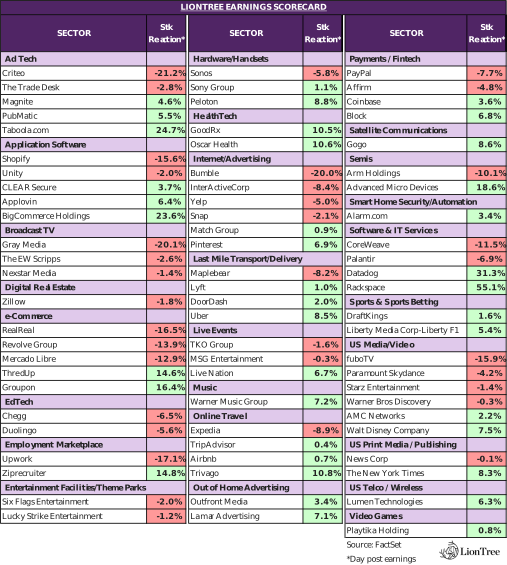
A whopping 74 stocks in our LionTree Universe reported in this Week 4 of earnings! Stock reactions were slightly biased to the positive side, with 37 (51%) stocks trading up and 35 (49%) stocks trading down. The best performer in reaction to earnings was Rackspace, which was up +55.1%, while the worst performer was Criteo, which fell -21.2%.
It was a pivotal week for Media Entertainment with Disney, Paramount, and Warner Bros. Discovery all reporting (see Themes #2, #3, and #4, respectively) and the former led with a +7.5% positive reaction to results. Warner Music Group rallied +7.2% in reaction (see Theme #5), and Live Nation and TKO were also in focus, with Live Nation up +6.7% and TKO down -1.6% in reaction (see Theme #6).
Sports betting was represented by DraftKings, which was up a modest +1.6% in reaction to earnings (see Theme #7). In Commerce and Consumer Internet, Shopify fell -15.6% (see Theme #8), while Pinterest and Snap were up +6.9% and down -2.1%, respectively (see Theme #9) post their earnings reports. Rideshare / last-mile was also in focus, with Uber up +8.5%, DoorDash up +2.0%, and Instacart down -8.2% in reaction to earnings (see Theme #10).
Other notable prints that we wanted to highlight, but were not able to do our usual deep dives for include:
- AppLovin – traded up +6.4%: The Co delivered a strong Q1, with results ahead of cons across the board
- Q1 revs beat by +4.0%, adj EBITDA beat by +4.7%, and adj EPS beat by +3.5%
- The Q2 outlook was also above cons, with rev and adj EBITDA guidance ahead by +2.1% and +2.5%, respectively.
- The Trade Desk – traded down -2.8%: Q1 results were mixed, and the weaker-than-expected Q2 guidance spooked investors
- Q1 rev and adj EBITDA beat by +1.5% and +4.5%, respectively, but adj EPS missed by -11.1%
- The bigger issue was guidance as Q2 revs was -2.7% below cons and adj EBITDA guidance was -10.9% below cons
- Airbnb – traded up +0.7%: Q1 was solid and the Co raised its FY rev/adj EBITDA outlook
- Q1 rev beat cons by +2.3%, while adj EBITDA was ahead by +7.1%; Q2 rev guidance at the midpoint was +3.2% above cons
- In terms of key KPIs, Q2 GBV is expected to grow low DDs y/y, driven by growth in Nights and Seats Booked and a moderate ADR increase, though Nights & Seats Booked growth is expected to slightly decelerate from Q1 due to an est’d ~100bps headwind from the Middle East conflict and a significantly lower FX tailwind
- For FY26, Airbnb raised rev growth guidance to low-to-mid teens y/y vs prior guidance of at least double-digit growth and cons of +12.0%
- The Co also expects adj EBITDA margin of at least 35%, up from prior guidance for margins to remain stable with 2025
- Expedia – traded down -8.9%: Q1 was in-line to better but Q2 guidance underwhelmed
- Q1 bookings beat by a modest +1.5% but rev beat cons by +2.4%, adj EBITDA beat by a strong +19.8%, and adj EPS beat by +30%
- In terms of the Q2 guidance…
- The mid pt of the rev guidance was only +0.7% above cons
- The mid pt of the bookings guidance was -0.4% below cons
- The expected adj EBITDA margin expansion of 0.5-1% was below cons 0.8%
- 2026 guidance was reaffirmed
- The Co annc’d a new $5bn repurchase authorization
- CoreWeave – traded down -11.5%: in-line to better Q1 but Q2 guidance disappointed
- Q1 rev beat cons by +5.6%, while adj EBITDA was in line and the adj EPS loss of ($1.40) narrowed by $0.09
- Q2 guidance disappointed
- Mid pt of revenue guidance was -6.5% below cons
- Mid pt of adj. op income guidance was -61.2% below cons
- Mid pt of capex guidance was +3.9% above cons
- 2026 guidance was re-affirmed for revenue and op income while capex guidance was raised to $31-$35bn from the prior $30-$35bn
The table below includes select mid- and large-cap TMT and consumer companies in our LionTree stock universe that reported this week.
It Was A Strong Opening Act At Disney, Though Little Changed In The Script
It was smooth sailing in Josh Amaro’s inaugural quarter since taking the helm as CEO of Disney. The Co solidly beat Street expectations and raised some of its FY26 guidance metrics. The playbook has not changed though…it is all about executing on the existing strategy that has been put in place. Investing in great content, as well as product & technology, plus advancing ESPN DTC all remain in the forefront of the plan, and are expected to drive accelerating growth for the Co in H2.
Five other important things that we learned from Disney’s results/call are: 1) FQ2 Streaming OI margins hit 10.6% (up +88% y/y), effectively reaching double-digits ahead of the FY26 guidance target (which was reiterated); 2) The Experiences business is not seeing any negative consumer behavior due to higher energy prices (at least yet) and mgmt expects domestic attendance in FQ3 to be BETTER than FQ2’s -1% y/y decline; 3) While the Co raised the FY2
Sports OI growth outlook (low DD to mid DD) , it was all due to the addition of the NFL Network (no underlying change); 4) Disney+ will evolve into a super-app, connecting streaming, sports, parks, and gaming; and 5) The Co raised the FY26 buyback target to $8bn from $7bn.
So all in all, this quarter was more about “steady as she goes”, and looking forward, it will all be about continuing to execute on the Co’s core priorities.
Below are more details on these most important points, in addition to some others…
-> Disney share rallied +7.5% on the back of results but is still down -5% YTD
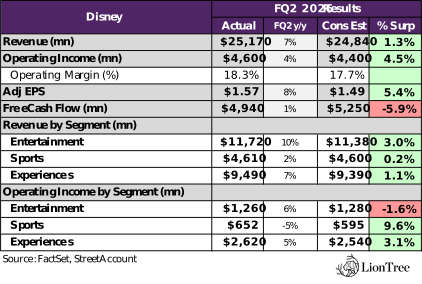
Solid FQ2 Results…With the Only Drags Being Entertainment OI and Lower Than Expected FCF
- Total FQ2 rev BEAT cons by +1.3%: Up +7% y/y
- Upside was driven by strength in Entertainment and Experiences (Sports in-line)
- Operating income BEAT cons by +4.5%: Grew +4% y/y
- Upside in Experiences was the main driver, followed by Sports
- Entertainment OI missed cons by -1.6%
- Adj EPS BEAT cons by +5.4%: Up +8% y/y
- FCF MISSED cons by -5.9%: Reflecting elevated capex and content investment
FY26 Guidance Still Reflects DD Adj EPS Growth & FQ3 Op Income Growth Guide Implies A H2 Acceleration
- FY26 adj EPS guide is +12% y/y excl. the 53rd week / +16% y/y incl. 53rd week
- Previously guided for “DD growth”
- Raised the FY26 buyback target to at “least $8bn” from $7bn
- FQ3 op income guide of ~$5.3bn implies continued H2 acceleration, BUT mgmt flagged “macroeconomic uncertainty” for consumers
- FY27: Continue to expect DD growth in adj EPS, ex the impact of the 53rd week (FQ4:27 will lap the impact of the 53rd week in FQ4:26
The Macro Dynamics Are Not Impacting Disney’s Experiences Business, Incl At International
- The Experiences segment outperformed expectations in FQ2…revs BEAT by +1.1% and OI BEAT by +3.1%
- Segment rev grew +7% y/y and OI grew +5% y/y, both fiscal Q2 records
- Upside was from the Core parks revenue…and it was broad-based with admissions, F&B, and merchandise
- World of Frozen / Disney Adventure pre-opening costs weighed on OI growth by ~2 pts (non-recurring)
- Segment rev grew +7% y/y and OI grew +5% y/y, both fiscal Q2 records
- The Co has “NOT seen any change in consumer behavior from elevated gas prices thus far and aren’t currently seeing a material impact on the remainder of the fiscal year”
- Domestic parks per capita spending grew +5% y/y
- Based on forward bookings, Disney World bookings are pacing “up strongly”, and even with the 40% increase in cruise capacity, booked occupancy remains in line y/y
- “However, we’re mindful of the macro uncertainty consumers are facing and we’re not immune to the impacts, including how a significant further rise in fuel prices from current levels could eventually lead to changes in consumer behavior if that possibility were to occur”
- Global guests grew +2% y/y in FQ2 and have a bullish outlook looking ahead
- AND expect growth to improve in the back half and “forward bookings are very encouraging as we look to the rest of the year”
- The segment beat even though domestic park attendance declined -1% y/y due in part to cont’d softness in intl visitation (it would have been up y/y excluding that)
- Looking ahead, mgmt expects FQ3 domestic park attendance to improve vs FQ2 given the healthy current domestic demand, but mgmt. also notes that consumer macro uncertainty remains a risk
- The Co is beginning to lap the attendance headwinds in the domestic parks from the opening of Epic Universe and expects international visitation to stabilize
- Current demand at domestic parks and resorts is healthy but mgmt is “mindful of the macroeconomic uncertainty consumers are facing today”
- Disney is bullish about its new experiences coming online
- The Disney Adventure was launched in March (expands penetration in Asia and bookings have been “very strong”)
- The Co opened the World of Frozen at Disneyland Paris, and guest response has been “positive”
- Plans re Experiences capx?
- In 26: Have the new ship and the ramp of major new expansions at Walt Disney World in Orlando, Disneyland in Anaheim, and Shanghai Disney Resort
- Over the next decade: The majority of capx is earmarked for investments to expand capacity
SVOD Growth Accelerated Y/Y In FQ2 & The Segment Is On Track For “At Least 10%” SVOD Margins In FY26
- FQ2 SVOD rev grew +13% y/y, accelerating from +11% in FQ1, driven by improved monetization from rate adjustments, volume growth, intl wholesale agreements and FX
- Saw double-digit advertising revenue growth y/y
- FQ2 SVOD OI margin surpassed the FY26 target, but the FY26 guidance was still reiterated – i.e., do costs ramp in H2 or is this conservative?
- FQ2 SVOD OI grew +88% y/y, reaching a 10.6% margin (1st DD SVOD margin qtr)
- But mgmt. reiterated “at least 10%” SVOD margin in FY26
- The main focus areas for future SVOD growth
- Focused on driving Disney+ outside the US and are seeing early success with local originals (Battle of Fates in Korea and Rivals in the U.K.)
- Highly focused on churn (the integrated Disney+ and Hulu experience is benefiting retention)
- “Reducing churn on Disney+ might be the single most significant opportunity that we have”
- Product improvements that reduce user friction, allow more intuitive discovery, and help users decide what to watch and to decide sooner
- Their Video and Browse initiative launched in the US in January
- It lets subscribers preview content directly while still browsing, so they don’t have to click in and out of titles
- Launched Verts on Disney+ in March… short-form / vertical video and interactive features are being intro’d to meet evolving consumer behavior and increase platform stickiness
- The Co is looking to build Disney+ beyond a premium SVOD services (see section below)
- In the meantime, the Co revamped the user interface and is improving personalization
- What is mgmt’s view regarding content licensing to 3P’s? No change to the strategy
- We’ve always distinguished between franchise IP and general entertainment. So franchise and branded IP stays on the platform and general entertainment. That library content can find audiences elsewhere. And that’s it’s been working pretty well for us financially”
Disney+ Is Evolving Into A “Digital Centerpiece”…Driving A More Connected, Superapp-Like Ecosystem Across Streaming, Sports, Games & Experiences
- Disney+ is seen as the “primary relationship between Disney and its fans…where everything comes together—entertainment, sports, experiences”
- This reflects a strategic shift from a standalone streaming service to a central hub connecting the broader Disney ecosystem
- Disney has “passionate fans”…a lot of park customer are Disney+ subs and there are millions of Disney+ subs that don’t go to parks…“we’re building Disney+ to serve as the immersive, interactive digital centerpiece of the company”
- Mgmt emphasized the shift from “a subscriber” to “a relationship with the company…that spans years and generates value across every part of our business”
- Early product and UX investments are foundational to enabling this broader platform strategy
- Focused on improving the consumer experience, reducing friction and increasing engagement through personalization and discovery tools
- Product enhancements (UI improvements, preview features, personalization) are explicitly tied to increasing engagement and reducing churn
- Focus on “hyper-personalized” content feeds, AI-driven recommendations and customized experiences across Disney+ and ESPN
- The goal is to create a single, unified touchpoint that drives engagement, retention and ultimately lifetime value
- Bundling & integration across owned services is a key step toward the super-app model
- The Disney+ and Hulu integration is driving “higher engagement” and “lower churn than…the services on their own”
- ESPN DTC is being integrated into the broader offering, with sports positioned as a key engagement and acquisition driver within the ecosystem
- The Co’s strategy emphasizes internal bundling first, with selective 3P partnerships only where they enhance the Disney+ experience
- How does Epic Games tie into Disney’s eco-system? “Disney+ is the hub, but the hub needs spokes. Epic gives us an interactive gaming native environment to reach audiences that we don’t currently own. And by the way, particularly younger audiences”
The Higher Sports FY26 OI Growth Guidance Reflects The Addition Of The NFL Network, Not An Underlying Change
- The Sports segment also out-performed, especially on operating income…revs BEAT cons by +0.2% and OI BEAT by +9.6%
- Sports rev grew +2% y/y, while OI declined -5% y/y (higher programming costs)
- ESPN advertising rev decl’d -2% y/y due to fewer impressions, fewer NBA games and lapping 4 Nations hockey
- ESPN subscription / affiliate rev grew +6% y/y, supported by DTC growth and NFL transaction contribution (+3 pts)
- Sports rev grew +2% y/y, while OI declined -5% y/y (higher programming costs)
- High priority is shifting ESPN to DTC… “it’s just the beginning”: The strategy includes cont’d product innovation, a focus on adding content partners, and distributing product through both direct and wholesale channels
- “This strategy is already yielding results as revenue generated by our digital subscribers in Q2 more than offset secular declines in the linear subscriber universe”
- The F3Q Sports OI decline guidance of -14% y/y (worse than cons -8% y/y) is due to DD programming expense growth and timing of new rights agreements
- But for FY26, Disney now expects MSD growth in OI , up from prior LSD, given the inclusion of the NFL transaction
- BUT the NFL deal is ~3c dilutive to FY26 adj EPS due to higher non-controlling interest
- Have been making enhancements to the ESPN app
- Multi-view
- Verts
- Sportscenter for You
- Regarding NFL re-opening media rights deals? Disney has “not started conversations about an early renewal but are always willing to have a conversation with NFL”
- “Expect to be in the business with the league for years to come”
- “Sports rights are expensive and can be dilutive without scale, but we have scale in our most important market, the US and the biggest sports media brand in the world”
Disney Is “Embracing” Emerging Technology BUT Human Creativity Will Remain “At The Center”
- The Co wants “to be a leader with leveraging tech for content creation but at the same time, we’re committed to implementing AI in a way that keeps human creativity at the center of everything that we do, and, of course, respects creators and the tremendous value of our own intellectual property”…the Co will use AI to:
- Make the production process more efficient
- Increase the volume of content that they put out in streaming
- Develop a “hyper personalized recommendation engine” across Disney+ and ESPN
- Enhance ad targeting capabilities
- On the Experience side, there’s a significant opportunity to make it easier for families to plan their trip to optimize all their time with Disney and to personalize their experience
- Also, the Co is implementing precision labor demand forecasting across theme parks
Other Key Updates & Comments Across Film, Linear, & Content
- Changes since Dana Walden took over the unified Entertainment content biz…
- Centralized TV programming w/in Disney Entertainment DT
- They are now programming for Disney Plus and Hulu “while being smart about windowing content to linear so that we can expand reach and maximize monetization”
- Integrated the games biz into Disney Entertainment
- This creates new opportunities to cross-promote franchises and use games to extend storytelling and ultimately develop new IP
- “Dana is making sure that every decision we make in content from development all the way through how we distribute that, it’s optimized for the fan and for the long term strength of our brands”
- Centralized TV programming w/in Disney Entertainment DT
- Short form content has exploded and the Co will continue to experiment
- The Co is making sure IP shows up across social platforms
- They intro’d vertical video on D+ (as mentioned above) and it is already driving deeper engagement and on ESPN
- They “did the same thing on our ESPN app and the early performance of the ESPN verts…has been really promising”
- Mgmt doesn’t sounds interested in separating the linear cable nets and the linear business is getting smaller and smaller…
- The Co monetizes content across multiple distribution platforms and “separating those monetization platforms into discrete businesses is highly complex and, in our view, unlikely to create incremental value for shareholders, especially given where linear networks are valued in today’s marketplace”
- “The linear earnings base is becoming smaller and smaller every quarter within our P and L”
- “Yes, linear revenues are declining, but Disney Entertainment as a segment is growing nicely”
- Excited for the upcoming theatrical releases of The Mandalorian & Grogu, Toy Story 5, and the live-action Moana
No Chg To PSKY’s 2026 Outlook & The Co Is Progressing Structural Changes Ahead Of The WBD Deal Close
While PSKY shares popped at first blush given the much better profitability reflected in the Co’s Q1 adj EBITDA results (beat cons by +29.4%) and the better Q2 adj EBITDA guidance (beat by +10%), the stock gave back gains on commentary that timing benefits were at play and H2 spending will ramp, hence no change to the full year 2026 adj EBITDA outlook (and no change to the rest of 2026 guidance for that matter). With that said, we’d note that Wall Street analysts had been taking a more conservative view on 2026 profitability, so they might revisit that at the least.
Aside from that, the 5 most interesting incrementals that we learned from PSKY’s results include: 1) Better streaming profitability was the largest driver to the adj EBITDA beat (reached $251mn versus cons $69mn) but again, some of this was due to timing; 2) Paramount+ benefited from +14% y/y ARPU growth (with no negative impacts to the Jan price increase) and the Co added 2mn underlying subs, which was offset by over 1mn international low-ARPU hard bundle exits; 3) The streaming tech stack convergence remains on track for mid-year launch; 4) Studios materially outperformed as well vs the Street in Q1 (revs and adj EBITDA beat by +44% and +134%, respectively) given licensing and a stronger-than-expected film contribution, but the division faces tough comps in the rest of 2026; and 5) Linear revenues declined at a faster pace than expected (Licensing & Other was the biggest drag vs projections) but mgmt showed better cost discipline.
Bigger picture, mgmt conveyed confidence in closing the WBD deal by the end of Q3 and is structurally preparing where it can. In advance of that, investors are assessing whether PSKY’s DTC subscriber ad growth can meaningfully accelerate growth in H2, whether TV Media declines can stabilize; and whether cost discipline can translate into durable FCF as transformation costs ramp.
See below for more details on the above, as well as other key updates.
-> Theme #4 is a deep-dive into WBD’s results as well
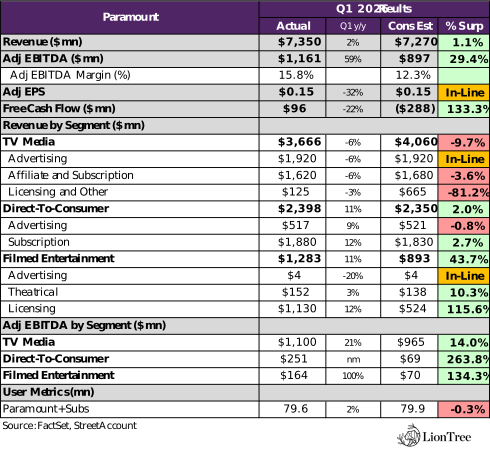
Much Higher Profitability Was A Main Upside Surprise In Q1… While TV Media Revs Were A Bigger Than Expected Drag
- Q1 total revenues BEAT cons by +1.1% (grew +2% y/y) with Studios the biggest upside driver (+43.7% ahead of expectations), followed by Streaming subscriptions (+2.7% ahead of cons)
- On the flipside, much lower Licensing & Other revs ($540mn below cons) was the biggest drag
- The bigger surprise was Q1 adj. EBITDA BEATING cons by +29.4%: It grew +59% y/y but was helped by timing benefits
- Better profitability was posted across all businesses, but DTC was the biggest upside driver followed by Studios
- “Expenses were a bit lighter than we had planned for. This is primarily around a slower pacing of hiring and…some of the shift in timing of content” spend
- Adj EBITDA upside did not flow through to adj. EPS though, which was IN-LINE vs cons
- FCF of $96mn BEAT cons by +133% (but declined -22% y/y)…reflects improving profitability BUT still impacted by transformation costs and content investment
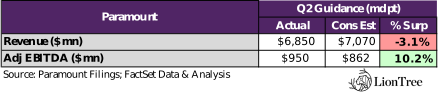
Q2 Guidance Was Mixed & The Full Year 2026 Guidance Was Reiterated As Costs Ramp In H2
- Q2 revenue guidance MISSED cons by -3.1%…reflects ~flat y/y growth driven by:
- Growth in DTC, and Studios to a lesser extent
- But tough comps from Mission Impossible & NCAA + cont’d TV Media pressure
- While Q2 adj EBITDA guidance BEAT cons by +10.2% at the mid-pt…
- …mgmt now expects profitability to skew toward H1 as content cost timing shifts to H2
- The Co anticipate transformation costs of “several hundred million” in Q2, which will impact their reported FCF
- Mgmt reiterated 2026 guidance
- The Co reiterated 2026 adj EBITDA despite beating in Q1 and higher than expect Q2 guidance…this is due to costs shifting to H2 (note that the Street had been taking a more conservative view on adj EBITDA guidance by 5.3%)
- In H2, there will be “some margin hit” in DTC based on when the slate launches in Q3 and Q4
- The revenue guidance implies +4% y/y growth
- Hence a strong revenue growth ramp in H2
- Continue to expect $3bn+ efficiencies through 2027 and $2.5bn+ run-rate efficiencies by YE26
- Continue to expect ~5% FCF conversion before ~$800mn transformation costs
- The Co reiterated 2026 adj EBITDA despite beating in Q1 and higher than expect Q2 guidance…this is due to costs shifting to H2 (note that the Street had been taking a more conservative view on adj EBITDA guidance by 5.3%)
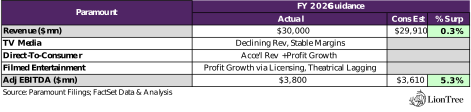
Core DTC Trends Are Strong & DTC Ad Growth Is Expected To Drive A H2 Acceleration
- DTC was the biggest profitability upside driver in Q1
- Rev grew +11% y/y and BEAT cons by +2.0%
- And more materially, adj. EBITDA of $251mn beat cons by $69mn (higher by +264%)
- Q1 Paramount+ revenue growth of +17% y/y (in-line w/ Q4) was driven by higher ARPU + higher quality subscriber adds
- Q1 ARPU rose +14% y/y driven by price increases + mix shift
- Reaction to the price increases across Essential and Premium tiers in the U.S., Canada, Australia and LatAm was “in-line” w/ expectations
- Q1 Subs grew +2% y/y…with reported sub adds of 700k q/q…BUT underneath that, the Co added ~2mn subs and exited a little over 1mn low-ARPU intl hard bundle subs (“less than $1 ARPU”)
- Bundles represented <2% of revenue but inflated subs
- Getting rid of these hard bundles is the right decision economically
- Paramount+ subs in total reached 79.6mn
- Q1 DTC advertising returned to growth and is expected to drive an H2 acceleration
- Mgmt “expects to meaningfully recover DTC ad growth”
- 2026 outlook…mgmt expects continued “healthy underlying subs” growth (especially as the content slate builds throughout the year), and will continue to see improvement in ad monetization
Content Investment & Tech Improvements Are Central To The Co’s Strategy
- Sports remains a core driver of DTC engagement and subs acquisition, and also the Linear segment
- Paramount+ offers ~14k hours of sports content annually
- Q1 included NFL playoffs, UEFA competitions, UFC, and March Madness coverage
- CBS delivered the most-watched final round of the Masters in over a decade
- NCAA March Madness was the second-most watched since 1994
- NFL on CBS had its most-watched year ever (from prior quarter context, still referenced as baseline momentum)
- Paramount+ offers ~14k hours of sports content annually
- UFC has exceeded mgmt expectations “across the board”
- Strong viewership
- Avg UFC viewership across Paramount platforms is 15x the avg PPV event over the past two years
- UFC 326 / 327 main fight cards on CBS avg’d 2.8mn viewers, ~50% higher than ABC’s NBA primetime game that night
- High engagement, including cross platform
- 10mn+ households have watched UFC programming on Paramount+
- 100mn+ hours of UFC content has been consumed across the platform
- UFC is driving cross-content engagement (users staying on platform to watch other shows like South Park)
- Improving demo mix
- New UFC subs are 15 yrs younger than avg Paramount+ viewer
- Better advertising demand
- UFC ad demand exceeded expectations and was a meaningful Q1 ad contributor
- Strong viewership
- The Co is in the midst of its sales re-tooling…& the streaming tech stack convergence remains on track for mid-yr launch
- BET+ content transition onto Paramount+ was completed ahead of the broader service integration
- Consolidated the national sales org into a single client-centric structure under unified leadership
- Launched Paramount Media Labs
- The Co is accelerating Precision+, an AI-powered targeting / optimization product combining 1P and 3P data
- Precision+ is driving performance efficiency gains above benchmarks also using AI driven QA
- New streaming product features are already rolling out, which are designed to deepen engagement
- Mgmt is working on improved personalization,recommendations, discovery and monetization
- Short-form video clips just rolled out on Paramount+ mobile app
- They enhanced the mobile experiences – like live stats for live sports
- The Co is planning gaming, polling and additional interactive features
- Pluto will get its “most significant” product update since inception this summer
- 65% of U.S. Pluto viewing minutes now come from registered users, up nearly +60% y/y
- OD TV hours per user up +60% after recent updates
Studios Is Rebuilding With Some Early Wins But The Real Slate Step Up Comes In 2027+
- Studios significantly BEAT expectations, with EBITDA +134% above cons and strong y/y growth
- Revenue BEAT cons by +43.7% and grew +11% y/y
- Scream 7 surpassed $200mn globally and became the highest-grossing installment in the franchise’s 30-year history
- Also Skydance / TV studio licensing was a key driver
- Adj EBITDA also doubled y/y to $164mn, driven by licensing deals, and BEAT cons by $94mn
- Revenue BEAT cons by +43.7% and grew +11% y/y
- 2026 theatrical rev is expected to decline y/y due to tough Mission Impossible comps but mgmt reiterated its commitment to 15 film releases in 2026 vs 8 in 2025
- Key upcoming releases: Billie Eilish – Hit Me Hard And Soft: The Tour, Passenger, Scary Movie and jackass: best and last
- Mgmt is very focused on ROI analysis for content they are underwriting (has been an investor concern)
- A step-function increase is expected in 2027–2028 from franchise reactivation
- Key franchises: Sonic, A Quiet Place, Call of Duty
TV Media Revs Declined Y/Y More Than Expected Though Cost Discipline Remains Strong
- TV Media was the primary revenue drag in Q1 vs cons and y/y, mostly due to Licensing & Other
- Revenue MISSED cons by -9.7%, declined -6% y/y (vs -5% y/y in Q4)
- Advertising rev decl’d -6% y/y: Including 2ppt impact from intl exits, partially offset by 1ppt political benefit
- Affiliate rev decl’d -6% y/y: Reflecting continued pay TV sub erosion
- Licensing & Other fell -3% y/y and missed cons by a large $540mn
- Revenue MISSED cons by -9.7%, declined -6% y/y (vs -5% y/y in Q4)
- But Q1 profitability in TV Media was materially better than expected
- Q1 TV Media adj EBITDA BEAT cons by +14.0% and grew +21% y/y
- Margin expanded to 29% vs 24% in Q1’25
- Q1 TV Media adj EBITDA BEAT cons by +14.0% and grew +21% y/y
- And mgmt expects stable-to-improving FY26 TV Media margins, while payTV sub erosion continues to weigh on revenue
A Few Other Key Comments
- Mgmt expects total Co ad rev to return to growth in H2, driven by DTC acceleration more than offsetting TV
- Q1 total ad rev decl’d -3% y/y but improved vs Q4
- DTC ads returned to growth in the qtr
- Q1 total ad rev decl’d -3% y/y but improved vs Q4
- Mgmt remains very confident in the WBD deal close by the end of Q3
- AI efficiencies…~ 80% of their engineering organization is using code assisted tech which is driving “meaningful production gains and really cutting approval times by more than in half”
WBD Makes Some Progress Ahead Of The PSKY Deal Close
The clock is ticking for WarnerBrosDiscovery (WBD) to be acquired by Paramount Global (expected during Q3) but in the meantime, the Co continues to move forward with its key initiatives which are basically “scaling HBO Max globally, returning our Studios to industry leadership, and optimizing our Global Linear Networks.”
The quarter itself reflected much better profitability, with in-line revenue (when adjusting for inter-company transactions). Digging deeper, the top 5 most incremental points in our mind from WBD’s results include: 1) Stronger growth in the Studios business was the largest upside driver in the qtr, though we would note that the Co benefited from inter-company licensing due to the Intl HBO launches…with that said, Q2 is a tough Studios comp qtr; 2) Better Streaming profitability was also a standout (Streaming adj EBITDA beat cons by ~29%) and subscriber-related revenue growth accelerated +400bps sequentially, with contributions from pricing (still no negative impact from the price hikes in Dec), the ad-tier mix (50% of gross adds are now ad-supported), and international; 3) While HBO Max’s global launches are largely complete, further penetration and monetization is the next leg of growth; 4) Streaming advertising grew +19% y/y FXN despite the NBA headwind; and 5) The Networks biz outperformed expectations (i.e., less bad), with ad declines improving sequentially and distribution holding in better than feared but revenue s and EBITDA are still declining high single digits, and the NBA absence remains a headwind.
With all that said, the next big catalyst is the close of the PSKY deal, but the core debate about whether streaming can scale fast enough to offset the linear erosion and volatile qtr-to-qtr Studios performance, and if the Co can at the same time improve profitability and de-lever the balance sheet, remains in place.
See below for more details on the above, as well as other key updates.
-> Our deep-dive on PSKY’s results are in Theme #3
Upside In Profitability Was The Main Headline Highlight In Q1
- Q1 revs IN-LINE w/ consensus: Down -1% y/y (-3% y/y FXN)
- Posted ad rev decline of -8% y/y ex-FX, as ad-lite streaming growth was more than offset by the absence of NBA and domestic linear audience declines
- Adj EBITDA BEAT cons by +11.7%: Grew +5% y/y, driven by better profitability trends in Streaming + Studios
- Adj EBITDA margin expanded to 24.7% vs cons 22.2%
- BUT FCF MISSED cons by -269.5% at -$476mn loss vs cons +$807mn …driven by:
- ~$100mn transaction/separation costs
- Higher content investment, higher tax pmts & working capital timing, partially offset by lower interest pmts
- Transaction costs will remain a FCF headwind through 2026
- The biz continues to operate in the historical 33-50% FCF conversion range on an underlying basis but there will be addtl transaction-related cash costs through the closing of the PSKY transaction
- Also, the Co ended Q1 with net leverage of 3.4x
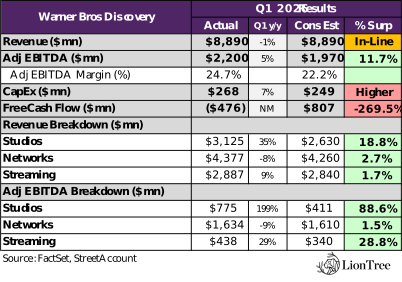
Streaming Momentum Accelerated In Q1…Intl Roll-Outs Are Complete & Focus Now Shifts To Greater Penetration & Monetization
- Upside in Streaming profitability was a stand-out in Q1, on slightly better revenue trends as well
- Revs BEAT cons by ~+1.7%: Grew +9% y/y (+7% y/y FXN), driven by global expansion and subscriber growth
- Adj EBITDA BEAT cons by a large +28.8%: Grew +29% y/y (+17% y/y FXN) reflecting strong operating leverage
- Subscriber-related rev growth accelerated +400bp seq to +8% y/y FXN in Q1, supported by pricing, ad-tier mix, and international expansion
- OUTLOOK – mgmt guided for a “healthy acceleration in subscriber-related revenue growth…picking up pace through Q2 and rest of year”
- Q1 Distribution revenue growth accelerated to +7% y/y FXN (from +2% y/y FXN in Q4) given strong subscriber growth both in existing and new markets, as well as the benefit of the Q4 2025 US price increase
- And continue to see limited churn impact from that Q4 price increase
- Q1 Advertising rev growth also accelerated to +19% y/y FXN (despite the NBA headwind), highlighting strength in the ad-lite tier and monetization scaling
- 50% of global retail gross adds took the ad-supported tier
- The HBO Max global roll-out is largely complete w/ its launches in UK, Germany, Italy and Ireland: To date, the U.K. and Germany launches have gone “particularly well w/ retail subscriber acquisitions trending ahead of internal expectations, while Italy has been in-line”
- But the intl launches are still nascent and mgmt “sees substantial runway for continued penetration growth in existing markets”
- The Co is “on track” to surpass its 150mn global streaming subscriber target by the end of 2026
- In Q1, they exceeded their guidance of more than 140mn global streaming subscribers
- HBO Max has more active shows averaging over 20mn global viewers than ever before…
- Q1 streaming content drivers include:
- The Pitt which averaged more than 20mn viewers an episode in Q1
- A Knight of the Seven Kingdoms which averaged 36mn viewers per episode (among the most popular debut series in HBO history)
- Rooster
- DTF St. Louis
- Like Water for Chocolate (Mexico) and Maxima (Argentina) were 2 intl hits
- In EMEA, this year’s Olympic Winter Games was their most streamed Olympic Winter Games ever
- Content drivers into Q2 and beyond:
- Euphoria Season 3 is off to a “great start”
- House of the Dragon Season 3 (June)
- Stuart Fails to Save the Universe (July)
- Lanterns (Aug)
- Harry Potter and the Philosopher’s Stone (Xmas Day)
- Q1 streaming content drivers include:
- Mgmt is a big believer in the bundle…some of the Co’s highest LTV subs come from bundled subs
- Bundles are “obviously hugely beneficial to churn and ultimately it’s a very healthy and growing part of the business that I think will be an increasingly important part of the entire ecosystem”
- In 2026, mgmt expects another “strong year” for both Streaming revenues and adj EBITDA
- But 2 factors are impacting y/y growth in Q2:
- The absence of the NBA, representing a 16% ex-FX headwind to ad revenues
- The previously disclosed domestic distribution renewal w/ a former related party, which has weighed on distribution revenue growth, will be lapped by the end of this month
- But 2 factors are impacting y/y growth in Q2:
Higher Intercompany Licensing Was A Key Driver For Studios In Q1…Q2 Comps Are Tough But 2026 Adj EBITDA Should Be “Relatively Flat” Y/Y
- Studios significantly outperformed, driven by higher intercompany licensing tied to HBO Max Intl launches
- The Co continues to shift from heavily externally focused content licensing to a more internal utilization model, though it takes a little longer to positively hit the P&L…” it’s going to be a very, very helpful driver for us”
- Revenue BEAT cons by +18.8%: Grew +35% y/y (+31% y/y FXN)
- TV rev rose +58% y/y FXN (higher internal licensing + externally licensing)
- Theatrical rev rose +21% y/y FXN (higher internal licensing)
- Games rev decr’d -30% ex-FX (lower library rev)
- Adj EBITDA BEAT cons by +88.6%: Grew +199% y/y (+156% y/y FXN)
- While Studios faces tough comps in Q2, 2026 adj EBITDA should be “relatively in-line” with 2025
- Q2’s tough comps are due to strong performance of A Minecraft Movie, Sinners, and Final Destination: Bloodlines and also WBTVG renewed an internal content licensing deal for a tentpole library title last year
- There will also be qtr-over-qtr fluctuations of content sales which leads to bumps
- Mgmt thinks they are “well-positioned” to achieve the goal of at least $3bn in annual WB Studios adj EBITDA
- 2026 is seen as an inflection point as streaming should represent “a greater portion of first-run deliveries than broadcast and cable combined for the first time”
- Selling ~80 shows to over 20 streamers
- Notable Q1 deliveries include:
- Memory of a Killer (renewed for a 2nd season)
- Rooster (HBO)
- Shrinking (renewed for a 4th season and is the 2nd most watched Apple TV comedy behind only Ted Lasso)
- The Pitt (HBO Max)
- The Voice (NBC, renewed for its 30th season)
- Notable additional Q1 orders include:
- The next seasons of Abbott Elementary (ABC) and Georgie & Mandy’s First Marriage (CBS)
- A new Netflix series, I Suck at Girls
- WBD is ramping theatrical releases… from 11 in 2025 to 14 in 2026 and up to 18 in 2027…key titles include:
- Dune: Part III
- The Lord of the Rings: The Hunt for Gollum
- DC franchises like Supergirl, Clayface
- The Batman: Part II
- A Superman sequel Man of Tomorrow
- Original stories like The Great Beyond, Panic Carefully, and Digger
- In horror, Evil Dead Burn and The Conjuring: First Communion
- In animation, The Cat in the Hat later this year, followed by Bad Fairies and Margie Claus next year
Linear Network Declines Were Slightly “Less Bad” Than Expected …Ad Trends Improved Seq But Mgmt Is Mindful Of The Macro
- The Networks business topped Street estimates and y/y declines improved sequentially
- Rev BEAT cons by +2.7%: Decl’d -8% y/y (-9% FXN) which is an improvement from -12% y/y (-13% FXN) in Q4
- Distribution fell -8% y/y FXN (ongoing pay-TV subscriber declines)
- Advertising fell -12% y/y FXN (NBA absence + audience declines): NBA absence was a -7% ex-FX ad rev headwind but +16% ex-FX cost benefit
- Content fell -9% y/y FXN (timing-related)
- Adj EBITDA BEAT cons by +1.5%: Decl’d -9% y/y (-10% FXN) which is also an improvement from -21% y/y (-21% FXN) in Q4
- Rev BEAT cons by +2.7%: Decl’d -8% y/y (-9% FXN) which is an improvement from -12% y/y (-13% FXN) in Q4
- Underlying ad revenue trends improved…Q1 reported ad revs were down -12% y/y FXN, a +200bp improvement sequentially but mgmt is also mindful of the macro
- Q1’s improvement was despite an incremental 300 bps headwind from the absence of the NBA relative to Q4
- The overall advertising market remains “healthy with scatter CPMs commanding a strong premium to upfront”
- But “visibility remains limited given broader macro uncertainty”
- “We are actively monitoring the geopolitical and macro environment” and will take any appropriate actions if need be
- Delivery trends are improving…general entertainment networks delivered a 16% seq improvement in y/y delivery trends, finishing the qtr down -8% y/y
- And for Q2, mgmt expects underlying domestic delivery trends to be roughly similar to Q1
- But reminder on Q2 factors:
- Expect the absence of the NBA to result in a 20% ex-FX negative impact to y/y ad revs partially offset by a net 400 bps ex-FX benefit to ad revenue related to the b-cast of the NCAA March Madness Final Four and Championship games, and the absence of the NHL Stanley Cup Final in the current year
- The absence of the NBA is expected to be a benefit to adj EBITDA in H1 as reduced opex will more than offset the reduction in ad revenues
- With the key U.S. distribution renewals in H1:25, secured low SD digit affiliate rate increases (including a flat affiliate rate for TNT, despite the loss of the NBA)
A Few Other Notable Comments/Updates From The Call
- Know “the power of sports” but mgmt wants to prove their ability to streaming sports profitability which is trickier
- The Co will experiment but will be disciplined
- The PSKY deal is still expected to close during Q3
- Thoughts on what happens with the rest of the media sector? “Your guess is as good as ours in terms of what happens to the overall universe”
WMG’s Execution Is Matching The Long-Term Growth Algorithm
WMG shares have been dragged down by AI disruption fears (as has the music sector), but the Co certainly delivered a stronger than expected Q1, easing some of those concerns. WMG’s accelerating revenue growth (total revenue growth re-accelerated to +12% FXN from +7% last quarter and beat consensus by +7.5%) and robust margin expansion (adj OIBDA beat by +10.6%) was a strong combination. Growth in the qtr was underpinned by an increase in recorded music subscription streaming revenue of +15% y/y (on an FXN & adj basis) due to subscriber growth, market share gains, pricing increases (PSM), and also easy comps. AI has also been a key enabler across the company’s priorities driving tangible growth and cost results.
Five of our other top learnings from WMG’s results are: 1) Margin expansion has been ahead of plan (+250bp seq in Q1 to 22.9%) and mgmt raised the FY guidance to the high-end of the +150-200bp expansion target; 2) US streaming share incr’d +1.1pts y/y and mgmt see gains as sustainable, though APAC is still a work in progress; 3) Monetizing and growing Catalog remains a key focus (AI is helping here)…it now represents ~65% of streaming revenue; 4) Ad-supported streaming revenue growth also accelerated (to +11% FXN from +4% last quarter) and is expected to maintain a healthy trajectory; and 5) Similar to other commentary in the music sector, WMG has not seen any dilution from AI music’s increased volume.
Net net, Q1 was the 4th consecutive quarter where the Co posted growth “in line with or above” their sustainable growth model and execution is now matching the long-term algorithm mgmt. has been underwriting. While the AI worries have not disappeared, the qtr likely helps ease some of those concerns.
See below for more details.
-> WMG shares rallied +7.2%…and is up +9.5% YTD (UMG and SPOT are down -11 & -28% respectively YTD)
FQ2 Reflects Another Stronger Than Expected Qtr, With Streaming Growth A Key Contributor
- Total FQ2 revs BEAT cons by +7.5% and adj OIBDA BEAT by a larger +10.6%
- Total revs grew +17% y/y (+12% FXN), accelerating from +10% y/y (+7% FXN) in FQ1
- Adj OIBDA grew +31% y/y (+24% FXN)…this was the second consecutive qtr where margin expansion was ahead of the high end of the full-yr target
- Adj OIBDA margin of 22.9% BEAT cons 22.3% and expanded +250bps y/y (+230bps FXN)
- Big UPSIDE with Recorded Music…led by subscription streaming growth accelerating to +15% y/y FXN on an adj basis
- Revs BEAT cons by +7.0% and grew +17% y/y (+13% FXN)
- Adj OIBDA of $346mn BEAT cons by +8.1% and grew +28% y/y (+22% FXN)
- And Music Publishing was also slightly ahead of the Street
- Revs BEAT cons by +2.3% and grew +14% y/y (+10% FXN)
- Adj OIBDA BEAT cons by +2.1% and grew +14% y/y (+10% FXN)
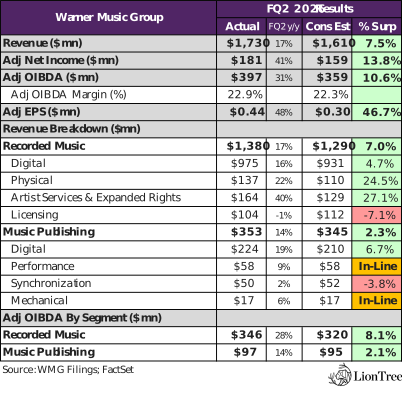
Margin Expansion Is Ahead Of Plan…Hence, WMG Raised Margin Expansion Expectations To The High-End Of Its FY26 Target
- WMG RAISED its FY26 margin expansion target to the “high end” of +150-200bps
- The strategic reorganization, focused investments in tech, and the rollout of the financial transformation program are all contributing to the margin improvement
- The Co reiterated the short-term margin target of mid-20s and longer-term target of high-20s (YTD it is at 24%)
- Key drivers: profitable growth, cost savings and op leverage, with incremental help from catalog growth, DSP pricing / tiering and accretive AI rev starting FY27
- “I’m very confident that we can get to the high-20s target in the medium to long term”
- Productivity is now being “embedded into the culture”
- The Co is leveraging AI more effectively for process automation and better real time decision making
- This is freeing up more resources for value-added work, leading to incremental growth at a lower cost
- Its Finance dept is the initial use case for AI-enabled operating leverage…advanced real time forecasting & reporting has “significantly” accelerated decision making
- WMG plans to use AI-driven tools to further streamline finance and other functions
- “These tools in combination with our relentless focus on profitable growth, will contribute to our margin targets of mid-20s in the short term and high-20s over the longer term”
- Mgmt reiterated its sustainable growth model
- High-single-digit total revenue growth
- Double-digit adj OIBDA and adj EPS growth
- 50-60% operating CF conversion as a % of adj OIBDA
- FQ2 OCF grew +83% y/y and first-half conversion was 66% of adj OIBDA, above the 50-60% model
Streaming Growth Stepped Up Sharply …And Advertising Growth Also Accelerated
- Both subscription and ad supported streaming benefited from “healthy” market growth and global market share gains plus subscription streaming also saw the benefit of PSM increases
- Recorded Music subscription streaming revs accelerated sharply to +20.9% y/y (+15.4% FXN) on an adj basis vs +12.0% y/y (+8.7% FXN) in FQ1
- Drivers for the +15.4% FXN adj subscription streaming rev growth?
- ~6-7ppts subscriber growth
- ~3ppts pricing / PSM
- ~3ppts market share
- Also ~2-3ppts easier prior-yr comp
- On an apples-to-apples basis, subscription streaming growth was around ~12-13%
- Drivers for the +15.4% FXN adj subscription streaming rev growth?
- Expect more room for growth ahead…
- There is more pricing to come
- M&A is not in numbers
- Acquired distribution Co will show up in the numbers later this calendar year
- WMG has done deals with AI companies and are in the process of doing more deals with DSPs
- …mgmt. is “very confident that we can continue to deliver numbers that are consistent with our sustainable growth model”
- Recorded Music ad-supported streaming revs also accelerated sharply to +12.9% y/y (+11.3% FXN) on an adj basis vs +7.7% y/y (+4.4% FXN) in FQ1
- Driven by a “strong overall ad environment” and global market share gains
- Mgmt noted that ad growth differed by partner, w/ some platforms growing “very, very strong” while another partner has not yet contributed as much, but has strategic intent to improve (confident they will)
- On the social side, a new deal also contributed to growth (but mgmt. did not quantify)
- Mgmt is confident that advertising growth will continue to be strong looking ahead
- “One of our partners will do a much better job”
- Music Publishing streaming revs grew +20% y/y (+16% FXN), accelerating from +12.8% y/y (+10.4% FXN) on an adj basis in FQ1
- Driven by new deals / renewals and continued market growth
Market Share Gaina Are “Not Short-Term” …But APAC Remains The Main Area To Fix
- WMG US streaming share grew +1.1ppts y/y and US new release share grew +2.7ppts y/y in FQ2
- This compares with ~+1ppt US streaming share growth in FQ1
- The gains were broad-based across labels, regions, and channels EXCEPT APAC which lagged behind
- WMG recently appointed a new leader and continues to see the “most amount of work to do”
- What is driving the mKt share gains? And is it sustainable? The drivers were strong pipeline mgmt, catalog optimization, and a disciplined focus on distribution… long-form programming will be a new share driver
- Creative momentum remained strong across established and emerging artists globally
- High-profile wins included Bruno Mars dominating four Billboard charts simultaneously, PinkPantheress securing her first Global 200 #1 and Don Toliver scoring his first #1 album
- Additional breakout / chart-topping artists highlighted included sombr, Black, The Marias, Alex Warren and Junior H, with local #1s in Italy, Poland, Sweden, France, Spain and Mexico
- Incr’d monetization of catalog plus high margin accretive catalog (leveraging Bain JV)
- See more below
- Incr’d focus on distribution to serve the independent artists community “profitably”
- Recent deal with Two Stream and acq of Revelator enhance capabilities
- Long-form programming emerged as a new share driver
- After last qtr’s multi-year first-look documentary deal with Netflix, WMG annc’d a multi-year first-look deal with Paramount to produce theatrical live-action and animated feature films
- WMG has “hit our stride,” is “firing on all cylinders” and the market share gains are “not short term” but the result of long-term foundational work
PSM Increases Are Now Flowing Through…With More DSP Step-Ups & AI Premium Tiers Expected To Drive Value-Led Growth
- After more than a decade of volume-led growth, mgmt emphasized that growth is now shifting toward volume + value, with greater certainty around economics “irrespective of retail pricing”
- The Co is pursuing “innovative partnerships” w/ traditional DSPs & emerging AI platforms through several avenues, including
- PSM increases on existing tiers
- Licensing agreements w/ emerging AI platforms
- Collaborating with DSP partners on the AI-centric premium tiers
- PSM increases began in FQ2 and contributed ~3ppts to subscription streaming growth of +15% on an FXN adj basis
- More PSM increases across other DSPs will roll in throughout the balance of FY26, providing further support for subscription streaming growth
- WMG is engaged with their traditional DSP partners regarding AI-centric premium tiers that would allow fans to engage more deeply w/ music and support higher ARPU
- Mgmt believes that consumers will like offerings that “blend creation and consumption”
- They are also focused on AI licensing partnership agreements like with Suno, who it sees as the near-term proof point for incremental AI monetization
- Suno is generating ~$300mn of annualized rev and plans to launch a fully licensed offering later this yr
- Suno’s 2mn subscribers are paying an avg of $12.50/mo
- WMG expects AI platform deals to begin contributing materially to future streaming rev growth starting in FY27 “Our industry leading and thoughtful approach to AI will drive one of the biggest incremental value creation opportunities for our industry”
- AI dilution remains a key investor concern, but mgmt said WMG has not seen dilution (like others in the industry have said)
- Per Deezer data, AI-generated tracks are ~44% of daily uploads but only ~1-3% of streams and a much smaller share of royalties, with ~85% of those streams deemed fraudulent
- Apple data shows AI music is less than 0.5% of listening
Catalog Monetization Remains A Major Priority & AI Is Becoming A Bigger Enabler
- WMG’s catalog is home to over 1mn tracks from more than 70,000 artists
- Catalog remains a major strategic focus, representing ~65% of Recorded Music streaming rev and growing across “shallow and deep vintages”
- WMG is using an always-on marketing approach to continuously revitalize repertoire
- The Co is introducing iconic artists to younger audiences through new release
- Madonna is a great catalog case study
- Ahead of Confessions II (her 14th album), WMG’s catalog marketing campaign drove Madonna weekly streams up +24% vs baseline, with under-20 fans accounting for 35% of Spotify streams
- Her new duet “Bring Your Love” w/ Sabrina Carpenter was Madonna’s highest-charting track yet on Spotify and fueled her biggest-ever streaming day on the platform
- AI tools are enabling WMG to monetize deeper parts of its catalog more efficiently
- AI enables quick / cost-effective creation of motion art, visualizers, lyric videos and other engagement assets
- WMG is also using a proprietary model to determine where marketing activity should be focused, enabling better and deeper monetization
- On catalog acquisitions, Bain JV has now deployed $650mn of its ~$1.65bn capacity to acquire catalogs
- Acquisitions are focused on iconic high-margin catalogs with growth potential and attractive return profiles
- WMG continues to maintain a “strong pipeline” of potential catalog oppties
- Return thresholds are similar as for A&R
Live Nation & TKO Keep Hitting Play As Live Entertainment Dismisses The Macro Backdrop
Live Nation and TKO are two sets of results that always provide a window into the health of the live entertainment sector. What did we learn this qtr? Live Nation delivered a broad-based beat across all segments in Q1 and record deferred rev signals a strong back half of the year. TKO beat on the headline numbers but results were a bit mixed under the hood, and guidance was reaffirmed but not raised.
That said, both companies paint a consistent picture that live entertainment demand remains resilient. Both saw no slowdown across genre, demographic, or geography, and both dismissed any impact from Middle East tensions. Fans are showing up in record numbers, pricing power remains intact, and the pipeline of events and content continues to grow heading into what is shaping up to be a strong back half of the year. The big focus is really on operational execution.
See below for more color on the points we thought were most incremental from both Q1 earnings results.
That said, both companies paint a consistent picture that live entertainment demand remains resilient. Both saw no slowdown across genre, demographic, or geography, and both dismissed any impact from Middle East tensions. Fans are showing up in record numbers, pricing power remains intact, and the pipeline of events and content continues to grow heading into what is shaping up to be a strong back half of the year. The big focus is really on operational execution.
Live Nation Delivers A Broad-Based Beat As Demand Remains Resilient And All Business Segments Are Firing On All Cylinders
–> Live Nation’s stock was up +6.7% in reaction to earnings and ended the week up +3.2%; YTD, the stock is up +13.3%
- Q1 earnings BEAT across the board
- Revenue – BEAT by +6.2%: Up +12% y/y vs +11% y/y in Q4
- Beat across all segments
- Adj op income BEAT by +10.9%: Up +9% y/y vs +23% y/y in Q4
- All segments were better than expected, but esp Concerts
- Revenue – BEAT by +6.2%: Up +12% y/y vs +11% y/y in Q4
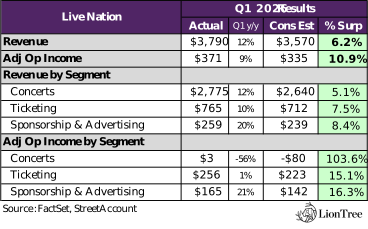
- FY26 guidance was mostly unchanged
- Reiterated FY26 CapEx guidance of $1.1bn-1.2bn
- Reiterated expectations of growing FY26 op income by double-digits, despite op income being impacted by a $450mn legal accrual (will also impact EPS by -$1.93)
- Updated FY26 AOI to FCF-adjusted conversion to be “in-line with or high than” 2025 (vs prior guidance of just “higher” than 2025)
- Overall demand dynamics – seeing NO slowdown across genre, demographic, theater sizes, or region, as Q1 deferred revenue for Concerts and Ticketmaster reached record levels
- Event-related deferred revenue grew +22% y/y to reach $6.6bn, the largest deferred revenue balance in Co history
- Ticketing deferred revenue grew +29% y/y to reach $368mn accounting for $5.5bn in deferred ticketing GTV
- Concerts – broad based demand momentum across geographies and venue is building towards a back half loaded yr
- Expect N. America and intl mkts to perform “very strongly” this yr
- “Very good” qtr in LatAm drove the Q1 outperformance
- Stadiums expected to be up both in the US (“despite a very strong year last year”) and up “strongly” in intl mkts
- Amphitheaters and arenas are up “nicely” in the US, so that should drive solid growth throughout North America
- Stadium and amphitheater growth setting up a strong back half of the yr
- Strong global stadium growth and US amphitheater growth will skew Concerts rev and AOI more heavily toward Q3 this yr vs prior yrs, simply due to venue mix shifting toward larger, seasonal outdoor shows, which by nature bunch up in the back half of the summer calendar
- As a result, Q4 is also shaping up to be a “very strong” margin qtr
- Specifically on amphitheaters…both supply and demand are setting up for a “strong” 2026: Tracking ahead of last yr on show count + ticket sales are up double-digits y/y
- Expect N. America and intl mkts to perform “very strongly” this yr
- Touring – both supply and demand are growing, and tour cancellations are a non-issue / Middle East conflict has had no impact on biz
- Quick comment on Middle East… Middle East disruption has “no material effect” today, as it is a very small touring market with “no tours, no shows planned” in the region
- Seeing no changes in tour cancelation activity… “this year would be no different than any other year”
- Cancellations are tracking “slightly below” the industry: For reference, tend to have 1%-2% cancellation rate historically both at Ticketmaster across the industry and at Live Nation
- “The pie is growing” …: There are more bands on the road on a global basis and that continues to grow
- …and seeing “strong” supply across the globe…: Intl biz growth is potentially stronger than America; LatAm is “on fire”
- …which is expected to continue for “many years to come”
- Ticketmaster – solid underlying momentum and new leadership driving innovation, with near term headwinds from scalper reduction efforts and legal expenses expected to be manageable
- What drove the y/y upside in margins? A lot of the growth on the Ticketmaster side is coming from addtl concert tickets that are being sold; Also adding more clients globally; Underlying biz fundamentals also continue to be in good shape
- New Ticketmaster Global President Saumil Mehta is accelerating innovation across the fan and artist experience on both the front end and global back end
- A top priority remains making the on-sale process smoother and more transparent
- Driving work on a more robust face value exchange program and better on-sale tools for artists (“that’s our biggest pain point”)
- On the back end, rethinking how Ticketmaster enters new mkts using AI and other innovative approaches to move faster without being constrained by legacy platform limitations
- Also remain focused on using the platform’s scale to drive addtl economics, though venue clients will continue to keep the bulk of svs fee economics and the oppty for Ticketmaster is in building incremental value on top of that
- On legal expenses running through ticketing – don’t expect to continue to have same level of elevated expenses going forward: Will continue to have some expenses related to the FTC and “some other activities” but they are expected to moderate over the next few qtrs from where they’re at today
- Ongoing efforts to reduce scalper activity expected to impact FY26 Ticketmaster AOI by MSD
- This is a one-time hit that they expect to grow to offset this yr and fully comp against going forward
- Over time, secondary is expected to gradually decline into single-digits of fee-bearing GTV as “primary will win” and content owners control more inventory
- But overall FY26 Ticketmaster AOI margin expected to be similar to last yr
- Venues – upgraded fan count outlook as Venue Nation accelerates global expansion through innovative financing and capital-light partnerships
- Increased FY26 Venue Nation fan count expectation: Expected to grow double digits this year off the prior 65mm base, implying more than the previously discussed ~5mm increase
- Growth is “pretty evenly distributed” between stronger performance at existing venues and newly added venues
- New venue securitization structure creates a scalable funding engine for long-term venue expansion”
- Live Nation developed a PropCo-OpCo framework, separating its physical venue assets from its operating business, allowing it to borrow against those properties at higher leverage levels without putting pressure on the rest of the balance sheet
- They kicked things off with an initial raise of just over €600mn, using existing venues as collateral, but the structure is designed to be self-reinforcing, so every new venue they add can be folded in as addtl collateral, meaning the funding capacity grows automatically as the portfolio expands
- The end result is a repeatable, scalable financing tool that lets Live Nation continue building out its venue portfolio without having to rely on traditional balance sheet financing each time they want to buy or build a new location
- Partnering with existing stadiums globally offers a capital-light path to venue expansion
- On Live Nation’s agreement with Club Atlético in Argentina for booking and naming rights… “we love that deal, and we absolutely think on a global basis, it’s something we could replicate”: Many stadiums outside the US sit underutilized, making Live Nation a natural partner to drive show volume, bring sponsorship expertise, and inject capital where needed
- “On a global basis, we like building arenas” BUT on the stadium side, they like partnering with them, which is “a little less capital intensive, but locks up a lot of the revenue streams”
- Reiterated oppty in premium: Targeting up to 30% of new arenas in premium capacity, and are retrofitting existing amphitheaters like Indianapolis and Dallas to take premium from as low as 1-2% up to 25%, taking a page out of the sports arena playbook
- Increased FY26 Venue Nation fan count expectation: Expected to grow double digits this year off the prior 65mm base, implying more than the previously discussed ~5mm increase
- Quick update on the regulatory front… what happens next after the DOJ settlement and state case ruling?
- Time scheduled in court for this upcoming Thursday (May 7th) to discuss process
- Three key elements:
- Rulings on evidence-related motions
- Judge to determine the process for DOJ settlement review process
- Remedies portion of the trial that just concluded
- Timing and next steps are uncertain until the judge decides…until then “we have to wait a minute and see how he lays it out”
TKO Continues To See Broad-Based Growth And Demand Across Portfolio While Holding FY26 Guidance Steady
–> TKO fell -1.5% in reaction to its earnings print, but ended the week up +0.5%; YTD, the stock is still down -10.6%
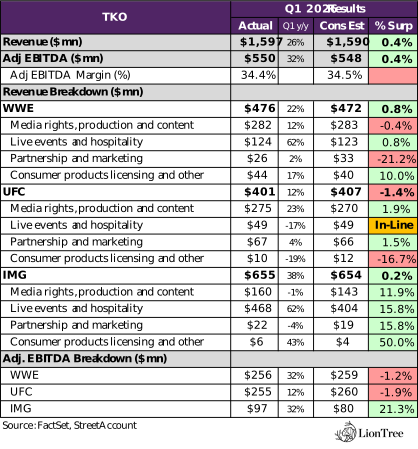
- Q1 total rev BEAT cons by +0.4%, while adj EBITDA BEAT by +0.4% (though margins were a tad light)
- WWE and IMG both beat on rev, while UFC missed
- Adj. EBITDA beat was driven by IMG, as both WWE and UFC both missed
- Also announced an addtl $1bn share repurchase authorization, which is incremental to its previously announced $2bn share repurchase program
- Reaffirmed FY26 guidance
- Rev of $5.675-$5.775bn vs cons $5.77bn (-0.8% below the midpt)
- Adj EBITDA of $2.24-$2.29bn vs cons of $2.27bn (-0.2% below the midpt)
- Performance is expected to be driven by “robust” growth across media rights, live events, including FIPs, and partnership rev
- Both UFC and WWE margins will “meaningfully” outpace 2025
- Continue to see “healthy” demand for premium live events across TKO’s portfolio
- “Firmly moving ahead” w/ scheduled events in Middle East and neighboring mkts AND “we have seen no customer pullback whatsoever”
- TKO doubleheader on June 27th reflect their commitment “to bring world-class events to fans across the region even and despite a challenging environment”
- UFC will return to Azerbaijan with UFC Fight Night Baku + WWE will host Night of Champions from Riyadh, Saudi Arabia
- Following the two events, expect remainder of 2026 slate in Middle East to take place as planned
- Six events inclusive of UFC, WWE, and Zuffa Boxing
- Also noted that following reports of PIF withdrawing funding from LIV Golf, Saudi partners confirmed that this “will not be the case with TKO”
- “Their commitment to our properties in 2026 and beyond is unwavering”
- TKO doubleheader on June 27th reflect their commitment “to bring world-class events to fans across the region even and despite a challenging environment”
- WWE – Q1 rev was up +22% y/y (in-line w/ Q4) and adj EBITDA was up +32% y/y (decel from +44% y/y in Q4)
- Driven by an increases across all categories
- Looking into WWE’s Q2…expected to be the highest rev and adj EBITDA qtr of the yr in terms of absolute dollars, given the timing and mix of the event calendar
- Media rights will continue to benefit from the step-up of their agreement with ESPN
- With respect to live events rev, the Saudi PLE carries a meaningful FIP, but held a similar event in Q2:25
- UFC – Q1 rev was up +12% y/y (decel vs +17% y/y in Q4) and adj EBITDA was up +12% y/y (decel vs +20% y/y in Q4)
- Driven by an increase in media rights, production and content rev, and an increase in partnerships and marketing rev, partially offset by a decrease in live events and hospitality rev
- UFC had 9 total events in Q1:26 compared to 11 total events in Q1:25
- Both Q1:26 and Q1:25 had 3 numbered events
- Q1:26 included 6 Fight Nights vs 8 in Q1:25; Q1:25 also benefited from a Fight Night in Saudi Arabia that carried a meaningful financial incentive package
- UFC deal w/ Paramount+ is off to a roaring start
- Debut on Jan 24th reached more homes than any UFC event in nearly a decade
- First CBS simulcast, UFC 326, was the most watched live UFC event since 2016
- The CBS audience alone was 270%+ above last yr’s UFC avg on linear before counting Paramount+ streaming
- New fans are discovering UFC on CBS and Paramount+, and they are staying
- On Paramount-WBD combination… “we are ecstatic and frankly anxious for them to close this deal and for us to get to the table and start brainstorming what we can do with all their platforms”
- Progress w/ Zuffa Boxing is “exceeding our internal growth plan and timeline”
- Already signed 100+ fighters
- Staged five events w/ “solid” viewership on Paramount+
- Secured a multi-year deal with Sky Sports for the UK and Ireland, “two of the most pivotal and important boxing markets in the world”
- Also signed media rights deals in 15+ addtl territories spanning EMEA and APAC
- “Next phase of our growth plan is underway” with events about to depart the Meta APEX in Las Vegas and go out on the road
- Looking into UFC’s Q2…media rights rev will continue to reflect the step up from the Paramount rights deal + the mix of live events will also impact results
- Expect to stage 11 events in Q2…UFC Freedom 250 at the White House in June + 2 numbered events + 8 Fight Nights
- Expect to lose ~$30mn on UFC Freedom 250, though it is a “once in a lifetime” event that will highlight the brand on the biggest stage possible
- UFC Fight Night Baku carries a “meaningful” y/y financial incentive package, part of a multi-ye renewal at a higher per event fee than they realized in the same mkt in Q2 of last yr
- Expect to lose ~$30mn on UFC Freedom 250, though it is a “once in a lifetime” event that will highlight the brand on the biggest stage possible
- …Vs prior-yr qtr…. which had 4 numbered events + 7 Fight Nights
- Expect to stage 11 events in Q2…UFC Freedom 250 at the White House in June + 2 numbered events + 8 Fight Nights
- IMG – Q1 revs were up +38 % y/y (accel vs -9% y/y in Q4) and adj EBITDA was up +32% y/y (vs -124% y/y in Q4)
- Primarily related to an increase in live events and hospitality revenue
- This increase was primarily related to hospitality sales at On Location from the 2026 Olympics
- On PBR specifically…rev grew +36% y/y to reach $74mn and asset is appreciating
- Opened the yr w/ record performance in seven mkts, including its debut at Boston’s TD Garden and its largest ever attendance at Madison Square Garden in Jan
- PBR’s team series has also approved a two-franchise expansion expected to grow from 10 teams to 12 teams for the 2027 season
- Franchise values are exploding: Growing from ~$3mn at launch → $22mn in 2024 → expected multiples of that in 2027
- Looking ahead…expect continued growth at PBR, and it will be high margin growth, “analogous” to that of the WWE and UFC segments
- Looking into IMG’s Q2…expect results will be driven by On Location with the World Cup starting on June 11, as well as notable events in the qtr like the Final Four and NFL Draft
- Also a “big” qtr for the IMG biz with many of the largest soccer leagues in the final months of their season, the start of Wimbledon, and the first full qtr of the MLS season
- While the World Cup is anticipated to have a positive impact on adj EBITDA, sales efforts for LA28 will have ongoing costs that are expected to partially offset such impact
- TKO is “insulated from AI disruption”: “As AI transforms how content is created and consumed, the value of our IP and properties increases. Our content is live. It’s communal. It’s scarce, and no algorithm can replicate it”
DKNG Is Going All-In On Predictions In H2
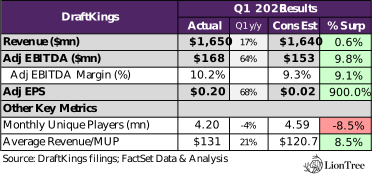
DraftKings’ Q1 was a bit of mixed bag with higher expected profitability (adj EBITDA beat by almost 10%) but revenues were ~in-line and monthly unique players (MUPs) were much lower than expected (by -8.5%). Plus, despite the higher Q1 adj EBITDA, the Co re-affirmed the FY adj EBITDA guidance of $800mn at the mid-point. At the same time, mgmt was explicit about the spending plan on its Predictions business that is included in the guidance (it will be a high $200-300mn that will be heavily back-half weighted) and the guidance also includes Alberta & Arkansas launch costs. Adjusting for the assumed Predictions investment spend, the Co’s Core business adj EBITDA is targeted to reach $1bn (which is well ahead of total $620mn reported in FY25). All in all, that’s a plus regarding growth in the Core but investors are focused on the ROI of the large Predictions spend in this competitive market.
Aside from all that, 5 other top takeaways in our opinion are: 1) The SuperApp seems to be working as Predictions CAC declined more than -80% in April after its integration into the app and early traction has been extremely strong with the annualized predictions consumer volume exceeding $1bn and the annualized total volume traded exceeding $2.3bn in April, an increase of +38% & +43% month over month respectively; 2) The World Cup is seen as a “tremendous” customer acquisition event in H2 (especially in non-OSB states)…though it may not be a huge revenue opportunity; 3) The Co’s market making business has been its fastest new business line to reach profitability ever…and the exchange business will be launched in the “coming weeks”; 4) The core OSB performance was strong with revenues growing +24% y/y despite handle up only +1.5% y/y… net revenue margin expanded by +140bp and parlay mix increased +300bp; and 5) April trends were very strong with handle up +6% y/y, revenue up +22% y/y, and $100mn+ EBITDA in a single month.
Overall, DKNG’s core OSB business is performing well and the Co is heavily leaning into Predictions with the user ramp slated to come later this year, which obviously will be a key deliverable as competition in this new market has been a significant investor concern.
See below for more details.
-> DKNG closed the day up just over +1%, though the stock is still down -26% YTD
Higher Than Expected Profitability Was DKNG’s Main Q1 Standout…While Revenue Was In-Line & MUPs Remained Weaker Than Expected
- Q1 revs BEAT by +0.6%: Rose +17% y/y vs +43% y/y in Q4
- Adj EBITDA BEAT cons by a more sizable +9.8%: Grew +64% y/y
- Adj EBITDA margin at 10.2% topped cons 9.3%
- Adj EPS of 20c BEAT cons $2c…DKNG also generated positive net income for the 2nd consecutive qtr
- Monthly unique players (MUP) MISSED cons by -8.5% (fell -4% y/y vs 0% in Q4): This primarily reflects lower MUPs from Lottery following their exit from Texas in 2025; Excl the impact of Lottery, MUPs incr’d by +2% y/y
- Mgmt expects Predictions to drive a “tremendous increase” in MUPs in H2 as DKNG ramps marketing across roughly the other half of the US population (see more below)
- Avg rev/MUP BEAT by +8.5% (up +21% y/y vs +43% y/y in Q4)
- DKNG repurchased almost $100mn of shares in Q1
Despite The Q1 Adj EBITDA Beat, FY26 Guidance Was Maintained And Now Explicitly Includes Predictions Market & New Launch Spend
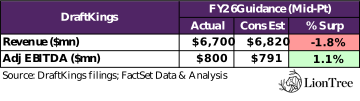
- FY26 guidance was maintained…
- Mid-pt of rev guidance is -1.8% below cons
- Mid pt of adj EBITDA guidance is +1.1% above cons
- … and mgmt detailed that it includes Predictions investment and expected Alberta & Arkansas launch costs
- Total 2026 Predictions investment is expected to be $200mn-300mn (back-end loaded and largely focused on marketing)
- This implies that the Core business is expected to generate $1bn+ of adj EBITDA this year before the Predictions investment (vs $620mn in total reported adj EBITDA in 2025)
- Mgmt was deliberately disciplined / conservative w/ the initial guidance earlier this year, anticipating potential launches and giving itself room to absorb them
- At the start of the year, the Co knew there was a chance it would “go very aggressive on Predictions”
- Mgmt also contemplated “at least one, maybe multiple launches,” including rumblings in Arkansas and discussions around Alberta
- Alberta is expected to launch “in July”
- The initial guide included “some conservatism,” which was deliberate to help “maintain and hopefully as the year progresses, raise the guide”
- “Not much has changed other than I think we’ve become a little more crystallized in some of these exact numbers. But nothing’s too far off from where we initially thought it would be at the beginning of the year”
DraftKings Expects “Huge” Growth In Users In H2 From Predictions…And The World Cup Is A Key Catalyst
- Given that Predictions is now live in their flagship app their Predictions customer acquisition cost declined more than 80% in April
- Within Predictions, they have more than doubled markets available to trade, which is driving Predictions volume per customer above Sportsbook handle per customer
- In April, the annualized predictions consumer volume exceeded $1bn and the annualized total volume traded exceeded $2.3bn, an increase of +38% & +43% month over month respectively
- As noted above, mgmt expects to invest $200mn-300mn in Predictions this year…the spending ramp starts in Q2 but will be heavily back-end weighted
- Mgmt expects “huge customer acquisition numbers” in the back half if the current regulatory environment hold
- The Co has “very high expectations” for World Cup regarding customer acq and engagement, especially in Predictions states such as CA, TX and FL
- Mgmt does not expect World Cup to be a huge revenue event, BUT it will “be absolutely tremendous for a customer acquisition, starting with these Prediction states”
- Spanish-language functionality launched ahead of World Cup and should help DKNG acquire / engage an incremental audience
- DKNG will “really go for it” but if the numbers don’t support that they will back off…they won’t spend heavily if it is not working
- “We are confident in sports predictions because we increasingly view our sportsbook capabilities as a key advantage. Sports predictions and sportsbook serve the same customers in the same live moment and leverage a shared underlying infrastructure”
Mgmt Sees “Tremendous Value” In Every Layer Of The Productions Eco System”…“Which Is Why We Are Playing In All Of Them”
- DKNG’s predictions market making business is not only already profitable, but is also “one of our fastest profitability business lines we’ve ever launched”
- Mgmt believes that there are arbitrage moments beyond hedging… they are “definitely looking at this”
- The Co thinks that they will need to go on 3P platforms in addition to their own exchanges
- Mgmt expects that DKNG should be one of the top 2-3 market makers globally, and “arguably the best,” given its sports modeling / pricing capabilities
- Market making is the least capital-intensive layer (and as noted, is already profitable): The consumer-facing Predictions will be the primary 2026 adj EBITDA headwind and is driving “most” of the $200-300mn investment spend this year
- The exchange sits in the middle of the eco-system w/ only “a little” product investment so should be “profitable quickly too if you don’t attribute any of the customer acq costs”
- Timing: The Co’s proprietary exchange and combos are expected to launch in the coming weeks, ahead of World Cup
- Beginning next qtr, DKNG will report “sports revenue” combining Sportsbook and Sports Predictions, reflecting how mgmt plans to operate the business
- Regarding 3P data suggesting that Predictions customers have a higher loss rate than OSB…
- “People think they are playing against other people but most of the liquidity is being put up by professional market makers”
- “The reality is that most of the money (liquidity) being put up…is being put up by professional market makers, institutions, things like that”
- “I think some people don’t necessarily understand that…and as that becomes more apparent, I think you’ll start to see that [rate of loss vs OSB] moderate”
Core Sportsbook Momentum Remains Strong As Hold, Parlays, And Promo Efficiency Drive Revenue Above Handle…April Trends Are Positive
- “Across all key metrics, our Sportsbook business remains strong”
- Sportsbook revs grew +24% y/y despite handle up only +1.5% y/y, reinforcing mgmt’s view that handle should not be analyzed in isolation
- Net revenue margin incr’d +140bp y/y to 7.8%, aided by higher parlay mix and improved promotional efficiency
- Parlay handle mix incr’d by ~300bp
- Sports outcomes were “slightly positive” but it was “minor”
- Revenue growth exceeded +20% across nearly all major sports, including NBA and NCAA men’s basketball, reflecting product enhancements and deeper media integrations
- The competitive environment is “pretty stable”…it “doesn’t really look any different than it has”
- Mgmt feels really good about how Q2 has started…April trends were strong with handle +6% y/y, total revs +22% y/y, and >$100mn of total adj EBITDA in the month
- DKNG has seen “no discernible impact from the rise of Predictions on our Sportsbook business”
- Internal and third-party data suggest Predictions is impacting Sportsbook industry handle only very slightly and primarily among low-margin wagers, resulting in a negligible impact to revenue
An Acceleration In iGaming Would Be Upside To the FY26 Guidance
- In iGaming, mgmt. acknowledged that it was “lower growth than we think it should” as the Co was overly focused on OSB cross-sell vs the iCasino-first / slots-first customer
- iGaming revs grew +8.9% y/y in Q1, below the ~20% y/y growth DKNG generated in 2025
- The Co has incr’d team focus and effort on iGaming in the last several months, with changes across product and marketing
- DKNG launched Flex Spins, a differentiated promo that lets customers use free spins on any game they want, which mgmt said no one else has
- It is a “huge opportunity to grow that [this business] in H2”
- Accelerating iGaming would be upside as it is not assumed in the FY26 guidance
Predictions Is Helping OSB Legalization Discussions And Is Also A Tool To Push Back On Taxes
- Predictions is not under the state framework but DKNG is, and in “my view, states would be absolutely crazy right now to raise OSB taxes with everything going on with prediction. So [we are] definitely getting some good traction on both that and on future legalization”
- “These things take time and might not get any [new states] over the finish line this year but I do see momentum”
- No state tax increases have occurred so far this year as well (Predictions don’t pay taxes in the state)
- Mgmt sees iGaming momentum in the DMV region:
- Washington D.C. is strongly considering a proposal
- Virginia came very close (passed both chambers before dying in conference)
- Maryland momentum is building
- Mgmt also cited Ohio as a focus for next year and Illinois as “interesting”, though without a clear path today
One Other Key Comment / Update
- The Superapp should help with lowering payment costs (which have also already been coming down given rates get better as vols ramp)
- The Co expects to decrease payments cost in 26 “and certainly in 27 and beyond”
Shopify’s Higher Investment Adds More Fuel To The AI Worries Fire
The level of concern regarding AI impacting the commerce sector remains very high and dynamic. While Shopify’s solid Q1 GMV and revenue growth was a plus (this was the 2nd consecutive $100bn+ qtr for GMV), investors honed in on the much lower than expected adj op income (missed the Street by a large -19.4%) reflecting incremental investments but also higher transaction / loan losses, and a mix shift to lower-margin Merchant Solutions. The Co talked about higher LLM costs from growing AI product usage, and this trend is anticipated to continue as usage deepens with merchants, which was a big focus. The Co guided for Q2 operating expenses as a % of revenue to reach 35-36% (much higher than cons 30%), while at the same time, Q2 revenue growth is expected to decelerate to high twenties % growth y/y (down from +34% y/y in Q1).
Other key comments about how AI is changing commerce and how Shopify is positioned (took up a large chunk of time on the call) include: 1) Shopify is increasingly framing itself as the infrastructure layer for “agentic commerce,” with its catalog, checkout, and payments stack embedded across platforms like ChatGPT and Microsoft; 2) The Co is seeing very strong AI usage on its platform…AI-driven traffic to Shopify stores grew 8x y/y in Q1, while orders from AI-powered searches rose nearly 13x & new buyer orders from AI searches are occurring at nearly 2x the rate of traditional organic search; 3) Sidekick usage is up roughly 4x y/y and 12k custom apps were built in Q1, up >200% q/q, and Pulse is shifting Sidekick from a reactive assistant to a proactive growth tool; and 4) Shopify Catalog is emerging as a popular AI discovery layer (the catalog has 1bn+ products and catalog-powered AI search traffic converts 2x better than general AI search traffic).
Also, Shop App GMV grew +70% y/y (MAUs grew >40% y/y) and it’s also worth noting that Shopify Payments was very strong, processing $67bn of GMV, up +41% y/y and reached 67% penetration, +3 pts y/y. Enterprise, International, and Offline continue as structural growth vectors for the Co looking ahead.
Overall, AI is driving incremental GMV and engagement for Shopify, but it is also introducing a new cost layer that scales with usage. Investors will be watching for signs of operating leverage re-emerging, a clearer linkage between AI usage and revenue uplift, and continued proof that Shopify remains central in an ecosystem increasingly shaped by third-party agents.
See below for more color on the points we thought were most incremental.
-> SHOP shares fell over -15.6% in reaction to earnings and is now down -32% YTD
Shopify Posts Solid Q1 Top-Line BUT Higher Investment In AI Weighed On Operating Income
- GMV BEAT cons by +2.1%…$101bn grew +35% y/y (+30% y/y FXN), marking the 2nd consec $100bn+ qtr and reflecting accelerating growth (Q4’s rate ws +15% y/y)
- Growth was broad-based across geos, cohorts, and channels
- Europe GMV rose +48% y/y (+35% y/y FXN) and continues to be key growth driver
- North America GMV re-accelerated on a large base, it was the strongest growth in 4+ years
- Same-store growth and new merchant adds remained relatively balanced
- Channel strength was more or less consistent with prior trends
- Offline GMV rose +33% y/y (accelerating vs Q4’s +29% y/y)
- B2B GMV rose +80% y/y (vs Q4’s +84% y/y), supported by feature expansion to the broader merchant base
- Growth was broad-based across geos, cohorts, and channels
- Q1 revenue BEAT cons by +2.6%…and accelerated from +27% y/y in Q4 to +34% y/y (+32% FXN): Growth was driven by GMV outperformance, higher payments penetration and strength across N. Amer / Europe / APAC
- N. Amer rev grew +33% y/y, strongest quarterly growth rate in >4 yrs
- Europe rev grew +42% y/y
- APAC rev grew +30% y/y
- Importantly, nearly 90% of rev came from merchants on the platform >1 yr, reflecting cohort compounding
- GAAP gross profit BEAT cons by +4.0%…grew +32% y/y, slightly ahead of expectations
- Gross margin at 48.9% was down y/y reflecting the cont’d mix shift toward Merchant Solutions
- BUT the big negative was that adj. op income MISSED cons by a significant -19.4%…implies only 12.1% margin vs cons 15.3% reflecting incremental investments and higher transaction / loan losses, plus mix shift
- Economies of scale / support efficiencies were offset by higher LLM costs from growing AI product usage, most notably; Mgmt expects this dynamic to continue as usage deepens merchant embedding
- On the plus side, R&D, S&M and G&A each improved as % of rev
- Transaction / loan losses were 3.7% of rev vs 3.2% y/y in Q1:25, driven mostly by Credit, while payments loss rate was below Q1:25
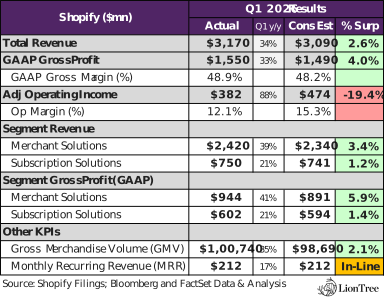
Merchant Solutions Is Over-Indexing On Growth, Though Will Under-Index On Margins
- Merchant Solutions showed the strongest revenue and gross profit outperformance vs cons in Q1
- Revs BEAT cons by +3.4%…it rose +39% y/y (+37% FXN) driven primarily by GMV strength and incr’d Shopify Payments penetration
- GP BEAT cons by +5.9%…grew +40% y/y, w/ GM ~39%, essentially flat y/y
- Shopify Payments processed $67bn of GMV, up +41% y/y and reached 67% penetration, +3 pts y/y: This growth is up from +38% y/y in Q4
- Shop Pay processed $35bn of GMV, up +59% y/y (vs +62% y/y in Q4)
- Shop Pay GMV outside the US grew >70% y/y
- While the mix shift toward payments remains a key driver of revenue growth it also is a margin headwind given European market launches
- Mgmt expects deeper Shopify Payments penetration across geos with the expansion beyond 39 countries today and Shop Pay’s momentum
- But note that near-term, Europe is a headwind to global payments penetration given recent launches, but should become a tailwind over time
Subscription Solutions Growth Should Normalize As Q1 Marked The Final Qtr Of Trial Related Headwinds
- Subscription Solutions slightly outperformed and note that Q1 marked the final qtr of trial-related headwinds hence growth should normalizes
- Rev BEAT cons by +1.2%…it rose +21% y/y (+19% FXN)…growth was balanced across:
- Plus subscriptions (enterprise upmarket)
- Standard plans (SMB funnel)
- Variable platform fees and ecosystem revenue
- MRR was IN-LINE w/ cons at $212mn and grew +16% y/y
- Plus MRR was 35% of MRR, up from 34% y/y
- Q1 was the final qtr of MRR headwinds from 3-month trials rolled out in Q1:25
- GP BEAT cons by +1.4% …grew +21% y/y
Q2 Revenue Growth Guidance Was As Expected BUT Operating Expense Growth Guidance Was MUCH Higher Than Expected
- Q2 revenue guidance is roughly INLINE but also points to decelerating growth from +34% in Q1 to high twenties in Q2
- Guidance assumes ~50 bps FX tailwind vs >200 bps FX tailwind in Q1
- Q2 operating expense as % of rev guidance at 35-36% was much higher than cons 30%
- But down from the +37% y/y growth in Q1
- Q2 FCF guidance includes ~50 bps FCF margin tailwind from adopting merchant cash advance accounting treatment consistent w/ Capital loans
- Key guidance drivers:
- Cont’d payments growth and penetration
- Strong merchant cohort performance
- International expansion (Europe remains key)
- Ongoing product expansion and AI investments
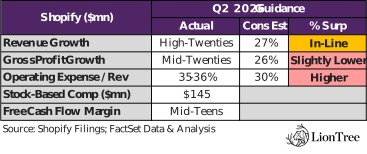
Mgmt Remains Confident In Shopify’s Position In This New AI World (This Is A Key Investor Debate)
- Mgmt’s tone on AI was confident, shifting from “laying the rails” last qtr to AI being “Shopify’s native language” and “already here”
- Mgmt emphasized Shopify as an “AI-native” platform across product, operations, and merchant workflows
- AI-driven traffic to Shopify stores grew 8x y/y in Q1, while orders from AI-powered searches rose nearly 13x
- New buyer orders from AI searches are occurring at nearly 2x the rate of traditional organic search
- Also to note. Shopify’s economics are the same as a consumer buying on a Shopify store
- The Co is seeing strong adoption of Sidekick (AI-powered assistant embedded into the merchant workflow)…usage accelerated meaningfully and is now positioned as a “co-founder” / daily operating layer for merchants
- Weekly active shops using Sidekick were up ~4x y/y
- 12k custom apps were built in Q1, up >200% q/q
- Nearly 50% of all Shopify Flows generated in Q1 were built w/ Sidekick
- Pulse is shifting Sidekick from a reactive assistant to a proactive growth tool
- Example: “Pulse identified an accessories brand getting social proof from fashion publications and celebrity Instagram profiles and created a social proof webpage within minutes”
- Mgmt noted what previously required marketing, UX, design and copywriting specialists can now be completed autonomously “in minutes” at zero incremental merchant cost
- AI is also driving internal productivity and product velocity
- AI now writes “well over 50%” of Shopify’s code and that % is rising
- Shopify shipped 300+ products / features last year while keeping headcount flat
- BUT the Co is also seeing higher LLM costs from merchant usage, which is a cost offset
- Mgmt also framed AI as a tailwind to e-commerce penetration and entrepreneurship rather than a platform displacement risk
- Mgmt reiterated its belief that more billion-dollar brands will be born on Shopify as AI accelerates entrepreneurship
- Mgmt also again emphasized their view that agentic commerce agents do not bypass Shopify
- ChatGPT’s in-app browser checkout is “literally the Shopify storefront within the chat”
- Shopify remains the system of record powering discovery / catalog, checkout, payments and post-purchase complexity… “Agents do not bypass Shopify”
- Universal Commerce Protocol (UCP) is gaining traction as an industry standard
Demand Creation Is Also Becoming A Bigger Part Of The Co’s Value Prop…Also For Non-Shopify Merchants
- Mgmt believes that Shopify is not just converting demand, but creating it
- Shop App GMV grew +70% y/y
- MAUs grew >40% y/y
- Unique buyers purchasing directly on Shop grew >50% y/y
- Sign in with Shop usage grew 3x y/y and is enabled across nearly the full merchant storefront base
- Shop Campaigns continues to scale as a risk-free acquisition channel
- Merchants w/ live campaigns grew 3x y/y
- For some smaller merchants, Shop Campaigns contributed as much as 25% of total GMV
- New Q1 channels included ChatGPT, Pinterest and Microsoft Monetize
- Shopify Catalog is emerging as the AI discovery layer
- Catalog has structured >1bn products w/ clean attributes, real-time pricing and accurate inventory
- Catalog-powered AI search traffic converts 2x better than general AI search traffic
- OpenAI and Microsoft are already using catalog to power discovery
- Agentic plan gives non-Shopify merchants access to AI channels via Shopify catalog, creating an on-ramp to broader platform adoption
Enterprise, International, & Offline Continue As Structural Growth Vectors…
- Enterprise momentum is accelerating given legacy platforms are looking increasingly disadvantaged in an AI / unified commerce world
- Merchants >$100mm GMV is the Co’s fastest growing segment (up nearly 2x over the last 2 yrs)
- Large brands increasingly adopting unified commerce stack
- Shopify-native brand creation remains part of the enterprise story
- Example: Gruen launched on Shopify in 2023 and was acquired by Unilever for >$1bn after scaling to hundreds of millions in rev
- Q1 wins / go-lives included Mulberry, Balmain, LVMH, rag & bone, The Outnet, Rue Gilt Group, Lands’ End, BevMo, Orvis, Benetton Group, Victoria’s Secret’s Body Shop, Vail Resorts and Reitmans
- International remains a key growth lever
- Intl GMV grew +45% y/y
- Europe posted +42% y/y revenue growth
- Europe GMV grew +48% y/y (+35% FXN), despite tough 2025 comps
- Cross-border GMV was 16% of total GMV
- Offline and B2B remain underpenetrated growth avenues
- Offline GMV grew +33% y/y, accelerating from Q4’s +29% y/y
- Fastest growing was merchants operating >20 stores
- B2B GMV grew +80% y/y vs +84% y/y in Q4
- Shopify made several B2B features available to most Standard subscription plans, allowing merchants to manage wholesale and DTC needs side-by-side
Pinterest and Snap Navigate a Shared Playbook, But With Diverging Outlooks
After both Cos had tough reactions to their earnings prints in Q4, it was a bifurcated story this qtr, with Pinterest’s shares up and Snap’s shares down. Both Cos actually delivered strong upside to Street Q1 profitability expectations, though Pinterest also outperformed on revenue (vs Snap’s in-line). Digging a little deeper, PINS’ ad revenue growth accelerated in Q1, while Snap’s ad revenue growth decelerated, but it was offset by much stronger Other revenue (i.e., including Snapchat+). On the guidance, PINS issued a Q2 outlook that topped projections while Snap’s Q2 outlook was more in-line and w/ notable caveats, including no contribution from Perplexity following the end of their $400mn partnership announced in Q1 and ongoing Middle East headwinds that impacted Q1 ad rev and are assumed to persist into Q2. To note, Pinterest said they haven’t seen any impact from the conflict on their biz.
Despite these differences, both Co navigated some similar challenges like a pull-back in large retailer ad spend in Q1. This constituent weighed on both PINS and SNAP’s results, but there has been some more recent improvement. Advertiser diversification is also a bright spot for both companies, with Pinterest continuing to broaden its revenue base into mid-market and managed SMB, while Snap’s SMB segment grew spend 30%+ y/y in N. America and accounted for 30%+ of global ad rev for the 7th consecutive quarter. PINS is very focused on closing its international monetization gap, while Snap’s challenge has been more concentrated with N. America large advertisers, even as its underlying monetizable DAU base has actually grown over the past two years. Finally, AI is a central theme for both platforms, with Pinterest emphasizing a differentiated and defensible data advantage, while SNAP highlighted that nearly 70% of ad spend now utilizes at least one AI-powered automation solution, alongside early traction in AI Sponsored Snaps and Lens+.
There was a lot covered across both companies but we tried to distill the below details to the need-to-knows.
-> Pinterest was up +6.9% after its report while Snap fell -2.1%
Q1 Reflected A Strong Profitability Beat For Both PINS & SNAP, Though PINS Also Outperformed On Revs
- PINS – Q1 headline was a clean beat across the board, most notably on adj EBITDA but also on revs
- Rev BEAT by +4.6%: Grew +18% y/y (accel from +14% y/y in Q4)
- Beat across all regions driven 1) cont’d broadening of the rev base and 2) better-than-expected performance from their large retail advertisers (more on this below)
- Adj. EBITDA BEAT by +17.5%: Grew +20% y/y (decel from +41% y/y in Q4)
- Adj. EBITDA margin of 20.4% was ahead of cons 18.2%
- Rev BEAT by +4.6%: Grew +18% y/y (accel from +14% y/y in Q4)
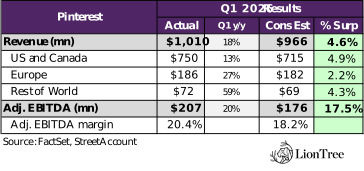
- SNAP – While the Co also outperformed on Q1 adj EBITDA, revs were just in-line (with decelerating ad revenue growth offset by higher Other revenue)
- Rev was IN-LINE: Grew +12% y/y (accel from +10% y/y in Q4) due to growth in Other revs
- Q1 ad rev (81% of revenue) grew +3% y/y (decelerated from +5% in Q4), driven primarily by growth in direct response ad rev, partially offset by continued headwinds in the N. Amer large client ad biz, and ~$20-$25mn impact from the geopolitical headwinds in the Middle East experienced during March
- Q1 Other rev (19% of revenue) was up +87% y/y (a big step up from +62% in Q4), driven primarily by continued momentum in Snapchat+ subscriptions, strong adoption of our newer offerings such as Memories Storage, and early traction from Lens+
- Adj EBITDA BEAT by +8.9%: Grew +115% y/y (accel from +35% y/y in Q4)
- Margin of 15.2% was ABOVE cons 14%
- Adj EPS of -5c was AHEAD of cons -7c
- FCF was a strong +80% BEAT
- Rev was IN-LINE: Grew +12% y/y (accel from +10% y/y in Q4) due to growth in Other revs
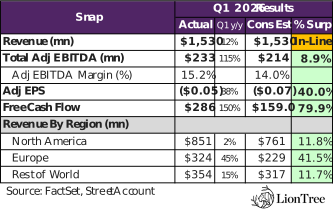
Differing Impacts Of Middle East Conflict…It Is NOT Having A Material Effect For PINS But Was A Material Headwind For SNAP
- PINS – The Middle East conflict is not having much of an impact
- Ad mkt environment is “relatively consistent” w/ last qtr: “The impact we are seeing so far from that conflict is small on a dollar basis based on what we now know”
- Any impact they see is most directly in their RoW region and “to a lesser extent” in Europe, where it’s isolated to certain verticals impacted by higher oil prices
- This has all been factored into the Q2 guidance range (see below)
- SNAP – Middle East conflict was a headwind in March and had an ~$20-$25mn impact on ad rev
PINS Q2 Guidance Was Also Solid, While SNAP’s Guidance Was Mostly In-Line But W/ Some Caveats
- PINS – Q2 guidance also came in ahead of expectations + progress towards medium- and long-term targets are “proceeding well”
- Q2 rev guidance BEAT by +2.1% at the mid-pt: Implies +14-16% y/y growth (vs +18% y/y in Q1 and ahead of cons +12%)
- Assumes the impact of FX to be ~1pt of tailwind
- Q2 adj EBITDA guidance BEAT by +2.3% at the mid-pt
- Reiterated FY26 adj EBITDA margin of ~29%, including tv Scientific
- Implying that margins step up in H2, from Q1’s 20.5% and Q2’s 23.4%
- Also reiterated medium-term adj EBITDA margin target of 30-34%
- Update on returning to mid-to-high teens long-term rev growth targets… “we’re encouraged by the early progress here in the first half of the year. And the work that we’re doing across the business is focused on returning us to consistent delivery of those targets over time”
- Q2 rev guidance BEAT by +2.1% at the mid-pt: Implies +14-16% y/y growth (vs +18% y/y in Q1 and ahead of cons +12%)
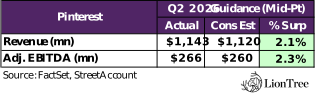
- SNAP – Q2 guidance was ~in-line w/ expectations… BUT Perplexity is now out & the Middle East is a seen as a wildcard
- Q2 rev guidance was ~in-line at the midpt
- But assumes no contribution from Perplexity as they ended the relationship in Q1
- Also assumes that the operating environment in the Middle East region remains consistent vs what they saw in March and April (but caution that the trajectory of the geopolitical situation in the region is uncertain)
- What’s driving the ~2pt q/q improvement in revenue growth implied in Q2? Strength in N. America ads biz, including improvement in pricing and yields
- Q2 adj EBITDA guidance was +1.9% ahead of expectations at the midpt
- Also on FY26 gross margin…reiterated goal of reaching “60% or better”
- Q2 rev guidance was ~in-line at the midpt
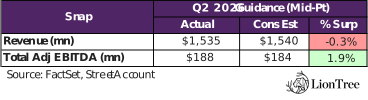
Snap Returns To Seq User Growth, While Better ARPU Was A Key Theme For Both PINS & SNAP (But Concentrated In Europe For The Latter)
- PINS – Q1 global MAUs reached 631mn, growing +11% y/y (vs +12% y/y in Q4), marking the 10th straight qtr of double-digit growth
- Posted MAU growth across all regions
- ARPU also came in ahead of expectations across all regions
- SNAP – Q1 marked a return to growth in DAUs, up +9mn q/q vs -3mn q/q posted last qtr
- DAU growth was driven by RoW, as both N. America and Europe DAUs still fell q/q
- Overall ARPU also beat expectations, though it was entirely driven by Europe, as both N. America and RoW missed
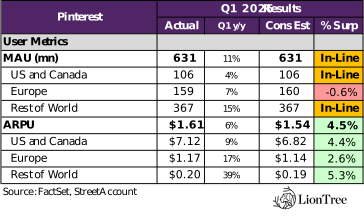
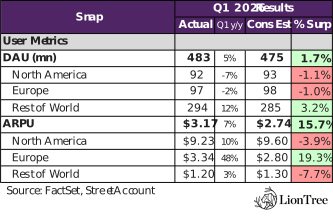
PINS and SNAP Show Diverging Regional Trends…PINS Stable In UCAN and Driving Intl Monetization While SNAP N. America Weakness Is Advertiser Driven Despite Improving Monetization
- PINS – the Co is seeing stability in UCAN + taking significant steps to capture international monetization upside
- UCAN (~75% of rev) – the Co is “really encouraged by the stability we’re seeing in that core market. We believe we’re on the right trajectory there”
- Looking into Q2… achieved double-digit growth in Q1 and expect to repeat that in Q2
- International growth is expected to moderate in Q2 as they make “deliberate” leadership and structural changes to best position for the long-term
- Mgmt reiterated that progress regarding the “rebuild and retool” of the organization will not always be linear, “but that modest disruption is playing out” in their intl regions in Q2
- Also lapping more difficult comps in Europe + RoW due to the ramping of resellers last year and elevated cross-border spend following the introduction of US tariffs
- “We’re still significantly under monetized internationally relative to the strength of engagement and commercial intent we see on the platform”
- UCAN (~75% of rev) – the Co is “really encouraged by the stability we’re seeing in that core market. We believe we’re on the right trajectory there”
- SNAP – N. America ad weakness reflects large advertiser softness rather than user trends, with underlying monetization improving
- N. America DAU declines have been improving over the last 2 qtrs after they pulled back on broad-based user acq spend
- BUT they are expected to decline by -1mn in Q2 or approach a flat q/q pace if they continue to land product improvements
- Even so, monetizable DAUs have actually GROWN in the N. America in the last 2 yrs, with a “meaningful” increase from the launch of Sponsored Snaps
- Overall, the monetizable user trends have been improving despite the N. America large customer business struggling and putting some downward pressure on the overall ad biz
- N. America DAU declines have been improving over the last 2 qtrs after they pulled back on broad-based user acq spend
PINS Stressed Closing The Monetization Vs Engagement Gap As A Key Focus
- PINS – remain focused on accelerating monetization on the platform, which still lags user engagement and commercial activity: Have 5x+ the # of clicks sent to advertisers over the last ~3 yrs, but monetization hasn’t increased “nearly” at that rate
- New Chief Business Officer Lee Brown has already begun making key changes
- Making leadership changes across parts of intl and go-to-market organization + how they drive accountability across the sales force:
- Accelerating adoption of internal AI tooling
- New Chief Business Officer Lee Brown has already begun making key changes
- Ongoing go-to-market work is organized around three broader themes:
- Broadening their rev base
- Increasing consistency of their global go-to-market execution
- Strengthening their measurement foundation
Large Retailers Continue To Be Headwinds For Both PINS And Snap
- PINS – Growth accelerated ex large retailers as diversification efforts start to bear fruit
- Q1 overall ad impressions grew +24% y/y (vs +41% y/y in Q4), w/ the decel primarily driven by lapping the initial ramp of monetization in previously under monetized markets, which had contributed to outsized impression growth the prior yr
- Q1 ad pricing declined -5% y/y (vs -19% y/y in Q4), w/ the sequential improvement vs recent qtrs driven primarily by a higher relative mix of UK and ad impressions, which carry higher avg pricing overall due to the lower growth of intl ad impressions, as well as stronger UCAN ad demand
- Q1 vertical ad trends: Across verticals, growth was driven by retail, though with puts and takes, as well as smaller but faster growing categories on the platform, including financial svs
- Continue to make progress in diversifying its rev base beyond large retailers into mid-market enterprise, managed SMB and international
- The Co saw cont’d headwinds from their largest retailers in Q1 BUT the Co did see some improvement later in the qtr
- Rev growth excluding these large retailers accelerated in Q1 relative to Q4 (note that large retailers continue to navigate some tariff related margin pressure, though they’re seeing some stability there)
- SNAP – ad execution improvement in Q1 was led by continued strength w/ SMBs, while large advertisers continue to be a headwind
- In Q1, SMBs grew spend by 30%+ y/y in N. America and accounted for 30%+ of global ad rev
- Remained their largest ad growth driver for the seventh consecutive qtr
- At the same time, large advertisers in N. America remained a headwind, but are beginning to see early signs of improvement as performance gains are more fully reflected in 3P measurement systems and as newer inventory in Chat is more widely adopted
- N. America upfront commitments for 2026 grew ~10% y/y
- BUT caveated that recovery among larger N. American advertisers remains “early and uneven” as these customers typically make planning and investment decisions on quarterly or semi-annual cycles, which means rev often lags underlying improvements in performance.
- Looking ahead, focused on three priorities –
- Improving performance and measurement across the core ad platform
- Expanding new inventory
- Translating those gains into broader advertiser adoption and larger commitment Thoughts on opening inventory up to more sellers on the DSP side? Open to it, but cautious about impact to advertiser relationships, as they are particularly important strategically as they’ve diversified with SMB customers and focused more on lower-full objectives; Some oppty around upper-funnel video demand that they’ve been considering but would have to “really carefully” think through the channel conflict
AI Is Driving Engagement Gains & Improving Advertiser Performance Across Both Platforms
- PINS – AI investments are compounding across the full platform stack
- “Pinterest is a highly personalized AI powered shopping assistant”: 80bn+ monthly searches on the platform, approx half of which are commercial in nature (vs ChatGPT’s 2% of prompts that are commercial)
- PinRec is their unified cross-surface model: Replaced multiple surface-specific models with one model that serves personalized results everywhere at once, delivering ~180bps improvement in search fulfillment and ~180bps reduction in CPA/CPC for advertisers
- Search ranking now draws on a much deeper user history: Pinterest expanded its model’s context window 30x, using up to 16,000 actions over 2 yrs to sharpen results, driving an ~70bps improvement in search fulfillment and ~390bps lift in saves
- Canvas is bringing in-house image gen at a fraction of 3P cost: Their proprietary model trained exclusively on Pinterest data that generates and edits images at far lower cost than third-party alternatives; Currently powers background editing and catalog-to-lifestyle image transformation for ads
- Pinterest Performance+ is crossing early adoption milestones: ~30% of lower-funnel rev now runs through Performance+ campaigns; Adopters grew lower-funnel spend nearly 2x the rate of non-adopters, with a new native A/B testing tool in Ads Manager to help advertisers validate results
- SNAP – continue expanding AI use cases across the platform, with early signs of traction
- Nearly 70% of advertising spend now use at least one of their AI-powered automation solutions, including Smart Audience, Smart Budget, or Smart Placement
- Introduced AI Sponsored Snaps, a new format that enables brands to engage Snapchatters through interactive, AI-powered conversations in Chat
- AI-powered Lens interactions are deepening user engagement and increasingly serving as a natural discovery layer for premium AI-powered experiences
- Lens+ is emerging as a key extension of this strategy, offering subscribers access to exclusive Lenses and AI-powered features; Early traction has been “encouraging”, with Lens+ contributing to higher subscription ARPU and gross margin expansion
- Continuing to make investments in AI-driven personalization, and specifically with Spotlight helped drive an increase in total time spent watching Spotlight up +11% y/y
PINS In Particular Called Out How The Co Is Leveraging Its Unique Data To Build A Defensible AI Advantage
- PINS – emphasized Pinterest’s “differentiated” and defensible position as AI reshapes the discovery economy
- “Pinterest data set is fundamentally different from what these other 3P models have been trained on”
- Have “one of the largest image corpuses in the Western world” + “a powerful proprietary data set” -> which “allow us to solve a problem that text-based general purpose search was never built for”
- Pinterest’s curation data is unique in the Western world, giving them an AI training advantage competitors can’t easily replicate
- Leveraging this data to build and train in-house and post-trained models, which delivers better performance than off-the-shelf proprietary models at a fraction of the cost
- Also…Gen Z is coming to Pinterest in “larger and larger” numbers and w/ increasing depth of engagement per user as “they clearly get something very different from Pinterest than they get from chatbots”
- “Pinterest data set is fundamentally different from what these other 3P models have been trained on”
PINS And Snap Both Doubled Down On Their Ongoing Commitment To Online Safety And Regulatory Compliance
- PINS – Have been ahead of the curve on youth online safety… “we believe social media companies should compete on their safety record the same way car manufacturers compete on their safety ratings”
- On the regulatory front… “for the sake of all our young people, we’re hoping to see more advancement of that dialogue”: “Welcome” the conversation and have been an “active” voice in those discussions and policy makers recognize and appreciate the proactive stance PINS has taken
- “There’s a genuine consumer demand for a more positive and safer space online, and Pinterest is in that”
- SNAP – regulatory actions to protect teens online is “certainly something we care a lot about” and they “invest deeply in”
- Often get lumped in with social media “even though Snapchat’s really different…it’s focused on communication”
- “We have to do a lot of work to continue differentiating ourselves from more traditional social media platforms”
- Steps Snap has taken…
- Exploring addtl age assurance practices (have integrated w/ Apple’s new offering but that requires users to essentially agree to share their age with Snapchat rather than being something that’s on by default)
- Also implemented facial scanning and ID verification in some countries which they may rollout more broadly through the yr
- Often get lumped in with social media “even though Snapchat’s really different…it’s focused on communication”
Other Key Highlights Across PINS And SNAP
- PINS – tvScientific is extending monetization of Pinterest’s high-intent user base beyond the platform into CTV
- Acq closed in Q1 and mgmt. has already begun integrating Pinterest audiences and signals with tvScientific algorithms via tvScientific buying platform
- Early results are “tangible” and “encouraging”
- Saw a 27% increase in outcomes and 65% increase in purchases, when bringing the Pinterest audience on top of the tvScientific algorithms
- One early partner, a leading home furnishings omnichannel retailer, saw a ~+190% increase in incremental audience reach and a +159% increase in incremental sales after leveraging Pinterest audience data in its CTV campaigns
- Over time, expect to integrate tvScientific capabilities directly into Pinterest Performance+ turning the Co into a “full funnel search, social, and CTV performance solution”
- SNAP – quick Snapchat+ and Specs updates
- Snapchat+…some key strategic callouts regarding the long-term oppty
- Increasing tiers of Snapchat+
- Rolling out new features
- Introduction of Memories is driving overall retention improvement
- Specs…commentary was fairly limited as Co plans to share more at Augmented World Expo on June 16
- Snapchat+…some key strategic callouts regarding the long-term oppty
Uber, DoorDash & Instacart’s Results All Point To Resilient Last Mile Demand, But Forward Signals Show Different Paths
The last-mile earnings prints this week were in overdrive, with Q1 reports from Uber, DoorDash, and Instacart. Despite a noisier macro backdrop that spanned geopolitical tensions, gas price volatility, and weather disruptions, the group largely painted a picture of resilient underlying demand. Across all three, the focus is on strengthening core operations, broadening their platforms across new use cases and verticals, and leveraging AI to drive the next leg of growth.
At a high level, Uber’s forward momentum stood out given the strong Q2 guidance despite a mixed Q1, DoorDash reinforced solid fundamentals with healthy demand and share gains despite some near-term investment pressure, and Instacart delivered a strong Q1 that was tempered by a more muted outlook. Taken together, the results point to a sector where demand remains intact and execution continues to drive performance, even as expectations and near-term dynamics diverge.
See below for the key takeaways from each company.
Uber’s Mixed Q1 Due To “A Complex Macro Backdrop Marked By Weather Disruptions, Geopolitical Tensions, And Gas Price Volatility” Was More Than Offset By Q2 Guidance That Was Well Ahead Of Expectations
-> Uber’s stock was up +8.5% in reaction to its print and ended the week up +1.1%
- Uber’s Q1 results were a bit of a mixed bag
- Q1 gross bookings BEAT grew by +21% y/y CC for the third consecutive qtr
- Saw upside across all segments
- Growth was driven primarily by expansion in user base, followed by higher engagement
- Q1 trips MISSED and grew +20% y/y (decel from +22% y/y) to 3.6bn
- Driven by MAPCs growth of +17% y/y (slight decel from +18% y/y) and monthly Trips per MAPC growth of +3% y/ y vs +3% y/y in Q4
- Q1 rev SLIGHTLY MISSED by -0.6%
- Driven by Mobility, as Delivery and Freight missed
- Q1 adj EBITDA margin of 18.8% BEAT ahead of cons 18.3%
- Q1 EPS of 72c was ahead of cons 69c
- Q1 FCF MISSED by -22%
- Q1 gross bookings BEAT grew by +21% y/y CC for the third consecutive qtr
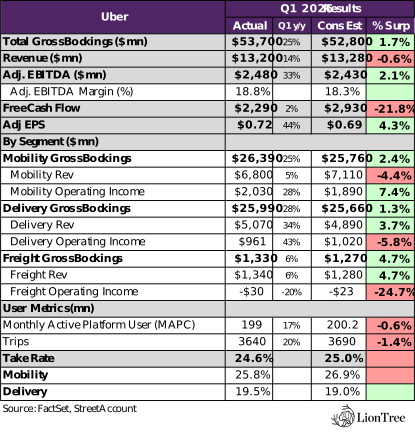
- Q2 guidance came in slightly ahead of the Street
- Gross Bookings – BEAT: $56.25bn-$57.75bn beat cons $56.17bn by +1.5% at the midpt
- Implies growth of +18-22% y/y CC vs +21% y/y CC in Q1
- Assumes an ~2ppt currency tailwind to total reported y/y growth
- Also incorporates a 60bps headwind from the conflict in the Middle East
- Adj EBITDA – BEAT: $2.7bn-$2.8bn beat cons $2.67bn by +3.0% at the midpt
- EPS – BEAT: of 78c-82c was ahead of cons 78c at the midpt
- Gross Bookings – BEAT: $56.25bn-$57.75bn beat cons $56.17bn by +1.5% at the midpt
- The Co also surpassed 10mn drivers and couriers globally
- In Q1…active drivers grew +21% y/y, despite gas price volatility
- Mobility – Q1 gross bookings accel from +19% y/y in Q4 to +20% y/y
- This was despite the conflict in the Middle East and severe weather in the US, which together contributed an est’d 60 bps headwind to y/y growth
- Mobility – update on cost savings from insurance changes… “this will be the first year since COVID where we expect to see good leverage on our insurance cost line for the US Mobility business”
- Passing down those savings to customers as lower prices which is driving “really good” elasticity and an acceleration in trip growth
- In particular, LA, which is the mkt w/ the most significant insurance headwinds over the last few yrs, is seeing trip growth trends that are “significantly better” than CA and the rest of the country
- Reiterated that this should translate to accelerating US Mobility biz growth in 2026, and feel even more confident about it today than they did in Dec or Jan
- Passing down those savings to customers as lower prices which is driving “really good” elasticity and an acceleration in trip growth
- Mobility – continue to execute on “barbell strategy” across the price spectrum…success in moving some user behavior from on-demand -> planning ahead drove decision to expand into “planned services” (i.e. hotels)
- Have consistently seen Uber Reserve svs growth rates continue to grow “well in excess” of the mainline biz, and margins are higher
- Hotels are “a very, very natural expansion for us. We’re very happy to have a relationship with Expedia… and we’re hoping hotels can be just as big as Reserve”
- 700k hotels are now available on Uber
- Uber One members get 10% Uber credits, and have a rolling list of 10,000 hotels where users can get 20%
- Delivery – Q1 gross bookings slightly decel’d from +26% y/y in Q4 to +23% y/y BUT op income reached a record 3.7%
- Driven by high consumer retention, continued growth in membership, and strength in Grocery & Retail
- Severe winter storms in the US contributed an estimated 80 bps headwind to y/y growth, but underlying demand remained robust
- Delivery – Mkt-specific updates across intl and sparse mkts + broadening out G&R
- Delivery position is improving “quite substantially” across the globe… “very much on an offensive footing” in intl mkts
- Seeing an incremental level of competitive intensity from both DoorDash but Uber has “held our own quite well”
- Annc’d expansion into 7 new mkts
- Seeing “very good” trends in Japan and Taiwan, while Australia has been “standout” from its highly penetrated position
- “Very happy” w/ suburban and sparse mkt delivery but still “very, very early innings”: As they add more selection to these mkts (i.e., more drivers, more merchants, etc.), seeing trip growth rates are growing 2x faster in Mobility and Delivery vs core urban mkts
- It’s all about expanding selection, investing in reliability, and tailoring products (i.e., seeing a higher %age of Reserve and Wait and Save; Grocery is very strong in suburbs as well)
- Building Grocery & Retail biz to move beyond food delivery to broader local commerce
- Biz continues to grow “significantly faster” than restaurant deliver, driven by increased selection, product innovation, and rising consumer awareness
- Delivery position is improving “quite substantially” across the globe… “very much on an offensive footing” in intl mkts
- Uber One reached 50mn+ members
- Members spend 3x more, account for 50%+ of bookings, and are growing 50% y/y
- Also increasing benefits, including getting 10% back on hotels, enabling benefits to work globally, and more
- As a reminder, Uber One ended 2024 w/ 30mn members… “we’ve kind of wondered when it’s going to slow down. At this point we don’t see it slowing down”
- AI investments are centered around making the app more personalized and easier to use
- “Utmost importance” is getting the basics right, which is increasing reliability and selection across both Mobility and Delivery globally
- Leveraging AI and agents to upgrade the experience from “one-size-fits-all” to being more personalized to each user: Lets user interact however they want (type, talk, take pictures) and enables easier discovery of svs, driving cross-platform usage
- Driving more cross-platform usage
- Cross-platform consumers are growing 1.5x faster than the overall growth of consumers
- Investing in new entry points on both their Rides and Eats app
- Introduced One Search, which is basically universal search across the product.
- Already seeing ~ $15bn of run rate gross bookings for Uber’s delivery biz coming from the Uber Mobility app
- Lots of headroom ahead….30% of our eligible Mobility consumers have never used Uber Eats
- Examples of AI in action –
- Predicting where a rider is going (already works ~75% of the time)
- Suggesting rides with one tap
- Cart Assistant → take a photo and Uber builds your shopping cart
- Personalized recommendations and upsells (i.e., coffee with your ride)
- Drivers can ask AI for advice on when/where to work
- And AI assistants replacing Uber’s direct relationships w/ customers is NOT a concern
- Already have a strong direct user relationship from building an “indispensable local service”
- Building their own in-app agent features to anticipate user needs…for example, suggesting a ride home before a user even asks
- Also talking to and partnering w/ 3P AI agents and will build APIs to work with all those agents
- Noted that this has happened before w/ travel when people worried middlemen (like search tools) would take over, but Cos like EXPE and ABNB still kept their customer relationships
- At one point, Google Maps had comparison shopping b/w Uber and Lyft but “it wasn’t the same experience as coming direct to the app”
- “We’re very confident that AI is going to empower entirely new experiences. But we think the majority of those experiences are going to come direct to us”
- And looking in-house, AI is an accelerator for Uber…investment in AI tools and infrastructure is increasing, which is offset by slower head count growth
- Have re-upped AI investments: Underestimated amount of impact AI tools would have when they set budgets for 2026 last Nov, before they had new models come up in Dec
- AI is creating employees with “superpowers” …examples of how employees are using AI…
- Engineers write more code, faster
- AI helps with design, testing, and maintenance
- ~10% of code is now generated by AI agents
- As a result…
- Employees can be 20–100% more productive
- And Uber can grow output without growing headcount as much
- Accelerating launch of AVs, particularly from Waymo, is not having an impact on the overall Mobility biz – “we continue to see very, very healthy trends and we don’t see any signs of that abating at this point”
- Not seeing any impact of new Waymo launches on overall biz: Highlighted that US Mobility biz accel vs last qtr and is expected to continue to accelerate for the balance of the yr
- “We certainly see Waymo moving very quickly, as we are moving very quickly”
- Will be in 15 mkts by end of yr
- And “significantly more” going into next yr w/ partners like Nuro, NVIDIA, Zoox, etc.
- Performance of Uber’s bizs w/ Waymo in Austin and Atlanta continue to be “strong”
- Driver earnings are up and more drivers are joining the platforms
- And in mkts where Waymo has been launching or has been around for some period of time, Uber’s category position is actually higher than it was six months ago
- Including San Francisco and LA
- Also continue to sign up partners b/c Uber’s platforms continues to drive demand
- “We have shown that the utilization of these cars, which are very, very expensive on our platform, is higher”
- Also in “very early innings” with the launch of Uber Autonomous Solutions, which helps AV partners focus on building the driver, while Uber can build “everything else” around them (i.e., fleet mgmt, data collection, etc.)
- Quick update on Freight biz – returned to growth for the first time in 2 yrs as Q1 gross bookings were up +6% y/y (vs -1% y/y in Q4), driven by strong service levels, continued simplification of operations, and expansion of AI-driven automation
- Added nearly as many new enterprise customers in Q1 as in all of 2025
- Looking ahead… “we see significant opportunity to more tightly integrate Freight with the broader Uber platform to create a cohesive end-to-end logistics ecosystem, ranging from multi-day to same-day to 30-minute delivery”
DoorDash’s Underlying Fundamentals Remain Solid With Healthy Demand Trends And Continued Share Gains, Despite Near-Term Pressure From Gas Investments
-> DASH’s stock was up +2.0% on the back of its print and ended the week down -7.2%
- Q1 margin strength offset top-line and order weakness
- Revenue, Total Orders and Contribution Profit were all ~2-3% below expectations
- BUT Adj. EBITDA and margin, Marketplace GOV and AOV were all ahead
- Note that winter storm had a ~1% y/y impact on GOV
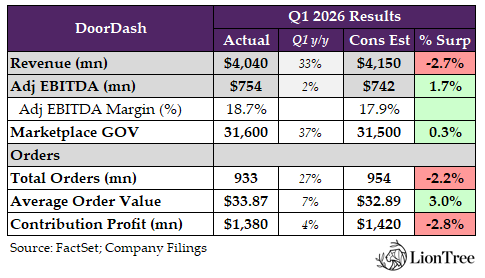
- Q2 guide shows GOV ahead while EBITDA lags w/ continued gas rewards investment
- Adj EBITDA was -0.9% BELOW cons at the midpt: $770mn – $870mn vs cons $827.7mn
- Marketplace GOV was +1.4% ABOVE cons at the midpt: $32.4bn – $33.4bn vs cons $32.43bn
- Reiterated FY26 guidance
- Continue to expect adj EBITDA as a % of Marketplace GOV to increase “slightly” vs 2025, excluding the impact of Deliveroo in both periods
- Expect H2 EBITDA and margins to be higher than H1
- Continue to expect Deliveroo to contribute ~$200mn to adj EBITDA in 2026
- Continue to expect adj EBITDA as a % of Marketplace GOV to increase “slightly” vs 2025, excluding the impact of Deliveroo in both periods
- On impact of rising gas costs…similar to Q1, expect the gross cost of the Dasher gas relief program to be over $50mn in Q2
- How was it funded? Pushed out some H1 investments to H2 (which they remain “fully convicted” in making)
- Looking ahead… will monitor the situation to determine whether to extend the program post Q2 and if they do, will find offsets in other parts of the biz to protect overall top and bottom-line
- Emphasized that view on FY26 has NOT changed
- Demand continues to be “quite strong” … in Q1, MAUs reached an all-time high, order frequency is growing, subscription had a record qtr across DoorDash, Deliveroo, and Bolt
- …and looking ahead… “Q2 is off to a good start”
- Geographic breakdown…
- Gaining share in virtually every single mkt
- Growing at “near” historical highs in “pretty much” all their mkts
- Specifically on competitive position in Europe… “we’ve never been stronger”
- Deliveroo is seeing the highest growth rates it has in the past 4 yrs and it has actually been reaccelerating in each of the months they’ve been operating
- Wolt has seen the highest share performance in each of the countries in which they operate
- Saw “record” growth across membership programs in Q1
- Y/Y growth in US DashPass members accel’d in Q1, driven by strong Y/Y growth in sign-ups and reduced churn
- In intl mkts, Y/Y growth in DashPass, Wolt+, and Deliveroo Plus members also accelerated, despite still being “nascent” which is something the CO is continuing to work to increase of the value they provide
- Grocery is growing fast but has lots of runway for improvement, fulfillment is the key unlock (they’re in early stages), and profitability is trending in the right direction
- Growth is being driven not just by increasing selection, but also improving the overall svs experience so online experience is just as good, if not better, than the offline experience
- Taking a “nail the experience before we scale” approach w/ DashMart Fulfillment Services: Have rolled out to a “handful” of partners; Trying to build out an experience similar to restaurant delivery where customers are willing to pay a small premium b/c they get exactly what they ordered, which is not the experience today
- Grocery profitability driven by execution and scale, not a single lever: Improvement will come from better fundamentals (selection, accuracy, pricing) driving higher order frequency and larger baskets, with cohort trends already showing naturally improving unit economics without reliance on ads or other one-off drivers
- More broadly on the New Verticals biz…reiterated expectations of being gross profit positive in H2
- Not worried about what the profitability profile of the biz, but rather how to continue scaling the biz, which is done through continued improvements in selection, quality and the underlying product
- Investments in tech re-platforming are helping drive improvements in velocity and quality
- No change to investment: Still investing “several hundred million dollars” back into the platform, in-line with what they guided before
- Any burden to the P&L from running the three tech stacks + the new global tech stack?
- Currently running all three tech stacks in parallel, creating some temporary duplicate costs
- This dynamic is expected to persist through most of 2026 (potentially into early 2027)
- Over time, legacy systems will be phased out, driving cost efficiencies and simplification of the tech stack
- The biggest piece is rebuilding their global tech infrastructure, which is on track
- They’ve finished the design phase and are now in execution, with real traffic already running on the new system and early benefits are already showing through
- Two main benefits of the re-platforming are velocity and quality
- Velocity: Enables them to build once and deploy globally, eliminating the need to develop features separately across DoorDash, Wolt, and Deliveroo and significantly accelerating product rollout
- Quality: Unified platform allows DoorDash to combine operational learnings across regions (i.e., European logistics density, U.S. scale and assortment), improving the overall product experience globally
- Customer ownership is driven by building the best end-to-end experience, which will limit the risk of AI “middlemen” …
- Pointed to prior examples (i.e., Google food ordering, Amazon search) where top-of-funnel platforms drove lots of traffic but failed to retain customers
- Customers prioritize fulfillment and overall experience (getting the right item, price, speed, accuracy) over where the journey starts
- …and a key advantage to drive better fulfillment and improved discovery is their “robust” proprietary catalog of real-world inventory that isn’t broadly digitized or accessible via scraping
- “So that’s something that we will continue to build, I think, greater and greater advantage in, especially, in the world of agentic commerce”
- AI is also making it easier to add merchants and inventory
- AI is helping automate repetitive onboarding tasks (menus, catalogs, photos, data tagging), which reduces friction and drives more merchants onboard and more items listed on the platform
- Already seeing benefits flow through to the P&L from these improvements
- But is still early and key areas of focus are increasing total item coverage and improving data quality/structure of real-world inventory
- On using AI internally at Doordash…AI is making them faster, but still figuring out how to translate that into real biz and customer impact
- Seeing “a lot” of productivity gains right now from AI…
- ~2/3 of code is written by AI but that doesn’t automatically mean better outcomes
- …but that can’t be the only factor determining how workflows and team set ups should evolve
- “The ultimate question I have is, are we actually delivering better outcomes for customers?”
- Top workforce priorities –
- Get all teams onto a single tech stack
- Make sure everyone at the Co (not just engineers) is as AI-capable as anyone else
- Update on advertising – ads are at a “record high” and are growing “extremely fast” vs any previous yr
- Growth driven by:
- Expanding from SMBs to large brands and CPG advertisers
- Improving ad performance (ROI) while keeping maintaining a strong consumer experience (low ad load)
- Significant runway remains in ads, including expansion beyond the DoorDash platform
- Oppty to grow both on-platform ads (more advertisers, better targeting/ROI) and off-platform/syndicated ads
- Includes in-store and broader omnichannel advertising, positioning DoorDash as a more comprehensive marketing platform
- Ad profits are largely reinvested into the biz rather than flowing straight to margins, used to fund improvements in growth, product, and customer experience over time
- Growth driven by:
- Commentary on Dot and broader autonomous efforts were mostly high-level
- “The vision for us is we are building an autonomous delivery platform, because ultimately we think different formats are needed for different types of deliveries”
- “We’re obviously happy to partner with others. We’re happy to build ourselves. I think there’s going to be different formats both on land as well as air that we’re working on”
- “The work that we are doing is starting to look good. We are early in our journey [and] the overall progress that we’re making is going really well according to the plans that we made at the beginning of the year”
- 2026 is really about“climbing that curve for the autonomy program”, including hardware, the remote operations, regulatory, etc.
Some Quick Takes On Instacart…A Strong Q1 Print Was Overshadowed By An Underwhelming Q2 Forecast
-> CART’s stock fell -8.2% after its report and ended the week down -4.4%
- Posted a strong Q1 and surpassed $10bn in GTV and $1bn in rev for the first time
- Q1 rev beat by +1.0%: Grew +14% y/y (accel from +12% y/y in Q4) driven by GTV growth
- Both Transaction and Advertising & Other rev beat expectations
- Q1 adj EBITDA margin of 29.4% was ahead of cons 28.5%
- Q1 GTV grew +13% y/y (decel from +14% y/y in Q4) driven by orders of 91.2mn, up +10% y/y
- As expected, GTV growth outpaced order growth as they lapped the launch of their $10 minimum basket feature for Instacart+ members in Q1:25
- Also annc’d a $1bn increase to their buyback authorization
- Q1 rev beat by +1.0%: Grew +14% y/y (accel from +12% y/y in Q4) driven by GTV growth
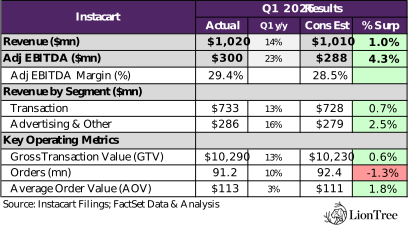
- But Q2 guidance was nothing to write home about
- Q2 GTV guidance implies growth of +11-13% y/y vs cons of +11% y/y growth
- Implies a slowdown from +13% y/y growth in Q1 and +14% y/y growth in Q4
- GTV is expected to continue to outpace orders growth
- Q2 Advertising & Other rev is expected to grow +11-14% y/y, slightly BELOW cons of +12% y/y at the midpt
- Implies a decel from +16% y/y in Q1
- Q2 adj EBITDA guidance of $290mn-$300mn was a tad BELOW cons $298mn at the midpt
- Outlook represents y/y growth b/w +11-15% vs cons of +14%
- For FY26… continue to expect adj EBITDA to grow faster than GTV
- Q2 GTV guidance implies growth of +11-13% y/y vs cons of +11% y/y growth
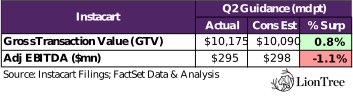
- Transaction rev grew +13% y/y (in-line w/ Q4) and represented 7.1% of GTV (flat y/y)
- Affordability, and particularly price parity, remain a key growth lever for grocery adoption: Price parity retailers grow ~10ppt faster and retain better
- Ads & Other rev saw its strongest growth since Q3:23: Up +16% y/y (vs +10% in Q4)
- Driven by broad-based strength…large brands performed “well”, while mid-market and emerging brands leaned in “particularly strong” to start the yr
- Remain confident in ability to deliver long-term targets on ads of 4% to 5% of GTV
- On the demand side…seeing broad-based strength across 9,000+ brands advertising on their platform
- On the supply side…expanding inventory providing ads capabilities across more surfaces
- AI is “completely core” to their advertising efforts: Powering ad ranking, relevance, and personalization to drive higher engagement and conversions, while also enabling smarter advertiser tools (i.e., recommendations, bidding/budget optimization, creative/landing page generation) that improve campaign performance
- Beyond advertising, also making progress on data monetization
- Off-platform partnerships continue to scale as they attract incremental budget from ad partners
- consumer insights portal, which aggregates real-time high-quality insights into consumer behavior, continues to attract new subscribers and drive deeper engagement w/ existing partners
- Enterprise platform continues to be a “real strategic advantage with retailers” and is now operating at “considerable” scale…expanding their enterprise offerings internally is a focus…
- Operating across 380 storefronts and believe there’s even more upside to land more retailers both in N. America and abroad (intl mkts was a particular callout as it “unlocks a much larger market opportunity for us”)
- Taking “proven” products like Storefront Pro and Caper Carts and FoodStorm to retailers who are facing challenges they’ve already solved in N. America, “which gives us confidence in product market fit”
- On the enterprise profitability front…don’t break out the specific economics but highlights that enterprise generates profit positive dollar and is contributing to overall growth
- …and Instaleap acquisition will be a key accelerant… “an extremely strategic acquisition for us”, particularly on the enterprise side
-
- Is “squarely in a sweet spot for us as a grocery tech company with global ambitions”
- “Their grocery technology is resonating with retailers around the world”
- “They have deep retailer relationships in markets that we want to pursue”
- Complements their “land-and-expand” strategy on the enterprise side, “where we can offer all of their current customers many more products with our existing services from our enterprise suite of products”
- “This is a great example of our M&A philosophy in action. We look for technologies and capabilities that complement our existing platform and accelerate our growth in a disciplined way”
Stock Market Check
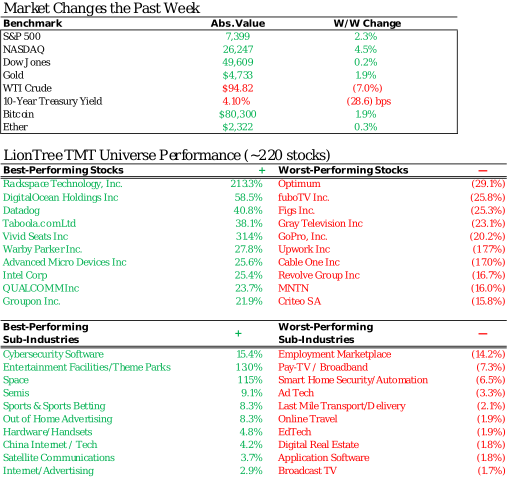
This Week's Other Curated News
Advertising/Ad Agencies/Ad Tech
- Magnite reported Q1 rev up 6% YoY to $164. 4mn, driven by CTV, now over half of rev, w/ strong live sports growth (80% in Mar). DV+ declined 5% YoY despite mobile gains. The Co is investing in AI tools, seeing them as a tailwind, not a threat. Execs expect gains from Google rulings and remain confident amid pressure from The Trade Desk, betting on continued strength in programmatic ads. (AdExchanger)
- Media Briefing highlights publishers cautiously counting AI licensing as a growing rev stream in Q1, helping offset declines in ad-driven biz amid ongoing traffic pressure. While programmatic strain persists, AI deals are emerging as a meaningful contributor. The report also notes broader industry shifts, incl. strategic newsroom moves and evolving media investment focus. (Digiday)
Artificial Intelligence/Machine Learning
- OpenAI annc’d 3 realtime voice models via its API: GPT‑Realtime‑2 w/ GPT‑5‑class reasoning for natural conversations, GPT‑Realtime‑Translate supporting 70+ input & 13 output languages, and GPT‑Realtime‑Whisper for low‑latency live transcription. Tools aim to enable advanced voice apps w/ faster, responsive interactions; pricing ranges from $0.017–$64 per usage tier. (9to5Mac)
- U. S. and China are weighing formal talks to set AI guardrails as rivalry risks becoming a digital-era arms race. The issue may feature in a Beijing summit between Donald Trump and Xi Jinping. Both sides recognize rapid AI advances could trigger crises beyond their control. (The Wall Street Journal)
- Google annc’d updates to its AI Search, adding “preview of perspectives” that pull insights from Reddit, social media, and forums. The feature highlights real user opinions alongside results, w/ added context like creator names and communities. It aims to improve trust and help users explore topics deeper, reducing reliance on traditional search links. (The Verge)
- Meta-backed Scale AI won a ~$500mn Pentagon contract to support data analysis & decision-making, marking a 5x rise from its $100mn Sept. 2025 deal. The award reflects growing military adoption of AI tech, incl. work on planning tools & defense systems. The move aligns w/ a Jan. strategy to expand AI use, alongside deals w/ major tech Cos like Microsoft, Nvidia & Amazon. (Yahoo Finance)
- Anthropic annc’d “dreaming” for Claude Managed Agents, a process that reviews past sessions to store key patterns in memory, improving long-running, multi-agent tasks. The feature helps overcome context limits by identifying recurring workflows, mistakes, and preferences across agents. It’s in research preview with limited access. (Ars Technica)
- Anthropic committed to spend $200bn w/ Google Cloud over five yrs, per The Information. Deal suggests the AI startup represents 40%+ of Google’s disclosed cloud rev backlog. Alphabet shares rose ~2%. Alphabet is also investing up to $40bn in the rival AI Co. (Reuters)
- OpenAI expects to spend $50bn on computing power this yr, co‑founder and president Greg Brockman said during testimony in its legal dispute w/ Elon Musk, per Reuters. He said compute costs rose from ~$30mn in 2017 to tens of bn now. OpenAI is also targeting ~$600bn in total compute spending through 2030, reflecting surging demand for AI infrastructure. (Reuters)
- China’s state-backed China Integrated Circuit Industry Investment Fund, known as the “Big Fund”, is in talks to lead financing for AI lab DeepSeek’s first fundraising, valuing it at ~ $45bn. Other investors incl. Tencent are also in discussions, though the line-up isn’t final. (Financial Times)
- Anthropic PBC annc’d 10 new artificial intelligence agents aimed at financial svs tasks as it pushes for Wall Street adoption. The Claude maker said the tools can draft pitch decks, review financial statements and escalate compliance cases across banking, insurance, asset management and fintech. (Bloomberg)
- OpenAI President Greg Brockman testified in federal court Tuesday that Elon Musk disparaged a ChatGPT predecessor as “stupid,” telling researchers kids online could do better, alarming co-founders about his patience to run the Co. Brockman recounted tense talks w/ Sam Altman and Ilya Sutskever on the startup’s future nearly a decade ago. (Bloomberg)
- Apple said it would let users choose third-party AI models to power text and image tasks across iOS 27, iPadOS 27 and macOS 27 via new “Extensions” settings, per Bloomberg. The move lets opt-in AI svs integrate through App Store apps. Apple has tested Google and Anthropic models as it seeks to close gaps w/ rivals Google and Microsoft ahead of updates annc’d for its Jun. developer event. (Reuters)
- Meta annc’d new AI-powered age assurance measures, expanding tech to identify under-13 users and place suspected teens into age-appropriate Teen Account protections. The Co will use AI visual analysis, alongside activity signals, to remove underage accounts across Facebook and Instagram svs, while clarifying it is not facial recognition. (Meta)
- Google has shut Project Mariner, an experimental AI agent annc’d at I/O 2025, ending the web‑browsing tool. The Co said Mariner’s computer‑use capabilities will be folded into its broader agent strategy, incl. Gemini Agent. The move follows weak adoption and high compute costs for browser agents, as the AI race shifts toward OpenClaw‑style and coding agents that let models control systems more reliably. (The Indian Express)
- The White House is weighing an AI working group and possible testing of new models via exec order, the NYT reports. Plans discussed w/ Anthropic, Google and OpenAI could require govt review, marking a shift in Trump’s approach to tech he has backed via data centers and power. The idea may mirror the UK’s AI Security Institute. (Yahoo Finance)
- OpenAI annc’d a $10bn joint venture, The Deployment Co, to deploy its AI tech for biz adoption, majority-owned and controlled by OpenAI and backed by TPG, Brookfield, Bain, SoftBank and Dragoneer. The effort uses forward-deployed engineers to integrate tools and boost adoption as cos target IPOs as soon as this yr. (Yahoo Finance)
- Analyst Ming-Chi Kuo says OpenAI is fast-tracking an AI agent phone, targeting mass production in H1 2027. The device may use a custom MediaTek Dimensity 9600 built on TSMC N2P (2H26), w/ two NPUs, enhanced HDR imaging, fast memory and security isolation. Luxshare is seen as manufacturer. (MacRumors)
- Anthropic co-founder Jack Clark says AI systems could begin rebuilding themselves by 2028, assigning a 60% chance to recursive self improvement. Writing on Substack, he argues most tech to automate end‑to‑end AI R&D already exists. He cites Claude models rising from ~2% to ~93.9% on SWE‑Bench and METR data showing autonomous work expanding to ~12 hours, warning AI progress may soon outpace human oversight. (Cryptopolitan)
- Nvidia’s push into physical AI lifted Asian partner stocks as deeper tie‑ups expanded beyond chips into robotics and auto tech. Asian suppliers now make ~90% of Nvidia production costs, up from ~65% last yr, underscoring reliance on the region. Shares of LG Electronics, Nanya Tech, Huizhou Desay and Pateo surged on reports of collabs, supply‑chain roles and product launches tied to Nvidia. (Yahoo Finance)
- Anthropic is finalizing a ~$1. 5bn AI joint venture w/ Wall Street firms to sell AI tools to private-equity-backed cos, citing a WSJ report. Blackstone, Hellman & Friedman and Anthropic are anchoring the deal, each expected to invest ~$300mn. Goldman Sachs is set to be a founding investor w/ ~$150mn. (Reuters)
Audio/Music/Podcast
- Spotify annc’d “Save to Spotify,” a CLI tool for AI agents like OpenClaw, Claude, and Codex to store AI-generated audio as personal podcasts. Users can create summaries or briefings via AI and save them directly to their library, integrated across devices. The feature targets users who compile research into custom audio content, streamlining access alongside regular shows. (The Verge)
- AI-generated music has surged from early experiments to mass production after Suno (Dec. 2023) and Udio (Apr. 2024) made creation easy w/ text prompts. The flood has hit streaming svs: Deezer said 28% of uploads were fully AI-made in Sept. 2025, rising to ~50,000 tracks per day and 34%. (The Verge)
Broadcast/Cable Networks
- Nexstar declined to issue a long-term earnings forecast as its $6. 2bn Tegna acquisition remains in legal limbo after challenges from DirecTV and state AGs. Despite closing in Mar. w/ FCC & DOJ approval, uncertainty persists. CEO Perry Sook said the Co views the dispute as critical for its biz and local journalism’s future. (TheWrap)
- Comcast Xfinity users lost NFL Network after it was dropped Thu amid a carriage dispute w/ ESPN, which annc’d acquisition of the channel in Aug. ESPN is now negotiating a new deal after expiry, w/ Comcast claiming fees could double and force more users to pay. Disney said it sought to keep channels live during talks but Comcast declined. (Yahoo Sports)
- NBC and Peacock drew record audiences for the Kentucky Derby as trainer Cherie DeVaux became the first woman to win the race. The broadcast averaged 19.6mn viewers and peaked at 24.4mn during Golden Tempo’s narrow win, up 12% vs 2025. NBC Sports credited expanded pre-show storytelling and said Triple Crown coverage cont’d w/ the Preakness on May 15. (Variety)
Cable/Pay-TV/Wireless
- A GSMA report says Europe’s mobile industry must double capex to stay competitive in 5G coverage and capacity. Operators are expected to invest ~€270bn over the next decade to maintain infrastructure and standard upgrades. However, an additional ~€200bn is needed to fully unlock 5G’s potential, highlighting a major funding gap vs other industrialised regions. (Telecompaper)
Capital Market Updates
- As investors question whether a torrid rise in US equities is fading, a key buyer shows cont’d support. Corporate America annc’d plans to buy back $665bn of shares in S&P 500 Index companies in the four months through Apr., the strongest start to a yr, Birinyi Associates data show. Apple Inc. recently approved a $100bn repurchase to reassure investors during a leadership transition. (Bloomberg)
Cloud/DataCenters/IT Infrastructure
- Nscale annc’d expanded collab w/ Microsoft and Start Campus to deliver 66,000+ NVIDIA Rubin GPUs at SINES Data Campus, Portugal, starting late 2027. Deal builds on 12,600 Blackwell Ultra GPUs already deployed. Nscale will invest €230mn in shared infra and €465mn in a 200MW second building, among EU’s largest AI infra projects. (Nscale)
Crypto/Blockchain/web3/NFTs
- Coinbase reported a Q1 loss of $1. 49/share vs est. $0.27 profit, w/ rev at $1.41bn missing $1.52bn est., hit by weaker crypto prices and lower trading activity. Transaction rev fell to $755.8mn, while svs rev also lagged. Co is diversifying into derivatives, stablecoins, and prediction mkts to offset volatility, even as shares dropped ~4%. (CNBC)
- Andreessen Horowitz’s a16z crypto raised $2. 2bn for its fifth fund, smaller than its $4.5bn 2022 vehicle, citing faster cycles and signs of real adoption over speculation. The firm flagged growing stablecoin use, onchain finance and improving regulation, including the GENIUS Act. CTO Eddy Lazzarin was promoted to general partner. (TechCrunch)
- Coinbase annc’d it will cut ~700 jobs, or 14% of its workforce, as the Co trims costs amid weak crypto mkts and shifts toward AI-driven workflows. The restructuring is set to finish largely in Q2 2026 and incur ~$50–$60mn in charges, mainly severance. CEO Brian Armstrong said AI tools enable smaller, focused teams, while analysts said the move supports forward profitability as trading volumes stay subdued. (Reuters)
- Shares of Circle surged ~20% after U. S. lawmakers reached a compromise on the CLARITY Act that preserves stablecoin rewards under certain conditions. The bill restricts savings‑like interest on passive deposits but allows usage‑based rewards tied to activity. Coinbase rose 6%, while BitGo and Galaxy gained. (CNBC)
Cybersecurity/Security
- OpenAI annc’d a more permissive version of GPT-5.5, dubbed “Spud,” for vetted cyber defenders, aiming to strengthen security efforts. The model shows near parity w/ Anthropic’s Mythos Preview in identifying and exploiting software bugs. Its advanced capabilities have intensified debate in Silicon Valley and the White House over risks, particularly misuse by malicious actors and safeguards to control access. (Axios)
eCommerce/Social Commerce/Retail
- MercadoLibre shares fell >7% after cos profits missed estimates for a 4th straight qtr despite strong rev growth. Rev rose 49% YoY to $8.8bn, above ~$8.4bn forecast, while net income of $417mn trailed ~$433mn est. Co is trading short-term profits for long-term gain, investing in logistics, credit & lower shipping thresholds. User growth stayed strong across e-comm & fintech units. (MSN)
- Agentic commerce in the U.S. retail mkt could hit $1tn rev by 2030, per ICSC & McKinsey. ~68% of consumers used AI in shopping in past 3 months, w/ 62% using it to compare options. Physical stores remain relevant, esp. for Gen Z seeking experiences. Retailers are investing in AI tools to boost inventory visibility & sales, though trust issues w/ AI pricing persist among shoppers. (Retail Dive)
- GameStop annc’d a new “Power Packs” tier selling randomized, PSA-graded Pokémon cards for up to $5,000 each, raising prior limits. Buyers can reveal cards digitally, then ship, sell via GameStop, or store them. Odds heavily favor losses: just 0.4% chance of cards worth $40,000+, while ~72% are valued below cost, highlighting criticism of the Co’s pricing tactics and profit push. (Kotaku)
- REI reported flat 2025 sales and narrower losses as store workers called for a boycott of its anniversary sale. The REI Union urged customers to skip the May 15–25 event after contract talks ended without agreement. The co-op posted ~$3.5bn in net sales and cut its net loss 65% to $54.3mn, citing progress in its turnaround. (Retail Dive)
- Victoria’s Secret & Co faces a renewed challenge from activist BBRC, which urged shareholders to vote against reelecting two directors ahead of the retailer’s June 11 annual meeting. BBRC criticized board tenure, governance and the Adore Me deal, and opposed a 2025 poison pill set to expire this May. (Retail Dive)
- Coupang swung to a net loss in Q1 as fallout from a Nov. 2025 data breach weighed on results. The Co posted a $266mn net deficit vs $114mn profit a yr earlier, despite rev rising 8% to $8.5bn. One-time customer vouchers and weaker demand hurt margins, while product commerce rev rose 4% and developing offerings jumped 28%. (The Korea Herald)
- Minneapolis-based Target Co faces growing nostalgia for the “old Target” as it plans store revamps after yrs of sluggish sales. Shoppers recall lost food courts, salty popcorn, slushies, neon lights, DVD aisles and Mossimo, versus today’s muted look. Social media critiques spread, echoed by Target’s Instagram. (Chicago Tribune)
- GameStop CEO Ryan Cohen made an unsolicited offer to buy eBay for ~$56bn, saying the deal could make the e‑commerce Co a stronger Amazon competitor. Cohen told WSJ GameStop built a ~5% stake in eBay and offered $125 per share in cash and stock, a ~20% premium to Friday’s close. (The Wall Street Journal)
EdTech
- Duolingo said its growth outlook is moderating as the Co prioritizes engagement and product quality over near-term monetization, despite beating Q1 rev estimates. The language-learning app reported $292mn in Q1 rev, daily active users up 21% to 56.5mn and paid subscribers also up 21% to 12.5mn. (Reuters)
Film/Studio/Content/IP/Talent
- Disney’s “The Devil Wears Prada 2” dazzled at the box office w/ a $77mn domestic debut from 4,150 theaters, far above the 2006 original. The sequel added $156.6mn intl, lifting worldwide sales to $233.6mn, the yr’s No. 2 global start. Budget was ~ $100mn. Despite mixed reviews, audiences gave an A- CinemaScore, driven by nostalgia and a largely female crowd. (Variety)
FinTech/InsurTech/Payments
- AWS annc’d Amazon Bedrock AgentCore payments (preview), enabling AI agents to autonomously pay for APIs, content, and svs using Coinbase and Stripe infra. The system supports real-time micropayments via stablecoins, w/ guardrails like user authorization and spending limits. It aims to simplify dev effort, letting agents transact seamlessly while expanding toward broader commerce use cases. (AWS)
- Block annc’d higher FY gross profit outlook to ~$12. 33bn from $12.20bn, driven by resilient spending and strong Cash App, w/ shares up ~7.7%. Quarterly gross profit rose 27%, as Cash App surged 38% and lending hit $17.6bn. Square posted 9% growth. Adj EPS reached $0.85. Co expects Q2 gross profit of ~$3.04bn, up 20%, despite $852mn restructuring costs and job cuts tied to AI push. (Reuters)
- Kalshi, a prediction mkts Co, annc’d raising $1bn funding led by Coatue, valuing it at $22bn amid surging investor interest. The biz has grown rapidly since the 2024 election, attracting ~2mn monthly users. Annualized trading volume hit $178bn, tripling in six months, w/ rev exceeding $1.5bn, as it targets expansion into major financial institutions despite regulatory scrutiny. (The New York Times)
- PayPal Holdings Inc. annc’d plans to cut ~20% of its workforce over 2–3 yrs, or 4,500+ jobs, as new CEO Enrique Lores pursues a turnaround. The move aims to deliver $1.5bn in cost savings, simplify ops, and reinvest in tech. Shares slipped as the Co guided to softer near‑term EPS growth despite Venmo strength. (MSN)
Handheld Devices & Accessories/Connected Home
- Walmart annc’d plans to expand its Onn. lineup with a budget smart speaker aimed at competing w/ Amazon Alexa. Certification filings show the device uses Google Gemini AI, a 10‑watt driver, far‑field mics, Wi‑Fi and Bluetooth, plus Google Cast and Matter support for smart‑home control. (Cord Cutters News)
HealthTech/Wellness
- Google annc’d a new health ecosystem integrating devices, data & AI. The Fitbit app is rebranded to Google Health app, combining wearable, medical & platform data into one hub w/ sharing features. Google Health Coach, launching May 19, offers personalized fitness, sleep & wellness guidance via subscription. (Google Blog)
- Peloton posted Q3 results beating estimates, w/ rev of $630. 9mn vs $617.6mn exp., and net income of $26.4mn, swinging to profit. Shares rose ~8%. Growth was driven by higher subscription pricing, equipment sales, and improved profitability. Subscription rev rose ~2% YoY to $428mn, though subscribers fell to 2.66mn. (CNBC)
Investor & Market Sentiment
- Michael Burry has sold his entire stake in GameStop, the Wall Street Journal reported. The exit follows CEO Ryan Cohen’s annc’d $56bn bid to acquire eBay, a deal that has sparked investor scrutiny and financing concerns. Burry, known for contrarian bets, had held GameStop shares amid its volatile trading history, but moved to cash out as the Co pivots toward a major M&A-driven strategy. (Reuters)
Last Mile Transportation/Delivery
- Grab Holdings Ltd. plans to adj its Indonesian biz after Jakarta’s surprise edict cut ride-hailing commissions it can charge. CFO Peter Oey said the Co must alter its model in its biggest mkt after better‑than‑expected results, but expects limited impact. Indonesia’s initial annc’d rule should apply only to two‑wheel riders, not cars, covering just a fraction of the fleet. (Bloomberg)
Macro Updates
- U. S. job openings fell 56,000 to 6.866mn in Mar., mainly in pro & biz svs, but hires jumped 655,000 to 5.554mn, the highest since 2024, pointing to a stable labor mkts. Layoffs rose to 1.867mn. The Fed is expected to hold rates. AI-driven capital goods imports lifted goods imports to $302.2bn, widening the trade deficit 4.4% to $60.3bn. (Reuters)
Media Conglomerates
- Walt Disney Co. execs are discussing unifying its disparate mobile apps and making Disney+ a single hub for all things Disney, per people familiar. New CEO Josh D’Amaro aims to break silos and simplify customer interaction. The effort would merge Disney+ w/ apps for Disneyland Resort and Disney Cruise Line into an internal “super app” enabling ticket booking, merchandise sales, gaming and streaming. (Bloomberg)
Regulatory
- Vice Pres. JD Vance raised alarm over new AI models like Anthropic’s Mythos, warning they could enable cyberattacks on local banks, hospitals & utilities. Concerns voiced in an Apr. call w/ major AI CEOs triggered a chaotic White House response, signaling a shift toward greater govt oversight of AI and away from prior focus on rapid deployment & global competition. (The Wall Street Journal)
- Meta annc’d plans to expand tech safeguards for teen accounts across 27 EU countries and to Facebook users in the US, as regulators intensify pressure to better protect minors online. The Co said it will proactively identify suspected underage users, even if adult birthdays are listed, and apply Teen Account controls. (Reuters)
- New study by National Bureau of Economic Research fn finds school cellphone bans delivered mixed results. Over past three yr, 2/3 of states passed laws restricting phones. Strict bans w/ locked pouches cut student cellphone use, but test scores did not rise on avg. (The New York Times)
- SEC annc’d proposed rule and form changes to let public cos opt for semiannual, not quarterly, interim reports. Under the plan, Exchange Act filers could file a new Form 10-S twice a yr plus an annual report, replacing three Form 10-Qs. Filing deadlines would be 40–45 days. SEC says flexibility could better serve biz and investors. (SEC.gov)
- Nintendo’s hit Super Mario movie could earn ~$1bn at the box office, underscoring the strength of its IP, but investors remain wary. Since Aug., shares are down ~45% as booming data‑centre demand has lifted memory‑chip costs. Higher inputs are squeezing margins and fueling concern over pricing and sales volumes for the Switch 2 console launched last Jun., casting a shadow over the cos growth outlook. (Financial Times)
- A Chinese court ruled firms cannot fire staff solely to replace them w/ AI, as authorities juggle stabilizing the domestic labor market w/ the global race to develop AI tech. A statement from the Hangzhou Intermediate People’s Court said an eastern China tech Co illegally dismissed a worker after his job was automated and he refused to accept a demotion, with the court finding the termination violated labor protections. (Bloomberg)
Social/Digital Media
- Meta asked a California judge to overturn a jury verdict holding the Co liable for a woman’s depression in a social media addiction case. The Mar. ruling found Meta and Google negligent, awarding $4.2mn and $1.8mn damages. Meta argued Section 230 shields it, saying harm stemmed from content, not platform design. (Reuters)
- Meta said Facebook and Instagram are using AI to detect users under 13 by scanning photos and videos for general visual cues such as height and bone structure, while stressing it is not facial recognition and does not identify individuals. The system also reviews posts, comments, bios and captions for context. (The Verge)
- Match Group said Q1 rev beat estimates as Tinder’s user declines slowed and new registrations rose 1%, the first growth since 2024, signaling a turnaround. Total rev was $864mn, up 4% yr/yr, w/ Tinder generating $455mn. The Co forecast Q2 rev of $850–$860mn and adj EBITDA of $325–$330mn, driven by product enhancements and stronger Gen Z retention. (Yahoo Finance)
- New Mexico asked a judge to deem Meta Platforms a public nuisance, seeking $3. 7bn and sweeping changes to Facebook, Instagram and WhatsApp to protect youth. The AG says designs addict minors and fuel a mental health crisis. A March jury ordered $375mn after safety claims were misrepresented; Meta will appeal. (Reuters)
Software
- It was set to be London’s listing of the decade: Visma, a €19bn accounting software Co owned by PE group Hg, planned an early‑yr IPO that would have boosted the UK mkts and capped Hg’s rise to >$100bn AUM. Advances in AI sparked a sharp sell‑off in SaaS stocks — dubbed the SaaSpocalypse — rippling through lenders and buyout owners, leaving Visma’s flotation on ice and unlikely this yr. (Financial Times)
- Palantir Technologies reported record Q1 results, posting $1. 63bn in sales, up 85% yr over yr and topping forecasts. Growth was fueled by strong U.S. military demand and accelerating sales of its data-analytics and AI-related software to American corporations. Executives told analysts the biz momentum and rising commercial adoption outweigh concerns about intensifying AI competition that have pressured the stock. (The Wall Street Journal)
Sports/Sports Betting
- FanDuel CEO Amy Howe departed after ~5 yrs, during which she led the Co through a U. S. sports-betting boom. She will be succeeded by President Christian Genetski, w/ Dan Taylor taking a new leadership role at parent Flutter. Howe’s tenure saw strong growth but rising competition from prediction-market firms and rivals like DraftKings and BetMGM gaining share in the mkts. (The Wall Street Journal)
Tech Hardware
- Apple’s low-cost MacBook Neo, released in Mar. 2026, has exceeded sales expectations and broadened Apple’s ecosystem, prompting speculation it could lead to a cheaper Apple TV. Analysts say success at lower price points may encourage Apple to annc’d a budget Apple TV, possibly a stick-style device priced under $100, expanding reach while boosting svs rev and ecosystem growth. (Cord Cutters News)
- AMD forecast Q2 rev above Street views, citing strong AI data‑center chip demand as cloud firms boost spend. Shares jumped 12% after hours. Co sees server CPU mkts growing >35% annually to ~$120bn by 2030. Q1 data‑center rev rose 57% to $5.8bn. AMD guided Q2 rev ~$11.2bn ±$300mn and ~56% adj gross margin, amid rising competition and memory shortages. (Reuters)
- Japan’s SoftBank annc’d a partnership w/ Korean startup Cosmos Lab to commercialize zinc halide batteries, cont’d development of next‑gen battery tech. Production is slated for 2027 at a former Sharp plant in Sakai, Osaka. (The Seoul Economic Daily)
Towers/Fiber
- CK Hutchison Holdings, the Hong Kong–based conglomerate founded by Li Ka-shing, is weighing further telecom asset sales after its $5. 8bn UK mobile divestment, aiming to exit an increasingly competitive and costly sector. The Co is proceeding cautiously, choosing not to rush deals as it seeks to maximize asset value, according to sources familiar w/ its private deliberations. (Bloomberg)
Video Games/Interactive Entertainment
- Sony forecast gaming biz sales to fall 6% to ¥4. 42tn (~$28bn) as PS5 hardware demand weakens amid rising memory prices. PS5 quarterly unit sales dropped 46% YoY to 1.5mn. However, profit is seen up 30% on stronger software sales. Co annc’d up to $3.2bn buyback, while overall operating profit rose 13.4% YoY but missed estimates. (Reuters)
- Nintendo Co annc’d it will raise Switch 2 price to $500 from $450 starting Sept. 1, citing pressure on profitability in its second yr. The move came alongside a weaker outlook, w/ operating profit forecast of ¥370bn (~$2.4bn), well below ¥480bn est., signaling softer demand & margin concerns for its flagship console. (Bloomberg)
- Microsoft Xbox CEO Asha Sharma annc’d leadership overhaul after rev fell in 4 of past 6 quarters. She’s hiring execs from CoreAI and Instacart to strengthen product, design, growth, and cloud svs, citing need to evolve workflows and speed delivery. Changes follow Feb. leadership shift and aim to revive Xbox amid weaker sales vs rivals and broader challenges in consumer tech biz. (CNBC)
- EA annc’d record FY26 sales of ~$8. 03bn, driven by Battlefield 6, the top-selling 2025 game, despite declining live-svc rev. The milestone comes ~2 months after layoffs hit Battlefield devs, drawing criticism as the co rewarded investors ahead of a pending buyout. EA said changes “realign” teams while cont’d investment in the franchise remains a priority. (Kotaku)
- Mattel CEO Ynon Kreiz said consumers are buying toys as the industry stays healthy. Q1 net sales rose 4% yr/yr to $862mn, swinging to $61mn net income, though operating loss widened to $102.7mn. Hot Wheels, Uno and Monster High saw double-digit growth. (Retail Dive)
- Electronic Arts said it missed Q4 bookings as Battlefield 6 engagement fell after a strong launch, w/ player metrics down on Xbox and PlayStation and weakness in mobile. TD Cowen cited significant attrition, raising concerns over long‑term live‑service rev potential. Bookings were $1.86bn vs $2.0bn est., while profit rose to $461mn. (Reuters)
- Microsoft is abandoning Xbox Copilot AI as new Xbox CEO Asha Sharma reshapes the biz. She annc’d Copilot on mobile is being wound down and development for consoles will stop, citing misalignment w/ Xbox’s direction. The change follows a platform reorg adding CoreAI leaders, as Sharma pushes faster execution, fewer friction points, and retires features seen as nonessential. (The Verge)
- Electronic Arts annc’d a global, multi-yr partnership w/ Visa spanning EA SPORTS FC and College Football. The deal brings player-first in-game rewards, live challenges, NIL-style sponsorships, and Visa-branded modes, plus real-world experiences at major sports events. EA said the collab uses dynamic tech to enhance gameplay while connecting brands to its global fan community without disrupting play. (EA)
- Activision annc’d that the next Call of Duty will no longer support PS4 or Xbox One, ending 12 yrs of last‑gen coverage, according to Kotaku. The decision follows performance limits on older hardware and marks the longest transition in franchise history. Millions still on PS4 must upgrade amid higher console and gaming PC costs, while uncertainty remains over a Switch 2 release. (Kotaku)
- A Bank of America analyst said Rockstar’s GTA 6 should launch at $80, arguing a $70 price would make other AAA titles look like poor value. After IICON talks, he said higher pricing could reset the industry and better reflect inflation and soaring development costs. (Kotaku)
Video Streaming
- Fubo annc’d adding Hulu + Live TV to its homepage plan comparison, letting users browse both svs in one place. The move follows Disney–Fubo’s Oct. 2025 merger but keeps offerings separate, w/ sign-ups redirecting to Hulu. Plans range ~$73.99–$103.99/month for Fubo vs ~$89.99 for Hulu. Differences include channel lineups, RSNs on Fubo, and varying free trials. (Cord Cutters News)
- FuboTV reported a sharp drop in North America subs in Q2 FY2026, ending Mar. 31, falling from 6.2mn to 5.7mn (~8.1%). Decline follows Hulu + Live TV integration and intense streaming competition. Despite this, Co posted record rev of $1.574bn and narrowed losses to $6.2mn w/ adj EBITDA of $37.7mn. Fubo cont’d investing in tech, partnerships, and cross-sell offerings to support growth and efficiency. (Cord Cutters News)
- Roku annc’d deeper integration of streaming inventory w/ retail media data to boost advertiser performance and growth. The Co’s Roku Curate platform links CTV ad impressions directly to retail purchases, enabling closed-loop measurement and simplified targeting. Early partners include Best Buy Ads, Kroger Precision Media, Instacart, Criteo and Fandango. (MediaPost)
- Netflix delayed Greta Gerwig’s “Narnia: The Magician’s Nephew” from Thanksgiving to Feb. 12, 2027, marking a bigger theatrical push. The film begins exclusive Imax previews Feb. 10, followed by a wide global, “eventized” run, then streams Apr. 2. The move extends an earlier limited Imax-only plan, aiming for a full theatrical window as Netflix works w/ major chains. (TechCrunch)
