


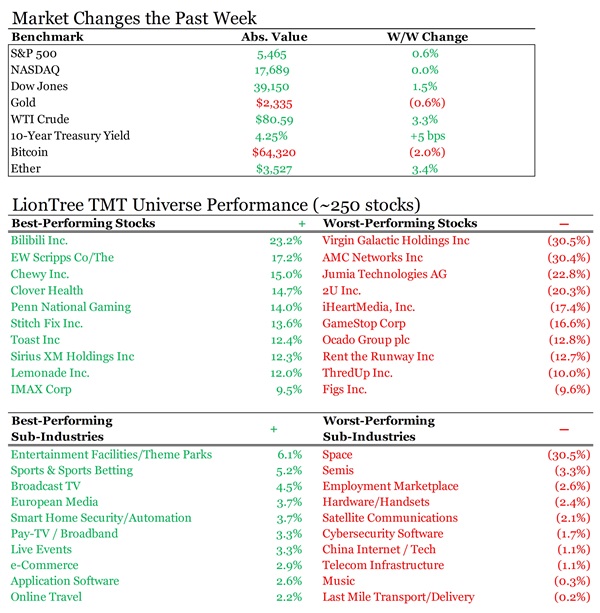
Equities started out strong this shortened and mostly quiet week of trading before losing some steam – the S&P 500 ended up a modest +0.6%, while Nasdaq finished the week flat. A big headline was that NVIDIA surpassed Microsoft in market cap to become the most valuable public company, just a couple weeks after hitting $3 trillion for the first time and passing Apple to take the second spot.
Within the sector, the news flow pared down a bit given the shortened week, but there were still several interesting updates to highlight. See below (all are clickable links):
- Next Step In The Streaming Wars? Netflix Forays Into Experiential
- More Price Hikes For Connectivity + Other Key Connectivity Updates
- AR/VR Market Is Hoping For A Rebound In H2 Post A Tough Q1
- Global Audiences Still Aren’t Ready For AI-Produced News + Other AI-Related Updates
- Some Twists & Turns In Sports Media Court Proceedings
- Social Media Feeds Continue To Come Under The Regulatory Microscope
- Grab Bag: Apple Shutters BNPL Service/ TikTok Plans To Launch Investment Arm / Retail Media Remains On The Rise
Also, I’d like to flag that LionTree served as financial advisor to Providence Equity Partners on its sale of Superstruct Entertainment to KKR.
Have a nice weekend.
Best,
Leslie
P.S. I just wanted to highlight one last time our newly published **LionTree’s Lens: Sector Insights & A Look Ahead, Summer 2024** update, which outlines key thematic trends that played out across the sector since our Spring update at the end of March as well as our expectations looking ahead. For access to the video presentation, where I run through the main takeaways and forward expectations from the deck in under 20 minutes, as well as the slides, click HERE.

Next Step In The Streaming Wars? Netflix Forays Into Experiential
Bridgerton, Money Heist, Stranger Things and Squid Games are just a few of the many original Netflix shows that have amassed a massive fanbase. Now, in what seems a move straight out of the pages of the Disney playbook, Netflix is looking to leverage its original intellectual property off the screen, as the streamer announced that it’s taking former department stores at malls in Dallas, Texas as well as King of Prussia, Pennsylvania and turning them into “Netflix House, an experiential entertainment venue”. These venues will be open year-round and will offer “unforgettable venues for viewers to explore their favorite Netflix stories and characters beyond the screen year-round” with immersive show-themed experiences and shopping opportunities. The Co had dabbled with pop up experiential events in the past, but this is now a deeper move into permanent facilities…
- Netflix will open its first two permanent immersive entertainment venues in 2025 (link/link): “At Netflix House, you can enjoy regularly updated immersive experiences, indulge in retail therapy, and get a taste — literally — of your favorite Netflix series and films through unique food and drink offerings,” per Netflix CMO Marian Lee
- Will be located in Dallas, TX and King of Prussia, PA, because “they are part of two of the most popular shopping centers in America, boasting hundreds of retailers, high foot traffic, and proximity to major cities”
- Both locations will occupy former department stores at Galleria Dallas and King of Prussia Mall, each spanning footprints of more than 100,000 sq ft
- Outside of the venues, “fans will be treated to some eye-popping sculptures and a mural mash-up of characters from their favorite Netflix titles”
- Features: Shopping outlets, eateries, and experiential activities
- Building off of past pop-up events held across the country over the past few years: “We’ve launched more than 50 experiences in 25 cities and Netflix House represents the next generation of our distinctive offerings. The venues will bring our beloved stories to life in new, ever-changing, and unexpected ways”
- Next step in the ongoing streaming wars? While Hulu, Max, and Prime Video have all held smaller pop-up events of their own, Netflix will be the first to launch a permanent experience; Additionally, while Disney also offers show-themed experiences, restaurants and shopping oppties at its long-established parks, it also offers rides, which Netflix House has not said it will offer
- Will be located in Dallas, TX and King of Prussia, PA, because “they are part of two of the most popular shopping centers in America, boasting hundreds of retailers, high foot traffic, and proximity to major cities”
More Price Hikes For Connectivity + Other Key Connectivity Updates
Price hikes across the Entertainment space have been pervasive for some time with the cost of streaming video, music, theme parks, etc. all edging up over the past several years. Connectivity services have also followed this path with more examples this week as both AT&T and Charter announced more pricing moves. For AT&T, compared to the $2.50/month per line increase that the company implemented last August (link), the magnitude of this year’s hikes will be much more substantial, ranging from +$5-20/month per account based on a customers’ usage or the number of lines associated with their account. In contrast, Charter’s coming price increases appear to be at a lower level than its hikes the previous year, mostly ranging between +$3-4/month versus a broad +$5/month adjustment in July 2023.
Separately, there were also several other notable updates concerning the telco incumbents this week, including some back-and-forth regarding T-Mobile’s “Price Lock” claims as well as Verizon joining several other groups in filing comments to FCC to oppose a plan that would assign 4.9 GHz spectrum estimated to be worth $14bn+ to AT&T’s FirstNet division.
See below for more details.
- AT&T annc’d price hikes on legacy mobile plans starting in Aug (link/link): The Co also introduced a new set of Unlimited wireless plans
- AT&T Mobile Share plan prices will rise depending on data usage: Subscribers’ rates will increase by +$5/mo if they use less than 6GB of data and by +$10/mo if they use more than 6GB of data
- Mobile share plans will now provide 5G access on compatible devices: This comes on top of the offering’s existing benefits, including unlimited talk & text in the US, mobile hotspot data, and AT&T ActiveArmor mobile security
- Retired unlimited wireless plan prices will increase based on customers’ number of lines: Single-line accounts will see a +$10/mo rise, while those w/ multiple lines will see a flat +$20/mo increase (not a per-line adjustment)
- Legacy unlimited plans will receive added high-speed data and hotspot data:
- AT&T Unlimited Choice, Choice II, Choice Enhanced, Unlimited &More, and Unlimited Value plans will now include 75GB of high-speed data and 30GB of hotspot data
- AT&T Unlimited Plus, Plus Enhanced, Unlimited &More Premium, and AT&T Unlimited (with TV) plans will now include 100GB of high-speed data and 60GB of hotspot data
- Unlimited wireless plans will provide customers w/ “the most value for [their] dollar, along w/ added benefits”: Including 5G access, advanced mobile security and unlimited talk & text across North America, the three new tiers offer escalating benefits –
- Unlimited Premium ® PL: Also offers unlimited talk, text, and high-speed data when traveling to 20 LatAm countries, 60GB of hotspot data, and 4K UHD streaming
- Unlimited Extra® EL: Includes 30GB of hotspot data
- Unlimited Starter® SL: Includes 5GB of hotspot data
- Legacy unlimited plans will receive added high-speed data and hotspot data:
- AT&T Mobile Share plan prices will rise depending on data usage: Subscribers’ rates will increase by +$5/mo if they use less than 6GB of data and by +$10/mo if they use more than 6GB of data
- Charter reportedly plans to raise prices for a second time this yr (link): In July, prices for TV will rise by +$3/mo in certain states, voice plan prices will increase +$3/mo, and internet base prices will go up by $3-4 for some customers, representing the Co’s second price hike in less than six months
- Addt’l adjustments: Other packages such as Sports View will see a +$3/mo price increase, cable cards are going up by +$4/mo for those that still have them, and the cost of cable boxes will rise +$1/mo
- Charter’s svs have been “impacted by rising costs”: A spokesperson noted that “some programmers continually raise fees for their content, which are passed through as increased fees to viewers and drive higher costs across the entire industry”
- The Co raised prices for its low-income program back in Jan: On Jan 30, prices for Charter’s internet svs went up by +25% to $24.99 for its low-income program
- Charter implemented a slightly higher broad price increase in July 2023: Then, the Co incr’d its phone and internet prices each by $5/mo, also citing programming cost increases
There Were Also Some Noteworthy Updates From The Other Telco Incumbents This Week…
- T-Mobile was advised by an industry group to stop using the “Price Lock” claim in its 5G Home Internet svs ads (link/link): The National Advertising Division (NAD) recommended that the Co should either quit using the claim or explain what it really means; The NAD’s decision came after AT&T brought forward a complaint
- AT&T’s challenge – T-Mobile isn’t really committing to locking the pricing of its svs for any amount of time: AT&T highlighted that “Price Lock” really means that T-Mobile internet customers instead get their last month of svs free if T-Mobile ever raises the rate
- AT&T also pointed out that T-Mobile’s disclosures contradict the “Price Lock” claim: Given limitations that make it clear that T-Mobile could increase the price of svs for any reason at any time
- The NAD agreed w/ AT&T’s argument: Per the NAD, T-Mobile contended that “Price Lock” is not a claim, but the name of a pricing policy it implemented w/ respect to its home internet svs in Jan, arguing that its advertising doesn’t reasonably convey that the “Price Lock” policy is an absolute guarantee
- T-Mobile will continue offering the “Price Lock” deal…: The Co “believe[s] the challenged ads clearly communicated [its] Price Lock benefit, which offers customers on eligible rate plans the oppty to get their final month’s svs charges paid by [T-Mobile] if their price changes”
- … But will “take the NAD’s recommendations for clarifying the offer into consideration”
- AT&T’s challenge – T-Mobile isn’t really committing to locking the pricing of its svs for any amount of time: AT&T highlighted that “Price Lock” really means that T-Mobile internet customers instead get their last month of svs free if T-Mobile ever raises the rate
-> On a separate but related note, T-Mobile annc’d a new offer for its 5G Home Internet svs, providing those that sign up w/ $200 back for a limited time as well as a 15-day free trial where they can cancel the svs and still receive a refund; The Co also highlighted a $40/mo sale of its 5G Home Internet svs for existing T-Mobile wireless subs, though this was also its starting price entering the yr (link)
- Verizon was among several groups that filed comments w/ the FCC opposing a plan to assign spectrum to AT&T’s FirstNet (link): For context, the Public Safety Spectrum Alliance (PSSA) has been supporting a proposal to assign a nationwide license to the 4.9 GHz spectrum band to FirstNet, which runs on AT&T’s network
- Other members of the opposition to the PSSA’s proposal include: The Coalition of Emergency Response and Critical Infrastructure’s (CERCI) as well as the CIO for the City of Boston and the MTA; These groups argued the plan would take control out of local first responders’ hands
- Verizon – “Nothing in record documents that FirstNet lacks access to sufficient spectrum”: Verizon argued that “FirstNet has never explained the breakdown of AT&T’s use of Band 14, nor the percentage of Band 14 traffic that is AT&T public safety (i.e., FirstNet) vs AT&T commercial”
- Verizon also believes the spectrum “giveaway” would disrupt the competitive mktplace in public safety & commercial: Notably, Verizon’s Frontline division currently supports 35,000+ public safety orgs across the US
- The 50 MHz of 4.9 GHz spectrum in question is worth $14bn+, per the Brattle Group’s estimates: This would be a “substantial windfall” for AT&T and is why critics of the PSSA’s plan believe there needs to be a more “lawful way” to assign the spectrum, such as via a competitive bidding or auction process
AR/VR Market Is Hoping For A Rebound In H2 Post A Tough Q1
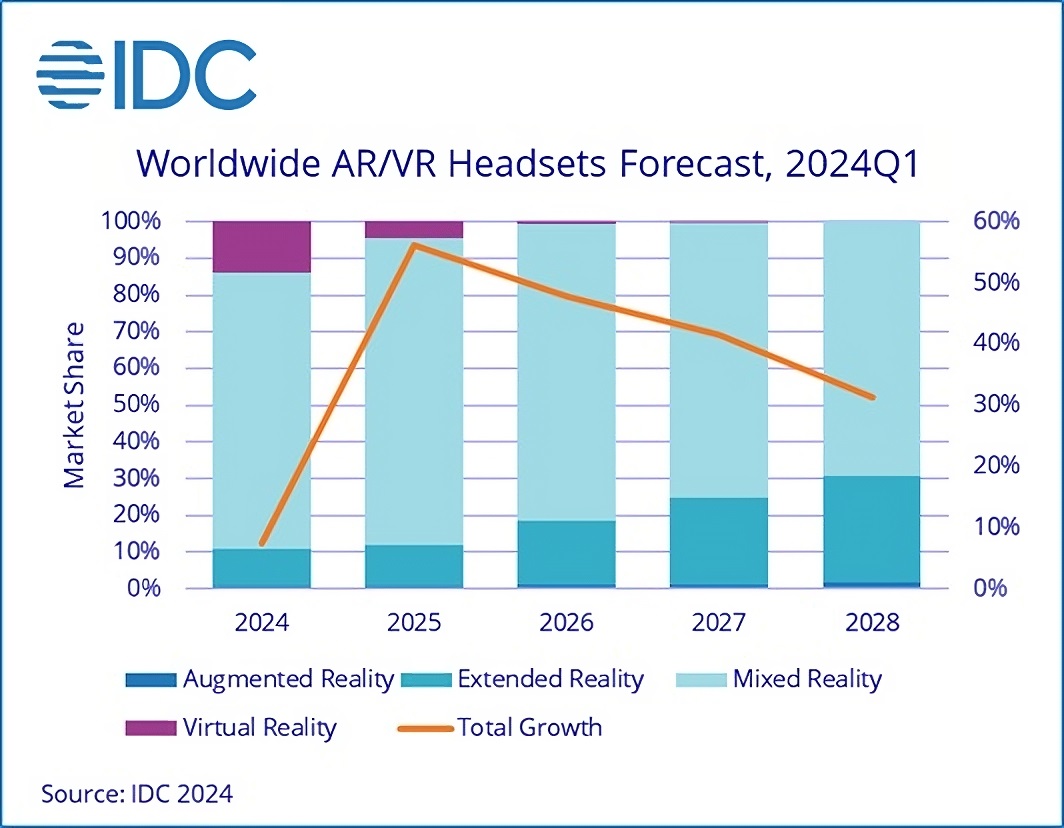
The AR/VR headset market had a rough go in Q1:24 with a -67.4% y/y decline in global shipments in Q1:24, per International Data Corporation’s Worldwide Quarterly Augmented and Virtual Reality Headset Tracker. Concurrent with the drop in global shipments, the average selling price of headsets rose to about $1,000 in Q1, driven by Apple’s market entry and Meta’s premium Quest 3 headset. Despite the down trend in Q1, shipments are expected to return to growth later this year driven by a y/y increase in volume, newer headsets, and lower price points.
In addition to these data points, there were some company-specific updates out from Meta and Apple this week regarding their AR/VR strategies. Meta implemented a major restructuring across its Reality Labs division, the first since its formal launch back in 2022. All teams in Reality Labs have now been merged into either a central “Metaverse” organization or a new “Wearables” organization. The Co is aiming to enhance and streamline its operations in the Web3 and wearables markets, though as a result of the reorganization, there were some layoffs. Apple, on the other hand, is reportedly shifting its focus from the Vision Pro 2 to developing a more affordable AR headset. Despite aiming for a 2024 release, the product may be delayed to 2025 due to challenges in cutting costs without compromising quality.
See below for more.
- Global shipments of AR/VR headsets declined -67.4% y/y in Q1:24, though the decline in shipments was expected as the market transitions to include new categories such as Mixed Reality (MR) and Extended Reality (ER); This is as per new data from the International Data Corporation’s Worldwide Quarterly Augmented and Virtual Reality Headset Tracker
- The avg selling price (ASP) rose in Q1:24 to over $1000 as Apple entered the market and incumbents such as Meta focused on premium headsets such as the Quest 3
- Meta led the way in terms of share, while Apple’s recent entry into the market allowed it to capture the second position; ByteDance, Xreal, and HTC rounded out the top 5
- Headset shipments are expected to return to growth later this year, driven by volume growing +7.5% y/y, newer headsets, and lower price points
- Beyond that, headset shipment volume is expected to see a CAGR of +43.9% from 2024–2028
- Expect ASP erosion across products over the next few yrs: “Because the overall market is still in its early stages with more expensive 1st- and 2nd-generation devices, prices will be high even as early adopters buy them. In order to reach scale in the mass market, vendors will need to reduce prices on later and upcoming devices”
Also This Week, Some Shifts And Movements In Meta And Apple’s AR/VR Strategies…
- Meta restructures Reality Labs (link/link): The restructuring will enable the creation of “more integrated product experiences across hardware, software, and experiences with less friction and fragmentation,” per an internal memo sent out by Meta CEO Andrew Bosworth
- All teams in Reality Labs are being consolidated into two groups –
- A central “Metaverse” organization, which is tasked with advancing Meta’s vision of a unified virtual environment, focusing on products like Oculus VR headsets, the Horizon virtual reality platform, and related metaverse technologies
- A new “Wearables” organization, that encompasses the rest of Meta’s hardware efforts, including its smart glasses with Ray-Ban and future AR glasses innovations
- Co’s smart glasses were “a much bigger success than we expected’
- “We are doubling down on finding a strong product market fit for wearable Meta AI, building a business around it, and expanding the audience”
- Restructuring also resulted in layoffs, which were a “relatively small number and focused on teams in Reality Labs where leadership roles are now redundant thanks to this new structure”
- All teams in Reality Labs are being consolidated into two groups –
- Apple is reportedly shifting its focus away from Vision Pro 2 towards developing cheaper headset (link/link)
- Have been deprioritizing the second-gen Vision Pro headset over the past yr, gradually assigning fewer employees to the project
- Now developing a more affordable Vision headset with fewer features, which is in-line with Apple’s original plans to have two Vision models, akin to the standard and Pro versions of the iPhone
- But is said to be having issues cutting costs w/o losing key features:
- Apple reportedly wants the affordable model to retain the Vision Pro’s ultra-high-end displays and is working w/ Seeya Technology for cheaper displays, potentially replacing Sony, which until now has been the sole supplier of displays for the Vision Pro; However, Seeya has reportedly been struggling to meet Apple’s standards
- Apple is also looking to make the cheaper model at least 1/3 lighter than the Vision Pro
- The cheaper headset is expected to have fewer cameras, a simpler headband, and smaller speakers
- Expected to be priced in-line w/ a high-end iPhone, at about $1,600
- Revised 2025 release date may still be ambitious: Apple reportedly aimed to release the most affordable product at the end of 2024, but as of earlier this yr, Apple still didn’t have a firm prototype and is having trouble cutting costs w/o compromising too much on features; As a result, the product could likely slip beyond its revised release date for the end of 2025
- But is said to be having issues cutting costs w/o losing key features:
Global Audiences Still Aren’t Ready For AI-Produced News + Other AI-Related Updates
We also wanted to flag a few noteworthy items from the ever-evolving AI space that hit the news tape this week. The main headline came from a Reuters report that surveyed nearly 100,000 people across 47 countries and found that the majority of global audiences possess high levels of distrust surrounding the use of AI in the news production process. Concerns about false news content also stepped up by +3% y/y, with respondents in the US and South Africa expressing particularly high levels of apprehension due to upcoming elections in both countries.
Elsewhere regarding AI, Snap released a new generative AI-powered features to help developers create more advanced AR features for users, and big-name investors Steve Cohen and Masayoshi Son both publicized commitments to invest more aggressively in AI moving forward.
See below for more details on this week’s key AI-related updates in the sector:
- Concerns about the use of AI in newsrooms and misinformation have been growing worldwide (link): Reuters’ annual Digital News Report, which surveys nearly 100,000 people across 47 countries, found consumers are suspicious of AI-powered news content, particularly in sensitive areas such as politics
- 52% of US respondents and 63% of UK respondents would be uncomfortable w/ news content mostly produced by AI: That said, the respondents (~2,000 in each country) were more comfortable w/ journalists using AI behind-the-scenes to make their jobs more efficient
- Concerns about false news content online rose +3% y/y: 59% of respondents said they were worried in this yr’s survey, w/ these percentages being higher in the US (72%) and South Africa (81%) w/ upcoming elections in both countries
- Audiences are also unwilling to pay for news subscriptions: Only 17% of respondents across 20 countries said that they pay for online news, a figure that has been flat for the last three yrs after seeing some growth during the pandemic
- 46% of Americans also pay less than the full price for their online news subscriptions
- News influencers are playing a bigger role in disseminating info: In a survey of 5,600+ TikTok users, 57% said they mostly pay attention to individual personalities vs 34% that reported that they mainly follow journalists or news brands
- Snap launched gen AI-powered advanced augmented reality (AR) features (link): Now, AR devs will be able to create more realistic and whimsical special effects, or lenses, and Snapchat users will be able to utilize them when using phone cameras to film themselves
- Snap annc’d an upgraded version of its dev program, dubbed Lens Studio: This program will enable artists and devs to create AR features for Snapchat or other websites and apps
- Lens Studio now includes a new suite of gen AI tools: Including an AI assistant that can answer questions if a dev needs help, as well as another that provides devs w/ 3D image creation abilities for their AR lenses
- Lens Studio will reduce the time it takes to create AR effects from weeks to hours: Per Snap CTO Bobby Murphy, who added that Lens Studio would also allow for more complex work on AR
- This is still just the beginning of Snap’s AR ambitions: As the Co also plans to create full body AR experiences (instead of just facial ones), including generating new outfits
- Snap annc’d an upgraded version of its dev program, dubbed Lens Studio: This program will enable artists and devs to create AR features for Snapchat or other websites and apps
Big Name Investors Doubled Down On AI W/ Plans To Begin Investing More Aggressively Into The Space…
- SoftBank will ramp up its power generation biz in the US to support worldwide gen AI projects, per founder Masayoshi Son (link): Son was speaking at the annual shareholder meeting of SoftBank’s telecom division; SoftBank Group-backed SB Energy develops and operates renewable electricity bizs across the US
- SoftBank will also look for “seeds of new evolution” in its investments: These will mainly be outside of Japan
- Steve Cohen’s Point72 reportedly plans to launch a separate, AI-focused hedge fund (link): Sources indicate Point72’s new long/short equity fund focusing on AI and AI-related hardware will launch later in 2024 or in early 2025;
- The Co is aiming to raise $1bn: Cohen and other Point72 employees are expected to contribute
- The new fund will standalone separately from Point72’s main fund: This is due to its need for a more flexible net exposure, per sources
Cohen has been bullish on AI: He has described AI as a “really durable theme” for investing and said that he “[doesn’t] see it as a bubble”, w/ the mkt still discounting some of the oppties around AI
Some Twists & Turns In Sports Media Court Proceedings
This week saw some new developments in a couple of court proceedings that have the potential to shake-up the sports media distribution landscape. The class action lawsuit against the NFL’s approach to bundling out-of-market rights in NFL Sunday Ticket has been ongoing for the last nine years, but the league has reportedly been making progress towards a favorable outcome that could enable it to avoid $20bn+ in damages and continue with its current operating model. There was also a new wrinkle in Diamond Sports’ bankruptcy saga, as the company filed for an emergency hearing this week in an attempt to hold off the NBA, NHL, and MLB’s demands to see its contracts with pay-TV providers, a move that Cox believes “risks significant competitive harm” to its business. Otherwise, beyond these court cases, another interesting sports update this week came from the world of electric motorsports, with DAZN signing a multi-territory agreement with the E1 World Championship all-electric boat racing league. E1 just launched in February and has already made rapid strides in growing its popularity with a long-list of celebrity team owners, including Tom Brady, Rafael Nadal, and Will Smith, to name just a few.
See below for more details on this week’s incremental updates from the sports world.
- The NFL Sunday Ticket trial reportedly has been progressing in the league’s favor (link/link): Per journalists attending the trail concerning the class action lawsuit over the NFL’s strategy of bundling out-of-mkt rights, the US District Judge overseeing the case has repeatedly expressed skepticism about the plaintiffs’ case
- The case could be decided before reaching a jury: As the US District Judge could grant a motion for judgment as a matter of law, concluding that no reasonable jury could reach a different a determination
- Some background on each side’s argument:
- Plaintiffs – Bundling NFL teams’ out-of-mkt rights violates antitrust law and drives up prices for consumers; The class action began 9 yrs ago on behalf of 2.4mn+ residential and 48,000+ commercial subscribers to NFL Sunday Ticket
- Damages could top $20bn+: The plaintiffs are seeking $7bn in damages that could be tripled under federal law
- Proposals for substantial price cuts were presented as key evidence: Court testimony has reportedly revealed that ESPN proposed cutting the price of NFL Sunday Ticket from $349 to just $79 for the 2023 season to boost subscriptions
- The NFL – Sunday Ticket is “a premium product, not just on pricing but quality”: During a cross-exam, NFL commissioner Roger Goodell added, “Fans make those choices whether wanted it or not… I’m sure there were fans who said it was too costly
- Sunday Ticket also complements CBS and Fox’s standard game coverage, rather than supplanting it: Consequently, the NFL believes a change to the model of Sunday Ticket could create a potential ripple effect throughout its media portfolio
- There are also benefits to consumers: As NFL Sunday Ticket ensures that fans can watch any game; If out-of-town fans had to rely on individual teams to arrange broadcast relationships, there would likely be some areas where games wouldn’t be available
- Plaintiffs – Bundling NFL teams’ out-of-mkt rights violates antitrust law and drives up prices for consumers; The class action began 9 yrs ago on behalf of 2.4mn+ residential and 48,000+ commercial subscribers to NFL Sunday Ticket
- Diamond Sports requested an emergency hearing to stave off new demands from sports leagues (link): Diamond asked a federal bankruptcy court for an emergency hearing after the NBA, NHL, and MLB demanded to see the Co’s contracts w/ pay-TV providers, as Diamond’s impasse on a new carriage agreement w/ Comcast continues
- The leagues want to look for “most favored nation” (MFN) clauses in Diamond’s pay-TV contracts: If Diamond acquiesces to Comcast’s demand to put Bally-branded sports channels on a more expensive premium tier would mean that other pay-TV operators could use MFN clauses to add similarly favorable terms
- The broader implications of the leagues’ ask: Diamond’s contracts w/ Charter, Cox, DirecTV, and other pay-TV providers would help the NBA, NHL, and MLB determine whether Diamond still has the distribution scale to remain a viable local TV partner
- However, pay-TV providers have expressed high levels of concern over the “highly sensitive info” requested: Cox sent a letter to the presiding bankruptcy judge indicating that the requested info “constitutes trade secrets… and [their] disclosure to the leagues… risks significant competitive harm to Cox”
- Without an emergency hearing, Diamond’s next scheduled court date is on July 29: There, the Co will be tasked w/ presenting a “very clear” restructuring plan, per the presiding judge
- The leagues want to look for “most favored nation” (MFN) clauses in Diamond’s pay-TV contracts: If Diamond acquiesces to Comcast’s demand to put Bally-branded sports channels on a more expensive premium tier would mean that other pay-TV operators could use MFN clauses to add similarly favorable terms
- DAZN signed a deal w/ UIM E1 World Championship to cover the first all-electric race boat league (link): The deal runs until the end of the current E1 season and will start in July w/ the Championship’s showcase race at the home of motorsport in Monaco
- The agreement covers multiple territories: DAZN will broadcast the E1 Series Championship to audiences in Germany, Austria, Switzerland, Canada, Japan, and Southeast Asia, among other territories
- Background on the E1 World Championship (link): The league launched in Feb after being conceived during the pandemic by former McLaren Motorsport biz director and NASA consultant Rodi Basso and founder of Formula E and Extreme E Alejandro Agag
- Teams are made up of one male and one female pilot: Currently, there are 8 teams that compete for the championship
- Boats can reach up to 80 km/hr: Contestants will use the RaceBird, which is the first-ever all-electric race boat and uses cutting-edge hydrofoil tech
- E1 has several celebrity team owners: Including Tom Brady, Rafael Nadal, Didier Drogba, Steve Aoki, Marc Anthony, and Will Smith
Social Media Feeds Continue To Come Under The Regulatory Microscope
All the talk on social media regulation resulted in some action this week, as New York took a pioneering step by becoming the first state in the United States to regulate social media algorithms. Governor Kathy Hochul signed a bill that would require social media platforms to display content chronologically by default for kids under 18, restrict websites from collecting or sharing the personal data of users under 18 without consent, and require platforms to limit late-night app notifications. The bill has been hailed by many, including New York Attorney General Letitia James who said that the legislation would take on “the most dangerous aspects of social media, the addictive algorithm feeds that exploit impressionable minds” and would also empower her office “to set rules and ensure companies are following them”. That being said, it also has its fair share of critics, as some argue that the law is unconstitutional and could instead increase children’s exposure to harmful content by requiring websites to order feeds chronologically, which runs the risk of “prioritizing recent posts about sensitive topics”.
New York adds to a growing list of states have that either introduced or passed legislation on minors and online safety, creating a patchwork of legislation across the country as legislators continue to deliberate on federal proposals (like the Kids Online Safety Act). However, on a separate but related social media matter, TikTok filed a legal brief challenging the upcoming US ban of the platform, the latest move in the US versus TikTok back and forth.
See below for more on the above.
- New York Governor signs bill regulating social media algorithms, the first in the United States (link/link/link)
- Signed two bills –
- Stop Addictive Feeds Exploitation (SAFE) For Kids Act will require social media platforms to display content chronologically by default for kids under 18 years old, rather than content recommended by the app; It would also block platforms from sending minors notifications on suggested posts between midnight and 6am
- New York Child Data Protection Act will restrict websites from collecting or sharing the personal data of users under 18 without consent (expanding an on existing federal privacy protections for children under 13)
- Both provisions could be turned off if a minor gets what the bill defines as “verifiable parental consent”
- Signing is just the first step, as the laws do not take effect immediately and social media Cos are expected to challenge the new legislation
- What comes next? The NY state attorney general is now tasked with crafting rules to determine mechanisms for verifying a user’s age and parental consent; After the rules are finalized, social media Cos will have 180 days to implement changes to comply with the regulation
- What do opponents of the legislation have to say?
- Meta: “While we don’t agree with every aspect of these bills, we welcome New York becoming the first state to pass legislation recognizing the responsibility of app stores,” per a Meta spokesperson
- Tech industry-funded policy organization Chamber of Progress says the restrictions on “addictive feeds” will violate platforms’ free-speech right to wield editorial control over their content
- Tech industry group NetChoice said “the law will also increase children’s exposure to harmful content by requiring websites to order feeds chronologically, prioritizing recent posts about sensitive topics
- Comes after US surgeon general called on Congress to put warning labels on social media platforms similar to those on cigarette packaging, citing mental health dangers for children using the sites (link)
- Other states are looking to implement similar laws –
- California announced plans to work the state legislature on a bill to restrict smartphone usage for students during the school day; In 2019, California governor Gavin Newsom signed a bill allowing school districts to limit or ban smartphones on campuses
- South Carolina this month proposed a measure that would ban students from using cellphones during the school day across all public schools in the state
- Arkansas, Florida, Georgia and Utah have also advocated for more age restrictions on social media platforms and more content regulation (link)
- Signed two bills –
- Latest update on the proposed TikTok ban… TikTok files legal brief challenging proposed US ban (link/link): TikTok submitted a 99-page filing calling for the review of the constitutionality of the Protecting Americans From Foreign Adversary Controlled Applications Act (PAFACA), which was signed into law in April and introduces a US ban on “foreign adversary-controlled applications,” and specifically includes both TikTok and ByteDance by name
- Law is “unprecedented” and violates the First Amendment: “The Constitution prohibits Congress from singling out a speech platform without findings or justifications, ignoring less restrictive alternatives, and discriminating based on speaker and content. The Act is unconstitutional and must be enjoined”
- Singles out TikTok and ignores other applications: The bill “ignores many applications with substantial operations in China that collect large amounts of U.S. user data, as well as the many U.S. companies that develop software and employ engineers in China, all of which pose the same purported risks”
- Divestment is “infeasible”: TikTok addressed the argument that the ban isn’t really a ban b/c ByteDance could just sell TikTok to a corporation the US approves of; According to TikTok, such a divestment within the 270-day timeframe they’ve been given is “technologically, commercially, and legally infeasible…the effect of the Act is therefore a ban”
What comes next? An appeals court will hear arguments challenging the federal law on September 16th, just four months before a ban could take effect
Grab Bag: Apple Shutters BNPL Service/ TikTok Plans To Launch Investment Arm / Retail Media Remains On The Rise
- Apple is shutting down its Apple Pay Later service less than a year after launch (link/link)
- What was Apply Pay Later? The service allowed users to split purchases up to $1,000 made via Apple Pay through the Apple Wallet app on iPhones and iPads into four payments, spread over six weeks, with no interest and no fees
- “No longer offering new loans” for Apple Pay Later, but existing ones aren’t affected: Users w/ current Apple Pay Later loans are still able to manage and pay them through the Apple Wallet app
- Will instead offer installment loan options from other providers via Apple Pay and Wallet: Last week, Apple announced that iOS 18 will let iPhone users apply for Affirm loans directly within Apple Pay upon checkout and will also have integrations with Citi, Synchrony, and Fiserv; Existing debit and credit cards with split payment options will be available as well
- TikTok reportedly plans to begin acquiring and investing in music rights (link): From a TikTok jobs ad, Music Business Worldwide revealed that TikTok is forming an in-house Music Content Investment Team based in LA, NYC, and San Jose, focusing on “partnership or acquisition opportunities in the music content space on a global level”
- The ads suggest TikTok’s new investment team will seek to acquire copyrights and invest in music Cos: The Co is currently hiring for two roles – a “Music Content Investment Manager” and a “Music Content Investment Lead”
- Music Content Investment Managers will focus on developing TikTok’s content acquisition strategy: Notably, applicants will need at least three yrs’ experience at a reputable investment bank, mgmt consulting firm, or PE firm
- Music Content Investment Lead will take on a more senior role: Will formulate and implement music content investment strategies and oversee the prep of financial valuation models for target Cos; Applicants will need at least five yrs’ experience at in IB, mgmt consulting, or PE
- The move could be concerning for the major music labels: As it signals that TikTok is pushing into the competitive music M&A mkt; The Co acquired SoundOn, which distributes indie artists on TikTok and other svs, and could be looking to sign the catalogs of rising acts before the majors get a chance
- The ads suggest TikTok’s new investment team will seek to acquire copyrights and invest in music Cos: The Co is currently hiring for two roles – a “Music Content Investment Manager” and a “Music Content Investment Lead”
- 49% of shoppers are more likely to search for an item after seeing it on TV (link): This was per Innovid’s new CTV x Commerce 2024 report made in collab w/ Target’s retail media network, Roundel; The report features findings from a Roundel survey of 2,876 Target shoppers; Other key findings include –
- 91% of respondents are streaming subs: The surveyed Target guests spend an avg of 22 hrs/week on streaming svs, an increase of over +40% y/y
- 57% use ad-supported svs: 49% report being likely to search for an item after seeing it on TV, and 33% say they will scan a QR code on their TV if they know it will take them to a familiar site
- CTV accounts for 49% of total video impressions for CPGs over the last two yrs: CPGs also have the highest avg CTV campaign reach (25.24%) among all measured verticals,
- CPGs have been seeing strong performances w/ the use of interactive ads: These ads typically have engagement rates that are +10x higher than standard video formats
- Creative elements are crucial components to boosting the conversion rates of shoppable ads: It’s been demonstrated that action-oriented calls to action (CTAs), like “Scan to Shop” or “Scan to Add to Cart”, create a sense of urgency and drive consumers to engage with shoppable ads
- 91% of respondents are streaming subs: The surveyed Target guests spend an avg of 22 hrs/week on streaming svs, an increase of over +40% y/y
Stock Market Check
This Week's Other Curated News
Advertising/Ad Agencies/Ad Tech
- Amazon Ads is highlighting the AI capabilities of its demand-side platform (DSP) at the Cannes Lions Festival of Creativity, unveiling Ad Relevance after two years of beta testing. This AI-driven service helps advertisers target online audiences without third-party cookies, using machine learning models based on browsing, shopping, and viewing behavior across Amazon properties. Amazon’s strategy, akin to Google’s Performance Max, leverages first-party data and machine learning for ad targeting and campaign optimization. Partnerships with Omnicom Media Group and WPP’s GroupM further integrate Amazon’s advertising insights into linear and CTV investments and shoppable content. Amazon Ads’ U.S. revenue is projected to grow 25% to nearly $42 billion this year, capturing a 14% market share. (Digiday)
- FreeWheel, the Comcast-owned ad-tech co that works w/ most big TV programmers, said it has launched new products that will make it easier for advertisers to buy commercials programmatically in live events on streaming channels. The upcoming Paris Olympics are among the big events w/ ad inventory available via programmatic ad buying technology. (Broadcasting Cable)
- Global ad tech company PubMatic has partnered with Cognitiv to launch a market-first contextual targeting solution using GPT-4, which surpasses traditional keyword targeting by understanding sentiment and nuance. This collaboration enables brands to confidently buy ads on specialty publishers. Cognitiv’s ContextGPT product supports positive sentiment and DE&I media buying goals. Through this integration, advertisers can filter content to exclude negative sentiment and target diverse, special interest, and multicultural audiences. (MarTech Cube)
- This yr, AI was top of mind for many attendees, as it has been for executives in almost every industry since ChatGPT debuted in Nov 2022. Some of these agencies say AI is already helping them to mockup campaigns and storyboard spots. Agencies’ race towards AI is driven as much by fear as it is by opportunity. (Yahoo Finance)
Artificial Intelligence/Machine Learning
- McDonald’s has ended its two-year AI partnership with IBM, which involved testing AI for voice orders at drive-thrus in over 100 locations. Despite some successes, the systems will be removed by next month as McDonald’s seeks broader voice-ordering solutions. Customers reported errors with the AI, leading to mixed experiences. McDonald’s remains optimistic about AI’s future role in its operations and plans to decide on a new voice-ordering solution by year-end. The company continues to explore AI, having acquired AI firms and established McD Tech Labs to enhance its technology presence. (Yahoo Finance)
- Thousands of people catching trains in the UK likely had their faces scanned by Amazon software as part of widespread artificial intelligence trials, new documents reveal. During the past two yrs, eight train stations around the UK including large stations such as London’s Euston and Waterloo, Manchester Piccadilly, and other smaller stations—have tested AI surveillance technology w/ CCTV cameras w/ the aim of alerting staff to safety incidents and potentially reducing certain types of crime. (WIRED)
- Verizon is using generative AI to stop 100,000 customers from leaving its svs this yr by predicting why a customer is calling, connecting them w/ a suitable agent and reducing store visit time, CEO Hans Vestberg said. The co receives ~ 70 mn calls every yr and w/ GenAI it can now determine 80% of the time why a customer is calling, he said. Earlier this yr, Verizon launched several GenAI-backed initiatives focused on customer svs. (Yahoo Finance)
Broader Connectivity
- After shuttering call centers in Milwaukee, Cincinnati and Syracuse, New York, earlier this yr, Charter Communications has embarked on a new wave of customer-svs consolidation. The cable operator has confirmed that it has laid off more than 1,000 workers, with Spectrum-branded call centers in Ontario, California (452 jobs lost), Rochester, Minnesota (352), Austin, Texas (232), and Columbus, Ohio (175) being closed. (NextTV)
Broader Consumer Internet
- T-Mobile’s 5G Home Internet is currently on sale for just $40 a month if you have any T-Mobile wireless plan. Not only can you get home internet for just $40 a month you will also get $200 back for a limited time and a 15 day worry-free trial allowing you to cancel and get your money back. (Cord Cutters News)
Broader Media & Entertainment
- MediaLink and UTA mount a big presence at Cannes Lions as the agency looks to move on after a messy break w/ MediaLink founder Michael Kassan. UTA and MediaLink are making a splash on the Croisette at Cannes Lions w/ a big presence that will focus on the growing clout of social media creators, understanding Gen Z and the importance for top-tier brands of being a part of big pop culture moments. In Mar, Kassan and UTA parted ways amid a war of words and legal and arbitration claims that are still pending. (Variety)
Broader Technology
- Apple faces several “very serious” issues under the EU’s Digital Markets Act, according to EU competition chief Margrethe Vestager. The European Commission’s March probe into Apple, Alphabet, and Meta revealed concerns about Apple potentially blocking businesses from informing users about cheaper options outside the App Store. Vestager emphasized the importance of enforcing compliance for Apple, given its significant role in business transactions through the App Store. If found non-compliant, Apple could face fines up to 10% of its global annual turnover. The investigation’s conclusions are expected soon. (CNBC)
Cable/Pay-TV/Wireless
- Cable One plans to lay off ~4% of its full- and part-time employees, an action that will result in the loss of ~120 jobs based on a published head count of just under 3,000 workers at the end of 2023. “On Jun. 13, 2024, Cable One annc’d to its employees that it is implementing certain organizational changes intended to enhance the co’s ability to grow, retain and serve customers and streamline its operations,” Cable one told the SEC. Cable One expects to incur a one-time charge of $7mn, tied mainly to severance costs. (NextTV)
- The Cellular Operators Association of India has urged the Indian govt to make available 6 GHz spectrum to enable domestic telecom operators to expand 5G mobile networks, local press reported. “Unfortunately in the last spectrum auction we could get only 800 megahertz, so to fulfill the requirement, we need to get 1,200 megahertz from the 6GHz range,” said COAI. The entity represents incumbent operators Reliance Jio, Bharti Airtel and Vodafone Idea. (RCR Wireless News)
- UK operator BT believes that the proposed merger between local telcos Vodafone and Three will have a negative impact in the local mobile market. The UK’s Competition and Markets Authority has recently published ten responses to a previous process in which the regulator was seeking comments from interested parties about the impact of the merger as well as possible remedies for the merger. The CMA launched the initial phase of an antitrust investigation in Jan after the entity was notified by the two carriers about the proposed merger. (RCR Wireless News)
- Spectrum is quietly raising the rates for some of its svs, the second time in less than six months that it is rolling out a price hike. This will also be the second price hike in 2024. TV will be going up by $3 for certain states, voice plans will go up by $3, and internet base price will go up by $3 or $4 for some customers. (Cord Cutters News)
Cloud/DataCenters/IT Infrastructure
- KKR and Singapore telecom operator Singtel have agreed to invest as much as $2.2bn for up to an 18.3% combined stake in ST Telemedia Global Data Centres in what stands as the largest digital infrastructure investment in Southeast Asia so far this yr. The US private equity Co, together w/ Singtel, has signed definitive agreements to invest an initial S$1.75bn ($1.29bn) in the Singapore-based data center operator as a boost to its further expansion. (Mingtiandi)
Cybersecurity/Security
- AMD is investigating a potential cyberattack after the threat actor “IntelBroker” claimed to have breached AMD.com and is selling stolen data, including future products, employee, and customer databases. AMD confirmed it is working with law enforcement and a third-party partner to assess the situation. (The Verge)
- The hacking group, known as Qilin, targeted Synnovis Group LLP, which provides lab svs to hospitals in London under the UK’s National Health Service. Someone affiliated w/ Qilin deployed ransomware on the co’s network and then demanded payment for a key to decrypt the locked-up data. The ransomware attack locked down vital computer systems used to provide blood testing and transfusion svs to NHS hospitals and clinics, primarily in South East London. (SiliconANGLE)
eCommerce/Social Commerce/Retail
- Retail sales in May rose +4.5% y/y, with e-commerce surging 6.4%, according to numbers released by the US Department of Commerce. The report underscored enduring consumer resilience despite challenges like continued inflation, rising debt and economic uncertainty, analysts said. In May restaurants took the brunt of consumer wariness to spend, while core retail held up, according to GlobalData Managing Director Neil Saunders. (Retail Dive)
- Two major unions, the Amazon Labor Union and Teamsters, are teaming up to confront Amazon on worker issues. After ALU members voted to join Teamsters, the alliance aims to enhance bargaining power and resources. The Teamsters are committing significant support to expand unionization efforts among Amazon workers across the country. (GV Wire)
- Amazon will invest 10bn euros ($10.75bn) as demand for its cloud svs and retail goods in Europe’s biggest economy keeps growing, the US technology and retail Co said. Berlin is dealing w/ an economic downturn triggered by high energy costs and interest rates, as well as under-investment due in part to red tape. (ETInfra.com)
EdTech
- Shares in Chegg surged by more than +19% in US premarket trading after the education technology group annc’d plans to slash 23% of its global workforce as part of a broader restructuring push. Chegg predicts it will incur $10mn to $14mn in charges related to the overhaul, w/ the majority incurred by the Q4 of 2024. (Yahoo Finance)
EV/ Autonomous Vehicles
- Fisker cars and Henrik Fisker Fisker filed for bankruptcy protection, as the US electric-vehicle maker looks to salvage its operations by selling assets and restructuring its debt after burning through cash in an attempt to ramp up production of its Ocean SUVs. The hyper-competitive EV market has seen several cos, including Proterra, Lordstown and Electric Last Mile Solutions, file for bankruptcy in the past two yrs as they grappled w/ weakening demand, fundraising hurdles and operational challenges from global supply chain issues. (Yahoo Finance)
Film/Studio/Content/IP/Talent
- “House of the Dragon” returned to HBO and Max w/ 7.8mn viewers, putting the Season 2 premiere 22% below the 10mn viewers that the “Game of Thrones” prequel series launched w/ in 2022. That drop is partially attributable to a decline in linear viewing; per Nielsen, about 1mn fewer viewers tuned in to HBO’s cable channel than did for the Season 1 premiere. Exact data was not made available for Episodes 3-9, but Episode 10 closed the season w/ 9.3mn viewers. (Variety)
- Blackstone is investing $1.7bn to buy Infocom, a digital provider of romance manga. This acquisition, Blackstone’s largest PE deal in Japan, taps into the rapidly growing $3bn digital manga market. Infocom’s Mecha Comics, popular for workplace comedies and romantic fantasy melodramas, will enable Blackstone to expand original content. The focus will be on developing works appealing to women in their 30s and 40s. Blackstone aims to monetize this intellectual property through animation and merchandising, eventually expanding globally. (Bloomberg)
- Imax and Wanda Film, China’s largest cinema exhibitor, are expanding their strategic partnership. Wanda will upgrade 61 locations with Imax’s advanced Laser technology and renew up to 37 existing Imax sites over five years, with potential for 25 new Imax locations in the next three years. This expansion reinforces Imax’s dominance in China, already having 381 Imax locations. Additionally, the partnership will explore new content opportunities in documentaries, music, gaming, and sports. This deal strengthens Imax’s presence as a premier platform for immersive cinematic experiences in China. (Deadline)
- Lionsgate, the studio behind “The Hunger Games” and “Saw” franchises, and Media Capital Technologies, a specialty finance co, have signed a slate co-financing agreement. As part of the pact, MCT will make what is being described as “a significant investment” in Lionsgate’s film slate. The deal is for a multi-yr period. Financial terms of the agreement were not disclosed. (Variety)
FinTech/InsurTech/Payments
- Apple was still ironing out final technical details but a settlement was likely in the next few weeks. Apple is to conclude a long-running European Union antitrust investigation into its mobile payments system and avoid a huge fine by making a series of concessions to allow rivals greater access to its contactless technology system. The European Commission, the executive arm of the EU, charged the iPhone-maker in 2022 w/ breaking competition law. (The Irish Times)
- Stripe expects to again let employees cash out some of their shares, the fintech’s co-founder said, reiterating that the co is in no rush for an initial public offering. Stripe, which helps online and brick-and-mortar merchants process customer payments, will probably again turn to investors and the firm’s own coffers for an employee tender offer which would be its third, John Collison said in an interview w/ David Rubenstein for an upcoming episode of Bloomberg TV’s “The David Rubenstein Show: Peer to Peer Conversations.” (Bloomberg)
Live Entertainment/Theme Parks/Concerts/Experiential
- Cedar Fair and Six Flags Entertainment announced that they notified the New York Stock Exchange that the closing of Cedar Fair and Six Flags’ previously announced merger of equals is expected to occur on Jul 1, 2024. The completion of the Mergers is subject to the satisfaction or waiver of a number of conditions set forth in the merger agreement relating to the Mergers, including the satisfaction of regulatory conditions. (Nasdaq)
Macro Updates
- China plans to introduce fresh measures to encourage venture capital into the country’s technology sector, including from overseas. International investors will be able to set up yuan funds in China to make domestic investments, while qualified institutions will be encouraged to issue corporate bonds and debt financing instruments to help fund their investments, the gov’t said in a notice. (CAIXINGLOBAL)
Metaverse/AR & VR
- VR studio Another Axiom annc’d that its breakout title, Gorilla Tag, has surpassed $100mm in rev. The Co shared other key metrics about its player population that shine light on the state of the VR market. These figures make Gorilla Tag one of the most successful and most popular VR games to date. Another Axiom also revealed the avg playtime is nearly 60 mins. (Road to VR)
Regulatory
- The UK’s Competition and Markets Authority has initiated a formal “phase 1” investigation into Hewlett Packard Enterprise’s planned acquisition of Juniper Networks. The CMA said it’s in the early stages of assessing whether the deal is likely to “result in a substantial lessening of competition w/in any market or markets in the UK for goods or svs.” (TechCrunch)
Satellite/Space
- SpaceX is introducing the Starlink Mini, a portable satellite internet antenna designed for mobility. Priced at $599, it’s a compact, backpack-sized kit offering high-speed, low-latency internet. The service costs $150 per month, with a 50 GB data cap and $1 per additional GB. The Starlink Mini, half the size and one-third the weight of the Standard model, includes a WiFi router and consumes less power. SpaceX plans international availability soon, with CEO Elon Musk claiming it can be set up in under five minutes. (CNBC)
Social/Digital Media
- Elon Musk aims to transform X into an “everything app,” incorporating financial services akin to Venmo. Documents reveal plans for users to store, send, and spend money, pay businesses, and shop in physical stores using their X accounts. X Payments, a subsidiary, is licensed in 28 states and seeks nationwide licenses, aiming for a 2024 launch. International expansion is delayed due to regulatory issues. Musk also plans to charge new users a small fee to combat bots and generate revenue. (Quartz)
- Huawei is nearing a deal to let Tencent Holdings WeChat super app operate fully on its Harmony mobile platform w/out sharing any rev, a concession designed to defend its newfound lead over Apple in China. The deal, in which Huawei will agree not to charge Tencent any fee for in-app transactions w/in the WeChat universe, comes after months-long negotiations between the two cos. The arrangement will likely make WeChat a rare exception in Huawei’s plan to start charging a fee for content and svs on its app store. (Yahoo Finance)
- TikTok and ByteDance urged a US court to strike down a law they say will ban the popular short video app in the US on Jan.19, saying the US govt refused to engage in any serious settlement talks after 2022. Legislation signed in Apr by President Joe Biden gives ByteDance until Jan 19 next yr to divest TikTok’s US assets or face a ban on the app used by 170mm Americans. The US Court of Appeals for the District of Columbia will hold oral arguments on lawsuits filed by TikTok and ByteDance along w/ TikTok users on Sep 16. (Yahoo Finance)
- TikTok annc’d that it’s introducing generative AI avatars of creators and stock actors for branded content and ads on its platform. The co is also launching an “AI Dubbing” tool for creators and brands to expand the reach of their ads and branded content. The new “Custom Avatars” are designed to represent a creator or a brand spokesperson. (TechCrunch)
Software
- Activist investor Starboard Value said it’s built a stake in Autodesk valued at more than $500 mn and plans to push for changes to the board because of concerns about the software co’s performance and how it handled an accounting probe. Starboard said it met w/ executives to ask the California-based engineering software maker to reopen a nomination window for directors, arguing that new members would give shareholders “increased comfort” about the board’s independence. (Yahoo Finance)
- Apple has been promoting its next-gen CarPlay, designed to unify interfaces on all car screens, including the instrument cluster, but only Aston Martin and Porsche have committed to it without specific dates. Many car CEOs are skeptical, preferring not to let Apple control the entire cockpit. Apple’s new approach gives automakers more control, with features like “punch-through UI” for their own systems. CarPlay now includes layers for local UI (speedometers), remote UI (maps, music), and overlay UI (turn signals). Despite this, connectivity stability remains a concern as next-gen CarPlay only supports wireless connections. The rollout is ongoing, with no specific timelines for widespread adoption. (The Verge)
- Huawei is reportedly considering in-app purchase fees for its Harmony operating system, potentially charging a 20% commission for games, lower than Apple’s and Google’s 30% fees and rival Android stores’ 50% fees in China. Although a Huawei spokesperson denied the 20% fee discussions, the company aims to attract more developers. (PYMNTS.com)
Sports/Sports Betting
- Chicago Sky–Indiana Fever matchup on CBS drew the largest audience for a WNBA game on any network in 23 yrs, the network said. The Fever and Sky are far from the league’s best teams, currently sitting eighth and ninth, respectively, in the 12-team league. Passionate South Carolina fans have also joined the party w/ second-yr Aliyah Boston playing for Indiana and rookie Kamilla Cardoso on the Sky, a reminder of both the intense ’23 Final Four game and ’24 national championship between the Hawkeyes and Gamecocks. (Front Office Sports)
- Fubo lost access to the RSN Monumental Sports Network on June 15, 2024, affecting coverage of NHL Washington Capitals, NBA Wizards, and WNBA Washington Mystics games. Despite negotiations, no renewal agreement was reached. Monumental Sports Network criticized Fubo’s lack of interest in local women’s sports and urged fans to explore other providers. Fubo stated no credits or refunds will be offered and hopes for future negotiations. Additionally, Fubo will drop SportsNet New York (SNY), home of the New York Mets, after failing to reach a new deal. (Cord Cutters News)
- NFL Commissioner Roger Goodell testified in federal court regarding the NFL Sunday Ticket lawsuit, revealing his dissatisfaction with the NFL Network’s broadcast quality. Goodell cited subpar production as a reason for selling Thursday night games to other networks. The NFL Network initially aired these games from 2006 to 2013, then shared rights with CBS and NBC, and later with Fox and Amazon Prime Video. Goodell criticized the original NFL Network broadcast team and acknowledged that it never matched the quality of CBS, Fox, and NBC. (Front Office Sports)
- Sports betting figures in Arizona increased significantly in April, the same month the NCAA Men’s Final Four was held in Glendale at State Farm Stadium and brought tens of thousands of people to the Valley to watch the action. Sports bettors in Arizona won nearly $592mn in April, meaning the sportsbooks in aggregate only retained about 9% of what was bet, which was similar to how they performed in April 2023. (Phoenix Business Journal)
- US Senator Tina Smith (D-Minn) has sent a letter to Comcast chairman and CEO Brian Roberts, urging him to get his cable company to “return to the negotiation table” with bankrupt regional sports network operator Diamond Sports Group and get a carriage deal done for Bally Sports North. “My constituents are furious,“ Smith tells Roberts in the missive. “Minnesotans look forward to watching the Twins all winter long.” (NextTV)
- Video solutions provider Accedo joins forces w/ hardware and software enabler Qualcomm Technologies and HBS, specialized in sports broadcast organization, to accelerate commercialization of XR sports svs. The three are collaborating to form a strategic alliance w/ the aim of bringing together market-leading stakeholders to bridge the sports and XR industry. It will draw on Accedo’s expertise in video user experience, distribution and monetisation, Qualcomm Technologies’ Snapdragon-powered XR technology, and HBS’ sports ecosystem. (Broadband TV News)
- After last month for the domestic TV rights to two Christmas Day regular-season games, Netflix now faces a tedious task: Lining of production and talent to actually stream the games. For one, all of these prospective contractors are very busy w/ their own football production obligations. Netflix has reportedly reached out to media companies that already have established NFL broadcast infrastructure: Paramount Global’s CBS Sports, Disney’s ESPN and NBCUniversal. (NextTV)
- NFL commissioner Roger Goodell testified in a Los Angeles federal court that purchasers of the knew full well its high value. “We have been clear throughout that it is a premium product. Not just on pricing but quality,” Goodell said during cross-examination. “Fans make that choice whether they wanted it or not. I’m sure there were fans who said it was too costly.” If the NFL is found liable, a jury could award as much as $7bn in damages — a number that could triple based on rules for antitrust damages. (NextTV)
- Venu Sports, a streaming joint venture of Fox, Warner Bros. Discovery and Disney, has announced a number of executive hires across departments. The new hires join a team of more than 150 engineers and executives focused on Venu but working at Fox, some of whom are expected to join the venture down the line. Dudakia’s time w/ Fox Corp. began w/ FX Networks, where was a key member of the launch team behind FX Now, Simpsons World, and FX. (Deadline)
Tech Hardware
- Japan-based TDK, a major supplier to Apple for its batteries, has announced a significant breakthrough in the development of small solid-state batteries. This can potentially result in a major performance boost push in several devices ranging from wireless headphones to smartwatches. The co claims its new material achieves an energy density of 1,000 watt-hours per litre, a substantial improvement compared to its current mass-produced batteries. (Firstpost)
- Nvidia is now the world’s most valuable public company, surpassing Microsoft with a market cap of $3.34 trillion. Nvidia shares have surged over 170% this year, driven by its dominance in AI chips, with a market share of about 80%. This growth coincides with the rise of generative AI, boosting its data center revenue by 427% to $22.6bn. (CNBC)
Towers/Fiber
- Open Fiber’s Board, led by Paolo Ciocca, approved the 2023 Financial Statements, showing a 24% revenue increase to EUR 582 million and a 31% rise in EBITDA to EUR 234 million. Despite a net loss of EUR 296 million due to financial expenses, the company invested over EUR 1.6 billion in ultra-broadband infrastructure. By 2023, Open Fiber connected 14.6 million units to FTTH, serving around 3 million customers. The company aims for Net Zero CO2 emissions by 2040 and continues its growth in the B2B segment. (TelecomTV)
- Vodafone Group was looking to offload a stake in Indus Towers to pay off debt. Although no details of the purchaser have been made public, it reportedly has sold 484.7mn shares in Indus Towers, India’s largest tower co, representing an 18% stake, for INR 153bn (€1.7bn) in gross proceeds. Vodafone is to use the money to pay off some a substantial chunk of 1.8bn in outstanding bank loans against Vodafone’s Indian assets. (Mobile Europe)
Video Streaming
- In May 2024, Tubi achieved its highest viewership ever, averaging one million viewers, surpassing Disney+’s 969,000 viewers, trailing only YouTube. Offering over 250,000 movies and TV episodes, Tubi is popular among “cord-nevers,” who have never subscribed to cable. Despite having many live TV channels, 90% of Tubi’s viewership is on-demand. This contrasts with Pluto TV, which focuses on live channels. (Cord Cutters News)
- According to newly released data from Nielsen’s monthly The Gauge report for May, streaming claimed a new record high %age of total TV viewing time during the month. Cable dropped to 28.2% of total TV viewing, after two straight months of gains. Tubi accounted for the same amount of monthly viewing as Disney+ in May, and Roku Channel edged out premium streamers like Max and Peacock. (The Streamable)
- Streaming grabbed a record high 38. 8% share of TV usage in May as total usage fell -2.4% from Apr., according to Nielsen. Nielsen said the sitcom Young Sheldon presented a strong example of how TV is converging. The series generated 6bn viewing hours, w/ half coming on streaming and the other half on traditional broadcast and cable TV. (Broadcasting Cable)
