

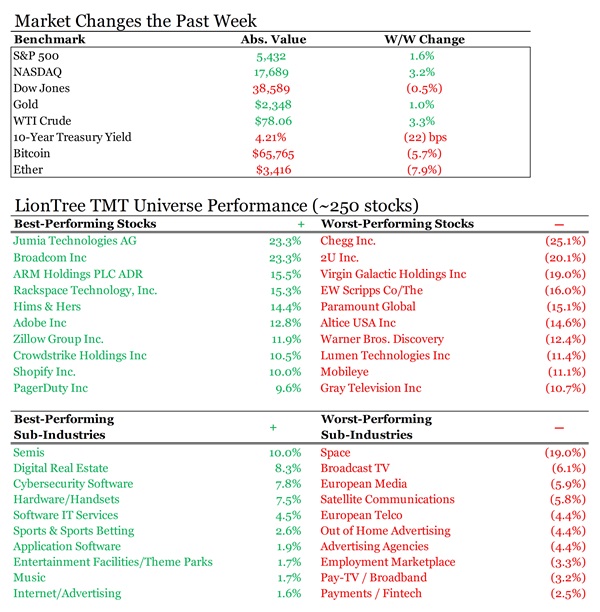
It was tech, tech, and more tech this week, with Nasdaq rallying almost +3.25% vs slightly down performances from Dow Jones and Russell 2000, while Treasury yields pulled back. May CPI cooling and the Fed signaling one rate cut for 2024 spurred a dramatic mid-week rally, but as has been the case for some time, the rally was concentrated amongst the tech giants.
This week, the key themes, developments, and updates that we focused on in this edition are below (all are clickable links):
- LionTree’s Lens: Sector Insight & A Look Ahead, Summer 2024 – NEW DECK
- Apple’s AI Strategy Finally Comes Into Focus At WWDC
- The Battle Re: The Gig Worker Continues… “Employee” Or “Independent Contractor”?
- Consumer Brands Are Increasingly Making Moves Into Hollywood…
- A Highlight Reel Of Impactful Sports Updates This Week
- The 2024 Outlook For The Global Ad Industry Now Looks Much Rosier
- Some Fits & Starts For The EV & AV Industries
- Grab Bag: Spotify’s New Premium Tier / Paramount-Skydance M&A Talks End / OpenAI Revenue Update
Have a nice weekend.
Best,
Leslie

LionTree’s Lens: Sector Insight & A Look Ahead, Summer 2024 – NEW DECK
In case you missed my email on Wednesday, I wanted to highlight our new LionTree’s Lens: Sector Insights & A Look Ahead, Summer 2024 update, which outlines key thematic trends that played out across the sector since our Spring update at the end of March as well as our expectations looking ahead.
The full deck includes what we think are the most recent incremental developments, perspectives, and themes across the TMT and consumer space.
**For access to the video presentation, where I run through the main takeaways and forward expectations from the deck in ~20 minutes, as well as the slides, CLICK HERE. **
We are happy to schedule calls with any company executives or investment teams if you would like to discuss any themes in more detail. Just let me know. As always, we welcome and appreciate any feedback.
Table of Contents
Macro & Markets
- The TMT Sector Remains The Top Driver Of Market Performance…
- …But Market Concentration Returned With A Vengeance In Q2TD
- Macro KPIs Continue To Send Mixed Signals About The Economy
- What Kind Of TMT IPOs Are Making It Out The Door?
- Is Being Public Losing Its Cache?
- Companies Deliver MUCH Better Profitability, AGAIN
- TMT Shareholder Returns Reached New Heights To Start 2024
Top-Down Themes
- Big Tech Is Entering A Multi-Year Investment Cycle As “The Next Industrial Revolution Has Begun”
- Major Innovations Are On The Way For Advertising
- Next Stop For Retail Media = Financial Services & FinTech
- Attacking The Streaming Churn Issue Via Bundles, Bundles, & More Bundles
- Video Game Bellwethers Remain In An Air Pocket
- Some Cracks Emerge In Experiential… Will It Broaden Out?
- Connectivity – Everyone Is Heads Down On ACP
- Labels Are Working To Preserve The Sanctity Of Music’s Value
- The Perfect Storm Around Sports Remains In Play
Wall Street Sentiment
- Wall Street’s Top TMT Picks & Pans
- The Upside To Wall Street Price Targets Continue To Get More And More Compelling, In Aggregate
Apple’s AI Strategy Finally Comes Into Focus At WWDC
Apple’s annual Worldwide Developers Conference (WWDC) often includes some of the company’s significant software updates to iPhones, iPads, Macs, as well as other key parts of the Apple ecosystem, and while some years contain fewer market-moving announcements than others, this year’s event was certainly not a disappointment. Front-and-center were Apple’s eagerly anticipated AI-related announcements. Later this fall, the company plans to launch “Apple Intelligence”, a personal intelligence system that will enable Apple devices to “understand and create languages as well as images” and help users “simplify interactions across [their] apps”. Along with prioritizing notifications and offering a wide range of machine learning-powered writing and image creation tools, one of Apple Intelligence’s key differentiating factors will be the level of privacy that it offers users. Data related to their queries won’t be collected or stored, and when extra computational power is required, Apple Intelligence will leverage private cloud compute on Apple Silicon servers to process a request. Siri will also incorporate AI to take a “major step forward”, integrating with OpenAI’s ChatGPT and, in the future, other LLMs, to understand and act on a broader range of natural language queries.
In addition to the details on Apple’s AI strategy, there were some other long-awaited updates in the company’s keynote address. For one, the upcoming iOS 18 will allow for more customizability on the iPhone home and control screens, something that Android phones have been able to offer for quite some time. Additionally, after more than a decade following its initial release, iPads will receive their first native calculator app, which will integrate with the Apple Pencil, solve users’ handwritten equations, and use machine learning to improve their handwriting. The Vision Pro also received its first major software upgrade, providing a plethora of new capabilities, display options, and the ability to create spatial photos using machine learning. Together with the announcement that Apple plans to begin expanding overseas distribution of Vision Pro beginning later this month, these updates could help reinvigorate interest in the $3,499 headset.
Elsewhere, there was some interesting, albeit less incremental news surrounding the upcoming MacOS Sequoia, WatchOS 11, and Home experience updates. An announcement that received less fanfare but that could have much further-reaching implications was Apple’s release of a new framework for ad attribution. Although at this point the move does little more than consolidate the company’s two existing ad attribution frameworks, it does signal that Apple could be preparing for a push into the AdTech space.
See below for more on what we thought was most incremental this year’s WWDC Conference…
-> Apple shares jumped +7.3% following the keynote address at WWDC and ended the week up +7.9%; YTD, Apple stock is trading up +10.4%
Apple Is Debuting “Apple Intelligence”, Its Own AI System, This Fall (link)
- Apple Intelligence is the Co’s new personal intelligence system: Apple Intelligence enables iPhones, iPads, and Macs “to understand and create languages as well as images and take action for [users] to simplify interactions across [their] apps”; Will be included in Apple devices free of charge
- A selection of Apple’s flashiest new AI-powered features:
- Priority notifications minimizes unnecessary distractions and ensures users don’t miss important updates; Another tool, “Reduce Interruptions”, only surfaces notifications that require immediate attention
- New writing tools are available system-wide and can rewrite, proofread, and summarize text to help users feel more confident in their writing; Can use these to summarize emails, determine what’s most urgent, and generate responses
- New image creation tools will be built into apps throughout the system, such as Notes, Freeform, Keynote, and Pages
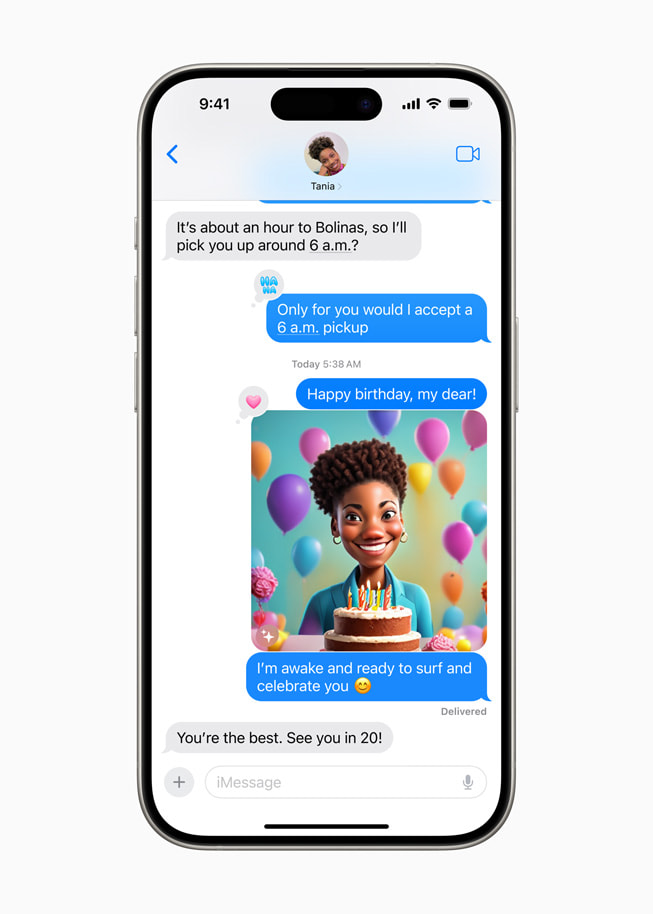
- Image Playground enables users to choose from a range of themes to create original images in three unique styles, including sketch, illustration, and animation; AI-generated suggestions can be provided to users based on their conversations
- Image Wand can transform a rough sketch to a polished image to complement notes and make them more visual
- Another “critical building block” – Apple Intelligence understands users’ personal context: Combines the ability to process users’ personal data with the ability to take actions across apps, allowing users to ask such questions as, “Will my meeting be rescheduled and interfere w/ my daughter’s playdate?”
- A selection of Apple’s flashiest new AI-powered features:
- Apple Intelligence goes “hand-in-hand w/ powerful privacy” – a differentiating factor: Apple Intelligence will be integrated into Apple devices and apps so that it is aware of users’ personal data without ever collecting and storing it; Instead, data will be used exclusively to fulfill users’ requests
- Apple Intelligence can draw on private cloud compute for more computational capacity, sending only relevant data for a request to be processed on Apple Silicon servers
- Third-party expert verification reinforces Apple’s privacy promise
- Siri has “taken a major step forward” w/ AI and will be more integrated into Apple devices: Siri will now appear as an “elegant glowing light” on the edge of the screen for iPhones, iPads, and Macs
- New features that will be available upon Apple Intelligence’s debut:
- Users can speak to Siri more naturally: W/ richer language understanding capabilities, Siri can understand and process more informally-worded user queries
- Siri now maintains conversational context: Allowing users to ask follow-up questions and commands based on previous requests
- Also introduced the ability to type to Siri: Can quickly and quietly ask Siri to set an alarm, for instance
- ChatGPT (powered GPT 4.0) is being integrated into Siri: Users will be able to access ChatGPT for free and without needing an account; ChatGPT subscribers will be able to connect their accounts and access paid features; Will be coming to iOS 18, iPadOS 18, and macOS Sequioa later this yr
- Apple is “just getting started” w/ AI integrations: Will add support for other LLMs in the future, including “maybe” Google’s Gemini family of LLMs, per Apple’s senior VP of software engineering Craig Federighi in statement after the keynote
- Apple plans to introduce more functionality to Siri over the next yr (link): The on-screen awareness capability will enable Siri to understand and take actions based on things on users’ screens; Siri will also be able to take actions across apps, surfacing photos of specific friends in specific locations, for instance
- New features that will be available upon Apple Intelligence’s debut:
-> Elon Musk called Apple’s integration w/ OpenAI an “unacceptable security violation” and threatened to ban the use of Apple devices at his Cos, including Tesla, SpaceX, and X; Musk added that visitors to the Cos will be required to hand over their Apple devices over upon arrival, whereupon they will be stored in Faraday cages, which are designed to block electromagnetic fields (link)
Coming in Sept, iOS 18 Will Offer More Customizability & More Messaging Features (link)
- iPhone home displays are becoming more customizable: W/ iOS 18, iPhone users will have the ability to place apps anywhere on their home screens, view apps in a “dark mode”, and group apps together w/ select color schemes
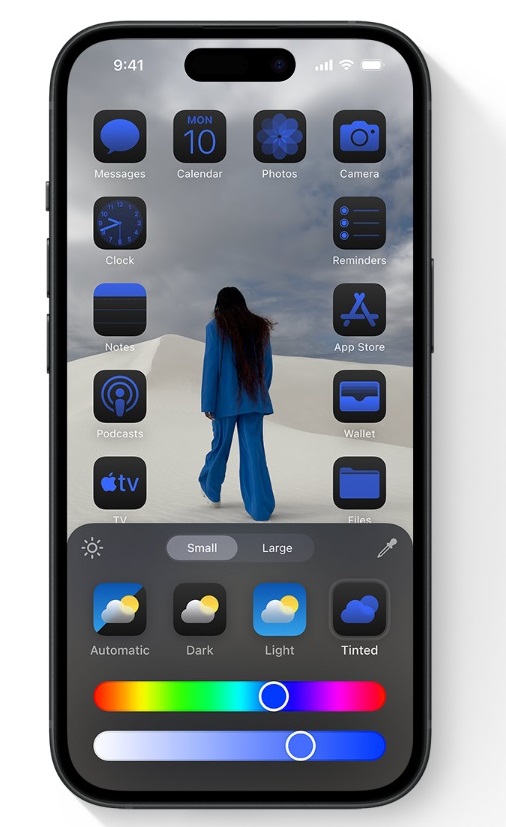
- The control screen will also allow for more personalization: The control screen, which houses the flashlight, do not disturb, and airplane mode buttons, will be opened up for app devs to create their own icons, potentially adding new icons for users to control their car, garage doors, home security systems, etc
- New privacy features will enable users to hide apps in a secret folder: Alternatively, users will also be able to lock certain apps behind Face ID
- iMessages also received several updates
- Users will be able to send texts from anywhere: iOS 18 will allow iMessages and even green-bubble text messages via a satellite connection; Previously, this featured only let certain iPhones text emergency svs outside of cell svs
- There will be more ways send reactions within text convos: Users will be able to add reactions (emphasizing, for instance) to their own messages and \ have the ability to react to messages from others with any emoji, not just the select few currently offered
- iOS 18 will also add support for the RCS protocol: This will enhance texting between iPhones and Android devices
- The Genmoji feature lets users create custom emojis based on text prompts and the content of their messages
visionOS 2 Will Bring The First Major Update To The Vision Pro (link)
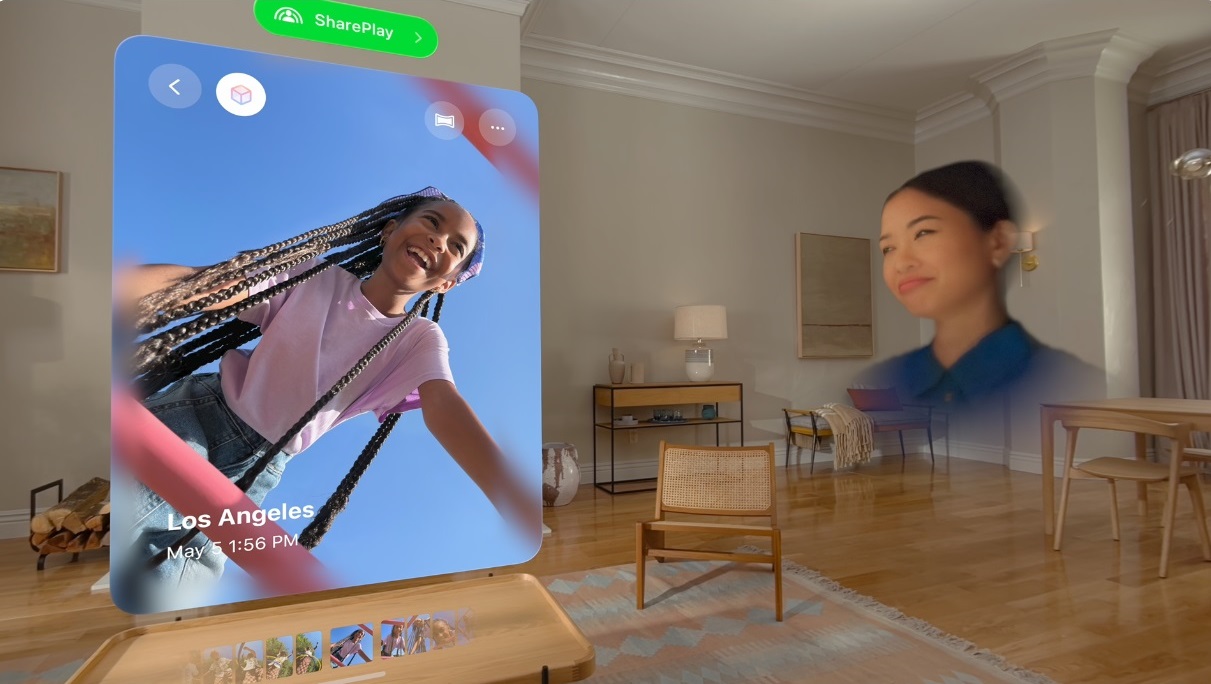
- Spatial photos will enable users to revisit past memories: visionOS uses advanced machine learning to create spatial photos directly from users’ libraries in the Photos app; Users can share spatial photos w/ others to view on Vision Pro or use SharePlay to view moments via their spatial personals in the same virtual room
- Improvements to accessibility and navigation are also coming:
- New hand gestures will make it faster and easier to access key functions: Will allow users to see important info, such as battery level, at a glance and perform actions, such as adjusting volume
- Mac Virtual Display will feature a higher resolution and larger size later this yr: This will create an ultra-wide display equivalent to two side-by-side 4K monitors
- visionOS2 also adds mouse support: Will also reveal users’ physical Magical Keyboards even when they are not fully immersed in an Environment or app
-> Apple also annc’d that the $3,499 version of the Vision Pro will soon be rolling out to more countries internationally; The Vision Pro will become available in China, Japan, and Singapore on June 28 and then be released in Germany, France, Australia, the UK, and Canada on July 12; Pre-orders for the Vison Pro will begin two weeks in advance of each rollout date (link)
- visionOS2 includes new APIs and frameworks to make it easier to develop apps and games: Specifically, this will help devs create games that are “more volumetric” and that introduce new shareable experiences
- These will expand use cases & capabilities across a variety of industries: Including healthcare, manufacturing, aerospace, automotive, and others; Devs are leveraging new APIs like Barcode Scanning and Object Tracking to help Cos improve day-to-day operations
- HealthKit will be added to Vision Pro: Will provide new ways to develop innovate health & fitness experiences leveraging the infinite canvas in visionOS
- Other new features: Among many others
- Users will be able to watch videos in an Environment while in Safari: This includes the ability to stream videos on popular sites, such as YouTube, Netflix, and Amazon
- The Apple TV app will support Multiview for the Vision Pro: Later this yr, sports fans will be able to watch up to five simultaneous streams
- AirPlay will also enable users to view content from their iPhone, iPad, or Macs on their Vision Pros
Addt’l Noteworthy Updates To Other Core Parts Of The Apple Ecosystem
- Apple TV+ will add InSight to provide timely info on actors, characters, and music from Apple TV+ content (link): For example, viewers will be able to select an actor to view their background and filmography page or to quickly view which is song is playing in the background of a scene; InSight will display info in real-time
- iPads are getting their first native calculator app w/ iPadOS 18 (link): This app will come w/ support for Apple Pencil as well as a new Math Notes feature that will allow users to write equations on their iPads and have the app solve them
- Smart Script, another new feature, will leverage machine learning to improve the appearance of users’ handwriting and spellcheck their notes
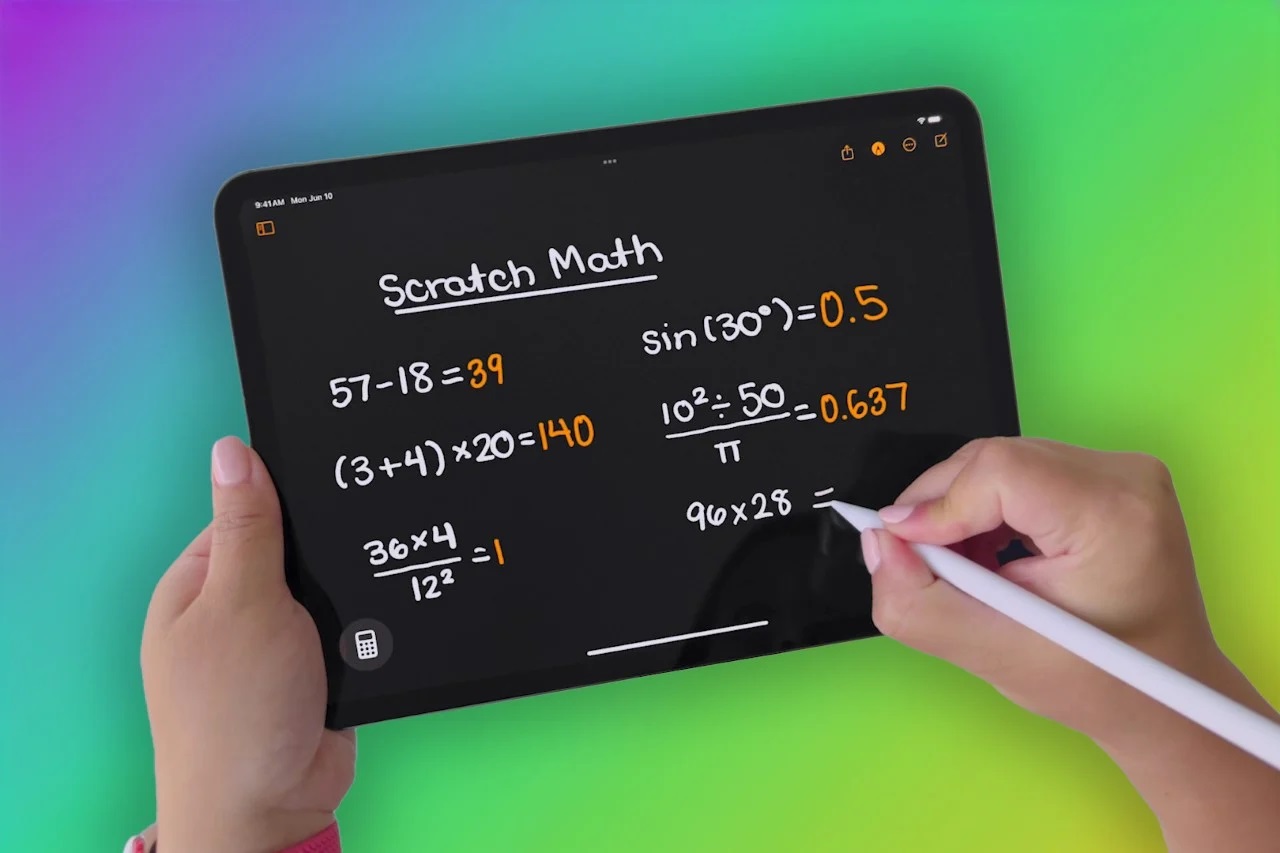
- Macs will be able to mirror iPhones (link): W/ macOS Sequoia, users will be able to view their iPhone screens and control them from their Macs, see iPhone notifications alongside Mac ones, and seamlessly drag and drop files, photos, and videos between devices
- Apple Watch will include Vitals to help users monitor their daily health (link): Vitals shows users’ overnight health data in one place, establishing a typical range for each of their health metrics as they sleep; If multiple metrics are outside their normal range, users will receive a notification
- Apple appears to be gearing up for a foray into ad measurement (link): The Co released “AdAttributionKit”, a framework to house its privacy-focused ad attribution tech, effectively phasing out its existing SKAdNetwork and Private Click Measurement frameworks; iOS 18 will also include more reengagement info for clickthrough attribution
-> Applovin shares were down -3.8% in reaction to the news of Apple’s potentially expanding efforts in ad measurement tech, closing the week down -5.4%; YTD, Applovin stock is still trading up +94.5%
The Battle Re: The Gig Worker Continues… “Employee” Or “Independent Contractor”?
The battle over whether workers that underpin the app-based ridesharing/delivery gig economy should be considered independent contractors or employees has been enduring for many years, and the state of California has been leading the charge to towards defining them as the latter term. The state first passed its initial AB5 law in 2019, requiring companies that use independent contractors to reclassify them as employees. However, this was followed by Prop 22 being passed in late 2020, which was a ballot initiative deeming that app-based drivers are still independent contractors.This week, Uber and its subsidiary Postmates lost their appeal to reverse the California AB5 law in US courts, but these companies are still protected under Prop 22 (for now). This back-and-forth in the courts is going to continue and could have bigger implications for the gig economy down the road, especially if other states follow California’s lead (there has been some movement in Massachusetts on this as well).
Why does CA want these workers to be considered “employees”? Because employees are entitled to the minimum wage, overtime pay, reimbursements for expenses, and other protections that are not extended to independent contractors. In contrast, ridesharing and delivery companies prefer to treat workers as independent contractors because this allows them to better control costs. Reuters cites studies suggesting that employees can cost companies up to +30% more than contract workers.(link/link/link)
We included some key details on the background and this week’s updates below…
- California AB5 was passed in 2019 that was intended to make app-based workers full employees with all the benefits associated with that
- In an attempt to counter AB5, Uber, Lyft, and the like heavily supported Prop 22, a ballot initiative that declared app-based drivers to be independent contractors; Californians then voted on Prop 22, w/ 58% of voters supporting the initiative in Nov 2020
- This Monday, the 9th US Circuit Court of Appeals in San Francisco upheld a lower court ruling that said Uber and Postmates failed to show that the 2020 state law (aka AB5) unfairly singled out app-based transportation companies, while exempting other industries
- In response, Uber said the ruling would not change the status of its relationships with its drivers, who are considered to be contractors under Prop 22
- However, the future of Prop 22 is in flux as well; There is a separate case at the state’s top court, which last month heard arguments from a labor union and four drivers contending the ballot measure was unconstitutional
- The California legislature “perceived transportation and delivery Cos as the most significant perpetrators of the problem it sought to address — worker misclassification,” Circuit Judge Jacqueline Nguyen wrote
- A similar Massachusetts ballot measure is also being challenged in court
Consumer Brands Are Increasingly Making Moves Into Hollywood…
Starbucks this week announced Starbucks Studios, representing yet another move made by a large-scale consumer brand into the Entertainment & Media Sector. This follows similar initiatives in this direction led by high-end fashion brands Saint Laurent and LVMH in the spring of last year and in February of this year, respectively.
As an underpinning to this new venture, Starbucks talks about its “longstanding commitment to championing storytelling” as well as its dedication to nurturing “human connection and joy”. The company is not going at it alone though and is partnering with Sugar23, whose founder, Michael Sugar, is an Academy Award-winning producer renowned for movies such as “Spotlight” and “Collateral Beauty”. Notably, Sugar23 specializes in “facilitating connections between brands and the entertainment industry”.
Overall, this emerging theme of consumer brands increasingly venturing into media & entertainment caught our attention and is one that we expect will become more pervasive, given that characters and narratives play a crucial role in fostering consumer passion and brand loyalty.
Details on other brands’ forays into the studio business are below: (link/link/link/link)
- Saint Laurent in April 2023 launched Saint Laurent Productions, which at the time marked the first luxury label to count film production as part of its repertoire; “I want to work with and provide a space for all the great film talents who have inspired me over the years”
- Saint Laurent Productions made its debut on the world cinematic stage by participating in the 76th Cannes Film Festival this May, where it premiered its first film: Strange Way of Life by Pedro Almodóvar, a Western starring Ethan Hawke and Pedro Pascal
- “You can still see a film in 10 or 30 years, if it’s good. In some ways, making a film can be more impactful than a seasonal collection”
- This Feb, LVMH annc’d an expansion into entertainment w/ a new division called 22 Montaigne, where it will explore opportunities for the LVMH brands like Dior, Tiffany, and, of course, Louis Vuitton and Moët by collaborating w/ entertainment creators, producers, and distributors on film, TV, and audio projects
- The Co is working in partnership with Jae Goodman and John Kaplan, founders of the consultancy firm Superconnector Studios
- “At LVMH, we see each house as a house of stories, a distinctive creator of culture”
- AB InBev hired Superconnector Studios in May to help connect it with studios and production Cos (link): Along w/ partnering w/ LVMH, Superconnector also helped build Nike’s Waffle Iron Entertainment
- AB InBev is looking to develop, produce, and finance projects around the creation of its brands and beverages; This approach has worked successfully in recent years w/ titles like Flamin’ Hot (Hot Cheetos), Air (Nike), and The New Look (Dior)
- Mailchimp also pivoted in this direction a few yrs ago (June 2019) when it officially launched Mailchimp Presents w/ the goal of assembling a slate of short-form unscripted and scripted programming to promote its brand in collaboration w/ entertainment industry partners like Vice Media, WME, Scout Productions (Netflix’s “Queer Eye”), production Co Caviar (Lars von Trier’s “Nymphomaniac”), and Jason Woliner, whose directing credits include Fox’s “The Last Man on Earth”
- Mailchimp describes itself as a “business entertainment platform”, centered on themes of entrepreneurship and aimed at owners of small businesses
A Highlight Reel Of Impactful Sports Updates This Week
We also wanted to include a quick round-up of some sports-related updates that we found compelling and that appear to underscore how sports leagues outside of the big 4 men’s sports leagues (NFL, NBA, NHL, and MLB) have gained popularity in the US recently. Moving forward, acquiring TV rights to these sports could help streamers and linear broadcasters, alike, attract viewers to their respective ecosystems. See below for more details:
- Warner Bros Discovery reportedly agreed to a $650mn, 10-yr deal for US TV rights to the French Open (link): This comes after the French Open, or Roland-Garros Tournament’s, 12-yr deal w/ Comcast NBCUniversal in the US expired on June 9; NBC Sports reportedly had paid just $12mn/yr for the rights
- The price tag for the rights is ~in-line w/ other pro tennis US TV deals: Disney/ESPN currently pays ~$83mn/yr for US TV rights to Wimbledon and $70mn/yr for US Open domestic TV rights
- The Co will offer a variety of options to watch the tournament in the US: WBD will reportedly cover the French Open on TNT, TBS, and its truTV linear channels as well as on the Max streaming svs
- WBD already carries the French Open in Europe: WBD shows the French Open on Eurosport and Discovery in 50 countries as part of a deal w/ the French Tennis Federation that expires in 2027
- Several emerging US sports set attendance records last weekend (link):
- The National Women’s Soccer League (NWSL) set a single-game high watermark for attendance: Last Saturday’s game between the Red Stars and Bay FC saw a record crowd of 35,038; The game was part of a total weekend mark of 110,485 and marked the first time the NWSL eclipsed 100,000+ in a weekend
- The Women’s National Basketball Association (WNBA) saw its highest turnout for a game since 2007: 20,333 people attended Friday’s contest between Caitlin Clark’s Indiana Fever and the Washington Mystics; The WNBA also recorded its best opening-month attendance in 26 yrs, posting ~400,000 in May
- The International Cricket Council (ICC) Men’s T20 World Cup set a new record for cricket attendance in the US: The high-profile match-up between India and Pakistan, one of the most rivalries in sports, drew a turnout of 34,028 to Long Island last Sunday
- Saudi Arabia’s Public Investment Fund (PIF) is reportedly seeking to form a $5bn boxing JV (link): Sources quoted by Reuters indicate that PIF is in discussions w/ multiple entities to create a boxing league valued between $4-5bn that would feature more bouts, potentially reshaping the sport’s competitive landscape
- PIF reportedly wants to create a JV that would bring together the sport’s main organizers: Reuters’ source indicated leading boxing promoters Matchroom Boxing and Golden Boy Promotions are included in the talks, adding that PIF is looking to take a minority stake in the venture
- Boxing is currently very fragmented: The sport is comprised of separate boxing organizations, including the World Boxing Council, the International Boxing Federation, the World Boxing Association, and the World Boxing Organization, w/ their own rules for championship belts
- A close advisor to Crown Prince Mohammed bin Salman has reportedly been involved: Chairman of the Saudi General Entertainment Authority Turki al-Sheikh was overseeing final discussions around a potential deal about a month ago, Reuters notes
- Reuters was unable to establish details around how a league would be structured
- PIF reportedly wants to create a JV that would bring together the sport’s main organizers: Reuters’ source indicated leading boxing promoters Matchroom Boxing and Golden Boy Promotions are included in the talks, adding that PIF is looking to take a minority stake in the venture
The 2024 Outlook For The Global Ad Industry Now Looks Much Rosier
Entering 2024, the advertising industry faced a great deal of uncertainty, given questions surrounding the health of the global economy and the resiliency of the consumer spending environment, and that factored into GroupM initially forecasting a deceleration in global ad revenue growth to +5.3% y/y from + 5.8% y/y in 2023 back in December. However, circumstances appear to have improved across the global advertising landscape since then, and this week, GroupM issued a more optimistic outlook for the year in its 2024 Global Midyear Forecast. Citing higher confidence around digital growth, recoveries in key markets such as China, and the accelerating adoption of retail media, CTV, and AI-powered advertising channels, the company now predicts that global ad revenues will jump +6.8% y/y in 2024 and rise another +6.8% y/y to $1.1tn in 2025. Notably, GroupM upwardly revised its estimates across nearly every single one of its forecast regions, with the exception of India. Expectations for China grew by the widest margin, increasing by +790 bps, followed by France’s +500 bps improvement from the company’s last update.
In terms of channel-specific trends, the rapid growth of retail media, both worldwide and in the US, stood out as a particularly noteworthy finding. In 2024, retail media is expected to account for 15.1% of total global advertising revenue, representing more than a tenfold increase from its 1.5% share just a decade ago. In TV advertising, declines in traditional linear TV advertising are expected to continue offsetting gains in CTV advertising, though the upcoming US Presidential election, which is projected to drive $15bn in ad spending, will provide a substantial boon before the end of this year. Digital advertising also stands to continue taking a greater share of the collective pie, with GroupM predicting the channel will account for 70.6% of total worldwide ad spending in 2024 and almost 75% in 2029.
Along with GroupM’s update, there were a couple other incremental advertising updates out this week that we also wanted to highlight, including Google’s launch of an advertising network to serve targeted ads to Google TV devices as well as Borell Associates’ 2024 estimates for the local advertising market in the US.
See below for more of our takeaways on this week’s key advertising updates, and CLICK HERE to access GroupM’s website for the report:
GroupM Raised Its Projections For 2024 Global Ad Spending
- Global ad revs are now projected to grow +6.8% y/y to $99.8bn in 2024: The uptick from GroupM’s prior +5.3% y/y forecast in Dec was due to optimism around digital growth, recoveries in key mkts such as China, and accel’ing adoption of retail media, CTV, and AI
- 2024 ad rev forecasts improved for nearly all regions compared to the Dec update…:
- US (more detail below): +5.8% y/y, up from +5.7% y/y in the Dec forecast
- Canada: +5.7% y/y, up from +4.0% y/y
- UK: +4.9% y/y, up from +4.4% y/y
- France: +8.6% y/y, up from +3.6% y/y
- Germany: +4.1% y/y, up from +3.7% y/y
- China: +14.0% y/y, up from +6.1% y/y
- Japan: +4.5% y/y, up from +4.0% y/y
- Australia: +1.1% y/y, up from +0.2% y/y
- Brazil: +11.3% y/y, up from +10.3% y/y
- Only India saw a downward revision: To +9.5% y/y, down from +11.2% y/y
- 2024 ad rev forecasts improved for nearly all regions compared to the Dec update…:
- In 2025, global ad revs are expected to rise +6.8% y/y to $1.1tn, up from the prev +6% y/y forecast
- Color on global channel-specific trends:
- Total linear TV and CTV revs are expected to increase +2.7% y/y to $163.2bn in 2024 (vs -0.4% y/y in 2023): Over the next five yrs, traditional TV rev CAGR is expected to be -0.2%
- Global CTV rev is forecasted to grow +20.1% y/y to $38.1bn in 2024: In 2025, another +20.1% y/y increase is expected
- Digital pure-play advertising will comprise 70.6% of total ad rev in 2024: Rising to 74.9% of ad rev, or $985.6bn, in 2029
- Retail media will account for 15.1% of total ad rev in 2024: This is more than a 10x increase from just a 1.5% share a decade ago
- Total linear TV and CTV revs are expected to increase +2.7% y/y to $163.2bn in 2024 (vs -0.4% y/y in 2023): Over the next five yrs, traditional TV rev CAGR is expected to be -0.2%
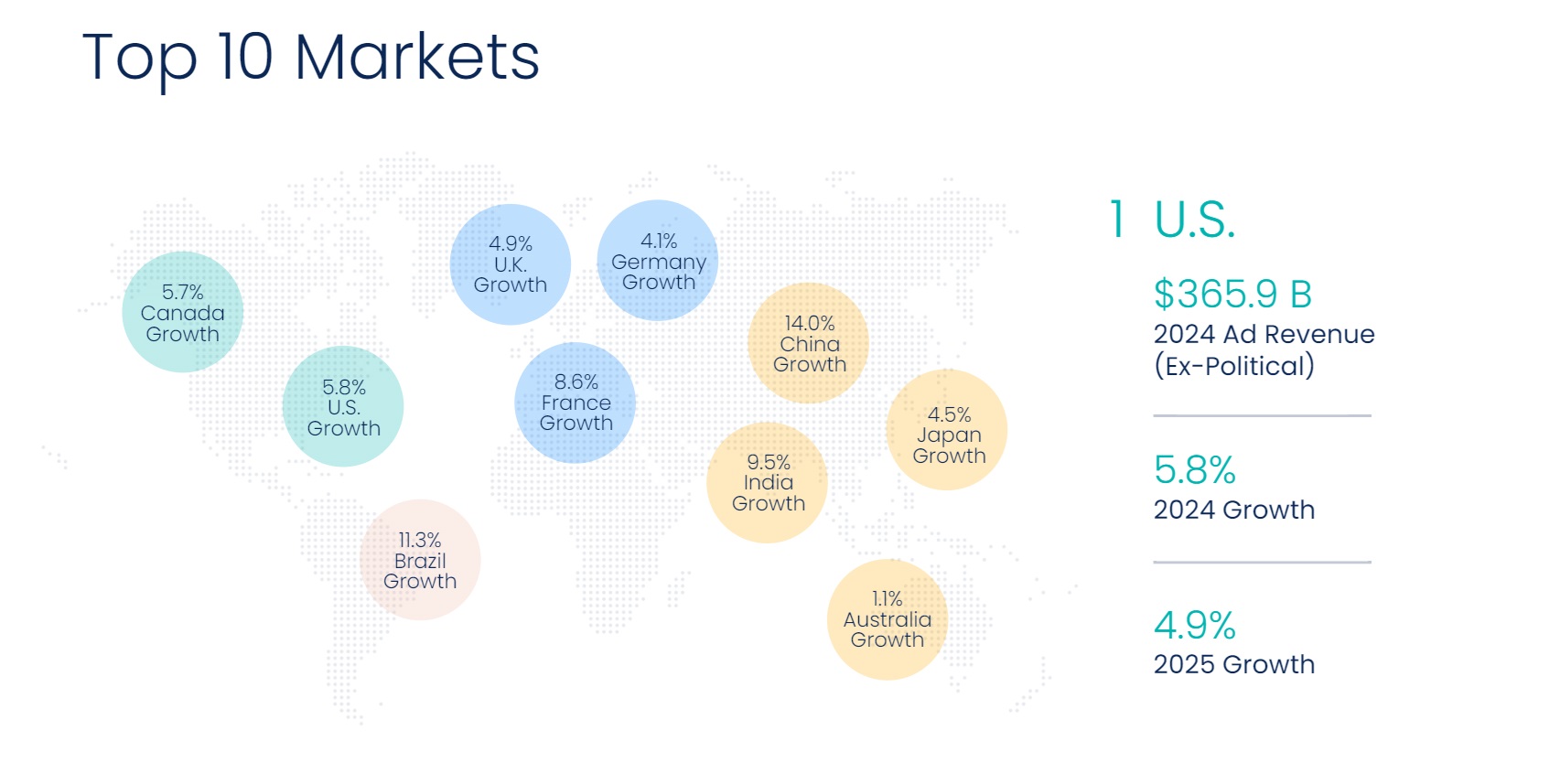
- Overall US ad rev is expected to increase +5.8% y/y in 2024, up from the prev +5.7% estimate:
- US TV ad rev (ex-political spending) is expected to fall -0.6% y/y to $64.1bn in 2024: To note, GroupM includes some YouTube spending in its TV totals
- Linear TV rev is forecasted to decline -8.9% y/y in 2024: GroupM anticipates that less than half of US households will be pay-TV subs by the end of 2024; In 2025, linear TV rev is expected to fall another -6.5% y/y
- CTV is expected to account for 30.2% of total TV ad rev: CTV revs are expected to increase +20.7% to $19.4bn in 2024 and then grow +19% y/y in 2025; By 2029, CTV is projected to generate 51.1% of all TV rev
- Retail media will be the fastest growing segment again in 2024: Retail media revs are projected to rise +22% to $47.9bn, surpassing traditional TV ad rev a year
- The largest US retail media owners are Amazon, Walmart, Instacart, eBay, and Target, per GroupM estimates
- Political advertising is predicted to be $15bn+ during the 2024 Presidential election cycle: For the 2028 Presidential election cycle, GroupM projects $17bn+ in political advertising
- US TV ad rev (ex-political spending) is expected to fall -0.6% y/y to $64.1bn in 2024: To note, GroupM includes some YouTube spending in its TV totals
- In 2025, US ad rev is anticipated to grow +4.9% y/y (vs +4.1% y/y in the Dec forecast), as the “overall resiliency of consumer spending, especially among more affluent consumers, has driven cont’d economic growth”
Elsewhere Within The Advertising Space, There Were Also Some Other Notable Updates This Week…
- Google is launching an advertising network to serve targeted ads to Google TV devices (link): The Google TV network ads svs will let advertisers place targeted, unskippable in-stream ad spots across 125+ live channels (many of which are FAST channels) on Google TV-powered streaming boxes and smart TVs
- There are currently ~20mn active Google TV and Android TV OS devices: When including YouTube, this figure reaches 150mn+ monthly active viewers in the living room, according to Google
- Google TV’s FAST viewers watch an avg of 75 min/day: This is despite the content mostly consisting of re-runs
- Advertisers already using Google can easily expand their campaigns to include the Google TV network: Those using Google Ads and Google Display & Video 360 just need to check a new box under YouTube & Google to do so
- There are currently ~20mn active Google TV and Android TV OS devices: When including YouTube, this figure reaches 150mn+ monthly active viewers in the living room, according to Google
- Overall local advertising is projected to increase +3.2% y/y in 2024, per Borrell Associates (link): Although a “healthy” rate of growth, the estimate marks a downward revision from the Co’s earlier forecast of +4.4% y/y growth; Over the next five yrs, total local advertising is expected to rise at a +2.2% CAGR
- Local broadcast TV advertising is expected to grow +5.9% y/y to $9.91bn in 2024: After the election yr, local broadcast tv ad rev is projected to drop -12% y/y to 2025
- Local cable-TV spending is forecasted to drop -6% y/y to $2.32bn in 2024: A further decline to $2.12bn is predicted in 2025
- Streaming video advertising (OTT & CTV) is forecasted to increase +3.9% y/y to $23.3bn in 2024: This was less than Borrell initially anticipated, w/ many local bizs noting a lack of awareness and knowledge of how to purchase local streaming spots as a key obstacle
Some Fits & Starts For The EV & AV Industries
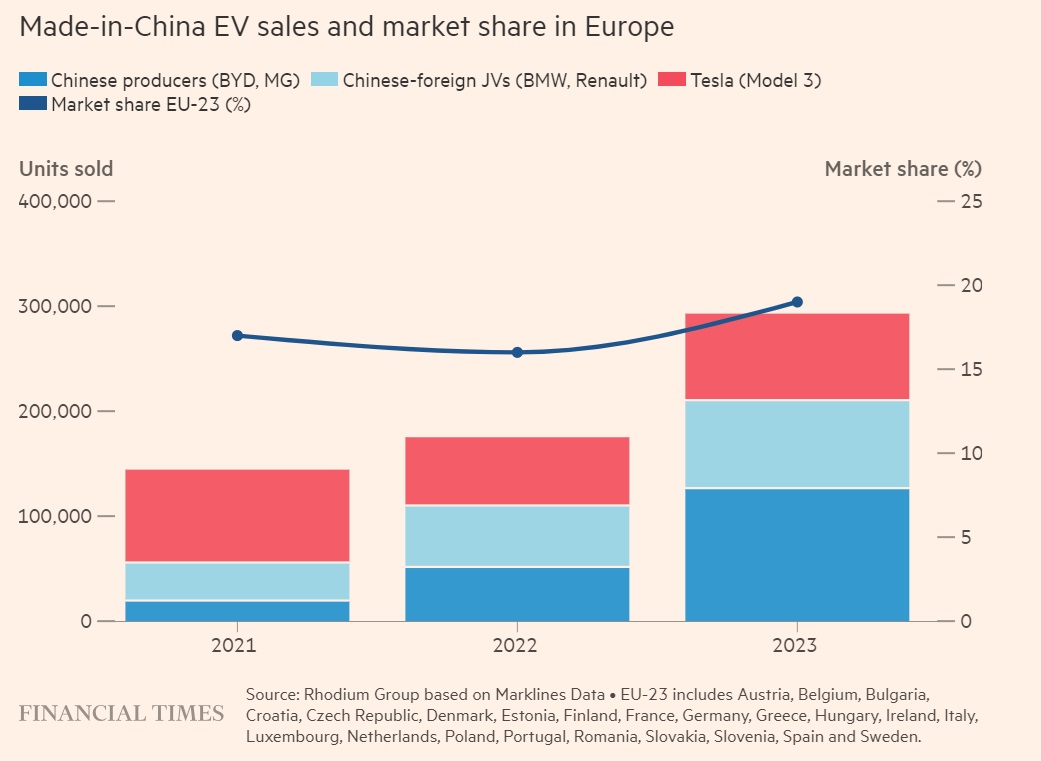
Over the past couple of years, legislators in the US and EU have passed laws intended to accelerate the transition away from gas-powered vehicles to cleaner, electric ones, and while these efforts have helped lay the foundation for a rapidly growing EV market, they have also created some cracks within the auto industry with the potential to become larger fault lines. One particular emerging area of concern has been the “soaring imports” of Chinese EVs in Europe, as OEMs have benefited from heavy subsidies from China’s government, enabling them to undercut rivals at the lower end of the market. In response, the European Commission began notifying auto manufacturers this week that it will start assessing additional tariffs on EVs imported from China on July 4, bringing them up to 48% for some companies. Given that it will raise billions in tariff fees annually for the bloc and shift market share back to western companies, there has been “broad support” for the measure among EU member states. However, not everyone is on board, as reprisals from China and the possibility of a trade war represent very real threats.
Across the pond in the US, there were also several notable developments related to EVs as well as autonomous vehicles this week. In terms of regulatory updates, the nation’s largest oil trade group, the American Petroleum Institute, filed a federal lawsuit seeking to block the Biden administration’s new tailpipe emissions law, while a California administrative court dismissed Tesla’s bid to dismiss an accusation by California’s DMV that the company’s claims of its self-driving capabilities have been overstated. Waymo’s driverless car business has also faced adversity lately, with the company issuing a recall to 672 vehicles this week following a collision last month. Conversely, in a more positive turn, Cruise plans to use an additional $850mn investment from GM to begin testing its robotaxi service around Houston and other markets again.
See below for more details on all the above:
- The EU plans to raise tariffs on Chinese EVs up to 48% (link): The European Commission notified auto OEMs that addt’l provisional duties of 17-38% will be applied on imported Chinese EVs on July 4, adding onto an existing 10% tariff on all Chinese EVs
- Addt’l tariffs will be applied based on the extent Cos complied w/ an EU anti-subsidy investigation: The investigation was annc’d last Sept in response to the growing mkt share of Chinese EV Cos
- Major Chinese EV exporters that cooperated w/ the probe will pay addt’l tariffs of 17-20%…: This group includes BYD and Geely
- … While uncooperative ones will be subject to the full 38% rate: Such as the state-owned group SAIC, which has dominated the lower end of the EU EV mkt w/ its MG brand
- Cooperative European brands producing EVs in China will pay an addt’l tariff of 21%: This group consists of Cos such as Mercedes and Renault; Separately, Tesla “may receive an individually calculated duty rate”
- Major Chinese EV exporters that cooperated w/ the probe will pay addt’l tariffs of 17-20%…: This group includes BYD and Geely
- An extra 20% tariff on Chinese EVs could reduce imports by -25%, per the Kiel Institute: This would correspond to a reduction of ~125,000 units worth almost $4bn; However, this “decline would largely be offset by an increase in production with the EU and a lower volume of EV exports”
- There is “broad support” among EU member states for the addt’l tariffs: The tariffs have been championed by France and will raise billions for the EU annually, as China’s exports of EVs to the EU reached €10bn in 2023, per the Rhodium Group, and will continue to grow
- … Though Germany, Sweden, and Hungary have led opposition within the bloc: The countries fear Chinese retaliation; China already applies a 15% tariff on European EVs, and many EU auto OEMs fear the country could even block them from its mkt
- EU trade commissioner Valdis Dombrovskis – “We have no option but to act”: “Soaring imports of heavily-subsidized battery EVs from China” have been putting the EU’s “industry at risk of injury”
- BUT the EU is “open to discuss other possible ways to remedy this situation”: Dombrovskis said he would use the three weeks until definitive duties are imposed to negotiate w/ Beijing
- China’s commerce ministry – “This is a naked protectionist act”: The ministry is “highly concerned and strongly dissatisfied” w/ the “ill-informed and lawless” EU action and will take “all necessary measures” to protect Chinese Cos
- Addt’l tariffs will be applied based on the extent Cos complied w/ an EU anti-subsidy investigation: The investigation was annc’d last Sept in response to the growing mkt share of Chinese EV Cos
- The American Petroleum Institute (API) filed a federal lawsuit to block the Biden administration’s EV push (link): The API, which is the country’s largest oil trade group and includes Exxon Mobile and Chevron, said the EPA exceeded its congressional authority w/ regulations intended to accel the transition to EVs
- The API specifically took issue w/ the EPA’s new tailpipe emission rules: These were annc’d in March and will force US auto OEMs to produce & sell more EVs, w/ the Biden administration projecting up to 56% of all car sales will be electric between 2030-2032
- A coalition of trade groups has been building: The API will be joined by the National Corn Growers Association and the American Farm Bureau Federation as co-petitioners; These two groups rely on gas-powered cars to support the corn-ethanol industry
- The API also has support within Congress: In April, Republican attorneys general from 25 states sued the EPA to block the same rules
There Were Also Several Key Updates Regarding Autonomous Vehicles This Week…
- Tesla must face a formal court hearing related to accusations that it overstated Autopilot’s capabilities (link): Judge Juliet Cox of California’s Office of Administrative Hearings (OAH) rejected Tesla’s bid to dismiss claims by California’s DMV that the Co misleads consumers about its vehicles’ self-driving capabilities
- The accusations, if true, would support an enforcement action against Tesla, per Judge Cox: California’s DMV is seeking remedies that could suspend Tesla’s license to sell vehicles in the state and require the Co to pay restitution to vehicle owners
- The DMV’s claims will be formally reviewed before the OAH on Sept 9: This was per the DMV, which initially filed the accusation in July 2022, alleging that Tesla vehicles “could not at the time of those advertisements, and cannot now, operate as autonomous vehicles”
- A similar, nationwide lawsuit against Tesla is also in progress: On May 15, a San Francisco judge rejected Tesla’s bid to dismiss another class action lawsuit claiming that the Co misled consumers in to believing its vehicles would soon have self-driving capabilities
- Federal prosecutors are reportedly separately examining Tesla’s self-driving claims: Per people familiar w/ the matter, they are investigating whether Tesla committed fraud by misleading investors about self-driving
- The accusations, if true, would support an enforcement action against Tesla, per Judge Cox: California’s DMV is seeking remedies that could suspend Tesla’s license to sell vehicles in the state and require the Co to pay restitution to vehicle owners
- Waymo issued a voluntary software recall to 672 vehicles after one collided w/ a telephone pole last month (link): The recall, which was filed w/ the National Highway Traffic Safety Administration (NHTSA), covers the total number of driverless-capable vehicles in Waymo’s fleet
- The software update corrects an error that assigned a “low damage score” to the telephone pole: It also updated the vehicles’ mapping tech to account for the hard road edge in the alleyway that previously wasn’t included
- The recall was done manually at the Co’s central maintenance & testing depot: Unlike some of Tesla’s recent recalls, the software update wasn’t done over-the-air; A Waymo spokesperson said the recall “does not impact [its] current operations”
- Background on the incident: On May 21, an unoccupied Waymo vehicle in Phoenix struck a telephone pole at 8 mph en route to a passenger pickup location; The vehicle had been navigating through an alleyway that was lined on both sides w/ wooden telephone poles located on the street instead of the curb
- This marks Waymo’s second recall: The first occurred in Feb following two minor collisions and affected 444 vehicles; The Co is under investigation by the NHTSA for more than two dozen incidents involving its driverless vehicles, as regulatory scrutiny of autonomous vehicle Cos has been on the rise
- The software update corrects an error that assigned a “low damage score” to the telephone pole: It also updated the vehicles’ mapping tech to account for the hard road edge in the alleyway that previously wasn’t included
- GM’s Cruise robotaxi svs will begin testing again around Houston (link/link): The tests will start w/ human drivers before transitioning to “supervised autonomous driving w/ a safety driver behind the wheels in the coming weeks”
- GM plans to invest another $850mn into Cruise: This was per GM CFO Paul Jacobson at Deutsche Bank’s Global Auto Industry Conference this week; The capital injection will help cover Cruise’s operational costs as it slowly resumes testing after being forced to shut down its robotaxi svs last yr
Grab Bag: Spotify’s New Premium Tier / Paramount-Skydance M&A Talks End / OpenAI Revenue Update
- Spotify is reportedly introducing a higher-priced premium plan later this yr (link): Users will be charged at least $5 more per month for access to better audio as well as new tools for creating playlists and managing their song libraries, according to a person familiar w/ the plan
- Spotify will position this option as an add-on for existing customers: It’s unclear how many will likely stay on their current Spotify plans vs upgrading
- Pricing for the new tier will vary depending on each user’s base plan: Though it will likely avg out to a ~+40% markup
- Perks for upgrading to the tier will include access to hi-fidelity audio: Spotify previously annc’d its HiFi audio feature in Feb 2021 but has since delayed the rollout; Amazon Music and Apple Music now offer higher-quality audio as part of their standard plans
- New playlisting tools will offer more personalization: These will be able to instantly generate custom playlists for certain activities, dates, and times of the yr; Playlists will also learn and adapt to each user based on their behavior, eventually developing playlists without prompting
- Spotify will position this option as an add-on for existing customers: It’s unclear how many will likely stay on their current Spotify plans vs upgrading
-> The follows the news last week that Spotify is raising prices in the US for the second time this yr (See Theme #1 from Weekly 6/7/24)
- Paramount and Skydance reportedly were unable to reach “mutually acceptable terms” regarding a potential deal (link): This was per a spokesperson for National Amusements, through which the Redstone family controls Paramount
- Both sides had reservations: Skydance reportedly deemed Redstone’s request for a “majority of the minority vote” to provide other Class A shareholders a chance to vote on the deal was a non-starter; In turn, the 1+ year of expected regulatory review for a potential deal gave Redstone pause
- Paramount’s special committee of board members “did not vote on any potential transaction”: During a meeting to discuss the progress of talks w/ Skydance, the comittee was informed by a National Amusements rep that it didn’t have agreement on a deal and didn’t anticipate a path forward
- Redstone is now looking to sell National Amusements to other parties, per the WSJ: However, its unclear if any others submitted an offer more attractive than Skydance’s; Skydance previously secured approval from Paramount’s special committee w/ its best and final offer in April
- National Amusements voiced support for Paramount’s recently annc’d strategic plan: The Co also endorsed Paramount’s Office of the CEO and Board of Directors’ “ongoing work… to continue to explore oppties to drive value creation for all Paramount shareholders
- Both sides had reservations: Skydance reportedly deemed Redstone’s request for a “majority of the minority vote” to provide other Class A shareholders a chance to vote on the deal was a non-starter; In turn, the 1+ year of expected regulatory review for a potential deal gave Redstone pause
- OpenAI reportedly has more than doubled its annual rev to $3.4bn over the last ~6 months (link): The vast majority of that rev, or $3.2bn, comes from OpenAI’s products and svs, per Bloomberg; OpenAI is also on track to generate ~$200mn by offering access to its AI models through Microsoft Azure
- The Co also hired a new CFO this week: The new CEO, Sarah Friar, is the former CEO of neighborhood social networking svs Nextdoor Holdings and will help OpenAI expand its global biz; Previously, OpenAI’s CFO role had gone unfilled for two yrs
Stock Market Check
This Week's Other Curated News
Advertising/Ad Agencies/Ad Tech
- Yahoo Advertising annc’d Yahoo Blueprint Performance, the latest update to its AI engine, Yahoo Blueprint, which powers a suite of features that guide performance throughout the Yahoo DSP. This next-level enhancement aims to redefine how advertisers manage and optimize digital campaigns by leveraging AI tech to boost efficiency and effectiveness while maintaining control. (ADVANCED-TELEVISION)
Artificial Intelligence/Machine Learning
- Apple’s next big project could be making a smart AI robot that can figure out how to navigate peoples’ houses. Mark Gurman at Bloomberg has said its robotics projects are under the purview of former Google employee John Giannandrea, who has been in charge of Siri and, for a time, the Apple Car. According to his info, any humanoid Apple robot is at least a decade away. Still, simpler ideas may be closer. (The Verge)
- Aston Kutcher, a former actor turned venture capitalist, expressed excitement about the capabilities of OpenAI’s generative video tool Sora. Kutcher suggested it could replace various roles in filmmaking, such as cinematographers and writers, but his comments were criticized by many in the industry, who are concerned about the quality of art and the potential loss of jobs due to the incr’d use of AI. (Fortune)
- Elon Musk dropped his lawsuit against OpenAI and its CEO, Sam Altman, accusing the Co of a breach of contract and allegedly abandoning its mission of creating AI tech to benefit humanity. The case was dismissed without prejudice, meaning Musk can file it again. Musk’s decision to withdraw the lawsuit comes just one day before a scheduled hearing where the judge would’ve reviewed OpenAI’s request to dismiss the case. (The Verge)
- Nvidia’s telecom exec told Fierce that the Co is quite close to a future in which AI managers rule the roost. According to Nvidia’s VP of Telecom Ronnie Vasishta, we’re actually “very close” to a world in which AI manages AI. “It’s more of a way of thinking about AI moreso than the technology barriers to making that happen” that’s standing in the way. (Fierce Network)
- Publicis Groupe is taking a stand to remove the BS from AI. W/ the BSBot, clients will be able to record audio or upload images and text from keynote speeches, meetings, presentations, articles and press releases about AI. Once inputted, they will receive an immediate analysis that translates AI hype and jargon into real talk and highlight critical questions that should be asked. The bot will be launch on June 17. (Campaign Brief)
Broader Media & Entertainment
- Disney dropped its appeal in its First Amendment lawsuit against Florida Governor Ron DeSantis, officially ending the two-yr battle sparked by the Co’s opposition to the so-called “Don’t Say Gay” law. The move came a day after a state board approved a new 15-yr development agreement, which will allow Disney to invest up to $17bn to expand its Orlando theme parks. (Yahoo News)
- Media exec Edgar Bronfman Jr. and Bain Capital are interested in buying the parent of Paramount Global, per a person familiar w/ the matter. They are considering offering $2bn+ for National Amusements. A final decision hasn’t been made and Bronfman and Bain could opt against pursuing a deal. (Bloomberg)
Cable/Pay-TV/Wireless
- Carlos Slim has taken a 3.16% stake in BT, per a stock market filing, providing a boost to the Co’s new CEO Allison Kirkby. The stake bought by Slim, whose family controls America Movil, has a mkt value of £400mn+. Slim acquired the holding through his Inbursa financial Co and two other group Cos. Slim joins other high-profile investors of the Co, including French billionaire Patrick Drahi. (ADVANCED-TELEVISION)
- Deutsche Telekom activated an option to buy an addt’l 6.7mn shares in subsidiary T-Mobile US from SoftBank Group at well below current stock mkt value. The option was granted under the terms of a deal signed in the wake of the merger w/ Sprint in 2020. The Co highlighted the shares cost $99.5 dollars each, representing a 45% discount on the closing mkt price for T-Mobile US shares on June 7. (Mobile World Live)
- Grupo Televisa annc’d the approval from the Federal Telecommunications Institute has been received w/ regards to the acquisition by the Co of the participation in Sky Mexico previously held by AT&T. The transaction, first annc’d in April 2023, has now been carried out. Televisa now owns 100% of Sky Mexico’s capital stock, effective immediately. The transaction price will be paid by the Co in 2027 and 2028. (ADVANCED-TELEVISION)
- Rogers Communications scored multi-yr deals that will see it scoop the Canadian rights to several lifestyle brands from Corus Entertainment and Bell Media in the new yr. Starting in Jan, Rogers will be home to several Warner Bros Discovery lifestyle brands, including HGTV, Food Network, Cooking Channel, Magnolia Network and OWN, as well as the brands Discovery, Motor Trend, Science, Animal Planet and ID. (City News Kitchener)
- Spectrum Reach has a significant presence and reach in the local streaming mkt, per a new report. Analyst Evan Shapiro crunched Nielsen data and found that, collectively, Charter’s local TV sales efforts cover 18.4% of all streaming occurring in its top 22 local mkts measured by Nielsen, second only to YouTube. (Spectrum Reach operates in 91 mkts nationally.) (NextTV)
- T-Mobile was chosen as a wireless solutions provider by the US Dept of the Navy as part of the $2.67bn Spiral 4 contract. This new contract will give all Dept of Defense agencies the ability to place orders for wireless svs and equipment from T-Mobile for the next ten yrs. T-Mobile also introduced Government Internet, a 5G fixed wireless solution that can function as the main internet connection or as unlimited backup. (BUSINESSWIRE)
- US internet users incr’d by ~13mn between 2021-2023, per new numbers from the National Telecommunications and Information Administration (NTIA)’s Internet Use Survey. That increase is the largest one since the 2015-2017 time period, according to NTIA, and the gains “came in large part from segments of the population that historically have been more likely to find themselves on the wrong side of the digital divide.” (RCR Wireless News)
Cloud/DataCenters/IT Infrastructure
- PLDT is in the process of negotiating the sale of a 49% share of its data center biz to a foreign Co, aiming to raise $1bn+ and maintain majority ownership. The proceeds from the sale are intended to pay off the Co’s debts, as PLDT seeks to strengthen its financial position. The Co has confirmed it is exploring various options, including bringing in a strategic partner, but no final decision has been made yet. (TipRanks Financial)
Crypto/Blockchain/web3/NFTs
- Cryptocurrency investment products raked in an impressive figure at $2bn recently. Bitcoin led the pack with inflows of $1.97bn. Ethereum was next in line, seeing its largest inflow week since March w/ a total of $69mn. CoinShares reported that trading volumes in Exchange-Traded Products (ETPs) surged to $12.8bn for the week, marking a 55% increase from the previous week. The US dominated the inflows. (CryptoRank)
- Donald Trump said hat he wants all the remaining bitcoin to be made in the US, reiterating that it will help the country become energy-dominant. Trump’s post on X likely indicates he’d like to see more bitcoin mining done by US Cos using local resources. Current mining hotspots are China, Central Asian countries, El Salvador, and some European countries such as Germany, data shows. (COINDESK)
- Top crypto VC firms Paradigm, Polychain Capital, Multicoin Capital, Haun Ventures, and Blockchain Capital all valued their assets higher in 2023 than the yr before. Multicoin Capital saw its assets’ value jump almost 180% to $3.81 bn in 2023 from ~$1.36 bn in 2022. Polychain Capital saw its fund’s value almost double to $5.04bn in 2023 from $2.61bn the yr before. (DL News)
Cybersecurity/Security
- RansomHub, a notorious hacker group says it has sensitive data for up to 2mn Frontier Communications customers and that it’s about to put ~5GB of stolen digital info on the Dark Web for auction. The theft by RansomHub reportedly took place back on April 14. Frontier messaged its customers, saying that sensitive data for ~750,000 customers was “accessed by a third party during a recent cyber incident.” (NextTV)
eCommerce/Social Commerce/Retail
- A Walmart exec said the IPOs of the Flipkart marketplace and PhonePe digital payments platform could take a couple of yrs. Speaking on the sidelines of Walmart’s shareholder meeting, EVP for corporate affairs Dan Bartlett said, “This is something we’re looking at over the next couple of yrs.” Walmart might prioritize an IPO for PhonePe ahead of Flipkart, despite Flipkart being the more mature biz, he said. (Inc42 Media)
- China’s Ministry of Commerce issued draft rules to encourage the construction of overseas warehouses and support the growth of cross-border e-commerce platforms, like Shein, Temu, and AliExpress. The ministry’s annc’ment, which covered draft rules for inbound cross-border e-commerce, as well as outbound, said it would also seek to improve cross-border data mgmt and optimize the supervision of cross-border exports. (TAIPEITIMES)
- eBay is expanding payment method choice at checkout by adding Venmo. By integrating Venmo, a platform already embraced by 90mn+ highly engaged users, eBay taps into the modern and mobile-first consumer. Notably, a vibrant 28% of Venmo’s users are Gen Zers and Millennials within the 18-29 age bracket. The ability to pay w/ Venmo will be available to US buyers on eBay.com and the eBay app in the coming week. (eBay Inc.)
- GNC has joined the Uber Eats marketplace, allowing it to provide same-day delivery in all 50 states as it seeks to gain an edge in the competitive nutrition and supplement space. GNC will offer same-day delivery both from the Uber Eats app as well as for orders placed on GNC.com. The announcement comes as GNC continues to try to re-position itself after filing for bankruptcy in mid-2020 and closing 1,200 stores. (Modern Retail)
- On Holding joined forces w/ Verity to transform its warehouse operations w/ AI and robotics. Under the partnership, fully autonomous drones will be used in On’s warehouses to enable full operational visibility via smart, real-time inventory tracking. This will minimize stockouts, misplacements, and shrinkage across On’s supply chain. (Retail Gazette)
- Skims will open its first permanent store in Georgetown, DC, followed this summer by Aventura, Florida; Austin; Houston; and Atlanta. The Georgetown store, which spans 3,300 sq ft, will carry women’s products. The plan is to introduce men’s to the store in Q3. The store will feature select drops, but the majority of the assortment will be the core collections. (WWD)
- Temu is attracting more repeat shoppers than eBay. An April survey of 1,000 consumers found that 34% of respondents buy something from Temu at least once a month, edging out 29% of eBay. Amazon remains the stand-out leader, w/ more than three of four respondents saying they shop there at least once a month, according to a survey conducted by Omnisend. (The Business of Fashion)
Film/Studio/Content/IP/Talent
- Producer Shawn Ryan has signed a four-yr overall deal valued in the “eight figures” to transition his talents from longtime home Sony Pictures TV to Netflix, per the Penske showbiz trades. Ryan is the creator/EP of The Night Agent, a Sony-produced series that was Netflix’s most-watched show last yr. (NextTV)
- Streamer spend in Europe is set to overtake public and commercial broadcasters this yr for the first time, topping €10bn ($10.6bn), per Ampere Analysis. In 2023, spend by streamers, PSBs, and commercial nets was virtually neck-and-neck in the continent at ~€8bn each, but a gap is set to emerge by the end of 2024. Broadcaster spend will remain virtually flat while streamer investment will shoot up by a 20%. (Deadline)
- SVoD platforms are projected to spend €10bn on content in Europe’s big five markets this yr, surpassing investments by commercial broadcasters in original and acquired film and TV content. In turn, these broadcasters face major challenges of strong competition from deep-pocketed streamers, incr’d pressure on their own content budgets, and falling viewer engagement levels. (AMPEREANALYSIS)
FinTech/InsurTech/Payments
- Worldpay revealed that digital wallets are the fastest growing payment method in the world, and Asia is leading the charge. Globally, digital wallets accounted for 50% of e-commerce purchases and 30% of in-store purchases in 2023, accounting for $14tn in transaction value. Last yr, 70% of online payments and 50% of in-store payments in APAC used digital wallets, the highest among all the regions. (CNBC)
Live Entertainment/Theme Parks/Concerts/Experiential
- StubHub reportedly had $350mn of EBITDA for the yr ending in Mar, as the Co prepares for a planned US IPO. The operator of ticketing resale platforms StubHub and Viagogo saw $1.4bn in revenue in the period, as well as $505mn of unlevered free cash flow, a person said. StubHub is in early discussions about its listing w/ prospective investors and is working w/ investment bankers. (Bloomberg)
Macro Updates
- European subscribers are now spending an avg of €696 on subscription apps and svs every yr, despite high cost-of-living concerns. These bills come on top of standard ones, such as TV, phone, and internet. UK subscribers lead w/ €814 per yr, followed by France (€780), Spain (€720), Germany (€684), and Italy (€600). That’s per a new European Subscription Wars report from Bango, which surveyed 5,000 European subscribers. (markets.businessinsider.com)
Social/Digital Media
- Integral Ad Science annc’d a partnership w/ Pinterest to provide global advertisers w/ greater transparency into campaigns across Pinterest’s in-app feed via IAS’s AI-driven Total Media Quality Brand Safety and Suitability product. IAS is launching new features and functionality for advertisers across Pinterest, including trusted campaign insights, frame-by-frame analysis, campaign level measurement, and global coverage (PRNEWSWIRE)
- New York’s state legislature has passed a bill that would prohibit social media cos from showing “addictive feeds” to children under 18, unless they obtain parental consent. New York governor Kathy Hochul is expected to sign the bill. Her office has already released a statement praising its passage, along w/ the passage of a related New York Child Data Protection Act. (TechCrunch)
- Social media platforms are an important part of the American news diet: Half of US adults say they get news at least sometimes from social media in general. But specific platforms differ widely in structure, content and culture. A new Pew Research Center survey finds that the ways in which Americans encounter news on four major platforms – TikTok, X, Facebook and Instagram – vary widely. (Pew Research Center)
Software
- Adobe is overhauling the terms customers must agree to when using its apps in an effort to win back trust and to clarify that it won’t train AI on their work. The change, annc’d via a new blog post, comes after a week of backlash from users who feared that an update to Adobe’s terms of svs would allow their work to be used for AI training. The new terms of svs are expected to roll out on June 18. (The Verge)
- Adobe shares jumped 17% in extended trading after the Co reported earnings and rev that topped estimates and lifted full-yr guidance. Adobe’s rev grew 10% y/y in the qtr, which ended on May 31, beating estimates by +0.3%. The Co called for adj EPS of $4.50-4.55 for FQ3, w/ $5.33-5.38bn in rev. Analysts polled by LSEG were looking for $4.48 in adj EPS and $5.4bn in rev in the Co’s upcoming qtr. (CNBC)
Sports/Sports Betting
- 33mn+ Brits will head to the pub to watch England play in the Euro 2024 tournament this summer, per Indeed Flex. Nearly half of the UK’s sports fans plan to watch as many matches as they can during the month-long competition. 13% will head to the pub at least 4x to watch a match during the four-week festival of football, w/ 40% planning to soak up the pub atmosphere during the semis and 57% watching the final in the pub. (ADVANCED-TELEVISION)
- FloSports annc’d the launch of the FloCollege in Oct 2024. During the 2024 NACDA & Affiliate Convention, FloSports’ latest platform will offer comprehensive NCAA coverage of men’s and women’s DI, DII, and DIII sports from partner conferences. Not only can viewers watch live streams of events, w/ 10,000+ live games in 2024-25, but FloCollege will offer sports data, editorial content, and social programming. (Cord Cutters News)
- Fox will be introducing dynamic ad insertion for college football games it televises as part of an expanded relationship w/ FreeWheel, Comcast’s adtech Co. The new relationship makes FreeWheel Fox’s primary ad-serving partner and main monetization engine. FreeWheel is also integrating w/ Fox’s AdRise tech platform, enabling Fox to find contextually relevant content that will boost the performance of advertiser message. (Broadcasting Cable)
- IndyCar and Fox Sports confirmed the new, exclusive home of the NTT IndyCar Series and the Indianapolis 500 presented by Gainbridge beginning in 2025, w/ Fox taking over from NBC. Fox will also provide coverage of Indy 500 qualifications, bringing the total number of broadcast network windows to 19. Indianapolis 500 Race Day coverage will include a five-hr window on FOX set aside for “The Greatest Spectacle in Racing”. (ADVANCED-TELEVISION)
- Liberty Global is buying a stake of Formula E from Warner Bros Discovery, giving Liberty Global controlling interest in the all-electric version of the motorsport. The deal means Liberty will own 65% of Formula E. The purchase price of the Warner shares isn’t disclosed. In a 2021 filing, WBD said its qtr ownership of the circuit was worth $65mn, though that is likely the value of the Co’s initial investment in the league. (Variety)
- Netflix will feature a live hot dog eating contest between Joey Chestnut and Takeru Kobayashi on Sept 2. Netflix calls the event Chestnut Vs. Kobayashi: Unfinished Beef. The venue has not been annc’d. Earlier this week, Chestnut said on social media he is “banned” from the Nathan’s event on July 4, which Major League Eating said was due to Chestnut signing w/ another hot dog brand, Impossible Foods. (Broadcasting Cable)
- The NFL is likely to lose an ongoing class action trial in Los Angeles. The suit was brought by bars, restaurants, and individuals, who allege the league illegally inflated NFL Sunday Ticket’s cost and required subscribers to purchase all available games rather than a lesser number. Barring a settlement, sports law specialists said the current trial, which started last week, is unpromising for the NFL. (Front Office Sports)
Tech Hardware
- The Biden administration is reportedly considering further restrictions on China’s access to chip technology used for artificial intelligence, targeting new hardware that’s only now making its way into the market. The measures being discussed would limit China’s ability to use a cutting-edge chip architecture known as gate all-around, or GAA, which promises to make semiconductors more powerful. (Yahoo Finance)
Video Games/Interactive Entertainment
- Netflix’s VP of Games Mike Verdu is taking on a new role as the Co ramps up its ambitions in the video games space. A former Facebook and EA exec, Verdu first joined Netflix in 2021 ahead of the Co annc’ing its push into mobile games. The details of his new position are unclear at this time, but GamesIndustry.biz understands it involves “innovation in game development”. (GamesIndustry.biz)
- PLAYSTUDIOS repurchased 11,677,398 shares of the Co’s Class A common stock held by Microsoft. Shares were purchased at a price of $2.11 per share and funded with available cash. Total consideration paid by PLAYSTUDIOS was $24.6mn. The repurchase reduces the number of shares of the Co’s outstanding common stock by ~8.6%. (PlayStudios)
- Xbox chief Phil Spencer confirmed that more of Microsoft’s own games will be coming to other platforms, like the PS5 and Nintendo Switch. “Our commitment to our Xbox customers is you’re going to get the oppty to buy or subscribe to the game, and we’re going to support the game on other screens,” said Spencer. “You are going to see more of our games on more platforms.” (The Verge)
Video Streaming
- Amazon is making start-up ads on Fire TV less annoying. This new update will be rolling out to all Fire TVs made in 2016 or later. W/ this update, the ad at the top of Fire TV will now start playing full screen, often promoting a movie or TV show. By hitting the home button, viewers can quickly exit the ad or if they quickly perform an action on the Fire TV once it finishes, they will avoid the video ad. (Cord Cutters News)
- Antenna found SVOD volatility to be higher than ever in Q1 in its latest State of Subscriptions report. While US subscription video svs tacked on a whopping 55.2mn gross subscriber adds in Q1, 9.2mn more vs the same period last yr, cancellations soared to 50.4mn, 12.4mn over Q1:23. Notably, Antenna found an elegant way of showing how bundles mitigate churn. (NextTV)
- Hub Entertainment Research’s new study found that consumer desires harken back to old-world cable economics. 59% of US consumers said they’d “pay for a service to manage, use and pay for all my subscriptions in one place.” But don’t mistake this collective “bundling” impulse as merely a desire to return to pay TV-style content packaging. It’s more of a broader impulse to restore old cable-world “triple-play” economics. (NextTV)
- Netflix is rolling out a significant redesign of its TV app interface, marking the first major revamp in a decade. This redesign replaces the static tiles currently in use w/ dynamic boxes that expand as soon as the user’s remote lands on them. This change aims to streamline the user experience, making it more intuitive and visually engaging, and is part of its broader strategy to increase user engagement time on the app. (Cord Cutters News)
- Paramount Global’s leadership team told employees the Co will focus on its new plan to transform its streaming biz, reduce costs, and divest some assets to help pay down debt. The message comes a day after Shari Redstone opted to end deal talks w/ Skydance Media. The leadership said it would invest in film and TV franchises, series, and sports, which it describes as the “core of our biz.” (New York Post)
