


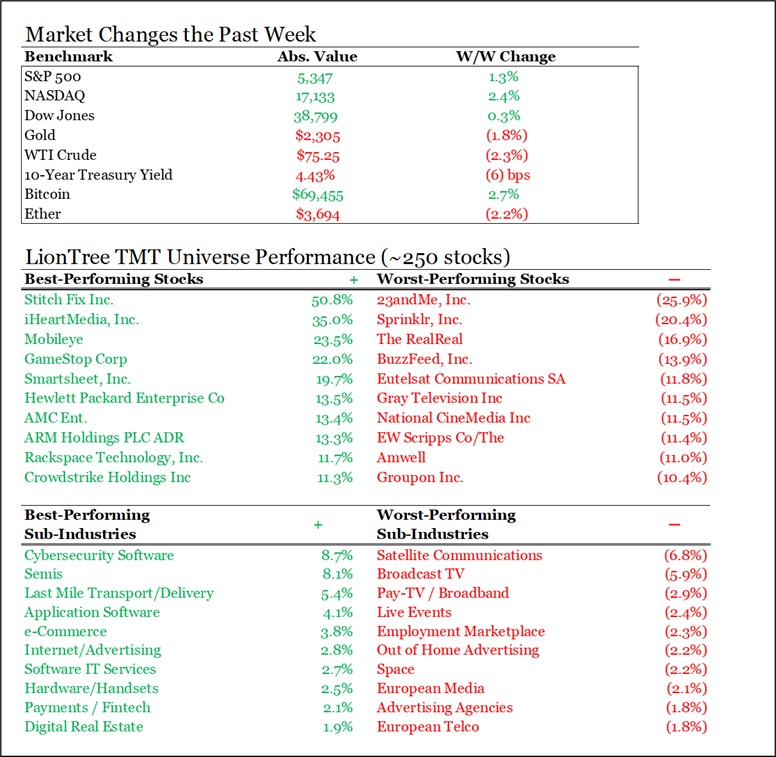
It was yet another positive week, with the S&P 500 and Nasdaq trading up for 6 of the past 7 weeks and both setting new record highs (the S&P 500 rallied +1.3% and Nasdaq rose +2.4%). But market concentration remains high, and the equal-weight S&P 500 was actually down for the week, per FactSet. The big macro update was the jobs report on Friday, which was much hotter than expected, and all ears will be on comments from the Fed meeting next Wednesday.
Regarding the sector, see below for what we focused on in this edition (all are clickable links):
- The Music “Harvesting” Continues + Other Price Hikes Across TMT
- How Much Will Social Media Start To Eat Into Traditional Search….
- One Step Forward With AI Regulation + Other Tech Regulatory Updates
- Will AI LLM Models Run Out Of Training Data? A Gold Rush Is Underway For Human Generated Datasets…
- Paramount Plans To Accelerate Its Path To Profitability
- A Round-Up Of A Few Key Company Updates
- No Signs Yet That Fixed Wireless Access Is Compromising 5G Network Performance
- Grab Bag: NBA Media Rights Deals / Facebook Attracts Youths / More Details On Verizon’s GenAI Plans
Have a nice weekend.
Best,
Leslie

The Music “Harvesting” Continues + Other Price Hikes Across TMT
Streaming prices are continuing to climb to new heights, not just across video, but also across music and gaming, and at an increased clip. One question that is always in the back of our mind is when will the consumer start to say enough is enough, as prices for entertainment and connectivity services continue to climb up and up.
Spotify and Max were the latest names to announce price hikes this year, with Spotify implementing its increase less than a year after its first-ever bump-up, while Max announced its own increase a little more than a year after its first-ever hike. On the gaming side, Twitch jumped into the fray this week, announcing its first-ever price hike as well in the US.
The general pattern of price hikes in the streaming industry continues to be driven by the goal of higher profitability. Twitch CEO said back in January, “I’ll be blunt: we aren’t profitable at this point.” While Max expects to remain profitable in 2024, the company is making heavy launch investments and has set a goal of $1bn in adj. EBITDA for 2025. As for Spotify, despite having profitable quarters, the 18-year-old company hasn’t yet reported a profitable year. With rising content creation costs, licensing fees, and the need to remain competitive by continually adding new features and content, price hikes are where streamers are turning to help fill the gap.
See below for more details on the above.
Spotify Is Raising Prices In The US Across Its Plans For The Second Time In Less Than A Year
- Spotify raises prices in the US (link/link)
- Price hikes across plans
- Premium individual plan will increase by +$1/mo to $11.99/mo
- Now priced at a premium to Apple Music’s plan, which costs $10.99/mo for an individual acct
- Premium duo will increase by +$2/mo to $16.99/mo
- Premium family plan will increase by +$3/mo to $19.99/mo (access for as many as 6 household members)
- Price of a student plan remains unchanged at $5.99/mo
- Premium individual plan will increase by +$1/mo to $11.99/mo
- Second price hike in less than a year, representing a +20% increase over the past 2 years: Last raised prices on its subscription plan for US listeners, its biggest market, in July 2023 (its first ever price increase in the US)
- Spotify said the move was necessary “so that we can continue to invest in and innovate on our product features and bring users the best experience”
- Price hikes across plans
-> Spotify shares jumped +5.8% on the back of the news and ended the week up +3.9%; YTD, Spotify stock is trading up +64.0%
There Were Other Price Hikes Annc’d In Streaming This Week… But On The Video And Gaming Side
- Warner Bros Discovery annc’d price hikes for its Max streaming svs (link): The prices will take effect immediately for new subs, while existing subs will see higher prices starting from their next billing cycle on or after July 4
- All ad-free options are seeing a hike in price –
- Monthly ad-free will go up +$1/mo to $16.99/mo
- Monthly ultimate ad-free will go up +$1/mo to $20.99/mo
- Yearly ad-free will go up +$20/yr to $169.99/yr
- Yearly ultimate ad-free will go up +$10/mo to $209.99/yr
- Ad-supported will remain the same: $9.99/mo or $99.99/yr
- This is the second time Max has raised prices for its ad-free svs since its launch: In early 2023, Max raised the ad-free tier price from $14.99 to $15.99/mo
- Price hike comes just 12 days before S2 premiere of “House of the Dragon”, whose series premiere garnered ~10mn viewers, making it the biggest in HBO’s history
- All ad-free options are seeing a hike in price –
- Twitch is increasing subscription prices in ~35 countries, including for the first time in the US (link/link):
- First price increase in the US: Will increase the price of its Tier 1 memberships in the US from $4.99/mo to $5.99/mo on July 11 (Tier 2 and Tier 3 will stay the same at $9.99 and $24.99/mo, respectively)
- Other countries are seeing increases between +11% and +43%: Liechtenstein and New Zealand saw the smallest increases at +11% and +13%, respectively, while Slovakia and Slovenia saw the largest increase at +43% for both
- Implemented price hikes in 3 countries back in February: Canada, Turkey, and UK
- Price hike will “drive more revenue to our streamers and help make streaming more sustainable”
- Streamers will continue to receive the same net revenue share on subs and gift subs, so this price increase allows them to receive more per subscription
- The increased revenue per sub that Twitch receives will help maintain and build for the long-term future of streaming
How Much Will Social Media Start To Eat Into Traditional Search….
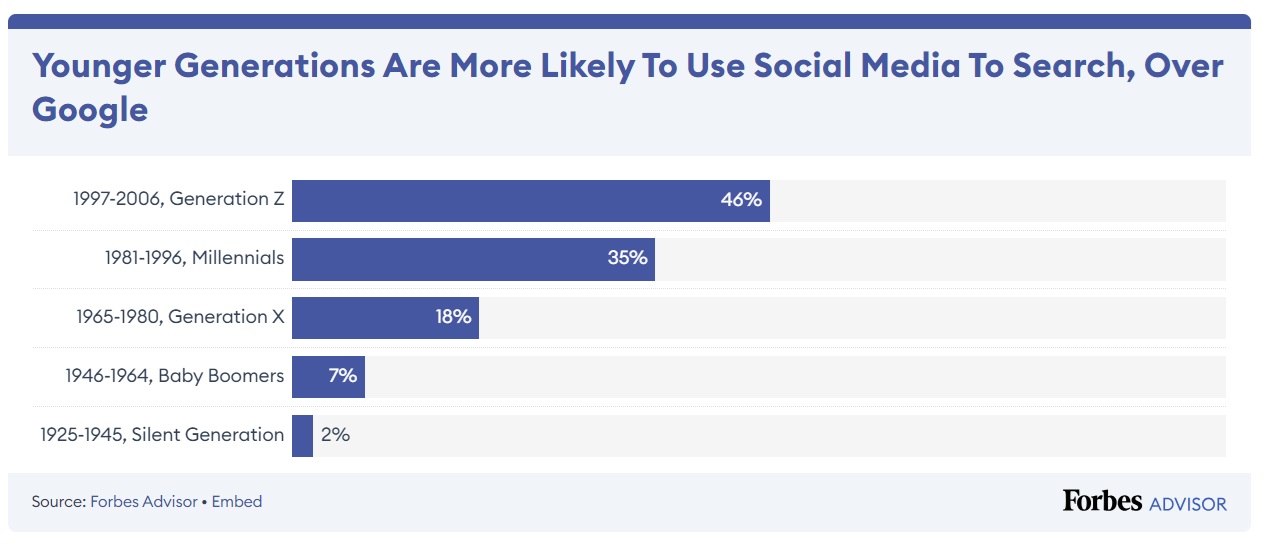
Forbes Advisor in collaboration with Talker Research put out what we thought were some interesting results from a recent online survey across 2k general population Americans that points to social media increasingly being used as a replacement to traditional search, especially for the younger demos. Nearly one-quarter of respondents are using social media apps in ways that were previously used for search engines, and 13% are buying directly within these apps, with these trends being more pronounced for Gen Z and Millennials. Overall, competition from social media can be added to the list of investor concerns, of which a negative impacted from Gen AI has been on the top, regarding traditional search.
See below for what we thought were the most notable findings and see link to report for more.
- A quarter (24%) of people said they “only use” or “primarily use” social media to search online
- The way people search for brand names varies significantly across generations
- 84% of the population still turn to search engines for this purpose
- BUT only 64% of Generation Z do the same, indicating a 30% decrease vs to the 94% of Baby Boomers who use traditional search methods
- This suggests a gradual move away from search engines among younger internet users
- 84% of the population still turn to search engines for this purpose
- The role of social media in initial brand discovery is increasing
- On avg, 10% of people begin their brand searches on social media, refining their searches on search engines later
- For Generation Z and Millennials, this is higher at 21% and 14%, respectively
- 4% of all respondents, including 11% of Generation Z, exclusively use social media platforms for both discovering and interacting with brands
- On avg, 10% of people begin their brand searches on social media, refining their searches on search engines later
- 57% of people said they search for info on YouTube in the same way they would on Google
- 56% said they do this on Facebook
- 38% on TikTok
- 36% on Instagram
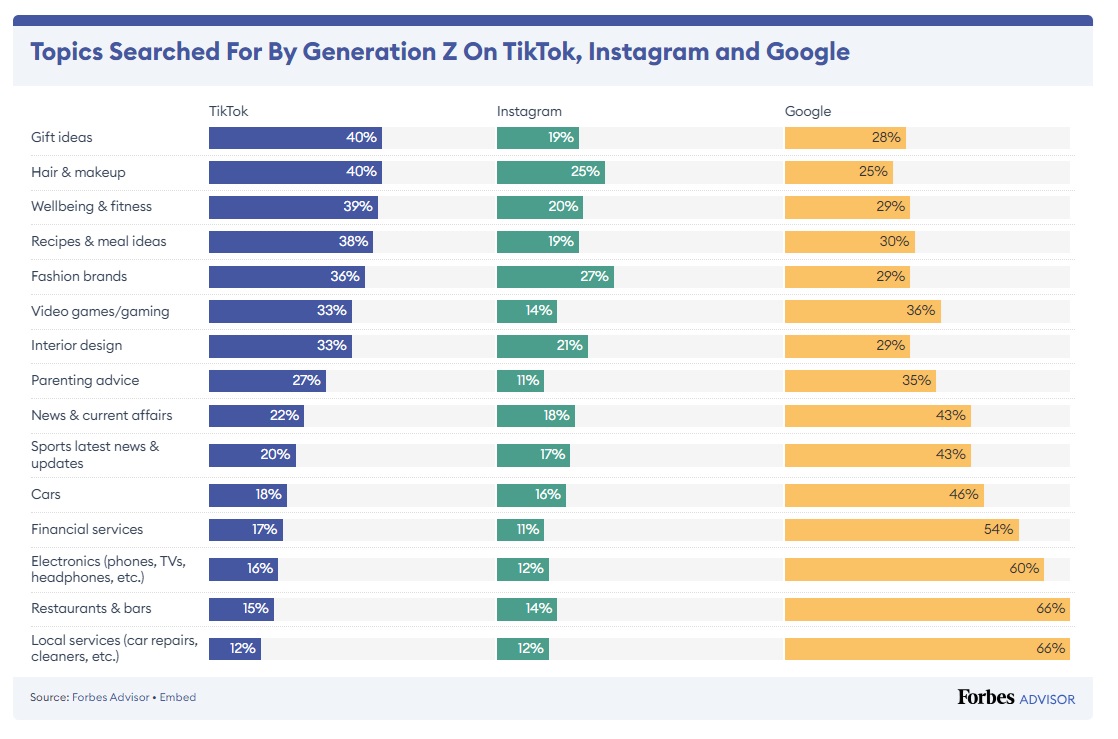
- What do people search for on Google vs various social platforms?
- Google:
- #1 = Restaurants and Bars (81% of the general population); For younger demos …66% of Generation Z and 77% of Millennials
- #2 = Local services, including car repairs and cleaners (77%); For younger demos…66% for Generation Z and 72% for Millennials
- #3 = Electronics, incl phones, computers, refrigerators, TVs, headphones, and sports watches (71%); For younger demos… 60% for Generation and 67% of Millennials)
- Facebook:
- #1 = News and Current Affairs (no % provided)
- #2 = Recipe and Meal Ideas (no % provided)
- Instagram:
- #1 = Fashion Brands (12%)
- #2 = Hair and Makeup (11%)
- #3 = Interior Design interests (10%)
- TikTok:
- #1 = Hair and Makeup (17%)
- #2 = Recipe and meal ideas (16%)
- #3 = Gift ideas (15%)
- Google:
One Step Forward With AI Regulation + Other Tech Regulatory Updates
A major regulatory update hit the tape this week when it was reported that the US Dept of Justice and the Federal Trade Commission are in the early stages of initiating antitrust investigations into Microsoft, OpenAI, and NVIDIA’s dominant positions within the AI industry. Specifically, the DoJ will take the lead role in reviewing NVIDIA’s practices within the AI chip space, while the FTC will spearhead an investigation of Microsoft and OpenAI’s behavior in the marketplace. Although this wasn’t the first time that the three have been investigated by federal officials, it does suggest that regulators will be taking a harder look at AI-related companies moving forward. Elsewhere within the tech ecosystem, there were also several regulatory updates that impacted some of the bigger players in the space. See below for more details…
- The DoJ and FTC reportedly reached a deal to proceed w/ AI antitrust investigations into Microsoft, OpenAI, and NVIDIA (link): Per sources quoted by the New York Times, the Justice Dept (DoJ) and Federal Trade Commission’s (FTC) agreement is expected to be finalized in the coming days
- The agencies will focus their respective investigations on different Cos: The DoJ will assume the lead in investigating whether NVIDIA’s competitive practices have violated antitrust laws, while the FTC will focus on examining OpenAI and Microsoft’s behavior
- NVIDIA’s dominance has started to concern industry players: Worries include how the Co’s software locks customers into using its chips, as well as how NVIDIA distributes those chips to customers
- The deal suggests that regulators’ effort to scrutinize AI is intensifying…: The Biden administration has been leveraging both the DoJ and FTC to rein in Big Tech, but to this point, NVIDIA, Microsoft, and OpenAI have largely escaped the brunt of this scrutiny
- Top DoJ officials have highlighted issues around AI: At an AI-focused conference last week, the DoJ’s top anti-trust official noted that “AI relies on massive amounts of data and computing power, which can already give dominant firms a substantial advantage”
- The FTC is aiming to preempt future AI-related issues: Per an interview in Feb, FTC Chair Lina Khan said that the agency was trying to spot “potential problems at the inception rather than yrs and yrs and yrs later, when problems are deeply baked in and much more difficult to rectify”
- … BUT this isn’t the first time that federal agencies have investigated the Cos:
- Last July, the FTC opened an investigation into whether OpenAI’s data collection practices harmed consumers
- In Jan, the FTC initiated a broad inquiry into strategic partnerships within AI that included Microsoft’s investments into OpenAI as well as Google and Amazon’s investments into Anthropic
- The agencies will focus their respective investigations on different Cos: The DoJ will assume the lead in investigating whether NVIDIA’s competitive practices have violated antitrust laws, while the FTC will focus on examining OpenAI and Microsoft’s behavior
-> On a related note, 11 current and former employees at OpenAI and Google DeepMind raised concerns about the risks associated w/ AI’s emergence in an open letter; The group argues that the financial motives of AI Cos hinder effective oversight, and its members “do not believe bespoke structures of corporate governance are sufficient to change this”; The letter further warns of risks from unregulated AI, ranging from the spread of misinformation to the loss of independent AI systems and the deepening of existing inequalities, which could lead to “human extinction” (link)
There Were Also Some Other Noteworthy Regulatory Updates That Impacted Other Big Tech Cos This Week…
- The UK’s Competition Appeal Tribunal allowed a potentially $17bn+ AdTech lawsuit to proceed against Google (link): The suit, which was filed by lawyers representing thousands of bizs, was unanimously allowed by the tribunal and alleges that Google abused its dominance in digital advertising
- Damages could be as high as £13.6bn ($17.4bn): If the claimants can prove that Google preferred its online advertising svs over competitors between Jan 2014 and Nov 2022
- The suit is an opt-out class action one: Meaning that someone impacted doesn’t have to be involved in the case to be included or to get a share in any eventual reward
- Google’s AdTech biz has faced scrutiny in other European mkts: Back in 2022, France fined the Co €150mn ($163mn) over its online platform
- The tribunal’s ruling is “a first step in delivering proper compensation to Google’s victims”: Per lawyers representing the plaintiffs
- … While Google plans to “oppose it vigorously and on the facts”: Google’s legal director said that the lawsuit is speculative and opportunistic
- Damages could be as high as £13.6bn ($17.4bn): If the claimants can prove that Google preferred its online advertising svs over competitors between Jan 2014 and Nov 2022
- Canada will require major online streaming svs to give 5% of their Canadian revs to support domestic broadcasting (link/link): The Canadian Radio-television and Telecommunications Commission (CRTC) said the money would go towards boosting funding for local and aboriginal broadcasting, raising ~$146mn/yr
- The legislation will ensure that online streaming svs contributes to Canadian culture: Including promoting Canadian music and stories; The measure was initially introduced under the auspices of a law passed last yr that forced Netflix and YouTube to offer more Canadian content
- The decision is final and comes into effect in Sept: The requirement will only apply to svs that are not already affiliated w/ Canadian broadcasters
- Funding will be directed toward areas of “immediate need” in the broadcasting system: Such as local news on radio and television, French-language content, and Indigenous content
- The Digital Media Association (DiMA) is “deeply concerned” by the decision: Head of DiMA Graham Davies said that “streaming is the main source of rev and engine of growth for music in Canada… and this is effectively a protectionist subsidy for radio”
- The legislation will ensure that online streaming svs contributes to Canadian culture: Including promoting Canadian music and stories; The measure was initially introduced under the auspices of a law passed last yr that forced Netflix and YouTube to offer more Canadian content
- UK retailers filed a £1bn ($1.3bn) lawsuit accusing Amazon of misusing small sellers’ data (link): The British Independent Retailers Association (BIRA), an umbrella body that groups numerous smaller merchants, filed the lawsuit on behalf of ~35,000 retailers at the Competition Appeal Tribunal in London
- The suit alleges that Amazon used merchants’ non-public data against them: Specifically, that Amazon leveraged the data provided by retailers on its marketplace to offer cheaper rival products to sell directly to consumers; BIRA argues that small retailers have little choice but to use Amazon due to its reach
- BIRA also claims Amazon manipulated the “Buy Box” feature on its website to its advantage: The “Buy Box” feature, which has been valued at up to $1.1bn, is shown at the top of product pages and is also the subject of a separate lawsuit by the UK’s Competition and Markets Authority
- The case is intended to prevent Amazon from putting small retailers out of biz: “The filing of the claim is the first step towards retailers obtaining compensation for what Amazon has done,” per BIRA CEO Andrew Goodacre
- The suit alleges that Amazon used merchants’ non-public data against them: Specifically, that Amazon leveraged the data provided by retailers on its marketplace to offer cheaper rival products to sell directly to consumers; BIRA argues that small retailers have little choice but to use Amazon due to its reach
Will AI LLM Models Run Out Of Training Data? A Gold Rush Is Underway For Human Generated Datasets…
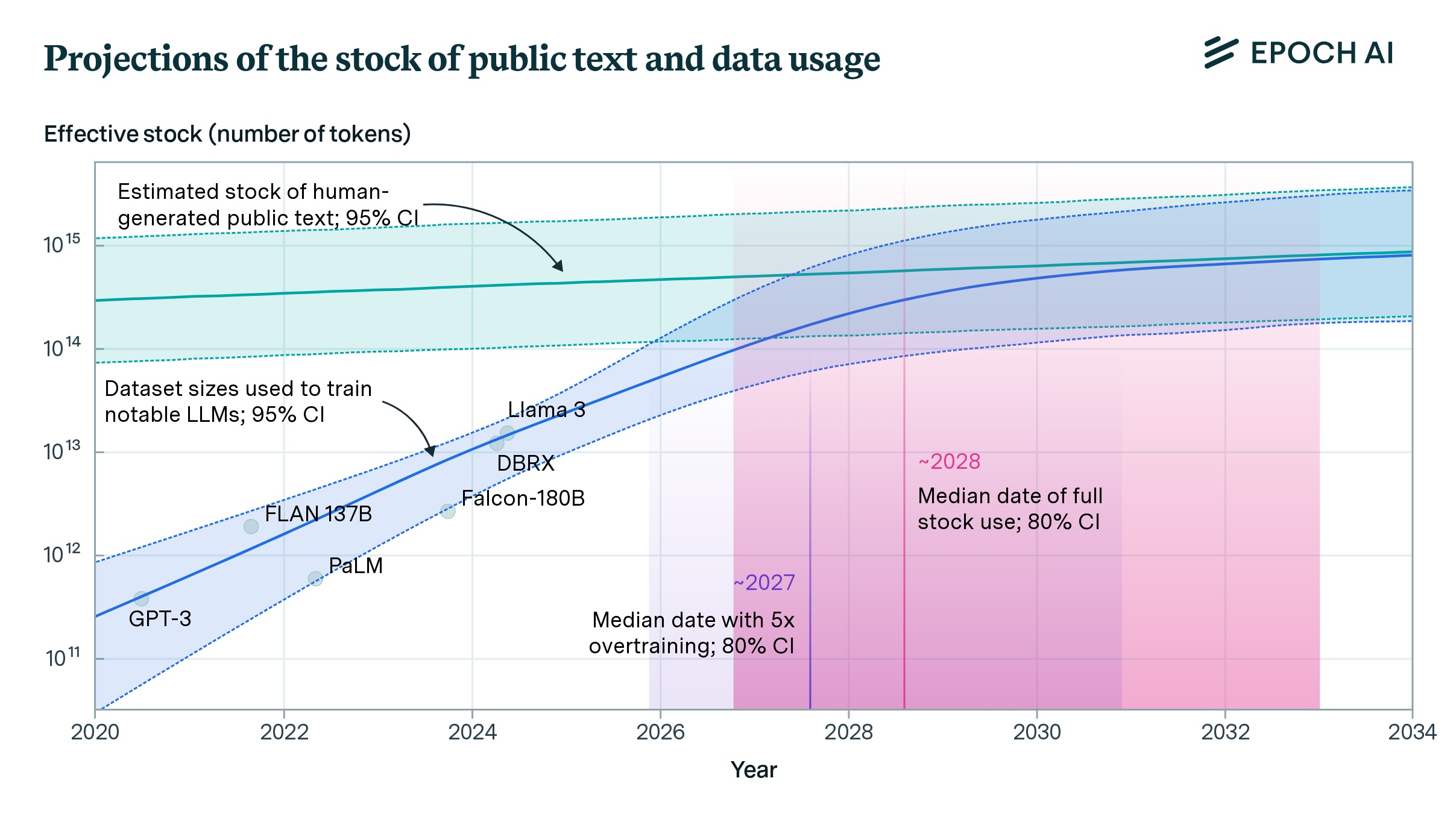
We’ve seen announcements left and right where Big Tech companies like Open AI and Google have been trying to get access to human generated text and data to train their large language AI models, and Reddit and News Corp are both recent examples of companies that have benefited from this push with content licensing deals. With that backdrop in mind, it was particularly interesting to see the below chart and data published by Epoch AI this week where they estimate “the stock of human-generated public text at around 300 trillion tokens” and note that “if trends continue, language models will fully utilize this stock between 2026 and 2032, or even earlier if intensely overtrained”. So, with the finite amount of human-generated data, it could become a bottleneck to scaling AI. Hence, scarcity of these dataset will drive value for those that own it. (LINK TO BLOG).
Paramount Plans To Accelerate Its Path To Profitability
Along with an update on the merger talks surrounding Paramount, this week also saw the company’s executives reveal some of their thoughts on how they plan to manage the business moving forward. At Paramount’s annual shareholder meeting, Shari Redstone and the company’s office of the CEO, which includes president and CEO of Paramount Pictures and Nickelodeon Brian Robbins, CEO of Showtime/MTV Entertainment Studios and Paramount Media Networks Chris McCarthy, and president and CEO of CBS Chris Cheeks, shared insights into upcoming efforts to reduce costs by $500mn/year as well as the company’s plans to adopt an “alternative strategy” to streaming partnerships. See below for more details:
- Paramount’s exec team detailed plans to cut costs by $500mn/yr + other strategic streaming updates (link):
- Reducing costs is a “Paramount” concern for the Co: Redstone explained that “this will then enable [Paramount] to decrease debt, strengthen [its] balance sheet, and continue to invest in best-in-class content that has always been at [its] core”
- Redstone has “confidence” in the office of the CEO to accomplish cost cutting goals: Based on “what this team has been able to accomplish w/ a reduced budget”
- Paramount is also looking to divest some assets: Cheeks said, “The combination of a streaming strategy reset, cost reductions, and asset sales will set [the Co] up to deliver consistent earnings growth and will return the Co to investment-grade metrics over time”
- Highlighted that Paramount+ has become a top 5 streaming svs in the US: The Co’s content and original programming have been key drivers behind the platform’s success, despite losing money
- BUT now “need[s] to accel its path to profitability”: McCarthy said the Co is “hard at work on a plan” focused on “reducing expenses, integrating [its] teams more closely, and eliminating redundancies”
- Paramount will adopt an “alternative strategy” to growing internationally and sub-licensing content: The Co has been “exploring options w/ both SVOD players” and “leading tech platforms” w/ the goal of forming a JV or a long-term strategic partnership to take advantage of their “combined strength”
- This “alternative strategy” goes beyond bundling: Sees it being a “deep and expansive relationship” that will improve the Co’s content offering; This will, in turn, “help reduce churn and reduce expenses, all of which will accel profits”
- There has already been a “great deal of inbound interest” in a partnership, per Robbins
- Reducing costs is a “Paramount” concern for the Co: Redstone explained that “this will then enable [Paramount] to decrease debt, strengthen [its] balance sheet, and continue to invest in best-in-class content that has always been at [its] core”
The Latest On Paramount’s M&A Saga
- Paramount and Skydance reportedly agreed to merger terms (link): This was per CNBC’s David Faber on Monday, who indicated that a Paramount special committee and a buying consortium consisting of David Ellison’s Skydance, RedBird Capital, and KKR could agree to a deal in the coming days after weeks of discussion
- The deal is now reportedly awaiting sign-off from Shari Redstone: Redstone is Paramount’s controlling shareholder, as she owns National Amusements, which owns 77% of class A Paramount shares
- BUT there’s also a competing offer from Apollo Global Mgmt and Sony (link): In early May, the two formally expressed interest in acquiring Paramount for $26bn, per CNBC; However, Apollo and Sony plan to break apart the Co, while Redstone favors a deal that would keep it together
- The reported proposed financial terms of the Paramount-Skydance deal? The total deal value is $8bn (compared to an earlier offer of $5bn), per CNBC
- Redstone would receive $2bn for National Amusements, and Skydance would buy out nearly 50% of Paramount class B shares at $15 apiece for a total of $4.5bn, leaving holders w/ equity in the new Co
- Skydance and RedBird would also contribute $1.5bn in cash to Paramount’s balance sheet to help reduce debt
- Following the deal’s close, Skydance and RedBird would own two-thirds of Paramount, and the class B shareholders would own the remaining third of the company
- The deal would not require a vote from shareholders: This term was part of negotiations
- The deal is now reportedly awaiting sign-off from Shari Redstone: Redstone is Paramount’s controlling shareholder, as she owns National Amusements, which owns 77% of class A Paramount shares
-> BUT later in the week on Wednesday, Reuters reported that Shari Redstone is unhappy w/ Skydance Media’s reduced bid for her family’s controlling stake in Paramount from an initial $2.5bn offer, presenting an oppty for rival suitors, including Hollywood producer Steven Paul, to make their case for National Amusements; It was also reported by Reuters that David Ellison’s Skydance reduced its valuation of the merger from $5bn to $4.75bn to create more cash for shareholders, which also displeased Redstone (link)
A Round-Up Of A Few Key Company Updates
This week, there were also a handful of notable developments from some of the key companies within the LionTree Universe, including some updates on Disney’s plans to expand Walt Disney World in Florida, Netflix’s progress on the video game front, and Lyft’s strategic priorities and 2027 financial targets. We thought it would be helpful to outline some of the main takeaways – See below for more details:
- Disney received the go-ahead to move forward w/ its plans to invest up to $17bn in Florida parks (link/link): A Florida board overseeing the rebranded Central Florida Central Florida Tourism Oversight District agreed to a 15-yr deal to allow Disney to move forward w/ its long-held plans to invest up to $17bn in Walt Disney World
- Disney CEO Bob Iger first unveiled plans to invest $17bn in its Florida theme park in May 2023: This came in response to Florida Governor Ron DeSantis’ plan to dismantle the Reedy Creek Improvement District
- The last time Disney added a major theme park to its Orlando resort was in 1998, when the 580-acre Animal Kingdom park opened at a report cost of nearly $1bn
- The $17bn investment in the district would occur over the next 10-20 yrs: Also includes a commitment of $8bn in the next 10 yrs, per Katherine Luetzow, manager of planning and engineering for the district
- Disney will be approved to build a fifth major theme park in Orlando: Along w/ two smaller parks (such as waterparks)
- Disney will also be able to expand the footprint of surrounding bizs: The Co can raise the # of hotel rooms on its property from ~40k to 53k+ rooms and increase the amount of retail and restaurants space by 20%+
- Disney’s requirements under the deal:
- Will donate up to 100 acres of Disney World’s 34k acres for the construction of infrastructure projects controlled by the district
- Will need to award at least half of its construction projects to Cos based in Florida and spend at least $10mn on affordable housing for central Florida
- Disney CEO Bob Iger first unveiled plans to invest $17bn in its Florida theme park in May 2023: This came in response to Florida Governor Ron DeSantis’ plan to dismantle the Reedy Creek Improvement District
- Netflix unveiled 14 new video game titles (link/link): Netflix will have 100+ titles once the new batch of 14 goes online over the next few months, w/ 4 coming this month, 3 coming this summer, and the remaining release dates being TBA
- New games based on Netflix originals will be making their debuts, among them Perfect Match, Selling Sunset, Emily in Paris and a new iteration of Too Hot to Handle and a spinoff called The Dragon Prince: Xandia; Each will launch alongside the latest season of the title’s corresponding TV series
- A popular Netflix original game title is also getting a sequel: Cozy Grove will spawn a sequel, Cozy Grove: Camp Spirit, in the coming weeks
- The Co is launching 3 exclusive-to-mobile games developed by Klei Entertainment: Including “Lab Rat,” “Don’t Starve Together”, and “Rotwood”
- Netflix is also releasing a Lord of The Ring game: Tales of the Shire: A The Lord of the Rings Game will be an exclusive mobile title for Netflix subscribers
- Other upcoming titles: The Case of the Golden Idol, Hearts, Arranger, and Harmonium: The Musical
- Mobile remains the dominant way to experience games on Netflix, though the Co sad last year it had rolled out a beta version of a cloud gaming platform for a select number of UK and Canada subscribers
- New games based on Netflix originals will be making their debuts, among them Perfect Match, Selling Sunset, Emily in Paris and a new iteration of Too Hot to Handle and a spinoff called The Dragon Prince: Xandia; Each will launch alongside the latest season of the title’s corresponding TV series
- Lyft provided some financial targets at its first-ever investor day (link/link): These reflect the Co’s “expectations of healthy top-line growth and margin expansion”; Lyft also shared a wide range of strategic and operational insights in the attached deck
- 2027 financial targets:
- Gross Bookings CAGR of ~15% between FY24 and FY25
- Adj EBITDA margin (as a percentage of Gross Bookings) of ~4% on in FY27
- FCF conversion (as a percentage of adj EBITDA) of 90%+ annually each yr between 2025-2027
- Reaffirmed 2024 outlook: There are no changes to the previously annc’d outlook for Q2:24 or to the Co’s directional commentary for FY24, which were updated during its last earnings call
- Also provided guidance for Lyft Media: Expects Gross Bookings for the ad platform to be $400mn+ in 2027, up from $50mn in 2024
- 2027 financial targets:
No Signs Yet That Fixed Wireless Access Is Compromising 5G Network Performance
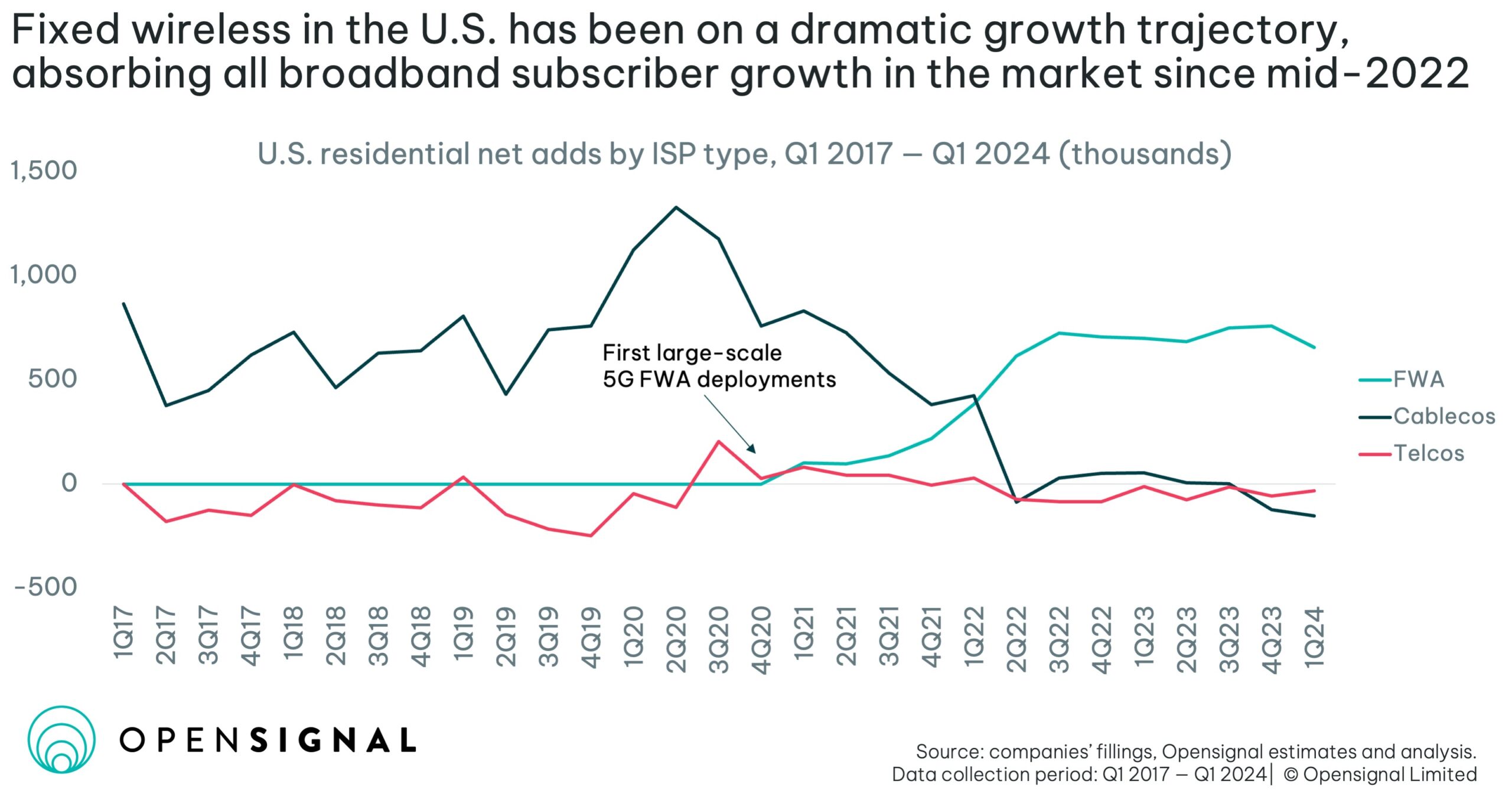
FWA has certainly been a thorn in the side of the cable broadband industry, as Verizon and T-Mobile have leveraged the technology to add home internet customers at a rapid pace, while cable operators have largely struggled to add broadband subscribers as of late. This week, OpenSignal published a report that shed some light on just how much 5G FWA services have “reshaped” the broadband market since mid-2022, providing insights on FWA network performance, usage trends, and adoption rates across various demographic and regional cohorts. One of the main takeaways was that Verizon and T-Mobile’s networks have shown no signs of being compromised after adding a combined 8mn+ FWA subscribers, helping to dispel the notion that the two telcos’ FWA strategies will inevitably lead to capacity constraints… at least for now.
See below for more of our key takeaways, and CLICK HERE for the full report.
- 5G FWA svs have been on a “dramatic growth trajectory” in the US: Have posted +600-700k net adds per qtr since mid-2022, despite the US being a mature broadband mkt w/ nearly 97% broadband penetration and modest household growth
- FWA is nearly as popular in urban areas as in rural ones: FWA providers have so far claimed ~6% of the market in urban areas and ~7% in rural ones
- Competitive pricing has helped drive growth: Nearly three-quarters of FWA subscribers pay less than $75/mo for broadband svs (vs 60.4% of cable subs)
- 66% of FWA subscribers consider their pricing plan as fair: This is significantly higher than in the case of other types of fixed broadband techs, per a separate survey conducted by Parks Associate
- FWA is particularly popular among younger consumers: Over one-third of FWA subs in the US are under 35 yrs old (vs only a qtr of cable subs)
- The rapid development of 5G FWA svs has intensified competition in the broadband mkt: An observation of FWA Wi-Fi networks showed the percentage of housing units passed by two or more high-speed broadband providers (either cable, fiber, or FWA) incr’d from 50% in Q1:22 to 78% in Q4:23, an increase of nearly 40mn homes
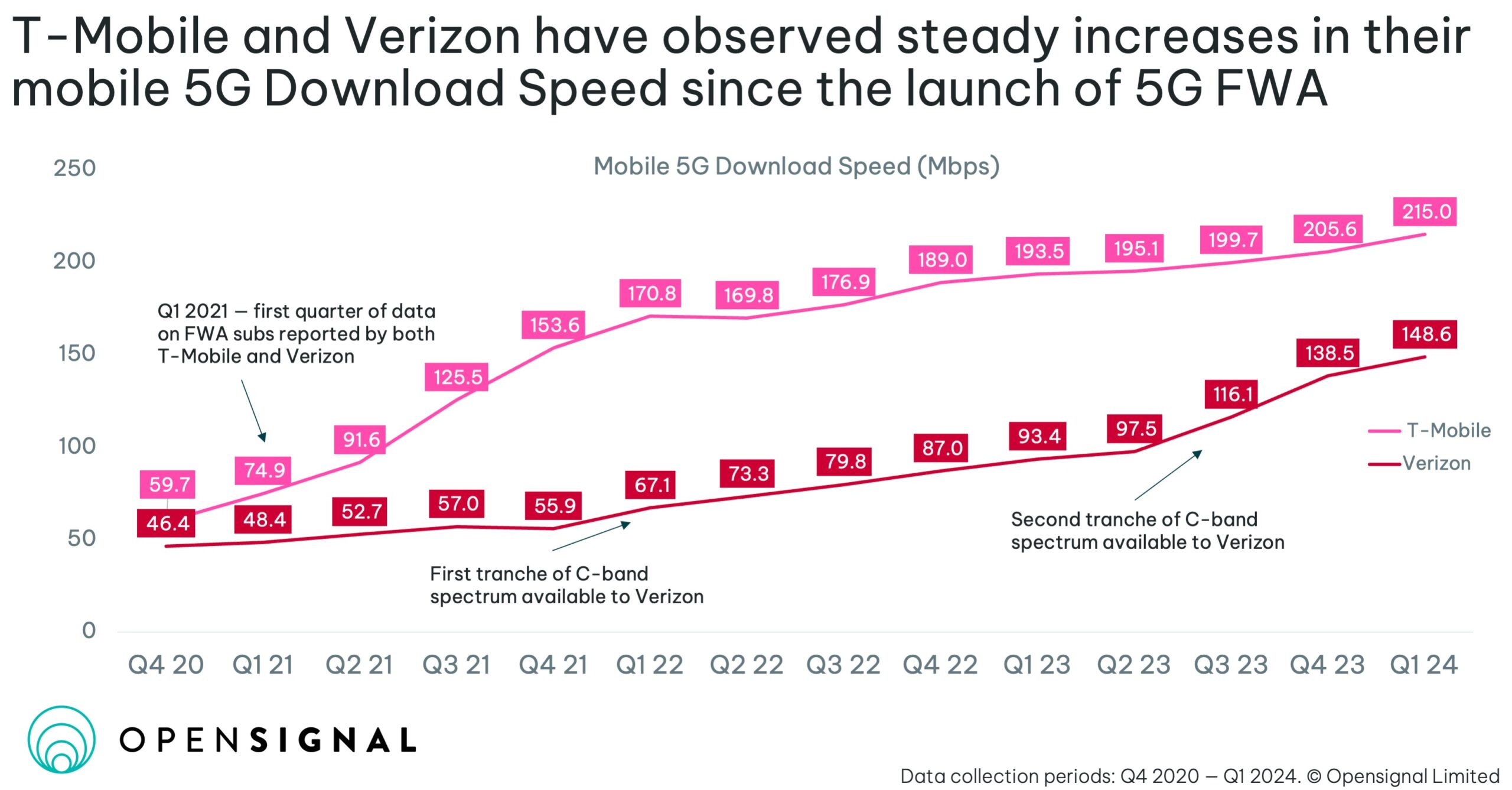
- FWA hasn’t compromised the performance of 5G networks: Verizon and T-Mobile’s avg 5G download speeds have almost tripled since Q1:21 (when T-Mobile started reporting on its FWA subscription numbers), and have incr’d qtrly at a “gradual and steady” rate
- BUT speeds alone don’t tell the whole story: OpenSignal found high-FWA penetration areas score better for mobile and FWA performance than low-FWA penetration ones; Performance in high-FWA penetration areas is also better than the overall performance for both T-Mobile and Verizon’s FWA and mobile svs
- Verizon and T–Mobile have been able to manage capacity using their “huge swathes of mid-band spectrum”: Both have licenses for 150MHz+ of contiguous mid-band frequencies; AT&T possesses a similar amount but lacks a contiguous spectrum footprint, rendering it less efficient
-> On a separate but related note, the Affordable Connectivity Program (ACP) officially expired on June 1, which puts both consumers and ISPs in a “fairly precarious state”, per Joel Thayer, president of the Digital Progress Institute; Although a number of legislative efforts have been introduced in Congress to prolong the program, including the $7bn ACP Extension Act, an amendment to the FAA reauthorization bill, and another extension bill that would allocate another $6bn to the program, none of these efforts have been able to gain any traction, leaving 23mn+ ACP households without subsidies (link)
Grab Bag: NBA Media Rights Deals / Facebook Attracts Youths / More Details On Verizon’s GenAI Plans
- The NBA is reportedly closing in on media rights deals worth a collective $76bn over 11 yrs (link): The deals would go into effect after the 2024-2025 season and would include rights to WNBA telecasts
- Disney’s ESPN will pay $2.6bn/yr to retain a package that includes the NBA finals: This represents a +73% increase from the $1.5bn/yr fee under ESPN’s current contract w/ the NBA; ESPN will get fewer games but will be allowed to air games on its DTC svs, which is expected to launch in 2025
- Comcast’s NBC will pay $2.5bn/yr for the rights to air ~100 live games: About half of the games will be shown exclusively on the Peacock streaming svs; Games would air on NBC on Tuesdays and Sundays when there isn’t a conflict w/ “Sunday Night Football”
- Amazon’s will pay $1.8bn/yr for a comprehensive package: Includes regular season and playoff games, the new NBA in-season tournament, and “play-in” games, where teams compete for the final playoff spots; Amazon also would have a share of the conference finals, which the media partners will split in rotation
- Warner Bros Discovery is still in the running as well, per Front Office Sports (link): Sources indicate WBD’s TNT is still negotiating for a smaller, less expensive package that could include regular season and some playoff games
- Unwinding the partnership between the NBA and WBD could be complicated: Given that WBD operates NBA TV and NBA.com on behalf of the league; TNT also has 40 yrs of experience of exemplary coverage of the NBA
- Facebook is attracting its highest number of young adults in three yrs, per Meta (link): 40mn+ US and Canadian adults aged 18-29 now check Facebook daily, according to Meta; This also marked the Co’s first-ever release of such demographic info
- Meta charted “five quarters of healthy app usage growth” among young adults: Reflects the Co’s efforts to recapture the attention of young adults in recent yrs following the emergence of TikTok
- Young users appeared to be coming to Facebook initially at key moments in their lives: Specifically, to use sections like Marketplace, Groups, and Dating, according to head of Facebook Tom Alison
- Usage of these sections has been driving engagement more broadly: “”Once they’re on Facebook, they go and they check out stuff that’s going on in Feed or from Reels,” he said, referring to Meta’s TikTok-like short video product,” Allison noted
- Verizon has four new GenAI-powered tools to enhance the customer experience (link): These tools will “make it simple to do business with Verizon and help reduce the cognitive load on store and customer service partners.”, per Verizon’s chief customer experience officer Brian Higgins in an interview w/ Fierce Wireless
- Segment of Me will offer customers products specifically suited for them: The AI tool uses customer data to tailor specific offers on what the customer may like; Now, when a customer looks at Verizon’s offers online, they might see ones that are different than what others see
- Personal Shopper can instantly analyze a customer’s profile and help employees get a head start on their needs: The tool has already cut customer transactions time down by 2-4 minutes by using probability models to predict what customers will prefer when upgrading phones, for example
- Verizon also has a personal research assistant to aid customer svs reps: The tool leverages the 10,000 knowledge-based articles within Verizon and ingests them into an LLM, allowing reps to do quick keyword searches and receiving conversational responses when speaking w/ a customer
- 40,000+ Verizon reps are already using the research assistant: The Co is still performing assessments but believes it could save 20%-30% of time for normal tasks
- “Fast Pass” helps pair customers w/ the best available customer care rep to meet their specific needs: For instance, if a customer is calling about intl roaming or billing, they will be paired w/ a rep that’s knowledgeable about the topic, rather than a generalist
Stock Market Check
This Week's Other Curated News
Advertising/Ad Agencies/Ad Tech
- Advertising industry analyst Brian Wieser has updated his ad spending outlook. He now sees US ad spending rising 6.3% in 2024, up from his Sept 2023 benchmark of a 4.3% increase. And as robust as that sounds, it doesn’t even include political, which is expected to be well into record territory by the end of the current election cycle. (Insideradio.com)
- Yahoo Advertising annc’d the launch of Unified TV Audiences, a blended dataset to offer advertisers insights into connected TV and linear audience viewership. Unified TV Audiences enable advertisers to more effectively plan, activate, and measure across 108mn US households in the Yahoo DSP. Unified TV Audiences combine extensive TV datasets, including automatic content recognition (ACR) and linear STB viewership data. (ADVANCED-TELEVISION)
Artificial Intelligence/Machine Learning
- Anthropic’s chief of staff has joined the growing list of senior tech professionals to weigh into our existential crisis. “I am 25. The next three years might be the last few years that I work,” Avital Balwit wrote. “I stand at the edge of a technological development that seems likely, should it arrive, to end employment as I know it,” Balwit explained. (Fortune)
- Ericsson ConsumerLab released a high-level study of AI that takes in trends on everything from generative fashion to AI childcare and human digital twins. Ericsson said 51% of the total sample identify as “AI hopeful” and are happy to use early AI digital assistants and more. However, 34% of the sample identify as “AI fearful” even among early adopters – and these respondents are fearful of AI-based respondents. (Fierce Network)
- OpenAI’s ChatGPT chatbot went down again during a multi-hour outage but wasn’t the only AI provider affected. On the morning of June 4, both Anthropic’s Claude and Perplexity began seeing issues, too, but these were more quickly resolved. Google’s Gemini appears to be operating at present, though it may have also briefly gone offline. This could signal a broader infrastructure issue or internet-scale problem. (TechCrunch)
- Instagram is testing “ad breaks” that force you to stop and look at an ad for a period of time before you can continue scrolling. Several X and Reddit users reported seeing the feature, and Instagram spokesperson Matthew Tye confirmed to The Verge that ad breaks are being tested. Tye said Instagram would “provide updates should this test result in any formal product changes.” (The Verge)
- Nvidia Chief Executive Officer Jensen Huang said that the co’s next-generation artificial intelligence chip platform was called Rubin and would be rolled out in 2026. Huang was speaking at National Taiwan University in Taipei as part of the Computex trade show. (Deccan Herald)
Audio/Music/Podcast
- Spotify and Nebula are teaming up on a video content initiative. The partnership will bring videos from Nebula to Spotify’s 615mn+ global users. Creators who are part of the initial Nebula slate include CinemaWins, Charles Cornell, Hello Future Me, Captain Midnight, Tale Foundry, Game Makers ToolKit, Todd in the Shadows, Adam Neely, The Closer Look, FD Signifier, and Kat Blaque. (Deadline)
Broader Connectivity
- Germany sold a €2.5bn ($2.7bn) stake in Deutsche Telekom, the latest in a series of moves by the cash-strapped govt to divest from some of its corporate holdings. State-owned bank KfW sold 110mm shares to institutional investors. While the placement trims the aggregate holding of KfW and the govt to a combined 27.8%, they remain Deutsche Telekom’s largest shareholders. The finance ministry said the net proceeds will be used to strengthen the equity of state rail operator Deutsche Bahn AG. (Yahoo Finance)
- NTT is pulling together its various assets, projects and plans associated with space, satellites and high-altitude platform station (HAPS) developments under one brand, NTT C89, as it takes the next steps in its “space integrated computing network” strategy. The Co says it has created C89 as a collaborative effort between various group operating units to strengthen its business in the field of space, creating synergies, and developing new markets, by creating integral connections for their services and businesses and proposing solutions that meet their customers’ needs. (TelecomTV)
- SpaceX has confirmed it is working with T-Mobile in the US to launch its Starlink direct-to-cell (DTC) service commercially “this autumn”. Starlink has a global broadband user base of more than 3mm and is now adding DTC satellites to its existing fleet of more than 6,000 satellites. Starlink is expected to have a minimum of 300 suitable DTC satellites by the autumn, and expanding rapidly to a reported fleet of 840 which they have mentioned in FTC filings.(ADVANCED-TELEVISION)
Broader Media & Entertainment
- Bloomberg Media now has 540,000 subscriptions to its website, up from 500,000 six months ago. 30% of Bloomberg’s traffic comes direct to the homepage, making this an important area of development for the title. This is a key strength of the site, as was the fact that the avg reader visits the site ten days /mo. The Co’s reader acquisition strategy is focused heavily around attracting loyal readers.(Talking Biz News)
Broader Technology
- Leaders in the US House of Representatives are debating a proposal that would dramatically limit speech on the internet. Backed by two powerful house leaders, the proposed “Legislative Proposal to Sunset Section 230 of the Communications Decency Act” would eliminate the protections granted to internet platform providers under Section 230 of the Communications Decency Act. (Fortune)
- An internal Google database obtained by 404 Media shows Google recording childrens’ voices, saving license plates from Street View, and many other self-reported incidents, large and small. Google has accidentally collected childrens’ voice data, leaked the trips and home addresses of car-pool users, and made YouTube recommendations based on users’ deleted watch history, among thousands of other employeereported privacy incidents, which tracks six yrs worth of potential privacy and security issues. (404 Media)
- Cisco Systems plans to invest $1bn in startups that are working on what it calls “secure and reliable” artificial intelligence svs, part of a push to be a bigger player in AI technology. Like other Silicon Valley mainstays, Cisco is looking for ways to tap into the frenzy of interest in AI computing. The maker of networking hardware and software has already committed about $200mm of the money and is making investments in Mistral AI, Scale AI and Cohere, the Co said. (Yahoo Finance)
- Microsoft annc’d layoffs reportedly affecting around 1,000 employees. As reported previously by CNBC, the mixed reality department working on HoloLens 2 is one of the areas affected. Separately, Business Insider reported that Azure for Operators and Mission Engineering has also seen cuts of “hundreds” of employees. This round of layoffs comes more than a yr after Microsoft laid off more than 10,000 people, and CEO Satya Nadella said the co was changing its hardware portfolio. (The Verge)
Cable/Pay-TV/Wireless
- Cogeco Communications has restructured its operations, combining the “commercial, operational, and technical” functions of its Canadian and Breezeline-branded US telecoms bizs into one North American unit. With the change, Breezeline president Frank van der Post will depart. Sean Brushett, VP of customer services and technical operations for Breezeline, will become COO of the combined North American group. (NextTV)
- Dish Network, saddled w/ $20bn+ in debt, is holding confidential talks w/ some of its convertible holders about potential new financing, per sources. Dish has received financing offers from convertible noteholders to provide fresh capital tied to wireless spectrum held at a so-called unrestricted subsidiary, people said. Negotiations are reportedly ongoing, and no final decision has been made. (Yahoo Finance)
- T-Mobile US has launched a backup fixed-wireless access (FWA) svs. Called Home Internet Backup, its essentially an entry-level FWA subscription. Priced at $30 /mo, it comes w/ a bundled home gateway and undercuts T-Mobile’s cheapest Home Internet package by $20. Citing data from CivicScience, T-Mobile said nearly 20% of US Internet users experience outages “at least a few times per month.” (TELECOMS)
- Vodafone Spain is collaborating w/ Ericsson to promote the transformative capabilities of private 5G networks for enterprises. The initiative includes a series of conferences across Spain, showcasing the technology’s potential to revolutionize various industrial sectors. Despite the advantages, widespread adoption in industries has been slow, w/ many viewing the tech as beneficial but not essential. (VoIP Review)
- The Chicago Bulls, Blackhawks and White Sox are leaving NBC Sports Chicago, and setting up new distribution, starting in Oct. The new channel, Chicago Sports Network will be launched in partnership w/ Nashville, Tennessee-based broadcaster Standard Media Group w/ distribution agreements in place w/ “traditional cable providers, streaming svs and be available via free, over-the-air broadcast.” CHSN will launch in Oct, in conjunction w/ the Bulls’ and Blackhawks’ respective NBA and NHL preseasons. (NextTV)
Cloud/DataCenters/IT Infrastructure
- President Joe Biden’s administration is asking big tech Cos to invest in new climate-friendly power generation to cover their surging demand. The talks come as a surprising surge in electricity demand has been driven by the adoption of techs like gen AI that require power-hungry data centers. This could complicate Biden’s target of decarbonizing the power sector by 2035 to fight climate change. (The Hindu)
Cybersecurity/Security
- CrowdStrike stock is higher after the cybersecurity Co beat expectations for its Q1 and issued a strong outlook. In the three months ended April 30, CrowdStrike’s rev increased 33% y/y to $921mn and its EPS was up 63.2% from the yr prior to 93 cents. The results easily beat analysts’ expectations. According to Yahoo Finance, Wall Street was anticipating rev of $905mn and earnings of 89 cents per share. (KIPLINGER)
- A Ticketmaster data breach that allegedly includes details for 560.0mm accounts and another one affecting Santander have been linked to their accounts at Snowflake, a cloud storage provider. However, Snowflake says there’s no evidence its platform is at fault. A post from Snowflake says, “To date, we do not believe this activity is caused by any vulnerability, misconfiguration, or malicious activity within the Snowflake product. Throughout the course of our ongoing investigation, we have promptly informed the limited number of customers who we believe may have been impacted.” (The Verge)
- The data breach at Santander Bank affected millions of customers, and all of its staff. Santander recently issued a breach notification letter saying following a supply chain attack, an unauthorized third party had accessed a database w/ sensitive customer information. As per the hackers’ sales ad, the database contains personal information of 30mm customers and employees, as well as 28mm credit card numbers, as well as 6mm account numbers and balances. The asking price is $2mm. (TechRadar)
eCommerce/Social Commerce/Retail
- Amazon bolstered its grocery offer in the UK. Customers in 100+ towns and cities nationwide can now receive groceries delivered by Amazon from its own Fresh stores, Morrisons, Co-op, and Iceland. The initiative, which launches later this month, will offer as much as 50% off on a rotation of products in store and online each week, alongside an addt’l 10% off “Price Cut” products in store. (Retail Gazette)
- Amazon Buy with Prime users are seeing mixed results nearly a yr and a half since the svs launched, per sellers who spoke w/ Business Insider. That jibes w/ internal Amazon emails from last yr that discussed “dissatisfaction” w/ unit sales off target “by a wide margin.” Still, executives are sticking with the initiative and are confident in its long-term outlook. (Business Insider)
- Amazon launched a Private Investigator powered by AI that can scan products leaving its warehouses to spot issues before they get to end users. Using a combo of gen AI and computer vision tech, Project PI is able to uncover defects before products reach customers. Amazon hopes this will greatly reduce the number of returns and refunds it needs to pay by helping customers get the correct item the first time every time. (Cord Cutters News)
- Costco Wholesale ushered in a new era w/ its new CFO Gary Millerchip hosting his first earnings call for the Co. Net sales jumped 9.1% to $57.39bn for the Co’s FQ3 ended May 12. During the call, Millerchip signaled that Costco was staying the course on the hot-button hot dog and soda combo pricing. “To clear up some recent media speculation, I also want to confirm the $1.50 hot dog price is safe,” Millerchip said. (Retail Dive)
- Instacart annc’d a new $500mn share repurchase program. The board approved the buyback plan on Jun 2, per a regulatory filing. Instacart had completed its two previous authorizations for $1bn in repurchases, equivalent to ~34mn shares or 10%+ of those outstanding, the co said. “Our business is performing well and we remain focused on deepening our lead as the largest online grocery marketplace,” CFO Emily Reuter said. (Yahoo Finance)
- Lululemon’s growth in the Americas, its largest mkt, appears to be stalling after the Co reported flat comparable sales in the region and weak guidance for the current qtr. The Co handily beat Wall Street’s earnings estimates, but only narrowly topped rev expectations. Lululemon’s full fiscal-yr guidance suggests the Co is betting conditions will improve in the back half of the yr. (CNBC)
- In-store retail media ad spend in the U.S. is expected to pass $1bn by 2028, but it’s still less than 1% of the total omnichannel retail media investment, according to eMarketer. In its latest report “In-Store Media 2024,” eMarketer adds that 99% of retail media ad dollars will go to online channels this yr, even though 80% of the $7tn in US retail sales are expected to occur in physical stores this yr. The researcher also expects in-store shopping to become more digital, which creates opportunities for integrating digital media.(Cynopsis Media)
- Nearly every shopper, 95%, has abandoned an e-commerce cart and 62% of shoppers cited high delivery cost as a top reason. These findings from a nShift consumer study which also revealed 63% of shoppers cite delivery choice as the most important factor when shopping online. More than half (62%) would not buy again after a single bad delivery experience. Almost a quarter (23%) of shoppers blamed a complicated checkout process while unsatisfactory returns policies were also highlighted as an issue for around 20% of shoppers. (www.retailcustomerexperience.com)
- Qu!ck, a new autonomous supermarket concept, has opened in Argentina, offering a cashierless shopping experience. Customers scan groceries using a mobile app and pay directly within the app, eliminating checkout lines, according to a report from La Nacion. This scan and go model is similar to Amazon Go stores. Qu!ck offers various store formats, including full-size locations and micro stores within office buildings or gated communities.(www.retailcustomerexperience.com)
- Shein is preparing to file a prospectus w/ Britain’s Financial Conduct Authority for approval ahead of a potential London float which could value it ~ 50bn pounds ($63.70bn), Sky News reported. The confidential filing could take place as soon as the coming week, the report added, citing sources. Shein, in response, has said it is strengthening governance and compliance.(CNBC)
- The bank holiday weekends provided a small boost to retail sales in May, helping to offset a more challenging performance across the rest of the month. The latest figures from the British Retail Consortium and KPMG show that total sales rose 0.7% in the four weeks to May 25, compared to 3.9% in 2023. Food sales increased 3.6% over the three months to May, against a growth of 9.5% last yr. Total non-food sales came under pressure once again as it dropped 2.4% over the quarter, steeper than the 12-month average decline of 1.7%. (Retail Gazette)
- Walmart boosts InHome delivery reach by nearly 30%. The expansion bolsters access to the svs in the greater Philadelphia, Boston, Detroit, Minneapolis and San Bernardino, California, areas. The growth of InHome, which is an add-on to the retailer’s Walmart membership, marks a big step for Walmart’s growing grocery ecommerce biz. With this expansion, Walmart said InHome is now available to 45mm households across more than 50 markets — a nearly 30% increase in customer reach.(Retail Dive)
- Zara will expand its live shopping broadcasts to the UK, Europe and the US this yr, testing a format that is already wildly popular in China but one w/ which Western shoppers are less familiar. Zara is investing in new ways to engage shoppers as analysts expect sales to grow less strongly after an extraordinary postpandemic surge. TV shopping channels where viewers phoned in to buy featured products were popular – but social media and ecommerce have triggered a new era of livestreaming. (Yahoo News)
EV/ Autonomous Vehicles
- GM’s Cruise is redeploying a small fleet of robotaxis in Dallas as part of the Co’s previously stated goal to validate its self-driving systems and win back public trust. Dallas is the second city that Cruise is easing its way back into after pulling its entire US fleet late last yr following an incident where a pedestrian was run over and dragged by a Cruise robotaxi in San Francisco. (TechCrunch)
- Zoox, Amazon’s self-driving unit, is bringing its autonomous vehicles to more cities. The Co annc’d plans to begin testing in Austin and Miami this summer. The two cities mark Zoox’s fourth and fifth test cities, following Las Vegas, San Francisco, and Seattle. The news comes as federal regulators increase their scrutiny of selfdriving car Cos like Waymo and Zoox, both of which are under investigation over safety issues. (TechCrunch)
Film/Studio/Content/IP/Talent
- Domestic box office rev YTD is $2.68bn, down a whopping 24% over the same corridor last year and 42% behind 2019, the last normal year before the COVID-19 crisis, per Comscore. Without the usual parade of tentpoles, including a Marvel superhero pic to kick things off over the first weekend of May, the early summer box office is in tatters after a tough winter and spring. (The Hollywood Reporter)
FinTech/InsurTech/Payments
- Robinhood Markets annc’d that it will purchase Bitstamp. In a press release, the Co said that it expects to pay ~$200mn in cash as part of the deal to become the owner of the cryptocurrency exchange. It is aiming to complete the acquisition sometime in the first six months of next yr. The deal comes as Robinhood works to boost its international footprint and expand into institutional biz offerings. (Robinhood)
Macro Updates
- US job openings fell in April to the lowest level since 2021. The Labor Department reported that employers posted 8.1mn vacancies in April, down from a revised 8.4mn in Mar. But they remained at historically strong levels despite high interest rates and signs the economy is slowing. Layoffs fell, and the number of Americans quitting their jobs, a sign of confidence in their prospects, rose in April. (AP News)
- US manufacturing activity slowed for a second straight month as new goods orders dropped by the most in nearly two yrs, and spending on construction projects slipped unexpectedly the month before indicating that a gradual slowdown in the economy is taking hold. The Institute for Supply Management’s manufacturing purchasing managers index for May fell to 48.7 from 49.2 in Apr. Construction spending fell for a second month in Apr., although there was an improvement in single-family home building.(Yahoo Finance)
Metaverse/AR & VR
- Meta’s Quest v66 update “significantly” reduces Quest 3’s passthrough distortion and warping. The v66 update also brings an experimental option to use wrist-mounted menu buttons instead of the pinch gestures when using hand tracking, background audio and media controls, the ability to hide apps in your library, and a new sleep mode. As always, keep in mind that Quest system software updates “roll out” gradually. (UploadVR)
Regulatory
- Joe Biden signed a veto of a House Joint Resolution that would have repealed the Securities and Exchange Commission’s Staff Accounting Bulletin 121, he annc’d. SAB 121 is a controversial piece of SEC accounting guidance that directs financial institutions holding crypto for customers to keep the assets on their own balance sheets. Critics of the guidance say it makes it too difficult for financial institutions to work w/ crypto Cos. (Yahoo Finance)
Satellite/Space
- China landed a spacecraft on the Moon this weekend for the fourth time, successfully placing its Chang’e 6 lander in the South Pole-Aitken Basin on the far side of the Moon. After the landing, the autonomous spacecraft will spend about 48 hours collecting samples. It will do so by two different means, drilling to collect material from beneath the ground, as well as using a robotic arm to gather regolith from the surface. (Ars Technica)
Social/Digital Media
- TikTok is testing streaks that are similar to what people see on Snapchat. TikTok confirmed that it is testing the feature but didn’t provide any statement related to it. The Co said that it is experimenting w/ the streaks feature in limited mkts and w/ select users. The rules for getting a streak are simple: Users have to DM someone for 3+ days in a row. (TechCrunch)
- TikTok took measures to stop a cyberattack targeting several well-known brand and celebrity accounts, including news network CNN, a spokesperson said. Hackers had launched the cyberattack by sending a malicious link through private messages to hijack prominent accounts. TikTok said that the number of accounts compromised is “very small”, and it is taking steps to mitigate the incident and stop it from happening again. (Yahoo Finance)
- Former President Trump has joined TikTok, the social media platform that he once tried to ban during his yrs in the White House. Biden’s 2024 re-election campaign joined TikTok in Feb, but the president signed a law in Apr forcing TikTok’s Chinese owner to sell the app w/in a yr or face a ban in the US Trump, in 2020 during his last yr as president, tried to ban the app in the US market over national security concerns. (Fox News)
- New York is poised to pass a law that will bar social media platforms from showing algorithmic feeds to teens without parental consent. The WSJ reports that lawmakers in the state have reached a “tentative agreement” on a bill that will be voted on later this week. State officials, including Governor Kathy Hochul, introduced a bill requiring parental consent for algorithmic feeds last yr. (Engadget)
Software
- Databricks said that it would buy data-mgmt startup Tabular for $1bn+. The annc’mnt comes at a time when Cos are doubling down efforts to build an ecosystem for clients to use open-source AI models, in a bid to gain mkt share from rivals such as Snowflake and Cloudera, among others. Databricks said Tabular’s team of ~40 members will join it after the transaction is completed in its Q2 ending July 31.(Yahoo News)
Sports/Sports Betting
- Diamond reportedly annc’d it had found a new naming rights partner for its regional sports networks in a Chapter 11 bankruptcy hearing. The partner was said to be FanDuel. The terms are still reportedly being finalized, but the multiyr deal is expected to involve FanDuel-related programming. Bloomberg says FanDuel would sell Diamond’s streaming svs to fans and take an equity stake in the Co.(Fox Business)
- Michael Bloomberg, former New York City Mayor and billionaire media mogul, joined the investor group headed by Marc Lore and Alex Rodriguez that is seeking to acquire a majority stake in the NBA’s Minnesota Timberwolves. The addition of Bloomberg is a major coup for Lore and Rodriguez, who are locked in a battle with current T-Wolves majority owner Glen Taylor over control over the team. (New York Post)
- The flagship Pac-12 Network, as well as its various regional sister channels, will leave the pay TV programming grid at the end of June, per a letter sent by distribution partner Charter Communications to its subscribers. Last week’s Arizona vs. Stanford conference tournament baseball game was the network’s final live broadcast. (NextTV)
- The NBA and NHL are concerned over Diamond Sports’ future and whether the regional sports network owner can put together a viable business plan ahead of their upcoming seasons this fall. Lawyers for each league raised their concerns during a status conference in bankruptcy court after Diamond said it was delaying its hearing to confirm its reorganization plan from mid-Jun until late Jul. (CNBC)
- Padres infielder Tucupita Marcano has been banned for life for MLB’s gambling policies, the league annc’d. Kelly bet on MLB (not involving the A’s) when he was in the minor leagues, while the other three players, all of whom are in the minors, bet on major league games. Marcano’s banishment comes at a time when professional sports are reckoning w/ the effects of legalized betting and an increase in betting-related incidents. (Front Office Sports)
- Tickets for the NBA Finals are at an all-time high, as the Boston Celtics aim to capture an 18th NBA championship against the Dallas Mavericks. The average price for the NBA Finals is $4,150 the most expensive NBA Finals since ticket reseller website TicketIQ began tracking such data in 2011. The previousmost expensive finals was the 2019 series between the Toronto Raptors and Golden State Warriors. (Boston Business Journal)
Tech Hardware
- Intel agreed to sell a stake in a venture that controls a plant in Ireland to Apollo Global Management for $11bn. This will help bring in more external funding for a massive expansion of Intel’s factory network. Under terms of the deal, Apollo will take a 49% share of a joint venture that operates Intel’s Fab 34. It’s the second such investment program that Intel has annc’d. (Apollo
- Tesla will likely spend between $3-4bn on its purchases of Nvidia hardware this yr, CEO Elon Musk said on X. Musk also said that out of the $10bn in AI-related capital expenditure this yr, around half would be internal spend. Tesla reportedly told Nvidia to prioritize shipments of AI processors to his Cos X and xAI over Tesla. The development also comes ahead of a crucial shareholder vote on Musk’s pay package at Tesla. (Investing.com)
Towers/Fiber
- Swisscom AG’s Italian unit agreed to sell its stake in Telecom Italia SpA’s fiber Co to KKR & Co, which is expanding its holdings in the country’s telecoms network. Fastweb SpA signed a deal w/ KKR subsidiary Optics Bidco for its 4.5% holding in Telecom Italia’s FiberCop SpA for €438.7mn ($477mn) in cash, the Italian Co said in a statement. The deal is expected to close in Q3. (Bloomberg
Video Games/Interactive Entertainment
- GameStop stock surged as a Reddit user ‘Roaring Kitty’ linked w/ its biggest booster appeared to reveal a new bold bet on the video game retailer. GameStop shares traded hands at $38 each in early trading before they were temporarily halted for volatility. The account also appears to own 120,000 options contracts that expire on Jun. 21. These contracts confer the right to buy GameStop shares at $20 each, a position worth $65.7mm. The surge comes after GameStop rallied 180% over a span of two days back in mid-May.(Yahoo Finance)
Video Streaming
- Amazon annc’d that it is raising the price of Amazon Kids+ monthly subscriptions. Customers who subscribe to the yearly annual subscription will continue to pay the same $48 a month. The price of Amazon Kids+ is going up from $4.99 a month to $5.99 for new customers and on or after July 8 for existing customers. (Cord Cutters News)
- Amazon has agreed to acquire key assets of Indian video streaming svs MX Player from the local media powerhouse Times Internet. This marks the latest step by Amazon to make its svs and brand popular in smaller cities and towns in India, a key overseas mkt. The deal reportedly values MX Player at less than $100mn, far short of the $500mn valuation at which the Co raised its last capital. (TechCrunch)
- Apple reportedly held talks w/ China Mobile, w/ a view to launch Apple TV+ in China, per The Information. If a deal is struck, Apple TV+ would be the only US streaming svs w/ a presence in China. The Information says the proposed deal would see China Mobile offer Apple TV for a monthly fee and feature its content prominently on China Mobile set-top boxes. Apple and China Mobile would split the rev from the arrangement. (9to5Mac)
- Disney and Comcast closed a deal that would give Disney full control over Hulu. The problem is that the final price has yet been agreed on, and the two sides are looking for more help to settle the matter. Comcast wants more, but Disney wants to stick closer to the original valuation of Hulu. If the two valuations are not within 10% of each other, the two firms will then select a third firm to determine its own figure. (Cord Cutters News)
- Fable’s new AI-powered streaming svs, Showrunner, is allowing users to create that shows they want. With Fable’s new streaming svs, Showrunner users can answer a collection of questions, and its AI will create a TV show. The svs is in limited beta testing, and people will need to join a wait list to be able to use it. Once they get in, they’ll be able to use it to create their own dream TV show. (Cord Cutters News)
- Free ad-supported streaming TV channels have fast become a big part of how Americans consume content, per Xumo and FASTMaster Consulting. A study found that a third of American adults said they regularly watch FAST channels during primetime hours, and they spend as much time w/ FAST channels as w/ other entertainment options. The avg FAST viewer spends one hour and 40 minutes watching FAST channels in the evening. (Broadcasting Cable)
- Lionsgate said it has made a deal w/ Nielsen to make its MovieSphere channel the first major free adsupported TV channel to get traditional linear audience metrics from the measurement Co. Nielsen will provide Lionsgate w/ detailed demographic data on MovieSphere’s audience, allowing the Co to better understand its viewers and make informed content decisions.(Broadcasting Cable)
- Netflix started rolling out the first major revamp of its television app in a decade. The Co revised the home page by enlarging title cards, reorganizing information, and highlighting easy-to-read tidbits such as a show or movie “spent 8 weeks in the top 10.” Among other tweaks to the TV app, the menu button was moved from the left to the top of the screen and a new “My Netflix” tab was added.(New York Post)
- Peacock is running a special scheme that gives new subscribers a $40 discount on Peacok Premium. New subscribers can sign up for a Peacock Premium annual plan and lock in the whole year for only $19.99. The discount is only for annual plans, and users have to enter the code: STREAMTHEDEAL to receive the savings. A subscription to Premium is usually $5.99 per month or $59.99 per yr. (Decider)
- Parks Associates’ Streaming Video Tracker report currently tracks churn data for 89 total svs, of which 85 are SVOD svs. The report found streaming giant Amazon Prime Video has the lowest churn rate at 8%, while Warner Bros. Discovery streaming svs discovery has the highest churn rate at nearly at 43%. (Digital TV Europe)
