

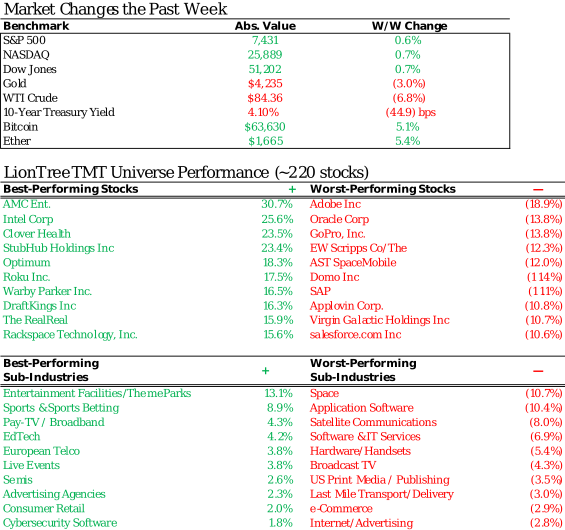
A roller coaster week ended with a bang with the SpaceX IPO closing +19% above its initial pricing. There are a lot of moving parts when talking about SpaceX but see Theme #1 for some thoughts and perspectives. In the background, while the major indices were up and down, the S&P 500 and Nasdaq closed up roughly +0.7% (following last week’s strong sell off), with semis a major driver (the SOX rallied +9.4%). Optimism on a deal with Iran emerging as soon as next week was a late week catalyst.
Fundamentally, we focused on the below in this edition:
- SpaceX Officially Blasts Off…
- The World Cup Is Positioned For A Record-Breaking Showing
- Apple’s WWDC 2026 Was More About Iterative Improvements Vs A Big Splash
- The Video Gaming Industry Had A Tough Week
- The Most Notable AI Updates This Week Span Model Launches, IPO Momentum, Pricing Pressure & Infrastructure Buildouts
- AI’s Growing Cybersecurity Risk Comes Into Focus Across Big Tech
- Grab Bag: Potential Sale Of Roku / DKNG’s Predictions/ Spotify Builds Its “Live” Hub
Also to highlight, LionTree served as financial advisor to Harbor Lights Entertainment (formerly National Amusements Inc.) on the sale of Showcase Cinemas U.S. to Kinepolis. Showcase Cinemas U.S. includes 13 movie theaters across Massachusetts, New York, Ohio and Rhode Island and will allow Kinepolis to further expand their U.S. market position.
Enjoy the weekend.
Best,
Leslie

SpaceX Officially Blasts Off…
The most highly anticipated (an understatement!) event this week was of course the SpaceX IPO, which set a new precedent for the largest IPO ever with $75bn raised at $135/share. The stock first traded at $150/share, traded as high as $176.52, and closed at $160.95, up ~+19% from pricing. While a strong start out of the gate, today is only day 1 in a long journey which is likely to be exciting, but also choppy along the way. The IPO created a tremendous amount of wealth for early investors, minted a massive number of new millionaires, and also produced one trillionaire…Elon. Initial demand for the deal was reported to be as high as $250bn which, to put that in perspective, exceeds the entire annual GDP of more than 150 countries on earth! A dynamic that is also unique to SPCX is the index inclusion story, given that multiple major index providers rewrote their eligibility rules specifically to fast-track SpaceX. This means that passive funds tracking the Russell 1000 and Nasdaq-100 will be forced buyers as early as 5 days post IPO. The inclusion into the S&P 500 (the largest wave of forced buying) won’t occur until at least mid-2027, leaving that demand as a future catalyst.
While Starlink is just a piece of the bigger picture vision for the company, it is SpaceX’s largest and only profitable segment, generating $11.4bn in 2025 revenue (~61% of total company revenue) at a 63% EBITDA margin. That has brought a lot of focus to the Connectivity sector and satellite stocks came under even more pressure today. While on the topic of Connectivity, we also included a few other connectivity developments this week, though those updates pale in comparison to the SpaceX IPO event!
See below for some additional thoughts and perspectives.
-> Outside the IPO, but another key SpaceX related announcement this week was that the Co entered into a Cloud services agreement with Google; Google will rent AI computing capacity from SpaceX for the next 3 years (Oct ‘26-Jun ‘29), for $920mn per month which equates to ~$30bn, almost 2x SpaceX’s total 2025 top line of $18.7bn (link)
SpaceX Rockets Ahead On Day 1 Of A Long Journey (link/link/link/link/link)
- SPCX’s first trade was at $150/shr (up +11% from the $135/shr pricing) and closed the day up +19.2%
- The $75bn IPO is by far the largest IPO globally… valuing the Co at ~$1.8 trillion
- The second largest was Saudi Aramco’s $4bn IPO back in 2019
- Elon Musk became the world’s first trillionaire
- He owns 4.8bn shares (~42% of SpaceX) plus 350mn options exercisable at $8.39/share
- Reportedly, the IPO order book closed at 4x oversubscribed, meaning that demand hit $250bn against a $75bn raise (though we would note that IPO investors have been known to inflate orders in a high-demand offering to try to get a desired allocation)
- Apparently ~300 institutional investors attended a single Morgan Stanley mtg with SpaceX mgt on Tuesday during the roadshow
- Multiple individual institutional investors reportedly each placed orders of $10bn+
- Retail: 20% of the book reportedly went to retail, which is above the typical 5-10% of large IPOs (but down from the initial 30% reserved for retail in the deal)
- The IPO creates a massive liquidity event for early investors (link/link/link/link)
- Founders Fund invested ~$600mn over nearly 20 years
- At the IPO price that stake is worth $50bn+…a roughly 80x return
- Valor Equity Partners owns 6.7% class A shares, worth $68bn
- Sequoia invested ~$2bn total and holds a 1.5% stake worth $20bn+
- Andreessen Horowitz‘s stake is worth $10bn+ which is the single biggest return in the firm’s entire history
- Ron Baron first invested in 2017 at a valn of less than $22bn and participated in 27 funding rounds
- SpaceX now makes up 33% of his $10.4bn Baron Partners Fund
- The list goes on and on…
- Founders Fund invested ~$600mn over nearly 20 years
- More than 4,400 current and former SpaceX employees are expected to have become millionaires
- ~ 400 employees will hold stock worth at least $100mn
- Index inclusion will also help drive future stock demand…with the largest wave in 2027 (link/link/link/link): More than $30 trillion in assets are benchmarked to the S&P 500, Dow Jones Industrial Average, Nasdaq Composite, and FTSE Russell indexes
- Russell FTSE: Eligible 5 trading days post-IPO (~June 19) under new fast-entry rules
- There are $12.2 trillion in assets benchmarked to Russell US indexes
- Nasdaq-100: Eligible after 15 trading days (~early July) under revised May 2026 methodology
- $800 billion in capital tracks the Nasdaq-100
- S&P Dow Jones Indices: Blocked until at least mid-2027 (“exceptions should not be granted solely based on market capitalization”)
- S&P DJI has est’d that $20 trillion was indexed or benchmarked to the S&P 500 alone
- Russell FTSE: Eligible 5 trading days post-IPO (~June 19) under new fast-entry rules
- While the SPCX bull case is about much more than just Starlink, that didn’t stop the connectivity-oriented stocks from trading off
- Shares of Redwire, Satellogic, and AST SpaceMobile all fell by -11.5%, -11.4% and -15.5% respectively on Friday
- EchoStar and Rocket Lab also fell -10.9% and -10.7% respectively
- Procure Space ETF, which tracks companies across the space economy, declined -7%
- Virgin Galactic also tumbled -31.8%, giving back a +23% gain from the prior session
On The Topic Of Connectivity Bigger Picture, There Were A Few Other Quick Updates Of Note From This Week
- There was renewed Deutsche Telekom and T-Mobile merger speculation, with Deutsche Telekom CEO Timotheus Höttges reportedly leading the push (link)
- Deutsche Telekom currently owns 54% of T-Mobile US, which contributes ~2/3 of Deutsche Telekom’s rev
- Speculated strategic rationale: Improving T-Mobile’s ability to pursue larger U.S. deals, particularly in fiber, by potentially lowering borrowing costs and avoiding equity issuance that would dilute Deutsche Telekom’s stake
- But several stakeholders would still need convincing, including…
- TMUS’s minority shareholders, who are said to be skeptical of a transaction that would give them exposure to Deutsche Telekom’s lower-margin intl operations
- The German govt, which holds a 28% stake in Deutsche Telekom, before navigating a complex regulatory process that could involve national security reviews in both Germany and the US
- Höttges is expected to retire at the end of 2028 and is said to want the merger completed and a suitable successor in place before he steps down
-> Deutsche Telekom’s stock fell as much as -3.9% on the day of the report, its biggest drop since Apr 22, when Bberg News first reported that the Co was discussing a potential combination w/ TMUS
- AT&T is launching $3/day “Unlimited Day Pass” for iPads (link/link)
- The Co offers on-demand connectivity for eligible US iPad users, regardless of the customer’s carrier, with no contracts, subscriptions or credit checks required
- Currently the Co only offers 24-hr passes BUT that will be expanded to include multi-day options, such as weekend and week-long passes
- Only iPads are eligible for the Unlimited Day Pass BUT AT&T plans to expand to other 5G-enabled devices “in the near future”, including Android tablets, smartwatches, laptops, drones, etc.
- No caps on speed or data is mentioned in the announcement, but the Co says it may “temporarily slow data speeds if the network is busy”
-> AT&T’s stock was up +2.2% on the day the new plan was announced
- Optimum surpassed 700k mobile lines (link): As a comp, Optimum ended Q1:26 at 674k mobile lines, after adding +52k net lines in Q1, its strongest qtr in 6 yrs
- As a reminder, Optimum Mobile starts at $15 per line for 1 GB of wireless data, with unlimited talk time and texting, on T-Mobile’s 4G LTE and 5G wireless network
The World Cup Is Positioned For A Record-Breaking Showing
The long awaited 2026 FIFA World Cup kicked off on Thursday night in Mexico City and while we’re still waiting on the viewership numbers (which should start trickling out soon), the tournament is set to be an more grandiose event with even more monetization potential. There will be 104 matches in total vs. 64 in 2022, it will be shown during more primetime-friendly time zones, and mandatory hydration breaks will add to the advertising opportunity. Fox and Telemundo have been positioning aggressively and are collectively projected to generate $850mn in ad revenue, up from $282mn in 2022.
For the full 2023–2026 commercial cycle, FIFA is targeting $13bn in total revenue, which is up over 70% from the prior cycle of $7.6bn. At the tournament level, FIFA is projecting $8.9bn in revenue, up ~54% from 2022’s $5.8bn.
As we await the ratings numbers, see below for where things stand across the World Cup and a few other key sports media related updates that were important this week.
Some World Cup Basics…
- The tournament runs from June 11-July 19th (the final is in New Jersey)
- There will be 104 match-ups during the tournament, up from 64 in 2022
- There are 48 teams competing, up from 32 in 2022
Fox & Telemundo Have Been Positioning For Higher Viewership (link/link/link)
- Telemundo has been planning all-day-long coverage from 16 cities with celebrity guests and unique broadcasting features
- And all World Cup matches will be on Peacock
- Fox Sports is delivering 340 hours of first-run programming, which is a massive 100-hour increase vs. 2022; The programming will be seen across three tiers:
- Linear TV: All 104 matches will be live across Fox and FS1, w/ a record 70 on the Fox broadcast network and 40 in primetime
- Streaming: All 104 matches will be live in 4K on Fox One
- Tubi is simulcasting the opener (Mexico vs. South Africa, June 11) and the U.S. opener (vs. Paraguay, June 12) for free
- Airports: Fox and ReachTV partnered to air all 104 matches across 80+ U.S. domestic airports reaching 51mn monthly viewers, with pregame shows, highlights, replays, team previews, and Sports Wall Activations at World Cup host city airports
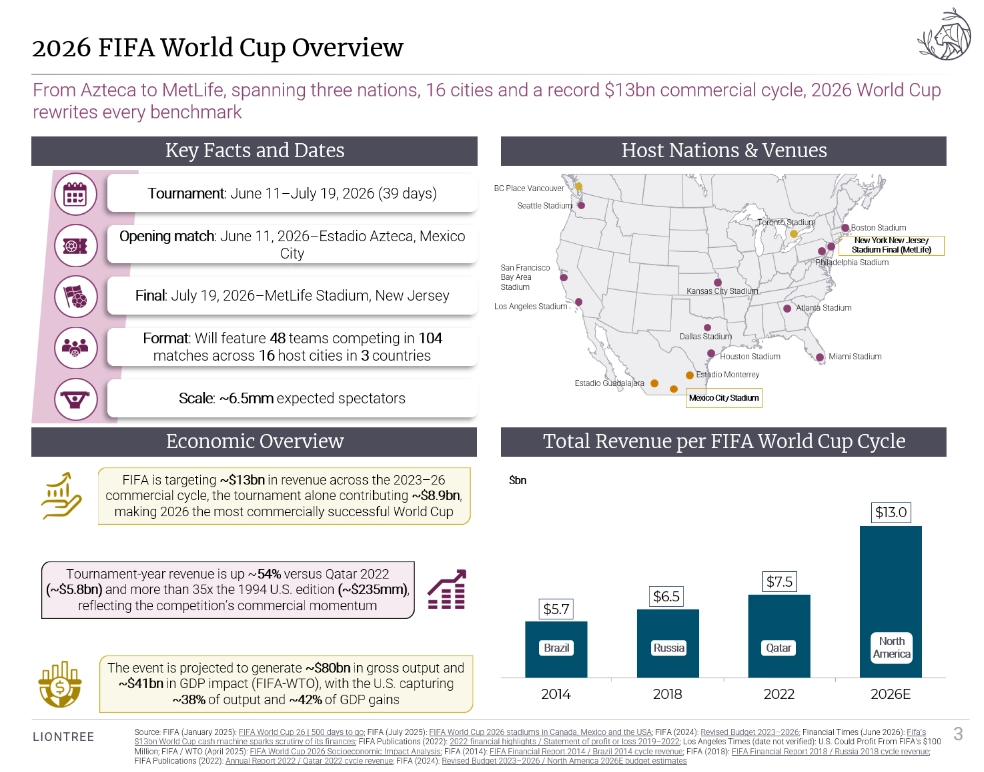
- See below for a chart of the highest viewed matches during historical tournaments
- Reminder that in 2018, the US Men’s Team was absent, which depressed interest across the whole tournament
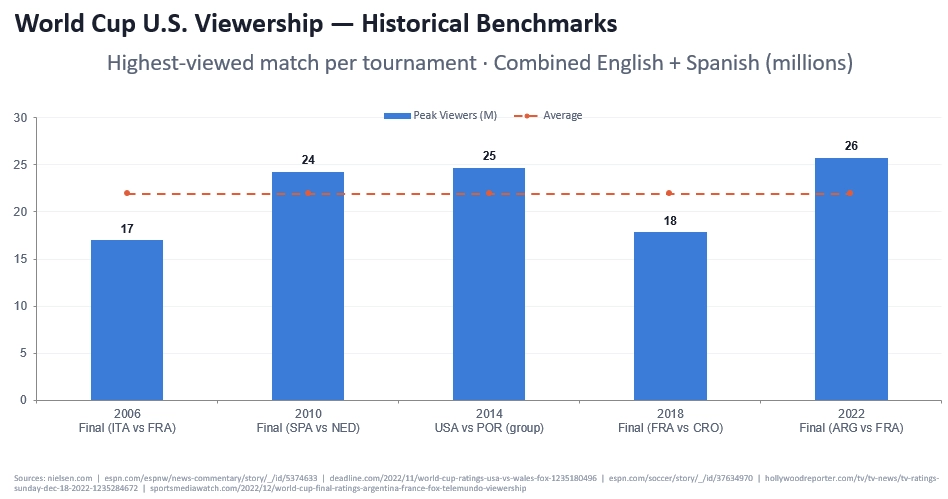
The World Cup’s Tournament Revenue Is Expected To Reach $8.9bn, Up +54% From 2022’s Level (link/link/link/link/link/link/link/link)
- FIFA’s projected TOTAL revenue for the entire 2023–2026 four-year commercial cycle (includes not just the World Cup but all FIFA events, sponsorships, and commercial deals across the period) is $13bn, which would be an increase of ~72% cycle-over-cycle
- FIFA’s projected 2026 TOURNAMENT revenue is $8.9bn, which is a ~54% increase from 2022’s level: TV broadcasting rights are expected to account for 44% of that figure
- More matches: The expansion from a 32-team field to 48 puts 40 addtl matches at Fox and Telemundo’s disposal (a 63% base-level increase in available ad slots)
- Better timing: The tournament is played in primetime-friendly North American time zones rather than Qatar’s morning slots
- Water breaks create more ad spots: The mandated 3-min hydration breaks in each half for ALL 104 matches creates more advertising opportunities
- A single-spot ad during hydration breaks could go for $2–6mn, per industry estimates
- Expected Fox & Telemundo ad revenue: The Cos are expected to generate up to $850mn combined in ad spend, up from their combined $282mn in 2022
Other Important Sports Related Updates This Week…
- NBA & NHL sports viewership hits highs (link/link/link)
- On the NBA viewership: ABC and ESPN delivered the largest NBA Finals Game 3 audience since 1998, averaging 23.8mn viewers for the Spurs’ win at MSG
- The game peaked w/ 26.3mn viewers and was the most-watched program of the day across all of TV
- NBA seat costs at MSG are on fire for the game:
- The cheapest upper-deck seats for NBA Finals Game 3 at MSG were going for more than $6k on secondary markets; Courtside went for more than $75k
- Two celebrity row seats (section VIP 10, row AA) were auctioned for $1mn ahead of Game 3
- For Game 4, upper-deck pricing jumped to $10k and courtside to over $130k
- On the NHL viewership: Game 1 of the NHL Stanley Cup Finals also hit multi-year highs for ABC, marking the largest Game 1 audience for the Cup since the 2019 Bruins-Blues series and the biggest ever for an ESPN/ABC broadcast of a Cup opener.
- Note: Nielsen changed its methodology this season to a Big Data + Panel approach, which has generally produced higher estimates for live sports and impact y/y compares
- On the NBA viewership: ABC and ESPN delivered the largest NBA Finals Game 3 audience since 1998, averaging 23.8mn viewers for the Spurs’ win at MSG
- But a House panel urges sweeping NFL TV changes (link/link/link)
- What report was put out this week? The House Judiciary Committee released a staff report titled “The Sports Broadcasting Act: A Special-Interest Antitrust Exemption Gone Awry”
- What is the panel arguing? That the NFL has stretched the antitrust exemption created by the Sports Broadcasting Act of 1961 beyond its original purpose to the detriment of American consumers by shifting games to streaming platform
- A case study on the cost to watch the NFL: “If one were to strictly stream all NFL games throughout the 2025 season on Sunday Ticket, Netflix, Peacock, Amazon Prime Video, ESPN Unlimited, and NFL+, it would have cost a minimum of $575, and others (prior Sunday Ticket watchers) nearly $800”
- What is the NFL saying? The NFL instead says that 87% of its games are available on b-cast TV
- However, the committee’s findings dispute this, with one report suggesting the avg game reaches only 39% of U.S. households
- What are next steps? Potential legislation to amend or narrow the SBA, with the DOJ investigation running concurrently…but no specific bill has been introduced yet
- Fox signs a multi-year NFL deal in Mexico starting w/ the 2026 season (link)
- What games are included? Thursday Night Football, Sunday regular-season games, Thanksgiving Day matchups, all NFC playoff games, the Pro Bowl, and the Super Bowl
- Where will they be shown? Games will be shown across Fox and Fox+ linear, Fox One streaming, and select programming on Tubi
- Fox will create original NFL content: Fox will produce 4 original weekly NFL programs specifically designed for Mexican audiences, including two editions of a fantasy football show each week.
Apple’s WWDC 2026 Was More About Iterative Improvements Vs A Big Splash
Rather than a huge splash, Apple WWDC’s was more about incremental and iterative improvements which are designed to make products more useful and user friendly. The updates touched the full product lineup, with a big focus on kids’ digital safety, a cleaner and more responsive UI across devices, and the next chapter of Apple Intelligence with a meaningfully upgraded Siri AI (though some investors wanted more). The AI story is interesting as Apple argues that competitors are racing to ship AI features, “without clear regard for the people, all of us, that it’s ultimately meant to serve”. In contrast, “at Apple, our mission has always been to turn the potential of advanced technology into helpful and intuitive products for everyone.” Privacy, integration, and usefulness were all keywords throughout the event, and the new Siri AI is more chatty, more context-aware, and more capable of actually get things done for users across devices in ways that feels genuinely practical. Developer betas are out now, public beta lands next month, and the full rollout hits consumers “this fall”.
Overall, while some investors may have been hoping for more, in our mind, Apple is playing the long game and trying to methodically make everything work better.
See below for what we thought was most incremental from the event and keynote.
–> Apple’s stock was down -1.9% in reaction to the news, but is up +7.1% YTD (though underperforming the Nasdaq’s +11%)
Big Picture, Apple Is Focused On Making Their Products More Useful & User Friendly
- The Co is aiming to create a more focused and approachable look for all devices
- They redefined liquid glass and are integrating the tech into their icons
- A new slider lets users make the interface range from ultra-transparent to fully opaque
- Apple is optimizing the responsiveness of its devices…and managing CPUs more efficiently in both newer and older models
- iPhone and iPad apps now launch up to 30% faster
- New photos appear up to 70% faster
- When users share those photos or other files w/ a friend using Airdrop, they’ll transfer up to 80% faster
- Browsing files & transferring them from iPad to an external drive is up to 5x faster
- iOS 27 is supported on iPhone 11 and all the same iPhone models as iOS 26
- The Co is also making it more seamless for the iPhone to transition between cellular and Wi-Fi networks
- The Co rebuilt the foundation of Search that powers Spotlight, Photos, and Mail…Search now can pull up more relevant results in the top hits
- At the core is the Search Index (a catalog) that users’ devices build all their content so it can understand what they have and where to find them
Mgmt Sees The Co’s Next Generation Of Apple Intelligence & New Siri AI As Key Unlocks
- Regarding AI, mgmt starts with a bit of dig competitively…“Some appear to be racing forward, seemingly pursuing AI for the sake of AI, without clear regard for the people, all of us, that it’s ultimately meant to serve. At Apple, our mission has always been to turn the potential of advanced technology into helpful and intuitive products for everyone”
- The “huge upgrade” for Apple Intelligence is state-of-the-art understanding and reasoning and multiple modalities, like powerful image understanding and generation
- Users can create realistic images, edit photos like never before, and get answers about visual content
- The models are deeply integrated into their platforms
- Apple annc’d a revamped Siri AI, powered by Apple Intelligence (and integrated with Google Gemini)…it is more intelligent, knowledgeable, and capable
- Siri is now more chatbot-like, with better conversational ability, contextual awareness, handling follow-up questions, and it has access to personal data on-device
- A new dedicated Siri AI app on iOS will also let users revisit old chats
- Siri AI is available on Mac through Spotlight and was shown on Apple Watch
- Real world use cases: Siri can draft messages, gather photos or videos into shared folders, help get event tickets, pin reminders to calendars, act as a writing assistant, and help split checks
- Now appears on the Dynamic Island on iPhone and has more expressive voice options
- Siri AI will be available in English to start, and will “quickly expand” support for more languages
- The Co will be bringing Siri AI to iPadOS and watchOS
- Siri is now more chatbot-like, with better conversational ability, contextual awareness, handling follow-up questions, and it has access to personal data on-device
- Siri AI timing:
- Developers can start trying it out right now
- Public beta is coming next month (July)
- Full public release: “This fall”
- It will not initially be available in the EU on iOS and iPadOS
- And it will not be avail on China: “We’re working hard to find a path forward that preserves our users’ privacy and security. In China, Siri AI and the other new Apple Intelligence features will not be available while we work through regulatory requirements”
Kids’ Digital Safety & Overall User Privacy Was A Big Focus
- Apple is expanding its child safety features which includes creating a Child Account, mandatory for those under 13 and it can remain in place until the age of 18…the restrictions include:
- What content they see
- Who they can talk to
- When they have access
- And it guides kids’ digital journey
- The Co also is trying to differentiate itself on the privacy angle vs other Big Tech companies
- “Today, many AI providers talk about privacy, but, by default, most of them retain your personal interactions, leaving the onus on you to defend your privacy, like using temporary chats, deleting conversations, or even turning off entire features. At Apple, we believe privacy in AI is non-negotiable”
- “Your data is not stored or accessible to Apple or anyone else. Your data is only used to execute your request, and outside experts can continue to verify this promise at any time”
A Little More Detail On Key Feature & Product Updates
- Apple Vision Pro: Users can now turn panoramas they have shot into spatial scenes with “incredible depth and realism”…users can use those panoramas as their environment
- Apple updated the Home app with smarter smart-home notifications
- Related notifications can be bundled into one message instead of repeatedly alerting the user
- Compatible security cameras can automatically surface short clips of key events
- Computer vision can describe what is happening in clips, such as package delivery
- The Shortcuts app can now generate new shortcuts from natural-language descriptions: Example: users can ask Apple Intelligence to tell someone when they will be home from work, using location, real-time Maps data, and Messages
- Photos are getting AI tools to clean up, extend, and reframe pictures:
- Users can remove background signs, change aspect ratios, and shift perspective as if the image were a 3D creation
- Image Playground now supports more styles, including photorealistic images
- Generated images can be based on existing photos, with changes to style, background, or foreground
- Apple intro’d significant App Store changes regarding subscriptions (link)
- Independent developers can now partner with each other to bundle subscriptions across different apps and sell them at a combined discount (previously bundling was only possible within a single developer’s catalog)
- One customer can purchase multiple seats and invite others to join, with similar functionality extended to Apple Business Manager and Apple School Manager for enterprise and education customers
- An AI-powered discovery system now recommends apps based on a user’s already-installed software
- Apple extended agentic AI capabilities to its Passwords app with automatic updating
- The app can now automatically navigate to websites, sign users in, and update credentials when changing passwords…handling the process in the background without manual intervention
- The feature specifically targets weak and compromised passwords, updating them with a single click rather than requiring users to visit each site individually
The Video Gaming Industry Had A Tough Week
While all data seems to point to greater consumption and consumer time spent on video games, this week’s announcements in the sector illustrate that it is not always easy to profitability monetize that participation and manage large video game franchises. Microsoft’s Xbox is reportedly gearing up to institute a major restructuring to drive more profitability but on the positive side, mgmt. indicated that Game Pass returned to growth after an eight-month decline. Separately, Nintendo shares fell -8.9% after its game pipeline update at its Direct presentation failed to meet expectations and concerns ensued given that the Co is lacking a major holiday franchise title, especially a new mainline 3D Mario. Adding more pressure is the expectation for continued memory chip shortages and higher costs as a result. Lastly, Ubisoft is also reportedly preparing for workforce reductions. As we have talked about in the past, the video game business is not for the faint of heart especially when it comes to large franchise IP.
See more below…
-> Related, at the same time some current video game companies are facing challenges, others are pushing harder into video games, as last week Paramount Skydance unveiled Paramount Games Studio which is a unified in-house gaming division combining Skydance Interactive + Skydance New Media + Paramount (previously Paramount only licensed IP to third parties)…Games are now “a core pillar of our content strategy alongside film, television and streaming”…“we are committed to creating exceptional games for every type of player, from casual to AAA” link to comments from Tony Discoll, the new Paramount Games Studio President
Xbox Remains In Turnaround Mode But With Some Green Shoots Emerging With Game Pass Returning To Growth (link/link/link)
- Xbox is still in transition and, reportedly, is planning significant layoffs per Bberg (link/link/link)
- Major cuts are expected to come next month (after the close of its fiscal yr on June 30th) as new CEO Asha Sharma overhauls the division to counter declining revenue
- Bberg reported that in an email to employees on Wed, Sharma wrote that the biz had plummeted to a 3% “accountability margin” (the metric Microsoft uses to reflect profit margin)
- “Excluding Activision Blizzard King, over the past 5 years, we have spent over $20bn on ongoing investments in our content, platform and hardware subsidy, but our annual revenue has declined nearly half a billion during that time”
- “Going forward, this cannot continue”
- Adding more pressure, the Co still faces component shortages and Sharma notes that by the 2027 holiday season, she expects to be paying 5x as much for storage/memory components as it did in 2024
- As a result, the Co will have to change their overall strategy for the next-gen console, code-named Helix
- “We are currently unable to make as many consoles as players want to buy, and we need a new business model and partnerships for hardware as we remain committed to Helix”
- However, on the plus side, Xbox Game Pass returned to growth after a mass subscriber exodus post the Oct 2025 price hike
- Per a Bberg interview, Xbox CEO Asha Sharma commented this week that the Co has “been able to reset Game Pass after an 8-month decline”
- “It’s now returned to growth and expanding retention”
- The Co has been clawing their way back after significant subscriber losses resulting from the implementation of a large price hike in Oct 2025
- Xbox chief strategy officer Matthew Ball at The Game Business event this week said “we shed millions of subscribers over the span of a few months” when the Game Pass went from $19.99 to $29.99/mo in Oct 2025
- But in April 2026, the Co “corrected that offering” and cut the price of Xbox Game Pass Ultimate down to $22.99 from the $29.99/mo (still above the original $19.99/mo)
- But future Call of Duty titles will no longer included in the Game Pass at launch
- Per a Bberg interview, Xbox CEO Asha Sharma commented this week that the Co has “been able to reset Game Pass after an 8-month decline”
- Other key updates and comments from the Co’s 2026 Xbox Games Showcase this week:
- The show had several big reveals, including Persona 6, and a new Spyro game
- They also confirmed two Xbox console exclusives
- Gears of War: E Day
- Clockwork Revolution
- Elsewhere, they gave release dates for Halo: Campaign Evolved and Fable, and the surprise announcement of a limited-edition Xbox Series X25
- The event ended with a first look at the DMZ mode from the upcoming Call of Duty: Modern Warfare 4
–>Microsoft’s stock was down -1.2% in reaction to the news, and is down -19.2% YTD
Xbox Is Not The Only One Facing Challenges…Nintendo’s Gaming Pipeline Disappoints & Ubisoft Also Faces Potential Job Cuts
- Wednesday’s Nintendo Direct presentation of forthcoming games lacked titles from top franchises, and investors/analysts had expected more (link/link/link)
- Key new titles were not announced: Heading into the event, the consensus view was that Nintendo needed a robust announcement lineup to support Switch 2 hardware sales and reassure the market that the transition from the original Switch would be smooth
- A new 3D Mario title was widely anticipated as a launch-window anchor
- The lack of a “mainline 3D Mario” for this year’s holiday shopping season is “commercially meaningful”, Jefferies analyst Atul Goyal wrote in a client note
- The reliance on ports was also a concern: The presentation leaned heavily on a remake of The Legend of Zelda: Ocarina of Time and a collection of ports (versions of existing games that are adapted to run on a different console or platform)
- Ports suggest Nintendo is leaning on its existing library to fill gaps, which is a fine short-term strategy but a worrying signal about the pace of new development
- “Year 2 [of Switch 2] now enters the holiday window without a franchise title of comparable pull,” Goyal wrote
- Last month Nintendo also hiked Switch 2 prices due to a memory chip price increase
- In the US, the base console will go from $449.99 -> $499.99 starting Sept. 1st, 2026
- Key new titles were not announced: Heading into the event, the consensus view was that Nintendo needed a robust announcement lineup to support Switch 2 hardware sales and reassure the market that the transition from the original Switch would be smooth
–>Nintendo’s stock was down -8.9% in reaction to the news, and is down -33.7% YTD
- Ubisoft is closing 2 offices and will cut up to 380 staff, per a source familiar with the ongoing restructuring (link/link)
- One of the studios being shut down is Ubisoft Winnipeg
- It opened back in 2018 to extend the Co’s game development operation in Canada and grew to ~100 employees
- The other is Ubisoft Belgrade
- It opened a decade ago and aided in the production of “Steep” and “Skull & Bones”
- The Co is also cutting back its Global Publishing division and seeking a reorg. of its Barcelona studio to have it focus exclusively on the development of upcoming Rainbow Six projects
- The result of all these cuts, according to the source, would be up to ~380 layoffs across a Co which employs ~15k
- One of the studios being shut down is Ubisoft Winnipeg
–>Ubisoft’s shares were -5.4% in reaction to the news, and is down -25.5% YTD
The Most Notable AI Updates This Week Span Model Launches, IPO Momentum, Pricing Pressure & Infrastructure Buildouts
In addition to the non-step headlines on SpaceX, there were non-stop headlines on AI related developments that we wanted to include. We pick our spots around the most incremental developments across new model launches, IPO momentum, pricing dynamics, and infrastructure buildouts.
Big picture, Anthropic launched Fable 5 and restricted-access Mythos 5, highlighting stronger model performance while limiting higher-risk capabilities through safeguards and controlled access. The AI IPO pipeline also continues to build, with OpenAI confidentially filing (which came after Anthropic’s filing last week) and Perplexity reaffirming its 2028 IPO plans. AI pricing changes also continue to mount, as Google cut pricing for AI Plus and OpenAI is reportedly weighing lowering token costs. Meanwhile, AI infrastructure demand remains a key theme, with Google and NVIDIA reportedly exploring Intel as backup chip manufacturing capacity and China is working on a major nationwide data center buildout.
See more below…
Anthropic Launches Two New Models…Fable 5 and Restricted-Access Mythos 5 (link/link/link)
- Claude Fable 5 is the first publicly available version of Anthropic’s Mythos model
- On performance… “the longer and more complex the task, the larger Fable 5’s lead over our other models”
- But warned that “releasing a model this capable comes with risks” …: W/o safeguards, Fable 5’s capabilities in areas like cybersecurity could be misused to cause “serious damage”
- …and as a result the Co has launched the model w/ safeguards, so queries on some topics (i.e., cyber, biology, chemistry, and distillation requests) will instead receive a response from Anthropic’s next-most-capable model, Claude Opus 4.8
- Anthropic also launched Claude Mythos 5 for a small group of cyberdefenders and infrastructure providers…it’s the same underlying model as Fable 5, but with the safeguards lifted in some areas
- The model will initially be deployed through Project Glasswing, in collaboration with the US govt, as an upgrade to Claude Mythos Preview
- Has “the strongest cybersecurity capabilities of any model in the world”
- Intend to expand access to Mythos 5 through a broader trusted access program “soon”
- Claude Fable 5 is available everywhere today but will be eventually cut back, while Claude Mythos 5 is restricted to Glasswing partners and soon to select biology researchers
- From today through June 22, Fable 5 is included in Pro, Max, Team, and seat-based Enterprise plans at no extra cost
- On June 23, they will remove Fable 5 from those plans
- Using it after that will require usage credits
- If capacity allows, they will extend the included window
- After this point, when sufficient capacity allows them to do so, they aim to restore Fable 5 as a standard part of subscription plans
- The models are offered at $10 per million input tokens and $50 per million output tokens, which is less than half the price of Claude Mythos Preview
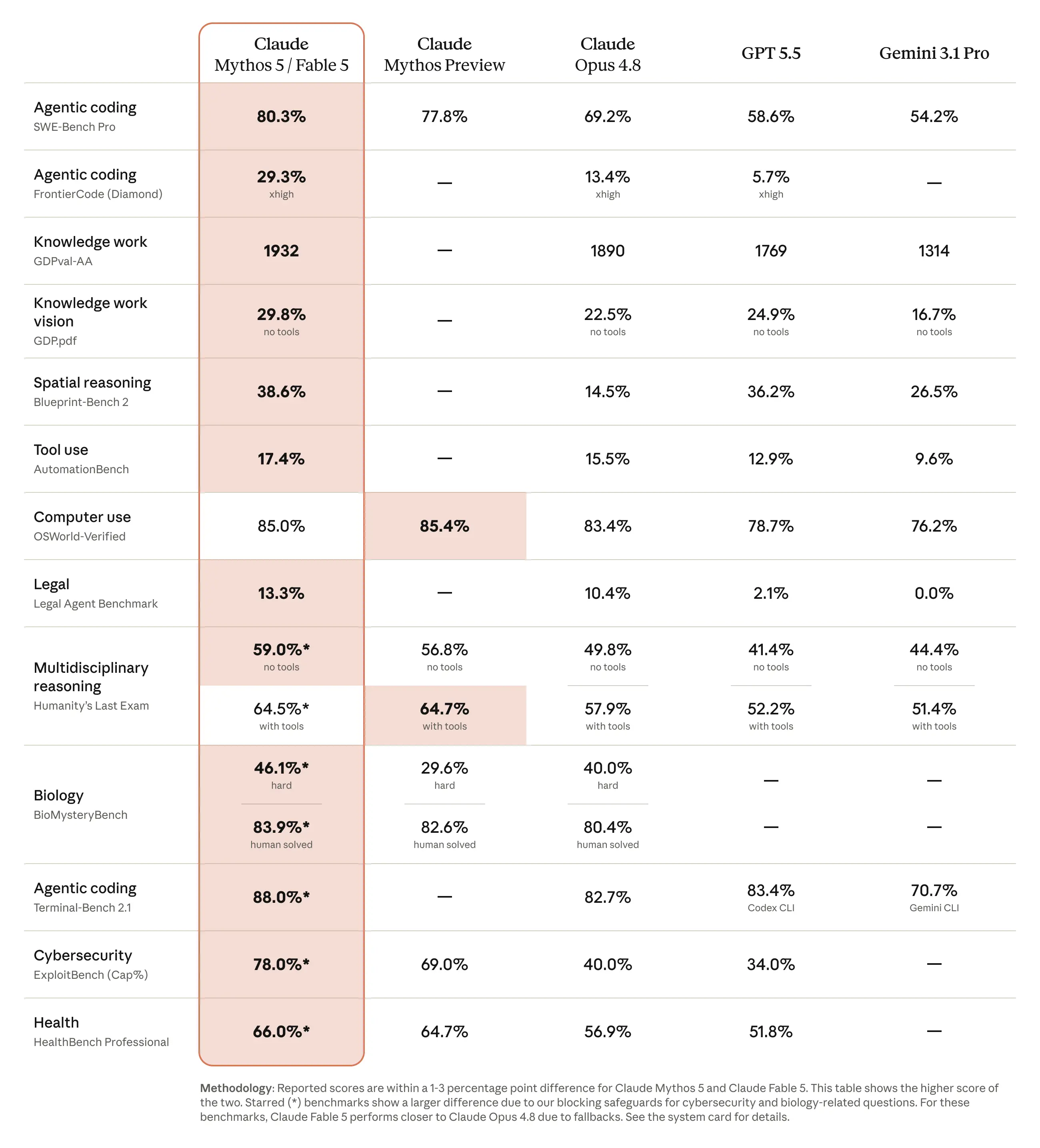
- In terms of performance…the models scored higher in every category when compared to GPT 5.5 and Gemini 3.1 Pro
- Fable 5 and Mythos 5 can work autonomously for longer than any previous Claude models
- See below chart for the full breakdown
Source: Anthropic
The AI IPO Pipeline Continues To Build
- OpenAI confidentially filed for an IPO this week, which comes a week after Anthropic’s filing (link/link/link)
- Timing of IPO is still TBD –
- “We have not decided on timing yet; it may be a while because there are things we want to do that are likely easier as a private company”
- “But it’s a complicated set of tradeoffs and this gives us the option to go public sooner if that ends up being best”
- Back in April…OpenAI CFO Sarah Friar told CNBC that it’s “good hygiene” for a biz of OpenAI’s size to “look and feel and act” like a public company
- The Co also reportedly plans to facilitate a tender offer that will allow employees to sell shares at its latest $852bn
- OpenAI will reportedly allow employees to sell shares at $687.69 each
- Employees have reportedly not yet been told how much they can sell, or when the tender offer will be
- The latest tender offer is said to help with alleviating some near-term pressure for liquidity, according to a person familiar with the plans
- Timing of IPO is still TBD –
-> Related, according to data from market intelligence firm Sensor Tower shows OpenAI’s ChatGPT surpassed 1bn MAU’s in May, which is a record no app has reached more quickly; ChatGPT cleared the threshold just under 3.5 yrs after its Nov 22 debut (Google Maps, the previous record holder, took ~5 yrs to amass a comparable user base (link)
- Perplexity also plans for their IPO in 2028 “regardless of how the market receives the listings of Anthropic and OpenAI”, per CEO Aravind Srinivas (link/link)
- “Agnostic of these two companies, we were planning for something in 2028, so that still remains the case”
- “By consistently holding 2028 as our earliest date for an IPO, Perplexity has been able to build a healthy, high-growth business”
- When asked about his view on OpenAI and Anthropic’s impending IPOs…
- “I certainly think there will be ripple effects if they don’t go well, like there is no sugar coating on that. The SpaceX IPO this week will definitely be a leading indicator of how Anthropic or OpenAI will go out”
- “I think it’s important for the AI industry that these IPOs go well, and I actually think they will go well, because they’re doing well”
- On OpenAI and Anthropic’s valuations…
- Srinivas said that both Cos deserve their high valuations because “they are on the frontier”
- A slowdown in the pace of innovation may dent their valuations, adding that there is no sign of this happening now
- “If for 6 months you don’t see a model capability advance from one of these two companies, then it’s a problem for them”
- “Agnostic of these two companies, we were planning for something in 2028, so that still remains the case”
AI Pricing Changes Builds
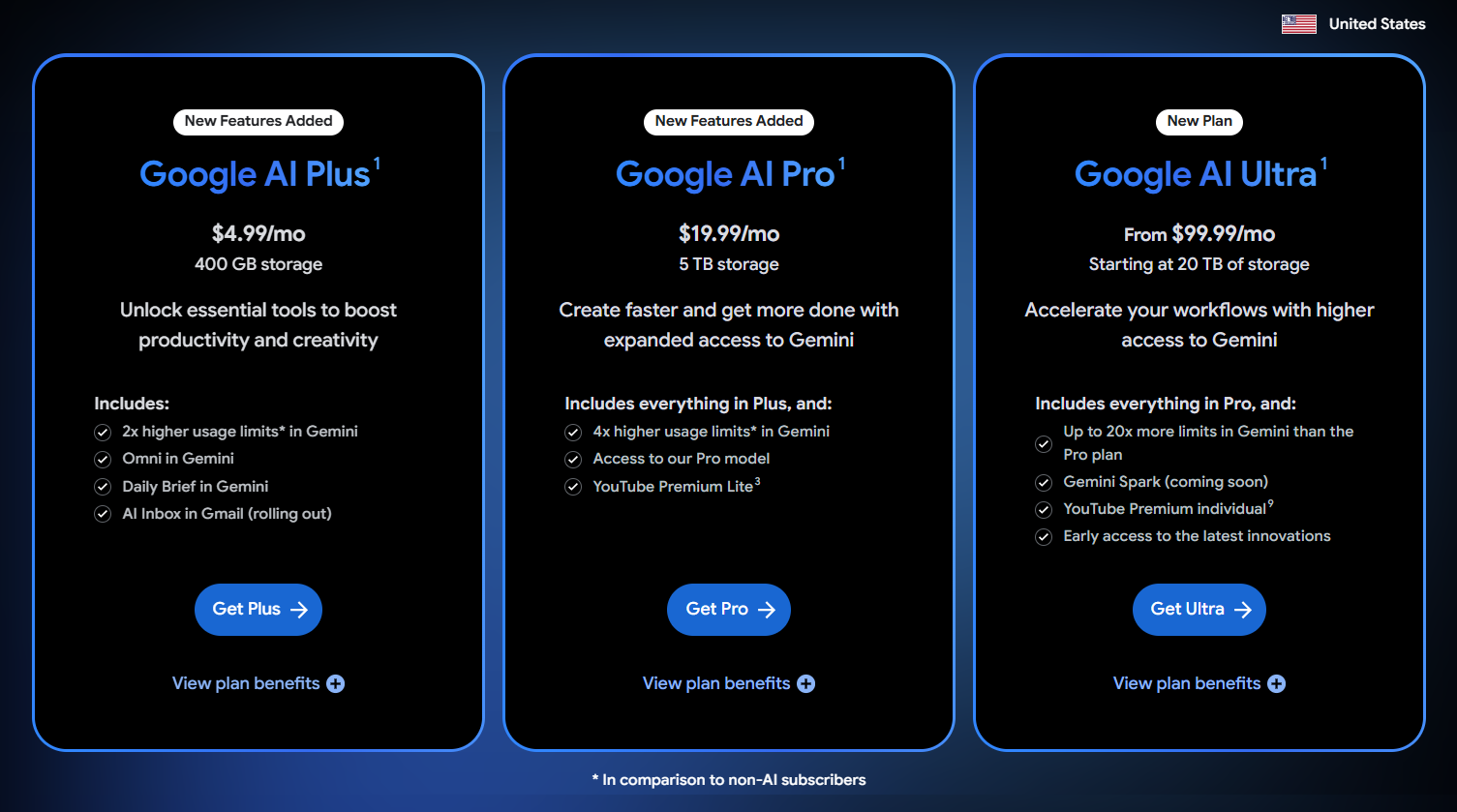
- Google annc’d that its AI Plus subscription is getting a price drop AND with double the storage: It will now cost $4.99/mo and includes 400 GB of storage, vs prior $7.99/mo w/ 200 GB of storage; The price of the annual plan is also cut from $79.99/yr to $49.99/yr (link/link)
- The plan can be used across Google products and shared w/ other accts: The 400GB is shared across Gmail, Drive, and Google Photos; Google AI Plus also supports acct sharing, allowing the user to split the 400GB cloud bucket and AI utilities with up to five addtl family members
- Google AI Plus provides 2x higher usage limits in the Gemini app compared to the free tier with a 128,000 token context window
- You also get features like Daily Brief, Omni Flash video generation, scheduled actions, and more
- There are also expanded limits in NotebookLM, Proofread and AI Inbox in Gmail, and more access in Google Flow, AI Studio, and Antigravity
- Google has been actively reshaping its AI subscription tiers in recent months: Google in April upgraded its AI Pro with 5 TB of storage without a price increase; At I/O last month, AI Ultra received a new $100/mo entry point, while the top-tier option dropped from $250 to $200/mo
- At $4.99/mo, Google’s plan is now the lowest-priced major AI subscription from a top-tier provider, w/ the next cheapest being OpenAI’s ad-supported $8/mo ChatGPT Go plan
Source: Google
- AND OpenAI is reportedly considering “drastically lowering” its prices for tokens (link/link)
- The move would be in anticipation of similar cuts the Co reportedly expects at Anthropic
- Sam Altman said at a recent event that costs had become “a huge issue…I think we’ll have a lot of ways we can help people get more value for less spend”
- As a reminder…
- OpenAI currently charges consumers in tiered subscriptions of $8, $20 and $100 and above each month for access to its flagship GPT-5.5 models
- Anthropic charges users $17 each month with an annual subscription to Claude Pro, and $100 and above monthly for a subscription to Claude Max
AI Infrastructure Demand Drives Intel Foundry Talks and China’s Reported Data Center Buildout
- Google and NVIDIA are reportedly looking at Intel as a backup chip manufacturer, as TSMC struggles to meet overwhelming demand for its chip manufacturing capacity (link/link)
- The Cos are in discussions with Intel to use its manufacturing capabilities as a backup for producing AI accelerators and data-center chips
- The talks center on Intel’s advanced packaging tech (EMIB) and its upcoming 14A and 18A process nodes, which could serve as alternatives to TSMC’s dominant foundry services
- Turn of events for Intel, which for yrs has been losing ground to TSMC, but soaring demand for chipmaking capacity driven by the AI boom has forced TSMC customers to look elsewhere
- Google has reportedly recently places an order w/ Intel to manufacture 3mn+ TPUs in 2028, while NVIDIA is reportedly yet to place an order
- The Cos are in discussions with Intel to use its manufacturing capabilities as a backup for producing AI accelerators and data-center chips
–> Intel’s stock was up +11.2% in reaction to the news and is up +237.6% YTD
- And finally, overseas…China is reportedly prepping a $295bn plan to fund nationwide AI buildout over the next 5 yrs (link/link): China is preparing to spend ~2 trillion yuan over the next 5 yrs on building data centers across the country with the broad goal of connecting those scattered data facilities to a cohesive network by 2028
- Govt and state firm involvement: Govt agencies including the National Development and Reform Commission are drafting a blueprint to bring a network of inter-connected computing hubs across the country
- State firms such as China Mobile Ltd. and China Telecom Corp. will operate the bulk of the data centers and ensure they’re connected
- The idea is to rely on local suppliers (i.e. Huawei) for ~80% of tech, such as AI chips
- This would effectively squeeze out Nvidia and AMD
- In addition to AI facilities, China also plans to integrate the power grid with the project, which could take the total projected investment to at least 5 trillion yuan
- The sum will be funded mainly through sovereign debt including ultra-long-term special government bonds and state funds for investment in strategic industries
- Bank loans and private capital would supplement the financing
- The reported investment goal pales in comparison to the ~$725bn that major US players (META, MSFT, GOOG, AMZN) are setting aside for AI this yr alone
- Chinese data centers in general cost less than in the US because of cheaper labor, component and construction costs, and local govt incentives
- The 2-trillion yuan also doesn’t include spending by private firms such as Alibaba and Tencent
- But plans are still in the works: The data center blueprint remains in early discussions and details could change
- Govt and state firm involvement: Govt agencies including the National Development and Reform Commission are drafting a blueprint to bring a network of inter-connected computing hubs across the country
–> Shares of major Chinese data center service provider GDS Holdings Ltd. rose as much as +12% in pre-market US trading, while Vnet Group Inc. climbed +17% after Bloomberg News’ report
AI’s Growing Cybersecurity Risk Comes Into Focus Across Big Tech
According to CrowdStrike’s 2026 Tech Threat Report, cyberattacks involving AI jumped +89% y/y in 2025, a pattern that has continued to play out across Big Tech in recent weeks. Microsoft has been forced to restrict access to dozens of open-source GitHub projects after hackers injected password-stealing malware into tools used by AI developers, while Meta this week disclosed that cybercriminals exploited a flaw in its AI-powered customer support system to hijack more 20k+ Instagram accounts.
As AI becomes more deeply embedded across key products, tools and systems, it is also expanding the attack surface for bad actors, creating a growing challenge for large tech platforms.
See below for more details on the attacks on MSFT and Meta which came to light this week, and if you would like to check out CrowdStrike 2026 Tech Threat Report, you can do so HERE.
Microsoft’s Open-Source Tools Were Hacked To Steal The Passwords Of AI Developers (link/link)
- The malware allowed the hackers to steal the users’ passwords and other sensitive credentials when they opened the compromised tools in their AI coding apps
- It’s not immediately known how many people have downloaded the affected tools
- Many of the compromised projects are related to Microsoft’s Azure cloud platform and tools used by developers to build AI applications, including Claude Code, Gemini CLI and VS Code.
- Since then, MSFT has cut off access to dozens of its open-source projects hosted on GitHub as it investigates how hackers breached the projects and injected the password-stealing malware into the code
- GitHub disabled 73 Microsoft repositories under four organizations, including Azure, Azure-Samples, Microsoft, and MicrosoftDocs

Source: TechCrunch
- This is Co’s second-known breach over the past few weeks that has allowed hackers to compromise its open-source projects, per Ars Technica
- In mid-May, security researchers said that Microsoft’s open-source project Durable Task, a tool that helps developers build apps, was also hacked
- OpenSourceMalware said that Microsoft’s latest incident is a “re-compromise” of the Durable Task project
Hackers Hijacked Thousands Instagram Accounts W/ Meta’s AI Chatbot (link/link)
- What happened? Cybercriminals exploited a vulnerability in Meta’s AI-powered customer support svs, tricking it into sending password reset codes for other people’s accounts
- The password reset tool itself worked as intended, but a bug in a separate part of the system caused an account-verification failure
- Specifically, the system did not properly check whether the email address entered for the password reset matched the email address already linked to the Instagram account
- The attacked impacted 20,225 accounts
- Meta says the attack first surfaced on May 31st, and the Co “resolved” the incident on June 1st
- During that time, several high-profile Instagram accts were impacted, including former President Barack Obama’s old White House account, US Space Force Chief Master Sergeant John F. Bentivegna, and Sephora
- The Co said it found no evidence of data exfiltration, but could not rule it out because the attackers were able to access the data
- Potentially exposed info included contact details, date of birth, social media posts and content, direct messages, account activity, profile information, and connected accounts / linked services
- Meta is conducting a comprehensive review of similar account recovery flows across Meta’s platforms to identify and remediate any potential issues
Grab Bag: Potential Sale Of Roku / DKNG’s Predictions/ Spotify Builds Its “Live” Hub
- Roku is said to be in sale talks, including a possible media tie-up (link)
- Late on Friday, headlines emerged that Roku is in talks to sell itself, and has been in discussions w/ at least one US media Co about a potential combination
- No final decisions have been made on a potential sale, and there’s no certainty the deliberations will lead to a transaction
–> Roku’s stock was up as much as +24% in reaction to the report
- DraftKing’s annualized consumer volume in their Predictions offering increased +24% m/m in May to $1.3bn (link/link/link/link)
- What drove the increase? Recent app improvements ahead of the NBA Finals, which have helped streamline access to its unified sports platform
- Annualized total volume traded also increased +34% m/m to $3.1bn
- Looking at the most recent data from DeFi Rate, Kalshi recorded $16.5bn in trading volume in May compared to $14.8bn in April
- While Polymarket recorded $7.1bn in May compared to $9.1bn in April
–> DraftKing’s stock was up +11.3% in reaction to the news, but is still down -15.8% YTD
- Spotify has reportedly held talks w/ festival promoters about licensing the rights to show live video of music festivals (link/link/link)
- Adding live video would be a new initiative for the Co, which previously experimented with live audio shows
- The platform has already begun adding footage from some live events, such as Dua Lipa’s Mexico City show
- The expansion into concert events reflects Spotify’s continued plans to become “a hub for live music”
- Spotify is adding live concert footage at the same time it is starting to help customers get access to see concerts in person, unveiling a feature called Reserved last month that reserves tour tickets for superfans
- Adding live video would be a new initiative for the Co, which previously experimented with live audio shows
–> Spotify’s stock was up +1.2% in reaction to the news, but is down -17% YTD
Stock Market Check
This Week's Other Curated News
Advertising/Ad Agencies/Ad Tech
- Political ad spend in the 2025-26 midterm cycle has surged to a record $4bn through Jun, making it the biggest midterm cycle to date, according to AdImpact. The firm raised its total projection to $11.6bn, driven mainly by Senate races, now est. at $3.4bn, up 23%. Broadcast TV, CTV and digital mkts all saw higher ests, while House races were revised lower. Biggest state mkts include CA, MI and TX. (MediaPost)
- AdRoll report shows display prospecting CPMs fell 48% YoY in Apr. –May, while retargeting CPMs rose 12% and ABM slipped ~2%, highlighting steady demand for precise targeting. Marketers are shifting from linear funnels to full-funnel, multichannel strategies as AI, social, and zero-click search reshape discovery. Retargeting now spans journeys, using first-party data to engage high-intent audiences across channels. (AdRoll)
Artificial Intelligence/Machine Learning
- Adobe will prioritize freemium AI offerings to boost user growth over short-term ARR as CFO Dan Durn exits. CEO Shantanu Narayen said frictionless onboarding w/o paywalls is key. Q2 showed Acrobat and Express MAUs rising to 850mn+, and creative freemium MAUs to 90mn+. The strategy may pressure ARR, and Creative Cloud price hikes are paused. (WSJ)
- SemiAnalysis says consumer AI subscriptions sharply subsidize heavy users versus APIs. After buying Anthropic and OpenAI plans and running long-horizon coding until weekly caps, it found a $200/month tier, often assumed to equal ~$2,000 in API tokens, actually delivered far more value. (Digg)
- Coinbase annc’d a new AI agent tool that lets users trade crypto and pay for premium research on their behalf. Integrated w/ main or sandbox accounts, agents can rebalance portfolios, follow investment theses, and trade spot or derivatives using Coinbase Advanced tools. Built on the x402 payments protocol, the agent can directly pay for data APIs and compute svs, w/ support for equities and prediction mkts planned cont’d. (TechCrunch)
- OpenAI annc’d it will acquire Ona to enhance its AI coding assistant Codex. Ona provides secure, pre-configured cloud environments enabling AI agents to run longer tasks and deploy more easily into production. Terms weren’t disclosed and deal is subject to closing. Ona staff will join the Codex team as OpenAI ramps investment amid rising competition in AI coding tools. (CNBC)
- JPMorgan Chase annc’d plans to deploy more advanced AI agents in 2026 that can operate autonomously for hours, evolving from single-task tools into digital workers managing multi-step workflows across svs. The Co said AI is boosting biz, incl. ~20% rise in private banking sales, and could expand client coverage by 50%, while reshaping software competition and workforce roles. (CNBC)
- A poll shows 53% of Americans fear AI could put someone in their household out of work amid rapid adoption. Concern spans demographics, w/ higher worry among Democrats (61%) vs Republicans (47%). College grads report more AI use (~50%) and greater anxiety. Despite tech layoffs (e.g., Intuit 17%), broader labor mkts remain strong, though 73% worry about AI’s expanding role. (Reuters)
- DoubleLine & Oaktree are positioning for potential AI-driven credit stress, buying debt likely to hold value if the boom falters. Firms warn rising AI funding could inflate bond valuations as tech cos issue heavy debt. Data center overbuild risk is growing, w/ ~$5tn expected AI capex. Investors stay selective amid uncertainty on long-term winners. (Yahoo Finance)
- OpenAI annc’d its biggest ChatGPT overhaul, shifting toward a “super app” w/ coding tools, AI agents, and creative features to target enterprise mkts. The redesign will guide ~900mn weekly users to integrated tools, boosting higher-margin biz ahead of its IPO. Backed by a $122bn funding round, the Co aims to improve profitability and compete w/ Anthropic in the AI IPO race. (Yahoo Finance)
- Amazon annc’d an AI image generator in its shopping app that creates product visuals from user descriptions, refining results as more details are added. Shoppers can pick images to find similar items, initially in apparel & home goods. The tool builds on prior visual search upgrades like Lens & Shop by Style, part of broader AI push incl. Alexa shopping features. (Retail Dive)
- The CEO of Anthropic, Dario Amodei, released an essay titled Policy on the AI Exponential. AI is advancing at a “lightning pace,” while the “slow and rickety policy apparatus” needs to catch up to risks and opportunities that are “going to compound surprisingly quickly” (Dario Amodei)
- Colleges across the US are racing to build AI degree programs. In 2021, only 5 colleges in the US offered an undergraduate major focused on AI. Researchers at Northeastern University estimate that students can now choose from at least 74 AI majors and 89 minors on US campuses. (Entrepreneur)
- The White House is negotiating a federal preemption of some state AI laws in exchange for its support of key tech policy priorities from the Hill. States are increasingly passing stronger AI laws, and the Trump administration is feeling the heat to get something done. (Axios)
Audio/Music/Podcast
- Deezer annc’d an AI music detector that scans user playlists across rival svs to flag synthetic tracks. After failing to license its tech to competitors, the Co is offering it directly to users, CEO Alexis Lanternier said. The web-based tool supports ~20 platforms incl. Spotify, Apple Music, SoundCloud and YouTube Music, importing playlists and identifying AI-generated songs, w/ optional sharing of results. (The Verge)
- Warner Music Group annc’d it will acquire Sureel AI to boost protection, control & monetization of IP in AI. Sureel’s tech tags works w/ “AI DNA,” tracking usage in AI training & outputs, incl. voice, likeness & style replication. Platform holds mn of assets & will cont’d as standalone, expanding attribution across music, video & images at scale. (PR Newswire)
- Universal Music Group N. annc’d it priced €1.0bn in Eurobond notes, incl. €500mn 3.375% notes due 2030 and €500mn 4.125% notes due 2036. Proceeds will support general corporate purposes, incl. refinancing debt and fees. Issued under its EMTN programme, the notes will be listed in Amsterdam and sold outside the U.S. Closing is expected Jun. 16, 2026, subject to conditions. (Universal Music Group)
Cable/Pay-TV/Wireless
- Bouygues Telecom, Orange & Iliad annc’d a €20. 35bn ($23.44bn) deal, incl. debt, to acquire Altice’s SFR. Bouygues will take ~52% of rev, Iliad 27%, Orange 21%, w/ some assets held jointly temporarily. The move would cut France’s operators to three, testing EU antitrust. Deal completion is targeted for H2 2027, w/ job protections until 2029. (Reuters)
- Ookla report highlights Wi‑Fi evolution, w/ Wi‑Fi 7 still nascent (~2% share Q1 2026) but growing, led by markets like Singapore (25%). Wi‑Fi 6 adoption rising (27%), while Wi‑Fi 4/5 decline. 5 GHz remains global workhorse (~60%), as 6 GHz use stays limited (~1.7%) due to fragmented spectrum policies. (Ookla)
- Orange annc’d it acquired the remaining 50% of MasOrange from Lorca for €4. 25bn, taking full control of the Spanish operator. The move supports its “Trust the Future” plan, boosting synergies and value in Spain, its 2nd-largest mkt. MasOrange CEO joins Orange exec team as the co is fully consolidated, w/ ~26mn mobile and 7.1mn broadband customers. (Orange)
Capital Market Updates
- Citi annc’d a market-first launch of tokenized depositary receipts on private shares, enabling private cos and investors to access equity via a regulated blockchain run by SIX. Citi acts as sole issuer and custodian, aiming to reduce complexity, costs, and intermediaries in private mkts. The solution broadens investor access, supports liquidity, preserves issuer control, and debuted w/ an inaugural Kaleido transaction. (Citi)
- Tencent raised $4. 66bn via dual-currency bonds, w/ strong demand driving >$17bn orders and tighter pricing across 4 tranches. The tech Co issued $2.45bn in 10- & 20-yr dollar notes and ~15bn yuan ($2.21bn) in offshore yuan bonds. Proceeds will fund general corp purposes incl. refinancing, marking its first dollar sale since 2021 and reflecting robust investor appetite. (Reuters)
- Indian quick commerce Co Zepto plans to raise up to $837mn via IPO, per updated filings, targeting a major India listing. Rev more than doubled last yr, but losses widened as costs rose. Proceeds to fund expansion of dark stores, tech and acquisitions. Founders responded to Apr. probe by authorities. Existing investors will also sell shares, amid rising competition. (Reuters)
- Morgan Stanley said global AI debt issuance is set to top ~$570bn in 2026, more than doubling as hyperscalers boost funding for AI capex. Issuance reached ~$236bn by May 31, up 4x yr/yr. Big tech cos incl. Alphabet, Amazon, Microsoft & Meta are driving demand, w/ spending seen at $700bn and >$1tn by 2027. Firms increasingly tap debt mkts as funding needs surge. (Reuters)
- Amazon secured a $17. 5bn loan facility from major lenders incl. Citibank, JPMorgan and HSBC, per filing dated Jun. 8, to fund general corp purposes as AI spending ramps. The delayed draw structure lets it access funds as needed. Big tech cos incl. Alphabet and Meta are boosting AI capex, w/ combined outlays set to top $700bn this yr, driving increased reliance on debt mkts. (Reuters)
- SK Hynix plans a U. listing as soon as Aug., aiming to capitalise on strong demand for AI-linked stocks and broaden its investor base. SEC approval for ADR issuance could come in late Jun. The move follows confidential filing and could raise up to $14bn. The chip Co, a key Nvidia supplier, has benefited from the AI boom, w/ shares surging and valuation topping $1tn. (Reuters)
- SoftBank Group’s talks to raise ~$6bn via margin loan backed by its OpenAI stake have stalled after cutting target from $10bn. The Co had ~$5bn commitments but faces lender hesitation over valuing unlisted OpenAI. It may revisit fundraising as options evolve, as OpenAI files for IPO and investor concerns grow over SoftBank’s >$60bn commitment; shares fell sharply. (Yahoo Finance)
- CoreWeave (CRWV) drew attention as it explores European debt mkts to fund AI data center expansion, w/ JPMorgan arranging investor calls on potential $ and € bonds. Shares rose ~1% amid scrutiny of insider sales exceeding $2.3bn since Aug., though stock is up ~155% since its 2025 IPO. (Yahoo Finance)
- PLDT Inc. plans to raise $300–$400mn via a REIT listing tied to its data center biz, amid rising investor interest in tech and AI assets. The Co annc’d its board approved the potential listing for assets under subsidiary VITRO Inc., which operates the largest data center network in the Southeast Asian nation, signaling a push to capitalize on demand in digital infra mkts. (Bloomberg)
- S&P Dow Jones Indices said it will keep its rule that cos must show positive net income over the past yr, incl the latest quarter, after a month-long review. By rejecting calls to relax profitability criteria, the decision signals that high-profile IPO candidates like SpaceX may face delays before qualifying for entry into the S&P 500. (Bloomberg)
Cloud/DataCenters/IT Infrastructure
- Amazon said its global data-center ops withdrew ~2. 5bn gallons of water in 2025, amid rising scrutiny of AI’s environmental impact. Water use at sites it owns and operates directly fell 2% yr/yr even as its footprint expanded. Amazon said facilities used 0.12 liters per kWh, beating industry averages, and pledged to return more water to communities by decade end. (WSJ)
- Meta annc’d expanded partnership w/ Reliance Industries to lease its first AI-enabled data center in India, a 168MW facility in Jamnagar w/ option to scale. Move boosts Meta’s AI infra, serving a fast-growing user base and deepening ties after its $5.7bn Jio bet. Co also backing ~1GW renewable energy via CleanMax and Fourth Partner to power ops and cut emissions. (Meta)
- Alphabet’s Google backed a $35bn financing deal tied to Anthropic’s AI data centers, guaranteeing lease payments to help secure funding. The move deepens Google’s role beyond investor into infra and chip supplier. Broadcom, Apollo, and Blackstone support the deal, highlighting how big tech balance sheets are driving AI infra growth while raising concerns over concentration risk. (Yahoo Finance)
- OpenAI is in talks to lease a 10‑gigawatt data center campus in Ohio, w/ possible Nvidia backing, per report. The project could cost at least $500bn, w/ OpenAI controlling equipment under a 20‑yr lease starting ~2028. Site would be developed by SB Energy on federal land, w/ Nvidia supplying chips and guarantees. Talks follow delays to its UK data center plans. (Reuters)
- Oracle warned AI-driven capex will surge, planning ~$95bn spend in fiscal 2027, above estimates, as it builds cloud infra and data centers. The Co may raise ~$40bn via debt/equity, fueling concerns over rising debt and negative cash flow. Shares fell 8.9%. FY26 capex hit $55.7bn. Q4 rev was $19.18bn, slightly above estimates, w/ strong backlog growth. (Reuters)
- Broadcom annc’d a strategic AI platform w/ Apollo & Blackstone to support >20 gigawatts of global AI compute by 2028. The platform launches w/ a $35bn investment led by Apollo to fund ~1 gigawatt for Anthropic’s infrastructure expansion starting mid-2026. It leverages Broadcom’s XPU tech to cut costs, improve efficiency, and scale AI model training and inference. (PR Newswire)
Crypto/Blockchain/web3/NFTs
- Bitcoin’s $235bn crash signals a broader shift in crypto, where it no longer fully dictates industry trends. Previously, rises drove funding and activity across mkts, while declines hurt the entire ecosystem. Now, the sector is becoming more diversified, reducing Bitcoin’s dominance as the central driver of crypto biz cycles. (Bloomberg)
Cybersecurity/Security
- Oracle annc’d a critical security bug in its PeopleSoft software that hackers used to breach 100+ cos. Cybercrime group ShinyHunters claimed exploiting the zero-day flaw, which requires no authentication, to access payroll and HR systems. Oracle urged mitigations, w/ no patch yet. (TechCrunch)
- Frontier AI labs OpenAI & Anthropic are adopting “selective access” to control powerful cyber-capable models while still commercializing them. OpenAI’s trusted-access program and Anthropic’s planned version restrict use to approved defenders, creating a new cybersecurity power center where AI firms influence which orgs gain advanced capabilities, balancing risk and biz incentives. (Axios)
- Criminal attacks on US broadband & communications networks are rising, w/ >18,000 incidents in 2025 disrupting svs for 11. 8mn customers, per USTelecom. Reports outline daily impacts and estimate total costs at $294mn–$1.47bn in 2025, largely borne by consumers. (Telecompaper)
eCommerce/Social Commerce/Retail
- DoorDash annc’d new AI ordering tools, launching the Ask DoorDash chatbot in select mkts. The tool lets users order food and groceries using photos and prompts, w/ reservations and more US cities cont’d in coming weeks. The co is in the middle of a massive investment cycle that includes revamping its tech platform after a string of acquisitions. (CNBC)
- Alibaba has offered $1. 5bn to acquire Pupu, a China-based instant grocery delivery app. The bid exceeds a prior $600mn offer from Sun Art Retail, backed by DCP Capital, amid rising consolidation in China’s online grocery mkts. Pupu generates >30bn yuan (~$4.4bn) in annual rev and operates 30-minute delivery svs across ~10 cities. (Tech in Asia)
- Alibaba and JD. com led a China equity selloff after Beijing warned major e-commerce players over misleading promotions during the “618” festival. Regulators summoned Alibaba, JD.com, PDD, ByteDance and Xiaohongshu, citing false advertising and unclear subsidy claims. Alibaba shares fell ~6.5% and JD nearly 6% as scrutiny signaled tighter oversight and concern over price wars hurting profits. (The Edge)
- Amazon annc’d expansion of its print‑on‑demand biz w/ AI‑generated merch via Alexa, letting users create designs from text prompts for items like T‑shirts and hoodies. The feature integrates design, purchase, and printing, threatening rivals and third‑party sellers. While subject to content rules, it enables endless unbranded products and highlights Amazon’s push into AI‑driven shopping experiences. (The Verge)
- Walmart is shifting its Walmart Deals event to Jun. 22–28 to align w/ Amazon’s earlier Prime Day, which moved to Jun., while Target also advanced its sale. Walmart+ members get 24 hrs early access. The Co is promoting via a fictional boy band campaign. Deals span categories across online, app and stores, though specifics weren’t annc’d. Move comes as fuel costs cut ~$175mn from operating income, pressuring prices. (Retail Dive)
- Chewy reported Q1 results that met estimates, w/ adj EPS of $0. 43 and rev up 7.7% to $3.36bn, slightly topping forecasts. Shares fell ~2.3% despite avoiding worst-case concerns tied to consumer softness flagged earlier. Co trimmed FY rev outlook to $13.4–$13.55bn vs prior $13.6–$13.75bn, though other guidance held. Sentiment remained cautious amid broader pet-sector weakness. (Barron’s)
Electric & Autonomous Vehicles
- Waymo annc’d a paid loyalty program, Waymo Premier, priced at $29. 99 per month, offering frequent robotaxi riders perks incl 10% cash back on trips, priority access, and five free cancellations monthly. The program excludes Austin and Atlanta, where svs run via Uber. The move supports Waymo’s US expansion, intl launch plans, and rollout of its new Ojai vehicle, positioning memberships as a scalable biz and potential rev driver. (TechCrunch)
- Baidu annc’d that AmiGo, its autonomous mobility svs w/ Swiss Post’s PostBus, received Level 4 regulatory approval from Switzerland’s FEDRO. Open-road trials began Jun. 1 across ~80 km² in Eastern Switzerland. The fully electric svs uses Apollo Go RT6 vehicles and targets regular driverless ops in early 2027, marking a major step in Apollo Go’s European expansion. (PR Newswire)
- Tesla’s robotaxi biz falls well short of Elon Musk’s promises, w/ just 59 vehicles operating across 3 Texas cities. Expansion, once projected to reach ~500 cars in Austin by 2025, has lagged due to tech hurdles and safety concerns. Users report long waits, errors, and inconsistent service, while rivals like Waymo deploy 600+ vehicles. Profitability isn’t expected until 2027. (Bloomberg)
Film/Studio/Content/IP/Talent
- Paramount annc’d plans to produce ~40 TV shows by 2030, w/ ~30 already underway, per a filing tied to its $110bn merger w/ Warner Bros. Combined output could reach ~170 shows, backed by ~$6bn in synergies via tech integration and efficiencies. The Co says the deal boosts choice and competition, rejecting claims it harms consumers, output and mkts. (The Wrap)
- Imax is exploring a potential sale amid strong box office trends and global expansion, aiming to maximize value rather than address distress. The Co could fetch ~20–40% premium, w/ mkt cap ~$2.15bn and solid liquidity. Key challenge is avoiding conflicts if studios buy it, as rivals may shift away; private equity seen as safer buyer option. (Yahoo Finance)
- Paramount Skydance is considering selling assets like Nickelodeon or Cartoon Network to secure approval for its $110bn deal to acquire Warner Bros. Discovery amid EU antitrust review. Regulators are examining competition in kids TV mkts, where both cos hold strong positions. The Co may divest select channels to address concerns while pursuing scale, growth, and global streaming expansion. (Cord Cutters News)
FinTech/InsurTech/Payments
- Mastercard annc’d Agent Pay for Machines, enabling always-on, machine-to-machine payments at high speed and low latency. The svs supports microtransactions, credentialing, permissioning and multi-rail settlement, incl. cards and stablecoins. Built on its network, it aims to scale AI-driven commerce, w/ partners like Stripe and Coinbase, unlocking new biz models and continuous automated transactions. (Mastercard)
Investor & Market Sentiment
- DoorDash was annc’d as a new short call at Hedgeye. Analyst Bennett Cheer said organic growth is slowing and masked by the Deliveroo acquisition, while unit economics are deteriorating. He warned the Street may underestimate the investment cycle as the Co funds grocery, international expansion, platform modernization, affordability initiatives and agentic commerce while facing larger, better-capitalized competitors in several mkts. (MSN)
Last Mile Transportation/Delivery
- Walmart & Wing annc’d expansion of drone delivery to 7 mkts incl. Philadelphia, Phoenix & San Diego, aiming for 2027 launches. Drones deliver in ~30 min at up to 60 mph as Walmart scales fast-delivery biz to compete w/ Amazon. Service spans 66 sites; co hit 1mn deliveries in Q1. Plan targets 270+ stores, leveraging FAA approvals & new partnerships to grow svs reach. (Retail Dive)
Live Entertainment/Theme Parks/Concerts/Experiential
- Hochul, Mayor Mamdani, FIFA & NYNJ Host Committee annc’d a free Central Park watch party for the FIFA World Cup 2026 Final, hosting ~50,000 on the Great Lawn. Tickets via lottery open Jun. 11. Backed by ~$9.5mn public funds, event incl. live entertainment, food vendors & media partners. (Governor Kathy Hochul)
Macro Updates
- U.S. inflation hit 4.2%, a 3-yr high, driven largely by energy costs (>60% of May spike). Gas rose 40.5% and fuel oil 58.9%, while prices broadly increased across basics like food, shelter and electricity. Inflation exceeded 3.4% wage growth, worsening consumer finances and sentiment to a 4-yr low. Analysts warn pressures may persist, especially for food, even if geopolitical tensions ease. (Retail Dive)
- Retail sales cont’d rising for eighth straight month in May, per NRF data released, as consumers stayed resilient despite inflation and high gas prices. Total sales rose 0.42% m/m and 7.19% y/y, w/ core sales up 0.39% m/m and 6.98% y/y. Gains spanned most categories incl. apparel, electronics, and grocery, while furniture and building supply lagged. (Chain Store Age)
Media Conglomerates
- Fox News led cable news in May 2026, drawing 2. 38mn primetime viewers, exceeding MS NOW (942K) and CNN (633K) combined, per Nielsen data cited by Ad Week. Fox also topped total-day viewing w/ 1.53mn. While Fox saw sharp MoM declines, it retained the No.1 spot. MS NOW and CNN posted steeper MoM drops but showed YoY gains, highlighting a highly uneven cable news mkt. (Cord Cutter News)
- Hewlett-Packard has annc’d Publicis Media as its global media partner, ending Omnicom Media Group’s 17‑yr run. The closed pitch concluded earlier this spring, w/ the account estimated at ~$250mn. Omnicom had handled HP since 2009, expanding into digital in 2017 and retaining the biz in 2024. HP spent $194mn on global media in 2023, w/ 69% in digital channels, reflecting its growing focus on subscription svs and tech-led mkts. (Adweek)
Online Marketplaces/Learning (Real Estate/Education/Jobs)
- GameStop annc’d plans for a hostile $56bn bid to acquire eBay at $125/share after rejection by eBay’s board. GameStop has built a 7.8% stake and may appeal directly to shareholders. CEO Ryan Cohen aims to combine eBay’s marketplace w/ GameStop’s 1,600 stores as authentication hubs, though analysts cite financing and execution risks amid mixed mkts reaction. (Cord Cutters News)
Regulatory
- Congress failed to extend Section 702 of the Foreign Intelligence Surveillance Act on Thur (Jun. 11), putting the spy law on track to lapse for the first time since 2008. The House rejected a short-term extension 218–198, w/ opposition from Democrats and some Republicans over privacy concerns and Pres. Trump’s annc’d choice of Bill Pulte as acting DNI. (Politico)
- A federal judge blocked Trump’s $100,000 H‑1B visa fee, ruling it violated the Constitution and Administrative Procedure Act, calling it an unauthorized tax not approved by Congress. The policy, targeting skilled foreign workers, had sharply raised costs from ~$2K–$5K. ~20 states challenged it, saying it hurt jobs. The administration plans to appeal amid broader legal setbacks. (CNBC)
- Italy’s antitrust regulator AGCM dropped its probe into Meta Platforms Co over allegations it abused dominance by integrating an AI tech tool into WhatsApp. The case, opened in Jul. 2025, was closed after the EU Commission cont’d and expanded its own investigation to cover Italy, taking over oversight of the issue. (Reuters)
- Pentagon added Alibaba, Baidu, BYD & other Chinese tech cos to its “1260H” military-linked list, citing alleged ties to China’s defense base. While not direct sanctions, U.S. bans DoD contracts w/ listed firms soon & procurement via third parties by Jun. 2027. Firms rejected claims as groundless and may pursue legal action, highlighting ongoing U.S.-China tech tensions. (CNBC)
- Taiwan is considering stricter curbs on AI chip sales to China to align w/ US rules, aiming to curb smuggling of advanced Nvidia-based systems. Current laws limit enforcement, but new measures could criminalize illicit exports and expand restrictions beyond blacklisted cos. Talks w/ the US cont’d, w/ details on scope and thresholds still under review. (Yahoo Finance)
- Paramount Skydance Corp. submitted proposed terms to resolve a multistate antitrust probe into its $110bn deal to acquire Warner Bros. Discovery. The co told California AG Rob Bonta it is willing to address concerns and offered concessions, though details and timing were not disclosed, according to sources familiar w/ the private discussions. (Bloomberg)
- EU regulators ordered Meta to restore free WhatsApp access for rival AI chatbots during an antitrust probe into alleged market abuse. The Commission said Meta’s fees were unsustainable and favored its own AI. The interim order lasts until the probe ends or Jun. 2029. Meta criticized the move as overreach and plans to appeal, w/ potential fines up to 10% of global rev if violations are confirmed. (Reuters)
- China’s NDRC outlined a 5‑yr tech & telecom agenda, positioning digital networks and AI as core infrastructure. At a national congress press conference, director Zheng Shanjie annc’d major state-backed capital investments to advance sovereign tech capabilities and strengthen global leadership, signaling a strategic push toward greater autonomy and expansion in key digital sectors. (Telecompaper)
- Amodei argues AI is advancing exponentially, outpacing slow policy, creating urgent risks/opportunities. He calls for stricter regulation beyond transparency, incl. mandatory third-party testing for cyber, bio, and autonomy threats, w/ gov’t power to block unsafe models. (Dario Amodei)
- White House urged UK not to ban social media for under-16s, warning rules could impose disproportionate burdens on US tech Cos. It opposed “one-size” limits, said age-gating may fail, and pushed for parental controls instead. UK govt still weighing bans on harmful apps, amid tensions over Online Safety Act, free speech concerns, and potential legal challenges from firms like Meta. (The Guardian)
- U.S. CFTC under Trump‑era leadership proposed new rules for prediction mkts, allowing most sports bets while restricting contracts prone to manipulation or lacking public interest, like wagers on injuries or assassinations. Rules set case‑by‑case review criteria rather than bans, aiming to support mkts growth amid state pushback and evolving oversight of platforms like Kalshi and Polymarket. (MSN)
- Kalshi plans new rules requiring some users to disclose employers to curb insider trading and manipulation in prediction mkts. The move follows advisory panel concerns over suspicious activity. Bets tied to sensitive topics like Co performance or national security will need disclosure via online form. (The Wall Street Journal)
- FCC granted Amazon a waiver to miss a Jul. 30 satellite deadline for its Project Leo home internet svc, preserving spectrum rights despite only ~330 of 3,232 satellites launched. The move supports broadband expansion and competition. Conditions remove priority status for new satellites after Jul. 30, 2026 until milestones are met, w/ full deployment still due Jul. 30, 2029, encouraging accel’d progress while ensuring compliance. (Cord Cutters News)
Satellite/Space
- SpaceX’s Starlink annc’d higher costs and reduced flexibility for new users, adding a $10/month hardware rental fee on top of recent $5-10/month service hikes. Customers who rent equipment can no longer pause svs, losing Standby Mode benefits. Renting is costlier long term, while buying dishes outright, often discounted via retailers, remains an option across multiple mkts incl. the US and Europe. (Cord Cutter News)
- SpaceX annc’d plans to test orbital AI computing systems by late 2027, ahead of broader deployment as early as 2028. Execs highlighted deals w/ Google, Anthropic and pitched the initiative as central to its IPO strategy targeting $1.75tn valuation. Initial systems will validate tech, w/ Starship key to lowering costs, though delays remain a risk to scaling space-based data centers. (Reuters)
Social/Digital Media
- Meta annc’d new “Your Algorithm” feature letting users adjust topics shown in Instagram’s main feed, expanding prior controls on Reels and Explore. The Co aims to boost user agency by allowing clearer input into recommendations using AI that explains interests in simple terms. Execs say algos, while advanced tech, reduced control, and this update begins shifting power back to users. (The Verge)
- YouTube is rolling out a new in-app messaging feature, enabling users to share videos, Shorts, and livestreams w/ 1:1 chats. Messaging requires invite links sent via third-party apps, valid 7 days, limiting use to known contacts. Available only for 18+, it includes safety controls, reporting, and blocking. Feature expands across US, UK, Brazil, and Singapore. (9to5Google)
Software
- Salesforce cut 86 roles per a California filing, impacting sales, admin & tech/product as layoffs hit Agentforce, Mulesoft & Marketing Cloud svs, though core AI teams spared. Staff stay paid until Aug. 7 w/ severance up to 6 months. Cuts follow Jan. layoffs amid AI threats to core CRM biz; stock down 30% this yr despite Agentforce ~$1bn rev. (Business Insider)
- Apple annc’d iOS 26 adoption data ahead of WWDC, based on App Store activity on Jun. iOS 26 ran on 86% of iPhones from last 4 yrs and 79% overall, while iPadOS 26 reached 79% of recent iPads and 68% overall. Adoption trailed prior yr iOS 18 levels, marking Apple’s final update before iOS 27 beta rollout. (MacRumors)
Tech Hardware
- Google has ordered 3mn AI TPUs from Intel for 2028 as TSMC struggles to meet surging demand, pushing Co’s to seek alternatives. The move follows months of testing Intel’s packaging tech. Google’s TPU biz is expanding w/ new chips and major clients. The deal marks a boost for Intel’s foundry turnaround efforts, despite it still trailing TSMC in advanced manufacturing. (Quartz)
- ASML CEO Christophe Fouquet warned EU against intervening in chip supply chains, arguing region needs stronger cos, not direct control. He said lacking its own supply chain limits intervention. ASML gets ~80% of rev from Asia vs ~1% Europe, leaving it exposed. Comments follow EU plans for a chips strategy w/ emergency powers and efforts to cut reliance on US tech and Asian mkts. (Financial Times)
- Google declined Trump-era US quantum funding due to “conditions” that could slow progress, a Google Quantum AI. The govt annc’d ~$2bn support for rivals like IBM. Google cont’d working w/ govt via other means, while urging more basic research funding. Execs flagged visa limits and global talent competition, w/ China seen as a key rival in quantum tech race. (Semafor)
- Nvidia annc’d its RTX Spark superchip, pitching AI PCs that run large models locally, but analysts say demand beyond niche users remains unproven. The devices target developers vs mass mkts, w/ high costs and memory constraints likely limiting adoption. While partners plan launches, most PC sales will stay traditional as AI PCs have yet to drive meaningful rev growth. (Reuters)
Video Games/Interactive Entertainment
- Roblox (RBLX) shares rose ~5% after reports Russia may lift restrictions on the platform. The Digital Ministry and regulator Roskomnadzor urged law enforcement to support the move, citing Roblox’s guarantees to comply w/ local laws. The potential shift marks a change after prior curbs, reopening access to the gaming platform popular w/ younger users
