


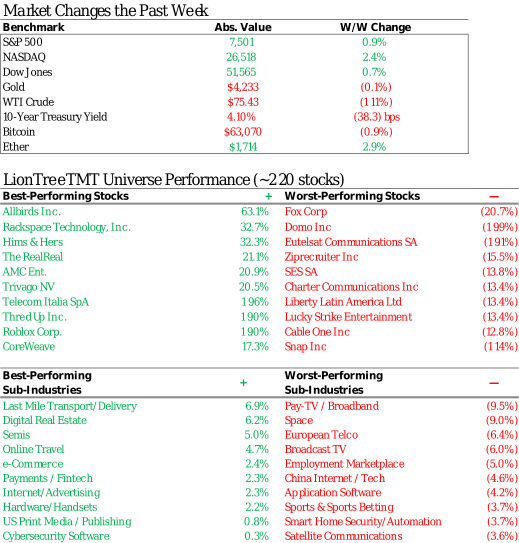
The market melt up is back in action with the Dow and the Russell 2000 hitting fresh new highs, and Nasdaq rising +2.4% this week, driven by the SOX up a massive +7.3%) Investors were more optimistic about the peace agreement but yields moved higher post Wednesday’s FOMC meeting which further raised the prospect of a rate hike this year.
As usual, there was no shortage of impactful developments and updates across the sector. This edition focuses on the below:
- Fox’s Surprise Roku Deal Highlights A Big Streaming Push
- Snap’s New Specs Are Met With Investor Scrutiny
- AI Policy Moves Into The Spotlight As Competition, Adoption, and Monetization Accelerates
- New Entrants & Mkt Expansions In The Emerging The Robotaxi Industry
- More Strategic Moves In Video Gaming Emerge
- Verizon Pushes Further Into Value, Bundles & Loyalty
- The Global Advertising Picture Is Even Rosier, Per WPP
- Grab Bag: World Cup Stats / UK Confirms Social Media Ban / Apple Price Raise
Also, LionTree Advisors served as exclusive financial advisor to Vox Media on the combination of its Publishing Brands with Penske Media Publishing. Vox Media is contributing a portfolio of digital brands, including SB Nation, The Verge, PopSugar, The Dodo, Punch, and Thrillist.
Enjoy the weekend.
Best,
Leslie

Fox’s Surprise Roku Deal Highlights A Big Streaming Push
On countless earnings conference calls, Fox’s mgmt. faced questions about what it plans to do with its strong balance sheet and while mgmt. expressed interest in disciplined M&A, they never found anything that met their thresholds until obviously this Roku deal that was annc’d out of the gate on Monday (which followed speculation hitting headlines on Friday). Per mgmt., “opportunities of this caliber are exceptionally rare,” and “nothing has the upside and the massive scale and opportunity that this transaction has.” Overall, Fox expects the pro forma business to “enhance our long-term revenue growth profile and drive accelerating EBITDA and free cash flow growth.”
The $22bn valuation for Roku valued the Co at ~3.5x and ~4.0x adj EBITDA based on 2026 and 2027 consensus estimates. Fox mgmt. characterized the $400mn run rate synergy target as conservative and flagged that it does NOT include any revenue synergies which could be “significant”. Proforma leverage will increase to 2.8x but mgmt. expects that to decline to its target within the first year or two post close. Importantly, the deal will not impact the Co’s mid-BBB investment grade credit ratings nor the buyback.
Digging a bit more into the strategic rationale, the deal unifies “the two most powerful forces reshaping video”, namely live news/sports and streaming, and pushes Fox into the highest-growth segments (CTV advertising and subscription aggregation) via Roku, the “front door to the streaming ecosystem.” Fox will also importantly layer Roku’s first-party data into Fox’s advertiser relationships. But areas of Wall Street analyst concern centered around potential Roku home-screen cannibalization from cross promotion, supplier-vs-distributor conflicts, and why Roku is selling now, but Fox’s/Roku’s mgmt. pushed back on each and stressed that “we are confident this is the right transaction at the right moment, for all the right reasons.”
-> Fox share fell -18% on the back of the transaction news while Roku trades down -1.5%, after trading up +20% on Friday when speculation hit the press
-> Also related on the sector M&A front, Netflix shares fell -3.5% on Tuesday following reports that the streamer had aggressively pursued Roku but was ultimately outbid by Fox’s winning $160/shr cash-and-stock offer, but Netflix said that it “did not make a bid for Roku” after this story was published. Later that day, Lionsgate shares surged +14% in regular trading after Semafor reported that Netflix was among several media companies interested in acquiring the Co, though the stock later dropped -4.4% after-hours after a subsequent report said Netflix was not interested in purchasing Lionsgate, contradicting the earlier item (link/link/link/link)
Fox Sees $400mn In Cost Synergies & A H1: Cal 2027 Close For The Roku Deal
- Key transaction highlights
- FOX will acquire Roku for $160/shr, or ~$22bn in enterprise value…it is a mix of
- 60% cash ($15bn): $96/share
- 40% stock: 0.9693 shrs of FOX Class A common stock for each Roku class A & B shrs; The $64/shr is based on FOX’s 10-day VWAP of $66.03/shr as of June 10th
- Expected close: H1 calendar 2027
- Pro-forma ownership:
- Fox holders ~73%
- Roku holders ~27%
- Funding for the transaction:
- The cash will be funded via ~$8bn of new debt plus the ~$9bn of pro forma combined balance-sheet cash at close
- The Co has secured $12.0bn of fully committed bridge financing
- Mgmt: Roku Founder & CEO Anthony Wood will have an ongoing role at the combined Co and will join the FOX Board of Directors post-closing
- FOX will acquire Roku for $160/shr, or ~$22bn in enterprise value…it is a mix of
- What are the valn multiples that are implied in the $22bn EV value?
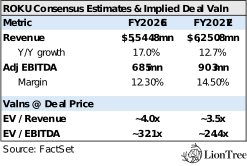
- Proforma net leverage will be ~2.8x TTM EBITDA at close, inclusive of 50% credit for run-rate cost synergies…mgmt. believes they can return to target gross leverage of 2.25-3x which maintains their existing credit rating within the first year or two after close
- The Co expects to maintain its existing mid-BBB investment-grade rating
- No change to the buyback except for mandatory SEC blackout periods and the dividend was maintained
- Re accretion/synergies…mgmt sees the $400mn synergies as conservative
- The transaction is expected to be accretive to FCF/shr within 2 years post close and to generate ~$400mn of run-rate cost synergies
- Additional revenue synergies are NOT included, though could be “significant”
- The transaction is expected to be accretive to FCF/shr within 2 years post close and to generate ~$400mn of run-rate cost synergies
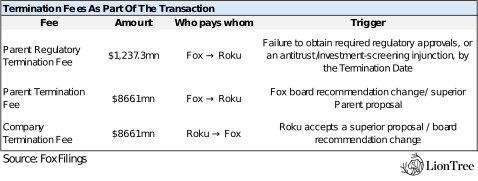
- While there is a >$1bn break-up fee, the regulatory path seems straightforward
- It principally requires HSR in the U.S. plus “very limited” international approvals
- Break-up fees are detailed below
- Why now sell ROKU? Roku’s CEO Anthony Wood cites the ability to grow faster with Fox + “a good price”
Thoughts & Perspectives On The Deal…
- Per Fox… “the pro forma business is expected to enhance our long-term revenue growth profile and drive accelerating EBITDA and free cash flow growth”
- “Opportunities of this caliber are exceptionally rare”
- The combination brings together…
- FOX’s premium live sports, news and entertainment portfolio, including NFL, MLB, NASCAR, Big Ten, FIFA World Cup, FOX News, FOX Business and Tubi
- Roku’s connected TV platform, The Roku Channel, first-party data and direct relationship with over 100mn global streaming households
- Roku is the #1 CTV platform, with 44% share of total US hours spent viewing CTV content (fireTV is 2nd at 14% share)
- Pro forma the combined company becomes the 3rd-largest player in U.S. TV by viewing time, spanning broadcast, cable, local and streaming
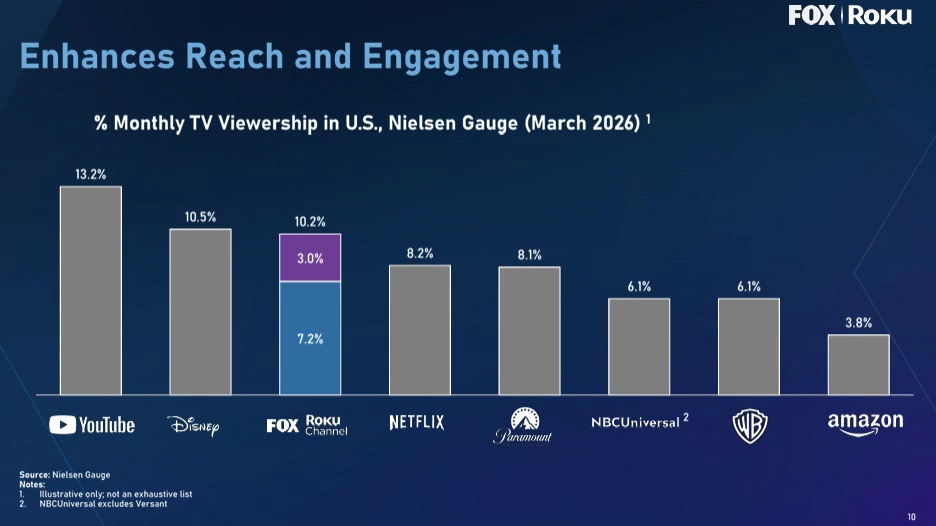
- Fox believes the deal will help accelerate advertising…upside comes from layering Roku’s 1st-party data and performance-marketing tools onto Fox’s direct advertiser relationships
- It’s going to be a “very powerful ad platform”
- The Co refuted an analyst concern that cross promotion could cannibalize Roku home screen revenue
- “I don’t think that’s true; actually, it’s going to increase profitability”
- Only ~25% of Roku Channel viewing comes from its tile (75% from other ingress points), promotional inventory is “almost an infinite supply” and personalized, so adding Fox properties does not impact home-screen revenue
- Mgmt also rejected analyst concerns that it can grow the FOX audience while also being partner friendly to a large number of 3P content providers that Roku has worked with across the ecosystem
- Fox’s thesis is “not to upset or dislocate” Roku’s role as the “Switzerland of distribution,” and that the deal does not “activate conflict”
- They stressed several times that Roku will remain an “open” and “partner-friendly platform” with cont’d ubiquitous distribution
- Roku believes that its purpose-built OS provides differentiation and a cost-edge vs competitors (i.e., Amazon/Google/Walmart-Vizio), looking ahead
- Example, their purpose-built platform uses less memory than competitors, and memory prices are “going through the roof” right now
- Mgmt stressed that there is NOT a lot of audience overlap between the Co’s streaming…combined they have “triple” the reach
- There is only 1/3rd audience overlap …the platforms have “different user bases” and experiences are different
- Mgmt plans to keep the brands separate
- Tubi is 90%+ VOD, Roku Channel 80%+ FAST
- Together they form an “extremely large and scaled ad platform” and a “must-use partner for content owners”
- International is also an opportunity but not too much time was spent on this on the call…though Roku’s footprint can assist the recent Fox Latin America launch
Snap’s New Specs Are Met With Investor Scrutiny
On Tuesday, Snap unveiled its long-awaited Specs at a spatial AI convention in Long Beach, marking the company’s latest push to position AR glasses as a long-term computing and advertising platform. The launch highlights Snap’s continued investment in hardware despite investor pressure to scale back the business (i.e., Irenic’s public pushback). Capability wise, Specs can be used for gaming, video, productivity, recording, and it includes contextual AI features as well. But all these features come at a very high price point relative to Meta’s Ray-Bans but is below Apple’s Vision Pro. The glasses also weigh a lot more than Meta’s Ray-bans but are much lighter than the Apple Vision Pro. All in all, there are some interesting capabilities with Specs but this iteration will not be a mass market product. The Co’s investment plans and ROI assumptions will remain top of mind for the investment community.
See more below…
-> Snap’s stock was down -9.6% in reaction to the news, and is down -42.3% YTD
- Key features of Snap’s new Specs (link/link/link)
- High price point: The cost is $2,195
- This is above most Meta Ray-Bans smart glasses, which run at ~$700
- But below Apple Vision Pro’s $3,500 starting price
- Availability: Pre-order on June 16th with a $200 refundable deposit
- They are expected to ship this fall in the US, the UK, and France
- The glasses come in two sizes:
- A 47 mm model, which weighs 132 grams (~4.6 oz)
- A 52 mm model, which weighs 136 grams (~4.7 oz)
- Vs competitive products…they are heavier than Meta’s Ray-Bans (the first-gen weigh under an ounce) but much lighter than Apple’s Vision Pro, which is 26.4-28.2 oz
- Processors: Specs run on two Snapdragon processors
- Battery life: Up to 4 hours of continuous battery life, plus a charging case that extends that to 20hrs total
- There are also privacy protections
- Similar to Meta’s smart glasses, Specs has a built-in LED light that glows while the device is recording
- The Co says that users will also have control over what data is stored, synced, or deleted
- High price point: The cost is $2,195

Source: Snap
- What can users do with them?
- User can play games, including ones that support shared multiplayer sessions between two users
- Snap calls this feature “EyeConnect,” and it’s activated simply by two wearers making eye contact with each other
- Users can also watch videos (the Co says the display offers a 51-degree field of view and 16mn colors)
- They can also record point-of-view footage
- User can play games, including ones that support shared multiplayer sessions between two users
- Users can get work done since the glasses allow them to surf the internet, connect to productivity apps, and check email
- Specs also use contextual AI: If users look at an object and ask about it, the glasses can pull up information on what they are seeing
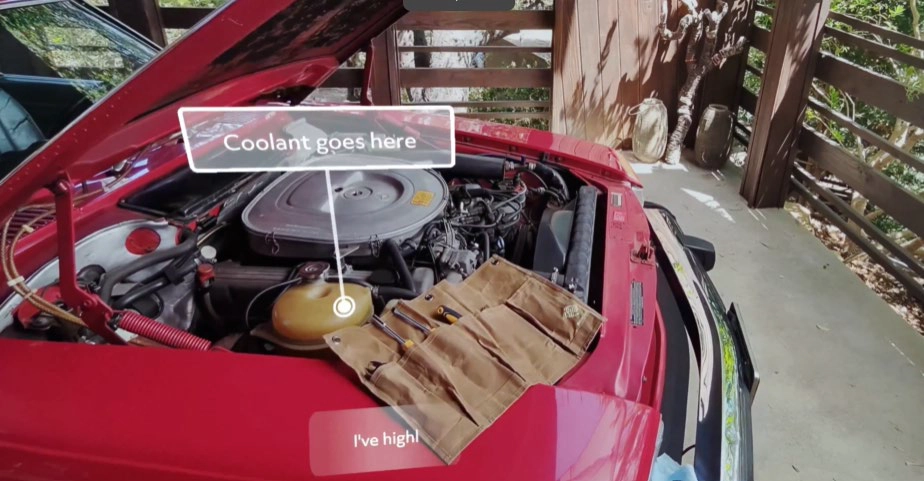
Source: Snap
- The launch comes months after Irenic Capital pushed Snap to consider options for Specs as part of a series of changes that they said could boost the Co’s worth by at least 5x (link/link)
- They estimated that closing or selling Specs would save ~$500mn in cash cost yearly…they argued that:
- An est’d $3.5bn has been invested over 11 years and that the biz is highly unprofitable with no visibility to that change
- The Co can’t compete in this area w/ better capitalized peers like Meta and players like Google, Apple, Microsoft, and MagicLeap have all deprioritized the space, while China competition is heating up
- Evan Spiegel said in an interview this week during Specs release…“While investors may want more short-term profitability, our job at Snap is to drive long-term profitability and the long-term success of the company”
- They estimated that closing or selling Specs would save ~$500mn in cash cost yearly…they argued that:
AI Policy Moves Into The Spotlight As Competition, Adoption, and Monetization Accelerates
One of the biggest AI developments over the past week was Anthropic’s decision to keep its newly launched Fable 5 and Mythos 5 models offline following a directive from the US government. While the suspension was initially tied to a reported security concern, the conversation has since expanded well beyond the models themselves. Policymakers, AI leaders, and US allies are now debating who should have access to frontier AI systems, how those decisions should be made, and what role governments should play in overseeing the technology.
At the same time, competition across the AI landscape continues to intensify as the models become more widely adopted. ChatGPT’s share of the AI assistant market fell below 50% for the first time, while the Co’s latest financial disclosures underscore the significant costs required to support rapid growth. Microsoft shifted Copilot Cowork to a usage-based pricing model as enterprise adoption scales. AI agents now account for more web traffic than humans, and, also, consumers appear increasingly willing to accept advertising in exchange for free AI services.
As always, the AI updates have dominated headlines but see below for more of what we thought was most impactful this week.
Anthropic’s Fable 5 And Mythos 5 Remain Offline As US Officials, Industry Leaders, And Allies Debate Future Access (link/link/link/link)
- Reminder, last Wednesday, June 9th, Anthropic annc’d Claude Fable 5 & Claude Mythos 5
- Fable 5 is positioned as the broadly usable, safety-guard railed version
- Mythos 5 is the less-restricted version for a smaller set of trusted cyberdefenders/infrastructure partners
- Then, last Friday evening, June 12th, Anthropic received a directive from the US govt requiring it to suspend access to Fable 5 and Mythos 5 for all foreign nationals, including foreign nationals inside the US and even Anthropic’s own foreign-national employees
- See HERE for the letter US Commerce Secretary Howard Lutnick sent to Anthropic CEO Dario Amodei, which said that the Co would need govt permission before exporting its Fable 5 and Mythos 5 models and threatened Anthropic with criminal and civil penalties if it failed to comply
- Given that this directive would be operationally hard to enforce cleanly, Anthropic disabled access for all customers
- The trigger for the directive appears to have been a reported jailbreak concern: Anthropic said the govt did not provide specific details, but its understanding was that the govt believed it had become aware of a method to bypass, or “jailbreak,” Fable 5
- BUT Anthropic disputes the severity of the concern, saying the demonstrated technique was used only to identify a small number of previously known, minor vulnerabilities that appeared relatively simple, and that other publicly available models could find them as well without requiring a bypass
- “If this standard was applied across the industry, we believe it would essentially halt all new model deployments for all frontier model providers.”
- So where do things stand now? On Wednesday, June 17th, US Pres Trump says talks with Anthropic are “going fine”, as the Co’s AI models remain offline
- Trump made the comments at a G7 summit in France, where he had lunch with world leaders and AI execs, including Anthropic CEO Dario Amodei
- The ban on Anthropic’s models raised concerns among industry execs and foreign govts that unilateral actions by the administration could dictate who can use leading AI models
- French President Macron told reporters that “The bad thing is that the reaction is, in a way, strictly nationalist,” adding that democracies need to cooperate on these issues; “We won’t buy any models made by these companies if overnight, you can just flip the switch”
- OpenAI CEO Sam Altman called for an international forum to settle on “globally accepted standards for testing” and “impartial analysis” of AI risks, adding that “it is crucial that we do not allow the risks of this technology to lead to undue concentration of power”
- Anthropic’s Dario Amodei and head of Google DeepMind AI lab’s Demis Hassabis advocated for the US to lead G7 countries in shaping AI safety standards, people familiar with the meeting said
- G7 leaders have reportedly also discussed the creation of a “trusted partners” scheme granting access for non-U.S. nations to advanced US AI models from firms like Anthropic
- The “trusted partners” could be countries or companies and would allow them to use the models to develop stronger cybersecurity defenses against rivals like China
- On Thursday, June 17th, Macron said he expected progress “in weeks” on expanding non-US access to advanced American AI models
- Also to flag some related chatter out of the White House…senior Trump officials were reportedly weighing how to structure govt equity stakes in major AI Cos BEFORE it sent Anthropic the suspension directive (link)
- Treasury Secretary Scott Bessent reportedly favored using equity in AI firms to seed Trump Accounts, while Commerce Secretary Howard Lutnick’s preference was that any equity be directed to a type of sovereign wealth fund
- It’s still unclear where the Trump administration could ultimately land on the idea, which remains an extremely tough sell for most of the industry beyond OpenAI, which first pitched it last year (execs at MSFT and META reportedly have already disagreed)
Other Key Developments Across AI Competition, Monetization, and Adoption…
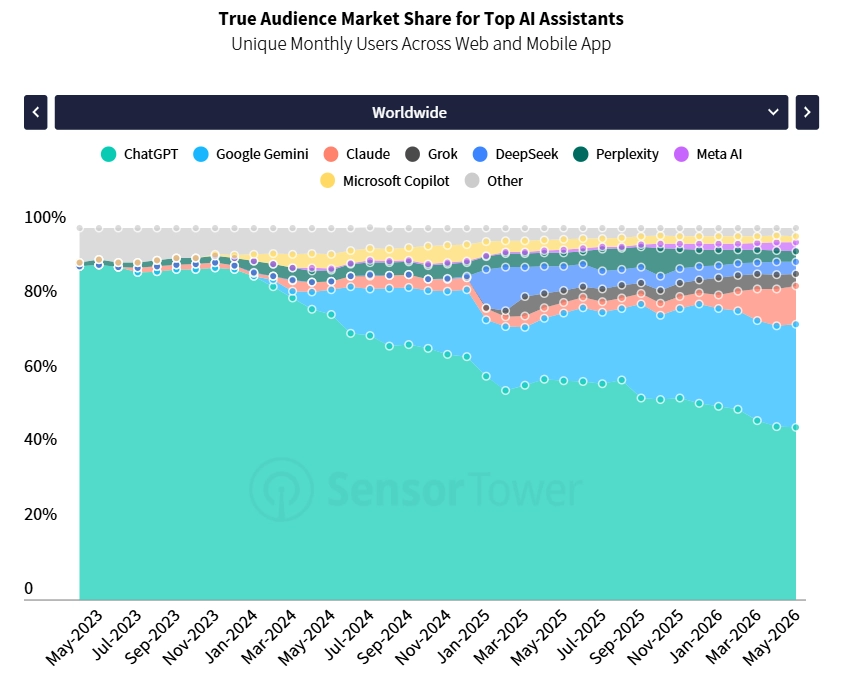
- On OpenAI… ChatGPT’s AI assistant mkt shr has slipped below 50% for the 1st time in March 26, per Sensor Tower’s State of AI Report (link)
- ChatGPT is still the most popular AI assistant worldwide with 1.1bn+ monthly users (46% share), followed by Gemini with 662mn (28% share) and Claude with 245mn (10% share)
Source: Sensor Tower
- Also regarding OpenAI… the Co burned through $3.7bn in Q1, more than half of its $5.7bn in rev, per documents the Co reportedly shared w/ shareholders (link)
- Both cash burn and rev tripled y/y
- The Co ended Q1 w/ $73bn+ in cash and marketable securities vs $40bn at the end of Dec, reflecting the Co’s massive funding round annc’d at the end of March (raised $40bn at a $300bn post-money valn)
- Assuming the cash burn remains around the Q1 level, OpenAI won’t need to raise more money in the near term, which could relieve the pressure on OpenAI to go public sooner rather than later
- However the cash burn has fluctuated qtrly: The Co had projected it would burn $25bn this yr and $57bn next yr, The Information reported back in Feb (link)
- On MSFT… Copilot Cowork is now generally available and is being shifted to usage-based pricing (link/link)
- After 3 months of preview in Frontier, more than half of the Fortune 500 is using Copilot Cowork, and now it is broadly available for organizations worldwide
- Testing showed that Copilot Cowork could not be offered on an unlimited-use basis: “We have users who do hundreds of tasks a week, which is great — they’re way productive — but the consequence is the costs can go very high,” said Charles Lamanna, Microsoft’s EVP for Copilot, agents and platform
- MSFT already made a similar move with GitHub Copilot, switching it to usage-based billing.
- MSFT is exploring a fine-tuned version of DeepSeek V4, or another open-source model, as a lower-cost alternative to the Anthropic and OpenAI models now powering Copilot Cowork, given that Cos using Copilot Cowork will pay based on how much compute they use
- If MSFT goes forward with DeepSeek, the Co said the model would be optional for customers and fully hosted on Azure, keeping customer data within Microsoft’s cloud and covered by Azure’s enterprise security, compliance and data-residency controls
- MSFT says it expects to make a lower-cost model available in the coming weeks and will confirm its choice then
- Consumers have accepted advertising as the price for free AI shopping assistants, according to research from PSE Consulting (link/link): Surveyed 4,250 adults in the UK, US, France and Germany who already use AI for online shopping
- ~43% who participated in the study would choose a free AI shopping assistant even if recommendations were influenced by advertising, vs just 27% who would pay for a fully impartial alternative
- The US stands out as the market most open to paying for impartiality, with 34% of American respondents saying they would pay for a fully impartial AI shopping assistant (the highest share among the four mkts surveyed)
- BUT acceptance of advertising in AI commerce does not translate into unconditional trust: 40% of respondents said that advertising would reduce their trust in AI-generated recommendations
- Sensitivity also increases with age: Half of consumers aged 55+ said advertising would reduce their trust in AI recommendations, vs ~1/3 of those under 35
- ~43% who participated in the study would choose a free AI shopping assistant even if recommendations were influenced by advertising, vs just 27% who would pay for a fully impartial alternative
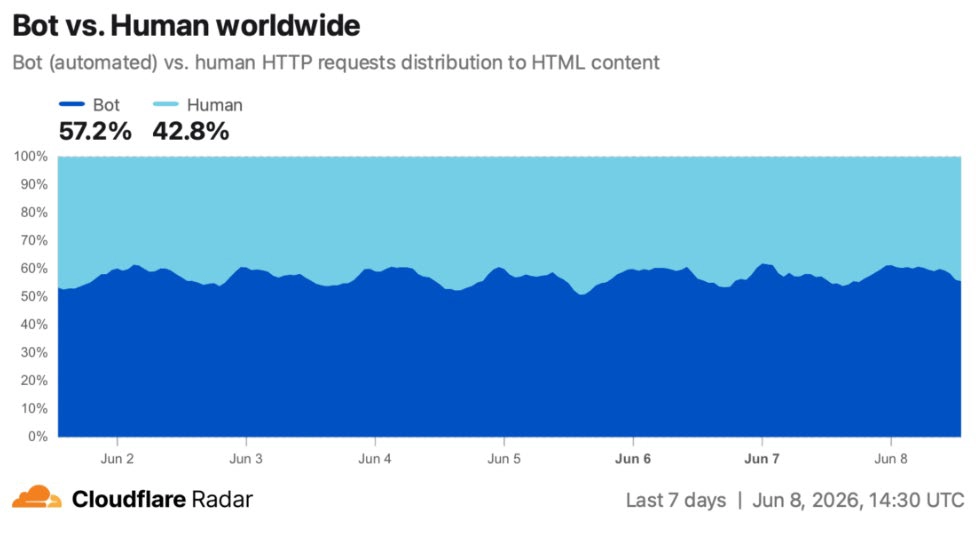
- Agentic AI bot traffic surpasses human traffic for the 1st time… agentic AI bots generated 57.4% of web requests globally, with humans accounting for just 42.6% (link)
- This means that more AI agents are visiting these webpages than real humans; Humans still physically engage with content more than AI does, but AI visits webpages more often
- Which countries have the most AI chatbot-related traffic? The island Gibraltar ranks first in bot traffic with 92.1%, followed by Singapore (76.3%), Iran (76.2%), Ireland (72.8%), and the Netherlands (68.8%)
New Entrants & Mkt Expansions In The Emerging The Robotaxi Industry
The pace of updates in the autonomous vehicle (AV) industry accelerated this week, led by the Mobileye making a big move to expand beyond just supplying AV technology. It now plans to be a vertically integrated robotaxi business. Equally of note were Uber’s new partnerships and market expansions (the Co is bringing robotaxi service to Houston in 2027 following the planned San Francisco Bay Area launch and is targeting a Zurich launch later this year).
Also, Japan’s Go raised $552.6mn in the country’s largest IPO YTD to support R&D and expansion of its robotaxi business while Tesla faces new scrutiny over reportedly self-published and inflated FSD safety statistics presented to European regulators.
See more below…
Mobileye’s New Vertically Integrated Robotaxi Vision
- Mobileye is now establishing a vertically integrated robotaxi biz (link)
- This is a “significant” evolution of Mobileye’s strategy: The Co will expand its robotaxi activities beyond just supplying self-driving technology and into full ownership of an autonomous ride-hailing biz
- Essentially the Co is combining autonomous driving capabilities w/ fleet operations, rider svs, and mobility mgmt into a single, vertically integrated offering
- The Co will combine its Mobileye Drive (its self-driving system) w/ the digital infrastructure of its Moovit subsidiary, which provides urban mobility data, trip-planning tools and a global passenger network
- This move will NOT alter Mobileye’s commitment to supplying Mobileye Drive to automakers, mobility operators, and other customers… “this initiative is not a replacement for our existing partnerships; it is an extension of them”
- Mobileye views direct robotaxi operations as a complementary path, accelerating deployment, generating operational learnings, and further demonstrating the capabilities of the Mobileye Drive platform at scale
- The Co is planning to deploy an initial 100-vehicle fleet in a major US city in 2027, after which they’ll aim to scale the fleet to ~17k vehicles over the next 5 yrs
- This is a “significant” evolution of Mobileye’s strategy: The Co will expand its robotaxi activities beyond just supplying self-driving technology and into full ownership of an autonomous ride-hailing biz
-> Mobileye’s stock was up +0.9% in reaction to the news but the stock is down -18.9% YTD
Uber Is Expanding Its Robotaxi Markets & Partnerships
- Uber is “scaling robotaxis globally” w/ a new Stellantis & Wayve partnership (link/link): The partnership will jointly explore the development and deployment of Level 4 (driverless) robotaxis at a global scale.
- This is an expansion of existing strategic relationships:
- Stellantis and Wayve’s recent L2++ agreement
- Wayve and Uber’s partnership to deploy autonomous rides in London, Tokyo, and 10 other cities globally will start this year
- Stellantis will design, engineer and manufacture at scale vehicles built on advanced L4-Ready Platforms
- Wayve will provide AI driving software that enables the vehicles to understand environments fully autonomously
- The tech is designed to adapt across different regions and driving conditions without relying on city-by-city mapping or re-engineering
- This will enable faster and more cost-effective expansion
- Uber will deploy these AVs on its global mobility network, connecting riders to autonomous trips through the Uber app
- This is an expansion of existing strategic relationships:
- Uber, Nuro, and Lucid also annc’d they are bringing robotaxi svs to Houston in 2027 (link/link): This is the 2nd planned city for their robotaxi program (1st was the San Francisco Bay Area launch later this year)
- Timing: Mid-2027, and the Houston svs will be provided exclusively through the Uber network, w/ plans to expand the svs to “dozens of additional markets over the coming years”
- Nuro is already conducting autonomous on-road testing w/ safety operators in Houston
- The robotaxi fleet supporting this work includes ~100 vehicles across CA and TX, w/ operations running 24/7
- The test fleet is expected to expand further in the coming weeks as Lucid manufactures the first production validation robotaxis at its AZ factory
- Uber also secured a 50k sq ft depot facility and dedicated charging station in Houston
- The facilities will enable Uber and its fleet partners to manage charging, maintenance, repairs, cleaning, and other day-to-day fleet operations at scale
- As a reminder this program was originally annc’d in Jul. 2025: It brings together Lucid’s EV and factory integration, Nuro’s Level 4 AV platform, and Uber’s global ride-hailing platform
- The overall program targets a minimum of 35k vehicles globally across dozens of markets over the coming years
- Uber and WeRide target robotaxis in Zurich “later this year” as their European expansion accelerates (link/link): This follows a recent annc’d expansion in Madrid
- The svs is expected to launch during 2026: Pending approval from Switzerland’s Federal Roads Office (FEDRO)
- Customers will be able to book rides through the Uber app, while local mobility and logistics specialist Rydera will oversee daily fleet operations under WeRide’s asset-light business model
- WeRide secured a driverless operations permit from FEDRO in Nov., allowing AV’s to operate on public roads in Zurich’s Furttal region
- The Cos intend to expand the fleet gradually as operational targets are achieved
- The planned Zurich rollout would increase the # of cities served jointly to 5, advancing the broader partnership agreement that covers 15 cities worldwide
- Since Dec. 2024, the two Cos have launched robotaxi services in Abu Dhabi, Dubai and Riyadh, while Madrid and Zurich are the latest part of the expansion
- The svs is expected to launch during 2026: Pending approval from Switzerland’s Federal Roads Office (FEDRO)
->Uber’s stock closed up +4% on the week, but is still down -12.3% YTD
Tesla Reportedly Sent “Misleading” Data To Regulators (link/link/link)
- Per Reuters, independent traffic safety researchers claim that Tesla submitted self-published, inflated FSD safety statistics to Dutch and Swedish regulators while lobbying for European approval, including:
- Claims that FSD-equipped vehicles travel 7x farther between crashes than the avg US driver and are up to 10x safer overall
- Researchers interviewed by Reuters said Tesla exaggerates the technology’s safety by comparing the rate of crashes in FSD-piloted Teslas that triggered airbag deployments to a US crash rate for all vehicles that includes far less severe accidents
- A separate Reuters investigation found this comparison error inflates Tesla’s claimed safety level by a factor of three
- Tesla also benchmarks its FSD-equipped fleet against the avg US vehicle, which is ~ 12 years old but researchers also argue that newer vehicles across all brands have better safety features that lower crash rates regardless of who’s driving, making the comparison misleading independent of the airbag issue
- Tesla’s claim that FSD could have saved 32k lives is based on the assumption that every vehicle in the US, including freight trucks and motorcycles, would be replaced by an FSD-enabled Tesla
- 10 of the 11 traffic-safety researchers who reviewed Tesla’s methodology for Reuters called the statistics misleading marketing rather than a serious safety study
- Telsa declined to comment to these press reports
-> Also in the mobility sector this week, taxi-hailing app provider Go raised 88.6bn yen ($552.6mn) in Japan’s largest IPO YTD; The deal was reportedly 25x oversubscribed; The Co plans to use the net proceeds to fund R&D of its robotaxi biz and support expansion efforts, including M&A within and beyond the taxi and ride-hailing industry (link/link)
More Strategic Moves In Video Gaming Emerge
Following our comments and updates on the video game industry in last week’s edition, additional key strategic developments stood out again this week. More specifically, EA is pushing harder into advertising w/ the launch of EA Advertising, which is a new platform designed to help brands connect with their 120m monthly player base across console, mobile and PC in FY2026. Player reaction will obviously be important and what also comes to mind is whether this will open the door to an ad-supported revenue model going forward.
At the same time, the leadership shuffles continue at Xbox, after its CEO last week flagged a company “reset” and several of its studios are said to be exploring spin-off discussions as the Co reassesses parts of its gaming portfolio.
Lastly, updates on Take-Two’s GTA 6 are always of note and on that front, a Piper Sandler analysis suggested that GTA 6 could sell 45mn copies on day 1, which is almost double their prior 20–25mn estimates and over triple GTA 5’s 11mn launch sales (LINK – TTWO shares were up +6% in reaction).
See more below…
EA Is Now Pushing Harder Into Advertising But How Will Players React? (link/link/link)
- The Co annc’d EA Advertising: A new platform “transforming how brands connect with audiences through digital and real-world experiences across its global portfolio of games”
- Brands will be able to integrate directly into game play, in real-time
- The Co is trying to better leverage its reach of 120mn players each month (in fiscal 2026) across console, mobile, and PC, and also its level of engagement
- Key aspects of EA Advertising:
- Integrations: EA Advertising partners directly w/ brands and agencies to create custom integrations designed for specific games and audiences
- Sports ad units: Advertisers can now reach fans through native ad units in select EA SPORTS games, including digital ad boards, scoreboards, and brand broadcast overlays
- Better targeting & measurement: Targeting will be powered by EA’s new proprietary ad server and SDK, custom built for EA’s Frostbite game engine
- EA SPORTS partner program gives brands access to opps, ranging from live events like EA SPORTS Presents Madden Bowl and things such as Ratings Reveals, in-game integrations, live service activations, creator tools, social play experiences, and community-driven programs
- EA Advertising’s early partners: Visa, Lowe’s, Red Bull, Xfinity, Peacock, and Mountain Dew
- Given that ads will be integrated into games that users are paying a high-ticket price for, will players push back or does this mean that an ad-supported model could be coming at some point in the future?
More Changes Ahead For Xbox As New CEO “Resets” The Company (link/link)
- Following new Xbox CEO Asha Sharma’s calling for a “reset” last week…
- Craig Duncan is stepping down as head of Xbox Game Studios, per The Game Biz
- He held the role for less than 2 years and previously led Sea of Thieves maker Rare for over a decade
- Duncan was responsible not only for helping with the upcoming Fable release, but also aiding in the Co’s strategy around exclusives and multiplatform releases
- Xbox Game Studios will now report up to chief content officer Matt Booty
- The Co’s Studios are also in flux
- Several studios in the Xbox gaming division, incl Montreal-based Compulsion Games and San Francisco-based Double Fine, are in active negotiations to spin off, per press reports
- Cambridge, England-based Ninja Theory, the maker of Hellblade, is also in conversations with Xbox, as are several other studios across the portfolio that are at risk of being shuttered
- The studios may still be able to buy themselves back from Xbox and go independent, although employees at several studios have been informed of the situation and given permission to seek new work, but were told that the status of the studios is still in flux
- Craig Duncan is stepping down as head of Xbox Game Studios, per The Game Biz
->Microsoft’s stock was down -1.5% in reaction to the news and is down -21.6% YTD
Verizon Pushes Further Into Value, Bundles & Loyalty
This week in connectivity, Verizon made a splash unveiling a new simplified wireless plan and loyalty rewards program. The company’s new Simplicity Plan is targeted to the value-single line subscriber and offers faster 5G access, hotspot data and satellite texting at a lower entry price for switchers. The Co’s new Shine loyalty program was interesting and includes weekly reward drops and Verizon Dollars tied to monthly bills, which can be used to purchase products and experiences. Separately, as a bit of a surprise, AT&T announced a CFO transition, with Pascal Desroches now set to retire at year-end after a four-decade career, and former AT&T executive Jennifer Biry is slated to rejoin the company as deputy CFO in July before taking over as CFO on Jan. 1, 2027.
See more details below…
-> Verizon’s stock was down -0.7% in reaction to the news but is up +11.4% YTD
-> Separately but related in connectivity this week, AT&T CFO Pascal Desroches annc’d that he will retire at the end of the year, ending a four-decade career; The Co named former AT&T executive Jennifer Biry as his successor; She will join as deputy CFO on July 9 and officially become CFO on Jan. 1, 2027; This was a surprise move for investors and AT&T’s stock dropped -3.1% in reaction to the news (link)
Verizon Introduced A New Value Single Line Oriented Plan (link/link/link)
- The new low cost “Simplicity” plan is priced at $45/month/line as a flat rate, no matter the amount of lines, but switchers who bring their number to Verizon pay $30/month/line: Subscribers get unlimited data, roaming in Canada and Mexico, 10GB of fast mobile hotspot data, and satellite texting
- How does this compare to the Co’s other plans?
- The Simplicity plan is $15/mo cheaper than one line under the Unlimited Welcome plan, which was the entry myPlan option with unlimited talk/text/data, 5G/4G LTE, Mexico/Canada talk/text/data and optional perks
- The Simplicity plan is $35/mo cheaper than one line under the Unlimited Plus plan, which adds in 5G Ultra-Wideband and 30GB mobile hotspot data
- The Unlimited Ultimate is the top-tier plan with 5G Ultra-Wideband, 4K streaming, international benefits and 200GB premium hotspot before slower unlimited hotspot speeds
- Customers can add optional perks such as streaming or cloud storage svs
- The Co is also offering customized bundles such as a For Movie and Show Lovers bundle that includes Disney Plus, Hulu, ESPN Plus (with ads), Netflix and HBO Max (with ads)
- The Co offers device payment plans in durations of 12, 24, 36 and 48 months
- Subscribers who want to upgrade their phone every year, they can opt for the Simplicity Plus or Simplicity Pro options, depending on the phone they want
- How does this compare to the Co’s other plans?
Verizon Launched A New Unified Home & Internet Bundle
- Verizon’s new Verizon One mobile and home internet bundle: Is “a truly combined plan for mobile and home” that puts postpaid unlimited wireless and home internet into a single plan with one bill, rather than just adding a discount to two separate services
- Availability: Only for new customers
- Cost: $70/mo, taxes and fees included
- Mobile: Specs are the same as the Simplicity plan
- Home internet: Speed depends on what’s available in a subscriber’s area
- If FIOS is an option, for example, the plan would start at 500 Mbps
- Customers can upgrade to higher speeds for an additional cost
The Co Also Is Enhancing Its Loyalty Program
- Lastly, Verizon also released a new loyalty rewards program called Shine
- Availability timing: It is available now to all Verizon’s postpaid unlimited plans subscribers who opt in
- The program will feature deal & product “drops”: On Mondays there will be different drops of deals and products, such as concert and sporting event tickets, dining vouchers, and gift cards
- It will also include the potential to win experiences: For instance, on Jun. 22, some customers will get to have breakfast with David Beckham as part of a 3-day trip to see the World Cup final
- “Verizon Dollars” will be accrued each month at a rate of 3% of your bill (not incl taxes and fees), starting in July
- The loyalty bucks can be used to purchase items from ~40 launch partners, including Sephora, Roblox, Hilton, Marriott and Starbucks, with the program expected to expand over time
- Loyalty members can NOT apply Verizon Dollars to reduce their bill, but they can use them for buying accessories through Verizon, such as phone cases, or put them toward a new device
- The dollars can be stored for 12 months
- Lastly, Verizon Dollars aren’t a 1 for 1 transfer (for example, one Verizon Dollar could get up to 5x its value from a partner such as a hotel)
The Global Advertising Picture Is Even Rosier, Per WPP
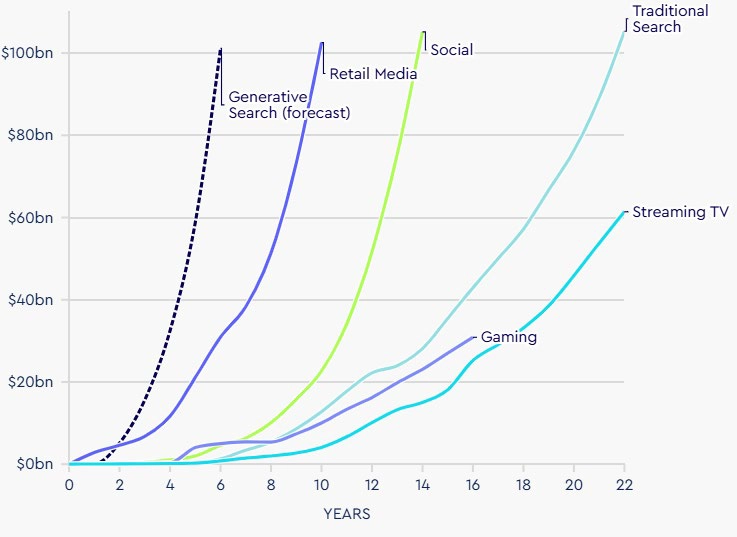
This week, WPP modestly raised its 2026 global ad forecast (ex US political) by 10bp to 8.9% and we highlighted a few charts and data that we found especially relevant and important.
Details are below…
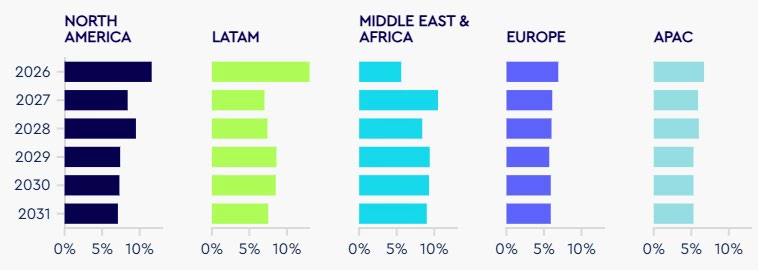
- WPP RAISED its 2026 global ad forecast (ex US political) from 8.8% y/y to 8.9% y/y, reaching $1.3 trillion: Note that the previous forecast was also raised from 7.7% earlier predicted. (link /link)
- Regional breakdown for 2026 estimates:
- US: 11.9%
- Middle East/Africa: 5.6%
- Latam: 13%
- Europe: 6.9%
- APAC: 6.7%
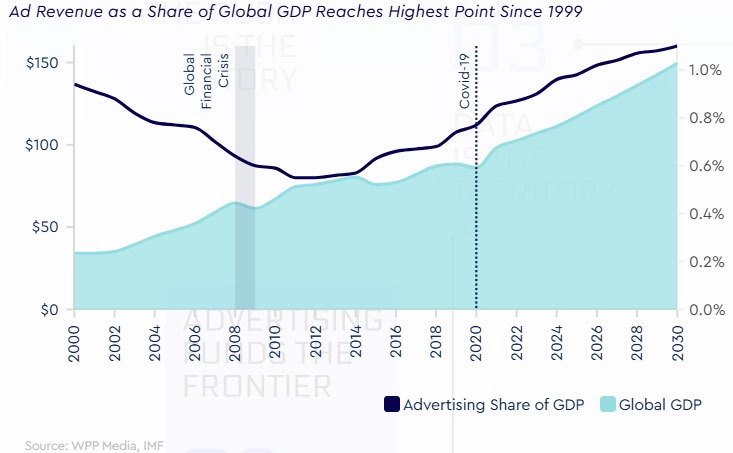
- An interesting chart in WPP’s update showed how total global ad revenue has been increasing as a % of GDP and that trend is expected to continue through their 2030 forecast period (surpassed 1999 levels along the way)
- Also, WPP projects that social will remain the largest single ad channel looking ahead and that it will be the greatest contributor to content-driven ad segment growth
- But y/y growth decelerates from 2027 as time spent on social platforms is expected to plateau or decline
- Age related restrictions will be a headwind
- AI chatbots will take share of time from social
- Scaling of generative search is expected to happen at a MUCH faster rate than was seen with Retail Media, and Social, not to mention Traditional Search, Gaming, and Streaming TV
- Traditional Search & Generative Search are anticipated to account for ~22% of total advertising revenue in 2026
-> Related to AI-search and shopping, per new data from Adobe Analytics, shoppers referred to retail websites by LLMs like Google’s Gemini or OpenAI’s ChatGPT generated 53% more revenue per visit and converted at a rate 54% higher than visitors from non-AI sources in May; AI traffic to retail websites jumped +138% y/y in May as well which is the highest share of total retail visits since Adobe began tracking this in October 2024; AI-referred shoppers also spent 53% more time on sites and visited more webpages than non-AI visitors (link)
Grab Bag: World Cup Stats / UK Confirms Social Media Ban / Apple Price Raise
- The World Cup viewership numbers are breaking records already… (link/link)
- Last Thurs nights’ Mexico-South Africa drew over 20mn viewers across Spanish- and English-language coverage for Thursday’s FIFA World Cup opening matchup
- Spanish-language coverage avg’d 13.4mn viewers across Telemundo, Peacock and Telemundo Deportes’ digital platforms (Spanish-language viewership was up +229% from the 2022 World Cup kickoff)
- English-language coverage avg’d 7.19mn viewers across Fox, Fox One and Tubi (English-language viewership was up +150% from the 2022 World Cup)
- Last Friday’s US Men’s National Soccer Team’s opening match against Paraguay, held at SoFi Stadium, set a record for the most-watched World Cup game on both and English and Spanish language television
- The match scored 18mn viewers on Fox and its streaming platforms, while Telemundo’s telecast averaged 9.5mn for a total of 27.5mn
- Through the first 16 group stage matches, an average of 6.7mn viewers have watched on Fox and cable network FS1 cable network, a +128% increase over the 2022 FIFA World Cup
- The first 12 group stage matches of the tournament drew an average of 7.5mn viewers on the Comcast-owned Spanish language network Telemundo, a +234% increase from four years ago
- Last Thurs nights’ Mexico-South Africa drew over 20mn viewers across Spanish- and English-language coverage for Thursday’s FIFA World Cup opening matchup
- The UK govt confirms a social media ban for kids under-16s (link/link)
- The ban will cover user-to-user platforms that enable social interaction and allow users to upload content, alongside algorithms
- This would include platforms such as Facebook, X, Instagram and YouTube, but not messaging svs such as Signal and WhatsApp
- The new measures follow a public consultation which received ~116k responses and saw 9 in 10 parents support a social media ban for under-16s
- The ban will cover user-to-user platforms that enable social interaction and allow users to upload content, alongside algorithms
- Timeline: The legislation is planned to go to Parliament before Christmas 2026, and come into force in spring 2027
- The govt. said it will also introduce a ban on harmful functions for under-16s, such as live streaming and stranger communications
- These will apply to a range of online platforms, such as gaming sites, and will be activated by default for under-16s and under-17s
- It will also consider overnight curfews and breaks to endless scrolling for children under 18, with more detail to be published later in July
- In addition, the use of AI ‘romantic companion’ chatbots will be restricted to people over 18, as well as similar intimate features on AI chatbots more widely
- After examining Australia’s social media ban, the UK gov. said it would adopt more highly effective age assurance (HEAA) steps to make it harder to children to get around protections
- Regulator Ofcom will quickly carry out a study on what would be effective age assurance technology for under-16s
- The govt. said it will also introduce a ban on harmful functions for under-16s, such as live streaming and stranger communications
- Apple to raise prices due to memory chip crunch, per CEO Tim Cook (link/link)
- The Co will increase prices on its products to offset the surging costs of memory and storage chips
- “Unfortunately, price increases are unavoidable…we’re doing our best to mitigate the huge increases that are being passed to us, and we’ve been trying to shield our customers from the increases, but the situation has become unsustainable”
- No details were shared on the timing or scale of the planned price increases, nor which products would be impacted
- But according to research firm TechInsights, Apple will need to make the upcoming iPhone 18 Pro ~$270 more expensive to keep its existing profit margin
- Cook noted that Apple does not plan to create its own memory and storage factories: “We can’t do everything…we know what we’re good at”
- As a reminder… Apple already raised the price of the Mac mini from $599 to $799 by eliminating its lowest-tier model; Apple has also eliminated several higher-tier Mac mini and Mac Studio options
Stock Market Check
This Week's Other Curated News
Artificial Intelligence/Machine Learning
- Pew Research finds ~50% of U. S. adults now use AI chatbots, up from 2024, w/ ~25% using them daily. Use centers on search & work, though some seek advice or support. Adoption of smart devices is rising, but views skew negative: many say AI advances too fast, risks data security, & may harm society more than help, despite modest gains in productivity & creativity. (Pew Research Center)
- SpaceX annc’d plans to acquire AI coding startup Cursor for $60bn in an all‑stock deal, following its Nasdaq IPO. Cursor, founded 2022, hit ~$1bn rev and saw rapid growth, though share slipped to 26%. The move aims to boost SpaceX’s AI tech to compete w/ rivals like OpenAI. Deal expected to close in Q3, pending approvals, w/ potential fees if terminated. (CNBC)
- A US judge dismissed xAI’s lawsuit accusing OpenAI of stealing trade secrets, ruling xAI failed to prove OpenAI induced an ex-engineer to share confidential data. The case was dismissed w/ prejudice as futile, marking Musk’s 2nd legal loss vs OpenAI in ~4 weeks. Court said discussing past work in hiring is routine and not evidence of wrongdoing. (Reuters)
- OpenAI spent $34bn last yr as it ramped investment ahead of a planned IPO, highlighting AI boom economics. About $19bn went to R&D and ~$6bn to sales & marketing, alongside heavy costs for models, data centres and hiring. Despite rapid growth to ~$13bn rev and ~$2bn monthly run-rate by end-2025, costs outpaced rev, underscoring pressure on profitability. (Financial Times)
- Salesforce annc’d a $3. 6bn deal to acquire AI customer svc platform Fin, boosting its agentic AI push via Agentforce amid rising competition. Fin’s AI agents handle chat, email, WhatsApp, phone & Slack queries using its Apex model. The deal, set to close FY27 Q4, supports Salesforce’s biz as AI disruption intensifies across SaaS mkts. (CNBC)
- China’s AI Co DeepSeek raised >$7. 4bn in its first round at >$50bn valuation, per report. Funding used an unusual structure routing investments via a LP controlled by CEO Liang Wenfeng to retain control. Investors face 5‑yr lockups w/o voting rights, except a state AI fund. Liang, Tencent, and CATL are key backers as DeepSeek cont’d to gain global AI prominence. (Reuters)
Cable/Pay-TV/Wireless
- Comcast annc’d same-day Wi-Fi gateway delivery for new Xfinity Internet customers across ~20 mkts, w/ plans to expand nationwide by early next yr. Orders placed by 3 pm qualify for same-day arrival or store pickup. The move cuts wait times from up to a wk, improving onboarding. Users can access 23mn hotspots pre-install and self-install via app, part of cos push to enhance customer experience. (Fierce Network)
- Ericsson Mobility Report annc’d global 5G subs hit 3. 1bn after +162mn adds in Q1 2026, forecast to reach 6.4bn by 2031. 5G now carries 48% of mobile traffic, seen rising to 85%. SA slicing offers rose to 84, signaling mainstream adoption. Uplink traffic growth outpaces downlink for most CSPs, driven by apps & cloud, w/ AI to boost further. Network traffic grew 22% YoY, led by India & North America. (Ericsson)
- BCE Inc. annc’d plans to cut ~690 jobs (~1% of workforce), incl ~230 union roles, as part of ongoing org changes tied to efficiency and fibre network shifts. Moves align w/ a three-yr cost-saving goal of $1.5bn by 2028. Prior layoffs incl 650 roles in Nov. and 4,800 in 2024. Co also raised its AI biz rev target to ~$2bn by 2028, up from $1.5bn. (Yahoo Finance)
Capital Market Updates
- Nvidia annc’d a $20bn bond sale, its first in 5 yrs, spanning 2–30 yr maturities to refinance debt and fund AI expansion. Deal could grow and is led by major banks. Part of a broader tech borrowing surge for AI infra, w/ peers raising large sums. NVDA also invests heavily in AI cos and reported record $81.6bn rev (+85% YoY) w/ strong cash flow. (Yahoo Finance)
Cloud/DataCenters/IT Infrastructure
- Databricks annc’d its annualized rev jumped 80%+ YoY to $6. 9bn as demand for its data & AI tech surged. CEO Ali Ghodsi said growth is fueled by agent-based AI, though rising usage is pressuring margins due to higher costs. AI svs rev reached $1.7bn. The Co is expanding into cybersecurity & industry tools while customers shift toward cost-efficient AI usage. (CNBC)
- Data centre deals are attracting billions despite geopolitical tensions, w/ $58bn in 42 transactions vs $34bn in 34 deals in 2025, per Dealogic. ~850 projects worth $7tn are under way globally, led by US & China. Major investments include €1.2bn DayOne Finland plan and €371mn Green Mountain deal. (Financial Times)
- Google annc’d Brazos, a rack-mounted liquid-to-air cooling system enabling high-density AI/HPC deployments in existing air-cooled data centers. The system handles chips exceeding 1000W TDP, avoids costly facility retrofits, and supports ~60 kW per rack. Its modular, plug-and-play design allows rapid installs, w/ closed-loop cooling, leak detection, and easy servicing, targeting scalable next-gen infra. (Google Cloud)
- AMD and Rackspace Tech annc’d a definitive deal to deploy ~30MW of AMD AI compute across global data centers from late 2026–2028, targeting regulated industries. The pact builds on a prior MOU, combining AMD GPUs/CPUs w/ Rackspace’s governed AI cloud to deliver scalable, accountable infra. (Rackspace)
- Rackspace Tech annc’d a workforce realignment cutting ~15% of staff, approved Jun. 10, 2026, w/ layoffs cont’d over 6 mnths. The move shifts focus to enterprise AI while reducing legacy cloud svs. Co expects $14mn–$19mn in 2026 restructuring costs and ~$75mn–$85mn annual savings to reinvest in AI. (Investing.com)
Crypto/Blockchain/web3/NFTs
- Binance, world’s largest crypto exchange, is set to lose permission to operate in EU after its MiCA licence bid via Greece is likely to be rejected, sources said. Without approval by end-Jun., it cannot serve EU clients from Jul. Regulators aim tighter oversight of crypto mkts; Binance says it worked w/ watchdogs and will support an orderly transition for users. (Reuters)
Cybersecurity/Security
- Apple plans to change its Hide My Email feature by shifting anonymous addresses to @private. icloud.com, making it easier for apps/sites to detect and block such sign-ups. The iCloud+ privacy tool previously worked as addresses matched standard @icloud.com ones. Existing emails will cont’d to function, but users criticized the move, which may reduce anonymity and effectiveness of the service. (TechCrunch)
- Cybersecurity leaders incl. Nvidia, Adobe urged the US to lift curbs on Anthropic’s AI models, saying limits hinder efforts to detect and fix software flaws amid rising cyber threats. The govt had ordered access restricted over security risks, but experts argue rival models offer similar capabilities and warning the move could aid foreign competitors, esp. China, and weaken defenses. (Reuters)
- Google said a Chinese-linked hacking group targeted U. S. & Canadian research orgs for over a yr (Sept. 2023–Nov. 2025), stealing sensitive data on defense, AI, cyber warfare & medical research. The group, UNC6508, used REDCap flaws to access networks, capture login details & auto-forward emails via keywords, before detection & notification of affected institutions. (Reuters)
eCommerce/Social Commerce/Retail
- Alibaba is weighing acquiring grocery delivery platform Pupu to strengthen its position in China’s fast-growing quick-commerce mkts and compete w/ Meituan. The potential move comes as regulators warn platform cos to rein in aggressive price competition. Discussions are ongoing, with the deal aimed at boosting Alibaba’s grocery and delivery biz presence. (Nikkei Asia)
- U. S. shoppers referred via AI tools like ChatGPT or Gemini browse longer and spend more. Adobe data shows AI-driven visits generated 53% higher rev per visit, w/ 54% higher conversion rates. AI traffic to retail sites rose 138% YoY in May, reaching a record share since Oct. 2024. Such users also spend 53% more time and view more pages, boosting personalization and sales potential. (Reuters)
FinTech/InsurTech/Payments
- Robinhood annc’d plans to cut ~10% of its workforce (~290 roles) to streamline operations and flatten management layers, aiming for greater efficiency. The Co said it remains financially strong, w/ record Jun. trading volumes despite earlier profit miss tied to crypto volatility. It expects ~$28mn in restructuring costs and will cont’d selective hiring while expanding broader financial svs beyond trading. (Reuters)
Handheld Devices & Accessories/Connected Home
- Apple’s roadmap incl. AirPods w/ cameras, targeting a 2027 launch, designed to give Siri visual context of surroundings and support future smart glasses. Tests tie to iOS updates. Apple is also planning a 2nd foldable iPhone, signaling cont’d focus on the category, plus new iPhone designs w/ edge-to-edge displays and upgraded chips. (The Verge)
- Alphabet’s Google began rolling out Android 17, first to Pixel devices, w/ other brands to follow in coming months. The update adds improvements in multitasking, social media video, and gaming, while setting up future agentic AI capabilities due later this yr. Some key AI features will be delayed for a few months. (Bloomberg)
Macro Updates
- A US appeals court allowed Trump’s 10% global tariff to remain, lifting a prior injunction that halted collections for select importers and Washington state. The court signaled the govt is likely to prevail, disputing earlier claims the levies were unlawful under Section 122. Judges also cited potential harm if blocked, noting the case is ongoing and not final. (Supply Chain Dive)
Media Conglomerates
- Paramount Skydance’s planned takeover of Warner Bros Discovery has received US antitrust clearance following an eight-month DOJ review. The probe concluded the merger would not harm competition across SVOD, linear TV, or film production segments, allowing the Cos to proceed w/ the deal without regulatory objections in key entertainment mkts. (Telecompaper)
Regulatory
- Illinois Gov. JB Pritzker signed a $55.9bn state budget, targeting affordability w/ $100mn food aid, $250mn housing, and $350mn school funding boost. It includes new taxes on social media cos expected to raise ~$200mn, plus smaller levies, though some face legal challenges. Measures also pause a fuel tax hike and add a sales tax holiday, while Republicans criticized rising spending and ~$800mn in new taxes. (Chicago Sun-Times)
- Amazon may face U. S. FTC lawsuit over claims it misled advertisers, potentially leading to civil penalties, per Bloomberg. Probe by FTC’s consumer protection unit, w/ state attorneys general, focuses on ad pricing transparency and auction practices. Case may conclude via suit or settlement by summer. (Reuters)
- Italy’s antitrust regulator annc’d a probe into Apple over Digital Markets Act compliance, focusing on cloud svs interoperability. Authorities said rival providers lack equal access to iOS/iPadOS components, putting them at a disadvantage vs iCloud. The case marks Italy’s first DMA probe, w/ findings to be sent to the EU Commission. (Reuters)
- The UK CMA annc’d two conduct rules for Google Search to ensure fair ranking and data portability. The Fair Ranking rule requires objective, non‑discriminatory results incl. AI Overviews, more transparency and notice of changes, and clear complaint routes for biz. A second rule makes Google’s data‑sharing tool a legal right, enabling third‑party svs. (GOV.UK)
- EU Commission said it is assessing practical implications of a U. S. export control affecting AI Co Anthropic, which annc’d it would disable advanced models for foreign nationals over security concerns. The Commission warned measures should not be discriminatory and stressed need to boost Europe’s tech sovereignty while reviewing impacts on users. (Reuters)
Satellite/Space
- AST SpaceMobile (ASTS) stock jumped >3% overnight as BlueBird 8–10 satellites were cleared for SpaceX launch, marking its first deployment since Apr. setback. New sats aim to boost network capacity, w/ ~2,400‑sq‑ft arrays delivering nearly double speeds. Move supports AST’s plan to deploy 45 sats this yr amid rising competition. (Yahoo Finance)
- Elon Musk said SpaceX could hit ~$1T rev by 2030, days after its IPO valued the Co at >$2T. He added rev may exceed that in 2031. SpaceX became the 6th-largest U.S. firm, though its earnings lag peers. 2025 rev rose to $18.67bn from $14.02bn, but it posted a $4.94bn loss vs prior $791mn profit. (Reuters)
- SpaceX’s IPO raised $85. 7bn after underwriters exercised a “greenshoe” option, adding 83.3mn shares to an initial $75bn haul. Priced at $135, stock surged 19% debut, valuing co at ~$2.1tn. Funds will support Starship rockets, Starlink expansion, and AI data centers. Despite strong demand, co reported $4.9bn loss last yr, w/ high valuation multiples. (CNBC)
Social/Digital Media
- Meta annc’d Threads hit 500mn monthly users, adding ~100mn in 10 months. The Co introduced “Your Algo,” letting users privately tailor feeds for 1–7 days, boosting personalization. Threads also expanded Communities w/ a new hub, distinct icons, and broader Live Chats rollout, aiming to strengthen real-time engagement and compete w/ X. (TechCrunch)
- Meta annc’d “AI Mode” on Facebook, letting users ask questions in plain language and get answers synthesized from public posts across Groups and Reels. The feature aims to boost engagement but raises accuracy concerns since info comes from user content. Meta also added AI editing tools for videos and photos, expanding efforts to grow platform use and AI-driven rev streams. (TechCrunch)
Sports/Sports Betting
- The New York Knicks’ 2026 NBA Finals Game 5 win over the Spurs drew 24. 5mn viewers across ABC/ESPN, peaking at 33mn, marking the most-watched Game 5 since 1998. The Jun. 13 broadcast capped a series avg of ~20.6mn viewers, ~2x 2025 levels. The Knicks clinched their first title since 1973, led by Finals MVP Jalen Brunson’s 45 points in a 94-90 comeback victory. (Variety)
- FIFA World Cup kicked off w/ strong ratings as Mexico–South Africa drew >20mn viewers across Spanish & English broadcasts. Spanish coverage hit 13.4mn, English 7.19mn, w/ records for most-watched opening match; viewership rose 229% vs 2022. U.S.–Paraguay also surged, topping 18mn English viewers, setting new streaming & broadcast highs. (TheWrap)
Tech Hardware
- Donald Trump said Apple will partner w/ Intel to design and manufacture chips in the U. S., aiming to diversify supply beyond TSMC amid strong AI demand. The deal, after >1 yr talks, could boost Intel’s struggling chip biz and ensure steady demand. Intel shares rose ~6.5%. The move aligns w/ U.S. efforts to strengthen domestic semiconductor supply chains. (Reuters)
Video Games/Interactive Entertainment
- A group incl. Saudi Arabia’s PIF sought EU antitrust approval for a $55bn acquisition of Electronic Arts, per a filing. The European Commission set a Jul. 22 deadline to clear the deal, impose remedies, or launch a probe. The group, incl. Affinity Partners and Silver Lake, annc’d the deal last Sept. and still needs clearance under EU subsidy rules. (Reuters)
- A Piper Sandler report suggests GTA 6 could sell ~45mn copies on day one, far above prior 20–25mn estimates and over 3x GTA 5’s 11mn 2013 launch. Analysis of subreddit data vs ~15 AAA launches drove the forecast, boosting Take-Two stock ~6%. Despite limited official info and smaller install base, hype cont’d to impact mkts. (TheGamer)
- Roblox is rolling out biometric age‑verification tech to improve child safety, using facial analysis to estimate users’ ages and assign tiered accounts. Kids 5–8 face strict limits, while teens gain gradual access. The move comes amid lawsuits and safety concerns, though it has sparked privacy worries and user backlash, w/ daily users falling from 152mn to 132mn as changes disrupt gameplay and dev activity. (NBC News)
Video Streaming
- Leaked audio shows Disney exec said Co isn’t building a “super app” linking parks, cruises, or retail, countering earlier reports. Focus is on streaming, w/ priority to integrate Hulu into Disney+. The effort, part of “One Disney,” aims to unify svs and improve user experience. Hulu app may be phased out as users shift to Disney+. (Business Insider)
