


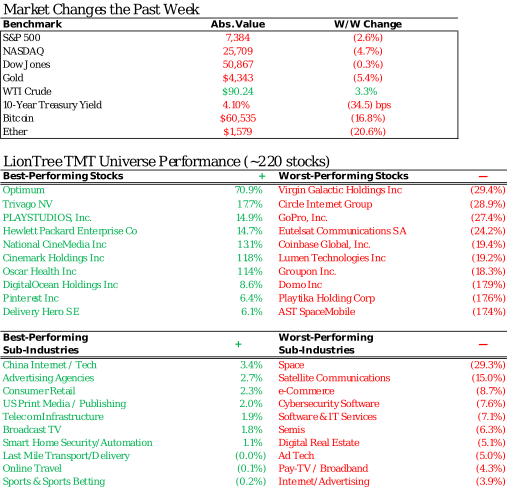
Volatility emerged in full force this week with a huge tech rally to start to the week and an even bigger tech sell-off to close the week. Investors were quick to hit the sell button on Tech after what seemed like an endless number of days doing nothing but going straight up. See Theme #1 for some details and perspectives on the market moves today but for the week, the S&P 500 fell -2.3% while Nasdaq fell -4.7%. On the fundamental side, it was a busy week with updates across AI (of course), the predictions market, video games, box office, and streaming, among other key developments.
In this edition we focused on:
- Investors Were Quick To Hit The “Sell Tech” Button On Friday
- AI Is Now Moving Beyond The Data Center And Into Daily Compute
- Big AI Financings Moves From The Debt & Venture To The Equity Markets As Alphabet Looks For More Funding
- There Was No Shortage Of Key AI Developments This Week
- Will Overall AI Compute Costs Go Down As Token Costs Decline? Probably Not
- Kalshi’s Push Into Perpetual Futures Created A Stir…
- What Is The Latest On What % Of The Population Plays Video Games?
- YTD Box Office Is On Fire…Can The Momentum Hold?
- Retention Rates For Streaming Ad-Supported Tiers Mirrors That Of Ad-Free
- Grab Bag: SpaceX Targets $135 Per Shr / Pershing Sells UMG / AT&T Refreshes Home Fiber Plans
Also to mention, LionTree Advisors is proud to have served as financial advisor to Hyve Group, Providence Equity Partners L.L.C., and Searchlight Capital Partners on the sale of Hyve to Hellman & Friedman.
Have a nice weekend and also on the positive side, the World Cup starts next week!
Best,
Leslie

Investors Were Quick To Hit The “Sell Tech” Button On Friday
After what seemed like non-stop ascending stock prices in the tech sector, and especially in the semiconductors sector, it all come to halt on Friday after a stronger-than-expected jobs report triggered greater odds of a rate hike. That was enough for investors to broadly dump tech shares. In our view, the massive reaction reflects the high levels of FOMO that had been propelling stocks, which makes investors quick to run for the doors when the selling starts. Monday’s market reaction will be telling if investors do, or do not, buy the dip.
Within the S&P 500 on Friday, investors most significantly rotated out of IT (-5.8%), but also sold off Consumer Discretionary (-2.4%) and Materials (-2%) and rotated into defensives like Consumer Staples (+1.6%) and Utilities (+0.8%).
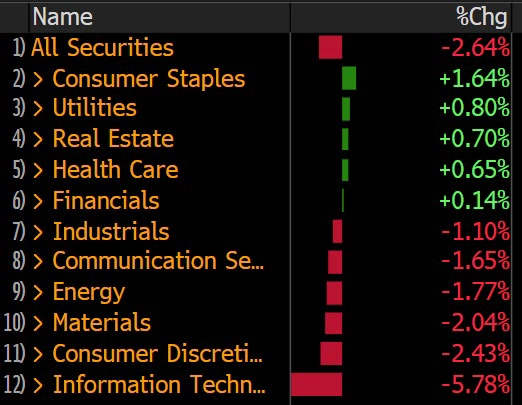
Source: Bloomberg
Which stocks were the worst performers in the S&P 500 and Nasdaq on the day? See list below.
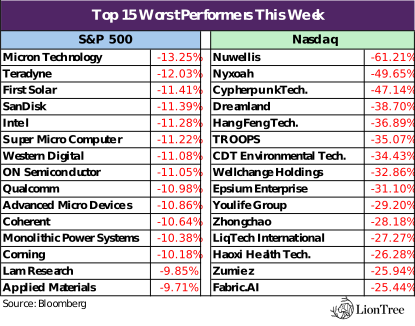
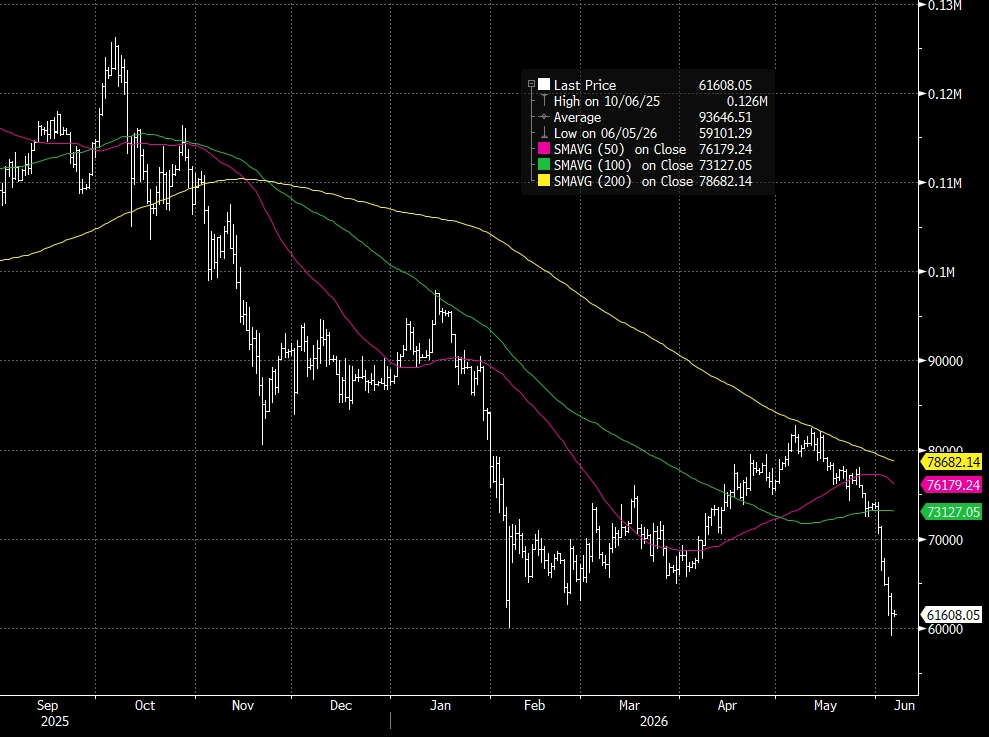
Also to flag, Bitcoin hit a new 52-week low at 61,625 on Thursday and is down -16% for the week, down -30% YTD and down -50% from Oct 2025 levels. Earlier in the week we saw a stat that over 50% of total circulating supply of BTC was in a state of unrealized loss (link)…obviously that would have been a higher number if calculated at the end of the week.
Source: Bloomberg
AI Is Now Moving Beyond The Data Center And Into Daily Compute
Putting aside Friday’s tech meltdown as mentioned above, the semi and software sectors were once again in the spotlight to start the week on the back of comments and new products at the Computex conference in Taipei, which drove Monday’s tech rally. The main theme was that the AI cycle is moving beyond the data center and will now become more embedded in daily computing, business software, and robotics. Nvidia’s move into AI PCs with the launch of the RTX Spark/N1X in partnership w/ Microsoft (which weighed on Intel and AMD on the day), new announcements regarding physical AI, and the reiteration that Vera Rubin was still on track for Q3:26, collectively gave investors more confidence in continued strong chip demand for the Co. CEO Jensen Huang’s reassuring and bullish comments helped lift not only Nvidia’s stock, but also PC suppliers, chip-design names and software stocks. HOWEVER, the software IGV ETF gave back all its gains by Wednesday, and while the SOXX continued to rally through Thursday, both ETFs fell out of bed during Friday’s sell-off …
See below for what we viewed as the most impactful updates and comments from Nvidia’s keynote and its product announcements.
- Nvidia is “not just a GPU company, not just a systems company, but an infrastructure company” (link/link/link)
- AI is no longer just about cloud infrastructure and GPUs…AI is now moving into personal computers, enterprise workflows, robotics, autonomous systems, and real-world use cases
- Nvidia annc’d RTX Spark/N1X in partnership w/ Microsoft, which is designed to reinvent the PC for the agentic computing… “this is the first reinvention of the PC literally in 40 years”
- The behavior of PCs will change… “It will do everything that it used to do better. And then it will do something else. It will also be your assistant”
- Nvidia’s new chip, built on ARM architecture and co-developed with MediaTek, will feature in more than 30 laptops and 10 desktops from Dell, HP, Lenovo, Microsoft Surface and others
- “I can totally imagine that someday there’s actually an AI supercomputer in your house, running all of your agents, all of your assistants, doing all kinds of things for you all the time”
- Huang was also vocal about physical AI with new product announcements…”in physical AI, we are absolutely the world’s best”
- Annc’d Isaac GR00T reference humanoid robot platform: Built for university researchers and robot developers worldwide
- Annc’d Cosmos 3: A new open AI model designed to help robots understand the physical world
- Huang argued that software will be more, vs less, in demand as agents will need to use more tools, not fewer
- “A lot of people have said, Jensen, AI is coming, agentic AI is coming, therefore all of the software companies are going to go out of business. I said it’s exactly the opposite. Because there are going to be so many agents, the world is no longer limited by the number of people. Therefore, those agents are going to use more tools than ever”
- Agents will need to interact with databases, spreadsheets, design tools, cybersecurity platforms, workflow systems, and business applications
- “This is actually an incredible time to be a software company”
- On software engineer jobs… “The number of engineers, software engineers, is actually increasing. People talk about AI reducing jobs. Complete nonsense. It’s causing more software engineers to be hired”
- Huang also confirmed that “Vera Rubin is in full production”…
- How did this all-impact semis and software stocks this week? The Software rally on Monday was short-lived and both sectors took it on the chin on Friday (especially the latter)
- The IGV software sector had a huge +6% rally on Monday, helped by Huang’s reassuring comments mentioned above
- 95% of stocks in the ETF traded up
- ~20% of stocks in the ETF traded-up DOUBLE DIGITS
- BUT the IGV gave back all the gains by Wednesday and subsequently fell -6% for the week (down -4% on Friday)
- The SOXX Semiconductor ETF traded up throughout the week (hit a new high on Wednesday) until the massive -10.4% sell-off on Friday (was up +5.4% WTD through Thursday)
- The IGV software sector had a huge +6% rally on Monday, helped by Huang’s reassuring comments mentioned above
Big AI Financings Moves From The Debt & Venture To The Equity Markets As Alphabet Looks For More Funding
AI infrastructure financing continues to accelerate rapidly. Alphabet’s ~$85bn equity raised (successfully upsized from the initial proposed $80bn) underscores the scale of capital required to support AI compute buildouts. The transaction included concurrent public offerings of common stock, mandatory convertible preferred securities, a $40bn ATM program (expected to begin in Q3), and a $10bn private placement with Berkshire Hathaway.
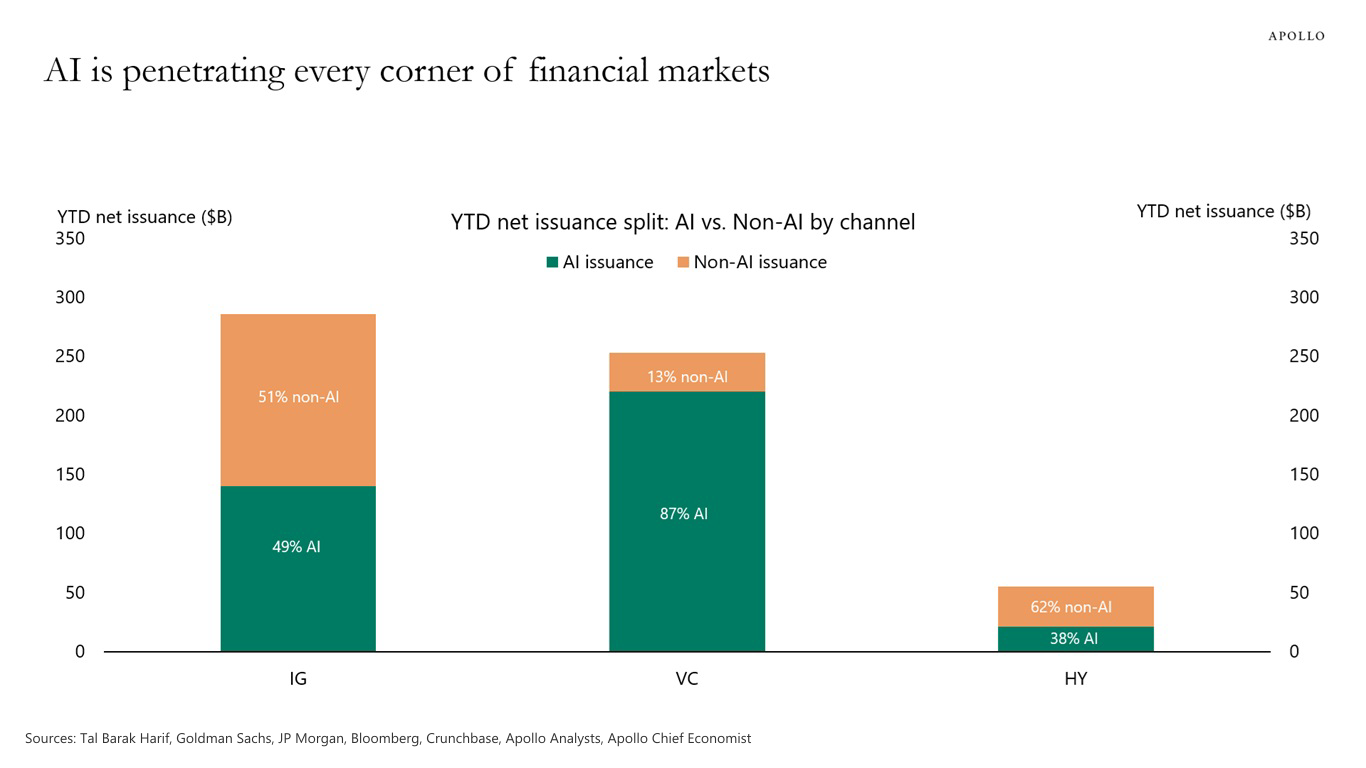
This massive equity raise (the largest ever!) follows what seems like a non-ending string of debt, venture, and high yield AI-related financings YTD, which has reached an est’d ~$380bn (per a report earlier in June leveraging data from Apollo) and represents ~64% of total capital flows across those channels. AI-related companies have comprised nearly half of IG issuance, most of the VC funding, and over one-third of high-yield bond activity per the analysis.
See more details below…
-> Alphabet shares fell as much as -5.5% during the week before recovering to close down -2.8%; YTD it is still up +16.6%
Alphabet’s Equity Raise = The Largest Equity Raise Ever (link/link/link/link)
- Alphabet priced its upsized $84.75bn equity capital raise (from the original $80bn) to expand AI infrastructure: The transaction includes a mix of public share sales, preferred depositary offerings, a private investment, and a planned at-the-market (ATM) program
- The Co now plans to sell ~$18bn of Class A and Class C common stock combine (priced at $355.1982/shr and $351.8018/share respectively), up from $15bn previously planned
- The Co also upsized its depositary share offerings to $16.75bn from the earlier $15bn target
- The Co maintained its annc’d $40bn ATM program (will start in Q3)
- As part of the deal, Berkshire Hathaway agreed to provide an anchor $10bn private placement investment
- $5bn in Class A Common Stock at a price of $351.81 per share
- $5bn in Class C Capital Stock at a price of $348.20 per share
- This investment adds to the fund’s $20bn+ position it has built since Q3:25, bringing its total position to over $30bn once closed
- Use of proceeds? General corporate purposes, including capx to scale AI infrastructure and global compute
- The Co reiterated its 2026 capex target of $180-190bn and that 2027 capex will “increase significantly” y/y
- Once closed, Alphabet’s equity raise will mark the largest stock sale ever
- SpaceX’s IPO target raise of $75bn is a close second
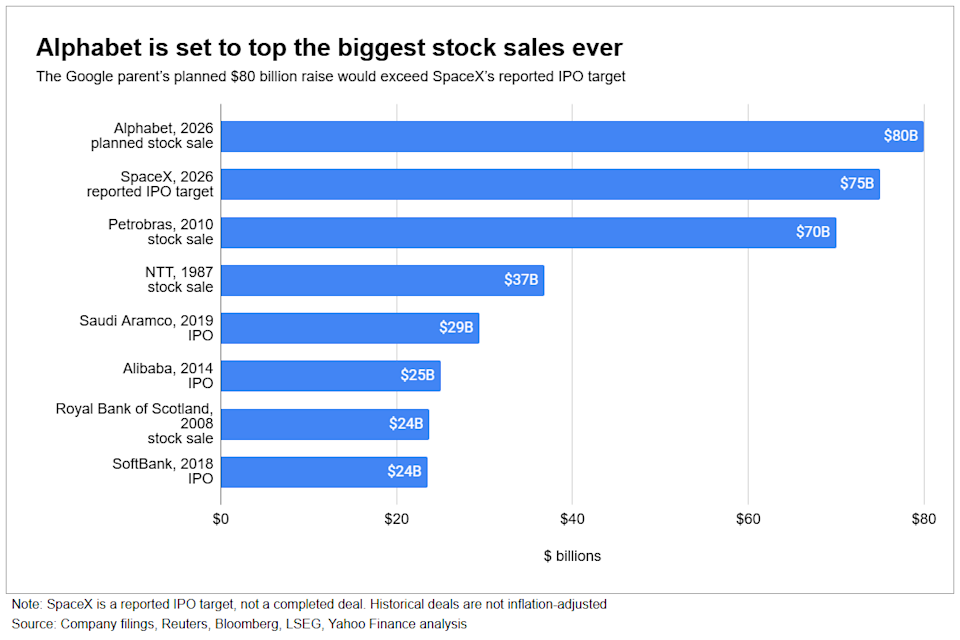
Source: Yahoo Finance
Alphabet’s Equity Transaction Follows A String Of Large AI-Related Debt Deals In The Market
- AI companies have raised ~$380bn across all IG, HY, and VC, YTD, reflecting ~64% of all capital flows (link/link/link)
- ~$140bn in investment-grade bonds YTD: 49% of the total investment-grade issuance, according to new analysis from the Kobeissi Letter
- ~$21bn in high-yield corporate bonds: AI has accounted for 38% of total issuance
- ~$220bn in VC funding YTD, making up 87% of the total: Nearly 9 in every 10 Dollars of VC funding has flowed into AI-related firms
Source: Apollo
There Was No Shortage Of Key AI Developments This Week
AI updates were broad-based this week, spanning IPO activity, user adoption, enterprise agent launches, and model releases. Anthropic confidentially filed its S-1(officially beating OpenAI!), while chatbot MAU updates showed ChatGPT reaching 1bn MAUs and Gemini scaling to 900mn+ MAUs. Meta introduced its new Business Agent, which helps businesses answer customer questions, recommend products, book appointments and close sales across WhatsApp and Messenger, with more than 1mn businesses already using the tool.
On the conference circuit, Microsoft used Build 2026 to launch a broad set of new AI model and agentic products across its stack. Also, OpenAI expanded Codex beyond software development with six new role-specific plugins for data analytics, creative production, sales, product design, public equity investing and investment banking, while DeepSeek is reportedly planning to raise ~$7.4bn in its first funding round.
See more below…
Anthropic Confidentially Filed For Its IPO This Week
- Following Anthropic last week raising $65bn in a funding round valued at $965bn, it confidentially filed its S-1 this week (link)
- Claude sits at 56mn MAUs as of May, which is 6% of ChatGPT’s base but is growing at +640% y/y annually versus ChatGPT’s 62%
AI Chatbot MAUs Continue To Scale…Updates From OpenAI and Gemini (link/link/link/link)
- ChatGPT reached 1bn MAUs in May, ~3 years after launch, surpassing the pace set by apps including Google Maps, TikTok, Instagram and YouTube, Sensor Tower said
- HOWEVER to note, US ChatGPT users who installed Anthropic’s Claude app in Q1:26 spent 5% less time on ChatGPT 1 month after installation, compared with their average usage in the prior 8 months
- Google says Gemini app is at 900mn+ MAU’s as of May
- The Co expects Gemini 3.5 Pro to be available in June 2026
Meta Launches A New Business AI Tool…And Early Reception Is Strong (link/link)
- The Co intro’d Meta Business Agent…it is an agent that businesses can be set up in minutes or plugged directly into an existing enterprise infrastructure so Cos can generate 10X or even 100X the output

Source: link
- More than 1mn businesses are already using a Meta Business Agent on WhatsApp and Messenger to respond to customers
- Because there are more than 1bn active threads with businesses on WhatsApp, Messenger and Instagram every day, a Business Agent can deliver more relevant, personalized experiences from the “very first interaction”
- What can companies do with their Business Agent?
- Answer questions specific to their business
- Make product recommendations from a business catalog
- Book appointments and qualify incoming leads
- Decide when a team member steps in to provide support
- Close sales
- What is to come?
- The Co will be expanding Business Agent to Instagram
- Businesses will also be able to access the agent through paid subscription offerings, with “options for businesses of every size” in the coming months
–>Meta’s stock was up +4% in reaction to the news, but is down -10% YTD
A Few Callouts From Microsoft Build 2026 (link/link)
- The Co annc’d 7 new AI models…
- MAI-Thinking-1…Microsoft AI’s “first reasoning model”
- Trained “from scratch with zero distillation” on “enterprise grade, clean and commercially licensed data”
- Built for “high efficiency and performance” at a “low-token cost”
- Designed for “complex multi-step instructions, long-context reasoning and code generation”
- Open now on Foundry in private preview
- MAI-Image-2.5…Microsoft’s first model to serve text-to-image workloads and also support image editing
- Live in PowerPoint, rolling out on OneDrive, and landing on Foundry
- MAI-Image-2.5 Flash
- Flash variant of MAI-Image-2.5
- Supports creative workflows for “taking a concept into reality” or “enhancing existing image work”
- MAI Transcribe 1.5… “best transcription model in the world, with SOTA accuracy”
- 5x faster than competing models, with built-in support for domain-specific terminology across 43 languages
- MAI-Voice-2… natural speech generation model
- Now available in “more than 15 additional languages” with “new voice options”
- MAI-Voice-2 Flash
- Flash variant of MAI-Voice-2
- Also part of the expanded voice model availability
- MAI-Code-1…MSFT’s first AI model designed to generate source code from text prompts
- An “inference efficient coding model tuned for GitHub”
- Now available in Copilot and VS Code
- MAI-Thinking-1…Microsoft AI’s “first reasoning model”
- …as well as some new agentic releases
- Web IQ…a search engine for AI systems
- Suite of AI-native APIs that acts as a dedicated search and grounding engine for autonomous AI agents
- Returns relevant passages at “nearly 2.5x the speed of the next best alternative”
- Microsoft Scout…Microsoft’s first Autopilot agent
- A new “personal agent for work,” available to Frontier customers now
- Built on OpenClaw and WorkIQ
- Integrated across the Microsoft 365 apps, connecting to Teams, Outlook, OneDrive, and SharePoint, as well as chats, email, calendar, and contacts
- Understands how you work and “proactively handles things like meeting prep, scheduling conflicts and routine tasks without asking”
- Web IQ…a search engine for AI systems
- A key quantum update…released their next-gen quantum computing chip Majorana 2
- Has an “average qubit lifetime of 20 seconds with instances up to a minute”
- Offers “1,000x higher reliability” than the previous generation
- Provides “a path to one million qubits on a chip that fits in the palm of your hand”
- The Co’s says that “with the help of agentic AI,” it will achieve a scalable quantum machine by 2029
–> MSFT’s stock ended the first day of BUILD 2026 down -3.2% and ended the second day flat; For the week, the stock closed down -7.5%
OpenAI Launches New Plug-Ins That Make Codex Useful For More Work Use Cases (link/link)
- OpenAI annc’d new role-specific plugins, sites, and annotations for Codex
- More than 5mn people now use Codex every week
- Codex started as a tool for software development, but it’s increasingly useful for more kinds of work
- Non-developers (incl analysts, marketers, operators, designers, researchers, investors, and bankers) make up ~20% of overall Codex usersand are growing more than 3x as fast as developers
- More than 5mn people now use Codex every week
- The Co launched 6 new role-specific plugins…
- Data analytics plugin: Helps analysts and business teams answer questions with data, explain metric changes, and create reports / dashboards
- Creative production plugin: Helps marketing and creative teams turn briefs into campaign boards, ad variations, lifestyle shots, and ecommerce-ready image sets
- Sales plugin: Helps sales teams bring customer context into deal work, from account signals and meeting prep to follow-ups, CRM updates, close plans, and deal-risk reviews
- Product design plugin: Helps teams turn early ideas into prototypes, explore product directions, audit user flows, and make screenshots interactive
- Public equity investing plugin: Helps investors review earnings, compare companies, track signals, and assess whether an investment thesis is strengthening or weakening
- Investment banking plugin: Helps bankers turn research and diligence into client-ready materials, including pitch materials, comps, transactions, and recommendations
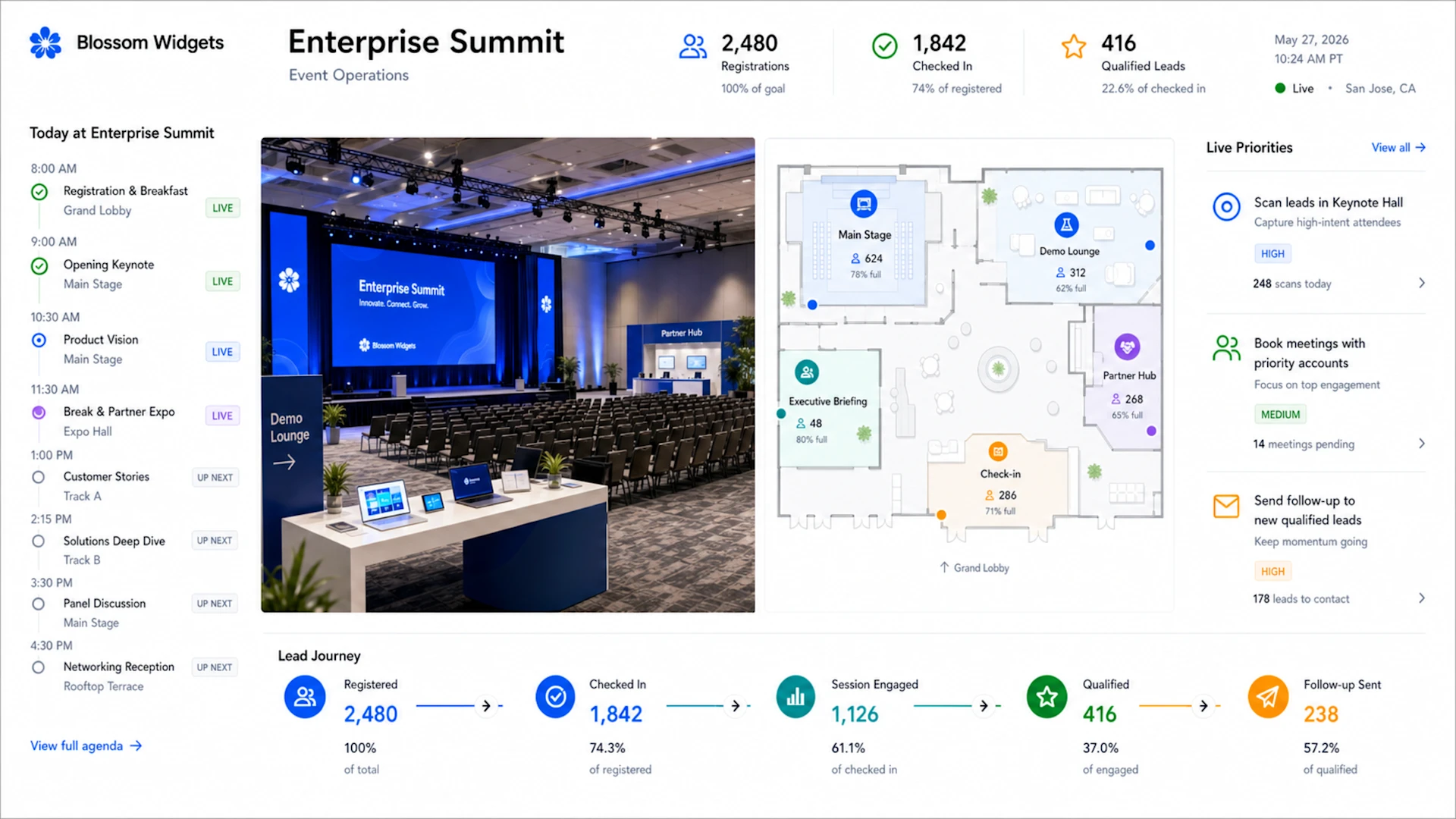
- Additionally, starting in preview for biz and enterprise customers, Codex can now create and share interactive, hosted websites and apps
- Codex can take your ideas, analysis, and plans and turn them into dashboards, planners, review workspaces, project boards, galleries, and lightweight tools
- Today, sites can be shared with anyone in your workspace via URL
- Sites aren’t static, they can also help track progress for a major project, help guide customer service reps, or act as a repository for your team’s creative briefs
- Codex can take your ideas, analysis, and plans and turn them into dashboards, planners, review workspaces, project boards, galleries, and lightweight tools
Source: OpenAI
DeepSeek Is Also Planning To Raise Equity (link/link)
- DeepSeek is reportedly set to raise about 50bn yuan ($7.4bn) in its first funding round from investors including Tencent Holdingsand CATL people with knowledge of the matter said; The planned number of investors is fewer than 10
- Valn: The fundraising could value the Co after the investment at between 350-400bn yuan, or $52-$59bn, the people said
- Potential investors: The startup’s founder, Liang Wenfeng, has committed 20bn yuan of his own money, the people said, adding that Tencent is considering 10bn yuan and CATL is looking at 5bn yuan; Other potential investors include:
- China’s national artificial intelligence fund
- NetEase
- com
- IDG Capital
- Monolith Capital
- Timing: DeepSeek is expected to complete the round within the next couple of weeks, per source
Will Overall AI Compute Costs Go Down As Token Costs Decline? Probably Not
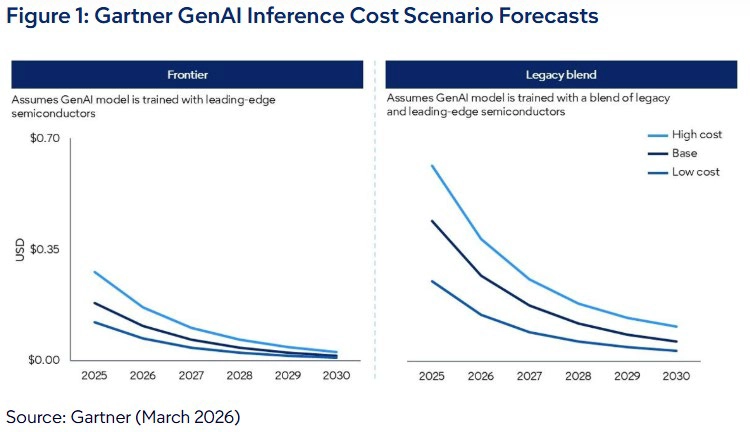
When it comes to AI, when it rains, it pours. Also related, we wanted to highlight some interesting projections that we came across regarding AI token and compute costs. Gartner’s latest forecast suggests that the cost of GenAI inference is set to decline sharply by 2030, driven by improvements in chips, infrastructure, model design, and utilization. HOWEVER, on offset will be the by rapid growth in total token consumption as AI systems become more agentic, complex, and embedded across workflows. As a result, enterprises need to focus on smart model orchestration rather than simply accessing cheaper tokens.
See more details below on what caught our attention.
- Performing inference will cost GenAI providers DRAMATICALLY LESS (link)
- By 2030, performing inference on an LLM with 1 trillion parameters will cost GenAI providers over 90% less than it did in 2025
- This level of cost improvement is expected to come from…
- Semiconductor and infrastructure efficiency improvements
- Model design innovations
- Higher chip utilization
- Incr’d use of inference-specialized silicon
- Use of edge devices for specific use cases
- Gartner also forecasts that LLMs in 2030 will be up to 100x more cost-efficient than the earliest models of similar size developed in 2022
- HOWEVER, this lower genAI provider token costs might NOT be fully passed on to enterprise customers
- Advanced AI use cases require far more tokens than today’s mainstream applications
- Agentic models, for example, require 5-30x more tokens per task than a standard GenAI chatbot
- Agentic models can also perform many more tasks than a human using GenAI
- Advanced AI use cases require far more tokens than today’s mainstream applications
- As token usage rises faster than token costs fall, OVERALL inference costs are expected to increase
- “As commoditized intelligence trends toward near-zero cost, the compute and systems needed to support advanced reasoning remain scarce”
- Value will shift to platforms that can orchestrate workloads across multiple types of models
- Routine, high-frequency tasks should be routed to the below as these models can outperform generic solutions at lower cost when tailored to specialized workflows.:
- Smaller language models
- Domain-specific language models
- Expensive frontier-model inference should be:
- Heavily gated
- Reserved for high-margin tasks
- Used only for complex reasoning needs
- Routine, high-frequency tasks should be routed to the below as these models can outperform generic solutions at lower cost when tailored to specialized workflows.:
Kalshi’s Push Into Perpetual Futures Created A Stir…
Activity in the predictions markets heated up as well this week. Following Kalshi’s updates late last week, which including its expansion into the art market and the launch of its American Power Index, the company announced another significant product update this week, which is moving prediction markets into crypto perpetual futures. Kalshi launched what it describes as the first US-regulated perpetual futures contract, beginning with Bitcoin, and subsequently filed to add perpetual contracts across 12 additional crypto assets.
See more below…
–-> This update spooked the traded Exchanges on concerns about Kalshi being approved for perpetual future contracts in other areas as well; CBOE, CME, NDAQ and ICE were all down -15.5%, -5.9%, -5.7%, and -4.3% respectively this week
Following The Stir Last Week, Kalshi Annc’d Yet Another Impactful Update (link/link/link/link)
- Kalshi launches first-ever perpetual futures or “Perp” in America
- The Co filed on Mon to add perpetual futures contracts on 12 altcoins, 3 biz days after the CFTC approved its BTCPERP bitcoin contract as the first US-regulated crypto perpetual
- The submission covers perpetuals on ether, XRP, solana, dogecoin, stellar, chainlink, bitcoin cash, litecoin, sui, shiba inu, polkadot and hedera
- The Co filed on Mon to add perpetual futures contracts on 12 altcoins, 3 biz days after the CFTC approved its BTCPERP bitcoin contract as the first US-regulated crypto perpetual
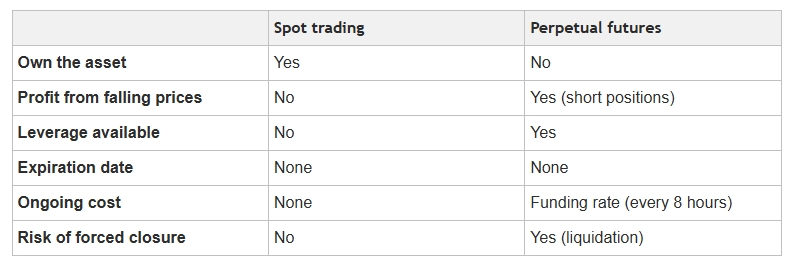
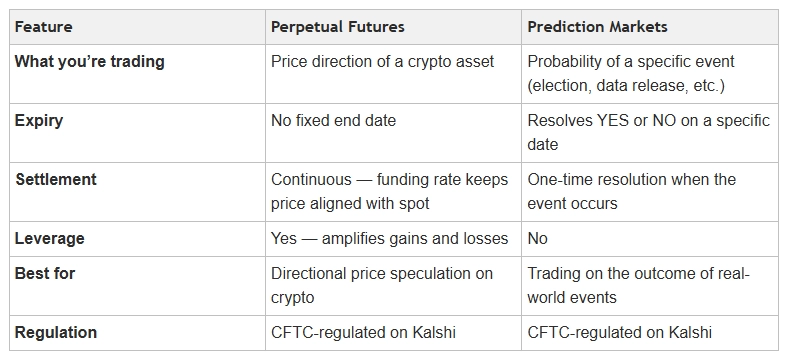
- What is this? A perpetual future is a derivative contract that lets you take a position on the price of a crypto asset, without owning it and without an expiration date
- If you think the price of Bitcoin is going up, you go long
- If you think it’s going down, you go short
- Unlike a traditional futures contract, which locks you into a set price on a specific date, a perpetual future has no end date
- You hold it for as long as you want and close it when you’re ready
- How does this compare to spot trading and the prediction markets as a whole?
Source: Kalshi
- Looking ahead, the piece that’s still unknown is timing
- The CFTC has not committed to a comparable pace for the 12 follow-on altcoin contracts
- The lower-cap, more volatile names, could be sent back for redesign or denied outright
–> Also this week on a related basis, Coinbase expanded its “Everything Exchange” with the launch of pre-IPO perpetual futures, giving eligible traders price exposure to private companies before they list on public markets, with no equity ownership or complex brokerage onboarding; Its first listing is SpaceX, offered as a USDC-settled perpetual futures contract referencing SpaceX’s implied mkt valn, with 24/7 trading, no expiry, no rollover and PnL realized directly in USDC; When SpaceX completes its IPO, positions will automatically rebase using the official outstanding share count and the contract’s price will transition to SpaceX’s public market price; Coinbase shrs were up +0.6% in reaction to the news (link)
What Is The Latest On What % Of The Population Plays Video Games?
The answer is approx. two-thirds of the US population. Gaming is no longer just something kids do after homework. More than 212mn Americans ages 5–90 now play video games. That was one of the key takeaways from the Entertainment Software Association’s 2026 Essential Facts About the U.S. Video Game Industry report.
What also stands out is how broadly gaming now reaches across audiences, households, and entertainment budgets. The avg player is 37 yrs old, parents are playing with their children, many families view games as a more constructive alternative to social media, and consumers increasingly see video games as strong value for money vs other forms of media.
See below for what we thought were the most interesting stats from the report. Full report can be downloaded HERE.
Video Games Continue To Appeal Across Generations, Moods, And Genres
- More than 2 in 3 American play video games = 212.3mn Americans b/w the ages of 5-90
- Avg player age = 37 yrs old
- While kids still love to play games, more adults are playing than ever before
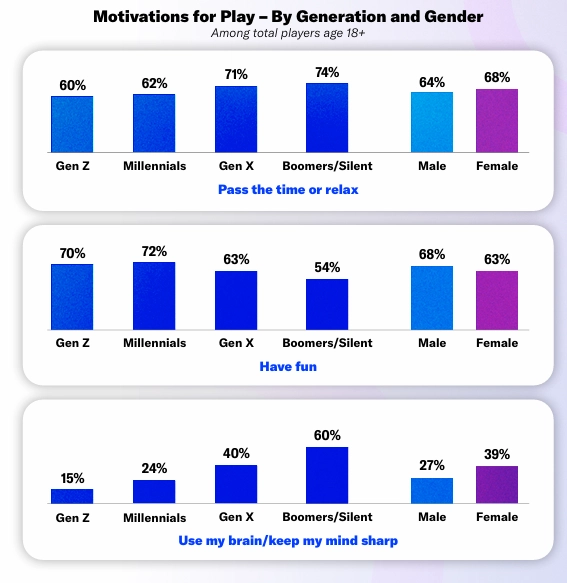
- The top two reasons that Americans play video games are to relax and to have fun…older generations also play to keep their minds sharp
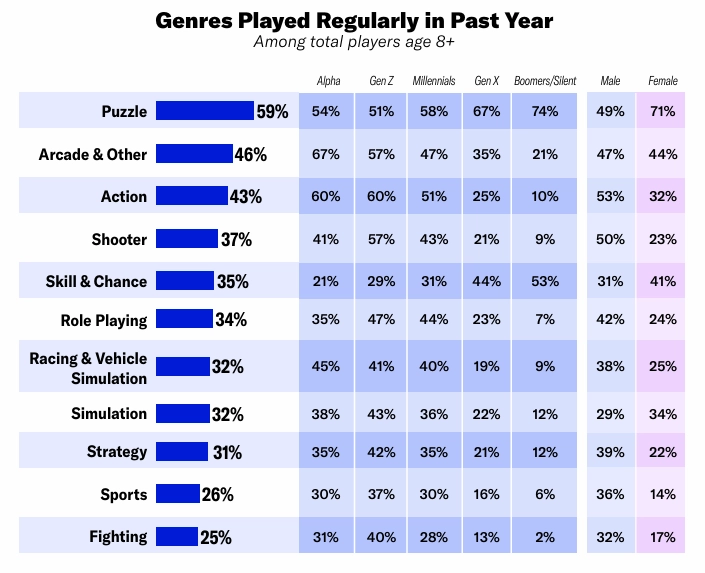
- Puzzle, arcade, and action games are the overall favorite genres among Americans
Gaming Is Becoming A Shared Family Activity
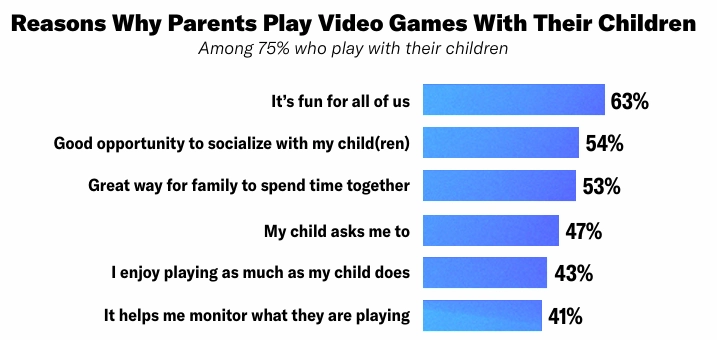
- 75% of parents play video games…of those who do, 81% have played video games w/ their children
- More than half (52%) of parents who play video games play with their children weekly
- 73% of parents prefer their child spend time playing video games than on social media
- 7 in 10 of all parents say playing video games offers more potential benefits for their children vs social media
Gaming Is Winning On Both Spend And Value
- Total consumer spending on video games in 2025…$60.7bn = $52.3bn on content + $5.4bn on hardware + $2.95bn on accessories
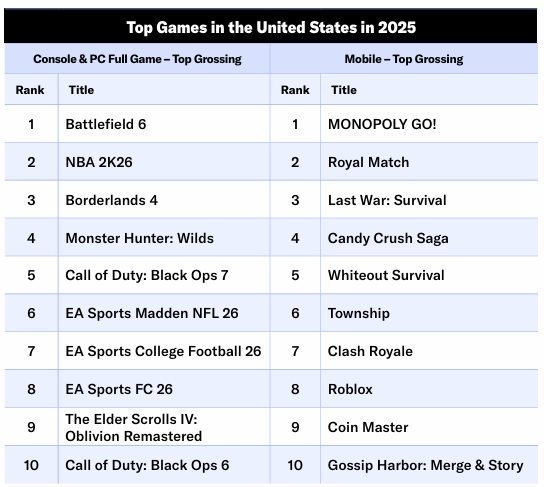
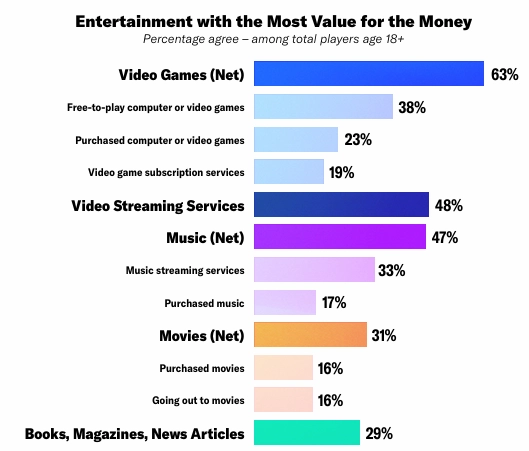
- …and most players agree that video games offer better value for money vs video svs, music, movies, or books, magazines, & news articles
YTD Box Office Is On Fire…Can The Momentum Hold?
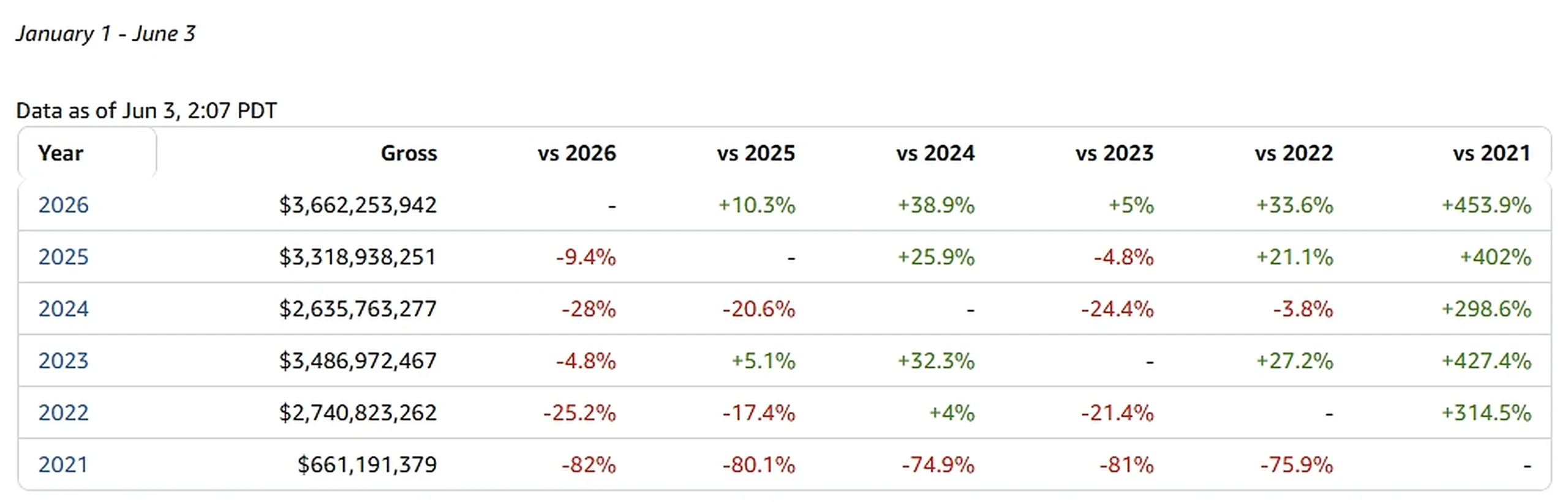
The domestic box office continues to show signs of real momentum, with YTD grosses already +10% higher than all of 2025 and above the post-COVID peak of $3.5bn in 2023 (per Box Office Mojo). This drove AMC and Cinemark shares to new highs and the Co’s remains bullish on what is to come. See more below…
The Box Office Is On Fire, Driving Cinemark & AMC Shares Notably To New Highs
- AMC Entertainment recorded its highest domestic and global May attendance since 2019 (link)
- Total guests at theaters reached 25.5mn globally
- So far in 2026, most domestic box office results are consistently meeting or exceeding expectations
- This weekend, Backrooms made $81mn domestically, becoming the 6th film in the past 10 weeks to debut above $75mn domestically in their opening weekends
- Other films since March 20th that opened to more than $75mn domestically in 2026 include:
- The Mandalorian and Grogu
- The Devil Wears Prada 2
- Michael
- The Super Mario Galaxy Movie
- Project Hail Mary
- AMC CEO Adam Aron is bullish on the outlook… “Week after week in 2026, it’s been clear that as Hollywood has been releasing well-made and well-marketed movies”…“Undoubtedly, you will understand and appreciate our enthusiasm when you look at the line up of just some of the films coming to our theatres over the next 5 weekends”
- Titles like Scary Movie, Masters of the Universe, Disclosure Day, Toy Story 5, Supergirl and Minions & Monsters are all upcoming
–>AMC’s stock was up +22.5% in reaction to the news but closed the week up only +3.5%
- Also, Cinemark reached an all-time high domestic box office for May (link)
- AND achieved its highest-ever food and beverage per cap spend for the month as well
- CEO and President, Sean Gamble said “We are proud to have achieved an all-time high May box office, driven by a compelling slate of releases from our studio partners, strong moviegoer demand for larger-than-life, cinematic experiences and our team’s outstanding execution to maximize the opportunity”
–>Cinemark’s stock was up +11% in reaction to the news and maintained those gains throughout the week to end up +12%
- YTD, the Domestic Box Office has already reached $3.67bn, which is up +10% vs all of 2025 and surpassed the post-COVID peak of $3.5bn in 2023, per Box Office Mojo (link/ link): May alone reached an est’d $1.06bn
Source: Box Office Mojo
Retention Rates For Streaming Ad-Supported Tiers Mirrors That Of Ad-Free
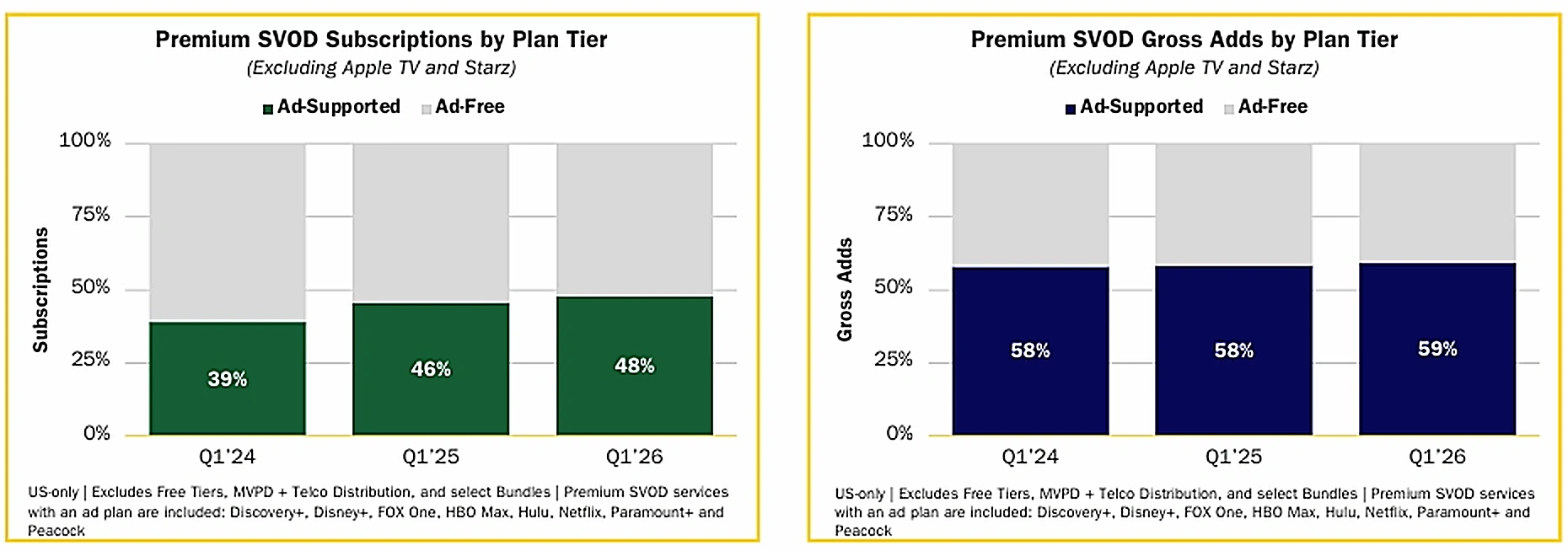
We have come a long way since early debates about whether consumers would accept ads inside premium subscription services given that ad-supported streaming now accounts for almost 50% of subscriptions across services that offer ad tiers and an even larger share of new subscriber growth. This was as per Antenna’s June 2026 State of Subscriptions: Adds & Ads report which made our top themes cut this week.
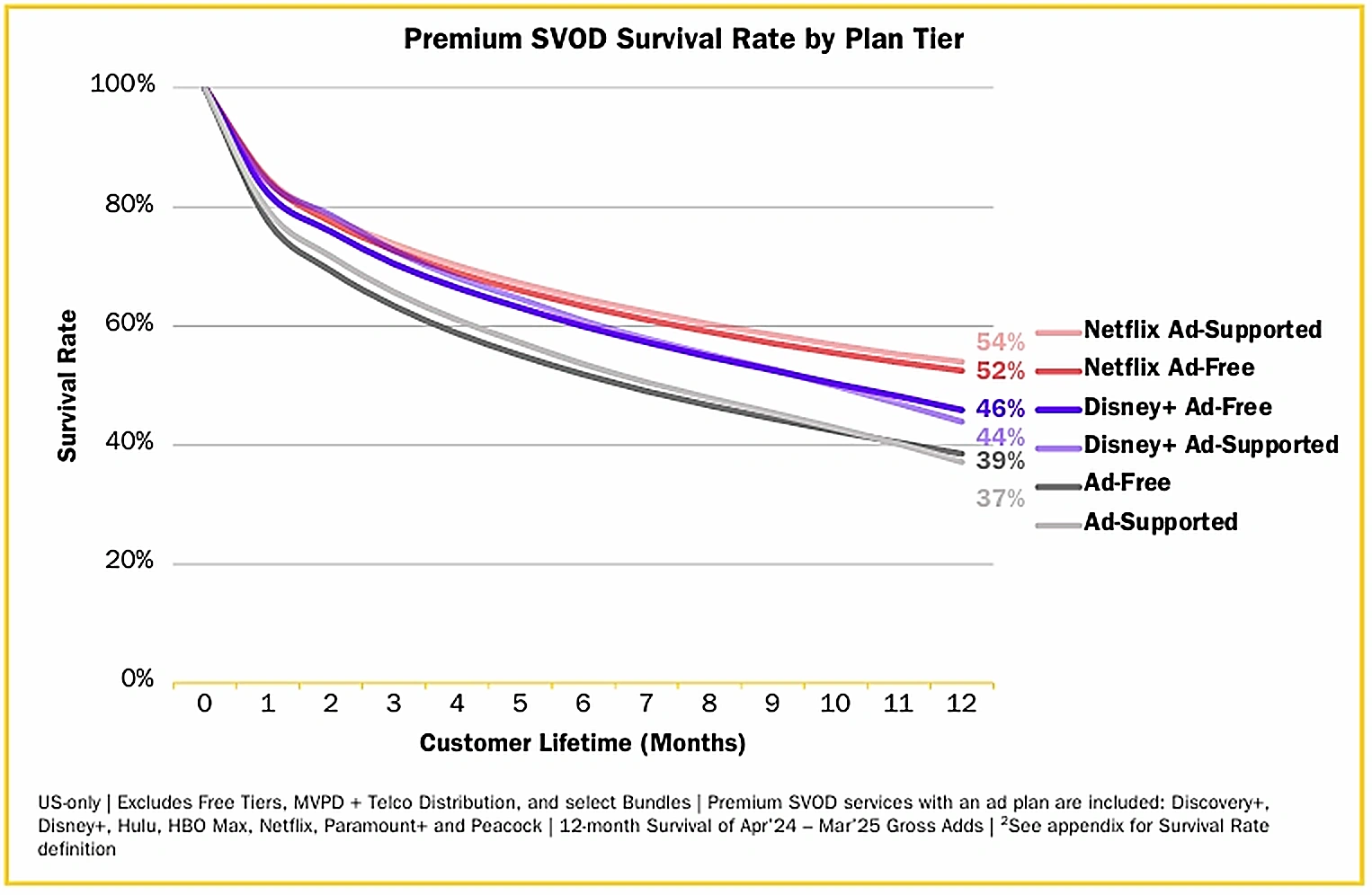
So overall, consumers continue to choose these ad-supported tiers as a lower cost way to enter or return to a service but what we found even more interesting is that the retention rate of ad-supported very closely mirrors that of ad-free, though could both could still use improvement (month 12…37% and 39% survival rate, respectively).
See below for what we thought were the most incremental callouts in the report, which you can also access HERE.
Key Background Stats To Set The Stage
- Antenna estimates there are now 110mn+ ad-supported streaming plans in the US, excluding Amazon Prime Video
- For the services that offer ad plans, they account for…
- Almost HALF of current subscribers (48%)
- 3 in 5 Q1 Gross Additions (i.e. acquisition)
- 4 in 5 Net Additions in the past 9 quarters (i.e. growth)
Ad-Supported Growth Is Outpacing Ad-Free
- Ad-supported SUBSCRIPTIONS increased +13% y/y in Q1:26 vs ad-free increased +4% y/y
- Ad-supported GROSS ADDS grew +16/% y/y in Q1:26 vs ad-free increased +12% y/y
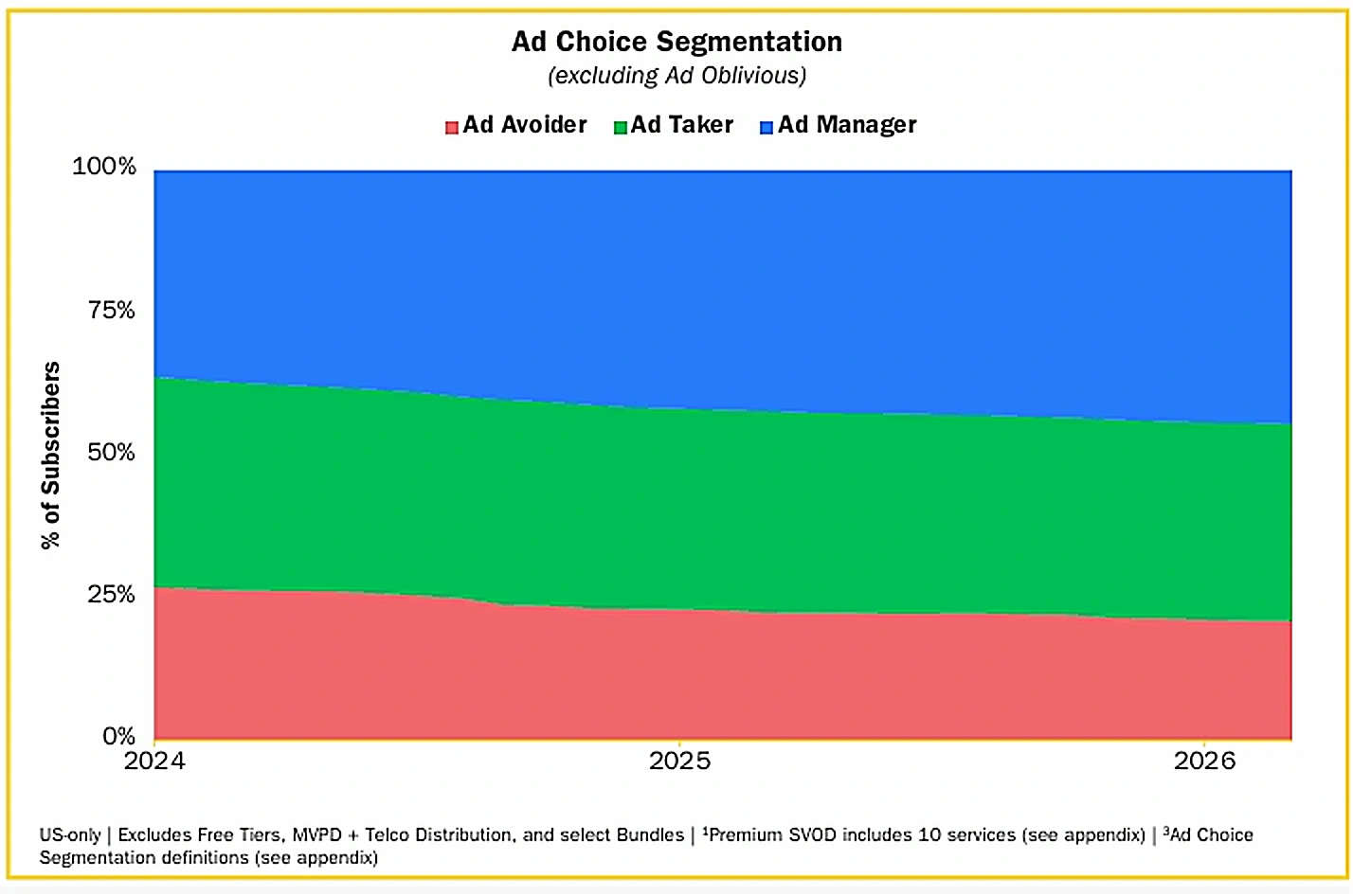
Consumers Facing An Ad Choice Are Largely Opting Into Ads & Interestingly Retention For Ad-Supported Plans Closely Match That Of Ads Free
- 4 in 5 who face an ad choice choose ads
- “Ad Managers” (opted in to both ad-free and ad-supported plans) represent 44% of individuals who faced an ad choice
- Segment grew +13% y/y as of Q1:26, adding 6.4mn consumers to its ranks in Mar 2026
- “Ad Takers” (opted in to only ad-supported plans) represent 35% of individuals
- Segment grew +6% y/y as of Q1:26, adding +2.4mn consumers to its ranks in Mar 2026
- “Ad Avoiders” (opted in to only ad-free plans) represent 21% of individuals
- Segment only grew +0.5% y/y, adding +0.1mn consumers
- “Ad Managers” (opted in to both ad-free and ad-supported plans) represent 44% of individuals who faced an ad choice
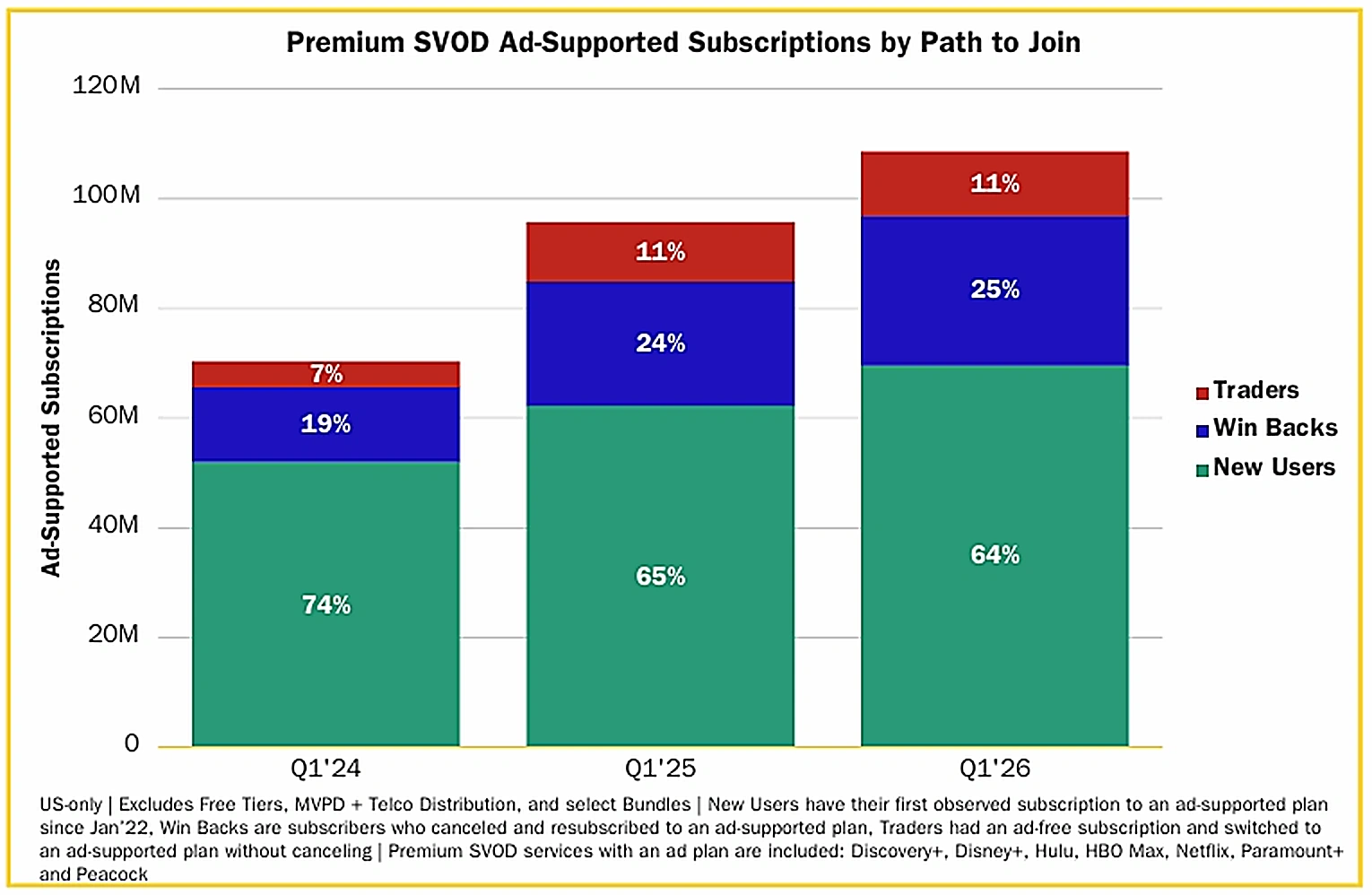
- Most ad plan subscribers are new to the service
- New users account for the largest share at 64%
- Survival rates for ad-supported and ad-free plans closely match…with Netflix having the highest retention rates
- Month 1: 79% of ad-supported Gross Adds remained, vs. 78% of ad-free
- Month 3: ad-supported at 66%; ad-free at 63%
- Month 6: ad-supported at 54%; ad-free at 52%
- Month 12 (small reversal): ad-supported at 37%; ad-free at 39%
Grab Bag: SpaceX Targets $135 Per Shr / Pershing Sells UMG / AT&T Refreshes Home Fiber Plans
- SpaceX IPO targets $75bn at $135/shr (link/link/link)
- This would bring the valn to ~$1.75 trillion
- At its target valn, SpaceX would rank among the 10 most valuable US-listed Cos, ahead of Meta, Berkshire Hathaway, and Tesla
- The Co’s investor roadshow began this week (June 4th), w/ trading on the Nasdaq set to begin June 12th under the ticker symbol SPCX
- The Co could still adjust the $135 price before the IPO
- Elon Musk will control ~82.4% of voting power after the offering, the Co said in the filing
- His shares are subject to a 366-day lockup
- This would bring the valn to ~$1.75 trillion
–> Morningstar analysts warned the Co is “significantly overvalued,” with their DCF valn of $780bn ~55% below the above IPO target valn; The analysts also flagged SpaceX’s history of net losses, uncertain profitability, significant future capital expenditures and xAI as a “material threat of value destruction,” while noting that a small initial float, buoyant AI infrastructure demand and potential Nasdaq 100 inclusion could support shares near term (link)
–> Also, we thought it was worth mentioning that the S&P Dow Jones Indices said it will NOT shorten the 12-month seasoning period for newly public companies as it relates to index inclusion; The decision closes the door to fast entry for large tech IPOs like SpaceX, which will instead not be eligible for S&P 500 inclusion until at least one year after listing and would miss an estimated ~$14bn of forced passive buying that fast inclusion could have triggered; The move contrasts with Nasdaq and FTSE Russell, which recently shortened their waiting periods (link)
- UMG buys back part of Pershing stake, after its unsuccessful $64bn bid (link/link/link/link)
- UMG annc’d that it has repurchased 14,156,285 of its ordinary shares as part of the disposition of the entire position owned by Pershing Square
- The Co bought back the shares at €17.66/shr (vs the closing price of $19.20/shr the day prior to the disclosure), for a total consideration of ~€250mn
- The repurchase was executed as part of the previously €500mn share buyback program
- In total, Pershing Square sold their €1.42bn ($1.65bn) stake in UMG per Bloomberg
- UMG annc’d that it has repurchased 14,156,285 of its ordinary shares as part of the disposition of the entire position owned by Pershing Square
–> UMG stock was down -5% in reaction to the news and is down -18.3% YTD
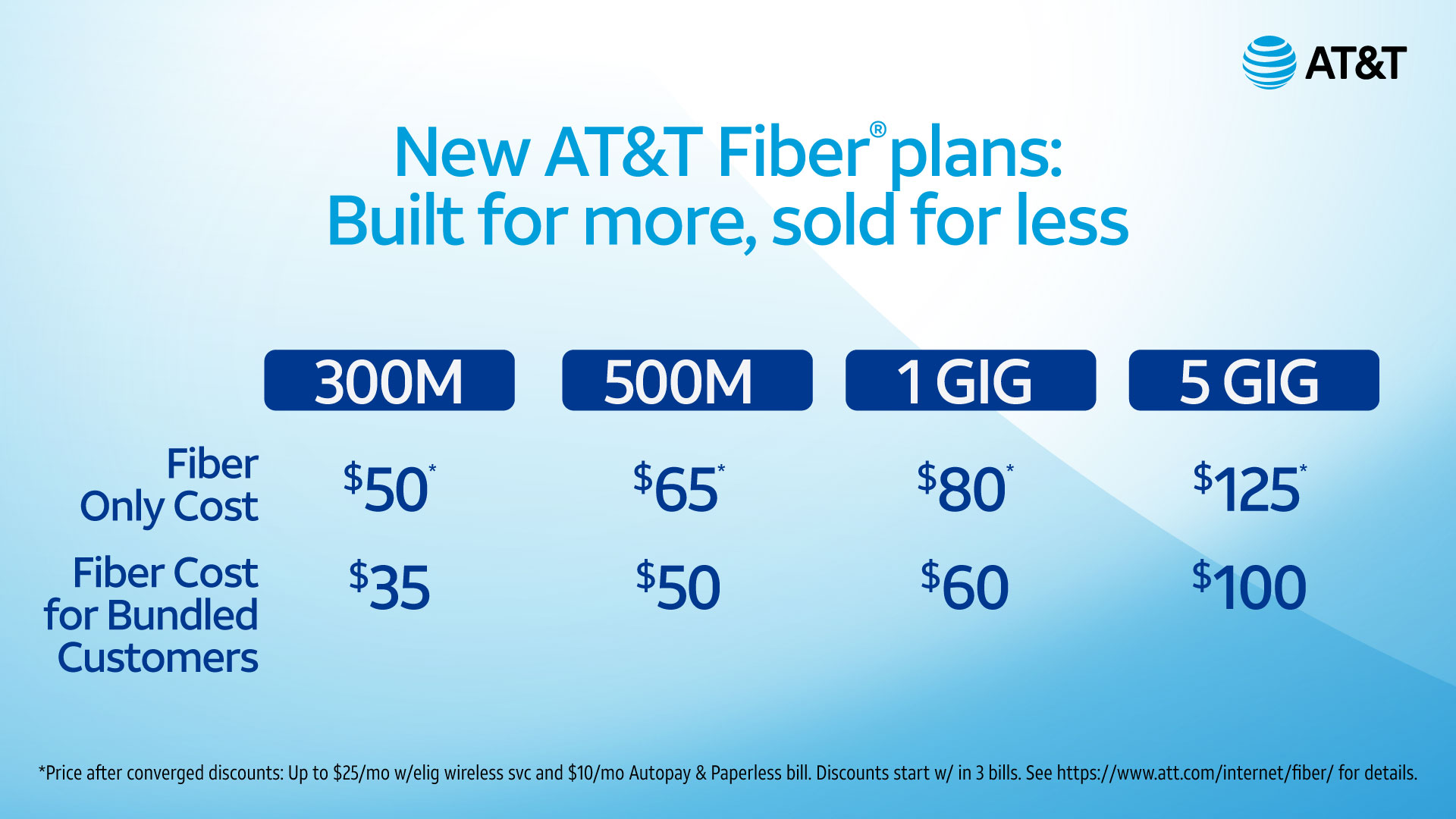
- AT&T refreshes home fiber broadband plans (link/link)
- Beginning June 7th, customers can choose from four AT&T Fiber speed options: pricing is in the image below
- 300 Mbps
- 500 Mbps
- 1 gig
- 5 gig
- Customers that combine AT&T wireless and home internet can save up to $420/yr
- More details: The new entry-level fiber plan is now 3x faster than before
- Customers also receive Internet Backup free of charge when combining qualifying services
- Their 5 gig plan also includes All-Fi Pro, their ultimate package for enhanced Wi-Fi performance, including whole home coverage, advanced security, Wi-Fi that adapts to routines, and their latest tech with equipment upgrades
- Beginning June 7th, customers can choose from four AT&T Fiber speed options: pricing is in the image below
Source: AT&T
Stock Market Check
This Week's Other Curated News
Advertising/Ad Agencies/Ad Tech
- Roblox annc’d opening ads to under-13 users for the first time, partnering exclusively w/ SuperAwesome. The Co will limit ads to direct deals, banning programmatic, w/ placements like banners and in-game billboards, excluding rewarded video. Targeting will be contextual, w/o behavioral data, to meet COPPA/GDPR rules. Move aims to grow ads biz while emphasizing control, safety, and transparency. (AdExchanger)
- The Trade Desk annc’d Nate Olmstead as CFO, effective Jul. 9, to support accelerated growth and scale. He joins from Penguin Solutions and previously served as CFO at Logitech, w/ 16 yrs at HP. CEO Jeff Green cited his leadership for next phase. Interim CFO Tahnil Davis will return to Chief Accounting Officer, cont’d supporting finance transition and adv. (The Trade Desk)
Artificial Intelligence/Machine Learning
- Amazon annc’d upgraded Proteus robot that workers can direct via natural language, replacing need for software commands. The AI-powered system prioritizes tasks, routes, and timing, and can operate across wider warehouse areas beyond docks, moving carts and assisting staff. Co says robotics supports jobs despite automation concerns. (The Verge)
- Anthropic urged a global pause in AI development, warning systems may soon achieve “recursive self-improvement” w/o human input, posing societal risks. In a post, the Co cited internal data showing rapid advances in its models. Leaders said slowing progress would likely be beneficial as capabilities approach a potentially dangerous threshold. (The Wall Street Journal)
- OpenAI annc’d a new “dreaming”-based memory system for ChatGPT to improve context, relevance, and freshness. The update enables the model to synthesize past chats, follow user preferences, and adapt over time, reducing stale or incorrect memory. Available to Plus/Pro users in the US, it expands soon, offering better personalization, scalable performance, and ~5x efficiency gains for broader rollout. (OpenAI)
- Airbnb CEO Brian Chesky plans to launch a new AI lab, signaling deeper entry into AI amid dissatisfaction w/ current models. The lab may focus on user interaction and design, areas tied to Airbnb’s expertise. Chesky will remain CEO and not lead the effort directly. His move follows close ties w/ OpenAI’s Sam Altman, though he now appears to compete w/ frontier AI labs. (TechCrunch)
- Pinterest annc’d a $4bn deal w/ AWS through 2031, its largest infra commitment, to scale AI-driven visual search for 600mn+ users. The co will expand use of cloud, Trainium & Graviton chips to boost model training & inference, while modernizing to Kubernetes. Partnership cont’d to enhance personalization, improve performance for users & advertisers, and support faster AI innovation. (Pinterest)
- Perplexity’s “trust and transparency” push is failing to win over publishers as copyright lawsuits mount, including a CNN case on May 28. Despite emphasis on accuracy, citations and rebuilding trust, publishers remain wary after yrs of disputes w/ NYT, Dow Jones and others, arguing citation-first doesn’t address rev concerns, highlighting ongoing tension and credibility challenges. (Digiday)
- Perplexity annc’d a new feature for its “Computer” AI system enabling task splitting between local and cloud models. The hybrid setup runs sensitive data (financial, health, personal files) on-device via compact models, while heavier workloads use server-based frontier models. The system auto-coordinates w/out user input, improving privacy and performance, w/ rollout expected in Jul. (9to5Mac)
- Alibaba is expanding Qwen into a digital concierge, opening its AI ecosystem to partners like KFC, Luckin and China Eastern Airlines. Users can order food or plan trips via chat, w/ agents handling tasks like discounts and timing. The app logs 100mn daily lifestyle engagements. Move cont’d intensifies China’s AI race as rivals like Tencent develop similar agent-based svs. (South China Morning Post)
- A study by AI-Driven Enterprise Institute ranked S&P 500 cos on AI adoption using metrics like literacy, implementation, and advocacy. Nvidia, Amazon, Meta, and SLB scored 100, leading peers, w/ Walmart next at ~95. The index uses public data such as filings and patents to assess AI use. (CNBC)
- AI boom post-ChatGPT has slashed startup valuations, leaving many pre‑2022 firms stranded. Nearly half of 857 U.S. unicorns haven’t raised funds in 3 yrs, w/ 2021-22 valuations down 68% and 52%. Over 220 are now “fallen unicorns.” Capital has shifted to AI‑native cos, as legacy SaaS and consumer startups struggle w/ outdated tech, weaker growth, and fewer exits. (CNBC)
- Nvidia-backed AI Co Runway annc’d major London expansion, naming it its European HQ and investing >$200mn by 2028. The $5.3bn‑valued Co, fresh off a $315mn raise, builds “world models” using diverse data beyond LLMs. Move targets UK talent and clients, amid growing U.S. AI Co expansion in the city incl. Anthropic and OpenAI. (CNBC)
- Venture capital firms are shifting from software into hardware and “physical AI” as AI threatens traditional software biz. Investors are backing infrastructure like chips, power and manufacturing, plus autonomous machines for real-world tasks. Funding surged from $4.2bn in 2019 to $26bn in 2025, w/ over $23bn raised by May 20, showing strong momentum in these sectors. (The Wall Street Journal)
- IBM shares surged up to 10%, adding ~$28bn in value, after an old clip of Donald Trump praising CEO Arvind Krishna resurfaced online, sparking trading momentum. The rally highlights AI-driven tech stock speculation and Trump’s influence on mkts. IBM had already risen ~40% in ~2 wks, aided by a $1bn gov’t deal for quantum chip foundry development. (Yahoo Finance)
- Chip stocks have surged, fueling debate over an AI bubble as gains turn historic. The semiconductor index jumped 69% in 2 months, w/ memory-chip cos like Micron, SK Hynix, and Samsung soaring ~165–260%. Strong AI-driven demand is lifting prices, but mkts rely heavily on a few tech leaders for growth. (Yahoo Finance)
- Tencent Holdings Ltd. shares rose the most since late 2022 after a report it’s testing a prototype AI agent, boosting optimism around its AI tech efforts. The Co plans to begin a compliance process for a public launch as soon as this month, per FT sources. It will then test the agent w/ a small group of external users before initiating a phased rollout to broader users. (Bloomberg)
Audio/Music/Podcast
- SiriusXM annc’d a non-exclusive deal w/ Tubi to distribute top podcasts incl. “Conan O’Brien Needs a Friend” & Trevor Noah’s show, expanding video reach beyond audio platforms. Shows remain on YouTube/others. Launch set for late Jun. [Tue., Jun. 2]. Move aims to grow audiences as video podcasting expands, w/ Tubi boosting creator rev and discovery across devices. (The Hollywood Reporter)
- Suno annc’d Wed. , Jun. 4 a $400mn Series D led by Bond Capital at $5.4bn valuation, over doubling from ~$2.45bn ~7 months ago. Funds will grow workforce (~70% increase) and expand offerings. Co has ~2mn subscribers and targets ~$300mn annual rev. It’s launching new music models amid ongoing copyright disputes w/ major labels and lawsuits from artists. (Yahoo Finance)
Cable/Pay-TV/Wireless
- AT&T said it is over halfway through a 5-yr wireless upgrade w/ Ericsson, expanding open RAN and preparing to scale cloud RAN. More than half of traffic runs on open-capable hardware, targeting 70% by yr-end, while ~60% of Nokia gear is replaced. Small cell deployments are growing across cities, w/ cloud RAN scaling as new Intel tech enables capacity and flexibility. (Light Reading)
- T-Mobile marked 10 yrs of “T-Mobile Tuesdays” w/ expanded perks, incl. Delta inflight drinks, free DoorDash DashPass, and up to $0.50/gal Shell gas savings in Jun. The Co says perks have grown 3x since launch, now serving ~60mn users. While some customers say deals have declined, engagement remains high, w/ 25mn monthly users and strong demand for food, travel, and entertainment offers. (Fierce Network)
- Scripps cut 54 local stations across 36 mkts from DIRECTV, after seeking record retransmission rates. DIRECTV declined, citing rising costs for consumers, prompting Scripps to pull channels. The blackout affects news, sports, and key events, incl. NBA/NHL finals, amid ongoing disputes over fees and access. DIRECTV says it seeks a reasonable deal. (PR Newswire)
Capital Market Updates
- S&P Dow Jones kept existing rules, rejecting faster index entry for large IPOs like SpaceX, requiring ~12-month seasoning plus profitability and float criteria. Move delays passive fund inflows—est. ~$14bn for SpaceX—and signals caution vs industry peers easing rules. Critics cite volatility risks, while supporters argue mkts should reflect mega cos’ scale sooner. (Yahoo Finance)
- Jefferies Financial Group Inc. was not selected among banks for SpaceX’s IPO, valued at ~$1.8tn, but may facilitate short-selling once shares begin trading. Hedge funds have approached the Co to arrange bearish bets. While IPO banks face conflicts in supporting both bullish and bearish trades, Jefferies said it won’t promote shorting, instead enabling balanced, two-sided mkts activity. (Investing.com)
- Quantinuum, backed by Honeywell, raised its IPO target to ~$1. 46bn, increasing its offering to 26.5mn shares priced $53–$55, up from prior plans. The move implies a ~$14.3bn valuation amid strong demand, w/ orders exceeding supply. The quantum computing Co develops advanced systems for sectors like cybersecurity, finance, and drug discovery, w/ added US gov’t funding support. (Yahoo Finance)
Cloud/DataCenters/IT Infrastructure
- Jane Street Group plans to build & finance its own data center to meet rising computing demand as it expands trading ops. Talks w/ tech, crypto & finance firms are in early stages, w/ capacity & location undecided. The firm currently relies on a Dallas site & cloud partners incl. CoreWeave. Move aligns w/ broader AI-driven growth. (Investing.com)
- Venture capitalist Kevin O’Leary annc’d plans to cut a proposed Utah data center project—once ~3x Manhattan—by 50% after backlash from lawmakers and residents. The 40,000-acre Stratos site may see a ~75% overall reduction, w/ much land left open. Critics cited environmental risks incl. water use, while O’Leary said concerns were overstated. The project remains unpermitted and under review. (Yahoo Finance)
- Tech cos are planning massive data-center expansions, highlighted by Alphabet’s $85bn equity raise, but deployment is lagging. Supply-chain issues, permitting delays, and power shortages are slowing progress. A JPMorgan report shows >60% of capacity slated for 2027 isn’t yet under construction, w/ another 7% delayed, widening the gap between investment plans and execution. (The Wall Street Journal)
- Elk Grove Village Property, linked to CoreWeave, seeks $850mn via junk bonds to fund a Chicago hyperscale data center leased to CoreWeave for 15 yrs, generating ~$2. 2bn rev. Proceeds will refinance $500mn debt and fund construction. Demand reflects surging AI infra needs, w/ firms raising ~$27bn in high-yield debt this yr to expand data center capacity. (Bloomberg)
Crypto/Blockchain/web3/NFTs
- Bitcoin fell below $61,500 amid ETF outflows and leveraged unwind, triggering ~$635bn liquidations and leaving >50% of supply at unrealized losses. Strategy’s losses hit ~$10.8bn. Despite volatility, Standard Chartered maintains a $100,000 yr-end target, citing prior cycle support levels and viewing current weakness as a buying zone while mkts remain divided on near-term direction. (Yahoo Finance)
- Binance has shut down its NFT marketplace amid a prolonged downturn in the digital art mkts, where trading volumes fell from over $50bn in 2022 to ~$5. 5bn. The Co said users must withdraw NFTs by midnight Jul. 3 or lose access, moving assets to Binance Wallet or external wallets. Binance had already scaled back NFT biz since 2024 as recovery prospects dimmed, w/ multiple rivals also exiting. (Yahoo Finance)
- Strategy sold 32 BTC for ~$2. 5mn between May 26–31 at ~$77,135 each, per a Jun. 1 filing, marking its first net BTC sale in 4 yrs. Proceeds will fund dividends on STRC preferred stock. Co still held ~843,706 BTC at avg cost ~$75,699. The move, previously signaled by Saylor, had minimal impact on holdings but weighed on shares and BTC prices. (CoinDesk)
Cybersecurity/Security
- Anthropic annc’d plans to expand access to its Mythos AI cyber security model to 150 organisations across 15+ countries under Project Glasswing. The rollout extends beyond US/UK to nations incl. Canada, Japan, India and EU states, targeting firms like Samsung and ICE. Move follows IPO filing potentially valuing the Co at $1tn, highlighting rising AI security demand. (Financial Times)
- CrowdStrike annc’d fiscal Q1 2027 results, narrowly beating estimates w/ adj EPS $1. 10 and rev $1.39bn (+26% YoY), but shares fell ~10%. Net income reached $27.8mn vs prior loss. Co also unveiled 4-for-1 split. Growth driven by rising demand for AI cybersecurity tools as firms counter advanced threats; AI seen as key to future biz expansion. (CNBC)
- Instagram is alerting users after hackers exploited Meta’s AI chatbot to take over accounts by falsely claiming ownership and linking new emails. Despite Meta saying the issue was fixed, attacks cont’d, w/ stolen “OG” handles resold in gray mkts. Meta secured affected accounts and began alerts, urging password resets as it scrambles to address the flaw in its automated support tech. (TechCrunch)
- Palo Alto Networks topped Q3 ests, reporting adj EPS $0. 85 vs $0.80 & rev $3.00bn vs $2.94bn, up 31% YoY, driven by AI‑led cyber demand. Co posted $177mn net loss vs $262mn profit prior yr. Shares jumped then eased. PANW raised Q4 outlook to ~$3.35–$3.36bn & lifted FY to ~$11.42–$11.43bn. (CNBC)
eCommerce/Social Commerce/Retail
- Lululemon cut FY outlook, citing negative media and weak product launches hurting traffic. FY rev now ~$11bn–$11.15bn vs prior higher range; EPS guidance trimmed. Q1 beat lowered estimates (rev $2.47bn, EPS $1.69) but profit fell YoY. Americas comps down 5% while intl rev rose 22%. Co expects continued NA declines and margin pressure from tariffs, discounts. Shares fell ~11%. (CNBC)
- Target Co annc’d a $387mn, 529,000-sq. -ft. food distribution center in Thornton, Colo., employing 380+ and serving 129 stores across 11 states. The facility speeds replenishment by 2 days, boosting freshness and stock levels. It adds consolidation to cut transport costs. Target also launched a $265mn Houston receive center, supporting faster inventory flow and its broader supply chain strategy. (Chain Store Age)
- Chinese consumers are showing renewed demand for high-end beauty and fashion, offering a bright spot for global luxury cos after yrs of weak sales. Results from L’Oréal, LVMH and Ralph Lauren, along w/ industry data, indicate affluent shoppers are spending more, supported by a China equities rally boosting wealth and sentiment, while discounting trends begin to ease across the sector. (Bloomberg)
- GameStop reported Q1 profit of $389. 6mn, up from $44.8mn a yr earlier, w/ adj earnings of $0.30 per share. Sales rose to $835.3mn, driven by collectibles. The Co also annc’d a $2bn stock buyback program valid for three yrs. Shares gained 8.2% after hours. Results follow a rejected $56bn bid to acquire eBay. (The Wall Street Journal)
- Retail cos posted a “surprisingly robust” Q1 2026 as sales and profits rose despite weak sentiment and high gas prices, helped by higher tax refunds and rising BNPL use. Cos incl. Target, Walmart and Ross cited refunds boosting comps by up to ~2%. However, guidance signals softer Q2 as refund impact fades, suggesting underlying consumer strain and slower growth ahead. (CNBC)
- Macy’s annc’d stronger-than-expected Q1 results, w/ comp sales up 3%—best in 4 yrs—and rev of $4. 68bn, topping forecasts. Net income rose to $63mn. Co raised FY guidance, expecting ~$21.5bn–$21.75bn rev and higher EPS. Growth driven by upgraded stores and Bloomingdale’s strength, as turnaround efforts cont’d despite macro uncertainty. (CNBC)
- Amazon annc’d it will show AI-generated product images in its shopping app to guide searches, offering visual options tied to queries. The feature aims to help users refine terms via styles, but critics say fake images may mislead shoppers expecting real items. It builds on Amazon’s broader AI push, including review summaries, visual search, and other experimental shopping tools. (TechCrunch)
- Amazon annc’d Prime Day will run Jun. 23–26, marking a shift from prior Jul. timing. The Co is promoting Alexa for Shopping AI to guide deals and boost spending. Amid weaker consumer confidence and rising costs, Amazon is offering a $1mn grocery sweepstake. Analysts expect 7.1% US sales growth and a 60.3% ecommerce share, w/ deals across 35+ categories and discounts up to 50%. (Retail Dive)
- Amazon annc’d its Agentic Shopping Assistant on AWS, enabling retailers to launch AI shopping agents in weeks vs building from scratch. The tool is customizable to brand and customers, w/ early use by Tapestry’s Kate Spade concierge. Amazon claims conversational sessions drive 3.5x higher conversions. (Retail Dive)
EdTech
- Duolingo annc’d a limited Jun. feature letting users restore lost streaks if they previously had 30+ day runs. To regain it, learners must complete three lessons in one sitting. The Co says the option responds to one of its most frequent requests, aiming to boost motivation and engagement by giving users a chance to recover disrupted progress rather than starting over. (The Verge)
Electric & Autonomous Vehicles
- Study finds robotaxis may not ease congestion as promised. Waymo data shows ~44% of miles are “deadheading,” w/ empty vehicles waiting or en route to pickups, similar to Uber/Lyft at ~40%. Despite safety gains and rapid growth, usage patterns mirror ride-hailing, which historically raised traffic. (Ars Technica)
FinTech/InsurTech/Payments
- Visa & Mastercard reportedly near launch of a new stablecoin platform, w/ Stripe & Coinbase also planning to join. Stablecoins, pegged to assets like USD, offer fast, secure cross-border payments. The ~$325bn mkt is led by Tether. Both cos have expanded stablecoin svs, signaling growing adoption, though details of the new platform remain unclear. (Yahoo Finance)
Handheld Devices & Accessories/Connected Home
- US smartphone shipments totaled 33. 4mn units in Q1 2026, down 3% YoY, per Omdia. The prior-year period was inflated as vendors/carriers built up inventory ahead of potential US tariff annc’ments. Shipments in Q1 were also impacted by fewer carrier upgrades, higher storage and memory costs, and delays in handset launches, weighing on overall demand. (Telecompaper)
Last Mile Transportation/Delivery
- China ride‑hailing Co Didi swung to a Q1 net loss of ~$177mn vs profit yr earlier, as overseas biz losses widened sharply. Int’l segment adj loss hit ~2.9bn yuan, reflecting heavy expansion in Brazil & Mexico w/ added svs like food delivery & finance. Rev rose ~10.3% to 58.7bn yuan, while domestic mkts face rising competition from Alibaba & Meituan. (Reuters)
- Uber Technologies Inc. capped employee AI tool spending at $1,500 per month per tool after exceeding its annual AI budget, aiming to control rising costs. Limits apply to agentic coding tools, w/ dashboards to track usage and approvals for overages. AI now generates ~10% of code, aiding productivity and slower hiring, though impact on new features remains unclear. (Yahoo Finance)
- Prosus is considering raising its stake in Delivery Hero, engaging investors on potential share sales, aiming to block Uber’s takeover bid. Prosus currently owns 16.83% of the German food-delivery Co. Delivery Hero declined comment, while Prosus hasn’t responded. Move signals strategic effort by the Dutch tech investor to counter the proposed acquisition attempt. (Reuters)
Live Entertainment/Theme Parks/Concerts/Experiential
- MSG Entertainment is betting on a summer surge in live experiences, annc’d a “See It Live Summer” campaign across Madison Square Garden, Radio City & Beacon, hosting 100+ events. The Garden alone will stage 57 shows Jun.–Aug., a record vs 37 prior high. Driven by post-COVID demand, artists add residencies & multi-night runs, w/ enhanced fan activations, tours & promos. (The Hollywood Reporter)
Macro Updates
- US tech cos in May annc’d 38,242 job cuts, the highest since Aug. 2024, as spending on AI rises. Data from Challenger, Gray & Christmas shows layoffs accelerating, w/ total cuts reaching 123,653 so far this yr, marking a surge of over 65% vs the same period in 2025. The trend highlights growing cost pressures and shifting priorities in the sector toward AI investment. (Bloomberg)
- ADP reported May private payrolls rose 122,000, above 110,000 est. and Apr.’s 105,000, signaling steady labor mkts. Hiring was broad-based, w/ gains in 8 of 10 sectors; education & health led (+57,000) while trade & transport added 36,000. Small biz drove growth. Pay gains held at 4.4% for job stayers, while switchers saw slower increases. (CNBC)
- US job openings jumped in Apr. to a near-2 yr high while layoffs fell, signaling a resilient labor mkts despite rising energy costs from the Iran war. Open roles rose to 7.62mn from 6.89mn in Mar., beating economists’ 6.87mn estimate, per Bureau of Labor Statistics data, highlighting stronger than expected hiring demand across biz. (Bloomberg)
- Fed Chair Kevin Warsh urged using alternative inflation gauges, like trimmed mean, to better assess underlying trends. While core inflation was 3.3%, trimmed mean showed 2.3%, nearer the Fed’s 2% target. Warsh argues such measures filter one-off impacts from tariffs or geopolitics, offering a clearer view, though critics warn they may understate persistent inflation pressures. (The Wall Street Journal)
Metaverse/AR & VR
- Snap annc’d it will acquire AR Co Illumix to boost its AR tech and support development of its Specs smart glasses. The deal includes adopting Illumix’s mapping platform and retaining most staff, though terms weren’t disclosed. Snap cited Illumix’s real‑world AR capabilities as key. The move follows Snap’s Jan. launch of Specs Inc., as it expands its AR ecosystem and hardware push. (Variety)
- Apple is targeting smart glasses by ~late 2027, aiming to disrupt eyewear like Apple Watch did watches. The Co sees a ~$200bn mkt w/ billions of users, leveraging iPhone integration, AI, and brand strength. Delays persist vs Meta’s lead. New Siri app w/ iCloud sync debuts in iOS 27, while iOS 28 work begins. (Bloomberg)
Regulatory
- France’s consumer watchdog fined Shein €22mn over consumer info, environmental disclosures and return rights. The largest €16.7mn penalty cited missing required details in email confirmations; Shein said info was available via its app and called rules outdated. Another €5.7mn covered return policy clarity and temporary missing environmental data. (Yahoo Finance)
- Sweden is weighing a social media age limit of 15 after a govt commission said risks to children outweigh benefits. Proposal would make platform cos responsible for age checks. Current rules allow use from 13 w/ parental consent. Officials warn excessive use harms youth health, as Europe cont’d tightening rules after Australia’s under‑16 ban and Norway’s planned curbs. (Reuters)
- US Supreme Court in 8-1 ruling backed FCC’s authority to levy fines via in-house process, rejecting AT&T and Verizon claims it violated jury trial rights. Case stemmed from penalties over improper sharing of customer location data. Court said orders aren’t final and can be challenged in court. FCC previously imposed ~ $200mn in fines across carriers, incl. $57mn on AT&T and ~$47mn on Verizon. (Reuters)
- PM Mark Carney’s govt signaled it may back down from a plan forcing streaming cos like Netflix and Walt Disney Co to boost funding for Canadian film/TV. Canada’s regulator had annc’d rules requiring major platforms to spend 15% of annual Canadian rev on local content, up from 5%, but the govt’s stance suggests a potential rollback of the measure. (Bloomberg)
- President Donald Trump signed an exec order taking a hands‑off approach to AI cybersecurity, emphasizing voluntary cooperation w/ AI cos. The policy allows ~30‑day govt access to models w/ developer consent, avoiding mandatory testing or licensing. It sets up info‑sharing across agencies to flag vulnerabilities while aiming to protect innovation and US competitiveness vs. China. (Yahoo Finance)
- UK publishers can opt out of Google AI search summaries after CMA ruling, aiming to boost bargaining power over content use. The move follows traffic declines as AI overviews push links down results. Google annc’d UK trials letting sites withdraw from AI features w/o affecting rankings. (BBC)
- European Commission annc’d a Tech Sovereignty Package to boost EU digital autonomy, covering semiconductors, AI, cloud & open source. It includes Chips Act 2.0, Cloud & AI Development Act, plus strategies for open source & energy digitalisation. The move aims to cut reliance on non‑EU tech, expand capacity, support biz & public svs, and strengthen resilience as AI demand surges. (European Commission)
- President Trump quietly annc’d a scaled‑down AI executive order targeting cybersecurity risks. It requires AI cos to submit models for voluntary review 30 days pre‑release, reduced from 90. The policy reflects tension between boosting US AI competition w/ China and addressing security threats, while stopping short of mandatory oversight despite cont’d concerns from officials and industry. (Politico)
- Malaysia barred under-16s from signing up for social media, requiring platforms to verify ages against govt records. Regulator may fine cos up to 10mn ringgit (~$2.5mn) for non-compliance. The move aims to protect minors from harmful content while boosting responsibility among platforms, parents and guardians; existing users face checks over six months. (Reuters)
- UK’s FCA warned Premier League clubs they could face legal action over “questionable” crypto sponsorships w/ firms not authorised in Britain. The regulator said such deals may breach rules, give legitimacy to unlawful operators and risk consumer harm. Crypto groups have expanded rapidly in football, targeting fans as clubs seek new rev streams. (Financial Times)
Satellite/Space
- Blue Origin CEO Dave Limp said its New Glenn rocket will return to flight before yr-end after an explosion during a hot-fire test damaged the launch pad. Cause remains unclear, though key fuel tanks were intact while a support tower needs repair. The failure adds pressure amid SpaceX competition and a U.S. launch bottleneck, w/ Amazon satellite plans also impacted. (Reuters)
- Goldman Sachs expects SpaceX AI rev to jump ~100x to $322bn by 2030 from $3. 2bn in 2025, per FT. Total Co rev may reach $474bn vs $18.7bn prior yr. AI rev seen at $15.6bn in 2026 and $34.5bn in 2027. Despite strong outlook, concerns persist on AI biz economics and competition, even as SpaceX targets $75bn IPO w/ $1.75tn valuation. (Reuters)
- Viasat annc’d its selection by Lockheed Martin to supply hybrid SATCOM tech for NOAA’s next‑gen C‑130J “Hurricane Hunter” aircraft, supporting real‑time data transmission for weather forecasting. The platform enables multi‑network, multi‑orbit connectivity and factory integration, reducing upgrade costs. (Viasat)
- Starlink became Australia’s second-largest broadband network provider by svs in Dec. 2025, per newly published Internet Activity data from the Australian Competition and Consumer Commission. The satellite operator supplied 589,000 retail and wholesale broadband svs at Dec. end, up from 400,000 six months earlier. (Telecompaper)
Social/Digital Media
- Meta is testing a “Series” feature for Reels on Instagram and Facebook, letting creators bundle videos into episodic content hubs on profiles. The move aims to boost longer viewing vs quick scrolling and drive repeat engagement. Users can watch in order, save series, and track progress, while Meta explores future monetization options similar to rivals. (TechCrunch)
- Meta annc’d hiring Snap exec Jim Shepherd as director of content & creator partnerships to boost its wearables biz. Formerly leading creator ties at Snap, he’ll help attract celebs and creators to Meta’s Ray-Ban and Oakley smart glasses. The push highlights wearables as a key frontier, leveraging built‑in cameras and AI to drive social content and engagement. (The Hollywood Reporter)
Software
- Databricks CEO Ali Ghodsi said the Co plans to go public but will avoid an IPO in 2026, citing a crowded yr of major tech offerings. He noted the move aims to create liquidity for employees. The firm recently raised $1.8bn in debt financing and $4bn in equity, valuing it at $134bn, while rivals like SpaceX, OpenAI and Anthropic prepare large public share sales. (Yahoo Finance)
- GitLab said it will cut ~350 jobs, ~14% of staff, as part of a restructuring tied to an AI pivot. The Co aims to streamline management and revamp R&D. Layoffs will cost $30–$35mn, w/ ~$19mn this quarter. GitLab will exit 22 countries, shrinking its footprint ~37%, while serving clients via partners. Plan to be completed by early next yr; shares rose 7%. (The Wall Street Journal)
- Microsoft annc’d Project Solara, an Android‑based OS built for AI agents instead of traditional apps. The concept uses “just‑in‑time” UI, where agents generate interfaces based on context across devices. Built on AOSP as part of a chip‑to‑cloud platform, it’s still experimental, w/ demo hardware like a smart display and wearable badge, reflecting Microsoft’s push toward agent‑driven computing. (Ars Technica)
Sports/Sports Betting
- Paramount and UFC annc’d an expanded rights deal bringing 13 UFC PPV-style events to Canada via Paramount+, w/ no extra fee. The pact builds on a 7-yr, $7.7bn agreement across the U.S. and LatAm, boosting Paramount’s streaming push. Execs say it will widen access and engagement; UFC has driven strong viewership, w/ >10mn homes and 100mn+ hrs watched. (Deadline)
- NRL broadcast rights talks have intensified as Amazon and Southern Cross join Foxtel and Nine in bidding for a ~ $4bn, five-yr deal from 2028. Chairman Peter V’landys secured strong interest after promoting the league’s value, w/ Amazon Prime Video proposing to stream two games weekly. (Australian Financial Review)
Tech Hardware
- STMicroelectronics raised data centre rev targets, citing strong AI-driven demand and capacity expansion. It now sees ~ $1bn rev in 2026 vs prior >$500mn forecast, w/ potential to double in 2027. Shares hit a 25-yr high, rising ~10%. Growth is tied to AI infra rather than GPUs, w/ analysts expecting ~7% boost to 2027 rev. (Reuters)
- Arm Holdings said strong AI demand could help it reach its $15bn chip rev goal earlier than expected, CEO Rene Haas said. The Co recently annc’d plans to sell its own chips, marking a shift from licensing biz. Meta will be first customer, w/ TSM producing the chip, as AI-driven data center demand cont’d to surge across mkts. (Yahoo Finance)
- Microsoft annc’d a new AI-designed “Majorana 2” quantum chip, targeting commercially useful systems by 2029, aligning w/ IBM. The chip uses lead-based materials, delivering ~1,000-fold performance gains in some areas. The move marks a shift from prior designs, but physicists question reproducibility due to limited public data, despite MSFT sharing findings w/ U.S. agencies. (Reuters)
- Broadcom said Q2 rev of $22. 19bn missed est. $22.27bn, w/ shares falling >13% after hrs. It forecast Q3 AI chip rev of $16bn, below est., amid rising competition from rivals like Marvell. Despite long-term $100bn AI sales outlook unchanged, supply concerns linger though Co said it’s “comfortable” for 2026–27. (Reuters)
- Google will open its first physical Store outside the US in Tokyo’s Omotesando “this summer,” marking its 11th location as the co expands hardware retail. Japan was chosen due to strong Pixel demand. The flagship site in Omokado Tokyu Plaza will offer Pixel devices, support svs, workshops, online order pickup, and exclusive merch/colors, w/ design blending Google style and Japanese elements. (9to5Google)
- D-Wave annc’d a gate-model quantum computing roadmap targeting fault-tolerant systems by 2032, aiming for 100 logical qubits performing 1mn+ operations. The Co’s dual-rail superconducting architecture embeds error detection, capturing ~90% of errors and achieving 99.9% fidelity. (D-Wave Quantum)
Video Games/Interactive Entertainment
- Warner Bros. Games annc’d global launch of Game of Thrones: Dragonfire, a free-to-play mobile strategy game inspired by “House of the Dragon.” Players become dragonriders in Westeros, commanding dragons, forming alliances, and battling for control. The game features tile-based warfare, evolving storylines, and seasonal gameplay, w/ rewards tied to HBO viewing integration. (Warner Bros. Discovery)
Video Streaming
- Digital i data shows YouTube surpassed Netflix in global daily viewing, reaching 99. 1 mins vs Netflix’s 87.1 mins across ~20 mkts in 2025. YouTube’s role is shifting toward mainstream TV, not just social video. Non-Netflix users watch ~120 mins daily on YouTube, while heavy Netflix users avg 168.1 mins on Netflix but still log 109.9 mins on YouTube. Creator-led content and channels drive strong engagement. (MediaPost)
- Versant Media took a minority stake in microdrama app GammaTime via a Series A round, aiming to expand short-form storytelling tied to its brands. The deal supports mobile-first, bite-sized originals popular w/ advertisers, w/ new funding to scale content using Versant IP and showrunners. GammaTime, led by ex-Miramax CEO Bill Block, previously raised $14mn ahead of its Oct. 2025 launch. (The Hollywood Reporter)
