


The big market rotation continued this week. Nasdaq fell -2% (though partially recovered on Friday from lower levels), while the Dow rose +0.8% and the Russell 2000 rose +3%. The “Magnificent 7” is collectively down ~13% since peaking July 10, while the small call Russell 2000 is up almost +10% for that period. Next week will be pivotal with the Fed meeting…
In the meantime, earnings is in full swing, and 41% of the S&P 500 has now already reported. Within our sector, it was a huge week for Connectivity (Verizon, AT&T, Comcast and Charter all reported), Digital Advertising, Cloud, and Music, among other sub-sectors. There was certainly a lot to digest and think about.
See below for the key focus themes in this edition (all links are clickable):
- Earnings Scorecard- Week 1 & 2
- Alphabet Says It’s Better To Over-Invest In AI, Than Under-Invest…
- Connectivity – Part 1: Verizon & AT&T Somewhat Diverge In Q2
- Connectivity: Part II – Cable Companies Are Weathering The ACP Storm Better Than Expected
- Investors Cheer Spotify’s Year Of Monetization + Better Paid Subscription Growth
- UMG’S Results Were Impacted By Varied DSP Performance, But Its “Entire Mentality Is To Grow The Pie”
- A First Look At Media Entertainment Trends Raised Concern On Theme Parks
- Grab Bag: Reddit Strikes Sports Partnerships / Apple Cuts Content Spend / Prop 22 Is Upheld
There is a lot packed in so you might need a little extra time this weekend!
Best,
Leslie

Earnings Scorecard- Week 1 & 2
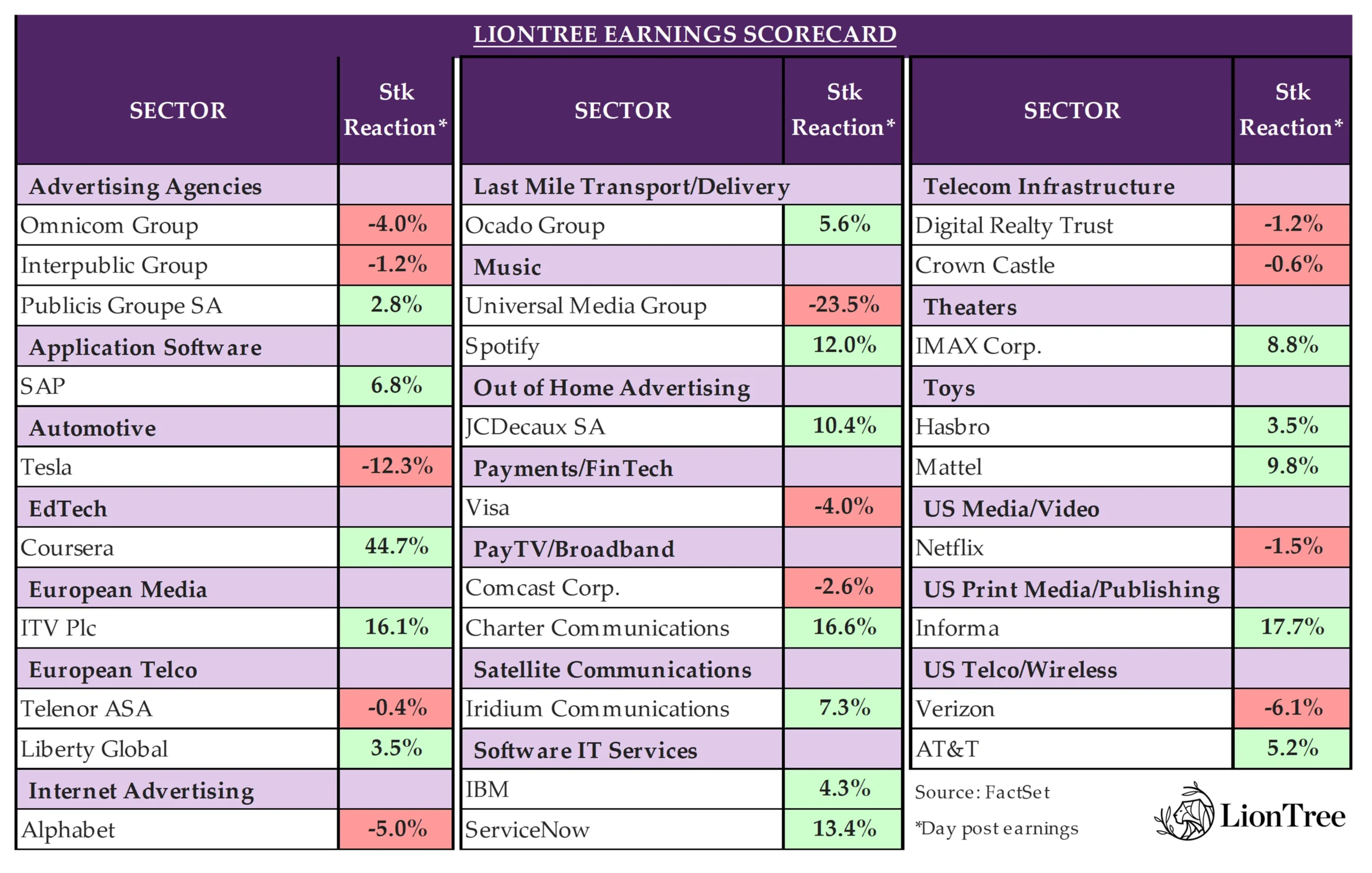
It’s that time of the year again when earnings season descends down en force. Over the last two weeks, 29 companies in our LionTree Universe reported their second qtr results, and stock price reactions were biased to the upside, with 18 companies (62.1%) trading up and 11 companies (37.9%) trading down following their prints. The worst performer in the group was Tesla, which traded down -12.3% in reaction to its report, and the best performer was Coursera, up +44.7%.
Connectivity names dominated the earnings circuit this week, with both telco and cable names reporting. On the Telco side, AT&T led, trading up +5% in reaction, while Verizon went the other way and traded down -6% (see Theme #3). Within Cable, Charter saw a huge jump and ended the day up +17%, while Comcast fell -3% (see Theme #4). Comcast’s results also included a first look into the Media sector through its media arm, NBCUniversal (see Theme #7 for more color).
Also within Media, Music was a sector of focus, and on the platform side, Spotify traded up +12.0% after posting its results (see Theme #5), though the going was tougher on the label side, with Universal Music Group plunging -24% after its report (see Theme #6).
We also got a first glimpse into Big Tech earnings with digital advertising juggernaut Alphabet, which fell -5% in reaction (see Theme #2). Also to flag in the advertising space, agencies Omnicom and Publicis reported last week, and reactions diverged, down -4.0% and up +2.8%, respectively (see Theme #6 from last week’s Weekly). Netflix was the other big print from last week and fell -1.5% (also covered in Theme #1 of last week’s Weekly).
The table below includes select mid- and large-cap TMT and consumer companies in our LionTree stock universe that reported this week.
Alphabet Says It’s Better To Over-Invest In AI, Than Under-Invest…
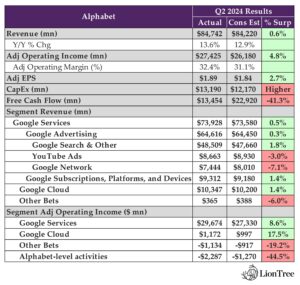
“When you go through a curve like this, the risk of under-investing is dramatically greater than the risk of over-investing.” That was a notable quote from Alphabet CEO Sundar Pichai on the Co’s Q2 earnings call, through which he rationalizes the Co’s Q2 y/y CapEx growth of +91.4% y/y to $13.2bn (following the +91% y/y growth in Q1 to $12bn). This came in ~+$1bn higher than Street estimates, and Alphabet expects to spend at least $12bn per quarter on CapEx through the end of the year. While this spending will weigh on FCF, management reassured investors that they continue to count on operating margin expansion in FY24 relative to FY23, despite some expected choppiness in Q3.
To provide some comfort regarding these investments, management made a point to highlight all the ways they’re starting to see AI benefits across the company’s segments, particularly advertising. Importantly, ad revenue in the Co’s core Search business came in stronger than expected, as the rollout of AI Overviews in the US has been driving higher engagement from younger users and increasing traffic to businesses. However, investors homed in on the disappointing YouTube advertising revenue, which was due to tougher y/y comps that will persist into Q3. That being said, new advertising features and products continue to be built to help advertisers leverage AI relevant products, and given that Gemini has been “natively multimodal from the ground up”, the Co expects to see it becoming “deeply relevant to YouTube” in the near future.
In addition to the strong results in Search, Cloud was a key upside driver and stood out with growth accelerating to +29% y/y, given an increasing contribution from AI. The segment set threshold records, as revenue crossed the $10bn mark for the first time (and beat by +1.4%), while operating profit passed the $1bn mark for the first time (and beat by +17.5%).
Other key updates from Alphabet included a $5bn multi-year investment in its Other Bets division, walking back on cookie deprecation (guess the cookie won’t be crumbling after all!), and more.
See below for more of what we viewed as most important.
-> Alphabet fell -5.0% in reaction to its print and further fell to end the week down -6.0%; YTD, the stock is still up +19.7%
-> AdTech names PubMatic and Criteo ended the week up +5.3% and +11.2%, respectively, while Magnite ended the week down -3.7% in in reaction to the press early in the week that Google was abandoning its cookie deprecation plans; The Trade Desk also ended the week down -3.7%, and was down -11.5% post Alphabet results, weighed down by the weaker YouTube ad rev; Roku also fell -10.5% in reaction
Q1 Beat On Headline Results, Though CapEx Investments Continue To Weigh On FCF
- Consol rev was up +14% y/y or +15% ex-FX (vs +15% y/y or +16% ex-FX in Q1) and beat cons by +0.6%
- Search remained the largest contributor to growth, and Cloud followed
- Op income beat cons by +4.8% w/ margins of 32%
- Y/Y margin expansion reflects ongoing efforts to durably reengineer the cost base and rev strength
- EPS beat by +2.7%
- CapEx came in higher than expected, and FCF of $13.5bn missed by -41.3%
- CapEx was driven “overwhelmingly” by investment in technical infrastructure with the largest component being for servers, followed by data centers
- On investment strategy – “When you go through a curve like this, the risk of under-investing is dramatically greater than the risk of over-investing”
Some Choppiness Is Coming In Q3, But Remain On Track For FY24 Margin Expansion
- Continue to expect to deliver FY24 op margin expansion relative to FY23, BUT Q3 will be under pressure, reflecting 1) increases in depreciation and expenses associated w/ the higher levels of investment in their technical infrastructure; And 2) the increase in cost of revenues due to the pull forward of hardware launches into Q3
- Similar to Q2, FCF y/y growth in Q3 will be depressed due to a timing benefit in last year’s Q2 and Q3 from a $10.5bn deferred cash tax payment
- Continue to expect qtrly CapEx through the year to be roughly at or above $12bn, keeping in mind that the timing of cash payments can cause variability in quarterly reported CapEx
Search Ads Had A Strong Qtr, While YouTube Ads Were Weighed Down By Tough Comps (Which Will Continue Into Q3)
- Google Search & Other revs beat cons by +1.8% and grew +14% y/y (in-line w/ Q1), led by growth in Retail, followed by the financial svs vertical
- YouTube ad revs missed cons by -3.0% and sharply decelerated to +13% y/y (vs +21% y/y in Q1): Growth was driven by brand, followed by direct response advertising; The seq decel primarily reflected tougher comps when YouTube was lapping negative y/y growth from Q1:23 and benefitted from the extra day from a leap year; Y/Y comps were impacted by a ramp in APAC-based retailers that begin in Q2:23, as well as FX headwinds
- Q3 will also see some pressure from lapping increasing strength in ad revs in H2:23 – in part from APAC-based retailers – as well as FX headwinds
Alphabet Is Building Out AI Use Cases Across Biz Segments
- 2mn+ developers are using Gemini across their developer tools
- Comes in four sizes with each model designed for its own set of use cases
- Offers the longest context window of any large-scaled foundation model-to-date at 2mn tokens
- All six Google products w/ 2bn+ monthly users now use Gemini
- Announced 30+ new ads features and products in Q2 to help advertisers leverage AI across Search, PMax, Demand Gen, and Retail
- Beta testing virtual try-on and shopping ads and plan to roll it out widely later this yr; Feedback shows this feature gets 60% more high quality views than other images and a higher click out to retailer sites
- AI-driven profit optimization tools have been expanded to PMax and standard shopping campaigns: Advertisers that use profit optimization and smart bidding see an avg +15% uplift in profit compared to revenue-only bidding
- Demand Gen is rolling out to Display and Video 360 and Search Ads 360 in the coming months with new generative image tools that create high quality image assets for social marketers: When paired w/ Search PMax, Demand Gen delivers an avg of 14% more conversions
- On AI integrations within YouTube – “Gemini has been natively multimodal from the ground up. But most of the use cases today that have been unlock have been around the tech side… but over time obviously it will be deeply relevant to YouTube”
- Where is Google seeing “faster than expected” traction in AI? Where are there oppties?
- Consumer: “Seeing progress on the organic side. Obviously, monetization is something that we would have to earn on top of it”
- Enterprise: “I think we are at a stage where definitely there are a lot of models. I think roughly the models are all kind of converging towards a set of base capabilities. But I think where the next wave is working to build solutions on top of it. And I think there are pockets, be it coding, be it in customer service, etc., where we are seeing some of those use cases, seeing traction. But I still think there is hard work there to completely unlock those”
AI Is Helping Deliver Better Responses In Search
- Seeing positive trends from the roll out of AI Overviews in the US, including increases in Search usage and increased user satisfaction w/ results
- Seeing even higher engagement from younger users aged 18 to 24 when they use Search with AI Overviews
- AI Overviews is driving traffic to bizs, as ads appearing above or below AI Overviews provide “valuable” options for people to take action and connect with bizs
- Looking ahead, AI Overviews will scale over the course of the year to more countries
- Will also start testing Search and shopping ads, giving advertisers the oppty to appear within the Overview in a section labeled as “Sponsored” when they’re related to both the query and information in the AI Overview
- Relentlessly” driving efficiencies and quality improvements in AI models
- Doubled the core model size for AI Overviews, while at the same time improving latency and keeping costs per AI Overviews
- Focused on matching the right model size to the complexity of the query in order to minimize impact on costs and latency
- In six months, AI-driven improvements to quality, relevance, and language understanding have improved Broad Match performance by +10% for advertisers using Smart Bidding
- Advertisers who adopt PMax to Broad Match and Smart Bidding in their Search campaigns see an average increase of over +25% more conversions or value at a similar cost
Reversal of Cookie Deprecation Plan Highlights User Choice as the Best Path Forward for Improving Privacy
- “We are super committed to improving privacy for users in Chrome… but on third-party cookies, given the implications across the ecosystems and considerations and feedback across so many stakeholders, we now believe user choice is the best path forward there”
- “We’ll both improve privacy by giving users choice, and we’ll continue our investments in privacy-enhancing technologies”
-> Earlier this week, Google annc’d plans to keep third-party cookies in its Chrome browser for those who don’t disable them; However, to enhance user privacy while preserving advertising effectiveness, Google plans to roll out a new solution: a one-time prompt that enables users to set preferences that will apply across Google browsing experiences; In Jan 2020, Chrome promised to phase out the technology “within two years”, but since then, the Co has pushed back its deadline two more times – most recently, in April of this year, citing regulatory concerns about Google’s Privacy Sandbox, the Co’s suite of proposed cookie alternatives (link/link)
While YouTube Ad Revs Missed Given Tough Comps, The Ads Biz Remains In A Strong Position
- YouTube continues to lead in viewership
- YouTube is the most watched streaming platform on TV screens in the US for the seventeenth consecutive month, per Nielsen
- Second most watched after Disney across all media Cos and their combined TV viewership
- Growth is happening in multiple verticals, including sports, which has seen CTV watch time on YouTube grow +30% y/y
- CTV on YouTube is continuing to benefit from combination of “strong” watch time growth, viewer and advertiser innovation, and a shift in brand ad budgets from linear TV to YouTube
- Shorts continues to see improvement in monetization, particularly in the US
- Seeing “very encouraging” contribution from brand advertising on Shorts, which was launched in Q4:23
- Shopping remains “a key area of investment”: Last year, viewers watched 30bn hours of shopping-related content, and there was a +25% increase in watch time for videos that helped people shop
- Rolled out several product updates to YouTube Shopping, including product tagging, product collections, and a new affiliate Hub
And YouTube Continues To Drive Most Of Subscription Revenue + More Announcements On Android And Pixel Are Coming Soon
- Subscriptions, Platforms and Devices beat cons by +1.4% and grew +14% y/y (vs +18% y/y in Q1)
- Subscriptions (the majority of revenue for the segment) continues to see “significant” growth: Both YouTube TV and YouTube Music Premium are key drivers, as well as Google One
- Outlook: The anniversary impact of the price increase for YouTube TV, which drove the seq decline in y/y growth, will persist through the balance of the year
- Platforms – “Pleased” w/ performance in Play, driven by an increase in buyers
- Devices will see a tailwind in Q3:24, as Made by Google launches had been pulled forward into Q3 from Q4
- Subscriptions (the majority of revenue for the segment) continues to see “significant” growth: Both YouTube TV and YouTube Music Premium are key drivers, as well as Google One
- Samsung’s new devices will include the latest AI-powered Google updates on Android
- Recently introduced a new Pixel 8a, powered by the latest Google Tensor G3 chip, which provides AI experiences like Circle to Search, Best Take, and a Gemini-powered AI assistant
- Will have more to share around Android and the Pixel portfolio of devices at the Made by Google event in August
Cloud Acceleration Driven By Continued AI Demand From Partners
- Cloud revs beat cons by +1.4% and were up +29% y/y (accel from +28% y/y in Q1), reflecting “significant” growth in GCP, which was above growth for Cloud overall, and includes an increasing contribution from AI as well as “strong” Google Workspace growth, primarily driven by increases in avg rev per seat
- Q2 was a qtr of milestones on both rev and operating profit: Google Cloud rev crossed the $10bn mark for the first time, while operating profit passed the $1bn mark for the first time
- “Really pleased” with Cloud margin improvement, which reflects the efficiency efforts they’ve implemented and the rev strength they delivered; Looking into Q3, expect the same seasonal pattern they saw last year
- “Majority” of top 100 customers are already using their genAI solutions
- Latest NVIDIA Blackwell platform will be coming to Google Cloud in early 2025
- Key AI partnership callouts –
- Momentum w/ AI infrastructure: Providing AI start-ups like Essential AI with leading cost performance for models and high-performance computing applications
- Advances since Cloud Next
- Trillium: A3 Mega powered by NVIDIA H100 GPUs, doubles the networking bandwidth of A3
- Vertex Enterprise AI Platform: Helps customers like Deutsche Bank, Kingfisher, and the US Air Force build powerful AI agents
- New announcements during the qtr
- Gemini Pro 1.5 and Gemini Flash 1.5: Used by Uber and WPP for customer experience and marketing
- Broadened support for 3P models: Includes Anthropic’s Claude 3.5 Sonnet and open-source models like Gemma 2, Llama, and Mistral
- Only Cloud provider to offer grounding with Google Search: Expanded capabilities with Moody’s, MSCI, ZoomInfo, and more
- AI-powered application portfolio: Helping win new customers and drive upsell
- Conversational AI Platform: Used by Best Buy and Gordon Food Service
- Gemini for Workspace: Helps Click Therapeutics analyze patient feedback for targeted digital treatments
- AI-powered agents: Helping customers develop better quality software, find insights from their data, and protect their organization against cybersecurity threats using Gemini
- Software Development: Used by Wipro with Gemini Code Assist to develop, test, and document software faster
- Data Analysis: Used by Mercardo Libre with BigQuery and Looker to optimize capacity planning and fulfill shipments faster
- Cybersecurity: Helps protect organizations against threats
- Security Portfolio
- Mandiant Teams: Manage cybersecurity risks and breaches
- Q2 AI Infusion: Helps TELUS strengthen its proactive security posture
Progress In Waymo Is Driving A Fresh Round Of Multi-Year Investment In Other Bets
- Alphabet Is committing to a new $5bn multi-year investment in Other Bets: “Continue to focus on improving overall efficiencies as we invest for long-term returns”
- “This new round of funding, which is consistent with recent annual investment levels, will enable Waymo to continue to build the world’s leading autonomous driving technology Co”
- “Really pleased” with progress Waymo is making
- 2mn+ trips serviced to date
- 20mn+ fully autonomous miles driven on public roads
- Now delivering 50k+ weekly paid public rides, primarily in SF and Phoenix
- Removed the waitlist in SF in June, so anyone can take a ride
- Fully autonomous testing is underway in other Bay Area locations
-> Also in the self-driving space this week, General Motors annc’d that it would be “indefinitely suspending” work on Origin, the autonomous vehicle produced by GM’s self-driving subsidiary; GM CEO Mary Barra said in a letter to shareholders that the change will lower Cruise’s costs and “addresses the regulatory uncertainty” around the vehicles’ lack of manual controls such as a steering wheel or pedals; Cruise will instead focus their efforts on the next generation of the battery-run Chevrolet Bolt; The decision to “pause” production of the Origin triggered a $605mn charge in Q2; Cruise has been under scrutiny since an October crash involving a pedestrian on the streets of San Francisco (link/link)
Connectivity – Part 1: Verizon & AT&T Somewhat Diverge In Q2
It was eventful week in the telco space, as Verizon and AT&T both reported Q2 results. In a continuation from the previous two quarters, the two incumbents printed mixed headline results, with each posting top-lines that fell short of consensus estimates and adj EBITDA numbers that exceeded expectations. Nonetheless, both reiterated their outlooks for FY24. What was particularly top of mind on the earnings calls was the potential for higher upgrade/switching activity in the back half of the year with the upcoming handset upgrade cycle. In particular, Verizon CEO Hans Vestberg believes that “we’re going to see some excitement around AI” with Apple’s upcoming iPhone launch, though AT&T CEO John Stankey cautioned that it remains to be seen “whether or not there’s something more compelling” in this year’s cycle, given that other AI devices have come into the handset ecosystem over the last couple of months but haven’t seemed to be “world-changing”. In any case, the emergence of generative AI should represent significant longer-term drivers for both Verizon and AT&T. The former has dimensioned the Verizon Intelligent Edge Network to be the “backbone of the GenAI economy”, while the latter’s “dense fiber assets” could also be utilized to support more data intensive AI applications.
The telco incumbents also sustained momentum across their core postpaid phone businesses in Q2. Despite “ongoing wireless market normalization”, Verizon and AT&T each saw sequential and y/y improvements in postpaid phone net adds that respectively surpassed consensus forecasts by a wide +46.5% and +48.0%, respectively marking the fifth consecutive quarter the two companies’ postpaid phone net adds topped estimates. The business segment was one of the main reasons for their outperformance, with both Verizon and AT&T highlighting successes with large enterprises and public sector customers. Verizon’s numbers were also augmented by second line additions (to which investors did not give as much credit). In contrast, their performances on the prepaid sides were more divergent. Verizon lost more prepaid customers than the Street anticipated with ACP ending, while the effect of the program’s conclusion on AT&T was more in-line with expectations. Looking ahead, it sounds like ACP will not materially impact the incumbents’ results, as the “vast majority” of ACP-related disconnects are now behind them.
There were also some puts & takes for the telcos on the broadband sides of their businesses. On one hand, lower move activity remained a persistent headwind throughout the quarter and contributed to worse than expected sequential declines in Verizon Fios and AT&T Fiber’s net adds. On the other hand, FWA net adds picked up sequentially in Q2, with Verizon adding +378k (vs +354k in Q1) and AT&T adding +139k (vs +110k in Q1), as more customers looked to migrate from legacy copper-based internet connections to FWA alternatives. Interestingly, while AT&T emphasized the importance of convergence within its broader go-to-market strategy, Verizon’s tone on convergence was a bit more muted, as management is skeptical that the US market will approach the levels of convergence seen in Europe.
Speaking of capital allocation, FCF was a standout from both incumbent’s prints in Q2, driven by their lower than anticipated levels of CapEx. Although AT&T’s CapEx was still a bit higher than its spend the prior year, both telcos appear to be following through on their commitments to return capital to shareholders after the peak 5G investment cycle.
See below for more detail on what we thought were the most incremental items from Verizon and AT&T’s Q2 earnings, and see Theme #4 for more on Connectivity perspectives from Comcast and Charter results…
-> Verizon shares fell -6.1% following the print but recovered some losses to end the week down -3.7%; AT&T shares rose +5.2% in reaction to earnings but ended the week down a slight -0.6%; YTD, Verizon stock is still trading up +6.3% and AT&T stock is up +13.2%
–> On a related note this week, T-Mobile annc’d a $4.9bn JV w/ KKR to acquire MetroNet, a provider of fiber connectivity svs; T-Mobile plans to use Metronet’s digital and fiber infrastructure to expand to more households w/ fiber broadband svs; Metronet’s fiber network reaches 2mn+ households in 17 states, and the Co is expected to reach 6.5mn homes by the end of 2030; The transaction is expected to close in 2025, subject to customary closing conditions and regulatory approvals (link)
Both Telcos Out-Delivered On Adj EBITDA But Missed On The Top-Line
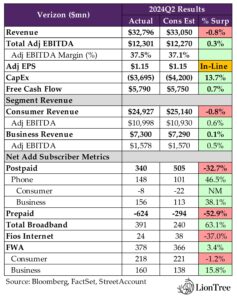
- Verizon – Headline results were mixed, w/ a shortfall on rev but a beat on adj EBITDA: Q2 rev was up +0.6% y/y (vs +0.2% y/y in Q1) but missed cons by -0.8%; Adj EBITDA rose +2.8% y/y (vs +1.4% y/y in Q1) and topped cons by +0.3%; Adj EPS of $1.15 was in-line w/ cons; FCF beat by +0.7%; Postpaid phone and broadband net adds both beat
- Consumer (~87% of adj EBITDA) – Mixed: Rev growth accel’d to +1.5% y/y in Q2 (vs +0.8% y/y in Q1) but fell -0.8% short of cons while adj EBITDA incr’d +4.0% y/y (vs +3.6% y/y in Q2) and beat cons by +0.6%; Gains in svs rev were partially offset by declines in wireless equipment rev
- Business (~13% of adj EBITDA) – Beat: Rev declines accel’d, falling -2.4% y/y (vs -1.6% y/y in Q1) but coming in +0.1% above cons; Adj EBITDA declines improved to -3.5% y/y (vs -7.2% y/y in Q1) and beat cons by +0.5%; Increases in wireless service rev were more than offset by decreases in wireline rev
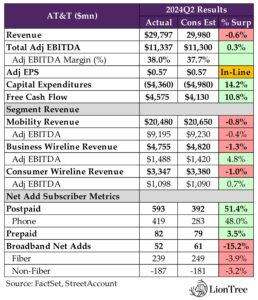
- AT&T’s headline numbers were mixed, as top-line underwhelmed while adj EBITDA beat: Rev fell -0.4% y/y in Q2 (vs +2.2% y/y in Q1) and ended -0.6% below cons; Adj EBITDA grew +2.6% y/y (vs +4.3% y/y in Q1) and topped cons by +0.3%; FCF closed +10.8% ahead of cons; Postpaid phone net adds beat, but broadband net adds missed
- Mobility (~78% of Communications adj EBITDA) – Miss: Q2 rev incr’d +0.8% y/y (vs +0.1% y/y in Q1) but closed -0.8% below cons; Adj EBITDA rose +5.3% y/y (vs +7.0% y/y in Q1) but missed cons by -0.4%
- Business Wireline (~13% of Communications adj EBITDA) – Mixed: Rev dropped -10% y/y in Q2 (vs -7.8% y/y in Q1) and missed cons by -1.3%; Adj EBITDA was down -13.9% y/y (vs -16.5% y/y in Q1) but beat cons by +4.8%
- Consumer Wireline (~9% of Communications adj EBITDA) – Mixed: Q2 rev grew +3.0% y/y (vs +3.4% y/y in Q1), missing cons by -1.0%; Adj EBITDA incr’d +7.1% y/y (vs +14.6% y/y in Q1) and beat cons by +0.7%
FY24 Guidance Was Broadly Reaffirmed In Both Cases, Despite The Adj EBITDA Beats
- Verizon is “very comfortable” w/ its rev and adj EBITDA guides for FY24: Reaffirmed forecasts for total wireless svs rev growth between +2.0-3.5% y/y, adj EBITDA growth between +1-3% y/y (below cons +2.1% y/y at the mid-pt), and a full-yr EPS range of $4.50-4.70 (above cons by +0.4% at the mid-pt)
- Seq growth in svs rev is expected in H2:24: Cited “progress on volumes on mobility and FWA”; Headwinds in prepaid are also “improving”; That said, y/y comps will be more difficult in H2:24, given last yr’s pricing changes; The promo environment will be a “wild card” moving forward as well
- The Co’s cost transformation efforts are “on track”: There’s a “lot of work” to reduce costs occurring within IT, real estate, and network decommissioning; A voluntary separation program will also start “manifesting” savings in the tail end of 2024 and into 2025; AI efforts have helped as well
- AT&T is “on pace to deliver on all of [its] full yr financial guidance”: Coming into FY24, the Co forecasted wireless svs rev growth in the +3% y/y range, broadband rev growth of over +7% y/y, adj EBITDA growth in the +3% y/y range, and adj EPS between $2.15-2.25 (-0.9% below cons at the mid-pt)
- A one-time, $480mn payment is expected in H2:24: This is termination fee related to the phasing out of one AT&T’s vendors as part of the Co’s wireless transformation; AT&T expected “some level” of payment related to the occurrence and still plans to hit its original guidance
Verizon & AT&T’s Postpaid Phone Net Adds Topped Estimates (For The Fifth Straight Qtr!) With Second Lines Helping The Former
- Verizon – Postpaid phone net adds beat estimates and showed a “big improvement y/y and seq”: Total retail postpaid phone net adds of +156k in Q2 (up from +8k the prior yr qtr and -68k in Q1) topped cons by a wide +46.5%
- Consumer postpaid phone net losses were better than feared: Declined -8k (vs -136k the prior yr qtr and -158k in Q1) beat cons’ -22k
- Growth in Consumer phone gross adds accel’d seq due to second lines: Consumer postpaid phone gross adds were up +12.0% y/y (vs +5.3% y/y in Q1), the Co’s sixth straight qtr w/ y/y gross add growth
- Excluding contributions from second numbers, gross adds grew +5% y/y: Last qtr, the Co disclosed that second line add-ons comprised a ~+lsd% of total gross adds
- Lower upgrade activity cont’d to weigh on volumes: The Co’s wireless retail postpaid upgrade rate dropped -30bps to 2.4% in Q2 (vs 2.5% in Q1), w/ total upgrades falling nearly -13% y/y; Believes “excitement around AI” could provide a boost to upgrade volumes “over time”
- Reiterated that “positive” postpaid phone net adds are expected in Consumer for the yr: Notably, this will come without the contribution from the Co’s second line offering; Verizon has been seeing improving postpaid phone net adds heading into H2:24
- Growth in Consumer phone gross adds accel’d seq due to second lines: Consumer postpaid phone gross adds were up +12.0% y/y (vs +5.3% y/y in Q1), the Co’s sixth straight qtr w/ y/y gross add growth
- The Co has been “performing extremely well in Business”: Q2 Business postpaid phone net adds rose +8.3% y/y (vs -33.8% y/y in Q1) and came in +38.1% ahead of cons; Saw a “strong seq improvement” in phone net adds across SMBs as well as enterprise and public sector customers
- Churn stepped down seq, as projected: Total retail postpaid phone churn was up +2bps y/y to 0.85% (but down from 0.89% in Q1), matching cons estimates; Verizon believes the majority of its pricing churn is now behind it and continues to expect 2024 consumer postpaid churn to be flat or slightly better y/y
- Consumer postpaid phone net losses were better than feared: Declined -8k (vs -136k the prior yr qtr and -158k in Q1) beat cons’ -22k
- AT&T – Postpaid phone net adds outperformed forecasts, increasing both seq and y/y: Q2 postpaid phone net adds grew +28.5% y/y to +419k (vs +349k in Q1) and beat cons by a wide +48.0%
- “The story really isn’t a whole lot different than it’s been” …: AT&T has been “intercepting customers and channels” where the Co believes it “can make a difference and… add them profitability”; Believes its intercept channels have “gotten a little bit stronger”
- … Though AT&T has been “growing a little bit faster in the biz segment” vs consumer: The Co has been “doing better in some of the govt public safety/first responder structures”; Also benefited from gaining large enterprise relationships
- FirstNet now has 6mn+ total connections: Saw “sustained growth” in FirstNet this qtr
- Postpaid phone net adds have been outpacing last yr’s levels: Despite “ongoing wireless mkt normalization”, the Co delivered +768k net adds in H1:24 compared to +750k in H1:23
- … Though AT&T has been “growing a little bit faster in the biz segment” vs consumer: The Co has been “doing better in some of the govt public safety/first responder structures”; Also benefited from gaining large enterprise relationships
- Postpaid upgrade rates dropped seq, though less than feared: Q2 postpaid upgrade rate of 2.9% (vs 3.1% the prior yr qtr and 3.0% in Q1) was still above cons’ 2.8%; Seasonality was one factor, as “there’s a little bit of suppression that occurs a month or two” handsets are released in the mkt
- BUT the Co anticipates “higher activity levels” in H2:24: This will be “driven by the availability of new devices and features, seasonal purchasing activity, and promo cycles”; “If customers decide that there’s meaningful features in the new devices, [AT&T is] going to respond to it”
- Postpaid phone churn stepped down further seq: Postpaid phone churn fell -9bps y/y to 0.70% in Q2 (vs 0.72% in Q1) and was better than cons’ 0.72%; Converged products have helped “keep customers in the fold”, and similar to last qtr, this is expected to be an industry-leading figure at the time of reporting
- “The story really isn’t a whole lot different than it’s been” …: AT&T has been “intercepting customers and channels” where the Co believes it “can make a difference and… add them profitability”; Believes its intercept channels have “gotten a little bit stronger”
Gains In ARPU/ARPA Were Driven By Higher Value Plans
- Verizon – Postpaid ARPA slightly missed expectations: Q2 total wireless retail postpaid ARPA of $161.20 was up +4.3% y/y (vs +6.2% y/y in Q1) and ended -0.2% below cons
- “myPlan helps drive ARPA growth”: Specifically, through “premium mix adoption and perk rev”; There is further upside in ARPA ahead w/ the percentage of Verizon’s customers using myPlan is expected to “expand meaningfully going forward”
- AT&T – Postpaid phone ARPU was higher than projected: Postpaid phone ARPU of $56.42 grew +1.4% y/y (vs +0.9% y/y in Q1) and beat cons by +0.5%; Upside was “largely driven by higher ARPU on legacy plan[s]”
- The Co still expects “modest” ARPU growth this yr: And it anticipates “greater benefits” from its annc’d pricing actions in Q4 vs Q3
Prepaid – It Was A Tale Of Two Cities W/ The End Of ACP, But Impacts Are In The Rear View Mirror
- Verizon – Prepaid net losses were worse than anticipated w/ ACP ending: Total prepaid net losses of -694k in Q2 (up from -304k loss the prior yr qtr and -216k in Q1), was much worse than cons -294k; The Co had -410k losses related to the conclusion of ACP, the vast majority of which were under the SafeLink brand
- BUT Without SafeLink and the impact from ACP, Verizon would have experienced -12k prepaid net losses
- The impact of ACP’s conclusion on wireless svs rev has been in line w/ forecasts: Last qtr, Verizon indicated the end of ACP would create up to a -50bps headwind to wireless svs rev, and the Co is “tracking inside of that number right now”
- Outlook – Verizon sees “stronger performance” in prepaid in H2:24: “Visible and Total Wireless continue to expand and perform well”, Verizon’s operational execution w/ Straight Talk “continues to improve”, and the “vast majority” of ACP disconnects are now behind the Co
- AT&T – Prepaid phone net adds beat projections: Q2 prepaid net adds of +82k (vs +167k the prior yr qtr and +1k in Q1) beat cons by +3.5%; Prepaid churn of 2.57% was up from 2.50% the prior yr qtr but down from 2.77% in Q1
- As expected, there was “a little bit of an impact” from ACP’s conclusion: There were “some adjustments that were made” as the Co has already transitioned “the vast majority” of its customers, but these effects have been tracking in line w/ expectations to not be “material or significant”
Promotional Environment – The Telcos Appear To Be Avoiding A Race To The Bottom
- Verizon has had a “very disciplined model when it comes to promos”: The Co has been “very consistent” about evaluating price oppties and “aligning price w/ the value proposition for customers”
- 30%+ of Verizon customers have myPlan: The Co has been seeing “an incredible adoption rate”, as myPlan’s ability to provide “the most personalized offerings in the industry… deeply resonates w/ customers”
- myHome will incorporate the myPlan’s features to home internet: Thinks this will make the Co’s FWA biz “even stronger”
- Verizon Business Complete just launched as a “new way to serve [the Co’s] SMBs”: Verizon Business Complete is “the industry’s only end-to-end smartphone mgmt system”, and all of the offerings new tiers are “accretive in value” but also give Verizon’s customers better svs
- AT&T maintained its “balanced” go-to-mkt strategy: The Co has demonstrated that it will work w/ customers on a qtr-to-qtr basis to “tweak” its go-to-mkt strategy to make them more successful, instead of driving a race to the bottom w/ “very aggressive, low-ball national offers w/ low-price entry points”
- The Co is “getting incrementally better q/q” at mkting its converged svs: The Co will “continue to take that where [it] can as long as [it] can take it profitably”
- Higher mkting spend is expected in Q3 vs last yr: As AT&T looks to capitalize on higher expected activity levels in the handset mkt in the back half of the yr
Broadband – Low Moving Activity Remains A Headwind But FWA Continues To Be A Key Growth Area
- Verizon is “still taking share” in broadband & FWA beat expectations: Total broadband net adds of +391k were down -6.5% y/y in Q2 (vs -11.0% y/y in Q1) but beat cons by a wide +63.1%; This was Verizon’s eighth consecutive qtr w/ over +375k broadband net adds
- The overall broadband mkt is “very healthy”, despite persistently low move activity: The Co “continue[s] to see healthy demand for reliable broadband, even in the seasonally softer qtr”
- “FWA remains a key driver”: Q2 FWA net adds were down -1.6% y/y (vs -9.9% y/y in Q1) but finished +3.4% above cons thanks to performance in Business; The Co now has 3.8mn FWA subs and is nearing is target of 4-5mn by 2025; It will revisit this target after hitting the range
- Consumer FWA net adds improved seq but missed expectations: Consumer FWA net adds fell -13.1% y/y to +218k in Q2 (vs +203k in Q1) and ended -1.2% behind cons; Along w/ the healthy environment, Verizon has been finding the “right balance” between price and volume
- Verizon Business set a “qtrly record” for FWA net adds: Q2 Business FWA net adds grew +20.3% y/y to +160k (vs +151k in Q1) and beat cons by +15.8%; Demand is “strengthening” as SMBs and enterprises continue to trust its reliability as well as the speed and ease of deployment
- Fios net adds were lower than projected: Q2 Fios net adds fell -48.1% y/y to +28k (vs +53k in Q1), missing cons by -37.0%; Noted a “slight impact” from ACP ending and lower move activity
- AT&T – Broadband net adds were slightly down seq and below expectations: Broadband net adds of +52k in Q2 (vs the prior yr qtr’s -35k and Q1’s +55k) and missed cons by -15.2%; This was the fourth consecutive qtr that the Co has added broadband subs, and the trend is expected to continue
- Broadband rev growth dipped down seq: Q2 broadband rev incr’d +7.0% y/y (vs +7.7% y/y in Q1), as Fiber rev grew +17.9% y/y and offset a -9.0% y/y drop in non-fiber rev (vs -8.2% y/y in Q1)
- Broadband rev growth of over +7% is still projected for FY24
- Fiber net adds were below the Street’s estimates and declined seq: Fiber net adds were down -4.8% y/y in Q2 (vs -7.4% y/y in Q1) and ended -3.9% behind cons; Flagged that the “three primary drivers of net add variability” are the pace of new Fiber deployments, overall broadband mkt dynamics, and seasonality
- Fiber ARPU cont’d to trend upward: Fiber ARPU of $69.00 rose +3.4% y/y in Q2 (vs +4.1% y/y in Q1), as intake ARPU remained above $70
- The broadband mkt has “remained fairly stable”: “Moves are continuing to be a bit suppressed” and beyond normal seasonality, there was “a little bit” of an impact from ACP ending
- Seasonal headwinds are expected to reverse moving forward: Given that Q3 “typically has favorable seasonality” relative to Q2
- Internet Air, AT&T’s FWA product, has seen “early success”: Internet Air is now in parts of 137 mkts, w/ +139k consumer subscribers added in Q2, bringing the product’s total base to nearly 350,000 customers
- The Co isn’t offering Internet Air everywhere to consumers…: AT&T wants to be selective about how it does FWA and plans to use it to help transition customers off of legacy technologies
- … But will make it available nationwide for bizs: Feels “very comfortable” in a nationwide offer for bizs, given that AT&T can acquire the “right customer” that it can “profitably add… to other portfolios”
- Broadband rev growth dipped down seq: Q2 broadband rev incr’d +7.0% y/y (vs +7.7% y/y in Q1), as Fiber rev grew +17.9% y/y and offset a -9.0% y/y drop in non-fiber rev (vs -8.2% y/y in Q1)
AT&T Sees Convergence As An Integral Part Of its Strategy Though Verizon Sees Some Comparative Market Limitations
- Verizon has seen “some uptick” on fixed-mobile convergence: The Co has “economics on wireless and broadband” and continues to see converged products as an “oppty” if customers want them
- BUT it is unlikely the US will reach European levels of convergence: Given that the nature of the mkt is different in Europe vs the US; Nonetheless, Verizon does the see the US moving “further into convergence” to some degree
- The Co’s initial C-band mkts continue to outperform other ones: Reiterated that C-band mkts see better gross add growth, higher uptake of premium svs, and lower churn
- Verizon doesn’t believe in “sort of discounting” its converged product
- AT&T is on a “clear path to becoming the leading provider of converged 5G and fiber svs”: The Co has a “proven ability to drive higher share in both Mobility and Broadband through converged svs penetration”, which is “the true benefit of owning and operating both 5G and Fiber networks at scale”
- “Consumers increasingly prefer to purchase Mobility and Broadband together as a converged svs”: AT&T “believe[s] the success of [its] Fiber biz is driving growth in Mobility and vice versa” in this environment
- Nearly 4 out of every 10 AT&T Fiber households choose AT&T as their wireless provider”: Consequently, the Co’s share of postpaid phone subscribers within its fiber footprint is ~+500bps higher than its national avg
- The ability to sell Fiber to mobile customers has driven faster than anticipated Fiber penetration: Based on publicly available data, AT&T has been able to achieve key penetration milestones “considerably faster” than fiber providers that do not operate wireless networks
- The Co can also reach new broadband customers through its “substantial mobile distribution channels”
- The cont’d expansion of AT&T Fiber will “drive significant growth w/ converge customers”: As a result, the Co sees “a long runway of growth w/ 5G and Fiber together”
Investment Plans Will Support Future Growth
- Verizon’s “network build remains ahead of schedule”: Have deployed C-band on almost 60% of planned sites; As the Co deploys more, this will also open more FWA oppties; The Co has a “great network that can ingest more customers over time”
- Verizon is continuing to expand C-band in suburban and rural areas: Gross adds have been up threefold in mkts w/ C-band
- Verizon’s initial C-band mkts have been outperforming other ones: The Co has been seeing “better gross add growth, higher uptake of premium svs, and lower churn” in its C-band mkts
- Nearly 50% of Verizon’s network traffic is now running on 5G Ultra Wideband: This compares to 36% a yr ago; This percentage will continue to grow as the Co expands its C-band reach
- The previously annc’d partnership w/ AST SpaceMobile will further enhance the Co’s coverage: AST SpaceMobile will provide satellite-to-device connectivity using 850 MHz spectrum and help bring Verizon’s network to unserved communities
- Verizon is continuing to expand C-band in suburban and rural areas: Gross adds have been up threefold in mkts w/ C-band
- AT&T sees “attractive oppties” to expand its fiber network outside its traditional footprint: Including through the cont’d scaling of its Gigapower JV and via capital-light arrangements w/ other providers of commercial open access fiber networks
- The Co is still on track to pass 30mn+ Fiber locations by the end of 2025: AT&T also reiterated that the “better-than-expected returns” on its Fiber investments thus far potentially expands its initial build targets by another ~10-15mn locations
- O-RAN will allow for a “more efficient growth of capacity” in the network moving forward: The Co is aiming to break out the small cell mkt to create a multi-vendor environment; Combined w/ its dense fiber assets, this could be a “match made in heaven” to deal w/ growth in a more cost-effective way
Q2 CapEx Was Broadly Lower Than Projected But Both Co’s Reiterated Their Previous Full-Year Guidance
- Verizon – CapEx levels were lighter than expected, as the Co returns to historic levels of CapEx intensity: Q2 CapEx fell -10.1% y/y to $3.7bn (vs $4.4bn in Q1) and beat cons by +13.7%; Verizon’s H1:24 CapEx spend was -$2bn less than H1:23’s total
- Reiterated FY24 CapEx guidance of $17-17.5bn
- AT&T – CapEx was up y/y but below the Street’s estimates: CapEx incr’d +1.2% y/y in Q2 (vs -13.3% y/y in Q1) but was still +14.2% better than cons; AT&T’s “investment-led strategy” has made it the largest capital investor in the US connectivity infrastructure space since 2019
- Reiterated FY CapEx guidance of $21-22bn: Higher spending in H2:24 will be driven by the Co’s efforts to ramp its wireless network modernization
Lower Capx Helped Drive Better FCF / Capital Allocation Plans Are Broadly InLine
- Verizon – FCF topped estimates: FCF of $5.8bn was up +3.0% y/y in Q2 (vs +16.2% y/y in Q1) and closed +0.7% above cons; Outlined its three capital allocation priorities as follows –
- The Co expects to “generate strong cash flow in the back half of the yr” to support paying down debt: Verizon continues to work toward its long-term target of 1.75-2x net unsecured debt to consolidated adj EBITDA (currently at 2.5x)
- The dividend is “very important”: The Co has been growing its dividend for 17 consecutive yrs, and mgmt is “committed to continue to [putting] the Board in a position to do that”
- Verizon won’t consider buybacks until it gets to a 2.25x net unsecured debt to adj EBITDA ratio
- AT&T – FCF finished well ahead of forecasts: Q2 FCF of $4.6bn grew +8.7% y/y (vs +34.1% y/y in Q1), beating cons by +10.8%; Cited “sustained growth in adj EBITDA, improved conversion of EBITDA into FCF, and lower capital investment as the main drivers
- H1:24 FCF grew +48.1% y/y to $7.7bn: This is “consistent w/ [AT&T’s] goal of driving more ratable FCF”
- FY24 FCF is still expected to between $17-18bn
Other Highlights – Thoughts On AI + AT&T’s Comments On The Recent Data Breach
- Verizon sees itself as a “backbone of the AI economy and the partner of choice for players in the space”: Cited its “portfolio of high-performance spectrum, the capacity of [its] fiber, and [its] ability to deploy and support mobile edge compute”
- The Co is “already seeing the benefits of AI in [its] operations”: The Co has four gen AI products being used by its 40,000 agents to work more efficiently and provide more personalization for customers; “AI is an enabler of efficiencies”
- AT&T is unsure whether “there’s something compelling in this [upgrade] cycle”: “There’s a lot of ways you can experience AI without having to necessarily change out hardware”, and “there have been other AI devices that have come into the handset ecosystem over the last couple months” that haven’t been “world-changing”
- AT&T – “The threat environment we’re in is a really, really difficult environment”: The Co believes “it’s going to get probably more difficult”, given “some of the geopolitical dynamics that are going on”; “Everybody’s dealing w/ this problem”, and AT&T has “handled it about as well as [it] can going through it”
Connectivity: Part II – Cable Companies Are Weathering The ACP Storm Better Than Expected
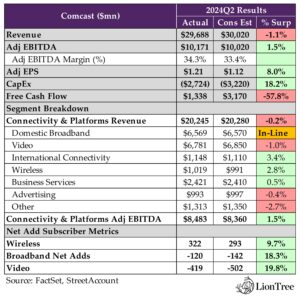
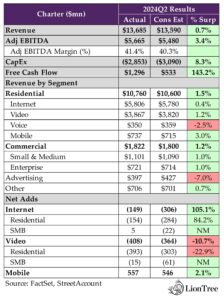 Alongside the telco incumbents’ prints this week (see Theme #3), the cable sector was also active with earnings, and Comcast and Charter’s Q2 results shed some light on the aftermath of ACP’s conclusion as well as on some of the competitive dynamics in the ongoing convergence battle across the connectivity space. Given that the cable companies, and especially Charter, “put a lot of effort” into ACP, the Street was anticipating a sizable sequential uptick in their broadband net losses during the quarter. However, this wasn’t necessarily the case. While consensus expectations called for -448k broadband net losses combined in Q2, Comcast and Charter only collectively lost a net -269k, as their proactive efforts to manage churn after the program’s end mitigated the impact of the transition more than anticipated. Otherwise, beyond ACP-related impacts, the cable companies highlighted a broadband market that has remained relatively slow due to a lack of moving activity as well as “intensely competitive”, with both fiber overbuilders and fixed wireless continuing to knock on their doorsteps. Moreover, “the bulk” of non-pay churn from former ACP recipients is expected to occur in Q3, so it looks like the cable companies still have some work cut out for them on the broadband front in the near term.
Convergence also remains an integral part of Comcast and Charter’s growth strategies, and this was reflected in the stronger than expected performances of their wireless businesses in Q2. The cable companies introduced new pricing plans and converged offers that helped drive a sequential improvement in both of their wireless net adds during the quarter. Comcast gained a net +322k wireless accounts (vs +289k in Q1) and Charter added a net +557k (vs +486k in Q1). Notably, this was also Charter’s “highest port-ins quarter ever” and the first time that the company’s standalone mobile EBITDA was positive. Looking ahead to the back half of the year, there is still much for the cable companies to be “optimistic” about as well. In addition to the upcoming handset upgrade cycle, Comcast and Charter’s mobile product remains “under-penetrated” relative to their overall broadband customer bases, providing their wireless net adds plenty of runway to continue growing as they continue on the path to “establishing a mobile business that is very profitable”.
The cable companies’ results on the video sides of their businesses were more of a mixed bag relative to forecasts. Comcast’s video net losses improved sequentially to -419k and beat consensus estimates by +19.8%, while Charter’s -408k video net losses were slightly worse than Q1’s total and missed cons by -10.7%. Pricing appeared to be one of the main drivers, as Comcast took “slightly less” of a rate increase in its video products this year compared to last year, but Charter‘s decision to pass through increases in programming rates resulted in higher downgrade churn. In particular, this seemed to have an outsized effect on customers coming off ACP, who increasingly prioritized affordability without their monthly internet subsidies. Nonetheless, Charter indicated that the “DTC take-up is going very well”, and the ability to offer hybrid linear-streaming bundles could help slow losses and retain value in its video business on the road ahead.
The big news on the capital allocation front was that Charter trimmed its FY24 CapEx by ~-$300mn at the mid-point to ~$12bn. The company pointed to lower CPE costs from lower than anticipated Internet and Video net adds as the main reason for the reduction. Along with expectations of accelerating EBITDA growth in the back half of the year, this should position Charter well from a FCF standpoint in H2:24 and help it build off of stronger than expected FCF numbers in Q2. For its part, Comcast’s more disappointing FCF performance in Q2 appeared to be tied to a one-time, over +$2bn increase in cash taxes associated w/ the previous payment it received for its stake in Hulu. See below for what we thought was most incremental from Comcast and Charter’s Q2 prints…
-> Comcast shares were down -2.6% in response to the print but recovered slightly to close the week down -1.0%; Charter shares jumped +16.6% in reaction to earnings, finishing the week up +14.8%; YTD, Comcast stock is trading down -9.5% and Charter stock is still down -5.4%
–> On a related note, Consumer Reports’ ISP survey of more than half of its 48k members revealed this week that fiber-optic internet svs received higher overall satisfaction scores than cable-internet providers; Greenlight Networks, EPB, Allo Fiber, Google Fiber, GoNetSpeed, and Sonic all had overall satisfaction scores that landed in the top ratings tier; Scoring worst were satellite broadband providers Viasat Internet and HughesNet, as well as Comcast Xfinity, CenturyLink’s Lumen, Mediacom’s Xtream, and Altice’s Optimum (link)
Comcast & Charter’s Headline Results Diverged In Some Key Areas
- Comcast printed mixed headline results, as rev missed but adj EBITDA surpassed estimates: Consolidated rev dropped -2.7% y/y in Q2 (vs +1.2% y/y in Q1), falling -1.1% short of cons; Consolidated adj EBITDA was down -0.7% y/y (vs -0.6% y/y in Q1) and topped cons by +1.5%; FCF missed cons by a wide -57.8%
- Connectivity & Platforms (~83% of total adj EBITDA) – Mixed: Q2 rev was down -0.7% y/y (vs +0.6% y/y in Q1) and slightly missed cons by -0.2%; Adj EBITDA grew +1.6% y/y (vs +1.3% y/y in Q1) and beat cons by +1.5%; Residential rev missed cons by -0.3%, while Business Services rev ended +0.5% ahead of cons
- In terms of KPIs, wireless, broadband, and video net adds were better than the Street expected
- Connectivity & Platforms (~83% of total adj EBITDA) – Mixed: Q2 rev was down -0.7% y/y (vs +0.6% y/y in Q1) and slightly missed cons by -0.2%; Adj EBITDA grew +1.6% y/y (vs +1.3% y/y in Q1) and beat cons by +1.5%; Residential rev missed cons by -0.3%, while Business Services rev ended +0.5% ahead of cons
- Charter – Headline numbers broadly exceeded expectations: Q2 rev was up +0.2% y/y (vs +0.2% y/y in Q1) and beat cons by +0.7%; Adj EBITDA rose +2.6% y/y (vs +2.8% y/y in Q1), topping cons by +3.4%; FCF finished a wide +143.2% above cons; Internet net losses and Mobile net adds beat, but Video net losses missed
- Residential rev (~79% of total rev) – Beat: Residential rev was down -0.6% y/y in Q2 (vs -0.4% y/y in Q1) but still closed +1.5% ahead of cons; Customer relationships fell -1.3% y/y (vs -0.7% y/y in Q1), while monthly rev per customer grew +0.4% y/y (vs -0.1% y/y in Q1)
- Commercial rev (~13% of total rev) – Beat: Q2 Commercial rev incr’d +2.1% y/y (vs +1.3% y/y in Q1) and beat cons by +1.2%; SMB rev grew +0.6% y/y (vs -0.3% y/y in Q1), and Enterprise rev rose +4.5% y/y (vs +3.8% y/y in Q1)
The Broadband Market Has Been Under More Pressure As Of Late
- Comcast – “The environment for broadband subscribers remains intensely competitive”: This is “particularly felt” at the lower end of the mkt, w/ more “price conscious” customers; However, competition is “no worse” and “no better” than the Co has seen over the past couple of qtrs
- 50% of Comcast’s territories have now been overbuilt by fiber: Expects to be at 60% by yr-end
- Charter – “The broadband mkt actually shrunk as a one-time event”: Growth in the broadband mkt was still “significantly reduced” in Q2 for similar reasons as in Q1, as low move activity, rental vacancies, and the loss of ACP resulted in the mobile-only broadband category reverting back to pre-pandemic levels
- This impact is “temporary”, but “it’s hard to predict exactly when”: Believes that the mkt will go back to “a much more normalized environment” when moves come back, housing starts return, and once the ACP impact between Q2 and Q3 is flushed out
- “The lack of ACP will also drive higher levels of mkt churn… over time”: Sees more switching oppties as “more customers [come] in and out of broadband based on affordability”; There will be more transaction volume from a non-pay disconnect and gross adds perspective
- The Co has been facing a “challenging competitive environment”: Competitive overbuilds have cont’d at a “steady pace”, if not “slightly lower” than what it has been; Reiterated that “cell phone Cos will face challenges as the consumer bandwidth demands continue to grow”
- This impact is “temporary”, but “it’s hard to predict exactly when”: Believes that the mkt will go back to “a much more normalized environment” when moves come back, housing starts return, and once the ACP impact between Q2 and Q3 is flushed out
Despite A Difficult Operating Environment, Broadband Net Losses Weren’t As Bad As Predicted
- Comcast – Broadband net losses were better than feared, though seasonally worse seq: Domestic broadband net losses of -120k in Q2 (vs -19k the prior yr qtr and -65k in Q1) beat cons’ -142k; The Co lost a net -110k residential customers (vs -55k in Q1) and -10k biz customers (vs -10k in Q1)
- There was “traditional negative seasonality” during the qtr: When combined w/ intense competition, these factors resulted in the -120k subscriber losses;
- BUT Q3 should be a seasonally stronger qtr: Indicated that “the same things that were headwinds in Q2 largely become tailwinds” moving forward in Q3
- Business Services benefited from “faster growth in mid-mkt and enterprise” …: That has been mainly driven by an increase in customers, as the Co has been investing into this space to build sales & fulfillment and expand its capabilities in other value-added svs
- While the SMB mkt “remains competitive: The Co has been competing aggressively in SMB and driving higher ARPU by pushing additional products that expands its relationships w/ SMBs
- ACP ending had a “minimal impact” on subscriber growth in Q2 but will affect Q3 numbers: “The bulk” of ACP-related subscriber churn is projected in Q3, w/ the “biggest impact” being on non-pay churn
- Otherwise, voluntary churn “continues to perform very well”: Cited Comcast’s superior network, along w/ its better products and extreme focus on competition
- There was “traditional negative seasonality” during the qtr: When combined w/ intense competition, these factors resulted in the -120k subscriber losses;
- Charter – Broadband net losses weren’t as steep as projected w/ ACP’s conclusion: Q2 total Internet net losses of -149k (vs +77k the prior yr qtr and -72k in Q1) were a wide +105.1% ahead of cons; Residential Internet net losses of -154k beat cons by +84.2%, and SMB Internet net adds of +5k came in ahead of cons’ -22k
- There was a “significant drop y/y” in the pool of available gross adds: Given the impact from losing ACP on top of “an already low level” of “overall mkt connect volume”; Q2 also “tends to be a seasonally weaker qtr”
- BUT Charter “performed better” on competitive switching on a seq and y/y basis: As the Co “competed well compared to previous qtrs against both wireline overbuild and cell phone internet, each w/ expanded footprints”
- The Co also posted +36k net adds in its subsidized rural footprint: Compares to +35k in Q1
- ACP-related net losses were “well over” -100k: ~Half was from voluntary churn, while the other half was from lower gross adds, particularly from the “low income segment that had been connecting at a higher rate”
- There will be more ACP-related non-pay disconnects in Q3: “The reality is that the ACP-related non-pay disconnect activity hasn’t started yet”; There will be “sustainable payment trends” through Aug, w/ the “non-pay beginning then and trailing… a little bit into Q4”
- “Overall churn remains at low levels, even w/ the end of the ACP program”: Although “the loss of ACP impacted… churn”, the Co has “retained the vast majority of ACP customers so far”; “Built-in savings” from the Co’s converged bundles and subsidies for former ACP recipients have helped
- There is some momentum heading into Q3: Indicated June was the “best loss” of Q2 and that Internet net adds in July have trended similarly
- There was a “significant drop y/y” in the pool of available gross adds: Given the impact from losing ACP on top of “an already low level” of “overall mkt connect volume”; Q2 also “tends to be a seasonally weaker qtr”
ACP’s Conclusion Was A Headwind To ARPU Growth
- Comcast – ARPU growth decel’d seq but was within the Co’s historical range of +3-4% y/y: Q2 broadband ARPU growth of +3.6% was down from Q1’s +4.2% y/y rate; Despite the downtick, the Co remains focused on effectively balancing rate and volume via customer segmentation
- There was a “little bit” of impact on ARPU from ACP’s conclusion: Consistent w/ Comcast’s approach to normal promo roll-offs, the Co worked w/ customers coming off ACP and migrated them to different products and price levels
- The Co has a “good ability” to increase ARPU on the biz side as well: Comcast is aiming to attach new products to biz relationships as part of transitioning to a “full, managed relationship basis”
- Charter – Residential ARPU growth returned to positive territory: Resi monthly ARPU incr’d +0.4% y/y in Q2 (vs -0.1% y/y in Q1), as promo rate step-ups, rate adjustments, and the growth of Spectrum Mobile were partly offset by a higher mix of non-video customers and lower-priced video packages, plus some Internet ARPU compression
- The end of ACP weighed on Internet ARPU growth: Internet ARPU grew +1.7% y/y in Q2 (flat w/ Q1’s rate), though excluding a $30mn one-time, non-ACP-related charge as well as the impact of extending retention offers to former ACP recipients, Internet ARPU would have risen +2.7% y/y
- The Co’s rev recognition policy for certain post-ACP customers also resulted in “slightly less rev”: For customers w/ a low likelihood to pay after the end of ACP, the Co has been recognizing rev on a cash basis, resulting in slightly lower rev and less bad debt
Go-to-Market Color – New Converged Offers Have Been Gaining Traction
- Comcast’s go-to-mkt strategy in broadband has been “consistent”: The Co has maintained its approach of “striking the right balance between rate & volume and relying heavily on mkt segmentation
- Enhancing offers for the price conscious segment has been a key focus: In Q2, Comcast launched the NOW line of products, which provide internet, mobile, and streaming TV offerings w/ “attractive” all-in pricing w/ no contracts or credit checks; However, it is still too early to gauge the mkt reception to these
- BUT the “vast majority” of Comcast’s base subscribes to more premium products: Consequently, the Co views fiber as its “true long-term competitor” instead of FWA
- Internet Essential tiers have helped mitigate ACP-related losses: Through these plans, customers can get a free line of Xfinity mobile for a yr, and ACP customers get an addt’l free unlimited line for a yr
- The Co has a new, upcoming converged offer that will be tied to the Olympics: The Co has a “great offer” coming that will offer customers the ability to tie broadband and mobile together
- Enhancing offers for the price conscious segment has been a key focus: In Q2, Comcast launched the NOW line of products, which provide internet, mobile, and streaming TV offerings w/ “attractive” all-in pricing w/ no contracts or credit checks; However, it is still too early to gauge the mkt reception to these
- Charter is “very well-positioned competitively” w/ its converged bundle of products: The Co has “cont’d to improve [its] selling capabilities” by rolling out new offers but doesn’t “intend to be in the biz of subsidizing phones”
- Customers increasingly opted for the $40 Unlimited Plus package over the $30 option: New value-added features such as Anytime Upgrade, which allows Unlimited Plus customers to upgrade their phones whenever they want, has helped
- Other new value-added svs have been driving higher take rates: Including the $5/mo repair and replacement plan as well as the phone balance buyout program, where the Co will pay off a switcher’s existing phone lines on purchases of 3-5 lines for up to $2,500
- Spectrum One also “continues to perform well at both connect and at promo roll off”: This is expected to carry into the back half of the yr and drive accel’ing EBITDA growth
- The Co also has a “number of products & offers to assist those that have lost their ACP subsidy”: Including the Spectrum Internet Assist program, the Internet 100 product, and an offer of a free mobile line for one yr
- Customers increasingly opted for the $40 Unlimited Plus package over the $30 option: New value-added features such as Anytime Upgrade, which allows Unlimited Plus customers to upgrade their phones whenever they want, has helped
Charter Saw A Notable Uptick In Data Usage, While Comcast’s Numbers Were Flat Seq
- Comcast – Data usage continues to grow at a double-digit y/y rate: The Co’s broadband-only households consumed 700+ gigabytes of data each month, on avg, w/ ~70% of customers receiving 500+ Mbps speeds and ~one-third getting 1+ Gbps (these are all similar to numbers provided on Q1’s call)
- “These positive consumer trends… will only accel”: Given the shift of live sports to streaming, which when combined w/ entertainment on streaming accounts, accounts for nearly 70% of Comcast’s network traffic today
- 90% of Xfinity mobile smartphone traffic travels over Comcast’s Wi-Fi network: This demonstrates the importance of bundling converged products
- Charter – “Data usage continues to grow, and demand for faster speeds will grow w/ it”: In Q2, ~30% of residential, non-video Internet customers used 1TB+ of data per month (vs nearly 800GB per month reported in Q1)
- The Co also saw the “most additions to [its] gig speed tier ever”: This is area Charter can continue to grow
- 87% of Charter’s mobile traffic is delivered by its Wi-Fi network
Wireless Net Adds Were A Highlight For Both, Driven By New Promos & Pricing Plans
- Comcast – Wireless net adds returned to y/y growth and topped forecasts: Wireless net adds incr’d +1.9% y/y to +322k in Q2 (vs +289k in Q1) and exceeded cons by +9.7%; Comcast now has ~7.2mn total domestic wireless customers, a +20.3% y/y increase
- “Early success w/ new pricing plans launched in April” contributed to the accel in wireless lines: These were specifically targeted at multi-line customers, and the Co saw “cont’d traction” w/ its Buy One, Get One Line offer
- New converged offers also resulted in better overall yield and awareness: Also contributing to higher multi-line attach rates
- There are still “significant oppties” in wireless that Comcast will seek to capitalize on: Including increasing penetration of its domestic residential broadband base, which is currently at 12%, as well as selling more lines per account
- “Biz mobile is just getting going”: Mobile has been “front and center”, as the Co has been working on layering addt’l products and svs on its biz relationships
- Comcast is “optimistic” about a potential handset upgrade cycle: The Co is in a “good position” to be a “switching provider” when an upgrade cycle does occur, given its handset subsidies and trade-in program
- “Early success w/ new pricing plans launched in April” contributed to the accel in wireless lines: These were specifically targeted at multi-line customers, and the Co saw “cont’d traction” w/ its Buy One, Get One Line offer
- Charter – Mobile net adds improved seq and outpaced estimates: Q2 Mobile net adds fell -14.0% y/y to +557k (vs +486k in Q1) but topped cons by +2.1%; The Co’s total mobile lines ended the qtr up +32.9% y/y to 8.8mn
- Even excluding the benefit of ACP mobile-only retention offers, mobile net adds incr’d seq: Notably, this followed a “very strong” Q1, reflecting Charter’s general momentum” and its efforts to evolve the product w/ new offers and capabilities
- The Co also had its “highest port-ins qtr ever”
- Charter’s mobile product still “remain[s] under-penetrated”: ~8% of the Co’s total passings currently have its converged internet-mobile offering, despite it having “mkt-leading pricing at promotion and retail”
- Standalone mobile adj EBITDA was positive for the first time ever: This comes even when including the headwind of subscriber acquisition costs and without the benefit of GAAP rev allocation to mobile rev; Shows the Co is “on the path to establishing a mobile biz that is very profitable”
- Even excluding the benefit of ACP mobile-only retention offers, mobile net adds incr’d seq: Notably, this followed a “very strong” Q1, reflecting Charter’s general momentum” and its efforts to evolve the product w/ new offers and capabilities
The Cable Cos’ Combined Video Losses Were Less Steep Seq, Even W/ The ACP Impact
- Comcast – Video losses were not as bad as anticipated: Q2 video losses of -419k (vs the prior yr qtr’s -543k and Q1’s -487k) were better than cons’ -502k; The Co took “slightly less” of a rate increase vs last yr, and positioning video alongside broadband has helped as well
- BUT Video rev declines were worse than expected and steepened seq: Video rev fell -7.8% y/y in Q2 (vs -6.9% y/y in Q1), missing cons by -1.0%; Noted cont’d customer losses, coupled w/ slower domestic ARPU growth on a y/y basis
- Charter – Video net losses were ~flat seq but underwhelmed forecasts: Video net losses of -408k in Q2 (vs -200k in the prior yr qtr and -405k in Q1) missed cons by -10.7%; Resi net video losses of -393k missed cons’ -303k, while SMB net video losses of -15k were better than cons’ -61k
- The Video biz was impacted by downgrade churn: Driven by the programming and rate increases that the Co passed through, as well as former ACP customers making decisions based on affordability
- “The DTC take-up is going very well”: The Co began offering Disney+ Basic to its base in late Jan, and it’s been “growing every month”; ESPN+ is also seeing a “very good take-up”, and “penetration is going well”
- The Co expects to have a “fully baked set of product… over the next yr or so” …: The Co just launched ViX and plans to soon roll out Paramount+, Disney+ Premium, and the Disney Duo Basic bundle w/ Hulu; Addt’l features are on the way as well
- … Which will “even further accel the monthly growth”: “The more scale we get there, the more effective it’s going to be”
- The Co isn’t “going to arrest completely the loss of video”: The Video biz “may not be growing”, but “it’s still really important” and “can be very valuable to [Charter’s] converged connectivity relationships”
Expense Mgmt Efforts Have Been Expanding Margins
- Comcast – Connectivity & Platforms EBITDA margin expanded at a higher rate seq: Connectivity & Platforms EBITDA margin of 41.9% was up +90bps y/y (vs +30bps y/y in Q1) and topped cons’ 41.2%
- Residential EBITDA margin incr’d +100bps y/y to 39.9%: Driven by the cont’d mix shift to higher margin connectivity bizs and the Co’s ongoing expense mgmt; The only line expense that incr’d meaningfully over last yr was direct product costs, which are success-based
- … While Business Services EBITDA margin was down -70bps y/y to 57.0%: This reflected the Co’s investments in sales & fulfillment to scale in the mid-mkt and enterprise spaces
- Improvements in legacy cable margin were also more pronounced seq: Legacy domestic cable margin of 48.4% incr’d +110bps y/y in Q2 (vs +70bps in Q1)
- Residential EBITDA margin incr’d +100bps y/y to 39.9%: Driven by the cont’d mix shift to higher margin connectivity bizs and the Co’s ongoing expense mgmt; The only line expense that incr’d meaningfully over last yr was direct product costs, which are success-based
- Charter – Adj EBITDA margin was higher than anticipated and improved seq: Q2 adj EBITDA margin incr’d +100bps y/y to 41.4% (vs 40.2% in Q1) and beat cons’ 40.3%
- Expense breakdown:
- Programming costs fell -9.8% y/y (vs -8.2% y/y in Q1): Driven by -9.5% y/y decline in video customers as well as a higher mix of lighter video packages
- Growth in cost to svs customers declined -4.2% y/y (vs ~flat y/y in Q1): Productivity gains from longer-term investments in workforce & operations resulted in lower labor costs and bad debt expenses
- Sales & mkting expenses were up +1.9% y/y (vs -2.7% y/y in Q1): The Co remains focused on driving customer acquisition
- Adj EBITDA growth is still projected to accel in H2:24: Cited ongoing expense mgmt initiatives, Spectrum One promotional roll-off, and political ad rev
- Expense breakdown:
Investment Plans & Network Build-Outs Remain On Target
- Comcast has expanded its broadband network at the fastest rate in Co history over the last 12 months: The Co has added 1.2mn home passings in the last 12 months and “plan[s] to continue to do that”
- Mid-split deployments have cont’d: The Co now has deployed mid-splits in 42% of its footprint (vs 40% at the end of Q1) and expects to be at 50% by yr-end
- The DOCSIS 4.0 rollout is also “tracking very well”: Comcast has launched DOCSIS 4.0 in multiple mkts thus far but didn’t provide specifics on the final rollout
- The Co has also been virtualizing “huge parts of the network”: This will avoid future node splits
- BEAD is still being figured out on a state-by-state basis: Comcast is “optimistic in a lot of cases” but will “have to look for the guidelines and specifics tied to it”
- Mid-split deployments have cont’d: The Co now has deployed mid-splits in 42% of its footprint (vs 40% at the end of Q1) and expects to be at 50% by yr-end
- Charter’s converged network has been expanding: The Co has been growing its footprint w/ high ROI construction oppties in both rural and non-rural areas
- Network evolution initiatives cont’d: The Co has been upgrading its wireline network to have symmetrical and multi-gig speeds everywhere, and this will support “cont’d growth in data demand from customers and new applications, such as AR, VR, and AI”
- Rural passings seasonally picked up speed seq: The Co grew subsidized rural passings by +89k in Q2, which was above the seasonally slower Q1’s +73k; ~450k rural passings are still expected across 2024, a +50% y/y increase
- RDOF is still projected to be completed by the end of 2026: This would be two yrs ahead of schedule
- The Co’s network offers 43mn+ access points: This number will grow further w/ Charter and its partners’ ongoing Wi-Fi router and CBRS access point deployments
CapEx Spending Was Lower Than Projected Across The Cable Space
- Comcast – Connectivity CapEx fell significantly both seq and y/y…: Connectivity & Platforms CapEx fell -12.9% to $1.9bn in Q2 (vs $2.6bn in Q1), as lower spend on CPE and scalable infrastructure was partially offset by higher investments in line extensions and support capital
- … Which contributed to a wide +18.2% beat on overall CapEx (ie, lower than expected): A reduction in connectivity-related CapEx offset a +4.4% y/y increase in Content & Experiences CapEx, driven by investments in Theme Parks
- The Co “still feel[s] comfortable w/ the capital intensity envelope that [it] gave”: At the beginning of the yr, Comcast indicated that its historic 10% CapEx intensity level is not a constraint and that it would like to “move faster… to the extent [it[ can”
- Also, acknowledged “some timing aspects around equipment purchases within the yr”
- Charter – CapEx levels were relatively flat y/y and lower than expected: Q2 CapEx of $2.9bn was up +0.7% y/y (vs +13.3% y/y in Q1), beating cons by +8.3%; Spend on line extensions grew +3.4% y/y to $1.1bn, driven by while non-line extension CapEx fell -1.0% y/y
- Lowered the FY24 CapEx guide: Now anticipates full-yr CapEx of ~$12bn (vs $12.2-12.4bn prior), reflecting lower CPE costs associated w/ lower Internet and Video net adds, including from the impact of ACP ending
The Cable Cos Posted Similar FCF Levels, Though W/ Widely Different Outcomes Relative To Estimates
- Comcast – “Higher than usual” cash taxes caused a wide miss on FCF: Q2 FCF of $1.3bn was down -60.9% y/y (vs +19.4% y/y in Q1) and missed cons by -57.8%; FCF was impacted by cash taxes that were up +$2bn y/y and associated w/ the payment Comcast received for its Hulu stake and other tax-related matters
- Share buybacks took a step down seq: In Q2, the Co repurchased $2.2bn worth of stock compared to $2.4bn in Q1
- Charter – FCF expanded significantly y/y and far exceeded forecasts: FCF of $1.3bn was up +94.0% y/y in Q2 (vs -46.1% y/y in Q1) and came in a wide +143.2% ahead of cons; Y/Y growth was primarily driven by higher adj EBITDA, lower cash taxes due to timing, and a favorable change in working capital related to expense timing
- Other balance sheet moves have provided better cash flow and incr’d flexibility: The Co has sold its tower portfolio over the last several qtrs to generate almost $400mn in proceeds, launched an EIP securitization program in Q2, and has been working w/ vendors to extend payment terms
- Repurchases were down seq: In Q2, the Co bought back 1.5mn shares for $404mn (vs $567mn in Q1)
Investors Cheer Spotify’s Year Of Monetization + Better Paid Subscription Growth
When CEO Daniel Ek said that 2024 will be the year of monetization, he really meant it. We were most impressed by the Co’s Q2 performance as it relates to margin improvements, with gross margins increasing +510bps y/y and +160bps seq, driven primarily by music content cost favorability and marketplace. This also helped drive operating margins up +1480bps y/y and +240bps seq. Both metrics finished at record highs and beat Street expectations. At the same time, Spotify’s subscriber adds for its Premium Service topped expectations (and grew +12% y/y), as its service tiering strategy has been working to attract new subscribers by giving them more listening choices. This level of Premium Subs growth, plus the +8% y/y growth in ARPU, led to a strong +21% y/y increase in Premium Subscriber revenue. Importantly, the Co didn’t see a negative impact from the recent price hikes (churn was lower than the Co experienced during the last price hike). What we learned though from UMG’s results (see Theme #6) was that not all DSP’s performed as well with paid subscription growth in Q2, so SPOT’s performance on this front was a standout.
If you had to harp on anything though, this was another quarter where MAU was lower than expected and ad-supported revenue missed Street expectations by -3.4% (grew +13% y/y, down from +18% y/y in Q1). Despite the MAU variability, funnel conversion remains strong, especially in developed markets, where Spotify raised prices. The Co has been through similar situations “many times” and reminded investors that it always has worked through them. In this case, Spotify will be adjusting its marketing strategy to only spend money to attract listeners if they meet its ROI expectations.
Overall, the Street is giving the Co a pass on the MAU fluctuation, given the strength on the Premium Services side of the equation and the strong margin performance, which should continue throughout the year. Another catalyst on the horizon is the launch of an Ultra-Premium tier, which had been speculated in the press. Management believes that a big chunk of their current subscribers will pay extra for a higher quality service. Bottom-line, the improved monetization strategy has been working, while also at the same time, not sacrificing growth in its paying streaming user base.
-> Spotify shares rallied +12.0% in reaction to its earnings print, which is particularly notably as it was up +57.2% YTD ahead of earnings; The stock trades at ~3x 2025 EV/EBITDA and 32x adj EBITDA
Q2 Margins & FCF Were Much Better Than Expected
- Q2 total rev was a tad below expectations (by -0.3%), but Premium rev was a tad better (by +0.3%): Total revs grew +19.8% y/y (vs +19.5% y/y in Q1) to €3.8bn
- Premium rev (88.0% total) – BEAT: Grew +21% y/y (vs +20% y/y in Q1), driven by subscriber gains and ARPU increases
- Ad-supported rev (12.0% total) – MISS: Grew +13% y/y (decel vs +18% y/y in Q1)
- BUT Q2 was the third consecutive qtr of profitability / Expanded gross margin to reach a record high: Gross margins reached 29.2% (vs cons 28.2%), up +510bp y/y and beat guidance of 28.1%
- Q2 op income also reached a record high of €266mn vs cons €238mn (7.0% margin vs cons 6.2%): Reflecting higher gross margins as well as lower personnel & related costs and lower marketing spend, partially offset by €59mn in Social Charges
- Highest FCF qtr ever: Reached €490mn
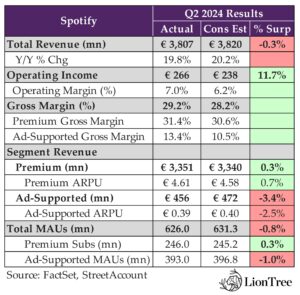
Posted Gross Margin Improvement Across The Board
- Q2’s outperformance in gross margins (29.2% vs cons 28.2%) was driven primarily by music content cost favorability and marketplace
- Premium Gross Margin at4% was up +291bps y/y – BEAT: The y/y trend reflects improvements in music profitability and Other Cost of Revenue, partially offset by audiobooks costs
- Ad-Supported Gross Margin at4% was up +1,907bps y/y – BEAT: ~1,260bp of the y/y improvement reflects lapping prior year charges related to efficiency actions; The remaining y/y trend reflects improvement in music profitability and podcast trends as well as Other Cost of Revenue favorability
- Continue to expect a seq ramp in gross margin through the balance of 2024
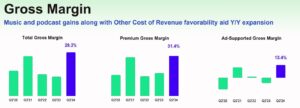
Spotify Expects Profits To Continue To Crescendo In Q3 & H2
- Q3 revenue guidance – Slight miss: €4.0bn vs cons €4.01bn; Implies +19% y/y growth (vs +20% y/y in Q2) but assumes ~-100bps headwind to growth y/y due to FX
- Q3 op income guidance – Solid beat: €405mn vs cons €298.5mn; Incorporates €15mn in Social Charges based on a Q2 close share price of $313.79
- Q3 gross margin guidance – beat:2% vs cons’ 28.6%
- Reached 30% gross margin well ahead of the 2025 deadline it shared at its Investor Day last year
- Q3 MAU guidance – Missed: 639mn vs cons 650.2mn
- Baking in “modest” levels of churn due to potential impacts from price increases
- Expect another “record qtr” of FCF generation in Q3
- Incremental FY24 commentary: Continue to expect a seq ramp in gross margin through the balance of 2024, as well as improvements in operating income and operating margin
Premium Paid Subscriber Growth Is Outperforming / Price Hikes Not Having A Neg Impact / Expect More Tiers To Come
- Premium revs growth of +21% y/y or +22% ex-FX (vs +20% y/y or +21% y/y ex-FX in Q1) was driven by –
- Premium subs growth of +12% y/y to 246mn (1mn ahead of guidance) reflects seq growth across all regions
- Driven by strong Q2 promo campaign intake due to top of funnel health
- ARPU growth of +8% y/y or +10% ex-FX (up from +5% y/y or +7% y/y ex-FX in Q1) due to price increases partially offset by product and market mix
- Posted Y/Y and seq growth across all regions with outperformance led by North America and Europe
- Premium subs growth of +12% y/y to 246mn (1mn ahead of guidance) reflects seq growth across all regions
- Have been moving to a more tailored proposition, which has helped drive adoption
- Expanded video podcast catalog to 250k+ shows
- Incorporated 250k+ audiobook titles into the Premium offering in Canada, Ireland, and New Zealand
- Introduced the Basic plan in Australia, the UK, and the US (ad-free without audio books)
- An Ultra-Premium Tier is on the way: Mgmt believes that a “good subset” of the 245m paid subscribers want “a better version” of Spotify; The plan is to offer a much better version at a $17-18/mo price point w/ all the benefits but “a lot more control and… higher quality across the board”, plus some other things the Co is not disclosing
- Thinks this will be a net positive across the music industry; Excited but “early days”
- Seeing “great success” from recent price hike and seeing less churn in this round of increases vs prior one, “which was already very low by any measure”
- Consumers continue to see value: Access to the 250k audiobooks, 6mn+ podcasts, and “pretty much the world’s entire music catalog,” would cost a user ~$26 in the US, which is “significantly more” than a Spotify subscription
BUT Ad-Supported Monthly Active Users (MAUs) Fell Short Of Expectations, Though Mgmt Is Very Confident They Can Overcome The MAU Challenges Looking Ahead
- Ad-supported revs grew +13% y/y or +12% ex-FX (down from +18% y/y or +19% y/y ex-FX in Q1) and missed expectations
- MAUs grew +14% y/y but missed guidance by -5mn (<1%)
- Music ad growth was driven by gains in impressions volumes and higher pricing
- Podcast ad revs growth was driven by growth in impressions sold across Original and Licensed podcast as well as the Spotify Audience Network, partially offset by softer pricings
- The Spotify Audience Network saw seq growth in participating publishers and advertisers
- Rev growth still reflected double digit y/y growth across all regions, with seq net adds led by RoW and Europe
- Recalibrating marketing activities – “We’re only going to spend money to attract listeners if it meets our ROI expectations”
- Paid subscription biz is primarily anchored in developed mkts, while ad-free segments is focused on developing mkts
- Developed mkts -> growth driven by net sub adds and strategic pricings
- Developing mkts -> see potential to convert users into subscribers, but on a much longer time horizon
- Path from free to paid user “is no longer a one-size-fits-all scenario”, given the bifurcation between developed and developing markets and the increased number of subscriptions offered; Less dependent on new free users to fuel rev growth in the short- to mid-term
- Seeing many users going straight to paid in developed mkts, and high engagement in those mkts gives them “tremendous confidence” in ability to raise prices
- Developing markets – See “significant” potential to attract “a large number” of new users
- Problem – Users in those markets are “a little bit more inconsistent” and conversion to paid can be slowed, which “makes it difficult to get the same level of ROI effectiveness from our marketing spend”
- Solutions –
- Improvements on marketing channels being used, particularly partnerships
- Further improvements in acquisition in developing markets, including optimizing marketing in those territories
- Prioritizing enhancements to free product pipeline, which, based on existing performance in certain markets, should boost engagement and retention
- Paid subscription biz is primarily anchored in developed mkts, while ad-free segments is focused on developing mkts
- On MAU miss – “We’re working really hard to fix it. But I am confident that this is more of a question when rather than if… we’ve been in this situation many times and we come back from it each and every time, and that gives me a lot of assurance this will be the case this time too”
Continue To See “Tremendous Oppty” In Advertising
- Given the deceleration in growth in advertising, how does it get to 20% of revenue?
- Seeing a mix shift towards paid offering: Subscription biz is “probably doing a little bit better than we expected it to” which means some of their “best, highest engaged users” are turning into paid subscribers, “which, of course, diminishes some of that potential that we have on the advertising side”
- Still working on bringing more programmatic and automated buying onto the platform: “We have been making a lot of investments over the past few years…you should definitely expect us to keep investing”
- Seeing choppiness in advertising spaces they operate in: “Our ads business is direct sales enterprise heavy in its current state. And on top of that… in our current state, [we are] an upper-funnel kind of brand-focused platform, and it’s exactly that quadrant that we’re sort of seeing choppiness and volatility in the market… I think that also highlights really what is a tremendous opportunity for us to basically diversify away from that and create agility for ourselves”
Relationship With Labels Is Not A Zero-Sum Game
- Did not provide comments on ongoing MLC lawsuit but provided some context on nature of relationship w/ labels
- Have continued to increase payouts y/y: Had record payouts in 2023, which the Co expects to beat this year
- “There’s always things that we’re arguing about… but overall, the music industry is growing”: This is inevitable when it comes to supplier and distributor relationships, but overall, the Co has a “healthy” relationship with the music industry
Other Initiatives In The Works – “We’re Focused On Solving Problems In The Intersection Between Creators And Consumer”
- “Very early days” on concerts, but it’s a “win-win” for consumers and artists: Concerts and live shows are a big revenue source for artists, while consumers often have a tough time figuring out what and which concerts to go to
- Seeing “great” artist and consumer support for “Fans First”, which allows artists to promote their concerts on their artist pages and across their different surfaces at Spotify; This could create oppties for their real fans to go to shows
- “Overall, the way we create higher LTV is by creating win-wins. We want to both do things for the existing creators we have in more new ways, like concerts. And potentially, when we see things we’ve already invested in and other groups of creators finding value in that, we’ll expand into other verticals [like] audiobooks and education”
UMG’S Results Were Impacted By Varied DSP Performance, But Its “Entire Mentality Is To Grow The Pie”
While Spotify delivered on Paid Music Subscriber growth this qtr (see Theme #5), it turns out that that was not the case across the DSP universe as “other large partners who have been less successful in driving global adoption have seen a slowdown in new subscriber additions”. This, plus tough comps due in large part to the previous price increases, resulted in sharply lower growth in UMG’s Subscription revenue to +7% y/y in Q2 from +12.5% y/y in Q1. This missed consensus estimates by almost -4% and was a key negative surprise.
However, UMG sees this dynamic as temporary and is working closely with their DSP partners on new product innovation and features. The Co is particularly excited about the ultra-premium tier that Spotify talked about earlier in the week, given that its research suggests that as many as 20% of the current subscriber base could upgrade to a super-premium tier at a “meaningfully” higher price point. Management remains confident that there is still ample room to grow paid music subscriptions, estimating that 180mn consumers will form the “next wave of subscription adoption” (and this assumes more price increases).
While performance in the Co’s ad-supported business did improve sequentially, management is still not ready to call a turn. They’d like to see a “broad based improvement across multiple partners and geographies over a longer” timeframe. Another headwind on the ad side (as well as a surprise announcement) was that Meta is no longer licensing premium music videos from UMG as of May.
UMG encouraged investors several times on the call to look beyond the quarter-by-quarter fluctuations, and the Co is planning to provide more details on its strategy and outlook during its upcoming Capital Markets day on Sept 17. Per management, the results “supports our conviction about our ability to deliver consistent, high single digit revenue growth”, and the “entire mentality is to grow the pie”. However, investors are likely take a wait and see approach until the dust settles and the growth trajectory becomes more visible.
-> UMG shares took it on chin post earnings, trading down -23.5%; It dragged down Warner Music Group -6.6% in US trading the day prior when results were released overseas; UMG’s stock is down -17.3% YTD vs WMG’s -16.1% and SPOT’s +71.3%.
The Q2 Beat Was All Driven By Merchandising & Other… The Key Paid Subscription Segment Posted A Negative Surprise
- Total revenue beat cons by +1.8%, growing +10% y/y (ex-FX) vs +8% in Q1… It was the 12th consecutive quarter of at least ~+hsd% revenue growth
- But the revenue beat came from Merchandising & Other revs, which was +40% above expectations
- Revenue in core paid Subscription missed expectations by ~-4%, which was a big surprise
- Adj EBITDA beat cons by +1.2%, growing +11% (ex-FX) vs +16% in Q1… It was the 7th consecutive quarter of double-digit increase in adj EBITDA
- Margin of 22.1% slightly missed cons 22.3%: Margin expansion was constrained by a greater proportion of lower margin physical and merchandising sales
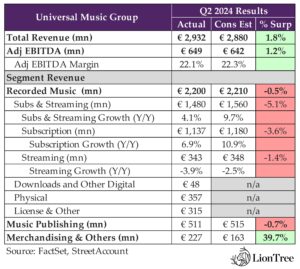
The Subscription Business Was Negatively Impacted By Weak Performance Of Some Large DSP Partners
- Recorded Music Subscription revenue saw a continued seq decel in growth from +12.5% in Q1 to +7% in Q2
- What drove the decel?
- The y/y comp was more difficult in Q2 vs Q1, partially due to the timing of price increases and had a -3pt impact vs Q1; In Q2, the Apple and Amazon price increases were fully annualized
- Also, there was a slowdown in subscriber growth at certain platforms
- What drove the decel?
- Q2 reflects “varied performances of our diverse portfolio of DSP partners”: “While Spotify, YouTube and many regional and local platforms have continued to exhibit healthy growth in subscribers, other large partners who have been less successful in driving global adoption have seen a slowdown in new subscriber additions”
- “It’s not that there’s an increase in switching, it’s really more about the competition for new subscribers. The services that are growing faster are doing a better job, enlisting the new subscribers”
- “There will always be variability quarter-to-quarter, so we continue to encourage you to view the business over a longer time horizon”
- UMG is working closely with DSP partners to reignite subscriber growth and should see some benefits towards the end of the year: The Co is engaged with all key partners in an “in depth” dialogue regarding product innovation to target high value customers and drive future revenue growth
- Particularly excited about the super-premium offering that SPOT discussed: UMG’s research and analysis indicate that as many as 20% of the current subscriber base could upgrade to a super-premium tier at a “meaningfully” higher price point for a compelling product configuration, one which offers enhanced features and exclusive access to content
- BUT “innovation does take time… hopeful to see some of these initiatives happen towards the end of this year”
- “We’re in a cycle of experimentation”
- “My entire mentality is to grow the pie”
- Still see opportunities with future price increases: Music is underpriced, perhaps to the extent of 20% of the cost per hour of entertainment of other formats
Remain Confident In The Overall Paid Music Subscription Market Growth – 180mn Consumers “Will Form The Next Wave Of Subscription Adoption”
- Mgmt highlighted that the industry added +78mn subs in 2023 vs +66mn subs in 2022 and that the US and UK mkts saw accelerated & higher subscription rev growth rates in 2023 y/y
- Media reports indicate that 5 of the top 10 global subscriber markets added more subscribers in 2023 than 2022, and mgmt sees sustained or accelerated subscription growth across multiple markets
- Mgmt identified an addressable mkt of 180mn+ consumers that “will form the next wave of subscription adoption”, AND that research is conducted assuming price increases
- About 50% of that total addressable market will be in the 13 developed mkts
- Expect to see a lot of growth in emerging markets
- “So we remain confident about the overall growth trajectory of the marketplace”
Still Not Ready To Call A Turn In The Ad-Supported Streaming Business
- Ad supported streaming revs growth declined -4% y/y ex-FX in Q2 (vs growth of +10% y/y in Q1) and missed cons by -2.5%: Mgmt still wants to see “broad based improvement across multiple partners and geographies over a longer” timeframe before we’re ready to adopt a less cautious view”
- Q2’s ad rev reflects a blend of platform specific and cont’d macro pressures
- On the platform side, Meta is no longer licensing premium music videos from UMG as of May, which added pressure on the ad business: Meta is now focusing instead on other areas involving music content, and UMG is with them to expand these areas as part of a multifaceted renewal
- Excluding this impact, as well as a lost month of TikTok rev while UMG was out of license with them, ad supported streaming revenue actually grew y/y
- The remainder of the slowdown in growth compared to Q1 was largely driven by slowdowns in ad revenue growth at Spotify and YouTube
- Outlook remains variable: “While the coming quarters may remain somewhat variable, we and our partners are laser focused on improving the monetization for the growing audience engagement on the platforms”
Expect Stronger Cash Flow In H2
- FCF before investing activities was a positive €155mn in H1 and H2 “is a consistently stronger cash generating period for our business”
- Expect royalty advances to step down materially in the back half of the year.
A Few Recent Initiatives With AI
- Agreement w/ TikTok included both creative and protective provisions
- The major music Cos recently filed copyright infringement cases against two AI music generation services, Suno and Udeo (follows a lawsuit last yr against Anthropic by several music publishers)
- Recently annc’d an exciting partnership with SoundLabs that has AI vocal plugins that generate ultra-high fidelity vocal models using an artist’s own voice data for AI training; This enables the creation of songs in languages artists don’t speak, but in their voice
A First Look At Media Entertainment Trends Raised Concern On Theme Parks
In addition to the key themes out of Comcast’s Connectivity results (see Theme #4), we had a first look at Media/Entertainment trends from NBCU, which did cause a bit of consternation this week especially as it relates to Theme Parks. NBCU’s Theme Parks business missed Wall Street estimates by -11% and -19% on revenue and adj EBITDA, respectively. Lower attendance at domestic parks accounted for ~2/3 of the biz’s decline, and management pointed to normalization in demand post-COVID, as well as the timing of domestic attractions, as the two main reasons for the pull-back. This was a developing trend that we highlighted last qtr, so it wasn’t completely out of the blue; however, the magnitude was more than expected. New attractions will help NBCU to reverse trends in early 2025, and management remains very bullish on the long-term opportunity for the theme park business. Note that Disney and Six Flag shares also felt some heat post this update, with their stocks closing down -3.4% and -2.1%, respectively, on the day Comcast reported.
NBCU’s bigger business unit is the Media segment, and while top line was slightly lower than expected, better profitability stood out with the $300mn y/y improvement in Peacock adj EBITDA losses. This is a year where growth in Peacock is offsetting the decline in some of the Co’s linear businesses, and Media adj EBITDA growth should, importantly, be positive in H2.
NBCU’s deal with the NBA was a big focus on the call with management, providing some color on the package that they bid on and the expected benefits (it was later reported that the NBA rebuffed Warner Bros Discovery’s matching bid for Amazon’s package, hence this is still some uncertainty regarding next steps ahead). Big picture, the NBA rights round out NBCU’s sports portfolio, which nearer term, will be driven by the Paris Olympics (kicking off at the end of the week).
Lastly to flag, NBCU’s Studio business was also under pressure in Q2, given the tough comps with Super Mario Brothers, but the H2 slate points to a rosier outlook for the rest of the year.
See below for more of what we thought was most important/incremental from NBCU’s Q2 performance…
Comcast’s NBCU Segment Was Under-Pressure In Q2 But Media Margins Were A Positive Outlier Vs Street Forecasts
- Content & Experiences revs missed by -3.9%, and adj EBITDA missed by -2.1%: Q2 rev in the segment fell -7.5% y/y (vs Q1’s +1.1% y/y), and adj EBITDA fell by -10.9% y/y (vs Q1’s -7.1% y/y)
- Weaker trends in Theme Parks and Studio were the main negative drivers
- The Media biz posted a slight miss to revenue but saw better-than-expected profitability
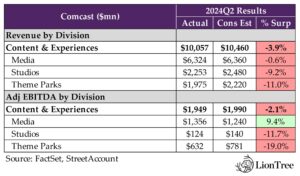
This Is The Year That Growth In Peacock Is Offsetting Declines In Some Linear Businesses / H2 Media Adj EBITDA Should Reflect Y/Y Growth
- Media segment revenue incr’d +2.1% y/y, and adj EBITDA rose +9.0% y/y, driven by Peacock: This compares to +3.6% y/y and -6.1% y/y, respectively, in Q1
- Media adj EBITDA for H1 is up nearly +3% y/y, as the improvement at Peacock outweighed the pressure at the TV networks
- In H2, mgmt guided for cont’d modest growth in overall media adj EBITDA but with some qtrly variability, driven by the timing of sports, entertainment launches, and marketing
- Q3 will be weaker…: Incremental content costs will hit in Q3, incl the Olympics, Sunday Night Football (will have an addt’l game), as well as Peacock’s exclusive NFL game from Brazil and the return of Big 10
- … While Q4 will be stronger: Given the timing of this content, adj EBITDA growth will be skewed to Q4
- Peacock rev grew +28% y/y (though down from +54% in Q1); Adj EBITDA improved +$300mn y/y to a loss of ~$350mn (but helped by lack of tentpole content in the period)
- Peacock ad revs +9% y/y and distribution revs up +61% y/y
- Peacock paid subs were up +38% y/y to ~33mn (but down from +55% y/y to ~33.5mn in Q1): Retention was a big focus in Q2, given the strong subs adds in Q1 that came from the exclusive NFL playoff game
- Peacock’s cost trajectory will “ebb and flow”: The “NBA is once in a generation… so obviously, we’ll make some adjustments and it might pause our trajectory of the year… but I think it’s part and parcel of the idea that we’re bringing the Media business to a better future”
- “The long-term goal for Peacock is to have a service that is a balance of sports, entertainment, and news, and so our content teams are now very focused on that new audience and what we’re going to be able to do to drive entertainment content with the advantage of being linked closely to the NBA and to the audience that follows it”
- Overall advertising in the Media business was only a slight step down from Q1: Adjusting for a much heavier load of sports in Q1 than Q2, the ad mkt remains “pretty stable”, and “we feel very well-positioned” for H2 with the Olympics, elections, and the slate of content coming to NBC and Peacock
- “Pleased” with results in the upfront: Total volumes for the upfronts were in line with last year as is the linear price; Secured $1bn in upfront volume for Peacock again; “So if you step back, we’d say the overall upfront market was pretty solid”
Comcast’s Deal With The NBA Was Big Focus
- Mgmt outlined color on their package:
- Length and timing: 11-year term that begins with the 2025-2026 season (will start to bear expenses in the fall of 2025)
- What games are included?
- Includes 100 NBA regular-season games across NBC and Peacock, “which is more than any other media partner and more regular-season games than each existing partner has under the current rights deal”
- For playoffs, will have first and second-round games each year, exclusively on their national platforms and six NBA conference final series, over the course of the term of the deal, “which is more playoff games on average each year, than any other media partner”
- Exclusively for Peacock? ~50 national regular-season and post-season games, incl national Monday night games and doubleheaders
- Additional elements of the NBA package: The annual NBA All-Star Game and All-Star Saturday Night each season, the season-opening NBA tip-off double header each season, a special doubleheader on the MLK holiday, and select NBA games in every NBA all-star game on Telemundo
- The package also includes WNBA: Starting in the spring of 2026, they will have 50+ WNBA regular-season and first round playoff games each season across Peacock, NBC, and USA; Will also have games in seven WNBA Conference semifinals and three WNBA Final series
-> It was quite the saga this week… It started with Warner Bros Discovery informing the NBA on Monday of its intent to use its matching rights to essentially secure the package of games that Amazon was bidding on, but the NBA subsequently rebuffed WBD and went ahead with awarding the package to Amazon (along with deals with Disney and NBCU), saying that WBD didn’t match the terms that Amazon was paying; The week ended with WBD filing a breach of contract suit against the NBA; Looks like this is now headed to court… (link)
- Why are they so excited about the partnership?
- Attractive demo: “The NBA brings in a broad, diverse, and youthful audience that is culturally relevant and further expands NBCU’s tremendous reach across broadcast and streaming”
- Drives other content: “Exciting opportunities for companion programming and marketing collaborations”
- Rounds out sports calendar: Completes the Co’s year-round calendar for sports, which already includes the NFL, Olympics, Premier League, NASCAR, PGA Tour, Big 10, and World Cup; “Our NBA package will establish much-watch Sunday, Monday, and Tuesday night traditions on NBC and Peacock”
- Comcast is uniquely able to drive strong value w/ the NBA in multiple ways
- Growing ad sales, by selling NBA ad inventory packaged with the rest of their programming
- Acquiring and monetizing subscribers both on linear and Peacock
- Optimizing NBCU’s programming investment across sports, entertainment, and news
-> Separately but related to the upcoming Olympics broadcast, NBCU will provide a commercial-free hour during the live coverage of the Paris Summer Olympics opening ceremony; Major sponsors Coca-Cola, Delta Airlines, Eli Lilly, Toyota, Visa and Comcast’s Xfinity brand will each be acknowledged by commentators as sponsors for 10 minutes during this hour but w/o interrupting the broadcast; This Paris Olympics has generated $1.2bn+ in ad revenue for NBCU, which is a record level (link)
Tough Comps Challenged The Studio Biz In Q2, But H2 Should Show Strength
- Studios posted underwhelming headline results
- Rev dropped -27.0% y/y (vs -7% y/y in Q1) and missed cons by -9.2%
- Adj EBITDA fell -51.4% y/y (vs -12% y/y in Q1) and ended -11.7% behind cons
- The timing of the Co’s film slate was a drag on the qtr: As the film slate is weighted to the back half of the yr
- … Along w/ a tough comp vs last yr: Given that Q2:23 saw the “tremendously successful” release of the Super Mario Bros movie as well as Fast X
- Still, recently released titles are “off to a strong start”
- Despicable Me 4 “had a terrific opening weekend” earlier in July: The latest iteration made the Despicable Me series of movies the first animated franchise in history to cross the $5bn mark
- Twisters is “off to a strong start” as well: Landed at #1 in the box office last weekend
- Notable upcoming titles: Include Wild Robot in Sept and Wicked in Nov
Theme Parks Suffered From Lower Attendance
- Theme Parks underperformed both on the top-line and adj EBITDA
- Rev fell -10.6% y/y (vs +2% y/y in Q1) and missed cons by -11.0%
- Adj EBITDA was down -24.1% y/y (vs -4% y/y in Q1), closing -19.0% below cons
- Lower attendance at domestic parks accounted for ~two-thirds of the biz’s decline: Pointed to normalization in demand post-COVID as well as the timing of domestic attractions as the two main reasons for the lower attendance
- Other travel options have been diverting spend away from parks: Given the strength of the dollar, cruises and intl tourism have experienced a “surge in demand”, causing a normalization of visitation rates at the Co’s theme parks
- The timing of the Co’s investments in new attractions is also “creating some headwinds”: The Co is planning on opening Epic Universe next yr in Florida, and it is also lapping its opening of Super Nintendo World in Hollywood last yr
- Performance by region:
- Osaka: Underlying growth at the Co’s park in the city continues to be partially offset by FX
- Donkey Kong Country will open as an expansion to the park in H2:24 after originally being slated for spring 2024
- Beijing: Universal’s park saw “some softness” due to the local macroeconomic environment
- Orlando: Attendance was “light”, given the opening of Epic in 2025
- Hollywood: Was affected by a pull-forward of demand during COVID, but the Co is “excited” about Hollywood horror nights and moving past more difficult comps in H2:24
- Osaka: Underlying growth at the Co’s park in the city continues to be partially offset by FX
- Cautious near-term outlook – Trends that the Co is currently experiencing will likely continue until Epic opens up “sometime next yr”, but “to reiterate, we couldn’t be more bullish about the long-term trajectory of Parks”
- In addition to Epic Universe, have a strong slate of new attractions w/ Donkey Kong Country in Osaka and a Fast and Furious roller-coaster in Hollywood as well as the Universal Horror Unleashed in Las Vegas and Universal Kids resort coming to Texas
-> Disney and Six Flags both traded down on the back of the news, ending the day down -3.4% and -2.1%, respectively
-> Also, Walt Disney World has reportedly been quietly discounting admission and hotel stays over the past several months amid declining attendance and customer dissatisfaction. In May, Disney began offering discounted three-day ticket packages as low as $89/day to visit Hollywood Studios, EPPCOT and Animal Kingdom, which is a sharp decrease from the all-time high of $254 for a daily Park Hopper pass; The Co is also discounting its cheapest hotels, with night stays at some resorts costing as little as $100; Additionally, new dining packages are reducing meal costs by as much as 20-30% (link)
Grab Bag: Reddit Strikes Sports Partnerships / Apple Cuts Content Spend / Prop 22 Is Upheld
- Reddit enters partnerships with NFL, NBA, MLB, the PGA Tour, and NASCAR (link/link/link):
- How does Reddit benefit? Will get videos and other content, such as game highlights, behind-the-scenes videos, and will help arrange for ask-me-anything (AMA) sessions with players
- How do advertisers benefit? Will be able to buy ads that run in front of the videos and alongside other content from the leagues
- “We’re already well penetrated with large advertisers,” Reddit CEO Jen Wong said, “but I think this opens the door wider”
- How does rev share work? Reddit will share the rev it gets from advertisers with the participating sports leagues
- Did not clarify whether Reddit is paying leagues an upfront fee or offering minimum guarantees for the content
- Sports is one of the most popular and fastest-growing categories on Reddit: Sports-centric groups accounted for 20.4mn page views in the LTM, up +26% from the previous 12-month period; Sports communities also receive 249mn monthly posts, votes, and comments on the platform across the globe
- Plan to expand the program beyond sports to include entertainment and lifestyle media companies in the future
- Twitter and YouTube have similar arrangements: Twitter’s program, which was put in place before Elon Musk bought the Co and renamed it X, generated $1bn+ annually (Twitter had deals w/ both sports leagues and media firms, so the rev was split b/w all of them); Google’s YouTube has a similar partnership w/ the leagues and media firms
- Apple is reportedly cutting back spending on original content (link/link):
- High-cost projects…: Have invested $20bn+ in original programming, including $500mn+ combined on movies from directors Martin Scorsese, Ridley Scott, and Matthew Vaughn as well as $250mn+ on the World War II miniseries Masters of the Air.
- … Have seen limited success and ROI: Apple TV+ accounts for only 0.2% of TV viewership in the US, compared to Netflix’s 8%; Apple TV+ reportedly generates less viewing in one month that Netflix does in a single day
- Over the last five years, Apple has only had 4 series make Nielsen’s weekly list of the 10 most-popular original streaming shows
- What does the new strategy look like? Tighter budget controls and a more cautious approach to spending, including paying less upfront for shows, being quicker to cancel underperforming series, and delaying productions to manage costs better; Also become more selective in acquiring new projects
- Uber, Lyft, and DoorDash triumphed in the Prop 22 gig worker battle (link): California’s Supreme Court upheld Proposition 22 in a unanimous decision, ensuring that ridesharing and food delivery svs workers in the state will remain independent contractors instead of being classified as employees
- Some background on the proceedings: California voters passed Prop 22 in 2020, but then a group of Uber and Lyft drivers filed a lawsuit challenging the law; Prop 22 was deemed “unconstitutional” and overturned by a judge in 2021 but then upheld by an appeals court in March 2023 before this week’s decision
- Still, Prop 22 does guarantee workers some protections: Including 120% of the local minimum wage for each hour spent driving, a health insurance stipend, and reimbursement for job-related injuries; Uber and Lyft began offering these benefits for drivers in late 2020
- “Uber alone has invested more than $1bn in direct benefits to-date”: This was per a response from the Co to the decision; Uber added, ““From the moment it became law, Prop 22 has been working for the millions of drivers and couriers that earn on platforms like ours”
- Opponents of Prop 22 are understandably frustrated by the outcome: The president of the California Federation of Labor Unions wrote, “These companies have upended our social contract, forcing workers and the public to take on the inherent risk created by this work, while they profit”
Stock Market Check
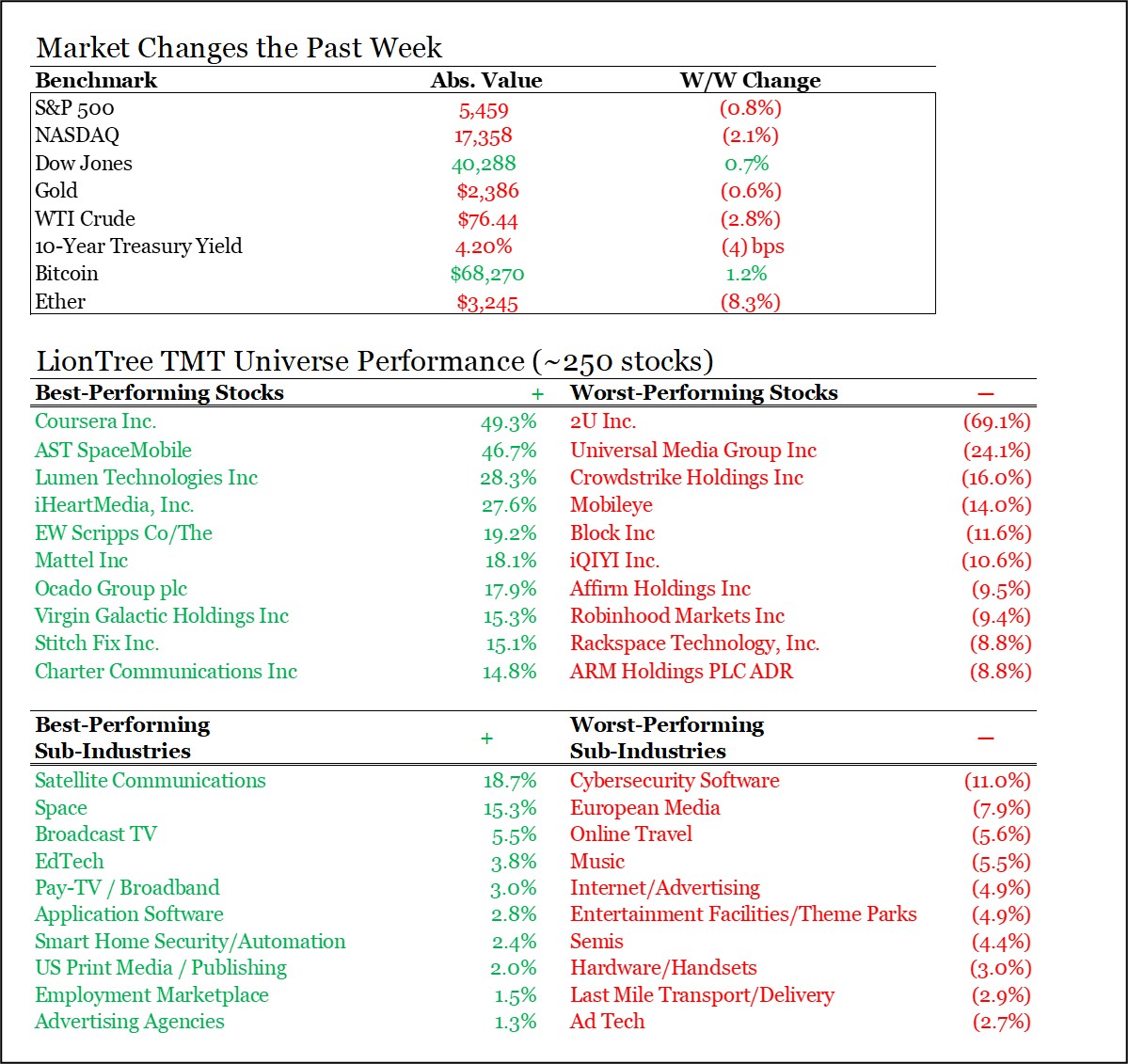
This Week's Other Curated News
Advertising/Ad Agencies/Ad Tech
- Six ad firms, including four that buy online ads and two whose technology helps sell ads, have told ADWEEK that they are limiting their clients’ exposure to streaming ads from Pluto TV, whose parent co Paramount has agreed to merge w/ media co Skydance. They are worried that Pluto TV is taking advantage of programmatic auctions to sell more ads at higher prices. A source w/in Pluto TV said there are multiple reasons why a live channel selling programmatically would send more than one bid request for each impression. (ADWEEK)
Artificial Intelligence/Machine Learning
- Following Meta’s release of Llama 3.1, French AI company Mistral introduced Mistral Large 2, claiming it outperforms recent models from OpenAI and Meta with fewer parameters. Mistral Large 2 excels in code generation, mathematics, reasoning, and multilingual support, boasting 123 billion parameters. It offers enhanced performance, cost efficiency, and reduced hallucinations, making it suitable for complex programming tasks. The model is available on Mistral’s platform, la Plateforme, and their chatbot, Le Chat. (The Indian Express)
- Google DeepMind said it has made strides in solving complex math problems, an area that remains challenging for AI programs. Google rolled out AlphaProof, which specializes in math reasoning, and AlphaGeometry 2, an updated version of a model focused on geometry that the co debuted earlier this yr. In the AI industry, where comparison between offerings is difficult, solving math problems has become a key proof point. (Yahoo Finance)
- Investments in generative AI startups aren’t slowing down. Should the trend maintain, generative AI cos are on track to match or exceed the ~$21.8bn they raised in 2023. Early-stage startups were the clear winners, like Elon Musk’s xAI (which raised $6 bn in May), China’s Moonshot AI ($1bn in Feb.), Mistral AI ($502.6mn in Jun.), Glean ($203.2mn in Feb.) and Cognition ($175mn in Apr.). (TechCrunch)
- Meta has released Llama 3.1, an open-source AI model with 405bn parameters, rivaling ChatGPT and Google Gemini. Trained on 16,000 Nvidia GPUs, it offers improved performance in Meta AI chats and a new feature to generate AI images starring the user. The model supports multiple languages and is free to download for developers. While Instagram and Facebook will integrate it soon, users can already test the “Imagine Me” feature for personalized AI imagery. Meta aims to attract developers with its performance and open-source availability. (Lifehacker)
- Meta’s AI assistant, already available on Ray-Ban smart glasses, will launch on Quest headsets in August for US and Canada users. The assistant, still experimental, replaces current voice commands on Quest, providing hands-free navigation and information. Users can ask for restaurant recommendations, weather updates, and use the “Meta AI with Vision” feature to get information on their surroundings via Passthrough. Meta also announced Llama 3.1, its new AI model, supporting expanded languages and new features like the “Imagine me” image generator. Meta AI is now accessible in 22 countries and multiple languages, with more updates to follow. (Engadget)
- Microsoft has unveiled an update to Bing web searches that overhauls search results w/ AI-powered answers. The new search results page will include a detailed AI-generated answer, followed by curated sources that the AI answer has pulled from. Traditional search results will still appear alongside the AI-generated results in a sidebar on the right. (Windows Central)
- OpenAI annc’d SearchGPT, an AI-powered search engine with real-time access to information across the internet. The search engine starts with a large textbox that asks the user “What are you looking for?” But rather than returning a plain list of links, SearchGPT tries to organize and make sense of them. In one example from OpenAI, the search engine summarizes its findings on music festivals and then presents short descriptions of the events followed by an attribution link. (The Verge)
- Runway’s AI video generation tool, Gen-3, was secretly trained by scraping thousands of videos from YouTube creators and brands, as well as pirated films, according to an internal spreadsheet obtained by 404 Media. Released in June and praised by the AI community, the tool’s training data included content from major brands and popular influencers. Despite previous non-disclosure about data sources, the spreadsheet details a company-wide effort to compile and scrape videos using proxies. (404 Media)
- Salesforce and Workday announced a new AI employee service agent to automate tasks, provide personalized support, and offer data-driven insights, enhancing productivity and efficiency. This collaboration integrates Salesforce’s Agentforce Platform and Einstein AI with Workday AI, leveraging shared data from both platforms for seamless employee support across various tasks. The service agent uses natural language processing for conversational interactions and ensures smooth human hand-offs for complex issues. This partnership aims to revolutionize employee experiences and improve business performance by merging HR, financial, and CRM data into one powerful AI-driven system. (BUSINESSWIRE)
Audio/Music/Podcast
- Apollo announced a $700mn capital solution for Sony Music Group, aimed at supporting investments in the music industry. Apollo Partner Jamshid Ehsani highlighted the bespoke nature of the solution, benefiting both clients and Sony’s business plans. Apollo, a global asset manager with $671bn in assets, focuses on yield, hybrid, and equity strategies to provide innovative growth capital and financial security through retirement products. (MarketScreener)
Broadcast/Cable Networks
- Sinclair has cont’d to make cuts to its local news programming. Sinclair annc’d that it will stop offering local news on CBS4 in El Paso. It will move all its news assets to KFOX14, resulting in some layoffs, according to a report from El Paso Matters. KTUL, Channel 8, a Sinclair Broadcast Group-owned ABC affiliate in Tulsa, Oklahoma, will soon produce its news out of Oklahoma City. (Cord Cutters News)
- Vivendi SE said that its Canal broadcasting biz should be listed on the London Stock Exchange and that the Havas advertising agency is likely to trade in Amsterdam, as French billionaire Vincent Bollore moves ahead w/ plans to break up his sprawling empire. Louis Hachette Group, a new co that brings together Vivendi’s publishing and distribution assets, would be listed in Paris, the co said in a statement. Following the split, the Bollore Group would hold about 30.6% of the shares of Canal, Louis Hachette Group and Havas respectively. (Yahoo Finance)
Broader Connectivity
- The FCC’s report on AT&T’s major outage said that a network update caused the outage. The incident lasted 12 hours overall and hit millions of customers. AT&T has implemented technical controls in its network and greater peer reviews to ensure it doesn’t happen again. The FCC opened a formal investigation into the incident on Mar 8. (Fierce Network)
Cable/Pay-TV/Wireless
- As of June 2023, Orange’s financial statements include its majority stake in VOO SA. The group’s Q2 2023 revenues grew by 2.6%, driven by retail services and equipment sales, despite declines in wholesale services. Africa & Middle East saw a 12% revenue rise. EBITDAaL increased by 1.0% in Q2, with strong performances in Africa & Middle East and Europe. Net income was €1,088 million in 1H 2023, down €378 million. eCAPEX reduced by 5.7% in 1H 2023. Orange aims for €3.5 billion organic cash-flow from telecom activities by year-end. Net debt increased due to the VOO acquisition. Orange is on track to meet its 2023 financial targets and sustainability goals. (Newsroom Groupe Orange)
- Jio Platforms ended Q4 with 108mn 5G subscribers, accounting for 28% of its wireless data. Mukesh Ambani emphasized Jio’s role in advancing Digital India with new prepaid plans aimed at fostering 5G and AI innovation. Jio’s net profit rose 12% y/y to INR55.8bn, with operating revenue up 13.3% to INR338.4bn. Jio, expanding its 5G network since October 2022, plans a potential IPO in 2025, possibly valuing around $112bn, which could boost Reliance Industries’ share price. (RCR Wireless News)
- Liberty Global’s Q2 2024 results are on track, with CEO Mike Fries highlighting strategic progress and shareholder value plans. Key points include the Sunrise spin-off set for Q4, a new UK mobile network agreement with Vodafone, and a $240mn dividend planned for 2025. The Ventures portfolio is valued at $3bn, and $3.5bn in cash supports a robust balance sheet. Financial performance saw stable revenue and adjusted EBITDA growth, with key contributions from Sunrise, Telenet, VMO2, and VodafoneZiggo. (ADVANCED-TELEVISION)
- Seven months after the FCC proposed rules to eliminate “video service junk fees,” including early termination charges, DirecTV continues to oppose them. DirecTV’s counsel, Michael Nilsson, argued that early termination fees (ETFs) of $450 to $700 are crucial for covering the cost of installing expensive equipment and that removing ETFs could force higher upfront costs or monthly prices. DirecTV also opposed prorated refunds for partial billing cycles, claiming this could hinder competition with online video distributors and reduce consumer choices. (NextTV)
- Vodacom said Q1 rev rose, driven by sustained growth in its key regions. Group rev rose 1.5% y/y to 36.2bn South African rand ($1.97bn). Service rev grew 10% on a normalized basis, above its midterm target, to ZAR28.96bn, w/ a 1.8% rise in South Africa and a 2.3% increase in international operations. Vodafone Egypt svs rev grew 44% in local currency, well above the rate of inflation, the Co said. (MarketScreener)
- VodafoneZiggo’s latest quarterly results met expectations, showing stable revenue and continued growth in mobile and business broadband markets. The company maintained its 2023 financial guidance. Despite a slight decline in consumer fixed internet customers, business broadband and mobile subscriptions increased. EBITDA fell by 3.6% due to higher operating costs but improved from Q1 2023. Investments in networks, products, and services were 23.6% of revenue. VodafoneZiggo remains focused on enhancing customer value and expanding its high-speed internet and entertainment offerings. (VodafoneZiggo)
- Wall Street analyst Craig Moffett called out “Verizon’s C-band problem” in a note for investors. “There are more holes than cheese in the C-band network,” Moffett said, citing Verizon’s dismal score in Opensignal’s latest 5G Availability report. Verizon responded to Fierce’s questions about those claims, saying Opensignal’s “Availability” measure is flawed in its basic methodology. (Fierce Network)
Cloud/DataCenters/IT Infrastructure
- Equinix has annc’d its entry into the Philippines w/ the acquisition of three data centers from Total Information Management, a leading technology solutions provider. Following the recently annc’d expansions in Malaysia and Indonesia, this strategic move aims to help businesses expand and capitalize on the digital opportunity of the fast-growing Southeast Asia region. The all-cash transaction represents a multiple of ~15x the projected EBITDA at full utilization and is expected to close in 2H 2024. (PRNEWSWIRE)
- Lumen Technologies and Microsoft annc’d a new strategic partnership that will use the Microsoft Cloud to further drive Lumen’s digital transformation. In addition, Microsoft has chosen Lumen to expand its network capacity and capability to meet the growing demand on its datacenters due to AI. This collaboration expands upon the longstanding relationship between Lumen Technologies and Microsoft. (PRNEWSWIRE)
Crypto/Blockchain/web3/NFTs
- Coinbase Asset Management plans to launch a Real-World Asset (RWA) tokenized money-market fund, partnering with Apex Group for the initiative, according to a CoinDesk report. This follows the success of BlackRock’s BUIDL token, which reached a market value above $500mn. Coinbase has been moving towards tokenized assets since 2023 after gaining approval to store TradFi assets on-chain in Abu Dhabi. The RWA token market cap is $7.2bn, though recent trading saw declines in ONDO, OM, and PENDLE tokens. (FXStreet)
- Donald Trump will deliver a keynote address at a major bitcoin conference in Tennessee. Trump, the Republican presidential nominee, has raised over $4mn in digital tokens from donors, including notable crypto figures. The Trump 47 committee’s filing shows $118mn raised from April to June, with significant bitcoin contributions. Trump is positioning himself as a pro-crypto candidate, reversing his previous stance, and has garnered support from influential tech and crypto investors. (CNBC)
- Ferrari plans to extend cryptocurrency payments to Europe by the end of July, aiming to “support dealers in better addressing the evolving needs of its clients. ” Previously, Ferrari started accepting Bitcoin, Ether, and USD Coin in the US last October, in partnership with BitPay. The company intends to expand this service to other markets by the end of 2024. Despite crypto’s popularity, its use as a payment method remains rare among major companies. (Yahoo Finance)
Cybersecurity/Security
- A confidential assessment by the US Office of the Comptroller of the Currency (OCC) found half of the major banks it oversees have inadequate management of operational risks, including cyber threats and employee errors, Bloomberg reported. Eleven of the 22 large banks the OCC supervises had “insufficient” or “weak” management of operational risk, and one-third scored 3 or less in a 5-point scale for overall management, Bloomberg said citing sources familiar w/ the matter. (Capital Brief — Business news and politics for the new economy)
- A ransomware attack on Australian healthcare firm MediSecure in April 2023 led to the theft of sensitive data belonging to nearly 13mn people. The company confirmed that the attackers stole personally identifiable information (PII) including names, addresses, phone numbers, healthcare identifiers, and more. Despite efforts, MediSecure couldn’t identify specific impacted individuals due to the data set’s complexity. The firm restored operations using a complete backup on May 17, 2023. (TechRadar)
- Telefonica has in collaborated w/ Warpcom to team up w/ Fortinet and Quantum Xchange to develop and demonstrate the effectiveness of an innovative solution based on quantum security architecture, designed to meet the present and future needs of organizations. This initiative aims to protect data and systems against the most sophisticated cyber-attacks that exploit the properties of quantum computing. (THEFASTMODE)
- The CrowdStrike glitch that caused outages for millions of users of Microsoft Windows devices last week continued to roil industries and snarl global air travel. Around 8.5mn devices were affected by the outage, CrowdStrike said in a statement, adding that it had brought a significant number back online. A file named “crowdstrike-hotfix.zip” was being distributed that included malware enabling hackers to remotely control or monitor a user’s device, CrowdStrike said in a blog post. (Yahoo Finance)
- US House leaders are calling on CrowdStrike CEO George Kurtz to testify to Congress about the Co’s role in sparking the widespread tech outage. CrowdStrike said this week a “significant number” of the millions of computers that crashed, causing global disruptions, are back in operation as its customers and regulators await a more detailed explanation of what went wrong. (Fortune)
- Wiz has walked away from a $23bn deal to be bought by Google, in what would have been the co’s largest-ever acquisition, telling employees it would pursue an IPO as previously planned. “Saying no to such humbling offers is tough,” Wiz co-founder Assaf Rappaport wrote in a memo to the company’s employees. A person said that the co weighed antitrust and investor concerns as reasons for abandoning the potential deal. (CNBC)
eCommerce/Social Commerce/Retail
- Amid speculation that Hasbro is considering its own bid for rival Mattel, the toy co reported Q2 rev fell -18% y/y to $995mn, down from about $1.2bn the yr prior. Excluding last yr’s sale of its eOne film and TV biz, Hasbro said rev declined 6%. Hasbro executives did not mention that possibility on the call, but focused on the co’s own turnaround efforts. (Retail Dive)
- Coach is now in the metaverse as the luxury retail brand has launched its Spring 2024 collection on the social platform Zepeto as well as in the Roblox realm. The metaverse move supports Coach’s “Find Your Courage” campaign, fostering self-expression and allowing users to explore their identities w/ themed digital wearables available in Fashion Famous 2 and Fashion Klossette on Roblox and Zepeto, according to a press release. (www.retailcustomerexperience.com)
- In a David versus Goliath battle, TikTok’s Deals For You Days sales event aimed to compete with Amazon’s Prime Day but failed to impact Amazon’s dominance. Data from Salesforce shows a 3% growth in non-Amazon retail during Prime Day, whereas TikTok’s event saw a 6% decline. The average discount on TikTok was 18%, compared to Amazon’s 22%. (Modern Retail)
- Mattel remains confident in its ability to deliver profits independently after reports that private equity firm L Catterton, backed by LVMH, made a buyout offer. Mattel’s shares rose 15% following the news. Despite recent gains from Hot Wheels sales and a successful Barbie film, Mattel’s stock has struggled. CEO Ynon Kreiz has expanded Mattel’s reach into Hollywood, with 16 film projects in development. An activist investor recently urged Mattel to sell some brands. Mattel declined to comment on the acquisition speculation. (Los Angeles Times)
- Taobao, the flagship retail platform of China’s Alibaba Group, will introduce free overseas shipping on apparel orders as it attempts to challenge cross-border e-commerce rivals Temu and Shein. The program will start from Aug. 3 and initially be available for shoppers in Singapore, Malaysia, South Korea, Taiwan, Hong Kong and Macao. The list will expand to additional Asian markets around the end of this yr. (Nikkei Asia)
- The British competition regulator’s review of supermarket loyalty prices is unlikely to find widespread misleading promotions, the CMA announced. Loyalty schemes by major UK supermarkets, like Tesco and Sainsbury’s, offer lower prices to members and have become highly popular. The CMA is investigating whether non-member prices are inflated to make loyalty prices more attractive. Preliminary results suggest no widespread misleading practices, but the CMA is examining pricing claims further, with a full report due in November. The British Retail Consortium supports the update, highlighting supermarkets’ need to demonstrate value. Tesco and Sainsbury’s shares remained stable. The CMA also noted effective competition in grocery profit margins but raised concerns about high road fuel and infant formula prices. (Yahoo Finance)
- TikTok plans to launch its in-app shopping platform in Spain and Ireland as early as Oct, resuming a campaign to expand Europe’s fastest-growing biz. ByteDance has told partners including merchants and creator agencies to prepare for the debut of TikTok Shop in both countries. The rollout will be smaller than previously anticipated, although preparations are underway to bring the site to other parts of Europe next yr. (SOLONDAIS)
EdTech
- KKR & Co will take education software platform Instructure Holdings private for $4.8bn, the private equity firm said. The buyout heralds a potential resurgence in private equity activity, following a period of dormancy due to elevated interest rates that had hindered debt financing for leveraged buyouts. The deal for Instructure follows a similar transaction in which Bain Capital agreed to acquire PowerSchool Holdings for $5.6bn. (Yahoo Finance)
EV/ Autonomous Vehicles
- China’s rapid adoption of autonomous driving isn’t boosting Baidu’s stock, which has nearly erased recent gains after announcing a ride-hailing expansion in Wuhan. Analysts are cutting its 12-month target price amid concerns about offsetting weak advertising revenues and uncertain regulations. While Baidu aims for profitability with its Apollo Go robotaxi service, market competition and macroeconomic conditions pose challenges. (Yahoo Finance)
- GM’s self-driving car subsidiary Cruise is scrapping plans to build the Origin and will instead use the next-generation Chevrolet Bolt in its operations. GM Chair and CEO Mary Barra told shareholders the decision will “simplify their path to scale” and addresses the regulatory uncertainty faced w/ the Origin robotaxi because of its unique design. (TechCrunch)
- Tesla reported another quarter of disappointing profit and postponed a highly anticipated unveiling of autonomous taxis, sending the carmaker’s volatile stock plunging the most in almost 4 yrs. Adjusted earnings fell to 52 cents per share in the three months ended in Jun., missing estimates for the fourth consecutive quarter. (BGOV)
Film/Studio/Content/IP/Talent
- Amazon Prime Video is buying the UK’s Bray Film Studios, where it shot the second season of ‘The Lord of the Rings: The Rings of Power. ‘ The deal marks Amazon’s first acquisition of a physical studio in the UK, w/ Bray set to be used for new and continuing TV series and feature films. The first production to be located there following the purchase will be the second season of the Russo Brothers’ spy series “Citadel,” starring Richard Madden and Priyanka Chopra Jonas, which is scheduled to begin filming in Sept. (Variety)
- AMC Entertainment Holdings has reached a debt refinancing deal that will push up to $2.45bn of debt maturities from 2026 to 2029 and beyond. The restructuring deal aims to give the movie theater chain breathing room on its balance sheet to pay down an estimated $4.5bn in long-term borrowings. The debt refinancing plan calls for ~$1.2bn in near-term loans due 2026 to be swapped for new secured term loans due 2029, w/ an additional $800mn of 2026 maturities potentially to be pushed out to 2029. (The Hollywood Reporter)
- AMC Entertainment swung to red as rev fell in the second quarter. Fewer films hit screens due to the Hollywood actors and writers strikes, but CEO Adam Aron said the worst and a major uptick that started in June is continuing. In preliminary results, the co said total revenues for the qtr ended Jun. 30 dipped to just over $1bn from $1.35bn a year ago, dragged down by slow moviegoing in Apr. and May. As a result, AMC swung to a loss of $32.8mn, from a $8.6mn profit in the 2023 qtr. (Deadline)
- Disney/Pixar’s Inside Out 2 has become the highest-grossing animated movie ever at the worldwide box office. With $1,462.8mn, the sequel has surpassed Disney Animation Studios’ Frozen II ($1.454bn). Disney has seven of the Top 10 animated movies ever globally, five of which are from Pixar. (Deadline)
- Marvel Studios/Disney’s “Deadpool & Wolverine” is expected to significantly boost the box office, projecting a record-breaking R-rated opening of $160M-$170M domestically and $340M-$360M globally. This follows a tough period for Marvel with “The Marvels” opening at $46.1M. Directed by Shawn Levy and starring Ryan Reynolds and Hugh Jackman, the film has strong advance ticket sales and is generating significant excitement. It marks a major step for the MCU, integrating X-Men characters and potentially revitalizing Marvel’s cinematic impact. (Deadline)
FinTech/InsurTech/Payments
- Around one in three adults are using mobile contactless payments every month, according to a finance industry body. Some 18.3bn contactless payments were made in the UK in 2023, a 7% increase compared w/ 17.0bn in 2022. Cash accounted for one in eight (12%) of all payments made in the UK during 2023, down from 14% in 2022. There was a marked increase in the number of people who were registered for mobile contactless payments such as Apple Pay or Google Pay last yr, UK Finance said. They represented 42% of the adult population, up from 30% in 2022. (Yahoo Finance)
- Britain’s new Labour govt will soon set out updated plans to regulate the “buy now, pay later” industry. This follows multiple delays to the roadmap for BNPL legislation in Britain. “Regulating Buy Now Pay Later products is crucial to protect people and deliver certainty for the sector,” a Treasury spokesperson told CNBC. (CNBC)
- Visa reported its FQ3 earnings on July 25, causing shares to drop 4.1% by July 26. Despite net revenue rising 10% to $8.9bn and net income increasing 17% to $4.9bn ($2.42 per share), revenue fell short of the $8.92bn estimate. The miss highlighted concerns as management noted lower earners cutting back on spending, impacting Visa’s growth. Payments volume rose only 7%, just above inflation. With shares trading at 31 times trailing earnings and a market cap of $510bn, the high valuation is being reassessed due to signs of slowing transaction growth. (Yahoo Finance)
Handheld Devices & Accessories/Connected Home
- Amazon’s Echo smart speakers, despite strong sales, have resulted in billions in losses. CEO Andy Jassy is focusing on cost-cutting and has targeted the smart device business for reductions. From 2017 to 2021, Amazon lost over $25bn on devices like Echo and Alexa, often sold at low prices to encourage broader use. The strategy didn’t yield expected profits. The company is now exploring monetized subscriptions and advanced Alexa features to boost profits. (New York Post)
Last Mile Transportation/Delivery
- Apollo Private Equity has acquired UK parcel delivery company Evri in a £2.7bn deal. Previously known as Hermes, Evri was bought by Advent International for €1bn in 2020. Under Advent, Evri rebranded and improved its operations, now delivering over 720mn parcels annually. Evri serves major retailers and aims to maintain its growth with Apollo’s expertise. The acquisition follows Evri’s announcement to invest £19mn in expanding its electric cargo bike fleet. (Retail Systems)
- Grab acquired Singapore restaurant reservation app Chope for an undisclosed sum, expanding its svs as competition over users intensifies. The deal adds dinner bookings to Grab’s offerings as it seeks to ward off rivals like GoTo Group and Line Man Wongnai in markets including Singapore, Indonesia and Thailand. Grab is pushing beyond its core services of ride hailing and food delivery, seeking to boost its margins in the Southeast Asia market of more than 650mn people. (Yahoo Finance)
- Lyft annc’d that the president Kristin Sverchek will be leaving on Aug 20. The co said Sverchek’s exit is not due to a disagreement w/in the co, its board of directors or mgmt, and is not related to Lyft operations or policies. Sverchek will continue serving as a nonemployee advisor through Nov. 30. The co also said Sverchek will be entitled to severance benefits, including a $650,000 cash payment. (CNBC)
- The European Commission is investigating Berlin-based Delivery Hero and its Spanish subsidiary, Glovo, for potential cartel activities. The probe will examine if the companies allocated geographic markets, shared sensitive information, and agreed not to poach each other’s employees. This follows unannounced raids in 2022 and 2023. Both companies stated they will cooperate fully. (TechCrunch)
Live Entertainment/Theme Parks/Concerts/Experiential
- Ascential, the owner of Cannes Lions and Warc, is to be acquired by publisher and events group Informa for a cash offer of £1.16bn. The boards of both Ascential and Informa agreed to the terms of a recommended offer of 568p per share, valuing the Co at £1.16bn “on a fully diluted basis”. However, the deal is still subject to regulatory and shareholder approval. (PRWEEK)
- Disney has rolled out discounted ticket prices for select parks, summer dining plans and reduced hotel rates to woo back customers who have complained about the exorbitantly high cost of taking their families to the “Happiest Place on Earth. ” In May, Disney World quietly began to offer cheaper ticket prices, which soared to as high as $254 for a one-day park hopper ticket at the Orlando, Fla, theme park. The discounted price starts at $89 a day for those buying three-day tickets. (New York Post)
- Live Nation Entertainment is pushing for the Justice Department’s antitrust lawsuit, which seeks to dismantle its merger w/ Ticketmaster, to be transferred from New York federal court to Washington, DC. The co argues that the District of Columbia is the appropriate venue to address issues related to a 2010 consent decree that permitted the merger under specific conditions. (PYMNTS.com)
- The Reinsdorf and Wirtz families, owners of the Bulls and Blackhawks, respectively, and co-owners of the United Center, have annc’d a 10-yr, $7bn plan to develop a district around the arena that would include an elevated green space, affordable housing units, and a 6,000-seat entertainment venue. The proposal, named The Project 1901, still needs approval from the Chicago Plan Commission and the city council. (Front Office Sports)
Macro Updates
- Economic activity in the US was considerably stronger than expected during Q2, boosted by a strong consumer, govt spending and a sizeable inventory build, according to an initial estimate from the Commerce Department. Real GDP increased at a 2.8% annualized pace adjusted for seasonality and inflation. Economists surveyed by Dow Jones had been looking for growth of 2.1% following a 1.4% rise in the Q1. (CNBC)
- The booming job market in the U.S. is cooling down, with the unemployment rate rising to 4.1% and job openings declining. Hiring has dropped below pre-COVID levels, and college graduates are struggling to find jobs. Wage growth peaked at 5.9% in March 2022 but has now settled at 3.9%. While layoffs remain low, hiring has decreased, indicating a shift towards a more balanced labor market. Companies that over-hired during the pandemic are now trimming staff. Despite the slowdown, experts see no immediate threat of mass layoffs. (ResetEra)
- Tokyo China’s central bank cut a key interest rate boosting support for the economy after disappointing growth data and a sweeping new economic strategy that failed to include a wide-ranging stimulus program. The People’s Bank of China cut the seven-day reverse repo rate, a key short-term policy rate, by 10 basis points to 1.7 per cent. The move prompted Chinese banks to follow suit by lowering their main benchmark lending rates by 10 basis points to try and entice biz and other borrowers to take out loans to boost investment. (Australian Financial Review)
Online Marketplaces/Learning (Real Estate/Education/Jobs)
- The US housing market is becoming less affordable, shutting out many aspiring homeowners. However, wealthy buyers remain active, particularly in the luxury segment, where homes over $1mn saw sales rise in June. With mortgage rates around 6.8%, cash-rich buyers are unaffected. Toll Brothers, a luxury homebuilder, reported strong orders, and 45% of high-end home purchases in Q1 2023 were all-cash. In contrast, entry-level buyers struggle with rising mortgage rates and loan approvals. This trend highlights the growing economic divide in the housing market. (Yahoo Finance)
Regulatory
- India’s federal govt has removed the so-called angel tax for all classes of investors, delivering a major victory to the country’s startup ecosystem that had lobbied for yrs against the measure. “To bolster the India startup ecosystem, to boost entrepreneurial spirit and support innovation, I propose abolishing angel tax for all classes of investors,” Finance Minister Nirmala Sitharaman said. The tax, introduced in 2012 as a measure to control money laundering, has long been a pain point for early-stage cos and their backers. (TechCrunch)
- The FTC announced an inquiry into how companies use consumer data for individualized pricing. This practice, termed “surveillance pricing,” involves setting prices based on consumer demographics, browsing, credit, and geolocation histories. Companies like Mastercard, JPMorgan Chase, Accenture, and McKinsey must explain their data collection and usage practices. The inquiry aims to understand the opaque market of third-party products using advanced algorithms and AI for pricing. The FTC’s focus includes the impact on consumer privacy and market competition. The investigation precedes potential enforcement actions against data exploitation. (THERECORD)
Satellite/Space
- AST SpaceMobile announced the successful completion of its first five commercial satellites, named Bluebirds. These satellites, featuring 693-square-foot communication arrays, are set for shipment to Cape Canaveral in early August, with a launch window in September. The satellites aim to provide U.S. nationwide non-continuous service with over 5,600 cells in premium low-band spectrum. AST SpaceMobile secured investments from AT&T, Verizon, Google, and Vodafone, among others. The company plans to use these satellites to build the first global cellular broadband network in space, accessible by standard smartphones. (BUSINESSWIRE)
Social/Digital Media
- A US judge has ruled that Meta’s separation agreements from the 2022 layoffs are illegal, violating the National Labor Relations Act by including overly broad non-disparagement and confidentiality clauses. The decision, issued by NLRB judge Andrew Gollin, mandates Meta to revise these agreements, inform affected employees, and post notices of their rights. Approximately 7,236 ex-Meta employees signed the agreements. If upheld, this ruling could significantly alter severance agreements industry-wide, setting a precedent based on the McLaren Macomb decision, which prohibits severance terms that waive employee rights. The NLRB board’s final decision is pending. (THEREGISTER)
- Google is now the only search engine that can show results from Reddit, making it the exclusive search engine for this user-generated content. Other search engines like Bing, DuckDuckGo, and Mojeek can’t access recent Reddit posts due to a new robots.txt update from Reddit, which blocks their crawlers. This change follows a $60 million deal allowing Google to scrape Reddit for AI training data, illustrating the challenges smaller search engines face in competing with Google. (404 Media)
- LinkedIn wants to be about more than just posting career updates. As the professional social network looks to compete w/ other social media sites for users’ eyeballs, and the ad dollars that come w/ it, it is incorporating new attention grabbing features like AI and puzzles. The co has also added a series of AI implementations that touch everything from a users’ profile to posts. (Fortune)
- Malaysia and Singapore are expanding their oversight of popular social media, messaging platforms, and market sites to curb online scams and protect minors. Malaysia’s new regulations, effective year-end, will require these platforms to register annually, with penalties for non-compliance. Singapore is enforcing identity verification for risky sellers on platforms like Facebook and Carousell, with further measures if scams persist. (Nikkei Asia)
- Mark Zuckerberg said on his channel that WhatsApp now has more than 100mn monthly active users in the US, a country where SMS/texts is a popular mode of communication. The annc’mnt is the first time WhatsApp has released data about users in the US. The co also noted that more than 50% of WhatsApp’s users have iPhones, which is not surprising given that iOS has the majority market share in the country. (TechCrunch)
- Meta will soon face its first EU antitrust fine for bundling its classified ads service, Facebook Marketplace, with its social network, according to sources. The European Commission accused Meta of unfairly giving Marketplace an advantage and imposing unfair trading conditions on competitors. Meta could be fined up to $13.4bn, though typical EU sanctions are lower. The decision is expected by September or October. Meta denies the claims and continues to work with regulators. (CNBC)
- Nigeria fined Meta $220mn (€202mn) for violations of antitrust, data protection, and consumer rights laws. The Federal Competition and Consumer Protection Commission (FCCPC) accused Meta of discriminatory practices, market dominance abuse, unauthorized data sharing, and denying Nigerians control over their data. Following a 38-month investigation, FCCPC found “invasive practices” and ordered Meta to comply with national laws. Despite Meta proposing a “remedy package,” the FCCPC deemed it insufficient. Meta’s platforms, including WhatsApp, Facebook, and Instagram, are highly popular in Nigeria. (com)
- Officials from the Consumer Protection Cooperation (CPC) Network, a group of national authorities that enforce EU consumer protection laws, have suggested that Meta may be violating consumer legislation w/ the “pay or consent” approach. The Commission, which is the European Union’s executive arm, coordinated the group’s action against Meta. The CPC Network sent Meta a letter laying out numerous ways in which it believes the Co may be violating consumer laws and it has until Sept 1 to reply and propose solutions to officials’ concerns (Engadget)
- Snapchat has developed a new initiative in partnership w/ The Lincoln Center, which uses Snap’s AR technology to bring the Center’s latest exhibition to life. Called “Ghost Variations”, the new exhibition encourages visitors to download Snap to experience AR activations around the displayed works. The project visualizes mental health and sound through a Snapchat augmented reality Lens which is available in the app through to Aug10. (Social Media Today)
- The Senate will consider legislation that aims to protect children from dangerous online content, moving forward w/ what could become the first sweeping new regulation of the tech industry in decades. Majority Leader Chuck Schumer annc’d that he will bring the bipartisan bill up in the Senate, w/ hopes of passing it before the chamber leaves for its Aug recess. The legislation had stalled for months even as more than two-thirds of the Senate signed on to support it and families of children. (AP News)
Software
- Apple has launched Apple Maps on the web in public beta, accessible via Safari and Chrome on Mac and iPad, and Chrome and Edge on Windows PCs. The web version offers driving and walking directions, business information, and curated Guides. Features like Look Around will be added soon. Users can’t yet log in to their Apple ID for saved places. Developers can now link to Apple Maps on the web. (9to5Mac)
- Applied Intuition added Fidelity Management & Research co as a new investor as existing investors General Catalyst, Lux Capital and Elad Gil also participated. The secondary round follows Applied Intuition raising a $250mn Series E annc’d back in Mar. Led by CEO Qasar Younis, Applied Intuition is a Tier 1 vehicle software supplier that accelerates the adoption of safe and intelligent machines worldwide. (FinSMEs)
- IBM reported a jump in bookings for its artificial intelligence biz as customers work to implement the latest technology. Bookings for AI consulting and software have exceeded $2bn since mid-2023, the co said in a statement. That is double the $1bn book-of-biz IBM disclosed during its last quarterly earnings report in Apr. (Yahoo Finance)
- OneStream shares jumped 34% after the software co and some of its shareholders raised about $490mn in an initial public offering. Shares of OneStream closed at $26.85 each in New York, above their $20 IPO price. The co and shareholders including KKR & Co. sold 24.5mn shares Tuesday after marketing them for $17 to $19 each. (Yahoo Finance)
- The global technology outage sparked by CrowdStrike’s faulty update will cost US Fortune 500 cos $5.4bn, insurers estimated, as the cybersecurity firm vowed to make changes to prevent it from happening again. The projected financial losses exclude Microsoft, the Co whose systems suffered widespread failures in the crash. CrowdStrike is one of the world’s most prominent cybersecurity firms and was valued at ~ $83bn before the outage. (the Guardian)
Sports/Sports Betting
- After the ICC Men’s T20 World Cup brought elite cricket to US fans, Major League Cricket is making significant strides in its second season. Despite all matches being held in Texas and North Carolina, attendance may exceed last year’s 70,000. MLC’s media rights are with Willow by Cricbuzz, but it also partnered with regional sports networks to broaden reach. MLC teams have a $1.15mn salary cap, competitive with other global leagues. Future plans include building stadiums in each market, expanding to 34 games in 2025, and growing to 10 franchises. (Front Office Sports)
- Independent music labels, including Kobalt Music and Artist Publishing Group, are suing 14 NBA teams, such as the Knicks, Sixers, and Suns, for copyright infringement. The lawsuits allege that teams used songs in social media videos without permission to boost viewership and fan engagement. Each case seeks up to $150,000 in damages per infringement, injunctions against further use, and attorneys’ fees. The suits were filed in the Southern District of New York, targeting teams like the Cavaliers, Magic, and Heat for using songs by artists such as Jay-Z, Cardi B, OutKast, and Migos. (Front Office Sports)
- MLB has launched a subscription streaming option for MLB Network in the US w/out the need for a cable, satellite or internet TV package. A little more than halfway through the 2024 season, Major League Baseball has launched a direct-to-consumer subscription streaming option for MLB Network in the US — w/out the need for a cable, satellite or internet TV svs. Beginning Wednesday, Jul. 24, baseball fans can purchase MLB Network as a standalone streaming offering for $5.99//mo. (Variety)
- NBCUniversal and Team USA are getting an AI-powered boost for the upcoming 2024 Olympics under a new sponsorship collaboration w/ Google that includes content integrations. Google has been named the Official Search AI Partner of Team USA. It’s a partnership-first for the co and the US Olympic team, w/ plans to use Google Search and other AI-powered Google tools to both show off the products and to highlight athletes’ stories and amp up NBCU’s Olympic and Paralympic Games coverage. (StreamTV Insider)
- NBCUniversal’s Paris Summer Olympics telecast promises to be grand, featuring 5,000 hours of broadcast, cable, and streaming coverage. NBCU has surpassed $1.2bn in ad sales, highlighting the event’s draw in a time of declining TV ratings. The promotional push includes daily events on “Today” and “The Tonight Show,” with athlete visits and French-themed activations. The games, expected to boost Peacock subscriptions, will also feature high-profile celebrity endorsements and increased digital and social media content, aiming to engage diverse audiences and drive record viewership. (Broadcasting Cable)
- Reddit is partnering with major sports leagues, including the NFL, NBA, MLB, PGA Tour, and NASCAR, to boost advertising revenue by adding more video content. This includes game highlights, behind-the-scenes clips, and special event content. With over 1,000 sports communities, Reddit aims to attract more video advertisers, having already tested ads with brands like FanDuel, Samsung, and Ford. Reddit’s stock rose 6.5% on the news, and the company, which went public in March, aims to expand video and shopping ads, with last year’s sales at $804mn, primarily from advertising. (Yahoo Finance)
- The NBA is finalizing an 11-year, $76bn media rights deal, which includes $200mn annually for the WNBA, up from the current $60mn per year. National WNBA games will air on Amazon, NBC, and ESPN, with potential renewals adding $60mn annually. The new deal could boost player contracts and team valuations, with renegotiation possible after three years. WNBA players’ union director Terri Jackson emphasized the importance of fairly valuing the league. This agreement significantly increases the WNBA’s revenue, surpassing Commissioner Cathy Engelbert’s goal of doubling it. (Cord Cutters News)
- The upcoming US presidential election is expected to impact sports ratings in Q4, especially after President Joe Biden announced he would not seek reelection, prompting networks to shift sports events to cable and online platforms. Historically, elections affect sports viewership, as seen in 2016. Despite potential rating drops, the political race will boost TV ad revenue, particularly in sports, which dominate top TV programs. (Front Office Sports)
- TNT Sports plans to match Amazon Prime Video’s 11-year media rights deal for NBA games to continue airing the league’s games. Despite this, the NBA prefers to honor its $1.8bn per year agreement with Amazon, potentially leading to a legal dispute. TNT emphasized its 40-year commitment to providing top-notch NBA coverage. Meanwhile, NBC is set to join ABC/ESPN as a new NBA partner, with exclusive games on Peacock and regular broadcasts, while ESPN retains NBA Finals rights. The WNBA rights will be shared among ESPN, NBC, and either Amazon or TNT, costing $2.2bn over 11 years. (Fox News)
- Verizon is offering a free NFL Sunday Ticket package for the 2024-25 season to customers on select plans. New and upgrading Verizon mobile customers, who sign up by December 10, 2024, can get this package, which normally costs up to $449. The offer is available to new premium unlimited mobile customers and home internet customers on specific plans. Existing customers can also get a $100 discount. (Variety)
Tech Hardware
- Apple continues to work on a foldable iPhone, which could arrive as early as 2026, according to a report from The Information. The phone is rumored to fold horizontally, like the clamshell-style Samsung Galaxy Z Flip. Apple may have settled on a design, as The Information says the device has an internal nickname, V68, indicating “the idea has moved beyond the conceptual stage” and is now “in development w/ suppliers.” (The Verge)
- Google’s “Made by Google 2024” event on August 13 will reveal the Pixel 9 lineup, including the Pixel 9, Pixel 9 Pro, Pixel 9 Pro XL, and Pixel 9 Pro Premium, all featuring the new Tensor G4 chip and running Android 15. The event will also showcase AI advancements with Gemini, a new foldable phone, the Pixel Watch 3, and Pixel Buds Pro 2. The shift to an earlier date may be to avoid the busy pre-election period. The Pixel 9 Pro Fold will be positioned as a premium device, and the event promises key generative AI features and new hardware integrations. (TechCrunch)
- Nvidia is developing a version of its new flagship AI chips, the “Blackwell” series, for the Chinese market, compliant with US export controls. The B200 chip in this series is significantly faster than its predecessor. Partnering with Inspur, Nvidia plans to start shipping the “B20” chip in Q2 2025. This move aims to counter China’s advances in AI processors, as tighter U.S. export controls have spurred local innovation. (CNBC)
- Samsung’s $399.99 Galaxy Ring offers discreet health tracking, competing with the Oura Ring. While smartwatches track more data, the Galaxy Ring excels with its slim, comfortable design and long battery life. It’s optimized for Samsung devices, offering better battery life and additional features when paired with a Galaxy Watch or phone. Despite its high price, the Galaxy Ring signals Samsung’s push for a multi-wearable ecosystem. (The Verge)
- Samsung’s upcoming Galaxy Tab S10 series is rumored to use MediaTek chips globally, including the flagship MediaTek Dimensity 9300+. The global variant of the Galaxy Tab S10+ (SM-X926B) was spotted on Geekbench, showing the same chipset as the US variant. This 4nm chip features an octa-core CPU and Immortalis-G720 MC12 GPU, with impressive performance scores and power efficiency. The tablet will run Android 14 with 12GB RAM and is expected to launch in October 2024. (SamMobile)
Towers/Fiber
- Britain’s Vodafone sold an additional 10% stake in Vantage Towers for €1.3bn ($1.4bn), reducing its ownership in the European mobile phone mast group to its intended level. This finalizes a deal announced in 2022 to sell a portion of its Germany-based masts company to Global Infrastructure Partners (GIP) and KKR to reduce debt. The total proceeds from the Vantage Towers sale now amount to €6.6 billion. Following the sale, Oak Holdings, which co-controls Vantage Towers, owns 89.3%, while Vodafone retains a 44.7% effective ownership. The sale proceeds will reduce Vodafone’s net debt, aligning with its leverage target. (Investing.com)
- Grid Telecom, a subsidiary of the Independent Power Transmission Operator of Greece and Dawiyat Integrated, a subsidiary of Saudi Electricity Co, annc’d a strategic collab to build a new high-capacity cable system connecting Greece w/ Saudi Arabia. The new cable system will connect Saudi Arabia to the Island of Crete extending westwards to major destinations in Europe and eastwards to the entire Arabian Peninsula. (Grid Telecom)
- T-Mobile, along with investment partners, is considering purchasing Metronet to expand its fiber internet footprint. Metronet serves over two million customers across 17 states, including California, Texas, and New York. This acquisition would enhance T-Mobile’s fiber internet offerings, complementing its growing 5G home internet service. While the deal is not yet finalized and could still fall through, it represents a strategic move to expand T-Mobile’s home internet services. (Cord Cutters News)
- The avg broadband speed is up from 173mbps in 2022 to 304mbps, but avg monthly ISP prices have increased by ~$9 to $85 over the same span. Speaking broadly, fiber-based svs providers scored the highest, w/ 69% of customers reporting to be “completely” or “very” satisfied, vs. just 39% for cable. Allo Fiber, Google Fiber, GoNetSpeed and Sonic also were on the top side of the list. (NextTV)
- The timeline for distributing $42.5bn in BEAD funds is primarily affected by the NTIA’s approval of each state’s eligible locations. States can still prepare by pre-qualifying applicants and working on non-location-specific parts of their applications. 75% of the scoring criteria for BEAD grants are set by the NTIA, focusing on cost, affordability, and fair labor practices. Some states, like Missouri and Montana, are early in the process, allowing pre-qualification applications. Large operators are preparing templates, while small operators wait for more clarity. Despite regulatory complaints, it’s risky for service providers to opt out of the program. (Fierce Network)
- Vodafone Spain and MasOrange signed a confidential non-binding term sheet that sets out proposed key terms for a national network sharing agreement. The proposed transaction will involve Vodafone Spain and MasOrange creating a joint fiber network Co that will cover ~11.5mn premises across Spain and provide fiber svs to both Cos within this footprint. (ADVANCED-TELEVISION)
Video Games/Interactive Entertainment
- Alain Tascan, former executive VP of game development at Epic Games, is now leading Netflix’s games division, reporting directly to co-CEO Greg Peters. Tascan’s appointment follows the transition of Mike Verdu to a new role at Netflix. With over 30 years of industry experience, Tascan will oversee Netflix’s expanding games portfolio, which includes over 100 released games and more than 80 in development. Netflix aims to make its games playable across all devices, rolling out a new game every month starting in July. (Variety)
- Epic is set to make a significant leap in mobile gaming by reintroducing Fortnite to iOS in the EU and launching the Epic Games Store on Android worldwide and iOS in the EU, offering a 12% store fee and 0% on third-party payments. Epic will also bring its games to other mobile stores that offer fair deals and end partnerships with non-competitive stores. Their mobile games will come to AltStore in the EU, with more third-party stores to be announced. In protest of Samsung’s anticompetitive practices, Fortnite and other games will leave the Samsung Galaxy Store. (ResetEra)
- Hollywood’s video game performers are going on strike, throwing part of the entertainment industry into another work stoppage after talks for a new contract w/ major game studios broke down over artificial intelligence protections. The strike — the second for video game voice actors and motion capture performers under the SAG-AFTRA will begin at 12:01 a.m. Friday. SAG-AFTRA negotiators say gains have been made over wages and job safety, but that the two sides remained split over the regulation of generative AI. (AP News)
- The long-awaited EA Sports College Football 25, released on July 19, has garnered significant interest, potentially surpassing the previous NCAA Football 14 in sales. With 2.8mn early players generating around $220mn, the gaming industry is watching closely. As gaming grows, 61% of Americans now play weekly. Increased college football viewership also boosts interest. EA’s success in navigating licensing and NIL deals may pave the way for other college sports games. (Front Office Sports)
- Warner Bros Games has acquired Player First Games, the developer of the Warner Bros Discovery-owned video game company’s new free-to-play platform fighter game “MultiVersus. ” Player First Games will continue to be run by co-founders Tony Huynh, Head of Player First Games, and Chris White, Head of technology, who will now report to Carlos Barbosa, VP and Studio Head of Warner Bros. Games San Diego. (Variety)
- World of Warcraft workers have voted to unionize the popular video-game franchise, expanding organized labor’s new foothold at Microsoft by ~500 employees. Their organizing effort, which brings the number of unionized US gaming employees at Microsoft to ~1,750, was buoyed by the co’s unusually union-friendly stance. The new bargaining unit, which includes artists, designers, engineers, producers and quality assurance testers, could help spur more organizing at the Co. (Yahoo News)
Video Streaming
- A new report by Hub Entertainment Research reveals that viewers of free, ad-supported streaming services (FASTs) also subscribe to multiple paid services. About 70% of FAST users pay for three or more SVOD services like Netflix, Hulu, or Amazon Prime Video. This trend is driven by the diverse channel offerings of nearly 2,000 FAST channels. (NextTV)
- Amazon is launching a major Prime Video update, claiming it’s simpler and more personalized, helping users find content faster. The new UI distinguishes what’s included with Prime and what requires extra payment, using logos and icons. Features include a navigation bar for easy access to titles, improved add-on subscription management, and AI-powered recommendations. The update starts rolling out globally on July 23 and will be available to all users within weeks. (Variety)
- Apple is reportedly tightening its budget for Apple TV+, aiming to shed the image of overpaying due to its cash-rich status. Bloomberg notes that Apple is now more selective about projects and scrutinizes show budgets closely. For instance, “The Morning Show” stars earn over $2mn per episode each, despite Apple seeking cost reductions. Production delays and budget overruns on “Foundation” and “Severance” led to forced script adjustments. However, Apple continues investing in high-profile projects and renewing shows, indicating ongoing commitment to its streaming service. It is also shifting some budget towards licensing existing films. (9to5Mac)
- College students in the US can now take advantage of a 50% discount off the Max w/ Ads monthly plan, reducing the cost from $9.99 to $4.99/mo. Max is partnering w/ UNiDAYS, a verification-enabled platform for students, to confirm students’ active status. When verification is complete, users will receive a unique discount code to redeem on the Max website. This offer will last for 12 months following sign-up, and students can re-verify their status to continue streaming after the 12-month period. (ADVANCED-TELEVISION)
- Google is developing a new streaming device called the “Google TV Streamer,” moving away from the compact dongle form factor of the 2020 Chromecast with Google TV (4K). The new set-top/table-top design features a slanted, pill-shaped surface and a base, with power and HDMI cables protruding from the back. The remote has a longer design with updated button placements, including a volume rocker on the front, a mute button, and shortcuts for YouTube, Netflix, and a “Magic” key. This device retains the “Google TV” branding but drops “Chromecast.” (9to5Google)
- Pixalate’s new report reveals a significant drop in ad spend market share for Free Ad-Supported Television (FAST) apps, with a 64% decrease across Roku, Apple TV, Amazon Fire TV, and Samsung Smart TV in Q2:24. The report suggests market saturation and a shift towards non-FAST apps, which may offer more premium inventory. Key findings include YoY ad spend share declines of 37% on Roku, 43% on Amazon Fire TV, 44% on Apple TV, and 67% on Samsung Smart TV. (TVTechnology)
- Starting July 25, the Disney+, Hulu, and Max bundle is available in the U.S. for $16.99/month with ads and $29.99/month without ads, offering up to 38.8% savings. The bundle includes content from Disney, Warner Bros. Discovery, HBO, Marvel, Pixar, Star Wars, and more. (Variety)
