


It was a brutal week on many fronts. Guess how much the Magnificent 7 lost in market cap this week?? Almost $400bn. The market sell-off however spread beyond the big tech names and small caps, which have been outperforming, and took it on the chin with the Russell 2000 falling almost -7%. Emerging concerns about economic growth and a potential recession stemmed from weak employment and manufacturing data that was out this week. The move in Treasury yields was also a standout as the 10-yr yield has solidly dipped below 4%.
Aside from the consternation about the market and outlook, it was an insane earnings week with a huge swath of companies deciding to all report on Thursday night, making for a tough end to the week! Overall, 75% of S&P 500 have now reported.
See below for the key focus themes in this edition (all links are clickable):
- Earnings Scorecard - Week 3
- Digital Advertising – Part I: Meta Would “Rather Risk Building [AI] Capacity Before It Is Needed, Rather Than Too Late”
- Digital Advertising – Part II: Challengers PINS & SNAP Feel Some Heat
- Amazon’s Results Feed Into Worries About The Consumer
- Cloud Investments Should Support Strong Top-Line Growth Into H2
- Roku’s Diversification Strategy Is Starting To Bear Fruit
- Video Games – EA & Roblox Shined In Q2, But All The Focus Was On Their Near-Term Outlooks
- Apple Returns To A Path Of Positive Revenue Growth
- DraftKings Plans To Take To the Offensive In H2:24
- Booking Confirms That The Travel Market Continues To “Normalize”
- Quick Takes On A Couple Other Key TMT Prints…Live Nation & T-Mobile
Be forewarned, this is a heavier than normal report!
Have a nice weekend and I’d love to hear about any additional thoughts you have a key updates, expectations, and themes as well. There was certainly A LOT to digest and make sense of.
Best,
Leslie

Earnings Scorecard - Week 3
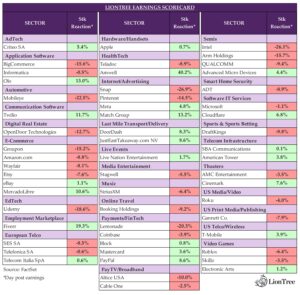
A whopping 56 companies in the LionTree Universe reported their second quarter results this week, more than double the 23 companies that reported last week. Unlike last week, stock price reactions were biased to the downside, as 32 companies (57.1%) traded down in reaction to their results, while 24 companies (42.9%) traded up. Amwell was the best performer of the group, trading up +40.2% the day after it reported, while Snap was the worst performer, down -26.9% (see Theme #3).
Along with Snap, Pinterest was the other digital advertiser to get hit post its print, falling -14.5% (see Theme #3). On the other hand, Meta traded up +4.8% after its results (see Theme #2). It was a big week for Big Tech, and market reactions were mixed, with Apple trading up +0.7% (see Theme #8), Microsoft trading down -1.1% (see Theme #5 for color on its Cloud business), and Amazon falling –8.8% (see Theme #5 for AWS results and Theme #4 for its core Consumer business).
There were also some key reports out of the interactive entertainment sector this week, with Electronic Arts and Roblox reporting and seeing divergent reactions, up +1.2% and down -6.4%, respectively (see Theme #7). Also in media but on the streaming/digital entertainment side was Roku, which fell -4.0% the day post its report (see Theme #6).
Booking Holdings kicked off online travel earnings this week and declined -9.2% (see Theme #10). DraftKings was also a key report out from the sports betting sector and fell -9.8% (see Theme #9). T-Mobile also finished out the big 3 connectivity reports this week and rose +3.9% (see Theme #11 for the quick hits), while Live Nation gave us a read into live entertainment trends and was up +1.7% (see Theme #11 for key points).
The table below includes select mid- and large-cap TMT and consumer companies in our LionTree stock universe that reported this week.
Digital Advertising – Part I: Meta Would “Rather Risk Building [AI] Capacity Before It Is Needed, Rather Than Too Late”
Surprise, surprise, capital spending was one of the biggest focus areas on Meta’s earnings conference call this week, especially given the commentary and tone regarding future spend, which drove the stock down -10% post Q1 results. While the Co posted another step up sequentially, Q2 CapEx came in almost -$1bn below Street estimates. But that doesn’t mean the spending spree is over. Mgmt raised the bottom end of the existing 2024 CapEx guidance and continues to prep investors for “meaningfully higher” CapEx in 2025. Also, in a similar vein to Alphabet CEO Sundar Pichai’s comments last week on Alphabet’s earnings call, Mark Zuckerberg said, “At this point I’d rather risk building [AI] capacity before it is needed, rather than too late.”
In regard to when AI products like Meta AI and AI Studios will begin to contribute to revenue, expect the Co to follow its tried and tested playbook of introducing a new product, scaling it, and only then focusing on monetization (most recently used this with Reels). While genAI products won’t be a meaningful driver of revenue in 2024 or 2025, they are expected to open up new revenue oppties over time that generate a “solid” return on investment. Alternatively, for those looking for more immediate monetization benefits from AI initiatives, AI integrations in existing products that are already at scale (like Instagram and Facebook) are already showing “lots of upside” by making advertising experiences more effective with tools like Advantage+, helping to drive revenue growth and conversions w/o increasing the # of ads or reducing ad load.
These better ad experiences helped drive the Family of Apps ad revenues growth to +22% y/y, which beat consensus by ~2%. Ad strength should continue into Q3, but as a caveat it will decelerate y/y, given the lapping of strong growth from “China-based advertisers” as well as strong Reels impression growth a year prior. There are also “modestly larger” FX headwinds in Q3.
At the core of the platform are the users, and we’d flag several milestones, such as WhatsApp reaching 100mn+ monthly actives in the US, and Threads being close to hitting 200mn monthly actives (vs 150mn last qtr). Facebook is also making a comeback amongst young adults, especially in the US. Overall Family daily active people (DAP) hit 3.27bn on avg for June, which is up +7% y/y.
In terms of other future growth drivers, Reality Labs continues to be a work in progress, with revenue growing +28% y/y (from +30% in Q1) but missing Wall Street estimates by -5%. Investments into this business segment are considerable (Q2 operating loss of -$4.5bn), but were slightly less than expected. Looking ahead, op losses are expected to continue to increase “meaningfully”. Both Quest 3 and the Ray-Ban Meta glasses are seeing better-than-expected demand.
See more of our thoughts/takeaways from Meta’s results below. Also, see Theme #3 for perspectives on Pinterest & Snap’s results, both of which disappointed investors.
-> Meta traded up +4.8% in reaction to earnings and also ended the week up +4.8%; YTD, the stock is up +37.9%
Q2 Headline Results Beat Cons On The Top & Bottom Lines…And The Q3 Top Line Deceleration Was Not As Much As Expected
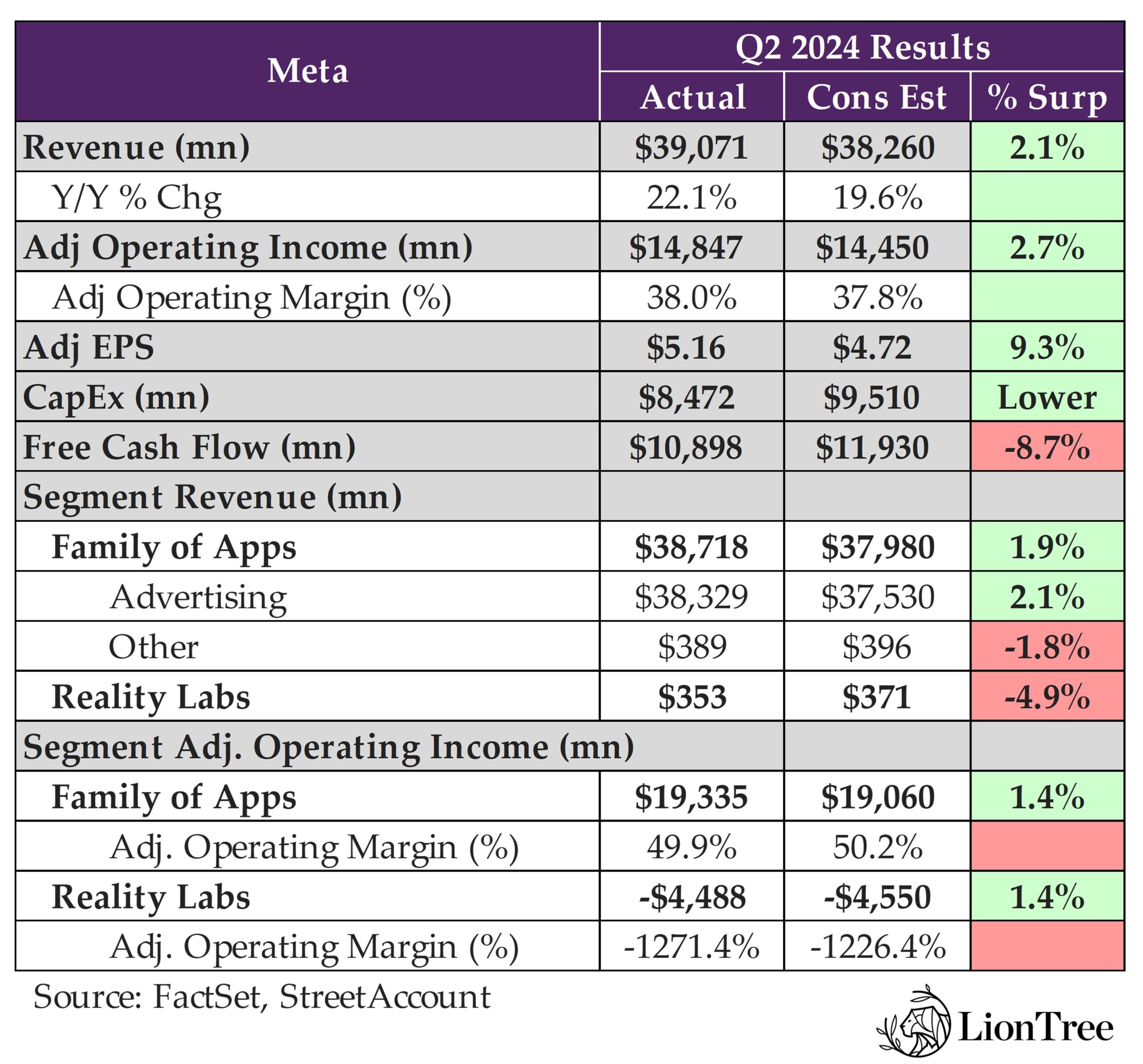
- Q2 total revs beat cons by +2.1%, though the growth of +22% y/y (+23% ex-FX) decel’d from +27% y/y in Q1
- Family Of Apps Advertising revenue was better than expected and beat by +2.1%
- Reality Labs revenue missed expectations by -5%
- Q2 operating margins of 38% were slightly ahead of cons 37.8% (better performance in both FoA and RL segments)
- Q2 EPS beat by +3%
- Q2 CapEx spending was more than $1bn below cons, but FCF still missed by ~$1bn
- OUTLOOK: Q3 total rev range beat cons by +1.7% at the mid-pt: $38.5-41bn, which assumes foreign currency will be a -2% headwind to y/y growth, vs cons $39.1bn
- Guidance implies a growth rate of +16.4% y/y vs cons +14.5% y/y
- OUTLOOK: Reiterated full-year 2024 total expenses in the $96-99bn range
Advertising Strength Is Expected To Continue, BUT Tough Comps, Among Other Dynamics, Will Weigh On Y/Y Ad Growth In Q3
- Seeing “healthy” global ad demand and delivering ongoing ad performance improvements: Anticipate these trends to continue to benefit Q3
- Family of Apps (FOA) +22% y/y ad revs growth (+23% ex-FX) was broad-based with strength across regions and verticals, with particular strength among smaller advertisers
- Online commerce was the largest contributor to the y/y growth, followed by gaming and entertainment & media
- Family of Apps (FOA) +22% y/y ad revs growth (+23% ex-FX) was broad-based with strength across regions and verticals, with particular strength among smaller advertisers
- But expect Q3 y/y ad revenue growth to slow, as they lap “strong” growth from China-based advertisers, “strong” Reels impression growth from a year ago, and “modestly larger” FX headwinds in Q3, based on current rates
- On a user geography basis, Q2 ad rev growth was strongest in RoW and Europe
- RoW +33% y/y
- Europe +26% y/y
- Asia-Pacific +20% y/y
- North America +17% y/y
- On an advertiser geography basis, Q2 total rev growth cont’d to be strongest in Asia-Pacific at +28% y/y, though growth was below the first quarter rate of +41% y/y, as the Co lapped a period of stronger demand from China-based advertisers
Meta’s Family Of Apps’ Post Impressive User Growth Metrics… AI Is Helping Drive Engagement on Platforms / US And Young Adults Were Key Demographic Callouts
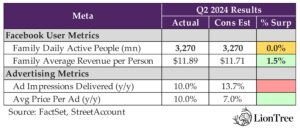
- Family daily active people (DAP) hit 3.27bn, on avg, for June (in-line w/ cons), which is up +7% y/y
- “We’re seeing good y-over-y growth across Facebook, Instagram and Threads… both in the US and globally”
- US and young adults have been bright spots for Facebook: “Particularly pleased” with progress being made and seeing “good results” from focusing apps more towards 18–29-year-olds; “The numbers we’re seeing, especially in the US, really go against the public narrative around who’s using the app”
- Ad impressions across FoA incr’d +10% y/y and avg price per ads incr’d +10% y/y
- Impression growth: Mainly driven by Asia-Pacific and Row
- Pricing growth: Driven by incr’d advertiser demand, in part due to improved ad performance; This was partially offset by impression growth, particularly from lower-monetizing regions and surfaces
- “Quite pleased” with trajectory of Threads: About to hit 200mn monthly actives (vs 150mn last qtr); “Making steady progress towards building what looks like it’s going to be another major social app, and we’re seeing deeper engagement”
- WhatsApp growth in US was a highlight – “Big tailwind if the US ends up being a big market”: Now serves 100mn+ monthly actives in the US; WhatsApp has been leading messaging app in many countries around the world, but not in the US; “We’re starting to make inroads into leading in the US as more and more people use the product and realize that, hey, this is a really good experience”
- More broadly, seeing “particularly promising signs” regarding retention and engagement on WhatsApp
- Monetizing business messaging making progress: “Family of Apps Other revenue was $38mn, up +73% y/y, driven primarily by business messaging revenue growth from our WhatsApp Business Platform”
- Advances in AI continue to improve the quality of recommendations and drive engagement on Facebook and Instagram: “As we develop more general recommendation models, content recommendations get better”
- Seeing “encouraging early results” on Facebook from global rollout of unified video player and ranking systems, which is expected to unlock addt’l growth oppties for short form video as they increasingly make shorter videos into the overall base of Facebook video engagement
- Instagram Reels engagement continues to grow through ongoing enhancements of recommendation systems, part of which includes increasing the share of original posts within recommendations so people can discover content from emerging creators; Now, more than half of recommendation in the US come from original posts
- Over time, looking to move towards a single, unified, recommendation system that powers all the content, including things like people you may know across all svs
- Video is expected to remain a source of impression growth in H2
- On Instagram, expect Reels to continue to drive growth
- On Facebook, expect to grow overall video time while increasing the mix of short-form video, which creates more impression growth oppties
CapEx Plans Remain In Focus… Meta Raised The Low End Of The Full Year 2024 Capex Guidance Despite Q2 Spend Materially Below Expectations
- Q2 CapEx of $8.5bn was -11% below cons but a sizable step up from Q1’s $6.72bn: Due to investments in servers, data centers and network infrastructure
- For 2024, raised the bottom end of the CapEx range to $37-40bn from $35-40bn
- For 2025, currently expect “significant CapEx growth” – “We are not in a position to quantify this yet” but will give further guidance “as appropriate”
- Will be investing in core AI as a part of the infrastructure growth next year
- And investing in training capacity for Gen AI efforts will be a big driver of future CapEx needs
- Different expectations for CapEx for Core AI investments and Gen AI investments
- Core AI investments: Take a very ROI-based approach; Still seeing strong returns as improvements to both engagement and ad performance have translated into revenue gains
- “It makes sense for us to continue investing here”
- Gen AI investments: Don’t expect gen AI products to be a meaningful driver of revenue in ’24 or ’25, but “do expect that they’re going to open up new revenue opportunities over time that will enable us to generate a solid return off of our investment while we’re also open sourcing subsequent generations of Llama”
- Core AI investments: Take a very ROI-based approach; Still seeing strong returns as improvements to both engagement and ad performance have translated into revenue gains
Investing Big In AI To Stay Ahead Of The Curve And Avoid Falling Behind Later
- Big picture investment philosophy – It is better to risk building capacity before it is needed than risk not doing so
- “We’re planning for the compute clusters and data we’ll need for the next several years. The amount of compute needed to train Llama 4 will likely be almost 10x more than what we used to train Llama 3 — and future models will continue to grow beyond that. It’s hard to predict how this will trend multiple generations out into the future, but at this point I’d rather risk building capacity before it is needed, rather than too late, given the long lead times for spinning up new infra projects”
- Released Llama 3.1 in Q2 – “I think we’re going to look back at Llama 3.1 as an inflection point in the industry where open-source AI started to become the industry standard, just like Linux is”
- 405B model has better cost performance relative to the leading closed models
- Already starting to work on Llama 4 “which we’re aiming to be the most advanced in the industry next year”:
- Despite investment philosophy, remain committed to operational efficiency across the Co
- Llama underscores Meta’s bullishness on open source: “My view is that open source will be safer, will enable innovation that improved all of our lives faster and will also create more shared prosperity…this approach has consistently worked for us and I expect it will work here too”
While Gen AI Use Cases Are Limitless And Meta AI Is The Talk Of The Town, Near-Term Benefits Will Be Seen On Meta’s Existing Advertising Biz
- Focused on 4 primary areas in genAI oppties –
- Enhancing the core ads biz
- Helping grow business messaging
- Oppties around Meta AI
- Oppties to grow core engagement over time
- Bullish on Meta AI, which is “on track” to becoming the most-used AI assistant by the end of the year
- Quick stats:
- Meta AI has been used for “billions” of queries since first being introduced
- Meta AI can now be used in 20+ countries and 8 languages
- Integration with WhatsApp – seeing “particularly promising signs” in terms of retention and engagement, which has coincided w/ India becoming their largest mkt for Meta AI usage
- “Still uncovering the wide range of use cases that it’s valuable for”: Including utilitarian use cases like searching for information or role-playing conversations, as well as creative use cases like the new “Imagine Yourself” feature that lets you create images of yourself
- “Bottom line here is that Meta AI feels like it is on track to be an important service and it’s improving quickly both in intelligence and features”
- Quick stats:
- Launched AI Studio, “which lets anyone create AIs to interact with across our apps”
- Allows creators to create an AI agent that can channel them to engage more w/ their community, answer people’s questions, create content, and more
- Not specific to just creators, anyone can built their own AI based on their interest that they can then engage with or share with their friends
- Business AIs “are the other big piece here” and has potential to “dramatically accelerate” business messaging rev: Still in alpha testing with increasing # of bizs, and feedback so far has been positive; Think that over time, bizs will pull all of their content and catalog into an AI agent that customers can interact with, which will help drive sales and saves them money
- AI initiatives that could be potential biz drivers in 2025 and 2026? AI integrations in existing products that are already at scale
- “Lots of upside” in AI initiatives that are helping users find better content through improved recommendations, as well as making the advertising experiences more effective
- Monetization of AI products will likely follow path of prior products (most recently Reels): “I think you all know this from following our business for a while, but we have a relatively long business cycle of starting a new product, scaling it to something that reaches 1bn people or more, and only then really focusing on monetizing at-scale…the early signals on [Meta AI and AI Studios] are good”
- GenAI products will NOT be a meaningful driver of rev in 2024
Meta’s Is Making Progress With Monetization Efficiency
- The Co is getting better at determining the best ads to show and when to show them during a person’s session across both Facebook and Instagram
- This is enabling the Co to drive revenue growth and conversions w/out increasing the number of ads, or in some cases, even reducing ad load
- “Continue to see opportunities to grow ad supply on lower monetizing surfaces like video, including within Facebook as the mix of overall video engagement shifts more to shorter videos over time, which creates more ad insertion opportunities”
- Pleased with progress at enhancing marketing performance: AI is playing an “increasingly central role”
- Advantage+: Making it easier for advertisers to maximize ad performance and automate more of their campaign set up; These tools continue to unlock performance gains, with a study conducted this year demonstrating +22% higher return on ad spend for US advertisers after they adopted Advantage+ Shopping campaign
- Advertiser adoption of these tools continues to expand
- Intro’d Flexible Format to Advantage+ Shopping, which allows advertisers to upload multiple images and videos in a single ad that Meta can select from and automatically determine which format to serve, in order to yield the best performance
- Expanded the list of conversions that businesses can optimize for using Advantage+ Shopping to include an additional 10 conversion types, including objectives like “add to cart””
- Advantage+: Making it easier for advertisers to maximize ad performance and automate more of their campaign set up; These tools continue to unlock performance gains, with a study conducted this year demonstrating +22% higher return on ad spend for US advertisers after they adopted Advantage+ Shopping campaign
- “We’ve seen promising early results since introducing our first generative AI ad features – image expansion, background generation, and text generation – with 1mn+ advertisers using at least one of these solutions in the past month”
Seeing Some Very Early Benefits From Investments In Reality Labs, But Still A Long Ways To Go
- Reality Labs Q2 headline results were mixed: Rev grew +28% y/y to reach $353mn, missing cons by -4.1%, driven primarily by Quest headset sales; Reality Labs operating loss is still large at -$4.49bn but was slightly above cons -$4.55bn
- Looking ahead – expect Reality Labs op losses to increase “meaningfully” y/y due to ongoing product development efforts and investments to scale their ecosystem
- Prior Reality Lab investments are helping pull forward timelines for some products: A few years ago, the Co had predicted that holographic AR would be possible before smart AI, but now it looks like those technologies will be ready in the opposite order
- “We’re well-positioned for that because of the Reality Labs investments that we’ve already made”
- Quest 3 is “selling well” and “outpacing our expectations”
- “Think that’s because it is not just the best MR headset for the price, but it’s the best headset on the market”
- In addition to gaming, users are increasingly using it for its capabilities as a general computing platform, using it to watch videos, browse website, extend their PC via virtual desktop, and more
- Ray-Ban Meta “continue to be a bigger hit sooner than we expected thanks in part to AI”: Now on the second generation of the glasses; Demand is still outpacing ability to build them, but “hopeful we’ll be able to meet that demand soon”
- “Showing very promising traction with the early signals that we are seeing across demand, usage, and retention, increasing our confidence in the long-run potential of AR glasses”
- Other oppties to deepen relationship with EssilorLuxottica? “Great company that has a lot of different products that we hope to be able to partner with…I think there’s a lot more to go from here”
Digital Advertising – Part II: Challengers PINS & SNAP Feel Some Heat
It has been a bit shaky out of the gate regarding digital ad trends, with Alphabet’s YouTube reporting weaker than expected revenue growth last week (decelerated from +21% y/y in Q1 to +13% y/y in Q2) and seeing some pressure in Q3 (see Theme #2 from last week), but Meta and Amazon reporting strong ad revenue results this week (see Theme #1 and Theme #4, respectively). Finishing out the major digital advertisers this week were Pinterest and Snap, which both felt some heat on the back of a volatile environment for brand advertising, especially with consumer advertisers. Starting with Pinterest, while the Co’s Q2 revenue results were actually a tad ahead of Wall Street forecasts, investors reacted negatively to the Q3 guide for a sharper deceleration in y/y revenue growth (from +21% in Q2 to +17% in Q3 at the mid-pt). Mgmt cited a “stable” ad market and some incremental FX headwinds BUT noted that there is also some softness in CPG, and namely food & beverage. Pinterest believes it is still gaining share, and while some of the macro dynamics may be out of its control, big picture, the Co continues to execute on its path to serve advertisers’ full funnel needs and has been successfully building lower funnel capabilities that are showing tangible results. It was a positive to hear that ad demand for the Co’s solutions is starting to come from the next tier of advertisers and broadening out. Performance+ should also help accelerate adoption from that segment of advertisers. The Co’s 3P partnerships with Amazon and more recently Google have been doing well, and the Co is able to address under-monetized RoW countries. This will remain a key part of the growth story along with monetization in the Co’s mature markets. Importantly, monthly active users (MAU’s) hit a record high, and engagement remains strong on the platform.
Moving onto Snap, the volatility of brand advertising, particularly in N. America with certain consumer discretionary verticals, was the swing factor with Snap’s performance in Q2. This came as a surprise after strong sequential rebounds in both Brand and Direct Response (DR) last qtr. For context, Snap’s Brand revenue growth went from a -3% decline in Q4:23 to +12% in Q1:24 but now fell -1% in Q2. However, DR performance was more resilient, rebounding from +3% in Q4:23 to +17% y/y in Q1 and posting +16% in Q2. The total number of active advertisers on Snap’s platform more than doubled in Q2 on the back of strong traction with small and medium size businesses (SMBs). Similar to Pinterest, as well as Meta for that matter, overall user growth and engagement was strong, with daily active users (DAUs) up + 9% y/y to 432mn, hitting an all-time high, though the strength came from lower monetization regions. North America was impacted y/y by optimization changes to the “go-to-market organization”, but this has started to see some improvements. Overall, the better-than-expected adj EBITDA in Q2 was more than offset by the weaker Brand revenue trends and weaker Q3 guidance. Going forward, the Co remains focused on improving results in N. America, growing the community and engagement, investing in DR advertising products, and diversifying revenue growth with Snapchat+. More details to come at the Snap Partner Summit on Sept 17.
See the below two sections for what we thought were the key themes, updates, and takeaways from 1) Pinterest and 2) Snap.
-> Pinterest shares fell -14.5% on the back of results and ended the week down -22.5%, while SNAP fell -26.9% in reaction to its print and ended the week down -29.8%; YTD, PINS is down -21.4% and SNAP is down -44.7%
1) PINTEREST – See below for details on what we thought were the key themes, updates, and takeaways
PINS – Another Quarter Of Better-Than-Expected Headline Results
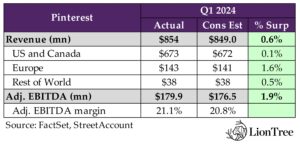
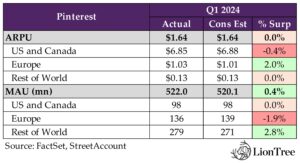
- Q2 revenue: Beat by +0.6%, Grew +21% y/y (vs +23% y/y in Q1) to reach $854mn
- Q2 adj EBITDA: Beat by +2.4%; Reached $180mn (21% margin, ~+600bp y/y
PINS – User Growth/Engagement Trends: Growth In MAU Sequentially Was Driven By RoW
- Global MAUs reached another record high of 522mn, growing +12% y/y (vs +12% y/y in Q1)
- Deeping engagement per user: Reflected in steady improvement in the WAU to MAU ratio in 2024
- Users continue to grow y/y across all of geographic regions in Q2
- US and Canada MAU +3% y/y
- Europe MAU +9% y/y
- ROW MAU +17% y/y
- What has driven better MAU growth?
- Utilizing AI to drive incr’d relevance and personalization
- Upgraded the search ranking algorithm in Q2 to incorporate new signals; Resulted in a significant increase in global search fulfillment rate (i.e., users are finding more of what they’re looking for when they search on Pinterest)
- Doubling down on curation through boards and collages to help users navigate their inspiration to action journey
- Increasing actionability, particularly for shopping
- More than doubled the number of outbound clicks sent to advertisers y/y for the third qtr in a row
- More new filters like price, retailer, and brand on high shopping intent search queries across fashion and home decor verticals; Experimenting w/ other filters
- Introduced video shopping ads
- Utilizing AI to drive incr’d relevance and personalization
PINS – BUT Slower Than Expected Q3 Revenue Guidance (Partially Impacted by FX) More Than Offset The Better Q2
- The Q3 revenue guidance was -1.8% below the Street at the mid-point: Implies +16-18% y/y growth (vs +21% y/y in Q1)
- FX will be a -1ppt headwind
- From a seq comp perspective, Q1 growth also benefited from seasonal factors, like Easter timing and leap day
- Also, comps last year did start to become more difficult in Q3, and the Co is experiencing further softness in food and beverage, as noted
- Addt’ly, the Co doesn’t accept political ads, which investors need to consider when comparing platform ad performance
- Q3 OpEx is expected to grow +17-20% y/y (which is a step up from the +13% y/y in Q2): Guidance is b/w $485-500mn, driven by ongoing infrastructure optimization efforts and investment increases in R&D; Anticipate flat Q3 non-GAAP cost of revenue
- Reiterated margin expansion expectations for 2024: Though implies a more modest level than the +660bp delivered in 2023
- Expansion will be modest in H2 vs the significantly higher expansion in H1 as the Co laps the strengthening of adj EBITDA margins in H2:23
PINS – Cites A Stable Ad Market & Strong Positioning + Monetization Trends
- Mgmt characterizes the ad market as relatively stable vs last qtr and are confident in their competitive position
- “We’re gaining share with some of the largest and most sophisticated advertisers in the world”
- More than doubled the number of clicks to advertisers y/y for the 3rd straight qtr
- Their larger, more sophisticated advertisers continue to lean into the platform as they have adopted our lower funnel tools and are seeing continued success but are now seeing signs of value capture from the next tranche of advertisers
- Believe Performance+ will help accelerate lower funnel adoption for that next tier of advertisers
- Advertisers who use upper and lower funnel objectives see +2x higher conversion rates than those who use one objective alone
- Nearly 100% of lower funnel revenue is covered by direct links or Mobile Deep Linking, hence it takes just one click to lead the user directly to an advertiser’s product or purchase page; This is more than double the amount of clicks to advertisers y/y for the third quarter in a row
- Vertical performance
- Saw strength in the Retail category due to the lower funnel improvements and also in emerging verticals, like Tech, Autos and Financial Svs, but this was partially offset by softness w/in CPG, esp food and beverage advertisers
- Q2 ad impressions grew 35%, while ad pricing declined 11% y/y: These dynamics were similar to Q1, with ad impressions being driven both by increases in total impressions as well as increases in ad load
- See more room to increase ad load due to the synergies between users’ commercial intent and relevant ads
- In Q2, saw a greater mix shift to ad impressions w/ lower avg pricing or eCPM: Started to serve ads in previously unmonetized markets, mostly in the RoW region, many of which have lower eCPMs than existing monetized markets
PINS – 3P Partnerships/Resellers Are Performing Well And Will Be Growth Drivers For RoW
- Acceleration in RoW revs was due to ramping the Google 3P partnerships (annc’d in Q1 and ramped in Q2)
- Partnership allows the Co to monetize previously unmonetized markets, and the Co is starting to expand into other relevant RoW countries
- The Amazon partnership is also “ramping nicely”
- Resellers are another lever to monetizing those regions: Launched these reseller partnerships in Q2, so “that’s still in early days, but we expect this to start to modestly contribute to the RoW segment over the course of the next year as well”
- Seeing some synergies between the resellers and the 3P partnerships
2) SNAP – See below for details on what we thought were the key themes, updates, and takeaways
SNAP – Adj EBITDA Was The Positive Driver With Headline #s in Q2
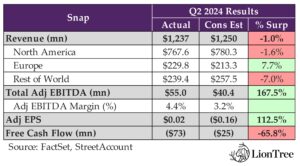
- Adj EBITDA of $55mn, well above cons $40.4mn and up strongly from last yr’s -$38mn (+243% y/y)
- Sets up well for cont’d improvement in op leverage as the year progresses
- Adj EBITDA flow through was 55% in Q2, up from 22% in Q1
- Adj gross margin was relatively stable at 53% in Q2
- Q2 revenues slightly missed cons by -1%, growing +16% y/y vs +21% y/y in Q1
- Regional Dynamics – Revs in Europe was an upside driver, more than offset by lower rev in N. Amer and RoW
- America rev up +12% y/y: Lower growth due to weaker brand demand which was concentrated in the region; DR was a bright spot in North America due in part to the SMB customer segment
- To accelerate growth in the Americas, made changes in Q2 to optimize the go-to-market organization to better support clients where they see the best product market fit and greatest opportunity going forward
- Europe rev grew +26% y/y: Cont’d progress on DR, and a relatively more stable demand environment for Brand, fully offset the impact of more challenging y/y comps
- Rest of World rev grew +20% y/y: Driven by cont’d progress of DR, while the deceleration seq was primarily due to the timing of holiday periods shifting out of Q2 this year
- America rev up +12% y/y: Lower growth due to weaker brand demand which was concentrated in the region; DR was a bright spot in North America due in part to the SMB customer segment
- FCF was – $73mn vs -$119mn in the prior year
SNAP – Q3 Profitability Guidance & The Y/Y Rev Deceleration Rate Were Negative Focus Areas
- Mid-pt of adj EBITDA guidance at $85mn was -22.6% below cons of $109.8mn
- Mid-pt of revenue guidance was -0.4% below cons $1.36bn and reflects +12-16% y/y growth
- But this also implies seq growth of +8-11%, which is very strong historically
- On a 2-year stack, this implies +18-22% vs +11-12% in H1:24
- Expect more of the growth to come from DR and contribution from Snapchat+ (over 100mn per qtr run rate); Have not assumed a big rebound in Brand in Q3
SNAP – Strong Daily Active Users Driven By RoW & ARPU Upside Driven By Europe
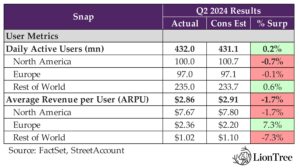
- DAUs grew + 9% y/y to 432mn to an all-time high and beat cons by +1mn; This was also up +10mn seq
- Amer DAU at 100mn was down by less than -1% y/y but up seq, as initiatives to improve the way Snapchatters communicate are showing early signs of progress
- Europe DAU at 97mn was up +1mn y/y and +3mn seq
- RoW DAU at 235mn was up +16% y/y and +4% y/y seq
- Europe drove the upside to total ARPU while performance in N. Amer was below expectations
- While RoW brought in more users on lower-than-expected APRU…
- Europe was the sole driver for upside to total ARPU
- OUTLOOK: Guiding for Q3 DAU of ~441mn, +8.6% y/y and +2% seq
- ~ 80% of Snapchatters are above the age of 18
SNAP – Advertising Performance Is Being Weighed Down By Brand Weakness… Direct Response (DR) Has Been Gaining Traction
- Total ad revs grew +10% y/y in Q2, down from +16% y/y in Q1 due to weakness in Brand advertising, which was down -1% y/y (down from +12% y/y in Q1), driven by –
- Particularly weak demand from certain consumer discretionary verticals, including retail, technology, and entertainment
- Also the timing impact of holidays shifting out of Q2 in the current year
- Direct response ad revs grew +16% y/y (similar to +17% y/y in Q1) driven by –
- Total active advertisers more than doubling y/y (seeing strong traction with SMBs)
- Cont’d progress w/ the 7-0 Pixel Purchase Optimization
- Early contributions from product improvements delivered for app-based advertisers
- Making progress on three foundational advertising platform initiatives –
- Larger ML models
- Improved signals
- More performant ad formats
- Other key advertising KPIs –
- Global impression volume grew ~+13% y/y, driven in large part by expanded advertising delivery within Spotlight
- Total eCPMs were down ~-3% y/y, as inventory growth exceeded ad demand growth in Q2
SNAP – Continue To Invest In & Focus On Platform Improvements and Content Engagement
- Delivered a number of new communication features and user experience enhancements in recent months –
- Map Reactions
- Editable Chats
- My AI Reminders
- Investing to enhance iOS app performance
- Working to combine stories and spotlight
- Continue to invest in ML models to improve content ranking and personalization as well as in Gen AI models and automation for the creation of ML and AI Lenses
- Seeing a significant improvement in content engagement –
- Global time spent watching content grew +25% y/y and +10% seq in Q2, driven by strong growth in total time spent watching Spotlight and Creator Stories
- But made some disruption changes in N. America; This led to mixed results on time spent with content, which declined by just under -2% y/y but did increase nearly +6% seq
- As the Co moved through the qtr, North America content engagement trends “improved”, and time spent w/ content incr’d y/y in the month of June
- Global time spent watching content grew +25% y/y and +10% seq in Q2, driven by strong growth in total time spent watching Spotlight and Creator Stories
- Making it easier for creators to submit and subsequently share compelling content: The number of creators submitting Spotlight content grew over +20% y/y in Q2
- Excited about growth in Spotlight time spent and think have headroom, given time spent on competitive short form video content
SNAP – Other Key Updates
- Infrastructure cost per DAU came in lower than expected: Was 81c, which is up from 80c in Q1 but below guidance of 83-85c due to a combination of greater than expected engineering efficiencies and a more moderate ramp in ML and AI investment
- Making progress with non-advertising revenue streams: Other revenue was up +151% y/y to reach $105mn in Q2 – the majority of which is Snapchat+ subscription revenue
- Now have 11mn+ Snapchat+ subscribers vs 9mn in Q1
Amazon’s Results Feed Into Worries About The Consumer
While Amazon’s AWS business is a key driver for the Company and outperformed this qtr (see Theme #5), concerns that arose surrounding the consumer took center stage and dragged down Amazon shares on the back of results. Amazon’s core N. American Stores business was negatively impacted by consumers “trading down” on price and looking for lower ASP items, and this dynamic has continued into Q3. On the heels of Amazon’s results Thursday night were the weak employment numbers that hit on Friday morning, which also stoked the developing recession fears.
With the mixed Q2 results, investors quickly homed in on the weaker-than-expected Q3 guidance, which was -1.2% below consensus on revenue and a significant -46% below on operating income. Granted, there are some historical headwinds to Q3 operating margins, but this was still a disappoint, especially with spending levels being a hot button for investors as of late. H2 CapEx is also expected to be up “meaningfully” up vs H1.
On the plus side, the $1.2bn y/y positive swing in Amazon’s Intl segment’s operating income is a key call out, in addition to the continued strong growth in the Co’s high margin advertising business (+20% y/y). Big picture, Amazon added $2bn+ in ad revenue y/y and has generated more than $50bn in ad revenue in the trailing 12 months. Sponsored products have been the primary driver, but Prime Video ads will certainly be a growth vector ahead.
Amazon also had positive things to say about the progress of Prime Video and emerging business areas, such as Pharmacy and Satellite connectivity.
See below for more details on what we found most interesting regarding the Co’s non-AWS business.
-> AMZN share fell -8.8% in reaction to earnings (and the broader tech melt-down on Friday) and ended the week down -8.0%; The stock is now up +10.5% YTD, slightly underperforming Nasdaq’s +11.6%
Q2 Headline Results Were Mixed And Q3 Guidance Disappoints
- Q2: Slight miss on overall revenue but much better operating income
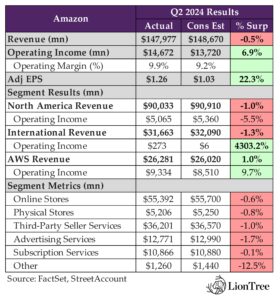
- Total revenue grew +10% y/y (+11% ex-FX) vs +13% in Q1, but missed by -0.5%
- Operating income grew +91% y/y and beat by +7%
- Q2: N. America and Intl rev fell short of expectations, while AWS beat and intl profitability was much better than expected
- America revs rose +9% y/y and op margin of 5.6% incr’d +170bp y/y but was down -20bps seq due to some investment areas, incl Kuiper, where they are starting to manufacture satellites for launch in Q4
- Int’l revs grew +10% y/y (ex-FX)
- Regionalization has been working – saw improvements in cost to serve: Driven by efforts to place inventory more regionally, closer to where customers are
- More consolidated shipments w/ higher units per box shipped
- Also saw packages traveling shorter distances to customers, and this led to better on-road productivity in the transportation network
- FORWARD LOOKING: “I think we have a lot of opportunities”
- Q3: Guidance was below expectations
- Revenue guidance of $154-158.5bn is -1.2% below cons at the mid-pt
- Operating income guidance of $11.5-15bn is -46% below cons at the mid-pt
- Historically have seen a headwind to Q3 op margins due to Prime Day deals, plus marketing spend surrounding the event
- Also beginning to ramp up capacity to handle Q4 holiday volumes in fulfillment network
- Also expect CapEx to be up in H2: H1 CapEx was $30.5bn and will be “higher” in H2
- The majority of the spend will be to support the growing need for AWS infrastructure as they continue to see strong demand in both generative AI and non-generative AI workloads
A More Careful Consumer Is A Headwind To The Core N. Amer Stores Business Extending Into Q3
- N.America Stores business rev growth rate (+9% y/y, which was a decel from +12% y/y in Q1) was impacted by customers trading down, which is likely to be a headwind in Q3
- Consumer headwinds: Seeing lower avg selling prices b/c customers continue to trade down on price when they can, “Consumers being careful with their spend…looking for lower ASP products, looking for deals that continued into Q2”; Higher ticket items like computers or electronics or TVs are growing faster for them vs what they see in the industry but more slowly than what they see in a more robust economy
- OUTLOOK: “We’re seeing signs of it continuing in Q3”
- But did have very strong unit volume growth that slightly accelerated when adjusted for leap year in N. America; Overall unit sales grew 11% y/y, which is consistent with growth rates in Q1 after ~100bps adjustment for leap year
- A few considerations impacting N. America Stores rev growth rates
- Last quarter’s Leap Day added ~+100bps of y/y growth
- Seller fees are a little lower than expected given behavior changes from the latest fee changes
- Believe Stores margins can continue to increase over time: “It’s not going to happen in one quarter…or one fell swoop. It’s going to take work over a long period of time”
Intl Segment Makes Strong Progress W/ Profitability (Op Income Up +$1.2bn y/y)
- Intl Stores revs incr’d +10% y/y (ex-FX) and were profitable again w/ op income of $300mn: That is an improvement of +$1.2bn y/y (margin was 0.9%, up +390bp y/y); Driven by established countries, where they are improving their cost structure with better inventory placement and more consolidated shipments
Bullish On Advertising…Still At The Early Stages Of What’s Possible In Video Advertising
- Advertising revenue growth (ex-FX) was strong at +20% y/y in Q2 (to $12.8bn), though decelerated from +24% y/y in Q1
- Advertising remains an important contributor to profitability in N. America and Int’l
- Saw strong growth on an increasingly larger revenue base this quarter
- Continue to see opportunities that further expand their offering in sponsored products (drives the most today) as well as newer areas like Prime video ads
- Added over +$2bn in ad revenue y/y and generated more than $50bn in ad revenue in the trailing 12 months
- “Even with this growth, it’s important to realize we’re at the very beginning of what’s possible in our video advertising”
- Had first Upfront appearance in May and were “encouraged” by feedback on the differentiated value via content, reach, signals, and ad tech
- “While ads have become the norm in streaming video, we aim to have meaningfully fewer ads than Linear TV and other streaming TV providers”
Continue To “Like The Progress” Of Prime Video
- “Our storytelling is resonating with our hundreds and millions of monthly viewers worldwide”: Amazon MGM Studios recently received 62 Emmy nominations
- Fallout is the second most-watched original title ever for Prime Video
- The Idea of You attracted nearly 50mn viewers worldwide in the first 2 weeks on Prime Video
- Season 4 of The Boys reached #1 on Prime Video in 165 countries in its opening 2 weeks
- “See momentum in live sports” and highlighted 11-year “landmark deals” with the NBA and the WNBA: When combined w/ their original films and shows, partner streaming services, licensed content and rent or buy titles, “Prime Video continues to evolve into the best destination for streaming video”
Other Updates On Key Initiatives
- Pharmacy continues to grow “really quickly” and to get more resonance with customers: This is a “natural extension for us to build a pharmacy offering from our retail business”
- Accelerating satellite manufacturing of Project Kuiper (low-Earth orbit satellite constellation):
- Annc’d a distribution agreement w/ VRIO who distributes DIRECTV Latin America and Sky Brasil
- Continue to “feel significant demand for the service” from enterprise and government entities
- Expect to start shipping production satellites late this year
- Continue to believe this could be a “very large business for us”
Cloud Investments Should Support Strong Top-Line Growth Into H2
Following Alphabet’s Q2 report last week, which showed accelerated sequential Google Cloud growth and set all-time records on both revenue and operating profit (see Theme #2 from last week’s Weekly), all eyes were on Amazon and Microsoft to see if their Cloud divisions would bring sunshine or rain.
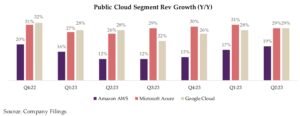
Interestingly, Amazon’s AWS and Microsoft’s Azure showed divergent paths in Q2. AWS followed Alphabet and posted its third straight quarter of accelerating growth. AWS now boasts an annualized revenue run rate of $105bn+ and with 90% of global IT spend still on-prem, growth is aplenty looking ahead. In particularly, businesses of all sizes are increasingly leveraging AI, and Amazon’s AI business is achieving a multibillion-dollar revenue rate, with growth expected to outpace traditional AWS growth. Unlike traditional infrastructure, generative AI is built directly in the cloud, offering significant new opportunities.
On the other hand, Microsoft went the other way and posted a seq deceleration in revenue growth, and a further deceleration is expected in FQ1, but mgmt anticipates Azure growth to re-accelerate in FH2 as capital investments create an increase in available AI capacity to serve more of its growing demand. Azure’s slowdown in the qtr was partly due to high demand for AI svs outstripping available capacity and slightly lower than expected growth in certain European regions. While gross margin decreased, it is expected to improve seq in the next qtr. Despite these challenges, Microsoft reported strong commercial bookings and record commitments to its cloud platform, and cloud security solutions and tools like Azure Arc continued to show strong adoption and revenue growth.
Overall, it wasn’t an across the board beat for Cloud this Q2, but the demand outlook remains strong. The expanded capacity from higher capital investment should enable strong top line growth across the board looking into H2.
See below for more details
AWS Was A Bright Spot Within Amazon’s Q2 Results
- AWS rev growth accelerated for the third straight qtr and beat expectations: Grew +18.8% y/y (up from +17.2% y/y in Q1) to $26.3bn and beat cons by +1.0%
- AWS is now at a $105bn+ annualized run rate (vs $100bn+ last qtr)
- AWS op income also beat estimates: Incr’d +72.2% y/y (vs +83% y/y in Q1) +to $9.3bn and beat cons by +9.7%, driven by a continued focus on cost control, including a “measured” pace of hiring
- AWS op margin includes an ~+200bps favorable impact from the change in the estimated useful life of servers instituted in Q1; Continue to expect AWS op margins to fluctuate over time, driven in part by the level of investments being made at any point in time; Remain focused on driving efficiencies across the biz, which enables them to invest to support the “strong” growth they’re seeing in AWS, including genAI
- Continue to see three macro trends drive AWS growth –
- Cos have completed “the significant majority” of their cost optimization efforts and are focused again on new efforts
- Cos are spending their energy again on modernizing their infrastructure and moving from on premises infrastructure to the cloud
- Builders and Cos of all sizes are excited about leveraging AI (Amazon’s AI biz continues to grow “dramatically” with a multibillion-dollar revenue run rate, despite it being early days)
- Generative AI and AI as a whole are expected to grow rapidly, potentially outpacing the traditional AWS growth rate: Unlike the traditional infrastructure, which involves migrating on-premises systems to the cloud, a process that takes time, genAI will be built directly in the cloud from the start, presenting significant new opportunities for AWS, and potentially expanding its market more quickly than traditional cloud services
- See a long road of growth ahead: “We’ll see where the growth rate nets over the next number of years…about 90% of the global IT spend is still on premises. And if you believe that equation is going to flip, which I do, there’s a lot of growth ahead of us in AWS”
- In the past 18 months, AWShas launched more than twice as many machine learning and generative AI features into general availability than all the other major cloud providers combined
Microsoft’s Cloud Miss Overshadowed The Co’s Overall Top-Line Beat
- Azure’s FQ4 seq decel in y/y growth spooked investors…: Rev was up +29% y/y (vs +31% y/y in FQ3 and +30% y/y in FQ2), coming in below cons +30.2%; Ex-FX, Azure’s y/y rev growth of +30% y/y (vs +31% y/y in FQ3 and +28% y/y in FQ2) also came in below cons +31.2%
- …as did guidance for FQ1: Ex-FX, +28-19% y/y vs cons +30.6% y/y
- Expect Azure growth to re-accelerate in H2, as capital investments create an increase in available AI capacity to serve more of the growing demand
- What drove the slowdown in FQ4? Azure growth included 8pts from AI svs, where demand remained higher than available capacity; Also, in June, saw “slightly lower-than-expected” growth in “a few” European geos
- Microsoft Cloud gross margin was down seq (as Co had expected)…: FQ4 Microsoft Cloud gross margin percentage decreased ~2pts y/y to 69% (vs 71% in FQ3), in-line with Co’s expectations
- … But expected to improve seq in FQ1 (still down y/y): Should be ~70%, which is still down y/y, driven by the impact of scaling AI infrastructure
- Commercial bookings were “significantly ahead” of expectations but decel q/q, up +17% y/y (+19% y/y ex-FX) vs FQ3’s +29% y/y (+31% y/y ex-FX)
- Had “record commitments” to Microsoft Cloud Platform, driven by growth in the # of $10mn+ and $100mn+ contracts for both Azure and Microsoft365, as well as “and consistent execution across our core annuity sales motions”
- Continue to see “sustained” rev growth from migration, as Azure Arc is helping Cos to streamline their cloud migrations and now have 36k+ Arc customers, up +90% y/y
- Cloud security use case reached a milestone, as MSFT’s cloud security solution, Defender for Cloud. Surpassed $1bn in rev over the past 12 months
- Reiterated that FY25 CapEx is expected to be higher than FY24 to meet growing demand signal for AI and Cloud products: Reiterated that it will increase on a seq basis. though there may be quarterly spend variability from cloud infrastructure buildouts and the timing of delivery of finance leases
- Cloud and AI related spend represents nearly all of total CapEx, with ~half for infrastructure needs and the remaining ~half for servers
Roku’s Diversification Strategy Is Starting To Bear Fruit
It was a strong quarter for Roku, with sweeping beats across the top and bottom line, as well as its fourth consecutive quarter of positive adj. EBITDA and FCF. The beats were driven by both the Devices and Platform segments, and top of mind remains the Co’s goal of accelerating Platform revenue (85.1% of total revenue in Q2). While y/y growth decelerated seq in Q2 and is expected to continue to decelerate in Q3, a turnaround is expected in Q4 onwards.
Diversification has been a key word across several of the company’s revenue objectives. More specifically in advertising, its diversified offerings kept Roku insulated from market-driven pricing changes that are impacting other streaming services. Y/Y growth of advertising across the Roku platform, excluding M&E, outperformed the overall ad market and OTT ad market in the US. While the M&E vertical continues to be challenged, as streamers have been pulling back spend on marketing over the past few years, Roku has been diversifying. M&E is now a “significantly” smaller % of the overall platform business, and the company is not reliant on that vertical for future growth. The Roku Home Screen is also a big oppty that they continue to drill into, particularly for advertisers looking to reach their ad-free SVOD users. In terms of accessibility, partnerships with 3P platforms, most recently with Trade Desk, are helping them to grow demand for all the supply they have to offer.
We’d also flag that Roku’s sports offering is one of its fastest growing features, with streaming hours from the Roku Sports Experience more than tripling y/y. They recently launched an MLB zone, in addition to its NFL and NBA Zones, and also secured exclusive multi-year rights to the MLB’s Sunday Leadoff live games, which are available for free on The Roku Channel (TRC). TRC remained the #3 app on the Roku platform in Q3, with streaming hours accelerating seq to +75% y/y, as viewership of key events like the presidential debate move from traditional TV to streaming. They are also collaborating with NBCU to create an Olympics zone, which provides a single, simplified destination for the 2024 Paris Olympics and allows viewers to subscribe to Peacock directly through the Roku platform, a win-win for both Roku and Comcast.
Looking ahead into the next quarter, revenue guidance was in-line with expectations, with y/y growth expected to decelerate seq across both segments, with Platform rev in particular impacted by a challenging y/y comp. That being said, adj. EBITDA guidance was a big beat, as they continue to focus on operational discipline.
Overall, it was a good qtr relative to expectations.
See below for more on all the above.
-> Roku shares opened in positive territory this morning after reporting its results last night but was dragged down by the market sell off to close -4% lower on the day; The stock is still down -40% YTD
Clean Beat Across Q2 Headline Numbers / Achieved Fourth Consecutive Qtr Of Positive Adj. EBITDA and FCF
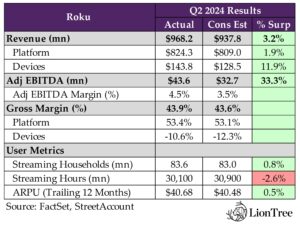
- Total revenue – BEAT by +3.2%: Total rev grew +14% y/y (vs +19% y/y in Q1)
- Devices revenue – BEAT by +11.9%: Grew +39% y/y (vs +19% y/y in Q1), driven by the retail distribution expansion of Roku-branded TVs
- Platform revenue – BEAT by +1.9%: Grew +11% y/y (vs +19% y/y in Q1), reflecting contribution from streaming services distribution and advertising activities, despite continued softness within M&E
- EBITDA – BEAT by +33.3%: $43.6mn vs cons $32.7mn (margins at 4.5% vs cons 3.5%), driven by Platform segment
- Gross margins were also a beat (43.9% vs cons 43.6%)
- Devices gross margin of -10.6% was up +6.4pts y/y and beat cons -12.3%
- Platform gross margin of 53.4% was up +0.1pts y/y and beat cons 53.1%
- Fourth consecutive qtr of positive adj. EBITBA and FCF was a result of top-line growth and ongoing operational efficiencies
Q2 Users KPIs Were A Positive As Roku Continues To Scale Internationally
- Streaming Households – BEAT by +0.8%: Added +2.0mn in Q2 (up from +1.6mn in Q1) to 83.6mn globally, driven by both TVs and streaming players
- Making “good progress” growing streaming households in the countries they are prioritizing, across the Americas, and the UK
- Streaming hours – MISSED by -2.6%: Up +20% y/y (vs +23% y/y in Q1) to 30.1bn
- Avg Streaming Hours per Streaming Household per Day = 4.0hrs in Q2 (down from 4.2hrs in Q1, but up from 3.8hrs in Q2:23)
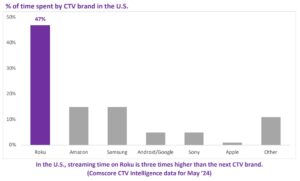
- Streaming time on Roku in the US is 3x high than the next streaming CTV brand, per Comscore
- ARPU – BEAT by +0.5%: Was flat y/y (similar to Q1) at $40.68 on TTM basis, reflecting an increasing share of Streaming Households in intl markets, where they are currently focused on scale and engagement w/ monetization efforts in the early stages
Q3 Profitability Guidance Was A Highlight Coupled With An In-Line Revenue Outlook
- Q3 total revenue – in-line: Will grow +11% y/y (decel from +14% y/y in Q2) to reach 1.01bn, which was in-line with cons
- Q3 Devices rev will grow +24% y/y (decel from +39% y/y in Q2), reflecting continued expansion and investment in the Roku-branded TV program
- Q3 Device margins will remain in the negative low-double digits
- Q3 Platform rev will grow +9% y/y (decel from +11% y/y in Q2), which takes into account a challenging y/y growth rate comparison within streaming services distribution along with elevated positive 606 adjustments in Q3:23
- Q3 Platform margin will be ~53%
- Addt’l forward-looking commentary on Platform rev: Anticipate y/y growth rate of Platform rev will accelerate seq in Q4 and remain confident in ability to accelerate Platform rev in 2025
- Q3 Devices rev will grow +24% y/y (decel from +39% y/y in Q2), reflecting continued expansion and investment in the Roku-branded TV program
- Q3 adj EBITDA – BEAT by +72.4%: $45mn vs cons $26.1mm, reflecting ongoing operational discipline
Streaming Services Distribution Is A Key Focus In Accelerating Platform Rev Growth
- Roku is “executing well” against initiatives to accelerate Platform rev growth, which include –
- Maximizing ad demand for Roku
- Leveraging Roku’s Hoe Screen as the lead-in for TV
- Growing Roku-billed subscriptions
- Streaming services distribution activities grew faster than Platform rev overall
- Primarily due to price increases for subscription-based apps on Roku’s platform in H2:23 and H1:24
- Have increased focus on growing the share of subscriptions billed through Roku Pay
- New Content Row on Home Screen is helping to drive Roku-billed subscription sign-ups by highlighting popular titles from SVOD svs on Roku’s platform, and they see upside ahead
- Collaborating with content partners to deliver experiences that benefit viewers, as well as Roku and its partners
- Partnered w/ NBCUniversal to create zone in Roku Sports Experience for the 2024 Olympic Games in Paris, which provides a single, simplified destination for live events, replays, daily primetime shows and more; Viewers can subscribe to Peacock for full Olympics coverage directly through the Roku platform
“Well-Positioned” To Accelerate Ad Biz In H2, Though M&E Is Expected To See Continued Weakness
- Y/Y growth of advertising across the Roku platform, excluding M&E, outperformed the overall ad market and the OTT ad market in the US
- Driven by their broad ad portfolio, reach of Roku Home Screen, and expanding partnerships w/ 3P ad platforms
- Highlighted that they are not impacted by market-driven pricing changes in the same way that streaming svs are – “We have a unique set of ad products and sponsorships that are only possible because we own the platform and we integrate these throughout the viewer experiences…we have flexibility to handle really well the market fluctuations”
- M&E vertical continues to be challenged BUT “we’ve diversified the overall ad business well”
- “We’re really good at M&E and we’re a must have for our M&E partners” BUT “due to the efforts to diversify… M&E is a significantly smaller percent of our overall platform business now versus the last several years”
- How has Roku diversified?
- Increased the # of ad categories and ad units in the viewer experience
- Opened up inventory to new advertisers that used to be reserved almost exclusively for M&E brands and performance advertisers, “and that diversification has worked well”
- “While we’re in a good position to benefit from any M&E rebound and any new M&E entrants into the market, we’re not relying on the vertical for future growth”
- Seeing “good momentum” in the upfront: “It’s been a positive market for us and we’ve been growing our share generally across the board”
- “Hearing a lot of excitement around our new products,” including video ads and the marquee and sports participation
- Getting positive feedback from clients on efforts to make it easier to purchase Roku Media and onboard new clients and measure their performance
- “We’re closing the upfront with poise, we’re building share and we’re having great conversations both about the upfront and establishing client KPIs really well beyond the upfront”
- Roku Home Screen is “highly valued” by advertisers
- Reaches US households w/ 120mn+ people every day (in-line with Q1)
- Provides advertisers w/ oppty to reach ad-free only viewers: Helps to reach the 40% of consumers who only select ad-free versions when given an SVOD ad choice (as per Antenna)
- “For many of our viewers, promotions and advertising in our Home Screen is the only ad they’re going to see”
- In Q2, the percentage of app sessions launched from one of their owned and operated features increased +35% y/y
- Owned and operated features on the Home Screen include Roku’s Content Row, Live TV tile, Sports Experience, and What to Watch
- Recently launched a Content Row that makes personalized recommendations powered by AI, and early results show that these recommendations drove an increase in Streaming Households, avg display ad impressions, and video ad reach of The Roku Channel
- Recently enhanced the marquee ad unit on their Home Screen by adding video
- Limited, invite-only beta for the new video ad unit sold out in the first month, w/ participation from brands such as The Home Depot, Disney, and MINI USA
- Part of ongoing effort to diversity displays ads on the Home Screen beyond M&E advertisers
- Expanding and deepening relationships with 3P platforms to increase demand and make it easier for advertisers to execute campaigns programmatically
- Recently partnered with The Trade Desk so that TTD customers can leverage Roku Media and audience data programmatically to better understand and optimize their campaigns for TV streaming viewers; Expanding relationship w/ Roku’s integration of Unified ID 2.0 (UID2) so Roku advertisers can achieve more precise targeting and means to facilitate data collaboration
- “We’re only a couple of months in, but the partnership with them has been really well received…our relationship is growing…and we look forward to continued innovations ahead”
- Also partnered w/ iSpot so advertisers on the Roku platform can receive best in-class optimization and ad measurement through iSpot’s Unified Measurement solution
- Will continue to partner w/ more 3P DSPs, which along w/ their expanding portfolio of ad products allow Roku to serve the entire demand curve at multiple price points, which will drive incremental rev that will grow over time
- “We’ve got a lot of supply of ads, and we have the ability to grow our supply. So, we’re highly focused on growing demand and third-party partnerships are one way to do that”
- Recently partnered with The Trade Desk so that TTD customers can leverage Roku Media and audience data programmatically to better understand and optimize their campaigns for TV streaming viewers; Expanding relationship w/ Roku’s integration of Unified ID 2.0 (UID2) so Roku advertisers can achieve more precise targeting and means to facilitate data collaboration
- Looking into H2 of 2024, expect these initiatives to help accelerate rev from advertising activities
- For Q3, while M&E is expected to be challenged, anticipate y/y growth of advertising activities to accelerate
Growth Of Streaming Hours On The Roku Channel Accelerated Q/Q
- The Roku Channel remained the #3 app on the Roku platform in Q2 by both reach and engagement, with streaming hours up +75% y/y (vs +66% y/y in Q1)
- Ongoing growth is largely due to its position as the lead-in to TV…:
- …as well as Home Screen’s power to drive viewership: 70%+ of The Roku Channel’s Streaming Hours in Q2 originated from Home Screen features such as the Content Row, Live TV, and What to Watch
- Streaming of news and other live programming continues to grow as viewers cut the cord
- Viewership of June 27th US presidential debate on tradition TV was -30% from the first debate in 2024, TRC’s FAST offering achieved its highest day for both reach and engagement; During the debate, 40%+ of TRC’s viewers watch on their live channels
- While foundation of content spend remains w/ 3P licenses and rev shares, continue to leverage Roku Originals to attract viewers and advertisers
- Reiterated success of Roku Original “The Spiderwick Chronicles,” where they drove viewers from various entry points across the Roku platform, including a takeover the Roku Home Screen, Roku City, and a “Spiderwick” tile (in the app grid), which helped the series achieve the highest reach and engagement of any on-demand title in TRC’s historical during its opening weekend and was sponsored by Airbnb
Roku Sports Experience Is One Of Roku’s Fastest Growing Features
- Nearly half of Americans watch sports on TV every month, and Roku is benefitting from the ongoing shift of sports to streaming by leveraging its position as the lead-in to TV
- In addition to the NFL and NBA Zones, recently launched MLB Zone w/ T-Mobile as a sponsor
- MLB Zone aggregates and organizes live and upcoming games, nightly recaps, game highlight, a fully programmed MLB FAST channel, and more from across the Roku platform
- Also secured the exclusive, multi-year rights for MLB’s Sunday Leadoff live games, which is now available for free on The Roku Channel
- In Q2, Streaming Hours originating from the Roku Sports Experience more than tripled y/y
Quick Updates On Roku Devices And Roku OS
- On Roku Devices –
- Expanded distribution of Roku-branded TVs to Target and other specialty retailers
- New Roku Pro Series hit the market in April, and the higher-performing TVs continue to receive strong reviews
- Expect Devices margin to be in its current range for the next several quarters
- As Roku-branded TVs continue to ramp, component costs will continue to go down, which over time will drive improvement in device margins, but its still early days
- On Roku OS –
- Roku OS was again the #1 selling TV OS in US, with TV unit sales greater than the next two TV operating systems combined
- Roku OS was the #1 selling TV OS in Mexico and Canda, where Roku continues to grow scale through the Roku TV licensing program
Video Games – EA & Roblox Shined In Q2, But All The Focus Was On Their Near-Term Outlooks
EA kicked off earnings for the interactive entertainment space this week, providing some insight into how the industry has been navigating post-COVID headwinds as well as other ongoing secular shifts. For the most part, EA’s headline results were better than the Street anticipated, with the company’s net bookings closing +3.4% ahead of forecasts and its non-GAAP operating margin of 11.3% topping estimates of 10.4%. The only blemish was a -60bps miss on non-GAAP gross margin, though this wasn’t addressed on the call. The outperformance on net bookings was primarily driven by stronger than expected performances from EA SPORTS FC 24 and Madden NFL 24. These titles, as well as EA’s other key franchises, benefited from “secular tailwinds in social media and sports” that have resulted in consumption “only growing and becoming more concentrated” in them. More specifically, EA CEO Andrew Wilson highlighted that “an expanded definition of play” has been emerging within interactive entertainment as modalities of play that involve “deep connection with… friends [are] becoming more and more important”. In this light, the company is in an “enviable position”, given its “broad portfolio of incredible IP” and “massive player network”, among other competitive advantages.
Looking ahead, EA’s FQ2 guidance exceeded expectations on both the top and bottom-line. Along with an “action-packed EA SPORTS quarter” with the recent successful launch of College Football 2025 and the upcoming launches of Madden NFL 25 and FC 25, the company also plans to release season 22 of Apex Legends, which will be more “content-rich” than prior seasons. However, despite forecasting a stronger than expected FQ2, EA stopped short of revising its full-year guidance, preferring to wait to see how its upcoming slate of titles performs. Longer-term, the company is positioning itself for “accelerated growth in FY26 and beyond. EA didn’t provide any details on the progress of its mobile business or its previously stated goal of expanding FY27 GAAP operating margin ~+300-350bps over FY25 but will share more information about its growth opportunities at its upcoming Investor Day on September 17.
On the infrastructure side of the industry, Roblox also released its Q2 print this week, reporting headline numbers that broadly exceeded consensus expectations. After experiencing “unseasonable” slowness in Q1, Roblox’s initiatives to re-energize net bookings growth appear to have paid off, as growth in the company’s net bookings rebounded above the +20% benchmark set at its Investor Day last November to +22.4% y/y in Q2 (vs +19.4% y/y in Q1) and beat estimates by +5.5%. This result reflected KPI trends that were directionally “strong across all regions”, and with the “very powerful improvements” in user growth and engagement seen exiting Q2 and heading into Q3, Roblox’s management felt comfortable raising its full-year bookings outlook nearly back to levels that were originally projected at the beginning of the year. However, for reasons that weren’t elucidated on the call, the company’s FY24 adj EBITDA guidance range was also lowered, sparking some concerns that recent platform improvements “haven’t put the platform seemingly on stronger footing than it was six or nine months ago”.
Lastly, another update that caught investors off guard was that CFO Mike Guthrie is stepping down to pursue personal interests, though he plans to remain in his role for the time being to assist in finding a successor.
See below for 2 sections which outline what we thought were the key themes, updates, and takeaways from 1) EA and 2) Roblox.
-> EA shares were up +1.2% in reaction to the print and ended the week up +2.5%; Roblox shares fell -6.4% following earnings but recovered slightly to finish the week down -3.6%; YTD, EA stock is trading up +8.8%, while Roblox stock is down -14.6%
1) Electronic Arts – See below for details on what we thought were the key themes, updates, and takeaways
EA – Off To A “Strong Start” In Its FY25 After Adjusting For Tough Comps
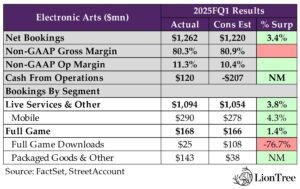
- EA’s headline numbers mostly exceeded estimates: Net bookings fell -20.0% y/y in FQ1 (vs -14.4% y/y in FQ4) but beat cons by +3.4%, given comps from last yr’s World Cup benefit to EA SPORTS FC; Non-GAAP gross margin of 80.3% (vs 80.4% in FQ4) missed cons’ 80.9%, while non-GAAP op margin of 11.3% beat cons’ 10.4%
- Live Services (~87% of net bookings) – BEAT: FQ1 net bookings were down -7.1% y/y (vs -13.3% y/y in FQ4) and closed +3.8% ahead of cons; EA “delivered more content to larger audiences, resulting in greater than anticipated engagement and monetization in core live svs”
- Full Game (~13% of net bookings) – BEAT: Net bookings dropped -58.1% y/y in FQ1 (vs +3.6% y/y in FQ4) but topped cons by +1.4%; There were three full game title releases a yr ago, including STAR WARS Jedi: Survivor, EA SPORTS PGA Tour, and Super Mega Baseball 4
EA – Although FQ2 Guidance Surprised To The Upside, FY25 Outlook Was Unchanged
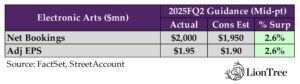
- FQ2 top and bottom-line guidance was better than anticipated: Expects FQ2 net bookings between $1.95-2.05bn, representing a -9.8% y/y decline but beating cons by +2.6% at the mid-pt; Adj EPS range of $1.85-2.05 also topped cons by +2.6% at the mid-pt
- Key assumptions in the outlook: Will be an “action-packed EA SPORTS qtr”, w/ the launch and “strong start” of College Football 25 as well as the upcoming releases of Madden NFL 25 and FC 25; Apex Legends season 22 is also scheduled to launch, but the Co is being “prudent” about its expectations
- Also, FX is expected to have a “minimal impact”
- Addt’l guidance items: Projects GAAP net rev between $1.9-2.0bn, cost of rev between $420-450mn, and GAAP OpEx between $1.19-1.2bn, primarily driven by restructuring-related charges and cont’d investment; This is projected to result in GAAP EPS of ~$0.76-0.93
- Key assumptions in the outlook: Will be an “action-packed EA SPORTS qtr”, w/ the launch and “strong start” of College Football 25 as well as the upcoming releases of Madden NFL 25 and FC 25; Apex Legends season 22 is also scheduled to launch, but the Co is being “prudent” about its expectations
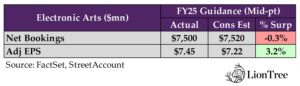
- Reiterated FY25 outlook as EA wants to “get through… major releases” before considering an adjustment to FY25 guidance: Still expects net bookings range of $7.3-7.7bn, which was ~inline w/ cons at the mid-pt though adj EPS between $7.05-7.85 is above cons by +3.2% at the mid-pt
- Key releases: Highlighted Madden 25, FC 25, and Dragon Age: The Veilguard specifically
- Other full-yr metrics were also reaffirmed: Including FY25 net rev between $7.1 – 7.5bn, an OpEx range of $4.35 – 4.44bn, GAAP op margin between 18-20.6%, and a non-GAAP op margin between 29.6 – 31.7%
- EA is positioning itself for “accel’d growth in FY26 and beyond”: The Co expects to “continue to invest w/ sharpened focus” behind its three strategic pillars of entertaining and engaging massive online communities, telling blockbuster stories, and harnessing the power of community in and around its games
- More details about EA’s pipeline long-term growth oppties will be revealed at its Investor Day: Scheduled for Tuesday, Sept 17
EA – Have An “Enviable Position” Amid A Changing Interactive Entertainment Industry
- EA has “cont’d to grow out of COVID”, BUT “that hasn’t been true for the whole industry”: The Co’s “incredible competitive advantage” in its creative talent, production strength, IP portfolio, and “massive player network” have enabled it grow its mkt share in the industry
- A “secular shift” occurring in the industry will benefit EA over the longer-term: Sees “secular tailwinds in social media and sports” as well as a “movement towards the biggest franchises in the industry” that “facilitate an expanded definition of play
- 25-30% of engagement in the interactive entertainment industry is driven by watching content: This correlates to “nearly the same levels” of monetization as playing does “over the course of time”; Fostering “a sense of connection and community is important”
- EA’s franchises will “benefit disproportionately” younger demos: Gen Z and Gen Alpha “continue to grow and age up and fulfill their entertainment needs through interactive games”
- BUT “not all of the industry has been making that transition at the same rate” as EA: The Co has been “working diligently against that transition” and has already “navigated [its] shift in distribution”
- A “secular shift” occurring in the industry will benefit EA over the longer-term: Sees “secular tailwinds in social media and sports” as well as a “movement towards the biggest franchises in the industry” that “facilitate an expanded definition of play
EA – “Consumption Is Only Growing And Becoming More Concentrated” In EA’s Key Franchises
- EA SPORTS FC 24 faced difficult comps but performed “better than expected”: Tailwinds related to the World Cup contributed to double-digit growth the prior yr qtr; To-date, the EA SPORTS FC franchise is up ~+msd% vs the prior FIFA-branded version
- Euro 2024 and Copa America 2024 helped drive “even better than expected monetization”: These major soccer tournaments occurred towards the end of FQ1
- EA SPORTS FC Mobile “delivered a record FQ1 net bookings result: Gameplay improvements and real-life events helped drive double-digit growth in spender acquisition
- “EA SPORTS FC 25 is going to be a giant step forward”: EA is forecasting franchise growth in FY25, seeing “many more oppties to grow its reach, engagement, and impact”
- “FC 25 will feature more innovation, as well more realistic and authentic gameplay”: This will be driven by “tactical sophistication using AI and real-world footballing data”; Will also introduce a new social 5v5 experience, called Rush, as well as new content capture and creation tool
- Madden NFL 24 also posted “greater than expected results”: Madden NFL 24’s “outperformance” is a “strong proof point in the power of [the] thriving community in and around [EA’s] games”
- The Co “saw sustained momentum late in the title cycle”: Both weekly avg use in Ultimate Team and total net bookings grew double-digits y/y, as efforts to deliver fun gameplay, real world connections, and “compelling live content year-round” has driven “deeper engagement”
- Efforts to connect “real-life cultural events to in-game experiences w/ live content” fueled deeper engagement: Including EA’s collab w/ Pat McAfee and its special Michael Vick Edition
- New game modes have also helped attract new younger players: Cited the Co’s efforts w/ Madden Mobile “and the constant evolution of that franchise in its mobile incarnation”
- EA is also “pushing hard” in international geos: Aligning w/ the NFL’s push to build an international fan base by broadening access to the sport w/ via cable and streaming
- Madden NFL 25 has shown “promising early signs”: Given the “incredibly strong” performance of Madden NFL 24 in FQ1, “really strong” preorders for Madden, and “incredibly strong engagement” in the football offseason, which “typically is demonstrative of good forward progress against the next iteration”
- “The 2025 edition of Madden NFL will significantly push the franchise forward”: The title will deliver enhanced audio and visuals, an all-new version of FieldSENSE, and “innovative physics tech”
- The Co “saw sustained momentum late in the title cycle”: Both weekly avg use in Ultimate Team and total net bookings grew double-digits y/y, as efforts to deliver fun gameplay, real world connections, and “compelling live content year-round” has driven “deeper engagement”
- EA SPORTS College Football 25 had a “successful debut”: The title, which was released in mid-July, received an “outstanding reception”, w/ record week one engagement for an EA sports franchise in North America; Also saw “positive momentum” w/ Ultimate Team
- College Football 25 and Madden NFL 25 will be “complementary in nature”: Given that “there’s more football fans broadly in this country than there has ever been” and that “College Football in and of itself is growing dramatically” since the last iteration of College Football ten yrs ago
- College Football 25 has also helped “bring in new players to the overall community”: The title also helped bring back players that hadn’t been w/ EA for some time; It’s still “very early” but so far the Co hasn’t seen any cannibalization between College Football and Madden
- The MVP bundle (College Football 25 + Madden NFL 25) “performed ahead of [EA’s] expectations”: Further evidence that the two titles are complementary
- AI & ML “amplified and accel’d” the development process for College Football 2025: Using AI, the Co was able to add 11,000+ star player heads (vs the typical 500-1,000 in any given year) and 150 unique stadiums into the game
- User-generated content is also big part of the strategy: Team Builder enables players to shape their own experiences, and nearly 1mn teams have been created to-date
- College Football 25 and Madden NFL 25 will be “complementary in nature”: Given that “there’s more football fans broadly in this country than there has ever been” and that “College Football in and of itself is growing dramatically” since the last iteration of College Football ten yrs ago
- Apex Legends was “largely in line w/ [EA’s] expectations”: Apex’s y/y declines improved seq after EA’s teams “made a series of really positive changes” to realign w/ its community, including responding to feedback around Battle Pass specifically
- Upcoming seasons 22 and 23 will be “bigger and more content-rich than usual”: The Co expects that “players will receive them extremely well”, given “profound improvements in gameplay and modalities of play” as well as “geographic culturalization”, but is still being “prudent and pragmatic” in its approach
- Highlights w/ other key franchises:
- Sims 4 experienced “healthy engagement throughout the community”: Excitement has been building for the launch of the Lovestruck Pack; The Co also committed to providing 15+ updates and introducing new experiences to the title over the coming yr
- The Battlefield franchise has surpassed 25mn+ players over LTM: The community has been “energized by what [EA’s] teams are doing and excited for what comes next”
EA – Commentary On Mobile Was Sparse, W/ No Color Provided On Mobile Bookings
- “Mobile remains an important entry point for our largest franchises” …: Indicated “FC Mobile is the blueprint for [EA’s] mobile strategy”, as the Co has been “leveraging the expanded access points offered by the Mobile platform to continue to grow [its] largest franchises”
- … Though the Co’s “orientation right now is to support all biz models”: W/ its biggest franchises, EA has “modalities of play” across premium, free-to-play, live svs, console, PC, and mobile; The Co wants to “fulfill the different needs and motivations” of the 3bn+ gamers across the world
EA – Capital Allocation Notes
- EA returned to $425mn to shareholders in FQ1: This represented a +13% y/y increase, as the Co initiated its previously annc’d enhanced stock repurchase program, which is expected to return $5bn over the next three yrs
2) ROBLOX – See below for details on what we thought were the key themes, updates, and takeaways
RBLX – “Op Leverage Is Really Kind Of The Highlight… For This Qtr”
- Headline numbers broadly beat (esp adj EBITDA), w/ accel’d top-line growth: Net bookings grew +22.4% y/y in Q2 (vs +19.4% y/y in Q1) and beat cons by +5.5%; Rev rose +31.3% y/y (vs +22.3% y/y in Q2) and topped cons by +3.3%; Adj EBITDA of $66.5mn (vs the prior yr qtr’s -$49mn and Q1’s $6.9mn) beat cons by a wide +25.5%
- FCF beat by a wide margin: Q2 FCF of $191mn (vs the prior yr qtr’s -$96mn and Q1’s $191mn) closed well above cons’ $20mn; Improved op leverage from efficiency initiatives has been flowing down to FCF
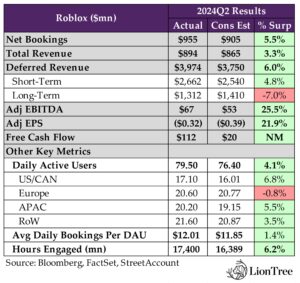
RBLX – Q3 Guidance Reflects A “Careful And Conservative Approach”
- Top-line growth is forecasted to outpace the Street’s estimates but decel seq: Projects a net bookings range of $1.00-$1.025bn, topping cons by +4.1% and representing a +20.5% y/y increase at the mid-pt; Although the exit rate from Q2 has been “strong”, Roblox wants to continue to exceed numbers provided at its Investor Day last Nov
- Adj EBITDA is expected to decline seq: Anticipates adj EBITDA to be between $22-42mn, which excludes $113mn of changes in deferrals, including a +$145mn increase in deferred rev partly offset by a -$32mn uptick in deferred cost of rev
- FCF is projected to be ~flat seq: Expects an FCF range of $105-120mn (vs $112mn in Q1), w/ net cash & cash equivalents from operating activities of $147-162mn and CapEx of ~$42mn
RBLX – There Were Some Puts & Takes W/ The FY24 Outlook
- FY24 bookings guidance was raised more than anticipated but slightly below the original outlook at the mid-pt: Now expects net bookings to fall between $4.18-4.23bn (vs $4.00-4.10bn prior and the initial outlook of $4.14-4.28bn), which beat cons by +3.1% at the mid-pt and represents a +19.4% y/y increase
- There was a “very healthy” exit rate transitioning into H2:24: Cited “very powerful improvements” in user growth, engagement, and bookings growth as the main reasons the Co “felt comfortable bringing the full-yr guidance back up”
- BUT the top-line guide implies a -4bps seq decel in growth in Q4 from Q3: Pointed out that the prior yr qtr saw the highest growth of 2023, given the PlayStation launch
- FY24 adj EBITDA guidance was cut to $92-132mn (from $95-147mn): Excludes net changes in deferrals of $548mn, w/ an increase in deferred rev of +$711mn partially offset by an increase in deferred cost of rev of -$163mn
- Still, Roblox expects to see margin improvement “trends continuing”: “Fixed costs [will] come back down in the future” due to ongoing efficiency initiatives, and the Co plans to invest at “slightly below the top-line growth rate” to drive “incremental margin improvement”
- There was a “very healthy” exit rate transitioning into H2:24: Cited “very powerful improvements” in user growth, engagement, and bookings growth as the main reasons the Co “felt comfortable bringing the full-yr guidance back up”
RBLX – KPIs Were “Strong Across All Regions”
- Growth in DAUs and hours engaged rebounded and accel’d seq: Q2 DAUs of 79.5mn were up +21.4% y/y (vs +17.5% y/y in Q1) and topped cons by +4.1%; Hours engaged incr’d +24.3% y/y (vs +15.2% y/y in Q1) and ended +6.2% ahead of cons
- US & Canada – BEAT: DAUs grew +21% y/y in Q2 (vs +13% y/y in Q1) and beat cons by +6.8%; Hours engaged were up +23% y/y (vs 12% y/y in Q1)
- “US & Canada saw their fastest growth since Q1:21”: Believes “there’s a lot of headroom” left in North America as well, as Roblox becomes “more and more [of] an everyday product”; Performance improvements and a broader range of content will also drive growth
- Europe – MISS: Q2 DAUs incr’d +14% y/y (vs +13% y/y in Q1) but missed cons by -0.8%; Hours engaged incr’d +16% y/y (vs +11% y/y in Q1)
- APAC – BEAT: DAUs were up +31% y/y in Q2 (vs +26% y/y in Q1) and topped cons by +5.5%; Hours engaged grew +39% y/y (vs +23% y/y in Q1)
- Japan and India remain important growth mkts: The Co’s DAUs in Japan were up +56% y/y in Q2 (vs +50% y/y in Q1), and its DAUs in India incr’d +57% y/y (vs 58% y/y in Q1); Hours engaged grew +66% y/y in Japan and +60% y/y in India
- Rest of World – BEAT: Q2 DAUs rose +22% y/y (vs +19% y/y in Q1) and closed +3.5% above cons; Hours engaged were up +22% y/y (vs +15% y/y in Q1)
- US & Canada – BEAT: DAUs grew +21% y/y in Q2 (vs +13% y/y in Q1) and beat cons by +6.8%; Hours engaged were up +23% y/y (vs 12% y/y in Q1)
- The Co’s efforts to “offset unseasonable growth rates” have been “seeing early signs of positive impacts”: Roblox initiatives in four key areas, including LiveOps bringing back platform-wide events, improvements in search & discovery, economy enhancements, and performance improvements, have been paying dividends
- There was a “level of improvement” that started in the back half of April: This was flagged on the Q1 earnings call, and since then, there’s been “an acceleration of those trends”, which has been reflected in the Co’s user growth and engagement hours
- Roblox’s FY24 bookings account for just ~2.5% of the $160bn video game mkt: Sees room to expand this by supporting a wide range of genres in gaming; Sees “really good early signals” in a handful of underutilized categories, including open-world action sports, racing, and social/co-op platforms
RBLX – Other KPIs Also Underscored Seq Improvements In User Trends / Age 13+ Trends Stand Out
- Age 13+ DAU growth cont’d to be “particularly strong”, accel’ing seq: 13+ DAUs of 46.4mn incr’d +26% y/y in Q2 (vs +22% y/y in Q1); Over 13+ users now account for ~58% of the Co’s total DAUs
- Growth in under age 13 DAUs also picked up seq: Under 13 DAUs of 32.4mn were up +15% y/y in Q2 (vs +12% y/y in Q1)
- Growth in monthly unique players (MUPs) accel’d seq: Q2 MUPs rose +22% y/y (vs +13% y/y in Q1)
- Avg daily bookings per DAU was better than anticipated: Avg bookings per DAU of $12.01 were up +0.8% y/y in Q2 (vs +1.6% y/y in Q1)
RBLX – Expense Color…AI-Driven Efficiencies Are Starting To Be Realized
- DevEx ratios were relatively ~flat seq: DevEx payments of $208.3mn were up +25.6% y/y in Q2 (vs +10.9% y/y in Q1), w/ a payout ratio of 21.8% (vs 21.9% in Q1)
- Roblox continues to “optimize and refine [its] economy”: Efforts to improve the pricing dynamics of the Avatar accessory mktplace have “paid great dividends”, and the dev community has also been working w/ the launch of price optimization
- Personnel expenses were flat y/y: The Co consolidated a number of employees in its offices that were previously WFH, though not all were able to make the move; This was offset by cont’d hiring in key growth areas, including for its AI platform, safety group, areas driving performance and quality, and its economy and ads team
- “The efficiencies are coming to a lot of infra-efficiency initiatives”: Highlighted that infrastructure & trust and safety expenditures were -8% lower y/y, falling to 13% of bookings vs 13% previously
- The use of AI has made the Co’s cost structure “better and more efficient and safer”: Including by improving the efficiency of its safety and moderation platform; Also has contributed to cost to serve dropping ~-25% y/y
RBLX – Seen “Cont’d Growth And Progress” In The Advertising & Shopping Spaces
- Roblox has expanded its offerings for advertisers: Roblox launched its video ad product, which has been “seeing subsequent q/q growth”, enhanced its self-serve ad manager, and introduced 3P integrations w/ IAS and PubMatic
- Total brand activations surpassed 400+ during the qtr: This is almost double the cumulative amount from a yr ago; Pointed to Ikea and Netflix as a couple examples of “really fun new brand partners” and also highlighted activations from Shrek, Despicable Me, and Six Flags
- Well-known artists have been joining Roblox as well: Including Rolling Stones, Ice Spice, and Post Malone as part of the Olympics via a partnership w/ Visa
- The Co is now testing real-world shopping in Roblox w/ Walmart and e.l.f. Beauty: Views real-world shopping as another growth channel that can supplement its core biz
- Longer-term, Roblox isn’t chasing “low-hanging fruit”: The Co wants to pursue “big strategic oppties” and is moving toward validating “closed-loop repetitive systems” w/ “a larger volume of… repeat day-on-day advertisers on top of the platform”
- Total brand activations surpassed 400+ during the qtr: This is almost double the cumulative amount from a yr ago; Pointed to Ikea and Netflix as a couple examples of “really fun new brand partners” and also highlighted activations from Shrek, Despicable Me, and Six Flags
RBLX – Other Highlights
- Improvements to search & discovery have resulted in an increase in content diversity on the homepage: Along w/ its AI-powered algorithm, the Co introduced “Today’s Picks”, which curates and showcases up-and-coming content and new releases
- Creators can also pay to promote sponsored content now: This new ability has resulted in an increase in the variety of content arising to the top of Roblox’s mktplace
- Roblox CFO Mike Guthrie decided to move on from the Co: Guthrie plans to pursue personal interests but will stay on throughout the search for a successor
- Roblox is “always behind legislation that helps support privacy and safety of people around the world”: Regarding the California Age-Appropriate Design Code, the Co is “already implementing much of what was in that code and supported it; Will “continue to monitor legislation” moving forward
Apple Returns To A Path Of Positive Revenue Growth
After a y/y decline last quarter, Apple returned to total revenue growth this quarter and set a new June quarter record. The growth came despite y/y declines in its iPhone (its largest category, accounting for 46% of Apple’s total revenue) and Wearables, Home, and Accessories divisions. This is the second straight quarter of y/y declines for the iPhone segment, which also posted its lowest revenue since September 2021, though looking ahead as they enter into the new iPhone cycle, management said it was “very excited” about the upcoming Apple Intelligence and believe it will provide a “compelling reason” for iPhone users to upgrade to new handsets, as it won’t run on devices before last year’s iPhone 15 Pro.
Apple’s strongest growth came from its iPad division, up +24% y/y, boosted by the release of new iPads during the quarter for the first time since 2022. Outside of the Products segment, which posted an overall beat of +2.1%, the Services segment also had a great quarter and beat estimates by +0.7% and set an all-time high revenue record.
Regionally, investors were also curious about sales in Greater China, Apple’s third largest market, where Apple’s market share has been on the decline in favor of local brands like vivo, OPPO, and Huawei. While the region posted its fourth consecutive quarter of declines, down -6.5% y/y, more than half of that decline was due to FX, and on a constant currency basis, the decline was less than -3% y/y. iPad sales have also returned to growth there, and they “don’t know how every chapter of the book reads, but we’re very confident in the long-term.”
Looking ahead, FQ4 guidance easily beat consensus estimates. The Co expects to see similar total revenue growth in the current quarter, and for Services rev to grow at a similar rate to the prior three quarters, which was ~+14% y/y. Apple Intelligence will also be something to watch, as the highly anticipated software is expected to roll out over the next few months across iPhone, iPad, and Mac.
See below for more.
-> Apple was up +0.7% in reaction to its report and ended the week up +0.9%; YTD, the stock is up +14.2%
- FQ3 headline results beat
- Total rev was a new June qtr record and grew +5% y/y (vs -4% y/y in FQ2) and beat cons by +1.6%, despite 230bps of negative FX impact
- Also set June qtr records in more than two dozen countries and regions, including Canada, Mexico, France, Germany, The UK, India, Indonesia, The Philippines, and Thailand
- Greater China: Rev fell -6.5% y/y (vs -8% y/y in FQ2), though 50%+ of the decline was due to FX; “Continue to be confident in the long-term opportunity in China”; iPhone install base set a record, and also set a June qtr record for upgraders; iPad also returned to growth in the qtr; “Vast, vast majority” buying Mac and iPad in Mainland China are buying the product for the first time;
- Also set June qtr records in more than two dozen countries and regions, including Canada, Mexico, France, Germany, The UK, India, Indonesia, The Philippines, and Thailand
- Gross margin of 46.3% (above cons 46.2%) and was down -30bps seq, driven by a different mix within Products, which was partially offset by a favorable mix shift towards Services and cost savings
- EPS beat by +4.5% and also achieved a record for the June qtr
- OpEx came in at the low end of the guidance range: At $14.3bn, vs cons $14.4bn, and up +7% y/y
- Total rev was a new June qtr record and grew +5% y/y (vs -4% y/y in FQ2) and beat cons by +1.6%, despite 230bps of negative FX impact
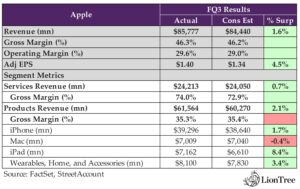
- Product rev beat cons by +2.1%: Grew +2% y/y (vs -10% y/y in FQ2), driven by the launch of the iPad Pro and iPad Air; Gross margin of 35.3% was down -130bps seq, primarily driven by mix, partially offset by favorable costs
- Total installed base of active devices reached an all-time high across all products and geographic segments
- By segment:
- iPhone rev beat cons by +1.7%: Down -1% y/y (vs -10% y/y in FQ2), but grew y/y on a CC basis
- Set June qtr records across several countries, including the UK, Spain, Poland, Mexico, Indonesia, and the Philippines
- iPhone was the top-selling model in the US, urban China, Germany, Australia, and Japan
- iPhone 15 is performing better than iPhone 14, looking at the same # of weeks since launch
- iPhone active installed base reached a new all-time high in total and in every geographic segment
- Mac rev missed cons by -0.4%: Up +2% y/y (vs +4% y/y in FQ2), driven by the MacBook Air powered by the M3 chip
- Saw “particularly strong” performance in emerging markets w/ June qtr records in Latin America, India, and South Asia
- Mac installed base reached an all-time highwith half of MacBook Air customers in the quarter being new to the product
- iPad rev beat cons by +8.4%: Up +24% y/y (vs -17% y/y in FQ2), driven by the launch of the iPad Pro and iPad Air
- iPad install base reached an all-time highas half of the customers who purchased iPads during the qtr were new to the product
- Wearables, Homes and Accessories beat cons by +3.4%: Down -2% y/y (vs -10% y/y in FQ2)
- Watch and AirPods continue to face a difficult compare against prior year launches of the AirPods Pro 2nd generation, the Watch SE and the first Watch Ultra
- Apple Watch install base reached an all-time high, as ~2/3 of customers purchasing an Apple Watch during the qtr were new to the product
- iPhone rev beat cons by +1.7%: Down -1% y/y (vs -10% y/y in FQ2), but grew y/y on a CC basis
- Services rev beat cons by +0.7%: Up +14% y/y (vs +14% y/y in FQ2); Gross margin of 74.0% was down -60bps seq
- Set all-time rev high overall Services rev record
- Set all time high rev records in developing markets and June qtr rev records in emerging markets
- Set all-time rev records in advertising, cloud, and payment services
- Transacting and paid accounts reached new all-time highs, with paid accounts growing double-digits y/y
- Paid subscriptions showed “strong” double-digit growth and reached an all-time high: Have “well over” 1bn paid subscriptions, more than double the # of paid subscriptions from four years ago
- Set all-time rev high overall Services rev record
- FQ4 Outlook: Provided formal guidance under the assumption that the projected macroeconomic outlook doesn’t worsen
- Expect FQ4 total Co rev to grow y/y at a rate similar to the June qtr (was +5% y/y in FQ3, which is above cons +4.3%), in spite of expected FX headwind of ~1.5ppts on a y/y basis
- Expect FQ4 Services rev to grow double digits at a rate similar to the first three quarters of this FY
- Gross margin: Between 45.5% and 46.5% (vs cons 45.9%), driven by similar dynamics to FQ3 of “slightly different mix” and FX headwinds
- OpEx: Between $14.2bn-$14.4bn vs cons $14.6bn
- OI&E: Around -$50mn, excluding any potential impact from the mark-to-market of minority investments
- “Very excited” about Apple Intelligence (coming soon with iOS 18) and “will continue to make significant investments in this technology and dedicate ourselves to the innovation that will unlock its full potential”
- “Siri also becomes more natural, more useful, and more personal than ever”
- “Apple Intelligence is built on a foundation of privacy both through on-device processing that does not collect users’ data and through private cloud compute, a groundbreaking new approach to using the cloud while protecting users’ information powered by Apple silicon
- Started roll out this week with developers “so we’re taking the first step in getting the beta out there, and we can’t wait to see what kind of amazing things they do with it”
- Also to note – ChatGPT will be integrated within iPhone, Mac, and iPad by end of calendar year
- Seeing any impact from changes made to comply with DMA rules in Europe? EU makes up 7% of revenue generated on the App Store; Introduced some changes to the way App Store is run in Europe and have seen “a good level of adoption” from developers; “It’s obviously early stage, but in general, our results for the Services business and for the App Store have been pretty good until now”
DraftKings Plans To Take To the Offensive In H2:24
Along with the flurry of earnings updates elsewhere across the tech and entertainment spaces, the sports betting industry was in focus this week with DraftKings’ Q2 print hitting the tape. In a seasonally slower quarter for the company that was also negatively impacted by fewer than expected NBA playoff games, DraftKings reported revenue that was a slight -0.5% below consensus forecasts. Customer acquisition, retention, and engagement exceeded the company’s own expectations during the quarter and contributed to a “strong” handle. However, this was offset by a wide -21.4% miss on average revenue per monthly unique payer (ARPMUP), driven by “customer-friendly sport outcomes”, increases in new customer promotional reinvestment associated with the growth in new players, and the inclusion of Jackpocket customers in the overall mix. Ultimately, DraftKing’s adj EBITDA finished -3.0% below the Street’s estimates, despite OpEx tracking in-line with the company’s expectations.
Looking past the Q2 performance, the bigger focus was on DraftKings’ revisions to its FY24 outlook and its “absolutely offensive” strategy to drive increased user acquisition in H2:24. More specifically, the Co cut its adj EBITDA guidance by -$120mn at the mid-point, which was -21.3% below where the Street was expecting it to fall. Although management explained that they are “following the data” and leaning into a “particularly strong environment” for user growth, which was reflected in a upward adjustment to FY24 guidance for top-line growth, questions from sell-side analysts suggested some wariness that these plans may be a reaction to higher levels of competition. DraftKings assured them that it will continue to use its three-year payback rule as a key criterion for user acquisition spend and also that, with the highly digital nature of its marketing spend, it can typically “move in and out” channels “in a matter of days” if it isn’t seeing the desired levels of ROI.
Despite the adj EBITDA cut this year, the outlook for $900mn-$1bn in adj EBITDA in FY25 remains intact, though the State of Illinois’ decision to introduce a new, tiered progressive tax on sportsbook operators will add another hurdle for DraftKings on its path to that goal. In response to Illinois’ new tax laws, the company has opted to respond by implementing a “nominal” gaming surcharge in the state as well as the three other ones with 20%+ taxes on its gross revenue. Interestingly, DraftKings will subsidize the first 20% of the taxes and then use the surcharge to cover the remaining amount in these higher tax states. To nobody’s surprise, this plan also sparked several follow-up questions on the Q&A.
See below for more details on what we thought was most incremental from the print:
-> DraftKings shares were down -9.8% following the print and ended the week down -11.8%; YTD, DraftKings stock is trading down -9.2%
“Customer-Friendly Sport Outcomes” Were A Drag On DraftKings’ Headline Numbers
- Headline results mostly fell short of estimates: Q2 rev rose +26.2% y/y (vs +52.7% y/y in Q1) and missed cons by -0.5%; Adj EBITDA incr’d +75.4% y/y to $128.0mn (vs $22.4mn in Q1) but ended -3.0% behind cons, w/ an adj EBITDA margin of 11.6% below cons’ 11.9%; Adj EPS of $0.22 beat cons by +15.8%
- Adj gross margin was down both seq and y/y: Adj gross margin decr’d by ~-400bps y/y to 43% (vs 44% in Q1), driven by better-than-expected customer acquisition and a corresponding promo reinvestment
- OpEx was in line with the Co’s expectations: Continues to balance rev growth w/ op efficiency
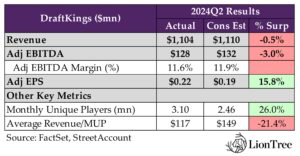
There Were Multiple Adjustments To FY24 Guidance, But The FY25 Adj EBITDA Outlook Was Reaffirmed
- The FY24 top-line outlook was raised more than anticipated: Now expects rev between $5.05-5.25bn (vs $4.80-5.00bn prior), beating cons by +3.6% at the mid-pt, given strong acquisition, engagement, and retention trends for existing customers, plus the inclusion of Jackpocket and the recent launch of Sportsbook in Washington, DC
- Adj gross margin is projected to “increase modestly”
- Sales & mkting expense is forecasted to rise ~+msd-hsd% y/y: Primarily due to investments in the Jackpocket brand
- Adj EBITDA guidance was lowered and below the Street’s estimates: Now projects adj EBITDA of $340-420mn (vs $460-540mn prior), missing cons by -21.3% at the mid-pt; Cited the new Illinois state tax, “strong new customer acquisition expectations”, the inclusion of Jackpocket, and the Washington, DC launch
- Higher new customer promos will be a headwind…: Emphasized that even if the Co didn’t spend any more on mkting, “higher new customer promos come from just more customers coming in”
- Adj EBITDA flow-through from existing customers will be in the ~50% range, or “maybe a little bit higher”
- But still reiterated FY25 adj EBITDA guidance: Continue to forecast adj EBITDA of $900mn-1bn, which was -4.8% below cons at the mid-pt; In addition to “underlying biz momentum”, also sees a benefit from higher customer acquisition in H2:24; Jackpocket will also begin to deliver a positive adj EBITDA
- DraftKing’s upcoming gaming tax surcharge could generate “addt’l upside” in FY25 adj EBITDA: However, the Co is not including this in its guidance as of now
- Adj gross margins will likely be under pressure: The Co will need to “get a little bit more rev” to offset the Illinois tax increase and still hit its adj EBITDA target range
KPI Trends Revealed Strong User Acquisition Trends
- “Handle was strong”: Driven by “healthy” and better than anticipated customer engagement and retention; This was also despite fewer than anticipated NBA playoff games
- The Co is “seeing absolutely no signs of any weakness in the consumer whatsoever”: DraftKings has been benefiting from “super strong, healthy cohort behavior across the board”
- Monthly Unique Payers (MUPs) topped estimates by a wide margin: MUPs of 3.10mn were up +50% y/y in Q2 (vs +23% y/y in Q1) and beat cons by +26.0%; Growth was driven by “strong unique player acquisition and retention across the Sportsbook and iGaming products as well as the expansion the Sportsbook product into new jurisdictions
- Customer acquisition exceeded the Co’s expectations in Q2: New to DraftKings, OSB, and iGaming customers incr’d by nearly +80% y/y; “Customer acquisition is really at all time high”
- DraftKings saw growth in new players “across the board”: Received a “big boost” from North Carolina after the late Q1 launch, despite fewer big new state launches y/y; In terms of products, there was “particular strength” in the Golden Nugget brand
- The Jackpocket acquisition also contributed to y/y MUP growth: Excluding this, MUPs would have incr’d by ~+34% y/y
- Customer acquisition exceeded the Co’s expectations in Q2: New to DraftKings, OSB, and iGaming customers incr’d by nearly +80% y/y; “Customer acquisition is really at all time high”
- Structural sportsbook hold improved in line w/ the Co’s forecasts: Q2 structural sportsbook hold improved ~+100bps y/y to ~10% (vs 9.8% in Q1)
- BUT ARPMUP declined y/y and was lower than expected: Avg rev per MUP fell -15% y/y to $117 in Q2 (vs $114 in Q1), missing cons by -21.4%, driven by the inclusion of lower ARPMUP Jackpocket customers, “customer-friendly” sport outcomes, and an increase in new customer promo investment
DraftKings Will Ramp Up User Acquisition Efforts Heading Into Its Busy Season
- Customer acquisition costs declined -40% y/y in Q2: Though this was a period w/ no new state launches
- The Co is “not seeing an increase in the existing player cost”: Instead, the incr’d customer acquisition spend is “all new player-driven and mix-driven”
- BUT there has been “some decline in cohort quality” in existing states “as time goes on”: Indicated that the strongest players are acquired in the first two yrs of a state launch “and then it kind of flattens out”
- Plans to increase user acquisition spend in H2:24 are “absolutely offensive” in nature: The Co is “following the data” and is looking to capitalize on a “particularly strong environment” and a mkt that is “growing quickly”; “You got to fish when the fish are biting”
- “There’s a lot of momentum in the industry right now”: Along w/ “a lot of buzz” associated w/ the upcoming NFL season, and the NBA season starts in the fall as well; Sees no reason why “very strong customer acquisition” would slow heading into the busiest time of the yr
- Still, DraftKings will continue to make decisions based on its three-yr payback rule: “The vast majority” of the Co’s mkting spend is “flexible” and on digital platforms, and it can move in and out of channels typically “in a matter of days”
Regarding The State Of Illinois’ New, Tiered Progressive Tax On Sportsbook Operators
- DraftKings believes it has a “reasonable solution for high tax states”: The Co plans to introduce a gaming surcharge in the four states w/ multiple sports betting operators and tax rates of 20%+ starting on Jan 1, 2025
- The Co is “subsidizing a chunk” of the tax increase: In contrast, highlighted that other industries tend to pass 100% of these increases through to consumers, such as w/ hotel taxes or sales taxes; Will subsidize taxes of up to 20% of gross rev and use surcharges to offset the rest
- The charge to consumers will be a “nominal amount”: The Co’s investor presentation provided the example of a $10 bet to win $20 receiving a $0.32 surcharge related to the Illinois gaming tax
- “If that’s our calculus, then others would come to the same conclusion”: But also acknowledged that “there might be other ways to do that” and will wait and see what happens before Jan 1
- The Co can pull levers to offset some of the impact of the higher taxes: However, the Co will do this at a level where it “can continue to invest in the state… to create long-term growth”
- The Co is “subsidizing a chunk” of the tax increase: In contrast, highlighted that other industries tend to pass 100% of these increases through to consumers, such as w/ hotel taxes or sales taxes; Will subsidize taxes of up to 20% of gross rev and use surcharges to offset the rest
Other Highlights
- “The Jackpocket integration is off to a great start”: DraftKings plans on integrating Jackpocket’s products into DraftKings as well as integrating DraftKings’ casino and OSB products into Jackpocket, which should create more cross-selling and user acquisition oppties, though timing is still unclear
- Jackpocket is expected to deliver positive EBITDA next yr: The Co has confidence b/c of the rev growth it is seeing in Jackpocket; Jackpocket users also have an “extremely low” CAC, making a “big difference” in their rev ramp
- In iGaming, DraftKings is “on track” to release double the games y/y: The Co also recently improved its interface to promote game discoverability; The DraftKings and Golden Nugget Online Gaming apps were recently ranked #1 and #2 in a recent third-party study
- DraftKings expects to be able to buy back $1bn of Class A shares over the next 2-3 yrs: Ideally, the Co would like to be “formulaic” w/ it to “create some consistency” but hasn’t “fully finalized” plans yet
- LatAm currently isn’t a major priority for the Co: DraftKings doesn’t want to distract its braintrust “w/ something like that” and is instead “really focused… on winning the US online gaming oppty” and on its core biz; That said, the Co indicated its strategy in LatAm would likely involve M&A over organic means
Booking Confirms That The Travel Market Continues To “Normalize”
Booking kicked off this quarter’s earnings cycle for the online travel industry this week, and after the company’s weaker-than-expected top-line guidance for Q2 during the last call, investors were keen to see how trends in travel have been playing out and to see if concerns about a slowdown have been coming into fruition. As predicted, Booking CEO Glenn Fogel confirmed that the “travel market has continued to normalize”, citing moderating global GDP growth as one of the main indicators of the pullback in consumers’ appetite to travel. However, other unforeseen factors, including a decline in air ticket prices and a “mild moderation” of growth in Europe, contributed to the company’s gross bookings growth slowing to just +4.4% y/y in Q2 after increasing +10.4% y/y in Q1 and missing the Street’s tempered expectations by -0.8%. Otherwise, Booking was able to sustain a high rate of growth in Asia and even saw a slight improvement in gross bookings growth in the US during the quarter, despite more travelers beginning to trade down in the region. Growth in the alternative accommodations business also remained relatively strong at +12% y/y (vs +13% y/y in Q1) and accounted for a similar mix (36%) of the company’s total bookings sequentially.
Looking ahead, the near-term outlook doesn’t appear to be much rosier for the travel industry. Booking’s Q3 guidance was broadly underwhelming, with the high-end of its projected ranges for room nights and gross bookings growth both coming in below consensus estimates. Along with a continuation of some of the current obstacles facing the company, the booking window is expected to continue to shrink to “be more similar to last year”, and an uptick in IT expenses will also pressure adj EBITDA. Nonetheless, for the full year, Booking now forecasts that its adj EBITDA will grow at a “slightly faster” rate than its previous expectation due to efforts to lower other fixed expenses. The company also anticipates that its revenue growth will be a “bit higher” than its prior forecast because of higher revenue associated with payments but downwardly revised its FY24 gross bookings outlook to account for less growth in flight bookings.
Net-net, while the travel market has seen some softening, Booking “can’t control demand” and is focused instead on the things it can control, including continuing to take market share. As part of this, the company has made progress with initiatives to drive more direct business and has enhanced its Genius loyalty program.
We covered these topics in more detail as well as other updates that we thought were incremental below.
-> Booking shares fell -9.2% in reaction to the print and closed the week down -10.1%; YTD, Booking stock is trading down -6.2%
Results Were Mixed Relative To The Low Bar Headed Into The Print
- Headline results were mixed, w/ a slight bookings miss but a strong adj EBITDA beat: Q2 rev rose +7.3% y/y (vs +16.9% y/y in Q1) and topped cons by +1.5%, while gross bookings missed by -0.8%; Adj EBITDA incr’d +6.6% y/y (vs +53.2% y/y in Q1) and beat cons by +8.3%; Adj EPS beat cons by +8.5%
- There was a -400bps headwind to rev growth during the qtr: Including a -200bps impact from changes in Easter timing and a -200bps impact from changes in FX; Excluding these, rev would have grown ~+11% y/y
- As previously flagged, 1x items also negatively affected adj EBITDA growth by -700bps: Changes in Easter timing had a ~-500bps impact, while FX changes had a -200bps impact; Without these, adj EBITDA would have grown ~+14% y/y, w/ lower than expected fixed expenses across personnel, G&A, and IT
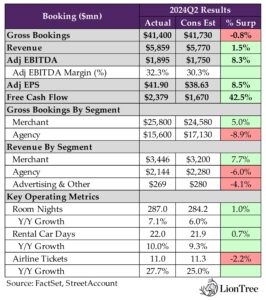
Q3 Guidance Was Underwhelming, W/ Further Slowdowns Expected
- Room night growth is forecasted to decline seq and more than the Street anticipated: Projects room night growth of between ~+3-5% y/y (vs +7.1% y/y in Q2), which was below cons’ +6.9% y/y; Expects the booking window to “be more similar to last yr”, and sees cont’d sluggishness in Europe
- The outlook for gross bookings was also disappointing: Expects gross bookings growth of ~+2-4% y/y (vs +4.4% y/y in Q2), missing cons’ +7.1% y/y; Bookings growth will be “slightly below” room nights growth due ~-1% of negative impact from FX changes
- Constant currency ADRs are expected to be “down slightly y/y”: However, the impact on bookings will be offset by a “slight benefit” from flight bookings growth, which will be lower than previously anticipated due to lower ticket flight prices
- Rev growth is projected to slow further seq: Sees rev growth ranging from +2-4% y/y (vs +7.3% y/y in Q2 and +16.9% y/y in Q1), w/ FX fluctuations expected to have a ~-100bps impact
- The outlook for adj EBITDA was well below the Street’s estimates: Anticipates adj EBITDA will be between $3.25-3.35bn, which would be ~flat w/ the prior yr qtr at the mid-pt but -7.8% below cons; Expects adj EBITDA to grow slower than rev due to deleverage from sales & other expenses and from growth in IT expenses
- Similar to rev, adj EBITDA will also face a ~-100bps headwind from FX changes
Booking Tempered The FY24 Bookings Outlook But Raised Expectations For Rev And Profitability
- The gross bookings forecast is now “a bit lower” than prior”: The Co now sees gross bookings growth of “faster than +6%” (vs “slightly faster than +7%” prior), given less growth in flight gross bookings due to lower ticket prices; Still expects “strong growth in flight tickets for the yr” b/c of efforts to expand flight offerings
- Rev growth is now projected to be “a bit higher” than prior but lower than the Street’s forecasts: Expects rev growth of “more than +7%” (vs “slightly faster +7%” prior), but this was below cons’ +8.4%; Cited the Co’s H1:24 outperformance as well as its expectation for higher rev associated w/ payments for the adjustment
- Rev will be impacted “to a much lesser extent” than gross bookings by declines in flight ticket prices
- Also continues to expect a ~-100bps negative impact from FX changes
- Adj EBITDA growth is now expected to be “slightly faster”: Forecasts adj EBITDA growth of ~+hsd% (previously guided to be “slightly faster” than the rev growth’s +7%), given the Co’s new outlook for higher rev growth and lower fixed OpEx growth
There Has Been Some Deterioration In The Travel Mkt
- “The travel mkt has cont’d to normalize”, as expected: Believes that “the travel mkt is best influenced by GDP” and that its +3-5% y/y room night growth forecast for Q3 “[isn’t] that different” from global GDP growth; “In the long run, GDP goes up, [and] more people travel”
- Booking is “not really seeing a trade-down on the global basis”: Both avg star ratings and length of stay have been “relatively stable” to what the Co has seen in previous periods
- BUT there has been “a really mild indication of some trade-down in the US”: Otherwise, the Co sees a “very steady picture” globally
- Travel has been benefitting from an “Instagram effect”: Thinks that peoples’ desire to “show off to [their] friends” has resulted in parts of the world that were previously lesser traveled now being “overrun”
- Reiterated (x3) that the Co’s growth in Europe from May-June has been “quite steady and stable”
- Booking is “not really seeing a trade-down on the global basis”: Both avg star ratings and length of stay have been “relatively stable” to what the Co has seen in previous periods
Declines In Flight Ticket Prices Were A Drag On Q2 Gross Bookings
- Gross bookings growth slightly missed and decel’d seq: Q2 gross bookings were up +4.4% y/y (vs +10.4% y/y in Q1) and missed cons by -0.8%, driven by lower flight ticket prices; The ~3% spread between room night and bookings growth was due to a ~-2% headwind from FX changes and ~-1% lower constant currency accommodation ADRs
- Room nights growth slowed seq but still topped estimates: Room nights grew +7.1% y/y in Q2 (vs +8.5% y/y in Q1), closing +1.0% above cons; As expected, the booking window expanded less seq, negatively impacting room night growth
- A “mild moderation” of travel mkt growth in Europe posed a headwind…: Europe room nights grew ~+msd% y/y (vs ~+hsd% y/y in Q1); Caveated that growth has “remained stable” from May-July, and the Co cont’d to perform well relative to the mkt in the region
- … Though Asia “cont’d to see high growth levels”: Growth in Asia room nights was in the ~+mid-teens% y/y (similar to Q1’s rate)
- The US also experienced “a slight improvement in growth”: US room nights incr’d ~+msd% y/y (vs ~+lsd% y/y in Q1)
- RoW room night growth was ~flat seq: RoW room nights grew ~+hsd% y/y (similar to Q1’s rate)
- Growth in airline ticket bookings declined further seq and missed forecasts: Airline ticket bookings rose +27.7% y/y in Q2 (vs +33.1% y/y in Q1), falling short of cons by -2.2%; Growth was driven by Booking.com’s flight offering and Agoda’s flight biz, but lower ticket prices weighed on bookings
- The mix of merchant gross bookings exceeded the Co’s expectations: Merchant gross bookings accounted for 58% of total gross bookings at Booking.com in Q2, a ~+10% y/y increase
- Processing transactions through Booking.com’s merchant offering generated incremental contribution margin dollars: However, this was still a small percentage of total adj EBITDA
- Room nights growth slowed seq but still topped estimates: Room nights grew +7.1% y/y in Q2 (vs +8.5% y/y in Q1), closing +1.0% above cons; As expected, the booking window expanded less seq, negatively impacting room night growth
Trends In Alternative Accommodations Were Relatively Similar Seq
- Alternative accommodation room nights growth ticked down slightly seq: Q2 alternative accommodation room nights were up +12% y/y (vs +13% y/y in Q1); The biz’s global mix of room nights of 36% was up +2% y/y but flat seq
- A greater selection of listings appears to be contributing to y/y growth in alternative accommodation room nights: Ended Q2 w/ 7.8mn alternative accommodations listings, representing a ~+11% y/y increase (flat w/ Q1’s rate)
- BUT the Co still doesn’t have “anywhere near the number or type of home accommodations in the US to be fully competitive”: That said, Booking will prioritize it spends to get the properties it needs, not on “subpar” products
- Comparing the profitability of alternative accommodations vs hotels is “not relevant”: Instead, “what’s relevant is making sure [travelers] use whatever they want”; Booking doesn’t try to steer them and is “agnostic from an economics perspective”
- Booking has a “unique” go-to-mkt proposition in alternative accommodations: By putting both traditional and alternative accommodations on the same platform, the Co has the benefit of all its brand mkting and paid mkting spend coming together on the same platform
- A greater selection of listings appears to be contributing to y/y growth in alternative accommodation room nights: Ended Q2 w/ 7.8mn alternative accommodations listings, representing a ~+11% y/y increase (flat w/ Q1’s rate)
The Genius Loyalty Program + Other Initiatives Continue To Push Travelers Toward Direct Channels
- Growth in room nights from direct bookings cont’d to outpace growth in room nights from paid mkting: The Co’s mix of total room nights from the direct channel has remained in the mid-50% range and in the low-60% range when excluding the B2B biz over the last four qtrs
- Mobile app mix improved seq: Booking’s mobile mix of total room nights was up +6% y/y to ~53% in Q2 (vs ~51% in Q1); The “significant majority” of the Co’s bookings have cont’d to come via the direct channel
- Still, Booking will “remain “proactive in paid mkting channels”: The Co wants to attract new travelers to its platform as long as it can do so at “attractive ROIs”
- The Co incr’d its spend on social media “in a disciplined manner”: As part of a broader effort to diversify the channels it utilizes to reach travelers; These efforts have been “getting some good ROIs”
- The Co sees a “meaningfully higher direct booking mix for Genius users vs other users”: This benefit increases at each higher tier of Genius statuses
- Level 2 & 3 Genius members now comprise nearly 30% of the Co’s active travelers: In addition to a higher direct booking rate, these travelers also generate a higher booking frequency (levels 2 & 3 require 5 and 15 bookings, respectively, in a two-yr period)
- These members booked over half of the Co’s total room nights over the past four qtrs
- Booking has also added more benefits to the Genius program: Q2 saw a +15% y/y increase in Genius benefits to travelers; This was mainly driven by accommodation bookings, though there was also triple-digit growth in discounts for car rentals and cont’d testing of benefits for flights
- The Co’s partners have been supplying all of the benefits
- Level 2 & 3 Genius members now comprise nearly 30% of the Co’s active travelers: In addition to a higher direct booking rate, these travelers also generate a higher booking frequency (levels 2 & 3 require 5 and 15 bookings, respectively, in a two-yr period)
- Growth in Connected Trips slowed seq: Connected transactions grew by ~+45% y/y in Q2 (vs “just over +50% y/y” in Q1) and cont’d to account for a ~hsd% of Booking.com’s total transactions; The Co has been seeing higher repeat and direct booking rates for a Connected Trip person
- AI remains at the center of the Connected Trips vision: The Co continues to work to further incorporate the tech into its platform
FCF Continues To Be A Bright Spot For The Co
- FCF closed materially above consensus estimates: FCF rose +44.6% y/y in Q2 (vs -8.1% y/y in Q1) and beat cons by a wide +42.5%; This was partially offset by ~$1.9bn of capital returned to shareholders, including share repurchases and dividends
Other Highlights
- Booking wasn’t affected “very much” by the CrowdStrike incident: That said, the Co acknowledged that it hit “some of [its] supplier partners significantly”; “Delta had a horrific event… and it will be interesting to see how that lawsuit turns out”
- Advertising is a “very attractive” potential oppty: Sees oppties in generate more ad income from the active app usage on Agoda and Booking.com; Currently, the majority of the Co’s ad rev is from KAYAK and OpenTable; Still, doesn’t want to overload its apps so tha they become “annoying”
Quick Takes On A Couple Other Key TMT Prints…Live Nation & T-Mobile
- Live Nation – The concert “boom” is expected to continue and the Co remains on track to deliver double digit AOI growth for the full year (link)
- Q2 rev was in-line w/ the Street, while adj op income beat: Q2 rev was up +7% y/y (vs +21% y/y in Q1) and was in-line w/ cons; Q2 adj. op income was up +21% y/y (vs +15% y/y in Q1) and topped cons by +8.8%
- The revenue beat was driven by Concerts (Ticketing and Sponsorship & Advertising miss); while adj. op income beat across all segments
- A -$94mn loss related to settlements from Astroworld festival litigation was booked in Q2
- Guidance continues to point to “another record year” in 2024, though a slight bump in the road is expected in Q3
- The Co boosted 2024 CapEx estimate again to ~$650mn, up from ~$600mn last qtr, which was an increase from $540mn projected 2 qtrs ago
- Change to CapEx estimate is largely due to a pull forward of activity, as well as addtl venue oppties, with major opening increasing from 12 to 14 venues over 2024-2025
- ¾ of total CapEx was driven by Venue Nation, as five venues account for ~40% of total venue spend
- Q3 op income will be impacted negatively by one-time accruals, but the Co remains on track to deliver double-digit AOI growth the yr
- 2025 is expected to be a “big banner year” for stadiums: The pipeline is bigger now than it was in 2023, with strong growth expected in amphitheaters and arenas
- The Co boosted 2024 CapEx estimate again to ~$650mn, up from ~$600mn last qtr, which was an increase from $540mn projected 2 qtrs ago
- YTD ticket sales for 2024 Live Nation concerts are 118mn, higher than 2023 with double-digit increases for arena, amphitheater, and theater and club shows
- Arena and amphitheater shows drove fan growth in Q2: 39mn fans (+5% y/y) attended ~15k Live Nation concerts (+20% y/y) globally
- America attendance grew y/y, but intl fell: N. America fans who attended Live Nation Shows in Q2 reached 23.3mn, up from yr-ago 18.5mn; Internationally, attendance shrank to 15.7mn from year-ago 18.6mn, which was expected due to the Paris Olympics
- International remains a key driver of growth
- By market: Ticket sales up +15% in Mexico YTD, 1mn+ tickets sold in newly launched markets Brazil and Peru, and expansion into South Africa
- By artists: Across top 50 global tours, intl artists have attracted 50% more fans YTD compared to 2019
- Not seeing “anything unusual” when it comes to cancellation rates: “Absolutely in-line” with historical trends of 4-5% of shows and 1.5% of fans
- Cancellation rates for N. America concerts tracking lower than 2023 levels
- Seeing 30%+ returns on 2022/2023 venue renovations: Refreshed ~1/3 of their amphitheaters since 2022, with improvements including new bar designs, upgraded VIP boxes, and other infrastructure upgrades
- DOJ investigation impact? “We’re able to isolate. So, if you’re in my legal department, you’re working on the DOJ. If you’re running any one of my divisions, it’s business as usual,”
- Q2 rev was in-line w/ the Street, while adj op income beat: Q2 rev was up +7% y/y (vs +21% y/y in Q1) and was in-line w/ cons; Q2 adj. op income was up +21% y/y (vs +15% y/y in Q1) and topped cons by +8.8%
-> Live Nation traded up +1.7% post its print, but ended the week down -2.6%; YTD the stock is down -2.6%
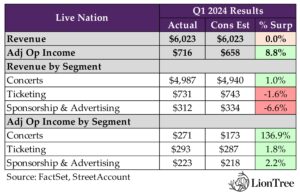
- T-Mobile posted industry-leading postpaid phone and broadband net adds:
- Some puts & takes w/ headline results: Rev incr’d +3.0% y/y in Q2 (vs -0.2% y/y in Q1) and beat cons by +0.8%; Core adj EBITDA rose +9.4% y/y (vs +8.0% y/y in Q1) and ended in ~in-line w/ cons, though adj EBITDA margin of 40.7% missed cons 41.1%; FCF topped cons by + 5.9%
- But postpaid phone net adds finished well ahead of forecasts: Q2 postpaid phone net adds were up +2.2% y/y to +777k (vs +532k in Q1), closing a wide +21.0% above cons;
- Postpaid phone gross adds expanded at the highest rate in nearly three yrs: The Co had the highest switching “ever seen” for a second qtr, smaller and rural mkts have been doing “incredibly well”, and the biz segment “saw once again positive port trends across all segments”
- The qtr saw “another record low upgrade rate” …: Although this has reduced chances for “more jump balls” the Co has benefited from this in “many ways”, including in the efficiency of its model
- BUT there’s “a lot of excitement around Apple’s launches”: The Co is “very, very excited about what’s coming” and “think[s] AI is on every customer’s mind”; However, also acknowledged
- High-speed internet (HSI) net adds were ~flat seq and better than projected: HSI net adds fell -20.2% y/y to +406k in Q2 (vs +405k in Q1) but beat cons by +2.3%; Captured a record share (~75%) of industry broadband net adds during the qtr; Now “resonating w/ customers on multiple topics”
- The majority of the Co’s gross ads are still coming from cable: Otherwise, the breakout of T-Mobile’s FWA net adds between smaller and rural mkts vs its top 100 remains the same
- Churn decr’d across every 10-yr cohort within the FWA base: “The delta of satisfaction between T-Mobile US FWA and the rest of the industry is expanding”
- Revised FY24 guidance across several key metrics: Now anticipates core adj EBITDA of $31.5-31.8bn (vs prior $31.4-31.9bn), missing cons by -0.2% at the mid-pt, FCF between $16.6-17.0bn (vs $16.4-16.9bn prior), beating cons by +2.5% at the mid-pt, and postpaid net customer adds of 5.4-5.7mn (vs 5.2-5.6mn prior)
- ACP is expected to have a y/y impact in the $350-450mn range: “The majority” of that impact is expected to occur in H2:24, w/ “even more” of it in Q4 than in Q3
- Regarding T-Mobile’s fiber strategy – The Co is aiming to reach “millions of homes”: MetroNet reaches 2mn+ homes today and expected to pass 6.5mn homes by 2030; The Lumos transaction will pass 3.5mn homes by 2028, and “there’s probably a couple more million” in T-Mobile’s wholesale partnerships
- MetroNet’s in-mkt teams have been “performing very, very well”: The Co has seen penetration rates in the upper 30%s in its more mature mkts
- T-Mobile’s “appetite for further transactions in the space is limited”: The Co’s recent deals give it a “material footprint”, and it isn’t currently working on something else like them
- Disputed the value of convergence: Despite the Co’s efforts to grow in broadband, caveated that competitors’ convergence claims are hard to prove, given that “they have broadband in places of their historic strength”; That said, acknowledged a “marginal impact to churn” w/ bundled offers
-> T-Mobile shares rose +3.9% in response to earnings and ended the week up +7.5%; YTD, T-Mobile stock is trading up +17.7%
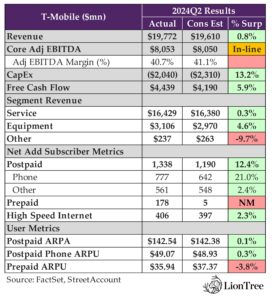
Stock Market Check
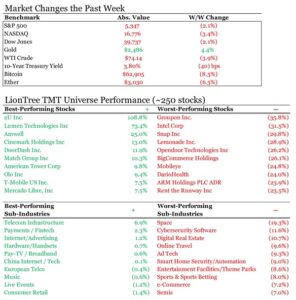
This Week's Other Curated News
Advertising/Ad Agencies/Ad Tech
- Comscore now measures YouTube audiences across all digital devices in the U.S., including connected TVs, through its Video Metrix Multi-Platform product. This integration with YouTube allows advertisers to better evaluate ad campaigns. Comscore’s expanded measurement addresses cross-platform audience shifts, offering comprehensive reporting of YouTube’s reach. By 2025, YouTube audience data will be available in additional countries including Argentina, Brazil, Canada, France, Germany, India, Italy, Malaysia, Mexico, Spain, and the U.K. (Broadcasting Cable)
- Fox said it has completed its upfront, managing increases in dollar volume for its linear and digital properties in what was expected to be a difficult market for legacy networks. “Our focused portfolio of market-leading properties in sports, news, entertainment and streaming delivered yr-over-yr growth in both linear and digital advertising commitments as well as growth in overall portfolio pricing in this yr’s upfront,” Fox president, advertising sales, marketing and brand partnerships Jeff Collins said in a statement. (Broadcasting Cable)
- NBCUniversal is surpassing ratings expectations for the 2024 Paris Olympics, prompting the sale of some reserved advertising inventory initially held as a safeguard. NBCU is averaging 33.8mn viewers across all platforms, a 79% increase from the 2021 Tokyo Olympics. The top viewership day so far saw 41.5mn viewers. NBCU aims to build on record Olympics revenue, potentially reaching $1.45bn in sales. Streaming also performed well, with significant engagement on Peacock and NBCU Digital platforms. (Sportico.com)
Artificial Intelligence/Machine Learning
- Apple Intelligence isn’t likely to be ready in time for the public releases of iOS 18 and iPadOS 18 in Sept, but people might not have to wait too long for it after that. According to Bloomberg’s Mark Gurman, Apple is planning to introduce Apple Intelligence w/ iOS 18.1 and iPadOS 18.1, which the co expects to be out by Oct. The betas for these will reportedly be ready for devs to start playing w/ as soon as this week. (Engadget)
- Google has updated its Gemma 2 open-source language models, emphasizing performance, safety, and transparency. The new 2-billion-parameter model, Gemma-2-2B, matches or exceeds the capabilities of larger models like GPT-3.5 and LLaMA-2-70B. Its efficiency allows it to run on less powerful devices. Google also introduced ShieldGemma for content filtering and Gemma Scope for AI transparency. These models and tools are available on platforms like Kaggle, Hugging Face, and Google AI Studio. (THE DECODER)
- OpenAI endorsed three Senate bills which could shape the federal govt’s stance on artificial intelligence. One of the bills – the Future of AI Innovation Act – would formally authorize the US AI Safety Institute as a federal body that sets standards and guidelines for AI models. OpenAI also endorsed the NSF AI Education Act and the CREATE AI Act. These bills provide federal scholarships for AI research and establish AI educational resources within colleges and K-12 settings. (TechCrunch)
- OpenAI has begun rolling out ChatGPT’s Advanced Voice Mode, giving users their first access to GPT-4o’s hyper-realistic audio responses. The alpha version will be available to a small group of ChatGPT Plus users, and OpenAI says the feature will gradually roll out to all Plus users in the fall of 2024. (TechCrunch)
- The European Union’s AI Act, which governs AI development and application, has officially taken effect. Aiming to mitigate AI’s negative impacts, the law targets large U.S. tech companies and includes strict regulations for high-risk AI applications like autonomous vehicles and medical devices. Non-compliance could result in fines up to €35 million or 7% of global revenue. While the AI Act is now in force, most provisions will become effective in 2026. (CNBC)
- Users with iOS 18’s developer beta can now access Apple Intelligence features, released in an update on Monday. Announced at WWDC in June, these features are limited to iPhone 15 Pro, 15 Pro Max, and M1 iPads and Macs, with devices set to U.S. English and U.S. region. Users must join a waitlist in Settings. New features include enhanced Siri animations, text prompt invocation, writing tools, email summarization, and AI-driven Focus Mode. Many features like ChatGPT integration and Image Playground are still pending. (TechCrunch)
Audio/Music/Podcast
- SiriusXM reported a loss of 100,000 self-pay satellite radio subscribers in Q2, less than the 130,000 lost a year ago. The decline was due to lower voluntary churn and higher automaker volumes, offset by higher vehicle-related churn and lower conversion rates. SiriusXM also lost 73,000 paid promotional subscribers due to a shift toward unpaid trials. Pandora saw a loss of 41,000 self-pay subscribers. Total Q2 revenue was $2.18bn, down 3%, with net income rising to $316mn. SiriusXM is set to merge with Liberty Media, closing on September 9. (The Hollywood Reporter)
- Spotify announced it will add video content from Cineverse, including titles like “Dog Whisperer with Cesar Milan” and comedy specials. The content comes from Cineverse’s free ad-supported TV channels and on-demand library. Spotify now offers over 250,000 video podcasts, with over 170mn users engaging with video on the platform. This marks Spotify’s first expansion into full TV shows. (The Streamable)
- Warner Music Group will see CEO of Recorded Music Max Lousada step down at the end of Sept, the co annc’d. Lousada has run the recorded music operation for eight yrs and will remain an adviser until Jan 31. Lousada’s role will cease to exist moving forward, as will the post of President of International. (Deadline)
Broadcast/Cable Networks
- Paramount Global has inked a multi-yr affiliation agreement w/ Nexstar, the nation’s biggest broadcaster, covering 42 markets. The deal calls for two Paramount-owned independent stations in Miami, Florida, and Detroit, Michigan, both top 20 markets, to become affiliates of The CW Network. WBFS-TV in Miami and WKBD-TV in Detroit will begin carrying The CW Network’s news, primetime entertainment, live sports, and special event programming on Sept. 1. (Deadline)
- The CW has found new affiliates in Detroit and Miami. Nexstar, which acquired control of The CW from Paramount Global and Warner Bros Discovery in 2022, said it signed a new affiliation deal w/ Paramount’s CBS News and Stations that not only renews the agreements w/ the 40 CBS affiliates Nexstar owns, but makes Paramount-owned stations WKBD Detroit and WBFS Miami affiliates of The CW, effective Sept 1. (Broadcasting Cable)
Broader Media & Entertainment
- Former Warner Music chairman Edgar Bronfman Jr is still in talks w/ bankers about a potential bid for Paramount Global’s parent, National Amusements, Axios reported, citing sources. David Ellison’s Skydance Media had struck a deal earlier this month to acquire Paramount, which included a 45-day “go shop” window to find a better offer. Bronfman was looking to offer between $2-2.5bn for National Amusements. (Yahoo Finance)
Broader Technology
- Net neutrality is officially on hold after the Sixth Circuit Court of Appeals blocked the rule from taking effect. The court granted a stay, extending an earlier temporary pause. This time, net neutrality will be blocked until the court says otherwise after reviewing the petitions from broadband providers who opposed the rule. (The Verge)
Cable/Pay-TV/Wireless
- Altice USA reported lower Q1 earnings, losing 51,000 residential broadband and 72,800 video customers. It ended the quarter with 4.09mn broadband and 2.02mn pay TV subscribers. However, it added 40,000 fiber customers, totaling 434,000, and 33,000 Optimum Mobile lines. Net income dropped to $15.4mn, and revenue fell 3.6% to $2.2 billion. CEO Dennis Mathew highlighted growth in fiber, mobile, and B2B businesses and new strategies for improved customer satisfaction. (Multichannel News)
- Cable TV costs have soared in recent years, with Spectrum raising prices three times in 2023, and Comcast and DIRECTV also implementing multiple hikes. A survey of over 1,000 former subscribers revealed that more than 70% paid over $100 per month, with 19.2% paying over $200. Most live TV streaming services cost under $80, prompting many to switch. Interestingly, in 2023, most new cord cutters opted for on-demand streaming services like Max, Netflix, and Disney+ instead of live TV services. (Cord Cutters News)
- Cellnex UK, Vodafone and Virgin Media O2 have reached a new long-term agreement for Cellnex UK to provide the two Mobile Network Operators w/ tower infrastructure and associated svs. This new agreement ensures that Vodafone and Virgin Media O2 have access to Cellnex’s tower infrastructure across the UK and facilitates Vodafone and Virgin Media O2’s network sharing under their separate network sharing agreement, which the parties recently renewed. (Cellnex)
- DOCOMO announced that it will initiate the commercial deployment of New Radio-Dual Connectivity (NR-DC) across Sub-6 (3.7GHz and 4.5GHz bands) and millimeter-wave (28GHz band) for high-speed transmissions connecting two 5G base stations and simultaneously transmitting/receiving across multiple frequencies supported by these stations. From Aug. 1, the technology will offer Japan’s fastest download speeds, up to 6.6Gbps, using 5G Standalone architecture. These features will initially be available in specific zones. (THEFASTMODE)
- T-Mobile unveiled “Your Name, Our Wireless”, a solution that makes it even easier for traditional and non-traditional Mobile Virtual Network Operators (MVNO) to launch and operate their own custom wireless svs on America’s largest and most awarded 5G network. Your Name, Our Wireless is an end-to-end managed and operated solution, which simplifies backend set-up and day-to-day operations. (TelecomTV)
- Telefonica entered talks w/ Millicom over the potential sale of its majority stake in its Colombia biz for $400mn. Alongside potentially purchasing Telefonica’s 67.5% stake in the Colombian operator, Millicom plans to make an offer to buy out minority shareholders, including Colombia’s ministry of finance. If a deal occurs, Millicom then intends to merge Telefonica Colombia w/ its operation in the country, TigoUne. (Mobile World Live)
- Telefónica presented its results for H1:24 and recorded a net income of €979mn, an increase of 28.9% y/y. Rev grew 1.2% in Q2 to €10,255mn and reached €20,395mn in the first half of the yr, up 1.1%. EBITDA incr’d 1.8% between April and June to €3,219mn and rose 1.9% to €6,424mn in the first half of the year. Thanks to this favorable performance, the Co confirmed the financial targets set for the full yr. (Telefónica)
- Telenor Group appointed Torbjorn Wist as CFO, a move which adds some familiarity, as he has previously worked in the Co for 13 yrs. Wist is scheduled to take up the post no later than Feb 1, 2025. Until then, interim CFO Kasper Wold Kaarbo will continue to oversee financial operations. Wist held several key roles at Telenor during his previous tenure, departing in 2018 from the positions of SVP and group treasurer. (Mobile World Live)
- Two members of the House of Representatives introduced legislation to provide the now-defunct Affordable Connectivity Program w/ $6bn in funding to renew the program. The program would provide the ACP w/ $6bn in funding, do away w/ the program’s one-time $100 subsidy, tighten the qualifications for eligibility and provide $3 bn for the FCC’s rip-and-replace program. (NextTV)
- Vodafone’s CEO said Labour will fail to achieve its promise of nationwide access to 5G, which is essential for next-gen technology, such as AI, by 2030 if the Co’s £15bn merger w/ rival Three UK is blocked. In its election manifesto, the govt said nationwide coverage was needed by the end of the decade because the UK was falling behind other countries in terms of the investment and rollout of advanced mobile networks. (the Guardian)
Capital Market Updates
- Bill Ackman’s Pershing Square USA withdrew plans for an initial public offering after investor demand appeared to wane from original expectations. Ackman said he would be back w/ a revised plan for the offering for his fund, which he had wanted to model after Berkshire Hathaway. The withdrawal comes a day after the fund said it would be seeking to raise $2bn, far below the possible $25bn cited in previous reports. (CNBC)
Cloud/DataCenters/IT Infrastructure
- Alibaba’s cloud computing unit has annc’d that it raised prices on its domain name auction platform. Starting from Aug. 1, starting bids for domain names on Alibaba Cloud will be raised to 199 yuan for “.com” addresses and 99 yuan for other top level domains, the co said in a statement published on its official website on Saturday. Alibaba Cloud’s auction platform allows potential buyers to bid for expired domain names managed through the co’s registrar. (Yahoo Finance)
- TikTok has become one of Microsoft’s biggest customers, as it paid nearly $20mn/mo as of March to access cloud-based AI tools, making up nearly a qtr of the rev generated by Microsoft’s increasingly lucrative cloud division, The Information reports. This practice is generally considered a faux pas in the AI world. Microsoft, which ByteDance is buying its OpenAI access through, has the same policy. (The Verge)
Cybersecurity/Security
- The global shipping industry is facing an increasing number of cyber attacks amid rising geopolitical tensions, the Financial Times reports. Researchers at the Netherlands’ NHL Stenden University of Applied Sciences found there were at least 65 cyber incidents in 2023 involving shipowners, ports and other maritime groups. That’s up from three a decade earlier and zero in 2003. The vast majority of the attacks are coming from a small group of countries, according to data from the university, which trains mariners. (LINKEDIN)
eCommerce/Social Commerce/Retail
- Albertsons and Instacart are expanding their partnership to include nationwide pickup and convenience delivery, along with same-day delivery from Haggen Food & Pharmacy in Washington. The new service, Albertsons Rapid, offers 30-minute delivery of essentials. By August’s end, pickup will be available at over 2,000 Albertsons locations. This expansion aims to provide more grocery choices and convenience, leveraging Instacart’s platform for both full shops and last-minute needs. (Instacart)
- Aldi has dropped its plan to expand into online shopping, believing it might affect its ability to continue providing low-cost products for customers. According to Aldi’s MD of buying, the Co dismantled its online team late last yr after serious consideration. He stressed that the Co prioritizes value over convenience as price plays a great importance to consumers. (Inside Retail)
- Alibaba annc’d the launch of an AI-powered conversational sourcing engine, anticipated to make its debut this Sept. This sourcing engine is set to revolutionize the global sourcing process for small and medium-sized enterprises, making it more intuitive and highly efficient. The engine has been fine-tuned using 1bn+ product listings and industry-specific knowledge compiled from Alibaba platforms and beyond. (SDC)
- Amazon achieved its fastest Prime delivery speeds ever in 2024, delivering over 5bn items the same or next day globally, a 30% increase y/y. This acceleration benefits small and medium-sized businesses, with most items delivered on behalf of independent sellers using Fulfillment by Amazon. In the U.S., Prime offers over 300mn items with free shipping, and tens of millions with free Same-Day or One-Day Delivery. This improvement is due to expanding Same-Day Delivery networks, regionalizing fulfillment centers, and using advanced machine learning to predict demand and optimize inventory placement. (ABOUTAMAZON)
- Amazon is legally responsible for hazardous products sold by third-party sellers on its platform, according to a unanimous decision from the US Consumer Product Safety Commission. The agency determined that Amazon is a distributor of products, and when they are defective or otherwise fail to meet federal consumer product safety standards, is therefore responsible for their recall or other remedial measures. Over 400,000 products sold on Amazon are affected by the decision. (Retail Dive)
- Amazon says 5bn+ items now arrive the same day or next day, up more than 30% y/y. And it seems the online mktplace is dead set on expanding this number even further. According to a Wall Street Journal report, Amazon’s expansion of its one-to-two-day delivery capabilities is designed to further push the Co into rural areas, a move that could mean fewer deliveries are handled by the US Postal Service. (Amazon)
- Amazon that it has developed an advanced AI model for its Just Walk Out checkout technology that makes the system more accurate, more efficient and quicker to provide receipts to shoppers. Amazon’s latest upgrade keeps it at the cutting edge of checkout technology as it shifts its focus from powering its own stores to integrating w/ third-party retailers and venues like hospitals, arenas and corporate buildings. (Amazon)
- Anne Wojcicki, CEO of 23andMe, has submitted a proposal to take the genetic testing co private as its stock price continues to hover below $1. Wojcicki said she was prepared to acquire all of 23andMe’s outstanding shares of common stock in cash for 40 cents per share, according to a filing w/ the US Securities and Exchange Commission. 23andMe went public in 2021 via a merger w/ a special purpose acquisition co, which valued the co at ~ $3.5bn. (CNBC)
- EBay exceeded Wall Street expectations for second-quarter rev and profit, buoyed by robust demand for pre-owned goods, cost-effective automotive parts and accessories. The Co’s third-quarter rev forecast, however, fell short of analysts’ estimates, signaling effects of a tough economy. (Yahoo Finance)
- Etsy says it will begin testing its first-ever loyalty program in Sept. The Co said select buyers will receive an invitation for the program, which will offer free shipping across the US and access to discounts. It’s been facing more challenges since the worst of the pandemic eased and consumers, who typically go on its site to buy discretionary items, began to feel more pressure from inflation. (AP News)
- Temu saw dozens of Chinese merchants protest an increasingly harsh fine policy by swarming its parent Co’s offices in Guangzhou. The frustrated suppliers claim the Co has started slapping Chinese merchants w/ fines more often. ~80 merchants reportedly entered the office before being cleared by police. (New York Post)
- Wayfair reported a 1.7% year-over-year decline in Q2 net revenue to $3.1bn. US revenue fell 2% to $2.7bn, while international revenue rose 0.3% to $387mn. Operating loss decreased by 75% to $35mn, and net loss shrank by 8.7% to $42mn. The active customer base remained at 22mn, with net revenue per active customer at $540. Despite challenges in the home category, Wayfair opened its first large-format store and plans to expand its physical presence. Q3 revenue is expected to decline slightly, but CEO Niraj Shah remains optimistic about the sector’s recovery. (BigFurnitureGroup)
EV/ Autonomous Vehicles
- Chinese self-driving technology firm WeRide has filed for an IPO on the US Nasdaq to raise up to $500mn for global expansion. This is the largest US IPO by a Chinese company since Didi Chuxing’s 2021 listing. Founded in 2017, WeRide focuses on Level 4 autonomous driving technology and operates in China, the US, UAE, and Singapore. The company, valued at over $5 billion in 2022, aims to expand to 30 cities across seven countries. (CNBC)
- Ola Electric’s IPO will open for retail subscription on Aug 2, the Indian electric scooter maker said, a stock offering that according to two sources will value the co between $4.2bn to $4.4bn. The issue, which will open for institutional investors a day earlier on Thursday, will close for retail subscriptions on Aug. 6, the final IPO prospectus filing showed. Ola founder Bhavish Aggarwal will offload 37.9 mn shares in the IPO, ~ 20% lower than estimated in the draft IPO prospectus. (Khaleej Times)
- The California Department of Motor Vehicles granted Nuro approval to test its third-generation R3 autonomous delivery vehicle in four Bay Area cities. Nuro’s vehicles, which don’t have seats, windows, steering wheels or pedals, aren’t designed to carry passengers, only goods. Nuro has been teasing its R3 for a couple of yrs now, but last yr it decided to pause a planned manufacturing push that would have seen it churn out thousands of vehicles in partnership w/ Chinese electric carmaker BYD. (TechCrunch)
Film/Studio/Content/IP/Talent
- AMC, in collaboration with Trafalgar Releasing and Sony Music Vision, will release “Usher: Rendezvous in Paris” from Sept. 12 for a limited 4-day global run in 2,000 cinemas, including 1,000 in the U.S. The film, directed by Anthony Mandler, captures Usher during Paris Fashion Week. Tickets will be available on UsherinParis.com starting August 6. This follows AMC’s successful release of “Taylor Swift: The Eras Tour” and the less robust “Renaissance: A Film by Beyonce.” (Sony Film/a>)
- BusinessWire published, then retracted, a false press release about a $43bn bid for Paramount Global by “Apex Capital Trust,” which claimed to facilitate the go-shop provision in Skydance Media’s $8bn bid. The Apex website was recently registered via GoDaddy, raising doubts. (MediaPlayNews)
- Chinese hit comedy “Successor” comfortably topped the mainland China box office over the weekend and advanced its haul to over $300 mn. But “Deadpool & Wolverine” also enjoyed one of Hollywood’s strongest openings in the territory so far this yr. “Successor,” a Chinese-produced comedy drama about escape from poverty, earned RMB364mn ($51.3mn) in what was its second official weekend of release and its third in reality. (Imdb)
- Lionsgate plans to merge its dual-class share structure into a single class by offering a 12% premium to class A voting shareholders. This move, approved by the board on July 25, precedes a spinoff of its studio business. Shareholders will vote on the new structure, aiming to value Starz and studio assets separately. Lionsgate Studios has started trading on NASDAQ under LION, raising $350mn and providing options for capital and mergers. (The Hollywood Reporter)
- Marvel’s Deadpool & Wolverine is shaping up to be the summer blockbuster film. Skyrocketing to $205mn USD at the opening weekend box office, the sequel now holds the record for being the eighth-best debut of all time. The ticket sales have surpassed the first Deadpool film which had $132mn USD in 2016 as well as Deadpool 2, which now got bumped down to being the third biggest R-rated debut w/ $125mn USD. (Hypebeast)
FinTech/InsurTech/Payments
- Block beat profit expectations in its Q2 earnings, reporting adjusted EPS of 93 cents (vs. 84 cents expected) and revenue of $6.16bn (vs. $6.28bn expected). Gross profit rose 20% to $2.23bn. Net income was $195.3mn, up 91% from last year. Cash App gross profit increased 23% to $1.3bn. Monthly active users of Cash App Card grew 13% to over 24mn. Block raised its full-year guidance and announced a new role for Afterpay CEO Nick Molnar. (CNBC)
- Last week, the UK experienced a £6mn spike in cash withdrawals from ATMs due to a global cyber outage disrupting digital payments. Despite a rise in cash usage, 40% of adults do not use mobile banking, amplifying the impact of such outages. (Financial Times)
- PayPal shares shot higher after the Co posted better-than-anticipated results and boosted both its guidance and stock buybacks on strong transaction gains. The Co reported Q2 EPS of $1.08, w/ rev rising 8% y/y to $7.89bn. Transaction rev incr’d 9% to $7.15bn, also more than forecasted, and transaction margin dollars were up 8% to $3.61bn, which the Co said was the best growth since 2021. (Investopedia)
Handheld Devices & Accessories/Connected Home
- Google appears to be preparing to launch a fourth-generation Nest Learning Thermostat. Details on the thermostat first leaked last week, and now the same leaker has posted more documents on X that show this new model will have a customizable homescreen, a new “Dynamic Farsight” feature, and a “borderless” display. Google’s leaked documents also mention “natural heating and cooling”. (Google)
Last Mile Transportation/Delivery
- DoorDash forecast third-quarter core profit above expectations and surpassed rev estimates for the Jun.quarter, sending its shares soaring more than 13% after the bell. The co has expanded beyond its restaurant delivery biz in the US into categories such as grocery and alcohol and has forged new partnerships w/ retailers to fend off rising competition from Uber Eats and Instacart. Total orders jumped 19% to 635 mn in the second-quarter from a yr earlier. (Yahoo Finance)
- German food delivery co Delivery Hero is consolidating its European and Asian operations by merging three of its bizs, Foodora, Yemeksepeti and Foodpanda. The move aligns w/ Delivery Hero’s strategy to sustain profitable growth and strengthen its global market leadership. (Yahoo Finance)
- Uber annc’d a multiyr strategic partnership aimed at integrating 100,000 BYD electric vehicles (EVs) into its platform across several key global mkts. The initiative will begin in Europe and Latin America, w/ plans to expand to the Middle East, Canada, Australia and New Zealand. This partnership will provide Uber drivers w/ competitive pricing and financing options for BYD vehicles. (Uber Investor)
Live Entertainment/Theme Parks/Concerts/Experiential
- Epic Universe’s fifth and final land, the Wizarding World of Harry Potter – Ministry of Magic, has been revealed by Universal Orlando Resort. The third installment of the Orlando parks’ popular Harry Potter-themed lands, Ministry of Magic will transport guests from a Muggle park in Paris into a 1920s hidden wizarding shopping district, Place Cachee. Among its offerings are state-of-the-art ride attractions like Harry Potter and the Battle at the Ministry, the live, full-scale theater experience Le Cirque Arcanus. (NBC Universal)
- The DC attorney general sued StubHub over ticket-buying process and fees. The lawsuit contends that StubHub deceives customers by adding fees at the end of a lengthy online checkout procedure, violating local consumer protection laws. StubHub has faced legal scrutiny of its fees before. (Reuters)
- Washington DC Attorney General Brian Schwalb sued the online ticket exchange platform StubHub, alleging deceptive and unfair pricing. The lawsuit claims StubHub uses deceptive advertising of low ticket prices to lure consumers who pay vastly more after an arduous checkout process. The complaint argued that StubHub tacks on substantially higher “fulfillment and svs fees” w/out an adequate explanation. (CNBC)
Macro Updates
- America’s gross national debt topped $35tn for the first time, a reminder of the nation’s grim fiscal predicament, as legislative fights over taxes and spending initiatives loom in Washington. The Treasury Department noted the milestone in its daily report detailing the nation’s balance sheet. The red ink is mounting in the US more quickly than many economists had predicted. (NYTIMES)
- Stock markets in Europe, Asia and New York tumbled as fears of a US economic slump grew and technology shares were hit by underwhelming earnings. Concerns that the US could be sliding towards a recession spurred a global sell-off, which accelerated after a poor employment report on Friday showed that the US jobs market was cooling fast, pushing up the unemployment rate. Economists fear the US economy could be weaker than central bankers at the Federal Reserve had realized. (the Guardian)
Satellite/Space
- DirecTV, with around 11.3mn customers as of last year, is focusing more on its streaming services than satellite TV. Its landing page directs users to DirecTV Stream unless they lack high-speed internet or prefer satellite. No new satellites have been launched since 2019, and satellite customer numbers are unclear. However, DirecTV has upgraded its user experience for satellite customers, rolling out a new design featuring thumbnails, carousels, and personalized content recommendations. (CNBC)
- WestJet and TELUS have launched a multi-year partnership to provide fast, free internet on WestJet flights, powered by Starlink’s satellite technology. This makes WestJet the first North American commercial Boeing 737 airline with such connectivity. The service will be available to WestJet Rewards members for free. The inflight system will begin rolling out by late 2024, with narrowbody fleet installation by 2025 and wide-body upgrades by 2026. Additional perks for WestJet Rewards members and TELUS customers will be announced soon. (THEFASTMODE)
Social/Digital Media
- Amazon paid nearly $1bn to acquire Twitch 2014. A decade later, the Co has received little financial return from one of its bigger acquisitions. Twitch remains unprofitable despite periods of explosive popularity, per current and former employees. Documents show that Twitch’s biggest-paying users are opening their wallets less, and third-party data reflect that growth in new users and engagement has slowed. (SLASHDOT)
- Linda Yaccarino, CEO of X (formerly Twitter), has been working to revive its advertising business. Despite her efforts, the company has faced challenges. Since Elon Musk’s takeover, X has seen a 52% decline in U.S. advertising revenue, dropping to $1.13nm. In Q2:24, X earned $114mnin U.S. revenue, a 25% decline from Q1 and a 53% drop from the previous year. Yaccarino has managed to reactivate 65% of advertisers, although they spend less than before. The platform aims to reach $190mn in U.S. revenue in Q3. (NYTIMES)
- Match Group shares jumped the most in nearly two yrs after it annc’d plans to cut 6% of its staff and delivered better-than-expected earnings, signaling to Wall Street investors that the worst may be behind it. The Co annc’d the layoffs as part of its move to shut down livestreaming svs across some of its dating apps. The cuts will result in annual cost savings of ~$13 mn, it said. (Bloomberg)
- Meta agreed to pay a record $1.4bn to settle a lawsuit by the state of Texas over its unauthorized use of biometric data by users, per Texas Attorney General Ken Paxton. The suit, filed by Paxton in Feb 2022, accused Meta of capturing and using the biometric data of millions of Texas residents, which was contained in uploaded photos and videos on Facebook, without legally required permissions. (Hunton)
- Meta has made the decision to move on from its celebrity-styled bots, for which it paid out millions to create chatbots in the likeness of Kendall Jenner, Charli D’Amelio, Chris Paul, and more. Why? Because nobody wants to talk to bot version of celebrities, which is neither “social” nor human, the core elements of Meta’s apps. Well, ostensibly at least. (Social Media Today)
- Meta is opening up the ability for anyone in the US to create AI versions of themselves in Instagram or on the web with a new tool called AI Studio. The pitch is that creators and business owners will use these AI profiles to talk to their followers on their behalf. They’ll be able to talk directly with humans in chat threads and respond to comments on their author’s account. (The Verge)
- Pinterest is testing a new program that could reshape advertising strategy, leveraging the relationships and expertise of news outlets and other publishers. This move creates a new offering for advertisers of potentially more targeted and effective ad placements. Other social platforms are making similar moves, such as LinkedIn’s Wire Program. which allows publishers to sell ads on distributed videos, is in beta testing. (Search Engine Land)
- Reddit annc’d its acquisition of Memorable AI, a creative intelligence platform designed to optimize ad performance. This acquisition is expected to accelerate Reddit’s ongoing work in optimizing, generating, and selecting ad creative to deliver enhanced outcomes for advertisers. The integration of Memorable AI’s technology into Reddit’s advertising stack is anticipated to provide advertisers w/ access to best-in-class tools for campaign planning and performance improvement. (Upvoted)
- Reddit CEO Steve Huffman demands Microsoft and others pay for scraping Reddit’s data, following deals with Google and OpenAI. He criticized Microsoft, Anthropic, and Perplexity for refusing to negotiate and updated Reddit’s robots.txt to block unauthorized crawlers. Reddit’s results now only appear in Google searches. Huffman emphasized the need for licensing deals, aligning Reddit with traditional media seeking payment for AI content use. Anthropic claims compliance with Reddit’s block, while Microsoft declined to comment. (The Verge)
- Some of Europe’s main broadcasters and top soccer leagues have sent a letter to the CEO of social media platform X, Linda Yaccarino, demanding more action against the distribution of illegal content. The letter, which was obtained by The Associated Press, had 14 signatories, including the Premier League, Spanish league, Bundesliga, Italian league, DAZN, Sky, be, DirecTV and Movistar Plus. (12WBOY)
- Twitch’s mobile app is getting a major update that puts its TikTok-like feed front and center. The Co started testing the update earlier this yr, and over the course of the week starting July 29, the new app will roll out to all users on Android and iOS. The new app also has a Browse tab, an Activity tab to see notifications, a profile tab, and a plus button users can tap to access features like starting a livestream. (The Verge)
Software
- Apple has filed a motion to dismiss the DOJ’s antitrust lawsuit, arguing it doesn’t meet the legal standards of Section 2 of the Sherman Act. Apple claims the lawsuit would harm innovation and consumer choice. The DOJ accuses Apple of anticompetitive behavior in five areas: super apps, cloud streaming apps, messaging apps, smartwatches, and digital wallets. Apple contends that its design choices are lawful and protect consumer experience. Judge Julien X. Neals will review the motion and decide whether the case proceeds to trial, which could happen in 2027 or 2028. (9to5Mac)
- CapCut, a video-editing app owned by ByteDance, is rapidly gaining steam, threatening to lure users away from Adobe and Canva. The app is a streamlined tool for making videos, w/ effects especially popular on TikTok. Since launching outside China in 2020, CapCut has picked up 300mn+ monthly mobile active users and commands 81% of the total active users for mobile video editing, per Sensor Tower. (Yahoo Finance)
Sports/Sports Betting
-
- A report from Sports Business Journal says that Diamond is continuing to work on a long-term deal w/ the NBA, but that deal will most likely include big cuts in rights fee payments to 10 teams, and that as many as five clubs may be dropped by Bally Sports regional sports networks (RSNs) altogether. The Grizzlies, Mavericks, Pistons, Pelicans, and Thunder are the five teams that could be dropped by Bally Sports. (Sports Business Journal)
- Amazon Prime Video will be spending $1.8bn a yr to stream National Basketball Association games under the new deal it reached w/ the league. That’s a lot of money, but New Street Research analyst Dan Salmon expects Amazon to get some of that back by increasing the price for Prime Video in 2025, the yr the NBA deal kicks in. Amazon turned Prime Video into a mostly ad-supported biz this yr. (Amazon)
- Diamond Sports Group and Comcast have reached a distribution agreement after months of impasse, bringing 15 of Diamond’s regional sports networks back to Xfinity. Comcast moving the RSNs to a higher tier served as the main sticking point of the disagreement between the two, and ultimately the cable provider prevailed. Subscribers to Comcast’s Xfinity Ultimate TV package will now have access to MLB, and NHL games from Diamond Sports, starting Aug. 1. (SPORTSBUSINESSJOURNAL)
- Draftkings is shutting down its non-fungible token biz “effective immediately,” the Co said in an email to customers. “After careful consideration, DraftKings has decided to discontinue Reignmakers and our NFT Marketplace, effective immediately, due to recent legal developments. This decision was not made lightly, and we believe it is the right course of action,” the email said. (Yahoo Finance)
- Legal precedent favors the NBA in its TV rights dispute with Warner Bros Discovery. LightShed Partners analyst Richard Greenfield highlighted a 2000 Delaware case where USA Networks lost a similar lawsuit against WWF for not matching CBS’s offer exactly. The NBA’s new partner, Amazon, offers additional benefits such as marketing on retail packages and NFL promotions, which WBD’s offer lacked. WBD also didn’t offer upfront payment as Amazon did. New York State case law likely supports the NBA’s position. (CNBC)
- NBCUniversal will surpass $1.25bn in ad rev for the Paris Olympics, a record for the network that has held the rights to the Summer Olympics since 1988, according to Variety reporter Brian Steinberg. This number is slightly higher than the $1.2bn that was reported earlier this yr. In 2014, NBCU renewed its rights deal for both the Summer and Winter Games through 2032 for $7.65bn. (Deadline)
- NBCUniversal’s presentation of the Paris Olympics Opening Ceremony on NBC and Peacock was the most-watched Opening Ceremony for a Summer Olympics since London 2012 w/ a Total Audience Delivery (TAD) of 28. 6mn viewers, according to Nielsen and Adobe Analytics. The Opening Ceremony was also the most-streamed ever (more than 2.5 mn viewers) and ranks as the No. 1 entertainment event in Peacock history, NBCU reported. (NBCUniversal)
- Orange Spain has reached an agreement w/ Movistar and DAZN to offer all matches from La Liga, Copa del Rey and all European tournaments (UEFA Champions League, Europa League and Conference League) for another season. With the move, Orange renews the football deal at a time when MasOrange just starting operations, and is underpinning its offering on premium football to attract subscribers. Movistar and Orange have been sharing the football content since 2018-2019 season when Vodafone refused to bid for high-priced football rights. (ADVANCED-TELEVISION)
- The introduction of Max, Warner Bros Discovery’s enhanced streaming svs, has helped audiences across Europe experience the Olympic Games. The total unique streaming viewers for Paris 2024 on WBD’s streaming platforms have already exceeded those from the entire last summer Olympic Games after only day two. Across both Max and discovery+, Paris 2024 has driven almost 1bn streaming minutes, more than 7x higher than at the same point of Tokyo 2020 and already representing 75% of the total minutes from those Games. (ADVANCED-TELEVISION)
- The NFL annc’d that new official technology partner Sony is developing a custom headset for coach communications as part of a growing relationship w/ the league. The new equipment will appear ahead of the 2025 season as Sony expands its sports marketing footprint. Financial terms of the Sony deal have not been made public. (Yahoo Tech)
- The Paris Olympics are showcasing the rising popularity of women’s basketball. The U.S. women’s team drew 3mn viewers for their opening win over Japan, surpassing any basketball game from the 2021 Tokyo Games. Despite a 3 p.m. ET tip time on a Monday, the impressive viewership highlights growing interest in women’s hoops. With newcomers like Jackie Young and Kahleah Copper, Team USA continues to captivate audiences as they aim for an eighth straight gold medal. (Forbes)
- The US viewing audience for the 2024 Paris Games is poised to be the smallest for any prior Summer Olympics, per Gallup. 35% of US adults plan to watch a great deal (10%) or fair amount (25%) of the games, which is down from 48% for the 2016 Olympics and figures just shy of 60% from 2000 to 2012. Americans’ lack of interest in this yr’s Olympics is also evident in the 56% who are aware the games are being held in France. (ADVANCED-TELEVISION)
- The WNBA’s historic media-rights deal may end up much larger than previously annc’d if the league is able to add addt’l partners. The signed deal between the NBA and Disney, NBCUniversal, and Amazon is worth $77bn for 11 yrs, w/ $2.2bn of the deal, or ~$200mn/yr, assigned to the WNBA. But the WNBA could end up w/ as much as $3bn in rights fees by the end of the 11-year term, according to ESPN. (Front Office Sports)
- TKO slammed a ruling by a Nevada judge rejecting its proposed settlement w/ former fighters in a class action lawsuit. “We obviously disagree w/ this ruling and believe it disregards the expertise of counsel from both sides, as well as that of an accomplished and expert mediator – all of whom have decades of experience in antitrust case law,” the Co said in a statement. (Deadline)
- Venu Sports will be priced out of the gate at $42.99, a price point that will undercut the sports-focused virtual MVPD operator partners of the streaming JV’s backers. Venu, a JV between The Walt Disney Co., Fox and Warner Bros. Discovery that will live-stream the cos’ linear sports channels, is also offering a free seven-day trial. (NextTV)
Tech Hardware
- A Circana report predicts a 2% dip in US consumer tech sales revenue for 2024 due to macroeconomic conditions and poor first-half performance. However, growth is expected in personal computers, large TVs, and tablets. Upgrades from early COVID-19 purchases will drive computer sales, while holiday season boosts TV sales. New tablet capabilities increase demand. Companies must focus on affordability to attract younger consumers facing financial stress. Despite some growth in electronics sales, inflation impacts spending, with Best Buy’s revenues down -6.5% y/y. (Circana)
- AMD’s GPU sales just went from $1bn cumulatively to $1bn quarterly. Nearly half the co’s sales are now data center products. The co’s data center business has doubled in a single year, and this quarter’s growth was primarily due to a single chip: the AMD Instinct MI300 accelerator, which competes with Nvidia’s H100 AI chip. (The Next Platform)
- Apple relied on chips designed by Google rather than Nvidia to build two key components of its artificial intelligence software infrastructure for its forthcoming suite of AI tools and features, an Apple research paper showed. Apple’s decision to rely on Google’s cloud infrastructure is notable because Nvidia produces the most sought-after AI processors. Including the chips made by Google, Amazon.com and other cloud computing cos, Nvidia commands ~80% of the market. (Reuters)
- Intel annc’d it would layoff more than 15% of its staff, or 15,000 employees, in a memo to employees. The massive headcount is part of a large plan to reduce spending by $10bn in 2025, following a dismal Q2 earnings report and outlook. “Our revs have not grown as expected — and we’ve yet to fully benefit from powerful trends, like AI,” said CEO Pat Gelsinger in the memo. (TechCrunch)
Towers/Fiber
- National Telecommunications and Information Administration (NTIA) chief Alan Davidson told a Fiber Connect audience that the agency will put out a proposed document that lets states use alternate techs for BEAD projects. NTIA stated from the start that fiber is its preferred tech for BEAD projects. But in cases where that isn’t economical, others such as licensed wireless or coaxial cable may be approved for BEAD funds. (Fierce Network)
Video Games/Interactive Entertainment
- Hollywood’s video game performers have picketed at the Warner Bros Studios building to protest against what they call an unwillingness from top gaming cos to protect union voice actors and motion capture workers equally against the unregulated use of artificial intelligence. The work stoppage came after more than 18 months of negotiations w/ gaming Cos, including divisions of Activision, Warner Bros. and Walt Disney Co., over a new interactive media agreement stalled over protections around the use of AI. (AP)
- Microsoft and Discord are greatly improving the integration of the communication platform into Xbox consoles. While users have been able to stream their gameplay to friends over Discord since last yr, they’ll soon be able to watch their friends’ streams whether they’re streaming gameplay from a PC, a mobile phone, or an Xbox. Xbox Insiders will be the first to get access to viewing Discord streams. (The Verge)
Video Streaming
- According to Hub Research, the number of viewers who say they can’t tolerate any ads at all has seen a big dip in the past three yrs. Streaming svs don’t just want to offer advertisements, they want to become leading deliverers of ads. The survey from Hub also took a look at which types of commercials viewers see more favorably. The viewers who are willing to accept at least some ads now stands at 88%. (The Streamable)
- Amazon Prime Video is undercutting Netflix on advertising prices as it battles for share in an increasingly crowded mkt. Per the Financial Times, Amazon is now charging advertisers less for its slots than Netflix in a bid to outdo its main competitor, although it is still charging more than Disney+. One exec said Amazon’s arrival onto the ad-supported scene has forced its rivals to lower their own prices. (Financial Times)
- Apple is continuing to show signs of an upcoming ad-supported Apple TV+ plan after hiring a number of advertising execs earlier in the year. Per a new report from The Telegraph, Apple has held meetings w/ a large UK ratings body to discuss options for tracking advertising. Apple reportedly sent execs to meet w/ the Broadcaster’s Audience Research Board (BARB) to discuss addt’l data collection required for advertising. (9to5Mac)
- Lionsgate has partnered with Curtis “50 Cent” Jackson to launch a free ad-supported channel, 50 Cent Action. This FAST channel will feature premium content from Lionsgate’s library, including the original Power series, The Expendables, The Hitman’s Bodyguard, Rambo, and over a dozen films starring Jackson. Lionsgate will collaborate with Jackson to promote and curate the channel, aiming to deliver action-packed content and promote diverse voices. (The Hollywood Reporter)
- Netflix is testing potential investor interest for its first investment-grade bond sale that would help refinance $1.8bn of maturities, according to people w/ knowledge of the matter. The sale is expected to include notes maturing in at least ten yrs or longer said the people. S&P upgraded Netflix two notches to A from BBB, citing the co’s “mid-teens % rev growth” and material margin expansion that has reduced leverage to 1.1x from 1.6x at the end of 2022. (MarketWatch)
- Paramount+ is now accessible via its app on the PlayStation 5 in Australia. The expansion of the svs’ accessibility channels means that PlayStation users will be able to download the Paramount+ app directly to their consoles and subscribe to its plans. The subscription will unlock a wide array of overseas and Australian content. (Mi3)
- Streaming once promised advantages over cable, notably month-to-month contracts, but this flexibility can lead to users paying for unused services. A Zuora report reveals 80% of users want flexible pricing options, with 20% preferring usage-based pricing, and nearly 80% desiring the ability to pause subscriptions. While usage-based pricing is unlikely soon due to profitability concerns, allowing subscription pauses could reduce churn and retain users. Streamers may consider such options after achieving profitability. (Zuora)
- The numbers of young people tuning into live TV in an avg week has dropped significantly as they increasingly turn to video streaming platforms, according to a study. Research by Ofcom found that less than half – 48% – of young people watched live TV each week in 2023, dropping from 76% in 2018, w/ most turning to platforms such as YouTube and TikTok instead. Middle-aged viewers, aged between 45 and 54, have also begun to turn away from linear TV, w/ viewing rates in the age group falling from 89% to 84% in a yr. (the Guardian)
- Warner Bros Discovery’s Max and Discovery+ streaming svs pulled in more unique viewers for the Paris Olympics than for the entire summer Olympic Games in Tokyo in 2021, In just two days. Max, which launched internationally ahead of the Olympics to enlist new subscribers, has benefited from strong momentum. Max has accounted for 80% of Warner Bros. Discovery’s total streaming audience for the Olympics in Europe, per WBD. (Variety)
