

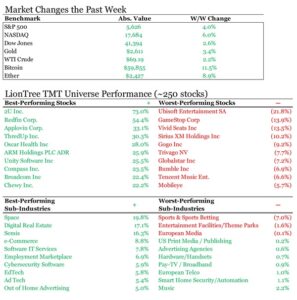
The big market swings continue, but at least this week’s was to the upside! Tech was back and propelled Nasdaq’s massive +6% move, while the S&P 500 was up +4% and the Dow closed +2.6% higher. Next week’s August retail sales data, followed by the Fed meeting, will be the main macro events to determine next steps…
Fundamentally, we focused on the below key themes, developments, and updates in this edition (all links are clickable):
- LionTree’s Lens: Sector Insights & A Look Ahead, Fall 2024 - *NEW DECK*
- Skeptics Emerge That The iPhone 16 Will Spark An Upgrade Super-Cycle
- The Push To Evolve Programming Deals To Align With The New Viewership Model Continues… DTV/Disney & Charter/WBD
- Autonomous Car Vs Humans… What Do The Safety Stats Say?
- Broadband Competition Pushes Further With AT&T Upping Its Fiber Ambitions
- Another Activist Target… News Corp
- EU Courts Take A Bigger Bite Out of Big Tech… Apple and Google Lose Appeals
- US Wireless Data Usage Skyrockets
- What’s The Outlook For Holiday Sales? Expect Some Growth Moderation…
- Linear Viewership Gets A Lift From The Election Cycle & The NFL
Hope you have a nice weekend.
Best,
Leslie

LionTree’s Lens: Sector Insights & A Look Ahead, Fall 2024 - *NEW DECK*
As we head into the tail-end of Q3, we’re excited to share our newest LionTree’s Lens: Sector Insights & A Look Ahead, Fall 2024 deck. To say there were a plethora of updates since our last edition would be an understatement, as the TMT and consumer space saw several noteworthy developments, perspectives, and themes emerge.
See below for the key themes we covered in this iteration. For the video presentation, which is ~25 minutes, and the stand-alone slide deck, CLICK HERE.
-> We are happy to schedule calls with any company executives or investment teams if you would like to discuss this in more detail. We also always welcome and appreciate any feedback or thoughts you may have. Please don’t hesitate to reach out.
Macro & Markets
- Volatility Has Returned To The Market In H2
- We FINALLY See Some Sector Rotation & Broadening In The Market…
- AND We’re FINALLY On The Cusp Of Rate Cuts… But By How Much & How Fast?
- Profitability Upside Was Once Again The Name Of The Game In Q2
Key Themes Across the Sector
- AI: Build It, But Will They Come?
- Lower End Consumers Trading Down Or Being More Selective Was A Common Thread
- Ad Dollars Flowing To Lower Funnel Is Likely To Persist In Q3
- All Boats Are Not Being Lifted In The DSP Landscape…There’s A Big Push To Grow The Paid Music Subscriber Pie…
- Retention From New Sports-Driven Streaming Subs Is Critical
- Will The Rising Scrutiny on TV Channel Bundling Reshape The Future of Media Deals?
- The Value Transfer From Linear To Streaming Continues
- Streaming Platforms Increasingly Turn To Shoppable Content For New Revenue Streams
- The Interactive Entertainment Industry Is “Back In Growth Mode”
- Connectivity – All Eyes Are On A Potential H2:24 Handset Upgrade Cycle
- Competition Looks To Ratchet Up Across Connectivity
- More Interconnected Tech Infrastructure = More Vulnerabilities
- The AV Push Is Accelerating… But On A Windy Road
Wall Street Sentiment
- Wall Street’s Top TMT Picks & Pans
- The Upside To Wall Street Price Targets Continued
Skeptics Emerge That The iPhone 16 Will Spark An Upgrade Super-Cycle
It was “showtime” for Apple Intelligence at Apple’s “Glowtime” event on Monday, which was anticipated by many to kick off a super cycle of sorts with the introduction of Apple’s AI offering across its products, specifically with the new iPhone 16 lineup. However, excitement fell short of expectations, as the iPhone 16 series, while featuring some notable updates like a redesigned camera system and a new Camera Control button, did not present groundbreaking hardware innovations that many were expecting in anticipation of the AI integrations. Similarly, despite introducing features like enhanced Siri capabilities, privacy-focused on-device processing, and cross-platform AI tools, much of the potential for Apple Intelligence remains on the horizon. Features like AI-assisted photo and video editing, smarter notifications, and the integration of ChatGPT are not immediately available and will roll out over the next few months, leaving many consumers without a compelling reason to make immediate upgrades.
That being said, Apple Intelligence and the iPhone 16 lineup weren’t the only big releases out from Apple. In conjunction with its AI efforts, it has also been making inroads in the health and wellness space, both on the hardware and software front. A new Apple Watch update will enable sleep apnea detection across not only the new Apple Watch Series 10, but also the previous Series 9 and Ultra 2. Additionally, the AirPods Pro 2 will be getting a software update this fall that adds hearing-health features, including a Hearing Test for mild or moderate hearing loss, hearing aid functionality, and a Hearing Protection mode. Apple also added to its AirPods lineup a newly redesigned AirPods 4, which bring a more ergonomic, open-ear design with the option for Active Noise Cancellation.
See below for our key takeaways from the event.
-> Apple ended the day of the event down -0.4%, but recovered through the week and ended up +0.8%; YTD, the stock is up +15.6%
Apple Intelligence Will Start Rolling Out Next Month Across iPhone, iPad, And Mac (link)
- Introduced Apple Intelligence – “the personal intelligence system that combines the power of generative models with personal context to deliver intelligence that is incredibly useful and relevant”
- Will start rolling out next month with iOS 18.1, iPadOS 18.1, and macOS Sequoia 15.1, with more features launching in the coming months
- Multiple language rollout: First launches in US English, and will “quickly expand” to include localized English in Australia, Canada, New Zealand, South Africa, and the UK in December
- Additional language support, such as Chinese, French, Japanese, and Spanish, is coming next year
- Siri “becomes more natural, flexible, and deeply integrated into the system experience”
- Brand-new design with an “elegant glowing light” that wraps around the edge of the screen when active on iPhone, iPad, or CarPlay
- Users can switch fluidly between text and voice as they use Siri
- Richer language-understanding capabilities means Siri can follow along when users stumble over their words and can maintain context from one request to the next
- First set of Apple Intelligence tools/features will include…
- Writing Tools: Users can refine their words by rewriting, proofreading, and summarizing text nearly everywhere they write, including Mail, Notes, Pages, and third-party apps
- Within the Photos app –
- Memories feature now enables users to create the movies they want to see by typing a description
- Natural language can be used to search for specific photos, and search in videos gets more powerful with the ability to find specific moments in clips
- Clean Up tool can identify and remove distracting objects in the background of a photo without accidentally altering the subject
- Within the Notes and Phone app, users can record, transcribe, and summarize audio: When a recording is initiated while on a call in the Phone app, participants are automatically notified, and once the call ends, Apple Intelligence also generates a summary to help recall key points
- Within the Mail app –
- Priority Messages understands the content of emails and surfaces time-sensitive messages
- Smart Reply provides users with suggestions for a quick response and identifies questions in an email to ensure everything is answered.
- Reduce Interruptions, which is a new Focus that surfaces only the notifications that might need immediate attention
- … With even more features in the works
- Image Playground will allow users to create playful images in moments
- Image Wand will make notes more visually engaging by turning rough sketches into images; When a user circles an empty space, Image Wand will create an image using context from the surrounding area
- Will be able to create original Genmojis by typing a description, or by selecting a photo of a friend or family member
- Users have the option to access ChatGPT within iOS 18, iPadOS 18, and macOS Sequoia, allowing users to access its expertise, as well as its image- and document-understanding capabilities, without needing to jump between tools
- Apple Intelligence is “designed to protect users’ privacy at every step”
- On-device processing: Many of the models that power Apple Intelligence run entirely on device
- Private Cloud Compute: To run more complex requests that require more processing power, Private Cloud Compute extends the privacy and security of Apple devices into the cloud to unlock even more intelligence
- When using Private Cloud Compute, users’ data is never stored or shared with Apple; it is used only to fulfill their request
- For users who access ChatGPT through Siri or Writing Tools, privacy protections are built in: Their IP addresses are obscured, and OpenAI won’t store requests; Users can access ChatGPT for free without creating an account, and ChatGPT’s data-use policies apply for those who choose to connect their account
New iPhone 16 Line Is “Built For Apple Intelligence” (link/link)…
- iPhone 16 and 16 Plus
- Newly redesigned vertically stacked read-camera system, which makes it capable of recording spatial photos and videos for viewing on Apple’s Vision Pro headset
- Introduced new Camera Control button that can quickly launch the camera to snap a photo or shoot a video; A new camera preview helps users frame the shot and adjust other control options, such as zoom, exposure, or depth of field, to compose a photo or video by sliding their finger on the Camera Control
- Developers will be able to bring Camera Control to 3P apps such as Snapchat
- Later this year, clicking and holding the button will enable a Visual Intelligence feature, which allows users to find real-time information about whatever the camera is pointed at
- Now includes the Action button, which was previously only on Pro models
- Introduced new colors and shades: Ultramarine and teal were new to the iPhone 16 lineup, while a deeper pink replaced the pastel pink from iPhone 15, the white replaced the yellow from iPhone 15, and black remained consistent across generations
- Pricing is the same as last year’s new phones: The iPhone 16 starts at $799 and the iPhone 16 Plus starts at $899
- iPhone 16 Pro and 16 Pro Max
- Increased screen sizes: The 16 Pro’s screen size is going from 6.1 inches to 6.3 inches; The 16 Pro Max’s screen size is going from 6.7 inches to 6.9 inches
- Also includes the new Camera Control button
- Includes a “huge leap” in battery life: The iPhone 16 Pro Max will have the “best battery life on iPhone ever” but did not give more specifics
- Introduced a new color, while other 3 colors were consistent from iPhone 15 Pro lineup: Desert Titanium replaced the Blue Titanium from iPhone 15 Pro lineup, while Natural Titanium, Black Titanium, and White Titanium continue from the iPhone 15 Pro models
- Pricing for Pro is the same as last year, but Pro Max has increased: The iPhone 16 Pro starts at $999 (same as the iPhone 15 Pro), but the iPhone 16 Pro Max starts at $1,1999, which is $100 more than the iPhone 15 Pro Max (which started at $1,099)
- iPhone 16 lineup is “built from the ground up” for Apple Intelligence: All iPhone 16 models will run iOS 18 on the new A18 processor, which is capable of tapping into the company’s new Apple Intelligence AI features
- Apple Intelligence will be available as a free software update, with the first set of features rolling out next month in US English for most regions around the world

…BUT Several Analysts And Executives Were Skeptical About An iPhone 16 AI Supercycle Post The Event
- AT&T CEO John Stankey expressed skepticism about an iPhone-driven supercycle in a CNBC interview (link): The coming upgrade cycle will be “meaningful” but not a “major” one; However, “ultimately, the consumer is going to drive the decision-making on what the upgrade cycle is”
- “There are other things driving how long consumers are choosing to hang onto their devices”:
- “The innovation is now coming in software”: This means that “the need to change hardware becomes less”; Believes iterations in software will “make a big difference… over time”, but “the question is whether it’s big enough right now to drive a huge cycle”
- AT&T has been “doing a better job of managing the lifecycle of these devices”: Cited the Co’s insurance plans and that iPhones are now “more durable” and more “stable”
- Handsets are becoming more like PCs: If you went back to the history of the PC, you didn’t see inflection points where upgrade cycles on PCs fundamentally changed 180 degrees as the product started getting more mature… I think we’re in that w/ handsets right now”
- The wireless industry’s promotions around the new iPhone “look pretty similar to last yr”: For its part, AT&T has been “winning in the mkt w/ a very stable and consistent play”, and there don’t appear to be plans to deviate from that approach
- “There are other things driving how long consumers are choosing to hang onto their devices”:
- Needham analyst Laura Martin – “Wait ‘Til Next Year” “We did not see any compelling use case shown by AAPL yesterday that would get consumers to buy an iPhone 16. GenAI is still too new, and the best apps in the iOS ecosystem are typically made by 3rd party developers, none of which were shown (or announced) yesterday. With lots of words like “later this year” and “early next year”, the core AAPL message for iPhone 16 was: Next year will be better”
- Barclays analyst Tim Long – “No Major Surprises; iPhone 16 Specs as Expected and No ASP Change”: “Apple’s annual fall iPhone event met expectations in terms of product introductions and specifications, in our view. We are disappointed by the lack of new hardware features for IP16…We don’t view the AI-related offerings as compelling enough in the near term to drive significant demand…AI feature delays make it unclear how volumes will be for the next quarter or two. We think there is a risk of negative build revisions in next few months if sell-through disappoint, given limited adoption of AI outside of the US. As ASP is unchanged across all four new models, we think it could be a slight negative to GMs assuming slightly higher BOM for IP16”
New AirPods Lineup Includes a Brand New Design For AirPods 4 And A New Array Of Colors For AirPods Max (link)
- AirPods 4 and AirPods 4 with Active Noise Cancellation (ANC)
- Total redesign with shorter stems and a more ergonomic, open-ear design
- First time that ANC is being brough to an open-ear design
- AirPods 4 with ANC also introduce intelligent features like –
- Transparency mode to keep users aware of their environment
- Adaptive Audio which dynamically blends Transparency mode and ANC based on the conditions of a user’s environment
- Conversation Awareness which lowers the user’s media volume when they start speaking to someone nearby
- Will use machine learning to enhance sound quality, including reducing background noise and improving phone call clarity
- Charging case will now offer USB-C charging and is more than -10% smaller in volume than its predecessor
- In addition to a USB-C charging cable, customers that choose AirPods 4 with ANC can charge using an Apple Watch charger or Qi-certified charger,
- Pricing remains consistent: AirPods 4 are $129 and the AirPods 4 with ANC are $179 (which matches the price of the AirPods 3 at launch)
- Total redesign with shorter stems and a more ergonomic, open-ear design
- AirPods Max
- Introducing 5 new colors: Midnight, starlight, blue, orange, and purple
- Will come equipped with USB-C charging
- Price remains the same at $549

Apple Watch Series 10 Gets A Design Overhaul, Enhanced Health And Fitness Features, And Faster Charging (link)
- Apple Watch Series 10
- Has the “biggest wearable display” Apple has put in a watch
- Case sizes have increased to 42mm (from 41mm on Series 9) and 46mm (from 45mm)
- Thinnest Apple Watch ever at 9.7mm thick, which is 10% thinner and lighter than the Series 9
- Added ability to have speaker play media/music with a built-in speaker, which previously wasn’t possible as users had to connect their headphones to listen to audio from their Watch
- Uses a new voice isolation neural network to suppress background noise during phone or FaceTime audio calls
- Features faster charging, allowing users to recharge it up to 80% in just 30 minutes (vs in 45 minutes on the Series 9)
- Bringing over some water activity features previously exclusive to the Ultra model –
- Depth app which can measure down to 6 meters beneath the water’s surface
- Oceanic+ app which allows users to easily find popular snorkeling locations nearby, view information on conditions provided by the snorkeling community, and during a snorkeling session, see depth, water temperature, and more in a single view
- Introduced titanium as a new material option, replacing stainless steel (aluminum remains an option): Aluminum version is available in jet black, rose gold, and silver, while the titanium version comes in slate, gold, and natural
- Pricing remains the same: Starts at $399, the same as the Series 9 when it was first introduced
- Has the “biggest wearable display” Apple has put in a watch
Continuing Innovation Around Health And Wellness, With New Sleep And Hearing Health Features Being The Standouts (link)
- Apple Watch rolls out new sleep apnea notifications
- Breathing Disturbances is a new Apple Watch metric that uses the accelerometer to detect small movements at the wrist associated with interruptions to normal respiratory patterns during sleep
- Every 30 days, Apple Watch will analyze breathing disturbance data and notify users if it shows consistent signs of moderate to severe sleep apnea so they can speak to their doctor about next steps, including potential diagnosis and treatment
- Expected to receive marketing authorization from the Food and Drug Administration (FDA) and other global health authorities soon, with availability this month in 150+ countries and regions, including the US, the EU, and Japan
- Sleep apnea notifications will also be available on the Series 9 and Ultra 2, so an upgrade to a new watch will not be necessary to use the health feature
- Breathing Disturbances is a new Apple Watch metric that uses the accelerometer to detect small movements at the wrist associated with interruptions to normal respiratory patterns during sleep
- watchOS 11 will come with several other health and fitness insights, including –
- New Vitals app, which gives users a way to quickly view key overnight health metrics; When two or more metrics are out of their typical range, users can receive a notification, along with a message detailing how the changes in these specific metrics may be linked to other aspects of their life (i.e., elevation changes, alcohol consumption, illness, etc.)
- Training load, which measures how the intensity and duration of workouts impact a user’s body over time
- Even more customizable Activity rings, offering users the ability to specify Activity ring goals by the day of the week; Users can also pause their rings without affecting their award streaks
- AirPods Pro 2 will get a software update this fall that adds hearing-health features, including –
- “Clinically validated” Hearing Test feature which can be performed on an iPhone at home in ~5 minutes and tests for mild or moderate hearing loss
- OTC “clinical grade” hearing aid functionality, which customizes music, voices, and other sounds to be easier to hear
- Hearing Protection mode, which Apple says can reduce exposure to damaging environmental noise
- Hearing Test and Hearing Aid features are expected to receive marketing authorization from global health authorities “soon”, and will be available this fall in 100+ countries and regions, including the US, Germany, and Japan
- On Thursday, the FDA announced that it had approved the software update for the AirPods Pro 2 to function as over-the-counter hearing aids, marking the first FDA-approved OTC hearing aid software (link)
The Push To Evolve Programming Deals To Align With The New Viewership Model Continues… DTV/Disney & Charter/WBD
Following up on our comments last week about the DTV/Disney carriage dispute that quickly erupted into a battle, the back-and-forth and collateral damage continued into this week, with DTV subscribers losing access to Monday Night Football, ABC’s broadcast of the Presidential election, and the US Open finals last weekend. Charter, on the other hand, has been successful inking early renewals with its programming partners. After announcing an updated agreement with AMC Networks last week, Charter announced a new deal with Warner Bros Discovery this week. A hybrid linear/DTC arrangement was the end result, and Charter is now set to include almost $60/mo of retail DTC value as part of its Spectrum offering, which should certainly be positively received by its customers. See below for more color on that stood out to us…
The DTV/Disney Dispute Rages On (link/link/link)
- Disney’s Monday Night Football lost viewers due to the DTV blackout: The game, which was on ABC and ESPN, attracted 20.4mn viewers, down -9.7% y/y which is being attributed to the blackout affecting DirecTV’s 11mn customers due to a dispute over fees
- The blackout impacts Disney’s revenue, which includes an est’d ~$45mn in ad sales per game or $765mn annually
- DTV rejected Disney’s offer to restore ABC for 3 hours so that subscribers could watch the Presidential debate
- DTV had said it was willing to return ABC in time for the debate if Disney was willing to restore all its channels across platforms through the end of Monday Night Football at 11:59 pm ET on Monday, Sept 16, BUT the Co said that Disney “flat-out rejected DirecTV’s offer”
- DTV viewers were also unable to watch the US Open finals over the weekend
- DTV is offering a $20 refund to affected customers
Charter Moves Forward With Its Hybrid Carriage Model W/ An Early Renewal With Warner Bros. Discovery (link)
- This “multi-year” deal was agreed “nearly one year early” and comes on the heels of Charter’s coming to an agreement with AMC Network
- Fully integrates linear video and streaming services
- Provides Max (Ad Lite), including all HBO and Max content as well as Discovery+, across all Spectrum TV Select packages at no extra charge to customers
- The addition of Max and Discovery+ represents a “game-changer” for Spectrum’s bundle proposition, which will offer nearly $60/mo of retail DTC value included when added to Disney+, ESPN+, Paramount+, AMC+, BET+ and Vix
- Provides Max (Ad Lite), including all HBO and Max content as well as Discovery+, across all Spectrum TV Select packages at no extra charge to customers
- Max also becomes a “preferred partner” for Spectrum when marketing and selling DTC apps and bundles to broadband subs
-> Charter continues to aggressively pursue flexible hybrid DTC & linear models as well as a soon-to-launch DTC to broadband distribution in 2025, following the 2024 deployment of its DTC inclusion and upgrade offers
Autonomous Car Vs Humans… What Do The Safety Stats Say?
We have recently been highlighting the step up in activity and momentum in the robotaxi and autonomous vehicle areas, and the stream of updates and developments hit our radar again this week. It is still early days to be clear, but activity is most certainly percolating at a stronger clip. New safety stats from Waymo, which we came across on their website, as well as an expanded Uber-Waymo partnership were the main events in addition to come relevant commentary on the conference from Lyft CEO. See more details below.
Waymo Is Winning Vs Human Drivers
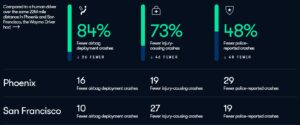
- Through June 24, Waymo has covered 22mn rider-only miles without human drivers
- Waymo’s safety record related to those trips in Phoenix (which accounted for 70% of the total) and San Fran (which accounted for 27%) was much better than the safety record of human drivers based on their data
- The picture below tells it all…
-> While Waymo is still obviously operating in a limited area and this data only pertains to the company, the stats are supportive regarding the technology moving more towards prime time. However, we suspect that the public is going to require a very high bar for safety relative to human drivers, given the fear about turning over control to computers! Their website has a drill down with more data as well… Link To Waymo Safety Data
A Few Other Key Updates Regarding Autonomous Cars Include…
- Uber is expanding its partnership with Alphabet’s Waymo to offer driverless ride-hailing services in Austin, Texas, and Atlanta starting in early 2025 (link): They have an existing partnership in Phoenix, Arizona
- Service availability: These autonomous rides will only be available through the Uber app, unlike in San Francisco and Los Angeles, where riders use the Waymo app
- Uber Eats is not included yet: While the original partnership in Phoenix included autonomous Uber Eats deliveries, the expansion into Austin and Atlanta will initially focus on ride-hailing, with plans to explore Uber Eats deliveries in the future.
-> Uber also recently annc’d a partnership with GM’s Cruise for autonomous rides, though there was investor skepticism due to Cruise’s past safety issues
- Lyft also wants to be the partner of choice to the AV industry: CEO John Risher commented this week…
- Autonomous vehicles are “coming” but it will be a hybrid solution with both drivers and robotaxis for a “long, long, long” time
- It will be a “huge tailwind” for the Co as “in order for autonomous vehicles to make any economic sense, they have to be put to work” and not just sit in a garage
- “We want to be the best way to help AV manufacturers monetize their assets the best way”
-> Reminder that Tesla will be revealing its robotaxi on Oct 6
Broadband Competition Pushes Further With AT&T Upping Its Fiber Ambitions
Following T-Mobile’s recent announcement of a plan to reach “millions of homes” with fiber via JVs with PE firms (see Theme #11 from Weekly 8/2/24) as well as Verizon revealing last week that it is in advanced talks to acquire to Frontier (see Theme #2 from Weekly 9/6/24), the telco incumbents’ appetite for fiber showed no signs of abating this week, with AT&T joining the fray and conveying that, it too, will expand its fiber strategy moving forward. Specifically, the company appears to be taking a page out of T-Mobile’s playbook and will work through third-parties both to extend AT&T Fiber network to new markets and increase capacity in its existing markets. AT&T CEO John Stankey elaborated on this strategy at the Goldman Sachs Communacopia Conference, signaling that growing demand for converged products was one of the key motivations for the company’s more aggressive push into fiber. He believes that “a good percentage of the market [is] going to want to have both products together”, and the company’s +500bps higher market share in areas where it does offer both wireless and fiber together certainly supports this line of thinking.
Stankey also had some noteworthy comments regarding the coming handset upgrade cycle. We covered these and other reactions to the new iPhone series in further detail in Theme #2.
AT&T Started The Week By Annc’ing Plans To Expand Its Fiber Network Via Third-Party Partnerships (link)
- AT&T and BlackRock plan to expand the Gigapower JV beyond its initial scope: The two are “looking for oppties” to grow Gigapower’s fiber footprint beyond the 1.5mn locations originally annc’d in Dec 2022; This expansion “may include growth in [Gigapower’s] existing geographies as well as the addition of new geographies”
- “AT&T Fiber performance in Gigapower geographies is showing positive momentum”: The Co highlighted several key biz trends but acknowledged that Gigapower is “still in the early phase of scaling” –
- AT&T Fiber penetration rates are ahead of the Co’s initial biz plan
- Adoption of 1Gbps+ fiber speed tiers has been higher than the Co’s in-footprint AT&T Fiber customers
- Incr’d customer convergence: AT&T Fiber customers in Gigapower areas have been attaching AT&T wireless svs at rates “equal to, or greater than those realized on avg across the AT&T Fiber customer base”
- Scaling build cadence, w/ plans to exit 2024 on an “accel’d trajectory”
- “AT&T Fiber performance in Gigapower geographies is showing positive momentum”: The Co highlighted several key biz trends but acknowledged that Gigapower is “still in the early phase of scaling” –
- AT&T also unveiled four new agreements with commercial open-access providers: New partners include Boldyn Networks, Digital Infrastructure Group, PRIME FiBER, and Ubiquity; These fiber agreements provide AT&T w/ wholesale access to their fiber broadband networks and the ability to evaluate where it wants to offer AT&T Fiber
- Boldyn Networks has a “significant focus on the US Armed Forces”: AT&T’s deal w/ Boldyn extends an existing collab to modernize communications at military bases; Boldyn provides network infrastructures at 75+ military bases worldwide and also covers a wide range of other industries
- Digital Infrastructure Group is a US and Canada-based wholesale fiber developer and operator: Digital Infrastructure Group has “extensive broadband experience in international mkts” and is currently expanding into new regions across the US
- PRIME FiBER is a newly-established commercial open-access fiber infrastructure provider: PRIME FiBER focuses on serving ISPs, infrastructure consolidators, and enterprises across the US; The Co is initially building in Florida
- Ubiquity has built one of the US’ largest commercial open-access fiber networks: The Co has been “scaling significantly” over the last two yrs and will build exclusive greenfield areas for AT&T, initially in Minnesota; Ubiquity will also provide AT&T wholesale access to its multi-state footprint
AT&T CEO John Stankey Discussed The Wireless Mkt & The Broadband Strategy At Communicopia
- There hasn’t been a “substantial change” in the wireless mkt thus far in H2:24: AT&T views the space as “pretty consistent” and has been focused on capturing “higher value” net adds
- “We’re certainly doing better in the consumer mkt”: AT&T has been “doing a much better job of managing [its] base”, resulting in “industry-leading churn”; The Co has also “done a really nice job in consumer intercepting the switcher channels more effectively than [it’s] historically done”
- AT&T hasn’t been seeing any signs of consumers trading down: Hasn’t seen a push toward the value segment and believes that all the discussion around the iPhone launch is “indicative of how instrumental the product and svs we sell [is] to everybody’s life”
- The Co has also “done much better in business”: AT&T has “moved share in some key segments”, particularly w/ FirstNet and in the public sector space
- BUT Business Wireline could “perform a bit better”: That said, AT&T has been seeing a “tremendous improvement” in its efforts to sell wireless to biz accounts; Still sees room to grow more in the mid-mkt
- “The most significant and efficient way for supply to come into the wireless industry is spectrum”: Highlighted that “demand has pretty consistently been going up over +30%” each yr and that without more spectrum coming online, “there’s going to have to a move in price”
- “We’re certainly doing better in the consumer mkt”: AT&T has been “doing a much better job of managing [its] base”, resulting in “industry-leading churn”; The Co has also “done a really nice job in consumer intercepting the switcher channels more effectively than [it’s] historically done”
- Regarding the coming upgrade cycle – The iPhone “doesn’t look like it’s out to skew anything we’ve seen in the past”: See Theme #2 for more details on Stankey’s thoughts on the H2:24 upgrade cycle
- On the fiber strategy – “My scale ambition is to be first and biggest as we go through this cycle”: Explained that “being first and biggest and being the best at executing on it” will enable AT&T to “[drive] the best returns” and “call more shots as the industry forms and plays over time”; “These are momentum bizs”
- “This is a long-term multi-decade play”: Caveated that this “kind of infrastructure doesn’t get built in a yr” and that “it will just take some time for the industry to order those assets to maek that happen”
- “We will use open-access third-parties…”: “… where somebody else builds it”, and “we put our brand on top of it”, leveraging AT&T’s “mkting know-how”
- AT&T is the “early innings” w/ its converged product: Sees that “a good percentage of the mkt [is] going to want to have both products together” and highlighted that the Co’s mkt share is +500bps better in mkts where it offers a converged product
Another Activist Target… News Corp
Activist investor Starboard Value made some waves this week, sending a letter to News Corp outlining its view that “dual-class structures are NOT in the best interests of shareholders and are NOT reflective of best-in-class corporate governance practices” and thus, are negatively impacting News Corp’s valuation. Starboard is putting are putting forth a proposal to collapse the Co’s dual class structure to be voted on at News Corp’s upcoming 2024 Annual Meeting of Shareholders. Starboard is filing a proxy statement in the “coming weeks” with more details on the proposal.
A few other key points from the letter include: (Starboard letter)
- Starboard sees discord within the family as a risk to the future direction of the Co and a risk to shareholders
- Cites public comments about the family’s legal battle for control of the Murdoch Family Trust, where their ownership is held
- “According to the court’s decision, Mr. [Rupert] Murdoch was concerned that the “lack of consensus” among his children “would impact the strategic direction at both companies including a potential reorientation of editorial policy and content.” It states that his intention was to “consolidate decision-making power in Lachlan’s hands and give him permanent, exclusive control” over the company”
- “This uncertainty represents a risk to shareholders that is only amplified by the Murdoch family’s super-voting shares and the poor governance and oversight that stems from the dual-class share structure”
- While dual-class structure can make sense in some situation, Starboard argues that this is not appropriate in News Corp’s case
- “Theoretically, some may believe dual-class share structures could provide potential benefits to recently listed companies that, perhaps, want their visionary founder to be insulated against short-term pressures for a limited period of time. However, News Corp could not be further from this archetype” … “There are no reasonable arguments to extend super-voting rights and de facto control to the inheritors of a founder”
- Starboard argues that majority support for eliminating the dual structure can be reached
- The Murdoch family’s economic ownership in News Corp is only ~14% and controls 41% of the vote
- Starboard is prepared to pursue other routes if the Board does not make this change: “If the Board refuses to listen, we can then take further action”
- Past attempts to change the dual structures have failed despite shareholder support
- “Shareholders have tried to abolish the dual structures in the past and almost 90% of unaffiliated shareholders supported a previously submitted proposal, resulting in 49.5% of total votes being in favor of eliminating the dual-class share structure but the Board failed to take action”
-> Starboard owns 1.9% of Class A shares and 4.6% of Class B shares; NWSA shares are up 6.1% YTD, but for context, have had a huge run of +64% from mid-March of last year; The stock trades at 10.02x EV/EBITDA in fiscal year ending June 2025 and 32.1x P/E
-> Rightmove, the UK’s largest real estate portal, rejected a $7.3bn takeover offer from Rupert Murdoch’s REA Group as it believes the offer undervalues its biz; The offer equated to 705p which was a +26% premium to where the stock traded before the info leaked; REA has until Sept 30 to propose a new offer under British law (link)
EU Courts Take A Bigger Bite Out of Big Tech… Apple and Google Lose Appeals
Although the regulatory drumbeat against Big Tech has been in motion for quite some time, investors have been able to shrug off this news as noise, especially given that the cases brought against companies in the sector by various regulatory bodies have had no enduring and material impact. Nonetheless, the shots continue as the European Court of Justice, the EU’s highest court, struck down appeals by Apple and Google to overturn multi-billion dollar fines this week. Both decisions are final. This will also open the door for further legal actions by parties injured by the two companies’ practices, with several of these cases already pending in national courts. More importantly, these rulings could set a precedent for other ongoing and future proceedings against Big Tech, perhaps demonstrating that lawmakers are not backing down.
- Apple owes €13bn ($14.3bn) in back taxes to Ireland after losing an appeal against a 2016 EU ruling (link/link): The European Commission had said in 2016 that Ireland granted benefits to Apple, including substantially lower tax payments, that were in violation of EU state-aid rules
- The ruling is final and cannot be appealed: This comes after a lower court annulled the EU’s 2016 ruling, claiming that officials failed to meet legal standards in showing Apple received special treatment; However, this week’s determination by the Court of Justice of the EU found the lower court was wrong in its reasoning
- Apple was “disappointed” by the decision: “This case has never been about how much tax we pay, but which govt we are required to pay it to… We always pay all the taxes we owe wherever we operate, and there has never been a special deal”
- Apple expects to record a one-time tax charge of up to $10bn in its FQ4 qtr: Apple previously set aside the money in an escrow account in Ireland, and the Irish govt said the process of transferring those assets could now commence
- The €13bn fine accounts for unpaid taxes between 2003-2014, plus interest: Apple had paid a corporate tax rate of less than 1% in some yrs by locating its European HQ in Ireland; The “Double Irish” tax loophole that Apple used was closed to new bizs in 2014 and phased out by 2020
- The ruling is final and cannot be appealed: This comes after a lower court annulled the EU’s 2016 ruling, claiming that officials failed to meet legal standards in showing Apple received special treatment; However, this week’s determination by the Court of Justice of the EU found the lower court was wrong in its reasoning
- Google must pay a €2.4bn ($2.6bn) antitrust fine for favoring its own comparison shopping svs (link): The fine was originally levied by the European Commission in 2017 and stems from a case first brought against Google in 2009 by Foundem, a British Co (the UK was still part of the EU back then)
- Further background on the proceedings: Foundem’s initial complaint contended that Google made its own shopping recommendations appear more prominent in search results than its rivals’ recommendations;
- Google has run out of legal options in this case: The European Court of Justice ruled that the Commission was right to find Google’s conduct “discriminatory” and said that the Co’s appeal “must be dismissed in its entirety”
- The Co could also face follow-on actions by parties injured by its anticompetitive conduct: Several of these cases are already pending in national courts
- Google has accumulated €8.2bn in EU fines: In addition to the €2.4bn fine from this case, the Co was also assessed a €4.3bn fine in 2018 over claims it used Android software to unfairly promote its own apps as well as a €1.5bn fine in 2019 for blocking adverts from rival search engines
-> Google’s AdTech biz is also under scrutiny; After UK regulators provisionally ruled that Google used anticompetitive practices to dominate the mkt for online advertising tech last week, the US Dept of Justice took Google to court this week, accusing the company of monopolizing the markets for ad tech tools and illegally tying together two of its products; Notably, Stephanie Layser, a former programmatic advertising executive at News Corp, testified that it “felt like they were holding us hostage” (link)
US Wireless Data Usage Skyrockets
AT&T CEO John Stankey wasn’t the only one pushing for more spectrum to be assigned to the wireless industry this week (see Theme #5 for more), as a new survey from CTIA found that Americans’ wireless data consumption “skyrocketed” in 2023 to a little over 100tn megabytes, representing a +36% y/y increase and a +89% rise from just two years ago in 2021. To support this “extraordinary” growth in demand, CTIA believes that “the wireless industry needs Congress to restore the FCC’s auction authority and create a pipeline of much-needed mid-band spectrum”.
See below for some other key findings from the report.
- Americans recorded the largest-ever y/y increase in wireless data usage in 2023 (link): US wireless networks supported 100.1tn megabytes of data traffic in 2023, marking a +36% y/y increase and a +89% uptick from 2021 and reached more data than was consumed from 2010-2018, per CTIA’s 2024 Annual Wireless Industry Survey
- 5G networks are driving “unprecedented demand” for wireless data: As of yr end 2023, 5G wireless networks covered 330mn+ Americans; 40% of wireless connections were 5G ones, a +34% y/y increase
- FWA has also been a contributing factor: Affordable 5G home broadband offerings comprised 95% of all new broadband subscriptions over the last two yrs
- 1 out of 5 net 5G home adds were entirely new broadband subs: This underscores “5G’s role in helping to close the digital divide”
- Other key findings –
- The total number of wireless connections in the US reached 558mn in 2023: Representing more than 1.6 wireless connections for every American
- Wireless investment surpassed $700bn+: Wireless carriers have invested $705bn to-date, including $30bn in 2023 and $190bn since 2018
- The wireless industry has also invested $233bn in spectrum license auctions
- Wireless costs have fallen, but consumers are using more data: Since 2020, the avg cost per MB of wireless data has decr’d -50% to $0.002 per MB today; This also marks a -97% decline from a decade ago
- The number of cell sites has cont’d to proliferate nationwide: By the end of 2023, there were 432,469 operational cell sites in the US, a +24% uptick from 2018
What’s The Outlook For Holiday Sales? Expect Some Growth Moderation…
As we head into the last quarter of the year, we also head into the most important quarter for retailers, given the holiday selling season. That said, Deloitte’s new annual holiday retail sales forecast this week points to an expected moderation of growth:
- Total sales growth is forecast to increase between +2.3-3.3%, reaching $1.58-1.59tn, during that November to January window; This would be down from the +4.3% growth posted in 2023 after the pandemic
- Growth in online e-commerce is forecast to increase between +7-9% (reaching $289-294bn), which would be down from the +10.1% rate seen in 2023
Inflation is cited as both a headwind (aids consumers’ purchasing power) and tailwind (negative impacts from the nominal increase in the dollar value of sales) to holiday sales. Rising credit card debt is seen as another risk to sales demand… (link)
This is the first of many forecasts that we expect to see over the coming month but sets a baseline forecast. We’d also note that while Deloitte predicts a moderation, it does reflect a return to more historical trend levels.
Linear Viewership Gets A Lift From The Election Cycle & The NFL
The NFL season kicked off with some excitement, and that, coupled with the Presidential debate, provided the bedrock for a good week for the linear ecosystem, as viewers tuned in to watch these marquee events… This continues to support the value of sports and news…
- The Kamala Harris-Donald Trump presidential debate drew significant audiences (link): The Kamala Harris-Donald Trump debate attracted 67.14mn viewers across 17 networks, which was significantly higher than the 51.3mn that watched the Trump-Biden debate in June (numbers don’t include streaming views)
- BUT it was lower than1mn who watched the first 2020 presidential debate between Joe Biden and Donald Trump
- The debate drew 21.32mm viewers in the 25-54 demo: Per Nielsen, an estimated 6.47mn were age 18-34, 16.88mn were aged 35-54, and 41.35mn were 55+
- The 2024 NFL season is off to a strong start, w/ overall viewership up +12% y/y in Week 1 (link/link): The NFL’s opening week avg’d 21mn viewers, a +12% y/y increase; The NFL’s total audience of 123mn from Sept 5-9 was the largest such viewership since 2019 and up from 122mn a yr ago
- The first five TV windows of the season saw a +14% y/y uptick in viewership, per Nielsen: Notably, the NFL reverted back to the standard scheduling format for the 2024 season after staging non-exclusive doubleheaders in Week 1 the previous three yrs
- Fox’s early window avg’d 13.03mn viewers: This represented a +28% rise and included games between Steelers-Falcons, Vikings-Giants, and Titans-Bears
- Fox and CBS’ Sunday afternoon coverage recorded the highest viewership for the window since 2016: Sunday afternoon NFL audiences avg’d 18.4mn viewers, a +21% y/y increase
- CBS and Fox’s doubleheaders: CBS avg’d 17.79mn for its singleheader (Its best 1 pm opener since 1998), while Fox had 18.64mn for its doubleheader, marking their best starts since 2020
- The first five TV windows of the season saw a +14% y/y uptick in viewership, per Nielsen: Notably, the NFL reverted back to the standard scheduling format for the 2024 season after staging non-exclusive doubleheaders in Week 1 the previous three yrs
-
-
- Color on Sunday Night Football –
- The Cowboys-Browns matchup, hosted by Fox, drew 23.93mn viewers, a +47% y/y jump: This game was also Tom Brady’s first game as a broadcaster
- NBC had just shy of 20mn avg TV viewers for the Rams-Lions game: This was effectively flat vs last yr’s 20.18mn linear viewers for the same window; Peacock added 2.7mn streaming viewers to the mix
- Color on Sunday Night Football –
- Disney’s coverage of Monday Night Football on ABC, ESPN, and ESPN2 avg’s 20.4mn viewers: This was a -10% drop from last yr’s 22.7mn Monday Night Football opener and likely reflected challenges from the ongoing DirecTV-Disney dispute
- Other highlights –
- NBC’s showing of the Ravens-Chiefs kickoff game had the most viewers: Total audiences of 29.16mn viewers were up +6% y/y, though the linear broadcast avg’d 24.56mn viewers (down -194k from last yr’s opening game between the Chiefs and Lions)
- Peacock’s coverage of the Packers-Eagles game in Brazil attracted 14mn viewers: This made it the second most-watched live event on the platform
-
Stock Market Check
This Week's Other Curated News
Advertising/Ad Agencies/Ad Tech
- IAB’s new study revealed that, in the charged presidential election cycle, digital ad sellers are seeing more demand for political advertising and are leaning in to make more inventory available to candidates. According to a study by of ad sellers, including publishers, platforms and ad tech, 89% of ad sellers that offer political ads incr’d their political inventory, while 86% of them said they’ve experience in increase in demand. (Broadcasting Cable)
- JCDecaux has annc’d that it has been awarded the London bus shelter advertising contract by Transport for London (TfL) for an 8-yr period, with the option of a 2-yr extension. The contract will commence on 1st Apr. 2025. It is the second-largest bus shelter advertising contract in the world and covers advertising on all TfL’s more than 4,700 advertising bus shelters across all 33 London boroughs including the City of London, Royal Borough of Kensington and Chelsea, and City of Westminster. (GlobeNewswire News Room)
- WPP annc’d its acquisition of London-based independent agency New Commercial Arts. The financial terms of the acquisition have not been disclosed. Founded just four yrs ago, NCA will join the WPP portfolio under the Ogilvy umbrella, a move aimed at strengthening the agency’s position in the UK mkt. Under the new deal, NCA founder James Murphy will serve as CEO of both Ogilvy UK and NCA, marking his return to Ogilvy, where he began his career. (The Drum)
Artificial Intelligence/Machine Learning
- Adobe unveiled Firefly AI video generation tools that will arrive in beta later this year. Adobe describes its new Firefly-powered text-to-video, Generative Extend (which will be available in Premiere Pro) and image-to-video AI tools as helping editors with tasks like “navigating gaps in footage, removing unwanted objects from a scene, smoothing jump cut transitions, and searching for the perfect b-roll.” (Engadget)
- AT&T struck a new agreement w/ Unsupervised to use the AI software co’s tools to analyse a variety of internal data sources and provide a range of svs powered by the technology to the US operator’s employees. The cos stated the agreement builds on an existing deal whereby Unsupervised’s AI-powered data software has identified more than $100 mn worth of opportunities which could be deployed across a variety of biz units at AT&T. Financial terms of the partnership were not disclosed. (Mobile World Live)
- Gemini Live, initially available to Advanced subscribers, is now rolling out to free users on Android. This feature allows natural conversations with back-and-forth exchanges and can be accessed via a new circular waveform icon. Users can interrupt responses, exit the UI, and continue using their phone while Gemini Live works in the background. It currently doesn’t support Gemini Extensions but will in the future. Gemini Live also introduces 10 new voices. (9to5Google)
- Google’s lead privacy regulator in the EU opened an investigation into whether or not it has complied w/ the bloc’s data protection laws in relation to use of people’s info for training gen AI. Specifically, it’s looking into whether the Co needed to carry out a data protection impact assessment in order to proactively consider the risks its AI tech might pose to the rights and freedoms of individuals whose info was used to train the models. (TechCrunch)
- Leaders at OpenAI, Anthropic, Nvidia, Microsoft, Google and several American power and utility cos met at the White House to discuss the future of artificial intelligence energy infrastructure in the US. The meeting focused on bringing the public and private sectors together to talk about artificial intelligence’s energy usage, data center capacity, semiconductor manufacturing, and grid capacity, sources familiar w/ the meeting confirmed. (CNBC)
- Nevada has a new helper in its quest to plow through a backlog of unemployment claims: Google AI. The initiative will task one of the co’s cloud-based AI models with analyzing appeals hearing transcripts and suggesting whether cases should be approved. It replaces the Nevada Department of Employment, Training and Rehabilitation (DETR) process, which averages three hours for a real-life human to complete. (Engadget)
- OpenAI is reportedly in talks with investors to raise $6.5bn at a $150bn pre-money valuation. The new valuation is significantly higher than OpenAI’s previously reported valuation from earlier this yr, $86 bn, and far higher than any other AI startup today. The funding round will reportedly be led by Thrive Capital, a major investor of OpenAI in previous rounds. Other reported investors include Microsoft, Apple, and Nvidia. (TechCrunch)
- Salesforce has launched Industries AI, an automation platform integrated into all 15 of its cloud platforms, capable of handling over 100 tasks across various industries. It aims to help sectors like financial services, healthcare, and automotive by automating tasks such as customer service and vehicle maintenance. The platform will start rolling out in October, with continuous updates planned. (SiliconANGLE)
Audio/Music/Podcast
- Google can now turn your research into an AI-generated podcast, complete with two “hosts” that discuss what you’ve dug up. The experimental feature lives within NotebookLM, the AI note-taking app Google launched last yr, and will have AI hosts “summarize user material, make connections between topics, and banter back and forth.” It’s meant to build on NotebookLM’s existing features that help users to interact with all their notes, transcripts, and other research documents. (The Verge)
- Spotify is planning to pay video creators to distribute their content on its platform, aiming to attract YouTube creators. Some creators may receive seven-figure deals, though offers vary. This initiative seeks to increase user engagement with more video content. However, creators might face increased workload without automated tools for dual distribution. (The Desk)
- FM is hoping its differentiated approach will help it garner a loyal following of its own, by using crypto to pay artists up to 100x more per stream. Unlike any of the big streaming services, Tune.FM is a decentralized music streaming platform that runs on the rails of web3. Users pay for each song they stream using the co’s own JAM tokens, as opposed to a subscription model (they can buy the tokens on Tune.FM’s website). Users can also choose to listen to promoted music to earn more JAM tokens. (TechCrunch)
Broadcast/Cable Networks
- DirecTV filed a complaint w/ the FCC accusing Disney of negotiating in bad faith. Disney channels, including ESPN and ABC-owned stations in nine markets, have been off DirecTV since the evening of Sept 1. That meant DirecTV customers were blacked out from viewing most college football games and the final week of the US Open tennis tournament, including the women’s and men’s finals. (New York Post)
- The FCC issued an order that would reduce regulatory fees for broadcasters for the second yr in a row. The decision follows a major push in recent yrs by the NAB and state broadcasting association to reduce the regulatory burden on stations. Like FY 2023, the FCC calculated regulatory fees for TV stations based on population but reduced the rate to $0.006598 “from the $.007799 per-person-served used for FY 2023 TV regulatory fees”. (TVTechnology)
Broader Media & Entertainment
- News Corp acknowledged receipt of a letter by shareholder Starboard Value taking issue with so-called super voting stock that allows the Murdoch family to control the Co. Starboard wants a vote at the annual meeting to merge the two classes of stock. Rupert Murdoch, 93, controls News Corp and Fox through a family trust, which would pass in equal parts to his four eldest children. (Deadline)
- Nielsen estimated that the debate stage clash between Vice President Kamala Harris and former President Donald Trump drew 67.1mn viewers. The estimated viewership improved on the ratings for the match-up between Trump and President Joe Biden in late June, which attracted ~51.3mn viewers and effectively derailed Biden’s re-election bid. Nielsen said 6.4mn+ viewers were ages 18 to 34 and another 16.8mn were 35 to 54. (NBC News)
Broader Technology
- Apple lost its court fight over a €13bn ($14.4bn) Irish tax bill and Google lost its challenge over a €2.4 bn fine for abusing its mkt power in a double boost to the EU’s crackdown on Big Tech. The EU’s Court of Justice in Luxembourg backed a landmark 2016 decision that Ireland broke state-aid law by giving Apple an unfair advantage. Addt’ly, the same court ruled that Google illegally leveraged its search-engine dominance. (Yahoo Finance)
- Kamala Harris released a list of proposed policy positions. Surprise or not, those stances did not include any takes on Bitcoin or other cryptocurrencies. On her campaign website’s new Issues page, Harris does dedicate a section to supporting “American innovation and workers.” She pledges to support the growth of the AI sector, and also nods to the importance of fostering “other cutting-edge industries of the future.” (Decrypt)
Cable/Pay-TV/Wireless
- Charter CEO Chris Winfrey spoke at the Goldman Sachs Communacopia Technology Conference in SF about AI and streaming. He was asked if AI is more hype or reality. “I think AI is very much reality. The question is: How fast is it really going to come and how fast is it going to be deployed?” he said. He added, “We’ve been investing in, really starting with machine learning, and AI now increasingly, for some time, but really from a service function. (The Hollywood Reporter)
- Comcast said the vast majority of its Xfinity X1 customers tuned in to the 2024 Paris Olympics in a blog post. Comcast said 87% of active households that subscribe to its live cloud-based pay TV svs, X1, watched Olympics programming. Notably for Comcast, 65% of X1 customers also interacted w/ the svs’ Olympics product features, designed to engage viewers w/ personalized playlists and other customized features. (NextTV)
- T-Mobile annc’d the successful transmission of the first-ever wireless emergency alert (WEA) via satellite in the US. Working with Starlink’s satellite-to-smartphone tech, the advancement marks a critical step forward in ensuring that emergency alerts can reach even the most remote areas of the country. Satellite-enabled alerts will bring life-saving information to areas previously cut off from critical warnings. (Capacity Media)
- The FCC is due to meet and vote on Sept 26 to potentially free up extra bandwidth for satellite communications. FCC chair Jessice Rosenworcel has written saying that freeing up 1,300 MHz in the 17 GHz band (17.3-17.8 GHz) for high-throughput satellite communications would “facilitate the deployment of high-speed broadband and other advanced satellite services, especially in remote, unserved, and underserved areas.” (ADVANCED-TELEVISION)
- The Italian Competition Authority has opened an in-depth investigation (Phase II) to assess the acquisition of Vodafone Italia by Swisscom under Italy’s merger control rules. According to Swisscom, Phase II reviews are not uncommon in the telecommunications sector. Swisscom remains convinced that the transaction is pro-competitive. It says it will continue to work closely and constructively with the Italian Competition Authority to secure a timely clearance. (ADVANCED-TELEVISION)
- Verizon expects to record a severance charge in the range of $1.7bn to $1.9bn in Q3 as a result of a previously annc’d voluntary separation program, the co said in a regulatory filing. The co annc’d a voluntary separation program in Jun. for select US-based mgmt staff. It also plans to stop the use of certain real estate assets and exit non-strategic portions of some bizs, due to which it will record a separate charge of about $230mn to $380mn in the Q3, Verizon said. (SRN News)
Capital Market Updates
- Citigroup’s investment banking fees are expected to jump 20% in Q3 from a yr earlier, CFO Mark Mason told investors at a conference in New York. The gains are being driven by a good pickup in activity across debt capital markets and mergers and acquisitions, Mason said. Meanwhile, mkts revenue is likely to drop about 4%, he added, after a jump of 10% last yr wasn’t repeated in 2024. (Yahoo Finance)
Cloud/DataCenters/IT Infrastructure
- Amazon said it would spend £8bn ($10.5bn) in the UK to grow its cloud biz. This adds to a string of recent expansion moves in Europe and gives Britain’s new Labour govt a welcome investment boost. The five-yr investment by Amazon Web Services in data centers will support up to 14,000 jobs and contribute £14bn to UK GDP between 2024-2028, Britain’s Treasury said. (Yahoo Finance)
- Switch owners are exploring an IPO of the data center operator that could value it at ~$40bn, including debt. The discussions on an IPO for Switch are at an early stage, sources said, cautioning that the plans are subject to mkt conditions and no final decisions have been taken. The investment firms that own Switch have held preliminary talks w/ investment bankers on the potential stock mkt flotation that could happen as early as 2025. (MarketScreener)
Crypto/Blockchain/web3/NFTs
- Global Bitcoin transactions in 2024 exceeded the heights of the 2021 bull market, according to blockchain intelligence firm Chainalysis. Their latest report highlights a major spike in global Bitcoin activity, fueled by the launch of spot Bitcoin ETFs in the US in Jan 2024. Despite this rapid adoption, Bitcoin ETFs also faced challenges, w/ $1.2bn in outflows occurring in Sept 2024 across 11 US-based ETFs. (BITBO)
- The number of cryptocurrency-related complaints accounted for 10% of all financial fraud complaints but 50% of the total losses in 2023. That is due in part to the use of crypto in investment scams that see victims accumulating “massive debt” to cover their losses, the FBI said in its Cryptocurrency Fraud Report 2023. Overall, losses to financial fraud involving the use of cryptocurrency leapt 45% in 2023, rising to $5.6bn. (PYMNTS.com)
Cybersecurity/Security
- Britain’s BT said it was spotting 2,000 signals of potential cyber-attacks across its network every second, as criminals were increasingly using disposable “bots” to try to evade existing blocking and security measures. The telecoms group said that digital surveillance activity by hackers using malicious scanning “bots” was 1,200% higher in July compared to the same month the previous yr. (Yahoo Finance)
eCommerce/Social Commerce/Retail
- Aldi UK’s CEO said shoppers are treating themselves w/ higher-end products as the cost-of-living pressures begin to ease. He said that customers are increasingly opting for premium own-brand items, such as Wagyu steak, artisan cheeses, ready meals, and brioche buns. He noted specifically that “sales of our specially selected smoked salmon have surged by over 50%”. (Retail Gazette)
- Amazon has annc’d a $2.1bn investment aimed at raising the avg pay for its delivery drivers. As the backbone of Amazon’s delivery operations, these drivers play a crucial role in the co’s ability to fulfill its Prime delivery promises. This move, the co’s largest investment in its Delivery Service Partner (DSP) program to date, will bring driver pay to an average of nearly $22 per hour, a 7% increase from last year. (WebProNews)
- Amazon launched a new budget-friendly grocery line aimed at attracting price-conscious shoppers in search of value over splashy brand names. The line, called Amazon Saver, is a “no-frills” private-label brand w/ items priced under $5. Although Amazon already offers several private-label food brands like Amazon Fresh, Happy Belly, 365, and Aplenty, the new Saver line is positioned to be the most economical option. (Quartz)
- Thrive Market annc’d its new retail media network in partnership w/ Instacart. After growing to 1.5mn+ members, Thrive Market will leverage Instacart’s Carrot Ads solution to create a more personalized member experience and drive value for the high-quality and sustainable brands on its platform. Using Carrot Ads, brands can meaningfully connect with Thrive Market’s members, introducing relevant products and simplifying the purchase process. (Instacart Corporate Blog)
- Walmart has implemented technology to combat shoplifting at its self-checkout stations. The co has introduced invisible barcodes on Great Value branded items, allowing shoppers to simply move an item over the scanner for it to be registered. While previously shoppers had to search for and angle items to scan the visible barcode, the technology eliminates the need for this. (www.retailcustomerexperience.com)
- Zara is bringing its secondhand clothing marketplace to the US. Zara Pre-Owned, which lets customers sell, donate, or repair secondhand clothing, is set to launch in the US by the end of Oct, Inditex annc’d. The Co first introduced its Pre-Owned business last yr, part of a wave of other retailers providing similar services amid pressures to improve their sustainability practices. (PYMNTS.com)
- Zara owner Inditex first-half profit rose 10%, driven by strong spring/summer sales. Zara’s 7.2% sales increase comes despite fashion retailers across Europe being hit by wet weather over the summer. Inditex said its spring/summer collections were “very well received” by customers. Its autumn/winter collections are also off to a good start, w/ store and online sales up 11% between Aug 1 and Sept 8 in constant currency. (Retail Gazette)
EV/ Autonomous Vehicles
- China has strongly advised its carmakers to make sure advanced electric vehicle technology stays in the country. Beijing is encouraging Chinese automakers to export so-called knock-down kits to their foreign plants meaning key parts of a vehicle would be produced domestically and then sent for final assembly in their destination market. China’s Ministry of Commerce held a meeting in July with more than a dozen automakers, who were also told they shouldn’t make any auto-related investments in India. (Yahoo Finance)
- Human drivers are to blame for most serious Waymo collisions. Twenty injuries might sound like a lot, but Waymo’s driverless cars have traveled 22mn+ miles. So driverless Waymo taxis have been involved in fewer than one injury-causing crash for every million miles of driving—a much better rate than a typical human driver. Waymo released a new website to help the public put statistics like this in perspective. (UNDERSTANDINGAI)
- In London, where electric bike sharing svs such as Lime and Forest are popular, complaints about bike parking have become increasingly evident. The bike-sharing svs, introduced w/ permission from Transport for London, has seen an increase in users every yr, and according to the charity CoMoUK, there were 37,694 electric bikes available for rental on London’s streets as of March 2024. But, the density of electric bicycles is also increasing. (GIGAZINE)
- Tesla’s Aug car sales in China were higher than in any other month so far this yr, but the Co is still losing ground to domestic brands in the largest and fastest-growing car mkt. Its share of the so-called New Energy Vehicles mkt has dropped to 6.5% in the first seven months of this yr. This is down from almost 9% a yr earlier, according to a report by Shanghai consultancy Automobility. (Fortune)
Film/Studio/Content/IP/Talent
- “Speak No Evil,” Universal and Blumhouse’s remake of the 2022 Danish horror film, is projected to earn $10mn to $13mn in its box office debut. With a $15mn budget, it faces a modest theatrical run. Despite positive reviews, it may struggle to surpass expectations amid a lackluster year for horror, aside from hits like “Alien: Romulus” and “Longlegs.” (Variety)
- Fox CEO Lachlan Murdoch announced plans to pursue mergers and acquisitions, leveraging the company’s strong balance sheet. While not specifying targets, Murdoch emphasized Fox’s focus on news, sports, and live content, ruling out a shift to general entertainment. Fox aims to expand investments in businesses like Tubi and possibly acquire 18% of FanDuel by 2030, with M&A opportunities ahead. (Deadline)
- Paramount Global partnered with shoppable advertising Co Shopsense AI for the 2024 MTV VMAs so that viewers can shop the red carpet looks they’re seeing in real time. Shopsense is debuting its new “Lens” at the start of the awards show, which will allow viewers to snap photos of outfits on screens and get product recommendations. The Co said it is in discussions w/ other major media Cos as well. (CNBC)
- The first four second-season episodes of Lord of the Rings spinoff The Rings of Power reached 40mn viewers globally in 11 days, per Amazon. The series has been No. 1 on Amazon Prime Video since its release and is now one of the streaming svs’s top five releases of all-time in terms of viewership, Amazon’s head of MGM Studios revealed in a memo. According to the memo, “tens of millions” have also tuned in to Season 1 since the beginning of Aug. (NextTV)
FinTech/InsurTech/Payments
- PayPal added Shopify to its list of recent partnerships, reaching a deal to process some of the payment co’s debit- and credit-card transactions. As part of the agreement, PayPal’s wallet will also integrate with Shopify Payments. The two cos also teamed up two yr ago to introduce Shopify Payments in France. (Yahoo Finance)
- PayPal, which has expanded its cashback rewards program to boost customers’ in-store use, has observed an increase in rewards claimed for groceries and gas, the co’s CEO, Alex Chriss, said during an investor conference. The co is also seeking to increase consumer use of its peer-to-peer payment tool for in-person purchases by pushing a debit card tied to the accounts and pitching it as a way to pay local contractors like dog-walkers and babysitters, said during the presentation. (Payments Dive)
Handheld Devices & Accessories/Connected Home
- The iPhone 16 launch won’t be the final Apple event of the yr, as the Co plans to debut some M4 Macs and new iPads with another showing in Oct. Apple could be announcing a new iPad Mini for the first time since 2021 in Oct, as well as a Mac Mini with an M4 chip, packed into a box about the size of an Apple TV, making that the first real redesign of the diminutive desktop in over a decade. (The Verge)
HealthTech/Wellness
- Amazon and Uber are in the running against La Poste, Doctolib, and Cegedim to take over the start-up Livmed’s, one of the pioneers of the home drug delivery mkt in France. This was according to a translation of a French-language report published by l’Informe’s Aline Robert. (TipRanks Financial)
Last Mile Transportation/Delivery
- Zoox, the Amazon-owned robo-taxi company, has kept its vehicle designs largely secret, with a small industrial design team refining them over a decade. The futuristic car, which lacks a steering wheel and front-facing seats, will debut in Las Vegas. Zoox is aiming to catch up with Waymo and Cruise in the self-driving race, but concerns remain over its operational challenges and public reception. (Yahoo Finance)
Macro Updates
- Inflation in Aug declined to its lowest level since Feb 2021, according to a Labor Department report. The consumer price index, a broad measure of goods and svs costs across the US economy, increased 0.2% for the month, in line w/ the Dow Jones consensus, the Bureau of Labor Statistics reported. The core CPI, which excludes volatile food and energy prices, increased 0.3% for the month, slightly higher than the 0.2% estimate. (CNBC)
Online Marketplaces/Learning (Real Estate/Education/Jobs)
- Australian property listing firm REA Group said that Britain’s largest real estate portal Rightmove rejected its 5.6bn pounds ($7.32bn) cash-and-stock takeover offer. REA, which is 62% owned by Rupert Murdoch’s News Corp, did not cite any reason for the offer’s rejection by Rightmove. REA had offered to pay a total of 705 pence per Rightmove share, representing a premium of 27% to the British Co’s closing price of 556 pence on Aug 30. (CNBC)
Satellite/Space
- AST SpaceMobile annc’d the successful launch of its first five commercial satellites, called BlueBirds. The groundbreaking launch started at 4:52 a.m. EDT from Cape Canaveral, Florida. These large arrays of antennas are designed to reach standard smartphones directly at cellular broadband speeds for voice, data and video and other non-communications govt applications. After launch, the BlueBird satellites are planned to offer non-continuous cellular broadband svs across the US and in select markets globally. (BUSINESSWIRE)
- Gogo Business Aviation has completed the first installation of Gogo Galileo HDX on a Bombardier Challenger 300 and has commenced flight testing as the co marches toward commercial launch of its Low-Earth-Orbit global broadband solution later this yr. Gogo will now enter the next phase of testing to finetune the performance and integrity of the system, including electromagnetic interference (EMI) ground testing, vibe and buffeting testing, and a robust flight-testing campaign. (PRNEWSWIRE)
- Jared Isaacman, a daredevil billionaire rocketed back into orbit, aiming to perform the first private spacewalk and venture farther than anyone since NASA’s Apollo moonshots. Unlike his previous chartered flight, tech entrepreneur Jared Isaacman shared the cost with SpaceX this time around. If all goes as planned, it will be the first time private citizens conduct a spacewalk, but they won’t venture away from the capsule. (Fortune)
Social/Digital Media
- A federal judge has blocked Utah from enforcing a new law aimed at protecting the mental health of young people by requiring social media platforms to verify users’ ages and impose restrictions on minors’ accounts. Chief US District Judge Robert Shelby issued a preliminary injunction after concluding that tech industry trade group NetChoice was likely to succeed in establishing that the law violated the US Constitution’s First Amendment by unduly abridging the social media cos’ free speech rights. (Yahoo Finance)
- Facebook admitted it scrapes the public photos, posts, and other data of Australian adult users to train its AI models. The Co does not offer Australians an opt out option like it does in the EU, because it has not been required to do so under privacy law. Meta’s global privacy director was pressed at an inquiry as to whether the Co was gathering the data of all Australians in order to build its gen AI tools and initially rejected that claim. (ABC)
- Online platforms have overtaken TV channels as the most popular sources for news in the UK, per Ofcom figures described as a “generational shift” in viewing habits. More than seven out of 10 UK adults (71%) consume online news, slightly ahead of TV, which is used by 70% of adults. Ofcom cited social media as a key factor in the shift. More than half of UK adults (52%) use social media for news, up from 47% in 2023. (the Guardian)
Software
- Adobe shares dropped after the co delivered an outlook that failed to quell investor impatience for new artificial intelligence tools to start generating cash. Adobe has been adding features to its applications, such as embedding its proprietary technology, Firefly, into products like Photoshop and Illustrator. Investors are keen to see evidence that Adobe can make money from those tools, especially as anxiety rises that small startup rivals will take biz from traditional software cos like Adobe, Salesforce and Workday. (Yahoo Finance)
- Oracle shares rose 9% in extended trading on after the Co reported FQ1 results that topped Wall Street estimates. Oracle posted an adj EPS of $1.39 vs $1.32 expected. The Co’s rev of $13.31 bn vs $13.23bn expected, increasing 8% from $12.45 bn a yr ago. Net income rose to $2.93bn, or $1.03 per share, from $2.42bn, or 86 cents per share, in the same quarter a yr ago. (CNBC)
- Permira agreed to increase its offer price to take Squarespace private, now valuing the deal at $7.2bn. The PE firm will offer $46.50 per share in cash to Squarespace stockholders, compared w/ its earlier proposal of $44 apiece. The revised bid comes days after proxy advisory firm Institutional Shareholder Services recommended Squarespace investors to vote against Permira’s proposed transaction. (MarketScreener)
Sports/Sports Betting
- Deadlines often spur action during tense negotiations, but in the case of DirecTV and ESPN parent Co Disney, not so much. W/ just hours to go before the start of Monday Night Football w/ a highly anticipated Jets-49ers Week 1 clash on ESPN, there is still no deal. Unlike the last-minute deal between Disney and Charter last yr, DirecTV remains locked in its effort to “change the model” between programmers and pay-TV distributors. (Front Office Sports)
- Manchester United posted record annual revenue of £662mn ($867mn), which was 2.1% higher than last yr’s all-time high. The operating loss for the 12 months ending June 30 was $91mn with a net loss of $148mn after financing costs and including a $23mn tax credit. In its financial results, United annc’d the “rationalization of the club’s employee base” of roughly 250 jobs in Jul. and Aug. The club expects to realize annualized cost savings of $65 mn to $72 mn. (com)
- NBC is set to take over the NBA’s new “B” package of media rights next year for $2.5bn annually, but it will be paying nearly the same price as incumbent “A” package rights holder ESPN, which will shell out $2.6bn per season over the 11-year contract. “We have a plan. We know exactly what we paid … and we have a rationale for why that makes sense,” NBCUniversal Media Group chairman Mark Lazarus said at the Front Office Sports Tuned In summit. (Front Office Sports)
- Nielsen released new data demonstrating how the Hispanic population is influencing the US sports landscape. In a new reoprt, Nielsen spotlights how Latinos are driving higher engagement than ever before to sporting events and bringing along all US audiences. The 2024 Copa America Final drew 12mn+ US viewers, becoming the most-watched Copa Final in the US. Of this number, 53% of viewers were Hispanic. (PRNEWSWIRE)
- The NBA is still hard at work trying to get a lawsuit filed against it by Warner Bros Discovery dismissed. Court documents reveal one new facet of the argument the NBA is trying to advance, and how it could point to WBD trying to seek a settlement instead of believing it will prevail in court. The NBA says that WBD’s streamer Max can’t be included in its matching argument, since its sports rights are under the Bleacher Report umbrella. (The Streamable)
- The NFL could opt out of its TV contracts sooner than expected. The media landscape of the NFL could soon change just yrs after the league agreed to an 11-yr, $110bn media rights agreement. The 2023 season was the first yr that the NFL’s latest media deal went into full effect and runs through the 2033 season. However, this could all change within a few years before the agreements expire in 2033, per a CNBC report. (Cord Cutters News)
- The NFL season is underway, and this means the return of Sunday Night Football. Peacock will stream all 25 games produced by NBC Sports, including the regular season and postseason. This yr’s Sunday Night Football schedule features 21 regular season games w/ 18 played on Sunday night, a Thanksgiving night game, and a Saturday Week 16 contest. (Cord Cutters News)
- The NFL’s bet on streaming is paying off and helping to broaden its fanbase in the U.S. and globally. Hans Schroeder, the NFL’s executive vice president of media distribution, said at CNBC x Boardroom’s Game Plan sports biz event that the league’s recent slew of exclusive streaming deals w/ media Cos showcases its push to grow its audience. (CNBC)
- The US Open surpassed 1mn attendees for the first time in history. Top-seeded Jannik Sinner beat No. 12 Taylor Fritz in straight sets Sunday. It was the first time an American man had made a Grand Slam final since Wimbledon 2009, when Andy Roddick lost to Roger Federer. The final US Open attendance number was 1,048,669, up 8% from last yr. (Front Office Sports)
Tech Hardware
- The cost of renting cloud svs using Nvidia’s leading AI chips is lower in China than in the US, a sign that the advanced processors are easily reaching the Chinese market despite Washington’s export restrictions. Four small-scale Chinese cloud providers charge local tech groups roughly $6 an hour to use a server with eight Nvidia A100 processors in a base configuration. Small cloud vendors in the US charge about $10 an hour for the same setup. (Ars Technica)
Video Games/Interactive Entertainment
- Microsoft said that it is cutting 650 roles at its Xbox gaming division, in the latest major round of layoffs to hit the video game industry. It marks the third series of redundancies in Microsoft’s video game unit since the Co’s blockbuster acquisition of Activision Blizzard for $69bn in cash. The Co confirmed that it is cutting hundreds of roles at Xbox in “mostly corporate and supporting functions.” (CNBC)
- One year after introducing a controversial runtime fee model, Unity has canceled it due to backlash from developers. Instead, Unity will revert to a per-seat subscription model starting January 1, 2025, with higher fees for Pro and Enterprise tiers. The abandoned model had charged developers per game download, sparking frustration over unpredictable fees and potential exploitation. (The Verge)
- Roblox has partnered w/ Shopify as its first commerce integration partner, the two cos annc’d. A pilot program will begin soon and a broader launch is planned for early 2025. Developers, creators and brands who already use Shopify will be able to sell physical items like clothing and accessories w/in Roblox games. This is just the first such partnership for Roblox, which said in its own annc’mnt that it plans to integrate w/ “various” e-commerce platforms in the future. (Retail Dive)
- Sony priced a faster version of the PlayStation 5 well above its rival Xbox at $700. Sony unveiled the surprisingly high price tag when it annc’d the start of sales on Nov 7, after the latest version of Microsoft’s competing console. Between them, Sony and Microsoft are moving into rarefied air for consoles, w/ the new Xbox Series X costing $600 and the upgraded PS5 Pro asking $200 more than the original. (Yahoo Finance)
Video Streaming
- Antenna’s report reveals that nearly a third of SVOD customers subscribed to specialty streaming services by the end of Q2 2024. Platforms like AMC+ and Crunchyroll saw 58% of sign-ups via Amazon Prime Video Channels, which leads in new specialty SVOD additions. Two-thirds of specialty SVOD subscribers use only one service, and bundling may be key to increasing customer retention. (NextTV)
- Disney is launching a new plan where customers in the US can sign up for the ad-supported Disney Basic plan for $1.99/month for the first three months. The new offer comes as the price of Disney Basic is set to increase from $7.99 to $9.99/month, effective Oct. 17, along w/ the prices of Disney Premium, Hulu, ESPN and its multisvs bundles. (Variety)
- Fubo launched a new connected TV ad format, The Triple Play, that lets advertisers feature branded video content alongside curated programming and creative assets. Walmart was the inaugural sponsor of the format, Marketing Dive has learned. The ad unit was used to take over the home screen w/ elements from its back-to-school campaign, and the branded video included a QR code to make the ad shoppable. (Marketing Dive)
- Pluto TV annc’d the debut of a number of FAST channels dedicated to global and local news coverage across multiple international mkts. FAST channels launching on Pluto TV include four channels from CBC News/Radio-Canada set to launch next month on Pluto TV in Canada, including CBC News Explore, CBC News Toronto, CBC News British Columbia and Radio-Canada Info. Other FAST channels are also now available in Canada, the UK, and the Nordics (ADVANCED-TELEVISION)
- YouTube TV gained an impressive 50,000 new subscribers in Q2 of this yr, rebounding from a subscriber loss in the previous qtr, per a new report. The anticipated return of NFL football is expected to further boost these numbers, potentially leading to a significant surge in subscribers. YouTube TV’s subscriber base is now estimated to be 8mn+ strong, solidifying its impressive growth trajectory. (Cord Cutters News)
