

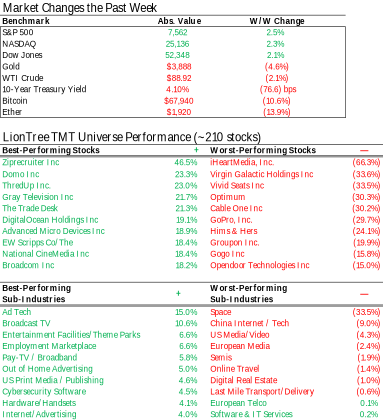
It felt like an unprecedented week, with constant debate about the implications of Nvidia’s leadership turmoil (stock was down -13% for the week) driving outsized volatility, especially in chip and neocloud stocks. Somewhat surprisingly, the major indices posted their first winning week since early October, with the S&P 500 up +2.5%, the Nasdaq up +2.3% and the Dow up +2.1%. The gains also came despite a hotter-than-expected October CPI print (headline +0.4% m/m, core +0.3%, both above consensus), which pushed Treasury yields and the dollar higher as markets leaned toward a December rate hike.
Sector-wise, the earnings train rolled on, with plenty of incremental updates across media and entertainment, cloud and ad tech, not to mention video games. Looking ahead, next week should be just as momentous. Nvidia is scheduled to kick things off with its FQ3 results on Tuesday (11/17), which will be a key focus for the market. Anthropic (ticker ANT) is then expected to price its IPO on Wednesday (11/18). How the deal is received will be a major catalyst for the tech sector and the broader market. Then on Thursday (11/19), the long-awaited Grand Theft Auto VI officially launches. It will certainly be one of the year’s defining cultural events, with expectations running high.
This edition focuses on the below:
- Earnings Scorecard – Week 5
- Paramount Standalone Is Tracking To The High End Of Plan While Investors Wait For A More Detailed Proforma Look
- Strong Q3 + Guidance = Temporary Sigh Of Relief For CoreWeave Investors
- Take-Two Counts Down To GTA VI
- Live Nation Sets the Stage For Continued Growth
- Is The Trade Desk Back In Business? Q3 Shows Some Rays Of Light, But There Is Still Work To Do
- Grab Bag: Anthropic Office Tools / Streamers Push Further Into Short-Form / Drone Delivery Expansion Continues
Enjoy the read and have a nice weekend.
Best,
Leslie

Earnings Scorecard – Week 5
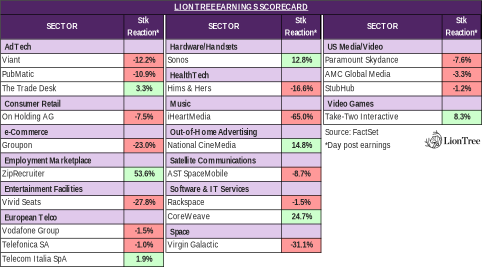
We are nearing the tail end of Q3 earnings, and this week, 22 companies in our LionTree Universe reported their results (down from 79 last week). Similar to the last two weeks, stock reactions were biased to the downside, with 15 companies (68%) falling post their print, while only 7 companies (32%) traded up. The worst performer was iHeartMedia, which plunged -65%, while the best performer was ZipRecruiter, which jumped +54%.
Key earnings that we delved into his week include CoreWeave, which jumped +25% post its print (see Theme #3), Take-Two, up +8% (see Theme #4), The Trade Desk, up +3% (see Theme #6), and Paramount Skydance, which fell -7.6% (see Theme #2).
The table below includes select mid- and large-cap TMT and consumer companies in our LionTree stock universe that reported this week.
Paramount Standalone Is Tracking To The High End Of Plan While Investors Wait For A More Detailed Proforma Look
A critical topic on Skydance’s first call since closing the WarnerBrosDiscovery deal (Oct 6th) was the integration roadmap, and mgmt. provided a detailed breakdown of the “at least $6bn” run-rate synergy program (30% realized by end of yr 1, 70% by end of yr 2) across corporate overhead/real estate ($2.2bn+), marketing ($1bn+), technology ($1.4bn+), and procurement ($1.4bn+). Mgmt has “very strong confidence” in hitting this target and flagged that incremental revenue synergies are also not in the plan and are “all upside.”
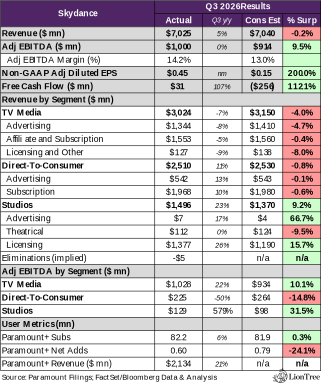
Paramount Skydance standalone continued the trend of profitability upside in Q3 w/ inline revs (adj EBITDA BEAT cons by +9.5% and topped the high end of guidance) and the Co is now tracking to the high end of its FY26 adj EBITDA guidance range at $3.9bn. Paramount+ Q3 rev growth accelerated to +21% y/y (fastest of the year), Studios rev BEAT by +9.2% on licensing strength, and FCF of $31mn was well ahead of the cons -$256mn loss. With that said, investors are still waiting for the full proforma picture that includes WBD, which will be provided prior to the Q4 call.
Other key incrementals in our mind from results include: 1) A Paramount+ / HBO Max bundle is confirmed for early 2027 and mgmt. targets ~1-yr to converge the two tech stacks; 2) The Q4 outlook calls for a -$200mn profit hit in Studios from the underperforming WB film slate; 3) The Co is moving to annual guidance (full 2027 outlook will be provided w/ Q4 results), though quarterly color will be given on major moving pieces “when we believe appropriate” (and mgmt. will stop providing quarterly subscribers); 4) Mgmt reiterated its medium-term targets of MSD rev growth, mid-20% adj EBITDA margins, $10bn+ FCF in 2030, and 3.0x net leverage by YE29; and 5) The Co doesn’t need non-core asset sales to reach its deleveraging target but will be opportunistic.
All in all, mgmt. has a strong plan which hinges on execution. See below for more details on the most important updates from Skydance’s results.
Also to flag, the Co will be hosting an Investor Day in 1H27.
-> SKYD shares fell -7.6% in reaction to earnings and ended the week down -6.1%
Q3 Profitability Topped The High End Of Guidance (W/ Inline Revs) / Licensing-Driven Studios Upside Offset A DTC Profit Miss
- To note, results exclude WBD, as the deal closed after the qtr ended…consolidated reporting begins in Q4
- Q3 adj EBITDA BEAT cons solidly by +9.5% (flat y/y)…exceeding the top end of the Co’s prior Q3 guidance
- Adj EBITDA margin of 14.2% topped cons 13%
- Q3 revs were ~INLINE w/ cons and grew +5% y/y vs +1% y/y in Q2 (within the guided +4-7% range)
- Driven by Studios (+23% y/y) and DTC (+11% y/y), offset by TV Media (-7% y/y)
- Q3 Non-GAAP adj EPS of $0.45/shr BEAT cons $0.15
- Q3 FCF of $31mn was much HIGHER than cons loss of -$256mn, incl $174mn of restructuring, transaction-related, and transformation costs
- Segment adj EBITDA:
- TV Media BEAT cons by +10.1% (+22% y/y)
- Studios BEAT by +31.5%
- BUT DTC MISSED by -14.8% (-50% y/y)
- …see sections below
Paramount Standalone Is Tracking To The High End For 2026 BUT WB’s Film Slate Creates An Up To $200mn Q4 Headwind / Going Forward The Co Is Moving To Annual Guidance
- For 2026, Paramount standalone remains on track vs prior guidance, incl the HIGH END of the adj EBITDA range at $3.9bn (vs $3.8-3.9bn previously)
- WB is on track w/ the Co’s underwriting plan, w/ the exception of the near-term film slate
- Q4 outlook:
- DTC: Cont’d strong rev growth (on a pro forma basis, combined DTC rev grew +15% y/y in Q3)
- TV: Trends consistent w/ prior qtrs, adjusting for seasonality around politics and sports
- BUT Studios: Slower rev growth and a profit impact of -$200mn vs prior expectations, as continued Paramount slate strength is more than offset by the WB film slate (incl films already released QTD)
- Preliminary 2027 color: Continued strong DTC rev growth, higher Studios rev, and an increase in pro forma total Co adj EBITDA y/y on underlying growth + the synergy ramp
- FCF is expected to be breakeven or better in 2027, incl costs to achieve synergies
- Mgmt is moving to an annual guidance methodology…”we’re not managing towards short term quarterly targets”
- The full 2027 outlook will be provided w/ Q4 results, along w/ quarterly color on major moving pieces “when we believe appropriate”
- Pro forma combined financials will be published prior to the Q4 call
- FCF conversion is now expected at 30% excl transformation and transaction costs…”a much higher conversion rate than what we had guided earlier in the year” (prior guide was at least 10%)
- Medium-term targets were reiterated: Mgmt expects to transition “a meaningful majority of revenue and profit from TV to our streaming and studios businesses”
- MSD annualized rev growth
- Mid-20% adj EBITDA margins
- $10bn+ FCF in 2030
The $6bn+ Synergy Breakout Was A Key Focus & Mgmt Is “Very Confident” In Achieving…Revenue Synergies Would Be Upside To The Plan
- Mgmt expects at least $6bn in run-rate synergies (net of reinvestment) within 3 yrs, w/ 30% realized in yr 1 and 70% through yr 2…20+ workstreams are already underway
- The Co is combining 2 global streaming services, 2 film & TV studio groups, 2 TV portfolios, and overlapping corporate functions across a $50bn+ cost base
- Mgmt has “very strong confidence in achieving the $6 billion of synergy in the next three years”…”this is not just about cutting costs, but also how we work”
- Synergy breakdown by category (vs 2026 cost base):
- Corporate overhead, real estate & facilities (~$8bn base): At least $2.2bn by consolidating back-office functions, reducing mgmt layers, shared services, a single ERP (Oracle Fusion), and scaling AI workflows
- The real estate footprint is being rationalized (while keeping the production lots)…e.g., the Co has 5 sites in NY, 7 in LA, and multiple locations in Atlanta and London, and sees an opportunity to move people into owned properties vs paying 3P rent
- Marketing (~$5bn base): At least $1bn by streamlining global spend, cross-promoting on owned platforms, and unifying media planning & buying across BUs
- Technology (~$4bn base): At least $1.4bn by unifying the enterprise tech stack, streaming ecosystem, and broadcast architecture, merging parallel tech functions, and using AI coding tools
- Procurement & vendor management (~$9bn base): At least $1.4bn by optimizing 3P spend and centralizing purchasing decisions
- Content is also an opportunity: The Co spends $30bn+ annually (highest in the industry) and can make “smarter choices” on how it distributes and monetizes new and library content across its combined platforms
- Corporate overhead, real estate & facilities (~$8bn base): At least $2.2bn by consolidating back-office functions, reducing mgmt layers, shared services, a single ERP (Oracle Fusion), and scaling AI workflows
- By segment, the majority of savings will come through Corporate, DTC and TV (DTC primarily through tech and marketing optimization), w/ broad-based cost structure optimization in TV
- Specific synergy contribution guidance will come w/ the 2027 outlook next qtr
- One-time cash costs to achieve are ~$4bn total, w/ 60-70% incurred in 2027-2028 (incl $1.5-2bn in 2027, ie, front-end loaded)
- The legacy Paramount efficiency program remains on track for $2.7bn+ in run-rate savings by YE26 (target raised to $3bn+, 50%+ above the original goal)
- $1bn+ has been realized YTD, and the remainder will be in 2027, which is incremental to the Skydance program
- There was also some focus on revenue synergies that are NOT in the business plan and would be “all upside”
- Licensing: A combined library of 15k films and hundreds of thousands of TV hours, plus 30 theatrical films and ~100 series/yr, serving partners through a single point of contact w/ more windowing flexibility (esp second-run licensing)
- TV: Better serving affiliates w/ a complete offering and advertisers across sports (CBS Sports + TNT Sports) through a single partner spanning broadcast, cable, and streaming
- DTC: A unified paid streaming product should drive stronger engagement and higher lifetime value…mgmt acknowledged its ARPU lags peers, esp internationally, which is an opportunity over time
Paramount+ Rev Growth Accelerated To +21% On ARPU Strength…BUT Investments Weighed On DTC Profit & Sub Disclosures Are Going Away
- Q3 DTC revenue growth improved to +11% y/y (vs +9% in Q2)
- Advertising rev grew +13% y/y (INLINE) and subscription rev grew +10% y/y (-0.6% vs cons)
- BET+’s integration into P+ along w/ Showtime declines was a ~6ppt headwind to total DTC growth
- Paramount+ revenue grew +21% y/y (vs +16% in Q2), its fastest quarterly growth this yr
- Driven by ~6% sub growth and ~14% ARPU growth, w/ monetization driven by previous price adjustments and accelerating advertising growth
- P+ engagement was up 20%+ y/y
- P+ subs reached 82.2mn, slightly ahead of cons 81.9mn (+0.3%)…BUT net adds of 0.6mn MISSED cons of 0.79mn by -24.1%
- Starting w/ Q4, the Co will no longer provide quarterly subscriber disclosures, in line w/ other DTC players
- “Prioritizing profitable streaming growth over subscriber counts”
- DTC adj EBITDA of $225mn decl’d -50% y/y, reflecting planned programming investment incl UFC and Originals
- Mgmt expects to expand streaming margins in Q4:26 and in 2027
- Key content drivers: Lioness S3 viewership grew +62%, MobLand S2 became the biggest original ever for P+ in the UK & Ireland, and DC’s Lanterns and House of the Dragon S3 averaged 22mn and 42mn global viewers on HBO Max
- HBO Max hits this yr also incl The Pitt S2 and new series Half Man…the Harry Potter series premieres on Christmas Day
- Pluto has ~75mn MAUs and is now on the unified P+ platform across all major devices (largest tech investment in Pluto’s history)
Importantly, A Paramount+ / HBO Max Bundle Launches In Early 2027…A First Step Toward A Fully Unified Offering On One Tech Stack Within ~1 Yr
- The bundle is the first step toward unifying the two services…it’s coming in early 2027
- P+ and HBO Max reach a combined 203mn subs worldwide (not accounting for overlap)
- The services are “highly complementary” and over-index w/ different consumer segments and different parts of the country
- Subscribers get Pay-1 films from Paramount, WB, and A24…and a new theatrical release essentially arrives on the service roughly every other week
- Sports incl NFL, UFC, Champions League, and all of March Madness
- Mgmt expects to grow reach and engagement, improve retention, and increase rev and profitability “in line with or ahead of the leading competitors” over the long term
- Pricing changes will be phased in “with discipline and consumer feedback” so the services keep growing through the transition…more details on the bundle and streaming roadmap will be provided “in the coming months”
- Tech convergence: Phase 1 is largely complete (Pluto moved onto the P+ platform and BET+ ingested into P+), which took ~18 months
- Mgmt has an “ambitious target” to converge P+ and HBO Max backends in roughly one yr
- What are the benefits of a unified backend? It lowers operating cost, speeds up product development, and gives shared personalization and monetization capabilities
- Will the bundle be offered only DTC vs via 3P platforms (Amazon Channels, Roku, YouTube, Disney+/Hulu bundle)? Mgmt sees value in being a “predominantly direct business”
- BUT the choice on where to go direct vs getting additional reach through partners will be “a balancing act” as the business scales
- Once on one tech stack, w/ 200mn+ subs plus 75mn Pluto MAUs, mgmt believes the Co can be competitive w/ larger peers
Q3 Studios Licensing Was A Standout & The 2027 Slate Is Stacked…BUT The WB Film Slate Is Underperforming Near Term
- Q3 Studios revenue grew +23% y/y, driven by secondary market licensing and content produced for 3Ps
- Licensing rev grew +26% y/y and BEAT cons by +15.7%
- BUT Theatrical rev was flat y/y and MISSED cons by -9.5%
- Studios adj EBITDA of $129mn (8.6% margin) was much stronger than expected reflecting the incr in licensing revenues
- HOWEVER, the WB film slate underperformed this yr and will weigh on Q4…how will they address this? Apply the Paramount playbook of testing earlier, tailoring marketing and release strategy to each opportunity, and greenlighting more selectively
- That approach is expected to result in the 2026 Paramount slate generating $500mn+ more in lifetime profit vs last yr’s
- 6 film releases are slated for the final 2 months of 2026:
- The Cat in the Hat (Nov 6)
- Ebenezer (Nov 13)
- Focker-in-Law (Nov 25)
- Dune: Part Three (Dec 18)
- The Angry Birds Movie 3 (Dec 23)
- Irrelevant (Dec 25; first release under Skydance Sports’ NFL partnership)
- The Co is on track for 30+ theatrical films and 180+ TV and streaming series in 2027
- Mgmt confirmed that the Consent decree commitments (30 theatrical releases/yr in yrs 1-2, 32/yr in yrs 3-5, +$300mn of annual US production, 5 yrs of ownership of both lots) were already contemplated in the guidance…”all of this was planned for and has no negative impacts on our plan”
- The decree only requires 20 wide releases scaling to 22, leaving “a tremendous amount of operational flexibility”
- Mgmt is very bullish on the leadership structure:
- Film studios are now unified under one leadership team
- WB, Paramount, New Line, and Skydance keep their own creative teams
- TV studios also now operate under one team
- Jeremy Latcham (a founding member of Marvel Studios) will now be leading DC Studios
- TV Studios had another strong qtr: 11 of the top 20 streaming programs in Q3 were owned and produced by the Co’s studios
TV Media Revs Continue To Decline BUT Margins Hold At 34% / On The Plus Side, Sub Declines Are Moderating
- TV Media revenue decl’d -7% y/y which was an improvement vs -9% in Q2
- Advertising rev was worse than expected though and decl’d -8% y/y, incl a ~3ppt headwind from the Telefe/Chilevision sales, partially offset by higher political advertising
- Affiliate & subscription rev decl’d -5% y/y consistent w/ continued pay TV sub erosion while rates remain resilient
- TV Media adj EBITDA grew +22% y/y, w/ a 34% margin (flat vs Q2) benefiting from cost savings initiatives
- US pay TV sub declines moderated seq as genre-based packages gained traction w/ the start of the NFL season…the decline in linear has “moderated slightly over the last few quarters”
- BUT mgmt continues to “conservatively plan for a structural decline” in the business
- Sports and news networks (incl CBS) drive a majority of US TV rev and EBITDA and mgmt expects distributors to increasingly want streaming built into packages (incl P+ and HBO Max)
- Sports advertising commitments are up +20%+ y/y for current and upcoming seasons leading into 2027
- Each rights package is evaluated on audience, streaming acquisition/engagement, distribution value, calendar fit, and returns…”as it relates to future rights, we’ll be disciplined”
- A unified leadership structure across TV and DTC now spans distribution, ad sales, and content sales so decisions are made holistically…while respecting the consent decree requirement for separate negotiations of the Paramount and WB cable portfolios
Mgmt Sees AI Reshaping The Business “Significantly” In Terms Of Both Costs & Revenue
- “We believe creativity and technology working together will shape the future of entertainment”…AI is a tool for artists and “will never be a replacement for them”
- In a world of “AI slop,” mgmt believes there will always be a premium for handcrafted storytelling, and franchise IP and live events become more valuable, not less
- Early internal AI tools indicate content will be easier to produce, projects will speed up, and how the Co works will transform…none of this is in the Co’s model
- In production, AI “has the potential to be the biggest creative unlock in modern history” by making budgets more digestible and enabling more original storytelling bets
- On product, personalization, search, discovery, and recommendations should all improve, and AI-driven tools should benefit advertisers
Deleveraging Is A Top Priority & Does Not Require Asset Sales BUT Mgmt Will Be Opportunistic On Non-Core Assets
- The Co is executing on its plan to reduce net leverage to 3.0x by YE29 and reach investment-grade credit metrics within ~3 yrs of close
- Key FCF levers: 1) Lower one-time transformation costs; 2) Lower cash interest as debt is paid down; and 3) Working capital improvement, where the Co just launched an AI agent in procure-to-pay
- Asset sales? “Achieving our leverage targets does not require us to raise additional capital or divest assets”
- BUT the Co will review the portfolio as it integrates and be “opportunistic” around monetizing non-core assets
Strong Q3 + Guidance = Temporary Sigh Of Relief For CoreWeave Investors
Given all the concerns regarding the health of the Neocloud and the overall AI trade, CoreWeave’s better than expected Q3 and forward guidance, coupled with positive comments on the overall demand and pricing environment, was enough to drive a strong tech rally in reaction. However, that was quickly followed by Nebius’ lowered 2026 sales guidance to the low end of the range given 3P capacity delays (despite strong Q3 and similar favorable demand and pricing comments), which in conjunction with the Nvidia leadership changes, re-sparked Neocloud concerns.
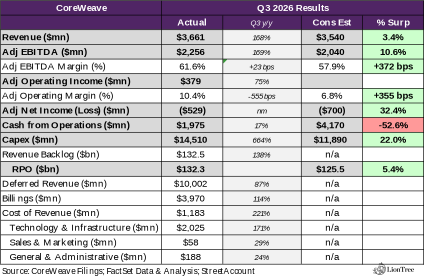
Digging into CoreWeave’s results, the Co’s Q3 rev (+168% y/y) BEAT cons by +3.4% and adj op margin reached double digits (10.4%) a quarter ahead of plan. The revenue backlog hit a record $132.5bn (+138% y/y) and mgmt raised FY26 guidance for rev, adj op income, capx and exit-2026 ARR (now $20–21bn), w/ the adj op income midpoint 25% above cons. With volatile capital markets and AI infrastructure financing under scrutiny, mgmt spent a lot of time on the call laying out its funding plan, which through 2027 does not include any new parent-level unsecured debt at current yields. ~$9bn of customer prepayments and deposits are expected over the next three months and an IG-rated DDTL is set to launch in the coming weeks.
Pricing power was the other key theme, as Co raised prices ~25% in July and another ~10% later in the quarter and sold short-term capacity at $40mn+ per MW (high margin). Also, ~300k of legacy GPUs are coming off contract in 2027–28, which represents nearly $10bn of incremental annualized rev at current pricing w/ importantly no additional capx. Rising interest expense remains the key offset, w/ the Q4 guide of $1.05–1.15bn above cons, BUT mgmt expects adj net loss to narrow meaningfully in 2027 and turn to adj net income in 1H28.
Overall, investors remain very skittish about the Neoclouds but CoreWeave’s beat-and-raise, record backlog and clearer funding plan through 2027 went a long way toward easing near-term concerns…the question is whether that relief holds, as Nebius’ guide-down showed how quickly sentiment can turn on any hint of capacity delays or financing strain.
–> After falling -55% over the last 6 months leading up to earnings, CRWV shares rallied a very strong +25% on the back of the better results and guidance; It essentially led a large AI rally on Wednesday; However, on Thursday am, neocloud competitor Nebius fell -17% in reaction to its guidance as mentioned above and then Jensen Huang’s resignation from Nvidia added more fuel to the fire with neocloud; With all that said, CRWV ended up week up +14.5%, but is still down -25.8% YTD
CoreWeave Delivers A BETTER Than Expected Q3…
- Q3 Rev (+168% y/y, +42% seq) BEAT cons by 3.4% and topped the high end of the $3.45–3.6bn guide
- It was driven by conversion of contracted power into active, revenue-generating capacity, a strengthening demand & pricing environment (incl. premium-priced short-term contracts) and broader multi-product adoption
- Q3 adj EBITDA (+169% y/y, +49% seq) BEAT cons by 10.6%
- Adj EBITDA margin of 61.6% (+23bps y/y) BEAT cons of 57.9%…this is the highest margin in the last five qtrs
- Q3 adj op income of $379mn (+75% y/y) was well above the $200–260mn guide
- Adj op margin inflected sharply seq from ~1% in Q1, 5% in Q2, and 10.4% in Q3…reached double digits “one quarter ahead of the plan”
- Q3 adj net loss of -$529mn was 32.4% narrower than cons of -$700mn BUT widened from -$41mn a year ago
- But Q3 OCF MISSED cons by 52.6% which reflects a -$1.74bn accounts receivable build, partially offset by a +$2.13bn incr in deferred rev
- Q3 capx of $14.5bn was 22% above cons and above the high end of the guided range: This is due to execution that pulled forward certain deliveries from Q4
- Q3 revenue backlog of $132.5bn rose +138% y/y and hit a record high; RPO BEAT cons by 5.4%
- 50%+ of the backlog is attached to contracts where customer delivery is expected to commence by YE26
…AND FY26 Guidance Was Raised Across The Board
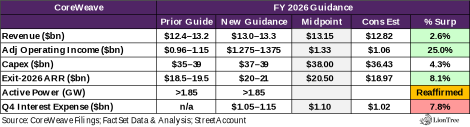
- FY26 rev guide RAISED +2.7% at the mid-pt and is +2.6% ABOVE cons
- Implies Q4 rev of ~$4.69–4.99bn, which at the mid-pt is +0.4% above cons $4.82bn
- FY26 adj op income guide RAISED +26% at the mid-pt and it is 25% ABOVE cons
- Implies Q4 adj op income of ~$747–847mn, which is +7.3% above cons (adj op margin of ~16–17%)
- RAISED exit-2026 ARR guide to $20–21bn from $18.5–19.5bn; The mid-pt is 8.1% ABOVE cons of $18.97bn
- But also RAISED FY26 capx guide at the low end to $37–39bn from $35–39bn…the mid-pt is 4.3% ABOVE cons
- Reflects expectation to deploy infrastructure and deliver it to customers “sooner than planned”
- Reaffirmed 1.85GW+ of active power at YE26
- Q4 interest expense guidance mid-pt was 7.8% ABOVE cons
- Initial 2027–28 framework: mgmt expects adj net loss to “reduce meaningfully” in 2027 and to turn adj net income positive in 1H28 and for FY28
- EBITDA less interest (excl. benefit of prepayments) is expected to more than double in 2027
- If the Co focused only on the committed backlog, 2027 capx is expected to remain in line with 2026 while rev & EBITDA “grow significantly”…flexibility does not impact ability to “meaningfully exceed our ARR target for 2027”
Demand Continues To Outstrip Supply Despite The “Wall Of Supply” Fears & The Co Is Holding Back 2028 Capacity To Capture Better Economics
- The Co is “largely sold out through 2027” and any 2028 infrastructure placed on the market has been sold
- The Co has 10x as much qualified demand as available capacity through the end of 2027
- 2028 demand is already “several times larger” than available capacity before it is formally brought to market
- The Co has held back 2028 capacity while waiting for it “to season further”…”We could sell all of the capacity that we have to current buyers that are in the queue. We are choosing not to”
- Mgmt pushed back on industry oversupply concerns: Demand for compute “is growing faster than the capacity to deliver that infrastructure,” evidenced by expanding margins on each additional contract
- The Co aims to keep power contracting in sync w/ customer roadmaps amid credit market concerns …the Co is “not getting out too far on the curve” in locking in power
- Mgmt also sees an opportunity as less established AI clouds go through growing pains…the Co’s scale + software layer lets them “be very selective” on which clients to take on
- The # of organizations committing $100mn+ to CoreWeave Cloud incr’d >2.5x y/y
Mgmt Rules Out Unsecured Debt At Current Yields & Expects Contract-Backed DDTLs, Prepayments & Cash Flow To Fund The Build-Out Through 2027
- Mgmt spent a lot of time talking about its funding during the prepared remarks given “the recent volatility in the capital markets”
- No addtl parent-level unsecured debt is planned through 2027 but mgmt. expects to raise less than $5bn of incremental parent-level capital through 2027
- Mgmt reaffirmed that contracted cash flow from existing customer commitments is sufficient to service and repay all debt outstanding today plus debt still to be raised to deliver those contracts…incl. both asset-level secured and parent-level unsecured debt, and before counting renewals
- Secured loans continue to trade around par
- Contract-matched delayed draw term loans (DDTLs) will be used to fund the majority of the remaining backlog capx
- The next DDTL is expected to launch “in the coming weeks”…an IG facility w/ multiple rating agencies indicating a high IG rating
- It is expected to price at a spread implying a 7–7.5% yield at current SOFR
- The next DDTL is expected to launch “in the coming weeks”…an IG facility w/ multiple rating agencies indicating a high IG rating
- The Co’s weighted avg cost of debt is 7.9% at end of Q3 (-250bps y/y)
- The Co has already paid down $4bn+ of debt via contract amortization, incl. nearly half of the first two (most expensive) DDTLs
- The infrastructure is owned free and clear once long-term contracts end
- 75%+ of committed capx through 2027 is tied to IG and enterprise customers; The remainder is tied to leading AI labs and AI-native cos
- Customer prepayments are also preferred as a funding source
- The Co collected prepayments on 70% of deals this year, w/ customers funding up to 100% of the contract value upfront
- Mgmt expects ~$9bn of prepayments & deposits from signed contracts over the next three months alone, and for that figure to grow in 2027
- $3bn+ tied to re-contracting existing, fully paid-off infrastructure at “meaningful premiums” to original pricing…requires no debt service and no additional capx
- Additional levers: OEM financing (esp. for capacity serving short-term opportunities), growing operating cash flow and CoreWeave Omni
- Success-based capx is a key risk mitigant…”We are not a growth at all cost business”
- A large majority of capital is committed only once contracts and infrastructure are in place
- The Co can “accelerate or moderate” the pace based on customer demand, financing terms, regulatory impacts and capital markets
- Regarding cost inflation between contract signing and delivery, the Co places corresponding POs and identifies landing data centers at signing so economics “stay relatively locked” through deployment
Pricing Power Accelerates Across New & Legacy Fleet…Short-Term Contracts At $40mn/MW+ Is Now A Meaningful Margin Lever
- The Co raised pricing across SKUs by ~25% in July, followed by another ~10% incr later in Q3…pricing “has continued to move higher in Q4 more than offsetting cost increases”
- Pricing for new infrastructure on 4–5 year contracts is moving to $20–25mn/MW annually and short-term capacity is selling at $40mn/MW+
- The Co is allocating more capacity to short-term opportunities “where the pricing justifies it”
- This contributed to the strong Q3 margins
- Short-term contracts pay back capx in ~6–18 months vs. ~1–2 years of hardware capx for long-dated contracts at current pricing
- The newest contracts are “among the most profitable we have ever underwritten”
- The Co is allocating more capacity to short-term opportunities “where the pricing justifies it”
- Margin upside should come from three areas: long-term contracts (stability), short-term contracts (margin) and premium products like managed inference…all three are expected to stay “in our favor” near term
- Prior-gen fleet pricing is also strengthening…Ampere and Hopper pricing incr’d 30–50% q/q, at prices above their original contracts
- The Co is signing multi-year commitments extending beyond GPUs’ depreciable lives and margins expand in later years as price and operating costs stay fixed while depreciation rolls off
There Is A Nearly $10bn Incremental Annualized Revenue Opportunity From 2027–28 Renewals
- 130k+ GPUs come off contract in 2027 and ~170k come off in 2028
- At current pricing, 2027 renewals would generate almost $4bn of incremental annualized rev w/ no additional capx and that increases to almost $10bn incl. 2028 renewals
- This is not included in the current $132.5bn backlog and the Co already has a “robust pipeline of customers competing for this capacity”
- Mgmt views the paid-off fleet as a hedge against an industry build-out slowdown…if construction slows, installed compute “becomes scarcer” and GPU pricing “may stay higher for longer”
- Co’s installed base comes off contract fully paid “years ahead of most others in the market”
- BUT mgmt stressed that “we do not build our plan on that scenario”…the plan rests on contracted demand, success-based capx and contracts already being signed
Diversifying The Client Base Beyond AI Labs Is A Key Priority
- There has been some investor concern about frontier labs signaling a desire to stand up their own compute but mgmt has been diversifying across customers and data centers
- 10% of Fortune 500 Cos are now customers
- 10% of the backlog is from financial services
- Over half of new customers YTD are from industries outside AI labs and tech
- With that said, mgmt still expects long-term relationships w/ AI labs, hyperscale clouds and social media cos
- CoreWeave’s Forge which was launched in Sept, integrates training, inference, evaluation and agent development workflows…70% of new cloud customers added in Q3 were already Forge customers
- New customer wins incl. Canva, Mirendil, Parallel Web Systems, Serve Robotics, Substack and Wayve; Expanded relationships w/ Chan Zuckerberg Initiative, Cohere, Hippocratic AI, Jane Street, OpenAI and Perplexity
The Co’s Capacity Build Is Running Ahead Of Plan…International Expansion & Fully Permitted Sites Insulate 2027 Deliveries From US Regulatory Shift
- Active power grew by over 200MW q/q to 1.7GW+, doubling since YE25…Over 850MW was brought online YTD
- Contracted power incr’d over 900MW to over 4.6GW, w/ further diversification of providers and expanded powered land footprint
- International is a key growth driver…
- 1.3GW+ of contracted power is now outside the US across Canada, Europe and Asia
- The Co also entered Indonesia and India in Q3 while growing in Denmark and Spain
- What is the impact from the mid-terms and possible delays in data centers? Mgmt does “not anticipate any impact from the seismic regulatory shift that’s occurred”…they see no material risk to 2027 deliveries given ongoing construction at fully permitted sites
- In Texas, the “overwhelming majority” of Co’s power is either online or fully permitted and under construction already
Take-Two Counts Down To GTA VI
Take-Two’s FQ2 call was all about GTA VI which launches next week on Nov 19th, and investors heard what they wanted to hear…pre-orders are tracking “far in excess” of initial expectations.
That gave the company a pass on a mixed quarter itself. Net Bookings came in slightly below both the Street and the guide, as NBA 2K27, despite being the second-highest launch in franchise history, fell short of forecasts, and RCS declined -9% vs a -5% guide, driven by NBA 2K. On the other hand, the GTA series beat forecast, mobile was in line with plan, and gross margin beat cons.
Looking ahead, FQ3 Net Bookings guidance was ~in-line with the Street, and FQ3 RCS is guided to grow ~+12%, with “significant growth” expected for the GTA series driven by sales of the GTA VI Ultimate Edition, whose add-on content counts toward RCS. The FY27 EBITDA guidance was also raised, and the Co expects NBA 2K RCS to accelerate in H2 on its largest-ever post-launch content slate.
Beyond the quarter, the Co declined to reaffirm prior commentary on growing revenue and earnings in the year after GTA VI, but said it expects to set “a new baseline for performance going forward.” For now, the Co reiterated FY27 Net Bookings and EPS guidance rather than raising it, saying it will update numbers once it has post-launch experience. Next week will certainly be exciting!
-> TTWO jumped +8.3% after its print and ended the week up +6.0%; But YTD, the stock is still down -11.0%
A Mixed FQ2…. Net Bookings Slightly Missed On NBA 2K27 Softness, BUT GTA Outperformed And Gross Margins Easily Beat
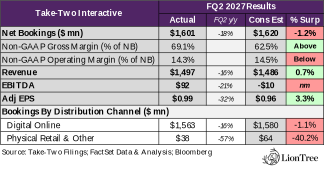
- FQ2 Net Bookings MISSED cons by -1.2%…decr’d -18% y/y to $1.60bn, slightly below mgmt’s $1.62-1.67bn guide
- NBA 2K27 was “below our forecast for the period” despite being the second-highest NB launch in the series’ history
- Mobile performed in-line w/ the Co’s plans, while GTA series exceeded its forecast
- RCS declined -9% y/y (worse than mgmt’s -5% guide) and accounted for 81% of net bookings
- NBA 2K and mobile each declined y/y, while the GTA series grew
- Gross margin beat the Street (69.1% of NB vs cons 62.5%), while operating margin was slightly below (14.3% vs cons 14.5%)
- Adj EPS of 99c BEAT cons 96c
Mgmt Raised FY27 EBITDA But It Is Still Below Street Expectations…GTA VI Pre-Order Strength Won’t Be Baked In Until After Launch
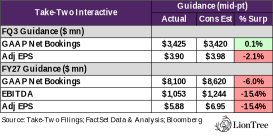
- FQ3 NB guide was ~IN-LINE w/ cons at the midpt and up ~+95% y/y vs $1.76bn LY
- The largest contributors are expected to be the GTA series, NBA 2K, Toon Blast, Match Factory!, Empires & Puzzles, Words With Friends, Red Dead Redemption series, Color Block Jam, Zynga Poker and Toy Blast
- RCS is expected to grow ~+12%, w/ “significant growth” for the GTA series from GTA VI Ultimate Edition sales and growth for NBA 2K, partially offset by a mobile decline
- REITERATED FY27 NB and adj EPS guide
- On why pre-order strength isn’t reflected in guidance…”We tend to avoid claiming success before it occurs. So as soon as we have some experience post-launch, we’re going to be very happy to describe what’s going on”
- FY27 RCS is still expected to be ~in-line w/ FY26 (65% of NB), assuming strong GTA series growth (largely GTA VI Ultimate Edition), high-single-digit NBA 2K growth, and a mobile decline
- Expected label mix: ~37% Rockstar Games, ~34% Zynga, ~29% 2K
- FY27 EBITDA guide was RAISED by ~+3% at the mid-pt but still sits -15% below Street expectations
- Mgmt declined to reaffirm prior commentary that the Co could grow revenue and earnings in the year after GTA VI (“I’m not going to give you guidance for fiscal 2028 today”), BUT reiterated the Co expects “to set a new baseline for performance going forward” and sees “a great opportunity for growth”
- They pointed to 15 franchises w/ 5mn+ units in an individual release, new IP investment, and a disciplined M&A track record that has been “accretive and successful across the board”
- Have “numerous strategic initiatives” under consideration and in development “that range from big to very big to huge”
All Eyes Are On GTA VI… Pre-Orders Are Tracking “Far In Excess” Of Expectations Ahead Of Nov 19 Launch
- In FQ2…GTA series exceeded forecast
- GTA series RCS and avg monthly GTA+ members both grew double digits y/y
- GTA V has now sold “nearly” 235mn units (vs 230mn+ last qtr)
- Rockstar unveiled NoPixel V, an overhauled GTA V roleplay experience…mgmt described it as a “professional version” of the roleplay business it purchased w/ FiveM
- Rockstar will keep supporting GTA Online w/ new content and events
- GTA VI launches Nov 19 on PS5 and Xbox Series X|S; development is complete and pre-loads are rolling out globally
- Pre-orders are “tracking far in excess of our initial expectations”…levels are “unprecedented” and “extraordinary”
- On what’s driving pre-orders…”the title is so widely anticipated and consumers appear very, very excited”
- GTA VI marketing is “well underway across the globe” …the Co’s tracking of awareness and anticipation is “trending very positively” and the press has been “universally positive”
- The extended look premiered on Netflix and became the platform’s most-viewed title for the week, drawing 31mn consumers in its first four days
- The official soundtrack reveal included three tracks that debuted in the top ten of their respective Billboard charts
- An NBA partnership will feature the Miami Heat playing as “Vice City” vs the Milwaukee Bucks, along with in-person Vice City activations in Miami
- FY27 GTA series RCS growth is expected “largely due to” sales of GTA VI Ultimate Edition, which includes add-on content
- Add-on content in the Ultimate Edition is allocated to RCS because it can also be purchased separately
- Asked whether last qtr’s GTA RCS guide was also based on the Ultimate Edition, mgmt said the Ultimate Edition add-on content and GTA Online were the only RCS components included, “and that hasn’t changed”
- Mgmt declined to comment on budgets, tie ratios and expanding to new platforms
- Regarding a question citing a Bloomberg interview where Rockstar’s head of publishing said GTA VI dev costs were not more than $1.5bn…mgmt’s response was that “someone saying something is not more than something does not mean it’s close to something”
- “We haven’t spoken about budgets at all”
- also declined to share tie ratio assumptions
- “We tend not to be slavishly devoted to estimating tie ratios because it doesn’t change anything that we’re going to do around here”
- Asked whether higher console prices could accelerate bringing GTA to PC or streaming, mgmt also declined to comment
- “Any information about new SKUs and the like will always come from our labels”
- Regarding a question citing a Bloomberg interview where Rockstar’s head of publishing said GTA VI dev costs were not more than $1.5bn…mgmt’s response was that “someone saying something is not more than something does not mean it’s close to something”
-> GTA 6 has already generated $1.2bn in presale revenue from 12mn units sold worldwide, according to SensorTower, a research firm that tracks sales data; PlayStation 5 accounts for 75% of purchases, compared with 25% for Xbox Series X|S (link)
-> What are the Street’s views ahead of the upcoming GTA VI launch? Bloomberg reported, citing a note from BofA analyst Omar Dessouky, that GTA VI needs to generate $1.9bn in opening-weekend sales to meet FY27 investor expectations, compared with GTA V’s $1bn in its first three days; BofA views an early sales announcement as a sign of strength, while no announcement by November 23 could suggest weaker demand following the November 19 launch; As of November 13th, TTWO has a 94% Buy ratings, with an avg analyst price target of $290 (stock closed the week at $227.82) (link)
The NBA 2K27 Launch Fell Short Of Forecasts, BUT A H2 Acceleration Is Expected On The Largest Post-Launch Content Slate In The Franchise’s History
- NBA 2K27 has sold 4mn+ units and achieved the 2nd-highest launch NB in series history, BUT still came in below projections
- Mgmt cited an “unusually busy” launch window w/ “numerous entertainment experiences competing for players’ attention”…”it’s really hard to know exactly what has caused a little bit of softness versus our expectations”
- NBA 2K RCS declined y/y in FQ2 after growing +7% in FQ1
- Looking ahead…mgmt. is “pretty confident that we’re going to see a rebound, which we’ve seen before in the past as well”
- The 2H plan includes the “largest slate of post-launch content in franchise history,” incl themed seasons, all-new college basketball experiences and MyTEAM innovation
- The FY27 guide still assumes high-single-digit NBA 2K RCS growth
- The content slate “gives us confidence that recurrent consumer spending for the franchise will accelerate during the second half of the year”
- Other 2K updates…
- Borderlands franchise surpassed 100mn units sold; Borderlands 4 DLC and promotions are improving engagement and retention
- NBA 2K Mobile Season 9 launched Oct 20, and NBA 2K27 Arcade Edition debuted last week
- WWE 2K26 Ringside Pass Season 6 and a Street Fighter Elite Pack (first-ever Capcom collab) launched Oct 28; WWE SuperCard is nearing 40mn downloads
- Civilization VII will get the free “Arc of Tomorrow” update and its first premium expansion, “Earthrise,” in 2027
- Risk of Rain 2: Hallowed Concepts launched Oct 8
- PGA TOUR 2K27 and WWE 2K27 are both slated to launch later this FY
Tough Color Block Jam Comps Weighed On Mobile While Advertising & D2C Continue To Grow
- Mobile performed in-line w/ plan; Color Block Jam NB declined double digits vs last year’s peak FQ2, as expected
- Toon Blast NB grew +4% over a record FQ2 LY, driven by a new in-game assist feature called BEAM (assists players while solving puzzles) that is boosting engagement and level progression
- Words With Friends NB grew +6%, helped by a multi-platform Wheel of Fortune collaboration
- NBA 2K All-Star mobile in China (w/ Tencent) surpassed 11mn registered users (vs 10mn+ last qtr) and is yielding strong margins
- The FY27 guide still assumes a mobile decline on the Color Block Jam comp and moderating trends at several mature Zynga titles
- Advertising improved seq as the Co added partners and incr’d yields…seeing “a huge opportunity for us in the ad business”
- There is the oppty to expand from endemic (game-for-game) mobile ads into brand advertising, which “we already have started”
- “Historically, mobile video games monetized under 20% of the audience”…the goal is to monetize all engagement through ads or IAP, since “what doesn’t make a whole lot of sense is serving consumers for free at a cost to us”
- D2C is “significant, and it is growing” w/ “a very meaningful margin and bottom-line impact” (did not disclose the % mix)
- Lower-than-planned user acquisition costs were partly due to timing…it was “mostly due to some of the movement in some of the new releases for our mobile titles”
A Few Other Key Takeaways On New Business Opportunities And The Impact Of AI
- When asked about “new business opportunities” referenced in the press release, mgmt pointed to streaming, expanding geographies, and creative formats
- Streaming “could vastly expand the size of our market” if it comes to fruition
- Geographic expansion…the business “still remains largely a US, UK, Western European business with a couple of pockets in Asia” and is underpenetrated in India, Africa, LatAm and much of Asia
- International was 41% of FQ2 net rev
- Tapping into new creative formats: “The current expression of interactive entertainment through PC, console, and mobile is super exciting, but we haven’t reached the creative asymptote that other entertainment industries have and I don’t think we will for years”
- The Co views AI as both a piracy risk and a non-threat to its creative moat
- On AI-assisted reverse engineering, mgmt said piracy is “going to become more of a challenge” and the Co is “utterly focused on enhancing our technical defenses and enhancing our legal activities appropriately”
- “It will be manageable”
- On AI and Rockstar’s competitive advantage, AI makes it easier to create assets, “but you know what’s not easier? Making a big hit…hit creation remains the purview of human beings”
- On AI-assisted reverse engineering, mgmt said piracy is “going to become more of a challenge” and the Co is “utterly focused on enhancing our technical defenses and enhancing our legal activities appropriately”
Live Nation Sets the Stage For Continued Growth
Following last week’s earnings, Live Nation used its 2026 Investor Day to outline how it plans to capture more of the growth in global concert demand, which is showing no signs of slowing down. More artists are touring internationally, yet many major cities still lack sufficient modern venue infrastructure so Live Nation is building and operating more venues to accommodate that demand. The Co is also focused on earning more from each fan visit through premium experiences, food and beverage and other onsite spending. Preopening costs are expected to rise in 2027 and remain comparable in 2028, but the Co outlined a path to $850mn of venue-investment AOI by 2031. The shift toward larger operated venues is also expected to support higher concert profit per fan as they ramp up. The venue build-out also adds another avenue for sponsorship growth, creating more inventory for brands alongside larger partnerships and expansion into new advertiser categories.
Meanwhile, concert ticket sales and shows on sale for 2027 are already tracking ahead, as is the committed sponsorship pipeline. Alongside that momentum, Ticketmaster is pursuing further growth through client wins and international expansion, while product and AI initiatives aim to help fans discover shows that they might otherwise miss. Together with fan growth and venue investment, these initiatives represent ~$1.9bn of incremental AOI opportunities across the business.
There was a lot shared at the event…see below for what we viewed as the most incremental takeaways.
-> Live Nation was up only +0.9% on the day of the event but is up +25.2% YTD
Global Concert Demand Is Expected To Keep Growing As Live Entertainment Gains Consumer Spend Share
- Global concert ticket rev is projected to exceed $60bn by 2031, vs ~$42bn in 2026
- Industry growth is expected to continue at ~8% annually, with N. America growing 5–6% and international markets 10–11%
- Live entertainment spending has grown faster than overall consumer spending
- US spending increased +498% since 2000, versus +227% for total consumer spending and +342% for sports, through 2026 YTD
- Post-COVID growth is structural rather than a temporary tailwind, w/ mgmt citing more artists (including younger and international acts and new content types), higher sell-through using AI products, and more large venues
Mgmt Outlined ~$1.9bn Of Incremental AOI Opportunities Over The Coming Years
- Starting from ~$2.6bn of LTM AOI, Live Nation outlined ~$1.9bn of incremental AOI opportunities across its businesses:
- $400mn from growing fans, including $150mn from North America and $250mn internationally
- $925mn from Venue Nation, including $725mn from new venue investments and $200mn from enhancements to existing venues
- $300mn from Ticketmaster, supported by 130mn additional fee-bearing tickets
- $250mn from sponsorship, driven by higher monetization per fan
- Mgmt emphasized that Venue Nation represents the largest incremental earnings opportunity, but that roughly half of the growth comes from continued execution across the existing bizs
- The venue AOI contribution includes incremental activity across concerts, sponsorship and ticketing, rather than venue operations alone
- The Co has greater confidence in its growth roadmap today than it did a year ago, supported by the expanding global opportunity and multiple growth levers
International Markets Remain Under-Penetrated, While Touring Economics Are Comparable To North America
- Live Nation sees a 185mn incremental international fan opportunity, with 45mn additional fans representing ~$250mn of AOI across concerts and sponsorship
- Adding 45mn fans represents ~$250mn of AOI across concerts and sponsorship, excluding the separately counted benefit from additional owned/operated venues
- Of the top 75 intl markets assessed, 46 have opportunities for additional modern arena infrastructure, including major markets such as Madrid, Munich, Tokyo and London
- Across four recent major global artist tours, avg box-office rev per show internationally was comparable to N. America
- Average gross per show was 111% of North American levels in Europe, 109% in Asia Pacific and 90% in LatAm
- The deal economics help explain why “more artists are doing more shows in more places than ever before,” with global touring described as “financially viable” and “financially sustainable”
Venue Preopening Costs Will Rise In 2027 But The Investments Are Targeted To Generate $850mn Of AOI By 2031
- Live Nation is shifting from leasing venues to developing and operating them, capturing more of the economics around each show
- “We just changed the hat from being the leaser to the developer to capture that margin,” with more value coming from premium experiences, food and beverage and other onsite spending
- The pipeline includes 38 large venues, half outside the US
- Attendance across the investment program is expected to grow from 11mn fans in 2026 to 33mn by 2031
- ~65% of fans in these buildings are expected to attend Live Nation-promoted concerts, meaning “our investment in venues is actually growing the concert business”
- Venue investments are projected to generate $525mn of AOI in 2029 and $850mn in 2031 (up from $125mn in 2026)
- Growth comes through venue openings, acquisitions and improvements, followed by “the maturation of our openings as they grow”
- 31 venues are expected to open by the end of 2029, with seven additional openings through 2031
- The contribution includes AOI generated “across concert sponsorship and ticketing” from incremental fans and activity, rather than venue operations alone
- The 38 venues are only the beginning of a much larger opportunity…this is a “10-year build-out story”
- Key financials – the updated venue pipeline totals $5.6bn, funded through ~$1.9bn of Live Nation cash, ~$2.1bn of debt and ~$1.7bn of partner funding
- Projects are targeting 20%+ IRRs and low-teens cash yields, with profit per fan in operated venues 2–3x higher than at third-party venues
- Preopening costs are expected to increase another $40–50mn in 2027, with 2028 comparable
- Costs remain subject to project timing and the numbers “may move around based on the exactness of its timing”
- New amphitheaters are delivering 2x the AOI of traditional portfolio amphitheaters
- Morton and Mystic Lake hosted 83 shows and 900,000 fans in their first summer, with premium revenue 80% higher and F&B spending 15% higher than average amphitheaters
- The buildings delivered a 13% first-year cash yield and are “clearly on track for a project IRR of 24%”
Sponsorship Enters 2027 With Committed Sales Pacing 15% Ahead
- Committed sponsorship represents approximately two-thirds of the 2027 plan
- The pipeline is 15% ahead y/y, measured at the end of October
- “We had some big renewals in 2026. We’ll start to get the benefit of that in 2027,” including Verizon and PayPal. The Spotify partnership expands into EMEA and Australia in 2027
- Mgmt expects continued double-digit sponsorship growth, supported by larger partnerships, new categories and additional inventory from new venues
- The number of sponsors spending more than $1mn has incr’d 75% since 2022, with an 85%+ renew-or-replace rate for major clients
- Larger partnerships have generated a 25% increase in annual spending upon renewal
- Sponsorship AOI per fan is expected to reach ~$5.25 in 2026, with an additional $1 per fan representing a ~$250mn AOI opportunity based on a long-term target of 250mn fans
Concert AOI Per Fan Has A Path To $6+, While 2026 Remains An Investment Year
- Live Nation believes concert AOI per fan can grow to $6+ over the next several years, vs $4.30 in 2025 and $4.30–$4.40 expected in 2026
- It will be driven by a substantial shift toward larger operated venues, supporting “more premium, more onsite spend through a longer dwell time, more ancillary activities”
- Preopening costs and marketing for next year’s shows are weighing on 2026 profitability
- Backing out those expenses would add “about $0.40 per fan” to the 2026 number; “If not for those two things, you’d be growing around 10%”
Ticketmaster Targets ~490mn Fee-Bearing Tickets By 2031, Continuing Historical Growth As AI Aims To Improve Sell-Through
- Ticketmaster targets ~6% annual growth in fee-bearing tickets, reaching ~490mn by 2031 vs 360mn+ forecast in 2026
- “We’ve historically grown at mid-single digits” and “we believe that that growth is sustainable into the future for fee-bearing tickets”
- Drivers include organic concert expansion, signing more clients in existing markets, international expansion and “the ability to drive sell-through through product improvements and agentic commerce”
- Adding 130mn fee-bearing tickets represents a ~$300mn AOI oppty
- AI is a significant oppty to improve concert discovery and increase sell-through of existing inventory
- Discovery is one of the industry’s biggest problems
- Live Nation’s All Access program has reached 14mn members, who attended up to 34% more concerts this summer compared with those same fans’ attendance in the three years before joining
- Knowing where fans go and want to go allows more efficient marketing: “we think this unlock will be really how we get to the 20 million unsold seat opportunity.”
- Ticketmaster is developing its own fan agent alongside integrations with major AI providers, while retaining control of its ticket inventory and checkout experience
Is The Trade Desk Back In Business? Q3 Shows Some Rays Of Light, But There Is Still Work To Do
After missing expectations two quarters in a row, The Trade Desk finally delivered a quarter well ahead of consensus, with revenue and profitability both topping consensus and the Q4 guide also coming in above the Street. However, devil’s advocate would say that the upside was due to a lift from a record midterm political cycle and a one-time benefit from a strategic partner, but mgmt noted that the underlying business still performed better than it anticipated. Medical health, personal finance and travel were among the strongest verticals, audio was the fastest-growing channel, and international markets continued to grow, led by APAC and China. With that said, some large global advertisers, particularly in CPG and auto, continue to face external pressure. Looking ahead, mgmt is not expecting the usual seasonal step-up into Q4 and pointed to a seasonal decline into Q1.
On product, Zuma (Kokai platform usability upgrade) launched in Q3 and is already making the platform faster to use, Audience Unlimited (flat-cost, AI-selected third-party data) is gaining traction with advertisers, and agentic AI is starting to automate manual campaign work. Open measurement (full-funnel ad attribution tool), which is described as the Co’s “most exciting product,” launches this quarter and is expected to improve growth next year.
The Co has also been executing on changes to its cost structure, leadership and capital allocation. A workforce reduction in Q3 is expected to drive meaningful savings in 2027, with expense growth set to moderate next year, though some of those savings will be reinvested in growth areas. Co-founder Dave Pickles is returning in an expanded role, TTD is looking more actively at M&A while holding a higher bar, and the board increased the buyback authorization. More detail on the 2027 operating plan will come in February but overall, mgmt described Q3 as “progress, but it was, of course, just one quarter.” Longer term, they are confident they can return TTD to “stronger, more durable” growth.
See below for more of our key takeaways from TTD’s Q3 results and conference call.
-> TTD was up +15.5% going into its report and added an additional +3.3% in reaction; The stock ended the week up +21.2% but is still down -58.7% YTD
Q3 Was A Big Beat Across The Board
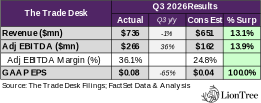
- Revenue BEAT by +13%: Down -0.5% y/y, vs +3% y/y in Q2 and +18% y/y in Q3:25
- Results were “meaningfully ahead” of the outlook given in August (guided to at least $650mn)
- Q3 included a ~3pt benefit to rev “from business with a strategic partner that we do not expect to recur”
- BUT “even excluding that one-time benefit, the underlying business still performed meaningfully better than we anticipated entering the quarter”
- Political (US midterms) was a mid-single-digit % of rev in Q3, and continues to “grow cycle on cycle”
- By channel: Video (incl. CTV) represented a low 50s% share of the biz; Mobile a high 20s% share; Display a low double-digit share
- Audio (~7% of the biz) “posted much stronger year-over-year growth than any other channel”
- By vertical: Medical health, personal finance, travel and political posted the strongest y/y growth
- CPG and auto remain under “pressure,” with “higher inflation, higher interest rates” weighing on auto financing
- By region: APAC grew ~30% y/y in the first 9 months, led by China (+45% y/y in Q3); EMEA grew >20% y/y in the first 9 months
- Adj EBITDA margin of 36.1% was well ahead of cons 24.8%
- But still below 43% in Q3:25
- GAAP EPS of $0.08 was also well ahead of cons $0.04
- The Co did not repurchase any shares in Q3, BUT the board approved an addtl $731mn authorization (the total amount available for future repurchases is now $1bn)
- Mgmt will evaluate capital allocation “with a focus on long-term shareholder returns, including offsetting dilution over time”
Guidance Was Also Well Above The Street, Though Mgmt Is Still Being “Prudent”
- Q4 revenue guidance BEAT by at least +10%: But implies a further deceleration to ~-11% y/y growth
- Political should be “a little bit higher in Q4 than it was in Q3”
- Mgmt is “not expecting the normal seasonal uplift Q3 to Q4 that we’ve seen in the past”…“we’re expecting some growth” ex adjustments, “but not at the level that we’ve seen historically”
- “While Q3 performed a little bit better than we expected, we’re not assuming that every positive indicator that we see immediately translates into revenue recognition”
- “There’s some large global advertisers out there that continue to be under external pressure”…“still kind of a challenging market out there today”
- Q4 adj EBITDA guidance was also ahead of expectations by at least +46%
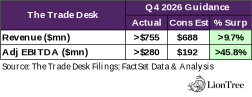
- What is the early read on Q1:27? Q1 is “always seasonally lower than Q4,” and in election years the seq decline has historically been ~25% on an absolute basis
- “You should definitely be mindful of that historical trend”
- Mgmt acknowledged that “Q3 was progress, but it was, of course, just one quarter”, but is confident it can return TTD to “stronger, more durable” growth
- They laid out 5 priorities heading into 2027…
- Improve how TTD serves the world’s largest brands and agencies
- Make the platform easier to access “while preserving the sophistication that differentiates it”
- Change how advertising is measured
- Keep “putting AI to work” to make marketers more productive and spend more effective
- Operate with “greater agility, greater focus, greater ownership, and faster speed”
- “If we keep executing against the changes that we have made…we think that we can return The Trade Desk to the stronger, more durable story that we were in the past”
- They laid out 5 priorities heading into 2027…
A Leaner Cost Structure Should Drive Operating Leverage In 2027 As Expense Growth Moderates
- Mgmt expects a “meaningful moderation in our expense growth” in 2027 vs 2026, creating “a significantly better foundation for operating leverage as revenue growth improves”
- More detail on the 2027 operating plan will come in February
- TTD reduced its global workforce by ~15% in Q3, resulting in ~$44mn of restructuring expense
- The Co expects to generate $100mn+ of gross savings in 2027, though “our objective is not simply to maximize near-term margins”
- Some savings will be reinvested and “some of that will flow through,” with aggressive investment in areas with “good line of sight to driving revenue growth”
- Beyond headcount, the Co is reviewing platform operations, software/SaaS, outside services and facilities, “making each dollar of investment compete for that capital”
- The goal is “translating incremental revenue into significantly greater incremental profitability over time”
TTD Is Narrowing Its Priorities & Bringing Back Its Co-Founder, With M&A Now More On The Table
- The Co is setting clearer priorities and allocating resources “more deliberately” against its highest-return opportunities (which include agentic AI, CTV, and measurement)
- “At times, we’ve been too focused on doing 100 small things instead of 10 big things that can move the needle for our clients”
- Co-founder Dave Pickles, the “architect of the platform” who stepped down as CTO in Sept 2023, “has agreed to substantially expand his role once again”
- “He can help us move faster” as TTD shapes “the next generation of advertising technology”
- Mgmt says it now has “most of the key players on board” on the leadership team after a series of senior hires
- On M&A, the Co is “looking more now than we historically have” given more opportunities in the market, BUT “our standards are also higher than ever”
- Mgmt doesn’t want to derail execution “by making our 17th priority our number one priority, simply because we bought a company”
Political Hits A Record As JBPs Show Results
- Political was a standout in Q3: This was “our biggest political election cycle yet,” with a larger total and growth rate than the last midterm, and a bigger growth rate than the last presidential cycle
- Mgmt credits its “objectivity and independence” and offering “all political parties equal access” to the platform
- “This particular cycle provides a more definitive proof point than we have ever provided to the market”… but highlighted “political will always be cyclical”
- The number of joint business plans (JBPs) was up 30%+ y/y through the end of Q3, including 20%+ growth in Q3, “representing hundreds of agencies and brands”
- But this was still a deceleration from +38% y/y (217 clients) as of Q2
- Customers under JBPs “continue to grow meaningfully faster” than those under traditional MSAs
- There are 100+ JBPs in the pipeline… “we have more in our pipeline than ever because that tactic is working”
- On the mid-market, mgmt is still prioritizing the largest advertisers, as “about half the TAM is contained inside of the top 1,000 advertisers” and there is “still massive amounts of room to grow” in the core biz
- Servicing those advertisers “is way different than servicing SMBs”
Product Innovation Is Accelerating, With Open Measurement Expected To Improve Growth In 2027+
- Open measurement, which mgmt calls its “most exciting product,” launches formally later this qtr and is expected “to improve our growth next year and provide a tailwind for years to come”
- The product aims to move beyond last-click and last-view attribution, which under-credit branding and premium media (CTV, sports, movies, news, music)
- “Unlike the walled gardens of Amazon and Google…we are not grading our own homework”…TTD provides “real sales data through real transactions”
- Premium publishers are “especially excited” about open measurement, as it gives them “another player [to] help validate that their premium media is worth it”
- Kokai Zuma launched in Q3, upgrading navigation, workflows and troubleshooting, and bringing more AI directly into the user experience
- Median active time to complete core setup workflows has declined, incl. -9% for campaign creation, -15% for ad group creation and -9% for uploading creatives
- Agentic AI is starting to automate manual work, with a campaign creation agent in beta that read a client’s media plan and set up campaign structure, ad groups, budgets and flights “in a matter of minutes,” work that “can take hours”
- Using MCP, Koa (TTD’s AI engine) can share audience objectives with data providers, whose AI systems respond with custom segments, creating “an open agentic ecosystem”
- Audience Unlimited (which gives advertisers AI-selected access to third-party data at a flat cost) is gaining traction, with over 100 advertisers now testing it and several hundred campaigns live
- In recent campaigns, advertisers improved CPA by 30%+ while reducing CPMs by ~14%; Multiple advertisers have also used it successfully “in direct competitive tests”
- The Co also expects it “to be a huge beneficiary of agentic AI as well”
- Also to flag…mgmt pushed back on take rate concerns, arguing that “the sticker price in some cases is” higher, but on true cost “The Trade Desk is not the most expensive platform in the space,” and expects “something close to where we’re at today” going forward
- The debate exists “because we are the most transparent platform in our space”…“others will just bury their costs into media”
- Take rate has stayed “within a point and a half” of its average over 10 years as a public Co
Grab Bag: Anthropic Office Tools / Streamers Push Further Into Short-Form / Drone Delivery Expansion Continues
- Ahead of its IPO next week, Anthropic unveils AI office tools that caused a bit of a stir (link/link/link)
- Functionalities –
- Claude Meetings: Joins video calls as a visible participant, listens and starts work during the meeting
- Claude Sheets: Builds and edits spreadsheets with Claude, exports to Excel or CSV
- Claude Whiteboards: Turns spoken planning into a board with timelines, owners and dates
- Claude Data: Connects Claude to data warehouses and CRM platforms, builds dashboards
- Availability: Whiteboards and Sheets are in beta, while Data is generally available, all on paid plans across web, desktop and mobile; Meetings is rolling out in beta on Team and Enterprise, initially supporting Google Meet only
- Functionalities –
-> Microsoft traded down -2% following the news
- Streamers continue to broaden their offerings, leaning further into short-form content…
- An internal Disney presentation outlined plans to strengthen Disney+ through increased short-form content, creator programming and a potential free tier (link): According to the leaked slide deck, initiatives in the works for Disney+ in the next yr include…
- Ramping up to adding 500 new vertical clips per day, and introducing creator content in early 2027
- A free tier with always-on FAST channels and content sampling
- 4K livestreaming for the Super Bowl
- Fully unifying Disney+ and Hulu into one app
- Peacock is expanding its microdrama lineup and plans to test more vertical livestreams (link): After introducing microdramas over the summer, the mobile app is adding new shows every Monday, with 60–90-second episodes and average viewing sessions of >30 mins
- The latest additions include Bravo’s first scripted microdrama, starring Southern Charm’s Craig Conover, alongside a micro-comedy starring Jimmy Fallon; NBC says its short-form content is driving more viewing of long-form shows and movies
- Peacock has also streamed a full NBA game vertically using AI to reframe the broadcast and plans to test vertical livestreaming for professional golf, college basketball and The Voice
- An internal Disney presentation outlined plans to strengthen Disney+ through increased short-form content, creator programming and a potential free tier (link): According to the leaked slide deck, initiatives in the works for Disney+ in the next yr include…
- Drone delivery gains higher altitude… Walmart expands its network as Wing ramps up manufacturing
- Walmart annc’d a new multi-yr agreement w/ Zipline to add 300 drone delivery sites nationwide, w/ the potential to expand (link): The rollout builds on Walmart’s drone delivery program, which has completed 2mn+ deliveries to date; Walmart has worked with Zipline to make drone deliveries since 2021 and currently offers drone delivery from 21 sites through Zipline
- As a reminder, Walmart also has an existing drone delivery partnership w/ Alphabet-owned Wing, with plans to expand that service to 270+ Walmart stores in 2027, reaching 40mn+ Americans (separate from the 300 new Zipline sites)
- Alphabet’s Wing annc’d plans to invest up to $125mn over the next two yrs in a new 15,000-square-foot drone manufacturing facility in Fort Worth, Texas (link): The plant will have capacity to build tens of thousands of aircraft annually and create up to 100 manufacturing jobs; The expansion supports Wing’s goal of reaching nearly 20 U.S. mkts by 2027 through its partnership w/ Walmart, up from five major metro areas today
- Walmart annc’d a new multi-yr agreement w/ Zipline to add 300 drone delivery sites nationwide, w/ the potential to expand (link): The rollout builds on Walmart’s drone delivery program, which has completed 2mn+ deliveries to date; Walmart has worked with Zipline to make drone deliveries since 2021 and currently offers drone delivery from 21 sites through Zipline
Stock Market Check
This Week's Other Curated News
Advertising/Ad Agencies/Ad Tech
- Political ad spending approached $12bn ahead of the 2026 midterms, highlighting shifts in campaign advertising. While broadcast TV ad spending cont’d to grow, cable spending declined, and streaming more than doubled its share, surpassing cable as the second-largest destination for political ad dollars. Through Oct. 28, broadcast and cable accounted for ~61% of political ad spending, down from nearly 72% in the 2022 election cycle, signaling changing media preferences ahead of 2028. (TheWrap)
Artificial Intelligence/Machine Learning
- A Howdy survey of 1,006 U. S. adults found growing use of AI agents alongside significant privacy concerns. While 40% use AI daily and 21% use AI agents, 85% of agent users worry about data privacy. Many have connected email, financial or medical information, while some reported unauthorized access or purchases. Despite convenience, most respondents want stronger protections, govt regulation, and greater accountability from AI cos. (Cord Cutters News)
- Anthropic PBC’s plans for a record IPO are facing increased scrutiny following the unexpected ousting of NVIDIA’s CEO, drawing attention to the close ties between the two AI firms. As part of Anthropic’s offering, Nvidia has agreed to purchase ~$10bn of shares within a $26bn private placement running alongside the IPO. Anthropic also identifies Nvidia as a strategic partner and has committed tens of bn of dollars to secure access to its most advanced AI chips. (Bloomberg)
- Cerebras Systems shares surged 17% after the AI chipmaker reported Q3 results above expectations and annc’d a new deal w/ Microsoft. The Co posted adj EPS of $0.12 versus an expected loss and core rev of $230.9mn, up 70% yr over yr. Management guided Q4 rev of $310mn-$330mn and a 47%-49% core gross margin, both ahead of forecasts, while expecting rev to triple in 2027 as demand for its AI tech grows. (CNBC)
- Google annc’d Gemini 4 Hydrogen, an AI model built for fast coding and agentic workflows across Google AI Studio, the Gemini API, Google Search, and enterprise offerings. The model delivers stronger performance, supports a 1mn-token context window, offers four reasoning levels, and is designed to improve speed, efficiency, reliability, and safety in developer, enterprise, and consumer use cases. (Google)
- Tencent’s founder Pony Ma urged the Co’s 100,000 employees to embrace AI, describing the industry as entering an “Age of Discovery.” In an annual anniversary speech, Ma compared Tencent’s core operations to an army and its emerging AI initiatives to a navy. He said the army should use AI to improve efficiency, while 50% of personnel would be redeployed to support AI-native biz, underscoring Tencent’s commitment to expanding its AI-focused operations. (Bloomberg)
- Anthropic PBC’s IPO has attracted demand of about six times the shares available, reflecting strong investor interest. The Claude AI developer and its co-founders aim to raise up to $64.4bn through the IPO and an additional $26bn via a private placement. Combined, the fundraising would surpass SpaceX’s IPO, making it the largest listing ever if completed as planned. (Bloomberg)
- A forensic analysis of publicly released AI models found evidence that models released since Apr. 2026 by DeepSeek, Moonshot AI, MiniMax and Ant Group contain numerical patterns matching NVIDIA Blackwell GPUs, which require a U.S. export license for China. The report said six models matched Blackwell hardware while earlier models matched Hopper chips. Researchers said the findings provide technical evidence of access to advanced computing hardware but do not establish whether export controls were violated. (Unemployment Labs)
- Anthropic’s bankers are considering raising the AI Co’s IPO valuation to ~ $1. 5tn, up from the previously disclosed ~$1.4tn target, after receiving strong investor demand during the roadshow. The offering could raise more than $100bn, above the initial $64bn target. (Financial Times)
- Apple has launched its first AI monetization model through Apple Creator Studio apps, introducing $49. 99 one-time “intelligence usage packs” in Logic Pro. The packs provide additional AI usage after users reach monthly limits, w/ unused usage rolling over and expiring 12 months after purchase. Apple said packs are tied to a single Apple Account and are expected to expand to Final Cut Pro, Pixelmator Pro and iWork apps later this month. (9to5Mac)
- Meta Superintelligence Labs released Muse Ember, its lightest and most cost-efficient AI model, built for agent execution tasks such as tool calls, coding subtasks, routing, extraction and long-document parsing. At $0.10 per mn input tokens, Ember is positioned as cheaper than rivals including Anthropic Haiku and OpenAI Luna. Designed to work alongside Muse Wonder, it supports text, images and audio, enabling agents to process screenshots, charts, scanned documents, voice memos and video. (TechCrunch)
- United Airlines said it will restrict AI agents’ access to its digital platforms, citing data security and regulatory concerns. The airline warned that sharing account credentials w/ third-party AI assistants could expose sensitive data, enable unauthorized use of frequent-flyer miles, or trigger unintended purchases and account changes. It also flagged risks tied to automated flight check-ins and plans to tighten booking, ticketing, and distribution policies. (Reuters)
- Bytedance plans to launch a Muse-like AI assistant in the coming weeks as part of efforts to strengthen its position in AI video and narrow the gap with leading U. S. AI labs. During a recent all-hands meeting, co-founder outlined priorities for the AI team, saying the Co aims to compete at the frontier. (Bloomberg)
- ERNIE 5. 5 Flash Preview is Baidu’s first post-trained model based on ERNIE 5.5 Flash Base. It features 280B parameters, 14B active parameters and a 1M-token context window. The model is designed for coding, 3D modeling, knowledge work and content creation, delivering end-to-end outputs through agent workflows. Available via Qianfan, it will be open-sourced under Apache 2.0 and remains under active post-training. (Baidu)
- Amazon annc’d a text-to-shop feature for its AI agent, Alexa for Shopping, initially for select U. S. customers, with a broader rollout planned in coming weeks. Users can text requests to add items, reorder products, track prices and deals, or upload a recipe photo to build a shopping cart. The feature also connects to products across the web via Shop Direct, as Amazon expands AI-driven shopping despite ongoing consumer trust concerns around agent-led purchases. (Retail Dive)
- Chinese AI firms are rushing to secure overseas Nvidia-powered cloud capacity amid fears a scandal involving CEO Jensen Huang could spur tighter U. S. curbs on remote access to advanced AI chips. Firms are reserving capacity in overseas data centers, while grey-market buyers stockpile chips. Concerns center on the proposed RASA bill, which could close a key export-control loophole used to access high-end processors. (Reuters)
- Amazon and Google stand to realize a combined $411bn windfall if Anthropic prices its IPO at the top of its proposed range. Amazon invested $18.0bn and its stake could be worth $271.8bn, while Google invested $33.3bn and could see its stake reach $139bn. The filing also details major private funding rounds and a $26.0bn IPO-linked private placement involving tech investors including Nvidia, AMD, and Microsoft. (Reuters)
- Anthropic could generate $685bn in annual rev by 2030, according to Goldman Sachs, highlighting expectations around its planned IPO. Enterprise sales are projected at $586bn, w/ another $100bn from non-enterprise customers, versus $4.58bn rev last yr. The AI Co is targeting a $1tn-$1.4tn valuation and plans to list on Nasdaq as ANT on Nov. 19. Analysts expect continued negative free cash flow through 2030 as spending on compute infrastructure rises toward $400bn. (Yahoo Finance)
- Governor Kathy Hochul launched the New York Center for AI Responsibility and Research at SUNY Binghamton University, bringing together 80+ researchers to study AI safety, test advanced AI systems using Empire AI, and develop evaluation standards. The initiative supports New York’s AI safety agenda and the RAISE Act, which requires frontier AI developers to meet reporting, transparency, and safety requirements beginning Jan. 2027. (Governor Kathy Hochul)
- OpenAI is launching verified “Business Agents” in ChatGPT beta for eligible US e-commerce and online svs biz. These AI agents represent brands and can assist users w/ comparison shopping, product questions, and follow-up queries. Businesses can customize agent instructions and provide context so agents accurately explain offerings and distinctions between products, improving customer engagement through ChatGPT. (The Verge)
- Anthropic PBC’s seven co-founders, including Dario Amodei and Daniela Amodei, plan to sell a combined $1. 75bn worth of shares in the Co’s upcoming IPO. Each co-founder is offering shares valued at ~ $250mn at the midpoint of the IPO range. Based on that valuation, each is expected to have a net worth of ~ $18bn, according to the Bloomberg Billionaires Index. (Bloomberg)
- Late 2026 tech job data from Lenny Rachitsky shows PM roles leading the AI era, w/ openings up 75% from Mar. 2023 lows and growing faster than engineering. Engineering demand is plateauing, though hiring remains substantial. Design hiring continues to decline, reaching record lows. AI skills such as LLMs, Claude, Cursor, and OpenAI now feature prominently across job postings. Tech jobs are increasingly concentrated in the Bay Area, while remote opportunities have fallen to record lows. (Lenny’s Newsletter)
- Apple is considering making Siri AI function more like an autonomous agent as early as next yr, allowing it to track goals, determine next steps and pursue objectives without requiring users to initiate every action. Gurman said this would move Siri closer to AI agents such as OpenAI’s Dots, Meta’s Muse and Grok. He also reported that CEO John Ternus urged faster progress on Apple’s AI software roadmap. (MacRumors)
- CoreWeave annc’d a multi-yr agreement w/ Wayve, under which Wayve will train its AI Driver foundation models on CoreWeave Cloud using NVIDIA Blackwell GPUs to expand training, evaluation and simulation capabilities. Wayve said access to CoreWeave’s AI cloud will help accelerate commercial deployment of autonomous-driving tech. The deal supports increasingly demanding physical AI workloads built from real-world driving data collected across 70+ countries. (CoreWeave)
- The Commodity Futures Trading Commission (CFTC) has delayed approval of futures contracts tied to AI computing power, pushing potential trading activity into early 2027. The contracts, proposed by CME Group, would track rental prices of Nvidia H100 and B200 GPUs. The regulator cited concerns over price manipulation, opaque GPU rental pricing and supplier concentration, and is seeking further input before allowing trading in the emerging computing-power derivatives mkt. (Financial Times)
- OpenAI closed an initial $11bn funding tranche that values the AI startup at $1. 25tn. The amount raised is only part of its original goal of up to $30bn, while its valuation is below the $1.5tn level initially sought. SoftBank and MGX participated in the round. The report noted cooling investor sentiment toward AI firms, citing Anthropic’s planned IPO valuation expectations also easing recently. (Reuters)
- DeepSeek, the Chinese AI disruptor, said on X that its open-source AI agent app, DeepSeek Harness, reached 1. 54mn daily active users by Nov. 4, less than three months after launching on Aug. 13. The platform’s growth accelerated following the release of a desktop version, with daily users rising from ~271,000 at the end of Sept. to 1.54mn by Nov. 4, based on users connecting to DeepSeek’s own servers. (Bloomberg)
- Anthropic annc’d two new AI models, Claude Fable 5. 2 and Claude Mythos 5.2, as it seeks to strengthen its position in the AI market ahead of a planned IPO. Fable 5.2 targets coding, reasoning and AI agent tasks, while Mythos 5.2 is designed for approved cybersecurity and life-sciences research and is restricted to verified organizations. The models are up to 30% faster than Claude 5.1, offer clearer communication, and are priced below prior releases. (Reuters)
Audio/Music/Podcast
- iHeartMedia denied reports that it plans to sell its podcast biz after Bloomberg reported about a possible partial or full sale. The Co said podcasting remains a core growth engine and it will cont’d investing in the segment, including video podcasting. (The Hollywood Reporter)
- iHeartMedia’s stock plunged over 60% after Q3 2026 results missed estimates, posting a 6-cent per-share loss and rev up 3. 3% to $1.03bn. CEO Bob Pittman said major advertisers delayed spending until after elections, citing inflation, volatile fuel prices and consumer uncertainty. These pressures may persist through 2026. GAAP operating income reached $73mn vs. a $116mn loss a yr earlier, while adj. EBITDA fell to $170.5mn from $204.8mn. (Yahoo Finance)
- SiriusXM annc’d Anjali Sud, currently CEO of Tubi and a board member since 2025, as its new CEO effective Jan. 1, 2027. She succeeds Jennifer Witz, who will depart after nearly 25 yrs at the Co and remain in an advisory role through 2027. (SiriusXM)
Broadcast/Cable Networks
- Donald Trump’s post-midterms interview on “60 Minutes” attracted 7. 8mn viewers and 918,000 adults aged 25–54, making it the second-smallest audience for a Trump episode since 2015. The broadcast was down 44% from his Nov. 2025 appearance but up 5% from Apr. 2026. The interview generated 195mn video views across the program’s social media platforms. (TheWrap)
- Walt Disney Co and Skydance are considering bids for domestic audiovisual rights to France’s Ligue 1 football league, potentially entering the French football broadcasting market for the first time. The French Professional Football League launched a tender for Ligue 1 TV rights covering 2027-2032, seeking to rebuild after yrs of declining rev. Interested parties have until Dec 3rd to submit bids. (Bloomberg)
Cable/Pay-TV/Wireless
- T-Mobile executives Jon Freier and André Almeida said the Co remains focused on competing against Verizon and AT&T despite SpaceX’s expanding wireless ambitions. They argued satellite-based connectivity is complementary and best suited for low-density areas, while T-Mobile plans to maintain network leadership in 5G and 6G. Deutsche Telekom CEO Timotheus Höttges views Elon Musk as a serious long-term competitor, while analyst Roger Entner expects limited disruption beyond rural telecom providers. (Fierce Network)
- StarHub reported Q3 2026 svs rev of SGD396. 1mn, up 2.9% YoY, as stronger enterprise performance offset continued weakness in its consumer biz. Total rev, excluding Ensign, increased 4.5% to SGD486.8mn. EBITDA declined 26.3% to SGD72.1mn due to lower gross profit, higher operating expenses and reduced other income. Operating expenses rose 11% YoY, partly driven by increased staff costs associated w/ investment. (Telecompaper)
- Vodafone reported double-digit growth in rev and adj EBITDAaL in the first half of its fiscal yr. The operator also recorded stronger B2B performance and higher svs rev across all mkts. Reflecting this momentum, the Co upgraded its full-yr outlook and expects improved financial performance going forward. (Telecompaper)
- Vodafone Deutschland said it will cut 2,300 jobs as the Co accelerates cost-cutting efforts amid intensifying competition. The Co aims to boost competitiveness and growth by simplifying structures, increasing use of AI and making targeted investments. It will further integrate sales and customer svs while investing in AI, IT, fibre-optic networks and digital channels. Lower rev, pricing pressure, a shrinking TV market and inflation drove the move. (Reuters)
- Comcast plans to cut more than 1,000 jobs in its connectivity and platforms divisions as it prepares to separate those declining units from its faster-growing media and entertainment segment. Recently filed notices show 634 job cuts in Pennsylvania, where the Co is headquartered, along w/ 119 positions in New Jersey, 159 in Washington state and 82 in California. Total announced reductions across those states amount to 994 roles. (Bloomberg)
Cloud/DataCenters/IT Infrastructure
- Nscale updated its IPO prospectus, reporting a Q3 net loss of $1. 69bn on rev of $307.5mn, up 1,344% YoY. The loss widened from $1.02bn in Q2 despite strong top-line growth. The Nvidia-backed neocloud operator has faced setbacks after Microsoft withdrew from planned data-center arrangements, though it expects the Co to remain a significant future customer. Anthropic also expanded its computing-power commitment to Nscale. (CNBC)
- AWS annc’d AWS Emulator, a free tool for building and testing AWS applications locally on a computer or CI environment. Existing SDK and CLI calls run against the emulator and return results in milliseconds, helping developers and coding agents identify and fix issues before deployment. The tool uses AWS API models, maintains isolated in-memory resource states, requires no AWS account, and has no additional fee. (AWS)
- Voters in 10 US states backed restrictions or rejected proposals for data center development following Nov. midterm elections, boosting concerns over stricter oversight of AI infrastructure. Data center opponents benefited from Democratic gains, and the results may increase pressure on the tech industry. (Yahoo Finance)
- CoreWeave is in talks w/ banks to raise at least $4bn through an investment-grade loan to lower funding costs and finance its artificial intelligence chip capacity. The loan would be backed by a contract w/ Meta Platforms Inc. While CoreWeave’s debt is rated speculative grade, Meta’s stronger credit profile could help the loan secure a blue-chip rating, enabling more attractive borrowing terms. (Bloomberg)
- Nvidia-backed neocloud Nscale warned it must obtain additional financing to meet forecast 2027 obligations after placing significant Nvidia chip orders to fulfil a $45bn Anthropic contract. The Co said some commitments cannot be deferred, reduced or cancelled, while new purchase orders have significantly increased short-term capital expenditure requirements. The disclosure deepens uncertainty around Nscale’s planned $35bn New York IPO. (Financial Times)
- SpaceX said it plans to invest over $74bn in AI supercomputing campuses at Starbase, Texas and Cochise County, Arizona, expanding beyond its rocket and satellite biz. The AI segment generated more than half of Q3 rev. SpaceX expects to spend over $24bn in Texas and ~$50bn in Arizona. The Arizona project could create 5,500 construction and 1,000 permanent jobs but still requires approval and faces local opposition. (Reuters)
- SpaceX plans to construct, own and operate a gas-fired power plant and super-compute facility at its company town in Starbase, Texas. The initial phase of the project is expected to require a $24bn investment. A notice on the city’s website states that city commissioners will consider approval of a tax abatement and development agreement related to the project at a Dec. 9 meeting. (Bloomberg)
- SoftBank Group swung to a $7bn net loss in Q2, driven by costly U. S. data centre expansion, a $3.7bn charge tied to advance payments for power-generation equipment, and sharply higher financing costs. The group raised a record $56.5bn to fund AI investments, including data centres, robotics and OpenAI. Management said future rebates could offset part of the equipment losses, while rising debt and weaker AI sentiment weighed on investor concerns. (Reuters)
- Nscale, a UK AI data-centre developer, is considering delaying its planned New York listing, which had targeted a valuation of up to $35bn, after a tech sell-off and investor concerns over AI infrastructure growth. The Co is assessing whether to postpone the float until next yr amid volatile mkts. The potential delay follows Microsoft’s withdrawal from a site deal, while concerns around debt-heavy AI operators have weighed on sector valuations. (Yahoo Finance)
- Microsoft and other tech firms urged the Trump administration to drop a proposed ban on Chinese optical transceivers used in AI data centers, arguing it could delay US data-center expansion and weaken its edge over China in the AI race. The US plans to restrict imports over security concerns, while industry groups warn supply disruptions could leave AI chips idle. Chinese suppliers currently control about two-thirds of the global market. (Reuters)
Crypto/Blockchain/web3/NFTs
- Coinbase received a national trust charter from the Office of the Comptroller of the Currency, giving it federal oversight and authority to provide fiduciary svs, digital-asset custody and potentially expanded payment or stablecoin svs. The charter does not allow traditional FDIC-insured deposits or commercial lending. Executives said a single federal framework will replace oversight from multiple state regulators and support institutional crypto adoption. (Yahoo Finance)
- Polymarket has laid off employees and ended relationships w/ several contractors as part of a broader reorganization aimed at recovering from recent setbacks that left the prediction-market platform trailing its primary competitor. A company email, later shared on X and confirmed as authentic by the Co, stated that some contractors were being released as part of a company-wide reduction in force conducted this month. (Bloomberg)
- A group of financial institutions, including Goldman Sachs Group Inc. , Citigroup Inc., Banco Santander SA, and Deutsche Bank AG, have committed ~ $270mn to fund a joint stablecoin venture. The funding is expected to support five yrs of operations for a new Co that will issue a dollar-denominated stablecoin. The venture stems from plans outlined earlier this yr by a consortium of 21 institutions, and the Co is expected to be incorporated in the US. (Bloomberg)
- Donald Trump’s administration is backing US expansion of perpetual futures, or “perps,” crypto-derived contracts that trade 24/7 and never expire. Incumbent exchanges including CME Group argue the products are misclassified as futures rather than swaps and pose leverage, liquidity and counterparty risks. (Reuters)
Cybersecurity/Security
- North Korean state-backed hackers stole over $400mn in cryptocurrency during the past 18 months through an FBI-identified social-engineering campaign called “FaceStealer.” Victims were lured into fake Zoom, Microsoft Teams and Google Meet video calls using compromised accounts, then tricked into installing malware. The FBI seized 900+ victim videos and linked the activity to Sapphire Sleet (UNC1069), warning that AI-generated deepfakes are increasingly being used in the scheme. (Reuters)
- Federal prosecutors allege three men used generative AI to impersonate the voices of CEOs and lawyers in a fraud scheme that targeted firms in the US and Europe over ~18 months from Jul. 2024. The scheme convinced employees to make urgent wire transfers, stealing over $129mn. Victims included a UK fintech Co ($11.6mn), a Florida pet food Co ($5mn), a California hospital system ($3mn), a Massachusetts mutual fund Co ($4.7mn) and a Rhode Island bank ($2.7mn). (The New York Times)
- France said Iran’s Islamic Revolutionary Guards Corps was behind a major cyber-attack that remotely altered temperatures in supermarket freezers and chillers on Oct. 11-12, damaging food inventories and disrupting operations across up to 700 stores. Jean-Noël Barrot said European sanctions would follow, while investigators linked the attacks to the Shahid Kaveh cyber unit. Similar incidents later affected blood-storage facilities and retailers across Europe. (The Guardian)
- Grok Build, the coding agent from SpaceXSI, exposed sensitive data from more than 35,000 apps due to a flawed link-sharing design. Claroc found confidential information including internal business plans, sales proposals, employee records, medical data, and operational documents from multiple organizations, including SpaceXSI itself. The issue allowed app links to be discovered through passive DNS searches, giving public access to stored data. (Ars Technica)
- Ring annc’d Ring Robotics, a new autonomous security category featuring Ring Drone Cam for homes and Ring Rover Cam for biz. Both use AI Pilot to map spaces, suggest patrol points and navigate around obstacles. The Drone Cam provides mobile indoor monitoring and automatic incident checks, while the Rover Cam conducts autonomous patrols, streams up to 4K video and responds to security events. (Amazon)
eCommerce/Social Commerce/Retail
- TikTok Shop is piloting a paid membership program, TikTok Shop Plus, rolled out to 1mn shoppers. Members receive free shipping, exclusive discounts and other benefits. The tier includes a 30-day free trial and then costs $9.99 per month. The platform launched in the U.S. three yrs ago and is gaining share in social commerce. A standalone app is now available in supported mkts for iOS and Android. (Retail Dive)
- PVH Corp plans to cut ~4% of its global workforce, primarily non-customer-facing roles, equal to about 12% of office-based associates, as part of a broader productivity and profitability initiative. The owner of and expects $100mn in pre-tax cost savings in fiscal 2027 and is streamlining operations to speed decision-making while continuing investments in product innovation, supply chain and e-commerce. (Retail Dive)
- Dollar General is expanding its Instacart partnership nationwide after a successful Sept. pilot. Customers can now access same-day delivery, in as fast as 30 minutes, from ~20,000 Dollar General and Popshelf stores across 48 states. The offering includes groceries, household essentials, health and beauty products, and pet and seasonal items. The retailer also continues delivery partnerships w/ DoorDash, Uber Eats, and its myDG Delivery platform. (Chain Store Age)
- CNBC/NRF Retail Monitor showed Oct. retail spending rose 0.2% m/m and 3.6% y/y to $561.7bn, while core spending increased 0.3% m/m and 3.4% y/y to $454.2bn. Growth slowed to its weakest pace since Nov. 2025, indicating consumers are becoming more selective as higher prices pressure budgets. Strong Halloween demand and early holiday promotions supported spending, while furniture and home furnishings sales remained weak. (CNBC)
- The Children’s Place filed for Chapter 11 bankruptcy and is pursuing a sale process aimed at finding new ownership by year-end. The retailer, which operates ~500 North American stores, has begun store-closing sales while keeping stores and its website open. The Co reported over $881mn in debt against ~$742mn in assets. It has received nine acquisition proposals, including going-concern and liquidation bids, as discussions w/ potential buyers cont. (Retail Dive)
- ThredUp reported Q3 rev of $88. 2mn, up 7% y/y, slowing from 34% growth a yr earlier, despite record 1.82mn active buyers (+16%) and record orders/items sold (+17%). Net loss widened to $5.5mn from $4.2mn. Citing intense competition, pressure on price-sensitive shoppers and expectations for heavier holiday promotions, the Co lowered Q4 rev guidance to $77mn-$79mn and reduced full-yr outlook to $337.7mn-$339.7mn. (Retail Dive)
- NRF forecasts Nov. -Dec. holiday sales of $1.013tn despite weakening consumer confidence, now at its lowest since 2014. Retail demand is increasingly split: luxury apparel traffic is rising while mid-tier retailers lag. Budget pressure remains high, w/ 4 in 10 Americans struggling to afford necessities and 45% planning to buy fewer gifts. Value-focused retailers, promotions, e-commerce growth and BNPL are expected to help drive spending. (Forbes)
- Instacart argued its proposed $17bn merger w/ DoorDash would help traditional grocers compete against Walmart and Amazon, whose investments are increasing pressure on the sector. Chief Commercial Officer Ryan Hamburger said the combined scale would support innovation and strengthen grocers’ ability to retain customers. Several retail partners, including Coborn’s, backed the deal, while regulatory approval is not expected before late 2027. (Grocery Dive)
EdTech
- Coursera annc’d a limited-duration stockholder rights plan, effective immediately and expiring in 1 yr, after a stockholder accumulated ~14. 7% of its common stock. The plan aims to protect long-term value, prevent creeping control, and ensure stockholders receive an appropriate premium in any control transaction. Rights are triggered at 15% ownership, with holders able to buy shares at a 50% discount under specified conditions. (Coursera)
- Coursera annc’d a workforce reduction plan affecting ~10% of its global workforce following its completed merger with Udemy in May. The Co expects to incur $14mn-$17mn in charges, mainly for severance and healthcare benefits, with most costs incurred in Q4 2026 and H1 2027. The move is part of integration and synergy initiatives, and the Co said additional operational efficiency measures may lead to further costs and benefits. (Investing.com)
Electric & Autonomous Vehicles
- SpaceX and Tesla are progressing merger talks that could lead to the biggest-ever deal, w/ an annc’d transaction possible in Dec, though timing could slip into early 2027. Boards and advisers are negotiating terms and governance. The combined Co would unite EVs, batteries, rockets and satellites, driven by AI ambitions, but faces China, national security, regulatory and shareholder approval hurdles. (Yahoo Finance)
- Elon Musk said many Tesla Cybertruck buyers may receive deposit refunds as orders exceed production capacity and the Co plans to wind down production in ~8 months. Musk said the decision reflects the higher value of expanding Cybercab output, not Cybertruck profitability. Cybertruck sales fell 48% from 38,965 in 2025 to 20,237 in 2026, while Tesla cont’d shifting focus toward autonomous vehicles and robots. (Fortune)
Film/Studio/Content/IP/Talent
- Netflix is expected to acquire the 55-acre Radford Studio Center in Studio City through a Nov. 24 foreclosure auction after lenders repossessed the property from Hackman Capital Partners. The streaming Co had discussed a ~$400mn purchase, far below the $1.85bn paid in 2021. Ownership would allow Netflix to consolidate Los Angeles production operations and reduce long-term studio rental costs. (The Hollywood Reporter)
- Adobe and The Walt Disney Company annc’d a multi-yr strategic alliance to advance creativity and storytelling through AI-powered tools. Adobe will provide early access to tech including Firefly, Photoshop and Premiere, plus engineering support, to help Disney accelerate content creation, theme park development and sports storytelling. The partnership also expands collaboration across StudioLAB, ESPN Edge and global marketing initiatives. (Business Wire)
FinTech/InsurTech/Payments
- Kalshi ended Donald Trump Jr’s advisory contract after his VC firm, 1789 Capital, increased its stake in rival Polymarket. Kalshi said discussions began in Aug. following 1789’s funding round and cited a conflict of interest, not politics. The move comes as prediction mkts face growing scrutiny from Democrats and lawmakers over insider trading, ethics, and ties to political figures. (Reuters)
- Americans’ credit card debt reached a record $1. 29tn in Q3, rising $22bn from the prior quarter and 4.2% from a yr earlier. Total household debt climbed to a record $19.1tn. Separate TransUnion data showed the average card balance rose 2.4% YoY to $6,678, while card holders increased to 178mn. Researchers said persistent inflation, higher borrowing costs and growing financial strain are contributing to rising debt and borrower distress. (CNBC)
Handheld Devices & Accessories/Connected Home
- Samsung annc’d the U. S. launch of its Intelligent Eyewear lineup, available Dec. 10 with pre-orders starting Nov. 12. Developed w/ and featuring built-in , the eyewear combines Samsung engineering with 30 designs from and . Features include hands-free AI assistance, translation, navigation, notifications, a 12MP camera, open-ear audio, and privacy-focused controls. (Samsung)
- Warby Parker is taking pre-orders and offering in-store previews of its Intelligent Eyewear Collection ahead of a mid-Dec. rollout. Developed w/ Google and Samsung, the smart glasses start at $395 and feature Google Gemini AI, Android XR, a 12-megapixel HDR camera, open-ear speakers, four microphones and up to nine hrs of battery life. Google also committed up to $150mn in development and investment support. (Chain Store Age)
HealthTech/Wellness
- Whoop launched Whoop Humans, a social network within its app that lets members follow others and selectively share health data such as sleep, recovery and workouts. CEO Will Ahmed said the feature is opt-in and includes privacy controls, while supporting the Co’s broader push into medical wellness. Whoop also reported strong membership growth and expects nearly 4mn members by yr-end. (TechCrunch)
- ŌURA annc’d a definitive deal to acquire AI-native primary care startup Counsel Health for $625mn cash, integrating Counsel’s medical AI and physicians into the Oura App. The combination will let members use biometric insights to access personalized guidance, diagnoses, prescriptions and referrals. Oura said the deal expands preventive, acute and chronic care offerings. The Co also reported Sept. 30, 2026 quarterly rev of $533mn, up 153% yr/yr, serving 6mn+ members. (Business Wire)
- Peloton annc’d a global refinancing, launching a private offering of $600mn senior secured notes due 2032 and proposing a $200mn five-yr revolving credit facility. Net proceeds, along w/ cash on hand, are expected to repay all outstanding debt under its existing $1bn term loan facility and cover related fees. Any remaining proceeds may support general corporate purposes, including share repurchases, capex, working capital and acquisitions. (Peloton)
Last Mile Transportation/Delivery
- A ShipBae survey of 1,974 U. S. adults found shipping experiences strongly influence trust in retail brands, w/ 96% saying delivery performance affects confidence. Consumers value real-time tracking and notifications, while delays, lost packages and inaccurate shipping updates hurt loyalty. Although 93% may abandon purchases without free shipping, 63% prioritize fast shipping. Many expect orders to ship within 24-48 hours and accept a holiday delivery window of seven days or less. (Chain Store Age)
- Uber annc’d Uber Parking, an in-app tool that lets drivers find, reserve and pay for parking spaces in advance, powered by its SpotHero acquisition. The feature integrates 13,000+ parking facilities across 400+ cities, offers filtering options, QR-code or license-plate entry, and flexible cancellations. Uber One members earn 10% back in credits. (The Verge)
Macro Updates
- The U. S. Federal Reserve unveiled a revised 2027 meeting schedule after Chairman Kevin Warsh said policymakers would vote on interest rates seven times instead of the traditional eight. Officials will still meet eight times, but the Oct. 26-27 meeting will focus on monetary policy strategy rather than rate decisions. The final rate-setting meeting shifts to Nov. 16-17, and meetings in Mar., Jun. and Sept. are no longer marked for quarterly economic projections. (Reuters)
- U.S. existing home sales fell 5.5% month-over-month and 8.8% yr-over-yr in Oct. to a seasonally adj annual rate of 3.75mn homes, the lowest level since Aug. 2010, according to the Lawrence Yun-led National Association of Realtors. Mortgage rates above 7% continued to weigh on activity, with sales declining across all regions. The West saw a 14.5% yr-over-yr drop, while the Northeast fell 4.1%. Yun said 2026 sales could finish below 2025’s 4.06mn level. (Yahoo Finance)
- China’s trade surplus surpassed $1. 04tn in the first 10 months of 2026 as strong global demand for AI infrastructure boosted exports of high-tech products and offset weak domestic demand. exports rose 35.2% YoY, ahead of forecasts, while the surplus reached the $1tn mark a month earlier than in 2025. T (Reuters)
- Average US new-vehicle transaction prices rose 2. 1% yr-over-yr in Oct. to a record $51,109, according to Cox Automotive. The increase outpaced overall inflation even as US new-car sales slowed. Automakers cont’d prioritizing profitability over volume, charging higher prices while consumers remained focused on expensive, high-margin vehicles such as full-sized pickups and SUVs, supporting stronger profit margins despite softer demand. (Bloomberg)
- The U. S. average price of regular gasoline fell to $3.9788 per gallon, dropping below $4 for the first time since Jul., according to AAA. Prices were down ~17 cents from a week earlier and ~39 cents from a month ago. Lower crude oil prices, seasonal weakness in fuel demand, and recovering Persian Gulf oil flows helped ease pump prices. While energy inflation slowed in Oct., officials cautioned that energy shocks could still affect inflation if elevated levels persist. (CNBC)
Media Conglomerates
- Matt Murray said The Washington Post is nearing breakeven after years of losses totaling hundreds of mn dollars and expects 2027 to be its strongest yr in seven years. Q3 direct ad sales posted the best growth since 2021, while programmatic rev rose 48% YoY through Sept. The newsroom is hiring again, leadership is focused on data and stability, and the paper aims to strengthen its Washington coverage to drive future growth. (ADWEEK)
- CNN veterans, including camera operators and fact-checkers, accepted voluntary buyouts offered after Skydance’s acquisition of Warner Bros. Discovery. The program was available to employees at vice president level or below w/ more than 15 yrs of service. Skydance, carrying $80bn in debt, has pledged $6bn in operational savings over three yrs, prompting scrutiny over future staffing and growth plans. (Variety)
- Fox is seeking to raise ~$8bn through an investment-grade bond sale to help finance its $22bn acquisition of Roku, which closed on Nov 6th, months ahead of expectations. Investor calls began on Nov. 9, and notes could be sold this week across maturities of 3-40 yrs. Fox previously borrowed $8.4bn via a bridge facility and secured a $2bn term loan from Morgan Stanley. The deal would create the third-largest US TV player by viewing share and expand Fox’s ad-supported streaming presence through Roku and Tubi. (Yahoo Finance)
Metaverse/AR & VR
- Disney is bringing 60+ 3D movies to the Disney Plus app on Meta Quest via an update rolling out now. Subscribers can watch titles including The Avengers and Black Panther in 3D and view select films in themed immersive virtual environments, such as Tatooine for Star Wars: A New Hope and the Scare Floor for Monsters, Inc. The app will also support IMAX Enhanced movies on Meta’s VR Glasses, due in spring 2027. (The Verge)
Online Travel
- OpenAI acquired AI travel agent Odessia, founded by Francis Davidson, who joined the Co to help shape the future of travel. Deal terms were not disclosed. The ~1-yr-old startup raised $6mn from Sequoia and had helped users plan mn of dollars in travel before shutting down. OpenAI said travel is a frequent use case for ChatGPT, though it annc’d no new travel products. (TechCrunch)
Regulatory
- Tim Scott, chair of the US Senate Banking Committee, asked former Nvidia CEO Jensen Huang and Howard Lutnick to testify over recent developments involving the chipmaker and concerns about the protection of sensitive US tech. Huang resigned after reports about a relationship w/ a businesswoman suspected by US authorities of ties to Chinese espionage. Scott said lawmakers and the public deserve answers and may pursue subpoenas if needed. (Reuters)
- The European Union is proposing stronger consumer protections through the Digital Fairness Act to address social media addiction and online “dark patterns. ” The plan, presented by the European Commission, would allow users to switch off features that encourage compulsive or excessive online behavior. The measures also include fines for companies that fail to comply w/ the proposed rules. (Bloomberg)
- Meta was fined £450,000 ($596,565) by UK regulator Ofcom for repeatedly providing inaccurate information on WhatsApp Business during a telecoms market review. The regulator said errors in data on messaging volumes and rev remained unresolved for up to 11 months and breached five information requirements. The original £600,000 penalty was cut 25% after the Co accepted liability, settled the case, and cooperated w/ the investigation. (Reuters)
Satellite/Space
- Starlink’s U. S. user base is expanding beyond rural areas, with urban Speedtest users up 73% YoY in 1H26 versus 33% growth in rural regions, according to Ookla. Upload speeds rose 42% to 20.73 Mbps, while latency improved to under 40 ms in 49 states and D.C., aided by SpaceX’s V2 Mini satellites. Promotional pricing and switching from cable, DSL and FWA drove adoption, though download speeds still trail major U.S. 5G FWA providers. (Fierce Network)
- Amazon Leo completed its 1,000th satellite in Sept and is preparing LV-01, its first launch aboard ULA’s Vulcan rocket, targeting liftoff on Nov 13, 2026, from Cape Canaveral. The mission will carry 40 satellites, the largest Leo payload to date, and is the first of 38 contracted Vulcan launches. Amazon said new launch infrastructure will enable faster mission cadence, w/ LV-02 expected within weeks, supporting deployment of its first-generation satellite constellation and broader service rollout. (Amazon)
- AST SpaceMobile said it is on track to launch nationwide intermittent U. S. satellite-to-device svs by end-2026, supported by partnerships w/ AT&T and Verizon. Q3 rev reached $42.3mn, while full-yr guidance remains $150mn-$200mn. The Co also plans its own Blacklift rocket for launches from late 2028, secured a ~$100mn U.S. Space Force contract, and highlighted strong liquidity of $3.2bn. (Fierce Network)
- SpaceX annc’d the Starlink Mini 2, an all-in-one satellite internet terminal combining a dish, Wi‑Fi router, and integrated battery in a laptop-sized device. Priced at $999 and including 1 yr of Roam Unlimited svc, it can operate for up to 4.5 hours per charge and supports hot-swappable batteries or 60W USB‑C power. The unit is thinner than the previous model, retains an IP67 rating, and is available via invitation-only US preorders, w/ broader availability planned. (The Verge)
- BT will delay the launch of its partnership w/ Starlink until concerns over recent disruptions to the satellite system in Ukraine ease. CEO Allison Kirkby said the svs is ready but the Co is cautious about public perception following scrutiny of Starlink’s role in Ukraine. BT annc’d the partnership last yr and had planned to offer the svs by end-2026, though satellite broadband is still expected in the coming months. (Reuters)
Social/Digital Media
- Meta and TikTok joined Google in opposing proposed revisions to Indonesia’s copyright law that would require digital platforms to compensate publishers for displaying news content and introduce AI rules. The firms argued the measures could reduce access to news, lower publisher traffic, advertising and subscription rev, and impose burdensome AI disclosure requirements. TikTok also urged lawmakers to retain safe-harbour protections. (Reuters)
- The UK government is considering broadening its planned under-16 social media ban, potentially bringing up to 150 platforms into scope, including YouTube Kids, Spotify and Lego Play. Proposed rules focus on recommender systems, user-generated content and messaging features. Industry groups warn the approach may be overly broad and difficult to implement, while ministers argue platforms can remain accessible if they remove harmful or addictive functionalities and comply w/ regulations. (The Guardian)
- Reddit launched Reddit Reviews, a product-review hub that uses AI to organize and analyze discussions across its communities, initially covering 10,000 items in electronics, health & beauty, home & garden, and fashion. The feature aggregates comments, highlights pros and cons, assigns sentiment ratings, and lets users filter reviews by product attributes. Reddit aims to strengthen its role in shopping research while addressing concerns over fake or coordinated reviews. (The Verge)
- Meta annc’d a global expansion of Instagram’s AI-powered age-estimation tech to identify users it suspects are teens, even when adult birthdays are provided, and place them into Teen Account protections. The system analyzes profile context, posts, comments, bios, captions, photos, and videos for age signals. The move follows settlements worth up to $18bn over claims its platforms harm teens. Meta is also rolling out similar tech on Facebook and plans a global launch on Threads later this yr. (TechCrunch)
Software
- Microsoft is working to resolve a major global outage affecting Microsoft 365 svs including Teams, Outlook and Copilot. The Co said several servers became unexpectedly unavailable, creating connectivity problems and intermittent disruptions for users worldwide. Reports of Outlook issues peaked at nearly 140,000, while organizations relying on Microsoft 365 faced difficulties accessing files and calendar details. No cyber-attack has been indicated. (BBC)
Sports/Sports Betting
- The College Football Playoff annc’d a unanimous decision to expand from 12 to 24 teams starting in the 2027-28 season. The field will include champions from the ACC, Big Ten, Big 12 and SEC, the highest-ranked team from select other conferences, and 19 at-large teams. ESPN secured exclusive worldwide media rights through 2031-32. The format adds 16 on-campus playoff games, while quarterfinals and semifinals remain at bowl sites. (College Football Playoff)
- David Ellison said Skydance will stay “disciplined” in future sports-rights bidding, stressing that every right must earn its place in the portfolio. Following the merger of Paramount and Warner Bros. Discovery, the Co plans to evaluate rights based on audience, advertising value, streaming engagement, distribution impact and scheduling needs. The Co is targeting $6bn in cost savings by 2029 while managing a broad sports portfolio. (Awful Announcing)
- Kalshi said the CFTC warned it of imminent charges in a probe over whether the prediction-market Co properly notified the regulator about dozens of new products. Kalshi said the matter relates to a procedural error involving a handful of contracts and is being addressed. The startup has expanded rapidly since a 2024 legal win against the CFTC, moving beyond event contracts into perpetual futures. The Co recently raised $1bn at a $40bn valuation, backed by strong institutional interest. (Reuters)
- Gotham FC raised $100mn from seven new minority investors, valuing the NWSL club at a record $350mn. Funds will support player investment, infrastructure projects, a new New Jersey training facility and a 2028 move to Etihad Park in New York. Led by the Moelis family and other investors, the deal reflects strong confidence in the club’s growth, fan engagement and long-term commercial potential as women’s soccer continues to expand. (Yahoo Sports)
Tech Hardware
- NVIDIA annc’d that Jensen Huang resigned as President, CEO and board member, effective immediately. Colette Kress, EVP and CFO, was appointed interim CEO while retaining her CFO role as the board begins a search for a permanent successor from internal and external candidates. The board also named Harvey C. Jones its first-ever chair and said the Co’s operations, customer commitments and tech roadmap will cont. without interruption. (NVIDIA)
- TSMC plans to invest up to $1bn in AI developers and , underscoring its confidence in long-term AI demand despite concerns over rising AI spending. The chipmaker’s board approved up to $500mn to buy shares at its IPO price and up to $500mn in preferred stock. The move positions TSMC to benefit from both AI infrastructure demand and ownership stakes in leading AI firms. Strong AI chip demand has helped drive record profits, and TSMC expects ~44% rev growth in 2026. (Reuters)
- Google is expanding its AI chip lineup with two new versions of its tensor processing units (TPUs), intensifying competition with Nvidia Corp. in the rapidly growing AI chip market. The new chips are designed to support confidential computing and enable AI models to access broader information when processing queries. The launch targets rising demand for AI agents and enhanced security as the industry evolves. (Bloomberg)
- Elon Musk’s Terafab semiconductor project has moved closer to reality by beginning procurement talks w/ Japanese chipmaking equipment suppliers. The development has generated both enthusiasm and skepticism across Japan’s chip supply chain, as suppliers prepare for potential orders under extremely tight timelines. (Nikkei Asia)
- Alibaba Group said its wholly owned chip unit T-Head confidentially filed for a Hong Kong IPO after receiving approval to proceed w/ a proposed spin-off. T-Head submitted a confidential Form A1 application on Sept. 11 for a Hong Kong public share sale and institutional placement. Deal size, offering structure and Alibaba’s post-listing stake remain undecided. Alibaba said the move would help investors value the two biz separately and support independent capital raising. (Reuters)
Video Games/Interactive Entertainment
- Asha Sharma, CEO of Xbox, marked the console’s 25th anniversary by reflecting on Microsoft’s gaming history and outlining challenges facing AAA game development, including rising costs, resources and risk. Sharma suggested new tools could let smaller teams build larger experiences and enable bigger ambitions, echoing earlier comments that hinted at major industry shifts without explicitly mentioning AI. (Kotaku)
- Rockstar Games’ Grand Theft Auto VI, due Nov 19, is expected to be the biggest entertainment launch in history, creating major competition for films, streaming and TV releases arriving around the same time. Analysts and industry executives say the game’s scale, projected 45mn first-yr sales and $3.2bn rev, could shift audience attention, viewing hours and consumer spending through the holiday season, affecting the broader entertainment landscape. (The Hollywood Reporter)
- The US is losing its position in the $121bn global mobile gaming industry as Chinese studios produce games faster, at lower cost and w/ stronger monetization. Yang Liu, co-founder of End Game Interactive, raised $3mn in early 2020 after the success of Zombs Royale, but says rising US operating costs are hurting competitiveness. As Chinese rivals gain ground, Liu is expanding operations in Latin America, where the Co employs more than 40 people. (Bloomberg)
- Sony’s PS5 has surpassed 100mn units sold as of Nov. 10, 2026, despite launch-era shortages, supply-chain disruptions and later price increases. Sony’s sell-in figure includes consoles in homes and on store shelves. After reporting 2.6mn sales for the quarter ended Sept. 30, the Co sold ~2mn more units during Oct. and early Nov. PS5 trails PS4 and PS2 at a similar lifecycle stage but remains ahead of PS1, PS3 and Nintendo Wii sales. (Kotaku)
- China has overtaken the US in mobile gaming, capturing 40% of global rev from the top 100 mobile games by mid-2026 versus 16. 5% for the US. Hits such as Honor of Kings and Whiteout Survival, led by Tencent and other Chinese developers, benefit from lower costs, faster development, and stronger monetization. (Bloomberg)
- Rockstar Games confirmed that Grand Theft Auto VI will be available through Xbox Cloud Gaming when it launches next week, allowing Xbox One owners to stream the game without upgrading hardware. Streaming will be limited to Xbox Series X/S and Xbox One consoles and will use Xbox Series S graphics settings. Microsoft called the arrangement the first step in a 10-yr partnership w/ Take-Two, adding that GTA VI is the most pre-ordered game on Microsoft Store. (The Verge)
Video Streaming
- A Nielsen Gracenote survey found content discovery issues are worsening across streaming platforms. 51.6% of respondents said they would likely cancel a svc if they cannot find appealing content, up from 48.5% a yr earlier, while 27.3% missed a show because they could not locate it. Demand for a single guide is rising, especially among ages 18-24, and 46.8% say too much choice leads them to rewatch existing content instead of finding something new. (Media Post)
- Peacock is rolling out a refreshed mobile app to improve content discovery and engagement through new features over the coming months. Updates include Franchise Hubs that group related episodes, clips, podcasts, games and live moments, along w/ Trending Stack, Direct Access, Explore Mode and Jump Back In. The platform is also testing conversational AI search and adaptive vertical video for live programming, including “The Voice,” NCAA basketball and golf content. (TheWrap)
- Parks Associates released its 2026 Top 10 US SVOD list, showing Netflix retained the No. 1 spot ahead of Prime Video for a second yr, while HBO Max moved ahead of Paramount+. The research found 54% of US internet households subscribe to five or more SVOD svs. Netflix reaches 67% of households, while Apple TV rose to 22%. (PR Newswire)
- Roku confirmed it will exit the smart home hardware biz and refocus on its core streaming platform following Fox’s $22bn acquisition. The Co plans to wind down sales of products including cameras, doorbells, smart plugs and its home monitoring system, while svs and support for existing users will be cont’d. Roku’s move follows rising hardware losses despite 33% yr-over-yr device rev growth, as higher memory costs weighed on performance. (Engadget)
- A survey of 1,800+ cord cutters showing 54. 1% pay for three or fewer streaming svs, while 69.8% pay for four or fewer. Rising subscription prices are driving consumers to reduce paid svs, shift to free ad-supported options, and rotate subscriptions rather than keep multiple platforms year-round. (Cord Cutters News)
