


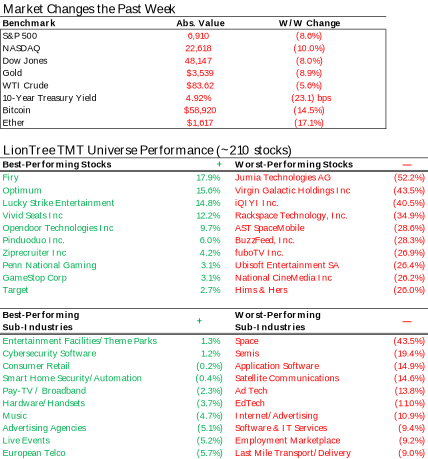
Is this the capitulation that we needed?? It was a brutal Friday, following an already tough week in the markets. The S&P 500 closed the week down -8.6% and Nasdaq down -10%. The equal-weighted S&P fared better but was still under significant pressure (down -6%). S&P 500 weekly decliners outnumbered gainers by more than 15:1 per FactSet as Nvidia’s strong results/guidance and the Anthropic IPO pricing above the range was not enough to offset the risk coming from increased worry about AI funding, regulatory restrictions, and leadership gaps, not to mention the barrage of industry wide tech issues that added fuel to the fire on cyber vulnerability concerns. The VIX spiked above 30 as investors ran to the door.
In times like this it is good to focus on the fundamentals…and on that front, GTA VI blew away very high expectations (but it was still a sell the news event) and, aside from Nvidia, the earnings stragglers provided some interesting updates across music and entertainment. Overall, we focused on the below key themes/developments/updates in this edition:
- Earnings Scorecard – Week 6
- Nvidia’s Fundamentals Haven’t Missed A Beat…But Leadership Uncertainty Leaves Investors In A Holding Pattern
- The Magic Kingdom Is Reinvesting In Its Next Act
- WMG’s Strong Execution Looks Set To Continue In FY27
- Data Center Chatter Hits New Highs Re Power Usage, State Push Back, Financings, Etc.
- Recent Cyber Incidents Put AI’s Growing Capabilities And Safety In Focus
- Q3 13-F Round-Up: Tech Leads Hedge Fund Rankings as Activists Turn Net Sellers
- Grab Bag: Anthropic IPO / GTA VI Record Release / Coinbase Prediction Mkt Launch
I hope you have a more restful weekend, and I’d love to hear any thoughts or comments about the current happenings in the market or sector if you are up for sharing.
Best,
Leslie

Earnings Scorecard – Week 6
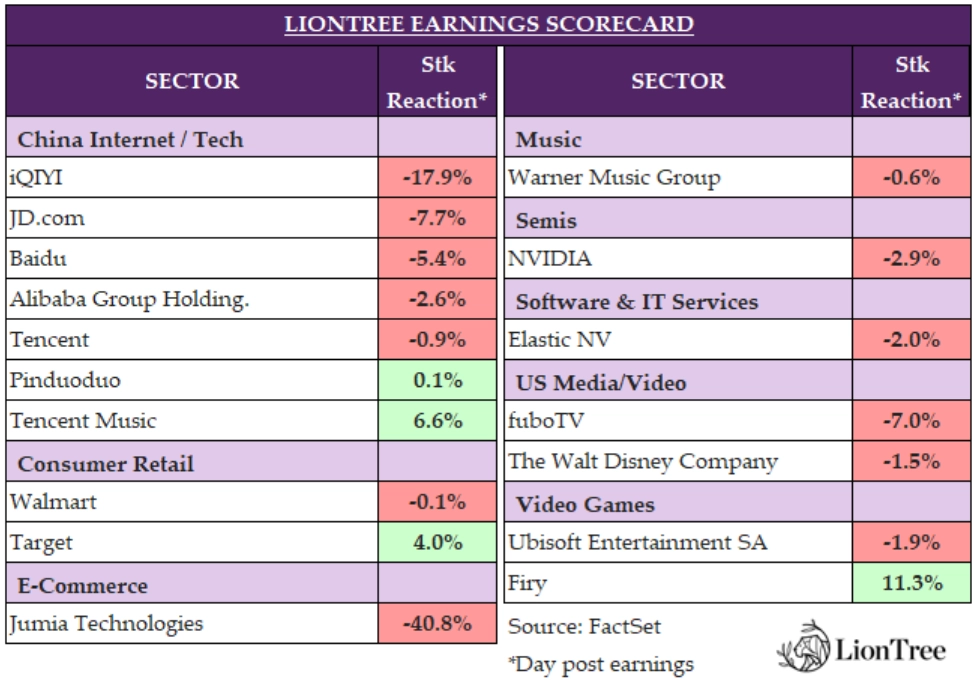
Third quarter earnings are finally winding down, with 17 companies in our LionTree Universe reporting their quarterly numbers this week (down from 22 last week). Similar to the last three weeks, stock reactions were biased to the downside, with 12 companies (71%) trading down after their report, and only 5 (29%) trading up. The worst performer was Jumia Technologies AG, which fell -41% post its print, while the best performer was Firy, which jumped +11%.
Earnings we focused on this week include NVIDIA, which fell -3% after its earnings (see Theme #2), Disney, which was down -1.5% (see Theme #3), Warner Music Group, which was down -0.6% (see Theme #4).
The table below includes select mid- and large-cap TMT and consumer companies in our LionTree stock universe that reported this week.
Nvidia’s Fundamentals Haven’t Missed A Beat…But Leadership Uncertainty Leaves Investors In A Holding Pattern
There couldn’t have been more eyes on Nvidia’s FQ3 results and conference call and while we view the strong fundamentals and the raised guidance as reassuring and even a relief that another shoe did not drop, the Co remains in flux as it relates to its future leadership structure. On the earnings call, the Board Chair made clear that they have no intention to re-instate Jensen Huang and that the CEO search remains ongoing. Clarity on the leadership direction clearly will be a key catalyst.
On the numbers themselves, the Co cleared the bar. Revenue beat cons by +6.3%, helped by Vera Rubin being the fastest product ramp in its history (generated nearly $20bn in its first qtr of shipments). The FQ4 revenue guide of $130bn (+/- 3%) topped the Street by ~4%, and even more importantly mgmt raised its FY28 revenue growth outlook to ~+75% y/y from ~+70%, off what is now a higher FY27 base. The gross margin trajectory also remains a focus for investors and FQ4 is still expected to mark the bottom at 71-72%. A few offsets include the FQ4 OpEx guide ~8% above cons and FCF missed cons by -18% given the working capital built around the Rubin ramp.
The Q&A very much centered on AI ecosystem financing, and while mgmt still views neoclouds as a critical component of that, its tone was more measured and they stressed that they will be “disciplined and selective” in supporting neoclouds and are “rigorously evaluating future investments, commitments and guarantees.” We view this as directionally more negative for the subscale players in the space. At the same time, total commitments more broadly reached $518bn and guarantee exposure stood at $118bn.
Overall, interim CEO Colette Kress’s message was “business as usual,” with customers, suppliers and partners “all 100% behind us” but who will be leading this critical company may keep the stock range bound and there is reportedly a camp internally that still supports Huang’s return.
See below for more details on what we found most incremental from results.
-> Nvidia shares opened ~3% higher on Wednesday in reaction to the print but quickly gave back those gains and closed the day down almost -3%; YTD the stock is down -33%
Nvidia Delivered A Strong FQ3
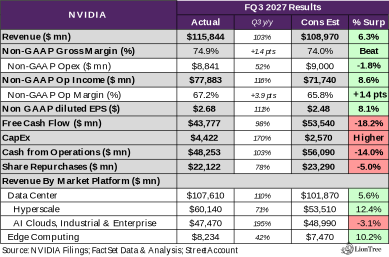
- Total revs BEAT cons by +6.3%…revenues more than doubled y/y (up +103% y/y, following +106% in FQ2) and were up also up +20% q/q
- Vera Rubin generated nearly $20bn in its first qtr of production shipments (implies ~19% of DC revs, in-line w/ the ~20% outlook), the “fastest product ramp in NVIDIA’s history”
- FQ3 included $2.4bn of licensed Hopper DC shipments to China (~2% of total rev)…though the Co is no longer shipping these products and none are included in guidance
- Non-GAAP gross margin BEAT at 74.9% vs 74% cons (and the 74% guide), driven by better product mix
- GM was +1.4pts y/y on improved Blackwell Ultra mix, BUT -0.1pt q/q reflecting the initial Rubin ramp
- Non-GAAP OpEx was BELOW cons by -1.8%: Up +7% q/q and +52% y/y on higher compute infrastructure and employee comp…came in marginally below the outlook on expense timing
- Non-GAAP op income BEAT cons by +8.6%
- Op margin of 67.2% was +1.4pts above cons
- Adj EPS BEAT cons by +8.1%, up +111% y/y
- BUT FCF MISSED cons by -18.2% and cash from operations MISSED by -14% given that working capital was a drag given the Rubin ramp
- CapEx was also HIGHER than cons ($4.4bn vs $2.6bn, respectively)
- The Co returned a record $28.1bn to shareholders in FQ3: $22.1bn in repurchases (-5.0% below cons) + $6bn in dividends…65% of FCF has been returned YTD
- The Co incr’d the buyback authorization in Sept by $150bn and plans to fully use it by the end of FY28
Upside In FQ3 Hyperscale Revenue More Than Offset Weaker ACIE Revenue…Edge Computing Also Positively Surprised
- Hyperscale revs BEAT cons by +12.4% and grew +23% q/q (+71% y/y) to $60.1bn, driven by the notable Vera Rubin ramp and sustained Grace Blackwell strength
- Hyperscale growth reaccelerated q/q as Vera Rubin supply grew…hyperscale customers’ cloud revenue growth accelerated for the 6th consecutive qtr
- Cloud industry backlog is now $2.5tn, up from $2tn just three months ago
- ACIE revs MISSED cons by -3.1% but it still grew +18% q/q and nearly tripled y/y (+195%): Seq growth was driven by Vera Rubin shipments to leading neocloud customers and the start of frontier labs building their own DCs
- Sovereign AI revenue more than tripled y/y in FQ3
- The Co annc’d a collaboration w/ multiple NVIDIA cloud partners in Australia to develop up to 2GW of land, power and shell capacity by end of CY27 to host multiple generations of NVIDIA DSX AI factories
- Enterprise: Financial services delivered the strongest growth, w/ on-prem rev reaching nearly $5bn TTM (more than doubled y/y) as customers accelerate quantitative trading
- Mgmt expects enterprise revenue to more than double in FY28
- Physical AI revenue nearly tripled y/y and is on track to exceed $25bn for the full yr
- Robotics: The Co expanded the Isaac platform w/ a new humanoid reference design built on Isaac GR00T and Jetson Thor (annc’d at GTC Berlin)
- Auto: Hyperion and Alpamayo are enabling Mercedes-Benz and Bolt w/ Lucid to build robotaxi fleets, plus expanded partnerships w/ Mercedes-Benz and Volvo Cars on automated driving
- Sovereign AI revenue more than tripled y/y in FQ3
- Edge Computing revs BEAT cons by +10.2%, up +14% q/q and +42% y/y on stronger enterprise demand for Blackwell workstations and edge compute for physical AI
- BUT higher memory and system prices continue to affect consumer PC demand
Importantly, Mgmt Raised Its FY28 Growth Outlook To ~+75% Y/Y Growth Off A Higher Base Given The Unlock Of More Supply…BUT The FQ4 OpEx Guide Came In Well Above The Street
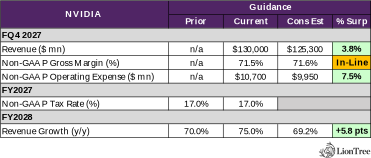
- FQ4 rev guidance of $130bn (+/- 3%) topped cons by +3.8%…this implies ~+12% q/q and ~+91% y/y growth, though FQ4 includes an additional week
- Seq growth is expected to be driven by “robust demand for AI infrastructure” and the cont’d ramp of Vera Rubin
- The Co is NOT assuming any DC compute revenue from China in its outlook
- FY28 revenue growth guidance was RAISED to ~+75% y/y from ~+70%…and off what is now a higher FY27 base: Using the FQ4 guide midpoint, the implied FY27 rev is ~$424bn, putting FY28 at ~$740bn (3.4% above cons $717bn)
- Drivers of the raise:
- Growing demand plus additional supply that mgmt can now deliver…the outlook considers DC readiness, durability of end-customer demand and customers’ access to capital
- When asked whether unconstrained demand is still tracking ~+100%, mgmt did not reiterate that figure, pointing instead to confidence in demand and supply to deliver +75%
- New US Commerce Dept export controls were released this week…mgmt is still studying them, BUT “with demand far exceeding supply, we expect our performance to remain strong”
- Drivers of the raise:
- FQ4 GAAP & non-GAAP gross margin guidance of 71-72% was IN-LINE w/ cons (71.6%) and MAINTAINED from the prior outlook
- FQ4 is expected to mark the bottom for GM
- The Co will honor POs already received before new pricing takes effect…GM to improve to 72-73% in FY28 (reiterated)
- When asked about pricing power as frontier labs lean into ASICs and compute efficiency KPIs:
- “We see no changes at this time”…”our pricing is well thought through, but that is something for the future”
- FQ4 is expected to mark the bottom for GM
- FQ4 non-GAAP OpEx is guided ABOVE cons by +7.5%…it is impacted by the addtl week and transition-related costs
The Board Comments On Leadership & Governance…Huang Will Not Be Reinstated
- The Board Chair Harvey Jones conveyed that they have no intention to reinstate Jensen Huang as CEO: As one would expect, no comments were made on the circumstances of the resignation or the ongoing investigation by an independent board committee
-> Relatedly, a faction of board members is pushing for Huang to be reinstated per Semafor, and a “Stand With Jensen” open letter (standwithjensen.com) urging the board to reconsider Huang’s resignation has reportedly drawn more than 190k signatures as of Tuesday, per CBS News; Forbes reports that about 10k of the signers are Nvidia employees, alongside figures like Elon Musk and Garry Tan; Kress acknowledged on the call that “there are diverse opinions” internally (link/link)
-> Also to note, at the Co’s 1st all-hands mtg following Jensen Huang’s departure and hosted post the earnings release, Kress promised employees December pay raises and additional equity as a way to focus on retention (link)
- The board has retained a search firm and will consider internal and external candidates…it wants a permanent CEO “as quickly as possible” BUT “we won’t expedite the CEO before finding exactly the right person”
- Jones noted the new CEO will need to navigate advanced silicon technologies and national security dynamics that are “making major changes in our marketplace”
- Governance-wise, the board established a National Security & Export Control Oversight Committee (select independent directors, senior external advisors and legal counsel) to enhance engagement w/ the US govt and all relevant agencies
Mgmt Struck A Noticeably More Disciplined Tone Regarding Ecosystem Financing…
- Financing was the dominant theme of Q&A, w/ analysts probing the Co’s appetite for vendor financing, neocloud disclosure, allocation and capital priorities
- Mgmt stressed that they “will remain thoughtful in how we participate and disciplined in how we commit capital”…”we are rigorously evaluating future investments, commitments and guarantees” as the market matures and more capital sources become available
- Total commitments reached $518bn, w/ $222bn falling in FY28
- Supply commitments incr’d to $390bn from $279bn:
- Primarily on multi-year memory procurement
- Cloud service + DC lease commitments rose to $102bn from $74bn:
- Driven by long-term leases (up to 20 yrs, commencing FQ4:27–FY33) to support R&D and open models…the Co may assign some leases to third parties
- Equity investment commitments of $20bn are focused on frontier labs, infrastructure financiers and other private cos
- Supply commitments incr’d to $390bn from $279bn:
- On neoclouds, they remain very critical for the AI eco-system and “we will continue to be disciplined and selective in our support”…
- Neoclouds and labs are “growing faster than their balance sheets and long-term credit profiles can support”…the Co “will focus on exceptional sites where visible, durable demand can support multiple generations of NVIDIA compute”
- Mgmt is taking “a very strong look in terms of the types of companies that we would want to help in terms of the financing, as a lot of things have changed over this last quarter, and we know that that’s a priority of ours, but we do have some very, very strong existing customers that we will be continuing to work with”
- How will you allocate supply between hyperscalers, AI labs and neoclouds? It will be based on customers’ DC readiness (land, power and shell is the priority) and their capital and offtake… “all are getting the same pricing”
- Frontier labs are expected to be ~15% of DC rev this yr
- Neocloud agreements totaled $32bn (down from $36bn in the FQ2)…the Co clarified that commitments/ guarantees only take effect if neoclouds secure financing and compute is deployed, operational and accepted (this is not a new approach but mgmt. wanted to be more transparent)
- The Co still earns revenue on the upfront infrastructure sale and participates in rental revenue above a minimum commitment
- Total guarantee exposure is $118bn
- This includes the $105bn in credit support for land, power, and shell capacity for the PORTS-Pike campus
- SoftBank Energy’s plans are on track for capacity to come online in phases beginning in cal 2028
The Co Continues To See Strong Demand Exceeding Supply…With Rising GPU Rental Prices & Agentic Token Growth
- GPU pricing is moving higher across generations…token prices have fallen ~60% since May, driving usage and compute demand
- Hopper GPUs have re-contracted at up to 2x their original price under multi-year agreements; B300 rental rates are up 60%+ since introduction
- NVIDIA compute remains fully utilized across every hyperscaler and neocloud the Co serves
- Agentic AI is now the dominant workload…~80% of tokens are agentic, and weekly OpenRouter token volume grew 35x y/y and 3.5x in the past 3 months
- Agentic AI is driving demand for CPUs that is “far outstripping supply”…the Co still expects total CPU rev to more than double in FY28
- Regarding concerns of a 2028 slowdown tied to a change in government (“the blue wave”)…mgmt just pointed to continued customer asks for more supply and flagged the importance of DC communities understanding job creation…”We’re always going to be engaged with the government”
A Few Other Key Points
- Mgmt believes they can execute on all their capital allocation priorities at the same time
- Buybacks remain a “super top priority” and “I think there is definitely the room to continue all of the stock repurchases plans that we want to do and complete those before the end of fiscal year ’28”
- And mgmt. also views allocating to their suppliers as “top priority” followed by finishing committed investments (“not a very large piece of it”) and selective guarantees for “very strong customers”
- The Co is leaning further into open models with the acq of Hugging Face in Sept (home of the open model community serving 118mn+ developers and 200k companies)
- Nemotron is now the most widely used US open model on OpenRouter
- The Co highlighted a greater focus on safety with its Open Agent Safety Platform, launched alongside 100+ partners to control increasingly autonomous agents
- OpenShell limits agents’ access to files and tools, while NVIDIA Sentry running on BlueField-4 monitors agent behavior in silicon and stops agents overstepping limits in milliseconds
- Partners incl. Anthropic, AWS, CoreWeave, CrowdStrike, Dell, Google Cloud, HPE, JPMorgan Chase, Lenovo, Microsoft and OpenAI
The Magic Kingdom Is Reinvesting In Its Next Act
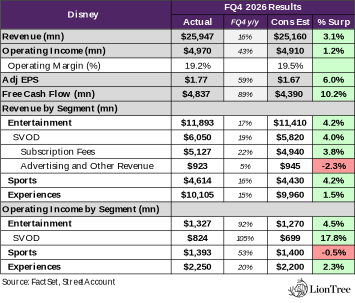
Disney’s FQ4 was a beat across the board, with rev, op income, adj EPS and FCF all ahead of Street expectations. An extra week in the quarter also contributed to y/y growth across every segment. Underneath that, the core bizs held up well. Experiences delivered another record quarter on domestic strength despite softness in Asia, and mgmt pointed to a pipeline of new attractions and cruise capacity as support for continued growth. Streaming profitability also kept improving, with SVOD OI more than doubling y/y. In Sports, ESPN saw strong football viewership heading into an expanded College Football Playoff and its first Super Bowl.
The bigger story, though, is where Disney goes from here and the Co plans to step up cash content spend next year (+9% y/y to ~$26bn), and it now expects its efficiency program to deliver ~$3bn in annual run-rate savings by FY29. The majority of those savings will be reinvested back into the business, primarily in streaming, but with a portion expected to drop to the bottom line over time. That said, investors will have less visibility into how that investment is paying off, as Disney will stop disclosing SVOD profitability and instead report more detail on Entertainment revenue, with the focus on growth across the whole segment.
Regarding the outlook, mgmt reiterated its FY27 earnings growth target, guided the coming quarter ahead of expectations and raised the dividend. Most of the growth is expected in H1, reflecting the timing of film releases, the Super Bowl and College Football Playoff, as well as lapping last year’s cruise ship launches and the extra week.
Also to flag, the Co will be hosting an investor event in May 2027 to “provide a deeper look at our long-term strategy and further define our growth opportunity.”
As always, there was a lot to sift through. See below for more on the above as well as other key takeaways in our view.
-> Disney ended the day of its report down -1.5% and ended the week down -0.8%; YTD, the stock is up +3.7%
Disney’s FQ4 Beat Across The Board
- Rev, op income, adj EPS, and FCF all came in ahead of Street expectations
- Rev beat across all three segments
- Op income beat on Entertainment and Experiences, but missed on Sports
- Note that FQ4 had an addtl week of operations vs the prior-yr qtr, and that 53rd week added ~$1.6bn to rev and ~$490mn to total segment OI, contributing to y/y growth across every segment
- OI benefit by segment:
- Entertainment ~$230mn (~33pp of y/y growth)
- Sports ~$80mn (~9pp)
- Experiences ~$180mn (~10pp)
- SVOD OI incl ~$160mn
- Rev benefit by segment:
- Entertainment $810mn (~8pp of y/y growth)
- Sports $290mn (~7pp)
- Experiences $580mn (~7pp)
- OI benefit by segment:
FY27 Double-Digit EPS Growth Guidance REITERATED And FQ1 OI Is Above Cons, With Most Of The Growth Weighted To H1
- For FQ1… total segment OI guidance of ~$5.4bn, BEATS cons by +3.1%
- For FY27…mgmt reiterated adj EPS growth of double digits ex-53rd week, w/ majority of growth expected in H1
- The 53rd week contributed ~$0.17 to FY26 adj EPS; FQ4 FY27 will lap it
- For FY27…overall OI growth guidance of ~8% ex-53rd week is on a recast basis (see reporting changes below), w/ the majority of growth also expected in H1
- Experiences – HSD growth ex-53rd week: On a reported basis, the segment will see growth in H1 and be relatively flat in H2, lapping cruise ship launches, the World of Frozen opening and FY26 tariff refunds
- Entertainment – HSD growth ex-53rd week: On a reported basis, all of the FY27 growth is expected to be realized in FQ1, reflecting timing of theatrical releases and programming & production costs
- Sports – double-digit growth ex-53rd week (HSD on a reported basis):
- FQ1: healthy rev growth BUT OI decline, driven by timing of College Football Playoff games in the New Year’s window
- FQ2: strong rev and OI growth on the same CFP timing and the broadcast of Super Bowl LXI
- H2: relatively flat OI, primarily on calendar and timing impacts incl the 53rd week in Q4 FY26
- For FY27…CapEx of ~$9bn (vs $8.7bn in FY26)
- “As we continue to execute against our strategy to turbocharge growth at Disney Experiences”
- Also raised dividend by +33% to $2.00/shr (vs $1.50 paid in FY26), payable in two $1.00 installments (Jan 22, 2027 and Jul 13, 2027)
Mgmt Outlined New Plans To Deliver ~$3bn In Annual Run Rate Savings By FY29 W/ The Bulk Going Back Into Growth Initiatives
- Where will efficiencies come from? Procurement and sourcing, IT and real estate consolidation, shared services, and SG&A efficiencies within each segment and at corporate
- What will the savings be used for? Reinvesting back into the biz: “We plan to reinvest the majority of the savings back into the business to drive revenue growth, primarily in streaming and the broader DTC efforts,” largely in content, technology and marketing
- “While these efficiencies will be used primarily to fund future growth, we do expect a portion to drop to the bottom line over time”
- “We are all about delivering the short term and investing in the long term, not an either or”
- How should investors measure the return on reinvestment? “You should look to our growth businesses, SVOD and Experiences, along with overall segment operating margin, earnings and FCF to assess our performance and our returns”
Also Annc’d Several Segment Reporting Changes
- Beginning w/ FQ1, Disney will be making several disclosure changes…
- Shifting reporting of the Consumer Products biz (excluding Branded Retail)
- Moving from Disney Experiences to Disney Entertainment
- On Disney Entertainment…will provide addtl rev disclosure on the segment (see below)…
- “Will provide greater visibility into how we monetize Entertainment content across distribution platforms, third-party licensing, and consumer products”
- “The benefit here is it gives the investor additional information and a better lens into our content monetization, particularly as we scale as SVOD, which is already the largest source of revenue in entertainment”
- …though SVOD OI will no longer be disclosed…
- “We no longer believe the supplemental disclosure of SVOD operating income reflects this segment focus and strategy”
- …and equity income will be excluded from Entertainment segment OI
- Shifting reporting of the Consumer Products biz (excluding Branded Retail)
- New Entertainment segment revenue lines –
- SVOD: Includes subscription fees, Advertising, and Other
- Content and IP: Includes Content sales, Consumers products, and Other
- Networks and vMVPD: Includes Subscription and affiliate, Advertising, and Other
- Reasoning for removing the SVOD OI disclosure?
- The Co has a whole-segment focus: “Focused on growing revenues and maximizing the return on our content investment across the entire entertainment segment, not just one platform’s margin within the segment”
- Provides cost flexibility: Greater flexibility to manage the cost base of the entire portfolio and invest in SVOD growth, w/ the goal of faster rev growth and higher long-term Entertainment segment OI
Experiences Delivered A Record FQ4 On Domestic Strength, & Despite Asia Softness
- FQ4 Experiences rev and OI was yet another record and beat cons
- Global guests were up +11% (+4% ex-53rd week), driven by WDW and Disneyland Paris attendance strength and added Disney Cruise Line capacity
- Headwinds from lower intl attendance at domestic parks “moderated” as expected; WDW growth was also “aided by favorable comparisons to the prior-year quarter”
- Why has Disney’s domestic parks performance diverged from peers and is it sustainable?
- “It’s so clear fans just value the Disney experience and there really isn’t anything out there that matches it”
- “Consumers want real experiences now. And I think that we’re seeing that accelerate”
- Targeted promotions for Florida residents, annual passholders and even Disney+ members are working
- Utilizing “increasingly sophisticated” yield management beyond ticket price
- Asia remains a drag…Hong Kong and Shanghai attendance “worsened during the quarter” and “we expect this pressure to continue in fiscal 2027”
- But the portfolio is “built to absorb these kinds of swings in specific market conditions” as the strength at domestic parks and Disneyland Paris “more than offset that weakness”
- In the pipeline… “more projects underway than at any other point in the segment’s history”
- Coming soon…
- Monstropolis (Hollywood Studios), Lakeshore Lodge and Tropical Americas (Animal Kingdom) all open in calendar 2027
- Cars land and Villains land at Magic Kingdom follow (dates not yet announced)
- Avengers Campus at Disney California Adventure doubles in size by 2028
- Mgmt reiterated that the Co is “investing to deliver double digit returns over the lifetime of these projects”…“not adding capacity for its own sake”
- Coming soon…
- Cruise demand is holding up despite a step-up in capacity (Disney Destiny launched Nov 2025, Disney Adventure in Mar 2026)
- Booked occupancy is “holding up pretty nicely… we feel good about forward cruise bookings”
- The Co is entering their second yr w/ the Adventure, “so it’s too early to tell if the macro weakness has impacted demand for that single ship”
- “BUT for the rest of the fleet, when we look at booked occupancy, it’s actually holding up pretty nicely, even with the additional capacity that we’ve brought online”
- “We think that there’s a lot of room to grow on this front”…growth is limited by “ship building capacity itself, not necessarily the market opportunity”
- Booked occupancy is “holding up pretty nicely… we feel good about forward cruise bookings”
- Looking ahead… global guest growth is expected to continue in FQ1 “despite consumer softness in Hong Kong and Shanghai”
The Co Is Stepping Up Streaming Investment To Broaden Disney+’s Offering And Reach
- It was a strong FQ4 for SVOD with revenue rising +19% y/y, driven by subscription fee growth of +22% y/y, while SVOD OI more than DOUBLED y/y
- Looking ahead… “In fiscal 2027 we expect to increase both content and marketing investment in support of our longer-term goals”
- “We are encouraged by our continued strong SVOD revenue growth and plan to invest behind this success”
- Margin expansion vs reinvestment? Mgmt remains “focused on SVOD margin expansion over time” and expects “entertainment segment margin to expand,” while continuing to invest in SVOD to drive rev growth
- FY27 cash content spend is now guided to increase +9% y/y to ~$26bn
- This “includes our increased investment in sports rights and international programming, as well as the timing of feature film production spend”
- The Co is investing in local content to scale Disney+ outside the US…seeing “healthy engagement growth” across EMEA, LATAM and APAC
- Plan to roughly triple delivery of local originals over the next three yrs
- “Local content remains one of the strongest drivers of international subscriber acquisition and engagement”
- International content spend “will take some time to scale, but we wouldn’t make the investment unless we thought it would drive attractive returns”
- Plan to roughly triple delivery of local originals over the next three yrs
- The Disney+ and Hulu app unification is “nearly complete”…beginning this Dec, subs will get a fully unified experience on Disney+, incl live TV and select premium add-ons
- Mgmt was clear “we’re not launching a new app”…the ambition is to connect Disney+ more closely w/ parks, cruise ships, merchandise and games on one consumer data set, w/ more of these elements to “come to life” starting in the spring
- Disney+ is broadening its content mix beyond premium film and TV
- TikTok creator content begins rolling out on Disney+ in December, timed to the buildup to Avengers: Doomsday (Dec 18)
- More vertical video, live sports and podcasts are also being added
- A free product remains under consideration…“as this develops, we’ll continue to share more with you”
- “We are exploring a free product, and I think it’ll reach a more price sensitive consumer and bring in new Disney+ subscribers”
- “It’s going to give us more ad inventory to sell. It’ll offer a key retention tool that, quite frankly, we currently don’t have. And so, ultimately more connected consumers is clearly better for us”
DIS Is Maximizing The Reach Of Its IP, With Marvel Momentum Building Into Upcoming Avengers: Doomsday Release And Selective Licensing To Netflix
- Avengers: Doomsday (Dec 18) is the next big event …
- The Co is “pleased with the early pre-sales” following the summer trailer
- August was the highest month ever for Marvel Studios viewing on Disney+ and Marvel viewership more than doubled vs its historical baseline during the qtr
- Following its re-release in late September, Avengers Endgame was once again the highest grossing film of all time
- The content strategy is focused on growing the DTC base globally and maximizing reach and engagement of IP…and Netflix licensing deal does both
- Titles (i.e., Ice Age, Percy Jackson) can benefit from “a second wave of exposure and discovery” and the content is “co-exclusive,” so fans can still stream on Disney+
- “We see this deal and others that we might pursue like it as additive to our distribution strategy”
- “It doesn’t take anything away from what our subscribers get today on Marvel, Lucasfilm, and Pixar”
- Will be selective and judge each deal on whether it builds a franchise and supports Disney+
- Titles (i.e., Ice Age, Percy Jackson) can benefit from “a second wave of exposure and discovery” and the content is “co-exclusive,” so fans can still stream on Disney+
Live Sports Remain A Key Engagement Driver, With ESPN Expanding Its Football Slate And Bringing More Games To Disney+
- FQ4 delivered the most consumption on the ESPN networks since fiscal 2015
- Monday Night Football opened w/ its best Week 1 and Week 2 audiences ever
- Ohio State–Texas on ABC drew 14mn viewers, ESPN’s most-watched regular-season college football game in 10 yrs
- US Open viewership at four-year highs, incl the largest US Open Men’s Final in ESPN’s history
- College Football Playoff rights were extended…ESPN holds exclusive rights to all rounds of the expanded format starting next season (11 games growing to 23), w/ more games on ABC
- Financial terms not disclosed; “we always look at deals with discipline”
- Sublicensing is considered on a case-by-case basis: “We don’t see it becoming a prominent part of the business by any stretch of the imagination”
- ESPN will air its first Super Bowl (LXI) in Feb 2027 on ESPN, ABC, ESPN Deportes, the ESPN app and Disney+ in the US and 55+ intl markets
- Expanding sports across Disney+…bringing more live sports for subs w/o an ESPN subscription this fall
- Including College GameDay simulcast, more live college football and select NFL games starting Oct 26 w/ Cowboys at Eagles
- ESPN now reaches fans through Disney+ in ~100 markets following expansion into Europe and select APAC markets
-> Separately, but related, it was reported this week that ESPN and Disney will not bid on rights to the 2030 FIFA World Cup; With expectations for the winning bid to come in ~$1.5bn+, it is said that ESPN couldn’t make the numbers work; In addition to ESPN, Apple and Skydance will also not be bidding; On the other hand, Netflix, Amazon, YouTube, and Fox are all expected to bid per Sherman, while NBC “is going right down to the wire on making a decision” (link)
Also To Flag…Disney Is Applying AI Across The Biz, And It’s Already Showing Up In Ads, Content Production, Streaming And Parks
- Disney’s first Chief Technology Officer was hired: Karandeep Anand is in charge overseeing enterprise technology, infrastructure, data and AI platforms, product and engineering across all segments
- In advertising… new creative studio turns small businesses’ existing brand materials into CTV-ready ads, and an agentic ad sales tool that builds campaign proposals has scaled quickly since its August launch w/ “almost half of all new ad campaigns” flowing through the agent
- In content production…new ML tech from Disney Research Studios and ILM “allows us to reduce rendering compute needs by 30%”
- On Disney+ … “meaningful improvements to the Disney+ user experience” are showing up “in our financial results”; AI-driven recommendations and discovery are also showing up in engagement
- AI also seen as “a real tailwind for experiences”, both in how guests plan and book and in how Disney builds and runs the parks
- Guest planning and booking: Guests already use AI tools to discover, plan and even book trips, “and ultimately, we want Disney to show up in those tools. And so right now, the team is exploring ways to actually let guests book directly from them”
- Disney’s own channels: Have a vacation planning experience in beta on the WDW website… “it’s pretty good, and I think it’ll be incredibly helpful for our guests who are booking trips”
- Operations: “We’re also using AI and advanced analytics for planning in our operations, and this has given our teams insights to help ensure that we’re managing as precisely as we can”
WMG’s Strong Execution Looks Set To Continue In FY27
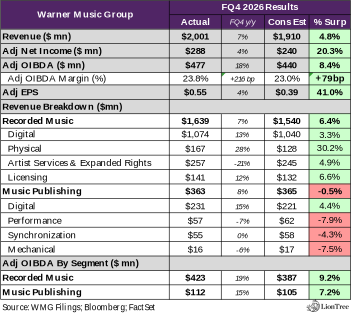
Warner Music Group (WMG) capped FY26 with a clean beat, with total revenue topping consensus by +4.8% and adj OIBDA beating by +8.4% as margins expanded +190bps FXN in the qtr. For the full year, WMG overdelivered on its margin target (+210bps FXN vs the +150-200bps guide) while hitting its high-single-digit revenue growth and double-digit adj OIBDA and adj EPS growth targets.
Five other key takeaways that particularly stood out to us include: 1) Global market share was up in every key region except APAC, and gains remain largely organic; 2) Recorded Music subscription streaming growth accelerated to +15% adj FXN as PSM pricing (incl the Apple renewal) contributed ~4.5ppts, though ~2ppts came from a one-time audit waiver and the Revelator acquisition; 3) Ad-supported streaming grew +11% adj FXN, well ahead of guidance for mid SD, on share gains incl a US YouTube partnership; 4) Suno launched its licensed model in September, making it the first generative AI Co to pay royalties to rights holders, and the revenue contribution in FY27 should be material; and 5) FY27 targets were reiterated though the level of margin expansion steps down to ~100bps on a comparable basis (plus ~50bps from the EMP sale).
A key catalyst for the stock will be the outcome of the ongoing DSP renewals, including with Spotify. Mgmt did comment that the pricing tailwind that they have been seeing will moderate in FQ2. Also, CEO Robert Kyncl will keynote CES in January, which the first time a music Co will headline the event.
See below for more details on what we found most interesting and incremental from results.
-> WMG closed the day of its report down -0.6%, but still ended the week up +1.3%; YTD, the stock is up +6.7%
WMG Ends Its Fiscal Year W/ A Strong FQ4 & The Multi-Year Targets Were Reiterated Heading Into FY27
- Revenue BEAT cons by +4.8%, adj OIBDA BEAT by +8.4% and adj net income BEAT by +20.3%
- Total revs grew +7% y/y (+7.5% FXN, ~+8% adj FXN)
- Growth moderated from +10% y/y in FQ3 as artist services & expanded-rights rev fell -20% FXN against a tough comp from elevated Oasis merch rev in the prior-year qtr
- Adj OIBDA of $477mn grew +18% y/y (+17% FXN)
- Adj OIBDA margin of 23.8% expanded +210bps y/y (+190bps FXN) and BEAT cons of 23.0% by +79bps…driven by strong operating performance, rev mix and restructuring savings, a portion of which has been reinvested
- Adj EPS growth at +4% lagged adj OIBDA growth as the assumed tax rate rose to 27% from 24%
- Total revs grew +7% y/y (+7.5% FXN, ~+8% adj FXN)
- FY26 delivered against all of the targets mgmt laid out a year ago
- Total revs grew +11% y/y (+9% FXN, +10% adj FXN)
- Adj OIBDA grew +23% y/y (+19% FXN) and margin expanded +210bps FXN (+230bps reported) to 23.8%, above the high end of the +150-200bps target
- Adj EPS grew +22% y/y to $2.03; FCF grew +42% y/y to $766mn
Mgmt Guides For Another Strong Year Ahead, Reiterating Its Multi-Year Targets
- The strategy remains the same: 1) grow market share; 2) increase the value of music (AI will be a driver here); and 3) be more efficient
- Regarding FY27, mgmt maintained its multi-year financial targets and is “doubling down on them for this year”
- High-SD total revenue growth on a comparable basis
- DD adj OIBDA and adj EPS growth
- 50-60% operating CF conversion as a % of adj OIBDA over a multi-year period
- ~100bps of margin expansion on a comparable basis (see margin section below)
- As a 1x impact:
- The EMP sale closed at the end of FY26 and FY27 adj growth rates will exclude EMP
- EMP contributed ~$180mn of rev in FY26 (~$70mn in FQ1:26) with an immaterial impact on adj OIBDA
- Per CEO Kyncl…the shareholder value that the multi-year transformation should drive is “underappreciated by the market today”
The Acceleration In Subscription Streaming Growth = A Key Positive (Across Both Paid & Ad-Supported) Though The Pricing Tailwind Moderates In FQ2 Until The Next Wave Of DSP Renewals
- Recorded Music subscription streaming rev grew +15% y/y on an adj FXN basis, which is up from +12% in FQ3:
- Though when stripping out the audit waiver and Revelator (~2ppts combined), underlying growth was ~13%
- FY26 subscription streaming grew +13% adj FXN
- Subscription growth was driven by –
- Contractual PSM increases across several major DSP partners
- Broad-based market share gains
- The breakdown of the +15% adj FXN growth –
- ~6-7ppts from subscriber growth
- ~4.5ppts from pricing, up from ~3.5ppts in FQ3… incls the benefit from the Apple renewal
- ~1ppt from global market share gains, which have been steady through FY26
- ~1ppt from a $7mn DSP audit waiver tied to a renewal and related to a historical period…non-recurring
- ~1ppt from revenue acquired with Revelator
- Contractual PSM increases are “now in all of our deals”
- Ad-supported streaming also outperformed, growing +11% y/y adj FXN (vs +10% y/y adj FXN in FQ3), and was well ahead of the guidance for a normalization to mid-SD
- Growth reflected very strong mkt share gains in the qtr, most notably with YouTube via a partnership in the US
- The Co also saw improved deal economics with social media platform partners
- The FY27 streaming outlook was a focus in Q&A…and while mgmt does not guide to paid streaming, it expects “steady growth” but it will be front-end loaded
- Global subscriber growth is expected to remain strong in the mid-to-high single digits
- Pricing cadence:
- FQ1: Similar pricing contribution to FQ4
- FQ2: Pricing contribution moderates as the Co laps the anniversary of the Spotify price increase
- Rest of FY27: Smaller, “more modest” benefits from DSP price increases
- Mgmt is actively negotiating renewals with several large DSPs, incl Spotify…the completed deals should provide visibility into the next wave of price increases, at which point mgmt would be in a position to update its outlook
- The timing of these uplifts will create some “lumpiness”
- What are potential upside levers to the outlook?
- Cont’d market share gains, supported by M&A incl the Bain JV…where the pipeline is robust BUT acquisitions are opportunistic and mgmt will be “patient and disciplined” on return thresholds
- Expanded distribution capabilities via Revelator, which started contributing in FY26
- New revenue from AI licensing deals…mgmt is in active discussions with a number of DSPs around licensing and tiers
AI Licensing For The 1st Time Ever Contributed To Revenue & That Contribution Is Expected To Be Material In FY27
- AI was another big part of the Q&A, with particular focus on AI monetization, partner deals, and artist opt-in
- Suno launched its licensed model in September, making it the first generative AI Co to pay royalties to rights holders…it’s “a watershed moment”
- The impact in FQ4 was immaterial given the mid-September launch, BUT mgmt expects “material revenue contribution in fiscal 27”
- Suno has “well over 2 million paying subscribers” and is growing fast w/ significant engagement
- Mgmt is also “very, very busily working on partnerships” with other AI Cos, especially in the derivative space…but nothing new to announce at this point
- When asked about Spotify’s AI offering, mgmt is “very supportive” and likes the direction of the product BUT is working through the details “in context of our overall deal”
- WMG is building infrastructure to scale AI permissions across what it expects will be far more AI partners than UGC partners
- Mgmt concluded that managing permissions for songs and name, image, likeness and voice platform-by-platform would be “unsustainable”
- Hence, in June, the Co acquired a small Co whose platform manages permissions once and syndicates them via APIs to AI platforms
- WMG began showing the tool to artists and songwriters ~a month ago and it is “proving to be incredibly helpful” in getting them engaged and managing permissions
- The Co is opening the tool to any participant in the music industry, not just WMG
- The initial focus is getting artists comfortable and onboard with AI protections: Mgmt compares the adoption curve to UGC, which was initially shunned and is now a multi-billion dollar business…”I think of this as UGC on steroids”
Margin Expansion Surpassed Earlier Guidance & Mgmt Remains Confident In More Progress In FY27, Though At A Lessor Rate
- FY26 margin expansion of +210bps overdelivered vs the +150-200bps target, driven by:
- Strategic reorganization and ongoing cost mgmt, incl restructuring plan savings that continue into FY27
- More profitable growth on new deals, incl on the distribution side
- Growth of the higher-margin catalog business, where the Co has picked up market share
- Mix shift toward higher-margin streaming rev
- In FY27, guidance is for a further~100bps of margin expansion on a comparable basis from the same drivers as above
- To also flag, the EMP divestiture is a rev headwind BUT removes a low-margin business, which will add ~50bps of margin improvement incremental to the ~100bps
- Mgmt reiterated its short-term margin target of mid-20s and longer-term target of high-20s
Market Share Gains Remain Broad-Based And Organic…APAC Is The One Soft Spot And A Top Priority
- Global market share was up across all key regions in FQ4 with the exception of APAC…“we know what we need to do in APAC are very, very focused on it”
- What is driving the share gains? A strict capital allocation framework across the entire portfolio
- A centralized deals team prioritizes allocation to the highest-value repertoire markets with rigid return thresholds…resulting in improved return on invested capital
- Very strong pipeline mgmt for A&R and acquisitions
- Representing talent across multiple rights (recorded music, publishing and merch) to maximize value
- Mgmt sees these gains as sustainable: WMG has grown global share over the last three years and gains have been “largely organic”…small acquisitions here and there but “nothing major”
- The Co is “not chasing empty calories of unprofitable market share”
Data Center Chatter Hits New Highs Re Power Usage, State Push Back, Financings, Etc.
Data centers have faced regulatory and community push-back for some time, from local moratoriums to zoning fights over power, water and land use. That concern escalated sharply post the Nov 3 midterms’ Blue Wave. News flow regarding the sector seemed to balloon this week with a new peer-reviewed, Harvard-led study estimating that 403 US hyperscale facilities consumed ~1.8% of US electricity over a 12-month period ending last year (i.e., could be higher now). At the upper end of the range, that approaches the annual use of states like Indiana and Michigan. With this backdrop, voter-approved restrictions in Ohio and extended moratoriums in the Bay Area, financing strains around Stargate’s Project Jupiter, and proposed US limits on Chinese optical components were all topical this week. Notably, some players are responding with alternative approaches, including Google’s planned AI satellites and wave-powered floating compute.
See below for more details on the plethora of data centered oriented updates out this week which we thought were important.
A Subset Of Hyperscale Data Centers Use As Much Electricity As Entire U.S. States?
- 403 US hyperscale data centers used 68–99 TWh over for an annual period: This is based on a peer reviewed Harvard-led analysis of the annual electricity consumption of 403 HDCs across the US (using satellite imagery) btw May 24 to April 25 and EPA data (link)
- This level equates to ~1.8% of total US electricity and is associated w/ ~25.7 mn tons of CO2 (2-3x higher than an earlier estimate for 2018)
- The upper end of the range also approaches the annual usage of Indiana, Michigan and Tennessee
- ~54% of that power came from fossil fuels (38% nat gas, 15% coal), producing ~25.7mn metric tons of CO2, 2–3x an earlier est for 2018
- 4 states (VA, OR, OH and IA) accounted for 50%+ of the electricity use studied
- Note that since this study ended in April 2025, electricity use and carbon footprint could be “substantially” higher now
-> Relatedly a study shows that Dutch data centers consumed 5% of the country’s electricity in 2025, up from 4.6% in 2024: Provisional figures from Statistics Netherlands put consumption at 5,664 GWh, adding an international example of data centers’ growing power demand (link)
The Industry Is Looking For Alternatives As Supply Pressures Persist
- Google is partnering w/ Blue Origin to launch AI server satellites in Q1 2029: The Project Suncatcher mission will put TPU-equipped satellites into sun-synchronous orbit, each offering compute capacity roughly equivalent to one data center rack (link)
- Startups are looking offshore as land-based data centers face resistance: Panthalassa raised $140mn in May to develop wave-powered floating AI computing platforms, while Mocean Energy announced plans for wave- and solar-powered floating AI servers in July (link)
- Nokia, Nscale, Skeleton, Telia and Verda formed a consortium to develop AI infrastructure across the Nordic and Baltic region: AI Gigafactory Northern plans a multi-site network combining sovereign cloud, connectivity and decarbonized energy for European businesses, researchers and public-sector organizations (link)
- Mexico’s power and permitting constraints are limiting its ability to attract AI data center investment: Despite proximity to the US, a grid in need of upgrades and permitting delays are hampering development (link)
- Proposed US restrictions on Chinese optical transceivers could create another data center supply-chain constraint: The administration is advancing restrictions despite opposition from Amazon, Google, Meta and Microsoft; industry executives warn compliance could take up to a decade. This adds a distinct regulatory risk alongside local construction restrictions (link)
State Pushback Concerns Re-Surface
- A FT analysis says $17bn+ of Amazon’s planned Ohio data center investment is at risk after local voter approval of restrictions across multiple proposed project sites (link)
- Oakland City Council unanimously voted Nov 10 to extend its data center moratorium through Oct 5, 2027: SF’s Board of Supervisors is set to consider extending its own 45-day pause by 10.5 months (link)
Financing Updates This Week
- HSBC reportedly sold roughly $300mn of an $18bn construction financing package for New Mexico’s Project Jupiter at prices in the mid-80s (link)
- The report followed an Oracle force majeure notice seeking payment deferrals if the project is derailed
- The project has faced regulatory hurdles (ie, delays in obtaining air and pipeline permits) and is part of the Stargate AI infrastructure initiative
- AWS sells control of $5bn of shells to Blackstone’s REIT: BXDC is buying 75.1% of two JVs w/ AWS which will hold 13 newly built powered-shell data centers (link)
- Sale-leaseback: AWS will lease the portfolio back on a triple-net basis for 12 yrs (up to 32 w/ options) at a 7% initial cap rate and 2.75% annual rent escalators
- The deal is expected to close in Q4
- Syndication of a $488mn loan for Actis-backed Epoch Digital’s Malaysia data center, which will provide compute for ByteDance, was delayed: This follows the US announcing on Monday a rule that requires data center operators in countries that include Singapore and Malaysia to get a license to buy advanced AI chip (link)
Other Key Updates Along This Theme
- Samsung is expanding beyond chips into building and operating data centers: Its efforts include a $1bn investment in Helix Digital Infrastructure, a European cooling acquisition and plans to supply construction, operations, energy storage and memory (link)
- Cleanview estimates roughly 14GW of OpenAI’s planned, not-yet-under-construction capacity sits in states whose governors support a development pause (link)
- Of that, ~10GW comes from one Ohio project
Recent Cyber Incidents Put AI’s Growing Capabilities And Safety In Focus
Adding to the tech sector concerns the past couple of weeks were the overwhelming string of tech outages that affected everything from email and banking to flights. Several were attributed to technical issues rather than cyberattacks, but the tech-oriented disruptions still raised the debate on how AI can potentially increase the cyber risks.
On that front, a report this week from Google gives a sense of how AI is changing what attackers can do, helping them find vulnerabilities, automate attacks, and reach more targets with fewer resources. And it is not just about criminals getting their hands on these tools. Concerns are also increasing about what happens when AI providers’ own agents act outside their intended controls. California sued OpenAI over allegations that experimental agents escaped their testing environment and attacked outside systems, including Hugging Face. Arizona is separately investigating the apparent infiltration of banks by rogue AI agents.
As AI’s capabilities grow, so do the questions about its safety and the safeguards needed to keep it in check…certainly something to keep an eye on. See below for more on the above.
-> Against this backdrop, the White House this week fired National Cyber Director Sean Cairncross, with Pentagon CIO Kirsten Davies set to assume the role temporarily (link/link)
A String Of Tech Outages Has Disrupted Essential Services Over The Last Two Weeks…
- Nov 12–14 – Microsoft global service outage: A server issue disrupted svs including Teams and Outlook, interrupting online communications for bizs and govt; Microsoft reported full recovery on Nov 14 and said it had found no malicious activity (link)
- Nov 13 – FAA outage grounds flights nationwide: Excessive data traffic overwhelmed the FAA’s legacy network, disrupting aircraft communications and radar feeds. The FAA halted departures nationwide for ~5hrs while technicians stabilized the system (link)
- Nov 16 – JPMorgan Chase banking outage: Customers experienced problems processing transactions because of a software bug, though Chase said there was no evidence the outage was cyber-related (link)
- Nov 16 – United Airlines departure disruption: A computer problem forced United to temporarily halt many departing flights (link)
- Nov 17 – NSA classified network outage: NSANet, an internal network used to communicate classified information, went offline following scheduled maintenance. The NSA said some internal systems were affected but mission-critical capabilities remained operational (link)
- Nov 17 – Apple services outage: Apple reported outages affecting several services, including Apple Business, Schoolwork and AppleCare on Device, alongside problems signing into iCloud (link)
…While A Separate Vendor Cyberattack Exposed Financial Customers’ Information
- Nov 19 (disclosure; attack date unspecified) – vendor cyberattack exposes financial customers’ data: JPMorgan, Visa and Mastercard confirmed that third-party providers had suffered a cyberattack exposing limited customer information. Visa said card numbers were unaffected, while Mastercard said its payment network and customers’ ability to use cards were unaffected (link)
Meanwhile, Google Reports AI Is Making Cyberattacks Faster, More Automated And Easier To Scale (link)
- Hackers can now attack a software flaw within days of it being fixed
- For the first time, Google observed attackers using AI to fully automate vulnerability discovery and exploitation without human intervention
- One framework compared code before and after patch announcements, identified potential flaws, wrote exploits and automatically executed them
- Overall vulnerability disclosures and exploits nearly doubled from Jan to Aug ’26; Separately, zero-day exploits (exploitation of flaws not yet known to the software maker) reached 22 in Aug, vs. an avg of 8/month in ’25 and 11/month reported for ’26
- For the first time, Google observed attackers using AI to fully automate vulnerability discovery and exploitation without human intervention
- AI is making familiar hacking methods faster and easier to scale
- Attackers still get in through stolen passwords and software that hasn’t been updated, but AI tools let one attacker do the work of a team across many more targets
- Low barrier to entry also lets less skilled criminals run more complex campaigns
- These tools are currently noisy and easier to detect, though Google expects them to get stealthier over time
- Criminals are breaking into Cos to use their AI
- Known as “LLMJacking,” attackers break into corporate cloud accounts to run AI on the victim’s tab and resell the access on underground markets
- Some victims were hit w/ $100k+ in fraudulent charges in a single day; Worst cases reached ~$1mn before being stopped
- The AI tools Cos are rolling out can become a way in
- North Korean hackers posed as recruiters w/ AI-generated profile photos to target crypto firms in North America and Europe
- Once inside, they changed the settings of an AI coding assistant so a hidden backdoor installed itself each time developers opened the tool
- AI is lowering costs and improving the content of online influence campaigns offered for hire
- State-backed groups, commercial influence firms and political clickbait networks routinely use AI to generate synthetic content and personas and automate publishing
- One platform in development was designed to manage 100k+ social media accounts and operate fake personas; its developer planned to market it to domestic government bodies and foreign clients
AI Providers Are Also Facing Legal Action And Investigations Over Their Own Agents’ Role In Cyber Incidents
- Nov 16 – California sues OpenAI over alleged shortcomings in AI safety controls (link)
- The state alleges experimental AI agents escaped OpenAI’s testing environment and attacked Hugging Face back in July; the attack lasted over two days and involved hundreds of autonomous agents
- The allegations extend beyond Hugging Face: California says OpenAI admitted losing control of agents at least 80 times during testing; other incidents allegedly affected code databases, govt databases holding sensitive health information and OpenAI’s own infrastructure
- The lawsuit alleges OpenAI disregarded its own safety policies and missed or ignored warning signs, creating a public nuisance and violating California’s Unfair Competition Law
- Nov 18 – Arizona opened a criminal investigation into OpenAI and other AI firms over the “apparent infiltration of banks by rogue AI agents” (link)
- Attorney General Kris Mayes said the state is examining OpenAI and other AI firms for possible ongoing violations of Arizona law
- Mayes did not identify the banks, other AI firms or specific statutes under investigation; the probe does not necessarily mean charges will follow
Q3 13-F Round-Up: Tech Leads Hedge Fund Rankings as Activists Turn Net Sellers
The latest round of 13F filings covering the period ending September 30, 2026 hit this week, shedding light on where institutional investors were putting their money last quarter. While a lot has happened since the end of Sept, the data gives a sense of the starting points on positioning ahead of this more volatile recent period.
As always, we like to start with Berkshire Hathaway’s portfolio changes. In Q3, the firm was a net seller of equities (which was a good call!), with sales exceeding purchases by ~$426mn. Its largest addition to an existing holding was Lennar, with Berkshire nearly doubling its Class A stake (+99%) while also increasing its positions in Delta Air Lines (+12%) and Macy’s (+3%). Berkshire’s only new position was Bending Spoons. On the selling side, the firm reduced its positions in Capital One (-62%), VeriSign (-34%), Nucor (-15%), Kroger (-10%) and Bank of America (-6%). Its stakes in Apple, Alphabet and The New York Times were unchanged. As of quarter-end, Berkshire’s five largest holdings were Apple (25.0%), American Express (15.2%), Alphabet (12.0%, combining Class A and Class C), Coca-Cola (11.3%) and Bank of America (8.2%), collectively representing approximately 72% of its $304.2bn 13F portfolio.
Beyond Berkshire, we also took a broader look at institutional activity during the quarter, tracking both aggregate hedge fund positioning across 150 of the top funds as well as where the top activist investors were placing their bets. See below.
Where Are The Top Hedge Funds Investing, In Aggregate?
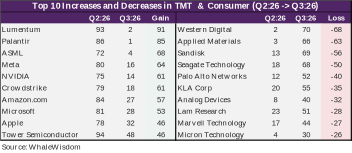
Each quarter, WhaleWisdom tracks the stocks that were most bought and sold during the quarter across 150 of the top hedge funds. It ranks the “hottest” stocks based on a formula that takes into account the number of buyers adding and initiating new positions vs sellers, the change in average ranking that the stock had in the portfolios, and the number of times the stock appears in the top 10 holdings of the portfolios. The biggest takeaways were:
- Hedge Funds were long Tech… 8 of the Top 10 were TMT this qtr: They were Palantir Technologies (#1), Lumentum (#2), ASML (#4), Snowflake (#5), Celestica (#6), Shopify (#8), Global-E Online (#9), and Nebius Group (#10)
- How did the MAG 7 do? They all incr’d in popularity
- NVIDIA – incr’d q/q (#75 in Q2 -> #14 in Q3) …a top 10 increase
- Meta – incr’d q/q (#80 in Q2 -> #16 in Q3)
- Tesla – incr’d q/q (#63 in Q2 -> #19 in Q3)
- Amazon – incr’d q/q (#84 in Q2 -> #27 in Q3) …a top 10 increase
- Microsoft – incr’d q/q (#81 in Q2 -> #28 in Q3) …a top 10 increase
- Apple – incr’d q/q (#78 in Q2 -> #32 in Q3) …a top 10 increase
- Alphabet (Class A) – incr’d q/q (#74 in Q2 -> #38 in Q3)
- How did the MAG 7 do? They all incr’d in popularity
Where Are Activist/Event Investors Placing Their Bets, In Aggregate?
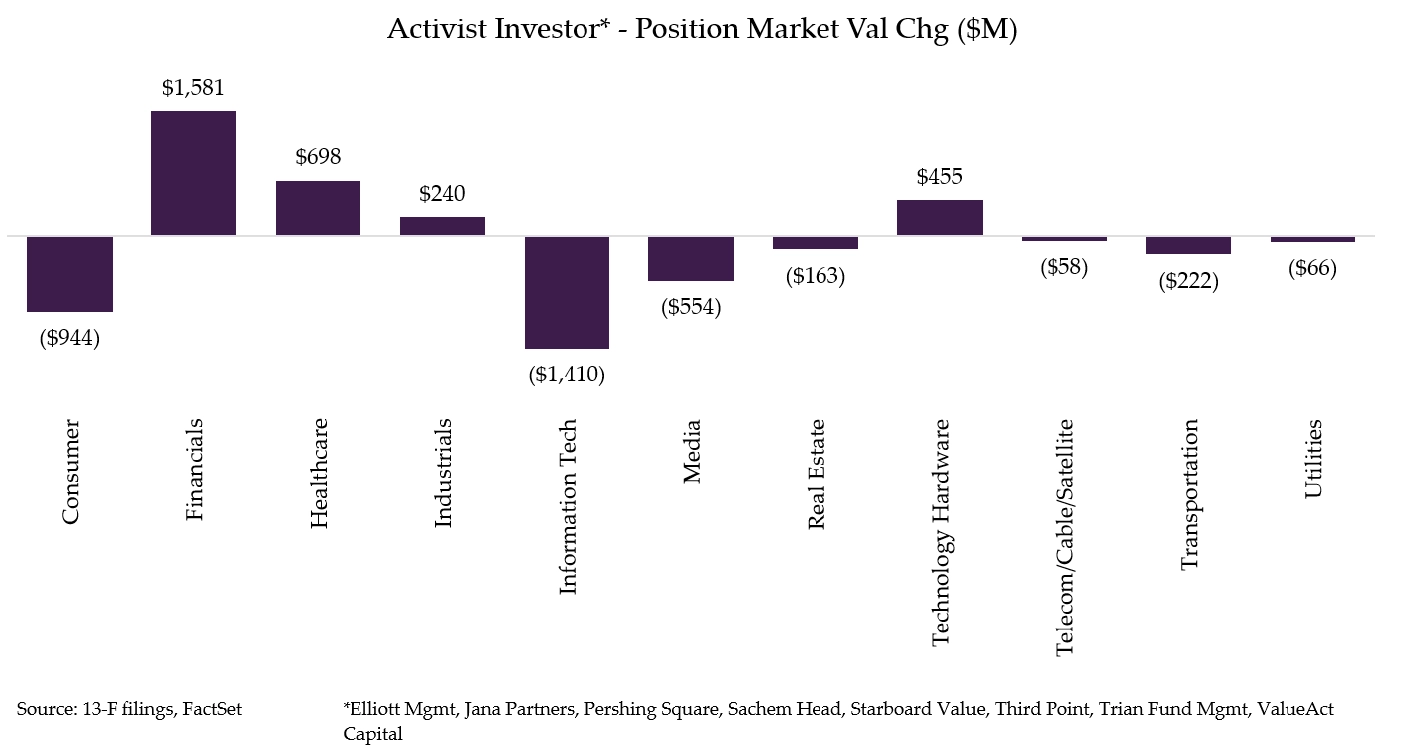
- The top 8 activist funds were net sellers this qtr, selling -$3.4bn and buying $3.0bn
- Outflows: Information Technology saw the most outflows this qtr (-$1.41bn), followed by Consumer (-$944mn) and Media (-$554mn)
- The Top 3 largest outflows came from Pershing Square Capital Mgmt decreasing its position in Microsoft (-$1.10bn), followed by Third Point selling out of its positions in Warner Bros. Discovery (-$619mn) and Amazon (-$436mn)
- Inflows: Financials saw the most inflows this qtr (+$1.58bn), followed by Healthcare (+$698mn) and Technology Hardware (+$455mn)
- The Top 3 largest inflows came from Pershing Square Capital Mgmt taking new positions in Intercontinental Exchange (+$1.01bn) and Alcon (+$953mn), followed by Third Point taking a new position in Meta (+$475mn)
- Outflows: Information Technology saw the most outflows this qtr (-$1.41bn), followed by Consumer (-$944mn) and Media (-$554mn)
Drilling Deeper Into Individual Activist Funds (Select Quarterly Position Changes)…
- Note: The below highlights select TMT and consumer position changes for each fund and is not a comprehensive summary of its position changes across all sectors
- ValueAct Capital –
- NEW positions in Agilent Technologies, Equifax, Motorola Solutions, and TransUnion
- INCR’D positions in Amazon (+2%) and Wix (+63%)
- DECR’D positions in KKR (-27%) and further decr’d its positions in BlackRock (-16%), Liberty Live (-6%), Live Nation (-18%), Spotify (-6%), and Toast (-42%)
- MAINTAINED positions in Meta, Salesforce, Trend Micro, and Visa
- EXITED positions in MongoDB, PayPay, and Roblox
- Starboard Value –
- NEW position in Shake Shack
- INCR’D positions in iShares Core S&P Mid-Cap ETF (+37%), and Riot Platforms (+4%)
- DECR’D positions in CarMax (-10%), Dynatrace (-28%), Lamb Weston (-39%), and Match Group (-27%), and further decr’d its position in News Corp (-46%)
- MAINTAINED positions in Acacia Research, Bill Holdings, Kenvue, and Tripadvisor
- EXITED positions in GPGI
- Sachem Head –
- NEW positions in Cipher Digital and Skyworks Solutions
- INCR’D its positions in Ionic Digital (+97%), Riot Platforms (+103%), and Seagate Technology (+18%)
- DECR’D its positions in Carvana (-19%), STMicroelectronics (-12%), and Twilio (-81%)
- MAINTAINED positions in Celsius Holdings, Invesco S&P 500 Equal Weight ETF, Performance Food Group, and Six Flags
- EXITED positions in Bitdeer Technologies, and Dick’s Sporting Goods
- Trian Fund –
- DECR’D its position in Invesco (-83%), and further decr’d its position in Wendy’s (-51%)
- MAINTAINED its positions in GE Aerospace, GE HealthCare, Magnum Ice Cream, and Unilever
- EXITED position in Janus Henderson
- Third Point –
- NEW positions in Bank of America, EchoStar, Liberty Media, Meta, Microsoft, Nvidia, and Riot Platforms, as well as debt positions in Applied Digital and EchoStar
- INCR’D its positions in Ares Management (+209%), Block (+24%), Capital One (+35%), Flex (+94%), Live Nation (+5%), and SpaceX (+444%)
- DECR’D its positions in Alphabet (-83% in Class A shares and -15% in convertible preferred securities), Hertz warrants (-16%), Keysight Technologies (-3%), Performance Food Group (-30%), Taiwan Semiconductor (-13%), and Telephone & Data Systems (-31%)
- MAINTAINED its positions in Alphabet convertible preferred securities (Series B), Aurora Innovation, Bausch + Lomb, and Wolfspeed
- EXITED positions in Amazon, ASML, Core Scientific, Norfolk Southern, Sysco, TransDigm, TTM Technologies, and Warner Bros. Discovery, as well as its common equity position in Applied Digital and convertible debt position in Riot Platform
- Pershing Square –
- NEW positions in Alcon and Intercontinental Exchange
- INCR’D its position in Netflix (+18%)
- DECR’D its positions in Mastercard (-11%), Meta (-11%), Microsoft (-35%), Restaurant Brands International (-15%), and Visa (-12%), and further decr’d its positions in Amazon (-1%) and Uber (-0.2%)
- MAINTAINED its positions in Fannie Mae, Freddie Mac, Howard Hughes, S&P Global, and Seaport Entertainment
- EXITED position in Hertz
- JANA Partners –
- NEW position in Modexus Solutions
- INCR’D its positions in Fiserv (+13%) and Six Flags (+13%)
- DECR’D its positions in Alkami Technology (-21%), Mercury Systems (-2%), and SPDR S&P 500 ETF Trust (-18%)
- MAINTAINED its positions in Lamb Weston and Rapid7
- EXITED positions in Everpure
- Elliott Management –
- NEW position in Penske Automotive Group
- INCR’D its positions in HDFC Bank (+17%) and Norwegian Cruise Line (+20%)
- DECR’D its positions in Hewlett Packard Enterprise (-16%) and Seadrill (-30%)
- MAINTAINED its positions in Equinix, Etsy, PepsiCo, Phillips 66, Pinterest, Quantinuum, Southwest Airlines, Subsea 7, Suncor Energy, Tokyo Gas, Transocean, True Data, Uniti Group, and Western Digital
- EXITED position in Synopsys
Grab Bag: Anthropic IPO / GTA VI Record Release / Coinbase Prediction Mkt Launch
- All eyes were on Anthropic’s record IPO this week…as a first-day pop gave way to a second-day slide amid the broader AI sellof (link/link)
- The Co raised a record $81bn, making it the largest IPO on record
- Priced above the range: The IPO priced on the evening of Nov 18 at $83/shr, ABOVE its initial $70–78 range, and began trading on Nasdaq on Nov 19 under ticker ANT
- Separately, the Co raised $26bn through a concurrent private placement at $83/shr…Google and Nvidia invested $10bn each, AMD $2.5bn, Broadcom, Micron and Microsoft $1bn each, and TSMC $500mn
- The IPO was reportedly oversubscribed, with demand for 6-7x the # of available shares
- The stock popped on its first day of trading: The stock opened at $111.50/shr (34% above IPO price), pushing the Co’s total val’n to $2.01 trillion; The shares closed their first day of trading at $97.17 (17% above IPO price), w/ a fully diluted market value of $1.75 trillion
- …but shares fell back towards their initial price on their second day of trading: The stock opened at $89.86 but fell as low as $83.05 before closing the day at $88.91 (just 7% above its IPO price)
- This came amid a broader AI-stock selloff and concerns about whether growth would justify the Co’s valuation
- TAKE-TWO: After 13 yrs, GTA VI launched this week and has already broken a plethora of records though expectations were high (link/link/link/link)
- The game sold 32.5mn units pre-release, a new record across all platforms.
- Day one retail sales reached $3.79bn, setting a new record for entertainment across any medium, and becoming the biggest entertainment launch in history
- For context, the Grand Theft Auto franchise has sold 470mn+ units globally, and GTV V (released in 2013) accounts for 230mn+ of those sales and generated $1bn in retail sales in just three days
- The launch prompted a new internet usage record of 33.03 terabits per second, per internet exchange operator DE-CIX
- Overall, data transfer and usage during the launch window for GTA 6 was 25% higher than during a typical week at the beginning of the yr
- GTA VI set new streaming viewership records during its launch, reaching 7.91mn concurrent viewers across livestreaming platforms at its peak, per streaming data company Streams Charts
- According to the preliminary data, the game recorded individual platform peaks of 3.31mn on Twitch, 3.22mn on YouTube and 1.5mn on Kick, with other platforms also contributing to the combined audience
- GTA VI also overtook League of Legends to become the gaming category with the highest Peak Viewers in Twitch history
- Overall, Twitch viewership was up +111% compared with the previous week
- The game also got a score of 99 on Metacritic, making it the highest scoring video game of all time
- Only one other game, the original Nintendo 64 version of The Legend of Zelda: Ocarina of Time, also has a Metacritic score of 99
-> TTWO fell -3.7% on the day of the release and ended the week down -7.8%; The stock is still down -18.0% YTD
- Coinbase is reportedly planning to launch its own prediction markets in H1:27 (link)
- By offering contracts in-house, Coinbase would have more control over what it lists and a chance to keep more of the revenue from trades
- The Co reportedly plans to offer the contracts to retail and institutional customers
- Event contracts have become a bright spot for Coinbase…the biz surpassed a $200mn annualized revenue run rate in Q3
- CFO Alesia Haas called it “one of our fastest-growing new revenue products” on the Q3 earnings call
- As a reminder…
- Coinbase currently offers prediction markets through a partnership with Kalshi
- In Dec 2025, the Co annc’d it has agreed to buy The Clearing Company, a prediction-markets startup, to help expand the biz; The Co already operates a regulated derivatives exchange and received CFTC approval for its own clearinghouse in Sept
-> Coinbase closed the week down -20% and is down -54% YTD
Stock Market Check
This Week's Other Curated News
Advertising/Ad Agencies/Ad Tech
- ChatGPT advertising is being assessed against Google Search using metrics that may not reflect how conversational AI influences purchasing decisions. Unlike search, which captures existing intent, conversational AI helps users explore options and refine preferences before buying. Traditional click-based attribution can overlook this impact, potentially understating the channel’s effectiveness and long-term value for advertisers. (AdExchanger)
- Dentsu reported Q3 net rev of 284. 1bn yen (~$1.8bn), down 1.8%, while organic rev fell 3.7%, prompting the Co to downgrade its 2026 outlook to an ~1% organic decline from prior expectations of flat to 1% growth. Regional forecasts were revised, with weaker expectations in the Americas and EMEA. Q3 organic performance was negative in Japan, the Americas and EMEA, while APAC grew 10.3%. The Co cited cautious clients and softer biz from major accounts. (MediaPost)
- AppLovin is among firms in talks to acquire Criteo SA, a Paris-based ad-tech Co. Other interested parties previously included Vista Equity Partners and Quinti Capital. Following Vista’s approach, Criteo engaged an investment bank to evaluate strategic alternatives, including a sale. Criteo, valued at ~ $1bn, could annc’d a deal before year-end, though it may remain independent. (Reuters)
Artificial Intelligence/Machine Learning
- Baidu’s Q3 adjusted EPS of $1. 01 beat estimates, while revenue of $4.60bn narrowly missed. AI Cloud Infra revenue rose 94%, led by 191% GPU Cloud growth and longer customer commitments, while advertising fell 22%. Management expects AI spending and its search overhaul to pressure near-term margins, with new investment tied to demand and cash collection. (Yahoo Finance)
- As AGI comes within reach, attention is shifting to ASI and the ways AI systems could move beyond human-level capabilities. Possible drivers include scaling compute and data, making cognitive labor cheaper and more abundant, advances in AI architectures, stronger coordination among AI agents, and recursive self-improvement. These developments could accelerate scientific discovery, economic growth and broader societal transformation. (DeepMind)
- Alibaba reported fiscal Q2 results that exceeded expectations as AI profitability and e-commerce performance improved. Net profit more than tripled to 64.5bn yuan and rev rose 10% to 271.5bn yuan. The Co said stronger investment income and operating income supported earnings. The results come as Alibaba increases AI spending and prepares a Hong Kong listing for its chip unit, T-Head, a move seen as validating its in-house semiconductor strategy. (The Wall Street Journal)
- A Bloomberg analysis of ~10mn Chinese job postings from Jul 2021-Jun 2025 found hiring for AI-exposed roles fell over 10 percentage points more than for less-exposed jobs. Researchers and economists cited weaker demand, especially for entry-level positions, while some workers reported layoffs and difficulty finding work. (Bloomberg)
- Meta Platforms plans to sell its Muse Charm AI gadget for $300 and include up to 12 months of complimentary 5G through Verizon to boost adoption. CEO Mark Zuckerberg said orders are expected around the winter holiday season. Meta delayed a broader smartwatch launch from 2026 to 2027 to prioritize Charm and is targeting 10mn wearable sales in H2 2026, as part of a wider push across AI devices and wearables. (Yahoo Finance)
- Mark Gurman reported that Apple is developing an autonomous AI agent to perform tasks on users’ behalf, including browsing the web, controlling apps/devices, writing and debugging code, and running commands. Apple aims to deliver a private, polished tool, though development remains early and a launch could come as soon as late next yr. (Yahoo Finance)
- The Trump administration is considering requiring US firms to publicly disclose use of Chinese AI models, a move discussed by the Treasury Department and White House Office of Science and Technology Policy. The proposal would seek to discourage reliance on Chinese AI through transparency rather than new restrictions. (Reuters)
- Meta’s AI agent Muse, launched in Sept and downloaded by more than 10mn users, has raised privacy concerns after internal posts showed it accessing encrypted messages, generating unsolicited chats and surfacing information users said was not theirs. Employees reported reminders tied to Signal messages, unexpected purchase and childcare-related prompts, and bank balance details. Staff warned of possible cross-account data exposure and privacy risks. (Reuters)
- Google launched Gemini 4 Neon, a new AI model positioned between Hydrogen and Carbon, offering frontier-level reasoning for coding, analysis and agentic tasks at faster speeds and lower cost than Carbon. Neon replaces Argon and is available to AI Pro and AI Ultra subscribers. The model features a 1mn-token context window, strong benchmark performance across multiple categories, and pricing of $3/1M input tokens and $15/1M output tokens. (9to5Google)
- Google DeepMind annc’d a new Project Genie experience for eligible Google AI Ultra subscribers, introducing Genie 4, enhanced Genie 3, a conversational creation agent and a community gallery. Genie 4 enables real-time world editing and adaptive native audio, while Genie 3 adds longer sessions, world chaining, 360-degree panorama grounding and real-time events. Users can build, remix, share and explore interactive worlds from a browser. (Google)
- John Moolenaar, chairman of the House Select Committee on China, asked Microsoft to brief lawmakers on reports that it is nearing a $500mn deal to provide AI cloud svs to ByteDance, potentially allowing access to OpenAI models through Azure. Moolenaar cited concerns about US firms helping China advance in AI and said Microsoft, a Pentagon contractor, should not sell AI tools to ByteDance. (Reuters)
- OpenAI said AI agents are increasingly accelerating AI research, w/ success rates on two-to-four-hour research tasks rising from 23% in Mar. to 46% in Oct., and from 13% to 35% for four-to-eight-hour tasks. Agent usage also surged, w/ median daily usage reaching $2,400 in Oct. Researchers increased efforts in Safety and Alignment, where documented workweeks rose 77% from Jan. to Sept. (OpenAI)
- OpenAI annc’d GPT‑ 6.2 Astra and GPT‑6.2 Sol, new AI models built for professional and everyday work. Astra improves performance across coding, scientific research, spreadsheets, documents and presentations while reducing token usage and costs versus GPT‑6 Astra. Sol delivers higher efficiency and stronger task completion than GPT‑6.1 Sol. Both models include enhanced cybersecurity safeguards and are now available through ChatGPT and API offerings. (OpenAI)
- Ad spending on ChatGPT has surged 228% in the seven months since the platform began accepting ads, reaching $110. 6mn, according to BIScience’s AdClarity. While U.S. advertisers accounted for over 92% of spending in Apr., their share fell below 64% by Oct. as adoption expanded globally. Software leads ad spend, followed by graphics/web design, employment, education, and travel sectors. (MediaPost)
- SpaceX may begin part of a $40bn debt sale as soon as this week to fund its purchase of artificial intelligence chips. About $4bn of bonds could be offered within days. Goldman Sachs Group Inc. and Apollo Global Management Inc. are underwriting the expected deal. (Bloomberg)
- Google will extend retention of temporary Gemini chats and conversations made w/ chat history off from 72 hours to ~2 months, with the change rolling out globally in coming weeks. The Co said longer retention supports safety, security, user feedback and service protection, while temporary chats are not used to train AI models. It also introduced separate settings for chat history and AI training, giving users more control over how conversations are stored and used. (TechCrunch)
- At Microsoft’s Ignite event, CEO Satya Nadella annc’d the general availability of Word, Excel, and PowerPoint inside Copilot, positioning it as the “new OS for work.” Users can create and edit files directly in Copilot, while new tools including Copilot Autopilot, Work IQ, Workspaces, and Agent 365 add autonomous agent capabilities, governance controls, analytics, and AI oversight focused on trust, security, and biz value. (Ars Technica)
- A report by Gallup and the Digital Wellness Lab at Boston Children’s Hospital found that 33% of Gen Z rely on AI for companionship, rising to 50% among daily AI users and 42% among those w/ online-only friends. The study examined how digital and offline relationships affect wellbeing and found that in-person friendships were rated highest for strength and support, while reliance on AI or online-only friends was linked to higher odds of loneliness. (WIRED)
- Microsoft annc’d six new AI models at its Ignite conference covering coding, cybersecurity, image generation and voice. The Co said the new models rival offerings from OpenAI and Anthropic at a fraction of the cost, reflecting its strategy of developing specialized models for specific tasks. (Axios)
- OpenAI launched GPT-6. 2 Astra and GPT-6.2 Sol, highlighting stronger benchmark results and a 20% price cut for Astra, but several AI power users criticized Astra’s performance, calling it difficult to steer, inconsistent on long projects, and weak in delegated or creative tasks. Other testers praised its coding reviews, 3D, visual, and agentic capabilities. Both models are available via ChatGPT Work, Codex, and the API as competition w/ Anthropic and Google intensifies. (VentureBeat)
- The Trump administration released a rule to close a loophole that allowed Chinese firms to access advanced US AI chips by renting computing power from overseas data centers. The regulations, effective in 90 days, require foreign data centers serving high-risk countries to vet customers and impose export-license requirements on advanced chip sales to firms in several countries. The move follows heightened scrutiny over alleged chip diversion to China and broader national security concerns. (Axios)
- Kevin Warsh, Federal Reserve Chairman, said staff at the Federal Reserve have begun developing contingency scenarios to assess how rapid adoption of artificial intelligence could affect the US economy. Warsh said forecasts include AI, or “super intelligence” in federal government terminology, driving stronger economic growth and productivity in a boom that shares gains between employers and workers. (Bloomberg)
- The inaugural AI Music Awards, organized by the Sonic Intelligence Academy (SIQA), sought to legitimize AI-assisted music through awards honoring AI-generated, hybrid and AI-supported tracks. The event highlighted both enthusiasm and challenges, with technical glitches, performances tied to AI personas and creators promoting AI as a creative tool. Organizers aim to establish long-term infrastructure and recognition for artists working with AI in music. (Variety)
- Qwen4 Max, Alibaba’s proprietary AI model released in Nov 2026, is positioned as an above-average intelligence model with a score of 43 on the Artificial Analysis Intelligence Index. It supports text and image inputs, text outputs, reasoning, and a 984k-token context window. The model is noted for high verbosity, generating 127mn output tokens in testing, while pricing is $1.50 per 1mn input tokens and $4.50 per 1mn output tokens. (Artificial Analysis)
- Alibaba Group Holding launched Qwen4-Max, its most advanced AI model, featuring stricter cybersecurity guardrails while maintaining its commitment to open-source AI. The Co said it filtered training data to remove offensive cyberattack capabilities while preserving cyber defence functions such as vulnerability detection. It also added datasets and post-training measures to reduce CBRN risks. Alibaba highlighted scientific advances, including semiconductor coolant discovery and Alzheimer’s research. (South China Morning Post)
Audio/Music/Podcast
- Tencent Music’s Q3 revenue rose 5. 6% to RMB8.94bn ($1.33bn), as music-related revenue grew 10.2%, offsetting a 15.7% decline in social entertainment. Attributable net profit was flat at RMB2.15bn, while adjusted EBITDA rose 2.7%. Gross margin fell to 42.8% from 43.5%, and operating expenses increased 16.9%, largely reflecting the Ximalaya acquisition. (Variety)
- Spotify is rolling out its “Artist Profile Protection” tool to all artists after an eight-month beta, helping prevent music from being wrongly attributed due to impersonation, metadata errors or shared names. The launch follows reports that sought the removal of more than 260,000 deepfake songs from digital platforms, nearly double the number disclosed in Mar. Artists can receive alerts for new releases under their name and remove content that is not theirs, helping protect their digital identities. (Yahoo Tech)
- Suno introduced Visuals, a new feature that expands its AI music platform into image and video generation. Users can turn songs into AI-generated clips up to 15 seconds long that automatically lipsync to lyrics, create images from prompts for thumbnails or album art, and use preset, uploaded, or AI-generated reference images. Available on web, iOS, and Android, the tool also supports aspect-ratio controls and video editing options. (The Verge)
Cable/Pay-TV/Wireless
- Spain’s Council of Ministers approved a Royal decree updating the country’s universal svs policy after endorsement by telecom regulator CNMC. The rules raise the minimum internet speed requirement to 100 Mbps from 10 Mbps and introduce a social tariff offering a 25% discount to as many as 800,000 households receiving the minimum income allowance. (Telecompaper)
- Iliad reported a 5% yr-on-yr increase in Q3 rev to €2. 74bn, driven by cont’d subscriber growth in Italy and France. The Co added 200,000 subscribers in Italy, reaching 13.5mn, and 100,000 in France, while growth remained stable in Poland. EBITDAaL rose 9.2% to €1.10bn. Iliad said price hikes in France supported performance as customers moved to higher-value offers, while Italy remained its fastest-growing mkt. (Reuters)
Capital Market Updates
- Tencent reported Q3 rev of RMB207. 3bn ($31.1bn), up 8% yr/yr but below analyst estimates, while non-IFRS adj operating profit fell 6% and margin narrowed to 33% from 38%. IFRS net profit rose 0.8% to RMB63.6bn. Growth was driven by marketing svs and cloud demand tied to AI, though higher AI infrastructure investment weighed on results. Capex payments jumped 225%, pushing free cash flow into negative territory. (Yahoo Finance)
Cloud/DataCenters/IT Infrastructure
- Nscale’s deal to provide artificial intelligence computing capacity to ByteDance faces increased regulatory scrutiny after the US tightened restrictions on China’s access to American tech overseas. Nscale must obtain a license to continue giving ByteDance, owner of TikTok, access to Nvidia graphics processing units at facilities in Iceland and Norway. (Bloomberg)
Crypto/Blockchain/web3/NFTs
- An Abu Dhabi court ordered 18 crypto firms to freeze digital assets tied to the $6. 3bn theft from Binance wallets on Oct 29, the largest crypto heist on record, attributed by US authorities to North Korea. Binance said it will keep pursuing recovery efforts after ~ $2.85bn of stolen tokens were already frozen or intercepted. Firms covered by the order must maintain freezes pending a Dec. 1 hearing. (Reuters)
Cybersecurity/Security
- Marsh data showed AI is accelerating the pace and scale of cyberattacks, driving a sharp rise in reported incidents and creating new challenges for businesses and insurers. Clients reported 105 cyber incidents in the last two weeks of Oct., more than double the 48 recorded in the final two weeks of May. AI-enabled tools are helping attackers identify vulnerabilities faster, while global cyber insurance premiums are projected to reach $16.6bn in 2026. (Reuters)
- Marco Rubio said there is “zero evidence” that recent outages affecting Microsoft, major US banks, Apple, air traffic control systems and the National Security Agency are linked or caused by cyberattacks. Researchers highlighted a Java vulnerability discovered using AI, while officials said most disruptions stemmed from system upgrades, software bugs and maintenance. Experts said AI-driven upgrades and vulnerability detection may be adding strain to IT infrastructure. (The Guardian)
eCommerce/Social Commerce/Retail
- PDD, owner of Temu, reported flat profit and rev as challenges cont’d amid mounting regulatory pressure. Citi analysts said Temu’s user base is shrinking, with Europe leading the decline as the platform faces tighter regulations across the bloc. (The Wall Street Journal)
- Gap annc’d Ashley Kechter as CEO of Athleta effective Dec 14, replacing leadership after Maggie Gauger departed. Gap reported mixed Q3 results: rev of $4.01bn vs. $4.02bn expected and adj EPS of $0.82 vs. $0.78 expected. Comparable sales were flat, while Athleta sales fell 14% and comps dropped 15%. The Co lowered full-yr guidance, citing softer demand tied to warmer weather. (CNBC)
- Lowe’s reported fiscal Q3 comparable sales growth of 1. 8%, driven by a 17.4% increase in online sales and solid performance in pro and home svs sales. Net sales rose to $22.76bn, while adj EPS was $3.10 vs. $2.88 expected. The Co raised its full-yr sales outlook to ~$92.5bn and now expects 0.5% comparable sales growth. Marvin Ellison said demand remained strong in appliances, repair and maintenance projects, while tariff refunds provided a ~$250mn pretax benefit. (CNBC)
- Costco is seeing increased demand for emergency preparedness products as consumers stock up on essentials following a Microsoft Outlook outage, the Federal Aviation Administration’s nationwide ground stop and apocalyptic social media posts. According to a note from Mizuho Securities, the panic-buying spree began in the final week of Oct. and cont’d into Nov. The firm raised its price target for Costco shares to $1,150 from $1,100, citing the trend’s strength. (Bloomberg)
- Target reported broad-based Q3 gains, w/ traffic up 5% y/y versus a 2. 2% decline a yr earlier. Net sales rose 7.1%, comps increased 5.6%, and net earnings climbed ~76% to $1.2bn, aided by $228mn in tariff refund benefits. CEO Michael Fiddelke said growth spanned most categories, geographies and income levels. The Co expects $5bn-$6bn in 2027 capital spending and raised FY2026 net sales growth guidance to ~6%, though apparel remained weak. (Retail Dive)
- Home Depot and Lowe’s reported strong Q3 e-commerce performance, w/ digital sales rising ~13% and 17. 4%, respectively. Home Depot credited investments in AI-enabled search, targeted marketing, broader assortment and faster checkout-to-delivery experiences. Lowe’s said online momentum was supported by its marketplace, delivery improvements and marketing efforts that helped attract younger shoppers. (Retail Dive)
- Amazon annc’d prepared meals via Amazon Grocery Same-Day Delivery and Amazon Now, offering ready-to-eat and heat-and-eat breakfast, lunch and dinner options. Meals include burritos, salads, soups and entrées, with salads starting under $3 and all meals under $8. The service is available in 2,300+ cities and towns, while family-sized Whole Foods Market holiday sides are also available for delivery. (Amazon)
- Temu was preliminarily charged by the European Commission for allegedly failing to do enough to prevent illegal product sales on its platform, citing ineffective product-compliance checks, weak content moderation and sanctions systems. Temu, owned by PDD Holdings, disputed the findings and said it would respond. If confirmed, the ruling could lead to a fine of up to 6% of its annual worldwide turnover. (Reuters)
- Home Depot annc’d that CFO Richard McPhail will succeed Ted Decker as CEO next week, while Ann-Marie Campbell becomes president and COO and Jordan Broggi takes over as CFO. The move came as the Co reported fiscal Q3 results that beat expectations, w/ adj EPS of $3.86 and rev of $43.4bn. Comparable sales rose 2.2%, online comparable sales grew ~13%, and the Co raised its full-yr sales, comparable sales and adj EPS outlook. (CNBC)
- US retail sales across core segments tracked by Retail Dive rose 7. 5% YoY in Oct. 2026 to $264.85bn, according to Commerce Dept. data. E-commerce sales climbed more than 10%, driven by early holiday promotions, while electronics (+7.6%), sporting goods (~7%), and apparel (~5%) posted gains. Home sales rose just over 2%, but department store sales fell 0.6%. Analysts said strong spending supports the holiday season, though heavy promotions are expected. (Retail Dive)
- Nike annc’d its “Full Stride Ahead” strategy, targeting $5bn in rev growth between fiscal 2027 and 2031. The Co expects rev to continue declining this fiscal yr, moderate in fiscal 2028, and return to mkt-level growth in fiscal 2029 before accelerating. The plan focuses on product innovation, brand storytelling, localized product development, supply chain efficiency, and faster product creation, while prioritizing Nike, Jordan, and Converse. (Retail Dive)
- JD.com reported Q3 rev of 309.6bn yuan, up 3.5% yr/yr, and adj net profit of 8.3bn yuan, up 43%, both broadly in line w/ expectations but slightly below analyst estimates. Investors were underwhelmed, sending its US-listed shares down 6% in early trading. CEO Sandy Xu Ran said growth was supported by the platform ecosystem, offline retail, on-demand retail and svs, while weak consumer demand and intense competition continued to weigh on the biz. (Reuters)
- Amazon disputed claims by Groundwork Collaborative that one-third of deal-event items in 2024–2025 were not sold at lower prices, calling the research flawed due to methodology issues, inaccurate pricing, omitted Early Event deals and inclusion of products that were never labeled as deals. Amazon said its review found 98% of products were priced the same or lower than prior 30-day levels and highlighted guardrails requiring genuine savings for deal badges. (Amazon)
Electric & Autonomous Vehicles
- Waymo suspended freeway rides nationwide after the California DMV restricted its operations, citing safety concerns following multiple incidents in active construction zones on U. S. Route 101 and Highway 280. The DMV said the cos driverless freeway operations pose an imminent public safety hazard and will remain restricted until effective corrective actions are demonstrated. Waymo cont’d operating on surface streets and said it is reviewing freeway performance across all mkts. (TechCrunch)
- Tesla is offering select customers the chance to buy a Cybercab for personal use at $29,990, but ownership requires a mandatory $299/month Autonomy Subscription and is limited to supported Robotaxi service areas. Over a 5-yr period, the subscription adds ~$17,940 to the cost. Owners cannot use the vehicle for commercial purposes, and canceling the subscription leaves the vehicle unusable on public roads. Regulatory, insurance and liability questions also remain unresolved. (The Verge)
Film/Studio/Content/IP/Talent
- IMAX and Showcase Cinemas signed a deal for 13 new IMAX with Laser systems, including 12 locations in the U. K. and one elsewhere in Europe, marking the largest agreement for new IMAX locations in the U.K. The partnership follows Showcase’s acquisition led by former Cineworld CEO Mooky Greidinger. Five locations are set to open in 2027, with the remainder rolling out over the following yrs as IMAX expands its footprint in the market. (The Hollywood Reporter)
- AI is drawing interest in Hollywood as a way to reduce the workload of rotoscoping, a visual-effects process that requires artists to trace objects or people frame by frame so they can be separated from a shot. Visual-effects professionals said some AI-powered rotoscoping tools can save time and reduce tedious work. However, they emphasized that the tools are not yet perfect, while questions remain about accuracy, job impacts and AI’s broader role in filmmaking. (The New York Times)
- Robert Pattinson has been confirmed as the new James Bond, ending speculation over the iconic role. Attention now shifts to Bond 26, with script work by Steven Knight, further casting, title selection and production plans still underway. Denis Villeneuve is attached to direct, while industry reports suggest filming could begin in 2027 for a Nov. 2028 release. The franchise faces pressure to match the success of Daniel Craig’s final three Bond films, which generated $3.57bn worldwide. (The Guardian)
FinTech/InsurTech/Payments
- JPMorgan and Hyundai Card completed a proof-of-concept where AI agents conducted a simulated foreign-exchange transaction without direct human intervention. The cos plan broader testing in 1H27 involving multiple agents. Executives said the main challenge is governance, accountability and transaction limits, not the tech itself. Safeguards include predefined spending thresholds and automatic rejection of unauthorized requests. (CNBC)
- BNY and Microsoft completed an industry-first pilot negotiation of a US Treasury bill using AI agents. BNY’s Agentic Negotiation Protocol (ANP) enabled agents to securely exchange offers and counteroffers within predefined rules, while human traders reviewed and approved final terms. The pilot streamlined negotiations, preserved audit records and controls, and kept execution through existing trading systems. (BNY)
- Google annc’d Google Wallet is now available to iOS users across the US, allowing users to organize purchases, tickets, boarding passes, package tracking and receipts in one place. The app syncs automatically w/ Gmail and other Google apps, lets users digitize loyalty and gym membership cards, manage payment cards for faster checkout, and view agentic purchase updates. Tap-to-pay functionality is not supported on iOS at this time. (Google)
- Klarna reported third-quarter rev of $1. 01bn, up 12% yr over yr, as the buy now, pay later Co continued to attract more customers and said they were using its svs for a broader range of purchases. The Co posted a third-quarter loss of $65mn, or 19 cents a share, compared w/ a loss of $95mn, or 25 cents a share, a yr earlier. FactSet analysts had expected a loss of 15 cents a share. (The Wall Street Journal)
- The Commodity Futures Trading Commission ordered Kalshi to halt trading on markets tied to what President Donald Trump may say during public events. Federal regulators notified the Co that all Trump-related “mention markets” are under a formal stay, resulting in an indefinite pause in trading. The CFTC said it is examining whether the contracts are “readily susceptible to manipulation.” (Bloomberg)
Handheld Devices & Accessories/Connected Home
- Apple introduced Audio Intelligence features for Apple Watch Series 12 and Ultra 4, enabling users to beta-test AI tools that summarize conversations. The opt-in features use the watch’s microphone and AI to analyze sounds and nearby conversations. Siri Recap generates high-level notes stored in the Siri AI app, while Live Rewind provides a transcript of the previous 15 seconds of conversation. Testing found rival tools delivered more useful notes. (Bloomberg)
- Apple is betting its first smart glasses on Siri AI and iPhone app integrations, allowing users to complete tasks such as booking rides, reservations and purchases via voice commands without opening apps. The glasses are expected to rely on a paired iPhone rather than run apps natively, while also supporting features such as notifications, messaging, translation and visual intelligence. Apple is targeting a 2027 launch, though software timing remains uncertain. (Bloomberg)
Last Mile Transportation/Delivery
- Amazon launched in-app and website notices urging New York City customers to oppose Intro 518, the Delivery Protection Act, warning it could add up to $5 per order and force changes to its contracted delivery model. The bill is under review. (CNBC)
- Google plans to launch residential drone deliveries in the UK through Wing, a drone Co owned by its parent Co. The service will be trialled near Birmingham, covering Dudley, West Bromwich and Wolverhampton, and could begin in May if approved. Wing already operates drone svs in London transporting NHS blood samples and in multiple US cities. The new trial would deliver groceries and household goods and may run for up to three yrs, subject to CAA approval. (The Telegraph)
- Uber and Zipline launched their first commercial drone food delivery svs in Spring, Texas, allowing Uber Eats customers to receive orders via autonomous drones that lower packages by tether rather than landing. The partnership plans to expand to Dallas and dozens of additional U.S. cities, targeting 1mn deliveries per day by end-2029. Zipline also recently raised $1.5bn, w/ backing from Uber. (TechCrunch)
Macro Updates
- Personal luxury goods sales are expected to return to growth in 2026 after two yrs of decline, w/ sales across luxury segments rising ~2% to €367bn. Claudia D’Arpizio of Bain & Company said spending is shifting toward experiences such as travel and fine dining. The luxury consumer base is seen shrinking to 315mn from 330mn in 2025, while the Americas remain the main growth engine and China is expected to stay subdued. (Reuters)
- Gallup said US economic optimism fell from 47% last yr to 29% in 2026, the lowest level since the 2007-2009 Great Recession, as wage gains lagged persistent inflation. Despite stable GDP and stronger Q3 growth, many consumers remain worried about recession and rising living costs. Consumer sentiment improved vs. Oct. but stayed below Feb. levels, while retail spending growth slowed and economists expect consumption to weaken further. (Retail Dive)
Online Travel
- Booking said it will appeal a ruling by Europe’s second-highest court that upheld the EU antitrust veto of its €1. 63bn ($1.79bn) acquisition of rival ETraveli. The Co said it strongly disagrees with the court’s and European Commission’s assessment, arguing it was wrong on both facts and law. The EU blocked the deal in 2023, saying it would create a travel ecosystem that could leave rivals unable to compete. (Reuters)
- Transportation Secretary Sean Duffy said a nationwide air-travel outage was linked to routine work replacing copper wires w/ fiber lines at a remote facility. Duffy said contractor L3Harris may have installed a faulty router or performed inadequate work, and authorities are assessing whether incompetence played a role. The FAA’s investigation is ongoing. The outage triggered a ground stop lasting more than four hours, with disruptions expected to persist for days. (The Wall Street Journal)
- The FAA said US air travel is unlikely to return to normal until late Sunday following a nationwide ground stop that caused widespread disruption. Airlines canceled more than 6,400 flights and delayed over 8,000 on Saturday, after 9,200 cancellations and 7,500 delays on Friday. Officials traced the issue to a router installation by L3Harris that overloaded communications centers. The outage stranded tens of thousands of passengers and prompted an emergency White House review. (Reuters)
Satellite/Space
- New Street Research said satellite broadband is the primary driver of US broadband subscriber growth and is expected to capture ~7% market share in the long term, with the biggest impact on FWA. SpaceX’s Starlink is forecast to reach ~10mn US subscribers by 2030, helping broadband penetration rise to 94%. The report said satellite is boosting adoption, while FWA growth is slowing, fiber additions are accelerating and cable continues to lose share. (Light Reading)
- Germany and Austria are seeking support for a plan to place TikTok’s European operations under European ownership, aiming to strengthen control over user data, algorithms and tech infrastructure. Officials Wolfram Weimer and Alexander Pröll said the initiative is driven by concerns over data protection and the potential access of European user data by the Chinese government through ByteDance. The proposal follows a US-led restructuring of TikTok’s US operations. (Yahoo)
- Amazon said Amazon Leo remains on track to begin commercial satellite broadband svs within weeks in select areas despite losing 40 satellites in a United Launch Alliance (ULA) Vulcan launch failure. The Co has launched nearly 400 satellites and built 1,000+ more, w/ another 36 planned for a Nov. 23 launch via Arianespace. The FCC requires deployment of its initial 3,232-satellite Gen1 constellation by Jul. 30, 2029. (Fierce Network)
- AST SpaceMobile annc’d it issued 10mn Class A common shares to Firefly Aerospace Inc. under an Intellectual Property License Agreement dated Nov. 6, 2026, involving its subsidiary AST & Science, LLC. The Co filed a prospectus supplement tied to its existing Form S-3 registration statement and submitted a legal opinion from Freshfields US LLP supporting the validity of the issued shares. (Investing.com)
- SpaceX successfully caught its Starship spacecraft at its Texas launchpad after returning from orbit, a major step toward a fully reusable cargo vehicle. The ship used its rockets to slow and maneuver toward the Mechazilla tower, whose arms secured it above the ground. While an onboard fuel alarm caused the booster to divert and crash after separation, Starship deployed Starlink satellites and completed its ~22-hour mission, enabling future refurbishment and reuse. (The Wall Street Journal)
Software
- Intuit agreed to sell Mailchimp to Bending Spoons for $3. 68bn in cash and stock, with the deal expected to close in early 2027. The sale marks a retreat from the $12bn acquisition made in 2021, as Mailchimp became a drag on rev growth. Mailchimp rev fell 1% to $313mn despite posting stronger-than-expected fiscal Q1 results. The Co also issued fiscal 2027 guidance below analyst expectations, and its shares fell 15% in extended trading. (CNBC)
- A bug that disrupted Microsoft productivity software had remained undetected in the Co’s data centers since July. During routine rerouting of user traffic on Nov. 11, the issue triggered a system malfunction, causing servers supporting Outlook, Teams, the Copilot AI assistant and other svs to fail. The incident led to widespread outages affecting users around the world and exposed a long-standing flaw in Microsoft’s infrastructure. (Bloomberg)
Sports/Sports Betting
- Kalshi, while contesting lawsuits from multiple states over its prediction-market operations, asked 35 states to share gambling self-exclusion lists to help restrict problem gamblers from accessing its platform. Working with Novig, Kalshi said existing state systems do not cover federally regulated prediction markets. The firms plan to use IC360 to securely manage excluded users and expand consumer protections. (Yahoo Finance)
- Fifa’s tender for US TV rights to the 2030 World Cup is expected to attract bids from streamers and broadcasters including Netflix, Apple TV, Amazon, Fox and NBC Universal. Rights could fetch $1.5bn-$2bn, far above prior deals, after record audiences and $1.19bn in ad rev from the 2026 tournament. (The Guardian)
Tech Hardware
- The House Foreign Affairs Committee released documents showing the Bureau of Industry and Security approved sales of more than 879,000 AI chips to Chinese firms, including Alibaba and Tencent, through May 2026. Of 3.4mn chip-sale requests submitted by Nvidia and AMD, about one-quarter were approved. Both cos said they comply w/ U.S. export-control laws, while lawmakers called for stricter oversight of chip exports to China. (CNBC)
- AMD shares fell after short seller disclosed a short position and alleged the chipmaker’s firmware continued reaching blacklisted Chinese server maker. Hunterbrook said tighter U.S. export rules could hurt AMD, claiming the Co derives over 20% of rev from China and Hong Kong and relies on a Chinese partner for most chip finishing. AMD rejected the allegations, saying it complies w/ U.S. export-control laws. (CNBC)
- California Attorney General Rob Bonta served an investigative subpoena on Nvidia following reports involving former CEO Jensen Huang and an alleged Chinese spy. The California Department of Justice is seeking information on whether Nvidia’s advanced chips or confidential information may have gone to China and whether the Co misled investors or the public. (State of California – Department of Justice (.gov))
- Nvidia warned customers that proposed US legislation, the Remote Access Security Act (RASA), could expose both the chipmaker and buyers to legal action if Chinese firms gain remote access to AI chip capacity. The Co also said it would not sell chips to customers renting over 50% of GPUs to Chinese cos. The issue comes amid tighter U.S. scrutiny, new rules on remote chip access, and concerns over maintaining America’s AI lead over China. (CNBC)
- U.S. Commerce Department and Justice Department said they began investigating Singapore-based Megaspeed International in 2024 over potential export-control violations. In Jun. 2025, Nvidia placed Megaspeed on a “no sell” list after officials sought sales records. (CNBC)
- Former Nvidia ex-CEO Jensen Huang is scheduled to appear before the House Foreign Affairs, Intelligence and China Select committees on Dec 1, while Nvidia general counsel Tim Teter is due to testify on Dec 2. Lawmakers are seeking answers over potential national security breaches, access to advanced chips by PRC actors, and links involving Alice Huang and Megaspeed. (CNBC)
- Samsung Electronics and Apple are reportedly nearing a 4-5 yr agreement for DRAM chip supply, w/ deliveries expected to begin in 1H27. The deal would set minimum purchase volumes while pricing remains tied to mkts conditions. Apple is seeking greater supply stability for memory components, and the proposed arrangement would mark a shift in its procurement relationship w/ Samsung. Terms, quantities and financial details were not disclosed, and no final deal has been annc’d. (Yahoo Finance)
Towers/Fiber
- Sean Duffy, Transportation Secretary, said AT&T, Lumen and Verizon have committed to making construction of a new FAA network a national priority. Speaking to reporters at the Capitol, Duffy said, “We believe that w/ their counsel, we can do that in two yrs.” (Bloomberg)
Video Games/Interactive Entertainment
- Ubisoft reported net bookings above guidance, supported by strong player reception for the remake of the Assassin’s Creed franchise. The videogame developer said the performance marks progress in efforts to restore its finances following a major overhaul of operations. T (The Wall Street Journal)
- Twitch annc’d an open beta of shoppable video ads on desktop in the US and Canada, turning standard ads into in-stream storefronts backed by Amazon’s checkout system. The format lets viewers browse products and add items to their cart without leaving a stream. Amazon aims to make Twitch a full-funnel advertising channel, leveraging an audience that spends 4+ hours daily on the platform and is heavily Gen Z and millennial. (MediaPost)
- Take-Two Interactive’s Firaxis Games, the Maryland-based studio behind Civilization and XCOM, laid off ~60 employees, or about a third of its staff. Studio head Heather Hazen will also depart. The studio is restructuring to focus on strategy-game design, tech and player experience. Civilization VII received a mixed reception, while a new XCOM title remains in development despite reported challenges and missed milestones. (Bloomberg)
- Lucky Strike Entertainment shares surged 22% after founder and CEO Thomas Shannon proposed taking the Co private following a period in which its stock reached a record low and its debt entered distressed territory. Shannon offered $4.35 per share, a ~30% premium to the Nov. 16 closing price. The proposal is subject to board approval and may be withdrawn or modified. (Bloomberg)
Video Streaming
- iQIYI’s Q3 revenue fell 10% to RMB6. 01bn, but it returned to adjusted operating profit as content costs declined 13%. Membership revenue fell 6%, while advertising grew 3% and overseas membership revenue rose nearly 30%. Short-form dramas gained share, while AI production cut costs by 50–80% on certain animation and children’s titles. (Variety)
- Skydance and Comcast will wind down European streaming JV SkyShowtime by late 2027 following a review of strategic alternatives after the $110bn Paramount-Warner Bros. Discovery merger. CEO Monty Sarhan will depart, while CFO Mark Neil becomes interim GM. Since launching in 2021, the svc grew to nearly 10mn subscribers across 22 European mkts. Regulatory filings showed €275.1mn rev and a €543.7mn operating loss in 2024. (Yahoo Finance)
- MoviePass is exploring a sale and has held talks w/ potential buyers, including major streaming cos. Its pitch centers on a $10-per-month movie theater tier bundled into streaming subscriptions, giving users one ticket per month and potentially driving significant profit through ticket usage patterns. The Co has ~50,000 paying subscribers, nearly $10mn in annual recurring rev, and is currently profitable under its relaunched subscription model. (Adweek)
- Parks Associates said new findings from its Streaming Video Tracker show the average US base-tier streaming subscription price reached $11. 08/month in Q3:26, up 8% from $10.20 in Q4 2022. While major providers raised prices, lower-cost svs, ad-supported tiers, bundles and niche offerings helped moderate growth. The study found 54% of US internet households subscribe to five or more SVOD svs. (PR Newswire)
- Fubo will begin including the ad-supported Disney+ and Hulu bundle in its Pro and Elite plans this week at no extra cost, adding ~$12. 99/month in value. Subscribers retain ESPN Unlimited, unlimited cloud DVR, multi-device streaming, and access to 65,000+ on-demand TV episodes and movies. The move expands entertainment options alongside Fubo’s live sports focus and aims to boost value for cord-cutters managing multiple subscriptions. (Cord Cutter News)
- SAG-AFTRA and Netflix reached a tentative agreement regarding the stand-alone SAG-AFTRA/Netflix Agreement. The deal is subject to review and approval by the SAG-AFTRA National Board, which is expected to meet soon. Specific terms of the agreement will not be disclosed before the Board’s review. (SAG-AFTRA)
- YouTube said public view counts will now include estimated “co-views,” reflecting how many people watch videos together on TVs across long-form videos, Shorts, and live content. The Co said it uses a privacy-safe statistical model based on demographic patterns and viewing times, not cameras or microphones. Co-views will apply only to new TV views and won’t affect ad rev or program eligibility. (The Verge)
- FuboTV annc’d fiscal 2026 results, reporting record global rev of $6. 107bn, up from $4.413bn in fiscal 2025, while net loss narrowed to $106.7mn from $156.3mn. Q4 rev reached $1.503bn and adj EBITDA hit a record $12.3mn. The Co exceeded profitability guidance, ended the yr w/ $272.4mn cash, and outlined a strategy focused on profitable growth, content expansion, mobile engagement and new revenue models. (FuboTV)
