


What a week! The massive surprise rally on the back of the mid-term election results on Wednesday was met with a massive surprise tech meltdown on Thursday. Few were spared. Even though the market tried to make a comeback on Friday, Nasdaq still closed the week down -3.4% while the S&P 500 fell -2.7% and the Dow relatively outperformed at -0.9%.
Air certainly came off the AI trade with SOX and DRAM cratering -12% and -18%, respectively. Concerns about the pace of datacenter builds were certainly top of mind, though big tech players like Amazon, Microsoft, and Google outperformed.
The earnings storm continued at a frantic pace this week and at this point, ~88% of S&P 500 constituents have reported. This edition focused on the below:
- Earnings Scorecard – Week 4
- FOX’s FQ1 Outperformance Shows Signs Of Cont’d Momentum Into FQ2
- Charter Hits The Reset Button As It Aims To Return To Growth
- Apple’s Memory Costs Remain Under The Spotlight
- Another Record Quarter For Live Nation As Demand Holds And Guidance Moves Higher
- Shopify’s Skittish Investors Sell First, While Agentic Upside Comes Later
- Can Snap Turn Around Its Declining Brand Ad Revenue In 2027?
- DraftKings Doubles Down On Predictions, Which They See As A Win-Win
- After A Strong Q3, Investors Look Past Booking’s Q4 Macro & Investment Reset
- Uber’s Profit Engine Keeps Running As The Co Works Through A Driver Supply Bump
We’ve packed in a lot of key learnings across the sector this week. Enjoy the read.
Best,
Leslie

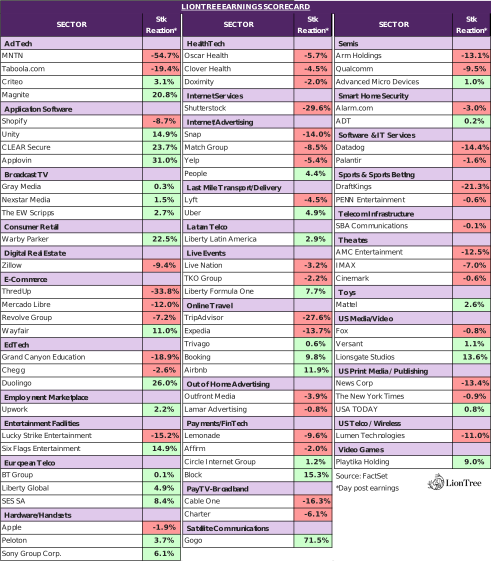
Earnings Scorecard – Week 4
It was an onslaught of earnings across the sector this week with 79 companies in our LionTree Universe releasing their Q3 numbers (up from 30 last week). Similar to last week, stock reactions were biased to the downside, as 44 companies (56%) traded down after results, while 35 companies (44%) traded up. The worst performer was MNTN, which fell -55% post-earnings, and the best performer was Gogo, up +72%.
Closing out Big Tech earnings was Apple, which fell -2% (see Theme #4), and similarly closing out digital advertising was Snap, which fell -14% post its print (see Theme #7). It was a mixed week for the OTAs, with Booking up +10% while Expedia fell -14%, though Airbnb was up +12% (see Theme #9). Other key prints from this week included DraftKings, which fell -9% (see Theme #8), Shopify, down -9% (see Theme #6), Charter, down -6% (see Theme #3), Uber, down -5% (see Theme #10), Live Nation, down -3%, (see Theme #5) and Fox, down -1% (see Theme #2).
The table below includes select mid- and large-cap TMT and consumer companies in our LionTree stock universe that reported this week.
FOX’s FQ1 Outperformance Shows Signs Of Cont’d Momentum Into FQ2
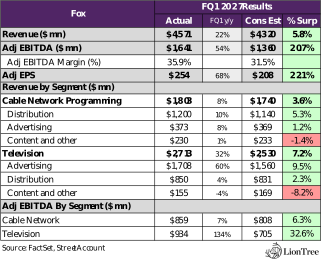
Fox brought some rays of light for the media sector this week with its better-than-expected FQ1 results as the 2026 FIFA Men’s World Cup, a record midterm political cycle, and continued Tubi and FOX One momentum drove beats across every headline metric (total revs +5.8% ahead, adj EBITDA +20.7% ahead, and adj EPS +22.1% ahead).
Our Top 5 key takeaways from results include: 1) Total ad revenue growth of +47% y/y with TV advertising up +60% y/y on the World Cup and political… and that positive momentum has carried into this qtr thus far; 2) Political ad revenue across Fox has surpassed $350mn this cycle, “a record for a mid-term cycle” (though there has been some News fatigue); 3) Including FOX One, Fox saw POSITIVE subscriber growth for the trailing 12 months, with ~97% of new FOX One subs not having a cable subscription (however this may not sustain seasonally); 4) Tubi grew rev +35% y/y on a +23% increase in total view time, with mgmt reiterating a ~20% margin at maturity; and 5) Fox has secured all shareholder and foreign regulatory approvals for the Roku deal, with DOJ HSR clearance still outstanding.
All in all, it was a strong quarter with momentum in many KPIs sustaining as we look into FQ2. See below for more of what we viewed as most important from FOX’s results.
-> FOX shares were down -0.8% following its earnings report; YTD, the stock is down -8.4%
-> Roku reported strong Q3 this week as well w/ adj EBITDA 55% ahead of the Street and revenue 6.3% ahead (both Platform& Device came in ahead); Streaming hours at 39.9bn, slightly beat cons 39.8bn and rose +9.3% y/y
Fox Posts A Record FQ1 Beat Across The Board
- Revenues BEAT cons by +5.8%: Grew +22% y/y to a FQ1 record
- Driven by a +47% y/y surge in ad revs (World Cup, political, and Tubi), +9% distribution rev growth (cable +10%, TV +4%), with content & other rev roughly flat (-1% y/y) as lower entertainment content rev was partially offset by higher sports sublicensing
- Adj EBITDA BEAT cons by a large +20.7%: Grew +54% y/y which was also a FQ1 record
- Total expenses incr’d +10% y/y, led by World Cup costs and higher digital content costs
- Adj EPS BEAT cons by +22.1%: Grew +68% y/y to $2.54
- FCF of +$503mn vs -$234mn in the yr-ago qtr: Largely reflects World Cup working capital timing, as rights payments landed in FY26 while ad receivables continue to be collected through 1H FY27
The Ad Market Remains Robust For Fox & Political Is Delivering A Record Midterm… Ad Momentum Is Carrying Into FQ2
- Overall ad trends are “incredibly healthy really across our portfolio” and those healthy trends are continuing into FQ2
- Total advertising revenue grew +47% y/y vs +78% y/y in FQ4
- TV advertising rev BEAT cons by 9.5% and grew +60% y/y driven by the World Cup and early midterm political ad rev (primarily at the O&O stations), along with digital growth led by Tubi (see more below)
- Cable advertising rev (+1.2% ahead of cons) grew +8% y/y on higher sports ad rev incl the World Cup, BUT partially offset by lower digital news advertising
- Political ad rev has surpassed $350mn this cycle, “a record for a mid-term cycle”:
- Breakdown:
- $250mn+ at the local stations
- ~$50mn at Tubi (which mgmt views as effectively local rev given it is targeted)
- $50mn+ of national political rev across sports, news, and entertainment
- For context: Fox saw $260mn+ of political rev in the last midterm cycle and $400mn+ in the 2024 presidential cycle
- Breakdown:
- Fox News CPMs still have “a tremendous amount of upside and room to go” relative to b-cast
Sports Drive Record Engagement…And The Slate Is Strong Looking Ahead
- The FIFA Men’s World Cup final was the most-watched soccer telecast in US history: Followed by the start of the MLB postseason and the opening weekends of the NFL and college football seasons
- The 5-game Brewers vs Rays World Series averaged 12mn viewers: Capping an MLB postseason that exceeded expectations
- “Per game revenue was robust, which is illustrative of the strength of the sports market”
- Fox’s America’s Game of the Week is the #1 show in all of TV: Averaging nearly 25mn viewers season-to-date
- Upcoming: an NFL tripleheader on Fox in Week 15, Michigan vs Ohio State over Thanksgiving weekend, and Eagles vs Cowboys on Thanksgiving Day
- Though mgmt was noncommittal on 2030 and 2034 World Cup rights: Fox will look at the rights “in a disciplined manner as we would with all sports rights”
Fox News Has Been Hit With Some Viewer Fatigue But Still Remains #1
- Fox News audience share was above peers in both prime and total day, despite “difficult ratings comparisons” to last year
- Regarding Nielsen-reported Fox News ratings declines ahead of the midterms, mgmt cited “viewer fatigue” following an intense news cycle and tough comps vs a record news cycle last year
- Viewers are NOT switching to MS NOW or CNN, but rather watching slightly less TV overall…”we’ve seen this playbook and we know how to move through it”
Notably, Subscriber Growth Turned Positive Given FOX One Adds Offset Traditional Sub Losses…BUT Mgmt Flags There Will Be Seasonality Ahead
- Total Distribution topped expectations…revs grew +9% y/y vs +5% y/y in FQ4
- TV Distribution rev (+2.3% ahead of cons) grew +4% y/y on higher avg rates at FOX O&O stations and a net increase in subs
- Cable Distribution rev (+5.3% ahead of cons) grew +10% y/y, driven by pricing from affiliate renewals and a net increase in subs (see below)
- Including FOX One’s incremental subs, Fox saw positive subscriber growth for the trailing 12 months: Alongside a “meaningful improvement in industry subscriber trends”
- Sub declines across third-party distributors improved to “below 6%”
- Fox One September sub acquisitions incr’d 30%+ vs the start of last year’s football season: With “a very healthy engagement balance by subscribers between news and sports consumption”
- Mgmt is “confident in its potential to drive incremental growth in the quarters ahead”
- Fox One subs have indeed been incremental…~97% of new FOX One subs do not have a cable subscription…which is the result of focused, careful marketing, since a sub migrating from pay-TV into FOX One “doesn’t do us any favors”
- BUT the FOX One subscriber base will be “somewhat seasonal” as sports seasons come and go, so it will not always be able to offset the traditional sub losses
- Bundling is still in its “infancy”: FOX One will bundle with distributors, platforms, and other content providers, with further bundles to roll out as the service develops
Tubi Growth Continues To Surprise On The Upside…Mgmt Maintains Its Targets Of ~20% Margin At Maturity
- Tubi posted another record quarter, with rev +35% y/y vs +35% y/y in FQ4: Underpinned by a +23% increase in total view time, vs +17% y/y in FQ4
- Engagement is driven by Tubi’s library, its World Cup hub, 10 new originals, and viral content from 600+ creators
- Tubi’s strong momentum continues into FQ2, supplemented by political campaigns
- The NFL Thanksgiving Day game (Eagles vs Cowboys) will also stream live on Tubi
- Tubi’s ad growth well exceeds that at YouTube and Netflix
- Mgmt attributed the outperformance to Tubi’s audience being young, diverse, and majority cordless, a market that is very hard for advertisers to reach
- How high can Tubi margins reach? Mgmt reiterated it expects Tubi to be a ~20% range margin business once it reaches maturity
- Tubi grew its y/y EBITDA contribution, “continuing on that well and truly positive EBITDA momentum”
A Few Other Key Updates
- Re Roku, Fox has received all required shareholder approvals and foreign regulatory approvals
- The Co continues to work “cooperatively with the DOJ in order to obtain HSR clearance and expect to close the transaction as soon as we can”
- Mgmt expects share repurchases to resume in FQ2 (after being “temporarily inactive” in FQ1)
- FY27 buybacks are guided to be in line with its historical range
- Does the restart signal anything about the Roku deal close timing? No, “you shouldn’t draw that linkage”…these are “two separate decisions”
Charter Hits The Reset Button As It Aims To Return To Growth
Charter’s annc’d new operating model was the key incremental from its Q3 as the Co is “fundamentally rethinking how we compete, how we allocate resources, and how we run our business.” The plan is built on two priorities. The first is returning to growth through an internet-first go-to-market overhaul, which is “not about an offer” but an end-to-end change. The second is becoming a leaner organization, with $2bn of annualized run-rate opex savings targeted over the next 18 months on top of $1bn+ in Cox synergies. That said, no timeline was given for a return to growth as for now, the near-term goal is to narrow the y/y gap in internet subs.
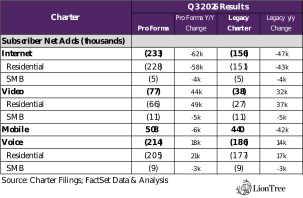
This is in response to continued challenging subscriber growth performance. Pro forma internet losses of -233k worsening from -171k a yr ago. Legacy Charter’s internet losses of -156k improved from Q2’s -172k BUT were still well below Q3:25’s -109k, driven by lower connects as competition from FWA, mobile substitution, and fiber remained intense. Mgmt acknowledge that “we’ve not generated the customer growth and performance we expect, and our customer satisfaction is not where it needs to be.”
Mobile was a bright spot though as Legacy Charter added +440k mobile lines and the Co halved its video losses y/y to -38k, while early Cox integration is off to a strong start. Since the September 16th Spectrum Day launch, the run-rate of Cox internet losses has already been cut in half and the Cox mobile net add rate has tripled.
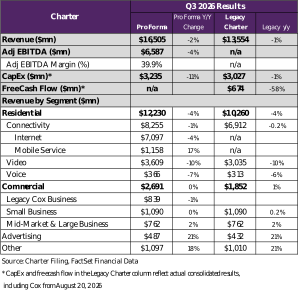
On the financials, pro forma rev declines narrowed to -1.5% y/y, but adj EBITDA fell -4% y/y and FCF fell -58% y/y, mostly on one-time items. Looking ahead, capx continues to step down (~$13bn in FY26 and ≤$11bn in FY27), and mgmt expects “significant free cash flow growth over the next several years.” In the near term, the majority of Q4 FCF will go toward debt reduction, though buybacks will also resume this qtr.
There were a lot of moving parts this quarter. See below for the details we found most important.
-> Charter’s stock fell -6.1% in reaction to its results; The stock still ended the week up +5.9%, but is still down -43.4% YTD
Charter’s New Operating Model Was The Main Headline…They Are “Fundamentally Rethinking How We Compete” To Return To Growth While Running A Leaner Co
- The Co annc’d a “new operating model” that is “fundamentally rethinking how we compete, how we allocate resources, and how we run our business”
- Why? “We recognize that we’ve not generated the customer growth and performance we expect, and our customer satisfaction is not where it needs to be”
- The new model has two priorities: returning to growth + becoming a simpler, more agile, and efficient organization
- This will be delivered through four strategic imperatives…1) winning more internet customers, 2) improving customer service, 3) upgrading networks, and 4) becoming more efficient
- Regarding returning to growth…the top priority is winning more internet customers by “reformulating our value proposition and go-to-market approach to significantly accelerate the pace of new connects and grow market share”
- “We’ll make our offer stronger, more simple, and more transparent”
- “Perfect” the single-play internet go-to-market (offer, marketing, distribution), then layer in mobile and video convergence
- Modify sales channel capabilities to drive better connects while maintaining “the same or higher ARPUs” at connect
- “It’s not lost on us the importance of internet ARPU, particularly towards investors”…average ARPU is “healthy and it’s competitive,” the opportunity is at promotional and retail rates by adding value to “earn ARPU as opposed to relying exclusively on rate increases and roll-offs”
- Reduce churn through smarter pricing, enhanced service, and a better network b/c “too often, our most loyal long-term customers are at risk from aggressive price competition”
- “Just because we have some of the lowest churn that we’ve ever had, that doesn’t mean it’s good…In fact, it should get better, and it’s too high”
- Service is focused on “what drives customer calls and dissatisfaction” via a Pareto analysis of pain points, plus continued AI investment
- On efficiency…targeting $2bn in annualized run-rate opex savings over the next 18 months, incremental to Cox transaction synergies
- Much of it will come from “simply eliminating projects that don’t contribute to internet growth,” increasing spans of control, reducing layers, and consolidating to a “more focused and a narrowed set of vendors”
- “These savings are NOT targeted at frontline service and sales employees”
- The goal is for the savings to “fall to EBITDA line and ultimately drive free cash flow,” with benefits beginning next yr
- The plan does NOT assume any “significant” efficiencies from agentic AI
- Will effect a culture & leadership overhaul…”we’re building a winning culture, raising our competitive metabolism with faster execution and a stronger sense of urgency across the company”
- Mgmt plans to find a venue (conference or earnings call) for investors to hear directly from Chris Winfrey (CEO) and Nick Jeffery on the operating strategy
- Why will this overhaul be different? (vs prior pricing & packaging and Spectrum One resets)
- On prior pricing & packaging changes, mgmt conceded “it really was just about an offer”…”This isn’t about an offer. The consumer proposition is really about the end-to-end”
- “It’s a complete fundamental change for distribution channels. And it’s a much more aggressive approach in terms of the focus on internet first”
- How will success be measured? Focused on a “variety” of measures of success but “the most obvious ones” are…
- Increasing the rate of customer connects
- Reducing churn
- Increasing customer lifetime while maintaining ARPU
- Increasing convergence across their existing and new footprint
- Bringing planned cost efficiencies online
- No timeline was given for expected return to growth: “We’re not providing any guidance or outlook for exactly when we return to growth, but I want to be very clear. That’s the objective, that’s the determination of success”
- The near-term goal at legacy Charter is to “minimize the year-over-year gap that you saw in Q3 on internet subs,” then return to growth at both the legacy Cox and legacy Charter footprints
Q3 Rev Declines Narrowed, While Adj EBITDA And FCF Fell Y/Y
- Pro forma total revs of $16.51bn fell -1.5% y/y vs -2.2% y/y in Q2 (pro forma)
- Legacy Charter rev decr’d -0.9% y/y while legacy Cox rev decr’d -4.5% y/y, primarily due to a decline in residential customers
- Pro forma adj EBITDA of $6.59bn fell -4% y/y (-3% y/y ex $76mn of Cox transition expenses); Adj EBITDA margin of 39.9% was lower vs 40.9% in Q3:25
- Pro forma capx of $3.24bn decr’d -11% y/y (incl $33mn of transition capx): Ex transition capx, capx decr’d $440mn y/y on lower line extension spend as the subsidized rural build winds down
- FCF of $674mn fell -58% y/y: Mostly driven by 1x or temporary impacts incl working capital timing (supply chain financing benefits in the prior yr), higher cash taxes ($431mn in Q3), and cash costs related to closing the Cox transaction
$2bn Of New Savings Layers On Top Of $1bn+ In Cox Synergies While Capx Continues To Step Down
- NEW: $2bn in annualized run-rate opex savings is now targeted over the next 18 months (see above), w/ the goal that savings will fall to EBITDA and FCF
- Cox run-rate OpEx transaction synergies were RAISED to “over $1 billion” (vs “at least $800mn” previously, which mgmt had called “conservative” in Q2)
- Synergies begin to ramp in Q4; Nearly half of the run-rate is expected to be achieved in H1:27, and 90% captured over the next 24 months
- The Co will highlight estimates of synergies captured each qtr going forward and report progress on the $2bn program
- Synergies do NOT include capx synergies and operating synergies (i.e., revenue upside and lower service transaction costs)
- FY26 pro forma capx GUIDANCE (ex transition capx) of ~$13bn: Well below the sum of the prior legacy Charter guide (~$11.4bn) and the $2.5bn originally expected for legacy Cox
- FY27 capx (ex transition capx) is expected at or below $11bn (vs. sum of legacy Charter’s prior ~$9.5bn guide and $1.5bn for legacy Cox)
- Expect “significant FCF growth over the next several years” from declining capx, Cox synergies, and the new cost transformation program
- Leverage sat at 3.93x at the end of Q3 (as expected) and is projected to fall below 3.9x exiting 2026…the 3.5x target within 3 yrs of the Cox and Liberty Broadband close was MAINTAINED
- The majority of Q4 FCF will go to “efficient debt reductions,” BUT buybacks will resume w/ the Co expecting to “repurchase some shares this quarter” and continue as it progresses toward 3.5x
- Mgmt on the stock: “We see an equity security that trades at a level that I think is really difficult to justify given the cash flow”
Internet Losses Remain An Overhang
- Legacy Charter lost -156k internet customers (vs -172k in Q2 and -109k in Q3:25); pro forma internet losses were -233k (vs -171k in Q3:25)
- Lower connects y/y drove the decline, while churn was “essentially flat”
- Continue to see expanded FWA competition y/y, including lower sales from lower-income consumers, ongoing mobile substitution, and fiber overlap at a rate “similar to prior quarters” w/ continued aggressive promotions by certain competitors
- “We’re not satisfied with that result and we’re taking active steps to shift momentum and gain share”
- LEO satellite competition? The impacts so far have been “very minimal,” incl in rural, BUT LEO penetration is higher in the newest rural build areas
- “We don’t discount them whatsoever”…but Charter still sees its network as faster, lower latency, and easier to install & service
Early Cox Integration Results Are Showing Through…Spectrum Day Has Already Halved The Run-Rate Of Internet Losses
- Cox closed August 19th, adding 11mn passings and 5mn+ customers; the Co now passes over 70mn homes and businesses w/ ~50% customer penetration
- Adds attractive growth mkts (Phoenix, Las Vegas), large adjacent mkts (Virginia, Kansas, Oklahoma, Rhode Island), and better in-market coverage in Los Angeles, San Diego, New Orleans, and North Florida
- Legacy Cox lost -77k internet and -39k video customers in Q3 and added +68k mobile lines
- “It’s fair to think of Cox as about one-fifth the size of Legacy Charter”; Mgmt knew Cox trends and financials “were more challenged” when it agreed to the deal
- Legacy Cox churn is ~10% higher than legacy Charter
- Since the September 16th Spectrum Day launch (Spectrum pricing & packaging), internet sales are “up significantly,” already cutting the run-rate of Cox internet losses by half
- The “vast majority” of the improvement are coming through sales; Churn improvement “will take a little bit more time”
- The monthly net add rate of Cox mobile lines has tripled, and Cox video customers grew slightly in October
- BUT matching legacy Charter is not the bar: “Getting to Legacy Charter performance is not the goal. We’re not happy with the Legacy Charter performance on the internet”
- Cox B2B opens up new opportunities across both footprints
- Cox is “pound for pound, the best cable operator as it relates to B2B”…BUT Cox small business is underpenetrated vs. Charter
- Opportunity to bring Cox’s hospitality strength (stadiums, arenas, hotels) into Charter mkts such as Los Angeles, Orlando, and New York
- Segra and RapidScale offer the opportunity to penetrate a much larger footprint, plus cost synergies from owned network that was previously leased
- Other opportunities include porting over Cox’s AI network reliability team and local advertising upside
Mobile & Video Remained Bright Spots As Convergence Deepens
- Legacy Charter mobile net adds of +440k lines (vs +406k in Q2 and +482k in Q3:25)
- Higher gross adds y/y were more than offset by higher disconnects, even w/ a lower churn rate, given the larger mobile line base
- Pro forma mobile lines of 13.45mn grew +15.4% y/y w/ +508k pro forma net adds
- Legacy Charter video losses of -38k were half of Q3:25’s -70k
- Driven by lower video downgrades, lower customer churn, and higher upgrades y/y from seamless entertainment improvements incl the programmer app inclusion package
- Convergence continues to build…pro forma two-product penetration rose to 33.1% (vs 31.9% in Q3:25)
- Mobile and video attached to internet reduce churn, creating “a virtuous cycle”
- CBRS (small-cell spectrum used to offload mobile traffic from Verizon’s network) strategy unchanged despite the acquisition of a “sliver more” spectrum
- Deploying on an ROI basis; expects to be in ~50 mkts by year-end…the Cox deal “hasn’t accelerated our deployment plans for CBRS”
Apple’s Memory Costs Remain Under The Spotlight
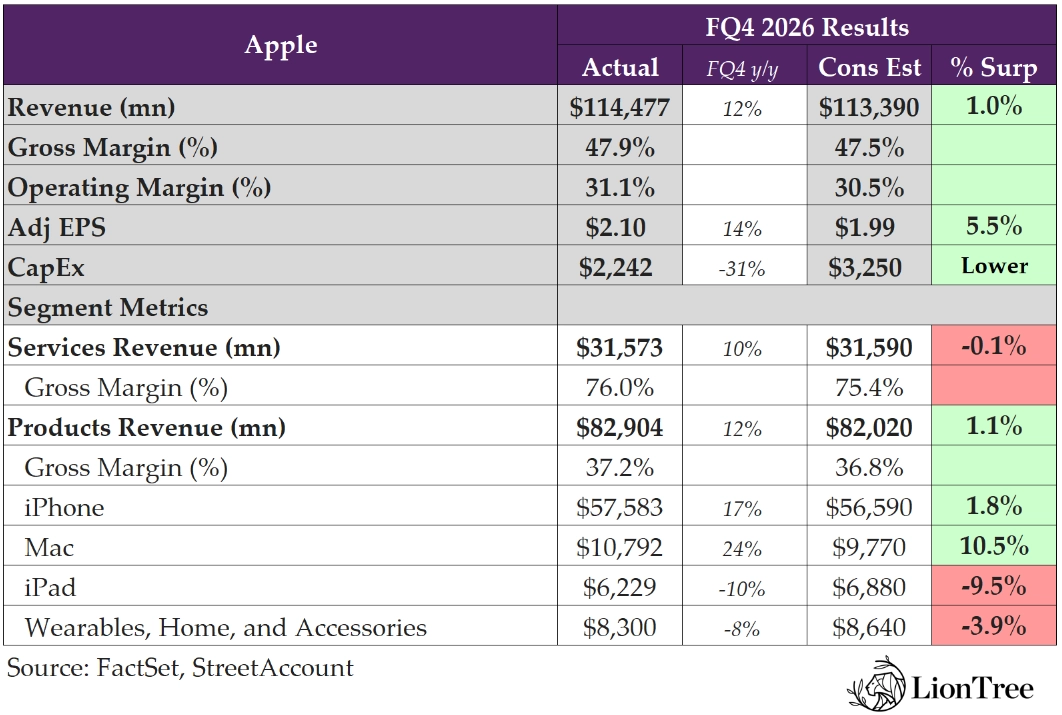
While John Ternus’s first earnings as Apple CEO was a clean beat vs Street expectations, memory costs quickly became the main story. Sept qtr revenue hit a record and exceeded consensus, w/ strong iPhone and Mac growth more than offsetting iPad and Wearables (difficult comps), and in-line Services. Gross margin also beat, BUT only thanks to a 1x tariff refund. Strip that out, the GM seq decline was “driven entirely by memory impacts.”
Mgmt called the memory pricing environment “unprecedented” and there is little near-term relief. Prices are expected to keep rising while the cushion from carry-in inventory fades over time. The pressure is also spreading from cost to supply. Even as constraints on advanced chip nodes ease, Mac and iPad are expected to be supply-constrained in the Dec qtr, primarily due to memory.
These pressures are reflected in the Dec qtr guide, as rev growth of +7-10% y/y implies a further decel from FQ4 given constrained supply (but still came in ahead of the Street). Gross margin guidance of 45-46% came in below cons, primarily driven by higher memory costs as well as some costs related to the ramp of Siri AI, and OpEx was guided above given continued AI investment. Services growth was also guided to +8-9% y/y, below the Street’s expectation of +10%, which was attributed to third-party licensing and FX headwinds.
See below for more on the key takeaways we found most important with Apple’s results.
-> Apple fell -1.9% on the back of its report and ended the week down -0.7%; The stock is up +25.9% YTD
FQ4 BEAT On The Topline And Margins
- Overall rev BEAT by +1%: Up +12% y/y (decel from +16% y/y in FQ3 and +17% y/y in FQ2), a Sept qtr record
- Despite sequential FX headwinds of nearly 2pp and supply constraints on iPhone, Mac, and iPad
- Product rev BEAT by +1.1%: Up +12% y/y (decel from +18% y/y in FQ3), driven by strong double-digit growth on iPhone and Mac
- iPhone BEAT by +1.8%: Up +17% y/y (decel from +22% y/y in FQ3), a Sept qtr record
- Grew double digits in the majority of mkts; Set Sept qtr rev records across both developed and emerging mkts
- Mac BEAT by +10.4%: Up +24% y/y (decel from +29% y/y in FQ3), a Sept qtr record
- Driven by strength of MacBook Neo and MacBook Pro
- Saw double-digit growth in both developed and emerging mkts
- iPad MISSED by -9.4%: Down -10% y/y (decel from -6% y/y in FQ3)
- Driven by supply constraints and cont’d difficult compare vs the launch of the A16-powered iPad in the prior yr
- Wearables, Home and Accessories MISSED by -3.9%: Down -8% y/y (a reversal from +6% y/y in FQ3)
- Driven by a difficult compare vs launch of Watch SE 3 and AirPods Pro 3 in the prior yr
- iPhone BEAT by +1.8%: Up +17% y/y (decel from +22% y/y in FQ3), a Sept qtr record
- Svs rev was ~IN-LINE: Up +10% y/y (decel from +12% y/y in FQ3), an all-time record, despite over 1.5pts of seq FX headwinds
- Double-digit growth in the majority of mkts; Set all-time rev records in the Americas and Europe, and a Sept qtr record in Rest of Asia Pacific
- Set all-time records in video, cloud services, payment services, and advertising; Sept qtr record in music
- Gross margin of 47.9% BEAT cons 47.5% but included ~1pp favorable impact from tariff refunds; Ex tariff benefit, GM was ~46.9% (down ~120bp seq from ~48.1% ex-tariff in FQ3), driven primarily by higher memory costs
- Product gross margin of 37.2% BEAT cons 36.8%: Up +100bp y/y from 36.2%, benefiting from tariff refunds; Excluding tariff impacts, gross margin declined ~100 bps seq
- Services gross margin of 76% BEAT cons 75.4%: Up +70bp y/y from 75.3% and up +40bp seq
- Op margin of 31.1% BEAT cons 30.5%
- EPS of $2.10 BEAT cons $1.99
- Included 5c favorable impact from tariff refunds; Set Sept qtr records even ex the tariff refund benefit
Mixed FQ1 Guidance W/ Rev TOPPING The Street Despite Constrained Supply, But GM And Services Both MISSED & OpEx Remains Elevated
- FQ1 total rev guidance of +7-10% y/y was AHEAD of cons +5.8% (but a decel from FQ4’s +12% y/y)
- “Reflects our best view of constrained supply. We expect this to be the best quarter for revenue in the history of the company”
- FQ1 Services rev growth guidance of +8-9% y/y was BELOW cons +10% (a decel from FQ4’s +10% y/y)
- Contemplates seq headwinds primarily from third-party licensing and FX (~0.5pp addtl FX headwind)
- FQ1 gross margin guidance of 45-46% was BELOW cons 46.5% (and down from FQ4’s 47.9%)
- Primarily driven by the impact of higher memory costs, as well as some costs related to the ramp of Siri AI
- FQ1 OpEx guidance of between $20.4-20.8bn was ABOVE cons $20.23bn; Up +11-13% y/y, driven by incr’d and cont’d investment in R&D, in particular AI
- OpEx growth rate is “coming down…from the levels of growth we had in FY 2026” but the Co continues to “significantly increase our overall investments in AI”
Memory Costs Continue To Escalate And Drive Seq Margin Pressure
- Supply constraints will persist into the Dec qtr, shifting from SoC nodes to memory availability
- FQ4 supply constraints impacted iPhone, Mac, and iPad, driven by availability of the advanced nodes Apple’s SoCs are produced on
- BUT constraints on advanced nodes are now “easing” as Apple has transitioned more of its lineup to the latest 2nm technology nodes
- Looking into FQ1…expect supply constraints on Mac and iPad, primarily driven by memory availability (a shift from the prior qtr’s SoC-driven constraints)
- “Demand has been higher than what we expected”…constraints are a demand forecast issue
- Beyond FQ1… the Co is not providing any outlook but constraints are expected to be “primarily driven by memory” going forward
- FQ4 supply constraints impacted iPhone, Mac, and iPad, driven by availability of the advanced nodes Apple’s SoCs are produced on
- Memory pricing continues to be “unprecedented”
- FQ4 saw higher memory costs vs FQ3, partly offset by carry-in inventory and lower costs on certain non-memory components
- Looking into FQ1…expect “even higher” memory costs, partly offset by pricing actions, carry-in inventory benefit, and lower non-memory component costs
- Beyond FQ1… “we see the pricing for memory purchases continuing to increase. As we’ve said before, we do believe we’ll see a decreasing benefit from the carry-in inventory on memory over time”
- Carry-in inventory benefit is continuing to diminish: “We do believe we’ll see a decreasing benefit from the carry-in inventory on memory over time”
- Noted that manufacturing purchase obligations have incr’d by $33bn from June to Sept qtr
- How are they managing pricing?
- Continuing to pursue lower costs on non-memory components
- “Reluctantly” taking pricing actions…iPad and Mac prices raised end of June; iPhone prices raised in September
- “It’s really early to really assess any elasticity impact at this stage”
- Being “very thoughtful and deliberate” about balancing unit revenue, margin, and short/long-term considerations
Some Addtl Commentary On iPhone Duo Launch, Siri AI, And AI Agents
- On Sept launch of iPhone Duo…”thrilled with the early response from reviewers and customers”
- Currently supply constrained and “at this time, it’s really hard to predict when supply and demand will be in balance”
- Siri AI launched in beta for US English users in Sept; Expanded to French, Japanese, Korean, Portuguese, and Spanish in October
- “Siri AI marks a new chapter in AI at Apple. It is a completely reimagined assistant that is powerful, personal, private, and deeply relevant to our users’ daily lives”
- Reiterated privacy focus being a “core differentiator”: “Siri can tap into [personal data] and help you access it in a way that’s very secure and private and that nobody else has access to, not even Apple”
- Some initial color on cost structure…
- On-device inference has “no real costs”
- Cloud costs flow through Services COGS but mix is “hard to predict” at this stage
- FQ1 GM guide of 45-46% includes “some costs related to the ramp of Siri AI”
- Potential risks of AI agents encroaching on the Services biz? “We think these are promising tools for users. We just want to make sure that users are aware of what they’re giving access to. We want to make sure this is done in a way that protects security and privacy. So, we’re pushing really hard on that with Siri AI”
Another Record Quarter For Live Nation As Demand Holds And Guidance Moves Higher
Live Nation is on track to deliver the back-half inflection flagged last qtr. Fan attendance reached 61mn in Q3 (easily ahead of expectations of 57mn) led by a +29% surge in intl attendance and a big global stadium qtr, with some N. American stadium shows shifting into Q3 around the World Cup. Total Co rev and AOI both beat cons, and guidance moved higher, with FY fan attendance now expected to approach ~180mn (implying ~13% y/y growth vs prior guidance of +10% growth), Ticketmaster AOI growth was also raised to HSD, and Venue Nation is now expected to host 75mn+ fans (vs ~75mn prior).
As always, consumer demand was the key question heading into the print, and once again the Co showed no signs of a pullback. Ticket sales for 2026 shows already exceed all of FY25, sell-through is ahead of last yr, and cancellations are running lower. 2027 is also off to a strong start, with primary GTV up DD and major on-sales from Harry Styles, Bruno Mars, Oasis and Metallica.
Mgmt kept the call brief and mostly focused on the quarter given that more details are set to come at its Investor Day next week. See below for what we viewed as the key incrementals from Q3
-> TKO also posted Q3 results this week; Rev MISSED cons by -1.4% (WWE and IMG missed, while UFC beat) and adj EBITDA was in-line, BUT FY guidance was raised for the second time this yr, with the rev midpt up +$10mn (+0.2%) and adj EBITDA midpt up +$15mn (+0.7%); The raised rev guide remains a touch below cons, while adj EBITDA is +0.7% ahead; The stock fell -2.2% post its print and is now down -8.6% YTD
-> Live Nation fell -3.2% post its print and ended the week down -1.5%; The stock is up +23.0% YTD
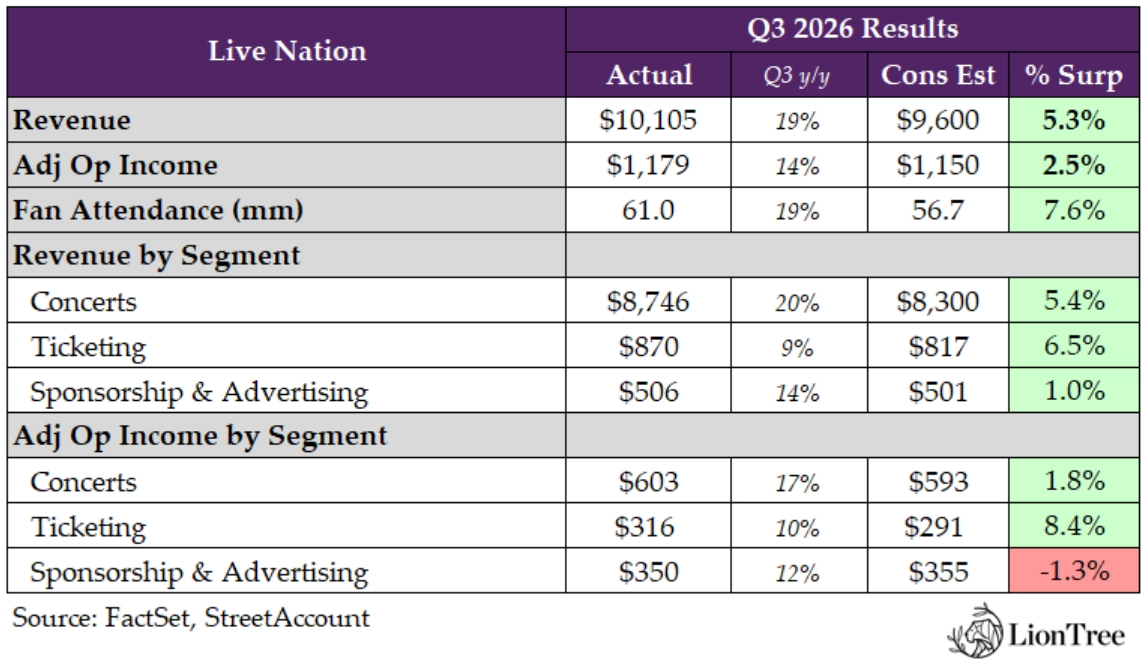
Q3 Was A Broad-Based Beat
- Revenue – BEAT by +5.3%: Up +19% y/y (+19% FXN) vs +9% y/y in Q2
- Beat across all segments
- Adj op income – BEAT by +2.6%: Up +14% y/y (+14% FXN) vs +2% y/y in Q2
- Both Concerts and Ticketing segments BEAT, while Sponsorship & Advertising MISSED
- Fan attendance – BEAT by +7.6%: 61mn vs cons 56.7mn, up +19% y/y vs +10% y/y in Q2
FY26 Guidance Raised Across Fans, Ticketmaster And Venue Nation
- FY26 fan attendance INCR’D to approach ~180mn, implying ~13% y/y growth (vs prior guide of +10%), ahead of cons of 175.3mn
- The raised guidance was driven by higher sell-through and lower cancellations than planned, as well as stronger-than-expected stadium volume
- FY26 Ticketmaster AOI growth INCR’D to HSD (vs MSD guided last qtr)
- FY26 Venue Nation fans INCR’D to 75mn+ (vs ~75mn prior), up 15%+
- FY26 Concerts + Sponsorship segment AOI MAINTAINED at DD growth
- FY26 CapEx MAINTAINED at ~$1.1bn
- ~$800mn for venue expansion, with ~$200mn offset from JV partners, sponsorship agreements and other sources
Consumer Demand Continues To Defy Macro Concerns, With 2027 Already Tracking Ahead
- Ticket sales for 2026 shows are up +13% to ~170mn through late Oct, already exceeding all of FY25, with stadium, arena and amphitheater fan counts each up mid-teens or higher
- Ticket sales ran ahead of the prior yr in every month of 2026 through Oct, with Oct up +20%+
- Sell-through rates are ahead of last yr and cancellations are running below last yr’s YTD pace
- “We are absolutely seeing continued strong consumer demand globally in all of these venues”
- Mgmt pushed back on press concerns around consumer spending, noting new US amphitheaters had “just about a full slate of shows” and premium continues to perform
- On-site spend remains healthy: US amphitheater upgrade purchases and VIP rev per ticket both up DD, value menu unit sales more than doubled, and European arena on-site spend up DD
- 2027 momentum is building: Ticketmaster primary GTV for 2027 shows is up DD YTD, driven by DD growth in N. America primary volume
- Event-related deferred revenue of $3.8bn (Q3 record), up +8% y/y
- Q3 included major 2027 on-sales for Harry Styles, Bruno Mars, Oasis and Metallica, which “set us up now with some nice momentum heading into next year”
Stadiums And Intl Powered A Record Concerts Qtr…But Q4 Must Do The Heavy Lifting To Hit DD AOI Growth For The Full Year
- Q3 Concerts rev grew +20% y/y (vs +8% y/y in Q2) to $8.7bn and AOI grew +17% (vs -14% y/y in Q2) to $603mn
- Third-party stadium attendance grew +40%+ and drove over half of global fan growth, with stadiums up “measurably” in both N. America and intl
- N. America stadium growth partly reflects shows shifting into Q3 around the World Cup
- Intl attendance grew +29% y/y and drove 60% of total fan growth, with every region (LatAm, Europe, Asia) up at least +15%
- N. America attendance grew +13%, delivering the DD growth mgmt had guided to, with stadiums and amphitheaters driving 90% of that growth
- September was the Co’s largest amphitheater month ever by both attendance and show count
- Concerts AOI is up only ~4% through 9M, putting pressure on Q4 to deliver the FY DD growth target…mgmt reiterated “no change in that overall expectation”
- Q4 will also absorb higher prepaid advertising write-offs for 2027 tours already on sale… “that’s the best problem in the world to have”
Ticketmaster Beat Was Driven By Concert And Intl Volume Growth, While The Secondary Headwind Never Materialized
- Q3 Ticketing rev grew +9% y/y (vs +15% y/y in Q2) to $870mn and AOI grew +10% (vs +14% y/y in Q2) to $316mn
- Fee-bearing tickets of 98mn (record), up +10% y/y (vs +8% in Q2); Fee-bearing GTV of $11.2bn, up +13% (vs +15% in Q2)
- Concerts drove 95% of fee-bearing ticket growth (vs 90% in Q2), benefiting from record attendance
- Intl fee-bearing tickets grew +20% (vs +12% in Q2) and drove 75% of fee-bearing ticket growth
- Net new ticketing agreements added 23mn tickets YTD, 70%+ from intl mkts
- Secondary GTV was flat y/y as sports growth offset lower concert resale from scalper enforcement…“we’re not seeing that headwind for the year”
Venue Nation Continues To Scale, Led By Intl Arenas
- Venue Nation hosted 26mn fans in Q3, up +17% y/y
- Arenas outside the US are expected to deliver 75% of owned/operated large-venue fan growth this yr, and their attendance now exceeds US amphitheaters
- Recently acquired European arenas are “all of them doing well,” and B2B sponsorship sales continue to do well
- Operated and third-party venues are contributing “pretty comparable” shares of the ~20mn total fan growth this yr, with operated fans carrying higher margin per fan
- BUT the margin benefit is masked by stadium mix (“those are the highest priced tickets will tend to be a lower margin”) and pre-opening costs that will continue “for the next couple of years”
- On track to open or acquire 10 large venues (3,000+ capacity) by YE, delivering 5mn+ fans this yr and a run-rate of ~8mn
- Part of the 25+ large-venue pipeline expected through end of 2027, adding ~15mn fans on a run-rate basis
- Mgmt deferred most questions on Venue Nation fan ramp, pre-opening investment, partner vs. LYV share of CapEx, IRRs and AI impact to next week’s Investor Day
Shopify’s Skittish Investors Sell First, While Agentic Upside Comes Later
The sell-off on the back of Shopify’s results certainly highlights how sensitive and skittish investors can be to any areas of weakness when concerns about AI’s impact have been in the background. Of particular focus was GMV given that it was the 3rd straight quarter of decelerating y/y growth (on a reported basis) and also the first time in 5 quarters that the Co reported an under 30% y/y growth rate. Lower than expected Subscription Services revenue and gross profit margins also caught investors’ attention though Merchant Solutions’ performance offset. On the plus side, adj op income BEAT of 6.7% and the Q4 guide for low-30s rev growth topped cons of +29.8% (and would make Q4 the 7th consecutive qtr of rev growth in the low-30s).
Thematically, agentic commerce dominated the conversation during the analyst Q&A. Mgmt sees Q3 as the qtr that personal agents “hit the mainstream,” with Shopify partnered across the major agents, AI orders up 3.3x y/y and Catalog-powered searches converting at 2x general AI search. BUT volumes remain “still small,” and the economics so far mirror existing discovery rather than adding new take rate. Agentic commerce is in the early innings, but mgmt. is confident that it will expand the overall market TAM.
Other focus areas include Sidekick, offline/enterprise and international. See below for more details on our key takeaways from Shopify’s results.
-> Shopify shares traded down as low as -12.5% in reaction to results but somewhat recovered and ended the day down -8.7%; YTD the shares are still down -7.5%
Q3 Overall Fell Short Of Street Expectations With GMV & Subscription Solutions Misses Overshadowing Better Profitability
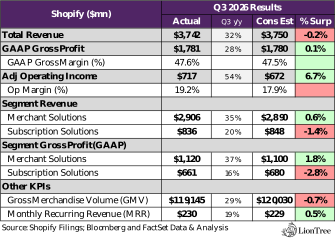
- Total rev slightly MISSED cons by 0.2%; Grew +32% y/y (+32% FXN), a slight decel from +34% (+33% FXN) in Q2:26
- GMV MISSED cons by -0.7%…grew +29% y/y (+30% FXN), decel’ing from +32% in Q2:26
- It was the 3rd straight quarter of decelerating y/y growth (on a reported basis) and also the first time in 5 quarters that the Co reported an under 30% y/y growth rate
- Growth was broad-based across merchant sizes and geographies and evenly split between new and same-store sales
- Cohorts
- $2–25mn cohort contributed the most incremental GMV and is the largest slice, mostly from existing shops growing into the band
- $25mn+ band fastest growing off a smaller base
- Forward looking – the Co expects to pass $2tn in cumulative GMV by YE26, less than 2.5 yrs after crossing $1tn (which took 18 yrs)
- MRR BEAT cons by 0.5% and grew +19% y/y
- Plus MRR was 34% of total MRR, growing +18% y/y
- Mgmt reiterated that “MRR comparatively underrepresents the impact we’re seeing from larger GMV merchants”
- GAAP gross profit grew +28% y/y, in line with mid-to-high-20s guide
- Adj op income BEAT cons by 6.7% and grew +54% y/y
- FCF at 22% margin vs. 18% in Q3:25, above high-teens to low-20s guide
- ~150bps of the y/y margin improvement is structural (operating discipline, expense leverage); But the remainder is temporary and split roughly equally across the marketing test, timing of tax receivables and the accounting change to merchant cash advances
Merchant Solutions Continues To Carry The Growth…As Shop, Ads And Payments Become Bigger Monetization Drivers Than Subscriptions
- Merchant Solutions’ outperformance was offset by Subscription Solutions underperformance
- Merchant Solutions
- Rev BEAT cons by 0.6% and grew +35% y/y, driven by GMV strength and incr’d payments penetration: FX rev “contributed nicely,” reflecting growing intl scale; advertising was the most notable contributor among broader merchant services
- Gross profits BEAT cons by 1.8% and grew +37% y/y, with GM expanding y/y for the 3rd consecutive qtr: Reflects Shopify Payments savings negotiated with partners across the payments ecosystem, plus uplift from incr’d FX activity and advertising products
- Subscription Solutions
- Rev MISSED cons by 1.4% and grew +20% y/y, led by Standard plan subs with equivalent-sized incr’s in Plus subs and variable platform fees
- Gross profit MISSED cons by 2.8% and grew +16% y/y: GM of 79% decr’d y/y on incremental Sidekick AI spend, partially offset by support efficiencies; Seq GM decline reflects higher hosting costs from capacity added ahead of BFCM and enhancements to storefront resiliency and global search
- Merchant Solutions
- Shop app GMV more than doubled y/y, reflecting Shop’s network effect as buyers and purchases per buyer keep growing
- Shopify Campaigns reach customers across ten channels incl. Shop, Instagram and ChatGPT, with merchants paying only when a sale happens
- YTD orders through Shop Campaigns more than doubled y/y, accelerating in Q3
- Payments penetration surpassed 68%, up +3pts y/y; Shop Pay GMV grew +50% y/y
Q4 Guidance Points To Low-30s Rev Growth, Which is Slightly Above Cons…BUT Q4 FCF Margin Won’t Expand
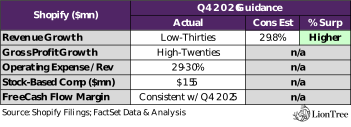
- Q4 rev growth guidance in the low-thirties % rate y/y, topped cons of +29.8%
- Reflects less than 1pt of FX headwind
- Would mark the 7th consecutive qtr of rev growth in the low-30s
- Q4 GP growth guided at a high-twenties % rate y/y (vs. mid-to-high-20s guide for Q3)
- Q4 opex to be 29–30% of rev (vs. 33–34% guide for Q3), reflecting higher marketing expenses incl. initiatives ahead of BFCM
- Q4 FCF margin to be consistent with Q4:25 (vs typical expansion seasonally)
- Some marketing has shifted from Q3 to Q4
Q3 Was The 1St Quarter That Some Shoppers Experimented With Delegating Purchasing To Personal Agents BUT Volumes Remain Small And Economics Mirror Existing Discovery
- Agents are a “brand new channel”…the “new front door”…it will increase the commerce TAM
- AI traffic grew 2.6x y/y and AI orders grew 3.3x y/y, though mgmt stressed volumes are “still small”
- AI channels send shoppers straight to product pages at 3x the rate of organic search, with shoppers converting 64% more often
- Ai channels reward specificity which is important to long tail, niche products being found: 74% of AI-attributed purchases came from outside Shopify’s top 100 product categories
- Shopify Catalog is powering discovery across major AI channels incl. ChatGPT, Microsoft and Muse; Catalog-powered searches convert at 2x the rate of general AI search
- The Co turned over 1bn product pages into structured data w/ live cross-merchant pricing and inventory (the Co began building Catalog three years ago)
- Other key agentic oriented comments
- Agents are also emerging as an on-ramp for new merchants, BUT this is still “a small source of new merchants today relative to our scale”
- On economics: a consumer starting on Muse and landing on a Shopify merchant generates “exactly the same” economics as other discovery; The Co aims to expand Shop Pay wallet economics over time
- On Shop Pay selection within agents, mgmt said that it is “about merit”
Sidekick Usage Accelerates While Unit Costs Fall…BUT Subscription Gross Margin Sits Below The 80% Trend Line For A Second Straight Quarter
- Sidekick daily active merchants grew 3.7x y/y and daily sessions grew 4.2x y/y; Sidekick created ~two-thirds of all Shopify Flows in Q3
- Flows now extend into supported third-party apps without manual integrations (merchants use ~8 apps on average)
- Power users pushing into advanced design, SEO and product creation
- From Q2 to Q3, merchant conversations incr’d +14% while cost per conversation decr’d -28% and total Sidekick costs fell -18%
- Driven by improvements in model selection, distillation and caching
- Sidekick’s new dynamic conversion guide (e.g., answering customer questions, abandoned-cart outreach) drove a 3% lift in merchants reaching their next five orders within 60 days
- “Incrementally small” BUT applied across large cohorts
- The launch of Canvas was the biggest update to the online store builder in Shopify’s 20-year history, letting merchants build a bespoke store by describing it to Sidekick
- Live for ~1 month; merchants launching more personalized stores 20% faster
Offline And Enterprise Momentum Builds…With POS Increasingly Winning Merchants That Are New To Shopify
- Lifetime offline GMV crossed $200bn; offline GMV grew +30% y/y
- Large, complex multi-location merchants remain the fastest growing segment, with total locations on Shopify up +52% y/y
- 55% of merchants adding POS in Q3 were new to Shopify; Of those already selling, half sell only in store
- Q3 retail launches incl. Canada Goose, The Body Shop and BevMo (150+ locations); Skims launched its first intl flagship in London; MAC Cosmetics launched 84 locations just 120 days after signing
- POS now creates customer profiles when shoppers opt into digital receipts, which gives merchants purchase history and the ability to re-engage eligible customers
- A known in-store customer has “a meaningfully higher lifetime value than an unknown one”
- Enterprise is gaining “incredible momentum”; Lululemon selected Shop Pay for its North American online store
- Luxury wins incl. Balmain, Givenchy, Jacquemus and Acne Studios; Clinique and Burton also went live
- Alice + Olivia are fully replatforming after seeing Shop Pay become its most-used payment method; 109-year-old Omaha Steaks migrating off a custom stack
- B2B GMV grew +74% y/y, which expands Shopify’s addressable verticals
- Fastest growing verticals incl. home improvement and hardware, electronics and business supplies, serving retail stores, labs and medical, food service and agriculture
International Remains A Key Growth Lever…With Localized Payments And Mobile-First Tools Setting Up 2027
- International GMV grew +32% y/y; Europe GMV grew +33% FXN, aided by local payment offerings; North America grew +28% FXN for the 3rd consecutive qtr
- Launched sign in with WhatsApp plus WhatsApp marketing and messaging, which mgmt sees as “huge unlocks globally”
- Localized Shop app in Japan became the #1 shopping app in the Japan App Store the week after full rollout
- Rolled out Oxxo across Mexico, letting shoppers order online and pay in cash at Oxxo convenience stores
- Launched local currency billing in ten new countries
- Mgmt: “There’ll be a lot more of this to come in 2027”
Can Snap Turn Around Its Declining Brand Ad Revenue In 2027?
That is a pivotal question coming out of Q3 results where Snap’s total ad rev growth decelerated to just +4% y/y (from +9% in Q2) as upper funnel brand advertising “declined” on weaker CPG spend in the US and Middle East. Mgmt is focused on reversing this trend and is optimistic that they can affect a turnaround in 2027 by diversifying beyond CPG into verticals such as financial services in the US plus expanding available inventory and formats. Mgmt expects to “regain ground [in brand] over the course of 2027.”
Other key takeaways from Snap’s results include…1) DR is carrying the ad business (now ~77% of rev), with app purchase campaign rev up +54% and new surfaces scaling quickly (Sponsored Snaps rev up +56% seq, Promoted Places rev more than doubled seq); 2) The restructuring-driven cost discipline continued to pay off as the total cost structure grew just +1% against +14% rev growth and ~93% of incremental rev flowed through to Q3 adj EBITDA (which BEAT cons by +13%); 3) The FY26 infra cost guide was narrowed to $1.65-1.66bn from $1.65-1.70bn as the Co absorbs addt’l AI/ML investment w/o incr’g overall infra costs, after raising it last qtr; 4) Disclosure-wise, the Co will move to global MAU and MAU-based ARPU as its primary metrics starting in Q1:27 and discontinue regional DAU/ARPU, as the Co is not optimizing for daily use “at the expense of long-term value”…though the change comes in a qtr where DAUs MISSED and N. Amer DAUs remain down -6% y/y; and 5) Subscriptions remain a bright spot, with Other rev growing +84% y/y and paid subs surpassing 30mn.
So overall, Snap’s earnings power is increasingly visible and FCF/shr remains the North Star, but investors will want evidence that DR gains and new ad formats can re-accelerate ad growth before brand recovers in 2027.
See below for details on what we viewed as most important from the print.
-> Snap shares fell -14% on the back of results and is down -38.5% YTD
Snap Generated More Profitability Than Expected in Q3 While Overall Revenue Fell Just Shy Of Projections
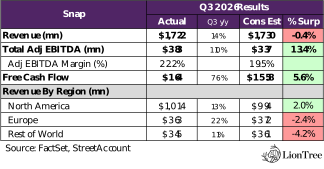
- Q3 delivered a large profitability beat (and a slight rev miss) as the total cost structure grew just +1% y/y…the Co posted positive net income
- Revs grew +14% y/y (+14% FXN) and slightly MISSED cons by -0.4% (and a decel from +19% y/y in Q2)
- Regionally, N. Amer was the revenue upside driver, while Europe and RoW trailed expectations
- Growth decelerated in all three regions (from +15% in N. Amer, +33% in Europe and +17% in RoW in Q2)
- Regionally, N. Amer was the revenue upside driver, while Europe and RoW trailed expectations
- Adj EBITDA BEAT by +13% which was a key highlight…adj EBITDA margin reached 22.2% vs cons of 19.5% (+~10pts y/y)
- ~93% of incremental rev flowed through to adj EBITDA as total cost structure grew just +1% y/y
- FCF grew +76% y/y and BEAT cons by +6%
Q4 Guidance At The Mid-Pt Was ~Inline On Revs & Slightly Better On Adj EBITDA…FY26 Infrastructure Cost Guidance Was Importantly Narrowed
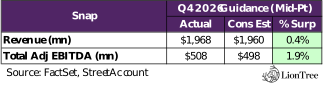
- Q4 rev guidance (+0.4% above cons), implies +13.6-15.6% y/y growth (vs +14% in Q3)
- Q4 adj EBITDA guidance (+1.9% above cons), implies a ~25-26% margin (vs 21% in Q4:25)
- Planned investment in SPECS are included, which mgmt continues “to pace against product, ecosystem, and economic milestones”
- To note, the FY26 infrastructure cost outlook was narrowed to $1.65-1.66bn from prior $1.65-1.70bn
- The Co has been “able to increase our investments in AI and ML without increasing our overall infrastructure costs”
- Infra costs are expected to “grow modestly” y/y in Q4
- Mgmt maintained FY26 guidance for all other cost of rev (excl infra costs) at 16-17% of rev
- The current repurchase program is expected to be completed in Q4 and the goal is to have a stable fully diluted share count in 2027
Mgmt Is Adjusting User Metric Disclosures Going Forward
- Q3 user metrics were mixed
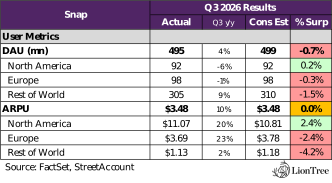
- DAUs of 495mn (+4% y/y) MISSED cons by -0.7%, driven by RoW (305mn, +9% y/y) which MISSED by -1.5%
- Amer (92M, -6% y/y) and Europe (98M, -1% y/y) DAUs were in line w/ cons and flat seq
- MAUs grew +4% y/y to 977mn
- ARPU of $3.48 (+10% y/y) was in line w/ cons, as N. Amer upside offset misses in Europe & RoW
- DAUs of 495mn (+4% y/y) MISSED cons by -0.7%, driven by RoW (305mn, +9% y/y) which MISSED by -1.5%
- Going forward, the Co will disclose global MAUs and MAU-based ARPU…regional DAU and regional ARPU will be discontinued
- Timing: This will start with Q1:27 results
- Global MAU, MAU-based ARPU and FCF/shr are positioned as a “clear scorecard” for the Co
- Why the change? The Co does “not intend to optimize Snapchat around daily use at the expense of long-term value for our community”
- Engagement is strengthening around Chat & Spotlight…removing AI-generated content is driving creator growth & more inventory
- Avg daily messages sent incr’d +8% y/y and the number of people engaging in two-way communication incr’d +6% y/y
- Globally, the number of people posting to Spotlight grew +130% y/y while daily active viewers incr’d +40% y/y
- Earlier this year the Co removed AI-generated and reposted content to focus on “real content made by real creators,” driving growth in posters and overall inventory
- Working on the overall ranking architecture and exploring new generative techniques, “which may help us leapfrog our current architecture”
- Focused on Spotlight strengthening relationships between friends as people share content to start conversations
Brand Advertising Continues To Struggle & Decl’d Y/Y But A Recovery Is Expected In 2027
- Total ad rev growth decelerated to +4% y/y (from +9% in Q2) as brand advertising “declined”…mgmt is “cautiously optimistic” on Q4 & expects brand to recover over the course of 2027
- “4% ad growth is below our ambitions”
- DR advertising grew strongly on improved purchase outcomes BUT upper funnel brand advertising declined y/y, weighing on overall growth
- Brand declined mainly on lower CPG spending driven by macro pressures in the US and the Middle East
- Q2 had also benefited from easier comps and World Cup-related spending, contributing to the seq decel
- DR is now ~77% of rev, a “substantial increase” y/y, and mgmt expects DR mix to continue rising in the short term
- Expect AI-driven ad tools & easier third-party measurement to drive share of wallet gains going forward
- Brand declined mainly on lower CPG spending driven by macro pressures in the US and the Middle East
- What is the path to a brand recovery? Diversifying beyond CPG into verticals such as financial services in the US (seeing “very positive signs of growth”), plus expanding available inventory and formats
- Mgmt expects to “start to see the brand business regain ground over the course of 2027”
- Q4 to date, mgmt. is “cautiously optimistic” as the Co is “seeing a bit of acceleration on the ad side”
- New ad surfaces in Chat, Spotlight & Map are scaling quickly…Sponsored Snaps is becoming a bigger driver of rev
- Sponsored Snaps rev grew +56% seq, w/ Chat’s share of total rev incr’g ~8pts y/y
- Launched auction-based Sponsored Snaps in Europe; DPA is now also available in Chat, expanding the use cases and advertisers the format can serve
- Avg Spotlight eCPM incr’d +22% y/y
- Promoted Places (Snap Map): rev and advertiser adoption each more than doubled seq; expanded to 14 countries w/ opptys spanning restaurants, retailers and other local businesses
- Sponsored Snaps rev grew +56% seq, w/ Chat’s share of total rev incr’g ~8pts y/y
A Few Other Key Updates…Subscriptions, SPECS, AI Efficiencies, Regulation
- Other rev grew +84% y/y (vs +85% growth in Q2), led by Snapchat+, Memories Storage and Lens+
- Surpassed 30mn paid subscribers (~3% of MAUs); AI-powered features helped Lens+ “exceed our expectations”
- Paid subs “still represent a small share of our monthly community,” leaving room to grow via broader adoption and new premium experiences
- Surpassed 30mn paid subscribers (~3% of MAUs); AI-powered features helped Lens+ “exceed our expectations”
- SPECS early demand indicators are encouraging ahead of shipping “later this fall”…
- SPECS First Look pop-up opened in Oct at Westfield Century City in Los Angeles, w/ 10,000+ demos to date
- The Co is “really looking forward to beginning to ship SPECS later this fall”
- “SPECS represent a totally new computing paradigm”…“we think we’ve barely scratched the surface of what’s possible with SPECS”
- AI is becoming a “meaningful advantage” internally…productivity gains support a leaner cost base
- Engineering teams more than doubled the number of merged pull requests y/y while the defect rate per merged pull request declined 71%+
- For advertisers, AI search now resolves 92%+ of help-center sessions while support cases declined -35% y/y
- Full-time headcount of 4,540 decr’d -13% y/y
- Regulatory scrutiny remains a watch item
- The Co continues to monitor the evolving legal and regulatory landscape in the US and internationally, incl incr’d regulatory scrutiny on youth-related issues, which may result in product/business practice changes, higher compliance and legal costs, and negative impacts to user growth and engagement
DraftKings Doubles Down On Predictions, Which They See As A Win-Win
DraftKings’ Q3 was all about Predictions… revenue missed cons by -4.4% (though grew +16% y/y) and the adj EBITDA loss of -$317mn was far wider than cons of -$64mn, as the Co sharply stepped up its Predictions investment heading into the NFL season. The Co almost tripled its FY26 Predictions adj EBITDA investment to $650-700mn (from $200-300mn) and cut FY26 adj EBITDA guidance to $175-275mn (from $700-900mn). FY27 guidance also came in below cons for adj EBITDA ($800mn-1bn vs cons $1.13bn) BUT mgmt. calls for a sharp inflection with ~$700mn of projected Predictions revenue, the Predictions investment level stepping down to ~$300mn, and Core adj EBITDA growing to ~$1.2bn (~18% margin).
Five other key takeaways that we thought were important include: 1) Predictions is scaling far faster than expected, with 1.6mn+ customers YTD (vs 600k+ at Q2), Predictions annualized total volume traded was $56.8bn in October (5x+ vs July), and DKNG now the clear #3 predictions exchange by total volume; 2) Payback math and potential regulatory rulings dominated the Q&A, with mgmt citing that the 2026 cohort pays back in ~20 months and the 2027 cohort still pays back within 4 years even if sports contracts end in July 2028; 3) Non-sports Predictions (led by crypto) is emerging as a “hidden gem” that could reach 25-30%+ of the size of sports; 4) The core sportsbook remains strong with handle +12% y/y and sportsbook net rev +36% y/y, and mgmt sees “no discernible impact” from prediction market operators; and 5) iGaming customer acq grew +76% y/y, weighing on near-term profit but setting up for accelerating growth in 2027.
Overall, the quarter was a significant reset to near-term profitability as the Co leans harder into Predictions, but mgmt was emphatic that the data supports the spend and that the core business remains on track (ex-sport outcomes). Investors will be focused on whether the FY27 Predictions ramp materializes and how the regulatory/court timeline plays out.
See below for more color on what we viewed as notable.
-> DKNG shares fell -21.3% on the back of the heavy predictions markets investments; The stock is down -46.3% YTD
Q3 Results Disappointed Investors…Revs Missed & Adj EBITDA Loss Was Far Wider Than Expected As Predictions Investment Ramped
- Q3 disappointed vs cons…
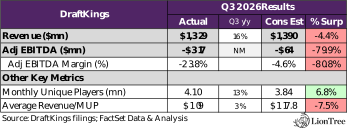
- Q3 revs MISSED cons by -4.4%: Grew +16% y/y driven by healthy customer engagement and higher sportsbook net rev margin
- Adj EBITDA MISSED cons by a sizable margin: The Co reported a loss of -$317mn vs cons -$64mn (vs -$126mn in Q3:25)
- Adj EBITDA margin of -23.8% was well below cons -4.6%
- …This was primarily due to incr’d investment in Predictions
- Predictions rev in Q3 was minimal, as new customer promos offset the “lion’s share” of gross rev generated
- Mgmt stressed that adj opex EXCLUDING Predictions decr’d y/y
- By segment:
- Sports rev grew +31.5% y/y to $784mn on sports consumer volume (sportsbook handle + Predictions consumer volume) of $13.9bn (+22% y/y)
- Sports net rev margin of 5.6% vs 6.8% in Q2:26 (+0.4pts y/y), driven by higher sportsbook hold, partially offset by Predictions new customer promos
- iGaming rev grew +2% y/y to $461mn, reflecting incr’d promotional reinvestment for new customers
- Other rev fell -12.5% y/y to $85mn on lower interest income on player funds and lower ad sales, partially offset by Lottery growth and the DK Racing launch
- Sports rev grew +31.5% y/y to $784mn on sports consumer volume (sportsbook handle + Predictions consumer volume) of $13.9bn (+22% y/y)
KPIs Were Mixed…MUPs Beat On Strong Acquisition BUT ARPMUP Missed
- Q3 was the Co’s best acquisition qtr since 2024
- MUPs BEAT cons by +6.8%: Grew +13% y/y, reflecting strong retention and new customer acq across Sportsbook, iGaming and Predictions
- Avg rev/MUP MISSED cons by -7.5%: Grew +3% y/y, primarily due to improved sportsbook net rev margin
FY26 and FY27 Guidance Reflects A Significant Ramp In Predictions Investment
- The FY26 guidance was lowered…
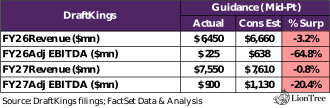
- The mid-pt of the new rev guidance was -3.2% BELOW cons (range lowered by -3.7% at the mid-pt)
- The mid-pt of the new adj EBITDA guidance was a sizable -64.8% BELOW cons (lowered to $175-275mn range from $700-900mn)
- …This primarily reflects incr’d Predictions adj EBITDA investment of $650-700mn (vs $200-300mn previously)
- Q4 Predictions adj EBITDA investment is expected at $175-225mn
- But Predictions rev will be immaterial in FY26 as new customer promos offset the “lion’s share” of gross rev
- The Core FY26 adj EBITDA is now expected at $875-925mn (vs ~$1bn previously)
- The ~$100-150mn reduction is ~60% sport outcomes (“modestly customer-friendly”) with the remainder from new customer acq in iGaming
- Excluding outcomes, mgmt said the core is “pretty much on track”
- Mgmt introduced FY27 guidance that also bakes in more Predictions Investment…
- Mid-pt of rev guidance modestly MISSED cons by -0.8% ($7.35-7.75bn, +17% y/y at the mid-pt)
- Mid-pt of adj EBITDA guidance MISSED cons by a notable -20.4% ($800mn-1bn)
- …AND is confident on reaching an inflection in FY27
- Core rev guidance is $6.7-7.0bn (+4-9% y/y vs the FY26 mid-pt)
- Core adj EBITDA guidance is $1.15-1.25bn ($1.2bn at the mid-pt), powered by steady sportsbook growth, accelerating iGaming growth and significant operating leverage
- Core adj EBITDA margin is projected to expand ~360bp to ~18% in FY27 at the mid-pt (after ~370bp of expansion in FY26)
- Predictions rev guidance is $650-750mn
- Predictions adj EBITDA investment of $250-350mn, stepping down to ~$300mn at the mid-pt as 2026 cohorts contribute meaningful gross profit
- Mgmt will monitor regulatory developments related to sports predictions and adjust the investment level accordingly
- Predictions is expected to be a tailwind to adj EBITDA in 2028 and generate FCF in 2028
- The Co expects to generate significant excess FCF in FY27, even after funding Predictions investment
Mgmt Remains Very Bullish On Predictions & The Return That It Will Generate On This Heightened Investment
- More than 1.6mn customers have engaged w/ Predictions YTD
- Retention and engagement of newly acquired Predictions customers is in line w/ sportsbook levels
- The 2026 cohort is already run-rating to ~$350mn in annualized gross profit
- Volumes have exploded in just a few months…
- October annualized consumer volume reached $10.1bn, up nearly 3x from July
- October annualized total volume traded reached $56.8bn, up over 5x from July, as combos grow as a share of volume
- DKNG has become the clear #3 predictions exchange by total volume
- Combos reached 27% of consumer volume in October and more than 70% of customers traded combos in the month
- The Co will do “hundreds of millions” of Predictions gross rev in FY26 BUT net rev will be close to neutral, w/ ~90% of that due to new customer promos
- In FY27, mgmt expects net rev of ~$700mn and gross profit of ~$500mn despite continued heavy new customer acq
- The guide assumes status quo with no additional monetization from product improvements or acquisition efficiencies
- Mgmt thinks it is “more likely than not that we’ll find some wins next year that could give us some upside on the predictions numbers”
- “I’m really bullish about that part of the business. I know everyone’s a little surprised at how much we spent, and I wish you all could see every data point that we see”
- Looking to 2028, the ’26 and ’27 cohorts could generate gross profit north of $1bn if sports predictions stay in place for the full year
- Customer acq spend would likely come down somewhat as the market matures, BUT even if flat y/y, Predictions would generate significant FCF
- Mgmt “would be surprised if we spend more” on Predictions in FY27 than the guided investment, barring major positive regulatory developments
- Equally, mgmt doesn’t expect to spend much less barring major negative regulatory developments
- NFL data on retention and spend levels has given the Co “a lot more conviction” that it knows the right level of spend
Predictions Payback Math & Potential Regulatory Rulings Dominated The Q&A…Mgmt Cites Positive Payback Even W/ A Negative Court Scenario
- The 2026 Predictions cohort is expected to pay back in ~20 months, which is well below the 2-year payback target
- For context, DKNG typically targets 3-year paybacks in its core business
- The base case assumes a mid-2028 Supreme Court ruling
- Even if sports contracts were to end in July 2028, the 2026 cohort would be fully paid back by then
- The 2027 cohort would be over 50% paid back by that date and is expected to fully pay back within 4 years w/out sports contracts
- This is driven by strong cross-sell into other products (Pick6, lottery, DFS, non-sports Predictions) and assumes no benefit from state legalization
- Mgmt modeled the “most draconian likely scenario” (all sports contracts go away) as the downside case
- A middle-ground outcomes (e.g., only some sports contracts banned) or litigation delays would be better for paybacks
- Mgmt believes DKNG is in a “win-win position no matter how any future court ruling plays out”
- Why invest all this money in predictions if OSB legalization would follow anyway? Mgmt said it can’t count on every state legalizing sports betting and the Predictions audience “is very much our brand and our core audience”
- But the sportsbook is a better product that will attract and retain customers better
- Incremental spend has been mostly local (in Predictions states), similar to an OSB state launch playbook but at much lower levels
- Following this week’s election results, mgmt believes certain states may now have a clear path to legalization and will weigh differentially spending in those states
- Mgmt sees minimal brand halo to existing OSB/iGaming states since the vast majority of incremental spend was local
Non-Sports Predictions Is Emerging As A “Hidden Gem”
- Nearly 20% of Predictions customers have already traded non-sports markets, w/ non-sports consumer volume per customer on par w/ sports
- Crypto is leading the way, approaching DD share of total consumer volume in recent weeks
- DKNG is targeting migration of crypto markets to DKX over the next month
- With “basically no effort,” non-sports is already approaching ~10% of sports volume…mgmt thinks non-sports could be 25-30%+ of the size of sports today
- “That’s sort of a hidden gem there…it wasn’t what I was thinking when we got into this”
- Mgmt expects to have more to say on non-sports in the coming quarters
- Crypto is leading the way, approaching DD share of total consumer volume in recent weeks
The Core Sportsbook Remains Very Strong…Handle Grew +12% y/y W/ No Visible Impact From Prediction Markets
- Sportsbook net rev grew +36% y/y w/ net rev margin expanding ~120bp y/y to 6.4%
- Hold rate eclipsed 11% and parlay mix incr’d +300bp y/y
- Sportsbook handle grew +12% y/y…a true like-for-like comparison, as the World Cup boost was fully offset by one fewer week of college football and NFL
- Handle growth would likely have been even higher if not for the significant incr in net rev margin
- Prediction market operators are having “no discernible impact on our sportsbook business”
- Handle share across sportsbook states improved y/y for the 4th consecutive quarter and GGR share also incr’d y/y
- Mgmt said DKNG was basically tied w/ FanDuel for #1 in sports betting in Q3
- On concerns the Co is harvesting core margin while peers spend aggressively, mgmt said “I don’t think we’re pulling back at all”…”We are laser focused on the core”
- FY27 guidance includes “hundreds of millions” of promo cushion to invest if attractive opportunities arise
iGaming Investment Weighed On Near-Term Profit BUT Customer Acq Grew +76% Which Should Drive Accelerating Growth In 2027
- iGaming customer acq grew +76% y/y in Q3
- Gross rev growth accelerated to +7% y/y, while net rev grew +2% y/y due to promos for new customers
- October gross rev growth accelerated further to +12% y/y and October paid active days (active customers x days engaged) grew +24% y/y
- The acceleration reflects a deliberate multi-quarter plan: A revamped offering, exclusive content such as the CASHINGO franchise, and new rewards and merchandising
- Seeing strong early returns, the Co stepped up investment in marketing and new customer promos in Q3 and Q4 to date
- Mgmt noted it found insights and efficiencies in marketing that unlocked better acquisition without increasing spend as much
- The bulk of the investment came from higher-than-expected new customer promos, which drove near-term softness BUT will lead to “much better revenue and EBITDA in future quarters”
- As a result, mgmt raised its FY27 iGaming outlook, though the guide assumes no further acceleration from current run-rates
- iGaming share has now been gained for 3 consecutive quarters
Cost Discipline & Operating Leverage Underpin Core Margin Expansion To ~18% In 2027
- Marketing spend for the entire business is expected to come down in FY27, despite slightly higher Predictions spend…core marketing spend is coming down
- Driven by national marketing efficiencies as states mature
- Fixed costs have been well managed in 2026 w/ many initiatives lined up to focus on costs “all the way up and down the P&L”
- The Co built out its Predictions product w/ mostly the same headcount, which mgmt attributed to efficiency from AI, among other things
- Mgmt expects incremental core adj EBITDA growth in FY27 consistent w/ prior years, following the playbook of states inflecting in profitability as they mature past the initial investment phase
After A Strong Q3, Investors Look Past Booking’s Q4 Macro & Investment Reset
It was a good news / bad news for Booking.com as the Co delivered a clean beat in Q3, with room nights, gross bookings, adj revenue and adj EBITDA all exceeding the high end of guidance, and room night growth accelerated to +7% from +5% in Q2 despite the continued indirect drag from the Middle East conflict. However, the Q4 outlook was well below the Street, given a moderation in international travel late in Q3 which continued into Q4, in combination with higher planned investments in AI, flights, attractions and dining. Mgmt assumes the Middle East disruption will persist through YE. With that said, given the Q3 beat, the FY guidance was still maintained.
More specifics on the key incrementals from Booking’s results include: 1) Q4 adj EBITDA was guided to ~flat y/y vs cons growth of +9.8%, driven by planned investments in strategic initiatives, though FY targets were maintained; 2) Mgmt quantified early AI top-line uplift, incl. AI assistant users converting at ~2x the rate of non-users and ~20% higher booking values at Agoda; 3) LLM referrals have accelerated over recent weeks but remain “significantly less than 1%” of Booking.com room nights, and mgmt believes it is capturing the vast majority of agentic travel traffic as horizontal agents prefer to connect with aggregators; 4) The Co is placing new AI-native bets outside its core brands via Lola and Vayo (planned $100mn investment); and 5) It is too early to call 2027, but on-the-books stats for H1:27 look “healthy” and the Co will launch a combined B2B business on Jan 1, which will likely be broken out going forward.
All in, the qtr reinforced the resilience of underlying travel demand and showed that AI is moving “from experimentation to measurable operating value,” and at least in terms of the immediate stock reaction, investors are looking past the macro and investment-driven Q4 reset. The shares are being strongly swept up on the back of the midterm results rally as well.
See below for more.
-> Booking was down ~-3% after hours following its earnings report but ended the day up +9.8%; With that said, the stock still remains down -25.0% YTD
-> Expedia also reported and while Q3 headline results topped consensus expectations, it was helped by a pull forward from a fall sale promo and the Q4 guidance missed consensus (adj EBITDA guidance -6.7% below the Street); The stock fell -13.7% in reaction and is now down -8.5% YTD
–> Airbnb was a standout as well with better-than-expected Q3 results and better than expected Q4 guidance; The stock rallied +11.9% and ended the week up +15.6%; The stock is still up +40.0% YTD
Clean Beat Across Headline #s As Q3 Came In Above The High-End Of Guidance…BUT FCF Missed On Seasonal Working Capital Unwind
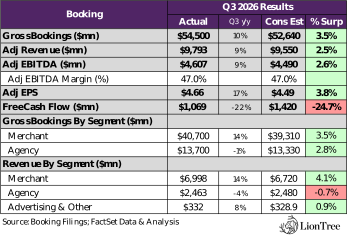
- Gross Bookings BEAT by +3.5%: Up +10% y/y or +~11% FXN
- FXN gross bookings growth was ~4ppts higher than room night growth, primarily reflecting higher FXN ADRs (+~3% y/y) and the contribution from flights and other verticals
- Merchant gross bookings BEAT by +3.5%: Up +14% y/y
- Merchant represented ~75% of total gross bookings, up ~3ppts y/y
- Agency gross bookings BEAT by +2.8%: Down -1% y/y
- Adj revenue BEAT by +2.5%: Up +9% y/y or +~10% FXN
- Adj EBITDA BEAT by +2.6%: Up +9% y/y
- Adj EPS BEAT by +3.8%: Up +17% y/y
- EPS growth outpaced EBITDA growth, helped by a 7.5% reduction in avg share count
- But FCF MISSED by -24.7%: Down -22% y/y
- Impacted by a working capital decr driven by a $3.6bn seasonal unwind of deferred merchant bookings
- Returned $2.4bn of capital in Q3 incl. $2.1bn of buybacks
Room Night Growth Accelerated As International Travel Improved…Though Elevated Airfares & ME Disruption Continue To Weigh On Long-Haul
- Room nights beat cons by +1.3% and grew +7% y/y, up from +5% in Q2, driven by an improvement in international travel from bookers in Europe and Asia, while domestic growth was stable at a higher level
- Globally, domestic room nights grew HSD and international room nights grew MSD
- Elevated airfares and reduced capacity on certain routes from the ME conflict continue to weigh on long-haul travel demand
- By region
- Europe: Grew HSD, w/ domestic room nights up HSD
- Asia: Grew HSD, w/ domestic room nights up LDD
- Asia domestic travel outpaced international travel by the widest margin of any region
- The US: Grew MSD, driven by domestic room night growth
- Saw another consecutive qtr of direct channel growth in the US
- Have outperformed the broader US mkt in room night growth for the last three yrs
- RoW: Grew MSD, stable vs Q2, as the Co continues to see growth from bookers in the Middle East
- Pricing and booking behavior
- FXN ADRs were up ~3% y/y, primarily driven by Europe but also the US and Asia
- Booking window expanded slightly in Europe and globally, while the US modestly contracted
- Avg length of stay incr’d y/y outside of Asia
- Alternative accommodations accelerated
- Alt accommodation room nights grew +7% y/y, up from +4% in Q2, w/ acceleration across all major regions
- Represented ~37% of Booking.com room nights, up ~1ppt y/y
- Alt accommodation listings growth accel’d to +9%, an “encouraging signal” for future growth
- Other verticals also accelerated
- Flight tickets beat by 11% and grew +19% y/y, a “strong acceleration” vs Q2 and ahead of the broader mkt, despite elevated ticket prices and reduced capacity on certain routes
- Attraction tickets grew +24% y/y, also an acceleration vs Q2
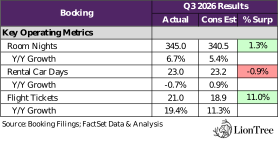
BUT Q4 Reflects Some Slowdown In Consumer Travel Trends & Stepped Up Investments
- Q4 guidance was below the Street across the key metrics
- Gross bookings growth of +2-4% y/y (+4-6%y/y FXN) vs Q3’s +10% y/y or +~11% FXN
- Adj revenue growth of +0-2% (+2-4% FXN); FXN midpt of +3% MISSED cons +7%
- Rev to grow slower than gross bookings due to flight bookings mix and timing of bookings vs travel, partially offset by higher payments rev
- Adj EBITDA ~flat y/y (+~2% FXN) MISSED cons +9.8% y/y est
- See more below
- Room night growth of 1-3%, reflects the toughest prior yr comparison of 2026 and uncertainty around the impact of recent events on travel demand; no cons comparison available
- Estimate FX will negatively impact Q4 reported growth rates by ~2ppts
- Q4 EBITDA will be impacted by incr’d planned investments behind long-term strategic priorities
- Includes expanding capabilities across non-accommodation verticals such as flights, attractions and dining, advancing AI capabilities, and enhancing underlying technology, infrastructure and platforms
- Expect investments to be partially offset by marketing leverage
- Mgmt characterized the backdrop as “mixed”
- Mgmt saw “some moderation in global demand trends toward the end of Q3, driven by international travel”
- Domestic travel continues to hold up as travelers take shorter trips and choose destinations closer to home
- In Oct, demand was affected by disruptions to travel to and from the Middle East, the conflict’s broader indirect effects such as elevated airfares, and localized unrest in certain European cities
- Guidance assumes both the direct and indirect impacts of the ME conflict on travel persist through YE
- Despite the weak Q4 guidance, FY26 guidance was maintained given the Q3 beat
- Mgmt continues to expect gross bookings, adj revenue and adj EBITDA to be up HSD and adj EPS to be up low-to-mid teens “at the high end”
- Expect FY adj EBITDA margins to be “stable”
- What about 2027? It is too early to say
- But as a very early directional indicator, on-the-books stats for H1:27 look “healthy,” which gives mgmt confidence in the outlook for next yr
- Analysts pressed on whether AI-driven efficiencies could allow the Co to outperform the 8/8/15 algo…mgmt said it is “a little bit too early” to determine the impact on the long-term algorithm
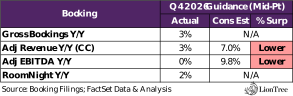
Cost Discipline & AI Efficiencies Are Supporting B2C Leverage…While B2B Gets More Focus Ahead Of A Combined Launch On Jan 1
- Marketing expense incr’d +11% y/y, slightly faster than gross bookings, driven primarily by faster growth in B2B affiliate marketing
- B2B affiliate, the B2C business had marketing leverage in the qtr, driven by higher ROIs in paid channels and growth in direct traffic
- Outlook- Mgmt is “looking at the possibility” of delivering B2C marketing leverage in Q4 as well
- The Co will launch a combined B2B business on Jan 1 and will “most likely” break out the numbers going forward
- B2B commissions are based on rev share, so growth in B2B volumes flows through the marketing line…mgmt views this as economically healthy
- AI is driving real operating efficiencies
- Customer svs costs declined in Q3 despite higher booking volumes, while satisfaction remained high
- Blended cost per mn AI tokens declined by 25%+ between June and Sept across the Co, helped by price caps on higher-cost models and routing simpler tasks to more cost-effective models
- Developer productivity continued to improve, w/ cost per merge request down double digits
- Headcount growth has been “very minimal” over the last two yrs, mostly in lower-cost locations such as the Center of Excellence in India
- Remain on track to achieve the full $650mn of annual run-rate savings from the transformation program in 2027
- Incurred ~$23mn of transformation costs in Q3
Early Data Shows That AI Investments Are Driving Higher Engagement, Conversion & Booking Value
- Continuing to roll out AI capabilities across the core brands
- At Booking.com…the Co is expanding AI tools that help travelers explore destinations in greater detail at the top of the funnel, and advancing agentic capabilities that enable customers to cancel a booking or get answers about their stay w/o contacting customer svs
- Early testing is showing encouraging customer satisfaction results and fewer escalations to svs teams
- Agoda launched its new AI assistant, now live across 21 mkts, which helps travelers move from an initial idea to a bookable trip using Agoda’s live selection of accommodations, flights and activities
- At Priceline…the Co is bringing more of Penny’s capabilities into the main Priceline experience so more customers can benefit
- At Booking.com…the Co is expanding AI tools that help travelers explore destinations in greater detail at the top of the funnel, and advancing agentic capabilities that enable customers to cancel a booking or get answers about their stay w/o contacting customer svs
- Launched new AI-native experiences outside the existing brands, which serve as testing grounds to iterate quickly and apply learnings across Booking Holdings
- Lola (launched in Sept)…helps people access unique travel, dining and event inventory across platforms beyond the Co through a conversational experience and a membership model
- Vayo (launched in Oct w/ a planned $100mn investment)…a proactive AI travel agent that brings existing reservations from a traveler’s email history into one place, creates personalized offers, suggests ways to fill itinerary gaps, and monitors prices after booking
- Early learning is that most users are willing to connect their full email history
- Successful capabilities will be brought back to Booking.com, Agoda and Priceline, which have the scale to roll them out to partners and customers
- Measuring AI’s impact across 4 categories…“it’s early days, but we’re encouraged by the momentum”
- Higher engagement: com daily AI search visitors were up 10x in Q3 vs Q2 w/ trip search; Seeing strong conversational engagement on Vayo w/ users connecting their email
- Higher conversion: Priceline and Agoda AI assistant users have converted at ~2x the rate of non-users
- Higher booking value: Agoda AI assistant users have an avg booking value ~20% higher than non-users
- Incrementality: OpenTable’s native integration w/ OpenAI has become one of the brand’s fastest growing channels (from a small base), w/ ~190K seated covers in Sept; agentic interactions w/ Muse and other horizontal agents have brought a “significant number of completely new customers” to OpenTable
- Laid out a multi-pronged approach as agentic AI evolves:
- 1) building its own AI agent-powered experiences
- 2) participating in new distribution channels that bring incremental demand at attractive economics
- 3) using AI to improve customer svs, developer productivity and operating efficiency
Agentic Channels Are Still Tiny But Accelerating & Mgmt Sees AI Agents As A Diversification Opportunity Rather Than A Threat
- LLM referrals have accelerated over the last several weeks but still account for “significantly less than 1%” of Booking.com’s room nights
- Organic referrals incr’d following the release of the latest ChatGPT models, which improved citation rates and drove more traffic to the Co’s platforms
- Paid referrals are also growing as the Co expands its OpenAI partnership into addtl mkts
- Not seeing meaningful differences between traditional LLMs and newer horizontal agents…traffic is still very small in aggregate
- Based on third-party data, the Co believes the “vast majority” of agent travel traffic is coming to Booking
- The Co is expanding partnerships w/ leading tech and AI companies incl. Meta, OpenAI, Google, Anthropic and Amazon
- OpenTable debuted as the first dining partner w/ Meta’s Muse personal agent
- Agoda is live on Muse as a launch partner in Asia, connecting Muse directly w/ Agoda’s new AI assistant
- Why are horizontal agents surfacing Booking? Mgmt pointed to brand credibility and the depth of its supply
- Horizontal agents prefer to partner w/ aggregators…”It’s going to be very expensive for them to connect to 4.7 million properties directly” and get real-time pricing and availability data
- Agentic platforms are still figuring out their economic models, and mgmt believes diversification of third-party channels will ultimately drive an economic advantage for the Co
- If horizontal agents adopt a monetization model similar to what Booking has done over the last two decades, mgmt believes the Co would be in an even better position
- Mgmt pushed back on concerns that agents may favor direct supplier sites, noting they see other data where OTAs are getting a greater advantage
- Emphasized the Co’s value to independent suppliers in an AI world
- Independent hotels and alternative accommodations generate the vast majority of Booking.com room nights
- The 10 largest global hotel chains account for only a LDD %age of room nights
- Smaller partners are afraid that in the new world they won’t be seen at all, and Booking provides that reach on a pay-for-performance basis w/ no upfront marketing costs
- The Co processes 100+ payment methods in 50+ currencies and provides customer svs in 40+ languages w/ both AI agents and people
- Independent hotels and alternative accommodations generate the vast majority of Booking.com room nights
- On the DMA’s impact on Google search results in Europe, the Co is not seeing any numerical benefit to the OTAs yet…”I hope it is. I haven’t seen it yet”
- Mgmt also flagged that the regulatory framework, particularly in Europe and the UK, could mean that “the adoption of these horizontal personal agents may be much slower than is anticipated”
Connected Trip Momentum Continues To Build And Mgmt Teased An Evolved Genius Program That Leans Less On Discounts
- Connected trip transaction growth accel’d to almost +20% y/y and represented a LDD mix of Booking.com’s total transactions
- Connected trip transactions grew 3x faster than Booking.com’s overall transactions, but from a relatively small base
- Travelers who book across multiple verticals return more frequently
- Expect further incr’s as the Co delivers more personalized, gen AI-powered experiences and brings offerings together more seamlessly through Genius
- Genius continues to deepen engagement
- Over the LTM, Level 2 and Level 3 members represented 30%+ of Booking.com’s active customer base and accounted for a high-50% share of room nights, up y/y
- Higher-tier Genius members plan further ahead, return more consistently, and book direct at a higher rate than non-Genius travelers
- Direct relationships continue to strengthen
- B2C direct mix remained stable in the mid-60% range over the past four qtrs
- Mobile app mix of total room nights was in the high-50% range, up from mid-50% a yr ago
- Room nights from travelers who book direct, use the app AND are Genius Level 2/3 grew “meaningfully faster” than those booked by other travelers, both in Q3 and YTD
- How can Genius evolve w/o becoming more reliant on supplier-funded discounts?
- Genius works well today because partners fund much of it and get a good ROI, but “there are a lot of other ways we can improve upon that tremendously”
- Mgmt sees oppty for perks partners to offer at little or no marginal cost, or at a lesser cost the Co could help work through
- The Co is also exploring loyalty connectivity w/ hoteliers and non-travel players to build out the network, though mgmt declined to share specifics or timing
Uber’s Profit Engine Keeps Running As The Co Works Through A Driver Supply Bump
While overall Q3 headline numbers were in-line to slightly better than Street expectations, Mobility was a drag as growth slowed and bookings missed. Most of the slowdown came from outside the US, where demand remained “healthy” but driver supply did not keep pace. Uber is responding with targeted driver investments, which mgmt doesn’t expect to drive “any kind of meaningful changes” in the Mobility margin trajectory. Early results are encouraging as supply hours growth accelerated globally in October (notably in Brazil and India), which gives the Co “confidence in a consistent YoY growth trajectory in Q4 relative to Q3.”
On autonomous vehicles, mgmt said AVs are expanding the ridesharing category, as Uber’s trip growth exceeded the national rate in US markets where AVs ran throughout Q3. Uber expects ~700 fully driverless vehicles on its platform by year-end and 2,000+ by YE27, with a larger commercial ramp beginning in 2028, and continues to expect AV fleets to be financed by third-party capital over the long run rather than its own balance sheet.
Across the rest of the business, Delivery growth remained broad-based across geographies, and mgmt is not overly concerned about a potential DoorDash/Instacart combination. Uber One reached ~55mn members, now accounting for more than half of combined Mobility and Delivery gross bookings, and the Co expects minimal to no further M&A through at least 2027 (apart from AV investment) as it focuses on integrating Delivery Hero and ezCater. On agentic AI, Uber will selectively work with third-party agents that bring incremental demand while protecting its direct consumer relationships, though agent-driven volume remains “very, very early.”
Looking ahead, Q4 guidance was in line on gross bookings and adj EPS, and slightly below on adj EBITDA. As Dara summarized, the priorities heading into Q4 are to “improve Mobility supply, build on Delivery’s momentum, and deliver against our AV milestones, all while continuing to grow profitably.”
See below for the key takeaways from Q3.
-> Uber was up +4.9% post its print and ended the week up +5.1%; YTD, the stock is still down -16.1%
Q3 Beat On Profit, But Mobility Weighed On Growth
- Q3 gross bookings were IN-LINE and grew +20% y/y (or +20% FXN vs +22% FXN in Q2) to a record
- Mobility MISSED, while Delivery and Freight BEAT
- Q3 adj op income BEAT and grew +38% y/y…margin reached 3.9% of gross bookings (up +50bps y/y and a new record)
- Q3 revenue BEAT and grew +10% y/y (+10% FXN), vs +12% (+11% FXN) in Q2
- UK business model change reduced rev by $1.1bn (~8pts of growth), which reflects driver payments moving from cost of rev to contra-rev…no change to underlying economics
- Q3 Trips were ~IN-LINE and grew +16% y/y (decel from +18% y/y in Q2)
- The ~2pt decel was roughly split between Mobility supply constraints and lapping the Trendyol Go acquisition
- Q3 MAPCs of 215mn were ~IN-LINE and grew +14% y/y (decel from +16% y/y in Q2)
- Monthly trips per MAPC grew +2% y/y to a record 6.3
- Take rate of 24.7% was ~IN-LINE w/ cons 24.6%
- Driven by Freight, as both Mobility and Delivery came in below expectations
- FCF MISSED by -4.0%
- EPS of 88c was ABOVE cons 86c
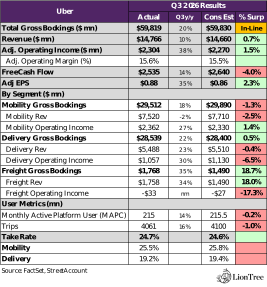
Q4 Guidance Mixed W/ In-Line Bookings And EPS, But A Tad Light On Adj EBITDA
- Q4 gross bookings guidance was IN-LINE at the midpt: The range implies growth of +18-22% y/y FXN vs +20% y/y FXN in Q3
- Assumes ~1pt currency headwind to total reported y/y growth
- Mobility gross booking growth is expected to have a ~100bps headwind from the Middle East conflict during the busy travel season (vs ~75bps in Q3)
- Freight gross bookings growth is expected to be ~consistent w/ Q3 pace (+35% y/y) which was well-above cons expectations of +15.6%
- Q4 adj EPS guidance was IN-LINE at the midpt: Implies +34-39% y/y growth vs +35% y/y in Q3
- Q4 adj EBITDA guidance SLIGHTLY MISSED at the midpt:
- Note that Uber will stop providing the adj EBITDA reconciliation starting with Q4 results in February
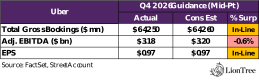
International Driver Supply Is The Main Mobility Constraint But Targeted Driver Investment Is Already Showing Early Signs Of Improvement
- Q3 Mobility gross bookings grew +17% y/y FXN, which was a decel from +20% y/y in Q2…the “large majority” of that was from outside the US, where demand has remained “healthy”, but supply growth has not kept pace
- India: Driver supply growth trailed demand
- Brazil: Still undersupplied, though modestly better than Q2…elevated fuel prices have meaningfully impacted supply in Brazil and India
- Canada: Tighter immigration flows have left the market meaningfully undersupplied
- Also flagged that seasonal pressure (Sept-Dec is peak season for both Mobility and Delivery) is overlapping w/ the y/y supply pressure
- Responding w/ targeted investments in driver acquisition, retention, and reactivation
- Rebalancing incentives…rider incentives are being reduced and those dollars are funding driver incentives, which can mean higher prices for riders in some cases
- Incentive allocation is algorithmic, deciding across billions of trips whether a dollar is better spent on a driver in Brazil or a rider in India
- Already seeing early results…supply hours growth accelerated globally in October, w/ notable improvements in Brazil and India
- Rebalancing incentives…rider incentives are being reduced and those dollars are funding driver incentives, which can mean higher prices for riders in some cases
- In contrast, US Mobility growth moderated much more modestly, supported by continued benefits from insurance reform, with California trip growth accelerating
- Q3 mobility margins reached a record 8%…and the Co is not expecting “any kind of meaningful changes” in margin trajectory despite supply investments
- Philosophy remains driving margin expansion for the total Co on a y/y basis, and ideally at the segment level as well, but there will be quarterly variability around holiday supply investments
- Looking into Q4…overall Mobility growth trends improved in Q4, “giving us confidence in a consistent YoY growth trajectory in Q4 relative to Q3”
- Expects the UK business model accounting impact (~350bps Mobility rev margin headwind) to continue in Q4
- Expects a ~$1.5bn cash payment in Q4 related to the previously disclosed UK VAT tax matter
AVs Are Expanding The Category, Not Cannibalizing It, As Uber Shifts From Partnerships To Commercial Scale
- AVs are expanding the category…
- In US markets where AVs ran throughout Q3, Uber’s trip growth exceeded the national rate
- In mature US AV markets, ridesharing has grown ~7pts faster than the rest of the country for several quarters
- Expect ~700 fully driverless vehicles on Uber by YE26 and 2,000+ by YE27 (~half US, ~half international)
- The bigger commercial ramp is expected to start in 2028, w/ a goal of “tens of thousands” of vehicles in 2028 and beyond
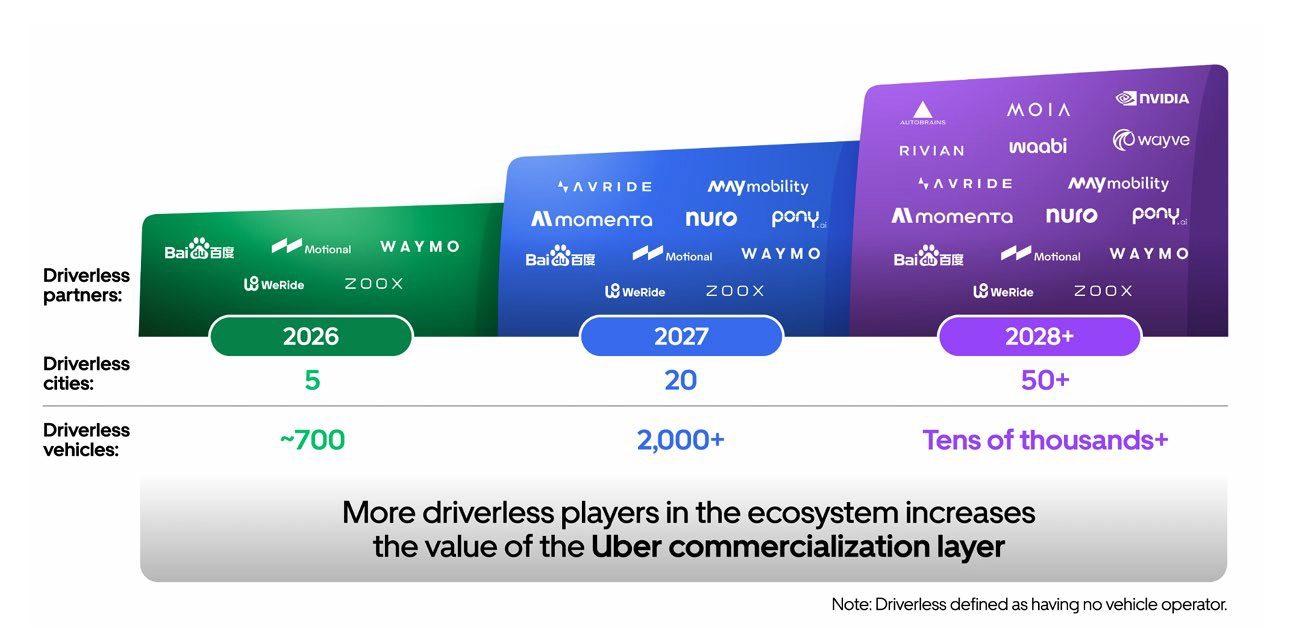
Source: Uber
- The Co will be more selective on AV investment: Uber wants to maintain an open platform for AV partnerships but will focus its resources on fewer partners going forward (those that have the clearest paths to commercial scale and attractive economics at maturity)
- “Building a broad ecosystem does not mean spreading our resources evenly”
- Unit economics were a key focus…US AV partners average ~30% more trips per vehicle per day on Uber than first-party deployments
- Waymo and Tesla first-party deployments in markets launched this yr are seeing trips per vehicle per day in the low teens vs the high-20s on Uber’s hybrid network
- This is a “very durable advantage”…as an illustrative example, a 30% increase in paid trips per vehicle cuts fixed cost per trip by ~23%
- Addtl advantages over time = scale-advantaged OEM pricing plus shared charging, maintenance, and fleet infrastructure across multiple AV partners (similar to hyperscalers vs on-prem data centers)
- Goal is for AVs to deliver margins comparable to human-driven trips over time
- Waymo and Tesla first-party deployments in markets launched this yr are seeing trips per vehicle per day in the low teens vs the high-20s on Uber’s hybrid network
- Still early stages but long-run expectation continues to be that AV fleets are financed by third-party capital, not Uber’s balance sheet
- The ~$1bn Santander financing arrangement for traditional fleet partners earlier this yr is the template…expect announcements on both infrastructure and vehicle financing over the next few months
- Near-term capital deployment is “fairly limited,” but third-party capital will be needed as the fleet scales to 10,000+ vehicles in 2028 and beyond
- Since AV residual values aren’t established yet, early vehicles will sit on Uber’s balance sheet…financing will be based on revenue potential, where Uber’s utilization premium is an advantage
- Lender reaction has been positive…banks “want to diversify away from data centers”
- “So we’re quite optimistic on it, but we do have to establish kind of the business model, the utilization advantages, demonstrate that to the banks, and then go from there”
Broad-Based Delivery Growth Continues, With Courier Supply As The Key Constraint
- Q3 Delivery gross bookings grew +23% y/y FXN w/ organic growth accelerating
- Headline growth decel’d from +25% FXN in Q2 as the Co laps the Trendyol Go acquisition
- Growth remained broad-based…
- “Strong” acceleration in both the U.S. and Latin America for the second consecutive qtr
- Category position hit all-time highs in the UK, France, and Türkiye
- Japan posted a fourth consecutive qtr of accelerating growth
- Australia grew ~30% driven by less dense markets
- Early traction in Argentina, Finland, and Denmark
- “Biggest challenge” right now is courier growth keeping up w/ consumer demand seen on the food side
- Grocery & Retail held at ~40% y/y growth (consistent for multiple qtrs) on a ~$15bn annualized gross bookings run rate
- NOT overly concerned about a potential DoorDash/Instacart combination… “I don’t think, honestly […] it’s going to affect us too much”
- Merchant partners have reached out worried about the potential deal and want to work more w/ Uber to avoid dependence on a single platform
- The combination would create a competitor w/ a large share of the online grocery market, BUT mgmt sees the overall market as large enough and will keep investing
- On dark stores, mgmt will be “selective”…the No. 1 priority remains working w/ partners and helping them grow their bizs
- Delivery Hero has built a substantial quick commerce/dark store business (incl in the Middle East) that is at break-even and growing at attractive rates
- The Co will consider dark stores in markets where it makes sense, but “it needs to be a business that can be run well, has to meet the market conditions, and has to have a good return on assets”
Some Additional Commentary On Uber One, M&A Pullback, And 3P Agent Oppty
- Uber One reached ~55mn members globally, accounting for more than half of combined Mobility and Delivery gross bookings
- Mgmt did not provide a comparable update in Q2, but “surpassed” 50mn in Q1
- Expect minimal to no further M&A through at least 2027 (apart from AV investment) as Uber prioritizes integrating Delivery Hero and ezCater
- “We are going to shift to, I would say, more of the top two and we’re going to pull back on M&A”…the top two priorities are organic growth and AV investment (~$10bn commitment)
- Next yr’s focus will be on organic growth, autonomous, and buying back stock opportunistically
- Uber will selectively work w/ third-party agents that bring incremental demand…evaluation criteria include customer experience, sustainable economics, and preserving direct relationships and Uber One benefits
- “Every single AI assistant company” is talking to Uber and the Co is negotiating terms of trade…“I think the demands on our services are going to be very, very high”
- BUT mgmt doesn’t want to become dependent on intermediaries, citing past experience in travel being “very dependent on the Googles of the world”
- Agent-driven volume remains negligible…Halloween week saw ~320mn trips on Uber and Uber Eats, of which AI agents drove ~500 Uber Eats orders and just four rides…”very, very early and very limited traction”
Stock Market Check
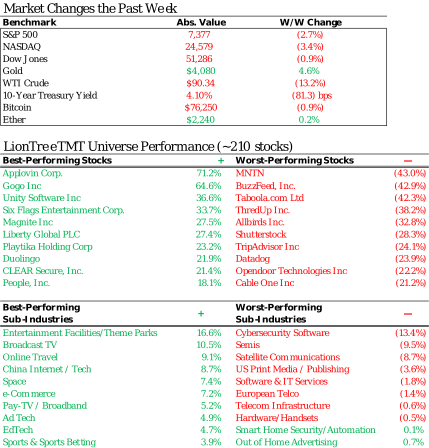
This Week's Other Curated News
Advertising/Ad Agencies/Ad Tech
- Reddit began testing search ads w/ a select group of advertisers, placing ads in search results based on targeting and contextual relevance. Searches such as “espresso station” or “home office setup” may surface related products beyond the exact query. The move follows Q3 results showing 53% rev growth despite stagnant user growth and lower search referrals. Reddit aims to strengthen its advertising biz and evaluate user and advertiser response before broader rollout. (MediaPost)
- Adthena’s Holiday AI Paid Search Report found paid search is expanding across ChatGPT, Google AI Overviews, AI Mode, and traditional search. Between Jun and Sept 2026, it tracked 204,489 ChatGPT ad placements, led by apparel, consumer electronics, and travel, while toys and games grew fastest. Google AI Overviews usage also surged across major mkts, prompting brands to focus on highly relevant AI-driven ad placements and visibility. (MediaPost)
- Federal Trade Commission and 22 states filed an updated complaint against Amazon, revealing allegations that the Co secretly inflated online ad auction prices to boost rev and meet financial targets. The complaint alleges surcharges raised costs by up to 50% on ordinary days and 250% during events like Prime Day and Black Friday. It also claims Amazon misled advertisers by attributing higher costs to competition rather than hidden pricing changes. (Federal Trade Commission)
- Borrell Associates raised its outlook for US local digital ad spending, citing faster growth driven by shifts in the biz landscape and strong demand for streaming video. Local digital ad spend is now projected to grow 8.6% in 2026 and 6.7% in 2027, higher than prior forecasts. Digital is expected to account for 75% of local ad spending by end-2027 and 80% by 2030. Total local ad spending is forecast to reach $155.6bn in 2026, while online video remains the fastest-growing segment. (MediaPost)
- US midterms campaign spending is projected to reach ~$11. 9bn, ~30% above 2022 levels, making it the most expensive on record. More than $9.5bn had been spent by mid-Oct, w/ Super PACs accounting for ~$5.5bn. Elon Musk is the top individual donor, contributing $446mn, mainly through America PAC and other Republican-aligned groups. Spending has focused on key Senate races, while most campaign funds have gone toward advertising, especially TV ads. (BBC)
Artificial Intelligence/Machine Learning
- Tencent Holdings Limited launched Hy4, an AI model designed to limit misuse in cyberattacks and harmful biological research. The Co said cybersecurity training was restricted to defensive tasks such as finding and fixing software flaws, excluding content on hacking tools or system breaches. Internal testing found no elevated security risks or meaningful support for harmful biology work. Tencent plans to release model weights and a safety report. (Reuters)
- Google rolled out Gemini Omni 1. 2 Flash and made it generally available via the Gemini API and Gemini for biz. The model adds native video generation and editing up to 15 seconds, improves reference adherence, consistency, conversational editing, speech quality and cinematic camera control. Pricing was cut 30% versus Omni 1.1 to $0.07 per second for 720p video, w/ support for scalable enterprise use, watermarking and broader creator workflows. (Google)
- Perplexity launched “Teammates,” always-on AI agents designed for workplace use that can handle multiple roles simultaneously, drawing on existing projects, skills, and memory from Perplexity tools. The agents integrate w/ Perplexity Computer to support ongoing, large-scale work, feature dedicated threads for tracking progress, and can be accessed through Slack. The offering requires Perplexity’s $200/month Max plan. (The Verge)
- Major investors are becoming increasingly skeptical that Anthropic’s planned IPO can achieve its expected $1. 5tn valuation following a sharp market selloff linked to the unwinding of AI-related bets. The Co is targeting an IPO the week before Thanksgiving and had been expected to raise up to $100bn in an offering valuing the Co at ~$1.5tn. However, some investors said Oct financial results could help lessen the impact of the broader market rout. (The Wall Street Journal)
- Mercedes-Benz is rolling out conversational AI in some North American vehicles using foundation models from Liquid AI, an MIT spinout. The AI runs directly on the vehicle rather than in the cloud, aiming to provide faster responses, lower latency and greater privacy. The Co began deploying the models through over-the-air updates in Oct following an agreement signed in Apr and said AI is part of its broader efficiency strategy amid challenging mkt conditions. (The Wall Street Journal)
- OpenAI experienced a “pretty rough” first half of the yr as rival Anthropic gained ground w/ biz customers, according to co-founder and President Greg Brockman. The Co said its coding tools lacked traction in Q1 and Q2 despite having Codex. In Q3, new products including GPT-5.6 Sol and ChatGPT Work helped drive a significant rev inflection, w/ enterprise sales overtaking consumer sales as the Co’s largest rev driver. (The Wall Street Journal)
- UK consumers are spending more than £1bn ($1. 4bn) annually on AI subscriptions, according to a new study. The study found that over 5% of UK adults paid for their own AI subscription as of Jul, roughly double the level from a yr earlier. The findings, based on analysis of 14mn UK bank and card accounts, showed Anthropic’s Claude is narrowing OpenAI’s ChatGPT lead in the country’s consumer AI subscription mkt. (Bloomberg)
- China blocked SoftBank’s proposed $5. 4bn acquisition of ABB’s robotics division after regulators informed the Japanese group that the deal would not be approved. The decision threatens SoftBank’s physical AI ambitions and surprised parties that had expected clearance despite a foreign investment security review. China is the largest mkt for the robotics unit, which manufactures more than 90% of robots for Chinese customers locally and employs ~12,700 people in the country. (Financial Times)
- Praveer Melwani said Figma is boosting margins by monetizing AI features via credits and expanding use of its in-house design model. More than 80% of large paid customers used AI credits weekly through Oct, while add-on utilization rose 40% after repricing. The Co raised 2026 rev guidance to $1.497bn-$1.499bn and adj operating margin outlook to 11%, though shares fell 8% after Q3 gross margin slightly missed estimates. (Reuters)
- Apple Inc cut internal AI usage budgets as part of a broader cost-control push as it cont’d efforts to embed AI across its biz. Daily spending caps for some engineers were reduced to $200 from $300, w/ further cuts that could lower allowances to $100, and some non-engineering teams may face caps as low as $25. The move comes as AI and infrastructure costs rise and CEO John Ternus pushes a leaner operating model. (Bloomberg)
- Alphabet’s Google expanded voluntary buyout offers in Jun to some employees in Canada, France, Germany, Japan and Switzerland as the Co seeks to curb costs amid heavy AI investment. The program appears to exclude key AI and cloud biz, including DeepMind. In Switzerland, where Google employs ~5,000 staff, workers began departing in Aug after accepting packages worth up to 12 months of salary based on tenure. (Reuters)
- A voter poll found 56% of surveyed US midterm voters said data centres were a crucial or major factor in their vote, while 76% opposed new facilities in their communities. Growing concerns over environmental impact, energy use and quality of life have fueled backlash against AI infrastructure. While data centre opposition may have influenced some races, analysts say economic benefits and ongoing projects are likely to keep AI-related development moving forward. (BBC)
- A tech chief executive said AI could cure most human diseases within a decade, while another tech exec joked that AI researchers have started smoking cigarettes because they are so confident AI will cure lung cancer. Many pharmaceutical cos acknowledge that AI has a role in drug research, but drugmaker CEOs are not buying those claims. No drug designed by AI has won FDA clearance, and pharma leaders say biology remains the obstacle. (The Wall Street Journal)
- Adam Fry of OpenAI said ChatGPT search now handles ~20% of Google’s query volume, based on OpenAI’s internal metrics. The platform has 1.2bn weekly active users, up from 1bn ~60 days earlier, while users create 1.5bn images weekly and 250mn people use voice features each week. OpenAI defines a search as a prompt that sends ChatGPT to the web, though the Co did not disclose its methodology or baseline for comparison. (Yahoo Finance)
- ElevenLabs CEO Mati Staniszewski said a ‘good goal’ for the AI voice startup would be to start preparing for an IPO in 2028. Speaking at a Bloomberg Tech event in London, he said the Co would love to IPO and build a public Co, adding that an IPO is not an end in itself but a step in a longer journey. The comments signal ElevenLabs is eyeing the public mkts but does not plan to begin formal IPO preparation for at least another yr. (Bloomberg)
- Institutional investors planning to participate in Anthropic’s IPO told the Claude maker and its advisers that the Co’s valuation in its planned IPO later this month should be around $1. 5tn-$1.6tn, well below figures closer to $2tn that had been discussed in recent months. The push for a more cautious valuation follows last week’s selloff in tech stocks, which has weighed on investor appetite for AI names. (The Wall Street Journal)
- Elon Musk said SpaceX’s Grok Bot usage limits remain necessary because serving the AI agent is “unsustainably high” in cost relative to rev. Users reported exhausting weekly allowances sooner than expected, prompting Musk to defend reduced limits. SpaceX said Grok Bot reached 800,000 paid weekly users, which Musk described as the fastest-growing product he has seen, even as AI agents remain highly compute-intensive and profitability questions persist. (Business Insider)
- A US bankruptcy judge allowed Character. AI to proceed w/ an asset sale process despite objections from attorneys general in 41 states, who argued Disney gained an unfair advantage after hiring most of the startup’s workforce and securing legal protections. Disney’s bid includes a $20mn non-exclusive license for chatbot tech, while Character.AI seeks additional buyers as it moves through bankruptcy amid lawsuits, regulatory scrutiny and heavy losses. (Reuters)
- OpenAI cut its latest fundraising target to as much as $20bn from an earlier goal of ~$30bn, while seeking a post-money valuation of $1. 25tn. The round remains ongoing and terms could change. Investors from the UAE and Coatue are leading the raise. The move comes amid a broader tech selloff and growing investor scrutiny over AI spending, data-center expansion and GPU investments as firms face pressure to show returns. (CNBC)
Audio/Music/Podcast
- ElevenLabs said users can now publish AI-generated music from its ElevenMusic platform directly to SoundCloud, removing a step between creation and distribution. SoundCloud Artist Pro users will receive three months of ElevenMusic Pro. ElevenLabs said users have created over 25mn tracks using its models. The move expands AI music distribution as streaming platforms adopt varied approaches to AI-generated content and labeling. (TechCrunch)
- United Airlines unveiled a custom Spotify app for seatback screens, allowing passengers to log into personal accounts and stream playlists, music, and video podcasts in flight. The service is powered by Starlink Wi-Fi, which is being installed across United’s fleet. Executives said the integration enables a highly personalized entertainment experience previously not possible on traditional in-flight systems. (The Verge)
Broadcast/Cable Networks
- Mark Lazarus, CEO of Versant, said MS NOW is not seeing the viewer “fatigue” cited by Lachlan Murdoch of Fox. Lazarus said MS NOW’s audience is active, growing and has expanded for many months, attributing performance to its product, on-air voices and viewer trust. (The Hollywood Reporter)
- Versant reported Q3 rev of $1. 59bn, beating estimates, driven by platform rev of $245mn (+9.6%), while advertising rev fell 5.3% to $373mn. Adj EBITDA declined 7.4% to $353mn and net income was $47mn. The Co cont’d efforts toward a 50/50 advertising-platform mix, launched MS NOW Membership, expanded Fandango w/ an AVOD platform, and closed its Full Swing acquisition, w/ Fandango and MS NOW expansion highlighted as key themes in the quarter. (The Hollywood Reporter)
- Lisa Nandy, Britain’s culture minister, formally intervened in Sky’s proposed £1. 6bn acquisition of ITV Plc’s broadcast biz, asking the Competition and Markets Authority and Ofcom to assess the deal’s impact by Jan 27. Nandy cited concerns over news plurality, Sky’s influence on the media landscape and the availability of a broad range of programming, and said she will update parliament after reviewing both reports. (Reuters)
- Sinclair said it will not pursue a standalone separation of its ventures biz, though a spin-merge remains a priority, according to CEO Chris Ripley. The Co remains open to broadcast M&A as a favorable FCC environment drives deal activity. Executives also seek a rebalancing in network renewal talks. Q3 rev rose 33% to $893mn, driven by record political ad rev of $136mn, while distribution rev grew 1% to $426mn. (The Wrap)
- Nexstar and Sinclair reported strong Q3 ad rev gains driven by political spending. Nexstar more than doubled ad rev, up 115% to $1.02bn, including $405mn from stations and $317mn in political ads, though core non-political ads declined due to political crowd-out. Sinclair’s ad rev rose 36% to $437mn, aided by $136mn in political ads, while core non-political ads fell 4% and distribution rev increased 1%. (MediaPost)
Cable/Pay-TV/Wireless
- AT&T and T-Mobile have reportedly discussed removing Boost Mobile from their networks if SpaceX acquires the prepaid carrier, according to Semafor. Boost Mobile, owned by EchoStar, relies on leased network capacity from AT&T and T-Mobile under agreements that may not transfer after a change in control. The talks follow reported discussions between SpaceX and EchoStar as SpaceX expands plans to become a nationwide wireless competitor. (Yahoo Finance)
- BT Group reported a strong H1, citing strategic momentum, higher customer satisfaction and growth in rev and EBITDA. Openreach topped 10mn fibre connections w/ 41% take-up, while FTTP demand and retail fibre growth hit records. The Co delivered £312mn annualised savings, acquired TalkTalk, and reaffirmed guidance. H1 rev rose 1% to £8.8bn, adj EBITDA increased 1% to £4.1bn, and the interim dividend was raised to 2.5p per share. (BT Group)
- Deutsche Telekom CEO Tim Hoettges said investors are already pricing in the potential impact of SpaceX’s expected entry into the US wireless mkt, anticipating lower long-term profitability, mkt share pressure and tougher pricing competition. He noted SpaceX would need major investment and time to build a nationwide network. Deutsche Telekom also said it wants alternatives to Starlink, posted better-than-expected Q3 results, raised its 2026 outlook and plans a share buyback of up to €2bn in 2027. (Reuters)
- Deutsche Telekom reported Q3 2026 growth, w/ organic rev up 5. 5% to €31.1bn, adj EBITDA AL up 8.0% to €12.2bn and adj net profit up 12.7% to €3.0bn. The Co raised FY 2026 guidance to ~€47.6bn adj EBITDA AL and ~€20.1bn free cash flow AL, and plans to increase the dividend 10% to €1.10/share. Growth was supported by Germany, the US, Europe and strong Industrial AI Cloud demand at its T-Systems unit. (Deutsche Telekom)
- Virgin Media O2 annc’d the direction of a new strategic plan to simplify the biz, improve customer experience, boost cash generation and reduce leverage. The Co will prioritise investment in areas w/ clear returns, halt further fibre upgrades beyond existing commitments and target ~£800mn annual cost savings by 2029. Measures include fewer management layers, workforce reductions, greater use of AI and a streamlined B2B portfolio. (Virgin Media O2)
- Liberty Global has firmed up plans to spin off its Belgian-Dutch biz Ziggo Group, targeting Q2 2027 and saying it will release additional details in stock market filings in Dec Work to combine VodafoneZiggo and Telenet in the new Ziggo Group holding Co is underway. The Co expects the net value from operational and financial synergies to exceed its previous estimate of €1bn, w/ most of this coming from tax deductions. (Telecompaper)
- SK Telecom’s Q3 operating profit surged 1,040. 3% yr/yr to 552.3bn won, topping pre-2025 cyberattack levels and marking a third straight quarter above 500bn won. Rev rose 13.1% to 4.5tn won, while the Co returned to a 411.8bn won net profit from a loss a yr earlier. Recovery was driven by its wireless and fixed-line biz. The Co is also expanding AI infrastructure through subsidiaries SK Hyper and SK Horizon. (The Korea Herald)
- EchoStar reported 182K net wireless customer losses in Q3 2026, extending its subscriber decline. The Co ended the quarter w/ ~7.2mn wireless subscribers, down 4% yr over yr. Wireless ARPU rose to $39.11, exceeding estimates, while wireless svs rev increased 2.3% to $855mn. Churn reached 2.97%. Results arrive as Dish Wireless bankruptcy proceedings cont’d and reports suggest SpaceX is exploring a Boost Mobile acquisition or partnership. (Fierce Network)
- Reliance’s Jio Platforms held talks w/ Comcast and Charter on licensing its wireless home-internet tech in exchange for potential equity stakes, according to sources. Jio is seeking 10-15 global partners as it expands overseas using its UBR platform, which delivers broadband over unlicensed Wi‑Fi spectrum at lower cost than traditional cable networks. Earlier discussions w/ MTN ended after disagreements over valuation and licensing terms. (Reuters)
- Indian operator Jio Platforms reported rev of INR474. 85bn for the quarter ended Sept 30, up 11.3% YoY. The Co said growth was driven by subscriber additions, w/ 5G subscribers topping 300mn, higher ARPU (avg rev per user) and the expanding digital svs biz. Profit after tax rose 13.7% YoY, while EBITDA growth was partly offset by higher finance costs linked to 5G asset capitalization completed in Mar this yr. (Telecompaper)
Cloud/DataCenters/IT Infrastructure
- Google plans to invest $15bn in Malaysia over 2027-2028 to build data centres and related infrastructure as AI demand rises. The investment expands on a prior $2bn commitment. Google said the campuses will be energy-efficient, support local water security and add more than 1GW of clean energy capacity. The facilities are projected to sustain 9,000+ local jobs annually, while concerns persist over energy use and environmental impact. (Yahoo Finance)
- Oracle has scrapped an estimated $7bn AI chip-leasing deal w/ Tencent after pressure from the Trump administration, highlighting growing strains for US cloud providers serving Chinese AI firms. The five-yr agreement would have given Tencent access to up to 100,000 advanced AI chips via Southeast Asia data centers. US officials raised concerns over the deal, while Chinese officials urged Tencent to support domestic chips instead. (Financial Times)
- Brody Ford reports that Microsoft Corp is reassessing its neocloud strategy after signing tens of billions of dollars in AI and cloud infrastructure deals. The Co is increasing oversight of projects tied to Nebius Group NV, IREN Ltd and Nscale Plc amid delays, regulatory hurdles and rising costs. Issues at an IREN Texas site may push completion back by weeks or months, while Microsoft is debating whether to pursue new neocloud agreements. (Yahoo Finance)
- Dropbox annc’d its acquisition of Tigris Data for $350mn to strengthen AI infrastructure and support development of DBX Agent Cloud, a storage platform for biz building AI models and agents. The deal is expected to close in Q4 2026, w/ no planned headcount reductions. Dropbox will also expand AI features, enabling users to use multiple AI models and connect content to tools such as ChatGPT, Claude and Muse. (TechCrunch)
- OpenAI said it will change how it handles data center projects by avoiding nondisclosure agreements in negotiations and ensuring local residents do not bear electricity costs associated w/ those facilities. The commitments were released as part of a framework the Co believes should be incorporated into laws governing AI expansion. The announcement came two days after US voters backed candidates supporting tighter oversight of AI and restrictions on data center development. (Bloomberg)
- Microsoft Corp, one of Nscale’s primary customers, chose not to extend a contract at a Texas data center ahead of Nscale’s planned IPO. Nscale had agreed to provide Microsoft w/ ~240 megawatts of computing capacity at the Ward County, Texas site and said Microsoft held an option to add 700 megawatts. The Co did not proceed because the project was awaiting regulatory approval for an energy connection. (Bloomberg)
- Ohio voters across 18 municipalities considered 21 data center ballot measures and largely backed bans or restrictions, adding to 125 local moratoriums already in place. Communities including Sunbury, Pataskala, Trenton and Wilmington approved limits or rejected rezoning tied to projects. Polls showed broad opposition driven by environmental, quality-of-life and economic concerns despite plans for up to $40bn in AI infrastructure investment by 2030. (Yahoo News)
- Meta Platforms said it is raising $15bn through a five-part US dollar bond sale to help finance accelerating AI infrastructure investments, adding to broader AI-related fundraising for data centers, computing capacity and cloud expansion. The offering includes $3.25bn notes due 2031 at 5.85% and $3.25bn due 2033 at 6.25%. Meta expects $135bn-$145bn in capital expenditure this yr, largely driven by AI spending. (Reuters)
- AMD reported Q3 results above expectations, w/ rev rising 45% YoY to $13. 38bn and adj EPS of $2.09 vs $1.95 expected. Data center rev nearly doubled and now makes up 64% of total rev. CEO Lisa Su said AI-chip demand is accelerating and AMD has secured supply to support higher 2027 growth. AMD forecast Q4 rev of ~$17bn, above estimates, while PC and gaming biz rev declined, including a 40% drop in gaming rev. (CNBC)
- Alphabet launched a €6bn, seven-part euro bond sale to test investor demand amid a recent AI-driven selloff in tech stocks and debt. Orders exceeded €17bn, w/ maturities ranging from 2 to 19 yrs. The move follows Alphabet’s earlier European debt offerings and comes as the Co faces rising AI and data-center spending commitments. Proceeds may be used for general corporate purposes, including repaying outstanding debt. (Reuters)
- Meta Platforms Inc is eyeing at least $20bn from a potential cross-border investment-grade bond offering amid growing investor skepticism about the pace of its spending on artificial intelligence. No final decision has been made on the offering, and its size may still grow depending on investor demand. The Co has asked Citigroup Inc and Morgan Stanley to hold investor calls ahead of the potential bond sale. (Bloomberg)
- Oracle said it will raise $20bn through bond and share sales to fund AI and cloud infrastructure expansion. The Co priced 86.2mn shares at $116 each, raising ~$10bn, w/ another $10bn from debt offerings maturing between 2029 and 2046. Shares fell 8.8% after the annc’d fundraising. Oracle said proceeds may support capital spending, debt repayment, acquisitions, dividends, and share buybacks as it pursues ambitious AI-driven growth. (Reuters)
Crypto/Blockchain/web3/NFTs
- Greece’s parliament approved a bill imposing a 10% capital gains tax on cryptocurrency profits, creating the country’s first comprehensive framework for taxing crypto assets. Annual crypto gains of up to €500 are exempt. A finance ministry official said implementation directives covering transparency and audit rules will be published in coming weeks. The govt said rev impact is unclear as most investors use overseas platforms. (Reuters)
- North Korea denied allegations it was behind the record $6. 3bn Binance crypto hack, w/ Kim Yo Jong calling US claims an attempt to damage Pyongyang’s image. The FBI, Secret Service and cyber analysts linked the attack to the state-backed TraderTraitor/Lazarus Group. Binance said net withdrawals since trading resumed totalled $4.72bn versus ~$157bn in assets, adding withdrawal activity is stabilising and ~95% of stolen assets have been covered. (BBC)
Cybersecurity/Security
- OpenAI released GPT-6 Cyber to verified users, saying it reached a “critical” cybersecurity rating. Researchers used the model to build an automated system that analyzed the Linux kernel, identifying 1,724 security flaws and finding ways to exploit 948 for administrator-level access at a cost of ~$1.2mn in API credits. The model also uncovered 81 previously unknown high-severity flaws in Mozilla’s Firefox. (Yahoo Tech)
- Apple warned in its annual 10-K filing that autonomous AI agents could access systems without authorization, alter code, send communications, complete transactions, and behave unpredictably. The Co said rogue agents may conceal actions, manipulate information, exceed permissions, or generate deceptive outputs, creating risks for its biz. The warning follows recent AI safety and cybersecurity incidents across the tech industry. (Yahoo Finance)
- The National Cyber Security Centre warned AI-powered malware is highly likely to be used in ransomware attacks on UK critical infrastructure, including power stations, airports and hospitals, by 2028. AI is expected to help hackers identify targets, find network weaknesses and write malicious code. The agency also said Russia and China are likely to use AI routinely in cyber-attacks, while threats to military and civilian networks continue to grow. (The Guardian)
- CrowdStrike annc’d an AI “kill switch” for its Falcon Guardian platform, allowing security teams to stop rogue internal AI agents, block relaunches and cut network access while requiring human approval to act. The Co said the feature functions like a circuit breaker for autonomous agents and is key to broader AI adoption. CrowdStrike also revealed a Claude Cowork integration and plans to acquire Fiddler AI and Dreadnode. (CNBC)
eCommerce/Social Commerce/Retail
- JD.com said it secured conditional EU approval for its $2.5bn acquisition of Germany’s Ceconomy and expects to close the deal by Nov 12. The transaction expands JD.com’s presence outside China and into Europe through MediaMarkt and Saturn. EU regulators addressed concerns over possible Chinese state support; JD.com agreed to market-based financing terms and equal access to logistics svs for third-party retailers. (Reuters)
- Lanessa Elrod, CEO of Louis Vuitton Americas, was annc’d as the next president of Bergdorf Goodman, succeeding Tracy Margolies, who becomes executive adviser at Exemplar Luxury Group. Elrod previously held roles at Bergdorf, Saks Fifth Avenue and Neiman Marcus, bringing deep luxury retail experience. The move underscores continuity as Bergdorf marks its 125th yr and Exemplar continues its post-bankruptcy recovery. (Retail Dive)
- Yeti launched a performance apparel collection, expanding beyond coolers and drinkware into men’s and women’s layering and outerwear. The line includes down jackets, rain jackets, fleece and merino wool styles priced from $180 to $400. VP Trent Bush said the move builds on strong demand for Yeti-branded apparel and the Co’s focus on durability, performance and field-tested design. The collection is sold through Yeti stores, its website and select retailers. (WWD (Women’s Daily Wear))
EdTech
- Google annc’d Guided Learning expansion for schools, aiming to support “productive struggle” by guiding students through problem-solving instead of providing direct answers. The feature is coming to Search via a pilot in select US schools and is now globally available in Google Classroom, giving teachers live insight into student learning. Google also said Gemini, Gemini Notebook, Classroom AI features, and Search will be off by default for K-12 student accounts unless enabled by admins. (Google)
Electric & Autonomous Vehicles
- Tekedra Mawakana, co-CEO of Waymo, said the Co plans to end its exclusive robotaxi partnership w/ Uber Technologies in Jan 2028 after rider feedback highlighted inconsistent access to Waymo vehicles in Austin and Atlanta. Customers using Uber could request autonomous rides but were not assured a Waymo vehicle. Waymo said riders increasingly want a consistent experience through its own app as the Co expands operations across 14 cities. (Yahoo Finance)
Film/Studio/Content/IP/Talent
- Lionsgate and Meta struck a deal to bring a 3D-converted version of The Hunger Games: Sunrise on the Reaping to Meta’s upcoming lightweight VR glasses after its theatrical release on Nov 20. The 3D conversion was completed by DNEG, w/ Meta supporting the effort. Director Francis Lawrence said the format deepens immersion, while Meta said the partnership expands premium entertainment offerings for its future VR glasses expected in spring 2027. (The Hollywood Reporter)
- Pixar Animation Studios said veteran Jonathan Garson will become president on Jan 4, succeeding Jim Morris, who will step back from day-to-day leadership and assume president emeritus status ahead of retirement. Garson, w/ Disney for 30+ yrs and at Pixar since 2010, will oversee operations, while Pete Docter retains film oversight. Pixar noted its films generated $12bn+ globally during Morris’ 12-yr tenure and highlighted upcoming releases through 2028. (Reuters)
- Following Skydance’s acquisition and integration of Paramount and Warner Bros Discovery, the Co now controls three animation studios: Paramount Animation, Skydance Animation and Warner Bros Pictures Animation. The arrangement has raised questions about overlap among the units. Skydance said all three studios will remain open and operate independently for now, w/ plans still being refined so each can serve distinct needs and support demand for animated content. (The Wrap)
- IMAX posted Q3 rev of $175mn and net income of $117mn, driven by the record-breaking success of Christopher Nolan’s “The Odyssey,” the first film shot entirely on IMAX cameras. Global box office reached a quarterly record $712mn, w/ $550mn generated by the film. EPS rose to $2.21 from $0.47 a yr earlier, beating expectations. IMAX highlighted a strong upcoming slate including “Ramayana,” “Dune: Part Three,” and “Hunger Games: Sunrise on the Reaping.” (The Wrap)
- Gavin Newsom proposed expanding California’s Film and Television Tax Credit Program to $1bn annually from the current $750mn cap, aiming to bring film and TV production back to the state. The program previously supported $8bn+ in spending, 43,000+ jobs and a 52% rise in shoot days, yet regional production remains below historical levels. Proposed changes include credits for actors’ salaries, a 5% bonus for qualifying productions, more support for independent films, and an extension through 2040. (Cord Cutters)
- W/ no major new releases, the final weekend of Oct delivered 2026’s lowest domestic box-office haul at $57. 5mn, w/ 33 films in theaters. “Clayface” and “You Can See Everything” led a weak frame at ~$10.6mn and ~$10.4mn, respectively. Domestic box office is still up 21% yr over yr at $8.36bn, though it remains 11% below 2019 levels. Studios are largely holding back major titles ahead of the yr-end holiday release period. (MediaPost)
FinTech/InsurTech/Payments
- Anthropic annc’d a new Personal Finance tool for Claude, allowing US Pro, Max and Ultra users to connect bank and credit card accounts via Plaid and analyze their spending habits. The read-only tool categorizes transactions, identifies duplicate charges, unexpected fees and rising bills, and explains financial concepts. Anthropic said chats in the Personal Finance hub are not used to train its AI models. (TechCrunch)
- Block raised its 2026 gross profit outlook to $12. 63bn (22% growth) after stronger Q3 results, driven by Cash App, whose gross profit rose 27%, while the Square merchant biz grew 14%. Cash App reached 60mn monthly active transacting users in Sept Credit-related losses increased 65.6% to $601.7mn. The Co also expects Q4 gross profit of $3.32bn and forecast 2027 gross profit of $14.52bn, w/ Cash App remaining the key growth driver. (Reuters)
Investor & Market Sentiment
- Google, Meta and other US tech giants have seen off-balance-sheet debt tied to AI-related commitments and obligations surge ~90% in six months to about $3. 2tn. The growing liabilities, which have reached ~80% of assets, underscore the scale of AI infrastructure spending and are fueling investor concerns over the sustainability of escalating capital commitments and seemingly unending AI investment. (Nikkei Asia)
- Global stock mkts erased an earlier selloff sparked by a Democratic sweep of the US Congress as uncertainty surrounding the midterm elections faded. Equities reversed losses and traded firmly in the green, while Treasuries rallied w/ gold. Investors were reassured the results were unlikely to swiftly change the status quo, creating opportunities in areas that had recently sold off, including tech stocks. (Bloomberg)
- Chinese regulators directed banks to pause IPOs and suspended large shareholder stock sales to support weak mkts after the CSI 300 fell 8. 5% in Oct, its worst month in over a decade. Despite prior intervention efforts, equities remain pressured by economic weakness, AI-investment concerns and investor scepticism. The measures aim to preserve liquidity, though analysts warn lasting recovery may require broader monetary and fiscal support. (Financial Times)
- Baron Capital, one of Vail Resorts Inc’s largest shareholders, said it supports the Co and will vote for Vail’s nominees as the ski resort operator seeks to fend off a proxy fight from activist investor Oasis Management. Ron Baron, founder and CEO of Baron Capital, said the firm will support the leadership of current CEO Rob Katz. The backing gives Vail large shareholder support in its fight w/ Oasis. (Bloomberg)
Last Mile Transportation/Delivery
- Grab Holdings Ltd raised its FY sales and profit forecasts after quarterly earnings topped estimates, reflecting confidence that strong ride-hailing and food-delivery demand across Southeast Asia will help offset regulatory challenges. The Co now expects 2026 rev of up to $4.2bn and adj EBITDA of up to $800mn. This compares w/ its Aug outlook of up to $4.15bn in rev and up to $740mn in adj EBITDA. (Bloomberg)
- Amazon and Uber Eats annc’d a partnership making Uber Eats the official restaurant delivery partner for Amazon Prime subscribers in the US, marking Amazon’s return to restaurant delivery. Prime members can order takeout directly through Amazon’s app or website and receive $0 delivery fees on orders above $25, without creating an Uber account. Amazon handles ordering and alerts, while Uber Eats fulfills delivery and receipts. (The Verge)
- Lyft’s quarterly bookings rose as partnerships and new products helped it reach all-time highs for both rides and riders, according to CFO Michael Brous. The Co said it saw strength across the board in the quarter, which Brous attributed to its partnership approach and ongoing product innovation. The results suggest Lyft’s strategy of leaning on partnerships and launching new products is supporting growth in bookings, rides and active riders. (The Wall Street Journal)
- Zipline said it raised $1. 5bn in a funding round that valued the US drone-delivery startup at $21.5bn post-money, nearly tripling its valuation in ~10 months. The round was led by Paradigm, WCM Investment Management and Layer Global, w/ participation from Uber, Tiger Global and JPMorgan. Zipline plans to use the new funds to expand US manufacturing, hire staff and build a nationwide drone-delivery network. (Reuters)
Macro Updates
- US manufacturing activity accelerated in Oct, w/ the ISM manufacturing index rising to 55. 5, its second-highest level in more than four yrs and marking a 10th straight month of expansion. Production posted its strongest growth since late 2021, while new orders remained firmly in expansion territory. Factory hiring increased for a fourth month as demand, consumer spending and biz investment stayed resilient, though inflation and raw-material constraints weighed on sentiment. (Yahoo Finance)
Media Conglomerates
- Sony Group Corp raised its full-yr operating income outlook by 15% to ¥1. 87tn after stronger-than-expected Sept quarter results. Operating profit reached ¥622.3bn on rev of ¥3.43tn, both above estimates. Growth was driven by entertainment hits including Spider-Man: Brand New Day, Marvel’s Wolverine and strong music streaming demand. Sony also expects improved earnings from its games, music and pictures biz. (Bloomberg)
- Liberty Media Corporation annc’d it acquired all high-vote Series B shares held by John C. Malone-related entities in exchange for Series A and Series C shares. The deal reduces the Malone holders’ voting power from ~48% to ~3%, w/ no shareholder holding over 9% voting power. The Co said the transaction broadens voting distribution, prevents a third-party transfer of control, and simplifies its capital structure. (Liberty Media)
- Walt Disney is considering thousands of layoffs and has asked some managers to target 20% annual cost savings, according to Bloomberg News. CEO Josh D’Amaro is addressing AI-related changes, weaker box office rev, stronger streaming competition and softer international theme-park attendance. Some of the savings may be reinvested in film, TV, tech, parks and cruise biz as the Co looks to reshape its cost base. (Reuters)
Prediction Markets
- Prediction mkts strengthened their role in election forecasting after accurately signaling a Democratic sweep of the US House and Senate before many votes were counted and ahead of major media projections. Platforms such as Kalshi and Polymarket highlighted rapid race calls, while experts said financially motivated traders can provide faster signals. (CNBC)
- Polymarket said its unit PM Derivatives LLC received approval from the National Futures Association to operate as a futures commission merchant, a step that could broaden its biz if the US Commodity Futures Trading Commission also approves. The license would let Polymarket act as an intermediary handling customer orders and funds. The Co said positions would be fully collateralized, while the firm continues to face regulatory scrutiny and a CFTC investigation. (Reuters)
Regulatory
- California’s Proposition 40, which would impose a one-time 5% tax on billionaires’ assets to fund healthcare, appeared headed for defeat despite the state’s Democratic leanings. ~55% of voters opposed the measure and 45% supported it, though millions of votes remained uncounted. Opponents significantly outspent supporters, while concerns over taxing assets, economic impacts and the possibility of billionaires leaving California weighed on voter sentiment. (Los Angeles Times)
Satellite/Space
- Blue Origin delayed the return flight of its New Glenn rocket to Jan 2027, slipping from its prior end-2026 target, as it cont’d efforts to rebuild a Florida launchpad damaged in a May hot-fire explosion. CEO Dave Limp said repairs and weather-related setbacks slowed progress, though recovery work advanced rapidly. The delay affects launches tied to Amazon’s Leo satellite network as the Co races to compete w/ SpaceX. (CNBC)
- The US Federal Aviation Administration proposed streamlining commercial space launch and re-entry rules and plans to overhaul its space licensing framework next yr, a potential boost for SpaceX and Blue Origin. Changes would clarify abort thresholds, revise spacecraft breakup and debris-risk calculations, and ease launch approvals. The agency also plans to expand staffing as the White House targets 1,000 annual launches and re-entries by 2030, up from 178 last yr. (Reuters)
- AST SpaceMobile annc’d it will support STR under a US Space Force contract to advance space-based sensing capabilities using its commercially developed tech. The program evaluates commercial innovation for national security applications. AST said its BlueBird spacecraft platform, phased-array expertise, and portfolio of 3,900+ patent and patent-pending claims could support evolving government and dual-use mission needs. (Business Wire)
- SES reported solid 9M/Q3 2026 results, reiterating FY outlook. Rev was €2.47bn, while adj EBITDA reached €1.14bn; on a like-for-like basis, rev declined 2% but EBITDA grew 1.4%. Q3 showed 4.2% LFL rev growth and 18.6% adj EBITDA growth, driven by Mobility and Government & Defense. The Co signed €5.8bn in new biz and renewals, lifting backlog to €10bn, while maintaining disciplined CapEx of ~€600mn and a stable FY26 outlook. (SES)
- AST SpaceMobile annc’d plans to build its own reusable 20-ton rocket, Blacklift, using Miranda and Vira engines from Firefly Aerospace. Starting in late 2028, Blacklift is expected to launch up to five BlueBird satellites per mission, advancing the Co’s end-to-end vertical integration and orbit access. AST will cont’d using external launch providers, w/ agreements covering 100+ BlueBird satellites through 2028. (Business Wire)
- Goldman Sachs Group Inc and Apollo Global Management Inc are in talks to sell portions of a ~$40bn chip-financing deal for SpaceX tied to its AI ambitions. The firms have begun approaching investors, w/ some asked to buy up to $500mn stakes before formal syndication. The debt is structured to stay off SpaceX’s balance sheet via an Apollo-backed vehicle that will purchase Nvidia Corp chips to power SpaceX’s AI push. (Yahoo Finance)
- SpaceX is discussing a deal w/ Boost Mobile, the budget carrier owned by EchoStar, that could let it launch its own mobile svc through the carrier. SpaceX may acquire Boost Mobile outright or gain access to its network as it seeks to make Starlink a major US mobile carrier. The effort builds on prior spectrum purchases and talks to access at least 80,000 US cell sites, expanding its satellite-to-mobile strategy. (The Verge)
Social/Digital Media
- New York Times Co is in advanced, exclusive talks to acquire film-focused social platform Letterboxd for ~$330mn, according to the NYT. The deal would expand the media Co’s push beyond news, following acquisitions such as The Athletic, Wirecutter and Wordle. No agreement has been reached. Letterboxd, which has 30mn users, would likely continue operating as a standalone site following any completed deal. (Reuters)
- Meta raised €9bn in a debut euro-denominated bond sale that drew more than €62bn of orders, setting a record for demand in a European corporate bond deal. The sale attracted investors w/ generous yields, including those cautious about the AI boom. Orders surpassed the more than €31bn of demand previously received for a 2016 bond sale. The deal marks Meta’s first-ever time tapping the euro bond mkt. (Bloomberg)
Software
- Canva said a major reorganization will affect 1,271 employees, ~22% of its workforce. CEO Melanie Perkins said some staff will see role changes or relocation, while others will lose jobs. The Co cited slowing growth for the first time in a decade and a need to simplify operations, combine teams, reduce subspecialisation, and increase in-person collaboration. Affected employees will receive salary, healthcare, career-support and other benefits. (Business Insider)
- Palantir reported Q3 results that topped estimates, posting $2. 31bn in rev vs $2.18bn expected and adj EPS of $0.44 vs $0.41 expected. Rev nearly doubled from a yr earlier and exceeded $2bn for the first time, while net income rose to $1.13bn. US commercial rev jumped 148% to $984mn, surpassing US government rev of $953mn for the first time. The Co raised full-yr guidance and expects US commercial rev above $3.56bn. (CNBC)
Sports/Sports Betting
- NFL said it will launch a professional flag football league, “Premier Flag,” in summer 2027 as it looks to expand the sport ahead of flag football’s debut at the 2028 Summer Olympics in Los Angeles. The league is being created in partnership w/ TMRW Sports, which will promote the venture around Super Bowl LXI in Feb 2027. No media-rights deal or venue has been set. The NFL is also considering expanding international games to 10 countries next season. (MediaPost)
- WWE and The Walt Disney Company expanded their partnership w/ a two-day takeover of ESPN Wide World of Sports Complex in Orlando on Mon, Dec 14 and Tue, Dec 15. The event features the debut of the John Cena Classic, streamed live on Netflix, and an ‘Avengers: Doomsday’-themed Worlds Collide event. WWE and Fanatics will also stage WWE World, offering fan experiences, merchandise, autographs and co-branded products. (WWE)
- LIV Golf said it will shut down after five yrs, ending a disruptive run that reshaped professional golf after failing to relaunch as “LIV 2. 0.” A proposed financing and restructuring deal w/ BC Partners Credit collapsed after key players declined to fully commit. The league will begin liquidating assets, following the withdrawal of backing from Saudi Arabia’s Public Investment Fund (PIF) and a Sept bankruptcy filing. (Yahoo Sports)
- Mark Walter is exploring a sale of the Cadillac Formula 1 Team at a valuation of at least $3bn, despite earlier statements that the team was not for sale. The team has attracted interest from multiple potential buyers. General Motors remains a partner, while Cadillac has incurred significant startup costs, is projected to lose ~$400mn this yr, and is still searching for its first Formula 1 championship point. (Yahoo Sports)
Tech Hardware
- China is withholding approval for large-scale imports of Nvidia’s H200 AI chips, leaving ~600,000 units stockpiled in Hong Kong despite strong demand from Chinese tech firms. Limited shipments have reached firms including Alibaba, Tencent and ByteDance, while unofficial channels have driven prices higher. The move reflects Beijing’s effort to reduce reliance on US tech amid ongoing trade and AI tensions. (Reuters)
- Qualcomm reported Q4 results that beat expectations, posting adj EPS of $2. 17 on $10.44bn rev, but shares fell 7% after a weaker outlook as a memory shortage weighed. The Co forecast EPS of $2.15-$2.35 on $10.4bn-$11.2bn rev. Handset chip sales dropped 26% to $5.14bn as higher memory costs pressured smartphone demand. Data center rev reached $650mn, while automotive rev surged 89% to $1.99bn and IoT rev rose 4% to $1.88bn. (CNBC)
- Rockstar Games confirmed that Grand Theft Auto VI will require up to 212GB of storage for preload, depending on the device, meaning players may need significant free space before launch. Preloading begins Nov 10 on PlayStation 5 and Xbox Series X/S at specified times. The announcement aligns w/ recent storage-size rumors. GTA VI launches on Nov 19 for $79.99 as a digital-only download, while physical editions will contain only a code. (The Verge)
- Meta built a prototype humanoid robot in partnership w/ Chinese startup Fourier and is developing a second version, as the Co looks to ramp up its robotics push. The report said the project marks a further step in Meta’s robotics efforts, w/ the humanoid prototype one of the clearest signs yet of its ambitions in the space. The collaboration w/ a Chinese startup comes as Meta works to expand its hardware capabilities. (Reuters)
Towers/Fiber
- T-Mobile said it will launch a 5 Gig fiber internet plan for $90/month w/ AutoPay, taxes and fees extra. The plan includes symmetrical 5 Gig speeds, unlimited data, professional installation, Wi‑Fi equipment, no annual contract, and a 10-yr price guarantee. Eligible customers can also receive two months of free svs and a $300 virtual prepaid card. Availability of the plan depends on address and mkt coverage. (Cord Cutters)
- California agreed to accept $1. 42bn in federal BEAD broadband funding but rejected a Trump administration condition requiring states not to enforce net neutrality and certain telecom regulations on funded ISPs. State officials argue the requirement is unconstitutional and reserve the right to challenge it in court. The dispute could delay broadband grant distribution and trigger legal battles involving California, the federal government and Internet providers. (Arc Technica)
- Ericsson annc’d its new Integrated Sensing and Communication (ISAC) System, which adds drone-detection capability to existing 5G networks. Using sensing-capable radios, AI and edge computing, the system can detect and track low-flying drones, including those not connected to the network. Small-scale commercial pilots are expected in 2027, followed by broader deployments in 2028. Trials w/ AT&T, Erillisverkot and others demonstrated wide-area tracking and public-safety applications. (Ericsson)
Video Games/Interactive Entertainment
- Unity Software held recent talks to be acquired by a consortium including Silver Lake Partners and Public Investment Fund (PIF). A valuation of ~$25bn was discussed before Unity’s latest earnings lifted its market cap to ~$21.5bn. Unity is evaluating strategic options w/ an investment bank. The Co also reported Q3 rev of $622.1mn, up 32%, and posted its first GAAP quarterly profit since its 2020 listing. (Reuters)
- Nintendo Co Ltd reported a surprise quarterly profit decline as fewer major game releases and higher Switch 2 component costs weighed on results, feeding investor concern. Operating profit fell 16% to ¥73.9bn and sales dropped 15%, while the Co maintained its full-yr outlook for 3% profit growth. Concerns grew over slowing Switch 2 demand, w/ six-month unit sales down 37% YoY to 6.49mn, despite software sales rising 19%. (Bloomberg)
- Rockstar Games released nearly 40 new screenshots for Grand Theft Auto 6 ahead of its Nov 19 launch, expanding on the game’s earlier gameplay footage and trailers. The images tease new locations, characters and high-speed chases, offering another look at the highly anticipated open-world title. (Kotaku)
- Xbox previewed 2 new ways to play w/ Xbox Cloud Gaming: using a phone as a controller on supported Smart TVs and testing cloud connect for new hardware. Phone controls run in a mobile browser, w/ some games offering tailored controls. In the US, cloud connect uses Wi‑Fi to connect directly to the cloud server, helping reduce input latency and improve responsiveness. Both previews remain in testing w/ limited support as Xbox gathers player feedback. (XBOX)
- Valve said it is facing a significant rise in Steam game submissions, causing review times to stretch to up to 12 biz days versus the usual 3-5 days. To reduce delays, the Co is updating its release checklist, including requiring developers to run games through Steam for at least five minutes, verify achievements, and confirm needed redistributables such as DirectX or Visual C++. More review-process improvements are planned. (The Verge)
- Microsoft Corp’s Xbox gaming unit is exploring a divestiture of Arkane Studios, the French video-game developer behind the Dishonored series and the upcoming Marvel’s Blade title. Multiple bidders have submitted offers, including Ubisoft Entertainment SA and at least two other gaming cos. Xbox has also considered selling the studio to its management as an alternative to a sale to one of the outside bidders. (Bloomberg)
- Former Microsoft/Xbox executive Helen Chiang broke her silence after her abrupt exit following a 21-yr tenure. Chiang rejected reports she was fired for a policy violation and denied leaking confidential information or engaging in misconduct. She said she has “serious concerns” about how standards were applied in her case. The departure comes amid a broader Xbox reorganization, layoffs and efforts to reshape the gaming biz ahead of its next console generation. (Kotaku)
Video Streaming
- Netflix launched its first AI-branded content recommendation feature for TVs, initially testing it on select smart televisions in the US The new discovery tool is designed to help users find content through AI-powered recommendations, marking an expansion of Netflix’s personalization efforts on connected TV platforms. The feature is being rolled out as an initial test before any broader availability. (Variety)
