

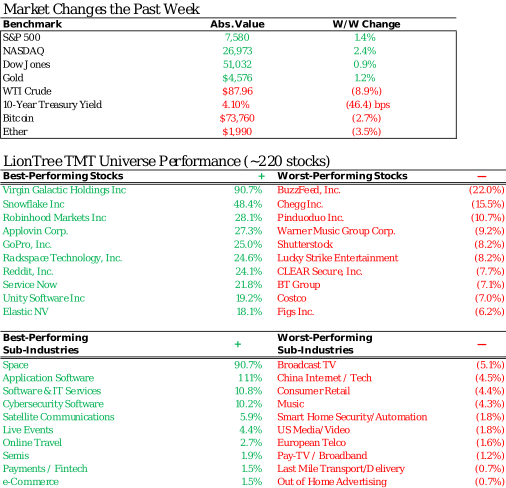
There seems to be no stopping this market! Optimism regarding an Iran resolution coupled with another massive tech rally propelled that Nasdaq up almost +2.4%, while the S&P 500 rallied +1.4%. Both hit fresh new highs.
Fundamentally it was quite a busy week yet again and we focused on the below in this edition.
- Signs Of Life Are Emerging In Software…Selectively
- Meta Is Now Pursuing New Revenue Opportunities Via Subscriptions
- Prediction Markets Push Into Art, Politics, and Institutional Finance
- Competition In The Connectivity Sector Remains Quite Active
- Anthropic Surpasses OpenAI’s Val’n + Addtl AI Updates Across Models, Monetization, & Infrastructure
- Uber & Walmart Make Moves To Fortify Their Last-Mile Delivery Networks
- Robotaxi Momentum Builds As Waymo + Pony AI Expand Deployment
- Grab Bag: UMG Rejects Takeover Bid / Robinhood Opens To AI Agents / Amazon’s MGM Is Making AI Series
Enjoy the read.
Best,
Leslie

Signs Of Life Are Emerging In Software…Selectively
It was almost non-stop headlines this week about tech stocks, starting with the massive +6% rally in the Semiconductor SOXX ETF on Tuesday after the long weekend. That ETF is now up a stunning +89% YTD (!), which propelled the debate about how long this outperformance can persist. Meanwhile the Software sector has been bouncing back from oblivion on the growing view that not all software companies will be taken down in the SAASpocalypse. Software stocks are being put into the AI winners and losers camps, which was in full force this week with Zscaler’s -32% decline on the back of results, Snowflakes’ +36% rally in reaction to results/AWS agreement, and vertical software giant Salesforce unable to reverse the negative narrative after its earnings report, among others.
Looking ahead, we certainly expect this greater dispersion of performance within the software sector to continue.
See below for further thoughts…
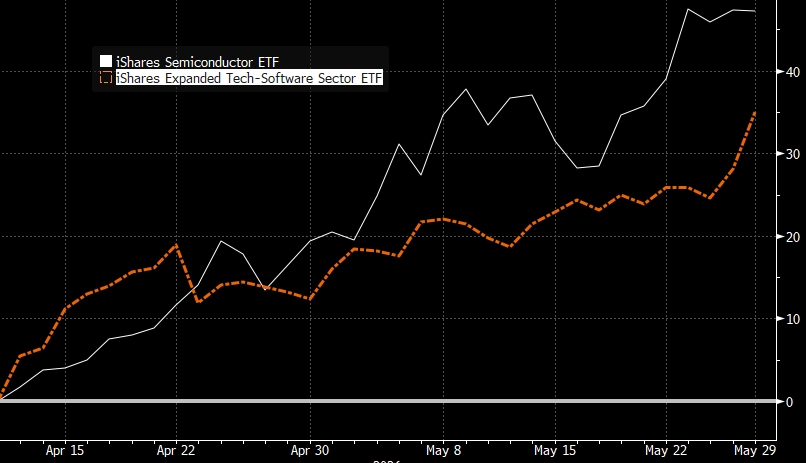
Update On Semis Vs Software Performance…Software Has Been Clawing Back
- The Semiconductor sector cont’d its massive outperformance this week, hitting a new high
- SOXX rallied +6% on Tuesday and as of week’s end, it is up +89% YTD
- However, the Software sector has been digging out of its hole since the lows on April 10th and the performance gap has significantly narrowed
- The IGV also rallied +7.1% this week and is up +35% from its 4/10 low of $74.67/shr
- The SOXX over the same time frame is up +47%
Source: Bloomberg
Zscaler Shares Plummeted On Disappointing Guidance…Down -32% In Reaction (And Is Now Down -39% YTD)
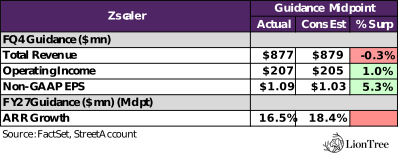
- While FQ3 results were slightly better-than-expected (more so on the bottom line), the FQ4 & FY27 revenue guidance disappointed and added fuel to the AI concerns fire
- FQ3 topped expectations
- Revenues grew by +25% y/y vs +26% y/y in FQ2
- Op income beat by +4.3%
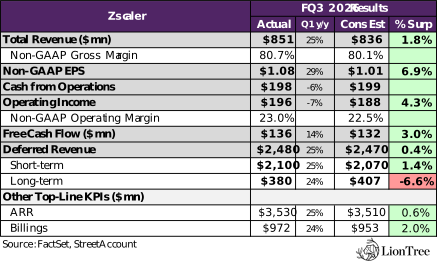
- BUT FQ4 revenue guidance missed expectations and the Co’s guidance for FY27 total ARR and revenue growth of +16-17% y/y was well below cons +18.4%
- A significant portion of Red Canary net new ARR in FY26 came from renewals and will not repeat in FY27
- Red Canary tends to significantly have higher churn than Zscaler’s core business
- The Co expects net new ARR seasonality in FY27 to be largely similar to FY25
While Snowflake Shares Skyrocketed As It Moves Into The Software AI Winners Camp…Up +36% In Reaction (And The Stock Is Now Up +13% YTD)
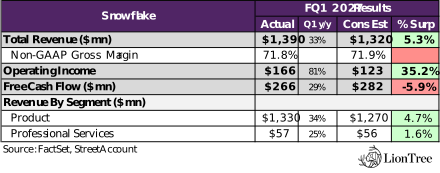
- FQ1 was a blow-out with revs BEATING cons by +5.3% (by $70mn) and operating income BEATING by +35%
- Product rev growth accelerated from +30% y/y in FQ4 to +34% y/y
- FQ1 Remaining Performance Obligations totaled $9.21bn (50% to be recognized in the next 12 months), up +38% y/y, though slightly down from the $9.77bn (46% to the recognized in the next 12 months) in FQ4
- Other key KPIs…
- Net revenue retention rate of 126% was up from 124% during the same period last year
- The # of Customers over $1mn product revenue reached 779, up +29% y/y and up from 733 last qtr
- ~4,500 net new accounts are using AI features, w/ Coretex Code reaching 7,100+ accounts
- The Co expects +30% y/y Product revenue growth in FQ2 and op margins of 12.5% (vs +11.9% in FQ1)
- The Co raised FY27 Product revenue & non-GAAP op margin guidance
- Product revenue guidance incr’d by $180mn to $5.84bn
- The growth rate was raised from +27% y/y to +31% y/y
- Non-GAAP op margin guidance incr’d from 12.5% to 13.5%
- Product revenue guidance incr’d by $180mn to $5.84bn
- Snowflake also commits to spending $6bn on AWS over the next 5 yrs per a new expanded multi-yr agreement
- This reflects the accelerating enterprise demand for AI and data workloads running on AWS
AI Concerns Remain In Place For CRM Giant Salesforce…The Stock Is Still Down -27% YTD
- The Co delivered in-line headline #s, though the RPO & revenue guidance missed the Street
- FQ1 reflected slightly better revenue, stronger adj EPS (due to share count reduction), but lower FCF
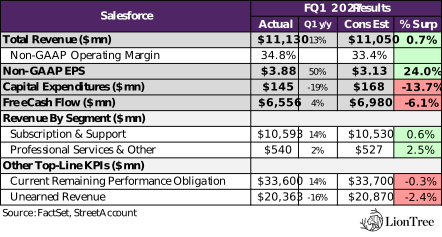
- Salesforce changed Subscription & Support revenue disclosure…the Co is now segmenting by Agentforce Apps and Data 360, Headless Platform, & Other
- Agentforce Apps revs of $6.910bn, grew +7% y/y FXN
- Data 360, Headless Platform & Other rev of $3.683bn, grew +23% y/y FXN
- FQ1 cRPO was only ~IN-LINE (+13% y/y FXN) and the Co is guiding for similar growth in FQ2, despite strength w/ Agentforce (this was a focus with analysts)
- FQ1 unearned rev also fell -16% y/y and MISSED cons by -2.4%
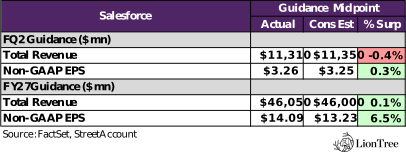
- FQ2 guidance was MIXED…
- Rev guide at the midpoint marginally MISSED cons by -0.4%
- Implies a seq deceleration to +10-11% y/y (+10% FXN)
- Non-GAAP EPS guide at the midpoint slightly BEAT cons by +0.3%
- Rev guide at the midpoint marginally MISSED cons by -0.4%
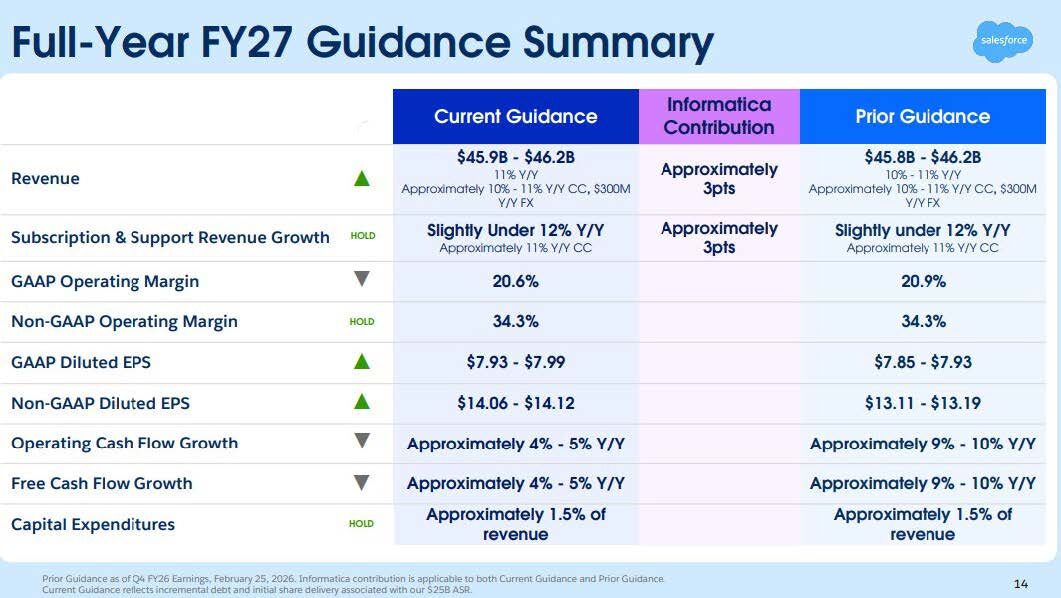
- And FY27 guidance was also MIXED…
- The Co slightly raised:
- Revs (inline w/ cons)
- Non-GAAP EPS guidance (6.5% ahead of cons)
- The Co maintained:
- Subscription & Support revenue growth
- Non-GAAP op margin guidance
- The Co lowered:
- Op CF growth
- FCF growth
- The Co slightly raised:
- Mgmt reiterated confidence in organic rev acceleration in H2 FY27, though there was some analyst skepticism on the call
- The Co is confident in a H2 reacceleration driven by net new AOV growth outpacing AOV growth; This is also supported by momentum with big deals, Agentforce, and Dats 360 with other 50% of bookings in these areas coming from existing customers, a strong pipeline, and an expanded TAM
- Mgmt is very focused on the Agentic AI revolution and sees it as their “biggest growth opportunity”
- The Co has seen huge token increases at their customers…processed 28.6 trillion tokens, up +152% q/q showing strong customer agentic adoption
- Agentforce surpassed $1bn ARR, with Agentforce ARR at $1.2bn up +205% y/y
- Mgmt laid out three core AI monetization paths: premium SKU upgrades, incremental seat expansion, and Flex Credit consumption for customer-facing agents
- “Headless 360” is a new strategic emphasis…it makes the entire Salesforce platform accessible through MCP clients, APIs, and CLI prompts
- It brings humans, agents and Headless platforms all together so customers can use Saleforce without any coding agent across any surface
- Headless 360 should speed implementations, drive consumption, and compound more actions, workflow, data, and intelligence across Salesforce
- It is seen as the next leg of the FY30 path b/c it expands Salesforce into surfaces the Co previously had not monetized
- Won’t this enable app disintermediation? No, as it makes it easier to implement Salesforce w/ coding agents like Claude and Codex by connecting underlying APIs through MCP
- Slack momentum strengthened materially, with Slack contributing nearly half of Q1 $1mn+ wins and those wins were up +80% y/y
- Slack AWUs grew nearly +350% q/q, and Slack MCP surpassed 1mm active users within six weeks of launch
- Slack’s bookings, net new AOV, and usage are accelerating with “very little attrition”
- The Co returned a high $27.5bn to shareholders in FQ1 and executed $25bn ASR under the new $50bn authorization
Meta Is Now Pursuing New Revenue Opportunities Via Subscriptions
Meta had a busy week. The Co is now expanding its monetization strategy beyond advertising with a broader push into consumer, professional, and AI-focused subscriptions under the new “Meta One” umbrella. More specifically, it is rolling out paid plans for Instagram, Facebook, and WhatsApp, while also testing higher-priced creator / business tiers and AI plans that offer more capacity for high-compute queries and richer image / video generation.
Separately at Meta’s shareholder meeting, a few standout comments and updates include: 1) Zuckerberg confirming that building a cloud to compete with AWS and Azure is “definitely on the table” if Meta finds itself having “overbuilt” on compute; 2) Weekly business AI conversations on Meta’s messaging apps have “grown 10x since the start of the year”; 3) New Meta AI glasses partnerships are coming later this year; and 4) Reality Labs losses in 2026 are expected to track roughly in-line with 2025, with gradual improvement guided beyond that.
See more below…
–>Meta’s stock was up +3.7% in reaction to the news, but is still down -4.2% YTD
Meta Is Offering New Subscriptions, Including New AI Plans
- The Co is rolling out new consumer subscription plans globally for Instagram, Facebook, and WhatsApp and more professional and AI plans are set to follow (link/link)
- Instagram Plus ($3.99/mo)
- Facebook Plus ($3.99/mo)
- WhatsApp Plus ($2.99/mo)
- Instagram Plus adds the ability to:
- See how many people have rewatched a user’s Story in aggregate
- Create unlimited audience lists for Stories, beyond the “Close Friends” option
- Spotlight one story per week for extra views, extend stories past 24 hours, preview stories anonymously, and search viewer lists
- Subscribers can also post directly to their profile or Highlights w/out appearing in followers’ feeds
- Other features include Super Heart Story reactions, custom app icons, bio fonts, and additional profile pins
- Facebook Plus offers a similar set of features to Instagram Plus
- WhatsApp Plus: Offers other features, like app themes, custom ringtones, additional pinned chats, list customization, premium stickers, and more
- The Co is testing Professional plans for creators and businesses
- Meta One Essential plan ($14.99/mo): Offers the Verified badge, impersonation protection, and an enhanced linksheet where users can link out to their online presence across social channels and the web
- Meta One Advanced plan ($49.99/mo): Includes the Essential plan benefits, as well as the ability to be featured in the Facebook feed, appear higher in Facebook and Instagram search results, gain attention with a “Follow” button on Reels, and automatically send “follow” invitations to people who engage with your content
- Timing – tests begin later this week, in markets including Saudi Arabia, Morocco, Thailand, and Bangladesh
- And AI-focused plans for all power users are also in the works
- Meta One Plus ($7.99/mo) and Meta One Premium ($19.99/mo) have the same features, but the Premium plan unlocks more capacity on higher compute queries and offers more video and image-generation capabilities across Meta’s apps
- Timing – The AI plans will start testing next month, initially in Singapore, Guatemala, and Bolivia
- Meta AI will remain free for more casual users
- “Meta One” will serve as the Co’s home for its subscription offerings going forward
Other Key Comments From Meta’s Shareholder Meeting
- Very interesting was that in response to being asked if Meta would consider building a cloud to compete with AWS / Azure, Zuckerberg said it is “definitely on the table”
- Outside Cos frequently ask Meta to stand up an API service or sell compute, but Meta has not done so because “we think that we have a use for the compute”
- He added that if the Co gets to a point where it has “overbuilt”, cloud/API monetization is an option and is part of what gives the Co confidence in investing
- The Co remains very bullish on Meta AI glasses and has “exciting new partnerships coming later this year” that should “reach even more people”
- And reiterated that the # of people using Meta glasses daily has “tripled year over year”
- Called it “one of the fastest growing categories of consumer electronics ever”
- Reality Labs operating losses this year are expected to be “similar to 2025”
- Beyond 2026, Meta expects to “gradually reduce Reality Labs losses” through more mature supply chains, scaling wearables and VR, higher-margin revenue lines, and operating more efficiently
- Business AI usage is growing quickly and has longer term monetization potential
- As of April, “weekly conversations with our businesses had grown 10x since the start of the year”
- Today, business AI is “currently free for most businesses” on Meta’s messaging apps
- Meta expects to work toward “establishing a longer-term monetization model”
Prediction Markets Push Into Art, Politics, and Institutional Finance
It was a very busy week as it relates to product expansion, institutional adoption, enforcement and regulation pertaining to the fast-growing prediction markets. Kalshi launched art markets tied to auction outcomes at major auction houses and also released the American Power Index, which aims to be the “S&P 500 for politics” by measuring the balance of political power between Democrats and Republicans. Kalshi (and others) are also pushing further into institutional finance, with its annualized trading volumes more than tripling within this segment over the past 6 months to $178bn and institutional trading volumes growing +800%, though liquidity remains critical for broader hedge fund adoption. Also on the regulatory front, a proposal for the CFTC to regulate prediction markets is now under White House review and lastly, the second criminal case regarding insider trading emerged this week when the DOJ charging a Google software engineer with trading on Polymarket with insider information.
See more below…
Kalshi Expands Predictions Markets Into Art, Political Indexes, & Institutional Finance
- Kalshi launched art markets, a new category of prediction markets tied to auction outcomes (link)
- The markets are tied to lot sold prices and total realized values at the world’s leading auction houses
- They give collectors, art funds, dealers, institutional investors and retail speculators a tool to “express views on the art market, and hedge against it”
- Kalshi said the product gives users exposure to art with the “precision and transparency of a regulated financial instrument”
- For devoted art fans, it represents one of the only ways to use expertise to make money in a famously inaccessible and illiquid asset class
- Contracts are structured around specific, verifiable auction outcomes, such as “What will Van Gogh’s La Moisson en Provence sell for?”
- Each contract resolves against publicly reported results
- TIMING – Art markets are available starting this week, with expanded product offerings coming before the fall auction season
- The markets are tied to lot sold prices and total realized values at the world’s leading auction houses
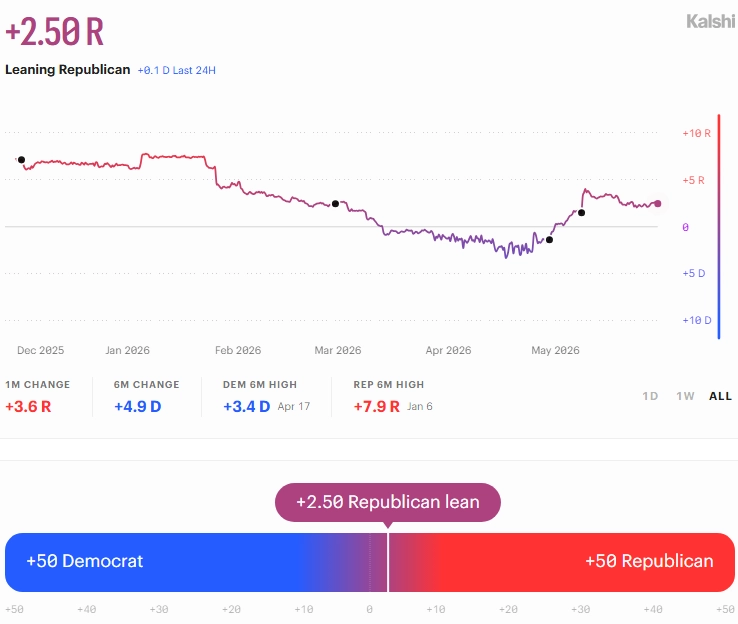
- Kalshi launched an American Power Index (KPOW) which measures the balance of political power between the Democratic and Republican parties (link/link)
- “KPOW aims to be the S&P 500 for politics”…“it reads the current distribution of power (who actually holds the seats) and it folds in what Kalshi’s markets thinks about who will hold them next”
- The KPOW is composed of two fundamental sub-components
- A‘current’ sub-component reflecting current political reality
- A ‘future’ sub-component reflecting market-projected electoral outcomes and risks of shutdown-related dysfunction; KPOW aims to be the “S&P 500 for politics”
Source: Kalshi
- Kalshi is also making a big push to attract institutional investors and hedge funds to the platform (link)
- Activity from these end-customer segments is growing rapidly
- Kalshi’s annualized trading volumes have more than tripled over the past 6 months to $178bn
- Trading volumes from institutional investors have grown +800% over the past 6 months
- Kalshi and other platforms are building infrastructure to support larger institutional flows
- Clear Street recently partnered with Kalshi to give customers access to event contracts
- Jump Trading has been working with institutional investors to give them access to prediction market platforms
- Marex recently started working with both Kalshi and Polymarket to help build the infrastructure to connect investors to these exchanges
- AQR, Susquehanna and OKX have recently advertised roles for specialist prediction market traders
- Liquidity remains the key hurdle before prediction markets can see broader institutional adoption
- Solidus Labs’ CEO said that no hedge fund will route flow to a venue with less than at least $10mn daily notional volume
- Stand’s CEO said some top markets on Polymarket have only about $30mn of total liquidity, meaning several million dollars from one institutional investor could create a wild swing in prices
- Coinbase’s head of prediction markets said prediction markets are increasingly being treated as a legitimate alternative asset class, with institutions using them to hedge specific risks that traditional instruments may only capture indirectly
- Activity from these end-customer segments is growing rapidly
CFTC Prediction Market Oversight Moves To White House Review
- A proposal for the CFTC to regulate the prediction markets is also under review by the White House, based on a recent filing (link/link)
- Details of the proposal, which are being reviewed by the Office of Management and Budget, are not visible on the filing
- Tuesday’s filing came on the same day that President Donald Trump, in a social media post, said, “It is critically important that the CFTC’s exclusive authority over Prediction Markets is maintained, and that they will thrive”
Another Crack-Down On Prediction Markets Insider Trading Cases Emerged
- Lastly, the DOJ this week charged a Google software engineer with insider trading tied to Polymarket (link)
- Michele Spagnuolo (from Switzerland) allegedly made $1.2mn in trading profits on Polymarket using Google’s confidential business information (worked at Google for 12+ years)
- DOJ said he “violated the duties he owed to his employer” and that insider trading “compromises the integrity of our markets”
- The alleged trades were tied to Google’s 2025 Year in Search campaign
- According to the complaint, Spagnuolo risked over $2.7mn on wagers related to Google’s 2025 Year in Search
- He allegedly accessed confidential internal Google Search data about the most-searched celebrities to inform his bets
- Google has placed the employee on leave and said it is working with law enforcement
- This is the second known federal criminal case tied to alleged insider trading on a prediction market
- The first set of charges was against a U.S. Army soldier who allegedly used insider knowledge of a military operation to make $400K on Polymarket
- Michele Spagnuolo (from Switzerland) allegedly made $1.2mn in trading profits on Polymarket using Google’s confidential business information (worked at Google for 12+ years)
Competition In The Connectivity Sector Remains Quite Active
Another sub-sector that was active this week was Connectivity, with several important satellite and broadband updates. Amazon bought Apple’s 20% stake in Globalstar following its acquisition of the latter (though apparently the partnership is still intact). In fixed broadband, Opensignal’s latest U.S. report crowned Comcast as the leader in 3 categories (consistent quality, download speed and video streaming performance) and Charter and AT&T led with on one each (reliability and upstream speed, respectively). Also, new Wall Street research pointed to a much larger long-term subscriber opportunity for Starlink (suggesting it could reach 100mn subs by 2034 as it scales V2 and V3 satellites). AST also was in focus given Blue Origin’s latest New Glenn testing “anomaly” (aka, rocket explosion) and the prior loss of BlueBird 7, but the Co says it remains on track to deploy 45 satellites this year.
See more details below…
Amazon Takes Over Apple’s Globalstar Stake & Plans Further Satellite Upgrades (link/link)
- Following Amazon acquisition’s of Globalstar, it is now buying Apple’s 20% stake in the Co
- Apple originally paid $400mn for 400k Class B shares
- Although Apple is losing its stake, Amazon says it remains committed to supplying satellite services for iPhones and improving them through Globalstar
- “Amazon’s investment in constellation expansion and technical improvements will strengthen the 1.6/2.4 GHz MSS [mobile satellite services] that millions of iPhone users depend upon
- In the FCC filing, Amazon alluded to the limitations of Globalstar’s network with plans to drastically upgrade the satellite connectivity, including enabling voice calls
- “Current MSS offerings frequently require a clear view of the sky because signal strength is insufficient to penetrate foliage, buildings, or adverse weather
- Amazon’s satellites will provide better coverage, higher capacity, quicker connection times, and improved signal quality
-> Amazon’s stock was up +3% while Apple’s stock was up +1% in reaction
Comcast, Charter and AT&T Come Out On Top In Opensignal’s Fixed Broadband Study (link/link)
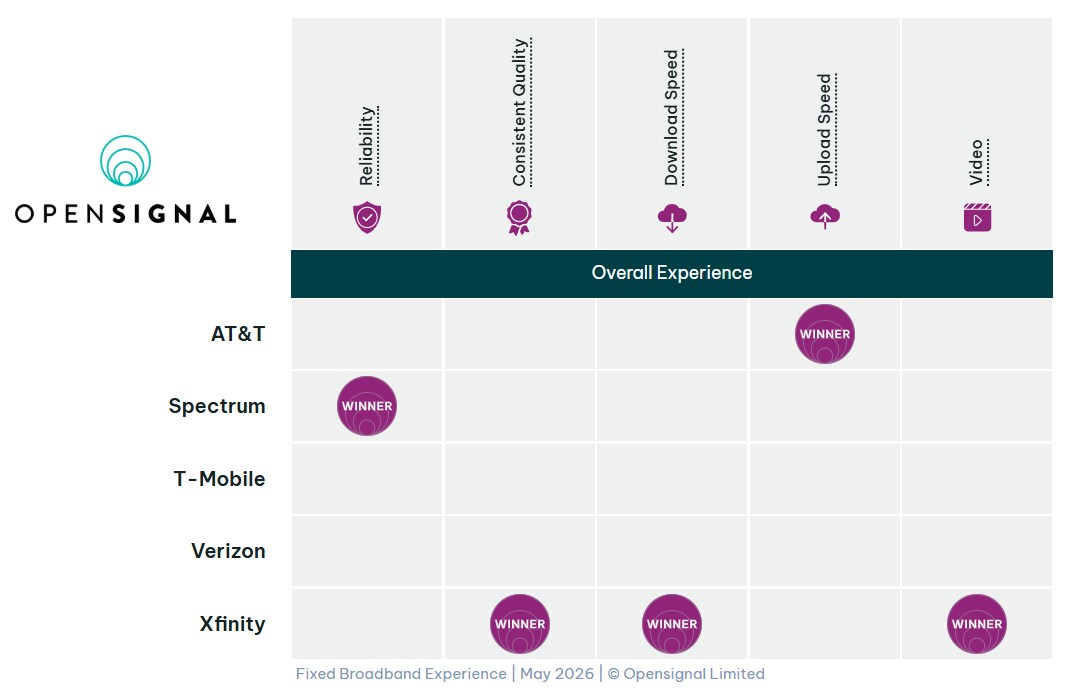
- Comcast won 3 categories in the latest US fixed broadband report, while Charter & AT&T each won 1
- Comcast won for consistent quality, download speed and video streaming performance
- AT&T led on upstream speed
- Charter / Spectrum topped in reliability
Source: OpenSignal
- Comcast led on…
- Consistent quality: Measures how often a network meets the requirements for common applications, such as HD video, video calls and online gaming
- Comcast delivered 83.7% of tests, vs Verizon 83.3%, followed by Charter 81.7%, AT&T 79.7% and T-Mobile 78.8%
- Download speeds:
- Comcast’s typical measurement was 228.6 Mbit/s vs Charter at 220.4 Mbit/s, AT&T 201.4 Mbit/s, Verizon 174.1 Mbit/s and T-Mobile 148.5 Mbit/s
- Video streaming performance:
- Comcast’s scored 77.9 out of 100, vs Charter at 77.8, Verizon at 77.3, AT&T at 76.9 and T-Mobile at 76.3
- Though all 5 operators ranked in the “very good” category, meaning users were generally able to stream at 1080p HD or better with satisfactory loading times and little stalling
- Consistent quality: Measures how often a network meets the requirements for common applications, such as HD video, video calls and online gaming
- Charter led on…
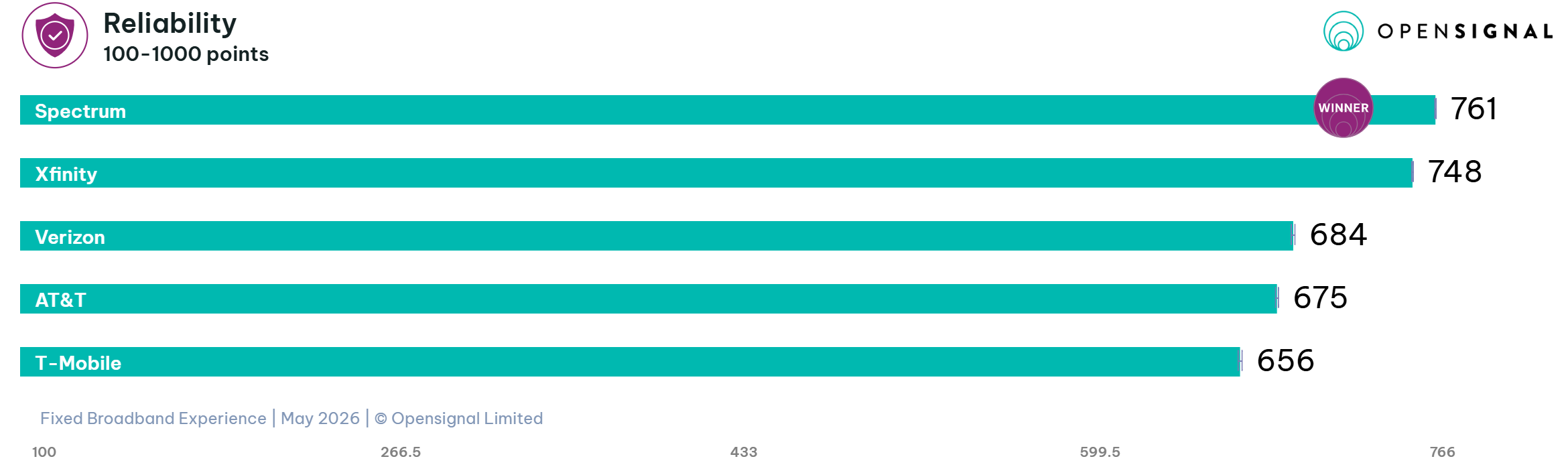
- Fixed broadband reliability: Measures a household’s ability to connect to the Internet and successfully complete “uninterrupted” tasks across multiple devices
- Charter scored 761 out of 1,000 vs Comcast 748, Verizon 684, AT&T 675 and T-Mobile 656
- Fixed broadband reliability: Measures a household’s ability to connect to the Internet and successfully complete “uninterrupted” tasks across multiple devices
Source: OpenSignal
- AT&T led on…
- Upload speeds, aided by its aggressive fiber network expansion initiatives
- AT&T delivered an avg upload speed of 120 Mbit/s, which was well ahead of Verizon’s 58 Mbit/s
- Comcast avg’d 46.9 Mbit/s, followed by Charter at 26.8 Mbit/s and T-Mobile at 26.4 Mbit/s
- Opensignal noted Comcast and Charter saw upload speed improvements of 20% and 36% y/y, respectively
- Upload speeds, aided by its aggressive fiber network expansion initiatives
New Wall Street Estimates Point To A Massive Potential Ramp In Starlink’s Subscriber Growth (link/link)
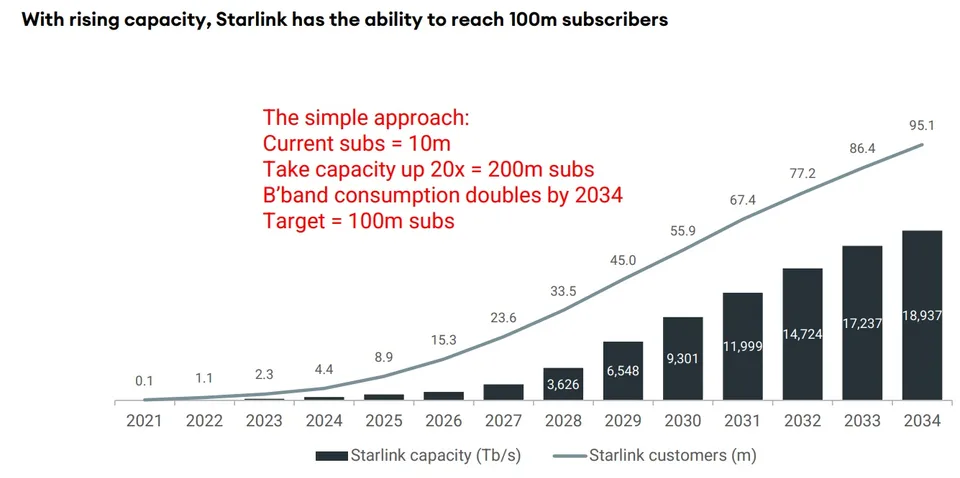
- Starlink could reach 100mn subs by 2034, according to New Street Research
- This would be up from the ~10.3mn paid customers currently and would be made possible as the Co expands its capacity to support new subscribers via its V2 and V3 satellites, with the possibility of a future, higher-capacity V4 satellite
Source: LightReading
- Starlink’s ability to scale depends on SpaceX successfully launching larger V3 satellites into LEO and being price competitive
- Getting “bigger and heavier satellites into low-Earth orbit (LEO) – and in great numbers – hinges on the success of SpaceX’s new (and still-troubled) Starship rocket”
- NSR’s “base case” of trending toward 20k V3 1Tb/s satellites shows Starlink “can grow capacity by 29x between 2025 to 2034”
- Analysts expect “pricing of equipment, installations and operating costs to drop” as Starlink moves ahead with V2 and V3
- “As the low-cost provider, they can be disruptive and win share”
- The firm estimates that Starlink is beginning to pull subs from cable, but its broader broadband impact remains limited
- U.S. cable is contributing “about 20% to Starlink’s gross adds” per their estimates
- NSR also expects Starlink will need to “beef up its marketing spending” to focus more on the mass broadband market, though early evidence shows it is running an “extremely lean and scalable cost machine”
–> SpaceX is reportedly now targeting a valn of at least $1.8 trillion in its IPO, down from the $2 trillion+ previously reported as recently as April, according to Bloomberg; The lowered value followed consultations w/ advisers and investors, and could still move higher depending on feedback during the formal marketing period, which is expected to begin as soon as June 4th. Pricing could come as early as June 11th (link)
–> SpaceX is also trying to reassure Starlink customers that recent price hikes will not immediately apply to those on active promotions or introductory discounts, but will transition following those periods; The clarification comes after a $5 to $10 rate hike created confusion and sparked “bait and switch” complaints from some users who had recently signed up at discounted rates; Starlink’s IPO filing shows that while paid subs doubled y/y in Q1 to 10.3mn, ARPU fell to $66 from $86 (link)
Blue Origin’s Rocket Explosion During Tests Reverberated Through The Satellite Sector As Well
- Blue Origin confirmed an “anomaly” during a hotfire test at Cape Canaveral, ahead of New Glenn’s anticipated fourth mission…it basically exploded (link/link)
- The fourth mission was expected to carry Amazon’s Project Kuiper internet satellites and was set to be the first of 24 launches Blue Origin is contracted to perform for Project Kuiper
- The incident marked the second major setback involving New Glenn in less than two months (when it suffered an “upper-stage anomaly”)
- ASTS fell -14% after a Blue Origin New Glenn rocket exploded during testing this week
- AST signed a multi-launch agreement with Blue Origin in late 2024 to deploy future Block 2 BlueBird satellites aboard New Glenn
- And the previous Blue Origin setback prevented AST SpaceMobile’s BlueBird 7 satellite from reaching its intended orbit
- AST says it remains on track to launch an addition 45 satellite this year
Anthropic Surpasses OpenAI’s Val’n + Addtl AI Updates Across Models, Monetization, & Infrastructure
At this point, a steady flow of AI updates each week feels inevitable given the pace of innovation across the sector. This week, Anthropic was top of mind, with its valuation reaching $965bn following its latest funding round, which is more than double its $380bn valuation back in February and surpassed OpenAI’s most recent $852bn valuation. Anthropic also introduced Claude Opus 4.8, with improvements focused on reliability, transparency, and workflow functionality.
OpenAI, meanwhile, continued to build out ChatGPT monetization with the addition of new cost-per-action ad buying options inside ChatGPT’s ad manager. Outside of this AI duopoly, Microsoft is reportedly preparing new in-house models and ByteDance is said to be developing a new chip for running AI models, like other big tech players have done.
See below for more thoughts.
Key Updates From The AI Duopoly…Anthropic Overtakes OpenAI’s Val’n & Releases A New Model + OpenAI Adds New Ad Buying Options
- Anthropic’s val’n reaches $965bn…officially surpassing that of OpenAI to become the world’s most valuable AI startup (link/link/link)
- The Co raised $65bn in Series H funding, pushing the round well above Anthropic’s initial $30bn target
- Also it is more than double the $30bn that Anthropic raised in Series G funding at a $380bn valn back in Feb, making the Co’s valn growth the fastest in venture-capital history, according to PitchBook Data
- Investor callouts –
- The round was led by Altimeter Capital, Dragoneer, Greenoaks, and Sequoia Capital, who reportedly each put in more than $2bn
- It also includes $15bn of previously committed investments from hyperscalers ($5bn from Amazon as well as strategic infrastructure partners, including Micron, Samsung, and SK Hynix)
- The latest funding is expected to advance safety and interpretability research, expand compute to meet growing demand for Claude, and scale the products and partnerships Anthropic’s customers rely on
- Run-rate rev also crossed $47bn earlier this month, up from $30bn back in Apr, $14bn in Feb, and $9bn at the end of 2025
- As a reminder… OpenAI was most recently valued at $852bn in a funding round completed in March
- The Co raised $65bn in Series H funding, pushing the round well above Anthropic’s initial $30bn target
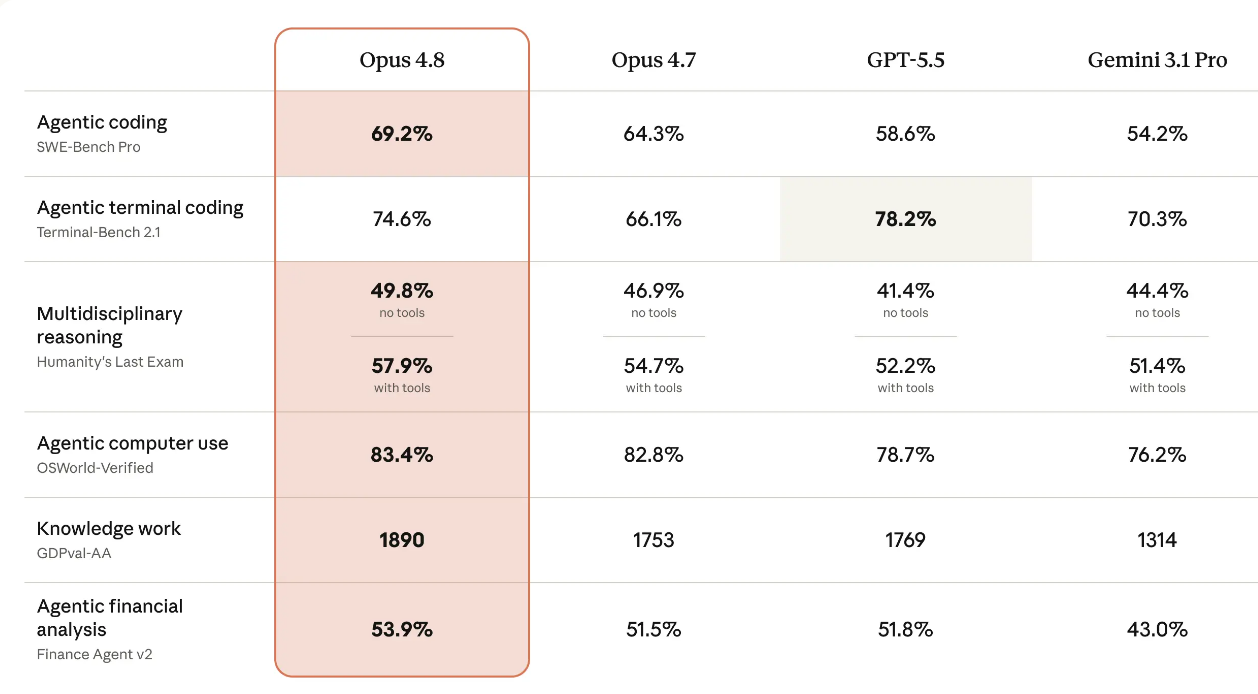
- Anthropic also intro’d Claude Opus 4.8 this week… which the Co characterized as a “a modest but tangible improvement on its predecessor” (link/link): The model is available everywhere, with standard pricing at the same level as the previous Opus release
- What is one of the most prominent improvements? Honesty
- Early testers report that Opus 4.8 is more likely to flag uncertainties about its work and less likely to make unsupported claims
- This has also shown through in Anthropic’s own evaluations, which show that Opus 4.8 is ~4x less likely than its predecessor to allow flaws in code it has written to pass unremarked
- The Co is also launching addtl updates alongside the model, including a “dynamic workflow” that lets Claude run multiple subagents at once and a control panel that lets users decide how much “effort” Claude puts into a response
- BUT The new model still lags the performance of Mythos, Anthropic’s most advanced, though the Co says a Mythos-class model should be available to all customers “in the coming weeks” following the development of stronger safeguards
- The table below shows how Opus 4.8 compares to its predecessor and to other models on tests of coding, agentic skills, reasoning, and practical knowledge work tasks
- What is one of the most prominent improvements? Honesty
Source: Anthropic
- As the AI monetization race heats up…OpenAI turns on cost-per-action ads inside ChatGPT’s ad manager (link)
- The feature lets advertisers pay for ads in ChatGPT only when a user takes a specific action, whether that’s clicking through to a site, signing up or making a purchase.
- Note that the feature is currently available to select advertisers only
- Previously, advertisers have had to pay for every thousand impressions or click regardless of what happens next
- This builds on a plethora of updates to the ads biz in the last two months, including…
- Updating the look of ChatGPT ads
- Adding automation to enable retailers to generate ads directly from their product catalogues
- Expanding the pilot to different mkts
- Launching its ads manager and subsequently making it widely accessible in the US
- Turning on CPCs
- Building a pixel
- Scrapping its minimum commitment fee
- The feature lets advertisers pay for ads in ChatGPT only when a user takes a specific action, whether that’s clicking through to a site, signing up or making a purchase.
Speculation On The AI Horizon… MSFT Reportedly Plans New AI Models + ByteDance Is Said To Be Developing Its Own Chip
- Microsoft is reportedly planning to release new AI models at its annual Build conference next week (link/link)
- The lineup is said to include models that come in various sizes and specialize in tasks like transcription, reasoning, speech, and images, as well as a coding model to boost the usage of its GitHub Copilot tool
- The Co is reportedly looking at pricing as its competitive angle: MSFT is reportedly planning to market the new in-house models as a less expensive alternative to OpenAI and Anthropic
- There is more training flexibility after the renegotiated OpenAI deal: MSFT’s internal AI team faced restrictions under the Co’s OpenAI agreement that were renegotiated in April, enabling broader in-house model training
-> MSFT’s stock was up +3.5% on the back of the speculation
- ByteDance is reportedly developing a new chip to run AI models (link/link)
- The new AI chip is said to have a structure similar to US chip designer Groq’s language processing units, which are built to run AI models at low cost
- ByteDance’s new AI chips, like Groq’s, are designed for inference, which accounts for the bulk of ByteDance’s AI computing needs
- The decision reportedly comes as CPU prices have surged, including from Intel and AMD, the two companies that ByteDance previously purchased its chips from
- ByteDance joins Microsoft, Google, and Amazon, which are all making their own chips internally
- ByteDance is also reportedly working closely with InnoStar Semiconductor on how to integrate the Co’s memory technology into the new AI chip ByteDance is developing
- The new AI chip is said to have a structure similar to US chip designer Groq’s language processing units, which are built to run AI models at low cost
Uber & Walmart Make Moves To Fortify Their Last-Mile Delivery Networks
Uber and Walmart both made notable moves in delivery this week. Uber increased its total ownership (including financial instruments) in Delivery Hero to 36.83% after its bid for the Co was rebuffed and it considers raising its bid. Walmart is also expanding its 30-minute-or-less delivery service to 33 U.S. markets, offering 100k+ eligible items and building on momentum from Q1, when 26% of deliveries were completed in 30 minutes or less across 19k+ zip codes.
Net net, scale in the last-mile delivery network is critical and becoming more strategic. See more on our takeaways below…
Uber Further Incr’d Its Stake In Delivery Hero (link/link/link)
- It has been a bit of a back and forth this week regarding Uber’s desire to buy Delivery Hero….
- A quick summary of the course of events…
- Last week: Delivery Hero said that Uber had incr’d its holding in the Co from ~7% to ~19.5% of issued capital +5.6% with financial instrument
- Making Uber its largest shareholder
- Last Saturday: Delivery Hero confirmed that it had received a €33 ($38.29)/shr takeover offer from Uber, which is a mkt cap of €10bn+
- On Sunday: The FT reported that Uber’s board had convened on Saturday to discuss an improved bid for Delivery Hero, after a €38/shr offer was reportedly rejected by one of Delivery Hero’s major shareholders
- The FT reported that several shareholders are seeking above €40/shr, a 19% premium to Friday’s close, valuing Delivery Hero at ~€13bn
- Last week: Delivery Hero said that Uber had incr’d its holding in the Co from ~7% to ~19.5% of issued capital +5.6% with financial instrument
- What was Uber’s next move? Buy more shares
- A filing indicated that Uber incr’d its equity stake in Delivery Hero from ~19.5% to ~25%
- And its total ownership from 10% to 36.83% when combining shares + other instruments
- A separate regulatory filing showed Delivery Hero shareholder Aspex lowered its stake from 14.55% to 56%
- A filing indicated that Uber incr’d its equity stake in Delivery Hero from ~19.5% to ~25%
- Morgan Stanley, reportedly working on Uber’s bid, disclosed a 27% interest in Delivery Hero, primarily through equity swaps
- Overall, it seems like more’s to come on this saga…
->Delivery Hero’s stock this week was up +3.7%, while Uber’s was down -2%
Walmart Is Expanding Their “30 Minutes Or Less” Delivery Service
- Walmart brings the svs to 33 US markets ((link): The svs is available in Austin, Dallas, Denver, Houston, Chicago, St. Louis, Atlanta, Tampa, Oklahoma City and several others, with additional expansion opportunities over time
- Customers can shop from 100k+ eligible items, including fresh groceries, pantry staples, baby essentials, cold and flu medicine, household supplies, pet food, electronics and prescription delivery
- Customers can choose from multiple same-day delivery options designed to fit different shopping occasions and schedules
- 30-Minute-or-Less: Delivery for immediate and fill-in shopping needs in select markets
- Express: Delivery in one hour or less
- On-Demand:Delivery in as soon as three hours
- Scheduled:Customers can choose a delivery window that works best for their schedule
- In Q1, Walmart completed 26% of deliveries in 30 minutes or less to more than 19k zip codes across the country
-> Walmart’s stock was up +0.3% in reaction to the news, but closed down -3.8% on the week
Robotaxi Momentum Builds As Waymo + Pony AI Expand Deployment
Despite some high-profile bumps in the road that we previously talked about (Waymo recently having to recall ~3800 robotaxis as an example), innovation and expansion in the robotaxi sector shows no signs of slowing down, and if anything is speeding up. In addition to the updates included in Theme #5 above, more AV players are moving from the testing phase towards broader commercial deployment. Waymo is beginning to offer select public rides in its new Zeekr- Ojai vehicle, while Pony AI raised its fleet expansion targets following stronger robotaxi revenue growth. Overall, this sub-category of mobility is becoming increasingly more visible across the broader landscape.
See more color below on our key takeaways.
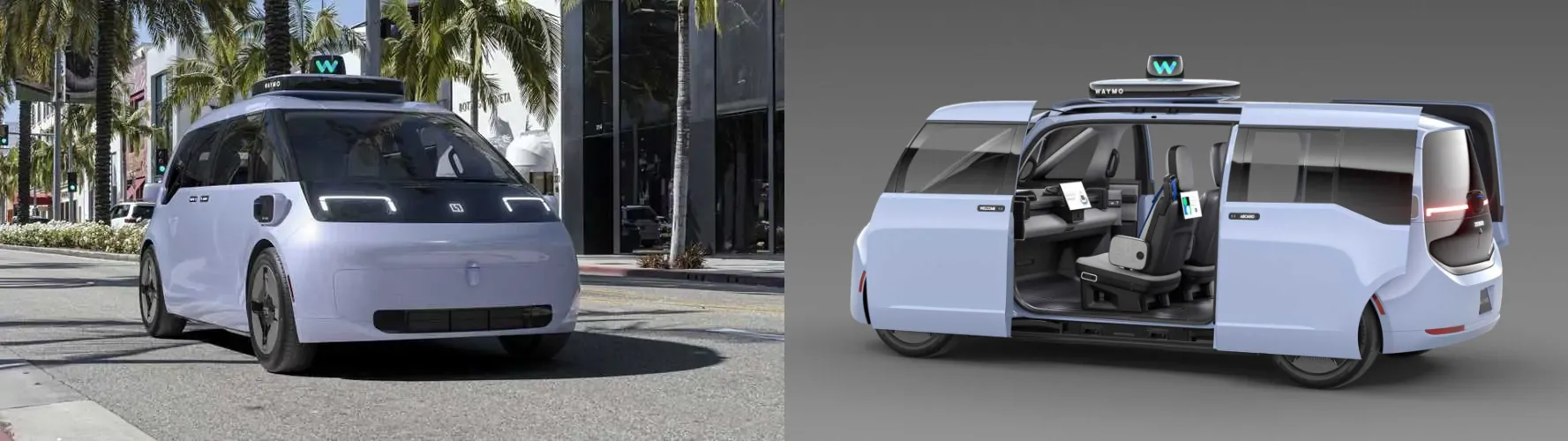
- Waymo is beginning to offer select public rides in Ojai, its new Zeekr-built robotaxi van (link/link): The new AV is designed specifically for robotaxi use, offering public rides in California and Arizona without human supervision
- Rides will initially be available for free to some customers in the “coming weeks” in Los Angeles, Phoenix, and San Francisco while Waymo gathers feedback
- Access will widen to more riders and cities, including Denver, Las Vegas, and San Diego
- Everyone will get to ride “later this year”
- Described as an “oasis on wheels”, the robotaxi is an electric self-driving van that can accommodate up to four passengers, made by China’s Zeekr, with a low entrance and flat floor, along w/ three touchscreens to help passengers customize the climate and music selection
- The Ojai will be the first vehicle to debut the 6th-generation Waymo Driver, enabling the Co to serve cities with even snowier conditions and further increase operations
- Rides will initially be available for free to some customers in the “coming weeks” in Los Angeles, Phoenix, and San Francisco while Waymo gathers feedback
Source: Inside EVs
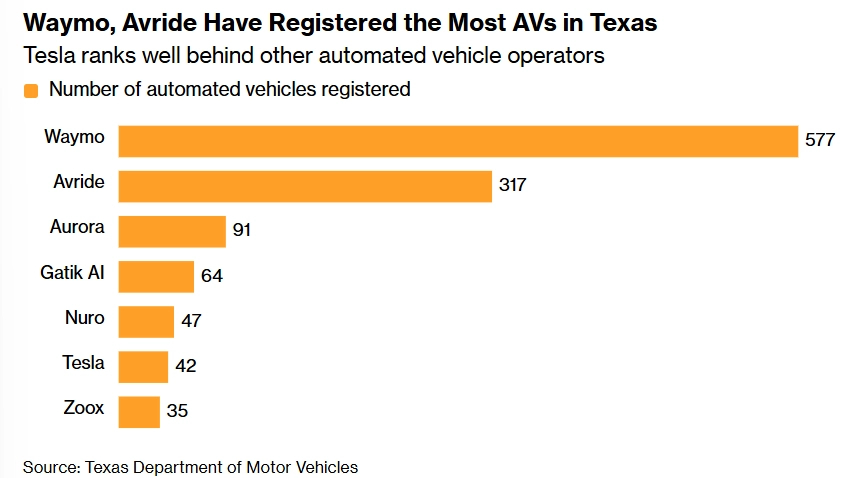
-> Separately, but related, new numbers submitted to the Texas’s motor vehicle dept revealed that Tesla has just 42 vehicles operating as robotaxis in Texas, almost a yr after the svs launched; In comparison, Waymo has 577 automated vehicles registered in the state, more than 13x Tesla’s total (link)
Source: Bloomberg
- Pony AI lifts its 2026 robotaxi fleet goal by +500 vehicles to 3,500 and raises its revenue target (link/link): Pony AI’s current robotaxi fleet now exceeds 1,700 vehicles, with further expansion underway in China and overseas mkts
- This comes after the Co posted stronger-than-expected Q1 rev: The Co reported +145% y/y rev growth to reach $34.3mn vs analyst estimates of $21.7mn
- Under the hood, robotaxi rev incr’d +395% y/y, with fare-charging revs growing +457% y/y, reflecting the continuous scaling of its fleet operations
- The Co also incr’d its FY26 rev target: It now expected rev to grow +3.5x y/y vs and earlier projection of ~+3x
- This comes after the Co posted stronger-than-expected Q1 rev: The Co reported +145% y/y rev growth to reach $34.3mn vs analyst estimates of $21.7mn
Grab Bag: UMG Rejects Takeover Bid / Robinhood Opens To AI Agents / Amazon’s MGM Is Making AI Series
- Universal Music Group officially rejects Pershing Square Capital’s $65bn takeover bid (link)
- Why? The proposal is “not in the best interests of UMG, its shareholders, artists, songwriters, employees and other stakeholders” and “it fundamentally and materially undervalues UMG and will not deliver superior value creation”
- The board also noted that it has “full confidence” in CEO Lucian Grainge and his team
- Notably, a day before the Board rejected the offer, Cyrille Bolloré, CEO of top UMG shareholder Bolloré Group, urged the Co to rebuff Ackman’s proposal, arguing it undervalued UMG…the Bolloré family holds ~18.5% of UMG and ~40% of voting rights (link)
- Robinhood will allow customers to deploy AI agents to trade stocks on its platform and make purchases on its credit card (link/link)
- Agentic Trading…users will be able to create a dedicated trading account, separate from their primary one, and have their AI agents trade on their behalf
- Users will get push notifications any time their agent makes a trade and can see a real-time activity feed and P&L directly in the Robinhood apps
- While the feature is currently only available for equities trading, it expects to expand it to derivatives, crypto and prediction markets.
- Agentic Credit Card…users can give agents access to a virtual Robinhood Gold credit card to make automatic purchases, such as grabbing concert tickets before they sell out or buying products once prices drop below a set threshold
- Users can set spending limits on agentic credit card accounts and require manual approval before any purchase
- Agentic Trading…users will be able to create a dedicated trading account, separate from their primary one, and have their AI agents trade on their behalf
- Amazon MGM Studios & AWS greenlights three series for Prime Video under new ‘GenAI Creators’ Fund (link/link)
- What is the fund for: Joint initiative that gives creators access to professional-grade AI tools and funding
- Amazon MGM Studios revealed the greenlit animation projects
- Cupcake & Friendsfrom BuzzFeed Studios
- Love, Diana Music Hunters by Albie Hecht, Chief Content Officer at pocket.watch
- Punky Duckby Jorge R. Gutierrez
- All 3 series will premiere on Prime Video “at a future date”
- Powering all of this is Project Nara, a purpose-built AI production platform for cinematic storytelling, built on AWS
- Used exclusively by Amazon MGM Studios and by creators selected for the GenAI Creators’ Fund
- Supports both animation and live-action production workflows
- Key features of Project Nara include:
- A model-agnostic architecture that routes each task to the optimal AI model
- Compounding intelligence that makes every subsequent production faster and more efficient
- Production-aware AI agents that carry full creative context across titles
- A camera-to-cloud data bridge preserving on-set data end-to-end
- Complete provenance tracking for IP protection
->Amazon’s stock closed up +1.6% this week and is up +17.2% YTD
Stock Market Check
This Week's Other Curated News
Artificial Intelligence/Machine Learning
- Tencent is betting on smaller A. I. models and agents to compete w/ Alibaba and ByteDance, as China’s tech trio invest billions in the fast-growing sector. The Co is leveraging its WeChat ecosystem to attract users by tailoring A.I. svs to diverse needs, diverging from rivals’ focus as competition for A.I. adoption intensifies. (Nikkei Asia)
- Apple plans to spotlight on‑device AI at WWDC, leveraging custom chips to process queries locally, positioning it as a privacy‑focused, cost‑saving alternative to cloud AI. Some tasks will still rely on cloud via Google Gemini models, resized for devices. Co may use Nvidia secure tech. Despite limits and delayed Siri features, Apple aims to reframe its AI strategy and boost adoption. (MacRumors)
- CoreWeave annc’d a unified agentic AI platform linking training, inference, observability & RL, enabling agents to continuously learn from real‑world data in production. The Co said this closes the training‑to‑inference gap, helping enterprises deploy self‑improving AI systems and advancing a “superintelligence loop” for scalable, adaptive AI across biz use cases. (CoreWeave)
- Big cos are rapidly expanding AI use, but soaring computing costs are forcing some to ration access and closely track returns. Execs have pushed staff to integrate AI tools and spent freely to show Wall Street they won’t be left behind by disruption. But as the bills come due, some are starting to pump the brakes, complicating AI’s broader rollout across the economy. (MSN)
- Apollo, Blackstone are working to raise ~ $36bn debt for AI Co Anthropic to expand infra, per Bloomberg. Funds would buy Google TPUs, leased back to Anthropic, w/ Broadcom backing key payments. Firms plan to sell part of debt while retaining stakes. Investors submitting orders this wk; deal may close next wk, terms still subject to change. (Reuters)
- Google DeepMind CEO Demis Hassabis said humanity is nearing AGI, w/ potential arrival in ~4 yrs, possibly by 2029–30. He described current AI agents as a “practice run” for more powerful systems and warned society isn’t prepared. Hassabis urged govts to ускорate safety measures, citing risks like self-improving systems, while stressing urgency beyond tech circles to address rapid AI progress. (Axios)
- A small but growing group of executives are creating AI “digital twins” that replicate how they write, speak and think to handle tasks like answering staff or giving presentations. Reid Hoffman uses his AI double, trained on 22 yrs of content, for media and events, delivering 75+ talks since 2024 in multiple languages. (The Wall Street Journal)
Audio/Music/Podcast
- YouTube annc’d new podcast features for Premium users to boost competition in podcast mkts. Updates include an AI recommendation tool suggesting content by mood or genres, “Auto speed” adjusting playback for efficiency, and an on‑the‑go mode w/ quick controls. (TechCrunch)
- Music has been central to TikTok since its Musical. ly origins, helping lesser-known artists become global stars. Nearly a decade after ByteDance Ltd. acquired and rebranded the app, TikTok is shifting strategy by deprioritizing ties w/ music labels, cutting related jobs, and focusing more directly on connecting w/ artists rather than their representatives, per industry sources. (Bloomberg)
Broadcast/Cable Networks
- Nielsen report showed Mar. TV trends shifting: ABC, CBS, FOX, NBC viewership dipped just 0.2% YoY, while cable fell 2.6%, extending declines from cord-cutting. Streaming jumped 3.8%, driven by Netflix, Disney+ & others gaining traction via original content, live events & flexibility. (Cord Cutters News)
- TEGNA Inc. annc’d Patrick Paolini as CEO, effective Jun. 1, overseeing daily ops, rev strategy, local journalism, and growth. He joins from FOX TV Stations, bringing 30+ yrs in broadcast mgmt and ad sales. Paolini previously led major mkts and helped drive #1 rankings via expanded programming. (Business Wire)
Cable/Pay-TV/Wireless
- DIRECTV annc’d price hikes for its genre-based streaming packages effective Jun. 25, citing rising distribution fees. MyEntertainment jumps to $43 from $35, MyNews to $45 from $40, and others see smaller increases. Channel lineups remain unchanged, w/ bundled streaming svs intact. (The Desk)
Capital Market Updates
- Lululemon nears deal to end proxy fight w/ founder Chip Wilson, who holds ~8. 6%. Plan would expand board, add two of his nominees, w/ another jointly chosen. Wilson would cap stake at ~10% and agree to non-disparagement for ~2 yrs. Talks follow months of criticism, weak N.A. sales and >60% stock drop, as Co refreshes leadership and board. (Reuters)
Cloud/DataCenters/IT Infrastructure
- AI-driven data-center buildout is straining optical tech supply chains, causing shortages and price hikes in lasers, fiber and related components. The surge follows earlier chip constraints, extending pressure across the tech ecosystem. China’s supply chain is benefiting as demand rises, boosting its role in meeting global needs for optical communications infrastructure. (Nikkei Asia)
- Dropbox co-founder Andrew Houston will step down as CEO after 19 yrs, becoming executive chairman. Ashraf Alkarmi, head of core biz, will take over as CEO, w/ both serving as co-CEOs during transition. Founded in 2007, Dropbox grew by offering free storage and referrals. It raised $250mn in 2011 at $4bn+ valuation and $756mn in its 2018 IPO. (The Wall Street Journal)
Cybersecurity/Security
- Okta reported Q1 results topping estimates, w/ adj EPS $0. 91 vs $0.85 exp. and rev $765mn vs $752mn exp., up 11% YoY. Net income rose to $74mn. Shares jumped ~8%. CEO said agentic AI is boosting demand for identity tech, though not yet a major rev driver. Co is investing in AI security tools as firms scale deployments; Q2 rev guidance ~$790mn–$794mn, in line w/ expectations. (CNBC)
- Demand for cybersecurity experts is surging as A. I. drives rapid code creation and new risks. Heidrick & Struggles says roles once filled yearly now appear weekly, fueled by fear in the A.I. race. Firms seek leaders able to handle breaches and review code, but talent is scarce, forcing some to turn away clients. (The New York Times)
eCommerce/Social Commerce/Retail
- EU regulators fined Temu €200mn ($232mn) for breaching Digital Services Act rules by failing to curb illegal goods sales, incl. unsafe toys and mislabeled electronics. A ~2-yr probe found weak risk checks and recommender systems amplifying harm. Co disputes ruling, says controls improved. Further penalties may follow; Temu must submit a plan by Aug. 28. (Reuters)
- Best Buy reported Q1 FY2027 earnings, beating estimates as rev rose to $8. 94bn vs $8.83bn exp. Adj EPS came in at $1.28 vs $1.23 exp, w/ comps up 2%. Growth in gaming, computing, mobile & svs offset appliance declines. Co reaffirmed FY outlook of $41.2–$42.1bn rev. Shares jumped ~15% as it cont’d efforts to revive sales amid macro pressures. (CNBC)
- Costco reported stronger fiscal Q3 sales as inflation-weary consumers sought value, boosting store traffic and gas demand. Rev rose to $70.53bn from $63.21bn, w/ net income at $2.19bn vs $1.9bn yr earlier. Same-store sales grew 9.8% (6.6% adj). Margins were pressured by higher costs and price cuts. Gas price increases drove higher volumes and member spending, while inflation persisted across categories. (MSN)
- Gap shares fell ~14% after Q1 results missed rev estimates, driven by weak Old Navy performance. Old Navy comp sales rose 1% vs 3% expected, hurting overall outlook as it drives ~60% of Co rev. Gap cut FY sales growth to 1–2% from 2–3%. Rev was $3.50bn vs $3.52bn est. Profit beat expectations, w/ adj EPS 38c. CEO said issues were product-related, not consumer demand. (MSN)
- American Eagle Outfitters AEO said its core brand is underperforming after Q1 sales fell. Same-store sales declined 2% at namesake brand, w/ women’s category notably weak. Co swung to profit of $23.5mn vs loss of $64.9mn yr earlier. Jennifer Foyle told analysts the biz is not satisfied w/ performance this quarter, especially in women’s segment. mgmt highlighted softness in women’s apparel driving weakness. (MSN)
- Dollar Tree Co shares surged up to 17%, biggest gain since 2022, after reporting stronger Q1 results. Comparable rev rose 3.5%, beating estimates, driven by a 4.5% increase in avg transaction despite lower traffic. The Co’s shift to higher price points ($3–$5 items) across ~half its 9,000 stores boosted spending and attracted higher-income shoppers, though weaker demand risks persist among lower-income consumers. (MSN)
- Dick’s Sporting Goods (DKS) posted Q1 adj EPS $2. 90 vs $2.92 est., missing on profit despite rev beating at $5.17bn vs $5.09bn. Costs tied to Foot Locker turnaround (~$96.5mn) weighed on results. Comp sales rose 4.1% overall, w/ Foot Locker up 0.6% and DKS stores up 6%. Co lowered FY26 earnings outlook while tightening comp sales guidance, reflecting ongoing turnaround pressure. (CNBC)
- French luxury cos are betting on U. S. mkts as global uncertainty clouds China and Europe, w/ the U.S. seen as key growth driver. Brands like LVMH are expanding via flagships and smaller-format stores in new regions, amid fewer dept store partners post-Saks restructuring. While expansion offers opportunity, cos must balance innovation w/ preserving brand identity to avoid missteps in a diverse market. (WWD)
- PDD reported Q1 profit miss amid intense competition and regulatory pressure, w/ net profit down 15% YoY to 12. 55bn yuan (~$1.85bn) and rev up 11% to 106.23bn yuan, below estimates. The Co is boosting supply-chain investment and rolling out support to retain merchants. Regulators fined multiple platforms in Apr., w/ PDD facing the largest penalty of 1.5bn yuan. (The Wall Street Journal)
- Under Armor said it trimmed ~25% of SKUs over the past 2 yrs as part of a disciplined inventory strategy, CEO Kevin Plank noted on [May 12]. The Co is focusing on “fewer, better” products to align w/ demand and simplify its supply chain. Inventory fell to $915mn, down 3% YoY, reflecting tighter buys, improved quality and a more focused assortment to boost rev efficiency. (Retail Dive)
Handheld Devices & Accessories/Connected Home
- Xiaomi reported a 19. 2% YoY drop in smartphone shipments to 33.8mn units in Q1 2026, citing portfolio optimization and lower mid- & low-end volumes. Avg selling price rose 8.2% to record CNY 1,310.1 per handset. Smartphone rev fell 12.5% to CNY 44.3bn, reflecting weaker volumes despite higher pricing. (Telecompaper)
HealthTech/Wellness
- Teladoc Health annc’d its svs are now offered via Walmart’s Better Care Services, expanding access to virtual care. Customers can use insurance or $89 cash-pay for 24/7 care, dermatology, and nutrition svs. The tie-up targets uninsured/underinsured users, boosts convenience, and builds on prior integration, incl. mental health, to broaden affordable care reach. (GlobeNewswire)
- China is restricting overseas travel for top AI professionals at firms incl. Alibaba and DeepSeek, signaling tighter controls to protect strategic tech. Authorities now require approval before such staff travel abroad, targeting individuals in advanced AI roles. The move reflects efforts to safeguard key capabilities and close gaps w/ the US in the AI sector. (Bloomberg)
- EU plans to fine Alphabet’s Google a high triple-digit €mn sum following a Digital Markets Act probe, per Handelsblatt. The case, launched Mar. 2025, targets alleged bias favoring Google svs in search. Decision may come before summer and be the largest DMA penalty. (Yahoo Finance)
- Prosus NV asked EU to drop a condition requiring it to sell shares in Delivery Hero SE tied to antitrust approval for another platform deal. The Co, holding ~17% stake, wants to retain its shares as Uber Technologies Inc. negotiates a takeover of the German startup, sources said, noting talks are private and ongoing. (Bloomberg)
Software
- Wix annc’d plans to cut ~1,000 jobs (~20% of staff), its largest layoffs, amid a ~50% stock drop, rising AI costs, and profitability concerns. The Co posted $541mn rev (+14%) but a $57.5mn loss as expenses surged, incl. Base44-related payouts. Cuts will span all depts as Wix shifts toward AI-driven biz while facing investor doubts and higher computing costs. (CTech)
Sports/Sports Betting
- On Location annc’d record sales for FIFA World Cup 2026 hospitality, w/ >500,000 packages allocated and rev already more than double any prior World Cup program as of Mar. 31, 2026. Sales topped Qatar 2022 in Jun. 2025, a yr before kickoff. Packages have sold in 125+ countries and all 50 U.S. states, as demand tracks ahead of expectations. (TKO)
- Underdog Global Partners is leading talks for a US consortium to acquire SSC Napoli SpA from the De Laurentiis family for ~€2bn ($2. 3bn), per The Athletic. The bid has stalled over issues raised by owner Aurelio De Laurentiis, though UGP aims to revive negotiations. (Bloomberg)
Tech Hardware
- King’s College London team annc’d as first UK group to access Google’s Willow quantum chip via nat’l lab scheme. Chip can solve complex problems in minutes vs supercomputers taking ~10 septillion yrs. Research will focus on natural processes like photosynthesis to advance energy, materials & drug discovery. Experts say quantum tech is progressing fast but still faces scaling challenges. (BBC)
- Handheld gaming has shifted from affordable to premium, as prices surge across devices. Steam Deck now costs ~$789 vs $399 at launch, while Nintendo’s newer model nears $499. Inflation, tariffs, and AI-driven chip demand are raising costs industry-wide. Competitors price even higher, limiting accessibility and pushing handhelds into niche, luxury territory, reducing their appeal as casual, entry-level gaming options. (The Verge)
- IBM annc’d plans to invest $10bn over 5 yrs to build a large-scale quantum computer by 2029, targeting reliable, error-free complex calculations. Move aligns w/ U.S. push to lead in quantum tech. IBM will fund R&D, manufacturing, and partnerships, incl. $1bn for a chip venture, while expanding ecosystem use across 325+ orgs despite technical hurdles. (Reuters)
- Dell posted strong Q1 results, as rev rose 88% YoY to $43. 84bn w/ adj EPS $4.86, beating estimates. Growth was driven by AI servers, w/ AI rev up 757% to $16.1bn. Co raised FY outlook to ~$165–169bn rev and $17.90 adj EPS. Infrastructure biz surged 181%, while PC unit grew 17%. Shares jumped ~39% as demand and pricing gains cont’d. (CNBC)
- HP annc’d higher fiscal Q2 profit and rev but cut full-yr outlook, now expecting EPS of $2. 15–$2.45 vs prior $2.47–$2.77, w/ adj EPS at $2.90–$3.10 (trimmed from $3.20). CFO cited disciplined execution in a dynamic env. Earlier, Co warned of results at lower end due to memory chip shortages raising costs, as demand tied to AI data-center buildout strains supply. (The Wall Street Journal)
- Nvidia CEO Jensen Huang annc’d plans to invest ~$150bn/yr in Taiwan and build a new Taipei HQ by 2030, expanding workforce to ~4,000. Spending, up from ~$10–15bn yrs ago, underscores Taiwan’s role in AI chip supply chains. Move brings Co closer to TSMC and partners, amid China biz pressures and shifting rev mix. (Yahoo Finance)
Towers/Fiber
- Opensignal’s latest US fixed broadband study (Jan. 1–Mar. 31, 2026) shows AT&T, Comcast, and Charter leading across categories. AT&T topped upload speeds (~120 Mbit/s), Charter led reliability (761 score), while Comcast dominated consistent quality (83.7%), download speeds (228.6 Mbit/s), and video performance. (Light Reading)
Video Games/Interactive Entertainment
- Call of Duty: MW4, out Oct. 23, brings changes to campaign, multiplayer, and gameplay, aiming for a grittier, grounded tone. Story spans South Korea conflict w/ multiple perspectives, including a North Korean soldier. MP adds new maps, dynamic Kill Block mode, and classic features. Gunplay and movement see major updates for realism, but concerns remain if tweaks are enough to redefine the franchise. (Kotaku)
- Valve annc’d major Steam Deck price hikes, w/ 512GB OLED rising to $789 (from $549) and 1TB to $949 (from $649), increases of ~$240–$300. Co cited higher memory & storage costs amid global shortages. Devices remain unchanged but now in stock. Refurbished units are cheaper. Supply constraints also delayed other hardware launches. (The Verge)
Video Streaming
- A survey of 2,300+ cord cutters shows YouTube TV dominates live TV streaming, w/ 68% naming it best, exceeding Hulu + Live TV (16%), DIRECTV (11%) & Fubo (4%) combined. Its popularity stems from ~100+ channels, unlimited DVR, and ease of use. (Cord Cutters News)
- Roku is revamping its homescreen for the 1st time in over a decade, adding greater personalization and new features while retaining popular elements like Roku City, which will become interactive. The update also introduces a more prominent advertising unit, reflecting Roku’s focus on monetization alongside enhancing user experience and navigation. (The Hollywood Reporter)
