


It was an incredibly busy week on the earnings front once again in the TMT sector, with 77 companies in our LionTree Universe reporting! That might be a weekly record. We have key updates across Big-Cap Media, Last-Mile & Grocery Delivery, Music, Video Games, and More. On the markets side, we had another up week, as the S&P rallied +1.9% and Nasdaq rose +1.1%. All eyes will be on the CPI numbers due out next week.
See below for key perspectives and updates in this edition (all are clickable links):
- Earnings Scorecard – Week 4
- DIS - Jitteriness About Parks Shakes The House Of Mouse
- WBD Is Pushing Harder On Streaming Profitability & Bundles
- FOX’s Fundamentals Moved In The Right Direction, Excluding Seasonal Factors
- WMG Is Focused On Ensuring The Sanctity Of Its Pricing Across The DSPs
- Uber’s Core Fundamentals Remain Intact
- Instacart Hitches Its Cart To Uber To Drive Another Avenue Of Growth
- EA Continues To Point To Greener Pastures On The Horizon
- Forward Outlooks Cast A Shadow Over The Video Game Infrastructure Space
- The Trade Desk Continues To Benefit From “Major Disruption” In Advertising
- Earnings Grab-Bag: Reddit / Shopify / Airbnb
This is another jam-packed report. There was a lot to distill and analyze.
Have a nice weekend.
Best,
Leslie

Earnings Scorecard – Week 4
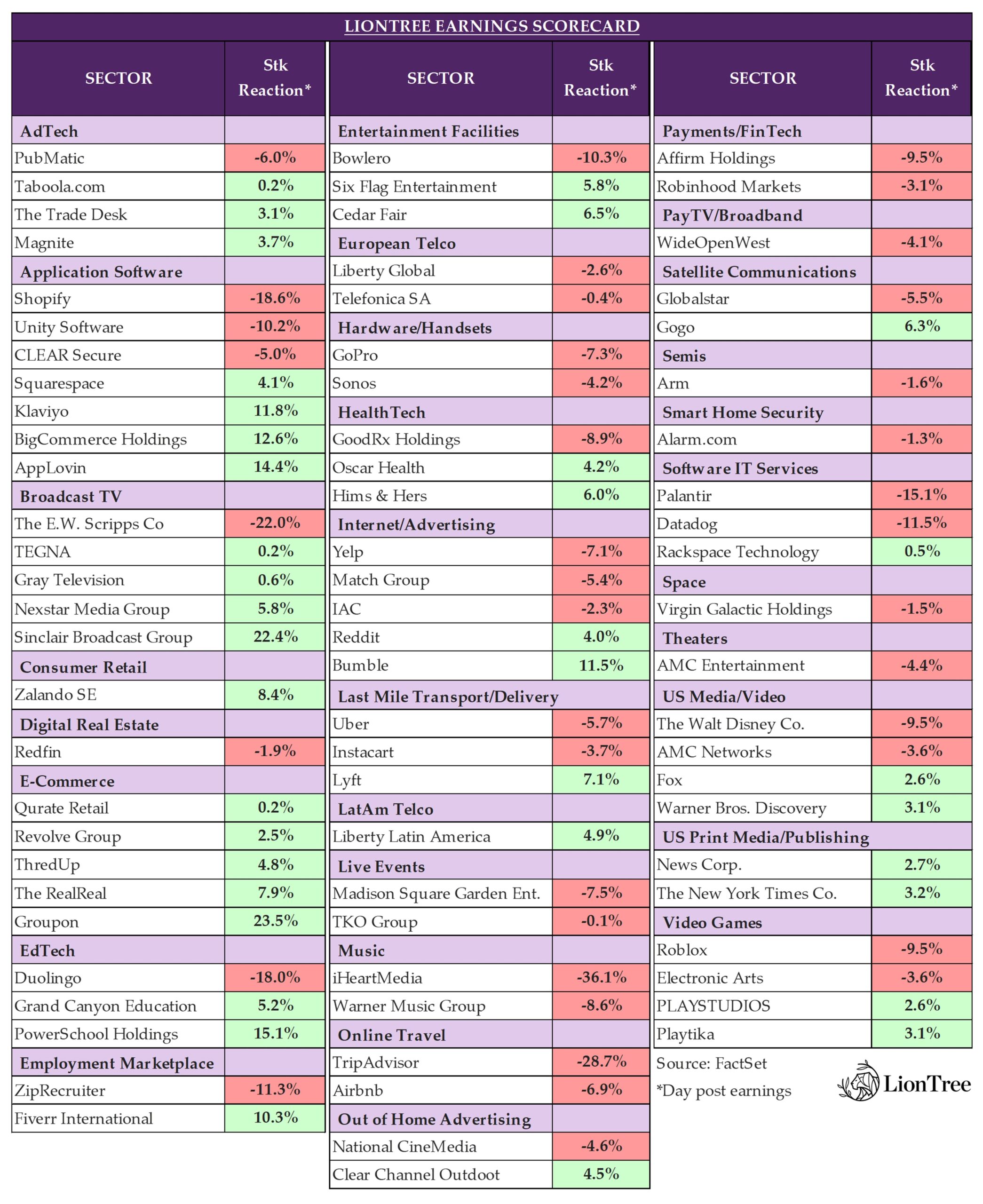
The fourth week of earnings saw a week-high of 77 companies reports in the LionTree Universe report their first quarter results (up from an already high 52 companies that reported last week). Similar to the last two weeks, stock price reactions were biased to the downside. 40 stocks (51.9%) traded down, and 37 (48.1%) traded up. iHeartMedia was the worst performer (down -36.1% post its print), while Groupon was the best performer (up +23.5%).
The media companies dominated the earnings circuit this week, and while Warner Bros. Discovery traded up +3.1% (see Theme #3) and Fox was up +2.6% (see Theme #4) in reaction to its results, Disney fell -9.5% (see Theme #2 for more on why). On the Music side, Warner Music Group also got a tough reaction from the Street and fell -8.6% (see Theme #5).
Moving to interactive entertainment, Electronic Arts fell -3.6% in reaction (see Theme #8), while on the video game infrastructure side, Roblox and Unity fell -9.5% and -10.2%, respectively, and AppLovin traded up +14.4% (see Theme #9).
In Last Mile/Delivery, the two ride-sharing companies saw their stocks take opposite routes, as Uber’s stock went south, down -5.7%, and Lyft’s went north, up +7.1% (see Theme #6). Instacart also had a rough ride on the day after its report and ended the week down -3.7% (see Theme #7).
Finally, AdTech leader The Trade Desk’s print also hit this week, and the stock was up +3.1% in reaction (see Theme #10). Also seeing some moves in their stocks were Reddit, up +4.0%, Shopify, down -18.6%, and Airbnb, down -6.9%, following their reports (see Theme #11).
The table below includes select mid- and large-cap TMT and consumer companies in our LionTree stock universe.
DIS - Jitteriness About Parks Shakes The House Of Mouse
In the midst of Disney’s linear to streaming transition, the Parks business has been a Rock of Gibraltar supporting growth and profitability along the way. Attendance bounced back strongly post-COVID, given all the pent-up demand; however, there appears to have been some dislocation recently. Following Comcast NBCU’s comments last week that it saw some pullback late in Q1 from the “unprecedented” attendance in Orlando following the pandemic due to timing of new attraction openings and “some incr’d competition” from other entertainment venues, Disney comments regarding its parks segment caught our attention. Specifically, the Co indicated that “while consumers continue to travel in record numbers” and it continues to see “healthy demand”, it has observed “some evidence of a global moderation from peak post-COVID travel”. This is one of the reasons why the Co guided for ~flat operating income in the Experiences business in FQ3, which took investors by surprise. Disney is still investing heavily in the Parks business and expects strong returns on this investment, but this update does raise the question about how long this normalization will last. Management also indicated that wage pressure was a factor to the disappointing operating income guidance.
In terms of other areas of the business, better operating income within Entertainment along with better operating income in Sports drove the profitability beat in FQ2. The Entertainment DTC business (which includes Disney+ and Hulu) broke into the black this quarter, and the Co reiterated the consolidated streaming business will reach profitability in FQ4. However, this path will not be linear, some softness is expected in FQ3. Core Disney+ subscriber growth beat consensus, but it was helped by adds that came from the Charter agreement (which, by the way, Disney doesn’t necessarily see as a template for other deals), while ARPU was lighter than expected. Also, the Co does not expect to see Core Disney+ subscriber growth in FQ3 (due to the non-renewal of Disney+ Hotstar’s ICC Cricket rights) but then anticipates sub growth will return in FQ4. Subs growth of other services, including ESPN+, missed consensus, but the Co will have the ESPN+ tile launched at the end of the calendar year and is on track to launch its standalone ESPN app in 2025. Lastly, given the strong earnings performance, management also raised EPS guidance for the FY, despite the weak Experiences guidance.
Was there any update on the CEO succession plans? Not really. Bob Iger only commented, “I’m confident that they will choose the right person at the right time and that to the extent that I can, we’ll participate in a smooth transition.” The activists quieted down post the shareholder vote after all board members were re-elected, though the topic could certainly re-surface to the extent stock performance doesn’t bounce back. Disney shares remain up +17% YTD.
See below for more detailed key points regarding Disney’s results and see Theme #3 and Theme #4 for the drilldown on Warner Bros Discovery and Fox’s results as well.
-> Disney plunged -9.5% after its report and ended the week down -6.9%; YTD, the stock is still up +17.2%, vs WBD’s -28.4% and Fox’s +11.9%
Better Profitability In Entertainment & Sports Drove FQ2 Beat / Raised FY EPS Guidance
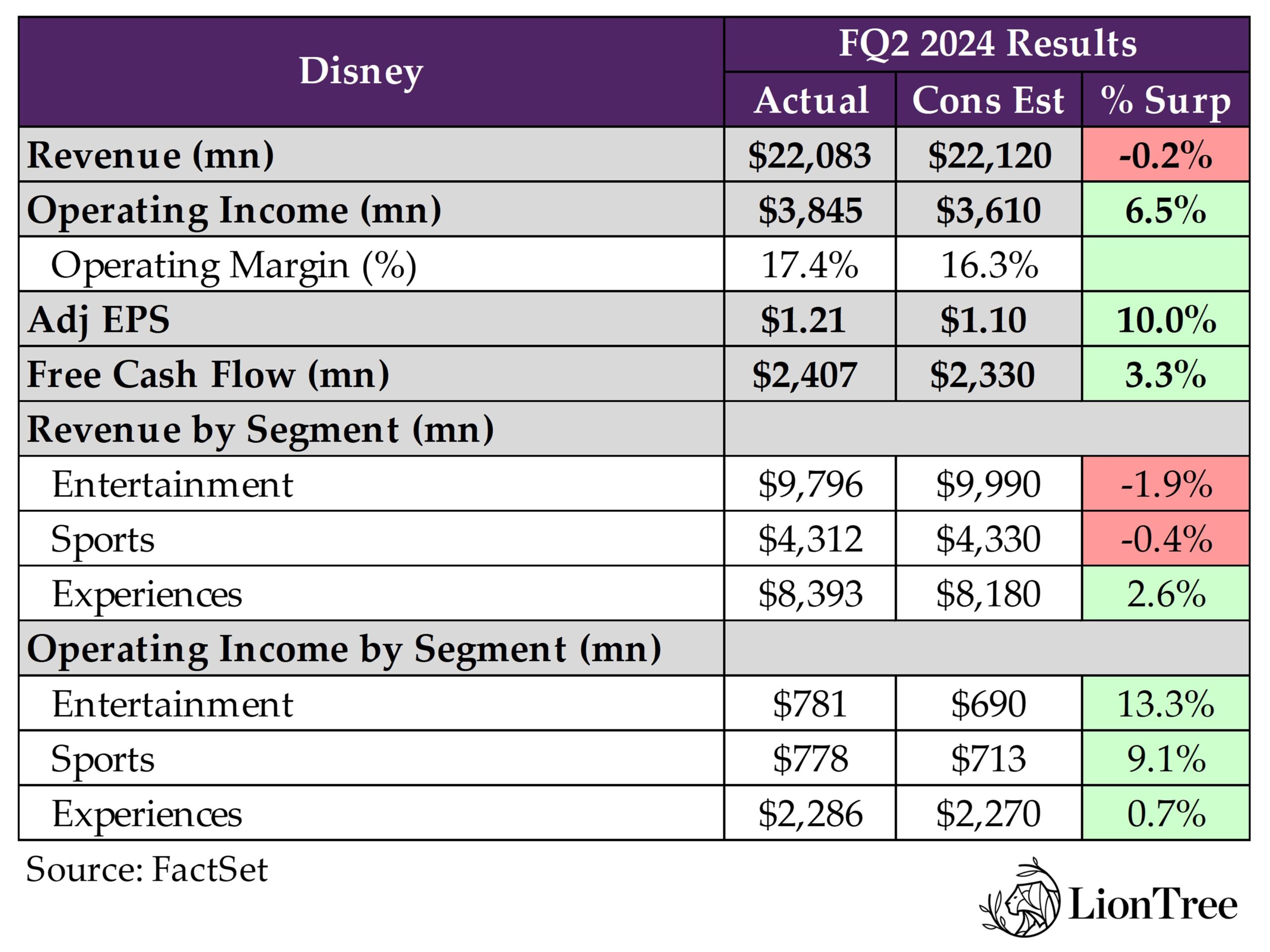
- The profitability push persisted in FQ2, though rev slightly missed consensus: Total op income beat by +6.5% and adj EPS grew +30% y/y and beat by +10.0%
- Revenue misses in both Entertainment and Sports segments was partially offset by a beat in Experiences
- Profitability beat across all segments, but most materially in Entertainment followed by Sports
- Raised adj EPS growth target to +25% y/y for the FY (from prior guidance of “at least” +20% y/y)
- Continue to expect to generate $8bn+ in FCF for the FY
- Continue to make “good progress” on cost efficiency initiatives: Remain positioned to exceed $7.5bn annualized target
Overall DTC Subscriber Adds Missed, While DTC Profitability in Remains On Track For FQ4 / FQ3 Will Be Soft
- Entertainment segment FQ2 rev fell -13% y/y, while op income flipped positive primarily due to “expense savings”
- Reiterated streaming profitability guidance but “path to profitability will not be linear”: Expect a softer FQ3 due in large part to the seasonality of its India sports offering, but continue to expect profitability in FQ4 and further improvements in profitability in FY25
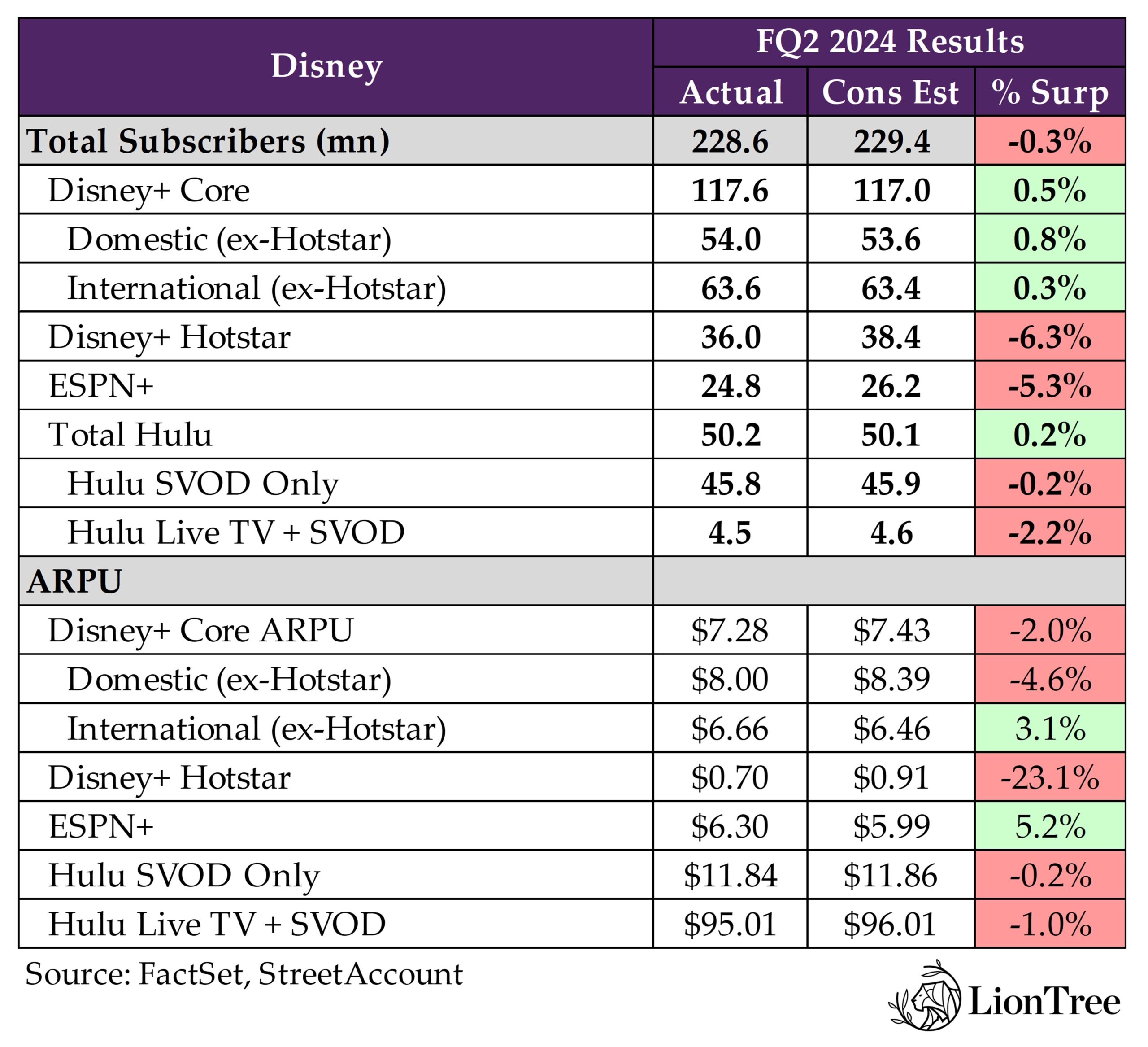
- FQ2 total subscribers grew +4.1mn seq but missed expectations by –0.3% / ARPU mostly missed, with the exception of Disney+ International and ESPN+
- Disney+ Core beat: Increased seq by +6.3mn
- Region drivers –
- Domestic: Added +7.9mn subs q/q, driven by Charter entitlements
- International: Lost -1.6mn subs q/q, driven by the impacts of wholesale deal changes and price increases
- Ad tier subscribers reached 22.5mn globally, partially driven by the recent Charter deal
- Disney+ Core ARPU incr’d seq by $0.44 (but missed by –2.0%), reflecting price increases for the domestic premium tier as well as international ARPU growth, partially offset by lower ad supported ARPU domestically driven by dilution from Charter entitlements
- Early takes on Charter partnership? “Very early days…that said, we’re happy with it so far”
- “Obviously have gotten added subscribers”
- “Cannibalization has not been very high”
- “Overall, the engagement has been good”
- “It’s been a successful deal for us and for Charter, so we feel good about it”
- Do NOT view the deal it as a template for the future, as each deal needs to be architected for the specific needs of the partner
- FQ3 & FQ4 outlook – Do NOT expect to see core subscriber growth at Disney+ in FQ3 but anticipate sub growth will return in Q4: The vast majority of subscriber losses in FQ3 will be due to the non-renewal of Disney+ Hotstar’s ICC Cricket rights
- Region drivers –
- ESPN+ missed on subscribers (-5.3% miss) but beat on ARPU (+5.2% beat)
- Both Hulu SVOD-only and Hulu Live TV + SVOD missed on subscribers and ARPU
Sees Path For Further DTC Subscriber, Engagement, And Advertising Growth
- Drivers for further subscriber growth and engagement
- In March, successfully launched Hulu on Disney+ and are “encouraged by early results”
- At the end of this calendar year, will be adding an ESPN tile to Disney+, giving all US subscribers access to select live games and studio programming within the Disney+ app
- Will launch the enhanced standalone ESPN streaming service in the fall of 2025
- Password sharing beginning next month-in very select markets: Will roll-out more broadly across the globe in September; “We feel quite bullish about it”
- Improved tech, including recommendation engines
- Will build out international more strongly
- The Co believes they are in a “good spot” regarding DTC advertising, but there is some new supply to work through: The ad market is “pretty healthy” as they head into the upfront and live and sports are playing out well
- The challenge is that there is more supply in the market as a competitor entered the ad tier: But regardless, think DIS “is in better place than last year”
- “Demand is out there and it’s pretty high. So, as we lap our way out-of-the supply increase, I think we’re going to be in a good spot as we enter next year”
- The challenge is that there is more supply in the market as a competitor entered the ad tier: But regardless, think DIS “is in better place than last year”
Provided Healthy Outlook For Sports Trends In FQ3 To-Date
- FQ2 Sport rev grew +2% y/y (vs +4% y/y in FQ1), but Sports op income decr’d slightly y/y, reflecting the timing impact of College Football Playoff games at ESPN, offset by improved results at STAR India Sports
- Domestic ESPN rev grew +4% y/y, reflecting higher programming and production costs from the timing of an addt’l College Football Playoff game in the quarter versus the prior year, which were only partially offset by higher ad revenue
- Domestic ESPN ad sales increased by over +20% y/y, or ~+hsd% y/y when adjusted for the College Football Playoff timing shift of an addt’l game as well as a new NFL divisional playoff game in Q2
- Domestic affiliate revs also decreased in the qtr, driven by fewer subscribers, partially offset by contractual rate increases
- Outlook – Q3TD, seeing healthy demand driven by the NBA playoffs, as well as domestic ESPN cash ad sales pacing up
- Expecting to incur linear ICC rights expense at Star India in Q3
- DIS is being selective with international sports rights to drive international growth for ESPN or Disney+: “Being selective about adding international rights right now where possible, where the opportunity exists, we’re doing so, but we’re not investing heavily at this point in growing our international rights, except again where we can buy them along with the rights that we’re licensing for the United States”
- “It’s an opportunity for us to plant the seeds for more growth for ESPN outside the United States, but we’re walking before we run-in that regard”
- Believes NBA rights are important but would not talk about potential costs: Thinks it is a sports product with growth ahead and believes will get long term NBA deal
Next Qtr Guidance For The Experiences Business Spooked Investors; Parks Demand Is Strong But Seeing Some “Normalization”
- Experiences revs incr’d +10% y/y & op income rose +12% y/y (mrgns expanded +60bps y/y)
- Parks and Experiences OI incr’d +13% y/y and Consumer Products OI incr’d +7%
- FQ2 Parks & Experiences breakdown by geography –
- Domestic grew +7% y/y, driven by Walt Disney World and the cruise business
- Disneyland saw a y/y decline due to cost inflation, including from higher labor expenses
- International grew +29% y/y, driven by Hong Kong Disneyland resort
- Domestic grew +7% y/y, driven by Walt Disney World and the cruise business
- Outlook – Continue to expect robust op income growth at Experiences for the full-year, BUT FQ3 op income is expected to come in ~flat y/y due to several items; FQ4 will see some pressure as well (but easing)
- 1x items, incl timing of media and tech expenses and timing of Easter
- Higher wage expenses and pre-opening expenses related to the Disney Treasure and Adventure cruise ships as well as Disney Cruise Line’s New Island, Lookout Kay
- Demand at Parks is still “healthy” but seeing some normalization: “While consumers continue to travel in record numbers and we are still seeing healthy demand, we are seeing some evidence of a global moderation from peak post-COVID travel”
- Pressures from wages, pre-opening costs, and demand impacts are expected to persist in FQ4, but do expect y/y Experiences op income growth to “rebound significantly” in FQ4 due to fewer comparability or timing factors
- Backing-out one-timers both for FQ3 and FQ4, expect OI to be in the mid to-high single-digit range for Q3 and to be double-digit for Q4
- Parks & Experiences has a lot of runway to generate strong returns on investment: “There is lots of opportunities to continue to grow attendance, both domestically and internationally. And the cruise business, frankly, is one that has an enormous number of opportunities for us over-time and that is why we’re leaning more heavily into that business”; Expect to get “excellent returns” out-of-the business, in particular in Cruises
Bullish On IP Slate…The Focus Has Been On Quality Vs Quantity
- Content Sales/Licensing and Other revenues fell -40% y/y and lost -$18mn
- Studio profitability has some cyclicality, but that business should get back to profitability
- Key new theatrical releases arriving over the next few months: “So I feel really good about what’s coming up”
- Friday: Kingdom of the Planet of the Apes
- This summer: Pixar’s Inside Out 2, Marvel’s Deadpool and Wolverine, and 20th Century Studios Alien Romulus
- Later this year: Moana II and Mufasa the Lion King
- 2025: Captain Brave New World, Fantastic Four, Elio, Zootopia 2 and Avatar 3
- “We’ve been working hard with the studio to reduce output and focus more on quality” …particularly at Marvel: Going to decrease volume and go to ~ two TV series a year instead of ~ four and reduce film output from ~ four a year to ~ two or max three; “We’re working hard on what that path is”
- The Co is balancing sequels w/ originals, particularly in animation: “We had gone through a period where our original films in animation, both Disney and Pixar were dominating. We’re now swinging back a bit to lean on sequels”; Sequels are “known” and takes less in terms of marketing
- In terms of Marvel specifically, actually have both: Thunderbolts is coming up in 2025 as an original, have Deadpool sequel is coming this summer and Avengers, and Captain America is coming out in 2025
- Continue to look opportunistically into the 20th Century Fox library to see what can be mined
- Open minded on licensing off platform but don’t expect a significant amount: Limiting their own product to their own platforms “definitely does have some value”, but “we’re also watching as some studios have licensed content to 3P streamers and that creates more traction, more awareness and in effect increases not only the value of the content from a financial perspective, but just in terms of traction”
- “So, we’re going to — we’re looking at it with an open mind, but I don’t think you should expect that we’ll do a significant amount of it”
WBD Is Pushing Harder On Streaming Profitability & Bundles
In between Disney’s Tuesday morning print and Warner Bros Discovery’s Thursday morning print came a big announcement – the two legacy media players would be partnering to launch a Disney+, Hulu, and Max bundle. This is certainly a step in the right direction to fix the fragmented DTC customer experience. The offer will be launched this summer, will be priced attractively, and clearly could help drive subs and increase retention. Expect WBD to engage in more of these bundles in the future, which will also include partnerships with telcos and mobile broadband players (as already being seen in Europe, LatAm, as well as the Netflix-Disney bundle with Verizon).
In terms of Q1, WBD’s total revenue and adj EBITDA came up short of expectations, with misses across all segments except DTC, where ad. EBITDA swung to a positive $86mn vs consensus expectations for a loss of -$51mn. This is a key milestone, and the segment is expected to remain profitable in 2024 and achieve its $1bn+ adj. EBITDA target for 2025.
In terms of streaming subscribers, in addition to the international launches (will be rolling out Max to 25+ additional markets across Europe in the next several weeks, with more to follow), another driver of growth will be this just-announced bundle with Disney. All-in-all, there is a greater line-of-sight to sustained profitability and subscriber growth in DTC.
However, it continues to be a tough advertising environment, though the Co’s y/y ad rev losses did improve sequentially. Overall ad rev was down -7% y/% (which is an improvement from -9% y/y in Q4), as growth in DTC ads started to offset linear ad declines. That being said, linear is far from being completely down and out, as WBD continues to see opportunities in the space, particularly internationally in free-to-air channels. Looking to Q2, the Co expects to see continued sequential improvement in total ad rev growth, led by what is expected to be its biggest DTC quarter ever.
Lastly to flag, despite having generated $1.8bn in global box office since the start of the year, the Studios segment was dragged down by games, with “Suicide Squad: Kill the Justice League” underperforming, especially compared to last year’s “Hogwarts Legacy” release. Quickly to note on the sports side, while commentary on the NBA was limited, conversations are ongoing, and WBD is “hopeful” for a deal “that makes sense for both sides.” The outcome of this negotiation certainly will have implications for the Co.
See below for more on all of the above and see Theme #2 as well as Theme #4 for the deep-dive on Disney and Fox’s results as well.
-> WBD climbed +3.1% in reaction to its print and ended the week up +2.3%; YTD, the stock is down -28.4% vs Fox’s +11.9% and Disney’s +17.2%
Better Than Expected FCF & DTC Positive Adj EBITDA Were Main Q1 Highlights / Expect To “Meaningfully Exceed” Cost Saving Target
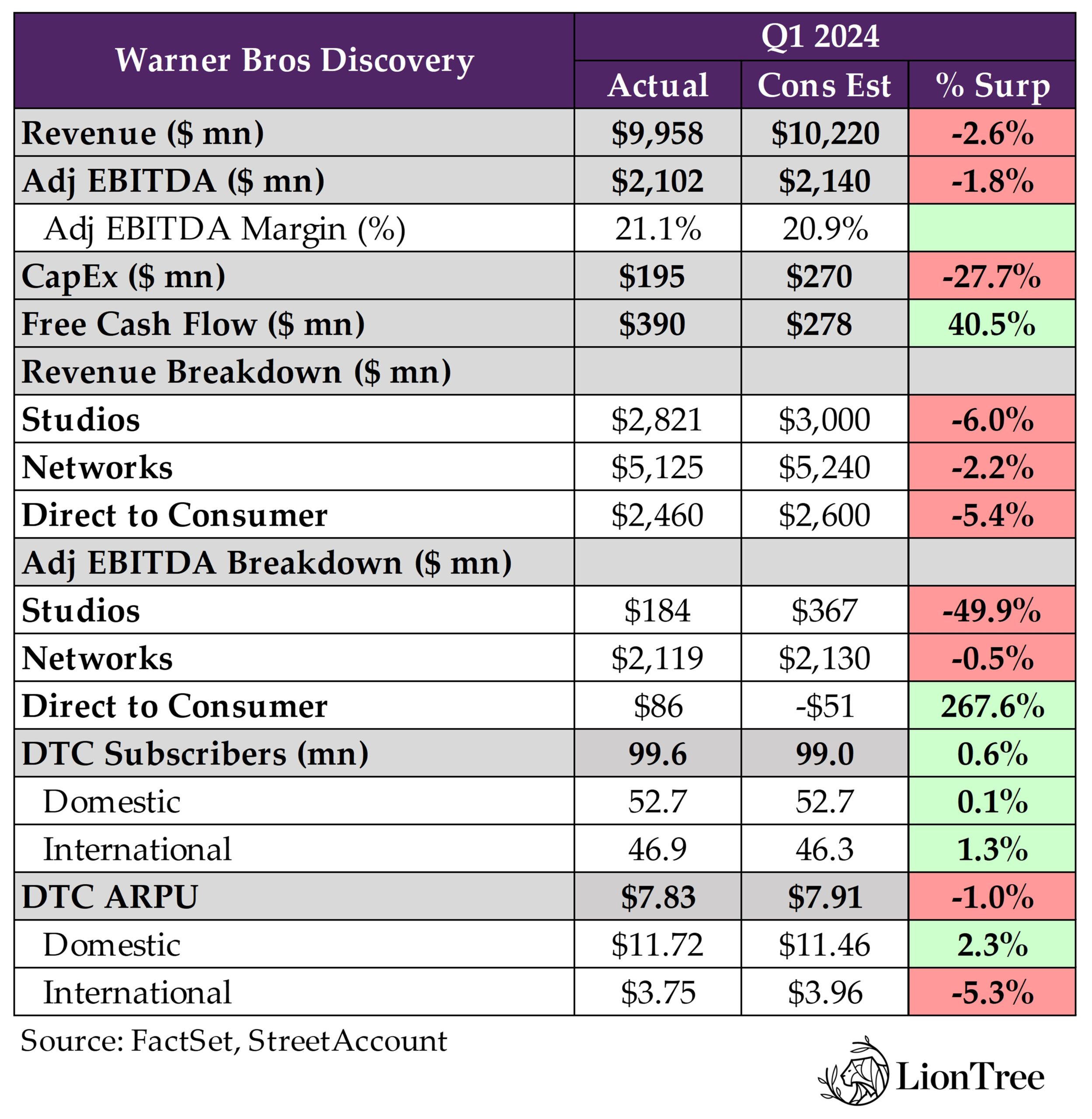
- Consolidated rev missed by –2.6%: Fell -7% y/y (vs -7% y/y in Q4)
- All three segments missed
- EBITDA missed by –1.8%, but DTC was better: Fell –19% y/y (vs –5% y/y in Q4)
- Studios and Networks both missed, but DTC came in positive $86mn vs expectations of a loss of -$51mn
- FCF beat by +40.5%, despite being in the Co’s “seasonally weakest FCF generation qtr”: Improved by +$1.3bn y/y to $390mn in Q1 and $7.5bn in TTM FCF
- Drivers:
- Continued to benefit from the many initiatives to improve working capital, which the Co is still in the “early innings of realizing”
- “More disciplined and analytical approach” to content investment and allocation
- “Meaningfully lower” cash restructuring costs
- Lower cash interest expense, as a result of $6bn+ of debt repaid over the past 12 months
- Primary use of FCF remains delivering the balance sheet and are committed to gross leverage target range of 2.5-3x: “Confident that we will continue to make progress towards further delivering this year”
- Drivers:
- See a path to “meaningfully exceed” the $1bn+ of remaining cost savings that they have previously guided to, which is on top of the $4bn+ already realized through the end of 2023
Despite Linear Ad Declines And DTC Ad Increases, Expect To See “A Very, Very Long Period Of Co-Existence”
- Q1 total ad rev fell -7% y/y (vs -9% y/y in Q4), helped in part by a record March Madness Men’s Basketball Tournament and steadier overall ratings
- Networks were down -11% y/y (improved from -14% y/y in Q4), primarily driven by audience declines in domestic general entertainment and news networks, as well as the soft linear ad mkt in the US and LatAm; The decline was partly offset by growth in EMEA; The AT&T SportsNet exit was a modest headwind to ad rev
- DTC was up +70% y/y (accel from +51% y/y in Q4), primarily driven by higher engagement on Max in the US, which in part was due to the launch of B/R Sports on Max in October 2023, and ad-lite subscriber growth
- Looking to Q2 – expect to see continued seq improvement in total y/y ad rev growth, led by what is expected to be their biggest DTC qtr ever: Cited the following drivers for the seq improvement –
- Launched international ad-lite offering in LatAm, with EMEA coming soon, which will be “critical” in enhancing their portfolio offerings
- Continue to see “select” opportunities in linear despite “obvious secular challenges”
- EMEA continues to be a standout bright spot, particularly from free-to-air channels, which outperformed in Q1 with positive rev growth (primarily driven by “robust” rev growth in Poland, Italy, and Germany) and they are seeing a continuation of their trend in Q2
- Except for the UK and the Nordics, advertising revs were flat to up in virtually all EMEA markets in Q1
- Linear cash pacing in the US continues to improve “modestly” QTD, even excluding the positive impact of the NCAA Men’s Final Four and the Championship Games
- Will benefit from having these games exclusive to WBD this year, but do not have the Stanley Cup finals and the exit of the AT&T SportsNet will continue to be a headwind to revs with marginal profit impact through the end of Q3
- Though materially smaller, LatAm has been and continues to be a different story, particularly given cyclical and secular headwinds in Brazil and Mexico, their two largest mkts in the region
- Unlike Europe, where they are a scale broadcaster in several markets, they are more exposed to the less resilient pay-TV ecosystem that is experiencing a more pronounced secular shift of ad dollars to streaming (but are now better positioned to capture a share of this migration with launch of Max in the region)
- Taking an increasingly more holistic portfolio approach to monetizing viewership in both linear and Max, supporting their ability to offer their partners incremental reach and more customized ad solutions spanning all platforms, particularly in the US
- EMEA continues to be a standout bright spot, particularly from free-to-air channels, which outperformed in Q1 with positive rev growth (primarily driven by “robust” rev growth in Poland, Italy, and Germany) and they are seeing a continuation of their trend in Q2
- On upcoming upfront – It’s a “little early” to discuss but “definitely hope to continue some of the momentum that we’ve seen last year”
- “Operating in a much more constructive environment this year than we did last year”
- Convergence of DTC and linear is “working very well right now” and the way they take their inventory to the market is “fully harmonized”
- Seen “some nice growth rates” for DTC inventory and taking it to market with more data-driven products
Despite Launch Costs From Max’s International Rollout, Continue To Be Disciplined And Expect DTC To Remain Profitable In 2024 And Achieve $1bn+ Adj. EBITDA Target In 2025
- Max added 2mn subscribers in Q1 to reach 99.6mn subs (beat by +0.6%)
- Gaining subscriber traction in all regions
- Looking to Q2 –
- Content rev expected to be down y/y: Similar to Q1, when content rev was down -46% y/y, will have a more difficult comp in Q2, both of which are a product of timing of output deals renewed last year, availability of content, as well as content utilization choices
- Some slowdown in US, but growth continues in int’l: US subs will be impacted by some seasonality, particularly related to sports, but on track for continued “robust” international growth
- Expect new subscriber highs through the remainder of the year
- Expect to remain profitable in the DTC segment during 2024, despite heavy launch investments, and remain “fully confident” in the path to achieve $1bn+ adj. EBITDA target for 2025 and growth ambitions thereafter
- 2024 is “a pivotal and critical year for Max with an aggressive relaunch and rollout underway that will meaningfully expand our global presence and growth potential”
- “Off to a strong start” with ~$86mn in adj EBITDA generated this qtr, despite absorbing some of the launch costs of LatAm
- Highlighted “three key metrics” that “underpin our strategic and financial objectives” for DTC
- Subscriber growth: Nearing 100mn subscribers and see “strong indicators” of continued growth through rest of the year
- Putting more partnerships in place to accelerate rollout, an enhanced subscriber migration experience that reduces one-time churn, and more optimized marketing investment
- Engagement and monetization:
- Engagement reached an all-time high in Q1 through a combination of stronger content and product enhancements, and the Co is taking “meaningful” steps to grow it further
- Global ARPU grew +4% y/y in Q1 (vs +7% y/y in Q4), which in part reflects a greater mix shift of lower ARPU intl subs vs US subs
- US ARPU grew +8% y/y in Q1 (vs +8% y/y in Q4)
- Churn: Still above their longer-term target but cont’d to trend downwards and hit an all-time low in the US at the end of Q1
- Saw “continued healthy improvements” in habituality and diversity of viewing in Q1, which are the most correlated inputs to churn
- Subscriber growth: Nearing 100mn subscribers and see “strong indicators” of continued growth through rest of the year
- International expansion of Max is underway: YTD, have expanded from single market in the US to 39 countries and territories
- Successfully migrated HBO Max subscriber base in LatAm over the past couple of months: Now able to offer more consumer-friendly pricing and packaging across ad-lite, ad-free- and premium tiers, with more flexibility and subscription options and addt’l paths to monetize the base
- Will rollout svs to 25+ addt’l mkts across Europe in the next several weeks, including their first new mkts, France and Belgium, with more to follow
- Max will be the only place where viewers across Europe will be able to watch every part of the Olympics
- The content lineup on Max over the next 12-18 months is “one of the strongest ever”
- Coming in Q2: S3 of Hacks, Streaming premiere of The Iron Claw and Dune: Part Two, Champions League in LatAm, and the S2 premier of House of Dragon, “just to name a few”
- Over the next 18 months: S2 of The White Lotus, S2 of The Last of Us, S3 of And Just Like That, along with tentpole original series including The Penguin Doom Prophecy, Welcome to Derry, A Knight of the Seven Kingdoms, a Spinoff of the Game of Thrones franchise, plus an ongoing slate of fresh new Warner Brothers theatrical releases such as Godzilla, Ex-Con, Furiosa, Beetlejuice, Joker 2, and more
“Need To Fix” The DTC Consumer Experience, And Bundling Will Help Do That
- Partnering with Disney to launch a streaming bundle, which will include Disney+, Hulu, and Max: “First of its kind offering that gives US consumers the option of an ad-lite or ad-free package that includes Max, Disney+, and Hulu”
- Will go live later this summer
- Will be priced “very attractively”, working off of the Max standalone and the existing Disney+ and Hulu package bundle
-> On the news of streaming partnerships, there was a report out this week from The Hollywood Reporter that Paramount might attempt a combination of its streaming service, Paramount+, with Comcast’s streaming service, Peacock; Details are very sparse as neither of the companies have made a formal announcement about the talks, and no pricing, naming, or other details have been decided; According to the report, the feasibility of a partnership would depend on several factors, including whether or not Comcast gets an NBA package, if Byron Allen or another bidder takes a swing at acquiring BET, who would even control the combined service, and whether a combination would be enough to compete against the upcoming Disney-Fox-WBD sports JV (link/link)
- Disney bundle is expected to help increase retention, lower churn, and in turn support higher customer lifetime values, as customers will have to retain all three streaming svs to take advantage of the price value in the offering
- As the bundle gets more traction, will benefit from increased efficiencies (including with marketing)
- Any plans to add other svs to the Disney+, Hulu, and Max bundle? Current bundle gives “the greatest offering of kids and family content, the greatest offering of adult fare, the greatest offering of scripted and non-scripted content. So, we don’t think we need anybody else in that package to make it incredibly compelling”
- “We do think this package can be an anchor tenant of every household’s entertainment experience. And we don’t think there is a need at this point for anything more”
- Update on bundle Max-Netflix bundle with Verizon? Doing “much better than expected… it’s another example where there’s more strength together… it’s just more efficient”
- Expect more bundles in the future, including w/ telcos: As they roll out in Europe, have partnership with Canal, Free, Orange, SFR, “all the big mobile Telco players”; “That’ll continue to be our strategy. Then partnerships with other programmers and other streamers, we will continue to explore, and I think you should see that in our roadmap in the quarters to come”
- “We need to come together ourselves and provide a better consumer experience…or there’ll be other companies [that] will do it for us”
- Cos like Roku and Apple and Amazon “are doing a terrific job of aggregating services in the quest to provide a better consumer experience” BUT “it’s much more efficient, better ARPU and a much better business if we can do it ourselves”
- Bundling will allow the legacy media players to “[get] back to all being great at what we do and swim in the lane that we were great at”
- Vs back in the 2010s, when “the industry went down the very dangerous financial path of trying to invest in every type of content, in every genre to try and be something for everyone”
- Now, with the new bundles, they can “go back to investing in the areas that we really are great at”
- “Disney, obviously, is incomparable and a world leader in kids and families”
- “We are world leaders in premium drama, scripted drama, comedy, nonfiction verticals”
- Consumers benefit because at a “very attractive price” they get a combination of products and don’t feel the need to switch in and out of services month to month
- “The key for us is, we need to be prominent in all of the major bundles because we want to be in front of all consumers”
Limited Commentary On NBA, But Discussions Are Ongoing
- Currently in active negotiations: “We’ve enjoyed a strong partnership with the NBA for almost four decades. We’re in continuing conversations with them now, and we’re hopeful that we’ll be able to reach an agreement that makes sense for both sides”
- Under current deal with the NBA, WBD has matching rights that allow them to match third party offers before the NBA enters into an agreement with them
- Had “a lot of time” to prepare for this negotiation and have strategies in place for the various potential outcomes
Have Been Taking “Meaningful” Steps To Rebuild Studios, Though Gaming Weighed On Results In Q2
- Q1 financials were overshadowed by tough gaming comps: $400mn+ y/y decline in rev was primarily due to the “very tough comp” following the success of Hogwarts Legacy last year, in conjunction with the disappointing Suicide Squad release in Q1, which has a $200mn impact to adj EBITDA
- Striving to “return the luster to Warner Brothers Pictures”, but it “takes time and it’s not something that can be accomplished overnight”
- “The heavy lifting taking place…isn’t something that you see fully reflected yet in our financials. However, we are confident it will become more apparent with time”
- Currently stand at the #1 spot for box office share this year: Making it the first studio this year to reach $1bn in both overseas and worldwide box office
- Dune: Part Two and Godzilla x Kong: The New Empire have grossed $1.2bn+ in global box office; Dune: Part Two is the highest grossing movie of 2024 to date with $700mn+ in global box office
- Have generated $1.8bn in global box office since start of the year
- Continue to lean on franchises as they develop new projects: “It’s a core value and a key advantage for us. We have the characters and stories people love and yearn for everywhere in the world, in every language”
- In the early stages of script development of the first of the new Lord of the Rings movies, which are expected to release in 2026; “Lord of the Rings is one of the most successful and revered franchises in history and presents a significant opportunity for our theatrical business”
- Harry Potter, Lord of the Rings, Superman, and many other parts of the DC universe are “largely underused. We are hard at work fixing that”
Looking To Leverage AI Across The Co To Run Bizs More Productively And Effectively
- “We recognize that AI is going to have an increasing impact on society and our industry, and we intend to take full advantage to enhance the products and experiences we deliver to consumers and to achieve greater efficiency companywide”
- Focused particularly on improvements to ad targeting and recommendation algorithms: AI-based understanding of their customers and content is being activated across product, marketing, and ad sales
- Since the initial launch of Max, have been using AI and ML to personalize content discovery, and have continuously innovated to improve models and present the right content in front of consumers at the right time
- Using AI to identify and optimize ad break oppties in premium HBO content more efficiently and swiftly, which typically does not have natural ad breaks, enabling them to offer premium content on their ad light tier and create variable ad load for content as they monetize it using multiple tiers and platform
- Have “dozens of other experiments” ranging from corporate and developer efficiency to marketing optimization and targeting
FOX’s Fundamentals Moved In The Right Direction, Excluding Seasonal Factors
Investor reactions to the Media earnings-palooza over the past couple of weeks have been quite bifurcated, with Fox and Warner Bros Discovery trading up but Disney and Paramount trading down post-earnings. There have been a lot of moving parts and company-specific dynamics, but at least in terms of Fox, much better profitability (adj EBITDA ~+12% ahead) was the key upside driver, given that revenues were more or less in-line. Tubi remains a shining star and has been growing to scale. It delivered +22% y/y rev growth in the quarter, driven by a +36% y/y increase in total view time (TVT) and +20% y/y growth in monthly active users (to just under 80mn). Tubi’s share of total US TV view time also grew +60% y/y, which was faster than any other streaming service over that same period. The proactive nature of Tubi users’ viewing behavior is also attractive to advertisers, and the Co is not concerned with weakness in CPMs, despite increased supply from Amazon Prime Video’s ad-tier. With that being said, Tubi’s revenue comps will be tougher next qtr.
The price increases in the carriage renewals helped affiliate revenues to grow this quarter and while total advertising revs fell a meaningful -34% y/y, it was seasonally due to the absence of the Super Bowl and 2 fewer NFL playoff broadcasts than in the prior year. EXCLUDING these items, total ad revs were up ~+lsd% y/y, and comments were constructive on the scatter and upfront market. Also, Fox’s political ad revs should ramp in Fiscal H2. Lastly, questions about the commitment to the Sports JV also emerged, but Fox remains enthusiastic and is excited about how the beta is looking.
See below for more thoughts on the above as well as insights into other key Fox comments and updates. Also, see Theme #2 and Theme #3 for a respective drill down into Disney and Warner Bros Discovery’s results this week, and see Theme #10 from last week for some perspectives on Paramount’s latest earnings update.
-> Fox ended the day of its report up +2.6% and built on those gains to close the week up +4.6%; YTD, the stock is up +11.9%, vs WBD’s -28.4% and Disney’s +17.2%
Much Better Profitability Drove Upside Vs FQ3 Expectations
- Total revs were ~in-line with consensus, but adj EBITDA was ~+12% ahead: The +7% y/y growth in adj EBITDA came despite tough comps with the Super Bowl; EPS of $1.09 (+16% y/y) also beat by +13.5%
- Cable Network: Revs (down -6% y/y) a tad light but adj EBITDA beat (grew +3% y/y)
- Expenses were down -16% y/y, primarily due to the timing of the associated sports sub-licensing expenses, lower costs at Fox News, and the de-consolidation of the USFL
- TV: Revs were in-line (down -22% y/y), but adj EBITDA beat (incr’d +24% y/y)
- Expenses were lower, primarily due to the impact of the NFL schedule, along with fewer hours of original scripted primetime content, including the impact of the industry labor disputes
- Cable Network: Revs (down -6% y/y) a tad light but adj EBITDA beat (grew +3% y/y)
- FQ3 to date, the Co repurchased $300mn and returned ~$125mn via the dividend: Total cumulative buyback activity since the launch of the program in 2019 now amounts to $5.4bn, or 26% of total shares outstanding; Fox remains committed to fully utilizing the current $7bn authorization
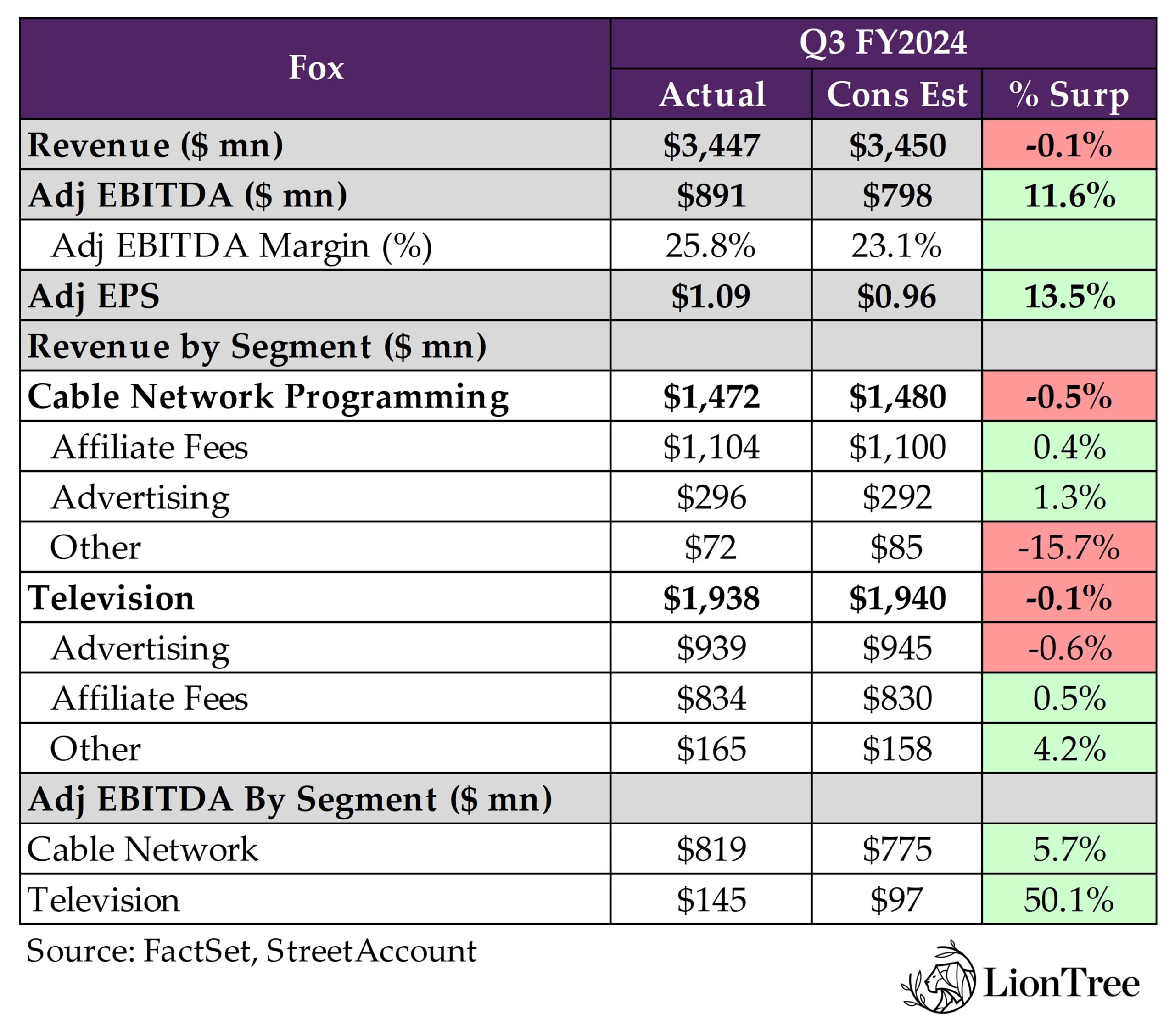
Tubi Remains A KEY Growth Driver / Total Viewing Time Was Up +36% Y/Y / Not Concerned About CPM Pressure
- Tubi posted +22% rev growth in FQ3, driven by a +36% increase in total view time (TVT) and +20% growth in monthly active users (to just under 80mn)
- Tubi’s share of total US TV view time grew +60%: This was than any other streaming svs over that same period
- 60%+ of Tubi’s users are classified as cord-cutters or cord-nevers
- 90% of those users’ time watching is “proactively on-demand” as opposed to passively watching
- This is much more valuable to advertisers
- This positions Tubi very well as an important part of the growing digital streaming advertising marketplace
- No concerns about CPM pressure for Tubi (was flagged by Disney as a headwind): Think they are already efficient with CPMs vs others; “I think some of our competitors priced themselves when they entered the AVOD market over the past 12 and 18 months very high. And we’re seeing in the marketplace them having to drop CPMs as new entrants add supply to the market. So that’s affecting the market overall”
- But note that next qtr, Tubi will face tough comps (revenues grew +40% y/y FQ4 last year)
Underlying Ad Trends Are Moving In The Right Direction
- Total advertising revs fell -34% y/y due to the absence of the Super Bowl and 2 less NFL playoff broadcasts than in the prior year… BUT ex these items, total ad revs were up ~+lsd% y/y
- Cable ad revs fell by -6% y/y… lapping issues with direct response
- National sports networks ad revs were down due to the absence of last year’s Super Bowl-related programming and the World Baseball Classic
- Fox News ad revenues were impacted by moderating direct response (DR) pricing declines and lower digital traffic, partially offset by higher national pricing
- TV ad revs fell -40% y/y on a reported basis due to sports schedule
- As noted above, Fox felt the impact of the absence of last year’s Super Bowl and two less NFL playoff games
- Overall advertising trends at Fox are “clearly moving in the right direction, both in the scatter market and in early upfront discussions”
- Fox is confident it will see strong political ads in H2 F25: They know how much money has been raised, and the stations are well-positioned
Renewals Continue To Grow Affiliate Revenues
- Total affiliate fees incr’d +4% y/y (vs +4% y/y in FQ2), with growth in both TV and cable segments supported by a recent cycle of affiliate renewals
- Cable affiliate fee rev were up +1% y/y (vs +0.5% y/y in FQ2)
- Growth in pricing outpaced the impact from industry subscriber declines running in the mid-8% range
- TV affiliate fee revs grew +9% y/y (vs +10% y/y in FQ2)
- Price increases across O&O and 3P FOX-affiliated stations more than offset the impact from subscriber declines
- Cable affiliate fee rev were up +1% y/y (vs +0.5% y/y in FQ2)
FQ4 Will Be Quieter In Sports But Excited By The Beta Version Of The Sport JV Product
- Key content plans during the quieter FQ4 sports calendar
- Launching Summer of Soccer: 200+ hours of live soccer coverage across the platform, starting with the UEFA European Football Championship on June 14 and Copa America on June 20
- A new schedule from Fox Entertainment: Gordon Ramsey’s Food Stars and new shows, like the 1% Club
- Focused and making progress on the Sports JV
- Have 150 engineers and executives
- Focused on sports fans outside the traditional bundle
- Have been trialing the beta and “can’t wait to launch this fall”
- Regarding the NBA…FOX is very happy with the sports portfolio they have and that is why they “didn’t pursue NBA in this negotiation”
A Few Other Key Comments
- Not looking to monetize the FanDuel option or Studio Lot
- M&A – “We obviously don’t want our balance sheet to go to waste, but we haven’t found anything yet that we’re going to do or follow. But it is something we are keeping a close eye on”
WMG Is Focused On Ensuring The Sanctity Of Its Pricing Across The DSPs
Warner Music Group’s FQ2 headline numbers were better-than-expected, with adj OIBDA closing +5.1% ahead of consensus expectations on a ~+1% revenue beat, though there were some puts and takes. Upside to the top-line was driven by Music Publishing, but there was some disappointment that Recorded Music missed primarily due to lower-than-expected digital revenue. Streaming revenue growth in the quarter came in at +11% y/y, representing a sequential acceleration that was supported by +13.5% y/y growth in Subscription revs (up from +12% in FQ1), as the company benefited from stronger music performance, subscriber growth, and subscription price increases. However, Ad-Supported revs grew +5% y/y, decelerating from +10% y/y in FQ1 due to “platform mix.”
There were a couple of questions from analysts on the call trying to assess whether WMG will participate in incremental revenue from Spotify’s bundled offer… but it sounds like won’t necessarily be the case. WMG said its job is to make sure the “sanctity” of their pricing is moving up as appropriate. However, it doesn’t mean that there won’t be higher-priced bundled offerings that are allocated for those additional content providers. WMG CEO Robert Kyncl commented, “The job of wholesalers, like music companies [and] like ourselves, is to ensure that the sanctity of our pricing across the different services, whether individual subscriptions, standalone subscriptions, or bundled offerings, are in line with each other. So, you can expect us to pursue that strategy.” The Co does continue to support further price increases and optimization especially where it thinks the offers will bring in more subscribers. That helps everyone.
WMG is on track with its restructuring plans and is set to deliver $200mn in annualized run rate cost savings, which is a plus. That said, investors grumbled about forward comments suggesting that organic streaming growth may not accelerate over the next couple of quarters despite the strong H2 slate, given comps with last year’s DSP price increases. Overall, WMG is focused on growing the Music revenue opportunity and its share of that pie, and it plans to do so via driving more engagement with its music, increasing the value of its music, and evolving how the company works together.
See below for more on what we thought was most incremental from results and the conference call.
-> WMG shares fell -8.6% in reaction to earnings, closing the week down -7.3%; YTD, WMG stock is trading -11.6% lower, while UMG stock is up +8.5% and Spotify stock is up +56.8%
Strong FQ2 With Better Financial (Especially Margins) & User Performance
- FQ2 revenue upside came from Music Publishing, while profit upside came from Recorded Music: Total FXN revs grew +7% y/y (+9% on normalized basis ex BMG/unfavorable renewal) and beat by +0.9%; Adj OIBDA beat by +5.1% (grew +9%, or +10% on a normalized basis)
- Recorded Music revs (+4% y/y and +7% on normalized basis) missed by -0.9% but adj OIBDA beat by +7.2%
- Music Publishing revs (+19% y/y) beat by +6.1% and adj OIBDA beat by +1.1%
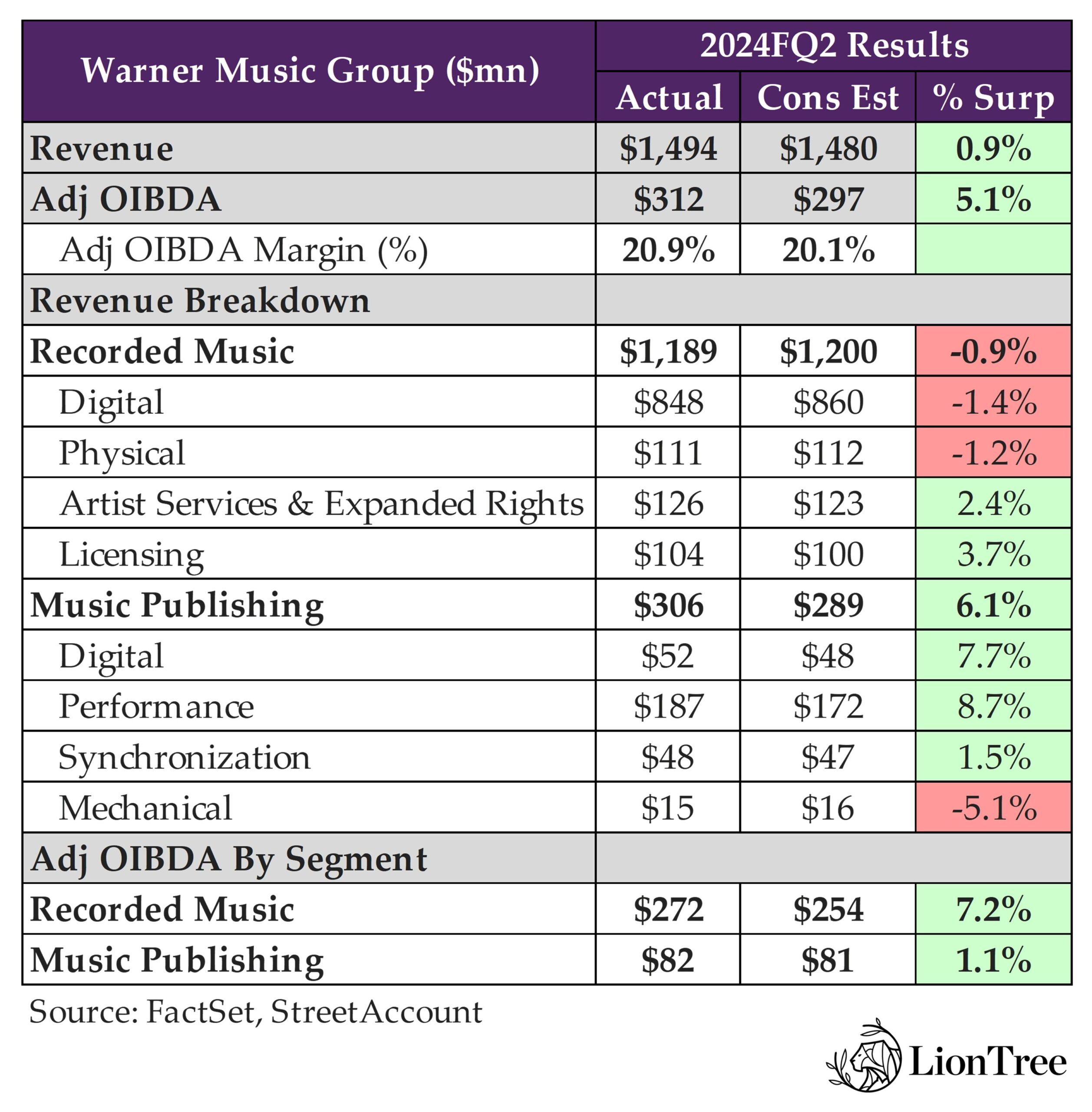
WMG Saw Underlying Strength In Subscription & Ad Supported Streaming Revs, While Emerging Platform Revenue Can Be Lumpy
- Subscription revenue growth was the key driver for overall Recorded Music streaming rev growth
- Recorded Music Streaming revenue incr’d +11% y/y on comparable basis vs +4% in FQ1
- Subscription streaming: Grew +13.5% vs +12% in FQ1, which was driven by stronger music performance, as well as subscriber growth and subscription price increases
- Ad-supported streaming: Grew +5% y/y, decelerating vs +10% in FQ1 due to “platform mix”
- Note a few revenue comparability items in Recorded Music streaming revenue
- BMG digital revenue roll-up was -$22mn unfavorable in FQ2
- The renewal w/ an international digital partner that resulted in upfront incremental rev recognition of $27mn last quarter resulted in an unfavorable impact of $4mn this quarter and will have a similar impact in FQ3 and FQ4
- Drivers for the seq decel in ad-supported organic growth
- Saw growth and accelerating trends in the traditional ad-supported
- “But again, underlying strength [was] there in the core subscription streaming and the traditional ad-supported”
- Emerging platform’s organic growth also decel’d seq due to lumpiness
- Cited deal timing, content delivery, as well as mix of platforms for the volatility
- Believe emerging is still a “growing category” and expects it to continue to grow over the long-term
- The Co has seen “encouraging early signs in the evolution of royalty models”, but it will take time: These better align economics with premium content and grow WMG’s participation in the pie; But these shifts to more artist-centric models take time to fully implement, and the Co doesn’t expect an “immediate impact” on results
WMG Is Working To Ensure The “Sanctity” Of Its Pricing Across DSPs
- Does WMG participate in the incremental revenue from Spot’s tiered offer? It sounds like not necessarily in this case… WMG’s response:
- It is great to see price increases after 15 years of no actions by anyone
- It is great DSPs are thinking long and hard about pricing strategies, and bundled services are part of that
- WMG’s job is to make sure “sanity” of their pricing is moving up as appropriate
- But it doesn’t mean that there wouldn’t be higher-priced bundled offerings that are allocated for those additional content providers
- “All of this is, the right direction… this is good news, in my opinion, to push forward”
- “The job of wholesalers, like music companies like ourselves, is to ensure that the sanctity of our pricing across the different services, whether individual subscriptions, standalone subscriptions, or bundled offerings, are in line with each other. So, you can expect us to pursue that strategy”
- WMG will “continue to advocate for further increases, as well as more sophisticated price optimization, especially as DSPs improve their offerings to bring in more subscribers”
Cost Reduction & Tech Plans Are On Track
- Are on track with the restructuring plans set to deliver $200mn in annualized run rate cost savings, but the full savings will not be realized until the end of FY25: Nonetheless, the majority of the changes have already been implemented
- This includes centralizing certain functions and exiting owned and operated media businesses
- Sold the entertainment websites UPROXX and HipHopDX
- Achieved modest cost savings in the quarter, the majority of which were reinvested into tech
- Enhancing Tech capabilities: Made improvements to their royalty systems and the tools used to identify unclaimed revenue; Overhauled their global supply chain, enabling the ability to scale 3P distribution business; Transformed proprietary tools that identify fan trends while building new ways to engage with Superfans
Outlook For The Rest Of The Fiscal Year
- Strong H2 slate…: H2 includes music from Dua Lipa, Twenty-One Pilots, Sia, Gunna, Megan Thee Stallion, David Guetta, Fred Again, Charlie Puth, and Maria Becerra.
- … BUT toned down comments about organic streaming growth accelerating over the next couple of qtrs, despite the strong H2 slate: Have lots of great content coming BUT “keep in mind is that we’ve now seen the full impact of the Spotify price increases in our results and then [in] the second half, we’ll be lapping last year’s price increases with the other DSPs, namely Apple and YouTube”
- “But we’re continually encouraged by the subscriber growth as well”
- BMG will have revenue impact in the -$25-30mn range in both FQ3 and FQ4 (vs -22mn in FQ2), eventually rolling off completely in FY25
- “Our goal continues to be to deliver operating cash flow conversion of 50-60% over a multi-year period, which we expect to achieve for full year 2024”
Other Key Comments On Potential M&A And Super Fans
- What happened with the bid for Believe? Mgmt didn’t provide any color on why they specifically decided not to move forward but did indicate they will continue to look for assets that will augment their strategy
- The Co continues to see plenty of runway on organic investment but “it’s our job to survey the market, and if there’s inorganic opportunities that will accelerate our initiatives, we’ll take those. But I think we’ve always demonstrated to be good stewards financially, and we will continue to do that”
- There are a lot of oppties w/ music content right, but the Co will approach them in a disciplined way: There is more out there than WMG can afford today, and they are diligent about what they go after and associated returns; Higher rates make it more rigorous, but the interest and pricing speaks to the value of music; WMG “still see[s] runway to invest”
- WMG is best to monetize superfans is as “a controlled solution”: The Co has been working on their plan to better monetize super fans – “It’s well-progressed, but nothing new to announce on that”
- The Co is naturally set up “to be the right place to do this and do it cross-platform”; Believes “it has to be a controlled solution” vs developing the strategy with any individual DSP
- WMG can always partner with the DSPs, but through a WMG offering
Uber’s Core Fundamentals Remain Intact
Uber’s stock sank on Wednesday morning, after posting a -$0.32 loss per share in Q1, which was significantly below the $0.22 profit per share that the Street was expecting. That ended Uber’s streak of consecutive profitable quarters, and the $654mn net loss was the steepest quarterly loss since Q3:22, coming in far below the prior Q4’s $1.4bn net profit. Uber attributed the loss to a write down of the Co’s equity investments, with CEO Dara Khosrowshahi stressing on CNBC that the results had “nothing to do with the operating business” (link). That was supported up by the Co’s adj EBITDA, which grew +82% y/y, reaching a record $1.38bn and beating cons by +5.5%.
Digging deeper into Q1 results, gross bookings slightly missed (-0.7% below cons), as holiday timing shifts and FX were headwinds in Mobility, though total revenue still beat by +0.4%. In terms of the Q2 adj EBITDA guidance, it was in-line at the midpoint, while gross bookings guidance slightly missed at the midpoint, as FX will continued to be a headwind. Specifically in Mobility, adj EBITDA margin is expected to be down slightly seq due to expected higher levels of investment and seasonality trends. Overall, Uber is not only seeing growth, but also increased engagement amongst its existing customers. Monthly Active Platform Consumers (MAPC) growth in Mobility is outpacing overall MAPC growth, and order frequency in Delivery is at an all-time high. Uber One members now generate 32% of Mobility and Delivery gross bookings, with members spending +3.4x more than non-members per month.
That being said, Uber is still focused on bringing on new customers via newer use cases, with 20%+ of new customers in Mobility coming from the growth bets category (Hailables, U for Be, Reserve, etc.), and a new partnership with Instacart represents the “addition of a very high quality and highly targeted suburban audience to the Uber Eats ecosystem and to our merchants” on the Delivery side (see Theme #7 for more on Instacart results). Grocery is a particular focus not only on the Delivery side, but also in advertising, which is being seen as an “enormous” and “high-margin” opportunity, given that 15% of monthly actives on Eats bought from grocery in Q1. Non-restaurant advertising is at the point where restaurant advertising was ~3 years ago (now reached 2% of gross booking), and Uber believes non-restaurant can surpass even that.
Overall, while the net loss was a surprise to the Street, the company’s core fundamentals are still strong, and the business segments and new use cases continue to grow. See below for more of what we thought was most important from the Co’s results.
-> Lyft also reported its Q1 results this week, and it was a series of beats across rev of $1.28bn (+10.3% beat), adj EBITDA of $59.4mn (+8.0% beat), and Bookings of $3.69bn (+3.1% beat); Q2 guidance also easily came in above expectations, with adj EBITDA $95-100mn above cons $81.5mn and Bookings of $4.0-4.1bn above cons $3.98bn; The Co also provided some FY24 directional commentary, w/ Ride growth expected to grow in the mid-teens y/y (w/ H2 expected to be ~15%), Gross Bookings growth coming in slightly faster than Rides growth y/y, and adj EBITDA margin of ~2.1%; The Co also remains on track to generate positive FCF for the full year
-> Also to note, Uber will be having its annual “GO-GET” event on May 15; This year’s theme will be “Togetherness”, and will announce new products, features, and partnerships; Lyft also announced that it would hosting its first ever Investor Day on June 6
-> Uber fell -5.7%, while Lyft was up +7.1% in reaction to their respective results; Uber ended the week down -3.2%, while Lyft closed the week down -0.1%; YTD, Uber is up +8.8%, while Lyft is up +14.6%
Uber’s Miss On Gross Bookings Did Not Materially Flow Through To Revenue And Profitability / User Growth Has Been Consistent BUT Write-Off Driving Adj EPS Loss Was Unexpected
- Gross bookings missed by -0.7%: Grew +20% y/y (vs +22% y/y in Q4)
- Trips growth outpaced booking growth for the fifth straight qtr: Trip growth was up +21% y/y (vs +24% y/y in Q4) to 2.6bn, driven by both Mobility and Delivery growth
- Frequency (monthly trips per MAPC) grew +6% y/y to 5.8 (in-line with last qtr), underpinned by 7.1mn drivers and couriers on the platform
- Revenue beat by +0.4%: Q1 rev grew +15% y/y (in-line with last qtr), beating cons by +0.4%
- Take rate beat: Came in at 26.9%, which was above cons 26.6% (Mobility beat, while Delivery missed)
- Adj EBITDA reached a new record and beat by +5%: Grew +82% y/y to $1.4bn (vs +93% y/y to $1.3bn in Q4)
- Adj EPS loss was a big surprise to the Street: Came in at -32c vs cons 22c and -8c in Q1:23
- Net loss of $654mn includes a $721mn net headwind from unrealized losses related to the reevaluation of its equity investments
- Overall user growth was in-line with the last two qtrs: MAPC grew +15% y/y (in-line w/ +15% y/y in Q4 and Q3) to reach 149mm (down from 150mn in Q4)
- Reached new FCF record: $4.2bn for the TTM
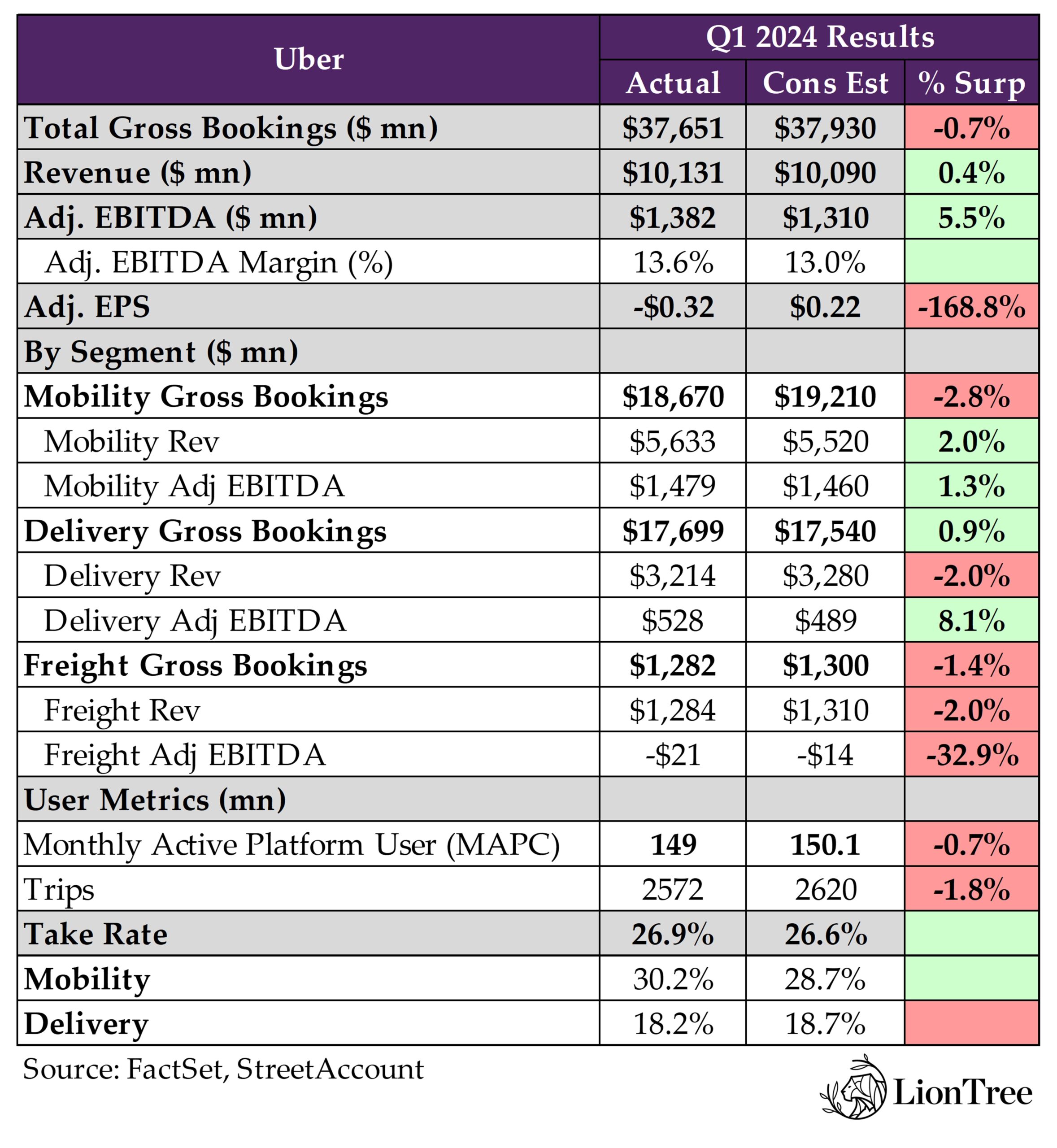
Q2 Guidance Accounts For Similar Patterns As Q1
- Q2 adj EBITDA guidance was in-line w/ cons at the midpoint: $1.45-1.53bn vs cons $1.49bn (+58%-67% y/y growth)
- Q2 gross bookings guidance slightly missed at the midpoint: $38.75-40.25bn vs cons $40bn (+18%-23% y/y growth)
- Expect similar trends in Q2 in each of the three variables as seen in Q1
- Audience (how many users of the product)
- Frequency (how often the product is being used)
- Pricing
- FX will also be a headwind: Outlooks assumes ~-3ppt currency headwind to total report y/y growth, including ~-5ppts currency headwind to Mobility’s reported y/y growth (primarily from the Argentine peso)
- “Exactly where they want to be” on 3-yr CAGR outlook: Back in Feb, the Co guided for “mid to high teens” growth
- Expect similar trends in Q2 in each of the three variables as seen in Q1
Mobility Gross Bookings Were Impacted By Timing Shifts And Seasonality / Expect Investments To Ramp Back Up In Q2 Causing Some Margin Lumpiness
- Mobility missed on gross bookings but beat on all other fronts in Q2
- Gross bookings growth decelerated seq to +26% y/y CC, down from +28% y/y CC in Q1 and +30% y/y in Q4, missing cons by -2.8%
- What drove the decel? ~1pt came from deconsolidating the non-ride sharing portion of their Careem biz in Dec, which used to be included in Mobility’s results; Seasonally, LatAm last year saw stronger demand in Brazil around Carnival that did not recur in Q1 of this yr, and Easter and Ramadan shifted between the qtrs, creating some lumpiness on a comp basis
- Revenue growth also decelerated seq to +29% y/y CC, down from +31% y/y CC in Q1 and beat cons by +2.0%; Rev increase y/y was primarily attributable to an increase in Mobility Gross Bookings due to an increase in Trip volumes
- EBITDA margin of 7.9% was a continued step up from 7.5% in Q4 and 7.2% in Q3; Margin improvement y/y was primarily driven by better cost leverage from higher volume
- Take rate of 30.2% came in above cons 28.7%
- Gross bookings growth decelerated seq to +26% y/y CC, down from +28% y/y CC in Q1 and +30% y/y in Q4, missing cons by -2.8%
- Held back some investments in Mobility in Q1 due to seasonality trends, which will ramp back up in Q2: This will cause some lumpiness in Mobility margins, but they remain “very confident” that Mobility is still on a “great trend” for continuous margin improvement
- Active driver growth continued to pace down q/q: Active drivers were up +29% y/y (vs +30% y/y in Q4 and +32% y/y in Q3)
- India crossed 1mn drivers for the first time ever in March, becoming the third country globally to do so
- Where is growth in Mobility coming from?
- “Most significant part of growth is coming from audience”: MAPC growth in Mobility was up +17%, outpacing overall MAPC growth of +15% y/y
- US growth is also “very, very healthy”: Don’t disclose US vs non-US growth, but US is their largest market in terms of gross bookings so “we wouldn’t be able to grow at these rates…without the US growth being very, very healthy”
- New products have been a “particular area of growth” and “introducing a whole new audience to our marketplace”: Looking across Hailables, U for B, Reserve, UberX Share, their new health biz, these new growth bets are growing ~80% y/y, and 20%+ of new customers are coming from the new product category
- Shared Rides gross bookings were up 6x y/y, as they continue to optimize the product
- Further scaled taxi offering in Q1, “significantly” growing taxis in New York City and Los Angeles and officially launching Black Cabs on Uber in London
- Uber Business continues to see “strong adoption” of premium products, with 50% of corporate travel activity on Uber happening on products like Business Comfort, Uber Black, and Reserve
- Work commutes are making a comeback post-pandemic: Workday session growth consistently outpaced leisure, holiday, and late-night session growth, while managed Uber for Business Gross Bookings were up 40%+ y/y
- Airport growth, especially internationally, was “particularly strong”
Being Aggressive, But Strategic, About Building Out Use Cases For Delivery
- Delivery results were a mixed bag in Q2
- Gross bookings grew +17% y/y CC, which was in-line with Q4 and beat cons by +0.9%
- “Our US and Canada growth rates are actually higher than that”
- But revenue grew +4% y/y CC, which was in-line with Q4 and missed cons by -2.0%
- Record adj EBITDA margin of 3.0% was a continued step-up from 2.8% in Q4 and 2.6% in Q3; Margin improvement y/y was primarily driven by better cost leverage from higher volumes and increased Advertising revenue
- Take rate of 18.2% was below cons 18.7%
- Gross bookings grew +17% y/y CC, which was in-line with Q4 and beat cons by +0.9%
- Other key milestones in Q2 –
- Delivery MAPC growth accelerated y/y across many top markets, notably the US, Canada, and Mexico
- Order frequency reached an all-time high
- Reached a milestone of 1mn+ active merchants, up +12% y/y
- What’s been driving accelerating Delivery growth?
- Most of the growth last year was on price: Was growing closer to 10% early last yr, now growing in the teens, and “the nature of that growth is improving as well”
- Now, price is a “relatively small portion” of the growth, and audience and frequency are the largest portion of the growth
- Have “a great service” and “a significant selection” (active merchants are up +12% y/y)
- Improving pricing (i.e., merchant-funded promos are up +100bp y/y, lowering effective price to consumer)
- Quality – continue to improve their defect rate
- Continue to spend “aggressively” to market the brand
- Cross-Platform benefits between Mobility and Delivery
- Announced partnership with Instacart – “this partnership is about playing offense”: Uber Eats will not power restaurant delivery on the Instacart app; This is “another growth vector for our US Delivery audience. We’ll be able to reach new consumers who are currently not active on Uber Eats, giving us an opportunity to improve our category position in key areas like the suburbs”
- BUT “make no mistake: we remain committed to executing against our Grocery & Retail strategy
- Expect similar partnerships in the future? Partnerships b/w Instacart and Uber Eats relied on tech already used to integrate Uber Eats into the Uber app; “Going forward, we can leverage this same tech for similar channel partnerships”
- Remain “very positive” on grocery and retail as biz growth “remains quite strong”: Gross bookings are up ~40% y/y, and despite that strong growth, they were still able to expand Delivery EBITDA margins, which was partly contributed to by improvement in the profitability of the grocery biz
- Still not at positive EBITDA margin, but it is improving q/q and y/y
- Continue to expand offerings: Making progress on grocery selection; Consumers can now benefit from grocery loyalty programs while shopping on Uber Eats, with in-app access to member prices and discounts at certain grocery merchants
- “Feel very good about the path we have to getting profitability on grocery” – drivers will be:
- Power of the platform: ~15% of Delivery users are ordering groceries, which is up q/q and y/y
- Continue to see oppties on ads, which are margin accretive as they bring CPG players into the platform for grocery advertising and lowering some of the consumer promotions they have
- “We think that grocery will eventually be a very strong part of the overall portfolio”
- Suburban strategy for Uber Eats? “Very similar” to general strategy for Delivery biz: Generally growing faster in the suburbs than in urban destinations (where they have higher penetration)
- How does Instacart partnership fit in? “Represents the addition of a very high quality and highly targeted suburban audience to the Uber Eats ecosystem and to our merchants. And we think that additional demand from this high-end consumer is going to be welcomed by our merchants… we definitely think that the Instacart deal puts us in a better position for growth going forward in the suburbs”
Push For Continued Uber One Adoption Is Working As Subscription Fees Pass The $1bn Mark
- Uber One membership fees are now in excess of $1bn
- “We think there’s a lot more growth there”
- Uber One strategy is largely the same domestically and globally
- Uber One members now generate 32% of Mobility and Delivery gross bookings (up from 30% in Q4)
- Make up 45%+ of Delivery gross bookings “where generally we’re more highly penetrated”
- Uber One members spend 3.4x as much as non-members per month
- Working on “a bunch of pretty exciting new initiatives”
- Continue to optimize the use of Uber Cash for Mobility: 25% of Uber Cash earned on Mobility in the US is being redeemed on Delivery, which is up from “mid-teens” when they originally rolled out the benefit; Business riders can also get Uber Cash, and they’re seeing 60%+ of Uber Cash on Mobility being redeemed on Delivery as well
- Introducing cash back accelerators, where Uber can increase the cash back amount for any product to the extent they’re trying to drive the product
- More member exclusives coming up, where members have exclusive access to events and experiences “which will surprise and delight our members”
- Moving more members on a global basis to annual pass: Annual pass results in “significantly higher” retention rates (retention increased ~200bps y/y in March)
- Continue to optimize the use of Uber Cash for Mobility: 25% of Uber Cash earned on Mobility in the US is being redeemed on Delivery, which is up from “mid-teens” when they originally rolled out the benefit; Business riders can also get Uber Cash, and they’re seeing 60%+ of Uber Cash on Mobility being redeemed on Delivery as well
Non-Restaurant Advertising Is A Key Area Of Focus, With Grocery Being Viewed As A Particularly Big Oppty
- Expect to beat $1bn advertising revenue target for the year
- Non-restaurant advertising “is still really in nascent stages” vs restaurant advertising (which has reached 2% of gross bookings)
- Think that Uber’s “sponsored items” product can surpass restaurant advertising’s 2%: For example, mgmt. flagged that Instacart is in the mid-2s in terms of advertising as a %age of gross bookings; “Sponsored items is [at the point] where we were in sponsored listings for restaurants three years ago”
- Fully launched sponsored items in UCAN, and it is now being scaled to 8 addtl priority mkts in 2024
- Active w/ ~500 top CPG brands and seeing “very strong retention as we expand”
- “Really, it’s going to be about the growth of the underlying grocery platform…we think it can be an enormous opportunity, and it can a high-margin opportunity as well”
- Increasing grocery audience: ~15% of monthly actives on Eats bought from grocery in Q1, which is up y/y
- New advertising oppties w/ Instacart partnership: When users click through Instacart and they come to the Uber Eats web view app, they are shown Uber’s ads as its Uber’s space to use and monetize
- Remain “quite bullish” on rider ads: Seeing “very strong” engagement from riders, with a click-through rate of 2.5%+, vs the industry avg of <1%; Video ads and tablets “continue to be a very promising growth area for us”
Not Feeling Much Of An Impact From Minimum Wage Regulations As A Co, But Find That It Is Hurting Couriers, Customers, And Merchants
- Update on European gig economy regulation? EU lawmakers “essentially voted to maintain a status quo there with platform worker status continuing to be decided on a country-by-country basis. Member states have until mid-2026 to implement that”
- Uber’s POV: Think that the deal is “really unlikely” to bring major changes to the current situation in “the vast majority” of EU countries
- Impact of minimum wage regulation in Seattle and New York? “Think some of the regulation that we’ve seen has actually been very unpopular with couriers, restaurants, and customers”
- Seattle: Delivery order volumes decreased -45% y/y, which has resulted in courier wait times increasing +50% y/y; Couriers are making more per order, but getting “a lot less” orders, which has resulted in 30% of active couriers leaving the platform
- Seattle city council is bringing forward reform to make the standard “lower and much more viable” for the platforms: “We think we’ll have a positive outcome there”; Believes Seattle’s “poor regulation… has hurt the people that they’re supposed to protect”
- New York: Similarly, have had to slot couriers; Have a waitlist of 20k+ couriers who want to be on the platform, but because of the regulation, have had to reduce the number of couriers on the platform by ~25%
- Seattle: Delivery order volumes decreased -45% y/y, which has resulted in courier wait times increasing +50% y/y; Couriers are making more per order, but getting “a lot less” orders, which has resulted in 30% of active couriers leaving the platform
- Have been able to absorb the financial hits of all these different regulations, as seen in Uber Eats profitability being up +83% y/y
- “We’re a big company with a lot of markets. We’re quite diversified. Our technology continues to drive a more effective marketplace that allows us to absorb these regulations”
- “We’re hoping that…regulators see the path going forward because so far regulation has definitely hurt the people that it’s supposed to protect”
Uber Is Looking To Get In Early And Partner With The Autonomous Vehicle (AV) Industry For The Long-Term
- AV impact on Uber and potential for new competition? “AV technology at maturity is going to be very good for the industry [and] it’ll be great for Uber”
- Will make rides safer
- Will expand the marketplace by lowering prices which usually means higher adoption
- BUT tech will take a long time to develop and a regulatory framework needs to be put in place, making the transition from human drivers to AV “relatively long”
- Individual and fleet owners of AVs will make more money and have a higher ROI if they include their car into the Uber ecosystem and into Uber demand
- Technology – for pricing, matching, routing algorithms, payments, etc. that are already in place on a global level
- Demand – which enables them to partner with these AV providers to drive utilization of their assets
- Have been expanding existing partnerships
- Waymo: Building on their successful Waymo partnership offering fully autonomous rides on Uber in Phoenix, have now expanded to autonomous deliveries on Uber Eats
- Cartken / Mitsubishi Electric: Expanded partnership with Cartken and partnered with Mitsubishi Electric for autonomous robot deliveries in Japan, the first international market to have autonomous delivery on Uber Eats
- “We’re looking to partner with big players and small platforms…as this technology develops, we think we will be a big partner in it”
Instacart Hitches Its Cart To Uber To Drive Another Avenue Of Growth
Instacart’s announced partnership with Uber took center stage this week. While most Americans shop for groceries (online or in a store) at least once per week, more than one-third also order takeout or delivery at least once a week, and this partnership helps the Co to service that need as well. While details on the partnership were limited, Instacart gets paid an affiliate fee and will have “positive unit economics” right out of the gate. Its Instacart+ subscribers will also love this, as it provides more value for their current subscription. Progress on this key tie-up will be closely followed…
Regarding Q1 results, they were better-than-expected, especially on the adj EBITDA margin side (24.1% vs cons 19.9%). Gross transaction value (GTV) also accelerated for the fourth consecutive qtr to +11% y/y. The drivers were: 1) improving mature cohort declines and bigger new cohorts than pre-pandemic levels; 2) A lessening of the y/y EBT SNAP headwind, which had the biggest impact in Q4 but a smaller impact in Q1 primarily because of the successful EBT SNAP launches with Kroger and Costco; and 3) Some one-time items. What didn’t go over as well was that GTV growth will likely decelerate sequentially in Q2 to +7-9%, given that the benefit of the leap day is largely expected to be offset by EBT SNAP moving from a modest y/y headwind to a tailwind from Q1 to Q2.
Another focus area was advertising, considering the big opportunity ahead. The guidance that Q2 y/y ad revenue growth will be roughly similar to Q4 and Q1’s levels (+7% and +9%, respectively) was lower than hoped, and it sounds like some large brand relationships pulled back. Given the Instacart’s customer concentration, it was hard for the company to avoid an impact. However, management is working to diversify its advertiser base and is still guiding for an investment rate of 4-5% of GTV over time vs the 2.6% seen in Q1.
Caper Carts are also seen as a significant long-term opportunity for the company. Early customer feedback has been positive, and grocers are excited about the ad options there as well.
The questions about competition always come up on the conference calls, particularly given Amazon’s recent announcement regarding its new grocery delivery subscription for Prime members and EBT cardholders (link). But Instacart still believes it is best positioned in the grocery space due to the company’s technology integrations, breadth of longstanding retailer and brand partnerships, and ability to deliver a great customer experience. The Co also has a significant 1P data advantage. Lastly, along with earnings, Instacart announced a C-suite change with a new CFO, Emily Reuter (former exec at Uber), coming in to replace Nick Giovanni.
See below for more on what we thought was most incremental and interesting from Instacart’s Q1 results and call.
-> Instacart shares pulled back -1.4% in reaction to the print but is still trading up +48.9% YTD; Instacart stock is up +16.5% from its IPO price
Strong Q1 With Better Financial (Especially Margins) & User Performance
- Continued acceleration of GTV y/y growth, which beat cons by +2.3%: Grew +11% y/y in Q1, up from +7% y/y in Q4, +6% y/y in Q3, +6% y/y in Q2, and +3% y/y in Q1)
- Total rev grew +8% y/yand beat cons by +3.3%
- Transaction revenue grew +8.0% y/y and beat cons by +4.4%
- Advertising & other revenue grew +9.0% y/y and was ~in-line with cons
- Adj EBITDA grew +17% y/yand beat cons by +25.0%; It was 2.4% of GTV (vs 2.5% in Q4)
- Order growth y/y also improved for the fourth consecutive qtr:Grew +9% y/y to reach 72.8mn, and average order value (AOV) of $114 was up +2.0% y/y
- Repurchased ~27mn shares worth $751mn: Have total capacity of $249mn left in its existing authorization
- “We plan to opportunistically repurchase shares”
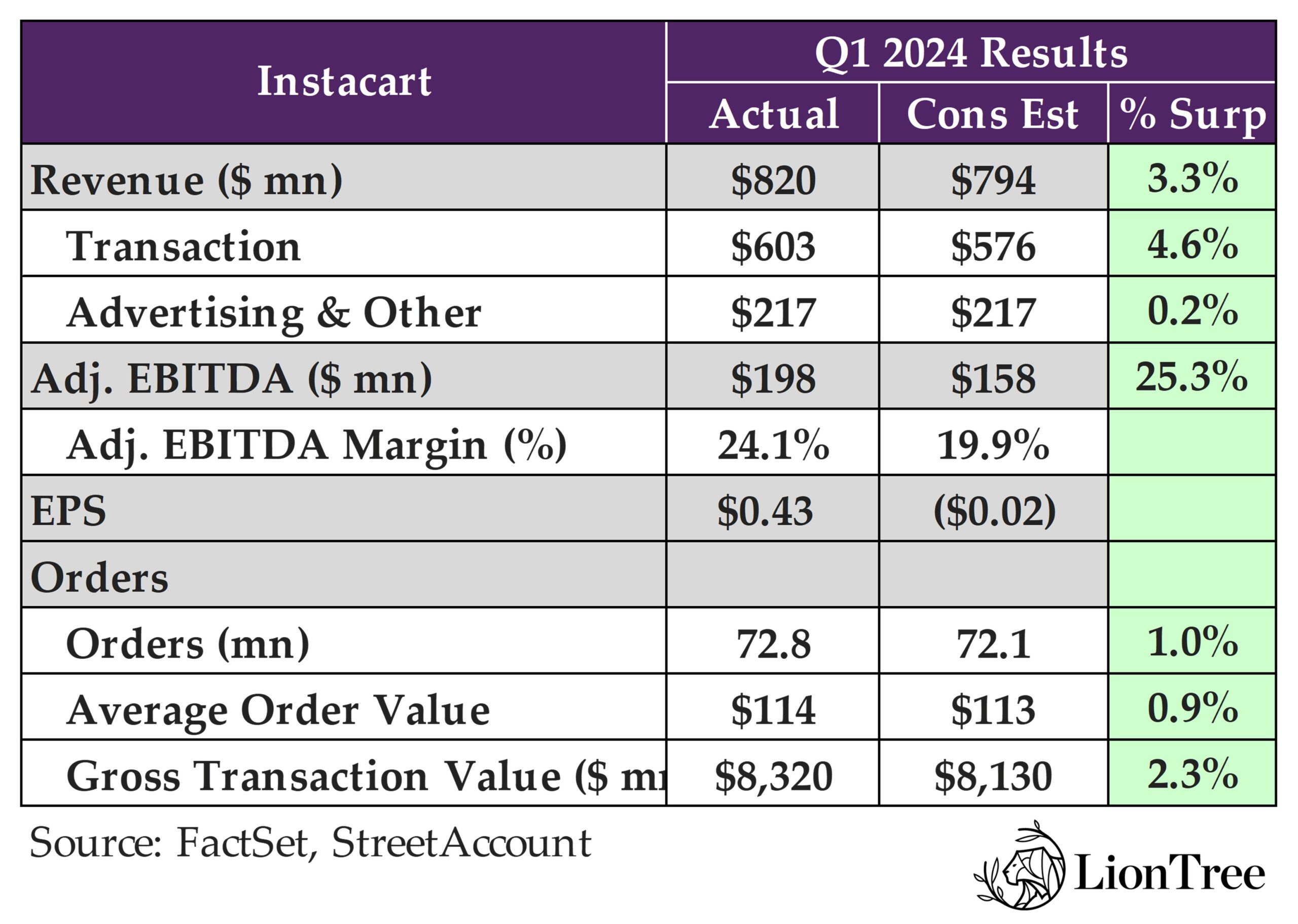
Q1 GTV Outperformance Benefitted From New Cohort Growth, Plus Some 1 Timers…
- Q1 GTV outperformance benefitted from:
- Cohorts: Cont’d improvement in cohort dynamics where mature cohort declines continued to improve, and new cohorts continue to be bigger than pre-pandemic cohorts
- EBT SNAP: Also saw lessening y/y EBT SNAP headwinds, which had the biggest impact in Q4 and a smaller impact in Q1, primarily because of the successful EBT SNAP launches with Kroger and Costco
- One-time items: It included just over 1 %age pt of growth from leap day, in addition to stronger than expected seasonality, as Q1 was an “exceptionally bad winter season”, especially vs the prior yr qtr
…BUT Q2 GTV Growth Will Slow Seq Due To Lack Of One-Timers, While Q2 Adj EBITDA Guidance Is ~In-Line
- Q2 guidance for GTV y/y growth will be in the +7-9% range vs Q1’s +11%: The seq slowdown is primarily due to the not having the benefit of inclement weather, and while Q2 also will not have the benefit of leap day, this will be offset by EBT SNAP moving from a modest y/y headwind to a tailwind from Q1 to Q2
- The guidance is still a step up from Q4’s +7%
- Q2 adj EBITDA guidance is ~in-line: Mid-pt of $180-$190mn compares to cons $184mn
- Implies adj EBITDA as a % GTV at a low of 2.2% and a high of 2.4%; Q2 y/y growth will be driven primarily by transaction revenue and adj OpEx leverage
Advertising Growth Has Yet To Accelerate, But The Opportunity Remains Large
- Q1 Advertising & Other rev growth was flat seq: Grew +9% y/y in Q1 vs +7% in Q4 and +19% in Q3
- Q1 Advertising & other investment rate was +2.6%, down -7 bps y/y, BUT the Co still expects it to reach 4-5% of GTV over time
- Have said in the past that growth towards the target will not be linear and that Advertising & Other revenue growth typically lags GTV growth on a multi-quarter basis
- Q2 ad revenue growth guidance is to grow “largely in-line” with the growth rate the last 2 qtrs… Why not accelerate?
- Has thousands of brands that are growing double digits BUT also has some concentration with large brands, so they see an impact when some large advertisers face challenges with their business
- However, many brands are under-indexed to spend
- The Co is focused on diversifying the advertiser base; Now that it has proof points on measurement and data, it is working to convince existing brands to spend more and bring in new brands
- Conviction regarding the advertising opportunity is high
- Off-platform advertising is also important: In addition to the measurements, improvements, targeting, and more, which is “really [Instacart’s] bread and butter”, the Co has been expanding partnership with Google, recently NBCU, and The Trade Desk; Instacart has been taking the data and the strength of its targeting and audiences and applying it to advertising platforms outside its ecosystem
- Have taken a similar approach w/ retailer ads, where the Co power ads on retailers’ websites; “That’s also a way to continue growing the ad business”
- Caper carts will drive the ads business as well longer-term
- Instacart is “an incredible place for advertisers to reach customers”
Uber Partnership Is A Significant Step In Category Expansion & Platform Utility
- Instacart partnered with UBER Eats to enter into the “Restaurant Delivery” category: Creates a combination of grocery and hundreds of thousands of restaurants options for Instacart customers.
- Expect to see “Restaurants” tab in the app in upcoming weeks
- Instacart+ members that pay $99 per year or $9.99 per month for free grocery deliveries over $35 will also get free restaurant delivery for orders over $35
- Regular Instacart members will be charged Uber Eats delivery fees
- Most Americans shop for groceries — either online or in a store — at least once per week, but more than one-third also order takeout or delivery at least once a week: Instacart wants to meet that need as well
- Instacart has incremental audiences that Uber does not have, especially with families in the suburbs, that they want to leverage for restaurant partners as well
- The partnership has positive economics for Instacart
- The deal adds a number of restaurants options overnight with “positive unit economics”
- Management said “this is something that’s going be incredibly accretive to the Instacart user”
- The IC+ membership becomes twice as valuable with no delivery fee on grocery and restaurant orders over $35
- Instacart will be getting an affiliate fee from Uber on orders that they send to them through their app
- Mgmt thinks they are “also going to be investing on top of that to ensure success of the sis and adoption”
- The end-goal of Instacart through this agreement is to make the app more engaging and a more frequent use case by getting more IC+ subscribers
Continue To Further Improve Platform Offerings
- Marketplace Player Dynamics
- Retailers – 85% of market represented on Instacart: Have “a very big” selection advantage share by partnering with 1,500+ retail banners.
- Shoppers supply is “extremely healthy”: Seeing high satisfaction amongst shoppers, and 80% would recommend others to shop for Instacart
- Ramped up EBT SNAP with Costco and Kroger.
- Increased the delivery area for more stores, which allowed nearly 80% of customers to gain access to at least one new retailer
- Completed nationwide rollout of same-day delivery from Kohl’s on the Instacart Marketplace.
- Launched alcohol delivery in Las Vegas in February ahead of the Super Bowl and expanded alcohol coupons for spirits and wine-eligible states, including California and Florida
Bullish On Prospects For Caper Carts
- “Consumers love to use the carts”, and some initial data shows that “people that use the carts have higher basket sizes”
- Deployed Caper Carts with Kroger, Schnucks, and Wakefern: The Co also signed a new Caper agreement with The Save Mart Companies, which is also adopting several enterprise platform products, including Storefront Pro and FoodStorm, that will connect to Caper to deliver a full omnichannel shopping experience
- Expect to have thousands of carts deployed by the end of the year: Management wants to see the response to these deployments, but they said “it could scale to many more”
- Are confident that “this is something that will get a lot bigger, especially as you look to 2025”
- Mgmt is focused on driving the hardware costs down, but it is not hindering deployment
- Grocers are excited about the advertising possibilities with Caper Carts: It’s a new incremental line of business for grocers to add advertising inside the store on the screen of Caper carts, and it’s a source of revenue for Instacart that can justify putting more of the costs out there
The Low-End Consumer Has Been More Pressured & Instacart Is Focused On Improving Affordability
- Obsessed about affordability… The Co has seen a resilient consumer, but on the lower-end, people are trying to stretch their budget and do more planning: Want to make it easy for these customers to get the best deals and shop multiple retailers to get the best deals
- Pickup is a big part of the Co’s affordability strategy because it is a cheaper option for category of consumers that value price over convenience
- Made it free this quarter to use pickup
- This is a different customer – 75% of pickup orders are incremental
- Instacart is expanding pick-up with large grocers like Kroger, Albertsons
EA Continues To Point To Greener Pastures On The Horizon
Although the EA had previously cautioned that a lighter content release slate and a difficult comparison to the prior year’s performance would result in a -8bps headwind to net bookings during the three-month period ended in March, EA’s net bookings performed even worse than feared, dropping -14.4% y/y in FQ4 (vs +1.0% y/y in FQ3) and missing consensus estimates by -6.4%. Similarly, on the profitability side of the equation, EA had warned on its FQ3 call that it decided to phase some marketing costs into FQ4; however, the impact of this decision appeared to be more negative than the Street anticipated, as the company’s non-GAAP operating margin of 25.9% finished -190bps below forecasts. Adj EPS also finished -9.9% below expectations. Nonetheless, returning capital remains an “important priority” for the company, and despite its underwhelming financial results, EA annc’d that it would extend its stock repurchase program an additional year – a small concession for shareholders.
Regarding the individual performances of EA’s key franchises in FQ4, the lack of disclosure on its earnings call this week was notable. Whereas the company had consistently provided updates on the net bookings growth seen by EA Sports FC, Madden NFL, Apex Legends, and some of its other hit titles, this color was absent on this earnings cycle. Likewise, there wasn’t any commentary on the performance of recently released sports titles that were heavily promoted previously, including EA SPORTS UFC, NHL, and World Rally Championship. Visibility into EA’s mobile business was also opaque, though the company alluded to headwinds related to prior portfolio optimization efforts and an extended development cycle that it expects to continue “over the next 12 months or so”. Looking ahead, investors will likely receive more insight into some of the dynamics affecting EA’s development pipeline at its September Investor Day.
In the meantime, EA will continue to face “challenging” headwinds associated with the “atypical seasonality” of its release slate as well as a “highly competitive” landscape within interactive entertainment. This was reflected in the company’s broadly underwhelming outlook for FQ1, which guided for net bookings and adj EPS that were -16.1% and -49.4% below consensus estimates, respectively. Still, there weren’t any “material” shifts in EA’s forecast for the whole of FY25, as the company still anticipates ~+lsd% y/y bookings growth and a ~+lsd-msd% y/y improvement in profitability. Longer-term, EA also indicated FY27 GAAP operating margins could expand by another +300-350 bps over 2025’s levels. That said, given the slippage in the company’s performance relative to the long-term targets it previously issued, its ability to achieve these new goals will be under heavy scrutiny by investors.
See below for more details on what we thought was most incremental from EA’s FQ4 earnings release. (Also see Theme #9 for more insights and updates in the interactive entertainment sector this week with Roblox, Applovin, and Unity reporting)
-> EA shares were down -3.8% in reaction to earnings and closed the week down -1.9%; YTD, EA stock is trading -7.1% lower but has outperformed Take Two stock, which is down -9.4%
EA’s FQ4 Was Impacted By Slate Timing & A “Highly Competitive Qtr”
- EA’s headline results mostly underwhelmed expectations: FQ4 net bookings fell -14.4% y/y (vs +1.0% y/y in FQ3), closing -6.4% below cons; Non-GAAP gross margin of 80.4% (vs 78.4% in FQ3) topped cons 79.3%, while non-GAAP op margin of 25.9% (vs 41.2% in FQ3) fell short of cons 27.8%; Adj EPS missed by -9.9%
- Live Services (~84% of net bookings) – MISS: Net bookings decr’d -13.3% y/y in FQ4 (vs +1.0% y/y in FQ3), ending -9.6% behind cons, Excluding the impact of sunsetting Apex Mobile, Live Services net bookings growth was ~flat y/y, as gains in EA SPORTS FC were offset by declines in Apex Legends
- Full Game (~16% of net bookings) – MISS: FQ4 net bookings incr’d +3.6% y/y (vs -5% y/y in FQ3) but still came in -3.4% below cons; Downside was primarily driven by slate timing
- Reminder – A -8bps headwind to net bookings growth was expected entering FQ4: Given the lapping of content releases in the prior yr, including EA SPORTS FC’s record-breaking performance
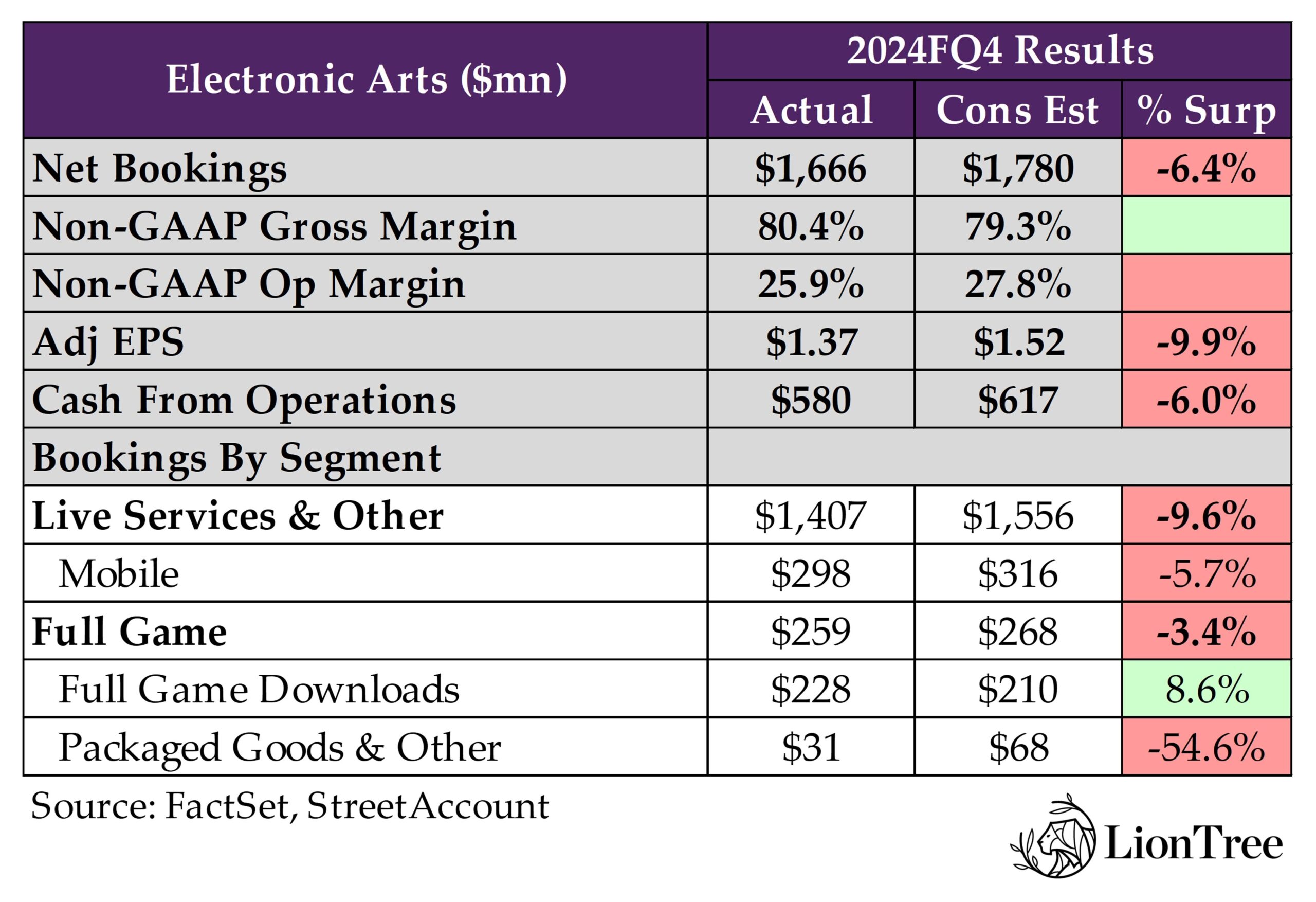
The Forward Outlook Was Broadly Disappointing
- FQ1 top and bottom-line guidance was far weaker than anticipated: Expects net bookings was -16.1% below cons and would mark a -24% y/y decline at the mid-pt; The adj EPS range was -49.4% below cons at the mid-pt
- “Challenging” headwinds related to slate timing and “atypical seasonality” are expected to intensify: Projects a -15bps impact in FQ1 (vs -8bps in FQ4) related to release and content timing vs the prior yr’s three addt’l title launches
- Addt’l guidance items: Projects net rev of $1.575-1.675bn, cost of rev of $240-250mn, and OpEx of ~$1.065-1.85bn, resulting in an adj EPS of $0.30-0.50
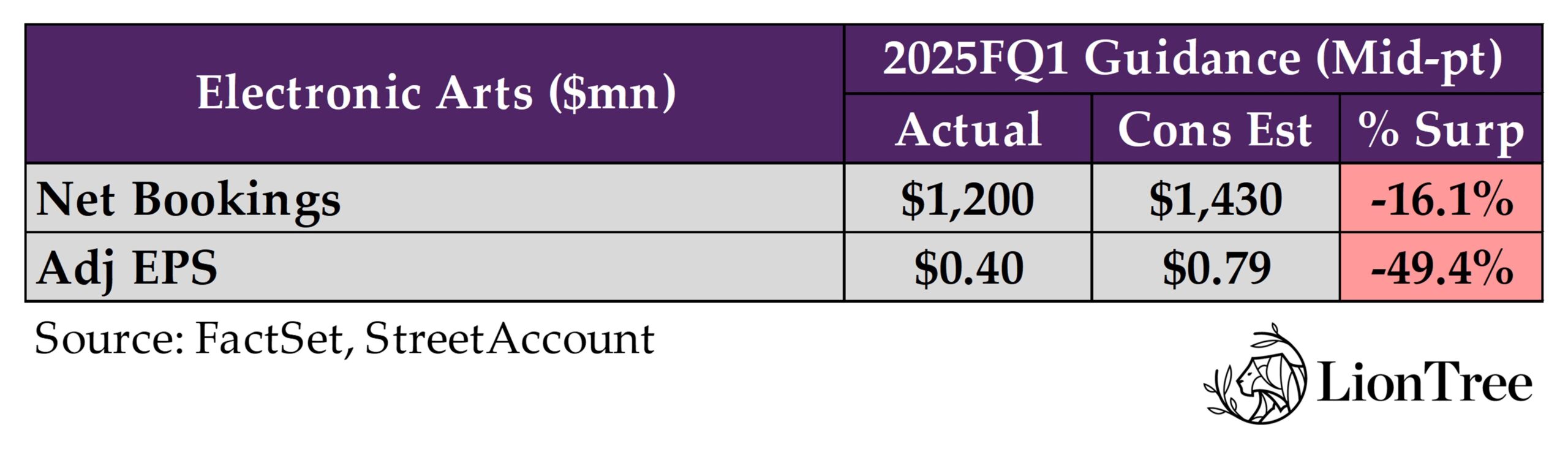
- FY25 guidance also missed estimates due to a lighter release slate: Projects a FY25 net bookings range of $7.3-7.7bn, missing cons by -3.1%, and adj EPS between $7.05-7.85, which was -2.0% below cons at the mid-pt
- BUT the FY25 outlook reflects “no material… shift” from prior forecasts: Previously, EA forecasted ~+lsd% y/y net bookings growth and a ~+msd-hsd% y/y rise in profitability; Anticipates ~+msd% y/y growth in core live svs, partially offset by fewer title launches, lighter catalog contributions, and headwinds in mobile
- Growth in EA’s core live svs biz is expected to outpace the mkt’s ~+msd% y/y rate: Along w/ adding College Football in Q2, Apex is expected to return to growth and EA SPORTS FC will continue to expand
- Mobile net bookings are expected to increase ~+lsd% y/y: Excluding the sunsetting of titles
- Addt’l guidance items: Expects net rev between $7.1-7.5bn, an OpEx range of $4.35-4.44bn, GAAP op margin between 18-20.6%, and a non-GAAP op margin between 29.6-31.7%; “Focused investment” will be offset by less mkting spend and acquisition-related expenses
- FCF is projected to be slightly lower y/y: Sees FCF of $1.85-2.05bn, a touch below $2.12bn in FY24, though ~flat y/y when excluding a one-time cash tax benefit
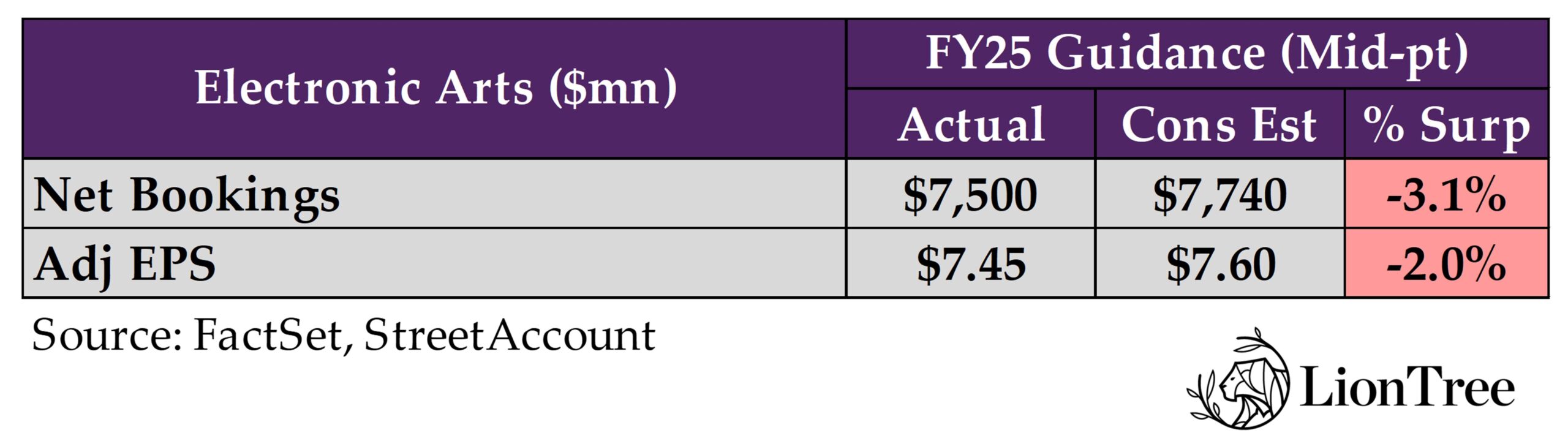
- FY27 GAAP op margin is expected to expand another ~+300-350bps (over FY25): Non-GAAP op margin is projected to increase another ~+150-200bps by FY27, driven by growth in the core biz from augmenting player acquisition, engagement, and retention as well as leverage in the cost structure and investments
- The Co doesn’t anticipate any addt’l impact from change in deferred rev
EA Continue To Tout The Attractiveness Of Top Franchises
- “Consumer attention and spend are increasingly consolidated in top franchises”: Highlighted that engagement for the top 10 franchises in North America have incr’d mkt share since FY22, presenting the Co w/ an “incredible oppty to evolve as an industry leader”
- EA remains focused on fostering a “deep sense of social connection” w/ its games: The Co is “really thinking” about how it engages players “across the expansion of play” and has been “inviting them to connect and expand and extend and enhance” the worlds it creates
- Converting gaming IP into TV shows and movies is expected to be a tailwind: The Co sees that gaming IP within film & TV has been “topping those charts in addition to topping the interactive entertainment charts”, and it expects to “see more of that” moving forward
“Blockbuster Storytelling” Remains A Core Focus, Though The Co’s Disclosure Of KPIs Was Limited
- EA SPORTS FC growth accel’d seq, as comps eased somewhat but will remain tough moving forward: EA Sports FC net bookings grew in the “high-teens” in FQ4 (vs +7% y/y in FQ3 and +41% y/y in FQ2), though the prior qtr was comp’d against the 2022 FIFA World Cup
- FC Ultimate Team delivered ~+lsd% y/y growth: This result followed double-digit net bookings growth in FQ3) but also came on top of “record” +20% y/y growth in FQ4:23;
- “FC Mobile and FC Online declined y/y”: Pointed to “record” comps in the prior yr period from World Cup tailwinds as the main reasons for this but didn’t provide specific numbers on KPI growth
- Growth in EA Sports FC will “continue to face difficult comp periods” in the near-term: The Co reiterated that FQ1:24 was the “largest Q1 in Co history for [its] global football franchise”
- Apex Legends faced difficult comps, but investments will continue: Indicated engagement and monetization levels were “elevated” early in FQ4 but “returned to prior norms” later; That said, EA underscored that player sentiment and engagement “remained strong” and that retention was also “great”
- EA continues to invest behind Apex to drive growth in the franchise in FY25: The Co expects to release some advancements and innovations over the next couple of seasons and believes these will help expand the franchise’s appeal to “new and more casual players”
- Apex community sentiment improved +29pts over FY24: Shows how the Co has a “great oppty… to continue to grow and expand that live svs”
- FQ4-specific color on Madden NFL’s performance was sparse: EA didn’t provide data on growth in Madden NFL bookings after reporting that the franchise’s net bookings grew +5% y/y in FQ3 and +6% y/y in FQ2
- NFL off-calendar events have been driving engagement beyond the regular season: The Co saw increases in weekly active users among younger audiences leading into and following the Super Bowl; The NFL Draft also led to roster changes in Ultimate Team, helping to spur interest in the franchise
- Madden NFL 24 has seen record overall net bookings: The game was the highest-selling installment for Madden since the early 2000s
- There was no mention of how recent releases EA SPORTS UFC, NHL, and World Rally Championship have performed
- More details on the Co’s development pipeline will be unveiled at its September Investor Day
EA Is Taking The Long View W/ Its Mobile Biz
- EA didn’t provide an update on how FQ4 Mobile net bookings performed either: Last qtr, EA reported that its mobile net bookings were up +5% y/y, excluding the impact from lapping difficult Apex comps from the prior yr
- The Co sees growth oppties in its Mobile biz “over time” …: EA believes its teams are “aligned and more empowered than ever” to capitalize on mobile being the largest platform in the gaming industry
- EA continues to make strategic investments in standalone mobile titles: The Co has been looking at oppties to invest in a “very limited number” of mobile titles w/ “breakout potential”
- The Mobile biz is in a “very good position given its profitability”: The Co plans to lean into its “massive online communities” around FC, Madden, and The Sims moving forward
- … BUT expects headwinds to persist in the nearer-term: Forecasts ~+lsd-msd% y/y growth in the mobile biz “over the next 12 months or so”, as portfolio optimization decisions taken over the last six months are projected to remain an obstacle throughout FY25
- “The mobile mkt remains a fairly high-risk oppty”: Explained that that mobile requires “significant user acquisition cost” to ramp up a new mobile game, while development cycles have become “increasingly longer”, lasting 2-3 yrs and, at times, up to 5-7yrs
- The Co sees growth oppties in its Mobile biz “over time” …: EA believes its teams are “aligned and more empowered than ever” to capitalize on mobile being the largest platform in the gaming industry
Other Notable Comments On Gen AI & Advertising
- EA is still “very early” in its “gen AI evolution”: The Co continues to see “meaningful” oppties in using gen AI to accelerate content development and find operational efficiencies; Has already used gen AI to test more run cycles during FC 24’s development and sees oppties to eventually use gen AI across 50%+ of its development processes
- The Co is also “still early” in its advertising ambitions: EA has been engaging w/ partners like Nike, Pepsi, Uber Eats, and Beats to “unlock new, multifaceted sponsorship and advertising oppties” and expects that advertising will be a “meaningful driver of growth” down the road, given the level of engagements that its platforms drive
Forward Outlooks Cast A Shadow Over The Video Game Infrastructure Space
Following a strong close to 2023 that saw the company print mostly better than expected Q4 headline results as well as a sequential acceleration in the growth of users and engagement hours on its platform, Roblox appeared to hit a road bump in Q1. Although the company’s DAUs beat expectations by +0.5%, it still acknowledged that it saw less growth than anticipated during the quarter, citing a slowdown in platform improvements and the velocity of new content being added to its platform as the main drivers. On a regional basis, Roblox’s DAU numbers in the US and Europe experienced the most pronounced sequential decelerations in growth, while APAC DAUs continued to grow at a fairly consistent rate. Ultimately, the company ended the quarter with mixed headline numbers, as net bookings finished -0.7% below consensus estimates but adj EPS closed a wide +25.6% above forecasts. It was unclear how Roblox’s adj EBITDA compared to sell-side expectations, given that the company had previously provided guidance for its Covenant adj EBITDA, which it is no longer reporting.
Looking ahead, Roblox’s decision to reduce its FY24 outlook only created greater levels of consternation for investors, particularly regarding the interactive entertainment industry’s exposure to a downward turn in the consumer spending environment. Across the year, the company now only anticipates +15.0% y/y growth in net bookings, missing expectations by -4.3% and representing a sizable step down from the ~+20% y/y target growth rate issued at its previous Investor Day. For Q2, despite highlighting improving user trends in the US & Canada beginning in mid-April, Roblox conservatively guided for +13.3% y/y growth net bookings at the midpoint, which was -6.1% below the Street’s estimates. On a positive note, the company’s efforts to develop its advertising business have remained on track and could help offset some of the pressure facing its core business moving forward; however, the segment isn’t expected to have a material impact on results until 2025 at the earliest.
Elsewhere in the video game infrastructure space, Applovin and Unity Software also released their Q1 earnings results, and the ensuing stock reactions told a tale of two cities. Applovin blew away sell-side estimates with its performance during the quarter, as breakthroughs with its AXON 2 model led to a “material amount of growth” during the quarter and underpinned a stronger than expected forecast for Q2. Conversely, Unity’s Q2 guidance fell well short of expectations, though the company reaffirmed its initial FY24 outlook and elaborated on some of the drivers that will support its growth in the near-term.
See below for what we thought was most incremental from earnings across the video game infrastructure space.
-> Roblox shares plummeted -22.1% in response to earnings and ended the week down -19.9%; Applovin shares rose +14.4% on the back of earnings, finishing the week up +15.1%; Unity shares fell -10.2% in reaction to earnings and closed the week down -12.3%; YTD, Roblox stock is trading -31.2% lower and Unity stock is down -47.0%, while Applovin’s stock is up +116.9%
Roblox’s Q1 Results Reflected Some Setbacks In User Growth & Engagement
- Roblox posted mixed headline numbers, as top-line missed but adj EPS and FCF topped estimates: Q1 net bookings were up +19.4% y/y (vs +25.3% y/y in Q4) and closed -0.7% below cons; Total rev grew +22.3% y/y (vs 29.5% y/y in Q4) and beat cons by +4.2%; Adj EPS topped cons by +25.6%, and FCF beat by +20.8%
- It was unclear how adj EBITDA compared to expectations: Despite guiding for FY24 Covenant Adj EBITDA last qtr, the Co is no longer referring to the metric in its results and will report and guide to adj EBITDA moving forward
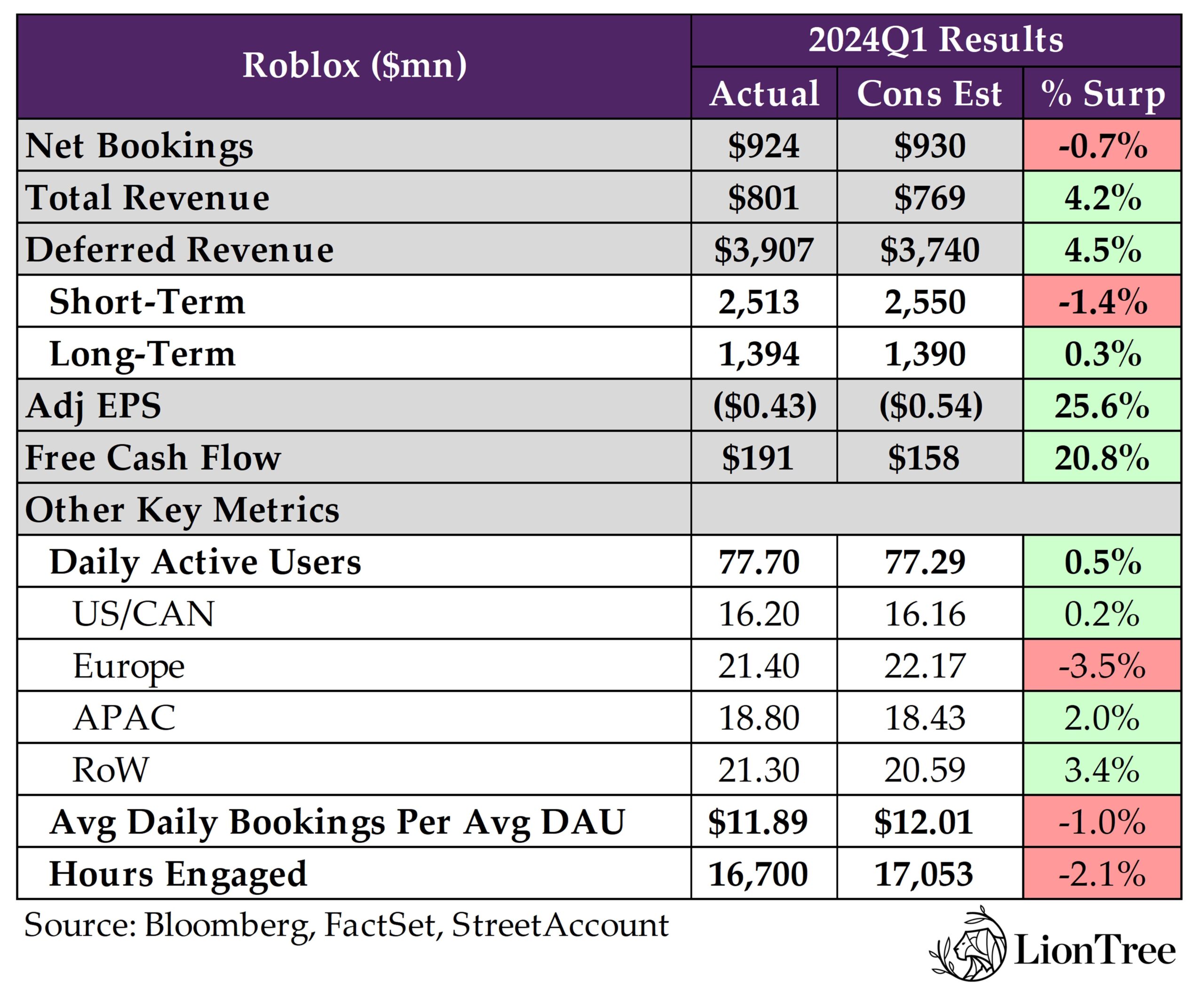
Q2 Guidance Was Weaker Than Anticipated
- Top-line growth is projected to be weaker than Street forecasts and decel seq…: Expects net bookings between $870-900mn, missing cons by -6.2% and representing a +13.3% y/y increase at the mid-pt;
- … While adj EBITDA is expected to improve seq: Sees adj EBITDA between $36-38mn in Q2 (vs -6.9mn in Q1), excluding a total change in deferrals of $11-14mn (a +$18mn to +$23mn increase in deferred rev will be partially offset by a -$7mn to -$9mn increase in deferred cost of rev)
- FCF is forecasted to range from $16-23mn (vs $191mn in Q1): Given net cash and cash equivalents provided by operating activities between $61-68mn and CapEx of ~$45mn
The FY24 Outlook Was Reduced And Underwhelmed Forecasts
- Net bookings guidance was lowered below Roblox’s +20% y/y target rate: The Co now anticipates net bookings between $4.00-4.10bn (vs prior $4.14-4.28bn), which was -4.3% below cons at the mid-pt and would mark a +15.0% y/y increase
- H2:24 y/y bookings growth is expected to slow further from H1:24: Given that the Co will be lapping more difficult comps from its highest growth qtr and other things like PlayStation
- Adj EBITDA is forecasted to range from $95-147mn: This excludes total changes in deferrals of between $435-453mn, including an increase in deferred rev of +$568mn to +$593mn partially offset by an uptick in deferred cost of rev of between -$133mn to -$140mn
- FCF is projected to be between $350-420mn: Sees net cash and cash equivalents provided by operating activities of $530-600mn and CapEx of ~$180mn
- Roblox “absolutely still believe[s]” that its core biz grow at more than a +20% y/y rate in 2025-2027: The Co guided for this growth at its last Investor Day
Growth In Roblox’s Bookings, DAU, & Hours Engaged Fell Below The Co’s Longer-Term Target In Q1
- Growth in DAUs and Hours Engaged decel’d seq: DAUs of 77.7mn incr’d +17.5% y/y in Q1 (vs +21.6% y/y in Q4) but still ended +0.5% ahead of cons; Hours Engaged grew +15.2% y/y (vs +21.1% y/y in Q4), missing cons by -2.1%
- US & Canada – Beat: Q1 DAUs were up 13.3% y/y (vs +17.3% y/y in Q4) and beat cons by a slight +0.2%; Hours engaged rose +12% y/y (vs +16% y/y in Q4)
- Europe – Miss: DAUs incr’d +12.6% y/y in Q1 (vs +20.5% y/y in Q4) and closed -3.5% short of cons; Hours engaged were up +11% y/y (vs +21% y/y in Q4)
- APAC – BEAT: Q1 DAUs grew +26.2% y/y (vs +26.5% y/y in Q4) and topped cons by +2.0%; Hours engaged incr’d +23% y/y (vs +27% y/y in Q4)
- Rest of World – Beat: DAUs rose +19.0% y/y in Q1 (vs +22.2% y/y in Q4) and came in +3.4% ahead of cons; Hours engaged grew +15% y/y (vs +21% y/y in Q4)
- Other regional highlights: Japan saw +50% y/y DAU growth (vs +45% y/y in Q4), while India DAUs rose +58% y/y (vs +59% y/y in Q4)
- Roblox “did see less growth in Q1 than [it] expected”: The Co highlighted a decline in new feature and tech launches after releasing “a bunch” in H2:23 as well as a slowdown in the velocity of new content being added to the platform as the main reasons for this
- The “drift” between bookings, DAUs, and engagement hours was another sign things weren’t where Roblox wanted: Explained that bookings per DAU and bookings per payer have gone up over the last couple of qtrs and that the Co is aiming for over +20% DAU growth (but isn’t necessarily guiding for that)
- BUT US & Canada bookings and DAUs have rebounded in Q2: This started in the last half of April and the first half of May, though the Co still wanted to be “more conservative” w/ its guidance, given this data was only from a three-week period; Factors driving the improvement include –
- Expansions and enhancements to Roblox’s search & discovery system
- A more aggressive approach to live ops and content
- Improvements to its UGC economy w/ new features, such as dynamic price floors
Other KPI Trends Also Showed Some Seq Deterioration
- Growth in 13+ DAUs was “particularly strong” but dipped seq: The Co’s number of 13+ DAUs rose +22% y/y in Q1 (vs +28% y/y in Q4); ~61% of Roblox’s DAUs were 13+ in Q1 (vs ~58% in Q4)
- Under 13 DAU growth was fairly flat seq: Under 13 DAUs were up +11.8% y/y in Q1 (vs +12.7% y/y in Q4)
- Monthly unique payer growth decel’d seq: To +13.0% y/y in Q1 from +18.7% y/y in Q4; Growth in avg bookings per monthly unique payer was fairly flat at +5.6% y/y in Q1 (vs +6.0% y/y in Q4)
Expense Color – Flat Headcount Levels Have Enabled Improved Op Leverage
- DevEx ratios climbed back up above 20%+: Q1 DevEx payments of $202.4mn incr’d +10.9% y/y (vs +21.8% y/y in Q4), resulting in a payout ratio of 21.9% (vs +19.7%); Last qtr had been the first time the ratio had fallen below 20%
- Roblox is working on making its content curve “flatter and more distributed” for the long-term health of the platform: Explained that if the Co’s content distribution is too focused, some creators may not see “enough action to supercharge their bizs”
- There was more movement within the Co’s top 20 creators seq: Cited the y/y increase in new creators coming into Roblox’s top 20 as evidence the Co is making progress in flattening its content curve
- Roblox’s headcount has been “relatively consistent” over the last three qtrs: The Co has cont’d to focus on growing its economy ads, AI safety, and live operations teams but has gained leverage in headcount expenses on an overall basis
- FCF benefited from a “significant reduction” in CapEx: Q1 FCF of $191mn was up +132.9% y/y and beat cons by +20.8%; Along w/ a material decline in CapEx now that the Co’s second data center is in place, Roblox’s strong FCF performance was supported by improved y/y op leverage
Advertising Remains A Nascent Oppty
- Advertising has been “a bit more… on track” but won’t be material in 2024:
- The Co touted some recent milestones: Including its recent partnership w/ PubMatic, which was annc’d in April, as well as its first real world shopping test w/ Walmart on Apr 29; On May 1, the Co also made video ads available to its advertisers on a self-serve basis via its ads manager platform
- Roblox has also seen some “lovely results” w/ efforts to provide independent measurement for advertisers: The Co brought in a brand lift solution w/ Kantar and plans to have 370+ cumulative brand activations for advertisers
- Roblox is in the process of introducing new ad products: The Co has been rolling out more integrated homepage-sponsored advertising and also has other new releases around search advertising coming in its pipeline; Also sees some oppties w/ AI-powered tech
- Guidance for FY25 will include advertising for the first time: Indicated that its “conceivable” that bookings per hr will go up in the US & Canada once the Co fully taps into the ad mkt
- The Co touted some recent milestones: Including its recent partnership w/ PubMatic, which was annc’d in April, as well as its first real world shopping test w/ Walmart on Apr 29; On May 1, the Co also made video ads available to its advertisers on a self-serve basis via its ads manager platform
Other Highlights
- Roblox is “more and more starting to lean into really building [its] own AI platform”: Emphasized the platform will be built on Roblox’s “enormous amount of data”, including a great deal of trust & safety data
- The Co has been releasing Gen AI assistant tools: Earlier in 2024, launched Texture Generator, which helps creators efficiently texture objects; Also rolled out avatar auto setup earlier this week, allowing standard industry models to be “automatically rigged” and turned into 3D interactive Roblox avatars
Elsewhere in the gaming infrastructure space, Applovin and Unity reported their Q1 earnings this week:
Applovin Delivered Another Record Qtr In Q1 And Guided To A Better-Than-Expected Q2
- Applovin’s headline numbers beat on all fronts: Q1 rev rose +47.9% y/y (vs +35.8% y/y in Q4), beating cons by +8.7%; Adj EBITDA incr’d +100.5% y/y (vs +83.1% y/y in Q4) and topped cons by +10.6%; Adj EPS of $0.67 came in ahead of cons $0.57
- Software Platform – Beat: Rev grew +91.2% y/y in Q1 (vs +88.2% y/y in Q4) and closed +11.8% ahead of cons; Segment adj EBITDA was up +125.0% y/y (vs +125.8% y/y in Q4); Growth was driven by the further improvement of AXON tech, and the Co benefited from “cont’d discipline” in managing costs
- Apps – Beat: Q1 rev was up +5.3% y/y (vs -4.8% y/y in Q4) and beat cons by +3.2%; Segment adj EBITDA incr’d +3.2% y/y (vs -24% y/y in Q4); While the Apps biz has benefited from the improved performance of AXON, it continues not to be a strategic focus for the Co
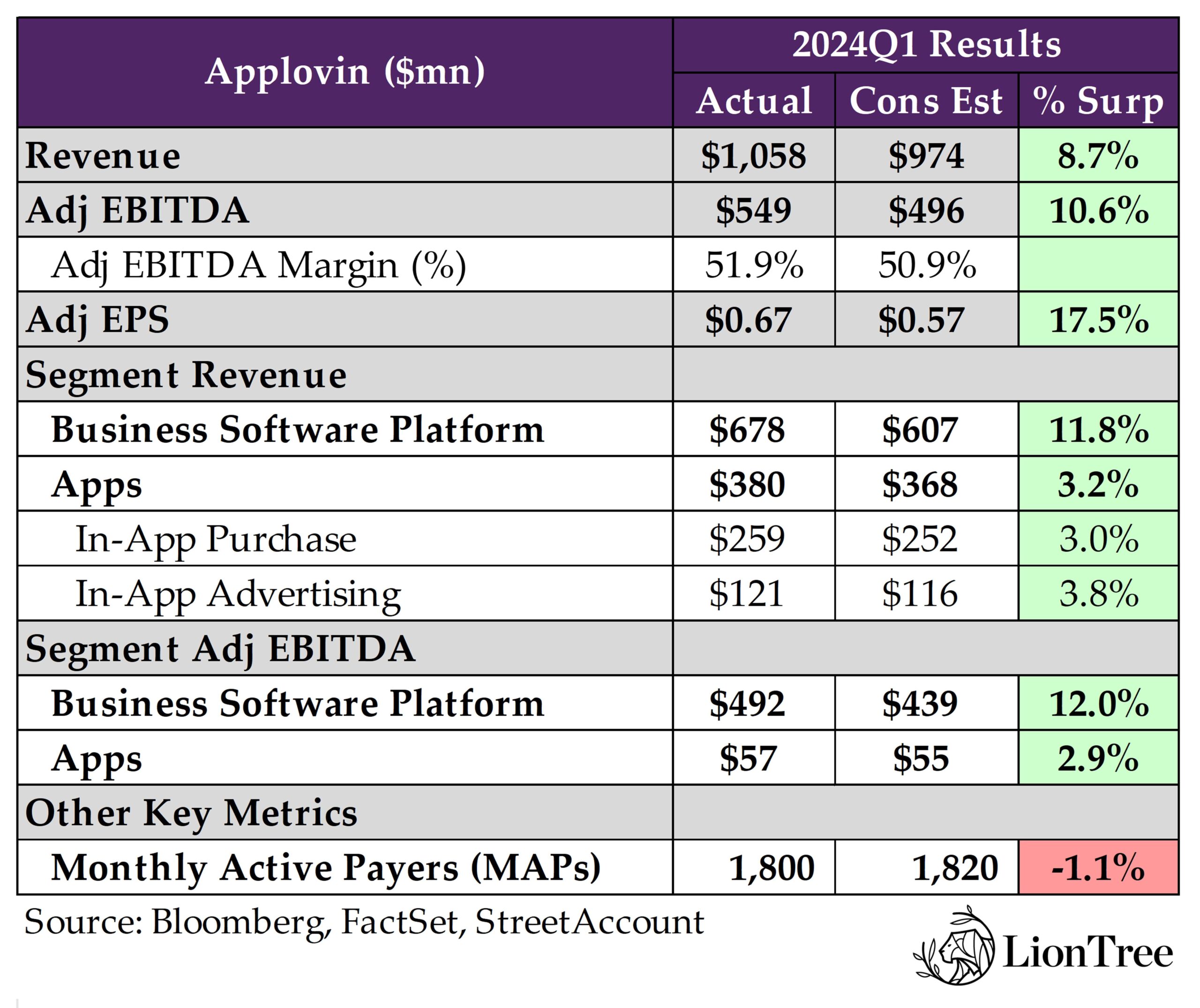
- “AXON 2 continues to perform well”, benefiting from “improved performance”: Advertisers have been ramping up spend on the Co’s platform to take advantage of AXON’s enhanced capabilities; The Co has also seen the advertising industry as a whole “return to growth”
- The “AXON breakthrough” drove a “material amount of growth”: Explained that in Applovin’s system, there’s no limit to what an advertisers spend and that most of its partners don’t have any sort of budgetary limitations and can spend more dollars per day as ROI of the platform improves
- Applovin’s “cutting edge AI technologies” can’t be easily replicated: The Co is skeptical that it’s even “conceivable” that it would be possible to replicate its tech, given its multi-yr lead and intention to continue building on its innovation
- Growth in the non-gaming vertical continues outpace growth in gaming: Emphasized that this has been primarily b/c the non-gaming growth has been off a lower base
- The Co is working on expanding into addt’l ad formats and verticals: Applovin has been working on launching the first form of web advertising on its platform and believes this will attract “a lot more demand density” onto its platform, particularly from transactional industries, such as e-commerce
- The “AXON breakthrough” drove a “material amount of growth”: Explained that in Applovin’s system, there’s no limit to what an advertisers spend and that most of its partners don’t have any sort of budgetary limitations and can spend more dollars per day as ROI of the platform improves
- Q2 guidance was stronger than anticipated: Forecasts rev between $1.06-1.08bn, surpassing cons by +7.0% at the mid-pt, as well as an adj EBITDA range of $550-570mn, which was +7.5% above cons at the mid-pt
- Applovin has a few growth vectors moving forward: Listed the following –
- Adding more advertisers both within gaming and within new verticals Applovin has been working on
- Improvements in core models (AXON), driven by their self-learning capabilities as well as the Co’s own R&D efforts; These are “very high margin gains”
- Margins are also expected to continue expanding: The Co believes they will expand to the extent that it sees incr’d development for AXON and doesn’t expect any declines from its current existing level
- Applovin has a few growth vectors moving forward: Listed the following –
Unity Outperformed With Q1 Financials, But KPIs & The Q2 Outlook Was Disappointing
- Unity outperformed on top-line and profitability but missed on FCF: Rev was down -8.0% y/y in Q1 (vs +35.1% y/y in Q4) and beat cons by +6.3%, w/ an adj gross margin of 81.8% vs cons 80.1%; Adj EBITDA was up +141.9% y/y and topped cons by +61.6%; FCF of -$15mn finished well short of cons $65mn
- The Co has been making “very good progress expanding profitability”: Unity completed a large and complex cost and portfolio restructuring and is now focused on the Engine, Cloud, and Monetization bizs, as well as making progress w/ AI tools
- KPIs missed with deferred revs -17.5% below cons, # of customers over $100k -9.6% below cons, and net revenue expansion -7.8% below cons
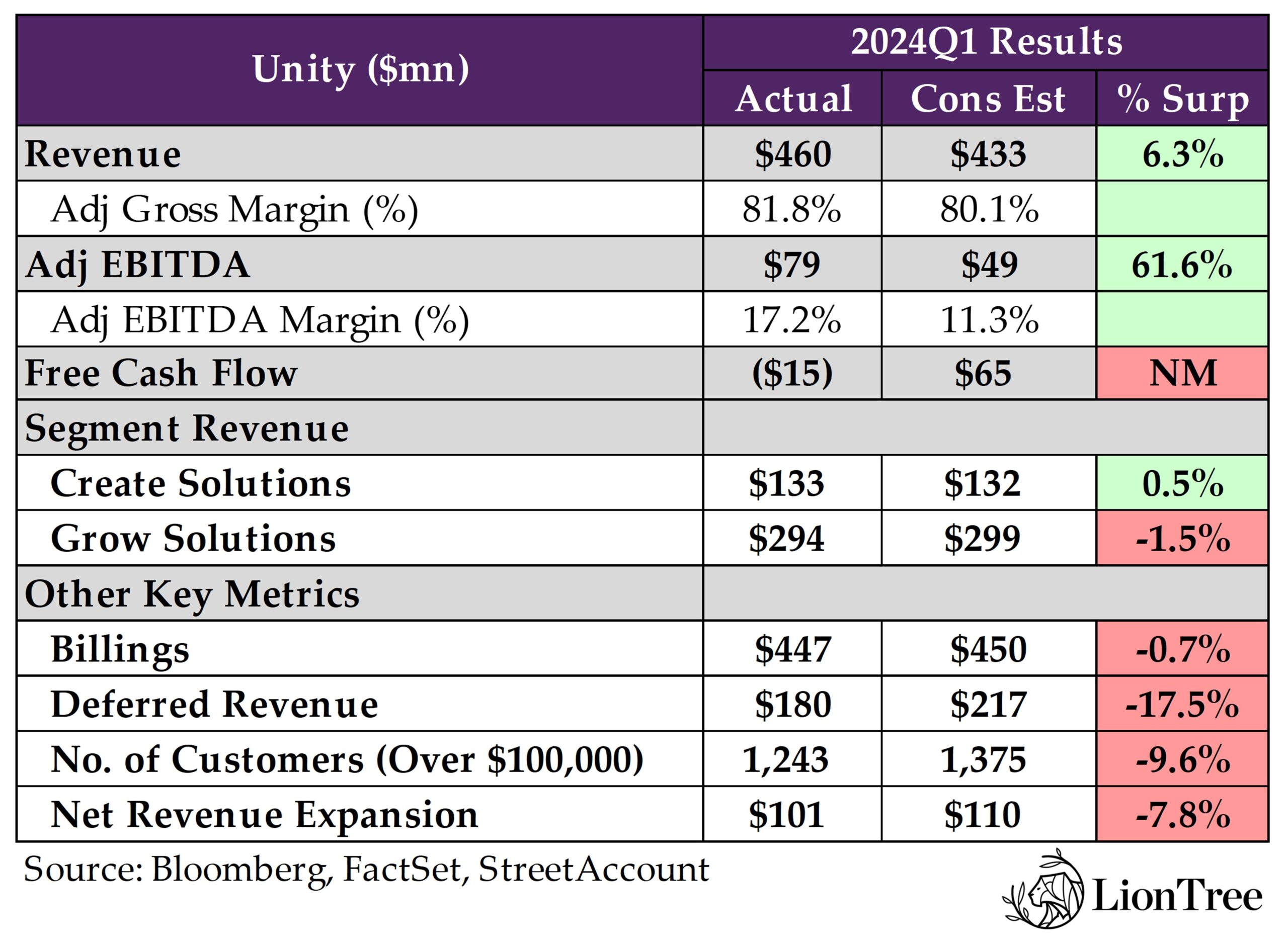
- Incoming CEO Matt Bromberg will be a “great strategic steward of the biz”: Described as a “down in the weeds operational leader” that knows both the game development and the monetization sides of the biz “extremely well”; Has sense of the industry and the trends, subtleties, disruptions, etc.
- Unity expressed confidence in its short-term outlook…: Highlighted three main reasons for this –
- Customers are “feeling much more confident” w/ Unity: Although customers were “a bit ruffled” at the end of 2023, there is now a recognition that the industry wants to ensure that Unity invests in the runtime; The Co is now having “super productive conversations” w/ its larger customers
- Leading metrics for Unity 6 point to “good execution”: Indicated that leading KPIs, including downloads, usage, and more importantly, those around quality and timelines show that Unity 6 is the “highest quality release” that the Co has ever had at its current stage
- Interventions on the data & analytics side of the biz will start to bear fruit: These haven’t been reflected in the Co’s number’s yet, but results from testing are “very encouraging”; These efforts should start impact results beginning in Q3
- … BUT sees an even greater oppties in the long-run: Particularly w/ the industry side of the biz, which remains a “relatively nascent oppty” for the Co; Unity is also still “essential to gaming” and sees a number of trends that will continue to make it integral to its customers’ success in the space
- Q2 guidance was underwhelming…: Expects rev between $420-425mn, missing cons by -5.7% at the mid-pt, as well as adj EBITDA between $75-80mn, which was -21.0% below cons at the mid-pt
- … Though FY24 guidance was reaffirmed: The projected rev range of $1.76-1.80bn missed cons by -1.7% at the mid-pt, while the adj EBITDA range of $420-425mn beat cons by +1.4%
The Trade Desk Continues To Benefit From “Major Disruption” In Advertising
After the advertising agencies posted a relatively strong showing earlier in this earnings cycle (see Theme #6 from 4/19/24 Weekly), this week offered investors a glimpse into trends on the AdTech side of the industry, with both The Trade Desk and Taboola releasing their Q1 results. Starting with the former, The Trade Desk continued its hot streak of beating consensus benchmarks for its headline numbers, as the company’s revenue topped estimates by +2.3% and its adj EBITDA finished a massive +48.7% above forecasts. Commentary on the macroeconomic challenges facing advertisers was noticeably absent on The Trade Desk’s earnings call, despite being a central topic on prior ones in H2:23. Instead, the focus was on how the Co has been benefitting from “another period of major disruption” in the advertising industry, highlighting in particular the tailwinds in CTV from the faster than expected shift from linear to streaming as well as the ongoing shift to UID2 and the Open Internet. Accordingly, the recent expansion of the company’s partnership with Roku and Google’s decision to delay the deprecation of cookies yet again were central topics of discussion, and, perhaps unsurprisingly, both were viewed positively within the longer-term context of The Trade Desk’s business. Retail media also still represents a significant long-term driver.
All said, The Trade Desk has a wide range of levers that it can pull on to maintain its high rate of growth moving forward, and the strength of its core business was reflected in its better than anticipated Q2 guidance. Citing CTV, retail media, international expansion plans, recent and upcoming platform upgrades to Kokai, continued UID2 adoption, and the upcoming US election cycle, the company projected that its Q2 revenue would beat consensus by +1.4% and that its adj EBITDA would top expectations by +1.8%. Work on deeper OpenPath integrations with Disney and other CTV content owners could also create additional opportunities for the company, while Amazon’s efforts to sell its own Prime Video inventory weren’t viewed as a major competitive threat moving forward. The runway certainly appears to be paved for The Trade Desk to continue its strong start to 2024…
See below for more details on what we thought was most incremental from The Trade Desk’s print as well as some quick takeaways from Taboola’s Q1 earnings:
-> Taboola’s headline numbers for Q1 also broadly outperformed expectations, surpassing forecasts for rev and adj EBITDA by +2.7% and +58.8%, respectively; Ex-TAC gross profit growth accel’d to +20% y/y in Q1 (vs +6% y/y in Q4); The Co benefited from double-digit growth in advertising spend, as it onboarded Yahoo advertisers and benefited from having Yahoo’s supply available on its platform; Also, despite the hiring required to support onboarding Yahoo, headcount still ended ~flat relative to the Co’s peak in July 2022; However, Q2 guidance left some room to be desired, w/ rev expected to come in -1.9% below cons and adj EBITDA projected to finish -23.8% behind cons, but the FY24 outlook remained intact
–> The Trade Desk shares incr’d +3.1% following earnings but ended the week down -1.5%; Taboola shares were ~flat in response to earnings and closed the week down a slight -0.7%; YTD, The Trade Desk stock is up +21.3% and Taboola stock is up +1.6%
The Trade Desk’s “Strong Momentum” Was Reflected In Better-Than-Expected Headline Numbers & Guidance
- Headline results broadly exceeded forecasts: Q1 rev incr’d +28.3% y/y (vs +23.4% y/y in Q4) and topped cons by +2.3%; Adj EBITDA rose +48.7% y/y (vs +15.9% y/y in Q4), beating cons by +21.5%; Adj EPS of $0.26 was +19.5% above cons
- Margins benefited from a seq decel in OpEx growth: Q1 adj EBITDA margin of 33.0% incr’d +460bps y/y (vs -300bps y/y in Q4) and beat cons 27.8%; OpEx rose +20% y/y (vs +29% y/y in Q4), w/ growth cont’ing to be driven by investments in headcount and platform, particularly sales & mkting and operations
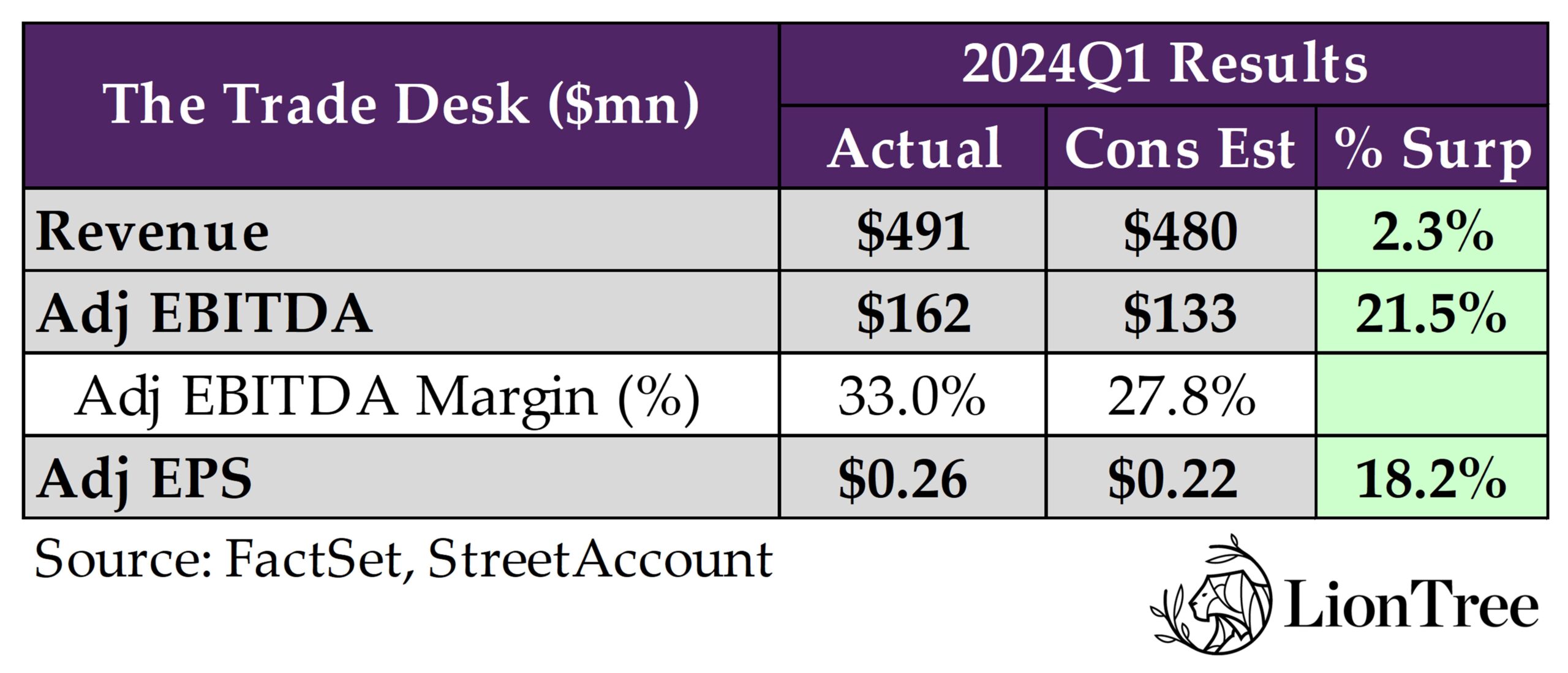
- Q2 guidance also surpassed expectations: Anticipates rev to increase ~+24% y/y to “at least” $575mn, exceeding cons by +1.4%, as well as an adj EBITDA of ~$223mn, which was +1.8% above cons
- The Trade Desk’s other long-term growth drivers: Include its int’l expansion plans, its recent platform upgrade in Kokai, UID, as well as the upcoming US election cycle
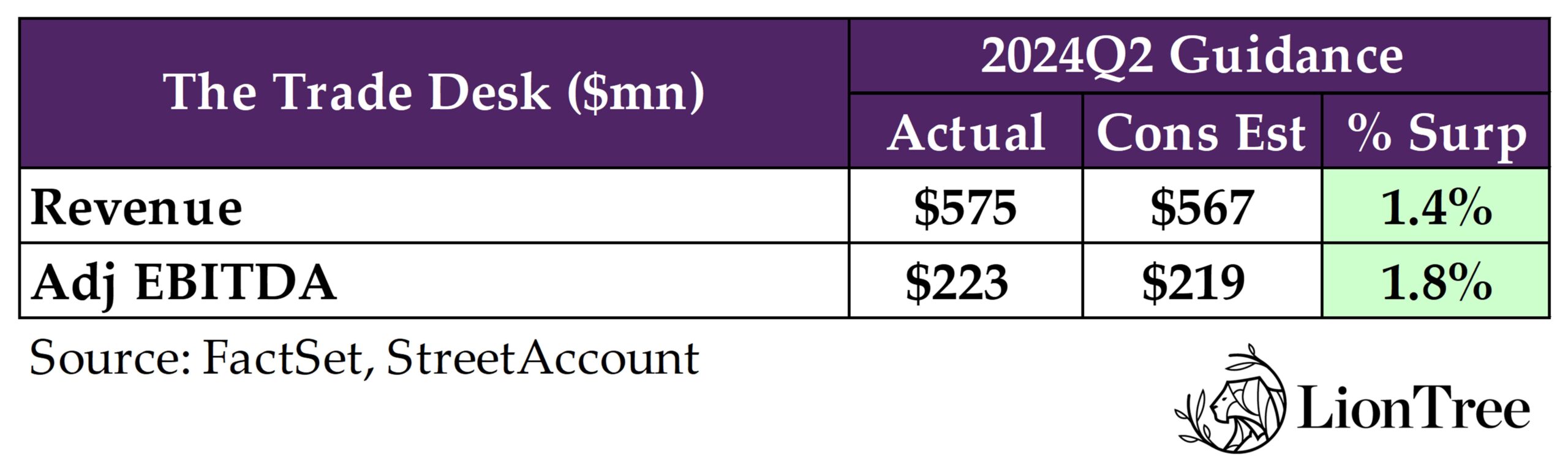
The Advertising Industry Has Arrived At Another Inflection Point
- The Trade Desk is positioned “very well” amid a “another period of major disruption” in the ad industry: Believes that the shift from linear to CTV “was always going to be disruptive” but what has been “more important” for the Co’s biz is how quickly the TV industry has evolved as result
- The Trade Desk is in a “phenomenal position” within the broader streaming wars: Believes that content owners have become “more dependent on programmatic than ever” due to the streaming wars, and that Cos like Hulu and Disney have excelled in growing profitability b/c of them “leaning into programmatic”
- There’s been “more and more pressure on anybody who tries to create a walled garden-like strategy in CTV”
- A “wider understanding” has developed around a few immediate themes in advertising: Highlighted three major trends, including –
- A broader understanding of the role that walled gardens are playing as “major purveyors of low-grade, made-for-advertising inventory
- A wider understanding of the poor ad-to-content ratios within walled gardens as well as the brand suitability risk of UGC (as opposed to premium content)
- A growing awareness that consumers spend most of their quality time w/ premium content on the Open Internet vs walled gardens
- Advertisers have been better utilizing first-party and retail data as alternatives to cookies
- There’s also a broad industry frenzy around AI and its implications for the space
The Trade Desk Continues To See “Strong Spend” In Key Areas
- CTV remains the Co’s fastest growing channel: Highlighted that industry giants, including Disney, NBCU, Walmart, Amazon, Roku, and LG Electronics, have made “deeper pivots into CTV” in recent months, many of them in partnership w/ The Trade Desk; This has brought more oppty for advertisers
- “Strong momentum” was maintained in retail media: The Trade Desk cont’d to win shopper mkting budgets and flagged a growing number of existing clients beginning to utilize retail data for targeting and measurement
- The Co has just “scratched the surface” of the TAM oppty at the bottom of the funnel: Advertisers are adding more data to the Co’s platform to sell more products, and retailers are providing more data to show that the products are actually selling, creating a richer ecosystem
- “UID2 is being deployed by major advertisers and publishers at a larger scale than ever”: Touted that UID has helped Disney offer advertiser match rates that +3-4x higher than when UID2 isn’t present, resulting in higher CPMs
- More supply in the CTV mkt will lead to greater demand for UID2: Explained that incr’d supply will tip the scales “even more towards [a] buyer’s mkt”, enabling them to be more selective and growing the need for identifiers such as UID2 to compare ROI across platforms
- The Co cont’d to see “strong, consistent y/y growth” across all regions: The Trade Desk’s international growth outpaced its growth in North America for the fifth consecutive qtr; The overseas biz is expected to be a “strong contributor” to growth in 2024 and “for yrs to come”
- Growth was also broad-based across verticals: Each of the Co’s categories representing 1%+ of spend grew double-digits during the qtr, as the value of the Open Internet has resonated w/ clients across many industries
The Roku Partnership Is Materializing Into “Something Meaningful”
- “This is a win-win-win for Roku, for advertisers, and for The Trade Desk”: The partnership will likely see Roku adopt UID2, while advertisers will get access to Roku’s ACR data in The Trade Desk platform for the first time
- “It makes a ton of sense for Roku to embrace the Open Internet w/ their premium content”: Given that the proliferation of CTV content over the last couple of yrs has made it so many of premium CTV streamers need to find ways to maximize advertiser demand and open up demand to a wider range of sources
- The Trade Desk believes advertisers will pay a premium for Roku’s ad inventory on its platform: The Roku Channel’s content and ad load has “grown tremendously” in recent yrs, and buyers will increasingly want the option to pick and choose programmatic inventory instead of buying it on a fixed rate basis
On Google – “Wounded Big Tech” Is Seeing Consequences From “New Draconian Policies And Tactics”
- Google’s decision to delay cookie deprecation yet again will benefit The Trade Desk: Believes the net effect of the move is that it “gives the Open Internet a bit more runway to adopt things like UID2” and to create alternative authentication and identity strategies
- The cookie deprecation delay has not slowed the adoption of UID2: Given that the “world knows that [cookies are] not going to last forever” and that Google is serious about the decision; Also, UID2 adoption has been led by competition in CTV, and that hasn’t changed
- Google’s hand was “forced” by previous missteps: Indicated Google’s proposal of replacing cookies w/ a privacy sandbox was “half-fake and not a valid solution”; Criticisms against the plan were “unanimous”, w/ industry bodies like the IAB unexpectedly taking a strong position against the sandbox
- The regulatory scrutiny facing Google has led to some incremental dollars for The Trade Desk: Advertisers are starting to view spending on Google (and providing their data to the Co) as a “risky strategy”; A lot have read the Texas Attorney General’s complaint and want to be more deliberate w/ their spend
The Trade Desk Doesn’t View Amazon Prime As A Formidable Competitor
- The Amazon Prime Video DSP has an “objectivity problem”: Explained that Amazon has been adding a “significant amount of supply” but has only been selling it themselves, making it difficult to approach buyers w/ the goal of helping them optimize allocation of ad spend, given the inherent bias toward Amazon’s platforms
- The Trade Desk believes it would be difficult to partner w/ Amazon: In addition to the objectivity problem, there is an added issue of Amazon making white-label products that compete w/ its sellers
- Eventually, the Co expects Amazon will join the Open Internet and open up its ad inventory to everyone: This is b/c advertisers will also want to bring their own data to the table; Until then, The Trade Desk believes Amazon is “going to struggle… operating an anemic mkt”
Other Highlights
- The Trade Desk’s expanded OpenPath partnership w/ Disney is seeing progress: The Trade Desk’s OpenPath partnership provides advertisers w/ a “pure pipe of visibility” directly in Disney’s DRAX, and the Co expects 100% visibility eventually at Disney, w/ 75% by 2027; This will create a model for the most optimal CTV integrations
- Innovations In Kokai contributed to the seq accel in rev growth: The Co has been “putting AI to work in Kokai”, providing clients w/ AI-powered tools to make key decisions in relevant scoring, forecast, budget optimization, etc.; UX and product rollouts will help the product maintain its hot streak over the next few qtrs
Earnings Grab-Bag: Reddit / Shopify / Airbnb
We also wanted to provide a quick take on Reddit, Shopify and Airbnb’s earnings, given the strong reactions to the prints… See below:
- Reddit delivers out of the gate: In its first qtr since the IPO in March 2024, Reddit handily beat Street expectations
- Revenue (+48% y/y), adj EBITDA (first profitable Q1), and user metrics (DAU +37% y/y) were all ahead, despite seasonality in Q1, revenue and user growth accelerated (seeing better retention which is a focus for further improvement)
- Drivers for revenue upside was advertising (+39% y/y) and data licensing agreements (+450% y/y)
- The Co was positive on the health of the ad market and is seeing ad revenue growth across the funnel, with click through rates growing 40% y/y and click volume doubling y/y
- Data licensing initiatives are expanding
- Focused on enhancing user experience and driving monetization
- Future growth to be driven by ads and international users (machine translation into other languages)
- Better Q2 outlook: At the mid-point, Q2 revenue guidance was +9% ahead, and adj EBITDA guidance at $7.5mn ($0-$15mn) was well above cons loss of -$18.2mn
- Revenue (+48% y/y), adj EBITDA (first profitable Q1), and user metrics (DAU +37% y/y) were all ahead, despite seasonality in Q1, revenue and user growth accelerated (seeing better retention which is a focus for further improvement)
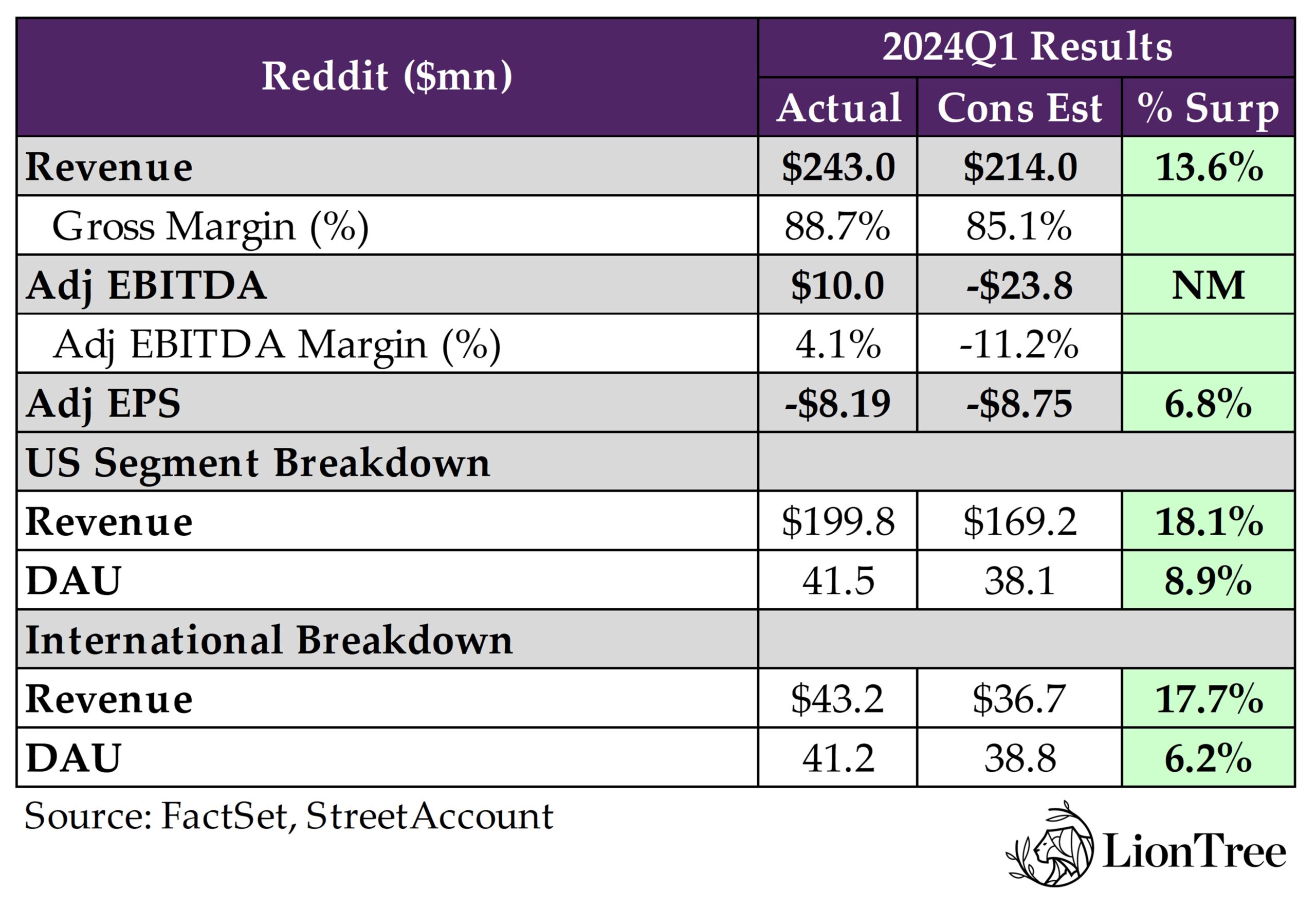
-> Reddit shares rallied as high as +11.7% intra-day but ended its earnings day up +4.0%. The stock is up +57.4% since its IPO pricing
- Shopify’s better-than-expected Q1 was overshadowed by worse-than-expected Q2 guidance
- Q1 beat across the board
- GMW grew +23% y/y (in-line with Q4)
- Driven by same-store sales growth of existing merchants, continued growth in merchant base globally, strength in EMEA, and +32% growth y/y in offline biz
- Rev grew +29% y/y (ex logistics biz), representing the fourth consecutive qtr that rev growth has been greater than +25%
- Driven by GMV strength, growth in Subscription Solutions rev from both new merchant growth and the pricing increases on standard plans, and increased Payments penetration
- Gross margin rose to 51.4% from year-ago 47.5%, helped by the sale of the logistics business and some changes in pricing
- Use of AI tools drove +130% increase in Shopify merchant ads from Q4:23 to Q1:24
- GMW grew +23% y/y (in-line with Q4)
- Q2 outlook – the Co is “long-term focused…we want to be able to make those investments for the future, which is why we gave the guide we did” (link)
- Y/Y comps will be impacted by the sale of the logistics biz, which will create a rev growth headwind of -300-400bps and a gross margin tailwind of +200-300bps vs Q2:23
- Rev will grow at a +high-teens % rate y/y (vs cons 19.5%), its slowest growth on record
- Gross margin expected to decrease by ~-50bps vs Q1:24
- OpEx will be up a ~lsd-msd% q/q
- FCF margin to similar vs Q1:24
- “We see consumer spend in North America remaining resilient, but we have factored in headwinds related to FX from the strong US dollar and some softness in European consumer spending in our Q2 outlook”
- Q1 beat across the board
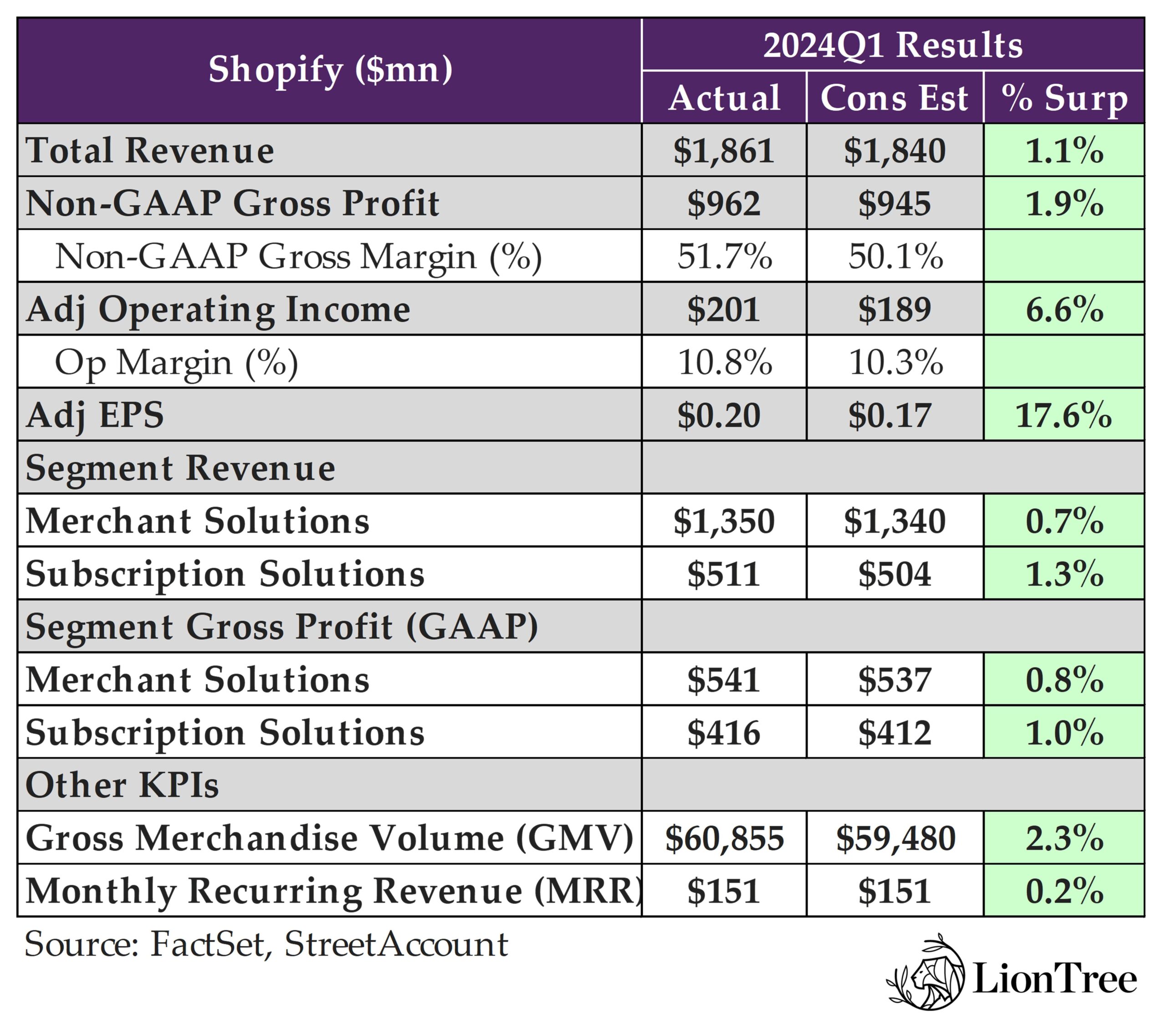
-> Shopify shares plunged -18.6% in its largest daily drop on record the day it reported its results; It ended the week down -20.8% and is down -24.3% YTD
- Similarly… Airbnb beat Q1 earnings expectations but its Q2 guidance disappointed
- Q1 rev grew +18% y/y; Adj EBITDA and Nights & Experiences Books were a Q1 records, while FCF of $4.2bn was Co’s highest ever
- Saw sustained double-digit supply growth across all regions
- Seeing highest growth in regions with the highest demand
- Gross nights booked in expansion markets grew twice as fast as core market
- Mobile app downloads are accelerating, and app downloads increase +60% y/y
- Global nights booked in the app increased +21% y/y and now represent 54% of nights booked in Q1 (vs 49% in Q1:23)
- Q2 guidance implies some seq decelerations
- Rev missed at midpoint: $2.68-2.74bn vs cons $2.74bn
- Y/Y rev growth is expected to accelerate in Q3 compared to Q2 due in part to the strength of summer backlog
- Adj EBITDA expected to be “flat to up on a nominal base” vs cons +11.9% y/y
- BUT down on an adj EBITDA margin basis, driven by pressure from the timing of Easter (benefit to margin in Q1:24 will be a headwind in Q2:24), one-time payment processing incentive benefits impacting Q2:23, and higher marketing expense (partially due to timing)
- Y/Y growth in night booked in Q2:24 will be “relatively stable” to that of Q1:24
- ADR will be up “modestly” vs Q2:23
- Rev missed at midpoint: $2.68-2.74bn vs cons $2.74bn
- Saw sustained double-digit supply growth across all regions
- Q1 rev grew +18% y/y; Adj EBITDA and Nights & Experiences Books were a Q1 records, while FCF of $4.2bn was Co’s highest ever
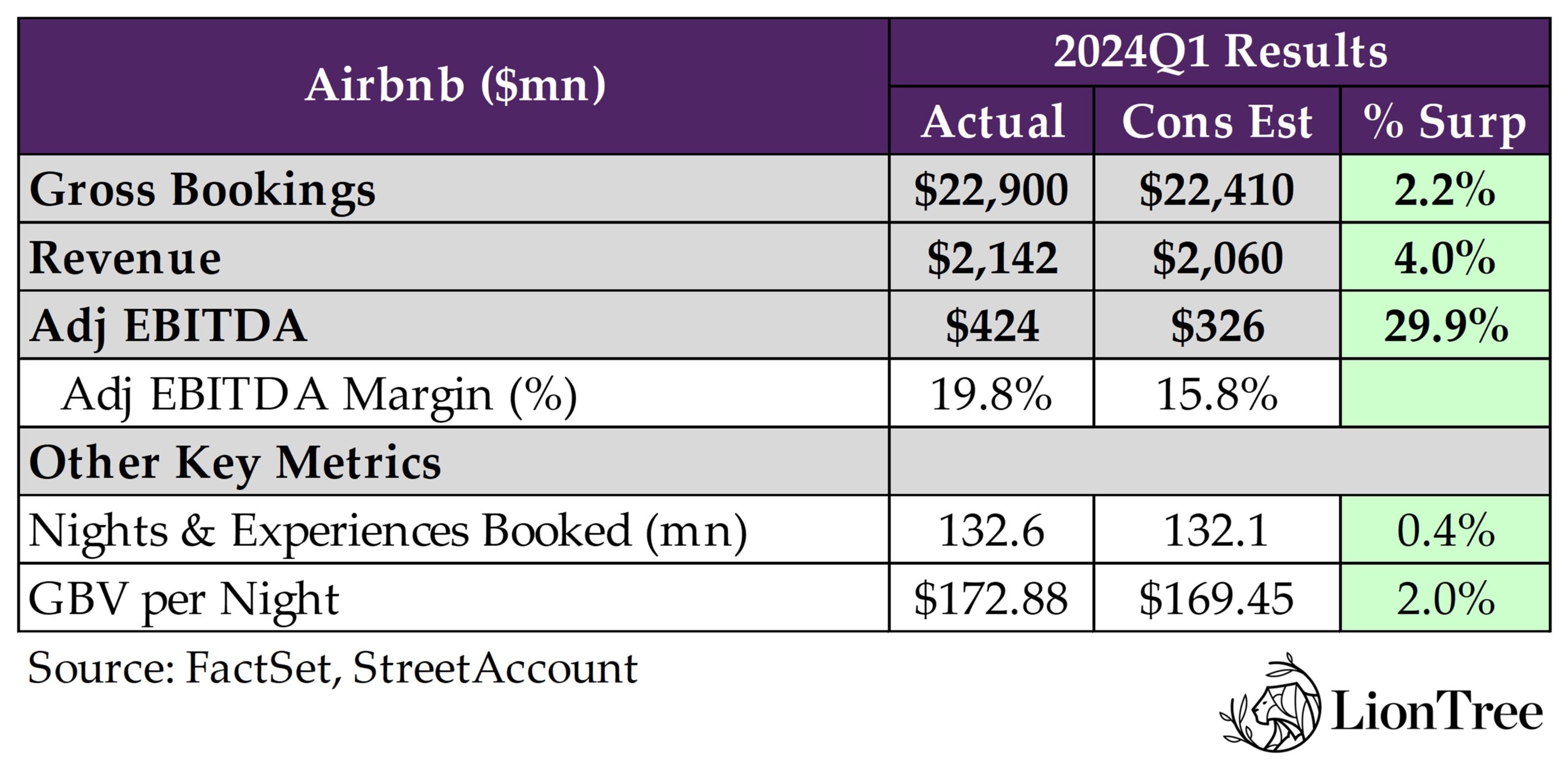
-> Airbnb shares fell -6.9% in reaction to its print and ended the week down -8.4%; YTD, the stock is up +7.5%
Stock Market Check
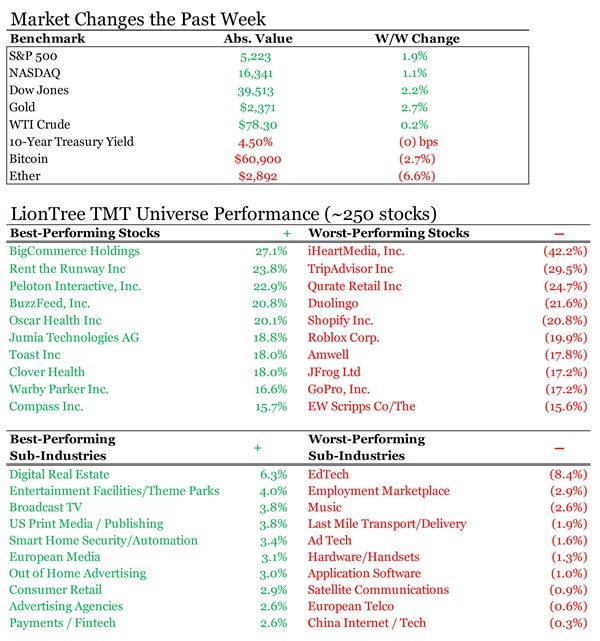
This Week's Other Curated News
Advertising/Ad Agencies/Ad Tech
- Alphabet’s talks to acquire HubSpot are reportedly advancing, w/ the latest news coming as the latter’s results for Q1 beat estimates. Bloomberg cited people familiar w/ the matter that discussions between Alphabet and HubSpot are making progress, but that no agreement has been reached yet. Last month, Reuters said Alphabet was meeting w/ investment bankers about making a bid. (Investopedia)
- Amazon Prime Video subscribers will see new types of advertisements this broadcast yr. Those who opted for Prime Video w/ commercials will soon see shoppable carousel ads, interactive pause ads, and interactive brand trivia ads, as Amazon calls them. All the new ad formats allow a viewer to place advertised products in their Amazon cart. (Ars Technica)
- Disney Advertising has partnered with Walmart Connect to allow advertisers to target Disney’s streaming portfolio, including Disney+ and Hulu, using Walmart’s shopper data. As part of the deal, Disney will also join Walmart’s Partner Lab, a group that tests new ad formats and measurements. This partnership follows a trend of increased collaboration between retailers and CTV platforms due to the rise of retail media and the impending deprecation of Google’s third-party cookies. (Swipe Insight)
- Disney’s global advertising president Rita Ferro told TheWrap that the co’s own shift is “consistent with the pace of the decline of ad impressions available to buy” from its linear portfolio. As viewership continues to decline on linear television, legacy media is seeing more ad dollars migrate to streaming. While Ferro believes that Hulu, Disney+ and ESPN+ are well positioned to capture those migrating ad dollars, she argued that advertiser demand for broadcast is still proving to be a “very robust” business. (TheWrap)
- NBCUniversal and Instacart have expanded an existing strategic partnership through a new retail media workstream that’s meant to open up audience-based advertising opportunities for CPG brands on Peacock. The partnership involves first-party data collaboration, with plans to launch on streaming in the second quarter and then expand to linear. NBCU and Instacart have been partners since last Nov. (StreamTV Insider)
- Warner Bros. Discovery has launched WBD Connect, a new ad marketplace, using programmatic guaranteed deals to streamline ad inventory across platforms like CNN International and WBD Sports Europe. This model is favored for its reliability and ability to forecast ad revenue accurately, offering advertisers fixed-rate campaigns across multiple publishers. The platform, which reaches 350mn monthly users, reflects a shift towards more controlled, premium ad sales environments. (Digiday)
Artificial Intelligence/Machine Learning
- Apple is developing its own chip to run artificial intelligence software in data centers. “We continue to feel very bullish about our opportunity in generative AI and we’re making significant investments,” CEO Tim Cook told Reuters in an interview. The project, internally codenamed as Project ACDC (Apple Chips in Data Center), aims to leverage Apple’s chip design expertise for its server infrastructure, the report said. (Yahoo Finance)
- As the US moves toward criminalizing deepfakes, tech companies are rapidly developing tools to detect AI-generated content, though with mixed success. OpenAI has launched an image detection classifier that identifies 98% of images from its DALL-E 3 model, but struggles with images from other AI models. The company emphasizes the use of C2PA standard metadata to verify content origins, aiming to enhance transparency and trust in digital media. This initiative is part of broader efforts to manage AI’s impact on disinformation, especially as major global elections approach. (Ars Technica)
- Google DeepMind has released a new version of AlphaFold, a landmark tool for predicting protein structures, that puts the artificial intelligence software on a path to make breakthroughs in biology research. Isomorphic Labs, a unit of Alphabet Inc. created three yrs ago, was built to commercialize DeepMind’s AI for drug discovery. Now in its third iteration, AlphaFold can model a range of molecular structures, including DNA and RNA, and predict how they interact w/ one another. (Yahoo Finance)
- Katy Perry didn’t attend the Met Gala, but thanks to AI, her Mom thinks she did. The California Gurls singer appeared to share a text message in which her Mom was fooled by a fake image of her daughter at The Metropolitan Museum of Art in New York. A post on X featuring the fake Perry photo was viewed more than 13M times. Perry was not the only celebrity to get the deep fake treatment. Other AI images included Rihanna and Selena Gomez. (Yahoo News)
- Microsoft has introduced a GPT-4-based generative AI model designed specifically for US intelligence agencies that operates disconnected from the Internet. This reportedly marks the first time Microsoft has deployed a major language model in a secure setting, designed to allow spy agencies to analyze top-secret information w/out connectivity risks and to allow secure conversations w/ a chatbot similar to ChatGPT and Microsoft Copilot. (Ars Technica)
- Microsoft has some new Copilot for Microsoft 365 features that are designed to make it easier to use AI prompts. In the coming months Copilot for Microsoft 365, the paid service that adds an AI assistant to Office apps, will be updated with a new auto-complete feature that offers suggestions to improve AI prompts. If you start creating a prompt then Copilot will soon offer to complete it with extra details to improve the end result of whatever you’re generating or the questions you’re asking. (The Verge)
- Microsoft is working on a new large-scale AI language model called MAI-1, which could potentially rival state-of-the-art models from Google, Anthropic, and OpenAI, according to a report by The Information. This marks the first time Microsoft has developed an in-house AI model of this magnitude since investing over $10bn in OpenAI for the rights to reuse the startup’s AI models. OpenAI’s GPT-4 powers not only ChatGPT but also Microsoft Copilot. (Ars Technica)
- OpenAI has made a flurry of new updates, but the biggest may be a new tool it is developing called “Media Manager,” due out next yr in 2025, which will allow creators to choose which of their works they will allow to be scraped and trained on for the co’s AI models. OpenAI notes that creators’ work can be readily screenshotted, saved, reshared, and otherwise reposted or redistributed across the web on domains that don’t offer the opt-out text. (VentureBeat)
- OpenAI is developing a feature for ChatGPT that can search the web and cite sources in its results. The feature would allow users to ask ChatGPT a question and receive answers that use details from the web w/ citations to sources such as Wikipedia entries and blog posts, according to the person, who asked to remain anonymous discussing private information. (ETCIO.com)
- SoftBank Group is in talks to acquire Graphcore, a struggling British semiconductor startup once valued at $2.8 bn (¥435.9 bn), according to people familiar w/ the deals. The two cos have held discussions over several months but entered into more advanced deal talks recently, said the people, who asked not to be identified discussing private matters. (The Japan Times)
Broadcast/Cable Networks
- Sinclair is looking to sell 30%+ of its footprint, per people familiar w/ the matter. Sinclair owns or operates 185 TV stations in 86 markets. The Co has hired investment bankers and has identified 60+ stations in various regions of the US that it would be willing to sell, said the people. Sinclair owns or operates 185 TV stations in 86 mkts. The stations are a mix of affiliates including Fox, NBC, ABC, CBS, and the CW. (CNBC)
- The CW‘s losses fell by $50mn in the Q1 and parent Nexstar Media Group still expects the network to turn a profit by next year, but CFO Lee Ann Gliha offered investors some reason for caution. “We’re no longer going to externally disclose the CW numbers separately,” the exec said about the network’s revenue trends. Since Nexstar took its 75% stake in 2022, she continued, “the quarter-over-quarter comparison is good. I would say just anecdotally it’s still driven by the national advertising market, which is not in a positive place even despite the green shoots.” (Deadline)
Broader Media & Entertainment
- A new survey from Pew-Knight Initiative has found that nearly half of US residents who don’t pay for local news cite its free availability elsewhere as the main reason. Only 15% of the survey respondents said they had paid for local news in the past year — approximately the same proportion as in 2018. A third of the non-payers said they were simply not interested enough in local news to pay for it in the first place. (Press Gazette)
Broader Technology
- Elon Musk’s startup Neuralink said part of its brain implant malfunctioned after it put the system in a human patient for the first time. In Jan, Neuralink implanted the device in a 29-year-old patient named Noland Arbaugh as part of a study to test its safety. But in the weeks afterward, a number of threads have retracted from Arbaugh’s brain, Neuralink said in a blog post. (CNBC)
Cable/Pay-TV/Wireless
- By 2024, fewer than half of Spectrum’s customers subscribed to cable TV, as 56% opted out. Spectrum lost a significant number of TV subscribers, shedding 405,000 customers in the first quarter alone, continuing a trend from the previous quarter. Despite losing 72,000 internet customers for two consecutive quarters, Spectrum added 486,000 wireless customers. This shift helped stabilize Charter Communications’ revenue, which saw a modest increase of 0.2% year-over-year. (Cord Cutters News)
- DISH Network lost 348,000 customers in Q1 2024, pushing CEO Hamid Akhavan-Malayeri to focus on survival amid merger talks with DIRECTV. Despite past hints of “inevitable” merger by co-founder Charlie Ergen, the CEO prioritizes DISH’s independence, noting potential synergies but remaining cautious. (The Streamable)
- TextNow, an MVNO provider of free ad-supported mobile phone svs in the US, has just annc’d its “Free Essential Data” to go along w/ its unlimited talk and text plan. This new feature gives users free data for essential apps like email, rideshare apps, and maps, as the co aims to give consumers even more options while working towards getting rid of monthly phone bills. Once the SIM is activated, users will be on the Free Essential Data plan. (PhoneArena)
- US Cellular shares jumped as much as 19% after a WSJ report that T-Mobile US and Verizon Communications are nearing separate deals to buy parts of the telecommunications co. T-Mobile would pay more than $2bn for a portion of US Cellular, according to the report which cited people familiar with the matter. That deal could close as soon as this month, while the Verizon deal could take longer or not close at all, they said. (Bloomberg)
- UScellular’s Fixed Wireless Access business continues to gain momentum, with the co reporting that it added 124,000 FWA customers during the Q1, up +42% y/y. Comparatively, UScellular added 87,000 in the yr-ago quarter, and it is seeing consistent sequential growth each quarter, including 106,000 FWA in Q3:23 and 114,000 during the Q4:23. The co (which is in the process of looking at its strategic alternatives, including potential mergers or acquisition) reported mixed results compared the same period last yr. (RCR Wireless News)
- WideOpenWest (WOW!) canceled the Q&A portion of its first-quarter earnings report, as a specially convened WOW! board committee considers an unsolicited takeover offer from private equity. DigitalBridge Investments and “various Crestview entities” have made a cash offer to purchase all outstanding WOW! shares not already owned by Crestview for $4.80 a share. (NextTV)
- Worldwide spending on Telecom Services and Pay TV Services reached $1,509bn in 2023, an increase of 2.1% over 2022, according to the International Data Corporation (IDC). IDC expects worldwide spending on Telecom and Pay TV services will increase by 1.4% in 2024 and reach a total of $1,530 bn. In terms of value, the progress of the global market slowed during the latter half of 2023 as the growth rate recorded for the full year was ~ one percentage point lower than IDC’s previous forecast. (IOTDesign Pro)
Cloud/DataCenters/IT Infrastructure
- A new study by Juniper Research found operators will invest $26bn in cloud svs in 2024, w/ expenditure growing to $65bn in 2028. The study predicts growth of 5G networks and the arrival of cloud-native 6G networks will result in a 110% increase in cellular data over the next 4 years. This growth will be driven by the rising adoption of data-intensive IoT use cases, such as automated manufacturing and vehicle infotainment systems. (THEFASTMODE)
Cybersecurity/Security
- AT&T has completed the divestiture of its cybersecurity services group and formed a joint venture with more than 1,000 employees in 10 countries that will focus on managed cybersecurity services. The new co, LevelBlue includes AT&T’s managed service business, cybersecurity consulting business, and the assets from AT&T’s purchase of AlienVault in 2018, such as the Open Threat Exchange (OTX) community of security professionals. (DARKREADING)
eCommerce/Social Commerce/Retail
- Allbirds reported that rev cont’d to plummet in Q1, declining nearly 28% to $39.3mn. Net loss narrowed by 22%, to $27mn. New CEO Joe Vernachio, who took over from co-founder Joey Zwillinger in March, said that “we know what needs to be done and we’re executing with urgency”. Vernachio said the Co is on track with its planned store closures — which will amount to 10-15 this yr — after closing three locations in Q1. (Retail Dive)
- Hasbro sold a $500mn bond, raising debt for the first time in nearly five yrs and joining a wave of blue-chip cos storming the US investment-grade mkt in the busiest week of the yr. The maker of games such as Monopoly and Dungeons & Dragons sold bonds maturing in 10 yrs for general corporate purposes, per sources. The notes yield 1.6% above Treasuries after earlier discussions for ~1.8%. (Bloomberg)
- Home shoppers across Germany, Austria and Switzerland as well as the UK and the Republic of Ireland will continue to receive an immersive, high-quality in-home shopping experience as QVC Germany and QVC UK have extended their partnerships w/ SES in multi-yr agreements. For QVC Germany, the extension secures capacity on SES’s prime neighborhood at the 19.2 degrees East for QVC HD, QVC2 HD and QVC Style HD channels. (BUSINESSWIRE)
- JD Sports has launched its first store in the Middle East, opening the doors to a shop at Bahrain’s Marassi Galleria Mall. The store opening, which was launched in partnership w/ global retailer and distributor GMG, sets the stage for JD’s expansion in the Middle East market, according to the co. It added that GMG would open around 50 stores under the JD fascia by 2028, focusing on locations in the United Arab Emirates, the Kingdom of Saudi Arabia, Kuwait and Egypt under the terms of the 10-year agreement. (Retail Gazette)
EdTech
- Duolingo shares slumped after the Co’s Q1 earnings report showed it had gained new users at the slowest rate since the Q3 2022. DAUs rose 55% to 31.4mn, more than double what it was 18 months ago and above the avg analysts’ projection of 31.1mn. Investors honed in on the slowdown in user growth even though the Co’s Q1 EPS of 57 cents was double the consensus estimate. (Daily Maverick)
EV/ Autonomous Vehicles
- Earlier this year, Apple discontinued its Project Titan electric car initiative but is reportedly considering a new partnership with a U.S. EV startup, potentially Rivian. According to DigiTimes, there is speculation within supply chains about Apple’s interest in leveraging its decade of EV and autonomous driving research through collaboration. Details of such a partnership remain unclear. (9to5Mac)
- Lucid Group forecast higher capital expenditure this yr and reiterated an annual production forecast below Wall Street targets amid slower-than-expected EV demand, sending its shares down nearly 9% in extended trading. The co said it expects capital expenditure of $1.5bn in 2024 as it prepares to start manufacturing its Gravity SUV later this yr, up from $910.6mn last yr. “We are making enhancements in our Arizona factory because we are going from 30,000 installed capacity to 90,000,” Gagan Dhingra, Lucid’s interim finance chief, told Reuters. (Yahoo Finance)
- Tesla has removed thousands of open positions in North America from its official careers page, bringing the number of roles at the co from 3,400 down to just three. The roles were all to join Tesla’s manufacturing teams in either Texas; Fremont, Calif.; or Sparks, Nev., the co’s three major factory hubs in the US. The apparent hiring freeze comes after a wave of job cuts that CEO Musk described as “hard core,” which included six executive exits. (New York Post)
Film/Studio/Content/IP/Talent
- Paramount Global is in talks about opening its books to a consortium of Sony Pictures and buyout firm Apollo Global Management interested in acquiring the US media co. Doing so would pave the way for Apollo and Sony to firm up their $26 bn offer and challenge a rival bid from David Ellison’s Skydance Media. A special committee of Paramount’s board that is evaluating the co’s options allowed an exclusivity period to lapse in its deal discussions w/ Skydance. (Yahoo Finance)
- Warren Buffett announced that Berkshire Hathaway has sold its entire stake in Paramount Global, resulting in a significant loss. He personally made the investment decision, debunking speculation it was one of his deputies. Buffett shared this during Berkshire’s annual meeting in Omaha, highlighting the tough lessons learned about the volatile entertainment sector. (The Hollywood Reporter)
FinTech/InsurTech/Payments
- Shares of Robinhood rose in extended trading after the Co annc’d stronger-than-expected Q1 results. Robinhood reported net income of $157mn, or 18 cents per share, for Q1. That is a positive swing from the same period last yr, when the Co had a net loss of $511mn, or 57 cents per share. The Co said the EPS and rev numbers were both records for the firm. (CNBC)
HealthTech/Wellness
- A number of private equity firms have been considering a buyout of Peloton as the connected fitness co looks to refinance its debt and get back to growth after 13 straight quarters of losses, CNBC has learned. The firm’s current level of interest in acquiring Peloton is unclear. A number of other private equity firms have been circling Peloton as an acquisition target, but it’s unclear if they have held formal discussions. (CNBC)
Last Mile Transportation/Delivery
- Amazon’s latest delivery drones are set to commence operations from the outskirts of Phoenix, however, according to the company, the hexacopter model is unable to function in temperatures exceeding 104 degrees Fahrenheit (40 degrees Celsius). This is particularly relevant as average daily highs surpass this threshold for three months annually in Tolleson, the city near Phoenix where Amazon plans to initiate drone-based deliveries within a 7.5-mile radius. (WIRED)
- Kohl’s has become the latest retailer to enable same-day delivery via Instacart, allowing customers to have accessories, home goods, skincare and beauty items delivered in as fast as one hour from all 1,172 Kohl’s stores. Shoppers using the Kohl’s Instacart storefront can earn Kohl’s Rewards on these orders, which are priced the same for delivery and in-store purchase. (Retail TouchPoints)
Social/Digital Media
- Bumble beat Wall Street estimates for Q1 rev helped by growth in its paying users, sending the co’s shares up more than 9% in aftermarket trading. The co, which offers dating apps such as Bumble, Badoo, and Fruitz, has benefited from its marketing efforts to tap younger users and women. It reported earnings per share of 19 cents, compared w/ analysts’ estimate of 7 cents per share, according to LSEG data. (Yahoo Finance)
- Meta is encouraging more users to post to its X rival Threads. In its latest experiment, the co is providing an easy toggle for users to cross-post from Instagram to Threads, the co told TechCrunch. Given Instagram’s shift to promoting video, Threads might be a good place to promote your photography. The co said that this is an opt-in experience. When users cross-post their Instagram posts, the caption will become text for the Thread post, and hashtags will be converted into plain text. (TechCrunch)
- Meta is expanding its paid verification service for businesses, adding three new tiers to the program that offers extra perks to companies willing to pay a monthly subscription. There are three additional tiers for business owners to choose from: the $44.99/month “plus” plan, the $119.99 “premium” plan and $349.99/month “max” plan. Each of these includes additions like the ability to add links to a Reels posts, fast-tracked customer support and more profile customization options. (Engadget)
- MrBeast, also known as Jimmy Donaldson, has elected to part ways with his longstanding talent management firm, Night Media. Reports indicate that while collaboration with Night Media may persist, it will no longer be characterized by exclusivity. (Mr Beast News)
- TikTok is starting to automatically label videos and images made w/ AI. AI-generated content on the app will now be tagged w/ “Content Credentials,” a digital watermarking tech. TikTok already labels content made w/ its in-app AI effects and requires creators to label any content they produce containing realistic AI. This latest move will expand automatic labeling to AI-generated content uploaded from other platforms. (CNBC)
Software
- BigCommerce is exploring a sale after attracting takeover interest, people familiar w/ the matter said. BigCommerce has become an acquisition target after losing 90% of its market value in the four yrs since its IPO. BigCommerce’s shares ended trading up 11% at $6.94 on the news, giving the co a market value of more than $500mn. (Yahoo Finance)
- Palantir’s stock fell 7% in extended trading after issuing weaker-than-expected revenue guidance for the full year, forecasting between $2.68 and $2.69bn compared to LSEG’s expected $2.71bn. Despite this, the company reported a solid first-quarter revenue of $634mn, surpassing expectations. Palantir has maintained profitability for six consecutive quarters, highlighting its growth from government and commercial partnerships. CEO Alex Karp emphasized the strategic importance of their U.S. commercial business and AI technology in modern warfare. (CNBC)
Sports/Sports Betting
- Diamond Sports went on the offensive in its dispute w/ Comcast w/ a letter to Bally Sports subscribers. “Bottom line, Xfinity’s current proposal will immediately put Bally Sports on a tier requiring you to pay more to see your favorite teams,” Diamond wrote. The Co added, “We are just asking them to accept mkt terms, similar to what Charter Spectrum, Cox Communications, DirecTV and DirecTV Stream all did just last month.” (NextTV)
- Formula E, a 10-year-old electric racing series w/ cars not too different-looking than those in F1 (although a little bit slower), sees the US market as a key growth area as it enters its next decade. In late Jun., FE will touch down in Portland to conduct the lone US race weekend on its calendar. But before then, FE is likely to announce the schedule for 2025, which will be its 11th season, and growing the series’ footprint here as F1 has done, is a top priority. (Front Office Sports)
- Just days after Formula One completed the third running of the Miami Grand Prix, all signs point to biz being as good as ever for the global racing circuit. Not only did the Miami race draw the sport’s highest US TV audience ever, but F1 parent co Liberty Media annc’d strong financial results. In Q1:24, F1 generated $553mn in rev. (Front Office Sports)
- NASCAR is adjusting its broadcast strategy as it prepares for new media-rights deals with Amazon and Warner Bros. Discovery starting next year, reducing race counts for Fox Sports and NBC Sports. The 2024 season features a strategic distribution of races among the broadcasters, with 14 races each for Fox and NBC, and five for Prime Video and TNT/Max. Key events and market expansions are being carefully considered to balance exposure across platforms. (Front Office Sports)
- The NFL is moving closer to grabbing cash from private equity funds. Per Bloomberg, the qtrly meetings held later this month could result in the passage of a rule allowing owners to sell up to 30% of the team to approved investment collectives. The most any one fund could own in any one team would potentially be 10%. The percentages could change as the NFL’s special committee for considering the issue continues its work. (Yahoo Finance)
Tech Hardware
- President Joe Biden’s administration is looking to fund efforts that improve semiconductor manufacturing by using digital twins. Digital twins are virtual models used to test and optimize physical objects and systems. This funding is part of the CHIPS and Science Act of 2022, a $280bn bill that included $52.7bn to increase domestic semiconductor manufacturing. (TechCrunch)
Video Games/Interactive Entertainment
- Microsoft has shut several Bethesda studios, including Arkane Austin and Tango Gameworks, leading to significant layoffs, with IGN confirming the closures. The cuts, described as a “reprioritization of titles and resources,” aim to refocus on high-impact games, affecting many employees across different teams. Key studios like Arkane Lyon and id Software remain unaffected. (IGN)
- Microsoft will launch its own online store for mobile-game consumables in July, creating an alternative to Apple and Google’s app stores and their fees. The browser-based store will debut w/ Microsoft’s own games, offering discounts on in-game items associated w/ titles like Candy Crush Saga. Later, Microsoft will open the store to other publishers. (South China Morning Post)
- Microsoft’s cuts are far from over, despite Xbox closing down four studios this week, per sources. Jason Schreier and Tom Warren, two popular industry journalists, are reporting the Co has offered Zenimax employees “voluntary buyouts” as a cost-cutting measure. Microsoft is also reportedly warning staff that more cuts are coming, so this restructuring has not finished. (Dot Esports)
- Netflix annc’d new games are launching on its platform in May, including the delayed Braid: Anniversary Edition. The other new titles include retro-styled platformer Sonic Mania Plus, puzzle game Paper Trail, and action-platformer Katana Zero. Netflix also announced its only new game for May, Netflix Stories: Virgin River, an adventure game based on the romance series of the same name. (VentureBeat)
- Nintendo anticipates a significant decline in its financial performance, with sales expected to drop by 19.3% and earnings by 38.9% for the fiscal year ending March 31, 2025. This downturn is attributed to sluggish sales of the Switch consoles and their software. The company projects operating income to decrease to $2.6bn from $8.77bn in sales, missing analyst forecasts. Additionally, the launch of the Nintendo Switch 2 is delayed, with an announcement expected within the current fiscal year. Despite the setbacks, Nintendo plans to sell 13.5mn console units this year. (VentureBeat)
- Pew Research Center’s survey of 1,423 US teens revealed that 85% say they play video games, and about four-in-ten do so daily. Another 22% say they play several times a week, while 21% play them about once a week or less. This drops to 30% among those who play them but aren’t gamers. Nearly all boys (97%) say they play video games, compared w/ about three-quarters of teen girls. (Pew Research Center)
Video Streaming
- Disney and Comcast closed a deal for Disney to gain full control of Hulu, but they haven’t agreed on a final price. They hired investment banks to set Hulu’s valuation, and if these differ significantly, a third firm will help find a consensus. Initially valued at $27.5bn, Comcast now claims Hulu is worth much more, citing increased value. With JPMorgan supporting the original valuation and Morgan Stanley proposing over $40bn, the companies are turning to a third party to resolve the dispute and determine a fair sale price. (Cord Cutters News)
- In 2024, Hulu + Live TV experienced a drop of 100,000 subscribers as viewers increasingly explore various streaming options. This decline reflects a similar decrease seen in early 2023. Despite these losses, Hulu + Live TV managed to stabilize its subscriber base to approximately 4.5mn by early 2024. (Cord Cutters News)
- NBCUniversal Local’s 15 NBC and Telemundo local and regional streaming news channels begin launching on Pluto TV this month. Over the course of May, channels going live on Pluto TV are NBC Boston News, NBC Dallas Fort Worth News, NBC Bay Area News, NBC South Florida News, NBC San Diego News, NBC Connecticut News, Noticias Telemundo Noreste, Noticias Telemundo California, Noticias Telemundo Texas, and Noticias Telemundo Florida. (Broadcasting Cable)
