


TGIF to another very busy earnings week! We have thoughts and updates out across Cloud/AI, E-Comm, Online Travel, Sports Betting, Tech Hardware, Food Delivery, and Live Entertainment, among other areas!
In the meantime, the markets continued their rebound, with the S&P 500 and Nasdaq closing up +0.55% and +1.43%, respectively, as Big Tech registered some nice gains, despite concerns on the consumer coming out of retail earnings.
See below for key perspectives and updates in this edition (all are clickable links):
- Earnings Scorecard – Week 3
- Amazon Follows Suit By Stepping Up CapEx Spend To Meet AI Demand
- The NBA Media Rights Deal Suggests The Market Is Not Past Peak Sports Rights Values
- UMG Sees A “Substantial Improvement” In Total Value From The New TikTok Deal
- Pinterest’s Platform Transformation Is Delivering “Compounding Benefits”
- Live Nation’s Results Point To No Slowdown In Live Entertainment
- DraftKings: The Odds Are Still In Favor Of Growth + Profitability In Sports Betting
- Apple’s Record $110bn Buyback Takes Center Stage
- DoorDash Expects To Be Dashing More Strongly In H2
- Paramount’s Story Continues To Unfold
- OTAs Offer Divergent Views Of The Travel Landscape
This is a pretty dense edition. Enjoy the read and let me know if you have any questions or comments.
Best,
Leslie
P.S. Quick question – How much has Apple spent on stock repurchases over the last decade (hint: it is more than any other tech company)?? The answer is… $650bn since 2012!

Earnings Scorecard – Week 3
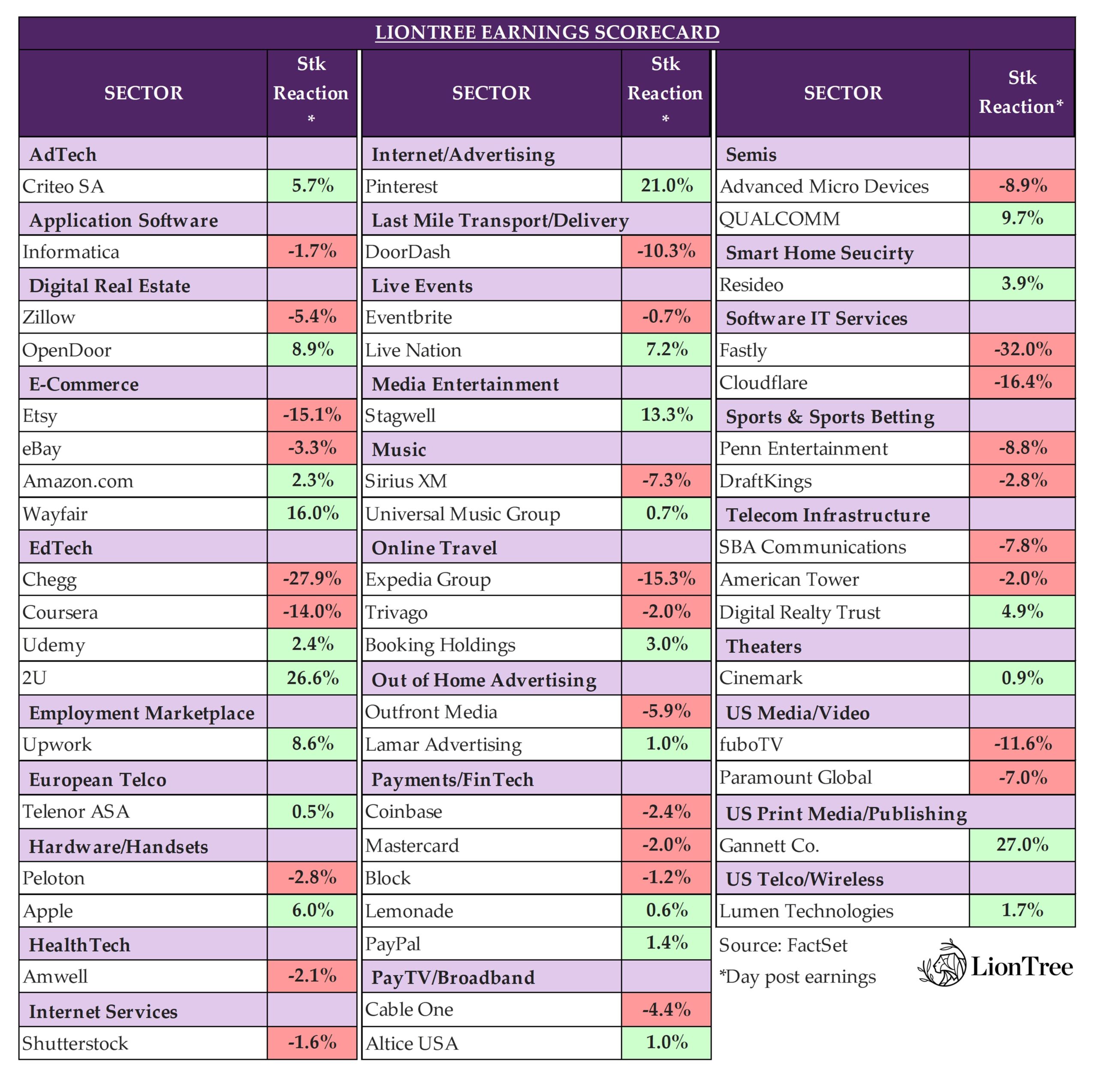
There was a deluge of earnings prints that came out this week, as 52 companies in the LionTree Universe reported results (more than double the 25 companies that reported last week). Similar to last week, stock price reactions were biased to the downside. 28 stocks (53.8%) traded down, and 24 stocks (46.1%) traded up. Fastly was the worst performer of the week (down -32.0%), while Gannett was the best performer (up +27.0%)..
Amazon (see Theme #2) and Apple (see Theme #8) finished out the MAANG reports for the quarter, with the stocks trading up +2.3% and +6.0%, respectively, in reaction to their results. Also finishing out their sector’s reports was Pinterest (see Theme #5), which was the last of the major digital media Cos to share its results and soared +21.0% in reaction.
Paramount (see Theme #10) kicked off legacy media earnings this week and traded down -7.0%. On the music side, Universal Music Group (see Theme #4) was up +0.7%, and on the Live Entertainment side, Live Nation (see Theme #6) was up +7.2%.
It was also a big week for the online travel names, and reactions diverged between the two big players, with Booking Holdings trading up +3.0% but Expedia falling -15.3% (see Theme #11). Also see a tough market response was DoorDash (see Theme #9), which fell -10.3% the day after posting its results.
The table below includes select mid- and large-cap TMT and consumer companies in our LionTree stock universe.
Amazon Follows Suit By Stepping Up CapEx Spend To Meet AI Demand
The impact and focus on AI and higher CapEx spending to support tech infrastructure has been the key theme for Big Tech this earnings season (see last week’s Theme #2 on Meta and Theme #3 on Alphabet). Now, Amazon has followed the lead of its other Big Tech peers by guiding for more spending to support customers’ capacity needs in AWS. Q1 CapEx of $14bn will be the low point for the year. While this means more upfront costs, visibility to generating returns on these investments is high, so the company should get support from Wall Street. Amazon’s accelerating top-line growth in AWS (from +13% y/y to +17% y/y, and the biz is now at a $100bn+ annual revenue run rate) also indicates success with its AI products and capabilities. AWS customers are through the cost optimization phase and are now renewing their infrastructure modernization efforts. The step up in AWS’s growth rate coming in combination with higher margins is notable as well (AWS op income margins at 2.8%, up +710bp y/y).
The core Stores business performed solidly (+6.9% y/y in Q1 vs +8.9% y/y in Q4), and Amazon is further expanding selection, focusing on providing value and accelerating delivery speed (setting another record on speed for Prime customers in Q1), while lowering cost to serve, which importantly has more to room to go. North American operating margins at 5.8% also have not likely arrived at a ceiling.
Overall, the strength across Amazon’s businesses came through in Q1, and costs efforts have been working. While the pendulum is shifting to investment again, we’d expect the company to better balance these efforts with maintaining a focus on profitability vs what we’ve seen in previous investment cycles.
See below for more details and updates on other key Amazon business areas, such as advertising, Amazon Prime Video, Healthcare, and more…
-> Amazon shares rose +2.3% in reaction to earnings and ended the week up +3.7%; YTD, Amazon stock is trading up +22.6%
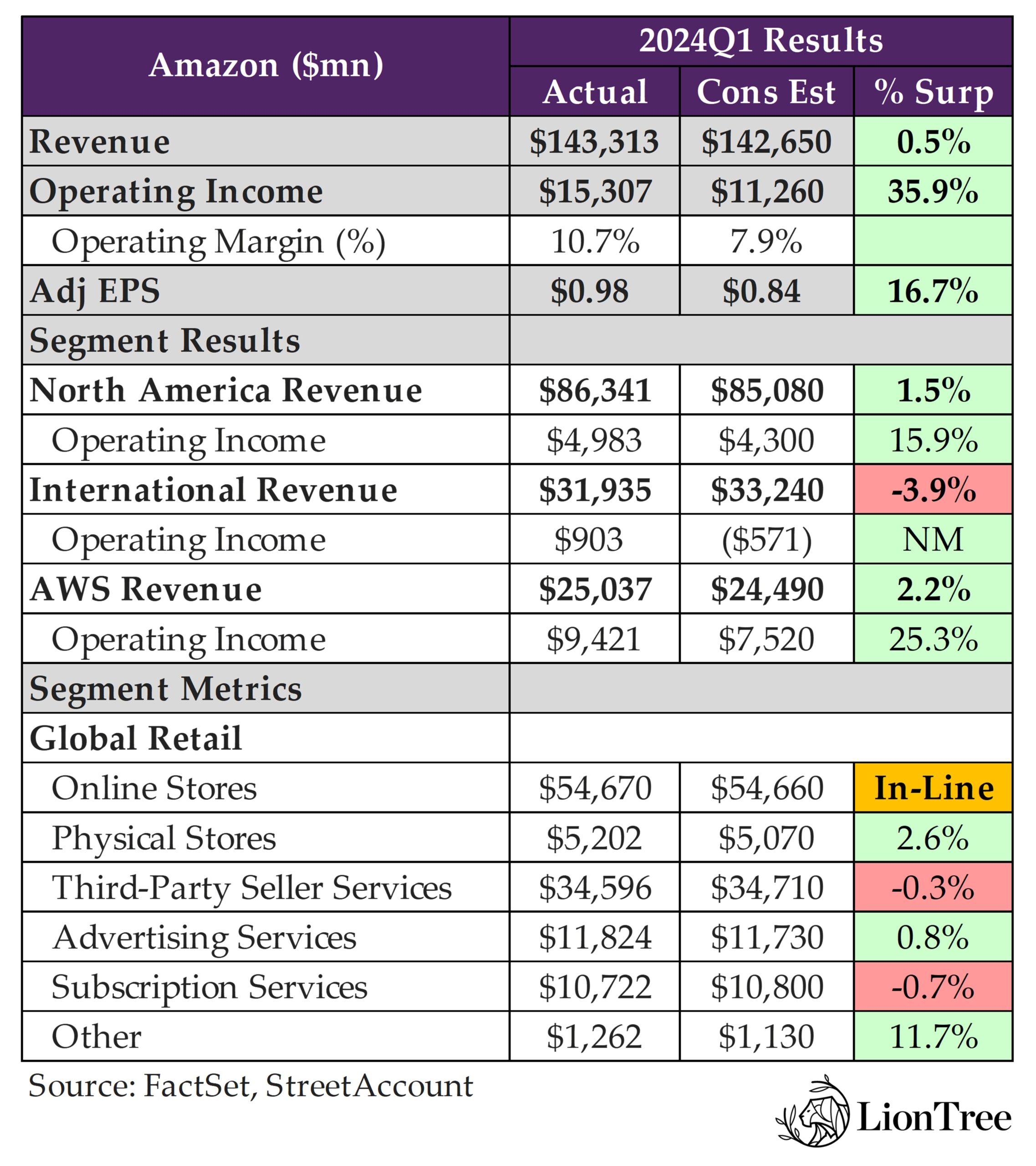
Amazon’s Q1 Beat The Street, With AWS Profitability Being The Biggest Positive Delta Vs Expectations
- Total revs at +13% y/y (vs +14% in Q4) was a tad better than expectations, but profitability was the standout vs cons:
- Some rev growth dynamics: Revenue had an impact from the leap year, which added +120bp to qtrly revs growth rate, but had an unfavorable FX impact vs plan, which was a -50bp headwind
- Op income was the highest qtrly number ever: Up +221% y/y and reached a 10.7% margin vs cons 7.9%
- EPS beat… 98c vs cons 84c
- Segment-Wise
- N Amer – BEAT: Revs (+12% y/y vs +13% in Q4) and op income (5.8% margin, up 460bp y/y) were both ahead of cons
- Intl – MIXED: Revs (+11% y/y FXN vs +13% FXN in Q4) were light but actually reported positive $903mn op income vs cons negative -$571mn
- AWS – BEAT: Revs (+17% y/y vs +13% in Q4) and op income (2.8%, up 710bp y/y) were both ahead of cons
- Other KPIs
- 3P svs revs up +16% FXN
- 3P seller unit mix was 61%, up +200bp y/y
- Paid units +12% y/y, similar to Q4
However, Q2 Guidance Was Lackluster Vs Estimates
- Mid-point of Q2 revenue guidance was -2.5% below cons: Growth range implies +7-11% y/y, which is a deceleration from the +13% y/y in Q1
- Assumes ~-60bp unfavorable impact from FX
- Also, Q1 growth was helped by ~+120bp y/y from the leap yr
- Mid-point of Q2 op income guidance is -5.7% below cons: But still up +55.8% y/y from the prior yr qtr’s $7.7bn
- Includes the impact from the seasonal step-up in SBC, given timing of the annual compensation cycle
Amazon Continues To Drive Faster Delivery & Broader Selection In Online Stores & Expanding Capabilities In Grocery
- Gunning for even faster delivery as it leads to higher shopping frequency
- 2bn+ global units arrived same or next day in Q1
- Amazon delivered to Prime members at its fastest speeds ever; In March, across the top 60 largest US metro areas, ~60% of Prime member orders arrived the same or next day, and in London, Tokyo, and Toronto, 3 out of 4 items were delivered the same or next day
- When customers received items quickly, they use Amazon more frequently
- Adding even more selection for customers: Added new brands incl Clinique, Parade and CIDER in the US; Annc’d collaboration w/ Hardly Ever Worn It in Europe to offer customers pre-owned items from luxury brands
- Are also making it easier for 3P sellers to add products to their store by just providing a URL to the seller’s website, Gen AI tools automatically create product detail pages on Amazon
- 100k+ of selling partners have used one or more of their GenAI tools
- Are also making it easier for 3P sellers to add products to their store by just providing a URL to the seller’s website, Gen AI tools automatically create product detail pages on Amazon
- Results show that “customers are shopping but remain cautious”: Focused on offering everyday low prices which is “important to our customers in this uncertain economic environment”; Customers are trading down on price when they can and seeking out deals
- Continue to expand capabilities in Grocery
- Launched a grocery subscription for unlimited delivery on orders over $35 from Whole Foods Market, Amazon Fresh, as well as local grocery and specialty retailers
- The subscription benefit is available to Prime members in 3,500+ towns and cities in the US, as well as customers using a registered Electronic Benefits Transfer card
- Annc’d Whole Foods Market Daily Shop: Provides customers in urban neighborhoods a quick, convenient shopping experience; Being launched on the Upper East Side in Manhattan, w/ more NYC locations to follow
- Launched a grocery subscription for unlimited delivery on orders over $35 from Whole Foods Market, Amazon Fresh, as well as local grocery and specialty retailers
Expect To See Further Improvements In Cost To Serve
- Have already made progress with regionalization efforts but think there are addt’l opportunities in the fulfillment network to lower costs more while improving customer experience: Avenues for efficiencies incl…
- Consolidating units into fewer boxes
- Allowing for better inventory placement closer to customers
- In fulfillment network, focusing on investing in the inbound network, streamlining and standardizing process paths, and adding robotics and automation
AWS Widely Outperformed Expectations And Higher Capx Will Lead To More Revenue
- AWS revenue growth posted a strong acceleration from +13% y/y in Q4 to +17.2% in Q1: Companies have largely completed cost optimization efforts and are turning attention to newer initiatives; Companies are modernizing infrastructure and leveraging GenAI to change their customer experiences and businesses
- AWS op income incr’d +83% y/y to $9.4bn: But reminder, the change in the est’d useful life of servers primarily benefits the AWS segment, and AWS op margins will “fluctuate” driven in part by the level of investments
- On the AI front, the Co has already “accumulated a multi-billion revenue run rate” and continue to add capabilities to all three layers of the GenAI stack
- Bottom layer (for developers and Co’s building models themselves): Have the broadcast selection of Nvidia compute instances, but demand for their customer chips, Trainium and Inferentia, is “quite high”; Larger quantities of Tranium 2 is coming in H2:24 and early 2025; Companies are seeing “eye popping” results with SageMaker (managed end to end svs for developers in preparing their data for AI, managing experiments, training models faster, lowering inference latency and improving developer productivity
- Middle layer (for developers and companies who want to leverage existing LLMs and customize with their own data): This is where Amazon Bedrock has the broadest selection of LLMs available to customers, plus model evaluation, retrieval augmented generation, guardrails, etc
- Bedrock already has tens of thousands of customers; A week ago, Bedrock launched a series of other features, but perhaps most importantly, Custom Model Import; Makes it simple to import models from SageMaker or elsewhere into Bedrock before deploying their application
- Top of the stack (Gen AI applications): Annc’d general availability of Amazon Q, the most capable Gen AI-powered assistant for accelerating software development and leveraging companies’ internal data
- Q has the highest known score in acceptance rate for code suggestions, outperforms all other publicly benchmarkable competitors on catching security vulnerabilities, and leads all software development assistants on connecting multiple steps together and applying automatic actions
- CapEx is going “meaningfully” up y/y in 2024, which bodes well for future growth: The more demand AWS has, the more the Co has to procure new data centers, power, and hardware
- Amazon doesn’t spend the capital without very clear signals that it can monetize
- Q1’s $14bn of CapEx will be the low qtr for the year
- Remain “very bullish: in AWS: The biz is at a $100bn+ annualized rev run rate, but 85%+ of the global IT spend remains on-premise; Plus, the Gen AI that will be created on the cloud represents “a very large opportunity”
Other Initiatives – Advertising, Prime Video, Autonomous Car, Healthcare, Satellite Efforts
- Advertising revenue growth was strong at up +24% y/y FXN: Compares to +26% y/y FXN growth in Q4
- Driven by sponsored products (improvements in relevancy and measurement) and more room to grow
- Just starting with Prime Video ads and “encouraged by the early response”
- Prime Video continues to build content slate:
- Released 20 films and series from Amazon MGM Studios
- “Fallout” is the latest big hit (65mn+ viewers worldwide in its first 16 days) on the heels of the very successful Road House movie (50mn+ viewers worldwide)
- Annc’d that Prime Video will stream its first NFL Wild Card playoff game in January 2025
- Internationally have 30+ local Amazon Originals
- Hazbin Hotel had the most total global viewers on its opening weekend for a new animated series on Prime Video
- The Beekeeper ranked in the top-10 of theatrical releases by revenue globally in Q1
- Annc’d plans to create a new series from Mr Beast; Beast Games is set to have 1,000 contestants competing for $5mn; The series will premiere on Prime Video in 240+ countries and territories
- Expanded the company’s health care offerings: Providing customers in the US more convenient access to medical care and medications
- Launched same-day delivery of prescription medications to customers in 8 cities, incl LA and NYC, with plans to expand to more than a dozen cities by the end of the year; Customers are now getting first filled medications +75% faster y/y nationwide
-> While Amazon is moving forward with its healthcare offering, Walmart annc’d it is shutting down all of its 51 health clinics as well as its telehealth offering, as the company grapples with increasing costs and reimbursement issues, though its in-store pharmacy and vision centers will remain open (link)
- Hitting milestones with robotaxis: On the path toward commercializing Zoox, Amazon’s self-driving robotaxi, which is expected later this year
- Received Zoox’s California PUC Driverless Autonomous Vehicle Pilot permit, which allows Zoox to carry members of the public in Foster City w/out charging a fare
- Expanded driving capabilities to include higher speeds, night driving, and driving in light rain in both California and Nevada
- Expanded the virtual boundary where Zoox can operate its robotaxis in Las Vegas, helping prepare for the first public riders in the city later this year.
- Kuiper is getting closer to having its production satellites in space and is entering commercial beta
The NBA Media Rights Deal Suggests The Market Is Not Past Peak Sports Rights Values
In our most recent annual survey, we polled our readers for their views on how much the value of the NBA’s media rights would rise during the upcoming negotiations, and the largest segment of respondents (~45%) thought they would increase +50% from the $2.6bn that Disney and Warner Bros Discovery currently pay the league annually, implying ~$3.9bn. Well, that pales in comparison to press reports this week suggesting that the value of the NBA’s media rights could nearly triple to a whopping ~$7bn per year, underscoring just how valuable premium live sports are becoming within the broader media ecosystem.
There were some other noteworthy developments elsewhere across the sports space as well this week, including a couple of fallouts over carriage renewal discussions that ultimately resulted in consumers losing further access to sports programming and even greater fragmentation. Separately, it was also reported that Fox is asking for $7mn for a 30-second ad spot in the 2025 Super Bowl as a starting point with would-be advertisers, potentially positioning the company to command an even greater premium than Paramount received during this year’s record-breaking Super Bowl event.
See below for more details:
- The NBA is reportedly targeting $76bn in total rights fees over 11 yrs, a +3x increase over its current deal (link): The NBA has apparently agreed to the general framework of deals w/ Disney and Amazon worth $2.6bn/yr and $1.8bn/yr, respectively; Both agreements are subject to change but are expected to be signed
- The winner of a third package still has yet to be decided: Sources indicate that the race has boiled down to Warner Bros Discovery and Comcast, which has proposed a deal worth ~$2.5bn annually, or double the amount WBD pays under its current contract
- Comcast appears to the favorite to win the rights: Given the size of its offer and its ownership of the NBC broadcast network, which will help the NBA reach as many people as possible, despite the ongoing declines in linear viewership
- Turner’s four-decade relationship w/ the NBA is at stake: If Comcast wins the rights, WBD will lose the NBA rights after the 2024-25 season, likely leading to a loss of viewers for its TNT network; Notably, WBD signed a 10-yr deal w/ NBA legend Charles Barkley as a host in 2022
- Adopting the NFL’s fragmentation playbook has benefited the NBA: By splitting the league’s rights up into three packages (instead of the two offered previously), the NBA is set to secure a record payday of close to $7bn annually, underscoring the extremely high demand for live sports
- The NBA emphasized bringing in a third partner rooted in technology: Amazon is reportedly discussing a package of games for Prime video that would include some of the conference finals, though specifics will depend on the outcome of the third rights package
- Disney is expected to keep the NBA finals: In the past, Disney has also had one of the two conference finals, while Turner has had the other; Disney will air games on ABC and ESPN as well as stream them
- The winner of a third package still has yet to be decided: Sources indicate that the race has boiled down to Warner Bros Discovery and Comcast, which has proposed a deal worth ~$2.5bn annually, or double the amount WBD pays under its current contract
There Were Also Some Other Notable Updates Across The Sports Media Landscape This Week…
- Fubo dropped Discovery networks after reaching an impasse w/ Warner Bros Discovery (link/link): Fubo said it had not received a response from WBD in recent carriage talks and removed 19 Discovery networks from its svs in response to WBD’s refusal to negotiate
- Fubo and WBD have a history of carriage disputes: Fubo hasn’t carried nearly a dozen networks from the Warner side of WBD, including TNT and CNN, since it was unable to renew a carriage agreement with the former WarnerMedia networks in 2020
- Fubo believes it negotiated in good faith: Fubo said that it offered WBD mkt rates for its content but didn’t receive a counteroffer from the Co
- Flexibility in sports bundling is at the heart of the current standoff between the two: Fubo accused WBD of denying Fubo customers the choice of accessing Turner sports content through a more affordable, skinny sports bundle
- Fubo also criticized WBD’s role in the sports streaming JV w/ Disney and Fox: Fubo took issue w/ WBD’s decision to make sports content that available in the JV that it otherwise wouldn’t have broken out as a separate offering; Fubo also recently filed an antitrust lawsuit against the JV
- Diamond Sports failed to renew its distribution deal w/ Comcast (link): Diamond’s prior deal w/ Comcast expired the night of April 30, impacting local coverage of several MLB games and an NHL playoff game between the Nashville Predators and the Vancouver Canucks
- Diamond has been successful in its negotiations w/ other cable networks: Diamond agreed to a carriage deal w/ Charter, the largest US cable video distributor, last month and is close to finalizing a deal w/ DirecTV, the country’s third largest cable TV provider; The Co also renewed a deal w/ Cox this week
- Diamond “declined multiple offers”, per Comcast: Notably, Comcast recently reached new distribution deals w/ the Mid-Atlantic Sports Network and SportsNet Pittsburg after the two agreed to be placed on more expensive and less broadly distributed tiers
- The stakes are high for Diamond…: The Co’s prior deals with Charter, Comcast, and DirecTV collectively represent ~81% of its total distribution rev
- … While Comcast can bide its time: Comcast has kept several sports channels dark on its systems indefinitely amid carriage negotiations; For example, New York’s MSG Networks has been off of Comcast in New Jersey and Connecticut since 2021
- Fox is reportedly seeking at least $7mn for a 30-second commercial in its 2025 broadcast of Super Bowl LIX (link): This was per sources w/ insight into the Co’s early talks w/ potential advertisers; The $7mn price tag marks a slightly higher starting point than Paramount’s initial request for between $6.5-7mn for a half-minute ad
- Fox is also seeking addt’l payments from potential sponsors that aren’t regular media buyers w/ the Co: This is standard practice by most networks each yr; Fox will likely insist on a commitment from advertisers to buy other parts of its portfolio, including Tubi, Fox Broadcasting, or other parts of Fox Sports
- Media buyers are taking a more measured stance during talks…: One buying exec doubted that some advertisers would be “chomping at the bit” to pay $7mn for an ad
- … Though execs at Fox have been optimistic: The Super Bowl has reached record audiences in each of the last two yrs, w/ an estimated 123.7mn viewers tuning in to watch the Kansas City Chiefs beat the San Francisco 49ers in overtime on Feb 11 in the most recent game
- Fox won’t host its next Super Bowl until 2029: Disney recently joined the rotation of Super Bowl rights holders, extending the period that each network has in between hosting the games
UMG Sees A “Substantial Improvement” In Total Value From The New TikTok Deal
Finally, the UMG and TikTok standoff ended, and the two came to a meeting of the minds with regard to a new agreement. While characterized as a win-win, UMG stressed that it would see a “substantial improvement” in total value derived from the relationship, which included a revenue component that wasn’t part of the last deal and includes other aspects that don’t necessarily show up in the revenue line, including e-commerce, ad credits, data marketing programs, and other things. Also, UMG indicated that TikTok addressed its concerns regarding AI and “protecting the integrity and value of human artistry”.
With respect to UMG’s quarterly results, the company delivered a strong Q1 relative to expectations, with total revenues up +8% y/y FX-neutral and adj EBITDA up +16% y/y, driving significant margin expansion. The upside to the numbers came from Recorded Music Ad supported streaming revenue growth accelerating from +5.6% y/y in Q4 to +10.3% y/y FXN in Q1 and easily beating cons +3.9%. This was encouraging; however, mgmt cautioned to “not get ahead of ourselves too far too quickly” after just one quarter. On profitability, adj EBITDA margins of 22.8% topped cons 22.3%, but mgmt reminded investors that there will be quarterly fluctuations and that trends should be assessed annually. The company also reiterated guidance of adj EBITDA margins in the mid-twenties in the medium term.
In the core Recorded Music Subscription business, revenues are still growing double-digits, but there was some focus on the deceleration from +15.0% y/y FXN growth in Q4 to +12.5% y/y FXN growth this qtr. While the Spotify price increase helped during the qtr, growth on some other platforms has not been as fast, given that UMG has lapped the one-year mark from earlier price adjustments, eroding their positive impact on the company’s P&L.
Lastly, mgmt stressed that the new terms with DSPs on premium bundles do not change UMG subscriber economics and that the company views Spotify’s experimentation with different pricing tiers positively because they believe it will ultimately attract more subscribers into the ecosystem, retain existing ones, and increase the customer lifetime value.
All-in-all, the music industry has been able to enact structural change with more of a win-win partnership mindset, a unique dynamic, and the trend toward monetization and harvesting in the music sector continues.
See below for more on our key takeaways and thoughts from UMG’s results and conference call.
-> UMG shares were up +3.6% in response to earnings, closing the week up+4.9%; YTD, UMG stock is trading +12.0% higher
UMG’s Agreement With TikTok Is At A “Substantially” Better Total Value
- Tiktok agreed to key changes and addressed concerns about gen AI on its platform; The new deal better aligns with the values of other comparable partnerships
- Saw a “substantial improvement” in total value derived from the relationship: Multifaceted deal on compensation
- Revenue: “Revenue under this new deal does mark an improvement for our last deal”
- Other economic value: There are also “other aspects and economic value that don’t necessarily show up in the revenue line, including things like e-commerce, ad credits, data marketing programs, other important facets of the platform relationship that we have with TikTok”
- AI: Also, “can’t emphasize enough the strategic significance in the area of AI… TikTok will also protect the integrity and value of human artistry by ensuring that fake artist AI content uploaded by third parties that misappropriates the identities of our artists, infringes on their right of publicity, can be removed. Collectively, these and other commitments we’ve secured regarding generative AI represent what we think is a dramatic improvement from where things stood just a few months ago”
- Saw a “substantial improvement” in total value derived from the relationship: Multifaceted deal on compensation
- Other efforts in social media:
- Have been working to accelerate engagement with music on Snapchat, Insta, and Youtube shorts
- Recent new agreement with Spotify makes available a range of new features that were previously only found on social media platforms and broadened the definition of the social music category
UMG Q1 = Better Streaming Revenue & Better Margins
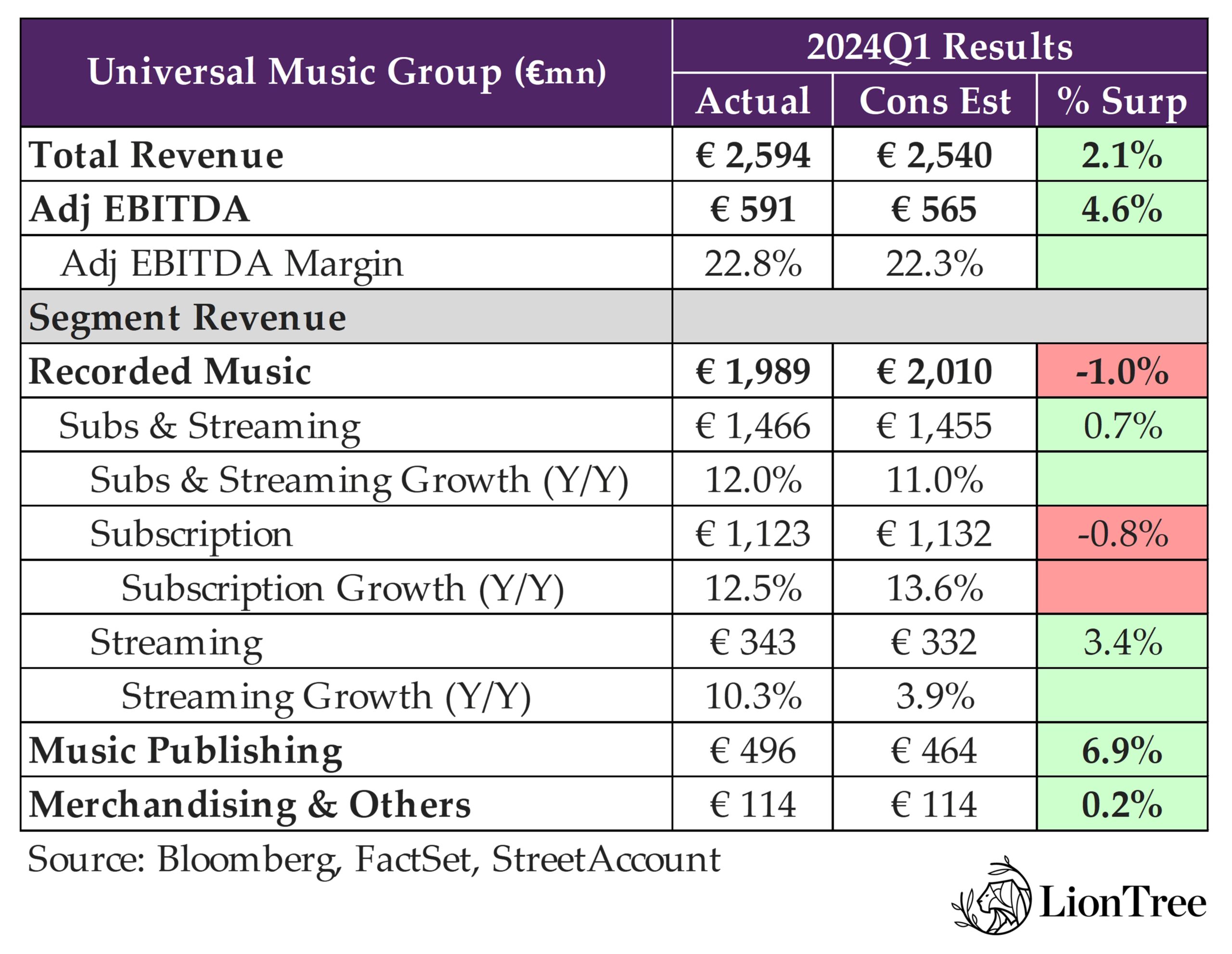
- Revs and adj EBITDA beat expectations:
- Revs: Grew +7.9% y/y FXN (actual +5.8%), which beat cons +7%
- Adj EBITDA: Beat by +4.6%; Adj EBITDA up +13.2% y/y or +15.9% FXN (margins expanded +1.5ppts to 22.8%)
- Recorded Music (77% of total rev) … Streaming rev growth was the key upside driver offsetting slower Subscription rev growth
- Total Recorded Music revs grew +3.4% y/y or +6% FXN but slightly missed consensus
- Subscription revs incr’d +10.7% or 12.5% FXN (driven primarily by subscriber growth but also price increases) but missed cons +13.6% FXN
- Streaming revs incr’d +8.9% y/y or +10.3% FXN and beat cons +13.6% FXN
- Physical revs decr’d -18.5% y/y or -14.4% FXN (largely due to a very difficult y/y comp in Japan and expect tough comps for the year)
- License & other revs decl’d -1.8% y/y, or -0.4% FXN (due to a timing-related decline synch revs)
- Downloads & other digital revs decr’d -16.4% y/y, or -13.2% FXN (download sales cont’d the industry-wide decline
- Total Recorded Music revs grew +3.4% y/y or +6% FXN but slightly missed consensus
- Music Publishing (19% of total rev)… Beat by +7%
- Revs grew +16.7% y/y, or +18.4% FXN
- Digital revs incr’d +22.9% y/y, or +24.6% FXN, driven by continued growth in streaming and subscription revenue
- Performance rev incr’d +26.7% y/y, or +28.1% FXN, due in part to higher society payments in the US, as well as greater than anticipated live activity in Europe
- Synchronization rev fell -10.1% y/y, or -7.5% FXN, as a result of timing; Mechanical rev grew by +8.7% in both reported and FXN
- Revs grew +16.7% y/y, or +18.4% FXN
- Top sellers: Taylor Swift, Noah Kahan, Morgan Wallen, Ariana Grande, and Olivia Rodrigo
Recorded Music Subscription Revs Benefited From The SPOT Price Increase In Q1 But Growth On Other Platforms Lagged Due To Comps
- Recorded Music Subscription revs growth decelerated from +15.0% in Q4 to +12.5% FXN in Q1: While the Co saw the full benefit from the Spotify price increase, “several other platforms did not grow as quickly”, UMG began to anniversary the positive 2023 impact on price increases at Apple and Amazon
- New terms on premium bundles do not change UMG’s subscriber economics: As previously discussed, “the new terms have some incentive structures around kitting KPIs that might relate to margin, but there is no change to what we previously said in terms of those impacts to our subscriber economics”
- “We’re of course going to stay vigilant in looking after the interest of our songwriters as we stay in close dialogue with all parties and all constituencies. We’re pretty good at coming up with solutions that benefit all of us. Our entire mantra is win, win. And I think we should add that Spotify has been an incredibly good partner
- UMG is positive on Spotify experimenting with different pricing tiers: “They’re looking to maximize the optimization of customer value, we think ultimately attracting more subscribers into the ecosystem and retaining the subscribers and increase the customer lifetime value”
- Market share is stable and healthy, and UMG “remain[s] encouraged by the total subscriber growth throughout the market”
Encouraged By Co’s Ad Supported Performance But Not Ready To Call It A Trend Yet
- Recorded music ad supported streaming rev growth accelerated to +10.3% y/y in Q1 from +5.6% in Q4 FXN: “Really encouraged” by the improvement in the ad supported streaming growth, but they are still cautious at the moment with regard to the entire marketplace for advertising
- “Need to see consistent, broad-based improvements across all partnerships and across all geographies and probably over a more consistent longer term time frame”; One qtr is encouraging, but “let’s not get ahead of ourselves too far too quickly”
Co Advocates Looking At The Margin trajectory On An Annual Vs Qtrly Basis & Reiterated Medium-Term Guidance
- Margins can vary qrtr to qtr, so investors should focus on annual trends: “Be very careful about any individual quarter”; Q1 came from op leverage but also revenue mix given the decline in physical sales and increase in the higher margin streaming and subscription rev plus €12mn savings from cash compensation from the equity plan
- Reiterated guidance of adj EBITDA margins in the mid-twenties in the medium-term
- Positive impact from cost savings initiatives is still to come: These savings began to roll out in April
- Remains on track for the €75mn in cost savings as previously guided for 2024
Remain Focused On More Fully Monetizing SuperFans
- Very encouraged by the “positive reaction” regarding prospects of a super-premium tier at a higher price point: That would involve an even more advanced value proposition for customers to take advantage of the potential 10-20% of the subscriber base that UMG’s research suggests could be the target market for a higher value, higher priced subscription tier;
- The research suggests that one in five paid music subscribers would be willing to pay for a premium tier – That’s enticing
Pinterest’s Platform Transformation Is Delivering “Compounding Benefits”
With Meta and Alphabet accelerating growth in their advertising businesses last year, a key discussion in the sector has been whether the axiom of “the bigger will get bigger” in digital advertising will persist to the extent that smaller digital advertising players are completely edged out. In other words, is there room for smaller platforms like Snap and Pinterest to establish a significant presence in a market overwhelmingly dominated by the “digital duopoly” of Meta and Alphabet?
On the back of Snap’s report last week (see Theme #4 from last week’s Weekly), which saw the stock rally +27.6% in reaction to revenue growth accelerating more than expected, coupled with much better profitability and favorable guidance, all eyes were on Pinterest to see if a similar trend would emerge. And Pinterest delivered, coming in above expectations both on Q1 results as well as Q2 guidance. The Q1 beat was driven by UCAN, which saw accelerating revenue growth q/q and also beat expectations, while Europe and RoW decelerated q/q (was the same q/q on a FXN basis, as FX was a headwind) and missed. However, focus has been on the home market, which is also Pinterest’s largest, and now that the company has been seeing results, it’s starting to focus on growing revenues more strongly internationally.
Solid MAU and engagement growth, ad load synergy, and monetization strength in the lower funnel all helped Pinterest achieve its fastest revenue growth since 2021 in Q1. Complementing the strong growth in 1P demand was the emerging contribution in Q1 from Pinterest’s 3P partnerships with Amazon and Google, which have been ramping and helped to round out gaps in the company’s auctions and bring more auction density. It’s still very early days, and they’re just getting start with Google on the international side, so there are “more […] opportunities in front of [them] than behind”
The growth and acceleration seen in the quarter is “a result of months and quarters of compound effects” from the initiatives that Pinterest been acting on to deliver more click and conversion to advertisers, giving them more measurement capabilities, and making it easier for them to create campaigns that deliver great ROI. We’d expect these “compounding benefits” to continue to build heading in Q2 and throughout the rest of the year.
-> Pinterest soared +21.0% post its print and ended the week up +19.0%; YTD, the stock is up +9.1%
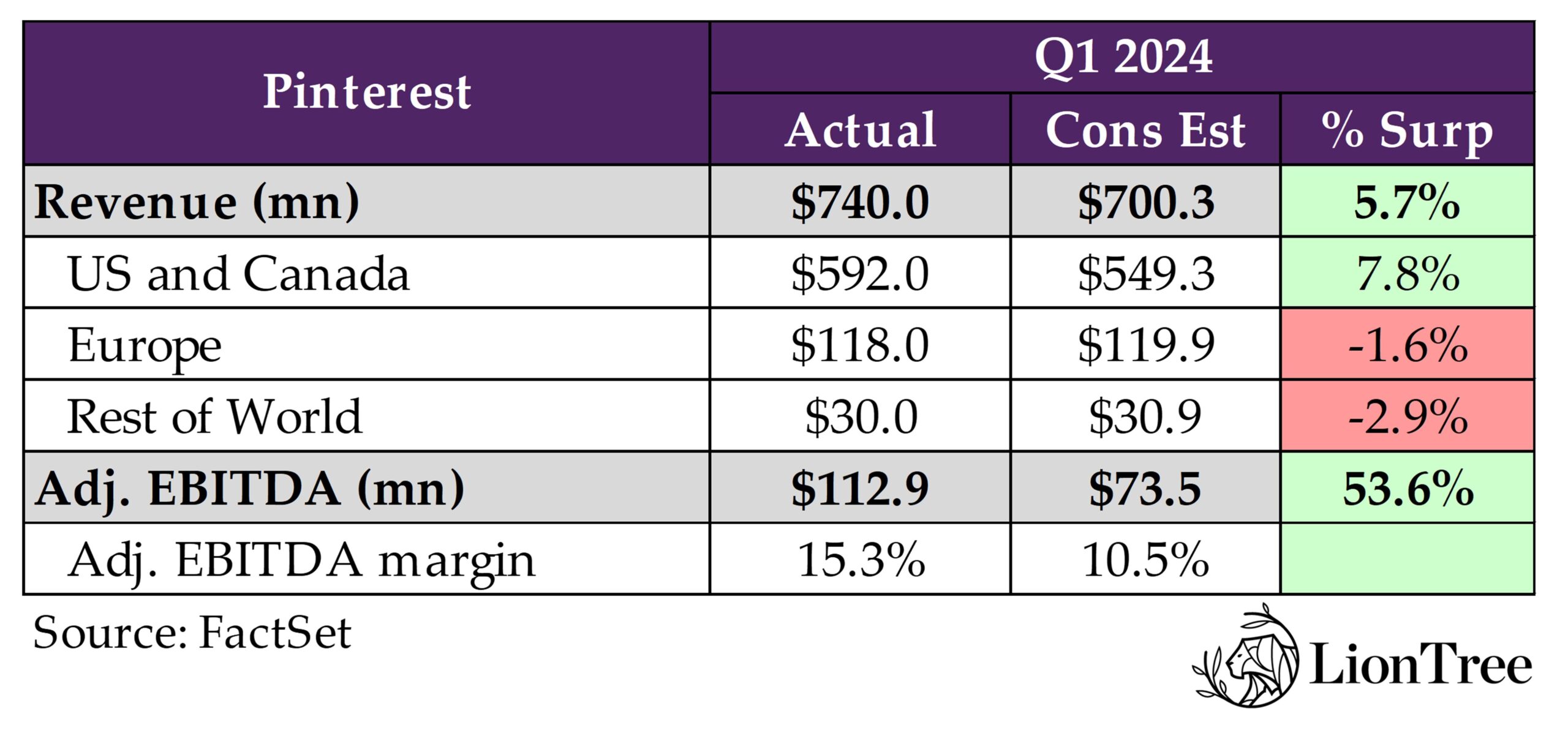
Easy Beats In Q1 – The Co Posted Its Fastest Rev Growth Qtr Since 2021 And Continues To Drive Improvements In Profitability
- Q1 revenue – BEAT by +5.7%: Grew +23% y/y or +22% ex-FX (accelerating from +12% in Q4) to reach $740mn
- The upside was all driven by UCAN, as Europe and RoW missed
- Reported revenue did have +2pts of y/y growth benefit from Easter, the leap year, and FX
- Q1 adj EBITDA – BEAT by +53.6%: Grew +319% y/y (vs +86% y/y in Q4) to reach $113mn (15% margin, ~+1,000bp y/y)
Guidance Supports Compounding Benefits Of Growth Initiatives
- Q2 revenue guidance – BEAT by +1.8% at the midpoint: $835-$850mn vs cons $827.2mn
- Implied growth is roughly consistent w/ Q1: When adjusted for the 2pts of y/y growth benefit in Q1 from the Easter timing shift and leap day as well as an addt’l +1pt benefit from FX, which they do not expect to continue into Q2 based on current spot rates, revs are expected to grow +18-20% y/y (vs +23% y/y in Q1)
- Q2 OpEx is expected to grow 11-15% y/y (vs +10% y/y in Q1): Expected to be between $490-505mn, driven by investment increases in R&D, where the Co is investing in headcount for AI talent across their biz
- Reiterated margin expansion expectations for 2024, which are forecast to come in at a more modest level than the +660bp delivered in 2023, as the Co balances investing in growth and flowing profitability through to the bottom line
- Expected the expansion to be more front-end loaded, as they lap the strengthening adj EBITDA margins driven in H2:22
- Some early puts-and-takes when thinking about 2024 rev growth –
- Tough comps going into H2
- Addt’l uncertainties from the ramping deprecation of 3P cookies through this year into early 2025, though the Co feels “well-positioned”
- More value capture on direct links is ahead of the Co vs behind
- 3P ad demand will continue to contribute to growth and grow off the base Pinterest is seeing in Q1
Global MAUs Set Another Record, As User Growth Continues To Accelerate
- Global MAUs surpassed 500mn+ for the first time, as y/y growth accelerated for the seventh consecutive qtr: Up +12% y/y (vs +11% y/y in Q4) to reach 518mn
- User growth accelerated across all regions and beat across all regions, esp ROW and Europe
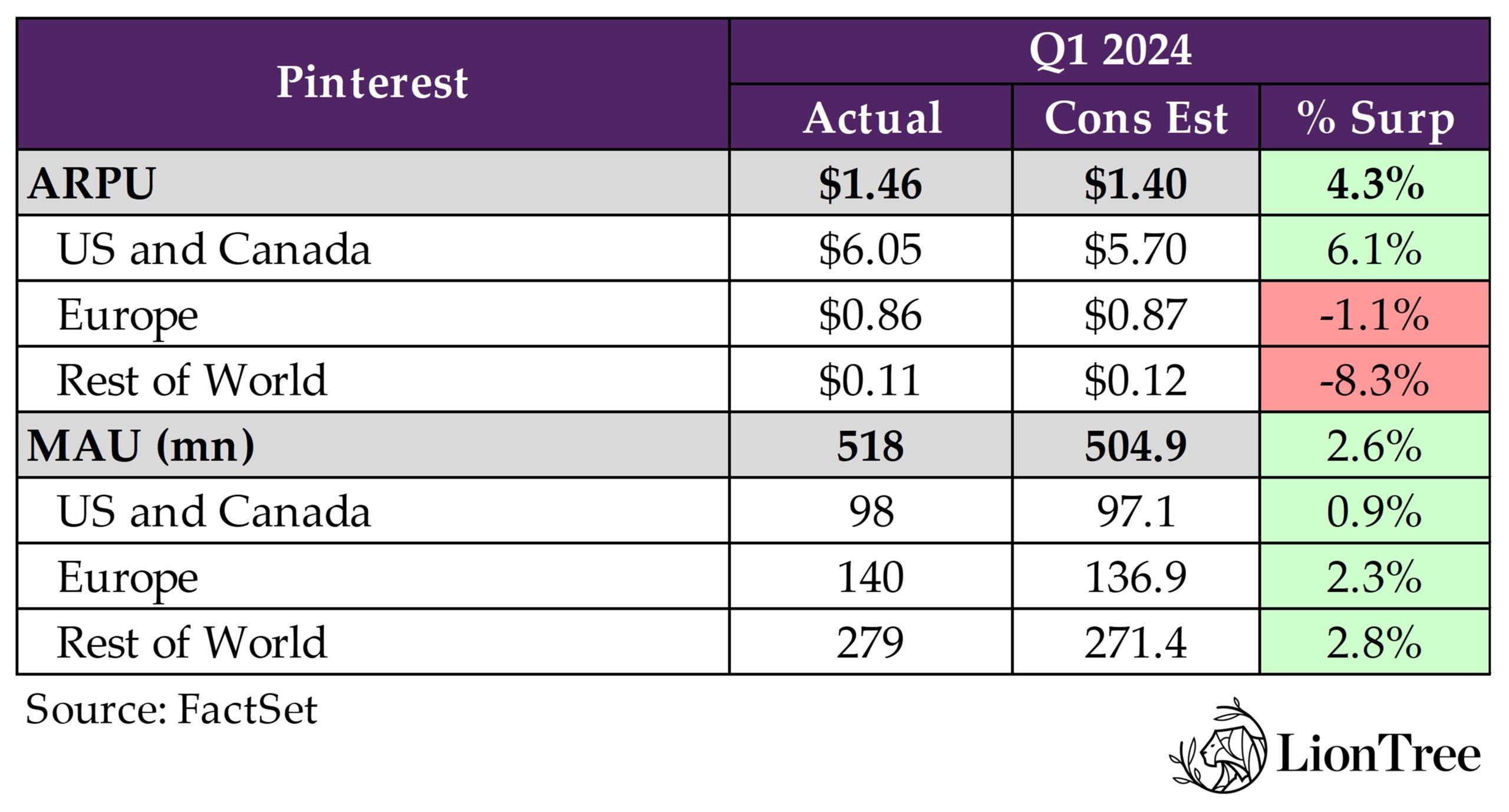
- ARPU was also better than expected ($1.46 vs cons $1.40), with the upside coming exclusively in the UCAN region
- Deepening engagement per user, w/ engagement growth outpacing user growth
- What has been driving the accelerating growth rate of MAUs?
- Using AI to drive relevance and personalization
- Doubling down on curation through boards and collages
- Driving actionability through core surfaces
- Create a more positive alternative to traditional social media
- Pinterest is aging down as it is “winning with Gen Z”: Largest and fastest-growing demographic at more than 40% of Pinterest users
- Save more pins than any other demo and also find value in new content formats
- View Pinterest as a “distinct and separate destination from other social media apps”
- Rates Pinterest higher on promoting and preserving well-being metrics vs other social media apps
- Connecting with Gen Z through “culturally relevant” moments (i.e., hosted an immersive activation at Coachella)
Improving Curation Tools Like Boards And Collages To Enhance User Experience
- Saw an ~+30% lift in boards created after adding auto organization features to help remove the friction for users to begin creating board
- Users are ~+3x more likely to save Collage Pins vs other Pins on Pinterest: “This is an entirely new, highly engaging, and highly shoppable content format”
- A “significant” portion contain clickable products
- Gaining traction with Gen Z, who are ~70% of collage creators
Starting To See Advertisers Shifting Budgets More Assertively Towards Pinterest
- Saw “broad strength” in retail in Q1, as well as “nice growth” in emerging categories, including financial svs and technology
- Q1 ad impressions accelerated to +38% y/y (vs +33% y/y in Q1) …: Driven by increases in total impressions and ad load
- … While pricing fell –1% y/y (vs –16% y/y in Q1): Largely as a result of accelerating ad demand, but still a y/y decline as the Co continues to drive increased value to advertisers in the form of more clicks and greater efficiency
- “Feel great” about their competitive positioning – advertisers are moving them into “always on” budgets vs “experimental” budgets that Pinterest historically played in
AI Is Driving The Flywheel Effect For Further Relevance In Content Recommendations
- Transitioned from CPU to GPU serving, allowing them to serve models that are 100x larger in size
- This was the first step to unlocking a better product experience by improving their ability to surface more personalized content for their users
- With GPU serving capabilities, they are now developing and deploying even more complex models to drive further gains in relevancy and personalization
- Optimizing recommendation models to focus more on engagement vs view time
- Previously, recommendation models were focused on serving content to drive greater view time in the immediate moment
- Now, as they’ve advanced AI and sharpened focus on user intent, have incorporated more proprietary signals into their recommendation models to optimize for depth of engagement and satisfaction of intent, including driving actionable outcomes (i.e., saves, clicks, and conversions)
- On the advertising front – seen “a lot of success” w/ current optimization tools and investing to build out the suite in order to give advertisers an array of tools to build, optimize, manage, and measure campaigns
- See “significant room” for the Co to drive further rev coverage for entire automation suite: Saw revenue coverage above 80% for automated bidding in Q1, with over half of revenue coverage utilizing either expanded targeting or flexible daily budgets
- Building out a more robust suite of automation tools drive further uptake: Will release these features in stages and will go through a typical product ramp as they develop, test, and scale
- Plan to launch a campaign creation tool that simplifies setup for their automated offerings and remove friction for advertisers to leverage those tools
- Launching a dynamic creative optimization solution set, which will allow advertisers to use genAI to optimize the creatives for their ads
- Introducing ROAS bidding, which is meant to increase advertiser return on ad spend by automatically optimizing campaigns in real-time to prioritize users or products that drive the highest ROI
Much More Value Capture Ahead Through Execution Of Lower Funnel Roadmap
- Solving for the actionability in the lower funnel through mobile deep linking and direct links, enhanced ad platform capabilities, and improved adoption of foundational measurement capabilities
- Adoption of lower funnel formats and tools has been a “critical” part of their monetization strategy
- Lowest funnel conversion objective was their fastest growing, with particular strength coming from the shopping ads format as advertisers turned to Pinterest to drive sales
- Clicks to advertisers more than doubled y/y again in Q1, after more than doubling clicks y/y in Q4
- Seeing particular strength in US and retail, where they’re taking share and starting to get more access into performance budgets
- Seeing value capture from direct links through increased ad spend from advertisers (97% of lower funnel rev has adopted the direct links format): Advertisers who have seen sustained performance gains from direct links and are able to measure the results have started to increase their share of wallet with Pinterest
- Reaching 5% or more total ad budget with some of their most sophisticated advertisers, implying an even deeper penetration of their digital ad spend
- But much more of the value capture from direct links remains ahead of them, as more advertisers begin to measure and react to the benefits from direct links
- Growing adoption of the API for Conversions to ~40% of total rev (up from 28% at Investor Day last Sept): Provides a server-to-server connection for advertisers to measure and attribute conversions
- Revenue from retail advertisers who have adopted the API for Conversions tends to grow “significantly” faster than revenue from those who have not yet adopted
- Seeing a reinforcing effect take place across lower funnel solution tool set and measurement solutions: As advertisers adopt and see the benefits of shopping ads, mobile deep linking, or direct links, they are more incentivized to adopt their privacy-centric measurement
- Advertisers who have adopted their lower funnel tool sets are also growing much faster than those who have no lower funnel solution adoptions
Integrating More Shoppable Content Into Core Surfaces To Facilitate User Actions
- Outbound clicks to advertisers accelerated q/q and more than doubled y/y, as users take advantage of the improved actionability
- Integrated more shoppable content into core surfaces, including home feed, search, and related items
- Guided shopping modules help users pick up where they left off on prior shopping journeys by resurfacing Product Pins based on past browsing and click history
- Visual shopping modules, such as Shop Similar and Shop the Look, allow users to shop the items they see within lifestyle images right when they discover them
- Brought shoppable video to Pinterest in Q1, expanding Shop the Look to video pins, allowed users to easily shop the items they see in videos
Seeing Emerging Contribution From 3P Partnerships And Now Beginning To Expand That Internationally
- Scaling 3P demand with their two partners – Amazon Ads in the US and Google Ads Manager (recently went live in February) in unmonetized int’l markets
- Amazon partnership is live on all main surfaces in the US, and they are continuing to optimize their respective systems to improve relevance and drive performance for advertisers
- Google partnership is “early” but “is also progressing nicely”
- Saw emerging contribution to revenue from 3P demand, which will be the base from which further 3P revenue will grow throughout the year
- Plans on potentially adding more partners beyond Amazon and Google? Continue to see oppties to expand current partnerships to multiple geographies and continuously evaluating partners that can complement the auction going forward
- In addition to 3P demand from Google, will begin working with resellers to bring in local ad demand, primarily in rest of world markets: Resellers provide a scaled approach to drive demand in markets where they don’t currently have a sales presence and can bring relevant ad content for users in those markets; Demand from resellers will take time to grow in these markets, so they expect this initiative to ramp over the course of the year
- Using a multi-pronged strategy to grow revenue in int’l markets
- In their largest int’l markets, using 1P selling efforts to strategically capture advertiser demand; Also deepening partnership w/ agencies to grow within these markets
- In smaller markets, where they had not monetized or are under monetized, they are introducing addt’l sources of demand to fill in gaps in their auction
Live Nation’s Results Point To No Slowdown In Live Entertainment
Following the early read into experiential experiences from NBCU last week, in which theme parks saw some declines in attendance in the US (see Theme #9 from Weekly 4/26/24), there was some worry coming into Live Nation’s earnings that a pullback may also be developing in the concert space as well. However, that was far from the case. Results easily topped expectations across all segments. Consumer demand hasn’t shown any weakness, as “global fan demand is stronger than ever, more artists are out on the road, and more venues are being added to bring them together.”
Overall attendance was up +21% y/y to 23mn in Q1, with arenas driving the growth, and ticket sales for shows this year are consistent w/ 2023, despite 2024 not being “a big stadium year.” The ticketing segment will see lower growth as a result of the decrease in deferred revenue associated with stadium tickets, which sell the earliest and are also the highest priced. Historically, that has led to a very high deferred revenue number at this point of the year, but with a shift to more arenas and amphitheaters, that sales cycle is going to come in a bit later. That being said, overall double-digit AOI growth is still expected due to strong consumer demand and sell-through rates.
On the venues side, Live Nation is the leader of the pack, as the company is “the one that everyone wants to partner with.” Live Nation has a good amount of optionality and is executing, with plans to open at least 12 major venues in 2024/25, creating capacity for 8mn+ additional fans and with returns expected to average 20%+. 2024 CapEx was revised up to $600mn (from the prior $540mn) due to “additional venue expansion opportunities”, with three-fourths of that being driven by Venue Nation.
The opportunity in international is also open-ended, particularly on the sponsorship side, and will drive higher growth rates in revenue in Q4 and Q1 of the upcoming years. Sponsorship revenue has historically been more heavily weighted towards Q2 and Q3 due to the summer months in North America and Europe. Putting on festivals in South America and Asia will smooth out the revenue plunges that the sponsorship segment sees in Q1 and Q4, and the company has been “getting real traction building those businesses.”
Finally, on the regulatory front, the company is about to begin discussions with the DoJ about the agency’s ongoing investigations; however, management doesn’t believe a breakup of Live Nation and Ticketmaster is legally permissible. They remain hopeful they can resolve the dispute but are prepared to defend themselves if the case gets to court.
All-in-all, Live Nation is on track to see a record 2024. See below for more.
-> Live Nation traded up +7.2% the day after its print and ended the week up +5.4%; YTD, the stock is up +1.1%
Live Nation Saw Its “Biggest Q1 Ever” As Both Top And Bottom-Line Easily Beat Consensus
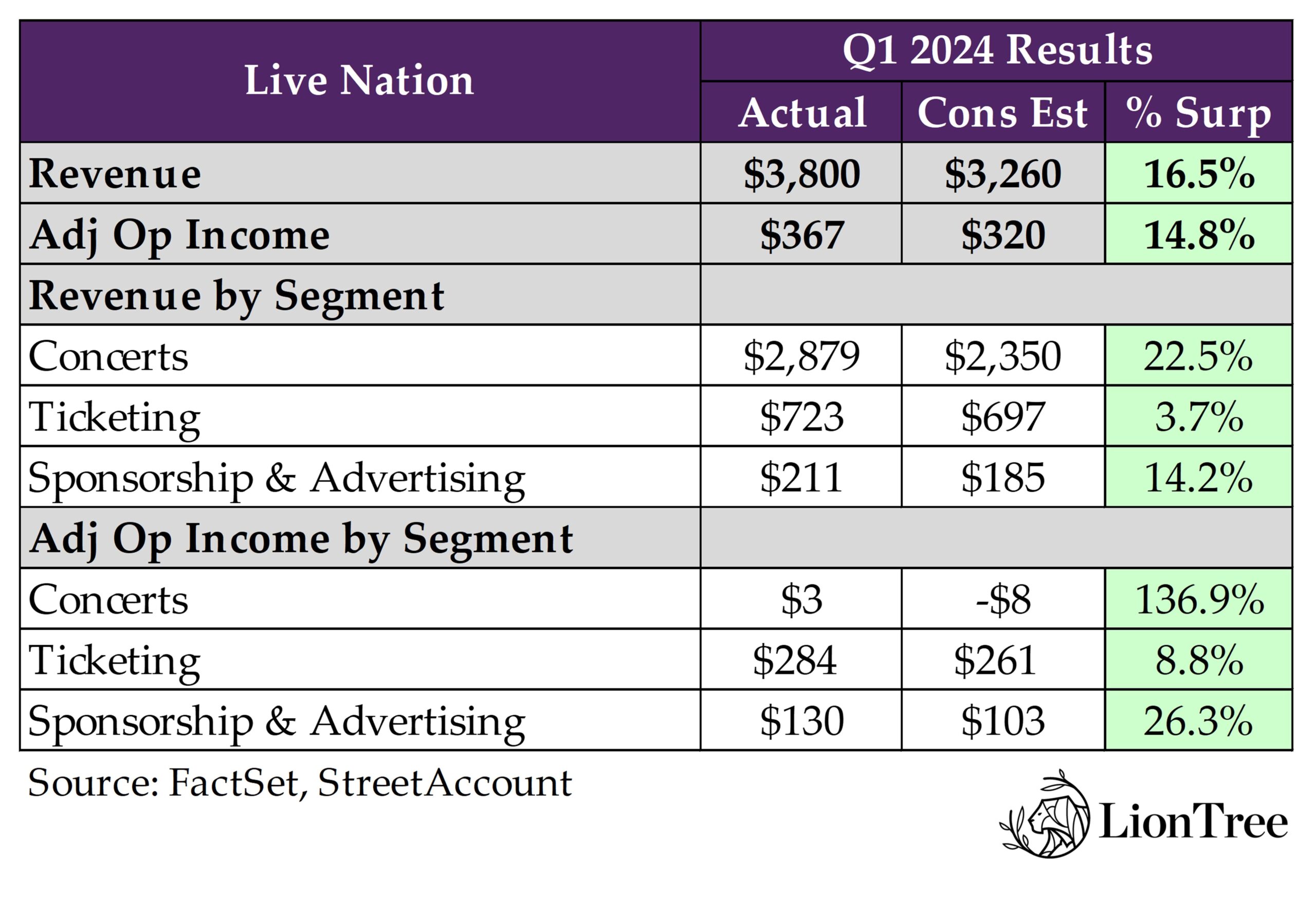
- Q1 was a series of beats: Q1 rev was up +21% y/y (vs +36% y/y in Q4) and beat cons by +16.5%; Adj op income rose +15% y/y (vs +20% y/y in Q4) and topped cons by +14.8%
- Revenue and adj op Income beat across all segments
Seeing No Weakness In Consumer Demand
- Q1 fan growth was up +21% y/y to 23mn fans
- Arena led attendance growth, up +40% y/y to ~10mn fans globally
- Festival attendance growth of double-digits, driven by Latin American markets
- “No issues at all” on fan demand relative to last summer
- # of artists that toured last year are in-line w/ the # that are touring again this year
- Those artists are consistently seeing sell-through of those shows at or above where they were last year
- Overall grosses for the artists are also consistently higher, even with a large increase in show count
- Overall arena volume is the largest at this point early on, despite “tremendous growth” in # of arena shows
- Not seeing any cannibalization as a result of increased # of arena shows
- Seeing “strong growth” in on-site spending
Looking Into 2024 – Leading Indicators Point To Another Record Year
- 2024 CapEx estimated to be ~$600mn, an increase from $540mn projected last qtr
- Three-fourths of total CapEx will be driven by Venue Nation; 5 venues account for ~40% of total venue spend
- Most of the CapEx increase relative to their prior projection is due to addt’l venue expansion opportunities, including a stadium in South America to be modeled after Foro So
- Still confident in double-digit AOI growth for the yr: “The story for the year is going to be less of a revenue story, more of a shift in the portion of the fans that are in our venues, higher fan profitability, concert AOI growth through margin expansion”
- Double-digit growth in ticket sales and confirmed shows…
- Live Nation concert ticket sales for overall arena and amphitheater shows are pacing up double-digits
- Confirmed shows for large venues (stadiums, arenas, and amphitheaters) up double-digits, with growth led by arenas and amphitheaters
- 85%+ of full-yr shows at large venues booked, compared to ~75% last yr
- … As demand for global content continues to grow
- Fan count for Q1 shows nearly doubled for int’l artists across top 50 global tours vs 5 yrs ago
- YTD ticket sales per show for Latin shows in the US are up double-digits y/y
- YTD confirmed US show count up +400% y/y for Afrobeats and ~+40% y/y for Latin, with similar trends in Europe
Momentum In Concerts Is Accelerating Into The Summer Season
- Concerts – Big beats: Rev grew +26% y/y in Q1 (vs +43% y/y in Q4) and easily topped cons by +22.5%; AOI grew to $3.1mn vs year-ago $0.8mn and beat cons of -$8mn
- Q1 margins expanded, even with increased arena activity
- What is the driver for bigger step up in North American concert attendance vs international attendance? It is a function of the international stadiums
- Q1 growth in North America was primarily due to fewer international stadium events, particularly in the Southern Hemisphere in Q1:23
- Despite an overall trend towards increasing international growth, this year might see a temporary shift with “disproportionate growth” from North American amphitheaters
- FY24 concert margins expected to be higher than FY23, though still too early to declare exactly what the margin expansion is going to be
- What factors will impact magnitude of growth?
- FX rates
- Arena activity levels, as Q4 is still in the process of being booked; If they have a lot of arena s in Q3, that could bring down margin while bringing up AOI, and “we’ll do that all day long”
- Advertising costs in Q4 related to 2025 stadium shows, as marketing and sales for those shows may begin in Q4; The more stadium tours put on sale in Q4 globally, the bigger the expense hit
- What factors will impact magnitude of growth?
- FY24 concert AOI growth expected to be primarily driven by Q2 and Q3 activity
Seeing “Strong” Start To Festival Portfolio
- Contrary to press around difficulty selling tickets in the broader festival industry in US and Europe, Live Nation has NOT been seeing challenges
- Benefit from being a global Co and having 100+ festivals around the world
- Ticket sales are up double-digits y/y
- Sponsorship on festivals is up over +20% y/y
- Festival strategy is to launch ~10 new festivals a year internationally, and cut out the weak performers for the next year – “You’re lucky if 50% of them make it the next year”
- “I think this year we started 10, we shut down 6, so you’re always kind of cutting off the weak performers and restarting some new ideas”
- Seeing a shift towards more niche 1–2-day festivals vs massive 3-day festivals
- Organizing large, 100k+ people, multi-day music festivals with unique, high-profile headliner that appeals to all is difficult to deliver year-on-year
- Also, artists are making a lot of money in arenas and stadium, so it’s not as easy to get “that special headliner”
- Seeing “great success” in smaller, ~35k people, 1-2-day festivals that center around a certain genre of music or lifestyle
- Usually have higher per heads and higher sponsorship value
- “If you’re starting a new one, you’re probably starting a more niche strategy and trying to make sure it’s a better experience versus just putting 75,000 people in a field”
- Organizing large, 100k+ people, multi-day music festivals with unique, high-profile headliner that appeals to all is difficult to deliver year-on-year
Ticketing Sales Have Been Consistent Y/Y (Despite Fewer Stadium Shows In 2024)
- Ticketing – beat: Q1 rev grew +13.6% y/y (vs +7% y/y in Q4) and came in +3.7% ahead of cons; AOI was up +5% y/y (vs +4% y/y in Q3) and beat cons by +8.8%
- Saw record Q1 operating metrics
- ~77mn fee-bearing tickets sold, driven by double-digit growth in int’l markets
- Fee-bearing GTV up to ~$8bn, with growth driven by int’l markets
- YTD ticket sales of 86mn for shows this yr are consistent w/ 2023, despite reduced stadium activity / As expected, 2024 will NOT be “a big stadium year”
- Stadium tickets sell earliest and are the highest priced, so they are going to lead historically to a very high deferred rev # at this point of the yr
- With a shift to more arenas and more amphitheaters, the sales cycle is going to come in a bit later
- Will see lower growth as a result of fewer stadium, high-ticket price shows this yr
- FY24 margins are expected to be consistent w/ last yr
Int’l Will Be A Key Driver In Filling In Sponsorship Rev Gaps In The Year
- Sponsorship & Advertising – beat: Rev grew +24% y/y (vs +4% y/y in Q4) and beat cons by +14.2%; AOI was roughly flat (vs +7.2% y/y in Q4) and beat cons by +26.3%
- Was the segment’s highest Q1 rev ever
- 85%+ of expected sponsorship commitments for the year are booked, up double-digits y/y
- By sector: Non-alcoholic beverages, CPG, and retail categories are each up double-digits y/y
- New partners added this year include Jaguar Land Rover’s Defender and U.K. festival headline partners Rockstar Energy and Liquid Death
- Expanded relationships with GNP in Mexico and Cisco and Bacardi in the US
- International festivals, particularly in the southern hemisphere, will drive the higher growth rates in sponsorship rev in Q1 and Q4 this yr
- Balancing out sponsorship rev (which tends to be Q2 and Q3 heavy due to the summer months in N. America and Europe) by putting on festivals in South America and Asia, which they have been “getting real traction building those businesses”
- FY24 Sponsorship & Advertising margins expected to be consistent with last year
Have More Opportunities Than Execution Power On Venue Buildout, “But We’re Building That Muscle Fast”
- Q1 food and beverage spending was up +10% y/y at US theaters and clubs
- Incremental FY24 commentary –
- Venue Nation fan count expected to grow double-digits with more shows at amphitheaters and other operated venues
- Profitability per fan at amphitheaters expected to increase double-digits this year, with these venues delivering over 2.5x the per fan profitability of similarly sized third-party venue
- Venue Nation expanding its global portfolio in 2024 onwards
- Plan to open at least 12 major venues globally in 2024/25, creating capacity for 8mn+ additional fans
- Will also complete “major” refurbishment of two venues in the US and Mexico in 2024
- Expected returns to average 20%+, with a proven track record on recent openings
- “Bunch of ones in the hopper right now” with sports owners – “Everybody that has a sport arena is looking to build out their retail footprint around it”: In potential partnership w/ “a bunch” of different NBA, NHL, or NFL owners, who are building out their concourse/retail area; Will partner with them in capital to help build that out
- Venue strategy when deciding b/w executing independently vs partnering with a third-party? “We do it all”
- Overall – “opportunistic depending on who the developer is”
- Globally – “the pipeline is long” and have “a lot that we’re going to keep rolling out over the next few years”; Can do them almost 100% on their own, but if the economics are there or if there’s a developer, will always look to see which will be a better return on capital
- “We’re the one that everyone wants to partner with, so we have great optionality. We are always kind of the first demand partner that a developer is looking to bring us in and be partners with”
An Overriding Focus Is On The Potential Pending Lawsuit From The Department Of Justice
- About to begin discussions with senior division leadership at DOJ about the issues their staff has been investigating, which is typically in the final phase of an investigation
- Decisions about whether to sue over what and what relief to seek are ordinarily made at the end of that process
- DON’T believe a breakup of Live Nation and Ticketmaster would be a legally permissible remedy
- DOJ’s investigation appears to be focused on specific biz practices, not the legality of the Live Nation-Ticketmaster merger or Live Nation’s overall biz structure
- Live Nation and Ticketmaster came together lawfully through a merger that the DOJ reviewed and approved, subject to divestitures and other remedies
- DOJ has repeatedly stated in court filings that the merger and settlement were in the public interest
- Believe that connection needed to prove Co’s ability to engage in unlawful conduct is lacking, since the conduct under scrutiny falls either within either the ticketing or concert segment, not across
- DOJ’s investigation appears to be focused on specific biz practices, not the legality of the Live Nation-Ticketmaster merger or Live Nation’s overall biz structure
- Remain hopeful they can amicably resolve remaining disputes, but if not, they are prepared to defend themselves in court
- Analysts were still curious…how do they see the relative value of Ticketmaster inside Live Nation vs as a separate standalone Co?
- Run a very decentralized organization
- All four bizs run “incredible core businesses” on their won
- “Long-term, together or sperate, these would all be very successful businesses. We happen to think that we like our portfolio today and plan on keeping it”
DraftKings: The Odds Are Still In Favor Of Growth + Profitability In Sports Betting
The notion that sports betting continues to be a high growth area within the Entertainment landscape was certainly reflected in DraftKings’ +53% y/y revenue growth in Q1, though Wall Street has caught on and was actually expecting a tad higher growth. The upside in the quarter instead came from better profitability, with adj EBITDA hitting $22mn vs cons $3mn. Also, the Co raised its 2024 revenue guidance by +$125m at the mid-point and its adj EBITDA outlook by +$40mn at the mid-point.
While user metrics were a tad mixed, with lower-than-expected monthly unique players (3.4mn vs cons 3.59mn) but better-than-expected avg rev/MUP ($114 vs cons $104), the Co had a “unbelievably” efficient Q1 for marketing. This continued into April, where DraftKings saw a ~40% y/y decrease in CAC. Also, adj Gross Margin incr’d +550bps y/y to 44% in Q1 due to higher structural sportsbook hold and improved promotional efficiency.
DraftKings is still seeing nice growth in its existing mature markets, and new launches in Vermont and North Carolina have been capturing more value faster (should contribute positively to adj EBITDA in H2:24). Looking ahead to 2025, Texas is a big focus. iGaming should also see momentum pick up once there is some movement legislation-wise, and there will be a lot of state expansions with respect to Jackpocket before the end of the year (the deal is slated to close in mid-2024).
Net-net, while the stock gave back a little in reaction to earnings, underlying market growth and the company’s progression toward profitability appear intact. It also sounds like a shareholder return action could be in the cards in the not-too-distant future, which would certainly be incremental…
See below for more of our key takeaways from DraftKings’s results.
-> DraftKings shares were down -2.8% following the print and finished the week down -3.0%; YTD, DraftKings stock is still up +18.6% after a massive +209.5% rally in 2023
It Was A Little Bit Of A Mixed Q1… But The Co Raised 2024 Guidance
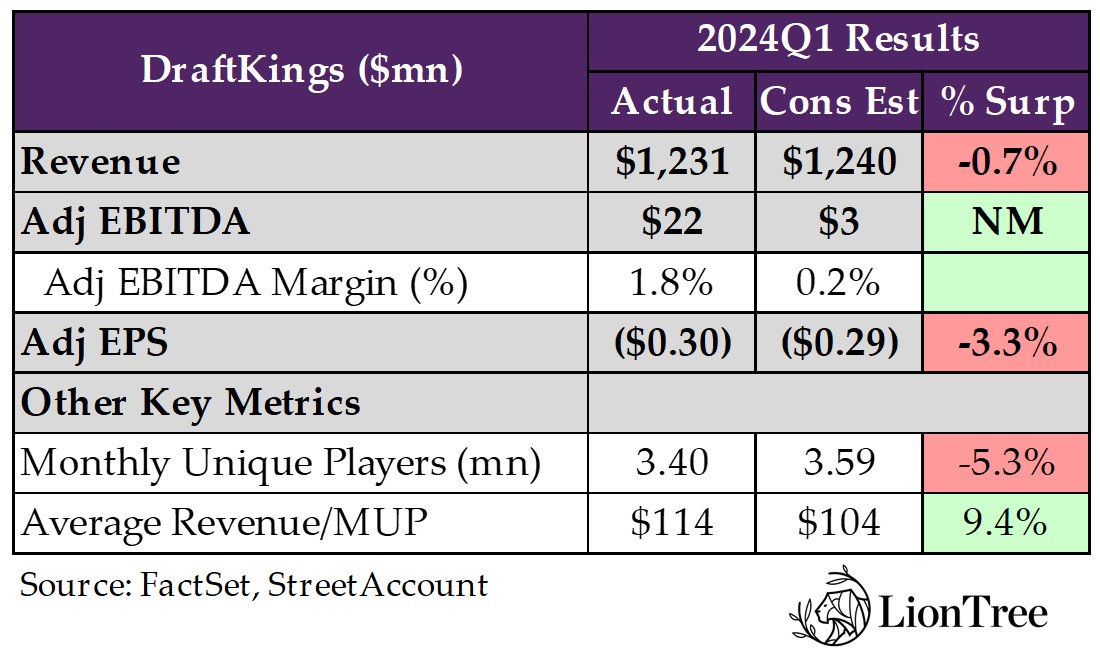
- Q1 total revenue was up +53% y/y but was -0.7% below cons, while adj EBITDA at $22mn was well above cons $3mn
- Adj EBITDA flow through percentage was at 60%
- Adj Gross Margin also incr’d +550bps y/y to 44% as a result of a higher structural sportsbook hold and improved promotional efficiency
- User metrics were mixed: Lower than expected monthly unique players at 3.4mn missed cons 3.59mn, while avg rev/MUP was better at $114 vs cons $104
- Q2, Q3 and Q4 quarterly guidance
- Raised the low end of the rev guidance range for Q2-Q4 to +25-30% y/y: Was +20-30% y/y initially
- Q2 = ~+25% y/y
- Q3 and Q4 = ~+30%
- Reiterated Q2 adj EBITDA of almost $150mn and maintained Q3 guidance of nearly breaking even
- Increased Q4 adj EBITDA guidance: Now expects $325mn+ in Q4 (vs $300mn originally)
- Raised the low end of the rev guidance range for Q2-Q4 to +25-30% y/y: Was +20-30% y/y initially
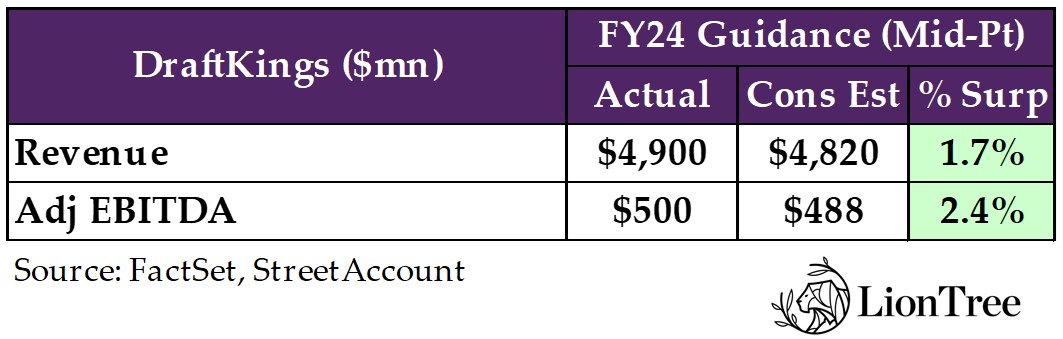
- Raised 2024 revenue guidance by +$125m at the mid-pt (from $4.65-4.9bn to $4.8-5bn), topping cons by +1.7%, and raised adj EBITDA by +$40mn at the mid-pt (from $410-510mn to $460-540mn), beating cons by +2.4%
- 2024 revenue guidance implies +34% y/y growth
- 2024 adj EBITDA flow-through percentage of 53%
- Includes all existing jurisdictions but excludes proposed acq of Jackpocket.
- Drivers to the 2024 guidance changes relative to the mid-points:
- $165mn of the rev and $68mn of the adj EBITDA improvement from Customer acq, retention, & engagement, which continue to exceed expectations due to marketing optimization initiatives and product advancements
- $20mn of the rev and $14mn of the adj EBITDA improvement from a higher structural sportsbook hold percentage primarily as a result of momentum into the same game parlay offering
- Now expect the structural sportsbook hold % to approach 10.5% in 2024
- Offset by $60mn of rev and $42mn adj EBITDA headwind from customer-friendly outcomes in late March and April
- Other 2024 guidance:
- Maintained adj Gross Margin in the range of 45-47%, +350bp y/y at the mid pt
- Now anticipates adj Sales & Marketing Expense will decline modestly
- Stock-based comp expense to be flat-to-down in dollar terms and to represent ~ 8% of rev (down from 11% in 2023 and 26% in 2022)
- Incr’d the forecast for FCF, which is now expected at ~ $400mn (vs $310-410mn prior), assuming ~$120mn CapEx and capitalized software development costs
- Expect to consummate the Jackpocket acq near the middle of 2024: “Excited to enter the rapidly growing U.S. digital lottery vertical”
Improving Efficiencies & KPIs
- Strong customer acquisition, retention, and engagement resulted in higher-than-expected handle in Q1:
- Customer acquisition was ~10% higher than had forecast, driven primarily by outperformance in North Carolina, where CAC improved by more than +20% vs CAC in Mass, which had been live for a similar duration in March 2023
- Had a “unbelievably” efficient Q1 for marketing and it continued into April, where the Co had a ~-40% y/y decrease in CAC: They see some opportunities to invest a bit deeper but not significantly
- “We’re not going to have a massive increase. I think this is like optimization around the edges where we see an opportunity”
- Improved structural sportsbook hold percentage: Structural sportsbook hold % was slightly ahead of expectations at 9.8% and incr’d ~+150bp y/y; “So what that really means is that our bet mix came in better than we expected as it relates to projected hold”
- Outlook: Continue to believe that “there’s a lot of upside here” but don’t know what they ceiling
- Handle per active rates all look “healthy” as they continue to drive and increase parlay mix and avg leg count: That will continue to be the focus as long as they continue to see healthy customer metrics and get positive feedback on the product; “So, we’ll see how far we can get it. But right now, we do believe there’s a good bit of upside still remaining”
- Promotional reinvestment for OSB and iGaming cont’d to become more efficient y/y and improved by more than +700bps as a % of GGR: The reinvestment rate also improved on an existing state basis (states that launched between 2018 and 2022)
- Had a lower percentage of the population launch in Q1 this year than last year
- As a drag on the business into Q2, sport outcomes were customer-friendly in the latter weeks of the qtr: The NCAA men’s basketball favorites won a high % of games during the early rounds of this year’s March Madness tournament
See More Penetration Upside In Mature States & New States Capturing Value Faster
- Still seeing growth in existing states: On a same store basis from 2018 to 2022, states grew net revenue ~+40% y/y in Q1, hence healthy growth in existing states
- Expect growth to continue as they improve the product and as the industry evolves and the TAM increases
- Seeing more casual customers coming to the market particularly in the older states
- New launches are capturing more value faster: Vermont and North Carolina’s customer acquisition efficiency is on par with prior launches and both states are expected to contribute positively to adj EBITDA in H2:24; “We’re able to capture a tremendous amount of value in a much shorter period of time with a much more efficient level of investment than we did, say, three or four years ago”
- Texas will be a big focus looking into 2025: “Texas, I think, has a real shot. It got through one chamber last year. And as you may know, the Texas legislature doesn’t meet in 2024. So we’re really gearing up for 2025”
- Expect to see some momentum pick up in iGaming once there is some momentum legislation wise: “Once the states in certain regions start moving on iGaming more, you’ll see a more rapid succession of them. And I also think that the need for tax revenues is going to increase”
- There will be a lot of state expansions with Jackpocket: “You’ll see some additional states come get up and running for Jackpocket before the end of the year”
More Confident Than Ever In FCF and Exploring Capital Return Options
- Have developed more confidence in their FCF trajectory for 2024+:
- Kicked off multi-year planning process
- Exploring capital allocation options given the strong trajectory of FCF
- Will share more in the next qtr
Couple Other Key Comments / Updates
- Have a very high bar for M&A and the organic growth path is really strong right now so “don’t feel compelled” to do M&A for growth
- Media rights partnerships? Amazon has been a great partner for Thurs Night Football and would look to expand the relationship depending on their plans; Have great relationships with a number of different parties rumored to be involved in the bidding on NBA too
- AI “can really be impactful in a significant and transformational way to DraftKings in the future”
- Use multiple tools from 5-10 vendors
- Use AI for things that improve the product, improve efficiency (like code refactoring, code review and marketing, asset creation), and improve customer experience (help model and detect signs of problem gaming so that they can flag things for the player intervention team to go and investigate)
Apple’s Record $110bn Buyback Takes Center Stage
Apple’s triumph of returning to quarterly revenue growth was short-lived, as after finally posting positive revenue growth last quarter (after four straight quarters of revenue declines), revenue once again fell in the most recent quarter, down -4% y/y. That being said, Q1 revenue was +0.4% above consensus, as Services revenue beat by +3.2% (and set all-time high overall Services rev record), but Product rev came in a hair below expectations. Product revenue fell -10% y/y due to tough y/y comps from the benefit of fulfilling pent-up iPhone 14 demand in the year-ago quarter, but ex the impact, Product rev would have been ~flat y/y.
Regionally, Apple saw revenue fall on a y/y basis in each of its geographic segments, excluding Europe. The Greater China market fell -8% y/y, but that was an improvement from -13% y/y in the prior quarter. iPhone 15 and iPhone 15 Pro Max were the best-selling smartphones in urban China, which “means the other products didn’t fare as well”, as was the case last qtr. Overall, the company “maintain[s] a great view of China in the long term”, and outside of China, Apple still achieved revenue records across more than a dozen countries and regions.
Looking ahead, in somewhat of a surprise after 15 straight quarters of just providing “directional insights”, Apple broke its streak to provide formal guidance. FQ3 total revenue is expected to grow low single digits y/y (cons was at +1.5%), while Services rev is expected to grow double digits at a rate similar to the growth seen in FH1. iPad rev is also expected to grow double-digits. The company did not provide guidance for any other segments.
While Apple’s overall results came in above expectations, what really stole the show was the buyback announcement of an additional $110bn – the largest buyback plan in US history, topping the company’s own prior record of a $100bn repurchase authorization back in 2018. Apple has spent the most of any tech company on stock repurchases over the last decade, apportioning $650bn since 2012. At Friday’s stock price, executing Apple’s full buyback authorization would amount to repurchasing nearly 4% of the company’s shares. (link). Also to flag, the company raised its cash dividend by +4%.
Moving forward, there’s lots to look forward to, with an “exciting” product announcement coming next week, followed by the worldwide developers conference next month. Also, similar to last quarter, the company teased “sharing some very exciting things with our customers soon” on the Gen AI front, though what it is and when that will happen is still TBD.
See below for more thoughts and key points.
-> Apple rose +6.0% on the day after reporting its results, posting its best day since November 2022, and ended the week up +8.3%; YTD, however, the stock is still down -4.8%
- FQ2 headline results beat: Total revenue fell -4% y/y (vs +2% y/y in FQ1) and beat cons by +0.4%; Gross margin of 46.6% was up +70bps seq (in-line with estimates of 46.6%), driven by cost savings and favorable mix to Services partially offset by leverage; EPS beat by +1.7%
- Achieved revenue records across more than a dozen countries and regions
- Hit March qtr rev records in Latin America and the Middle East, as well as Canada, India, Spain, and Turkey
- Greater China: Rev fell -8.0% y/y (accel from -13% y/y in FQ1), w/ iPhone being the primary driver (Other products “didn’t fare as well…we clearly have work to do. I think it has been and is through last quarter the most competitive market in the world)
- All-time rev record in Indonesia, “one of the many markets where we continue to see so much potential”
- Hit March qtr rev records in Latin America and the Middle East, as well as Canada, India, Spain, and Turkey
- OpEx came in at the mid-pt of the guidance range: At $14.4bn, in-line with cons, and up +5.0% y/y
- Achieved revenue records across more than a dozen countries and regions
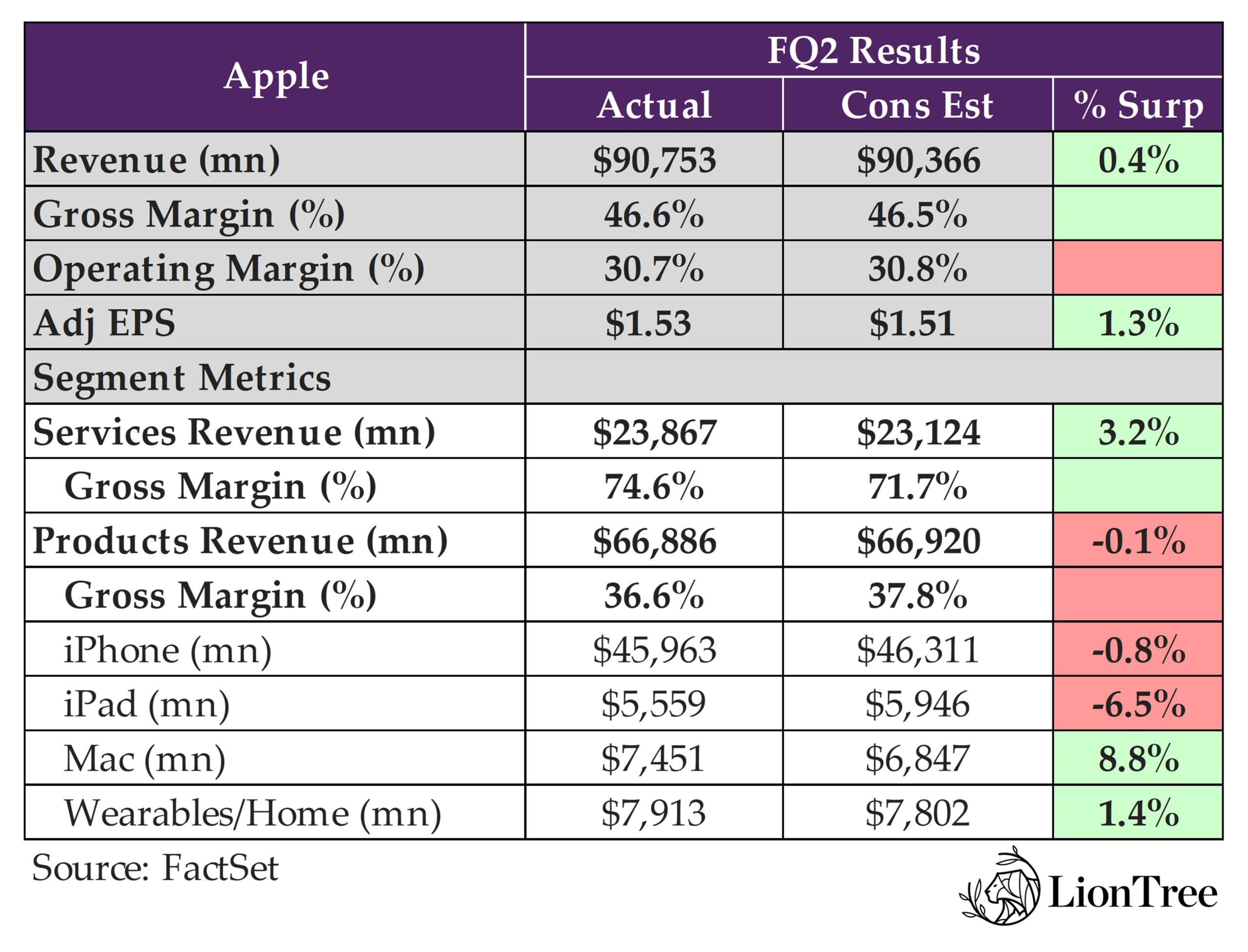
- Product rev missed cons by -0.1%: Fell -10% y/y (vs +0.1% y/y in FQ1); Gross margin of 36.6% was down -280bps seq, primarily due to seasonal loss of leverage and mix, partially offset by favorable costs
- Tough y/y iPhone comp weighed on Product rev growth…: Fulfilling pent-up demand from year-ago December qtr due to COVID-related supply disruptions on the iPhone 14 Pro and Pro Mac added an ~$5bn benefit to March qtr rev last year (ex the impact, Product rev would have been ~flat y/y this past qtr)
- … Partially offset by strength from Mac
- Continue to see “a lot” of interest at the top-end of the range of products: Combination of consumers wanting to purchase the best product offered and Apple’s ability to make those purchased more affordable over time (i.e., financing solutions, installment plans, trade-in programs, etc.); Have seen this trend over the last several year, “which we think is pretty sustainable”
- Total installed base of active devices set a record across all products and geographic segments
- By Segment:
- iPhone rev missed cons by -0.8%: Down -10% y/y (vs +6.0% y/y in FQ1), as segment faced a difficult y/y comp
- iPhone still saw growth in some markets, including Mainland China
- iPhone was the top-selling model in the US, urban China, Australia, the UK, France, Germany, and Japan
- iPhone active installed base reached a new all-time high in total and in every geographical segment
- iPad rev missed by -6.5%: Down -17% y/y (vs -25.3% in FQ1), due to difficult comp with the momentum following the launch of M2, iPad Pro and 10th-gen iPad last FY
- iPad install base reached an all-time high with over half of the customers who purchased iPads during the qtr being new to the product
- Mac rev beat by +8.8%: Up +4% y/y (vs up +1.0% in FQ1), driven by strength of the new MacBook Air powered by the M3 chip
- Mac installed base reached an all-time high with almost half of MacBook Air buyers during the quarter being new to the product
- Wearables, Home, and Accessories beat cons by +1.4%: Down -10% y/y (vs down -11% in FQ1) due to difficult launch compare on Watch and AirPods
- Apple Watch install base reached an all-time high, as ~2/3 of customers purchasing an Apple Watch during the qtr were new to the product
- iPhone rev missed cons by -0.8%: Down -10% y/y (vs +6.0% y/y in FQ1), as segment faced a difficult y/y comp
- Tough y/y iPhone comp weighed on Product rev growth…: Fulfilling pent-up demand from year-ago December qtr due to COVID-related supply disruptions on the iPhone 14 Pro and Pro Mac added an ~$5bn benefit to March qtr rev last year (ex the impact, Product rev would have been ~flat y/y this past qtr)
- Services rev beat by +3.2%: Up +14% y/y (vs +11% y/y in FQ1); Gross margin of 74.6% was up +180bps seq due to a more favorable mix
- Set all-time high overall Services rev record, with record performance in both developed and emerging markets
- Set all-time revenue records in cloud services, payment services, and video
- Transacting and paid accounts reached all-time highs, with paid accounts growing double-digits y/y.
- Paid subscriptions showed “strong” double-digit growth: Have “well over” 1bn paid subscriptions, nearly double the # of paid subscriptions from four years ago (in-line w/ commentary from last qtr)
- Set all-time high overall Services rev record, with record performance in both developed and emerging markets
- FQ3 Outlook: After 15 straight qtrs of providing directional insights in lieu of specific guidance, the Co provided formal guidance under the assumption that the projected macroeconomic outlook doesn’t worsen
- Expect FQ3 total Co rev to grow in the low-single-digits y/y, in spite of FX headwind of ~-2.5ppts (vs cons of +1/5% y/y growth)
- Expect FQ3 Services rev to grow double digits at a rate similar to the growth reported for FH1
- Expect FQ3 iPad rev to grow double digits
- Gross margin: Between 45.5% and 46.5%
- OpEx: Between $14.3-$14.5bn
- OI&E: ~$50mn
- Announced the largest buyback plan in US history: Approved an additional $110bn in share repurchases
- Topped its own prior record: Back in 2018, Apple authorized $100bn in share repurchases, the largest ever up until its latest buyback plan
- Increased quarterly dividend by +4.2%, to 25c from 24c
- Continue to plan for annual increase in the dividend going forward, as they have done for the last 12 yrs
- “Continue to feel very bullish about our opportunity in generative AI”: Making “significant investments” and “looking forward to sharing some very exciting things with our customers soon”
- Any changes to historical CapEx cadence or split b/w tooling data center and facilities as Apple leans more into AI efforts? Plan to continue along the same lines of a hybrid model where they make some investments themselves and also share them w/ their suppliers and partners on the manufacturing and data center sidesl “It’s a model that has worked well for us historically, and we plan to continue along the same lines doing forward”
“We believe in the transformative power and promise of AI and we believe we have advantages that will differentiate us in this new era including Apple’s unique combination of seamless hardware, software and services integration groundbreaking Apple silicon with our industry leading neural engines and our unwavering focus on privacy which underpins everything we create”
- Implications to Apple from changes driven by EU DMA having them open up 3P App Stores? “It’s really too early to answer the question…we’re focused on complying while mitigating the impacts to user privacy and security…that’s our focus”
- Incremental Apple Vision Pro commentary – More than half of the Fortune 100 companies have already bought Apple Vision Pro units and “are exploring innovative ways to use it to do things that weren’t possible before”
DoorDash Expects To Be Dashing More Strongly In H2
DoorDash’s Q1 came in above expectations and set several new quarterly records for revenue, total orders, and marketplace GOV, as the investments the Co has been making to become the one-stop-shop for delivery are showing results. However, Q2 guidance was a sticking point, with profitability coming in below consensus at the midpoint and Marketplace GOV just barely beating at the midpoint. However, looking out into the full year, similar to the past two years, H2 profitability is expected to come in higher than H1, as the company drives further efficiencies.
Its core US restaurant business growth slightly decelerated in the quarter, which raised some investors’ eyebrows, especially on the back of prints from McDonald’s and Starbucks, which both reported lower store traffic in their earnings in part due to consumers exercising more caution and shifting from dining out to eating at home. On that point, however, DoorDash is NOT seeing a pullback. The company benefits from being in the digital and delivery space, and all three lines of business are growing double-digits and gaining share.
DoorDash’s investment areas also are growing nicely, outpacing growth in the core US restaurant business and posting improving unit economics. The grocery business is growing the fastest and gaining share, doubling growth for the third straight quarter, and retail has also been growing, with more selection continuing to be added to the platform. International is also a point of strength and growing strongly across the 29 countries the company is in, with a long runway for expansion ahead.
Concerns on competition were also addressed, specifically regarding DoorDash’s 3P business versus the likes of Walmart and Amazon. Ultimately, DoorDash operates under the assumption that it will come down to consumer choice. While 3P offerings are more expensive, they are faster and offer more selection versus 1P. Moving forward, DoorDash will likely continue to focus on what has been working, and the company reminded analysts on the call that its 3P business has been unit economic positive for several qtrs.
On the regulatory front, New York and Seattle newly-mandated minimum wage requirements for delivery drivers has increased prices for consumers and resulted in reduced sales. While DoorDash absorbed some of those increased costs in Q1, those costs are expected to decrease as the year progresses. On the overall business, however, the impact has been minimal, as New York and Seattle represented <1% of Total Orders in Q1.
The company also had additional commentary on its demand and supply, its advertising business, Platform Services, and more. See below…
-> DoorDash shares fell -10.3% in reaction to earnings and ended the week down -13.9%; YTD, DoorDash stock is trading up +15.1%
DoorDash Mostly Beat Expectations In Q1, Setting New Qtrly Records For Rev, Total Orders, And Marketplace GOV
- Revenue – beat: Grew +23% y/y (decel from +27% y/y in Q4), due primarily to the y/y increase in Marketplace GOV
- Total Orders – beat: Grew +21% y/y (decel from +23% y/y in Q4)
- Marketplace GOV – beat: Grew +21% y/y (decel from +22% y/y in Q4)
- Contribution Profit – beat: Grew +41% y/y (decel from +54% y/y in Q4)
- Adj EBITDA – beat and reached an all-time high: Grew +82% y/y (decel from +210% y/y in Q4)
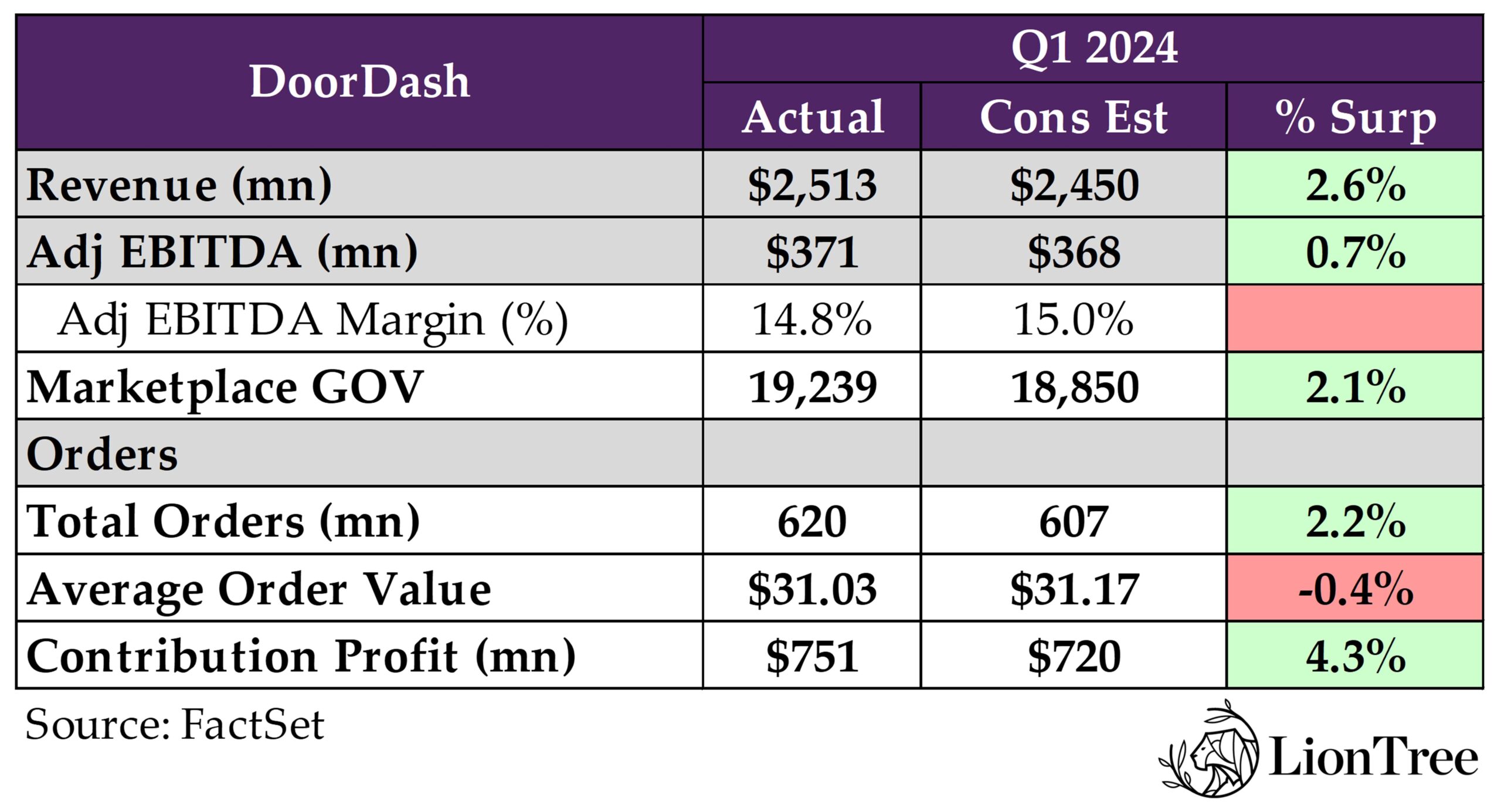
While Q2 Guidance Was Lower Than Expected, The Co is Anticipating H2 To Be Stronger Than H1
- Q2 adj. EBITDA guidance missed at the mid-pt: $325-425mn missed cons $394mn by -4.8% at the midpt
- Q2 Marketplace GOV only slight beat at the mid-pt: $19.0-19.4bn came in slightly ahead of cons $19.23bn by +0.2% at the midpt
- Q2 outlook assumptions –
- Key FX rates remain “relatively stable” at current levels
- Anticipates “significant levels” of ongoing investments in new categories and int’l mkts
- Cautions that consumer spending in any of their geographies could deteriorate relatively to outlook, which could drive results below their expectations
- Increasing int’l exposure heightens risks associated with operating in foreign mkts, including geopolitical and currency risks; Change in the int’l operating environment could negatively impact results vs current outlook
- Investments made in H1 will drive both scale and leverage in H2
- Expect H2 adj. EBITDA to be higher than H1, driven by higher volume in H2 across all lines of biz
- Expect further improvements in unit economics going through the rest of the year
- Confident in H2 adj EBITDA coming in higher than H1 b/c “we’ve done this before”
- Expect to drive further efficiency, whether it’s Dasher cost, regulatory cost, quality improvements, making credits and refunds more efficient, growing ad biz, all combined w/ investments they’re making in H1, which will drive both scale and leverage
- “2023 is exactly the same pattern as well as in 2022… And when I’m looking at the business, whether it’s Q1 or Q2 guide or the rest of the year, I feel very good about both the top line as well as the bottom line”
- Expect OpEx levels for rest of year to be similar to Q1, but longer-term, goal is to continue to drive leverage in OpEx as the biz continues to grow
- Will be adding headcount this year: “We’re going to be thoughtful. We’re adding engineers to help us improve the product”
NOT Seeing Signs Of Weak Consumer Due To Macro
- All three lines of biz are growing double-digits and gaining share across the board
- Benefit from being in the digital and delivery space: While certain merchants are facing headwinds when it comes to in-store traffic, they are not seeing those same signs of strain in digital
- US restaurants biz: Growth has been “pretty consistent” over last 6 qtrs
- Grocery: Still seeing “pretty strong” demand on the digital side and “relatively stable” growth, despite higher prices on grocery items due to inflation
- MAUs are growing at a double-digit rate
- Order frequency continued to set an all-time record in Q1
- Newer cohorts are joining the platform at a higher order frequency compared to many of the older cohorts
- 2023 cohort is as strong as any of the other cohorts they’ve seen
- DashPass subscribers continue to be at record highs: Ended last year at 18mn+ subscribers, and that # has continued to grow
Dasher Supply Continues To Be “Very Healthy”
- The Co has driven leverage and efficiency in Dasher supply, despite absorbing some regulatory costs on a y/y basis
- Seeing more hours from existing Dashers, which is making Dasher Pay also more efficient
- Looking ahead – efficiency will largely come from improvements they will make on the product side, driving an increase in Dasher retention and ultimately making Dasher acquisition more efficient
- Have made “a number of” improvements in the last year (redesigning the Dasher app, updating the way Dashers earn on the platform, etc.) and have a “long list” of improvements that they continue to plan to make, which will make Dasher costs overall more efficient across the board
Bit Of A Seq Slowdown In US Restaurant Biz
- Growth in Marketplace GOV in US restaurant marketplace decelerated “slightly” y/y
- Mgmt did not specify if biz would have still decelerated ex impact for the extra day in a leap yr
- Biz still gained share in Q1, as user growth was in the double-digits and order frequency continues to be at an all-time high
Expect Continued Unit Economic Improvements Across Segments In New Verticals
- Seeing positive unit economics in New Verticals biz, which comes despite smaller basket sizes and w/o “meaningful” contribution from CPG ad dollars in grocery biz
- Grocery biz is growing +100% y/y (has doubled for three straight qtrs in a row) and gaining share: Added “several dozen” retailers in Q1
- Focus has been to continue to drive more selection, improve the quality, as well as make the product more affordable
- Continued to improve unit economics in Q1, since seeing an increased step function change y/y in Q4
- Outside of grocery, also seeing increasing inbound interest in the retail segment
- Added first retailer in home improvement category, which was Lowe’s
- “Quite active” in offerings in health & beauty, apparel, and electronics category
- Seeing “opposite of resistance” in retailers joining the platform: “Increasingly, retailers and consumers alike are seeing DoorDash as a one-stop shop for buying everything inside the city”
- Question is more around sequencing and prioritizing the road map: Not just about adding retailers to the marketplace, but also working with them to help their own e-commerce capabilities and selling first party to their own consumers in an increasingly digital way
- International biz growth rate continues to outpace peers: In some cases, growing 5-6x faster, and in some places has been sustained over the last 2-3 yrs, which is leading share gains in the majority of markets that they operate (currently in ~29 countries outside of the US)
- Seeing “major improvement” across the 3 key metrics they manage the biz, which is retention, order frequency, and unit economics
- Building on the “material progress” on all 3 metrics over the course of the last couple yrs
- See “very good improvement” y/y in unit economics for overall intl portfolio, which have been positive for a few qtrs
- Expanding portfolio of countries makes it more complex to manage, but is a minimum-efficient scale biz, so if they achieve minimum efficient scale in a locale, every dollar or order that comes after that point makes up for the investment made in the market
- Several countries in restaurant portion of intl biz are contribution margin-profitable
- Long runway ahead: “Long ways to go” in terms of getting to the cities they want to reach and adding merchant selection in restaurants and outside of restaurants
- Seeing “major improvement” across the 3 key metrics they manage the biz, which is retention, order frequency, and unit economics
- 1P vs. 3P debate will come down to consumer choice
- 3P biz has been unit economic positive for several qtrs.
- 3P offerings (like DoorDash) are more expensive on a point-to-point basis vs 1P
- BUT it’s faster and offers more selection (i.e., get offering for several stores vs just one store)
- DoorDash will focus on what has been working for them: A model in which they can increase the amount of selection they offer, reduce the cost in which that selection is made available, and improve the quality of the process
- “All things are pointing in the right direction”: Seeing retention and usage and high engagement from consumers; Making “quite a lot of progress” on fulfillment quality; Also making progress on the cost to serve
Absorbed Costs In Seattle And New York Due To Regulations Will Pace Down Through The Year
- Regulations in Seattle and New York are having “the opposite impact of what they intend to do”: “Our platform has become less accessible and less flexible for the people who use it to generate incremental income. This is an unfortunate, though predictable, outcome”
- Local merchants will be earning less: Estimate local merchants will earn at least $40mn less annually from DoorDash Marketplace in Seattle and at least $110mn less annually in NYC due to the new earnings standard, based on an analysis of data following implementation of the new earnings standards
- Wait times between orders has more than tripled for Dashers in Seattle
- # of new Dashers in NYC has fallen by -20% compared to before the new earnings standards took effect
- Absorbed “meaningful amount” of cost in Q1, but expect the cost they take in to go down over rest of the yr: NOT going to be a step function change, but will be gradual overtime; Largely being driven by further improvements in efficiency, whether it’s logistics, quality, credits, and refunds
- Expect both markets to be sustainable from a unit economic perspective going forward
- However, consumers in Seattle and NYC represent a small portion of Total Orders, and it is estimated that the regulations reduced Total Orders by <1% in Q1:24
- Looking ahead, intent to manage biz in the mkts w/ parallel goals of protecting the Dasher, merchant, and consumer experience, while maximizing long-term FCF potential
Advertising Offering Is Being Adopted By All Cohorts
- Ads biz is “substantially larger” than the $100mn+ run rate analysts assumed: Are not disclosing ad rev, but it is growing fast and contributing to both rev and adj. EBITDA
- Offering “leading and best in-class” return on ad spend, while also seeing “good” engagement on the consumer front: Measure the quality of their ads biz based on merchant ROAS and consumer conversion, which “we believe we are best-in-class for both of those”
- Seeing “extreme adoption” from all cohorts, whether it’s small businesses to large enterprises
- Saw initial uptake from restaurants in first 1.5 years of ads effort as they set themselves up
- Now seeing increasing pull from CPG advertisers, with the ads effort now 2.5 years in, as grocery and retail sectors have been growing on the marketplace; “We do work with all of the large CPG advertisers”
- “We’re now just building out the products to serve them to meet their demand”
- Also working to build more self-serve and reporting capabilities, “so that everyone can see exactly what’s going on with their dollar spend”
Platform Services Is Proof Point That Physical Retailers Are Increasingly Investing In Digital Capabilities
- Total Orders in Platform Services accelerated for the fourth consecutive qtr and grew faster than Total Orders in DoorDash’s Marketplaces in Q1
- What’s driving the acceleration?
- Continue to offer fulfillment through DoorDash Drive in more places, whether that’s more countries or more verticals; More and more retailers are seeing how its net beneficial to their Cos b/c the omnichannel customer is more valuable than customers who shop exclusively in one channel
- Continue to build new products: Platform Services biz is meant to enable any retailer to do what DoorDash on its marketplace for their own customers, so that goes “much beyond” fulfillment; Need to build products for everything in between, from online ordering to customer support
Paramount’s Story Continues To Unfold
Paramount’s Q1 report this week was overshadowed by the official announcement that (now former) CEO Bob Bakish was stepping down. In his place, a triumvirate of division heads will step in to lead the company in a newly-formed Office of the CEO, which will be made up of Brian Robbins, President and CEO of Paramount Pictures and Nickelodeon, George Cheeks, President and CEO of CBS, and Chris McCarthy, President and CEO of Showtime/MTV Entertainment Studios and Paramount Media Networks. The three will work closely with CFO Naveen Chopra and the Board of Directors “to develop a comprehensive, long-range plan to accelerate growth and develop popular content, materially streamline operations, strengthen the balance sheet, and continue to optimize the streaming strategy”. (link)
The leadership changes come on the back of Paramount and Skydance Media reportedly being in the midst of exclusive talks to pursue the deal until May 3 (link), and mid-week, the saga continued with Sony and Apollo reportedly submitting an all-cash, $26bn offer for Paramount, with Sony having a majority stake and Apollo possessing a minority stake. (link)
The company’s earnings call was less than 15 minutes, as the CEO team and CFO Naveen Chopra did not take questions from analysts but provided some high-level commentary on Paramount’s Q1 performance. Q1 rev slightly missed Street expectations, though adj OIBDA was significantly ahead, partially driven by DTC adj OIBDA losses coming in lower than expected. The Super Bowl was the standout this quarter, driving ad growth both on the linear and streaming side. Paramount+ also continue to grow, with numbers benefitting from a full qtr of their domestic price increase.
See below for more quick takes on quarter, but visibility to the longer-term strategic direction of the Company is the bigger focus for investors at the moment.
-> Also importantly this week, it was reported that Paramount’s distribution deal with Charter which was set to expire at the end of April, has been extended… (link)
-> Paramount was down -7.0% the day post earnings, but with all the chatter through the week closed Friday up +8.2%; YTD, the stock is down -12.9%
Q1 Adj OIBDA Beat Across All Segments, While Revenue Was A Bit Of A Drag
- Missed on rev by –0.6%, but adj OIBDA beat by a huge +30.8%: Total revs grew +6% y/y (vs –6% y/y in Q4), while adj OIBDA grew +80% y/y (vs -15% y/y in Q4)
- Revenue was a mixed bag across segment…: Missed on TV Media by -2.2% and slightly missed on DTC by -0.1%, while Filmed Entertainment beat by +5.0%
- … Though adj OIBDA beats were a clean sweep: TV Media beat by +12.9%, while losses at DTC and Filmed Entertainment were not as significant as investors expected, beating by +26.4% and +736.7%, respectively
The Co delivered $209mn in FCF, which was much better than cons $14mn
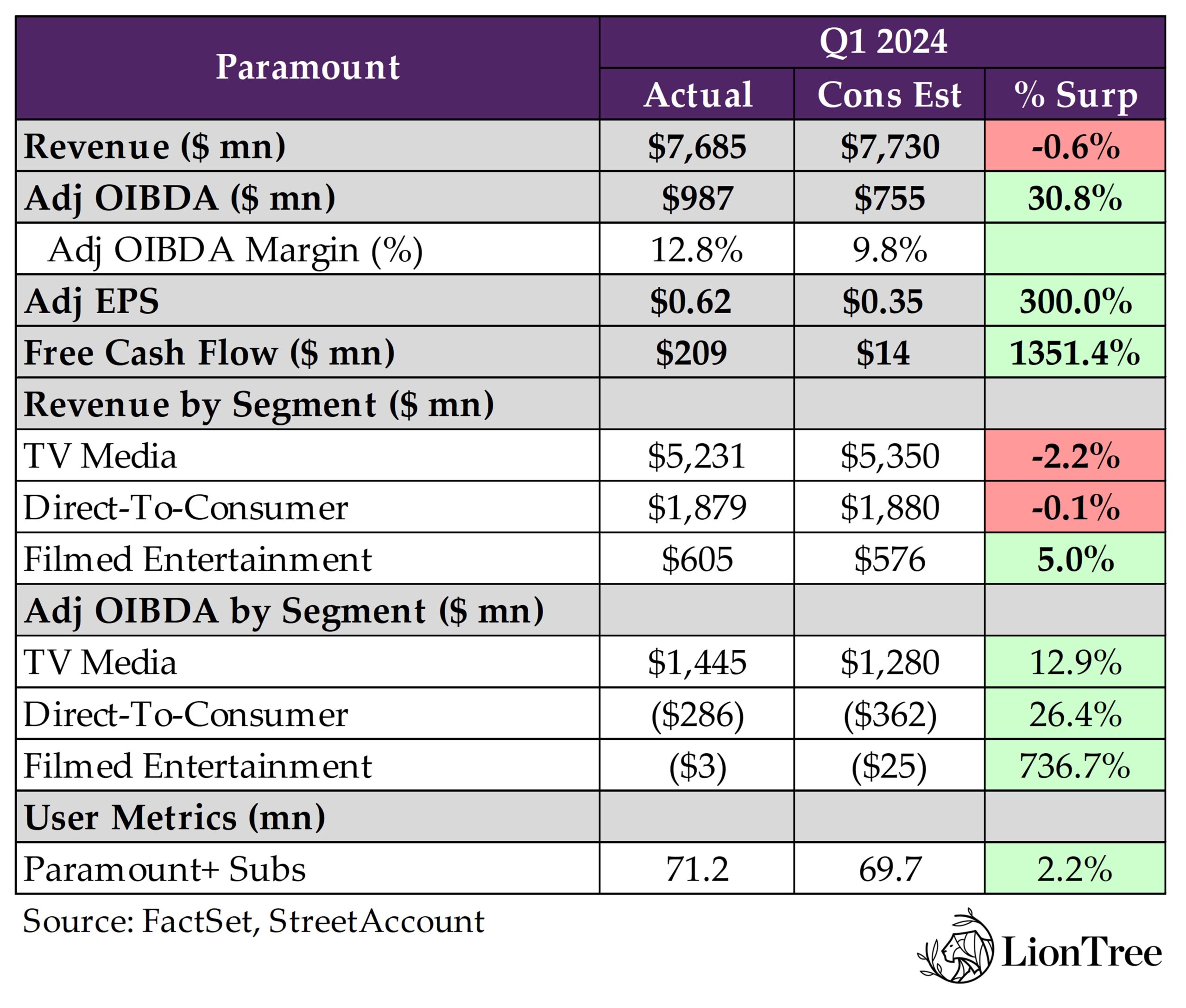
The Super Bowl Drove Y/Y Advertising Growth
- The Super Bowl game broke records across CBS, Paramount+, and Nickelodeon, and was “a great example of the power of our multi-platform offering”
- Total ad rev grew +17% (vs down -11% y/y in Q4), benefitting from Super Bowl LVII, which contributed +22ppts to the growth rate
- Linear ad rev grew +14% y/y (vs -15% y/y in Q4), and included a +23ppt contribution from the Super Bowl; Sports continued to over-deliver, with the NFL playoffs and NCAA college basketball contributing to growth in the qtr
Paramount+ Continues To See Benefits Of Subscriber Growth And Pricing Increases
- DTC rev grew +24% y/y (vs +34% y/y in Q4)
- DTC subscription rev grew +22% y/y (though decelerated from the +43% y/y in Q4), driven by subscriber growth and pricing increases for Paramount+
- DTC ad rev grew +31% y/y (accelerating from +14% y/y in Q4), driven by growth from Pluto TV and Paramount+, including the benefit of the Super Bowl
- Beyond the Super Bowl impact on engagement, rev growth reflects a combination of increased sell-through and higher CPMs
- Paramount+ rev grew +51% y/y (vs +69% y/y in Q4), reflecting subscriber growth and ARPU expansion
- Paramount+ added more subs that expected hitting 71.2mn total vs cons 69.7mn: Added +3.7mn subscribers in Q1 (but down from +4.1mn in Q4); Subscriber growth benefitted from the NFL and the Super Bowl
- Paramount+ global ARPU grew +26% y/y (vs +31% y/y), reflecting a full quarter of their domestic price increase and the addition of international subscribers in higher ARPU markets
- Domestic ARPU was negatively impacted by lower-than-expected engagement due to the lagging effect of last year’s strikes, which constrained the availability of new programming
- Q1 DTC adj OIBDA saw y/y growth for the fourth consecutive qtr: Up +44% y/y (vs +15% y/y in Q4), led by improvement in Paramount+ domestic profitability
- “Healthy revenue growth and a disciplined focus on cost drove improved leverage in content, marketing and other overhead costs, which all decreased as a percentage of revenue relative to the prior year”
Theatrical Had Some Successes In Q1
- Theatrical rev grew +20% y/y (vs -20% y/y in Q4)
- Mean Girls and Bob Marley: One Love each debuted at #1 at the domestic box office and together generated $275mn+ at the global box
OTAs Offer Divergent Views Of The Travel Landscape
The online travel space was under the microscope this week, as Booking and Expedia released their Q1 prints and shed some light on how the industry has fared thus far in 2024 after their previous round of earnings revealed a rocky finish to 2023. In terms of top-line trends, the two companies’ gross bookings numbers and their accompanying commentary on macroeconomic trends painted a mixed picture of the broader travel demand landscape. On one hand, Booking’s gross bookings growth was relatively flat sequentially and surpassed consensus estimates by a comfortable +3.2%, while on the other hand, Expedia’s gross bookings decelerated sequentially and ended -0.9% short of expectations that had been tempered on the company’s prior earnings call. Accordingly, although Expedia flagged a “healthy but normalized” market environment and acknowledged that the post-pandemic travel recovery has “largely” concluded, Booking touted the “resiliency” of global demand for leisure travel and highlighted better than anticipated room nights growth in Europe as well as the Middle East. Booking also experienced accelerating room nights growth in the US, which could suggest that the company gained market share, given that the region remained Expedia’s slowest growing one.
Moving forward, macroeconomic factors are expected to continue having an impact on the two companies in Q2. In particular, Booking issued Q2 guidance for its growth in room nights, gross bookings, and adj EBITDA that were broadly worse than the sell-side had projected. In addition to an unfavorable impact from this year’s shift in Easter timing, the company predicted that mounting FX headwinds would also pose mounting obstacles ahead. For its part, Expedia made the decision to reduce its FY24 top-line guidance due to the slower than expected growth it saw in Q1, specifically in Vrbo. Still, the company expects that bookings growth on its vacation rental platform will see a sequential rebound in bookings in Q2, as its longer-tail brand marketing efforts begin to bear fruit and re-ignite growth in Vrbo. Cross-selling activities could also help the company’s vacation rental business “fully recover”, as 25% of Vrbo’s customers were completely new to the platform and earned their One Key cash either on Hotels.com or Expedia. Booking’s Connected Trip vision has also started to drive similar benefits within its product ecosystem.
Turning to the bottom-line, profitability was a key standout area for both OTAs during the quarter. Booking and Expedia’s adj EBITDA topped estimates by +24.6% and +41.4%, respectively, in Q1, as the former benefited from the higher efficiency of its marketing spend, while the latter prioritized headcount reductions to augment its bottom-line during the quarter. Generative AI will provide another powerful toolset to further enhance profitability on the road ahead, and both Expedia and Booking have been working on new technologies that will lower customer service costs per transaction and improve their users’ experience over time. All said, the OTAs still see significant opportunities in their core businesses moving forward.
See below for what we thought was most incremental from Expedia and Booking’s Q1 prints:
-> Booking shares were up +3.0% in reaction to earnings, closing the week up +1.6%; Expedia shares fell -15.3% following earnings + the guidance cut and finished the week down -15.0%; YTD, Booking stock is trading up a slight +0.9%, while Expedia stock is down -24.0%
Headline Results Mostly Outperformed A Relatively Low Bar
- Booking – Headline results beat across the board: Rev was up +16.9% y/y in Q1 (vs +18.2% y/y in Q4), ending +3.9% above cons; Adj EBITDA grew +53.2% y/y (vs +18.0% y/y in Q4) and beat cons by +24.6%, w/ EBITDA margin of 20.3% beating cons +17.0%; Adj EPS topped cons by +45.9%
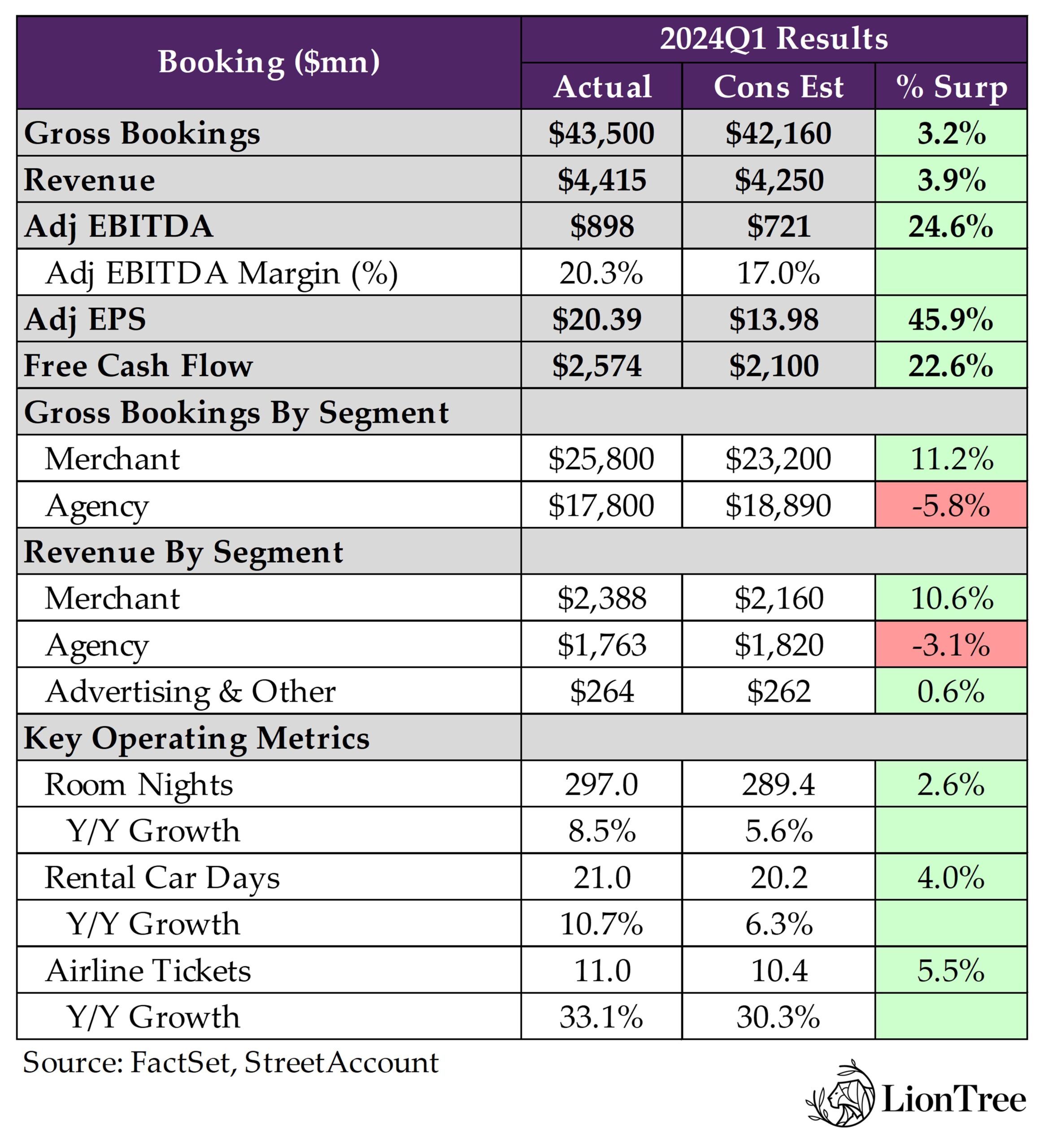
- Expedia posted a wide beat on profitability but slightly missed on the top-line: Q1 rev grew +8.4% y/y (vs +10.3% y/y in Q4) and beat cons by +3.2%; Adj EBITDA rose +37.8% y/y (vs +18.5% y/y in Q4) and closed +41.4% ahead of cons; Adj EPS of $0.21 was far better than cons -$0.14
- Adj EBITDA margin was better than expected: Adj EBITDA margin of 8.8% beat cons 6.4%; Cost of sales fell -13% y/y (vs -17% y/y in Q4), while direct sales & mkting expenses grew +11% y/y (vs +14% y/y in Q4); Benefited from mkting deleverage in the B2C biz as well as headcount reductions
- Investments in “pricing actions” will impact future qtrs: The discounts that Expedia provided its customers last qtr had a smaller impact on the bottom line than direct mkting investments but will show up as contra rev when the stays occur in future qtrs
- Adj EBITDA margin was better than expected: Adj EBITDA margin of 8.8% beat cons 6.4%; Cost of sales fell -13% y/y (vs -17% y/y in Q4), while direct sales & mkting expenses grew +11% y/y (vs +14% y/y in Q4); Benefited from mkting deleverage in the B2C biz as well as headcount reductions
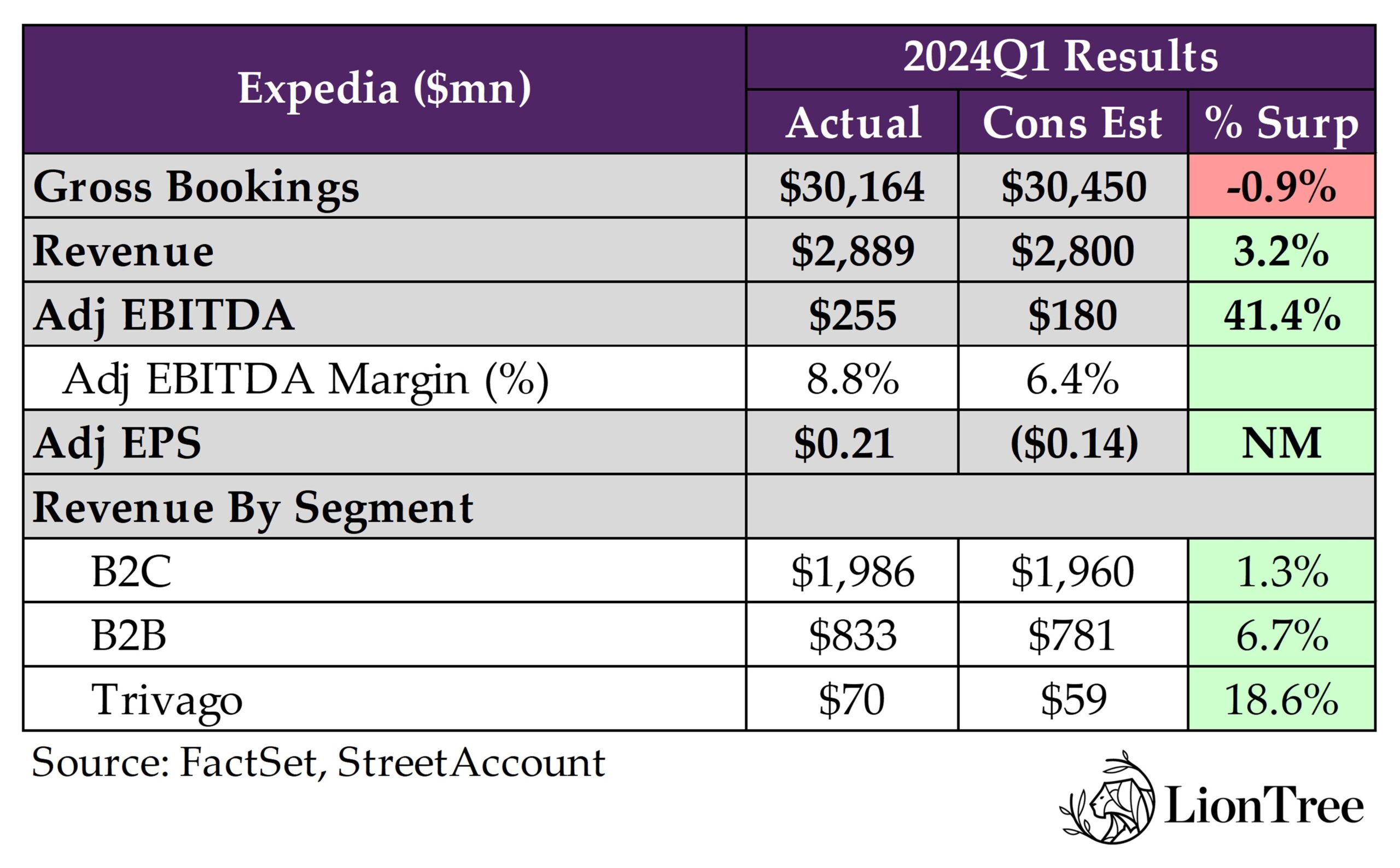
Q2 Guidance Left Some Room To Be Desired
- Booking anticipates seq slowdowns in growth ahead in Q2:
- Q2 room night growth is projected to decel seq more than the Street expected: Sees Q2 room night growth between +4-6% y/y (vs +8.5% y/y in Q1), missing cons +6.9% at the mid-pt; Along w/ a seq decline in the booking window, the War in the Middle East is expected to have a “more negative impact” than in Q1
- BUT April room night growth was above the high end of the guidance range: The Co’s performance during the month benefited by ~+2pts from a favorable shift in Easter timing; Excluding this, April room night growth was at the high-end of the range
- The gross bookings forecast also underwhelmed estimates: Expects a gross bookings growth range of +3-5% (vs +10.4% y/y in Q1), missing cons +7.9% y/y at the mid-pt; Bookings will grow below room nights due to ~-3pts of FX headwinds, offset by +1% higher accommodation ADRs and ~+1pt from flight bookings
- Rev growth is expected to decel seq: Anticipates rev growth between +4-6% y/y in Q2 (vs +16.9% y/y in Q1); After accounting for ~-2% of negative impact from FX, Q2 rev growth is expected to be in-line w/ bookings growth
- Expectations for adj EBITDA growth were disappointing: Projects an adj EBITDA range of $1.70-1.75bn, which was -7.8% below cons at the mid-pt; Excluding ~-7% of pressure from the shift in Easter timing and ~-2% from FX, Q2 adj EBITDA is expected to grow ~+msd-hsd% y/y (vs +52.3% y/y in Q1)
- Q2 room night growth is projected to decel seq more than the Street expected: Sees Q2 room night growth between +4-6% y/y (vs +8.5% y/y in Q1), missing cons +6.9% at the mid-pt; Along w/ a seq decline in the booking window, the War in the Middle East is expected to have a “more negative impact” than in Q1
- Expedia – Gross bookings growth is forecasted to improve seq in Q2: Expects gross bookings growth of ~+msd% y/y in Q2 (vs +2.6% y/y in Q1), w/ the seq accel being driven by improvements in Vrbo
- BUT rev growth is expected to decline seq: Given the Co’s lower than projected gross bookings in Q1, the pull forward of Easter stays into last qtr, and contra rev stemming from the Co’s pricing actions
- Expedia also anticipates “some pressure” on EBITDA and EBIT margins vs last yr: Cited cont’d investments in mkting to drive growth and the contra rev impact from discounts as the main reasons; This will bring margins relatively in-line w/ last yr after Q1’s outperformance on the bottom-line
FY24 Outlooks – Booking Maintained Guidance, While Expedia Reduced Its Top-Line Forecast
- Booking – Still sees 2024 as a “strong yr” and reiterated FY24 guidance: Last qtr, the Co guided for FY24 gross booking and rev growth to be “slightly faster” than +7%; Adj EBITDA was growth was projected to be “slightly faster” than rev growth, and adj EPS was expected to grow above +14% y/y
- Expedia –FY24 top-line growth is now projected to be lower than initially anticipated: Now forecasts ~+msd-hsd% y/y bookings growth (vs being “relatively in-line” w/ 2023’s +9.5% y/y growth prior), while margins are still expected to be “relatively in-line” w/ last yr’s levels
- The Co still expects a “broad improvement” across 2024 in its B2C biz: Pointed to conversion gains from higher testing velocity and future product rollouts as the “best early indicator” of this trend; Also plans to continue to invest in Vrbo and int’l growth
- Expedia is “still motivated… to get back to mkting leverage”: However, it wants to have room in the back half of they yr to invest in re-invigorating Vrbo and expanding int’lly
Macro Commentary Was Varied In Tone
- Booking continues to benefit from “resiliency” in global leisure travel demand: The Co noted “healthy growth… on the books” for its upcoming peak summer travel season but caveated that these bookings are cancelable and represent a “modest percentage” of its expected total summer bookings
- The Co still hasn’t seen any indications of weakness at the consumer level: Booking emphasized that there hasn’t been a change in its mix of hotel star rating levels being booked or in the length of stays, which are both signals that consumers could be trading down
- Expedia saw a “healthy but more normalized” global travel mkt: North America remains the Co’s “slowest-growing” major national mkt, though the gap has been closing vs other mtks w/ the post-pandemic travel recovery having been “largely” concluded; In particular, the air and car bizs have seen cont’d pressure
The OTAs Gross Bookings Growth Both Slowed Seq But Diverged Relative To Expectations
- Booking – Gross bookings growth beat expectations but declined seq: Gross bookings growth rose +10.4% y/y in Q1 (vs +16.1% y/y in Q4), topping cons by +3.2%; The ~2% spread (unrounded) between room night and bookings growth was due to ~+1% higher accommodation ADRs, plus a +1% tailwind from flight bookings
- Room nights growth outpaced projections: Q1 room nights were up +8.5% y/y (vs +9.2% y/y in Q4) and closed +2.6% ahead of cons; Upside was driven by a cont’d expansion of the booking window, w/ Q2 room nights pulled into Q1, as well as “healthy underlying demand” globally
- Regionally, Europe and the Middle East stood out: Highlighted stronger than anticipated demand in Europe and only a “small negative” impact from the ongoing War in Middle East
- Growth also picked up seq in the US: The US incr’d ~+lsd% y/y (vs flat y/y in Q4), while Asia grew in the ~mid-teens% y/y (similar to Q4) and Europe as well as RoW both were up ~+hsd% y/y (vs ~+ldd% y/y and ~+lsd% y/y, respectively, in Q4)
- Growth in airline ticket bookings decel’d seq but topped estimates: Q1 airline ticket bookings incr’d +33.1% y/y (vs +45.8% y/y in Q4) and beat cons by +5.5%; Growth as driven by cont’d adoption of Booking.com’s flight offering by a “healthy number of new customers”
- Unfavorable changes in regional mix cont’d to weigh on ADR: Ex-FX, ADRs grew ~+2% y/y in Q1 (vs ~+5% y/y in Q4); ADR growth was pressured by a higher mix of room nights from Asia; Regionally, ADRs were up in Europe and flat in North America and Asia
- Room nights growth outpaced projections: Q1 room nights were up +8.5% y/y (vs +9.2% y/y in Q4) and closed +2.6% ahead of cons; Upside was driven by a cont’d expansion of the booking window, w/ Q2 room nights pulled into Q1, as well as “healthy underlying demand” globally
- Expedia – Gross bookings were “less robust” and fell short of estimates: Total gross bookings grew +2.6% y/y in Q1 (vs +5.6% y/y in Q4) and missed cons by -0.9%; Last qtr, the Co issued a tempered guide of ~+lsd-msd% y/y growth in Q1, citing tougher comps cont’d pressures facing air travel and the Vrbo brand
- Total lodging gross bookings were the main driver behind overall bookings growth: Q1 total lodging gross bookings incr’d +4.0% y/y (vs +8.0% y/y); “Strong hotel growth” contd, w/ gross bookings up +12% y/y (vs +13% y/y in Q4); The Co saw “good share gains” in its core hotel biz across all major focus mkts
- Excluding Vrbo, the B2C biz was in line w/ the Co’s expectations: B2C rev was up +3.4% y/y in Q1 (vs +4.4% y/y in Q4), topping cons by +1.3%; Vrbo has been experiencing a slower than expected recovery, and this has cont’d to be a headwind in Q2 as well
- The B2B biz “cont’d its strong performance”: Q1 B2B rev grew +24.7% y/y (vs +27.8% y/y in Q4) and beat cons by +6.7%; Highlighted a “well-balanced” portfolio of partners, customers, and geo mix; The Co still sees “a big oppty to win share” w/ its recent tech enhancements and partnerships
- B2B benefited from “a little more geographic diversity”: Particularly in Asia in LatAm, as well as other regions that are growing “a bit faster” than the US
- Pricing remained under pressure: Pricing “held up in general” for lodging, but the Co has seen cont’d pressure in air and car rental rates
The Alternative Accommodations Space Was Incrementally Pressured
- Booking – Alternative accommodation room nights growth decel’d further seq: Alternative accommodation room nights grew +13% y/y in Q1 (vs +19% y/y in Q4 and +24% y/y in Q3)
- The Co has been benefiting from an increasing supply on its platform: Global alternative accommodations of 7.4mn were up +11% y/y in Q1 (vs +12% y/y at the end of Q2)
- Expanding supply in the US remains a priority: Booking is focused on further improving its alternative accommodations product for supply partners and travelers in the US, where it’s been behind in the past; Increasing supply of single-family homes should help the Co take share
- Global alternative accommodation room nights are accounting a larger portion of the Co’s mix: In Q1, the global mix of alternative accommodation room nights incr’d ~+300bps y/y to 36% (vs 32% in Q4), amid a broader mix shift towards alternative accommodation properties during the qtr
- The Co’s alternative accommodations oppty is “not well understood and underestimated”: Emphasized that Booking is two-thirds the size of the largest player in the space and still has “a lot of oppty” to further develop of its offering
- The Co has been benefiting from an increasing supply on its platform: Global alternative accommodations of 7.4mn were up +11% y/y in Q1 (vs +12% y/y at the end of Q2)
- Expedia – Vrbo has experienced a “slower than expected ramp” following its technical migration: Vrbo has been improving alongside Expedia’s efforts to begin investing in mkting the biz again after scaling back efforts to do so in H2:23 during its migration; However, the recovery has taken longer than anticipated
- Vrbo’s core biz is “very strong”: Stressed that it doesn’t compete w/ shared accommodations and doesn’t compete directly w/ some of its competitors in certain geos and cities
- BUT mkting investments in Vrbo have a longer payoff window: The vacation rental (VR) space isn’t driven by performance mkting, and the Co is “taking some time to lean back into” brand mkting
- VR demand has been “fairly flat” in North America: The space hasn’t been benefiting from the same tailwinds that drove the “huge pandemic surge”
- Vrbo has also “obviously given up share” in VR to Airbnb and Booking in some areas: Specifically in city-centric and other types of accommodations outside of whole home rentals
- Expedia has been seeing “real improvement” in the Vrbo platform: The Co has been “leaning into investment” to “re-ignite” its flywheels and set the foundation for future growth and win back customers
- Moving forward, Vrbo’s main focus will be rebuilding traffic: Growing brand awareness will be a key piece of this strategy, along w/ leveraging the benefits of the One Key ecosystem; The Co has also been leaning more into performance mkting and looking to drive int’l growth
- In contrast, conversion has been in “good shape”: Vrbo has been “converting very well”, and this continues to improve as the Co realizes the benefits of being on a single tech stack
- Vrbo’s core biz is “very strong”: Stressed that it doesn’t compete w/ shared accommodations and doesn’t compete directly w/ some of its competitors in certain geos and cities
Prior Investments In Building Out Loyalty Initiatives Are Starting To Pay Dividends
- Booking has been seeing “encouraging early proof points” in its loyalty offerings: The Co has grown its number of total active travelers while experiencing higher growth in repeat travelers; Booking also noted increases in the avg number of trips booked per traveler as well a growing mix of room nights booked w/ the Co, on avg
- The direct booking channel’s room nights cont’d to outgrow the paid mkting channel’s room nights: Mobile app mix was up +500bps y/y to 51% (vs 53% in Q4), and over the last four qtrs, the Co’s mix of room nights via the direct channel was in the ~mid-50% range (~low-60% range when excluding B2B)
- The Genius loyalty program has played “an increasingly important role” in offering tiered svs: the Co has been seeing success in moving customers into the higher Level 2 & 3 Genius tiers, which require 5 and 15 bookings in a two-yr period, respectively
- Bookings outside of accommodations will contribute more to the program moving forward: The Co has seen an “encouraging number” of rental car supplier partners adopt the program and has just begun to test it in flights and attractions
- The Connected Trip vision has been gaining traction: Connected transactions incr’d by just over +50% y/y in Q1 (off of a small base though), as more travelers are choosing to book connected transactions, given the Co’s efforts to provide more value and offer a better overall experience
- Expedia has been “really pleased” w/ member growth within its loyalty programs: New membership in Expedia’s loyalty programs incr’d +40% y/y in Q1 (unclear how this compares seq); The Co has also been experiencing “good repeat rates” from existing customers
- Cross-shopping trends continue to demonstrate the effectiveness of One Key: Expedia has seen that 25% of the people that redeemed One Key Cash on Vrbo had earned those credits either on Hotels.com or Expedia and were completely new to Vrbo
- One Key is poised to rollout int’lly later this yr: Like in the US, the Co believes this will help it capture more trips from travelers originating overseas as well
- Growth in the percentage of biz coming through Expeida’s app was ~flat seq: Continues to be up ~+600bps y/y, and the Co is focused on driving more direct traffic moving forward
Both OTAs Experienced A Y/Y Decline In FCF
- Booking delivered a wide outperformance on FCF: Q1 FCF fell -8.1% y/y to $2.6bn (vs $1.3bn in Q2), beating cons by +22.6%; Upside came despite $1.9bn in capital returns, including share repurchases and a $8.75/shr dividend initiated in the qtr
- Expedia – FCF growth was impacted by headwinds in the Vrbo biz: FCF was down -7.6% y/y to $2.7bn in Q1 (vs -$415mn in Q4); The y/y decline was related to working capital timing changes, including lower deferred merchant bookings, driven mainly by the softness in Vrbo bookings during the qtr
AI-Related Initiatives Remain In Early Stages But Are Progressing
- Booking continues to work to integrate Gen AI into its products in “innovative ways”: Cited Booking.com’s AI trip planner, Priceline’s AI travel assistant, Penny, and KAYAK’s recent release of Gen AI-powered features & tools as examples; Gen AI will also be incorporated into the Connected Trip vision and customer svs interactions
- Expedia’s Gen AI efforts are still “early days”, but some “really cool” annc’ments are on the way: The Co plans to provide an update on its AI initiatives at its upcoming EXPLORE conference in two weeks; It has been mainly focused on experiment w/ Gen AI, and its usage of the tech is “still pretty modest
- The Co’s Gen AI enhancements will benefit both partners and customers: Indicated that the “coolest, newest” updates will impact consumer behavior and experience, and new AI-powered tools will also help bizs better show properties and advertising inventories
Other Highlights
- Expedia sees “lots of oppty ahead” in its advertising biz: Expedia’s ad biz posted a “strong performance” in Q1; The segment is “big, differentiated, and growing”, and the Co enjoys “strong relationships” w/ its supply partners
Stock Market Check
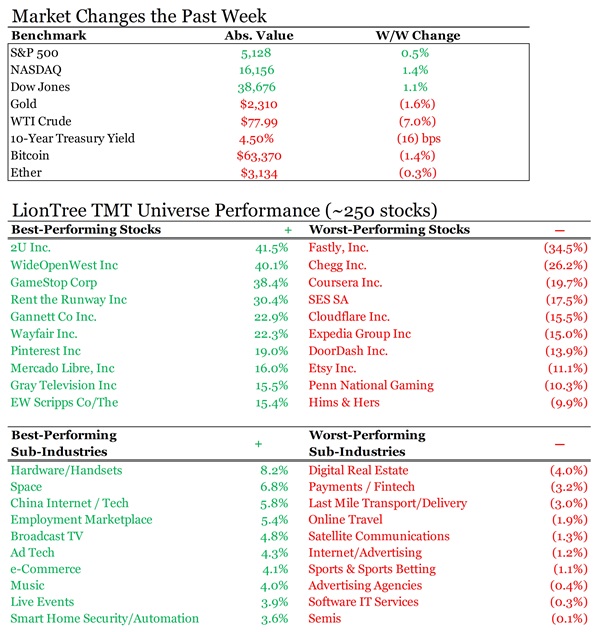
This Week's Other Curated News
Advertising/Ad Agencies/Ad Tech
- The US advertising mkt maintained its robust expansion streak for the 11th straight month in March, marking a 4. 3% y/y increase, as per Guideline’s US Ad Market Tracker. Smaller advertising categories surged ahead, surpassing the growth of the top categories by nearly fourfold. While the top 10 categories saw only a modest 1.9% y/y rise in spending, all other categories witnessed a substantial 7.9% expansion. (Spots n Dots)
- T-Mobile said it is expanding its advertising biz, creating an in-store retail media network and adding Plex, the video streaming platform for its footprint of mobile customers. Plex will give T-Mobile reach in the connected TV space. Advertisers will be able to use insights and audience data from T-Ads to target consumers w/ relevant ads and specialized sponsored experiences, like free movies and series. (Broadcasting Cable)
Artificial Intelligence/Machine Learning
- A new bill seeking to track security issues by mandating the creation of a database recording all breaches of AI systems has been filed in the Senate. The Secure Artificial Intelligence Act, introduced by Sens. Mark Warner and Thom Tillis, would establish an Artificial Intelligence Security Center at the National Security Agency. This center would lead research into what the bill calls “counter-AI,” or techniques to learn how to manipulate AI systems. (The Verge)
- CoreWeave, an AI cloud infrastructure startup, said it has raised fresh funding in a round led by Coatue, which reportedly values the Co at $19bn. That represents an almost threefold increase from the Co’s valuation just five months ago, when it was valued at $7bn following a secondary sale, and a huge jump from its $2bn valuation in a Series B extension last May. (Crunchbase News)
- Microsoft reaffirmed its ban on US police depts from using Gen AI for facial recognition through the Azure OpenAI Service. Language added to the terms of svs for Azure OpenAI Service more specifically prohibits integrations w/ Azure OpenAI Service from being used “by or for” police depts for facial recognition in the US, including integrations w/ OpenAI’s current and future image-analyzing models. (TechCrunch)
- Nvidia is updating its experimental ChatRTX chatbot w/ more AI models for RTX GPU owners. The chatbot, which runs locally on a Windows PC, can already use Mistral or Llama 2 to query personal documents that users feed into it, but now the list of supported AI models is growing to include Google’s Gemma, ChatGLM3, and even OpenAI’s CLIP model to make it easier for users to search their photos. (The Verge)
- As the AI sector experiences a financial reckoning, several high-profile AI startups are struggling to balance exorbitant development costs w/ insufficient rev streams, signaling a potential end to the initial AI boom. Inflection AI has ceased its original operations, Stability AI has seen layoffs and executive changes, and Anthropic is grappling with a substantial revenue deficit. The input of $330bn over three yrs in AI, contrasts sharply with the practical revenue outcomes, raising concerns about the long-term business viability of these ventures. (AI KATANA)
- OpenAI has enabled the “Memory” feature for all ChatGPT Plus users, the Co annc’d via X. Memory allows users to tell ChatGPT things they want it to remember across chats. The feature can be turned on and off in the settings. This feature is designed to extend ChatGPT’s capabilities by allowing the model to retain the context of previous conversations across chats. OpenAI said that Memory is not “currently available” in Europe and Korea, without giving a reason. (THE DECODER)
Broadcast/Cable Networks
- MeTV is launching a 24/7 classic cartoon network in partnership w/ Warner Bros. The new network will include many popular classic shows like Bugs Bunny, Daffy Duck, Scooby Doo, Tom & Jerry, George Jetson, Top Cat, Yogi Bear, Popeye, Johnny Quest, and Fred Flintstone. Many of these shows had been on Boomerang but recently left that network. MeTV Toon TV is coming to free over-the-air broadcast stations. (Cord Cutters News)
Broader Connectivity
- FCC is fining the largest US mobile carriers a combined nearly $200mm for allegedly illegally sharing customers’ location data without their consent. The FCC says it found the carriers “sold access to its customers’ location information to ‘aggregators,’ who then resold access to such information to third-party location-based service providers.” Carrier includes T-Mobile, AT&T, Sprint, and Verzion. (The Verge)
- The Spanish gov’t said it had already acquired a 6% stake in domestic telecom operator Telefonica through a state holding Co. Spanish state-run co Sociedad Estatal de Participaciones Industriales noted that the transaction is part of a move to acquire a stake of up to 10% in the operator. The main aim of this move is Spain attempting to balance the influence of Saudi telco stc in the Spanish Co. (RCR Wireless News)
Broader Media & Entertainment
- Fubo dropped all Warner Bros. Discovery networks from its lineup, alleging that WBD was seeking “above-market rates” and refused to license Turner Sports networks separately. In a statement, Fubo said it attempted to renew its Discovery content agreement with WBD for networks including Discovery, HGTV, Food Network and TLC. Fubo said WBD would not negotiate in “good faith” and that as a Warner Bros. Discovery networks were pulled from Fubo as of April 30 at 5 p.m. ET. (Variety)
- The Financial Times has struck a deal with OpenAI to license its content and develop AI tools, the latest news organization to work with the OpenAI. The FT writes in a press release that ChatGPT users will see summaries, quotes, and links to its articles. Any prompt that returns information from the FT will be attributed to the publication. In return, OpenAI will work with the news organization to develop new AI products. FT is already a customer of ChatGPT Enterprise. (The Verge)
Broader Technology
- Google paid Apple $20bn in 2022 to be Safari’s default search engine, per court documents. That’s a $2bn increase compared to the reported amount Google paid Apple in 2021. According to the court documents, Google paid Apple around $18bn that year, surpassing $1bn every month. At the trial last fall, Apple execs were cryptic about the payment and said Google spent “billions” on a deal w/ Apple. (Yahoo News)
- New rules clamping down on China’s internet giants are now in effect. These rules, part of the expanded State Secrets Law, require Cos like Tencent, ByteDance, and Weibo to swiftly act if users share sensitive content. Dubbed as “network operators,” these firms must keep a close eye on user-shared info, promptly remove flagged posts, and report any issues to the authorities. This update reflects President Xi Jinping’s focus on national security amid the government’s scrutiny of the country’s tech industry. (WTX News)
Cable/Pay-TV/Wireless
- Altice USA reported a loss of both video and broadband subscribers, resulting in red ink for Q1. The Co had 30,000 fewer Optimum broadband subscribers than in the prior qtr, compared to 19,000 net disconnects a yr ago. The Co finished the qtr w/ 4.1mn broadband subscribers. In video, 78,000 customers cut the cord, the biggest loss in at least a yr, leaving 2.1mn pay-TV subscribers. (Multichannel News)
- AT&T debuted AT&T Turbo, a new svs option that will enable customers to buy better network performance for an extra $7/mo. The Co also indicated that the new capability is a first step that will be expanded upon. AT&T touts the service as providing “real-time responsiveness and improved stability” and that Turbo is “built to support using high-performance mobile applications… w/ optimized data”. (RCR Wireless News)
- Dish Network and Cox Media Group say they’ve finally resolved a broadcast retransmission standoff that has kept Cox stations in nine markets off the satellite TV platform since Nov 2022. “Dish and CMG greatly appreciate the patience of their subscribers and viewers,” reads a brief statement jointly released by the two cos over the weekend. The dispute affected Cox stations in Atlanta; Boston; Charlotte, North Carolina; Dayton, Ohio; Eugene, Oregon; Jacksonville and Orlando, Florida; Pittsburgh; and Seattle. (NextTV)
- The Affordable Connectivity Program, which is credited w/ helping 23mn American households in need pay for internet svs, has officially entered a “partial funding” phase. Households that rely on the pandemic-era program will receive a maximum of $14 for the month of May (w/ the exception of tribal households), rather than the typical $30. At the end of May, the program will run completely dry. (NextTV)
- The DIRECTV via Internet Choice+ package is now offering new subscribers the chance to save $10 each month for 24 months. That’s a huge savings of $240 over two yrs, and subscribers can get the discount on the Choice package or above. The Choice package features many popular news, entertainment, lifestyle, and a broad selection of sports networks, including popular Regional Sports Networks (RSNs). (Cord Cutters News)
Capital Market Updates
- The US IPO market has rebounded significantly, reaching $13.7bn in volume this year—more than triple last year’s figures. However, private equity firms remain cautious, with only two significant IPOs raising about $1bn. Despite the market recovery, PE-backed public listings have been slow, reflecting recent lows in divestments. (SUPERNEWS)
Cybersecurity/Security
- Google annc’d 400mn+ Google accounts (of the at least 1.5bn reported since 2018) have used passkeys since launch, logging 1bn+ authentications between them. The majority of users find them easier to use than passwords, per Google, which said that “since launching, passkeys have proven to be faster than passwords, since they only require users to simply unlock their device using a fingerprint, face scan, or pin to log in.” (The Verge)
- Verizon Business released the findings of its 17th annual Data Breach Investigations Report (DBIR). The report analyzed a record-high 30,458 security incidents and 10,626 confirmed breaches in 2023, a two-fold increase over 2022. The exploitation of vulnerabilities as an initial point of entry almost tripled from the previous yr, accounting for 14% of all breaches. (Inside Towers)
eCommerce/Social Commerce/Retail
- eBay forecasted Q2 rev below Wall Street estimates, as demand cools for its key product categories, like collector’s items and auto parts, sending shares down 5% in extended trading. It expects revenue in the range of $2.49-2.54bn for the upcoming qtr, while analysts on avg were expecting $2.56bn, according to LSEG data. The Co also projected an adj EPS of $1.10-1.15, the mid-pt of which came in below estimates of $1.14. (Yahoo News)
- Happy Returns wants to make the reverse logistics process more flexible for large retailers by allowing them to accept returns from multiple brands across online and in stores. The Co tagged Shein as one of the first beneficiaries of its newest feature. Happy Returns is enabling shoppers to return Shein products to 373 US Forever 21 stores via its box-free, label-free buy online, return in store (BORIS) capabilities. (Footwear News)
- Hong Kong-listed L’Occitane International’s chairman and controlling shareholder will take the firm private, valuing it at a maximum of HK$13.91bn (US$1.78bn). As part of the deal, Austrian billionaire Geiger’s investment holding co L’Occitane Groupe in Luxembourg will pay HK$34 for each share not already owned, representing a 30.8% premium to the stock’s last close of HK$26 on Feb. 5. (CNBC)
- LVMH is exploring options for its Marc Jacobs fashion brand amid interest from potential buyers. The Co has been working with advisers to study possibilities for Marc Jacobs after getting approaches from suitors, the people said. The brand could attract bids from other consumer cos as well as private equity firms. The review is in the early stages and LVMH hasn’t made a final decision on how to respond to the interest. The co could continue growing the business itself, according to the people. (CNBCTV18)
- Peloton’s CEO Barry McCarthy is stepping down after announcing yet another round of layoffs, this time affecting ~15% of its remaining workforce, or ~400 global team members. It’s the fifth round of layoffs to hit the pandemic darling and comes after McCarthy said on its Q1:23 earnings call that the Co was done w/ layoffs and that the “ship was turning.” (The Verge)
- Shein is courting brands like toothpaste conglomerate Colgate-Palmolive and toymaker Hasbro as it tries to sell more household names on its platform. It is moving into other categories and has given brands and retailers access to its platform in nine European countries so far, having done so in the US, Brazil, and Mexico last yr. The strategy, part of Shein’s plan to build credibility and better compete w/ Amazon is enabling the biz to expand and develop new ways of selling goods ahead of a planned stock market listing later this yr. (Reuters)
- Sycamore Partners is one of the buyout equity firms that have expressed interest in taking Nordstrom private, per sources. Negotiations will take several weeks and there is no certainty that Sycamore or any other private equity suitor will reach a deal, the sources said. Nordstrom said last month that CEO Erik Nordstrom and his brother Pete, the Co’s president, were exploring options to take the Co private. (Yahoo Finance)
- TikTok reported that more than 500,000 merchants were selling to US users on its app at the end of 2023, more than double the number from three months earlier, as the svs stepped up its e-commerce effort. E-commerce is seen by TikTok as its next big potential revenue source as well as a way to keep users spending time and money on its app. After starting Shop in Southeast Asia, the co has expanded to markets like the UK and, last yr, the US. (South China Morning Post)
- UK retail footfall declined last month, hurt by poor weather and an earlier Easter, per the latest British Retail Consortium-Sensormatic IQ tracker. Retail footfall fell 7.2% y/y in April, worsening from a 1.3% drop in March. In high streets alone, footfall fell 6.9% y/y, following a 1.5% decline in March. In retail parks, footfall was 6.3% lower, worsening from March’s 3.5% fall. (MarketScreener)
- Walmart has launched its Roblox store, letting users buy digital items inside the game that are also sent to them physically via the mail. According to Walmart, it hopes that its stores and tech will power future Roblox commerce. (Kotaku)
- Walmart is piloting a new in-store artificial intelligence to advise associates on everything from when bananas are likely to rot to when to mark down seasonal clothing. The goal is to reduce food waste and fashion waste, which leads to millions of tons of unused items each year likely bound for landfills, and billions of lost dollars for Walmart. Walmart thinks AI will make quicker, data-informed decisions w/ employees. (CNBC)
- Walmart is stepping up its grocery game w/ a new line of trendy, chef-inspired foods, in its largest private brand food launch in two decades. Bettergoods, a line of 300 new grocery items curated by Walmart’s product development team, includes premium food items like pistachio nut butter and plant-based mozzarella. Bettergoods is meant to attract new customers to the grocery chain, as well as higher-income shoppers who might typically go to Trader Joe’s and Whole Foods, which also have their own store brands. (Quartz)
- Walmart said that it will close all of its health-care clinics across the country. The big-box retailer said it would also shutter its telehealth provider, which it acquired for an undisclosed amount in 2021. Walmart will close 51 clinic locations across Arkansas, Florida, Georgia, Illinois and Texas, plans that won’t affect the company’s 4,600 pharmacies and more than 3,000 vision centers, the company said in a release. (CNBC)
- Walmart’s proposed acquisition of Vizio is now set to undergo rigorous scrutiny by the Federal Trade Commission, as confirmed by Vizio. According to disclosures made in a regulatory filing, both Walmart and Vizio received a “second request” from the antitrust agency, signaling the necessity for additional information regarding the proposed deal. (PYMNTS.com)
- Walmart-owned Sam’s Club says it’s turning to AI to speed up its own exit technology. Instead of requiring store staff to check members’ purchases against their receipts when leaving the store, Sam’s Club customers who pay either at a register or through the Scan & Go mobile app can now walk out of the store without having their purchases double-checked. The technology has now been deployed at over 120 clubs across the U.S., which is 20% of the total number of Sam’s Club locations. Since rolling out, the company claims that it has significantly sped up exits, as members leave the store 23% faster. The retailer plans to expand the tech to all its stores by year-end. (TechCrunch)
- About 45,000 retail stores may close in the coming yrs as retail’s physical footprint increasingly shifts to serve as fulfillment and distribution centers, USanalysts said in an Apr 22 report. The forecast is based on the premise that online retail penetration rises to 26% from 21% w/ retail sales growth of 4% by 2028. Several major retailers w/ noteworthy physical footprints recently annc’d store closures or have gone out of biz altogether. US says the total number of retail stores in the US will fall to 913,500 from 958,533. (Retail Dive)
- Research shows 79% of customers would switch to a competitor if they provided a better customer experience, and 51% believe the importance of customer service outweighs the price tag. Cos in the US alone already suffer $75bn in annual losses due to poor customer service. Digital avatars could hold the key to unleashing a new era of AI-powered excellence in customer service. These digital avatars combine GenAI tool to produce photo realistic digital humans capable of holding real-time, face-to-face conversations. (www.retailcustomerexperience.com)
- Starbucks reported weaker-than-expected quarterly earnings and revenue, fueled by a surprise decline in same-store sales. The Co also slashed its forecast for its fiscal 2024 earnings and revenue, predicting that its cafes would keep underperforming for several quarters. Shares of the Co fell 12% in extended trading. “In a highly challenged environment, this quarter’s results do not reflect the power of our brand, our capabilities or the opportunities ahead,” CEO Laxman Narasimhan said in a statement. (CNBC)
- Walmart will leverage 19 autonomous forklifts from Fox Robotics at four distribution centers, according to a report at thescxchange. The autonomous forklifts will unload pallets from trucks after a 16-month proof of concept program. Walmart has bought an ownership stake in Fox Robotics, according to the news report. (www.retailcustomerexperience.com)
EdTech
- The rapid rise of AI appears to be taking a toll on the shares of online education cos Chegg and Coursera. Both stocks sank by more than 10% after issuing disappointing guidance in part because of students using AI tools such as ChatGPT from OpenAI. Chegg, which annc’d a new CEO, said it expects Q2 revenue to come in between $159 mn and $161 mn, lower than the $174 mn expected by analysts polled by LSEG. (CNBC)
EV/ Autonomous Vehicles
- Elon Musk shocked Tesla fans after news leaked he was eliminating everyone at Tesla’s Supercharger operations. According to an email from the entrepreneur obtained by The Information, Tesla’s senior director for EV charging, Rebecca Tinucci, would be leaving the co with immediate effect. Musk also informed staff he would be dismissing everyone on her Supercharger team, which numbered roughly 500 employees. (Yahoo Finance)
- Local Chinese authorities have removed restrictions on Tesla cars after the Co’s China-made vehicles passed the country’s data security requirements. The breakthrough came as Elon Musk arrived in Beijing for an unexpected meeting with Chinese Premier Li Qiang, amid the first major auto show in the city in four yrs. In addition to Tesla’s Model 3 and Model Y, several new energy vehicles from BYD, Lotus, Nezha, Li Auto and Nio passed China’s data security requirements. (CNBC)
- The provisional approval in China of Tesla’s autonomous driving system, known as Full Self-Driving, marks a significant milestone for the future of autonomous mobility and the robot taxis that Elon Musk envisages. It is crucial to distinguish FSD, a driver assistance system requiring active supervision, from true robot taxis. The approval comes after a surprise visit by Elon Musk to China, coinciding with a car show in Beijing. (MarketScreener)
Film/Studio/Content/IP/Talent
- Apple is reportedly talking to producers and agents about a potential new deal structure for their originals going forward. Right now, all shows receive the same backend payouts based on duration, but Apple is purportedly discussing an alternative structure, where backend payouts are more closely linked to success, “in an effort to align better with what talent wants”. (9to5Mac)
- Global film and TV production in Q1 2024 was down 7% from the same time last yr, according to ProdPro. In the aftermath of the dual strikes which largely halted film and TV shoots for about six months straight, entertainment workers and Cos alike seemed eager to get back to biz and resume filming immediately. But production has not rebounded as quickly or strongly as many had hoped, particularly in the Los Angeles area. (Yahoo News)
- SAG-AFTRA has selected Nielsen as its third-party provider of streaming content measurement. The actors’ union needs the data because its new contract calls for members to get additional pay based on the success of streaming shows. Nielsen’s data will complement first-party data from streaming platforms and serve as a lens to analyze the performance of streaming titles across various distribution platforms. (Broadcasting Cable)
- “Fallout” is proving to be far from a (nuclear) bomb for Amazon’s Prime Video. According to the streamer, the series pulled in 65mm viewers in its first 16 days of availability, w/ the first season dropping in its entirety on Apr 10. Amazon also says the show is its most-watched ever among adults 18-34, w/ 60% of the show’s audience coming from outside the US. (Variety)
FinTech/InsurTech/Payments
- Block reported Q1 earnings that exceeded analysts’ estimates. The Co reported net income of $472mn, or 74 cents per share, more than quadruple the net income of $98.3mn, or 16 cents per share, a yr earlier. The Co reported $5.96bn in rev vs $5.82bn expected. The Cash App biz, which is the Co’s popular mobile payment platform, reported $1.26bn in gross profit, a 25% y/y jump. (CNBC)
- SoFi Technologies shares plunged on Apr 29 after the co gave worse-than-expected current quarter guidance and called 2024 a period of change. SoFi fell 10.48% to close Monday at $7.05, pushing its year-to-date decline to nearly 30%. The co said it sees Q2 revenue in the range of $555mm to $565mm and net income of $5mm to $10mm. Both were well short of estimates. (Investopedia)
Last Mile Transportation/Delivery
- Bolt Technology secured a €220mn ($235mn) credit facility that the Estonian mobility Co says will help it prepare for a public offering. Bolt CEO Markus Villig said the financing “provides us w/ additional flexibility as we work towards being IPO-ready.” In 2022, Bolt earned a €7.4bn valuation after raising €628mn from Sequoia Capital, Fidelity Management, and other investors. (Bloomberg)
- Thousands of London taxi drivers have launched a £250mn lawsuit against Uber, claiming the minicab app illegally obtained a license to operate in London. More than 10,000 cabbies have signed up to the lawsuit, which lawyers claim could result in compensation of £25,000 per driver. The High Court claim comes just weeks after Uber sought to bury a long-running battle with black cab drivers by allowing them to accept rides through its app. (Yahoo Finance)
Macro Updates
- US job openings fell to a three-yr low in March, while the number of people quitting their jobs declined, signs of easing labor mkt conditions that over time could aid the Federal Reserve’s fight against inflation. The JOLTS report from the Labor Dept was, however, tempered somewhat by other data showing a measure of prices paid by manufacturers for raw materials jumped to the highest level in nearly two yrs in April. (Yahoo Finance)
Online Travel
- Airbnb is offering customers a chance to spend a night in a Paris museum, stay in houses mocked up to look like movie settings, or sleep surrounded by eight Ferrari racing cars. The Co hit upon the idea for the publicity caper after seeing the response to a Barbie-themed house in Malibu, CA that it listed last yr. Winners will be able to book the featured properties or events for free or at prices under $100. (New York Post)
Satellite/Space
- Hubble Network has become the first Co in history to establish a Bluetooth connection directly to a satellite. This marks a critical tech validation for the Co, potentially opening the door to connecting millions more devices anywhere in the world. Hubble Network launched its first two satellites into orbit on SpaceX’s Transporter-10 ride-share mission in March. (TechCrunch)
- SES is acquiring rival satellite operator Intelsat for $3.1bn, a deal that would bring together two of the major GEO satellite operators in a market facing increased competition from LEO constellations. The companies annc’d Apr. 30 that they had agreed on the deal, subject to regulatory approvals. SES will pay $3.1bn in cash along with certain contingent value rights for 100% of Intelsat. The transaction is not expected to close until the second half of 2025. (SpaceNews)
- Starlink satellite internet terminals are reportedly still operating in unlicensed places, despite the Co’s warning that the svs would be shut down by May 1 in those areas. A resident of Al-Fashir in North Darfur, Sudan was able to conduct an interview w/ Bloomberg using one. The Starlink shutdown warnings came after news outlets reported of its unauthorized use in nations including Russia, Yemen, and Venezuela. (Quartz)
- SES and Intelsat have revived talks to merge. The pair had tried to combine early in 2023 but those talks came to nothing, other than to lead to the departure of SES’s then CEO Steve Collar. The news, however, did no favours for shares in SES which crashed almost 10% w/in minutes of the report emerging. (ADVANCED-TELEVISION)
- Sometime next yr, NASA believes SpaceX will be ready to link two Starships in orbit for an ambitious refueling demonstration, a technical feat that will put the Moon w/in reach. Amit Kshatriya, who leads the “Moon to Mars” program w/in NASA’s exploration division, outlined SpaceX’s plan to do this in a meeting w/ a committee of the NASA Advisory Council. Before getting to the Moon, SpaceX and Blue Origin must master the technologies and techniques required for in-space refueling. (Ars Technica)
Social/Digital Media
- Snap is launching a slew of new features in Snapchat, including the ability to edit already sent messages allowing users to rectify typo or other errors. Snapchat is also getting emoji reactions, map reactions, and a new AI-powered reminders function. (The Verge)
- The European Commission has opened formal proceedings to assess whether Meta may have breached the Digital Services Act. The suspected infringements cover Meta’s policies and practices relating to deceptive advertising and political content on its services. They also concern the non-availability of an effective third-party real-time civic discourse and election-monitoring tool ahead of the elections to the European Parliament, against the background of Meta’s deprecation of its real-time public insights tool CrowdTangle without an adequate replacement. (Benton Foundation)
- A group of eight US newspapers is suing OpenAI and Microsoft, alleging that the technology Cos have been “purloining millions” of copyrighted news articles w/out permission or payment to train their artificial intelligence chatbots. The New York Daily News, Chicago Tribune, Denver Post and other papers filed the lawsuit in a New York federal court. The other newspapers include Mercury News, Denver Post, Orange County Register and St Paul Pioneer-Press, and and South Florida Sun Sentinel. (the Guardian)
- A new report from TechCrunch claims that TikTok might be bypassing Apple’s App Store in-app purchase system. The report says that TikTok is “presenting some of its users with a link to a website” to purchase coins, instead of using Apple’s in-app purchase flow. TikTok users purchase coins (which are used for tipping TikTok creators) using Apple’s in-app purchase flow. Through this process, TikTok pays Apple a 30% commission. (9to5Mac)
- Meta’s co-funded oversight body is planning to trim its workforce, a downsizing effort that could affect the board’s ability to police Co, the Washington posts reports. Meta’s Oversight Board told some employees last week that their jobs were at risk of being cut. The job eliminations probably will add to challenges facing the Oversight Board at a time when it has faced criticism for moving too slowly and cautiously to issue decisions and opinions that significantly shape how Meta handles contentious free speech debates. (MarketScreener)
- The United Arab Emirates-backed consortium that proposed a £600m takeover of the Telegraph group is walking away after it said new legislation meant the acquisition was “no longer feasible”, triggering a fresh auction of the newspaper group. The decision by RedBird IMI and the US investment firm RedBird Capital Partners puts the newspaper group back up for sale, with several high-profile suitors expected to bid. (the Guardian)
Sports/Sports Betting
- Disney, Fox, and Warner Bros Discovery are reportedly set to finally pull back the curtain to some extent next month at the annual upfront presentations about a joint venture that will collect the sports content of three of the country’s largest legacy media companies onto a single streaming platform later this yr. (The Streamable)
- Formula 1 and software development firm Globant have reached a multi-yr partnership to elevate the digital experiences of F1 teams and fans at races around the globe. The first project of the collaboration will focus on improving the current pit wall system, which delivers different camera angles and audio and is a key source of information for racing teams. F1 and Globant have already been working on these enhancements. (Sportico.com)
- Miami Dolphins owner Stephen Ross, who also owns the Miami F1 race and the venue that hosts it, Hard Rock Stadium, is said to have recently entertained a $10bn offer for control of those sporting assets. Ross declined the offer, per the report. It’s unclear what the individual values of the Dolphins, Miami GP, and Hard Rock Stadium would have been in that deal. (Front Office Sports)
- NFL Commissioner Roger Goodell’s right-hand man is heading off into the sunset. In a memo to employees, Goodell said Jeff Pash, the league’s lead attorney and executive VP, will retire “after 40 yrs of distinguished svs to the NFL.” Pash negotiated the past two collective bargaining agreements between the league and the NFL Players Association, the latter of which expanded the regular season from 16 games to 17. (Front Office Sports)
- As about a third of the 2024 Major League Soccer season has now concluded, Apple is dropping the price of the MLS Season Pass package in kind. The season subscription is now sold for $69, down 30% compared to its $99 price at the start of the season. For Apple TV subscribers, the pass is now just $59. The price drops reflect the amount of content left in the season package, and is expected to return to the normal pricing for 2025. (9to5Mac)
- The NFL and X, agreed to terms on renewing a content partnership. The decade-plus-long partnership will continue on through the 2024 NFL season and beyond. The NFL puts its highlights just about everywhere, but obviously, it has a place in this spectrum. (Awful Announcing)
- Viaplay will continue as the home of Formula 1 in the Netherlands and Nordic countries after agreeing an exclusive new five-yr deal with the top motor racing series. The multi-year renewal, which covers the Netherlands, Denmark, Finland, Iceland, Norway, and Sweden, will run through the 2029 season, and continue to see all practice and qualifying sessions, F1 Sprint events, and grands prix shown live across Viaplay’s platforms. (Sportcal)
- DAZN bolstered its Women’s Football offering, securing the free-to-air rights to the Northern Ireland Football League. The acquisition marks the first commercial broadcast rights agreement for football in Northern Ireland. The NI Football League will exclusively stream live on DAZN until 2027, w/ the new season kicking off on May 5. The deal includes five exclusive live games and more. (Digital TV Europe)
Video Games/Interactive Entertainment
- Dave & Buster’s is taking its games to a new level by offering social wagering on its app. Customers can soon make a friendly $5 wager on a Hot Shots basketball game, a bet on a Skee-Ball competition or on another arcade game. The betting function, expected to launch in the next few months, will work through the co’ app. (CNBC)
- Following the EU’s designation of Apple’s iPadOS as a digital “gatekeeper” under its Digital Markets Act, Epic Games announced plans to launch Fortnite on iPads later this year. This decision builds on Epic’s move to reintroduce Fortnite to iPhones in the EU through alternative app stores, challenging Apple’s market dominance. (TechCrunch)
- LinkedIn is introducing a set of Wordle-style puzzle games. The Co is starting w/ three games: Pinpoint, a word game where players must guess the theme that ties a series of words together; Queens, a puzzle game that’s a bit like a cross between Sudoku and Minesweeper; and Crossclimb, a trivia game that involves guessing a series of four-letter words and placing them in the correct order. (Engadget)
- Meta annc’d that the next entry in the iconic Batman: Arkham series will be Batman: Arkham Shadow, a VR game that’s exclusive to the Meta Quest 3. Iron Man VR developer Camouflaj and Oculus Studios are developing the game, which is set to release later this yr. Meta didn’t share much about the game itself, releasing a short trailer featuring Batman’s POV as he swoops over the grimy, rain-slicked streets of Gotham. (The Verge)
- Sony announced a new PS5 feature allowing users to invite others to multiplayer games via a link, shared online, without needing to exchange usernames or be friends. This tool, available later this year, facilitates joining games directly and includes a QR code option. However, it’s exclusive to PS5 and may require game updates or a PlayStation Plus subscription. Additionally, Sony introduced a live widget for Discord to indicate active multiplayer sessions, enhancing user convenience. (Engadget)
- Take-Two Interactive is shuttering Rollerdrome studio Roll7 and Kerbal Space Program 2 team Intercept Games, per Bloomberg. Take-Two reportedly plans to close Roll7 and will offer severance packages to staff. Take-Two founded Intercept in 2020 specifically to manage Kerbal Space Program 2. The Co has yet to confirm that it’s closing Intercept Games — but it hasn’t said it isn’t, either. (Engadget)
- Unity appointed Matthew Bromberg, former COO of Zynga, as its new CEO, president, and board member. Filling a role that has been temporarily filled by former Red Hat CEO Jim Whitehurst, Bromberg will formally join Unity as CEO on May 15. Whitehurst will serve as executive chair of the Unity board, and Roelof Botha will transition from chairman to lead independent board member. (VentureBeat)
Video Streaming
- 51% of viewers said the difficulty in finding new content on TV can be frustrating, per a new report from Comcast Advertising. The report found nearly two out of three US viewers spend 6+ minutes searching for something to watch. The platform plays a role in picking content, respondents said, w/ 51% finding content recommended on the home screen. 94% of viewers also said genre was a big factor in choosing what to watch. (Broadcasting Cable)
- Crunchyroll annc’d a price hike on its popular Mega Fan membership from $9.99/mo to $11.99/mo for new members. Current subscribers will see their bills go up on their next bill after June 25, 2024. Crunchyroll got its start offering a free tier w/ ads, but it removed that option in Feb, forcing all members to pay a fee to access its content. Recently Crunchyroll annc’d it passed 13mn subscribers. (Cord Cutters News)
- Kantar found that the US streaming mkt has hit a saturation point, w/ the household penetration rate stagnating and at near universal levels. In Q1, streaming svs were available in 95% of, or 123mn U.S. households, only growing 0.1% q/q. Kantar’s study found, however, that the avg number of paid svs accessed per household continues to rise, w/ US households now subscribing to 3.9 paid svs on avg. (TVTechnology)
- Kroger is reportedly in talks w/ Disney to offer the Disney+ streaming svs as a benefit to paying members of its Kroger Boost grocery delivery program. The discussions are in the early stages but could see Kroger Boost subscribers gain access to Disney at no addt’l cost this yr. This move comes as retailers look to enhance their membership programs in order to compete w/ Amazon. (Yahoo Finance)
- Roku has made a deal with NBCUniversal to create a new destination on the Roku homepage screen menu that highlights coverage of the upcoming Paris Summer Olympics and pushes users to NBCU’s streamer Peacock. The NBC Olympic Zone on Roku will feature a replay row, clips, and highlight reels that will take users directly to Peacock, which will live-stream every Olympic event. (Broadcasting Cable)
- Samsung TV Plus is expanding with new sports streams, including Ontario Reign hockey, MLB, PGA Tour, Formula 1, and MMA’s ONEChampionship. It’s also partnering with Warner Music and enhancing gaming with innovative, controller-free games. The platform aims to be a leader in accessible streaming and interactive content, catering to a broad audience. (Deadline)
- Multiview on YouTube TV for Android devices has been rolled out. Users need to do to receive the feature is run the latest version of the app on your smartphone or tablet. After installing the patch, scroll down while on the Home tab until you see the section “Watch in Multiview”. Then users can select a group they want to watch. Audio will initially play from the livestream in the upper left corner. Users can change the audio source by tapping another stream twice. (TechRadar)
- NBCUniversal is looking to wring more money out of Peacock subscribers, with the streamer set to raise prices this summer, one year after its last fee hike, going into effect for new customers ahead of the 2024 Olympics. Beginning in mid-July, the price for Peacock Premium (with ads) will increase by $2 to $7.99/mo and Peacock Premium Plus (mostly ad-free) is also going up by $2 to $13.99/mo. Annual price will increase from $59.99 to $79.99, while Premium Plus is going from $119.99 to $139.99/yr. (Variety)
