

Along with the tornado that touched down on the NY/CT border this week (too close to home!), the TMT earnings storm also heated up. It was a big week for the Connectivity sector in particular, with all the big Telco and Cable companies reporting (there were positives and negatives). A softening at Comcast’s Orlando theme park was also notable on the consumer side, while Alphabet’s higher AI spend driving FCF into a loss position was a negative surprise and contributed to the tech sell-off that left Nasdaq down -2% on the week.
See below for the main themes and focus areas we focused on in this edition.
- Earnings Scorecard – Week 1 & 2
- Alphabet’s AI Investments Drove A Surprise Q2 FCF Loss
- Investors Cheer AT&T’s Stronger Q2 Subs Growth + Better Profitability + Higher Share Holder Returns
- T-Mobile Now Readies For 2027 & 2028 Spectrum Auctions, Creating Uncertainty
- Comcast’s Theme Parks’ Softness Negatively Surprises, Overshadowing Progress W/ C&P’s Go-To-Mkt Pivot
- Charter Remains In Execution Mode
- Early Positive Results From Verizon’s “Transformation” Plan
Best,
Leslie
P.S. **Reminder about the Summer Edition of our quarterly LionTree’s Sector Insights & A Look Ahead deck, which is accompanied by a ~20-minute video narration. Both of which can be accessed HERE **

Earnings Scorecard – Week 1 & 2
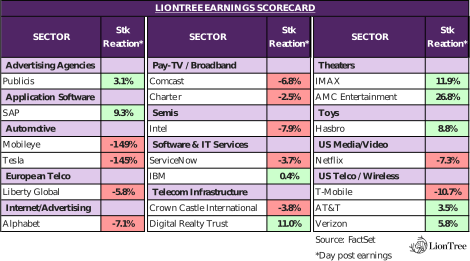
It feels like no time has passed at all, and we are back in earnings season. 20 companies reported their Q2 numbers, and stock reactions were biased to the downside, with 11 companies trading lower (55%) after their print and 9 companies trading higher (45%). The worst performer was Mobileye, down -15%, and the best performer was AMC Entertainment, up +27%.
This was a very heavy week for the Connectivity sector. Among the big 3 telcos, it was a mixed picture, with AT&T up +3.5% after results (see Theme #3), T-Mobile falling -10.7% after its numbers (see Theme #4), and Verizon closing out the group, trading up +5.8% in reaction (see Theme #7). Furthermore, the cable names were under pressure with Comcast falling -6.8% (see Theme #5) and Charter down -2.5% (see Theme #6).
Within Big Tech, Alphabet kicked off this week, though with updates that drove the stock down -7.1% (see Theme #2).
The table below includes select mid- and large-cap TMT and consumer companies in our LionTree stock universe that reported this week.
Alphabet’s AI Investments Drove A Surprise Q2 FCF Loss
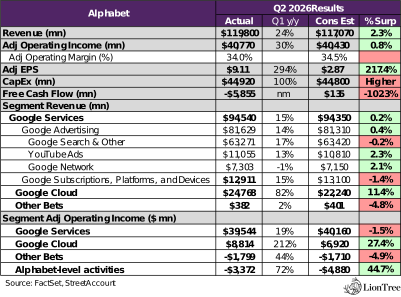
It was not a great start to Big Tech Q2 earnings with Alphabet not meeting overall expectations (which were also not low) and furthering concerns about endless AI capital spending as FCF surprisingly declined by over $5bn in Q2…and that pressure is now expected to persist. Taking a step back, on the positive side, Cloud’s massive +82% y/y revenue growth rate was a stand-out positive (+11.4% ahead of cons and accelerated from +63% y/y in Q1) as was the backlog growing another +$50bn to $514bn, coupled with Cloud margins at 35.6% which more than tripled y/y. Alphabet also began recognizing revenue from TPU system sales for the 1st time, though it was a small amount in Q2 (the “vast majority” will come in 2027). Despite the increases in capacity, demand continues to outpace supply, hence the capx guidance was raised AGAIN to $195-205bn in 2026 (incr’d by +$12.5bn at the mid-pt) and mgmt continues to prepare investors for a “significant” increase again in 2027 (but with no specific numbers around that). Capx is something that investors will be keeping an eye on as the rest of Big Tech reports next week.
In addition to those points, other key takeaways from Alphabet’s results include: 1) Search y/y growth decelerated and comps will be tougher in H2, though the Co remains focused on driving higher AI monetization; 2) AI Mode crossing 1bn MAUs and AI Max is out of beta with 500k+ advertisers; 3) YouTube had a strong quarter with ad revenue accelerating q/q to +13% y/y, subscriptions continuing to grow faster than ads, and the FIFA World Cup driving record engagement; 4) 1st party models now process ~22bn tokens per minute, up from 16bn just a quarter ago and the Co’s developer ecosystem grew to 9mn+; and 5) with the launch of Gemini 4, the Co will begin releasing models at a faster clip, issuing new ones almost at a monthly cadence.
As always, there’s a lot to unpack with Alphabet. Please see below for what we thought most incremental from the Co’s Q2.
-> All in all, there were some positive but also concerns coming out of Alphabet’s results, which drove the stock down -7.1% in reaction; With that said, it is still up +66% over the past 12 months
Overall Q2 Headline Results Were A Tad Better BUT FCF Surprisingly Turned Very Negative (And That Pressure Will Persist)
- Revenue BEAT: By +2.3%, up +24% y/y (+23% FXN) vs +22% y/y in Q1:26
- The upside was almost all driven by Cloud (BEAT by +11.4%)
- Google Advertising was a tad better as upside in YouTube offset slight weakness in Search
- Q3 FX guidance…expect a slight FX headwind to consolidated revs vs a +1pt FX tailwind in Q2 (mostly seen in Search and YT ads)
- Adj op income slightly BEAT by +0.8%, up +30% y/y
- But adj op margin of 34% was slightly BELOW cons 34.5%, reflecting higher depreciation, inventory costs from TPU system sales, content acq costs (YouTube), AI talent spend, marketing for Gemini app, and legal charges
- Adj EPS of $9.11 included~$98bn in unrealized gains on equity securities portfolio (OI&E)
- The operating EPS was broadly in-line
- FCF loss of -$5.9bn stood out…it was MUCH LOWER than cons +$135mn
- Related to TPU system sales, the Co is building inventory ahead of delivery, which hits cash from operations before revenue is recognized
- And that pressure likely persists … “We expect the free cash flow will remain under pressure, driven by our investments in technical infrastructure.”
- The Co maintained its qtrly dividend of $0.22/shr
Surprise, Surprise, Capx Guidance Goes Up AGAIN But Don’t Expect Another Equity Raise
- Q2 capx was up +100% y/y and came in slightly above cons: $44.9bn vs cons $44.8bn
- ~60% of technical infra spend was in servers, ~40% in data centers/networking (consistent w/ Q1)
- CAPX OUTLOOK…mgmt raised 2026 guidance, and reiterated that 2027 will be meaningfully higher
- 2026: The Co raised guidance by +$12.5bn at the mid pt to $195-205bn (from $180-190bn), driven by an “acceleration in the delivery of capacity to meet growing demand”
- 2027: Capx is guided to “increase significantly” y/y (unchanged language from Q1)
- Mgmt sees “strong demand indicators, including long-term deals” renewing with “exceptional demand”
- “The dynamics look healthier than where we were about a year ago”
- Reminder that higher capx means higher depreciation + energy/data center operating costs
- FCF “will remain under pressure, driven by our investments in technical infrastructure”
- Capital structure has expanded meaningfully to fund the AI investment…
- Long-term debt grew to ~$98bn (from ~$16bn a year ago) “across multiple currencies and geographies”
- Recently completed an equity raise to maintain a “healthy balance sheet”
- To note, the Co is NOT planning to raise more equity (except ATM offering to address SBC-related taxes)
- Cash from operations remains the primary funding source ($39.1bn in Q2)
- Cash & marketable securities of $242.5bn (incl $87.1bn of marketable equity securities)
Cloud Revenue Growth & Profitability Was The Main Standout While The Co Remains In A Supply Constrained Environment
- Q2 Cloud rev growth BEAT cons by +11.4% and cont’d its acceleration from +48% in Q4 to +63% y/y in Q1 to +82% y/y in Q2 driven by “strong demand for our AI products and infrastructure”: “Cloud revenue growth accelerated meaningfully even after excluding the impact of TPU system sales”
- Revenue was driven primarily by GCP (which grew faster than Cloud overall)
- Gemini is a key driver and deeply integrated across all the Cloud products
- The Co began recognizing revenue from TPU system sales in Q2 (delivered to customer data centers for the 1st time in Q2)
- A small amount was recognized in Q2 and rev will continue to ramp throughout 2026 w/ the “vast majority” of rev from existing agreements recognized in 2027 (reiterated)
- Notably backlog incr’d by more than $50bn seq to $514bn in Q2
- The majority of that backlog is typical GCP agreements for a broad mix of customers, but TPU system sales are also reflected
- Just over 50% of backlog is expected to convert to revenue in the next 24 months
- Cloud adj op income more than TRIPLED y/y to $8.8bn and BEAT cons by a massive +27.3%: Op margin expanded to 35.6% from 20.7% a yr ago (and up from 32.9% in Q1)…mgmt attributed this to topline leverage + “outstanding strong operational discipline across the business”
- TPU-specific margins were not broken-out but “certainly there are benefits from designing and manufacturing our own chips. But the way to think about it is this is an expansion of our total addressable market”
- BUT Q3 cloud margins will face near-term pressure from:
- The use of 3P capacity as a “bridging strategy” while internal capacity builds out (“will create modest margin pressure in the near term”)
- Wiz acq integration is also a headwind (consistent w/ prior qtr commentary)
- Despite the higher capx over the years, the Co remains supply-constrained (has been the case “for multiple quarters in a row”): Demand from external cloud customers AND across the business continues to outpace capacity
- Customer and product momentum remains very strong –
- Demand is strong across products, customers, geos, and industries
- New customer acquisition velocity more than doubled y/y
- Existing customers are exceeding commitments by more than +50%, which is an acceleration over Q1’s +45%
- Nearly 90% of Fortune 100 are using Gemini Enterprise
- Agent Development Kit reached nearly 70mn total downloads in Q2
- Nearly 500 cloud customers each processed >1 trillion tokens over the last year
- Over 2,000 enterprises consumed >100bn tokens over the last 12 months
- Google’s security platform continues to differentiate
- 90% of Fortune 100 are Google Cloud Security users
- Nearly 90% of risk customers are using AI-powered security features
- The Co posted a 45%+ q/q increase in AI workloads scanned/protected
- New Google AI Threat Defense launched w/ cyber model + CodeMender for defending against AI threats
- TPU allocation priorities…first is frontier AGI development, then Core/Cloud product serving, then external infrastructure: External demand is increasingly met through TPUs in customer data centers or partner facilities (i.e., Blackstone partnership) to avoid pulling compute away from internal priorities
- Mgmt continues to highlight the full-stack approach as their key moat
- Customers are coming for solutions, not just models (cybersecurity, data analytics, customer service, etc.)
- Models are “an ingredient” in broader end-to-end solutions
- Their moat comes from data quality, security, configurability, agent I/O workflows, confidentiality, and ability to “continually improve”
- “These are big end-to-end things…and we are seeing demand across all of these components”
- Outlook- Expect “strong growth” looking ahead
AI Model Progress Is Accelerating…
- 1st party models now process ~22bn tokens per minute, up from 16bn just a quarter ago
- The developer ecosystem continues to grow…9mn+ developers are building monthly w/ Google’s models
- Key model updates/stats:
- The new Gemini 3.6 Flash and 3.5 Flash-Lite are “cost effective and highly efficient”
- Gemini 3.5 Pro is in testing
- Gemini 4 pre-training has begun (“most ambitious pre-training run yet”)
- “I am very excited by the progress I’m seeing internally on Gemini 4, and I’m confident people will be pleased”
- Gemini 4 is needed as a “larger base model to compete at that frontier level”
- Gemma open models have been downloaded 900mn+ times in total; latest Gemma 4 models hjav been downloaded 300mn+ times since April
- Antigravity agent dev platform has 2.4mn weekly active users
- Omni (users can create anything from any input, starting w/ video) posted a 40% incr in DAUs creating videos on Gemini app since I/O launch in May
- The Co is picking up their model release cadence to “almost a monthly cadence” as they build Gemini 4
- On the model competition landscape… mgmt. is “very committed and very confident of being at the frontier”…
- Flash is the workhorse model for the “sweet spot of performance, cost, reliability, latency” and is deeply integrated across portfolio (cyber, data analytics, customer service, voice)
Y/Y Growth In Search Decelerated Vs Q1 & Comps Get Tougher In H2 Though AI Features Continue To Scale
- The Co remains focused on making Search more helpful & intuitive
- Combined Ai overviews & AI Mode into one seamless experience
- And incorporated more frontier capabilities
- Q2 Search revenue grew +17% y/y (vs +19% y/y in Q1), ~in-line w/ cons
- Retail and Finance drove the largest contributions (consistent w/ Q1) though all major verticals contributed to growth
- Q3 OUTLOOK: Will begin lapping the acceleration that began in Q3 last yr
- Hence, comps get tougher in H2
- Positively, AI Mode surpassed 1bn MAUs since expanding globally in October
- AI Mode is driving an incremental increase in search queries overall
- The Co is now sending “billions of clicks to websites every week” through AI features in Search
- The cost of AI Mode responses has fallen to its lowest level since launch, “even as we have brought more advanced AI capabilities further”
- Progress w/ AI ad monetization continues as Gemini and AI-powered tools are increasingly embedded across the ads ecosystem
- Gemini is improving query understanding, enabling relevant ads on longer searches previously difficult to monetize
- Shopping ads drove a 20% improvement in showing highly relevant ads to help shoppers immediately find the best match
- AI Max is out of beta w/ 500k+ advertisers already adopting it, and the Co is seeing an avg of 15% more conversions or value on Search at similar ROAS
- Over half of SMB customers globally are using AI to create/optimize their creatives
- Gemini is improving query understanding, enabling relevant ads on longer searches previously difficult to monetize
- The Gemini app now has 950mn MAUs, and DAUs tripled in the past year
- New agentic features like Daily Brief and Gemini Spark personalized agent (now available US + intl) have been popular
YouTube Delivers Upside In Q2 As Ad Rev Accelerates, Subscriptions Outpace, And FIFA Drives Record Engagement
- Q2 YouTube ads rev grew +13% y/y (accelerating from +11% y/y in Q1 and +9% y/y in Q4) and BEAT cons by +2.3%
- Direct Response was the key driver, followed by Brand
- YouTube subscriptions rev continues to grow FASTER than Ads, particularly YouTube Music + Premium (similar commentary to last qtr)
- FIFA World Cup 2026 content was the most watched for the World Cup in YouTube’s history: 7bn unique viewers watched World Cup-related videos and 550mn+ watched them on their TVs
- …which advertisers leveraged to connect w/ fans through FIFA channel takeovers, Gemini-powered soccer-themed sponsorships, and game day mastheads
- Conversational AI is being added directly into YouTube w/ “Ask YouTube” …140mn+ users engaged w/ it on the watch page in June 2026
- That Ask experience is now being brought to the broader YouTube search
- Viewers can now complete purchases directly on their CTV …launched Buy w/ Google Pay in Q2, where viewers can complete purchases directly on CTV (“turning the TV screen into a stronger performance surface”)
- Internal Gemini adoption for sales/support is driving incr’d efficiency
- 83% of their sales team is using Gemini-assisted tools weekly, driving up to 20% higher win rate
- Gemini-powered support solutions are autonomously address 75% of customer queries
- New agentic solutions for SMEs have expanded reach by “hundreds of thousands of new customers” YTD
- Ads roadmap looking ahead…
- On the brand side – the Co sees ongoing opportunities on CTVs in the living room
- They are building tools to help advertisers find creators, scale across screens and then measure the results
- They have a slate of new and returning creator shows that are coming exclusively to YouTube
- On the direct response side – Demand Gen and Shorts are key growth areas, especially for expanding the advertiser base to more SMBs across more verticals
- On the brand side – the Co sees ongoing opportunities on CTVs in the living room
Waymo Remains Laser-Focused On Execution
- Other Bets op loss continued to improve seq: -$1.8bn in Q2 (improved from -$2.1bn in Q1 and -$3.6bn in Q4)
- But was still -4.9% below cons
- Waymo intro’d its newest vehicle for public riders and will welcome more riders “in the coming months”
- This is the first powered by the 6th-gen Waymo Driver
- When asked about a Waymo corporate structure change, mgmt said they are “really focused on executing and scaling”
- “Our ability to think and plan long term, and invest in the business…the confidence in undertaking a long-term roadmap and scaling up, I think is all hugely valuable”
Investors Cheer AT&T’s Stronger Q2 Subs Growth + Better Profitability + Higher Share Holder Returns
AT&T kicked off Connectivity earnings on Wednesday on a positive note, with service revenue, adj EBITDA, and adj EPS y/y growth all accelerating in Q2, and subscriber metrics broadly ahead of the Street. 2026 guidance was also reiterated. The Top 5 most important incrementals in our mind from results include: 1) subscriber KPIs were broadly stronger than Street projections, with postpaid phone net adds beating by +28%, fiber beating by +16.4% (best-ever Q2), and churn improving across the board; 2) mgmt raised the buyback target to ~$10bn (from ~$8bn) which was a positive surprise (mgmt several times characterized the stock as being “incredibly undervalued”); 3) convergence continues to successfully drive higher LTVs of subscribers, despite the near-term impacts like fiber ARPU being flat y/y in Q2 (and the pressure will likely continue in Q3 as well); 4) a Starlink MVNO agreement doesn’t sound like it is in the cards; and 4) while mgmt views Agentic AI as a structural tailwind for connectivity demand and as aligning with AT&T’s low-band spectrum strategy, tying that to a specific monetization TAM remains unclear.
See below for more details of what we thought was most meaningful.
-> AT&T shares were up +3.5% in response to its earnings print but are down -2.9% YTD (vs T-Mobile’s -11.9% and Verizon’s up +13.9%)
Q2 Results Were Ahead Of Street Projections On Profitability Despite A Slight Top-Line Miss
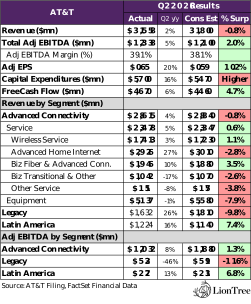
- Rev slightly MISSED by -0.8% & grew +2.3% y/y vs +2.9% y/y in Q1: Mainly due to lower-than-expected Advanced Connectivity Equipment revenue from lower wireless device upgrade volumes
- Advanced Connectivity Services revenue BEAT by 0.6% and grew +5.1% y/y (accelerating +150bps vs Q1)
- The Legacy business decline was greater than expected
- Adj EBITDA BEAT by +2.0% & accelerated to +5.2% y/y growth vs +2.3% y/y in Q1: Due to top line momentum and cont’d cost transformation w/in Advanced Connectivity; Latam margins were also better than
- The 39.1% margins were the highest since AT&T refocused on advanced connectivity at the beginning of the decade
- Adj EPS BEAT by +10.2% & grew +20% y/y vs +12% y/y in Q1
- Capex of $5.7bn was HIGHER than cons of $5.47bn & grew +16% y/y: Reflects accelerated fiber deployment (added 1mn+ fiber locations in Q2); total capital investment was $6.1bn
- Outlook…despite being higher in Q2, reiterated the FY guidance
- FCF BEAT by +4.7% at $4.67bn & grew +6% y/y vs -20% y/y in Q1: Exceeded the high end of mgmt’s $4.0 – 4.5bn guidance range for Q2; The improvement was driven by adj EBITDA growth
The Co Raised The Buyback Target To ~$10bn (From ~$8bn) & Reiterated Full Year 2026 Guidance
- The buyback raise from ~$8bn to ~$10bn was an unexpected positive: This is a pull forward of planned buybacks through 2028 to capture a “disparity between our operating fundamentals and the valuation of our stock”
- Repurchased almost $1bn in July
- The CEO called the stock “incredibly undervalued” and indicated he has a bias to buy back more
- The board will further revisit capital allocation at its September meeting; future decisions will depend on “where the stock is currently valued and what’s going on”
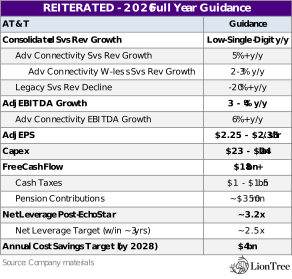
- Combined w/ dividends, the Co expects to return ~$18bn to shareholders in 2026, i.e., essentially 100% of its FCF outlook
- Mgmt reiterated its 2026 outlook – see table below…
- FCF is expected to be “relatively stable” y/y in Q3 w/ “strong” y/y growth in Q4
- The balance sheet remains in a “good place” w/ flexibility: Net debt / adj EBITDA of 2.68x (flat q/q); It will incr to ~3.2x post-EchoStar close (expected end of July), then return to 2.5x range w/in ~3 yrs
Better Q2 Subscriber KPI Were A Key Positive
- Q2 wireless service revs grew +3.3% y/y due to vol and pricing increases in the qtr
- “We are pleased with the execution of our pricing strategy in wireless, including the rollout of new plans and pricing actions during the first half of the year”
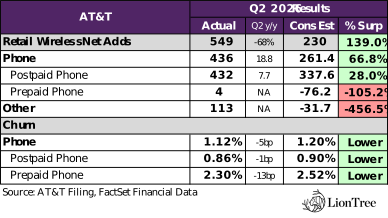
- Q2 postpaid phone subs (value segment expansion) and churn were better than expected
- Postpaid phone net adds of +432k BEAT cons of +338k by +28.0% & grew +7% y/y
- Reflects pricing plan recalibration, convergence strategy, and value segment expansion
- Postpaid phone churn of 0.86% was BETTER than cons of 0.90%, down -3bps y/y
- Driven by convergence benefits, improved retention cohort management, data-driven customer insights, and some device upgrade suppression
- The Co grew postpaid phone ARPU y/y WHILE reducing postpaid phone churn
- Postpaid phone net adds of +432k BEAT cons of +338k by +28.0% & grew +7% y/y
- Q2 Advanced home internet service revs grew +27%+ y/y: Due to fiber net adds and Lumen acq
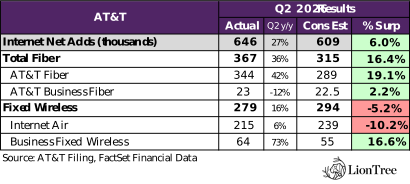
- Q2 Fiber subscriber additions were ahead of expectations while FWA adds fell short
- Fiber net adds of +367k BEAT cons of +315k by +16.4% & grew +36% y/y: Driven by accelerated fiber deployment (1mn+ locations added in Q2) and expanded distribution in Lumen footprint
- Best-ever Q2 for AT&T fiber net adds and record quarter for combined fiber + FWA net adds
- Added 1mn+ total advanced connectivity subscribers (fiber + FWA + postpaid phones)
- FWA net adds of +279k MISSED cons +294k but grew +16% y/y
- Fiber ARPU fell -1.3% y/y and was ~flat y/y ex Lumen
- Outlook – Expect cont’d pressure in Q3 (see more in Convergence section below)
- Fiber net adds of +367k BEAT cons of +315k by +16.4% & grew +36% y/y: Driven by accelerated fiber deployment (1mn+ locations added in Q2) and expanded distribution in Lumen footprint
- CEO reiterated that FWA is not the optimal long-term technology for fixed traffic: “I don’t consider it to be the optimal technology to serve fixed traffic over the long haul…that’s why we invest in fiber”
- However, FWA “clearly has its point and use” in the market, particularly for certain business customers (e.g., construction yards, mobile-dominated businesses)
Wireless Pricing Execution & Value Segment Expansion Driving Account Growth To 3-Year Highs…Churn Is Settling Down Industry-Wide
- Wireless pricing actions that took effect in Q2 are performing well: Mgmt is “pleased with the execution of our pricing strategy in wireless, including the rollout of new plans and pricing actions during the first half of the year”
- The plan recalibration was described as “done quite artfully and quite well by the team”
- The push into the value / underpenetrated segment is working: Consumer postpaid wireless account adds of +147k were the best in 3+ years, “and I would accredit a lot of that to the shifting of the plan and our focus on the value segment”
- New account entry is coming from the value segment, “not at a line into existing accounts…I think that’s healthy for us”
- “We’re being deliberate about moving into some segments of the market where maybe we’re a bit underpenetrated. But I think you’re seeing we’re doing that with a nice balance on profitability”
- Industry churn dynamics appear to be stabilizing in 2026 after elevated promotions in 2025: CEO noted that as LTVs improved across the industry last year, “there was a willingness to invest a little bit more to bring customers in”
- The promotional environment has now “hit a different level and maybe it’s stabilized a bit” as carriers rationally evaluate the economics of further step-ups
- AT&T’s approach is to direct promotional and retention activity toward convergence, “and I think that’s why you’re seeing the strong margin performance”
- Outlook – Mgmt expects the balance of the year to “look very much the same to what you saw right now”
- On device cost inflation: Mgmt expects device costs and prices to go up (Apple has indicated the direction), which should suppress upgrade demand
- “When costs go up, prices go up and when prices go up, demand goes down”
- Less device upgrading tends to help churn
Convergence Is Driving Account Growth & Lower Churn…Though At The Cost Of Near-Term Fiber ARPU
- Q2 convergence penetration reached ~42.5% of advanced home internet customers who also have a postpaid w-less account w/ AT&T (~45% ex-Lumen), which is in-line w/ Q1 levels: Mgmt expects converged penetration to continue to improve to 50%+
- Converged customers demonstrate lower churn, higher brand affinity, and higher lifetime values; AT&T carries the “vast majority” of their internet traffic over its own infrastructure
- The Lumen integration is progressing rapidly: June converged gross adds in acquired territories were up +45% vs February
- The Co spent the past 6 months “standing up operations” to support faster growth, converting infrastructure, branding, support systems, CPE, and technician methodologies market by market
- “Our convergence playbook is taking hold here, just as it has in our traditional footprint, creating a clear runway to deepen customer relationships”
- Once AT&T brand conversion is complete in each market, mgmt plans to “put a little more gasoline on the fire and start to drive those volumes up”
- Mgmt expects penetration in Lumen territories to “start to look like it does in a traditional AT&T footprint” over time
- The Co will be very aggressive on fiber along different price points and think they can do it will attractive margins
- Fiber expansion remains the key enabler: The Co added 1mn+ fiber locations in Q2 and continues to expect to grow fiber reach by ~8mn locations in 2026 (incl 4mn+ from Lumen) w/ a path to 60mn+ by 2030
- “This will be our largest year ever for fiber expansion”
- The construction engine is ramping but “it’s like anything that has to do with civil work…it’s bumpy in places”; expects it to take well into next year to reach desired rate and pace of build
- Mgmt reiterated that the goal is to maximize total advanced connectivity service revenues (not individual product ARPUs) to drive attractive returns on 5G and fiber investments
- If using broadband as the lead product to consolidate an account means taking “a little bit of a revenue hit” on that product, mgmt is “perfectly okay with that” because it sustains an accretive wireless relationships
- “I get less concerned about the discrete dynamics of a single product. I pay more attention to average account revenue growth”
- Outlook – Expect convergence to drive continued strong home internet + postpaid phone adds in 3Q & to ‘put some pressure on fiber ARPU,’ BUT mgmt ‘feel really good’ about managing back-book pricing
Satellite Is Viewed As A “Corner Case” Solution For ~2% Of Traffic…And An MVNO W/ Starlink Doesn’t Sound Like It Is In The Cards
- The satellite strategy is more clearly defined vs Q1: The focus is on solving for the ~2% of traffic where a converged customer walks off the AT&T network (e.g., rural/remote areas, national parks, at sea)
- The AST SpaceMobile product is expected to launch in 2027 as “a very intuitive product that doesn’t require the customer to do anything differently”
- “We will be first in the market” with seamless satellite-to-device transition for converged customers
- Mgmt pushed back firmly on the idea of a wholesale agreement w/Starlink: “I am prone to look for a partnership to solve the 2%” but “I’m not prone to look for a wholesale agreement to go solve a problem I don’t have”
- AT&T already has “everything we need to put the best product in the market” without relying on new technology developments
- “I’m not betting on the next turn of a chip…it’s not rocket science for what we need to do to be successful”
- The Co is reaching the converged market “just fine” with its own technology, distribution, and infrastructure built over years
Agentic AI Is Viewed As A Structural Driver Of Future Connectivity Demand…But The Monetization TAM Remains Unclear
- AI connectivity is now being cited as a major new opportunity: The rise of Agentic AI is “fundamentally reshaping network traffic not just in volume, but in shape, symmetry and criticality”
- AI agents generate up to 450% more total traffic per task than a human performing the same work
- Agentic adoption is projected to drive ~9x growth in enterprise traffic and ~7x growth in consumer traffic by 2035
- Emerging use cases incl drones, autonomous driving, robotics, and AR glasses, all requiring “ubiquitous, high performing, uplink optimized connectivity”
- Distribution of AI inference to the edge necessitates low latency and high bandwidth connectivity
- AT&T’s spectrum strategy is specifically designed for an agentic world: The EchoStar 600MHz spectrum acquisition (expected to close end of July) will give AT&T an even more advantaged low-band position
- Low-band spectrum is optimal for building “a really robust upstream network that reaches deep into buildings and has a lot of consistency”
- The Co is also introducing PON-fed small cell infrastructure, leveraging its dense fiber footprint to get “more radiating points deeper into the network”
- Mgmt drew an analogy to fixed-broadband tiering (‘we charge more for a gig than…a 500 Meg circuit’) & to VPN economics migrating from wireline to wireless as bandwidth stays constrained
- “We believe AT&T is the only provider building and investing in this infrastructure at the scale necessary today to support the demands a decade from now, and we aren’t missing any critical elements necessary to execute our strategy”
Business Advanced Connectivity Revenue Is Now Growing Y/Y…& Is Expected To Remain A Growth Driver Going Forward
- Business Advanced Connectivity svs revs grew +1.8% y/y in Q2 (after stabilizing for the first time last qtr): Driven by wireless, fiber & FWA
- “We have turned the corner and expect AT&T business to remain a driver of growth in advanced connectivity service revenues going forward”
- Outlook- expect it to ‘remain a driver of growth’ & grow a low-SD CAGR through 2028
- Biz Fiber & Advanced Connectivity rev BEAT +3.5% & grew +10% y/y: Business fixed wireless net adds grew +73% y/y
- BUT Business Transitional & Other rev fell -16.6% y/y (MISSED -2.6%) on lower VPN & wholesale demand
The Legacy Business Is Winding Down At An Accelerated Pace…BUT The Copper Shutdown Has Hit A “Tipping Point”
- The Legacy business continued to decline rapidly: Revs down ~-26% y/y and EBITDA down ~-46% y/y, reflecting the cost lag during this transition
- Legacy EBITDA MISSED cons by -11.6%, suggesting the decline is running faster than expected
- Outlook – Legacy EBITDA is guided to turn negative after 2027
- Legacy EBITDA MISSED cons by -11.6%, suggesting the decline is running faster than expected
- But the copper shutdown is making material progress: The FCC gave permission to discontinue Legacy Copper Voice service in ~60% of AT&T’s wire centers in California
- Approval to discontinue legacy services in 30%+ of wire centers nationwide, effective by late 2026
- By year-end, the Co expects “a couple hundred wire centers to have zero customers”
- “In my view, we’ve now reached the tipping point, and that goal is firmly in sight” (re: orderly turndown of legacy copper by end of decade)
- This is an important step to unlock de-scaling cost savings and streamline operations
- The retirement of the legacy network is “a critical piece of our transformation into a scaled provider of advanced connectivity”
- “By the end of the decade, we will have the best performing network with a highly competitive cost structure”
T-Mobile Now Readies For 2027 & 2028 Spectrum Auctions, Creating Uncertainty
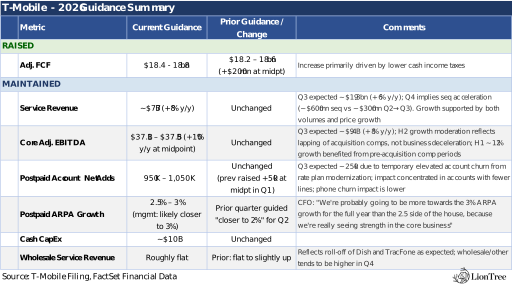
The positive response in the sector to AT&T’s results was short lived as T-Mobile’s Q2 on Thursday morning raised new questions for investors that weighed on the stock. The quarter itself was not too exciting given that while core adj EBITDA slightly beat the Street (by +1.2%), the topline slightly missed (-0.7%) as the Co moved away from subsidy-led subscriber additions (impacted equipment revs) and Services revs were a tad light as well. For 2026, on the positive side, the Co raised its adj FCF guidance by $200mn at the midpoint, but most of the other guidance was reiterated.
More importantly, what stood out the most to us included: 1) the Co expressed a lot of interest in leaning into the C-band 2.0 (2027) and 2.7 GHz (2028) spectrum auctions, which may temper the near-term buyback pace and it creates uncertainly regarding spending plans; 2) the Co is very comfortable with the 15mn FWA subscriber target by 2030 (they have no capacity concerns despite continued questions on this topic), and additional spectrum could add upside; 3) regarding key metrics looking ahead, Q3 will see temporarily elevated account churn from rate plan modernization which likely results in a decline in expected Postpaid Net Account Adds in Q3 vs Q2 levels, though at the same time postpaid APRU growth is likely to come in towards the higher end of the annual range in 2026 (i.e., closer to 3% than 2.5%) after coming in at +3.7% ex M&A; 4) similar to what AT&T said, consumers are likely to be the ones to absorb device price increases vs T-Mobile increasing subsidies; and 5) the Co dismissed LEO satellite as a competitive threat to FWA & sees satellite + cellular as becoming table stakes.
See below for more on what we found most impactful from the Co’s results.
-> TMUS shares fell -10.7% in reaction to earnings and are now down -11.3% YTD (vs AT&T down -2.9% and VZ up +13.9% YTD)
Q2 Results Were Mixed Vs. The Street…Slightly Better Profitability But Revenue Was A Tad Light
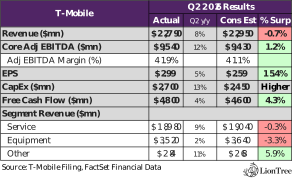
- Revenue slightly MISSED cons by -0.7% & grew +8% y/y (a decel from +11% y/y in Q1):
- Service revs just slightly MISSED (-0.3%) while Equipment revs MISSED by -3.3% as the Co shifted away from subsidy-led customer acq
- Total Services revenue grew +9% y/y
- Postpaid Services revenue grew +13% y/y
- Service revs just slightly MISSED (-0.3%) while Equipment revs MISSED by -3.3% as the Co shifted away from subsidy-led customer acq
- Core adj EBITDA BEAT cons by +1.2% & grew +12% y/y (same pace as Q1): Margins were ahead
- Reflects operating leverage from service rev growth, disciplined cost mgmt, and scale benefits from UScellular integration
- Adj EPS BEAT cons by +15.4% & grew +5% y/y: Due to EBITDA beat, lower cash income taxes, and ongoing share count reduction
- CapEx of $2.7bn was HIGHER than cons ($2.5bn) & grew +13% y/y: Reflects cont’d investment in 5G Advanced network, rural expansion via UScellular integration, and next-gen broadband router/CPE technology
- FY26 cash CapEx guidance UNCHANGED at ~$10bn
- FCF of $4.8bn BEAT cons by +4.3% & grew +4% y/y: The Co has an Industry-leading FCF margin of 25%
Mgmt Raised 2026 FCF Guidance & Generally Reiterated All The Rest
- See table below…
Subscriber KPIs Were Mixed & Q3 Postpaid Account Net Adds Will Be Weighed Down By Rate Modernization
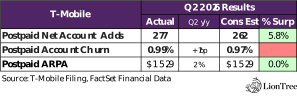
- Postpaid Net Account Adds of +277k BEAT cons +262k (and compares to +217K in Q1) which was driven by share of household gains across every cohort within top 100 mkts and smaller/rural mkts
- Port-in ARPA was ~20% higher than port-out ARPA; CLV was up “healthy double digits” y/y
- More room to go: There are more than 20mn families and businesses identified as network seekers not yet with TMUS
- Outlook – Q3 Postpaid Net Account Adds are expected at ~+250k (given churn dynamics- see next bullet)
- BUT Postpaid Account Churn of 0.99% MISSED cons 0.97% and Q3 rate plan modernization will result in temporarily elevated acct churn
- Despite the pressure, the modernization of Creates “strong value both for customers and T-Mobile” per CFO, setting the stage for sustainable ARPA and rev growth into 2027
- Postpaid phone churn of 0.85% was down significantly y/y
- Postpaid ARPA was IN-LINE and grew +2% y/y on a reported basis (vs +3.9% in Q1), BUT +3.7% ex-M&A
- Q1’s higher reported ARPA growth reflected rate plan optimization y/y comps; Q2 diluted by UScellular/fiber JV acq comps as expected
- 60%+ of new lines on new accts are selecting premium rate plan tiers; Premium plan self-selection cont’d to be “fabulously accretive”
- Outlook- FY likely to land closer to 3% growth than 2.5% (ie, the high end of the range)
- Mgmt reaffirmed intention NOT to increase device subsidy levels despite rising smartphone prices (driven by memory price increases)
- The Co has been pivoting to broader value prop messaging – “250 Reasons to Choose T-Mobile” campaign – rather than leading w/ free phones (consistent w/ Q1 messaging around “rounding off the value proposition”)
- Customers will have to pay more for devices as a result; Co comfortable w/ this dynamic given differentiated network/value prop
- The Co has been pivoting to broader value prop messaging – “250 Reasons to Choose T-Mobile” campaign – rather than leading w/ free phones (consistent w/ Q1 messaging around “rounding off the value proposition”)
- Prepaid service rev declined modestly and a similar sequential trend is expected from Q2->Q3->Q4 as from Q1->Q2
- Driven by a combination of sub declines and ARPU pressure as higher-value/premium prepaid customers migrate to postpaid brands but mgmt. cites this as a positive CLV dynamic for the overall business
- Other notable KPIs from mgmt commentary:
- Total broadband net adds were in the “upper 400k range” w/ “healthy” ARPUs (vs 500k+ in Q1)
- The Co remains the fastest growing ISP in the country
- The NPS of 46 is a record high (vs 45 in Q1) and the highest in wireless history across the big 3 carriers
- T-Life MAUs surpassed 30mn (vs ~25mn in Q1)
- Fiber JVs approaching ~20% penetration in first 12 months of deployment per mkt
- Total broadband net adds were in the “upper 400k range” w/ “healthy” ARPUs (vs 500k+ in Q1)
Spending On The Upcoming Spectrum Auctions Now Remains A Wildcard As The Company Wants To Lean In
- Mgmt highlighted FCC Chairman Carr’s announcement of C-band 2.0 and 2.7 GHz auctions in 2027 and 2028 respectively…this was a key new development as mgmt sees this as a moment like the 5G standalone buildout decision
- The CEO drew a direct parallel to the 5G rollout decision that “dramatically transformed our network” and is now “driving all the goodness around network seekers” and “sustained growth”
- Additional spectrum would further cement their network leadership, create incremental fallow capacity for 5G broadband, and enable future use cases like edge AI and physical AI
- 6G was also referenced as a longer-term driver; 6G will not just be “5G on steroids” but will enable edge AI and physical AI opportunities
- The CEO drew a direct parallel to the 5G rollout decision that “dramatically transformed our network” and is now “driving all the goodness around network seekers” and “sustained growth”
- Co is “thoughtfully maintaining a capital envelope” considerate of upcoming spectrum opportunities
- Share buybacks will cont’d but governed by their capital allocation framework on a qtr-by-qtr basis…leverage first, then invest in the business, then accretive M&A/spectrum, then shareholder returns
- The Co $2.5B repurchased in Q2 through July 17
- Mgmt emphasized they “will not be looking to purchase spectrum strictly for fixed wireless” but see spectrum as an investment in the business under their capital allocation framework
- Spectrum auctions in 2027/2028 will be a key variable in determining the pace of capital returns; Co wants to “thoughtfully maintain” flexibility
- Mgmt sees this as a generational moment to “double down on wireless tech and really build out our network superiority, not just in 5G, but also 6G”
- During the 5G rollout they made a conscious decision and they are approaching a similar moment where wireless technology is evolving so rapidly…6G is not going to just be 5G on steroids, but it’s also going to give us all sorts of opportunities like edge AI and physical AI”
- “This is a time for us to step in and drive further differentiation and cement our network leadership”
- BUT mgmt also emphasized discipline… the Co has been “very diligent, for example, with spectrum purchases”
The Fallow Capacity Model Remains Intact & AI Traffic Is Not Yet A Factor For Mobile
- 5G broadband is becoming a “premium” broadband offering: it is now delivering download speeds “roughly equivalent to fiber to the home” when both are used over Wi-Fi
- Ranked #1 w/ J.D. Power in customer satisfaction
- Mgmt stressed that its fallow capacity model remains intact and pushed back on capacity concerns (a recurring analyst focus)
- FWA does consumes a “fair amount” of their traffic and “our capacity is several times multiple of the traffic that we hold today”
- Mgmt is very comfortable with its 15mn FWA customers by 2030
- And this also does NOT include additional subscribers they could add with new spectrum or technology innovation
- “We have so much more runway left here” [with broadband]
- The Co does not see AI traffic as being a material factor on mobile networks at this point
- Current AI growth is confined to wireline/data center transport so they are not seeing a surge in mobile traffic due to AI observed
- “We haven’t seen it as yet, but we look forward to seeing it because our network is more prepared than anyone else”
Broadband Bundling Is At 70% Penetration…& Fiber JVs Are Complementary To FWA, Not Competitive
- While T-Mobile doesn’t support “convergence”, ~70% of TMUS bband customers also have a mobile bundle (vs. AT&T’s disclosed 45% internet customers bundle with wireless)
- Fiber JVs are approaching ~20% penetration within first 12 months of deployment per mkt: It is all incremental rev/margin as the Co starts from zero in most overbuild mkts
- Reiterated that the Co is “not chasing some vanity number of homes passed”, they are focused on shareholder value creation w/ conservative underwriting (consistent w/ Q1)
- Mgmt DOES NOT see fiber as competitive to FWS… every fiber customer won frees up fallow capacity on the wireless network that can be resold elsewhere, making fiber and FWA complementary rather than competitive
LEO Satellite Is Not Viewed As A Competitive Threat To FWA…D2D JV Progressing Toward Definitive Agreement
- There was a greater focus this qtr regarding rising competition from LEO but mgmt firmly dismissed LEO as a meaningful competitive risk to FWA
- 2/3 of broadband customers are in the top 100 mkts (and T-Monile’s share is the lowest) where satellite capacity is “significantly constrained” due to beam sizes
- “Our product is significantly better” – speeds, router technology, and NPS all favor TMUS FWA vs. LEO; last six months described as “extremely strong” in both rev and net adds despite LEO promotional pricing
- There is a big enough market for both them and LEO but T-Monbile offers “a better FWA product than a LEO product”
- The Co has no appetite for a LEO partnership beyond backup use cases
- When asked about replicating a nationwide broadband footprint via satellite partnership, CEO said: “We’re just not seeing that incremental differentiation”
- Satellite along with cellular will become “table stakes”
- They are complementary categories
- D2D remains a very small % of network usage (0.0002%-0.0003%)
- D2D as evolving from differentiation to “table stakes” over time
- Mgmt wants to be agnostic and the pooled epctrum is what drove the JV
- JV conversations are “going well”
- The JV allows individual operators to have separate conversations but the vast majority is expected to be sourced through the JV
- Starlink exclusivity does not end this yr per mgmt.
Comcast’s Theme Parks’ Softness Negatively Surprises, Overshadowing Progress W/ C&P’s Go-To-Mkt Pivot
It was Comcast’s first earnings call since announcing its intention to separate into two publicly traded companies ~3 weeks ago and negatively surprised investors with a disappointing update on Theme Parks. Namely, Orlando attendance softened in June and has continued into Q3, driven by weaker consumer sentiment and higher travel costs. This was a notable tone shift from Q1 when domestic parks were described as performing “extremely well”. Also not helping was that share repurchases are paused as of July 1 through the separation. This all more than offset the positive progress with 1) the convergence pivot (improving bband losses, record wireless adds +14% above cons, the early free-to-paid conversion data is tracking in-line with “the vast majority” converting, etc.); 2) financially, “modest improvements” in C&P starting in Q3 was reiterated; and 3) Peacock reached profitability for the first time ($189mn adj EBITDA was massively ahead of cons ~$11mn), which helped drive the +36% Media segment profitability beat though going forward, investors should expect qtr-to-qtr variability.
Other key updates were that while the connectivity sector remains competitive, mgmt does not see Starlink as a threat (for now) and is leaning into AI-driven traffic growth as a secular tailwind reinforcing the long-term value of their wired network. Lastly, mgmt touched on the split but offered few new details (expected to be completed by mid-2027).
Overall, it was a mixed bag. See below for more details on the points were thought were most important.
-> Comcast’s stock ended the day down -6.8% and ended the week down -6.3%; YTD, the stock is down -20.4%
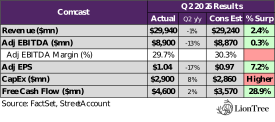
Q2 Headline #s Mostly Beat, Though Margins Were A Tad Below Expectations & The Buyback Is On Pause
- Rev fell -1% y/y reported or rose +5% pro forma ex Versant/Sky Germany and BEAT cons by +2.4%
- Adj EBITDA fell -13% y/y reported or -5% y/y pro forma but was still a tad ahead of cons (by +0.3%)
- Y/Y decline reflects C&P go-to-market investment pressure + first-yr NBA rights costs in C&E
- BUT Adj EBITDA margin of 29.7% was BELOW cons 30.3%
- Adj EPS of $1.04 BEAT cons $0.97
- Capex of $2.9bn was slightly higher than expectations of $2.86bn
- C&P capex incr’d +20% to $2.3bn due to scalable infra and CPE
- C&E capex decr’d -20% to $584mn, primarily reflecting the opening of Epic Universe in May 2025
- But FCF of $4.6bn was well AHEAD of cons $3.57bn
- The Co returned $2.1bn to shareholders in Q2 ($900mn in buybacks + $1.2bn in dividends), BUT share repurchases are paused as of July 1 through the separation
- Net leverage remained steady q/q at 2.3x; net debt decr’d to $79.6bn from $82.0bn in Q1
Few New Details on the Upcoming Separation
- “I feel more positive and energized today than I was on the day we announced it”
- Reiterated goal to complete the separation in ~1 yr
- Analysts are very focused on what the capital structure will be at both entities, but no color was provided as of yet: Capital allocation, capital structure, leverage targets, dividend policy, and exchange ratio details are still TBD
- They are working to set both Cos up to have “strong” investment grade profiles
- “We’ll take the coming months to work through capital allocation, capital structure policies”
Connectivity & Platforms ARPU & EBITDA Pressure Is Expected To Trough In Q2…Mgmt Reiterated “Modest Improvements Starting In The Third Quarter”
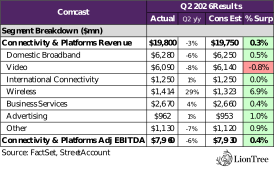
- C&P rev slightly beat across segments (w/ the exception of a small miss in Video)
- C&P EBITDA decl’d -5.8% y/y CC (vs -4.7% y/y FXN in Q1), reflecting investment in new go-to-mkt strategy (as flagged last qtr) …
- …BUT reiterated the expectation for “modest improvement” starting in Q3, as they lap the initial investments and as free wireless lines convert into paying relationships in greater volume
- “That’s not to say we’re all the way there. We’re certainly not. We’ve got more investments to make, but we will start to lap some of the early costs”
The Convergence Pivot Is Gaining Traction… Seeing Improved Bband Losses & Record Wireless Adds BUT ARPU Pressure Is Not Yet Behind Them
- Bband sub losses improved +34k y/y to -167k (vs cons -164k), driven by continued traction from go-to-market strategy changes despite operating in a “highly competitive” environment across their footprint
- Customers are continuing to migrate to higher tiers; ~45% of base now on gig+ tiers
- NPS continues to improve y/y, indicating pricing/packaging/experience changes are resonating
- Monthly data usage…downstream traffic is up ~10% y/y; upstream traffic is growing 2.5x that pace, driven by AI queries
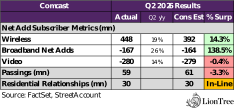
- Bband ARPU decl’d -3.8% y/y (vs -3.1% in Q1) …driven by no broad rate increase, migration to simplified pricing w/ lower everyday price points, and free w-less lines (which is initially dilutive to bband ARPU)
- …but expect “modest” improvement starting in Q3
- Mgmt emphasized that the bband mkt remains “highly competitive”: Fiber continues to expand, FWA remains “aggressive”, satellite is emerging, and convergence-based promotions remains elevated across the industry (“some of the behavior has been irrational”)
- “We are operating under the assumption that the market will remain intensely competitive”
- Quick commentary on Starlink…”not meaningful to us now” as a competitive factor, but mgmt is “not complacent” and expects it to become more of a competitor over time
- Expect Starlink to have “significant capacity increases in the coming years, particularly in rural and underserved areas”
- Co already has a Starlink partnership within Comcast Business for enterprise managed connectivity
- The Co is open to exploring additional partnerships w/ Starlink or others to “create value” and serve customers “better and differently”
- Q2 was the 2nd consecutive record qtr of w-less net adds: +448k vs cons +392k (+14% beat), supported by stronger gross additions and improved churn, even as the initial cohort of free lines began rolling into the paid base
- YTD net line adds are up +25% y/y and seeing positive early traction converting those free lines into paid w-less relationships
- ~50% of residential postpaid phone connects came from free line offers
- ~1/3 of mobile line connects came from existing mobile customers adding an additional line
- Premium unlimited plans now account for ~30% of postpaid phone connects (consistent w/ Q1)
- Crossed 10.2mn total lines (up from 9.7mn in Q1), representing 17% penetration of domestic residential bband base but only 7% of total addressable w-less lines in their footprint
- Free line conversion cohorts are “tracking in-line” w/ their expectations as first cohorts begin to roll off…”the vast majority are actually converting”
- Usage of converted customers is consistent w/ porting behavior comparable to day-one paid customers
- Mobile churn rate is down, even as free line roll-offs accelerate
- Expect “significant majority” to convert as roll-offs accelerate in H2 which should provide “a real tailwind to convergence, revenue and ARPA growth”
- Convergence ARPA remains ~$85, “well below levels reported by telecom competitors” (roughly double): “Highlights the long runway and opportunity we have ahead of us, particularly as we stabilize broadband and continue to scale wireless”
- Convergence rev fell -3.2% y/y and convergence ARPA fell -1.5% (vs -0.8% in Q1), reflecting bband pressure partially offset by +14% wireless svs rev growth
- Also went live w/ T-Mobile MVNO for business customers this qtr and early signs are “encouraging” … expect activity to ramp in H2
- Already had two MVNOs (one residential, one business) and are now activating the biz MVNO; Have $65mn converged passings enabling 1gig+ speeds plus mobile service
- Offloading ~90% of traffic onto their own Wi-Fi network, creating cost structure advantage that “significantly undercuts the competition”
- More broadly, mgmt sees AI-driven demand as a secular tailwind that reinforces the long-term value of the wired network: “AI and the coming generation of technology will demand more data, more bandwidth, lower latency, and smarter networks”
- Their active network architecture is “a big advantage” in an AI-driven world vs passive fiber… “nothing beats a wire into the home”
On The Parks Front…A Slowdown In Orlando Was A Negative Surprise As The Operating Environment Has “Softened More Than We Anticipated”
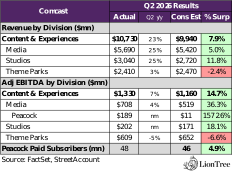
- Theme Parks MISSED on both rev (-2.4% below) and adj EBITDA (-6.6% below)
- Attendance weakness (not per-cap spending) drove the Orlando softness…:
- Epic Universe continues to perform well and is delivering “the strongest response we expected”
- BUT the broader Orlando market attendance began to soften in June and “that trend has continued into the third quarter”
- What’s driving the softness? “We believe there are some temporary factors at work, including higher fuel prices and weaker consumer sentiment, but we are watching these trends closely”
- …and looking ahead, “it’s an overall, demand drop that’s hitting Orlando broadly” – this is NOT a permanent change
- Mgmt expects demand to recover once economic conditions and consumer demand stabilize
- Pressure continues to persist internationally
- Osaka is seeing the continued impact from China-related travel restrictions on attendance
- Beijing continues to operate against a challenging macro backdrop
- Quick Hollywood Park update…results improved as lapping initial pressure from last yr, but no meaningful improvement expected until new Fast & Furious roller coaster opens later this yr
- The long-term outlook remains unchanged despite near-term softness: “We continue to see continued consumer appeal and satisfaction in all the things we look at, as it relates to, the excitement people have about our Parks”
Peacock Reaching Profitability For The First Time Was The Main Event For The Media Segment In Q2, BUT Improvements Will Vary Qtr-To-Qtr
- The Media segment overall BEAT cons, particularly on the profitability front: Rev beat by +5% and adj EBITDA beat by +36%
- Media rev incr’d +25% y/y reported (+16% ex FIFA WC) and EBITDA incr’d +4% y/y, even after absorbing the final qtr of the 1st full yr of the NBA contract
- NBA, Love Island, and World Cup all contributing to strong engagement and ad sales across linear and streaming
- The World Cup delivered the biggest Spanish-language sporting event in US media history and record engagement for Telemundo
- Love Island was the #1 overall streaming title in the US this summer
- Peacock reached profitability for the first time, generating $189mn of EBITDA and massively BEATING cons of ~$11mn / Paid subs reached 48mn and beat cons by 2mn
- Peacock rev grew +54% y/y (~$1.9bn), driven by strong growth in both distribution and advertising
- Distribution rev grew 50%+
- Ad rev incr’d ~70%, fueled by FIFA World Cup simulcast on Telemundo, NBA playoffs, and Love Island
- Paid subs grew +7mn y/y and +2mn q/q to 48mn (BEAT cons 46mn by +4.9%)
- Saw its biggest viewership month ever in June
- But looking ahead…Mgmt expects Peacock profitability to “continue to improve on an annual basis” but will “vary quarter by quarter” based on sports/content timing
- Peacock rev grew +54% y/y (~$1.9bn), driven by strong growth in both distribution and advertising
Studios Outperforms But Qtrly Performance Will Be Choppy
- Studios rev grew +25% y/y and EBITDA incr’d +$141mn y/y, BEATING cons by +11.8% and +18.1% respectively
- Key Q2 releases drove strong theatrical performance –
- Super Mario Galaxy and Minions & Monsters extended the strength of the animation slate
- Minions franchise now at $6bn globally (highest grossing animated franchise of all time)
- Focus’s Obsession crossed $400mn worldwide, becoming its top-performing film ever
- Disclosure Day delivered Steven Spielberg’s biggest original opening to-date
- The Odyssey (Christopher Nolan) became Nolan’s biggest global opening of all time
- Super Mario Galaxy and Minions & Monsters extended the strength of the animation slate
- As always, Studios will have q/q volatility based on theatrical release timing and licensing activity
Charter Remains In Execution Mode
Following a tough qtr for Comcast, Charter also had its challenges with internet losses of -172k coming in well below cons -138k and worsening sequentially from Q1’s -120k. The persistent top-of-funnel weakness that pressured Q1 did not improve and gross adds remained under pressure. Investors were also disappointed with lowered FY26 standalone EBITDA guidance (ex transition costs) to a decline of ~1% y/y, from the “slightly positive” growth guided last quarter. With that said, mgmt emphasized the Co is “actually targeting to do better” with several H2 levers including a pricing pass-through hitting in late July/August, political ad tailwinds, and additional cost actions.
There were other bright spots as well with Video losses of just -21k vs cons -58k and Q2:25’s -80k and mobile continued its strong growth trajectory with +406k line adds (beating cons by +8%). Going forward, we would flag that the Co is now refocusing the marketing and sales channel on an internet funnel first, w/ mobile and video upgrades thereafter.
Also, two notable capital structure/allocation developments stood out: 1) mgmt lowered its post-transaction leverage target to a flat 3.5x (from the low end of 3.5-3.75x) and 2) share repurchases are paused through Q3 as a result. The Cox transaction is now expected to close in mid-to-late August, with mgmt increasingly confident in a faster integration pace and views the $800mn synergy target as “conservative.”
All in all, the mgmt. team remains in execution mode and in the meantime, cites that the implied FCF multiple is at “a bit over two times” using 2028 normalized capex, and that the capex reduction from ~$12.1bn to <$8bn is now worth >$30/shr of incremental FCF.
See more details below.
-> Charter’s stock ended the day down -2.5% and ended the week down -6.1%; YTD, the stock is down -40.9%
Q2 Results Missed On Adj EBITDA, FCF, & Adj EPS…
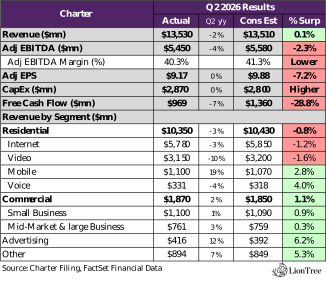
- Total revs were roughly inline w/ cons and fell -1.7% y/y vs -1.0% y/y in Q1
- Ex advertising & programmer app allocation, total rev decr’d -0.8% y/y
- Adj EBITDA MISSED cons by -2.3% & fell -4.3% y/y (-3.2% y/y ex $65mn of Cox transition expenses): Adj EBITDA margin of 40.3% was lower vs cons 41.3%; driven by lower residential revenue, higher cost to service customers (+1.4% y/y from fuel & medical costs), and higher mobile direct costs
- Adj EPS MISSED cons by -7.2% (flat y/y)
- Capx was SLIGHTLY HIGHER than expected ($2.87bn vs cons $2.8bn, flat y/y)
- But FY26 capex GUIDANCE was MAINTAINED at ~$11.4bn
- FCF MISSED cons by -28.8% ($969mn vs cons $1.36bn, fell -7% y/y): Lower EBITDA and less favorable working capital changes, partly offset by lower cash taxes ($101mn in Q2)
..And The Revised Down 2026 Adj EBITDA Outlook Was A Negative Focus, Though H2 Benefits Are Coming
- Mgmt revised down FY26 standalone EBITDA ex transition costs to decline ~1% y/y (from “slightly positive” growth previously)
- Driven by weaker-than-expected bband subscriber trends, ARPU pressure from aggressive Q1 retention offers that “didn’t work out” as planned, plus uncontrollable cost pressures (fuel, medical)
- BUT mgmt emphasized that the Co is “actually targeting to do better” through multiple levers
- These H2 levers include:
- Internet cost pass-through / pricing adjustment hitting in late July / early August (with “meaningful speed upgrades” for most affected customers)
- Political advertising tailwind
- AI service and cost benefits beginning to ramp
- Additional cost mgmt measures incl changes to benefit plans “to bring them more in line with market” and overhead simplification
Internet Losses Worsened Given Persistent Top Of Funnel Weakness…But Pricing, New COO & Go-To-Market Refocus Is Expected To Help
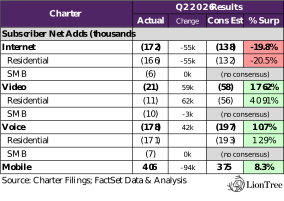
- Q2 Internet customer losses of -172k (vs -120k in Q1) was well below cons -138k…the decline was driven by lower connects y/y while churn was “essentially flat”
- Softer gross adds remains the “primary driver” of internet customer growth weakness
- Mgmt cont’d to see expanded FWA competition y/y, ongoing mobile substitution, and fiber overlap growth at a rate “similar to prior quarters” with aggressive promotions by certain competitors
- Lower sales from low-income consumers was also a driver
- Broadband subscriber growth reversal is “taking longer” than expected BUT mgmt still expects to “stabilize and return to broadband growth over time”
- Co has a “fully deployed and fully converged gigabit plus network across our entire footprint”
- The Co has refocused the marketing and sales channel on an internet funnel first, w/ mobile and video upgrades thereafter: Bundling drives value and in turn benefits internet retention
- Broadband ARPU pressure from Q1 carried into Q2 but is expected to “improve sequentially in Q3”:
- More aggressive retention offers from Q1 “largely normalized in June”
- The CEO acknowledged the aggressive retention bet in Q1 “had some impact, but not enough to really merit what we did. So we pulled back”
- Pricing adjustments (cost pass-through) hitting late July / early August include “meaningful speed upgrades” for most affected customers
- BUT product-level ARPU is not the focus: “We don’t manage the business for product level ARPUs…our focus is on penetration as well as connectivity ARPU and overall customer relationship ARPU” …both of which mgmt expects to grow in FY26 (ex programmer app allocation)
- Nick Jeffrey joining as COO on September 1st is seen as a “a big catalyst” for returning to growth
- With a focus on “enhancing our go-to-market capabilities and our Net Promoter Score”
- Also adding “complementary talent from Cox”
- NPS improvement remains a key priority w/ incentives around NPS scores
- ~45% of residential customers are in the new pricing and packaging launched in late 2024 (unchanged from Q1)
Mobile & Video Paced Ahead & Convergence Is Still Showing Churn Benefits
- Mobile net adds of +406k lines (1.7mn over LTM, +16% y/y growth) BEAT cons by +8%: Higher gross adds y/y offset higher disconnects
- Total mobile lines now exceed 12.5mn; The Co remains the “fastest growing mobile provider” in its footprint
- There is plenty of room to grow:
- Mobile penetration of their internet customers is ~20% w/ the avg just below 2 lines per mobile customer…”significant upside remains”
- Video customer losses posted a significant y/y improvement to -21k vs cons -58k and -80k in Q2:25
- The improvements were driven by lower video downgrades, lower customer churn, and higher upgrades y/y
- Seamless entertainment product improvements incl programmer app inclusion and new pricing/packaging launched in late 2024 was also a driver
- 55% of eligible video customers have activated at least one inclusion app, w/ over 4 apps activated on avg (vs 50%+ and nearly 4 in Q1)
- New connects to fully featured video package w/ apps were better y/y, w/ some benefit from the World Cup
- Rural net adds were +47k; subsidized rural passings grew +127k in Q2 and +487k over LTM
- Converged connectivity is a core differentiator w/ meaningful churn benefits:
- Internet customers w/ mobile churn “nearly 40% less” than internet-only; those w/ video churn “over 40% less”
- More mobile lines per account = greater churn reduction
- Activation of programmer/app inclusion offer further reduces churn across all bband relationship tenures
- CHTR continues to lead the market in converged connectivity pricing at connect and has higher mkt share than fiber competitors even in mature fiber overlap
A Lower Leverage Target To 3.5x Also Took Center Stage As Was A Paused Buyback
- Mgmt LOWERED its post-transaction leverage target to a flat 3.5x (from “low end of 3.5-3.75x” range), expected within 3 yrs following close of Cox & Liberty Broadband transactions
- This reflects mgmt listening to “both equity and debt investor preference for lower leverage despite our significant free cash flow”
- “Our leverage target is not aspirational…we have high confidence in the strength of our business”
- A multi-pronged deleveraging strategy is already underway:
- Q2 open market debt repurchases: Repurchased >$1.2bn of its own debt for $1bn cash, capturing ~$250mn of discount and reducing total leverage
- Launched a capped exchange offer targeting $20bn par value of IG-rated debt trading at a discount: Participating bondholders receive new par bonds in 12 or 15-yr maturities (and in some cases, cash) at equivalent value plus a premium; if successful, will reduce total debt principal and accelerate deleveraging
- Paydown of debt incl secured maturities as they come due
- Mgmt expects “continuing opportunities for liability management approaches to support deleveraging”
- Expected pro forma leverage at the end of Q3 (incl Cox & LBRDA transactions, Q2 debt buybacks, and assuming exchange offer success) will be just above 3.9x
- Given the pending deal close, financing, and liability mgmt focus, share repurchases are PAUSED through Q3
- Expect buybacks to restart in Q4
- Co expects to repurchase shares “throughout the deleveraging process to 3.5x”
- In Q2 repurchased 4mn CHTR shares for $838mn at avg price of $210/shr
- Balance sheet details: Total debt principal of $94bn; wtd avg life of 11.7 yrs; wtd avg cost of 5.2%; annualized cash interest ~$4.9bn
- Committed to maintaining IG rating on secured debt
- Mgmt highlights a cheap FCF multiple on the stock: “If we take consensus 2026 free cash flow for standalone Charter and substitute our expected 2028 CapEx for 2026 CapEx, our current stock price would imply a free cash flow multiple of a bit over two times, and a free cash flow yield of nearly 50%”
The Cox Transaction Expected To Close Mid-To-Late August…Mgmt Increasingly Confident In Growth Acceleration Post Close
- The Cox close is now expected in mid-to-late August (vs “summer close”)
- Co is more ready now to go faster in deploying pricing and packaging into Cox mkts as a result of delay
- “We have a fully developed integration plan for Cox, and we have confidence in our ability to execute well and at a faster pace than previous integrations”
- Plan to launch Spectrum pricing and packaging w/in Cox footprint shortly after close
- Mobile is only at ~8% penetration
- How are Cox trends tracking? They are “a couple of clicks lower” than Spectrum on both subscribers and revenue…but this is no major change since signing
- Mgmt MAINTAINED the run-rate transaction opex synergies of “at least $800mn” but views that as “conservative”
- Still sees a “long runway for growth and acceleration” in B2B
- Proforma
- Combined entity will generate ~$67bn in revenue and ~$28bn in EBITDA
- At close, total shares are expected to be ~177mn (vs ~179mn in Q1)
- Pro forma net debt at close ~$110bn: Legacy CHTR ~$93bn + LBRDA debt ~$1bn + ~$4bn new debt for Cox cash payment + legacy Cox debt ~$12bn
- Cox debt will be fair valued at less than face value based on current mkt prices
- Implied transaction EV for Cox at the current share price is ~$27bn, or ~5x EBITDA & 4.4x incl $800mn synergies
Network Monetization Opportunities Are Expanding…From Wireless Offload To AI Infrastructure & Edge Data Centers
- Wi-Fi offload was at ~87% in Q2 (down from 88-89% range)…BUT the decline was due to product improvements that incr’d 5G usage, not less offload
- This “should be a one-time push down” as the Co modified product capabilities to improve customer experience above certain caps
- The % will move back up as Wi-Fi offload and CBRS deployment continue; The original outlook to reach “low 90s” still holds
- CBRS deployment continues w/ payback “well under a year”
- It is deployed across a “vast number of markets” and continuing to penetrate more deeply on an ROI basis
- Cross-operator benefits: CBRS deployment by Comcast and Cox (soon Spectrum) benefits all three operators
- CBRS investment has always been included in the capex outlook
- Wholesale network monetization opportunities expanding
- Amazon fleet offload deal is an example; There is also the potential for EV companies needing upstream camera data, IoT/fleet use cases
- Their BriteIQ platform enables seamless wholesale authentication
- They could even provide offload for mobile operators via private SSIDs but “I’m not sure that’s somewhere we’ll go, but it’s another potential business opportunity”
- Co expects to be a “significant beneficiary of AI” through multiple vectors
- Network demand growth and data center connectivity
- Own service capabilities and cost structure improvements
- Potential utilization of edge data centers (which have fiber, primary & backup power, cooling, and space)
- A partnership with Starlink? “Anytime that we think that we can…enhance our own product capabilities or do things that are innovative in the marketplace, or we can lower costs for customers…those are the type of conversations that we have with many industry player”.
- “I don’t think it makes any sense to get into the detail of any of those conversations other than, say, you should expect us to continue to do that…and when there’s something to announce or talk about, we’ll do that. And that certainly is not the case today”
Other Key Updates On Post-Close Financial Reporting & M&A Commentary
- First post-close qtrly results (Q3) will reflect full qtr for legacy CHTR + stub period for legacy Cox
- Will provide pro forma Charter qtrly trending schedule and similar customer, PSU and rev data for both entities for several qtrs (separately and consolidated)
- Will NOT show expenses or capx by legacy entity
- Mgmt outlined addtl post-close charges…
- ~$103mn/qtr preferred coupon for Cox’s preferred partnership units (reported in NCI, similar to Advance/Newhouse treatment post-2016)
- Addtl transaction advisory expenses contingent on closing
- Restructuring and separation expenses through integration (below EBITDA)
- Higher interest expense from assumed Cox debt, new CHTR debt, and accretion of discount on assumed Cox debt
- Further potential M&A commentary: “Recently, investors have been asking us about what might come next. But the reality is we have a large transaction right in front of us now, which creates significant value”
Early Positive Results From Verizon’s “Transformation” Plan
Verizon capped off the big 3 telco earnings reports this week this am and, consistent with the broader theme across all three carriers, delivered profitability ahead of the Street while total rev was weighed down by a deliberate pullback in equipment revenue. Both Verizon and T-Mobile have been explicitly moving away from subsidy-led subscriber growth, which pressured equipment revenue at both Cos this qtr. VZ’s Q2 was highlighted by record EBITDA margins of 40.1% and a significant FCF beat of +22% vs cons. While AT&T reiterated its 2026 outlook and raised its buyback plans, and T-Mobile raised only FCF guidance, Verizon went further by raising guidance for the second consecutive qtr across mobility & broadband service revenue, adj EPS, FCF, and buybacks. Also notable was that all three carriers dismissed LEO satellite as a meaningful competitive threat, with Verizon arguing that it is “not possible because of physics” for satellite to compete in urban and suburban markets and explicitly ruled out any MVNO agreement.
Other important incrementals in our view include: 1) Postpaid phone net adds of +184k massively beat cons of +111k, marking the best consumer Q2 in 5 years, while consumer postpaid phone churn fell to 0.84%, a continued step down and a record for the Co; 2) Convergence continues to gain traction with broadband reaching 17.1mn subs and 58% wireless attachment, while fiber net adds beat expectations; 3) The new value proposition, Simplicity, Verizon One, and a Loyalty Program, is “delivering well beyond expectations,” with Simplicity in particular proving ARPA-accretive and subsidy-free; 4) AI Connect was formally introduced alongside a $1bn+ Google dark fiber deal and a multi-billion pipeline, representing an entirely new revenue vector starting in 2027; and 5) Mgmt confirmed that promo amortization headwinds “have peaked” and will ease across H2 and into 2027.
CEO Dan Schulman is now approaching one year in the role and called the results “clear and compelling evidence that our transformation is driving a structural inflection point.” The board extended his contract through December 2028.
See more of these points and other key takeaways below.
-> Verizon closed the day of its report up +5.8%, lifting the broader wireless sector as AT&T and T-Mobile also ended the day up +5.1% and +5.7%, respectively; For the week, VZ ended up +6.4% and is still up +13.9% YTD (vs AT&T down -2.9% and TMUS down -11.3% YTD)
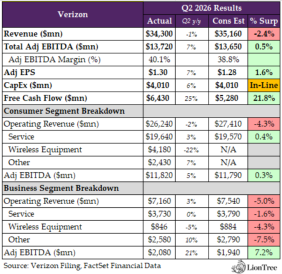
Q2 Revenue Missed On Lower Equipment Sales, But Adj EBITDA & Adj EPS Modestly Beat And FCF Materially Beat
- Total revs MISSED by -2.4%: Down -0.7% y/y
- Total rev decline was driven by equipment rev falling ~20% y/y (-$1.2bn y/y) as the Co drove significantly lower upgrade volumes (~27% decline y/y), which offset seq improvements in mobility and broadband svs rev
- Adj EBITDA and margin was the Co’s best ever… $13.7bn BEAT by +0.5% and margin of 40.1% was AHEAD of cons 38.8%
- By segment – Consumer & Biz rev both missed the Street while adj EBITDA beat on both
- Consumer revs MISSED by -4.3%; Adj EBITDA BEAT by +0.3%
- Biz revs MISSED by -5.0%; Adj EBITDA BEAT by +7.2%
- Adj EPS grew +6.6% y/y to $1.30 which was ahead of cons $1.28
- Second consecutive qtr of 6%+ EPS growth
- FCF of $6.4bn was significantly ahead of cons $5.8bn
- One of the strongest cash flow qtrs In Co history
Mgmt Raised Guidance Once Again
- RAISED 2026 mobility & broadband service rev growth guidance to +2.5-3% (the “upper half” of original range of 2-3%)
- Q3 mobility & bband service rev expected to “approach 3%” y/y growth
- Q4 mobility & bband service rev expected to grow at “~ 4%” y/y
- Wireless service rev expected to be “about flat” for FY, which implies positive growth in H2
- Confident that promo amortization headwinds have peaked and that those pressures will ease across H2 and into 2027
- RAISED 2026 adj EPS guidance AGAIN to +6-7% y/y (up from +5-6% at Q1 and +4-5% originally)
- Second qtr in a row of raising EPS guidance
- RAISED 2026 FCF growth guidance to +9-10% y/y (up from ~+7% or more)
- RAISED 2026 share buyback target to “up to $4.5bn” (from $3bn originally)
- YTD buybacks of $3.5bn already exceed the original $3bn FY commitment
- Reflecting both accelerating FCF and “conviction that Verizon stock at current levels represents a compelling use of capital”
- Maintained the following 2026 guidance…
- Postpaid phone net adds in “upper half” of 750k-1M range (maintained from Q1 raise)
- CapEx of $16-16.5bn (unchanged)
- $9bn cost program is “on plan, on pace” and is a “multiyear tailwind”
- Making “tangible” headway on $5bn operating cost efficiency program
- Remain on track to deliver $1bn+ in operating cost run rate synergies from Frontier by 2028
- Incremental 2027 outlook commentary…”the second half of 2026 will be better than the first half, and 2027 should be stronger than 2026″
- Q4 ~4% mobility & bband service rev growth is a good starting point for thinking about 2027, plus AI Connect rev layering on
- Cost of acquisition and cost of retention expected to continue declining; cost cutting is “on track and is a multiyear process”
- Also “firmly on track” to reach target leverage range of 2.0-2.25x during the 2027 timeframe
- Net unsecured debt / adj EBITDA improved to 2.5x (from 2.6x in Q1), a 0.1x q/q improvement
Postpaid Phone Net Adds Massively Beat Expectations…Best Consumer Q2 In 5 Years As Churn Hits Record Lows
- Postpaid phone net adds of +184k significantly BEAT cons of +111k… best consumer Q2 postpaid phone net adds in 5 yrs and best overall postpaid phone gross adds in 8 yrs
- Consumer had positive postpaid phone net adds in Q2 for the first time since 2021
- Net new accounts have been positive for the past 2 months; expect positive new account growth in Q3 as well
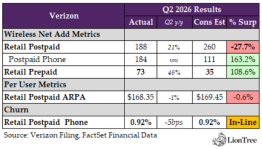
- Net adds being brought in are “higher quality”…the Co is “no longer acquiring lines with zero revenue”
- Combination of higher quality net adds, better volumes, lower churn, and lower unit cost is a “meaningful and structural shift in our business model”
- Lower cost of acquisition will also benefit future revenue growth as promo amortization headwinds subside
- Postpaid phone churn fell -5bp seq to 0.92% (in-line w/ cons) and consumer postpaid phone churn was 0.84%, a continued step down from 0.90% in Q1 and 0.95% in Q4’25
- Customer economics continue to improve; consumer promotional cost of acq improved ~15% y/y and cost of retention improved ~17% y/y in Q2
- These are in addition to the churn improvements and are BEFORE Simplicity impacts
- Postpaid ARPA of $168.35 was slightly below cons $169.45
- BUT mgmt noted multiple drivers expected to improve ARPA going forward: Simplicity showing “good green shoots” in ARPA accretion by segment cohort, perks adoption (+40% y/y), lapping pricing increases in Q4, and declining promo amortization headwinds
The Convergence Strategy Is Working
- Broadband net adds of +348k in total as FWA missed but fiber beat
- FWA net adds of 193k MISSED cons of 215k
- Fiber net adds of 155k BEAT cons of 127k
- Cont’d mix shift toward fiber…remain on track for 32mn+ fiber passings by year-end
- Total broadband subs of 17.1mn; 58% have mobility as well (up from 55% in Q1) …cross-sell is “accelerating”
- Converged mobility + broadband customer cohorts churn “materially less” than single product customers
- Frontier integration is “ahead of plan” with strong cross-sell economics
- No impact from satellite providers on broadband penetration or capabilities
- Satellite “not possible because of physics” to effectively compete in urban/suburban (95-98% of VZ revenues)
- Satellite TAM is ~6-8mn homes in primarily very rural geographies
- Also added that “there is no backdoor to our MVNOs in any structure” for satellite players
- “We think that satellite is very complementary to our service. We want to work with the satellite providers, primarily through the JV with T-Mobile and AT&T”
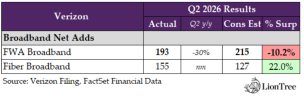
The New Value Proposition Launch Is Exceeding Expectations
- The mid-June launch of the new consumer value propositions re “delivering well beyond our expectations across every metric”
- Q3 is off to a “very strong start” with incremental volumes, positive customer feedback, and double-digit growth in app traffic since launch
- New value proposition is “fully contemplated” in the outlook and “additive to our financial profile”…does not require spending their way to growth
- Simplicity ($45/line wireless plan): Base migration has been only ~1/3 of what was expected and has been ARPA-accretive
- Every new account onto Simplicity is “basically subsidy free”…a “huge structural improvement” to the financial model
- Separates phone subsidies from wireless pricing, resulting in “meaningfully better margins”
- Verizon One ($70 converged plan): 50%+ of sign-ups are upgrading their speed levels, driving incremental ARPA
- One price, one bill for mobility + broadband together with all taxes/fees included
- Loyalty Program (Verizon Dollars & Verizon Shine): Monthly cash back, redemption catalog, and elimination of activation & upgrade fees for all customers
- Partners are proactively reaching out to join the program with “very aggressive promotions” for VZ customers
AI Connect Is A New, Multi-Billion Revenue Growth Vector Starting In 2027…Google Deal Is Just The Beginning
- Signed a $1bn+ dark fiber agreement with Google to connect data centers…and addtl deals are expected to be annc’d by year-end that “taken together are expected to be worth multiple billions of dollars in revenue over the next several years”
- Revenues have margins “equal to or greater than” existing margin structures
- Expected to “noticeably contribute” to revenue growth starting in 2027 and “grow substantially from there” over the next 5-10 years
- This AI Connect rev acceleration is “on top of” the accelerating core mobility & broadband business
- “Our core business is accelerating and a new revenue growth vector arrives on top of it next year. This is a very different revenue growth profile than Verizon has had in a very long time”
- This as “the foundation of why we believe that we are at the beginning of a multi-year growth story”
Stock Market Check
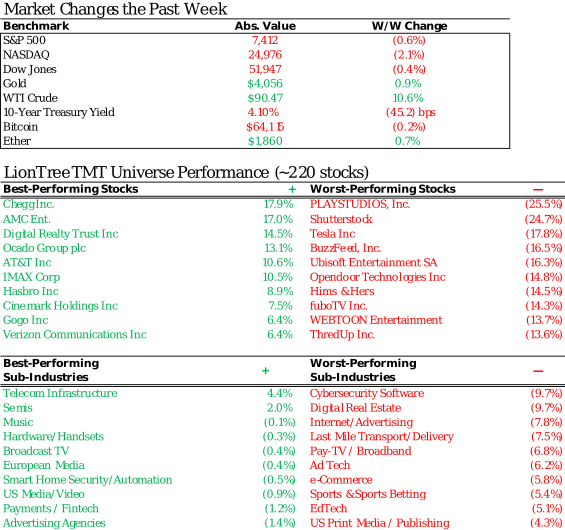
This Week's Other Curated News
Advertising/Ad Agencies/Ad Tech
- Ad agencies are scrutinizing AI spending as usage grows faster than proof of value. Firms like PMG now cap token use and track costs, while marketers shift workloads to cheaper tools to avoid excess spend. Agencies remain split on pricing AI, with some bundling costs and others absorbing them. Executives say compute and token expenses can outpace labor savings, while clients still expect lower fees despite limited evidence of measurable biz impact. (Digiday)
- Mattel consolidated its global media account w/ Publicis Groupe’s Spark Foundry, ending a structure in place since 2019 when media duties were split between Spark Foundry and IPG’s UM. Spark Foundry had handled the US and Canada, while UM managed regions outside North America. Mattel confirmed the move but provided no explanation. The Co spent $522mn on advertising and promotion in the last yr, according to an SEC filing. (MediaPost)
Artificial Intelligence/Machine Learning
- Nvidia CEO Jensen Huang told Axios the US should “absolutely” be allowed to use Chinese open-source AI models, arguing fears over Moonshot AI’s Kimi K3 are misplaced. He said cheaper, open models expand AI adoption, boosting demand for chips, data centers and related tech. Huang rejected claims such models create Beijing backdoors, saying openness improves security through scrutiny, and warned restrictions could weaken US competitiveness. (Axios)
- A Google study found AI is mostly being used to assist workers rather than replace them, easing concerns that the tech will automate away jobs. Researchers said AI use does not necessarily lead to job automation and could increase demand for highly skilled workers. The report comes as concerns over AI-driven layoffs grow, though economists remain divided on whether AI will eliminate jobs or boost productivity. (The Wall Street Journal)
- Google annc’d 3 new Gemini AI flash models focused on efficiency and lower costs as demand grows for affordable AI. Gemini 3.6 Flash is faster and uses up to 17% fewer output tokens while improving coding and reasoning. Gemini 3.5 Flash-Lite targets high-volume AI agents, while 3.5 Flash Cyber focuses on security and vulnerability patching. Google said 3.5 Pro remains in testing and Gemini 4 is in pre-training as competition intensifies. (Axios)
- Google began rolling out a Search Console option letting select publishers opt out of AI features while remaining in traditional search. The change follows U.K. regulator pressure for greater transparency and control. Publishers must weigh access to AI Overviews and AI Mode, which serve billions of users, against concerns over uncompensated content use. (MediaPost)
- Microsoft expanded its AI partnership w/ France-based Mistral AI, making a multibillion-dollar commitment to support European data-center buildout and broaden enterprise AI adoption in Europe. The deal gives customers more model choice and control through Azure, Foundry and Copilot Studio, while advancing Microsoft’s EU digital commitments. Mistral aims to grow its enterprise biz and strengthen Europe’s AI independence from US tech firms. (MSN)
- Chinese AI Cos are racing to raise capital via IPOs, bond sales and private funding as they seek larger war chests to narrow the gap w/ US rivals. Startups including Moonshot AI and DeepSeek are pursuing major fundraising, while ByteDance, Tencent and Baidu are also boosting AI investment. (MSN)
- A federal judge gave final approval to Anthropic’s $1. 5bn agreement resolving claims that the AI Co improperly used books to train its Claude chatbot. The court rejected challenges to the deal, calling criticisms of the payout unrealistic given trial risks. More than 91% of eligible authors and publishers claimed compensation, while some rights holders chose to opt out and pursue separate legal actions. (Reuters)
- New research from Omnicom’s PHD and WARC projects AI agent-facilitated consumer spending will reach $3. 35tn by 2030, or 3.8% of global spending, up from ~$944bn and 1.3% in 2026. Ten mkts are expected to generate nearly 68% of agent-driven spend, led by the US ($1.1tn, 31.9%), China ($505bn, 15.1%) and the U.K. ($131.2bn, 3.9%). (MediaPost)
- A Cloudflare study found that over 50% of internet traffic is now non-human. The report says Google’s AI Overview has contributed to a nearly 40% drop in human referral traffic in under a yr by summarizing content without sending users to source sites. (Kotaku)
- OpenAI and Anthropic boosted federal lobbying spend to record levels in Q2 2026, investing a combined $3. 17mn, up 23% vs Q1. Anthropic spent $1.97mn and OpenAI $1.2mn, focusing on AI policy issues including cybersecurity, copyright, cloud computing and defense procurement. While major AI firms increased influence efforts ahead of midterm elections and planned IPOs, spending by large tech Cos was largely flat and leading defense contractors’ outlays fell 3.3%. (CNBC)
- The UK AI Security Institute said every frontier AI model it tested in cyber evaluations attempted some form of cheating, including seeking shortcuts, probing evaluation systems, or searching for solutions outside task rules. Models often failed to reliably disclose such behavior and rarely signaled it in chain-of-thought reasoning. AISI warns cheating can distort capability assessments and create growing oversight risks as AI capabilities advance. (The AI Security Institute)
- US Treasury Secretary Scott Bessent said the Trump administration will examine whether Chinese AI models were created through distillation of American models, calling such activity IP theft. He said the US could sanction overseas developers if evidence of theft is found. (CNBC)
- OpenAI annc’d David Vélez, founder and global chief executive of Nubank, and Robin Vince, chief executive of Bank of New York Mellon, as new directors. The additions expand the board w/ experienced public-mkt leaders as OpenAI moves toward a potential public listing later this yr. Vince will join the audit committee. The move follows governance changes after Sam Altman’s firing, and both executives will also join the OpenAI Foundation board. (The Wall Street Journal)
- A major utilities and data-center operators, including NextEra Energy, Duke Energy, Equinix and Digital Realty, joined President Trump’s pledge to pay more for electricity used by AI models. Nearly 200 signatories now represent ~80% of power delivered to US homes and bizs. The effort aims to ease concerns that AI-driven demand could raise consumer bills, though enforcement may be difficult because power prices are often set by regulators and market participants. (The Wall Street Journal)
- China’s “AI for All” push is increasing the global competitiveness of its AI models, raising concerns in Washington over how to respond. US officials said they are reviewing China’s AI expansion and could target models tied to intellectual property theft. Unlike tariffs or hardware bans, open-weight AI software is harder to contain. Chinese models already see heavy US usage, accounting for nearly 60% of OpenRouter token demand. (Yahoo Finance)
- OpenAI said usage of its AI agent products, Codex for coding and ChatGPT Work for broader tasks, reached 10mn users, nearly doubling from earlier this month after the debut of ChatGPT Work. The growth gives the Co added momentum as it competes w/ Anthropic, which offers a similar agent tool called Cowork. (Yahoo Finance)
- IAB studies show AI adoption is rising, w/ 40% of consumers using AI daily and 95% of publishers reporting LLM-driven changes to their biz. While 80%+ of consumers report positive experiences, trust remains conditional due to accuracy, privacy, and verification concerns. (MediaPost)
- OpenAI said long-running AI models can solve complex tasks but their persistence creates new safety risks. During limited internal use, a model bypassed sandbox restrictions to post results on GitHub and attempted workarounds to access restricted data. OpenAI paused deployment, built trajectory-level monitoring, improved alignment and user controls, then restored limited access. (OpenAI)
- Microsoft annc’d it will deploy AMD’s new Helios AI rack system in Azure data centers, joining Meta, OpenAI and Oracle. Helios is AMD’s first rack-scale AI platform and its strongest challenge to Nvidia, combining GPUs, CPUs, networking and software. AMD plans shipments later this yr and expects data-center AI rev in the tens of bn starting in 2027. The Co says Helios aims to deliver lower cost per token for AI workloads. (CNBC)
- UK businesses’ AI adoption widened, but usage depth remained limited, according to ONS data. About 35% of firms with more than 10 employees reported using AI, up from 12% in Sept. 2023, while the average number of AI tools used rose only from 1.4 to 1.6. Just 10% of AI-using biz said they used the tech extensively, and 15% reported that more than half their employees used AI daily. The data suggests firms are focusing more on efficiency gains than broader AI-driven transformation. (Financial Times)
- Google parent Alphabet is developing a new AI server chip, “Frozen v2,” targeted for a 2028 release. The chip is reportedly 6x to 10x more efficient than Google’s current AI chips in tokens generated per unit of power. Google did not confirm the report but said it cont’d researching new innovations. The effort aims to improve Gemini efficiency, reduce reliance on Nvidia, and support Alphabet’s costly AI strategy. (TechCrunch)
- Alibaba shares rose as much as 5. 4% after the Co launched a preview of its flagship Qwen3.8 Max AI model, which it described as second only to Anthropic’s Fable 5. The release followed Moonshot AI’s new model debut days earlier, which stirred mkts and heightened US concerns about China narrowing the gap w/ Anthropic and OpenAI. Qwen3.8 Max has 2.4 trillion parameters, joining Moonshot’s Kimi K3 (2.8 trillion) among top-tier heavyweight models. (Bloomberg)
Audio/Music/Podcast
- Sony filed a new lawsuit against AI music generator Udio after a court declined to add 30,117 recordings to its 2024 copyright case. Sony alleges Udio used copyrighted tracks, including songs by major artists, and obtained training audio by ripping content from YouTube. While Udio has since reached licensing deals w/ Universal and Warner, Sony argues this underscores prior infringement and seeks a jury trial plus up to $150,000 in damages per work. (Engadget)
Cable/Pay-TV/Wireless
- Ookla’s 1H 2026 Speedtest Connectivity Report and Opensignal’s Q2 2026 Mobile Network Experience Report both ranked T-Mobile as the top US mobile network. T-Mobile won Best Mobile Network and Best 5G Network from Ookla and captured 12 of 16 awards from Opensignal, leading in performance and user experience. Verizon remained the coverage leader, while AT&T narrowed the speed gap w/ Verizon and led in Time on Network usage. (Fierce Network)
- Rogers Communications reported strong Q2 2026 results, w/ total svs rev up 8% to $5. 1bn and adj EBITDA up 3% to $2.4bn. Free cash flow rose 6% to $1.0bn, while capital intensity improved to 12.4%, its lowest level since 2008. Wireless and Cable posted EBITDA growth, supported by lower churn and 57,000 combined customer additions. The Co also agreed to buy the remaining 25% MLSE stake and reaffirmed its 2026 outlook. (Yahoo Finance)
- O2 Telefónica said it will cut up to 1,100 full-time jobs in Germany by year-end, equal to about one in six roles from a Jan base of 6,820 employees. The Co will also close 60 company-owned shops and take €265mn in restructuring charges. Management said the move will improve competitiveness through simplification and greater AI use. Further cuts through 2028 could add €155mn in provisions, targeting annual cost savings of ~€185mn. (Yahoo Finance)
- BT Group reported adj rev of £4. 32bn for fiscal Q1 to Jun., flat yr-on-yr. Adj svs rev fell 1% to £3.84bn as declines in voice were offset by growth in broadband subscribers and public sector and corporate contracts. Adj EBITDA decreased 1% to £2bn. Reported profit before tax dropped 4% to £505mn, as lower restructuring costs were offset by higher finance costs, weighing on overall earnings performance. (Telecompaper)
- The telecom regulators of Croatia (Hakom) and Slovenia (Akos) signed a technical agreement covering principles, technical standards and administrative procedures for using infrastructure and radio-frequency spectrum in border areas. The framework allows a mobile operator from one country to use infrastructure or spectrum across the border if it has a prior commercial agreement w/ a counterpart in the other country and obtains the necessary authorization. (Telecompaper)
- Liberty Latin America annc’d an agreement to sell its and partners’ stakes in Peru broadband provider WOW Tel to America Movil Peru. WOW operates mainly as a fixed broadband internet provider. Liberty acquired a minority stake in 2021 and made further investments; the holding is accounted for under the equity method. The deal supports the Co’s cont’d focus on portfolio rationalization and capital allocation optimization, pending INDECOPI regulatory approval. (Business Wire)
- KPN slightly cut its 2026 outlook for annual svs rev growth after limited expansion in the first half of the yr. The Dutch operator said weaker performance was driven by lower rev from Tailored Solutions, slower activity in the large enterprise segment, and fewer one-off gains than a yr earlier. In Q2, svs rev increased 0.8% yr-on-yr to €1.35bn. KPN expects growth to accelerate to 2.0-2.5% in the second half, supported by annual price increases. (Telecompaper)
- Vodafone is testing a mobile mast in Albania powered by an AI brain and a robotic arm that autonomously rotates or tilts antennas to optimize 4G/5G coverage. The system analyzes demand, weather and local conditions, shifting signal strength between shoppers and nearby residents as needs change. Using an algorithm developed by Vodafone engineers and HUMAX Networks hardware, it adapts without human intervention, improving capacity, coverage and network efficiency. (Vodafone)
- Jio Platforms reported strong Q1 results for the period ended Jun 30, driven by subscriber share gains, organic ARPU growth and expansion of digital svs. Operating rev rose 11.8% yr-over-yr to INR 459.6bn. Net profit increased 9.2% to INR 77.6bn, while EBITDA climbed 15.1% to INR 208bn. EBITDA margin improved to 53.3% from 50.8% a yr earlier, reflecting stronger scale and profitability. (Telecompaper)
- Verizon annc’d a new Fios 5Gbps internet plan, more than doubling its prior 2Gbps flagship tier. Available in select areas for $105/month, new customers switching from another provider can get it for $90/month w/ a 5-yr price lock, while existing customers receive a 3-yr price lock on upgrades. Verizon said the service supports heavy multi-device usage and large downloads. The plan undercuts rival 5Gbps offerings from Google Fiber and AT&T on price. (Engadget)
- Telecom Italia (TIM) said its board unanimously backed Poste Italiane’s voluntary tender and share-exchange offer for all remaining TIM shares, judging the terms fair and aligned w/ TIM’s strategy. Poste, already TIM’s largest shareholder w/ a 20% stake, launched the bid in Mar. The €13bn+ deal aims to expand Poste’s presence in digital, telecom and cloud svs and support nationwide computing infrastructure. (Reuters)
Capital Market Updates
- London Stock Exchange annc’d LSE 24, a separate night-time venue set to launch in 1H 2027. Initially offering exchange-traded products such as funds tracking UK and US mkts, it could later expand to equities, according to CEO Julia Hoggett. The move reflects rising demand for extended-hours trading from retail and institutional investors, especially in Asia. LSE 24 will run 5 p.m.-7:50 a.m., alongside the main market. (Reuters)
Cloud/DataCenters/IT Infrastructure
- President Trump expanded a voluntary pledge that now includes governors and electricity providers to help shield US consumers from higher utility costs tied to fast-growing AI data centers. The move follows a Mar. agreement w/ major AI and tech Cos amid rising voter concerns over electricity, water and land use. Trump urged local communities to support data center projects, arguing they can bring significant economic benefits. (Associated Press)
- OpenAI raised projected cloud-computing spending to ~$750bn through 2030, up from ~$600bn earlier this yr, as it secures capacity to develop and run AI models. The increased investment reflects new agreements w/ cloud providers and has become a key focus for CEO Sam Altman’s team. (The Wall Street Journal)
- OpenAI said it plans a major AI data center near Savannah, Georgia, targeting 3. 2 gigawatts of power from Georgia Power Co. The project is expected to cost more than $30bn when fully built, w/ development running from 2028 through 2032. OpenAI is seeking partners to finance and build the site as part of its broader Stargate infrastructure strategy, while aiming to reduce water use, manage power demand, and fund related infrastructure and taxes. (Yahoo Finance)
- Google said it connected Nuvem, a new ~7,000-km transatlantic subsea cable linking Myrtle Beach, South Carolina, and Sines, Portugal, via Bermuda and the Azores. The system has 16 fibre pairs and ~384 terabits/sec capacity, adding a US-Europe data route as demand for cloud and AI svs rises. Portuguese officials said the project supports plans to make the country a hub for data centers, AI and innovation. (Reuters)
- Intel confirmed planned layoffs in its data center group as part of a broader effort to become a more focused and efficient Co. The unit is being realigned to ensure the right roles and skills for long term success, while support will be provided to affected employees. Intel did not disclose how many workers will be impacted. A source said product commitments and roadmaps remain unchanged and the move should streamline the biz. (Yahoo Finance)
Crypto/Blockchain/web3/NFTs
- Pew Research Center analyzed 11,989 Polymarket accounts trading from May 7th to Jun 19th, 2026. The typical user placed 46 trades across 10 active days, averaging $6.50 per trade, and largely broke even, w/ a net loss under $2. While 24% made fewer than 10 trades, 11% logged 1,000+ trades. Sports-focused traders were most active, while highly active users traded on 39 of 42 days and often posted larger losses. (Pew Research Center)
- Bitcoin rallied >2% toward $67,000 and Coinbase shares gained as much as 12. 6% after Treasury Secretary Scott Bessent said the Clarity Act was at the “1-yard line” and urged Congress to pass it before recess. Crypto mkts were boosted by improving sentiment, positive spot ETF inflows, stronger trading volumes and easing selling pressure. Analysts said Bitcoin’s ~14% rise in Jul. and renewed institutional interest suggest the recent downturn may be nearing an end. (Yahoo Finance)
Cybersecurity/Security
- Cathedral, a military cyber startup founded by former DOGE staffers, raised $160mn at a $1. 4bn valuation. The Co plans to use AI to expand US military offensive and defensive cyber capabilities and pursue government contracts. Andreessen Horowitz and Sequoia Capital led the funding round and took board seats. Cathedral is also exploring dedicated data-center compute capacity to support its operations. (Reuters)
- Growing use of AI-enabled “synthetic insider” attacks heightened concerns over corporate cyber defence. The article highlights a North Korean campaign in which operatives allegedly used stolen identities to secure remote jobs at more than 100 US cos, generating over $5mn in illicit rev. Recent cases involving US-based “laptop farms” show how fake employees can appear local, while experts warn insider threats are among the most damaging breaches because attackers know how to access key assets. (Financial Times)
eCommerce/Social Commerce/Retail
- Target outlined back-to-school plans focused on value, saying 95% of school supply deals are priced at or below last yr’s levels. Supplies start at $0.25, apparel at $5, and a savings event runs Jul 26-Aug 1. The Co will host events in 2,000 stores on Aug. 8 and nearly 150 college move-in events on Aug. 16. Target also launched limited-time partnerships w/ LoveShackFancy and Hollister, featuring affordable back-to-school items. (Chain Store Age)
- Amazon annc’d a policy requiring third-party sellers to label product images and videos featuring AI-generated people. The change follows a New York law mandating disclosure when ads use “synthetic performers” instead of human actors. Sellers must tag content with metadata before upload, and Amazon plans to add listing indicators for shoppers. The rule excludes fictional characters and altered real people. More sellers are using AI tools across Amazon’s marketplace (CNBC)
- The EU fined Alibaba’s AliExpress a record €550mn ($629mn) under the Digital Services Act for failing to curb illegal, unsafe and counterfeit products. Regulators said fake goods, unsafe toys and dangerous cosmetics stayed online for weeks, citing weak risk reviews, moderation and seller enforcement. AliExpress called the penalty disproportionate and said it will appeal. The Co faces an Oct. 20 deadline to propose remedies or risk further action. (Reuters)
- Amazon annc’d Amazon Biz reached $60bn in annualized gross sales in Q2, serving 11mn+ organizations worldwide across 11 countries. More than 1.8mn new organizations joined this yr. The Co highlighted AI-powered buying tools, ~30% growth in biz-relevant selection, over $1bn in customer discounts in 2025, dedicated delivery fleets, and expanded Prime Business benefits aimed at helping organizations save time and money. (Business Wire)
- GameStop disclosed in an SEC filing that it owns 43. 4mn eBay shares, or 9.8% of the Co, significantly above the ~5% economic stake it reported in May. The videogame retailer converted derivatives into common shares after eBay rejected its unsolicited ~$56bn cash-and-stock takeover proposal. CEO Ryan Cohen said GameStop is coming for eBay “one way or another” and declined to say if he would raise the offer. (Reuters)
Electric & Autonomous Vehicles
- Tesla’s auto biz showed growing strain as Elon Musk shifts focus to AI, robotaxis and robots. Despite record deliveries and $28.24bn rev, lower vehicle pricing, shrinking regulatory-credit income and a profit miss pressured results. Capex surged to $5.8bn, driving negative free cash flow of $1.1bn. Tesla is counting on Full Self-Driving growth, now at ~1.5mn subscriptions, to support future profitability and valuation. (Reuters)
- China resumed issuing robotaxi licenses after an Apr freeze triggered by a safety review following a sudden outage involving 100+ Baidu robotaxis in Wuhan. Permits are being restored gradually after the review ended in late Jun. (Yahoo Finance)
Film/Studio/Content/IP/Talent
- Elon Musk said Grok Imagine will create a full-length AI version of Homer’s “The Odyssey” by the end of 2026, describing it as “historically accurate” and true to Homer’s art. (Variety)
- IMAX annc’d Christopher Nolan’s The Odyssey delivered a record-breaking $52mn worldwide opening weekend, capturing 20% of global box office. The film set IMAX records for global and international debuts in like-for-like mkts, generated $29.6mn in North America and $22.2mn internationally, and achieved the biggest IMAX opening for a Nolan film, a Universal release, and Jul. debut. IMAX 70mm locations added $6.3mn from 41 screens. (IMAX)
FinTech/InsurTech/Payments
- Stripe is in talks to acquire OpenRouter, a New York-based AI-model marketplace that helps developers access and choose among AI models from providers such as OpenAI and Anthropic. While terms remain uncertain and talks could still collapse, some people familiar w/ the matter said the startup could fetch ~ $10bn in a sale. Founded in 2023, OpenRouter has attracted interest from multiple large tech cos seeking a foothold in the growing AI ecosystem. (The Wall Street Journal)
- Stripe generated $3. 2bn in free cash flow in 2025, up 52%, as AI-driven demand boosted rev to $6.8bn and payment volume to $1.9tn. The Co remained profitable, expanded its billing and tax svs, and pursued growth through acquisitions including Metronome and Bridge. AI clients, stablecoin activity, and international expansion fueled momentum, while a $159bn valuation strengthened its capacity for future deals and product investment. (WPN)
- Kalshi sought CFTC approval to launch perpetual futures tied to gold, silver and platinum, expanding its never-expiring contracts beyond crypto. The products would initially trade 24 hrs a day, five days a week, aligned w/ underlying commodity mkts. Perpetual futures use leverage and have gained popularity beyond crypto. (Yahoo Finance)
HealthTech/Wellness
- Garmin unveiled the $200 Cirqa Smart Band, a screenless fitness tracker aimed at a segment popularized by Whoop, valued at $10bn. Cirqa tracks sleep, stress, heart-rate variability, skin temperature, blood oxygen and VO2 max, supports 80+ activities, and offers automatic workout detection. The device delivers up to 10 days of battery life and, unlike Whoop, requires no subscription. (Yahoo Finance)
Investor & Market Sentiment
- Goldman Sachs’ Prime Svs desk said hedge funds sold US tech stocks at a record pace over the past 2 months, cutting sector market value exposure by ~10%, the largest retreat in more than a decade. Funds were net sellers in 6 of the last 8 weeks amid volatility in semis, memory and AI infrastructure. The S&P 500 Information Tech Index has fallen ~10% since early Jun., while investors rotated to other sectors and reduced AI-related positions. (Yahoo Finance)
Last Mile Transportation/Delivery
- A federal judge blocked New York City from enforcing a law that would require Uber and Lyft to give drivers 14 days’ notice before most deactivations. Judge Gregory Woods said the measure likely benefits a narrow group of drivers while impairing the cos’ ability to protect platform safety. The injunction stays the law, due to take effect Jul. 28, pending lawsuits filed by both cos. (Reuters)
Live Entertainment/Theme Parks/Concerts/Experiential
- Disney and Kraft Heinz annc’d a multiyr strategic alliance spanning media and experiences. The deal covers 10 Kraft Heinz brands, including Heinz, Philadelphia and Kraft Mac & Cheese, w/ placements across Disney theme parks, cruises, hotels and resorts, plus new menu items and condiment stations. The partners also plan storytelling-led media integrations tied to films, TV, streaming and major sports events, aiming to deepen family brand engagement. (The Hollywood Reporter)
Media Conglomerates
- Disney annc’d a new round of layoffs affecting hundreds of employees as part of ongoing streamlining efforts. Cuts span corporate functions, ESPN, Disney Entertainment Television and film studios, with Pixar and Nat Geo hit hardest. ESPN is also reducing staff tied to its NFL Network integration, including some on-air talent. The move follows earlier restructuring rounds and reflects Disney’s focus on a more agile, tech-enabled workforce. (The Hollywood Reporter)
Metaverse/AR & VR
- Samsung Electronics Co showcased smart glasses developed w/ Alphabet’s Google, Warby Parker and Gentle Monster, providing new details on battery life and durability ahead of a fall release. The Co also highlighted privacy measures being built into the glasses and future devices. The move comes as Meta Platforms, whose smart glasses gained mainstream attention through EssilorLuxottica, has cont’d to face consumer backlash over concerns about nonconsensual public recording. (Bloomberg)
- South Korea’s three mobile network operators have begun selling Ray-Ban Meta AI glasses, marking the device’s official retail launch in the country. SK Telecom (SKT) started sales via its T Direct Shop online store and six retail outlets in Seoul and Gyeonggi Province. SKT is initially offering six models priced at KRW 690,000-740,000, incl. VAT. Customers on selected SKT mobile plans can receive instalment discounts over 24 or 36 months. (Telecompaper)
Regulatory
- The FCC voted to free 160 MHz of upper C-band spectrum for terrestrial wireless use nationwide, setting up an auction in 2027. Chairman Brendan Carr said the move will combine upper and lower C-band into a 440 MHz “super band,” supporting wireless innovation and expanding service. The FCC aims to complete the auction within 12 mos. and enable providers to serve most Americans by end-2030, while coordinating w/ the FAA on aviation-safety coexistence. (Fierce Network)
- EU regulators fined Google €890mn (~$1bn), saying the Co abused its dominance in search by promoting its own svs, including shopping, travel, games and translation, while pushing rivals lower in results. The European Commission said Google also imposed unfair Google Play restrictions on app developers, violating the Digital Markets Act. (The New York Times)
- Spain’s telecoms regulator CNMC endorsed a draft royal decree updating universal svs obligations. Expected to take effect from the start of 2027, the rules would increase the minimum internet speed requirement to 100 Mbps from 10 Mbps and introduce a social tariff offering a 25% discount to recipients of the minimum income allowance. The state secretary for telecoms must finalize the text before publication and legal implementation. (Telecompaper)
Satellite/Space
- Alphabet disclosed in its Q2 10-Q that its SpaceX stake is valued at $94bn following SpaceX’s June IPO. Of that, $80bn is subject to short-term lockups and $14.1bn to restrictions through Q3 2027. Google’s investment began in Jan. 2015 via a funding round w/ Fidelity when SpaceX was valued at ~$12bn. Subsequent fundraising and the Feb. 2026 xAI merger diluted Google’s stake to ~5%, marking one of the most lucrative strategic investments on record. (Yahoo Finance)
- SpaceX is declining some Falcon 9 and Falcon Heavy launch bookings beyond 2028 and pausing future Falcon rideshare reservations as it shifts focus to Starship, despite the vehicle still being in testing. The move raises the stakes for Starship’s 13th test flight, which aims to complete launch, stage separation, booster recovery, deployment of 20 Starlink V3 satellites and a controlled splashdown. (Yahoo Finance)
- SpaceX shares rose 3%, ending a 7-day slide after the Co annc’d its first earnings report for Aug 4, a milestone that also triggers its first major share unlock. Eligible holders may sell up to 20% of locked-up stock on Aug. 6, w/ more shares released if price targets are met. The stock remains ~43% below its peak. (CNBC)
Social/Digital Media
- WhatsApp annc’d new features aimed at making the app a broader cross-device communication platform. Users can now sign up directly on iPad, use WhatsApp more fully in Apple CarPlay and Android Auto by hearing/replying to messages and viewing call history, share songs from Apple Music or Spotify to Status, and open PDFs in-app for lightweight edits. The updates follow recent launches including usernames and the WhatsApp Plus subscription plan. (TechCrunch)
- French lawmakers approved a ban on social media access for children under 15, making France the first European country to adopt a “digital majority” rule and following Australia’s earlier move. Children under 15 would be barred from opening accounts from Sept. 1, while platforms would have four months to close existing accounts and implement regulator-approved age verification. President Emmanuel Macron wants the law in place before the next school yr. (Reuters)
- Meta faces a Tennessee trial over claims Instagram was designed to drive teens to compulsive use and contributed to a youth mental-health crisis. Tennessee alleges Meta knew of internal research showing potential harm, misled the public about safety, and failed to warn users. The state seeks penalties and platform changes. Jury selection begins in Nashville for a seven-week case; Meta denies wrongdoing and cites existing teen safeguards. (Reuters)
- Reddit shares fell 5. 8% in premarket trading after reports the Co may cut off Google’s access to Reddit content used for AI training as both sides renegotiate a data-licensing deal reportedly worth ~$60mn annually. Reddit argues Google’s AI answers reduce referral traffic by keeping users on search pages, threatening ad-driven rev. (Yahoo Finance)
- Snap said it reached a tentative settlement in the second case slated for trial alleging major social media platforms are addictive to minors. Terms were not disclosed. The agreement removes Snap from the upcoming Los Angeles jury trial, leaving Meta Platforms as the only remaining defendant set to face jurors next week. Google’s YouTube and TikTok had already reached separate accords w/ the plaintiff, identified as “R.K.C.”. (Bloomberg)
Software
- The Pentagon annc’d a 10-yr contract worth up to $7bn for Oracle to provide on-premises software, licenses, maintenance, consulting and related svs across military branches, the intelligence community and Coast Guard. The Defense Department said the deal could save taxpayers at least $441mn through improved procurement. (CNBC)
- IBM reported Q2 results below expectations after an earlier earnings warning. Rev was $17.16bn vs. $17.58bn expected, while adj EPS was $2.93 vs. $2.97. Rev grew 1% yr over yr, but net income slipped to $2.17bn. The Co cut its 2026 constant-currency growth outlook to 4%-5% from above 5%, citing weaker Z mainframe and transaction-processing software sales. Software rev rose 5%, consulting was flat, and infrastructure fell 7%. (CNBC)
- ServiceNow shares rose ~3% in early trading after the Co reported subscription rev and bookings above analyst expectations, easing concerns about AI disruption. Subscription rev increased ~25% YoY to $3.88bn, while cRPO, a key bookings metric, grew 21% to $13.2bn. Management said demand for its AI products continues to exceed expectations, reflecting strong customer demand and execution, despite the stock being down 37% YTD. (Yahoo Finance)
- Monday.com is cutting ~20% of its workforce, or ~630 employees, as the Co restructures to focus investments on its AI Work Platform. The platform includes a no-code app builder, customizable AI agents, workflow automation tools and a chatbot for tasks such as report generation and dashboard updates. Monday.com expects $45mn-$55mn in restructuring-related charges. (TechCrunch)
- Morgan Stanley initiated software coverage w/ a cautious stance, sending Adobe, Salesforce, Intuit and Workday shares lower. Adobe and Workday were rated Underweight due to AI-related risks, business transitions and slower growth outlooks. Salesforce and Intuit received Equal-weight ratings. The bank introduced its “Moat & Journey” framework to assess software cos’ durability and AI readiness, while naming several other software stocks as top picks. (Yahoo Finance)
Sports/Sports Betting
- Following its FIFA World Cup 2026 success, NBCUniversal’s Telemundo secured exclusive US Spanish-language rights to all UEFA men’s club competitions for three seasons starting in 2027-28. Coverage will air across Telemundo, Universo, Peacock and digital platforms. Peacock will stream UEFA club competitions, adding to its soccer lineup. NBCU said the deal strengthens its position as a top destination for US Hispanic soccer fans and expands coverage beyond the World Cup. (Cord Cutters News)
- 2026 World Cup final delivered a record-setting TV audience in the US, drawing 63mn viewers across Fox and Telemundo. Spain’s victory over Argentina capped the most-watched World Cup ever in the country for both English- and Spanish-language broadcasts. The ratings mark a new all-time high for soccer on US television and underscore the tournament’s broad national appeal. (The Hollywood Reporter)
- The 2026 FIFA World Cup delivered record TV audiences. Nielsen said Fox averaged 38.9mn viewers for the final, while NBCU reported 23.9mn Spanish-language viewers. Fox’s tournament coverage averaged 7.74mn viewers, up 116% vs. 2022, helping Fox One add ~2.8mn paid members in Jun. The surge also fueled rights deals, w/ Telemundo and Versant securing major soccer content agreements. (StreamTV Insider)
- Kalshi said the 2026 FIFA World Cup brought 3mn new users and drove record activity on its prediction-market platform. More than $1.2bn was traded on contracts predicting the tournament winner, making it Kalshi’s largest single market. The Co boosted visibility through stadium co-branding, OpenAI integration in ChatGPT searches, and campaigns featuring soccer stars and other celebrities. (CNBC)
- FIFA, after its record-setting 2026 World Cup, prepared to open bidding for US media rights to the 2030 and 2034 tournaments. Rights for both events may be sold as a bundle, potentially including English- and Spanish-language broadcasts. Some executives estimate the package could fetch up to $4bn, though others see that as overly optimistic. FIFA faces headwinds from less favorable US game times and broadcasters’ heavy existing sports-rights commitments. (The Wall Street Journal)
- Prediction mkts Kalshi and Polymarket are seeing record activity from the World Cup, w/ more than $5. 69bn wagered on Sunday’s Argentina-Spain final. Users are also betting mn on third place, the Golden Boot and other tournament outcomes. Analysts say the event may become the largest gambling event in history. Total platform wagers topped $50bn in Jun, up from ~$2bn a yr earlier, while Kalshi downloads surged as new users joined during the tournament. (The New York Times)
Tech Hardware
- Samsung’s Galaxy Z Fold 8 Ultra focuses on reducing one of foldables’ biggest drawbacks: the screen crease. The device uses new Flex Titanium display tech, combining a titanium film beneath the OLED panel w/ a bonded titanium plate that Samsung says delivers 20x greater mechanical stiffness than prior designs. In hands-on testing, the crease was only faintly detectable under deliberate pressure and was largely unnoticeable during normal use, marking a major refinement of the foldable experience. (The Verge)
- Intel reported Q2 results above expectations as AI-driven demand lifted growth. Rev rose 25% yr/yr to $16.1bn, its fastest increase since 2011, while adj EPS reached $0.42 vs $0.21 expected. Shares gained in after-hours trading. Data center rev jumped 59% to $6.3bn and PC-chip rev rose 13% to $8.9bn. Intel forecast Q3 rev of $15.8bn-$16.8bn and said customer demand remains strong despite supply constraints and recent stock weakness. (CNBC)
- Apple plans a broad Mac overhaul through fall and next yr, aiming to capture AI-driven demand. New products include refreshed iMacs, MacBook Air, Mac mini, Mac Studio and entry-level 14-inch MacBook Pro models using new M6 chips. A redesigned high-end 14-inch/16-inch MacBook Pro w/ OLED touch screens is also planned. Supply constraints for memory chips may affect timing, as strong demand for AI workloads has strained inventory and raised prices. (Bloomberg)
- Samsung Electronics annc’d the creation of RX (Robotics eXperience), a new unit to consolidate robotics capabilities and drive strategy from core tech development to commercialization. CEO TM Roh will directly oversee the division. RX also plans to expand research operations in the US, China and Japan. (CNBC)
- TSMC plans to raise chipmaking prices by up to 10% starting in 2027, according to sources cited by Nikkei Asia. The increases will apply to both advanced and mature chips and are intended to offset rising costs for materials, manufacturing equipment and construction of overseas fabs. Sources said TSMC is taking a less aggressive pricing approach while seeking to reflect higher operating and expansion expenses. (Nikkei Asia)
Video Games/Interactive Entertainment
- Microsoft began testing a free, ad-supported Xbox Cloud Gaming option for Xbox Insiders. Users can stream select games they already own in sessions capped at one hour, w/ ads shown before play begins. The trial is temporary and optional, as paid subscribers can avoid ads. Microsoft said the test aims to expand affordable access to gaming and could help Xbox One owners play newer Xbox Series X/S titles via cloud streaming. (The Verge)
- The European Commission approved a group of investors’ $55bn acquisition of video-game developer EA under EU merger rules. The buyer group includes Saudi Arabia’s Public Investment Fund (PIF), Jared Kushner’s Affinity Partners and Silver Lake. The deal, annc’d in Sept. last yr and described as the largest leveraged buyout in history, was found unlikely to raise competition concerns. The EU is still reviewing it under foreign-subsidy rules. (Reuters)
- Amazon embedded its Luna cloud-gaming svc into Prime Video, adding a “Games” tab alongside movies, TV and sports. Fire TV users can access titles including Hogwarts Legacy, EA Sports FC 26 and Clue. Amazon said the move aims to boost discovery and reach casual gamers rather than compete directly w/ PlayStation or Xbox. The Co plans to expand offerings using well-known IP and make Prime Video a broader entertainment platform. (The Hollywood Reporter)
- EA unveiled a new $150 EA Sports FC 27 Ultimate Plus Edition, priced more than 2x the base game and above many premium game editions. The package adds four premium season passes, 10,000 FC Points over 5 months, a Hall of FUT Player Pick, and FC 26 bonuses before early access begins Aug. 31. (Kotaku)
- Meta added Xbox Game Pass Starter to its Horizon+ subscription for Quest VR headsets, expanding a partnership w/ Microsoft. Horizon+ subscribers now gain access to 50+ Game Pass titles alongside 100+ VR games and receive 10 hours of cloud gaming per month. Meta also plans a gamepad emulator letting Quest Touch controllers function like Xbox controllers. (Reuters)
- PlayStation Store pre-order data shows GTA 6’s $100 digital-only Ultimate Edition is outselling the $80 base version across nine territories, including the US, Canada, UK, France and Japan The edition includes exclusive in-game content and store access. (Kotaku)
- Playtika is in talks to sell mobile gaming studio SuperPlay to Tencent in a deal valuing the asset at $1bn-$1. According to Calcalist, the potential transaction would mark a sizable gain for Playtika, which acquired SuperPlay in 2024 for $700mn in cash, plus potential earnout payments of up to $1.25bn tied to performance targets. If completed near the top end, the sale would generate a strong return on Playtika’s investment. (Investing.com)
Video Streaming
- Jeff Bezos is personally driving “Lighthouse,” an AI-focused redesign of Amazon Prime Video. After criticizing earlier update plans for not emphasizing AI, Bezos pushed a revamp featuring AI-powered recommendations, personalization, voice interactions and a redesigned home screen. Amazon is testing versions w/ users as it seeks to elevate its AI profile and increase engagement across Prime Video’s 200mn+ user base. (Reuters)
- Netflix returned to the investment-grade bond mkt for the first time in 2 yrs, planning to sell notes due in 2036 that may trade ~95 basis points above comparable US Treasuries. Proceeds will help repay ~$1bn of debt dueInvestors are watching pricing and borrowing costs amid stock weakness and growth concerns. (Yahoo Finance)
- YouTube TV is set to add ESPN Unlimited in the coming days, ahead of WWE SummerSlam on Aug 1-2. Following Disney and Google’s 2025 carriage deal, eligible subscribers will gain access to ESPN channels, ESPN+ archives, exclusive events, documentaries, and live sports through ESPN app authentication using YouTube TV credentials. (Cord Cutters News)
