


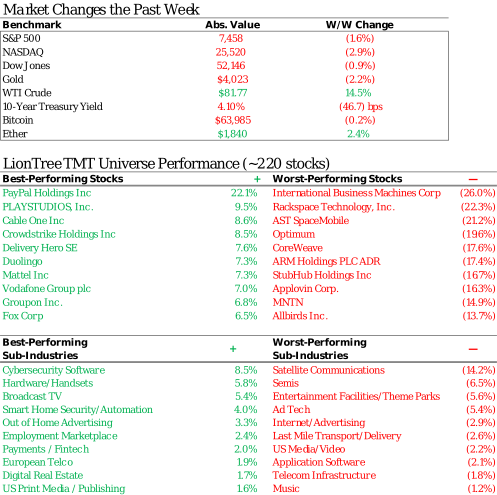
While bank earnings were the shining star this week (though a lot of good news was priced in), TMT didn’t do too well with Netflix trading off more than -7% on the back of its results (see Theme #1), and semis, memory and AI infrastructure taking it on the chin (SOX fell -10%, DRAM fell -16%). IBM’s losing about ¼ of its value post earnings (customer spend shifted to AI computing products) and SpaceX shares significantly breaking their IPO issue price ($135) closing Friday at $124 also stood out. Ramping geopolitical tensions didn’t help as well, though economically, the much lower than expected June CPI was a big focus.
All in all, a lot was going on and we focused on the below in this edition:
- The Netflix Playbook Remains The Same, But Investors Wanted More
- Uber’s Sweetened Delivery Hero Bid Underscores The Attractiveness Of The Cross Platform (Mobility + Delivery) Opportunity
- Lawsuits, Hardware Ambitions, Ad Monetization Questions, And Model Delays Shaped This Week in AI
- Data Center Push Back Hits A New High, While Growth & Compute Demand Continue To Soar
- Media Entertainment / Studios Take The Spotlight
- Sports Remains On A Tear Between Viewership & Franchise Values But Not All Sports Media Rights Go Up
- Can Sentiment On Traditional Connectivity Get Any Worse?
- Grab Bag: Google vs PINS, Publicis (+), Resale Ticket Price Caps/StubHub
I hope you have a nice weekend and enjoy the read.
Best,
Leslie
P.S. **Reminder about the Summer Edition of our quarterly LionTree’s Sector Insights & A Look Ahead deck, which is accompanied by a ~20-minute video narration. Both of which can be accessed HERE **

The Netflix Playbook Remains The Same, But Investors Wanted More
Q2 was a similar narrative for Netflix as in Q1, given that the Co delivered a give-or-take in-line qtr with lowered expectations, while the Q3 guidance fell below Street projections and 2026 was largely maintained (though in this case with a narrowed revenue range). Aside from the decelerating top-line growth implied in the Q3 targets, investors were also not thrilled that Co is reducing engagement related disclosures going forward.
The latter point adds fuel to the fire on general engagement concerns, which have been an overhang for NFLX shares. Mgmt continues to reiterate that viewing hours are only one component of measuring engagement, given that all hours are not created equally. With that said, mgmt highlighted that view hours grew +2% y/y in H1:26 (up +1.5bn hrs to 97bn+) which is a slight accel vs +1.5% in 2025, despite competition from the Winter Olympics and World Cup. They also dismissed press reports that viewership of Season 2s was dramatically falling off from Season 1s, and in fact indicated that the Season 2 falloff has “actually slightly improved this year relative to last year.”
Aside from that, live remains an increasingly important component of Netflix’s content portfolio, as does new formats like video podcasting and cloud gaming. The TF1 partnership, while early, is showing positive signs and it wouldn’t be surprising to see similar deals on this front looking ahead. Mgmt reiterated that content amortization remains front-end loaded and overall content spend will rise +~10% y/y this year. Lastly, the doubling of the ads business also remains on track.
See more color below on the takeaways we found most impactful, including some comments on AI usage in production.
-> Netflix share fell -7.3% in reaction to earnings (following falling almost -10% in response to Q1 results); The stock is now down -26.5% YTD
It Was Hard to Get Too Excited About Q2 Results ….
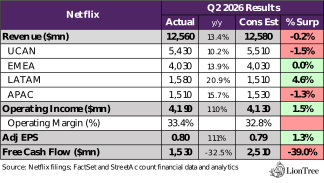
- Q2 revs were in-line and grew by +13.4% y/y (+12% y/y FXN): Growth was driven primarily by membership growth, pricing and incr’d ad rev, with DD rev growth across all regions
- UCAN disappointed: Grew +10.2% y/y and MISSED cons by -1.5% as Q2 only included a partial qtr impact from recent price changes (which “has gone well and as expected)
- LATAM outperformed: Grew +20.9% y/y and BEAT cons by +4.6%
- EMEA grew +13.9% y/y and was in-line with cons
- APAC grew +15.7% y/y and MISSED cons by -1.3%
- Op margin of 33.4% BEAT cons 32.8% and was ahead of the 32.6% guide given timing of expenses
- BUT op margin was down ~70bps y/y, reflecting higher content amortization growth in H1, which mgmt expects to moderate in H2
- Adj EPS BEAT cons by +1.3% and grew +11.1% y/y: Driven by op income beat and lower share count
- FCF MISSED cons by -39.0% ($1.53bn vs cons $2.51bn) and decr’d -32.5% y/y; Driven by higher cash tax payments due in part to the Warner Bros. termination fee
- Repurchases accelerated in Q2…$4.7bn buyback was the Co’s largest qtr of repurchases and the Co has $27.1bn left on the authorization
…AND Q3 Guidance Disappointed While The FY Guidance Was Narrowed
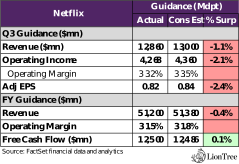
- Q3 guidance MISSED cons across rev / op income / adj EPS…and implies another qtr of decelerating FXN growth despite healthy membership / pricing / ads drivers
- Rev guide of $12.86bn MISSED cons by -1.1%…implies +17% y/y growth (+11% FXN) vs +13.4% in Q2
- Mgmt attributed the q/q decel to q/q choppiness b/c 2025 was more H2 weighted and emphasized “we manage to the full year”
- Op margin guide of 33.2% MISSED cons 33.5% BUT was up ~500bps y/y (vs 28.2% in Q3:25)
- EPS guide of $0.82 MISSED cons of $0.84
- Rev guide of $12.86bn MISSED cons by -1.1%…implies +17% y/y growth (+11% FXN) vs +13.4% in Q2
- 2026 guidance was NARROWED around the prior mid-pt
- The rev range NARROWED to $51.0-51.4bn (from $50.7-51.7bn) w/ the midpt held at ~$51.2bn (-0.4% vs cons)
- Implies +13-14% y/y growth (~12% FXN)
- Growth will be driven by membership growth, pricing and ad revs doubling to ~$3bn
- Op margin guidance of 31.5% was MAINTAINED
- Implies +20%+ annual op income growth vs 2025
- FCF guidance of ~$12.5bn was MAINTAINED
- Annual cash content spend-to-amortization remains at ~1.1x
- The rev range NARROWED to $51.0-51.4bn (from $50.7-51.7bn) w/ the midpt held at ~$51.2bn (-0.4% vs cons)
Mgmt Defends Its Engagement KPI BUT Also Reduces Going Forward Disclosure Cadence, Keeping The Debate Front & Center
- View hours grew +2% y/y in H1’26 (+1.5bn hrs, to 97bn+), a slight accel vs +1.5% in 2025…despite competition from the Winter Olympics and World Cup
- Mgmt reiterated again that regarding engagement it is not just about viewership hours as “all hours are not created equal”
- It is about quality, variety and quantity… different content types drive acquisition / retention / monetization
- Non-English content again drove >1/3 of viewing…standouts from Korea, Japan, Spain, and India
- Mgmt also pushed back on analyst concern that 2nd Season viewing is weakening vs 1st Season
- The Season 2 falloff has “actually slightly improved this year relative to last year”
- Mgmt said there will be “no changes in release strategies”
- At the same time mgmt highlighted its strong engagement stats, it announces that it is REDUCING its engagement disclosure cadence
- After this H1:26 What We Watched report, it will shift to annual (in Q1) publication starting in 2027
- Mgmt explained the change as keeping “the focus on our primary financial metrics – revenue and operating profit” …Co will keep weekly Top 10s and title-level hours
Content Spend Wil Grow +~10% Y/Y In 2026 BUT Content Amortization Remains Front End Loaded
- Content expense is expected to grow ~10% in 2026, above the 5-yr avg of +8% but below the decade avg of +14%
- Mgmt emphasized that spend grows slower than rev and the Co remains disciplined
- Content amortization growth is H1 weighted and should decelerate to mid-to-high SD-digit growth in H2
- Core TV / film remains the vast majority of programming spend and the Q2 slate breadth was strong
- Q3 slate includes 72 HOURS, The Last House, The Whisper Man, Call My Agent!, The Hawk, Outer Banks final season, Little House on the Prairie, Monster: The Lizzie Borden Story, The Gentlemen S2, The East Palace, The Doll and Lovesick
Live Events Are Becoming Increasingly More Important
- Live is a disproportionate acquisition / engagement driver…expected to be ~5% of content spend, but only ~1% of view hours in 2026 as mentioned above
- BUT 6 of the top 10 new member sign-up days over the past 5 yrs came from live events (Co has only run live since 2023)
- In comparison, animation series kids family TV is also ~ 5% of content spend, but will drive 8% of view hours
- Live strategy remains focused on “big breakthrough events” vs regular-season packages
- World Baseball Classic (WBC) in Japan became NFLX’s most-watched program ever in Japan and the biggest baseball streaming event ever
- WBC-driven members showed churn in-line with mgmt’s expectations despite slightly higher churn characteristics from event-driven acq
- Key upcoming live events –
- NFL: A week-one matchup in Q3, a Thanksgiving Eve game and NFL Christmas Gameday in Q4, and a final-week contest in Q1’27
- Mgmt said learnings from the last couple of yrs will make them “even more disciplined” in how they value the NFL and live generally
- MLB Home Run Derby and MLB Field of Dreams, Tyson Fury vs Anthony Joshua, Women’s World Cup, WWE
- NFL: A week-one matchup in Q3, a Thanksgiving Eve game and NFL Christmas Gameday in Q4, and a final-week contest in Q1’27
Expect The Co To Continue To Expand The Variety Of Its Content
- Early results of the TF1 partnership in France (launched last month) is “very promising”…TF1 view hours are growing weekly and Secret Story already hit the France Top 10
- The Co is open to similar types of deals but there is “nothing new to announce” now
- Video podcasts show incremental engagement (viewership over-indexes in the daytime + on mobile)
- The Co added Jay Shetty’s On Purpose, Kate & Oliver Hudson, plus publisher lifestyle content via Condé Nast, Hearst, and People (starting Aug) and iHeartMedia
- Creator and publisher relationships are becoming a bigger part of the engagement mix
- Successes include Danny Go!, Ms. Rachel, Mark Rober, Salish & Jordan Matter; annc’d collaborations include Stokes Twins, Alan Chikin Chow, Nick DiGiovanni and Mythical
- Publisher partnerships with Condé Nast, Hearst and People will bring lifestyle content to members in the US and several other countries beginning in August
- Cloud gaming is gaining traction…FIFA World Cup & Unhinged were the two most successful cloud-game debuts (June)…cloud MAUs are up +11x since Oct, w/ adoption ahead of the curve that they had for mobile games, and w/ even higher retention
- The Co is also seeing positive signals w/ kids games: Netflix Playground is posting +3x daily players since April, driving kids mobile-game engagement +600% y/y
- Mgmt think they are still scratching the surface: Cites a ~$150bn market opportunity (ex-China/Russia)
- Investment remains small relative to total content spend and will be calibrated to demonstrated member performance / business returns
Advertising Revs Remain On Track To Double To ~$3bn In 2026…ARM Gap Is A Key Monetization Opportunity
- Mgmt reiterated ad rev is on track to roughly double y/y to ~$3bn in 2026
- US upfront negotiations are “in advanced stages”…commitments are expected to close “in the next few weeks”
- There is strong advertiser interest in the Live lineup, i.e., see above
- Plus the breadth of entertainment titles
- Ad-tier ARM remains below Standard w/out Ads ARM, BUT the gap is narrowing and mgmt called it “near-term underrealized” rev growth
- The main levers are expanded demand sources, faster execution on Netflix Ads Suite, more ad products, more measurement, easier buying, higher fill rates and higher ads ARM
- Those unit monetization improvements are the “bulk of the opportunity” for the next few yrs
- Other key updates on the ads business
- Programmatic continues to expand beyond non-live inventory
- NFLX is extending programmatic access to Pause Ads and live inventory this summer, which should reduce manual buying friction and open inventory to a broader advertiser base
- The Co expanded AI-powered tools across the full ad lifecycle (planning, creative, campaign mgmt, optimization, reporting
- Programmatic continues to expand beyond non-live inventory
A Few Other Important Updates…
- First-half price changes (US, Mexico, Spain) “have gone well”…the impact is “consistent with prior price changes and our expectations,” w/ no change in receptivity this cycle
- Mgmt argues that US subs pay “the least per hour of viewing” vs comparable SVOD (“in some cases…2x per hour” for competitors)…the $8.99/mo ad plan framed as an “amazing entry point”
- Mgmt also said a free offering could make sense in some markets, BUT highlighted potential paid-tier cannibalization, offering differentiation, and scaled ads economics as a gating factor
- GenAI workflows have been used in roughly 300 titles in 2026, with the largest concentration in post-production…InterPositive is now working alongside iLine and the animation lab
- AI has enabled complex shots/sequences productions that they “would have left out”
- Example: the American Experiment doc had 17 min of AI-enhanced footage produced “twice as fast and at half the cost”
- Cost savings are “likely reinvested into more content” rather than cutting the cash content budget
- “It takes great artists to make something great…AI is not changing that”
- AI has enabled complex shots/sequences productions that they “would have left out”
- No interesting comments on M&A…the bar for large M&A remains “very high” and mgmt emphasized no change in strategic profile / capital allocation
Uber’s Sweetened Delivery Hero Bid Underscores The Attractiveness Of The Cross Platform (Mobility + Delivery) Opportunity
In a deal that has been a long-time in the making, Uber finally came to an agreement to buy the remaining shares of Delivery Hero that it does not own for €41.50/shr in cash (a ~34% premium to the 3-mo volume-weighted avg shr price). That price implies an enterprise value of $14.8bn. As a reminder, Uber was already Delivery Hero’s largest shareholder and had an earlier takeover approach at €33/shr which was rejected back in May, but this sweetened bid did the trick. The combination of the two companies would make it the largest food-delivery group outside of China’s Meituan, and this deal marks the latest consolidation of the food-delivery market, following DoorDash’s £2.9bn takeover of UK-based Deliveroo and Prosus’s €4.1bn acquisition of Just Eat Takeaway last year.
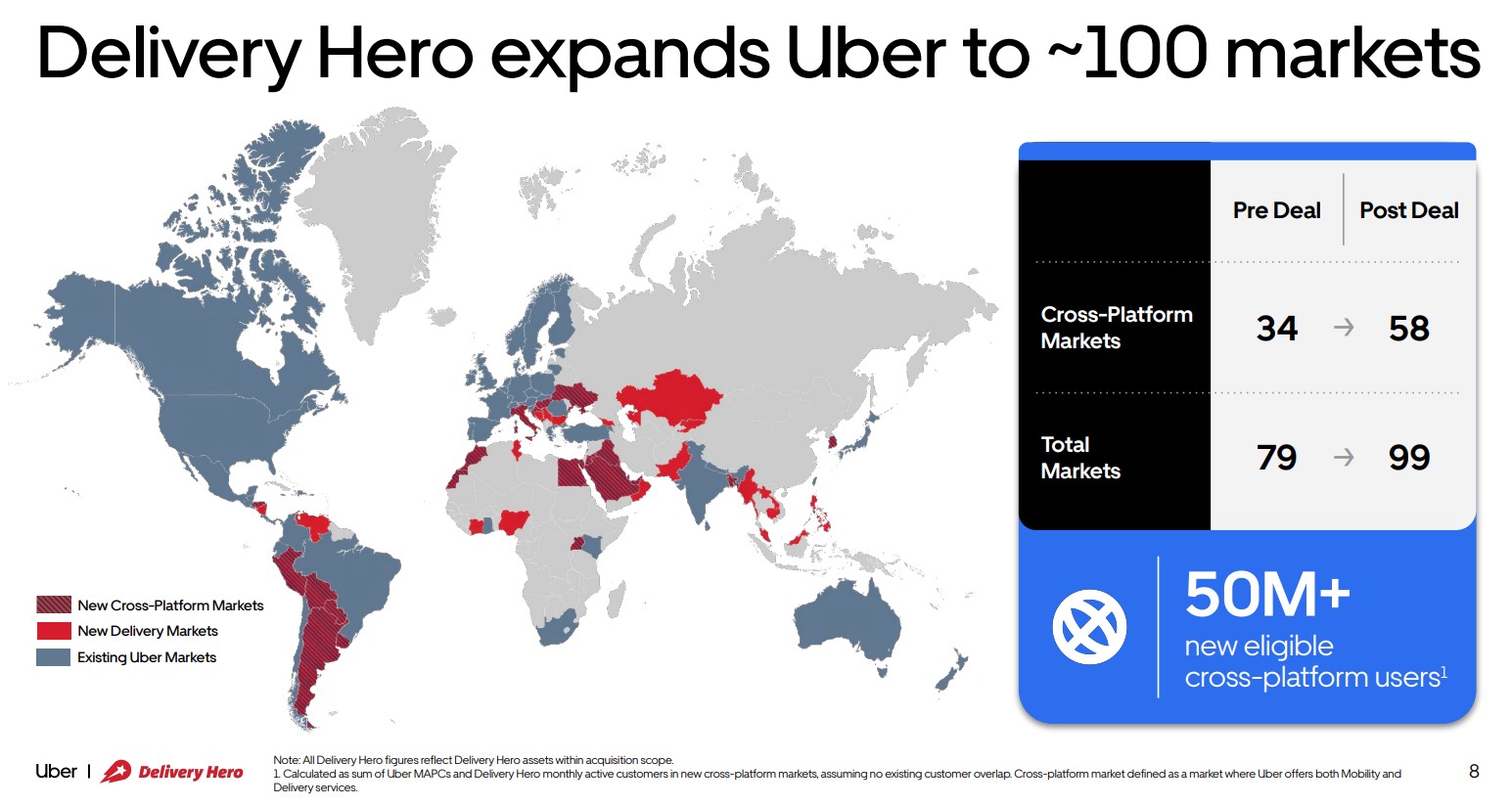
Concurrently, Delivery Hero is selling operations in 14 overlapping markets to SSW Partners for $1.6bn. If the deal closes (expected in H2:27), Uber would essentially double its geographic footprint to 99 mkts with combined total gross bookings of $236bn. The deal also nearly doubles the number of markets where Uber offers both mobility and delivery from 34 to 58, unlocking over 50mn new eligible cross-platform users. Annualized synergies are expected to exceed $1.2bn within 18 months, though those estimates are characterized as “very conservative” with high confidence they can be exceeded.
See below for more color on the deal and opportunities in cross-platform, advertising, tech integration, the regulatory path, the competitive landscape, and more (link/link/link/link).
-> Uber closed the day of the deal announcement up +0.8%, while Delivery Hero was up +0.9%; YTD, Uber is still down -11.3%, while Delivery Hero is up +68.2%
- The deal is not a huge surprise… Uber was already Delivery Hero’s largest shareholder and had an earlier takeover approach rejected in May, with press speculation that they were still trying to get a transaction done…
- Deal basics:
- Price/shr: €41.50/shr of cash
- A ~34% premium to Delivery Hero’s 3-mo volume-weighted avg shr price
- That also compares to Uber’s earlier proposal of €33/shr back in May
- Valn: Implied EV is $14.8bn (or $13.7bn adj for Uber’s prior stake purchases)
- Multiple: Implies ~8x EV / 2027E adj. EBITDA (incl. existing ownership and $1.2bn+ of run-rate synergies)
- Financing: Uber will fund the deal through existing cash on its balance sheet and new debt financing
- The Co is committed to maintaining its investment grade rating and to its capital allocation framework
- Gross leverage is expected to remain below 2x
- Timing: Expected to close in H2:27, pending regulatory approvals
- Price/shr: €41.50/shr of cash
- Alongside this transaction…Delivery Hero struck a separate $1.6bn deal to sell its biz in 14 countries to SSW Partners, a NY -based investment group
- The sale covers mkts where Uber Eats and Delivery Hero already overlap, and is subject to the larger takeover deal’s completion
- Synergy realization –
- Expect annualized synergies of $1.2bn+ w/in 18 months of closing, though mgmt. is “highly confident” they can do more than that
- The transaction is expected to be non-GAAP EPS accretive upon close, and HSD %age accretion by yr 3
- What are the biggest synergy drivers? Migrating Delivery Hero’s brands onto Uber’s global tech platform is the “first and biggest” synergy driver
- Despite Delivery Hero operating w/ a net take rate that’s higher than Uber’s, its margin output is “significantly” lower than Uber’s…and one of the biggest deltas is the cost of tech on a % on gross bookings basis at Delivery Hero relative to Uber’s
- Integration complexity is reduced b/c both Uber Eats and Deliver Hero (ex-Baemin in Korea) already run on common back-end architectures, making this a platform migration rather than a multi-yr re-platforming effort
- Addtl cost savings are expected “pretty quickly” from shared svs (cost of payment, support, insurance, etc.) b/c of the migration
- On the regulatory front, mgmt sees a “clear path to closing,” as the transaction has been structured to facilitate the regulatory process while preserving the strategic value of the combination
- The deal is fundamentally about expanding Uber into “highly complementary” mkts rather than combining two delivery bizs everywhere (i.e., no delivery-on-delivery overlap given the SSW carve-out of 14 overlap mkts)
- While the German takeover process is complex, it involves “well-defined steps” that have been “successfully navigated by many international acquirers before”
- “We’re quite confident in both the strategic merits of the transaction and then, of course, the path to completing it”
- Total mkts – the takeover will expand Uber’s mobility and delivery platform from 79 -> 99 mkts, creating a group with combined gross bookings of $236bn
- The deal would expand Uber Eats across Europe, the Middle East, Asia and Latin America
- The Co’s expanded cross-platform position unlocks “meaningful” topline synergies, with the deal growing the # of mkts where Uber offers both mobility and delivery from 34 -> 58 mkts
- “Cross-platform work is one of the highest return growth levers that we run on a global basis. There’s very little investment. We’ve already acquired these customers. All we’re doing is cross-selling each other”
- Unlocks 50mn+ new eligible cross-platform users: ~35mn from Delivery Hero’s delivery user base + ~15mn from Uber’s mobility-only users in those mkts
- Cross-platform users generate ~3x the gross bookings and profits vs single-product users, at >50% lower incremental acquisition cost vs paid channels
- Mgmt noted that rev synergy assumptions baked into the $1.2bn target are “very conservative” relative to the cross-platform oppty
- Uber will leverage Delivery Hero’s strength in advertising to build out its offering
- Delivery Hero has built out its ad biz to ~3% of GMV, which is higher than Uber’s current ad penetration as a % of gross bookings…mgmt views this as validation that Uber’s own ad biz has meaningful runway ahead
- “Advertising is a very, very high-margin product. So, we’re looking forward to hearing from them as to how they are building their advertising product as well”
- Delivery Hero has also expanded “pretty aggressively” into grocery and quick commerce, getting that biz to adj. EBITDA profitability on a margin basis…Uber is “quite excited to learn from that”
- The deal will improve Uber’s competitive positioning but “recognize that’s going to take a lot of work to get there”
- They are operating in a “super competitive” mkt, but noted that ~95%+ of competitors are pure-play mobility or pure-play delivery businesses
- Uber’s cross-platform capabilities, global tech scale, and Uber One membership program give it the ability to “thrive in highly competitive markets” and generally grow category position while continuing to improve margins
- “We respect our competition, and we’re always kind of paranoid about them”
- Uber will retain Delivery Hero’s HQ and keep its workforce in Berlin until at least 2029 + the Co earmarked €2bn for investments in Germany over the next 5 yrs
- Delivery Hero mgmt and Supervisory Boards “unanimously” welcome and support the transaction and intend to recommend that shareholders tender into the offer
- Uber already holds a direct stake of 24.99% in Delivery Hero and has exposure to an additional 11.84% through financial contracts
- Prosus, Delivery Hero’s 2nd-largest shareholder, also said it would sell its remaining 16.8% stake in the Co as part of the takeover
Source: Uber
Lawsuits, Hardware Ambitions, Ad Monetization Questions, And Model Delays Shaped This Week in AI
AI news continues to move at an incredibly fast pace, with seemingly every week bringing new model launches, product announcements, funding rounds, and other major developments. Late last week, a lawsuit was added to that mix as Apple sued OpenAI, accusing the Co of stealing trade secrets related to its upcoming AI products. The first of those products is expected to be a movable, screenless AI companion for the home that becomes increasingly personalized over time and proactively assists users based on their habits and surroundings.
Apple was not the only one questioning OpenAI this week. eMarketer cast doubt on the Co’s long-term advertising projections, estimating the entire US market for standalone chatbot advertising will reach just $5.4bn by 2030, well below OpenAI’s goal of generating $100bn in annual ad revenue over the same period. Elsewhere, Google has delayed the launch of Gemini 3.5 as it works to improve the model’s coding capabilities, while over in China, Apple Intelligence finally received regulatory approval and DeepSeek continues to build momentum with annualized rev touching $500mn as it reportedly prepares to go down the IPO route.
See below for what we thought were the most incremental need-to-know updates in the AI space.
Apple Sues OpenAI, Accusing It Of Stealing Trade Secrets To Create Its Upcoming AI Gadgets (link/link/link)
- Late last week (Friday), Apple filed a lawsuit against OpenAI in which it alleged that its former employees have stolen trade secrets “for the benefit of OpenAI”
- Apple alleges that OpenAI asked former Apple employees, and even prospective recruits, to bring information about unreleased products
- Apple also claims that OpenAI instructed hires on how to evade its security procedures
- Apple says it first raised concerns with OpenAI directly in February, asking the Co to investigate and address the issue; OpenAI, however, never responded
- What was OpenAI’s response to the lawsuit?
- On Friday, OpenAI issued an initial response…rejecting the accusation and saying it had no interest in trade secrets belonging to other Cos and was focused on building its own new technology
- Then in a statement on Tuesday… “While we take these allegations seriously, we’re not aware of any evidence that this complaint has merit…we believe in fair competition and allowing people the freedom to work wherever they choose, and we’re focused on building innovative technology that empowers people everywhere”
- As part of this process, Apple has reportedly sent legal preservation letters to ~40 of its former employees now working at OpenAI
- A preservation letter is a formal written notice sent to a person or organization telling them to preserve documents, records, and other evidence that may be relevant to a legal dispute
- For context, OpenAI has hired more than 400 other people from Apple, according to the lawsuit
- In some instances, OpenAI poached so heavily from engineering groups, particularly within the iPhone product design organization, that Apple was forced to rebuild parts of those teams
- Apple is seeking monetary damages and an order requiring OpenAI to halt the alleged conduct and destroy any proprietary materials
- That said, legal remedies could take months or years to materialize
On The Back Of The Suit…Reports Are Speculating That OpenAI’s First Device Will Be A Movable, Screenless Speaker Built As An AI Companion (link)
- In the immediate aftermath of the Apple filing, OpenAI reportedly believe it is on track to announce its first hardware product this yr and release it in 2027 BUT that could still change as OpenAI digests Apple’s claims
- The product (which is still under development) is meant to serve as a humanlike AI companion that lives in the home
- It will help control smart-home appliances, play media, answer questions, respond to messages and tap into the range of capabilities offered by OpenAI’s ChatGPT
- The machine is believed to be able to draw on personal information, such as emails, to better understand its owner
- Though the new product resembles a speaker, OpenAI reportedly internally describes it as the first of its kind…a computer built for AI to help make busy people more productive
- It includes a camera and other sensors that help it understand a user’s surroundings and context, as well as advanced AI models beyond those available on conventional smart speakers
- OpenAI reportedly envisions the device anticipating needs, surfacing information proactively and serving as an expert on its user
- OpenAI is said to believe that the product’s defining feature will be its personality and ability to connect with users
- The speaker incorporates mechanical elements that can move on their own, creating a sense that it is alive and not just an object responding to commands
- The device’s communication abilities will rely on a more advanced version of the ChatGPT Voice Mode, GPT-Live, that OpenAI rolled out this month, and is designed to act more like a human
- It can listen and talk at the same time, adapt more naturally during conversations, and quickly process information
- The speaker is designed to stay in the home, though it will be easy to move around the house
- The device is said to include a rechargeable battery, allowing it to be carried from room to room throughout the day
-> Sonos’ stock fell -9.3% on the day of the report
eMarketer Says OpenAI’s Ad Targets Are Way Ahead Of Where The Market Actually Is (link/link)
- OpenAI has projected that ChatGPT ads could generate $2.5bn in rev this year and $100bn annually by 2030…
- …BUT eMarketer is far more skeptical, estimating that the entire US mkt for standalone chatbot advertising will generate <$1bn in 2026 and grow to just $5.41bn by 2030
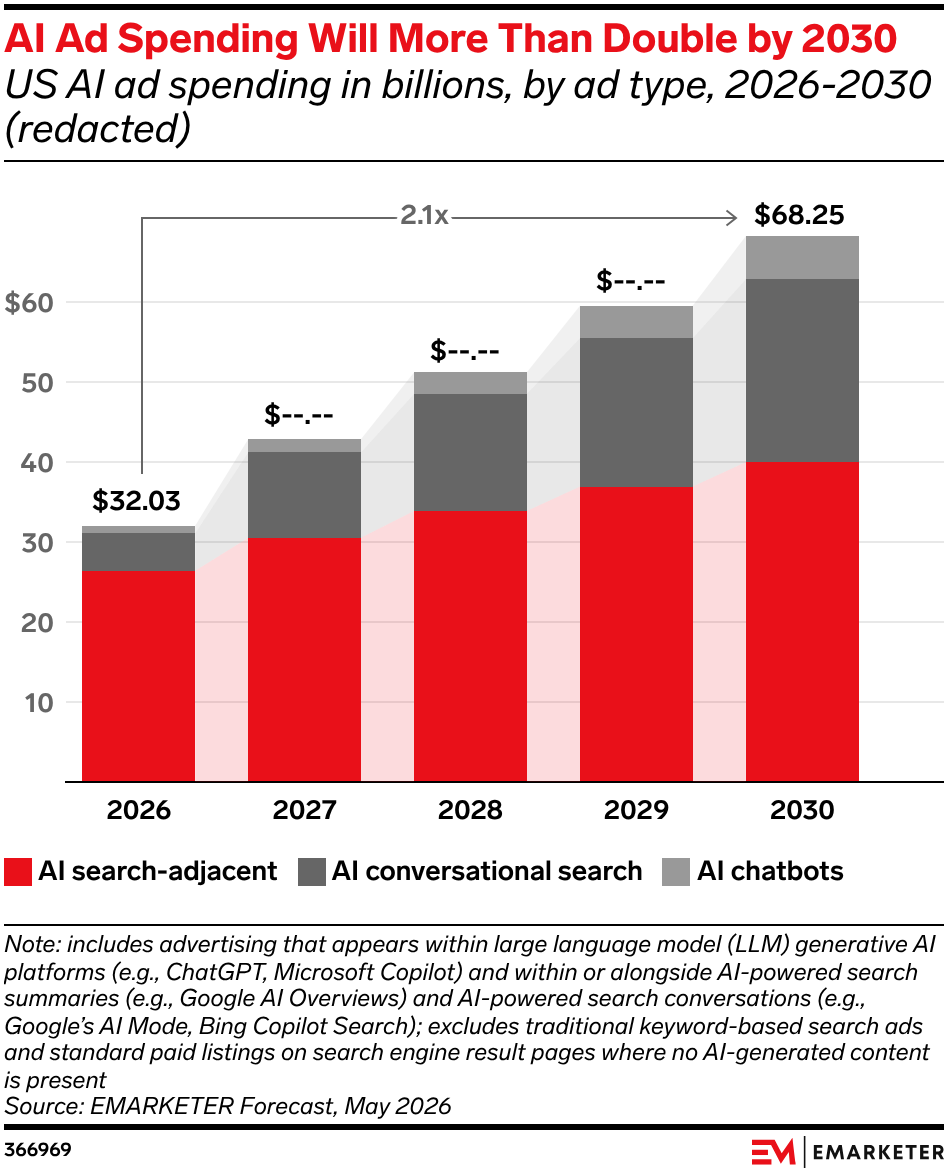
- More broadly, total AI ad spending (not just chatbots) will more than double over the next 5 yrs from $32.03bn in 2026 -> $68.25bn in 2030
- Even if OpenAI captured every advertising dollar in that mkt, it would still be far below the Co’s stated goal
- While AI search is growing quickly, most AI ad spending still depends on traditional search formats
- Conversational search ads (i.e., ads inside search engine-based chatbots like Google AI Mode) are scaling faster than ads on standalone chatbots (i.e., ChatGPT or Gemini), which is expected to continue to face pressure on inventory, pricing, and advertiser returns
- Most AI advertising spending is expected to come from ads placed alongside AI-generated content rather than inside AI chatbots or conversations
- 80%+ of AI ad spend in 2026 will come from placements such as search ads shown next to Google AI Overviews
Source: eMarketer
A Slowdown In The Model Race…Google’s Gemini 3.5 Is Behind Schedule
- Google delays Gemini 3.5 Pro AI model release (link/link)
- Google is reportedly months behind schedule: The model was due to be released in June, Alphabet CEO Sundar Pichai had said during Google’s annual I/O developer conference in May
- The big bottleneck? It’s coding abilities: Engineers are reportedly still working to close a coding performance gap against competitors like OpenAI and Anthropic
- Both OpenAI and Meta recently released new models that further outpace Google’s current offerings in AI for writing code
- Organizational sprawl is said to be a root cause: Separate teams within DeepMind, Cloud, Android, and Search are each building AI coding tools in parallel, resulting in duplicated work and slower decision-making
-> Google ended the day down -4.4% on the back of the report
Over In China…Apple Intelligence Finally Gets Approval + DeepSeek Momentum Continues To Accelerate
- Apple receives long-awaited govt approval to roll out Apple Intelligence in China, with Alibaba and Baidu as partners (link/link)
- Apple intro’d its AI features 2 yrs ago, but the features have been stuck in the Chinese approval process + development required Apple to work with outside partners, which in Apple’s case was Alibaba and Baidu
- China requires companies to register LLMs and genAI svs with regulators before making them available to the public
- The Cyberspace Administration of China included Apple’s genAI on a list of newly approved providers, alongside recent offerings from local Cos like Huawei and Xiaomi
- The version of Apple Intelligence for the China mkt was modified to include Alibaba technology as a filter of sorts that works with the Chinese govt to approve on-going LLM updates
- Alibaba said in a statement that its Qwen model will be integrated into Apple Intelligence across Apple’s iPhone, iPad, Mac and Vision Pro operating systems in China
- The US version of the features taps into svs from Google and OpenAI for search, while the Chinese version works with Baidu
- Apple intro’d its AI features 2 yrs ago, but the features have been stuck in the Chinese approval process + development required Apple to work with outside partners, which in Apple’s case was Alibaba and Baidu
-> The news sent Alibaba’s ADRs up as much as +7.9% after mkts opened in New York, while Baidu’s ADRs gained as much as 4%
- DeepSeek’s annualized rev reportedly reached b/w $400-500mn, as the Co reportedly looks to raise a new round ahead of going public (link/link/link)
- The growth has been driven largely by sales of cloud-based access to its models through APIs
- This comes as the Co seeks to raise its second funding round of 50bn yuan, or ~$7.4bn, at a valn of 500bn yuan, or ~$74bn
- That would value DeepSeek at ~148x its annualized rev
- Comes just weeks after the Co closed a round that raised $7bn at a ~$50bn valuation
- DeepSeek has reportedly maintained gross margins of 70% to 80% on access to its V4 flagship model despite charging less than OpenAI and Anthropic
- This is because DeepSeek manages to keep the cost of running its models low due to improvements in its computing infrastructure that allow it to process more AI queries using fewer chips
- On the road to going public? The Co is said to have hired investment banks to help it prepare an IPO in Shanghai’s tech-focused Star Market; The Co reportedly aims to file the listing application this yr and go public next yr
Data Center Push Back Hits A New High, While Growth & Compute Demand Continue To Soar
We have been getting increasingly concerned about the growing political and consumer push-back and back-lash regarding the massive scale and pace of data center builds given impacts to power grids and water resources, among other complaints. This week brought with it a major update on this front given New York will now be the 1st state to pause permitting for new large-scale data centers until new policy guardrails are put in place. This headlined at the same time that news hit that Meta nearly doubled its planned investment in its Louisiana data center project from $27bn to more than $50bn. To redirect concerns, the Co highlighted the economic benefits the project is bringing to the region but big picture, we would expect to see this heightened political and consumer sensitivity persist
At the same time, reported multi-billion dollar compute leasing discussions between Meta and Anthropic, as well as SpaceX and the U.S. Department of Defense, underscore that demand for AI compute is showing no signs of slowing down anytime soon. Morgan Stanley also raised its capex forecasts for the hyperscalers, arguing that the next phase of the AI race will be defined less by who builds the most capacity and more by who can monetize it.
See below for more of what we found most important on this front this week.
New York Imposes The Country’s First Statewide Moratorium On Data Centers…But Not Without Presidential Backlash (link/link/link)
- The order will pause state permitting for new large data centers (w/ capacities greater than 50 megawatts) for up to one yr + direct state regulators to create standards that address environmental impacts, energy demand, water usage and other factors
- The moratorium will be lifted once the govt is able to execute on a policy that sees AI Cos contributing some of the growing energy bills
- “We’re going to explore having hyperscale data centers pay into a larger fund to support our grid statewide. We expect this process, which we already launched, to be completed within the year. Once this policy is in place, the moratorium will be reviewed and lifted,” NY Gov. Kathy Hochul said
- Other key focuses of the plan –
- Make sure data centers are only built “in places that want them,” so they will not be exempt from local zoning and approvals
- Include labor issues in discussions with data centers hoping to build in New York…”projects can include wage standards and labor agreements, and prioritize local hiring”
- Include a proposal to end tax subsidies for data centers
- “As data center development threatens to hike up utility bills, deplete our natural resources, and create uncertainty for New Yorkers, it’s my responsibility to take action and lead,” Hochul said in a statement
- But not everyone is in support…President Trump in a Truth Social post said that the state should change its policy “IMMEDIATELY” …
- “One of the biggest Driving Forces in the Future for Jobs, are Data Centers,” he wrote. “They are big, strong, bold, and Money Machines for the State in which they are built… New York State has made a terrible decision”
- …to which Hochul responded with her own post on X – “We hit pause because the communities powering AI should share in its success. Maybe that’s a novel concept in Washington. We call it doing our job”
-> As a reminder, Sen. Bernie Sanders (I-Vt.) and Rep. Alexandria Ocasio-Cortez (D-NY) brough the idea of a data center moratorium into the national spotlight earlier this year with legislation that would have paused new projects nationwide; The Sanders-AOC proposal went even further and would lift the ban only after Congress passed sweeping AI safety legislation covering issues from civil rights to consumer protection (link)
- Moratoriums have been proposed in at least a dozen states but have not gotten far, though some counties and municipalities have imposed their own temporary bans
- Earlier this year, Maine seemed poised to establish a similar moratorium, but the measure was vetoed by the state’s Democratic Gov. Janet Mills because it would have blocked a proposed data center in a town that has struggled following the closure of a local mill
As New York Slows Data Center Development, Meta Accelerates Its Louisiana Buildout
- Meta is scaling its Northeast Louisiana data center project to 5 GW of compute capacity, with costs now exceeding $50bn (link/link/link)
- That’s higher than the $27bn that was first shared in Oct, when Meta and Blue Owl Capital formed a JV to help with the build-out and mgmt of the facility, originally planned as a 2 GW data center
- The site will encompass more than 3,200 acres, which is more than 4x larger than New York City’s Central Park
- Meta highlights “life-changing” returns for teachers, local bizs and students in the area –
- Since breaking ground in Dec 2024, local Louisiana businesses have received $1.6bn+ in contracts from Meta
- With this expansion, Meta plans to invest $1bn+ in local infrastructure improvements, including roads, water and wastewater systems.
- Teachers in Richland Parish recently received annual bonuses of up to $50,000, a +400% increase from the previous yr, thanks to incr’d tax revs from the Co’s data center project.
- Also the Co is donating $5mn to Louisiana Delta Community College to create scholarships for residents training for data center jobs
- Meta pays the full costs of the energy, water, and related infrastructure the data center uses so consumers aren’t paying the cost
- Meta currently has 32 data centers across the globe in operation or under construction, 28 of which are in the US
-> Meta’s shares fell -1.9% on the day of announcement
Demand for AI Compute Continues to Accelerate as Meta and SpaceX Reportedly Explore Multi-Billion Dollar Leasing Deals
- Meta is said to be in talks to lease $10bn in computing power to Anthropic, per the New York Times (link/link)
- Anthropic is reportedly in early discussions to lease computing power from Meta, potentially worth as much as ~$10bn over 2 yrs
- Anthropic, which reportedly proposed the deal in June, would pay Meta in monthly increments over the 2-yr term and the Cos would be allowed to opt out of any agreement early
- For Meta, a deal would open a new line of biz for the Co, though the talks are in early stages and may not result in an agreement
- Anthropic made a similar deal w/ SpaceX back in May… under that agreement, Anthropic is paying SpaceX $45bn over 3 yrs (or $1.25bn/mo) for computing power; The deal included similar provisions that let either Co exit the agreement early
- SpaceX is reportedly in talks w/ the Defense Department about providing computing power worth billions of dollars for running AI models (link/link)
- The talks are reportedly centered around providing the agency with access to data-center capacity worth billions of dollars for running AI models
- The talks are ongoing and could fall apart
- The deal is similar to previous agreements SpaceX has reached with Google and Anthropic
- A Defense Dept agreement would mark the latest deal between SpaceX and the Pentagon, which relies on the Co for launching rockets and managing satellites for communications and missile tracking
Morgan Stanley Raises Hyperscaler CapEx Forecasts as the AI Race Shifts From Building Compute to Monetizing Capacity (link/link)
- Morgan Stanley raised its CapEx forecasts for the five major hyperscale cloud operators, increasing its 2027 estimate by +9% to ~$1.2 trillion and its 2028 estimate by +10% to ~$1.4 trillion
- Includes Meta, Amazon, Microsoft, Google, and SpaceX
- What drove the upward revision? Soaring hardware costs and data center construction delays
- Estimates that overall GPU-related costs have risen by ~20%
- Data centers can now take up to three years to become operational + community opposition and political uncertainty ahead of the 2028 U.S. election is prompting hyperscalers to break ground early, which is accelerating the front-loading of CapEx
- The available computing power of the five major cloud hyperscalers is predicted to grow from ~30 GW in 2025 to ~116.6 GW in 2028
- The AI investment story is evolving…
- In 2025, the market was most concerned with who could secure GPUs
- In 2026, it began to focus on who could build data centers
- By 2027 to 2028, what will truly determine valuations is who can sell that capacity, converting it into advertising, cloud services, API, and subscription revenue
- Select Morgan Stanley company-specific callouts / views –
- Meta has the most underappreciated AI monetization story
- investors are focusing too heavily on Meta’s CapEx and underestimating its ability to monetize AI through advertising and lower-priced model APIs
- Even a small allocation of computing capacity to APIs could create a meaningful new rev stream
- Amazon AWS has the clearest near-term monetization path
- Strong cloud demand, a growing backlog, and large contracts from AI companies could support rev growth
- Higher AWS revenue may help offset the depreciation and capital costs tied to increased spending
- Google has strong technology but near-term capacity constraints
- Google is currently in a state of tight computing capacity, evidenced by its recent computing power lease agreement with SpaceX
- The computing bottleneck could drag down its near-term rev growth or the pace of new product launches, a risk that is relatively higher than for Meta and Amazon
- Also, the release schedule for Google’s next-generation model, Gemini 3.5, has already fallen behind the company’s original plans outlined at its I/O developer conference
- Meta has the most underappreciated AI monetization story
Media Entertainment / Studios Take The Spotlight
The studio and media entertainment sector saw a flurry of activity this week spanning M&A speculation, box office milestones, major franchise marketing moves, policy lobbying, and analyst calls on streaming strategy. Details are below.
More Studio M&A?
- Lionsgate is reportedly exploring a sale, w/ takeover interest from Bolloré and Banijay (link/link): Lionsgate apparently is working w/ an investment bank to evaluate inbound approaches
- Background on these interested parties –
- France’s Bolloré Group’s interest is driven by a desire to bolster the production capabilities of Canal+, the pay-TV Co in which it holds a controlling interest
- Banijay Group (TV production Co behind “Big Brother” and “Survivor”) earlier this year completed its merger with All3Media and is reported to be among suitors that have considered a bid
- Netflix last month denied acquisition interest
- It is good timing w/ Lionsgate’s Michael hitting $1bn in global box office (see below), which is its 1st
- And surpassed The Hunger Games: Catching Fire ($865mn)
- Background on these interested parties –
-> Lionsgate shrs rallied as much as +10% on the back of the news and has skyrocketed by +52% YTD
This Week Was Marked By Both Booms & Busts In The Global Box Office
- Michael became the first $1bn biopic in box office history (link/link/link/link): Michael global box office reached $371.8mn domestically and $629.8mn overseas after 12 weekends in release
- The film surpassed other biopics…
- Bohemian Rhapsody ($911mn)
- Oppenheimer ($975.8mn)
- It is the 2nd film to reach the $1bn mark this year (1st being The Super Mario Galaxy Movie at $1.008bn)
- Toy Story 5, currently at $879mn, is expected to join that club soon
- The film surpassed other biopics…
- But Disney’s live action “Moana” opened more softly than hoped (link/link)
- Moana opened to $95.1mn worldwide ($52mn international, $43.1mn domestic)
- It was described as underperforming with “very low openings”
- Releasing too close to Moana 2 (Thanksgiving 2024) was cited as a culprit
- Deadline ests the film is poised to lose between $100–$125mn (assuming the movie hits $250mn global box office)
- Moana opened to $95.1mn worldwide ($52mn international, $43.1mn domestic)
- Key films to watch…(link/link)
- Disney’s Avengers: Doomsday…domestic premium tickets to go on sale July 20th
- This is 5 months ahead of its December 18 theatrical release
- Tickets will be for Infinity Vision theaters (Disney’s premium large-format certification created in response to Warner Bros. locking down IMAX screens for Dune: Part Three, which opens the same day)
- Disney’s Avengers: Doomsday…domestic premium tickets to go on sale July 20th
- Amazon MGM Studio’s Spaceballs: The New One’s theatrical release was confirmed to be April 2027: This would be the 40th anniversary of the original 1987 film
A Push For Disney To Exit Streaming
- Wells Fargo this week moved Disney’s stock when it argued that the Co should exit the DTC streaming business and return to a pure content-licensing model (link/link/link)
- Why exit streaming? Wells Fargo analysts argues that Disney is structurally unable to compete with high-volume streamers like Netflix and YouTube and that the rest of their businesses wouldn’t suffer if their library was on a competing global streamer
- They est that Disney could generate $15bn+ in annual licensing revenue if it focused purely on content vs. distribution
- Licensing could add ~10% to EPS by fiscal 2028
- A shift of this nature could boost the stock by ~40%
- In the meantime, while the analyst maintained their Overweight rating, but cut their PT from $146->$125/shr
-> Disney shares are down by ~50% over the past 5 yrs
Sports Remains On A Tear Between Viewership & Franchise Values But Not All Sports Media Rights Go Up
Following last week’s US vs Belgium Round of 16 blockbuster viewership (~33mn English language viewers on Fox’s telecast, the most watched soccer telecast in US history), the World Cup ratings machine kept on giving this week with Fox’s back-to-back record semifinal telecasts (Argentina vs England at 15.1mn, Spain vs France at 11.5mn). Both were more than double the prior English language semifinal record. We are looking forward to this Sunday’s Argentina vs. Spain final match!
An interesting, related survey published by Samsung Ads this week shows that streaming has overtaken cable for World Cup viewing for the 1st time at a major sports event (56% vs 37%, respectively) which is important as leagues and sports rights holders assess the best distribution channels to maximize value. Another theme in sports this week was what seems like forever escalating value of sports teams. This past Saturday, a Khosla-led group agreed to pay $9.6bn for the Seahawks, which is the highest price ever for an NFL franchise. Rogers also is now taking full ownership of MLSE at an implied $17.4bn valuation, up 39% from just last year. With that said, not all sports assets are inflating. The Bundesliga’s new US deal with Versant came in at $20mn/yr per press reports, which is a 33% haircut from what ESPN was paying before. The league is swapping dollars for distribution by moving to free, ad-supported streaming on Fandango in a bid to “expand accessibility.”
Overall, live sports remains the most valuable content in media, but there is a gap between tier 1 and tier 2 properties. Below is more detail on all of these developments this week.
The World Cup Continues To Break Viewership Records! & WC Streaming Viewing Surpasses Cable…
- FOX aired the 2 largest English-language World Cup semifinal telecasts in US history in consecutive days (link/link)
- Wednesday – Argentina vs England: Avg’d 1mn viewers on Fox
- It was the most-watched FIFA Men’s World Cup semifinal ever in English-language US TV
- Peak viewership was 22.2mn from 4:45–5 p.m. ET
- Tuesday – Spain vs France: Avg’d 5mn viewers on Fox
- It held the semifinal record for ~24 hours before Argentina/England topped it
- For context…the prior English-language semifinal record was France vs Morocco in Dec 2022 at ~6.6mn on Fox hence both 2026 semis more than doubled that
- But viewership for Weds’ match up was still a far cry from Fox’s US vs Belgium Round of 16 at ~33mn viewers, which is the most-watched soccer telecast in US history
- Wednesday – Argentina vs England: Avg’d 1mn viewers on Fox
- A Samsung Ads survey found streaming topped cable for World Cup viewing for the 1st time at a major sports event: 56% streaming vs. 37% cable (link)
- Of streamers:
- 42% used an existing subscription
- 14% signed up for a new svs specifically for the tournament
- Among new sign-ups – most joined via free trial or lapsed-account reactivation, not fresh paid plans
- YouTube TV led, accounting for 35%
- Peacock accounted for 34%
- Hulu + Live TV accounted for 31%
- For actual watch time during the tournament –
- Peacock accounted for 41%
- Hulu + Live TV accounted for 34%
- YouTube TV accounted for 29%
- Smart TVs were the dominant device at 61%; streaming sticks (Roku, Fire Stick) were a distant second at 17%
- The churn risk…
- 56% of new subscribers say they plan to cancel once the tournament ends
- 44% intend to stay
- Of streamers:
NFL Franchise Values Hit A New Record!
- On Saturday, a Khosla-led group agreed to buy the Seahawks for a reported $9.612bn which would be the highest price ever for an NFL franchise, surpassing the Commander’s 2023 sales of $6.05bn in 2023 (link/link)
- This also represents the 2nd largest sports franchise transition in N. America (#1 is the $10bn LA Lakers deal in 2025)
- Paul Allen purchased the Seahawks in 1997 for only $194mn and his estate will give all sale proceeds to charity
- This follows the week prior when Rogers Communications annc’d that it is buying the remaining 25% ownership stake in Maple Leaf Sports & Entertainment (MLSE) from Kilmer Sports as it previously telegraphed it would do; Rogers will now own 100%…the deal size is C$4.35bn (link/link)
- What does MLSE own? The NHL’s Maple Leafs, NBA’s Raptors, MLS’ Toronto FC, Toronto Argonauts
- Rogers other sports ownerships/partnerships:
- Ownerships in the Toronto Blue Jays, Rogers Centre & Sportsnet (the #1 sports media brand in Canada)
- Strategic partnerships w/ the Vancouver Canucks, Edmonton Oilers, Calgary Flames, the NHL, the NBA, MLB and Live Nation
- MLSE’s value has materially gone up:
- Last year, Rogers purchased BCE’s 37.5% stake in MLSE for C$4.7bn (took Rogers ownership to 75%)
- This deal w/ Kilmer implies a total value for MLSE of C$17.4bn, a 39% increase from the $12.5bn valn implied w/ Rogers’ acq of BCE’s stake
- The transaction should close in Q4
But Sports Rights Don’t Only Go Up…
- Versant (NBCU spinoff) this week acq’d exclusive English-language US rights to the Bundesliga for 5 seasons (2026/27–2030/31) (link/link/link)
- The total $s paid declined vs the last deal
- Value = $100mn total ($20mn/yr), down from the $30mn/yr ESPN was paying under the prior 6-season deal
- What’s included?
- 30+ matches/season on linear USA Network
- The remaining 250+ matches streamed free (ad-supported) on Fandango, which has never carried live sports before
- Why accept a lower price? The Bundesliga accepted a ~33% annual fee haircut in exchange for broader reach, moving from behind the ESPN+ paywall to a free AVOD platform reaching 80mn+ US homes
- The priority was “expanding accessibility” while delivering “strong financial results.”
- For Versant, the deal extends USA Network’s growing live sports portfolio (already has EPL, WNBA, college sports, golf) and positions Fandango as a potential live-sports AVOD competitor
- The total $s paid declined vs the last deal
Can Sentiment On Traditional Connectivity Get Any Worse?
It was a rough week for US wireless/cable incumbents, w/ legacy plan shake-ups, another round of headcount cuts, and some Wall Street analysts voicing concerns about SpaceX’s Starlink ambitions compounding sector pressure. A lot of negativity is certainly priced into the stocks, especially for cable. Earnings reports for the Connectivity sector next week will be the next potential catalyst for the group and all of the below will be in focus.
-> For the week, CHTR was up +0.5%, CMCSA +0.9%, TMUS +2.6%, AT&T +3.2%, VZ +3.5%, while SPCX was down -14.7%
- Following speculation earlier in the week that job cuts were on the way (per Barron’s, confirmed by an employee familiar w/ the plans), Verizon officially annc’d a 3rd wave of layoffs on Thursday (link/link/link/link):
- Cuts impact a total of ~3k employees –
- ~500 corporate employees and selling 274 company-owned retail stores to franchise operators (~2,500 retail employees affected)
- The store sales become effective Aug. 16, leaving Verizon w/ ~1,000 Co-owned stores
- This follows the sale of 179 corporate-owned stores to franchise operators in Nov 2025
- The cuts are reportedly part of CEO Dan Schulman’s target to slash $5bn in 2026 opex
- But previous estimates suggested that 8-10k employee cuts might be needed to hit the $5bn target
- Other areas of opex optimization beyond headcount include: vendor optimization, software streamlining, real estate footprint reduction, and AI deployment in customer service
- These cuts follow the record 13k-employee redundancy in Nov 2025 (~13% of workforce) and a smaller round of several hundred cuts in May 2026
- VZ entered 2026 w/ ~89.9k employees
- Cuts impact a total of ~3k employees –
- Wall Street’s Bernstein analyst (Laurent Yoon) weighed on Telco/Cable this week with PT cuts across the group on Monday, citing valn risk from SpaceX’s Starlink ambition (link/link/link/link)
- What were the PT changes?
- VZ PT from $49->$44 (Mkt Perform)
- AT&T PT from $30->$25 (Outperform)
- T-Mobile PT from $245->$220 (Mkt Perform)
- Charter PT from $210->$170 (Mkt Perform)
- Comcast PT from $32->$28 (Mkt Perform)
- This came on the back of recent market concerns about Starlink Mobile potentially pursuing a DTC Starlink mobile service and exploring building its own terrestrial wireless network in the U.S
- SpaceX holds 65 MHz of exclusive-use, nationwide mid-band spectrum (AWS-4, AWS-3, H-Block) via the FCC-approved $17bn EchoStar acq (May 2026); Licenses fully transfer in late 2027
- BUT all 3 major carriers have publicly or reportedly said they would decline to offer SpaceX an MVNO deal
- Bernstein’s view: Starlink is unlikely to materially disrupt incumbents in the near-term, but adds another competitor to an already saturated market and introduces persistent uncertainty that compresses multiples
- Oher Wall Street views:
- MoffetNathanson’s Craig Moffett argues that physics prevents meaningful suburban penetration
- Wolfe Research’s Peter Supino called Starlink “a comet bearing down on broadband incumbents”
- Morgan Stanley’s Sean Diffley said “we believe the perceived risk of Starlink Mobile disrupting the US Wireless industry is greater than the actual risk” and would lean more on partnerships vs building its own network.
- What were the PT changes?
-> This follows Wells Fargo’s Steven Cahall last week initiating on the US wireless industry with a cautious outlook, flagging Starlink as a growing competitive threat to FWA and postpaid account growth
- T-Mobile makes changes to some legacy plans (link/link/link)
- What plans are being retired?
- Simple Choice
- ONE/ONE Plus
- Magenta
- And grandfathered Sprint plans
- What plans are these subscribers being transitioned into?
- Experience-branded rate plans
- Users will keep their current benefits but will also gain addtl perks & improved service experiences
- T-Mobile is also offering a 5-year price guarantee on the new plans
- But the push back is that it means higher prices for some of these long-time loyal subscribers
- “A very big portion” of customers will NOT see a price change
- But others will face increases of ~$4–6/line/month (more or less) but still pay below “rack rate” for the equivalent current plan
- For T-Mob, this move simplifies the back-end, which should accelerate feature rollouts and reduce support costs over time
- It consolidates ~1,100 legacy billing codes down to <100
- Separately, customers are reporting online that the T-Mobile Kickback program, which provides credit if you use less than 2GB of data in a month, is being retired along with the plans
- What plans are being retired?
Grab Bag: Google vs PINS, Publicis (+), Resale Ticket Price Caps/StubHub
- Google is making moves into Pinterest’s territory (link/link)
- The Co unveiled a significant redesign of Google Images on its 25th anniversary, which transforms the product from a basic search grid into a Pinterest-style discovery feed w/ personalized “For You” galleries, saveable Collections (functionally identical to Pinterest boards), and continuous-scroll browsing
- The update also embeds AI image generation directly into Search via Google’s Nano Banana model so users can create custom visuals from text prompts w/o leaving the ecosystem (a play to keep sessions away from chatbots)
- Timing: The update is rolling out over the coming weeks on desktop in the US in English
- The Co unveiled a significant redesign of Google Images on its 25th anniversary, which transforms the product from a basic search grid into a Pinterest-style discovery feed w/ personalized “For You” galleries, saveable Collections (functionally identical to Pinterest boards), and continuous-scroll browsing
-> PINS was flat on the back of the news and ended the week up +3.0%
- Publicis posted better than expected results this week and raised the low end of its 2026 revenue guidance (FactSet/link)
- Q2 net revenue organic growth BEAT
- Accelerated to +4.8% y/y (vs. +4.5% y/y in Q1) and beat cons +4.5%
- Co RAISED the low end of the FY26 organic growth guidance
- To +4.5–5%
- From +4–5% previously (Publicis Groupe; Adweek)
- Strength came from its AI-powered marketing services (Epsilon, media, creative – now accounting for 87% of net revenue, up +1pt from Q1)
- Sapient (technology/consulting, ~13% of net revenue) continues to be a drag
- Fell mid-single digits in Q2, reflecting industry-wide delays in client transformation spending amid macro uncertainty
- Mgmt said no major recovery is assumed in H2, but the unit is stabilizing sequentially
- Q2 op margins at 17.5% were well ahead of cons 16.5%
- And for 2026, the Co maintained a “slight improvement” vs 18.2% in 2025 (despite high levels of investment)
- The Co confirmed its 2027 and 2028 objectives for avg net revenue and headline EPS growth at constant currency of at least +7% to +8% and +8% to +10% per year, respectively
- Q2 net revenue organic growth BEAT
-> Publicis fell -3.9% post its print and is down -3.1% YTD
- StubHub shares come under pressure from the DC resale cap (link/link/link)
- Washington, DC Council unanimously passed the RESALE Act on Tuesday, introducing a 10% cap on ticket resale prices above face value for concerts (the strictest price cap yet)
- The act also bans speculative ticket sales (listing tix you don’t possess), requires full price transparency, and mandates registration for sellers moving 50+ tickets/year
- Next steps: The act now heads to Mayor Muriel Bowser for approval and is expected to go into effect on January 1, 2027
- Citi’s analyst flagged significant EBITDA risk: They est’d that it could shave about $95mn off StubHub’s 2027 EBITDA if one‑fifth of ticket volume is subject to the cap
- Could other states follow? State legislators in NY and CA, as example, are considering price cap legislation as well
- Washington, DC Council unanimously passed the RESALE Act on Tuesday, introducing a 10% cap on ticket resale prices above face value for concerts (the strictest price cap yet)
-> StubHub fell -11.3% on the day of and is down -31.6% YTD
Stock Market Check
This Week's Other Curated News
Advertising/Ad Agencies/Ad Tech
- Stagwell plans to launch Stagwell Curate, an AI-powered media curation marketplace that brings ad-inventory selection in-house instead of relying on DSP and SSP solutions. The platform uses AI agents and data from The Trade Desk’s OpenSincera to assess inventory quality and build bespoke packages across CTV, video, display and audio. Stagwell says the move will improve transparency, lower tech fees, reduce duplication and boost efficiency for clients. (Digiday)
- An IAB report projects 2026 connected TV ad spend will rise 11% to $29. 3bn, slightly below 2025’s 12% gain. Social video spending is forecast to grow 13% to $31.9bn, while online video advances 10% to $20.7bn. Media executives cited cost and audience delivery as key budget factors. Fraud in open programmatic CTV exchanges (56%) and unverified content sources (48%) remain top concerns, while live news and sports lead buyer interest. (MediaPost)
Artificial Intelligence/Machine Learning
- Cadence annc’d AuraStack, an AI “super agent” for printed circuit board and chip-package design that lets engineers state goals in plain language, then uses existing Cadence tools to plan, execute and test designs. The Co said it can cut time-to-market by up to half and boost task productivity by as much as 15x. Nvidia chips accelerate the system; early users include Nvidia, TSMC and Schneider Electric. Availability is planned by Sept. 2026. (Reuters)
- Microsoft told sales teams to counter OpenAI and Anthropic by emphasizing lower AI costs, stronger security controls and a complete end-to-end platform for deploying and monitoring AI. Executives said rivals sell pieces while Microsoft offers a full system. Copilot was positioned as faster, more accurate and better integrated for security. (Bloomberg)
- Databricks is set to reach a $188bn valuation after a new $3bn investment led by Coatue Management, according to people familiar w/ the matter. The data-analytics software Co’s valuation rises 40% from Dec., when it raised funding at a $134bn valuation. (The Wall Street Journal)
- Google annc’d updates to Google Vids that let users create a personal AI avatar from a selfie and voice recording, enabling them to star in AI-generated videos. The Co is also adding Gemini Omni, which creates videos from prompts and reference images, supports background swaps, lighting fixes, effects, and step-by-step edits. Vids is expanding from a workplace presentation tool into a broader AI video creation platform, w/ avatars tied to Google accounts and protected by SynthID watermarking. (TechCrunch)
- Google annc’d AI Mode can now link and interact w/ select apps, including Instacart, Canva and YouTube, letting users complete tasks directly from its conversational search experience. Examples include adding barbecue ingredients to an Instacart cart, browsing Canva templates for projects, and creating playlists for YouTube Music. The U.S. rollout expands AI Mode beyond answers into task execution as Google adds more app partners and capabilities. (TechCrunch)
- China’s Moonshot unveiled Kimi K3, a 2. 8-trillion-parameter open-weight AI model it says is the world’s largest and capable of performance nearing Anthropic’s frontier models. The launch highlights how Chinese AI firms are closing the gap w/ U.S. rivals while offering lower-cost alternatives. Independent benchmarks showed strong results in coding and complex tasks, though analysts noted scale alone does not guarantee best performance. (Reuters)
- China’s AI startup DeepSeek is considering a new fundraising round just weeks after closing its first financing, and is preparing for a potential IPO. Media reports said talks w/ new investors could value the Co at ~${71}bn pre-deal. DeepSeek raised ~$7bn at a $52bn valuation in May and gained global recognition for its V3 and R1 models. The Co is also developing its own AI chip to reduce reliance on Nvidia and Huawei. (Reuters)
- Anthropic is preparing investor meetings in coming weeks ahead of a potential IPO that could occur as soon as Oct, according to people familiar w/ the matter. The Claude maker would reach public mkts before OpenAI, now targeting 2027, and possibly before DeepSeek. Timing remains subject to change. Anthropic’s IPO follows strong rev growth from its AI models, despite regulatory tensions, and the Co was valued at $965bn after a May funding round. (Yahoo Finance)
- Google DeepMind CEO Demis Hassabis called for urgent US-led oversight of frontier AI and future AGI. He proposed a federally overseen standards body, similar to FINRA, funded largely by industry to test advanced models, set benchmarks, review systems before release, and promote safety, cybersecurity, auditing, and transparency. Hassabis said stronger safeguards are needed as AI capabilities advance and risks to security grow. (MediaPost)
- Waze rolled out new AI-powered features using Google’s Gemini assistant. The app now offers personalized route suggestions based on trip history and traffic patterns, while users can disable personalization. New voice search lets drivers find destinations via natural-language requests. Waze also added a “less chatty” mode, expanded conversational reporting for map updates, and introduced Motorcycle Mode with rider-focused routing and hazard alerts. (MediaPost)
- Anthropic annc’d Claude for Teachers, giving verified US K-12 educators free access to premium Claude features, teaching skills, and curricula aligned to standards across all 50 states. The offering supports lesson planning, differentiation, assessment, and class-data analysis through integrations w/ tools such as Canva, MagicSchool, and ASSISTments. Anthropic said teacher data is protected and not used for model training. (Anthropic)
- US Under Secretary of Commerce for Industry and Security Jeffery Kessler told Congress that “very few” Nvidia H200 AI chips have been shipped to China and Hong Kong under approved licenses. The comment signals shipments have restarted, potentially aiding Nvidia sales. Kessler said applications are reviewed case by case, some are denied, and recipients must meet national security requirements and inspections. (CNBC)
- JPMorgan Chase & Co said it is taking a strategic approach to AI use across its operations. CFO Jeremy Barnum said the firm aims to use the right model for the right purpose, rather than relying on the latest and most expensive AI tools for every task. He noted that simple work, such as summarizing an analyst report, does not require cutting-edge models, underscoring efforts to manage AI costs efficiently. (Bloomberg)
- More than 200 economists and AI researchers, including 16 Nobel laureates, issued a statement urging greater study and oversight of AI. They said AI may become radically more powerful over the next decade and could transform the economy on a scale exceeding the Industrial Revolution, but much faster. While the tech could raise living standards, they warned of risks such as large-scale job displacement and called for guardrails to ensure it supports workers and benefits society. (Bloomberg)
- Rising AI costs are pushing US cos to adopt cheaper Chinese AI models. Firms including DoorDash, Airbnb and Siemens are turning to tools from DeepSeek, Z.ai and others, drawn by lower prices and open-weight flexibility. Usage data cited in the article shows Chinese models gaining ground on ChatGPT and Claude. As enterprise AI spending climbs, some biz users are replacing US options to cut costs while maintaining performance. (Yahoo Finance)
- Microsoft CEO Satya Nadella criticized AI model makers for opposing model distillation while benefiting from training on public data. He called the stance hypocritical and warned that learning controlled by model providers leaves knowledge creators behind. Nadella appeared to target concerns raised by Anthropic over rivals using Claude outputs. He urged enterprises to own AI infrastructure, data, evaluations, and learning loops rather than depend on a single vendor. (Business Insider)
- AI execs said demand for AI computing remains “almost unlimited” despite volatility in chip stocks. Leaders from Playground Global, Nebius, Cerebras, Rebellions and Lumentum said demand for data-center capacity and related infrastructure still exceeds supply, dismissing concerns about overcapacity. They noted enterprises are shifting from heavy AI spending to “valuemaxxing,” focusing on ROI and more rational use of AI resources. (CNBC)
- Cursor is developing Sand, a general-purpose AI agent to rival Anthropic’s Claude Cowork and OpenAI’s ChatGPT Work. Sand is designed to manage emails, texts, spreadsheets and documents, extending Cursor beyond developers to office workers. The project began internal testing in Jun. and uses SpaceXAI computing. Its future may hinge on SpaceX’s planned $60bn acquisition of parent Co Anysphere and questions over model neutrality. (The Next Web)
- Chinese humanoid robot startups are racing toward IPOs as investment surges. LimX Dynamics, founded ~4 yrs ago, raised $200mn in a pre-IPO round valuing the Co at $2.21bn. Founder Will Zhang said listing is necessary once tech matures. China now has 100+ humanoid firms, while sector funding reached 47.09bn yuan in Q2, more than double Q1. LimX is preparing a likely Hong Kong IPO and plans overseas expansion. (CNBC)
- Elon Musk and OpenAI CEO Sam Altman reignited their long-running feud on X after Apple sued OpenAI over alleged trade-secret theft. Musk labeled Altman a scammer in multiple posts, while Altman mocked Musk’s focus on him, saying OpenAI’s new GPT-5.6 Sol may explain the attention. The clash follows years of disputes over OpenAI’s direction, recent court battles, competing AI releases, and growing rivalry between OpenAI and Musk’s xAI. (CNBC)
Audio/Music/Podcast
- Spotify launched “Talk to Spotify,” a beta feature for Premium users that enables voice or text conversations in the app to create playlists, control playback, discover music, and learn about songs, artists, podcasts, and audiobooks. Users can refine requests, save tracks, manage queues, and explore listening history. The feature is rolling out on iOS and Android to users 18+ in the US, Ireland, and Sweden in English. (Engadget)
Broadcast/Cable Networks
- ABC, NBC and CNN declined to air President Donald Trump’s prime-time election security address on their primary platforms, instead using streaming or digital channels. Trump alleged the decision was part of a “plot” and said networks’ licenses should be revoked. The move came amid ongoing tensions between the administration and major media outlets, while some Democrats had urged networks not to broadcast the speech. (Reuters)
- The FCC is preparing to rule ABC’s “The View” is not a bona fide news program, potentially ending a news exemption in place since 2002 and subjecting candidate interviews to equal-time rules. The agency is also expected to intensify its review of Disney’s ABC broadcast licenses. The move follows scrutiny of a Feb. interview w/Texas Senate candidate James Talarico. Disney is expected to challenge any adverse rulings. (New York Post)
- FCC Chair Brendan Carr said the agency will vote to rescind the 85-yr-old rule limiting broadcasters to reaching 39% of U. S. TV households. The proposal would replace the cap w/ a case-by-case review allowing larger deals if deemed in the public interest. Critics argue only Congress can remove the limit and warn of greater ownership concentration, while broadcasters say the rule is outdated in today’s media mkts. (CNBC)
- W. Scripps Co said it reached a new retransmission consent agreement w/ DIRECTV, completing its three largest cable and satellite distribution renewals of 2026. The deals cover most pay-TV subscriber households up for renewal this yr. Following a five-week blackout, service was restored on Jul. 10 in 40+ mkts. (GlobeNewswire)
Cable/Pay-TV/Wireless
- Telia Co maintained its FY2026 guidance after Q2 service rev rose nearly 3%, marking its strongest growth in four yrs. CEO Patrik Hofbauer said the solid performance, along w/ EBITDA growth of more than 3%, reflects strong demand for the Co’s connectivity offerings as well as disciplined cost and capital management. In H2, Telia plans to focus on delivering greater customer value, achieving profitable growth, and becoming a simpler operation. (Telecompaper)
- Digi Spain Telecom SA shares ended lower in their Spain stock market debut on Thursday after a rare IPO in the country. The Spanish unit of Digi Communications NV opened at €6, about 7% above its IPO price of €5.60 per share, but later lost momentum, falling below the offer price and closing at €5.15. The performance valued the Co at ~€1.5bn ($1.7bn), reflecting a weaker finish despite an initially strong market reception. (Bloomberg)
- T-Mobile annc’d it is retiring several of its oldest wireless plans, some dating back nearly 15 yrs from the 3G/4G era. The Co said these plans often include slower data, limited premium data, 480p video, reduced hotspot access and fewer international features. Customers will be moved automatically to modern plans w/ enhanced 5G access and a 5-yr price guarantee, though some users may see a modest increase in their monthly bills. (The Independent)
Capital Market Updates
- Wall Street’s biggest investment banks posted their strongest equity capital markets revenue since 2021 in Q2, driven by SpaceX’s record-setting IPO and heavy fundraising for artificial intelligence infrastructure. Goldman Sachs led major US banks, reporting $985mn in equity underwriting rev for the quarter ended Jun. 30, up 130% from a yr earlier. The bank held the lead-left role on SpaceX’s IPO and also led an $85bn+ equity financing for Alphabet. (Bloomberg)
- Samsung Electronics denied a Reuters/Bloomberg-linked report that it is exploring a U. S. ADR listing, stating it is “not reviewing” such a move. Bloomberg had reported the Co held preliminary talks w/ banks but had not decided whether to proceed and discussions may not lead to a listing. The report noted Samsung previously reviewed an ADR offering and that SK Hynix’s recent $26.5bn U.S. ADR deal renewed interest. (Yahoo Finance)
- Major US banks posted strong 2Q results as a Wall Street boom driven by stock-market debuts and heavy trading activity lifted earnings. JPMorgan, Goldman Sachs, Bank of America, Citigroup and Wells Fargo earned over $49bn, up 39% from a yr earlier, while combined rev rose by more than 20%. Consumer biz also remained resilient. Goldman’s equity underwriting fees nearly doubled to ~$1bn, aided by the SpaceX IPO, as U.S. IPO proceeds more than doubled. (The Wall Street Journal)
- European blue-chip cos are headed for their strongest earnings growth since Q1 2023. LSEG data showed Q1 earnings are expected to rise 10.2% YoY, helped by energy cos, whose profits are forecast to jump 48.4% as higher oil prices linked to the Middle East conflict boosted results. Non-energy earnings are seen up 5.7%. STOXX 600 rev growth forecasts were cut to 0.2%, suggesting cost-cutting and restructuring efforts are supporting profits. (Reuters)
Cloud/DataCenters/IT Infrastructure
- Alphabet is seeking to sell Google’s tensor processing units (TPUs) to neocloud providers, aiming to expand in an AI compute market dominated by Nvidia GPUs. Nvidia’s established ties w/ major providers such as CoreWeave, Nebius and Lambda remain a hurdle, while Nscale said demand is still centered on GPU capacity. Google already uses TPUs in its data centers and supports customers including Anthropic, Meta and Apple. It is also partnering w/ Blackstone on a TPU-based neocloud set to launch next yr. (Yahoo Finance)
- Nvidia and Mitsubishi Heavy Industries are considering a partnership under which the Japanese industrial group would supply cooling systems and energy management equipment for AI data centers. The collaboration aims to improve energy efficiency as power and cooling demands rise w/ growing AI infrastructure. The effort could combine Nvidia’s AI expertise w/ Mitsubishi Heavy’s industrial and energy tech capabilities to support more efficient data center operations. (Nikkei Asia)
- US data-center developers and operators are seeking to sell majority equity stakes worth tens of bn dollars as AI-driven demand for computing power boosts investor interest in the infrastructure behind advanced tech. Firms including Netrality, DataBank, Edged and EdgeCore are marketing stakes to private-equity investors. Rising construction costs and capacity shortages are pushing some operators to seek deeper-pocketed backers, w/ a potential DataBank deal valued at up to $25bn. (The Wall Street Journal)
- CoreWeave is exploring financial derivatives to hedge against potential declines in memory and storage chip prices, reflecting AI-driven cloud providers’ growing exposure to chip mkts. The Co has discussed tools such as put options but has not executed any hedges, and talks remain early-stage. Long-term supply deals w/ Micron and SanDisk guarantee price floors, while new capacity from Micron and SK Hynix is expected by early 2028, raising future price-drop risk. (Reuters)
- Switch hired Goldman Sachs and JPMorgan to lead an IPO that could raise up to $10bn as soon as Q4 and value the Co at nearly $80bn, including debt. The data-center operator, whose customers include Nvidia, Dell and FedEx, benefits from surging AI infrastructure demand. Sources said valuation, timing and size remain under discussion. Switch was taken private for $11bn in 2022 and has powered its facilities w/ renewable energy since 2016. (The Economic Times)
- PJM, the nation’s largest grid operator, released electricity auction results expected to add $6. 3bn in charges to households and biz across 13 Eastern states and DC over the next 3 yrs. PJM said data centers are driving power demand growth faster than supply, pushing up rates. Rising electricity costs have fueled criticism of PJM, while concerns over data centers cont’d as New York annc’d a 1-yr construction moratorium. (The New York Times)
- The White House plans to convene utilities, data-center developers and states to support a voluntary pledge aimed at preventing AI-driven electricity demand from raising power bills for households and biz. The effort expands an earlier pledge signed by Amazon, Google, Meta, Microsoft, OpenAI, Oracle and xAI. Officials say the initiative will help fund grid and power upgrades while shielding existing ratepayers from AI expansion costs. (Reuters)
- Google agreed to buy 100% of the initial output from Arkansas’ Steel River Energy Center to help offset emissions tied to its growing data-center power use. The project is expected to deliver 1.6GW of solar power and 2GW of battery storage when it begins operating in 2029, enough for ~315,000 homes. Google will pay a fixed cost for the electricity, while continuing to draw power from the broader grid mix. (Engadget)
Crypto/Blockchain/web3/NFTs
- Japan’s parliament passed a law amendment reclassifying cryptocurrency assets as “financial assets,” moving them from the Payment Svs Act framework, Reuters reported citing NHK. The change will subject crypto assets to stricter rules, including insider-trading regulations and tougher penalties for unregistered trading. Japan’s crypto exchange accounts have cont’d to grow, and the new framework is expected to take effect within ~1 yr. (Reuters)
- Crypto.com reached a $20bn valuation after Citadel Securities invested $400mn in the exchange’s first institutional funding round. The Co said the capital will accelerate expansion across asset classes, including tokenized securities and derivatives. Citadel called the tie-up part of the convergence of traditional finance and digital assets. Crypto.com also highlighted recent U.S. regulatory progress and broader ambitions beyond crypto. (Yahoo)
Cybersecurity/Security
- Cybersecurity stocks surged after IBM CEO Arvind Krishna said rising concerns over AI, particularly Anthropic’s Mythos model, are prompting firms to reassess cyber spending. IBM noted some customers shifted budgets toward servers and memory, while major software deals were delayed as companies evaluate security needs. CrowdStrike jumped 12%, while Okta, Netskope, SailPoint, Zscaler, SentinelOne and Palo Alto Networks also rallied strongly. (CNBC)
- Lumen’s Black Lotus Labs is using AI to counter growing cyber threats as attackers also adopt AI. The team analyzes ~200bn NetFlow sessions and DNS queries daily, tracking ~2.3mn threats w/ AI and human analysts working together. Black Lotus leverages visibility across Lumen’s global backbone to detect and disrupt criminal activity. Lumen also annc’d a new security offering w/ Palo Alto Networks that combines threat intelligence and detection capabilities. (Fierce Network)
- Defenders are using prompt injection as a defense against AI hacking agents. Tracebit’s “context bombing” plants prompts alongside AWS secrets that trigger LLM safety guardrails, causing attacking agents to refuse further actions. In tests across five leading models and 152 attack runs, admin-account takeovers fell from 57% to 5%, while complete compromises dropped from 36% to 1%, significantly reducing successful attack paths. (Ars Technica)
eCommerce/Social Commerce/Retail
- Walmart annc’d its back-to-school assortment will feature some of its lowest pricing since 2019, including 14 popular school supplies at the lowest levels and select items starting at 25 cents. The Co said it has 1,300+ more rollbacks than last yr, a lunch basket averaging under $2 per meal, a new college grocery basket under $35, and a digital wishlist. (Retail Dive)
- Jun 2026 US retail sales in segments tracked by Retail Dive surged 11%+ YoY to $272. 93bn, while non-store/e-commerce sales rose nearly 20%, according to Commerce Dept data. Strong weather and Prime Day helped results, and analysts said consumer spending remained resilient despite higher fuel costs. All major categories posted gains, including electronics (10%+), apparel (5.6%), home (2%+) and sporting goods/hobby stores (18%+). (Retail Dive)
- Costco opened its first standalone gas station in Mission Viejo, California, in late Jun, featuring a 17,185 sq. -ft. canopy and 40 fueling positions for warehouse members only. The site sells regular gasoline at $4.59 per gallon, ~71 cents below the Orange County average, increasing pressure on nearby fuel retailers. Costco is also developing a second standalone station as it continues emphasizing fuel sales and member loyalty. (CStore Dive)
- NRF and Prosper data show 2026 back-to-school spending set to hit record levels, w/ K-12 spending reaching $43. 3bn and college spending expected to top $100bn for the 1st time. Surveyed shoppers cited budget pressure, w/ 47% buying only essentials, 23% spreading purchases over weeks and 46% waiting for deals. Early sales events drove spending, while online shopping’s share declined. Electronics remain the largest spending category for both K-12 and college households. (Progressive Grocer)
- GameStop Co CEO Ryan Cohen said in a Bloomberg TV interview Thursday that he would not disclose whether he plans to increase his $56bn offer for online auctioneer eBay. However, Cohen made clear that GameStop is “coming for eBay one way or another,” signaling continued pursuit of the target. He also said he hopes a combined GameStop and eBay operation could be transformed into a $1tn biz, highlighting his long-term ambitions for the potential combination. (Bloomberg)
- Amazon annc’d 2026 holiday fulfillment fee increases for FBA, Remote Fulfillment, Multi-Channel Fulfillment and Buy w/ Prime svs. The update said peak fees run Oct. 15-Jan. 14, 2027 and average ~$0.32 per unit above non-peak rates. The ongoing 3.5% fuel and logistics surcharge will also apply. Amazon urged sellers to move inventory into its network by Oct. to support Prime delivery speeds and warned of tighter capacity during Nov. and Dec. demand. (Retail Dive)
- Shein is scheduled for a Hong Kong IPO hearing w/ the city’s stock exchange, a key step toward its long-awaited market debut. After receiving approval from China’s securities regulator, Shein cleared a major hurdle. If approved by the exchange, it can begin investor roadshows and bookbuilding. Sources said the Co may target a Sept. or Oct. listing at a $40bn-$50bn valuation. (Reuters)
Electric & Autonomous Vehicles
- Uber is lobbying against a Washington, DC bill that would let robotaxis operate without human drivers, putting it at odds w/ partner Waymo. Uber argues the proposal could displace drivers and give Waymo a dominant position, instead backing a hybrid model requiring robotaxis and human-driven rides on the same network. The debate could shape future AV regulation beyond D.C. and influence broader robotaxi deployment. (TechCrunch)
Film/Studio/Content/IP/Talent
- Christopher Nolan’s The Odyssey launched w/ $17. 6mn in Thursday previews, marking the strongest live-action preview haul of the yr and topping Michael’s $12.6mn. Audience score reached 96% on Rotten Tomatoes, Nolan’s highest. The preview gross exceeded Oppenheimer’s $10.5mn and ranks behind only The Dark Knight Rises and The Dark Knight among Nolan preview openings. Strong presales and IMAX demand continue to drive momentum. (Deadline)
- Paramount Skydance CEO David Ellison has quietly backed bipartisan legislation for a US federal film tax incentive, holding exploratory talks for at least six months and meeting Republican leaders in Washington. The proposal would aid producers filming domestically and complement California’s $750mn credit. The effort comes as state attorneys general seek to block Paramount’s $111bn Warner Bros. merger on antitrust grounds. (Variety)
FinTech/InsurTech/Payments
- PayPal’s board views a $53bn takeover offer from Stripe and Advent International as inadequate, saying it undervalues the Co and faces regulatory and financing risks. PayPal has not formally responded and the board will cont’d discussions while weighing its turnaround strategy and the chance of other bids. The consortium has lined up ~ $50bn in financing and remains interested in reaching a deal. (Reuters)
- Visa annc’d the Visa Stablecoin Platform, a one-stop system enabling banks and fintechs to integrate stablecoin payments into existing treasury and payment workflows. The platform supports Visa’s network of ~15,000 financial institutions and 200mn+ merchants, aiming to simplify stablecoin adoption and low-cost, near-instant settlement. It launches w/ OUSD and complements supported assets including USDC and USDG. (Fortune)
- ERShares annc’d XOVR invested $30mn in Kalshi, a CFTC-regulated prediction mkts platform, making it one of the ETF’s largest private-company holdings. XOVR said the deal advances its private-public crossover strategy, using its VC Lens to identify category-leading firms before broader market recognition. The fund cited strong recent performance, including 27.45% Q2 2026 returns, and said it manages ~$2.1bn in assets as of Jul. 9, 2026. (PR Newswire)
- Stripe and Advent International offered to acquire PayPal for $60. 50/share, valuing the Co at more than $53bn and implying a ~28% premium to its prior close. The bid is backed by ~$50bn in bank financing, and both parties would hold equal stakes if a deal proceeds. PayPal has not responded. Shares rose 16.2% premarket as the proposed transaction adds to ongoing consolidation across payment tech and financial svs. (Reuters)
Handheld Devices & Accessories/Connected Home
- Samsung unveiled Flex Titanium, a new foldable-display tech designed to be slimmer, stronger and less prone to visible creasing. The display combines a titanium-alloy film and titanium plate to boost durability, flexibility and stability while folding, w/ Samsung claiming 20 times greater mechanical stiffness versus polymer film. The tech is expected to debut in the Galaxy Z Fold 8 and Z Fold 8 Ultra. (The Verge)
- IDC said China smartphone shipments fell 4. 3% YoY to 66mn units in Q2, marking a fifth straight quarterly decline, as rising memory and component costs pushed many vendors to raise prices. First-half shipments dropped 4.2%. Huawei and Apple were the only brands to grow, up 19.4% and 24.4%, aided by stable pricing. Huawei led w/ 22.6% share, while Xiaomi, Oppo and Vivo posted shipment declines. (Yahoo Finance)
- Huawei Technologies aims to boost smartphone shipments by more than 20% this yr despite an ongoing memory chip crunch, according to sources. The Co has told suppliers it plans to raise production to as many as 60mn smartphones, up from fewer than 50mn last yr. The target reflects Huawei’s cont’d recovery from years of US export controls and efforts to expand its overseas presence, including a product launch event in Malaysia. (Nikkei Asia)
- Omdia reported global smartphone shipments fell 4% YoY in 2Q26 as a memory-chip crisis disrupted supply and raised component costs. Samsung and Apple defied the decline, gaining share to 22% and 20%, respectively, helped by strong demand, stable pricing and product cycles. Xiaomi, OPPO and vivo retained the next positions. Omdia said vendors are shifting from volume to value as rising memory and semiconductor costs pressure the mass market. (Omdia)
Investor & Market Sentiment
- Warren Buffett told CNBC he personally initiated Berkshire Hathaway’s investment in Alphabet, clarifying the move was not driven by CEO Greg Abel, though both work closely on decisions. Berkshire first disclosed the stake in Q3 2025 and later joined a $10bn private placement supporting Alphabet’s AI infrastructure. Buffett said he regrets not investing sooner, while noting Alphabet ranks below several Berkshire-owned biz and faces heavy AI spending demands. (CNBC)
Last Mile Transportation/Delivery
- DoorDash annc’d a limited beta of “dd-cli,” a command-line tool that lets U. S. and Canadian macOS developers order through DoorDash directly from AI agents. The tool can search stores, find deals and complete checkout. While drawing attention for its humor and developer-centric approach, the launch highlights agentic commerce by exposing DoorDash’s platform so developers can build custom food, grocery and local-deal ordering applications. (TechCrunch)
- DoorDash annc’d a direct Shopify integration that lets US brick-and-mortar retailers add product catalogs to the DoorDash marketplace through Shopify’s App Store. The new sales channel removes separate onboarding and manual uploads, keeps inventory synced in real time, and can cut setup from weeks to days. DoorDash said the move helps local biz reach nearby consumers faster while expanding on-demand delivery options. (DoorDash)
Macro Updates
- China’s economy grew 4. 3% in Q2, the slowest pace since 2022 and below forecasts, increasing calls for stimulus. Fixed-asset investment fell 5.7% in H1, led by declines in real estate, infrastructure and manufacturing. Retail sales rose 1% in Jun. and industrial output gained 5.3%, topping expectations. While AI-related exports cont’d to support growth, weak demand, investment pressures and income concerns continued to weigh on the economy. (CNBC)
- Federal Reserve Chairman Kevin Warsh pushed back on claims that a surge in artificial intelligence investment is fueling inflation. In remarks tied to a Senate Banking, Housing, and Urban Affairs Committee hearing in Washington, Warsh said the AI boom does not necessarily translate into persistent price pressures. The article highlights his view that strong AI-related spending alone should not be assumed to drive lasting inflation. (Financial Post)
- Traders sharply reduced bets on a Fed rate hike after Jun inflation cooled more than expected. CPI rose 3.5% yr/yr, down from 4.2% in May, while core CPI increased 2.6% and was unchanged month to month. Fed Gov. Christopher Waller said several mos. of cooler inflation are needed to rule out tightening. Futures imply ~10% odds of a Jul. 28-29 hike, down from 35%, and ~60% odds for Sept., down from 90%+. (Reuters)
- Corporate America is receiving an accidental stimulus as court-invalidated tariff refunds flow back to biz. Customs is processing over $104bn in refunds, w/ ~$71bn already approved. Many cos, including PepsiCo and McCormick, plan to use the funds to offset inflation and higher costs rather than spur new activity. Refunds may help limit price increases, though some firms could save cash, repay debt or return funds to shareholders instead of expanding investment or hiring. (Axios)
- Odds of a Federal Reserve rate hike at the Jul 29 meeting climbed sharply. CME FedWatch put chances of a 25-basis-point increase at 46.5%, up from 34%, while Kalshi showed 36%, up from below 20%. Expectations rose after renewed U.S.-Iran tensions pushed oil above $75 per barrel and as Fed Governor Christopher Waller warned against repeating past delays in addressing inflation. Despite forecasts for Jun. inflation to ease to 3.8%, analysts said inflation risks remain elevated. (CNBC)
- President Trump proposed a 20% fee on all cargo moving through the Strait of Hormuz and said the US would restart a blockade of Iranian ports near the waterway, positioning America as its “guardian. ” The announcement came as U.S.-Iran hostilities intensified. Oil prices rose and stock mkts fell. Iran disputed the move, while the International Maritime Organization said there is no legal basis for mandatory transit tolls on the strait. (CNBC)
Media Conglomerates
- Thomson Reuters annc’d a joint venture w/ KKR for its Global Print biz. KKR will acquire a 51% stake, while Thomson Reuters retains 49% and receives ~$500mn in gross proceeds at closing. The venture gets an exclusive license to distribute print content and ProView eBooks, while Thomson Reuters keeps intellectual property rights and editorial control. The deal is expected to close in Q4 2026, subject to regulatory approvals. (Thomson Reuters)
Regulatory
- The CFTC blocked Kalshi from canceling Michigan sports-event trades despite a state court order requiring the platform to stop offering sports wagering to residents. The move escalates a clash between federal regulators, which support prediction mkts, and states seeking restrictions. CFTC Chair Michael Selig said states cannot force a registered exchange to violate federal law or CFTC rules. (Reuters)
- The Trump administration has acquired equity stakes in more than two dozen firms over the past yr, expanding influence across semiconductors, nuclear energy, minerals, quantum computers and steel. The move has sparked concern among artificial intelligence executives that A.I. firms could face similar demands. While no formal plan exists, officials have discussed taking stakes in A.I. cos or using equity to fund new Trump investment accounts, prompting both interest and anxiety across the sector. (The New York Times)
- New York City annc’d a “click-to-cancel” rule taking effect Oct 1, requiring cable, streaming and other subscription providers to make cancellation as easy as sign-up. Residents who enrolled online must be able to cancel online, avoiding calls and retention tactics. The city estimates annual consumer savings of $21.5mn-$162.5mn. Violations can trigger $525 penalties, though legal challenges from industry groups are expected. (Cord Cutters News)
Satellite/Space
- SpaceX scrapped a planned Starship V3 test flight from Starbase, Texas, after some Raptor engines failed to start, triggering an automatic abort. Elon Musk said two engines will be replaced and another launch attempt could come early next week. The mission was set to deploy 20 next-generation Starlink satellites. SpaceX shares fell more than 3%, extending losses and remaining below the $135 IPO price after the Co’s record $85.7bn offering. (CNBC)
- AST SpaceMobile, a Starlink Mobile rival, delayed its satellite-to-phone svs launch to 2027 from a late-2026 target after Blue Origin’s New Glenn rocket test failure disrupted launch availability. The Co now targets deploying ~45 BlueBird satellites in early 2027. AST raised $1bn via convertible notes and said proceeds may support partnerships and/or acquisitions to secure additional launch capacity and reduce dependence on third-party providers. (PCMag)
- SpaceX bears are seeing paper gains surge as the Co’s stock weakens ahead of a closely watched rocket launch and upcoming earnings, which are expected to unlock a large volume of shares. Data from S3 Partners show short sellers’ paper profits rose to $3.88bn. Shares of Elon Musk’s rocket, satellite and artificial intelligence biz traded near the $135 IPO price and were headed for a fourth straight day of losses after falling as low as $132.15. (Bloomberg)
- AST SpaceMobile annc’d plans for a private offering of $1. 0bn in convertible senior notes due 2034, w/ an option for buyers to purchase up to an additional $150mn. Net proceeds will fund growth initiatives, expand access to orbit for its space-based cellular broadband network, and support potential partnerships and/or acquisitions to further integrate the biz. The Co also expects capped call transactions to help limit dilution from note conversions. (Business Wire)
- Amazon said it will launch its Amazon Leo satellite internet svc in South Africa in 2027 through a partnership w/ local provider Herotel, marking its first satellite internet agreement in Africa. The move could put Amazon ahead of Elon Musk’s Starlink in South Africa, where licensing rules require foreign telecom cos to include local non-white ownership. Amazon said the deal is the start of a broader Africa rollout strategy. (Yahoo Finance)
- The FAA closed its review of SpaceX’s May Starship booster return failure, clearing the Co to proceed w/ its 13th test flight as soon as July 16. Regulators said heat damage and erroneous engine alarm settings contributed to the mishap after five of 33 Raptor engines failed to reignite for landing. SpaceX completed four corrective actions and plans to test Starlink V3 satellite deployment and new heatshield technologies on the upcoming flight. (Reuters)
- Frontier Airlines annc’d a partnership w/ SpaceX’s Starlink to offer in-flight Wi-Fi for the first time, starting early next yr. Starlink will also provide connectivity for pilots, flight attendants, maintenance teams and ground operations to support performance and customer svs. Frontier has not said whether passengers will pay extra. The move comes as the discount carrier adds amenities, including first-class seats, to attract customers seeking a more premium travel experience. (The Wall Street Journal)
- NTT Docomo annc’d its Starlink Direct satellite-to-cell svs surpassed 5mn subscribers about two months after its Apr 27 launch, marking rapid adoption among Japan’s mobile users. The Co said the service lets compatible smartphones connect directly to Starlink satellites across Japan and offshore areas, enabling messaging, location sharing and select data apps. The free offering is available automatically on supported devices. (Light Reading)
Social/Digital Media
- Meta annc’d it will alert parents when teens discuss suicide or self-harm w/ Meta AI, following manual review of AI-flagged chats. The feature is live for Instagram Parental Supervision users in the U.S., U.K., Australia and Canada, w/ global rollout due by yr-end. Meta is also developing emergency-service notifications for imminent risk cases and expanded its “Limited Content” safeguards on Meta AI for teens. (TechCrunch)
- Ofcom opened an investigation into TikTok to assess whether it meets duties under the U. K. Online Safety Act to protect children from harmful content. The probe focuses on the platform’s use of age inference tools that estimate users’ ages from activity, which Ofcom said may not be “highly effective” at identifying child users. If found in breach, TikTok could face fines of up to £18mn or 10% of global rev. TikTok said it complies w/ its obligations. (Politico)
- A Pew Research Center survey showing 56% of US adults support banning social media use for those under 16, while ~20% oppose and ~25% are undecided. Support for other restrictions also rose, including parental consent (85%), age verification (78%) and time limits (78%). The piece says concerns about youth social media use are driving regulatory interest in the U.S. and abroad, as scrutiny of platform design and potential harms intensifies. (Yahoo News)
- UK plans a default social media curfew for 16-17-year-olds, blocking app use from midnight to 6 a. m. unless users change settings. Features designed to keep teens scrolling would also be switched off by default. Ministers said tech Cos will be legally required to enforce the rules as part of wider online-safety measures aimed at improving sleep, education and wellbeing. The first regulations are due by year-end, w/ rollout expected in spring 2027. (Reuters)
- EU Commission chief Ursula von der Leyen pledged an EU-wide social media ban for children, citing “predatory algorithms” and backing age-appropriate restrictions. An expert panel urged delaying “social media plus” platforms, including some games and AI chatbots, for under-13s. The EU plans draft legislation this autumn, while investigations into Meta and TikTok focus on addictive features such as infinite scroll, autoplay and personalized feeds. (The Guardian)
Software
- IBM shares plunged 25% after the Co released weak preliminary Q2 results, saying clients shifted spending toward AI-related servers, memory chips and storage amid expected price increases. Rev rose just 1% to $17.2bn. IBM’s infrastructure biz rev fell 7%, while software rev grew 5% but missed expectations. Red Hat rev increased 11%, and non-mainframe server/storage rev surged 37% as customers accelerated AI hardware purchases. (Yahoo Finance)
- Google and Epic withdrew their bid to modify a court injunction, clearing the way for third-party Android app stores to be distributed through Google Play in the US. Google told the court it is prepared to begin carrying rival stores on July 22nd. The ruling stems from Epic’s antitrust win over Google. App listings will be shared unless developers opt out, while eligible stores must meet security requirements and pay a $5,000 annual review fee. (The Verge)
Sports/Sports Betting
- Kalshi annc’d a pilot program w/ AppliedXL to launch biotech prediction mkts on clinical-trial outcomes and FDA decisions. The contracts provide public probabilities on whether drugs succeed, addressing information silos in drug development, where estimates are often private and trial reporting can be incomplete. Resolution relies on predefined public documents, while safeguards include late-stage trials, post-enrollment listing, and trader employment verification. (Kalshi)
- MLB has banned teams from using custom apps on league-provided dugout iPads after concerns that live data was being fed into AI tools to influence in-game decisions. A commissioner’s office memo issued said some clubs were using apps for recommendations on substitutions, pitch calling and other coaching choices. About a third of teams reportedly used the tech. The ban took effect Wednesday, drawing criticism from some front-office innovation groups. (The New York Times)
- Versant secured U. S. Bundesliga media rights in a 5-yr deal worth $100mn, or $20mn annually, replacing ESPN’s prior $30mn-per-yr agreement. At least 30 matches will air on USA Network, while 250+ others will stream free on Fandango, expanding access despite lower league rev. Bundesliga said the pact broadens reach and delivers strong results, while Versant adds soccer to its growing live-sports portfolio and pushes Fandango further into live svs. (Awful Announcing)
- ChatGPT Search is now displaying Kalshi’s World Cup predictions after a partnership between OpenAI and Kalshi. Results may show clearly labeled forecast data for upcoming matches, for informational purposes only, and users cannot place bets through ChatGPT. The article notes scrutiny of prediction mkts, including a U.S. House investigation and Arizona charges against Kalshi, which the Co disputes. (Yahoo Tech)
- Crypto brokerage Blockchain. com Group Holdings partnered w/ Polymarket to offer prediction mkts to users ahead of the World Cup semifinals. The betting feature was due to go live Tuesday as the matches begin, allowing eligible users to wager on real-world outcomes directly through the app. The offering will be available in the European Union, but not yet in the US. CEO Peter Smith said the initiative is expected to be significant. (Bloomberg)
- Kalshi unveiled a tool that uses prediction mkts to build a forward curve for AI compute costs, tracking expected prices for GPU rental and related resources over future time frames. The curve is derived from weekly and monthly compute-cost contracts extending up to 1 yr ahead and is intended to support hedging, risk management and future derivatives products. The move comes as compute becomes a commodity amid rising AI infrastructure demand. (Yahoo Finance)
Tech Hardware
- TSMC reported Q2 net income of NT$706. 56bn, up 77.4% yr over yr and 23.4% from the prior quarter, beating estimates. Rev reached NT$1.27tn ($39.45bn), also topping expectations. The Co said AI-driven demand remains robust and forecast Q3 rev of $44.6bn-$45.8bn. TSMC also annc’d an additional $100bn investment in Arizona, bringing total state investment to $265bn, while raising its 2026 capital budget to $60bn-$64bn. (CNBC)
- Apple is pursuing AI chip Co acquisitions to strengthen server processors for AI workloads. The iPhone maker has contacted chip startups and bankers about potential deals as its in-house AI server efforts face setbacks. A future server chip project, “Baltra,” was delayed, while tests showed Apple chips struggled to run Google Gemini models, leading to use of Nvidia chips in Google’s cloud. Apple held $45.57bn cash as of Mar. 28. (Reuters)
- ASML is considering raising prices for its chipmaking equipment, potentially creating tension w/ major customer Taiwan Semiconductor Manufacturing Co (TSMC), which is reportedly pushing back. ASML said productivity gains in its low NA EUV tools support potential pricing improvements, though long order lead times mean changes would not have immediate effects. Strong AI-driven demand and customer performance have also strengthened the case for higher prices. (Yahoo Finance)
- Surging memory chip prices, driven by heavy artificial intelligence investment, are raising costs for consumer electronics and cooling demand. Memory prices have climbed sixfold, and forecasts indicate further increases for chips and devices that use them. The trend is expected to push down electronics shipments, w/ smartphone and computer sales projected to fall by 200mn units, marking a record decline. (Nikkei Asia)
- UMC, Taiwan’s second-largest contract chipmaker, annc’d first mass-produced silicon photonics wafers from its Singapore facility, targeting AI and hyperscaler data-center demand. Working w/ SILITH Tech, it moved the platform from development to production in 18 months and plans a 12-inch platform for customers by 2027. Citi sees improving H2 outlook, including 13% q/q sales growth and margin recovery, though the stock traded lower. (CNBC)
- ASML, Europe’s most valuable chip-equipment Co, is expected to use upcoming earnings to address AI-driven capacity demand and China export-control risks. Analysts expect Q2 rev of €8.8bn and net profit of €2.61bn, w/ potential guidance upgrades. Some believe ASML’s capacity is fully booked through 2027 as chipmakers expand. China could still account for up to 20% of sales via legal purchases of less-advanced tools. (Reuters)
- Samsung Electronics secured Anthropic as a new foundry customer and will produce the AI startup’s proprietary AI chips, reportedly using its 2nm process and advanced packaging capabilities. The win adds to recent foundry momentum after orders linked to Tesla and NVIDIA, while Samsung is also cited as a potential partner for Meta and Google TPU production. Industry sources said demand is shifting toward Samsung as rivals face higher costs and capacity constraints. (NewsWorks)
- ASML raised its 2026 sales forecast for a second time this yr after reporting stronger-than-expected Q2 results, driven by robust AI chip demand. The Dutch chip-equipment Co now expects annual sales of €43bn-€45bn, up from prior guidance of €36bn-€40bn. Q2 net sales reached €9.3bn and net profit €2.9bn. CEO Christophe Fouquet said orders were extremely strong as customers accelerated capacity expansion, boosting long-term demand visibility. (CNBC)
- SK Hynix shares in Seoul tumbled more than 15%, marking their biggest one-day decline in nearly two decades, as investors unwound gains after the AI memory chipmaker’s Nasdaq debut. Its U.S.-listed shares fell 7.9% after rising over 12% on debut. The selloff, alongside Samsung’s decline, helped drive the Kospi down 9%, triggering a 20-minute trading halt. SK Hynix raised over $26bn via ADRs priced at $149, which opened at $170 and closed at $168. (Reuters)
- Intel annc’d a €5bn ($5. 7bn) capital investment in its Leixlip, Ireland campus to upgrade capacity and expand European semiconductor output amid rising AI and high-performance computing demand. The project will enhance Intel 3 wafer production, connect facilities across the campus, support R&D, and retrain staff. Most spending is due by end-2027 and is expected to create several hundred jobs, adding to Intel’s 4,900 Ireland employees. (Reuters)
- Nvidia more than halved the number of Asian customers authorized to buy its AI chips after creating a “white list” for firms that passed stricter compliance reviews, according to an FT report. The Co increased due diligence in Singapore, Malaysia and Japan, and more than half of prior customers, especially neo-cloud providers, failed initial checks. The move comes amid U.S. efforts to stop advanced chips from reaching Chinese entities through third countries. (Yahoo Finance)
Towers/Fiber
- Ericsson shares fell >12% after Q2 sales declined 1% and rev dropped 6% YoY to $5. 4bn, driven partly by lower IPR licensing rev and weaker North America demand. EBIT was $609mn. Outgoing CEO Börje Ekholm said rising AI-driven component costs are prompting price increases and product redesigns. Despite planning for a flat RAN market, Ericsson remains bullish on AI-powered connectivity, 5G, robotics and physical AI as future growth drivers. (Fierce Network)
Video Games/Interactive Entertainment
- Roblox annc’d Build, a mobile-first AI tool that lets users create basic games in its app from text prompts. The feature can generate gameplay mechanics, environments, characters, visual style and sound using Roblox and open-source AI models. Roblox says Build is meant for rapid idea exploration, while games created through it will still be ranked by existing retention-based discovery systems to limit low-quality AI-generated content. (The Verge)
- A Saudi-led investor group including the Public Investment Fund (PIF), Affinity Partners and Silver Lake is set to win EU approval for its $55bn acquisition of Electronic Arts under foreign subsidy rules. The deal, annc’d in Sept. last yr as the largest leveraged buyout in history, supports Saudi Arabia’s push into gaming and broader economic diversification. EU decisions are expected by Jul. 22 and Jul. 30. (Reuters)
- Sony’s latest PlayStation biz meeting strongly hints the PS6 could emphasize handheld or portable play. Ahead of annc’ing the end of PlayStation discs, Sony Interactive Entertainment CEO Hideaki Nishino said the next-gen platform aims to anticipate changing player habits and make the ecosystem more accessible. Sony also highlighted the PlayStation Portal, suggesting future gaming experiences may extend beyond the living room. (The Verge)
- EA reversed its decision to lock College Football 27 single-player progression options behind paid microtransactions after a player backlash and negative Steam reviews. Road to Glory and Dynasty modes had moved formerly free XP-scaling features behind purchases, drawing criticism. EA said it “missed the mark,” annc’d the paid progression features will be removed, and pledged greater transparency in future releases. (Kotaku)
Video Streaming
- A class-action lawsuit filed in California alleges YouTube Premium’s advertised “ad-free” experience includes interruptions and ads. Subscribers William Fleming and Devin Rose claim Google violates consumer protection laws, citing ads before and during videos despite Premium marketing that promises uninterrupted viewing. The suit also challenges YouTube’s distinction between ads and creator-linked “promotions.” (Mediapost)
- Pluto TV is testing a redesigned interface aimed at improving content discovery. The menu moves from the left side to a top navigation bar, while new Movies and TV Shows tabs create clearer paths to on-demand content. The update, now focused on Roku devices, promotes recommendations and easier browsing while keeping Live TV available. Pluto TV said the test may expand if it boosts engagement and on-demand viewing. (Cord Cutters News)
- The UK is considering a BBC funding overhaul that could require Netflix, Disney+ and other streaming subscribers to contribute toward the broadcaster’s £180 annual licence fee. Culture Secretary Lisa Nandy said the current model is unsustainable as paying households fell by 539,000 in the yr to Mar. 2026. Options include tiered payments tied to streaming use, while avoiding taxes or levies on streaming cos and preserving BBC independence. (Cord Cutters News)
- Netflix is testing free trials again for eligible new users in select countries, marking its first such effort since ending the practice in 2020. Reported trials range from 7 to 30 days, w/ Brazil cited as a possible test market. The move comes as subscriber growth slows, despite reaching 325mn users at end-2025. Investors are also focused on engagement trends and ad rev, which topped $1.5bn last yr after surging more than 250%. (Yahoo Finance)
