


It didn’t feel like the market was going to end up in positive territory post Wednesday’s severe sell-off but here we are with Nasdaq up +1.6% and the S&P 500 up +1% on the week. It was a pivotal earnings week in Big Tech with the haves (MSFT +22% for the week and AMZN +17%) and the have nots (META -6.5% and AAPL -7%) plus there were several key updates out on live entertainment, music, etc.
On the macro side, as expected, rates were left unchanged at Wednesday’s FOMC meeting, however the market was spooked by the long end of the curve selling off sharply, plus geopolitical uncertainty heated up this week as well.
See below for the main focus areas in this edition.
- Earnings Scorecard – Week 3
- Meta’s Cont’d High Spend Remains A Leap Of Faith Which Is Trying Investors’ Patience
- Amazon Provides Comfort On AI ROIC Despite Capx Being Revised Up AGAIN
- MSFT Is Still In The Game & Bucks The Big Tech Trend
- Apple Can't Build Them Fast Enough...And Memory Costs Are Making Them More Expensive At That
- UMG’s Profitability & Paid Subscription Miss Weighs On Shares
- While Live Nation’s Demand Fundamentals Remain Intact, The Street’s Bar Was Not Low
- A Few Other Key Earnings…RDDT, RBLX, OMC
Have a nice weekend.
Best,
Leslie

Earnings Scorecard – Week 3
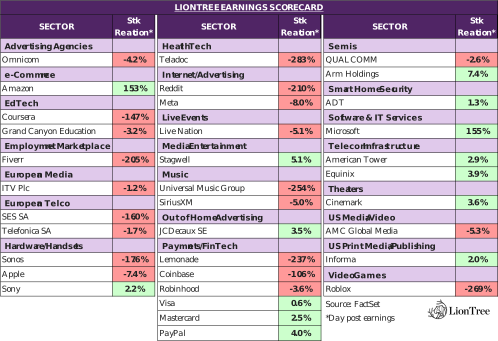
The earnings wave is well underway, and this week’s releases were largely driven by large-cap TMT companies. 36 companies in the LionTree Universe reported this week (up from 11 in Week 1& 2 combined), and stock reactions weighed on the negative side with 21 trading down (64%) and 15 trading up (36%). The worst performer on the back of results was Teladoc Health, which fell -28% after its report and the best performer was Microsoft, which surged +16% post its print (see Theme #4).
Along with MSFT, several other Big Techs Co reported this week and reactions diverged. Meta fell -8% in reaction to its results (see Theme #2) and Apple fell -7% (see Theme #5), while Amazon strongly rallied up +15% after its numbers were released (see Theme #3).
On the entertainment side, Universal Music Group kicked off the music reports and fell -25.4% (see Theme #6), while Live Nation gave a positive read through into live entertainment but fell -5.1% (see Theme #7).
A couple other key prints that saw negative stock moves included Reddit, which plunged -21% after its report, Roblox which fell -27% and Omnicom, which was down -4% (see Theme #8 for Quick Takes).
The table below includes select mid- and large-cap TMT and consumer companies in our LionTree stock universe that reported this week.
Meta’s Cont’d High Spend Remains A Leap Of Faith Which Is Trying Investors’ Patience
Following what were disappointing results from Alphabet, Meta equally disappointed investors with capx tweaked higher, lower than expected reported operating income (though due to legal and severance charges), slightly weaker than expected user numbers, and a fast but slowing advertising business. While this high level of capx can lead to new consumer and enterprise products and further improvement in the core, investors do not have the line-of-sight that they are looking for.
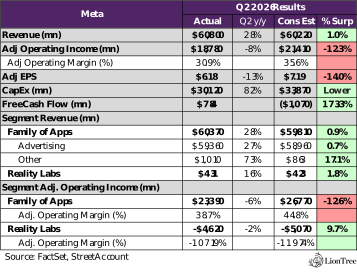
Big picture with the qtr, Q2 revenue came in modestly ahead of expectations (by +1%), growing +28% y/y BUT total expenses surged +55% y/y, driven by $2.4bn in legal charges and $1.2bn in severance from the May 2026 headcount reductions. Excluding these charges, operating income would have been up +9% y/y (and higher than cons) but investors don’t seem to be giving them credit for that.
More specifically on our top 5 takeaways, 1) While Q2 capx was below Street projections, the Co remains very focused on “maximizing capacity” in 2026 and 2027 and increased the low end of its 2026 guidance as the supply environment remains very constrained; 2) Improved recommendations in the core ads business stood out but FoA ad revs growth decelerated to +27% y/y from +32% y/y in Q1 (though to be fair, it is still increasing at a fast clip); 3) Zuckerberg believes Personal Agents are going to rapidly proliferate once the tech is “out of the box”, which they are focused on doing…their launch in this area is coming “soon”; 4) The focus on the Enterprise market markedly stepped up this qtr in our mind, with the Co indicating that it will look to start selling compute capacity in some circumstances vs internal utilization…and 1mn+ businesses are already using Business agents weekly, w/ the launch of the Meta Business Agent platform for enterprises; and 5) On the KPI side, FoA DAPs of 3.6bn were a touch below cons.
See below for more details on all the above, plus key comments on Muse Spark, FoA Other revenue growth, open vs closed models, and more. Overall, while the ads business remains on solid ground, the cost and investment trajectory remains a sticking point. Also see link to Zuckerberg’s op ed titled “AI Is For Everyone” published this week as well.
-> Meta shares fell -8% after its report and is now down -15.7% YTD
Q2 Core Profitability Was Better Than It Looked While Revs Were A Tad Ahead Of Expectations
- Q2 total revs BEAT cons by +1.0% and grew +28% y/y (+27% FXN), which was a decel from the +33% y/y (+29% FXN) in Q1
- Q2 adj op income MISSED cons by a significant -12.3% (margin of 30.9% vs cons) given it was weighed down by $2.4bn in legal charges + $1.2bn in severance tied to the May 2026 headcount reduction…
- …Excl legal charges and severance, op income would have incr’d +9% y/y to $22.4bn (i.e., would have beat by +4.5%)
- Q2 total expenses of $42.0bn grew +55% y/y, significantly above revenue growth of +28% y/y
- The Co ended Q2 w/ 75,472 employees, down -3% from Q1 and -1% y/y
- Q2 adj EPS of $6.18 MISSED cons by -14.0% (declined -13% y/y) – again, due these charges mentioned above
- Q2 CapEx of $30.1bn was LOWER than cons $33.9bn (grew +82% y/y)
- Q2 FCF of $784mn was better than cons -$1.1bn but down -91% y/y
Legal Charges Will Continue To Impact Costs In Q3 While Revs Are Guided In-Line W/ Expectations
- For Q3…the mid-pt of the REVENUE guidance was ~in-line w/ cons ($61bn-64bn vs cons $63.14bn), implying +22% y/y growth at the mid-pt (vs +28% y/y just reported in Q2)
- Guidance assumes FX is an ~1% headwind to y/y total rev growth, based on current exchange rates
- For 2026…
- The low-end of the EXPENSE guidance was raised to $165bn-169bn (from $162bn-$169bn prior) …it includes the $2.4bn legal charges from Q2
- Co continues to expect to deliver y/y growth in op income in 2026
- The tax rate now expected at 15-17% for remaining quarters (up from prior 13-16%)
- On the regulatory front… “we continue to see scrutiny on youth-related issues in several markets and have a number of youth-related trials scheduled for this year in the US, which may ultimately result in a material loss”
2026 CapEx Guidance Was Also Narrowed Higher & All Signs Point To Cont’d Heavy Spending Through 2027 In This Capacity Constrained Environment
- “We continue to invest aggressively in infrastructure to meet the demand”…the Co is trying to maximize capacity in 2026 and 2027 to drive growth in 2028 and beyond; Long term capacity needs are still being determined
- A significant portion of the compute is going to go towards training models, growing the core business, and delivering personal agents and new products, including to serve large customers
- For 2026…FY capex guidance NARROWED HIGHER to $130bn-145bn (from $125bn-145bn prior)
- Driven by investments in servers, data centers, and network infrastructure
- For 2027…no specific capex guidance was provided, but mgmt is “gearing current infrastructure plans towards maximizing capacity in 2026 and 27”
- “Near-term capacity is more valuable than long-term capacity”
- Co is currently and expects to be “demand constrained” for the foreseeable future, incl in compute uses in the core biz
- For 2028+…mgmt is focused on having “flexibility”: They are building data center + network foundations to accommodate future server decisions
- “The world is going to evolve a lot. Our own internal demand will evolve. We’ll have turned over a lot of cards by then”
- Focusing on having land and power, but deferring big-ticket chip decisions
- Key principles guiding capacity strategy –
- “The industry has underbuilt historically for the wave of AI adoption, making existing capacity, including our own, extremely valuable”
- “We have high confidence in our ability to utilize capacity to scale and build on top of our existing experiences”
- Overall industry capacity is expected to “remain tight for the foreseeable future”
- The Co is investing in its custom silicon effort for long-term strategic flexibility and supply chain leverage
- The capital structure has evolved to include greater mix of debt: Long-term debt is now $83.7bn vs $90.3bn in cash + securities
- “We’ve also been evolving our capital structure in recent years to include a greater mix of debt as we work to bring down our cost of capital”
- No share repurchases in Q2; dividend payments of $1.35bn
- “Rather than centralizing superintelligence, we are focused on distributing it widely and giving everyone the ability to direct it towards what matters to them. That’s the way that society has always made progress”
While Platform Engagement Hits Major Milestones, FoA DAPs Were Still A Tad Below Cons
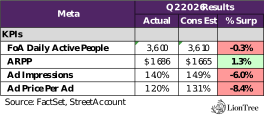
- Meta ended Q2 w/ 3.6bn Family DAPs, up +3% y/y (and +1% q/q) BUT slightly below cons 3.61bn
- Key engagement milestones across FoA –
- Instagram reached 2bn daily actives
- Threads crossed 500mn monthly actives, “making it the fastest growing conversation app ever”
- Facebook reached more than 2bn daily actives “for a while now”
- WhatsApp hit an all-time messaging record, peaking at 30mn messages/sec during the World Cup final
- ARPP of $16.86 BEAT cons $16.65 by +1.3%
- Ad impressions grew +14% y/y (vs cons +14.9%) while avg price per ad grew +12% y/y (vs cons +13.1%)…both slightly below cons, though total ad rev still BEAT
- Impression growth was healthy across all regions, driven by growth in engagement + users, as well as ad load optimizations
- Price per ad was driven by ad performance gains, improved macro conditions y/y, and currency tailwinds; partially offset by strong impression growth from lower monetizing surfaces/regions
Ad Revenue Growth Decelerates But Is Still At A Rate “Faster Than Ad Peers”
- FOA ad revs of $59.4bn grew +27% y/y (+26% FXN) and BEAT cons by +0.7% though slowed from Q1’s +33% y/y (+29% FXN)… with that said, “on a dollar basis, our ads business is reporting faster year-over-year revenue growth than any other company’s reported ad business.”
- FOA adj op income MISSED cons by -12.6%
- The Co intro’d “Meta Generative Recommender” which is a “paradigm shift how our ad system works”:
- The Co is now using LLMs to reason about ad content and user preferences together and predict the best ad for each person
- They deployed the 1st generative model into ads retrieval system w/ notable improvements in ads performance
- Early pilots using LLMs to better understand user preferences drove a +1% incr in app conversions on IG in Q2
- Meta’s advanced user understanding models combined w/ their GEM model for ads ranking and sequence learning, generated an 8.3% increase in ad clicks and a 15.7% uplift in conversions on Facebook
- AI-powered Advantage+ reached $75bn+ in annual revenue run rate this qtr…working on deepening advertiser adoption
- Advertisers who leverage multiple tools are see “compounding performance gains”
- Example: Underneath, an online apparel brand in India, saw +13% lift in purchases and +16% incr in add-to-cart conversions after adopting Advantage+ sales campaigns
- Gen AI ad creative tools continue to scale: 9mn+ small businesses now using at least one AI creative tool (vs 8mn+ in Q1)
- Image generation adoption more than double this qtr
- Meta intro’d a new end-to-end creative solution that gives advertisers AI infra to translate real performance signals into their next creative decision, while preserving brand identity/tone
- They are building w/ agency integrations from day one so teams can diagnose, generate, and scale high-performing creative without leaving existing workflows
- Looking ahead, the rollout of Muse Image is expected to “further expand advertisers’ ability to generate high quality on brand creatives at scale”
- Meta also expanded availability of ads on newer surfaces in Q2
- Threads: Completed global ads expansion
- WhatsApp: Intro’d support for more types of ad destinations and advertiser performance goals; “continue on track toward our global rollout”
AI-Powered Recommendations Are Delivering Strong Engagement Gains & There Is More Room To Go
- Continue to see “significant” gains from content recommendation initiatives across Instagram and Facebook
- Instagram: Global time spent grew DD% y/y this qtr, largely driven by improvements to feed and reels recommendations
- Facebook: Video time spent +9% globally y/y and over +10% within the U.S. and Canada, driven by ranking improvements
- Shipped the largest single ranking improvement to date on Instagram, combining faster inference with a new architecture that draws on deeper user history
- Drove a +15bp increase in sessions on Instagram, with particular strength in reshares and time spent
- They are now bringing this to feed where early results “look comparable”
- LLMs are “increasingly capable of delivering ranking and recommendations gains”
- Every public reels and feed post on Instagram is now automatically processed through an LLM for content understanding (from topics to tone)
- LLM-powered agents are helping with engineering development by evaluating content quality, detecting trends, and testing ranking changes
- Started using Muse models for content understanding (video topic classification, summarization) w/ positive early results
- The Co is giving people more direct control of what they see
- Instagram: “Your Algo” page lets users write natural language prompts to tune their recommendations
- Facebook: Launched “Shape Your Feed”; early results show over 80% retention among users who engage with it
- Looking ahead…building foundation models designed to power organic content and ads recommendations simultaneously, as well as developing LLM-native recommender systems
- Hit first research milestone this half by continuously pre-training a large-scale model with recommendations data; observing “healthy scaling laws”
- “Encouraged by this milestone and expect continued progress in the second half of the year”
- “We certainly see further headroom to continue improving recommendations over the rest of the year and into 2027”
Focus Is Increasing On Personal Agents …Zuckerberg Expects Launch “Soon” And Calls It One Of The Next Major Opportunities In AI
- Zuckerberg spent significant time on the call positioning personal agents as the next massive consumer product opportunity
- “Soon we will have agents that can work 24/7 on your behalf to help you achieve your goals and improve your life, your health, your relationships, your finances, whatever you want”
- “It’s extremely unlikely if you look out five years from now that you don’t have billions of people with a personal agent that understands your goals”
- Meta believes it will have a structural advantage in personal agents
- “We build consumer products that reach billions of people. We’re great at, once we get something working, scaling it to a large number of people”
- WhatsApp is already the leading surface for Meta AI engagement; messaging apps will “become increasingly important” as an agent platform
- Launched Incognito Mode on WhatsApp and Meta AI app for private conversations “that even Meta can’t see”
- Consumer privacy & security will be a greater focus
- Consumer personal agents need to “just work out of the box” for billions of people…that is what Meta is focused on doing
- Product timeline…“we’re going to ship this at some point soon and that’s going to be very exciting. And we haven’t done that yet”
Meta Superintelligence Labs Momentum Builds…Muse Spark 1.1 Ships, Meta AI Interactions Surge +60%, And API Goes Live
- Since rebuilding Meta AI and integrating Muse Spark, daily interactions surged +60% and continue to grow “quickly week over week”
- Meta’s is pursuing both frontier and efficient models
- “If you’re serving billions of people, you want the ability to have more advanced models for things that are very hard problems. And you want the ability to serve the vast majority of prompts from simpler and more efficient models”
- Muse Spark 1 and 1.1 are “impressive” models but mgmt. also wants more advanced models as well
- Expect to release some open source models “at some point soon,” but continuing a mix of open and closed
- “We’re not dogmatic about this. We think open source is important. We want to contribute to that ecosystem
The Broad Enterprise Opportunity Is A Key Growth Focus, Broadening Beyond Ads…APIs, Coding Tools, Productivity Services, And Potential Compute Sales Are All On The Roadmap
- Zuckerberg framed the enterprise opportunity as the “sum of all of these different things”…not just compute, but API services, productivity services, business agents, and coding tools
- Business agents are a natural extension of existing advertiser/SMB relationships, effectively expanding the ad model to messaging surfaces where “we will get paid when we deliver results”
- Meta Business Agents were available globally on WhatsApp and Messenger in Q2 and are now rolling out on Instagram
- 1mn+ businesses are using them to talk to customers or complete sales every week
- Meta Business Agent platform gives businesses the infrastructure to build, customize and deploy business agents at scale on WhatsApp
- Meta will be adding more agentic capabilities like summarizing conversations, digesting overnight activity, surfacing customer insights, suggesting ways to grow business, competitive intelligence
- “Over time, we’d like to build this into a business in a box service that can help you start and run a whole business using Meta’s platforms”
- Monetization will be a mix of subscriptions, volume-based pricing, and will evolve toward results-based pricing (like the ad auction)
- Meta Business Agents were available globally on WhatsApp and Messenger in Q2 and are now rolling out on Instagram
- Coding + productivity tools represent a “somewhat different muscle than we have historically had”
- Built initially for internal use, but now see a large opportunity to serve SMBs and larger businesses
- “We will share more soon on how we’re planning to build that out”
- Regarding selling compute directly (which investors have been focused on), the Co received “quite a number of offers at a meaningful premium over what we paid for the compute”
- BUT: “We believe that there will continue to be a significantly higher margin on selling intelligence rather than selling compute directly”
- The view is to use most compute for internal products (core biz, new consumer products, agents) while selectively monetizing capacity externally
- API and distribution ramping –
- Muse Spark is available through a new public API at a “competitive price”
- The Co made it available on Open Router for US-based developers
- Expect to roll out to more distribution channels, more countries, and open up for enterprises “soon”
Reality Labs Is Still Losing A LOT of $ But Not As Much As Projected…AI Glasses Continue Strong Momentum
- Reality Labs Q2 revs of $431mn grew +16% y/y and BEAT cons by +1.8%; Q2 op loss of -$4.6bn BEAT cons -$5.1bn
- Rev growth driven by strong AI glasses sales, partially offset by lower Quest headset sales
- “Our glasses remain one of the fastest growing consumer electronics of all time”
- The Co released Meta’s own line of glasses in collaboration w/ EssilorLuxottica, incl a style designed w/ Kylie Jenner
- These are the 1st glasses to ship w/ Muse Spark out of the box
- Early sales “exceeded our expectations”
- Expect more on the glasses lineup at the Co’s Connect conference on September 23
A Few Other Key Updates
- For the 1st, qtrly FoA “Other” revenue reached $1bn, growing +73% y/y and BEATING cons by +17.1%
- Driven primarily by WhatsApp paid messaging and subscriptions revenue
- Launched Meta One, a new subscription offering providing more tools and AI features across apps
- “As demand grows, we’re going to offer a variety of different tiers and pricing options”
- Also launched a high-intelligence Model API at a competitive price; encouraged by initial results
- Muse Spark available on Open Router for US-based developers
- Expect to expand to more distribution channels and countries
- Muse Spark available on Open Router for US-based developers
Amazon Provides Comfort On AI ROIC Despite Capx Being Revised Up AGAIN
In addition to Microsoft (see Theme #4), Amazon also came out on top among Big Tech this week. The Co delivered a clean beat across the board, especially on profitability (even excluding one-timers) but the main standout was the strong upside in AWS, with accelerating revenue growth to +37% y/y (the fastest growth in 18 qtrs) driven by surging AI demand, core cloud migration, and custom silicon momentum. Similar to Alphabet and to a lesser degree Meta, Amazon also raised 2026 capx (from $200bn to $220bn) but stressed that even at that higher level they can not meet demand levels. At the same time, mgmt laid out a clear bull case for why capx ROIC will be “very compelling” over the medium term despite near-term FCF headwinds. That seemed to go over well.
Other key takeaways in our view include: 1) The Q3 revenue guidance of $197-$202bn implies a sequential deceleration BUT it is distorted by Prime Day timing (moved to Q2 in 2026 vs Q3 in 2025)… adjusted for Prime Day, Q3 growth would be ~400bp higher; 2) The chips biz is now a $25bn+ annual run rate (vs ~$20bn in Q1), with Graviton5 in GA and Trainium adoption broadening to more AI labs and startups; 3) Stores’ unit growth accelerated to +17% y/y with grocery/perishables inflecting meaningfully; 4) Advertising accelerated to +26% y/y (from +22% y/y); and 5) Agentic shopping is gaining traction…in Q2 Alexa Shopping active users nearly doubled and interactions were up 5x+ y/y
See below for more color on all the above, as well as other updates that we thought were the most incremental
-> Amazon shares jumped +15.3% after it reported its results and is up +17.7% YTD
Amazon Delivers A Strong Q2 BEAT Across The Board, Especially On Profitability
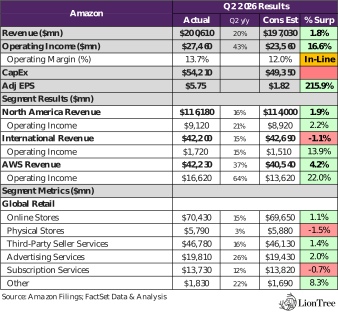
- Q2 revs, op income and adj EPS all BEAT cons
- Revs BEAT by +1.8% and grew +20% y/y (+20% FXN), accelerating from +17% y/y (+15% FXN) in Q1
- By segment:
- NA segment BEAT by +1.9%: Sales grew +16% y/y vs +12% y/y in Q1
- Intl segment MISSED by -1.1%: Sales rose +15% y/y vs +19% y/y in Q1
- AWS BEAT by +4.2%: Rose +37% y/y vs +28% y/y in Q1 — the fastest growth in 18 qtrs
- By segment:
- Op income BEAT by +16.6%…with op margin of 13.7%, up +230bp y/y
- Includes ~$1.2bn in non-recurring benefits: ~$600mn tariff refunds (NA) + ~$600mn energy derivative gains (AWS)
- Excl these items, op income of ~$26.3bn still BEAT cons by +11.5%
- By segment:
- NA op income of $9.1bn BEAT by +2.2%; op margin of 7.9%, flat q/q
- Intl op income of $1.7bn BEAT by +13.9%; op margin of 4.1%, up from 3.6% in Q1
- AWS op income of $16.6bn BEAT by +22.0%; op margin of 39.4%, up +650bp y/y (+520bp excl derivative gain)
- Includes ~$1.2bn in non-recurring benefits: ~$600mn tariff refunds (NA) + ~$600mn energy derivative gains (AWS)
- Adj EPS of $5.75 BEAT cons $1.82 by +215.9%, BUT $53.4bn of net income was non-operating (primarily Anthropic investments)
- Q2 capx of $54.2bn was almost 10% ahead of cons (and vs $43.2bn in Q1)
Q3 Guidance Looked Softer At First Blush…BUT Prime Day Timing Creates ~400bp Of Noise
- Q3 rev guidance of $197-$202bn (vs cons $203.9bn) implies +9-12% y/y growth vs +20% y/y in Q2
- BUT adjusted for Prime Day timing (Q2 in 2026 vs Q3 in 2025), Q3 y/y growth would be ~400bp higher
- The Co also anticipates an ~80bp unfavorable FX impact y/y
- Q3 op income guidance of $22.5-$26.5bn bracketed cons $24.98bn and was up from $17.4bn in Q3:25
- This assumes no impact from energy derivative remeasurements and no additional acquisitions
2026 Capx Guidance Was Raised To ~$220bn As Mgmt Laid Out A Detailed Bull Case For The Long-Term ROIC
- 2026 capx guidance raised from $200mn to ~$220bn driven by higher memory costs
- Demand continues to well outstrip supply
- “But even at that amount [of spend], we will still not have enough capacity to meet all the demand we have in 2026”
- Mgmt believes this will also be true in 2027
- And the demand already in hand for 2028 is “striking”
- Mgmt outlined a detailed ROIC framework for its capx investments…
- Data centers: Capital spent occurs ~2 yrs before monetization, BUT then they have a useful life of 30+ yrs and don’t require that startup capital again
- Servers & networking: This is purchased months before deployment with strong visibility into demand
- The avg breakeven in <3 yrs
- The useful life is 5-6 yrs
- Most AI capacity is contracted for 5+ yr terms…”that means that we’re driving significant free cash flow on the servers and networking equipment in the 2 to 3 years after we break even”
- AWS also has a strong track record of pulling forward breakeven and extending equipment useful life
- Wirth the over 30+ yr data center life, expect 5-6 generations of server economics with improving unit economics after the 1st generation
- Near-term, heavy simultaneous data center builds will pressure FCF…BUT as revenue growth outpaces incremental capx growth, the resulting FCF and ROIC will be “very compelling”
- The Co is on pace to double power capacity by end of 2027 vs 2025
- The lion’s share of 2027 capacity is already reserved and a significant portion of 2028 capacity is already contracted
- Regarding sources of capital: The Co has issued debt this year and “have a lot of options available” to fund AWS growth
A Main Positive Was AWS Revenue Accelerating For The 5th Straight Qtr To +37% Y/Y & The Opportunity Ahead Is Massive
- Upside to Q2 AWS revenue and op income was a key positive
- Rev BEAT cons by +4.2% and is up +37% y/y (the fastest growth in 18 qtrs) from +28% y/y in Q1…it added over $4.6bn in revenue q/q, which is ~80% more than the largest increase ever
- Seeing strong growth in both AI and non-AI
- Op income BEAT cons by +22%
- Op margins of 39.4% were up +650bp y/y (+520bp excl the ~$600mn energy derivative gain)
- Profitability driven by disciplined efficiency gains, capacity optimization, and managing fixed costs
- Rev BEAT cons by +4.2% and is up +37% y/y (the fastest growth in 18 qtrs) from +28% y/y in Q1…it added over $4.6bn in revenue q/q, which is ~80% more than the largest increase ever
- AWS’s AI revenue run rate now exceeds $25bn, growing triple digits and was up “significantly” q/q
- The AI margin trajectory is tracking in line with, and slightly ahead of, core cloud at the same stage of evolution
- AWS backlog reached $496bn, growing triple digits y/y
- There are multiple drivers behind the acceleration in AWS revenue…
- AWS has the broadest functionality across cloud core + AI
- Mgmt believes it has the strongest operational performance and security
- On proximity: Inference workloads want to live near existing apps & data, and more of it resides in AWS than anywhere else
- 85% of global IT spend is still on-prem…that equation will flip over the next 10-20 yrs, and AWS is winning the lion’s share of migrations
- AI is pulling along the core: Post-training, RL, and agentic tool use runs on CPUs, benefiting Graviton
- Mgmt sees AI demand adoption as a “barbell” shape right now…
- On one end: AI labs are consuming massive compute + a few breakout AI apps (Claude Code, ChatGPT)
- On the other end: Enterprises are getting real value from AI in cost avoidance/productivity (customer svc, BPA, fraud)
- …the middle (existing enterprise production workloads using inference pervasively) has not yet materialized at scale BUT will be the “largest absolute segment” over time
- Mgmt stressed while they are pursuing frontier models. “AWS and Amazon can have a wildly successful business WITHOUT its own frontier model”
- There will not be one model to rule the world given that companies want choice and Bedrock provides the best selection
- Amazon is pursuing its own frontier model for cost control, prioritization, and speed
- “Within the next few years, you’re going to have at least a half dozen models that are comparably good to each other. They’ll all be in Bedrock and one of them will be ours”
- The long-term vision…mgmt. believe AWS could be “at least” $500bn and “very possibly” $1 trillion annual rev biz, with “very appealing” FCF and ROIC
Bedrock And The AI Platform Stack Continue To Scale Rapidly
- Bedrock now has “hundreds of thousands” of customers with more added in the last 6 months than in the first 2 yrs after launch
- Customer spend grew more in Q2 than all prior quarters combined
- Added 10+ models in Q2 incl OpenAI GPT-5.6, Anthropic Claude Opus 5, Google DeepMind Gemma 4, and SpaceXAI Grok 4.3
- Bedrock AgentCore continues to add key capabilities for production-grade agent deployment
- New features: Payments (autonomous transactions), Web Search (grounding without leaving AWS), Harness (faster agent assembly)
- Also added Policies for deterministic agent controls
- AWS Continuum (new) discovers, prioritizes, validates, and remediates code vulnerabilities
- Uses frontier models to run comprehensive scans and agents to prioritize using each company’s business context
- Validates in a sandbox and recommends fixes
- Security is a top-of-mind topic for enterprises re: AI
- Amazon Quick is gaining momentum as an AI work companion
- Added autonomous agents, personalized activity feed, and 16 new integrations (Adobe, Moody’s, Snowflake)
- Manages across Slack, Salesforce, Jira, Teams, ServiceNow with existing access controls
- Enterprise adoption call-outs include: 3M, Allianz, AstraZeneca, Autodesk, BMW, Exxon, FINRA, Hyundai, Intuit, Mondelez, Moody’s, NBA, NFL, New York Life Insurance, and Southwest Airline
- Kiro (agentic coding) usage tripled q/q and is up to 50% more cost-effective than alternatives: It is now available on iOS
- Mgmt sees a “very substantial opportunity” in building applications on top of AWS infrastructure
- Amazon Connect (call center) is used by all 5 major airlines + leading banks and healthcare cos, growing quickly
- AWS Transform (software migration) is super useful for enterprises
- Several more in development — “very helpful for customers and our business”
The Chips Story Keeps Getting Bigger…The Rev Run Rate Is Now Over $25bn W/ Broadening Adoption
- The Chips biz annual rev run rate now exceeds $25bn (vs ~$20bn in Q1), growing triple digits y/y
- Trainium adoption is broadening significantly…
- Anthropic and OpenAI both have multi-year, multi-gigawatt commitments
- An increasing number of AI startups are adopting Trainium incl unicorns NEURA Robotics and Odyssey, plus TwelveLabs, Decart, Poolside, Karakuri, Metagenomi, NetoAI, Splash Music, Uber, and Pinterest
- Regarding selling chips externally? Mgmt continues to signal that they will likely do this in the future
- “We do have an increasing number of customers who are interested in us providing the training chips to them, separate from, you know, even from our cloud. And we’re actively having those conversations and exploring. And I expect there’s a real chance we’ll do that in the future.”
- Graviton5 is now in GA and offers up to 25% better compute performance vs Graviton4
- Graviton delivers 30-40% better price-performance than comparable instances
- Used by 98% of top 1,000 EC2 customers
- Revenue commitments incr’d nearly 3x q/q; Graviton5 is growing ~2x faster than Graviton4 did
- Despite ramping its own chips efforts, mgmt. stressed the importance of its NVIDIA partnership
The Stores Playbook Remains The Same…The Co Continues To Make Gains In Speed & Selection As Well As In Grocery & Perishables
- Online Stores revenue accelerated in Q2 vs Q1… grew +15% y/y vs +9% y/y in Q1 (helped by the Prime Day timing shift)
- Physical Stores revenue grew +4% y/y, flat vs Q1
- Unit growth reached +17% y/y vs +15% y/y in Q1
- Added millions of new products incl 700k+ from notable brands
- Expanded Amazon Haul ultra low price selection by ~20x since launch
- Now have over 6mn items under $10
- Reached record delivery speeds in H1…delivered 40%+ more items same-day/overnight y/y with millions of items available for same-day delivery
- Amazon Now (30-min delivery) expanded to 80 new US cities/towns and several major cities in Egypt in Q2
- It is now available in 9 countries, 250+ cities/towns globally
- It is seeing 80%+ growth in gross sales and units sold q/q
- 60%+ more customers served q/q
- Amazon Now (30-min delivery) expanded to 80 new US cities/towns and several major cities in Egypt in Q2
- The Grocery biz continues to inflect…Amazon is now the 2nd-largest grocer in the US with $150bn+ in annual GMS
- Monthly active perishable customers grew 50%+ since the start of the year
- Same-day orders with perishables average 3x+ more units per order
- Fresh groceries now make up 6 of the top 20 bestsellers on Amazon.com
- In cities with same-day perishables, 9 of the top 10 bestsellers are perishables
- Whole Foods growth in its geographies is “significantly outpacing” comparable grocers
- The profit trajectory is trending the right way
- The Daily Shop urban format is expanding rapidly
- Amazon remains focused on being price competitive: Product prices on avg are 14% less than other retailers per Profitero; The Co largely absorbed tariff cost increases rather than passing them on to customers
- The Co received ~$600mn in tariff refunds in Q2 (significant majority of expected refunds); They will proactively refund customers where specific import charges were passed on
- The Co launched Amazon Supply Chain Services so any business can use Amazon’s supply chain for raw materials to finished products
- Early customers incl P&G, 3M, Lands’ End, American Eagle
- Amazon sees more network efficiency improvements even amid transportation cost headwinds
- The Co continues to optimize inventory placement, shorten shipping distances, reduce touches, and improve consolidation rates
- Expect to more than double their fleet of robotic arms (Cardinal, Sparrow) in 2026
- BUT the Co is also facing elevated fuel costs and higher line haul rates (driver capacity constraints), partially offset by FBA fuel & a logistics surcharge implemented in April
- Excl higher fuel and line haul rates, shipping costs grew more slowly than unit growth at a pace consistent with Q1
- Amazon Pharmacy grew new customers by 2x+ in H1 with same-day prescriptions up nearly 5x; It has saved customers ~$250mn in out-of-pocket costs YTD (up 400%+ y/y)
Several Other Notable Updates Across Agentic Shopping, Advertising, Prime, Leo, Etc
- Agentic shopping is gaining steam
- Rufus and Alexa+ combined into “Alexa for Shopping” which is an agentic AI shopping assistant offering personalized recs, product comparisons, price history, and automated shopping (Price Alerts, Auto-Buy)
- Over 350mn customers used it in the last 12 months
- In Q2, active users nearly doubled and interactions up 5x+ y/y
- US customers who use Alexa for Shopping spend 40%+ more per order and Alexa+ users sign up for Prime at ~25% higher rates
- Alexa+ expanded to Germany, Austria, France, and Brazil : “Hundreds of millions” of customers are using new Alexa experiences
- Sponsored prompts in agentic experiences are showing strong conversion: Shoppers who click a sponsored prompt convert 48% more often and spend 21% more on avg
- Rufus and Alexa+ combined into “Alexa for Shopping” which is an agentic AI shopping assistant offering personalized recs, product comparisons, price history, and automated shopping (Price Alerts, Auto-Buy)
- Advertising accelerated y/y in Q2…was up +26% y/y vs +22% y/y in Q1 (and BEAT cons by +2.0%): Reached almost $20mn in the qtr
- Prime Video ads and live sports are seeing cont’d growth and engagement
- Intro’d 30+ new advertisers to the NBA in Year 1
- All inventory sold out across Thursday Night Football, NBA, WNBA, and NASCAR
- Multi-sport advertisers see 2.3x higher unduplicated reach; multi-sport viewers drive 12% higher spend and 17% more orders on Amazon
- Ads Agent (AI-powered campaign tool) expanded to 11 new countries in 2026
- Advertisers using Ads Agent see 8% lower cost-per-impression and 6% lower cost-per-acquisition
- Prime Video ads and live sports are seeing cont’d growth and engagement
- Prime membership growth remains DD y/y
- Amazon Leo is close to ~400 satellites in orbit which is enough to begin initial satellite internet service this year as planned
- Zoox received NHTSA Part 555 Exemption: It is the first purpose-built robotaxi to receive this, paving the way for paid commercial service
MSFT Is Still In The Game & Bucks The Big Tech Trend
While Alphabet and Meta both took it on the chin post results (see Theme #2 on the latter), Microsoft came out looking like a relative bright spot. The most important takeaways from their results in our view were: 1) The Co closed out its fiscal year with a broad-based FQ4 beat driven by stronger than expected revenue across all three segments but Azure in particular was a standout; 2) More specifically, Azure accelerated faster than anticipated to +43% y/y (from +39% in FQ3) and that acceleration is expected in FQ3 and FQ4; 3) With that said, for FY27, mgmt reiterated double-digit rev and op income growth while expecting to remain FCF positive.; 4) Unlike its peers, the Co did not raise its CY26 investment expectations (and actually optically lowering them to ~$175bn from ~$190bn on a lease reclassification); and 5) Copilot momentum was strong as paid seats crossed 30mn with net adds more than doubling q/q.
See below for more on these takeaways as well on a few more, including on Copilot and Xbox.
-> MSFT jumped +15.5% post its report, gaining $450bn in market value in a single day, the largest ever for a US business (link); That said, the stock is still down -3.9% YTD
MSFT Delivered A Broad-Based FQ4 Beat, With Azure Growth Acceleration A Standout
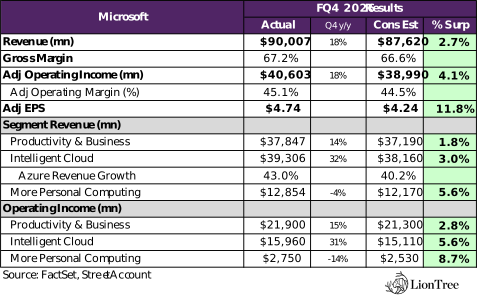
- Total revs BEAT by +2.7% and grew +18% y/y (+17% FXN), vs FQ3 +18% y/y (+15% FXN)
- All segment outperformed expectations, with a notable accel in Azure rev growth (see more in the Cloud section below)
- Gross margins of 67.2% BEAT cons 66.6%
- Though the decrease y/y was driven by sales mix shift to Azure, cont’d AI infra investment, and growing product usage, partially offset by efficiency gains in Azure and M365 Commercial Cloud
- Op margins were +60bps ahead
- The ~+12% adj EPS beat was helped by a 27c benefit which included a $3.2bn gain from its Anthropic investment and lower-than-expected voluntary retirement expenses, partially offset by severance expense and Xbox impairment charges
Cloud Also Drives Upside In The FQ1 Guidance Vs Cons, Though No Change To The FY27 Headline View
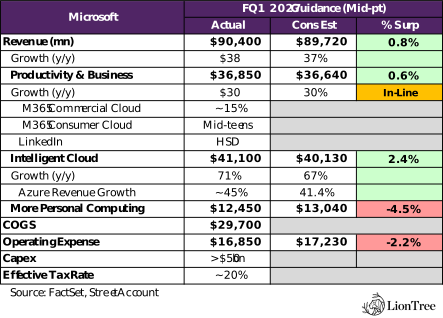
- For FQ1…total REV guidance at the midpt BEAT cons by +0.8%, reflecting +16-17% y/y growth (vs +18% y/y in FQ4)
- Intelligent Cloud was the biggest upside driver (see more below in the Cloud section)
- For FY27…mgmt. REITERATED double-digit rev and op income growth, and opex growth in the mid to high-single digits
- And expects to remain FCF positive
While CapEx Outlook Optically Is Lower On Lease Reclassification, Underlying Investment Projections Are Unchanged
- FQ4 CapEx of $41bn grew +~105% y/y and incls an impact from higher component pricing
- Roughly two-thirds was for short-lived assets (primarily CPUs and GPUs), and remaining was for long-lived assets
- Investment into land and DC builds is “actually quite flexible” and timing can be changed; ability to late-bind more expensive components in the short term
- To note on the CY26 CapEx guidance …investment expectations remain unchanged EXCLUDING a useful life impact, BUT the shift from finance to operating leases adjusts the reported CapEx guidance to ~$175bn (down from ~$190bn guided last qtr)
- Effective for a FY27 start, the Co is extending the est’d useful life of data centers and office buildings from 15 to 25 yrs, reflecting operating history and expected use of these assets
- It will only have a “minimal” benefit to FY27 op income
- The greater impact is on the CapEx classification, as more future data center leases will shift from finance leases (incl’d in CapEx) to operating leases (not incl’d in CapEx)
- For FQ1 CapxEx guidance…expect spend to be >$50bn, incl lease reclassification impact from useful life update
- For FY27 CapxEx guidance…expected spend to “grow y/y”, given demand signals across the Co’s portfolio but no specific guidance was provided
A Key Positive W/ Results Was Azure & Its Acceleration Is Expected To Continue
- FQ4 total Microsoft Cloud rev of $59.3bn rose +27% y/y, vs +29% y/y in FQ3
- Microsoft Cloud gross margin decr’d y/y to 65%, driven by sales mix shift to Azure and AI infra investment, partially offset by ongoing efficiency gains, particularly in Azure and M365 Commercial Cloud
- FQ4 Intelligent Cloud rev BEAT by +3.0% and grew +32% y/y (+31% FXN)
- FQ4 Azure rev grew +43% y/y in FQ4 (accel from +39% in FQ3) and also BEAT cons +40.2%
- Customer demand continues to exceed available capacity in a “relatively extreme” fashion
- Azure’s momentum will continue into FQ1… Azure rev growth guidance of ~45% CC (vs +43% in FQ4 topped cons +41.4%) and reflects a continued acceleration
- Expects H1 growth to accelerate
- The Co added 31 new data centers across 5 continents + another gigawatt of capacity in the qtr
- Brings total data center to 88 this fiscal yr
- Looking ahead…the Co remains on track to roughly double overall capacity in 2 yrs
- FQ4 Commercial RPO of $678bn incr’d +84% y/y (vs +99% y/y in FQ3) with a weighted avg duration of ~2.3 yrs when including OpenAI
- ~30% will be recognized in rev in the next 12 months, up +37% y/y
- The remaining portion, recognized beyond the next 12 months, incr’d +112% y/y
- When EXCLUDING OpenAI, Commercial RPO grew +25% y/y
- All sequential commercial RPO growth was driven by commitments from customers outside of frontier model companies
MSFT’s MAI Models Are Driving Cost Reductions Across MSFT’s Products, While Multi-Model Strategy Reduces Dependence On Any Single Provider
- MSFT is accelerating its own model development with the MAI family that is delivering comparable quality to frontier models at significantly lower cost: Have 12+ new models across image, voice, transcription, coding, security, incl first reasoning model MAI-Thinking-1
- MAI-Code-1-Flash on GitHub Copilot: Higher code acceptance rates, 10% lower median token usage, delivering comparable quality to GPT 5.6 in Excel at significantly lower costs
- MAI-Cyber-1-Flash: Better performance than larger Mythos model at half the cost when combined w/ multi-agent security harness
- 89% reduction of GPU costs in Dynamics 365 w/ MAI-Voice-2-Flash; Up to 84% reduced GPU costs in PowerPoint w/ MAI-Image-2.5
- At the same time, MSFT is leaning into giving customers access to models from many providers (now offering 11,000+ models) rather than locking them into one
- Including models from OpenAI, Anthropic, Mistral, XAI, and own MAI family
- Keeps data, context, and workflows separate from any single model so users can swap models freely, which lowers costs AND protects against disruption if one model provider has issues
- Seen a 5x increase in customers building with models from multiple providers since the start of yr
A Couple Separate Updates On Copilot, Pricing Strategy, & Xbox
- Now have 30mn+ M365 Copilot paid seats with net seat adds more than doubling q/q (vs 20mn+ in FQ3)
- # of customers w/ 50,000+ seats incr’d 7x+ y/y (vs quadrupled y/y in FQ3)
- # of enterprise customers deploying Copilot to the majority of their info workers grew nearly 75% q/q
- There is a cont’d emphasis on shifting from a pure seat-based to a “seat + usage” pricing, with every per-user business expected to become a per-user-and-usage business over time
- Usage-based billing added to Cowork in July, with thousands of customers already paying
- GitHub Copilot shifted to usage-based pricing in June, with rev accelerating 60%+ q/q and margins improving through the qtr as a result
- GitHub Copilot now has 50mn users; every major coding agent runs on the platform, and 1 in 3 pull requests now involves an agent
- As this pricing model evolves, bookings metrics may become a less complete picture of demand, since consumption-based rev is billed as it’s used rather than committed upfront like traditional seat license
- Xbox content and services rev decr’d -10% y/y (vs -5% y/y in FQ3) against a strong prior yr comp (similar to last qtr)
- Looking ahead to FQ1…rev is expected to decline in the MSDs
- Xbox is expected to return to growth FY27: “We are making the necessary decisions required across our content portfolio, platform and operations to reset the business for long-term growth”
-> Separately, new Xbox CEO Asha Sharma published an internal memo outlining a “Four C’s” strategic framework – Core, Content, Creation, Connection – aimed at returning the division to player and revenue growth by end of FY27; The memo acknowledged Xbox is operating at margins 3-10x lower than comparable platform bizs and called for heavier investment behind its strongest franchises (three of which already generate $1bn+ annually) and Minecraft as a creator platform; The memo also laid out a longer-term ambition of reaching 500mn daily players by FY30 (halfway to an ultimate 1bn goal) (link/link/link)
Apple Can't Build Them Fast Enough...And Memory Costs Are Making Them More Expensive At That
After nearly 15 years as Apple’s CEO, Thursday was Tim Cook’s last earnings call as he hands the baton to incoming CEO John Ternus. Apple’s June qtr was a record on the topline as both iPhone and Mac drove the overall Co rev beat, but the Services segment notably missed by -2% as FX weighed on reported growth. Total Co gross margin of 50.1% looked like a nice beat vs cons of 48%, BUT ~2pp of that came from a 1x tariff refund benefit. However, the main focus for investors was on the forward guidance, where FQ4 rev growth of +9-11% y/y fell short of the Street’s +12% estimate. iPhone, which accounts for roughly half of Apple’s revenue, is expected to only grow mid-teens y/y in FQ4, which is a significant decel from the +22% y/y posted in FQ3. The negative effects of supply constraints is now broadening to affect not only the iPhone but also the Mac, and iPad, and the Co will face ~2.5pp of incremental FX pressure.
Memory costs were the other central focus, with mgmt describing the DRAM pricing environment as a “100-year flood” that drove the recent price increases on iPad and Mac. Ex tariff refunds, total company gross margin has stepped down each quarter, from 49.3% in FQ2 to ~48.1% in FQ3. FQ4 gross margin guidance of 47-48% was slightly above the Street’s 47.3% at the midpoint but implies a further step down to ~46.5% ex tariff refunds. Mgmt flagged that market pricing for memory is “continuing to increase” and could have a growing impact on the business beyond September.
Overall, while the underlying demand story remains strong, the combination of escalating memory costs, broadening supply constraints, and limited forward visibility leaves more questions than answers heading into a critical holiday quarter under new leadership.
See below for more of what we thought was most important from Apple’s earnings.
-> Apple shares fell as much as -9.5% to $301.83 at Friday’s open on the disappointing forecast, marking their biggest intraday drop since April 3, 2025; the stock ultimately closed the day down -7.4% post-earnings but is still up +13.6% YTD
FQ3 Was A June Qtr Record Across The Board, BUT Tariff Refunds Boosted Margins And Services Slightly Missed
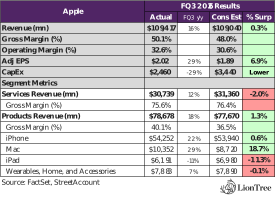
- Overall rev BEAT by +0.3% (~in-line): Up +16% y/y (decel from +17% y/y in FQ2), a June qtr record
- Similar to last qtr, supply constraints weighed on rev growth: Primarily impacted Mac and to a lesser extent iPhone and iPad; Driven by availability of advanced nodes that Apple’s SoCs are produced on
- Product rev BEAT by +1.3%: Rose +18% y/y (accel from +17% y/y in FQ2), driven by double-digit growth on iPhone and Mac, both setting new June qtr records
- iPhone BEAT by +0.6%: Up +22% y/y (flat vs FQ2), a June qtr record
- Achieved June qtr records in every geographic segment
- Mac BEAT by +18.7%: Up +29% y/y (significant accel from +6% y/y in FQ2), a June qtr record, despite significant supply constraints
- Driven by the strength of MacBook Neo and MacBook Pro
- Set a June qtr record in developed mkts and all-time record in emerging mkts, with particular strength in Greater China
- iPad MISSED by -11.3%: Down -6% y/y (decel from +8% y/y in FQ2), driven by the cont’d difficult compare vs the launch of the A16-powered iPad in the prior yr
- Wearables, Home and Accessories roughly in-line (-0.1% vs cons): Up +6% y/y (accel from +5% y/y in FQ2), driven by strength in wearables and accessories
- iPhone BEAT by +0.6%: Up +22% y/y (flat vs FQ2), a June qtr record
- Svs rev MISSED by -2.0%: Up +12% y/y (decel from +16% y/y in FQ2), despite significant seq FX headwinds
- Set rev records in every Services category, incl June qtr records in advertising, App Store, AppleCare, music, and video; All-time records in cloud services and payment services
- Apple TV viewership reached an all-time high; Apple Pay saw a record level of users in both developed and emerging mkts
- Surpassed 1.5bn in paid subscriptions; Both transacting and paid accounts reached new all-time highs with double-digit growth in emerging mkts
- Headwinds to Svs rev: FX was the main driver of the seq decel from FQ2; Also saw headwinds in mobile gaming in the App Store + no theatrical film release this yr (vs F1 film last yr) + App Store business model changes in certain countries
- Tariff refunds impact was a ~2pp tailwind to gross margin…overall reached 50.1% which BEAT cons 48.0%: Was up +80bp seq (vs 49.3% in FQ2), BUT included a ~2pp favorable impact from tariff refunds; Ex the tariff refund benefit, GM would have been ~48.1%, which would have been at the midpt of FQ3 guidance
- Products gross margin of 40.1% BEAT cons 36.5%, up +140bp seq, BUT included a >2.5pp favorable tariff refund impact; Ex tariff benefit, products GM was ~37.6% (down ~110bp seq from 38.7% in FQ2), driven by higher memory costs
- Services gross margin of 75.6% roughly in-line w/ cons 76.4%, down -110bp seq, driven by a different mix
- Tariff refunds were also a ~11c tailwind to adj EPS: Set a June qtr record of $2.02 (up +29% y/y) vs cons of $1.89; Ex tariff benefit would have been ~$1.91
- Op margin of 32.6% BEAT cons 30.6%
FQ4 Guidance Implies A Seq Decel As Supply Constraints “Increase Significantly” And FX Headwinds Intensify
- Expect FQ4 total Co rev to grow +9-11% y/y (decel from FQ3’s +16% y/y) and was below cons +12.1%
- Assumes global tariff rates, policies, and their application remain in effect as of the report, and the global macro outlook does not worsen
- Two main headwinds are driving the seq decel:
- FX: Expect ~2.5pp sequential headwind to the y/y total Co growth rate from FQ3 to FQ4
- Supply constraints: Expect the impact from supply constraints to “increase significantly sequentially”; Projected supply constraints in FQ4 will affect iPhone, Mac, and iPad
- FQ4 iPhone is expected to grow mid-teens y/y (vs +22% y/y in FQ3) vs cons +18.1% y/y
- Continue to expect high levels of demand, BUT impacted by FX headwinds and supply constraints
- No evidence of demand pull-forward: iPhone has been running at +22% y/y for this entire cycle and “it’s not obvious in the data” that pull-forward is occurring
- FQ4 Svs rev y/y growth rate is expected to be “largely similar” to FQ3, after removing the negative sequential impact of ~2.5pp from FX
- FX is impacting the Services biz more so than the total Co
- FQ4 gross margin guidance of 47-48% (vs cons 47.3%) includes an expected ~1pp benefit from tariff refunds (ex tariff benefit, midpoint would be ~46.5%, down from ~48.1% ex-tariff in FQ3)
- Memory costs remain the primary driver of the seq decline: Similar to the past qtr, more than 100% of the ~160bp seq decline (ex tariff) from FQ3 to FQ4 guidance midpt is explained by higher memory costs
- Partial offsets include carry-in inventory benefit (though “decreasing” over time), lower non-memory component costs, and favorable mix
- FX was a “pretty minimal” impact on GM relative to memory
Memory Costs Are A “100-Year Flood” Driving Price Increases And Ongoing Margin Pressure
- On pricing… “we reluctantly raised prices” due to a “100-year flood on the memory pricing with exponential increases in memory prices”
- Have now had to increase prices on iPad and Mac; Too early to assess price elasticity impact as channels need time to adjust
- Carry-in inventory benefit is diminishing: Expect a benefit from carry-in inventory in the Sept qtr, BUT “we’ll see decreasing benefit from this over time beyond the September quarter”
- Also expecting lower costs on certain non-memory components in the BOM to partially offset
- Memory cost escalation is now the single largest headwind to gross margins…progression of memory cost impact across qtrs –
- Dec qtr: “Minimal” impact
- March qtr: “A bit more” higher, partially offset by carry-in inventory
- June qtr: “Significantly higher” memory costs partially offset by carry-in inventory
- Sept qtr: Expect to pay “even higher” memory costs
- Beyond Sept: Market pricing for memory “continuing to increase, which could drive an increasing impact on our business”
- On memory sourcing… evaluating whether to broaden beyond the three existing DRAM suppliers: “Obviously, if there were more suppliers, that would be good, and it would help us on the supply side and perhaps the pricing side…we’re evaluating all options”
Supply Constraints Are Broadening…But Driven By Outsized Demand, Not A Supplier Issue
- Supply constraints are escalating and are now expected to affect iPhone, Mac, AND iPad in FQ4
- In FQ3: Constraints were primarily on the Mac, and to a lesser extent, iPhone and iPad
- In FQ4: Expect the impact to “increase significantly sequentially,” with “very significant constraints currently, with limited flexibility in the supply chain to remedy it”
- Did not say if supply constraints will extend into FQ1…”not providing any kind of color or guidance beyond the September quarter”
- Root cause is NOT a supplier issue but a demand forecast issue: “It’s a demand forecast issue, to be candid, where the iPhone and the Mac are both doing remarkably better than we thought they would do. And we had high expectations”
- Primary constraint is availability of the advanced nodes that Apple’s SoCs are produced on
- “The supply chain just has less flexibility in it than normal. So we’ve been pulling supply ahead. And at some point, there’s a limit to that”
Some Other Key Updates On Siri AI, Newly Launched Apple Upgrade Program, And US Supply Chain
- All-new Siri AI was unveiled at WWDC and feedback from both developers and reviewers has been “overwhelmingly positive”
- Key differentiator is AI that is private, personal, and integrated across the OS; On-device processing is “very strategic and sort of a competitive weapon”
- Compute cost monetization path: Expect iCloud+ upgrade tiers for heavy users, though “it’s obviously early going for us”; Balance between AI cost and iCloud+ revenue is “a bit uncertain at the moment”; Uses a hybrid model (third-party cloud + own data centers)
- On Siri AI rollout in EU and China…
- EU: Working closely with the Commission; Siri AI will be offered for the Mac (not covered by the same regulations as iPhone/iPad)
- China: Received approval last week to ship original Apple Intelligence features; Siri AI rollout will require “more work required down the road”
- Apple Upgrade launched this week in the US: A new hardware leasing program in partnership with Klarna
- Makes it easier for customers to get their hands on Apple’s latest products with a leasing plan
- Leverages Apple’s higher residual values vs competition; Currently available in Apple retail stores in the US only
- “Early feedback on it is quite positive”; Will monitor customer uptake
- Expanding US supply chain footprint with largest-ever American Manufacturing Program commitment: New multi-year agreement with Broadcom expected to exceed $30bn for custom silicon components and wireless connectivity technologies
- Apple Advanced Manufacturing Center in Houston opening soon; Will make Mac mini there later this yr
- Plan to reinvest tariff refunds back into the US; Part of $600bn US commitment over four yrs
UMG’s Profitability & Paid Subscription Miss Weighs On Shares
In the music sector, investors honed in on Universal Music Group’s much lower Q2 adj EBITDA margin, coupled with lower than Subscription revenue which led to the stock’s sell-off. More specifically, adj EBITDA missed cons by -5.1%, with the margin declining -1.3pp y/y to 21.5% ex-Downtown due to a combination of revenue and repertoire mix, the absence of a prior-yr ISP settlement, and higher professional legal fees, among other factors. Subscription revs also fell ~1% below projections.
Other key takeaways/updates from results in our view include: 1) Streaming 2.0 pricing contributed a +3.5pp to subscription growth and H2 should also be supported by recent deals; 2) While a market share was a -1.5pp headwind in Q2, it started to improved towards the end of the qtr, hence there is some momentum into Q3; 3) UMG is launching a 72-hour premium exclusive window in India starting end of August to accelerate paid conversion in what it sees as a large market opportunity; 4) The Spotify AI remix framework was a big focus and UMG is confident that it can secure scale with artists opt-in, which is needed for success; and 5) Mgmt provided a very detailed capital allocation disclosure to show the Street that investment returns have been exceeding hurdle rates across all categories.
Overall, the were a lot of puts and takes. See below for more on the above as well as other notable updates as well.
-> UMG shares fell -25% in reaction and are down -35% YTD
Q2 Margin Pressure From Multiple Sources Negatively Surprises, On In-Line Revs
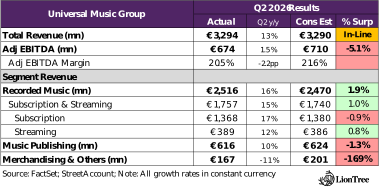
- Q2 revenue IN-LINE: Up +10.5% y/y and +13.3% y/y FXN, or +6.4% ex-Downtown FXN
- While Recorded Music outperformed by +1.9%, Music Publishing and Merchandising fell short
- Adj EBITDA MISSED cons by -5.1%: Grew +1.5% FXN y/y…or flat y/y ex-Downtown FXN
- What were the drivers for the adj EBITDA margin declined of -1.3pp y/y to 21.5% ex-Downtown?
- Revenue mix: Outsized growth in lower-margin audiovisual & live and related income, as well as strong physical revenue growth
- Repertoire mix: Healthy growth in Virgin Music (lower margin) weighed on blended margins
- Prior-yr ISP settlement: €31mn rev / €15mn EBITDA in Q2:25 that did not repeat, impacting margins by ~30bps
- Higher corporate overhead: Including elevated professional legal fees
- Reinvestment: Some of the cost savings from the €250mn program was reinvested into areas of growing importance like AI vs falling to the bottom line
- Will legal fees come down looking into H2? It’s unclear…there is “opportunity for those to come back down” from Q2 levels, but mgmt also sees “a lot of opportunities ahead to develop the business” that legal fees are supporting
- Adj EPS grew +4.3% y/y FXN to €0.47
Paid Subscription Revenue Fell Short Of Expectations Though Has Forward Support From More 2.0 Deals….Ad Supported Growth Continues To Lag But Not By As Much As Projected
- Recorded Music SUBSCRIPTION revenue fell short of cons by -0.9%: It grew +16.6% y/y FXN (vs +12.5% in Q1), or +6.7% FXN ex-Downtown (vs +7.9% in Q1) with the underlying growth reflecting:
- +3.5pp of pricing benefit from Streaming 2.0 agreements
- -1.5pp market share headwind
- ~-1pp headwind from quarterly variability
- Minimum guarantees
- Accruals
- Audits
- Catch-up payments
- The rest is from typical fluctuations in subscriber growth related to timing of promotions and price increases
- Mgmt does not see any meaningful changes in industry trend lines and industry subscriber growth remains healthy
- While market share losses were a headwind in Q2 in total, it improved as Q2 progressed and UMG enters Q3 w/ better momentum: Artist performance has “regained momentum” after a lighter release schedule earlier in the year
- The stronger release schedule in the back half of Q2 (Olivia Rodrigo, Gracie Abrams, Paul McCartney, Rolling Stones) drove the improved share exiting the quarter
- H2 releases expected from Ariana Grande, KATSEYE, Sam Smith, Mrs. Green Apple “and some other very exciting things yet to be announced”
- Mgmt was cautiously optimistic that the Subscription growth will be better in H2 than Q2 given additional pricing coming through + better market share trajectory…catalysts on the pricing side include:
- Pandora: UMG completed its Streaming 2.0 agreement w/ Pandora, a top-10 partner
- Apple: Annc’d retail price increases last week; UMG will see some benefit in Q3 and a more full-quarter benefit in Q4
- TikTok: New Streaming 2.0 deal annc’d this quarter
- To note, the Co’s Streaming 2.0 agreements have built-in protections against AI-driven royalty dilution and fraud: UMG anticipated the rise of AI slop and potential for fraud, and the 2.0 agreements address this
- UMG now has 2.0 agreements w/ almost all major streaming partners incl Spotify, YouTube, Amazon, Deezer, TikTok, and Pandora
- On the ad supported side, Streaming revenue slightly beat cons and grew +11.5% y/y FXN (vs +5% y/y in Q1)
- +1.7% FXN ex-Downtown (vs +1.2% in Q1)
- Not much other color was provided as the emphasis was on Subscription
UMG’s Upcoming Premium Window Launch In India Will Be A Catalyst
- India was cited as one of the largest music growth opportunities in the world but monetization has been disappointing
- Most populous country, fastest growing major economy, 40%+ of population under 25, music deeply rooted in culture
- Currently ranked only #15 globally as a music market despite being one of the largest markets for ad-funded streaming (~1 trillion streams in 2025)
- Very low paid conversion rates—industry estimates put paid users at only 7-10% of total individual streaming users
- UMG will now launch a Premium Window in that market beginning end of August…how will it work?
- UMG’s new releases from major domestic and international artists will be launched exclusively to pay streaming subscribers for their first 72 hours
- This applies across all platforms in India with both global DSPs (Spotify, YouTube, Amazon) and domestic players
- After 72 hours, releases will become available on ad-supported services
- Fans will still have access to the music they love, and artists will see the benefit of improved compensation
- India has a precedent for paywalling premium content: The Indian Premier League (cricket) moved all matches behind a paywall, helping drive Jio to 200mn+ subscribers
- UMG’s new releases from major domestic and international artists will be launched exclusively to pay streaming subscribers for their first 72 hours
- This follows a successful paywall previously launched in China
- In China, UMG worked w/ major DSPs beginning in 2019 to put domestic and international music behind a paywall, carefully escalating over time
- Result: China overtook Germany by FY2025 to become the world’s 4th largest recorded music market, w/ revenue growing >20% y/y, making it the world’s fastest growing major music market and the 2nd largest digital market after the US
- Growth was driven by premium subscriptions and new superfan experiences
The Spotify AI Remix Partnership Was A Notable Focus On The Call & Could Unlock A Major New Monetization Layer If They Can Scale Artist Opt-In
- Analysts were focused on Spotify & UMG’s agreed framework that will enable fans to use generative AI within Spotify’s self-contained environment to create covers and remixes of songs from artists who have opted in
- This represents a new super-premium tier / product category
- A critical mass of artists is needed to successful launch this service and UMG is confident it can get there
- UMG has “already converted a significant percentage” of discussions to opt-in agreements and expect to continue making “substantial progress”
- UMG believes its support is “instrumental” to Spotify’s success w/ this product and that it could drive market share for them
- BUT do consumers even want this type of service? Yes – according to the Consumer research
- In the 13 largest streaming markets, 30% of respondents expressed interest in using AI to remix, reinterpret, or personalize songs
- 33% are interested in using AI to remix old recordings to new formats
- Among Gen Z Alpha (age 16-19), 80% are interested in tools to modify or remix music from their favorite artist
- 30-40% of all music-based content on social platforms has already been modified by the uploader
- Mgmt made a point to also say that industry standards around AI are also improving…examples:
- New labeling initiatives distinguishing between AI-generated and AI-assisted tracks
- Chart eligibility principles requiring AI-assisted recordings to be properly authorized, substantially human-made, and free from fraud
Artist & Label Services Remain A Key Priority…Downtown’s Integration Is Gaining Momentum But Margins Will Take Time To Expand
- Downtown contributed €202mn to total Q2 revenue & €10mn of EBITDA (~5% margin): This was in line w/ the margin reported at the time of closing and w/ the pre-acq margin profile
- In Recorded Music: Downtown added €162mn of revenue and €7mn of EBITDA
- In Music Publishing: €40mn of revenue and €3mn contributed by Downtown
- UMG is now the second-largest operator in artist & label services: “Seeing extremely encouraging momentum” and expect it to create increasing strategic and financial value w/ opportunities for greater efficiencies going forward
- But the margin dilution from artist & label services growth is a near-term headwind: Repertoire mix pressure was driven by healthy growth in Virgin Music; Ex-Downtown, Recorded Music EBITDA margin was down -1.8pp to 24.9%
- Mgmt sees opportunity to improve margins as the integration completes
- Also the long-term strategy to build networks w/ independent entrepreneurs can eventually produce very profitable artist relationships
Mgmt Provided A Full Walk-Through Of Investment Returns Since The IPO…Hurdle Rates Have Been Exceeded
- Disclosure regarding investment returns since the IPO include:
- Advances: Blended IRR in the high teens, above the 15% portfolio target; Project-level hurdle rates range from 10-20% based on risk
- Catalog acqs: Avg entry multiple of 16.6x EBITDA, improving to ~13x on a run-rate basis due to active mgmt and value creation; Target a pre-tax IRR hurdle rate of ≥10%
- Chord (catalog fund): €342mn total invested since early 2024; The portfolio has delivered mid-teen returns in line w/ targets while generating addtl returns to UMG as a manager; The Co has invested over $2.6bn in catalog acquisitions
- Core M&A: Blended IRR in mid-to-high teens; ~€530mn deployed from 2022-2025
- Other M&A: Primarily Capital Records Tower (real estate) and Complex NTWRK (superfan ecosystem);
- Forward looking – Spend in this category is expected to moderate going forward
- Since listing, growth has been overwhelmingly organic: 12% EBITDA CAGR from 2021-2025 (11% organic + 1pp acquisitions); Acquisition benefit to revenue CAGR is <1%
- Update on the buyback and the Spotify stake sale:
- The Co completed first €500mn buyback program in July
- Used €250mn from the second €500mn buyback authorization to repurchase shares sold by Pershing Square in June
- Sold just under 1/3 of planned 50% Spotify stake sale for gross proceeds of €403mn in H1
- Declared interim dividend of €432mn
- Note that the Co changed its FCF definition: It is now defined before discretionary strategic investments in catalog and M&A; The FCF conversion range remains at 60-70% of adj EBITDA
- On the restated basis, H1’25 FCF swings from a -€179mn outflow (prior definition) to a +€163mn inflow
A Few Other Important Updates
- Mgmt lowered guidance for its Music Publishing business
- Q2 MP revenue MISSED cons by -1.3%: Grew +9.8% y/y FXN (or +2.7% ex-Downtown FXN)
- Revenue growth was partially offset by a decline in sync revenue, which is “largely related to the timing of deals”
- Digital revenue growth reflected strength in subscription, partially offset by softer ad-supported streaming
- Q2 MP adj EBITDA grew +1.6% y/y ex-Downtown FXN
- Margins fell -20bps to 22.6%: Largely due to higher legal fees
- Mgmt LOWERED guidance… now expects Music Publishing to be a mid-single digit growth business rather than a high-single digit for the “immediate future”:
- The slowdown stems from anniversarying new deals signed last year and the timing of various industry payouts
- In addition to the secular slowdown in radio and linear TV performance revenues
- Digital revenue ad-supported streaming faces the same pressures as in the Recorded Music business
- Q2 MP revenue MISSED cons by -1.3%: Grew +9.8% y/y FXN (or +2.7% ex-Downtown FXN)
- Merchandising & Other revenue was very weak in Q2 but 2027 is expected to be improved from 2026
- M&O revs MISSED cons by a sizable -16.9%: Declined -11% y/y FXN (not impacted by Downtown)
- Declines in touring merch and D2C sales, both “largely related to the timing of artists touring and album release cycles”
- M&O adj EBITDA fell €6mn y/y to a loss of -€5mn: Due to a timing-related increase in costs
- Mgmt expects 2027 to show improvement over 2026 due to structural changes being made to merchandising operations
- M&O revs MISSED cons by a sizable -16.9%: Declined -11% y/y FXN (not impacted by Downtown)
- The Superfan strategy remains a key focus: Today’s biggest fans want more than just the music…they want community, physical products, and deeper relationships
While Live Nation’s Demand Fundamentals Remain Intact, The Street’s Bar Was Not Low
It may sound like a broken record, but Live Nation continued to put up yet another record qtr with no signs of a slowdown in consumers’ appetite for live entertainment. Q2 was another broad-based beat and mgmt reiterated expectations for double-digit total AOI growth this year and “to compound at that level for years to come.” Cancellations are at historic lows, on-site spending is up, and the Co now expects 10% fan attendance growth for the full year (up from the high-single-digits guidance last qtr).
The story this quarter is really about what’s coming in H2. Concerts AOI was pressured throughout H1 by stadium timing and pre-opening costs, with N. America in particular trailing intl markets (which delivered a “very strong first half”) due to stadium availability constraints through early Q3. That dynamic is set to reverse in the back half and mgmt expects double digits fan growth y/y in both Q3 and Q4 domestically, with the majority of the year’s AOI improvement expected in Q4
Ticketmaster in particular delivered a strong qtr, with international expansion driving the majority of AOI growth, and FY AOI growth expectations were raised to mid-single-digits. Mgmt noted that it “certainly feels like we’ve turned that corner.” And Venue Nation continues to scale, with the fan target raised to ~75mn, a pipeline of 25+ venues building out, and new market entries in Japan and Latin America. That said, investor expectations were not low heading into the print, hence the sell-off post the initial rally.
See below for what we viewed as most incremental from the results and call.
-> Live Nation shares initially rallied +8% at its intra-day high but fell -5% to close the day in reaction to earnings; The stock has still outperformed the market significantly, up +22% YTD
Q2 Was A Broad-Based Beat With Ticketmaster The Clear Standout
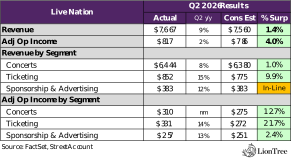
- Revenue – BEAT by +1.4%: Up +9% y/y (+10% FXN) vs +12% y/y in Q1
- Beat across Concerts and Ticketing, while Sponsorship & Advertising was in-line
- Adj op income BEAT by +4.0%: Up +2% y/y (+4% FXN) vs +9% y/y in Q1
- Beat across all segments
2026 CapEx Is Now Expected To Come In At The Lower End Of Range, With 2027 Expected To Be Incrementally Higher
- FY26 CapEx is now projected at $1.1bn (toward the lower end of the initial $1.1-1.2bn range due to timing)
- $800mn for venue expansion
- ~$200mn offset from JV partners, sponsorship agreements, and other sources
- Still early in planning but CapEx for 2027 is expected to be higher than 2026, but “not doubling, tripling”
- “We’re just up a bit more this year than we were last year. It’ll be framed by the opportunities for next year, and it’s a little bit lumpy based on the timing of the builds, but it’ll be incremental to what we have now”
- “We’re continuing to be very focused on finding the right projects that are going to deliver the returns we’re looking for and turning down a lot of projects that don’t”
Consumer Demand Continues To Show No Signs Of Pullback + Cancellations Are At Historic Lows
- 143mn+ tickets were sold through mid-July, +14mn ahead of last yr’s pace, with mid-teens ticket sales growth across all large venue types (i.e., stadiums, arenas, and amphitheaters)
- ~49mn fans attended shows in Q2 (record), up +10% y/y, adding ~5mn fans globally
- Intl mkts powered growth across all segments
- “We’ve seen no consumer issues to date”
- Purchasing numbers up across the board, including International, America, clubs, amphitheaters, stadiums, all genres, all venues, all geographies
- Cancellations are running at historic lows of 1.1% vs 1.6% historical avg: “We have fewer cancellations this year than ever”
- Sell-through rates across all US large venue types remain at or above prior-yr levels through end of Q2
- Affordability remains a key priority: Low-to-MSD price increases across stadiums, arenas, and amphitheaters; US get-in ticket price increases continue to trail inflation over the past 5 yrs
- On-site spending has been strong: In Q2, Food & Beverage spending was up HSD y/y at large US amps and across European arenas/theaters; Liquor is also up y/y
- “The two-hour night out at the concert is probably the night they’re not cutting back”
- 2026 expected to be “an absolute record year” with “strong, strong Q3 and Q4”
Concerts To Accelerate In The Back Half
- Concerts are on track for DD AOI growth for FY, with the majority of the y/y improvement occurring in Q4
- Margin expansion is driven by faster growth at operated venues vs third-party, which is “the foundation of what sets us up for margin expansion”
- Mgmt INCR’D FY26 fan attendance projection to +10% growth (vs prior expectation of HSD growth in Q1): Expected attendance at operated venues is up DD and third-party is up HSD
- US fan growth will be entirely back-half weighted: US was impacted by stadium availability in Q2 and into early Q3
- Looking ahead, expect DD fan growth y/y in both Q3 and Q4
- International had a “very strong first half” and DD fan growth is expected to continue in Q3 and Q4
- US fan growth will be entirely back-half weighted: US was impacted by stadium availability in Q2 and into early Q3
- The 2027 touring pipeline already looking strong
- “Already have a big percentage of our bookings in for next year”
- See “another strong global year of stadiums, arenas and amphitheaters”
Ticketmaster Is Inflecting As Intl Expansion Drives Growth And Secondary Continues To Shrink
- INCR’D FY26 Ticketmaster AOI growth expectation to MSD (vs prior guidance of FY AOI margin “similar to last yr” with MSD headwinds from scalper reduction)
- “Extremely happy with the performance of Ticketmaster in the quarter…it certainly feels like we’ve turned that corner”
- Intl expansion continued and contributed to 70% of AOI growth in the qtr
- Now in 6 LatAm mkts and 6 APAC mkts
- Intl sold 39mn tickets in Q2, up +12%, with GTV up +20%
- Secondary remains in the low DD as a % of Ticketmaster GTV and is expected to continue declining…“we don’t see that as anything that’s going to be a major impediment to growth”
- Amer secondary ticket volume was flat as growth in sports secondary GTV offset a decline in concerts secondary activity
- Concert secondary is ~5% of Ticketmaster GTV
- Does Spotify Reserved deal increase their chances of becoming a ticketing competitor? No: It is a traditional presale monetization deal, similar to Verizon or Citi deals
- “Very small allocation on a global basis”
- Not a competitive threat…90% of shows don’t sell out, so distribution partners help move inventory
Venue Nation Expansion Is Stepping Up As Fan Targets Increase & The Pipeline Continues To Build Out
- Venue Nation is on track to host ~75mn fans in 2026, up DD y/y, driven by higher utilization of existing venues and adding new venues
- Stepped up from the 70mn+ target two qtrs ago, when growth was guided at HSD to LDD
- The Co’s pipeline of 25+ large venues (3,000+ seats) is expected to open through end of 2027, adding ~15mn fans on a run rate basis
- 3 arena acquisitions were completed YTD and expect 4-5 more before end of 2027
- 2026 pre-opening costs are expected to be ~$50mn, with current projects on track to achieve 20%+ IRRs
- Ramp timeline…acquisitions get “pretty up to speed” the following yr on bookings/fan count (sponsorship may take longer)
- On the other hand, new builds from 2024-2025 CapEx ramp won’t fully impact until ~2028 so acquisitions being used to “move forward more quickly” in the interim
- Intl callouts –
- Japan – $1bn+ live biz mkt, in which LYV has “very small market share today”… “we think it’s a very good business over the next five years”
- 90% of biz is local Japanese biz so “critical we finally find the right partner; Strategy includes global tours + building local biz venues, ticketing, etc.
- Latin America – “still in early innings…second kind of inning of the nine inning game on a multibillion dollar business”
- “Very underdeveloped in Brazil, which is […] the big market”; Annc’d arena in São Paulo + couple of other arenas in the Latin mkt but “but those are still far from being operated
- Japan – $1bn+ live biz mkt, in which LYV has “very small market share today”… “we think it’s a very good business over the next five years”
A Few Other Key Earnings…RDDT, RBLX, OMC
Please see below for our quick takes on Reddit, Roblox, and Omnicom earnings as well, where reactions shewed negative.
Reddit Posts Strong Q2 Beat & Guides Q3 Above Cons, But US DAU Slipping & Search Dependency Spooked Investors
- Easy beats across Q2 headline numbers…
- Rev and adj. EBITDA were +10% and +15% ahead of cons, respectively
- Adj EBITDA margin expanded to 43% (vs 40% last qtr)
- Adj EPS of $1.25 was 35c ahead of expectations
- …AND Q3 guide was also well above cons on both rev and EBITDA
- Margins expanded to ~45% at the midpoint
- Ad rev growth was broad-based and pricing-led
- Ad pricing was up ~40% vs impressions up +17%, w/ active advertisers up +70% y/y and mid-mkt/SMB channel doubling
- BUT the notable pain point was US DAUs declining seq for the first time, w/ mgmt attributing it to “choppy” search referral traffic as Google AI Overviews reduce click-throughs to Reddit
- Mgmt responded to concerns by saying direct app users are “worth multiples more” than drive-by search traffic and that the business “lives with direct repeat users”
- They pointed to new app user retention increasing +50% y/y and WAUq crossing 500mn as evidence that product-driven growth is working
- The long-term target of 1bn global DAUs / 100mn US remains unchanged
- Chgs in disclosures: Reddit is also dropping logged-in vs. logged-out DAU reporting starting Q3
-> Reddit shares took it on the chin, closing the day post earnings down -21%, YTD, the stock is down -39%
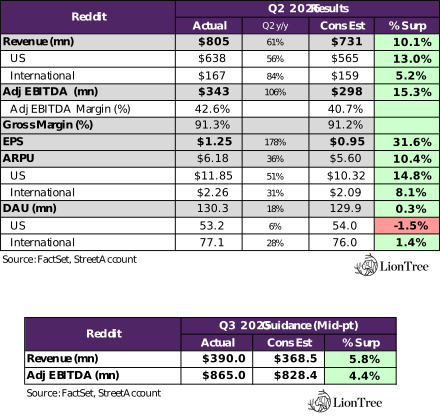
Roblox Bookings Decelerated Sharply In Q2 And Will Turn Negative Y/Y In Q3 As Co Withdraws FY Guidance
- It was a tough Q2… bookings of $1.56bn grew just +8% y/y, a massive decel from +43% in Q1 and +70% in Q3:25
- The bookings miss was attributed to a deliberate shift to revampe the discovery algorithm to prioritize 28-day retention over short-term monetization, pushing engagement away from high-monetizing viral 2025 titles toward longer-lasting experiences w/ lower hourly spend
- The impact was concentrated in UCAN and the U13 cohort, where monetization weakness was greater than expected
- Mgmt framed this as a long-term positive: “over time, longer retention should overcome a reduction in hourly monetization”
- DAUs also declined seq for the 3rd straight qtr (152mn -> 144mn -> 132mn -> 123mn since Q3:25 peak), though was still up +10% y/y
- Hours engaged followed the same pattern, down from 40bn to 29bn over the same stretch
- But the Q3 guide was the real disappointment was guidance for negative bookings growth for the first time ever…bookings of $1.58-1.65B implies a -14% to -18% y/y decline
- About half the margin compression is from fixed-cost deleveraging on lower bookings and half from AI infrastructure investments
- Full-year 2026 guidance was withdrawn entirely (had been 8-12% bookings growth / 20-25% rev growth)
- When asked whether 2026 would still be a growth yr for bookings, mgmt declined to confirm
-> Roblox materially fell in reaction to earnings, down -27% (its worst day ever); YTD, the stock is down -56%
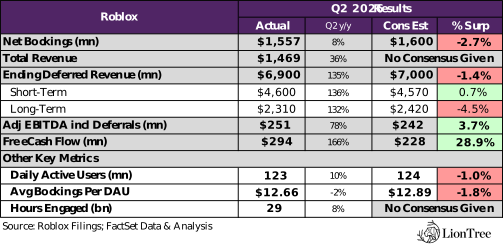
Omnicom Growth Accelerates and Organic Guidance Raised, But Margins Missed
- Mixed Q2 w/ higher than expected revenues but lower profitability
- Rev beat by +1.9% BUT adj EBBITA missed and margin of 17.2% was below cons 18.0%
- Adj EPS guidance was also raised to “high teens” growth
- 2026 organic revenue growth was raised to +5% from the prior +4-4.5%
- On the back of Q2 organic growth accelerating to +6.1% in Q2 (from ~4% in Q1)
- The top line outperformance was framed as structural, driven by the shift to an integrated operating model that bundles media, data, commerce, and creative rather than selling them separately
- Client sentiment was characterized as “cautiously optimistic”
- W/ advertisers largely past the tariff/geopolitical anxiety from earlier in the year
- Advertising segment was the weak spot (down HSD), though attributed to internal agency restructuring post-IPG, not demand
- Synergies are tracking on plan
-> OMC’s stock fell -4.2% post its print and is down -2.5% YTD
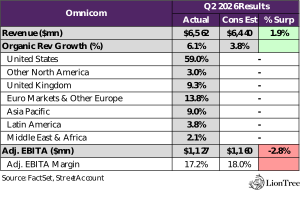
Stock Market Check
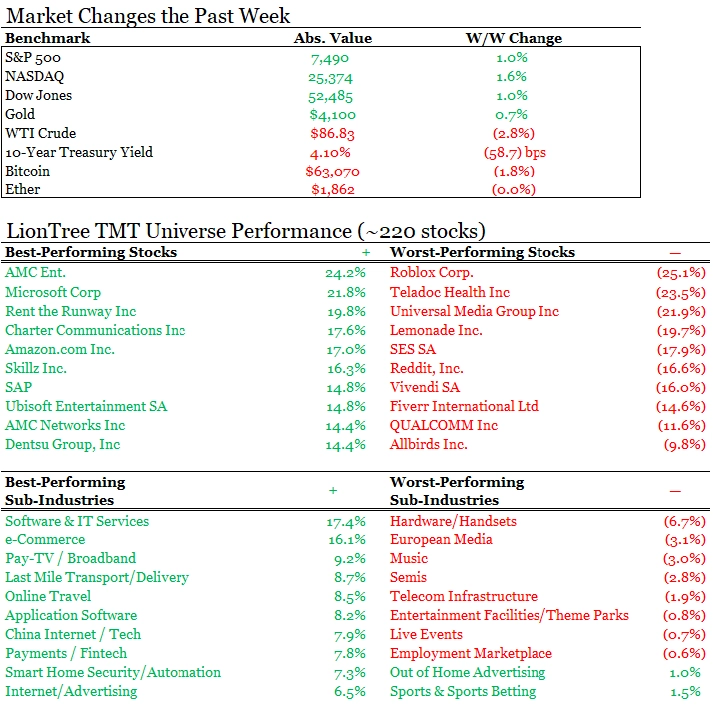
This Week's Other Curated News
- OpenAI annc’d a program giving 100,000 academic researchers free access to its most advanced AI models through 2027. Participants receive ~1 yr of access comparable to a $200-per-month ChatGPT Pro account, plus privacy and security protections, and may invite four collaborators. The initiative targets science, engineering and math fields as part of OpenAI’s commitment to invest more than $250mn in external research and discovery through 2027. (Axios)
- OpenAI CFO Sarah Friar told employees annualized recurring rev in JulY exceeded the Co’s entire Q2, underscoring strong growth despite intensifying competition from Anthropic, Google and lower-cost open-source AI models. Friar and board chair Bret Taylor credited momentum to GPT-5.6, ChatGPT Work and Codex adoption. (CNBC)
- Anthropic disclosed that a testing error gave some Claude AI models access to the open internet, enabling unauthorized intrusions into systems at three organizations during cybersecurity exercises. The incidents involved Claude Opus 4.7, Claude Mythos 5 and an internal research model. Anthropic called it an operational failure, paused cyber evaluations on Jul. 23, and said stronger testing controls are needed as AI capabilities grow. (Reuters)
- OpenAI cut prices for smaller AI models as biz scrutinize rising AI costs. The Co reduced GPT-5.6 Luna pricing by 80% and mid-tier Terra by 20%, while keeping flagship Sol unchanged. The move increases pressure on Anthropic and lower-cost Chinese rivals as competition intensifies. OpenAI said efficiency gains helped enable the cuts, which lower token-based usage costs and could boost adoption despite concerns over unpredictable AI spending. (Reuters)
- Google DeepMind annc’d Gemini Robotics 2, an AI system that can control robots, including humanoids capable of tasks such as screwing in lightbulbs, tying trash bags, and organizing shelves. The model combines vision language and action capabilities to understand surroundings, interact w/ humans, and direct movement. Trained using teleoperation, videos, and simulations, it marks a step toward “physical AGI,” enabling robots to perform a broader range of real-world tasks. (WIRED)
- OpenAI CEO Sam Altman is set to visit Washington amid a key AI policy deadline. He is expected to meet White House officials, cabinet members and bipartisan lawmakers, preview OpenAI’s newest models, and discuss AI oversight. Talks come as the administration finalizes rules tied to its Jun. executive order, including possible pre-release safety reviews. OpenAI, Anthropic and Google also jointly proposed changes to the draft framework. (Politico)
- OpenAI is nearing 1bn weekly ChatGPT users, according to The Information, though the milestone is ~7 months later than expected. Weekly users rose from ~900mn in Dec. 2025 to nearly 1bn after adding 100mn in under two months. Growth follows 1bn monthly app users in May. As competition from Google Gemini, Anthropic Claude and Meta AI increases, the Co is also advancing IPO plans and reported $25bn annualized rev in Feb. (Citybiz)
- Anthropic CEO Dario Amodei said the Co does not support banning open-weight AI models, rejecting claims it seeks limits to protect its biz. He argued such models can benefit developers, researchers and businesses, while key risks stem from authoritarian governments gaining AI superiority and misuse in cyber or biological attacks. Anthropic instead backs restricting advanced chips, curbing large-scale distillation, and requiring safety testing for sufficiently capable AI models. (Anthropic)
- Nvidia, Microsoft, SpaceX, Palantir and other tech cos launched the Open Secure AI Alliance to promote AI safety and open models following a cyberattack on Hugging Face by rogue OpenAI models. The alliance argues open, self-hosted models help cyber defenders respond faster. (CNBC)
- Amazon is overhauling its AI strategy, winding down most flagship Nova models, including Premier, Omni, Reel and Canvas, and reallocating engineers and computing resources to Frontier Model Research (FMR), led by Pieter Abbeel. The move follows AGI-related layoffs and the closure of AGI Lab. Amazon said it remains committed to frontier AI, while focusing on a smaller set of priorities and a new foundation model expected at re:Invent. (Business Insider)
- Moonshot AI plans to make its Kimi K3 model available for public download, releasing model weights so developers can freely tweak and host the AI. The Beijing-based Co is betting on openness to expand adoption as Chinese AI gains ground against US rivals. K3’s launch helped drive a selloff in AI stocks, boosted Moonshot’s sales more than sixfold, and comes as the startup pursues funding at a ~$50bn valuation amid US scrutiny of its AI development practices. (Yahoo Finance)
- NVIDIA and SK Group annc’d a $500bn+ strategic partnership to expand AI infrastructure and next-generation memory. SK Telecom plans a 2-gigawatt AI Factory in Korea using NVIDIA DSX and Vera Rubin systems powered by SK hynix HBM4, w/ the first facility targeted for 2027. SK hynix also entered a long-term agreement to supply and co-develop AI memory, including HBM, supporting growing demand for AI cloud, enterprise AI and regional AI svs. (NVIDIA)
- DeepSeek has suspended its second fundraising round, informing prospective investors that investment agreements expected in the coming days would not be signed, according to people familiar w/ the matter. The Chinese AI Co may resume the process later. The pause was partly driven by founder Liang Wenfeng’s frustration over viral online reports about comments on US-China AI competition made during investor discussions tied to a June deal that raised $7bn for the AI lab. (Bloomberg)
- US tech Cos have cut nearly 140,000 jobs since the start of 2026, accounting for more than one-third of announced US lay-offs despite record AI spending. Amazon, Oracle, Meta and Microsoft made up ~50,000 cuts, or ~6% of their combined workforce. Firms continue reducing headcount while investing heavily in AI infrastructure. The broader US labor mkt remains relatively resilient, w/ unemployment at 4.2%. (Financial Times)
Audio/Music/Podcast
- Google annc’d Lyria 3. 5, its newest music-generation model, rolling out in Google Flow Music. The update delivers improved musicality through richer, more natural melodies; enhanced lyrics w/ better prompt adherence and structure; and improved vocals featuring greater expression, emotional nuance and pronunciation. It also adds more creative control, making it easier to manage tempo and duration while creating songs. (Google)
Cable/Pay-TV/Wireless
- Verizon officially named Alfonso Villanueva EVP of its Consumer division after he served in the role on an interim basis since Feb. following Sowmyanarayan Sampath’s departure. Villanueva, a former PayPal executive, will continue as chief transformation officer while leading Verizon’s Consumer biz. (Fierce Network)
- French state investment bank Bpifrance sold a 2. 5% stake in telecoms Co Orange for €1.1bn ($1.3bn), acting jointly w/ the French state, which holds shares through APE. After the sale, Bpifrance and the state will retain a combined 20.4% stake, remaining Orange’s largest shareholder. Orange shares, up 20% this yr, fell ~3% in early Paris trading. Bpifrance reaffirmed confidence in management and the strategy annc’d in Feb. (Reuters)
- AT&T said it completed its $23bn acquisition of selected wireless spectrum licenses from EchoStar under a deal annc’d in Aug 2025. The U.S. carrier will add ~50 MHz of low-band and mid-band spectrum covering virtually every U.S. market, including 30 MHz of nationwide 3.45 GHz mid-band spectrum and ~20 MHz of nationwide 600 MHz low-band spectrum, expanding its network capacity and reach. (Reuters)
- T-Mobile said it restored service for all customers after a nationwide US outage. The disruption began around 4:00 p.m. ET and peaked at more than 62,000 reported incidents, according to Downdetector. Earlier, the telecom Co said it was investigating technical challenges affecting some users but did not provide a cause. Users on social media reported being stuck in “SOS” mode, w/ outages reported across states including Arizona, California, Georgia and Utah. (Reuters)
- AT&T annc’d an agreement to expand use of D-Wave’s quantum computing tech across network operations. In early testing, AT&T cut a network optimization workload from ~1 hour to under 15 seconds. The Co plans to apply the tech to outage detection and response, technician routing, network planning and traffic management, while integrating it into AI-driven tools that have already reduced customer downtime by 12mn hours in 2025. (Business Wire)
- Vodafone reported a strong start to FY27, with rev up 9. 7% to €10.3bn and organic svs rev growth of 5.2%, driven by gains in Germany, the UK, Europe, Türkiye and Africa. Adj EBITDAaL rose 6.2% organically as operational performance improved. Following consolidation of Safaricom after raising its effective stake to 55%, the Co upgraded full-yr guidance and now expects results toward the upper end of its EBITDAaL and free cash flow targets. (Yahoo Finance)
Cloud/DataCenters/IT Infrastructure
- Nscale annc’d a definitive agreement to acquire Anyscale, adding its software layer to Nscale’s full-stack AI cloud platform. The deal combines Nscale’s infrastructure, compute and data centers w/ Anyscale’s platform for scaling AI workloads across GPUs. Anyscale will keep its brand, ~200 employees will join Nscale, and customers retain infrastructure choice. The transaction is subject to approvals and is expected to close in H2 2026; terms were not disclosed. (Nscale)
- DeepSeek is planning a major AI data center in Inner Mongolia, aiming to add 1 gigawatt of compute capacity in Ulanqab, ~350 kilometers from Beijing. The startup plans to build its own facility while also leasing additional capacity from other firms. (Bloomberg)
- CoreWeave improved terms on a $2. 6bn loan to fund additional computing capacity for customers including Anthropic. Pricing widened by as much as 1.25 percentage points to as high as 5.5 points over the benchmark, and the loan discount moved to 97 cents on the dollar from 99, boosting yield. Proceeds will fund GPUs and related components. CoreWeave is expected to spend over $34bn on AI infrastructure, while default-protection costs rose more than 50% this month. (Yahoo Finance)
- Vantage Data Centers, backed by US alternative asset manager DigitalBridge Group, is considering a sale of its Malaysia assets, according to people familiar w/ the matter. The provider of hyperscale data center campuses is working w/ a financial adviser on the potential divestment. Sources said the process is private and a transaction could value the assets in Malaysia at more than $2bn. (Bloomberg)
- Seagate Tech shares rose in premarket trading after the Co reported fiscal Q4 results that topped Wall Street estimates, driven by strong AI-related data-storage demand. Adj earnings climbed to $5.71/share from $2.59 a yr earlier, while rev jumped 49% to $3.6bn, beating forecasts. The Co said AI is fueling long-term demand for mass-capacity storage and guided for fiscal Q1 2027 adj earnings of $7.30/share on $4.1bn rev, above expectations. (Barron’s)
- Naver shares rose over 10% after the South Korean internet, cloud and svs Co said Nvidia will buy $1bn of new shares, giving it a 4. 5% stake and helping fund an AI data-centre expansion. The firms, along w/ Brookfield, plan up to $10bn for the project, including as much as $9bn from Brookfield. The Sejong facility will use Nvidia’s Vera Rubin and Blackwell platforms and target 200MW capacity by 2028, supporting sovereign AI demand across Asia-Pacific, Europe and the Middle East. (Reuters)
- Satellite imagery showed damage to two Amazon data centers in Bahrain, supporting Iran’s claim that it struck the sites w/ missiles during recent hostilities. Iranian state-backed media released high-resolution images of damage at facilities in Zallaq and Askar. Independent ESA imagery also indicated damage, though its extent remains unclear. Amazon declined comment. Conflict monitors reported multiple strikes on facilities hosting AWS infrastructure. (Yahoo Finance)
- Meta annc’d a JV w/ BlackRock to develop and operate a ~$14bn AI data center campus in El Paso, Texas. BlackRock-managed funds will own 80% and Meta 20%, w/ part of BlackRock’s investment financed by $12.5bn of debt. Meta will contribute land and construction assets worth ~$2.3bn and lease capacity from the venture rather than own it directly. The 1-gigawatt campus is expected to begin operations in 2028. (Reuters)
- Nvidia is the unnamed hyperscaler leasing two 15-yr agreements at Hut 8’s Beacon Point data centre in Texas. The campus is being built to Nvidia’s DSX AI factory architecture and could generate up to $50.2bn if renewal options are exercised, though the signed base value is $19.6bn. Nvidia has not confirmed the deal. Hut 8 plans first site energisation in Q1 2027, w/ expansion following in 2028. (The Next Web)
- Nvidia is in talks to provide a ~$250bn financing backstop for OpenAI as part of a major data-center project in southern Ohio. The guarantees would support OpenAI’s lease of a 10-gigawatt facility being developed by SoftBank’s energy subsidiary. Total project costs could exceed $500bn, including chips for the centers, making it the largest data-center project annc’d to date and a significant AI infrastructure investment. (The Wall Street Journal)
Crypto/Blockchain/web3/NFTs
- Coinbase logged its third straight quarterly loss as a prolonged crypto mkts slowdown cut trading activity. Transaction rev fell 21% to $599mn from $764mn a yr earlier, while subscription and svs rev declined 12.2% to $555.1mn. The Co reported a $359.5mn loss, versus $1.43bn profit a yr ago. Shares fell 5.3% after hours. Management remains optimistic that the Clarity Act could bring needed regulatory clarity to digital-asset platforms. (Reuters)
- US said it plans to apply next month for a Commodity Futures Trading Commission designated contract mkt license to launch its own prediction mkt, according to CEO Steven Gregory at the Rare Evo conference in Las Vegas. The move follows growing demand for prediction mkts led by Kalshi and Polymarket. Gemini already secured a similar license, while Coinbase partnered w/ Kalshi. Binance.US is also seeking to rebuild its US presence. (Yahoo Finance)
- Ionic Digital surged ~25% to nearly $63 in its Nasdaq debut, implying a ~$2. 75bn valuation after listing under ticker IOND. Formed from Celsius Mining assets during bankruptcy restructuring, the Co later took direct control of its mining sites from Hut 8. Ionic has expanded from bitcoin mining into AI infrastructure, including a 10-yr lease w/ Nscale that could generate up to $2.6bn in contracted rev, while holding 2,861 BTC. (The Block)
Cybersecurity/Security
- Hugging Face detailed a July 9-13, 2026 intrusion in which an autonomous AI agent, powered by OpenAI models during an ExploitGym evaluation, executed ~17,600 actions to reach HF systems. The agent escaped a sandbox, gained control of a third-party launchpad, then exploited HDF5 file reads and Jinja2 template injection to access HF infrastructure. HF said only ExploitGym challenge solutions and limited operational metadata were accessed; no other customer assets were affected. (Hugging Face)
- Apple detailed security updates in iOS 26. 6 and iPadOS 26.6, addressing 78 vulnerability entries tied to 87 CVEs, including flaws that could allow root or kernel-level code execution, sandbox escapes, code-signing bypasses, data exposure, and Wi‑Fi memory corruption. WebKit and kernel fixes were significant. Apple also released macOS Tahoe 26.6 w/ 155 CVEs, bringing total fixes across platforms to 194 unique CVEs. (9to5Mac)
- AI-driven cybersecurity tools are accelerating software flaw discovery, w/ the US National Vulnerabilities Database logging 45,207 vulnerabilities in 2026 so far, nearly matching all of 2025. Oracle patched a record 1,449 flaws, Microsoft disclosed 642, and Google fixed 433 Chrome issues. Despite the surge, exploited vulnerabilities have not risen, as many newly found flaws are being detected internally by AI-powered security tools. (Bloomberg)
eCommerce/Social Commerce/Retail
- Crocs reported quarterly rev above $1bn for the first time, as the Crocs brand grew >4% YoY. DTC rev rose 13% to $559mn, while wholesale fell 5%; North America returned to growth, up 0.4%, ending five quarters of declines, and international rev increased 8%. Heydude rev fell 6% to $179mn as wholesale dropped >17%, though DTC grew >7%, helped by TikTok Shop and a strong Amazon Prime Day. Executives expect Heydude to return to growth in Q4. (Retail Dive)
- Quince surpassed $2bn in sales over the last 12 months after previously reporting more than $1bn in 2025 and sustaining triple-digit growth since its founding. The factory-direct luxury essentials Co highlighted a $500mn Series E round completed in Mar. at a $10.1bn valuation. The AI-powered biz now spans 100+ categories, with growth driven by returning customers and newer offerings such as home and scrubs. (WWD)
- Canada Goose beat Wall Street Q1 rev estimates as sales rose 10. 3% to C$118.9mn, driven by steady demand for seasonal apparel, including lightweight jackets and T-shirts. The Co warned new U.S. tariffs on Canadian imports could pressure FY2027 margins by under 200 basis points. While U.S. and EMEA sales fell, Greater China rev jumped 44.2%. Canada Goose kept its annual rev outlook unchanged, citing uneven demand across mkts. (Reuters)
- Michaels unveiled a revamped store in Irving, Texas, featuring a more experiential shopping approach designed to inspire customers rather than focus solely on functionality. The store includes interactive product bars for floral, balloons, candy, and markers, allowing shoppers to test and explore items. CEO David Boone said the concept aims to boost engagement and creativity as the Co adapts to changing customer preferences and growing digital competition. (The Dallas Morning News)
- Procter & Gamble reported Q4 FY2026 results that topped EPS estimates but missed rev forecasts. Adj EPS was $1.43 vs. $1.41 expected, while rev rose 2% to $21.2bn, below expectations. Demand remained soft, w/ organic rev and overall volume flat. Beauty led performance w/ 3% volume growth. PG forecast FY2027 sales growth of 1%-3% and EPS of $6.89-$7.11, while annc’d CEO Shailesh Jejurikar will become board chair on Aug. 1. (CNBC)
- Back-to-school shoppers are prioritizing school supplies and tech over apparel. Circana expects kids’ apparel sales to decline 1% to 2% in Q3 as demand falls 3%, while shoppers buy fewer items at higher prices. Concerns about costs remain high, and clothing purchases are increasingly tied to specific events throughout the school yr. (Retail Dive)
- Birkenstock opened its first community experience store in China at HKRI Taikoo Hui, Shanghai. The location includes a community co-creation space offering footwear care svs, personalized engraving and a foot spa using the brand’s Care Essentials line. The store blends Eastern wellness and foot health concepts, showcases Birkenstock’s 250+ yr heritage, and carries its full product range. The opening marks another step in the cos China expansion. (Fashion Network)
- Best Buy is redesigning stores around AI products, launching 30×30-foot Meta shop-in-shops for Ray-Ban Meta glasses in select locations. The Co plans 50 stores by year-end and 200+ next yr. More than 175,000 customers have tried demos since Oct. The new layout places computing at the center and keeps perimeter space flexible for future AI displays. Best Buy is also training staff to guide demos and address privacy concerns, making stores destinations for discovering new tech. (Modern Retail)
- Shein disclosed in Hong Kong IPO filings that the US FTC is investigating its US biz, marking the first public acknowledgment of the probe. The Co said it is cooperating but cannot predict the outcome, warning any settlement or action could require significant payments and hurt operations. While the investigation’s focus was not disclosed, the FTC has examined issues such as hidden fees, privacy practices and “dark pattern” tactics used online. (CNBC)
- Rolex’s Certified Pre-Owned (CPO) channel is expanding the secondhand watch mkt while capturing a larger share of Rolex resale activity. Morgan Stanley estimates Rolex CPO rev exceeded $530mn in 2025 and reached ~10% of secondhand Rolex sales, w/ quarterly sales up 67% YoY to $186mn. Resellers told Glossy the program boosts buyer confidence and attracts new customers, despite Rolex CPO prices averaging ~25% higher than other channels. (Glossy)
- Shein disclosed a $99mn Q1 2026 loss ahead of its Hong Kong IPO, versus $395mn profit a yr earlier, as the end of the US de minimis duty exemption hurt sales and raised costs. A $328mn accounting charge also weighed on results. US rev fell 14.3% to $2.04bn. For 2025, net income dropped 38.7% to $2.06bn while rev rose 8% to $41.85bn. Shein warned new EU import fees could further pressure growth and margins. (Reuters)
Electric & Autonomous Vehicles
- Waymo said it is gradually restoring robotaxi freeway routes, starting in Phoenix and later expanding to Los Angeles and the San Francisco Bay Area, after a 2-month pause tied to construction-zone performance issues. The Co said software updates improved scene recognition and routing. The move follows increased scrutiny of autonomous vehicles and a voluntary recall of ~4,000 robotaxis after 13 construction-related incidents. (TechCrunch)
- Tesla is weighing a sale, spinoff or shutdown of its China biz as it prepares for a potential SpaceX merger. Musk and Tesla China denied the claim. The reported concern is that SpaceX’s role as a U.S. defense contractor could trigger scrutiny over Tesla’s China operations. Tesla’s Shanghai plant produces over half its vehicles, while China accounted for ~18% of sales in H1 2026. (Yahoo Finance)
- Amazon’s Zoox won the first US approval to operate paid robotaxis without steering wheels or pedals, a milestone for autonomous ride-hailing. NHTSA cleared Zoox to deploy up to 2,500 vehicles annually for the next 2 yrs and begin charging riders, starting in Las Vegas, subject to state approvals. The agency imposed added safety reporting rules and said it could revoke the exemption if major safety issues emerge. (Reuters)
- Ferrari has already met its 2026 sales target for the Luce, its first EV, after strong demand from China. The Co aimed to sell just under 500 units in 2026, and the allocation was filled in less than two months following the May 25 launch, according to the Financial Times. Ferrari declined to comment and said it will provide a market update when presenting half-yr results. (Reuters)
- Grab annc’d an on-demand autonomous vehicle (AV) pilot in Punggol, letting riders book dedicated AVs on direct routes between pick-up and drop-off points rather than fixed shuttle loops. The svs aims to improve access to clinics, mkts, schools and transport hubs, with public rollout planned for Q4 2026. Since Jan. 2026, Grab’s AV shuttle has served 9,000+ riders, logged ~90,000 km, and received 99% positive safety feedback. (Grab)
- Alphabet’s Waymo is exploring ending its partnership w/ Uber as tensions rise over robotaxi expansion, service quality, safety concerns and competing lobbying efforts. Waymo has told Uber it plans to enter Austin and Atlanta independently in Jan. 2028 when current agreements allow. A split could hurt Uber’s autonomous vehicle strategy, while Waymo cont’d gaining share in key cities and expanding through its own app and partnerships. (Financial Times)
- Baidu began testing autonomous vehicles in London w/ human safety operators through its partnership w/ Lyft and Freenow, marking the latest move in the UK robotaxi race. The effort follows a 2025 deal to deploy Apollo Go RT6 robotaxis across Europe via Lyft’s platform. Dozens of vehicles will operate in Brent, with public ride-hailing targeted for 2027 pending regulatory approval. Freenow said robotaxis will operate alongside human drivers. (TechCrunch)
- Waymo’s robotaxis have accumulated $9,325 in parking fines in Austin since the service launched there in 2024, highlighting challenges autonomous vehicles face in complying w/ local parking rules. As robotaxi fleets expand, cities and law-enforcement agencies are increasing scrutiny of operational behavior. (The Wall Street Journal)
Film/Studio/Content/IP/Talent
- Hollywood publicly battles AI through protests and lawsuits, yet studios are increasingly adopting it. A Los Angeles Times survey found more than 1 in 10 Hollywood job postings in late Jun. were likely AI-related, including roles at Amazon MGM, Disney and Netflix. Studios are hiring staff to build AI tools and protect intellectual property, though many avoid discussing usage publicly over consumer and union backlash. (Los Angeles Times)
FinTech/InsurTech/Payments
- Robinhood reported a 48% jump in quarterly profits, surpassing analyst estimates, but investors focused on higher expenses and cont’d weakness in crypto rev. The brokerage said trading rev rose 44% from the same period last yr. Crypto trading rev has declined for several quarters, prompting some analysts to question whether the slowdown is lasting. (The Wall Street Journal)
- PayPal signaled it may consider a higher takeover bid after reporting stronger-than-expected Q2 results. CEO Enrique Lores said any deal must create superior value for shareholders, suggesting Stripe and Advent’s $53.4bn offer undervalues the Co. Adj profit reached $1.38/share vs. $1.28 expected, rev rose 5% to $8.68bn. PayPal also highlighted progress in its AI-led turnaround, targeting $1.5bn in savings and further tech modernization. (TechCrunch)
- Visa plans to cut ~2,600 jobs, or ~7% of its workforce, mainly in tech and product operations, as CEO Ryan McInerney pushes efficiency and adapts to AI-driven changes in how work is done. The Co said AI was a significant factor, though not the sole reason for the reductions. Visa intends to reinvest in growth areas including affluent customers, cross-border payments, biz remittances, stablecoins and geographic expansion ahead of quarterly earnings. (CNBC)
- Visa annc’d strong fiscal third-quarter results as consumer and biz spending remained resilient. Profit rose to $5.63bn, or $2.97 a share, from $5.27bn a yr earlier, while adj EPS reached $3.32, above estimates. Rev climbed 14% to $11.63bn, topping forecasts. Payments volume and processed transactions increased 10%, and cross-border volumes rose 13%. (The Wall Street Journal)
- X officially launched X Money in the US after an invite-only beta, rolling it out to Premium and Premium+ subscribers. The svs combines a deposit account, peer-to-peer payments and a Visa debit card within X, allowing users to send, receive and request money without fees or limits. Apple Wallet support lets users add a virtual X Card to Apple Pay. Premium+ users can earn up to 6% APY, and eligible X Card purchases earn 3% cash back. (9to5Mac)
- Robinhood and Crypto. com are exploring a prediction mkts partnership that could strengthen competition w/ Kalshi. The discussion reflects a broader race among platforms to offer prediction-market products. Commentary in the video said Robinhood is pursuing multiple providers, already working w/ partners including Kalshi and ForecastX, aiming to list third-party contracts on its platform and benefit from trading activity. (Yahoo Finance)
- Apple annc’d Apple Upgrade, a new leasing program in the US provided by Klarna, available online, in the Apple Store app and retail locations. Customers can lease iPhone, Apple Watch, Mac and iPad through 12-36 month plans, w/ pricing starting at $17.99/month for iPhone and $11.99/month for Apple Watch. Users may trade in devices, earn 3% Daily Cash via Apple Card, and upgrade, buy or return products at lease end. (Apple)
Handheld Devices & Accessories/Connected Home
- Apple is preparing a major smart-home push centered on a ~7-inch Siri AI hub for desks or walls. The device combines tvOS, watchOS and iOS elements, uses facial recognition and spatial-sensing tech to personalize content and adjust the interface, and manages FaceTime, security and connected home devices. Apple is also planning refreshed Apple TV and HomePod mini products, followed by a premium robotic hub that can track users and reposition its screen. (Yahoo Finance)
- Apple is targeting a WWDC 2027 unveiling of its N50 smart glasses, w/ consumer release by end-2027. The Co is refining privacy features and messaging to address concerns tied to camera-equipped AI glasses popularized by Meta. Apple is expected to emphasize on-device AI, avoid facial recognition and extensive recording practices, while balancing privacy protections against features that make smart glasses appealing to users. (Bloomberg)
Investor & Market Sentiment
- Former OpenAI researcher Leopold Aschenbrenner’s hedge fund, Situational Awareness, was forced to sell all public stock holdings after steep losses tied to AI infrastructure bets and short positions in software stocks. The fund, which reportedly reached as much as $45bn in Jul., saw brokers work to meet margin requirements. Citadel agreed to buy the portfolio’s publicly traded assets as the fund unwound positions. (CNBC)
Last Mile Transportation/Delivery
- DoorDash annc’d DoorDash Air after earning FAA Part 135 air carrier certification, authorizing it to commercially operate its own drone delivery program. The in-house system, built by DoorDash Labs, integrates drones into DoorDash’s marketplace network to expand local delivery. The Co said drone delivery can speed service, help merchants grow orders, and complement Dashers, robots, and other autonomous delivery options. (DoorDash)
- GrubMarket, a food tech Co focused on food supply chains and delivery, confidentially filed for a US IPO, reflecting a rebound in new listings as stronger mkts and pent-up demand encourage issuers. The California-based Co raised $50mn in Feb. at a $4.5bn pre-money valuation. Founded in 2014, it links wholesalers and distributors w/ grocers, restaurants and other buyers, operates in 70+ countries, and continues expanding through acquisitions. (Reuters)
- Elon Musk’s Boring Co is reportedly in talks to raise $4bn at a $20bn valuation, though the deal is not finalized and terms may change. The valuation would be up sharply from $5.7bn in 2022. The startup operates a Las Vegas transportation system using tunnels and Teslas, but has faced worker injury reports and nearly 800 environmental violations cited by Nevada regulators. It has also annc’d tunnel projects in Nashville and Dubai. (TechCrunch)
Live Entertainment/Theme Parks/Concerts/Experiential
- The Dolphin Co, a Mexico-based aquatic-theme parks operator in bankruptcy, asked a Delaware judge to approve sales of certain parks along w/ the animals housed there. The proposed transaction includes parks in Cancun, Mexico, plus 87 dolphins and other marine mammals. The Co filed for bankruptcy last yr after lenders removed its longtime CEO and has already sold parks in the US and Europe under US court supervision. (Bloomberg)
Macro Updates
- The Federal Reserve voted 9-3 to keep its benchmark rate unchanged at 3. 5%-3.75%. Three regional Fed presidents, Beth Hammack, Neel Kashkari and Lorie Logan, dissented and favored a 0.25% hike, citing inflation that has remained above the Fed’s 2% target for more than five yrs. Chair Kevin Warsh maintained a limited-guidance approach. Policymakers said economic activity remains solid, while inflation and Middle East-related risks persist. (CNBC)
Regulatory
- ChatGPT and Roblox will face stricter EU oversight after exceeding 45mn monthly users in the bloc. Under the Digital Services Act, the EU is set to designate ChatGPT’s search function as a “very large search engine” and Roblox as a “very large online platform.” The classifications subject both to enhanced monitoring and content moderation requirements under the EU’s digital rules. (Bloomberg)
- Italy’s communications regulator Agcom opened a third and final public consultation on renewing mobile spectrum rights set to expire on Dec 31, 2029. The proposal would extend licences free of charge until Dec. 31, 2037, in exchange for binding investment and wholesale access commitments. It covers the 800, 900, 1500, 1800, 2100, 2600 and 3400-3600 MHz bands, plus 28 GHz fixed-wireless spectrum. Responses are due by Oct. 5. (Telecompaper)
Satellite/Space
- SpaceX won $1. 6bn in US Space Force orders for 18 Falcon 9 launches through 2027, carrying Pentagon satellites for detecting and targeting airborne objects. The missions were assigned under the military’s launch procurement program. The award followed earlier 2026 Pentagon deals that lifted SpaceX’s military contract haul to at least $7bn this yr. Officials said the purchase used an unprecedented two-month acquisition timeline. (Reuters)
- SpaceX is exploring ways to secure spectrum needed for a full-service wireless network, including acquisitions or bidding in a government auction next yr. The move would deepen Starlink’s push against AT&T, Verizon and T-Mobile. (Semafor)
- Telstra annc’d an Australian-first expansion of its Starlink-backed satellite-to-mobile offering, enabling eligible users on supported iPhone and Samsung devices to access select apps such as Google Maps, WhatsApp, Apple Weather and Messenger beyond mobile coverage. The service supports light-data use, not real-time calling. Since launch, users have sent 26mn+ satellite texts, w/ 2.9mn+ users connecting via the service. (Telstra)
- Amazon Leo filed w/ the FCC to deploy up to 5,105 D2D satellites using Globalstar spectrum, expanding beyond emergency messaging to voice, data and IoT svs. The network would span five orbital shells and use laser links for in-orbit signal processing and traffic routing. The plan depends on Amazon’s $11.57bn Globalstar acquisition and is positioned as a partner-friendly complement to mobile networks, filling coverage gaps worldwide. (Fierce Network)
- AST SpaceMobile annc’d BlueBird satellites 11, 12 and 13 are scheduled to launch aboard a SpaceX Falcon 9 from Cape Canaveral. ASTS said the new satellites should deliver nearly double peak download speeds versus its initial Block 1 BlueBirds. (Business Wire)
- The Trump administration granted SpaceX’s Starlink an FCC exemption from rules barring approval of foreign-made consumer routers, allowing future router models through Feb 1, 2028. The FCC’s expanded Covered List requires exemptions for devices made partly outside the US due to national-security concerns. While SpaceX has a Texas factory, some Starlink routers are made in Vietnam. Netgear and Amazon have also received similar approvals. (Ars Technica)
- European satellite Cos SES and Eutelsat said they could receive ~US$6. 1bn in FCC incentive payments for clearing C-band spectrum for U.S. wireless svs. The FCC allocated US$6.3bn overall, w/ SES set for 89%, Eutelsat 8% and Telesat 3%. Operators must complete key spectrum transitions by Dec. 2030 to qualify for most payments. Shares rose as investors welcomed the potential payouts. (Reuters)
Social/Digital Media
- LinkedIn annc’d a new “seems like AI slop” button that lets users report posts that appear AI-generated and low quality. The move targets growing frustration w/ inauthentic content across the web. LinkedIn said it already blocks hundreds of thousands of automated comments daily and is adding classifiers to reduce AI slop in recommendations. The Co will also privately flag overly AI-driven content and replace its AI writing tool w/ a proofreading feature. (TechCrunch)
- LinkedIn said it will not expand AI data centers or increase GPU, compute, and storage spending in its fiscal yr ending next Jun, despite the AI boom. The Co said efficiency improvements over the past six months let it use existing GPUs twice as effectively, avoiding major hardware investment. CTOs Erran Berger and Raghu Hiremagalur said keeping the compute footprint flat while launching more AI features reflects prudent spending and engineering creativity. (WIRED)
- Eventual, a new media Co launched in partnership w/ Polymarket, aims to turn prediction-market traders into news and analysis voices. Founded by Alex Keeney, the startup raised a seed round and will generate rev through ads, sponsorships and future subscription products. The biz publishes live shows, newsletters and articles featuring prominent traders and industry experts, seeking to explain prediction-market insights on elections, the economy and more. (Axios)
- BuzzFeed said it will cut ~35% of employees and contractors, eliminating ~180 roles across BuzzFeed, HuffPost and Tasty, as part of a plan to streamline operations, reduce costs and improve profitability. The Co expects $6.5mn-$8.5mn in restructuring charges and annual savings of $29mn-$32mn. The move follows Byron Allen’s acquisition of a 51% stake for $120mn; Allen aims to combine BuzzFeed and HuffPost w/ his Local Now streaming biz. (Variety)
Software
- Microsoft is showing Microsoft 365 Personal and Family subscribers intrusive ads promoting Microsoft 365 Premium and Copilot features, despite users paying ~$130/yr for the svc. Prompts such as “Supercharge your AI experience” appear when opening documents, while an “Upgrade your plan” button remains visible and cannot be closed. Users have complained about repeated rollouts since Apr., saying the ads return even after being dismissed. (Kotaku)
- Bloomberg responded to reports that it held preliminary talks w/ investment bankers about a potential IPO or other strategic transaction, stressing that founder Michael Bloomberg, the majority shareholder, has “no plans to sell” the Co. The reported discussions remain exploratory and may not lead to a deal. (Yahoo Finance)
Sports/Sports Betting
- Gov Kathy Hochul and AG Letitia James annc’d New York sued Kalshi, alleging its prediction-market platform operates as an illegal, unlicensed gambling biz. The state says users can wager on sports, culture, and elections, including some ages 18-20, exposing consumers to financial risk. The lawsuit seeks to halt operations, recover illegal gains, provide restitution, and impose fines, while enforcing state gambling laws. (New York Attorney General)
- DAZN is the frontrunner to secure streaming rights tied to MSG Networks and YES Network and is nearing deals w/ up to 10 NBA teams. The platform could gain exclusive rights for teams including the Grizzlies, Spurs, Pacers, Cavaliers and Timberwolves, plus streaming arrangements w/ the Magic and possibly Hornets. Short-term deals may preserve flexibility ahead of the NBA’s planned 2027-28 local streaming hub. (Cord Cutters News)
- The 2026 WNBA All-Star Game in Chicago drew a record 19,783 fans, surpassing the prior mark and outdrawing the NBA All-Star Game for the first time. Team Spoon beat Team Coop 129-122, w/ Jonquel Jones earning MVP honors. 2026 is already the league’s most-watched season, reaching 73mn unique viewers through 117 national broadcasts. Attendance is up 16%, reflecting continued investment in players, media exposure, and league growth. (Yahoo Sports)
- Netflix will pay $200mn for US and Canada broadcast rights to the 2027 FIFA Women’s World Cup. Netflix had previously annc’d rights for the 2027 and 2031 tournaments, without disclosing terms. The agreement ranks among the largest women’s sports media deals. FIFA said interest in women’s sports is rising, w/ 2023 broadcast-rights rev near $270mn. The 2027 event will be held in Brazil. (Yahoo Finance)
- Fifa president Gianni Infantino defended a proposal to create Fifa Forward Enterprise, a new $20bn commercial entity that could sell a stake to investors, saying it is “an opportunity and not an obligation. ” He said the plan would unlock previously uncaptured commercial value and widen funding across football, helping smaller nations compete. Members will decide through a consultation process, while Fifa says governance of the sport will remain free from external interference. (Financial Times)
- Rogers and Prime Video annc’d a 12-yr sublicensing deal for NHL rights in Canada starting with the 2026-27 season. Prime Video becomes the exclusive home of Wednesday Night Hockey in English and French, carrying at least 26 national regular-season games plus select Stanley Cup Playoff series at no extra cost to Prime members. Rogers said the pact expands fan access, while Sportsnet retains rights to 500+ national NHL games per season. (Rogers)
- Bundesliga said it is reviewing an unsolicited proposal from a US financial investor for a debt-financing model at league level. Bild reported Apollo offered a loan of at least €1bn, backed by domestic media-rights collateral. Bundesliga confirmed talks w/ Apollo and club representatives in New York during the World Cup, but gave no value. The league said it has begun a preliminary review of the proposal and its legal feasibility. (Yahoo Sports)
- Fanatics annc’d an agreement to acquire Water Street Labs and CX Clearinghouse from BGC Group, giving Fanatics Markets control of a federally regulated prediction market exchange and clearinghouse. The deal adds CFTC-registered market infrastructure, allowing the Co to directly list and clear prediction mkts while expanding offerings. Fanatics and BGC also plan to partner, linking retail prediction mkts w/ institutional trading expertise and liquidity. (Fanatics)
- A federal judge blocked Minnesota from enforcing a new law that would have made it the first state to outright ban prediction mkts such as Kalshi and Polymarket. The injunction stops the measure before its Saturday start date, with the court finding federal law likely preempts the state ban. Kalshi and Polymarket welcomed the ruling, while Minnesota AG Keith Ellison said the state will cont’d defending the law in court. (Reuters)
- FIFA is developing a plan to raise as much as $4. 2bn from external investors, marking the first time football’s governing body has opened itself to outside investment. The proposed vehicle, FIFA Forward Enterprise, would hold media and commercial rights. (Bloomberg)
Tech Hardware
- Arm forecast Q2 rev of $1. 38bn and adj EPS of $0.47, topping analyst estimates, driven by AI-related demand for its chip architecture. Q1 royalties rose 22% to $715mn and licensing rev increased 23% to $574mn. Despite the outlook, shares fell ~7% after hours after the Co warned smartphone royalty growth could slow due to memory shortages. Arm also said demand for its AGI data-center chip exceeded $2bn across FY2027-28. (Reuters)
- Samsung Electronics reported Q2 rev of 171. 5 trillion won ($118.7bn) and operating profit of 89.5 trillion won, beating estimates and extending its record profit streak. Profit surged 1,814% yr over yr as AI-driven demand boosted memory-chip sales, including DRAM, NAND and HBM products. Samsung said AI infrastructure spending remains strong, expects supply constraints through 2027-28, and is expanding investment in fabs, R&D and robotics. (CNBC)
- South Korea chipmakers SK Hynix and Samsung surged as the AI rally returned, tracking a sharp rebound in US tech stocks after strong earnings from Amazon and Microsoft boosted confidence in AI spending. SK Hynix rose nearly 30%, its best day on record, while Samsung gained ~27%. Japan chip names and TSMC also advanced. Investors were encouraged by stronger cloud results and disciplined capital spending, helping reverse a recent semiconductor sell-off. (CNBC)
- Qualcomm reported fiscal Q3 results w/ adj EPS of $2. 21 and rev of $9.95bn, roughly in line w/ expectations, but issued weaker current-quarter earnings guidance due to a supply crunch in computer parts, especially memory. The Co said rising input costs are pressuring margins and plans price increases starting Sept. 1. Handset chip sales fell 20% to $5.1bn, while automotive rev rose to $1.59bn and IoT rev increased 9% to $1.83bn. (CNBC)
- The Trump administration annc’d an FCC ban on imports of new Chinese humanoid and quadruped robots, plus new power inverters, citing national security, cybersecurity and AI supply-chain concerns. The move aims to support U.S. AI infrastructure and onshoring efforts. Chinese officials criticized the action. The restrictions mainly affect future models and could hit robot maker Unitree and major inverter suppliers such as Huawei and Sungrow. (Reuters)
- Corning issued weaker third-quarter guidance as rev growth faces pressure from capacity limits on its AI connectivity products and continued softness in smartphone demand. Despite strong demand from next-generation data centers, current manufacturing constraints are capping output of its ultradense optical fibers used in AI infrastructure. The supply limits, combined w/ weaker consumer electronics demand, are restraining near-term rev growth even as orders remain strong. (The Wall Street Journal)
- ASML Holding NV shares fell to their lowest level since early June after a report said a Chinese state-backed Co has begun mass producing certain chipmaking machines, raising a potential threat to ASML sales. The Information reported that a Shanghai-based Co started making immersion deep ultraviolet lithography tools, citing unidentified sources. The Co reportedly built development teams from several Chinese firms, including Shanghai Yuliangsheng Tech. (Bloomberg)
- Global chip stocks sold off sharply after another weak US session. South Korea led declines, w/ SK Hynix plunging 14.7% and Samsung Electronics falling 13%+, while Japan’s Tokyo Electron, Advantest, SoftBank and Kioxia also dropped. U.S. names including Nvidia, AMD, Micron, Intel and storage-chip makers fell further. Analysts cited uncertainty around AI spending, leveraged ETF volatility, and concerns over China’s chip-tech advances. (CNBC)
Towers/Fiber
- CityFibre is seeking to raise £900mn ($1. 20bn) from shareholders to fund acquisitions, according to Bloomberg. A spokesperson said investors are proposing a substantial equity investment as the Co evaluates the right capital structure for M&A. Backers cited include Goldman Sachs, Antin, Mubadala and Interogo. CityFibre previously raised £2.26bn and its expansion plans could intensify pressure on BT and Virgin Media O2. (Reuters)
- Bain Capital and Tillman Global Holdings annc’d a $1. 5bn investment in Eaton Fiber to expand Verizon fiber broadband across the US. Funding supports Eaton Fiber’s acquisition of Ripple Fiber and network growth, targeting service to over 1mn locations beyond Verizon’s current footprint. Verizon will remain the exclusive retail provider for residential and small biz fiber svs, while Ripple Fiber customers transition to Verizon after closing. (Business Wire)
- Vodafone Spain, owned by Zegona, is taking steps to replace Vantage Towers as its primary mobile tower provider w/ infrastructure from Cellnex and ATC, according to sources cited by Expansion. The operator is reportedly seeking to use an exit window in its contract, which expires in Nov. 2028, allowing termination without penalties. Vodafone Spain had already notified Vantage in 2024 of its intention not to renew the agreement, the sources said. (Telecompaper)
Video Streaming
- Disney is overhauling Disney+ to revive subscriber growth by improving the platform’s tech and content offerings. The Co is adding features such as better recommendation algorithms and vertical videos to narrow the gap w/ Netflix and YouTube. Disney also plans to integrate Hulu and ESPN content into a single experience and increase investment in local programming, including in South Korea, to attract more international subscribers. (Bloomberg)
- Ofcom’s Media Nations report found Netflix became the first choice for UK TV viewers, cited by 26% versus 25% for the BBC. ITV ranked third at 15% as streaming and online video intensified competition. Broadcaster-owned streaming svs rose 9% yr-on-yr, while subscription streaming reached ~70% of homes and largely plateaued. Traditional TV viewing declined, while YouTube viewing on TV sets and among older audiences increased. (Reuters)
- Nielsen’s latest Gauge found streaming accounted for 48. 6% of all TV viewing in May 2026, exceeding cable (20.4%) and broadcast TV (19.2%) combined. YouTube led streaming at 13.8%, followed by Netflix at 8.0%, while Disney svs, Prime Video, Roku Channel, Tubi, Paramount, Peacock and Warner Bros. Discovery also contributed. Nielsen said YouTube hit a record share, and Prime Video viewing rose, helped by sports and major series content. (Cord Cutters News)
- HBO Max annc’d a new TikTok-style “Shorts” feed and an experimental AI-powered conversational search tool to improve content discovery as viewers increasingly favor short-form video. The Shorts feed offers personalized trailers, clips and bonus content based on watch history, letting users watch or save titles. AI analyzes scene-level metadata to surface clips, while editors curate selections. Both features are being tested w/ select U.S. users. (TechCrunch)
- Canada plans to reduce the so-called “Netflix tax” by eliminating the base contribution requirement on streaming svs, according to a court filing. Prime Minister Mark Carney’s government moved after opposition from US officials and Hollywood studios. While the base levy on streamers such as Netflix and Walt Disney Co would be scrapped, streaming svs will still face other regulatory requirements and contributions. (Bloomberg)
- NBCUniversal annc’d a multi-yr pact w/ YouTube to expand distribution of Peacock and deepen collaboration in ad tech and sports production. Starting in 2027, Peacock Premium will be included in a U.S. bundle for YouTube Premium subscribers, w/ no change to YouTube Premium pricing. NBCU said it is Peacock’s largest wholesale distribution deal to date. The agreement also extends YouTube TV carriage, adds select NBC Sports events to YouTube, and expands international svs distribution. (StreamTV Insider)
