


Before we dive into this earnings-heavy edition, I wanted to give a quick reminder to please participate in our 8th Annual TMT Sector Themes Survey if you haven’t yet had the chance to do so. It consists of 25 simple questions about the market, sector developments, and company outlooks. It will take less than 10 minutes and we only send results to those who participate – CLICK HERE. Thanks!
Turning to the week, after a lot of ups and downs, the major indices closed mostly flat (S&P 500 up +0.3%, Nasdaq down -0.2%). A notable stat out this week was US consumer confidence, which fell to its lowest level in 12 years on more pessimistic views from Americans worried about the nation’s economy, inflation and a weakening labor market. Trump also officially named former Fed governor Kevin Warsh to succeed Jay Powell as Fed chair.
On the earnings front, it was a heavy skew toward Big Tech and the Connectivity sector. See below for what we focused on this week.
- Earning Scorecard – Week 1 & 2
- The Meta Narrative Does A 180…The Co Is Yielding Strong ROI From AI Investments In The Core
- Volume Growth Will Be A Key Driver To AT&T’s New, Better-Than-Expected Long-Term Plan
- Comcast’s NBCU Delivers & There’s A Clearer Line Of Site Out Of Its Connectivity Investment Period
- Has Charter Finally Reached The Broadband Inflection??
- Verizon Is Full Steam Ahead On Its Turnaround Journey
- Microsoft’s Results Bring “The AI Investment Vs Returns” Question Back To The Forefront
- iPhone Demand Drives A Strong FQ1 For Apple, Though Supply Hurdles Persist
- Successful AI Organizational Adoption Likely Follows The Hockey-Stick Growth Pattern
- Grab Bag: Nvidia Invests More Into CoreWeave / Amazon Is Further Expanding Groceries / Pinterest, Along With Others Announce Job Cuts
Enjoy the weekend and rest up before the next wave of earnings reports next week, with Disney kicking things off Monday morning.
Best,
Leslie

Earning Scorecard – Week 1 & 2
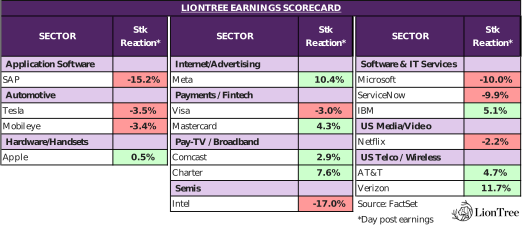
Week one and two of earnings have come to a close. In total, 16 stocks in our LionTree universe reported. Stock reactions were even this week with (8) stocks trading down and (8) trading up. The best performer in reaction to earnings was Verizon, which was up +11.7% (see Theme #6), while the worst performer was Intel, which fell -17.0%.
There was mixed performance elsewhere in Big Tech with Meta shares rallying +10.4% in reaction to earnings (see Theme #2), Microsoft closing down -10% (see Theme #7), and Apple shares up just +0.5% (see Theme #8).
It was a favorable week in the Connectivity sector given that in addition to Verizon mentioned above, Charter shares rose +8.4% in reaction to earnings (see Theme #5), followed by AT&T, and Comcast trading up +4.7% and +2.9%, respectively (see Theme #3 and Theme #4).
The table below includes select mid- and large-cap TMT and consumer companies in our LionTree stock universe that reported this week.
The Meta Narrative Does A 180…The Co Is Yielding Strong ROI From AI Investments In The Core
While Meta CEO Mark Zuckerberg isn’t saying “I told you so,” Q4 results and the 2026 guidance made it hard to argue that all the AI investment is not having a profound impact on the Co’s core business trajectory. Last quarter the stock sold off -11% in reaction to higher investment levels and this qtr, the stock rallied +10% on better-than-expected results. 2026 capx guidance was still +13% above consensus, but the y/y rate of growth is slowing.
In addition to the higher capx in 2026, operating expense guidance pointed to a ~40% y/y increase (at the midpt) but even so, op income is still expected to exceed 2025 levels, supported by accelerating Q1 rev growth y/y (fastest rate in 5 years) and a disciplined approach to reinvesting in AI and other strategic priorities while maintaining a focus on long-term profitability.
The core advertising biz is showing persistent strength as AI-driven enhancements are driving stronger engagement and monetization across ad products. Meta is expanding ads to new surfaces, including Threads and WhatsApp, while improvements in AI model consolidation and backend systems drove a +12% increase in ad quality in Q4. AI-powered tools for advertisers and creative workflows are also accelerating performance, with features like incremental attribution and click-to-message ads yielding meaningful gains.
Looking ahead, mgmt framed 2026 as the year AI “accelerates even further.” A key focus is personal superintelligence, where AI understands an individual’s context, interests, and behavior to deliver more relevant and adaptive experiences across platforms, recommendations, and commerce. New AI-driven media formats are expected to pave the way for Meta glasses, which will be the primary focus for Reality Labs (marking a shift away from the metaverse-heavy investments of past years).
Lastly, detail on internal AI-driven efficiency gains among Meta employees was also interesting. Since early 2025, AI coding tools have driven a +30% increase in output per Meta engineer, with “power users” seeing even stronger gains of 80%+ y/y. This power AI user dynamic that Meta is seeing internally was also echoed more broadly in a Gallups recent AI in the workforce survey that we separately detailed in Theme #9 as well.
Net net, investors are feeling more comfortable that Meta is executing on and investing in its long-term strategy in a disciplined way.
See our deep-dive regarding the points we saw as most important/incremental from Meta’s results below.
-> Meta was up +10.4% on the back of its print and is up 8.5% YTD, after being up +10% in 2025
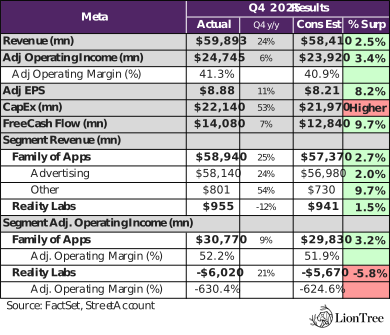
Meta Posted A Strong Q4
- Q4 total revs BEAT cons by +2.5% and grew +24% y/y (vs +26% y/y growth in Q3)
- Family of Apps (FOA) revs BEAT w/ ad revs ~2% better than expected and Other beat by +10%
- Reality Labs BEAT by +1.5%
- Q4 adj op income BEAT by +3.4% (margin of 41.3% vs cons 40.9%)
- FOA adj op income BEAT 52.2% vs cons 51.9%
- Reality Labs adj op income MISSED -630.4% vs cons -624.6%
- Q4 EPS beat by +8%
- Q4 FCF BEAT by +10%, while CapEx was slightly higher than expected
2026 Is Positioned For Strength…Q1 Rev Guidance Implies The Fastest Growth In ~5 Yrs / Despite 2026 Being Another Investment Year, Op Income Is Expected To Be Above The 2025 Level
- For Q1…the mid-pt of REVENUE guidance was ~7% ahead of cons ($53.5-56.5bn vs cons $51.4bn), implying a +30% y/y growth (largest growth in the last 5 yrs)
- What’s driving the acceleration? “Strong” demand seen through the end of Q4 that is continuing into the start of 2026; Q1 guidance also assumes ~4% FX tailwind to y/y rev growth (vs ~1% in Q4) as they lap the strengthening of the US dollar a year ago
- BUT for full yr 2026… REVENUE growth y/y will be “below” Q1 levels – why?
- Expect that FX tailwinds will dissipate later in the yr based on current rates
- Will be lapping stronger periods of growth later in the yr that benefited from 2025 ad performance investments and the strong macro landscape
- Expect there could be some headwinds from introducing a revised, less personalized ads offering in the EU (begins rolling out later in Q1)
- For 2026…the EXPENSE guidance was $162-$169bn (vs $118bn in 2025)
- The majority of expense growth will be driven by infrastructure costs, which includes 3P cloud spend, higher depreciation, and higher infrastructure OpEx
- The 2nd largest contributor to total expense growth is employee compensation, driven by investments in technical talent
- At the segment level…expect expense growth to be driven by FOA, w/ Reality Labs op losses remaining similar to 2025 levels
- For 2026…expect OP INCOME to be “above” 2025 levels
- Will still be investing in AI infrastructure and talent
- Reiterated framework of growing consolidated op profit over time to guide these investments
- For 2026…the CAPX guidance was ~13% above expectations ($115-135bn vs cons $110.74bn)
- Y/Y growth will be driven by incr’d investment to support Meta Superintelligence Labs efforts and the core business
- Capx growth rates: +84% y/y in 2025 & +73% y/y in 2026 at the mid-pt
- Will continue to be “opportunistic” about share repurchasing but “first order use of capital” for the Co is investing in resources to position themselves as a leader in AI
- On ongoing regulatory chatter –
- Recently aligned with the European Commission on further changes to their less personalized ads offering, which they will begin rolling out this qtr
- Continue to monitor legal and regulatory headwinds in the EU and the US that could “significantly” impact business and financial results
- I.e., continue to see scrutiny on youth-related issues and have several trials scheduled for this yr in the US, which may ultimately result in a material loss
The Core Advertising Business Continues To Operate On All Cylinders
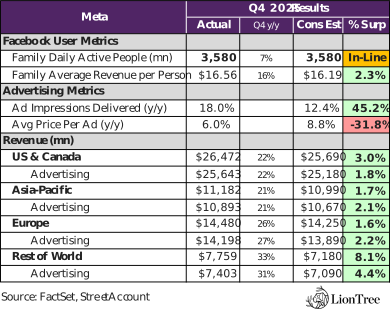
- Family of App ad revs grew +25% y/y (vs +26% y/y in Q3 and +22% y/y in Q2) and beat cons by +2.7%; FOA adj op margins of 52.2% also came in ahead of cons 51.9%
- Q4 ad impressions were up +18% y/y (vs +14% y/y in Q2): Growth was healthy across all regions, driven primarily by engagement and user growth, and to a lesser degree, ad load optimizations
- Q4 avg price per ad was up +6% y/y (vs +10% y/y in Q2): Benefiting from increased advertiser demand, largely driven by improved ad performance
- Saw “healthy” y/y growth across all verticals in Q4 (w/ the exception of politics, due to lapping US presidential election last yr)
- The online commerce vertical was the largest contributor to y/y growth, followed by professional services, and technology
- Ended Q4 w/ 3.58bn DAUs using at least one of Meta’s apps everyday (up +7% y/y and in-line w/ cons)
- Includes 2bn+ DAUs each on Facebook and WhatsApp and “just shy” of $2bn on Instagram
Recommendation Optimizations In Q4 Drove Incremental Engagement Across Platforms
- On Instagram…
- Reels watch time was up 30%+ y/y in the US
- Grew the prevalence of original content in the US by +10ppts in Q4, with 75% of recommendations now coming from original posts
- On Facebook…
- Video time cont’d to grow double-digits y/y in the US
- Saw a +7% lift in views of organic feed and video posts on Facebook in Q4, resulting in the largest qtrly rev impact from a Facebook product launch in the past two yrs
- Now surfacing 25% more Reels published that day than in the prior qtr
- On Threads…
- Optimizations made in Q4 drove a +20% lift in Threads time spent
- Other key platform updates…
- Now support 9 different languages w/ “hundreds of millions” of people watching AI-translated videos everyday: Already driving incremental time spent on Instagram, and plan to launch support for more languages over the course of 2026
- ~10% of the Reels people view each day are now created in the Edits app, which is almost triple from last qtr
- Looking into 2026…“we see a lot of opportunity to drive additional [engagement] gains”
- Includes scaling the complexity and amount of training data used in their models, while continuing to make the systems more responsive to people’s real time interests
AI-Driven Enhancements Are Also Driving Stronger Engagement & Monetization Across Ad Products
- Continue to make progress in bringing ads to Threads and WhatsApp
- On Threads – beginning to expand ads to all remaining countries this month, including the UK, European Union and Brazil
- On WhatsApp – expect to complete the rollout of ads and status throughout the yr
- On monetization efficiency – seeing “very strong” results from ad performance investments as model size and complexity continue to scale
- In Q4, learning improvements drove a +3.5% lift in ad clicks on Facebook and a 1%+ gain in conversions on IG
- Looking ahead…expect ad performance investments in 2026 will drive further gains
- Consolidation of models + a series of back-end improvements drove a +12% increase in Ads quality in Q4
- Saw “strong” success from consolidating Facebook feed and video models in H1:25, and extended the effort in Q4 by folding Stories and other services into the core Facebook model, driving the increase
- Looking into 2026…expect to consolidate more models than they have in the prior 2 yrs
- Q4 biz ad product updates – continue to invest in helping bizs leverage AI
- Started testing Meta AI business assistant w/ advertisers, which helps with tasks like campaign optimization and account support; Will make available to more advertisers in the coming months
- AI in ad creative – combined revenue run rate of video generation tools hit $10bn, with q/q growth outpacing the increase in overall ads rev by ~3x
- Click-to-message ad rev growth accel’d in Q4, with the US up 50%+ y/y, driven by “strong” adoption of website to message ads; Paid messaging within WhatsApp also continues to scale, crossing a $2bn ARR in Q4
- Incremental attribution feature is driving a +24% increase in incremental conversions vs their standard attribution model: Has already achieved a multibillion dollar ARR just 77 months since launch
- Other incremental commentary on business AIs …
- Will expand availability to more mkts; Mexico and Philippines has reached 1mn+ weekly conversations b/w people and business AIs on Meta’s messaging platforms
- Also extending their capabilities beyond just finding information to also completing tasks directly within WhatsApp
- Longer-term…working on improving larger scale models as a way to drive ads biz scale
- Typically don’t use larger model architecture for inference b/c their size and complexity would make it too cost prohibitive
- Instead, they drive performance from these models by using them to transfer knowledge to smaller, lightweight models used at runtime
- BUT scaling up the compute available to these larger models over time is expected to drive gains across the different stages of ads ranking and recommendation
2026 Is The Year AI “Accelerates Even Further”
- Over the next few months, the Co will start shipping their new models and products…
- These first models will be “good” but “more importantly…will show the rapid trajectory that we’re on”
- …then over the course of the yr will “steadily push the frontier” as they continue to release new models
- May take a few iterations to find product-market fit but think they’re starting off early enough in the yr that they expect to see “some” success by the end of the yr
- Continue to be capacity constrained and that’s expected to continue through “much” of 2026…
- …but highlighted the Meta Compute initiative, which is based on the belief that engineering, investment, and partnership efficiency in building infrastructure will be a strategic advantage
- Will focus on long-term investments in silicon and energy
- Will advance their own silicon program while working with key partners to design flexible systems
- Expect cost per gigawatt to decrease “significantly” over time through technology and supply chain optimization
- Quick update on Meta AI…
- Now available in 200+ mkts
- # of daily actives generating media tripled y/y in Q4
- Looking ahead into 2026… expect upgrades to media generation models and new features that improve the product experience
Starting To See The Early Innings Of Their Vision To Build Personal Superintelligence
- “We’re starting to see the promise of AI that understands our personal context, including our history, our interests, our content, and our relationships”
- On recommendation systems – Meta’s “world-class” recommendation systems are “primitive” compared to what will be possible soon and improving recommendations is a key focus in 2026
- Plan to continue scaling up their models and increasing the amount of data they use, including a longer history of content interactions to further improve the overall quality of recommendations
- Will continue to make recommendations even more adaptive to what a person is engaging with during their session, so the recommendations surfaced are more relevant to what they’re interested in at that moment
- Will work on more deeply incorporating LLMs into their existing recommendation systems, which will be useful for content that has been more recently posted since there’s less engagement data to base recommendations off of
- On commerce – integrating AI-driven commerce across both feeds and business messaging, which will “significantly” increase WhatsApp’s capabilities over time
- For customers, new agentic shopping tools will allow people to better find the specific products they are looking for
- For sellers, ads will help bizs find the specific people who are interested in their products
- New kinds of content will soon be possible as well – expect an “explosion” of new media formats that are driven by an AI vs an algorithm…
- Feeds will become more interactive as AIs will understand the user and be able to show and/or generate personalized content for the user
- …and glasses will be the “ultimate incarnation” of that vision
- Will be able to see what a user sees, hears, says, and help as they go through their day
- Will also be able to show information and generate custom UI right in the user’s vision
Glasses Are The Primary Focus Area For Reality Labs
- Reality Labs Q4 revs fell -12% y/y (vs +74% y/y in Q3) and beat cons by +1.5%; Reality Labs Q4 op loss of -$6.0bn was more than cons -$5.7bn
- Y/Y decline in Reality Labs rev is due to the lapping of the introduction of Quest 3S in Q4:24, as well as retail partners procuring Quest headsets during Q3:25 to prepare for the holiday season, which was recorded as revenue in Q3
- Reality Labs 2026 losses are expected to be similar to 2025 and will likely be the peak
- Sales of Meta glasses more than tripled in 2025 …Meta thinks that glasses are reaching a smartphone-level inflection point
- Most of Reality Labs’ investment will go towards glasses and wearables going forward
- And on other Reality Lab initiatives…will also focus on making Horizon a “massive” success on mobile and making VR a profitable ecosystem over the coming yrs
2026 Is Also The Year Meta Employees Are Going To See AI “Dramatically” Change The Way They Work Internally
- Investing in AI native tooling, so individuals at Meta can get more done
- They are elevating individual contributors and flattening teams
- Also starting to see projects that used to require big teams now get done by a “single very talented person”
- AI coding tools have been driving an increase in output per Meta engineer
- Since the beginning of 2025, the Co has seen a 30% increase in output per Meta engineer
- Majority of that growth is coming from the adoption of agentic coding, which saw a “big jump” in Q4
- Seeing “even stronger” gains with “power users” of AI coding tools, whose output has increased +80% y/y
- Looking ahead…expect this productivity growth to accelerate in H2
- Since the beginning of 2025, the Co has seen a 30% increase in output per Meta engineer
- Bigger picture, there is a “big delta” b/w those who use AI and use it well and those who don’t, and that’s likely to create a “profound” dynamic across the whole economy in terms of the productivity and efficiency with which Cos are run
Volume Growth Will Be A Key Driver To AT&T’s New, Better-Than-Expected Long-Term Plan
AT&T’s new 3-year guidance pointing to higher growth than the Street was expecting, coupled with a better-than-anticipated Q4 was met with analyst and investor cheer. Big picture, the Co expects to grow adj EBITDA by +3-4% y/y in 2026 (ahead of cons +3%) and to accelerate that growth to +5% y/y in 2028 (vs cons +3%). What is driving this growth? Volumes & greater penetration of the fiber footprint as well as convergence are critical to the plan, plus integrating Lumen’s fiber assets will create “pretty significant” upfront costs in 2026, but as the asset penetration increases and the legacy declines fade, adj EBITDA growth is expected to accelerate. Adj EPS is expected to grow at a double-digit CAGR through 2028 (vs cons +10%).
While Q4 headline results impressed, there were some puts and takes under the hood with w-less subscriber phone adds and churn both falling short of projections and broadband adds were a mixed bag with fiber additions beating the Street while FWA additions missed. With that said, convergence gains accelerating in Q4 (up +200 bp to 42% penetration) was a key highlight and mgmt’s 50% penetration target is not likely the future cap.
Looking ahead, it will be more of a volumes game. Mgmt will be taking a consistent, disciplined approach to pricing in both w-less and home internet, balanced by gains in underpenetrated categories such as value focused customers and converged customers, as mentioned (where they take an upfront ARPU hit). Mgmt is expecting to see higher device upgrades in the year ahead which will also be a headwind to ARPU. Overall mgmt believes that they can still grow advanced home internet services revs organically by 20%+ per year through 2028 given this expected growth in customer relationships.
A few other important outlook assumptions include capital intensity coming down once the major capital projects are substantially completed by the end of 2030, cost savings accelerating y/y in 2026, and the Co returning $45bn+ to shareholders over the next 3 years (almost 30% of AT&T’s mkt cap). At the same time, net debt will return to the 2.5x target within ~3 years post close of its pending acquisitions
Lastly, as a heads up the Co is reorganizing its reporting segment to separate out the legacy assets starting in Q1:26.
See below for much more detail plus a few more points we viewed as important.
-> AT&T share rallied +4.8% on the back of results and the connectivity sector was generally up in sympathy; However, AT&T share are still down -3% YTD (following being up +9% in 2025)
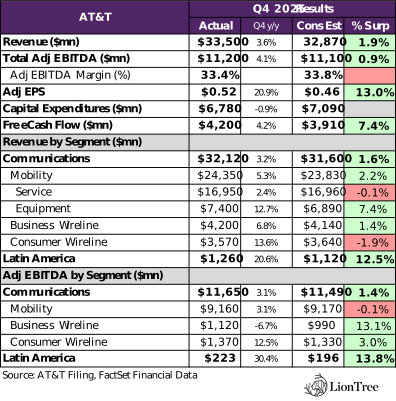
Q4 Headline Numbers Accelerate Growth & Top Street Expectations
- Rev BEAT by ~2% & grew +3.6% y/y (an accel from +1.6% y/y in Q3) – the upside came from higher-than-expected Equipment rev, Business W-line rev, and Latam rev
- W-less svs revs growth of +2.4% (in-line w/ cons but slightly up from +3% in Q3)
- Adj EBITDA BEAT by ~1% & grew +4.1% y/y (an accel from +2.4% y/y in Q3)
- Expanded adj EBITDA margins by 20bp (though the Street expected a little more)
- Adj EPS BEAT by 13% & grew +21% y/y (was up ~9% in 2025)
- The upside to guidance came from a lower-than-expected effective tax rate & stronger growth in adj EBITDA
- FCF BEAT by 7.4% & grew +2% y/y (reached $16.6bn total in 2025 which was at the higher end of guidance):
- The Co paid lower than expected cash taxes but accelerated pension contributions in Q4…but these combined were effectively neutral to FCF in the qtr
AT&T’s New Long-Term 2026-2028 Growth Guidance Topped Street #s
- Svs rev growth guidance is in LSD range annually from 2026-2028…how will they achieve this? Growth in consumer & biz customer relationships is the primary driver as they expect to gain wireless subscriber share through convergence in areas where they offer fiber & FWA
- This compares to Street expectations at +2.3% y/y for 2026, +2.1% y/y for 2027, and +1.6% y/y in 2028
- Adj EBITDA growth is guided in the +3-4% range in 2026, improving to +5% or better in 2028 (and is above cons expectations of +3% y/y every yr over the forecast period), as growth in Advanced Connectivity increasingly more than offsets declines in Legacy
- What’s driving the inflection in 2028? Integrating the Lumen assets will create “pretty significant” upfront costs in 2026, but as asset penetration increases and legacy declines fade, EBITDA growth is expected to accelerate
- Expect “strong and sustained” growth in Advanced Connectivity segment from 2026-2028…
- Rev growth in the MSD range annually
- Includes expected growth of 5%+ y/y in 2026, which bakes in ~100bps of growth from Lumen’s retail fiber subscribers
- EBITDA growth in the MSD-HSD range annually
- Includes expected growth of 6%+ y/y in 2026
- Does NOT expect planned acquisition of retail fiber subscribers from Lumen to materially impact EBITDA in 2026
- Rev growth in the MSD range annually
- …as well as “sustained” declines in the Legacy segment as the Co phases out the large majority of its copper network by end of 2029 and upgrades customers to 5G and fiber
- Rev expected to decline 20%+ y/y in 2026 and will be immaterial by the end of 2029
- EBITDA expected to be negative after 2027 until direct costs associated with operating the copper-based network are “substantially eliminated”
- Adj EPS guidance of $2.25-$2.35 in 2026 (which is up +7% y/y at the mid-pt and is +4% above cons $2.21) w/ a double-digit 3-yr CAGR through 2028 (vs cons +10% CAGR)
- The outlook anticipates that Lumen and EchoStar acqs will “modestly” dilute adj EPS in 2026-2027 and be accretive beginning in 2028
- For 2026 specifically…Outlook includes ~5c of dilution from stand up costs and higher interest expense related to Lumen and EchoStar transactions and an effective tax rate in the 22% range
- Capital investment guidance in the $23-24bn range annually during 2026-2028 (vs $22bn in 2025)
- Looking further out, capx intensity will be coming down: The Co expects that major capital projects will be “substantially completed” by the end of 2030 or sooner
- As they complete these investments, expect capital intensity to decline from high-teens % of rev to mid-teens
- Looking further out, capx intensity will be coming down: The Co expects that major capital projects will be “substantially completed” by the end of 2030 or sooner
- FCF of $18bn+ in 2026 (in-line w/ cons), $19bn+ in 2027 (vs cons $18.9bn), and $21bn+ in 2028 (vs cons $19.2bn): Y/Y increases are driven primarily by growth in adj EBITDA
- Specifically for 2026…FCF drivers = growth in adj EBITDA, lower pension contributions and lower legal settlements, partially offset by higher capital investments and cash interest
- Also expect greater cash tax savings under the One Big Beautiful Bill Act than the Co expected back in Q2, and plan to use the incremental tax savings to fund working capital and growth initiatives
- Expect annual cash taxes of ~$1-$1.5bn through 2028, which primarily reflects further assessments of expected savings due to this legislation
- “Our goal is to put these savings to work over the next three years to fund working capital and growth initiatives”
Also Provided Incremental Q1 Guidance, Which Will See An Impact From Upfront Costs Of Long-Term Investments
- Q1 adj. EBITDA y/y growth is expected to be below the run rate expected for the FY26 (which is +3-4% y/y)
- Have plans to “accelerate and scale” the execution of their strategy across 5G and fiber this year, so expect some upfront investments to be reflected in Q1 results
- Includes incremental spend to integrate and scale expected Lumen retail acqs + investments to accelerate fiber deployment
- Also lapping ~$100mn of 1x benefits disclosed in Q1:25
- Also expect Q1 FCF to be in the $2-$2.5bn range
While Q4 Headline #s Exceeded Expectations, It Was A Bit Of A Mixed Bag W/ Q1 Unit KPIs…Though Fiber Additions Were A Source Of Upside
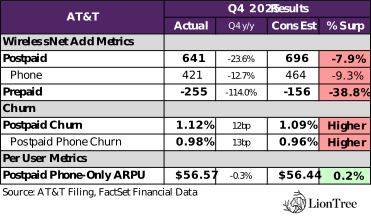
- Q4 wireless unit KPIs fell below Street expectations almost across the board
- Postpaid phone net adds (missed by -9%), postpaid phone churn was higher than expected, & prepaid adds were also weaker
- The only minor upside came from postpaid phone-only ARPU
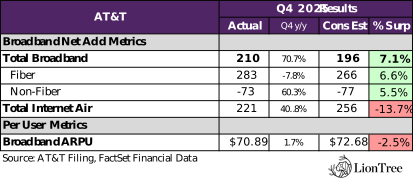
- Mixed bag w/ bband adds given Q4 fiber adds BEAT while FWA adds MISSED the Street: Though achieved ~500k combined advanced home internet net additions for the second consecutive qtr
- Fiber adds of 283k BEAT by +6.6%
- Consumer Wireline fiber rev: $2.2bn, up +13.6% y/y
- FWA adds of 221k MISSED by -14%
- Fiber adds of 283k BEAT by +6.6%
Looking Ahead, AT&T Expects To Take More Share On The Back Of Continuing To Expand The Fiber Footprint & Convergence
- AT&T maintained guidance to ramp the annual pace of fiber construction from 3mn new locations in 2025 to a run rate of 4mn by the end of 2026: The acq of Lumen’s fiber assets & build capabilities including Giga power will also expand beyond this
- Total fiber customer locations at the end of 2025 = 32mn
- Total fiber customer locations at the end of 2026 = ~40mn
- NEW GUIDANCE…beyond 2026, the Co plans to expand fiber reach by ~5mn locations annually through the end of this decade
- …BUT over the past 2 yrs given inflation, their avg deployment cost per fiber passing has incr’d by ~2% annually, and they expect a similar trend over the next 3 yrs
- Accelerated convergence gains also stood out in Q4
- The fiber convergence rate rose +200bp y/y to 42% (their fastest annual increase since they began tracking this metric)
- “I do expect the convergence rate to continue to improve” … “we’re going to drive that to 50% [target] and feel very comfortable” … BUT it will go higher…”I don’t expect it to stop there”
- Mgmt continues to stress that while there is an initial investment in converged customers, the long-term economics with lower churn and purchasing of addt’l services will be more than offsetting
- Churn has gone up with unbundled customers
- The fiber convergence rate rose +200bp y/y to 42% (their fastest annual increase since they began tracking this metric)
- Also, mgmt remains positive on oppty with the Lumen fiber assets as the network that they are acquiring only has 25% customer penetration which is well below AT&T’s fiber penetration of 40%
- And there is plenty of room for new converged customers: AT&T ests that < 20% of these customers also subscribe to their w-less service
- This is less than 50% of the convergence rate that AT&T achieved in their current fiber footprint
- And there is plenty of room for new converged customers: AT&T ests that < 20% of these customers also subscribe to their w-less service
What Are The Key W-Less & Broadband Assumptions Underpinning The New 3-Yr Guidance? Volume Growth Is A Main Driver
- Postpaid phone ARPU…assume a “relatively stable” trend
- Will have a “consistent, disciplined approach” to pricing
- Balanced by gains in underpenetrated categories such as value focused customers
- Plus growth in converged customer relationships
- Similar to the approach in w-less, mgmt. will maintain a “consistent approach” to pricing in home internet, balanced by gains in under-penetrated customer categories at different price points as they materially expand the availability of home internet services
- LT outlook assumes a lower contribution from bband ARPU growth than they have posted over the past few years
- Expect higher device upgrades…continue to plan for an operating environment with “elevated levels of new and existing customers that are eligible for device offers”
- Given that they amortize a portion of device offers through w-less svs rev, expect ~90bp headwind to postpaid ARPU growth in 2025 (which is the same impact in 2025)
- Expect advanced home internet service revs to grow organically by 20%+ per yr through 2028 (in-line w/ the annual rate over the past 2 yrs)
- The primary driver is growth in customer relationships that will come given the expanded reach of AT&T fiber and the availability of Internet Air
- “Expect to sell more [FWA] this year than last year”
- In 2026…w/ the addition of Lumen, expect 30%+ y/y growth in advanced home internet rev: Lumen fiber assets (deal expected to close in Q1) will add ~$900mn of annualized fiber revs
- The outlook factors in the portion of the convergence discount that they allocate to internet services as they grow the converged customer base
What Else Is Assumed In The New Long-Term Guidance?
- Cost savings are expected to accelerate in 2026: Achieved $1bn+ of cost savings in 2025 and expect to accelerate in 2026
- How? By leveraging AI, moving more customer transactions to digital, and achieving greater operating leverage as they grow their customer base
- Also expect D&A expense of ~$20bn annually through 2028
- As incremental depreciation from growth investments is offset by the roll off of depreciated assets that have reached the end of their useful lives
Expect AT&T To Bring Leverage Down Even W/ Significant Shareholder Returns
- The Co expect to return $45bn+ to shareholders over the next 3 yrs, representing almost 30% of AT&T’s mkt cap or 75%+ of expected FCF: The Co plans to maintain the current common stock dividend and continue share repurchases at a consistent pace through 2028
- Includes ~$8bn of buybacks in 2026 + board authorized an addtl $10bn after the current buyback authorization is completed
- Longer-term… “we expect that our improved growth, declining capital intensity and higher free cash flow will provide us with even greater flexibility to support enhanced shareholder returns”
- Even with strong shareholder returns, net leverage is still expected to return to ~2.5x target within ~3yr post close of Lumen + Echostar acqs
- Immediately post-close (early this yr): Expected to increase to ~3.2x
- By year-end: Should fall to ~3x as they grow adj EBITDA and FCF; Also expect to receive cash from an equity partner that will also co-invest in the acquired Lumen fiber assets
- Within ~3 yrs post-close: Expect to return to ~2.5x
The Co Is Restructuring Operating Segments Around 5G & Fiber Connectivity Starting In Q1:26
- Advanced Connectivity segment: Primarily includes the Co’s domestic 5G & fiber based wireless, internet and other advanced connectivity services
- On a recast basis, this segment contributed ~90% of consol revs & over 95% of adj EBITDA in 2025
- Segment results will be reported in aggregate, w/ supplemental disclosures on consumer and business performance
- Legacy segment: Represents results from the Company’s domestic legacy voice and data svs provided over its copper-based network to consumer and business customers
- Latin America segment: Will continue to represent results for the Co’s wireless biz in Mexico
Other Points We Wanted To Call Out
- Both the Lumen fiber asset deal and the Echostar spectrum license deals are expected to close by end of yr: Lumen acq is expected to be completed in Q1, while Echostar is supposed to close “early this year”
- The long-term outlook does not anticipate a material contribution to EBITDA growth from the pending acqs until 2028, which is also when they expect these investments to become accretive to adj EPS
- Bad debt/health in the consumer? Not seeing any notable changes in customer payment patterns
- The Co does not expect a new foldable iPhone to become a broadly adopted form factor
- Mgmt believes that the Echostar deal will allow them to be more strategic on what they are doing with spectrum going forward
- They believe industry spectrum demand is not all centered around the same bands, which is a positive dynamic
Comcast’s NBCU Delivers & There’s A Clearer Line Of Site Out Of Its Connectivity Investment Period
2025 was certainly a transition and investment year for Comcast as it implemented a strategic go-to-the market shift with new connectivity pricing and packaging and new customer experience initiatives. The aim is to stabilize the broadband customer base and position for subsequent growth. We are always a fan of companies effecting these shifts as quickly as possible, and that is what Comcast appears to be doing.
The Q4 results reflected this transition with pressure on Connectivity ARPU plus elevated marketing, product & customer svs expenses. Connectivity & Platform (C&P) adj EBITDA fell -4.5% y/y. Q4 subscriber additions across broadband and wireless were also below expectations. Nonetheless, mgmt was “encouraged” by what they are seeing thus far with the new go to market strategy & investments in customer experience (more color below). Investors should expect continued pressure from the Co’s strategic shift in H1, but H2 is positioned for tailwinds as they lap this investment cycle.
On the Content & Experiences (C&E) side of the business, results in the core Media segment were essentially in-line with expectations, with the key driver being Peacock (revs up +20% y/y growth). The Co is absorbing the cost of the new NBA contract but these sports rights appear to have helped drive subs (up +8mn y/y and up +3mn q/q). Another highlight was theme parks where revenue growth accelerated to +22% y/y (from +19% y/y in Q3) and EBITDA rose +24% y/y (crossing the $1bn level for the 1st time). Epic Universe’s performance stood out and importantly drove higher per capita spend & attendance across the entire Orlando resort.
So net net, trends in the Co’s media and theme parks segments paced ahead and while the connectivity business remains in transition, pressure will ease in H2.
-> Comcast shares actually rallied +3.6% in reaction to earnings despite the mixed Q1 performance and downbeat H1 outlook
Q4 2025 Results
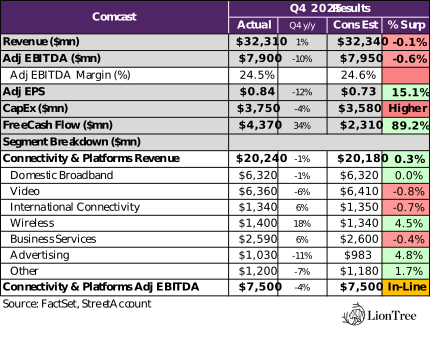
- Rev ~IN-LINE: Rose +1% y/y (vs down -2.7% y/y in Q3)
- But the focus businesses are growing faster:
- The 6 focus growth businesses grew at a +mid-SD rate y/y
- 3 of the 6 key growth businesses (Theme Parks, Peacock, & Domestic Wireless) each grew revenue ~+20% y/y
- But the focus businesses are growing faster:
- Adj EBITDA slightly MISSED by -0.6%: Fell -10% y/y (vs -0.7% y/y in Q3)
- Adj EBITDA margin SLIGHT MISS: 5% vs 24.6%
- Drivers: Decline y/y reflects investments to transition customers to the new packaging & pricing and in customer experience, plus the Co is absorbing the cost of the new NBA contract
- Adj EPS BEAT by +15%: But was down -12% y/y
- Capx was HIGHER than cons by +4.7% (but fell -5% y/y)
- Content & Experiences capx declined -17% y/y (lower investment in Theme Parks)
- Connectivity & Platform capx was stable
- But FCF of $4.4bn BEAT cons $2.3bn but included a $2bn cash tax benefit related to an internal corporate reorg
- Returned $2.7bn in Q4 ($1.5bn in buyback)
The Impact From New Go-To-Market Plus Customer Experience Initiatives Weighed On Q4 Connectivity & Platform (C&P) Results But Early Progress Is Seen As “Encouraging”
- C&P total Q4 revenues fell -1.1% y/y (vs -1.4% y/y in Q3), while adj EBITDA fell -4.5% y/y (vs -3.7% y/y in Q3)
- APRU was under-pressure and the Co had elevated marketing, product & customer svs expenses
- The competitive environment for bband stepped up in Fiber in Q4 (and that continues)…FWA competition was consistent, and the Co flags that it saw “a step up” in wireless competition towards the end of Q4
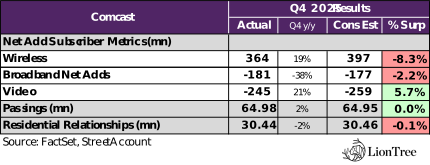
- Q4 bband losses of -181k were marginally worse than cons -177k… the “early traction” from the new initiatives were “more than offset by the cont’d competitive environment”
- Mgmt expects that market to remain “intensely competitive”
- Q4 bband ARPU grew +1.1% (vs -4% y/y in Q3 and +1.2% y/y in Q2) reflecting the new go to mkt pricing
- This pressure is expected to persist in H1 (see section below)
- Q4 wireless adds reached +364k which missed cons +397k
- Seeing strong uptake of customer uptake of the free wireless line: Nearly 50% of the resi postpaid connects came from customers taking a free line…these will be converted to paying after the 1 yr offer
- The Co is also seeing uptake in the premium unlimited package (targeting the high value postpaid market)
- Comcast now has 9mn+ wireless lines which is still only 15% penetration of the base
- Q4 convergence revs grew 2% y/y in the qtr, driven by 18% growth in w-less
- “Encouraged” by what they are seeing with the new go to market strategy & investments in customer experience
- Voluntary churn continues to trend lower
- Seeing strong adoption of the 5-yr price guarantee
- Seeing a “significant improvement” in take rates of gig+ speeds…~40% of the base is on Gig Plus tiers
- Cont’d uptake of free wireless lines (has been the biggest area of investment)
- NPS is “moving in the right direction”
- Remain focused on transitioning the majority of the customer base to the simplified, market-based pricing plans and are “prioritizing getting to the other side of this transition as quickly as possible”
Connectivity & Platforms Headwinds Will Continue In H1 But Tailwinds Should Emerge In H2
- H1 headwinds
- Near term revenue will continue to be impacted by the rate investments (simplified bband pricing and offering free w-less lines)
- ARPU pressure should continue over the next “couple” of qtrs
- Will not have a bband rate increase
- Will have the dilutive impact from the free wireless lines
- WIll have the ongoing migration of the base to simplified pricing
- This also drives operating costs higher due to customer experience initiatives
- Expect EBITDA pressure over the next couple of qtrs
- H2 tailwinds
- The majority of the base will be on the new pricing and packaging for bband…the ARPU pressure will ease
- Expect to convert the “vast majority” of free lines into paying relationships which will provide a “meaningful” tailwind to convergence revenue growth
- They will have a much higher % of customers on gig + speed plans (more differentiated from FWA and satellite)
- EBITDA pressure will ease as the Co starts to lap the initial investments
- Other important guidance:
- FCF in 2026 won’t include $2bn in 1x time benefit from 2025
- Capx in 2026 should be similar to 2025 and spending at both C&P and C&E to be consistent y/y
- The capital allocation strategy remains unchanged
Network Upgrade & AI Investments Are Bearing Fruit
- Continue to make substantial progress on the network upgrade: ~60% of the footprint is now transitioned to mid split spectrum & a virtualized architecture
- Already seeing benefits from greater automation & the deployment of AI across the network to optimize the end-to-end customer experience
- 20% reduction in trouble calls
- 35% reduction in repair minutes
- As the Co completes upgrades across most of the footprint, they will start marketing multi-gigabit symmetrical speeds and their differentiated capabilities, creating opportunities to move customers into higher value tiers over time
Other Key C&P Updates / Developments
- Within Business Services…revs rose +6% y/y and EBITDA incr’d +3% y/y…Enterprise is a key growth driver looking ahead
- Q4 trends: Seeing modest rev growth in SMB and strong momentum in enterprise solutions business (which has been the trend)
- Competition: Remains elevated especially in FWA
- 2026: Focused on stabilizing small business while accelerating growth in mid-market & enterprise “where demand for advanced, secure and scalable connectivity continues to increase” and will help drive APRU
- The Co will be expanding business mobile relationships w/ T-Mobile MVNO later in 2026
- Mgmt disclosed that the Co “modernized” its VZ MVNO partnership but didn’t provide any more color
- The addition of T-Mobile as a network partner for their business customers starts later in the year
The Media & Theme Parks Segments Outperformed The Street While Studios Fell Short
- The Media segment outperformed consensus: Revenue (+6% y/y) & adj EBITDA both topped Street forecasts (note that results include Versant which was spun on Jan 2nd)
- Peacock was the main top line driver (see section below)
- Total advertising rose +1.5% y/y (strength from NFL and NBA launch, but lower advertising from political)
- Media EBITDA fell (-141% y/y) due to addition of NBA rights but think will offset through ad growth and subs additions & monetization across both linear and Peacock
- Q1 EBITDA guidance: Q4 had 25% of total games for the season but Q1 will be the peak volume period with 50% of games which will result in peak EBITDA dilution
- Theme Parks also outperformed: Revs and adj EBITDA were +2.5-3% higher than cons (see section below)
- Studio performance fell well short of cons expectations: Revenues missed the Street by -9% and adj EBITDA by -15.2%
- While Wicked has grossed well over $1bn WW, the Studio biz was impacted by tough comps y/y, the timing of licensing deals, & higher marketing spend due to higher volume of films this year
- Optimistic on slate going forward: Led by The Odyssey from Christopher Nolan, the Super Mario Galaxy movie, Minions 3 from Chris Meledandri and Disclosure Day from Steven Spielberg
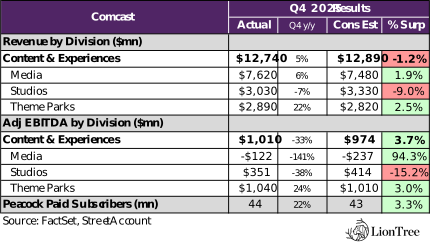
Peacock Was The Biggest Driver To Media Results…Added Subs & Losses Continue To Improve
- Peacock revenue rose +20% y/y to a record $1.6bn
- Distribution revs grew 30%+ y/y
- Ad revs grew almost +20% y/y due to the strong sports lineup
- Peacock losses hit -$552mn in Q4 (NBA addition & exclusive NFL game) but improved by $700mn y/y for the full year
- Outlook – expect Peacock losses to “improve” again y/y
- Peacock subs incr’d +8mn y/y and +3mn q/q to 44mn
Theme Parks’ Growth Accelerated In Q4 As Epic Universe Drove An Uplift Across The Entire Orlando Resort
- Themes parks rev growth accelerated to +22% y/y (from +19% y/y in Q3) and EBITDA rose +24% y/y (crossing the $1bn level for the 1st time)
- “Couldn’t be more pleased” with Epic’s performance: It drove higher per capita spend & attendance across the entire Orlando resort
- The Co will expand ride throughput over the next several qtrs which will lead to higher attendance, strong per caps & addtl op leverage over time
- Bullish on 2026… it will be the 1st full year with Epic plus, will have the opening of Universal Kids Resort in Frisco, Texas, the debut of the first outdoor roller coaster at Universal Studios Hollywood, and a new universal resort in the UK
What About Potential M&A Or Ramifications?
- Mgmt commented that WarnerBrosDiscovery’s international reach “would have been additive” but Comcast was not interested in an all-cash deal
- However, it did “force them to take a look at what they have and what they are building”
- The M&A talk has “stirred the pot” and companies are trying to think about what this means for them and Comcast is open to that kind of thinking
- But mgmt is “very confident and comfortable that they are in the right parts of the industry”
Has Charter Finally Reached The Broadband Inflection??
That is a key point coming out of Charter’s Q4 earnings. While headline financials were mixed (revenue slightly missed consensus while adj EBITDA, adj EPS, and FCF all beat), the big story was significantly lower than expected broadband losses in Q4 (and further improvements are expected in 2026). On top of that, the Co actually added video subscribers given the success of its new video strategy. Also at an inflection is adj EBITDA as the Co is guiding for “growth” in 2026 vs the -1.2% y/y decline in 2025, though as a caveat, it will be more back-half weighted (more color on drivers below).
Mgmt’s capx outlook commentary also provided comfort given 2025 was the peak year for capital spending, and beyond 2026, total capx dollars should be on a “meaningfully” downward trajectory. The Co anticipates returning to normalized capex (sub $8bn/yr) by 2028 which drives the strong FCF growth story. Also standing out was a lowered leverage target post-Cox from 3.5-4x in 2-3 years post the deal close to the “lower end” of a new 3.5-3.75x range to be achieved 3 years post the deal close. Even with that, the Co is firmly committed to their shareholder return strategy.
Looking ahead, returning to positive broadband net additions is a key focus and a “game of inches”. It is not likely to happen this year but investors should expect to see a positive trajectory. While the mobile business was held back by not participating in the “flood of subsidies” in the market, the convergence strategy remains a top priority and focus is on further building brand recognition and driving strong word of mouth. The mobile adoption penetration curve in Cox’s territories post close should also be an improvement from Spectrum Mobile’s adoption curve in Charter’s footprint. Cost attention and efficiency remains a top priority and an improved trajectory in adj EBITDA is within sight.
All in all, this was a sigh of relief quarter. The business is moving in the right direction but execution remains the name of the game.
-> Charter’s shares rallied +10% on the back of results, recovering from the share declines out of the gate in January; The stock was down -42% in 2025
Mixed Q4 Headline Result
- Q4 total revs missed cons by -1% (fell -2.3% y/y)
- Q4 adj EBITDA beat cons by +1.6% (fell -1.2% y/y)
- Q4 adj EPS beat by +5%
- Q4 FCF beat by ~+3% despite Q4 capx being $140mn higher than the Street
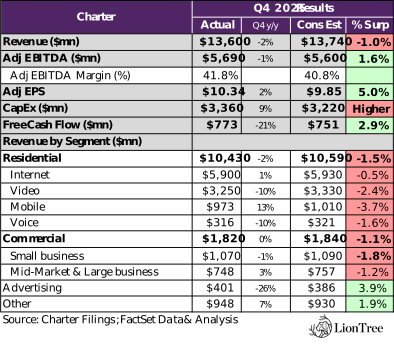
2025 Was The Peak CapEx Yr & The Co Expects To Return To Normalized CapEx Sub $8bn Annually By 2028
- 2025 was the peak year of capx and beyond 2026, expect total capx dollars to be on a “meaningfully” downward trajectory
- FY25-28 cumulative capx guidance INCLUDING BEAD is $40-40.5bn (the prior guidance of $39.5-40.5bn EXCLUDED BEAD)
- BEAD spend is expected to total ~$230mn, mostly in 2027- 2029
- By year…will hit a normalized capx level in 2028
- FY26: ~$11.4bn
- FY27: ~$9.5bn
- FY28: $7.5-8bn (reaching 13-14% capital intensity level for Charter, should be able to do the same incl Cox)
- NEW – FY29: $7.5-8bn (flat y/y)
Lowered Target Leverage Post Cox But Remain Committed To Shareholder Returns
- The Co also adjusted post Cox transaction target leverage to the low end of the new 3.5-3.75x range, which they expect to achieve within 3 years post the close (before expected 3.5-4.0x in 2-3 yrs post close)
- The Co believes this will help attract more potential investors
- Despite that, mgmt still expects significant capital returns to shareholders
- Note that in Q4, bought back $750mn of stock in the qtr at avg price of $259/shr
- Debating how to allocate FCF is a “first class problem” but mgmt remains committed to the buyback program
Expect EBITDA to “Grow” In 2026, With Strength Moreso In H2
- Adj EBITDA will “grow” in 2026 but H1 will be “more challenged” than H2 due to a 1x benefit from Q1:25 and political advertising in H2
- Could adj EBITDA grow higher than 1% this year? “Maybe”…EBITDA growth is challenged in 2026 given the headwind from broadband subscriber declines, BUT mgmt. believes they can overcome that w/ the combo of:
- Mobile growth and changing mix of internet driving positive ARPU growth
- Cont’d operational improvements
- “Attentive” expense mgmt
- Political advertising being a driver
- Cost of service coming down again y/y (excl bad debt, cost to serve customers declined -3.2% y/y in Q4)
- Growth in Marketing & Sales will also be down y/y
- Continue to look for ways to drive down costs: Investing in tech, incl AI, to increase customer satisfaction through self-service where customers want it, and also enhancing employee service capabilities across sales, call center services, field operations and the network itself
Significant Upside In Customer Volumes… Broadband Losses Lower Than Expected While Video Subs GREW
- Broadband losses were much lower than anticipated (total Internet losses of -119k compared to cons -136k)…churn improved y/y given last year’s ACP related impact…but headwinds to growth include:
- Internet competition for new customers remains high
- Low move rates and higher mobile substitution
- Expanded FWA competition & fiber overlap growth, similar to earlier in the yr
- Video subscriber adds was also a positive surprise (+44k vs cons for -63k loss)
- Spectrum TV Select subscribers now receive up to ~$117 per month (soon will be $129/mo) of streaming apps at no extra cost
- BUT mobile net additions of +428k were lower than expected… due to heavy device subsidies activity by the big telco competitors, including the new iPhone 17, through the holiday sales cycle (gross adds were higher)
- “The convergence strategy is working”
- The market was “flooded” with subsidies that they didn’t follow
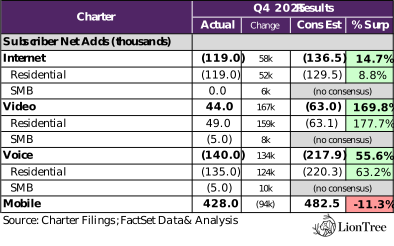
What Should Investors Expect For Broadband, Mobile, & Video Trends In 2026+?
- Getting back to positive broadband net additions is a “game of inches”…not expecting bband volume growth this year but expect to see a positive trajectory
- Focused on more clearly messaging the greater value and utility and providing the best quality of svs in the mkt
- What is the sustainability of video gains? The north star is not to just have net video gains, but want video to support bband acq and retention
- The video eco-system remains challenged…programming costs continue to go up
- There is only a slight difference between Q4 vs Q3, and KPIs could fluctuate back
- Selling DTC apps a-la-carte will be an increasing component of their video offer
- Outlook comments on product ARPU for 2026
- Internet ARPU should grow in 2026 but more slowly than prior years: As they drive Spectrum pricing & packaging through the footprint
- End of 2025, 40% had the new pricing and packaging
- Expect that to increase to 60% by the end of 2026
- Mobile ARPU had been declining but has bottomed: As more customers take the gig product, which includes Unlimited plus and Unlimited pricing…and as they see some contra revenue from the phone balance buyout plan, ARPU has been pressured… there might be addtl mobile ARPU declines y/y but “I think that we’re at a low point there” and that it has “bottomed” seq
- Video ARPU has multiple headwinds: Programmers streaming app allocation, unfavorable bundled revenue allocation, and a higher mix of skinnier video tiers…but also passing some programming increases to customers
- Internet ARPU should grow in 2026 but more slowly than prior years: As they drive Spectrum pricing & packaging through the footprint
- Spectrum Mobile brand is gaining momentum but is still in the early stages
- It is still a relatively new brand and concept to get cellular from a cable Co
- Spectrum Mobile’s reputation and word of mouth is “improving” but will “take some time” to develop
- They are on “a steady path” to increase brand awareness
- Most customers have NOT picked up that when they move around the country, they are getting faster speeds via WiFi; Charter “needs to show this better”
- Nearly 90% of Spectrum mobile traffic goes over their network
- What will mobile penetration curve in Cox territories look like? An improvement to the Spectrum Mobile penetration curve at Charter is a “good starting point”: “Our platforms, our sales channel, our marketing, our national brand awareness, it’s all in a much better place”
A Few Other Call-Outs
- Total commercial revs grew by +0.3% y/y with mid mkt and large business rev growth of +2.6% (ex wholesale revs, it was up by +3%); Small biz revs fell by -1.3%
- The Co generated +46k net customer adds in their subsidized rural footprint and grew subsidized rural passings by 147k and by 483k+ in the last 12 months (vs 450k target)
- Expect subsidized rural passings growth of ~450k in 2026 (the last large build year)
- Regarding the updated Verizon MVNO agreement – similar to Comcast and Verizon, no details were provided
- “It is a very good deal for both companies”
- The “structural” agreement has not changed
- Improvements/progress the Co has delivered in customer service commitments:
- Internally, moved the service window target to 2 hours and 1 hour for business (no competitors do this)
- Backing the customer service guarantee w/ credits beginning in February
- If they don’t hit the guarantees $1,000 of savings/yr when customers take internet and 2 lines of mobile from Spectrum they will credit the difference
- Gig speed availability:
- By the end of 2026, 50% of the current Spectrum network will be upgraded to symmetrical and multi-gig service
- It will be 100% in 2027
Verizon Is Full Steam Ahead On Its Turnaround Journey
The first 100 days have now passed at Verizon under new CEO Dan Schulman’s leadership and a lot has taken place in this first chapter of Verizon’s turnaround story. While Q1 results at the top-line were mixed, the focus is more on what’s coming ahead in 2026+, as mgmt framed the yr as a “step-function” improvement vs recent history. The focus is on pushing towards volume-based growth across both mobility and broadband, with the goal of exiting 2026 on much stronger financial ground. The year ahead is transitional, but the building blocks for more durable growth and improved financial performance are being put in place.
At the core of this reset is a sharper focus on growth areas alongside aggressive efforts to simplify the organization and improve efficiency. Verizon is actively streamlining the business, exiting pockets of underperformance, and working toward a $5bn OpEx savings target by 2026, with a portion of those savings set to be reinvested back into the business. Early signs of progress are already visible, as Q4 delivered 1mn+ mobility and broadband net adds, which has been the Co’s strongest quarterly net add performance since 2019.
In particular on the wireless side, Q4 postpaid phone net adds reached their highest level in six years, though churn remains elevated due to prior price increases without increases in value (which Schulman reiterated multiple times is not part of the going forward strategy). Reducing churn is a key priority in 2026 and the Co will be investing in the customer experience and deepening convergence to drive higher CLTV. On the topic of convergence, on the broadband side, Frontier is a central focus following the close of the acq, unlocking significant cross-sell opportunities. They are particularly bullish on the fiber oppty and actually raised their medium-term fiber passing targets from 35-40mn to 40-50mn.
Lastly, it sparked our interest when Schulman hinted on the call that a new value proposition is launching in H1:26. While there was limited detail, the expected impact is already embedded in 2026 guidance. Alongside these operational initiatives, a $25bn share repurchase program to be completed over the next three years was also announced, as well as a pull forward in the Co’s annual dividend increase.
There is clearly a lot in motion at Verizon, and little time has been wasted in turning strategy into action. See below for more of what we thought was most important.
-> Verizon’s stock jumped +11.8% on the day of its report and ended the week up +12.7%; The shares were up +1% in 2025
Verizon’s Q1 Results Were A Bit Of A Mixed Bag
- Total revs – BEAT by +0.9%: Up +2% y/y (in-line w/ Q3)
- Both Consumer and Biz segments beat by +1.2% and +1.0%, respectively
- Adj EBITDA MISSED by -1.3%: Down -1% y/y (vs up +2% y/y in Q3)
- Both Consumer and Biz segments missed by -1.0% and -1.8%, respectively
- Margin of 32.6% was below cons 33.3%
- Adj EPS BEAT: $1.09 vs $1.05
- FCF was +2.3% ahead of cons
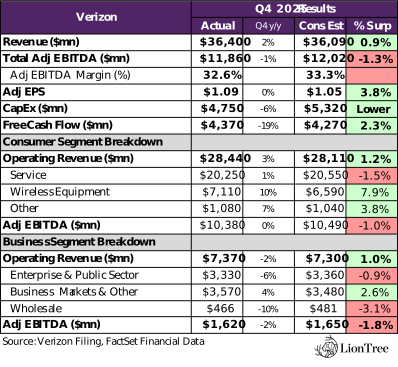
Verizon’s 2026 Guidance “Reflects The Beginning Of Our Turnaround” & Is A “Step Function Change From Recent Historical Performance”
- Note that 2026 financial guidance includes Frontier from January 20, the closing date of the acq
- Provided guidance for postpaid phone net adds for the first time ever: Expect to deliver 750k-1.0mn postpaid phone net adds in 2026, or ~2-3x what they delivered in 2025 and the highest since 2021
- That is “only 10-15%” of the new adds to the industry, which is a “doable” target in yr 1 of the transition
- Will not require overutilizing promotions or pricing to achieve those targets; If churn is reduced by 5bp, they will already be halfway to their target
- Will also continue to invest in the overall customer experience, and the $5bn in OpEx savings gives them flexibility to do that
- And will leverage all their convergence oppties, including in FWA and across new Frontier mkts
- Anticipate 2026 to be a “transitional” yr for rev and will see ~180bp headwind as they lap prior yr price increases, absorb promotional amortization, and await the benefits from churn reduction and increased volumes
- Guided for mobility and broadband svs rev growth of 2-3%, equating to ~$93bn, even as they lap billions of dollars of price increases from last yr that they will not repeat
- Wireless svs rev growth is expected to be ~flat as the Co transitions to sustainable volume-based growth
- 2026 adj EPS guidance of $4.90-$4.95 was +3.7% ahead of cons $4.75 at the midpt
- Implies growth of +4-5% y/y (which is a significant accel from -1.9% in 2025 and significantly higher than the 5-yr historical avg of ~-1% y/y growth)
- Expect 2026 adj. EBITDA to grow FASTER than adj EPS
- Have line-of-sight to delivering ~$5bn in OpEx savings in 2026: With a “substantial” portion realized by headcount reductions, alongside marketing efficiencies, real estate rationalization, contract renegotiations and more
- Will reinvest a portion of those savings to drive a higher quality rev profile
- 2026 CapEx guidance of $16-16.5bn was less than cons expectations of $18.05bn and below 2025’s $17.0bn
- 2026 FCF guidance of $21.5bn+, growing ~7% or more from 2025 (above the ~-1% y/y over the last 5 yrs), which will mark the highest FCF generated since 2020
- Given all the efficiency work being done, Frontier acq is no longer expected to be cash flow dilutive in 2026
Outlined 4 Key Priorities In Allocating Capital Spend…Which Included Pull Forward In Dividend Increase + $25Bn Share Repurchase Program
- Investing in the biz
- Applying the same rigor towards CapEx as they are on OpEx efficiencies
- Focused “squarely” on growth areas –
- In mobility, they are focused on the completion of their C-Band buildout and increasing investments to maintain reliability
- In broadband, they are focused on reaching 40mn-50mn fiber passings over the medium-term
- Firmly committed to VZ’s dividend
- Pullingforward their annual dividend increase to May, which represents an annualized increase of $0.07 or +2.5%/shr from their prior annual dividend rate
- Marks their 20th consecutive year of dividend increases
- Goal is to put the board in a position to continue to increase that dividend
- Maintaining a strong balance sheet
- Remain committed to paying down debt and returning to a target leverage range of 2.0-2.25x in the 2027 timeframe
- Returning cash to shareholders
- Announced up to $25bn of share repurchases, which they expect to complete over the next 3 yrs, with at least $3bn of repurchases in 2026.
- Expect to “significantly increase” their total return of capital to shareholders over the next three years
Update On The First 100 Days Of The “New” Verizon Turnaround Story
- Emphasized that “no company ever cost cuts its way to greatness” and they are “examining every dollar of OpEx and CapEx to ensure it is being spent on initiatives that will drive customer loyalty and brand trust”
- “Already a leaner, more efficient and intense organization” + “bringing in talent with new skill sets to complement our workforce”
- “We aim to be the most efficient telecom company in our industry” – “every single year, we will become more efficient, more agile, more outcomes-oriented and our speed of decision-making and product deployment will meaningfully increase”: How?
- Continue to reduce complexity
- Eliminate structural inefficiencies
- Divest non-core assets
- Deploy automation at scale
- What will drive financial success?
- Subscriber growth driven by convergence
- Value-based pricing strategy
- Superior value-added services
- Fully revamped end-to-end customer experience
- What will NOT? Price increases that drive short-term rev and earnings – “that is not a sustainable financial model, nor an engine of long-term growth”
- Mgmt is also “determined” to be an AI-first Co and deploy AI at scale: “Eventually, every individual customer will have a tailored proposition”
- Leveraging AI to simplify offers, personalize interactions, and reduce churn through “smart, consistent” marketing
- Using predictive models to anticipate customer pain points before they happen
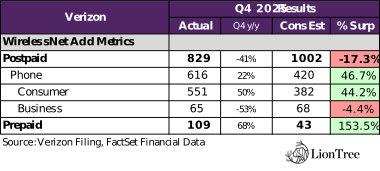
The Co Reported Notable Q/Q Jumps In Net Adds Across The Wireless Segment, Particularly In Postpaid Phone
- Q4 total postpaid phone net adds was the highest in 6 yrs: +616k (huge jump from +36k in Q3)
- Consumer postpaid phone net adds were a hefty beat: +551k (vs -7k in Q3) and beat cons by +44%
- Driven by “strong” demand as they leveraged their financial strength and flexibility to fund growth oppties
- Business postpaid phone net adds missed: +65k (vs +51k in Q3) and missed cons +68k
- Continued to see growth in the SMB and enterprise sectors.
- Public sector results were impacted by residual disconnects from govt efficiency efforts and the federal govt shutdown
- However, public sector performance improved from the prior qtr and w/ the “vast majority” of these related disconnects behind them
- Outlook – expect to see further improvements in public sector wireless volumes in H1
- Consumer postpaid phone net adds were a hefty beat: +551k (vs -7k in Q3) and beat cons by +44%
- Q4 prepaid phone net adds were also a big beat: +109k vs cons +43k
- 6th consecutive qtr of positive subscriber growth
- Completed a comprehensive, long-term agreement with Comcast and Charter to continue their partnership: Didn’t share any details, but said that partnership is “on very solid footing…financially, operationally and strategically”
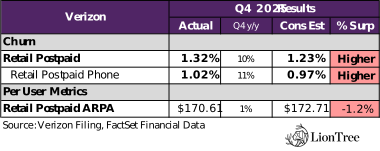
Postpaid Churn & ARPA Both Disappointed In Q4… “We Have A Large Opportunity To Address Churn”
- Q4 postpaid phone churn incr’d to 1.32% (up from 0.98% in Q3) and was higher than cons 1.23%
- This is largely from prior pricing actions, as well as competition
- Churn is a “pivotal” oppty in 2026 and expect investments in the customer and increased convergence oppties to benefit retention and LTVs over the next few qtrs
- Q4 postpaid ARPA missed by -1.2%: Grew +1.0% y/y (decel from +2.0% in the last 2 qtrs) to reach $170.61
Strength In Broadband Will Now Be Supercharged With The Closing Of The Frontier Acq
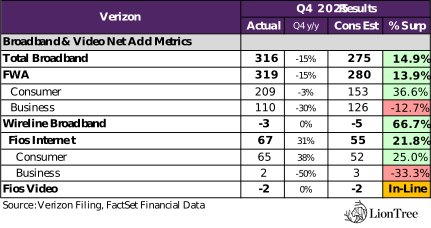
- Total Q4 broadband net adds came in ahead of cons: +316k vs cons +275k
- Total Q4 FWA net adds beat, again driven by Consumer: +319k (up from +261k in Q3), which was +14% ahead of cons
- Consumer beat by +25.0%, while Business missed by -33.3%
- Q4 Fios internet net adds were the high fourth qtr net adds since 2020: +67k (up from +61k in Q3) and beat cons +55k
- On the fiber front…Frontier acq has now closed and are full speed ahead on leveraging “huge” cross-sell oppty
- In Q4, generated +125k fiber net adds (up +29% y/y)
- In 2026, want to add “at least” 2mn fiber passings organically
- RAISED medium-term fiber passings goal from 35mn-40mn to 40mn- 50mn (whether that be organically or inorganically)
- Expect to realize $1bn+ of run rate operating cost synergies by 2028, double their initial estimate: Savings will be derived from network integration, 3P contract efficiencies and GTM savings across marketing and advertising
- Intend to “aggressively” seize incremental net adds and share of both mobility and broadband svs within Frontier mkts
Finally To Flag…Coming Soon in H1 Is A Brand-New Value Proposition
- Shared very few, vague details about what exactly the value prop is – “we are not going to show our hand until the day we launch”
- BUT the expected impact has already been incorporated into guidance: Based on “significant” mkt input and data analytics of how it will impact their volumes and financials
- Targeting launch for H1:26
- Currently in “deep” mkt research with a “very sophisticated” conjoint analysis…: Providing them w/ detailed customer feedback, projected market dynamics and associated financial and operational metrics
- …and feedback is “quite positive”
- Now in the fine-tuning stage of how the value prop will work
Microsoft’s Results Bring “The AI Investment Vs Returns” Question Back To The Forefront
It was not all smooth sailing for big tech this week (like it was for Meta in Theme #2). Microsoft lost over $350bn in market cap at one point on Thursday following its results.
While the Co actually delivered stronger than expected FQ2 results, the FQ3 guidance was uneventful in combination with market concerns about higher CapEx spending not yielding strong enough returns and OpenAI accounting for 45% of its backlog more than overshadowed.
To give a little more color, CapEx has been on the rise for the Co (and others in the industry) and incr’d +66% y/y in FQ2 but at the same time, Azure Cloud revenue growth y/y has been decelerating and is expected to again decelerate in FQ3. Mgmt stressed that this slower growth is not due to a lack of demand but reflects continued supply constraints as not all of the new incremental CapEx is being allocated to bring on more capacity for Azure. They are also allocating support to accelerate usage in first-party applications like M365 Copilot and GitHub Copilot, which represents incremental businesses which are expanding the TAM, and to fund ongoing R&D and product innovation.
Furthermore, the disclosure that 45% of the remaining performance obligation (RPO) balance is from OpenAI created customer concentration concerns. In defense, mgmt argues that the other ~55% (or ~$350bn) is highly diversified across customers, solutions, industries, and geographies, and is growing ~28% y/y.
Overall, investors’ appetite to underwrite huge AI investment levels continues to become more discriminating. Microsoft will need to show more fruits of their current investment spend to ease these concerns.
-> MSFT shares closed down -10% in reaction and is now down -11% YTD, following up +13% in 2025
Microsoft Tops FQ2 Headline #s
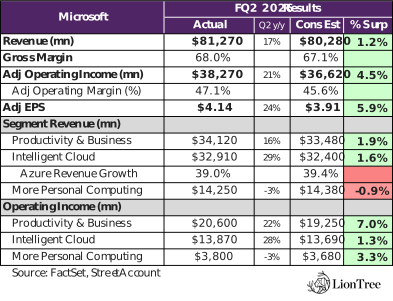
- FQ2 total revs BEAT by 1.2% and grew +17% y/y (+15% FXN), vs FQ1 +18% y/y (+17% FXN)
- PBO rev BEAT: by +2% and grew +16% y/y (+14% FXN)
- Intelligent Cloud rev BEAT by +1.6% and grew +29% y/y (+28% FXN)
- Azure rev growth FXN rose +39% y/y vs cons +39.4% y/y
- MPC rev MISSED by -1%, decel -3% y/y (-3% FXN)
- Microsoft Cloud gross margins decreased due to AI infrastructure investment
- Microsoft Cloud rev of $51.5bn, up +26% (up +24% FXN), vs +26% y/y in Q1:26
- Microsoft Cloud gross margin decreased y/y to 67% driven by continued investments in Al infrastructure and growing Al product usage, offset by efficiency gains in Azure and Microsoft 365 Commercial cloud
- FQ2 Gross margins beat (again) at 68% vs cons 67.1%, op margins were +150bp ahead, and EPS beat by +6% (+24% y/y, +21% FXN vs FQ1 +22% y/y, +21% FXN)
- FQ2 shareholder returns: +12% y/y to $12.7bn total ($6.8bn in dividends & $6bn in share repurchases)
- FQ2 FCF down -9% y/y to $5.9bn reflecting higher CapEx to support cloud and Al offerings
The Overall FQ3 Guidance Was A Non-Event
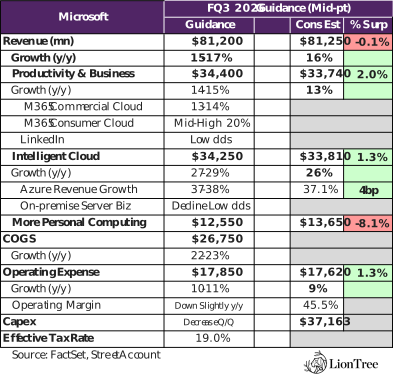
- FQ3 total rev at the midpt was roughly in-line w/cons, and reflects 15-17% y/y growth (a deceleration from the +17% y/y in FQ2)
- Productivity & Biz processes rev guidance slightly BEAT
- Intelligent Cloud rev guidance slightly BEAT
- Personal Computing rev guidance MISSED
- Some key assumptions underpinning the revenue guidance –
- M365 commercial cloud…accelerating Copilot momentum and ongoing E5 adoption will again drive ARPU growth
- M365 commercial products rev should decline in the low SD q/q, assuming Office 2024 transactional purchasing trends normalize
- Dynamics 365 rev growth to be in the high-teens
- Microsoft Cloud gross margin guidance of ~65% (down y/y) is driven by cont’d investments in AI
- Azure on-premises server rev is expected to decline in the low SD range as growth rates normalize following the launch of SQL Server 2025, though increased memory pricing could create additional volatility in transactional purchasing
- Personal Computing rev growth rates will be impacted as the benefit from Windows 10 to support normalize & as elevated inventory levels come down through the qtr
- M365 commercial cloud…accelerating Copilot momentum and ongoing E5 adoption will again drive ARPU growth
- Expect FQ3 CapEx to decrease on a sequential basis, due to the normal variability from cloud infrastructure build outs and the timing of delivery of finance leases: Expect the mix of short-lived assets to remain similar to Q2
But The Heavy Backlog Exposure To OpenAI Raised Eyebrows
- FQ2 Commercial remaining performance obligation (RPO) of $625bn incr’d +110% y/y (vs +51% y/y in FQ1:26) with a weighted average duration of ~2.5 years (~2 yrs in FQ1)
- ~25% will be recognized in rev in the next 12 months, up +39% y/y
- The remaining portion, recognized beyond the next 12 months, is up +156% y/y
- Notably ~45% of the commercial RPO balance is driven by commitments from OpenAl
- Incudes multi-year demand needs…at the same time it could also cause some quarterly volatility in future bookings and RPO growth rates
- But mgmt highlighted that the majority of capital spend is on GPUs (including for large customers like OpenAI) and is already contracted for most of its useful life
- Excluding OpenAI, ~55% of the RPOs (or ~$350bn) is highly diversified across customers, solutions, industries, and geographies, is growing ~28%, and is larger and more diversified than most peers, which management has very high confidence in
-> Also this week, Perplexity signed a 3-year, $750mn agreement w/ Microsoft to use Azure as a primary platform for accessing frontier AI models through Microsoft’s Foundry program;The deal does not replace Perplexity’s existing AWS usage.(link)
And There Was Ample Analyst Focus On Azure Cloud Y/Y Growth Decelerating While CapEx Grows
- FQ2 CapEx of $37.5bn rose +66% y/y (vs +74% y/y in FQ1) and was above cons $36.3bn: ~2/3 of CapEx was for short-lived assets (primarily GPUs and CPUs), which support Azure platform demand, growing 1st-party applications and Al solutions, accelerating R&D by their product teams, as well as cont’d replacement for end-of-life server and networking equipment
- While at the same time Azure & Other Cloud rev growth decelerated from +40% y/y in FQ1 to +39% y/y in FQ2 and guidance is for further deceleration to +37-38% y/y growth (though mgmt argues that demand is above supply)
- Why isn’t the material increase in CapEx spend leading to higher Azure & Other Cloud revenue growth? Isn’t that level of spend a risk?
- Mgmt clarified that the CapEx investments are not solely to support Azure revenue but also to drive the lifetime value (LTV) of the broader portfolio, including first-party AI applications like M365 Copilot, GitHub Copilot, Dragon Copilot, and Security Copilot, as well as R&D
- Acquiring an Azure customer is super important to them, but so is acquiring an M365 or a GitHub or a Dragon Copilot, which are all incremental biz and TAMs
- Also to note, mgmt stressed that the majority of the current CapEx (esp for GPUs) is fully contracted for most of their useful life so the risk being pointed to “isn’t there” b/c the hardware is already sold
- If all the GPUs that came online in Q1 and Q2 were all allocated to Azure capacity, “the KPI would have been over 40” (while unclear, it sounded like mgmt was referring to what Azure Cloud rev growth would have been in that case)
- “Our customer demand continues to exceed out supply” so mgmt needs to balance the need to have incoming supply to meet Azure’s demand vs other uses noted above
- “Mgmt is working as hard to add capacity as quickly as we can”
- Will add long-lived infrastructure and put more GPUS and CPUs in them as quickly as possible when they are done
Mgmt Outlined Several Bullish Stats To Reflect Strong AI Demand / Adoption Within Enterprises
- AI adoption is compounding across M365, Security, and GitHub, which historically worked well together and are now becoming transformative as AI and agents sit on top of them
- Microsoft 365 data is the most important database for enterprises, because it contains info (people, relationships, projects, artifacts, communications), and Work IQ unlocks this context for workflows and agents
- Agents are the “transformative” layer, where tools like M365 Copilot, GitHub Copilot, and Security Copilot work together
- Demand for specific AI-powered products is robust –
- Microsoft 365 Copilot: +160% y/y increase in seat adds, with accelerating q/q growth, reaching 15mn paid seats; The # of customers with 35k+ seats tripled y/y, and DAUs incr’d 10x y/y
- CoPilot app: DAUs incr’d nearly 3x y/y
- GitHub Copilot: Paid subs reached 4.7mn, up +75% y/y, w/ Copilot Pro Plus subs for individual developers incr’d +77% q/q
- Dragon Copilot (healthcare): Used by 100k+ medical providers & helped document 21mn patient encounters this qtr, up +3x y/y
- Purview: Audited 24bn Copilot interactions this qtr, a 9x increase y/y
Other Points To Highlight
- FQ2 Gaming declined this qtr: Xbox content and svs rev declined -5% (down -6% CC) vs +1% y/y in FQ1:26; Xbox hardware rev declined -32% y/y (down -29% y/y in FQ1:26)
- FQ3 guidance…Gaming rev is expected to decline mid SD y/y due to tough comps, partially offset by growth in Xbox Game Pass and hardware revenue should decline y/y
- FQ2 Linkedln delivers stable y/y growth: Rev grew +11% (up +10% FXN), driven by growth in Marketing Solutions (slightly accelerating from +10% y/y in Q1:26)
- FQ3 guidance…LinkedIn rev growth to be in the low DD
iPhone Demand Drives A Strong FQ1 For Apple, Though Supply Hurdles Persist
“Staggering” demand for iPhones was a key driver of Apple’s FQ1 performance, which saw revenue rise +16% y/y to $144bn, the strongest growth since 2021. Amidst that, the Co is in a “supply chase mode”, as they navigate supply chain constraints for the advanced nodes on which their SOCs (system-on-chip) are produced. While the Co is working to expand supply, they declined to forecast when that might balance. And while this qtr’s supply shortage is related to advanced node chip manufacturing, rising memory prices are also going to have “a bit more” of an impact in FQ2, and the Co is looking at “a range of options” to manage it. Despite these pressures, gross margins for next qtr were guided to between 48-49%, which at the midpt is higher than FQ1. Rev growth guidance of +13%-16% y/y for next qtr also topped expectations of +10%.
Apple’s AI strategy continues to be a focus amongst investors and while the Co recently announced a partnership with Google to leverage its AI capabilities to help power future Apple Intelligence features, including a more personalized Siri coming this yr, mgmt was mostly tight-lipped about sharing any additional details.
See below for what we viewed as the most incremental takeaways from the call.
-> Apple stock closed the week up +1% y/y and is down -4.5% YTD, following being up +12% in 2025
-> Also this week, Apple annc’d that it acquired Q.ai, a startup working on AI technology for audio, for ~$2bn; Apple did not say how it will use Q.ai’s technology but said the startup has worked on new applications of machine learning to help devices understand whispered speech and to enhance audio in challenging environments (link/link)
FQ1 Was Apple’s “Best-Ever” Qtr
- Overall rev BEAT by +3.9%: Best-ever FQ1 with rev reaching $143.8bn vs cons of $138.4bn, up +16% y/y (accel from +8% y/y in FQ4)
- Svs rev was ~in-line: Reached an all-time rev record of $30.01bn vs cons of $29.99bn, up +14% y/y (decel from +15% y/y in FQ4)
- Performance continues to be broad-based, with double-digit growth in almost every mkt they track
- Reached all time rev records for advertising, cloud services, Music and payment svs; Set Dec qtr records on the App Store and Video
- Apple TV is seeing “fantastic momentum” with December seeing a +36% y/y increase in viewership
- Product rev BEAT by +5.3%: $113.74bn vs cons $108.04bn, up +16% y/y (accel from +5.4% y/y in FQ4)
- iPhone BEAT by +4.7%: Set an all-time rev record across every geographic segment to reach $85.3bn, up +23% y/y (accel vs +6% y/y in FQ4)
- Mac MISSED by -9.2%: $8.39bn vs cons $9.24bn, down -7% y/y (decel from +13% y/y in FQ4)
- Faced a “very difficult” compare against the M4, MacBook Pro, Mac mini and iMac launches in the yr-ago qtr
- iPad BEAT by +5.3%: $8.6bn vs cons $8.2bn, up +6% y/y (accel from flat in FQ4)
- Wearables, Home and Accessories MISSED by -6.0%: $11.5bn vs cons $12.2bn, down -2% y/y (decel from -0.3% y/y in FQ4)
- Experienced constraints in the AirPods Pro 3 in FQ1, and believe that the overall category would have grown had it not been for these constraints
- Gross margin of 48.2% BEAT cons 47.5%, and was up +100bp seq (vs 47.2% in FQ4), driven by favorable mix and leverage products
- Products gross margin of 40.7% BEAT cons 39.7%, up +450bp seq (vs 36.2% in FQ4), driven by favorable mix and leverage
- Services gross margin of 76.5% BEAT cons 75.6%, up +120bp seq (vs 75.3% in FQ4), driven by mix
- Op margin of 35.4% BEAT cons 34.2%
- Adj EPS BEAT by +6%: Reached an all-time record of $2.84 vs cons of $2.68
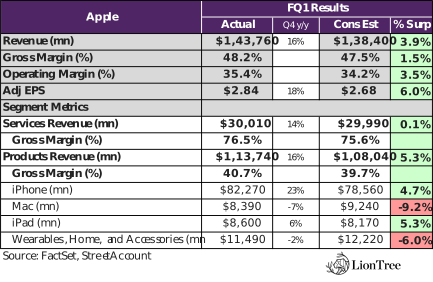
FQ2 Guidance Was Ahead Of Expectations Despite Pressured iPhone Supply
- Expect FQ2 total Co rev to grow by +13-16% y/y, which was above expectations of +10% y/y
- Guidance takes into account their best estimates of constrained iPhone supply during the qtr
- FQ2 Services rev is expected to grow at a similar y/y rate as FQ1
- FQ2 gross margin guidance of 48%-49% was ABOVE cons 47.6%
- How are they sustaining that gross margin level despite rising memory (NAND) costs? Favorable product mix from a strong iPhone cycle and continued double-digit growth in Services are helping offset the normal seasonal headwinds going from FQ1 to FQ2
- FQ2 OpEx guidance of $18.4-18.7bn was +6% ahead at the midpt of cons $17.5bn
- Similar level to FQ1 and driven by higher R&D on a y/y basis
- FQ2 OI&E is expected to be ~$100mn
- Excluding any potential impact from the mark to market of minority investments
- FQ2 tax rate is expected to be ~17.5%
China & India Continue To Be Key Focus Markets
- FQ1 geographic callouts –
- Set all-time revenue records in the Americas, Europe, Japan and Rest of Asia Pacific
- Saw double-digit growth y/y across the majority of the markets they track, including the US, Latin America, Western Europe, Greater China, India and South Asia
- Continue to gain momentum in emerging markets
- Greater China was up +38% y/y in FQ1 (vs down -4% y/y in FQ4), driven by the best iPhone qtr in history of the region (set an all-time rev record)
- Greater China was up +38% y/y in FQ1, driven by iPhone, which set an all-time record for upgraders and double-digit growth for switchers; Installed base also reached an all-time high in both Greater China and Mainland China
- Also saw broader product momentum beyond iPhone: Majority of Mac, iPad, and Watch buyers are still new to the product
- India was also called out as a mkt where they have been seeing “nice” growth but still only have a “modest” share and is therefore a “huge” opportunity
- India is the second-largest smartphone market and fourth-largest PC market
- Set a qtrly rev record for FQ1
- Set qtrly rev records for iPhone, Mac, and iPad, and an all-time rev record for Services
- Seeing “strong” double-digit growth in installed base
- Majority of customers buying iPhone, Mac, iPad, and Watch are new to the product
Expect To Be Able To Manage Through The Supply Constraint
- The Co is in a “supply chase” mode to meet iPhone demand; Difficult to predict when supply and demand will balance
- Exited FQ1 with “very lean” channel inventory due to the “staggering” level of demand
- Constraints are driven by the availability of the advanced nodes that their SOCs are produced on
- Also seeing less flexibility in supply chain than normal, partly b/c of the increased demand
- Memory had a “minimal” impact on FQ1 gross margin but expected to have “a bit more” of an impact to FQ2 gross margin
- This is already baked into FQ2 guidance
- Did not provide outlooks beyond FQ2 but continue to see market pricing for memory increasing “significantly” and will look at “a range of options” to deal with that
Mostly Tight-Lipped On AI-Related Collaboration With Google But Shared A Few Incremental Details
- Collaborating with Google to develop the next generation of Apple Foundation models, which will help power future Apple Intelligence features…including a more personalized Siri coming this yr
- What drove the decision to choose Google as partner? Determined that Google’s AI technology would provide the most capable foundation for Apple Foundation Models
- Believe they can unlock experiences and innovate “in a key way” due to the collaboration and will maintain their “industry leading” privacy standards while doing so
- Impact of partnership on CapEx? Declined to provide details on the arrangement w/ Google but highlighted their overall CapEx strategy, which follows a hybrid model (using a mix of first- and third-party capacity) and can fluctuate independent of volume performance of the biz; “I would just say there’s going to be some ebbs and flows in CapEx”
Successful AI Organizational Adoption Likely Follows The Hockey-Stick Growth Pattern
AI might not actually be taking our jobs, at least not yet! There were two reports this week that support the view that AI has yet to take hold in terms of broad employee / organizational usage and higher returns that would come from that. First, a new Gallup poll shows that while overall AI usage in the workplace is still growing, that growth is being driven primarily by existing users rather than new ones. Adoption among infrequent users has largely plateaued. With that said, employees in leadership roles were more likely to use AI than those in non-leadership roles, but there is still a ways to go.
At the same time, and supporting this same conclusion, the majority of CEOs in PwC’s 29th Annual CEO Survey said that they have yet to see meaningful revenue gains from AI. Many leaders also admit that their organizations lack a clear AI roadmap or sufficient investment to deploy AI effectively. The use cases that have seen the most returns from AI implementation include Demand generation and Support services.
Net net, AI infrastructure investment levels continue to skyrocket but employee/organizational AI adoption and successful utilization is happening at a slower pace, at least as of now. We expect to see a typical hockey stick-adoption pattern as we’ve seen with other new developing technologies. In our mind it is not “if” AI will scale this type of adoption successfully, but “when”.
See more of what we viewed as most important on this theme below…
-> Also see Theme #2 for related Meta comments on its workforce’s use of AI internally
Growth In AI Usage Amongst Employees Is Being Driven Existing Users Vs Broadening Adoption, Per Gallup (link)…
- Frequent AI users increased their usage further in Q4…
- % of employees using AI DAILY has risen from 10% in Q3 -> 12% in Q4
- % of employees using AI FREQUENTLY (at least a few times a week) has risen from 23% in Q3 -> 26% in Q4
- …while usage among infrequent users was flat
- % of employees using AI PERIODICALLY (at least a few times a yr) was FLAT (45% in Q3 -> 46% in Q4)
- In fact, 49% of employees said that they NEVER use AI in their role
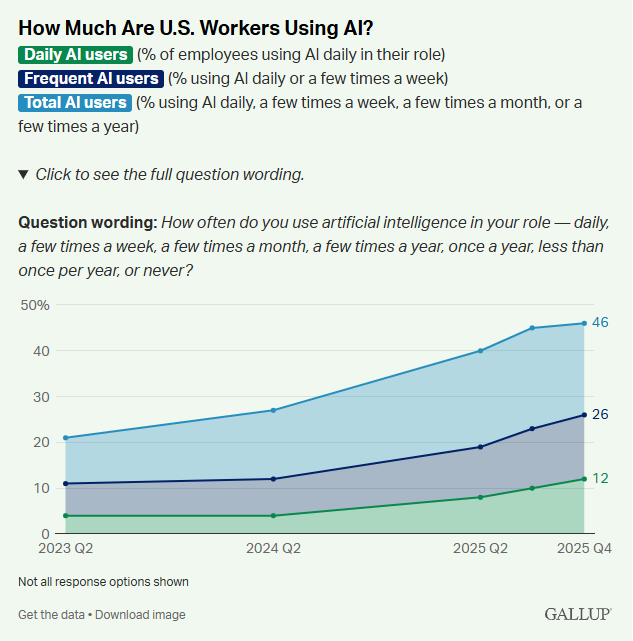
Source: Gallup Report
- In a similar vein, organizational AI adoption has not changed meaningfully from Q3 -> Q4
- 38% of employees in Q4 said their org has integrated AI tech to improve productivity, efficiency and quality
- Vs 37% in Q3
- 41% said their org has not implemented AI tools
- Vs 40% in Q3
- 21% said they don’t know
- Vs 23% in Q3
- 38% of employees in Q4 said their org has integrated AI tech to improve productivity, efficiency and quality
- Even in tech, where AI adoption has been the most prevalent, user growth has also leveled off, w/ gains driven mainly by existing AI users
- Total AI use in tech was mostly flat…: By just +1ppt in Q4 (76% in Q3 -> 77% in Q4)
- …while frequent use was up seq: Up +7ppt (50% in Q3 -> 57% in Q4)
- Employees in remote-capable roles use AI at a significantly higher rate AND more frequently
- Remote employee…
- AI use was up +38ppt: From 28% in Q3 -> 66% in Q4
- Frequency was up +27ppt: From 13% in Q3 -> 40% in Q4
- Non-remote employee…
- AI use was up +17ppt: From 15% in Q3 -> 32% in Q4
- Frequency was up +9ppt: From 8% in Q3 -> 17% in Q4
- Remote employee…
- Employees in leadership roles are more likely than non-leaders to use AI at work, and the usage gap continues to widen
- In Q4, 69% of leaders said they use AI at least a few times a year: Vs 55% of managers and 40% of individual contributors
- Also a potential driver…leaders are more likely to hold office-based and remote-capable roles where AI tools are more easily applied
- Leaders also report more frequent AI use than non-leaders, and that gap has been growing: Frequency of AI use amongst (from Q2:23 -> Q4:25)…
- Leaders up +27ppt: 17% -> 44%
- Managers up +15ppt: 15% -> 30%
- Individual contributors up +14ppt: 9% -> 23%
- In Q4, 69% of leaders said they use AI at least a few times a year: Vs 55% of managers and 40% of individual contributors
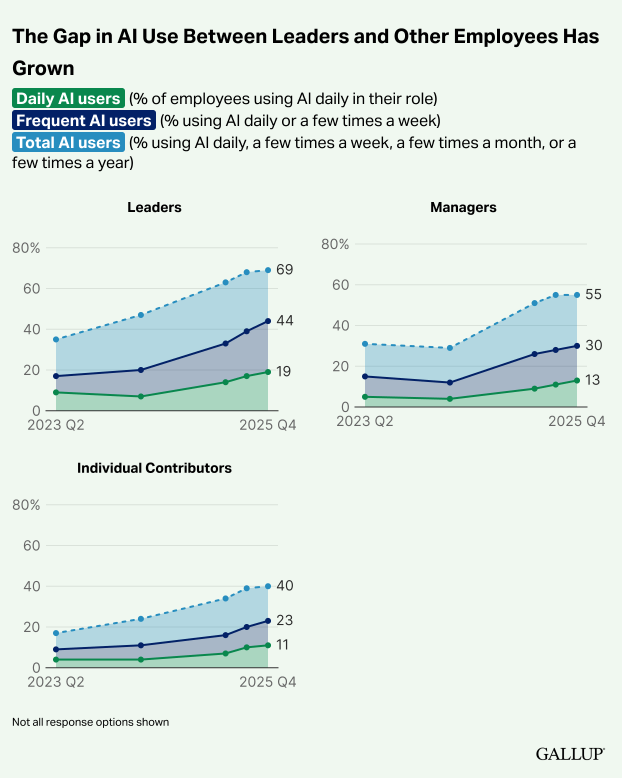
Source: Gallup Report
…AND PwC’s 29th Global CEO Survey Also Finds That AI Is Being Used Less Than Some May Expect (link)
- The majority of CEOs surveyed, whether focused in TMT or more broadly, have not yet to see an increase in revenue from AI
- TMT (where adoption is higher): Only 38% of TMT CEOs have seen an increase in rev
- Overall: Only 30% of CEOs reported an increase in rev
- 56% have seen no change
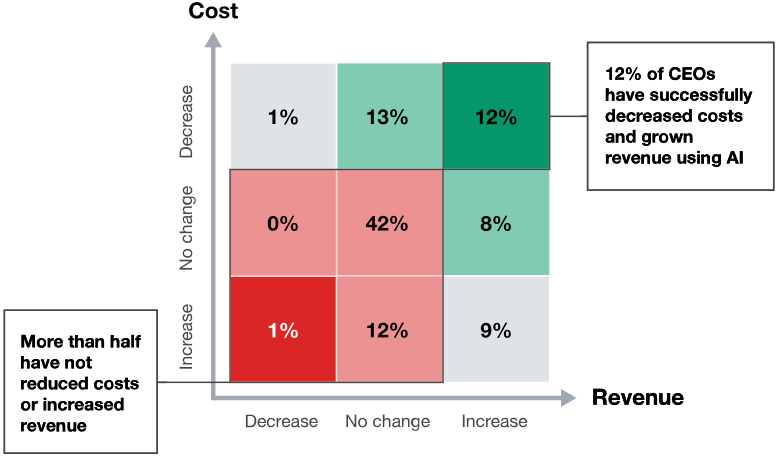
Source: PwC CEO Report
- When asked about the extent to which their orgs are deploying AI across the biz, only a small % of CEOs say they’re applying it to a “large” or “very large” extent: The largest use cases right now include:
- Demand generation (22%)
- Support svs (20%)
- Co’s products, services, and experiences (19%)
- Direction setting (15%)
- Demand fulfilment (13%)
- Many CEOs still feel like their Co lacks AI foundations such as road maps or sufficient levels of investment (see chart below)
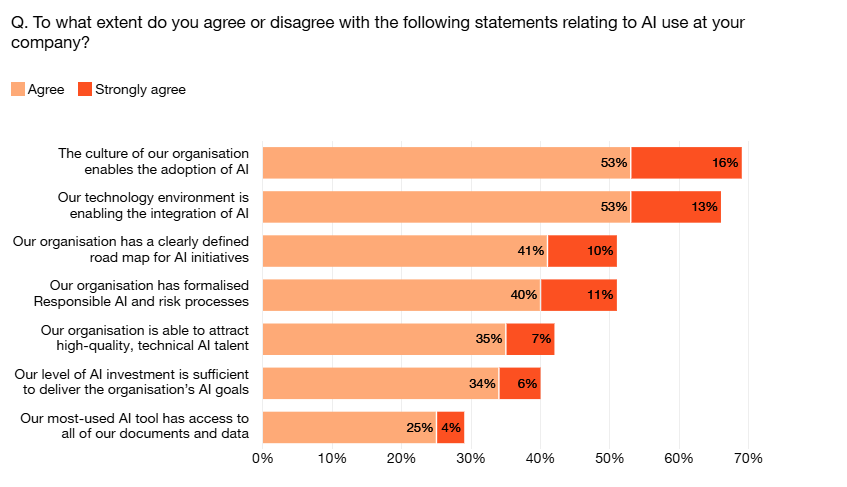
Source: PwC CEO Report
Grab Bag: Nvidia Invests More Into CoreWeave / Amazon Is Further Expanding Groceries / Pinterest, Along With Others Announce Job Cuts
- Nvidia invests an addtl $2bn into CoreWeave + expands relationship to accelerate buildout of AI factories (link)
- NVIDIA purchased CoreWeave’s stock at a price of $87.20/shr
- It said its investment reflects its “confidence in CoreWeave’s business, team and growth strategy as a cloud platform built on Nvidia infrastructure”
- What does the expanded partnership entail? Enables CoreWeave to accelerate the buildout of more than 5 gigawatts of AI factories by 2030
- For reference, NVIDIA already owned a 6.6% stake in CoreWeave and had previously agreed to buy $6bn+ in svs from the firm through 2032
- NVIDIA purchased CoreWeave’s stock at a price of $87.20/shr
-> CoreWeave’s stock was up +10.7% on the back of the announcement but is only up +0.2% on the week
- Amazon is expanding their online grocery footprint (link/link)
- What happened: The Co will close Amazon Go and Amazon Fresh physical stores to prioritize investment in growth areas
- The Co has ~60 Fresh stores in the US
- The Co is also shuttering ~15 Amazon Go stores
- What’s next: The Co plans to open ~100 Whole Foods supermarkets “over the next few years”
- The Co is also opening 5 new Whole Foods Market Daily Shop stores in 2026
- The Co is also working on expanding its grocery delivery capabilities this year
- The Co currently offers delivery in ~5,000 cities and towns in the US
- What happened: The Co will close Amazon Go and Amazon Fresh physical stores to prioritize investment in growth areas
-> Amazons stock was down -1% on the back of the announcement
- Pinterest is laying off 15% of its workforce and cutting back on office space as the Co embraces AI (link/link)
- The Co expects the cuts will be complete by the end of Q3:26 in late Sept
- Why? The Co is “reallocating resources” to AI-focused teams and prioritizing “AI-powered products and capabilities”
- It’s also reshaping its sales and marketing strategy
- The Co expects to record pre-tax restructuring charges of about $35mn-$45mn
- Other cuts annc’d recently:
- Dow: 4,500 annc’d to “streamline operations”
- Amazon: 16,000, just three months after laying off 14,000
- UPS: 30,000, as the Co plans to reduce the number of Amazon shipments it handles
-> Pinterest stock was down -9% on the back of the announcement
Stock Market Check
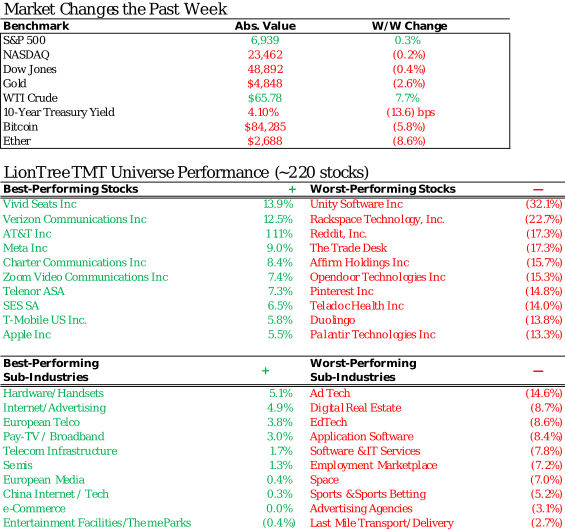
This Week's Other Curated News
Advertising/Ad Agencies/Ad Tech
- Prices for Super Bowl commercials have climbed as high as $10mn ahead of the Feb. 8 broadcast on NBC. According to the network’s head of global advertising, underscoring the NFL’s strong pull on fans and sponsors. (Bloomberg)
- eMarketer projects Disney+ U. S. ad rev up 21% to $1.2bn this yr and 17% next yr, while viewing grows slower at ~5%. Netflix also posts low single‑digit gains in global hrs watched. Hulu’s ad rev rises ~3–4% to $2.7bn–$2.8bn, w/ viewing up ~2–3%. Hulu remains the leading premium streamer in yearly ad rev as mkts show modest engagement growth. (MediaPost)
Artificial Intelligence/Machine Learning
- SpaceX is in talks to merge w/ Elon Musk’s xAI ahead of a potential IPO this yr, which could fold SpaceX, Starlink, X and Grok under one Co. Under the deal, xAI shares would be swapped for SpaceX stock, though value and timing remain fluid. SpaceX is also weighing a Tesla tie-up. (Reuters)
- Construction firms are turning to AI agents to ease project management as labor shortages grow and retirements loom. Construction-software Cos such as Procore are annc’d AI tools that analyze site data, flag safety issues and automate reports, cutting hrs of manual work. (The Wall Street Journal)
- OpenAI annc’d it will retire several ChatGPT models next month, including GPT‑4o, despite loyalty to its warm style. The Co said only 0.1% of users choose it daily as most use GPT‑2. After backlash when access was briefly pulled in Aug., CEO Sam Altman promised notice. (CNBC)
- Pentagon and AI Co Anthropic are at a standstill over safeguards limiting use of its tech for autonomous weapons and U. S. surveillance, Reuters reported. Talks under a contract worth up to $200mn stalled as Anthropic pressed for human oversight, while Defense officials argued AI can be deployed regardless of cos policies if lawful.e. (Reuters)
- OpenAI is preparing for a possible IPO in Q4 as rivalry w/ Anthropic intensifies, people familiar say. The ~$500bn AI Co has held informal talks w/ banks, expanded its finance team and weighed timing amid a wider IPO rebound. Challenges include rising competition, heavy spending and a pending Elon Musk lawsuit. (The Wall Street Journal)
- OpenAI’s Sora video app surged after its Oct. debut but is now losing traction. Appfigures data show iOS downloads fell 32% m/m in Dec. and 45% m/m in Jan. 2026 to 1.2mn, while consumer spending dropped 32%. Despite 9.6mn total downloads and ~$1.4mn spend, rankings slid as competition from Google Gemini and Meta AI rose and tighter copyright controls curbed use. (TechCrunch)
- A coalition led by UMG, Concord and ABKCO filed a new copyright lawsuit accusing AI Co Anthropic of mass-scale piracy and infringement of 20,000+ songs. In the N. District of Calif., the $3bn claim escalates a 2023 suit once seeking ~$75mn. (MSN)
- Amazon is in early talks to invest up to $50bn in OpenAI. Discussions led by Amazon CEO Andy Jassy remain preliminary. Big Tech firms including SoftBank, Nvidia and Microsoft are vying for stakes as OpenAI seeks up to $100bn in funding, valuing it at ~$830bn. (Reuters)
- Nvidia, Microsoft & Amazon are in talks to invest up to $60bn in OpenAI, per a Wed. Nvidia may add $30bn, Microsoft < $10bn, while Amazon could invest > $20bn, tied to cloud/server deals & ChatGPT svs sales. OpenAI is close to term sheets as it faces rising AI costs amid Google rivalry, w/ SoftBank also eyeing a $30bn add’l stake. (Reuters)
- Google annc’d major Search upgrades, making it more AI‑driven as Gemini 3 becomes the default model for AI Overviews globally. Users can now ask follow‑up questions for a seamless chat‑style exp w/ AI Mode, offering quick snapshots or deeper convos. The shift signals Google’s move away from link‑focused results after mixed outcomes from earlier models, aiming for “best‑in‑class” answers. (The Verge)
- Google Photos annc’d new text prompts for its AI image‑to‑video tool, letting users describe movement, style, or effects, aligning the feature more closely w/ rival AI editors. Prompts can be edited and come w/ suggestions. Access is limited to users 18+ and availability varies by region. The update also adds default audio in generated videos, making them ready for online posting. (The Verge)
- D-Wave, Davidson & Anduril annc’d a collab on quantum‑classical tools for U. S. air/missile defense. Using Anduril sims, Davidson modeling & D‑Wave tech, tests showed Stride hybrid solver gave ≥10x faster results vs classical methods, 9–12% better threat mitigation & +45–60 intercepts in a 500‑missile scenario. (D-Wave)
- UK govt annc’d a Meta‑funded AI team to build open‑source tools for transport, public safety and defence. Experts from Turing Inst. and unis will spend 1 yr creating trustworthy, safety‑critical AI that public bodies can run w/out closed‑source systems. Meta said models like Llama will support work, w/ govt owning tools to keep sensitive data in‑ (Reuters)
- Google annc’d AI Plus in US at $7. 99/mo, offering 200GB via Google One, enhanced Gemini 3 Pro access, Flow AI tools, limited Veo 3.1, and 200 monthly AI credits. New users get $3.99 for 2 mos. Google One 2TB subs gain AI Plus benefits automatically. Plan expands to 35 regions as Google boosts its AI svs lineup. (9to5Google)
- Anthropic annc’d that its 2026 rev outlook is up ~20%, as the Co expects sales to near‑quadruple to $18bn and rise to ~$55bn in 2027. But higher model‑training and compute costs pushed its cash‑flow‑positive target to 2028. The Co, maker of Claude, faces pressure to balance rapid growth w/ long‑term financial stability amid strong investor interest. (Investing.com)
- Anthropic is set to raise ~$20bn, doubling its target amid strong investor demand, valuing the Co at $350bn. The round, led by GIC and Coatue w/ Sequoia and other backers, reflects Anthropic’s growing role as OpenAI’s rival. Tech groups incl. Microsoft and Nvidia may add up to $15bn. (Financial Times)
- Cloudflare shares jumped ~11% as buzz around Clawdbot, an AI agent built on Anthropic’s Claude, boosted expectations for its low‑latency infra enabling local autonomous tasks. Thousands of GitHub stars signaled rising interest in agentic AI. Analysts say NET’s edge network, consumption pricing and ~80% reliance by leading AI cos could lift traffic and rev ahead of its Feb. 10 earnings. (Yahoo Finance)
- Apple annc’d major progress on its Gemini deal, w/ new Siri set to debut in iOS 26. 4 beta next month. Siri will gain on‑screen awareness, deeper personalization, and app actions powered by Apple Foundation models v10 using a 1.2T‑parameter model. Plans for iOS 27 cont’d w/ more advanced v11 models. (9to5Mac)
- Qwen3‑Max‑Thinking, is a flagship reasoning model showing strong gains in knowledge, reasoning, alignment & tool-use. It adds adaptive Search/Memory/Code tools to cut hallucinations and boost personalized responses. A new test‑time scaling method improves benchmark scores via iterative self‑ (Qwen.ai)
- YouTubers behind h3h3, MrShortGame Golf & Golfholics filed a proposed class action alleging Snap used their vids to train AI via HD‑VILA‑100M, meant for research only. They claim the Co bypassed YouTube limits for commercial use. The suit seeks damages and an injunction. It joins many ongoing AI copyright cases vs major cos. (TechCrunch)
- Anthropic CEO Dario Amodei warns in a 38‑page essay that rapid AI progress could soon create super‑human systems posing civilization‑level threats. He cites risks incl. mass job loss, rising terror threats, AI‑enabled authoritarianism, and unchecked AI cos influencing users. Though optimistic, he urges govts and leaders to act fast, noting AI’s power and profit make meaningful restraint hard. (Axios)
- DOT annc’d a plan to use Google Gemini to draft regs, w/ leaders saying AI could speed rulemaking to minutes. counsel Zerzan said they want “good enough” rules as DOT pilots AI‑written drafts, incl. an FAA rule. Critics warn LLM errors could harm safety across transit mkts, noting DOT’s staff loss of ~4k workers and risks of AI-driven biz decisions impacting millions. (Engadget)
Audio/Music/Podcast
- Spotify annc’d $11bn in 2025 royalties, lifting all-time payouts to $70bn. Hellman said indie cos earned ~50% and Spotify’s 10% yr-over-yr growth beat other income sources. He pushed back on criticism over low rates, noting streaming revived mkts after piracy. (The Hollywood Reporter)
Broadcast/Cable Networks
- TEGNA, a major owner of ABC, CBS, FOX and NBC local stations, rolled out new mobile apps to make local news and weather more social-style. Launched in beta in four mkts—Atlanta, Denver, Indianapolis and Seattle—the apps are expanding across the cos 51 mkts. (Cord Cutters News)
Cable/Pay-TV/Wireless
- Telia Co annc’d a higher 2025 dividend as it fulfils its mid‑term plan, stressing it aims to turn around its biz in Norway and Finland even as those mkts face headwinds. The Co said Q4 2025 rev rose 1.6% YoY on a like‑for‑like basis to SEK21.3bn vs SEK21.4bn, and svs rev increased 2.1% during the period, reflecting continued momentum in Sweden and the Baltic mkts, which cont’d to underpin overall performance. (Telecompaper)
- Verizon topped RootMetrics’ US mobile study for H2 last yr, winning 7/8 national categories incl. overall performance. Despite close gaps among the big 3, Verizon’s gains came from stronger 5G SA use, wider C‑band reach & improved reliability. AT&T had a strong showing but shared all its wins, while T-Mobile led in speed only. (Telecoms)
- European telco outlook for 2026 is modest, w/ ~2% rev growth from new svs, price hikes and bigger bundles. Competition from satellite, fibre ops and OTT apps pressures cos. EBITDA seen rising ~2.5% as automation, AI and reorganisations cut costs. Capex stays high for 5G SA, fibre links and new sites, keeping mkts steady but limiting faster biz expansion. (ING Think)
Capital Market Updates
- LVMH shares fell 7. 9% after Q4 rev rose 1% to €22.7bn but lagged peers. CEO Arnault warned 2026 won’t be simple due to geo risks. China recovery stayed uneven amid FX pressure, w/ demand volatility. Full‑yr profits fell 13%, hurt by wine/spirit unit, partly offset by Sephora. Fashion/leather goods stayed soft, but analysts see signs of stabilizing momentum. (CNBC)
- Nokia annc’d it will keep its 2025 dividend stable even as FY profit fell 49% on restructuring, acquisition costs and limited sales growth. The Co expects stable‑to‑higher adj operating profit this yr, starting the yr under a new structure built to capture mkts in data‑centre networking and AI computing. (Telecompaper)
- Burry said in a Substack post he’s been buying GME, calling it a long‑term value play, not a meme bet. He backs CEO Cohen’s strategy as the Co uses past meme spikes to raise cash and pursue stronger biz ops. GME surged ~6% on the news. Burry said the Co’s core biz is “crappy” but Cohen is turning it into leverage, incl. moves like bitcoin buys. (CNBC)
Cloud/DataCenters/IT Infrastructure
- Oracle annc’d its NM data center for OpenAI will create up to 1,500 permanent jobs, doubling its earlier forecast. The Co said the project is meant to highlight positive impacts of server farms as mkts expand. Exec VP Pradeep Vincent wrote the site will bring high quality roles, sustainable infra, and long term economic benefits to Doña Ana County once construction is complete. (Bloomberg)
- Microsoft’s A. I. boom has driven a surge in data-center water use, w/ forecasts shifting but still rising. Internal estimates show needs climbing from 7.9bn liters in 2020 to ~18bn by 2030, straining water‑stressed regions like Jakarta, Phoenix and Pune. (The New York Times)
Crypto/Blockchain/web3/NFTs
- The U. S. Senate Agriculture Committee voted along party lines to advance a crypto mkt structure bill, marking the first time such legislation moved beyond a Senate committee. The measure would give the CFTC authority over digital commodities, set intermediary rules, and add consumer protections. It must still align w/ a Senate Banking bill before reaching the floor. (CNBC)
- The SEC annc’d guidance tightening oversight of tokenized stocks, saying blockchain tech doesn’t change federal securities rules. Agencies said only issuer-approved tokens integrated into official registers represent true equity. Third-party products are often synthetic, offering price exposure w/o ownership, voting or info rights, and can pose counterparty risk. (Yahoo Finance)
- Tether annc’d it added ~27 tons of gold in Q4 ’25, near its prior level, as gold surged past $3k, $4k and $5k amid strong demand. The Co’s rapid buys made it a key source of gold demand, backing USDT and XAUT, w/ reserves incl. Treasuries and 7% gold. XAUT held 16.2 tons by end-Dec., while Poland bought 35 tons. Tether said its scale now rivals sovereign holders. (Yahoo Finance)
- CMLNs now drive ~20% of illicit crypto laundering, processing $16. 1bn in 2025 (~$44mn/day). These networks use six svc types — incl. Black U, OTC, running points, mules, gambling, and swap svs — to fragment or aggregate flows. Growth far outpaces exchanges as vendors migrate across platforms despite crackdowns, showing resilient, tech-enabled laundering ops. (Chainalysis)
eCommerce/Social Commerce/Retail
- FT’s Big Read examines how agentic AI shopping chatbots could reshape ecommerce. Tech cos incl Google, Amazon and Walmart are taking diverging paths as bots automate search, price comparison and checkout. Walmart is pushing ahead w/ partnerships and in-house tools, while Amazon is cautious, citing data, security and rev risks to retail media. (Financial Times)
- Missoni may become American, w/ a deal annc’d within weeks, opening a new chapter for the Italian Co founded in 1953. Authentic Brands Group is frontrunner, while a Jerry Silverman-led consortium also bids. Investor FSI, which put €70mn in 2019 for a 41.2% stake, may exit or keep a minority. (Fashion Network)
- TikTok Shop annc’d it will end independent shipping in the U. S., forcing sellers to use platform-controlled logistics like Fulfilled by TikTok starting Feb. 25 and finishing by Mar. 31. Brands say the shift raises costs, risks delays and squeezes margins, prompting some to scale back or exit. (Modern Retail)
- Allbirds annc’d it will shut all full‑price US stores by end of Feb. , keeping only 2 outlets as it shifts to e‑comm, wholesale and intl. distrib. The Co peaked at 60 stores in 2023 but has cont’d shrinking its footprint. Recent closures, incl. ~20 more planned, have weighed on rev, down 23% YoY, though the Co says new products are performing well. (Retail Dive)
- Pacsun’s digital push cont’d as it annc’d a partnership enabling agentic AI checkout. The Co uses real-time tech to sync prices/inventory, boost discoverability on LLMs and offer instant buy via Perplexity, PayPal and Commerce. Pacsun plans more AI on its e-comm site, incl. voice, image and conversational shopping, aiming to expand AI across its biz. (Chain Store Age)
- Resale values of rare luxury goods are falling, showing demand cooling even for Hermès Birkin bags and Rolex watches. The scarcity model remains key: Ferrari, w/ a $59.6bn valuation, sells <15k cars/yr vs. Porsche’s 300k+, charging millions for limited editions. In watches, Patek Philippe makes 72k/yr, while Cartier, owned by Richemont, produces ~10× more, highlighting differing scarcity strategies. (The Wall Street Journal)
- Nike is laying off ~775 workers as it consolidates U.S. distribution centers to cut complexity and boost efficiency. The move supports its turnaround strategy, aiming for stronger rev and EBIT margins. Nike is increasing use of advanced tech, automation, and reshaping leadership across regions, incl. China, as CEO Hill drives broader biz changes to improve flexibility and long-term growth. (Retail Dive)
- Once Upon a Farm, co‑founded by Jennifer Garner, annc’d plans for an IPO targeting a ~$764. 4mn valuation. The Co aims to raise ~$209mn by offering ~11mn shares at $17–$19. Listing on NYSE as OFRM, the Co faces cont’d losses, incl. $17.6mn in 2023, $23.8mn in 2024, and larger losses in the nine‑mo periods ending Sept. 2024 and Sept. 2025. (Yahoo Finance)
- Bob’s Discount Furniture, backed by Bain Capital, annc’d plans for a U. S. IPO targeting up to $2.48bn valuation and raising $369.6mn via 19.45mn shares at $17–$19. The Co, founded in 1991 and now w/200+ showrooms, shows strong growth but tariff exposure remains despite shifting sourcing from China to Vietnam. (Reuters)
- Retail shows resilience despite high‑profile closures and Saks’ bankruptcy. Sales up 4.2% YoY, outpacing inflation, as consumers—incl. Gen Z—return to stores. Openings (1,201) exceed closures (733), w/ discounters and full‑price chains expanding. (Forbes)
Electric & Autonomous Vehicles
- Waymo said it will begin offering driverless rides to San Francisco International Airport, starting w/ a select group and expanding to all riders over coming months. The Alphabet-owned tech Co said pickups and drop-offs will start at the rental car center before widening to terminals. (CNBC)
- U.S. auto safety regulators opened a probe after a Waymo self‑driving vehicle struck a child near an elementary school in Santa Monica, causing minor injuries. NHTSA is reviewing whether the AV used proper caution in a school zone during drop‑off hours. Waymo said the vehicle detected the child immediately, braked sharply from ~17 mph, and called 911. (Reuters)
- Waymo, the US driverless car Co owned by Alphabet, plans to launch robotaxi svs in London as soon as Sept., pending UK rule changes in H2 2026. A pilot begins in Apr., after mapping w/ safety drivers. The gov’t says autonomous vehicles could add £42bn to the economy by 2035 and create ~40,000 jobs. (BBC)
- Tesla plans >$20bn capex in 2026 to revamp plants, boost car, battery & robot output, and discontinue Model S/X to make room for Optimus. Musk said big investments come as Tesla shifts focus from EVs to AI, robotaxi & robots amid sales slump. Tesla also annc’d ~$2bn xAI investment and hinted at a chip facility, deepening ties between Musk’s cos and its AI ambitions. (Yahoo Finance)
FinTech/InsurTech/Payments
- Visa beat Q1 estimates as holiday spending lifted payment volumes. Global volumes rose 8%, while cross‑border growth slowed to 12%, pressuring shares, down 1% after hours. Adj net income hit $6.1bn, or $3.17/share, on $10.9bn rev, topping forecasts. (Reuters)
- Mastercard beat Wall St expectations as resilient consumer spending lifted Q4 results. The Co annc’d plans to cut ~4% of its global workforce, or ~1,400 jobs, after a strategic review, taking a ~$200mn charge. Adj profit was $4.76 per share on $8.81bn rev, above forecasts, while cross-border volumes rose 14% and total transaction volume grew 7%, reflecting strength in travel, leisure and essential spending. (Reuters)
HealthTech/Wellness
- ChatGPT Health misread an Apple Watch user’s data, giving shifting heart‑health grades from F to B. Its evals relied on est. VO2 max and misread sensor‑driven changes, ignoring key vitals. The tool often forgot age/gender and gave inconsistent analysis, raising concern over its readiness vs Apple’s rumored Health+ aims. (9to5Mac)
Last Mile Transportation/Delivery
- Grubhub said it will waive delivery and service fees on US restaurant orders over $50, aiming to lure users from rivals DoorDash and Uber. The move rolls out to limited users before wider launch on Feb. 2. CEO Howard Migdal said fees are the sector’s biggest pain point, citing ~81% cart abandonment. (Yahoo Finance)
Live Entertainment/Theme Parks/Concerts/Experiential
- The US Justice Dept told a judge that Live Nation should be broken up for holding a stranglehold on live events by freezing out venues that don’t use its Ticketmaster unit. Venues that ditched Ticketmaster lost ~5 concerts/yr from Live Nation, forfeiting ~$1.5mn in rev, or >$300k per event, per the govt, which sued the Co in 2024. (Bloomberg)
Macro Updates
- U.S. companies cont’d slashing jobs to reverse pandemic hiring surges. After rapid workforce growth in 2020–2021 and higher pay to avoid talent shortages, firms now face economic uncertainty and AI threats. Big names incl Amazon and UPS are cutting head counts; UPS annc’d 30,000 cuts in 2026, after 48,000 last yr, as Co cost-cutting forces workforces to slim down across mkts nationwide. (The Wall Street Journal)
- CNBC survey shows mkts expect just two more rate cuts in 2026 as growth stays firm. GDP seen ~2.4% w/ low recession risk, while tariffs still add ~0.3% inflation. Strong consumer, capex and AI-driven productivity boost outlook. Trump’s pick for Fed chair likely Warsh, though concerns linger over policy uncertainty and Fed independence. (CNBC)
- Bridgewater’s co-CIOs said in a client note that large cos’ AI spending will cont’d rising exponentially, reshaping the economy as AI becomes the main driver of global investment and mkts. Surging AI capex across chips, power and data centers has lifted equities but may raise inflation and fuel bubble-like conditions, w/ easy policy risking further speculative AI-driven mkt activity. (Reuters)
- Trump annc’d tariffs on S. Korea autos, pharma & lumber rising to 25% due to delayed trade-deal approval. Hyundai fell ~4.8% before trimming losses; Kia & Hyundai Mobis also dropped. Trump said the July 30, 2025 deal w/ Pres. Lee wasn’t ratified, prompting the hike. S. Korea said it hadn’t been officially notified & is reviewing responses as it remains a major U.S. exporter. (CNBC)
- US long-term unemployment has risen to a 4‑yr high as muted hiring slows the labour mkt. Avg job search now exceeds 11 wks, w/26% of 7.5mn unemployed looking >6 mos. Economists warn household stress could hit spending. Cooling hiring spans even low‑tech roles, creating a “low hire, low fire” env’t. Jobseekers report heavy competition, long processes and frequent rejections. (Financial Times)
Media Conglomerates
- A coalition of 20+ advocacy groups urged the FCC to block a proposed multibn merger between Nexstar and Tegna, arguing it would hurt competition, consumers, and local journalism. The deal would create a Co controlling 265 TV stations across 132 mkts, exceeding ownership limits. (Cord Cutters News)
Metaverse/AR & VR
- Meta’s Reality Labs cuts signal a VR “winter” as the Co shifts focus to AI and smart glasses. ~1,000 jobs were cut, impacting Quest and Horizon Worlds. VR mkts shrink while XR grows via AI glasses. Analysts say VR stays niche, though enterprise use shows promise. (CNBC)
Regulatory
- France annc’d that it will ditch US comms tools like Microsoft Teams and Zoom due to security concerns. The govt will shift to its sovereign Visio platform, aiming for deployment across all departments by 2027. The move underscores France’s push for greater digital autonomy and reliance on national tech for official svs and internal biz coordination. (Yahoo)
- Meta annc’d it will suspend teens’ access to AI characters across its apps as it builds an updated version w/ parental controls. The move follows criticism over flirty chatbots and U.S. scrutiny of AI risks. Meta said PG-13 rules will guide teen AI use; prior controls previewed in Oct. aren’t launched yet, as the Co works to make its platforms safer for minors. (Reuters)
- Broadcasters filed replies urging FCC to drop ownership caps, saying old rules hurt local TV as digital giants grow. They argue ending the Duopoly Rule would boost local news, while keeping the Dual Network Rule protects affiliates. Opponents cite competition + diversity risks, but cos say data is outdated and reform is needed to sustain free OTA svc. (Cord Cutters News)
Social/Digital Media
- X’s U. K. arm saw rev plunge 58% in 2024 to $39.8mn as the ad spend collapse that began after Musk’s 2022 takeover cont’d. Rev had already fallen 66% in 2023 from $282.9mn. Filings say large brands cut spend over brand safety, reputation and content moderation concerns, highlighting a deepening advertiser exodus and worsening biz outlook for the Co. (Fortune)
- A landmark LA trial begins as a plaintiff claims major social-media cos built addictive features harming teens. Meta, TikTok, Snap and YouTube face 3k+ suits alleging harmful algorithms. Cos deny wrongdoing, citing teen-safety safeguards. Jury will weigh design vs. third-party content as Section 230 immunity is contested in this bellwether case. (The Wall Street Journal)
- Meta annc’d plans to test new subscriptions across Instagram, Facebook and WhatsApp, offering premium features, expanded AI incl. Manus integration and freemium Vibes video. Each app will have distinct perks aimed at boosting rev, while core svs stay free. Meta will gather user feedback as rollout cont’d. (TechCrunch)
- California Gov Newsom annc’d a probe into claims TikTok USDS JV censored anti-Trump posts after its sale. US users saw zero views, missing political content, and flagged “Epstein” msgs. TikTok said a power outage at an Oracle data centre caused infra failures. Celebs and users fear new owners may suppress critical content despite TikTok saying data and engagement are safe. (BBC)
- TikTok annc’d Adam Presser as CEO of its US Data Security JV, spun out to avoid a ban. A longtime exec w/ deep entertainment ties, he’s led ops, trust & safety, and USDS. Presser now oversees data protection, content moderation, and growth of TikTok, CapCut & Lemon8, while ByteDance retains ads & shopping. (Yahoo)
Software
- IBM beat Q4 rev/profit as AI demand lifted its software svs. Qtr rev hit $19.69bn and adj earnings reached $4.52/share. Software rev rose to $9.03bn, w/Automation up 18% and Data up 22%. Hybrid cloud slowed to 10% due to a U.S. shutdown. AI biz grew to $12.5bn. (Yahoo Finance)
- The Army inked a $5. 6bn, 10-yr deal w/ Salesforce to modernize outdated systems using its cloud tech, AI agents and Slack. The Co said the pact brings private‑sector innovation to the Pentagon, helping cut procurement from months to days. (The Wall Street Journal)
Sports/Sports Betting
- UFC’s Paramount+ debut drew ~5mn viewers but fans were frustrated as ads replaced walkouts and corner audio. CEO Dana White defended the ad-heavy format, saying the $8.99 price means Paramount must make money and the product is a work‑in‑ Analysts like Ariel Helwani said ads hurt key fight moments. (Front Office Sports)
- NBA will next week give PE firms and major EU football clubs access to financial projections for its proposed European league as it pushes intl expansion. Blackstone, CVC, RedBird, GA, BlackRock, BC Partners and Oaktree will review docs. Nonbinding bids are due Mar., w/ franchises valued $500mn–$1bn. (Financial Times)
Tech Hardware
- A Target employee shared images showing steep price hikes on SSDs and SD cards as cos shift supply to AI hyperscalers. A SanDisk 2TB SSD jumped from $200 to $520, a WD 1TB Xbox card from $150 to $390, and a Nintendo MicroSD from ~$20 to $67. The worker said a PS5 SSD rose to $564. (Kotaku)
- ASML posted record Q4 orders of €13. 2bn vs ests amid AI‑driven demand. Co annc’d a €12bn buyback by Dec. 31, 2028. Q1 net sales are seen at €8.2–€8.9bn; 2026 rev guided at €34–€39bn, implying 4–19% growth. Co will cut ~1,700 jobs to boost agility. EUV rev will rise in 2026 as chipmakers expand. (CNBC)
- Samsung posted record Q4 profit as AI-driven HBM demand tightened memory supply, boosting its DS biz while smartphone and display units saw mixed results. Rev hit 93.8T won and op profit 20.1T won, both beating estimates. Co plans to ramp memory investments this yr and expand AI features in upcoming Galaxy S26, though higher costs may pressure its mobile biz. (CNBC)
- Alibaba annc’d its Quark AI glasses in Nov. , drawing strong interest from users like Xiaoma, a 35-yr-old tech fan. Over a month later, he’s still excited to use the device, noting its practical AI features, while his Apple Vision Pro sits unused. (Nikkei Asia)
- Microsoft annc’d its Maia 200 AI chip, built on TSMC’s 3nm process, claiming 3x FP4 perf vs Amazon Trainium and FP8 above Google’s TPU. The chip packs 100bn+ transistors to run large models and will host GPT‑2. MS says it delivers 30% better perf/$ than current hw. Superintelligence team gets first use, w/ devs, academics, AI labs invited to preview the SDK. (The Verge)
Video Games/Interactive Entertainment
- A GDC study based on 2,300+ respondents finds 33% of U.S video game industry workers were laid off over the past two yrs, vs 28% globally. Half said their current or most recent employer cut jobs in the last 12 mos, w/ 2/3 at AAA studios affected and ~1/3 at indie studios. (Variety)
- Xbox’s holiday quarter saw steep declines as Microsoft annc’d Xbox hardware rev down 32% and content & svs rev down 5% YoY, w/ weak late‑2025 releases hurting demand. Despite prior yr’s soft comps, Xbox’s share of MS’ gaming biz keeps shrinking as the Co pivots beyond consoles. (Kotaku)
- Ubisoft annc’d plans to cut up to 200 staff at its Paris HQ as part of a wider restructuring focused on new “creative houses. ” The move follows prior ~3,000 cuts and a €200mn cost‑saving push, plus game cancellations and delays. The Co faces a ~€1bn operating loss for the 2025–26 yr, and its stock has plunged amid disappointing releases and closed studios. (Yahoo Finance)
Video Streaming
- “Skyscraper Live” drew 6. 2mn views after a weather delay, ranking 3rd on Netflix’s Eng.-lang TV list for the wk of Jan. 19. “His & Hers” led w/17.2mn, followed by “Seven Dials” at 8.7mn. “The Rip” topped films w/40.4mn views, ahead of “Kidnapped: Elizabeth Smart” (15.9mn) and “No Time to Die” (9.6mn), while “KPop Demon Hunters” cont’d its long run. (TheWrap)
- Netflix annc’d its biggest Japan slate yet, unveiling 13 series, 8 anime, 3 films & live WBC games. Highlights include Human Vapor reboot, Sins of Kujo, global-minded romances, major manga adaptations, plus new unscripted hits. Anime remains central, w/ new titles from Kyoto Animation & Studio Mappa. The slate shows Netflix’s push to grow in Japan’s entertainment mkts. (The Hollywood Reporter)
- Dec. viewership surged as Disney rose 4% to 10.7% share, driven by ESPN’s MNF, CFP and holiday films boosting Freeform. Netflix gained 10% to 9% on NFL Xmas games and ‘Stranger Things’. WBD’s TBS/TNT climbed >20% on CFP; Amazon rose 12% to 4.3% w/ TNF and Xmas NFL. (Yahoo)
- SkyShowtime annc’d price hikes effective end Feb. , raising fees by €1-2/mth. In NL, Standard w/ ads rises to €7 from €6, Standard no-ads to €10 from €9, and Premium to €14 from €12. Full article access is gated, requiring reg. on the Telecompaper site w/ basic user details before viewing the complete content. (Telecompaper)
