


What a week. It was pretty much all dominated by AI in one form or fashion. Panic selling on the “AI is eating software” theme hit a new level this week (the IGV software ETF is now down ~30% since late Oct) and also spilled over into other related sectors as well. AI capx going up dramatically at companies like Alphabet and Amazon was another big focus as well.
However, the massive Friday rally helped the S&P 500 to recover its losses earlier in the week and Nasdaq closed down only -1.8% (vs steeper lows earlier). On the macro side, the weaker-than-expected jobs report caught investors’ attention, but at least for S&P 500 companies that have reported, Q4 earnings growth is close to +13% y/y which is well above the +8.3% expected which is a very positive sign.
It is another earnings heavy edition, please see below for what we focused on this week:
- Earning Scorecard – Week 3
- The Claude Cowork Market Meltdown
- The Capx Overhang Returns, Though Google Shows All Signs Of Successful Execution At Least Thus Far
- Ditto For Amazon…The Massive Capx Ramp Sparks Concerns, But The Co Is Realizing Strong Returns
- Disney Sets Sail With New Leadership During A Fiscal H2 Pickup
- Fox Is Executing Well In This Cyclically Slower Year
- WMG Is Hitting The Right Notes On Margins And AI Partnerships
- AI Concerns Overshadow Take-Two’s Strong Beat & Raise Qtr
- Snap Navigates A Self-Inflicted DAU Dip…While Still Aimed At Its Long-Term Goals
- Uber Keeps Driving While Building For An Eventual Driverless Future
- Other Quick Earnings Takes: Reddit & Roblox
**Also, LAST CALL if you would like to participate in LionTree’s 8th Annual TMT Sector Themes Survey. It consists of 25 simple questions about the market, sector developments, and company outlooks and takes less than 10 minutes. We are closing the survey at the end of the weekend and will send results only to those that participate! CLICK HERE for the survey**
Enjoy the weekend and rest up before the next wave of earnings reports next week, with Spotify kicking things off Tuesday morning.
Best,
Leslie

Earning Scorecard – Week 3
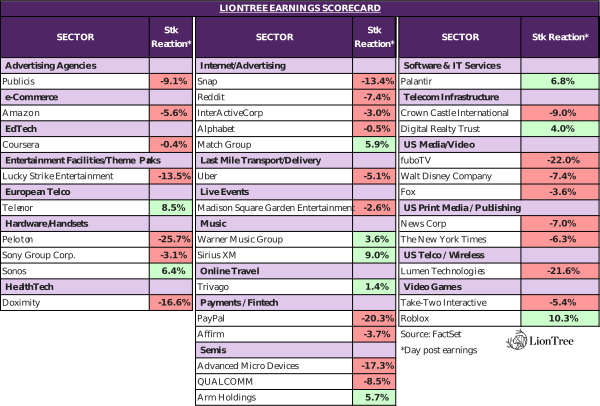
Week 3 of earnings has come to a close. In total, 36 stocks in our LionTree Universe reported (though it felt like more!). Stock reactions were skewed negative this week with 26 stocks trading down and only 10 trading up. The best performer in reaction to earnings was Roblox, which was up +10.3% (see Theme #11), while the worst performer was Peloton, which fell -25.7%.
It was a tough week for Big Tech with Amazon down -5.6% in reaction to results (see Theme #4) though Alphabet’s shares closed almost flat after being down as much as -8% intra-day (see Theme #3), Elsewhere in digital media, Snap closed down -13.4% following results (see Theme 9), while Reddit fell -7.4% (see Theme #11)
Media conglomerates were under pressure with Disney and Fox shares down -7.4% and -3.6%, respectively (see Themes #5 and #6) and in music, WMG shares rallied +3.6% (see Theme #7).
In Last-Mile Transportation Uber fell -5.1% in reaction (see Theme #10), Lastly, gaming stock Take-Two (see Theme #8) dropped -5.4% post earnings.
The table below includes select mid- and large-cap TMT and consumer companies in our LionTree stock universe that reported this week.
The Claude Cowork Market Meltdown
Who knew that the addition of a couple of plug-ins could trigger a global stock selloff? While a gross oversimplification, that is essentially how Anthropic drove an ~trillion-dollar selloff after it released a set of industry-specific add-ons to its Claude Cowork product, expanding its abilities across productivity and finance to marketing and operations. In reaction, investors hit the sell button not just for software companies, but also software-adjacent and software-exposed businesses, as fears about its potential to disrupt existing tools and workflows reached a new level.
Despite the carnage in the market (up until Friday), several industry leaders argued that the sell-off was an overreaction. Nevertheless, this week’s stock reactions were a continuation of growing investor uncertainty around how AI will reshape the tools and platforms that companies rely on every day.
See below for the quick drill-down of what happened this week. We anticipate this debate will persist for a while, with software survivors at some point emerging out of the rubble.
The Market Meltdown Catalyst…Anthropic Announces Plugins For “Cowork”
- On January 12th Anthropic launched Claude Cowork (link)
- Cowork is essentially a user-friendly version of Claude Code and is designed to manage files, research, and execute multi-step workflows
- Claude Cowork works like a “proactive teammate” rather than a chat bot: Once given access to a specific folder, it independently plans and executes tasks (i.e., reading, creating, and organizing files) while keeping the user in the loop; Instead of constant back-and-forth, users can assign it work, queue feedback, and let Claude steadily carry it through with more autonomy and context
- Example use cases: Reorganize downloads by sorting and renaming each file; Creating a new spreadsheet w/ a list of expenses from a pile of screenshots; Producing a first draft of a report from a user’s scattered notes
- Then on January 30th, Anthropic rolled out a series of plugins that could be added to Cowork (link)
- The plugins bundle skills, connectors, slash commands and sub-agents so people can use Cowork as a specialist for specific roles, teams and companies
- The Co launched with 11 plugins spanning a wide range of use cases –
- Productivity: Manage tasks, calendars, daily workflows, and personal context
- Enterprise search: Find information across your company’s tools and docs
- Plugin Create/Customize: Create and customize new plugins from scratch
- Sales: Research prospects, prep deals, and follow your sales process
- Finance: Analyze financials, build models, and track key metrics
- Data: Query, visualize, and interpret datasets
- Legal: Review documents, flag risks, and track compliance
- Marketing: Draft content, plan campaigns, and manage launches
- Customer support: Triage issues, draft responses, and surface solutions
- Product management: Write specs, prioritize roadmaps, and track progress
- Biology research: Search literature, analyze results, and plan experiments
What Followed Was Carnage Across The Market…But Particularly Across Software, Software-Adjacent, And Software-Exposed Names
- Stocks plunged in response to the announcement given fears that the new plugins will take a bite out of business for many software, data, and professional services companies
- Software stocks almost across the board were indiscriminately sold
- Legal & Data Service Cos saw some of their highest daily losses on record on Tuesday
- Thomson Reuters, which owns the Westlaw legal database, fell -16%, its biggest daily loss on record and lowest close since June 2021
- RELX and Wolters Kluwer, both providers of legal analytics services, fell -14% and -10%, respectively; RELX’s plunge was its biggest since 1988
- The drop in software valuations fed directly into the private credit market, as alternative asset managers with significant exposure to software borrowers fell between 6-19% from last Friday to Thursday
- Blue Owl, for example, was down ~15% over the same time period and is now down ~50% over the past yr, as part of that repricing of risk tied to software-linked loans and broader market jitters
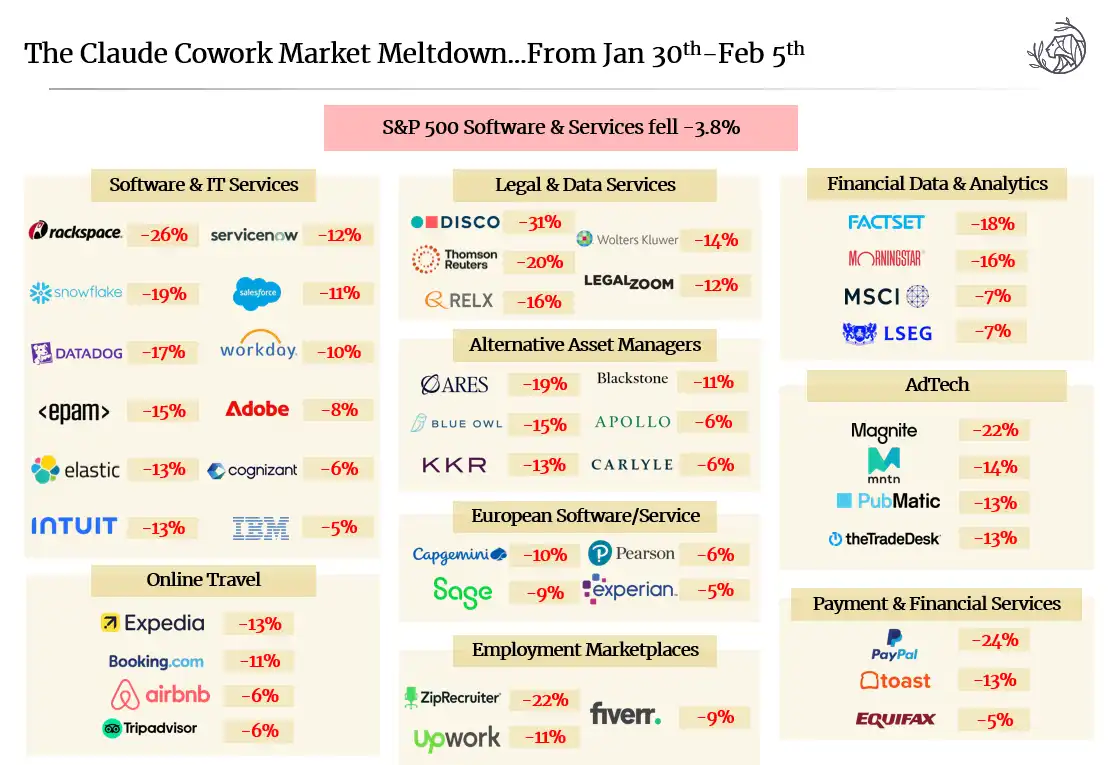
Source: FactSet; All stock performance data is from 1/30/26-2/5/26
But There Are Some Who Think The Sell Off Is An Over Reaction
- NVIDIA CEO Jensen Huang said its “illogical” to think AI will replace software tools (link)
- On Tuesday, Huang said, “there’s a whole bunch of software companies whose stock prices are under a lot of pressure because somehow AI is going to replace them…it is the most illogical thing in the world”
- He argued it makes sense for AI to use existing tools to accomplish tasks, rather than reinventing them, using the examples of ServiceNow, SAP, Cadence and Synopsys – “would you use a hammer or invent a new hammer?”
- Arm CEO Rene Haas said fears about AI hurting software companies are a “micro-hysteria” that exceeds the reality of how businesses are actually using the tools (link)
- Mark Murphy, head of U.S. enterprise software research at JPMorgan, said it “feels like an illogical leap” to say a new plug-in from an LLM would “replace every layer of mission-critical enterprise software” (link)
But This Is Not A New Worry … Software Stocks Have Been On The Decline (link)
- Software stocks officially entered a bear market last week, the iShares Expanded Tech-Software Sector ETF (IGV) is now down -27% (as of Feb 5th) from its Sept 2025 peak
- The average multiple of Cos on the IGV index has fallen from 39x forward earnings to about 21x as of Feb 4th
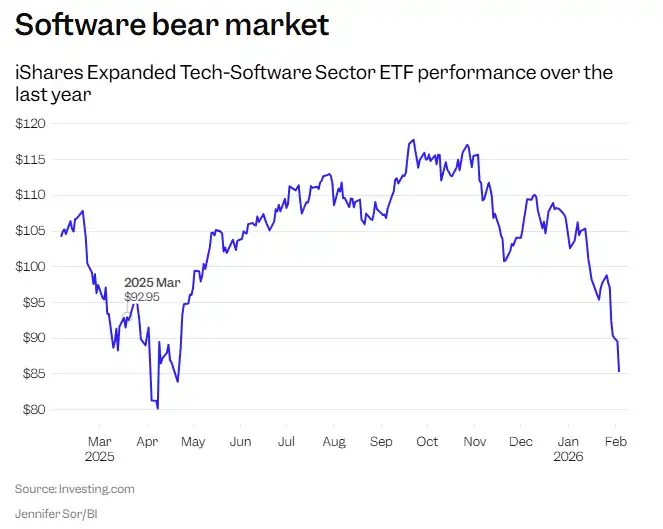
Source: Business Insider
- The P/E ratio in the S&P software index dropped to below 60x, down from a peak of around 85x last summer
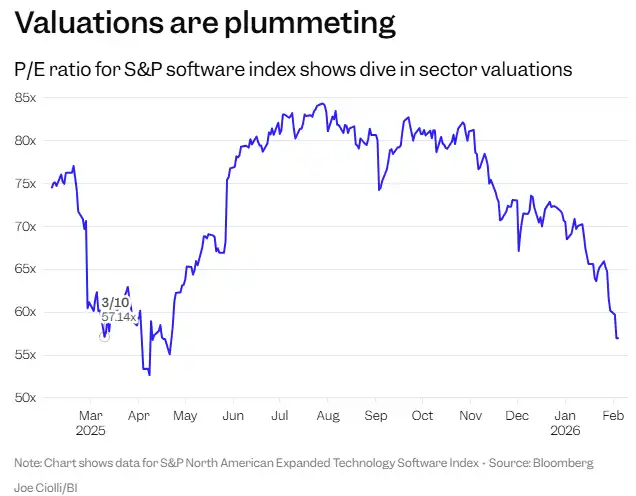
Source: Business Insider
The Capx Overhang Returns, Though Google Shows All Signs Of Successful Execution At Least Thus Far
Capx took another leg higher (AGAIN) when Alphabet issued 2026 capx guidance of $175-185bn, which was +55% above Street forecasts and, at the mid-point, is DOUBLE the full year 2025 level. When the Co said on its last year’s call that 2026 capx would be “significantly” higher, they certainly meant it!
The question is whether all this investment will be well spent, and at least thus far, one can certainly argue that it has been. Google’s Search and Cloud revenue growth both accelerated, and on the latter that was despite being in a supply constrained environment and not able meet all the demand.
Regarding Search, it wasn’t that long ago that the Street thought that Google’s core Search business would be disintermediate by AI platforms. Instead, the Co is seeing increased usage and better monetization. Q4 Search revenue beat the Street by +2.6% and accelerated to +17% growth y/y. Mgmt framed this as an “expansionary moment” with Q4 daily AI mode queries per user doubling in the US and queries 3x longer than traditional search (though some analysts focused on how monetizable this higher‑complexity usage really is).
Cloud outperformance was the other positive surprise with Q4 revenue beating the Street by +9.1% and operating income beating by a huge +45%. Growth accelerated to +48% y/y from +34% y/y in Q3 despite, as mentioned above, demand still outstripping supply. The backlog being up +50% q/q and doubling y/y to $240bn is also a good indicator of future demand. Enterprise AI adoption has been ramping with 75% of Cloud customers using Google’s vertically optimized AI stack and those customers are using nearly 2x as many products.
It was also impressive that Gemini hit 750mn MAUs and is now embedded across Search, Chrome, consumer apps, and enterprise workflows. Enterprise adoption was a standout with more than 120k companies using Gemini and 8mn paid enterprise seats were sold in 4 months. To the question about AI eating software, CEO Sundar Pichai said that AI is an “enabling tool” like it has been for Google and companies that are “seizing the moment” have the same opportunity ahead.” This remains an open question and a key debate for the sector (see Theme #2)
On the negative side, YouTube ad revenue fell ~4% below cons (grew +9% y/y), with brand weakness tied to lapping the US election cycle. However, to be fair, YT subscription revenue was strong, hence it makes more sense to look at the segment holistically.
Overall, the Co has made a lot of progress levering AI inside and outside the company to drive better results but the much higher capx, plus the general concerns about downstream AI implications for their software customer base dragged on the stock in reaction.
-> Google shares fell -0.5% in reaction to earnings, is up +3% YTD, following a huge +63% rally in 2025
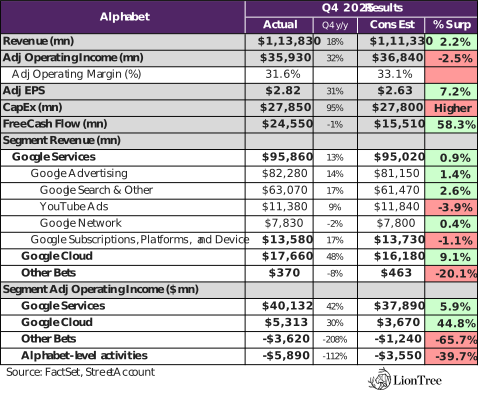
Search & Cloud Drove Better Overall Q4 Results…Though YouTube’s Ad Rev Weakness Stood Out
- Revenue BEAT: By +2.2%, up +18% y/y vs +16% y/y in Q3 2025
- Acceleration driven by Search & Cloud
- Expect FX tailwind to consol Q1 revenue
- Adj Op Income MISSED: By -2.5%, up +32% y/y vs +31% in Q3 2025
- Adj Margin MISSED: 6% vs cons 33.1%
- Adj EPS BEAT: By +7.2% up +31% y/y vs +35% y/y in Q3 2025
- Capex came in higher than cons: $27.85bn vs $27.80bn
Google’s Search Is Enhanced & Not Disrupted By AI…Its An “Expansionary Moment”
- Google’s Search revenue beat cons by +2.6% and continues to accelerate to +17% y/y in Q4 from +15% y/y in Q3 and +12% y/y in Q2
- Retail was particularly strong
- Search saw more usage in Q4 than ever before as AI continues to drive an expansionary moment
- AI is being integrated into Search …it is improving ad quality, advertiser tools, and user experiences and also making it easier to deliver ads on longer, more complex searches, which was difficult to monetize before
- Shipped over 250 product launches within AI Mode and AI Overviews
- Last quarter, integrated Gemini 3 directly into AI Mode in Search and last week upgraded AI Overviews to Gemini 3
- Once people start using these new experiences, they use them more
- In the US, daily AI Mode queries per user doubled since launch and AI Overviews continue to perform very well
- Queries in AI Mode are 3x longer than traditional search (the Co is also in the early stages of experimenting with AI Mode monetization)
- Also seeing sessions become more conversational, w/ a significant portion of queries in AI Mode now leading to a follow up question
- Mgmt is very bullish on its Universal Commerce Protocol (UCP) dramatically improving the commerce experience: People can soon use a new checkout experience to buy directly in AI Mode and Gemini from select merchants
- The Co has received “tremendous feedback from the industry”
- “There’s an oppty to improve the experience”…“there can be a foundational uplift here”
- “It makes it easier for users to complete transaction but also allows merchants to help showcase the range of their offerings” (i.e., if they want to make a promo)
- “Excited about a future whereas people are going through discovery, searching, finding new things, if they’re interested in acting upon it, all of that is seamless”
- “So, it overall creates an expansionary moment”
- UCP is the core foundation for interoperability for agentic commerce and “this is the year” that consumers will actually be able to use agents for shopping
- People are also searching in new ways beyond text
- Nearly 1 in 6 AI Mode queries are now non-text using voice or images
- Circle to Search is now available on over 580mn Android devices
YouTube Ad Revs Fell Short But Subscriptions Grew
- YT Q4 ad revenue fell ~4% short of cons expectations, growing only +9% y/y vs +15% in Q3 and +13% in Q2…DR was strong while brand advertising was weaker
- YT Q4 ad revenue drill-down
- Brand: Growth y/y was most negatively impacted by lapping the strong spend on US elections, though the Co saw a slight impact in some other brand related verticals as well
- Going forward: Excited about the CTV opportunity, more innovative ad formats, and shoppable
- DR/Performance: There’s a lot of momentum w/ demand gen adoption across SMB and the Co is excited about cont’d ad innovation in DR (like shoppable formats, incl in the living room) which will drive strength in retail, Shorts, etc.)
- Brand: Growth y/y was most negatively impacted by lapping the strong spend on US elections, though the Co saw a slight impact in some other brand related verticals as well
- Strong momentum with YT Shorts
- Shorts now averages 200bn+ daily views
- In a number of countries (incl the US) Shorts earns more rev per watch hour than traditional in-stream YT
- However, investors should look at YT revenue holistically given that when an ad supported user moves to subscription, it has a neg impact to ads but positive impact to subscriptions
- And it was a strong Q4 for YT subscriptions, especially w/ YT Music and premium category
- Premium will soon launch new YouTube TV plans
- And it was a strong Q4 for YT subscriptions, especially w/ YT Music and premium category
- In 2025, YT total rev passed $60bn across both ads and subscriptions
- Google has 325mn paid subs across consumer services w/ strong uptake of Google One (strong demand for AI plans) + YT Premium
- Creators & viewers are using the Co’s AI tools: In December, 1mn+ channels used their new AI creation tools to enhance creativity and 20mn+ viewers used their new ask tool powered by Gemini to learn more about the content they watched
- Mgmt was “blown away” by Google’s Genie (just annc’d & caused a big sell-of with videogame stocks – see Theme #8)
- Google has spent a lot of time creating these worlds
- Think it will have a wide level of applicability
- Google shines with multi-modal and real-world representation and Genie furthers that
Capx To Rise Much More Than Expected In 2026 …Demand Continues To Outpace Supply
- Q4 capx at $27.85bn was just modestly above cons, but grew +90% y/y
- The bigger focus was on 2026 capx guidance of $175-185bn, which was a significant +55% above cons $116bn and up almost +100% y/y at the mid-point (after a +74% y/y increase in 2025)
- Investments should ramp over the course of the year
- Expect the growth rate of 2026 depreciation to accelerate in Q1 and meaningfully increase for the full year
- Continue to be supply constrained and there is a time delay from when previous investments were made to when they can close the gap
- The time horizons are increasing in the supply chain
- Mgmt expects demand across the board will be “exceptionally strong” and that they will go through the year in a supply constrained way
- In 2025, ~60% of capx went towards machine investment (shorter term) and the rest went to long duration assets…It should be similar in 2026
- For 2026, just over half of their ML compute is expected to go towards the cloud business
- What keeps you up at night? “Compute capacity is the top question” (power, land supply chain constraints)… “how do you ramp to meet demand and get investments right for the long term”
Google Cloud Is Performing MUCH Better Than Expected Despite This Constrained Environment
- Google Cloud revs beat cons by +9.1% and adj OI beat by +45% (margins hit 30.1% vs cons 22.6%)
- Cloud revs growth significantly accelerated to +48% y/y (hitting over $70bn annual run rate) vs +34% y/y in Q3 and +32% y/y in Q2
- GCP continues to grow faster than Cloud’s overall revenue growth rate
- Strong growth in Enterprise AI infrastructure
- Double digit growth in Workspace (posted increase in avg rev/seat and in the # of seats)
- The Co posted strong backlog growth as well: Up +55% q/q (and doubled y/y) to $240bn w/ AI demand from wide breadth of customers
- Exited the year w/ 2x the new customer velocity compared to Q1
- Signing larger customer commitments: The # of deals in 2025 over $1bn surpassed the previous 3 yrs combined
- 75% of Google Cloud customers have used their vertically optimized AI (from chips to models to AI platforms) and enterprise AI agents
- These AI customers use 1.8x as many products as those who do not
- Outlook – expect to continue to drive “strong growth” despite the tight supply environment
See Extraordinary Growth Of Gemini Including In The Enterprise…Software Co’s Need To Seize The AI Moment
- Gemini app has 750mn MAUs vs 650mn in Q3
- Gemini is also seeing a sharp increase in engagement per user on the app, especially with Gemini 3 users
- All metrics showed progress globally
- The introduction of Gemini 3 in AI Mode was a very positive driver as well
- Seeing strong enterprise adoption of Gemini
- More than 120k enterprises use Gemini
- 95% of the top 20 and over 80% of the top 100 SaaS companies use Gemini
- Google sold 8m paid seats of Gemini enterprise (launched 4 months ago)
- Gemini enterprise managed 5bn+ customer interactions in Q4, growing 65% y/y
- Revenue from AI solutions built by Google’s partners incr’d nearly 300% y/y, and commitments from their top 15 software partners grew more than 16x y/y
- But are software companies losing seat and pricing power? Are their businesses being undermined by Gemini adoption? “See very, very good SaaS customers who are leaders in their respective categories successfully incorporating Gemini deeply in critical workflows, improving product experience and driving growth or using it to drive efficiency within their organizations”
- “It is an enabling tool” like it has been for Google
- Companies that are seizing the moment have the same oppty ahead”
- “Excited” about their partnerships
- Tokens, usage, growth etc. has been “very robust” in Q4
- A couple other telling AI related stats:
- In Q4, revenue from products built on their gen AI models grew nearly 400% y/y, significantly accelerating from the prior qtr
- ~50% of their codes are written by coding agents (which are then reviewed by our own engineers)
A Few Other Key Comments On Waymo
- Waymo continues to scale
- New funding: Waymo raised its largest investment round to date this week (raised $16bn at $126bn valuation)
- Google funding a significant portion of the round
- Scaling rides: In Dec, the Co surpassed 20mn fully autonomous trips and are now providing more than 400k rides every week
- Waymo continues to expand its service territory
- Miami (6th mkt) launched 2 weeks ago
- The Co will expand its service to multiple cities across the US and in the UK and Japan
- Making progress on opening services to airports and freeways
- New funding: Waymo raised its largest investment round to date this week (raised $16bn at $126bn valuation)
Ditto For Amazon…The Massive Capx Ramp Sparks Concerns, But The Co Is Realizing Strong Returns
Alphabet was not the only one to spook the Street with higher capx…Amazon followed suit when it guided for $200mn in capx in 2026 which is +52% higher than 2025 (which itself was up +59% y/y). Amazon added 1.2 gigawatts of power q/q in Q4 (more than any other datacenter company in the world) and added 3.9 gigawatts over the last 12 months, which is 2x what they had in 2022. The Co expects to double it again by the end of 2027.
Last quarter the debate centered on AWS’ reacceleration and whether the early AI lift was sustainable. This quarter AWS growth accelerated again, up +24% y/y (from +20.2% in Q3), its fastest pace in 13 quarters, and backlog surged +40% y/y. Even with the massive investments that the Co has already made in capacity, it has not been able to keep up with supply. As soon as new capacity comes on-line at AWS, they sell it.
Interestingly, mgmt believes that the AI market demand right now is a barbell, BUT the middle (for Enterprise workloads) will be the biggest and most durable users of AI capacity longer term. Bottom line, mgmt is VERY confident in generating strong returns sustainably on this investment, and like Google, that has been reflected in the strong business performance thus far.
Outside AWS, the core retail story is steady as she goes. Worldwide paid units improved to 12% y/y, delivery speeds hit new highs for Prime members, and Amazon continues to press selection, price competitiveness, and cost-to-serve efficiency. Advertising maintained strong momentum, growing +22% y/y to $21.3bn (following +22% y/y in Q3), helped by continued traction in Prime Video ads and live sports.
While most of the focus was on the longer term and future returns on the capx spend, nearer term, Q1 sales guidance was in-line but op income guidance missed by -14% (which was a disappointment) as Amazon factors in roughly $1bn in incremental Leo launch costs (commercial launch is in 2026) along with continued investments in quick commerce and sharper pricing in the stores business.
Net net, the key question for Amazon (and other Big AI Tech companies in the sector) is whether the Co can translate its unprecedented capacity build into sustained AWS revenue acceleration, margin leverage, and improvements in the core retail business. Signs point in that direction in our opinion.
-> Amazon shares closed down -5.6% in reaction to earnings and was down -12% on the week; YTD, it is down -8.9%
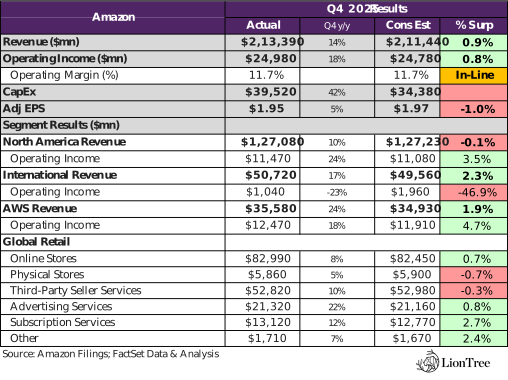
Q4 Slightly Exceeded Street Expectations
- Q4 revs and op income slightly top expectations while adj EPS slightly misses
- Revs grew +14% y/y (+12% y/y FXN) vs +13% y/y (+12% y/y FXN) in Q3
- North Amer segment sales grew +10% y/y
- Intl segment sales rose +17% y/y (+11% FXN)
- AWS rose +24% y/y
- Op income grew to $25bn from $21.2bn Q4:24
- North Amer op margin reached 9% up 100bp y/y
- Into op margin 1% (excl charge would have been up y/y)
Q1 Op Income Guidance Disappoints As It Factors In Incremental Costs For Leo’s Launch
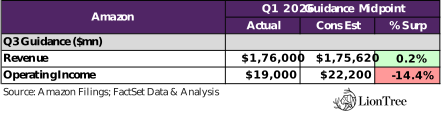
- Q1 revenue guidance was in-line w/ cons and implies +11-15% y/y growth (assumes ~180bp tailwind from FX), vs the +14% y/y in Q4
- Q1 op income guidance missed the Street by -14.4%…mainly b/c it now includes ~$1bn y/y increase in Amazon Leo costs, plus also investment in quick commerce and “sharper prices” in the stores biz
- Reminder re accounting for Leo…
- Right now, the Co expenses Leo costs as incurrent
- Later this yr, many of these costs (satellite manf & launch svs) will be capitalized within the intl segment
- Reminder re accounting for Leo…
The Pace Of Capx Investments Is Still Much Higher Than The Street, BUT Mgmt Is VERY CONFIDENT In Returns
- Q4 capx at $39.5bn was +15% ahead of cons, ending the year at $131.8bn (vs the guidance in Q3 for $125bn in 2025)
- For 2026, the Co guided for ~$200bn in capx (+52% y/y following +59% y/y in 2025)
- Most of the spend is going towards AWS b/c of the “very high demand”
- Most of the spend is for AI but some for core workloads
- Mgmt stressed repeatedly that they are confident in generating strong returns on this capital spend
- The Co is monetizing capacity as soon as it gets online
- “We have deep experience understanding demand signals in the AWS business and then turning that capacity into strong return on invested capital. We’re confident this will be the case here as well”
- The Co is seeing “strong return on invested capital” and “seeing strong demand”
- “These investments will yield strong returns on invested capital”
- Amazon is trying to seize this “once in a lifetime” moment
- This is an “extraordinarily unusual opportunity to forever change the size of AWS and Amazon as a whole”
- It is an “extraordinary opportunity for companies to change their customer experiences and for start-ups to be able to build brand new experiences / businesses that would have taken much longer to try to accomplish before then can right do now
- The Co “will invest aggressively here”
- Over the last 12 months, Amazon added 3.9 gigawatts of power…that’s 2x what they had in 2022 when the Co was at an $80bn annual run rate business…expect to double it again by the end of ’27
- They added 1.2 gigawatts of power q/q in Q4… which is more than any other data center company in the world
- “We’ll add a lot more [capacity] in ’26, in ’27, and in ’28 for that matter”
AWS Posted Its Fastest Growth In 13 Qtrs
- AWS results were better than expected…revs beat cons by ~1% and AWS op income beat by 4.7%
- AWS revenue grew +24% y/y to $142bn annualized revs run rate (it was up +$2.6bn seq and up $7bn y/y)
- Mgmt reminded investors that their growth performance can’t be compared to companies w/ higher growth but much smaller bases
- Amazon is adding more incremental revenue and capacity than others
- The Co is seeing strong growth in core non-AI workloads as enterprises move from on premise to cloud
- The Co’s business remains capacity constrained…as soon as new capacity comes online, they sell it
- The backlog is at $244bn, up +40% y/y and up +22% q/q
- Have “a lot” of deals in the pipeline
- “There is a lot of demand for AWS right now in AI and core AWS space”
- New AWS deals: OpenAI, Visa, MBA, Blackrock, Perplexity, Lyft, United Airlines, DoorDash, Salesforce, US Air Force, Adobe, Thomson Reuters, AT&T, S&P Global, National Bank of Canada, the London Stock Exchange, Choice Hotels, Accenture, Indeed, HSBC, CrowdStrike and many more…
The Biggest Long-Term Demand Source For Capacity Is Still To Come
- Who is taking all this capacity? The vast majority of the capacity they have is being consumed by external customers (vs internally used)
- The AI market demand right now is a barbell…but the middle will be the biggest and most durable user of AI capacity longer term
- AI labs are spending “gobs and gobs” on compute on a couple runaway applications (they are consuming a lot of capacity for training and inference)
- On the other side, enterprises are getting value from AI doing productivity & cost avoidance types of workloads (customer service or biz process automation and some fraud pieces)
- Then all the enterprise production workloads are in the middle of the barbell and enterprises are at various stages of figuring out how to move those and put them into production
- AI demand is “so huge” already but “the lion share of demand will come from the middle barbell” and that will come over time as…
- More and more AI talent is added
- Inference becomes less expensive
- And as companies start to have success at moving workloads to run on top of AI
“I Don’t Think Folks Have Realized How Strong A Chips Company We’ve Become Over The Last 10 Years”
- AWS’s chips biz (including Graviron and Trainium) has reached a $10bn+ annual rev run rate growing at triple digits % y/y…and “it’s still very early”
- Graviton delivers up to 40% better price performance than leading x86 processors, and is used extensively by over 90% of AWS’s top 1000 customers
- Graviton itself is a multi-billion dollar annualized run rate business, growing more than 50% y/y
- Trainium is “taking off” and is at a multi-billion annualized rev run rate
- Trainium 2: Sold over 2.4mn chips (fastest ramping chip launch ever); Trainium is underpinning Bedrock usage today
- 30-40% more price performance vs comparable GPUs
- Trainium 3: Seeing “strong demand”; Expect nearly all of T3 chips supply to be committed by mid-2026
- 40% more price performance vs Trainium 2;
- Trainium 4: They are in the process of building and seeing “strong interest already”…coming in 2027
- Trainium 5: Having “conversations” about T5
- Trainium 2: Sold over 2.4mn chips (fastest ramping chip launch ever); Trainium is underpinning Bedrock usage today
The Stores’ Business Strategy Remains Steady As She Goes…Faster Speeds, Greater Selection, Value Prices & Greater Operational Efficiencies
- Q4 Online Stores revenue slightly beat Street projections and grew +8% y/y while Physical Stores revenue was modestly below consensus and grew +5% y/y
- WW paid units grew +12% y/y FXN (highest qtrly rate in 2025) vs +11% in Q3
- For the third year in a row globally in 2025, the Co achieved both their fastest ever delivery speeds for Prime members while also reducing cost to serve
- Amazon continues to expand selection –
- Amazon Haul grew selection to over 1mn items under $10 and are now serving customers in more than 25 countries/regions
- The Co is seeing a strong response to everyday essentials (grew 2x the rate of all other categories in the US in 2025) and grocery including perishables (for 150mn Americans mostly online and whole foods)
- With $150bn in gross sales, Amazon is a larger grocer
- They remain committed to staying “sharp on price” and meet or beat other retailers’ prices (they are 14% lower than avg other major online retailers, per 3rd party study)
- Driving for even higher delivery speeds continues to be a priority –
- Delivered +70% more items same day y/y
- Have incr’d the speeds for rural customer w/ almost 2x more monthly customers in rural areas receiving same day delivery y/y in 2025
- Customers that buy perishables delivered same day shop more than 2x customers that don’t
- Amazon will expand to more communities in 2026 and open 100+ new Whole Foods stores in the next few years
- Launched Ultra-fast delivery in India, Mx, and the UAE…it is 30min or less for thousands of items
- Testing in the US and the UK
- Offering later cut-off times for same day delivery
- “Add to Delivery” made up ~10% of all Prime volumes fulfilled each week
- Delivered +70% more items same day y/y
- See further opportunities to enhance productivity in the global fulfilment network
- Optimize inventory placement
- Reduce touches per package
- Improve package consolidation
- Lever robotics and automation
- The Stores business has also seen success innovating with AI
- Rufus is improving: More than 300mn customers used it in 2025 (and customers who use Rufus are 60% more likely to complete a purchase),
- Lens saw usage incr’d 45% y/y
- Mgmt is “very optimist” about agentic shopping making it easier for customers and believe that their own agent will be best positioned vs 3rd parties
- 3rd party horizontal agents will be able to enable shopping as well BUT they won’t have any shopping history and they will get product & pricing details wrong, so the customer experience will need to be refined
- The value exchange between Amazon and 3rd parties will also have to “make sense to both sides”
- “Horizontal agents are good at aggregating selection, but retailers [like Amazon] are much better at delivering the best experience”
- Mgmt is “optimistic” that people will use their shopping agent but also expect to work with other 3P agents “over time”
A Few Other Important Updates & Developments (Advertising, Satellites)
- Advertising revs grew +22% to $21.3bn led by sponsored products in stores
- Saw cont’d growth in Prime Video ads (contributing meaningfully to revenue)
- Prime Video has an avg ad-supported audience of 315mn viewers globally
- “Great success” w/ live sports: Thursday Night Football (4th season broke viewership records – avg 15mn+ viewers, +16% y/y); Packers v Bears Wild Card Game was the most streamed NFL game in history (31.6mn viewers)
- AI innovation: Recently annc’d ads agent (advertisers research, brainstorm, and generate full funnel ad campaign from concept to completion using conversational guidance – takes weeks long process to hours)
- Saw cont’d growth in Prime Video ads (contributing meaningfully to revenue)
- Leo is moving to commercialization in 2026 –
- Launched 180 satellites thus far
- 2026: Will launch 20 more and expect to launch commercially during the year
- 2027: Will launch more than 30
- Partners: Have “dozens” of commercial agreements already signed, including w/ AT&T, DirecTV, Latin America, JetBlue and Australia’s National Broadband Network, and “have many more on the way”
Disney Sets Sail With New Leadership During A Fiscal H2 Pickup
Disney’s earnings report on Monday morning ultimately proved not to be the main event for the Co this week, as its FQ1 results were sidelined by its CEO succession announcement on Tuesday morning. Disney Experiences Chairman Josh D’Amaro will become the next CEO, succeeding long-time CEO Bob Iger. Concurrent with D’Amaro’s appointment, Dana Walden, Co-Chairman of Disney Entertainment and widely viewed as a final contender for the role, has been named President and Chief Creative Officer. Both appointments will be effective March 18. As for Bob Iger’s next steps, he will continue to serve as Senior Advisor and a member of the Board until his retirement on December 31, 2026.
Back to fundamental trends…the back-half weighted narrative for F2026 that we talked about last qtr remains intact. On the Entertainment side, this qtr marked the first time Disney stopped breaking out revenue and operating income across its linear TV networks, streaming, and theatrical businesses, making it more difficult for investors to assess. Disney also discontinued reporting streaming subscriber numbers, following Netflix’s lead from last year. The segment delivered a +3% revenue beat, driven by two $1bn+ box office releases and strength in its SVOD svs, but operating income declined -35% y/y for a second consecutive qtr, reflecting higher production and marketing costs tied to those releases. Looking ahead, given the slate they have in the works, segment OI is expected to grow double-digits for the full year, weighted in H2.
Within Experiences, it was a record qtr with both qtrly rev and op income reaching all-time highs, which was driven by continued strength in domestic parks. BUT international visitation remains an overhang which will impact FQ2 op income growth (will be “modest”) with higher growth in H2 after the March launch of Disney’s eighth cruise ship, the Disney Adventure, in Singapore.
More broadly, investors have been focused on what a post-Iger Disney will look like. Iger addressed this on the earnings call (prior to the succession announcement), noting that the Co is in “much better shape” than when he returned three years ago, when there was “a tremendous amount that needed fixing.” His successor will take over a biz that is now “well positioned” in both Entertainment and Experiences and looking ahead there is now a “healthy competition” at the Co between the two businesses to see which “is going to essentially prevail as the number one driver of profitability for the company.”
-> Disney shares fell -7% on the back of the print and ended the week down -4%
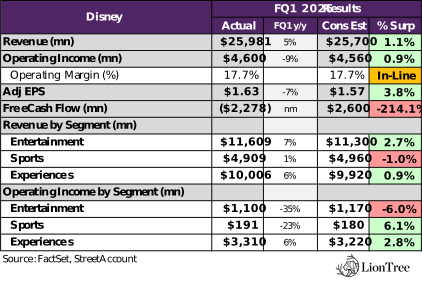
Disney’s FQ1 Beat On The Top-Line & EPS But Segment Results Were Mixed Under The Hood
- Total FQ1 rev BEAT by +1.1%: Up +5% y/y (accel from flat y/y in FQ4)
- Entertainment and Experiences BEAT, while Sports missed
- Total op income BEAT by +0.9%: Fell -9% y/y (decel from -5% y/y in FQ4)
- Sports and Experiences BEAT, while Entertainment missed
- Adj EPS of $1.63 beat cons $1.57: Down -7% y/y, reflecting lower Entertainment results driven by film slate comparisons, partially offset by higher results at Experiences
- FCF loss -$2.8bn was below cons gain of $2.6bn
The Co Reaffirmed FY26 Guidance
- Reaffirmed double digit adj EPS growth y/y vs cons +11.5%
- Entertainment – reaffirmed double digit segment OI growth y/y, weighted to H2:26 (vs +19% y/y in FY25)
- Sports – reaffirmed LSD segment OI growth y/y (vs +20% y/y in FY25)
- Experiences – reaffirmed HSD segment OI growth y/y, weighted to H2:26 (vs +8% y/y in FY25)
- On track to repurchase $7bn of stock
- Note that Q4 FY26 includes a 53rd week of operations…guidance for fiscal yr segment op income, SVOD op margin, and adj EPS excludes the benefit of the addtl week, while other guidance points include the 53rd week
Higher Op Expenses Continues To Weigh On The Entertainment Segment, But A Reacceleration Is Still Expected In H2 / SVOD Is Increasingly Contributing To Overall Segment Results
- Entertainment – FQ1 headline results were mixed vs consensus (+2.7% rev beat, -6.0% OI miss)
- Revs were up +7% y/y (accel from -6% y/y in FQ3)
- But op income fell by -35% y/y (in-line w/ FQ3)
- Reflecting higher programming and production and mkting costs driven by more theatrical releases in the qtr (9 releases vs 4 in the prior yr)
- SVOD rev incr’d +11% y/y and op income reached $450mn (8.4% op margin)
- Rev growth reflects a 1 ppt adverse impact from the inclusion of Star India rev in the prior-yr qtr
- Op income grew +$189mn to reach $450mn, driven by subscription and ad rev growth, partially offset by higher programming and production and mkting cost
- For FQ2…expect SVOD OI of ~$500mn, up +$200mn y/y, as investments in content and technology and improved user experience drive subscription and ad rev growth
- For FY26…remain on track to reach a 10% SVOD op margin for the yr
- Key drivers = Zootopia 2 & Avatar: Fire and Ash will be released on streaming by the end of this fiscal year
- Advertising rev decr’d -6% y/y, and reflects a net adverse impact of 11pts from the inclusion of Star India ad rev in the prior-yr qtr, lower political advertising vs Q1:25, and Fubo ad rev
- For FQ2…segment OI expected to be roughly comparable to Q2 last yr (~$1.7bn)
- For FY26…continue to expect double-digit segment OI growth weighted to H2:26, driven by Disney’s theatrical release slate and continued growth from its SVOD svs
- How does the new Entertainment segment disclosure better align w/ the Co’s goals for the biz? Talking about streaming, theatrical, linear networks, etc. “creates a lot of complexity that’s just not reflective of the reality”
- “We manage the Entertainment business as a single entity”
- “For us to […] get into a lot of depth […] I don’t think it’s terribly informative to investors and it’s not the reflective of the way that we create or distribute content
- “It’s just a level of nuance that may have been relevant in the past, but just isn’t relevant anymore”
- A “one-app” bundled experience could be coming by the end of the calendar year: Bundled subscribers churn out less; While consumers will always to be able to buy Disney+ or Hulu on its own, they believe “by and large” that the “great majority” of consumers will buy both for a fully integrated experience
- Regarding the partnership with OpenAI…plan to introduce a “curated” slate of Sora-generated content on Disney+
- Did not specify how UGC from Sora will show up on Disney+ – “we’re working through all the technical details of that”
- Do you expect overtime to grow beyond the 30-sec videos in the current agreement? “For now, we’re sticking to the 30-second limit on videos created down the road, not sure, but we’re not really focused on that at this point”
Blockbuster Qtr For Studios Biz
- Studios delivered two $1bn films in FQ1: Both Zootopia 2 and Avatar: Fire and Ash crossed the $1bn mark at the global box office
- Several titles in the works for a 2026 release –
- The Devil Wears Prada 2
- The Mandalorian and Grogu
- Toy Story 5
- Moana (live-action)
- Avengers: Doomsday
Mixed Regional Performance In The Experiences Segment & Reiterated That Pre-Opening / Pre-Launch Costs Will Weigh On FQ2
- Experiences – delivered record qtrly rev and OI (rev beat by +0.9%, OI beat by +2.8%)
- Qtrly rev exceeded $10bn for the first time
- Domestic Parks & Experiences drove the increase in overall segment OI and was up +8% y/y (vs +9% y/y in FQ25)
- Driven by higher guest spending, an increase in passenger cruise days due to the Disney Treasure and Disney Destiny, and 1% growth in attendance at Disney’s domestic parks, partially offset by an increase in costs for new guest offerings (including expansion costs for Disney Cruise Line)
- On Walt Disney World specifically…had a “very good” quarter that benefitted from the overlap of the hurricane
- Outlook: Bookings are up +5% for the full yr, weighted more toward H2
- International Parks & Experiences OI and was up +2% y/y (vs +25% y/y in FQ25) – “international visitation was softer”
- Reflecting higher attendance and guest spending, partially offset by higher costs
- “We continue to monitor international visitation to our domestic parks and adjust our strategy”
- For FQ2…expect “modest” Experience OI growth, driven by –
- International visitation headwinds at Disney’s domestic parks
- Pre-launch costs for the Disney Adventure at Disney Cruise Line
- Pre-opening costs for World of Frozen at Disneyland Paris
- For FY26…segment growth is expected to be H2-weighted
- Reiterated HSD segment OI growth weighted to H2, which will benefit from the launch of their two new cruise ships and the opening of World of Frozen at Disneyland Paris
- Room bookings at Walt Disney World are pacing up +5% y/y, weighted to H2
- Have expansion projects underway at all theme parks –
- New World of Frozen at Disneyland Paris opening next month
- New experiences feat. Bluey
- Activations planned around the release of Toy Story 5
- A new mission featuring the Mandalorian and Grogu inside Millennium Falcon: Smugglers Run coming soon
- Disney Cruise Line fleet now stands at eight cruise ships, w/ another five scheduled for launch beyond FY26
- Recently launched the Disney Destiny, which has received “outstanding” reviews from guests since its maiden voyage on Nov 20th
- The Disney Adventure, Disney’s first ship homeported in Asia, is on its way to Singapore for its maiden voyage on Mar 10
Sports Segment Results Were Impacted By YouTube TV Blackout & Higher Expenses From New Sports Rights
- Sports – headline missed on rev but beat on op income (-1.0% rev miss, +6.1% OI beat)
- OI fell -23% y/y, as ad rev growth of +10% y/y was more than offset by higher programming and production costs and a decrease in subscription and affiliate fees
- Temporary suspension of YouTube TV carriage had an adverse impact to segment OI by ~$110mn
- For FQ2… expect comparable rev vs prior yr and higher rights expenses for college (including the reversal of the timing benefit for Big 12 programming) and new WWE rights costs to drive a y/y decrease in segment OI of ~-$100mn
- For FY26…continue to expect LSD OI growth
- ESPN captured 30%+ of all sports viewership across networks
- Season-to-date, ESPN has delivered its third most-watched NBA regular season
- Still early days for ESPN Unlimited but “pleased” w/ engagement and adoption: “We are encouraged by ESPN app authentication from pay-TV subscribers, the pace of new signups, and the engagement patterns that have followed”
-> Also related this week, Disney closed its deal with the NFL, valuing ESPN at ~$30bn and giving the league a 10% non-controlling stake; The agreement deepens ESPN’s NFL partnership by transferring full ownership of NFL Network, adding exclusive game inventory, and integrating RedZone and other NFL media assets across ESPN’s linear and streaming platforms; Disney retains the option to buy back the NFL’s stake beginning in 2034, while the league has the right to increase its ownership at a discounted valuation (link)
Quick Point To Flag On WBD Transaction Implications
- Brief comments re the ongoing WBD transaction – “I think more than anything, it illustrates the value of that IP beyond the big screen”
- It “should emphasize or cause investors to appreciate the tremendous value of our assets, particularly our IP,” as well as “our brands and our franchises” and “let’s not forget, ESPN”
- Any plans to acquire more IP? “I don’t really feel that we have a need to buy more IP. We’re just going to continue to create our own and we’ve got an unbelievable bedrock of stories already told to grow from”
Fox Is Executing Well In This Cyclically Slower Year
It feels a little like Groundhog Day as Fox once again delivered a better-than-expected set of quarterly numbers. Its relative positioning in news and sports continues to enable the Co to outpace peers. FQ2 Cable Network ad rev growth of +7% y/y was a standout and total ad rev growth was up +1% y/y despite tough comps. Per mgmt, since 2021, media peers’ total advertising including streaming is down ~4% CAGR while Fox’s advertising revs, including streaming, has increased +8% CAGR.
Tubi continues to operate on all cylinders and the Co posted strong rev growth of +19% y/y in FQ2 (though down from +27% y/y in FQ1) and did so profitably for the 2nd quarter in a row. The +27% y/y increase in Tubi’s total viewing time in the qtr is also a good leading indicator looking ahead.
The launch of Fox One was a focus and uptake has exceeded expectations. Importantly, the Co has not seen any cannibalization of its traditional linear bundle subscriber (though this is something to look out for) and is tracking to the previously outlined subscriber targets. Another important point was that Fox benefited from improving video subscriber trends and will be a net beneficiary of the shift to skinnier bundles.
Fox remains committed to shareholder returns and since launching its buyback program in 2019, has cumulatively bought back $8.4bn or 35% of total shares, including the $1.5bn accel share repurchase.
All in all, it was a solid quarter, and the Co is executing well during this period of tough comps. See below for more of what we thought was most important from the Co’s results and conference call.
-> Despite the strong beat, Fox share were relatively flat; The shares remain down -10% YTD after being up +40% in 2025
FQ2 2026 Was A Standout Quarter For the Company
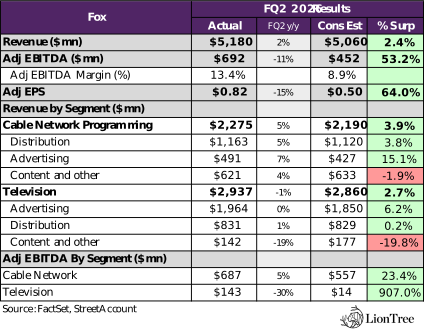
- Revenue BEAT by +2.4%: Up +2% y/y, a decel from +5% y/y in Q1
- Adj EBITDA BEAT by +53.2% but still down -11% y/y (vs +2% y/y in Q1): Includes growth driven digital growth initiatives spend & higher sports programming and production costs, partially offset by lower entertainment programming and production costs
- Adj EBITDA Margin BEAT: 4% vs cons 8.9%
- Segment performance BEAT across the board except with Content & Other revenue (mostly due to the timing of deliveries in TV)
- Cable Networks outperformed
- Revs BEAT by +4%, rising +5% y/y, vs +4% y/y in FQ1
- Adj EBITDA BEAT by 23.4%, increasing +5% y/y
- Television outperformed
- Revs BEAT by +2.7% but was down -1% y/y vs +5% y/y in FQ1
- Adj EBITDA of $143mn was well ahead of cons $14mn, but was still down -30% y/y (vs +7% y/y in FQ1) due to higher sports programming rights amortization and production costs and higher digital content costs, partially offset by lower entertainment programming rights amortization and production costs
- Bought back $1.8bn (since launched the buyback program in 2019, have cumulatively bought back $8.4bn or 35% of total shares, including the $1.5bn accel share repurchase)
- Annc’d a 28c semi-annual div
Total Advertising Revs Y/Y Grew Despite Tough Political Comps Last Year
- Grew total Co ad revs +1% y/y despite political last year
- Cable advertising revs grew +7% y/y (vs +7% y/y in Q1), due to higher news & sports pricing, partially offset by lower ratings
- TV advertising revs were flat y/y (vs +6% y/y in Q1) as cont’d digital growth led by the Tubi’s AVOD svs, the impact of addtll MLB postseason games, and higher sports pricing were offset by lower political ad revs & lower ratings
- News hit its highest FQ2 ad rev ever: News, business, further demographic expansion & pricing growth in both direct response and national advertising all contributed to this result
- Ad market for Fox News has been “incredibly robust”
- Added 200 new advertisers (on top of 350 added last your)
- Demand for the audience is very strong
- Scatter pricing for news is up 46-47%
- Direct response pricing is “strong”
- “Couldn’t be more pleased with Fox News”
- Starting to see growing appetite for national political advertising and think Fox News will benefit
- Fox is well positioned as 94% of national ad sales comes from sports, news and streaming vs only 6% from Entertainment
- Of that top 10 categories for national advertising, 8 are up significantly with financials in the lead (insurance)
- Entertainment is modestly down along with some govt and political
- At Fox, Fox News Media had highest ad revs, Tubi had the highest qrtly, weekly and daily ad revs, Fox Sports ad revs are hitting records, and Fox Entertainment ad revs were up y/y for the 1st time in 4 years
- Of that top 10 categories for national advertising, 8 are up significantly with financials in the lead (insurance)
- Local advertising is more mixed given Super Bowl and Olympics but still “feel good”
- Mgmt highlights that since 2021 media peers’ total advertising growth including streaming is down ~4% CAGR while Fox’s ad revs including streaming has incr’d +8% CAGR
Strong Performance At Tubi Was A Standout
- Tubi posted strong revs growth of +19% y/y (though down from +27% y/y in FQ1): Strong upfront for Tubi, “healthy” direct response & partner trends
- Tubi total viewing time (TVT) growth was up +27% (good leading indicator): This is the strongest engagement growth in 7 qtrs
- On demand viewing is over 95% of consumption on Tubi
- Tubi achieved EBITDA profitability for the 2nd qtr in a row
Fox One Has Exceeded Expectations & Not Seeing Any Cannibalization
- Fox One (launched 5 mos ago) is performing better than expected on both direct signups as well as partnerships
- “Have not seen any cannibalization of traditional subscribers”…targeted marketing to cord cutters and cord nevers has been “successful”
- 2/3 of the audience on Fox One are sports fans and 1/3 are news fans
- News viewers engaged w/ the platform 2x as many days per week as non-news viewers and watched nearly 3x as many mins per week on avg
- The Co is “well on track” to hit their low to mid-SD millions of subs over the next 3-4 yrs: Though the impact of sports seasonality is a wild card
- Where is Fox One accounted for on the P&L?
- Platform costs run though the corporate segment (where EBITDA loss fell from -$81mn to -$138mn)
- Then it pays an affiliate fee to the networks for the programming which is recorded in Cable and TV
No Big Affiliate Deals Renewals On The Horizon
- Distribution revs grew +4% y/y during the quarter, with subscriber declines notably improving sequentially even when excluding the contribution from Fox One
- Cable distribution revs grew +5% y/y (+3% y/y in Q1) as contractual price increases were partially offset by the impact of net sub declines
- Distribution rev rose +1% y/y (+2% y/y in Q1), driven by higher avg rates at the Co’s owned & operated TV stations and increases in fees from 3rd-party FOX affiliates
- Renewals are “pretty much done for the [fiscal] year” but will ramp in F27 and F28
- F27 will be more skewed towards TV
- F28 will be more skewed towards Cable
The Trend Of Improving Video Losses Due To Skinny Bundles Is Likely To Continue
- The -6.3% y/y decline in video subs was a strong improvement from the “below 7%” y/y posted last qtr
- That also excludes Fox One sub additions (i.e., would be better if included)
- Looking ahead, mgmt believes that skinny bundles will play a factor at improving sub declines
- Many of these skinny bundles are just now launching and this should be a positive for Fox
- Fox sells its channels as a bundle but distributors have flex on how they market those channels to their consumers…so mgmt believes that they have “downside protection” from this skinny bundle shift
A Couple Other Key Comments Related To Sports & Sports Betting
- Looking ahead, the Daytona 500 and Indy 500, FIFA Men’s World Cup (June)
- There’s a lot of excitement around the World Cup and a robust advertising market
- Will the World Cup be profitable this year? “Yes it will”
- Mgmt was confident that they can manage an increase in an NFL renewal: They believe they can offset any cost increases given they will rebalance their overall portfolio; “Feel pretty comfortable”
- Mgmt believes its stakes in sports betting are worth $2.8bn and are not reflected in the stock price
- 5% stake in Flutter is worth $700mn
- The valuation of the 18.6% in FanDuel is ~$2.1bn
- Combined that is worth ~ $6-7/shr, “which we don’t think is reflected”
- The Co is “watching the predictions market with interest”
WMG Is Hitting The Right Notes On Margins And AI Partnerships
The fruits of Warner Music Group’s restructuring are continuing to pay off. The Co posted a strong FQ1 print, with revenue +4% ahead of expectations and adj OIBDA beating by an even stronger +12%. Margins were a standout, up +310bps y/y to 25.2%, easily surpassing Street estimates of 23.4%, and that margin level should be sustained in the short term and expand to high-20s longer-term. WMG is also gaining momentum in market share, up +1ppt in US streaming (accelerating from +0.6ppts in the prior qtr). Looking ahead, the Co has a strong upcoming release slate and expanded catalog acquisition capacity, as both WMG and Bain each increased their equity commitments by $100mn in their JV, boosting total capacity from $1.2bn to ~$1.65bn. There will be “exciting announcements” ahead as they plan to deploy a “significant portion” of this capacity by the end of FY26.
As has been the case across several companies on the earnings circuit this week, AI was a main topic of conversation on the call. WMG has completed deals with several AI music Cos, which will unlock “significant” incremental revenue at accretive economics. In particular, WMG’s partnership with Suno is expected to be a “material” top and bottom-line growth driver starting in FY27. In addition to AI Co partnerships, they are also exploring oppties with their large DSP partners to incorporate AI tools on their platforms to increase engagement. Elsewhere, WMG is deploying AI across operations and hosting workshops to help artists and creator leverage these technologies. AI is at the center of all their initiatives, and mgmt made sure to emphasize that it is being done in a principled way.
All in all, the work WMG put into restructuring is starting to show tangible results. Mgmt remains laser focused on delivery on their three main objectives… growing share, growing the value of music, and driving efficiency.
See below for what we thought was most incremental from WMG’s results and conference call.
-> WMG was up +3.6% post its print, but the stock is still down -5.3% YTD; In 2025, WMG’s stock was down -3.1%
Strong FQ2 Headline Results for WMG Reflect A Third Consecutive Qtr Of Profitability Growth
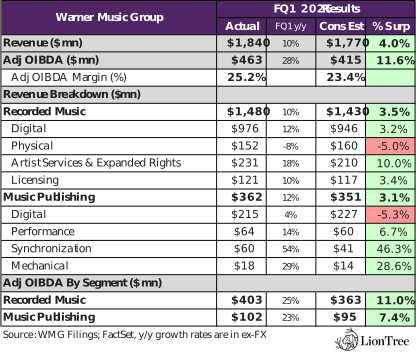
- Total FQ1 revs BEAT cons by +4% and adj OIBDA BEAT by a larger +12%
- Total revs grew +10% y/y (decel from +13% y/y in FQ4)
- Adj OIBDA grew +28% y/y (big accel from +12% y/y in FQ4)
- Recorded Music subscription streaming revs were up +8.7% y/y on an adj basis vs +8.4% y/y in FQ4
- Ad-supported streaming revs grew +4% y/y on an adj basis vs +3% y/y on adj basis in FQ4
- Driven by “strong” performance from traditional DSPs
- Music Publishing revs grew +15% y/y on an adj basis vs +13% y/y in FQ4
Margins Has Been A Big Focus & WMG Has Been Delivering (And Expects To Continue To Do So In The Short- And Long-Term)
- FQ1 margins were stronger than expected…adj OIBDA margin of 25.2% signif beat cons 23.4%: Up +310bps y/y
- What’s driving the increase? WMG’s reorganization and cost savings related to that, as well as the acceleration of high margin streaming growth and the operating leverage they get behind that
- The ongoing cost savings plan is “delivering on schedule” and “on track” to contribute 150-200bps to margin in FY26
- Reiterated that a margin in “the mid-20s” is sustainable in the short-term, and have a longer-term goal to deliver margins in the high-20s
- As they work to drive “even greater efficiency” through the use of AI and improve op leverage in the biz
- Highlighted some additional drivers for future margin increase: DSP pricing and tiering; High-margin catalog M&A; Accretive AI rev that will continue to accelerate over the next few yrs
- The Co will provide an update on their path to “meaningful margin expansion” as their plans evolve in the upcoming qtrs
WMG Increased The Capacity Of Their JV With Bain
- WMG and Bain have increased their equity commitments by $100mn each
- Expect to maintain the existing equity-to-debt ratio, which will increase the JV’s total capacity from $1.2bn to ~$1.65bn
- Expect “some exciting announcements” coming in the “near future”, as they plan to deploy a “significant” portion of the JV’s total capacity by end of FY26
- “We’ve developed a very, very strong pipeline which we’ll start to announce in the remainder of this calendar year”
Focused On Leveraging AI Across The Biz To Drive “Significant” Top- And Bottom-Line Growth
- Recently completed AI deals with Suno, Stability, KLAY and Udio have the potential to unlock “significant” incremental rev at accretive economics
- Will be compensated on a consumption basis for all of their deals: WMG’s economics will scale as their partner’s bizs grow
- Partnerships will be key to building out the “super fan tiers of the future”, including the ability to create: Creation is “the ultimate expression of fandom…so, for us, the super fan tiers of the future will all include AI functionality to create. And our partnerships with the four companies are key to establishing how we would like to see this market evolve”
- Partner highlight – Suno partnership expected to be a “material” top and bottom-line growth driver starting in FY27: Suno is already earning “several hundred million” dollars in annual rev
- Also exploring oppties w/ their large DSP partners to incorporate AI tools that would enhance the consumer offering
- Including AI tools to accelerate new artist discovery + enhance and automate marketing: Can scale mkting efforts “beyond what’s humanly possible” by “quickly and inexpensively” generating assets like (i.e., motion art, music videos) to better monetize WMG’s music catalog of “over a million” recordings
- “The impact from AI generated assets that spike engagement with the catalog can be a significant one”
- As well as developing tools to amplify the creativity of their artists
- Hosting workshops and songwriting camps to help creators leverage the latest technologies to “hone their work, cut through the noise, and build fandom”
- Emphasized that they are taking an “early and aggressive” approach to embracing these new technologies by authoring ethical AI guidelines
- Enabling WMG to protect and super serve artists and songwriters, while creating incremental opportunities for the entire ecosystem
- Reiterated WMG’s non-negotiable principles –
- WMG’s partners must commit to license models
- Economic terms must properly reflect the value of music
- Artists and songwriters must have a choice to opt in to any use of their name, image, likeness and voice in new AI-generated recordings
- AI will also be advantage on the cost side across WMG’s internal operations
- Have already deployed AI across various depts: “Over the last two years, we have laid the infrastructure foundation for us to effectively deploy AI across many different departments across the company…we have deployed AI across finance, legal, marketing, HR, and more”
- With other use cases in the works: Ranging from “music production, where many of our artists and songwriters are already leveraging these tools, to more analytically-driven, precise deployment of marketing dollars, as well as more real time forecasting and analytic”
Additional Key Biz Updates – Mkt Share Gains, TikTok Deal Renewal, Music Publishing Accelerations
- Seeing “steady” and “broad-based” mkt share improvement – “all of our business units are growing at a very, very healthy clip, and it’s showing up in the results”
- Saw ~1ppt of US streaming mkt share growth over the prior-yr qtr (accel from +0.6ppt in FQ4), w/ strength across new releases and catalog
- Market share on Spotify’s Top 200 chart is up +3ppts FY-to-date
- What’s driving the improvement? Reinvestments from 2024 restructuring into growth through technology and investments into A&R materialized through FY25, which is starting to show through, along with “much, much sharper” capital allocation and “our incredible ability of artist development”
- Where is there room for improvement? Asia: Region where they have “the most amount of work to do”; Have changed leadership across the region; “We got the right people there, but it takes some time and we’ll work on that hard”
- Renewed their deal w/ TikTok, which resulted in improved deal economics
- “Very happy” w/ TikTok partnership
- Did not disclose deal terms but it contains “structural” changes that “better reflect the value of music”
- Flagged that TikTok deal is not material to revenues: Is in the LSD as a % of revs, but “our deals are never just about money. They’re also about data, promotion, insights and all of the things that can help advance our business overall”
- Have “many, many” opportunities to accelerate growth in music publishing
- Will double down on their proven A&R strategy – “we have now more firepower to do that than in the past”
- Further focus on regions where WMG has seen strong tractions behind their investments – specifically called out developing regions and LatAm
- Leverage Bain JV and the increased capacity
- Will also benefit from acceleration and growth of WMG’s AI partnerships
- “We’re really confident that we can continue to deliver double-digit growth in that business…[and] also continue to improve margins…we’re very, very confident about the business and the leadership we have there
“Our Path To Accelerating Growth In 2026 And Beyond Is Clear” …Highlighted Key Drivers
- A “strong” release slate: Anchored by new releases from Bruno Mars, Zach Bryan and many others
- Contractual per stream margin (PSM) increases starting in Q2 and layering in throughout the balance of fiscal 2026
- Will start to see volume-led subscription streaming growth will evolve to volume AND volume-led growth
- “On top of that, we believe this is the best opportunity now with AI to introduce super premium tiers”
- Acquisitions of high-quality accretive catalogs and bolt-on capabilities that will accelerate WMG’s distribution, e-commerce businesses and AI partnerships and initiatives
- Expected to result in a “material” contribution to revenue and margin in FY27
- “In summary, we are very optimistic about the road ahead with greater certainty around DSP deal terms, more consistent market share performance, and a refined approach to capital allocation”
AI Concerns Overshadow Take-Two’s Strong Beat & Raise Qtr
The big story since last Friday (Jan 30th) was a significant spike in concern about Google’s Genie release and more generally AI disrupting the video game industry. Mgmt addressed questions confidently, believing that AI will be an enabler and will not impact the creative part of game development. They see Google’s Genie’s platform as apples to oranges to TTWO’s game development process (see Theme #3 for Google’s comments on its Genie launch).
Nonetheless, these concerns dramatically overshadowed what we viewed as strong quarterly results with another beat and raise. The Co’s business outperformed broadly across all key franchises. Total net bookings grew +28% y/y (vs +33% in FQ3) with recurrent consumer spending up +23% y/y and dramatically exceeding the previous guidance of +8% y/y. The performance was also broad based across their key franchises…NBA 2K grew +30% y/y, Grand Theft Auto Online increased +27% y/y, and Mobile increased +19% y/y (accelerating from mid-teens growth last quarter).
Last but not least, the Co Importantly reiterated the November 19th launch of GTA VI and continues to project record levels of net bookings in Fiscal 2027.
Bottom line, it was a strong quarter but the AI overhang will likely remain in place at least in the short-term.
See more details below on our view regarding what was most incremental with TTWO’s results…
-> TTWO rose +5% after its report and ended the week down 11%; The stock is down -24% YTD
Street Concerns Regarding AI Disruption Dramatically Increased Since Google’s Genie Launch Late Last Week
- What did Google announce? (link)
- On Jan 29, 2026 the Co released Genie 3
- Project Genie is a prototype web app powered by Genie 3, Nano Banana Pro and Gemini, which allows users to experiment with the immersive experiences of worlds model firsthand
- How does it work? Prompt with text and generate or upload images to create a living, expanding environment; Create your characters, your world, and define how you want to explore it
- The “world” can be explored: As you move, Project Genie generates the path ahead in real time based on the actions you take
- You can also adjust the camera as you traverse through the world
- Access to Project Genie begins rolling out to Google AI Ultra subs in the U.S.
- Analysts focused on Genie and the overall impact that AI will have on the interactive entertainment industry…TTWO’s response = they are embracing gen AI and it is an enabler
- The video game biz, since its inception, was built on the back of machine learning and AI
- They create their games in “computers with technology”, ever since questions began about gen AI, ~18 months ago, they have been incredibly enthusiastic about what the future can bring
- The Co has hundreds of AI pilots in implementations across the firm, including with their studios
- They are seeing opportunity to drive efficiencies, reduce costs, and create the opportunity to do what digital tech has always allowed
- This frees up creators to do the more interesting tasks of “making superb entertainment”
- Impact of Genie? “It is early in its iteration at this point, and trying to make a comparison to a game engine is just not even in the same ballpark … Genie is not a game engine but it’s very exciting technology”
- One final note: “There are more elements to gaming than world creation, like story line, mission structure and vibe which cannot be captured with AI”…”AI will make what they do better”
- The video game biz, since its inception, was built on the back of machine learning and AI
Regarding TTWO FQ3 Results…They Were Strong, Driven By Consumer Spend Growth
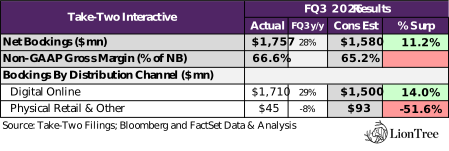
- FQ3 Net Bookings BEAT by +11.2%: Grew +28% y/y (vs +33% y/y in FQ2)
- Growth was driven by better-than-expected performance from NBA 2K, the GTA series, and several mobile titles, including Toon Blast, Empires and Puzzles, and Top Eleven
- During the qtr, they launched WWE 2K Mobile for Netflix and Red Dead Redemption and Undead Nightmare for several new platforms
- Recurrent consumer spend growth cont’d to accelerate from +17% y/y FQ1 to +20% y/y FQ2 to +23% y/y in FQ3, MASSIVELY outperforming guidance of +8% y/y
- Represents 76% of total net bookings, slightly down from 79% in Q3 2025
- NBA 2K RCS: grew +30%
- GTA Online RCS: rose +27%
- Mobile RCS: incr’d +19%
- FQ3 adj EPS of $1.23 was well ahead of cons $0.83
FQ4 Guidance Topped Estimates As Well
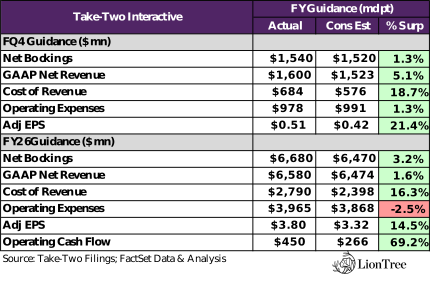
- FQ4 guidance BEAT –
- Net bookings BEAT by +1.3%: $1.54bnbn vs cons $1.52bn
- The release slated for the quarter includes Sid Meier’s Civilization VII for Apple Arcade, PGA TOUR 2K25 for Switch 2, and WWE 2K26. The largest contributors to net bookings are expected to be NBA 2K, the Grand Theft Auto series, Toon Blast, Match Factory!, WWE 2K, Empires & Puzzles, Color Block Jam, Red Dead Redemption Series and Words with Friends
- Adj EPS BEAT by +21.4%: $0.51 vs cons $0.41
- Expect RCS to increase ~+7% y/y assuming –
- A ~20% y/y increase for NBA 2K
- Mid-single digit growth y/y for mobile
- A modest y/y decline for GTA Online
- GAAP net rev to range from $1.57 – $1.62bn vs cons $1.52bn and cost of rev to range from $675 – $692mn vs cons $576mn
- Operating expenses are planned to range from $973-$983mn vs cons of 991mn
- On a management basis, operating expenses are expected to grow by approximately 3% y/y
- Net bookings BEAT by +1.3%: $1.54bnbn vs cons $1.52bn
- Raised FY26 guidance –
- RAISED FY26 net bookings guidance by +18% at the mid-pt: $6.65-$6.70bn vs prior guidance of $6.4-6.5bn and prior guidance $6.05-6.15bn (ahead of cons $6.47bn)
- Reflects Q3 outperformance and higher expectations for several of our key titles in Q4
- Project net bookings breakdown from our labels to be ~46% Zynga, ~38% 2K and ~16% Rockstar Games
- RAISED RCS growth guidance to ~17% y/y from 11%…assuming:
- NBA 2K RCS: grows +37% y/y
- Mobile RCS: grows+13% y/y
- GTA Online RCS: increases slightly y/y
- RAISED OP Cash Flow to ~$450mn which is up from our prior expectation of $250mn vs cons of $266mn
- RAISED FY26 adj EPS guidance by +19.5% at the mid-pt: $3.75-$3.85 vs prior guidance $3.05-$3.30 and prior guidance $2.60-$2.85 (ahead of cons $3.32)
- MAINTAINED: $180mn in capx
- RAISED GAAP net rev, which is now expected to range from $6.55-$6.6bn vs cons $$6.45bn, and cost of revenue, which is expected to range from $2.78-$2.8bn vs cons $2.4bn
- Total operating expenses are expected to range from $3.96 – $3.97bn vs cons $3.87bn
- On a management basis, they now expect operating expense growth of ~8% y/y, which is down slightly from our prior forecast due to a shift of some marketing expenses into next year
- RAISED FY26 net bookings guidance by +18% at the mid-pt: $6.65-$6.70bn vs prior guidance of $6.4-6.5bn and prior guidance $6.05-6.15bn (ahead of cons $6.47bn)
- For FY27 – still expecting to achieve “record” levels of net bookings
Growth In The Mobile Business Was A Key Positive
- Mobile revenue growth accelerated to +19% y/y vs “mid-teens” last qtr: Consumer engagement has been strong
- Toon Blast net bookings grew +43% y/y vs +26% in FQ2, and surpassed $3bn in lifetime net bookings
- Match Factory net bookings grew +17% y/y vs +20% in FQ2
- Color Block Jam remains Rollic’s all-time top performing title and was featured in Apple’s 2025 free games list in the US
- Empires and Puzzles and Words with Friends net bookings grew +11% and +6%, respectively y/y
- The post pandemic rebound has helped mobile –
- The market has rebounded, there are tailwinds and so “as much as I’d like to take credit for all of the team’s success” they are benefiting from consumer engagement with mobile games
- Mobile advertising rev grew +10% y/y vs “an increase” last qtr: Driven by higher avg rev per DAU and mgmt is “highly confident” in mobile looking ahead
- The Co has been adding new ad units to mobile and Zynga has been “very smart” with the way they monetize them
- 2Ks mobile offerings also had another solid quarter
- WWE Supercard, surpassed 38mn lifetime downloads
- NBA 2K mobile continuing to expand its audience
- NBA 2K26 Arcade Edition, held its top 5 position on the Apple Arcade charts
- NBA 2K All-Star in China, grew to nearly 9mn registered users, after less than one year in mkt
- Mobile DTC biz delivered its strongest qtr on record (though mgmt doesn’t disclose how big it is): The Co intro’d recent enhancements that enable more personalized offers, flexible pricing, reduced payment friction, and alternative payment methods with the regulatory environment becoming even more favorable
- DTC should be a meaningful growth driver that will help accelerate net bookings, margins and profitability
Core Segment Saw Growth From A New GTA Online Update As Well As NBA 2K 2026
- GTA 5 recurrent consumer spending grew +27% y/y (exceeding expectations), accelerating from a “decline” last qtr
- Led by GTA Online’s “A Safe House in the Hills” update
- Full game sales of GTA 5 remain strong, with the title now having sold over 225mn units since 2013 launch
- GTA 6 consumer anticipation is huge, and “we will be astonished” by the creativity of the marketing team leading up to its release
- The game is still expected to be released on Nov 19, 2026
- The anticipation of GTA 6 is driving engagement in GTA 5
- After the release of GTA 6, the Co will still focus on GTA 5 Online
- NBA 2K26 delivered stellar results
- To date, the title has sold ~8mn units, representing a high SD % increase over NBA 2K25
- DAUs and MyCAREER DAUs both grew +30% y/y vs +30% and +40% respectively last qtr
- Outlook: It is on track to generate the highest level of annual net bookings and RCS in franchise history
- There is a significant international expansion opportunity
- The NBA continues to be an “amazing partner” for them and they’re expanding internationally
- Basketball is a global sport
- But North America is still a focus of expansion
Other Game Releases Highlighted This Quarter
- In Dec, Rockstar Games expanded Red Dead Redemption and Undead Nightmare onto new platforms
- PlayStation 5, Xbox Series X and S, Nintendo Switch 2, and iOS and Android mobile devices for Netflix subs
- On Jan 14th, 2K and HB Studios annc’d an array of new content for PGA TOUR 2K25
- Including 3 new courses for the 2026 major championships
- The 2026 PGA Championship at Aronimink Golf Club
- The 126th US Open at Shinnecock Hills Golf Club
- The 154th Open at Royal Birkdale Golf Club
- Additionally, they look forward to growing the community with the launch of PGA TOUR 2K25 for Nintendo Switch 2 on Friday
- Including 3 new courses for the 2026 major championships
- Firaxis Games will continue to deliver a steady cadence of updates for Sid Meier’s Civilization VII
- On Feb 5th, 2K launched Civilization VII for mobile devices exclusively on Apple Arcade
- Lastly, On Mar 13th, 2K and Visual Concepts will release WWE 2K26
- Featuring the biggest roster in the series history, (over 400 wrestlers)
- They plan to support the release with a new Ringside Pass Live service model, and a series of add-on packs that can be purchased individually or together as part of the Season Pass
- 2K and Gearbox Software will continue to support Borderlands 4 with new content and updates, and they expect the title to achieve strong sell-through over its lifetime
- Looking ahead, they believe strongly in their upcoming launches and will provide their initial 3-year pipeline for 2027-2029 with their Q4 results in May
Other Comments Worth Noting On M&A & CFX Marketplace
- The Co will continue to be extremely selective when it comes to M&A
- Mgmt cited that most corporate M&A fails, b/c most corporate mgmt teams “love the notion of presiding over a bigger empire”
- “We don’t look at the world that way, our job is to entertain the world”
- “If there is an enterprise available on favorable terms that sits within that strategy and can operate within our unique culture, then it’s potentially interesting to us”
- Mgmt cited that most corporate M&A fails, b/c most corporate mgmt teams “love the notion of presiding over a bigger empire”
- Expanding User generated content (UGC) is an opportunity: The Co launched CFX Marketplace in early Jan, an official modding store
- UGC has already been present in numerous parts of their biz
- There are users who want to create and engage, and they want to create a home and tools that make that more viable and more accessible “could be an opportunity for us”
- Continue to believe TTWO delivers more value for consumer than they charge
Snap Navigates A Self-Inflicted DAU Dip…While Still Aimed At Its Long-Term Goals
A ~3mn decline in global DAUs was the main blemish in Snap’s Q4 report, which otherwise would have been a largely clean beat. The decline was largely self-inflicted. After years of community growth outpacing revenue growth, the Co is now prioritizing a “much better balance” by focusing on its “most valuable” geographies, namely markets with the highest ARPUs. As part of this shift, Snap “substantially” reduced community growth marketing investments in Q4, which drove the DAU decline. Additionally, and more outside the company’s control, Snap lost ~400k users following the implementation of new age-limit laws in Australia.
But, the user losses had little impact on financial performance. Q4 rev and adj EBITDA were both ahead of expectations, with margins a particular standout at 20.8% vs cons 17.6%. Looking ahead to next quarter, the increased focus on profitability is evident in the guidance, with adj EBITDA guide +1.1% ahead of cons, though revenue guidance missed by -2.3% (does not include any potential contribution from the Perplexity integration). Despite the quarterly DAU decline, Snap reiterated its long-term goal of reaching 1bn MAUs, while remaining on track to achieve its 60% gross margin target, having already reached 59% in Q4.
On advertising, the focus continues to be on building demand and North America remains a key area for that. While Snap is seeing strength among SMB advertisers in N. Amer, headwinds persist amongst larger customers. It was also particularly interesting that against the backdrop of continued CapEx step ups across the large-cap tech names (see Theme #3 & Theme #4), Snap plans to keep FY26 infrastructure costs flat y/y. They are being “really sensible” about cost to serve relative to monetization potential by market, while also converting infrastructure spending into revenue-generating investments, such as its Memories Storage plan. That said, mgmt made a point to emphasize that they are NOT pulling back on AI and ML investments and will continue to invest “pretty heavily” in those areas. On that note, the launch of Specs is nearing and there is a lot of talk from mgmt about the opportunity that the product will bring about, going as far as to say they are developing something that is its own “strong standalone brand”, though the specifics were sparse. Finally, we would flag that revenue diversification plans are on track as the “Other” segment saw both rev and subscribers accelerate q/q.
All in all, Snap continues to have a lot of balls in the air, and the business remains in transition as it works towards its long-term goals.
See more below for more on what we viewed as most important from the Co’s earnings and investor call.…
-> Snap shares fell -13.4% in reaction to earnings, is down -35% YTD
Q4 Upside In Profitability Was The Main Event
- Q4 rev BEAT by +1.2% and was up +10% y/y (in-line w/ Q3)
- Rev beat across all regions
- Q4 adj EBITDA BEAT by +19.3% was up +30% y/y (decel from +38% y/y in Q3)
- Q4 adj EPS of 3c was ahead of cons -3c
- FCF was in-line
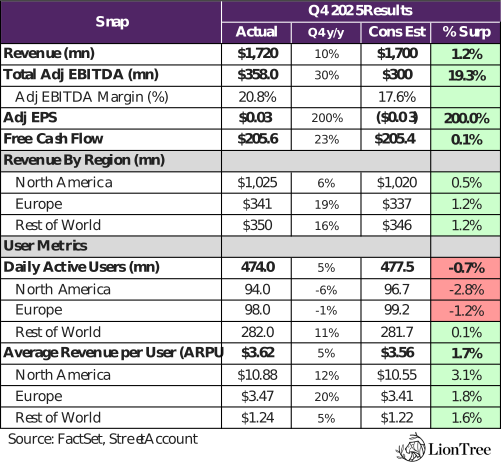
BUT Q1 Guidance Was Mixed…Light On Rev, Beat On Profitability
- Q1 rev guidance MISSED by -2.3% at the midpt: $1.5-$1.53bn vs cons $1.55bn
- Note that that the guidance range EXCLUDES any potential rev from the Perplexity integration as they have yet to mutually agree on a path to a broader roll out
- Q1 adj. EBITDA guidance BEAT by +1.1% at the midpt: $170-$190mn vs cons $178.1mn
- “As we begin 2026, we are excited to execute on our pivot toward profitable growth and to make incremental progress toward our medium-term goal of delivering meaningful net income profitability”
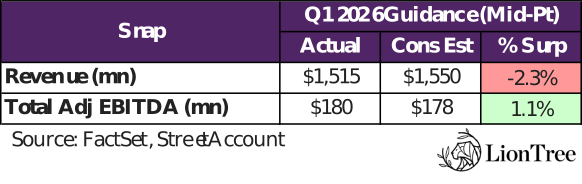
Incremental FY26 Guidance Commentary
- Infrastructure costs are expected to be flat y/y at the low end: $1.6- $1.65bn
- Also working on turning infrastructure costs into revenue generating investments (as an example, Snap’s Memories Storage Plans)
- But emphasized that AI and ML investments are NOT an area they are focused on pulling back on – “we intend to continue to invest pretty heavily there”
- Expect the remaining components of adj Cost of Revenue will be a combined 16% to 17% of rev in each qtr of 2026, which would represent a 1-2ppt improvement over 2025, driven by the benefit of outsized growth in higher margin ad placements
- FY26 adj OpEx of ~$3.0bn
- Personnel costs (largest component of adj OpEx) is expected to be ~in-line w/ Q4:25’s 7% y/y, with hiring tightly focused on our core strategic priorities
- Anticipate cont’d elevated legal and regulatory related costs and plan to make “meaningful” proactive investments in community safety that will contribute to adj OpEx growth
- Also includes incremental Specs investments in product development and go-to-mkt support in anticipation for the consumer launch later this yr
- These factors will be partially offset by reduced spending on community growth marketing as they adjust these investments to better reflect the long-term monetization potential of each geography
- FY26 SBC and related expenses of ~$1.2bn
Snap Is Focusing On 3 “Catalysts” To Drive Gross Margin Expansion
- Expect infrastructure costs will pivot from being a source of gross margin pressure to becoming a margin accretive investment
- As community growth initiatives become more focused on monetizable markets, and as Snap’s cost to serve becomes increasingly calibrated to each market’s monetization potential.
- Expect advertising margins to improve
- As more of Snap’s ad rev is derived from higher margin placements (such as Sponsored Snaps and Promoted Places)
- Expect growing scale of Snap’s subscription biz will become increasingly accretive to overall gross margins
- Reiterated long-term goal to achieve 60% gross margins
- “We have already made meaningful progress toward that goal by achieving a 59% gross margin in Q4, and we believe there is a clear path to exceed this goal in 2026”
DAUs Disappointed As Snap Pulls Back On Community Growth Initiatives To Focus More On Profitable Growth
- Q4 DAUs came in below expectations (-0.7% miss), as a very small beat in RoW was not enough to offset misses in N. Amer and Europe
- Amer and Europe both MISSED by -2.8% and -1.2%, respectively
- RoW beat by a small +0.1%
- Despite global MAUs INCREASING by +3mn q/q in Q4 to 946mn…
- …global DAUs DECLINED by -3mn q/q to 474mn (-0.7% miss)
- Driven by Snap “substantially” reducing its community growth marketing investments to focus more on profitable growth
- Focused on striking “a much better balance” b/w growing users and also growing ARPU
- “Over the past three years, our community growth has really outpaced our revenue growth”: Causing ARPU to declined as cost to serve increased, putting downward pressure on margins
- “We have immense daily reach and engagement in many of the most valuable advertising markets, including in North America. And we think we can strike a much better balance between pursuing community growth and also growing average revenue per user”
- “We’ve made some choices to reduce community growth marketing spend, to adjust the cost to serve and to roll out additional paid features”
- While it will cause some headwinds to user engagement, it will enable them to focus on their “most valuable” geographies
- Despite the changes, Snap remains committed to their long-term goal of reaching 1bn MAUs
The Co Continues To Work On Building Advertising Demand, Particularly Amongst N. America Large Advertisers
- Q4 ad rev reached $1.48bn, up +5% y/y (decel from +8% y/y in Q3:25)
- Driven primarily by growth in DR ad rev
- SMBs contributed the majority of ad rev growth for the 6th consecutive qtr
- In Q4, total active advertisers incr’d +28% y/y
- Driven in part by simplified onboarding, improved campaign workflows and increased performance
- SMBs contributed to the majority of ad rev growth in Q4 for the 6th consecutive qtr, w/ “especially strong” growth in the medium customer segment globally…
- …looking at N. Amer specifically, seeing strength in SMBs, but still room for improvement in large customers
- Medium customers in N. Amer were the largest contributor to absolute dollar growth in the region
- But continue to face some headwinds in the N. Amer large customer biz that they are working through; Have new leadership in place over the N. America LCS segment and the financial svs and autos verticals were bright spots in Q4
- Incremental ad product updates from Q4 –
- Sponsored Snaps rev grew “meaningfully” q/q supported by in-app optimizations and early testing of Dynamic Product Ad (DPA) integrations; Click-through rates grew +7% y/y and click-through purchases grew + 17% from Q3 to Q4, during which numerous format and ranking improvements were introduced
- Promoted Places saw a ~65% reduction in cost per incremental visit and an avg double-digit visitation lift in early results from its beta
- DPA rev grew +19% y/y, supported by expanded adoption among large advertisers and continued migration to higher-performing dynamic solutions
- App advertising also accelerated “meaningfully” in Q4, and rev from In-App Optimizations grew +89% y/y, supported by advances in foundational app models, broader adoption of the App Power Pack, and new immersive formats such as Playables
- “Biggest focus is continuing to generate additional demand” – looking ahead, focused on 3 core initiatives for the ad biz…
- Fostering direct connections between brands and Snapchatters by leveraging their core product capabilities across Snapchat
- Making it easier and more performant for advertisers to connect with Snapchatters by leveraging AI tooling and capabilities end to end, incl creative development, campaign setup, and performance optimization
- Scaling and optimizing their GTM operations that support the success of SMBs
- More on Snap’s AI strategy…central focus is simplifying how advertisers plan, launch, and manage campaigns on Snapchat
- Smart Targeting and Smart Budget
- Uses AI to identify incremental high-value audiences
- Dynamically allocates spend across objectives
- Reduces the need for manual setup and ongoing optimization
- Smart Ads (in early testing)
- Automatically assemble and iterate creative elements to identify the highest-performing combinations
- Smart Targeting and Smart Budget
On The Cusp Of Specs Launch
- After 5 generations of “development and refinement” and more than a decade of investments, Specs will launch to the public in 2026
- In preparation for launch, have continued to strengthen the platform and the ecosystem to support adoption at scale
- Began testing Snap Cloud, powered by Super Bass, to make advanced back-end capabilities more accessible within Lens Studio
- All Lenses built today for Spectacles will be compatible with Specs at launch, providing “continuity and scale for developers from day one”
- “We’re just really focused on getting the hands of early adopters. We’re so fortunate to have this passionate base of developers, hundreds of thousands of developers who’ve used Lens Studio to build Lenses”
- Key priority for Specs – “developing a strong standalone brand”: “Specs […] in many ways, appeals to a different audience segment than the core Snapchat audience. And it’s going to be really important for us to develop a standalone brand identity for Specs”
- Longer-term, there may be oppties to raise additional capital as they move toward broader rollout and deployment, “balancing that obviously with our own […] ownership interest and any potential dilution”
- “We have a lot of flexibility to think about how we want to capitalize it moving forward.”
- “We’ve got a really clear path here to, lightweight, affordable and incredibly powerful glasses that can deliver immersive experiences in the real world”
The New Regulatory Environment Around Age Verification Will Have More Of An Impact On Engagement Vs. Revenue
- In Q4, Snap had to implement platform-level age verification in Australia in compliance with the new law, which resulted in the removal of ~400,000 accounts
- Have since begun testing new signals from Apple’s declared age range API, and they plan to test Google’s Solution once it becomes available
- But global ad rev from impressions served to users under the age of 18 is “nonmaterial”
- “While these actions may adversely affect engagement metrics as implementation progresses, we believe it is the right thing to do to maintain the long term trust of our community and partners”
Other Key Points – Subscribers, AI Across The Co, And Gaming
- Growth in “Other” portion of the biz is accelerating – both on the revenue and subscriber front: Other Revenue increased +62% y/y (vs +54% y/y in Q3), with subs grew +71% y/y (vs +35% y/y in Q3)
- Drivers? “Memories Storage Plans were a big driver of the subscriber growth that we’ve seen recently. And also, have helped improve retention rates overall”
- “In the year ahead, growth in subscribers will be a critical input metric to track our progress, and we will ultimately grade our performance based on the growth of the annualized run rate for Other Revenue”
- Seeing gains from AI across the Co
- ~40% of new code at Snap is AI-generated
- Have made “a ton of headway” with in automating customer service workflows
- “A lot of opportunity” to automate the sales workflow
- “Running as fast as we can” to roll out new agents across the enterprise
- Is also a “real accelerant for our own creativity”
- Quick gaming callout – 200mn+ Snapchatters are now playing Games every month on avg, up +90% y/y (vs +100% y/y in Q3)
- Began rolling out two new player turn-based games – 2 Player Mini Golf and Magic Jump
Uber Keeps Driving While Building For An Eventual Driverless Future
It was a bit of déjà vu for Uber this qtr as similar to Q3, the Co delivered a strong current qtr with gross bookings, revenue, and FCF all coming in ahead of expectations (and it also beat on adj EBITDA which it did not last qtr). However, it was another print of mixed guidance. While Q1 gross bookings outlook beat consensus, Q1 adj EBITDA guidance slightly disappointed. That said, the underlying business remains steady, and this is more a story of continued execution than any major inflection.
Both core segments showed strong momentum. In Mobility, Q4 gross bookings were up +20% y/y and adj EBITDA was up a more substantial +25% y/y, as the Co continues building out product offerings and expand deeper into markets. On the Delivery side, growth was even stronger, with gross bookings up +26% y/y (a continued acceleration from +24% y/y in Q3 and +20% y/y in Q2), which was outpaced by adj. EBITDA growth of +40%. Delivery also surpassed a $100bn annual run-rate for the first time.
But the real focus of the earnings call was autonomous vehicles. Mgmt and investors spent the majority of Q&A discussing Uber’s AV initiatives. The introduction of AVs has been an overall growth driver in the markets where Uber operates. Notably, AVs on Uber’s platform are seeing “significantly higher” utilizations than on standalone platforms, to which mgmt expressed confidence that Uber will be the first choice for AV manufacturers and tech Cos looking for a platform to deploy their vehicles. In addition, they reiterated their willingness to deploy capital in the early years of buildout (somewhat of a departure from their traditionally asset-light model) to guarantee supply going forward. While widespread AV deployment is still years away, Uber is making it clear they intend to be at the forefront.
A few other items to flag – Uber announced that Balaji Krishnamurthy, VP of Strategic Finance and Investor Relations, will become Uber’s new CFO, replacing Prashanth Mahendra-Rajah, who will step down on February 16th. On capital returns, the Co repurchased a record $1.9bn in Q4 and has exhausted its inaugural $7bn share repurchase program faster than expected. They expect to continue being active and opportunistic buyers under their additional $20bn authorization announced in August 2025.
Bottom line? The core business remains on solid footing and the Co is making aggressive moves to establish Uber as the dominant platform for when the industry eventually shifts toward autonomous.
See below for our drilldown regarding the most important updates & developments.
-> Uber ended the day down -5.1% and ended the week down -6.6%; For context, the stock was up +35.5% in 2025, but YTD, has been down -8.5%
Q4 Headline Results Were A Standout
- Q4 gross bookings growth was their strongest in ~3 yrs: Up +22% y/y (a slight accel from +21% y/y in Q3) and BEAT cons by +5.9%
- Saw upside across both Mobility (+1.3% beat) and Delivery (+2.7% beat)
- Q4 Trips grew +22% y/y (in-line w/ Q3) to 3.8bn, driven by MAPC growth of +18% y/y (slight accel from +17% y/y in Q3)
- Q4 rev BEAT by +0.3%, driven by Delivery biz: Was up +19% y/y (vs +20% y/y in Q3)
- Delivery rev beat by +3.6%, while Mobility rev missed by -1.2% and Freight rev missed by -1.6%
- Q4 adj EBITDA was a record: Grew +35% y/y (slightly accel from +33% y/y in Q3) to reach a record $2.5bn
- Freight biz achieved breakeven adj EBITDA for the first time in 3+ yrs, despite a continued challenging operating backdrop
- Q4 FCF BEAT by +36%
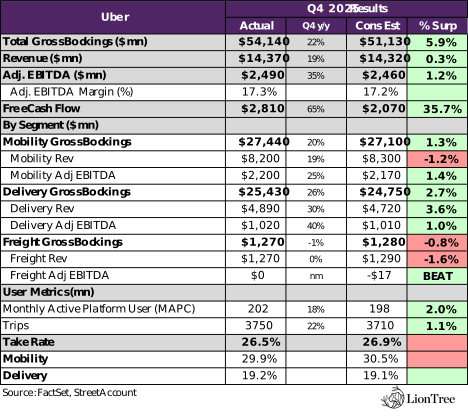
Q1 Gross Bookings Guidance Was Ahead BUT That Was Overshadowed By Disappointing Profitability & EPS Guidance
- Q1 Bookings BEAT by +2.6%: $52.0-53.5bn vs cons $51.39bn
- Implies +17–21% y/y growth on a CC basis (vs +22% y/y reported in Q4)
- Assumes ~1ppt currency tailwind to total reported y/y growth
- Q1 adj EBITDA MISSED by -0.8% at the midpt: $2.37-2.47bn vs cons $2.44bn
- Implies +31%-36% y/y growth
- Q1 EPS of 65-72c was BELOW cons 74c
- Also to flag…a UK biz model change will be a ~350bps headwind to Q1:26 and FY26 Mobility rev margin
- Following a UK tax law ruling, driver payments will be reclassified from cost of revenue to contra-revenue, which will reduce reported revenue and revenue margin
- There is no impact on profitability from this change
Uber Outlined 5 Capital Allocation Priorities
- Disciplined reinvestment in future growth
- Will continue to invest in a “disciplined” manner to deliver operating leverage, with a “rigorous” focus on customer cohorts and LTV/CAC ratios, with a particular focus on technology and customer acquisition investments
- Invest “appropriately” to advance Uber’s AV strategy: Expect the oppty in the space to improve over time, and expect to invest along three core pillars –
- Supporting Uber’s AV software partners, with capital as well as Uber’s data and platform capabilities
- Support Uber’s OEM partners, as they scale out their nascent AV production capacities
- Investments may take the form of equity or vehicle offtake commitments
- In the long-term, intend to remain asset-light and believe the ownership of AVs will become financialized over time
- However, in the initial years of AV deployment, Uber may purchase some vehicles directly “to shape the category” and improve their speed to market
- Support Uber’s AV infrastructure partners with the deployments as they enter the market
- In parallel, Uber is also actively working on 3rd -party financing partnerships, which will amplify their investments across all three pillars
- Selective M&A to augment Uber’s organic efforts
- May selectively evaluate acquisition oppties that are aligned with Uber’s strategy
- Continue to hold a “high bar” for any M&A oppties
- Likely to be biased towards “bolt-on” oppties that accelerate Uber’s organic efforts
- Return excess capital to shareholders
- Expect to “steadily” repurchase Uber stock through their existing repurchase authorization
- May look to be opportunistic and aggressive buyers during stock dislocations to maximize long-term value
- Remain on track to steadily reduce their share count
- Maintain a “solid” investment grade rating
- Plan to maintain financial policies and “ample” liquidity to support their expanding marketplace and improve cash efficiency over time
Despite Uber’s Scale, They Are Still In The Early Stages Of Customer Acq, Which Continues To Be The Primary Contributor To The Co’s Growth
- 202mn MAUs (+18% YoY) on the platform, Uber’s largest and most engaged customer base ever
- Added more customers in Q4 than in any other qtr since the post-Covid recovery
- Customers joining the platform are using Uber more frequently
- New rider and new eater cohorts are exhibiting much stronger retention than prior yrs cohorts
- 40% of Uber customers are now using multiple products, driving frequency higher and building long-term loyalty
- Demand growth is being matched by continued supply growth, with 9.7mn monthly drivers and couriers (+19% y/y) and 1.3mn+ monthly merchants, both of which are all-time highs
- Made a point to emphasize the massive oppty outside of their top mkts – Uber’s profit pools are NOT concentrated in their top cities
- In the US…: ~75% of their profits come from outside their top mkts, and those numbers have been growing b/c those mkts are growing faster than the top 20 cities
- Internationally…: 60% of mobility gross bookings are international outside of the US
- In less dense mkts…: Growth is ~1.5-2x more than growth in the middle of big cities
The Mobility Biz Continues To Drive Growth Through Expansion Of Mkts And Offerings
- Q4 Mobility gross bookings grew +19% y/y (in-line w/ Q3), reflecting “strong demand across regions”
- In the US, growth accel for the second consecutive qtr, and EMEA continues to be a standout with ~30% y/y growth, driven by healthy category demand, category-position gains, and geographic expansion
- Q4 Mobility adj EBITDA growth of +25% y/y continued to grow faster than both trips (+22% y/y) and Gross Bookings (+20% y/y)
- But Mobility rev missed by -1.2% and take rate of 29.9% missed expectations of 30.5%
- Mgmt did not provide any commentary around this, nor did investors ask any questions
- Continue to build out Mobility offerings using a “barbell” strategy – low-cost offerings on the one end, stable pricing in the middle, and higher-margin premium experiences on the other end…
- …and airports are a “great” example of this strategy in action…
- In the low-cost portfolio: Uber Shuttle has expanded across all major New York airports; Continue to expand UberX Share to airport pickups
- In the middle: Uber One members get better price and service quality (with Surge Savings, highly-rated drivers, and more); Also recently launched their first Uber Kiosk at LaGuardia Airport, letting travelers request a ride even if they don’t have the Uber app
- On the premium end: Expanded UberXXL for larger groups to 200+ airports, with addtl plans to expand their super-premium offerings this yr
- …and despite already contributing 15% of Mobility Gross Bookings, airports remain an “enormous” oppty
- Across Uber’s top airports, estimate ~10% of travelers use Uber to get to or from their flights
- Uber’s best-in-class airports (including in Rio de Janeiro, NYCy, and Mexico City) already range from 20-40% penetration, so they see “significant” oppty ahead
- Also continue to diversify Mobility offerings beyond UberX, with non-UberX products now representing ~35% of Mobility trips…
- Uber Moto and Uber Black trips are both up ~40% y/y in 2025
- …but at the same time, UberX growth also continued to accelerate in the US, with Q4 seeing the strongest UberX trip growth in 2+ yrs
- Looking ahead… expect US trip and Gross Bookings growth to accelerate further in 2026: Driven by –
- Healthier pricing environment supported by lower insurance costs: Insurance is shifting from a headwind to a source of leverage, enabling Uber to keep prices flat or lower
- “Strong” supply dynamics: Both lower-cost and premium products are growing ~40% y/y, with strong momentum in options like Wait & Save, XXL, and airport shuttle
- Growth in less-dense markets: Lots of oppty in sparser US markets, which make up only 20% of global mobility trips but are growing ~1.5x faster than dense cities
The Delivery Biz Is Roaring On All Fronts…Its Just A Matter Of Continued Execution
- Delivery gross bookings further accelerated in Q4 and surpassed a $100bn annual run-rate for the first time: Up +26% y/y in Q4, a continued acceleration from +24% y/y in Q3 and +20% y/y in Q2
- Drivers: Saw a “robust” holiday season; Also seeing accelerating restaurant delivery growth, strong membership adoption, and growing customer preference for expanding Grocery & Retail (G&R) products
- Growth was broad-based, accelerating both in the US and internationally: EMEA was their fastest-growing Delivery region in 2025, and continued to extend their leading category position in the UK and France, while growing their category positions in Germany and Spain
- Q4 Delivery take rate of 19.2% was also ahead of cons 19.1%
- How will they continue to drive Delivery growth?
- Increasing selection: Selection in many countries is still 30-40% of the addressable mkt; Selection in US, esp in less dense mkts and SMBs, is not where they want it to be; Expect continue accel in # of merchants on platform
- Growth in less dense mkts: Suburban markets are underpenetrated and growing faster than large cities as selection and reliability improve, both in the US and outside of the US
- Newer product categories, like G&R: Which is a “trillion-dollar” oppty, and they continue to add grocery partners
- Growing Uber One membership: Member base is approaching 50% of gross bookings, and these members are “very, very sticky”
- Continued expansion into newer mkts: International footprint on Eats is “not quite” what it is with their mobility biz
- Continue to “strategically” invest in Grocery & Retail (G&R), with y/y growth accelerating, led by “strong” retail moments in the US
- Had Uber’s biggest Black Friday ever, with US Retail Gross Bookings up ~+300% y/y over that weekend
- Selection expansion remains a core priority and active storefronts grew 45%+ y/y; Also added several notable merchants in key retail categories like beauty and personal care, pets, health, electronics, and home improvement
- Expanded OpenTable partnership across the U.S., Canada, Mexico, the U.K., and Ireland in Q4, letting customers make restaurant reservations directly in the Uber Eats app and receive targeted ride offers
- Also deepened merchant relationships through Uber Direct, including a new integration with Shopify that allows merchants to embed 1-hr, same-day, and scheduled delivery directly into their checkout experiences
- On the product side, Uber is reducing friction in everyday shopping through improvements to item replacements and returns, including smarter defaults for low-stock categories, cached replacement preferences, and the launch of courier pickup for easy returns
- Also leveraging “deep” catalog intelligence to further personalize item-first search, ranking, and recommendations
The Fruits of Uber’s AV Efforts May Be Years Away, but the Company Is Hard At Work Laying the Groundwork Now
- Introduction of AVs has been an overall growth driver for the mkts in which Uber operates – “this is not the kind of a technology that is going to replace. It’s going to augment”
- Gross bookings in SF, Austin, and Atlanta have all accelerated
- New riders to the platform in those mkts are also growing faster than the rest of the country
- Frequency is “super strong” as well
- BUT “we have barely scratched the surface of the AV opportunity”: AV trips (on or off Uber’s platform) globally account for just 0.1% of global rideshare trips
- Given Uber’s growth at scale, AVs are likely to remain a “very small” portion of the rideshare category for many yrs to come
- For comparison, Uber’s Mobility business is currently adding ~50x the total global AV category volume
- AVs on Uber’s platform are seeing “significantly higher” utilizations than the standalone platforms
- Citing publicly available data, the Co found that trips per vehicle per day are 30% higher and ETAs are better as well
- Expect to be in 15 cities by end of 2026 and then expanding beyond that as well
- AV impact on financials?
- From a top line basis, see AV as a net positive for the ecosystem
- In terms of margins, AVs are going to be “very similar” to other Uber products: New products are introduced at a lower margin as they built out liquidity, and then over a period of time margins improve
- How is Uber thinking about the timeline of AV deployment?
- Near-term: Launching in multiple markets and getting to a consistent base load supply
- Medium-term: As deployments scale, vehicle platform cost needs to come down so AVs can expand the TAM, enabling Uber to lower prices to consumers
- In the “very” long term: Majority of supply is coming from AVs in certain mkts BUT that future is “far, far away” given where the OEMs are on their production ramp curves
- Scaling is less about demand and more dependent on how quickly OEMs can ramp production…
- Uber has some more OEM partnerships in the pipeline (in addition to the ones they already have)
- Over time, expect those commitments to get financialized and for asset owners to take ownership
- But in the first few years, Uber will be stepping in with some vehicle purchases as well
- … Uber is “putting our capital up in order to guarantee supply going forward”
- Investing in software players in AV: Including Cos like Waabi, Nuro, and Lucid; As an example of the agreements being made, the first 25,000 passenger vehicles Waabi produces will be exclusive to Uber
- Leveraging fleet scale and efficiency: Uber has the largest fleet ecosystem in the world, which allows it to manage operations at lower variable cost and at a global scale vs competitors
- Building a financial ecosystem for fleets: Working with banks, PE, and other financial institutions to finance AV and EV fleets, similar to how hotel chains operate; Over time, fleet ownership will be financialized, allowing partners to invest while Uber benefits from platform economics without needing to own all vehicles directly
- “We’re very, very early on that path, but we’re quite confident we’re going to get there. And the whole ecosystem is going to finalize, just as you see data centers financialize as well”
- On competition – “we’re very confident in terms of what we will do in competitive market”
- “We’re the multi-product player. We are everywhere. We are global as well.”
- Uber One gets people “highly engaged” with Uber’s platforms
- “Very confident” that they will be the first choice for AV manufacturers and tech Cos to put their assets on Uber’s platform
- Partnership w/ NVIDIA is enabling them to build a “data collection factory” to “democratize AV real-world data and provide it to the entire AV ecosystem”
- Collecting 3mn+ hours of real-world specific data on “all the complexity that Uber drivers have to deal with”
- When combined w/ the advanced simulation capability that Uber’s partners are developing “you get to a roadmap of very fast roadmap to AV readiness for many, many players”
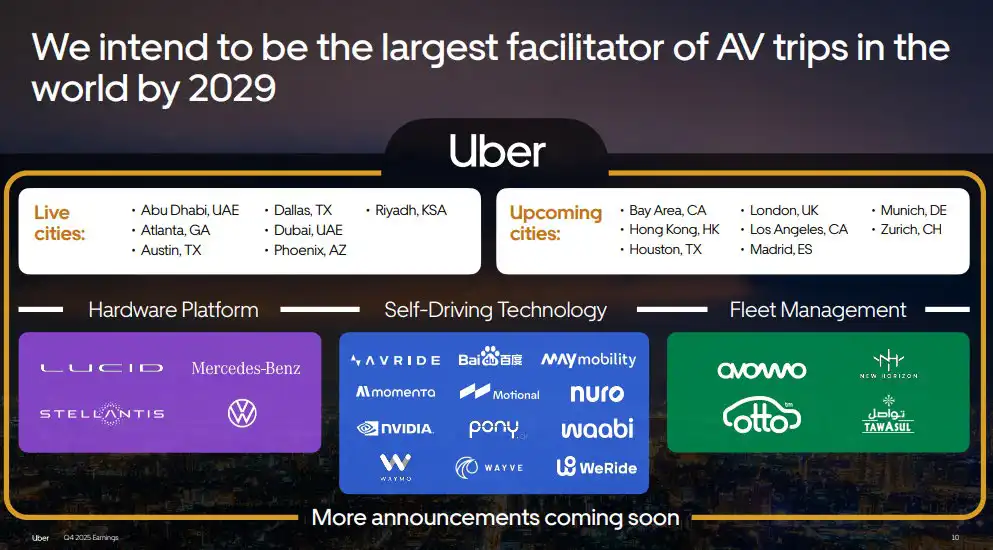
A Few Other Key Updates On Uber One, Advertising, And GenAI
- Uber One grew +55% y/y to 46mn+ members globally, with growth across all regions… “we continue to see significant runway ahead”
- Expanded the program in Q4 by adding Family Sharing, allowing members to extend benefits to another adult and their teens at no addtl cost; Also leveraging Uber’s supply density to deliver “surprise” vehicle upgrades for their most loyal users (i.e., from UberX to Comfort or Comfort to Black)
- 35%+ of Mobility Gross Bookings in the US are now coming from Uber One members, up “significantly” y/y
- Advertising is now generating “well over” $2bn in annualized rev (up +50% y/y) and the oppty size is larger than they previously estimated
- Delivery advertising as a %age of Delivery Gross Bookings crossed 2%…: Driven by continued strong adoption of Sponsored Listings and the expansion of Sponsored Items
- … which years ago Uber said was the potential ceiling for penetration w/ delivery advertising…BUT now seeing that the oppty size is “potentially much larger”
- SMB ad penetration is “a lot” higher than 2%
- Enterprise y/y growth is now outpacing SMBs “by a lot more” which means “there’s going to be a lot of runway”
- G&R and Mobility bizs are “a lot” more nascent, and there’s going to be oppty for them to grow there as well
- Partnered with LiveRamp to launch advanced planning tools that allow brands to close the loop with data-driven audience insights
- Also intro’d Journey Takeovers in the Uber (Mobility) app, unlocking premium, multi-surface real estate that transforms Uber into a comprehensive full-funnel partner across the tablet, app, and map interfaces
- On the genAI front…piloting several first-party agents to improve customer experience and drive marketplace efficiency
- For drivers + couriers: AI assistants to help plan their day and increase earnings
- For consumers: AI agents in both the Uber and Uber Eats apps, which are coming soon
- Also applying genAI to Uber’s core operations, where Merchant Reasoning Agents have reduced false-positive store closures by 15%+, and automated item-image enhancements are increasing storefront conversion
- Beyond Uber’s own products, they’re partnering with leading AI platforms to expand discovery and reach new customers: Have launched integrations with ChatGPT across Rides and Eats, allowing users to discover svs and restaurants directly within the LLM experience before completing checkout in Uber’s apps
Other Quick Earnings Takes: Reddit & Roblox
Amongst the deluge of other earnings prints we wanted to flag some thoughts on Reddit and Roblox…
Reddit:
- Reddit delivered a strong Q4, beating expectations across revenue, earnings, and user metrics while also announcing a $1bn share repurchase program
- Rev growth: +70% y/y (vs +68% y/y in Q3)
- S. revenue reached $583mn, beating cons by +10%
- Q1 guidance was also better than expected
- Q1 sales guidance was +4% ahead of cons
- Q1 adj EBITDA was +6% ahead of cons
- Rev growth: +70% y/y (vs +68% y/y in Q3)
- Global DAUs rose +19% y/y to 121.4mn and beat cons by +1.2% BUT … logged-in DAUq for the U.S. rose +5% y/y to 23mn, slower than the +7% y/y in Q3
- Mgmt emphasized that the distinction between logged-in and logged-out users is becoming less meaningful and plans to “phase out reporting on logged-in and logged-out later this year”
- CEO Steve Huffman highlighted that their partnerships with Google and OpenAI are “very healthy” and that “the conversation is shifting from a purely business deal to more of a product partnership”
- He also noted “GenAI search results will just be better for most queries”
- Unlike traditional search, cutting-edge GenAI search and chat tools excel at providing results that contain “multiple perspectives from lots of people”
->Reddit stock was down -7% in reaction to earnings and closed -22% in the week
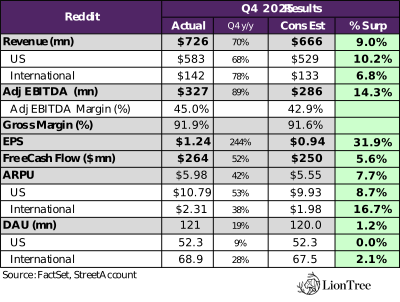
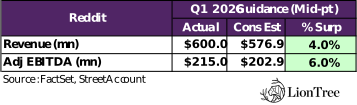
Roblox:
- Net bookings, adj EBITDA, and FCF were nicely ahead of cons expectations (by +6.2%, +21.1%, and over +100%, respectively)
- Q4 revs rose +43% y/y vs +48% y/y in Q3
- Q4 bookings rose +63% y/y vs +70% y/y in Q3
- DAUs beat cons by over +4% (up +69% y/y vs +70% y/y in Q3)
- Hours engaged rose +88%, a decel from +91% y/y in Q3
- 2026 bookings guidance also topped forecasts ($8.28–$8.55bn vs cons of $8.03bn)
- Though H1 is expected to be faster growth than H2
- The forecast for topline growth over the next several years implies a CAGR “in excess of” 20%
- They also continue to expect to deliver long-term margin expansion though, similar to bookings growth, the trajectory will be non-linear due to varying levels of annual investment.
->Roblox stock was up +10% in reaction to earnings and closed +1% on the week
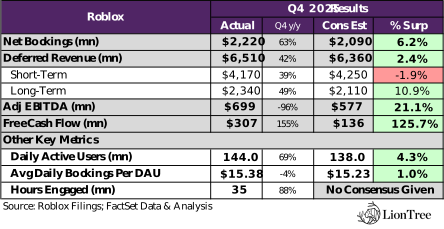
Stock Market Check
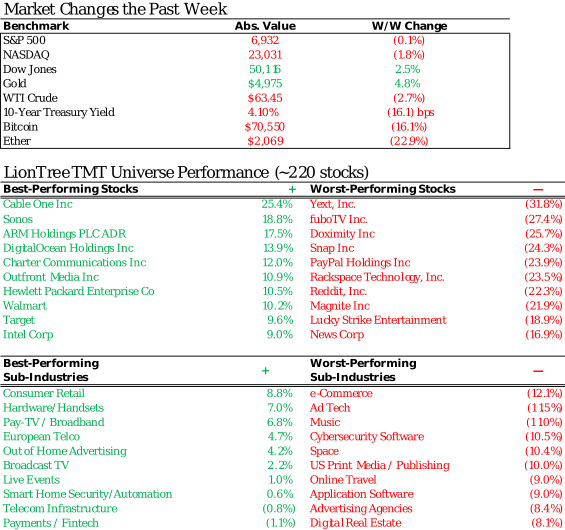
This Week's Other Curated News
Advertising/Ad Agencies/Ad Tech
- Super Bowl ads remain celeb-heavy, but brands are tightening budgets as 30‑second spots cost ~$8–$10mn, pushing all‑in totals to $12–$20mn+. Talent fees are falling, w/ ensembles, cameos and influencers favored over single A‑ AI rises in creative, from deepfakes to tech-led spots, amid an OpenAI‑Anthropic feud. (The Hollywood Reporter)
- Adobe Inc. ramped up advertising in 2025, spending $1.4bn to promote its brand amid rising competition and Wall Street skepticism that the Co is falling behind in the age of AI. Filings show the push was over a 30% yr-over-yr increase versus prior spending and took a far larger share of sales for ads than peers such as Salesforce Inc. and Meta Platforms Inc., signaling an aggressive bid to defend its creative software biz. (Bloomberg)
- OpenAI annc’d a limited beta to test ads on ChatGPT, asking select brands for a ~$200,000 minimum commitment, w/ some pitches reaching $250,000. The Co said the tightly controlled test aims to assess which ad formats add user value. OpenAI declined to share specifics, noting more formats and buying models could cont’d once it learns how ads fit the product without harming the experience. (Adweek)
Artificial Intelligence/Machine Learning
- OpenAI annc’d Frontier, a new enterprise platform to grow its biz mkts. The tool acts as an intelligence layer linking data and systems, enabling AI agents to manage, deploy and complete tasks w/ shared context. The Co said enterprise users drive ~40% of its biz, aiming for ~50% by yr-end. (CNBC)
- Anthropic annc’d plans for a tender offer letting eligible current and former employees sell shares at a valuation of ~$350bn, alongside a funding round that could raise over $20bn. The valuation is pre‑money and may shift based on the fundraising outcome and employee participation. (CNBC TV18)
- Relief in debt mkts after Oracle’s record bond sale has encouraged other big tech cos to seek funding for data-center infra, Goldman Sachs. Estimates put total financing needs at up to $5trn, raising fears of a debt glut. Oracle annc’d a $25bn high-grade deal that drew >$129bn in orders from yield-hungry investors, the largest ever, easing concerns. (Bloomberg)
- At a summit in A Coruna, Spain, only 35 of 85 countries agreed to non‑binding principles on responsible military use of AI tech, while the U.S and China opted out. Attendees cited strained U.S.–Europe ties and uncertainty over future relations. (Reuters)
- Amazon annc’d nationwide US availability of Alexa Plus, its gen AI‑powered assistant, ending Early Access after a Mar. 2025 launch. The svc is now bundled free w/ Prime or offered for $19.99/month, plus a new free chat‑only tier via web/app for non‑Prime users. (The Verge)
- Sam Altman responded to Anthropic’s Super Bowl ads, calling them funny but “clearly dishonest. ” He said OpenAI would never run ads as depicted and accused the rival AI Co of doublespeak. Anthropic’s campaign avoids naming OpenAI, while stating users won’t see sponsored links or ad‑influenced answers. (The Verge)
- Meta Platforms’ next-gen AI model, codenamed Avocado, is showing strong early results, per an internal memo seen by The Information. Developed by Meta Superintelligence Labs, the model completed pre-training and is described as Meta’s most capable base model to date. (Investing.com)
- AI Co Mistral annc’d Voxtral Transcribe 2, a family of speech‑to‑text models delivering state‑of‑the‑art accuracy, diarization and ultra‑low latency. It includes Voxtral Mini Transcribe V2 for batch jobs and Voxtral Realtime for live apps, offered w/ open weights under Apache 2.0. (Mistral AI)
- Alibaba said it will spend 3bn yuan ($431mn) to boost its Qwen AI app during the Lunar New yr, intensifying China’s AI chatbot race. The push, starting Feb. 6, offers dining, entertainment and leisure incentives via digital red envelopes. (Reuters)
- Palantir beat Q4 estimates and annc’d upbeat outlook, driven by accelerating AI adoption and rising U.S. government demand. Adj EPS was $0.25 vs $0.23 est as rev hit $1.41bn vs $1.33bn est, up 70% yr/yr, lifting shares ~5% after hours. U.S. govt and commercial rev rose to $570mn and $507mn. (CNBC)
- Elon Musk annc’d SpaceX is combining w/ AI startup xAI, forming a vertically integrated co spanning rockets, AI, space-based internet and the X social platform, ahead of a potential IPO. Public filings show the deal closed Feb. 2, w/ SpaceX as managing member. (CNBC)
- X annc’d Grok Imagine 1. 0, calling it its biggest leap in AI video gen, enabling 10-sec, 720p clips w/ improved audio. X claims the tool gen’d 1.245bn videos in ~30 days. The launch revives concerns over Grok’s history of producing sexualized and offensive content, despite added safeguards and prior bans in some mkts. (Yahoo)
Audio/Music/Podcast
- Spotify will enter the physical book biz, allowing premium subscribers in the U.S and U.K. mkts to buy hardcovers and paperbacks through in-app purchases w/ partner Bookshop.org. The move expands its audiobook svs, launched in 2022, and aims to appeal to readers who use multiple formats. (The Wall Street Journal)
Cable/Pay-TV/Wireless
- SK Telecom (SKT) reported sharply lower 2025 earnings after a uSIM cybersecurity incident hurt customer trust and weighed on results earlier in the yr. Net profit fell 73% to KRW375.1bn, while consolidated rev declined 4.7% to KRW17.1 trillion. (Telecompaper)
- Shares in Telenor ASA jumped >5% after the Co annc’d a NOK 15bn buyback tied to selling a 30% True stake for ~NOK 39bn, cont’d exit from Asian mkts. Approval is due May 19. Q4 adj EBITDA rose 11.7% organically, group svs rev grew 2.6%, while net income fell on a Pakistan biz loss. (Investing.com)
- KDDI said it will delay disclosure of Q3 results for the fiscal yr ending Mar. 2026, as the filing will exceed the standard 45‑day post‑quarter deadline. The Co cited an ongoing special investigation into suspected improper transactions at a consolidated unit. The probe involves alleged fictitious advertising transactions at Biglobe and its subsidiary G‑Plan, w/ the financial impact not yet finalised. (Telecompaper)
- Sowmyanarayan Sampath, CEO of Verizon’s Consumer Group, is leaving the Co. CEO Dan Schulman annc’d Sampath will stay through Q1 for a smooth transition, w/ Alfonso Villanueva named interim lead. (Fierce Network)
- Vodacom reported strong Q3 results, w/ group rev up 11% yr on yr to ZAR43. 9bn, driven by Egypt. South Africa rev was flat at ZAR24bn, while Egypt rose 43% to ZAR11bn as data use and financial svs grew. Data customers increased 9% to 33.4mn. Including Safaricom, ~100mn financial svs users were connected; segment rev climbed 24.7% to ZAR4.5bn. (Developing Telecoms)
Capital Market Updates
- Sony raised its full-yr outlook after posting record quarterly profit, driven by image sensors and music biz, despite PlayStation 5 unit sales falling 16%. Q3 operating profit rose 22% to ¥515bn, beating estimates, and full-yr forecast was lifted 8%. (Reuters)
- Baidu Inc. annc’d plans for its first dividend and a three-yr stock buyback of up to $5bn, aiming to reward investors after a multiyr share slump. The Chinese AI and search Co said the buyback runs through 2028 and dividends may be regular or special. Shares rose in Hong Kong, though the stock remains well below prior peaks, lagging rivals in AI momentum. (Yahoo Finance)
- Vodafone said it expects results at the high end of guidance for the FY to Mar. 2026 after steady Q3 growth. Q3 rev for the three months to Dec. rose 6.5% YoY to €10.45bn, helped by acquisitions of 3 UK and Telekom Romania, growth in Africa and stable mkts in Germany. Adj EBITDA after leases fell 0.4% to €2.82bn, but rose 2.3% organically, showing continued momentum cont’d into the FY in its largest mkt. (Telecompaper)
- Wall Street’s alt-investment leaders are suffering steep Jan. losses despite stronger biz trends. Dealmaking is rebounding, client payouts are rising and annual profits are expected to increase, yet shares of Blackstone Inc., KKR & Co., Apollo Global Management Inc. and Ares Management Corp. logged their worst first-month decline since 2016. (Bloomberg)
Cloud/DataCenters/IT Infrastructure
- Oracle annc’d plans to raise ~$45bn–$50bn via debt and equity to expand AI-focused cloud infra, tied to contracted demand from major tech clients incl. AMD, Meta, NVIDIA, OpenAI, TikTok and xAI. The Co said the move supports long-term cloud svs growth despite weak near-term momentum, recent share declines, and leverage risks as capacity scales. (Yahoo Finance)
- Liberty Global and Google Cloud annc’d a five-yr strategic AI partnership to embed AI at scale across Liberty’s European ops. Using Google’s Gemini, the collab targets smarter TV, care svs, and new devices for ~80mn connections, while improving network reliability, security, and cost efficiency. (Business Wire)
- KKR and Singtel annc’d a deal to fully acquire ST Telemedia Global Data Centres, buying the remaining 82% stake for S$6. 6bn, implying ~S$13.8bn enterprise value. The KKR-led consortium will own 75% and Singtel 25% of the Co. STT GDC, founded in 2014, provides colocation and connectivity svs across 12 mkts w/ 2.3GW design capacity, supported by cont’d growth in cloud and AI demand. (Singtel)
Crypto/Blockchain/web3/NFTs
- Bitcoin fell below $80,000, dropping 6. 53% to $78,719.63, cont’d a slide to its lowest since Nov. 21. The decline followed news Kevin Warsh was selected as next Fed chair, fueling liquidity worries as he favors a smaller balance sheet. Analysts said tighter cash could hit speculative assets; ether fell 11.76% to $2,387.77, and bitcoin is down ~33% from Oct. highs. (Yahoo Finance)
- Crypto.com annc’d the launch of OG, a CFTC-regulated prediction mkts platform offering sports, financial and cultural event contracts. Powered by Crypto.com | Derivatives North America, OG features a social app experience, transparent forecasts and plans for margin trading. First 1mn sign-ups can earn up to $500. (Crypto.com)
eCommerce/Social Commerce/Retail
- Meituan annc’d it agreed to acquire Dingdong Fresh for $717mn to deepen its fresh grocery push, per a filing. The deal, subject to China antitrust and NDRC clearance, aligns w/ the Co’s long‑term grocery strategy. Analysts say it strengthens instant retail amid fierce competition. (South China Morning Post)
- Walmart crossed a $1tn mkt cap as shares rose ~3% to $127. 71, fueled by e-commerce, marketplace and ad biz growth. The Co joined a tech-heavy group after listing on the Nasdaq 100, beating S&P 500 gains, and attracting higher-income shoppers amid inflation. Stock is up 28% YoY and 14% in 2026; FY2026 Q3 rev rose 5.8% on 27% e-commerce and 53% ad growth. (CNBC)
Electric & Autonomous Vehicles
- Waymo annc’d plans to expand its driverless taxi svs into Sacramento, citing the city’s innovation and safety focus. The Co gave no start date, saying vehicles will arrive first to map streets and learn routes. The move follows DMV approval to operate across more CA mkts. City leaders praised improved mobility and safety, aligning w/ Vision Zero. (CBS News)
- Uber Technologies Inc. annc’d plans to expand robotaxi svs to Hong Kong and Madrid, and launch in Houston and Zurich, per an earnings presentation. Hong Kong will be its first Asian robotaxi mkt. Uber aims to make driverless cars a key growth area and offer vehicles in 10+ mkts by end-2026, working w/ partners incl Baidu and WeRide, while competing w/ Alphabet’s Waymo across US and global mkts. (Bloomberg)
- Waymo annc’d it raised $16bn, valuing the Alphabet unit at $126bn, to accelerate global robotaxi growth. Co chiefs said the funding supports rapid scaling w/ strong safety standards. Waymo now operates in 10 US cities, plans ~20 more in a yr incl London and Tokyo, and delivered 15mn rides in the past yr, providing 400,000 rides weekly as autonomous mobility gains traction. (The Guardian)
FinTech/InsurTech/Payments
- Prediction market operator Kalshi is seeking US regulatory approval to offer margin trading, holding months-long talks w/ the CFTC to attract institutional investors. Margin would let big investors post a fraction of funds, like futures, initially excluding retail traders. The move shows prediction mkts evolving beyond elections and sports. (Financial Times)
- Affirm Holdings annc’d fiscal Q2 results after market close, posting GAAP profit of $0. 38 per share, up 61% yr/yr and above estimates. Rev rose 30% to $1.12bn and GMV climbed 36% to $13.8bn, aided by 159% growth in debit card GMV and rising active users. (Investor’s Business Daily)
- PayPal shares fell 19% after the Co annc’d CEO Alex Chriss’ exit, naming HP’s Enrique Lores president and CEO, w/ CFO Jamie Miller as interim until Mar. 1. The Co forecast 2026 adj profit from low-single-digit % decline to slight rise, below ~8% growth eyed. (Reuters)
HealthTech/Wellness
- Apple dropped plans for an AI health coach that could mimic a doctor, per Bloomberg’s Mark Gurman. The Co had been developing the unannounced Health+ svs to track food, fix workouts w/ iPhone cameras, and suggest lifestyle changes from user data. (Engadget)
Live Entertainment/Theme Parks/Concerts/Experiential
- Live Nation annc’d an agreement to acquire ForumNet Group from Bastogi S. p.A., deepening its investment in Italy’s live entertainment mkts. The deal centers on Unipol Forum, hosting ~2mn fans annually, w/ planned upgrades to fan experience, artist facilities and sustainability ahead of its 2026 Olympic role. (Live Nation)
Macro Updates
- Crypto exchange Gemini said it will cut up to 200 jobs, ~25% of staff, and wind down ops in the UK, EU, other Europe and Australia, focusing on the U. S. and Singapore. The Co aims to curb costs and speed a path to profitability amid a weak crypto mkt. Shares fell ~7%; stock is down ~74% since its Sept. IPO. (Reuters)
- US Cos annc’d the most Jan. job cuts since 2009, per Challenger, Gray & Christmas, underscoring weaker hiring outlooks. Data showed 108,435 cuts in Jan., up 118% yr/yr, while hiring intentions fell 13% to 5,306, the weakest Jan. in 17 yrs. Nearly half came from Amazon (16,000 roles), United Parcel Service (up to 30,000) and Dow (~4,500). (Bloomberg)
- US private payroll growth slowed as ADP said employers added just 22,000 jobs in Jan. , missing forecasts for 45,000. ADP noted job creation weakened in 2025, though wage growth stayed stable. Manufacturing and prof & biz svs cut jobs, while healthcare and education added 74,000 roles. Dec. figures were revised lower as mkts await delayed govt data. (Yahoo Finance)
- The Washington Post annc’d plans to cut one-third of its staff, eliminating hundreds of jobs across the newsroom and other departments to trim costs and reshape coverage. The cuts affect nearly all news teams, including sports, foreign, tech and breaking news, plus biz and tech staff. CEO William Lewis is leading the overhaul. (The Wall Street Journal)
- Chinese tech stocks slid sharply as tax concerns mounted, pushing the Hang Seng Tech Index near a bear mkt. The gauge fell as much as 3.4% and briefly hit a 20% drop from an Oct. peak before closing down 1.1%. Shares of Kuaishou, Baidu and Tencent led losses amid fears of higher value-added taxes on Internet cos, Wall Street volatility, and valuation worries. (Yahoo Finance)
Online Marketplaces/Learning (Real Estate/Education/Jobs)
- Simon, a retail real estate Co, annc’d an over $250mn investment to redevelop three luxury shopping centers: The Mall at Green Hills in Nashville, Cherry Creek Shopping Center in Denver, and International Plaza in Tampa. Following a Nov. acquisition, the plan targets high-growth mkts w/ exterior and interior upgrades, new flagship spaces, and a 50,000 sq ft open-air expansion. (PR Newswire)
Regulatory
- The FDA warned it will act against Co mass‑marketing “illegal copycat drugs” after telehealth Co Hims annc’d a $49 compounded version of Novo Nordisk’s Wegovy. Commissioner Marty Makary said non‑approved drugs’ safety can’t be verified. Hims shares fell ~10% after hours, while Novo vowed legal action, calling the product illegal mass compounding. (Reuters)
- Polymarket founder Shayne Coplan saw fortunes reverse after a DOJ probe into money laundering was dropped. The crypto-based betting Co, valued at $9bn after NYSE backing, gained mkts clout and data deals but faces criticism over anonymous trading, alleged manipulation and near-zero rev as it expands, incl a cleared U.S. app launch. (The Wall Street Journal)
- CFTC Chair Michael Selig said a pending crypto market structure bill could reach President Trump in coming months, making the US a “gold standard” for digital asset regulation. He said clear rules, token taxonomy and defined CFTC vs SEC roles are overdue, arguing many crypto assets are commodities. (Fox Business)
- French police raided X’s Paris office as prosecutors summoned Elon Musk and ex‑CEO Linda Yaccarino for Apr. 20 hearings in a widening probe. The yr‑long case alleges algorithm abuse and fraudulent data extraction, now expanded to Grok over non‑consensual sexual deepfakes and child‑porn imagery. (Reuters)
- Spain annc’d plans to ban social media for under‑16s, saying it will protect children from the digital “Wild West”. PM Pedro Sánchez said platforms must add real age checks, face exec liability for illegal or harmful content, and stop algorithm manipulation that amplifies abuse, disinformation and hate. (BBC News)
Satellite/Space
- SpaceX filed w/ the FCC seeking approval to launch ~1mn solar-powered satellites to host AI data centers in orbit, aiming to cut energy costs and environmental impact tied to terrestrial facilities. The plan relies on Starship’s projected lower launch costs and scale to expand orbital computing capacity, as Musk accelerates competition against major tech firms in the AI race while flexibility mirrors earlier Starlink filings. (Reuters)
- MasOrange annc’d a pilot w/ Starlink parent SpaceX to test satellite direct‑to‑cell svs in Spain, after approval to use MasOrange spectrum in Valladolid. Eligible users may access basic online tools plus SMS/MMS, though timing remains unclear. The move targets coverage gaps via LEO satellites, following Starlink deals in Ukraine, UK and Africa, and cont’d regulatory momentum into 2026. (Telecoms.com)
Social/Digital Media
- TikTok recovered from a brief US usage dip after an ownership change, rebounding to 90+mn daily active users from 86–88mn, per Similarweb. Fears over privacy policy updates, incl. GPS tracking language and CCPA disclosures, plus a multi-day data center outage, drove users to try rivals UpScrolled and Skylight Social. (TechCrunch)
Software
- Liftoff Mobile Inc. , backed by Blackstone, postponed its planned IPO that was set to price that evening, Bloomberg reported. The mobile app marketing Co had aimed to raise up to $762mn. The delay reflects a broader software selloff as investors assess AI’s impact on biz models. Shares of peers like AppLovin fell, pressuring mkts; the offering may be rescheduled later. (Investing.com)
- GitHub annc’d updates to Agent HQ, letting Copilot Pro+ and Enterprise users run multiple coding agents—Copilot, Claude by Anthropic, and OpenAI Codex—in public preview across GitHub, GitHub Mobile, and VS Code. The tools cut context switching, enable async workflows, draft PRs, compare agent outputs, and integrate review, security, and governance into existing dev workflows. (GitHub)
- Snowflake annc’d a $200mn partnership w/ OpenAI to embed advanced AI models into its cloud data platform, aiming to help enterprises analyze data, search docs and automate workflows w/ strong security. The deal expands an earlier tie-up by offering OpenAI models across all three major cloud providers, not just Azure. (Reuters)
- A selloff hit U. S. and European data analytics, software and ad stocks after Anthropic annc’d Claude Cowork plug-ins automating legal, sales, marketing and data tasks. Investors fear AI disruption of professional svs and biz models. Thomson Reuters slid ~18% toward a record one-day loss; RELX and Wolters Kluwer fell ~14% and ~13%. (Reuters)
- Alphabet annc’d plans to sharply expand its India presence as tighter US visa rules pressure tech cos, per Bloomberg. The Google parent has leased one office tower and options on two others in Bengaluru’s Whitefield tech corridor, totaling ~2.4mn sq ft, which could house up to 20,000 staff. (Yahoo Finance)
Sports/Sports Betting
- Genius Sports annc’d a definitive agreement to acquire Legend for up to $1. 2bn, incl $900mn at close and up to $300mn earnout. The deal creates a sports and gaming media platform w/ official data, media and ads, is adj EBITDA and cash flow accretive, targets ~20% rev CAGR to 2028, and adds Legend’s 320mn annual visits and syndication across major publications. (Business Wire)
- ESPN and the NFL annc’d the closing of ESPN’s purchase of NFL Network and related digital assets after regulators approved the deal. ESPN gains NFL Network, NFL Fantasy and cable/satellite distribution of RedZone, while the league takes a 10% equity stake. (ESPN)
- Ampere Analysis said Prime Video will replace DAZN as streaming’s top sports rights spender in 2026, taking 27% of a $14. 2bn total, vs DAZN’s 22%. Amazon is forecast to spend $3.8bn, helped by its 11-yr NBA pact worth ~$1.8bn per season, plus NFL Thursday Night Football and UEFA soccer, boosting subs and retention amid fiercer competition. (Deadline)
Tech Hardware
- Nvidia plans to delay new gaming GPUs amid a memory chip shortage, prioritizing AI processors, according to The Information. Sources say production of GeForce RTX 50 will be reduced, marking the first missed gaming launch in ~30 yr. Micron’s Dec. 2025 pivot added strain. (Yahoo Finance)
- Samsung Electronics will start trial production of Tesla’s AI5 chips at its Taylor foundry, advancing timelines after Tesla completed designs. The Co previously annc’d an AI6 contract worth ~$16.5bn through 2033 and is using a 2nm-class process. Elon Musk is directly involved in exec-level tech meetings. (DealSite)
- NVIDIA urged Samsung to expedite HBM4 supply, seeking delivery even before final quality tests, as AI chip rivals race for memory. Samsung and SK Hynix are finishing tests for mid-Feb. shipment, w/ NVIDIA’s next Rubin GPU set to use HBM4. Memory firms now hold leverage in AI supply chains, controlling the bottleneck. (MSN)
- AMD annc’d a surprise China boost in Oct. -Dec. results, w/ rev up 34% yr/yr to $10.3bn. The Co booked $390mn from MI308 AI chips sold to China, enabled by U.S. export licenses. CEO Lisa Su said orders were placed early 2025 and shipped after approval. (Nikkei Asia)
- Peloton Interactive annc’d job cuts, laying off 11% of staff as part of turnaround efforts, a Co spokesperson. The move marks another step under CEO Peter Stern, who took charge last yr and revamped products while raising hardware and subscription prices to shore up finances. (Reuters)
- Nvidia CEO Jensen Huang denied reports of tension w/ OpenAI, saying the Co’s plan to invest remains on track and “no drama. ” He said Nvidia will invest in OpenAI’s next fundraising round, potentially the largest private raise, after a Sept. letter of intent for up to $100bn tied to AI infrastructure using Nvidia tech. (CNBC)
- Western Digital said its board annc’d $4bn more for share buybacks as demand for memory chips used in AI servers surges. Shares rose ~5% premarket, extending a 57% gain this yr after more than tripling last yr. A global chip shortage has tightened supply, lifting prices and lead times. (Reuters)
- Intel Corp. CEO Lip-Bu Tan said the computer industry’s memory-chip shortage is likely to cont’d for at least two yr, w/ no near-term relief in sight. Speaking during remarks at a Cisco Systems Inc. conference Tuesday, Tan said he spoke to two key memory players, who told him there is no relief as far as they know. (Bloomberg)
- Advanced Micro Devices annc’d Q4 results that beat expectations, but its Q1 outlook disappointed some analysts, sending shares down ~8%. AMD posted $10.27bn in rev and $1.53 EPS, w/ net income rising to $1.51bn. Co forecast Q1 rev of ~$9.8bn ±$300mn. Data center svs rose 39% to $5.4bn on AI GPUs and CPUs, while client and gaming grew 37%. (CNBC)
Towers/Fiber
- Lumen Technologies reported Q4 and yr-end 2025 earnings after completing the sale of its mass mkts biz to AT&T, annc’d as a defining reset. The Co used ~$4.8bn in proceeds to cut debt to < $13bn, lowering interest expense ~45% and improving flexibility. (Fierce Network)
- MTN Group said it is in late-stage discussions to buy the remaining 75% holding in passive infrastructure Co IHS Holdings. According to the group, any bid may be set close to IHS’s last share price on the New York Stock Exchange. That valuation has climbed sharply in recent months, which MTN noted could influence pricing of a potential deal. (Telecompaper)
- TIM SA is in talks to buy back a 51% stake in its Brazilian fibre biz I‑Systems from IHS Towers, a move that would restore full operational control. The stake could be valued at ~900mn reais ($170mn). TIM sold the unit, then FiberCo, in 2021. Talks are non‑binding, w/ no agreed price or structure. Approval could come as early as Feb. 10, though negotiations may cont’d. (Reuters)
- AT&T annc’d completion of its all-cash $5. 75bn acquisition of Lumen’s mass mkts fiber biz, extending AT&T Fiber to 32 states. The Co adds >1mn subscribers across ~4mn locations, boosting access to high-speed internet tech and 5G svs. (AT&T)
Video Games/Interactive Entertainment
- Blizzard is open to genAI, but the Overwatch team opposes using it for player-facing content. In interviews, Blizzard president Johanna Faries said the Co uses a dev-led, values-driven approach, w/ centralized AI governance. Game director Aaron Keller said Overwatch aims to remain a handcrafted universe, avoiding AI-generated heroes, maps, or skins amid wider biz pressure on AI use. (Kotaku)
- Nintendo Co shares slid >10% after missing mkts estimates for quarterly rev, despite an 86% yr-on-yr jump and a 24% profit gain. Investors are focused on rising memory chip costs squeezing margins as DRAM shortages, driven by AI demand, push prices higher. (CNBC)
- Nintendo annc’d a 30‑min Direct Partner Showcase livestream, airing Feb. 5 at 6 a.m. PT/9 a.m. ET, focused on upcoming Switch and Switch 2 titles. As a partner event, it will spotlight third‑party games, not first‑party Mario or Zelda. (Kotaku)
- Valve annc’d its Steam Machine launch, planned for early 2026, is delayed to later in the yr due to memory and storage shortages as firms pivot to AI tech, per a blog post. The Co still aims to ship Steam Machine, a new controller, and Steam Frame VR headset by 1H 2026, but can’t confirm pricing or dates as mkts shift. (Kotaku)
- Egypt’s top media regulator blocked access to the US-owned gaming platform Roblox over child safety concerns, citing inappropriate, violent and unsuitable content for children. The move follows calls from senators and President Abdel Fattah El-Sisi for stronger protections against smartphone risks. (Arab News)
- Epic Games Store exec Steven Allison admitted the launcher “sucks,” citing slow performance and missing basics like a shopping cart. He said Epic prioritized developer tools for ~3 yrs, delaying player-facing fixes.. (MSN)
- Videogame stocks slid as Google annc’d an AI tech model, Project Genie, that turns prompts into playable worlds, rattling mkts. Shares of Take-Two fell 10%, Roblox >12% and Unity 21%. The tool simulates dynamic worlds in real time, challenging engines like Unreal and Unity, promising shorter dev cycles and lower costs. (Reuters)
- AMD CEO Lisa Su said Valve is on track to ship its AMD-powered Steam Machine early this yr, while development of Microsoft’s next-gen Xbox using an AMD semi-custom chip is progressing toward a 2027 launch. She noted the current console cycle will be ~7 yrs old then, a typical refresh point. (Kotaku)
- Nintendo annc’d strong Switch 2 results in its latest earnings. The Co sold 7mn units over the 2025 holiday, lifting six-month lifetime sales to 17mn, nearly double the original Switch pace. Digital game sales rose 14.7% yr/yr to ~58.7% of packaged software. (Kotaku)
Video Streaming
- Roku is testing a refreshed home screen that elevates its free streaming ecosystem. The “Picked for You” tab now features oversized buttons for Live TV Guide and The Roku Channel, pushing them ahead of standard app tiles. The design aims to boost engagement, reduce clicks, and drive ad-supported viewing as ad rev outpaces hardware. (Cord Cutters News)
- Fubo annc’d Q1 results after closing Disney’s Hulu + Live TV merger, reporting 6. 2mn North American subs, down from 6.3mn yr-ago. Overall rev rose 40% to $1.55bn, while pro forma rev grew 6% to $1.68bn. Net loss narrowed to $19.1mn; pro forma adj EBITDA was $41.4mn. The Co also outlined an ESPN reseller deal and ad tech integration w/ Disney. (The Hollywood Reporter)
- Crunchyroll annc’d a price hike of up to 25% weeks after ending its free tier. The anime streaming Co, owned by Sony, raised monthly plans to $10, $14, and $18, w/ current users impacted after Mar. 4. Sony has cont’d consolidating anime mkts, folding Funimation and cutting free access. (Ars Technica)
