


The tech sector continued its downward spiral this week as tech earnings failed to deliver. Nasdaq fell -2% (closing the month of October down -5%). However, market breadth was actually better with the equal-weight RSP outperforming the cap-weighted S&P by nearly 140 bp. Fundamentally, it was a very busy earnings week.
See below for our focus areas in this edition:
- Earnings Scorecard – Week 3
- Alphabet’s Search Slowdown Adds Monetization Concerns To The AI Spending Debate
- Amazon's Accelerating AWS Growth Is Overshadowed By Another Significant Step-Up In AI Spending
- Verizon’s Subscriber Momentum Accelerates…But ARPA & Top-Line Growth Remain The Next Test
- DASH+ CART = The Creation Of A Last Mile Behemoth
Last plug for the Fall Edition of our quarterly LionTree’s Sector Insights & A Look Ahead deck. It is accompanied by a ~20-minute video narration, both of which can be accessed HERE.
Have a nice weekend.
Best,
Leslie

Earnings Scorecard – Week 3
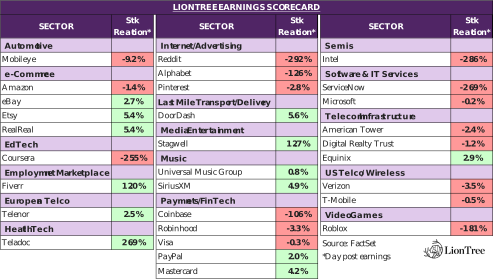
Earnings ramped up this week with 30 companies in our LionTree Universe reporting their third quarter results (up from 13 last week). In a reversal from last week, stock reactions were biased to the downside, as 17 companies (57%) traded down post their print, and 13 companies (43%) traded up. The worst performer was Reddit, which plunged -29% after its report, and the best performer was Teladoc, which was up +27%.
It was a tough week for Big Tech, as Amazon fell -1.4% (see Theme #3) and Alphabet fell a more massive -13% (see Theme #2). Telcos were also not spared this week, with Verizon down -3.5% after it reported (see Theme #4). Finally, DoorDash had a big announcement to make alongside its third quarter results, which drove the stock up +5.6% (see Theme #5).
The table below includes select mid- and large-cap TMT and consumer companies in our LionTree stock universe that reported this week.
Alphabet’s Search Slowdown Adds Monetization Concerns To The AI Spending Debate
First Meta…then Alphabet. Meta’s solid quarter was overshadowed by heavier AI spending, rising financing obligations and negative FCF. It was “ditto” for Alphabet but also add slower Search growth and lower AI Mode and the reception was even colder, with Alphabet’s shares suffering their worst day on record Thursday and wiping out ~$500bn in market value. Search rev growth slowed to +12% y/y from +17% in Q2, and while FX was the largest driver, alongside retail and media spending dynamics, lower monetization of AI Mode queries also contributed. The Co is expanding ads within AI Overviews and AI Mode, though mgmt expects further FX pressure and tougher Search comparisons in Q4. To add more salt to the advertising wound, YouTube ad rev growth also decel’d seq, with ad rev up +9% y/y versus +13% in Q2.
As has been the biggest focus across the sector, the cash demands of the AI buildout also continued, with CapEx and TPU inventory build contributing to a wider FCF outflow of -$9.1bn in Q3. A $5.2bn payment for the 2018 EC fine weighed on cash generation as well. Full-year CapEx guidance was maintained, but mgmt reiterated that spending will increase significantly in 2027 and FCF will remain under pressure.
That said, there were positives, particularly in Cloud, where rev more than doubled, op income more than tripled and backlog reached $561bn. Demand continued across AI infrastructure, AI solutions and core GCP, while TPU system sales contributed meaningfully and are expected to ramp further in 2027. Cloud margins also expanded, BUT third-party capacity only came online at quarter-end, so previously flagged margin pressure will largely be seen in Q4 as usage ramps. There was also progress across Gemini, with the Argon and Carbon launches, measurable internal coding gains and plans for broader consumer-agent deployment later this year.
As always, there was a lot covered. See below for what we viewed as the most important updates and takeaways and see Theme #3 for the update from Amazon, which also reported this week.
-> Alphabet’s stock plunged -12.3% post its report and also ended the week down -12.3%; YTD, the stock is down -11.3%
It Was A Tough Q3 For Alphabet
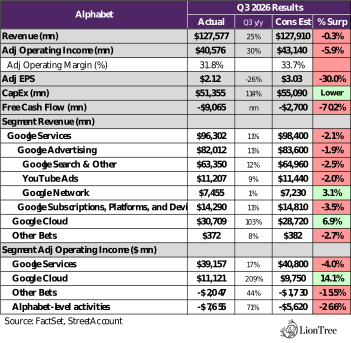
- Q3 rev grew +25% y/y or +25% FXN (vs +24% y/y or +23% FXN in Q2) and MISSED cons by -0.3%
- Google Cloud drove the upside, while Google Services MISSED by -2.1%
- Adj op income grew +30% y/y (in-line w/ Q2) and MISSED cons by -5.9%; Op margin of 31.8% was below cons 33.7%
- Once again, Cloud op income beat, while Google Services and Other Bets missed
- EPS of $2.12 was well below cons $3.03
2026 Capx Was Maintained BUT 2007 Spending Will Increase Significantly & FCF Will Remain Under Pressure
- Q3 CapEx of $51.4bn was below expectations of $55.1bn, up +114% y/y (vs +100% y/y in Q2), with the “vast majority” supporting AI infrastructure
- ~65% of technical infrastructure investment was in servers/networking and ~35% was in data centers
- CapEx OUTLOOK…2026 guidance was MAINTAINED at $195–205bn + reiterated that 2027 CapEx will “increase significantly”
- Will provide further details on 2027 CapEx in Q4 call
- Q3 FCF loss of -$9.1bn was meaningfully lower than than cons -$2.7bn, widening from -$5.9bn in Q2
- Driven by continued investments in CapEx, as well as the TPU inventory build and a $5.2bn cash payment for the 2018 EC fine
- Continue to expect long-term AI returns BUT CapEx and TPU inventory build will continue to pressure FCF
- Expects ROIC to remain “meaningfully above our cost of capital” through the investment cycle, alongside strong operating cash flow
- Capital structure continues to expand to support AI investment…
- Long-term debt grew to $125.1bn from ~$98bn in Q2; The Co issued senior unsecured notes for $28.7bn in net proceeds during Q3
- Raised $12.4bn through the ATM common-stock program in Q3, with $27.6bn of issuance capacity remaining at quarter-end
- Generated $42.3bn of cash from operations in Q3 (vs $39.1bn in Q2), BUT capx of $51.4bn exceeded that cash generation
- Cash & marketable securities of $265.1bn (vs $242.5bn), including $90.4bn of marketable equity securities
Cloud Revenue Growth Accelerates As Margins Expanded
- Cloud rev BEAT cons by +6.9% and grew +103% y/y (accelerating from +82% in Q2)
- GCP generated the “vast majority” of segment rev, w/ strength in AI infrastructure, AI solutions and core GCP; TPU system sales also contributed meaningfully
- Growth ex-TPU system sales remained “incredibly strong”
- OUTLOOK…expect TPU system sales to continue to scale in Q4, followed by a “meaningful” ramp in 2027
- Cloud op income more than tripled y/y to $11.1bn and BEAT cons by +14.1%; Margin reached 36.2% vs yr-ago 23.7%
- Third-party bridging capacity came online only at the very end of Q3 and therefore had “limited” negative impact to margin in the qtr
- OUTLOOK…third-party compute usage will ramp in Q4 to address supply constraints, creating near-term margin headwinds
- Backlog reached $561bn, up +$47bn seq, with the majority related to typical GCP contracts
- Just over 55% is expected to convert to rev over the next 24 months, up from just over 50% at Q2
- TPU distribution is expanding through partnerships and easier deployment
- Oracle and Crux AI partnerships broaden access; Torch TPU, developed with Meta, lets customers deploy PyTorch workloads using familiar tools
- TPU systems inventory is backed by signed contracts; Deployment in customer/third-party facilities reduces Alphabet’s need to pre-build hosting capacity
- Cloud adoption and revenue streams continue to broaden
- Cloud now has 18 product lines generating more than $1bn each in annual rev
- Nearly 90% of the Fortune 100 use Gemini Enterprise; Customers that used Gemini Enterprise in Q3:25 more than quadrupled spend y/y
- Across all AI services, the Co has sold more than 100mn seats for knowledge work
- Gemini adoption is also driving demand for agents, data analytics, cybersecurity and supporting infrastructure
- Agents: Gemini Agent combines research, coding and workflow automation through one agent/API/prompt window across Cloud
- Tata Steel deployed 300+ agents in nine months and cut customer service times by 50%; Ulta Beauty’s AI shopping assistant delivered 3x the conversion rate of traditional browsing
- Data analytics: BigQuery query speeds improved >40% y/y while processing costs fell >50%; Knowledge Catalog and Lakehouse help agents access Co data
- Deutsche Telekom is unifying 40+ legacy systems; Etsy runs critical data joins up to 60% faster after migrating to a unified Lakehouse
- Cybersecurity: Gemini Flash cyber models identify vulnerabilities across 20 programming languages and patch 2.6x more reliably than other models
- >95% of Wiz customers adopt AI-powered features
- Agents: Gemini Agent combines research, coding and workflow automation through one agent/API/prompt window across Cloud
Gemini 4 Launches Bring New Coding Gains As Consumer Agents Move Toward Broader Rollout
- Gemini 4 moved from development into launch, with Argon followed by Carbon
- Gemini 4 Argon launched two weeks ago; First-week developer-platform usage ramped 3.5x faster than Gemini 3, despite capacity constraints
- Carbon ranked #1 on the updated Artificial Analysis Intelligence Index; Initial access is limited to trusted cyber defenders, with US government testing underway
- Internal deployment is producing measurable coding gains
- Teams across Chrome, Ads and Search shipped +35% more code with -30% fewer errors using Argon
- Expect further acceleration in model-training and launch velocity over the next 12 months
- The enterprise-first Gemini Agent experience is expected to reach consumers later this year, starting with the Gemini app
- Working on distilled Carbon models to deploy efficiently at billion-user scale, balancing compute, latency and quality
- Agents will act as a unifying layer across Search, Gemini, Chrome, Android and Workspace
- Usage continues to scale…first-party model APIs process nearly 32bn tokens/minute, >4x y/y; The Gemini app reached 1bn users (up from 950mn in Q2)
Turning To The Advertising Side Of The Biz…Search Growth Slowed And Missed Expectations With FX And Tougher Comps Set To Pressure Q4
- Search rev growth decel’d from +17% y/y in Q2 to +12% y/y in Q3 and MISSED cons by -2.5%
- What drove the slowdown?
- FX was the single largest driver of the growth deceleration
- “Strong” growth in AI Mode also affected rev growth b/c monetization in AI Mode is lower BUT the majority of AI Mode queries are incremental, “creating more monetization opportunities over time”
- Also called out some vertical-specific dynamics –
- Retail remained the largest growth contributor, followed by finance, BUT EU de minimis changes affected some APAC retail advertisers
- Media & entertainment spend normalized after an unusually strong World Cup-driven Q2, when June had more matches and ad budgets than July
- Paid clicks grew +8% vs cons +9.9%; CPC grew +4% vs cons +3.4%
- What drove the slowdown?
- Q4 OUTLOOK… Search growth will face a slightly larger FX headwind and tougher y/y comparisons as the Co laps the acceleration that started in Q3:25
- AI features are enabling longer, more varied searches
- AI Mode queries are ~3x longer than traditional searches; 1 in 5 uses voice, images or documents
- Visual searches now exceed 50bn/mo
- Now expanding AI Mode ads internationally and into multi-turn conversations (with follow-up questions) in the US
- The rollout follows tests showing similar click-through rates for sponsored and organic product listings within AI Mode
- AI advertiser tools expanded across creative generation, campaign testing and ad relevance
- AI creative tools are now integrated directly into AI Max; Gemini generated >1.5bn campaign assets in Q3, up >7x y/y
- New A/B tests allow advertisers to compare budgets and ROI targets across multiple Search campaigns
- Separately, the largest Product Listing Ads update in a decade drove +19% higher satisfaction and cut dissatisfaction by more than half
- Universal Cart launched in Q3 as Google expands direct checkout and develops agentic monetization
- Supports shopping across Google while preserving retailer customer relationships and reducing abandoned carts
- Universal Commerce Protocol now enables direct checkout for hundreds of thousands of brands, including Chewy, Nike and Tapestry, alongside the Agent Payments Protocol
- Agentic experiences are “clearly additive,” with opportunities in ads, subscriptions and other payment models, not just automating purchases
YouTube Ad Growth Also Slowed
- YouTube ad rev growth decel’d from +13% y/y in Q2 to +9% y/y in Q3 and MISSED cons by -2.0%
- Brand was the largest growth contributor; Living room accounted for >1/3 of YouTube ad rev
- YouTube subscriptions rev continue to grow faster than ads, led by Music and Premium (similar commentary to last qtr)
- Surpassed 150mm YouTube Music and Premium subscribers globally, including trials
- Expanded shopping and creator tools to support monetization and engagement
- Amazon joined YouTube Shopping, allowing US creators to tag products in videos, Shorts and livestreams; >1.3mn channels participate globally
- New creator tools include AI-powered creation/editing, topic-based custom Home feeds and Short Series with seasons, episodes and sequential playback
Amazon's Accelerating AWS Growth Is Overshadowed By Another Significant Step-Up In AI Spending
Following Alphabet’s results Wednesday night, Amazon was also not spared from concerns over the ever-mounting cost of the AI buildout, as accelerating cloud growth was overshadowed by plans for another significant step-up in spending. Q3 results were mixed, with revenue ~in-line and operating income ahead of expectations, alongside record operating margins. AWS remained the standout, accelerating for the sixth consecutive quarter to +39% y/y, its fastest growth in ~5 years, and Amazon outlined a path to $1 trillion in annual revenue over the next 5-10 years. Yet capturing that growth requires substantial investment. Q3 CapEx more than doubled y/y to $77.3bn, and came in ~32% above expectations, with the ~$220bn spending outlook for 2026 reaffirmed and investment expected to increase “meaningfully” in 2027. Q4 guidance also underwhelmed, with total revenue ~in-line at the midpoint but operating income below consensus, partly reflecting continued expenses associated with Amazon Leo.
Despite the elevated spending, the Co pointed to accelerating CapEx payback and expressed confidence that these investments will generate significantly greater revenue and FCF over time. That conviction comes alongside continued growth in enterprise AI adoption, with Bedrock token volumes growing nearly 17x y/y and revenue commitments for both Graviton and Trainium up more than 20x y/y. Outside of AWS, results were more mixed, with North America and International revenue falling short of expectations and Advertising growth decelerating sharply to +12% y/y from +26% in Q2, as the shift in Prime Day timing weighed on growth across the business.
See below for more.
-> Amazon’s stock fell as much as -5.9% in reaction to its print, but ended the day after its report down -1.4%; The stock closed the week down -3.1%, but the stock is still up +4.1% YTD
It Was A Mixed Q3 For Amazon
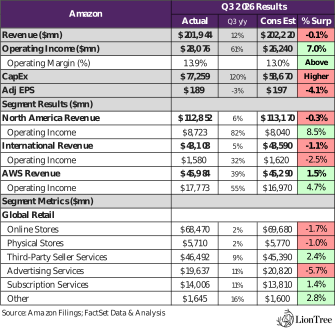
- Revs were ~IN-LINE: Grew +12% y/y (+13% FXN), which was a decel from +20% y/y (+20% FXN) in Q2; The decel is largely due to Prime Day timing (shifted to Q2 in 2026 vs Q3 in 2025) …adjusted for that shift, Q3 growth would have been ~400bp higher
- By segment…
- NA segment MISSED by -0.3%: Sales grew +6% y/y vs +16% y/y in Q2
- Intl segment MISSED by -1.1%: Sales grew +5% y/y (+8% FXN) vs +15% y/y in Q2
- AWS BEAT by +1.5%: Rose +39% y/y vs +37% y/y in Q2…the fastest growth in ~5 yrs, accel’ing for the 6th consecutive qtr
- By segment…
- Op income BEAT by +7.1%…with op margin of 13.9%, the Co’s highest ever, up +420bp y/y and +20bp q/q
- By segment:
- NA op income of $8.7bn BEAT by +8.5%; op margin of 7.7%, down from 7.9% in Q2
- Intl op income of $1.6bn MISSED by -2.5%; op margin of 3.7%, down from 4.1% in Q2
- AWS op income of $17.8bn BEAT by +4.7%; op margin of 38.7%, up +440bp y/y
- By segment:
- EPS of $1.89 MISSED cons $1.97 and declined -3% y/y
- Decrease is driven primarily by $9.5bn in pre-tax gains in Q3:25 from Anthropic investments included in non-operating income which did not recur in Q3:26
- Q3 CapEx of $77.3bn was well ABOVE cons $58.7bn
Q4 Guidance Was Underwhelming
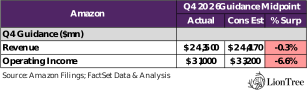
- Q4 rev guidance of $240-247bn (vs cons $244.2bn) implies +12-16% y/y growth, roughly in-line at the midpt
- The Co estimates an ~60bp unfavorable FX impact y/y based on current exchange rates
- Q4 op income guidance of $28.5-33.5bn was below cons $33.2bn at the midpt
- Assumes no impact from energy derivative remeasurements and no additional acquisitions
- Also to flag…mgmt called out Amazon Leo’s impact on Q4 guidance: Amazon Leo’s commercial service is on track to begin initial service this yr, and the Co expects to begin capitalizing certain costs in Q1 of next yr…as a result, the majority of Leo-related costs will continue to be expensed in Q4
2026 Capx Was Reiterated Despite Higher Spend In Q3, While 2027 Spending Will Be Up “Meaningfully”
- Q3 CapEx of $77.3bn was +32% above cons $58.7bn and more than doubled y/y (+120%)
- Primarily related to AWS and AI as the Co invests to support strong customer demand
- Though 2026 CapEx guidance of ~$220bn was REAFFIRMED…
- After being raised from $200bn to ~$220bn last qtr
- …and expect to spend “meaningfully more” in 2027
- “Even with heightened component costs like memory…we continue to accelerate our CapEx payback and have even more conviction than we already had” that the investment will yield much larger revenue and FCF than imagined a couple yrs ago
AWS Accelerated For The 6th Straight Qtr To +39% Y/Y…The Co Sees A Path To $1 Trillion In Rev Over The Next 5-10 Yrs
- AWS rev of $46.0bn BEAT cons by +1.5% and grew +39% y/y, accelerating from +37% in Q2…the fastest growth in ~5 yrs
- Seeing strong growth in both AI and non-AI services
- AWS op income of $17.8bn BEAT cons by +4.7%
- Profitability driven by disciplined efficiency gains, capacity optimization, custom chips in cost structure, and managing fixed costs
- AWS op margin came in at 38.7%, reflecting “strong” growth and focus on driving efficiencies
- Looking ahead… not guiding on AWS margin but noted that the outsized growth of AI puts margin pressure on the biz as a whole (b/c AI margins are lower) and component costs like memory are a headwind, BUT they are happy w/ the progression in both core and AI margins
- AWS backlog reached $578bn, growing triple digits y/y
- Mgmt outlined the long-term vision for AWS…believes it can grow 40%+ y/y in 2027 and 2028 and be a $1 trillion revenue biz in the next 5-10 yrs
- More definitive vs last qtr when mgmt said it could “very possibly” be $1 trillion annual revenue biz
- “We’re in the very early days of this inflection. Our strategy is working, and I expect it will for the foreseeable future”
Bedrock Continues To Scale Rapidly As Enterprise AI And Agent Adoption Accelerate
- Bedrock continues to scale rapidly…Fortune 500 companies spending nearly 7x more y/y w/ total token volume growing nearly 17x y/y
- Fastest growing multibillion dollar service in AWS’s history
- Recently added OpenAI models to Bedrock, plus managed versions of Kimi, GLM and SpaceX models
- AWS Continuum was launched to discover, prioritize, validate, and remediate code vulnerabilities at machine speed
- Already being used by Capital One, IBM, Infor, Luminate, and Robinhood
- In Q3, annc’d integration into Anthropic’s Claude Code, OpenAI’s Codex and AWS’s CUR…”the interest from customers exceeds anything we’ve ever seen for a new security service”
- Agents continue to be deployed at “accelerating rates”, w/ many built on Bedrock agent core building blocks
- Tens of thousands of customers currently use Agent Core, deploying 2x more agents w/ it in Q3 than the prior three qtrs combined
- Turnkey agentic services also gaining: Kiro for coding, Amazon Connect for Contact Center agents, and Amazon Transform for migrations
- Amazon Quick (AI work companion) is growing “very rapidly” w/ large enterprises like Mondelez, EchoStar, 3M, Southwest Airlines, and DXC adopting it
Custom Chips Demand Remains Robust, With Revenue Commitments Up 20x+ Y/Y For Both Graviton And Trainium
- The chips biz continues to grow triple-digit percentages y/y (similar to last qtr), and revenue commitments for Graviton and Trainium have each increased more than 20x y/y
- Graviton5 launched w/ TorchNeuron open sourced so developers can run existing PyTorch code on Trainium w/o rewriting
- Graviton is the strongest CPU chip for post-training reinforcement learning and agent tool use, offering up to 30-40% better price performance than alternatives
- Customers using custom silicon saved more than $2bn in Q3 alone
- Demand for prior generation chips “remains strong” even as new generations launch
- After the launch of Graviton5, backlog for prior generation Graviton instances still more than doubled q/q
- Short-term capacity for prior generation training instances sold at a premium compared to H1
- Trainium demand is “so strong” that the Co intends to make it available outside of AWS in late 2027
- The Co sees external chip sales as a “very significant business” starting in late 2027
- “Our ability to create price-performance, scalable chips is going to be a very significant strategic advantage”
- On the balance of internal use vs external chip sales… it is a trade-off they will be “thinking through every year” but believes both will be “very significant”
Online Stores Missed As Prime Day Timing Weighed On Growth…BUT Grocery, Delivery Speed & Pharmacy Continue To Inflect
- Had their fastest Q3 ever globally for same-day and overnight delivery, delivering 1.5bn+ items same-day or overnight in Q3
- Amazon Now (sub-30-min delivery) is now available in 450+ towns and cities, w/ items ordered through it up 10x y/y
- On track to reduce cost to serve per unit for the 4th consecutive yr
- Shipping costs incr’d +11% y/y vs +12% unit growth; excl fuel and line haul inflation, shipping costs grew 8%, or ~400bp slower than unit growth
- Increasing speed is fueling the Grocery biz, which continues to inflect
- Fresh groceries and everyday essentials grew about 3x faster than the rest of the store in Q3, representing about half of all units sold
- Customers who shop perishables w/ same-day delivery buy nearly 7x more everyday essential units than those who don’t
- Active grocery customers shopped nearly 4x more non-grocery categories like home and apparel, and spent over 2x more on those categories
- Amazon Pharmacy growth is also accelerating…customers using it up 60%+ y/y, with growth accelerating each qtr through 2026, and repeat customers grew 50%+ y/y
- Now offering 3x prescription delivery in 350+ cities
- Robotics and AI are delivering “measurable” gains in productivity and safety, “which we’ll expect to compound in the future”
- Doubled the fleet of robotic arms (Cardinal, Sparrow) in 2026
- Also developing robotics foundation models that enable faster programming and teach robots increasingly complex physical tasks, with the goal of delivering useful robotics at scale
- Have over a million robots now in the fulfillment network
- On the agentic front…400mn+ customers have used Alexa for Shopping, their agentic shopping assistant, in the last 12 months, with customer interactions up 570% y/y
- US customers using Alexa for Shopping are spending 50% more per order than those who don’t
Ad Revenue Growth Decelerated Seq But Is Expected To Reaccelerate in Q4
- Ad services rev of $19.6bn grew +12% y/y, which was a notable seq decel from +26% y/y in Q2
- What drove the decel?
- Prime Day shifted to Q2 (from Q3 in 2025), creating an ~850bp sequential headwind to Q3 ad growth
- NBA on Prime moved from Q2 to Q4 timing
- Lapping of search engine marketing changes from Q3:25 that boosted the comp
- What drove the decel?
- Is agentic shopping meaningfully impacting Amazon Ads? No
- “Few customers are doing much shopping this way yet, as the experience is still not great, nor more convenient than coming to a retailer directly to research or one-click order there”
- LOOKING AHEAD…advertising revenue expected to return to high-teens y/y growth in Q4 as the Prime Day and NBA timing headwinds reverse
A Quick Update On Prime Video And Devices
- Prime Video is “not profitable in its own right” …it has “emerged as a significant business with a revenue run rate in the tens of billions of dollars”
- “Momentum” from hit shows incl Carrie, The Summer I Turned Pretty, The Boys, Off Campus, Reacher and Fallout, plus breakout movies like Project Hail Mary
- Along w/ “compelling” live sports portfolio incl Thursday Night Football (best start ever in 2026), NBA on Prime, NASCAR, the Masters, and UEFA Champions League Soccer
- Also launched their the most “powerful” devices lineup yet, w/ 34 new products across Echo, Kindle, Alexa Tablets, Fire TV, Ring, and Bee
- “It’s early, but we’re off to a very strong start and excited for more customers to get their hands on these as we head into the holidays”
Verizon’s Subscriber Momentum Accelerates…But ARPA & Top-Line Growth Remain The Next Test
Following AT&T’s report last week, Verizon was the next of the big 3 telcos to post results, and the Co’s qtr was solid, as adj EBITDA, adj EPS and FCF all beat the Street, though total rev missed. Guidance was raised for the third consecutive qtr, w/ this qtr’s raises covering postpaid phone net adds, adj EPS, operating cash flow and FCF, and mobility & bband service rev growth was tightened to the upper half of the +2.5-3% range.
The subscriber story was a notable bright spot, as postpaid phone net adds of +406k came in at more than double expectations and net account adds were the best in over a decade. “No free lines” were behind those adds and promo cost of acq was down -41% y/y in the qtr. Having added “a tremendous amount of value” over the past yr, the Co now sees “potentially room” for price increases, which could matter as postpaid ARPA missed cons and declined -1.9% y/y. Postpaid phone churn also ticked up seq to 0.94%, though it improved -4bp y/y. In broadband, FWA net adds missed by ~19% amid a continued mix shift toward fiber and the Co’s decision to stop selling FWA where it can’t deliver the speeds customers expect, a gap it aims to close w/ a new mmWave 1-gig FWA product expected to expand its high-speed footprint by 10-15mn premises over the medium term.
Looking further out, AI Connect is becoming a more tangible growth driver, and like AT&T, Verizon is counting AWS as a hyperscaler customer. A new $2bn+ AWS deal brings signed contracts to ~$4bn in just 6 months, alongside early wins in edge computing, with rev contribution beginning in 2027. As at AT&T, SpaceX was a focus amongst investors. Mgmt said it is operating under the assumption that SpaceX will “execute flawlessly” and is taking its exploration of a terrestrial network “quite seriously,” but argued that such a build would take at least 4-6 yrs and $300-500bn, and reiterated there are “no backdoors” to Verizon’s agreements letting other carriers use its network.
See below for the key takeaways.
-> Verizon fell -3.5% post its print, but ended the week up +0.2%; YTD, its stock is up +9.8%
Q3 Revenue Misses On Lower Equipment Sales, While Adj EBITDA, Adj EPS And FCF Beat…Record EBITDA Margins Once Again
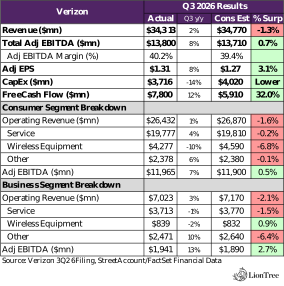
- Total revs MISSED by -1.3%: Grew +1.5% y/y to $34.3bn
- Mobility & bband service rev grew +2.9% y/y (vs +2.8% in Q2 and +1.6% in Q1) offset by equipment rev falling -9% y/y amid a 20%+ reduction in upgrade volumes
- Adj EBITDA of $13.8bn BEAT by +0.7% and grew +8% y/y…margin of 40.2% was AHEAD of cons 39.4% and up +240bp y/y, the Co’s highest reported
- By segment – Consumer & Biz revs MISSED, while adj EBITDA BEAT
- Consumer revs MISSED by 1.6% (+1.3% y/y); Adj EBITDA BEAT by 0.5% (margin of 45.3% vs yr-ago 43.0%)
- Consumer mobility & bband service rev of $19.8bn was in-line w/ cons and grew +3.6% y/y; wireless equipment rev of $4.3bn MISSED by -6.8%
- Biz revs MISSED by -2.1%; Adj EBITDA BEAT by +2.7% (+13% y/y; margin of 27.6% vs yr-ago 25.1%)
- Biz mobility & bband service rev of $3.7bn MISSED by -1.5% and declined -0.8% y/y
- Consumer revs MISSED by 1.6% (+1.3% y/y); Adj EBITDA BEAT by 0.5% (margin of 45.3% vs yr-ago 43.0%)
- Adj EPS of $1.31 BEAT cons $1.27
- CapEx of $3.7bn was BELOW cons $4.0bn
- FCF of $7.8bn was significantly ahead of cons $5.9bn (+32%) and grew +12% y/y…highest qtrly FCF since 2020
Raised Guidance For Third Consecutive Qtr Across Postpaid Net Adds, Adj EPS And FCF While Narrowing Service Rev Growth To Upper Half Of Range
- RAISED 2026 postpaid phone net adds guidance to 1.1-1.2mn (from “upper half” of 750k-1mn)
- “More than three times last year’s result”
- RAISED 2026 adj EPS growth guidance AGAIN to +7-7.5% y/y, or $5.04-5.06 (up from +6-7%, or $4.99-5.04), ahead of cons $5.00
- Third qtr in a row of raising EPS guidance
- RAISED 2026 FCF growth guidance to “approach 12%” y/y (up from +9-10%)
- FY FCF expected to be the Co’s highest since 2020
- NARROWED 2026 mobility & bband service rev growth guidance to the “upper half” of the +2.5-3% range
- Q4 mobility & bband service rev growth expected to accelerate to ~4% y/y
- Wireless service rev expected to return to y/y growth in Q4
- MAINTAINED 2026 CapEx of $16-16.5bn
- $9bn cost reduction plan across OpEx and CapEx “remains fully on track”, w/ benefits materializing earlier than expected
- On track to meet this year’s $5bn operating cost efficiency target
- Frontier integration remains on track to deliver $1bn+ in annualized operating cost synergies by 2028
- Addtl cost efficiencies expected in 2027
Postpaid Phone Net Adds More Than Doubled Expectations And Saw Best Account Growth In Over A Decade, While Acquisition And Retention Costs Fell Y/Y
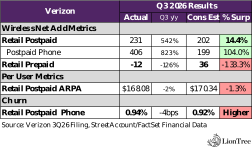
- Postpaid phone net adds of +406k significantly BEAT cons of +199k, up 820%+ y/y from +44k…strongest Q3 in 5 yrs
- Consumer drove +266k postpaid phone net adds, its best Q3 in 5 yrs; Biz added +140k mobility net adds w/ the public sector returning to growth
- Gross adds grew +11% y/y, driven by new-to-Verizon customers, w/ strong performance in single and two-line accounts where VZ has historically under-indexed
- Postpaid net account adds of +137k were the best qtrly result in over a decade…expect positive account growth again in Q4
- Net adds are “growth that pays”… “Every new line we added delivered revenue. There were no free lines”
- Operating the way it did a yr ago, the Co could have added “multiple hundreds of thousands more net adds” by giving away free lines and free phones
- “We are not buying customers”
- Customer economics continue to improve sharply; promo cost of acq declined -41% y/y and cost of retention declined -30% y/y
- Upgrade rate fell to 2.6% (from 3.3% y/y)
- Lower upgrades expected to continue in Q4
- Postpaid phone churn of 0.94% was slightly worse than cons 0.92% BUT improved -4bp y/y; consumer postpaid phone churn of 0.87% also improved -4bp y/y
- Up seq from 0.92% overall and 0.84% consumer in Q2
- Expect churn can continue to decline y/y and “even do better than where we are”
- Postpaid ARPA of $168.08 was below cons $170.34 and down -1.9% y/y
- Retail prepaid net adds of -12k MISSED cons of +36k; prepaid phone churn of 3.80% was ~in-line w/ cons
Value Proposition Continues To Drive Subsidy-Free Growth And Mgmt Now Sees Potential Room For Price Increases
- Simplicity, Verizon One and the loyalty program continue to deliver beyond expectations, w/ loyalty enrollment scaling and customer satisfaction metrics improving
- Reiterated shift away from promotions and free phones, which give “no one in the market any competitive advantage”
- “Anybody launches something against us, we can respond in two hours. And if somebody tries to hit us, we hit back harder”
- On pricing, the Co has added a “tremendous amount” of value over the past yr and “there’s potentially room for us to adjust that price-to-value equation by increasing pricing as well”
- “I think we’re in a place where we can start to think about that”
FWA Misses Amid Deliberate Shift Toward Customer Speed Requirements…But A New mmWave 1-Gig Product Is A “Technological Breakthrough” That Expands The High-Speed Footprint
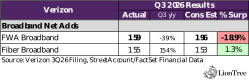
- Broadband net adds of +314k in total as FWA missed but fiber beat
- FWA net adds of 159k MISSED cons of 196k
- Fiber net adds of 155k BEAT cons of 153k…fiber now makes up nearly half of bband net adds
- FWA pullback was a deliberate choice…“where we can’t deliver the speed a particular segment of customers expects from Verizon, we won’t sell it”
- “We should never drive for a net add metric that runs counter to our customer-first philosophy”
- Developed a 1-gig FWA product using the Co’s 1,700MHz of millimeter wave spectrum (2x that of any competitor), w/ rollout starting in Q4 and scaling market-by-market through 2027 and beyond
- Targets an incremental 10-15mn premises w/ 1-gig speeds through FWA on top of the 40-50mn fiber build…a medium-term target of 50-65mn premises passed w/ 1-gig+ speeds
- Goal is to have the nation’s largest 1-gig+ footprint
- Much cheaper to deploy than fiber… “no right of way, no digging, no permitting”
- Still comfortable w/ the 8-9mn FWA sub target by 2028 and now expect to “go well beyond that”
- Also offloads C-band capacity, which mgmt said “reframes the way that we’re thinking about our spectrum needs”…the Co’s relative spectrum position “has flipped”
- Not sure whether it will bid in the upper C-band auction (H1’27) given its new spectrum position; noted that spectrum will take 4-5 yrs to clear
- Targets an incremental 10-15mn premises w/ 1-gig speeds through FWA on top of the 40-50mn fiber build…a medium-term target of 50-65mn premises passed w/ 1-gig+ speeds
- Broadband convergence continues to drive higher-value customer adoption, with 55%+ of new fiber customers taking 1-gig+ speeds, driving incremental ARPA and customer satisfaction
- Frontier integration remains ahead of plan, w/ converged customers churning “materially less” than single-product customers
- Simplifying fiber pricing to compete more on value proposition and less on promotions
- Scaling an MDU program to deliver fiber-like speeds over FWA
AI Connect Is Now “Real”…~$4bn Of Signed Contracts In 6 Months, Including New $2bn+ AWS Deal And First Edge Computing Wins; Rev Contribution Begins In 2027
- Signed a $2bn+ dark fiber agreement w/ Amazon Web Services, building on the $1bn+ Google deal annc’d last qtr
- Total signed AI Connect contracts now ~$4bn in just 6 months, and they are “just getting started”
- Already processing fiber orders under the Google agreement
- Active pipeline of addt’l hyperscalers, neocloud providers and large enterprises in negotiations for dark or lit fiber connectivity
- Edge computing opportunity beginning to convert into signed deals, w/ partners leveraging VZ’s network hubs for AI inference
- First long-term contracts expected to generate “hundreds of millions of dollars in revenue over their term”… “we are just scratching the surface there”
- AI Connect revenues carry “attractive margins” and are expected to begin contributing in 2027
- Long-duration contracts w/ high-quality counterparties leveraging VZ’s existing fiber and real estate assets
- Secured fiber supply through a multiyear, multibillion-dollar agreement w/ Corning for 80mn+ miles of fiber through 2032
- “Modest and success-based” incremental CapEx expected in 2027, tied to defined AI Connect contracts
- Will provide further detail on AI Connect’s contribution to 2027 growth on the next earnings call
Agentic AI Expected To Drive An “Explosion In Data Traffic”…VZ Plans To Price Its Network As A Scarce Asset
- Expect “at least 100 billion agents” in the next couple of yrs, and VZ’s network will become “a scarce and crucial asset and we will price it as such”
- Expects “an explosion in data traffic”…“You’ll see different pricing plans”
- Will also leverage their national fiber network “backbone” to be “competitively differentiated”
- Agents will not be allowed to access VZ platforms unless the Co is “100% certain that it’s truly a customer and not a rogue agent”
- Will also ensure agents’ purchase decisions align w/ customer permissions
- Also see oppty to leverage agents to drive incremental bundle and subscription sales, incl through Verizon Dollars
Taking SpaceX “Quite Seriously” But A Terrestrial Network Would Take At Least 4–6 Yrs And ~$300–500bn To Build, While Reiterating No MVNO Access
- Operating under the assumption “that everything SpaceX says they will do, they will do, and that they will execute flawlessly”
- Expects SpaceX to explore building a terrestrial network, since without one its addressable market is limited to very rural areas
- Reiterated that VZ’s terrestrial network is “100 to 1,000 times more efficient” in urban/suburban markets, which account for ~98% of revs
- A terrestrial network would need 65-80k macro sites, backhaul and “a tremendous amount of spectrum,” taking at least 4-6 yrs and an estimated $300bn-$500bn to build
- “There’s no magic wand. There’s no secret sauce. There’s no shortcuts”…SpaceX would ultimately have a similar network and cost structure to incumbent operators
- At that point SpaceX would become “the sixth, not the fourth, the sixth competitor in the market”
- Reiterated “there are no backdoors to any of our MVNO agreements” and sees “absolutely no benefit whatsoever” to extending an MVNO deal to any satellite provider
- Dismissed the “prisoner’s dilemma” argument as “ridiculous”
- Still sees a role for satellite in remote areas, working w/ providers directly or through the JV
DASH+ CART = The Creation Of A Last Mile Behemoth
Following reports last week that Instacart was exploring a potential sale, developments moved quickly as DoorDash brought forward its Q3 earnings release from November 4 to October 29, before announcing Thursday morning that it would acquire Instacart for ~$17bn. The deal would combine Instacart’s grocery marketplace and software capabilities with DoorDash’s logistics and fulfillment network.
A key part of the rationale is to help grocers of all sizes better compete with larger retailers (like Amazon and Walmart) by providing access to better technology, faster delivery, and more affordable fulfillment. As CEO Tony Xu put it, “That’s what this combination is really about, where DoorDash and Instacart can give every retailer a fighting chance at competing in the modern day era.” The additional scale is expected to improve delivery efficiency and lower fulfillment costs, while expanding store selection for consumers, providing access to both membership programs for one fee, and creating more earning opportunities for Dashers and Shoppers.
The transaction is expected to close in late 2027 or H1 2028, with DoorDash planning to retain Instacart’s brand, app, and enterprise technology products. The Co is targeting $500mn+ in annual synergies by year three, net of investments.
With grocery becoming an increasingly important focus for last-mile delivery platforms (i.e., Uber Eats continuing to expand its grocery presence through partnerships with major retailers), the acquisition marks a significant development in the space. Attention will now be on how DoorDash integrates the two businesses and delivers on its expected synergies.
See below for the details.
-> DoorDash closed the day of the announcement up +5.6% while Instacart fell -2.2%; YTD, DoorDash is down -21% while Instacart is up +26%
DoorDash Is Buying Instacart For $17bn (link)
- DoorDash to acquire Instacart for ~$17bn, or $65/shr, representing a 26% premium to CART’s closing price on Oct. 22, 2026, the last trading day before media reports about a potential transaction
- The aggregate consideration will be at least 75% cash, with DASH stock capped at 25%
- The cash portion of the transaction will be funded through cash on hand and debt financing
- The transaction is not subject to a financing condition
- Targeting a capital structure that will maintain investment-grade ratings
- Transaction expected to close at the end of 2027 or in H1:28
- Instacart’s brand, enterprise technology products, and app are expected to be retained post-close
- Until the transaction closes, DoorDash and Instacart will continue to operate as separate and independent Cos
- Acquisition is being pursued from a position of strength
- Strong underlying business performance and progress on existing integration and technology initiatives have provided sufficient management bandwidth to pursue another acquisition Deliveroo’s total orders grew at twice the Y/Y rate in Q3 2026 compared to Q3 2025 (pre-acquisition), which DASH cited as evidence of its acquisition and reinvestment strategy
- Combination is expected to strengthen grocers’ ability to compete with larger retailers, including Amazon and Walmart
- The combined platform would provide smaller grocers with better technology, faster delivery, and more affordable fulfillment
- “That’s what this combination is really about, where DoorDash and Instacart can give every retailer a fighting chance at competing in the modern-day era”
- Combination brings together Instacart’s first-party grocery software with DASH’s logistics and fulfillment capabilities
- The combined platform would allow grocers to maintain their own customer relationships, loyalty programs, and data, while benefiting from faster delivery and improved fulfillment quality
- Opportunity to reaccelerate Instacart’s marketplace by leveraging DASH’s experience operating and scaling marketplaces
- Highlighted DoorDash’s track record of reinvesting in product innovation to drive growth across its U.S. restaurant marketplace, Wolt, and Deliveroo
- Instacart’s incremental order volume is expected to improve last-mile delivery density, enabling faster delivery and lower fulfillment costs
- DASH achieves 99%+ fulfillment accuracy when managing inventory itself, with deliveries arriving more than 10 minutes faster on avg. compared to traditional grocery fulfillment
- Additional scale is expected to help amortize the fixed costs of managing inventory on behalf of grocers, while creating capacity to reinvest in its fulfillment network
- Highlighted 3 key benefits from the transaction, including –
- More choice for consumers: Adds 50k+ addtl stores that Instacart customers can shop, on top of the ~100k stores on the Instacart platform today
- Two memberships for the price of one: DashPass and Instacart+ members would pay one membership fee instead of two, saving an estimated $100mn/yr on membership fees alone
- More ways to earn for Dashers and Shoppers: More orders for local bizs can create more earning oppties, with greater flexibility over when and how they earn
- What does the deal mean for couriers and merchants?
- For couriers, Instacart Shoppers can continue to choose whether to take on DASH orders or stick with fulfilling Instacart shopping requests
- For merchants, DASH committed to an open platform with no grocery exclusivity, allowing local grocers to work with any delivery platform they choose
- Expects to generate $500mn+ in annual synergies by year 3, net of investments
- Plans to reinvest more than 100% of total synergies in year 1 post-close, followed by positive net synergies in year 2 and $500mn+ in incremental annual bottom-line synergies by year 3
- Where will those synergies come from? Cross-listing merchants across both platforms, including adding DASH’s restaurant selection to Instacart; expanding reach for CPG advertisers and improving ROAS; cross-selling Instacart’s first-party software infrastructure to grocers; improving fulfillment efficiencies through increased Dasher / shopper density; and reducing sales, marketing, and support costs
- Ongoing technology re-platforming is expected to facilitate Instacart’s integration and limit incremental integration costs
- DASH’s existing re-platforming project remains on track for completion in H1 2027, both in terms of cost and timeline
- The new technology infrastructure was designed to accommodate future acquisitions and addtl platforms
- While integrating Instacart will require incremental investment, it is not expected to be a “massive” investment
Quickly Looking Into DoorDash’s Qtr….
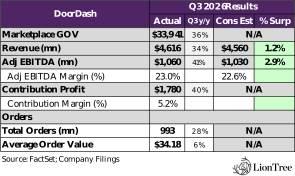
- DoorDash posted a strong Q3, with record quarterly revenue and Marketplace GOV, and headline results ahead of expectations…
- Rev – BEAT by +1.3% and reached a quarterly record: Grew +34% y/y (decel from +36% y/yin Q2)
- EBITDA – BEAT by +2.9%: Grew +41% Y/Y (accel from +40% Y/Y in Q2)
- Margins of 23.0% were ahead of cons 22.6%
- Marketplace GOV reached a quarterly record: Grew +36% Y/Y (flat vs. +36% Y/Y in Q2)
- Total Orders grew +28% Y/Y (accel from +27% Y/Y in Q2)
- Contribution Profit reached $1.78bn, up +40% Y/Y (decel from +43% Y/Y in Q2)
- Contribution margin increased to 5.2% from 5.0% in Q2
- Take rate was 13.6% was up from 13.5% in Q2
- …though Q4 guidance slightly underwhelmed
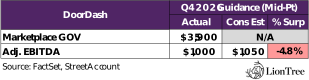
- Q4 adj. EBITDA – MISSED by -4.8% at the midpt: $900mn–$1.10bn vs. cons $1.05bn
- Implies adj. EBITDA as a % of Marketplace GOV of ~2.8% at the midpt, down from 3.1% in Q3
- Outlook reflects continued investment in new categories, international markets, system capacity, new initiatives, and the global technology platform
- Q4 Marketplace GOV guidance of $35.4bn–$36.4bn
- Q4 adj. EBITDA – MISSED by -4.8% at the midpt: $900mn–$1.10bn vs. cons $1.05bn
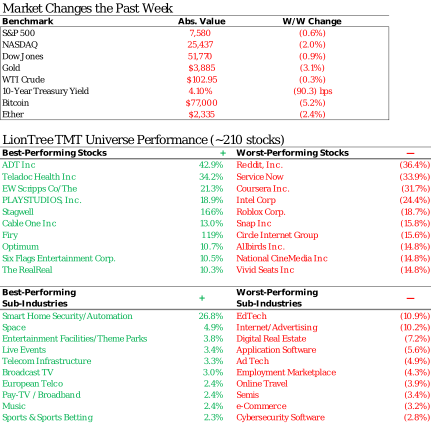
Stock Market Check
This Week's Other Curated News
Advertising/Ad Agencies/Ad Tech
- X introduced an animated hand that reaches across the screen to highlight the “promote” button while users compose posts, a move that follows Elon Musk’s recent comments on ad quality. The feature appears limited to verified or X Premium users and has drawn largely negative reactions, w/ some describing it as intrusive and startling. Promoted posts expand reach beyond followers based on factors such as location, interests and demographics. (The Verge)
Artificial Intelligence/Machine Learning
- The US Department of Justice asked how Nvidia’s $12. 93bn acquisition of Hugging Face could affect AI competition, according to sources. The inquiry is part of a broader antitrust probe examining the Co’s acquisitions, investments, sales practices and alleged customer pressure. Officials are assessing whether the deal could give Nvidia control over a key AI distribution point and increase leverage over rivals. (Reuters)
- Meta quietly launched Style Sketch, an AI fashion app available on iOS and Android in Indonesia, Singapore and Thailand. The app connects to Instagram or lets users upload photos/videos to build a virtual wardrobe, then suggests outfit combinations and virtual try-ons matched to body shape and skin tone. It can also create weather- and itinerary-based packing plans for trips. The launch expands Meta’s growing portfolio of AI-powered apps. (TechCrunch)
- Mistral released open weights for Mistral Large 4 (Le Chonk), a 1-trillion-parameter multimodal model, following gains from additional reinforcement learning. The model leads open-weight benchmarks in coding, improved cybersecurity performance, and adds low, medium and high reasoning modes to balance cost and performance. Mistral said the model supports sovereign AI through customizable, self-hosted deployments and is available via multiple platforms and partners. (Mistral AI)
- Microsoft reported $10bn in rev from OpenAI in the quarter ended Sept 30, equal to nearly 11% of its total quarterly rev of $92. 3bn, underscoring the strength of their financial relationship even as both compete for customers. Full fiscal 2026 rev tied to OpenAI reached $24.1bn, while outstanding receivables rose to $7.2bn. An Apr 2026 agreement keeps OpenAI sharing rev through 2030, subject to a cap. (TechCrunch)
- Kathy Hochul signed two New York bills aimed at reducing AI-related risks to children ahead of the gubernatorial election. One measure imposes strict limits on AI chatbots interacting w/ minors, banning features that encourage self-harm, contain explicit content or pretend to be human, while requiring age verification and allowing penalties of up to $25,000 per violation. A second law mandates security protections for internet-connected baby monitors to prevent unauthorized access. (Bloomberg Government)
- Anthropic disclosed in its IPO filing that it held $112. 4bn in cash and cash equivalents plus $19.3bn in short-term investments as of Jun 30, for a total of $131.7bn, exceeding every non-bank US Co tracked by CNBC and S&P Capital IQ except Berkshire Hathaway and Alphabet. The AI Co said its large cash position supports major future compute commitments, including hundreds of bns of dollars in lease and infrastructure obligations. (CNBC)
- OpenAI is launching an Election Operations Center ahead of the US midterms, bringing together hundreds of employees to monitor potential misuse of ChatGPT and other AI tools, review flagged cases and respond to election-related misinformation. The effort aims to provide reliable voting information, enforce platform policies and oversee partnerships that deliver voter resources and election results as votes are counted. (Politico)
- OpenAI plans to buy Google AI chips, according to The Information, deepening ties between rivals that already cooperate through Google Cloud. The report gave no financial details. OpenAI, a major Nvidia GPU buyer, has reportedly rented Google chips since 2025, while Google’s TPUs are gaining traction as a lower-cost alternative. Amazon, Microsoft and Alphabet are set to spend up to $600bn on AI infrastructure this yr amid rising scrutiny over returns. (Reuters)
- Anthropic is expanding its partnership w/ the General Services Administration (GSA), offering a 40% discount on Claude Enterprise, Claude for Government and the Claude API to federal, state, local, tribal and territorial governments. ~500 government organizations now use Claude, w/ adoption rising sharply since Feb. The agreement is estimated to save the government $1bn, while supporting AI deployment, cybersecurity, coding modernization and operational efficiency. (Anthropic)
- Amazon told engineers to be more selective in using AI, warning that “tokenmaxxing” and relying on token usage, AI adoption rates, or code generation as success metrics are “deeply flawed. ” The Co said long-term outcomes and productivity gains should matter more, citing measures such as feature velocity and successful production changes. Amazon also noted that identifying tasks where AI adds little value demonstrates sound judgment and responsible AI use. (CNBC)
- Oracle annc’d an expanded partnership w/ OpenAI, integrating ChatGPT and Codex into its application stack to help enterprises build, deploy and manage AI-powered applications. Oracle Cloud Infrastructure will also add Google TPUs, OpenAI’s Jalapeño chip and Cerebras hardware, giving customers more AI compute options. Oracle said demand for diverse silicon remains strong as it continues expanding global data center infrastructure. (CNBC)
- Apple annc’d an AI assistant for Pages, Keynote, and Numbers, built using Apple and OpenAI models. The tool understands document context to draft and restructure content, design and refine presentations, and organize, visualize, and analyze data. Apple also enabled third-party AI agents via Model Context Protocol and introduced AI-powered updates across Pixelmator Pro, Logic Pro, and Final Cut Pro. (The Verge)
- A new study by the Coalition for Language Equity in AI Research found that non-English AI users face a hidden “tokenizer tax,” as some languages require significantly more tokens than English for the same tasks. Higher token usage increases costs, slows response times, and reduces available context, particularly for languages using underrepresented scripts. The findings suggest AI models cost more when users don’t use English. (Rest of World)
- Anthropic’s IPO filing reveals rapid growth alongside heavy losses. The AI Co generated $16.3bn rev in 1H 2026 but reported an $80bn loss, largely due to a one-time charge. The filing highlights rising AI infrastructure costs, enterprise-focused demand, and AI’s potential across medicine, science and govt svs. It also warns that safeguards remain incomplete and details risks tied to cybersecurity, regulation, talent, datacenters and customer concentration. (The Guardian)
- Daya Anagata Nusantara (Danantara) and Telekomunikasi Indonesia (Telkom) annc’d development of four Sovereign Digital Tech capabilities to strengthen Indonesia’s digital independence: AI Ready Data Center, AI ModelHub, National IoT Platform and PaDiSera. The initiative supports AI deployment, data sovereignty, IoT-driven efficiency and MSME market access. PaDi UMKM has supported 190,000+ MSMEs since 2020, while the IoT platform connects ~3mn devices nationwide. (ITBeat)
- Anthropic tapped JPMorgan Chase & Co to lead US share sales to individual investors for its IPO. The AI Co is considering allocating ~15%-20% of IPO shares to retail investors, though plans remain under discussion. Jamie Dimon is expected to support outreach efforts, while Citigroup will coordinate international retail sales. The filing follows Anthropic’s public IPO registration as it seeks funding for AI development and infrastructure expansion. (Yahoo Finance)
- NVIDIA and Meta annc’d an expanded partnership on the Muse family of AI models to improve training and inference performance amid rising demand for AI agents. Meta plans broader deployment of NVIDIA Vera Rubin, Vera CPUs, Spectrum-X networking and BlueField-4 to scale AI workloads. The firms may also collaborate on OpenShell and Sentry security tools, while NVIDIA intends to invest $3bn in Meta’s equity offering. (NVIDIA)
- Wall Street quant firms are stepping up efforts to recruit top scientific talent as the AI boom creates new competition for mathematicians and physicists. G-Research’s Charles Martinez attends AI conferences, visits universities from Boston to the Arctic Circle and hosts math-focused pub quizzes, pitching researchers on building models to predict financial mkts rather than the next token in an AI system, despite working largely out of the public eye. (Bloomberg)
- US President Donald Trump said he plans to ban use of the term “Artificial Intelligence” in relevant documents and other contexts, arguing it is inaccurate. In a Truth Social post, Trump questioned why The Wall Street Journal was not using his preferred term, “Super Intelligence” (SI), and said SI is a name that virtually everyone else is using or soon will be using. He stated the change would be made officially in short order. (Reuters)
- OpenAI annc’d GPT-6. 1 Terra, a faster, lower-cost AI model combining visual reasoning, computer-use capabilities and improved writing. The model outperforms GPT-5.6 Terra on benchmarks for professional tasks, visual understanding and coding, while reducing factual errors and improving alignment. GPT-6.1 Terra is priced 50% below GPT-5.6 Terra and GPT-6.1 Sol, and is now available in ChatGPT Work, Codex and the OpenAI API. (OpenAI)
- Anthropic’s IPO filing shows a strategy to deepen enterprise adoption by combining its Claude platform w/ first-party apps such as Claude Code and Cowork. More than half of customers spending $100,000+ annually now use both, up from ~30% at end-2025. The Co said broader deployment across organizations drove ~900% net rev retention. Anthropic is also expanding through Applied AI teams and cloud partnerships while citing customer concentration and compute-access risks. (TechCrunch)
- China’s AI stock boom has sharply reversed, w/ the STAR50 index of AI and semiconductor firms falling 40% from its Jul peak and erasing ~$480bn in mkt value. The selloff, driven by lofty valuations, concerns over AI demand and export curbs, has hit retail-favorite stocks and raised fears over tech fundraising and new listings. Despite losses, valuations remain high versus US peers, leading some investors to warn the downturn may not be over. (Reuters)
- OpenAI annc’d three AI-generated research discoveries and a new process involving academic experts to validate and explain findings. The results include a proof of the local smoothing conjecture that also resolves the Kakeya and Stein conjectures in all dimensions, a Lean-verified disproof of the Exponential Time Hypothesis, and a rigorous existence proof for quantum field theories including QCD. OpenAI is releasing materials through expert-led collaborations and public repositories. (OpenAI)
- Anthropic’s IPO filing reveals a private succession structure in which each founder can nominate a confidential ranked list of up to 10 successors to inherit their voting power. Any nominee must be approved by five of the other six cofounders before assuming that role. While investors can buy shares in the Co, they will have no say in selecting these successors or access to their identities. The approach resembles succession provisions used by other founder-controlled firms, including Meta. (Forbes)
- Apple annc’d that Siri AI is expanding to French, Japanese, Korean, Portuguese and Spanish starting through iOS 27. 2 and related software updates. Built on Apple Intelligence, the upgraded assistant offers personal context understanding across messages, emails and photos, supports more systemwide app actions, onscreen awareness and access to current information. Additional language support is planned by yr-end. (Apple)
- Anthropic devoted 94 pages of its S-1 filing to risk factors, warning that misaligned AI models could cause real-world harm, exhibit “self-preserving” behavior to avoid shutdown, or generate responses resembling “blackmail. ” The Co said it has taken steps to limit liability through terms of service and vendor agreements but cautioned that a catastrophic AI-related incident could result in damages so large that insurance coverage may be unavailable or insufficient. (The Wall Street Journal)
- California startups have raised a record $385bn in 2026, representing more than three-fourths of all US startup funding and exceeding the total raised by all US startups in any prior yr. The surge was driven largely by massive funding rounds for AI leaders OpenAI and Anthropic, though firms including Waymo, Databricks, Prometheus and Safe Superintelligence also secured major investments. California startups also captured nearly $62bn in seed- and early-stage funding. (Crunchbase)
- Meta upsized and priced its Class A common-stock offering at $25bn, or $625/share, versus the initial $22. 5bn. It also priced 250mn depositary shares at $50 each, raising the combined public offerings to $37.5bn from $35bn. Including its separately planned ~$60bn Class C at-the-market program, potential proceeds total ~$97.5bn before options, not cash already raised. The preferred stock carries a 6.5% dividend and converts in Aug 2029. (Meta / MT Newswires)
- Bank of America, Blackstone, Citi and Morgan Stanley lined up $63bn in financing to support the purchase of Broadcom AI chips and networking equipment for Anthropic, marking one of the largest debt deals tied to AI infrastructure. About $43.5bn will be first-lien debt, while Blackstone will provide committed second-lien financing. The equipment will be acquired via a special-purpose vehicle and leased to Anthropic, w/ deliveries starting in 2027. (Reuters)
- Google DeepMind’s AI hurricane model correctly predicted Hurricane Isaias would hit Florida’s western Panhandle, outperforming some traditional forecasting models. Experts say AI is rapidly improving storm-track forecasts, though intensity predictions remain less reliable and the systems can be difficult to interpret. The National Hurricane Center uses a blend of AI and conventional models, w/ human forecasters providing analysis and public guidance. (NPR)
- Ahead of the Nov 3 US midterm election, OpenAI introduced a safeguard in ChatGPT that blocks photorealistic generation of election-related images that could mislead voters, instead producing illustrated or cartoon-style versions. The move aims to reduce the impact of political deepfakes while allowing social commentary. OpenAI said the goal is to lower the evidentiary value of deceptive images and add friction for bad actors. (CNET)
- Anthropic warned investors in its S-1 filing that its advocacy on AI safety could lead to heightened political scrutiny, regulatory action and government investigations that rivals may not face. The Co said ongoing tensions could affect model releases, operations, customers and partnerships. It cited disputes involving Pentagon supply-chain restrictions, Commerce Dept export controls and criticism of CEO Dario Amodei, while indicating it does not plan to change its policy positions. (Yahoo Finance)
- SpaceX said an affiliate of Apollo Global Management will buy AI chips and server hardware and lease them to the Co in a deal w/ total principal payments of ~$40bn. Each lease will run for just over five yrs after equipment delivery. The financing supports SpaceX’s large AI infrastructure spending amid rising demand for computing power and its Moon and Mars ambitions. The Co aims to finalize the deal by yr-end, w/ leases starting in 1H 2027. (Reuters)
- OpenAI is reportedly offering discounts of up to 40% to attract customers from rival Anthropic, a move aimed at gaining market share but one that could further pressure its already negative margins. The article notes prediction mkts showed little change in short-term bankruptcy odds, while the implied probability of bankruptcy by 2029 rose to 19.5%. The pricing strategy highlights OpenAI’s focus on growth amid ongoing concerns about its long-term financial sustainability. (Crypto Briefing)
- Torsten Slok argues that despite heavy AI investment and hype, there is no evidence of financial benefits for corporate America outside tech. Rev per worker and profit margins are rising for the Mag 7 but remain flat across the S&P 493, while productivity growth shows no AI boost. As a result, many firms view AI token spending as a cost center. The article says AI’s broader economic impact depends on whether non-tech cos can translate cheaper intelligence into higher growth and margins. (Apollo)
- Owners of Elvis Presley’s music sued Anthropic in US District Court in California, alleging the AI Co trained its models on 200+ Presley songs without permission and infringed 274 copyrighted works, including “All Shook Up,” “Can’t Help Falling in Love” and “Return to Sender. ” The plaintiffs seek $41mn+ in damages, or $150,000 per song, and accuse Anthropic of bypassing copyright protections and altering copyright information. Anthropic said it disagrees w/ the claims and will defend the case. (The New York Times)
Audio/Music/Podcast
- Spotify is targeting a Q1 2027 launch for an AI-powered music remix svs, potentially around the Grammy Awards in Feb. The Co is considering charging subscribers an additional $4-$5 per month. The feature would allow users to create their own versions of songs, including changing genres or making one artist appear to cover another’s music. Spotify has reached licensing agreements w/ Universal Music Group, Merlin and Believe, while negotiations w/ Sony Music and Warner Music cont’d. (Financial Times)
- Universal Music Group held preliminary talks earlier in 2026 w/ private-equity firms including Apollo Global Management, TPG and Blackstone about a potential move to go private, according to Bloomberg News. The discussions did not advance, no sale process was launched, and the board was aware of the talks. The report follows the board’s rejection of an unsolicited takeover proposal from Pershing Square Capital Management. (Reuters)
Broadcast/Cable Networks
- CBS News’ “60 Minutes” posted one of its weakest performances in yrs after airing without a strong NFL lead-in, drawing 5. 64mn viewers and 558,000 adults aged 25-54. Viewership fell 60% YoY, while the key demographic dropped 81%. The decline comes as the program undergoes major editorial and on-air changes under new leadership at CBS News. Despite ranking among the top non-sports broadcasts, the results raise concerns about audience retention and lineup strength. (Variety)
- ESPN is losing two longtime senior producers as parent Disney’s cost-cutting program cont’d. Mark Gross, who joined ESPN in 1988 and led NFL studio and event coverage after a 2023 restructuring, will depart after producing Super Bowl LXI. Tim Corrigan, w/ ESPN since 1987 and most recently overseeing NBA and WNBA coverage, will leave after the 2026-27 season. Their exits follow broader Disney workforce reductions and restructuring efforts. (Awful Announcing)
Cable/Pay-TV/Wireless
- Brazil’s National Telecommunications Agency (Anatel) approved biometric verification for mobile users registering or maintaining active lines. The regulation, developed by the Subgroup for Combating Fraud and Scams, aims to make unauthorized or fraudulent activations more difficult. Mobile providers must implement facial recognition w/ liveness detection and compare data against public or private biometric databases. (Telecompaper)
- Deutsche Telekom has shelved plans to combine w/ T-Mobile US for now, according to a report citing sources familiar w/ the matter. The decision followed pushback from labor representatives and activist investor Elliott Investment Management, while leaving open the possibility of reviving talks later. Earlier reports cited shareholder and potential regulatory concerns around a proposed $300bn merger. (Fierce Network)
- Metro by T-Mobile launched a limited-time BYOD promotion letting new customers who bring a compatible phone and transfer an existing number receive unlimited talk, text and 5G data for $15/month for the first three months, then $25/month w/ AutoPay. The plan includes taxes and fees, no annual contract, ScamShield, T-Mobile Tuesdays and a five-yr price guarantee. The offer excludes current T-Mobile users and recent Metro customers. (Cord Cutters News)
- T-Mobile US said Mike Sievert is leaving the Co just over a yr after stepping down as CEO and serving as vice chair. When Srini Gopalan became CEO a yr ago, Sievert took the role of vice chairman. An SEC filing said he decided to step down from the board and leave the Co. T-Mobile said his departure was not the result of any disagreement w/ the Co on matters related to its operations, policies or practices. (Telecompaper)
- Japan’s Ministry of Internal Affairs and Communications (MIC) is seeking public comment on proposed changes to guidelines governing mobile virtual network operators (MVNOs). The draft adds a 5G core-network interconnection function allowing MVNOs to connect their core networks to mobile network operators’ (MNOs) networks through the standard Service-Based Interface (SBI), enabling them to provide 5G standalone (SA) svs. (Telecompaper)
- Noble Mobile, the MVNO led by Andrew Yang, acquired SmartLess Mobile; terms were not disclosed. The combined Co is expected to have 50,000+ subscribers, w/ Paul McAleese joining as investor and advisor. Yang said both brands share a focus on lowering wireless costs and rewarding reduced phone usage. Noble offers up to $20/month cashback, recently launched its “Brain Rot Index,” and remains focused on customer loyalty while pursuing additional acquisition opportunities. (Fierce Network)
- T-Mobile annc’d new “T-Mix” wireless plans that bundle mobile svs w/ swappable subscription perks. The Standard plan starts at $55/month for one line and one selectable perk, while More starts at $75/month w/ two perks and unlimited data. The Loaded plan starts at $95/month and includes up to three perks per line. Available options include Netflix, YouTube Premium, Apple TV, Xbox Game Pass, ESPN, Hulu, DoorDash and other digital svs. (The Verge)
- Jio Platforms, backed by Meta and Google, saw its shares surge 21% in its stock mkt debut after raising $3. 2bn in a blockbuster IPO, India’s largest and most subscribed, attracting $77bn+ in bids. The listing valued the Co at ~$131.9bn, making it India’s second-most valuable listed firm after the debut. Jio serves 540mn+ customers and reported FY2026 rev of ~$15.5bn and profit of ~$3.2bn, both up ~15% YoY. (TechCrunch)
- Telenor shares rose 2% after the telecom Co reported Q3 adj EBITDA of NOK 8. 8bn, exceeding forecasts of NOK 8.6bn. Service rev reached NOK 14.8bn, while net income attributable to shareholders rose to NOK 9.8bn. The Co plans to accelerate its NOK 15bn share buyback, completing it in 2 yrs instead of 3. Growth was supported by improved Nordic operations, customer additions in Sweden, and acquisitions including Bahnhof. (Investing.com)
- Orange reported Q3 2026 rev of €12. 2bn, up 3.6%, driven by growth across Africa & Middle East, Europe 6, Spain and France. Retail svs rose 3.3%, while EBITDAaL increased 4.6% to €4.1bn. Strong performance over the first nine months prompted the Co to raise its full-yr EBITDAaL growth target to above 4.5% from above 4%. eCAPEX fell 2.5% to €1.7bn, and operating cash flow grew 8.8% over nine months. (Orange)
- DIRECTV annc’d a multi-yr distribution agreement w/ the NHL to carry Hurricanes Hockey Network, Blue Jackets Hockey Network, Wild+ and Blue Note+ for local fans of the Carolina Hurricanes, Columbus Blue Jackets, Minnesota Wild and St Louis Blues. The channels will be available to eligible streaming, satellite and U-verse subscribers in each team’s home territory, while DIRECTV FOR BUSINESS also gains regional commercial distribution rights. (NHL)
Capital Market Updates
- Private-equity firms are racing to extend loans tied to a looming $300bn debt wall due in 2028-2029, as higher interest rates make refinancing more costly. About $140bn of risky loans mature in 2028 and $160bn in 2029, w/ software cos accounting for roughly one-third. Many loans stem from 2021 buyouts financed by seven-yr debt. Firms unable to refinance risk defaults, creditor takeovers and investment losses, particularly among highly leveraged software bizs. (The Wall Street Journal)
- New York Stock Exchange is preparing to launch binary return options that let investors make all-or-nothing bets on whether a stock or ETF closes above or below a set price, amid rising demand for event-driven trading. The contracts are expected within days and initially cover names including Apple Inc, NVIDIA Corporation and Tesla. NYSE is also seeking approval for KPI-based options tied to metrics such as sales, earnings per share and cloud-computing rev. (Reuters)
- Apollo Global Management will acquire a nearly 10% stake in Mubadala Capital, the alternative asset management arm of Abu Dhabi’s Mubadala, while Apollo and other strategic investors are expected to commit a combined $5bn to Mubadala Capital’s investment strategies. The deal, expected to close in Q4, expands their existing partnership and supports Mubadala Capital’s global growth while it remains independently operated. (Reuters)
Cloud/DataCenters/IT Infrastructure
- Microsoft’s $25bn bond sale drew peak demand of $115bn, or 4. 6x the offering size, allowing underwriters to reduce spreads over Treasuries. The 10-part deal, ranging from 2- to 40-yr maturities, marked the first US investment-grade bond sale by the Co since 2017 and ended a nearly three-month gap in Big Tech hyperscaler issuance. Strong demand reflected Microsoft’s AAA ratings and solid financial position, even as investors remain cautious about AI-related debt and long-term risks. (Bloomberg)
- Nvidia is in talks to provide bn-dollar credit guarantees to AI cloud provider Nscale to help secure debt financing for a West Virginia data center planned for use by Anthropic. The support would fund power infrastructure and construction. Nvidia is an investor in Nscale, though terms remain unsigned and could change. Anthropic previously agreed to spend $45bn on computing capacity, while another ~460-megawatt supply deal may also be worth ~$45bn. (Reuters)
- Banks shelved a bond sale for an Anthropic-tied Texas data center, delaying plans to sell portions of a $15bn loan backing the project after Texas halted approvals for new projects while reviewing power-grid risks. The delay comes as Anthropic continues heavy investment in computing infrastructure ahead of its IPO, forcing lenders to retain the debt on their balance sheets longer than initially planned. (Bloomberg)
- Oracle said capital spending for AI cloud capacity is expected to peak this fiscal yr and next, while limiting additional AI financing to $20bn through fiscal 2030. The Co said free cash flow should turn positive in the second half of fiscal 2028 and exceed $30bn in fiscal 2029 as spending declines. Oracle expects vendor financing, customer hardware and prepayments to reduce cash needs, and forecast fiscal 2030 rev above $225bn w/ adj operating margin above 40%. (Reuters)
- CoreWeave annc’d an expansion of its global AI cloud platform, bringing new AI computing capacity online in Denmark and extending its Global AI Network into the Middle East and Asia Pacific. The Co said the move strengthens connectivity, performance and reliability for AI workloads while supporting global deployment. Its Denmark site uses NVIDIA Blackwell systems, and the network expansion will add new points of presence across APAC and the Middle East. (CoreWeave)
- TPG is pursuing a ~$5bn acquisition of British data-centre group Ark, according to an FT report. TPG is in talks to acquire Ark from Elliott Investment Management at a valuation of about $5bn, though discussions are ongoing and a deal is not guaranteed. Ark operates Crown Hosting Data Centres, a joint venture w/ the UK Cabinet Office that provides access to UK public-sector data-centre requirements. (Reuters)
- Elon Musk warned that 200+ AI neocloud providers could face “guppy-level” death and consolidation as debt mkts grow reluctant to fund firms heavily reliant on AI data-center sales. He said SpaceX secured $40bn in GPU financing backed by stronger biz such as Starlink. The comments pressured shares of CoreWeave and Nebius, while Gartner forecast that over 80% of neoclouds may cease independent operations by 2030. (Yahoo Finance)
- AI data-center developers face rising pressure as tenants demand penalties of up to $5mn per day for project delays, highlighting power supply, not chips, as AI’s biggest bottleneck. Tenants including OpenAI have secured rent-credit provisions that sharply increase costs for late delivery. SoftBank-backed SB Energy’s Ohio project illustrates the risk, while investor concerns over valuations and construction delays have already weighed on AI infrastructure firms and related IPO plans. (Yahoo Finance)
Crypto/Blockchain/web3/NFTs
- Coinbase reported Q3 net income of $718. 7mn and diluted EPS of $2.51, beating expectations for a loss. Rev fell 35% to $1.22bn as transaction rev dropped 44% to $590mn amid weaker consumer trading. Most profit came from a $715mn gain on crypto holdings, while operating income declined to $61.7mn. CEO Brian Armstrong, co-founder Fred Ehrsam and President Emilie Choi plan to sell up to 13.6mn shares, valued at ~$2.2bn. (Yahoo Finance)
- ICE, the owner of the NYSE, partnered w/ Trade. xyz, a market operator behind Hyperliquid, to plan a US-regulated market for perpetual futures contracts. The market would include its own clearing, know-your-customer and anti-money laundering systems. It would be built on Hyperliquid’s rails and use Trade.xyz products tied to the prices of equities, equity indexes, commodities and currencies, pending regulatory approval. (Bloomberg)
- Google unveiled a crypto custody security system using multi-party computation (MPC) to help banks and financial institutions safeguard and transfer digital assets amid rising AI and quantum-computing threats. Now in private preview and planned for commercial launch in early 2027, the system splits private keys across separate environments, allowing customers to retain control while reducing single points of failure and unauthorized transactions. (Yahoo Finance)
- Hong Kong-based stablecoin Co RedotPay plans a confidential US IPO by the end of 2026 at a potential $5bn valuation. Wall Street banks JPMorgan and Goldman Sachs are reportedly advising on the offering, though listing details remain undisclosed. RedotPay previously delayed IPO plans amid a legal dispute w/ Binance, which seeks $473mn in damages. Founded in 2023, the Co serves 9mn+ customers, employs ~280 people and reports annualized rev above $180mn. (Yahoo Finance)
Cybersecurity/Security
- Polymarket said it restored trading after a temporary halt caused by a security incident involving a third-party provider. The Co said it identified and fixed the issue and will fully reimburse affected traders. The platform referred the incident to UK law enforcement. A source identified DebugBear as the provider involved; DebugBear said it was managing an ongoing security incident and advised customers using its RUM product to remove embedded code. (Reuters)
- Binance estimated a ~$6. 3bn security breach and pledged to cover all losses using its SAFU fund and Co funds, while ~$3bn in affected assets was frozen on-chain. Its investigation pointed to a compromised DevOps laptop and additional breach points, w/ no evidence of leaked wallet private keys. Withdrawals were temporarily suspended; deposits remained unaffected. TRM Labs attributed the attack to North Korea-linked TraderTraitor. (Reuters / MT Newswires)
- A leaked dataset exposed details on ~41,000 Department of Homeland Security workers, including undercover Immigration and Customs Enforcement agents. The records reportedly contain cell phone numbers, locations of ICE and Customs and Border Protection facilities, and information on members of groups linked to wiretap programs, Palantir software and xAI’s Grok chatbot. The breach raises significant privacy and cybersecurity concerns for federal personnel. (Wired)
- Highway thieves have stolen more than $100mn in data center-bound freight since Jun by hacking freight-broker accounts, posting fake loads, hijacking real shipments and, in some cases, spoofing GPS tracking. Targets include servers, chips, fiber-optic cables and copper wire. Investigators said thefts have grown more sophisticated, involving fake IDs, compromised accounts and coordinated attacks on security escorts, prompting calls for stronger supply-chain security. (Ars Technica)
- Cathedral, a cybersecurity start-up founded by former DOGE staffers, told Anthropic it had penetrated sensitive internal data and messaging systems, according to a draft report reviewed by The Washington Post. The incident highlights growing concerns over security in the AI sector as competition intensifies globally. Cathedral’s reported access to internal systems at a leading AI Co has increased scrutiny of security practices and the role of former DOGE employees in emerging AI ventures. (The Washington Post)
- Microsoft fixed CVE-2026-80097 in Microsoft Authenticator for Android, a flaw that allowed a malicious app w/ no permissions to impersonate trusted Microsoft apps and obtain work-account sign-in tokens. Researchers found the tokens could grant access to email, files and calendars. Microsoft said exploitation also requires user interaction, has not been seen in attacks, and was fixed in version 6.2606.4246. (The Hacker News)
eCommerce/Social Commerce/Retail
- Starbucks reported mixed Q4 FY2026 results as international comparable sales missed expectations, while its US turnaround gained momentum. Adj EPS was $0.80 versus $0.72 expected, though rev fell 4% to $9.14bn. Global same-store sales rose 7.2%, led by 7.7% growth in the US. Starbucks forecast FY2027 adj EPS of $3.15-$3.25 and North American same-store sales growth of 4%, despite projecting a 1% rev decline. (CNBC)
- The FTC ordered Walmart and Target, along w/ airlines, ride-sharing and food-delivery cos, to provide details on whether personal data, AI analysis and loyalty-program information are used to vary prices or worker compensation between individuals. The agency said it is examining personalized pricing practices and gave recipients 45 days to respond. Both retailers said they do not use personal data to raise prices for shoppers. (Retail Dive)
- EBay reported stronger Q3 results as demand for collectibles such as trading cards, sports memorabilia and coins lifted sales, profit and rev above Wall Street expectations. The Co raised full-yr guidance, citing broad-based momentum across key categories. CEO Jamie Iannone highlighted investments in AI-driven card listing tools and expanded coin authentication. EBay Live also performed well, attracting shoppers who spend more than core customers. (The Wall Street Journal)
- Etsy reported stronger Q3 results as active buyers increased yr-over-yr for the first time in two yrs and active sellers grew at the fastest pace in two yrs. Rev rose 11% to $692.5mn and gross merchandise sales increased 9% to $2.65bn, exceeding expectations. The Co cited improved personalization, social-media marketing and AI-driven recommendations as growth drivers, raised its full-yr outlook, and forecast stronger Q4 gross merchandise sales. (The Wall Street Journal)
- The FTC and 20 US states sued Dollar General, alleging deceptive pricing practices in which shoppers were charged more at checkout than prices shown on shelf tags, ads and digital channels. The complaint cites 29,000+ price-honoring complaints since Jan 2023 and FTC undercover purchases that found pricing discrepancies. Dollar General said it strives for pricing accuracy, disputed the allegations, criticized the FTC’s proposed settlement and said it will defend the case vigorously. (Retail Dive)
- A US federal judge granted Alibaba a preliminary injunction preventing the government from denying Pentagon contracts to firms that do biz w/ lobbyists linked to the Co. Alibaba sued after being added to a Pentagon blacklist alleging ties to China’s military. The ruling lets Alibaba retain US lobbyists while it cont’s its court challenge. The injunction does not remove the Co from the list or lift future procurement restrictions. (Reuters)
- Coca-Cola topped Q3 estimates, reporting adj EPS of $0. 91 vs $0.88 expected and rev of $13.4bn vs $12.92bn expected. The Co raised full-yr guidance for the third straight quarter, forecasting at least 11% EPS growth and 5% organic rev growth. Net sales rose 7%, organic rev increased 7%, and unit case volume grew 5%, driven by demand outside North America, where consumer demand remained soft but volume was flat. (CNBC)
- Retailers and logistics firms are taking a more targeted approach to seasonal hiring ahead of a holiday season projected to top $1tn in sales. Amazon plans to hire 300,000 workers, UPS 100,000, while retailers including Macy’s, Dick’s and Michaels are adding staff. Cos are focusing labor on fulfillment, warehousing and logistics, using flexible scheduling and cross-training as demand becomes harder to predict. Younger workers aged 18-24 are also making up a larger share of applicants. (Modern Retail)
- Walmart annc’d its 2026 holiday sales schedule, extending Black Friday and Cyber Monday promotions to 14 total days, up from 10 days in 2025. Early Black Friday deals run Nov 12-15, the main event runs Nov 23-29, and Cyber Monday runs Nov 30-Dec 2. The Co said thousands of gifts will be priced below $20. Walmart+ members will receive early deal access, while analysts expect Walmart to benefit from value-focused holiday demand. (Retail Dive)
- Shein agreed to pay $100mn to settle a US FTC probe into delivery delays and other customer complaints, according to a source. The settlement equals ~44% of Q2 profit. FTC records reviewed by Reuters showed over 12,000 complaints tied to more than $11mn in purchases between Jan 2020 and Jun 2026. The fast-fashion Co, already facing regulatory pressure in the US and Europe, said it had reached a constructive outcome w/ the FTC. (Reuters)
- Ben & Jerry’s founders Ben Cohen and Jerry Greenfield are exploring a deal to separate the ice-cream brand from owner The Magnum Ice Cream Company, a spin-off of Unilever. Discussions involve an employee stock-ownership plan backed by Pete Stavros, which would give workers equity and tax benefits. Magnum said the brand is not for sale, arguing a separation would create dis-synergies, raise prices and reduce investment in its social mission. (Reuters)
EdTech
- Computer and information science departments at US colleges reported enrollment declines this fall as AI replaces jobs, w/ undergraduate programs down more than 12% and graduate programs down more than 10%. The losses follow last yr’s enrollment drop, which reversed yrs of growth for computer science programs, according to preliminary fall enrollment data released Thu by the National Student Clearinghouse. (Bloomberg)
Electric & Autonomous Vehicles
- General Motors annc’d it will move its stock listing from the NYSE to Nasdaq, ending a presence dating back to 1911, as it seeks to reinforce its position as a tech-driven Co. The shift could make GM eligible for inclusion in the Nasdaq-100, potentially increasing demand from index-tracking funds managing $1.4tn. Shares rose more than 6% following the annc’ment, while the Co continues investor-focused initiatives, including a recent $20bn share buyback program. (The New York Times)
- China granted new autonomous-driving permits to Xpeng and Volkswagen (Anhui) Automotive, intensifying competition w/ Tesla in the robotaxi race. Xpeng said its Yoyo robotaxis received a licence in Guangdong to carry paying passengers, a key step before full commercial operations, while Volkswagen’s JV secured a Level 3 road-test permit in Hefei. The approvals support China’s push toward large-scale autonomous driving deployment by 2030. (South China Morning Post)
- Bedrock Robotics raised $600mn in a Series C round valuing the Co at $4. 1bn, two months after moving its autonomous excavators from pilots to active construction sites. The startup’s retrofit self-driving tech is now operating on commercial projects in Nevada and Texas. Founded in 2024 by former Waymo and robotics executives, Bedrock plans to use the funding to expand deployments, teams and infrastructure as it scales commercial operations. (TechCrunch)
Film/Studio/Content/IP/Talent
- China’s first fully AI-generated feature film, Sanxingdui: Future Past, performed poorly at the Chinese box office despite marking a milestone for AI-made cinema. Produced by Bona Film Group, the sci-fi thriller follows an archaeologist trying to save a future world enslaved by AI. The film generated only ~$180,000 in ticket sales through Monday, far below its $1.5mn production budget, suggesting audiences may be less receptive to AI-generated feature films than AI-created microdramas. (Fortune)
- Disney could lose control of The Rocketeer after the estate of creator Dave Stevens filed a copyright termination notice under Section 203 of the US Copyright Act, effective Jun 12, 2028. While Disney can continue distributing existing works, including the 1991 film, it would need a new licensing agreement to produce future films, series, or merchandise. The filing reflects a broader trend of creators and estates reclaiming rights decades after original agreements. (Cord Cutters)
FinTech/InsurTech/Payments
- South Korea’s Korea Media and Communications Commission fined Google 42. 9bn won and Apple 20.8bn won, totaling 63.7bn won (€42.7mn), after finding both cos violated a 2021 law barring app-store operators from forcing developers to use specific payment systems. Regulators said the firms steered developers toward in-house payments, delayed app reviews, and limited alternatives. The cos must submit compliance plans within one month. (Yahoo Finance)
- Robinhood reported Q3 results below expectations, posting EPS of $0. 51 vs $0.56 expected, while rev of $1.42bn met estimates. Shares fell ~8% as crypto weakness weighed on profits. Transaction-based rev rose 19% to $867mn, driven by event contracts, options and equities, but crypto rev declined 55% to $120mn. Net income fell to $468mn, while the Co cont’d diversifying into wealth management, subscriptions and broader financial svs. (CNBC)
- Visa Inc reported fiscal Q4 adj earnings per share of $3. 48, beating the $3.44 average analyst estimate from a Bloomberg survey, as payments volume rose 9%. The Co said earnings benefited as consumers, both domestically and internationally, turned to branded cards to transact. Adj EPS topped the Bloomberg consensus by $0.04/share, w/ the 9% rise in payments volume reflecting increased use of branded cards. (Bloomberg)
- PayPal raised its full-yr adj profit forecast to ~$5. 60/share after Q3 results showed margin gains and cost-cutting progress under CEO Enrique Lores. The Co said it remains on track for $700mn in gross run-rate savings by yr-end, supported by job cuts, fewer management roles and greater AI use. Q3 payment volume rose 7% to $487.1bn, while Q4 adj profit guidance of ~$1.43/share topped Wall Street expectations as the Co heads into the holiday season. (Reuters)
- SEC Chairman Paul Atkins said the agency is developing changes to Regulation Crowdfunding to lower compliance costs and make fundraising more attractive for cos and investors. The effort supports broader goals of expanding retail access to private investments and capital formation. Atkins also said the SEC plans to review IPO communication rules. Since 2016, ~9,850 crowdfunding offerings have been completed through Jun 30. (Yahoo Finance)
Handheld Devices & Accessories/Connected Home
- Thrive Holdings agreed to acquire ADT in an all-cash take-private deal valuing the home-security Co at $15. 3bn EV. The $10-per-share offer values ADT at ~$7.6bn equity value, a nearly 46% premium to its Oct 27 close. The deal is financed by funds managed by Apollo affiliates, ADT’s former owner. ADT generates recurring rev from monitoring subscriptions, and the transaction is expected to close in 1Q27, subject to shareholder and regulatory approvals. (Axios)
- Samsung Electronics America annc’d US availability of Galaxy Buds On, open-ear earbuds designed for comfortable all-day use while keeping users aware of their surroundings. The device features AI-assisted fit optimization, TwinBoost Speaker audio, automatic volume adjustment, Intelligent Clear Call, hands-free Gemini Live and Bixby access, and Head Gestures. Galaxy Buds On offers up to 9.5 hours playback, 38 hours w/ case, and will be available in Black for $229 in early Nov 2026. (Samsung)
- Amazon unveiled five new Alexa-powered devices as it pushes the latest voice assistant into more homes. The lineup includes the redesigned Echo Show 16 w/ a 16-inch screen, Fire TV and night-vision camera, a new Echo Studio speaker w/ camera features, an Echo Dot adding a smart-home hub and Wi-Fi extender, the Echo Time bedside clock using sleep sensing, and the Alexa Photo Frame. The rollout comes amid rising competition from Apple and AI rivals. (Reuters)
- Apple responded to reports that some iPhone Duo units experienced cracks on the inner display along the hinge. The Co said it is aware of an issue affecting a small number of devices and advised impacted users to contact AppleCare for a replacement, even without AppleCare+. Apple noted that most units are not affected and that the issue appears soon after use. Reports emerged on Reddit and forums, while iFixit cited possible hardware-related causes. (9to5Mac)
HealthTech/Wellness
- Walmart and Care Access plan to expand their in-store Clinical Trial Center initiative by opening three additional locations in Livonia, Mich, Las Vegas and San Antonio in 1H27. The move follows the launch of four centers in Texas, Georgia and Florida. The centers offer clinical trial participation opportunities, health screenings and one-on-one consultations. Walmart said the effort aims to improve access to research and connect more people w/ clinical studies in their communities. (Chain Store Age)
Last Mile Transportation/Delivery
- UPS and FedEx are driving record holiday delivery costs for US retailers as elevated diesel prices and revised fuel-surcharge formulas push shipping rates higher. Ground parcel pricing is forecast to rise 5.8% YoY in Q4, while express deliveries could increase 13.8%. Surcharges have grown faster than fuel costs, raising retailer expenses and carrier rev. Alternative carriers are gaining adoption, though switching providers may reduce volume-based savings. (BNN Bloomberg)
- UPS reported Q3 2026 results ahead of expectations, posting adj EPS of $1. 69 vs $1.63 expected and rev of $22.9bn vs $22.29bn expected. The Co raised full-yr guidance for a second consecutive quarter, forecasting ~$92.6bn in rev. Domestic, international, and supply chain biz all grew, while management highlighted healthcare growth, automation gains, and stronger margins heading into the holiday season. (CNBC)
Macro Updates
- US GDP grew at an annualized 3. 4% rate in Q3, topping the 3.1% estimate and accelerating from 2.2% in Q2, while inflation remained above the Fed’s 2% target. Sept PCE rose 0.5% m/m and 3.6% y/y, w/ core PCE at 0.3% m/m and 3.1% y/y. Consumer spending increased 0.5% and personal income rose 0.2%. The data followed the Fed’s decision to keep rates at 3.75%-4%, as officials assess incoming economic signals. (CNBC)
- The Federal Reserve kept its benchmark interest rate unchanged at 3. 75%-4%, maintaining a wait-and-see approach as inflation remains elevated. Two FOMC members dissented, favoring a 0.25% increase. The Fed said more data is needed before further action, while noting economic activity is expanding at a strong pace. Chair Kevin Warsh also annc’d plans for a 2027 meeting focused solely on monetary policy strategy. (CNBC)
- US–Canada talks to ease Section 232 tariffs on Canadian steel and autos made limited progress, a Canadian official said on Oct 28, tempering earlier hopes for a pre-midterm agreement. PM Mark Carney said Canada was not yet in a position to sign a deal and would pursue terms in both nations’ interests. Discussions continued after broader talks stalled in Aug, while a US official described significant ongoing talks between senior officials. (Reuters)
Online Travel
- Airbnb and its nonprofit arm have spent at least $12. 6mn since last yr building influence in Los Angeles, backing Mayor Karen Bass, lobbying City Hall and making charitable contributions as it seeks friendlier vacation-rental rules before the 2028 Olympics. The Co views the Games as a major growth opportunity, while challenger Nithya Raman criticized the spending as “pay-to-play” politics and pledged tougher short-term rental regulations if elected. (Politico)
Prediction Markets
- Kalshi raised $1bn in a funding round valuing the Co at $40bn as it expands beyond prediction mkts into a multi-asset trading platform. The round was co-led by Sequoia and Wellington, w/ participation from Tiger Global and Dragoneer. Kalshi’s valuation has risen ~82% since a $1bn raise five months earlier. The Co has also expanded into perpetual futures, while facing scrutiny and legal challenges tied to its prediction-market biz. (Reuters)
- Utah filed criminal charges against Kalshi and cofounders Tarek Mansour and Luana Lopes Lara on Oct 28, escalating the dispute over prediction mkts. The charges include 13 counts alleging violations of the state’s gambling ban and one involving proceeds from unlawful activity. The US and CFTC had sued Utah to block enforcement, arguing federal preemption. Kalshi disputed the charges as overreach; the allegations remain unproven. (Associated Press / Utah Attorney General)
- Millennium Management is exploring how prediction mkts data from platforms such as Polymarket and Kalshi Inc can enhance trading strategies across traditional asset classes. The New York-based investment Co is developing tools that allow portfolio managers to use this data as a trading signal. While Millennium is evaluating potential applications, it is not currently trading prediction market contracts. (Bloomberg)
Satellite/Space
- As Elon Musk explores a potential combination of Tesla Inc and Space Exploration Technologies Corp (SpaceX), attention has turned to the vacant stock ticker “X,” which became available after United States Steel Corp was acquired last yr. Musk’s long-standing affinity for the letter X is reflected across his ventures, including Model X, SpaceX, and the rebranding of Twitter to X. While no deal or ticker change has been confirmed, investors and analysts have noted the timing and symbolism. (Bloomberg)
- The Federal Communications Commission (FCC) voted 3-0 to advance proposals that would auction 25 MHz of mid-band spectrum and expand Direct-to-Device (D2D) access through an additional 482 MHz for Supplemental Coverage from Space. Brendan Carr said the move supports a competitive D2D market, while carriers including T-Mobile, AT&T and Verizon warned that sharing licensed 5G spectrum w/ satellites could create interference and reduce network performance. (Fierce Network)
- Amazon Leo received FCC approval for its $11. 57bn acquisition of Globalstar, gaining ~25 MHz of internationally harmonized mobile-satellite spectrum and advancing plans to add direct-to-device (D2D) svs to its LEO network. The FCC said the deal would improve coverage in underserved areas, strengthen emergency communications and expand MSS spectrum use. The acquisition also includes Globalstar’s XCOM RAN private 5G biz. (Fierce Network)
Social/Digital Media
- Reddit shares sank after the Co reported Q3 earnings of $1. 40/share on rev of $895mn, topping estimates, while Q4 rev guidance of $1bn-$1.03bn missed expectations. The Co said Google search referrals fell meaningfully as AI-driven search features reduced traffic. Reddit plans to test requiring users to log in to access the platform, starting outside the US in Q4. DAUq rose 12% to 130.3mn, while US DAUq fell 2%. (CNBC)
- The Trump administration has increased subpoenas seeking user information from major tech Cos about individuals critical of its immigration policies. As Democrats push to regain power in the midterm elections, Meta and Google have resisted what they view as overly broad DHS requests and delayed some responses. Tech Cos are also updating user-notification policies on law-enforcement data requests amid scrutiny from Democratic lawmakers and concerns from users and employees. (The Wall Street Journal)
- Pinterest stock sank as signs pointed to slowing rev growth after the Co reported Q3 earnings of $0. 46/share and rev of $1.17bn. The Co missed expectations and also provided lower-than-expected rev guidance for the current quarter, adding to signs of slowing rev growth. The combination of the Q3 miss and the weaker-than-expected outlook for the current quarter sent the Co’s shares sharply lower in after-hours trading. (Barron’s)
- Reddit annc’d a redesigned home feed that gives users two options: “For You” and “Following. ” The “For You” feed combines posts from joined communities w/ recommendations tailored to user interests, while “Following” shows only subscribed communities. The Co said the change is aimed at improving discovery, connection and participation, while allowing users to switch between feeds. The update is rolling out globally over the next few weeks. (TechCrunch)
- Instagram is testing “Features,” a new format that lets select US creators publish horizontal videos up to 90 minutes long, targeting podcasters, comedians and other long-form creators. Viewers can move from Reels clips to full videos, which will also be surfaced across Instagram. The feature supports branded-content deals, has been tested in Brazil, and is designed for mobile and TV apps as Meta expands into longer-form entertainment content. (The Hollywood Reporter)
Software
- Twilio reported Q3 2026 rev of $1. 56bn, up 19.9% YoY and 3% above analyst estimates, while adj EPS of $1.65 beat forecasts by 12.4%. The Co also guided Q4 rev to $1.6bn and adj EPS to $1.51, both above consensus. Adj operating income reached $325.7mn, operating margin rose to 9.5% from 3.1% a yr earlier, and billings increased 19.2%. Despite the stronger-than-expected results, the stock dropped 14.3% following the report. (Yahoo Finance)
- Dropbox annc’d plans to cut ~9% of its global workforce to align investments w/ its top product and growth priorities. The cloud-storage Co said the layoffs are expected to cost $27mn-$33mn, mainly for severance and related expenses, w/ most charges recognized in Q4 and the remainder in 2027. CTO Ali Dasdan will step down on Nov 18. Dropbox also said Q3 results should be in line w/ or above prior guidance for rev and adj operating margin. (Reuters)
- GitHub annc’d general availability of GitHub Copilot Fusion, a system that automatically routes and orchestrates AI models instead of requiring developers to choose one for each task. It combines Project HydraFusion and auto model selection to balance performance and cost. Users can choose Standard, High or Max effort levels, while admins control model availability and defaults. Paid users currently receive a 30% discount on Fusion model costs. (GitHub)
- GitHub’s 2026 Octoverse report said developers pushed code 17. 9bn times in the past 12 months, exceeding 2024 and 2025 combined. Agent-driven workflows accelerated activity, w/ over 40% of pull requests starting from an agent by Sept 2026 versus 17% in Mar. GitHub now serves 225mn+ developers globally, while industries such as healthcare, agriculture, construction and mining showed rapid growth in repository activity. (GitHub)
- ServiceNow Inc shares posted their biggest-ever intraday drop after the Co’s quarterly subscription sales outlook matched analyst estimates but failed to ease concerns that AI could disrupt its software biz. Subscription rev is expected to grow up to 23%, in line w/ Wall Street forecasts. The Co also projected current remaining performance obligations growth of more than 18% through Dec, slightly below analysts’ 19% estimate, weighing on investor sentiment. (Bloomberg)
- Microsoft is offering voluntary buyouts to ~60,000 employees, more than a quarter of its 223,000-person global workforce, as it seeks to contain costs and support heavy AI investments. Eligible staff include teams in AI, Copilot, finance, HR, Xbox and Windows + Devices, while some units are excluded. The time-limited program covers eligible employees in Canada, India, the UK and the US at level 70 and below. (Reuters)
Sports/Sports Betting
- The Brewers-Rays World Series finished w/ a preliminary average audience of 11. 83mn viewers across five games. Milwaukee’s title-clinching Game 5 drew a preliminary 14.22mn viewers across Fox and Fox Deportes, while Game 3 drew 8.33mn, the fourth-lowest World Series audience on record. The Brewers won their first championship in five games. The full-series audience was roughly in line w/ 2021 and 2022, subject to Nielsen measurement changes. (Awful Announcing / Front Office Sports)
- NBC and Peacock posted record basketball audiences in the same week. The NBA season opener between the Philadelphia 76ers and New York Knicks averaged 7.7mn viewers, making it the most-watched NBA Tip-Off primetime game ever, while opening-night coverage and a tripleheader also set milestones. The 2026 WNBA Finals Game 1 averaged 2.1mn viewers, up 11% yr-over-yr and the most-watched Finals opener, as NBC Sports reported cont’d growth in regular-season viewership. (Cord Cutters News)
Tech Hardware
- Intel reported Q3 adj EPS of $0. 52 on rev of $16.51bn, topping analyst estimates, as data center and AI rev jumped 78% to $7.3bn. However, client computing and physical AI rev fell 5% to $8.1bn amid a weakening PC market. The Co issued soft Q4 guidance of $15bn-$16bn in rev and $0.25 EPS, below expectations, citing cont’d PC weakness through at least the first half of next yr and a fab explosion in Israel expected to reduce rev by ~$600mn over two quarters. (CNBC)
- Samsung Electronics reported Q3 operating profit of 107. 4tn won, up nearly ninefold, as AI-chip demand drove semiconductor profit to 106.5tn won. The Co said HBM supply is sold out for next yr and warned AI-memory shortages could persist through 2028, prompting a 62% rise in 2026 chip spending. Shares fell ~6% after Samsung delayed new shareholder-return details until Jan despite strong earnings and expanding long-term customer contracts. (Reuters)
- Marvell Technology is in advanced talks to acquire Lumentum Holdings, a maker of data-center and communications-network optical components, w/ a deal potentially annc’d as soon as next week. The move would deepen Marvell’s push into optical tech for AI infrastructure as demand for faster data transmission grows. Bernstein analysts noted the deal could require additional financing and present integration challenges. (Reuters)
- SK Hynix reported record Q3 operating profit of 83. 3tn won, up more than sevenfold YoY, as AI-driven demand lifted memory chip prices. The Co said HBM demand is about twice the volume it can supply, w/ HBM and DRAM chips sold out through 2029, and expects AI investment momentum to cont’d. It plans to return ~100tn won ($75bn) to shareholders through dividends, buybacks and a special dividend tied to gains from its Kioxia investment. (Reuters)
- Apple unveiled its first touchscreen MacBook Pro, marking a shift from its long-standing opposition to laptop touchscreens. CEO John Ternus showcased OLED-display models aimed at creators and professionals. The 14-inch version starts at $2,899, while a high-end 16-inch model starts at $4,799. Apple said the devices are available for pre-order now and go on sale on Nov 6, as it expands its product lineup ahead of the holiday season. (Reuters)
- Anduril annc’d a partnership w/ Qualcomm to develop BlueChip, a new line of rugged, US-made laptops for government and military users. The devices will use Snapdragon X chips, manufactured by Taiwan Semiconductor Manufacturing Co at its Arizona facilities. Production will include Ohio-based circuit board assembly and a phased effort to build an end-to-end American supply chain for the US-made laptops. (Reuters)
- Apple annc’d a new iMac powered by the M6 chip, delivering major performance and AI improvements. The device features up to a 12-core CPU and GPU, faster Neural Engine processing, Siri AI integration, Wi‑Fi 7, Bluetooth 6, Thunderbolt 4 connectivity, and up to 2x faster storage. Apple says M6 enables up to 18x faster performance versus popular Intel-based iMacs. The 24-inch 4.5K Retina display remains available in seven colors, w/ shipments starting Nov 6. (Apple)
- Apple annc’d the new 14-inch MacBook Pro w/ M6, featuring a 12-core CPU, 12-core GPU, enhanced on-device AI capabilities, Wi‑Fi 7, Bluetooth 6 and up to 24 hours of battery life. The device delivers up to 30% faster graphics and 25% faster AI workloads vs M5, while offering 16GB standard memory, faster storage, Liquid Retina XDR display, and expanded connectivity. Pre-orders begin Oct 28, w/ availability from Nov 6. (Apple)
- Apple annc’d an all-new iPad mini in its biggest update ever for the device, featuring a thinner 5. 4mm design, 8.5-inch OLED display, A20 Pro chip, IP67 water and dust resistance, and faster Wi‑Fi 7 and 5G connectivity. The device adds a landscape 12MP Center Stage camera, Acoustic Display audio system, and support for Apple Intelligence and Siri AI in iPadOS 27. Pre-orders begin Wed, Oct 28, w/ availability starting Fri, Nov 6. (Apple)
Video Games/Interactive Entertainment
- Microsoft said there is “more demand than consoles available” for Xbox Series X/S, w/ demand continuing to exceed available supply despite declining hardware sales. The Co is expanding its refurbishment program to increase console availability ahead of the 2026 holiday season and the launch of Grand Theft Auto 6. Microsoft is also navigating hardware supply constraints tied to an AI-driven RAM shortage that could extend into 2027. (Kotaku)
- Roblox shares fell 14% after the Co forecast Q4 bookings of $1. 89bn-$2bn, down 10%-15% YoY and below analyst estimates. CFO Naveen Chopra said guidance includes a modest headwind from Take-Two’s GTA VI launch. In Q3, bookings fell 12% to $1.7bn but topped guidance, while daily active users declined 9% to 138mn. Roblox also expects negative adj EBITDA and free cash flow in Q4 as it increases AI infrastructure and marketing spending. (Yahoo Finance)
- Meta launched Waddle World, a Tamagotchi-like AI-powered pet app currently available only in the Philippines. Users hatch and care for a virtual pet that can chat, respond to journal entries, and create illustrated doodles using Meta’s AI. The 16-bit game also includes mini-games that earn points for food and toys. Meta describes it as a “daily journal disguised as a pet” and may be testing it locally before a broader rollout. (Engadget)
Video Streaming
- FOX One annc’d an interactive election hub for the 2026 US midterms, developed w/ FOX News Media to provide real-time results, polling and race analysis. The platform includes a command center, election hub and Ask FOX Elections Mode, powered by in-house ElectionAI, allowing users to receive election-specific answers in real time. Coverage combines national and local race data through a unified data platform designed for live election-night viewing. (Fox News)
- Versant launched four new free ad-supported streaming TV (FAST) channels, expanding its portfolio to 13 channels and bringing content from CNBC, Oxygen and E! to Prime Video and The Roku Channel. The move supports the Co’s strategy to grow digital platforms beyond pay-TV. New channels include CNBC Ambition, Snapped | Oxygen True Crime, Botched and Oxygen Murders of America, w/ phased rollouts through Nov and additional platform launches planned. (Versant Media)
- Tubi and TikTok annc’d the 12 creators selected for the Creatorverse Incubator, a program that helps TikTok talent develop original long-form series for Tubi. The cohort will create 10 exclusive scripted and unscripted shows spanning animation, horror, reality and YA content. The initiative represents Tubi’s largest investment in creator-led programming, extending opportunities for creators to reach its audience of 110mn monthly active users. (Tubi)
- YouTube TV expanded its 4K offerings by enabling 4K feeds on NBCSN for subscribers of the 4K Plus add-on, allowing UHD viewing of select sports also streamed on Peacock. The upgrade lets users watch events such as NBA, MLB, Premier League and college sports within the YouTube TV interface while retaining DVR and streaming features. Availability depends on native 4K production, rights clearances, compatible devices and sufficient internet speeds. (Cord Cutters News)
- Roku is rolling out a home-screen feature on Roku TVs and players that shows real-time sports scores personalized to viewing habits, favorite teams and engagement patterns. Live game tiles display current scores and status, letting users launch directly into available broadcasts or streams w/ one click. The update builds on Sports Zone, aims to make games easier to find across svs, and includes an option to disable score displays. (Cord Cutters News)
