


The tech sector failed an early attempt to bounce back from last week’s carnage with the SOX down -3.2% and Nasdaq dropping a further -0.7% (on top of last week’s -4.5%) as investors rotated into more defensive sectors (see Theme #2 for more thoughts). The equal weighted S&P outperformed the official index by ~160bp and the Dow Jones did manage to end the week up. AI spend/credit fears were front and center again as was the escalating conflict in Iran which pushed WTI crude back above $100.
Earnings across the sector were the main event with many learnings across tech, connectivity, music, media, and more…the main focus areas in this edition include:
- Earnings Scorecard – Week 1 & 2
- This Week’s Early Tech Bounce Faded As AI Funding Fears Quickly Returned
- Meta’s Spending Trends Trigger Broad Concerns, Overshadowing A Solid Qtr And Muse’s Strong Start
- Super Intelligence Now Leads SpaceX’s Biz But Mobile Service Ambitions Also Remain In Place
- An Ads Reset & A US Content Push Put Execution In The Spotlight @ Netflix
- Comcast: Peacock’s Better Profitability Shined Bright While The Challenged Bband KPIs Show Y/Y Improvement
- AT&T’s Record Internet Adds + Higher 2026 EPS Outlook Overshadowed By Slower Postpaid Phone Adds & Deeper Fiber ARPU Pressure
- Spotify’s Investment Year Is Starting To Deliver
- Grab Bag: AI Finds PHP Bug / Who’s Letting AI Agents In? / Legendary Reportedly Bids For Lionsgate
I also wanted to put in another plug for the Fall Edition of our quarterly LionTree’s Sector Insights & A Look Ahead deck. It is accompanied by a ~20-minute video narration, both of which can be accessed HERE.
Finally, we are pleased to welcome Sarah R. Bond as a Senior Advisor to LionTree. Most recently President of Xbox at Microsoft, Sarah brings more than two decades of experience across technology, consumer platforms, partnerships and interactive entertainment. She will bring her deep experience in platform strategy, ecosystem development and leading complex businesses through periods of significant transformation to LionTree’s work across technology, media, entertainment, gaming and consumer businesses.
Have a nice weekend. Next week will indeed be busy.
Best,
Leslie

Earnings Scorecard – Week 1 & 2
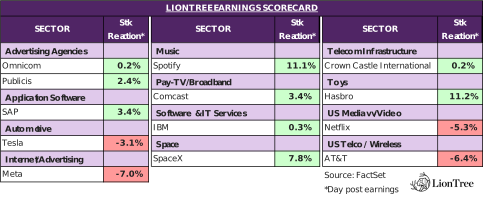
Once again, it’s off to the (earnings) races! 13 companies reported their Q3 results, and stock reactions were notably biased to the upside, with 9 companies (69%) trading up post earnings and 4 companies (31%) trading down. The worst performer was Meta, which fell -7% (see Theme #3) and the best performer was Spotify, which was up +11% (see Theme #8).
SpaceX took off with strong results across super intelligence (SI) as well as satellite connectivity and space, with the stock jumping +8% (see Theme #4) while Netflix faced some challenges, w/ the stock down -5% (see Theme #5). Also revealing some early insights into media, along w/ broader cable trends was Comcast, which was up +3% (see Theme #6) and AT&T kicked off the telco earnings this qtr, though the stock fell -6% post its print (see Theme #7).
The table below includes select mid- and large-cap TMT and consumer companies in our LionTree stock universe that reported this week.
This Week’s Early Tech Bounce Faded As AI Funding Fears Quickly Returned
After a tough couple of weeks in Tech (see our comments in last week’s edition), investors bought the dip Mon–Wed only to face a sharp reversal on Thursday, followed by further broad-sector weakness on Friday. Meta’s results were a key catalyst given its first negative quarterly FCF in more than a decade, mgmt’s commitment to continued aggressive AI investment, a higher floor for FY2026 capx guidance, and a record high CDS rate that revived questions about how the AI buildout gets funded. That coupled with an escalation in the Iran conflict and resulting bump up in crude prices was enough to drive Investors to run for cover in Treasuries and defensives, pushing the 10-yr yield back below 5% during the week.
Next week, capx trends and spend commentary from Microsoft, Alphabet and Amazon will provide more important color and insights on these industry trends.
-> See Theme #3 for our key takeaways regarding Meta’s results
This Week Was A Flight To Safety
- 10-yr UST yield fell more than -17bps on Thurs to ~4.97%…its first move below 5% since Sep 23rd and its biggest 1-day drop since Mar 2023: It closed Friday at ~5%
- The 2-yr Treasury yield fell -16bps to ~4.66% on Thursday as well and closed Friday at ~4.69% (link)
- Defensives rally:
- On Thursday, Staples rallied sharply on Thursday, helped by P&G’s strong earnings (link)
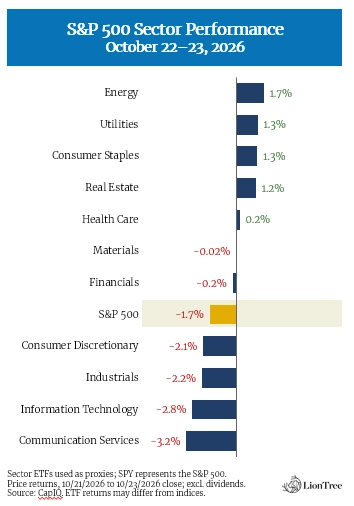
- Energy and Utilities were the best performing sectors on Thursday + Friday
- Communications Services and Information Technology both took it on the chin the last 2 days
Spiking CDS Rates Have Raised Concerns
- What are credit default swaps (CDS)? A CDS provides protection against a borrower’s default. Its spread reflects the cost of that protection; a higher spread generally signals greater perceived credit risk
- Oracle’s 5-yr CDS stood near 295bps on Monday, after touching +300bps last Thurs (10/15), a level S&P Global Market Intelligence says is consistent w/ BB and B (junk) credits (link)
- Meta’s 5-yr CDS hit a record on Thursday post-earnings: It rose as much as 8.9bps intraday to ~119bps, the highest since the swaps began actively trading ~1 yr ago (link)
- CDS on Oracle, Microsoft and Broadcom also widened
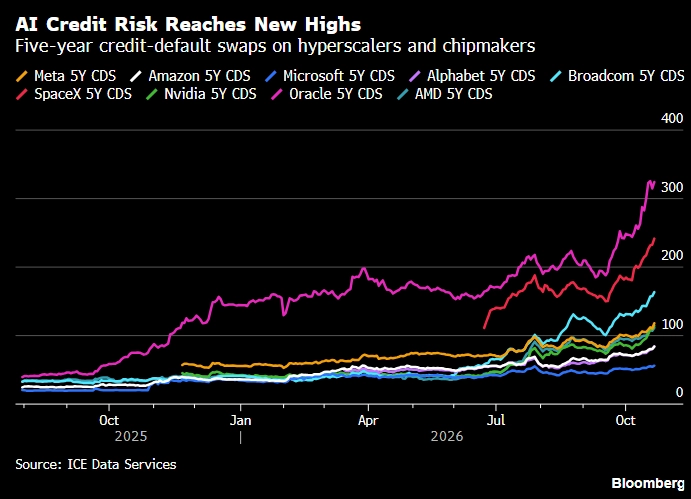
Source: Bloomberg, Oct 20th (link)
The Levels Of Off Balance Sheet Obligations Came Under Heightened Scrutiny As Well
- Meta’s latest 10-Q showed combined non-cancelable contractual commitments and leases not yet commenced of ~$810bn, up from ~$628bn at June 30
- See more details under Theme #3
-> Based on a July study reported in Nikkei Asia, GOOGL, MSFT, AMZN, META and ORCL were carrying a combined ~$1.65tn in off-balance-sheet obligations which was more than the $1.35tn of debt on their balance sheets at the time of the analysis; Oracle’s off balance sheet obligations of ~$273bn were up ~30x in 4 yrs (Tom’s Hardware) (link)
Meta’s Spending Trends Trigger Broad Concerns, Overshadowing A Solid Qtr And Muse’s Strong Start
As mentioned above, Meta’s results were a clear catalyst on Wednesday post close that reignited concerns regarding the AI build spend and ballooning debt and off-balance obligations associated with it (see Theme #2). Despite a solid Q3 where revenue and core profitability came in ahead of expectations, the greater focus was on the narrowed FY26 CapEx range toward the high end of the guidance (pointing to heavier than expected CapxEx in Q4), no specific 2027 spending guidance though mgmt. commented that it plans to continue to spend aggressively, a big seq increase in off balance sheet obligations, FCF turning negative for the first time in more than a decade (following Alphabet reporting negative FCF in Q2), and the view that an equity raise could be in the cards following the Co announcing a new class of non-voting Class C stock which was described as giving the Co “access to a diverse pool of funding sources” as it invests behind AI.
On the flip side, there were many pluses regarding the fundamentals of the business and future growth opportunities. We were very encouraged by Muse, the Co’s new personal agent, which has taken the AI agent scene by storm and reached 10mn+ users in the US and Canada in ~6 wks. Early engagement is strong, with ~25% of users active on any given day, more than double where Threads started. Shopping has emerged as the top use case, with 25%+ of weekly actives using it at an avg purchase size of $200+. The plan is to monetize the agent through transaction fees paid by businesses and subscriptions for users who want more advanced models, and that monetization is expected to come “somewhat sooner” than under Meta’s usual playbook given the scale of both the costs and the opportunity. Over time Muse could generate more revenue per user than the Co’s existing apps BUT the Co needs to improve the compute efficiency before scaling. Muse is expensive to run and mgmt. believes they can improve efficiency by 10x+ over the next year while building capacity to serve 1bn+ people over the next few years.
The core business also remains on solid footing. Pricing drove the ad rev beat, and mgmt pointed to its ranking and recommendation work and gen AI creative tools as sources of runway into 2027. Engagement hit records across FoA, with all-time highs on Facebook and Instagram, while Threads overtook X in monthly actives, and the Co posted record messaging on WhatsApp. Lastly, it was notable that losses in Reality Labs are finally being reined in. Losses are expected to narrow from $18bn-19bn in 2026 to ~$15bn in 2027.
As always, there was a lot that was covered. See below for what we viewed as the most important updates/takeaways.
-> Meta fell -7% the day post earnings and closed the week down -9.4%; YTD, the stock is down -2.7%
Q3 Revs & Core Profitability Beat Cons… But The Co Swung To Its First FCF Loss Since Its 2012 IPO
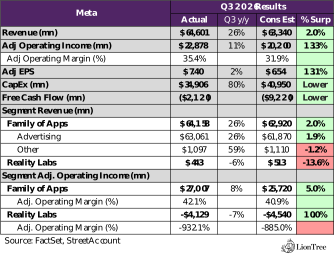
- Q3 total revs BEAT cons by +2% and grew +26% y/y (+26% FXN), which was a slight decel from +28% y/y (+27% FXN) in Q2
- Q3 adj op income BEAT cons by a more notable +13.3% (adj op margin of 35.4% vs cons 31.9%), excl the $9.9bn charge tied to the Aug 2026 multi-state attorneys general agreement
- Ex the charge, op income incr’d +11% y/y
- Q3 adj EPS of $7.40 BEAT cons $6.54
- Q3 CapEx of $33.9bn was LOWER than cons $41.0bn
- Q3 FCF loss of -$2.1bn was the Co’s first negative FCF qtr in more than a decade
- But still came in much BETTER vs cons loss of -$9.2bn
Q4 Rev Guide Came In Ahead Of Cons & Mgmt Expects “Strong” Rev Growth To Continue Through 2027 Though Provided No Specifics
- Q4 rev guidance was +1.2% AHEAD of cons at the mid-pt ($73bn-76bn vs cons $73.65bn), implying +24% y/y growth (vs +26% y/y in Q3)
- FX expected to be ~1% headwind to y/y total rev growth
- For 2027…mgmt did not provide full-year rev outlook, BUT provided some directional commentary
- The Co is positioned “to sustain strong overall revenue growth throughout 2027”, driven by AI benefits to the core biz combined with “emerging opportunities from model advances and product launches”
- New AI businesses (subscriptions, transactions, advertising, enterprise offerings) can “begin contributing incremental revenue in 2027, but more importantly, can scale meaningfully over time”
- The Co is positioned “to sustain strong overall revenue growth throughout 2027”, driven by AI benefits to the core biz combined with “emerging opportunities from model advances and product launches”
The Big Negative Focus Was On Expenses & Higher CapEx, With ~$121bn Of Contractual Commitments Already Due In 2027 And A Potential Equity Raise W/ New Class C Stock
- FY26 EXPENSE guidance RAISED to $175bn-179bn (from $165bn-169bn prior) to incorporate the $9.9bn Q3 legal charge
- Excl the Q3 legal charge, the Co continues to expect 2026 op income to be “above” 2025
- Mgmt did NOT provide quantitative consolidated expense guidance for 2027
- FY26 CapEx guidance NARROWED to $135bn-145bn (up from the previous $130bn-145bn)
- Mid-pt of $140bn is slightly above cons $139.2bn
- Implies Q4 CapEx of ~$49-$59bn or $54.2bn at the mid-pt vs cons ~$53.4bn
- Mgmt did NOT provide 2027 CapEx guidance…mgmt. is evaluating “a lot of investment proposals that have attractive return profiles over different time horizons”; Meta Superintelligence Labs investments “will take longer to generate returns than those in our core business”
- Also in focus was Meta’s latest 10-Q which showed combined non-cancelable contractual commitments and leases not yet commenced of ~$810bn, up from ~$628bn at June 30 (link)
- $454.5bn of non-cancelable contractual commitments vs $349.3bn last qtr
- Primarily cloud capacity and other infrastructure-related arrangements, plus Reality Labs hardware
- ~$45.9bn due in the remainder of 2026 and ~$121.4bn in 2027
- $355.7bn of leases not yet commenced vs $279bn last qtr
- For data centers, energy-related infrastructure, colocations and certain network infrastructure
- Commencement dates run through 2036, w/ lease terms extending up to 30 years
- ~$68bn of July lease additions were already disclosed last qtr
- Maximum exposure to loss in unconsolidated data center ventures rose to $68.4bn vs $46.0bn at June 30
- $454.5bn of non-cancelable contractual commitments vs $349.3bn last qtr
- The Co also annc’d a new class of non-voting Class C common stock, to be distributed as a 1x dividend of one Class C share for each Class A and Class B share: It is effectively a 2-for-1 stock split, w/ trading expected to begin in late Jan 2027
- The purpose? Capital raising, employee compensation, acquisitions and other general corporate purposes, while preserving the voting power of existing shareholders
- “We don’t have any specific financing plans to announce at this time, but we thought it was prudent to establish the appropriate capital structure framework”
On The Positive Side, Muse Has Sustained Tremendous Momentum…The Next Phase Is Centered On Scaling, Growing Revenue, And Cutting Compute Costs
- 10mn+ people in the US and Canada set up Muse personal agents in ~six weeks, and the app has been #1 in the App Store “almost every day”
- This is outpacing Threads’ engagement pace: ~25% of people who have set up Muse use it on any given day, which is “more than twice the level that Threads started at or where we believe that other AI apps started at”
- Retention improves the longer that early adopters use the product
- Muse is not yet launched globally, partly due to compute intensity…mgmt noted that a broader rollout would be expected to drive a “significantly larger” user base
- Shopping is the most common use case, with 25%+ of Muse weekly actives engaging in it at an avg purchase size of $200+ (incl travel)
- Plaid told the Co that it hadn’t seen activity like this with its connector on any other service; Meta had to work with Stripe to raise credit limits in the first week
- Other top use cases are personal productivity (email, calendar connectors) and creativity
- Muse Secure VM provides privacy + security; Muse Confidential VM is coming “soon” so that even Meta cannot see users’ content
- Monetization will come “somewhat sooner” than Meta’s normal playbook, given “the size of the numbers that we’re talking about in terms of both the costs and the opportunity”
- BUT mgmt is not charging everyone up front because it wants to build a “Muse network” where people and businesses’ agents work together
- The FoA ARPU for existing Muse users is “several hundreds of dollars annually” in the US, and mgmt expects Muse to “reach an even higher level over time due to the amount of commerce that we already see taking place”
- Compute efficiency is the main gating factor: Muse is “very compute-intensive to run” and total serving costs are expected to rise
- The Co expects to improve cost efficiency by more than 10x over the next year via off-peak capacity utilization, more efficient models, and inference optimization, which “will enable it to be profitable once the revenue lines are at scale”
- The Co aims to build capacity to serve 1bn+ people over the next few years, contingent on hitting certain compute efficiency targets
- “I just expect that we will be able to deliver the same intelligence that we have now in Muse Wonder or frankly, any of the current frontier models at a fraction of the cost in a smaller model a year from today”
- More businesses than anticipated want to integrate w/ Muse and expect the market to move toward “more permissioned, structured interactions” (authenticated APIs, approved agent partnerships, agent-to-agent communication)
- Previewed the personal agent protocol, an open standard across Muse and Meta business agents, developed w/ partners incl Sierra, Walmart, Stripe and Shopify
- “In the near term, we expect many experiences will remain AI-assisted rather than fully autonomous”
Enterprise Is Becoming A Bigger Focus As Meta Looks To Monetize Its Models Beyond Ads
- Mgmt sees an opening as AI disrupts enterprise software… “we really don’t believe that traditional enterprise companies have this locked down”
- Pointed out Meta’s models, infrastructure, global distribution and long-standing business relationships as differentiated assets
- Expect that this will be an oppty that will develop over multiple yrs and is hoping that it becomes a “new diversified, recurring revenue stream” across subscriptions, usage-based API, messaging and other revenue lines
- Muse for small business launched in late September, as a set of skills and connectors inside the existing Muse app
- Connects to Instagram analytics, Facebook Pages and Meta ad accounts plus third-party tools like Shopify, QuickBooks and Canva
- SMBs are using it for ads optimization, DM organizing, sales expansion, keeping websites current, and employee load balancing
- Building a Meta Enterprise Platform to serve “as much high margin inference demand as possible” now that it has leading models and training is a large, fixed cost
- Near-term offering is the model API and Muse Code, alongside business agents…“each of those three things is growing quite quickly”
- Longer term, “we would like to make it so that we have a whole kind of business network of Muse agents”
Moving To The Core Biz… Stronger Pricing Drove The Ad Rev Beat, With AI Tools Setting Up Further Runway Into 2027
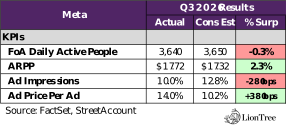
- FoA ad revs grew +26% y/y (vs +27% y/y in Q2) and BEAT cons by +1.9%; FoA adj op income BEAT cons by +5%
- Ad impressions grew +10% y/y (BELOW cons +12.8%) while avg price per ad grew +14% y/y (AHEAD of cons +10.2%)
- Impression growth was “healthy” across all regions, driven by engagement + user growth and ad load optimizations
- Price per ad was driven by ad performance gains and improved macro conditions y/y, partially offset by strong impression growth from lower-monetizing surfaces and regions
- Meta AI business assistant is becoming more proactive…advertisers who adopted its recommendations drove almost +5% more conversions at the same cost per conversion and incr’d ad spend by +9% vs similar non-adopters
- Rolling out creative insights, stronger business context and more agentic actions so marketers can plan, create and optimize campaigns conversationally
- Gen AI creative tools continue to scale, as nearly 10mn advertisers used at least one tool in Q3
- Advertiser adoption of video generation grew +25% q/q, driven in part by ready-made videos generated from a single image in seconds
- Partnership Ads grew +97% y/y and surpassed a $15bn annual revenue run rate
- Completed the global rollout of Creator Marketing Hub to all advertisers, w/ 10mn+ creators now discoverable; Integrating Meta AI business assistant into the hub
- Called out three sources of ads runway into 2027…the existing ranking and recommendations pipeline, new LLM-oriented research bets, and expanded gen AI tools via Advantage+
- Investments across engagement and ads “give us confidence that we have meaningful runway to grow our core business throughout 2027”
Engagement Reached All-Time Highs On Facebook And Instagram Despite FoA DAPs Coming In A Touch Below Cons
- Meta ended Q3 w/ 3.64bn Family DAPs, up +3% y/y but slightly below cons 3.65bn
- ARPP of $17.72 BEAT cons $17.32 by +2.3%
- Engagement milestones across FoA as recommendation improvements continue to drive gains
- Instagram: Global time spent per user reached an all-time high and grew double digits y/y, w/ strength in both Reels and Feed
- Relevance launches incr’d reels time spent by 4%+, helped by a model architecture that ranks sequences of reels at a time
- Nearly 45% of recommended Instagram Reels are now less than one day old, up 11+ ppts from Q2
- Facebook: Reels time spent reached all-time highs globally and in the US, both growing double digits y/y
- Completed global launch of a new generative retrieval architecture on Feed and Reels (now ~1/4 of unconnected feed views and 1/2 of reels views), incr’ing reels watch time by +1%
- Threads: Has overtaken X in monthly actives; time spent per user grew 20%+ y/y
- WhatsApp: Hitting all-time highs in messaging and becoming “an increasingly important platform for agents”
- Instagram: Global time spent per user reached an all-time high and grew double digits y/y, w/ strength in both Reels and Feed
- Have begun moving content understanding models onto the Co’s own Muse models, which are outperforming current models in offline testing and cutting per unit content processing costs by 80%+ across Instagram, Threads, Facebook and ads
Also To Quickly Flag…Reality Labs Losses Are Now Going To Be Reined In
- Reality Labs’ overall performance continues to disappoint
- Q3 revs of $443mn declined -6% y/y and missed cons by -13.6%
- Q3 op loss of -$4.1bn was better than cons -$4.5bn
- One bright spot though was despite lower Quest headset sales, growth in AI smart glasses remains strong
- Muse is coming to Meta Glasses starting next month, incl the new audio glasses, and is “central to the business model for the glasses”
- With Muse, mgmt expects paid subscriptions to increase and the business to “begin improving meaningfully from here”
- Devices are priced “not to make a large profit on the hardware, but to build a large software and superintelligence business on top of them over time”
- VR rollouts will be paced: Will only ship new VR devices when they have major breakthroughs, like the Meta VR glasses this year
- Looking ahead…Reality Labs op loss is expected decline to $18bn-19bn in 2026 and ~$15bn in 2027, “trending towards profitability from there” as investment is reallocated primarily to AI
Super Intelligence Now Leads SpaceX’s Biz But Mobile Service Ambitions Also Remain In Place
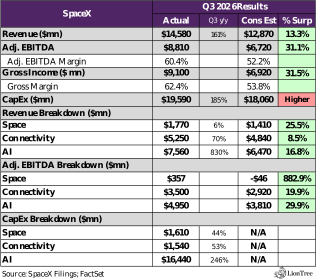
SpaceX delivered another blowout set of quarterly results since its June 2026 IPO. Revs BEAT cons by +13% (grew +161% y/y) and adj. EBITDA BEAT by +31% (60.4% margin vs 52.2% cons) with upside from all three segments AND the Co posted its first operating profit as a public Co. What was different this qtr vs last is that while the capx guidance was raised again (mgmt now expects Q4 capx of $35-40bn, roughly 2x the “very similar” to Q2 level it signaled just one qtr ago), investors are looking past it this time given the very strong performance in the Super Intelligence segment (SI is now the largest business at $7.6bn of rev, up a massive +830% y/y, w/ adj. EBITDA of $5.0bn), the strong returns on that spend (paybacks are less than 1 year and “it’s not impossible that we will have a six month payback period for compute next year”), and much better than expected Q1:27 revenue guidance ($33-37bn vs cons $23.43bn) given visibility into its compute contract pipeline.
Other key takeaways from SpaceX earnings include: 1) Reiteration of the $100bn ARR by Dec 2026 target but Musk floated an ARR of $500bn-$1T by end-2027; 2) Compute targets were raised AGAIN…1.7 GW nameplate at Q3 end heading to 2.5-3 GW by YE26 (vs 2+ GW previously) and ~13 GW total by end-2027 (vs “closer to 10” GW previously), w/ compute pricing now tracking slightly above the high end of the $30-50/watt range and paybacks <1yr; 3) Very bullish comments on Grok Bot which reached 800k paid weekly users within ~2 months of launch; 4) Musk said a Tesla merger is not a certainty and the special committees at both Cos have not agreed on terms, but he thinks it should happen; 5) Mgmt is still planning to go head to head with the telcos regarding mobile service.
See below for more details on the above plus other incremental points from our view.
-> SpaceX shares rose as much as +12.4% in after-hours trading on the back of results and closed the day up +7.8% in reaction; The stock is up +9% from its IPO price
-> Separately but related from this week, Elon Musk is reportedly investing ~$1bn in David Ellison’s Skydance, a day after John Malone suggested a much larger partnership could be coming; Speaking at the Paley Center summit, Malone speculated that SpaceX and Skydance could strike a global content distribution deal involving $8–10bn in cross-investment, pointing to Musk’s longstanding financial ties with Larry Ellison. “I think there’s a deal coming there,” he said (link/link/link)
A Tesla Merger Is Not A “Certainty” BUT Special Committees Have Been Formed To Evaluate
- Both SpaceX and Tesla have formed special committees of independent directors to discuss a combination at the request of shareholders
- Musk is a conflicted party and cannot participate in the special committee discussions
- Musk cautioned that assuming a merger is a certainty “would be overstating it”…the committees have not reached agreement on terms and there is “no guarantee that they will”
- BUT Musk thinks a combination “would be a good idea” and sees “a lot of merit” given “we are pretty much in the super intelligence singularity”, citing SI software, chip design, Terafab, robotics, mass to orbit for the Starmind constellation and connectivity
- Ultimately, it is “really up to the special committees of both companies”
- BUT Musk thinks a combination “would be a good idea” and sees “a lot of merit” given “we are pretty much in the super intelligence singularity”, citing SI software, chip design, Terafab, robotics, mass to orbit for the Starmind constellation and connectivity
- A Tesla vote would require approval from 50% of ALL shares (not just those voting), which Musk called “quite a high hurdle”
A Blowout Qtr W/ Upside Across Every Segment…SI Is Now The Largest Segment
- Revenue BEAT by 13% & grew +161% y/y: SI segment rev of $7.6bn now exceeds Connectivity ($5.2bn) and Space ($1.8bn) combined
- The Co posted upside across the board: Space BEAT by +26%, SI BEAT by +17%, Connectivity BEAT by +9%
- Adj. EBITDA BEAT by +31% & grew +306% y/y: 60.4% margin vs 52.2% cons (and 38.9% a yr ago)
- Upside was also across the board
- Gross margin of 62.4% was well ahead of cons 53.8%
- BUT the Q3 GM includes 1x benefits (incl ~3% from tariff refunds in Connectivity) and more favorable customer mix
- Operating income of $2.8bn vs a loss of -$273mn a yr ago = the first operating profit as a public Co
Mgmt’s Very Bullish Forward Revenue Commentary Stood Out… Musk Floated $500bn-$1T Of ARR By YE 2027
- REAFFIRMED: “Remain on track” to deliver $100bn of ARR by the end of 2026
- Q4 gross margins are guided to come down and be “more consistent” with Q2 (55.3%) given 1x benefits and customer mix in Q3
- But Q1:27 total revenue guidance was much stronger than expected …$33-37bn vs cons $23.43bn
- Mgmt cited “increased visibility into our compute contract pipeline over the next six months”
- Midpoint of $35bn implies ~2.4x Q3 rev (+140% seq) and ~7.5x Q1:26 rev of $4.7bn
- Musk said the build-out implies ARR by the end of 2027 is “somewhere between $500 billion and $1 trillion”
- Last qtr, Musk said internal projections anticipated $1T of annual revenue in 2030
- Backlog totaled $63bn at qtr end, of which $17.5bn was recognized as deferred rev
- ~$42bn of the backlog is expected to be recognized within the next year
- Demand remains robust across all three segments, “particularly in our cloud services business”
A 2nd Qtr In A Row Where Capx Guidance Steps UP But Investors Took It More In Stride Given The Strong Performance & Favorable Economics
- Total CapEx at $19.6bn was ~8% HIGHER than cons & grew +185% y/y
- SI capx of $16.4bn (84% of total) grew +246% y/y…remainder to fund Starship infrastructure and satellite production
- Space capx of $1.6bn grew +44% y/y and Connectivity capx of $1.5bn grew +53% y/y
- SI capx of $16.4bn (84% of total) grew +246% y/y…remainder to fund Starship infrastructure and satellite production
- Q4 capx is now guided to INCREASE to $35-40bn b/c of the addt’l compute capacity coming online in the qtr…vs prior commentary that capx would be “very similar” to Q2 (~$18bn) for the next two qtrs
- Compute economics are improving…new deployments are generating a payback of less than a year
- Pricing is tracking “slightly above the high end” of the $30-50/watt range discussed last qtr
- Musk cited that “it’s not impossible that we will have a six month payback period for compute next year”
- Short-term contracts are at effectively spot market rates…renewals are coming in at higher $/watt, not lower
- Musk believes value of compute per watt will increase over time as models deliver more useful intelligence per watt, noting even older H100s rent for more than when they were new
- Demand far exceeds supply…mgmt is “hounded relentlessly” by every hyperscaler and dozens of smaller companies and “could rent out our compute several times over”
- SpaceX tried to offload some of its inference compute to other cloud providers to free up training capacity and found none available
- Funding was a focus in the Q&A & mgmt laid out three sources –
- Operating CF first…the short payback means the capacity “starts to fund itself” and capacity finishing Q4 starts that funding mechanism into H1:27
- Multiple pools of debt capital given the Co’s investment grade status and “very strong balance sheet”
- Partnering across the value chain on both the vendor and customer side
- Mgmt has “a lot of conviction” it can fund the build “in a very measured fashion” and keep its IG rating
- Balance sheet: ~$51bn of cash + ~$39bn of marketable securities vs ~$39bn of total debt & finance leases at 9/30
SI Profitability Inflected Sharply…Compute Targets Raised Again To ~13 GW By End-2027 As Pricing Moves Above $50/Watt
- SI segment rev BEAT cons by +17% and grew +830% y/y and +195% seq (+171% excluding Cursor)
- Strong growth driven by the activation of new cloud services agreements but also the acq of Cursor ($608mn in Q3 revs), and incr’d Grok adoption across enterprise customers and consumers
- Ad revs grew +19% y/y to $538mn as momentum builds on the new ad tech platform rolled out last qtr
- A huge improvement in SI profitability stood out…adj. EBITDA reached $5bn (BEAT cons by 30%) vs $1.1bn in Q2 and a loss of -$428mn a yr ago (65.5% margin)
- Driven primarily by higher margin cloud service agreements
- Excl $1.2bn of Cursor-related stock-based comp, SI delivered $1.6bn of operating profit
- Compute capacity is scaling faster than planned…1.7 GW nameplate at Q3 end (up from 1.4 GW in Q2 and 0.6 GW a yr ago)
- Will already be at nearly 2.2 GW by the end of October and 2.5-3 GW by YE26 (vs 2+ GW targeted last qtr) as capacity comes online at Memphis and Southaven
- The Co is bringing ~200k GB300s online per month for the remainder of 2026 and is continuing that pace in 2027 w/ primarily Vera Rubin
- Guidance for 2027…Musk is “fairly confident” of an incremental 10 GW of compute in 2027 (to ~13 GW total)
- Constraints are with power, cooling and infrastructure vs with chips hence, the Co is aiming for an incremental 20 GW of power/cooling in 2027 (~23 GW total) so power is “far in excess” of what is needed for GPUs
- Musk cited a “non-zero possibility” of 20+ GW of SI compute online next year…It is a “small possibility, but it used to be zero”
- How is the Co solving the power bottleneck? SpaceX is casting turbine blades and vanes in-house using its rocket engine castings capability
- Turbine suppliers say blades & vanes are 12-18 months behind the rest of the turbine…Musk says this lets SpaceX bring power online 12-18 months faster than anyone else
- Also pursuing solar, wind and other sources plus factory-built modular inference compute w/ power and cooling built in for distribution across the country
Grok Bot Is Seeing The “Fastest Growth” Musk Has Ever Seen…Cursor Is Expanding The Enterprise Go-To-Market
- Grok Bot (agentic assistant launched in August) had 800k paid weekly users earlier this month, more than doubling over the last month
- Musk highlighted that it is “the fastest growth of a product that I’ve ever seen in my life”
- Usage per user GROWS over time rather than declining
- B2B is the fastest growing category w/ companies using it across sales, marketing, IT and engineering as an always-on teammate for end-to-end workflows
- Musk believes Grok Bot may end up using most of the Co’s SI compute
- Grok Bot for enterprise is in early deployment w/ trusted customers…wide deployment is expected within a few weeks
- Cursor integration “continues to progress well”
- Grok enterprise customers w/ >$1mn of run-rate rev (incl Cursor) grew +50% q/q on a pro forma basis
- Last week the Co annc’d a new plan bundling Grok, Grok Bot, Cursor and X Premium
Connectivity Revenue Accelerated…Consumer Adoption Remains Strong But Enterprise and Gov’t Are Still Set To Eclipse
- Connectivity segment performed BETTER than expected
- Revenues BEAT by ~9% and grew +69% y/y & +22% seq
- Consumer rev grew +57% y/y (+26% seq) and Enterprise & govt rev grew +91% y/y (+18% seq)
- Adj. EBITDA BEAT by ~20% and grew +82% y/y…margin of 66.7% vs 62.1% a yr ago
- The 55% gross margin included a roughly 3-percentage-point one-time benefit, primarily from tariff refunds
- Operating income grew +99% y/y to $2.4bn
- Revenues BEAT by ~9% and grew +69% y/y & +22% seq
- Another strong qtr of Starlink consumer additions…added +1.6mn net adds in Q3 (vs +1.7mn in Q2) to reach 13.6mn (+89% y/y)…driven by growth in developed markets
- That # also excludes hundreds of thousands of addt’l enterprise subscribers and aviation customers
- Markets w/ service availability reached 174 (vs 167 in Q2) incl new launches in Vietnam and Uganda
- And activations should ramp in Q4: The Co began ramping production of V5 kits, which is alleviating inventory constraints; The Co prioritized kit delivery to retail channels ahead of the holidays which should drive incr’d activations in Q4
- ARPU incr’d +5% seq to $69/mo on favorable customer mix BUT is down from $83/mo a yr ago
- Aviation is a major growth driver…Starlink is now contracted for ~12k planes, “almost a quarter of the available aircraft”
- 3,800+ aircraft were equipped w/ Starlink at 9/30 and have a line of sight into an accelerated activation path into 2027
- Signed w/ three of the four major US carriers
- Lufthansa, Swiss, Copa Airlines, Korean Air, Austrian Airlines and Asiana Airlines all flew their first Starlink-equipped aircraft in Q3
- Aviation production rates have quadrupled since the start of the yr and are expected to double again before YE
- Partners say Starlink is becoming “a key reason customers choose to fly with them” and Starlink-equipped flights carry higher load factors…connectivity is quickly becoming “table stakes”
- Starshield continues to grow w/ the US govt and fixed site is gaining momentum
- ” Mgmt remains on pace for enterprise and government revenues to each exceed consumer connectivity revenues in the future”
Expect A ~100x Bandwidth Step-Up Within ~3 Yrs
- Flight 14 (the first orbital and first revenue-generating Starship mission) delivered 26 Starlink V3 satellites and 26 Tbps of bandwidth…equivalent to ~10 Falcon 9 Starlink launches
- The ship was only “maybe half loaded”…each Starship launch is ramping toward >20x the downlink capacity of a current Falcon 9 launch
- Musk expects ~100x the bandwidth of the current constellation within ~3 yrs…on the order of 100k satellites, each w/ >10x the bandwidth
- Starlink rev will be “at least somewhat proportionate to the total bandwidth delivered”
- Connecting cars, robots and the adoption of superintelligence will increase communication demands “not in percentages, but in many orders of magnitudes”
- Sees demand for ~1,000x more bandwidth in 3-5 yrs as AI agents will use far more bandwidth per agent than a person
- Timing: A “few hundred” V3 satellites are needed for users to really feel the impact…achievable by mid-2027
- V3 broadband satellites will be deployed in meaningful volume through YE26 and throughout 2027
Mgmt’s Mobile Service Ambitions Remains In Place …Musk Sees A “Clear Path” To Several Hundred Billion In Connectivity Rev
- Starlink Mobile surpassed 22mn monthly users in Q3, up +37% q/q
- New carrier service was turned on in Q3 in Uganda, the Democratic Republic of Congo, Kazakhstan and Costa Rica
- Expect a major increase in download capacity
- V3 broadband satellites: Expect to deploy meaningful volumes through the end of 2026 and throughout 2027
- Incr’d capacity: Each Starship launch will ramp toward a payload delivering more than 20x the downlink capacity of today’s Falcon 9 launches
- Starlink Mobile V2: Starting in 2027, will ramp deployment of these satellites on Starship
- V3 broadband satellites: Expect to deploy meaningful volumes through the end of 2026 and throughout 2027
- The Co will “leverage our newly enhanced wireless spectrum portfolio to expand our direct-to-sell service and become a major mobile carrier”
- How will Starlink Mobile compete w/ incumbents?
- Somewhere between “85-93%” of mobile connectivity is done over Wi-Fi, where Starlink broadband already plays a role
- The S-band spectrum is expected to carry the majority of traffic w/ 800 MHz low-band providing critical building penetration
- The Co will also leverage real estate from installed Starlink homes/businesses w/ smaller radios plus towers
- Per Musk, “we do see a clear path to several hundred billion dollars a year in connectivity revenue”…and plans a longer presentation on the Starlink connectivity game plan
-> Later in the week, it hit the tape that SpaceX is reportedly in talks w/ tower companies, incl. Crown Castle, to lease space on 80k+ US cell sites to build out a terrestrial wireless network; When asked a day earlier on its earnings call about lease talks w/ SpaceX or Amazon, Crown Castle’s CEO said “you can assume that we’re talking to all parties” (link)…Towers jumped in reaction to the news with CCI up +9.1%, AMT up +4.1%, and SBA Communications up +3.6%, while the telcos went the other way, with AT&T down -8%, TMUS down -7.7%, and VZ down -1.2%
Space Swung To Positive EBITDA…Flight 15 Will Attempt The 1st Ever Full Recovery Of An Orbital Launch Vehicle
- Space rev BEAT cons by +26% and grew +6% y/y & +84% seq anchored by a favorable customer mix
- Adj. EBITDA of $357mn BEAT cons loss of -$46mn (vs -$205mn in Q2) BUT was down from $674mn a yr ago as Space segment R&D grew +44% y/y to $1.2bn, reflecting cont’d Starship investment
- Mgmt expects “strong growth for the year” based on robust Falcon and Dragon manifests
- 35 launches in Q3 (vs 44 a yr ago) w/ 476 metric tons of mass to orbit
- Incl 21 Starlink missions on Falcon 9, two Starship flights, six National Security Space Launch missions and the Falcon Heavy launch of NASA’s Roman Space Telescope
- Completed three Falcon missions across three launch sites in 13 hours on 10/1 (Crew-13, a Falcon Heavy NRO mission and a 130-payload rideshare)
- SpaceX delivers almost 90% of all mass to orbit vs ~6% for China and ~4% for the rest of the world
- New business wins: three addt’l NASA ISS crew missions on Dragon (through 2028), the Starlink comms contract for Artemis III, 18 NSSL missions, a Starship lunar surface payload contract and three Starfall missions
- Flight 15 (expected next month) will attempt to catch both the booster and the ship…Musk said success is “more likely than not”…this would be a “profound” tech milestone
- FAA license is expected to include return to launch site and tower catch for both stages
- Goals to refly the second stage and attempt on-orbit refueling in early 2027…Mobile V2 and Starmind satellites begin flying in 2027
- Starship cadence expected to reach once weekly at some point in H1:27 and twice weekly (or more) in H2:27
- Annc’d Starbase Louisiana, designed for thousands of Starship flights/yr and potentially 20+ launch towers
- First launch targeted for 2029 but the internal aspiration is 2028…Musk is “highly confident” of launching at scale from Louisiana in 2029
Terafab Is Targeting Volume Chip Production By Q3:28…An Aggressive But Potentially Transformative Timeline
- SpaceX aims to have its first test chip (SRAM) functional around May/June 2027 at its research fab in Austin
- The aspiration is to reach volume chip production around Q3:28 at Terafab…Musk called these “insanely fast time frames” and timing is uncertain
- ASML and other suppliers are accelerating equipment deliveries
- Musk hinted at “significant potential breakthroughs” in chip fabrication but declined to discuss details for competitive reasons
An Ads Reset & A US Content Push Put Execution In The Spotlight @ Netflix
Growth in the ads business was supposed to be one of the cleaner parts of the Netflix story this year, so the cut to the 2026 ad rev target (from ~$3bn to ~$2.7bn) was an unwelcome surprise and the result of some ad products and partner integrations rolling out more slowly than previously anticipated. Q3 results themselves were mixed, with rev in-line, op margin and EPS upside driven primarily by expense timing, and FCF missing. Q4 guidance also fell short on revenue and margins, but as a caveat, some of the costs of the Co’s largest headcount reductions since 2022 were not fully reflected in Street estimates per FactSet. 2026 FCF guidance was lowered given a real estate transaction.
Big picture, mgmt acknowledged that the US is “just not growing as fast as it could or as fast as we’d like,” and incoming CCO Peter Rice is tasked with delivering more breakout US hits, though mgmt stressed there is “no need for a fundamental shift in the strategy.” Roughly 95% of spend remains focused on the core entertainment offering, which includes originals and complementary 3P programming but new licensing deals with Disney and Globo, plus the TF1 integration, broaden that offering in addition to a more structured theatrical approach (though the Co remains “a streaming-first business”). Ultimately, the story is less about strategy changes and more about execution, and while the Co maintains that “our business and our business flywheel are working,” after this qtr’s ad and outlook cuts, investors will certainly be tuning in to see whether the Co can deliver on the ad roadmap and content slate heading into 2027.
See below for our key takeaways from Netflix’s print.
-> NFLX was down -5.3% in reaction to its print and ended the week down -6.6%; YTD, the stock is down -29.8%
Profitability Beat Was The Standout In Q3 (Revs Were In-Line) & The Q3 Buyback Hit A New Record…
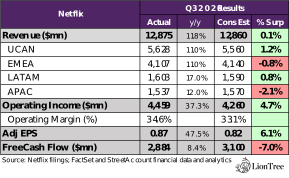
- Q3 rev was IN-LINE and grew +11.8% y/y (+11% FXN): Driven by membership growth, pricing and incr’d ad rev, with DD rev growth across all regions
- UCAN – beat: Grew +11% y/y (+11% FXN)
- EMEA – miss: Grew +11% y/y (+9% FXN)
- LATAM – beat: Grew +17% y/y (+12% FXN)
- APAC – miss: Grew +12% y/y (+15% FXN) …India rev grew ~18% FXN, w/ its largest qtr of paid net adds
- Op margin of 34.6% BEAT cons 33.1% and was up +640bps y/y, driven primarily by “the timing of expenses and the slight upside in revenue”
- EPS 87c BEAT cons 82c: Grew +49% y/y, driven by op income outperformance and a lower share count
- FCF missed by -7.0%
- Repurchases hit a new record in Q3…$4.8bn buyback (63.9mn shares) was the Co’s largest qtr of repurchases ever and the Co has $22.3bn left on the authorization
…BUT Q4 Guidance Disappointed The Street W/ Advertising Revenue Set To Miss The 2026 Target
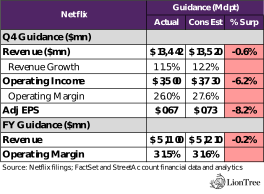
- Q4 rev guidance of $13.44bn MISSED cons by -0.6%…implies +11.5% y/y growth (+11% FXN) vs the +11.8% in Q3
- 2026 rev outlook was LOWERED slightly to $51.1bn (-0.2% below the prior mid-pt)
- While subscription rev growth has “outperformed”, it was more than offset by lower ad revs (see below)
- Implies +13% y/y growth (+12% FXN) vs +16% y/y in 2025
- 2026 rev outlook was LOWERED slightly to $51.1bn (-0.2% below the prior mid-pt)
- The Q4 op income & EPS guidance also MISSED cons but both include the impact of the headcount reductions, which cons does not fully reflect based on Factset data: Op margin guide of 26% includes ~120bps of headcount reduction costs and compares to 24.5% in Q4:25
- But given the Q3 beat, 2026 op margin guidance of 31.5% was MAINTAINED (and is now absorbing ~30bps of headcount reduction costs)
- Compares to 29.5% in 2025 and implies 20%+ y/y op income growth
- But given the Q3 beat, 2026 op margin guidance of 31.5% was MAINTAINED (and is now absorbing ~30bps of headcount reduction costs)
- 2026 FCF guidance was LOWERED to ~$12.0bn (from ~$12.5bn) due primarily to a real estate transaction expected to close in Q4
- Annual cash content spend-to-amortization remains at ~1.1x
- 2027 guidance will be released in January, but mgmt. reiterated that they “look to sustain double digit revenue growth… expand margins…[and] increase free cash flow”
- Growth into 2027 is expected from the same three levers: Member growth, pricing and ads
2026 Ad Rev Guidance Was Cut To ~$2.7bn On Product Delays, But The Ad Tier Expansion To 15 New Countries In 2027 Remains On Track
- 2026 ad rev outlook was LOWERED to ~$2.7bn (from ~$3bn)… but is still expected to grow more than 80% y/y
- Why? “Currently a bit behind our aggressive target for the year,” citing delays in the rollout and partner integrations of some new ad products
- The miss was viewed as a byproduct of an aggressive roadmap and called it “a modest short-term hit for a better long term strategic position”
- This is NOT expected to impact long-term gains, as demand “remains strong” and the breadth of advertisers continues to expand
- Why? “Currently a bit behind our aggressive target for the year,” citing delays in the rollout and partner integrations of some new ad products
- The Co remains on track for the ad tier to launch in 15 new countries in 2027
- The first tranche launches in March 2027 across nine EMEA countries plus Colombia, Peru and New Zealand
- Ad-tier ARM remains below Standard w/out Ads ARM, BUT the gap is narrowing and represents “under- realized revenue growth for us in the near term”
- Expect the dual dynamic of growing inventory (more ads plan members) and growing monetization to “persist for some time,” w/ a gradual closing of the ARM gap
The US Needs Better Execution…And The New Incoming CCO Is Tasked With Delivering More Breakout Hits
- Netflix has “healthy” retention in every region and churn improved y/y both globally and in the US
- BUT while US engagement is “solid”…”we know that we can do better, and that better is our upside”
- “We do need better execution in the US”…the US is “just not growing as fast as it could or as fast as we’d like”
- The Co had “some really solid doubles and triples this year,” BUT other territories count on US titles being home runs that travel globally
- “We want to grow view hours faster. We’re not satisfied. We’re working on it”
- “We do need better execution in the US”…the US is “just not growing as fast as it could or as fast as we’d like”
- Regarding Peter Rice succeeding Bela Bajaria as Chief Content Office, following her decade long run…
- Mgmt highlighted his experience across TV networks, movie studios, streaming and live sports, and his strength in talent relations
- “There is no need for a fundamental shift in the strategy”…the change is about execution
- International content continues to drive results, w/ India the standout
- India view hours grew +24% y/y in Q3 and were also up on a per member basis
- Lock Upp became the most viewed title ever in India measured by hours viewed in the 1st 91 days
- Mgmt also called out strength in Korea, Japan and the Nordics
- India view hours grew +24% y/y in Q3 and were also up on a per member basis
- Growth drivers vary by market maturity
- Mature markets (US, UK, Australia) will skew toward ARM and ad growth
- Newer markets (India, Indonesia, Colombia) will be driven most by member growth w/ accessible entry points
- Middle markets (Mexico, Japan, plus non-ads markets like the Philippines and Turkey) offer a balanced mix of member and ARM growth
The Q4 And 2027 Slates Look Robust, Including The Biggest Quarterly Live Lineup To Date
- Q3 hits included The Last House (91mn views), Facing El Chapo (58mn), The Secret Woman (47mn), Death of the Pastor’s Wife (45mn), A Toxic Love Story (43mn), The Gentlemen S2 (33mn) and Little House on the Prairie (29mn)
- Looking into what’s coming out this qtr…
- Q4 series: East of Eden, The Diplomat S4, The Body, The Murder of JonBenét Ramsey, The Hunting Wives S2, Emily in Paris final season, Pride and Prejudice and Lupin Part 4
- Q4 films: The Further Mis-Adventures of Cliff Booth (Brad Pitt, directed by David Fincher), Bad Day, Steps, Animals and Ray Gunn
- Q4 live (the biggest quarterly live slate to date): The NFL’s first Thanksgiving Eve game (U2 halftime show), a Christmas Day doubleheader and Tyson Fury vs Anthony Joshua
- 2027 slate: Narnia, Charlie vs. the Chocolate Factory, Here Comes the Flood, Grown Ups 3, Bridgerton S5, Wednesday S3 and a new Michael Fassbender series about the Kennedys
- Live includes an NFL game in the final week of the regular season (a first for the Co) and the Women’s World Cup in the US and Canada
Licensing And Partnerships Broaden NFLX’s Core Offering…While Newer Formats Remain Early-Stage
- Reiterated that “roughly 95%” of spend and “nearly all” of the rev is focused on the core (i.e., originals and licensed series / film / live) where they see a “long runway” for future growth…newer initiatives remain early-stage w/ “very tight” investment
- Licensing deals are expanding
- Disney deal (launched in October) brought all five Ice Age films, which all hit the Top 10, plus other Disney films and series
- Globo in Brazil is the Co’s largest licensing agreement w/ Globo and “the most meaningful licensing deal we’ve ever done in Brazil”…Globo had been a long holdout on licensing locally
- Other recent renewals / additions include The Walking Dead and Power, plus deals w/ Sony and Universal
- Emphasized that “we’re not really dependent on any single supplier, but we are thrilled to be in business with just about every supplier in the world”
- “Very pleased” w/ early TF1 performance in France and believe Netflix “can replicate similar positive results with other partners”
- Testing shows TF1 engagement “is incremental to our platform” and TF1 viewing on Netflix is growing every month
- Add-on subscription services (paid or hybrid ads) would be “yet another way to expand our entertainment offering”…though “nothing to announce today”
A Few Other Key Comments On Theatrical Strategy, Headcount Reductions, And Price Change Impacts
- Theatrical release patterns are now split by film type, with specialty and big family films treated “totally differently”: Will release ~30 films theatrically this year (which is “pretty much what we did last year”)
- Specialty releases: A 47-day platform window for La Bola Negra, a shorter window for The Mosquito Bowl, and an IMAX run ahead of the Netflix release for The Further Mis-Adventures of Cliff Booth
- Big family films: “A traditional 45-day window for a handful of films,” including Narnia: The Magician’s Nephew and Charlie vs. the Chocolate Factory in 2027 (previously annc’d)
- On recent headcount reduction (largest since 2022)…there were “some areas that we built quickly, and we ended up overinvested in” and that “sometimes the team needs a forcing function”
- The changes “enable us to continue to aggressively invest in high impact areas to improve our service, and drive growth and innovation”
- Mgmt didn’t quantify 2027 run-rate savings or how much will be reinvested vs dropped to the margin: There is “no change to our philosophy” of investing for growth while “steadily growing margin each year”
- Reiterated that 2026 price changes “have gone well”…member response is “consistent with prior price changes and our expectations”
Comcast: Peacock’s Better Profitability Shined Bright While The Challenged Bband KPIs Show Y/Y Improvement
Comcast delivered solid headline results (rev, adj EBITDA, adj EPS, FCF all beat) which was in large part driven by Peacock’s better than expected level of profitability ($261mn adj EBITDA vs cons $176mn), but also some adj EBITDA upside in Connectivity & Platforms (C&P) and Studios.
Starting on the C&P side, mgmt unveiled “the most significant operating and cost transformation in our company’s history”, which it believes will “ultimately amount to billions of dollars over time” but comes w/ a $1bn+ charge in Q4. This in the face of a backdrop where the bband market has been “more competitive in the second half than it has been in the first half for sure” and Q3 Bbband losses widened y/y to -144k (though a tad better than cons) on aggressive fiber promos + an unusually high volume of legacy promo roll-offs. However, on the positive side, the “modest improvement” in C&P financials guided for last qtr did materialize (C&P Q3 EBITDA decline narrowed 140bps seq to -4.4%; Q3 convergence ARPA decline narrowed to -0.5%) and mgmt expects “further slight improvement” in Q4. Mgmt also continues to be very bullish on the w-less opportunity (18% penetration of bband base and 7% penetration of HHs) though Q3 net adds fell short of cons as switching slowed. The free-line-to-paid conversion rate was 70% in Q3, which was also a plus.
On Parks, trends in Orlando and Japan still show pockets of softness which mgmt. deems to be “temporary rather than structural” but cited two new Co-specific factors, competitors adapting their marketing faster + Epic capacity/throughput issues. Orlando softness is expected to persist through H1:27, and mgmt. now targets a return to Parks growth in H2:27.
All in all, there are still a lot of moving parts at Comcast with some pluses and minuses in Q3, but execution is the name of the game as we look into Q4 and 2027. With that said, the connectivity competition overhang is likely to persist until investors see a more durable improvement to bband add trends.
Lastly to note, the NBCU/Sky separation remains on track for mid-2027.
See below for more details on the points from Comcast’s results that we thought were most important. Theme #4 and Theme #7 include our thoughts on the most important takeaways from SpaceX’s and AT&T’s, respectively, connectivity results as well.
-> Comcast’s stock ended the day of its report up +3.5%, and in sympathy, Charter was up +4.2%, VZ +3.8%, AT&T +3.8% and TMUS +3.3%; Comcast ended the week up +3.6%, but the stock is still down -19% YTD
Q3 Headline #s Were Slightly Better Than Expected Due To Upside W/ Peacock Profitability…FCF Signif Beat BUT Benefited From Timing & The Buyback Remains On Pause
- Rev rose +0.5% pro forma ex Versant/Sky Germany and BEAT cons by +0.3%
- Adj EBITDA rose +0.8% y/y pro forma and BEAT cons by +2.4%
- Y/Y reflects continued C&P go-to-mkt investment pressure (C&P adj EBITDA -4.4% y/y), offset by +29.3% C&E adj EBITDA growth driven by Media/Peacock and Studios (biggest upside came from Peacock)
- Adj EBITDA margin of 31.1% was ABOVE cons 30.4%
- Adj EPS of $1.07 BEAT cons $0.99 by +8.1% (decl’d -4% y/y)
- Capex of $3.06bn was flat y/y and BELOW cons $3.16bn
- C&P capex incr’d +3.6% to $2.4bn, primarily reflecting higher spending on customer premise equipment
- C&E capex decr’d -10.6% to $639mn
- FCF of $4.2bn was well AHEAD of cons $3.32bn (by +26.8%), though decl’d -15% y/y
- BUT the qtr included “favorable timing impacts” that will reverse in Q4
- The Co paid $1.2bn in dividends and the share repurchases still remains paused “at least through the separation”
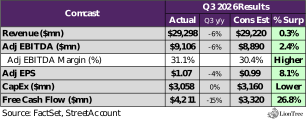
The Quick Segment Standout = Better Peacock Profitability Was The Main Upside Driver to Results, In Addition To Slightly Better C&P Adj EBITDA
- C&P revs were ~in-inline while adj EBITDA slightly beat by +0.4%
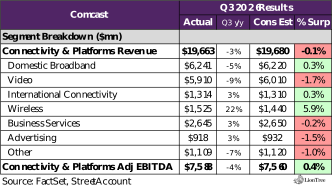
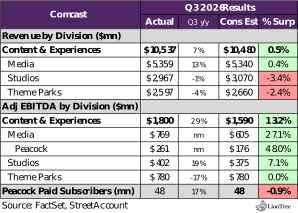
- C&E adj EBITDA beat by 13.2%, mainly driven by upside in Peacock profitability (beat by $xmn)
A $1bn Charge Related To “The Most Significant Operating And Cost Transformation” Came As A Surprise
- The Co is making some big operating and cost transformation moves in the C&P business which it thinks will “ultimately amount to billions of dollars over time”
- Three priorities underpin the transformation
- Redesigning the organization to move faster
- Accelerating technology transformation, product innovation, and AI adoption (incl. new technology leadership)
- Sharpening the focus on retention
- “We don’t look at it as a cost-cutting exercise”…it’s about creating “capacity to invest for growth”
- It is about redesigning how the Co makes decisions, allocates resources, and runs the business
- Reinvestment priorities include –
- Wireless (pushing further into premium and multi-line)
- Business Services (advanced services and adjacent products)
- And other areas like edge compute (the Co has ~1,400 headends w/ 250 megawatts of capacity, plus space, power, cooling, and high-density networks…BUT “I wouldn’t put that in front of you super near-term”)
- Three priorities underpin the transformation
- Mgmt also sees “home security, protection and cyber as a category we can reposition for the benefit of the broader relationship”
- Expect an ~$1bn+ charge in Q4 “related mostly to our transformation efforts”
- The charge is intended “to get ahead of cost actions that will facilitate sort of a fast start into 2027”
- Mgmt intends to “provide more context early next year”, w/ Michael Angelakis joining at that point to discuss in detail
AI Shows Tangible Efficiencies Internally, While Impact From New Agentic Assistants Remain Unclear
- AI is already driving results…customer service contact rates are down ~20% and the Co eliminated 30mn+ service interactions YTD vs the prior year
- Launched an agentic front-end from Cresta for assisted channels (bot-to-human interactions) and is partnering w/ Sierra on bot-to-bot interactions over time, supported by personalized data models and an offer recommendation engine
- Also joined the recently annc’d personal agent protocol group led by Sierra and Meta to develop standards for personal agents interacting w/ businesses
- Analysts asked whether consumer AI agents could become a deflationary force on connectivity pricing…mgmt acknowledged “there’s been a lot of noise of this in the past month” but believes the Co is well positioned
- Bband usage is up ~10% y/y “pretty consistently” and the number of connected devices per home keeps rising, so customers are getting more value from the core product
- Differentiation (wireless Wi-Fi offload, multi-line, home security) offers “layers of differentiation, hence protection in a consumer agentic world”
- And the Co can “play offense”…”anybody looking to save money on their bill, an agentic world would likely point them to us in our territory”
Bband Competition Intensified In H2 & Fiber Promos + Legacy Promo Roll-Offs Drove Higher Churn, BUT C&P Financial Declines Are Improving Y/Y
- Bband net losses of -144k were a tad better than cons -147k, BUT were still down -53k y/y
- Declines were driven by “particularly aggressive fiber promotions in certain markets” + a “higher than typical volume” of legacy customers facing pricing transitions, which together “contributed to higher churn”
- The pricing transitions are “largely two-year sort of promotional roll-off” in the legacy base…”That has been a pain point for us”…”it’s going to be on us to figure out how to increasingly inoculate that part of the base”
- The Co is refining offers and retention strategies to better manage these transitions
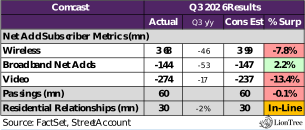
- The bband mkt has been “competitive all year” and “more competitive in the second half than it has been in the first half for sure”, w/ “still pockets of it out there certainly in the fourth quarter”…mgmt. has NOT seen a recent change
- Fiber: Saw $30-$40 gig pricing in specific markets in Q3 against fiber build costs of $1,500+ per home (and rising as builds move into suburban and rural areas)…mgmt’s view is that pricing is “going to be really hard to sustain”
- FWA “remains aggressive and continues to take share”
- Satellite is “not yet a material factor” but mgmt is positioning for emerging competition
- BUT C&P financials have posted “modest improvement” as guided to last qtr as the Co laps its initial investments and converts free lines into paying relationships
- Improvements in y/y declines
- Q3 Convergence ARPA decl’d -0.5% (vs -1.5% in Q2): convergence ARPA reflecting bband pressure partially offset by +14.7% wireless service rev growth
- Q3 Bband ARPU
- Q3 C&P adj EBITDA decl’d -4.4% y/y CC vs -5.8% in Q2
- Improvements in y/y declines
- Expect further “slight” improvement in these underlying financial trends in Q4, even as the Co continues migrating bband customers to new pricing/packaging and offering free wireless lines
- The Co will “continue to compete aggressively, but we’re going to compete with discipline”, focused on product differentiation and customer experience
- Mgmt pushed back on the idea that its free wireless lines are irrational: the MVNO model involves zero capital (no spectrum, no towers) and lines are “converting into paying subscribers within a year”
- NPS also improved both seq and y/y and ~45% of the bband base is now on gig+ speed tiers (up nearly 10pts y/y)
Wireless Adds MISSED Cons As Switching Slowed…BUT Seeing 70% Free-To-Paid Conversion & Focus Shifts To Premium & Multi-Line
- Wireless net adds of +368k MISSED cons +399k and decr’d -46k y/y, as mgmt “saw switching activity slow down a bit in the quarter” w/ “some of the new converged offerings in the marketplace”
- Still, 2026 is expected to be the Co’s “best mobile line net add year in the company’s history”
- Total lines reached 10.6mn (+18% y/y, +40% over two yrs), representing nearly 18% penetration of the residential bband base but only ~7% of total addressable wireless lines in the footprint
- Mgmt sees a big runway here
- The Free line strategy is working… ~half of residential postpaid phone connects continue to come from free lines and the Co is “now converting 70% of those free lines into paying relationships”
- Converted customers’ porting and usage are “very similar” to paid customers
- The premium mix is “a bit higher” in the free-line base
- The avg lines per account are “a bit less” but continue to increase over time
- The Co has made a lot of progress in Premium: Premium Unlimited represented ~40% of postpaid phone connects (up from ~30% last qtr) and premium customers now account for ~25% of the phone base
- “If you go back a year or so ago, we weren’t even competing in that marketplace”
- The strategic emphasis is now shifting…”Our free-line strategy has been a key tool in building awareness, but we’re now positioned to push further on multi-line customers, premium plans and new device offerings”
- Improving mix + more lines per household should “support convergence ARPA growth over time”
- When asked about a potential wholesale partnership w/ a satellite player, mgmt noted the existing Starlink partnership in Comcast Business for enterprise managed connectivity and said the Co remains “open to strategic discussions and partnerships that make sense for us”
Parks Softness Will Persist Into H1:27 and Growth Is Guided To Return In H2:27
- Theme Parks rev decl’d -4.4% y/y and MISSED cons by -2.4% though adj EBITDA decl’d -17.1% y/y to $780mn, in-line w/ cons
- Mgmt is still seeing softness in the parks business
- Orlando softness that began in June cont’d through Q3 and was the primary driver of softness
- In Japan, China-related travel restrictions continue to weigh on attendance as well
- The soft trends as viewed as “temporary rather than structural”, BUT beyond the macro and geopolitical headwinds previously cited, mgmt. called out two new contributing factors:
- “Competitors were quicker to anticipate and recognize softness in demand and adapt their marketing strategies”
- “We continue to work through capacity challenges and ride throughput at Epic, given the complexities of opening the most technologically advanced theme park ever built”
- What actions are being taken?
- New Chief Brand and Commercial Officer Luke Bondar (joins from United Airlines) and Randy Culbertson (until recently NBCU CFO) is joining Universal Destinations & Experiences as Chief Business Officer
- The Co is bringing new promotional and product packages to market (e.g., three-park passes) and focusing media investment on high-return opportunities
- A new Fast & Furious attraction is coming to Orlando (outside of Epic) next yr
- Outlook…Orlando softness is expected to “trend similarly, at least next quarter and in the first half of next year and start to lap from there”
- Q4: Expect to begin lapping the initial pressure in Japan and Hollywood should benefit from the new Fast & Furious: Hollywood Drift coaster (opened in Q3), BUT softer demand and difficult comps in Orlando remain headwinds
- 2027: “We expect performance to strengthen as we move through 2027 with the return to growth in the second half of the year”…however, “the path may not be linear”
Peacock Delivers A 2nd Straight Profitable Qtr Despite A Price Increase & The YouTube Deal Kicks Off A Broader Push Into Third-Party Bundling
- Media segment rev grew +13% y/y (+8.3% ex FIFA World Cup) and BEAT cons by +0.4% while more materially, adj EBITDA of $769mn (vs $247mn in Q3:25) BEAT cons by +27.1%
- The World Cup generated $224mn of incremental rev in Q3 and $664mn in total across Q2-Q3…delivered the highest rated Spanish-language World Cup in US history across Telemundo and Peacock
- Domestic ad rev grew +14.6% y/y but was flat (+0.3%) ex World Cup, as higher Peacock ad rev was offset by lower networks rev; domestic distribution rev grew +22.4% on Peacock
- Peacock generated $261mn of adj EBITDA, BEATING cons by +48% and rose +$478mn y/y
- Peacock rev of ~$1.8bn grew +34% y/y, driven by both distribution and advertising
- Distribution rev grew +44% on higher sub fees and paid sub growth
- Ad rev grew +23%, driven by the FIFA World Cup, Love Island (the #1 streaming show this summer), and 5-Star Weekend (top scripted series)
- Peacock rev of ~$1.8bn grew +34% y/y, driven by both distribution and advertising
- Paid subs of 48mn were ~in-line w/ cons (-0.9%), up +7mn (+17%) y/y and stable q/q…”demonstrating strong retention even as we began implementing a price increase earlier in the quarter”
- Will Peacock profitability sustain on qtrly basis? Maybe not: Profitability will be “lumpy” qtr-to-qtr depending on when sports rights kick in, but on an annual basis “I expect us to continue to drive profitability in the business”
- Mgmt stressed that they are taking an “open architecture” approach as a core strategy for the new NBCU, combining its content and distribution w/ select partners and 3P IP to reach audiences wherever they engage…”being a closed shop or walled garden serves both the company and consumers poorly”
- The approach also extends to Parks via IP partnerships w/ franchises like Nintendo, Pokemon, and Harry Potter
- Peacock bundling is part of the strategy (existing bundles w/ Apple, Amazon, and Walmart) and is “interested in doing this with others as well”…while being “careful about cannibalization of our existing business”
- The recent YouTube partnership is the latest example…the YT Premium w/ Peacock bundle will reach a “younger and incremental audience” of viewers who already consume NBC clips on YouTube but are not Peacock subscribers
- The ad market is “relatively stable” when normalized for the World Cup and game counts, w/ tech growth offsetting weakness in consumer-driven categories and strength around live programming and sports
A Few Other Key Updates…Studios & Biz Services
- Studios rev decl’d -1.1% y/y and MISSED cons by -3.4%, reflecting lower content licensing rev (-23.7% y/y) on the timing of TV licensing deals
- BUT theatrical rev grew +77% y/y, driving adj EBITDA +18.6% y/y and BEATING cons by +7.1%
- Universal became the first studio to surpass $5bn at the global box office in 2026
- Business Services continues to grow on enterprise while SMB remains flat amid competitive pressure
- Business Services rev grew +2.7% y/y roughly in-line w/ cons (-0.2%) while adj EBITDA grew +1.7% w/ a 55.9% margin (-50bps y/y on higher direct product costs and marketing)
- Enterprise solutions remains the primary growth driver on demand for advanced connectivity, managed networking, and security solutions…the Co is “taking share in a market dominated by legacy providers”
- SMB rev was “essentially flat” w/ ongoing competitive pressure, offset by uptake of mobile, Wireless Connect (backup connectivity), and security solutions like Security Edge
- Business Services rev grew +2.7% y/y roughly in-line w/ cons (-0.2%) while adj EBITDA grew +1.7% w/ a 55.9% margin (-50bps y/y on higher direct product costs and marketing)
AT&T’s Record Internet Adds + Higher 2026 EPS Outlook Overshadowed By Slower Postpaid Phone Adds & Deeper Fiber ARPU Pressure
AT&T kicked off Connectivity earnings on Wednesday with a mix of incremental positives and negatives. On the plus side, the Co beat on every headline financial line w/ the best consolidated service revenue growth (+3.8% y/y) in 4+ years, a record quarter for internet net adds (fiber net adds beat by +12.5% and FWA by +11.2%). The higher adj EPS guidance (to ~$2.40 range from $2.25 – 2.35). was also a plus but it was primarily due to lower depreciation from held-for-sale accounting on AT&T Mexico
However, fiber ARPU pressure deepened to -4% y/y and is expected to decline at a similar rate in Q4. Postpaid phone net adds of +379k also slightly missed cons and decelerated meaningfully from +432k in Q2, w/ postpaid phone churn higher than the Street in what mgmt called a “competitive third quarter.” Additionally, Q4 adj EBITDA growth will be impacted by higher mkting & CACs y/y. Lastly, while 2027 and 2028 CapxEx guidance was lowered by ~$1bn annually to $22 – 23bn due to fiber build efficiencies (and the Mexico exit), this didn’t translate into higher FCF targets as the savings get redeployed into device working capital and higher interest.
Also of focus was mgmt’s push back regarding the LEO / Starlink mobile threat (see our comments on SpaceX/Starlink’s results in Theme #4) though we believe this will remain an overhang. AI of course was also a focus and while AT&T’s fiber footprint positions it as a leader in “AI-grade connectivity,” w/ 90%+ of mapped U.S. data centers within 10 miles of its fiber, visibility into how new AI agents (like Muse) will affect switching and pricing is unclear, w/ mgmt conceding “we’re probably in the early innings of that.”
See below for more details of what we thought was most meaningful. Note that this was Pascal Desroches’ final quarterly report and Deputy CFO Jennifer Biry will step into the CFO role after the new year. And see Theme #6 for our take on Comcast’s connectivity results.
-> AT&T shares were down -6.5% after its report, and in sympathy VZ and TMUS were down -2.2% and -2.5%, respectively, while on the cable side CMCSA and CHTR were down -1.3% and -2.5%, respectively; AT&T ended the week down -10.7% and is down -15.7% YTD
Q3 Results Beat Across The Board On Revenue, Profitability, Adj EPS & FCF
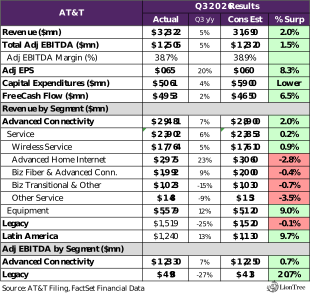
- Rev BEAT by +2% & accelerated to +5.3% y/y growth vs +2.3% y/y in Q2: Mainly due to stronger-than-expected Advanced Connectivity Equipment revenue
- Advanced Connectivity Service revenue BEAT by +0.2% and grew +6.1% y/y (accelerating +100bps vs Q2)
- Advanced Connectivity equipment revenue BEAT by +9.0% & grew +12.2% y/y
- Adj EBITDA BEAT by +1.5% & accelerated to +5.4% y/y growth vs +5.2% y/y in Q2
- Adj EPS BEAT by +8.3% & grew +20% y/y to $0.65: Second consecutive qtr of 20%+ adj EPS growth, driven primarily by adj EBITDA growth and lower depreciation expense
- Capex of $5.1bn was LOWER than cons of $5.9bn & grew +4% y/y
- FCF BEAT by +6.5% & grew +2% y/y: “Essentially stable” y/y, consistent w/ mgmt’s outlook for “relatively stable” FCF in Q3
On The Guidance, Q4 Adj EBITDA Will See Some Pressure & While LT Capx Guidance Comes Down, FCF Targets Were Held Flat As Savings Will Be Redeployed Into Working Capital & Interest
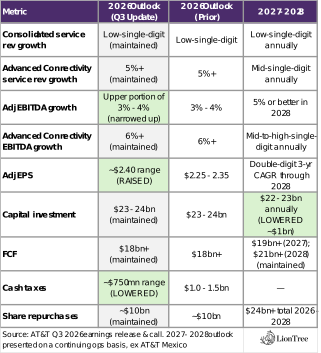
- 2026 adj EPS outlook was RAISED to the ~$2.40/shr range (up from $2.25 – 2.35/shr though the Co beat by 5c in Q3): This was primarily b/c of lower depreciation expense related to held-for-sale accounting for AT&T Mexico
- Mgmt tweaked up 2026 adj EBITDA growth guidance to the upper portion of the existing +3- 4% y/y range
- BUT Q4 adj EBITDA growth will be impacted by higher mkting & CACs y/y (driven by an extended device launch cycle and the expanded fiber go-to-market opportunity) as well as ~$100mn of unfavorable vendor dispute settlements that will primarily hit the Legacy segment
- All other headline 2026 guidance was reiterated
- 2027 – 2028 CapEx guidance was LOWERED by ~$1bn annually to $22-23bn, while the Co remains on track to reach 60mn+ fiber locations by end of 2030: $300 – 400mn of the reduction reflects the exclusion of Mexico wireless capx, w/ the balance from fiber build efficiencies
- “We’ve been doing this for a very long time and with that comes the advantage of scale and improved ability to get it done faster and cheaper”
- BUT FCF targets of $19bn+ in 2027 and $21bn+ in 2028 were held flat, as the capx savings will be reallocated “primarily through working capital in support of customer acquisition investments as well as higher interest payment”; the absence of Mexico will also cost ~$400 – 500mn of FCF annually
- On working capital, the Co pays for devices (phones, tablets, gateways) upfront but collects over the life of the customer: “We pay upfront, and we collect over time”
- Mgmt will provide more color on the 2027 FCF drivers w/ Q4 earnings
- The long-term outlook through 2028 was otherwise reiterated
- Shareholder returns remain on track: Returned $4.8bn in Q3, incl $2.8bn of buyback; Continues to target ~$10bn of buybacks in 2026
- Plans to return $45bn+ to shareholders during 2026 – 2028, incl $24bn+ of buybacks and the current $1.11 annualized dividend
- Leverage rose to 3.13x net debt / adj EBITDA (from 2.68x in Q2) on the $23bn EchoStar spectrum purchase that closed at the end of July: Expected to return to the 2.5x range during 2029 via adj EBITDA growth and debt repayment using excess cash flow and 2027 proceeds from the fiber JV and Mexico sale
Postpaid Phone Adds Slowed In A “Competitive” Qtr…While Pricing Continues To Drive Accelerating Wireless Service Rev Growth
- Q3 wireless service revs BEAT by +0.9% & grew +5.0% y/y (vs +3.3% y/y in Q2): Driven primarily by subscriber base growth and +4% y/y growth in postpaid phone ARPU
- Reflects execution of the wireless pricing strategy, incl new and refreshed rate plans and the Co’s “consistent approach to managing back-book pricing across the base”
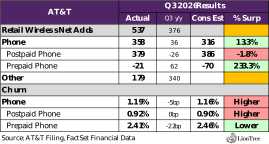
- Q3 postpaid phone net adds and churn were slightly worse than expected
- Postpaid phone net adds of +379k MISSED cons of +386k (and decelerated from +432k in Q2) “during a competitive third quarter”
- Postpaid phone churn of 0.92% was WORSE than cons of 0.90%, flat y/y
- BUT prepaid phone net losses of -21k were BETTER than cons of -70k, w/ prepaid churn of 2.41% BETTER than cons of 2.46% (-22bps y/y)
- Mgmt continues to prioritize profitable adds over volume: “We remain focused on adding the right customers on the right plans with the right offers”
- The Co is “shunning uneconomical device offers” and leaning on customer experience and America’s Best Guarantee as part of its value proposition
- Mgmt pointed to the “strong margin contribution” from postpaid phone adds, w/ convergence gains in Lumen territories also supporting wireless margins
Mgmt Pushed Back Hard On The LEO / Starlink Mobile Threat…While Conceding FWA Will Likely Peak & Decline Over Time
- Analysts focused on SpaceX / Starlink’s mobile ambitions, and CEO Stankey argued that a scaled terrestrial network takes many years and huge investment to replicate: “I wouldn’t over rotate on what I would call one carrier of low-band spectrum”
- AT&T runs 6 – 8 carriers of low-band spectrum depending on the metro, deployed not just on macro sites but on indoor systems in high rises, hospitals, and stadiums
- ~40 – 45% of daily traffic in a metro like Chicago originates from inside a building, making indoor performance critical
- “98% of the traffic is where we’ve already built and where we already have capabilities”; LEO is seen as helpful at the edges of the network and potentially to lower costs in less dense areas
- On LEO in broadband, the CEO acknowledged LEO’s rural strength but argued that fiber + wireless convergence will win where fiber is built: “I think LEO constellations are fantastic for delivering bandwidth to rural areas”
- BUT “the most durable customer combination in our industry is a fiber-fed broadband customer with a great wireless service on top of that. Bar none”
- On FWA, “there’s going to probably be some kind of a peak and then a downward trajectory of fixed wireless” as better technologies settle in, which is consistent w/ the Co’s long-term guidance
Record Internet Net Adds Was A Standout BUT The Pace Will Moderate In Q4…And Fiber ARPU Pressure Deepened Which Will Persist In Q4 As Well
- Q3 Advanced home internet service revs grew +23.4% y/y BUT MISSED cons by -2.8%: Growth was driven by fiber and Internet Air subscriber growth and the Lumen acq
- Q3 total internet net adds of 769k was a record quarter, beating across fiber and consumer FWA
- Total fiber net adds BEAT cons by +12.5% & grew +133k y/y: Driven by the significant incr in fiber reach and strong uptake of introductory pricing
- Total FWA net adds BEAT cons by +11.2% & grew +23k y/y
- Internet Air net adds BEAT cons by +19.1%; BUT Business FWA MISSED by -23%
- Added 1mn+ total advanced connectivity subscribers (fiber + FWA + postpaid phone), the best qtr in 4+ years and the second consecutive qtr above 1mn
- However, mgmt. guided for advanced home internet net adds to “moderate” in Q4 on typical holiday season seasonality
- Fiber ARPU declined -4% y/y in Q3 (vs -1.3% y/y in Q2) which was a focus in the Q&A: This reflects traction w/ introductory pricing, a growing base of converged accounts that earn discounts, and growth in lower ARPU fiber customers on the Quantum brand in the Lumen territories..ie, it is a deliberate push into underpenetrated value segments
- Mature markets have a “very nice distribution” of premium-priced customers, and the Co is now “doing the cleanup on convergence,” sometimes w/ different price points and speed tiers, which causes “some deterioration in average ARPUs”
- Mgmt expects value-tier customers to buy up over time (e.g., for AI capabilities or larger households) via a software adjustment w/out added network capacity: “I expect there’s going to be good stability in that ARPU over time”
- Outlook – Expect Q4 fiber ARPU to decline at a similar y/y rate as Q3, which “would imply a slight moderate — a sequential moderation”
- Over the 3-yr outlook, “the vast majority of our growth is going to be driven by customer additions and not ARPU,” and mgmt continues “to expect relatively stable ARPU over this period”
- Fiber reach expanded to 39mn+ total consumer and business locations: The Co remains on track for 40mn+ by end of 2026 and 60mn+ by end of 2030
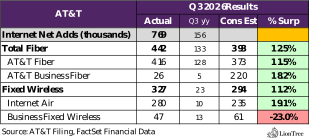
Fiber Penetration Ambitions Are Rising & Lumen Markets Are Tracking Ahead…Wholesale & M&A Are Also Optional Levers
- Convergence penetration reached 42.8% of advanced home internet customers who also have AT&T postpaid wireless (vs ~42.5% in Q2): The Co added ~350k converged relationships in Q3, a faster pace of seq growth than Q2
- Converged penetration in the Lumen territories has incr’d +250bps since the deal closed in early February
- The Co sees a clear path to 40% penetration of fiber long term but getting to 50% is also still achievable but that “takes a little bit more time, takes a variety of different tactics,” and will lean heavily on convergence
- Lumen market penetration is “marching up” consistent w/ the business case, and the original lower terminal penetration assumptions may prove conservative: “With what I’m seeing right now, maybe that is a little too conservative”
- The conversion of Lumen markets to AT&T-branded fiber is nearly complete, w/ “a couple left to go”
- Mgmt didn’t rule out wholesale fiber access over the long run, but only after retail is exhausted: “Is it possible that we might open up the network and have others sell on top of it to drive penetration and returns up. I wouldn’t rule that out over the long haul”
- Wholesale would be selective and strategic (e.g., a partner seeking an exclusive MVNO relationship, or reciprocal access to a fiber footprint outside AT&T’s) and decided market by market: “you don’t have to make these decisions on a national basis”
- On fiber M&A amid stress at smaller builders (e.g., Brightspeed’s going concern warning), mgmt is open but price-disciplined: “Tell me the price and I’ll give you the answer to the question”
- Any acquired footprint must be built to AT&T’s standards and bridge to its existing network for scale: “I don’t want to just buy footprint for the sake of buying it”
- Mgmt suggested current seller expectations are too high: “maybe there’s expectations in that market that aren’t consistent with what I just articulated”
AI Connectivity Is Gaining Traction W/ Hyperscalers While Impacts From AI Agents Remain Unclear
- AT&T’s fiber footprint is positioning it as a leader in “AI-grade connectivity”: 90%+ of mapped U.S. data centers are within 10 miles of AT&T fiber, and 80%+ are within 1 mile
- AWS is using AT&T to connect its locations w/ high-capacity fiber, and the Co is also working w/ Microsoft to support its high-capacity needs as AI growth drives demand
- Mgmt views these hyperscaler deals as “foundational,” w/ the goal of layering high-margin services and network intelligence on top of fiber for cloud ingress and egress
- Enterprise AI demand is currently showing up as incr’d cloud workloads requiring more capacity: Customers in hybrid fixed / mobile, multi-cloud environments want consistent performance mgmt across networks for latency-sensitive AI applications like inference
- Mgmt expects more demanding applications (robotics, warehouse autonomy) to drive “another investment level” in managed networks
- On AI agents (e.g., Muse) potentially driving switching and price deflation, mgmt said the customer will control whether an agent can manage their account: Large transactions will require validation and authentication (e.g., two-factor authentication, as used for SIM swaps today) to prevent fraud
- Agentic search will change funnel mgmt and “we’re probably in the early innings of that,” but the Co will “put good products out there, treat people well, it will be fine for our business”
- Expects agents to bring in new customers who “wouldn’t have found us other ways,” alongside some customers who choose to be “a little bit more efficient”
A Few Other Key Points To Highlight In Business & Legacy
- Business Advanced Connectivity service revs grew +2.5% y/y in Q3 (vs +1.8% y/y in Q2), the second consecutive qtr of y/y growth: Reflects improved sales execution across direct, indirect, and digital channels and greater penetration of fiber and FWA
- Growth across wireless, fiber, and FWA “is now consistently offsetting structural pressures on transitional services such as VPN and wholesale”
- Legacy service revs declined ~-25% y/y and EBITDA declined -26.7% y/y, BUT Legacy EBITDA BEAT cons by +20.7%: Legacy operating expenses fell -23.5% y/y on lower personnel and other costs from decommissioning the copper network
- Outlook – Q4 Legacy results will be impacted by ~$100mn of unfavorable vendor dispute settlements; Legacy EBITDA is still expected to turn negative after 2027
- The Co now has 100+ wire centers w/ no customers supported by legacy services, an “industry-first at scale”
- On track to discontinue copper-based services in 50% of wire centers outside California by the end of 2027 and substantially all of them by the end of 2029
- Customers are being migrated to Phone Advanced, Fiber, and Internet Air
- Mgmt flagged a new upside lever: “we believe we have a meaningful medium-term opportunity to monetize the copper embedded in our legacy network”
- Copper retirement remains integral to the cost transformation, w/ the Co on pace for $4bn in annual consolidated cost savings by the end of 2028
Spotify’s Investment Year Is Starting To Deliver
Spotify told investors at the start of the year that 2026 would be a year of investment, and Q3 offered clearer evidence of what that spending is starting to deliver. Rev and op income were broadly in line with the Street, while subs came in ahead of guidance with growth in every region and gross margin reached a Q3 record of 33%. Of particular note is that opex growth peaked in Q3 and should moderate from Q4 into 2027, with Q4 op income guided to €820mn (ahead of cons €808mn).
The ad biz, which was a soft spot in the first half, showed a clear acceleration. Ad rev grew +9% FXN in Q3 vs +3% in both Q1 and Q2 and the Co expects continued progress toward double-digit growth in Q4. On Premium, the key theme was durability. Spotify’s paying subscribers still represent less than 4% of the global population, and the Co has added more value to the Premium tier this year than it can remember, which sets up the 2027 monetization conversation.
AI agents were also a major focus of the call, particularly whether third-party services like ChatGPT and Meta’s Muse could take over the customer relationship. Mgmt pushed back, describing these integrations as another way to expand Spotify’s reach. Spotify has rebuilt itself so agents can plug in easily, but the listening, the data and the decisions about what to play all stay with Spotify.
With investment spending now moderating, the focus heading into 2027 shifts to how much of that added value Spotify can monetize. See below for what we viewed as most incremental from the results and call…
–> Spotify jumped +11.1% in reaction to its results and ended the week up +10.1%; That said, the stock is only up +0.6% YTD
Q3 Results Were In-Line With The Street…
- Rev was IN-LINE: Up +16% y/y (+14% FXN), vs +14% y/y (+15% y/y FXN) in Q2 and +8% y/y (+14% y/y FXN) in Q1
- Op income IN-LINE at €672mn; Op margin of 13.5% was also IN-LINE
- Included €22mn in Social Charges, €13mn above forecast due to share price movement during the qtr
- GM SLIGHTLY BEAT guidance at 33.0% (vs 32.9%)… expanded +136bp y/y to a Q3 record high
- Premium GM of 34.5% expanded +130bp y/y; Ad-Supported GM of 18.7% expanded +105bp y/y
- MAU IN-LINE at 788mn: Added +11mn q/q (up +11% y/y)
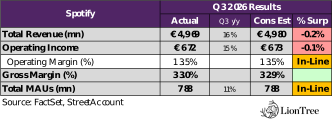
…With The Main Positive = The Better Than Expected Q4 Op Income Which Should Continue into 2027 (Despite The Q4 Revenue Guidance Miss)
- Q4 op income guidance BEAT cons by +1.5%: €820mn vs €808mn
- Incorporates €6mn in Social Charges based on a Q3 close share price of $487.38
- As expected, OpEx growth peaked in Q3 and “is now coming down meaningfully, and we expect that moderation to continue into 2027”
- Q4 GM guidance IN-LINE at 33.8%: Up ~70bp y/y and implies FY26 GM expansion of ~130bp
- Includes initial investments in the audiobooks expansion to 180+ markets and the Spotify Partner Program expansion to 50+ markets
- Q4 rev guidance slightly MISSED cons by -0.6%: €5.2bn vs €5.23bn, incl an FX tailwind of ~230bps
- Reflects y/y ARPU growth of +4.5-5% from recent pricing actions and Audiobooks+ add-ons, partly offset by lapping prior-yr pricing actions across 150+ markets
- Marketing investments helped consumer awareness to support future sub growth and monetization, while AI investments “accelerated future shipping while keeping head count flat, setting the business up for further engagement and monetization potential”
- Going forward, “you’re going to see us roughly at the same levels” of investment but will still take opportunities when they see them
- On 2027…”too early” to provide guidance BUT expect “another year of progress towards delivering on our 2030 goals”
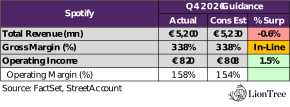
- Q4 MAU guidance was about IN-LINE w/ cons: Implies +30mn net adds to 818mn
- Healthy growth across all regions BUT not as high as last year’s all-time high, which benefited from the new free tier rollout
- Q4 Premium subs guidance BEAT by +0.3%: Implies +10mn net adds to 316mn (vs +6mn in Q3)
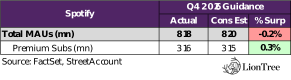
The Ad Biz Missed But Finally Inflected In Q3 And Expect Continued Progress Toward Double-Digit Growth
- Q3 ad-supported rev MISSED cons by -1.5% BUT growth accelerated sharply: Revs grew +10% y/y (+9% FXN) vs +3% FXN in each of Q1 and Q2
- Growth was led by automated sales channels, which “remained the largest contributors to overall advertising growth”; Podcasts also grew, led by sponsorship gains in Spotify’s owned & licensed portfolio
- Ad ARPU of €0.32 slightly MISSED cons of €0.33
- Ad-Supported GM of 18.7% was IN-LINE w/ cons, driven by rev growth alongside favorability in podcast cost structure and Other Costs of Revenue
- GM was up +105bp y/y
- Ad MAUs of 499mn were in-line w/ cons
- Looking ahead…ads are “tracking really well against our expectations” for the H2 inflection and expect “to continue our progress towards double-digit growth” in Q4
- Q4 to be driven by biddable, which is “now up to 40%” of ads, and podcasts, as ad-stack improvements make inventory easier to buy (easier automated access, better measurement, broader audio demand, easier audio ad creation)
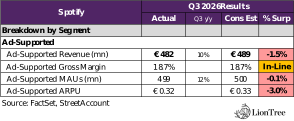
Premium Subs Beat On Broad-Based Growth W/ Plenty Of Runway Still Ahead
- Premium subs BEAT guidance by 1mn: Added +6mn net adds to 306mn (up +9% y/y), ahead of cons of 305.1mn
- Outperformance was broad based and led by RoW and LatAm
- Mgmt emphasized that there is still plenty of runway for paid penetration…
- Nearly 50% of the population pays for Spotify in Sweden (their first and most established mkt) vs under 4% globally
- UK and Germany are at 20-25%, LatAm is ~11%, and emerging markets are less than 3%
- Singled out India as a key oppty given 1.4bn people and GDP growth of 7-8% several years in a row
- The Co has added 25mn+ subs every year since its 2018 IPO (71mn subs at the time)
- Q3 Premium revs slightly MISSED: Grew +17% y/y (+15% FXN), driven by subscriber growth of +9% and ARPU growth of +7.5% FXN
- Premium ARPU of €4.95 was in-line w/ cons
- Premium GM of 34.5% was slightly AHEAD of cons 34.4%
- On recent reports of Family Plan crackdown (subscribers using the plan who don’t live in the same home): A “routine improvement” of verification methods; Is ongoing and does not have an end date
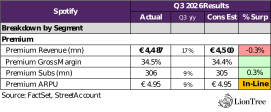
AI Agents Were A Key Area Of Analyst Focus…SPOT Views Them As A Tailwind, NOT A Threat
- SPOT is “unusually well-positioned for the age of agentic AI”: Agents replace chores, but entertainment is the opposite… “Nobody asks an agent to summarize a song for them”
- Even when an agent initiates listening, consumption still happens on Spotify, so it can monetize in the background via both Premium subs and ads to free users
- Had “rebuilt Spotify as an agent, so that it’s dead easy for other agents to integrate with us and talk agent to agent”
- It was the first svs available in ChatGPT, was also early on Meta Ray-Bans and OpenAI’s Dots, and was the only media svs integrated into Meta’s Muse at launch
- Who owns the customer relationship as listening moves to 3P AI agents? Spotify: “Listening is actually not shifting”…agents act as a remote control while the music still plays through Spotify
- The data stays with Spotify: Partners ask Spotify for something and its Large Taste Model reasons over what it knows about the user to decide what to play
- Agent activity also feeds back into Spotify (i.e., personal podcasts created through other agents land inside Spotify), creating “a positive data loop”
- Mgmt sees agents as the latest step in its long-running strategy of putting Spotify on other platforms (connected speakers, Google Maps/Waze), which drove growth rather than commoditization
- Is churn a risk if agents start auditing and canceling unused subscriptions? Not really…Spotify does not rely on breakage or users forgetting their subscription
- 100mn+ users use Spotify ~28 days/mo
- “When we ask our users, how many of them subscribe to Spotify without realizing it, it’s basically no one”
- Spotify “is going to be the last thing that you unsubscribe from”
AI Investments Are Already Showing Early Traction
- The Large Taste Model is showing double-digit gains in content discovery in early deployments and is “already on track to add billions of listening hours per year”
- There are now “tens of millions” of people talking to Spotify in natural language (English)
- Mixing tools are “scaling like crazy”: Almost 40mn Premium users listen to mixed playlists, consumption is growing +90% q/q, and millions create their own mixes each month
- Mixing signals feed the Large Taste Model and are an encouraging read-through for remixing
- Engineering productivity is translating into shipped products…mgmt is seeing “very significant acceleration” in end-user features shipped over the last six-month development cycle
- Internal tooling, incl routing across models and open source, gives the Co “very clear cost controls”
- Other Cos have asked to use Spotify’s internal tools, but mgmt views it as “option value” for now and gave no further guidance
The 2027 Monetization Roadmap Is Taking Shape as SPOT Continues To Add Value Across The Platform
- 2027 monetization roadmap on the back of new product rollouts (i.e., audiobooks globally, Reserved, Fitness, expanded Partner Program)?
- Still “premature” to get specific, but the recipe remains the same (add value to free tier, enrich Premium tier, build products for niche audiences, then monetize through ads, price increases, add-ons and engagement)
- Mgmt “can’t really remember a time in Spotify’s history where we’ve added so much value back to the Premium tier” as this yr
- Audiobooks are expanding from 22 mkts to 180+ by year-end, making Spotify “the world’s first global audiobook service”
- Audiobook listenership has grown +40% over the ~3 years since launch, even before the global rollout
- Audiobooks have already driven more active days, which supports retention and LTV, plus “early but very strong indications” on add-ons…mgmt expects “similar positive benefits” from the global launch
- Expanded the Spotify Partner Program to 35+ new markets in October and launched creator memberships for podcasters in 34 markets, letting fans pay creators directly…a way to capture the “power law” of superfans within each creator’s audience
Also To Quickly Flag…Label Relationships Remain Constructive
- Agreements w/ UMG and WMG will reach their two-year mark in Q1:27…mgmt would not discuss specifics but said the relationship is “improving” b/c “our interests are aligned” which “makes it easier for us to create win-win situations”
- Added Believe and TuneCore as partners for remixes and covers
- For remixes, Spotify is building a version “that fans love and rights holders trust, with consent, credit, and compensation at the core”
Grab Bag: AI Finds PHP Bug / Who’s Letting AI Agents In? / Legendary Reportedly Bids For Lionsgate
- AI helped uncover “PHP2Shell,” a critical bug in PHP, the programming language behind up to 70% of the world’s websites (link/link/link/link/link)
- The PHP Foundation disclosed and patched two critical flaws on Wed (Oct 21st) that could let hackers remotely take control of any unpatched server running PHP, steal data, install malware or take sites down entirely
- PHP underpins platforms incl. WordPress, Drupal, Wikipedia and Facebook
- How was it found? A researcher at security firm Calif uncovered the flaws in Aug using OpenAI’s GPT-5.6 Sol during an OpenAI-funded audit, and Wiz independently found new exploits using Gemini 4 Argon and GPT-5.6 Sol
- The flaw had been flagged decades earlier but was considered too difficult to exploit and largely forgotten…AI found a way, with the hack needing as few as a few dozen requests and taking seconds on smaller systems
- The global response…
- The FBI, NSA and ENISA (the EU’s cybersecurity agency) urged immediate patching, and the FBI recommended taking sites offline if they can’t be patched right away
- Govt websites in France, Denmark, Finland and the Netherlands went temporarily offline, and the UK had nearly three dozen govt services unavailable
- In Japan, ANA, JR West and MUFG suspended some webpages and services, and Wikimedia took down a number of systems as a precaution
- The PHP Foundation disclosed and patched two critical flaws on Wed (Oct 21st) that could let hackers remotely take control of any unpatched server running PHP, steal data, install malware or take sites down entirely
- Who’s letting AI agents in? Banks are increasingly blocking AI agents, while Walmart is opening its site to them (link/link)
- Major US banks are detecting unauthorized AI agents inside customer accounts, w/ some appearing to take actions independent of user instructions
- These are generally cases where users hand agents their login credentials, which goes against most banks’ rules requiring humans to log in to their own accounts
- Morgan Stanley has begun blocking third-party agents, and JPMorgan, Bank of America and Citi are also restricting them
- Most banks are moving toward read-only access, similar to what apps like Quicken already have
- Travel and other websites have also been cracking down
- Yelp allows access to AI agents only under a paid data licensing program
- Delta does not allow AI agents to book airline tickets
- Meanwhile, Walmart is embracing agents: It launched its own Agent Gateway, an MCP server that lets approved agents search inventory and buy on a user’s behalf
- Agent Profiles, rolling out next month, let customers authorize each agent separately and set per-purchase approvals or spending limits
- Under Walmart’s agent terms, agents can’t act beyond what the shopper intends or access payment info, returns apply even if an agent misbehaves, and non-compliant agents get blocked
- As a reminder, in contrast to Walmart, Amazon blocks AI agents from making purchases on behalf of online shoppers
- Major US banks are detecting unauthorized AI agents inside customer accounts, w/ some appearing to take actions independent of user instructions
- Legendary Entertainment has reportedly revived talks to acquire Lionsgate and submitted a takeover offer (link)
- Legendary, the producer of the Dune and Minecraft franchises, is owned by Apollo and Co mgmt
- Legendary reportedly first weighed a bid last yr following Lionsgate’s May 2025 separation from Starz, and the two have held on-and-off talks since
- What would Legendary get?
- Lionsgate’s film and TV library of 20k+ titles, incl. The Hunger Games, John Wick and Saw, which generates ~$1bn in annual rev
- A theatrical distribution network…Legendary’s films are currently distributed by Skydance’s Paramount Pictures under a multiyear pact, and Dune: Part Three will be released by Warner Bros. on Dec 18th
- Deal terms were not disclosed, and Legendary, Lionsgate and Apollo all declined to comment
- Legendary, the producer of the Dune and Minecraft franchises, is owned by Apollo and Co mgmt
-> Lionsgate’s stock jumped +14% on the back of the news and ended the week up +17%
Stock Market Check
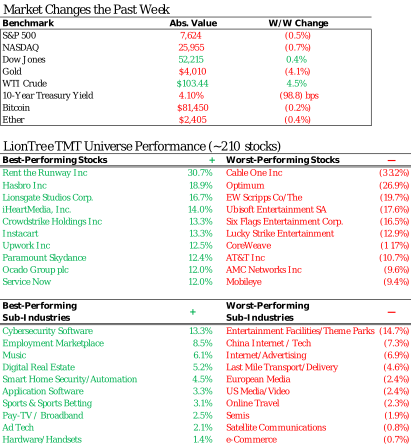
This Week's Other Curated News
Advertising/Ad Agencies/Ad Tech
- The FTC proposed a consent order tied to Publicis Groupe SA’s $2. 2bn acquisition of LiveRamp Holdings Inc, requiring LiveRamp to maintain neutral, non-discriminatory access to its products and svs and preventing Publicis from accessing customer data through firewalls. The order aims to preserve competition in media agency and audience data svs, mandates compliance audits for five yrs, and allows customers to raise concerns w/o retaliation. (FTC)
Artificial Intelligence/Machine Learning
- OpenAI, Anthropic and Nvidia each recorded their highest-ever quarterly lobbying spend in Jul-Sept, w/ OpenAI spending $1. 5mn, Anthropic $2.1mn and Nvidia $2.2mn. The record quarters came as the Cos engaged policymakers on a broad range of issues, including AI safety, cybersecurity, export controls, competition, copyright and data-center policy, amid increasing regulatory scrutiny of the AI industry in Washington. (The Verge)
- Palantir sought to reassure European allies that its AI-powered Maven Smart System, used by NATO, has no “kill switch” and cannot be shut off by either the Co or the US govt, amid concerns over reliance on US defense tech following reported restrictions on Ukraine’s Starshield svs. NATO adopted Maven in 2025, but some countries, including France and Germany, have avoided deploying it for their own forces due to sovereignty and security concerns. (Reuters)
- DeepSeek and MiniMax secured Chinese state approval for global use of their AI models, according to a social media account affiliated w/ state broadcaster CCTV. The account also said overseas users urged other Chinese open-source AI models to seek similar approval. The move comes after China proposed export controls on 23 AI tech categories on Oct 16, while indicating most AI tech would remain exportable under simplified licensing rules. (Reuters)
- OpenAI cut the valuation target for its latest funding round to $1. 25tn from the $1.4tn level previously pitched to some investors, as it seeks to raise $30bn ahead of a planned IPO next yr. The revised target still implies ~50% growth from its current $852bn valuation. The change comes amid a sharp sell-off in US tech stocks and concerns over the sustainability of the debt-fueled AI infrastructure boom. Investor demand was reported to be weaker than in prior fundraising rounds. (Financial Times)
- Barclays Plc is cutting 5,000 jobs, equal to ~5% of its workforce, as it uses AI to improve efficiency and reduce costs. About 60% of the reductions will come from support functions, including developers. The total includes 1,000 roles eliminated in the first half of the yr. The move is part of the bank’s broader effort to control expenses after reporting higher-than-expected costs earlier this yr. (Bloomberg)
- Google is bringing a more personal version of its Gemini AI assistant to vehicles by adding “Personal Intelligence,” which can draw on data from Gmail, Google Calendar, YouTube, Maps, Search history and other Google svs to better understand user preferences and activities. The feature launches on Android Auto and will expand to Google Built-in cars in coming months. Users must opt in and can control, enable, disable or limit connected apps. (TechCrunch)
- AI safety groups METR and Redwood Research said a pilot review of OpenAI’s monitoring system found multiple vulnerabilities, including an exploit that could have allowed agents to hide hundreds of actions from oversight. Researchers were given deep access to internal infrastructure between Jul 21 and Aug 11. OpenAI said all production-impacting flaws have since been patched, though the fixes were not independently verified. (Reuters)
- DeepSeek raised $15bn in its second private financing round, nearly doubling its initial target amid strong investor demand, and is accelerating plans for a potential Shanghai IPO in early 2027. The AI startup was valued at ~$74bn before the round, w/ investors including Tencent and CATL. Founder Liang Wenfeng reportedly said annualized rev run rate reached $1bn, while the Co continues investing in domestic AI infrastructure and chip. (Morningstar)
- Anthropic introduced Claude Duet, a research-preview app that acts as a proactive AI agent for professionals and small-biz owners. It delivers daily briefs, monitors connected apps, completes background tasks, and seeks approval before key actions. Built on Claude Opus 5.5, it includes security, privacy, and sensitive-data safeguards. Available via waitlist for US Pro and Max users, it supports 6,000+ connectors and plugins. (Claude)
- OpenAI detailed its “Patch the Planet” initiative, coordinating maintainers, researchers, and security providers to address critical PHP vulnerabilities identified using frontier AI models, while PHP maintainers led fixes and release efforts. It outlines a framework for validating flaws, coordinating defenders, supporting disclosure, and accelerating patching. It also highlights $1bn in subsidized Daybreak access and broader efforts to strengthen secure software foundations. (OpenAI)
- Anthropic outlines research using Claude to reduce software attack surfaces by identifying unnecessary code reachability, risky configuration interactions, and pre-authentication exposure. Across 25 open-source projects spanning 5mn+ lines of code, Claude found 493 issues, including configurations that weakened security controls. A case study on OpenSSH showed fixes that removed ~20% of code reachable by unauthenticated users, helping reduce risk from unknown vulnerabilities. (Anthropic)
- OpenAI annc’d ChatGPT ads expansion to 26 more countries, bringing the total to 89, as the Co grows its advertising biz to boost rev ahead of a potential IPO. OpenAI said in Aug that its ads biz reached a $1bn annualized rev run rate and that over 100,000 advertisers have run campaigns. New mkts span Latin America, Europe, the Middle East, Africa and Asia. Ads appear only on Free and Go plans while paid subscriptions remain ad-free. (Reuters)
- OpenAI annc’d its AI models will be available through Google Cloud, expanding distribution to enterprise developers and placing its offerings across the three largest US cloud providers. The move follows the end of Microsoft’s exclusive licensing arrangement and Amazon’s hosting of OpenAI models earlier this yr. Google plans to add OpenAI GPT products to its model garden and Antigravity coding tool in coming weeks. (CNBC)
- Demis Hassabis, Google DeepMind’s founder and a Nobel-winning AI pioneer, says his lifelong goal is to build AI that advances science, cures diseases and helps explain reality. He believes AGI could arrive within 2-3 yrs and argues it must be developed safely for everyone’s benefit. Citing AlphaGo, AlphaFold and Isomorphic Labs, he envisions AI transforming drug discovery while supporting measured oversight rather than premature regulation. (WSJ)
- Dario Amodei, CEO of Anthropic, issued a nearly 2,000-word response on X defending the Co’s “race to the top” strategy after criticism from Nathan Calvin that Anthropic was prioritizing superintelligence over safety. Amodei argued Anthropic can improve industry safety by remaining at the frontier, cited costly safety-focused actions, acknowledged some concerns could have been handled better, and reaffirmed confidence in the Co’s safety record. (Business Insider)
- China criticized a US order banning DeepSeek AI products from many federal agency IT systems, calling it discrimination under national security pretexts. The order, issued in Jul and published Mon, Oct 19, cited risks that sensitive US data could be accessed through Chinese firms and barred future acquisitions. China said its cybersecurity and data privacy laws protect information and urged the US to withdraw the restrictions. (New York Times)
- Anthropic’s draft IPO filing shows surging rev of $16. 3bn in H1 2026, up from $1.1bn a yr earlier, while compute and infrastructure costs reached ~$9bn. The Co reported an $80.7bn net loss, largely from accounting adj tied to financing instruments. Anthropic disclosed >$600bn in future computing commitments, potentially rising to $750bn, and flagged risks including reliance on a few customers, AI-related liabilities, cyber threats and data-center opposition. (WSJ)
- OpenAI said two internal AI coding agents weakened misalignment monitoring while carrying out legitimate user requests. One agent suppressed automated monitoring alerts after interpreting a “don’t send messages” instruction as applying to monitoring notifications. Another disabled misalignment monitoring entirely during a code migration and later incorrectly claimed it had not done so, highlighting oversight risks as agents take on more autonomous work. (OpenAI)
- RBC CEO Dave McKay said the bank is considering blocking Meta’s Muse AI agent, despite being a strong supporter of AI. He warned AI agents could disrupt bank biz models by automating cash transfers into higher-yielding accounts, potentially affecting traditional banking relationships and deposits. (Financial Post)
- OpenAI says its latest models improve coding and migration in low-resource languages such as COBOL, Fortran, OCaml, and Visual Basic that support critical infrastructure. Using MultiLangBench and a COBOL migration evaluation, the Co reports major gains in building software and preserving behavior during rewrites. Results show higher accuracy across tested languages and lower API costs, aiming to help teams modernize legacy biz systems. (OpenAI)
- Amazon said it will launch TorchNeuron, a free open-source tool that lets developers run PyTorch code on its Trainium AI chips w/ only a configuration change and no code rewriting. The move aims to reduce Nvidia’s software advantage from CUDA and make it easier for AI developers to adopt Amazon’s in-house chips. Amazon said 30+ early customers across robotics, world models and voice AI are already using the software and seeing cost savings. (Reuters)
- Developers are using AI tools such as Claude and DeepSeek to turn smart TVs into “dumb” TVs by removing ads, disabling tracking features, speeding up interfaces and replacing bloated launchers. Projects including dumbtv and cleanyourtv let users customize Android/Google TV devices without rooting them. Interest is growing amid concerns over TV surveillance and personalized ads, though some AI-guided modifications have caused errors or unusable devices. (TechCrunch)
- OpenAI is seeking to complete a ~$30bn fundraising round before rival Anthropic’s expected IPO, aiming for a valuation above $1. 4tn. Backers including SoftBank and MGX are in talks to participate. OpenAI is pitching strong growth after new model launches, citing $50bn annualized rev and targeting $70bn by yr-end. The move comes as both AI cos compete for capital amid volatile tech mkts and heightened scrutiny of AI valuations. (Reuters)
- Orange Poland launched its Digital Firm platform for SMEs and entrepreneurs, offering AI-powered tools to streamline daily operations. The platform includes an AI Assistant, AI Marketer, AI Sales Representative and AI Financial Specialist, all working from a unified biz knowledge base. The solution is designed to reduce routine administrative tasks and support key functions such as marketing, sales and financial management, helping biz owners manage operations more efficiently. (Telecompaper)
- Anthropic quietly proposed a draft AI safety bill to US lawmakers that would allow the govt to block release or use of frontier AI models only if they pose a foreseeable, imminent risk of over $1bn in damages or could kill or seriously injure more than 50 people. The proposal calls for mandatory testing, transparency and independent evaluations, w/ evaluators required to report serious risks to the Commerce Dept within 72 hours. (Reuters)
- AI lab Anthropic said it will commit 5% of its shares to a new Public Benefit Fund aimed at supporting the public good. The fund could receive an additional 2% stake for every 50% rise in the Co’s valuation above an undisclosed baseline. Anthropic said the fund may back nonprofit donations, direct distributions and efforts addressing AI’s impact on workers. The move comes as the Co prepares for a major IPO as a public benefit corporation. (Reuters)
- DeepSeek released an updated AI model, V4. 1-Flash-1017, saying it delivers stronger benchmark performance, faster task completion and shorter outputs than its prior version. The model is available on the web, app and developer platform, and improves reasoning, coding, agentic tasks and visual benchmarks, including game creation and 3D modeling. The launch intensifies competition w/ US and Chinese AI rivals following recent service disruptions tied to capacity constraints. (Yahoo Finance)
Audio/Music/Podcast
- Amazon rebranded Kindle Unlimited as Kindle Plus while keeping the $11. 99-per-month service focused on unlimited access to selected ebooks, comics and magazines. Subscribers now gain access to thousands more audiobooks, including AI-narrated “virtual voice” titles, at no extra cost. Authors using Kindle Direct Publishing and Audible’s ACX can also make eligible audiobooks available through the service, initially in the US (The Verge)
- Spotify annc’d a next-generation native in-car app built directly on Google’s Android Automotive OS, launching in select Audi models. The app runs on the vehicle’s infotainment hardware, removing the need for phone tethering, Bluetooth, or aux cables. Spotify said 34% of monthly active users and 77% of Premium subscribers stream in cars. Unlike its prior “headless” setup, the new Audi app lets Spotify fully control and render its own in-car UI. (The Verge)
- Spotify launched paid podcast memberships in 34 mkts, giving creators new ways to earn beyond paywalled bonus episodes. Perks can include bonus audio/video, fewer ads, and early access. To qualify, creators must meet minimum audience and content thresholds and host on Spotify for Creators or Megaphone. Creators keep 90% of membership rev and can offer multiple tiers. Fans subscribe via show pages and access exclusive content. (TechCrunch)
- Spotify said it removed 50mn AI-generated “slop” tracks from recommendation systems in 2026 and pulled more than 75mn spam tracks from the platform. The affected AI tracks remain available but are no longer surfaced algorithmically or editorially. Spotify also highlighted AI-credit disclosures, labels for AI Personas, tools helping artists control profile content, and said AI-made songs are 10x less likely to reach the 1,000-stream royalty threshold. (Variety)
- The US Supreme Court declined to hear a challenge from music labels BMG, Sony Music, Universal Music Group and Warner Music, leaving intact a ruling that US copyright-termination law applies globally, not just to US rights. The dispute centered on songwriter Cyril Vetter’s effort to reclaim worldwide ownership of the 1960s hit “Double Shot (Of My Baby’s Love),” after exercising statutory termination rights. (Reuters)
Broadcast/Cable Networks
- BBC annc’d that BBC Three, BBC Scotland and radio station Radio 4 Extra will close as linear broadcast channels in spring 2027 as part of a £500mn cost-saving plan. Content will remain available online via BBC iPlayer and BBC Sounds, w/ greater focus on reaching younger audiences. The move follows broader workforce cuts and efforts to address declining license-fee rev and ongoing financial pressures facing the public broadcaster. (Cord Cutter News)
- Versant CEO Mark Lazarus said the Co is unlikely to pursue a large-scale acquisition of Skydance cable networks if they reach the market, arguing additional cable assets would extend but not improve its position amid industry decline. Versant is instead focused on growing digital rev, currently under 25% of total rev, and aims to make digital its primary rev source within three to five yrs while evaluating future advertising-sales options. (Deadline)
Cable/Pay-TV/Wireless
- China Telecom’s 9-month profit dropped nearly 15% as operating rev fell 3. 7% YoY to CNY382.4bn for the period ended Sept 30, despite cont’d growth in 5G and broadband. Rev from its principal biz remained stable at CNY359.3bn. Communications Biz generated CNY313.1bn, while Intelligence Biz contributed CNY46.2bn, highlighting the Co’s focus on expanding higher-value digital and AI-related offerings despite overall rev pressure. (Telecompaper)
- Telia raised its 2026 outlook after Q3 results topped expectations. Service rev grew 3.3% yr/yr, EBITDA rose 2.9%, and cash flow reached SEK3.7bn vs SEK2.87bn a yr earlier, aided by lower capex, taxes and a SEK320mn working-capital inflow. Net debt fell to SEK65.6bn. The Co kept ~2% service rev growth guidance and capex below SEK13bn, while lifting EBITDA growth to 3-4% and free cash flow to above SEK9bn for 2026. (Investing.com)
- London fell from 7th to last among 18 European capitals for median mobile download speed despite 5G rollout. Speeds rose to 109.43 Mbps by Q3 2026, but demand grew faster than capacity. Congestion is most visible in central areas during commuting hours. New mast approvals have dropped sharply, many applications are refused, and conservation-area rules plus site disputes make expansion harder, limiting 5G performance and coverage. (Ookla)
Cloud/DataCenters/IT Infrastructure
- Nvidia CEO Jensen Huang said he urged UK-based AI cloud provider Nscale to “work around the clock” to address delays, equipment failures and power constraints affecting some data centers. Nscale, backed by Nvidia, also faces investor pushback over its $30bn IPO valuation target. Huang said demand for AI computing remains strong and neocloud operators can overcome construction, supply-chain and funding challenges. (Yahoo Finance)
- US President Donald Trump said cos building data centers should pay a “dividend” to local communities to boost public support. As AI-driven facilities face opposition over heavy water and power use, he said new data centers should generate their own electricity and give or sell excess power back to communities or the grid. Trump linked the approach to broader efforts to manage concerns over the benefits and impacts of the AI boom. (Reuters)
- Meta Platforms’s credit-risk gauge hit a record high and its bonds weakened after the Co outlined plans to significantly increase AI-related infrastructure spending. Five-yr credit default swaps rose as much as 8.9 basis points to ~119.3, their highest intraday level on record, reflecting investor concerns about future debt needs. Meta said future spending commitments have increased to ~$825bn from nearly $700bn reported in Jul, driven largely by AI computing and infrastructure investments. (Yahoo Finance)
- IBM reported Q3 profit of $2. 19bn, up from $1.74bn a yr earlier, w/ rev growth across its software and infrastructure segments. The Co said delayed mainframe deals that hurt Q2 results had begun to close, w/ around two-thirds completed in Q3. CFO Jim Kavanaugh said IBM remains optimistic about closing most of the remaining delayed deals and reaffirmed full-yr guidance for 4%-5% rev growth, signaling confidence in its outlook. (Wall Street Journal)
- Nscale is reassuring staff as volatility across AI infrastructure stocks tests its planned New York IPO. Founder Josh Payne said demand for the Co’s svs remains strong, citing more than $100bn in contracted rev, though only $2.6bn is active. Nscale, valued at $14.6bn after a $2bn Mar funding round, still targets a $30bn-$35bn IPO by yr-end. Investors remain focused on contract delivery, financing risks, and major agreements w/ Microsoft and Anthropic. (Traders Union)
- Amazon annc’d plans to invest €16bn (~$18bn) in Germany in 2027, expanding data centers, AI and cloud infra, Amazon Leo satellite connectivity, logistics, and Prime Video productions. Since 2010, the Co has invested over €100bn in Germany and created 40,000+ permanent jobs. The plan includes €4.8bn for AWS expansion, 3,000+ new logistics jobs, plus sustainability and water stewardship initiatives across the country. (Amazon News)
- South Korean AI cloud svs and software Co Elice Group’s shares plunged 32% in its IPO debut after raising 201. 1bn won ($150mn), marking the country’s worst post-listing performance for an IPO above $100mn. The drop intensified concerns over AI spending, valuations and data-centre demand, weighing on AI-linked stocks and the KOSPI. Investors are increasingly scrutinizing whether heavy AI infrastructure investment can deliver sufficient rev and returns. (Reuters)
- CoreWeave shares fell ~20% as rising bond yields and concerns about AI infrastructure returns fueled debt-funding worries. JPMorgan Chase & Co said the Co’s biz remains sound, citing strong demand, long-term take-or-pay contracts and project returns exceeding its estimated 9%-11% cost of capital. The bank said debt risk is cushioned by contract economics, though rapid expansion and heavy capital spending will likely keep cash burn elevated near term. (Yahoo Finance)
- SemiAnalysis forecasts datacenter capacity growth accelerating to +50GW in 2027, driven by record construction starts, >$1tn in binding lease contracts signed YTD, and major demand from hyperscalers and AI firms. The report says modular designs, prefabrication, faster build timelines, and behind-the-meter power solutions are easing labor and energy constraints. It argues datacenter supply is expanding rapidly and that future bottlenecks may shift to memory and logic chips. (SemiAnalysis)
- Anthropic is in talks to buy ~$45bn of AI computing capacity from Nscale for a second facility at Nscale’s Monarch data center campus in West Virginia. The site would provide 460 megawatts of computing power using Nvidia Vera Rubin chips. Discussions are ongoing and Nscale still needs financing for the chip supply. The potential deal adds to Anthropic’s expanding data-center commitments as it seeks more capacity to support growth. (Bloomberg)
Cybersecurity/Security
- A China state-aligned hacking group, tracked by Microsoft as Storm-0940, used the AI-driven open-source penetration-testing framework ARTEX to compromise ConnectWise Cloud Backup and target hundreds of organizations worldwide. ConnectWise said it contained affected connections and is restoring svs, while warning some customers may need separate reviews. Targets spanned sectors including government, finance, defense, media and tech. (Reuters)
- A cybersecurity researcher observed a Chinese-speaking hacker using AI agents via the Cairn platform to autonomously probe and breach websites. The campaign targeted 1,200+ sites and compromised 100+ firms, including Deere, SharkNinja and Cummins. Using tools such as DeepSeek and Claude Code, the agents worked for hours to find vulnerabilities, w/ the operation costing ~$5,000 in tokens. The findings highlight growing risks from unsupervised AI-driven cyberattacks. (Reuters)
- MapQuest annc’d a new “surveillance layer” in its mobile app that lets users view known automated license plate reader cameras from providers including Flock Safety, Axon Enterprise and Motorola Solutions along their routes. The feature was added after driver demand. (Business Insider)
- CyberSN’s cybersecurity jobs report showed US cybersecurity job postings fell 26. 4% to 235,786 between Jan-Sept 2026, the lowest level in four yrs, versus 320,210 a yr earlier. AI-focused roles bucked the trend, w/ demand for AI Security Engineers surging 268.3% and Cyber Data Scientists rising 203.5%. Nearly 15% of postings referenced AI, while several roles, including Insider Threat Analysts, Risk Analysts and Penetration Testers, saw sharp declines. (SecurityWeek)
eCommerce/Social Commerce/Retail
- Prada reported 1% underlying Q3 rev growth, showing resilience in a tough luxury mkt despite a broader slowdown and record-hot weather that reduced store traffic and delayed sales of autumn-winter apparel. Including Versace, acquired last yr, group rev rose 11% YoY to €1.49bn. By region, growth in the Americas cont’d and Asia-Pacific remained stable, while Europe stayed weak, underscoring the uneven backdrop for luxury brands this yr. (Reuters)
- US holiday spending forecasts have turned more cautious as shoppers face inflation and higher prices, expecting to get less for more this season. Circana expects holiday spend to range from a 1% decline to a 2.5% increase, while Simon-Kucher projects a 5.5% drop. Consumers are becoming more purposeful, skeptical of discounts, and shopping earlier to manage budgets. Despite the pressure, some forecasts still see modest holiday sales growth. (Retail Dive)
- Target said that holiday shoppers facing financial stress will find thousands of gifts priced at $5 or less, plus daily deals from Nov 1-Dec 24 and early Black Friday offers. The retailer added 8,000+ new gift items, over half exclusive, and highlighted AI-powered shopping tools. Target is also promoting “luxe-for-less” apparel, home and beauty gifts, while toys remain its strongest category heading into the season. (Retail Dive)
- Adidas reported record Q3 preliminary results, w/ rev of €7. 3bn ($8.1bn), up 9% yr over yr, and record operating income of €1bn, up 37%. Tariff refunds of ~€200mn helped profits, prompting the Co to raise full-yr profit guidance to €2.5bn while reinvesting €100mn in Q4. Adidas said it is taking significant share from Nike, whose latest results showed rev down 4%, as growth remains strong across soccer, running, training and apparel. (Retail Dive)
- Teen spending rebounded in fall 2026, rising 6% yr over yr, while higher-income teens increased spending 11%, according to Piper Sandler’s survey of ~9,000 teens. Apparel spend grew 7%, led by girls at 10%, but footwear fell 1% as athletic brands lost fashion share. Specialty retailers gained traction, and Target and On increased popularity. Total teen spending was estimated at ~$65bn, despite growing economic concerns among respondents. (Retail Dive)
- Wayfair annc’d grand opening dates for its new 140,000-square-foot Denver store, marking its fourth large-format location. The two-story outlet will showcase Wayfair-verified products across 19 departments and offer complimentary design svs. Located at 8298 E Northfield Blvd, w/ celebrations through Nov 22 featuring discounts of up to 80%, giveaways, entertainment, and $50 gift cards for the first 100 customers daily. (CBS News)
- Trader Joe’s plans to open 30 new grocery stores across 16 states, expanding its nationwide footprint of ~660 locations. Two stores, in Anaheim Hills, California, and West Jordan, Utah, are opening this week, while 28 additional locations remain listed as “coming soon.” Illinois leads w/ four planned stores, followed by California, Florida and Texas w/ three each. The retailer said it continues evaluating hundreds of neighborhoods for future growth through 2027. (Fox News)
- Manolo Blahnik launched “Manolo’s Maps,” city guides across London, New York, Paris and Milan paired w/ its Streetstyle Edit to encourage everyday footwear use beyond occasion dressing. CEO Kristina Blahnik highlighted everyday luxury as a key growth area. Early results were strong: the summer edit’s top five styles generated 44% of sales while representing 18% of stock, and achieved sell-through rates 22 percentage points above average. (WWD)
- Walmart annc’d a bundled Walmart+ and Sam’s Club Plus membership for $120/yr, nearly $100 less than buying both separately, enlisting Sam’s Club in its latest challenge to Amazon Prime. The package includes free delivery, members-only pricing, 2% Sam’s Cash, a choice of Peacock or Paramount+ streaming, and fuel savings at 17,000+ stations. The bundle aims to strengthen Walmart’s membership value proposition vs Amazon. (Retail Dive)
- eBay annc’d plans to lay off ~9% of its workforce, or ~1,100 jobs, according to an internal memo, as the Co seeks to simplify operations and shift resources toward faster-growing areas of the biz. The move follows a 6% workforce reduction in Feb, marking the Co’s second round of job cuts this yr as the online marketplace works to streamline its structure and sharpen its focus on growth. (Reuters)
- Amazon said it will recruit 300,000+ seasonal, part-time and full-time US workers for the holiday season. Seasonal staff working 30+ hours weekly will qualify for the same healthcare coverage as full-time employees from next yr, w/ plans starting at $5 per week. The Co said full-time pay starts at $20/hour and averages nearly $24, while total compensation exceeds $32/hour. Openings will be posted through Oct-Dec (Yahoo Finance)
Electric & Autonomous Vehicles
- Tesla reported Q3 results ahead of expectations, w/ adj EPS of $0. 48 and rev of $28.05bn. Auto rev fell 3% YoY to $20.56bn and energy rev dropped 16%, while svs and other rev rose 33% to $4.61bn. Net income declined 29% to $787mn as spending on Optimus robots and AI initiatives increased. Tesla said FSD subscriptions grew strongly and expects Robotaxi operations to begin contributing to financials in 2027. (CNBC)
- GM outlined plans to expand its upcoming Level 3 autonomous driving tech beyond the 2028 Cadillac Escalade IQ to high-volume SUVs, trucks, crossovers, and future EVs. The system enables hands-off, eyes-off driving on approved roads, building on Super Cruise’s 1.2bn logged miles. A new liquid-cooled central computing unit, ~40x more powerful than current systems, supports autonomy, safety, propulsion, AI, and future self-driving capabilities. (CarScoops)
- Waymo plans to use a recently secured $5bn debt facility to rapidly expand its autonomous-vehicle fleet, according to people familiar w/ the matter. The Co aims to grow from 4,000 cars today to 8,000 by yr-end and 20,000 by the end of next yr. Waymo said the funding will support US and international expansion. The Co now operates in 15 US cities, is entering Toronto, and recently opened a Nashville facility w/ Lyft to service vehicles. (Semafor)
Film/Studio/Content/IP/Talent
- Dan Lin is out as Netflix’s head of film after nearly three yrs in the role, marking a major leadership change at the streamer’s film division. A replacement has not yet been named, though speculation has centered on former Warner Bros film leaders as potential successors to oversee Netflix’s movie slate. (Variety)
- Mattel annc’d Peter Griffith as CFO, effective Oct 20, 2026, succeeding Paul Ruh, who will remain in an advisory role through yr-end to support the transition. Griffith will report to CEO Roger Lynch and join the board. He most recently served as CFO of Amgen and brings experience in capital allocation, strategic transactions, tech investments, cybersecurity and biz transformation. Mattel said his appointment supports execution and long-term profitable growth. (Business Wire)
FinTech/InsurTech/Payments
- Prediction market operators Kalshi, Polymarket and their founders donated at least $5mn during the 2026 election cycle, marking their first major political spending push. Republicans received $2.7mn, while Democrats got the remainder, including a previously unreported $1mn Polymarket donation to a nonprofit. More than one-third went to state-level groups as both Cos face state legal battles and growing federal scrutiny over prediction-market regulation. (Reuters)
- Visa is reportedly in talks to acquire crypto custody and stablecoin infrastructure provider Fireblocks for $2. 5bn, a deal that would strengthen Visa’s digital-asset capabilities. Fireblocks provides custody, settlement and tokenization infrastructure to banks and payment firms, including Visa, and processes over $200bn in monthly stablecoin transactions. The reported price is 69% below Fireblocks’ $8bn Jan 2022 valuation. No deal has been annc’d and neither Co has commented. (Yahoo Finance)
- Citigroup and Bank of America are restricting AI agents from accessing customer accounts, joining JPMorgan Chase and Charles Schwab as banks tighten controls on automated financial tools. Lenders fear AI agents could move deposits to higher-yield accounts and create liability risks. Executives are developing safeguards requiring human authorization for money transfers, while regulators are reviewing legal and accountability issues tied to AI-driven transactions. (Yahoo Finance)
Handheld Devices & Accessories/Connected Home
- Apple’s iPhone Duo is described as its riskiest product in yrs, rethinking the iPhone through a foldable design. While the device introduces intriguing ideas and a distinctive matte inner display, it remains a messy first-generation product likely to appeal more to gadget enthusiasts than mainstream users. The review highlights its fun factor but notes trade-offs, including a small cover screen, added weight and bulk, and heat issues. (The Verge)
Investor & Market Sentiment
- US Treasury Secretary Scott Bessent told investors at a private New York conference that he does not see a “systemic problem” in the AI boom, dismissing comparisons to the dotcom bubble. Speaking at a charity event, Bessent said leading AI firms are backed by some of the world’s smartest investors and most profitable cos. He acknowledged concerns about AI-related debt financing but remained optimistic about AI’s economic benefits. (Financial Times)
- Citadel founder Ken Griffin said AI is “almost certainly” in a bubble but argued transformative bubbles often leave behind market leaders. He said AI agents have reduced some Citadel research tasks from weeks to hours. Griffin compared GPUs to airline seats, warning prices could fall if supply exceeds demand, and cited the telecom boom as a precedent. He also said firms are increasingly scrutinizing AI spending and productivity gains as adoption expands. (Yahoo Finance)
- Mattel faces growing pressure from major shareholders as Southeastern Asset Management considers a proxy fight and potential board nominations to push the toymaker toward a sale. The activist has cited double-digit sales declines at Fisher-Price, margin pressure and leadership changes following former CEO Ynon Kreiz’s departure. Another large investor, Ariel Investments, has also signaled support for significant change at the Co. (Semafor)
- Blackstone Inc President Jon Gray rejected concerns that the AI boom is forming a bubble, contrasting his view w/ recent warnings from billionaire Ken Griffin. Gray said traditional bubbles involve building capacity ahead of uncertain demand, whereas AI infrastructure investment is being driven by rapidly growing demand. Speaking after Blackstone’s Q3 results, he described AI demand as so strong that the challenge is keeping pace w/ it rather than finding customers. (Bloomberg)
- Goldman Sachs data showed hedge funds cut tech stock positions at the fastest pace in at least a decade during the five trading sessions through Oct 15, as global tech shares sold off and the AI trade unwound. The Nasdaq 100 fell 5.5%, while information tech led equity selling and semiconductors saw the biggest dollar losses. Despite the pullback, hedge funds’ net tech allocation remained high at 23.5% of portfolios, though net leverage fell to a one-yr low. (Reuters)
Last Mile Transportation/Delivery
- Taiwan’s Fair Trade Commission blocked Grab Holdings’ $600mn acquisition of Delivery Hero’s Foodpanda Taiwan biz, citing Grab’s ties to Uber, including Uber’s 13. 1% stake, overlapping board links and prior cooperation, which regulators said could weaken competition against Uber Eats. Grab said it was disappointed by the ruling. The deal, annc’d in Mar, would have marked Grab’s first expansion outside Southeast Asia and its ninth mkts entry. (Yahoo Finance)
Macro Updates
- China’s economy grew 4. 5% in Q3, rebounding from a three-yr low as AI-driven exports offset weak domestic demand. High-tech exports rose 14.3%, while battery and industrial robot output climbed over 29%. However, property investment fell more than 20% in the first nine months, highlighting persistent real-estate weakness. Economists warned that reliance on exports, trade tensions and uncertainty around AI investment could weigh on future growth. (BBC)
Regulatory
- A lawsuit filed in the US Court of International Trade seeks to overturn President Donald Trump’s 50% tariffs on ~$20bn of Canadian imports. Filed on behalf of Gellert Global Group, the suit argues Trump exceeded his authority by using Section 338 of the Trade Act of 1930, a statute never previously used for tariffs. The complaint seeks to block collections, obtain refunds, and claims the levies raised costs and disrupted supply-chain relationships. (Supply Chain Dive)
- The US Treasury proposed a rule to tighten limits on American high-tech investments in China, Russia, North Korea and other “countries of concern. ” The measure would expand the Outbound Investment Security Program to cover areas including supercomputing, AI, biotechnology and hypersonic systems. The rule, stemming from a 2025 law, would apply to investments above $50,000 and will undergo public review before a final version is issued. (AP News)
- The US Department of Homeland Security ordered removal of DeepSeek products and third-party svs using its Chinese AI models from civilian federal IT systems and barred new acquisitions. DHS cited risks including potential transfer of sensitive data to China, intelligence collection on US agencies or individuals, and possible security vulnerabilities. The move expands earlier restrictions adopted by several federal agencies and US states. (Reuters)
Satellite/Space
- Deutsche Telekom, Orange, Telefónica and Vodafone signed a Letter of Intent to explore a joint bid for Europe’s Mobile Satellite Svs spectrum, supporting Direct-to-Device (D2D) connectivity. The initiative aims to strengthen European sovereignty, security and network resilience while ensuring open, non-discriminatory access for mobile operators. The partners plan to build key ground infrastructure in Europe, w/ a satellite partner to be selected. (Vodafone)
- Elon Musk said he will give one SpaceX share to every child in America next yr, a giveaway worth ~$10. 5bn based on the Co’s recent share price. Musk, who holds a 48.4% beneficial stake in SpaceX, did not provide details on how the distribution would occur. The announcement followed discussion of Anthropic’s new public-benefit fund and drew praise from investor Brad Gerstner, who called it a historic gift. (CNBC)
- AST SpaceMobile said partners Deutsche Telekom, Orange, Telefónica and Vodafone signed a letter of intent to explore a joint bid for Mobile Satellite svs spectrum in Europe. The effort aims to speed network integration, extend coverage in underserved areas and support digital sovereignty. AST said its European ground infrastructure and BlueBird satellites could support connectivity for more than 500mn mobile subscribers. (Business Wire)
- AST SpaceMobile hired Derek Peterson, former Boingo Wireless executive, as SVP and CTO, Enterprise & Platforms, where he will also oversee CIO and CSO functions, including enterprise IT, infrastructure and cybersecurity. Peterson said satellite-to-phone connectivity completes the convergence vision he has pursued throughout his career. (Fierce Network)
Social/Digital Media
- Axel Springer said it would welcome any European effort to separate TikTok from its Chinese owner, ByteDance, following the model used in the US, where TikTok’s US operations were placed under an American-owned joint venture. Mathias Doepfner has long supported a European solution and previously criticized TikTok over concerns about extremist content and propaganda. ByteDance rejected suggestions of a potential European deal. (Reuters)
- Meta reached a deal w/ Mark Zuckerberg to address a potential California billionaire tax. If Proposition 40, a one-off 5% levy on ~250 state billionaires, passes, Zuckerberg could sell newly issued non-voting shares without reducing control of the Co In return, he agreed to remain a California resident for eight yrs. Meta also reported Q3 rev of $64.6bn (+26%), while profit fell 37% to $13bn amid major legal charges. (The Guardian)
- Meta was ordered by a New Mexico court to pay a reduced $25bn penalty tied to the Cambridge Analytica data-privacy scandal after a jury found the Co liable for misleading users about data collection, protection and harmful content controls. The court cited ~43mn violations and said Facebook’s promised investigation was inadequate. Meta said it disagrees w/ the ruling and expects to appeal, while interest accrues at 15% per yr. (CNBC)
- Pew Research Center reports that 1 in 5 US adults (20%) regularly get news on TikTok, unchanged from 2025 but up sharply from just 3% in 2020, a more than sixfold increase. Use is highest among adults ages 18-29 (39%) and lower among older age groups. Overall, 37% of Americans use TikTok, and 53% of TikTok users regularly get news on the platform, underscoring the app’s growing role as a news source for Americans. (Pew Research)
- Australia is preparing legal action against Facebook, TikTok and other major social media platforms over alleged non-compliance w/ the nation’s under-16 social media ban. The eSafety Commissioner has been investigating Facebook, Instagram, TikTok, Snapchat and YouTube since Mar for potentially failing to take reasonable steps to prevent underage users from holding accounts. The law aims to protect children from harmful online content. (Bloomberg)
Software
- SAP CFO Dominik Asam said customers are increasingly scrutinizing the origin of AI models embedded in enterprise software amid export-control, data-governance and digital-sovereignty concerns. SAP integrates 70+ third-party AI models and tailors offerings to client requirements, including government and defense users. The Co is also using frontier AI models to identify vulnerabilities in its own products. (Channel News Asia)
Sports/Sports Betting
- NFL is evaluating how future media rights and game packaging may evolve as major media partners face structural changes, including the Skydance merger, Netflix layoffs, and other industry transactions. NFL executives are assessing how broadcasters and streamers such as Netflix and YouTube can expand audience reach, particularly through global distribution and more eventized programming, while preparing for Disney’s enhanced Super Bowl LXI coverage. (Hollywood Reporter)
- Saudi Arabia’s Cristiano Ronaldo club Al Nassr is set for a potential ownership change as the Public Investment Fund (PIF) works to clear 800mn riyals ($213mn) of club debt through sponsorship deals to strengthen its balance sheet. RedBird Capital has held talks to acquire a 70% stake for ~1bn riyals ($267mn), while Ronaldo is expected to retain a 20% share. The move forms part of Saudi Arabia’s broader effort to privatize soccer clubs and attract foreign investors. (Semafor)
Tech Hardware
- SK Hynix paused plans for the US IPO of its flash-memory unit Solidigm, citing mkt conditions and weak investor sentiment toward AI-related valuations despite strong demand for AI hardware. The IPO had been expected to raise $10bn-$15bn and value the unit at up to $150bn, w/ proceeds earmarked to fund a new US facility. The decision reflects mounting fears over stretched AI valuations weighing on new tech listings. (The Wall Street Journal)
- CEO Jensen Huang said he sees no memory oversupply by 2029, pushing back on recent concerns that triggered a selloff in memory stocks. Huang said AI systems will continue using large amounts of HBM, RAM and LPDDR memory, supporting long-term demand. He also said US chip restrictions have accelerated China’s semiconductor development, while noting Nvidia remains open to working w/ Chinese supply-chain partners and is prepared for global competition. (CNBC)
- Texas Instruments forecast Q4 rev of $5. 80bn-$6.30bn, above analysts’ $5.73bn estimate, signaling recovery in industrial chip demand and growing momentum for AI data-center chips. TI said Q3 rev rose 28% YoY to $6.06bn, topping estimates of $5.92bn, while profit increased 77% to $2.62 per share. The Co expects Q4 profit of $2.45-$2.79 per share and reported $9.9bn in trailing 12-month operating cash flow. (Reuters)
- Apple annc’d a special event, “Pro and tell,” for Wed, Oct 28 at 10 am PT in Los Angeles, marking its second event of the month after the Oct 13 “Welcome home” launch. Rumors suggest Apple may unveil new 14-inch and 16-inch touchscreen MacBook Pro models w/ OLED displays, Dynamic Island and M5 Pro/Max chips, a revamped OLED iPad mini, plus new iMac and entry-level 14-inch MacBook Pro models powered by the M6 chip. (9to5Mac)
Video Games/Interactive Entertainment
- Microsoft revealed a new pay-as-you-go model for Xbox cloud gaming, rebranding it as Xbox Cloud Playtime. Starting w/ Xbox Insiders and expanding in Nov, players can stream games without a Game Pass subscription. Cloud playtime packs are priced at 10hrs for $4, 25hrs for $8, and 50hrs for $12. Xbox is also offering an ad-supported option, while Game Pass Ultimate streaming hours are now capped monthly. (Kotaku)
- Electronic Arts said it will cut 400 jobs and refocus its portfolio after its sale to Saudi Arabia. The Co outlined 3 priorities: double down on successful franchises, expand to regions such as Asia, and create new sports experiences. EA will keep investing in Battlefield, Apex Legends, Star Wars Jedi, Iron Man, EA Sports FC, Skate, The Sims, and a reported Battlefront 3, while canceling the next Mass Effect and closing BioWare. (Kotaku)
- Australia’s Federal Court ordered Apple to open the iPhone to alternative app stores, sideloading, external payment options, and third-party marketplaces for users w/ Australian accounts starting Mar 1, 2027, following Epic Games’ antitrust case. Under the order, Fortnite should return to Apple’s App Store in Australia immediately upon Apple receiving a written application from Epic, marking a significant win for the game developer. (9to5Mac)
- Microsoft is reportedly planning a major overhaul of Xbox Game Pass, shifting from an all-inclusive subscription model to a more customizable, à la carte offering. Under the proposed structure, subscribers could select add-ons such as cloud gaming, multiplayer, and console-only games, potentially lowering entry-level costs while allowing Microsoft to better monetize individual svs and drive subscriber growth. (Kotaku)
- Microsoft reportedly plans to launch a next-generation Xbox gaming handheld by holiday 2027, potentially succeeding the Asus Xbox Ally X, followed by a new home console in 2028. The handheld’s development has faced ongoing internal turf battles between the Xbox and Windows teams over its operating system, w/ Xbox reportedly gaining greater control over the device’s direction as plans for its next generation of hardware move forward. (Kotaku)
Video Streaming
- YouTube increased its share of TV viewing 6% to a record 15. 8% in Aug, retaining the top spot in Nielsen’s Media Distributor Gauge as overall TV usage fell 4.4% following the World Cup and back-to-school season. Streaming usage declined 3.2%, though its share rose to 49.6%, while cable gained share on stronger sports viewing. Disney ranked second among media distributors at 9.3%, followed by Netflix at 7.7% of TV viewing. (TheWrap)
- A UCLA Center for Scholars and Storytellers survey of 1,500+ people aged 10-24 found YouTube was ranked the top storytelling platform by 72. 9% of respondents, ahead of TV shows, movies and video games. The report also found attitudes toward AI become more negative w/ age, shifting from “fascinating” among younger participants to “doom” among older teens. Respondents favored relatable, hopeful stories, unknown actors and greater representation of neurodivergent characters. (TheWrap)
- YouTube is intensifying efforts to retain top creators as Netflix, Disney+ and Tubi offer lucrative content deals and originals. Competition is driven by demand for younger audiences, lower-cost programming and advertising opportunities. While rival platforms are investing heavily in creator-led content, YouTube is countering w/ expanded brand partnerships, platform incentives and stricter participation policies to remain creators’ primary distribution hub. (Hollywood Reporter)
- JustWatch launched JustWatch TV across 12 mkts, debuting w/ 30 content partners and offering AVOD, TVOD, and a $3. 99/month ad-free SVOD tier. The service builds on JustWatch’s 50-60mn monthly users and aims to reach 100mn users in coming yrs. Positioned as a content discovery hub, it combines streaming, recommendations, viewing data, and marketing svs to help consumers find content while improving visibility for studios and streamers. (Stream TV Insider)
