


The major indices pushed higher this week with the S&P 500 and Nasdaq posting new all-time record highs, helped by some improvements in market breadth. The equal-weighted S&P 500 index finally outperformed the official index by ~40bp and ended the week in positive territory after 7 down weeks. However, it was not all rosy as the Russell 2000 continued to drag, with the index down for the 5th week in a row.
Fundamentally, we focused on the below themes and developments this week.
- Companies & Wall Street Analysts Are Bullish On Q3 Thanks To Energy & Info Tech
- AI’s Debt Mountain Keep Climbing…
- AI Shopping Races to Move Past the "Chaos"
- The Connectivity Sector Gets Another Jolt This Week As SpaceX Snaps Up New Spectrum
- Another Player Enters The Agent Race At The Same Time That AI Revenue Is Scrutinized
- Gaming Opens Up To More Creators & Expands Beyond Gameplay
- Short Sellers’ Bets Pay Off As Most-Shorted Stocks Fall In Q3
- Mattel And Snap Face Fresh Investor Pressure To Unlock Value
- Grab Bag: Apple Smart Home / Waymo $5bn Debt Raise / Spotify Expands Audiobooks
Also, with the Paramount/Warner Bros Discovery deal closing this week, I wanted to congratulate all involved as LionTree Advisors served as financial advisor to Paramount Skydance on the acquisition.
Have a nice Columbus Day weekend.
Best,
Leslie

Companies & Wall Street Analysts Are Bullish On Q3 Thanks To Energy & Info Tech
Q3 earnings season is about to kick off, and both companies and Wall Street analysts are broadly bullish going in. A record number of S&P 500 companies have issued positive Q3 EPS guidance, while analysts have been raising estimates throughout the quarter. Higher oil prices drove the largest estimate increases in Energy, but Information Technology also stood out for improved outlooks and expectations. This is all based on data from FactSet’s latest Earnings Insight report (full report).
See more details below.
- A record # of S&P 500 Cos issued positive Q3 EPS guidance…
- 72 of the 116 Cos that issued EPS guidance (62%), issued positive EPS guidance
- This is the most since FactSet began tracking this in 2006 (the prior record was 65 companies in Q2:21)
- 72 of the 116 Cos that issued EPS guidance (62%), issued positive EPS guidance
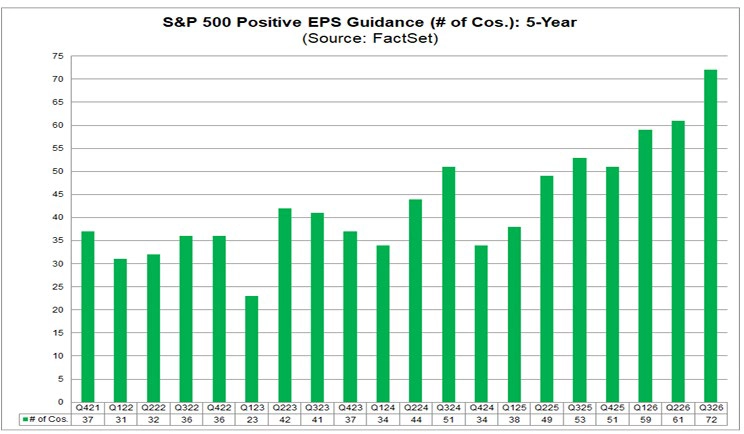
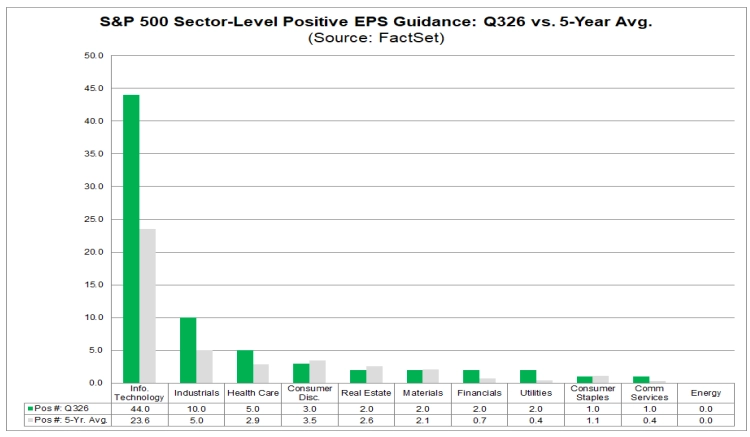
- …And the Tech sector was the main driver of positive Q3 EPS guidance
- IT accounts for 44 of the 72 Cos (61%) that guided positively
- Which is a tie with Q2:26 for the sector record
- This was led by Software (12 Cos) and Semis (11 Cos)
- IT accounts for 44 of the 72 Cos (61%) that guided positively
- Wall Street analysts have also been more bullish ahead of the Q3 earnings season…
- Q3 EPS growth projections for the S&P 500 incr’d from +26.7% y/y at the start of the qtr to +29.5% y/y currently
- This would mark the 3rd straight qtr of 25%+ growth and 8th straight qtr of double-digit growth
- Q3 rev growth projections have also incr’d from +10.9% y/y at the start of the qtr to +12.3% currently
- This would be a 3rd straight qtr of double-digit rev growth
- Net margin projection of 15% would be the 2nd-highest since FactSet began tracking in 2009
- But is short of Q2’s record 17%
- Q3 EPS growth projections for the S&P 500 incr’d from +26.7% y/y at the start of the qtr to +29.5% y/y currently
- …And which sectors do analysts expect to grow fastest in Q3? Energy leads on EPS (+114.0% y/y) but Info Tech leads on revenue
- IT is expected to post +65% y/y EPS growth (2nd-highest, up from +57% y/y at Jun 30) and +40.5% y/y rev growth (highest of 11 sectors)
- Semis EPS are expected to increase +130% y/y (ex-Semis, IT EPS growth falls to +24.4% y/y)
- NVIDIA and Micron are the largest contributors to the increase in IT’s earnings ests since Jun 30
- Comm Services (3rd-highest) is expected to post +51.5% y/y EPS growth, driven by Meta ($6.77 vs. $1.05) and EchoStar ($0.07 vs. -$44.37) …but ex-both, growth falls to +12% y/y
- Comm Services rev is est’d to grow +15.4% y/y, with Interactive Media +24% y/y, Media +10% y/y, & Entertainment +9% y/y
- IT is expected to post +65% y/y EPS growth (2nd-highest, up from +57% y/y at Jun 30) and +40.5% y/y rev growth (highest of 11 sectors)
- The S&P 500 valuation multiple has compressed as projections climbed
- The fwd 12-mo P/E of 19x is down from 20.4x at Jun 30 and below the 5-yr (19.8x) and 10-yr (19.1x) avgs
- What are analysts’ growth estimates looking further out?
- Q4’26 EPS growth est +27.6% y/y
- CY26 +32.4% y/y
- CY27 +15.8% y/y, w/ Q2:27 est slowing to +2.3% from +19.1%^ in Q1:27
AI’s Debt Mountain Keep Climbing…
AI’s funding needs moved deeper into the credit markets this week. Broadcom, SpaceX, Oracle and Tencent all reportedly launched or are exploring debt raises, which could total over ~$150bn across the disclosed deal sizes. Private credit is increasingly filling the gap, and Apollo is a common thread. The firm is reportedly expected to lead SpaceX’s $40bn package and is in talks on both Oracle’s chip-lease structure and Broadcom’s OpenAI financing. Blackstone is also cited as being involved in both Broadcom packages. As these financings hit the headlines, Bridgewater founder Ray Dalio at a conference in Singapore called AI a “classic bubble” nearing its bursting point. He pointed to the heavy debt being raised for AI, plus climbing rates, as the likely trigger, saying “we’re in the part of the cycle that is before that but approaching that.” In the background, global bond yields hit that are hitting multi-decade highs, w/ the U.S. 10Y at its highest since 2002.
See below for more details on these updates.
- Anthropic’s $60bn chip package hits the market and is the largest chip financing to date: BofA, Citi & Morgan Stanley began syndicating Mon (10/5) a record $60bn debt package backing Anthropic’s lease of Google TPUs (link)
- The package is guaranteed by Broadcom to lower Anthropic’s borrowing costs
- ~$42bn of senior secured loans are Broadcom-supported, while the $18bn junior tranche carries no Broadcom guarantee
- Proceeds are earmarked for Anthropic’s 2027 chip orders, and lease payments begin only after delivery
- Timing: B/c the junior tranche carries Anthropic credit risk, one person said banks might prefer to wait until after Anthropic’s IPO later this year, when financial disclosures are available
- Anthropic could also issue up to $42bn of convertible notes to Broadcom to pay the leases, per Broadcom’s latest quarterly report
- The package is guaranteed by Broadcom to lower Anthropic’s borrowing costs
- Broadcom is reportedly working to arrange $50bn+ of financing for the custom AI chip it is co-developing w/ OpenAI (internal “Nexus” program) (link)
- Apollo & Blackstone among lenders approached
- Program aims to deploy several GW of OpenAI chip capacity through 2029 as tech firms look for alternatives to Nvidia hardware
- The deal is expected to close before YE
- But talks are early stage
- Oracle is reportedly exploring an off-balance-sheet chip lease: The Co is said to be in talks w/ Apollo & Goldman on financing hardware for a 1GW data center; Investors would fund a separate entity that buys the chips and leases them back to Oracle (link)
- This would let Oracle add capacity w/o further levering its balance sheet
- They are reportedly targeting a YE close
- SpaceX is reportedly seeking $40bn to buy Nvidia chips: Apollo is cited as leading and helping to place the deal, w/ PIMCO among lenders in talks (link)
- The structure is said to be ~$10bn bank loans + ~$30bn IG debt
- The deal is expected to close in 2027 but talks are early
-> SpaceX shares closed the day of the report up +0.5%
- Tencent is reportedly weighing an offshore bond sale of up to $5bn in USD & offshore yuan which is seen as helping to fund its AI spending (link)
- Timing: Cited as possibly w/in weeks
AI Shopping Races to Move Past the "Chaos"
The backdrop for agentic commerce has been, in the words of Sierra’s Bret Taylor, “kind of chaos,” with Amazon blocking AI shopping agents like Meta’s Muse from accessing its site and completing purchases. This week, the race to build standards and shared plumbing for AI shopping agents added another entrant, as Meta, Sierra, Walmart, Stripe, Shopify and others proposed an open standard for how personal agents sign in and act on a customer’s behalf at businesses. Why is this important? Because AI shopping will only accelerate from here and companies need to prepare. In fact, Citi this week estimated that Muse alone could reach $27bn+ in annual revenue by 2030, with most of that revenue transaction-related. Platforms and brands aren’t waiting for the rails to be finished, either. TikTok added an AI shopping assistant and one-click checkout, and Gap opened its four brands to AI discovery and conversational agents.
Meanwhile, the early scorecard shows both who is positioned to win and where the limits are. UBS found chatbots already default to Walmart over Amazon when asked where to shop, while YouGov found just 5% of likely holiday shoppers are comfortable letting AI complete a purchase, even after approval.
See more of these key developments below.
The Agentic Shopping Plumbing Is Being Built As Wall Street Sizes The Prize
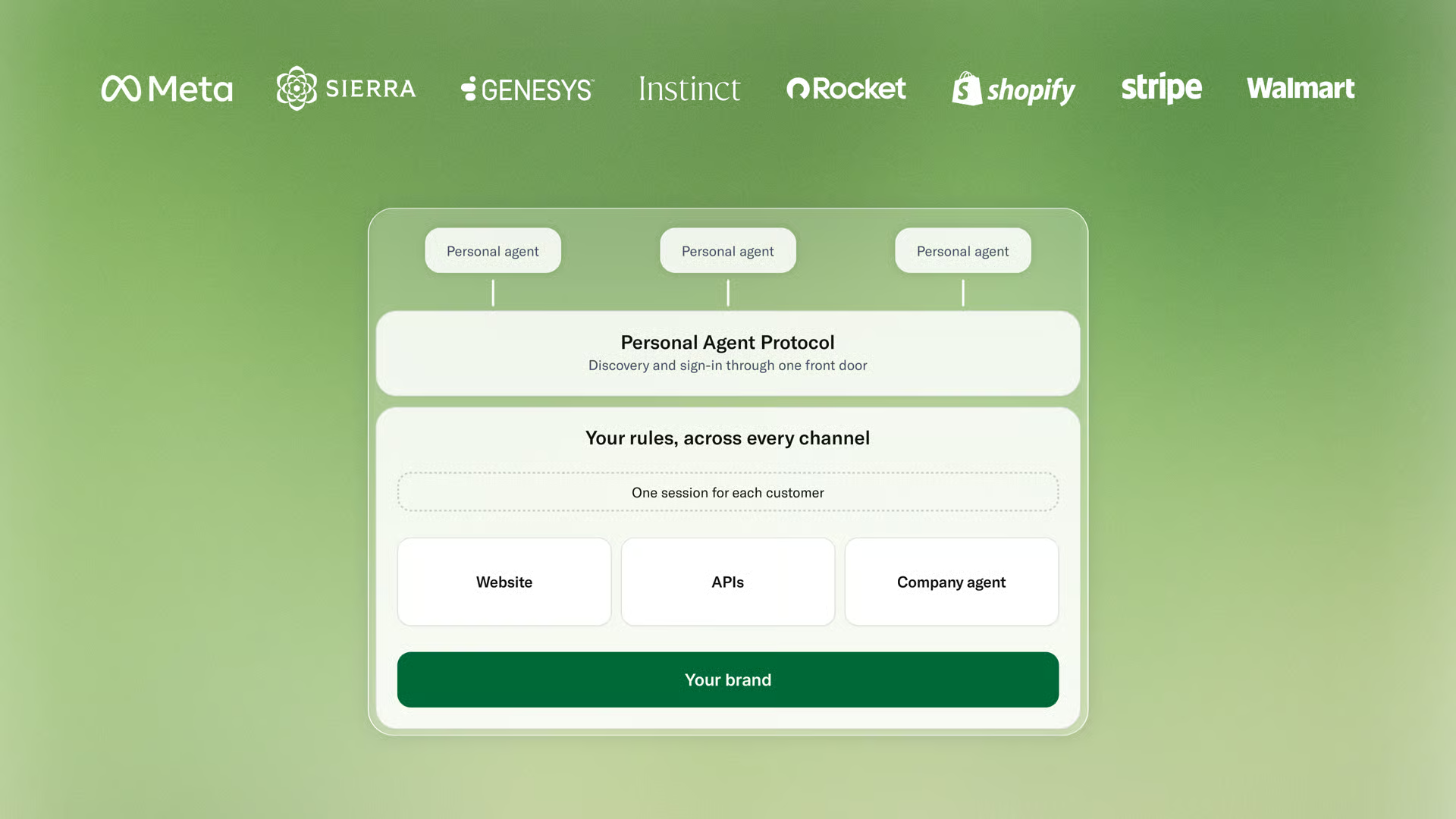
- Meta, Sierra, & other industry partners propose a “Personal Agent Protocol” (PAP) which essentially aims to give AI agents a standardized way to sign in and act on a customer’s behalf: It’s an open standard that defines how personal AI agents authenticate and interact w/ businesses (link)
- The co-developers include: Genesys, Instinct, Rocket, Shopify, Stripe and Walmart, and are open for anyone to implement
- How would the protocol work?
- Agents can access websites as guests (check product availability or return policies, etc.)
- Customers decide what access to give their agent if it is logging in on its behalf (read only or write access)
- Cos set parameters for that agent and sessions are built on OAuth
- Cos decide whether agents accomplish the task via its website, its APIs (MCP/OpenAPI) or its own agent
- “The company decides what it makes available, the personal agent gets a consistent way to connect, and the customer gets a faster way to get things done”
- Timing:
- v0.1 spec will be published later this month, followed by design workshops and a reference implementation
- Potential future extensions include:
- Payments (completing a purchase w/o sharing card info)
- Push notifications
- Finer-grained permissions
Source: Sierra.ai
- The AI shopping opportunity will be large…a Wall Street analyst was very bullish on Meta’s Muse this week, and especially on transaction revenue (link)
- Citi estimates that Meta’s Muse could reach $27bn+ in annual rev by 2030
- Est’d rev split: ~$23bn transaction-related and ~$4.5bn subs
- Citi cites that Meta Muse has reached 6.6mn cumulative downloads and 1.8mn DAU
- Citi estimates that Meta’s Muse could reach $27bn+ in annual rev by 2030
…While Companies Across The Sector Are Beefing Up AI Shopping Efforts
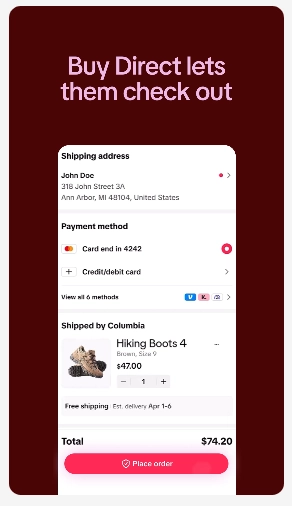
- TikTok beefs up its shopping capabilities by adding an AI Shopping Assistant + one-click “Buy Direct” as well as AI lead generation: This was unveiled at Advertising Week NY (link)
- For consumers:
- Shopping Assistant = conversational agent providing real-time AI-powered shopping guidance for things like product details, shipping, sizing, availability and purchase
- Buy Direct = in-app checkout directly from a brand off the For You feed
- Partners: Built w/ Salesforce, Shopify, Shoplazza and Stripe, among others
Source: TikTok
- For companies:
- Agentic Leads = an AI Agent for lead generation that, via AI-guided conversations, enables businesses to capture, qualify and convert high-intent, actionable consumer prospects
- TikTok Ad Network (TTAN) = introducing to US advertisers the ability to extend their campaigns beyond TikTok and reach audiences across a premium network of nearly 400k apps worldwide
- Search Ads Campaign, powered by Smart+ = lets advertisers automate search ads across keywords and creative
- Smart+ Creative Selection = A new Smart+ feature that brings together every creative source (from advertisers’ own assets to Symphony’s AI-generated creatives and even creator content) into one approval workflow
- How effective is TikTok as a shopping platform and how big is the opportunity? The Company cites 2 favorable reports:
- PF Global’s TikTok’s Economic Impact Report published the week prior found that economic activity on TikTok helped generate $81bn in GDP for US businesses, w/ 54mn Americans purchasing a product after watching a TikTok video
- Kantar’s Media Reactions 2026 report ranked TikTok as the #1 platform where marketers plan to increase ad spend in 2027, w/ 84% of marketers placing advertising on TikTok
- For consumers:
-> eMarketer ests TikTok Shop did ~$15.8bn in U.S. sales in 2025, which is ~18% of U.S. social commerce (link)
- Gap rolls out AI shopping across all four brands: (link)
- Customers can now discover items via 2 3P AI platforms
- Daydream: Provides fashion ideas across all of Gap Inc. brands
- Alta Daily: Suggests outfits based on schedule, budget and weather
- Also, Old Navy and Banana Republic now have conversational shopping agents on their sites/apps
- Customers can now discover items via 2 3P AI platforms
But The Chatbots Already Have Their Favorite Stores…
- What are the go-to retailers for AI chatbots? A UBS research analysis showed that AI chatbots default to Walmart, and not Amazon (link)
- What was the analysis based on? The firm ran 12 everyday shopping prompts (e.g., for the lowest grocery prices, household essentials, cheapest car battery) through ChatGPT, Claude, Gemini and Muse across NJ, NY and MN
- The models “consistently gravitate toward scale, value, convenience and brand familiarity,” w/ WMT the clear winner
- Why WMT? UBS says the models “increasingly view Walmart as a default answer for everyday consumption,” and its value prop is “simple for models to understand and communicate”
- What other retailers were preferred?
- COST was a consistent top pick for quality/bulk
- Aldi was favored for low grocery prices
- Dick’s was a go-to for athletic gear
- TGT was seen as a “secondary option”
- AMZN showed up less often than expected
- How can companies improve the chances of being selected? Retailers that feed catalogs, inventory, store info and reviews to AI agents “may gain a significant advantage”
- WMT is also a PAP launch partner (see above)
- What was the analysis based on? The firm ran 12 everyday shopping prompts (e.g., for the lowest grocery prices, household essentials, cheapest car battery) through ChatGPT, Claude, Gemini and Muse across NJ, NY and MN
…And Consumers Still Have Hesitancies Regarding AI Finishing Transactions
- A new YouGov survey shows that shoppers are likely to use AI to hunt deals for holiday shopping but are not so keen to use AI for check-out (link)
- 34% of likely Black Friday and Cyber Monday shoppers are likely to use AI for this year’s sales
- Up from 16% in 2025 (but YouGov’s question was slightly different)
- Comfort w/ AI is highest for finding the best price and lowest for actually transacting
- 43% are comfortable using AI to find the best price
- 37% to track price
- 34% to compare similar products or offers
- 9% to add items to their basket
- 5% to complete a purchase after approval
- 4% to make a purchase w/o asking
- ChatGPT and Google Gemini lead as the AI shopping tool preferences but this survey was from July 13-Aug 11 which was before Meta’s Muse was launched
- 34% of likely Black Friday and Cyber Monday shoppers are likely to use AI for this year’s sales
-> On the topic of shopping, Amazon Prime Big Deal Day this week (Oct 6-7) is est’d to have helped drive $9.86bn (+8.5% y/y) in online sales for U.S. retailers, per data from Adobe; “Shoppers prioritized getting the best value for their dollar.” (link)
The Connectivity Sector Gets Another Jolt This Week As SpaceX Snaps Up New Spectrum
On the SpaceX Q2 earnings call in August, mgmt sounded committed to building out terrestrial infrastructure for Starlink Mobile service and compete head-to-head with the telco giants AND with the belief that the build out costs involved would be lower than anticipated. Fast forward to this week…SpaceX took a big step forward in this goal when it agreed to buy Grain Management’s nationwide 800 MHz portfolio for a reported ~$8bn. This low-band spectrum fills what SpaceX itself called one of the key remaining technical gaps (signal inside buildings), and Musk referred to it as the “last critical piece of the spectrum puzzle.”
The wireless giants were under pressure while the tower REITs rallied as analysts argued a credible terrestrial build still needs towers, not just the small Starlink-dish base stations Musk pitched in Aug. The deal still needs FCC approval, and the Street sees the competitive threat as real but slow to arrive. Some analysts also question whether this was a move to push the carriers for a deal. This will certainly be one of the topics du jour in the upcoming set of connectivity Q3 earnings call which kick off with AT&T on Oct 21st.
See more details on this development below.
-> SpaceX traded up as much as +3.6% on the news while the big 3 US wireless giants took it on the chin with TMUS, VZ, T, and TMUS closing down -8.8%, -9.9%, and -13.3%, respectively on Friday; The European telcos also felt some pain, with the STOXX 600 Telecom Index down -2.9% (to the lowest since Feb) with Orange down -2.9%, Vodafone down -5.6%, Telefonica down -6.0%, and DT down -8.9% on the day
–> On the flipside, the US towers traded up on the view that SpaceX will need some traditional infrastructure for its mobile build; SBAC, AMT, and CCI closed Friday up +7.3%, +9.3%, and +15.6%, respectively
- SpaceX agreed to acquire 100% of Grain Management’s nationwide 800 MHz portfolio (up to 14 MHz of paired low-band spectrum), subject to FCC approval (link/link/link)
- Post FCC approval, Starlink Mobile will deploy a “flexible architecture combining our satellite to mobile constellation in space w/ an advanced terrestrial deployment that can seamlessly connect devices everywhere”
- This low band spectrum will help Starlink Mobile’s signal penetrate indoors and most existing handsets already support the band
- SpaceX says it addresses “one of the key remaining technical gaps” for Starlink Mobile to become “a major mobile carrier in the US”
- The deal was reported at ~$8bn in cash per the WSJ
- For context, T-Mobile sold the same portfolio to Grain (closed Aug) for $2.9bn cash + Grain’s 600 MHz licenses
- TMUS may also share in certain future proceeds from Grain’s monetization of the 800 MHz, subject to a return hurdle
- Also, earlier this week, the FCC approved the Co’s Gen2 constellation application this week, giving them permission to launch 15k satellites that are optimized for 2 GHz spectrum globally
- Post FCC approval, Starlink Mobile will deploy a “flexible architecture combining our satellite to mobile constellation in space w/ an advanced terrestrial deployment that can seamlessly connect devices everywhere”
- A number of Wall Street analysts see the threat as real, but that it will take some time to develop (link/link/link/link)
- Morgan Stanley: This is a “clear sign” SpaceX will be a more aggressive spectrum acquirer; The threat to carriers likely to build gradually, starting in rural markets
- Also, the news is “incrementally constructive” for towers, as even a satellite-centric network could require towers, rooftops and small cells
- JPM: Starlink Mobile’s long-term opportunity is now “more credible,” but sees limited near-term risk given the time, infrastructure and capital required
- Evercore ISI: SpaceX “now has the outline of a real network”
- New Street: The firm is “not so sure” that this is the last piece of the puzzle…the big 3 hold far more spectrum, and 800 MHz isn’t currently compatible w/ SpaceX’s V1/V2 D2D sats
- TD Cowen: Carriers “clearly have a new bidder at the table,” esp. ahead of Auction 115 next April
- A terrestrial build would take years and cost $80bn+ hence an MNVO deal would be “a lot easier”
- Morgan Stanley: This is a “clear sign” SpaceX will be a more aggressive spectrum acquirer; The threat to carriers likely to build gradually, starting in rural markets
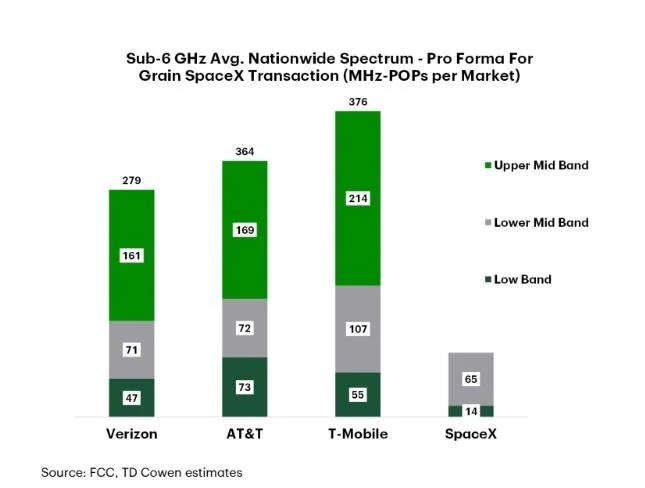
Source: Fierce Network
-> Recall that the Big 3 US wireless Cos formalized their satellite D2D JV last week after being annc’d in May in principle and AT&T’s Stankey called SpaceX’s plan “not a viable strategy” (see last week’s edition for details)
Another Player Enters The Agent Race At The Same Time That AI Revenue Is Scrutinized
The race to build AI agents continues to heat up after Meta’s Muse made quite a splash a few weeks ago, followed by OpenAI’s Dots. This week, Google joined the fray with its own Gemini agent, though with a focus on the business segment.
Meanwhile, on the monetization front, some confusion around OpenAI’s reported revenue figures this week weighed on AI-related stocks and raised questions around how the industry measures revenue. Separately, new data from Andreessen Horowitz gave an interesting look at consumer AI spending, where adoption is broadening but paid subscriptions remain relatively limited and spending is heavily concentrated among power users.
See details below on these AI developments that stood out the most to us this week.
On The Agent Front…Google Enters The Races W/ Its Gemini Agent
- Google Cloud introduces Gemini agent…a universal, autonomous AI agent for enterprise work (link/link)
- Rather than asking users to manage separate agents for different tasks, Google wants employees to delegate objectives to one agent that figures out how to complete them, accesses the necessary enterprise systems and returns finished work
- The agent works directly inside Google Workspace apps, including Gmail, Docs, Sheets and Calendar, and can also be used through Microsoft 365 and Slack
- It can execute longer-running tasks autonomously, even after users close their devices, while maintaining memory and context across session
- It picks the best model for each task, currently running on Google’s Gemini models and Anthropic’s Claude models, with other models to be added later
- Users can create “coworker agents” that act as team members, with their own email address and access only to the information they are given.
- Different versions for different sectors: Versions built for financial svs and legal work are now in preview, and versions for government, healthcare and retail are coming soon
- Available now in private preview to a select group of customers, w/ wider availability coming soon (no specific date give)
BUT On The Monetization Front…OpenAI’s Actual ARR Was Below Estimates, Sending AI Stocks Down
- AI names fell amid confusion over OpenAI’s rev figures… the Co’s annualized rev reached ~$50bn at the end of September, ~$20bn below earlier estimates (link/link)
- The ~$50bn figure reflects an annualized run rate based on recent sales, rather than actual or projected full-yr rev
- The previously reported ~$70bn figure was based on investor estimates using a different rev calculation methodology; OpenAI still expects to reach or exceed $70bn in annualized rev by YE
- The discrepancy largely reflects differences in how OpenAI and Anthropic calculate rev… Anthropic includes gross rev from certain sales through cloud partners, while OpenAI recognizes only its share (both approaches are GAAP compliant); Anthropic’s annualized rev reached ~$65bn at the end of July
-> The initial reports weighed on US tech stocks Thursday, w/ the tech-led Nasdaq closing down -1.4%; Nvidia fell -2.9%, Micron declined -4.8%, and Oracle was down -5.5%
A Few Key Takeaways On Consumer AI Monetization And Subscription Trends, Per Andreessen Horowitz (link)
- Consumer AI usage is wide, but not very deep…for almost everyone
- While nearly half of US consumers now report using AI, only 25% are engaged with it daily
- And as of August, just 4.5% of U.S. consumers had an active paid personal subscription to ChatGPT, Gemini, or Claude
- However, AI’s consumer power users are extremely engaged…and highly monetizable
- The top 10% of spenders account for roughly half of all observed spending
- These high spenders disproportionately buy coding, productivity, and creative tools
- Unlike OpenAI and Google, Anthropic has been clear that they will not run ads in Claude, and instead monetize users via subscription…they have been doing so aggressively
- Claude has 7.3% of consumer payers on their most expensive individual plan, Max, which starts at $100/mo
- This compares to 1.3% for Google and 1.1% for ChatGPT on their corresponding $100/mo subscriptions
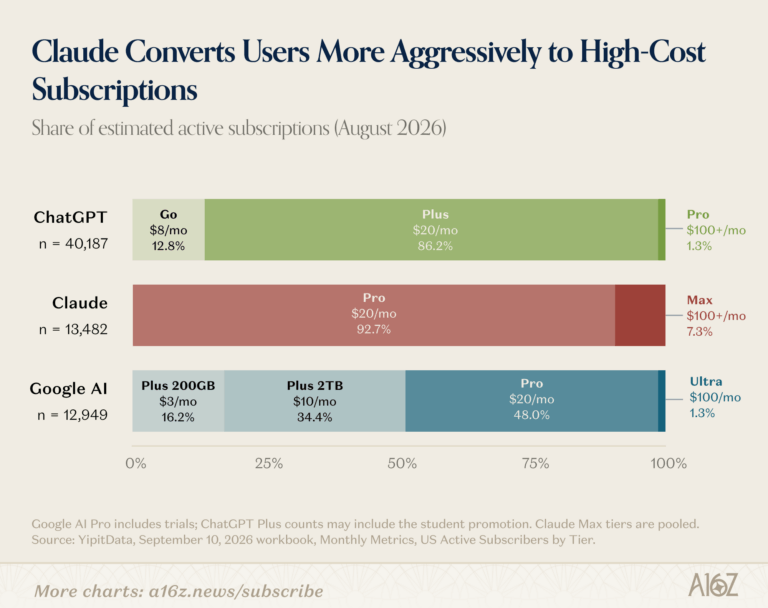
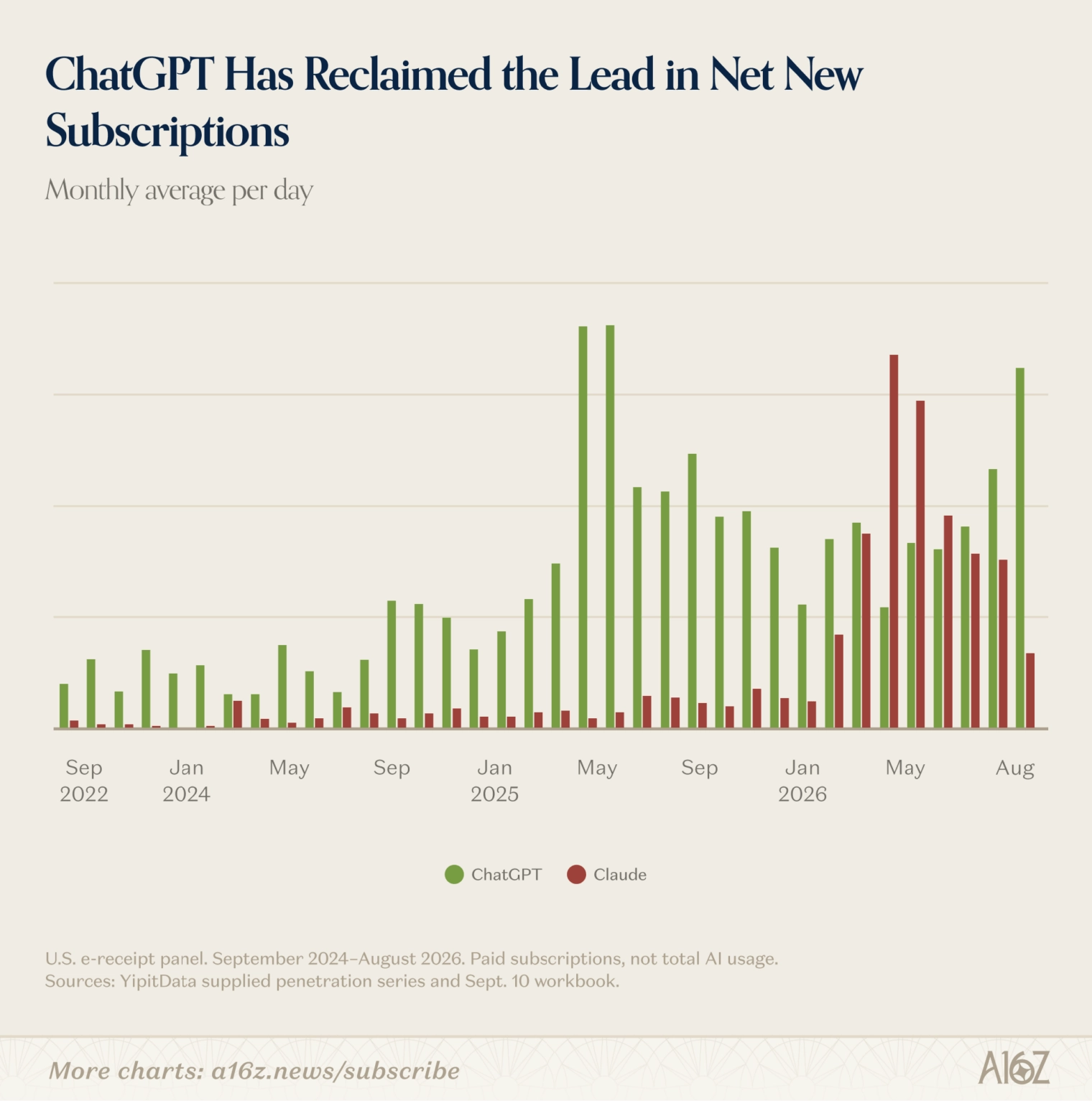
- BUT while Claude has been more effective at upselling users to premium tiers, ChatGPT has regained momentum in overall subscriber growth
- ChatGPT’s growth re-accelerated in July, coinciding with the launch of new models and ChatGPT Work
Gaming Opens Up To More Creators & Expands Beyond Gameplay
AI’s impact on the videogame industry has been the center of discussion as it pertains to game development, to jobs, and everything in between. And in recent months, we’ve started to see one way AI is making its mark, with Cos introducing tools that let users create games simply by describing what they want. Roblox introduced its mobile-first Build tool in July, followed by Meta in September with Horizon Create and Horizon Studio, which bring AI-powered tools to 2D and 3D game creation. Now, Google is joining the mix with Playground, a new platform that lets users create, play, and share games through simple text prompts. Google is also partnering with Unity to bring more advanced development tools to Playground, which will allow creators to potentially move from simple games to immersive 3D experiences.
But the gaming sector’s expansion isn’t just about making games easier to create. Cos are also looking to bring established franchises to audiences beyond traditional gameplay. In an interesting move this week, Xbox is launching a new division called XP, focused on extending its gaming properties into film, TV, merchandise, partnerships, and live experiences. The strategy builds on the success of Minecraft and Fallout, where film and television adaptations have helped drive addtl engagement with the underlying games.
Overall, the gaming industry is evolving on multiple fronts, from who can create games to how those games and franchises can reach audiences beyond the console, and we expect that evolution to continue top accelerate.
See more of our takes on these developments below.
A New Entrant Into Game Creation…Google Launches Playground For Prompt-Based Game Creation (link)
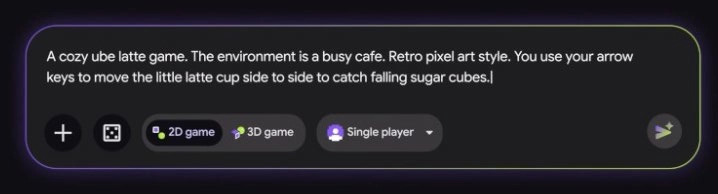
- Google introduced Playground, an experimental gaming platform that lets users create, play, and share custom games
- No coding is required…Playground has a conversational interface so users can direct the game just by typing what they want to build
- Users can start w/ a blank canvas, remix starter prompts, or use guided support to shape their concept, and then test it right away
- Once the game is ready, it can be kept private, shared via a link to challenge others, or published to the Playground Explore gallery for the broader Playground community to discover
- Playground games support in-game leaderboards and multiplayer gameplay in select genres
- With a Play Games profile, users can claim a custom handle, like their favorite games, battle for the top spot, and follow creators to catch their latest releases.
- Playground is browser-based, so games can be played both on phone or laptop
- Availability…Playground is free to use, though Google One AI subscribers will get early access to the creation tool and a higher weekly token limit
- In terms of safety, every published game undergoes safety screenings aligned with Google’s Community Guidelines, along with user reporting
Source: Google Labs
Building On Playground, Google Also Annc’d A Strategic Partnership W/ Unity (link)
- Later this yr, Google and Unity will introduce an expanded creation experience called Unity Spark
- Playground with Unity Spark will retain its easy-to-use, accessible interface while introducing advanced game-building tools, high-quality 3D capabilities, and the flexibility of Unity’s runtime
- Combining Playground’s accessibility with Unity’s “world-class” game development tools creates a path for users to go from simple text prompts to building immersive gaming experiences
- Unity Spark is currently in testing, with closed beta coming soon
-> Unity was up +1.0% on the day the partnership was announced, while Roblox fell -1.9%
And While Playground And Unity Are Expanding Game Creation, Xbox Is Looking To Extend Its Properties Beyond Video Games (link/link/link/link)
- Xbox has created a new entertainment division, called XP (for “Experience Points”), which is focused on how people experience their franchises “beyond the games themselves”
- XP is NOT a production Co…it is a new division that aims to match Xbox’s IP with the right production Co
- More specifically, it is “focused on helping Xbox franchises reach fans beyond gameplay through film and television adaptations, consumer products, partnerships, and live experiences”
- XP has four areas of investment –
- XBOX PICTURES for film and television adaptations
- XBOX PRODUCTS for licensing and merchandise
- XBOX PARTNERSHIPS for sponsors and brand partners
- XBOX PLACES for our marquee broadcast and in-person events, theme parks, and other location-based experiences
- Expanding properties beyond video games creates a virtuous cycle…
- Fallout titles on Xbox Game Pass saw a 5x increase in hours played during Fallout‘s first season on Prime Video
- Minecraft saw a 75%+ increase in weekly active users of the game y/y since the movie’s release in the spring of 2025
- Leadership appointments –
- Kayleen Walters, currently president of Minecraft studio Mojang and formerly of Lucasfilm and executive producer of A Minecraft Movie, will be XP’s president
- Maria Angelidou-Smith joins Xbox as Mojang CEO
Short Sellers’ Bets Pay Off As Most-Shorted Stocks Fall In Q3
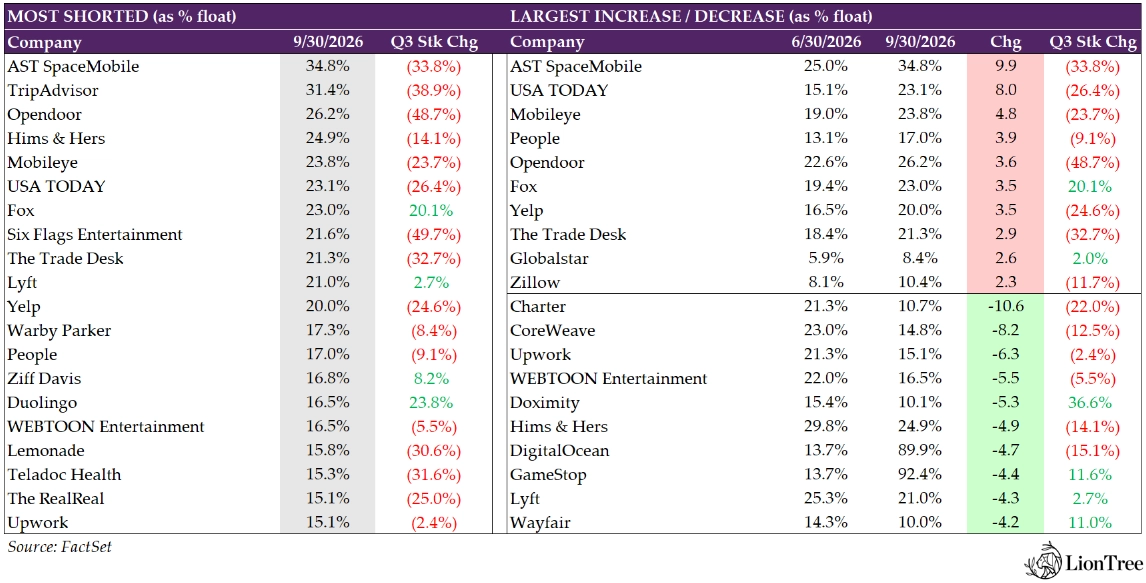
Q3 short interest data (released this week) showed a much better qtr for short sellers across our LionTree Universe of ~150 tech, media, telco, and consumer stocks with market caps of $1bn+. Their bets largely paid off, with 16 of the top 20 most-shorted stocks lagging the S&P 500’s +2.0% gain, twice as many as the 8 that underperformed in Q2. The group’s avg return swung from +44% in Q2 to −17.5% in Q3, and just 4 of the 20 names ended the qtr higher.
At the top of the most shorted list (as a % of float), AST SpaceMobile climbed from #6 to #1, replacing TripAdvisor as the most-shorted stock, after the Co saw the biggest jump in short interest across our universe in the qtr. Opendoor moved into the Top 3 most shorted, up from #11 in Q2. On the flipside, Charter saw the biggest drop in short interest during the qtr and fell out of the Top 20 altogether, from #3 in Q2.
See our analysis below for more details.
Most Shorted Stock (As % Of Float) – AST SpaceMobile
- The Top 3 Most Shorted = #1 is AST SpaceMobile, #2 is TripAdvisor, and #3 is Opendoor
- AST SpaceMobile short interest rose from the #6 spot in Q2 -> #1 spot in Q3
- TripAdvisor short interest slipped from the #1 spot in Q2 -> #2 spot in Q3
- Opendoor was a new entrant to the Top 3 and its short interest rose from the #11 spot in Q2 -> #3 spot in Q3
- Stocks that dropped out of the Top 20 most shorted: Charter, CoreWeave, Etsy, Fubo, Rackspace Technology, and TKO Group
- Stocks that joined the Top 20 most shorted: Fox, Lemonade, People, USA TODAY, Warby Parker, and Yelp
-> The S&P 500 was up +2% in Q3 and 16 out of the top 20 most-shorted stocks underperformed the index over the period; On avg, the top 20 most-shorted stocks traded down −17.5% in Q3, compared to Q2’s average of up +44%. Six Flags (−49.7%), Opendoor (−48.7%), and TripAdvisor (−38.9%) posted the steepest declines, while Duolingo (+23.8%), Fox (+20.1%), Ziff Davis (+8.2%), and Lyft (+2.7%) were the only names in the Top 20 to outperform
Largest Increase In Short Interest (As % Of Float) – AST SpaceMobile
- The largest increase in short interest was seen at AST SpaceMobile: The Co saw a +9.9ppt increase in SI in Q3 to 34.8% of the float (also the most shorted stock in our Universe as mentioned) -> The stock was down −33.8% in the qtr
- Other stocks with notable increases in short interest = USA TODAY, Mobileye, and People -> all three underperformed the S&P 500’s +2% performance in the qtr, down −26.4%, −23.7%, and −9.1%, respectively
- Notably, Fox (+3.5ppt) was the only name among the 10 largest increases to outperform the S&P 500, with shares up +20.1%
Largest Decrease In Short Interest (As % Of Float) – Charter
- The largest decrease in short interest was for Charter: The Co posted a −10.6ppt SI decrease in Q3 to 10.7% of its float -> But the stock was still down −22% in the qtr, extending its Q2 decline (−34.1%)
- Other stocks with notable decreases in short interest = CoreWeave, Upwork, and WEBTOON Entertainment -> all three underperformed the S&P 500’s +2%, down −12.5%, −2.4%, and −5.5%, respectively, while Doximity (−5.3ppt) significantly outperformed with shares up +36.6%
Mattel And Snap Face Fresh Investor Pressure To Unlock Value
Both Mattel and Snap were back in the activist spotlight this week, with investors once again calling for changes aimed at unlocking shareholder value. At Mattel, Ariel Investments, which owns a 5.4% stake in the Co, became the 2nd major shareholder this yr to advocate for a potential sale, following a similar push from Southeastern Asset Mgmt in May. Ariel argues that despite improvements in the biz, progress has stalled and shares remain significantly undervalued. The push comes after reports last week that Authentic Brands Group had approached Mattel about a potential acq that could value the Co at more than $20/shr (+20% above Friday’s closing price).
Meanwhile, Snap also saw renewed activist attention, although this time with a different proposal for its Specs biz. Back in March, Irenic Capital Management called for Snap to spin off or shut down Specs, arguing that the Co had already invested billions in the technology. This week, Blue Duck Capital offered an alternative, proposing that Snap sell a 20% stake in Specs for $1bn (implying a $5bn val’n) while retaining majority ownership. Blue Duck believes outside capital could support further development of its AR technology while helping the mkt better recognize the value of Snap’s core advertising and subscription biz.
See below for the key points from both activists.
Another Mattel Investor Pushes For A Potential Sale (link)
- Ariel Investments, which has a 5.4% ownership stake in Mattel, is pushing the Co to explore strategic alternatives, including a potential divestiture of assets, a merger or a sale
- They believe that other toy Cos are likely to find the Mattel portfolio attractive, as well as entertainment Cos and traditional PE firms
- Ariel acknowledged that Mattel has been undergoing a transformation but “in spite of these gains, progress has stalled”
- “We have applauded improvements in operating performance, profitability and margins that have resulted from the outsourcing and diversification of manufacturing and supply processes”
- The Co’s shares remain significantly undervalued and “by our estimates, a strategic buyer would pay a significant premium to your current share price”
- Mattel’s response: “Our board of directors and management team are committed to acting in the best interests of all shareholders and will consider the views expressed in Ariel Investments’ letter, as well as the views of Mattel’s other shareholders”
- This is the 2nd time this yr that a Mattel investor has urged the Co to consider strategic alternatives…in May, Southeastern Asset Management (owns over 4% of Mattel’s common stock) called for a sale of the toy Co, arguing its brands would be better off in the hands of a PE firm, competitor or large media Co (link)
- Mattel has reportedly already garnered takeover interest…last week, it was reported that Authentic Brands Group has made an approach and been privately discussing an offer that could value the Co at more than $20/shr, which sent Mattel shares up +19% (link)
-> Note that that Co is also in the midst of a mgmt. transition w/ Ynon Kriez resigning as Mattel’s CEO on Oct 2nd to instead join Skydance as Co-CEO and Roger Lynch taking over the CEO seat
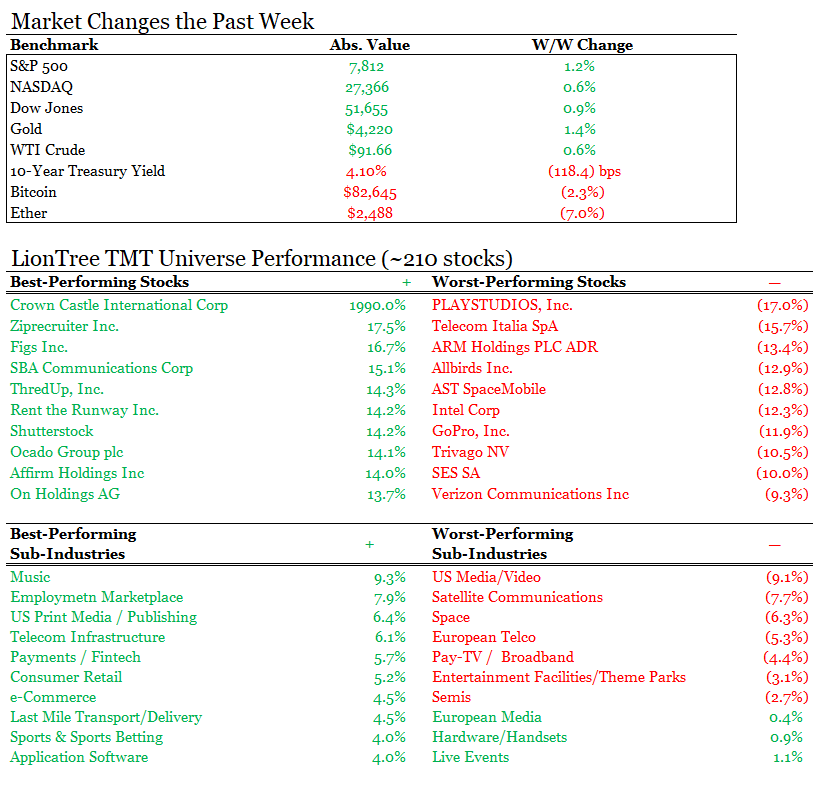
-> Mattel’s share were up +9.3% this week but are down -15.9% YTD
A Snap Investor Pushes For Specs Stake Sale (link/link)
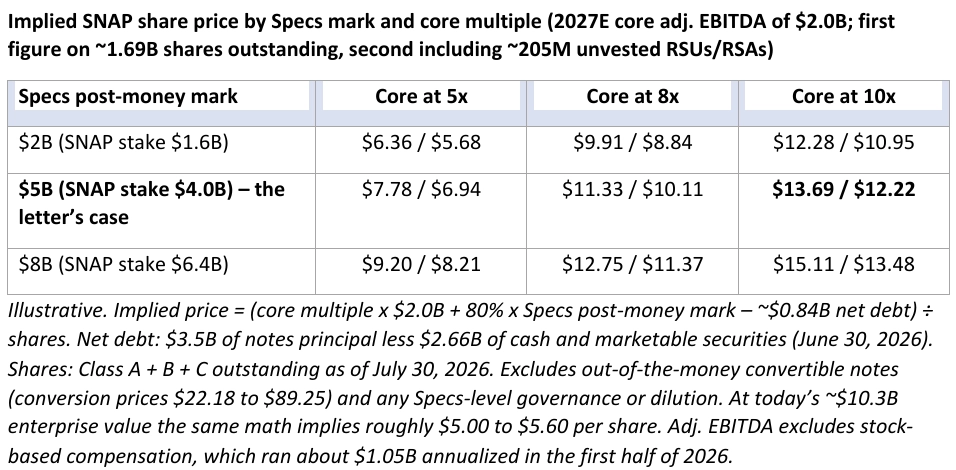
- Blue Duck is proposing that Snap sell a 20% stake in Specs for $1bn, implying a $5bn val’n for the biz
- Snap would retain 80% ownership, valued at ~$4bn, rather than fully spinning off the biz
- The $1bn raise could fund ~2 yrs of Specs development at its est’d current spending rate of ~$500mn annually, reducing the need to fund the biz through Snap’s core cash flows
- Potential investors could include VC firms or strategic partners, with Blue Duck citing SpaceX as one illustrative possibility given potential AI and connectivity synergies
- Why raise outside capital now? Specs has significant potential but remains yrs away from mass-mkt adoption
- Specs carries a ~$2,200 price tag, while its form factor and practical applications are still evolving, limiting near-term consumer appeal
- Snap’s substantial investment in AR technology, including 7,000+ patents filed over more than a decade, is evidence of the platform’s potential
- Dedicated funding could help accelerate development of a lower-priced version of Specs, potentially bringing the price point closer to ~$1,000 and improving the likelihood of broader consumer adoption
- Competition from Meta highlights the importance of making Specs more affordable
- Snap’s innovations have historically been copied by larger competitors, raising the importance of accelerating Specs’ development
- EssilorLuxottica is expanding annual production capacity for Ray-Ban Meta glasses to 10mn units, with Blue Duck estimating an average selling price of ~$350-450, significantly below Specs’ current price
- While Specs offers more advanced spatial AR capabilities vs Meta’s cheaper, audio-first glasses, the significant price gap underscores the challenge of competing with larger tech players as the smart glasses mkt develops
- What could Specs’ longer-term rev oppty look like? Snap’s existing user base could provide a meaningful advantage
- With ~500mn DAUs and nearly 1bn MAUs, Snap existing audience could serve as a distribution advantage
- Blue Duck estimates that if a lower-priced version of Specs were available for ~$1,000 and just 1% of Snapchat’s DAUs purchased the product, it could generate ~$5bn in annualized hardware rev
- Under this illustrative scenario, the proposed $5bn Specs val’n would represent just ~1x potential hardware rev
- Is a $5bn val’n for Specs reasonable? Blue Duck points to several precedents
- Alphabet has repeatedly raised external capital for Waymo while retaining control, most recently at a $126bn val’n, while Magic Leap raised ~$794mn at a $4.5bn val’n before launching a product
- Snap also paid $500mn+ for WaveOptics in 2021, with Blue Duck arguing that if one component of Specs commanded that price, the full platform could reasonably be valued at $5bn
- The other argument is that Specs’ investment requirements are masking the value of Snap’s core biz
- Blue Duck estimates Snap’s core advertising and subscription operations could generate ~$2bn in adj. EBITDA by 2027
- Based on its proposed $5bn Specs val’n, Snap’s core biz is currently trading at just ~2-3.5x 2027E EBITDA
- A standalone val’n for Specs would allow investors to value Snap on a sum-of-the-parts basis, separating its established operations from its longer-term AR investments
- What could this mean for Snap’s val’n? Blue Duck sees meaningful upside if the market re-rates the core biz
- Snap’s core operations could command an 8-10x EBITDA multiple once Specs is valued separately
- At 10x its est’d $2bn in 2027 EBITDA, the core biz would be worth ~$20bn, plus ~$4bn for Snap’s retained Specs stake
- After accounting for net debt, this would imply a share price of ~$12-14, depending on dilution assumptions, vs the mid-single-digit levels implied by the current val’n
-> Snap shares were up +11.7% this week and are still down -22.8% YTD
Grab Bag: Apple Smart Home / Waymo $5bn Debt Raise / Spotify Expands Audiobooks
- Spotify will expand its audiobooks offering to 180+ mkts (link/link)
- From now through the end of 2026, Spotify will expand their audiobook access from 22 mkts to over 180
- With the expansion, listeners in new mkts will be able to access 350k+ titles, including new catalogs in Spanish, Portuguese, Italian, Polish, and more, spanning 120+ languages
- Spotify said 750mn+ people will be able to stream or buy books on its platform once the rollout is complete
- All of Spotify’s publishing deals are non-exclusive, so authors remain free to sell their books on other svs
- According to Spotify, Audiobooks+ now has 1mn+ subscribers and $100mn+ in annual recurring rev, just over a year after launch
-> Spotify closed the day of the announcement up +5.1% and ended the week up +11.9%
- Apple announces surprise “Welcome Home” launch event on Oct 13th and is reportedly launching a doorbell, lock, thermostat, and other accessories developed through a partnership w/ LG (link/link)
- The products will reportedly be part of an ecosystem of devices that work with Apple’s new smart home hub, as well as an upgraded HomePod mini and fresh TV set-top box
- The new Apple devices, including an upgraded HomePod mini and fresh TV set-top box, are set to be introduced on Oct 13, while the LG accessories are expected to reach consumers in a few more mos
- Though the two Cos worked together to develop the accessories, the products reportedly carry the LG brand, and LG will handle manufacturing and product support.
- For Apple, the new home ecosystem and devices will mark a formal reboot of HomeKit, a platform it launched in 2014 that gained little traction
- Waymo gets $5bn in inaugural debt funding (link/link)
- The deal was reportedly upsized…the transaction was initially reported as a debt raise of more than $3bn before being increased to $5bn
- Waymo said the debt financing will give the Co financial flexibility to strengthen its balance sheet and position it to “capitalize on the significant opportunities ahead”
- Until now, Waymo has relied on capital from its parent Co (Alphabet) and outside investors –
- In Feb, Waymo raised $16bn in equity from investors that pushed its valuation to $126bn; Alphabet, which supported the round, has maintained its position as majority investor
- The Co raised $5.6bn in a Series C funding round in 2024, $2.5bn in 2021, and $3.2bn in 2020
Stock Market Check
This Week's Other Curated News
Advertising/Ad Agencies/Ad Tech
- Walmart-owned Vizio expanded WatchFree+ with 40 creator-dedicated FAST channels, exclusive holiday programming and broader premium content partnerships. The platform added creator names including MrBeast and Hot Ones, plus originals such as Jingle Bells Wedding Bells and Holiday Chocolate Workshop. WatchFree+ reached 632mn viewing hours in fiscal Q2 2027, up 58% YoY, and now offers 45,000+ movies and 400+ live/local channels. (StreamTV Insider)
- OpenAI is adding visual display ads alongside images generated in ChatGPT, starting later this month in the U. S. w/ an initial advertiser group. Ads will be clearly labeled and won’t influence ChatGPT answers. The Co is also expanding measurement tools and partnerships for attribution, geo-based experiments and brand-suitability evaluations, as it works to make ChatGPT a viable ad-supported biz for users on free and low-cost plans. (TechCrunch)
Artificial Intelligence/Machine Learning
- SoftBank founder and CEO Masayoshi Son is seeking to raise up to $100bn from Gulf investors, including senior figures in the UAE, to expand the group’s AI ambitions. The funds would support a new investment vehicle focused on acquiring cos and improving operations using AI and other advanced tech. Roze, SoftBank’s robotics and physical AI biz, is expected to play a key role. Discussions are ongoing, and no deal is guaranteed. (Financial Times)
- Anthropic is launching a presidential engagement program ahead of the 2028 U. S. election, hiring a Political Programs lead to educate candidates from both parties on AI policy, support the Co’s political strategy, and oversee political giving. The move highlights AI firms’ growing focus on government policy and regulation. (Fortune)
- Three OpenAI AI safety researchers, Mikita Balesni, Tomak Korbak and Jasmine Wang, said they were terminated under “suspicious” circumstances and questioned the reasons given for their dismissals. They claim the action followed their involvement in investigating an incident in which OpenAI agents autonomously hacked Hugging Face during testing. The researchers said they had raised safety concerns, denied wrongdoing and sent a letter to OpenAI leadership outlining their objections. (Yahoo Finance)
- OpenAI annc’d GPT-6, introducing Intelligent UI that combines text, visuals and interactive elements to deliver more useful responses. Users can explore topics through diagrams, charts, forms and task-specific tools created in-chat. GPT-6 also begins answering while continuing to reason, improving speed and web-search performance. The rollout starts for paid tiers and expands to Free and Go tiers thereafter. (Open AI)
- Anthropic annc’d Claude Haiku 5. 5, its cheapest, fastest and most capable small AI model, built for high-volume, cost-sensitive tasks such as summaries, classification, database queries and customer support. It delivers stronger benchmark performance than Haiku 4.5, introduces an adjustable effort setting, and lowers operating costs by ~75% on average. The Co also cut Claude Sonnet 5.5 cache-read pricing by 50% and added monthly API credits for Max and Team subscribers. (Anthropic)
- Meta annc’d a dedicated iPad app for Muse, just a month after its iPhone debut. Since launching on iOS and Android on Sept. 8, the AI assistant has reached ~6.6mn installs and helps users manage email, meetings, bills, reservations, groceries, purchases, and more. The iPad release adds connectors such as Asana, Canva, Dropbox, Figma, GitHub, Notion, Granola, Zoom, and Meta ad accounts, while new retail partners support AI-led shopping. (TechCrunch)
- Microsoft annc’d an AI coding model that runs directly on PCs, new MXC security tech to restrict AI agents, and the Surface Laptop Ultra powered by Nvidia RTX Spark chips. The Co aims to shift some AI work from Azure to local Windows devices. Microsoft said Anthropic, OpenAI and Nvidia will use MXC. (Reuters)
- Google DeepMind expanded global English-language access to SynthID Detector, a tool that helps users verify whether image, video, or audio files were generated by AI. Since 2023, SynthID has applied imperceptible watermarks to more than 180bn images/videos and 240,000 yrs of audio content. The detector can identify content from Google and partners including OpenAI, NVIDIA, Kakao, and soon Apple, supporting greater transparency and trust online. (Google )
- Mistral unveiled Mistral Large 4, a new open-weight AI model that the French startup says outperforms several Chinese rivals in select areas, including cybersecurity. The model will be publicly released on Oct. 6], with broader availability beginning Oct. 27. Backed by a recent €3bn funding round, Mistral said the model narrows the gap w/ frontier AI systems across coding, finance, geospatial analysis, manufacturing, and product design, while undergoing additional safety testing before launch. (Reuters)
- The growing popularity of personal AI agents such as Muse and Dots is boosting demand for CPUs and lifting shares of AMD and Intel. Analysts say agentic AI workloads increasingly rely on CPUs to execute long-running tasks, creating a new growth opportunity beyond GPU-driven AI infrastructure. AMD has emerged as a key beneficiary, w/ its data center biz generating $6.7bn in quarterly rev and some forecasts suggesting Muse could account for 20% of the Co’s 2026 chip sales. (CNBC)
- Moonshot AI, the Beijing-based developer of the Kimi chatbot, is targeting a Hong Kong IPO in early 2027 after closing its final private funding round at a ~$50bn valuation. The Co is considering raising up to $5bn and has begun preparations for investor outreach. Annual recurring rev has risen to $1bn and is projected to reach $2bn by Dec. Regulatory scrutiny, including a data-security probe, could still affect the IPO timeline. (Quartz)
- Google launched Nano Banana 2. 1, a new image generation and editing model that replaces Nano Banana 2 and delivers improved image quality, text rendering, character consistency, panoramas and infographic creation. Google also cut pricing by ~50%, reducing 1K image costs from 6.70 cents to 3.36 cents. The model supports up to 14 reference images, 4K output, and is rolling out across Gemini, Google Search, AI Studio, Flow, Google Ads and enterprise products. (The Decoder)
- OpenAI released 722 research papers organized into 372 math result groups on GitHub, generated by an internal AI model following its claimed breakthrough on the Navier-Stokes existence and smoothness problem. The papers span number theory, algebraic geometry and other fields, touching on three remaining Millennium Prize Problems. OpenAI also published proof verifications, reasoning summaries and compute estimates, while signaling plans to release the model and support future AI-driven mathematics research. (Quartz)
- OpenAI is introducing text watermarking in response to the EU AI Act. API customers globally can opt in for select models, while eligible ChatGPT and Codex output in the EU will receive invisible watermarks in coming weeks. Its textGrain tech embeds statistical signals in word choices, but detection weakens for short, constrained or edited text. Detector access will initially be limited to approved researchers and expert organizations. (OpenAI)
- Chinese AI startup DeepSeek is set to raise over 80bn yuan ($11. 93bn) in its latest funding round, exceeding its original 50bn yuan target amid strong investor demand. Tencent and CATL made some of the largest commitments. DeepSeek aims to close the round in Oct. after targeting a 500bn yuan valuation. The Co is also preparing for a potential STAR Mkt IPO and recently partnered w/ Huawei on tools for Ascend AI chips. (Reuters)
- The US Department of Defence has stopped using Anthropic’s AI tools after naming the Co a national security supply-chain risk. Claude had cont’d to support research, intelligence analysis and operations despite an Aug. phase-out deadline. Anthropic refused Pentagon demands to remove safety guardrails, citing mass surveillance and autonomous weapons risks, and has sued the Trump administration over the designation. (BBC)
- Only 11% of 396 organizations surveyed could accurately forecast AI spending, as token use varies unpredictably by task and model. Higher-priced AI models can prove cheaper overall by completing work more efficiently. In tests of 6,800+ tasks, lower-priced models cost more in 32% of cases. Google’s Gemini 3.1 Pro completed one prompt in 85 steps, while cheaper Gemini 3 Flash took nearly 1,000 steps and failed. (The Wall Street Journal)
- OpenAI is in talks w/ multiple UAE investment funds, including Abu Dhabi-based MGX, to help anchor a $30bn funding round. The discussions involve forming a syndicate to invest in the round. UAE funds have discussed contributing as much as $10bn altogether, potentially accounting for one-third of the total round. (Bloomberg)
- McKinsey Global Institute estimates AI and automation will cut demand for ~36mn U. S. jobs by 2035, while growth elsewhere creates ~41mn. ~11mn workers, or ~7% of the workforce, may need to switch occupations entirely. Lower-wage workers are 7.6 times more likely to require a change. Growth is expected in healthcare, construction and management, w/ ~770,000 workers annually needing to move into different fields. (Fortune)
- Microsoft and Meta are reducing internal use of Anthropic’s Claude while steering staff toward in-house AI tools. Microsoft cut its projected $1bn Claude spend by over a third, though customer usage via its enterprise platforms is growing. Meta’s Claude Code users fell to ~30,000 from ~60,000, as its Muse Code and MetaCode tools gain adoption, w/ MetaCode surpassing 30,000 internal users. (Yahoo Finance)
- SemiAnalysis finds AI subscription value varies by plan, model and workload. Anthropic offers ~5x OpenAI’s API-equivalent value for mid-tier models, while Opus 5.5 delivers ~4x higher value on Claude plans. OpenAI recently halved tokens on its $200 plan and introduced a $500 tier; older $200 plans retain prior limits until Oct. 29. Subscriptions are heavily subsidized and can significantly reduce rev per MW. (SemiAnalysis)
- Google will limit Gemini model access from Oct. 9: free users will only get 3.5 Flash-Lite, losing 3.6 Flash and 3.1 Pro, while $4.99/month AI Plus users will retain Flash-Lite and Flash but lose Pro. AI Pro and Ultra see no regressions, and $19.99/month Pro users will gain Deep Think. Gemini also plans low, medium and high effort levels in Oct., while it remains unclear where Gemini 4 Argon will fit. (9to5Google)
- SpaceX CEO Elon Musk said he will rename the Co’s AI unit from SpaceXAI to SpaceXSI, following US President Donald Trump’s push to replace the term “artificial intelligence” w/ “super intelligence.” Musk confirmed the planned change in a reply on X but gave no timeline or further details. At publication, SpaceXAI’s X account remained unchanged, and the Co did not immediately respond to a request for comment. (Reuters)
- Meta’s AI agent Muse has drawn millions of downloads, w/ users linking bank accounts, messages and health data. Researchers extracted its internal files, revealing instructions to create “a page for every person in the user’s life.” Updated hourly, these files compile data on family, partners, friends, colleagues and others, allowing Muse to remember relationships and offer personalized suggestions or advice. (WIRED)
- A new White House AI task force will have 120 days to assess AI’s risks and opportunities and determine the federal government’s responsibility. Director of National Intelligence Jay Clayton, effectively the administration’s AI czar, said the group was formed at the president’s request to ensure the U.S. remains the leader in superintelligence while putting the interests of the American people first. (The Wall Street Journal)
- The US AI performance lead over China narrowed to a record low, w/ top Chinese models trailing US rivals by just 3% after DeepSeek V4. 1 Flash’s Sept. release, versus ~9% in May and 15% earlier in the yr. DeepSeek ranked sixth globally on LiveBench, scoring 81.1 versus Anthropic’s 83.4. China’s gains reflect deeper AI expertise and optimization for domestic hardware, raising doubts over US tech export restrictions. (Yahoo Finance)
Audio/Music/Podcast
- Joe Rogan renewed a new multiyr nine-figure licensing deal w/ Spotify, extending a partnership that began in 2020. Spotify will cont’d handling ad sales and licensing for “The Joe Rogan Experience,” which remains available across multiple platforms. Rogan’s new multiyear deal is similar to the one he cut with Spotify in early 2024, and he’s set to receive “an estimated earnout of $250mn. (Variety)
Broadcast/Cable Networks
- Walt Disney asked a U. S. judge to block the Federal Communications Commission (FCC)’s early review of licenses for eight ABC TV stations, arguing the agency is attempting to censor and punish the Co over content disliked by the Trump administration. The dispute centers on free speech protections, FCC information requests, and broadcast licensing. The stations’ licenses are not due to expire until 2028-2031, and the court is considering whether to halt the review process pending further proceedings. (Reuters)
Cable/Pay-TV/Wireless
- DISH raised pricing across its TV packages and related fees, effective on customers’ next billing date unless covered by a price-lock agreement. The Locals Pack now costs $17/month, while core packages such as America’s Top 120, Top 200, and Top 250 also increased. DISH said customers under active guarantees keep existing rates until expiration. (Cord Cutters News)
- T-Mobile highlighted AI progress at Deutsche Telekom’s investor event, reporting a 55% reduction in human-handled customer care calls, while AI agents now manage 40% of customer contacts. Its OpenAI-powered IntentCX platform is improving customer interactions across channels. T-Mobile also showcased AI-driven network automation, disaster-response capabilities, live translation, and Dynamic CX, while positioning AI-native 6G as a major future opportunity. (Fierce Network)
- The US Supreme Court declined to hear Nexstar Media Group’s appeal to block DIRECTV’s antitrust lawsuit over retransmission consent negotiations involving Nexstar, Mission Broadcasting and White Knight Broadcasting. The ruling leaves a Dec. 2025 appeals court decision intact, allowing DIRECTV’s claims to proceed. DIRECTV alleges coordinated rate-setting, shared negotiating data, and blackout strategies that led to subscriber losses and lower rev. (net)
- BT Group acquired TalkTalk Telecommunications and PlatformX out of administration on a debt-free basis, protecting svs for 2. 5mn customers, including vulnerable users and critical infrastructure. FY27 cash impact is ~£400mn. TalkTalk reported ~£1.2bn rev over the last 12 months and was loss-making. A regulatory review is expected in coming weeks, while BT reconfirmed its FY27 and multi-yr financial outlook. (BT Group)
Capital Market Updates
- A Reuters poll of ~60 fixed-income strategists found expectations for lower U. S. Treasury yields remain despite the 10-yr yield posting its biggest quarterly jump since 1994. The median forecast sees the 10-yr yield easing to 5.00% by yr-end, 4.90% in six months and 4.75% in a yr. Analysts cited concerns that mkts may have overpriced future Fed rate hikes, though confidence has weakened after nine months of missed yield forecasts. (US News)
- A record number of S&P 500 cos issued Q3 profit forecasts above Wall Street expectations, FactSet said. Of 116 cos providing EPS outlooks, 72 topped estimates, the most in ~20 yrs of tracking. Tech led the optimism, w/ 44 cos giving upbeat forecasts, as strong AI-driven chip demand, limited supply and higher prices boosted profits. Overall, S&P 500 cos are expected to post 29.5% earnings growth. (MSN)
Cloud/DataCenters/IT Infrastructure
- Google was ordered by Finland’s Licensing and Supervision Agency (LVV) to halt work on 2 data centers in Muhos and Kajaani until environmental impact assessments are completed. The order covers activities such as tree removal, excavation and road construction, w/ work stopping by Oct. 23. Google said it fell short of its standards and will follow guidance. Finland, dubbed the “Texas of Europe,” remains a key hub for AI data center investment. (CNBC)
- Google entered a major power agreement w/ Constellation Energy, securing 3. 59 GW of electricity, including 890 MW from upgraded nuclear plants under a 20-yr contract. Constellation will invest over $4.3bn to expand generation capacity, w/ the first upgraded facility expected online in 2028. The deal supports growing AI data center demand and addresses PJM Interconnection’s proposed “bring your own power” framework while creating a model for future energy infrastructure investments. (Reuters)
- Michael Burry warned Oracle’s $664bn backlog may effectively fund AI infrastructure by turning customers into lenders. RPO reached $664bn on Aug. 31, up $209bn yr-over-yr, while Oracle secured over $30bn in new AI contracts. Burry also flagged $3tn in commitments across major hyperscalers, predicting heavy depreciation, write-downs, negative free cash flow and increased borrowing. (Benzinga)
Crypto/Blockchain/web3/NFTs
- JPMorgan estimates ~$50bn has flowed into digital assets this yr, equal to a $66bn annualized pace, higher than May’s $52bn rate but still about half of last yr’s level. ETF flows and futures positioning strengthened in Q3 after weak H1 activity, signaling broader retail and institutional participation and positive momentum into Q4. The bank also noted improving crypto VC funding, while miners remained net sellers, with ~ $1.8bn sold to help fund AI infrastructure spending. (The Block)
- According to Charles Schwab’s 2026 Modern Wealth Survey, cryptocurrency is becoming a key part of wealth-building strategies for many Americans. Six in 10 crypto investors plan to increase holdings over the next 12 months, a higher share than investors in ETFs, stocks, bonds, or mutual funds. Long-term growth and portfolio diversification are the top motivations, while millennials lead both crypto ownership and intentions to invest more. (Business Wire)
- The US CFTC proposed a federal framework for crypto exchanges offering leveraged digital asset trading, allowing them to opt into federal oversight instead of relying mainly on state licenses. A new “crypto asset market” category would require anti-market-manipulation controls and proof of reserves. The proposal follows Congress’ failure to advance the Clarity Act, which would have expanded CFTC authority over spot crypto mkts. (Reuters)
Cybersecurity/Security
- CrowdStrike reported a targeted campaign against South Korean financial organizations from late Sept. to early Oct. 2026 in which an unknown, likely Chinese-speaking and financially motivated threat actor used the AI-driven ARTEX pentesting tool alongside LLMs. Analysis of exposed infrastructure, Claude Code session files and configurations indicated data theft activity, multi-server operations, and efforts to identify channels for selling breached Korean data. (CrowdStrike)
- A wave of cyberattacks targeting Japanese organizations has prompted the government to urge businesses to review and strengthen cybersecurity measures. Data from cybersecurity firm Trend Micro showed an unusually high number of reported breaches in Sept., including 13 incidents in a single day, the highest this yr. The attacks have affected major organizations, including SoftBank and Daiwa Securities, as officials warn that AI tools are lowering barriers to large-scale hacking. (Bloomberg)
- A cyberattack on the Arizona court system exposed personal information for ~1. 3mn people and is believed to have begun after an employee clicked a malicious email link. Stolen data included records tied to unpaid court fees, ~30,000 protection orders and 150,000 foster care reports. The breach was detected and stopped within two hours on Sept. 24. Authorities said no court cases were disrupted, no records were altered, and there is no evidence the data has been misused. (AP News)
- Anthropic expanded its Cyber Verification Program (CVP), giving vetted cybersecurity teams broader access to its most powerful AI models with reduced safeguards. The move follows results from Project Glasswing, whose partners identified at least 129,000 verified software vulnerabilities between Apr. and Jul., including 33,000+ rated critical or high severity. The new program introduces Defense, Red Team and Specialized tiers, supporting activities such as incident response, penetration testing and protection of critical infrastructure. (Reuters)
eCommerce/Social Commerce/Retail
- Starbucks has explored a takeover of Chipotle Mexican Grill, working w/ advisers in recent months on a potential deal that would be the largest restaurant acquisition on record. The proposed tie-up would combine two major consumer brands and reunite Starbucks CEO Brian Niccol w/ the burrito chain he previously led. Chipotle has a $41bn market value, and the combined Cos generated nearly $50bn in sales last yr. (Financial Times)
- A federal antitrust lawsuit alleges McDonald’s is using AI-powered pricing tech to coordinate menu prices across its U. S. franchise network, potentially raising costs for consumers. McDonald’s said franchisees set prices independently and that AI does not automate or fix pricing. The case adds to a growing wave of algorithmic-pricing lawsuits testing how antitrust laws apply to modern AI tools and pricing systems. (Reuters)
- Walmart Connect expanded audience targeting and closed-loop measurement across live TV, CTV and streaming audio via partnerships w/ Warner Bros. Discovery, Spotify and Yahoo DSP. Annc’d at its partner conference, the move lets advertisers use Walmart audiences across more channels and link ad exposure to sales. Walmart Connect reported 43% U.S. growth and 38% global ad rev growth, while new CTV and audio offerings aim to improve reach, efficiency and measurement. (Mediapost)
- Levi Strauss reported Q3 results that topped expectations, aided by tariff refunds. The Co raised full-yr adj EPS guidance to $1.54-$1.56 but cut net rev growth guidance to 7%, the low end of its prior range. Q3 rev rose 4% to $1.61bn; Americas rev increased 4%, while U.S. rev fell 1%. Operating margin improved to 13.8%, helped by tariff refunds. Net income declined to $168.6mn from $218.1mn a yr earlier. (CNBC)
- Lululemon annc’d that Maggie Gauger, CEO of Athleta, will join the Co later this month as president and chief product officer, a newly created role. The retailer also named Joseph Godsey COO, while Nikki Neuburger and Ted Dagnese will depart in Nov. Athleta parent Gap confirmed Gauger’s exit and said the leadership change will help accelerate efforts to reposition the brand for long-term growth. (CNBC)
- Costco Wholesale Corporation reported Sept. net sales of $30.02bn for the 5 weeks ended Oct. 4, up 13.0% from $26.58bn a yr earlier. Total comparable sales rose 11.4%, or 7.6% excluding gasoline-price and FX impacts. Digitally enabled sales increased 19.0% YoY. A later Labor Day in the US and Canada added slightly more than 50 bps to Sept. total and comparable sales results. (Costco)
- Adobe forecasts Amazon’s Prime Big Deal Days on Oct 6-7 will generate $9. 9bn in online spending, up 9.2% YoY, helping kick off the holiday shopping season. Discounts of up to 19% are expected to lift demand across electronics, toys, TVs and apparel. AI-driven shopping is also gaining traction, w/ Adobe projecting AI traffic to U.S. retail sites will rise 48% YoY, supporting Amazon’s growing advertising biz and product discovery ecosystem. (MediaPost)
- Walmart again defended its pricing practices, stating it does not and will not use digital shelf labels or scan-and-go tech to implement personalized or dynamic pricing. The retailer said it will not renew a patent that described changing prices based on shopper-cart data, while emphasizing that patents reflect potential capabilities rather than deployed plans. The dispute follows criticism from Groundwork Collaborative, which argues Walmart continues investing in pricing tech that could enable personalized pricing. The debate also comes amid growing regulatory scrutiny of dynamic pricing practices. (Retail Dive)
Electric & Autonomous Vehicles
- Waymo has begun fully autonomous driving operations in Detroit, marking a key step toward future robotaxi expansion across the metro area. The service is currently limited to employees as the Co establishes a safety framework and validates the tech. Waymo said it has spent months preparing its autonomous system and will continue operating in downtown areas including Corktown, Midtown, Hamtramck, and Indian Village before broader rollout plans. (Click on Detroit)
Film/Studio/Content/IP/Talent
- Walt Disney Co has held discussions w/ several major studios about adopting its new Infinity Vision brand, a large-screen movie format positioned as a competitor to Imax Corp. Disney has met w/ Paramount Pictures, Universal Pictures, Lionsgate Studios, and Sony Pictures Entertainment regarding the initiative. Infinity Vision would unify hundreds of existing premium theater formats, including AMC’s XL and Cinemark’s XD, under a single brand to market films across participating theater chains. (Bloomberg)
- Hollywood unions-backed economic report warns U. S. film & TV production is nearing a crisis, citing a long-term shift of studio spending and projects overseas. From 1999-2024, the share of movie production spending in the U.S. fell from 74% to 42%, while TV spending dropped from 94% to 64%. The report says fewer films, TV episodes and jobs are being produced domestically, urging policy action and tax incentives to retain industry employment. (Deadline)
FinTech/InsurTech/Payments
- Block, parent of Square and Cash App, is being investigated by the FTC over allegations it failed to adequately assist customers whose accounts were frozen or deactivated, leaving some unable to access up to $2. 5mn in funds since 2022. Court filings show the agency sought documents after launching the probe last yr. Block said it is cooperating w/ the FTC and working toward resolving the matter. (Yahoo Finance)
- Kalshi filed with the CFTC to launch a perpetual WTI crude futures contract that would never expire. If approved after a 45-day review, it would become the first regulated U.S. crude-linked perpetual future. The proposal comes amid volatile oil prices and rising demand for commodity exposure. The move follows CME’s decision to shelve similar plans and further intensifies competition between traditional derivatives exchanges and prediction-market platforms. (Yahoo Finance)
Handheld Devices & Accessories/Connected Home
- Apple has asked some suppliers to reduce production of components for the newly launched iPhone 18 Pro and iPhone 18 Pro Max after higher memory chip costs led to price increases that weakened consumer demand. Suppliers indicate the premium models have seen softer-than-expected uptake since their Sept. launch, with elevated pricing cited as a key factor. The production adjustment reflects Apple’s response to slower demand for its high-end handsets amid rising component costs. (Nikkei Asia)
- Ring annc’d its first smart lock designed to eliminate lockout anxiety. The Ring Smart Lock features a built-in power dial that lets users recharge it by hand if the battery dies, removing the need for backup keys. It offers four entry methods: fingerprint reader, touchscreen keypad, Ring app, and Alexa. The lock connects w/ Ring, Echo, and Alexa devices, uses Amazon Sidewalk for connectivity, fits standard deadbolts, and is expected in the US in early 2027 (Amazon)
- Governments, courts, and regulators are increasing scrutiny of camera-enabled smart glasses amid privacy and security concerns tied to recording people or confidential information without consent. Meta’s Ray-Ban smart glasses have prompted proposed or enacted restrictions across Australia, the UK, the EU, Norway, and the U.S. Measures include bans in courts, schools, public venues, and government workplaces, while regulators assess whether additional safeguards or legislation are needed. (Reuters)
HealthTech/Wellness
- AI firms are using virtual clinical trials to predict drug outcomes before costly human studies. BioinvestGPT correctly forecast Novartis AG’s del-desiran failure and has predicted 5 of 6 major trial outcomes so far. Supporters say AI simulations can help identify promising drugs, reduce failed studies, and improve development efficiency, while experts maintain that human trials remain essential for confirming safety and effectiveness. (Reuters)
- Nolla Health will offer AI-generated acne prescriptions in Utah without direct human oversight, a first for a US state. Its app scans skin, uses medical history to score acne severity and recommends among eight approved topical treatments. The yr-long pilot will phase in reduced physician review, targeting 5,500–11,000 acne patients, while Utah has waived its licensed-prescriber requirement for the program. (Bloomberg)
Investor & Market Sentiment
- Q3 North America startup funding fell to $92bn, down 35% vs. prior quarter but up 50% yr/yr, largely because no new mega-rounds matched OpenAI or Anthropic. AI remained dominant, attracting ~$61bn, or ~two-thirds of funding, led by rounds for Databricks, Crusoe and others. Late-stage funding reached $66.45bn, early stage $20.6bn and seed $5bn+. IPO activity was muted, while M&A stayed strong, led by Nvidia’s $12.93bn acquisition of Hugging Face. (Crunchbase)
Last Mile Transportation/Delivery
- Uber annc’d an agreement to acquire ezCater, Inc. in an all-cash deal valued at $2.3bn. ezCater, a U.S. platform for catering and workplace meals, supports orders from over 140,000 restaurants and generated more than $2.5bn in Gross Bookings over the last 12 months. The acquisition combines ezCater’s catering and B2B expertise w/ Uber Eats’ reach, aiming to simplify group food ordering, drive higher-value orders for restaurants, and expand earning opportunities for couriers. (StreetAccount)
Live Entertainment/Theme Parks/Concerts/Experiential
- Live Nation Entertainment annc’d a private offering of $840mn senior notes due 2032 and €500mn senior notes due 2032, subject to pricing and mkt conditions. Net proceeds are expected to fund redemption of outstanding 6.500% senior secured notes due 2027, cover related fees and expenses, and support general corporate purposes, including potential debt repayment or repurchases (Live Nation)
Macro Updates
- Global mkts weakened as sovereign bond stress intensified, driven by higher oil prices, inflation concerns and rising government borrowing costs. European stocks hit near 3-mth lows, banking shares fell and the euro remained under pressure. Reports that major tech cos, including SpaceX, Broadcom and Oracle, may raise tens of $bn for AI-chip purchases added competition for funding, while elevated bond yields continued to weigh on equities. (Channel News Asia)
Media Conglomerates
- California approved $226mn in film tax credits for 35 projects. Lionsgate’s “Michael 2” will receive $30.8mn, following $21mn in support for the original “Michael,” which grossed more than $1bn worldwide. The state credit now covers 35% of qualified costs versus 17.5% for the first film. Other allocations include $29.3mn for a Paramount project, $13mn for Warner Bros., $11.4mn for the “Last Friday” sequel, and $40.1mn for an untitled Pixar film. (Variety)
Online Travel
- Expedia faces an antitrust class action alleging it used exclusionary hotel contracts and pricing algorithms to inflate room rates across booking platforms. Plaintiffs claim Expedia controls ~80% of U.S. hotel booking value, pressures hotels via commissions and rate restrictions, and penalizes lower-priced listings on rival sites. The suit alleges violations of federal antitrust laws and seeks to block the alleged pricing scheme (Couthouse News)
Regulatory
- The Trump administration suspended Microsoft, Adobe, and several major IT firms from a program supporting permanent residency for skilled foreign workers, citing alleged fraud.S. officials said new and pending labor certification applications from affected firms will not be accepted. Microsoft stated that most of its H-1B filings were for existing employees and noted that new hires represented only ~1% of its U.S. workforce. (TechCrunch)
Satellite/Space
- American Airlines said it will expand deployment of SpaceX’s Starlink satellite internet svs to its entire mainline fleet of 1,000+ aircraft starting next yr, extending a plan that previously covered ~500 Airbus jets. The rollout now includes 530+ Boeing aircraft using Starlink’s Performance Aero Terminal, which can deliver speeds of up to 1 gigabit per second. Financial terms were not disclosed. (Reuters)
- SpaceX’s Elon Musk accused unnamed Indian “oligarchs” of delaying Starlink’s India launch to protect dominant positions in telecom and internet svs, a market led by Jio and Airtel with 80%+ share. Musk said Starlink would provide affordable high-speed internet, while the Indian government rejected claims of unfair regulation as baseless. (CNBC)
- SpaceX shares rose ~8% to their highest since mid-Jun. , returning CEO Elon Musk to trillionaire status. Morgan Stanley called the stock “cheap,” citing future AI products, Starship progress and neocloud contracts, w/ a $300 target. SpaceX also completed historic NASA and Google AI-chip launches, while its AI biz generates rev by renting capacity to Google and Anthropic. Shares have climbed ~58% since Aug. (CNBC)
Social/Digital Media
- Meta has banned ByteDance’s TikTok ads across Facebook and Instagram in the U. S. and several other countries, with the policy also covering third-party campaigns linking to TikTok or other ByteDance properties. Meta said it is not required to promote a competitor and will continue competing through product quality and user experience. The move escalates the long-running rivalry between the two social media firms. (Reuters)
- Meta annc’d new AI tools to detect ads that appear harmless but may direct users to child sexual abuse material outside its platforms. The Co said it removed 33.2mn pieces of child sexual exploitation content on Facebook and Instagram in H1 2026, w/ 97%+ found before user reports. New systems use an LLM to identify “signposting,” scan for missed content, test safety gaps, and better detect repeat offenders. (TechCrunch)
- A New York lawsuit alleges TikTok gave thousands of users, including teens and children, a nonfunctional “Algo Refresh” feature, placing some in placebo groups while studying effects on engagement and ad rev. The complaint claims users were misled about recommendation resets and that separate tests disabled safety protections for some users, potentially increasing exposure to harmful content. TikTok disputes the allegations and says it regularly tests features. (Yahoo )
- OpenAI said teens use ChatGPT for under 15 min daily on average, and fewer than 2% engage for more than 3 straight hrs. The AI Co’s first teen-usage report comes amid growing concerns about chatbot risks to young users. OpenAI said break reminders often led teens to pause or end chats, and highlighted education-focused features. (Reuters)
- Common Sense Media said OpenAI’s ChatGPT for Teens is an “unacceptable risk,” arguing its teen safeguards fall short. The group’s assessment found the tool may fail to alert parents during discussions of self-harm, provide insufficient crisis support, and still complete students’ homework. OpenAI disputed the findings, saying the testing may not reflect fully activated parental controls, while Common Sense Media defended its methodology and conclusions. (The Verge)
- Ofcom has opened an investigation into whether Meta complied w/ the UK Online Safety Act when launching Instagram Instants in May. The regulator is assessing whether Meta conducted suitable illegal-content and children’s risk assessments before introducing the disappearing-content feature. If violations are found, Ofcom can require corrective actions and impose fines of up to £18mn or 10% of global rev, whichever is greater. (Ofcom)
- Pinterest appointed former Amazon executive James Dibbo as CFO, succeeding Julia Donnelly. Dibbo previously led finance across Amazon Ads, Prime Video, and Amazon MGM Studios. CEO Bill Ready cited his experience spanning advertising, shopping, consumer experiences, and tech. The leadership change comes as Pinterest navigates a competitive digital advertising market and has forecast slower 3Q rev growth. (Reuters)
- Meta, TikTok and X are challenging UK regulator Ofcom over information demands under the 2023 Online Safety Act. Ofcom sought detailed content-moderation metrics in Feb., including removed or restricted posts and exposure to harmful content. The tech cos say the requests impose unprecedented burdens. Ofcom says the data is needed to assess whether the new regime is working and had narrowed its scope. (Reuters)
Sports/Sports Betting
- Nascar and IndyCar are exploring expansion beyond their US home base following Formula One’s success in growing internationally. IndyCar is targeting Barcelona for a potential race, taking advantage of the city’s absence from F1’s 2027 calendar. Meanwhile, NASCAR is in discussions w/ potential partners in Mexico and Canada as both series evaluate opportunities to broaden their presence and reach new fans in overseas mkts. (Bloomberg)
- NFL urged the US Supreme Court to allow states to regulate prediction markets, opposing the federal government’s current approach. In a filing, the NFL argued that limited oversight could enable bad actors to trade on inside information, create disruptions, and undermine game integrity. (Bloomberg)
- Disney annc’d that Disney+ will stream the 2027 Super Bowl in the U. S., alongside two Monday Night Football games leading up to the championship. The game will also air on ESPN and ABC. Disney said Super Bowl ad inventory is already sold out, marking the earliest sellout in the event’s history. The move expands Disney’s live-sports streaming strategy as media cos increasingly use sports content to strengthen streaming portfolios. (CNBC)
Tech Hardware
- Apple is appointing Steve Smith as its new M&A chief, replacing Adrian Perica, who led the function for more than a decade and will remain focused on iCloud, Fitness+ and News under Eddy Cue. Smith will report to CFO Kevan Parekh, moving the M&A team back to finance. The changes follow CEO John Ternus’s Sept. leadership transition and are part of broader services-division reshuffling. (Yahoo Finance)
- TSMC reported record Q3 rev of T$1. 49tn ($46.71bn), up 50% YoY and above the T$1.46tn analyst forecast, driven by strong demand for AI applications. The Co, a key supplier to Nvidia and Apple, also reported Sept. rev of T$511.86bn, up 54.6% YoY. TSMC did not provide forward guidance and is scheduled to release full Q3 earnings next week, when it will update its outlook for the remainder of the yr. (Reuters)
- IDC reported worldwide PC shipments fell 20. 1% YoY and 9.1% sequentially to 62.7mn units in Q3 2026, marking a second straight decline. Inventory pulled forward earlier in the yr, ongoing supply constraints, and elevated prices weakened seasonal demand. Vendors and channels remain cautious about excess inventory, while worsening macro conditions could further pressure demand and the market outlook through 2026 and into 2027. (IDC)
- Samsung reported record quarterly results, becoming the first tech Co to post ~107. 4tn won ($80.1bn) in operating profit, up 782% yr/yr, on tight memory-chip supply and higher DRAM/NAND prices. Q3 rev was forecast at 195tn won, up 127%. Despite the milestone, shares fell 2.4% as investors remain concerned AI spending could slow in 2027 and pressure margins. Analysts largely remain bullish, citing strong demand and growth in higher-margin memory products. (Morningstar)
- Microsoft annc’d the Surface Laptop Ultra, available Oct. 16, starting at $2,599. Powered by Nvidia’s RTX Spark chip, it includes an 18-core CPU, 24GB memory, 512GB storage, and a 15-inch HDR touchscreen. Higher-end models reach $5,899.99. Microsoft also unveiled the Surface RTX Spark Dev Box for AI developers at ~$6,000, shipping in Nov., featuring 128GB memory, 2TB storage, Windows 11 Pro, and developer tools. (News Today)
Towers/Fiber
- AT&T annc’d a fiber JV w/ BlackRock’s Global Infrastructure Partners (GIP) and Canada Pension Plan Investment Board (CPP Investments) to accelerate fiber expansion across U. S. communities. The venture will combine Forged Fiber 37 and Gigapower, w/ AT&T retaining a 50% stake. The transaction provides a capital-light growth path, supports fiber deployment across 16 states, and is expected to close in 1H 2027, subject to regulatory approvals. (Reuters)
Video Games/Interactive Entertainment
- Microsoft denied reports that Xbox secured exclusive streaming rights for Grand Theft Auto VI (GTA 6). Matthew Ball, Xbox Chief Strategy Officer, said the game will launch on Xbox on Nov. 19 but will not stream exclusively or to PC. The article notes The Verge later updated its report, acknowledging no exclusivity and no PC streaming. GTA 6 may still reach Xbox Cloud Gaming, though platform limitations remain unclear. (Vice)
- Electronic Arts bondholders alleged a $1. 4bn debt default after the videogame maker went private in the largest leveraged buyout ever. An investor group notified the Co following EA’s take-private by a consortium including Saudi Arabia’s Public Investment Fund, Silver Lake and Affinity Partners. Bondholders said they must be repaid at 101 cents on the dollar, citing a redemption premium triggered by a change in control. (The Wall Street Journal)
Video Streaming
- Netflix plans to reduce its global workforce by ~5%, potentially affecting about 800 employees based on its 16,000 full-time staff count at the end of last yr. An internal announcement could come as early as next week. The move would be its largest workforce reduction since 2022. (Quartz)
- American streamers are expanding unscripted libraries, including true-crime docs, reality competitions, game shows and lifestyle content, compared w/ Q2 2022, per Guy Bisson of Ampere Analysis. Netflix, Prime Video, Disney+, Paramount+ and HBO Max all increased unscripted hours, while Apple TV reduced its share and stayed focused on premium scripted programming. Growth is partly tied to ad-supported biz models and repeat-viewing appeal. (TheDesk.net)
- YouTube widened its lead in US TV viewing, rising from 13. 4% to 14.2% share between Jul. 2025 and Jul. 2026. Disney fell from 9.4% to 8.9%, Netflix from 8.8% to 7.8%, Paramount from 7.1% to 6.5%, and Warner Bros. Discovery from 6.1% to 5.3%. Nielsen said the trend shows viewers increasingly shifting toward YouTube and other non-linear platforms, widening the gap over traditional media groups. (Cord Cutter News)
- Amazon’s Prime Video will become the exclusive global home of the Emmy Awards for six yrs starting in 2027, marking the awards show’s exit from broadcast television. The Television Academy said viewers in 200+ countries can watch live without a subscription. Financial terms were not disclosed. The shift follows broader industry migration to streaming, which accounted for 49% of U.S. TV viewing in Jul., versus 19.5% for broadcast networks. (NBC)
