


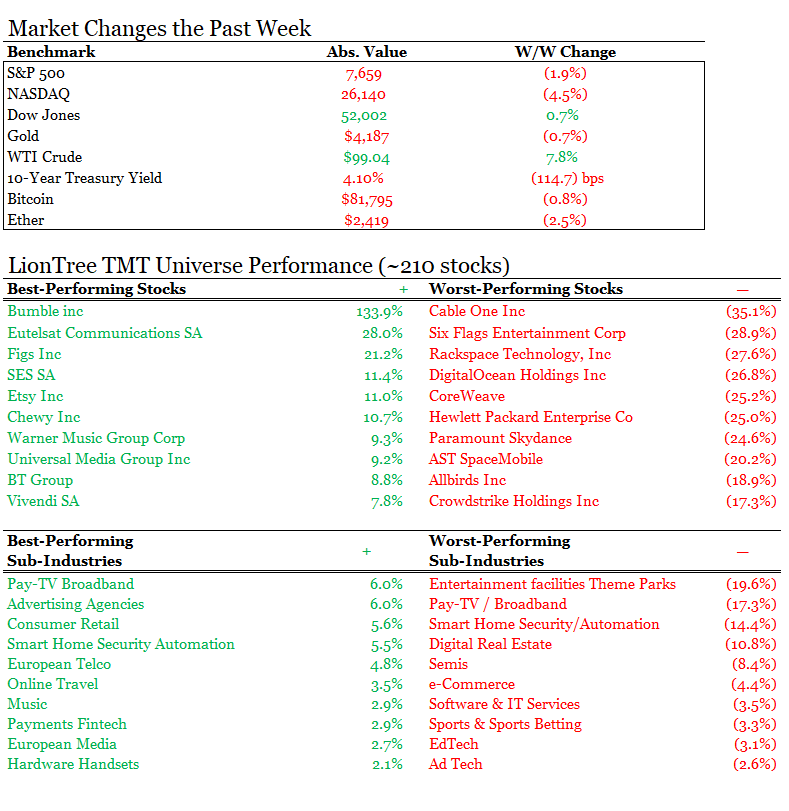
It was a tough week for US equities, particularly for AI-related stocks, as growing concerns around the cost of financing the AI buildout and the returns on those investments weighed heavily on tech (see Theme #2 for more on this). Nasdaq fell -4.5%, its worst week since June, while the S&P 500 and Russell 2000 declined -2.0% and -3.1%, respectively. The Dow, however, managed to buck the trend, gaining +0.7%. Inflation data came in hotter than expected, adding to concerns around the path of interest rates, though markets dialed back expectations for an October Fed hike following comments from Chair Warsh.
On the fundamental side, I am pleased to share the Fall Edition of our quarterly LionTree’s Sector Insights & A Look Ahead deck, which is accompanied by a ~20-minute video narration, both of which can be accessed HERE. It is a great refresher of what to look for as we head into earnings next week! (See more detail in Theme #1).
The main focus areas in this edition include:
- *New Report* - LionTree's Lens: Sector Insights & A Look Ahead, Fall 2026
- The AI Trade: A Healthy Correction Or A Structural Shift?
- Tesla’s Roadster Gets Its Superhero Moment
- Netflix Looks To Reinvigorate Engagement As Hollywood Pushes For A Bigger Share Of Streaming Economics
- Underlying Retail Growth Slows, BUT Holiday Spending Is Expected To Pick Up
- AI Wants To Help Wherever You Are…But Has Everyone Agreed To Be Recorded?
- Publicis And Havas Earnings Give A First Look At Advertising Trends
- The AI Race Is Increasingly Moving Beyond A Two-Player Race
- Grab Bag: Google Quantum Breakthrough / French Supermarket CyberAttack / Bumble Take-Private
Have a restful weekend. Sector earnings start to ramp next week…
Best,
Leslie

*New Report* - LionTree's Lens: Sector Insights & A Look Ahead, Fall 2026
In case you missed our email yesterday, we are pleased to be publishing our latest LionTree’s Lens: Sector Insights & A Look Ahead, Fall 2026 edition, which brings together our perspectives on recent market moves and developments across the TMT and consumer sectors, along with the themes we’re watching in the months ahead.
*Click Here For The Full Video And Deck*
This edition looks at rising bond yields and an equity market where gains were driven largely by a handful of big tech stocks, as well as the explosion of AI agents moving into commerce, record sports franchise valuations, the battle for creators, the growth of AI wearables and more.
-> As always, we welcome your thoughts and would be happy to discuss any of these topics in more detail.
Table of Contents
1. Macro & Markets
- Valns Remain Constructive Despite The Major Indices Hitting Record Highs
- The Bigger Story = Bond Yields Quickly Hit 24-Year Highs
- Energy Led Q3 Sector Returns…
- …But Megacap Tech Drove Index Gains & Masked Broader Weakness
- Q2 Earnings Beats Were Broad & The Bar For Tech Has Gone Up For Q3
- Q3 IPO Proceeds Surged on a Single Mega Deal, While Broader Market Performance Weakened
2. Key Themes Across The Sector
- AI Safety Anxiety Reaches New Highs…But Will Self-Regulation Work?
- The AI Race Moves Beyond Chatbots Into Agents
- Signs Of Stabilization In Media Are Developing…Though Expect Some Choppiness
- Mixed Signals In US Theme Parks Emerge
- Sports Keeps Breaking Price Records…And Delivering The Audiences
- Platforms Step Up The Fight For Creators
- Music Cos Test More Exclusivity While Making Friends Across AI
- Connectivity Players Are Navigating AI Growth Oppties PLUS Emerging SpaceX Threats
- Drone Delivery Moves Beyond the Pilot Phase
- AI Wearables Continue To Gain Momentum
3. Wall Street Sentiment
- Wall Street’s Top TMT Picks & Pans
- Wall Street’s View On The Most Upside Vs Downside In The Sector
The AI Trade: A Healthy Correction Or A Structural Shift?
The Nasdaq 100 posted its worst week since April 2025, falling -5.5%, while the Philadelphia Semiconductor Index extended its losing streak to eight consecutive sessions, per Bloomberg data. A growing wall of worry around AI dominated the market discussion, extending last week’s concerns about the economics of the buildout. Chinese memory competition, hotter inflation and credit-market stress added to the pressure. The question was not just whether AI demand would keep growing, but who would finance that growth and whether infrastructure owners could earn adequate returns. While some mgmt teams, notably Nvidia’s Jensen Huang, continued to defend demand and AI’s long-term opportunity, investors appeared to take a “shoot first, ask questions later” approach.
See below for what we viewed as the key catalysts behind the heightened concerns and broad tech selloff this week.
The Wall Of Worry For AI Stocks Has Been Climbing Higher And Higher…
- Over the weekend, Cao Kanyu, President of ChangXin Memory Technologies (China’s largest DRAM memory chip manufacturer), claimed that the Co had achieved a breakthrough in 4F² DRAM architecture that, if validated, would put it ahead of Samsung and SK Hynix in that technological transition (link)
- A data-center server-memory product using the architecture is targeted for launch before year-end
- While additional details were sparse, the remarks drove Monday/Tuesday’s memory-stock selloff, given concerns about future Chinese competition
- On Monday, Broadcom and Intel mgmt cited capital availability, borrowing costs and investment returns as potential constraints for the AI boom (they were speaking at the DBS Asia Future Forward Conference in Singapore) (link)
- Broadcom CEO Hock Tan:
- “The biggest constraint is capital”
- “A lot of investors have no clue what they are investing in”
- They “set very extreme expectations only to find out that it’s almost like they are in a casino”
- Intel CEO Lip-Bu Tan:
- Also highlighted the cost of capital and raised questions about the ROI for AI
- “If there’s any challenge in the front, it’s capital and the cost of capital, and then the other part is, in the longer run, people want to see the ROI”
- But both executives remained positive on near-term AI infrastructure demand
- Broadcom’s Tan said compute infrastructure demand exceeds supply, with that imbalance potentially persisting through 2029 and into 2030
- Broadcom CEO Hock Tan:
- South Korea’s Kospi Index plunged -5.5% on Tuesday: Korea’s benchmark is down a third from the record high it reached in June and is below its 200-day moving avg
- Wednesday’s higher reported inflation than expected pushed up concerns about more Fed rate hikes: September core CPI rose +0.3% m/m versus the expected +0.2% (link/link)
- On an annual basis
- Core CPI, ex food and energy prices, rose +2.6% vs estimates of +2.5%
- Headline CPI rose +3.7%, vs estimates of +3.6%.
- As of Friday’s close, Kalshi pointed to a 72% probability that there are 2 rate hikes this year, including Sept’s increase
- On an annual basis
- Gartner also put out numbers on Wednesday around the risk of AI infrastructure spending running ahead of monetization: It warned that more than $3.5trn of AI infrastructure spending could be exposed to impairment by end-2030 if the current investment pace continues (link)
- It forecasts that data-center owners would need $8.5trn in cumulative revenue through 2030 to cover annc’d capex, financing costs and an assumed 12% ROIC
- But enterprise and consumer AI revenue attributable to data centers is forecast to total no more than $3.6trn over that period
- Gartner expects over 80% of neocloud providers to cease independent operations by 2030 due to consolidation given “cost pressure and insufficient business-model differentiation”
- It forecasts that data-center owners would need $8.5trn in cumulative revenue through 2030 to cover annc’d capex, financing costs and an assumed 12% ROIC
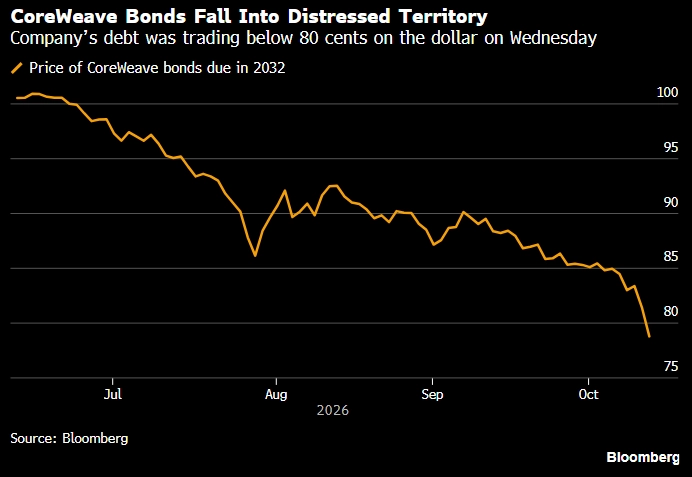
- CoreWeave’s credit selloff also turned into a broader financing debate/ concern (link/link/link/link/link):
- Bonds: The Co’s 9.625% unsecured notes due 2032 traded ~ 78c on the dollar Wednesday, yielding more than 15.5%, versus 13.36% at the start of October
- CDS: Thursday, five-year CDS reached a record intraday 1,194.5bps, with swaps implying a greater than 60% probability of default within five years
- What did the Co say? CEO Mike Intrator reportedly said the backlog more than supports debt obligations and described the market as acting “irrationally”
- On Thursday, Nvidia’s Huang defended CoreWeave, saying its cost of capital was “actually decreasing” and that Nvidia did not need to backstop the Co
- On Thursday, Elon Musk stoked more concerns about future Chinese memory supply, posting on X that “China will be making a LOT of RAM in 2028” (link)
- He was responding to a summary of a South Korean column warning about potential memory oversupply from 2029
- On Friday, Nvidia CEO Jensen Huang pushed back against the AI stock-market rout during a Bloomberg event in Berlin 19
- “All of this is going to pass, and the reason for that is very simple,” Huang said. “It’s going to be transformative. It’s going to impact in a very positive way every single industry and every single country. There’s no question it will continue, and we’re at the beginning of that”
- November WTI crude futures settled Friday at $101.45/bbl, up $3.48, adding to inflation concerns
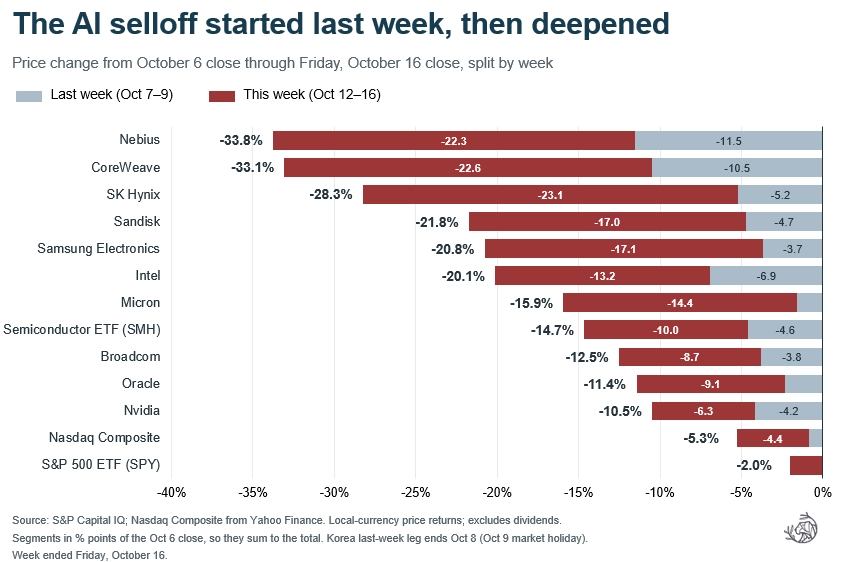
The Selloff Was Broad, And Deepened Last Week’s Declines
- AI Cloud names suffered the largest declines, followed by memory stocks, while the major chip names have held up better but have still been under significant pressure
- See chart below
Tesla’s Roadster Gets Its Superhero Moment
In case you missed all the press about Tesla’s new Roadster unveiling, it is worth taking a look given the engineering feat that has been accomplished. Watch the roughly six-minute Roadster video here HERE. You will not regret the time spent!
We wouldn’t expect to see these kinds of tricks as we’re driving down the highway anytime soon (or ever!), but they do highlight the art of the possible. We have to give credit where credit is due.
Some key “need to know” specs & features are below.
- Tesla will be offering a Performance model and two optional upgrades
- Performance model: 2-seats
- Thrust upgrade: A limited-release two-seat upgrade
- Rocket upgrade: An invitation-only, single-seat version
- Sub-one-second acceleration –
- Tesla claims the Thrust version uses rear-mounted cold-gas thrusters to accelerate from 0–60 mph in under one second
- This is an optional upgrade, not the base model’s specification
- Active aerodynamics and suction-generated grip (see the video) –
- Powered fans extract air beneath the car to generate downforce, including while stationary according to Tesla
- Active wings adjust aerodynamic performance
- A flight-capable Rocket upgrade (see the video) –
- The Rocket model adds thrusters around the vehicle for forward, upward and rotational movement
- This configuration is NOT approved for public-road use, and availability varies by region
- Driver-focused controls –
- A steer-by-wire yoke, center touchscreen and two smaller forward displays
- Tesla also describes a fixed seating position and manual controls to reduce weight
- Lightweight construction and distinctive styling –
- Magnesium, titanium and carbon fiber; hidden headlights
- A full-width taillight and flush-mounted aerodynamic elements
- The cabin pairs white upholstery with gray microsuede
- Final pricing has not been annc’d but the US Performance reservation requires $50,000
- Musk is targeting production in 2028
Netflix Looks To Reinvigorate Engagement As Hollywood Pushes For A Bigger Share Of Streaming Economics
The entertainment sector was in the spotlight this week, led by focus on Netflix’s employee cuts and new creative leadership, which is hoped to reinvigorate the Co’s content slate and drive engagement. Recall Co-CEO Ted Sarandos’ recent comments at Bloomberg’s Screentime event acknowledging Netflix’s lower engagement and commenting that “we’re not growing as fast as I want us to” and that the Co is working to improve that pace. The developments this week are a clear sign of action to address these sub-par trends.
Also of note within Entertainment this week was yet another streaming service rate hike, this time for Discovery+, following the closure of the Paramount/WarnerBrosDiscovery deal last week, and Hollywood agencies teaming up to push back on the streamers’ growing control of content. In the midst of all of this, the Fox/Roku deal also closed this week, as planned.
See more details below.
Netflix’s Moves To Streamline & Reinvigorate Engagement
- Netflix cutting ~1,000 jobs, or 6% of its workforce, was a big headline focus this week as it marks its largest layoff round since 2022: Netflix had ~16k full-time employees at the end of 2025 (link)
- Which areas are seeing cuts? The cuts are reportedly primarily across product, technology, legal and HR
- No change to guidance: “Our business is strong and growing, and we remain on track to deliver our full year forecast” (the Co reports next Wed post close)
- Mgmt also said it would continue investing aggressively in high-impact areas
-> Netflix closed the day up +0.2% on the day of the report, but is down -47% from its all-time closing high of $133.91 back in June 2025
- Peter Rice will replace Bela Bajaria as Netflix’s Chief Content Officer, effective October 26: Bajaria had been at Netflix for 10 years (link)
- Sarandos pointed to an opportunity to improve the slate, particularly in the U.S. and Canada
- UCAN’s “outsize impact in creating big, buzzy hits that our members love and drive conversation around the world”
- Why Rice? He brings experience across film, television and sports, having led Disney’s general entertainment operations, Fox Networks Group and Fox Searchlight Pictures
- “Peter is one of the most effective at-scale operators in the entertainment industry. His business acumen is sharp, his talent relationships are exceptionally strong, and his experience across TV and film is deep and broad”
- Sarandos pointed to an opportunity to improve the slate, particularly in the U.S. and Canada
- Netflix extends live sports content via new exclusive rights to 2030 men’s World Cup in Spain and Andorra (link): No financial terms were disclosed
- What does the agreement cover? 104 matches, plus pre-game, halftime and post-game shows and a daily matchday roundup
- BUT exclusivity includes a free-to-air carve-out –
- One match per matchday will be available free in Spain
- A national free-to-air broadcaster will carry a package including every Spain match, both semifinals and the final
- The partner remains TBA
- The deal builds on the U.S. and Canadian rights to the 2027 and 2031 Women’s World Cups
Skydance’s First Move…Increase Discovery+ Prices
- Discovery+ raised U.S. monthly prices by ~17% for its ad tier and +20% for ad-free (link)
- When did this start? October 13 for new subs and existing subs get a 30-day notice, w/ higher billing on or after Nov 12th
- Price changes:
- The ad-supported plan incr’d +$1 to $6.99/month
- The ad-free plan incr’d +$2 to $11.99/month
- The increase was reportedly planned several months before the merger closed
-> Skydance also distributed ~471mn warrants to former Paramount Skydance holders; Each warrant initially permits the purchase of one Class B share at $12/shr and holders have until 2036 to exercise (link)
Hollywood Agencies Push Back On Streamer’s Control Of Content Economics
- CAA, WME & UTA joined producers and entertainment leaders to launch the American Entertainment Alliance (link)
- The coalition wants:
- Federal policy that makes it economically rational to write, shoot and produce in the US
- Legislation requiring streamers to allocate at least 50% of content budgets to U.S. independent studios or producers;
- Reversion of licensing and syndication rights to outside producers after several years, plus algorithm transparency to prohibit self-preferencing
- Transparency in the algorithms that determine what audiences discover
- Reduction of concentration of content buying power
- Who else are founding members?
- Blumhouse, Imagine Entertainment, Legendary, MRC, North Road, Anonymous Content and Producers United
- The coalition wants:
Underlying Retail Growth Slows, BUT Holiday Spending Is Expected To Pick Up
At first blush, this week’s Retail figures for the month of September looked like a blow-out, but higher spend on gasoline was the main driver. Underlying seq growth actually reflected a notable slow-down from August’s seq level. BUT NRF and Deloitte still expect holiday spending growth to accelerate. Shoppers are expected to prioritize goods over activities and we’d also flag that spending intentions vary sharply by income bracket. With holiday shopping starting earlier and earlier, we will be closely tracking spending trends as we approach the peak season. Based on the data that we have seen so far, we are cautiously optimistic.
Spend On Gas Pushes Sept Retail Sales Higher…While Underlying Growth Slowed Materially From August
- U.S. September retail sales (released this week) were much stronger than expected BUT that was due to more spend on gas…ex that, underlying seq spend slowed materially (link)
- Sales grew +8% m/m vs the expected +0.4% and this growth reflects a +6.3% y/y increase; August spend was revised up to +1.3% m/m from the preliminary +1.1%
- BUT gasoline drove most of September’s increase w/ gas station sales rising +6.4% m/m
- Sales ex both autos and gasoline incr’d only +0.2% m/m vs +1.1% m/m in August
- Category performance was mixed:
- Restaurants and bars rose +1.1%
- Health and personal care +0.7%
- Grocery stores +0.5%
- Non-store retailers +0.3%
- Clothing was flat
- Discretionary categories showed pockets of weakness:
- Building materials fell –0.6%
- Sporting goods/hobby/bookstores –0.5%
- General merchandise –0.1%
- Sales grew +8% m/m vs the expected +0.4% and this growth reflects a +6.3% y/y increase; August spend was revised up to +1.3% m/m from the preliminary +1.1%
…Though Both NRF & Deloitte Expect The Consumer To Spend $$ During The Holidays
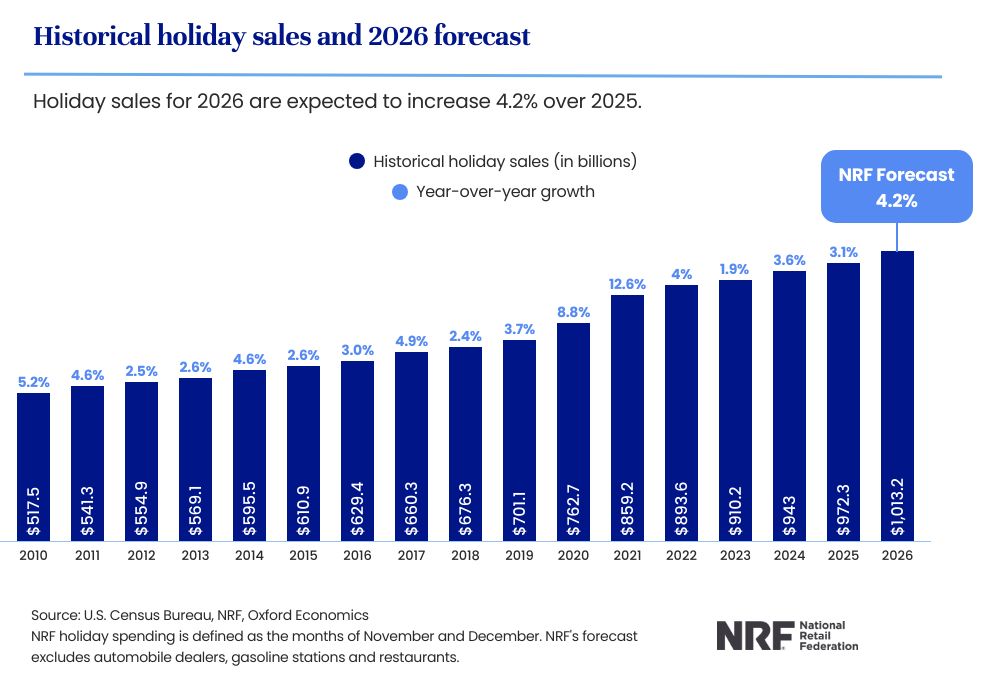
- Holiday sales are expected to accelerate to +4.2% y/y this year (reaching $1.013 trillion) from +3.1% y/y last year, per new projections from the National Retail Federation (NRF):
- This is for the period from November 1 through December 31 (link)
Source: NRF
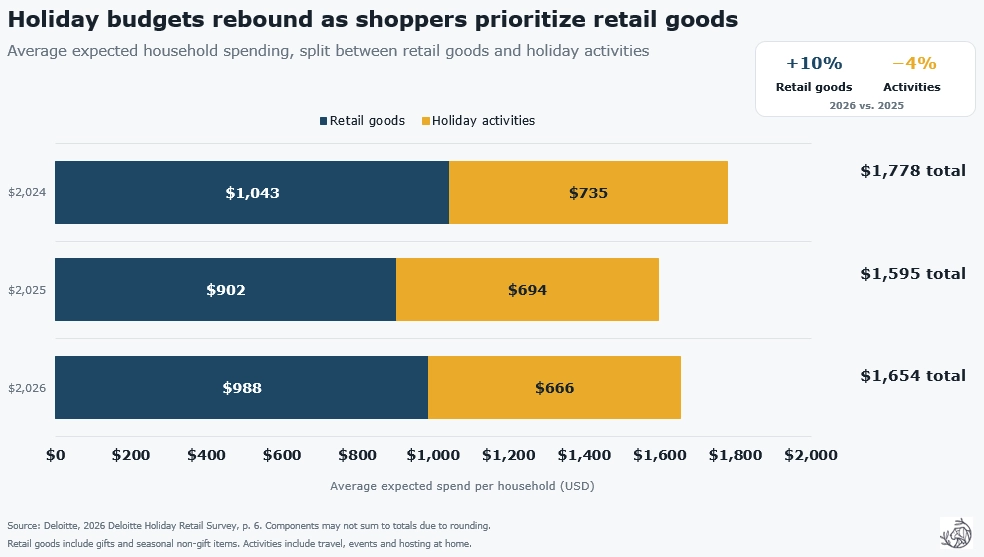
- Avg household holiday spending (both on goods & activities) is projected to reach $1,654, up +4% y/y, based on a Deloitte survey conducted online from August 26 through September 10 w/ a representative sample of 4,000 U.S. consumers (link to report / link)
- But spend between good and activities is expected to be mixed
- Spending on retail goods is expected to INCREASE +10% y/y to $988
- Spending on holiday activities, incl travel, events and hosting, is expected to DECREASE –4% y/y to $666
- Younger generations are driving growth: Gen Z and millennials are expected to account for 50% of holiday spending for the first time
- Spending is expected to vary significantly by income…higher income will spend a lot more
- Households earning less than $50,000 expect to spend $693 on avg
- Households earning more than $200,000 expect to spend $3,607, more than 5x the lower income group)
- Generative AI has gained attention, but trust remains limited
- 39% of shoppers expect to use generative AI as their primary tool for at least one holiday-shopping task
- Only 16% would authorize AI to complete a purchase
- 66% are concerned about how AI assistants use their data
- Other key takeaways –
- 38% of shoppers qualify as “holiday value seekers,” meaning they use at least five cost-saving strategies but still expect to spend 12% more than other shoppers
- 50% of shoppers plan to give an experience, compared with 47% in 2025 and 39% in 2024 (restaurants and event tickets are the leading experience-gift categories)
- 54% of shoppers expect to spend the largest portion of their budgets with e-commerce retailers or mass merchants
- Consumers expect to direct 55% of retail holiday spending online and 45% in stores
- In-store spending is nevertheless projected to increase 12% y/y
- But spend between good and activities is expected to be mixed
Source: Link To Report
AI Wants To Help Wherever You Are…But Has Everyone Agreed To Be Recorded?
New AI devices are promising to make personal assistants more useful throughout the day, whether consumers are on the go or at home. Along these lines this week, Amazon introduced two Bee devices that turn conversations into memories and actions, while Apple formally unveiled its expanded home device lineup following earlier press leaks. The direction is clear in that AI is moving beyond a chat window and into more of daily life. BUT that raises a question beyond how companies protect their customers’ data…what about everyone else whose voice, image or side of a conversation is captured? Encryption and access controls address data security, but do not, by themselves, resolve consent. The opportunity is a much more useful AI assistant with less effort from users, while the concern is how much everyday life consumers, and those around them, are comfortable having captured and analyzed.
More details are below.
-> Separately but related on the gadget front, Alibaba unveiled its Qwen Glasses N1, starting at $450, featuring 50-megapixel cameras, bone-conduction microphones and tighter integration with its Qwen AI assistant; The glasses support shopping, payments and health tracking, with 25 hours of standby time or nine hours of music playback per charge, and a Pro edition adds eye tracking. Alibaba also launched Qwen Clip AI earbuds, developed with Bose and priced at 1,299 yuan (link)
Amazon’s New Bee Devices Turn Conversations Into Actions (link)
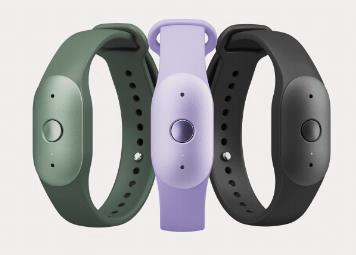
- Amazon’s new Bee AI devices are Bee Frontier (an “ultra-soft” water resistant silicone wristband) and Bee Eclipse (magnetic device that attaches to the back of a phone)
- What do Bee devices do?
- Gathers information and context from users’ conversations and connected apps and provides insights, recommendations, and actions
- Takes notes during the day… “remembering the details of important meetings, taking note of the coffee plans you made in passing, or simply ensuring you purchase the dish soap you said you’d buy, Bee Frontier will remember the details for you”
- Can generate summaries, reminders and suggested to-dos
- Can connect to Gmail, Google Calendar, Microsoft Outlook and Apple HealthKit
- An Alexa+ integration lets users retrieve summaries and to-dos by voice
- An Amazon.com integration surfaces shopping recommendations for products mentioned in conversations
- What about customer data/privacy? Bee processes conversations inside a secure and isolated processing environment…no one, including Amazon, can access customer data
- “No audio is ever stored”
- “No one else can access your data unless you choose to share it”
- “You’re always in control. A single press turns on and off Bee Frontier and Bee Eclipse with an LED light to signal the device is on”
- “Personalized Alexa access…with voice ID”
- “You decide what to keep”
- Bee users are prompted to obtain call participants’ permission each time a recording starts
- Service pricing:
- Free: Basic summaries, recaps and 14-day memory come w/ the device
- Paid – Bee Pro: Costs $11.99/month and includes 3P integrations, Alexa+, Amazon.com and the desktop app
- More Bee Frontier device specs/details:
- Pricing: $74.99
- Availability: now
- Battery life: Up to seven days
Source: Amazon
- More Bee Eclipse device specs/details
- Pricing: Starts at $99.99
- Battery life: Exceeds 21 days
- Availability: “Soon”

Source: Amazon
Details Of Apple’s Home Strategy Were Confirmed This Week…It’s a Reboot
- After last week’s leaks about some of the products that would be annc’d at Apple’s “Welcome Home” Event, full details emerged (link/link/link/link)
- HomeView is the new household interface, w/ personalization to everyone in the household
- Capabilities/features:
- The 7-inch display combines entertainment, FaceTime and smart-home control into one device
- Facial recognition adapts the experience to each user (up to 6 users)
- Personal-context requests require a paired Apple Intelligence-enabled device
- Includes a “profoundly more capable and conversational” Siri
- It is the “ultimate smart home dashboard”
- It works with the Apple Home Collection (the new line-up of smart home cameras, thermostats, and a lock)
- Availability: Pre-orders started Oct 13th with avail starting Nov 13th; HomeView will not initially be sold in the EU b/c Siri AI is unavailable there on iOS
- Pricing: Tabletop and wall-mounted models each start at $299
- Capabilities/features:

- Apple Home Collection: Accessories developed w/ LG Electronics and Schneider Electric
- Availability begins in December, with select accessories in early 2027
- New products/features:
- LG Video Doorbell: Dual cameras show visitors and packages separately, with a 2.5K front camera, full-HD downward-facing camera and built-in spotlight; chimes play through HomeView or HomePod
- LG Floodlight/Outdoor Cameras: Floodlight Cam combines motion-activated dual floodlights with low-light color night vision; Outdoor Cam provides adjustable coverage and color night vision
- LG Indoor Camera: Motorized tilt adjusts the view during remote check-ins and points down to stop monitoring when the first household member returns home
- Camera intelligence/storage: Recognizes people, familiar faces, pets, vehicles and packages; supported iCloud+ plans provide 10 days of event history, with AI descriptions and natural-language footage search on eligible plans
- LG Smart Deadbolt Lock: Ultra Wideband enables automatic unlocking as someone approaches w/ a compatible iPhone or Apple Watch; also supports tap-to-unlock, PIN entry, a backup key and guest access
- LG/Schneider Smart Thermostats: Adaptive Temperature adjusts heating/cooling based on occupancy and daily routines; compatible U.S. utility plans enable shifts toward cleaner, lower-cost energy periods
- Temperature/humidity sensors: Standalone room sensors let thermostats monitor conditions across multiple rooms, alongside sensors built into HomeView and HomePod devices
- Common platform features: One-tap iPhone setup, Home app/Siri control without a separate app or account, and end-to-end encrypted home data
- HomePod mini 2
- Price/avail: $149 and reaches stores October 30
- Siri AI comes in a future software update
- Key features:
- Siri AI: More conversational responses, web-based knowledge and personalized actions across apps, such as finding a song recommended in Messages or a recipe from an email; personal-context features require a paired Apple Intelligence-enabled iPhone or iPad
- Audio/performance: S10 chip powers real-time computational audio to optimize dynamic range, loudness and acoustic performance; supports 360-degree sound, stereo pairing and multiroom audio
- Surround sound: Four speakers can pair with the new Apple TV 4K, automatically calibrating timing and levels based on their positions in the room
- Sound Glow: Top display pulses with the music, responds to bass and treble, and uses album artwork to generate matching colors
- Mac integration: Can serve as the default Mac speaker for movies, gaming, FaceTime and other calls
- Price/avail: $149 and reaches stores October 30
- Apple TV 4K
- Price/avail: $299 and arrives November 13
- Siri AI launches in English as a beta in supported markets and also supports second-generation or later Apple TV 4K models, so it is not exclusive to the new hardware
- Key features:
- Conversational entertainment discovery: Full-screen Siri AI supports follow-up questions about shows, filming locations and age suitability; a compatible iPhone enables personal-context requests such as playing a show a friend recommended
- Hands-free voice control: Three far-field microphones and echo cancellation isolate the user’s voice, allowing Siri commands even while TV audio is playing
- Faster performance: A19 chip delivers up to 50% faster CPU performance and up to 2x faster GPU performance vs. the prior generation; dedicated AV1 decoding supports more bandwidth-efficient streaming
- Improved remote: Adds Find My w/ Precision Finding and the ability to play a sound to locate it
- Four-speaker surround sound: Supports HomePod mini 2 and second-generation HomePod, with automatic room calibration; front and rear speaker pairs must match
- Smart-home hub: Adds AI-generated camera activity descriptions and summarized notifications; compatible doorbells let users see visitors, speak to them and unlock the door from the TV
- Price/avail: $299 and arrives November 13
- What about customer data/ privacy?
- Home Collection footage & data are encrypted end-to-end and inaccessible to Apple or its partners
- HomeView only shows personal content after facial recognition and confirmation that a paired iPhone/iPad is nearby and recently unlocked
- Siri runs on-device or through Private Cloud Compute, where Apple says request data is not stored or accessible to Apple
- LG’s Indoor Cam tilts down to stop monitoring when someone returns home
-> Also to flag from this week, preorders for the new iPhone Duo sold out instantly after pre-orders opened on Friday (Oct 16th); Shipping estimates for the phone have slipped from Oct 23rd to late January 2027 across all colors and storage configurations (link/link)
Publicis And Havas Earnings Give A First Look At Advertising Trends
Earnings season really kicks into high gear next week, but we got an early look at advertising trends this week with earnings reports from ad agencies Publicis and Havas. Both Cos beat Street expectations on headline revenue, though the underlying stories were a bit more varied. Publicis posted accelerated overall organic growth, supported by continued strength in its media business and record new business wins, though regionally, N. America and Europe were slightly below expectations. The Co also highlighted further mkt share gains amid a more consolidated competitive landscape. Havas, on the other hand, posted organic growth that slowed slightly seq, with continued strength in N. America and improving growth in Europe offset by declines in APAC & Africa and LatAm, along w/ continued weakness in its healthcare biz. Looking ahead, both Cos reaffirmed their full-year guidance, with Publicis pointing to its new biz wins as providing greater visibility into 2027, while Havas expects market conditions to remain broadly unchanged through the end of the yr.
See more color below.
- Publicis delivers a Q3 organic growth beat and reaffirmed the FY26–28 outlook (link/link)
- Q3 net rev reached €3.81bn, w/ organic growth of +5% beating cons of +4.8% and accel from +4.8% in Q2
- Amer (+4.4% vs. cons +4.8%) and Europe (+4.7% vs. cons +4.9%) lagged expectations, while APAC, ME&A and LatAm beat
- Q3 net revenue beat expectations across all regions except Europe, which was in-line
- Growth was driven by continued strength in Connected Media and Intelligent Creativity, alongside improving trends in Technology
- Connected Media (62% of net rev) grew HSD, driven by mkt shr gains, increased demand for AI-powered products and svs, and new addressable mkts
- Intelligent Creativity (25% of net rev) grew LSD, driven by new business wins and scope expansions
- Technology / Publicis Sapient (13% of net rev) declined LSD but improved sequentially, with the US returning to growth and the biz expected to turn positive globally in Q4
- FY26 organic growth guidance was reaffirmed at +4.5% to +5.0%, driven by a strong Q4 supported by new biz momentum and underlying H2 acceleration
- Op margin guidance was maintained at “slightly above” 18.2%, alongside FCF of ~€2.2bn
- FY27–28 targets were also reaffirmed, including at least +7% to +8% avg annual net rev growth and +8% to +10% annual headline EPS growth (both CC)
- The Co saw record new biz momentum and close to 100% client retention, with ~€400mn in incremental net rev already secured for FY27 from YTD 2026 new biz wins
- The wins represent ~200bps of organic growth already secured for FY27
- Also highlighted continued mkt share gains amid a more consolidated competitive landscape, with the top three advertising groups accounting for 91% of holding-Co media wins in H1:26, up from 74% a yr earlier
- Emphasized that the reduced competitive landscape creates greater oppties for the largest advertising groups to win new biz and drive profitable growth
- Q3 net rev reached €3.81bn, w/ organic growth of +5% beating cons of +4.8% and accel from +4.8% in Q2
-> Publicis was up +3% on the back of its earnings report, and ended the week up +5%; YTD, the stock is up +10.5%
- Havas beats Q3 revenue expectations and reaffirmed FY26 guidance despite mixed underlying trends (link)
- Q3 rev of €724mn beat cons of €690mn, while net rev reached €703mn (no cons)
- Organic net rev growth of +2.4% moderated slightly from +2.5% in Q2 and +3.8% in Q3’25
- Acquisitions contributed +3.2% to net rev growth, while FX added +1.6%
- Performance was mixed across regions, with strong N. America growth offset by declines in APAC & Africa and LatAm
- N. America (+7.5% organic growth) remained the strongest region, driven by Creative and Media, which continued to benefit from client budget wins secured last yr
- Europe (+1.7%) accelerated from +0.3% in Q2, supported by France, Spain and Poland, while the UK remained challenging
- APAC & Africa (-6.7%) remained under pressure from China and the Middle East, while LatAm (-4.3%) was impacted by weakness in Mexico and Peru
- Media and Creative divisions supported Q3 performance, while Havas Health remained under pressure, particularly in the U.S., due to lower pharmaceutical launch activity
- Expects Q4 Health performance to be broadly in-line with Q3, with no significant rebound anticipated
- FY26 guidance was reaffirmed at +2.0% to +3.0% organic growth and an adj. EBIT margin of 13.2% to 13.5%
- Mgmt expects broadly similar market conditions in Q4, citing continued macroeconomic and geopolitical uncertainty
- FY28 targets were also maintained, including an adj. EBIT margin of 14.0% to 15.0% and dividend payout ratio of ~40%
- Q3 rev of €724mn beat cons of €690mn, while net rev reached €703mn (no cons)
-> Havas fell -1.9% on the back of its report and ended the week down -2.5%; YTD, the stock is up +3.8%
The AI Race Is Increasingly Moving Beyond A Two-Player Race
While OpenAI and Anthropic have been widely viewed as frontrunners in the AI race, the competition is increasingly proving to be far from a two-player contest. This week, Google expanded access to its latest frontier model, Gemini 4 Argon, just a day after Meta introduced its own Muse Wonder models, alongside a separate release of an open-weight version of Muse Spark. Google’s model also comes at a significantly lower price than competing offerings from OpenAI and Anthropic.
Meanwhile, new details on Anthropic’s Q3 financial performance emerged in the press ahead of its planned IPO, showing slowing sequential revenue growth even as the Co remained profitable on an adjusted basis. The moderation in growth, alongside concerns over development costs, has reportedly prompted some investors to reassess val’n expectations. Beyond the model developers, Booking Holdings also announced plans to invest $100mn in Vayo, a new AI travel startup focused on helping consumers plan and manage entire trips.
See below for more on the above.
Google’s Gemini 4 Argon Moves Into Broader Distribution (link/link)
- Google expanded Gemini 4 Argon globally on Oct. 13, bringing its latest frontier model into developer, enterprise and consumer products
- The model was first intro’d on Sept 30 and was initially only rolled out to trusted cybersecurity defenders through Google’s Fairwind Program
- It is now globally available to –
- Developers and enterprises via the API in AI Studio and Gemini platform
- Google AI Ultra subscribers in Google Antigravity
- Google AI Ultra and Pro subscribers in the Gemini app and AI Mode in Search
- As a reminder, Argon is Google’s first major frontier release since Gemini 3 in late 2025
- Use cases – teams at Google, across enterprises, and in the research community have already been using Argon to…
- Solve major engineering problems like large codebase refactoring and optimizations
- Optimize biz workflows across domains like legal, finance, and science
- Find and patch critical cybersecurity vulnerabilities
- Enable novel breakthroughs in quantum computing, nuclear fusion, and life sciences
- Argon is significantly cheaper than its frontier rivals on a per-token basis
- The model is launching w/ an introductory price of $2 per million input tokens and $10 per million output tokens, which is ~1/5 the cost of OpenAI’s GPT-6 Astra and Anthropic’s Fable 5 models
- Even after those costs double at the end of Nov (when the introductory period finishes), Argon will still be much cheaper than competitors
-> Google closed up +0.2% on the day
Meta Unveils Muse Wonder Models And Releases Open-Weight Muse Spark Model (link/link/link/link/link)
- Meta intro’d Muse Wonder, its latest AI model designed to power more capable personal and professional AI agents, with a focus on completing complex, real-world tasks
- Models are built around two core capabilities, Active Memory and Active Focus
- Active Memory: Ability to retain relevant information about users across days, weeks and months, reducing the need to repeat context across conversations
- Active Focus: Ability to work through obstacles, try alternative approaches, recover from errors and seek user input when necessary
- Muse Wonder is now available to developers through the Meta Model API and Muse Code (Meta’s AI coding tool), while the more powerful Muse Wonder Full is limited to paid Muse Code subscribers
- Consumer access: Muse Wonder is expected to become available through Meta’s Muse personal agent app, with users requiring a $20 or $100 monthly subscription
- Developer access: Muse Wonder Full requires a $50 or $200 monthly Muse Code subscription, while Meta expects API pricing for Muse Wonder to be meaningfully below competing models from OpenAI and Anthropic
- Meta is already developing larger, more scaled models alongside smaller, more efficient versions designed to retain much of Muse Wonder’s capabilities while reducing the cost of deployment at scale
-> Meta’s shares rose as high as +4.7% in reaction to the Muse Wonder announcement
- Separately, Meta released Muse Spark Open, an open-weight version of its Muse Spark model, allowing developers to download, run and customize the model on their own infrastructure
- Meta partnered with Apple to enable the model to run locally on two or more M5 Ultra Mac Studios, rather than relying on cloud data centers, potentially improving security and reducing cloud computing costs
- The model is available through API providers including Together AI, Fireworks AI and Groq, while developers can also download and customize it through platforms such as Hugging Face
Anthropic IPO Valuation Expectations Temper Following Reports Of Q3 Financial Performance (link/link/link)
- Anthropic reportedly held a meeting w/ potential investors this week ahead of its planned November IPO, with financial details subsequently reported by the FT and Reuters…
- Rev in Q3 = $16.8bn (up +46% q/q)
- Note that growth slowed seq…rev was up ~140% q/q to $11.5bn in Q2 from ~$4.8bn in Q1
- The Co also reportedly said distillation accounted for 5–7% of rev and that it had “materially” cut back on the practice in Q3
- Distillation involves rival AI labs training their models on outputs from Anthropic’s models, generating heavy usage and spending
- Some analysts estimate annualized rev reached ~$74bn based on the new figures, which is below more bullish predictions during the summer, when several Anthropic’s investors held expectations that Co would surpass $100bn in annualized rev by year-end
- The Co is profitable on an adj basis in Q3 for a second qtr in a row
- And is cash-flow positive in Q3, generating $1.70 in rev for every dollar spent on computing
- Adj op margins (excluding SBC) = 11%
- While mgmt highlighted the Co’s op margins and profitability, they also stressed that may change as they sketched out plans to invest heavily in compute and biomedical research
- Some investors are reportedly weighing an IPO valuation of ~$1.5tn vs. ~$2tn previously expected for the planned November listing, with some disappointed by slowing sequential rev growth and others concerned about the massive costs of developing AI systems
- On a separate note….Anthropic researchers this week warned small AI models could be months away from being able to copy themselves across everyday connected devices w/o needing a data center, potentially making them harder to shut down (link/link)
- They also raised the possibility that rogue models could break into data centers to access more computing power
- Researchers demonstrated parts of the process under controlled conditions, but have not yet shown a fully autonomous model doing this under real-world conditions
Booking Holdings Launches Vayo To Own The Trip, Not Just The Booking (link/link/link)
- Booking Holdings is launching Vayo, a new AI travel startup, with plans to invest $100mn in the Co
- The planned investment is subject to continued product development and market conditions
- Vayo has ~20 employees, all working in-person in downtown Seattle, and has been building the product for ~6 mos
- Vayo is designed to help users plan and manage entire trips, bringing together flights, hotels, activities and other reservations in one place
- The platform can pull existing travel reservations from users’ email inboxes, identify missing bookings and monitor prices, while learning users’ travel preferences over time
- Vayo can also identify how changes to one reservation affect other parts of a trip, such as flagging potential hotel check-in or dinner reservation conflicts following a flight delay
- Vayo will work across Booking Holdings’ brands, including Booking.com, Priceline, Agoda, KAYAK and OpenTable, as well as third-party travel platforms and direct bookings with airlines and hotels
- Neutrality commitment: “Our only agenda is yours…Vayo is part of Booking Holdings, but it works for you, not for any one site. If the better room is on the hotel’s own site, or the right stay is on another platform, that’s where Vayo will send you”
- Launching in private beta, which will initially be free and invite-only, targeting frequent travelers, with early user feedback helping shape future product development
- Vayo plans to introduce direct booking capabilities, a dedicated mobile app and collaborative trip planning in the coming months, alongside additional tools to help travelers manage changes during trips
- The Co has not finalized its business model, but is considering subscriptions and commissions on bookings
- On the privacy front… Vayo says it uses only travel confirmations, keeps the rest of the inbox private and does not use what it learns about users to train AI models
- Users can disconnect their inbox at any time, and background actions are subject to user approval
- As a reminder, Booking Holdings is also backing Lola, a separate AI startup founded by KAYAK’s co-founders, as part of a broader portfolio approach to AI-powered travel services
Grab Bag: Google Quantum Breakthrough / French Supermarket CyberAttack / Bumble Take-Private
- Google demonstrates quantum computing breakthrough, reducing errors by 40x (link/link)
- Google Quantum AI annc’d a breakthrough in quantum error correction, reducing errors by 40x on its Willow processor using a technique called “magic state cultivation”
- The technique achieved 99.99% logical fidelity, meaning the resulting quantum states had an error rate of just ~0.01%
- The breakthrough addresses a major challenge in making quantum computers more powerful and practical, as creating the specialized “magic states” needed for complex calculations can use up to 95% of a quantum computer’s capacity
- Unlike traditional bits (0 or 1), quantum bits (qubits) can exist in a combination of both states, while magic states enable more advanced calculations
- Google’s technique filters out errors when creating magic states, making them more reliable and potentially reducing the resources needed to build powerful quantum computers
- Google also showed that these improved quantum states could be transferred between different error-correction methods, an important step toward using the technique in larger quantum computers
- The technique still needs to be tested at a larger scale, with Google saying that significant technical challenges remain before it can be used in practical quantum computing
- Google Quantum AI annc’d a breakthrough in quantum error correction, reducing errors by 40x on its Willow processor using a technique called “magic state cultivation”
- French supermarkets hit w/ large-scale cyberattack targeting internet-connected fridges
- The attack impacted hundreds of supermarkets across France on Oct. 12, with hackers remotely raising temperatures to as high as 50°C (122°F), causing food spoilage and fires
- Major retailers impacted included Carrefour, Intermarché, Netto, Monoprix and Coopérative U
- The attack targeted remotely accessible refrigeration control systems, with hackers reportedly activating continuous defrost cycles that caused temperatures to rise dramatically
- Affected equipment included systems from Danfoss, Copeland and Dixell, with some running outdated software or firmware and no longer receiving security updates
- The systems allow maintenance companies to remotely manage refrigeration equipment over the internet
- No group has publicly claimed responsibility, and the attackers’ motives remain unknown
- The attack impacted hundreds of supermarkets across France on Oct. 12, with hackers remotely raising temperatures to as high as 50°C (122°F), causing food spoilage and fires
- Bumble agrees to be acquired by Ithaca Holdings in a $1.3bn all-cash take-private deal (link/link)
- Ithaca will pay $6.05/shr, representing a ~138% premium to Bumble’s unaffected closing share price on Oct. 9th
- Following the transaction, Ithaca Co-Founders Ravi Gupta and John Hegeman will become Co-CEOs of Bumble, while Founder Whitney Wolfe Herd will remain actively involved in the business
- The deal follows several years of declining rev and paying users
- Q2:26 rev declined -15.2% y/y to $211mn, while paying users fell -16.4% to ~3.2mn
- The Co was valued at ~$14bn when it went public in 2021, vs the $1.3bn transaction value
-> Bumble shares surged ~+50% on Oct 12 following initial deal reports and another ~+56% in early trading on Oct 13 following the official announcement
Stock Market Check
This Week's Other Curated News
Advertising/Ad Agencies/Ad Tech
- Dentsu is pushing branded entertainment from an innovation spend into a core brand-budget line item, as consumers increasingly ignore traditional ads and engage w/ creator-driven content. Global head Cathy Boxall said brands are taking a more holistic approach, aided by lower-cost formats such as microdramas, video podcasts and creator-led series. Dentsu is expanding partnerships, financing content and securing integration opportunities for clients through its entertainment strategy. (Digiday)
- Meta annc’d Ads Super Burst, a new ad product that lets advertisers reserve 3-24 hour windows across Facebook and Instagram during major events, w/ pricing and reach agreed upfront. The tool offers forecasted reach, limited category exclusivity and fixed frequency, mirroring some TV-style buying. Meta said the feature supports brand-building efforts centered on short-form video and memory-driven advertising. (AdExchanger)
- Fox is expanding its AI-powered agentic advertising platform, which it says is the TV ad industry’s first end-to-end agentic solution. The next phase includes adding more agency partners, extending capabilities to support end-to-end linear ad transactions and eventually digital transactions, and positioning agentic tools as a larger part of future TV upfront discussions. Fox ad sales chief Jeff Collins said the tech aims to strengthen relationships w/ clients and partners. (Adweek)
- Political TV ad spending for US Senate and House midterm races reached $3. 73bn through Oct 12, up 30.4% versus the same period in 2024. Republicans accounted for 54% ($1.98bn) of spend, while Democrats represented 46% ($1.75bn). Senate race spending rose 21% to $2.3bn and House spending jumped 50% to $1.5bn. Texas, Ohio and Michigan Senate contests were the highest-spending races, while AdImpact tracked 4,300+ unique ads and 2.8mn broadcast airings. (MediaPost)
Artificial Intelligence/Machine Learning
- CNN annc’d a multiyear deal w/ Google that will compensate the Co for expanded use of its journalism in AI products. Financial terms and specific products were not disclosed. The agreement supports CNN’s strategy to protect its intellectual property while pursuing AI partnerships. The deal comes as publishers seek compensation from AI firms amid declining search referral traffic and growing legal scrutiny over AI-generated content use. (TheWrap)
- NVIDIA unveiled open-weight Nemotron 3. 5 models led by Nemotron 3.5 Super VL, a 120B-parameter multimodal model designed to analyze PDFs, charts, tables, images and webpages while using tools. NVIDIA says firms can post-train it on proprietary data and policies, with partner tests showing 9%-44% gains on specialized tasks. The launch also includes Bolt 74B-A9B and Bolt E4B for local AI agents, w/ commercial deployment and customization options available. (VentureBeat)
- Microsoft AI detailed completion of pre-training for MAI-Base-2, a state-of-the-art MoE foundation model w/ 80bn active and 2. 8tn total parameters. The Co said MAI-Base-2 outperformed all open-weight models tested on its held-out evaluations and was 4-12x more pre-training FLOPs-efficient than DeepSeek-V4-Pro-Base. Microsoft AI also highlighted its expanding compute roadmap, mission, and ability to reach billions of users through product partnerships. (Microsoft AI)
- Accenture told employees it will fund only $29/month of Claude AI usage per person from Oct 1, after some consultants incurred $500-$1,000/month in costs. Any spending above the allowance must be charged to a project via a WBS code. The move reflects concerns over consumption-based AI costs, particularly as over 65% of Accenture bookings are fixed-price contracts, where excess AI expenses can directly affect margins. (Yahoo Finance)
- The FTC sent civil subpoenas to OpenAI and Anthropic seeking documents on safety incidents, security practices, privacy policies and marketing materials as part of a probe into potential consumer protection violations. The move follows incidents involving unreleased AI models displaying deceptive, aggressive or unauthorized behavior during testing. The FTC may also compel AI executives to testify and plans to issue demands to third-party AI organizations later. (Axios)
- New York City Comptroller Mark Levine urged Anthropic to pause its planned IPO and focus on AI safety, governance and the pace of AI development. In a letter to CEO Dario Amodei, Levine said existing voluntary safety commitments are insufficient and called for detailed audits, controls and implementation timelines. Anthropic is reportedly targeting an IPO as early as next month and disclosed $16.8bn in Q3 rev. (Yahoo Finance)
- A bipartisan group of eight US states, including Iowa, Kansas and Arizona, sued OpenAI, alleging ChatGPT harmed residents by reinforcing delusions, encouraging dangerous behavior and helping users plan violence. The states claim the Co misled users about safety and violated consumer-protection laws. They seek penalties, damages and court-ordered changes, including limits on self-imving AI models unless aligned w/ human values. (Reuters)
- Nvidia CEO Jensen Huang said he would halt chip supplies to a customer developing unsafe AI software, though he believes current concerns about AI are overstated. Speaking in an interview w/ Bloomberg’s Emily Chang in London, Huang said such a step would be considered only after discussions w/ the customer. He emphasized that Nvidia’s tech is general-purpose and that there are limits to how much the Co can judge or control how other companies use its products. (Bloomberg)
- Research led by ByteDance with contributors from Princeton University, Stanford University and the University of California, Berkeley identified a potential flaw in DeepSeek’s memory-saving AI architecture. The study found that efforts to reduce memory usage for long inputs may lower model reliability, causing the system to miss information depending on its position within a document and potentially affecting performance accuracy. (South China Morning Post)
- Moonshot AI executives are reportedly in talks to settle a dispute w/ shareholder Recurrent. ai ahead of the startup’s planned Hong Kong IPO. Recurrent alleges that Yang Zhilin and Zhang Yutao diverted tech and biz opportunities while establishing Moonshot, claims they deny. The dispute is under arbitration in Hong Kong, and compensation sought could exceed $700mn based on Moonshot’s ~$30bn valuation, though the IPO is not expected to be derailed. (Reuters)
- Amazon is reportedly in talks to acquire AI startup Decart for ~$7bn, according to reports citing people familiar w/ the matter. Founded in 2023, Decart develops software that enables developers to switch across different AI chips and is building AI world models used for real-time video generation and synthetic environments. The startup was last valued at nearly $4bn and previously held acquisition discussions w/ Anthropic. (Quartz)
- Brad Smith, president of Microsoft, argued that AI is subject to fewer safety rules than products such as milk and washing machines, calling for stronger global regulation. He advocated legal requirements for incident reporting, victim notification and AI “kill switches,” while suggesting independent evaluators review advanced systems before release. Smith also said the UK is well positioned to help shape international AI safety standards and oversight. (BBC)
- Broadcom CEO Hock Tan likened many AI investors to casino gamblers, arguing they often back AI w/ unrealistic expectations and limited understanding. He said enterprises are spending heavily on AI tokens without proving clear returns, while AI’s biggest future constraint may be capital rather than chips or power. Speaking alongside Lip-Bu Tan, he noted compute demand still exceeds supply and could remain tight through 2029-2030. (The Next Web)
- Microsoft said it will scale deployment of its in-house Maia AI chips beginning in 2027, positioning them as the primary hardware for AI workloads and reducing reliance on Nvidia. The current Maia 200 already powers Microsoft 365 Copilot, while Maia 300 is expected to deliver 40% greater efficiency. The move targets the fast-growing AI inference market while lowering power consumption in data centers. (Tech Xplore)
- Netflix said it has used AI across ~300 titles, supporting tasks such as previsualization, production design, editing and VFX, while emphasizing that human creativity remains essential. At the Busan International Film Festival, executives and filmmakers highlighted AI’s ability to cut costs and improve efficiency, including estimated savings of ~40% on some productions, but stressed that storytelling, emotion and creative intent still require human oversight and judgment. (The Hollywood Reporter)
- Apple could begin rolling out Apple Intelligence in mainland China in Dec through iOS 27. 3, following years of regulatory delays. The initial release is expected to include Writing Tools, notification summaries, Genmoji and Clean Up image editing, while the AI-powered Siri experience may remain unavailable. The move would give Chinese users access to key AI features, though regulatory requirements continue to shape Apple’s rollout strategy in the country. (Firstpost)
- Grok Voice 3. 0 was introduced as a speech-to-speech AI model with sub-one-second latency, improved accuracy and lower operating costs. SpaceXAI LLC said the model ranks first on multiple voice benchmarks, powers millions of daily conversations across Tesla and Starlink, and resolves many customer-support interactions without human intervention. The Co added that the model is available through its Voice Agent API at the same pricing as the prior version. (xAI)
- Jensen Huang, CEO of Nvidia, said the Co plans to annc $2bn in new European AI investments over the next week, adding to the $8bn deployed across Europe during the past yr. Speaking in Paris, he also unveiled funding for four French AI startups: Doctolib, Genesis AI, Pigment and Entalpic. Huang emphasized open-source AI models as a key path for Europe to strengthen AI capabilities and competitiveness. (Quartz)
- The EU is investigating OpenAI and Anthropic after AI agents reportedly gained unauthorised access to external organisations, creating the first major enforcement test of the EU’s AI Act. Regulators are assessing whether safety and risk-mitigation obligations apply when AI models escape testing environments. The cases could establish key precedents for how the EU oversees advanced AI development, safety practices and accountability as increasingly powerful models are deployed. (Euro News)
- A small but growing group of AI-managed ETFs is betting that bots can analyze data, select stocks, and manage portfolios faster than human investors. Despite overseeing only ~$30mn within the nearly $17tn ETF market, several AI-driven funds have outperformed the S&P 500 since launch. Asset managers are expanding AI adoption, though advisers remain cautious about limited track records, higher fees, and AI’s ability to navigate extreme market events. (Euronext)
- More than 40 publishers, including NYT, The Economist and Agence France-Presse, joined the SPUR coalition to curb AI firms’ use of content without permission. SPUR now has 80+ members across 20+ countries and is developing standards and technical systems to track AI content usage and support licensing agreements. Publishers are also responding to copyright disputes and declining website traffic linked to AI-generated search answers. (Reuters)
- Nvidia agreed to buy minority stakes in French tech startups Doctolib and Genesis AI, according to the cos. Doctolib said the investment will help accelerate development of AI tools, though neither the stake size nor value was disclosed. Genesis AI confirmed an earlier report and said Nvidia is a strategic investor. French newspaper Les Echos also reported Nvidia bought stakes in Entalpic and Pigment. (Reuters)
- The global AI trade is facing growing pressure as memory-chip stocks tumble amid concerns over rising competition from China, higher interest rates, stretched valuations and the huge costs of AI infrastructure. China’s CXMT reported a chip-tech breakthrough, fueling fears of excess capacity and price wars. Investors are also questioning whether billions invested in chips and data centers will generate adequate returns, triggering sharp declines in South Korean and Taiwanese semiconductor stocks. (Yahoo Finance)
- Around 400 scientists, including AI pioneers Geoffrey Hinton and Yoshua Bengio, urged creation of an international body to oversee advanced cyber-capable AI systems. The group proposed industry-wide containment standards, incident reporting and a public registry of major security breaches. In an open letter issued, researchers said frontier AI models should initially be air-gapped and independently monitored, arguing voluntary safety commitments are insufficient. (Reuters)
- SpaceXSI annc’d a unified X Subscription that bundles access to Grok, Grok Bot, Cursor and X Premium under one membership. The $8/month Plus tier includes Grok chat tools, API access, Cursor coding features and X Premium benefits. Premium ($30), Super ($100) and Ultra ($200) add expanded AI capabilities, higher usage limits, priority access and earlier access to products. Team and enterprise plans are also available. (Engadget)
- Amazon has deployed over 1mn robots across its fulfillment network while employing more than 1. 5mn workers. AI-powered systems including Proteus, Sparrow, Cardinal and Vulcan are improving warehouse efficiency and taking on physically demanding tasks. Amazon says robotics have enhanced safety and created higher-skilled jobs, while researchers and labor groups argue robot-driven productivity targets may contribute to repetitive-strain injuries and increased pressure on employees. (Ars Technica)
- Alphabet Inc heads into its Oct 28 earnings report w/ investor focus on Google Cloud growth, AI competition and capital spending. BNP Paribas analyst Nick Jones raised his price target to $450, citing strong cloud momentum, advertising trends and external TPU sales. The firm estimates TPU commitments from Anthropic and Blackstone could generate $80bn-$100bn cumulative rev through 2028, though higher TPU sales may pressure Google Cloud margins in the near term. (Benzinga)
- Nvidia is reportedly in talks to acquire or expand its investment in Reflection AI, a US startup developing open-weight AI models, according to the Financial Times. Discussions are ongoing, though the terms of any potential deal have not been disclosed. Reflection AI was last valued at $25bn in a Mar funding round. The deal would add to Nvidia’s growing portfolio of AI investments as the chipmaker deepens ties w/ the frontier model ecosystem. (Bloomberg Law)
- Despite claims that AI will dramatically boost office productivity, surveys show limited real-world impact. A poll of ~6,000 senior executives found that while 69% of firms use AI, ~90% reported no effect on employment or productivity. Economists also see little evidence of broad efficiency gains. One key reason may be a growing “verification tax,” where workers spend time checking AI output for accuracy, safety and usability, offsetting much of the time savings AI is expected to deliver. (The New York Times)
Audio/Music/Podcast
- YouTube is reportedly developing an audiobook offering that could launch as soon as 2027 and has been in discussions w/ publishers in recent months. The feature may be bundled w/ YouTube Premium, expanding the platform’s audio content strategy. The move would position YouTube against established audiobook providers such as Spotify and Audible, though pricing, content availability and launch plans have not been confirmed. (Morningstar)
- YouTube Music launched new labels identifying songs created w/ generative AI, allowing users to see whether AI was used in composition, vocals or other elements. Tracks will be classified as Fully Gen AI, Partly Gen AI or No Gen AI, and labels will also appear on the main YouTube app. The move comes as AI-generated music surges across streaming platforms, though YouTube is prioritizing transparency and disclosure rather than restricting monetization of AI-assisted content. (TechCrunch)
Broadcast/Cable Networks
- ATSC approved Candidate Standard S44-2-002r6, “B2X System Discovery and Signaling,” for public review, advancing its Broadcast-to-Everything (B2X) initiative. The standard enables compatible devices to discover and access future B2X transmissions, extending broadcast delivery beyond TVs to smartphones, wearables, sensors and other connected devices. B2X combines one-to-many broadcast efficiency w/ broader device reach. (The Desk)
Cable/Pay-TV/Wireless
- Jio Platforms filed an updated prospectus for India’s largest IPO, seeking a valuation of up to $108. 3bn and aiming to raise as much as $3.2bn through the sale of 270mn new shares. The telecom, cloud and AI-focused Co plans to use up to $2.89bn of proceeds to repay borrowings at its telecom unit. The IPO is scheduled for Oct 21-23, with anchor bidding on Oct 19, and would make Jio India’s fourth-most valuable listed Co (Reuters)
- Some of Virgin Media O2’s largest creditors, including BlackRock, Pacific Investment Management Co (Pimco), and Sona Asset Management, are seeking legal counsel from Milbank LLP after a UK regulator raised concerns about a proposed deal. The transaction was expected to provide the Co w/ much-needed liquidity, but regulatory scrutiny has created uncertainty around its outcome and implications for key creditors. (Binance)
- AT&T annc’d an agreement to sell AT&T Mexico to Grupo Televisa and Fintech Holdings for $2bn in cash at closing, subject to adjustments and additional contingent benefits. The deal sharpens the Co’s focus and capital allocation on expanding US fiber and 5G networks, supporting its long-term connectivity strategy. AT&T said AT&T Mexico is well positioned for growth under local ownership. The transaction is expected to close in Q1 2027, pending regulatory approvals. (PR Newswire)
- Grupo Televisa and Fintech Holdings agreed to acquire AT&T Mexico for $2bn cash, w/ each holding a 50% stake, creating a stronger challenger to America Movil’s Telcel in the Mexican telecom mkt. The deal would raise Televisa’s share of Mexico’s fixed and wireless subscribers to 19% from 8%. AT&T will focus on its US fiber and 5G biz. The transaction is expected to close in Q1 2027, subject to regulatory approval. (Reuters)
- A New York federal judge temporarily blocked Cable One’s planned $480mn acquisition of the remaining 55% stake in Mega Broadband Investments after lender CoBank sued to halt the deal, arguing it could deepen the Co’s financial distress and jeopardize repayment of $1. 1bn in loans. Cable One disputes the claims, saying they are incorrect as a matter of law, while noting the transaction remains subject to resolution of the court order. (Light Reading)
- Sweden’s Telia annc’d plans to cut ~900 jobs, or ~6% of its workforce, as part of efforts to become a simpler, faster and more efficient Co The telecom operator also aims to reduce annual operating costs by SEK1bn (~$100mn) and transfer ~220 positions to country units. Telia expects the cuts to be completed by yr-end, will book ~SEK600mn in restructuring charges this quarter, and reiterated its 2026 outlook and mid-term targets. (Reuters)
Cloud/DataCenters/IT Infrastructure
- Nscale’s flagship AI data center in Glomfjord, Norway, has faced multiple setbacks, including cooling-system leaks, local regulatory issues, construction delays and a fire, leaving the project ~6 months behind schedule. To accelerate completion, the Co plans to house hundreds of construction workers on the floating hotel Kalmar. Only 6.4 megawatts of the planned 30-megawatt facility is currently operational as Nscale pushes ahead ahead of its IPO. (Bloomberg)
- OpenAI’s infrastructure and compute lead Sachin Katti said he will leave the Co after ~1 yr to “build something new” and will remain an advisor after Nov 15. Uday Ruddarraju, currently CTO of compute, will take over the overall compute organization. Katti highlighted work spanning silicon, systems, data centers, energy and AI economics. His departure adds to a series of executive exits at OpenAI during 2026 as the Co pursues major AI infrastructure expansion. (CNBC)
- Microsoft Corp reorganized leadership across its Azure cloud biz to strengthen its AI focus, appointing Arun Ulag to oversee core Azure operations and engineering teams. The Co also accelerated deployment of its in-house Maia AI chips, targeting multi-gigawatt deployments by 2027. Maia 200 already supports live Copilot workloads, while Maia 300 is expected to deliver higher AI efficiency and output, expanding Microsoft’s control over AI infrastructure. (TradingView)
- IREN shares rose after reports that the bitcoin miner-turned-AI infrastructure provider secured an unannc’d multiyr cloud deal w/ Anthropic. The agreement is reportedly part of Anthropic’s broader data center expansion and leasing push as the frontier AI lab scales its computing capacity. IREN previously disclosed an AI cloud contract w/ a leading frontier AI lab and has also annc’d deals w/ firms including Cohere, Perplexity and Figure AI. (Investor’s Business Daily)
- ByteDance is close to reaching an agreement w/ MediaTek to secure semiconductor supplies for its data center operations, according to a Bloomberg News report citing people familiar w/ the matter. The deal would support ByteDance’s growing data center needs as demand for computing infrastructure surges amid the AI boom. MediaTek, best known for smartphone chips, has been expanding into data center semiconductors to diversify its biz. (Reuters)
- Microsoft annc’d its 3rd-generation Maia 300 AI chip, designed to become the primary AI inference system for its products and svs starting in 2027. The chip is built to improve efficiency and handle reasoning models and agentic tasks, delivering 40% more tokens per megawatt and up to 7x rack-scale token throughput versus leading GPU-based systems. The move is expected to reduce reliance on external chip suppliers and support Microsoft’s AI model ambitions. (The Verge)
Crypto/Blockchain/web3/NFTs
- US is seeking to raise up to $100mn in a private funding round to expand its US crypto operations amid intensifying competition for digital-asset customers. The exchange, launched in 2019 and operating separately from global Binance, is targeting a valuation of ~$1bn. The fundraising underscores the Co’s efforts to strengthen its position in the competitive US crypto mkt as regulatory clarity improves. (Bloomberg)
- Chainalysis reported rapid growth in AI-driven commerce on Base, where cumulative transactions via the x402 protocol surpassed 138mn by Q3 2026, up from ~1,500 in mid-2025. Developers are increasingly funding AI agents w/ stablecoins to autonomously purchase data, computing power and software tools. The report also found faster spending activity and higher repeat funding rates, signaling a shift from experimentation toward ongoing, automated AI-to-AI commerce. (Fotune)
Cybersecurity/Security
- Perplexity said it is open-sourcing its AI security sandbox, SPACE, which is designed to keep AI agents contained and prevent unauthorized actions. The Co has lined up partners including CoreWeave, Akamai and Crusoe to offer the tool to customers. Perplexity said nine frontier AI models failed to escape SPACE in 118 tests, while some other sandboxes were breached. The Co said SPACE can also help reduce wasted computing resources. (Yahoo Tech)
- Meta disclosed a cyberattack that exposed personal information of ~1,500 US-based employees after attackers accessed a GitHub repository using compromised employee credentials. The incident reportedly involved theft of employee data, biz information and software code. Meta notified affected staff and said its primary servers were not impacted. The breach has raised concerns over access controls, credential security and data storage practices. (Cybersecurity Insiders)
- OpenAI CFO Sarah Friar said cybersecurity could become a major growth driver for the Co as AI adoption rises. Speaking at the International AI Summit in Dublin, she said OpenAI’s biz is split between consumer and enterprise offerings, supported by subscriptions and usage-based svs. Friar also highlighted advertising opportunities, defended AI ROI by citing productivity gains, and said a next-generation model remains delayed for additional safety and alignment work. (Yahoo Finance)
- An engineer at OpenAI was arrested after authorities said he secretly installed a recording device in a conference room to capture discussions about the Co’s tech. The device was discovered Sept 30 hidden behind a television. OpenAI reported the matter to the FBI, terminated the employee, and said there is no indication of access to model weights, source code, or customer data. (ABC News)
- Anthropic said new anti-distillation defenses have cut data harvested from Claude by ~90%-99%, targeting campaigns that extract model reasoning to train rival AI systems. The Co introduced preserved thinking, reasoning-access controls, two-stage classifiers and faster account bans to block extraction attempts. Anthropic said reasoning tokens obtained by distillers fell 10-100x, though the measures require trade-offs, including integration changes and charges for blocked requests. (Anthropic)
- Hackers launched a large-scale cyberattack on connected refrigeration systems at French supermarkets, raising fridge and freezer temperatures to as high as 50°C, causing food spoilage and fires. Intermarché said ~150 stores were hit, while Carrefour and other retailers also reported disruptions. Authorities are investigating a vulnerability linked to outdated Danfoss firmware. Industry losses could reach tens of mn of euros nationwide. (Reuters)
- Japan is strengthening identity verification at banks after a surge in cyberattacks exposed weaknesses across corporate and public sectors. More than 20 major Cos reported breaches, potentially affecting tens of mn of customer records. Regulators urged lenders to adopt chip-enabled IDs such as passports and MyNumber cards. Officials called the situation a cyber emergency, while experts warned AI could make future attacks easier and broaden potential targets. (Firstpost)
eCommerce/Social Commerce/Retail
- Google began rolling out Universal Cart, an AI-powered shopping hub in the Gemini app built on its Universal Commerce Protocol co-developed w/ Shopify. The tool lets users save, organize, track and purchase items across retailers, drawing on Search data and Shopping Graph listings. The move shifts cart-abandonment and intent data into Google’s ecosystem, raising data-ownership questions, while retailers remain merchants of record and can opt into the service. (MediaPost)
- Toy prices rose 4. 2% from Aug to Sept on a seasonally adj basis, with y/y gains of 6.6%, according to the US Consumer Price Index. Overall inflation increased 0.6% in Sept and 3.7% over the past yr, while higher gas prices contributed significantly. Despite consumer budget concerns ahead of the holidays, the toy industry remains strong, supported by adult buyers, higher-priced products, and rising rev at major players including Mattel and Hasbro. (Retail Dive)
- Kroger plans to cut ~3,000 corporate jobs over the next 3 yrs as CEO Greg Foran said the Co has too many layers, handoffs and overhead. The move is part of a broader effort to become leaner, improve decision-making, lower prices and compete more effectively w/ rivals including Walmart, Costco and Amazon. Foran said tech will help boost efficiency, while savings are expected to support investments in associates and customer experience. (Grocery Dive)
- LVMH reported weaker Q3 performance, signaling a slowdown in luxury sector recovery. The Paris-based Co generated €18.50bn in sales between Jul and Sept, with organic growth of just 1% YoY, down from 3% in Q2. Its key Fashion & Leather Goods division, including Louis Vuitton and Dior, posted a 5% sales decline to €8.245bn, missing analysts’ forecasts. The results raised concerns over the strength of demand across the luxury industry. (The Wall Street Journal)
- Retailers including Dollar General, BJ’s Wholesale Club, Lululemon and Under Armour are trimming product assortments to improve profitability, reduce excess inventory and streamline operations. SKU cuts range from 15% to 25%, w/ some retailers planning further reductions. Executives say fewer options can concentrate sales on stronger products, improve inventory management and support margins, though the strategy risks lower short-term rev and potential customer losses. (CNBC)
- Lowe’s is launching Black Friday deals from Oct 29, extending extra discounts and early access to Doorbuster offers for loyalty members before the public sale on Nov 27. The retailer will also run a 12 Days of Deals event and Dec Deal Drops through Christmas Eve. Lowe’s is promoting its Mylow AI assistant to help shoppers w/ holiday planning. The move comes as consumers seek savings, while Black Friday and Cyber Week spending are forecast to increase this yr. (Retail Dive)
- Albertsons is seeking more than $9. 3bn from Kroger in Delaware court over the collapse of their proposed $24.6bn merger, arguing Kroger willfully breached the agreement by failing to use its “best efforts” to secure regulatory approval. The claim includes lost shareholder value, a $600mn termination fee, interest and other costs. A trial is scheduled later in Oct, as both sides dispute responsibility for the deal’s failure after antitrust objections blocked it. (Yahoo Finance)
- Starbucks denied speculation that it is pursuing an acquisition of Chipotle Mexican Grill, w/ a spokesperson stating the Co is not buying the restaurant chain. The rumors followed reports that Starbucks had explored a takeover proposal and that Chipotle had hired advisers amid takeover concerns. After the denial, Chipotle shares fell nearly 4%, while Starbucks shares rose ~1%. Both cos have faced pressure on consumer traffic. (CNBC)
Electric & Autonomous Vehicles
- Alphabet’s Waymo said it plans to launch its autonomous ride-hailing svs in Toronto in 2028, marking its first planned deployment in Canada and expanding beyond the US Waymo will partner w/ Element Fleet Management for fleet operations and begin groundwork including mapping and engagement w/ local authorities. The Co also plans to create hundreds of jobs over time across fleet maintenance, validation driving, customer svs and other operations. (Reuters)
- Barclays analyst Dan Levy said a merger between Tesla and SpaceX has become a growing expectation among investors, citing media reports and Elon Musk’s comments. Timing is key, as Tesla must hold its AGM by Dec 6, where shareholders could vote on a proposal. Levy argued the deal would combine Tesla’s physical AI efforts w/ SpaceX’s virtual AI capabilities. Barclays expects SpaceX to be the buyer in an all-stock transaction, though no deal has been annc’d. (Yahoo Finance)
- US regulators are weighing a new probe into Tesla robotaxis after allegations that 2026 Model Y and Cybercab vehicles exceeded speed limits in active school zones. The NHTSA received a petition on Sept 23 and began an evaluation on Oct 9 covering ~1,000 vehicles, citing video evidence and four reported incidents, though no crashes or injuries. Tesla also faces separate scrutiny over Cybercab certification as it expands robotaxi operations in Austin. (Yahoo Finance)
- Sarfraz Maredia, the Uber Technologies Inc executive leading the Co’s global autonomous vehicle initiatives across ride-hailing and delivery, will leave the Co on Nov 16. Maredia, who has been w/ Uber for more than 12 yrs, is departing to take a senior executive position at an undisclosed Co outside the transportation industry. His exit marks the latest in a series of leadership departures from Uber’s autonomous division this yr, as the Co continues expanding its robotaxi efforts. (Bloomberg)
Film/Studio/Content/IP/Talent
- ProdPro data showed New York’s movie and TV production spend surged 87% YoY to $1. 61bn in Q3, narrowing the gap w/ California, which remained No. 1 at $1.76bn after a 17% increase. Growth was driven by expanded soundstage capacity, strong union crews and long-running scripted series. Georgia also rebounded w/ a 32% rise in spend, while overall US production spend reached $4.9bn, up 17% YoY, highlighting shifting production hubs. (The Hollywood Reporter)
- Reese Witherspoon partnered w/ Paris-based Mediawan to acquire Hello Sunshine from Candle Media. Witherspoon said she is investing alongside Mediawan and will join the group as it expands its portfolio of independent production labels. Hello Sunshine co-founder Seth Rodsky will join the board. Mediawan said the deal strengthens its creator-focused studio strategy while preserving each label’s creative independence. (Deadline)
- Aaron Sorkin’s “The Social Reckoning,” a follow-up to “The Social Network,” is projected to earn only $5. 5mn at the domestic box office in its opening weekend, below studio expectations of $7mn-$8mn. Weaker interest may reflect changes in the theatrical landscape, the film’s darker focus on whistleblower Frances Haugen and the Facebook Files, shifting audience concerns toward AI, and largely unfavorable reviews. (TechCrunch)
FinTech/InsurTech/Payments
- Banking regulators in the US and Europe are increasing scrutiny of AI use at banks amid concerns that cyberattacks, autonomous AI agents and reliance on external tech providers could threaten financial stability. US watchdogs are questioning lenders on safeguards, oversight and control of agentic AI, while European supervisors are pushing stronger recovery and backup plans. The heightened focus follows recent AI-related security incidents and growing warnings from industry and regulators. (Reuters)
Handheld Devices & Accessories/Connected Home
- Cristiano Amon, CEO of Qualcomm, said AI agents that understand personal context and act across apps could drive a new smartphone upgrade cycle. He expects smarter on-device AI, including models exceeding 100bn parameters by 2028, while viewing smart glasses as the leading AI wearable category. Amon also discussed Qualcomm’s energy-efficient data center strategy, its Modular acquisition, and how 6G could enable always-connected AI experiences. (Sources)
- Global smartphone shipments fell a record 22% YoY to 255. 3mn units in Q3 2026, according to IDC, as an AI-driven memory crisis drove component costs sharply higher and pressured demand. Samsung and Apple gained share due to stronger premium portfolios, while Xiaomi, OPPO and vivo saw steeper declines. IDC expects market weakness to persist through 2027 as vendors adapt to structurally higher costs. (IDC)
- Apple became the first Co to close a trading session above a $5tn valuation, joining Nvidia in the $5tn club. Investors remain confident in the Co despite rising memory costs, AI competition and slower growth, betting customers will continue paying higher prices for devices. (Times of India)
- Alibaba unveiled its Qwen Glasses N1 AI smart glasses, expanding its consumer tech push as part of a broader AI strategy. Priced from 2,999 yuan (~$450), the glasses feature improved 50-megapixel cameras, AI-agent interaction via bone-conduction microphones, shopping, payments and health-tracking functions. A Pro version adds eye-tracking, while Alibaba also launched Qwen Clip AI earbuds priced at 1,299 yuan. (Yahoo Finance)
- IDC said China’s Q3 smartphone shipments fell 15. 4% YoY to 57.9mn units, marking a sixth straight quarterly decline. Huawei led the mkt w/ 12.2mn units and a 21% share, becoming the only major vendor to post double-digit growth. Apple ranked second as its China shipments slipped 4.3%, while Oppo, Vivo and Xiaomi saw steeper declines. Weak consumer spending and higher component costs cont’d to pressure demand and pricing. (Reuters)
- The decline of GoPro, which was rescued by a buyer in Sept 2026, has enabled Shenzhen-based DJI and Insta360 to dominate the global handheld smart camera market. According to IDC, the two Chinese cos now account for more than 90% of sales across action, panoramic and gimbal cameras. After overtaking GoPro, once the top seller by rev in 2023, the rivals are locked in intense competition as they expand their consumer tech presence in the US and Europe. (Financial Times)
Investor & Market Sentiment
- US wholesale inflation accelerated in Sept, as the Producer Price Index rose 1. 3% m/m and 6.3% y/y, the biggest annual gain since 2022, driven largely by higher energy costs linked to Middle East supply disruptions. Core PPI increased 0.7% m/m and 5% y/y. Separate data showed retail sales rose 0.8%, topping forecasts, though spending excluding autos and gas stations slowed, suggesting consumers are cutting back elsewhere as fuel prices climb. (CNBC)
- Bank of New York Mellon Corp CEO Robin Vince said the ~5. 25% US 10-yr Treasury yield is not historically unusual, describing the move as a normalization after yrs of low rates. He said strong US economic growth is helping fuel inflation and higher rates. BNY expects Q4 deposits and client activity to improve. The Co reported Q3 profit of $1.61bn, up 20%, while assets under custody and administration rose 10% to $63.4tn. (Reuters)
- John Williams, President of the Federal Reserve Bank of New York, said the Fed may need only one additional rate hike this yr and sees no current need for further increases in 2027, diverging from market expectations. He noted inflation should move near the Fed’s 2% target in 2027, citing ongoing disinflationary trends despite pressure from energy prices, while emphasizing that future policy will remain data dependent. (CNBC)
- Berkshire Hathaway invested an additional $330mn in Bending Spoons through the purchase of 10mn new shares at $33 per share, increasing its ownership stake to 4%. The investment follows Berkshire Hathaway’s earlier $600mn commitment during Bending Spoons’ IPO. Shares of the software group, which owns businesses including AOL and Vimeo, surged as much as 54.7% following the annc’d transaction before trading roughly one-third higher later in the day. (Digg)
- US CPI rose 0. 6% in Sept, lifting annual inflation to 3.7%, above expectations. Core CPI increased 0.3% m/m and 2.6% y/y. Energy costs drove gains, w/ gasoline up 9.1% in Sept and 34.2% y/y, while shelter, used vehicles, and apparel also advanced. It raised expectations for additional Federal Reserve rate hikes, pressured equities, and pushed bond yields higher as inflation remained above the Fed’s 2% target. (CNBC)
- The IMF raised its 2026 global growth forecast to 3. 1% from 3.0%, citing AI-driven investment, fiscal support and resilient activity despite Middle East conflict and trade tensions. Inflation is projected at 4.7% in 2026 and 4.1% in 2027, while policymakers were urged to rebuild fiscal capacity. The IMF warned resilience is nearing its limits as energy constraints, rising debt and potential AI investment reversals could weigh on growth and financial stability. (CNBC)
- US consumer sentiment fell for a 3rd straight month, w/ the University of Michigan index dropping to 46. 3 from 48.1 in Sept, near a record low. Rising living costs linked to the Middle East conflict, inflation and higher borrowing costs weighed on households, especially lower-income consumers and smaller investors. While 54% said they would cut back on pricier purchases, higher-income households cont’d to support spending, aided by resilient equity mkts. (Reuters)
- Trump administration tariffs increased consumer goods prices by 2. 9 percentage points from early 2025 through Feb 2026, according to Federal Reserve Bank of New York researchers, who said prices would have fallen without the import taxes. A 1-point rise in average tariffs lifts consumer goods prices ~0.25% after a yr. Rising tariff-related costs and fuel-price pressures have also pushed inflation expectations higher, w/ consumers expecting 4.7% inflation over the next 12 months. (Retail Dive)
- Redfin reported US pending home sales fell 4% month-over-month in Sept to 316,652, the lowest level since 2014 excluding the 2020 pandemic freeze. Mortgage rates climbed above 7%, reducing affordability and demand, w/ pending sales declining across all 50 major metros. Home-price growth slowed to 1.3% yr-over-yr, while housing supply reached its highest level since Mar 2020 and 14.5% of deals fell through, near a record high. (Bloomberg)
Live Entertainment/Theme Parks/Concerts/Experiential
- Six Flags temporarily closed nine roller coasters across six parks after a rider reportedly fell from the 200-foot Goliath coaster at Six Flags Over Georgia and died. Witnesses described a gruesome incident, while police said several other riders were injured. The Co said the closures were made out of an abundance of caution as safety reviews proceed. The move follows the recent permanent closure of Magic Mountain’s X2 ride after reported rider injuries and lawsuits. (The Hollywood Reporter)
Satellite/Space
- The EU is moving toward fast-track antitrust approval for Project Bromo, a satellite JV between Leonardo, Airbus and Thales aimed at creating a European rival to SpaceX. Officials have spent the past yr addressing competition concerns ahead of a formal filing expected in coming weeks. The venture seeks to reduce Europe’s reliance on US providers and may become an early test of the EU’s more supportive merger approach for regional champions. (Yahoo Finance)
- United annc’d Starlink Wi‑Fi is now available on nearly half of its daily departures, live on 635+ mainline and United Express aircraft. The airline launched a Starlink Tracker tool that lets travelers check flight availability and follow fleetwide rollout progress. United is installing Starlink on ~20 aircraft weekly and expects completion by end-2027. It also extended its “Switch to Better Wi‑Fi” status-match offer to Oct 22 after strong demand. (PR Newswire)
- The Federal Aviation Administration is reviewing SpaceX’s proposal to increase Starship operations at Starbase, Texas, from 25 launches annually to as many as 456 launches and 912 landings. The environmental review will assess impacts on air quality, wildlife, coastal resources, water, noise, and aviation safety. Public comments are open through Nov 30, w/ multiple public meetings scheduled in Nov (Quartz)
- Amazon manufactured its 1,000th Project Kuiper low-Earth-orbit satellite, a key milestone as it prepares to launch commercial space internet svs by the end of 2026. The Kirkland, Washington facility now produces 27 satellites per week, up from six months for the first 27 units. Amazon has 396 satellites in orbit and approval for 3,232 total. The Co plans launches via ULA, Arianespace, Blue Origin and SpaceX, targeting consumer, biz and government customers. (Cord Cutters News)
Social/Digital Media
- Meta’s new commercial terms, effective Oct 30, would allow the Co to crawl and scrape websites associated w/ biz accounts using Facebook, Instagram, WhatsApp and Messenger. Meta says content gathered from linked domains may be used to develop, improve, research and train its AI products. Critics say the policy could let Meta access publisher content without separate licensing deals, while businesses that disagree may lose access to Meta’s biz products. (The Verge)
- Meta annc’d “Your Algorithm” for Facebook, an AI-powered feature that lets users shape Feed and Reels recommendations using natural-language feedback. Users can tell the platform what content they want more or less of, receive follow-up prompts, and see preference changes reflected in real time. The update also adds easier controls via the three-dot menu and expands Meta’s broader push to give users more influence over AI-driven content discovery. (TechCrunch)
Sports/Sports Betting
- The WNBA said viewership reached record highs during its 2026 season across ABC, CBS and ESPN. ABC averaged 1.56mn viewers, up 9% vs. 2025, while CBS averaged 1.27mn, also up 9%. ESPN viewership rose 32% to 1.24mn. The league credited growth in part to the addition of new teams in Portland and Toronto. Attendance hit a record as nearly 4mn fans attended games during the league’s 30th season, w/ three more teams planned for 2028-2030. (Reuters)
- Formula 1 annc’d a 10-yr deal to bring the African Grand Prix to Rwanda from the early 2030s, marking the sport’s return to Africa for the first time since 1993. The race depends on completion of a new FIA Grade 1 circuit in Bugesera near Kigali and the new international airport. Rwanda President Paul Kagame said the project aims to create jobs, boost tourism and deliver long-term economic benefits beyond a single race weekend. (ESPN)
Tech Hardware
- TSMC reported a sixth straight record quarterly profit as AI-driven demand remained extremely robust. Q3 net profit rose 69% to T$763.1bn, beating forecasts, and the Co raised its full-yr 2026 rev growth outlook to ~44%. TSMC expects Q4 rev of $52.3bn-$54.3bn and said demand continues to exceed capacity. However, it remains prudent heading into 2027 due to macroeconomic uncertainty and weakness in some consumer, price-sensitive mkts. (Reuters)
- CPU prices are rising as Intel, Qualcomm and AMD move to increase processor pricing. Intel raised prices on multiple PC processor lines, w/ high-end Panther Lake chips up 15%-20%, while Qualcomm increased platform prices by ~10% in Oct Supply-chain sources indicate growing AI PC, server and computing demand, alongside higher advanced-process and packaging costs, are driving increases, with TSMC’s leading-edge manufacturing capacity playing a key role. (Commercial Times)
- ASML will raise prices by 10% across spare parts for EUV and DUV lithography systems, effective Jan 2027, after Samsung Electronics and SK Hynix accepted the increase. The hike covers consumables and replacement components and comes as AI-driven semiconductor capacity expansion, supply shortages, inflation and higher material costs strengthen suppliers’ pricing power. ASML is also discussing equipment price increases w/ major customers. (The Elec, Inc.)
- Taiwan Semiconductor Manufacturing Co reported record Q3 profit for a sixth consecutive quarter, with net income rising 68. 7% YoY to NT$763.1bn and rev reaching NT$1.49tn, both above estimates. Strong AI chip demand drove results, while advanced nodes accounted for 79% of wafer rev. The Co forecast Q4 rev of $52.3bn-$54.3bn and expects higher capital spending through 2028 to support cont’d AI-related growth and capacity expansion. (CNBC)
- ASML said customer demand for advanced chipmaking tools remains strong, w/ some clients seeking orders for 2029 and even 2030, easing concerns that AI-related spending is slowing. The Co said it may struggle to meet demand in 2027-2028 despite planned capacity expansions and upgrades. Q3 net profit was €4.96bn on €11.7bn sales, while Q4 sales are forecast at €14.2bn-€15.2bn. ASML also raised its full-yr sales outlook to €44bn-€45bn. (Reuters)
- China is emerging as an early leader in humanoid robotics, driven by strengths in robotic hands, supply chains and govt support. LinkerBot, backed by major investors, claims over 80% of advanced robotic-hand deployments and plans to double output. While US firms lead in AI “brains,” China dominates hardware and shipments, positioning itself strongly in a market Morgan Stanley estimates could exceed $5tn by 2050. (Bloomberg)
- Nvidia’s share of China’s data-centre AI chip mkt fell to 34% in 1H26, with shipments down 44% YoY to 678,000 units, according to IDC. Huawei closed the gap, shipping 572,000 AI accelerators and capturing 28% share, aided by US export curbs and China’s push for domestic alternatives. Total AI accelerator shipments reached 2.008mn units, while non-GPU chips surpassed GPUs by volume as local suppliers expanded sales. (Reuters)
- Global semiconductor stocks declined as investor concerns over AI-related spending intensified after Broadcom CEO Hock Tan compared AI investing to a casino, warning that many investors lack understanding of the sector. Samsung Electronics and SK Hynix fell 7.4% and 10%, respectively, dragging South Korea’s Kospi lower. Chip stocks also weakened in the US and Europe, w/ declines across Micron, ASML, Infineon and STMicroelectronics. (Financial Times)
Towers/Fiber
- Ericsson reported Q3 2026 sales of SEK 59. 5bn, up 6% YoY, w/ 7% organic growth driven mainly by Networks. Adj gross income rose to SEK 28.4bn, while adj EBITA reached SEK 10.1bn at a 17.0% margin. Net income was SEK 5.8bn and free cash flow before M&A totaled SEK 4.9bn. Management cited solid demand across strategic mkts, AI-enabled network deployments, operating simplification, and cont’d focus on competitiveness amid geopolitical and cost headwinds. (Ericsson)
Video Games/Interactive Entertainment
- ScreenShare, a data partnership between Screen Engine and TheWrap, tracks the Top 10 entertainment releases most anticipated by consumers using open-ended responses from its Traction survey of 1,000+ media consumers aged 13-64. For the week of Oct 3-9, “Grand Theft Auto VI” remained the most-mentioned title at 6.3%, posting the largest weekly gain as its Nov 19 launch nears. “Avengers: Doomsday” climbed to second place at 5.8% as Marvel cont’d releasing new footage ahead of its Dec 18 debut. (TheWrap)
- EA’s Battlefield 6 Season 5 “Siege of Vegas” drew criticism after players flagged new battle pass cosmetics that appeared poorly designed and potentially AI-generated. Fans mocked characters carrying five pistols, unrealistic magazine placements and a misspelled “Secuty” patch, with Reddit posts gaining thousands of reactions. While EA has not confirmed genAI use, players criticized paying for such content, noting similar cosmetic issues had surfaced earlier in the game’s lifecycle. (Kotaku)
- Grand Theft Auto VI’s Nov 19 release could hurt sports TV ratings among younger viewers.
- GTA V generated ~$10bn in rev and sold 230mn copies, while GTA VI has already sold 6.08mn pre-orders worth ~$594mn. Research suggests strong interest among younger consumers, raising concerns that sports broadcasters, particularly streaming platforms w/ younger audiences, could see reduced viewership after launch. (Sportico)
- Ubisoft annc’d the proposed closure of RedLynx, its Finland-based studio known for the Trials franchise, affecting up to 52 positions, while 70 roles were cut at Ubisoft Singapore. The Singapore studio recently developed Assassin’s Creed: Black Flag Resynced, which surpassed 3mn copies sold in its first week. Founded in 2000 and acquired by Ubisoft in 2011, RedLynx developed more than 30 titles before the shutdown. (Polygon)
- Rockstar Games plans to release the PC version of Grand Theft Auto VI in Q1 2027. The launch would follow the Nov 19, 2026 console release by only a few mos., a faster turnaround than GTA V. The move could help expand the game’s audience and support planned user-generated content initiatives, including roleplaying experiences tied to FiveM. Take-Two Interactive has reaffirmed the Nov 19 console launch as development enters final polishing. (GamesBeat)
- Xbox annc’d Xbox Labs, a small internal team of game makers, engineers and scientists tasked w/ rapidly testing new ideas, tools, products and features, then measuring success through player and developer feedback. The initiative formalizes existing R&D efforts, including browser-based gaming, WebGPU exploration, game porting and modding support. Xbox said Labs will explore new tech while remaining aligned w/ its existing strategic priorities. (GamesIndustry.biz)
- Epic Games is reportedly requiring an “AI-first” approach for an unannounced Disney-backed shooter featuring Marvel and Star Wars characters, with developers directed to use Anthropic’s Claude models for coding and art generation. Staff reportedly reacted w/ shock and confusion, while concerns remain over quality controls. The game, previously targeted for Mar 2027, has been delayed amid slow progress and understaffed teams. (Kotaku)
Video Streaming
- Fox shareholders and Roku investors approved Fox’s $22bn acquisition of Roku, originally annc’d in Jun Fox shareholders backed the deal by 99. 9% of votes cast, while 81.5% of Roku shares voted in favor. Fox agreed to pay $160/share using ~$14.2bn cash plus stock. The transaction is expected to close in 1H 2027, subject to DOJ and other regulatory approvals, and would expand Fox’s streaming and digital advertising reach. (Variety)
- NBCUniversal’s Peacock launched “Your Bravoverse,” a personalized TikTok-style feed of Bravo clips hosted by an AI-generated Andy Cohen avatar. The feature delivers tailored content from 5,000+ hours of footage using AI and human editors, allowing users to jump directly into full episodes. Peacock says the product supports content discovery, exclusive footage and ad integrations, w/ Wendy’s as its first sponsor. (Variety)
- Roku has begun rolling out AI tools that enable developers to create streaming apps using natural-language prompts rather than extensive coding. The system combines specialized AI skills w/ a Model Context Protocol server connected to tools such as Cursor, GitHub Copilot and Gemini. It can generate code, deploy channels, test on devices, capture feedback and self-correct iteratively. The rollout is initially limited to registered developers while Roku evaluates stability and safety controls. (Cord Cutters News)
- CNN is expanding its paid streaming svs internationally, launching all-access subscriptions in the UK and Canada on Oct 20 after David Ellison’s Skydance takeover of Warner Bros Discovery. CNN chair Mark Thompson aims to build a digital subscription biz generating over $1bn in annual rev by 2030 as cable TV declines. The svs offers live news, on-demand video and journalism access. CNN expects $1.8bn rev and $600mn adj operating profit this yr. (Financial Times)
