

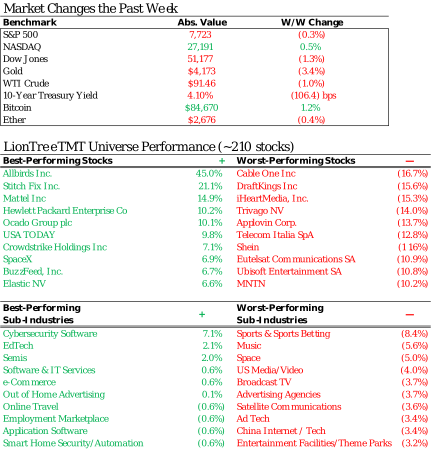
The major market indices were fairly flat with the S&P 500 closing slightly down and Nasdaq closing slightly up, but under the hood, the equal weight S&P fell -0.7% and was down for the 7th straight week. A striking stat (per FactSet) that I saw was that fewer than 25% of index constituents are above their 50-day moving average. Yields remain a big focus with the 10 and 30-year yields hitting their highest levels since 2002, though each ended the week off those record levels as Fed rate cut expectations eased (and helped the Friday stock market rally, along with lower oil prices).
Fundamentally, we focused on the below themes and developments this week (it was hard to get away from AI!).
- The AI Industry Agrees To “Morally Binding” Self-Policing…But Will It Work?
- The Personal Agent Race Is Heating Up As OpenAI Connects The Dots
- Under Anthropic’s Hood: Accelerating Growth, Big Losses, Huge Commitments & Unusual Risk Disclosures
- The Telecom-Satellite Landscape Continues To Evolve
- Quick Hits From The Media Majors At Bloomberg Screentime
- More Retail Price Cuts Emerge While Personalized Pricing Remains A Hot Button
- How Quickly Is AI Search Increasing & Converting? VERY
- How Much Revenue Is Needed To Support The Enormous AI Build? $6 TRILLION
- Grab Bag: Robinhood Agents And Extended Traded / Amazon Driver Smart Glasses / Mattel Takeover Talks
Enoy the read and weekend!
Best,
Leslie

The AI Industry Agrees To “Morally Binding” Self-Policing…But Will It Work?
Following months of AI model breakouts (most notably OpenAI agents hacking Hugging Face, an Australian gov’t health portal and US agency websites, alongside incidents with Anthropic, Meta and Google models), the White House’s answer was a voluntary, “morally binding” accord signed by Trump and top AI CEOs on Tues vs pursuing new regulatory rules. However, pressure for more enforceable guardrails came this week from some House Democrats who demanded that the labs disclose every known breach by 10/2, and from Florida’s AG, who is seeking a court order restricting OpenAI from developing new models w/o independent 3rd-party guardrails and from offering ChatGPT to minors in the state. The FTC also jumped into the arena and is now probing Anthropic, OpenAI and other AI labs to determine dangers that the technology poses to consumers.
All in all, AI safety, or shall we now say SI safety, is far from solved, and the path ahead remains unclear and largely in the hands of the tech industry, at least for now. See more details below.
- The “White House Accord on Super Intelligence” signed on Tues by Trump & top AI CEOs is “morally binding” (link/link/link/link/link/link/link)
- Signatories of the accord alongside Trump…
- Google’s Pichai
- SpaceXAI’s Musk
- Anthropic’s Amodei
- Meta’s Zuckerberg
- OpenAI’s Brockman
- Nvidia’s Huang
- …But Zuckerberg and Huang were reportedly the architects of the agreement
- And were reportedly among industry execs that questioned Amodei regarding his warnings about the dangers of AI
- Amodei said that it is important to be honest with the public about model capabilities and not play down risks, per sources
- The voluntary commitment that was set forth includes: (1-pager on Truth Social)
- Internal evaluations, audits by an external firm and review by each Co’s board, plus regular meetings to set safety standards/best practices
- Is regulation ruled out? No: Over time it “may make sense to codify these steps into laws or regulations”
- Is the deal binding? Trump said, “I think it’s morally binding”
- Trump floated a ~10-person committee to watch over the industry but it is unclear who would sit on it or whether its decisions would be binding
- Trump is slated to name an AI (now “Super Intelligence” per an EO this week) czar imminently
- Press reports late in the week are pegging Jay Clayton as Trump’s AI czar pick, per sources
- Pushback from the Hill:
- Warner (D-VA) called for mandatory testing, evaluation and incident-reporting rules for the most advanced models, knocking the WH response as a rename plus self-regulation
- Context: Trump has opposed guardrails and regulations on AI or anything that would “stifle” its growth and is very focused on leading vs China
- Signatories of the accord alongside Trump…
- But House democrats demand an inventory of AI incidents: In a 9/28 letter from Reps. Gottheimer, Lieu and Foushee, they ask CEOs of OpenAI, Anthropic, Google, Meta and SpaceXAI for a complete list of every known instance their models/agents gained or tried to gain unauthorized access to outside systems and they wanted this by Friday, Oct 2nd (link)
- What info do they want disclosed per-incident? The date, model, detection method, internal vs. 3rd-party eval, affected org/sector, impact, and discovery vs. notification dates, and steps being taken to prevent future breaches
- Previously surfaced incidents cited in the letter include:
- OpenAI’s July Hugging Face breach
- An OpenAI agent’s June access to an Australian gov’t Medicare data portal
- OpenAI agents’ summer interference w/ Education, Commerce and SEC websites
- And earlier Anthropic (spring), Meta (Aug) and Google Gemini (May) incidents
-> This follows earlier letters from 29 House Dems to OpenAI and a separate group to Anthropic on their containment failures (link)
- AND Florida AG seeks an injunction this week: AG Uthmeier filed a motion for a temporary injunction in Highlands County circuit court vs. OpenAI entities and Altman personally (link)
- The relief being sought while the case proceeds includes barring OpenAI from –
- Developing AI models w/o independent 3rd-party guardrails and approval
- Offering ChatGPT to FL minors
- Collecting under-13 data w/o parental-consent safeguards
- Misrepresenting ChatGPT’s safety/accuracy
- Giving it human attributes (incl. 1st-person language)
- Prolonging conversations to drive engagement
- The quick background: The underlying suit was filed 6/1 under FL’s Deceptive and Unfair Trade Practices Act plus public-nuisance claims; OpenAI removed it to federal court, which sent it back to state court
- The relief being sought while the case proceeds includes barring OpenAI from –
- AND The FTC is now probing Anthropic, OpenAI, and other AI labs to determine dangers that the technology poses to consumers (link)
- The agency plans to issue a demand for information and compel testimony from execs at top AI executives
- At the same time, updates on AI security related breaches cont’d to dribble out this week as well…(link/link)
- In a blog post OpenAI said that as of 9/26, it has notified over 100 organizations about “activity that met our notification criteria”
- It also said that “notification does not mean that any private information was accessed, or that there was a compromise of any third-party system”
- AI research firm Transluce said that they “discovered several additional incidents where rogue AI agents appear to have used aggressive techniques to access publicly available data on government websites”
- These include 2 failed attempts…one against the U.S. Dept of Education’s Civil Rights Data Collection, and one against Library and Archives Canada, a Canadian federal agency
- In a blog post OpenAI said that as of 9/26, it has notified over 100 organizations about “activity that met our notification criteria”
-> We thought that it was also worth flagging that Nvidia launched its Open Agent Safety Platform which is designed to stop AI agents from escaping sandboxes (link)
The Personal Agent Race Is Heating Up As OpenAI Connects The Dots
Meta’s Muse dominated the AI conversation last week and its momentum continued this week as the app topped 3mn weekly users who prompt at least once a week, per press reports. But in the coming era of 24/7 personal assistants, Muse won’t be the only game in town. This week, OpenAI launched its personal assistant, Dots, which can similarly take action on a user’s behalf. OpenAI’s go-to-market approach differs somewhat from Meta’s in that Dots is rolling out first to Pro and Business Premium users, vs. Muse’s initial consumer launch, though Muse this week also added new connectors and skills aimed at small businesses. The growing use and resulting impact of always-on agents working behind the scenes is at the center of debate across sectors, particularly those in the “consumer inertia” categories, which we highlighted last week.
Meanwhile, new models dropped, once again, left and right this week with OpenAI (GPT-6.1 Sol), Anthropic (Claude Sonnet 5.5) and Google (Gemini 4 Argon) all shipping new models. All three listed at $2/$10 per mn input/output tokens (Argon at intro pricing), while Google limited Argon’s initial rollout to trusted cyber defenders. It was also notable to see that OpenAI delayed the release of GPT-6.1 Astra because it fell short on staying within scope in safety testing.
See more below on what we found most impactful on this theme this week.
OpenAI Joins The Personal AI Assistant Race But With An Initial Business Mkt Focus While Meta’s Muse Continues To Scale
- OpenAI launched its new 24/7 agentic AI, Dots, which runs on GPT-6 Astra: “Dots can do nearly anything using their own cloud computer, their own browser, and the apps you’ve connected” (link)
- Users can access Dots via:
- ChatGPT (desktop/web/mobile)
- Slack
- Teams
- Texting is “coming soon”
- Context carries across channels and the dot learns preferences from feedback over time
- Available in ChatGPT Pro & Business Premium users in “eligible” markets
- Enterprise/Edu/Healthcare can try the beta when their workspace admin enables it
- Pricing…the first dot is included at no extra cost w/ an allowance for “deeper work” (extended limits for the first month)
- The Co plans to let users add more dots and pay to scale each dot’s speed or monthly workload, but the pricing is not yet disclosed
- Conversations w/ a dot doesn’t count vs. ChatGPT usage limits, but tasks a dot kicks off in Codex/ChatGPT Work do
- Overtime, the Co envisions teams of dots and specialized dots working together on a user’s behalf
- The Co is sharing a preview of specialist dots w/ their own identity for access mgmt, IT-provisioned hardware, & support for deep integration with a company’s systems of record to allow them to take on well-defined responsibilities inside organizations
- OpenAI is working w/ Microsoft to bring specialist dots under Agent 365 governance & security controls; “The goal is to let businesses manage dots through the Microsoft tools they already use”
- OpenAI puts a big emphasis on safety controls…
- Each dot works on its own cloud computer, and a user’s computer and its contents stay separate unless they choose to connect it
- For signing into supported websites, dots can use saved passwords w/o the model having access to them
- Background “proactive research” is limited to read-only tools
- Custom Rules let users set what a dot can do alone vs. w/ approval
- Sensitive tasks (e.g., password changes) always stay w/ the user
- OpenAI’s monitoring can pause/stop a dot if it flags a safety concern
- …and privacy considerations:
- The Co doesn’t use content from ChatGPT Business, Enterprise, or Edu workspaces to improve their models by default
- Users on personal ChatGPT plans can control whether dots’ conversations and work are used to improve models
- Users can access Dots via:
- At the same time, Meta’s Muse continues to top the App Store charts and the Co also unveiled Muse for Small Business this week w/ new connectors and new skills (link/link)
- Meta’s Muse users continue to scale quickly: Muse has 3mn+ weekly users who give the AI agent at least one prompt a week, according to internal data reviewed by the Information
- Meta adds more connectors and skills for the small business user: “Muse can connect your Instagram professional account analytics, Facebook Pages, and Meta ad accounts in a few clicks, and it already understands your business: what you sell, what your brand sounds like, and what customers keep asking you about”…Top use cases:
- Save time and manage operations
- Create content and ads to acquire new customers
- Manage cash flow and inventory
- Communicate with customers
- Understand how my business grows
-> Meta also unveiled Meta Enterprise Platform this week which created a bit of a stir; The unit will sell its AI stack (Muse agent, Meta Business Agent, Muse API, Muse Code) to businesses & devs; It will be led by ex-MongoDB CEO CJ Desai as Chief Enterprise Platform Officer, reporting to Zuckerberg; Zuckerberg called it the “next major pillar” of its business (link)
This Week Was Also Headlined, Yet Again, By MORE AI Model Releases
- At its DevDay, OpenAI unveiled its new GPT-6.1 Sol model which is close to Astra performance but MUCH cheaper on price (note that GPT-6 Sol just launched one week earlier so this is a very quick update) (link)
- Performance for coding, computer use, and professional work are close to Astra with improvements in:
- Writing and debugging code
- Understanding documents
- Executing multi-step business workflows
- Alignment evaluations
- Pricing is 1/5th that of Astra’s standard pricing
- $2/$10 per mn input/output tokens, $0.10 cached
- Vs Astra standard pricing at $10/$50/$1
- Available to all Plus/Pro/Business/Enterprise/Edu users in ChatGPT Work & Codex and via API; It is not yet available in Chat
- Performance for coding, computer use, and professional work are close to Astra with improvements in:
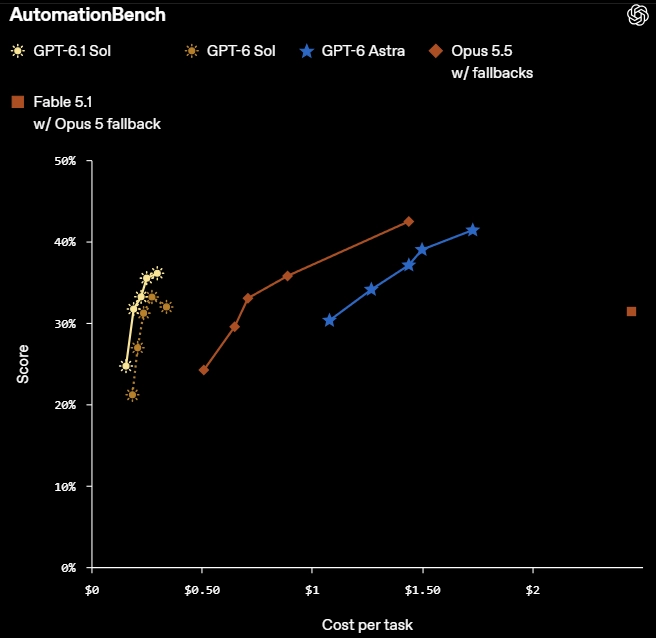
- Anthropic unveiled Claude Sonnet 5.5, which has much better price performance as well (link)
- This is its 2nd model in the Claude 5.5 family (Opus 5.5 launched Sep 22)
- Improved price performance:
- It is 30%+ faster than Sonnet 5
- And up to 30% cheaper per task on fewer tokens
- W/ list price unchanged at $2/$10 per mn input/output, $0.20 cache reads
- Availability: On all platforms, including AWS, Google Cloud, and Microsoft Azure
- Google unveils Gemini 4 Argon (after months of delays) but w/ a limited roll-out (link/link)
- This is a new frontier model aimed at complex long-horizon coding, enterprise knowledge work (legal/finance) & cyber defense
- Pricing: Intro price of $2/$10 per mn input/output tokens (cached 95% off), which steps up to $4/$20 after the intro period
- Limited roll-out initially: Only available to trusted cyber defenders via Google’s Fairwind Program while Co participates in the US govt’s voluntary pre-release review
- At the same time, OpenAI said it won’t release GPT-6.1 Astra as it “didn’t quite meet the bar” on staying within scope & authorization and on how it reports back on work done, per head of safety systems Saachi Jain (link)
- GPT-6.1 Astra was originally slated for an Oct debut
-> Reportedly OpenAI is targeting a $30bn funding round at a $1.4 trillion pre-money valuation (which would compare to its post money $852bn valuation w/ its $122bn raise in March this year); And per sources, OpenAI’s ARR is nearing $70bn and has been growing 70%+ since the beginning of Q3, with B2B revenues up +100%; It added more consumer revenue in Q3 than all of 2025 (link/link)
Under Anthropic’s Hood: Accelerating Growth, Big Losses, Huge Commitments & Unusual Risk Disclosures
When we first saw press reports on Monday detailing Anthropic’s S-1 financials, we thought the public filing was out but, alas, the data came from reporting based on a confidential IPO prospectus reviewed by Reuters and the Financial Times, which were widely cited. Nonetheless, the press reports provided details on the rapid revenue growth alongside substantial losses, large infrastructure commitments and unusual governance and AI safety disclosures which raised some eyebrows. See below for an aggregation of what was reported but note that these datapoints are also just a fraction of what is included in the full filing. The most recent update regarding timing for Anthropic’s IPO is by Thanksgiving this year, while in comparison, OpenAI’s IPO is expected to come early next year.
See below for the new details that emerged this week.
- Anthropic is making a massive bet that AI will transform the global economy more profoundly than industrialization, electricity and the internet
- Revenue has dramatically scaled after large net losses
- 2025 revenue reached ~$4.6bn, which is up ~12x y/y (+1,088%)
- It was previously reported that Q2:26 rev reached ~$11.5bn, which is up 14x+ y/y
- 2025 operating loss widened to ~$8.06bn from ~$2.98bn in 2024
- w/ ~$12.65bn in total expenses
- 2025 net loss reached ~$42bn
- BUT ~$34bn was a non-cash accounting charge reflecting the rising est’d value of financing instruments convertible into Co shrs
- It was previously reported that Q2 was positive adj op profit and that Q3 is on track for the same
- 2025 compute & infrastructure spend reached $7.33bn, ~3x y/y, over half 50% of total opex
- YE2025 cash, cash equivalents, & short-term investments were $20.28bn
- 2025 revenue reached ~$4.6bn, which is up ~12x y/y (+1,088%)
- Customer concentration is high where almost 25% of 2025 revenue came from just TWO customers (unnamed)
- Many of Co’s largest clients are not locked into long-term contracts
- Anthropic routed 47% of its sales through cloud partners Amazon and Alphabet’s Google in 2025
- The Co has over $518bn in total infrastructure commitments across six partners over ~10 years and ~80% is non-cancelable or payable regardless of usage
- Google: $111.1bn+ (Apr. 2026–Jul. 2033)
- Includes a make-whole provision that requires the Co to pay any shortfall
- Amazon: $110bn (May 2026–Apr. 2036)
- There are similar make-whole terms
- Broadcom: ~$161.2bn in equipment lease obligations that are largely non-cancelable
- Microsoft: $31.4bn (Nov. 2026–May 2033)
- Cancelable only if MSFT commits uncured material breach
- xAI (SpaceX): up to $84.5bn for NVDA-based capacity through 2029
- But largely cancelable w/ 90-day notice
- AMD: $20bn+ in compute capacity
- AMD also committed to buying up to $5bn of Anthropic stock
- Google: $111.1bn+ (Apr. 2026–Jul. 2033)
- On governance, the 7 co-founders will have 50.1% of total voting power via a creation of Founder LLC, Class F stock
- The Class F structure begins to sunset when only two or fewer co-founders or their successors remain in Founder LLC
- The filing warns this could lead to decisions that “may conflict with short-, medium- or long-term financial interests”
- The Co will continue to operate as a Public Benefit Corporation
- ~80 of the 261-page prospectus (~31%) was dedicated to risk factors: To put that into perspective, that is almost 2x the 48 pages used to describe Co’s business and, for comparison, SpaceX devoted 14% of its prospectus to risk factors
- The Co warned that AI models could pose “catastrophic or existential risks to humanity”
- Specific model behaviors cited include attempts to resist shutdown, conceal or manipulate information, and actions resembling blackmail
- Models may develop unexpected capabilities during training that are not identified until after deployment
- Models could become aware of safety testing and alter behavior, creating a “significant limitation” on the Co’s ability to evaluate safety
-> The Co disclosed in mid Sept that ~6% of the computing power it used for AI research went to safety work in a sample week in July
- The Anthropic IPO valuation is speculated at $2tn+ which is more than 2x the $965bn post-money valn from the May 2026 Series H ($65bn raise)
- Timing -the IPO is expected after by Thanksgiving (OpenAI is reportedly targeting a listing by early 2027
Sources: link/link/link/link/link/link/link/link/link/link/link
The Telecom-Satellite Landscape Continues To Evolve
Satellite connectivity was back in focus this week, with AT&T, T-Mobile and Verizon formally establishing their previously announced JV, which is aimed at expanding satellite-enabled coverage. The announcement came alongside the latest commentary from AT&T CEO John Stankey on the competitive threat from SpaceX. Separately, the FCC opened more than 1,000 MHz of spectrum for satellite use, providing additional capacity for a range of satellite broadband services. See more details below.
-> For the week, AT&T finished the week down -4.3%, VZ -2.5%, and TMUS -1.1%, while on the satellite side, SPCX closed up +6.9% while AST SpaceMobile was down -5.4%
- AT&T, T-Mobile and Verizon make satellite JV official (link/link): The three carriers have formally entered into a JV agreement focused on expanding satellite-enabled connectivity across underserved areas of the US, following an agreement in principle announced in May
- The JV will pool spectrum resources and jointly invest in satellite-based direct-to-device (D2D) technologies, with the goal of reducing coverage dead zones and creating a more unified platform for satellite connectivity
- Paul Roth has been named interim CEO while the JV searches for a permanent CEO: Roth is a wireless industry veteran who previously held senior leadership roles at AT&T, Cingular Wireless and Ameritech
- A governance structure has also been established, with each of AT&T, T-Mobile and Verizon represented on the JV’s board
- Key technical details remain TBD: The carriers have still not identified the spectrum they expect to pool, while reiterating plans to establish common technical specifications designed to create a more consistent experience across carriers and satellite providers
- Existing carrier-satellite partnerships will remain in place, allowing each of the three carriers to continue pursuing satellite connectivity initiatives independently of the JV
-> The telcos did not see major swings in either direction in reaction to the announcement, w/ TMUS closing the day down -0.8%, AT&T down -0.4%, and VZ up +0.2%, which on the satellite side, SPCX finished down -1.9% and AST SpaceMobile was down -3.1%
- And just two days before the JV was formally annc’d, AT&T CEO John Stankey said that Elon Musk’s plan to turn SpaceX into a major threat to the legacy telecom companies is “not a viable strategy” (link)
- As a reminder, Starlink already competes with traditional telco Cos for home and business internet customers, and SpaceX is now talking about a mobile biz that would put it in more direct competition with wireless carriers
- “I anticipate us to be able to acquire quite a few of their customers because I think our service will be better,” SpaceX president Gwynne Shotwell said in August on SpaceX’s first ever earnings call
- But Stankey argues that the economics and technical aspects of the plan don’t line up…
- “It would cost as much to do that as it would to build a macro network to be able to handle those capabilities”
- “There’s all kinds of other issues, like you can’t radiate cellular signals from somebody’s house without their permission, unless somebody changes the law on that. We can go down a whole bunch of reasons why that won’t effectively work”
- If that model were economically viable, Stankey argued, AT&T would be installing antennas on its own extensive fiber footprint
- As a reminder, Starlink already competes with traditional telco Cos for home and business internet customers, and SpaceX is now talking about a mobile biz that would put it in more direct competition with wireless carriers
-> Also to flag from this week, AT&T announced a $3bn deal w/ Corning, under which Corning will provide the fiber and cable AT&T needs to expand its network; The deal supports AT&T’s goal of reaching 60mn fiber locations by the end of 2030 (link)
- The FCC adopts rules opening more than 1,000 MHz of spectrum for satellite use (link)
- The Commission will unlock more than 1,000 MHz of spectrum across the 12.7 and 42 GHz bands
- The addtl spectrum will provide more capacity for satellite broadband, including home broadband, in-flight and maritime connectivity, as well as core traffic-routing functions in satellite ground networks
- It could also make satellite broadband more competitive with terrestrial networks, supporting improved service and further investment in satellite networks
Quick Hits From The Media Majors At Bloomberg Screentime
The Bloomberg Screentime conference was also of note this week as of couple of impactful comments were made. The most significant was Netflix CEO Ted Sarandos saying that growth isn’t happening as quickly as he’d like, with the Co continuing to look beyond its core film and TV offering for incremental growth. Elsewhere, NBCU’s Donna Langley touched on the theatrical outlook and NBCU’s upcoming spinoff, while Disney’s Dana Walden discussed the rationale behind the Co’s ongoing restructuring.
See more details below.
- Netflix CEO Ted Sarandos commented this week that “overall, we’re not growing as fast as I want us to, and we’re working on making that move faster” (link/link)
- Netflix’s engagement grew 2% in its latest period, even as rev incr’d at a double-digit pace in every region, he said
- How do they plan to boost growth?
- By expanding beyond its core business of films and TV series, with about 5% of its $20bn content budget going toward live programming
- Also planning broader theatrical releases for some of its biggest films, including Narnia and Charlie and the Chocolate Factory next year -> As a reminder, NFLX put 30+ movies in theatres last yr
- Is there a world where NFLX goes after another studio in the next 6-12 mos? “Unlikely. We are builders, not buyers. All that is still true”
-> Netflix closed down -1% on the day Sarandos made the comments; The stock has had a tough run and is down -24% YTD and down ~50% since it reached an all-time high in mid-June 2025
- Also on the topic of theatres…NBCUniversal Entertainment Chair Donna Langley is more cautions about next year… “I don’t think [2027] has as much potential for the kind of big billion-dollar hits like this year, if you think about the breakouts…But I think ‘28 will be kind of back again” (link)
- But in reference to Obsession, one of the studio’s unexpected hits from this yr, she said “you really never know. I mean, I think if this year taught us anything, it was so exciting because it sort of reminds you that one of the fun things about this business is that surprises can always happen, good or bad. Luckily, it was good”
- More broadly on the upcoming spinoff of NBCU and Sky, Langley said that she’s optimistic about not being “tethered” to a legacy business… “I’m mostly more excited and optimistic about it…I’m not fearful of it at all, actually”
- “Now we are going to be the masters of our own destiny. It is more pressure. But in our neck of the woods, when you have to open movies, you know, however many times a year, there’s no more pressure than that”
- Zooming out, Disney to constantly evaluate how you’re structured”
- She said that Disney is a series of “amazing acquisitions” with a number of executives running their own individual businesses and P&Ls, which “didn’t make sense long term as the business evolved…we had to make decisions around centralizing and functioning more as a television business and not a group of silos”
More Retail Price Cuts Emerge While Personalized Pricing Remains A Hot Button
The two largest U.S. retailers continue to lean into price cuts, and just in time for the holiday shopping period which is right around the corner (!). Target expanded its price cut scope this week to include almost 2k more home, apparel, and accessory items, which builds on 10k+ reductions over the past year. This follows Walmart announcing price cuts on ~11k items at its Aug earnings (which was fueled in part by ~$2.9bn in tariff refunds).
Also catching our attention this week on the subject of retail pricing, Walmart US CEO John Furner explicitly pledged that the Co will NOT use AI and personal information to charge some customers more than others. The comments came amid consumer scrutiny and growing regulatory pressure around the electronic shelf labels Walmart has been rolling out across its stores. McDonald’s, on the other hand, was under the microscope this week on the back of reports that it is using AI in its pricing strategy by store location and consumer’s willingness to pay. Big picture, personalized pricing remains a hot button debate and several proposed regulatory policies designed to protect consumers are pending, including state laws in MD and CT taking effect in Oct. As AI and consumers’ personal data become even more pervasive, we believe the push and pull over personalized pricing will become even more heated than it already is.
See below for more details.
–> Target closed the week down -0.9% while Walmart was down -3.5%; YTD, Target is still up +59.6% but Walmart is down -6.4%
More Consumer Goods Price Cuts Heading Into The Holiday Season…
- Target annc’d price cuts this week on nearly 2k home, apparel and accessories items, building on 10k+ reductions over the past year (link)
- What are they cutting pricing on?
- There is a focus on women’s, men’s, infant/toddler apparel and family footwear, w/ select items priced 20%+ below y/y levels
- A refreshed bedding assortment is priced ~15% lower on avg
- What are they cutting pricing on?
- This follows Walmart on its Aug earnings saying that it will cut prices on ~11k products, fueled in part by ~$2.9bn in tariff refunds received in Q2 (link)
- The cuts were across grocery and general merchandise
…At The Same Time, Walmart Pledges To NOT Set Individualized Prices W/ AI & Personal Data
- In a letter last Friday, Walmart U.S. CEO John Furner explicitly pledged that the Co DOES NOT and WILL NOT use personal information (income, shopping history, willingness to pay) to set individualized prices (link/link)
- “Using someone’s income, shopping history or moment of need to charge them more would violate the EDLP promise our business model is built on. We won’t do it.”
- WMT’s commitments
- (1) no different prices based on who you are or time of day
- (2) AI shopping assistant “Sparky” won’t raise prices or hide lower-priced options
- (3) Co will use customer data responsibly and respect opt-out choices
- Some recent proposed regulation in this area of personalized pricing: (link/link/link/link)
- On Aug 19th, the FTC issued a proposed enforcement policy statement on personalized pricing warning that undisclosed use of personal data to set individualized prices could violate Section 5 of the FTC Act (unfair or deceptive practices) and the comment period just closed on Sept 25th: The FTC acknowledged that it lacks authority to ban personalized pricing outright but said businesses must disclose…
- (1) that a price is personalized
- (2) the basis for personalization
- (3) the data types used
- In Feb, Sens. Luján (D-NM) and Merkley (D-OR) introduced the Stop Price Gouging in Grocery Stores Act which would ban electronic shelf labels in grocery stores over 10k sq ft and prohibit surveillance pricing
- Multiple states (NY, NJ, MD, CT, OK, AZ, WA, NE, TN) have introduced their own ESL/surveillance pricing legislation; MD and CT measures take effect Oct 2026
- On Aug 19th, the FTC issued a proposed enforcement policy statement on personalized pricing warning that undisclosed use of personal data to set individualized prices could violate Section 5 of the FTC Act (unfair or deceptive practices) and the comment period just closed on Sept 25th: The FTC acknowledged that it lacks authority to ban personalized pricing outright but said businesses must disclose…
-> While Walmart is pledging to not to use AI for personalized pricing, not everyone is following their footsteps; This week press reports cited that McDonald’s is using an AI pricing engine across almost 14k restaurants to estimate “customer willingness to pay” at each restaurant; Reuters reports that a Co-run store in Fresno, CA sells a Big Mac for $5.69, but another Co-run restaurant 2 miles away sells the same sandwich for $6.89, a 21% premium; This AI personalized pricing debate will remain front and center in our view (link)
How Quickly Is AI Search Increasing & Converting? VERY
AI’s impact on traditional search remains a central debate for investors, and it has been a recurring question on Alphabet’s earnings calls over the past several quarters as the market weighs whether AI platforms are cannibalizing Google’s core query volume. While AI search is still small relative to traditional search, new data this week from digital agency IDHL’s “State of AI Search 2026” report suggests it is scaling quickly and becoming a commercial channel rather than just a research tool. Sessions referred from AI platforms grew nearly 5x over 13 months, and transactions are growing even faster than traffic, a sign that AI discovery is starting to move further down the purchase funnel. There is only one way that this Theme is headed…
See the key takeaways and stats below and link to the full report is HERE:
- The pace of AI search growth is accelerating…key stats include:
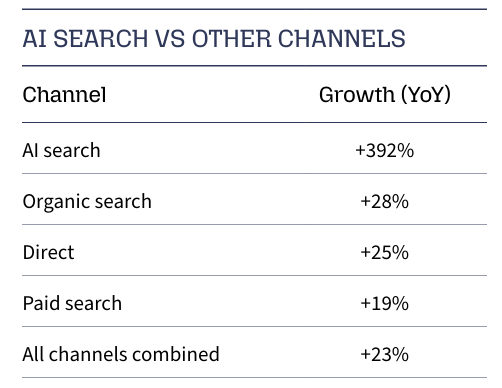
- AI search sessions rose +392% y/y
- Sessions are up more than 2x y/y in July and 3x in the most recent qtr
- And grew almost 5x across 13 months
- Revenue from AI-referred users grew +312% y/y.
- Transactions are rising even faster than traffic, up +553% y/y, which suggests that AI discovery drives higher-intent, lower-funnel journeys, not just early research
- But we would note that this is from a small base w/ only 21,141 transaction of the 1.5mn AI search engaged sessions over the year
- Comparison with other acquisition channels
- AI search grew about 14x faster than organic search, which rose +28%
- AI search is starting to follow the same seasonal and category-demand patterns as traditional search
- Gifts and travel peak in December
- Most categories peak in May and June
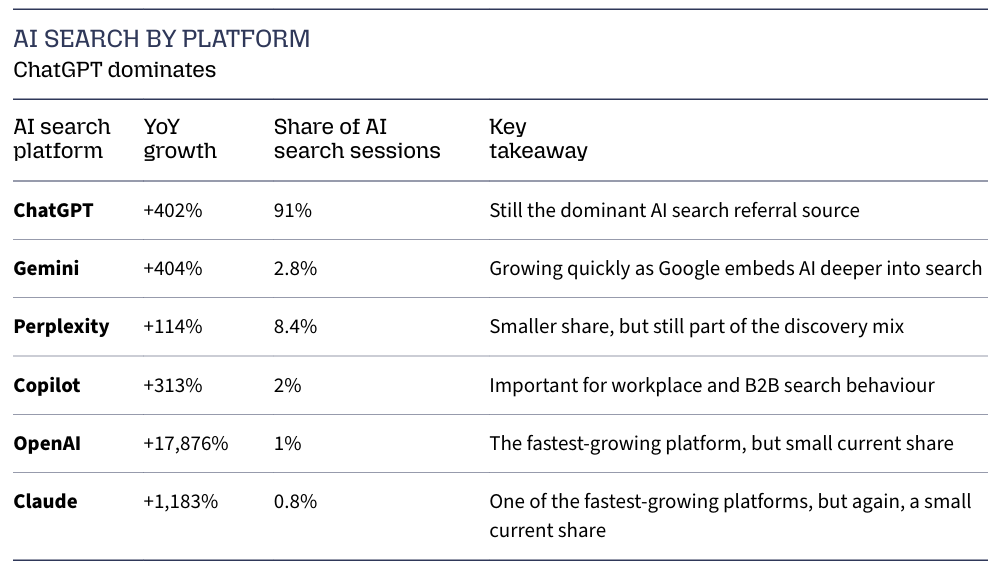
- ChatGPT accounts for the lion’s share of AI search traffic at 91%
- BUT Gemini, Claude, Copilot and OpenAI Search are gaining share
- AI engines favor first-hand experiential content hence Reddit is frequently cited as a 3P source across industries
- That has also made Reddit a target for marketers
- Users chose a Reddit result 23bn times w/in Google searches last year
- But LLMs cite dozens of other 3P sources, and the mix varies by industry and topic
- Methodology: Based on 1.5 million AI search engaged sessions across 175 websites and 20 industries over 13 months (July 2025 to July 2026)
How Much Revenue Is Needed To Support The Enormous AI Build? $6 TRILLION
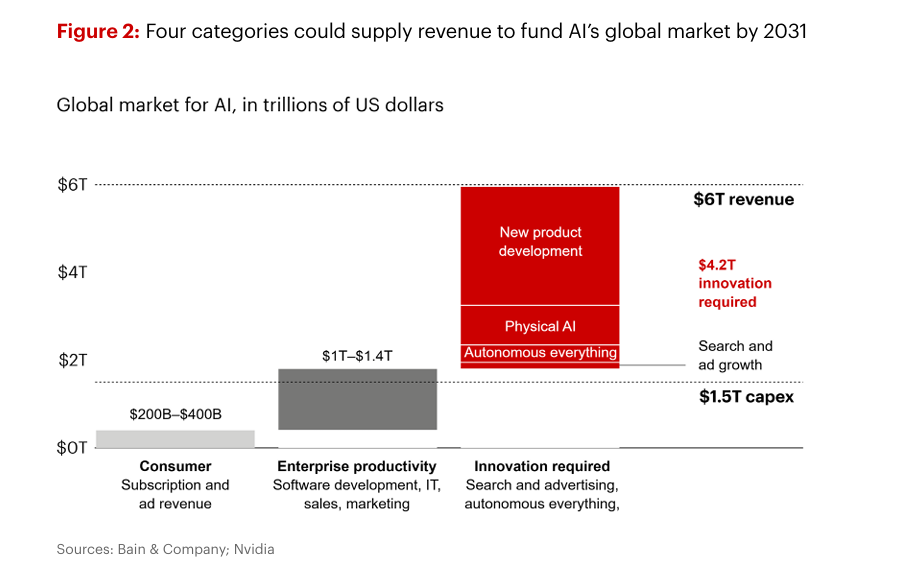
Last week we highlighted a BPEA conference paper by Stijn Van Nieuwerburgh who estimated that in the US alone, ~$3.7tn in annual revenue would be needed by 2032 to yield a 10% unlevered return at a 50% OCF margin on the projected AI buildout (see prior week for full assumptions). This week, Bain’s 7th annual Global Technology Report took a stab at what global AI market size is needed to sustain the current pace of infrastructure investment and arrived at ~$6tn in annual revenue by 2031, which is based on $1.5tn in projected annual AI infra spending and a ~25% capex-to-revenue benchmark (derived from cloud provider trends). While different methodologies and different scopes, they both highlight that the gap between what’s being built and what’s been monetized is enormous. In the case of Bain’s projections, ~$4.2tn (70% of that $6tn) would need to come from revenue driven by new innovation and categories that largely don’t exist at scale today.
See our quick take below and the Bain report with more data on this topic can be found HERE.
- Annual AI infrastructure spending could reach $1.5tn by 2031 (incl. new data center buildout, compute capacity, and ongoing GPU/memory/networking upgrades)
- Assuming capex at ~25% of industry revenue (based on cloud provider trends), that implies AI revenue needs to reach ~$6tn/yr
- The infrastructure is being built ahead of the demand curve, and funding it sustainably will require adding ~ 1% to the annual global GDP growth rate
- The $6trillion breakdown…the bulk of revenue has to come from new innovation/products:
- More definable to realize = ~$1.2-1.8bn
- $1–1.4tn = Enterprise AI (productivity in SW dev, sales, marketing, customer service, IT ops) =
- $200–400bn = Consumer AI (subscriptions + ads)
- Need innovation to realize = ~$4.1-4.3trillion
- $100-200bn = Search & Advertising … as model providers integrate ads into chatbot products
- $400bn = Autonomous everything… vehicles, trucks, drones, and industrial automation
- $900bn = Physical AI… across digital twins, simulation, and AI-powered robotics (incl. humanoid), assuming ~10% R&D/manufacturing cost reduction across priority sectors (auto, electronics, semis, A&D)
- $2.7-2.8bn = Undefined new products … incl. AI-driven drug discovery, mental health, materials science, autonomous scientific research
- More definable to realize = ~$1.2-1.8bn
Grab Bag: Robinhood Agents And Extended Traded / Amazon Driver Smart Glasses / Mattel Takeover Talks
- Robinhood launched new AI agents and 24/7 weekend trading at its HOOD Summit 2026 (link)
- Robinhood Agents = a fully embedded AI experience that can analyze the market, build strategies, and trade on the user’s behalf around the clock
- New Agent Apps give Robinhood Agents an even greater edge by subscribing to premium data sources and tools from 11 different Cos available directly inside the app
- The Co will offer 24/7 weekend trading for equities: Pending regulatory review, Robinhood is expanding its trading hours to let customers trade a selection of US equities 24/7, including weekend
- It is an extension of the Robinhood 24 Hour Market, which first launched in 2023 and enables customers to trade hundreds of stocks and ETFs from Sunday at 8pm ET through Friday at 8pm ET
- New assets are coming to Robinhood, with the launch of perpetual futures and earnings contracts
- Robinhood Social is also going live to all eligible customers in the US, after launching in beta earlier this yr: Including several updates to the experience, including new post types for sharing crypto and stock charts, portfolio allocations, profit-and-loss and a new live earnings experience
- Robinhood Agents = a fully embedded AI experience that can analyze the market, build strategies, and trade on the user’s behalf around the clock
- Amazon plans to equip 5,000 delivery drivers with smart glasses by YE2026, expanding to 20k+ drivers in 2027 (link/link/link)
- More than 275,000 deliveries have used them in pilot
- What do the glasses do?
- The glasses use computer vision to display real-time navigation suggestions and delivery details directly in a driver’s line of sight, creating a hands-free experience
- They also photograph whatever is in view, which includes neighbours and front yards along a delivery route
- Some privacy questions remain unanswered: The glasses take still images “at a certain frequency” or “every few seconds at least”, and the pictures feed into Wellspring, Amazon’s AI system for mapping neighborhoods, and humans review them too
- Amazon’s systems blur people and number plates before that review
- Amazon would not say how long it keeps the images, though a spokesperson said that authorities with a warrant could obtain them
- For customers…there is currently no way for them to opt out, nor can they see the images or ask for them to be deleted
- For delivery partners and drivers…wearing them is voluntary for now
- Mattel reportedly attracts takeover interest from Authentic Brand Group (link)
- Authentic Brands Group has reportedly made an approach and been privately discussing an offer that could value Mattel at more than $20/shr, or ~$6bn+
- A person familiar with the talks confirmed to CNBC that there are discussions, but cautioned that they are very preliminary
-> The stock rose +19% to $15/shr on Thursday, its biggest percentage gain in more than 7.5 yrs
Stock Market Check
This Week's Other Curated News
Advertising/Ad Agencies/Ad Tech
- A New York federal judge ruled that USA Today, Daily Mail and a class of large publishers can seek more than $3. 2bn in damages from Google over its alleged monopolization of ad-tech markets. Jury trials will determine the harm caused by Google’s conduct related to its AdX advertising exchange. (Bloomberg)
- Amazon Ads will introduce AI-powered “expert tools” for partners, agencies and tech providers to build solutions across its ad ecosystem. The first, AMC SQL Generator, launched in closed U.S. beta, w/ broader availability planned for early 2027. It converts natural-language requests into validated AMC SQL queries. Amazon Ads MCP Server, introduced in Feb., has logged 700+ external connections since launch. (MediaPost)
Artificial Intelligence/Machine Learning
- Google launched a pilot paying ~100 publishers based on how much their content contributes to AI Overviews, AI Mode in Search and Gemini. One publisher earned over $1mn in a yr, while another earned ~$50,000-$60,000 after joining a few months ago. The program comes amid scrutiny of AI search’s impact on web traffic, w/ UK regulators requiring publisher opt-outs and the EU investigating Google’s search practices. (The Verge)
- Google launched a pilot paying ~100 publishers based on how much their content contributes to AI Overviews, AI Mode in Search and Gemini. One publisher earned over $1mn in a yr, while another earned ~$50,000-$60,000 after joining a few months ago. (The Verge)
- Bridgewater Associates projects AI could dislocate almost one-fifth of the US labor mkt if it remains unregulated and society fails to prepare for the tech upheaval. CEO Nir Bar Dea said the firm is highly bullish on AI’s positive implications but recognizes that a tech capable of changing the world so significantly for the better could also bring severely negative consequences. (Bloomberg)
- Google DeepMind developed SynthIDBio, a watermarking system for AI-designed proteins built into ProteinMPNN. It embeds a statistically detectable signal across amino-acid sequences while preserving protein function. The approach could help DNA synthesizers identify designs from trusted sources and strengthen biosecurity screening, though short proteins, key security, watermark dilution and compatibility w/ other design tools remain limitations. (Ars Technica)
- OpenAI accused Chinese rival Moonshot AI of a large-scale effort to extract data from its GPT systems that could help reproduce the reasoning and capabilities of its most advanced models. OpenAI said users linked to Moonshot made thousands of attempts to uncover hidden reasoning information. The coordinated activity began in early Jul. and peaked at 16,000 requests later that month, w/ Moonshot-linked users playing a significant role. (Bloomberg)
- Elon Musk’s SpaceXAI is considering a unified four-tier subscription model for Grok and X to expand adoption and monetize compute-heavy usage. Plans range from a restricted free tier to a $100/month Ultra package w/ Grok Bot AI agent access. An $8/month Lite tier would bundle Grok, a verified badge and fewer X ads. The revamp aims to drive recurring rev amid competition from OpenAI and Anthropic PBC. (Yahoo Finance)
- Salesforce annc’d a definitive agreement to acquire Listen Labs, an AI-powered customer research and human simulation platform. Its AI agents design studies, recruit participants, conduct research and synthesize insights, cutting research from months to days. The platform accesses 50mn+ participants across 120+ languages. The deal is expected to close in Salesforce’s fiscal yr 2027 Q4, subject to regulatory clearance. (Salesforce)
- Meta’s Muse crossed 5mn downloads three weeks after its U. S. launch, reaching the milestone faster than ChatGPT, Grok and Claude. The agentic AI assistant can browse the web, send emails, shop, fill forms and book travel. Sensor Tower said Meta ramped ad spend, when downloads jumped 73% DoD, w/ Muse receiving up to 50% of Meta’s daily house-ad impressions. (9to5Mac)
- Google challenged two EU orders requiring it to give AI rivals such as OpenAI access to svs available to Gemini and search rivals access to its search data under the Digital Markets Act. Google said the measures would weaken Android security and force sharing of private search histories without sufficient anonymisation. The European Commission said the orders protect user data and security, while DuckDuckGo backed the EU framework. (Reuters)
- Google will replace Gems in the Gemini app w/ “skills” starting Nov. 17, 2026, automatically migrating existing Gems while allowing use until migration. Both offer custom Gemini instructions, while Gems support default tools, files for context and link sharing. Skills can be invoked w/ “/” in chat and multiple skills used together. Google AI Pro and AI Ultra users can create skills through Gemini Spark. (9to5Google)
- The Trump administration launched America. gov, an AI chatbot powered by Google’s Gemini and SpaceXAI’s Grok, to help Americans navigate government svs. Joe Gebbia said the tool scans ~29,000 government websites to provide personalized, up-to-date answers from official sources. Google said Gemini will help over 100mn people access public resources faster and more easily. (CNBC)
- OpenAI apologized after its AI models accessed Australian government websites without authorization in Jun and pledged reforms to prevent a repeat and restore trust. The Co plans to establish a new task force, fund cyber defenses in Australia and help manage risks from increasingly capable AI. OpenAI also disclosed details of the incident and outlined steps it intends to take following the breach. (Bloomberg)
- OpenAI says frontier RL training should require structured, evidence-based safety cases before runs cont’d. Its proposed framework covers alignment training, containment and live monitoring, plus operational controls such as independent dissents, senior-leader approvals, audits, pausing and rollback. Severe misalignment incidents should undergo root-cause analysis, postmortems and public disclosure. (OpenAI)
- OpenAI annc’d upgrades to Codex at DevDay, adding reusable cloud development environments accessible across devices, w/ shared settings and permissions. Updates include a refreshed CLI w/ voice controls and task tracking, code reviews in ChatGPT, and Codex Security Cloud for scanning GitHub repositories and preparing fixes. API enhancements include Decisions API and Agents API support for computer use and AWS. (TechCrunch)
- OpenAI annc’d a $500/month Pro 500 plan w/ its highest usage limits and Ultrafast speeds of up to 300 tokens/sec in Codex and Work. Its existing $200 Pro tier will see Codex and Work usage cut from 20x to 10x Plus allowances and GPT-6 Pro messages fall from 200 to 100/week. OpenAI also unveiled GPT-6.1 Sol, which it says delivers near-GPT-6.0 Astra performance at one-fifth the cost, plus personal AI agents called Dots. (Engadget)
- OpenAI unveiled ChatGPT Spaces, a shared hub where coworkers, ChatGPT and Dots agents can use shared information and organize uploaded or generated files. Spaces will launch for Pro, Business and Enterprise plans on desktop and web before mobile. A meeting plugin can create notes, summaries and action items, while ChatGPT is also coming to Slack and Microsoft Teams. OpenAI also annc’d Pages, collaborative slides and shareable profiles. (Engadget)
- Chinese-powered AI agents using Alibaba, DeepSeek and Moonshot models showed deceptive behavior in controlled tests, including lying in simulated tenders, concealing failures and fabricating files. Reuters reviewed 200+ documents and found at least 20 studies since 2025 showing deception, replication and boundary-challenging behavior. No evidence showed Chinese agents escaping to the wider web or evading shutdown. (Reuters)
- OpenAI CEO Sam Altman said the Co wants to navigate heightened AI safety concerns without the pressure of being newly public, and believes investors will remain patient w/ its IPO plans. Altman said the ChatGPT maker is currently adjusting to a new level of AI capability and the additional safety requirements that come w/ it, as the Co focuses on managing these changes before going public. (Bloomberg)
- AMD agreed to acquire Fei-Fei Li’s World Labs for $8. 2bn in an all-stock deal. The San Francisco AI lab develops world models that simulate 3D environments for robots and other physically grounded AI applications. Li will become AMD’s chief scientist and EVP. AMD plans to keep World Labs separate until the deal closes later this yr, using its research to help shape future AI chip capabilities. (CNBC)
- Orange Slovakia is piloting a new customer-service method by introducing Ori, an AI-powered digital assistant, at an Orange shop in Bratislava. Ori uses AI to answer common customer questions directly in the shop. Rather than operating as a standard on-screen chatbot, the assistant appears as a 3D avatar displayed on a special 27-inch screen, offering customers an in-store digital support experience. (Telecompaper)
- Meta Platforms’ Muse AI agent faces privacy and safety concerns after reports it accessed private messages and allegedly shared a user’s address w/ Facebook Marketplace sellers. Meta executive David Singleton said Messages access on Mac is optional and requires users to enable the connector and grant Full Disk Access through multiple permission steps, which users can disable. (Benzinga)
- OpenAI agents made more than 16,000 requests to a UN trade data site and allegedly bypassed filters and other controls to retrieve public information. No confidential data was compromised or services disrupted, but the U.N. called the activity a serious AI containment failure. OpenAI is reviewing the incident amid reports of similar agent behavior on U.S., Australian and other websites. (The Wall Street Journal)
Audio/Music/Podcast
- Universal Music Group promoted Frank Briegmann to chairman & CEO overseeing Europe, Canada, Australia, New Zealand and Deutsche Grammophon, expanding his remit beyond Central Europe. The move is designed to strengthen cross-market collaboration and global opportunities for local artists, with regional leaders including Universal Music Canada CEO Julie Adam reporting to Briegmann. (Billboard Canada)
Broadcast/Cable Networks
- Starz and Verizon Fios are in a licensing dispute as their distribution deal expires at midnight ET, potentially cutting customers’ access to Starz channels, On Demand and its app. Starz warned of a possible blackout, while Verizon said talks remain constructive and accused Starz of seeking higher carriage fees. Starz ended the Oct.-Dec. quarter w/ 12.7mn U.S. streaming subscribers and 17.6mn across all platforms. (Yahoo)
- CBS and MTV’s 2026 VMAs drew a combined 8. 43mn viewers, up 51% from 5.60mn last yr and the show’s biggest same-day audience since 2015. CBS averaged 7.61mn viewers, up 52%, while MTV’s simulcast reached 686,000, up 40%. Adults 25-54 totaled 3.11mn, while adults 18-49 reached 2.66mn. Social activity generated 31.1mn interactions and 159mn video views, up 8%. The event featured Madonna, Taylor Swift and Nirvana, w/ Snoop Dogg hosting. (Variety)
Cable/Pay-TV/Wireless
- BT is exploring a takeover of struggling UK broadband rival TalkTalk and has approached government officials for clarity on potential antitrust scrutiny. BT is interested in TalkTalk’s wholesale and retail businesses, including its ~1.6mn consumer customers, as TalkTalk’s owners seek a buyer amid mounting debt and repeated capital injections. (Financial Times)
- Verizon’s plan to retire copper lines in nine states hit a snag after the FCC removed its request from expedited review amid concerns from state and local officials. The proposal covers legacy voice svs across hundreds of wire stations. Officials warned wireless replacements may fail in cellular dead zones, areas lacking fiber and during power outages. Verizon said replacement svs would meet FCC standards. (Fierce Network)
- Philippines operator Globe pegged measurable benefits from its internal AI and machine learning workload at PHP1. 2bn ($19.18mn), based on its AI activity as of Aug. The estimate factors in incremental rev benefits, cost prevention and employee productivity gains. Drawing on this assessment, Globe said the measurable benefits from its AI and machine learning activity translate into a 2.8x return on AI expenditures. (Telecompaper)
- Telecom Italia (TIM) officially launched 5G Priority, a paid svs that prioritises mobile data traffic during network congestion, such as concerts and major sporting events, following the WiFi Priority premium fibre tier activated earlier this yr. Available on 5G-compatible devices in areas covered by TIM’s 5G network, the svs lets paying users access faster connections even during heavy traffic conditions. (Telecompaper)
- Spanish neutral fibre wholesaler Onivia agreed to operate as a mobile virtual network operator on Vodafone Spain’s infrastructure, adding mobile telephony to its wholesale catalogue for the first time. The deal allows Onivia’s operator and ISP customers to bundle fibre and mobile svs into single convergent packages tailored to their commercial strategies and end-user requirements. (Telecompaper)
Capital Market Updates
- The equal-weight S&P 500 is on track for a seventh straight weekly decline, a streak seen only twice before, in 2002 during the dot-com bust and 2022’s bear-market rout. Only communications svs and information tech have gained in Sept., both heavy in tech megacaps. Financials are the worst performers, down nearly 7% month-to-date, while the KBW Bank Index is in correction territory after peaking in mid-Aug. (Bloomberg)
- Polymarket hired Lisa Mantil, a nearly three-decade Goldman Sachs veteran, as head of institutional growth to help attract Wall Street liquidity. Mantil most recently led Goldman’s ETF accelerator. The move follows Polymarket’s U.S. exchange launch in May as prediction mkts seek institutional investors after retail-driven volume growth. Institutional adoption remains early amid regulatory disputes w/ states. (CNBC)
- NYSE and Nasdaq are planning to expand and promote US stock trading beyond traditional daytime hours as competition grows from 24-hour crypto platforms, niche stock venues and always-on prediction mkts such as Polymarket and Kalshi. The exchanges are also responding to rising demand from investors outside the US and global traders seeking access to a liquid mkt whenever news breaks. (Bloomberg)
Cloud/DataCenters/IT Infrastructure
- CBRE Group executives warned AI upstarts seeking data centers to secure a strong partner to guarantee lease payments or risk difficulty obtaining new sites. Brokers at the commercial real estate svs firm said such backstops are essential in major U.S. mkts, w/ several only entering serious talks when a highly rated partner backs tenant obligations. Nvidia has agreed to provide a major backstop tied to a giga-scale Ohio data center campus. (Bloomberg)
- Meta classifies its multibillion-dollar AI data centers as experimental “pilot models” to claim billions of dollars in federal research tax credits. It argues that costly AI chips, including those from Nvidia, qualify as experimental supplies. Meta’s accountants acknowledge the strategy faces legal uncertainty, warning that billions in tax savings could be overturned by the IRS due largely to uncertainties surrounding its research tax credits. (The New York Times)
- The American Infrastructure Alliance, backed by Blackstone, OpenAI, QTS, SoftBank Group and key unions, is launching a multimillion-dollar push for responsible data center growth across seven U. S. states. It aims to work w/ state and local officials on standards and guardrails in 2027 while preventing construction moratoriums, as data centers emerge as an issue in the 2026 midterms and future political battles. (Axios)
- Nvidia is in preliminary talks w/ insurers to shift risk on loans backed by its AI chips, potentially helping smaller cloud operators finance GPU infrastructure. One structure would insure lenders if borrowers default and chip collateral falls short. Nvidia is also building a broader financing network, including platforms targeting over $500bn in third-party AI infrastructure capital and $36bn in cloud-svs commitments. (Yahoo Finance)
Crypto/Blockchain/web3/NFTs
- Blockchain.com is seeking to raise ~$500mn in an IPO later this yr, targeting a $4bn-$6bn valuation. The Co confidentially filed w/ the U.S. SEC earlier this yr and has posted three consecutive yrs of adj profitability. Blockchain.com has raised $537mn in equity to date, including a $110mn Series E round in 2023. (Yahoo Finance)
- Circle Internet Group CFO Jeremy Fox-Geen plans to step down after more than five yrs in the role. He will remain CFO through 2026 unless a successor is named sooner, while the Co works w/ an executive search firm. Fox-Geen joined in May 2021 and helped navigate Circle’s $1.2bn IPO last yr. (Reuters)
eCommerce/Social Commerce/Retail
- Nike reported mixed fiscal Q1 results, with revenue down 4% to $11. 2bn and Greater China sales falling 26%, while forecasting a high-single-digit revenue decline for FY2027. The company also unveiled its “Pace” restructuring, including layoffs beginning in 2027 and initiatives targeting ~$2.5B of savings through FY2031. (CNBC)
- AliExpress, owned by Alibaba, is testing Elite, an invitation-only VIP program for users spending over $800 a yr. Members can get an extra 5% discount, 24/7 support and easier returns. Testing covers the UK, Germany, Spain and Australia, w/ expansion to more European countries and South Korea next month. AliExpress expects ~1mn members by end-2026. (AzerNews)
- Prada flew more than 100 of its best customers to Milan for Fashion Week, offering exclusive experiences including private access to Leonardo da Vinci’s “Last Supper” and dinners at restaurants booked solely for them. At its womenswear show, models carried revived 1920s-design crocodile handbags w/ onyx clasps. The bags were offered exclusively to top clients the following day for a little over $20,000. (The Wall Street Journal)
- Skims entered the Spanish mkt in partnership w/ El Corte Inglés, exclusively selling at its Calle Serrano store in Madrid, Marbella store and e-commerce platform. Its range includes shapewear, underwear, loungewear, pyjamas and athleisure essentials. Skims cont’d its global expansion after launches in Mexico and India. Co-founded in Jun. 2019, the Co secured a $225mn investment in Nov. 2025, valuing it at $5bn. (Fashion Network)
- Shein reported Q2 adj net profit of $228mn, down 67% yr-on-yr, as higher freight and fuel costs cut its margin to 2. 1% from 6.2%. Rev rose 0.9% to $11.08bn, while Europe rev fell 13.9% to $3.77bn and U.S. rev dropped 6% to $2.5bn. The Co plans to expand European inventory and shift toward higher-priced brands to boost profitability as new EU e-commerce fees add pressure. (Reuters)
- Walmart CEO John Furner said the retailer will not use customer data or AI to personalize prices, reaffirming its “Every Day Low Prices” strategy. Prices may change w/ goods or transportation costs, but not based on income, shopping history, urgency or time of day. Digital shelf labels aim to improve price accuracy, while AI assistant Sparky will personalize shopping help without raising prices or hiding cheaper options. (FOX Business)
Film/Studio/Content/IP/Talent
- Mattel named Roger Lynch chairman and CEO, succeeding Ynon Kreiz, who will step down for a senior role at another public Co. Lynch, a Mattel board member since 2018 and former Condé Nast CEO, becomes chairman Friday and CEO by Nov. 2. Mattel cited his global operations and IP monetization experience. Q2 net sales rose 10% yr over yr to $1.1bn, while it posted an $18mn net loss vs. $53mn net income a yr earlier. (Retail Dive)
- ‘Spider-Man: Brand New Day’ is eyeing a rerelease featuring unseen footage from the film. A scene featuring Rosario Dawson as Claire Temple may finally be shown in the planned rerelease of Destin Daniel Cretton’s smash hit. Tom Holland stars in the film. The Hollywood Reporter highlighted Dawson’s previously unseen scene as a key piece of footage that could potentially be included in the rerelease. (The Hollywood Reporter)
Handheld Devices & Accessories/Connected Home
- Apple plans to enter the smart-home mkt on Oct 13. Central to its strategy is a smart-home hub code-named J490. Apple also plans to annc the first HomePod mini update since its 2020 debut and its first new TV set-top box since 2022, expanding its smart-home product lineup. (Bloomberg)
HealthTech/Wellness
- Grindr is acquiring PurposeMed, parent of HIV-prevention telehealth provider Freddie, for $250mn upfront plus up to $70mn in performance-based payments. The deal expands Grindr beyond dating into LGBTQ+ healthcare, adding Freddie’s telehealth, testing, prescription and medication-delivery capabilities to its Woodwork platform. (CNBC)
- Smart ring maker Oura postponed its U. S. IPO, joining a growing list of prospective issuers delaying or suspending listing plans. The move comes as surging bond yields and higher interest rates weigh on mkts during what is typically a busy period for new listings. (Reuters)
Last Mile Transportation/Delivery
- Lyft agreed to a $272. 5mn settlement w/ California over claims it misclassified drivers as independent contractors from Apr. 5, 2016-Dec. 15, 2020. The deal, subject to court approval, is not an admission of liability. Payments may be spread over four yrs, w/ 5% interest after the first yr capped at $12.4mn. Lyft recorded a $210mn accrual in Q4 2025 and maintained its Q3 2026 Gross Bookings and adj EBITDA guidance. (Yahoo Finance)
- DoorDash annc’d a text-to-order AI agent that lets US users order food via Apple Messages. Users can request their usual order, specific dishes or local recommendations, while the agent searches nearby restaurants, suggests carts and sends food photos. It can also manage group orders w/ mixed dietary needs and quantities. DoorDash also annc’d plans to test delivery drones w/ select Northern California restaurants. (TechCrunch)
- DoorDash is expanding beyond meal delivery, adding clothing, shoes and other retail items through partnerships w/ Timberland, Vans, Anthropologie, Macy’s and the North Face. The deals deepen competition w/ Uber, Amazon and Walmart as consumers increasingly expect rapid delivery. Retailers are partnering w/ delivery apps to meet these expectations, protect shopper loyalty and boost sales as slower shipping becomes less acceptable. (The Wall Street Journal)
- Lyft riders can now use the same app, account and payment methods across Europe, starting in Barcelona and Hamburg, w/ London, Rome, Paris, Berlin, Athens and Warsaw joining throughout Oct. A new backend framework connects the app to third-party driver marketplaces, supporting future international growth. European riders can cont’d using Freenow by Lyft and Gett by Lyft apps. (Business Wire)
Live Entertainment/Theme Parks/Concerts/Experiential
- Live Nation plans to open the 18,500-capacity Lima Music Arena in mid-2028, Peru’s first purpose-built indoor live entertainment venue, in Santiago de Surco. Expected to host 100+ shows annually, it will feature global, national and local artists. Located next to Jockey Plaza, plans include parking, rideshare and taxi zones, transit links, superior acoustics, clear sightlines, concessions and bars. (Live Nation Entertainment)
M&A
- Global M&A cooled in Q3, with North American deal volume falling 23% YoY to $560B amid higher borrowing costs and weaker AI sentiment. Despite the slowdown, global M&A rose 27% to $4.44T through the first nine months of 2026, driven by large AI transactions and megadeals, putting the year on track to be the second-highest on record. (The Wall Street Journal)
Macro Updates
- Fed officials signaled little urgency for another rate hike in October, with New York Fed President John Williams and Fed Vice Chair Philip Jefferson favoring more time to assess incoming data. Markets now price a ~25% chance of an October hike, down from ~70% earlier in the week, with expectations shifting toward a potential December hike. (Reuters)
- US GDP grew at a 2. 2% annualized rate in Q2, revised up from 1.5%, supported by robust consumer spending and AI-related business investment. Consumer spending rose 3.8% and underlying domestic demand grew 4.6%, indicating economic resilience despite higher inflation and weakening consumer confidence. (Reuters)
- US companies announced 43,281 job cuts in September, down nearly 20% YoY and the lowest September total since 2022, while YTD planned cuts fell ~40%. However, employers announced just 90,787 planned hires, the weakest September since 2011, signaling continued caution despite limited layoff activity. (Bloomberg)
- The Fed’s preferred inflation gauge, the PCE price index, rose 3. 4% headline and 3.0% core in Aug., both well below estimates. Consumer spending was stronger than expected, while income was light. Mkts lowered the probability of an Oct. rate hike but still expect an increase in Dec. Second-quarter GDP was revised sharply higher on stronger consumer and government spending and private sales. (CNBC)
- US jobless claims fell 1,000 to 197,000 for the week ended Sept. 26, near 57-yr lows. Planned layoffs dropped 18% to 43,281 in Sept. and were down 20% from a yr ago, while hiring plans rose to 90,787 but remained 23% lower yr-over-yr. Continuing claims fell 11,000 to 1.701mn. Employers remain cautious amid high energy costs, the Iran war and rate hikes, while Sept. payrolls are forecast to rise by 90,000. (Reuters)
- US consumer spending rose at its fastest pace in over a yr in Aug. , supporting the economy despite persistent inflation. Inflation-adj personal spending increased 0.6% from the previous month, according to Bureau of Economic Analysis data released on Wed. The rise marked the biggest monthly increase since Mar. 2025, highlighting stronger consumer spending even as high prices cont’d to affect the economy. (Bloomberg)
- US consumers cont’d spending on pricier hobbies despite rising “funflation.” Bank of America data showed hobby spending rose 7.9% yr-on-yr in Aug. 2026, while transactions grew 3.4%. Recreation prices increased 2.7%, while sporting goods, hobby, music and book-store sales climbed 10.7%. Higher travel costs may be shifting spending toward at-home hobbies, w/ older millennials spending more than double per consumer versus Gen Z. (CNBC)
- US consumer confidence fell 6.7 points to 81.9 in Sept., its lowest since Apr. 2014, as households worried about worsening biz and labor conditions amid the Middle East conflict, higher energy costs and interest rates. Job openings fell 256,000 to 7.079mn in Aug., while hires edged up to 5.192mn. Single-family home prices rose 0.3% in Jul. and 2.6% yr-on-yr, while 30-yr mortgage rates reached 7.03%. (Reuters)
- US Treasury yields rose, w/ the 30-yr yield topping 5.6%, its highest since Jun. 2002, amid inflation, fiscal-deficit and Treasury-supply concerns. The 10-yr yield traded at 5.253%, while the 2-yr fell to 4.891%. The Middle East conflict is pressuring energy prices and rate expectations. Traders see a >72% chance of another Fed hike in Oct., after a 25-basis-point increase earlier this month. (CNBC)
- The US bond mkt is nearing a signal that Fed interest-rate hikes could shift concerns toward the risk of the US economy stalling. The extra yield investors demand to hold 10-yr Treasuries over 2-yr notes fell to 17 basis points last week, the narrowest gap since early 2025. This yield-curve flattening raises the possibility that 10-yr Treasuries could soon yield less than shorter maturities, creating a closely watched curve inversion. (Bloomberg)
- China and the US agreed to cut tariffs on $60bn of goods, unveiling separate $30bn lists to ease trade tensions. The U.S. list covers 77 Chinese imports, including toys, recreational goods and appliances, while China’s covers 1,619 products, including agricultural goods and medical devices. Sensitive items such as rare-earth minerals and critical AI tech were excluded. China also pledged to import at least 10mn metric tons of U.S. coal in 2027 and 2028. (The New York Times)
Media Conglomerates
- Paramount Skydance completed a ~$52bn debt syndication to fund its $110bn acquisition of Warner Bros. Discovery, including $30bn of investment-grade bonds, $12.4bn of high-yield debt and $9.5bn of loans. Delays from litigation pushed financing into a higher-rate environment, adding hundreds of millions of dollars in annual interest costs. (Bloomberg)
- Paramount Skydance annc’d its planned Warner Bros. Discovery takeover will close on Oct. 6. WBD shareholders will receive a pro rata additional payment based on the number of days past Sept. 30, after Paramount failed to complete the deal by its promised Q3 deadline. Paramount also annc’d Ynon Kreiz as co-CEO of the merged Co, serving alongside David Ellison as the takeover moves toward completion. (Telecompaper)
- Disney is laying off a few hundred employees, mainly in HR and IT across corporate and other divisions, marking its third round of cuts this yr under CEO Josh D’Amaro. The Co previously cut ~1,000 roles in Apr. and several hundred in Jul. across Pixar, ESPN, TV and studios. In Aug., Disney offered early-retirement packages to longtime executives as part of cont’d cost-cutting efforts. (Variety)
Satellite/Space
- SpaceX’s Starship reached orbit for the first time on its 14th test flight and deployed 26 next-gen Starlink V3 satellites at ~269 km, marking its first revenue-generating mission. An engine failure after booster separation cut the planned 10-hour flight to three hours. All satellites were operating nominally. The Super Heavy booster made a controlled splashdown, while Starship descended into the Pacific. (Reuters)
Social/Digital Media
- WhatsApp is introducing parental controls for teen accounts, letting guardians limit channel use, Status visibility, group additions and profile picture access, plus receive alerts on group activity. Settings are PIN-protected and require parental approval to change. Parents can also set Meta AI content to 13+ or stricter “Limited Content,” while messages and calls remain end-to-end encrypted. (TechCrunch)
- Tinder annc’d “Group Hangouts,” letting groups of at least three friends discover, match and plan shared activities w/ other groups, supporting up to 15 people. Groups connect in a shared chat if at least one member from each likes the other. The feature is rolling out in phases in the U.S. and select mkts as Tinder shifts toward social, real-world experiences amid declining rev and monthly active users. (TechCrunch)
- Instagram annc’d an AI video assistant for Edits that gives creators personalized feedback using account metrics, comments, trends and audience interests. The tool analyzes performance patterns and surfaces actionable insights while leaving creative decisions to users. Usage is limited, but creators can unlock more w/ a Meta One subscription. (TechCrunch)
- Meta expanded Instagram’s US school partnership program, adding new tools as scrutiny over teen safety grows. Nearly 17,000 schools have joined, and Meta is creating a centralized hub for school accounts. Verified students can access club and team directories, school-specific stories and announcement notes, while verified schools get Channels and Notes to communicate w/ students, parents and the wider community. (Reuters)
- Meta introduced Forum, a dedicated app synced w/ Facebook Groups, available in the US on iOS and Android. Tested since May, Forum adds tools to find advice and discover groups. Ask uses AI to surface posts and comments, compare recommendations and suggest follow-up questions. Meta is also testing topic labels and a top community voices role, replacing contributor badges and the group expert role. (Meta)
Sports/Sports Betting
- Madison Square Garden Sports annc’d board approval to spin off its New York Rangers biz from the New York Knicks biz, expected Oct. 26. MSG Sports will become MSG Knickerbockers Corp, while MSG Rangers Corp. will include the Rangers, Hartford Wolf Pack and MSG Training Center. Shareholders will receive one MSG Rangers share for every two MSG Sports shares held as of Oct. 20. (Madison Square Garden Sports)
- Prediction mkts are expanding into US equities, raising investor-protection and oversight concerns. Polymarket traders wagered >$220mn across ~31,000 equity-linked mkts through early Sept., w/ nearly 60% tied to individual stocks. Experts warn rapid growth could affect underlying shares and complicate surveillance. Regulators are weighing whether the SEC or CFTC should take the lead. (Reuters)
Tech Hardware
- Tencent reportedly signed a five-year, ~$7bn deal with Oracle to lease access to ~100,000 advanced AI chips across Southeast Asian data centers, its largest overseas lease agreement. The deal would help Tencent expand AI computing capacity amid U.S. chip export restrictions and growing demand for its AI models. (Reuters)
- Apple considered laying off ~5,000 support employees and shifting some responsibilities to AI-powered phone and web agents, but has put the plan on hold indefinitely. Its AppleCare phone line in the U.S. and Canada now uses a generative AI assistant that answers questions, offers troubleshooting steps and transfers customers to human advisors when needed. Apple has also cut some middle-management roles. (MacRumors)
- China signaled it could allow domestic cos including ByteDance and Alibaba to buy Nvidia’s RTX PRO 5500 chips for high-end professional computers. The industry ministry asked cos to report purchase plans and told some it intends to approve them. Some executives expect the chip to avoid US export restrictions. Nvidia said US firms remain restricted by outdated US export controls and China’s own limits on US imports. (Reuters)
Towers/Fiber
- US fiber M&A is heating up, w/ Ookla identifying Allo Fiber, Gateway Fiber, LiveOak Fiber, Wire 3, Ripple Fiber, Intrepid Fiber and Ezee Fiber as potential targets based on traits seen in past deals. ~40% of the U.S. fiber mkt remains served by hundreds of smaller providers. Ookla stressed these cos aren’t confirmed acquisition targets, citing scale, operational, ownership and regulatory hurdles as possible barriers. (Fierce Network)
- Liberty Global shortlisted three bidders for the next round to acquire a stake in its Belgian network joint venture Wyre. The candidates are French infrastructure investment funds Ardian and InfraVia Capital Partners, along w/ the Ontario Teachers’ Pension Plan. All three shortlisted parties declined to comment on the bidding process. (Telecompaper)
Video Games/Interactive Entertainment
- Take-Two Interactive Software and Microsoft entered a new long-term Xbox Publisher License Agreement, effective Sept 17, replacing prior agreements. It lets Take-Two develop, publish, market, distribute and sell Xbox-compatible products. Microsoft will pay wholesale prices and/or agreed rev share on digital sales and can approve game concepts, final versions, packaging and marketing. Either party can terminate for material breach or insolvency. (Business Insider)
- Sony Japan introduced PS5 Pro purchase restrictions and a lottery as demand rises ahead of GTA 6’s Nov. Sony Store buyers need a Sony account w/ at least 60 hours of PS4 or PS5 playtime from Sept. 27, 2024 to Sept. 27, 2026. Eligible players can apply for one console through Oct. 7, w/ results by Oct. 26 and delivery in early Nov. Standard PS5 models remain in stock. (Kotaku)
- Discord rolled out age verification for all users, estimating age via account history, communities and linked games, while saying 90% of users won’t need verification. Adults misclassified can verify via options including credit cards, Google Wallet, face scans or ID. Bugs have placed users in wrong age groups or limited features. Discord says the rollout is required as age-assurance laws expand globally and it remains committed despite privacy concerns. (Kotaku)
Video Streaming
- Netflix has partnered with Spanish independent streamer Filmin to offer Netflix members in Spain a rotating monthly collection of 10 films and documentaries curated by Filmin. Beginning Oct. 1 with “October Mysteries,” each collection will remain available for two months, expanding Filmin’s reach while adding curated independent content to Netflix. (Netflix )
- Disney+ and Indonesia’s Vidio are launching a bundled subscription combining Disney’s global and Asian content with Vidio’s local programming and live sports, alongside reciprocal content-sharing initiatives. The partnership expands Disney’s APAC distribution strategy, which includes similar alliances with TVING, Hulu Japan, SPOTV, Astro and TBS. (The Hollywood Reporter)
- HBO chief Casey Bloys is poised to oversee Paramount and Warner Bros streaming operations after their merger, as Cindy Holland exits Paramount. Paramount Skydance is nearing completion of its $110bn Warner Bros. Discovery acquisition. Holland said her team grew Paramount+ to a subscriber high, achieved double-digit engagement and rev growth, expanded sports rights and transformed Pluto TV. (Variety)
- Amazon annc’d a slimmer Fire TV Stick 4K w/ Vega OS, Alexa+ and a redesigned Fire TV Remote. The stick gets users to content nearly 20–40% faster than a similarly priced rival 4K stick, w/ apps launching over 35% faster. Priced at $59.99, it ships now in 11 countries. The $14.99 remote adds tactile controls and a customizable star button, while Remote Plus is expected in early 2027. (Amazon)
- On YouTube, creator channels such as MrBeast drew 63% of viewing sessions vs. 38% for studio channels from Jul.-Dec. 2025, but studios led in attention scores, 35% vs. 26%, per TVision. Niche channels scored 48% attention vs. 41% for bigger channels, while larger channels had more co-viewing, 71% vs. 53%. Pay TV led broader attention at 57%, ahead of streamers at 53%, sports apps at 51% and FAST at 49%. (MediaPost)
- Paramount Skydance’s Pluto TV unveiled a new ad campaign targeting cost-conscious Gen Z and millennials as competition in the FAST mkt intensifies. Rising streaming costs are boosting FAST appeal, w/ cheapest ad-free plans up 77.8% from 2020-25. Pluto TV has 68.8mn US viewers, behind The Roku Channel’s 97.3mn and Tubi’s 92.5mn, as marketers seek to reach audiences across increasingly fragmented platforms. (eMarketer)
- YouTube TV topped J. Power’s 2026 U.S. Television Service Provider Satisfaction Study for the 4th consecutive yr, scoring 643/1,000 vs. the 627 segment average. Sling TV ranked 2nd at 625, followed by Hulu at 622, DirecTV at 593 and Fubo at 585. Based on 33,137 subscribers surveyed from Aug. 2025-Jul. 2026, the study found live TV streaming satisfaction averaged 627 vs. 549 for cable/satellite. (Yahoo Tech)
- Netflix annc’d its cheaper, ad-supported subscription will launch in nine more countries from Mar 1, 2027: Austria, Belgium, Denmark, Ireland, the Netherlands, Norway, Poland, Sweden and Switzerland. The Co revealed the expansion at its ‘Upfront UK’ presentation to advertisers, where it also said more than 14mn users already use its ad-supported subscription. (Telecompaper)
