


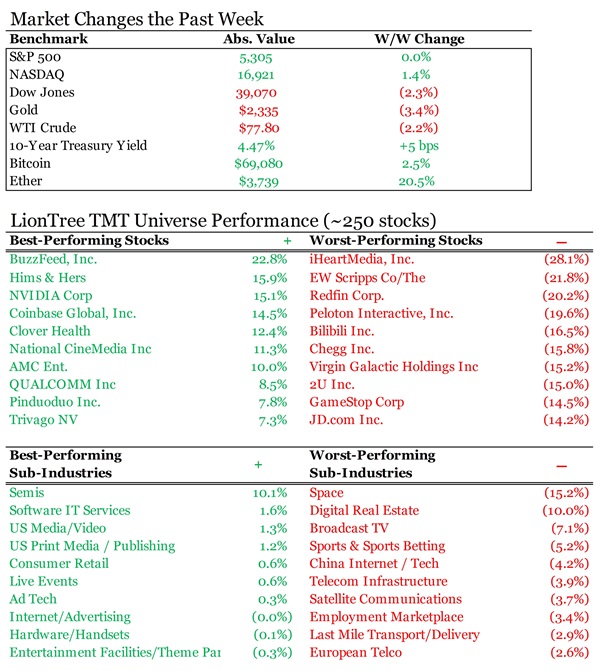
Happy Friday before the long Memorial Day weekend! The major indices ended the week mixed, with the Nasdaq rallying +1.4% (its fifth straight weekly gain and helped by Nvidia’s +15.1% gain), the S&P being flattish, and the Dow falling -2.3%. The market’s expectations for rate cuts seem to move day-by-day and based on the latest economic data points. After the week started with the market pricing in a 75% probability of a rate cut in September, by the end of the week, that had fallen to a 50% probability (on the back of the latest PMI data and jobless claims, plus mixed data on the consumer). I suspect these day-to-day gyrations will continue.
Regarding the fundamentals of the sector, there was a lot going on as usual. See below for the developments, themes, and updates that we focused on in this edition (all are clickable links):
- Q1 Earnings Wrap: Companies ONCE AGAIN Are Delivering Much Better Profitability Than Street Expectations
- NVIDIA – “The Next Industrial Revolution Has Begun”
- AI Jockeying, AI Ad Formats, AI Mega Funding Rounds…
- The Scramble For Premium Sports Rights Continues
- The Streaming Wars Rage On… Some Key Updates
- The UK Drives Forward With Autonomous Vehicles
- Pinduoduo Overdelivers But Again Cautions For Higher Investment Levels
- Connectivity Executives Converge On The Conference Circuit
- Grab Bag: DOJ vs. Live Nation / Neuralink’s Second Human Implantation / Pixar And TikTok Layoffs
Have a nice weekend.
Best,
Leslie

Q1 Earnings Wrap: Companies ONCE AGAIN Are Delivering Much Better Profitability Than Street Expectations
As we wrap up the earnings season, we wanted to take a closer look at the Q1 results of our LionTree TMT and Consumer Universe of ~160 companies across 35 sub-sectors with $1bn+ market cap to see what patterns particularly stood out.
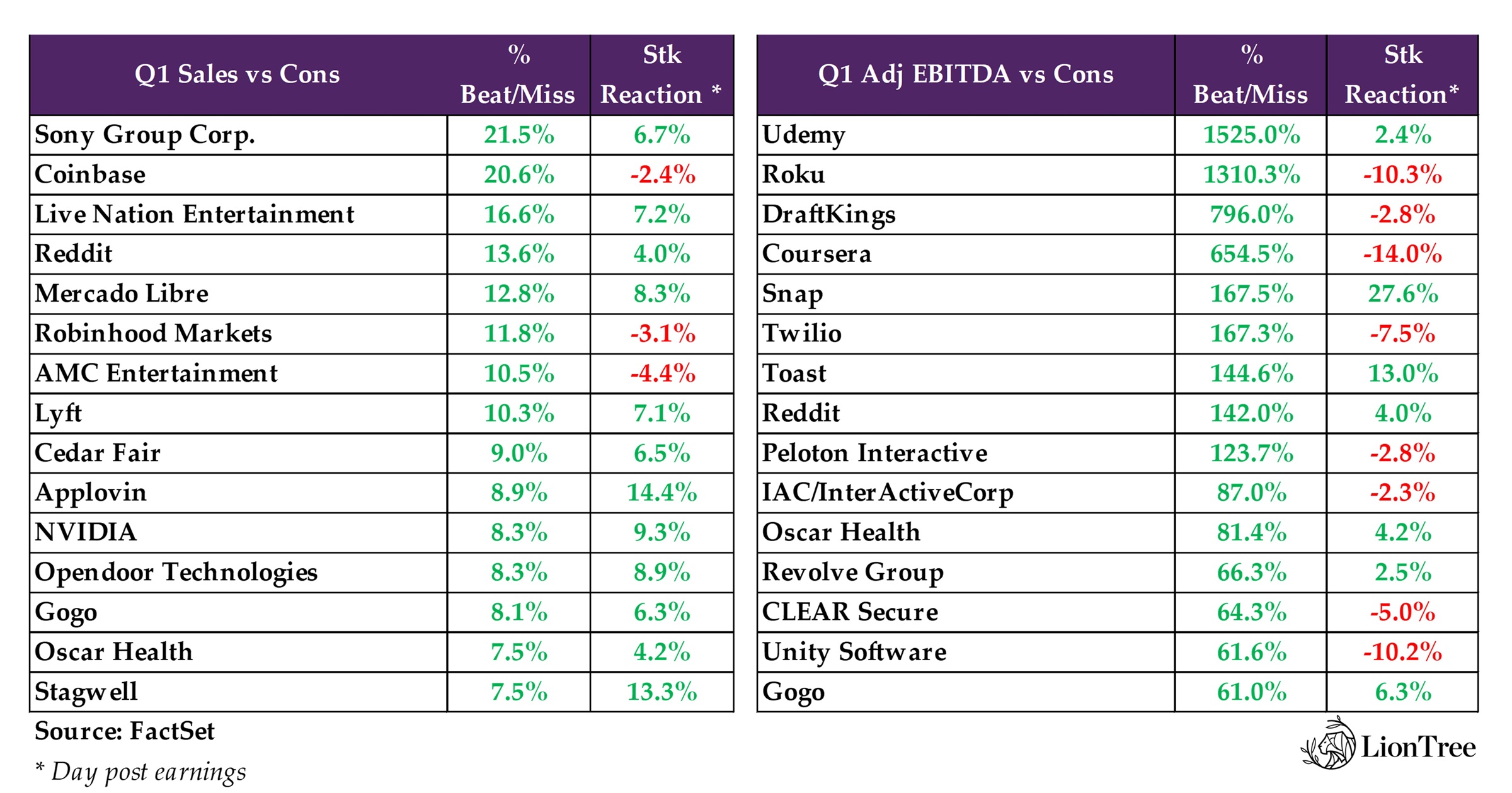
As has been the case for the past few qtrs, the focus on profitability continues to show through in the numbers. A substantial 83% of companies BEAT expectations for adj EBITDA (up from 75% last qtr), and close to HALF, or 48%, beat by double, triple, or quadruple-digits (vs 38% last qtr).
On the other hand, while a notable 76% of companies beat on revenue (vs 74% last qtr), only 5% beat by 10%+ (vs 4% last qtr). 18% of companies that beat on adj EBITDA missed on sales (slightly down from 19% last qtr).
Despite all the beats, it was tough to impress investors. Regarding stock performance in reactions to results, only 51% of stocks trading up on the day post-earnings. This was a step down from 52% last qtr and 61% two qtrs prior. Just 13% traded up double-digits, which was a big step-down from 23% last qtr. However, on the other end, there was a decrease in material sell-offs, as only 10% traded down double-digits vs 18% last qtr.
The best performing stocks in response to earnings was Snap, which jumped +27.6% after its report (a complete flip from last quarter, when it was the worst performing stock post earnings), followed by Pinterest, up +21%, and On Holdings, up +18%. On the other end, Fastly saw the worst post-earnings stock performance, down -32.0%, followed by TripAdvisor down -28.7% and Roblox down -22.1%.
See below for more of our takeaways on the Q1 stock performance of companies and sub-sectors within our LionTree Universe of TMT and Consumer stocks…
The Majority Of Companies Continue To BEAT Consensus, Most Prominently On Adj EBITDA
- Adj EBITDA – Of the companies in our LionTree Universe that report adj. EBITDA, 82.9% beat consensus adj EBITDA and 47.6% had double, triple, of quadruple-digit beats
- By Company: Udemy and Roku both made a repeat appearance in the Top 3 in Q1, beating cons by +1525.0% and +1310.3%, respectively (Udemy had the second highest and Roku had the third highest adj EBITDA beats last qtr); DraftKings beat by +796.0% to finish out the Top 3
- By Sector:
- EdTech stocks had the highest adj EBITDA beat (for the third qtr in a row), with an avg beat of +441.6%; The big beat was mostly driven by Udemy (+1525.0% beat) and Coursera (+654.5%), as well as smaller beats from Duolingo (+18.6%), PowerSchool Holdings (+6.2%), and Grand Canyon Education (+3.7%)
- Sports & Sports Betting stocks had an average beat of +393.3%, which was mostly driven by DraftKing’s adj EBITDA of $22.4mn beating cons $2.5mn by +796.0%, though the sector also saw a -9.4% miss from Penn Entertainment
- US Media/Video stocks came in third, with an average beat of +334.3%, as Roku’s $40.9mn in adj EBITDA was a big beat vs cons of $2.9mn; Lions Gate Entertainment and Fox also beat by +17.1% and +11.6%, respectively, though the sector average was weighed down by Warner Bros Discovery’s -1.9% miss
- Sales – Overall, 76.4% of companies in our LionTree Universe beat consensus on sales, but only 5.0% beat expectations by double-digits
- By Company: Sony Group took the top spot this quarter, with revenue of ¥3.481tn beating cons ¥2.866tn by +21.5%; Coinbase made another appearance in the Top 3, coming in with the second highest sales beat at +20.6% this qtr (vs the third highest sales beat last qtr), while Live Nation’s +16.6% sales beat rounded out the Top 3
- By Sector:
- Live Events had the highest sales beat in our Universe (for the second qtr in a row), topping cons by +7.3%, in aggregate, driven by beats across Live Nation (+16.6% beat), TKO Group (+3.2%), and Madison Square Garden Entertainment (+2.2%)
- Theater stocks had an aggregated sales beat of +6.8%, driven by AMC Entertainment’s +10.5% beat, as well as Cinemark’s +3.1% beat
- Digital Real Estate stocks beat by +6.1%, on average, driven by OpenDoor Technologies +8.3% beat, and Zillow’s +4.0% beat
Some Color On Companies & Sub-Sectors That MISSED Expectations
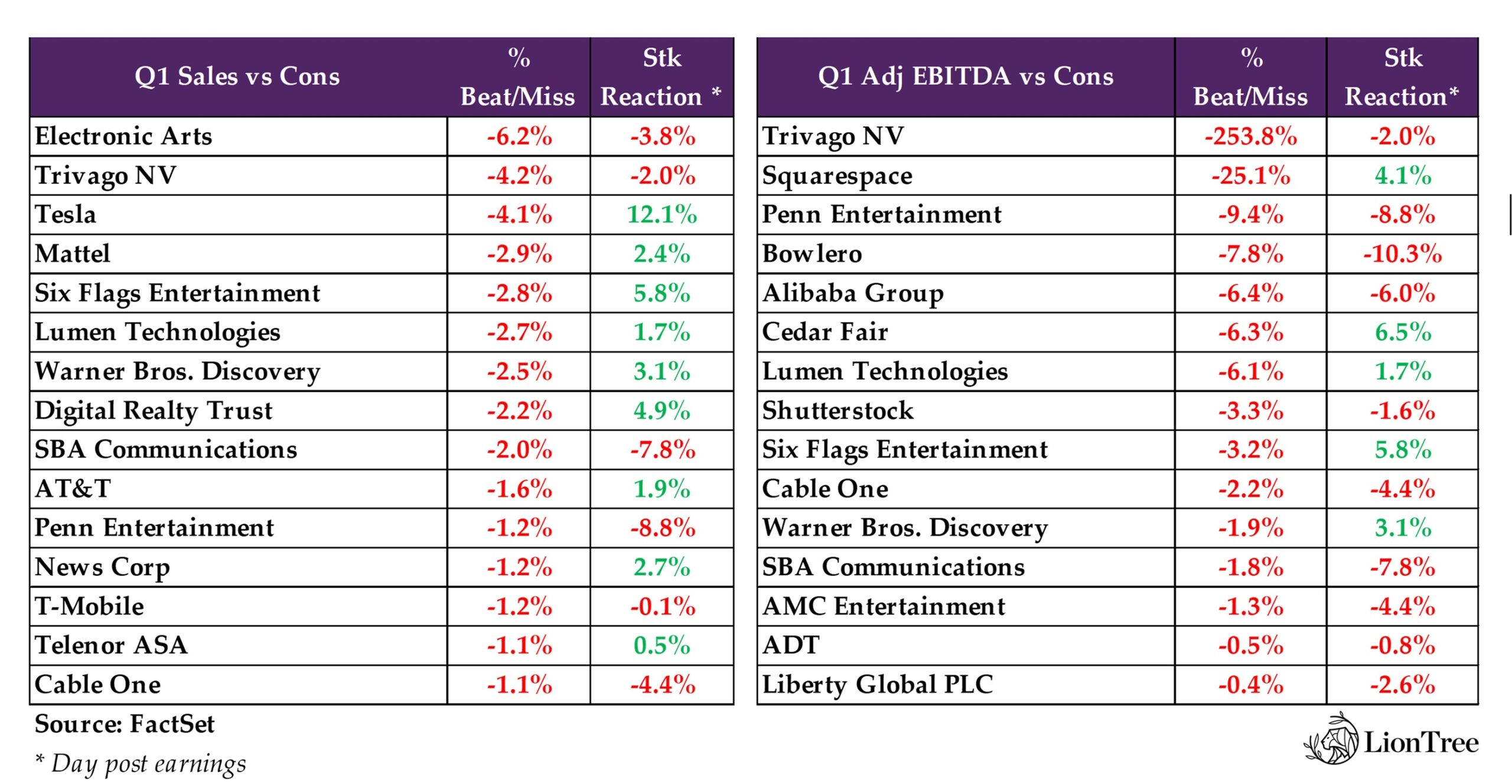
- Adj EBITDA – Of the companies in our LionTree Universe that report adj EBITDA, 17.1% reported numbers in-line/lower than consensus, and 1.9% had double-digit misses
- By Company: Trivago NV’s adj EBITDA of -€9.2mn came in below cons -€2.6mn and missed by -253.8%; That was followed by Squarespace’s adj EBITDA coming in -25.1% below expectations and Penn Entertainment’s coming in -9.4% below
- By Sector:
- Online Travel saw a sector average of a -22.0% miss, but that was mostly driven by Trivago NV’s -253.8% miss; Several names across the sector posted beats, including TripAdvisor (+4.2%), Trip.com (+21.8%), Booking Holdings (+24.6%), Airbnb (+29.9%) and Expedia Group (+41.4%)
- US Telco/Wireless missed by -1.0%, on average, as Verizon, T-Mobile, and AT&T’s beats of +0.2%, +0.8%, and +0.9%, were not enough to offset Lumen Technologies -6.1% miss
- Pay-TV/Broadband stocks had the third highest adj EBITDA miss versus expectations of –0.6%, in aggregate; Cable One, Comcast, and Altice USA all came in below expectations by -2.2%, -0.3%, and -0.3%, respectively, though Charter beat by +0.5%
- Sales – Overall, 23.6% of companies in our LionTree Universe reported sales in-line/lower than consensus
- By Company: Electronic Arts saw the biggest miss, with net bookings of $1.67bn missing cons $1.78bn by -6.2%; Trivago NV and Tesla missed by -4.2% and -4.1%, respectively, to round out the Bottom 3
- By Sector:
- US Telco/Wireless stocks had the highest sales miss in our Universe, with the sector missing expectations by -1.6%, in aggregate; All companies in the sector came in below expectations, including Lumen Technologies (-2.7% miss), AT&T (-1.6%), T-Mobile (-1.2%), and Verizon (-0.7%)
- Broadcast TV, for a second qtr in a row, took the second position in the Bottom 3 and missed expectations by -0.8%, on average, which was driven by Nexstar and TEGNA’s -0.8% and –0.7% misses, respectively
- Telecom Infrastructure had mixed results across the sector, but missed by -0.8%, on average; While American Tower and Crown Castle beat by +1.4% and +0.6%, respectively, while Digital Realty Trust, SBA Communications, and Equinix missed by -2.2%, -2.0%, and -0.5%, respectively
NVIDIA – “The Next Industrial Revolution Has Begun”
After posting another record quarterly revenue and a third straight quarter of +200% y/y growth, NVIDIA made it very clear that AI demand is far from its peak. While there was some concern from analysts going into the call that there may be an air pocket in Data Center revenues (86.6% of total rev in Q1) between the current Hopper chips and the upcoming Blackwell offering, much of those fears abated, as the Co annc’d an accelerated shipping timeline for Blackwell, noted that demand is outstripping supply for both Hopper and Blackwell, and CEO Jensen Huang ultimately proclaimed that the company is “poised for [its] next wave of growth.”
The industry is undergoing a significant transformation, marking the beginning of “the next industrial revolution”. Not only companies, but also countries are collaborating with NVIDIA to shift traditional data centers to AI-powered ones, called AI factories, to produce “a new commodity”, artificial intelligence. This shift promises productivity gains across industries, cost and energy efficiencies, as well as expanding revenue opportunities. Demand for AI training and inference is boosting NVIDIA’s Data Center growth, with AI fundamentally transforming computing from “information retrieval” to “answers and skills generation”. NVIDIA is at the forefront of this shift, and its Blackwell and Spectrum-X platforms, along with the NIMs software, are set to drive the next wave of growth in AI.
In addition to posting a strong Q1, NVIDIA set forth guidance comfortably ahead of consensus estimates. The Co also annc’d a 10-for-1 stock split (shares will begin trading on a split-adjusted basis at market open on June 10) and boosted its quarterly dividend by +150% to $0.10/shr. NVIDIA’s incr’d dividend follows similar moves annc’d so far this year from Meta and Alphabet, which both initiated quarterly dividends for the first time, as well as Apple, which raised its dividend earlier this month.
See below for more of what we took away from Nvidia’s strong performance.
-> NVIDIA shares passed $1,000 for the first time in extended trading, opened at an all-time high on Thursday, and ended the day up +9.3%, adding ~$9.3bn in market cap to reach a total of $2.6tn (as a comparison, Intel’s market cap stands at ~$128bn); NVIDIA ended the week up +15.1% and is up +115.0% YTD
“The Next Industrial Revolution Has Begun,” Per NVIDIA CEO Jensen Huang
- Shifting traditional data centers -> AI factories which will produce “a new commodity, artificial intelligence”: Companies and countries are partnering with NVIDIA to shift the trillion-dollar installed base of traditional data centers to accelerate computing and build a new type of data center, AI factories
- Generative AI has expanded beyond cloud service providers, creating “multiple multibillion-dollar vertical markets”: Across consumer internet companies, sovereign nations (“sovereign AI”), automotive and healthcare firms
- “AI will bring significant productivity gains to nearly every industry, and help companies be more cost efficient while expanding revenue opportunities”
- Sovereign AI rev is expected to approach ~hsd billions this yr (up from nothing in the prior yr): Data Center rev continues to diversify as countries around the world invest in sovereign AI, which refers to a nation’s capabilities to produce AI using its own infrastructure; Have initiatives in place across Japan, Italy, Singapore, etc
- Generative AI training also continues to scale as models learn to be multi-modal, understanding text, speech, images, video, and 3D, all the while learning to reason and plan
“We’re Completely Redesigning How Computers Works, And This Is A Platform Shift”
- Generative AI is driving a “full-stack computing platform shift that will transform every computer interaction”
- Computers are moving from being instruction-driven software -> intention-understanding models: “Every aspect of the computer is changing in such a way that instead of retrieving pre-recorded files, it is now generating contextually-relevant intelligent answers, and so that’s going to change computing stacks all over the world”
- Shift across computing models from information retrieval -> answers and skills generation
- General purpose CPU -> GPU accelerated computing
- Retrieving information -> performing skills
- Producing software -> generating tokens that manufacture digital intelligence
NVIDIA’s Headline Numbers Knock It Out Of The Park
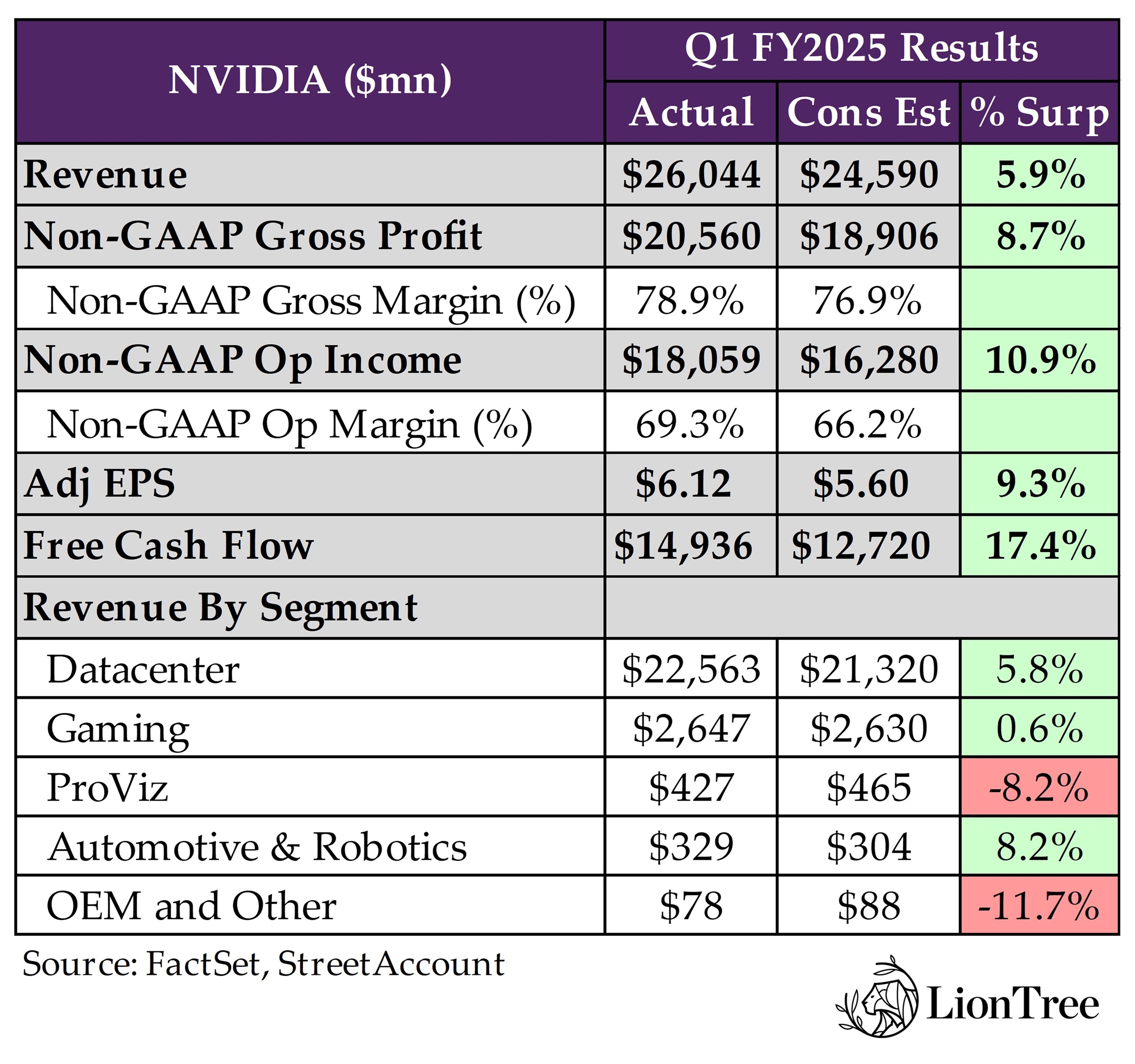
- Record Q1 revenue: Grew +262% y/y (vs +265% in Q4) and topped cons by +5.9%
- Data Center revenue (86.6% of total rev) was a quarterly record and beat cons by +5.8%; Gaming and Automotive & Robotics segments also beat, while ProViz and OEM & Other both missed
- Beats on margins: Adj gross margin of 78.9% beat cons 76.9%; Adj. op margin of 69.3% beat cons 66.1%
- Big beat on EPS: $6.12 vs cons $5.60
NVIDIA’s Guidance Also Came In Well Above Expectations
- Q2 guidance beat across the board
- Revenue of $28bn +/- 2% vs cons $26.62bn
- Adj gross margin of 75.5%, +/- 50bp vs cons 75.6%
- Adj op expenses of $2.8bn vs cons $2.77bn
- Incremental FY guidance commentary
- Gross margins in the mid-70s range
- FY operating expenses expected to grow in the low-40s range
Demand “Outstrips” Supply
- Demand is “well ahead” of supply for both H200 and Blackwell and expect demand may exceed supply well into next year
- Will momentum for Hopper slow as Blackwell shipments start later this year? No: “We see increasing demand of Hopper through this quarter”; Clients can “easily transition from H100 to H200 to B100,” and “Blackwell systems have been designed to be backwards compatible
Moved Up Timeline For Realizing Blackwell Series Revenue – “We Will See A Lot Of Blackwell Revenue This Year”
- Older timeline: The Co had initially projected shipping Blackwell around early 2025
- New timeline –
- Q2: Production shipments will start
- Q3: Production shipments will ramp
- Q4: Data centers using Blackwell processors should be up and running
- Time-to-market customers of Blackwell include Amazon, Google, Meta, Microsoft, OpenAI, Oracle, Tesla, and xAI
- “’[Blackwell] will supports fast and broad adoption across the customer types, workloads, and data center environments in the first year of shipments
“We Are Poised For Our Next Wave Of Growth”
- “Blackwell platform is in full production and forms the foundation for trillion-parameter-scale generative AI”
- “Spectrum-X is ramping in volume with multiple customers … [and] opens a brand-new market for us to bring large-scale AI to Ethernet-only data centers”
- “We expect Spectrum-X to jump to a multibillion-dollar product line within a year”
- “Nvidia NIM is our new software offering that delivers enterprise-grade, optimized generative AI to run on CUDA everywhere — from the cloud to on-prem data centers and RTX AI PCs — through our expansive network of ecosystem partners”
AI Jockeying, AI Ad Formats, AI Mega Funding Rounds…
Aside from the earnings results out of the poster child for AI, NVIDIA (see Theme #2), the news flow and key developments from the burgeoning AI sector continued at breakneck speeds this week. In particular, there was some major jockeying for position amongst the China Tech companies, Google hosted iTs Marketing Live event and debuted new AI ad-formats for advertisers, and news broke regarding some mega-AI funding rounds…see details below.
China Tech Is Wrangling For AI Dominance (link/link/link)
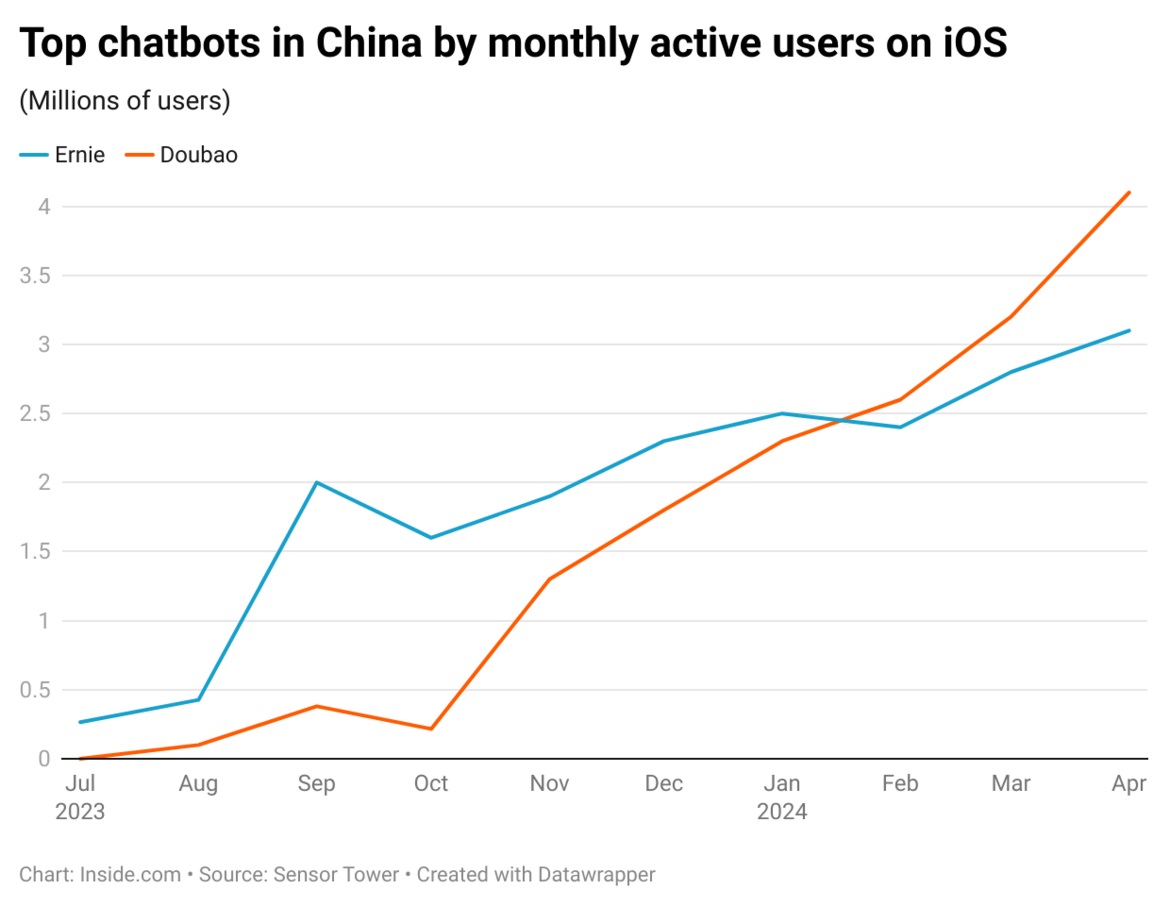
- ByteDance’s Doubao has become the most popular AI chatbot in China, surpassing Baidu’s Ernie Bot in downloads and monthly users: This is as per Sensor Tower data released this week
- This is despite Ernie’s earlier release in March 2023 vs Doubao, which launched in Aug 2023 and quickly surpassed Ernie in user numbers by Feb 2024
- In April 2024, Doubao had 4.1mn iOS monthly active users in China, while Ernie had 3.1mn (this data does not include Android app stores)
- In Feb 2024, Doubao recorded 2.6mn users, surpassing Ernie’s 2.4mn
- ByteDance reported that Doubao had 26mn MAUs across all platforms in China
- In comparison, OpenAI’s ChatGPT mobile app has 6.7mn monthly US users
- Baidu claims it has 200mn users since Ernie’s launch and has partnerships with companies like Samsung and Apple for using its model in China
- Alibaba and Baidu slash pricing for their large-language models (LLMs) used in generative AI: The price cuts threaten to lower profit margins for companies involved in the LLM market (link / link)
- Alibaba’s Tongyi Qwen LLMs cut pricing up to 97%
- Baidu responded by making its Ernie Speed and Ernie Lite models free for all business users
- Bytedance last week annc’d its primary model of its Doubao LLMs would be priced 99.3% lower than the industry avg for business users
-> Apple is reportedly in early talks with Baidu to incorporate Ernie’s genAI technology into its products in China
The Ad Market Is A Key Use Case For AI… Google Launches More Capabilities At Its Marketing Live Event This Week (Google Blog/link)
- At Google’s Marketing Live Event, one of the most interesting new AI-ad features was a gen AI tool to help shoppers see how clothing items fit on different body types: The tool uses AI to generate images w/out needing addt’l photos
- Functionality and availability: The new feature allows ads for shirts to show how they look on various models with different skin tones and body types (Google says brands don’t need to share detailed dimensions of the clothes w/ the Co for it to generate new images of models wearing them)
- Other types of apparel are not yet eligible, and no timeline was provided for their inclusion
- Feature extends Google’s free virtual try-on tool intr’d last year
- Functionality and availability: The new feature allows ads for shirts to show how they look on various models with different skin tones and body types (Google says brands don’t need to share detailed dimensions of the clothes w/ the Co for it to generate new images of models wearing them)
- Other AI-ad formats/features that were launched at the Google Event
- A tool that allows companies to create entirely new, AI-generated product images based on photos from earlier marketing campaigns and pictures that represent their brand identity
- Ability to link short-form videos to ads with AI-generated text summaries
- Shortly, advertisers can share their font and color guidelines in Performance Max, as well as provide helpful image reference points to generate new asset variations
- New image editing capabilities so advertisers can try adding new objects, extending backgrounds, and cropping to adapt images to any format, size, and orientation.
- Google AI will generate more recommendations showing products in different contexts and scenarios, so advertisers can select the assets they love and use them across their marketing channels
- A feature that lets shoppers dive deeper into an ad to see product videos, summaries, and similar products provided by the advertiser.
- Currently, the Co is testing a new ad experience in Search to help guide people through complex purchase decision
- Will soon start testing Search and Shopping ads in AI Overviews for users in the US
-> AI-generated advertising is becoming more and more common with enhanced capabilities to come…

Valuations In AI-First Companies Are Skyrocketing
- Scale AI’s latest $1bn raise values the Co at $14bn, up from its $7.3bn valn when it raised $325mn in 2021 (link)
- Who invested? Accel led the round, w/ Nvidia, Amazon, Meta, Coatue, Tiger, Intel Capital, and AMD Ventures all participating
- What does Scale AI do? Provides vast amounts of accurately labeled data, pivotal for training LLMs and helping companies create and refine data sets
-> Pitchbook estimates that AI startups raised~ $19bn in VC funding in Q1 vs ~$16bn in the yr ago period
The Scramble For Premium Sports Rights Continues
There were some noteworthy updates across the sports media landscape this week, and these were headlined by reports that the NBA is in the process of formalizing deals with Amazon, Disney, and NBC, potentially ending WBD’s 35-year run as a holder of the rights. However, it would be too early to count WBD out, given that in addition to possessing matching rights to NBC’s $2.6bn offer for the league’s “B” package, the Co still has legal options available to it. WBD also took steps to bolster its sports offerings in other areas this week by signing a sub-licensing deal with Disney to broadcast select College Football Playoff games. Speaking of college sports, news emerged that private equity is set to begin investing into college athletic departments, as Redbird Capital Partners and Weatherford Capital announced the launch of a new investment arm, Collegiate Athletic Solutions (CAS). In the baseball world, some interesting new details emerged this week regarding Roku’s offer to secure the MLB’s “Sunday Leadoff” package last week (see Theme #5 from 5/17/24 Weekly).
See below for more details…
- The NBA is reportedly formalizing deals w/ Amazon, Disney/ESPN, and NBC, though Warner Bros Discovery still has a chance (link): The final tweaks are still being determined and have been changing almost every day, per sources
- ESPN is expected to acquire the NBA’s “A” package for either $2.6bn or $2.8bn per yr: The package includes the NBA Finals, a conference final, weekly primetime games, the WNBA, and likely shared int’l rights
- Disney was firm about not letting the “A” package reach the open mkt: As a result, the Co reportedly doubled its old rights fee of $1.4bn during the exclusive negotiating window
- NBC’s proposed “B” package is believed to be worth $2.5-2.6bn annually: Would probably include a “Basketball Night in America” or “Sunday Night Basketball” following the NFL season, a total of two primetime windows a week, conference semifinals, and a conference final
- Amazon’s deal is expected to be worth $1.8-2.0bn: Would likely include the Emirates In-Season Tournament, the SoFi Play-In Tournament, first-round playoff games, the WNBA, and int’l rights
- WBD will have the oppty to match NBC’s offer in “total value”: Sources believe this would mean WBD would have to pay more than $2.6bn to top NBC, given WBD has $40bn in debt and doesn’t possess the same over-the-air broadcast infrastructure as NBC
- Sources said that WBD CEO David Zaslav believed he would have to pay $1.8-2.1bn to retain the “B” package: His refusal to double WBD’s former rights fee of $1.2bn to $2.4bn meant that the package went to open mkt
- WBD has the option to take the NBA to court as well: Sources indicate that the NBA is prepping lawyers for a possible lawsuit from WBD disputing the definition of a match; The NBA will likely contend that a match needs to include the same ad rev and broadcast windows
- ESPN is expected to acquire the NBA’s “A” package for either $2.6bn or $2.8bn per yr: The package includes the NBA Finals, a conference final, weekly primetime games, the WNBA, and likely shared int’l rights
- Warner Bros Discovery’s TNT signed a 5-yr deal w/ Disney’s ESPN to sub-license College Football Playoff games (link): Under the deal, TNT will broadcast two first-round College Football Playoff games the next two seasons and add two addt’l quarterfinals games starting in 2026; WBD will also add the games to MAX’s sports tier
- Disney will keep exclusivity of the championship game throughout the contract: Disney is paying $1.3bn annually for rights to the entire College Football Playoff through 2031and also has the option to sublicense a semifinals game to WBD in 2026
- The sports streaming JV appears to have played a role: As ESPN sublicensing to WBD keeps all of the CFP games on Venu Sports, the new sports streaming svs being developed by Disney, Fox, and WBD that is expected to launch in the fall
- Financial terms: WBD is paying ESPN an avg of “hundreds of millions” per yr for the games over the course of five yrs, though less in yrs one and two when it only has two games per yr
- College football has been one of the most popular programs on TV: Michigan’s semifinals win over Alabama drew an avg audience of 27.2mn viewers last yr — the most watched non-NFL sporting event since 2018
- Disney will keep exclusivity of the championship game throughout the contract: Disney is paying $1.3bn annually for rights to the entire College Football Playoff through 2031and also has the option to sublicense a semifinals game to WBD in 2026
-> WBD CFO Gunnar Wiedenfels spoke at JP Morgan’s Global TMT Conference and touched on the Co’s “very much ongoing” negotiations w/ the NBA as well as Venu, the upcoming sports streaming JV; According to Wiedenfels, WBD “value[s] the product” and is “very hopeful” that a “mutually beneficial” solution can be found; Regardless of what happens w/ the NBA, he emphasized that WBD is going to have a “very, very strong sports offering” while remaining “disciplined” on spending; Venu is the Co’s “top priority” right now, and it is running at “full steam” to bring that to mkt
- Private equity launched its first foray into college sports (link/link): Redbird Capital Partners and Weatherford Capital annc’d the launch of an investment arm, Collegiate Athletic Solutions (CAS), intended to infuse capital into athletic depts; The fund plans to offer between $50-200mn to each dept
- This week’s House v. NCAA settlement clears the way for private financing into college sports: The settlement provides $2.8bn in backpay to college athletes unable to participate in likeness deals before 2021; It also sets up a framework for Power 4 schools to rev share w/ athletes up to $20mn per school per yr
- CAS is seeking to capitalize on a “paradigm shift”: Views this shift as being similar to ones seen w/ media distribution models, collective bargaining rights, and premium hospitality; CAS will address athletic depts’ need for near-term capital and operational expertise to help improve competitive positioning
- CAS isn’t looking for an equity stake in these depts: Will provide capital to athletic depts, only expecting a return based on how much rev or profit the schools can generate from those investments; Redbird and Weatherford will advise athletic depts without having an official position at them
-> On a separate but related note, Eli Manning’s PE firm, Brand Velocity Group, is “definitely” interested in buying a stake in one of the NFL’s 32 teams if the league approves rules changes that would allow PE firms to own minority shares of franchises; Manning, who is a partner at the firm, believes it will be a “really interesting” oppty, especially as “valuations of NFL teams are getting so high that [it’s] limiting the number of people that can afford it”; Manning already has a minority stake in Gotham FC, a National Women’s Soccer League team (link)
- Roku is reportedly only paying $10mn per season for Major League Baseball’s “Sunday Leadoff” rights (link): Per The Athletic, Roku is paying $10mn a season to stream the 18-game package compared to the $30mn a season that the previous incumbent, NBCUniversal’s Peacock, had been paying
- The agreement is somewhat back-end loaded: Roku is paying $10mn in 2024, $8mn in 2025, and $12mn in 2026; Notably, NBCUniversal had also offered $10mn per yr to retain the rights
- The deal also has an opt-out clause, per sources: Though it’s not clear whether that belongs to Roku or MLB
The Streaming Wars Rage On… Some Key Updates
Along with the connectivity updates that we received from Comcast and Charter (see Theme #2), there were also some interesting updates from the cable companies pertaining to the pay-TV sides of their businesses this week, particularly as it relates to their distribution of streaming services.
See below for more details.
- Comcast Cable CEO Dave Watson offered more details on the new StreamSaver DTC bundle: The package includes a subscription to Netflix Standard w/ Ads, Peacock Premium, and Apple TV+, providing a “simple, easy alternative” for consumers
- There are two ways for consumers to get it:
- Existing customers can get it for $15/mo starting next week: Representing 30%+ savings; Subscribers to the Co’s broadband, Xfinity TV, mobile, and other products are eligible
- OR StreamSaver can be combined with NOW TV for $30/mo: NOW TV offers 40 FAST channels
- StreamSaver “opens up possibilities down the road” for further bundling oppties: The Co “like[s] this package” and “like[s] this approach”
- There are two ways for consumers to get it:
- Paramount and Charter reached a new carriage agreement (link): Paramount signed a multi-yr deal w/ Charter that will keep Paramount’s networks available for Charter customers and make the Paramount+ Essential tier and BET+ Essential available to Spectrum TV Select subscribers free of charge
- Scope of the agreement: Includes Paramount’s full portfolio of linear cable networks, CBS owned-and-operated broadcast stations, and DTC streaming svs; Charter’s Spectrum subs will keep access to CBS, BET, Comedy Central, MTV, Nickelodeon, Paramount Network, and Paramount+ w/ Showtime
- Later this yr, ad-supported versions of Paramount’s DTC svs will be included at no extra cost for Spectrum TV customers: Includes both Paramount+ Essential tier and BET+ Essential; Will be available through the Xumo Stream Box or any Paramount+ supported device
- Paramount’s DTC products will also be available to purchase by Charter’s Internet-only customers: Charter will mkt these to its customers at retail rates and will receive rev share for new paid subscriptions and ad-free upgrades
- The Paramount+ w/ Showtime plan will continue to be available for free for Spectrum’s Paramount+ w/ Showtime linear customers as well: Other users will be offered the chance to upgrade to the plan
- The deal had previously been set to expire on Apr 20: However, the two Cos opted to extend the talks; Charter is the largest pay-TV provider in the US w/ 14.1mn subs, so losing the distribution partner would have been a difficult blow for Paramount
- Scope of the agreement: Includes Paramount’s full portfolio of linear cable networks, CBS owned-and-operated broadcast stations, and DTC streaming svs; Charter’s Spectrum subs will keep access to CBS, BET, Comedy Central, MTV, Nickelodeon, Paramount Network, and Paramount+ w/ Showtime
The UK Drives Forward With Autonomous Vehicles
While companies like Wayve and Oxa have been actively trialing self-driving cars in London and Oxford, UK legislators actually signed autonomous vehicles into law this week, paving the way for fully autonomous vehicles (AV) to be on UK roads by 2026. The overarching view is that this tech will end up making roads safer and drive significant economic benefits for the country. (link/link)
-> We also recently covered some trends related to the development of autonomous cars in the US – See Theme #7 Weekly 3/8/24 for more.
- The Automated Vehicles (AV) Act received royal assent this week, making the UK’s self-driving car regulations official
- This legislation has been in the works since 2022: It was first proposed in a 2022 joint report by the Law Commissions, emphasizing the need for new legal vocabulary, actors, and regulatory schemes for autonomous vehicles
- A big component is that the Act clarifies where accident liabilities lie: The UK clarified that corporations (insurance Cos, software developers, auto manufacturers) will be responsible for accidents when cars are in self-driving mode, NOT the human drivers; Each self-driving vehicle will have an “authorized self-driving entity” responsible when in self-driving mode
- Independent oversight will be established: The govt will establish a vehicle approval system w/ an independent incident investigation function; Companies must meet ongoing safety obligations
- The UK expects substantial economic impact from this shift to AVs: The self-driving vehicle sector could create 38k+ jobs and be worth up to £42bn by 2035; Self-driving vehicles could support sectors w/ driver shortages and dangerous work
- The Act will also “improve the lives of millions of Brits – improving mobility and access to services, reducing isolation and better connecting rural communities”
- The rollout of AVs is seen as improving road safety: Self-driving vehicles are expected to reduce human error, which causes 88% of road collisions; The law requires these vehicles to achieve safety levels at least as high as competent human drivers
- Timeframe? Self-driving vehicles could be on UK roads by 2026
- Public and private investment in AVs continues
- The UK govt has invested £600mn+ in the self-driving vehicle industry since 2015
- UK-based Wayve recently raised $1bn+ from major companies like SoftBank, Nvidia, and Microsoft to develop self-learning software for autonomous vehicles
What is happening with AV legislation in other key European countries? MOIA (Volkswagen’s ride sharing company) had a great breakout on their website, which we outlined below: (link)
- Germany: The first country in the world to define the legal framework for fully automated driving in specified Level 4 operating areas in 2021
- This includes both the Autonomous Driving Act and the Autonomous Vehicle Approval and Operation Ordinance (AFGBV) that followed in 2022
- Various model regions and real-life laboratories are helping to ensure continuous digital and connected mobility progress
- There are already 40+ pilot projects with autonomous shuttle buses in local public transport
- France: Created a legal framework for the use of AVs at an early stage
- Since 2022, self-driving vehicles up to Level 4 have been permitted in public transport
- Like in Germany they are only allowed to drive in defined operating areas
- In addition, it must be ensured that vehicles can be controlled and maneuvered from a control center
- Italy: Unlike the other countries, Italy has not yet enacted any specific laws on automated driving
- However, Level 2 automated vehicles may be used in traffic
- Switzerland: In Switzerland, fully automated vehicles are only allowed on certain routes or areas
- Nevertheless, Switzerland participates in various European funding projects for autonomous driving
- Spain: The Spanish govt is currently working on a legal frame for the operation of Level 4 vehicles on Spanish roads
- This is expected to be based on existing legislation from other EU member states
Pinduoduo Overdelivers But Again Cautions For Higher Investment Levels
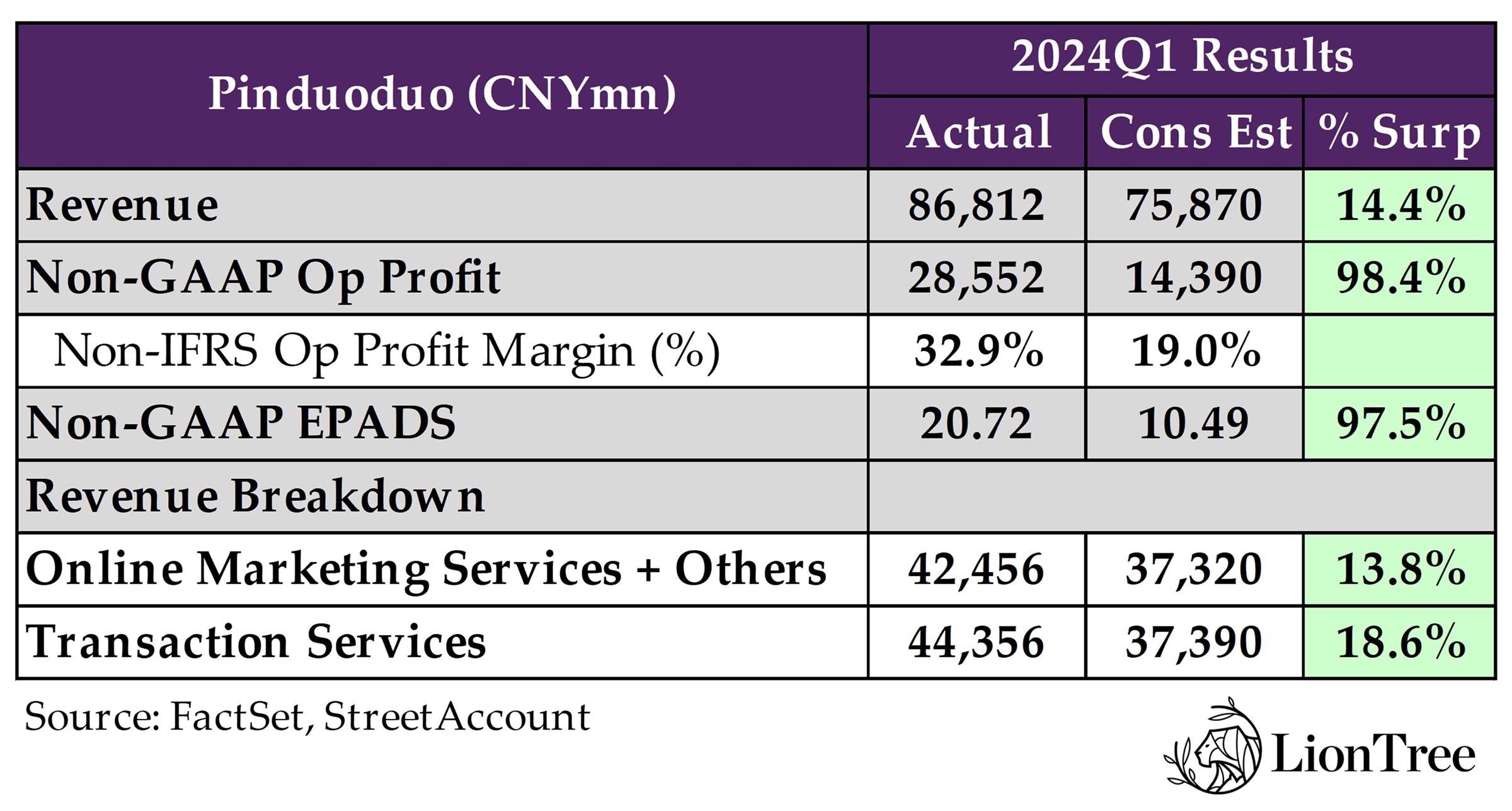
Pinduoduo, parent Co of Temu, reported its latest results this week, revealing that the e-commerce upstart’s hot streak not only carried over from the previous quarter, but conflagrated to even greater heights in Q1. The Co finished the quarter with a top-line that was +14.4% above consensus expectations and a non-GAAP operating profit that was an even wider +98.4% ahead of estimates. Revenues from Pinduoduo’s Online Marketing Services and Transaction Services business segments both comfortably outperformed forecasts, which reflected the Co’s execution in improving user and merchant experiences on its platform, the strength of its promotional offers for China’s shopping holidays during the quarter, as well as a broader improvement in macroeconomic conditions in the country. The e-commerce industry has been “growing quickly” in China, and Pinduoduo still sees “large potential” to increase its online retail penetration both domestically and abroad, despite intensifying competition.
While Temu wasn’t directly named on the earnings call, mgmt still discussed some key trends related to the segment. The Co reiterated that the global business segment remains in an “exploration stage”, and although it continues to predict challenges on the road ahead, Pinduoduo is “prepared to respond positively” to them, even at the expense of future profits. The Co won’t be distracted by short-term results, instead prioritizing the development of key capabilities, including further enhancements to its supply chain, overall user experience, and compliance program. These investments will, in turn, attract more merchants and users to its platform, creating a “virtuous cycle” and broadening the selection of high-quality products available for shoppers to choose from. More than anything, Pinduoduo’s main focus is growing intrinsic value over the long-run, even if that means less profit in the short term.
Given some of the recent regulatory developments surrounding Temu in the EU (link), Pinduoduo’s compliance regimen was also under the microscope on the earnings call. However, mgmt assured investors that Pinduoduo has been “actively engaging with regulatory bodies in various countries” and expressed confidence that the Co’s proactive investments in strengthening its compliance framework across various countries would insulate it from regulatory scrutiny. Net-net, despite a far better-than-anticipated quarter overall, Pinduoduo appears to show no signs of taking its foot off the gas pedal anytime soon and will continue to prioritize growth over profitability.
See below for more detail on what we thought was most incremental from the Co’s earnings and conference call.
-> Pinduoduo shares were up +1.1% in reaction to the print and ended the week up +7.8%; YTD, Pinduoduo stock is trading up +7.7%
PDD Widely Outperformed In Q1 But Cautioned That Profitability May Not Follow A “Linear Path” Moving Forward
- Headline numbers reflected double-digit beats across all segments
- Q1 rev incr’d +130.7% y/y (vs +123.2% y/y in Q4) and topped cons by +14.4%, w/ Online Mkting Svs and Transaction Svs rev beating by a respective +13.8% and +18.6%
- Non-GAAP op profit rose +237.4% y/y (vs +118.9% y/y in Q4) and closed +98.4% ahead of cons
- Emphasized that the strength during the qtr is not necessarily indicative of future results
- The biz “does not follow a linear path”, and the Co is “still in growth phase”, meaning it will look to capitalize on “good value creation oppties” even at the expense of “fluctuations to short-term profitability”
PDD “Benefited From An Improving Macroenvironment”
- The Chinese consumer was off to a “good start” in Q1: Online consumption remained strong and online retail penetration cont’d to rise; PDD is “confident in the consumer mkt in China”
- BUT Chinese consumers are “becoming more rational”: There’s demand amongst consumers “for more savings and better svs”, and they have been increasingly comparing platforms and their shopping experiences on each across a few areas, including product selection, pricing, and svs
- Chinese consumer demand is also becoming “more diversified”: In response, the Co is looking into “boosting the supply of high-quality products” on its platform and improving its overall shopping experience
- “The online retail industry is growing quickly”: “E-commerce infrastructure continues to improve, and new e-commerce models continue to emerge”; PDD has been “innovating and exploring new models to create greater value for consumers”
- BUT Chinese consumers are “becoming more rational”: There’s demand amongst consumers “for more savings and better svs”, and they have been increasingly comparing platforms and their shopping experiences on each across a few areas, including product selection, pricing, and svs
PDD Maintained An Aggressive Promotional Posture
- PDD sees 2024 as a “yr for consumption promotion”: During the Spring Festival and other seasonal events, the Co launched “a series of promo activities” to meet users’ shopping needs and to benefit merchants
- PDD has been focused on offering customers more savings: The Co incr’d investment in its RMB 10bn program and partnered w/ millions of merchants during the spring festival shopping season and the May Day shopping festival to offer consumers more savings
- 10mn+ customers have taken advantage of the Co’s trade-in offers: For context, as part of efforts to promote nationwide consumption, China created the Consumer Goods Trading program to incentivize consumers to upgrade mobile phones, AC units, refrigerators, and other goods
- Competition “intensified” during the qtr: PDD’s industry peers “significantly stepped up” their promo efforts, which will ultimately result in higher expenses for PDD; However, PDD “welcome[s] healthy competition”
- Still, new tech and new mkts offer the Co “tremendous oppties for growth” …: PDD is operating in a “constantly evolving” industry, w/ both competition and oppties “emerging at a rapid pace”
- PDD has been focused on offering customers more savings: The Co incr’d investment in its RMB 10bn program and partnered w/ millions of merchants during the spring festival shopping season and the May Day shopping festival to offer consumers more savings
The Core E-Commerce Biz Was Supported By “High-Quality Consumption”
- Some color on PDD’s domestic performance:
- Efforts to develop rural last-mile delivery led to “rapid y/y growth” of orders from remote provinces: During the qtr, the Co upgraded its shopping and shipping svs, pioneering free shipping to villages in rural areas and bringing most rural consumers within a 2km radius
- PDD’s “traffic support” svs for high-quality merchants also provided a boost: As an example, a dairy product brand that launched a limited edition, Chinese New Year-inspired offering “quickly gained popularity” in the dairy category w/ the help of PDD’s platform resources
- There’s still “plenty of room for improvement” in the global biz: The global biz is still in an “exploration stage”, and the Co is “prepared to respond positively to challenges”, viewing them as “important oppties to improve”
- “There’s still large potential in [PDD’s] retail penetration”: Improving the scope and value of its svs for both merchants and consumers will create a positive feedback loop that will ultimately be reflected in its financial results
- PDD is planning to “innovate for the long-term”: The Co won’t be distracted by short-term results and will instead focus on developing its key capabilities, including –
- Supply chain enhancements are on the horizon: Will continue to rollout tailored fulfillment in different mkts to improve pricing efficiency, reduce costs, and broaden product offerings
- PDD wants to build an “industry-leading” compliance program: And will invest accordingly to create a “safe and trustworthy shopping environment” for its user
- Expanding svs capabilities will improve the overall user experience: Plans to invest in tech and operations to respond to the diverse needs and quality standards of global users
Agriculture Continues To Be “The Foundation” Of PDD
- The Co is committed to investing in agriculture over the long-run: PDD launched its fourth annual Smart Agriculture Competition and its second annual Pinduoduo Academy to explore “new productive forces in agriculture”
- PDD’s agriculture biz capitalized on seasonal shopping holidays: Collab’d w/ 1,000+ quality agricultural production regions in China during the spring festival shopping season and launched dedicated livestreaming sessions for agricultural products under the RMB 10bn program during the May Day shopping festival
- Online penetration of agricultural products has remained “relatively low”: PDD still sees “plenty of room for improvement in digitalizing farmers’ operations”
PDD Has Been “Actively Engaging W/ Regulatory Bodies In Various Countries”
- Consumers and regulatory bodies have been holding PDD accountable for “higher compliance requirements”: In response, the Co has “invested significant resources” into creating a “major regulatory framework around the world” over the past few qtrs
- PDD has been “proactively strengthening” its local compliance capabilities: The Co has been “investing heavily in researching and understanding the regulations of each mkt” and has dedicated teams to ensure product compliance for consumer protection as well as compliance w/ data-related regulations
Connectivity Executives Converge On The Conference Circuit
The Wall Street conference circuit continued this week with JP Morgan’s Global TMT Conference providing leading executives from across the connectivity space with the opportunity to elaborate on trends discussed on their earning calls last month (see Theme #5 and Theme #6 from 4/26/24 Weekly) and shed some light on new developments. Along with the slowing postpaid phone market, other key incremental themes covered included color on how new promotions have been faring as well as updates on the progress of ongoing CapEx initiatives and cost savings efforts. Convergence also remains a core part of each major player’s strategy, as Verizon CEO Hans Vestberg, AT&T CEO John Stankey, Comcast Cable CEO Dave Watson, and Charter CFO Jessica Fischer all devoted time to expound on how they plan to continue augmenting the value of their converged bundles moving forward.
See below for more of what we thought were the most incremental connectivity comments from the conference:
Wireless Has Hit Some Road Bumps, But The Long-Term Picture Remains Strong
- Verizon is just at the beginning of its turnaround in consumer postpaid wireless: The Co has cont’d to add perks to MyPlan, including insurance recently; Other changes, such as adjusting sales incentives for sales reps, have led to a seq improvement in the consumer postpaid biz every qtr since then
- The Co has been outpacing a slow mkt thus far in Q2: Although the switcher pool and upgrade volumes have been lower in the mkt, the Co has been “performing better than that”, having seen “good momentum” throughout April
- Low upgrade volumes have remained a drag: People are now waiting for “way longer” before upgrading b/c their phones have been “working so well”, opting to replace them every 3-4 yrs vs every yr previously; Still, this has also helped reduce churn
- In prepaid, Visible and Total by Verizon have been “performing well and more than according to plan”: Efforts to improve Total’s distribution through Walmart have helped, along w/ investments in consumers, including via media spend and promos
- Sees ACP “more as an oppty”: Although Verizon has 1.1mn customers on ACP, there are 21mn in total that have taken advantage of the program and that could be potential acquisition targets
- The Co has been outpacing a slow mkt thus far in Q2: Although the switcher pool and upgrade volumes have been lower in the mkt, the Co has been “performing better than that”, having seen “good momentum” throughout April
- AT&T has seen “a little bit of a tempering of growth” in postpaid, as expected: Postpaid net adds are “still growing”, though “maybe not at the clip” seen post-pandemic; Nonetheless, AT&T is “still finding the right customers”
- AT&T still has “room to grow” in the value-oriented segment of the mkt: The Co has “started pushing [in] that direction” and has been “hitting some of the ethnic segments better than… before”
- “You see stress showing up in certain parts of the low-end of the mkt”: Customers are “still paying” and buying svs but have moved to credit card payments as opposed to cash
- AT&T’s balance between its consumer and biz sides is currently “really healthy”: The Co is present w/ “every Fortune 1000 Co just about out there” and has been strengthening its distribution in the mid-mkt and at the low end of the mkt in biz; Also, has established itself in gov’t and w/ first responders
-> On a related note, T-Mobile annc’d pricing increases for its customers on legacy plans earlier this week, raising them by $5.00/mo and citing “rising costs and inflation on its website”; The Co reassured investors that it still offers “the best value in wireless” by saving customers an avg of ~20% vs some competitors, per comparable sources; Customers were advised that services, benefits and promotional pricing will remain the same and the additional charges will automatically be added to bills after June 15 (link)
- Comcast still has a “long way to go” w/ mobile: Bundling mobile w/ broadband is a “core part” of the Co’s strategy, and new svs offerings have helping Comcast better compete; Highlighted a second free line initiative for existing customers as well as new prepaid and family pack pricing, in particular
- Charter has “high expectations for [its] mobile product”: Highlighted the value and relatively low pricing of Charter’s converged bundle and addt’l brand mkting efforts to raise awareness
- “Two big launches” of promos will spur demand: Including the Anytime Upgrade offering, which will provide access to new devices “on a regular basis”, as well as contract buyout, a “super targeted” program to target multi-line homes
-> Regarding contract buyouts, Charter CEO Chris Winfrey recently said that the Co will commit as much as $2,500 for customers to move up to five wireless lines from their existing carrier to Spectrum Mobile (link)
Broadband Commentary – Convergence Appears Poised To Continue Driving Competition
- Verizon is thinking beyond its initial 4-5mn FWA target: Given that it has “way more” capacity than needed to reach its original goal; The Co also has waitlists of potential FWA customers in regions where it plans on expanding the svs and has seen strong traction w/ biz customers
- AT&T is “optimistic” that business wireline will return to “aggregate growth over time”: Pointed to uptake of converged mobile + broadband bundles, efforts to fine-tune distribution to mid-mkt and SMB, as well as the new Internet Air FWA product as drivers
- “Converged is now the oppty”: Convergence as the “end game” that “the consumer ultimately wants” and that all in the industry should “keep in mind”
- Comcast sees fiber as its “main competitor”: Comcast is also “certainly very competitive against fixed wireless”
- The Co will see “elevated churn” from ACP’ in Q2 and Q3: Views these are a “form of promotional roll-off”, though it’s still too early to gauge how much churn will occur in each qtr respectively
- The NOW brand has been seeing “early traction”: The prepaid NOW brand includes NOW TV, NOW Internet, and NOW mobile; Positioned NOW as an “attractive proposition” for the lower end of the mkt and a “great alternative” for those coming off ACP
- Charter – Several factors will underpin a rebound in the Co’s broadband gross adds: Including the Co’s focus on improving its network speed & reliability, which will provide it w/ mkting claims, as well as other elements of its converged bundle, including mobile as well as its new video packages
- There’s also “really strong” oppty to bring in customers as ACP ends: Given that Charter has a “solid set of offers” available to customers coming off the program, along w/ a mobile product that can save people “hundreds or even thousands of dollars”
- BUT it’s “still way too early” to determine ACP’s impact on non-pay churn: Though there’s been “very little thus far in terms of residual disconnects related to ACP”, as expected; Will know more on non-pay trends in the June-July timeframe
- More details on the impact & timing: The subscriber headwind will be reflected both in Q2 and Q3, while higher bad debt flow through in Q2
- There’s also “really strong” oppty to bring in customers as ACP ends: Given that Charter has a “solid set of offers” available to customers coming off the program, along w/ a mobile product that can save people “hundreds or even thousands of dollars”
Key CapEx-Related Color
- Verizon is only using “a fraction” of its C-band holdings: There’s “a lot left [in] the tank” for the Co to increase capacity in its C-band network, given that it is likely using an avg of 80 MHz of its 160 MHz of available C-band spectrum; Verizon has densified large cities and is now expanding capacity in more suburban and rural mkts
- AT&T is now approaching 40% fiber penetration: AT&T has a “pretty clear path” to “cost efficiently and effectively” get to 40% penetration and is now figuring out how to leverage converged products to 50% fiber penetration in its mkts; Higher fiber penetration will mean less churn moving forward
- Comcast is now live w/ CBRS in three mkts: Including its hometown of Philadelphia; The Co has been “going beyond testing” and has been doing “real deployments” in these areas; Comcast can now begin offloading more traffic if it wants to
- Reiterated key points about the Co’s CapEx plans: The Co is targeting similar or “a little bit more” fiber passings in 2024 than 2023’s 1.1mn, and it also expects to deploy mid-splits ~50% of its footprint by the end of 2024 (currently at 40%), opening up the path for DOCSIS 4.0 and multi-gig symmetrical speeds
- Charter’s CapEx projects are “executing on time”: Still expects to complete RODF-related builds and the network evolution initiative by the end of 2026 (was previously delayed from end of 2025 in Q3:23)
- “BEAD continues to be a really interesting project”: Views BEAD as a “first-of-its-kind oppty”, given the level of subsides that are available, and sees “high ROI oppties” associated w/ the program
- Penetration in rural mkts has cont’d to be higher than anticipated: Driven by “tremendous demand for proper broadband”; Higher penetration rates can justify a higher cost per passing
The Push Towards Greater Efficiency/Cost Savings Continues…
- Verizon has launched four gen AI products to improve its customer svs in Q2: Including “simple things”, such as adding a search tool on all of its plans for its 40,000 customer care employees, as well as more advanced features, including more efficient caller ID and routing capabilities
- AT&T sees “plenty of places” left to address in meeting the next $2bn run-rate cost savings target: Including cont’ing to reduce the legacy wireline footprint to focus on more concentrated mkts as well as technological improvements that have streamlined operations
- Comcast “feel[s] pretty good” about its longer-term potential to grow margins: AI has contributed to progress in reducing variable expenses associated w/ transactional activity, including taking truck rolls and calls out of the system; The Co has also been “very disciplined” about taking out fixed costs where possible
- Charter’s investments in efficiency have been paying off: Cost savings efforts have been “really successful”, and cost to svs customers (excluding ACP) has been better than what was forecasted in the Q4 outlook
Grab Bag: DOJ vs. Live Nation / Neuralink’s Second Human Implantation / Pixar And TikTok Layoffs
- Department of Justice sues Live Nation on antitrust grounds (link): The Department of Justice (DoJ) and 30 state and district attorneys general across the country filed a federal lawsuit on May 23 against Live Nation Entertainment and its wholly owned subsidiary Ticketmaster
- What does the DOJ suit allege? That Live Nation has created a monopoly on live event ticket prices across the US
- Live Nation and Ticketmaster engage in several forms of anticompetitive conduct, including –
- Retaliating against other promotion companies and venues that worked with its rivals
- Locking out competitors with long-term, exclusive ticketing contracts
- Restricting musicians’ access to live event venue
- Strategically acquiring smaller, independent companies that Live Nation allegedly perceived as threats to its dominance
- According to the DOJ, “it is time to break up Live Nation-Ticketmaster”: The Dept. is pushing for “structural relief,” which is asking the federal court to break up the combined Co (a merger that the DOJ itself approved in 2010)
- Live Nation and Ticketmaster engage in several forms of anticompetitive conduct, including –
- Live Nation responds – DOJ’s allegations of monopoly are “absurd”: “Some call this ‘anti-monopoly,’ but in reality, it is just anti-business. There is no legal basis for objecting to vertical integration on these grounds” (link)
- The lawsuit will NOT reduce ticket prices or service fees, because artist teams set prices for their tickets and the venues set and keep the majority of ticket fees
- There is more competition than ever in the live events market, which is why Ticketmaster’s market share has declined since 2010
- “Calling Ticketmaster a monopoly may be a PR win for the DOJ in the short term, but it will lose in court because it ignores the basic economics of live entertainment”
- What does the DOJ suit allege? That Live Nation has created a monopoly on live event ticket prices across the US
- Neuralink gets FDA approval to implant a brain chip in a second patient (link/link/link): Neuralink has been testing its brain-computer interface (or BCI), which aims to help people with full-body paralysis control outside technology using their thoughts
- Signed off on the Co’s proposed fixes for a problem that occurred in the first test participant
- The first patient recounted that the device had given him the ability to have nearly full control over a computer using only his thoughts
- But within a month of his surgery, several of the implant’s threads that had been placed in his brain had come loose, which reduced the amount of data it could capture
- Neuralink told the FDA that it plans to fix the issues that affected the patient by inserting the implant deeper into the brain’s motor cortex (from 3-5mm deep into the motor cortex to 8mm deep)
- The fixed now include embedding some of the device’s ultrathin wires deeper into the brain
- More trials of the device are on the docket: Neuralink expects to implant its device in the second patient in June and a total of 10 people this year; More than 1,000 quadriplegics have signed up for the patient registry in hopes of being one of the people to get the implant
- With the possibility of testing outside of the US in the near future: Neuralink aims to submit application to regulators in Canada and Britain in the next few months to begin similar trials
- Signed off on the Co’s proposed fixes for a problem that occurred in the first test participant
- Also to flag… news of layoffs from TikTok and Pixar this week
- Pixar undertakes biggest layoffs in Co history (link/link): Pixar Animation Studios will lay off ~14% of the studio’s 1,300-person workforce
- The cuts were long-expected, as layoffs hit other Disney businesses last year, but Pixar’s cuts were delayed because of production schedules (the division let go of 25 employees in 2023 which, at the time, was the largest staff reduction in a decade); That being said, cuts were smaller than the speculated 20% reduction that was earlier reported
- The cuts comes as the Co moves away from series production for Disney+ and makes a “return to our focus on feature films,” per a memo sent to staff by Pixar president Jim Morris
- TikTok doing global layoffs in operations and marketing (link): “A large percentage” of the roughly 1,000 people working on TikTok’s global user operations, content and marketing will be affected; The global user operations team will be dissolved, with remaining employees reassigned to trust and safety, marketing, content, and product teams.
- Not all employees to be laid off are in the US
- The changes are aimed at increasing efficiency for the Co’s long-term growth, according to TikTok execs
- Unlike other tech giants that cut thousands of employees in 2022 and 2023, TikTok rarely conducts large-scale layoffs; Instead, it typically manages employees out via performance assessments and smaller, ongoing reorganizations
- Pixar undertakes biggest layoffs in Co history (link/link): Pixar Animation Studios will lay off ~14% of the studio’s 1,300-person workforce
Stock Market Check
This Week's Other Curated News
Artificial Intelligence/Machine Learning
- AI development is irreversible, but major companies and governments are addressing concerns about its dangers. At a Seoul summit, 16 AI firms, including Microsoft and OpenAI, agreed to halt advanced AI if risks are too high, but this lacks legal enforcement. Past summits faced similar criticism. Some governments, like the US and EU, have enacted binding regulations. Future summits aim to establish clear risk benchmarks for regulation. (Yahoo Finance)
- Alphabet and Meta are reportedly in negotiations w/ major Hollywood studios. The discussions revolve around licensing content for their artificial intelligence video generation software, according to Bloomberg. The proposed partnerships could be worth tens of millions of dollars, as both cos are working on technology capable of generating realistic scenes from text prompts. (NewsBytes)
- An AI-generated news presenter delivered a partisan message in Mandarin, criticizing Taiwan’s outgoing president, Tsai Ing-wen. This deepfake aims to influence the Taiwanese presidential election by undermining pro-sovereignty politicians. Created with unknown sources, it reflects China’s use of AI in disinformation. Despite being crude, these videos are spreading on social networks. Experts warn of the growing impact of AI-generated content in misinformation campaigns, although their effectiveness is currently limited. (the Guardian)
- Scarlett Johansson issued a statement saying she had a lawyer contact OpenAI CEO Sam Altman before the Co took down its “Sky” voice option. Johansson said in a statement that was reposted on X, formerly Twitter, that Altman contacted her last Sept and asked her to be the voice actress for its ChatGPT 4.0 system. Johansson declined Altman’s offer, only to hear nine months later that the “Sky” voice sounded just like her. (Yahoo Finance)
- US Federal Communications Commission Chairwoman Jessica Rosenworcel proposed requiring disclosure of content generated by artificial intelligence in political ads on radio and TV. Rosenworcel is asking her colleagues to vote to advance a proposed rule that would require disclosure of AI content in both candidate and issue advertisements, but does not propose to prohibit any AI-generated content w/in political ads. (Dunya News)
- AI firms have reportedly begun offering “AI-in-a-box” tools for companies to run in-house. It’s a trend that presents a threat to the AI cloud computing business of Chinese tech cos like Alibaba, Tencent and Baidu. Huawei estimates the Chinese market for “all-in-one machines,” as they are known in the country, will reach $2.3bn this year. Analysts at Minsheng Securities project the government market for AI boxes could reach $62bn by 2027. (com)
- As cities and states push to restrict the use of facial recognition technologies, some police departments have quietly found a way to keep using the controversial tools: asking for help from other law enforcement agencies that still have access. Officers in Austin and San Francisco (two of the largest cities where police are banned from using the technology) have repeatedly asked police in neighboring towns to run photos of criminal suspects through their facial recognition programs. (Yahoo Life)
- For the past decade, AI researcher Chris Olah has been obsessed w/ artificial neural networks. One question in particular engaged him, and has been the center of his work, first at Google Brain, then OpenAI, and at AI startup Anthropic, where he is a cofounder. If the people building the models knew what happened inside these “black boxes,” it would be easier to make them safer. Olah believes that we’re on the path to this. He leads an Anthropic team that has peeked inside that black box. (WIRED)
- OpenAI and News Corp annc’d a “multi-year global partnership” that will allow OpenAI to access current and archived articles from News Corp. ’s outlets. As part of the deal, OpenAI will be able to display content from News Corp.-owned outlets within its ChatGPT chatbot, in response to user questions. The startup will also be able to use News Corp.’s content “to enhance its products,” or, likely, to train its artificial intelligence models. (CNBC)
- OpenAI unveiled a new team dedicated to ensuring that future AI systems that might be more intelligent than all humans combined could be safely controlled in Jul 2023, publicly promised to dedicate 20% of its then-available computing resources to the effort. Now, less than a yr later, that team, which was called Superalignment, has been disbanded amid staff resignations and accusations that OpenAI is prioritizing product launches over AI safety. (Yahoo Finance)
- The types of businesses which are most likely to use artificial intelligence are seeing growth in workers’ productivity that is almost five times faster than elsewhere, raising hopes for a boost to the broader economy, PwC said. Productivity in professional and financial services and in information technology grew by 4.3% between 2018 and 2022 compared with gains of 0.9% across construction, manufacturing and retail, food and transport, PwC said. (Yahoo Finance)
Audio/Music/Podcast
- Spotify is discontinuing its Car Thing dashboard accessory, which will become inoperable on December 9th. Customers are being notified but won’t receive refunds or subscription credits. Spotify advises users to factory reset and recycle the device. Car Thing, launched in 2021 and sold for $90, was more of a remote for Spotify on phones rather than a standalone player. Production stopped five months after its general sale in February 2022. No replacement or new version is planned. (The Verge)
- Spotify launched an in-app experimental feature called “Listening Party” in Dec 2023, The Listening Party experience was a mixed bag, falling short of expectations. On one hand, the fans’ excitement was palpable as they flooded the live chat with comments. On the other hand, besides opening remarks from Eilish and her brother Finneas O’Connell (songwriter and producer), there was little use of Spotify’s live audio capabilities. (TechCrunch)
Broadcast/Cable Networks
- Google warns nonprofit newsrooms that a new California bill could jeopardize its US news investments, affecting hundreds of publishers nationwide. This follows a previous threat to pause California news investments due to a “link tax” bill. The current bill, by State Sen. Steve Glazer, would tax Big Tech for digital ad transactions to fund journalism. Google’s concerns include the precedent it sets for other states. The ad tax bill passed California’s Senate tax committee and may reach the Senate floor soon. (Editor and Publisher)
- The Media Bill has been passed in the UK, removing the threat of state-backed press regulation and modernizing broadcasting regulations for the streaming age. The bill includes the repeal of Section 40 of the Crime and Courts Act 2013, which has yet to be enacted. Section 40 would have required news publishers to pay both sides’ costs in libel and privacy actions whether they won or lost unless they were members of a Royal Charter-backed press regulator. (Press Gazette)
Broader Connectivity
- In a recent global study commissioned by Ciena, communications service providers (CSPs) demonstrate growing confidence in the positive impact of Artificial Intelligence (AI). 60% of the roughly 1,500 telecom and IT engineers respondents saying they believe the use of AI will improve network operational efficiency by at least 40%, while 85% say it will lead to “multiple avenues” of revenue. (RCR Wireless News)
- Telstra has revealed plans to sack up to 2,800 workers as part of its latest cost-cutting measures. The co said the majority of the job cuts would happen by the end of this yr. Telstra had more than 31,000 employees at the time of its last annual report in Aug 2023, meaning that the job losses represent roughly 9% of its workforce. “I appreciate the uncertainty proposed changes like this can create for our people and we will support them through this change with care and transparency,” said Telstra’s CEO Vicki Brady. (ABC)
- Vodacom Group is in discussions with France’s Orange SA about a strategic partnership in Africa to explore infrastructure deals to help keep down costs on the continent, people familiar with the matter said. The Cos are looking at agreements in overlapping markets including Egypt and the Democratic Republic of Congo, and reviewing where there are other opportunities to work together, said the people. (Daily Maverick)
Broader Technology
- Rumors suggest Microsoft will unveil a new Arm-powered Surface Pro 10 and Surface Laptop 6 devices and a host of new AI features for Windows at Microsoft’s Surface and Windows AI event. Microsoft has been building up to this moment for quite some time, so expect to hear a lot about its transition to Windows on Arm. (The Verge)
Cable/Pay-TV/Wireless
- Crown Castle annc’d that, based on preliminary information, that its entire slate of 12 nominees has been elected to the Board of Directors at the 2024 Annual Meeting of Stockholders. The company expressed gratitude to shareholders and emphasized ongoing strategic reviews to enhance performance and shareholder value. Final results will be certified soon. (Yahoo Finance)
- OpenSignal’s latest Fixed Broadband Experience report suggests that cable executives were right to be unconcerned about the competition from 5G fixed wireless access services. Despite T-Mobile and Verizon initially undercutting cable on price and market share, the report shows that Comcast’s Xfinity and Charter’s Spectrum provide significantly faster and higher quality home broadband connections than T-Mobile 5G Home Internet, especially for data-intensive tasks like 4K streaming. (NextTV)
- Charter Communications is offering customers who switch to Spectrum Mobile up to $2,500 to pay off their existing plans. “Our new phone buyout program is designed to help customers switch from the steep costs associated with other mobile providers and take advantage of Spectrum Mobile’s superior value,” said Sharon Peters, executive VP, chief marketing officer at Charter. This offer is another example of how we are driving exceptional value and convenience in the mobile marketplace, he added. (Broadcasting Cable)
- Charter said that it will commit as much as $2,500 for customers to move up to five wireless lines from their existing carrier to Spectrum Mobile. The move comes after Charter CEO Christopher Winfrey said last week that the cable company will continue to eschew aggressive handset subsidies, but rather aggressively capitalize on “our opportunity from a subscriber acquisition standpoint to rip out multiple lines that are stuck in contracts” with large mobile network operators “that have locked up these devices and tied up these consumers.” (NextTV)
- Lawmakers are butting heads over a provision within the Broadband Equity Access and Deployment (BEAD) program that allows states to require low-cost service options from participating service providers. Democrats are calling it an affordability policy. Republicans say it’s heavy-handed government regulation. As part of the BEAD planning process, the National Telecommunications and Information Administration (NTIA) is considering each state’s definition of a low-cost option, provided that it meets the standards laid out in the program’s statute. (Benton Foundation)
- The US home internet business experienced total customer growth of just 2.3% in the first quarter, according to new findings from equity research Co MoffettNathanson, with expansion decelerating by more than half from where it stood in Q1 2021, when the pace stood at 4.9%. That starts with the US cable business, which saw its customer base erode by 0.5%, or 169,000 customers. The general consensus has been that cable is being undercut by upstart fixed wireless access competition from T-Mobile and Verizon, which are undercutting MSOs on price. (NextTV)
Capital Market Updates
- Jeffrey Gundlach, the CEO of investment mgmt co DoubleLine Capital, expects a US recession as soon as this yr, as higher interest rates pressure US consumers and cos. Signals of brewing trouble in the US economy such as rising credit card delinquencies and softer retail sales data suggest the possibility of an economic contraction is more imminent than the risk of an inflationary rebound, he said. (Yahoo Finance)
- Shares of Trump Media fell more than 10% before recovering slightly to close at $44.19 a share, a one day drop of 8.6%. The shares slid hours after the Truth Social app owner disclosed a net loss of $327.6mn in Q1:24 on revenues of just $770,500. Trump Media, whose majority shareholder is former President Donald Trump, revealed the loss after markets closed, as part of its first earnings report since co began public trading under the DJT ticker in March through a SPAC merger. (CNBC)
Cloud/DataCenters/IT Infrastructure
- Amazon’s cloud computing unit AWS will invest 15.7bn euros ($17.02bn) in data centers in Spain’s northeastern Aragon region, significantly boosting its expansion plan in the country. The Aragon govt said in a separate statement the investment would be carried out over 10 yrs in the region that is already a hub for Amazon in Spain, calling the plan “the largest technology investment in Spain and southern Europe”. Amazon said in a statement the new plan replaced a previous one announced in 2021, when the company earmarked 2.5bn euros for Spain. (Yahoo Finance)
Crypto/Blockchain/web3/NFTs
- Lawmakers voted in favor of a crypto market structure bill that could have a sweeping impact on the US regulatory backdrop for digital assets if it eventually becomes law. A measure rolling back crypto custody rules for banks from the US Securities and Exchange Commission passed both the House and Senate. The bill passed by the House creates a federal framework for the regulation of digital assets, establishing jurisdiction between the Commodity Futures Trading Commission and SEC. (Decrypt)
- Crypto startup funding rose for a second straight quarter to hit $2.4bn in the first three months of 2024, PitchBook data showed, as expectations of lower interest rates and the debut of the first US bitcoin spot ETF whetted investor appetite. Funding was spread across 518 deals and rose by 40.3% from the previous quarter. Global venture capital investments dropped to a near five-year low in the same period. (Yahoo Finance)
- Donald Trump‘s presidential campaign said that it would begin accepting donations in cryptocurrency as part of an effort to build what it calls a “crypto army” leading up to Election Day. The Trump campaign launched a fundraising page that allows “any federally permissible donor the ability to give” to its political committees using any crypto asset accepted through the Coinbase cryptocurrency exchange. (AP News)
- The number of US adults reporting crypto ownership or usage has seen a significant decline, according to the latest annual household survey conducted by the Fed. The survey indicates that ~18mm US adults reported using cryptocurrencies in 2023, representing a drop from previous yrs. In the 12-mo period leading up to Oct 2023, the survey found that 7% of the surveyed US adults reported using cryptocurrencies, down from 10% in 2022 and 12% in 2021. (Cryptonews)
Cybersecurity/Security
- CyberArk said that it will acquire cybersecurity firm Venafi from private equity firm Thoma Bravo in a deal valued at around $1.54bn. The Co will acquire Venafi in a combination of $1 bn in cash and around $540mm in stock, and expects the deal to close in the Q2 of 2024. “By combining forces with Venafi, we are expanding our abilities to secure machine identities in a cloud-first, GenAI, post-quantum world,” said CyberArk CEO Matt Cohen. (Yahoo Finance)
- Google is betting Microsoft’s very public cybersecurity failures, along with deep discounts, will persuade corporate and government customers to use the Co’s productivity software rather than Office. Government agencies that switch 500 or more users to Google Workspace Enterprise Plus for three years will get one year free and be eligible for a “significant discount” for the rest of the contract, said Andy Wen, the senior director of product management for Workspace. (Yahoo Finance)
eCommerce/Social Commerce/Retail
- Alibaba Group sold $4.5 bn worth of convertible bonds, a record dollar-denominated sale by an Asian co, securing capital needed to buy back shares and invest in bizs including artificial intelligence. The offering by Alibaba is the biggest dollar-denominated equity-linked debt issuance by an Asian co on record, according to data compiled by Bloomberg. (Yahoo Finance)
- Foot traffic is expected to fully recover to 2019 levels by Q3 this yr, and surpass pre-pandemic levels by 2025, a report released by CBRE. In 2023, avg monthly foot traffic in 10 prime retail districts recovered to 81% of pre-pandemic 2019 levels, CBRE found. Offline sales surged to 78.1% in 2022, while digital growth tapered off at 21.9% compared to 2019 when digital sales saw 53.5% growth. Brick-and-mortar saw 46.5% growth that year, the report said citing Forrester’s 2023 Retail Competition Tracker. (Retail Dive)
- LVMH and Alibaba Group are extending their strategic partnership for five more years to enhance retail experiences in China and adapt to evolving data laws. The French luxury group will utilize Alibaba’s cloud services and AI technologies. Announced at Viva Tech in Paris, the partnership will improve LVMH’s omnichannel and tech presence, covering over 30 brands and divisions in China and Southeast Asia. Key features include AI-powered solutions and advanced customer experiences on platforms like Tmall Luxury Pavilion. (Yahoo Finance)
- Q1 2024 earnings from major retailers reveal mixed results and signs of consumer spending fatigue. Walmart, a key economic barometer, reported a shift towards essentials over discretionary items, particularly among value-driven consumers. Home Depot saw declining sales due to high interest rates and reduced spending on major home projects. In contrast, the luxury goods market remains strong, with LVMH and The RealReal showing growth. Overall, stable retail sales are tempered by concerns over high interest rates and weakening employment. (Forbes)
- UK retail sales volumes dropped 2.3% in April as wet weather deterred shoppers, the Office for National Statistics said. Sales were up 0.7% across the three months to April compared to the previous three months following a weak December and holiday season, but were down -0.8% y/y. (CNBC)
- Walmart annc’d a new partnership this week w/ Pawp, a virtual pet care svs, a provider of 24/7 virtual veterinary care, to offer exclusive svs for Walmart members. Later this yr, members will gain access to all of Pawp’s virtual team of veterinary professionals through text and video. They will also get post-visit care plans with product recommendations, according to Walmart. (Fox Business)
- Consumer confidence dipped in Apr due and factors included job market discomfort, and consumers ability to make ends meet, according to the Numerator Consumer Sentiment Tracker from Numerator. The tracker report captures over 6,000 responses a month relating to consumer confidence, spending, saving and consumer financial outlook, according to a press release. The report revealed that less than half of consumers, 41%, are very or somewhat comfortable spending money on discretionary purchases right now. (retailcustomerexperience.com)
- JD is preparing celebrations to welcome its one millionth customer to its fast-growing loyalty programme ‘JD STATUS’, cementing the brand’s unrivalled status in British youth culture. Offering exclusive perks and rewards every time its users make a purchase in-store, online and via the app, JD STATUS has captivated both new and existing customers with its unmatched loyalty programme, growing close to one million customers in just over six months. (Retail Times)
- Lowe’s reported Q1 net sales of $21.4bn, down 4.4% from $22.3bn y/y. The Co said that Q1’s comparable sales fell 4% due to a decline in DIY big-ticket discretionary spending partially offset by positive comps in online and pro sales. Despite soft performance, the home improvement retailer’s results beat analysts’ expectations, with operating income of $2.7bn, down 19% from $3.3bn a yr ago. Net earnings declined 22% to $1.8bn, down from $2.3bn a yr ago. (Retail Dive)
- Luxury retailers in European cities outside France are jockeying for business from deep pocketed tourists this summer, betting on a surge in visitors avoiding crowds and street closures in Paris during the Olympic Games. “Paris will probably be slow,” with cities like London, Milan or Barcelona likely seeing a lift in traffic during the event, Cartier CEO Cyril Vigneron said. (XM FR – Global Broker in Forex and CFD Trading)
- Take-home grocery sales rose by 2.9% over the four weeks to May 12, according to new figures from Kantar. Grocery price inflation has also fallen for the fifteenth month in a row to 2.4%, the lowest level since Oct 2021. Fraser McKevitt, head of retail and consumer insight at Kantar, comments: “Grocery price inflation is gradually returning to what we would consider more normal levels. It’s now sitting only 0.8 percentage points higher than the 10-yr average of 1.6% between 2012 and 2021, which is just before prices began to climb.” (Retail Times)
- Target has slashed prices on more than 1,500 popular items beginning immediately, ranging from butter to laundry detergent, as the retailer attempts to attract inflation-wary shoppers turned off by high prices. The lower prices will aim to “collectively save consumers millions of dollars” on household staples and everyday items such as milk, fresh fruit, diapers and even pet food. By comparison, a yr ago, retail sales surged by 3%. (Yahoo Finance)
- Target posted a y/y sales decline and missed Wall Street’s earnings estimates, as consumers fatigued from high prices bought both fewer discretionary items and groceries. The Co’s rev in FQ1 was ~in-line w/ expectations. Leaders said the Co is on track to return to sales growth in Q2. Target’s net income for the period fell by less than 1% y/y to $942mn, or $2.03 per share. (CNBC)
EdTech
- Microsoft is partnering w/ Khan Academy in a multifaceted deal to demonstrate how AI can transform the way we learn. Microsoft says it will migrate the bot to its Azure OpenAI Service, enabling the Khan Academy to provide all US K-12 educators free access to Khanmigo. In addition, Microsoft plans to use its Phi-3 model to help Khan Academy improve math tutoring and collaborate to generate more high-quality learning content while making more courses available within Microsoft Copilot and Microsoft Teams for Education. (VentureBeat)
- PowerSchool has drawn takeover interest from private equity firms including Warburg Pincus, according to people familiar with the matter. The Co is engaging with buyout firms and has formed a special committee of its board of directors, which is working with an investment bank, the people added, asking not to be identified. The Co is also in talks about a buyout with Bain Capital. Private equity firms Onex Corp and Vista Equity Partners own about 63% of PowerSchool’s outstanding shares, according to data compiled by Bloomberg. (Bloomberg)
- Thoma Bravo is exploring a sale of Instructure, a US education software provider. Thoma Bravo, which holds an 83% stake in the Co, has tapped JPMorgan Chase to gauge the interest of potential buyers that include other buyout firms, the sources said. Shares in Instructure, which carried debt of close to $1.2bn at the end of Mar, jumped 9% to $22 in afterhours trading in New York on the news. (Yahoo Finance)
Film/Studio/Content/IP/Talent
- Fox First Run is launching “Battleground,” starting with a weekly email newsletter on Tuesday, a weekly 30-minute TV show on June 10, and a strip on August 12. It will air on Fox-owned stations and Bahakel Communications’ WCCB Charlotte. “Battleground” focuses on the seven swing states with 93 electoral votes. Executive VP Stephen Brown highlighted its potential for political ad revenue and local media’s deep community insights. Executive produced by Neal Kendall, the show features anchor S.E. Cupp and political correspondents from key markets, providing in-depth election coverage. (Broadcasting Cable)
- Creative Artists Agency is hoping to be at the forefront of AI protection svs for celebrities in Hollywood. With many stars having their digital likeness used without permission, CAA has built a virtual media storage system for A-list talent actors, athletes, comedians, directors, musicians and more; to store their digital assets, such as their names, images digital scans, voice recordings and so on. The new development is a part of “theCAAvault,” the Co’s studio where actors record their bodies, faces, movements and voices using scanning technology to create AI clones. (TechCrunch)
- Walt Disney has struck a deal to sell its minority stake in Tata Play to Tata Group, at a value of ~$1bn. As per the deal, Tata Group takes full control of the TV platform after buying the 29.8% stake from Disney. The deal comes as Disney signed a binding agreement in late Feb. to combine its India unit with Viacom 18 Media Pvt creating an $8.5bn entertainment giant. (Hindustan Times)
FinTech/InsurTech/Payments
- The UK’s Payment Systems Regulator is targeting Visa and Mastercard, aiming to reduce their dominant market share and high merchant fees after a 30% fee increase w/out svs improvements. With a combined grip on 95% of card transactions, the two Cos face new penalties over fees that have soared by 30% without a hint of service improvement, prompting a regulatory crackdown to bring transparency and fairness back to the market. (bobsguide)
Handheld Devices & Accessories/Connected Home
- Amazon is upgrading its decade-old Alexa voice assistant w/ generative artificial intelligence and plans to charge a monthly subscription fee to offset the cost of the technology, according to people w/ knowledge of Amazon’s plans. The Co will launch a more conversational version of Alexa later this yr, potentially positioning it to better compete with new generative AI-powered chatbots from other cos. Amazon’s subscription for Alexa will not be included in the $139-per-year Prime offering. (CNBC)
Macro Updates
- JPMorgan Chase predicted it would earn more income from elevated US interest rates despite uncertainty hanging over the economy, executives said at the bank’s investor day. “I’m cautiously pessimistic,” said CEO Jamie Dimon, citing geopolitical tensions and other risks such as inflation being more sticky than what people had expected. Dimon, 68, who has run JPMorgan for more than 18 yrs, outlasting many other CEOs in the banking industry, also spoke about the succession timeline. (The Globe and Mail)
Metaverse/AR & VR
- LG denied reports from Korean news outlets claiming it canceled its partnership with Meta, but said it is “controlling its pace”. Previous reports from Maeil Business Newspaper and The Korea Economic Daily claimed LG is making a high-end Quest Pro successor aimed for 2025 at a price around $2000. But now Seoul Economic Daily reports the headset is delayed to 2027, and The Korea Economy Daily claimed LG has ended the partnership with Meta altogether. (UploadVR)
Online Marketplaces/Learning (Real Estate/Education/Jobs)
- KKR and TPG are exploring options including a buyout of PropertyGuru Group, per sources. The US private equity firms are working w/ a financial adviser to help gauge initial interest from other global investors in New York-listed PropertyGuru. KKR and TPG, which own ~26.5% and ~29.6% of PropertyGuru, respectively, could also opt to buy the remaining shares they don’t already hold, the people said. (Bloomberg)
Online Travel
- One week after Ariane Gorin took over as the new CEO of Expedia Group, the Co issued a statement that CTO Rathi Murthy, and Sreenivas Rachamadugu, SVP, core services product & engineering, are no longer working at the Co. Expedia Group cited “a violation of company policy,” but wouldn’t provide additional details on their exits. The co said “we’re actively searching to fill these roles and remain confident in our technology, strategy, and employees.” (Yahoo Finance)
Satellite/Space
- Blue Origin has successfully completed its NS-25 mission, resuming crewed flights for the first time in nearly two yrs. The mission brought six tourist crew members to the edge of space, including artist and former Air Force Captain Ed Dwight. Blue Origin paused launches after the NS-22 mission experienced an anomaly in Aug 2022, causing the mission to abort after liftoff. (TechCrunch)
Social/Digital Media
- Bumble annc’d its intention to acquire Geneva, the group and community app for people to connect based on shared interests. Through the planned acquisition of Geneva, Bumble aims to rapidly expand the Bumble For Friends experience from one-to-one connections to groups and communities to serve the many ways people seek friendships. This experience, like all others on Bumble’s platforms, will be centered on creating kind and safe spaces for connection. (Bumble)
- ByteDance has quickly risen to prominence in the AI realm w/ its chatbot Doubao. Doubao has eclipsed the popularity of its competitor Ernie Bot by Baidu in terms of monthly regular users on the iOS platform in China. Doubao was the most downloaded AI chatbot on Apple’s iOS, boasting nearly 9mm downloads by Apr., surpassing Ernie which had ~ 8mm, Sensor Tower data revealed. Moreover, Doubao achieved over 4mm active monthly users, showcasing its extensive reach. (elblog.pl)
- LinkedIn has added labels to AI-generated content in-stream, via a partnership w/ the Coalition for Content Provenance and Authenticity (C2PA), which uses data tagging to identify AI images. AI-generated images posted on LinkedIn will now include a small C2PA tag in the top right of the in-stream visual. The tags will be automatically added, based on the code data embedded into the image, as identified by the C2PA process. (Social Media Today)
- Snap CEO Evan Spiegel said he’s investing more aggressively in bringing AI and machine learning to Snapchat to make it more interesting for its users, the next major shift after yrs spent overhauling its advertising business. “There was a recognition that we’d fallen behind the curve on the machine learning side, which, to some degree, was reflected in the business performance,” Spiegel said in an interview. (Yahoo Finance)
- TikTok’s launching another program to support creators on the platform, this time focused on those who are making an impact on society via their in-app presence. The new TikTok Change Makers Program will highlight creators and non-profits “who create meaningful change in their communities through TikTok.” Users can share content that seeks to educate and inform about a wide range of cultures, communities, and more. (Social Media Today)
Software
- Intuit shares fell 8.3% after the company reported a loss of 1mn free TurboTax users, raising concerns about software demand. Despite this, average spending per TurboTax user increased by 10%, and Q3 revenue rose 12% to $6.74bn, beating estimates. Intuit focuses on users with complex tax needs and AI features. (Yahoo Finance)
- Snowflake gave a sales outlook for the current quarter that beat estimates, suggesting that new artificial intelligence-oriented products can help accelerate growth. Product rev, which makes up the bulk of Snowflake’s biz, will be $805 mn to $810 mn in the period ending in Jul., the co said in a statement. The co also raised its fiscal yr product sales forecast to $3.3 bn from $3.25 bn. (Yahoo Finance)
- Workday reported Q1:24 results topping analysts’ expectations, w/ rev up +18.1% y/y to $1.99bn. It made a non-GAAP profit of $1.74 per share, improving from its profit of $1.31 per share in the same quarter last yr. (Yahoo Finance)
- Zoom gave a sales forecast that was in line with estimates, suggesting the software maker’s effort to provide a wider range of productivity tools isn’t yet attracting more business customers. Revenue will be about $1.15bn in the period ending in Jul, the co said in a statement. Profit, excluding some items, will be about $1.21/shr. Analysts, on average, projected $1.24, according to data compiled by Bloomberg. (Yahoo Finance)
Sports/Sports Betting
- Comcast has dropped Bally Sports after failing to reach a deal, jeopardizing Bally Sports’ plans to exit bankruptcy. Comcast’s decision stems from disagreements over moving Regional Sports Networks (RSNs) to more expensive packages. MLB, NHL, and NBA expressed concerns in court about the impact on Bally Sports’ restructuring. MLB called Bally Sports an “undependable partner” and arranged alternative broadcasts. Bally Sports is also seeking a new naming sponsor for the post-2024 MLB season. (Cord Cutters News)
- Diamond Sports Group, in bankruptcy, secured a multi-year carriage renewal for its Bally Sports channels with virtual MVPD Fubo, which has over 1.5 million U.S. subscribers. This deal offers an alternative for Comcast customers missing Bally Sports. The agreement follows the recent blackout of Bally Sports on Comcast, the second-largest U.S. pay TV distributor, due to pricing disputes. Diamond has also renewed deals with Charter Communications, DirecTV, and Cox Communications. (NextTV)
- MLB Commissioner Rob Manfred expressed strong criticism of Diamond Sports Group (DSG), the bankrupt parent of Bally Sports, but has not decided on formal action against DSG’s reorganization plan. DSG’s plan hinges on securing distribution deals and maintaining league contracts, but they currently lack agreements with major providers and leagues, including the NBA, NHL, and MLB. While DSG remains bankrupt, key court dates have been rescheduled to mid-July. Meanwhile, MLB is considering a national media rights structure to avoid future issues like DSG’s, though it involves complex internal and labor challenges. (Front Office Sports)
- After securing a groundbreaking deal that brings live major-league American sports to free ad-supported streaming, details regarding Roku’s acquisition of Major League Baseball’s Sunday Leadoff games package have begun to emerge. Roku is only paying $10mm a season to stream the 18-game package on the Roku Channel, According to The Athletic. The Athletic also said the deal has an “opt-out” clause, although it’s not clear as to whether that belongs to Roku or MLB. (NextTV)
- Eli Manning, the retired quarterback who led the underdog New York Giants to two Super Bowl victories, now wants a team of his own. Manning’s Brand Velocity Group is hoping to take advantage of potential changes to NFL rules that would allow private equity firms to own minority stakes of franchises. The proposals are currently being examined by a special NFL committee, Bloomberg reported in early May. (Yahoo Sports)
- ESPN has reached an agreement w/ the English Football Association for the media rights to the Emirates FA Cup in the US for the next four seasons, 2024-’25 through 2027-’28. The agreement extends ESPN’s position as the exclusive home of 79 Emirates FA Cup matches each season, beginning w/ the First Round and running through to the Final at London’s Wembley Stadium. The renewal agreement was brokered by the competition’s media rights partner in the US, IMG. (ADVANCED-TELEVISION)
- Media giants relied on sports last yr when they had to woo advertisers during the Upfronts meeting week at a time when a Hollywood strike and cost cutting bit into their content and star power. Sports once again stole the show, from legacy media giants emphasizing the NBA and Summer Olympics, to Netflix’s announcement it will host two NFL games on Christmas Day. Cos are still focused on streaming, and tech giants that now offer ad-supported platforms touted robust upcoming slates. (CNBC)
- The Bengals took a big step toward affirming their commitment to remaining in Cincinnati. The Bengals annc’d an investment of $100 to $120mm into renovations at Paycor Stadium, a deal the team said showcases its “support and commitment to a successful future in Cincinnati.” The development comes at a time when local govt officials and the franchise are hoping to make progress toward a new agreement regarding the team’s stadium as the old one approaches its expiration date. (ESPN.com)
- The Miami-Dade Board of County Commissioners will discuss a proposal that aims to secure millions of dollars to support the organization and execution of the 2026 FIFA World Cup. Seven matches for the World Cup will be hosted at the Hard Rock Stadium in Miami Gardens from Jun 15 to Jul 18, 2026. The proposed resolution requests the county fund up to $21mm in cash support for the World Cup, approx. $3mm for each match. (South Florida Business Journal)
Tech Hardware
- International lawyers representing the gov of the Democratic Republic of Congo said new evidence gathered from whistleblowers indicates that Apple is sourcing minerals from conflict areas in the east of the country. In a statement, the lawyers urged Apple to answer questions about its supply chain in the country, and said they were evaluating legal options. (94.3 Jack FM)
- Amazon’s cloud computing arm has halted orders of Nvidia’s most advanced “superchip” to wait for a more powerful new model, as investors fret about a dip in demand between the $2.3tn (NZ$3.77 tn) chipmaker’s product cycles. Nvidia declined to comment ahead of its quarterly earnings report, citing quiet period rules. Neither Amazon nor Nvidia would confirm the value of the order. (NZ Herald)
- Apple has launched an aggressive discounting campaign on its official Tmall site in China, offering discounts of up to 2,300 yuan ($318) on select iPhone models. The discounting comes as the U.S. tech giant seeks to defend its position in the high-end smartphone market, where it faces increasing competition from local rivals such as Huawei. Running from May 20 to May 28, it is more substantial than the one Apple offered in Feb. (Yahoo Finance)
Towers/Fiber
- Google is preparing to build what will be the first subsea fiber-optic cable connecting the continents of Africa and Australia. Dubbed “Umoja,” its new cable starts off in Kenya and runs through various countries, including the Democratic Republic of the Congo, Rwanda, Uganda, Zambia, and Zimbabwe, before concluding its land journey in South Africa — notably, home to Google’s first African data center region, which has been operational in Johannesburg since the start of this year. Google’s annc’mnt follows widespread outages across Africa, which have been attributed to faulty undersea cables. (TechCrunch)
- US officials are privately delivering an unusual warning to telecommunications Cos that undersea cables that ferry internet traffic across the Pacific Ocean could be vulnerable to tampering by Chinese repair ships. Subsea cables are vulnerable to sabotage and espionage, and Beijing and Washington have accused each other of tapping cables to spy on data or carry out cyberattacks. The US Department of Justice has blocked Google, Meta and Amazon from building fiber-optic cables from the US to Hong Kong due to concerns about Chinese spying. (Jeff Newman Law)
Video Games/Interactive Entertainment
- Embracer released its full-yr financial results, showing a rise in overall sales despite a slow final qtr. The Co reported net sales of SEK 42.2bn ($3.9bn) for the full fiscal yr, a rise of 12% y/y. Sales for the three months ended Mar 31, 2024 came in at SEK 8.9bn ($830.9mn), down 5% y/y. The Co’s debt stands at SEK 16.4bn ($1.53bn), compared to SEK 15.6bn ($1.46bn) at this time in 2023. (GamesIndustry.biz)
- Nintendo has acquired Miami-based Shiver Entertainment to help bring more games from outside developers to its next-generation Switch platform. Nintendo “aims to secure high-level resources for porting and developing software titles,” the Co said in a statement. The move signals greater interest from Nintendo to bring in content to bolster the offerings from its in-house creative studios, after decades of relying mostly on its own software to drive console sales. (Yahoo Finance)
Video Streaming
- The anticipated return of Bridgerton, Netflix’s Shonda Rhimes-led Regency-era drama, was the most widely watched show in subscription streaming last week, generating 165.2mn streaming hours and 45.1mn account views. It was Netflix’s biggest weekly audience since limited series Fool Me Once generated 238.2mn streaming hours and 37.1mn account views from Jan. 1-7. The drop of the first four episodes of Bridgerton: Season 3 generated less audience engagement than season 2, which garnered 193mn viewing hours in its first week on the platform. (NextTV)
