


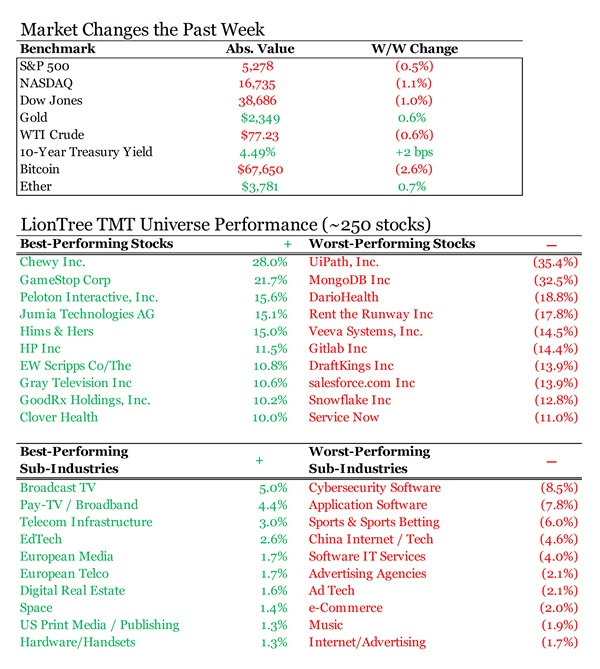
The 5-week streak for Nasdaq gains came to an end this week, with a -1.1% pullback (worse than the S&P 500’s -0.5% decline). Rate cut expectations continue to recede, and the market is now pricing in only ~30bp of cuts by the end of the year…
Today also marks month-end, as we continue to inch further towards the mid-way point of the year. So far YTD, the Nasdaq is up +11.5% and the S&P 500 is up +10.6%, while the Dow is lagging at up +2.6% (with most of the gains posting in Q1).
It is nice to have a respite from the barrage of earnings, but this week was still chocked up with some developments and updates that we thought were important to highlight.
See below for what we focused on in this edition (all are clickable links):
- States Are Starting To Vie For A Bigger Piece Of The Sports Betting Pie
- Never A Dull Moment In The Streaming Wars… Bundles, Bundles & More Bundles
- Retail Foot Traffic Is Set To Recover To Pre-Pandemic Levels By Q3 2024
- T-Mobile & Verizon Made A Couple Of Expansionary Moves This Week
- More Interactive Entertainment Content Becomes Widely Accessible
- Salesforce Suffers A Setback But Is Well-Positioned For AI Transformation
- Dentsu Tweaks Its Overall 2024 Ad Market Forecast… EMEA, US & Digital Revised Up
- Grab Bag: US Algorithm For TikTok / PayPal Ad Biz / Sony-Queen Catalogue Acquisition
Enjoy the weekend.
Best,
Leslie

States Are Starting To Vie For A Bigger Piece Of The Sports Betting Pie
It was a somber week for the sports betting industry, as officials in Illinois passed a fiscal 2025 budget bill (year starting July 1st) that includes a new, and first-of-its-kind, progressive sports betting tax rate for operators that will be as high as 40% vs the current 15% flat rate. The budget is awaiting sign-off from the Governor and then will go into effect. If signed into law, Illinois will become the first state to increase its sports betting tax rate since Ohio raised its rate from 10% to 20% last year, becoming the second highest in the nation only to New York’s 51% tax rate.
Revenue-wise, Illinois is one of the larger states for sports betting, so this change would not be immaterial and clearly would result in an increased tax burden, particularly for the large operators like DraftKings and Flutter (owns FanDuel). This news was not a complete surprise though, given that back in February, the governor proposed a 35% flat rate. Nonetheless, both stocks still took it on the chin in reaction to the update.
Looking ahead, Illinois’ decision does set a precedent for a new tax structure, and one would think that other states have taken notice. Also, the question remains about how much of the tax increase will just be passed onto consumers and how much can be offset by operators’ reducing expenses elsewhere.
See below for some more color…(link / link)
-> DraftKings down as much as -14% during trading Tuesday, while Flutter, owner of FanDuel, plunged -8%; ESPNBet operator Penn Entertainment saw its shares lose -6% Tuesday; Representatives from the three companies didn’t immediately respond to requests for comment
- What are the thresholds for the new progressive sports betting tax in Illinois if enacted? Sports betting operators will be taxed as follows, depending on their adj gross sports betting revenue totals –
- $0-30mn: 20%
- $30-50mn: 25%
- $50-100mn: 30%
- $100-200mn: 35%
- Over $200mn: 40%
- The tax rates apply separately to retail and online sportsbooks
- Timing: If the bill is signed by Governor Pritzker, the new rates will take effect on July 1
- Company impact:
- Only FanDuel and DraftKings would be subject to the highest tax rate of 40%, as their adj gross revenues exceed $200mn+
- BetRivers and Fanatics Sportsbook would see their tax rates increase to 30%
- Caesars, ESPN BET, and BetMGM would face a 25% tax rate
- What other states are considering tax changes?
- New Jersey and Massachusetts have also seen proposals to significantly increase their sports betting tax rates
Never A Dull Moment In The Streaming Wars… Bundles, Bundles & More Bundles
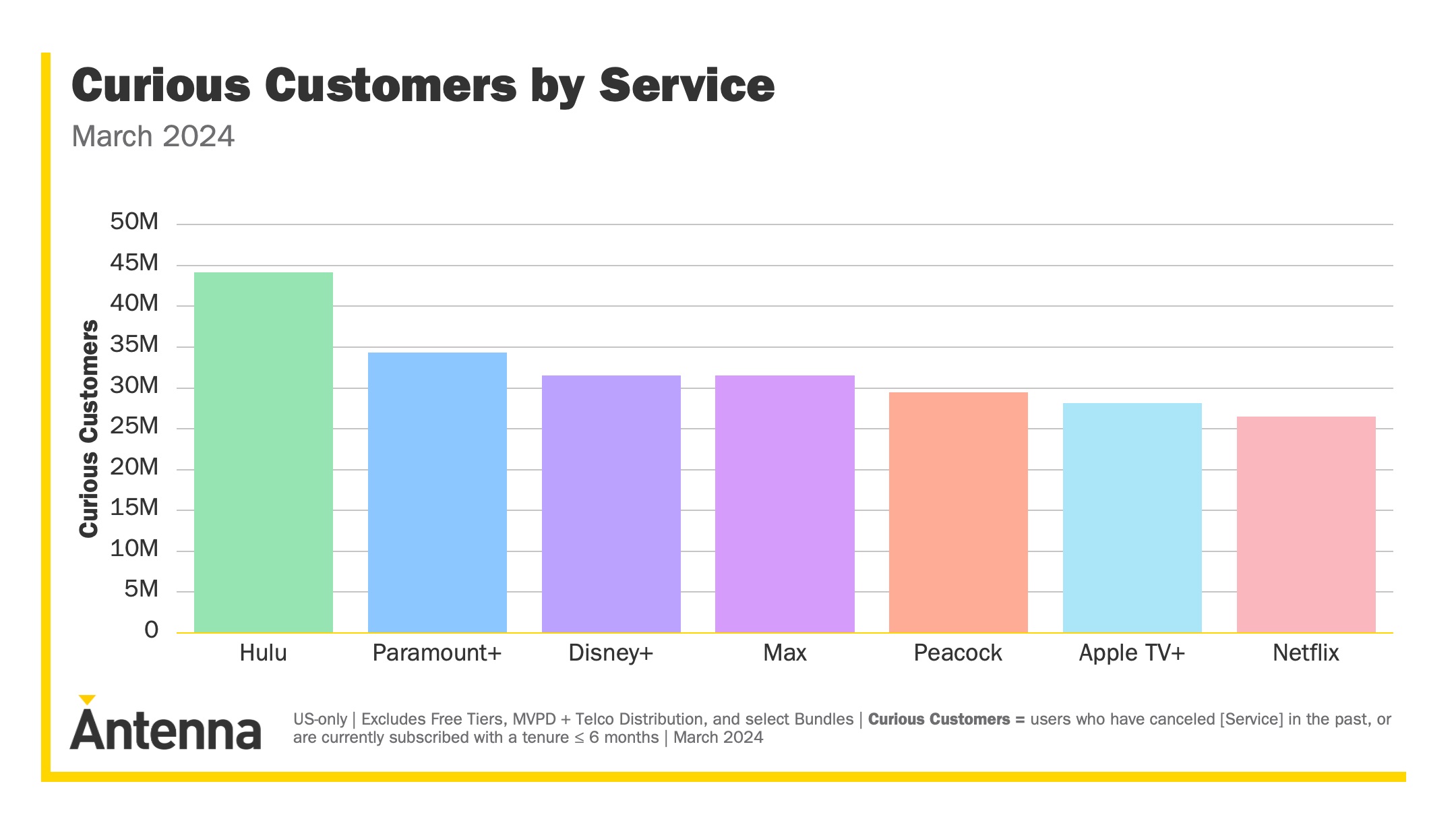
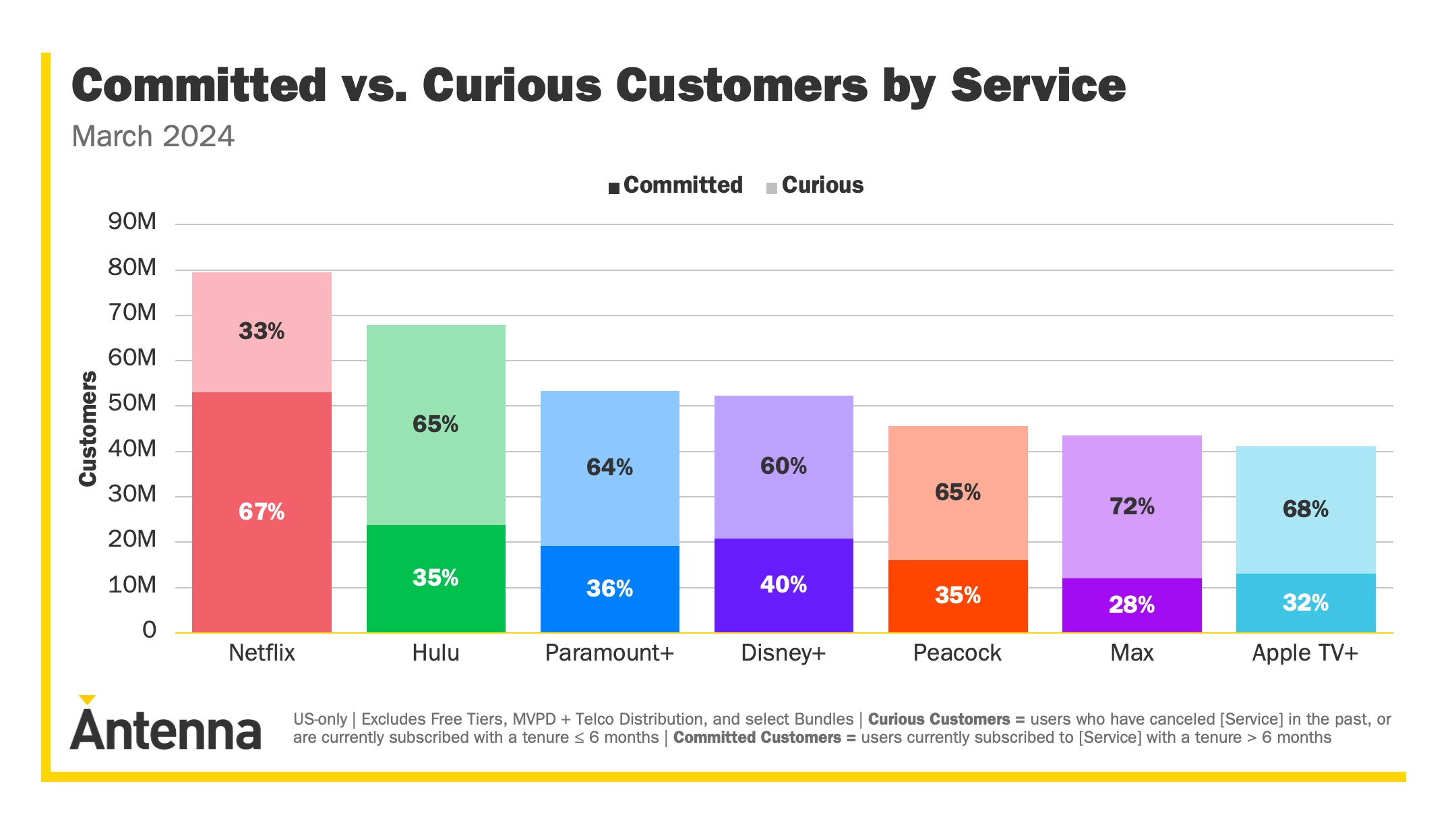
Which streamer is expected to see the most benefit from bundling? WBD’s Max. On the flip side, Netflix may be the most at risk of cannibalization through bundling. This is as per data from Antenna, which looked at the ratio of “Curious Customers” (viewers who have canceled a svs in the past or have been subscribed to a svs for <6 months) and “Committed Customers” (viewers who have been subscribers for 6+ months) to assess the potential impact from bundling.
This introduction of new bundles remains in full force, with Verizon announcing more services to its bundled offerings this week. Verizon is adding Comcast’s Peacock to its streaming subscription hub and plans to offer YouTube Premium at a discounted rate, adding onto existing options its offers with Netflix, Disney, WBD, Apple, Walmart, and more.
While bundling is the streamers’ latest strategy to attract new customers and mitigate churn, the password sharing crackdown which Netflix initiated two years ago has continued to spread across the industry, and this week YouTube TV reportedly has joined in. There were also some new stats out suggesting a potentially strong reception for the upcoming Disney-Fox-WBD sports JV, Venu Sports, as well as a price increase update from Philo.
See below for more.
Which Streamers Stand To Benefit The Most From All The Bundling Happening Across The Industry? WBD’s Max… Netflix Is More At Risk (Based On Data From Antenna)
- Hulu has the highest number of “Curious Customers” while Netflix has the least
Curious Customers are defined by Antenna as individuals who have canceled a service in the past, or are currently subscribed with a tenure of six months or less
- Netflix has the highest % of Committed Customers, while Max has the highest % of Curious Customers
- Committed Customers are defined by Antenna as subscribers who have a tenure longer than six months
- Services with a higher ratio of Curious Customers have a higher potential upside from using bundles: Bundles will motivate these Curious Customers to subscribe more loyally, with less risk of losing revenue from existing loyal subscribers “trading down” to a lower cost bundle
- The most productive bundles will pair svs with a strong overlap between Curious Customers: These Curious Customers have displayed a willingness to pay for each service, but not a high level of loyalty to them, so a discounted bundled offering has a large base of individuals who may be prompted to engage more loyally with both services together than they were with either service on a standalone basis
- Svs with a higher ratio of Committed Customers may see bundles represent more cannibalization risk, with less upside potential
- The least productive bundles maximize Committed Customer overlap: These Committed Customers have shown a willingness to pay for a given service, and a higher level of loyalty, so offering them a discounted bundle could be value-destructive
Verizon Introduces New Partnerships With YouTube and Peacock And Is Now “The Only Provider Offering Savings On 10 Of the Top Streaming And Content Services”
- Verizon adds Peacock to its streaming hub and offers the discounted YouTube Premium plan (link)
- Peacock is joining Verizon’s +play content hub, which will offer Peacock at its regular price, but with Verizon’s myPlan, customers can pay $10/mo for a $15/mo credit towards +play services, saving $5
- YouTube Premium has been added as one of its monthly myPlan perks, letting customers sign up to the service for $10/mo, which represents a 30% savings off the regular $13.99/mo price
- What other subscription add-ons are available through Verizon’s myPlan for $10/mo each?
- Apple One (Apple TV+, Apple Music, Apple Arcade and iCloud+)
- Apple Music Family
- Disney Bundle (Disney+, Hulu, ESPN+), which is currently being offered for free for 6 months
- Netflix & Max (with ads) bundle
- Walmart+ (which includes Paramount+)
- 100 GB/mo of mobile hotspot data
- +play monthly credit (spend $10 on the perk, get $15 to use toward subscriptions in the content hub)
- Three TravelPass Days
- Unlimited cloud storage
- What other subscription add-ons are available through Verizon’s myPlan for $10/mo each?
-> Verizon also annc’d a new Ultimate Phone Upgrade program option that will let Unlimited Ultimate customers get the “best” trade-in deals regardless of the condition of their phone; An Unlimited Ultimate plan costs from $100/mo for one line with no discounts to $55 per line each month if you have four lines and an auto-pay discount
Another Streamer Jumps Into The Password Sharing Crackdown…YouTube TV
It was back in May 2023 when Netflix kicked off the initiative to curb password sharing and to try to convert some of these consumers to paying users and it has proved to be quite successful in driving incremental growth. Disney is slated to launch its crackdown for its Disney+ service next month, while Warner Bros Discovery will start later in 2024, and now Google joins the bandwagon by reportedly starting its own crackdown for YouTube TV…all in all, while not all users will convert, this should bring in some incremental paying subscribers and hence, more revenue…
See below for more color:
- YouTube TV reportedly is locking some users out of accounts until they show a driver’s license (link): This is per Cord Cutters News citing reports from YouTubeTV subscribers that…
- They have been locked out of accounts that are shared with people that do not live with them (they can only share with 5 people that live at the same address)
- And that have been locked out until they prove their home address as they log in from different locations (ie traveling for example but YouTube says travelers should log in at least 1x every three months in their home area)
- YouTubeTV is reportedly getting more aggressive on these types of lock-outs and apparently the only way to get the account unlocked is to provide Google customer support with a driver’s license
- Netflix announced in March 2022 that it would be cracking down on password sharing, which the Co began implementing in May 2023
- Disney+/Hulu password sharing crackdown will start rolling out in June 2024 in “just a few countries in a few markets” before expanding to all subscribers in September
- Max announced its crackdown would begin rolling out in the later part of 2024 and into 2025
A Few Other Quick Hit Streaming Updates From This Week…
- In anticipation of the launch of Venu Sports in the fall, an early read from Horowitz Research into potential subscribers to the Disney, Fox, and WBD sport JV (link/link)
- Assuming a price point of $35-40 a month, 42% of 2,008 surveyed US adults who identified themselves as “sports viewers” said they’ll “likely” or “very likely” subscribe to Venu Sports
- 58% of viewers aged 18-34 said they are likely to subscribe
- 57% of viewers aged 35-49 said they were likely to subscribe
- 23% of viewers aged 50+ said they were likely to subscribe
- Among those sports fans likely to subscribe to Venu, 38% said they’d alter their other subscriptions
- Cancelling their virtual MVPD service is the most mentioned change these viewers would make
- Sports viewers also indicated that they may consider cancelling some of their other subscription streaming services and MVPD (traditional cable/satellite) service
- Assuming a price point of $35-40 a month, 42% of 2,008 surveyed US adults who identified themselves as “sports viewers” said they’ll “likely” or “very likely” subscribe to Venu Sports
- Philo raises its monthly price for the first time since 2021, but will add AMC+, and is expanding its FAST offering to non-subscribers (link)
- The monthly subscription price for Philo will increase from $25 to $28 per month beginning June 12, 2024
- Will impact new and returning customers but NOT existing customers
- Price increase will include an AMC+ subscription (normally $8.99/mo), which has been added to the Core package
- Cited an increase in contract fees with content partners as being behind the price change
- Will now also offer access to its FAST platform to non-subscribers, which includes 70+ live channels and gives viewers the ability to record content; Credit card details are not required, but viewers will have to sign up for an account
- The monthly subscription price for Philo will increase from $25 to $28 per month beginning June 12, 2024
Retail Foot Traffic Is Set To Recover To Pre-Pandemic Levels By Q3 2024
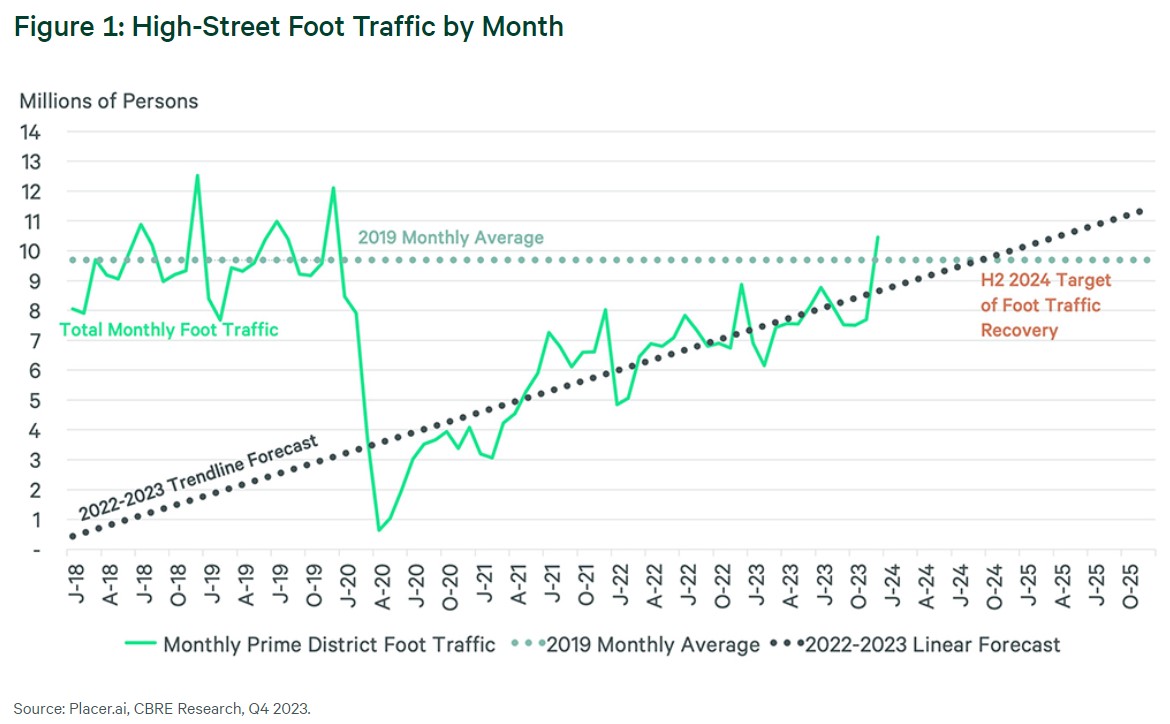
Post the dislocation during the pandemic, retail foot traffic has been making a comeback, and new estimates from the CBRE this week suggest that a full recovery to pre-pandemic levels will occur by Q3 this year. That said, finding economical retail space in prime locations is not an easy feat, and retailers are having to find alternate solutions given that an omni-channel presence is still the name of the game.
See our takeaways from the report below. (CBRE report/link/link)
- Retail foot traffic in prime areas is anticipated to surpass pre pandemic levels by 2025
- Last year, foot traffic in 10 prime retail areas had already reached 81% of 2019 levels
- CBRE projects full recovery of foot traffic in prime areas to pre-pandemic levels by Q3:24 and an increase beyond those levels by 2025
- Challenges exist to find economical retail space in prime locations given increase in rents: Retail rents in prime areas have risen since the pandemic lows, with an increase of +9% in the Americas and +5.8% globally since 2021
- Record-low availability and high rents are major challenges for retailers
- This situation forces retailers to adopt creative strategies to meet growth targets
- Alternative retail locations are gaining popularity: Due to space constraints in prime locations, retailers are considering multiple smaller locations in alternative districts which offer lower rents and fewer operational restrictions; This strategy aids in brand expansion and customer convenience for digital transactions
- Physical stores boost digital sales and the interconnectivity of offline & online: According to shopping center industry association ICSC, opening a physical store can increase a brand’s digital sales by nearly +7%, while closing a store can decrease them by -11.5%
- Brick-and-mortar stores remain crucial for driving online sales
- In-store sales accounted for 78% of retail growth in 2022 (vs 46% in 2019) per Forrester
- The synergy between online and offline sales is expected to continue
T-Mobile & Verizon Made A Couple Of Expansionary Moves This Week
In the connectivity space this week, Verizon and T-Mobile inked a couple of notable deals that were primarily concerned with expanding coverage. Following earlier reports of talks between the two, T-Mobile annc’d plans to acquire the majority of UScellular’s assets in a $4.4bn deal. For its part, Verizon signed a new partnership with AST SpaceMobile, a move that will provide Verizon’s customers with space-based connectivity in hard-to-reach parts of the country.
See below for details.
- T-Mobile plans to acquire most of UScellular in a $4.4bn deal (link/link): Specifically, T-Mobile is looking to acquire UScellular’s retail stores, some of its spectrum holdings, and its customers; The deal is expected to close in mid-2025
- The deal includes cash and up to $2bn in debt financing: Addt’ly, up to $100mn of the deal’s cash portion depends on certain financial and operating metrics being met between signing and closing
- T-Mobile will purchase ~30% of UScellular’s spectrum assets…: Improving T-Mobile’s rural coverage
- … And become a “strong anchor tenant” for UScellular for at least 15 yrs: UScellular will lease space to T-Mobile on at least 2,100 addt’l towers; T-Mobile will also be able to sign new long-term leases on at least 2,015 UScellular towers and extend existing leases on ~600 others
- Other players could carve up UScellular’s remaining spectrum (link): The WSJ reported earlier this month that UScellular was also in talks w/ Verizon but said that a separate transaction could take longer or fall through
- UScellular customers will get access to “better connectivity”: Upon deal closing, millions of UScellular customers will receive nationwide access to the internet using T-Mobile’s network and will no longer have to rely on roaming when outside of UScellular’s coverage
- UScellular customers have the option to stay w/ their current plans or switch to T-Mobile’s: In aggregate, this could save them “hundreds of millions of dollars”, per T-Mobile
-> UScellular shares rose +12.2% in response to the news and ended the week up +29.0%; YTD, UScellular stock is trading up +33.5%
- Verizon annc’d a new partnership w/ AST SpaceMobile (link/link): The partnership will see Verizon commit $100mn and will, in turn, provide Verizon customers w/ direct-to-cellular AST SpaceMobile svs when needed
- The partnership will enable Verizon to target “100% coverage” of the continental US: AST’s space-based connectivity will utilize 850 MHz bands to help Verizon eliminate dead zones and reach remote areas of the country
- A breakdown of Verizon’s $100mn commitment: Includes $65mn in the form of commercial svs prepayments and $35mn in debt via convertible notes; $45mn of the prepayments are conditional, requiring regulatory approvals and the signing of a definitive commercial agreement
- Verizon’s partnership’s w/ AST appears to be following a similar path as AT&T’s: AT&T was a co-debt investor in AST alongside Google and Vodafone in Jan; Then, the two established a commercial agreement earlier this month
- AT&T welcomes AST’s partnership w/ Verizon: In an interview w/ CNBC, AT&T Head of Network Chris Sambar said that “[it] reinforces the shared commitment to providing nationwide space-based broadband to everyday cell phones”
-> AST SpaceMobile shares jumped +69.2% on the back of the news, closing the week up +74.7%; YTD, AST SpaceMobile stock is trading up +37.3%
-> In addition to AT&T and Verizon’s partnership w/ AST, a variety of other major players have been making moves to capitalize on the direct-to-device (D2D) oppty as well; In 2022, T-Mobile partnered w/ SpaceX’s Starlink to provide coverage throughout the US (link), while Apple has been investing heavily to develop its Globalstar-supported “Emergency SOS w/ Satellite” svs, which was rolled out in iPhone 14 models (link)
More Interactive Entertainment Content Becomes Widely Accessible
Although delayed releases have been a common theme in the interactive entertainment industry as of late, it appears that some companies have responded to this trend by making existing content more accessible, namely, this week Microsoft made the decision to make Call of Duty: Black Ops 6 available on Xbox Game Pass upon release. Also, Big Tech continues to make some moves to expand interactive entertainment offerings and along those lines, YouTube’s Playables platform is being rolled out to all users on YouTube vs just only for paying subscribers…see more details below.
- Microsoft annc’d that Activision’s Call of Duty: Black Ops 6 will be on Xbox Game Pass at release (link): The title is the next installment in the popular franchise, and it is expected to be launched later this yr on Game Pass
- There were some concerns regarding the move: Including that Game Pass sales could potentially cannibalize traditional sales, which typically account for sales of 20mn+ copies, on avg, at ~$70 each; This led to some internal debates at Microsoft b/c it could undermine rev from traditional sales
- Other details are still somewhat murky (link): Including the exact timeframe that Microsoft plans to release Call of Duty: Black Ops 6 as well as whether or not the Co plans to increase the price of Game Pass again
- More info on what’s to come: Microsoft plans to host a special stream after its main Xbox summer showcase on June 9; The main showcase will also “feature a new Gears of War announcement, alongside the next Doom game”, as well as redates for other titles
- YouTube’s “Playables” games will become available to all users in coming weeks (link): Playables is an app store of free, lightweight games, and it is now rolling out to all users on YouTube after being launched exclusively for paying subscribers last Nov; The move stands to drive further competition in mobile gaming
- Details on accessibility: Users can find Playables in the Explore menu on YouTube’s home page, including on both desktop sites as well as via the iOS and Android versions of the app
- YouTube has released 75+ individual titles on Playables: Including Angry Birds, Showdown, Words of Wonders, Cut the Rope, Tomb of the Mask, and Trivia Crack
- Playables also has older games: One example is StackBounce, which originally premiered on Google’s initial HTML minigames svs, GameSnacks
Salesforce Suffers A Setback But Is Well-Positioned For AI Transformation
Earlier this week, Salesforce’s stock experienced its worst trading day in nearly 20 years after it reported a mixed FQ1 print alongside disappointing forward guidance. The company was buffeted by a “measured buying environment” that had shown signs of dissipating in FQ4 but resumed again in FQ1, evidenced by “elongated deal cycles, deal compression, and high levels of budget scrutiny” among customers. Nonetheless, Salesforce still has some irons in the fire that could potentially provide a strong foundation for future growth, including providing services around AI transformation, data management, and industries clouds. Changes to the company’s go-to-market strategy, which weighed on FQ1 results, should also help improve the long-term productivity of its own sales force.
See below for some key points that we wanted to flag regarding Salesforce’s FQ1 print:
-> Salesforce shares dropped -19.7% in reaction to earnings but recovered some losses to finish the week down -13.9%; YTD, Salesforce stock is trading down -10.9%
FQ1 Represented Another Qtr Of “Cont’d Discipline And Transformation” For Salesforce
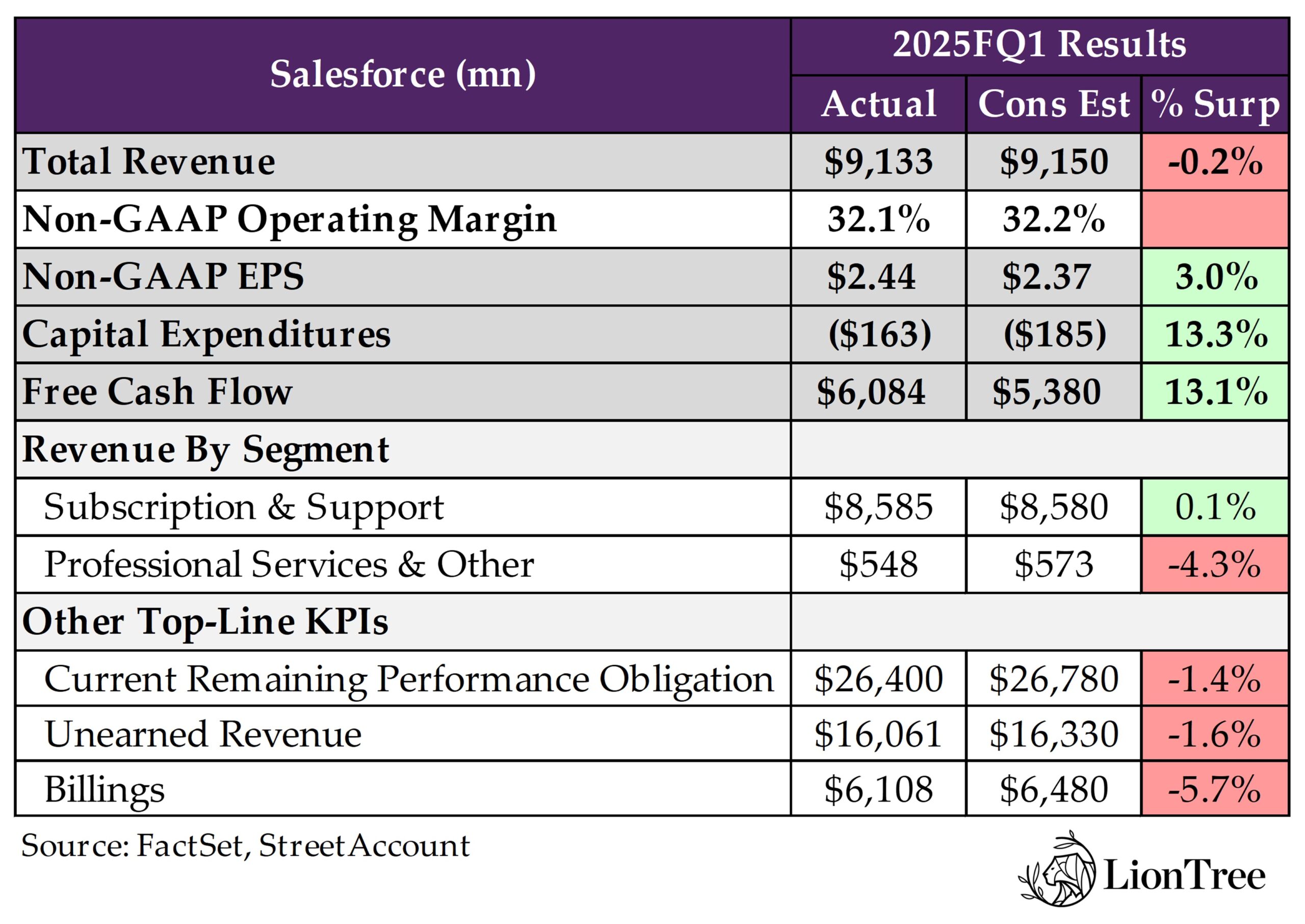
- Headline metrics were mixed, w/ top-line and op margin both missing estimates: FQ1 total rev grew +10.7% y/y (vs +10.8% y/y in FQ4), closing -0.2% short of cons; Non-GAAP op margin of 32.1% was below cons 32.2%, though non-GAAP EPS beat by +3.0%; FCF topped cons by +13.1%
- Other forward-looking top-line KPIs were underwhelming:
- Current Remaining Performance Obligation missed by -1.4%: Incr’d +9.5% y/y in FQ1 (vs +12.2% y/y in FQ4); Includes a -$200mn FX headwind
- Unearned Rev missed by -1.6%: Finished FQ1 up +6.2% y/y (vs +9.4% at the end of FQ4)
- Billings missed by -5.7%: Grew +2.9% y/y in FQ1 (vs +7.9% y/y in FQ4)
- Other forward-looking top-line KPIs were underwhelming:
Despite A Lower Than Projected FQ2 CRPO Guide, There Is Still Confidence In The Full-Yr Outlook
- FQ2 guidance broadly disappointed expectations: Forecasts FQ2 total rev between $9.20-9.25bn, missing cons by -1.3% at the mid-pt, as well as non-GAAP EPS range of $2.34-2.36, which was -2.1% below cons at the mid-pt
- CRPO growth is expected to slow slightly seq: FQ2 CRPO is projected to rise +9% y/y, including another $200mn FX headwind
- The FY25 non-GAAP EPS outlook was revised upwards: Reaffirmed FY25 rev between $37.7-38.0bn, which was -0.5% below cons at the mid-pt, and now anticipates a non-GAAP EPS between $9.86-$9.94 (vs prior range of $9.68-9.76), beating cons by +1.0% at the mid-pt
Cont’d “Measured Buyer Behavior” Was Reflected In “Moderated” FQ1 Bookings
- Several factors pointed to the “measured buying environment” during the qtr: The Co saw “stronger bookings” in FQ4, but “momentum moderated” in FQ1, as Salesforce faced “elongated deal cycles, deal compression, and high levels of budget scrutiny” from customers
- Intentional changes in Salesforce’s go-to-mkt strategy also contributed to “softer bookings”: These are aligned w/ the “typical” changes that the Co makes in FQ1 each yr and are intended to “drive long-term productivity and create better customer experiences”
- Salesforce’s growth was “constrained” in the US, EMEA, and parts of LatAm: Americas rev was up +11% y/y in FQ1 (vs +9% y/y in FQ4), while EMEA ex-FX rev grew +9% y/y (vs +11% y/y in FQ4) and APAC ex-FX rev incr’d +21% y/y (vs +19% y/y in FQ4)
- The Americas remained a “tough industry”: Cautiousness from buyers was worsened by the country’s higher exposure to tech; Still, Canada was flagged as a “strong region”
- “EMEA was weaker during the qtr”: Indicated that the “measured buying environment” was “most profoundly” felt in Europe
- There was “particular strength” in Japan: The Co’s Japan biz “really accel’d during the qtr” and posted a “really strong performance”, w/ key wins at Seibu Prince Hotels Worldwide and Hitachi
- The Co is still seeing “strong momentum” across various parts of its biz: Highlighted “strong demand” for Data Cloud and multi-cloud deals, in particular
- 6 of Salesforce’s top 10 deals included 6+ clouds: The Co’s multi-cloud biz has been seeing benefits from recent pricing and packaging changes
- Data Cloud have been seeing “incredible momentum”: The segment is Salesforce’s “fastest-growing organic” one as well as its next billion-dollar cloud; 8tn+ records were ingested in the Data Cloud and 2+ quadrillion records were processed, +42% and +217% respective y/y increases
- Adoption of Salesforce’s industries projects has been “very healthy”: Half of the Co’s top 10 deals included industry clouds during the qtr
- Attrition rates have been “very healthy”: FQ1 rev attrition ended at ~8%, which was in-line w/ previous qtrs; Customers are still relying on Salesforce to run their bizs; Is expected to remain “slightly above” 8% for the full yr
AI Transformation Continues To Be An Exciting Oppty For Salesforce
- “Every Co in the world, across every industry, is being transformed by AI in the next few yrs”: The Co has been seeing “good demand” for AI-driven transformations and believes its customer data mgmt capabilities will provide it w/ a competitive advantage in this transition
- “Models and UI are not the critical success factors” for enterprises: Instead, “the one thing that every enterprise needs to make AI work is their customer data”; As the number one CRM provider, Salesforce is now managing 250+ petabytes of data for its customers
- “75% of the value of GenAI use cases is in the front-office”: Per McKinsey data cited by Salesforce, which stands to uniquely benefit from this trend as its position as the “leader in front-office software”
Salesforce Is “Going To Continue To Look At [M&A] Oppties” Moving Forward
- The Co is “not going to shy away from M&A… if its within [its] framework”: Conversely, Salesforce will be “extremely cautious” if a potential target is outside of its framework; The Co “need[s] to prioritize [its] use of the balance sheet, and it’s got to be a best-in-class asset”
Dentsu Tweaks Its Overall 2024 Ad Market Forecast… EMEA, US & Digital Revised Up
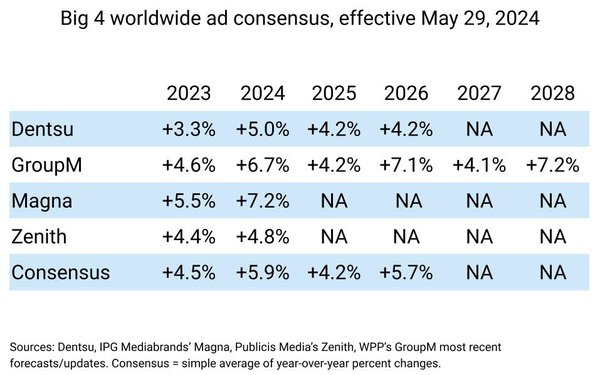
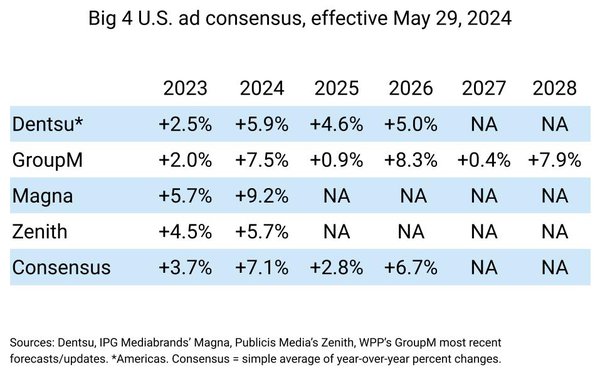
Given a faster start to the year regarding ad revenue growth and the expectation for momentum to continue in H2 with major sporting events and the political calendar, Dentsu tweaked up ad growth forecasts for 2024 and provided a detailed mid-year update. See below for our key takeaways and a handy chart on ad revenue estimates across the key global agencies …(link to download the detailed report / (link)
Dentsu Ad Forecasts & Changes
- Raised 2024 global ad growth forecast from +4.6% y/y to +0%, vs +3.3% in 2023
- Improved spending in the UK, Germany, US, Japan, and France
- Fastest pace is predicted in the Americas (+5.9% growth, 46.8% share of global spend), followed by Asia-Pacific (+4.2%, 31.3%) and Europe, Middle East, and Africa (+4.0%, 21.9%)
- 2024 drivers: The US presidential election alone is forecast to account for ~ 1/3 ($11bn) of the 2024 incremental ad spend; The Paris Olympics and Paralympics will also boost ad investments
- Digital ad spend is beating previous growth expectations / Raised forecasts by ~ one % point to +7.4% y/y to capture 59.6% of global spend in 2024: Double-digit growth expected for retail media (+32% y/y) and paid social, whilst paid search remains a major spend driver
- Programmatic digital spend consolidates its position as preferred choice for transacting media, rising at a forecasted 10.9% in 2024 and reaching the equivalent of three times nonprogrammatic digital spend in volume
- TV ad spend is forecast to rise by +2.6% y/y to reach $170bn in 2024: Growth in connected TV (+24.2%) is offsetting linear weakness
- Growth is expected to slow in 2025 with tough comps but remain ahead of economic growth: Expect +4.2% y/y growth in 2025 (vs world economy forecasts at +3.2%) and a consistent with +4.2% in 2026
Grab Bag: US Algorithm For TikTok / PayPal Ad Biz / Sony-Queen Catalogue Acquisition
- TikTok is reportedly prepping a US version of its algorithm (though TikTok denies it) (link/link)
- According to Reuters, TikTok is working on a clone of its recommendation algorithm that may result in a version that operates independently of its Chinese parent, citing sources with direct knowledge of the efforts
- Per the report, ByteDance started working on splitting the source code late last year, before the “divest or ban” bill was signed into law in April
- Once the code is split (a project which could take over a year to complete), it could lay the groundwork for a divestiture of the US assets, although there are no current plans to do so
- TikTok declined the report, saying “The Reuters story published today is misleading and factually inaccurate” and reiterated that “the ‘qualified divestiture’ demanded by the Act to allow TikTok to continue operating in the United States is simply not possible: not commercially, not technologically, not legally. And certainly not on the 270-day timeline required by the Act”
- Reuters responded saying “we stand by our reporting”
- According to Reuters, TikTok is working on a clone of its recommendation algorithm that may result in a version that operates independently of its Chinese parent, citing sources with direct knowledge of the efforts
- Another player jumps into retail media – PayPal planning to launch an ad business using customer data (link/link): Will create an ad network that allows merchants and brands to target PayPal’s ~400mn users with personalized promotions and ads based on their transaction histories
- Hired former Uber ad exec to lead the newly-created PayPal Ads division: Mark Grether will lead the effort as senior vice president and general manager and will be responsible for developing new ad formats, overseeing sales, and hiring staff to fill out the division
- Will collect data from customers by default, while also offering the ability to opt out: Will receive shopping data from customers using its credit cards in stores, as well as PayPal and Venmo
- What kind of data will PayPal collect? Per a PayPal spokesperson, the advertising platform is still in “early stages” and the Co doesn’t have “definitive answers” yet but “alongside the advertising business, PayPal will build transparent, easy-to-use privacy controls”
- PayPal already offers an “Advanced Offers” ad product that uses AI to serve PayPal users with targeted discounts from merchants whenever they make a purchase
- Plan to expand this to sell ads to brands outside of its merchant network that could be displayed across the web and CTV
- PayPal is not the only Co selling ads based on transaction data:
- Facebook gets information about users from thousands of different companies, including retailers like Walmart and Amazon (link)
- JPMorgan Chase announced that it’s creating an ad network based on customer spending data (see Theme #9 from 5/17/24 Weekly)
- Visa is rolling out new technology that will allow it to share more information about customers’ preferences based on their shopping history with retailers (link)
- Sony reportedly in talks to buy Queen’s music catalog in potential $1bn deal (link/link/link/link/link): Sony is said to be working with another investor on the transaction that would be the largest sale of its kind and include recorded music and publishing as well as other income, including merchandise and licensing and revenue from the biopic film Bohemian Rhapsody
- Current shareholders: Brian May, Roger Taylor, John Deacon, and the estate of Freddie Mercury are equal shareholders in Queen Productions Ltd., which produced revenue of £40.9mn ($52mn) for the year ended Sept 30, 2022, according to the latest available filings
- Queen has been shopping its music catalogue around for more than a year and had held talks with Sony Music and Universal Music, according to people familiar with the matter; Sony was still among the bidders, while Universal had let an exclusivity period on negotiations expire because the price the band wanted was too high
- Talks are still early: Negotiations “are ongoing and may not result in an agreement”
- If the deal goes through, it will be the biggest acquisition for a single artist’s catalog
- Deal would add to Sony’s portfolio of catalogs: Earlier this year, Sony acquired a half interest in Michael Jackson’s music catalog from the singer’s estate for at least $600mn, Billboard reported; Sony Music also acquired Bruce Springsteen’s recording and publishing rights for $550mn in December 2021, as well as Bob Dylan’s recorded music catalog for an estimated $200mn in January 2022
Stock Market Check
This Week's Other Curated News
Advertising/Ad Agencies/Ad Tech
- A new study from FreeWheel, Comcast’s ad-tech unit, found that it’s not commercials that viewers dislike. Rather, it’s the way ads are handled that hurts their experience. Latency, unnatural ad breaks, and the appearance of ad slates tend to turn viewers off, the study found. Those problems tend to crop up on CTV platforms when automatic systems don’t perform the way they ought to. (Broadcasting Cable)
- Connected TV is becoming a bigger deal for consumers and advertisers, per TVision. According to the Co’s Q1 2024 State of CTV Advertising Report, the attention paid to CTV advertising rose from the end of last yr. Overall CTV ad attention rose to 51.5% from 49.2% in Q4 2023, but attention paid to ads in premium CTV jumped to 56.1% from 51.7%. That makes attention to premium CTV higher than attention to linear ads. (Broadcasting Cable)
- Google’s search algorithm is perhaps the most consequential system on the internet, but now, an explosive leak purports to show thousands of pages of internal documents that offer an unprecedented look under the hood of how Search works. The leak also suggests that Google hasn’t been entirely truthful about it for yrs. So far, Google hasn’t responded to multiple requests for comment on the legitimacy of the documents. (The Verge)
- Over the past two years, Snap has improved its ad business with key updates. Enhanced ad formats and a streamlined app download process on iOS reduce costs and boost ROI. Value Optimization bidding and 7/0 delivery optimization improved click-through conversions by over 75% YOY. New CRM partnerships and tools enhance lead generation, while a Landing Page View optimization goal lowers web ad costs by 60%. The updated Conversions API (CAPI) v3 ensures better, privacy-safe data collection. (SNAPCHAT)
Artificial Intelligence/Machine Learning
- AI homework apps like Answer AI are revolutionizing education, offering affordable, personalized learning solutions. These apps, leveraging AI models like ChatGPT, dominate the U.S. App Store’s top education slots. They provide equitable access and foster deeper learning, although they still make mistakes and can’t fully replace human educators. Chinese-owned apps like Question AI and Gauth lead the U.S. market, overcoming cultural barriers with advanced AI. (TechCrunch)
- Elon Musk’s AI startup xAI raised $6bn in series B funding, reaching a post-money valuation of $24bn as investors bet big on challengers to cos like OpenAI in the intensifying AI race. The funding round was backed by investors including Andreessen Horowitz and Sequoia Capital, the co said in a blog post on Sunday. The money will be used to take xAI’s first products to market, build advanced infrastructure and accelerate research and development of future technologies, xAI said. (CNBC)
- Google published a long response about AI Overviews and their accuracy. The Search feature launched at I/O 2024 in the US and has been criticized for some high-profile mistakes. Google starts by explaining how AI Overviews operate, including how they “work very differently than chatbots and other LLM products.” In particular, AI Overviews are “backed up by top web results,” unlike the broader LLM hallucination problem. (9to5Google)
- In 2017, venture capitalist Kai-Fu Lee predicted AI’s disruptive potential, foreseeing it surpassing previous tech revolutions and replacing 50% of jobs within ten years. By 2024, he asserted his prediction’s accuracy, noting AI’s rapid adoption. He emphasized AI will likely replace white-collar jobs first, urging the use of AI tools like ChatGPT in education and careers. Lee highlighted the enduring human qualities of empathy and trust, which AI cannot replicate, stressing their importance in future job markets. (Yahoo Finance)
- OpenAI annc’d pacts w/ Vox Media and The Atlantic to license their content for the ChatGPT AI chatbot. Under the deals, the Cos also will work w/ OpenAI on a range of product-development initiatives. Financial terms of OpenAI’s deals w/ Vox Media and The Atlantic weren’t disclosed. In recent months, OpenAI has struck similar deals w/ Cos including News Corp, Dotdash Meredith, the Financial Times, and Reddit. (Variety)
- OpenAI CEO Sam Altman has consolidated his grip on power at the Co that briefly ousted him last fall by striking a deal w/ Apple to incorporate AI into its products, per a report. Altman has pushed out his rivals from the Co’s board and is moving full steam ahead w/ plans to overhaul its nonprofit structure. Altman is also partnering w/ former Apple designer Jony Ive on a personal device that would be powered by AI. (New York Post)
- OpenAI is making a big move back into robotics and is looking to hire research engineers to build a new robotics team. The Co had shut down its previous robotics unit in 2020 but is now ready to dive back in. The job listings of the Co show that new hires will be among the first members of this new team, highlighting the early stage of this project. (India Today)
- Scale AI published the results of its first-ever SEAL Leaderboards. It’s a new ranking system for frontier large language models based on private, curated, and unexploitable datasets that attempts to rate their capabilities in common use cases. The SEAL Leaderboards show OpenAI’s GPT family of LLMs ranks first in three of the four initial domains, followed by Anthropic PBC’s popular Claude 3 Opus. (SiliconANGLE)
- The Army has awarded Palantir a $480mn deal to support its Maven Smart System prototype, the Pentagon annc’d. The US military has recently been using this type of AI tech in the Central Command area of responsibility in the Middle East. The Maven Smart System uses AI generated algorithms and memory learning capabilities to scan and identify enemy systems in the Area of Responsibility. (FedScoop)
Audio/Music/Podcast
- Spotify has hiked the price for its premium subscription in France by €0.13 in response to a music-streaming levy imposed by the govt at the start of the yr. At €11.12/mo for an individual subscription plan, the new price is 1.2% higher than the previous amount, the same as the 1.2% levy that France imposed on music-streaming cos including Deezer, Apple, Google and Spotify starting from Jan. 1 this yr. (TechCrunch)
Broader Technology
- Google, Amazon, and Airbnb won the backing of Europe’s top court in their fight against an Italian rule requiring them to provide information on themselves. The Cos had challenged the requirement, saying it was contrary to EU legislation which says online svs providers are only subject to the rules of the country where they are established, while countries where they provide a svs must refrain from applying their laws. (Yahoo Finance)
Cable/Pay-TV/Wireless
- Bouygues Telecom has issued an update on the progress of its acquisition of MVNO La Poste Telecom, owned by the La Poste group w/ 51% stake and SFR w/ 49% stake. Following a press release dated 22 Feb. 2024 announcing the exclusivity agreement w/ La Poste group, Bouygues Telecom states that it has been informed by SFR and La Poste of differences between them regarding the terms and conditions of the transaction. According to Bouygues Telecom, this could lead to delays in completion of the transaction. (THEFASTMODE)
- Comcast’s and Charter’s Xumo TV is getting a new user interface. “Xumo’s goal is to make TV easy with a smart, intuitive user experience. It’s w/ this in mind that we are rolling out thoughtfully designed updates to the Xumo TV user interface to get customers to the programs they love faster, while also making it easier for them to discover something new to watch.” Xumo TV said on its website. (Cord Cutters News)
- Cord cutting has been growing quickly and now, according to a new annual report from the Michigan Public Service Commission, there are only 1.29mn households in Michigan that still pay for cable TV. That works out to be just 31.54% of Michigan households are still paying for cable TV at the end of 2024. Of the more than 4mn Michigan households, 2.799mn do not pay for a cable TV service from Comcast, Spectrum, or similar company. (Cord Cutters News)
- Orange annc’d a merger between Orange Romania SA (ORO) and Orange Romania Communications (OROC), through the absorption of OROC by ORO. The merger enables the creation of an integrated converged telecommunications operator, starting June 1, 2024. This move will further Orange’s objective of becoming the preferred provider of fixed-mobile integrated svs on the Romanian mkt, both for the residential and biz segments. (THEFASTMODE)
- VEON announced that it has signed an agreement for the sale of its 49% stake in Kazakh wholesale telecommunications infrastructure services provider TNS Plus LLP (TNS) to its JV partner, the DAR Group of Cos. TNS provides a wide range of telecommunication svs in voice, internet access, data transmission, transparent digital channels, IP VPN, IPLS to commercial telecommunications operators, and corporate clients on the enterprise segment. The total consideration for the sale is USD 137.5 mn. (THEFASTMODE)
Cloud/DataCenters/IT Infrastructure
- A consortium of US investment firm KKR and Singapore Telecommunications has emerged as the frontrunner to buy a minority stake worth $1bn in one of Asia’s biggest data centre providers, two sources said. The KKR-SingTel consortium is competing w/ Stonepeak for the stake of up to 20%, one of the sources said. A deal could be sealed or announced in early June, the first source added. (Yahoo Finance)
Crypto/Blockchain/web3/NFTs
- PayPal’s PYUSD is now available on the Solana blockchain in a move that the Co says will make its stablecoin faster and cheaper to use. PayPal launched PYUSD on the Ethereum blockchain nearly a yr ago but is now adding Solana as an option, providing users w/ flexibility and control. In addition to the PayPal and Venmo wallets, people can buy PYUSD on Solana via Crypto.com, Phantom, and Paxos. (Finextra Research)
Cybersecurity/Security
- The EU’s top cybersecurity official has said there has been a “significant increase” in disruptive cyber attacks, many of which can be traced to Russia-backed groups, in recent months. “The number of hacktivist attacks (against) European infrastructure, threat actors whose main aim is to cause disruption, has doubled from the Q4 of 2023 to the Q1 of 2024,” said Juhan Lepassaar, head of the EU Agency for Cybersecurity. (Yahoo News)
- The European Union’s justice and police agencies have taken down computer networks responsible for spreading ransomware via infected emails. This has been dubbed the biggest-ever international operation against the lucrative form of cybercrime. The EU’s judicial cooperation agency, Eurojust, said that police arrested four “high value” suspects, took down 100+ servers, and seized control of 2,000+ internet domains. (ABC News)
- The LexisNexis® Risk Solutions Cybercrime Report for 2023, based on 92 billion transactions, shows a 19% y/y increase in global human-initiated digital attacks, particularly in North America and ecommerce. The volume of human-initiated attacks surged 80% y/y, with an attack rate of 2.8%, driven by a 119% YOY rise in account takeover attempts at login. Human-initiated attacks grew 40% in volume to 1.3bn, while bot attacks remained steady at 3.6bn. (PRNEWSWIRE)
- The ShinyHunters hacking group claims to have hacked Ticketmaster and Live Nation, offering data of 560 million customers for $500,000 on a hacking forum. The data includes hashed credit card numbers, expiration dates, customer names, addresses, and emails. A second hacker has posted identical claims. ShinyHunters, known for past breaches, attempted to contact Ticketmaster without success. The legitimacy of the breach is under scrutiny, with experts urging caution. (CYBERDAILY)
- Windstream had numerous subscribers report that their routers had suddenly stopped functioning in Oct 2023. Lumen Technologies’ Black Lotus Labs recently published a report shedding new light on the incident. Their investigation revealed that malware had taken out 600,000+ routers in a 72-hour period starting on Oct 25. The routers were compromised by a threat actor using Chalubo, a type of commodity malware. (Tech Times)
eCommerce/Social Commerce/Retail
- Amazon Fresh is set to scrap its direct grocery delivery svs across five UK cities at the start of June. The Co told shoppers it would end its Amazon Fresh offer in Portsmouth, Glasgow, Sheffield, Leeds, and Newcastle at the beginning of next month. Instead, Amazon is now focusing on perishable grocery delivery offerings w/ its partner grocers, an Amazon spokesman said. (Retail Gazette)
- Costco posted another bulk-sized qtr as consumers look for wallet-friendly prices on everyday essentials. The Co reported net sales of $58.52bn, compared to estimates of $57.98bn. Its adj EPS of $3.78 also beat estimates of $3.70. “We’re definitely winning in consumables, as we see the food business and dining away from home has softened up a bit,” CEO Ron Vachris said on a call w/ investors. (Yahoo Finance)
- Kohl’s shares plummeted more than 20% on May 30 after the Co posted a surprise loss per share, coming in well below Wall Street’s expectations for a slight profit. Kohl’s reported a net loss of $27mn, or a loss of 24 cents per share, for the Q1 compared to a yr-ago profit of $14mn, or 13 cents per share. In an interview with CNBC, CEO Tom Kingsbury chalked up slower sales to tough comparisons. (CNBC)
- Walgreens became the latest retailer to try to lure customers w/ new deals, slashing prices on 1,500 items. The cuts will impact everything from snacks to toiletries and even Squishmallows, as it follows the lead of other major brands that have reduced prices in recent days. Brand-name and store-brand products, including Walgreens’ health and wellness, personal care and seasonal lines, are also included in the price cuts. (The Independent)
EV/ Autonomous Vehicles
- Americans still prefer to buy a standard gas vehicle over a hybrid or an electric vehicle even w/ the same price and features, a KPMG study said. Only one-fifth of people surveyed said they would purchase an EV over a gas-powered vehicle or hybrid vehicle. The show of preference comes amid a global slowdown in demand for electric vehicles, resulting in global automakers rethinking their EV plans. (HT Auto)
FinTech/InsurTech/Payments
- Mastercard is launching a peer-to-peer network for sending and receiving digital assets across borders. The P2P network, called Mastercard Crypto Credential, will serve users in Europe and LatAm. Users of the P2P network will be able to use Mastercard Crypto Credential aliases for their transactions. The aliases, which are short-hand labels for crypto wallets, are vanity addresses much like those offered by the Ethereum Name Service (ENS) on the Ethereum network. (AICoin)
Last Mile Transportation/Delivery
- Amazon shoppers can now order restaurant delivery from Grubhub without leaving the Amazon app. Customers can access Grubhub via Amazon.com and the Amazon Shopping app under a header labeled “Grocery and Dining.” They’ll order within Amazon, but the process will otherwise mirror the Grubhub app experience. For restaurants, orders will appear like any other Grubhub order and continue to be fulfilled by Grubhub couriers. (Restaurant Business)
- Amazon’s Prime Air drone program has been cleared by US regulators to fly devices beyond the visual line of sight of pilots, increasing range and giving more customers access to the svs. The approval, which means pilots won’t need to be able to see the drones w/ their own eyes, will allow Prime Air to scale deliveries in the US. The Co will expand the area it svs w/ unmanned aerial vehicles in College Station, TX this yr. (Yahoo Finance)
- Didi Global net loss grew in the March qtr, after climbing mkting costs and losses on its stake in EV-maker XPeng outweighed a rev boost. The Co’s net loss grew to 1.35bn yuan ($186mn) in the first three months of the yr, reversing two straight qtrs of profitability, despite a 15% rise in sales. Didi’s net loss was 1.16bn yuan a yr ago. Didi’s results come as the Co undergoes a major transition at the top. (Yahoo Finance)
Macro Updates
- Contract signings for US home purchases fell by the most in three years in April, and the overall level of activity was the lowest since the onset of the COVID-19 pandemic in the spring of 2020, as high interest rates keep a lid on the housing market, the National Association of Realtors said. The NAR said its pending home sales index fell 7.7% in April to 72.3 from an upwardly revised 78.3 reading in March. (Yahoo Finance)
Metaverse/AR & VR
- Google and augmented reality startup Magic Leap are forming a strategic tech partnership and working on building immersive experiences that blend the physical and digital worlds. While short on details, the announcement adds to signals that Google may be plotting a return to the market for augmented and virtual reality (AR/VR) technologies that it so far has largely yielded to rivals Meta and Apple. (CNBC)
Satellite/Space
- Satellite operator SES has launched the SES Open Orbit Inflight Connectivity (IFC) Network which will deliver connectivity services to airlines globally. The Ka-band platform will combine the geostationary earth orbit and medium earth orbit (MEO) satellite networks of SES, including NEO Space Group, AeroSat Link and Hughes Communications India. SES Open Orbit aims to enable satellite operators w/ regional satellite coverage to be able to participate in a worldwide IFC svs offering to airlines, says the co. It will use multi-orbit and multi-waveform capacity offered by regional connectivity svs partners and SES to deliver svs. (Digital TV Europe)
Social/Digital Media
- Fidelity’s Blue Chip Growth Fund raised the value of its position in Elon Musk’s X by 4. 4% in April. Fidelity, which gained its stake by helping Musk complete his $44bn purchase of what was then known as Twitter, valued its position at $5.51mn as of April 30. That was up from $5.28mn at the end of March. The Fidelity fund’s monthly accounting of its stake is the best publicly available indication of X’s value. (Yahoo Finance)
- Instagram said it is expanding the scope of its “Limits” tool specifically for teenagers that would let them restrict unwanted interactions w/ people in a bid to combat harassment on its platform. Once they turn the feature on, teens will only be able to see comments, messages, story replies, tags, and mentions from their “Close Friends” group, and interactions from other accounts will be muted. (TechCrunch)
- Tiktok said it would let federal officials pick its US operation’s board of directors, give the govt veto power over each new hire, and pay an American Co that contracts w/ the Defense Department to monitor its source code, per a copy of the Co’s proposal. It even offered to give officials a kill switch that would shut the app down in the US if they felt it remained a threat. However, officials have declined the proposal. (ResetEra)
- YouTube has launched a far more aggressive effort to stop ad blockers. YouTube has started muting audio and skipping to the end of videos for customers who use ad blockers, per a post on Reddit. This move to fight ad blockers comes from many factors, but Google may be looking at the need to combat dropping ad revs. This battle has been going back and forth since YouTube started to crack down on users who use ad blockers. (Cord Cutters News)
Software
- MongoDB stock sank as much as 26% in extended trading on May 30 after the Co issued light guidance for the qtr and reduced its forecast for the full fiscal yr. MongoDB’s rev grew 22% y/y in FQ1, which ended on Apr 30. Growth slowed for the third consecutive qtr. It was 57% two years ago. The Co had a net loss of $80.6mn, or $1.10 per share, compared w/ a net loss of $54.2mn, or 77 cents per share, in the yr-ago qtr. (CNBC)
- Salesforce bought Spiff several months ago to help Cos build out and manage incentive-based compensation schemes. Salesforce’s 10-Q filing w/ the SEC finally revealed the price it paid: $419mn all-in, including $374mn in cash. The $419mn price tag is a notable hike for Spiff, which was last valued, according to PitchBook, at $260mn as recently as May 2023 when it raised $50mn. (TechCrunch)
Sports/Sports Betting
- ITV will deliver free-to-air coverage of select games from the top-level football competitions Carabao Cup and Championship in a new deal w/ Sky Sports. Starting from Jan 2025, ITV will jointly broadcast a select number of matches also available on Sky Sports. The PSB will screen at least nine Carabao Cup matches in total for each full season. (Digital TV Europe)
- SponsorUnited’s 2022-2023 NBA Marketing Partnerships Report highlights significant growth in NBA sponsorships, with team sponsorship revenue reaching a record $1. 4bn, up over $100mn from last season. Key growth categories include Finance, Retail, Sports Betting, and Gambling & Lottery. NBA athletes outshine others on social media, with playoff teams seeing a 33% higher follower increase. YouTube sponsorship asset usage rose the most year-over-year. Over 300 brands focused on social responsibility, driving a 25% surge in purpose-driven sponsorships. (PRNEWSWIRE)
- The Wimbledon tennis tournament will remain on Warner Bros Discovery’s channels and platforms in 11 markets in Europe through a new long-term rights agreement with The All England Lawn Tennis Club. The broadcast partnership means Wimbledon will continue to be shown on Eurosport in Belgium, Bulgaria, Czech Republic, Finland, Hungary, Iceland, Netherlands, Norway, Romania, Slovakia and Sweden with streaming of every match on Max, WBD’s new enhanced streaming service, in selected markets. (ADVANCED-TELEVISION)
Tech Hardware
- Apple’s iPhone shipments to China surged 52% in April, following a 12% increase in March, driven by regional discounts to compete with domestic brands like Huawei. Despite prior slow demand, these discounts have bolstered sales. Apple aims to sustain this growth with new price cuts and the upcoming iPhone 16 launch. (Yahoo Finance)
- Arm annc’d its next-gen CPU and GPU designs for flagship smartphones: the Cortex-X925 CPU and Immortalis G925 GPU. Both are direct successors to the Cortex-X4 and Immortalis G720 that currently power MediaTek’s Dimensity 9300 chip inside flagship smartphones like the Vivo X100 and X100 Pro and Oppo Find X7. Arm changed the naming convention for its Cortex-X CPU design to highlight what it says is a much faster CPU design. (The Verge)
- Dell fell ~13% in premkt trading after its first rev increase since 2022 wasn’t enough to impress investors w/ high expectations for the Co’s AI server biz. Sales incr’d 6.3% to $22.2bn in the period ended May 3. Analysts, on average, estimated $21.6bn. Rev from Dell’s powerful servers equipped to handle AI tasks more than doubled from the previous qtr to $1.7bn. The backlog for those machines incr’d 30%+ q/q to $3.8bn. (Yahoo Finance)
Towers/Fiber
- Vineland’s mayor is advancing a $35-$40 million municipal broadband network plan to address inadequate broadband services, despite opposition from the Taxpayers Protection Alliance Foundation. The city, experiencing high economic distress with unemployment rates up to 9% and poverty rates at 19.2%, claims incumbent providers won’t enhance services. A feasibility study by Bonfire revealed 42% of Vineland lacks quality broadband, prompting the city to propose a fiber ring to offer high-speed, affordable internet to all residents and businesses. (Benton Foundation)
Video Games/Interactive Entertainment
- Supercell has finally released its first title in over five yrs, despite the industry slowdown after a decades-long winning streak. The Co has officially released the video game Squad Busters, which combines characters from all its previous games. Teams are formed and the characters fight it out in four-minute contests. The mash-up idea has been in the works for some time but is now available for all to play. (ReadWrite)
- Tencent and Microsoft struck a deal that will see Tencent’s Android wares available on the Microsoft Store and playable on Windows PCs. A Microsoft China annc’ment explains the deal means Windows users can install mobile apps on their PCs. It quotes Tencent veep Lin Songtao expressing his enthusiasm about the size of the PC market and plans to help developers to ensure their products run in Microsoft’s OS. (THEREGISTER)
- Tencent’s blockbuster release Dungeon & Fighter Mobile made a remarkable debut in China, raking in $140mn+ in player spending during its first week. The impressive start cements its place as one of the most lucrative launches in the global gaming mkt, Bloomberg reported. Released on May 21, DnF Mobile has amassed $63mn on Apple’s App Store in China, per Sensor Tower, translating to $140mn+ across all mobile platforms. (Yahoo Finance)
Video Streaming
- BBC Studios has launched four new FAST channels on Paramount Global’s free streaming service Pluto TV for the EMEA region. BBC Studios will roll out three new Top Gear FAST channels on Pluto TV, in addition to its existing Top Gear FAST channel available in the region. Pluto TV has also launched a FAST channel dedicated to the UK period drama, Call The Midwife, in Spain. (Digital TV Europe)
- Comcast has officially launched its discounted $15-a-month StreamSaver streaming bundle of Netflix, Peacock, and Apple svs. The $15 a month StreamSaver bundle includes a subscription to Netflix Standard w/ ads, Peacock Premium, and Apple TV, delivering a savings of over 30% or nearly $100 a yr. Customers can also combine the bundled apps w/ NOW TV for one all-in-monthly price of $30. (TVTechnology)
- Fubo annc’d that it is expanding its unlimited DVR to all customers on both English and Latino plans. This will let users DVR all they want and rewatch their shows without fear of running out of space. This news comes as Fubo and Diamond Sports Group, parent Co of Bally Sports, annc’d a multi-yr deal to keep the RSNs on the streaming svs last week. (Cord Cutters News)
- Netflix co-CEO Ted Sarandos stated that the 2023 blockbusters “Barbie” and “Oppenheimer” would have attracted just as large an audience on Netflix as they did in theaters. He noted that while Netflix avoids certain content like breaking news, most types of content can thrive on the platform. Sarandos emphasized Netflix’s successful strategy of blending original films with licensed content, which consistently attracts large global audiences. (Variety)
- On May 23rd, Netflix released viewership data for 16,000 titles globally for the second half of 2023. Analysis shows viewers quickly consume new releases, driven by Netflix’s high volume and binge-release schedule. “The Night Agent” was the most-watched title with nearly 1 billion viewing hours, followed by “Ginny and Georgia: S2,” “The Glory,” “Wednesday,” and “King The Land.” (OWLANDCO)
