


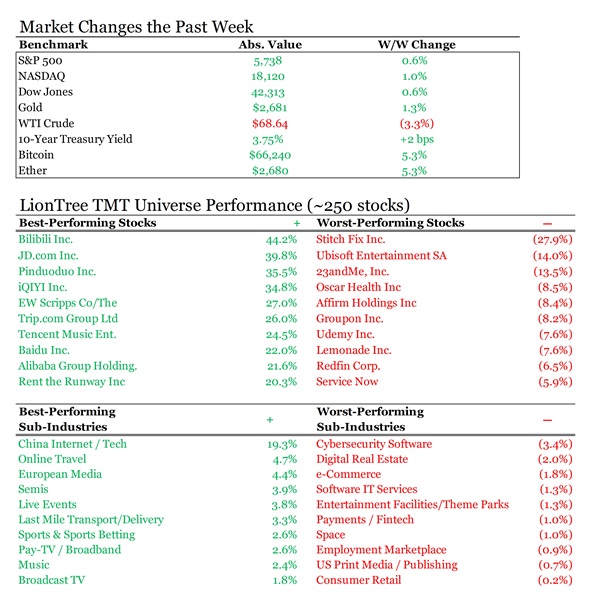
It was another mostly up week in the markets (Dow +0.6%, S&P +0.6%, & Nasdaq +1%). More aggressive stimulus news in China was the main macro event this week, which drove the Heng Seng index to log its best week in 26 years (ended up +13%)! That, coupled with the cooler core PCE numbers, were the main drivers for the US market this week.
Within the sector, we focused on the below key themes, developments, and updates in this edition (all links are clickable):
- Meta Connect 2023 – A Glimpse Into The Full Vision Of Reality Labs
- Dealmaking Shows No Signs Of Slowing Down In The Connectivity Space
- Another Setback In Video Gaming Land… Ubisoft Cuts Guidance
- AI Continues To Penetrate The Entertainment Sector…
- Is Netflix Going To Push For Changes In Talent Pay? Not Yet…
- New Updates Point To A Stronger Holiday Season For Retailers
- Grab Bag: Media Job Cuts/Starlink Passes 4mn+ Subs/TikTok Shutters Music Streaming Service
Enjoy the weekend.
Best,
Leslie

Meta Connect 2023 – A Glimpse Into The Full Vision Of Reality Labs
After Snap’s Partner Summit last week (see Theme #5 from Weekly 9/20/24 for the key highlights), this week, it was Meta’s turn to take the stage for its annual Meta Connect 2024 event to showcase its latest technological advancements, particularly in wearables, virtual reality (VR), augmented reality (AR), and artificial intelligence (AI).
Among the key announcements from the event were the unveiling of the Orion AR Glasses, Meta’s first ever holographic AR glasses, as well as the Quest 3S, a new, affordable mixed reality headset that is designed to make immersive experience more accessible. The Ray-Ban Meta Glasses also saw some improvements to its features and functionality, alongside several updates to Meta AI’s capabilities, including enhancements in voice interaction as well as advanced image and video understanding.
See below for what we thought were the most incremental updates from the event.
Debuts Orion, The Co’s “First True Holographic Augmented Reality Glasses” But It Won’t Be Commercial Available Any Time Soon (link/link)
- Has the largest field of view in the smallest AR glasses form to date
- Has a 70° field of view (for reference, Snap’s new AR glasses have a 47° field of view) and can display up to three apps next to each other without forcing the user to turn its head
- Uses eye tracking to help users navigate through menus
- Developing a neutral interface to control the prototypical glasses: Device is tethered https://liontree.com/wp-admin/post-new.php?post_type=blog#wirelessly to a small “puck” that can pick up on user’s neural signals and let them control the Orion glasses using their brain; Technology stems from the Co’s 2019 acquisition of CTRL-Labs
- Meta AI runs on Orion: It understands what the user is looking at in the physical world and can help with useful visualizations (i.e., opening up the fridge and asking for a recipe based on what’s inside)
- Access to the glasses will be limited to Meta employees and “select external audiences”, but the product will eventually become Meta’s “first consumer full holographic AR glasses”
- Developers must commit to paying $99/mo for one full year if they want to build AR apps for the device
- Each pair reportedly costs ~$10,000 to produce, and Meta wants to bring that cost down
- Expects the second generation of Orion to come out in a few years, which will be the first consumer version, with pricing expected to be comparable to that of phones and laptops of today
- “We still want it to be a little smaller, a little brighter, a little bit higher resolution, and a lot more affordable before we put it out there as a product. And look, we have a line of sight to all those things” (link)

Reveals New Entry-Level Quest 3S Which Is “Our Most Affordable Mixed Reality Headset” (link/link/link)
- “Quest 3S is the best headset for those new to mixed reality and immersive experiences, or who might have been waiting for a low-cost upgrade from Quest and Quest 2”
- “S” in Quest 3S stands for start, referring to getting started with VR, per a Meta representative
- Lower price and smaller maximum storage capacity vs Quest 3: Starts at $300 for 128GB and $400 for 256B, vs $500 for 128GB and $649 for 512GB for the Quest 3
- Also announced priced drops and phasing out of select Quest 3: Reduced price of the 512GB Meta Quest 3 from $650 to $500; The Co is also phasing out the 128GB version and reducing the price to $430 while supplies last
- Will also start winding down sales of Quest 2 and Pro: Will be selling remaining headsets through the end of the year or until they’re gone, whichever comes first
- Fully compatible with Quest’s library of thousands of apps and games
- Core performance is in-line with that of Quest 3…: Both have the Snapdragon XR2 Gen 2 processor, Touch Plus controllers, 120Hz refresh rate, and mixed reality passthrough
- … And optics are where the cutbacks will be: Lower per-eye resolution (1832×1920 vs Quest 3’s 2064×2208), Fresnel lens vs Quest 3’s pancake lenses (which had made the Quest more compact and lighter vs the Quest 2), and lower FOV (96°/90° vs Quest 3’s 104°/96°)
- Some other differences: Is slightly larger than the Quest 3; Has its front sensors arranged in two triangular formations versus the Quest 3’s three pill-shaped cutouts; Lacks the Quest 3’s depth sensor
- Longer battery life vs the Quest 3: 5hrs vs 2.2hrs on Quest 3
- Includes new “Action Button” for switching between passthrough and immersive modes: Can already switch between immersive and passthrough on the Quest 3 and Quest Pro by turning on a “Double Tap” feature, but new button makes it easier to jump between real world and full VR
- Have also made several improvements to the Quest ecosystem…
- Rebuilt Meta Horizon OS for spatial computing, with better support for 2D apps like YouTube, Facebook and Instagram
- Added better spatial audio and improved Passthrough’s contrast and color, making it more realistic and immersive
- Travel Mode enables Quest to be used while in transit
- … And have additional “big plans for the future” including –
- Expanding Travel Mode to work on trains
- Support for lying down while using the headset
- Continuing to improve Meta AI on Quest and enabling the “Hey Meta” wake word to invoke it

Series Of Updates To Ray-Ban Smart Glasses (link/link)
- Adding new frame colors and lens colors, including the option to add transition lenses that increase or decrease their shading depending on the current level of sunlight
- Will be able to understand natural language and can answer follow up questions without the “Hey Meta” or “Ok Meta” prompt
- Addition of real-time AI video processing, which lets the user ask the Ray-Ban Meta glasses questions about what it can see in front of them / Can recognize what the user is looking at without needing a command
- Will be able to detect when a user is looking at a sign in a different language and, if asked, can translate in the user’s ear
- Camera can scan QR codes and extract information out of photos it takes
- Real-time speech translation to English from French, Italian, and Spanish is coming soon, with more languages to be added
- The glasses will translate in the user’s ear what someone is saying, and their responses can be translated via the companion app
- Will also be getting full integration with music streaming apps, like Amazon Music, Audible, and iHeart Radio, which can be controlled with the user’s voice
- Did not give timeline of when these additional AI features will be coming, but expect that they will arrive sometime this year

Meta AI Has Moved Beyond Typing And Can Now See And Speak
- Now includes visual capabilities…
- Can reply to photos shared in the chat and answer questions about what’s in them
- Can also edit photos, including changing the background, removing objects, or adding accessories
- … As well as expanded voice capabilities: Users can ask a question or otherwise chat with Meta AI out loud through Messenger, Facebook, WhatsApp, and Instagram and get simulated vocal responses in return
- Will roll out in multiple voice options, including those of celebrities like those of Awkwafina, Judi Dench, John Cena, and Kristen Bell, which can be selected as the AI voice of choice to answer any time something is asked to Meta AI
- Not the first time Meta AI has made celebrity voices available: Meta discontinued a similar initiative in August 2023, after the Co had signed deals with celebrities including Kendall Jenner, Snoop Dogg, and Tom Brady and paid them up to $5mn to use their voices for two years
- Comes a day after OpenAI announced the rollout of its Advanced Voice Mode feature with a new look and five new voices
- New Meta AI voice feature will be available over the next month for US, Canadian, Australian and New Zealand users of WhatsApp, Instagram, Facebook and Messenger
- Will roll out in multiple voice options, including those of celebrities like those of Awkwafina, Judi Dench, John Cena, and Kristen Bell, which can be selected as the AI voice of choice to answer any time something is asked to Meta AI
-> Also at the event, Meta announced a newer version of Llama, called Llama 3.2.; This updated model can understand both images and text, an upgrade from its predecessors which generated responses to people’s written prompts
- Testing a tool that automatically translates the audio in Facebook and Instagram Reels, simulating the speaker’s voice in another language and syncing their lips
- As an update, Meta AI now has 500mn users
Dealmaking Shows No Signs Of Slowing Down In The Connectivity Space
With the recent news out regarding Verizon’s acquisition of Frontier, T-Mobile’s JVs with PE firms to acquire Metronet and Lumos, as well as AT&T’s new wholesale commercial fiber agreements, it is certainly no understatement to say that dealmaking activity has been hot across the connectivity industry lately. This week was no different, as headlines emerged that Charter and Liberty Broadband are discussing a potential combination AND that DirecTV and Dish are in advanced talks to merge as well. Speaking to the former, Liberty Broadband has long traded at a discount relative to its stake in Charter and other assets, and this deal would provide a “compelling opportunity” for Liberty Broadband “to simplify its structure” and “meaningfully reduce” this gap, per Charter CEO Chris Winfrey. The proposed transaction would close by mid-2027, though there has been some back-and-forth between the two companies regarding the exchange ratio for their respective common shares in an all-stock transaction.
The details surrounding the reported merger talks between DirecTV and Dish were more opaque, though an official announcement could reportedly come as soon as the coming days. All-in-all, there appear to be a lot of moving parts across the connectivity space. See below for more details:
- Charter & Liberty Broadband are looking to merge (link/link): Liberty Broadband communicated a counterproposal to Charter’s initial merger proposal, which was submitted Sept 15; This proposed transaction “would rationalize the dual corporate structure between Charter and Liberty Broadband”, per Liberty Broadband CEO Greg Maffei
- The terms of the counterproposal: The proposed combination of Liberty Broadband w/ Charter would be an all-stock transaction intended to be tax-free; Holders of each series of Liberty Broadband common stock would, for each share, receive of 0.29 shares of Charter Class A common stock
- The proposed transaction would have a closing date of June 30, 2027: Or at an earlier date, if the parties should mutually agree
- Charter would assume or refinance Liberty Broadband’s debt at or prior to closing: This will also apply to Liberty Broadband’s outstanding preferred stock
- Liberty Broadband, including GCI, would continue operating as normal while the transaction is pending: For context, GCI is Alaska’s top telco provider and offers a range of cellular, broadband, and cable TV svs
- John Malone would not be involved in the approval process: Instead, the deal would be subject to approval of a “majority of stockholders unaffiliated w/ John Malone and his affiliates”
- Malone owns a 49% voting stake in Liberty Broadband: Liberty Broadband, in turn, owns a 26% interest in Charter
- The terms of the counterproposal: The proposed combination of Liberty Broadband w/ Charter would be an all-stock transaction intended to be tax-free; Holders of each series of Liberty Broadband common stock would, for each share, receive of 0.29 shares of Charter Class A common stock
- Charter’s initial proposal included a lower conversion ratio: Under these terms, Liberty Broadband shareholders would receive 0.228 newly issued shares of Charter common stock for each share of Liberty Broadband common stock
- The exchange rate “assumes that Liberty Broadband disposes of GCI prior to completion of the transaction: A letter from Charter CEO Chris Winfrey added, “Alternatively, we are willing to discuss terms for a transaction that would include GCI”
- Charter’s rationale: The Co “believe[s] that this proposal represents a compelling oppty for Liberty Broadband to simplify its structure and meaningfully reduce this discount, to provide greater value, certainty and ultimately greater liquidity to the Liberty Broadband shareholder”
Separately, DirecTV & Dish Made Some Headlines This Week
- DirecTV & Dish are reportedly in advanced talks to merge after press speculation 2 weeks ago (link): The deal would create the largest pay-TV provider in the US w/ nearly 20mn subs
- DirecTV is looking to control the combined entity, per sources: The Cos are still working through details of how the combination might be structured, according to people familiar w/ the matter
- An agreement could reportedly be reached as soon as the coming days: That said, while talks are advanced, they could still falter or be delayed, per sources
- The pay-TV biz has been in secular decline: Bloomberg Intelligence found that the pay-TV industry, including cable and satellite, had 104mn US subs in 2015; However, that figure had shrunk to less than 70mn as of this yr w/ the trend towards cord-cutting
Another Setback In Video Gaming Land… Ubisoft Cuts Guidance
While entertainment consumption continues to move towards video games, delivering games on schedule and releasing games based on original or licensed IP has been an industry challenge (earlier this year, Take-Two lowered its FY25 bookings guidance to reflect a delay in GTA VI’s launch, for instance). This week, Ubisoft joined the club by revising down guidance for the quarter and the year. While some concerns were already baked in to the stock with it down -48.2% YTD before the pre-announcement, the magnitude of the profit warning came as a surprise and raised questions about the future execution and management of the Co. The updated guidance was met with several Wall Street downgrades as well as price target cuts, and activist activity also stepped up, calling for a sale of the Co. Activist investor AJ Investments had previously sent a letter to Ubisoft earlier in Sept calling for strategic change and now claims that it has support from 10% of the shareholder base (AJ Investments owns less that a 1% stake themselves).
More details below on the guidance cut…. (link / link)
-> Ubisoft shares fell -14.1% on the back of the news and ended the week down -14.8%; YTD, Ubisoft stock is trading down -54.3%
- FY2024-25 guidance was cut:
- Net bookings of ~€1.95bn, which is a decline of -16.0% y/y, vs the previous guidance of “solid net bookings growth” and cons €2.42bn
- ~Breakeven non-IFRS op income and FCF, which compares to the previous guidance for “slight increase” in non-IFRS operating income and “positive” FCF
- FQ2 guidance cut: Net bookings ~€350-370mn is down materially from the previous €500mn
- The revised targets are mainly a reflection of a softer than expected launch for Star Wars Outlaws and a delay in the release of Assassin’s Creed Shadows
- Delaying the release of Assassin’s Creed Shadows from Nov 15, 2024 to Feb 14, 2025
- Wanted addt’l time to “further polish the title”
- The Co is going to be making the game available to all players on release date
- Star Wars Outlaws initial sales proved softer than expected, despite solid ratings and user scores
- “Ubisoft’s development teams are currently fully mobilized to swiftly implement a series of updates to polish and improve the player experience in order to engage a large audience during the holiday season to position Star Wars Outlaws as a strong long-term performer”
- The game will be available on Steam on Nov 21
- The Co is launching a review to improve its execution and operating model
- The Co will report H1 results on Oct 30

AI Continues To Penetrate The Entertainment Sector…
This week, there were a number of AI initiatives and announcements as it relates to deployments in the entertainment sector. The technology is still in the early stages, but it is being actively incorporated across many use cases within the entertainment space… See below for this week’s key developments on this front.
- Spotify is expanding its AI feature that creates customized playlists from text descriptions to 4 addt’l English-speaking regions (link):
- Premium Spotify subscribers in the US, Canada, Ireland, and New Zealand will now have access the AI Playlist in beta
- The feature was initially launched in the UK and Australia earlier this year
- The AI can create playlists based on descriptions, specifying genres, decades, moods, or artists for example
- Subscribers can find the beta feature in the mobile app by tapping the “+” button in their Spotify library and selecting “AI Playlist” from the drop-down menu (not available on the Spotify desktop or web apps)
- Generated playlists contain 30 songs and can be adjusted with addtl prompts to better match the desired vibe
- Premium Spotify subscribers in the US, Canada, Ireland, and New Zealand will now have access the AI Playlist in beta
-> Spotify’s playlists have been a point of differentiation, so further enhancing its capabilities in this regard should help with attracting new users and reducing churn…
- Warner Bros Discovery partnered w/ Google Cloud to use an AI-powered tool called Caption AI for creating captions on its content platforms (link):
- It will be initially deployed for unscripted programming, such as sports and reality TV content
- The tool aims to cut time and production costs for creating captions
- Real people will still oversee the use of Caption AI for quality assurance on studio channels like Max, CNN, and Discovery+
- Runway launched a “Hundred Films Fund” to provide funding for AI film projects in both pre- and post-production phases (link):
- Eligible film formats incl features, shorts, documentaries, experimental projects, music videos, and more
- At the moment, the fund is $5mn with the potential to grow to $10mn
- Grants range from $5K to $1mn+ with an addt’l $2mn in Runway credits to be awarded
-> The fund is quite small in the big scheme of things but could grow and help lure creatives to Runway’s platform that can leverage the tech to potentially reach a new level of filmmaking…
- Comcast is improving live sports streaming on YouTube TV, Fubo, & other platforms by using AI to improve its internet svs(link):
- Comcast launched “Janus”, which uses cloud and AI/ML tech to maximize network performance and efficiency, providing faster and more reliable internet service for Xfinity and Comcast Business customers
- The initiative will virtualize Comcast’s core network, shifting management and control to its edge cloud platforms
- Comcast anticipates several benefits from Janus, including –
- Speed for the Need: Seamless capacity scaling, faster speeds, and lower latency for live-streamed events
- Enhanced Reliability: Pinpoint issue visibility and automated rerouting of data traffic during disruptions, improving service restoration times
- Cleaner, Greener Internet: Adoption of power-efficient virtualized and disaggregated compute platforms to reduce Comcast’s environmental footprint
- Comcast is currently conducting initial trials in its Atlanta network hub, with plans for wide-scale rollout in 2025
Is Netflix Going To Push For Changes In Talent Pay? Not Yet…
There has been increasing talk about the evolution of economic models for content being purchased by the streamers from the tradition cost-plus model to one that is more based on performance, and, along those line, this week’s press that Netflix is potentially looking to push in that direction caught our attention. Word is that Netflix is considering asking talent to reduce their fees by between -20-30%, in exchange for giving them twice that amount on the backend if the show or movie is successful, which would be on top of other bonuses that are already part of Netflix’s package.
The Co was expected to outline this new structure to reps for WME, CAA, UTA Verve, and other agencies, plus several large management companies that were attending the Co’s “Netflix Explained” breakfast event, BUT that ended up not being part of the agenda. While this plan theoretically could still be in the works, this week was not the week for any transformational updates on this theme. However, it is one that we are watching closely, as we think changes are inevitable. (link /link)
-> One thing that will be necessary in order to make this new model feasible is data transparency, and Netflix has been working towards improvements on that front; Reminder that last week, Netflix also published its H1 engagement stats report that points to people watching 94bn+ hours on Netflix and also detailed viewership of its top shows – Link to Netflix’s update.
-> Separately but related, there was also some press about a slowing of Netflix’s total viewing hours; Analysis and data from MoffettNathanson Research shows that Netflix’s total viewing hours rose only +1% y/y to 94bn (with 277mn global subs), BUT avg daily hours viewed per subs fell -13% to 1.9bn per day; The US market looked better for Netflix on this KPI, as total US viewing engagement incr’d +15% y/y, outpacing subscriber growth of +9% y/y (to 74mn), and avg US daily viewing per subscriber rose +4% y/y to 1.5 hours a day; Note that this data is based on Nielsen’s data that doesn’t include viewership on mobile, so that implies these figures are understated (link)
New Updates Point To A Stronger Holiday Season For Retailers
Just two weeks ago, we highlighted a report from Deloitte that predicted a moderation in both total sales and online e-commerce sales growth during the upcoming holiday season (see Theme #9 Weekly 9/13/27); however, it now appears that not everyone agrees with this prognosis. In contrast, Adobe Analytics’ online shopping forecast for the 2024 holiday season, which was published this week, anticipates that online spending growth in the US will accelerate to +8.4% y/y during the period from November 1 to December 31 (vs +4.9% y/y in 2023), driven by a “stream of discounts” that have been driving “material changes in shopping behavior”. Specifically, Adobe sees consumers starting their holiday shopping earlier and “trading up to goods that were previously higher-priced… propelling growth for US retailers”. In aggregate, Adobe predicts that discounts will contribute to $2-3bn of incremental online spending this holiday season. The report also included some data points on BNPL trends as well as the proliferating use of generative AI in online shopping. We covered these as well as some other interesting takeaways in greater detail below.
There were a handful of updates on other prominent shopping events out as well this week. Walmart announced that it is kicking off its holiday shopping event season weeks earlier than prior years, citing research that found that nearly 50% of consumers planned to start purchasing holiday items as early as August and September. In the UK, TikTok Shop launched a weekslong “For You Days” sales event that will feature markdowns as high as -50% and livestreams to promote items that will run for up to 16 hours. Finally, a report from the National Retail Federation forecasted a decline in spending on Halloween, though this also follows record levels of shopping last year.
See below for more details:
Adobe Analytics’ Annual US Online Holiday Sales Forecast Predicts An Accel In Spending Growth
- US holiday online sales are forecasted to grow +8.4% y/y to $240.8bn, per Adobe Analytics (link): This represents an accel from 2023’s +4.9% y/y increase for the period between Nov 1 and Dec 31
- Cyber Week sales are expected to increase +7.0% y/y to $40.6bn: Cyber Week shopping is predicted to account for 16.9% of the overall holiday season, w/ 70% of consumers saying they proactively check for deals during Cyber Week
- Cyber Monday is projected to remain the season’s and yr’s biggest shopping day…: Adobe expects a record $13.2bn in spend, a +6.1% y/y uptick
- … And y/y growth in Black Friday and Thanksgiving Day sales is expected to be even higher: Black Friday and Thanksgiving Day sales are forecasted to rise +9.9% y/y and +$8.7% y/y, respectively, as consumers embrace earlier promos from US retailers
- Consumers are expected to “trade up” for the holiday season: Share of the most expensive goods is set to increase by +19% vs pre-season trends, driven largely by competitive discounting; Will be most pronounced in sporting goods, electronics, and appliances
- Major discounts are anticipated for the 2024 holiday season: For the upcoming holiday season, Adobe expects the strong consumer response to discounts will contribute an incremental $2-3bn in online spend
- Discounts for electronics are projected to peak at -30% off list price (vs -31% in 2023)
- Discounts for toys are set to hit -27% (vs -28% in 2023)
- TVs and sporting goods are expected to see record markdowns: Discounts are forecasted to be at -24% for TVs (vs -23% in 2023), and -20% for sporting goods (vs -18% in 2023)
- Other categories w/ notable discounts include –
- Apparel at -23% (vs -24% in 2023)
- Computers at -23% (vs -24% in 2023)
- Furniture at -19% (vs -21% in 2023)
- Appliances at -18% (vs -16% in 2023)
- Addt’l highlights:
- Shopping for mobile devices is expected to reach a new milestone: Mobile device sales are projected to rise +12.8% y/y to a record $128.1bn and comprise 53.2% of online spending this holiday season (vs desktop sales)
- BNPL shopping is also projected to hit new records: Buy Now, Pay Later spend is expected to drive $18.5bn in online spending this holiday season, representing a +11.4% y/y increase; $9.5bn in BNPL shopping is projected in Nov, making it the largest BNPL month on record
- 39% of millennials plan to use BNPL this season: Along w/ 38% of Gen Zers
- Use of Gen AI is expected to rise: Given that traffic to retail sites from gen AI chatbots doubled from Jan 1 to Aug 31; Also, 7 out of 10 consumers surveyed said gen AI enhanced their shopping experience, and 2 out of 5 plan to use it for the holidays
- Influencers have been converting shoppers at a +10x higher rate than social media overall in 2024: 37% of GenZ respondents to Adobe’s survey have purchased something based on an influencer’s recommendation
- Cyber Week sales are expected to increase +7.0% y/y to $40.6bn: Cyber Week shopping is predicted to account for 16.9% of the overall holiday season, w/ 70% of consumers saying they proactively check for deals during Cyber Week
There Were Also Several Noteworthy Updates On Other Related Shopping Events Out This Week
- Walmart is starting its holiday sales season “weeks” earlier this yr (link): Starting Oct 8 at 12 pm EST, all customers will be able to shop the Walmart Holiday Deals event on Walmart.com and the Co’s app; In-store deals will begin the following day, Oct 9, at local store open times; The event ends on Oct 13
- Consumers are shopping for holiday items earlier than ever this yr: Research cited by Walmart found that nearly 50% of consumers plan to start holiday shopping as early as Aug and Sept
- Walmart+ members will get exclusive early access to the “most-wanted deals”: Walmart+ members will be able to start shopping deals at 12 am EST on Oct 8 – 12 hours before anyone else
- This is just the first of many deal events the Co has planned: Black Friday and Cyber Monday events will also be part of Walmart’s “season of spectacular savings”
- Walmart is using AI tech for the first time to expand its delivery scope: This will enable the Co to reach an addt’l 12mn households
- TikTok Shop launched its first week-long sales event in the UK (link): TikTok’s “For You Days” sales event runs from Sept 23-30 and features shopping sessions and one-off discounts from some of the platform’s most popular brands; This follows a successful iteration of the event in the US earlier this summer
- Brands will run live selling events throughout the week: Each live event will offer a range of discounts, product launches, and free items for viewers, w/ some sessions lasting for up to 16 hours
- Shoppers will be able to access discounts of up to 50% on trending brands and retailers: The press release highlighted deals from Sweaty Betty, Sage Studios, Made by Mitchell, and Free Soul, in particular
- The National Retail Federation predicts lower levels of Halloween spending this yr (link): An NRF survey revealed that consumers expect to spend $11.6bn on Halloween this yr, which was down from last yr’s record $12.2bn; The survey included 8,000+ consumers
- Shoppers plan to spend $103.63, on avg, this Halloween: This is down from last yr’s record $108.24 per cap spending
- 37% of consumers plan to buy their Halloween items at discount stores
- 33% plan to purchase Halloween goods at specialty stores
- 33% plan to shop online for Halloween items
- Halloween shopping has been starting earlier: 47% of respondents had begun their Halloween shopping before Oct, up from 37% five yrs prior
- 48% of shoppers attributed their early Halloween shopping to looking forward to fall
- 38% of early shoppers did so to avoid the stress of last-minute shopping
- Shoppers will spend the most on costumes and decorations: The NRF projects shoppers will spend $3.8bn on costumes, $3.8bn on decorations, $3.5bn on candy, and $500mn on greeting cards
- Shoppers plan to spend $103.63, on avg, this Halloween: This is down from last yr’s record $108.24 per cap spending
Grab Bag: Media Job Cuts/Starlink Passes 4mn+ Subs/TikTok Shutters Music Streaming Service
- Job cuts across the media sector this week…
- Disney lays off several hundred corporate employees (link)
- ~00 people were affected by the layoff this week
- The positions, all based in the US, were reportedly across Disney’s corporate operations, including legal, HR, finance and communications
- Parks, ESPN as well as Disney Entertainment were amongst the divisions that weren’t impacted by the reductions
- Cuts follow the July 31 round of layoffs at Disney Entertainment Television, when ~140 people were let go (~2% of the total DET workforce), and Disney animation studio Pixar reducing staff by -14% in May
- Paramount initiates phase two of reductions in ongoing effort to cut -15% of its US workforce (link)
- Expects at least 2,000 employees to be impacted by this round of cuts
- The streaming organization within Paramount, which encompasses several departments, is expected to be the most directly affected by Phase 2; Paramount’s ad division was targeted by a number of cuts last week
- Last Feb, the Co let go of 3% of employees; According to the Co’s execs, the cuts will be 90% complete after the further cutbacks this week
- Disney lays off several hundred corporate employees (link)
- Starlink surpasses 4mn customers across 100+ countries, territories, and mkts (link/link): This is up from 2.3mn that Starlink reported in its 2023 progress report
- Starlink’s user growth has been accel’ing: The Co first reached 1mn subs in Dec 2022, crossed 2mn subs in Sept 2023, broke 3mn subs in May 2024, and in just ~four months exceeded the 4mn mark
- There are currently 6,426 Starlink satellites orbiting the Earth, of which 6,371 are operational: This was per astronomer Jonathan McDowell
- The number of satellites in orbit has been ramping rapidly: The most recent set of 20 satellites was launched this week on Sept 25, and the next batch is expected to go into orbit on Oct 2
- Starlink has been expanding into more mkts: Including countries in Africa, the Middle East, and islands in the Pacific
- Starlink has also been gaining traction within several industries: The Co has secured deals w/ major airlines, such as United, along w/ cruise ships
-> On a related note, in a win for SpaceX’s Starlink, the Federal Communications Commission unanimously voted this week to open 1,300 megahertz of spectrum in the 17.3 to 17.8GHz bands to non-geostationary satellites, which would include Starlink satellites that operate closer to Earth; The order specifically enables non-geostationary satellites to harness the 17GHz bands for downlinking purposes or to send data from space down to Earth (link)
- TikTok plans to shut down its music streaming svs beginning on Nov 28 (link): This comes two yrs after the platform was initially introduced as a rival to Spotify and Apple Music
- TikTok account information and personal data will automatically be deleted following closure of TikTok Music: The Co is advising users to transfer playlists to other svs no later than Oct 28
- ByteDance wants to partner w/ DSPs, not compete against them: The Co wants to “focus on [its] goal of furthering TikTok’s role in driving even greater music listening and value on music streaming svs, for the benefit of artists, songwriters and the industry”
- The Co is now encouraging users to use the “Add to Music App”: This lets users save the songs they discover on TikTok to the music streaming svs of their choice
- This is a “clear positive” for Spotify, per sell-side analysts (link): Deutsche Bank said that Spotify stands a chance to absorb TikTok’s nearly 2-2.5mn subscribers across 5 mkts, as the closure reduces competition in the music streaming mkt
Stock Market Check
This Week's Other Curated News
Advertising/Ad Agencies/Ad Tech
- Amazon’s video ad rev for the 2024-25 upfront period has exceeded the co’s internal target of $1.8bn, a source has confirmed to Deadline. The strong buy-in from advertisers follows a move last Jan. by Prime Video to start running ads on all film and TV titles in the US and nine other countries, except for subscribers willing to pay extra to avoid ads. (Deadline)
- Google has closed its ad ecosystem to third-party ad verification firms, citing security concerns. This decision follows the discovery of the 3ve ad fraud operation, which exploited vulnerabilities in the ad ecosystem. Google aims to prevent similar fraud by tightening control over ad verification processes. The move has raised concerns about transparency and the potential impact on advertisers. (The Verge)
- Lamar Advertising Co annc’d that its Board of Directors has approved the extension of the co’s stock and debt repurchase initiatives. The programs, initially set to conclude on September 30, 2024, will now continue until March 31, 2026. The repurchase plans allow for the buyback of up to $250mn of Lamar’s Class A common stock and a similar amount for the debt repurchase program managed by its wholly-owned subsidiary, Lamar Media Corp. (Investing.com)
- Omnicom’s precision marketing division, Omnicom Precision Marketing Group (OPMG), has acquired LeapPoint, a digital advisory firm specializing in marketing lifecycle optimization. The acquisition strengthens OPMG’s content supply chain capabilities and positions it as a leader in digital transformation. (STOCKTITAN)
- Sinclair is expected to post higher earnings for the yr as political ad spending continues to balloon. The co disclosed that it now expects political ad spending to be between $442mn and $469mn for the yr, an increase of about $60mn. For Q3, ad revenue is expected to range from $149mn to $145mn, up from the previous estimate of $113mn to $128mn. (Broadcasting Cable)
Artificial Intelligence/Machine Learning
- Britain’s competition regulator said Amazon’s artificial intelligence partnership w/ startup Anthropic will not be referred for a deeper probe as it did not raise competition concerns. The Competition and Markets Authority said the partnership, which includes a $4 bn investment by Amazon in Anthropic, did not qualify for investigation under Britain’s merger regulations. “We welcome the UK’s Competition and Markets Authority (CMA) decision acknowledging its lack of jurisdiction regarding this collaboration,” an Amazon spokesperson said in response to the regulator’s decision. (AOL)
- For the first time, OpenAI will provide access to its training data for review of whether copyrighted works were used to power its technology. In a filing, authors suing the Sam Altman-led firm and OpenAI indicated that they came to terms on protocols for inspection of the information. They’ll seek details related to the incorporation of their works in training datasets, which could be a battleground in the case that may help establish guardrails for the creation of automated chatbots. The agreement stems from a trio of lawsuits initiated by top authors accusing OpenAI of harvesting mass quantities of books across the web, which were then allegedly used to produce infringing answers by ChatGPT. (The Hollywood Reporter)
- Google paid $2.7bn to rehire an AI genius that left the tech giant in a huff three yrs ago to found his own startup, per a report. Noam Shazeer, a 48-yr-old software engineer who was first hired by Google as one of its first few hundred employees back in 2000, left the Co in 2021 after it refused his request to release a chat bot that he had developed w/ a colleague, Daniel De Freitas. Shazeer and De Freitas went on to found Character.AI. (New York Post)
- Kamala Harris said that she would boost investments in artificial intelligence and cryptocurrency. “I will bring together labor, small business founders and innovators and major companies,” she said. “We will encourage innovative technologies like AI and digital assets while protecting our consumers and investors,” she added during the event at Cipriani Wall Street in NY, which raised $27mn. It’s the first time Harris has openly commented on cryptocurrency as a presidential candidate. (Bloomberg)
- Mark Zuckerberg envisions content creators using AI to scale their reach by creating AI clones of themselves. In an interview, he explained that these AI clones could handle community engagement, allowing creators to focus on other tasks. Zuckerberg believes this approach will help creators reflect their values and objectives through AI, enhancing their interaction with audiences. (The Verge)
- Microsoft is launching a new feature called “correction” that builds on the co’s efforts to combat AI inaccuracies. Customers using Microsoft Azure to power their AI systems can now use the capability to automatically detect and rewrite incorrect content in AI outputs. The correction feature is available in preview as part of the Azure AI Studio — a suite of safety tools designed to detect vulnerabilities, find “hallucinations,” and block malicious prompts. (The Verge)
- OpenAI’s chief research officer, Bob McGrew, and a research VP, Barret Zoph, left the co on Wednesday (Sep 25), hours after OpenAI CTO Mira Murati annc’d she would be departing. Matt Knight, formerly head of security, will be OpenAI’s chief information security officer. Chief product officer Kevin Weil and VP of engineering Srinivas Narayanan will continue to lead OpenAI’s applied team, which is responsible for bringing the co’s tech to both enterprise and consumer customers. (TechCrunch)
- The European Commission has revealed a list of the first 100-plus signatories to the AI Pact. While the bloc’s legally binding risk-based AI rulebook (the AI Act) entered into force last month, it will be several yrs before all its compliance deadlines are in operation. There are also three “core actions” that Pact signatories are expected to commit to (at a minimum): Adopting an AI governance strategy; Identifying and mapping AI systems likely to be categorized as high-risk; and promoting AI awareness and literacy among staff. (TechCrunch)
- The FTC is cracking down on cos making big claims about AI. On Wednesday (Sep 25), the FTC annc’d cases against four bizs the commission claims made “allegedly deceptive claims about AI-driven svs” to market and sell their bizs. FTC annc’d a settlement with another co that allowed users to create fake customer reviews using GenAI tools. It said that AI writing co Rytr agreed to a proposed settlement over claims it sold a tool that it said could write and publish fake customer reviews for bizs. (Marketing Brew)
Audio/Music/Podcast
- Spotify annc’d updates for podcast creators. More specifically, the Spotify for Podcasters platform is adding new conversion metrics for both hosted and non-hosted creators. As annc’d by Spotify in a blog post, the new metrics allow podcasters to see how their shows are discovered on Spotify via Home, search, or library. The platform will also show data on how discovery is directly converted into streams. (9to5Mac)
Broadcast/Cable Networks
- Sky and UKTV have annc’d a multi-yr extension to their long-standing partnership. The new agreement means that Sky and NOW customers can continue to watch the channel brands including Gold and Alibi and popular programming from UKTV including drama titles Murdoch Mysteries, The Red King and CSI: Vegas, comedy in the form of Only Fools And Horses, Dad’s Army and The Vicar of Dibley, and entertainment including World’s Most Dangerous Roads, Battle In The Box, and upcoming documentary Absolutely Fabulous: Inside Out, and much more. (ADVANCED-TELEVISION)
Broader Media & Entertainment
- British real estate portal Rightmove rejected a sweetened $8. 1bn takeover proposal from Rupert Murdoch-owned Australian property listing firm REA Group, saying the increased bid was still “unattractive”. “The board considered the increased proposal… and concluded that the increased proposal continues to be unattractive and materially undervalues the Co and its future prospects,” Rightmove said in a statement. (Yahoo Finance)
Cable/Pay-TV/Wireless
- According to TVRev, private equity firms are investing heavily in broadcast TV, attracted by steady retransmission fees and political ad revenue. However, this influx of capital risks destabilizing the industry, prioritizing short-term profits over long-term sustainability. Leveraged buyouts could lead to debt-laden companies, reduced local news quality, and less diverse media ownership, ultimately harming public interest. (TVREV)
- Anthem Sports & Entertainment said it has agreed to buy Hollywood Suite, which owns and operates four linear TV channels in Canada. The acquisition would double the number of channels Anthem offers to Canadian viewers. Hollywood Suite will continue to be managed by its co-founder and president, David Kines. The networks are available in about 10mn homes via distributors including Rogers Communications, Bell, Telus, Amazon Prime Video, Cogeco, Eastlink and Freedom Mobile. (Broadcasting Cable)
- Comcast and Charter Communications annc’d a new partnership w/ Broadcom to jointly develop a new silicon standard capable of delivering downstream speeds of up to 25 gigabits per second over cable’s traditional hybrid fiber-coax wires. The Cos billed the standard as the launch of “DOCSIS 5.0” — a new version of the Data Over Cable Service Interface Specification, which the cable industry uses to transmit data. (NextTV)
- Global 5G connections exceeded 2bn connections at the end of the Q2 of the yr, w/ the addition of 192mn connections during the period, according to a new report by 5G Americas and Omdia. The report suggests that global 5G connections will reach 8.6bn by 2029. As a share of all wireless cellular technologies, 5G is expected to account for 59% of global access networks by 2029, according to 5G Americas. Currently, there are 329 commercial 5G networks worldwide. (RCR Wireless News)
- In a move aimed at bolstering competition in the wireless market, the FCC has granted DISH’s parent co, EchoStar, an extension on its 5G network buildout. This decision allows EchoStar, the parent co of Boost Mobile, to continue its plan to build a nationwide 5G network despite financial hurdles. EchoStar will now have a more flexible timeline to complete its network. (Cord Cutters News)
- Italy is preparing a new bid to acquire Telecom Italia SpA’s submarine cable unit, Sparkle, in a consortium w/ Spain’s Asterion Industrial Partners, La Repubblica reported. The offer is expected to be slightly above the €750mn ($837mn) proposal made earlier this yr, which was rejected by Telecom Italia. CEO Pietro Labriola aims to play an active role in Italy’s telecom consolidation, following Swisscom’s €8bn deal to merge Vodafone Italia w/ Fastweb. (Amwal Al Ghad)
- Rogers Communications will begin an industry-first implementation of Comcast’s leading network design the two cos annc’d. With this collaboration, Rogers will advance its roadmap to deliver faster speeds, enhanced reliability, and lower latency across its footprint like what Comcast has made accessible to more than 60mn homes and bizs in the US. The effort continues Comcast’s expansion of its global technology platform, allowing svs providers across the globe to deliver next-generation connectivity and entertainment experiences. (Comcast)
- T-Mobile has introduced T-Priority, a new 5G network slice dedicated to first responders. This service ensures lower latency and faster speeds, even during high congestion. The City of New York is the anchor customer for this initiative, which aims to provide advanced connectivity solutions for emergency services. T-Priority includes priority access, preemption for voice and data, and a dedicated emergency response team. (Fierce Network)
- Telefonica is pushing ahead w/ plans to launch and monetize a new fibre JV w/ Vodafone in Spain, essentially replicating a model that has worked well for it in LatAm. The telcos confirmed that through what they are calling FibreCo they plan to roll out a joint fiber network covering 3.5mn premises. They also disclosed that they would bring in a third-party financial investor, but that Telefonica would likely retain majority ownership, while Zegona would keep a 10% stake. (TELECOMS)
- The number of global cellular IoT connections jumped 24% in 2023 to finish the yr at 3.3bn, according to Counterpoint Research. The number will increase by 88% (at a compound growth rate of 10% per yr) to reach 6.2bn by 2030 according to Counterpoint Research, which has updated its IoT Connections Tracker to also forecast that total revenues from cellular IoT will surpass $26bn by 2030 – which is up 90% from $13.7 bn in 2023, which is up 17%, in turn, on 2022. (RCR Wireless News)
- Windstream sold a $1.3bn loan and bond package to refinance its existing debt, securing more favorable terms after the offering gained traction among investors. The deal for the telecommunications firm includes a $500mn seven-yr term loan and $800mn of seven-yr senior secured first-lien notes that are callable in three yrs. Proceeds will be used to refinance two outstanding loans due 2027 and for general corporate purposes, including investments in the firm’s network, the people said. (Bloomberg)
Cloud/DataCenters/IT Infrastructure
- Google filed an antitrust complaint at the European Commission against Microsoft over alleged anticompetitive practices in its cloud licensing system. The complaint targets Microsoft’s cloud platform Azure, which Google argues restricts European customers from moving their workload to competitors’ cloud systems. Google claims that the platform locks customers in through the Windows server. (euronews)
Crypto/Blockchain/web3/NFTs
- PayPal annc’d it is enabling its US merchants to buy, hold and sell cryptocurrency directly from their PayPal biz account. PayPal is enabling US merchants to externally transfer cryptocurrency on chain to third-party eligible wallets. PayPal biz account holders can now send and receive supported cryptocurrency tokens to and from external blockchain addresses. (PRNEWSWIRE)
- The SEC has approved options trading for BlackRock’s Bitcoin ETF, iShares Bitcoin Trust. This approval is expected to lead to a gamma squeeze, where increased options trading could drive up the ETF’s price. The approval follows a successful launch of the ETF, which quickly gained significant assets under management. This development is seen as a positive step for the broader acceptance and integration of Bitcoin in traditional financial markets. (CryptoSlate)
Cybersecurity/Security
- China-connected hackers, identified as Salt Typhoon, breached multiple US broadband networks to steal sensitive data and establish persistence, the Wall Street Journal reported, citing sources familiar w/ the matter. As the report noted, it marks the latest in a series of hacks that investigators in the US say are connected to China. The hack involved an incursion into US broadband networks, w/ cybercriminals setting up a foothold inside the network that let them access data stored by telecommunications cos or carry out cyberattacks. (PYMNTS.com)
eCommerce/Social Commerce/Retail
- A Ryder System study reveals a 21% increase in in-store shopping sentiment, with 61% of consumers enjoying the experience of trying on products and comparing items. The study surveyed over 1,300 U.S. shoppers and found that 55% prefer returning online purchases in-store, up 15% from last year. Mobile devices play a significant role, with 77% of shoppers using them to search for items while in-store. (WWD)
- Amazon Fresh plans to debut a store in Oxford Valley, Pennsylvania, and opened new locations in Fontana and Elk Grove, California, on Sept 12, according to a spokesperson. The new locations bring Amazon Fresh’s fleet to 52 stores in eight states. Amazon recently accelerated development of the supermarket chain after pausing its efforts to expand the concept early last yr. (Retail Dive)
- China’s Meituan is aiming to raise up to $2bn in a bond deal. The co is planning to raise $1bn from each of the tranches, the sources said. Initial price guidance for the 3.5-yr bond is 3-yr Treasuries plus about 145 basis points. For the longer-dated bond, guidance is 5-yr Treasuries plus about 160 basis points. Meituan plans to use the funds to refinance upcoming offshore debt, the term sheet said. (MarketScreener)
- Costco Wholesale missed market expectations for Q4 rev due to cautious spending by budget-conscious customers at its membership-only stores, as well as an impact from lower gasoline prices. While ultra-low prices on groceries and other kitchen staples is driving demand for essential products, consumer spending on big-ticket categories such as furniture, home and sporting goods has been choppy, hurting sales at Costco’s warehouses. (1450 AM 99.7 FM WHTC | Holland)
- eBay UK has launched its new consignment svs for luxury items, giving users direct access to expert sellers who will list and sell their items on their behalf. The Co has partnered w/ experienced luxury seller, Luxe Collective to power the svs, known for selling coveted pre-owned luxury goods, and eBay said the biz brings “unrivalled expertise to the consignment svs”. Launching initially for designer handbags, consumers can list and sell their new and pre-owned handbags from top brands across all price points. (Retail Gazette)
- Jesse Palmer, TV personality and former football player, has launched a new clothing line with Fanatics called “J. Palmer.” The collection is designed for sports fans who want stylish, high-end fashion. It includes 13 pieces such as shorts, joggers, shirts, quarter zips, full zips, and a blazer. The line features advanced performance fabrics and subtle team accents. It is licensed with all 32 NFL teams and several NCAA schools. (FashionNetwork.com)
- Nike’s stock surged over 8% following the announcement that Elliott Hill will replace John Donahoe as CEO. Hill, a longtime Nike executive, is expected to rejuvenate the brand and address challenges such as rising competition and changes in distribution. Analysts are optimistic about Hill’s appointment, viewing it as a positive step towards accelerating Nike’s turnaround. (New York Post)
- Shares of H&M tumbled as much as 8% after the co posted a miss on operating profit and abandoned its earnings margin target. The co reported that operating profit for the group’s fiscal Q3 came in at 3.51bn Swedish crowns ($345.8 mn), which compared to 4.74bn Swedish crowns a yr ago. H&M dropped its earnings margin target for 2024 after warning of more challenging conditions earlier in the yr. (CNBC)
- Stitch Fix said its Q4 net rev fell -12.4% y/y to $319.6mn, and accounting for an extra week in its fiscal yr, net rev fell -18.3%. Number of active clients declined by 613,000 — down -19.6% y/y and 4.7% from the previous quarter — to 2.5mn. Lower transportation costs helped push gross margin up 50 basis points to 44.6%. (Retail Dive)
- Wayfair is looking to borrow $700mn from the junk-bond market to refinance existing maturities. The company announced plans to offer senior secured notes due 2029. Goldman Sachs previously held meetings with leveraged finance investors to gauge their appetite for debt from Wayfair, Bloomberg reported. The co has ~$870mn of convertible debt due by the end of 2025, according to data compiled by Bloomberg. (Bloomberg)
EV/ Autonomous Vehicles
- Critical parts of connected vehicles in the US could soon be guaranteed free of Russian and Chinese-made components. A recommended ban on hardware and software components from Russia or China in connected vehicles has been published via a Notice of Proposed Rulemaking (NPRM) by the US Department of Commerce’s Bureau of Industry and Security (BIS). The proposed rule focuses on the vehicle connectivity system (VCS) and the automated driving system (ADS). (Infosecurity Magazine)
- Drive Pilot, Mercedes-Benz’s Level 3 “conditionally automated driving” feature, is getting a speed bump. The system will now support speeds of up to 95km/h (59mph) on German motorways, a sign that the co is feeling bullish about its boundary-pushing technology. Mercedes is still waiting for approval from German regulators before pushing out a software update to customers of vehicles that support Drive Pilot. (The Verge)
Film/Studio/Content/IP/Talent
- According to Hawaii Tribune-Herald, TV comedies are facing significant challenges as Hollywood cuts back on new series. The number of comedy premieres fell by 7% in 2024, while drama series increased by 25%. Factors include the rise of social media platforms like TikTok, which offer free short-form comedy, and the global preference for dramas. Additionally, media companies are reducing investments in comedy channel. (HAWAIITRIBUNE-HERALD)
- John Malone, a key investor and board member of Warner Bros. Discovery, praised CEO David Zaslav’s energy and highlighted WBD’s strong balance sheet. Despite challenges, Malone sees potential in WBD’s international growth and creative talent. He discussed the competitive pressures from Big Tech and the high costs of sports rights. Malone also mentioned the ongoing merger talks between Liberty Broadband and Charter Communications. (Deadline)
FinTech/InsurTech/Payments
- Visa has agreed to buy Featurespace, an AI-focused enterprise tech firm, for an undisclosed amount. Featurespace develops real-time AI payments protection technology to prevent fraud and financial crime. The acquisition aims to enhance Visa’s ability to manage fraud in real time and protect its payment ecosystem. (Yahoo Finance)
Handheld Devices & Accessories/Connected Home
- Parks Associates has partnered w/ Xailient to issue a new white paper, Video at the Door: Driving New Revenues, that estimates that smart video devices generated $1 3bn in stand-alone svs revenues in 2023 and that those svs revenues will jump to $2.4bn by 2027. (TVTechnology)
Last Mile Transportation/Delivery
- Boots has partnered w/ Just Eat to deliver on-demand beauty and healthcare products to customers across the nation. The health and beauty co has stocked the platform w/ over 1,000 products which are now available to order. The partnership will initially launch w/ 50 sites across the UK including London, Birmingham, Manchester, Leeds, Glasgow and Edinburgh, but there are plans to follow up w/ 100 more by spring 2025. (Retail Gazette)
- Swiggy has filed for a $1.25bn IPO in India in what could be one of India’s biggest listings this year. Swiggy is selling shares worth 37.5bn rupees ($448.56 mn), while existing shareholders including Prosus, Accel India and Tencent Europe will sell about 185.3mn shares, the co said in its draft prospectus. The Bengaluru-based startup is targeting a valuation of $15 bn through the offering, said the source, who had direct knowledge of the matter. (AOL)
Live Entertainment/Theme Parks/Concerts/Experiential
- Live Nation Entertainment has unveiled plans for a new 50,000-seat stadium in north Toronto to host top global music acts. Rogers Stadium, to be built on a former runway, will open in Jun. 2025 on former Downsview Airport lands earlier slated to host a giant film studio complex. The property developer has an option to revive plans for a film studio development in the future. The outdoor Rogers Stadium will be built on the north end of the runway, not where the film studio was planned. (The Hollywood Reporter)
M&A
- Global M&A activity is expected to slow in Q4 2024 as companies delay major deals ahead of the US elections. This follows an uneven Q3, with US M&A volume down 8% to $338B due to stock market fluctuations, regulatory scrutiny, and interest rates. However, Asia-Pacific saw a 54% increase to $273B, and Europe rose 7% to $160B. Dealmakers anticipate a rebound in 2025, driven by lower interest rates and a stable economic outlook. (XM – Global Broker in Forex and CFD Trading)
Macro Updates
- China bond yields fell to a record low after the People’s Bank of China annc’d that it will cut the reserve requirement ratio. Yield on China’s 10-year government bonds fell 3.2 basis points to 2.041%, data from LSEG showed, marking a record low. 30-year bond yields dropped 0.4 basis points to a record low of 2.168%. (NBC Los Angeles)
- Consumers’ view on the economy tumbled in Sept 2024, falling by the largest level in more than three yrs as fears grew about jobs and biz conditions, the Conference Board reported. The board’s consumer confidence index slid to 98.7, down from 105.6 in Aug., the biggest one-month decline since Aug. 2021. By contrast, the index had a reading of 132.6 in February 2020, a month before the Covid pandemic hit. (CNBC)
- Global debt hit a record high of $312tn at the end of the Q2, driven by borrowing in the US and China, while a key debt ratio in emerging markets also scaled a fresh peak, data from a banking trade group showed. The Institute of International Finance, a financial svs trade group, said that global debt rose by $2.1tn in the first half to $312tn- a new high point after previous data was revised lower. (Yahoo Finance)
- Gold hit a fresh high, as concerns around inflation and the US economy linger, with bets that the precious metal could hit the $3,000 mark next yr. The spot gold price hit $2,622 per ounce on Friday (Sep 20), with a rise of 1.7% over the course of the week and more than 1% on Friday alone, according to Deutsche Bank. The price held steady on Monday (Sep 23), edging slightly higher to $2,623 per ounce, while gold futures were up to $2,647. (Yahoo Finance)
- Promoters of the theory that China faces a “Japanification” of its economy look set to enjoy a symbolic milestone in the bond market. The yield on China’s 30-yr govt bonds is on track to fall below its Japanese equivalent for the first time in about two decades. China’s long-term yields continue to plumb fresh lows amid a sluggish outlook for the world’s second-largest economy, while Japan’s have climbed to their highest in 13 yrs on bets the fourth-biggest has finally banished the scourge of deflation. (Bloomberg)
- The interest rate for the most popular US home loan ticked down to 6.13% last week, the lowest in about two yrs, and refinancing activity jumped, data from the Mortgage Bankers Association showed. The avg contract rate on a 30-yr fixed-rate mortgage dropped 2 basis points in the week ended Sept. 20, the data showed, a far smaller move than the half-of-a-percentage point policy rate cut delivered by the Federal Reserve last week. Refinancing now accounts for more than 57% of all mortgage applications. (Yahoo Finance)
- The US economy grew at a 3% annualized pace in Q2, a faster rate than Wall Street had expected. The Bureau of Economic Analysis’s third estimate of Q2 US gross domestic product was unchanged from the second estimate which had shown 3% annualized growth. The third estimate for Q2 GDP confirms that economic growth was higher than the 1.4% annualized growth seen in the Q1. (Yahoo Finance)
Online Marketplaces/Learning (Real Estate/Education/Jobs)
- REA Group issued its fourth acquisition proposal to the board of Rightmove PLC, urging the co to engage in dialogue and extend the offer deadline. The Melbourne, Australia-based digital advertising co, majority owned by Rupert Murdoch’s News Corp, has issued its fourth proposal in an attempt to acquire the Milton-Keynes, England-based online real estate co. The terms of the fourth proposal outline that Rightmove shareholders would receive for each share owned, 346 pence in cash and 0.0417 of a new REA share (AJ Bell)
Satellite/Space
- Eutelsat CEO Eva Berneke candidly admitted that developing its ‘next generation’ of OneWeb satellites would take time, unless it could bring partners on board. “We could fund the development of Gen 2 on our own,” she insisted. But it would be “a stepwise approach over years”. OneWeb already has 630 satellites in space but business is slower to arrive than originally expected. (ADVANCED-TELEVISION)
- Satellite communications specialists Iridium is funding $500mn (€448.7m) to buy back its own shares for cancellation. The move, approved by its directors on Sept. 19, is the largest-ever for the co which supplies satellite-based connectivity to govt agencies, NGOs, the military and emergency first responders. It is the fourth buyback from Iridium in the past four years (2021, 2022 and 2023). The period for the buy-back ends on Dec. 31 2027. (ADVANCED-TELEVISION)
- SpaceX plans to launch five uncrewed Starship missions to Mars in the next two years, according to CEO Elon Musk. If these missions land successfully, crewed missions could follow in four years. However, if there are challenges, crewed missions will be postponed by another two years. This announcement follows a successful test mission where a Starship rocket completed a full test mission around the globe. (Yahoo Finance)
- Vodafone is expanding its work with Intelsat to bring on-the-move satellite communication to organizations operating in hard-to-reach areas or disaster zones. This includes communications-on-the-move (COTM) with a vehicle-mounted antenna, and communications-on-the-pause (COTP) with a compact satellite terminal. Flex operates on Intelsat’s Geostationary Orbit (GEO) network. This expanded connectivity will support businesses, governments and charities, including the telco’s charitable arm, Vodafone Foundation, with health and education initiatives in Europe and Africa. (Via Satellite)
Social/Digital Media
- Meta has been found to be in breach of the GDPR for storing millions of user passwords in plaintext on its internal systems in 2019. The decision comes from a 2019 inquiry in which millions of Facebook and Instagram user passwords were stored in a readable format. Ireland’s Data Protection Commission has fined Meta’s €91m for breaching the General Data Protection Regulation in relation to storing user passwords. (Silicon Republic)
- Snap’s stock rose 3.6% following the announcement of an expanded AI partnership with Google Cloud. This partnership will integrate Google’s Gemini AI technology into Snap’s My AI chatbot, enhancing its capabilities across text, audio, image, video, and code. The collaboration aims to boost user engagement and offer more innovative features for the Snapchat community. (GURUFOCUS)
- TikTok annc’d that its redesigned “Subscription” monetization offering is rolling out to eligible creators in select regions, including Brazil, France, Germany, Spain, the UK, Indonesia, Italy, Japan, South Korea, and the US. The co says it plans to expand the feature to more markets in the coming weeks. The official rollout comes as TikTok said back in March that it was going to rename its LIVE Subscription monetization tool to “Subscription” and would soon expand it to non-LIVE creators. (TechCrunch)
- X is reportedly reversing course after weeks of refusing to comply with conditions set by the Brazilian Supreme Court that would allow it to operate in the country again. The co’s lawyers said in a court filing that X has named a legal representative in Brazil as demanded by justice Alexandre de Moraes and removed accounts that the judge had identified as a threat to democracy, along with paying the fines it owed. (Engadget)
Software
- EQT plans to sell a minority stake in the software co IFS, which is currently valued at around €15bn. This decision comes at a time when higher interest rates are significantly impacting the market for initial public offerings and forcing buyout firms to resort to more creative financing models, according to people familiar with the matter. EQT took IFS off the Stockholm Stock Exchange in 2016 and has since significantly expanded the company through organic growth and acquisitions. (Eulerpool Research Systems)
- Salesforce annc’d plans to buy Zoomin, an enterprise knowledge platform. Founded in 2019 by Gal Oron, Hannan Saltzman, and Joe Gelb, Zoomin applies AI and big data to help Cos build self-svs documentation search and support experiences. The terms of the deal weren’t disclosed. Salesforce expects it to be finalized in Q4 of its fiscal year 2025 (Jan 31), subject to customary closing conditions. (TechCrunch)
Sports/Sports Betting
- According to Sportico, Bill Ackman, a prominent investor, is backing the Las Vegas Aviators’ bid to bring Major League Baseball to Las Vegas. Ackman is working with the team’s owner, Howard Hughes Corporation, to secure funding and support for a new stadium. The Aviators aim to capitalize on Las Vegas’ growing sports market and the success of other franchises in the city. (Sportico.com)
- DAZN could face a class action lawsuit after the sports-streaming service was accused of violating California law.org has reported that a complaint has been filed alleging that the over-the-top sports streaming service did not provide the required disclosure before renewing certain subscriptions. Under California’s Automatic Renewal Law (ARL), businesses are required to be more transparent when subscriptions are up for renewal before charging customers for payment. (Cord Cutters News)
- DAZN has secured the exclusive broadcast rights for the new Super League Basketball, w/ all games to be aired for free to audiences worldwide. With the season beginning on Sep. 27, the agreement grants DAZN rights to broadcast the men’s competition globally, including to the domestic UK audience. DAZN will create a dedicated on-platform environment for Super League Basketball which will house live and on demand content from across the competition. Fans will be able to enjoy action from the league, which will be available at no cost. (ADVANCED-TELEVISION)
- More people are watching the NFL than at any point since 2015. Through three weeks of the regular season, the league reports all games outside of the Peacock exclusive (Packers-Eagles in Week 1) have averaged 18.6mn viewers. That’s 10% higher than the average through three weeks of the 2023 season, which did not include an exclusive streaming broadcast. The Chiefs’ 3–0 start has featured three ofthe five most watched games, as Kansas City’s star players continue to drum up interest off the field. (Front Office Sports)
- On top of two media-rights deals struck this past spring and a third now in development, Amazon intends to quickly build its presence further with the National Hockey League. “If you look at what we’re doing in sports around the world, we’re really targeting the largest, biggest, tier-one sports in every country, where the games are must-watch [events],” said Jay Marine, Amazon Prime Video global head of sports. Marine appeared Monday at a press conference with NHL commissioner Gary Bettman to tout the company’s new streaming rights deals with the league in Canada. “Of course, in Canada, there is nothing bigger than hockey and the NHL.” (Front Office Sports)
- Shams Charania might not remain on the free agent market for long. The NBA insider, who recently left digital sports network Stadium after six yrs, is reportedly being considered by both NBCUniversal and Amazon, according to Front Office Sports. NBC’s and Amazon’s huge investments require big talent, and Charania now stands as the leading NBA insider, following ESPN reporter Adrian Wojnarowski’s decision last week to step down. (Awful Announcing)
- The Pac-12 annc’d it will add Utah State in 2026. It’s the fifth current Mountain West Conference member to commit to joining the Pac-12 in 2026, following Boise State, Colorado State, and Fresno State. The annc’mnt came a few hours after the move was confirmed in court documents related to a new lawsuit the Pac-12 has filed against the Mountain West. The Pac-12 now only needs one more FBS-playing member to meet the NCAA’s eight-school minimum, as well as that of the College Football Playoff. (Front Office Sports)
- The Professional Fighters League is looking to super-serve fans of mixed martial arts as it gears up for a major Oct 19 pay-per-view event from Saudi Arabia. The event, featuring former UFC heavyweight champion Francis Ngannou against PFL heavyweight titleholder Renan Ferreira, is one of the biggest events for the six-yr-old franchise, which pits MMA fighters in a league elimination format — including a regular-season and post-season — to determine its champion. (Multichannel News)
Tech Hardware
- An increasing number of iPhone 16 Pro owners are reporting intermittent issues with their phone’s touchscreen responsiveness. Users experience taps and swipes seemingly being ignored, which affects various interactions like scrolling, pressing buttons, and missed presses on keys on the virtual keyboard. Based on testing, reader reports, and a growing number of online complaints, the issue appears to stem from a software bug, rather than a hardware fault. (9to5Mac)
- Apollo Global Management has offered to invest up to $5 billion in Intel Corp. This investment is seen as a vote of confidence in Intel’s turnaround strategy and provides an alternative to a potential takeover by Qualcomm. Intel is considering Apollo’s proposal, which is still in preliminary stages. This comes after Intel’s shares have lost nearly 60% of their value this year. (Yahoo Finance)
- Google’s A-series Pixel phones are on on sale just ahead of Prime Day. The Android phone has dropped to $399, which is $100 off and a new record low price. (Engadget)
- Intel reportedly rebuffed an offer from ARM to buy its product unit. ARM made a high-level inquiry about purchasing Intel’s crown jewel product unit, but Intel declined, stating the division wasn’t for sale. This comes amid Intel’s financial struggles, including a net loss of $1.6bn in Q2:24 and plans to lay off 15,000 employees as part of a $10bn cost reduction plan. (Engadget)
- Samsung Display plans to invest $1.8bn to build a factory in northern Vietnam for organic light-emitting diode (OLED) displays used in automobiles and technology equipment, according to Reuters. The reports state that the new plant will be located in the Yen Phong Industrial Park in Bac Ninh province, east of Hanoi, near Samsung’s existing facility. Bac Ninh authorities and Samsung Display signed a memorandum of understanding (MOU) for the project. With this new project, Samsung’s total investment in Bac Ninh will reach $8.3bn. (JOINS)
- The US and India reached an agreement to work together on setting up a semiconductor fabrication plant in the South Asian nation, giving a boost to Prime Minister Narendra Modi’s efforts to bolster manufacturing in the country. The proposed plant will make infrared, gallium nitride and silicon-carbide semiconductors, according to a White House readout that followed a meeting between the US President Joe Biden and PM Modi. (Gadgets 360)
Towers/Fiber
- Bharti Airtel revealed that it has deployed 1,700 towers over the past seven months in the western state of Gujarat and added newly acquired spectrum across about half of India. In a statement, the Co noted the tower buildout “equates to a remarkable pace” of more than eight new sites installed per day, expanding coverage to some 5mn people. Earlier in the month, the operator said it completed the deployment of additional spectrum in the 2100MHz, 1800MHz and 900MHz bands. (Mobile World Live)
Video Games/Interactive Entertainment
- Discord annc’d that it is opening development for Activities, its in-app ecosystem of apps and games, to all creators. This means that any developer can create, distribute and monetize apps on Discord via its Embedded Apps Software Development Kit. This also means that Discord offers all developers an ecosystem on which to launch games and other software. (Yahoo Tech)
Video Streaming
- According to analysis from Omdia, 365mn SVoD subscriptions will be distributed through operator TV, broadband and mobile bundles, representing 20% of the global streaming market. By 2029, bundling is expected to generate 540mn online video streaming subscriptions, or 25% of the global market. (ADVANCED-TELEVISION)
- Disney annc’d a new rule intended to curb password sharing among its streaming subscribers, following through on plans initially shared last month in an earnings call. A post from the Co explained that Disney is getting a Paid Sharing feature. For an additional $7 a month on Disney Basic or $10 a month on Disney Premium, an account holder can provide access to their plan to one person outside their household, dubbed an Extra Member. (Engadget)
- Disney says it is looking to strike more bundling deals after offering an upbeat assessment of its agreement with Warner Bros Discovery-owned streamer Max. Nami Patel, Disney’s senior vice president of strategy and business development, told the RTS London Convention that the agreement is “working really well.” “Partnerships will always be a key benefit to consumers, and I think we’ll see more and more of that,” Patel continued. She added that bundling offers a “great alternative.” (Cord Cutters News)
- FuboTV launched its popular Multiview feature in beta on select Roku devices. The beta feature is expected to launch on additional Roku devices in the coming weeks. With this launch, Fubo says it is the first virtual MVPD to bring user-configurable multiviewing to Roku. Fubo customers can select and stream up to four live channels simultaneously with Multiview beta. (TVTechnology)
- Google TV and the underlying Android TV OS are growing quickly, w/ 270 mn devices now active. Over the past several yrs, Google’s efforts in building a TV platform have resulted in steady growth. There were 80 mn active devices as of 2021, up to 110 mn in 2022. Google confirmed that Google TV and Android TV OS are now active on over 270mn devices which are active “monthly.” That’s 80% growth of 120mn since the last update in early 2023, significantly faster compared to what we’ve seen over the past few years. (9to5Google)
- Live TV streamers in the US are more satisfied than cable and satellite customers, according to the JD Power 2024 US TV Service Provider Satisfaction Study. Overall satisfaction for live TV streamers is 625 (on a 1,000-point scale) compared w/ 524 among cable and satellite customers. (ADVANCED-TELEVISION)
- Netflix has started to move customers off of its basic plans to more expensive ad-free standard plans unless they decide to switch to cheaper ad-supported plans. This strategic move comes as the streaming Co aims to boost rev through its ad-supported tiers. (Cord Cutters News)
- Roku released detail of its latest product upgrade to its top-of-the-line “Ultra” streaming gadget. Alongside the standard features, the Voice Remote Pro has backlit buttons, USB charging, and two new buttons: quick launch and live TV guide. In addition to controlling their video players, the remote app will allow users to discover personalized content recommendations and read IMDb ratings w/out having to launch a new window. (NextTV)
- The new Google Streamer is on the way, and the co has annc’d several exciting features and updates that will roll out on all Google devices. The Google Streamer will include a home panel and AI features that will also extend to the rest of the Google ecosystem. Starting at $99.99, the streamers build on the success of Chromecast and will offer users a faster and more premium 4K TV streaming experience. (Cord Cutters News)
- The Paris Summer Olympics pushed Comcast’s NBCUniversal unit to the top spot on Nielsen’s list of media distributors for Aug. Nielsen said that NBCU’s units including NBC, USA Network and Peacock, accumulated 13.4% of TV usage — the biggest share since Nielsen began keeping track in Nov. 2023. NBCU had 9.5% of TV viewing in July. USA Network viewership jumped 47%, Peacock showed a 39% gain in streaming and viewing across NBC’s broadcast affiliates rose 62%. (Broadcasting Cable)
- YouTube is raising the cost of its Premium plan in multiple countries around the world, w/ the new pricing surfacing over the weekend. Prices are up in Europe, South America, and some countries in Asia and the Middle East. The biggest single plan price increase is in Norway, where prices are up 42%. YouTube Premium in Norway used to cost approximately $11.33 per month, but now it is just over $16. (MacRumors)
