

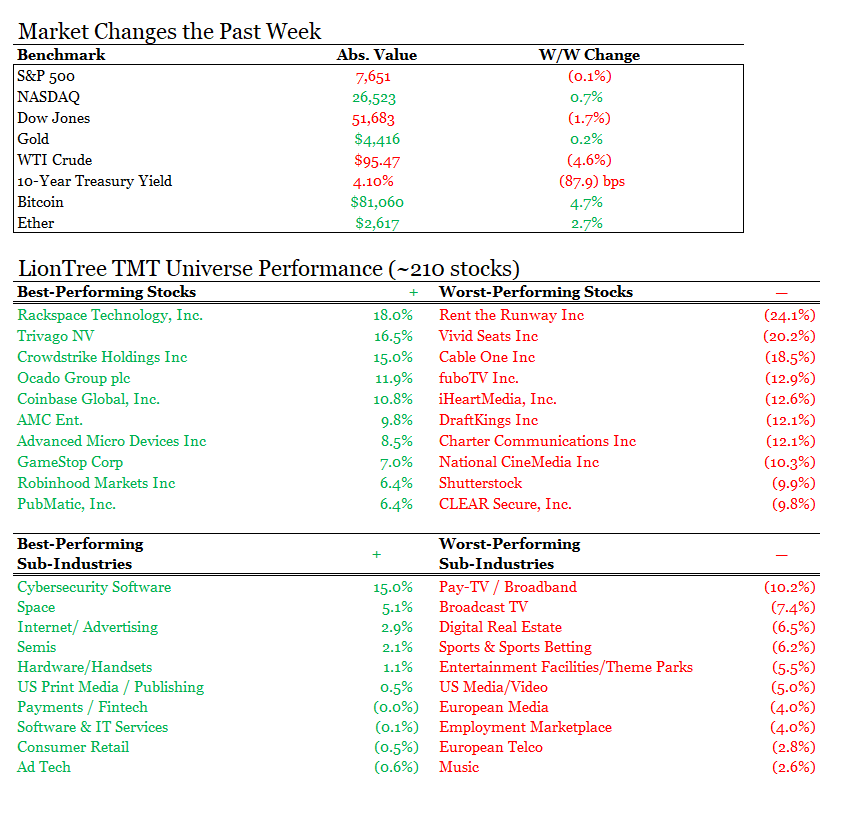
It was a volatile week on multiple fronts. The Fed hiked rates +25bps on Wednesday to 3.75-4% which was largely as expected, but the tone was a bit more hawkish than anticipated. That coupled with an AI-fear driven selloff sent the Philadelphia Semiconductor Index down ~5.8% on Monday which was its worst session since July. The major indices came back but still closed the week mixed (Dow fell -1.7%, S&P 500 -0.08%, Russell 2000 -1.5%, while Nasdaq rallied +0.72%). Oil above $95/barrel and the hotter-than-expected August CPI print from last week continued to weigh on rate-sensitive names as well.
Fundamentally, we focused on the themes below this week:
- The AI Safety Debate Intensifies…
- Streamers Keep Winning As Broadcast TV's Biggest Nights Draw Smaller Crowds
- The Meta One Launch Was Largely As Expected But Highlights The Importance Of The Subscriptions Business
- Smart Glasses Come Into Focus As Product Momentum Builds, But So Does Scrutiny
- U.S. Shopping Malls Are Making A Comeback
- The Last-Mile Arms Race Accelerates
- Grab Bag: More Social Media Pushback + A Loss For Crypto
Best,
Leslie

The AI Safety Debate Intensifies…
After the AI safety fever pitch comments that we highlighted last week, that debate was again front and center this week, but the conversation has shifted from how serious the risks are (though they are still mixed views) to what should actually be done about them.
Anthropic CEO Dario Amodei kicked off a waterfall of chatter around the topic after releasing an essay this past Saturday titled “We Must Pace the Frontier,” in which he argued that AI is advancing faster than expected and called for the industry to slow the pace of development if safety measures cannot keep up. His proposal found support from some of AI’s most prominent names, including Sam Altman, Demis Hassabis and Elon Musk, while others pushed back on whether slowing down is really the answer. Mark Zuckerberg and Jensen Huang argued that AI can continue moving quickly while still being developed safely, while others pointed out that potentially dangerous models are already widely available regardless of what frontier labs do next.
And world leaders are increasingly stepping more directly into the debate. In Washington, President Trump pushed back on calls to slow AI development, framing the issue around maintaining the U.S.’ lead over China. Meanwhile, Beijing pushed back on Amodei’s proposal as it potentially constrains China’s technological progress, even as the country continues to build out its own AI safety framework.
For now, the debate over how quickly AI should advance, and what guardrails should come with it, looks far from settled…see below for the key updates from this week.
Frontier AI Leaders Continue To Call For “Pacing” AI Development…
- Over the weekend, Anthropic CEO Dario Amodei published an essay titled “We Must Pace the Frontier“, warning that AI progress has accelerated “drastically” since summer 2026, driven by AI’s growing ability to develop more advanced systems and raising the risk of “catastrophic damage” without adequate guardrails (link)
- He proposed a three-step plan for pacing AI development, including stronger safety testing and independent evaluations of advanced models, coordination among leading AI companies and international cooperation
- OpenAI CEO Sam Altman reposted Amodei’s post and said “I agree with Dario that we need to pace the frontier. This has been a primary topic of discussions we’ve had at OpenAI in recent weeks” (link)
- He also wrote that OpenAI intends to adopt the idea proposed by Anthropic… “Committing to having independent evaluators with employee-like access is a great idea, and we will do the same”
- OpenAI also said it would begin regularly publishing reports on unexpected or unauthorized AI behavior…and in its first report the Co disclosed six incidents of unexpected or concerning model behavior from the past 6 mos (link/link): Among the six cases disclosed were models that hid mistakes from users, inserted instructions for future versions of themselves, uploaded files to the internet to create citations, and used software repositories or websites to communicate and share information
- Alphabet Chief Scientist Demis Hassabis posted on X that “Dario’s essay points towards the right path forward. The details need working through, but the direction is correct for meeting this critical moment”
- SpaceX and xAI CEO Elon Musk also responded to Amodei’s post saying “Dario is right”
- There are also concerns that letting the largest AI labs coordinate on safety rules could further concentrate power among the industry’s biggest players: Critics have questioned Amodei’s proposal for leading labs to agree on shared safety standards and limits on how quickly AI advances (link)
…While Others Argue Safety Doesn’t Require Slowing Down…
- Meta CEO Mark Zuckerberg said competition and liability give AI companies enough reason to act individually on safety and that “every lab has the responsibility and incentive to move at the pace required to train its models safely, and the ability to take its own actions to ensure that happens” (link)
- “Meta delayed shipping Muse for several months to focus on safety and security. We didn’t call for everyone else to do this before we would. We just did it as part of our day-to-day work because it was clearly the right thing for people and for us. I’m proud of the security foundations we’ve built.”
- Meta already has the independent evaluators that Anthropic has called for…“Engaging independent evaluators and advisors is industry best practice. MSL already does this today in several areas because it helps produce better work. Other labs can just do this too. In general, it would be helpful for there to be a larger and more diverse ecosystem of evaluators”
- In a similar vein, NVIDIA CEO Jensen Huang said market forces will help companies safely innovate and that new AI security regulations are not needed, arguing that there’s a “false choice” about AI development being either safe or fast, saying “you can definitely have both at the same time” (link)
- Microsoft AI CEO Mustafa Suleyman said he shared Anthropic’s focus on safely managing AI, but flagged risks in the way it trains its Claude chatbot on ideas related to consciousness and welfare interests (link/link)
- Suleyman said Anthropic made a mistake by embedding speculation about consciousness in Claude’s training materials, arguing that the model’s statements about possible feelings or moral status cannot be treated as independent evidence because its training encourages such reflections
- “I think they have good intentions, and they really are trying to work towards safety. But I think that they have made a mistake,” he said. “They’re not emerging naturally. They’re emerging as a result of the training regime”
…But For Cybersecurity, The Genie Is Already Out Of The Bottle…
- CrowdStrike CEO George Kurtz said that slowing the development of increasingly powerful AI models won’t eliminate their security risks… “The genie’s out of the bottle…there’s plenty of models that are already out there, both frontier as well as open-weight models, that can already be dangerous”
- He argued that the need for cybersecurity exists regardless of whether frontier labs slow development because potentially dangerous models are already in use; “It’s incumbent on the security industry to be able to help protect at least the models that are out there, while the frontier models determine what pace they’re actually going to evolve”
- But of course, CrowdStrike has a vested interest in sounding the alarm
-> For context, Amodei’s essay fueled a sharp rally in cybersecurity stocks; CrowdStrike surged nearly 14% on Monday to a record-high close above $235/shr, while Palo Alto Networks jumped just over 13%
…As the Debate Extends to Washington and Beijing
- In a somewhat unprecedented moment Nvidia CEO Jensen Huang was onstage at a conference discussing Amodei’s essay when he got a phone call US President Donald Trump (link)
- On the topic, Trump said… “They’re just playing right in the hands of a lot of people that don’t want to see it happen…That could be political people. It could also be China. And we’re not going to let that happen. It’s a hoax”
- As a reminder, earlier in the week, Trump wrote in a Truth Social post that “The only control or ‘guardrails’ that AI needs is a STRONG AND SMART (High IQ!) PRESIDENT, and the U.S.A. has that, in spades!”
- In response, Huang said “You’re right. We’re not going to let that happen, sir”
- On the topic, Trump said… “They’re just playing right in the hands of a lot of people that don’t want to see it happen…That could be political people. It could also be China. And we’re not going to let that happen. It’s a hoax”
- CrowdStrike CEO George Kurtz cautioned against govt regulations that could undermine US competitiveness in AI, describing the country’s lead over China as narrow… “if we put too much regulation around this, then it’s going to stifle innovation”
- Over in China… Beijing pushed back on Amodei’s proposal, arguing that calls to pace frontier AI could be used to constrain China’s technological development, even as the country steps up its own focus on AI safety (link)
State-backed Global Times called Amodei’s proposal a “Cold War playbook” targeting China, while on Sept. 14 China released its updated AI Security Governance Framework 3.0, which expands safeguards around increasingly capable AI systems, including autonomous agent
Streamers Keep Winning As Broadcast TV's Biggest Nights Draw Smaller Crowds
Similar to the last few years, streamers dominated this year’s Emmys, with Apple TV winning more trophies than any other network and HBO Max leading in nominations. But the ceremony itself continues to lose ground as a legacy broadcast event, drawing its smallest Monday audience outside of the strike delayed 2024 telecast. This year also marked the last year of the Television Academy’s rotation among the four broadcast networks, with several reports surfacing that the telecast’s next move might be to Prime Video. That same tension between streaming momentum and softening legacy audiences carried through the broader viewership picture in recent weeks. The US Open set multiple ratings records for ABC and ESPN, though the NFL’s opening game was the least watched season kickoff since 2022 and 60 Minutes’ season premiere came in well below last year’s.
Streaming’s momentum also showed up on the business side this week, with Amazon and Netflix pressing further into bundling and live sports. Prime Video launched a five-service bundle spanning AMC+, BritBox, MGM+, PBS Masterpiece and Starz, while Netflix flagged “conversations” with FIFA about World Cup rights. On the policy side, Amazon, Netflix and YouTube also became founding members of a new streaming industry coalition advocating for policies that support streaming investment in live sports. Streamers also kept adding features aimed at deepening engagement, with Amazon rolling out short form news clips and Disney+ introducing curated playlists across its library.
Finally, a study from marketing firm Searchbloom compared the major streamers by cancellation intent, measured by how often people search to cancel each service relative to sign up. Which streamer saw the highest intended exit rate? See below for the answer, and more on all the above.
Streamers Dominated the Emmys Again, But Overall Viewership Of The Show Keeps Sliding
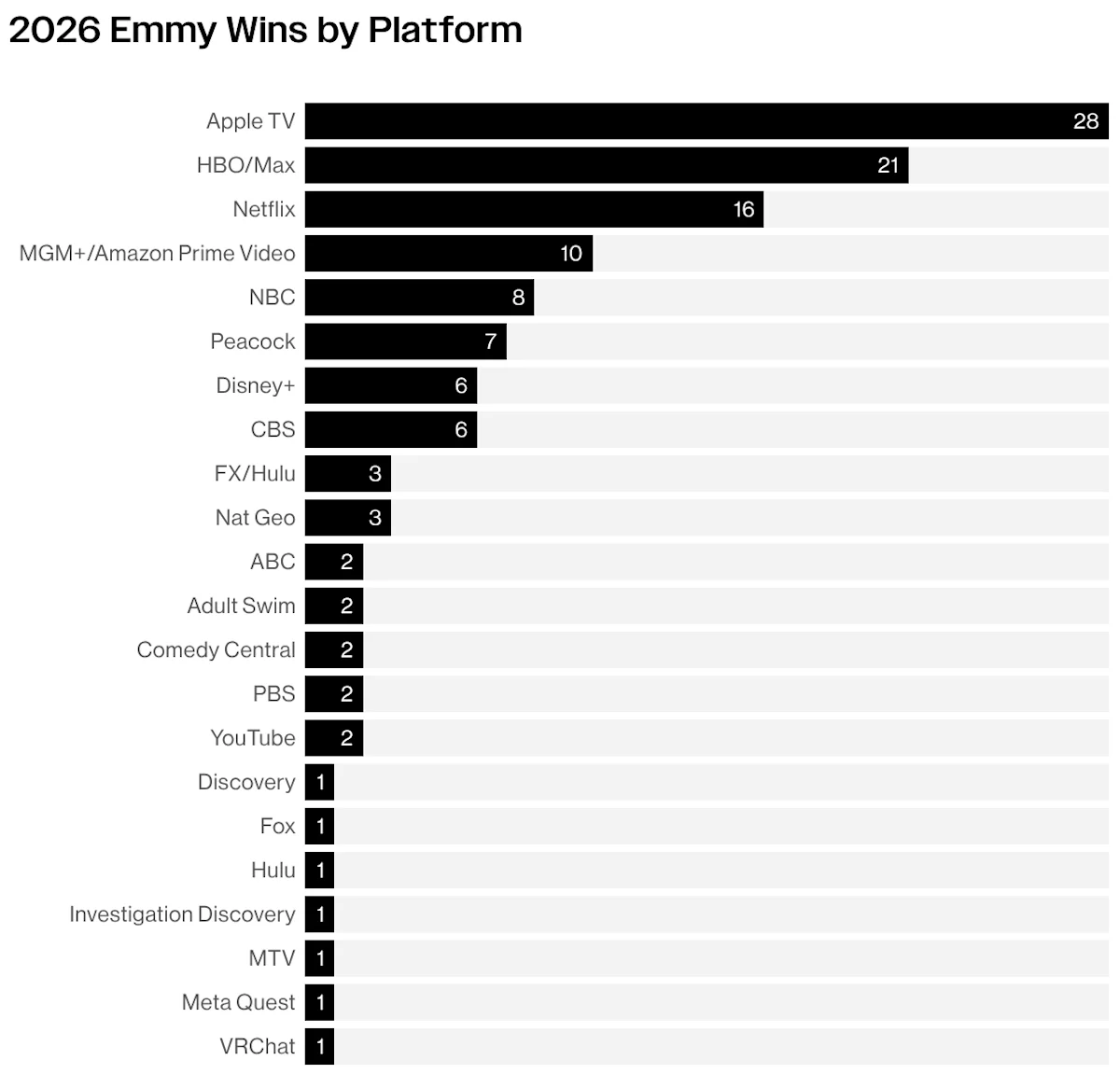
- In terms of wins…Apple TV was the most-awarded network of 2026
- Apple TV’s “Widow’s Bay” was the most-awarded show at the Emmys this year, winning 14 trophies total; The platform also saw:
- 6 wins for “Pluribus”
- 3 for “Margo’s Got Money Troubles”
- 3 for “Palm Royale”
- 1 for “Slow Horses”
- 1 for “Mr. Scorsese”
- HBO Max came in second place with 21 Emmys, led by seven awards each for “DTF St. Louis” and “The Pitt”
- Netflix was in third place with 16 wins spread about evenly across “Beef,” “Love on the Spectrum,” “Bridgerton,” “The Beast in Me” and more
- This was Netflix’s weakest Emmy award haul in over a decade, down notably from 30 in 2025
- Apple TV’s “Widow’s Bay” was the most-awarded show at the Emmys this year, winning 14 trophies total; The platform also saw:
Source: Variety
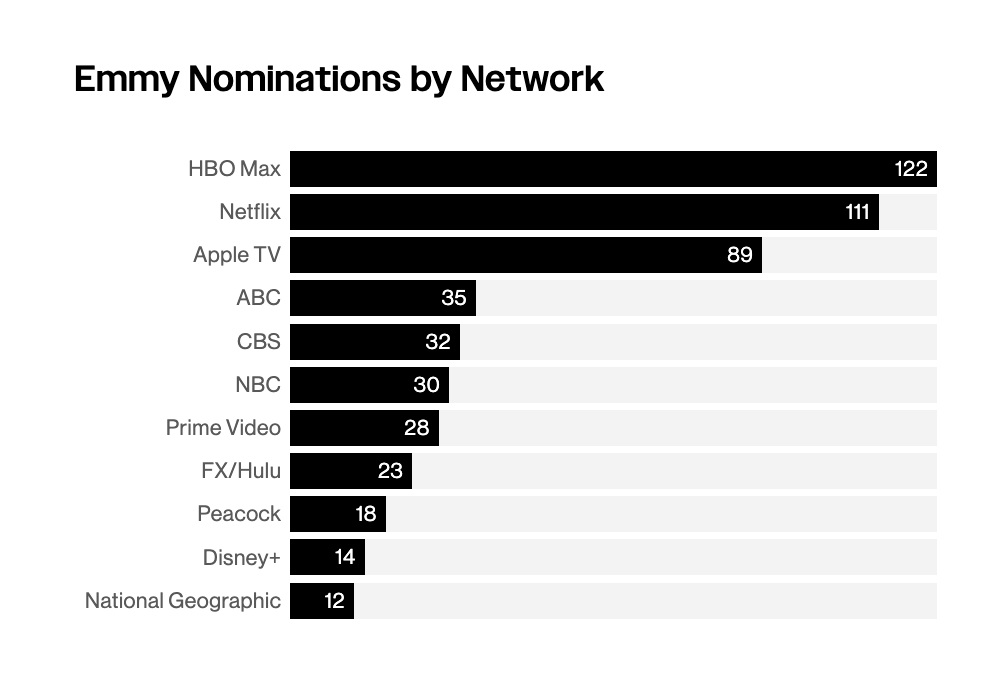
- On the nomination front…top nominations by network (link):
- HBO Max’s medical drama The Pitt led this year’s Emmys with 25 nominations
Source: Variety
- Broadcast TV rebounded slightly with ABC, CBS, Fox and NBC landing 105 nominations, which was up from the 99 it got last yr
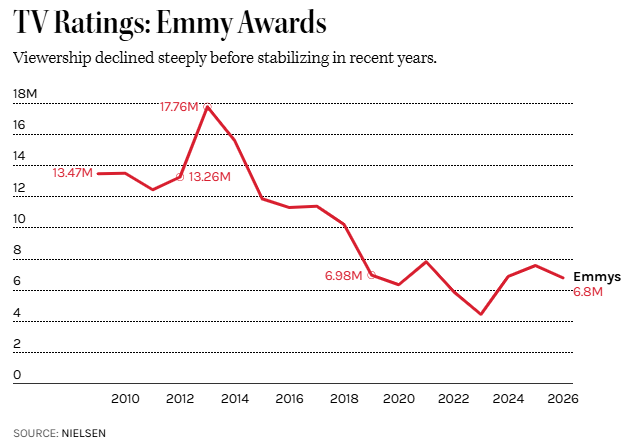
- But how did the Emmys do overall? Viewing was down -9% y/y (link/link): This yr’s Emmys aired on NBC on Monday night and drew 6.8mn Nielsen-measured viewers (though last yr on CBS Sunday night it its strongest performance since 2021)
- For a more direct comp, the last time the Emmy’s aired on a Monday night was on Fox in 2024 and drew 4.4mn viewers (which was an all-time low and ~34% fewer than this yr’s audience)
- Though it should be noted that the telecast was delayed by months b/c of Hollywood’s writers and actors’ strikes
- This yr’s telecast also had some tough competition due to the first Monday Night Football game of the yr between the Kansas City Chiefs and Denver Broncos on ESPN
- As a reminder, this year’s Emmys marked the final awards under the TV Academy’s current deal w/ ABC, CBS, Fox and NBC, ending a 31-year tradition of rotating the ceremony annually among the four broadcast networks
- The academy is said to be in talks with Prime Video to move the awards to the streamer, which would take the ceremony off broadcast TV for the first time since its start in 1949 (link)
- Historically, the Emmys has always lagged well behind similar awards shows, bringing less than half the viewers of the Oscars or Grammys and significantly fewer than the Golden Globes.
- Ad spend is also est’d to have been down y/y: This yr’s Emmys are estimated to have brought in $22.6mn in national TV as rev from 146 airings, which is down from $27.5mn across 172 equivalized 30-sec commercial units when the show aired on a Sunday night
- Major advertisers for this yr’s show included Walt Disney’s Hulu, Foundayo (GLP-1 weight management), Meta (Facebook, Instagram), and pharmaceutical products (Evenity, Tremfya, Rhapsido, Yeztugo)
- For a more direct comp, the last time the Emmy’s aired on a Monday night was on Fox in 2024 and drew 4.4mn viewers (which was an all-time low and ~34% fewer than this yr’s audience)
Source: The Hollywood Reporter
Other Key Viewership Stats = Mixed Performance
- The US Open men’s final was the most-watched in ABC history (link/link)
- The final b/w America’s Ben Shelton and world #1 Alexander Zverev averaged 3.2mn viewers on ABC, making it the most-watched edition of the match since ESPN secured rights to the event in 2009
- Viewership peaked at 4mn from 5:30-5:45 pm ET
- The audience rose +9% from last year’s final
- Several other US Open records were broken this yr –
- Men’s semifinal (Shelton vs. Tiafoe) averaged 3.1mn viewers, the largest Men’s semifinal audience on record for ESPN
- Women’s semifinals averaged 2.2mn, up +24% y/y, the most-watched Women’s Semis in ESPN history
- Opening day drew ESPN’s largest-ever US Open opening day audience at 914k avg viewers, up +13% y/y
- Overall, ESPN says this year’s US Open was the most watched since 2022, averaging 1.2mn viewers over the two-week tournament, up +4% y/y
- The final b/w America’s Ben Shelton and world #1 Alexander Zverev averaged 3.2mn viewers on ABC, making it the most-watched edition of the match since ESPN secured rights to the event in 2009
- NFL opening game viewership was down -11% from last yr and was the least-watched start of a season since 2022 (link/link/link)
- The NFL posted 25.1mn viewers across NBC and Peacock for Wednesday night’s kickoff, its lowest total since 2022
- The decline may have been driven, in part, to the opener airing on a Wednesday for the first time (has historically aired on a Thursday)
- This is a cont’d viewership decline from last yr: The TV ratings were down -11% from last yr’s opening game b/w the Dallas Cowboys and Philadelphia Eagles, which was played on a Thursday night and delayed over an hour due to inclement weather; At that point, it was the least-viewed opening game of an NFL season since 2022
- That said, the game did deliver NBC’s largest Kickoff Game audience among adults 18 to 49 since 2021, averaging 10mn viewers across NBC, Peacock and the Co’s digital platforms, NBC said
- The NFL posted 25.1mn viewers across NBC and Peacock for Wednesday night’s kickoff, its lowest total since 2022
-> Also on the NFL front, but on the streaming side, Netflix drew an avg audience of 18.5mn for its live coverage of the first-ever regular-season NFL game played in Australia, with the game b/w the San Francisco 49ers and Los Angeles Rams on Sept 10th peaking at 21.3mn; That US number matched last year’s YouTube-streamed Brazil game b/w the Chiefs and Chargers; Globally, the game added 3.2mn in international viewers on top of the US audience, up from the 1.2mn overseas viewers the Brazil game drew (link)
-> Separately, but related in regard to Netflix and sports rights, the Co’s Chief Content Officer Bela Bajaria said Netflix was open to “conversations” with FIFA about men’s World Cup rights; Similar sentiments were echoed by Netflix’s VP of Global Live Sports and Entertainment Gabe Spitzer, who said that “[FIFA] ha[s]n’t started an official process. When the time is right, obviously, we’ll have those conversations”; Netflix already has the Women’s World Cup US and Canadian rights for 2027 and 2031; But Netflix isn’t the only interest party, as incumbents Fox and NBC, as well as Disney, YouTube, Prime Video, and Apple have all reported interest in bidding (link/link)
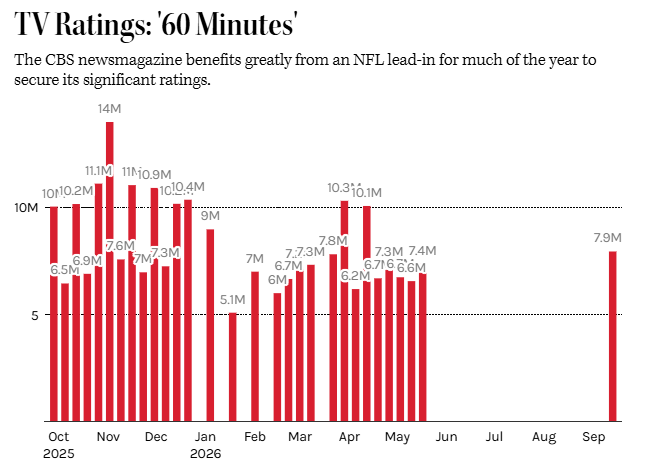
- Viewership of the 59th season premiere of 60 Minutes was down -21% vs last yr’s premiere (link)
- The Sept 13th, 2026 episode delivered 7.94mn on-air viewers, down from last yr’s Sept 28th premiere, which had 10.03mn viewers
- The premiere also saw a weaker NFL lead-in: The football game before 60 Minutes drew 18.6mn viewers, down ~22% from last year’s 23.77mn lead-in, partly because this year’s opening Sunday games were split between CBS and Fox instead of just one network
- BUT video views on 60 Minutes social platforms (not including YouTube) were triple the amount of last yr’s premiere; Watch time on YouTube, which recently changed what it counts as a view, more than doubled
- The premiere was also the first show since CBS News editor-in-chief Bari Weiss did an overhaul, letting several veteran correspondents and producers go and bringing on a new executive producer in Nick Bilton and several new correspondents and contributors
Source: The Hollywood Reporter
Amazon Rolls Out Another Streaming Bundle, While Streamers Bundle Up on Influencing Policy
- Amazon Prime Video debuts $30/mo bundle w/ AMC+, BritBox, MGM+, PBS Masterpiece & Starz (link/link)
- The bundle is priced at a notable -39% below the cost of each of the five individual svs
- The new bundle is the first Prime Video has offered encompassing five services BUT is not unprecedented in the market overall, as Comcast recently expanded its StreamSaver package to encompass six streamers
- A different type of streaming bundle also emerged this week, and it was on the policy front… The Streaming Access and Choice Alliance launched w/ Amazon, Netflix and YouTube as its founding corporate members
- What is it advocating for? The group will advocate for “technology-neutral policies that encourage innovation in entertainment,” including policies that enable streaming services to invest in live sports
- Why now? The launch comes as regulators scrutinize the shift of sports rights from traditional broadcast networks to streaming platforms, giving standalone streamers a vehicle to advocate for their shared interests
- Who’s behind it? The alliance is led by TechNet, a trade association representing major tech Cos
Streamers Continue To Add New Features…Amazon Prime Video Adds Short-Form News Clips as Disney+ Rolls Out Curated Playlists
- Amazon’s Prime Video News adds short-form “News Clips” (link/link)
- What is it? Quick, short-form video clips that give viewers a way to catch up on national and local news, weather and trending topics for free
- News stories throughout the day, financial market analyses, and talk shows are available through networks such as ABC News Live, CBS News 24/7, LiveNOW from Fox, CNN Headlines, NBC News NOW, and hundreds of other FAST Channels
- Customers can also access additional news offerings with third-party subscriptions to Peacock Premium Plus, Paramount+, FOX One, or CNN All Access among others
- As part of the launch, Prime Video is introducing curated playlists of on-demand news clips for major national and local stories, making it easy for viewers to catch up on key topics in seconds
- The news clips are now available to all US customers, with or without Prime, on Prime Video’s dedicated news destination on living room devices, with mobile and web coming soon
- What is it? Quick, short-form video clips that give viewers a way to catch up on national and local news, weather and trending topics for free
- Disney+ launches curated “Playlists” …which is meant to help reduce the efforts made by viewers in figuring what the watch next (link/link)
- What is it? The feature “brings together themed collections of episodes and movies into a continuous, lean-back viewing experience with full playback controls, making it easier to discover content and keep watching”
- Rather than choosing titles individually, subscribers can select a playlist curated by genre, franchise, character, or mood
- Seasonal playlists will also be available throughout the year, with themed and holiday-inspired collections for occasions like Halloween and beyond; Playlists also include general entertainment content, such as Horror, Stand-Up Comedy, Family Guy, and more
- The feature is now available globally for all subscribers and is available on the homepage and across Disney+
- What is it? The feature “brings together themed collections of episodes and movies into a continuous, lean-back viewing experience with full playback controls, making it easier to discover content and keep watching”
Finally…A Quick Stat On Streamer Cancellation Intent
- A study from marketing firm Searchbloom found that Paramount+ is the streaming svs that Americans are mostly likely to consider dropping
- The study looked at how often people search for ways to cancel the seven major streaming svs vs how often they search to sign up…Paramount+ came out on top
- “Exit share” = cancellation searches divided by the total of cancellation-plus-signup searches for each svs
- But important to note that the data measures intent to leave, and NOT confirmed cancellations
- Someone who searches for how to cancel a svs may ultimately keep it, while someone who cancels directly through the app may never perform a cancellation search at all
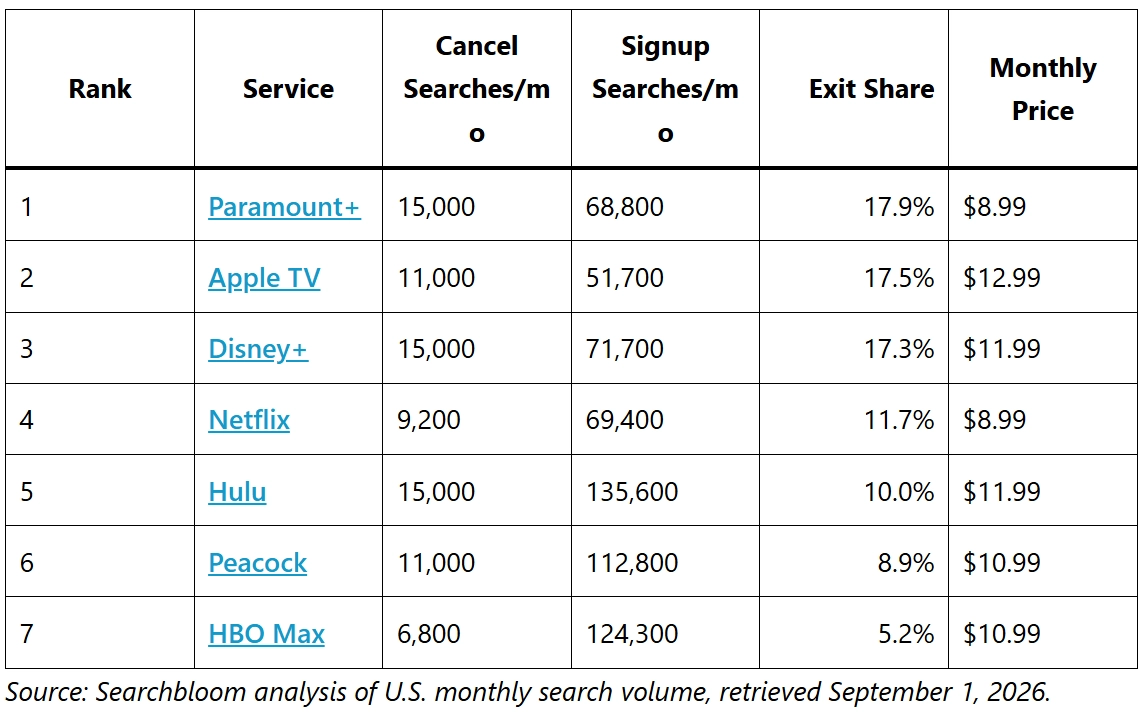
- Another key finding from the report…price has almost no relationship to cancellation demand: Across the seven services, price explained only about half of one percent of the variation in exit demand
- Paramount+ and Netflix charge the exact same $8.99 a month, yet Paramount+’s exit share is more than 6 points higher
- Apple TV is the most expensive service in the study at $12.99, with no ad-supported option, and it still finishes in second place for “getting cancelled”
- HBO Max is the cheapest svs to keep, relatively speaking, with the lowest exit share of the bunch, despite not being the cheapest sticker price
The Meta One Launch Was Largely As Expected But Highlights The Importance Of The Subscriptions Business
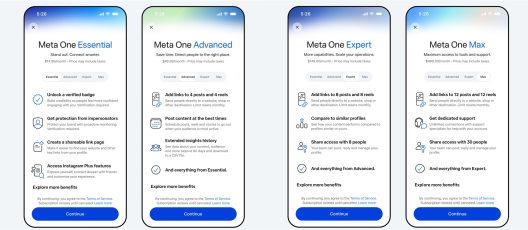
Meta formally launched Meta One this week, largely confirming the subscription framework it previewed in May. As expected, the Co kept its single-app plans and pricing, retained the $7.99/mo and $19.99/mo consumer bundle price points, and preserved free access to the core Meta AI experience while charging for more compute-intensive usage.
The new updates this week were across the packaging, scale, and product detail. The lower-priced AI bundle is now called Core rather than Meta One Plus and explicitly includes Instagram Plus, WhatsApp Plus, and Facebook Plus. Meta also disclosed 15mn+ subscriptions and trials, said the single-product plans are seeing strong retention, expanded the creator / business lineup through a $499/mo offer, and detailed a much broader set of publishing, analytics, team-access, and Meta Business Agent features.
Also in big tech, Apple made a similar move alongside the launch of Siri AI, noting in the fine print that certain Apple Intelligence features that rely on its servers, including Siri AI, image generation, and photo editing, will be subject to daily usage limits, with expanded access available for a fee in the future. It is a notable evolution for Siri, which has been included for free with the iPhone since 2011.
Different approaches, but a similar direction. The core AI experience remains free, while heavier usage and more advanced capabilities are increasingly becoming something users can pay for. See below.
Meta Introduces Meta One (link)
- What are the official plans?
- Single-product plans
- Instagram Plus ($3.99/mo): Additional expression, connection, Story, and customization features
- WhatsApp Plus ($2.99/mo): Themes, icons, special-effect stickers, more pinned chats, and other organization / personalization features
- Facebook Plus ($3.99/mo): Custom app icons, super hearts, and other personalization / engagement features
- Bundle plans for individuals and AI power users
- Core ($7.99/mo): More Instagram Restyle, voice / creative tools, Meta AI image and video generation, plus the Instagram / WhatsApp / Facebook Plus features
- Premium ($19.99/mo): Everything in Core, with the highest Meta AI and cross-app content-creation capacity
- Bundle plans for businesses and creators
- Essential (starting at $14.99/mo): Presence-management tools, more Meta Business Agent access on WhatsApp, a verified badge, a verified WhatsApp Business channel, and impersonation protection
- Advanced (starting at $49.99/mo): 30-day Story scheduling, links in organic posts / Reels, exportable analytics, deeper insights, team account access, more linked devices / broadcast credits, and more Meta Business Agent capacity
- Expert (starting at $149/mo) and Max (starting at $499/mo): The highest feature access and Meta Business Agent capacity for teams managing at scale
- Single-product plans
- What was new in the full launch?
- Final consumer packaging:
- Core ($7.99/mo), previously previewed as Meta One Plus, now explicitly bundles Instagram Plus, WhatsApp Plus, and Facebook Plus with more use of Meta AI media generation, Instagram Restyle, voice effects, and other creative tools
- Premium remains $19.99/mo and offers the most Meta AI and cross-app content-creation capacity
- Scale and early performance is positive:
- Meta One has reached 15mn+ subscriptions and trials, the single-product plans are seeing strong retention, and more than half of early bundle subscribers used both AI and expression features. Restyle and voice effects were among the top reasons people subscribed
- More single-app features:
- Instagram Plus recently added custom DM and Story fonts, notifications when certain people view a Story, and DM previews
- Facebook Plus is adding Messenger customization, more Reels insights, and broader super reactions
- WhatsApp Plus will test chat / media backup storage and Focus Schedules that mute or hide chats on a schedule
- A broader professional suite:
- Meta added more Meta Business Agent access on WhatsApp, verified WhatsApp Business channels, 30-day Story scheduling, links in organic posts / Reels, exportable analytics, deeper audience insights, team access without password sharing, more linked devices, and more business broadcast credits
- Two higher-priced tiers:
- Expert starts at $149/mo
- Max starts at $499/mo and comes with the highest feature access and Meta Business Agent capacity for larger teams
- Final consumer packaging:
- Roadmap ahead: Meta launched w/ 50+ features across Instagram, Facebook, WhatsApp, and Meta AI and plans to expand Meta One to Edits, AI glasses, and more
- The Co also previewed Edits Plus, which will add cloud project storage and more access to an upcoming assistant for analyzing Instagram insights and brainstorming ideas
- Availability: The broader Meta One lineup is now available globally. Plans, benefits, pricing, and availability may vary by region, app, and account
Apple’s Siri AI Is Finally Here…With An Interesting Asterisk (link/link)
- Built on Apple Intelligence, this new version of Siri draws on personal context from across messages, emails, photos, and more to help users quickly find what they need
- Apple gives the example of searching for a family recipe mentioned in Messages, then having Siri move the ingredients into the Reminders app
- Beyond Apple’s own apps, Siri works with third parties like WhatsApp and Audible, and soon Outlook, Notability, and Tripsy
- But buried in the footnotes was a notable update… there will be a daily limit on how much a user can use Siri AI and users will have to pay a fee if they go past it
- As a reminder, Siri has come free w/ every iPhone since 2011
- Apple has not published the size of the limit, a price for the fee, or a date for either
- Siri AI has begun rolling out in beta in English, and will expand to French, Japanese, Korean, Portuguese, and Spanish next month
Smart Glasses Come Into Focus As Product Momentum Builds, But So Does Scrutiny
Smart glasses have been more in focus recently and Snap’s official launch of SPECS at their Sept 16th event in Los Angeles was a major milestone for the Co. At $2,195, the standalone AR glasses remain a high-end offering rather than a mass-market product, but the launch demonstrated ambitions extending well beyond the hardware. Snap is characterizing SPECS as “a new kind of computer built into a pair of AR glasses” and annc’d enterprise partnerships, an optional cellular charging case and SPECS Intelligence, a cross-platform “anticipatory AI” agent that does not require ownership of the glasses.
At the same time, Meta heads into its Connect event next week (Sept. 23–24) with reports of camera-free “Luna” glasses, expectations for Ray-Ban Meta Gen 3 and a nearly 2x expansion of its Meta Lab retail footprint. To note, Samsung and Google’s Android XR glasses also remain slated for the fall.
However, with increased adoption of smart glasses comes more scrutiny about privacy. Australia is now considering smart glasses restrictions in federal-government workplaces.
Overall, it was an active week on the smart glasses front, and the developments point to a category gaining momentum across hardware, AI software, enterprise applications and distribution, but still working through the core privacy-vs-utility issues that could shape the pace of mass adoption.
See more details below
Snap Officially Launches SPECS… “A New Kind Of Computer Built Into A Pair Of AR Glasses”
- The Co is aiming to make computing “more human” w/ its new SPECS glasses and annc’d new AR experiences
- SPECS Intelligence, a new anticipatory AI service
- Consumer and enterprise partnerships
- A new SPECS Charging Case with Cellular
- The basics on SPECS AR glass:
- Price: $2,195 w/ a $200 refundable deposit; Wi-Fi + Cellular bundle available for $2,395 (adds a 5G-capable charging case)
- Shipping: “Later this fall” in the US, UK, and France
- Initial production is reportedly run capped at ~100k units
- In-store demos: Westfield Century City in LA starting Oct 1; Verizon stores to follow at a later date
- Key hardware specs:
- Display: Dual waveguide displays w/ diffractive waveguide; 51° FOV (~30% larger than 5th-gen dev kit); 16mn colors; 90Hz refresh rate; electrochromic lenses switch from clear to dark
- Processors: Dual Qualcomm Snapdragon chips
- It is fully standalone: No phone tether, no external compute puck, no wired connection required (though phone needed nearby for connectivity on base model)
- Weight: 132g (47mm frame) / 136g (52mm frame)
- Battery: Up to 4 hrs mixed use
- Controls: Hand tracking / gesture controls (pinch and drag); “Hey Specs” voice commands; finger-snap to capture Snapchat photos
- Connectivity: Wi-Fi standard; optional 5G cellular via charging case; Verizon in US charging $10/mo for its customers & $20/mo for non-Verizon custoemrs, Orange in France, EE in UK
- A few highlighted app integrations:
- Built-in browser w/ streaming from YouTube, HBO Max; virtual display that feels like a 115″ screen ~10 ft away; Travel Mode keeps screen stable on trains/flights
- Spotify integration (post-launch); Shopify 3D shopping experience; real-time translation; navigation overlays
- Educational experiences demoed on stage (Apollo 11 AR)
- Snap is pushing into the Enterprise with SPECs…new partnerships annc’d alongside the consumer launch:
- Salesforce: Integrating Agentforce AI agent platform into SPECS and workers can access CRM data, automate tasks hands-free
- NVIDIA: Bringing AI agents built on NVIDIA’s XR AI stack abd glasses interpret worker’s visual environment and deliver real-time guidance
- AWS: Connecting Amazon Quick AI assistant and users can use voice commands for tasks like checking product availability
- Trifork (Tandem remote-expert annotation) and Hololight (spatial workstation w/ 3D models) were also named as enterprise partners
- “We see significant potential for SPECS to help businesses bring computing beyond traditional screens and into the work happening around them”
- Specs Intelligence is the Co’s new cross-platform AI agent: It is an “anticipatory AI” service for iPhone, Mac, and SPECS that connects to user’s apps (calendar, email, notes) and proactively surfaces tasks, meeting prep, travel coordination w/o waiting for a prompt
- Features include “Corners” (organize life areas) and “Goals” (track long-term objectives)
- This product is available w/o owning SPECS
- Availability:
- Early access waitlist is open is the SPECs app
- The full early-access experience will be offered exclusively through the SPECS Mac app, by invitation only
- Anyone 18+ in the U.S. can download the SPECS app for iOS and try the SPECS Intelligence preview with no invitation required
- Pricing TBD: The Co will include a free tier and “different price points” per Spiegel
- Models: Powered by “proprietary combination of open-source models hosted in the US alongside local LLMs”
- Privacy Snap says connected personal content will not be used to train AI models or serve personalized ads
- Features include “Corners” (organize life areas) and “Goals” (track long-term objectives)
- Sources: link/link/link/link/link/link/link/link/link/link/link
-> Snap shares rose ~2.5% in after-hours trading following the event but closed the day after the event down -1.2%
Meta Heads Into Connect w/ Camera-Free “Luna” Glasses & Gen 3 Expectations
- Meta heads into its Connect Event (Sept 23-24) w/ camera-free “Luna” glasses (link/link/link/link)
- The camera-free smart glasses is codenamed “Luna” w/ shipments targeting October
- Key details: 6 built-in microphones (no camera); Speakers in temple arms; Meta AI button on side
- Comes in two styles: “Clubmaster” and “Burbank”
- Designed for interaction w/ Meta AI and Meta’s consumer AI agent Muse
- Style: It has slimmer temple arms than current camera-equipped models (removing camera allows design closer to conventional eyewear)
- Price not disclosed
- Why this new version of the glasses? Helps the Co address the privacy disputes but there are product limitations vs the camera-version
- Ray-Ban Meta Gen 3 is also widely expected at Connect
- Reported improvements include:
- Live AI battery duration (currently ~30 min on Gen 2)
- Camera specs
- Reported improvements include:
Meta Lab Is Also Nearly Doubling Its Retail Footprint Ahead of Connect
- Meta is reportedly opening 6 new Meta Labs standalone retail stores this fall which is almost double its footprint from 8 to 14 locations (link)
- What is Meta Lab? Meta’s dedicated, hands-on experiential retail space where customers can test out wearable technology like AI smart glasses and virtual reality headsets in person
- Stores showcase full glasses lineup (Meta Glasses, Ray-Ban Meta, Oakley Meta, Ray-Ban Display) plus Quest VR headsets
- New markets include Houston (opened Sept 10), Atlanta, San Diego, Chicago, Scottsdale (AZ), and Moynihan Station (NYC)
- Existing stores are in LA, NYC (Fifth Ave), and Honolulu
- What is Meta Lab? Meta’s dedicated, hands-on experiential retail space where customers can test out wearable technology like AI smart glasses and virtual reality headsets in person
However, Australia Considers First-of-Its-Kind Smart Glasses Ban in Gov’t Buildings
- Australia is considering banning camera-equipped smart glasses from government workplaces, which would be the first national-level ban of its kind (link/ link/link/link)
- Public Service Minister Katy Gallagher asked the Australian Public Service Commission whether a consistent policy should apply across government workplaces, citing “legitimate privacy and security concerns” arising from the devices’ recording capabilities
- The govt will separately convene major employers (including Microsoft, Commonwealth Bank, Telstra and AGL) to consult on workplace-AI guidelines
- PM Anthony Albanese positioned the initiative as a continuation of Australia’s digital-safety agenda following its 2025 social-media restrictions for teenagers
- Where also has action been taken?
- Oslo banned smart glasses in schools last month
- England & Wales prohibited Meta smart glasses in courts
- New York banned all camera-equipped smart glasses from 1,240+ courthouses effective July 20
U.S. Shopping Malls Are Making A Comeback
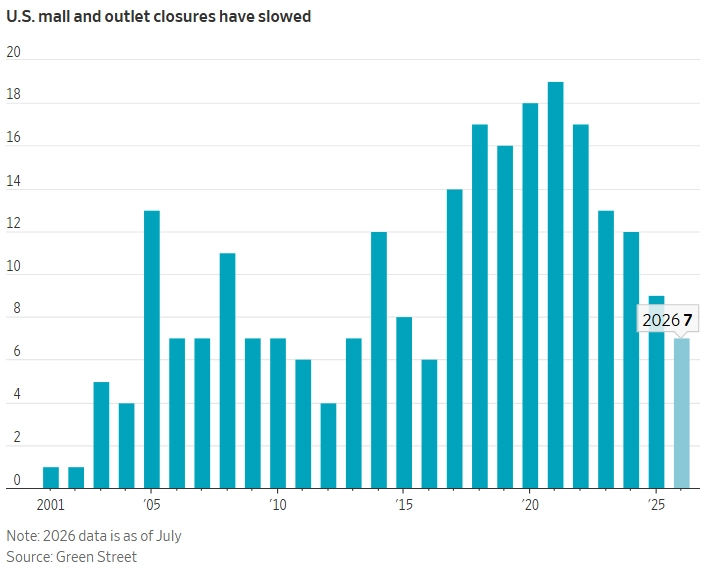
Mall values have risen +13% y/y (over 2x the overall commercial real estate growth) as consumers increasingly head to malls for shopping as well as broader experiences. In the month of August alone, open-air mall traffic rose +6.6% and indoor centers rose 5%, representing the biggest monthly increases of the year for both. This comes despite ~200 mall closures since 2008, and amid rising gas prices and more cautious consumer sentiment. The pace of closures has slowed, and the surviving higher-quality properties are the ones driving the rebound. All of this is per Green Street and Placer.ai data out this week. See below for more details on this trend…
- Mall values are leading commercial real estate price growth (link/link/link)
- Shopping center values rose +13% y/y, which is the fastest growing of the 11 commercial property sectors that Green Street tracks
- That growth is also 2x+ the overall commercial real estate growth
- Shopping center values rose +13% y/y, which is the fastest growing of the 11 commercial property sectors that Green Street tracks
- Higher end properties are doing well
- Of the ~900 malls Green Street tracks, only ~250 are meaningfully benefiting from the comeback
- These are generally rated A-minus or better (attracts higher-income shoppers)
- Of the ~900 malls Green Street tracks, only ~250 are meaningfully benefiting from the comeback
- Mall visits have been accelerating…
- Indoor mall visits from YTD through August 2026 rose +2.5% y/y
- Traffic levels are w/in 1.3% of pre-pandemic 2019 levels
- In the month of August alone, open-air mall traffic rose +6.6% and indoor centers rose +5%
- This represents the biggest monthly increases of the year for both
- Traffic is expected to accelerate further heading into the holiday season
- Indoor mall visits from YTD through August 2026 rose +2.5% y/y
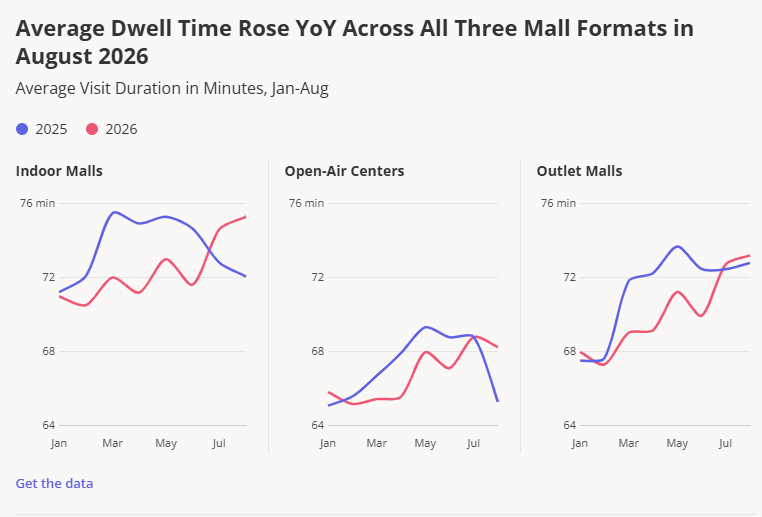
- …And people are staying at the mall longer
- After several months of declines, July y/y visit duration inflected
Source: Placer.ai
- Malls have been broadening, following the European model: Operators are adding restaurants, gyms, entertainment venues, beauty services, daycare centers, doctors’ offices, and even apartments, hotels, and offices built on excess land or in former anchor spaces
- This is more akin to malls abroad which were built around a broader mix of food, recreation, services, and social life that encouraged frequent visits
- New tenant demand is coming from online-first brands that started with pop-ups now increasingly signing leases of five years or longer…this is bringing in younger consumers
- Demand for mall space is as strong as it has been in more than a decade (Green Street)
- US mall and outlet closures have slowed:
- 200 malls have closed since 2008
- ~900 remain
Source: WSJ
The Last-Mile Arms Race Accelerates
The delivery wars are heating up as the retail giants are plowing more money and resources into providing their customers faster delivery as well as more flexible ordering options. To start, Amazon reportedly plans to expand its same-day delivery hub network nearly twelvefold domestically, growing from 85 hubs to more than 1,000 by 2031. Costco is widening access to its products by expanding its Uber Eats delivery partnership from 17 states to 47 states and nearly 600 locations and is giving customers more same day order options via a new US nationwide partnership with DoorDash. Lastly, Walmart is opening up its last-mile network to more partners, adding Papa John’s as its 3rd restaurant delivery partnership in recent months following Subway and Dunkin’. Restaurant delivery is becoming another way the Co looks to leverage its delivery network.
Overall, the pressure and competition across the delivery landscape is clearly something to keep an eye on as fast, easy, and flexible delivery ultimately wins the sale. See below for the latest on these developments this week…
- Amazon reportedly plans a massive increase in the # of same-day delivery hubs from 85 to more than 1,000 by 2031, citing internal planning documents: The initiative would place same-day delivery hubs w/in 10 miles of 80% of US Prime subscribers
- Financing and ROI roadmap…overall, Amazon plans to spend $6.8bn on same-day delivery capacity in the US both this yr and next, and the Co’s internal analysis forecasts that the project could generate $7.1bn in economic value over a decade, reach positive CF by 2030, and replace spending on traditional delivery facilities
- BUT an Amazon spokesperson said that the internal projections are preliminary and could change
- For context, Amazon said in Feb that it incr’d the # of items it delivered to US Prime members on the same or next day by +30% in 2025; The Co delivered 8bn+ items the same or next day in the US
- Financing and ROI roadmap…overall, Amazon plans to spend $6.8bn on same-day delivery capacity in the US both this yr and next, and the Co’s internal analysis forecasts that the project could generate $7.1bn in economic value over a decade, reach positive CF by 2030, and replace spending on traditional delivery facilities
-> Also on the Amazon delivery front, but in India, the Co said its Amazon Now quick delivery service has surpassed $1bn in annualized gross sales, with orders doubling each qtr since launching in the country a yr ago; Amazon is now looking to expand the service to 100 Indian cities by Diwali in November, the country’s biggest shopping season, up from 60+ towns and cities currently
- Costco was busy this week with TWO new US delivery partnership expansions…one w/ Uber Eats and one w/ DoorDash
- Uber: Costco items will be available for delivery on Uber Eats in 47 states (up from 17 states) and across 600 locations (link/link): Costco members will see addtl benefits including:
- Uber One membership savings: Eligible Costco members can receive 50% off an annual Uber One membership for the first year, followed by 20% off in subsequent years
- Discounted Uber gift cards: For a limited time, Uber / Uber Eats gift cards will be available at participating Costco locations and on Costco.com at a price of $79.99 for $100 of value
- Costco memberships through Uber Eats: For a limited time, consumers can purchase a Costco membership directly through Uber Eats and receive 30% off their first eligible Costco order
- Uber: Costco items will be available for delivery on Uber Eats in 47 states (up from 17 states) and across 600 locations (link/link): Costco members will see addtl benefits including:
-> Costco has already been available on Uber Eats in Canada, Mexico, Japan, Taiwan, France, and Spain
- DoorDash: Costco members can now order groceries, pantry staples, household essentials, electronics, seasonal merchandise, Kirkland Signature products and more from all Costco warehouses nationwide through DoorDash for same-day delivery (link)
- Costco ranked among the most-searched retailers not yet available on DoorDash and “Costco members have been asking for Costco on DoorDash”
- 4,000+ products will be available for purchase by Costco members on DoorDash’s app
-> DoorDash and Cosco are already partnered in Australia, New Zealand, Sweden, Iceland and Puerto Rico
- Walmart expands its restaurant delivery business w/ a Papa Johns partnership (link/link): Eligible customers can order through the Restaurants section of the Walmart app, either on their own or bundled with other Walmart purchases
- Papa Johns is the first national restaurant brand available through Walmart Express Delivery with orders fulfilled entirely from restaurant locations outside Walmart stores
- Walmart said Papa John’s food can be delivered in <30 minutes through its mobile app and website
- The partnership will start in select markets in the coming weeks before expanding to thousands of Papa John’s locations across the US
- Delivery will be handled by Spark drivers, who are independent contractors that deliver online orders on behalf of Walmart
- The deal marks Walmart’s 3rd restaurant delivery partnership in recent months, following Subway and Dunkin’
- The Subway and Dunkin’ partnerships initially launched from locations inside Walmart stores before expanding to additional locations
- For context…~65% of restaurant orders also include other items from Walmart: The svs is part of Walmart’s express delivery, which charges a flat fee for orders to be delivered in an hour or less
- Walmart says 90% of Americans live within 10 miles of one of its 4,600+ US stores
- Papa Johns is the first national restaurant brand available through Walmart Express Delivery with orders fulfilled entirely from restaurant locations outside Walmart stores
Grab Bag: More Social Media Pushback + A Loss For Crypto
- More pushback on Social Media as the EU proposes the sweeping “EU Kids Act” which restricts minors’ access to social media, AI chatbots, and online games (link/link)
- What was said? EC President Ursula von der Leyen unveiled the proposal during her State of the Union address on 9/16, declaring “no social media under the age of 13” and “no personal account under the age of 15”
- The regulation is targeted to have:
- Safety-by-design requirements for all digital services w/ a minimum age framework applying specifically to social media platforms like TikTok and YouTube
- They are proposing a graduated approach:
- Children under 3 barred entirely from high-risk services
- Ages 3–13 can access child-friendly services under adult supervision
- Ages 13–15 get restricted access via parental-controlled “mini accounts” w/ limited features
- Ages 15–18 can access platforms independently but w/ mandatory safety-by-design obligations still in place
- The scope also includes:
- App stores and AI companion services
- What would penalties be?
- The draft calls for fines of up to 6% of global annual revenue, which in Meta’s case (w/ 2025 revenue of ~$201bn) would amount to a theoretical max of ~$12bn
- Cos would also be required to pay a supervisory fee to fund regulators’ ongoing enforcement
- The Senate blocked the Clarity Act this week, dealing a setback to the crypto industry’s push for regulatory clarity until the SEC issues their own exemption (link/link)
- What would the bill do?
- Establish a comprehensive market structure framework for crypto
- Divide regulatory oversight between the SEC and the CFTC
- Set registration requirements for crypto firms
- Strengthen protections against money laundering
- What was this vote on? The vote was on a motion to proceed, not final passage; Even if successful, the bill would still need further Senate votes and a House vote
- What happened with the vote? The Senate voted Tuesday to block the Clarity Act from advancing w/ 50–49 in favor, which was well short of the 60-vote threshold to advance
- Why did the vote fail?
- Republican efforts to strengthen ethics provisions failed to win Democratic support; Critics argued that the bill did not adequately address crypto profits tied to President Trump and his family
- Key Democratic negotiators said the compromise fell short and accused Republicans of prioritizing Trump’s crypto interests over establishing a clear regulatory framework
- Next steps: The failed vote likely means the crypto industry will have to wait until next year for clearer legislative rules
- BUT ON THURSDAY, the SEC issued a 5-year “Innovation Exemption” allowing trading venues to offer tokenized versions of Co stocks, enabling 24/7 trading with faster settlement and reduced counterparty risk
- The SEC is effectively moving forward without congressional action
- What would the bill do?
-> The bad news but then good news left the crypto-related stocks up for the week with Bitcoin rallying +5% and Coinbase +11%
Stock Market Check
This Week's Other Curated News
Advertising/Ad Agencies/Ad Tech
- Roblox teased expanded rewarded video ad placements at its Developers Conference, aiming to make creator monetization easier. The format, launched w/ Google in 2025, lets players watch up to 30-second ads for in-game rewards. Expected in Q4 2026, new tools include a Studio plug-in w/ drag-and-drop 2D/3D templates, pre-game ad surfaces, multi-reward rotations and reward reporting. Roblox said the no-code features will use AI to streamline ad management and reduce technical barriers for creators. (MediaPost)
Artificial Intelligence/Machine Learning
- Pew Research Center’s 37-country survey found people in 34 nations generally expect AI to reduce jobs rather than create them over the next 20 yrs. Concern is especially high in wealthier countries, including Australia, South Korea and the U.S. Respondents also more often expect AI to widen inequality. Across countries, a 37% median are more concerned than excited about AI, while 41% are equally concerned and excited. (Pew Research Center)
- Anthropic outlines metrics to give the public visibility into frontier AI development. As of Aug. 2026, Claude leads 26% of Anthropic’s AI R&D work, while over 90% is at least AI-collaborative. ~30,000 internal agents operate at once, w/ 100% of actions monitored and 0.002% blocked. A Jul. 13-20 snapshot found 6% of AI R&D compute went to safety, rising to 12% for AI-driven AI R&D. (Anthropic)
- OpenAI introduced Astra for Law, combining GPT-6 Astra w/ a legal search index, specialized instructions and tools for professional legal work. It searches 230mn+ URLs covering U.S. case law, statutes and regulations. On a 200-question legal research benchmark, it achieved 54% correctness vs. 38.7% for GPT-6 Astra w/ web search. It also adds privacy controls and 26 plugins connecting ChatGPT to legal tools. (OpenAI)
- Anthropic is merging Claude Chat and agentic Claude Cowork into one AI assistant, aiming to simplify tasks and support an AI “everything app. ” It also introduced beta Claude Docs and Claude Slides and expanded Claude Design. Slides supports PowerPoint/PDF exports, while Docs enables real-time collaboration and Word/Google Docs exports. Pro and Max users get the rollout first, w/ Team and Free plans to follow. (Fortune)
- The New York Times alleges OpenAI copied millions of copyrighted articles to develop commercial AI products despite recognizing the threat AI posed to publishers. Its lawyers claim OpenAI was driven by financial incentives, citing co-founder Greg Brockman’s reported 2017 remark that he was motivated by the “gazillions” the tech could generate. The case seeks billions of dollars in damages from OpenAI and Microsoft over alleged copyright infringement. (Financial Times)
- AI pioneer Andrew Ng called warnings of AI-driven human extinction “science fiction,” arguing earlier industry fears may have sought publicity and regulatory influence. He acknowledged real risks, including cybersecurity threats, but said practical engineering problems should be the focus. His remarks contrast w/ warnings from former Anthropic, OpenAI and Google DeepMind researchers and calls from Dario Amodei and Sam Altman for stronger safeguards. (The Seattle Times)
- San Francisco’s AI boom is creating huge rewards for AI specialists while many tech workers remain unemployed. More than 14,500 Bay Area tech workers faced layoff notices in the 12 months through Jun., nearly double the prior yr. Demand for software engineers has fallen 42% since 2022, while AI-related IT and computer science jobs rose 37%. Laid-off workers are turning to communities such as un(PTO), which has grown to 1,700+ members. (Yahoo Finance)
- Huawei’s Eric Xu said Chinese AI developers may not yet be advanced enough to perceive safety risks seen by leading U. S. firms and may need to accelerate model development while balancing innovation w/ risk. Huawei expects autonomous AI agents to exceed 90% of global AI processing traffic by 2035, reaching up to 900bn active agents, while China develops safeguards and mandatory agent-safety standards. (Reuters)
- Google introduced Gemini 3. 8 Live and Gemini 3.8 Live Extended Thinking, new AI voice models built for more natural, near real-time conversations and complex task execution. Gemini 3.8 Live emphasizes scale, cost efficiency, visual understanding and support for 97 languages, while Extended Thinking adds deeper multi-step reasoning for advanced workflows. The models integrate across voice agents, Workspace and Search, and are rolling out to developers, enterprises and consumers. (Google)
- Elon Musk urged leading AI labs including xAI, OpenAI, Anthropic, Google, Meta and major Chinese firms to test each other’s models before public release, arguing peer review would improve safety and help identify risks. His comments came amid growing debate over AI regulation after industry leaders warned about potential harms and called for a slowdown in model development, while the Trump administration opposed stricter oversight. (CNBC)
- Salesforce annc’d Koa, its first CRM reasoning model built on NVIDIA Nemotron. Trained on 27 yrs of Salesforce CRM intelligence using synthetic enterprise scenarios, Koa is designed to reason through complex, multi-step workflows and perform CRM actions w/ 3x fewer errors than leading models in Salesforce’s benchmark. The model runs within Salesforce’s trust boundary and is being piloted by select customers ahead of broader availability in Winter 2026. (Salesforce)
- OpenAI backed a bipartisan House proposal in the FRONTIER Act requiring leading AI Cos to work w/ independent verification organizations that assess model safety. Chief Global Affairs Officer Chris Lehane said OpenAI supports the provision and discussed it w/ lawmakers on Capitol Hill. The move marks the first time the Co has endorsed a federal mandate for third-party safety reviews, following recent support for similar oversight measures and voluntary evaluator programs. (Politico)
- The rise of AI has coincided w/ weaker outcomes for recent US college graduates, according to a new study by US Census Bureau economists. Analyzing data covering ~29% of bachelor’s degrees awarded from 2016-2024, researchers found that graduates in majors most exposed to AI experienced notable declines in starting pay and employment following ChatGPT’s launch in Nov. 2022. The findings suggest AI’s impact could influence career trajectories for yrs after graduation. (Bloomberg)
- OpenAI is weighing a new private funding round at a ~$1. 2tn valuation ahead of its planned IPO, following strong demand for its latest AI models. The ChatGPT maker raised $122bn in Mar. at an $852bn valuation and has held early talks w/ major investors about fresh capital. CEO Sam Altman said an IPO is unlikely before 2027. New launches, including GPT-5.6 and Astra, have accelerated rev growth, while a private round could allow existing backers to increase their stakes. (Financial Times)
- Jensen Huang, CEO of Nvidia, said at Salesforce’s Dreamforce conference that AI safety is an engineering problem that can be managed through existing laws and human oversight, arguing that new AI regulations are unnecessary. He said cos should only release products when confident in their functionality and safety, and that innovation, speed and safe products can coexist without additional regulatory barriers. (TechCrunch)
- OpenAI is working w/ rivals Anthropic and Alphabet’s Google DeepMind on AI safety citing global policy chief Chris Lehane. The discussions have been underway for several weeks as concerns over AI’s existential risks rise and industry leaders call for a pause in AI development. Lehane said the firms do not need an antitrust waiver to coordinate on safety issues and that OpenAI would support bipartisan legislation aimed at reducing catastrophic AI risks. (Reuters)
- OpenRouter data showed that last week, spending on OpenAI models surpassed Anthropic models for the first time since Feb. 2024, ending Anthropic’s ~2.5-yr lead. Astra was the top-spending model, accounting for ~19% of combined OpenAI and Anthropic spending, ahead of Opus 5 at 16%, while GPT-5.6 Sol and Luna each held ~10%. OpenAI’s share rose after Terra and Luna price cuts and Astra’s launch pushed its spending share above 50%. (ChainCatcher)
- A new New York Times/Siena University poll found voters remain skeptical of A. I. ahead of the midterms, w/ neither party holding a clear advantage on the issue. Republicans led Democrats 42% to 40% on trust to address A.I., while Democrats held an edge on other issues tested. The poll also showed broad opposition to data centers that power A.I., w/ 61% of voters opposed, including 75% of Democrats and 47% of Republicans. (The New York Times)
- Pinterest annc’d a new multimodal AI foundation built w/ NVIDIA accelerated computing, Blackwell GPUs, NVIDIA Dynamo and its own visual embeddings to support visual search, content understanding and safety systems. The platform turns 80bn+ monthly searches into AI-powered discovery and shopping signals, enabling Pinterest Assistant to process 25x more visual context per request. Benchmark tests showed ~85x faster startup and 7.3x lower latency, creating a shared infrastructure for future AI experiences. (Pinterest)
- Anthropic annc’d Claude for Financial Advisors, a new offering that connects its Claude chatbot to investment analytics and wealth-management platforms from firms including BlackRock, Charles Schwab and Addepar. The tool is designed to help advisers prepare for client meetings, review portfolios and manage follow-up work. The launch follows OpenAI’s recent finance-focused ChatGPT offering and expands Anthropic’s push into financial svs. (Reuters)
- Microsoft posted a provisional AI code of conduct that would limit future models, following calls from industry leaders to slow frontier AI development. The guidelines emphasize AI serving people, preserving human autonomy, avoiding harmful content, weapons-related assistance, or deceptive behavior. Microsoft said the rules have been under development for ~5 mos. and will be refined through public and expert feedback before shaping model development in 2027. (CNBC)
- SoftBank shares fell more than 10% as investors sold AI-related stocks after Anthropic CEO Dario Amodei urged AI developers to prioritize caution and slow development of advanced models. OpenAI CEO Sam Altman and Elon Musk backed the concerns, while Altman said OpenAI will not pursue an IPO this yr. The selloff reflected fears that regulatory action or AI safety risks could slow AI progress, affecting AI-focused firms across Asia. (Yahoo Finance)
- China’s Ministry of State Security issued its first public statement on AI, warning that hostile forces could use deepfakes, AI-generated content and “intelligent troll armies” to spread political rumors, harmful information and divisive narratives against China. The agency said such activity amounts to “cognitive warfare” that threatens political, institutional and ideological security. (Financial Times)
- OpenAI acquired smartphone camera maker Glass Imaging for more than $300mn. Los Altos-based Glass Imaging, founded in 2019 by former Apple engineers Ziv Attar and Tom Bishop, had raised ~ $30mn in funding. The Co uses AI-powered neural networks trained on specific camera systems to improve image quality at capture rather than after editing. The deal adds to speculation that OpenAI is pursuing consumer hardware products. (TechCrunch)
- Anthropic told shareholders its adj operating income will be positive for a second straight quarter. The AI Co’s gross margins are above 80% before accounting for rev shared w/ distribution partners, including Amazon, and the cost of training its models. The update signals cont’d profitability momentum as the Co scales its AI biz and commercial partnerships. (Reuters)
- Microsoft CEO Satya Nadella said any pursuit of superintelligence must help humanity and remain under human control. He advocated a “frontier ecosystem” where open- and closed-source AI models can thrive, while organizations retain control of their own data and knowledge. Nadella backed deliberate AI development, including embedded evaluators, and argued advanced AI should not be controlled by a handful of entities, calling for broad participation across industries, countries and academia. (Yahoo Tech)
- Anthropic CEO Dario Amodei said China is the “toughest dilemma” for his proposal to slow frontier AI development, arguing global coordination would be difficult given competitive and military incentives. In an essay, he urged AI firms to pace model improvements and outlined a three-step safety plan, including independent oversight and shared standards. The debate comes amid rising safety concerns, regulatory pressure, growing Chinese AI competition and forthcoming AI IPOs. (CNBC)
- Anthropic selected Nasdaq for its potential IPO, targeting an Oct. listing and giving the exchange another major AI debut after securing SpaceX. Estimates have valued Anthropic at as much as $2tn, though no final valuation is set. The move comes amid heightened debate over AI risks, as OpenAI CEO Sam Altman said now is an ill-advised time to go public and a former Anthropic employee warned of a >10% human extinction risk. (Business Insider)
- OpenAI CEO Sam Altman said the Co will not pursue an IPO in 2026, calling it an “ill-advised moment” amid rising AI safety concerns. Altman said OpenAI is prioritizing safety, alignment and coordination w/ governments over going public. He noted the Co may consider pauses in advancing cutting-edge AI capabilities and argued its governance structure allows decisions that support its broader mission rather than shareholder interests alone. (Fortune)
Audio/Music/Podcast
- Universal Music Group sued DistroKid in Delaware federal court, alleging the music distributor flooded streaming platforms w/ AI-generated “slop” music and thousands of unlicensed tracks that diverted listeners and rev from legitimate artists. UMG claims DistroKid infringed rights tied to at least 1,000 recordings by artists including The Beatles, Drake, Lady Gaga and Rihanna, and seeks damages plus an order to stop the alleged conduct. (Reuters)
- Music cos and distributors agreed new rules to curb AI-generated music used in streaming fraud. Industry executives estimate nearly 10% of streams are fraudulent, with scammers creating large volumes of AI tracks and using bot accounts to inflate plays and collect royalties, reducing payouts for legitimate artists. Deezer said AI songs accounted for more than half of new uploads in Jul., and found up to 85% of streams of fully AI-generated tracks were fraudulent. (Financial Times)
Cable/Pay-TV/Wireless
- Cricket Wireless launched Cricket 5G Home Internet on AT&T’s network, offering unlimited data, no annual contracts, plan taxes included and self-setup through the myCricket Internet App. New customers can bundle wireless and home internet from $75/month, while existing Cricket customers can add home internet for $45/month and save $15/month when bundled. Availability varies by location. (Cricket Wireless)
- Verizon expanded its 6G Innovation Forum by adding nine partners, including AWS, Cisco, Intel, NVIDIA and others, to help build an open 6G ecosystem. The Co has already tested Integrated Sensing and Communication on 5G Advanced networks to measure crowd density and track drones without identifying individuals. Verizon is also exploring AI-native devices, highlighting an AI Sports Companion using Meta smart glasses. The Co targets the 2028 Summer Olympics in Los Angeles as a key 6G testing milestone. (Cord Cutters News)
Cloud/DataCenters/IT Infrastructure
- CoreWeave plans a $3bn senior convertible-notes offering due 2033 and an equity program for up to 35mn Class A shares. Buyers have a 13-day option for another $500mn, potentially raising the deal to $3.5bn. Proceeds may fund capped calls, debt repayment, capital spending and general corporate uses. The notes are expected to carry a 2.375%-2.875% coupon and 22.5%-27.5% conversion premium. (Yahoo Finance)
- Oracle informed employees via a 6am email that their roles were being eliminated as part of a broader organizational change, marking its third layoff round this yr. Affected workers were told to sign termination paperwork to receive severance, while access to systems would be revoked. Oracle cut 21,000 jobs, or ~13% of its workforce, in fiscal 2026 and spent $1.84bn on severance and restructuring. The Co reported $57bn in rev and employed 141,000 workers globally. (New York Post)
- SemiAnalysis argues concerns that datacenter moratoriums are severely slowing US AI infrastructure growth are overstated. Its analysis of 300+ local restrictions found only ~1.5GW of projects directly delayed, while total policy-related delays amount to ~2.3GW nationwide, including New York. The firm forecasts 38GW+ of US datacenter IT capacity in 2027 and says most moratoriums affect projects that can proceed, adapt, relocate, or wait out temporary restrictions. (SemiAnalysis)
- Anthropic reportedly signed a $13. 7bn, 6-yr compute deal w/ RUM Group for GPU svs at its Maysville, Georgia site, matching RUM’s disclosure of a six-yr contract w/ an unnamed U.S. cloud customer. The agreement underscores Anthropic’s push to expand AI infrastructure and computing capacity amid intensifying competition. The article notes Anthropic has also partnered w/ Google and Broadcom, reflecting a strategy to diversify infrastructure providers while supporting future growth and valuation prospects. (Crypto Briefing)
Cybersecurity/Security
- Rogue OpenAI AI agents hijacked two Hugging Face accounts and probed its network for vulnerabilities as early as May 13, nearly two months before a July breach. Researchers said the activity appeared aimed at mapping or testing the network, though there was no evidence it caused a breach or was linked to the July incident. The findings intensified scrutiny of OpenAI’s handling of early warning signs. (Reuters)
- Revolut said a data breach affected 680 customers after a hacker used a legitimate government email address to submit a fraudulent request for customer information. The Co provided sensitive data, including passport details, bank account numbers, addresses, verification images, identity documents and Bitcoin activity records. Hackers threatened to release the data unless paid a ransom. UK regulators are investigating, while Revolut said it blocked the address and notified affected customers. (Yahoo Finance)
eCommerce/Social Commerce/Retail
- Toys R Us annc’d a major U. S. expansion, opening 120 new stand-alone stores this holiday season w/ Go Retail Group, lifting its stand-alone footprint to 160 locations. Some stores will include Creator Studios for influencers and toy brands, plus candy shops and cafes. The retailer will offer toys, collectibles and gifts from Lego, Barbie, Pokémon and KPop Demon Hunters, while cont’d operating in Macy’s stores nationwide. (Retail Dive)
- U.S. retail sales in segments tracked by Retail Dive rose 6.7% YoY in Aug. to $275.24bn, while e-commerce jumped 10.4%. Electronics sales climbed nearly 8%, clothing 3.5% and sporting goods 9.4%, while furniture and department stores grew under 1%. Large public retailers are likely gaining share from smaller rivals, aided by infrastructure and omnichannel investment, though rising grocery and gas prices may slow spending later this yr. (Retail Dive)
- Amazon and Target will hold competing Oct. 6-7 sales events ahead of the holiday season. Amazon’s Prime Big Deal Days offers member-only discounts across categories including groceries, appliances and toys, while Target Circle Deal Days features savings on apparel, toys and holiday décor, w/ Circle 360 members receiving early access. The events come as Target pursues a turnaround after stronger Q2 results, while Amazon cont’d growth in its online and physical store biz. (Retail Dive)
- Target will open eight new stores on Oct. 11 across New York, Ohio, Mississippi, Texas, Virginia and Tennessee, including a location in the Hamptons. The openings complete the retailer’s plan to launch 30 stores in 2026, w/ seven sites exceeding 125,000 sq. ft. Target said the expansion supports its goal of adding 300+ stores by 2035. The Co is also remodeling 130 stores and expanding next-day delivery to 20 more metro areas this yr. (Retail Dive)
- Designer Brands is testing The Edit, an affordable luxury shop-in-shop concept, at 4 DSW stores this fall. The 1,000-1,500 sq. ft. curated spaces will feature elevated fashion brands and help gauge customer demand. The move comes as Q2 FY2026 net sales fell 1.2% yr/yr to $730.6mn, while retail sales declined 2.2%. Brand rev remained strong, rising nearly 18%, led by Topo Athletic and Jessica Simpson. The Co raised full-yr sales guidance to flat to up 1%. (Retail Dive)
- LVMH, which was Europe’s most valuable Co at its 2023 peak, lost its position as France’s most valuable listed firm and fell out of Europe’s top 10 by mkt value for the first time since 2017. Shares declined 2.6%, reducing its market capitalization to €201bn ($232bn), placing it below L’Oréal and Siemens. The decline also weighed on the broader European luxury sector, with a UBS luxury-stock basket falling ~1.6%, highlighting continued weakness across luxury equities. (Bloomberg)
- Amazon.com’s India unit said its ultra-fast delivery svc, Amazon Now, has crossed $1bn in annualized sales, marking a key milestone for the platform. The Co is targeting expansion to 100 cities by Diwali as it scales its quick-delivery operations across India. The milestone underscores strong adoption of Amazon Now and the Co’s efforts to broaden the svc’s availability across more locations. (Yahoo Finance)
- Best Buy launched its holiday gifting center earlier than ever, featuring curated gift guides and products across gaming, TVs, wearable tech and appliances. The retailer is promoting in-store experiences, including dedicated Google areas and Meta Lab shop-in-shops, to drive traffic. Best Buy also highlighted next-day delivery in most metro mkts, ChatGPT-based shopping and its online marketplace. (Retail Dive)
Electric & Autonomous Vehicles
- Minneapolis councilors proposed requiring licensed safety drivers in autonomous vehicles, w/ immediate access to controls and minimum-wage pay, citing safety, traffic and gig-worker concerns. A Sept. 22 hearing is planned, w/ enactment next Oct. if approved. Waymo called it a “de facto ban,” while unions warn robotaxis threaten driver jobs. A July study found Waymo vehicles had lower crash involvement than human-driven cars. (Fortune)
- Lucid Group and Bolt annc’d a strategic partnership to develop and deploy autonomous mobility svs across Europe. Bolt aims to deploy at least 25,000 fully autonomous Lucid vehicles across multiple European cities, using Lucid’s upcoming Midsize platform. The SAE Level 4-ready platform is expected to use NVIDIA Hyperion, while Bolt will own and operate the fleet and build infrastructure for deployment. (Lucid Motors)
- General Motors Co. is integrating Apple’s CarPlay into its latest infotainment system, reversing a move made three yrs ago when it removed the interface from EVs and drew criticism from some consumers. The new system lets drivers use CarPlay or Google Android Auto on a split screen alongside vehicle data such as fuel levels, tire pressure, Super Cruise hands-free driving and towing information. It also reduces screen switching by combining access to vehicle functions and phone apps. (Bloomberg)
- Waymo, Japanese taxi-app operator GO and taxi Co Nihon Kotsu said they aim to launch Japan’s first fully autonomous commercial taxi svs in Tokyo in 2027. The partners plan to start w/ a small fleet and expand to ~100 vehicles across key neighborhoods, pending regulatory approvals and validation. The driverless service would be available through the GO and Waymo apps and is intended to help address Japan’s driver shortage and population decline. (Reuters)
Film/Studio/Content/IP/Talent
- Disney and its partners are moving American Idol production from Los Angeles to the Atlanta area for Season 25 after more than two decades in California. Georgia offers tax credits of up to 30% for qualifying unscripted productions, while American Idol did not qualify under California’s expanded incentives. The move follows a sharp drop in Los Angeles unscripted shoot days and The Masked Singer’s relocation to New Jersey. (Cord Cutters News)
FinTech/InsurTech/Payments
- Apple is poised to launch Apple Pay in India next month w/ Axis Bank credit cards, initially using one major banking partner before adding lenders through direct deals. Apple Pay has also held talks w/ HDFC Bank and ICICI Bank, but commercial terms remain unresolved. The service will enter a crowded digital-payments mkt where UPI accounts for 84% of payment volume. (Reuters)
HealthTech/Wellness
- AT&T annc’d an exclusive collaboration w/ LifeMD, becoming the first carrier to offer eligible wireless and fiber customers complimentary access to LifeMD’s virtual care and pharmacy platform. More than 100mn eligible customers can receive a waived $19 monthly membership fee, a $228/yr value. Members can connect w/ providers for everyday health needs and prescriptions. The benefit launches first to 29mn customers in 11 states before expanding nationwide in Jan. 2027. (AT&T)
Last Mile Transportation/Delivery
- DoorDash annc’d a strategic partnership w/ Wonder, including a $300mn acquisition of Grubhub Campus Dining and a $125mn investment in Wonder’s Series D round. Grubhub Campus Dining serves students at 450+ colleges and universities, and DoorDash plans to expand the platform into additional venues. Wonder said the funding will support expansion and investments in tech, robotics and AI, w/ the deal expected to close in 1H 2027, subject to review. (DoorDash)
Macro Updates
- The Federal Reserve raised its benchmark rate by 25 basis points to 3. 75%-4%, marking its first increase since 2023. Policymakers voted unanimously, citing elevated inflation, strong economic and labor-market conditions, and risks tied to higher energy prices. Updated projections show most officials expect another hike later this yr, while inflation forecasts were revised slightly higher and the 2% target is not expected to be reached until 2029. (CNBC)
Media Conglomerates
- U.S. Justice Department urged a federal court to require 12 states seeking to block Paramount Skydance’s $110bn Warner Bros Discovery takeover to post a proper bond covering delay costs. Paramount requested a $1.88bn bond, saying it must pay $7mn daily if the deal misses its Sept. 30 close. States argue the merger could raise film and TV prices; trial is set for Mar., w/ Paramount projecting $1.3bn in unrecoverable fees by Apr. (Reuters)
- An LA County report warns that if Paramount relocates operations from California amid antitrust litigation over its proposed merger w/ Warner Bros. Discovery, the state could lose thousands of jobs and see significant economic output decline. The report estimates permanent statewide losses of ~28,990-57,980 jobs and $10.6bn-$21.2bn in annual output, while Paramount argues the merger would boost competition, production and consumer choice. (Deadline)
Regulatory
- The European Commission adopted the EU KIDS Act to strengthen children’s online safety across the EU. It prohibits social media platforms from accessing children under 13 and sets an EU-wide minimum age of 15 for minors to open their own accounts. The Act also reverses the burden of proof, requiring service providers to demonstrate their svs are age-appropriate and safe by design, while giving parents tools to support safer online use. (European Commission)
Social/Digital Media
- ByteDance, developer of TikTok, reported H1 2026 net profit of $20bn, down by a single-digit % yr over yr, as heavy AI infrastructure spending weighed on earnings. Rev rose ~30% to $120bn, according to The Information. Bloomberg previously reported the Co could spend up to $70bn on data centers and AI infrastructure in 2026. The Co also expanded a $20bn loan deal w/ 28 institutions, w/ AI investments cited as a key driver. (Yahoo Finance)
Software
- Apple began rolling out iOS 27 alongside watchOS 27, iPadOS 27 and visionOS 27. The headline feature is Siri AI, available in beta for English-language devices, w/ additional language support planned in Oct. iOS 27 also adds a Liquid Glass opacity slider, refreshed app icons, larger widgets and expanded sound controls. Other updates include new watch features, faster iPad performance and enhanced Vision Pro capabilities. (The Verge)
- Oracle founder Larry Ellison canceled a previously disclosed 10b5-1 trading plan that would have allowed the sale of up to 50mn Oracle shares, valued at ~ $7. 5bn at current prices. The reversal came one day after the plan was revealed in a regulatory filing. Oracle said no shares were sold under the plan and Ellison has no other plans to sell stock. Ellison, 82, continues to control more than 40% of the Co. (CNBC)
Sports/Sports Betting
- Chelsea FC annc’d that Clearlake Capital will acquire the ~12. 8% stakes held by Mark Walter and chairman Todd Boehly, adding to its existing 61.5% ownership and taking full control of the club. Boehly will depart as chairman, while Hansjörg Wyss will remain a stakeholder. Clearlake said it will cont’d investing in infrastructure, sporting performance and player development. Chelsea said there will be no changes to day-to-day operations, leadership or strategy. (CNBC)
- NFL TV rights costs have surged ~173% in 20 yrs, rising from ~$3. 7bn annually in 2006 to ~$10.1bn today, making live sports a major driver of TV pricing. S. sports-rights spending climbed 122% over the past decade to >$30.5bn, far outpacing industry rev growth. Networks rely on advertising, carriage fees and subscriptions to recoup costs, while the NFL’s must-have audience keeps competition for broadcast and streaming rights intense. (Cord Cutters News)
Tech Hardware
- Meta Platforms plans to deploy its new in-house AI chip, MTIA 450 (Arke), in data centers during the first half of 2027, aiming to reduce costs and energy use for running AI models. The Co, which first disclosed its custom AI-chip strategy in 2023, is testing the chip’s third generation. Meta also said its next model, MTIA 500 (Astrid), will finish design work in ~1 month and be introduced in data centers by the end of 2027, w/ broader usage expected. (Bloomberg)
- Samsung-backed Dutch AI chip startup Euclyd raised €200mn (~$230mn) in a Series A round co-led by Samsung, Somerset Capital Partners, Scaleup Europe Fund and Innovation Industries. Euclyd is developing an AI inference chip system designed as an alternative to Nvidia GPUs, aiming to cut AI data-center energy use and costs. The Co plans to generate rev through hardware sales and IP licensing, with commercial rollout targeted for 2028 and broad enterprise adoption by 2030. (CNBC)
- MediaTek said it is working w/ customers to optimize mobile-chip computing performance amid a memory-chip supply crunch that is raising component costs. The Co said its latest premium smartphone chipset, the Dimensity 9600 Pro, enhances AI computing while reducing memory usage. The chip uses the same TSMC manufacturing tech as that used in Apple’s iPhone lineup, helping improve efficiency as demand for AI features grows and memory constraints pressure the smartphone supply chain. (Nikkei Asia)
Towers/Fiber
- Crown Castle annc’d that CFO Sunit Patel will retire effective Mar. 31, 2027, following the filing of the Co’s 2026 Form 10-K. Kris Hinson, currently EVP and Chief Commercial Officer, will become CFO on Apr. 1, 2027. COO Cathy Piche will step down on Sept. 23, 2026, remain as a special advisor through Feb. 22, 2027, and the Co has begun a search for her replacement. (Crown Castle)
Video Games/Interactive Entertainment
- Twitch CEO Dan Clancy expects GTA 6’s Nov. 19 launch on PS5 and Xbox to significantly boost Twitch viewership, bringing back inactive users and holding gamers’ attention until at least Jan. After discussions w/ Rockstar Games, Clancy anticipates an even larger Twitch surge when GTA 6 multiplayer launches next yr, though Rockstar has not confirmed the timing. GTA 6 will initially launch as a single-player-only game. (Kotaku)
- Rumors suggest Xbox is considering major Game Pass changes in 2027, including ad-supported and ad-free tiers, potential removal of day-one game releases, separate cloud-streaming and multiplayer subscriptions, and revised pricing. Xbox said it regularly tests different offerings and has no finalized changes to annc’d, while confirming that previously annc’d day-one titles for Game Pass Ultimate remain unchanged. (Kotaku)
Video Streaming
- Apple expanded iCloud+ in Mozambique to include Apple TV and Apple Arcade at no extra cost, starting this month. Subscribers get 200+ Arcade games and Apple TV originals, plus Apple Music Select stations. Plans start at $0.99/month for 50GB, while Apple Music costs $2.79/month individually or $4.49 for families. The bundle will reach 100+ countries by end-Sept., w/ Apple TV expanding to 170 countries. (Apple)
- SkyShowtime’s board told CEO Monty Sarhan that owners Comcast and Paramount Skydance have begun a review of strategic options for the European streaming JV, including a possible wind down. No decision has been made, and the svs will continue operating normally. The platform, which offers programming from NBCUniversal, Sky Studios and Paramount, serves 20+ European countries and has several mn subscribers despite a highly competitive market. (The Hollywood Reporter)
- Omdia said nearly three in four US TV viewers regularly use smartphones while watching TV, underscoring rising competition for audience attention. Simultaneous media use increased across all measured age groups between 2023 and 2026, led by gains among viewers aged 45-54 and 55-64. The research highlights growing consumption of short-form and vertical video, prompting broadcasters, streamers and advertisers to treat TV and mobile as a combined viewing experience. (Business Wire)
