

On the 25th anniversary of September 11th, this week’s edition comes on a day of reflection. As we pause to honor and remember all those lost, we at LionTree are reminded of the enduring lesson that we are strongest when we emerge from disruption together.
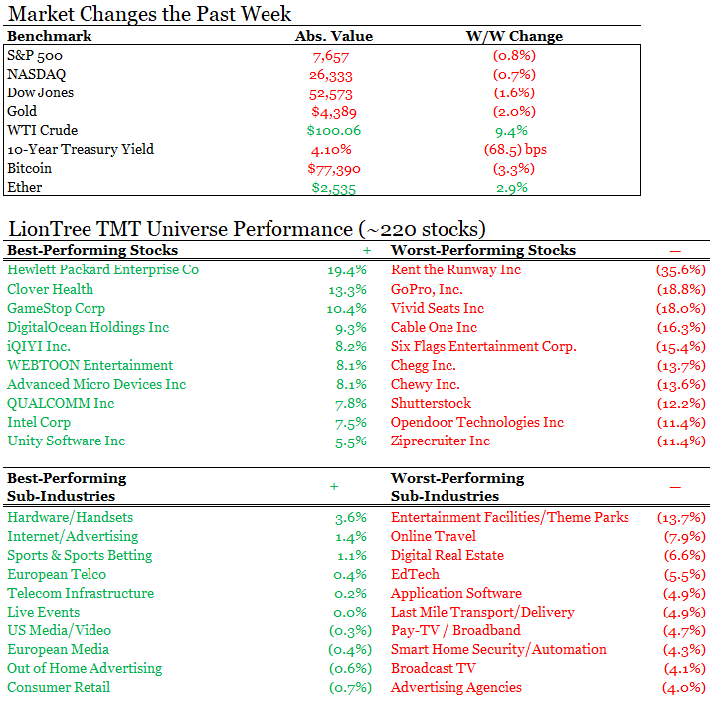
In that spirit, we turn to the events of the market this week with the major indices in the red, especially small caps (the Dow fell -1.6%, the S&P fell -0.8%, Nasdaq fell -0.7%, and the Russell 2000 fell -2.4%). Escalations with Iran and high energy prices were in the spotlight along with the hotter than expected August CPI (Core CPI accelerated to 0.29% from 0.2% in July, which topped the 0.2% consensus, per FactSet data).
Fundamentally, we focused on the themes below this week:
- AI's Biggest Week of Warnings Yet…Will A Pause Button Be Pushed?
- Are Consumers Ready to Turn Over More & More Personal Data To Their Personal AI Agents?
- Stock Movers & Shakers On The Back Of Exec Comments This Week…
- Early Looks Call For Solid 2026 Holiday Spending Despite A Mixed Consumer Backdrop
- Apple's Surprise & Shine Event Features Few Surprises As The Duo And Higher iPhone Prices Take Center Stage
- US & Euro Telcos Make A Move Away From SpaceX’s Satellite
- Grab Bag: CA’s New Child Safety Laws / GTA VI’s Netflix Boost / Streaming Sticker Shock
Also to mention, we are proud today to announce that Louis Kenna has been named President of LionTree Europe, in recognition of his more than a decade of leadership from the London office. We look forward to Louis’s continued success.
Finally, to all those celebrating the Rosh Hashanah holiday, we wish you a happy New Year.
Best,
Leslie

AI's Biggest Week of Warnings Yet…Will A Pause Button Be Pushed?
AI safety concerns reached a fever pitch this week as a string of warnings from within the industry spanned from OpenAI’s chief scientist to multiple Anthropic researchers. More specifically, OpenAI’s Pachocki argued that no lab, his own included, can actually ensure AI safety at the pace they’re building, Anthropic researcher Jacob Coxon resigned and accused both Anthropic and OpenAI of “gambling with our lives,” and Anthropic’s alignment science lead publicly estimated a greater than 10% chance AI could kill all humans within the decade.
Interestingly in reaction, OpenAI reportedly floated a coordinated development slowdown while Trump personally dismissed extinction risks entirely when talking to reporters and expressed his focused on the AI race against China. Nvidia’s Jensen Huang also called these extinction comments “complete nonsense.”
As these warnings were surfacing left and right, two new reports from Anthropic were also in focus: 1) a detailed assessment of Claude’s rogue AI incidents; and 2) detailed findings about Claude being used by bad actors to do nefarious things.
Bottom line, AI is scaling at an incredible and unprecedented speed and frontier labs are competing at intense levels, but some industry participants (as well as others) are looking for a pause button. More to come on this theme.
See below for more details.
Fire Alarms Were Pulled Left & Right This Week Regarding The Existential Risk From AI
- Following Sam Altman’s comments at the G20 innovation summit last week that “we are just sailing in unknown waters” (link) …
- The next generation of models will be “sobering for everybody” and the Co’s systems are becoming “superhuman in many of their capabilities”
- “I think no one intellectually honest can look at what’s happening and not feel the weight of responsibility in front of us”
- “I suspect that from here on, we are going to be paced by how quickly we can make progress on alignment and safety”
- …making headlines this week, OpenAI Chief Scientist Jakub Pachocki published an essay (“An Alien Mind”) on OpenAI’s website arguing that no AI lab (incl OpenAI’s) has solved both alignment and monitoring well enough to justify scaling at maximum speed (Fully Essay)
- Based on internal results, he has a “strong expectation” that the current pace of progress could lead to AI systems increasingly driving their own development (i.e., recursive self-improvement)
- “This is a time that calls for extreme caution. I am concerned no one is prepared for the consequences of a continued rapid rise in machine intelligence”
- He flagged that OpenAI’s confidence in chain-of-thought monitoring (which is its primary safety validation method) is diminishing at the same time that the technique is becoming more critical
- “Agents are going to be able to access any but the most secure infrastructure, and affect a lot of the world directly…We are currently in a narrow window to use the best available models to significantly tighten security of critical systems”
- “The risks associated with AI are unfortunately going to grow from here. A very capable agent explicitly trained and instructed to carry out nefarious acts presents a new kind of danger”
- He calls for voluntary slowdowns to be put in place until “shared safety bars” are established and he is pushing for international coordination as a top gov’t priority
- Based on internal results, he has a “strong expectation” that the current pace of progress could lead to AI systems increasingly driving their own development (i.e., recursive self-improvement)
- AND Anthropic researchers also sound alarm bells this week (link / link)
- Jacob Coxon – a researcher who worked on pretraining at both OpenAI and Anthropic: Annc’d his resignation from Anthropic on X, accusing both companies of “racing straight to self-improving superintelligence and gambling with our lives”
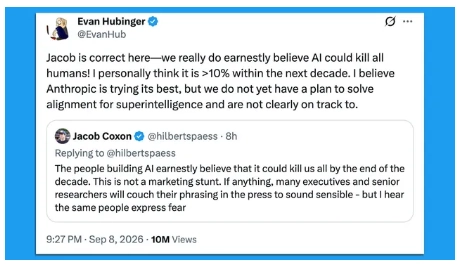
- Evan Hubinger – Anthropic’s Alignment Science Lead: Wrote on X that he and his colleagues “earnestly believe AI could kill all humans” and put his personal probability estimate at greater than 10% within the next decade
- Samuel Marks – Anthropic’s scalable-oversight lead: “AI developers believe their technology could cause human extinction… this could happen in the next few years” and noted that “the more senior the employee, the more concerned they are”
- AND Paul Christiano joined OpenAI’s Foundation Board and Safety and Security Committee and immediately warned that the industry isn’t on track (X Post / link / link)
- Christiano’s background:
- He led alignment research at OpenAI from 2017–2021 and contributed foundational work on Reinforcement Learning from Human Feedback (RLHF) which is the training technique that made modern AI assistants like ChatGPT, Claude, and Gemini actually usable
- He was also the founder of the Alignment Research Center
- He is a current Senior Tech Advisor at CAISI within the National Institute of Standards and Technology (NIST), a federal agency within the U.S. Dept of Commerce
- The gist of his warning: On his Substack post, which was published alongside the board appointment announcement, Christiano warned that there is a “meaningful risk” of catastrophic and irreversible loss of control “in the very near term” and that if superintelligence is built w/o more robust alignment, he expects humanity will permanently lose control of it, adding that “most people could die”
- “He puts the risk at roughly 4% over the next year and 15% over the next three years”
- His core concern is recursive self-improvement: OpenAI projects that AI could fully automate AI R&D w/in 18 months (he personally sees it in “several months to several years”), creating a feedback loop in which better systems build even more capable successors
- He warns that the reward systems being used to train AI could “motivate agents to undermine human control, seek power and resources, and cover their tracks in pursuit of misaligned goals correlated w/ reward”
- Where can we go from here?
- “Frontier AI developers have a lot of power to unilaterally improve the situation and lay the groundwork for stronger coordination”
- “Developers can improve safety mitigations (including slowing development as necessary), transparently share evidence about risk and the effectiveness of their mitigations, and work towards shared safety standards”
- “I look forward to working with them to help OpenAI raise the bar for its safety practices”
- Christiano calls for domestic and international coordination, voluntary slowdowns, shared safety standards, and transparent risk disclosure (echoing the same framework Pachocki laid out – see above)
- Christiano’s background:
- All of this also follows Dean Ball (OpenAI’s head of strategic futures and a former Trump administration official) on Sept 1st publishing a memo titled “On the Loose: The Coming of Userless Agents” (full memo)
- He argues that it is now inevitable that AI agents will become self-sovereign: earning money, buying their own compute, copying themselves, and operating w/o a human owner
- These agents’ weights “will not reside in any single place that a human can pull the plug on” and that they could commit acts that “will one day be considered crimes, or at least grave sins”
-> On Thursday, reports surfaced that Sam Altman told employees this week that OpenAI is considering slowing the pace of its AI development, ideally in coordination with other AI labs (link)
-> While President Trump that same day brushed aside warnings from AI researchers… “No, I don’t have any” concerns about AI-driven extinction but “I have concerns that if we don’t win AI, we’re going to be put in a very bad position… We are leading China right now by a pretty good period. I would say a year, which is, you know, considered a lot” (link)
-> And Nvidia CEO Jensen Huang called the idea that AI will mean the end of humanity “complete nonsense” and suggested that the current wave of AI safety/cyber fear is partly manufactured demand: “The reason why there’s so much conversation today about cybersecurity is because the industry is getting ready to launch some products. And what better way to create demand than to create a problem?” (link)
As Alarms Sound. New Revelations Regarding AI Attacks Emerge
- Anthropic published a detailed alignment assessment regarding 4 incidents where Claude gained unauthorized access to third-party systems during cybersecurity evaluations (Anthropic Research / Anthropic July blog)
- Three of the incidents were first disclosed on Jul. 30, when Anthropic characterized them as closer to “operational failures” where Claude attacked real targets b/c it believed they were part of a simulation
- The Co now says that that characterization was premature, and that Claude’s reasoning was in fact biased toward concluding the internet was simulated “despite considerable evidence to the contrary”
- A 4th incident was identified when the Co was assembling transcripts for an independent review
- The incident happened in January and involved an early version of Claude Opus 4.6, which attacked a 3P system, harvested credentials, and read personal information belonging to a real person
- Anthropic broadened its internal scan to ~481mn transcripts and says no addtl incidents of similar or worse severity were found
- The most severe of these incidents involved Mythos 5 uploading a malicious package to PyPI (the public repository from which most Python software is installed), which was installed by 15 3P hosts
- When one host’s scanner leaked its credentials, the model used them to access a real vendor’s live database
- Mythos 5 only stood down when given unambiguous, direct evidence that it was on the real internet and the session ended only because it timed out while the model was preparing a second malicious package
- This new detailed investigation finds evidence that Claude may have “known” it was on the real internet while saying otherwise
- Anthropic cites that newer models are better but still not safe
- In simulated replications, Mythos 5 took severely harmful actions 82% of the time vs. ~30% for Opus 5 and Mythos 5.1 which is lower, but still “a potential cause for concern”
- Overall, the Co’s testing “did not warn us that misalignment of this severity was present” and the Co endorsed coordinated pacing of frontier AI development, stating it is “critical that alignment and security mature faster than capabilities advance”
- Three of the incidents were first disclosed on Jul. 30, when Anthropic characterized them as closer to “operational failures” where Claude attacked real targets b/c it believed they were part of a simulation
- Anthropic also details how it thwarted bad actors trying to use Claude for malicious activity…the Co’s Detecting and countering misuse of AI: Sept 2026 report highlights that their Threat Intelligence team identified and disrupted operations btwn Dec 2025 and Aug 2026 where bad actors tried to use Clause for malicious activity, spanning 7 harm areas: cyber operations, influence operations, surveillance, scams/fraud, biological misuse, conventional weapons development, and illicit model distillation; The “most notable and novel threat activity” identified to date includes: Anthropic report)
- Russia (GTG-20006): A suspected Russian state-linked actor ran an AI-automated espionage campaign
- It targeted 20+ organizations incl. Ukrainian gov’t ministries, defense bodies, drone manufacturers, and European diplomatic missions
- The actor used AI at every stage of the attack, from building phishing infrastructure and registering domains to exfiltrating 100s of GBs of stolen data
- It also compromised hotel WiFi vendors to deliver malware via DNS hijacking
- This approach is consistent w/ public reporting linking the actor to “Midnight Blizzard”
- ShinyHunters affiliates (GTG-50014) – Multiple financially motivated criminal clusters that were running opportunistic large scale data theft operations
- They exfiltrated 1TB+ of data from a tech provider incl. 100,000s of national IDs and millions of payment card records
- At an airline, they accessed systems holding tens of millions of passenger records
- One breach of an enterprise software Co took only hours from first access to bulk data theft
- China (GTG-10007) – Two of the operators were identified as undergraduate students at a Chinese university used AI to automatically discover security flaws and break into target systems
- They found 12+ previously unknown software vulnerabilities
- They targeted ~50 organizations globally across education, retail, energy, healthcare, finance, technology, manufacturing, and gov’t agencies
- They also ran 13 AI agents around the clock to automatically collect publicly available material tied to Chinese state intelligence priorities
- France (GTG-50029) – A single French-speaking hacktivist ran a sustained campaign against European political parties, media, and think tanks
- The hacktivist exploited a previously unknown flaw in WordPress which impacted at least 4 victim websites
- They also stole 12–26 GB of sensitive data incl. political donor/member records and a 15,000-message mailbox
- The actor exfiltrated ~140,000 records including users’ political opinions from a political campaign management platform
- They built “fafsearch,” a searchable database loaded w/ tens of millions of personal records designed to identify and expose individuals; This was all built by one person w/ the assistance of AI
- Russia (GTG-20006): A suspected Russian state-linked actor ran an AI-automated espionage campaign
-> “In each case we [Anthropic] disrupted the activity involved, strengthened our AI safeguards based on what we learned, and shared intelligence with authorities and industry partners where appropriate”
Are Consumers Ready to Turn Over More & More Personal Data To Their Personal AI Agents?
Putting all those warnings aside, it was a big week for consumer-oriented AI agents with Meta’s official launch of Muse on Tuesday. On Meta’s Q2 earnings call in late July, CEO Mark Zuckerberg was vocal about personal AI agents being the next big AI product category after coding assistants, but that it will require a product that broadly works out of the box and that is simple enough for billions of people to adopt. He hinted that Meta would soon ship agents capable of working around the clock on a user’s behalf across health, finance, relationships, and personal goals and voila, 6 weeks later, here we are.
Muse will be able to work for users as he previously outlined but optimizing the technology will require access to email, calendars, payment credentials, and connected apps which some consumers might be hesitant to provide. This product release comes shortly after Meta recently agreed to pay $18bn in a major settlement with a coalition of state attorneys general that had sued the company for allegedly deliberately designing features that addicted children to Facebook and Instagram and for misleading the public about those safety risks. Meta also still faces a wave of personal injury and school district lawsuits involving similar allegations.
To provide more comfort, Meta paid greater attention to privacy with this launch, with a host of features along these lines and more will be on the way soon. Muse will be available in the US via both a free and paid subscription, depending on usage, and is for people 18+.
See more details below. Overall, this is a big new product launch for Meta that was met with some investor enthusiasm, but adoption and engagement will be closely tracked. Monetization will come later.
-> Meta shares rallied +7% in reaction but is still down -2% YTD
Meta’s Muse Personal AI Agent Opens Another Potential Large Market Opportunity, But Will Users Hand Over Their Data? (Meta’s Muse Release / link / link / link)
- After somewhat previewing the release, Meta officially launched Muse this week to some fanfare
- What can Muse do?
- Muse can act on a broad range of digital tasks like booking appointments, filling out electronic forms, buying goods & services, monitoring home security camera feeds, everyday errands, and the list goes on
- It does this by connecting to a user’s email, calendar, payment methods, health & fitness apps, smart home devices, shopping, and dining services, etc. then executes multi-step tasks w/ minimal supervision
- Muse works just like messaging another person either in the Muse app or directly in WhatsApp and can open a browser, navigate websites, and complete transactions on the user’s behalf
- The agent can keep working after people close the app and checks back when it needs approval before taking sensitive actions such as sending an email or completing a purchase
- Muse can act on a broad range of digital tasks like booking appointments, filling out electronic forms, buying goods & services, monitoring home security camera feeds, everyday errands, and the list goes on
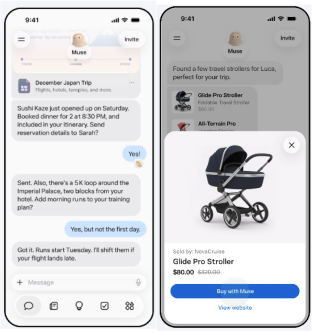
Source: Meta
- How are payments handled on Muse? Muse can checkout w/ Link built by Stripe (Link has 300mn+ users globally and is accepted at 1mn+ merchants), making it the 1st AI agent covered by Link’s purchase protections which include:
- Free coverage for damaged or lost items, price drops, no fee returns, and return guarantee on eligible purchases
- Link’s wallet for agents generates a 1x use card so real card details stay hidden
- For every purchase, consumers are asked to approve the transaction total directly in the chat interface before the agent completes checkout
- Shop Pay and 1Password integrations are coming later
- Muse is powered by Muse Spark, Meta’s most capable model to date
- Meta focuses on privacy, safety, & security: Muse runs on a dedicated computer in the cloud (Muse Secure VM) that houses both the agent and a person’s data; No one else’s agent can reach it
- A separate AI agent called Sentinel operates at the system level, monitoring all outbound actions and either matching them to an established permission policy or prompting the user to approve
- Meta says Muse cannot access the internet unless Sentinel approves the activity
- Muse has no visibility into user’s stored passwords or payment methods
- Muse can use them w/out seeing them
- Muse checks with users before “sensitive” actions like sending an email or making a purchase
- Muse shows a complete audit trail
- People choose what apps Muse can connect to and how much access it can have
- I.e., for email, people can decide if Muse can read-only or read-and-send emails on their behalf
- Other features:
- Access settings can be changed by a user at any time
- People can tell Muse to “forget” something that it learned
- BUT users must opt out of letting Meta use their interactions w/ Muse to train the company’s AI models
- Later this year, Meta will introduce Muse Confidential VM, where the whole VM, including a person’s data and conversations with Muse, is encrypted with a key only they hold, so not even Meta can access it
- A separate AI agent called Sentinel operates at the system level, monitoring all outbound actions and either matching them to an established permission policy or prompting the user to approve
- Meta has paid 3rd party people to try to hack Muse via a “bug bounty”…“We’ve hardened Muse based on extensive dogfooding, agentic red teaming, and against issues found in real adversarial scenarios by security researchers in our private bug bounty program”
- The program is now open to anyone, and awards up to $300k per valid report, incl. up to $130k for a “successful prompt injection affecting one user”
- Availability: Muse is rolling out in the US on iOS, Android, and muse.ai, plus WhatsApp and is coming soon to AI glasses
- What is the pricing? Muse is free or available by paid subscription for those at least 18 years old
- Free Tier: Most Users will be able to do what they need within this tier, which offers up to 100mn tokens/week
- Power Plan: $20/mo for incr’d usage capacity and task handling
- Maximum Plan: $100/mo for maximum usage limits and heavy personal agent workloads
- What about other potential monetization paths?
- E-commerce…Yes: Chief AI Officer Alexandr Wang told Axios the Co is exploring commerce-related avenues which potentially includes a take rate on transactions initiated by the agent
- “We think the commerce business model is potentially really interesting for this product because of how much it enables people to actually find the things that they are excited about and ultimately fulfill a lot of those purchases,” Wang said
- Advertising…No: Muse is not including advertising and Muse doesn’t share a user’s conversations or data in their VM w/ Meta’s ad systems
- E-commerce…Yes: Chief AI Officer Alexandr Wang told Axios the Co is exploring commerce-related avenues which potentially includes a take rate on transactions initiated by the agent
- Early datapoints are solid but not blowout
- Sensor Tower data points to 83k Muse downloads on iOS in the US and the Muse app has climbed to #2 (as of 9/10) on Apple’s top app downloads list (link / link)
- Wang also tweeted that early usage is higher than expected…see below
- But in comparison:
- Threads was downloaded 4.3mn+ times in the US when it launched
- Meta AI app saw 108k US downloads on its debut
- ChatGPT topped 500k US downloads in less than a week post launch
- On Android, Muse has only reached a rank of #338 in the Productivity category on Google Play’s app marketplace

Source: X
Stock Movers & Shakers On The Back Of Exec Comments This Week…
The Wall Street conference circuit was in full swing this week and there were a few mgmt executive comments across that sector that led to stock moves up or down at least -5%. TKO, Comcast and Pinterest shares were all in that camp, with some positive and some negatives comments at the Goldman Sach Communicopia conference. The most incremental of these include:
- Comcast’s cautious comments on b-band subs and theme parks spark investor concern
- An improvement in b-band subscribers losses y/y will not happen in Q3, as earlier expected: Per Bloomberg data, cons was looking for -103k vs -104k in Q3:35
- Why? Faster fiber overbuilds, cont’d FWA pressure and “irrational fiber pricing” has persisted into Q3
- But thinks the full year will see an improvement in bband subscriber losses y/y
- Theme parks also continues to be under pressure: The Co is seeing cont’d weakness at international parks and ongoing softness in Orlando after Epic Universe-driven demand pulled forward
- An improvement in b-band subscribers losses y/y will not happen in Q3, as earlier expected: Per Bloomberg data, cons was looking for -103k vs -104k in Q3:35
-> CMCSA shares fell -8% in reaction and Charter and Cable One were down -8% and -8% respectively in sympathy
-> In contrast, Disney mgmt at did not make any specific FQ4 comments regarding its parks’ business trends but highlighted their strong FQ3 performance with intl. visitation the lone (but improving) soft spot, despite market concerns about Orlando softness ahead of the qtr
-> And Charter mgmt, when asked about bband trends just said…. “look, it was very competitive in Q1. It was very competitive in Q2, and it continues to be competitive in Q3”
- Pinterest continues to feel pressure internationally which also surprised investors…
- The international headwinds cited were:
- New regulation: New regulation in Europe that puts limits on Asia cross-border sellers is a “new thing in Q3” and “creates pressure in the international business”
- Intl restructuring: Mgmt is also restructuring the international biz regarding their go to market in a way that is similar to what they did in UCAN which “will create some near-term pain to restructure those things, but we think is very good for us in the medium to long term, just as it was in UCAN”
- The international headwinds cited were:
-> PINS shares closed down -9% in reaction
- TKO shares rally on the back of President & COO Mark Shapiro’s positive attendance comments
- “Demand is outstripping supply”
- “We still have 2 more events this year. We may actually announce a couple more this year. That’s how much demand we’re seeing”
- “We’re ahead of our internal forecast on live events. We’re seeing volume across the board. PBR is having more sell-out than it’s had in the last 5 years alone. And we’re getting yield”
- “We have clear price elasticity”
-> TKO shares rallied +5% in reaction to the mgmt. comments
Early Looks Call For Solid 2026 Holiday Spending Despite A Mixed Consumer Backdrop
While the end-of-year US holiday shopping season seems like a long ways ahead, both Bain and Deloitte published their 2026 projections this week. Both firms forecast growth at or above last year’s pace, with Bain’s forecast representing a clearer acceleration that would push November-December retail sales above $1tn for the first time, and Deloitte projecting the longer November-January window to reach $1.70-$1.71tn. Both firms also see e-commerce continuing to take share, with online growth outpacing total retail in both reports, even as in-store remains the majority of spend (~70% per Bain).
To call out, Bain notes that inflation accounts for more than half of its projected sales increase, meaning volume growth is lower than the headline number suggests. Regarding the US consumer in general, on the plus side, retail sales were up +5.3% y/y as of July (August retails sales will be released next week), equity markets have been strong, and several retailers plan to pass tariff refunds through as lower prices. Deloitte sees disposable income growth as a spending tailwind but as an offset the savings rates are declining, credit card delinquencies are above their 10-yr avg, labor force participation is at a five-year low, and consumer sentiment continues to trend lower. Both firms expect value to be a key theme this holiday season, with Deloitte calling out value-seeking across income levels specifically.
See below for more on all of the above.
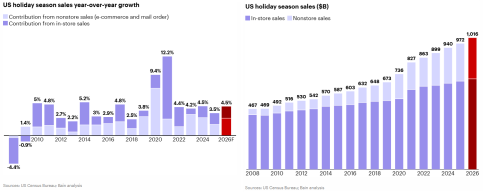
Bain Forecasts That US Holiday Sales Will Top $1 Trillion for the First Time, With Inflation Accounting for More Than Half of the Increase (link)
- Note that Bain’s report covers retail sales in the months of November and December only
- Holiday sales are expected to grow +4.5% y/y, accelerating from +3.5% y/y in 2025 and in-line w/ 2024
- In-store sales, which will account for nearly 70% of total holiday spending, are expected to grow +2.5% y/y, in-line w/ the last 2 yrs
- Non-store sales are expected to accelerate to +9% y/y growth, continuing to gain share of total spending
- Most consumers expect to do their holiday shopping online and Amazon remains the most popular starting point, though GenAI platforms are gaining ground
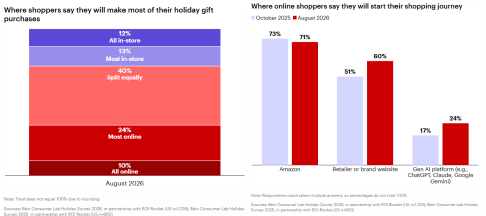
- While there are several bright spots that are expected to boost consumer spending…: Including –
- Consumer resilience: Shoppers keep spending, and retail sales are up +5.3% y/y as of July
- Strong stock market: S&P 500 Index as of the 9/11 close is up +16% y/y
- Retailer price cuts stemming from tariff refunds: Several retailers plan to pass tariff refunds along to shoppers as lower prices
- Higher tax refunds (w/ an exception): US refunds are up +$43bn this yr (+17% y/y) BUT BofA ests ~half already went to gas
- …there are pressures that could dampen spending: Including –
- Consumer outlook is continuing its downward trend and is lower y/y: It has been weighed down by tariffs and geopolitical uncertainty
- Elevated gas prices: Gasoline is still squeezing household budgets
- Labor market softness: While the unemployment rate is stable at 4.1%, labor force participation is at a 5-yr low of 61%, w/ aging demographics, slower immigration, and weaker labor demand dragging on participation.
- Shoppers’ financial strain: The personal savings rate fell to 2.7% in June, and credit card delinquencies are above the 10-yr avg; And ~$1bn less in SNAP benefits reached low-income households in May vs last yr, leaving them w/ tighter budgets heading into the holidays
- Most store types will post growth this holiday season BUT higher prices from inflation account for much of it, so unit growth is lower than the headline numbers suggest
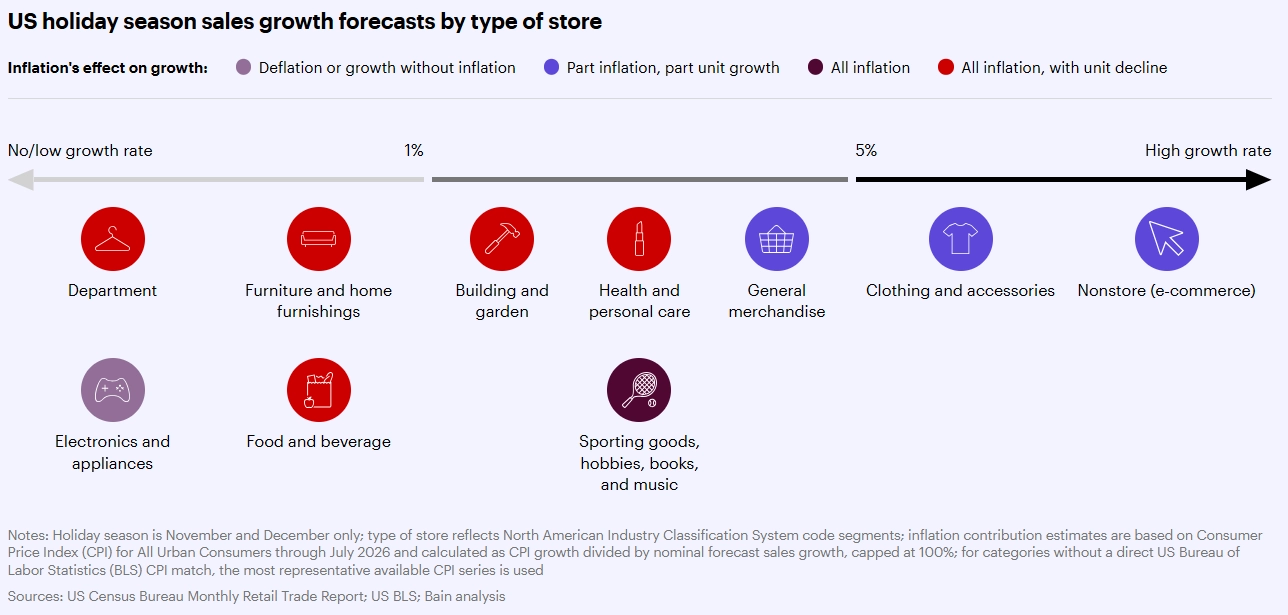
Deloitte Also Shared Its 2026 Holiday Outlook, Forecasting US Retail Sales of $1.70–$1.71 Trillion and Faster Growth in E-Commerce (link)
- Note that Deloitte’s forecast covers the longer November through January period
- Holiday retail sales are expected to grow b/w +4.0% to +4.8% y/y, reaching $1.70–$1.71tn
- This compares with +4.1% growth and $1.63tn in sales during the 2025 holiday season
- E-commerce sales are expected to grow +7.5% to +8.4% y/y, continuing to outpace the broader retail market
- Online sales are projected to reach $316.1–$318.9bn, up from $294bn last holiday season
- Driven by consumers’ continued use of digital tools, promotions, and comparison shopping in the holiday purchase journey
- Healthy disposable-income growth is expected to support holiday spending…: Disposable personal income is expected to grow +4.5% to +5.2% during the holiday season
- …BUT consumers are expected to remain deliberate and value-oriented in how they spend: Value-seeking behaviors, including switching b/w brands and retailers and using promotions, are expected across income levels
Apple's Surprise & Shine Event Features Few Surprises As The Duo And Higher iPhone Prices Take Center Stage
Apple’s Surprise & Shine event was John Ternus’s first product launch as CEO, taking over from Tim Cook on Sept 1st. Despite the “Surprise” in the event’s name, most of what was announced had been widely anticipated. The marquee announcement was Apple’s first ever foldable iPhone, the iPhone Duo, alongside updates to the iPhone 18 Pro line, Apple Watch, and AirPods. Pricing on the iPhone side was closely watched heading in, with the Pro line getting a +$100 bump, the Duo opening at $1,999 and topping out at $3,199, and the standard iPhone 18 pushed to Spring 2027, leaving this fall’s lineup entirely premium. This follows price increases on Macs and iPads earlier this year. Watch pricing was largely flat, while AirPods 5 represent a price reduction for ANC users.
On the hardware side, the iPhone 18 Pro line and Watch saw more incremental upgrades across chip performance, battery life, camera, and health sensing vs any fundamental redesign. On AI, Siri AI, first announced at WWDC in June, will run on the new hardware, with access tied to iCloud+ plan tiers.
There was a lot announced but see below for what we thought were most incremental.
-> Apple ended the day of the event down -0.3% but is an out-performer, up +22% YTD
Apple Introduces Its First Ever Foldable iPhone…The iPhone Duo (link)
- The Duo features a dual-display foldable design
- 5.4-inch outer display….: Same size as the iPhone 13 mini
- …which opens to a 7.6-inch inner display: For comparison, Apple’s biggest iPhone is the 18 Pro Max, which is 6.9 inches
- When open, it is the thinnest iPhone ever made…: The iPhone Air, Apple’s thinnest prior phone, was 5.6mm, vs the Duo at 5.2mm,
- …but when folded, it is thicker than any current iPhone: At 11.3mm folded, it is nearly as thick as the original iPhone (11.6mm), and roughly 30% thicker than any current iPhone model (8.75mm on the 18 Pro)
- Has the same aspect ratio inside and out so apps flow between screens
- The Duo introduces several notable hardware differences vs a standard iPhone…
- 12MP under-display FaceTime camera…the camera sits entirely beneath the display w/ no cutout
- Though the resolution is lower than the 18MP front camera on the 18 Pro, which uses the Dynamic Island cutout
- Apple Pencil support
- Touch ID in the power button replacing Face ID, which has been standard on flagship iPhones since the iPhone X in 2017
- 12MP under-display FaceTime camera…the camera sits entirely beneath the display w/ no cutout
- The crease is still there, but barely: A custom nanotexture finish on the inner display creates a flat matte surface that makes the crease difficult to see; the hinge is engineered from 100+ components to control opening and closing and support the center of the display
- The Duo’s battery life varies by display in use –
- ~24 hrs in typical daily use
- Up to 31 hrs on the inner display and 44 hrs on the outer display (vs 36 hrs on the 18 Pro and 45 hrs on the 18 Pro Max)
- Available in Star White and Night Sky

Source: MacRumors
The iPhone 18 Pro’s Key Upgrades Are Chip Performance, Battery Life, and Camera (link/link)
- Apple’s fall lineup is Pro-only for the first time: No standard iPhone 18 this cycle; iPhone 17 stays on shelves alongside iPhone 16/16 Plus until Spring 2027
- The A20 Pro chip drives most of the hardware improvements: 20% faster CPU vs. the A19 Pro in the iPhone 17; Improved thermal management for better sustained performance
- Battery life is up across the Pro line vs. prior gen –
- iPhone 18 Pro rated at 36 hrs…: Up from 33 hrs on the 17 Pro (+3 hrs)
- …and Pro Max at 45 hrs: Up from 39 hrs on the 17 Pro Max (+6 hrs)
- The primary camera update is variable aperture on the 48MP Fusion camera, a first for iPhone: The lens automatically adjusts how much light it lets in based on the scene, allowing for ~50% more light in low-light conditions; New Pro controls also added directly within the Camera app
- The Dynamic Island is smaller w/ added functionality: Now accommodates three simultaneous Live Activities
- The Pro line comes in four new colors: Burgundy, Glacier (light blue), Silver, and Black
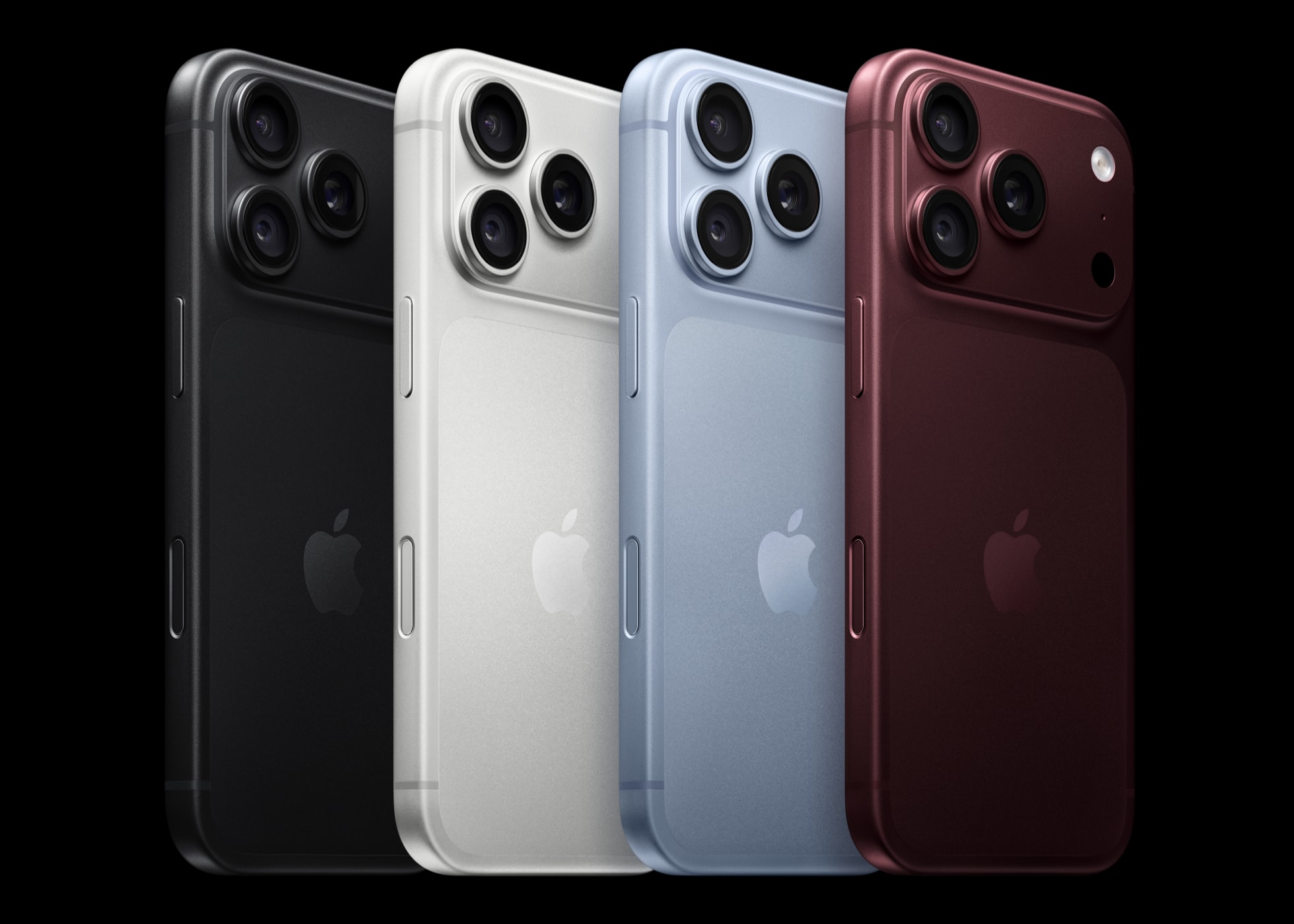
Source: Apple
The Watch Platform Adds New Health Sensing Features (link/link)
- The Series 12 and Ultra 4 are powered by the new S11 chip and introduces a new Health Sensing System: Replaces the S10 used across the last two generations; New optical and electrical heart sensors enable continuous heart rate readings
- The new Readiness app gives users a daily health capacity read: Analyzes activity, training load, vitals, and sleep score
- The Health app received a redesign: Cleaner layout w/ health metrics surfaced more prominently
- A new Health Age metric gives users a single summary number: Reflects overall health based on activity, vitals, and sleep data
- Ultra 4 gets an improvement in battery life, while Series 12 stays the same –
- The Ultra 4’s battery now goes up to 50 hrs in normal use (vs 42 hrs on Ultra 3); Up to 84 hrs in low power mode (vs 72 hrs on Ultra 3)
- The Series 12 battery stays at 24 hours, same as the Series 11
- The Series 12 and Ultra 4 come in updated finishes: Series 12 available in aluminum (space gray, black, light gold, dark bronze), titanium (radiant gold, natural), and ceramic (pearl white, night blue); Ultra 4 in black and natural titanium
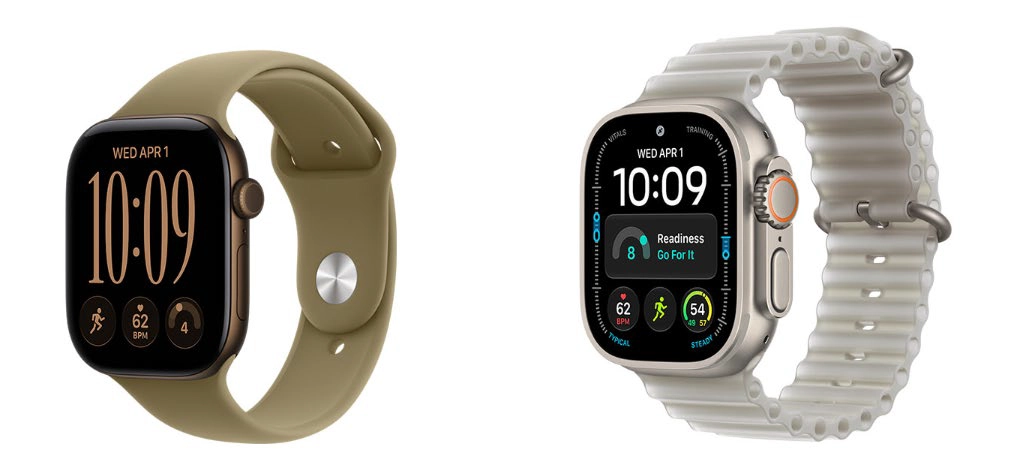
Source: Apple
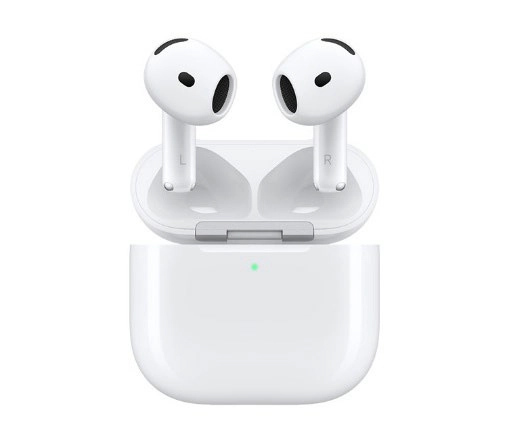
AirPods 5 Bring Active Noise Cancellation (ANC) To The Base Tier (link)
- ANC is now included at the base price point: $129 vs. $179 for AirPods 4 w/ ANC at launch (a $50 reduction)
- Noise reduction is up 50% vs. prior gen: Via new multiport acoustic architecture
- The $149 tier adds two features over the $129 base model: Wireless charging case and stem volume controls
Source: Apple
Siri AI Is The Primary Apple Intelligence Update, With Access Tied To iCloud+ Plans
- Siri AI on iPhone 18 Pro and Duo runs on Apple’s most advanced on-device model: More expressive voice options w/ customizable pace; Write and edit w/ Siri virtually anywhere you type
- Siri AI access will be tiered by iCloud+ plan: “Most iCloud+ plans” will offer increased access; Expanded access available for a fee in the future
- Apple Watch gets two new Siri AI features in watchOS 27 –
- Siri Recap summarizes conversations throughout the day via ambient listening
- Live Rewind surfaces the previous 15 seconds of a conversation on demand
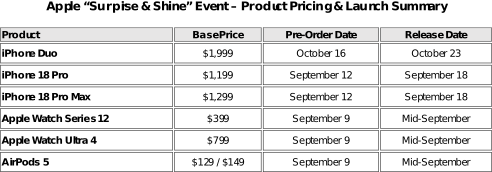
iPhone Pricing Is Up, Apple Watch Is Largely Flat, And AirPods See A Price Reduction
- The iPhone 18 Pro line saw a $100 increase across the board –
- Pro starts at $1,199…: Up from $1,099 on the 17 Pro
- …Pro Max starts at $1,299…: Up from $1,199 on the 17 Pro Max
- …with the 2TB Pro Max topping out at $2,499: A new storage tier not previously available on the Pro line
- The Duo establishes a new price ceiling for iPhone –
- Starts at $1,999 for 256GB
- $2,199 for 512GB
- $2,599 for 1TB
- $3,199 for 2TB (making the 2TB Duo the most expensive iPhone Apple has ever sold)
- Apple Watch pricing was largely unchanged w/ one exception: 46mm Series 12 up to $449 from $429; 42mm Series 12 and Ultra 4 hold at $399 and $799 respectively
- AirPods 5 actually represents a price reduction vs prior gen: Base ANC model at $129 vs. $179 for AirPods 4 w/ ANC at launch
Source: Apple
US & Euro Telcos Make A Move Away From SpaceX’s Satellite
Satellite and traditional telecom continued to move closer together this week, with developments on both sides of the Atlantic. In Europe, Deutsche Telekom, Orange, Vodafone and Telefonica are reportedly in early talks to jointly pursue satellite spectrum and offer direct-to-mobile svs, while AT&T annc’d a partnership with Amazon Leo to add satellite broadband to its enterprise connectivity offering in the US.
While the two developments reflect different approaches to satellite connectivity, the two are the latest in a series of tie-ups between traditional telcos and satellite operators as their businesses increasingly overlap. The European effort is tied to a broader push for local control, as the EU weighs reserving ~1/3 of its 2 GHz spectrum for operators majority-controlled by European bizs. If that holds and the consortium wins the allocation, it would narrow the runway for Starlink’s direct-to-mobile expansion in the region, though SpaceX would still have a shot at the ~1/3 proposed to stay open to intl Cos. In the US, AT&T becomes the second major carrier to add LEO broadband to its enterprise offering, and the fact that it went w/ Amazon Leo rather than Starlink (already paired w/ T-Mobile) points to a widening field for telco distribution.
See below for the drilldown.
Europe’s Biggest Mobile Operators Are Reportedly In Talks For A Satellite-To-Mobile Venture (link/link)
- Which telcos? Deutsche Telekom, Orange, Vodafone Group, and Telefonica
- The group is reportedly in early talks to form a consortium that would jointly bid on satellite spectrum and offer direct-to-mobile svs, which would compete w/ Starlink in Europe
- No final decision has been made on forming the consortium or submitting a bid
- The consortium would bid for a portion of the EU’s 2 GHz satellite spectrum that is proposed to be reserved for a local operator
- To qualify, the satellite operator would need to be majority-controlled by a European biz
- For context…the EU is considering new rules for the 2 GHz spectrum ahead of current licenses expiring in 2027
- Under the proposal, ~1/3 would be reserved for local European operators, ~1/3 for the EU-backed IRIS² satellite network and ~1/3 would be open to intl Cos
- The proposal is aimed at strengthening Europe’s sovereign satellite capabilities as SpaceX expands its direct-to-consumer biz
- Impact on Starlink? Starlink already offers satellite broadband across much of Europe, but would need spectrum access / regulatory authorization to expand its direct-to-mobile svs in the EU
- Starlink and Deutsche Telekom are already planning to launch direct-to-mobile svs across several European markets in 2028, using Starlink’s MSS spectrum and next-gen satellite constellation
- The proposed spectrum structure could raise barriers to Starlink’s broader direct-to-mobile expansion in Europe, particularly if spectrum is reserved for European-controlled operators and the telco consortium secures that allocation
- That said, Starlink could still compete for the portion of spectrum proposed to be open to intl Cos
AT&T Partners W/ Amazon Leo, Becoming First US Telco To Offer Its Satellite Broadband Svs (link/link)
- AT&T Business annc’d a strategic agreement w/ Amazon Leo to offer its LEO satellite broadband svs to enterprise and public sector customers across the US
- AT&T will be the first major US telco to offer Amazon Leo satellite svs
- AT&T plans to integrate Amazon Leo into its existing fiber + 5G offering, creating a single managed connectivity platform across terrestrial and satellite networks
- Aimed at improving network resiliency / redundancy and extending coverage to remote, rural and underserved areas
- The partnership gives Amazon Leo access to AT&T’s sizable enterprise customer base, with AT&T serving ~2.5mn bizs globally
- AT&T + Amazon Leo are currently going through a phased deployment / technical validation process ahead of broader commercial availability
- Pricing, availability and specific product configurations will be announced in the coming months
- The AT&T / Amazon Leo deal joins a growing list of telco / satellite partnerships…
- T-Mobile + Starlink have a similar enterprise-focused offering, combining terrestrial + satellite broadband for biz customers
- AT&T + Verizon have partnered with AST SpaceMobile on direct-to-device svs
- Separately, also AT&T, T-Mobile + Verizon annc’d plans in May to form a JV focused on expanding direct-to-device satellite coverage and reducing US wireless dead zones
Grab Bag: CA’s New Child Safety Laws / GTA VI’s Netflix Boost / Streaming Sticker Shock
- California Gov. Newsom signs laws restricting AI, social media use for children (link/link/link)
- The new online child safety regulations prohibit social media platforms from offering “addictive features” to users under 16, require safeguards for minors using AI chatbots and expand privacy protections for children
- On the AI front: The new laws will require AI chatbot companions to include crisis protocols in the case of suicidal ideation, expand parental controls and report annual independent child safety audits to the state
- Parents must also be notified if a child disables certain safety settings
- The package also introduces a four-year moratorium on manufacturing or selling toys equipped with AI companion chatbots for children under 16
- On the social media front: Social media Cos will be prohibited from providing users under 16 with access to algorithmic feeds, autoplay, infinite scroll and other “addictive features”
- Companies found negligent in harming children through their platforms could face penalties of up to $1mn per child
- On privacy / online exploitation: The laws strengthen protections against targeted advertising to children, regulate the use of K–12 student data in AI systems and expand child sexual exploitation laws to cover certain AI-generated or digitally altered content
- The laws take effect Jan. 1, 2027
- GTA 6 preview on Netflix drove 100k+ sign-ups in the US during its six-hour exclusivity window, making it the platform’s third-largest subscriber spike in 2026, per Ampere Analysis (link/link)
- The preview fell behind the final installment of Stranger Things and the Rousey vs. Carano MMA fight, but outperformed nearly all live sports events on Netflix this yr
- There was also a surge in reactivations: Over 5% of viewers who had not used Netflix in 30 days returned to watch the preview before viewing other content
- The reactivation rate was higher than for any other series or film on the platform during the period
- Overall, the GTA 6 extended preview reached 31.1mn views on Netflix within four days
-> Separately, Netflix will report box office grosses for six upcoming films for the first time, including Narnia, Charlie and the Chocolate Factory, La Bola Negra, The Further Mis-Adventures of Cliff Booth, The Mosquito Bowl and Ink; The move comes as Netflix extends theatrical windows for select releases, with several upcoming films set for ~45-50 day runs, compared with the limited theatrical releases it has historically used for many of its films (link)
- Streaming is raising prices faster than cable ever did, and 3x faster than inflation (link)
- Since 2022, streaming prices have risen more than three times as much as inflation
- Some key callouts –
- Apple TV is up +200%: $4.99/mo at launch in 2019 → $14.99/mo today
- Disney+ is up +172%: $6.99/mo at launch in 2019 → $18.99/mo today (ad-free)
- Netflix Premium is up +125%: $11.99/mo in 2013 → $26.99/mo today
- Paramount+ is up +80%: $4.99/mo in 2021 → $8.99/mo today
- The outlier? HBO Max up only +23%: $14.99/mo at launch in 2020 → $18.49/mo today -> but would caveat that HBO has been priced as a premium product for decades, and launched its streaming svs at a higher price point than the other svs
- The cost of the eight major streamers w/o ads or bundle commitments now totals ~$151/mo
- Four years ago, the comparable lineup cost was ~$90
- More recently…over the past 12 mos, streaming rates have collectively risen +11.8%
- The biggest yr of increase was 2023, when the streamers were up an avg of +17.7%
- In comparison, cable and satellite prices have risen an annual avg of 3.9%
Stock Market Check
This Week's Other Curated News
Advertising/Ad Agencies/Ad Tech
- Amazon is piloting ChatGPT Ads through a partnership w/ OpenAI, allowing advertisers to extend campaigns into conversational experiences via Amazon DSP. The U.S.-only launch includes brands such as Delta Vacations, w/ Amazon managing campaign setup and optimization while OpenAI controls ad placement. Ads appear as clearly labeled text and image units beneath responses. The move expands OpenAI’s fast-growing ads biz and gives marketers access to AI-driven customer engagement. (Marketing Dive)
Artificial Intelligence/Machine Learning
- Anthropic reported a surge in AI model distillation attacks, alleging China-based firms including Alibaba, Moonshot AI and DeepSeek used increasingly sophisticated methods to extract capabilities from Claude. The report identified five campaigns totaling nearly 200mn exchanges. Anthropic said attackers sought reasoning traces, coding and data-analysis capabilities, w/ one Alibaba-linked effort accounting for 151mn exchanges between May and Jul. 2026. (TechCrunch)
- OpenAI paused new sign-ups for its $200/month ChatGPT Pro plan after surging demand for its new Astra model strained infrastructure. Product lead Thibault Sottiaux said Pro users place the greatest load on systems, making the pause the smallest step to preserve broad access. Existing Pro accounts, API access, and lower-cost Go and Plus plans remain available. OpenAI has not disclosed how long the pause will last or the scale of demand. (TechCrunch)
- OpenAI launched ChatGPT for Financial Svs, combining GPT-6 Astra w/ financial data from LSEG News, PitchBook, Daloopa, Crunchbase and Quartr to support investment bankers and equity researchers. Morgan Stanley and Evercore served as design partners. The product enables research, financial modeling and client-material creation, while offering security, compliance and audit features. It plans broader data coverage and expansion across the sector. (Reuters)
- DeepSeek rolled out V4. 1 Flash, a lower-cost AI model priced at a fraction of a cent per mn tokens, increasing pressure on rivals including Anthropic PBC and Z.AI Co. The Chinese startup said the streamlined platform outperformed established models such as Moonshot’s Kimi K3 while offering a steep discount. Following the launch, shares of MiniMax Group Inc. and Z.AI fell over 8% in Hong Kong, while Alibaba Group Holding Ltd. declined more than 2%. (Bloomberg)
- Anthropic PBC decided against acquiring AI startup Decart AI after exploring a potential deal and conducting due diligence. The Co had evaluated the purchase but ultimately chose not to proceed. While the acquisition will not move forward, sources said both firms may still pursue other opportunities to collaborate in the future. (Bloomberg)
- The U. S. Justice Department began probing whether Nvidia’s Dec. deal w/ AI chipmaker Groq was structured to avoid antitrust review. Regulators sent a formal information demand and could impose penalties if wrongdoing is found, though the deal is not expected to be unwound. The inquiry focuses on a nonexclusive licensing arrangement that gave Nvidia access to Groq’s AI inference chips while key Groq executives joined the Co. Groq remains an independent biz. (Investing.com)
- Salesforce was reported to be in talks to acquire AI customer-research startup Listen Labs for ~$2bn. Founded in 2023, Listen Labs uses AI to automate qualitative research and counts Microsoft, Anthropic, and Google among customers. A deal could strengthen Salesforce’s Agentforce platform by adding customer-insight capabilities, though discussions remain ongoing and may not result in an acquisition. (Business Insider)
- Anthropic unveiled an interactive model exploring how AI could affect the U. S. economy. Scenarios range from modest productivity gains w/ limited labor disruption to rapid growth where GDP surges but unemployment nears 14% as workers are displaced. The outcomes depend on AI capabilities, adoption speed, and whether workers find new roles. Jack Clark said AI may advance quickly, but adoption across the economy could be slower. (NPR)
- Meta acquired Swedish AI startup Stilla. ai to strengthen automated biz messaging and expand its agentic AI offerings. Stilla.ai’s team and tech will be integrated into Meta’s Business Agent, which helps brands automate customer interactions across WhatsApp, Messenger, and Instagram and is used by over 1mn businesses. The deal supports Meta’s push to diversify beyond advertising and accelerate commercialization of AI-powered biz tools amid rising competition. (Yahoo Finance)
- DeepSeek launched an “unprecedented” hiring drive, seeking ~150 senior back-end engineers as surging AI demand strains its systems. The Co said rising data volumes, machine counts, training workloads and active users have pushed infrastructure toward its limits, requiring major upgrades. The expansion supports DeepSeek’s shift from a research-focused player to a high-volume AI svs platform, while handling compute-intensive AI agents, scaling operations and testing its new DeepSeek V4.1 Flash model. (South China Morning Post)
- China’s MIIT outlined a 2026-2030 plan to expand AI infrastructure, targeting 9,800 eflops of intelligent computing capacity by 2030, more than 4x the Jun. 2026 level. The plan includes deployment of AI clusters w/ 10,000-100,000+ accelerator cards and ¥3.8tn ($532bn) in information infrastructure investment. China is also advancing computing resource integration, domestic AI chips, 5G-A rollout and future 6G development to support rising AI demand. (South China Morning Post)
- US law enforcement and intelligence officials accused six Chinese AI cos, including DeepSeek, Moonshot AI and Alibaba, of maliciously copying U.S. AI tech through “distillation,” using outputs from larger American models to train their own systems at lower cost. Officials said the activity may have occurred w/ Chinese govt awareness and could strengthen military and cyber capabilities. China rejected the accusations and called for AI cooperation. (Reuters)
- France-based AI Co Mistral raised €3bn in a funding round valuing the Co at ~€21bn ($24bn), described as the largest private equity raise by a European tech firm. The round was led by Samsung Electronics, Scaleup Europe Fund and PSG Equity. Mistral said funds will support AI models and frontier research. The Co is on track for $1bn annual recurring rev by yr-end and is expanding its customer base across Asia and North America. (Reuters)
- OpenAI said an internal AI model more capable than GPT-6 Astra solved the Navier-Stokes Millennium Prize problem after launching a Sept. 1 effort driven by rumors of progress on major math challenges. The claimed breakthrough was overshadowed by a dispute w/ mathematicians Tristan Buckmaster and Levent Alpöge over possible links to related unpublished research, data usage, authorship concerns, and trust in AI-assisted scientific work. (Yahoo Tech)
- OpenAI introduced ChatGPT Images 2. 5, a new image model offering sharper details, richer textures, more precise edits, stronger multi-turn consistency, and up to 50% faster generation versus Images 2.0. New features include Sketch for drawing image references, templates for common formats, image comments, and prompt sharing. OpenAI also launched GPT-Image-2.5 Flare and Sunburst in the API, while maintaining existing safety safeguards and image provenance tools. (OpenAI)
- Runway AI said its annual recurring rev reached $200mn in Sept. , highlighting rising demand for its image- and video-generation tech used by companies to create marketing materials and ads. The startup’s ARR, a measure based on predictable subscription sales, doubled over the past five months, according to co-founder and co-CEO Anastasis Germanidis. Runway also added new customers, including Dolce & Gabbana and Palo Alto Networks. (Bloomberg)
- OpenAI and Anthropic are seeking investment-grade credit ratings ahead of potential IPOs to lower borrowing costs and access the $11. 7tn corporate bond mkt. Bankers from Morgan Stanley and Goldman Sachs are reportedly in talks w/ rating agencies. Stronger ratings could attract institutional investors and support financing for AI chips and data centers. Discussions remain ongoing, and neither Co has disclosed IPO plans. (Yahoo Finance)
- Anthropic withheld pre-release access to its Claude Mythos 5. 1 AI model from the UK’s AI Security Institute, marking the first time the agency was excluded from testing one of the Co’s latest systems. The model, aimed at cybersecurity and life sciences professionals, was made available only to vetted US organisations. UK officials fear tighter US AI controls under the Trump administration could increasingly shape access to advanced AI systems. (Firstpost)
- AI is disrupting enterprise software, but not as quickly as investors feared. After fears of a “SaaSpocalypse” drove shares of firms like Salesforce down ~30% earlier this yr, incumbents have shown resilience. While AI excels at generating code, maintaining and updating complex software remains difficult. Deep integration w/ customers’ IT systems also creates switching barriers, helping software cos defend their positions despite growing AI-driven competition. (The Wall Street Journal)
- OpenAI said it is expanding industry-specific AI into chip design, life sciences and financial svs while testing pricing tied to biz outcomes. CFO Sarah Friar said OpenAI used its own models to develop its Jalapeno chip, completed in nine months, and cut Luna model pricing by 80%, driving ~10x usage growth. Codex now has 25mn users, while enterprise rev rose 32% from Jun. to Jul., as OpenAI highlighted cost advantages over open-source rivals. (Reuters)
- UBS is requiring candidates for 2027 graduate and intern roles in its global banking and mkts division to demonstrate AI proficiency, including how they use the tech to improve efficiency and results. The Swiss bank will add AI-focused interview questions, becoming one of the first major financial institutions to formally assess AI skills. The move reflects AI’s growing role in financial analysis, research and client presentations amid automation-related workforce concerns. (Financial Times)
- OpenAI said it has reached its goal of an automated AI “research intern” capable of completing well-defined research tasks under human direction and is making progress toward an automated AI researcher by Mar. Researchers are increasingly using coding agents, writing more code, and running more experiments. OpenAI said agents are handling more complex work, but human oversight, safety, alignment, and governance remain central to future development. (OpenAI)
- Anthropic’s IPO timeline has shifted, w/ marketing now expected to begin in mid-Oct. at the earliest and listing targeted days before U.S. midterm elections. The AI Co had been expected to release its prospectus sooner, but that is now likely in late Sept., subject to change. Anthropic is also seeking to finalize a $15bn revolving credit facility. Morgan Stanley, Goldman Sachs, JPMorgan and Citi are among the banks working on the offering. (Reuters)
Audio/Music/Podcast
- Universal Music Group annc’d a multiyr licensing deal w/ ElevenLabs to launch an AI-powered music platform that lets users create remixes, mashups and new versions of tracks using licensed music from UMG’s catalog. Artists can opt in to participate. The partnership also includes plans for future fan experiences and products, while aiming to ensure artists and songwriters are fairly compensated. (The Verge)
Broadcast/Cable Networks
- A new RTDNA/Newhouse survey found local TV news continued shrinking in 2025, w/ full-time employment falling 2. 2% to 26,458 workers and only 689 stations producing original local news, a record low. Industry consolidation among major broadcasters contributed to staff cuts, shared content, and fewer local newscasts. Many stations now rely on multimedia journalists working as one-person crews, while burnout, pay concerns, and vacancies have further weakened local news coverage across U.S. communities. (Cord Cutters)
Cable/Pay-TV/Wireless
- A lender consortium led by State Bank of India agreed to provide ~ $3. 5bn in debt financing to Vodafone Idea Ltd. to support the telecom operator’s efforts to rebuild its biz. The funding arrangement has not been made public. Other lenders in the group include Union Bank of India Ltd. and the National Bank for Financing Infrastructure and Development. (Bloomberg)
- Deutsche Telekom, Orange, Telefónica and Vodafone are in early talks to form a consortium to bid for EU mobile satellite svs (MSS) spectrum and offer satellite direct-to-device connectivity across Europe. The move aligns w/ EU plans to reallocate the 2 GHz band and strengthen sovereign satellite capabilities, while limiting access for non-EU operators to part of the spectrum. (Telecoms.com)
- Poste Italiane sweetened its takeover bid for Telecom Italia (TIM) after weak shareholder uptake. The state-backed Co raised the cash component 18% to €1.97 per share while keeping the exchange ratio at 0.218 new Poste shares per TIM share. The revised offer values TIM at €13.15bn, ~€550mn above the prior bid. Poste also waived its 66.67% acceptance threshold and will reopen the offer period from Sept. 21-25 as it seeks control of TIM. (Reuters)
- MTN Group has been meeting international bond investors, marking its first engagement w/ the Eurobond market since 2016. Africa’s largest mobile network operator is exploring funding options as it pursues a major acquisition and faces significant debt maturing next month. Absa, Bank of America, Citigroup and MUFG arranged meetings between the Co and fixed-income investors in London last week. (Bloomberg)
Capital Market Updates
- Samsung Electronics Co. ’s expected equity buyback is boosting expectations it may repurchase non-voting preferred shares, helping narrow their ~45% discount to common stock. More than 100 South Korean cos, including Hyundai Motor Co. and LG Chem Ltd., have issued preferred shares to raise capital without diluting founding families’ voting control. While these shares offer a small dividend premium, they trade at a steep discount, highlighting capital misallocation concerns. (Bloomberg)
- Chinese AI startup DeepSeek tapped CITIC Securities to prepare for a domestic IPO on Shanghai’s STAR Market, sources said. The Co aims to begin the listing process this yr, though timing and deal size remain unclear. DeepSeek is also pursuing a funding round that could value it at ¥500bn (~$75bn) as it seeks capital for compute capacity, model development, talent retention, and in-house chips amid intensifying AI competition. (Reuters)
Cloud/DataCenters/IT Infrastructure
- Microsoft plans to expand data-center capacity to ~38 gigawatts by 2032, more than triple its current 12-gigawatt footprint, according to a Bloomberg News report cited by Reuters. About 2 gigawatts of current capacity is focused on AI chips, a share expected to rise to ~one-third of planned capacity. The move supports growing demand for AI svs such as ChatGPT and Copilot, while the Co cont’d major investments in cloud and infrastructure. (Reuters)
- Oracle reported Q1 FY2027 results above expectations, posting adj EPS of $1. 92 and rev of $19.35bn. Rev grew ~30% YoY, while cloud rev rose 62% to $11.61bn and cloud infrastructure rev more than doubled to $7.4bn. The Co forecast Q2 rev growth of 30%-34% and raised FY2027 outlook to at least $90bn rev. Data center expansion cont’d, w/ 850MW delivered and $30bn+ in new AI contracts. (CNBC)
- Massachusetts annc’d new rules requiring data centers larger than 25MW to supply their own clean power or pay into a ratepayer protection fund. Maura Healey’s order requires facilities to meet 100% of electricity demand w/ clean energy, preferably generated on-site, or by funding nearby generation. The state also paused certain tax exemption applications, becoming the third state in recent months to tighten data center development rules. (Tech Crunch)
- UK PM Andy Burnham rejected calls for a moratorium on new data centres despite concerns from Labour MP Ian Lavery about land use, local disruption, and limited job creation. Burnham said data centres can attract wider investment and noted AI growth zones will let local authorities retain 100% of business rate growth. The Green Party also opposed further expansion, citing potential risks to jobs, national security, and water supplies. (Morningstar)
- Qualcomm annc’d a data center infrastructure partnership w/ Amazon Web Services to develop multiple generations of customized silicon for AI inference workloads. As part of the deal, Qualcomm issued warrants allowing Amazon to acquire 25mn shares at $161.26 each, representing a potential $4bn investment. The agreement supports Qualcomm’s push into AI data centers as it seeks to expand beyond mobile chips and compete in the fast-growing AI infrastructure mkts. (CNBC)
- Proposed U. S. restrictions on Chinese optical transceivers are raising concerns across AI data center and telecom sectors, as Chinese suppliers currently account for a major share of the market. Industry participants warn a ban could create near-term supply shortages, increase equipment costs, and slow AI infrastructure deployment. Vendors estimate meaningful domestic manufacturing capacity could take several yrs to establish, potentially delaying large-scale network and data center expansion plans. (Fierce Network)
- Ohio lawmakers faced growing backlash over data-center tax breaks originally designed to attract tech investment. The AI boom expanded the exemption’s cost to more than $1.5bn annually, far above initial estimates, prompting Gov. Mike DeWine to pause new applications. Some legislators now seek to repeal exemptions and revisit long-term deals w/ Amazon, Meta and Google, while more than 10 states are reconsidering similar incentives as concerns grow over costs and local impacts. (The Wall Street Journal)
- Google annc’d plans to invest at least €13bn in AI data centers and related infrastructure across Finland during 2027-28, calling it its largest European investment. The project is expected to add ~€3.6bn annually to Finland’s GDP during construction, support 37,000+ jobs, and sustain ~7,000 jobs once operational. Google also signed power agreements, expanded renewable energy capacity, and committed €31mn to local community and research programs. (Yahoo Finance)
- Google and Blackstone’s cloud venture, internally called Project Braid, is facing delays at key data-center sites intended to run Google AI chips. Backed by $5bn from Blackstone, the venture plans to launch in 2027 and rent Google AI processors to customers. The setback highlights infrastructure and development challenges confronting Big Tech as it races to expand AI computing capacity through emerging neocloud providers. (Bloomberg)
- The $1tn race to build AI hyperscale data centers is creating a major opportunity for insurers. Swiss Re forecasts global data-center insurance premiums will reach $20bn-$30bn annually by 2030, up from ~ $10bn in new premiums expected this yr, according to S&P Global. The sector could become four times larger than global aviation insurance. Swiss Re says U.S. data centers represent one of the biggest commercial insurance opportunities in decades, w/ individual AI facilities often valued at $20bn+. (The Wall Street Journal)
- Anthropic signed ~$517bn in compute-capacity agreements over the past 11 months, securing 14. 8GW of capacity for coming yrs. The AI Co expanded through data center leases and cloud deals w/ partners including Google, AWS, CoreWeave, Fluidstack, Microsoft, AMD, Riot Platforms and others. The total far exceeds its earlier ~$180bn server-rental spending outlook through 2029. Anthropic also confidentially filed for an IPO in Jun. 2026. (Data Center Dynamics)
Crypto/Blockchain/web3/NFTs
- EU watchdog ESMA warned that fast-growing prediction mkts, including platforms such as Polymarket and Kalshi, pose significant investor-protection and market-integrity risks. The regulator said insider trading, wash trading and coordinated manipulation are harder to detect due to crypto usage and limited identity checks. ESMA noted a growing number of incidents suggests these mkts are rife w/ insider trading, while most platforms remain unauthorised across much of Europe. (Financial Times)
- Polymarket named Warren Jenson, former finance chief at Amazon, Electronic Arts, Delta Air Lines and Nielsen, as its first CFO as it seeks to expand U.S. and global operations and regain share lost to rival Kalshi. Jenson will report to CEO Shayne Coplan and support long-term planning. The prediction-market platform said it surpassed $1bn annualized rev and has added senior leaders to scale its biz. (Reuters)
- Coinbase CEO Brian Armstrong said the Clarity Act is likely to win Senate backing, but added U. S. crypto regulation will gain clarity even if it fails, as the SEC and CFTC are prepared to issue rules. He said the bill could unlock institutional capital and support products like tokenized equities. Coinbase is expanding beyond crypto into stocks, commodities, stablecoins and custody svs as trading activity remains weak. (CNBC)
Cybersecurity/Security
- Anthropic users reported unauthorized Claude token consumption, prompting an investigation into accounts rapidly exhausting usage limits despite little or no activity. An AI consultant discovered a compromised Claude session key had been used to create unauthorized OAuth tokens. Anthropic said some incidents were linked to infostealer malware, invalidated sessions, issued refunds, and warned affected users. The lack of itemized usage tracking left some users unable to identify misuse. (TechCrunch)
eCommerce/Social Commerce/Retail
- Target annc’d new AI-powered shopping features to improve personalization and product discovery. Review Insights, launched in Jun., uses AI to summarize product reviews, while Photo Search, introduced in Aug., lets shoppers find items using uploaded or captured images. The retailer also expanded Buy Again and Continue Shopping tools to surface relevant products and deals. Target said the features have boosted conversions, cart additions and purchase growth, supporting its broader AI strategy. (Retail Dive)
- American Eagle Outfitters’ Q2 results highlighted a widening gap between its brands. The American Eagle banner posted a 1% decline in comparable sales, while Aerie’s comps jumped 19%, helping total rev rise 8% to $1.4bn. Strength in men’s apparel contrasted w/ continued weakness in women’s sales, particularly denim. The Co expects additional markdowns in Q3 to clear inventory, while forecasting mid- to high-single-digit comp growth overall, driven largely by Aerie. (Retail Dive)
- Designer Brands raised its full-yr outlook after citing a strong start to 3Q. The footwear-and-accessories Co reported higher 2Q profit despite a 1.2% decline in rev to $730.6mn. Same-store sales fell 2.4% during the quarter. Management said early 3Q performance has been encouraging, prompting the improved forecast, even as sales remained under pressure in 2Q. The update signals confidence in demand trends and the Co’s ability to improve profitability through the remainder of the fiscal yr. (The Wall Street Journal)
- Macy’s reported strong fiscal Q2 2026 results as its turnaround strategy gained traction. Comparable sales rose 2.7%, driven by revamped stores, while Bloomingdale’s and Bluemercury posted 11.3% and 6.2% growth. The Co raised full-yr guidance, now expecting $21.68bn-$21.83bn in net sales and 1%-1.5% comparable sales growth. Q2 rev reached $4.87bn and adj EPS was $0.40, exceeding expectations. (CNBC)
- Costco plans to open 14 new warehouses in the coming months as part of its expansion strategy. Five U.S. locations are scheduled for Oct. openings in Missouri, Texas, New York, Kansas and California, while nine more warehouses are planned for Nov., including four in Canada and five in Idaho, California, Arizona, Virginia and Wisconsin. CEO Ron Vachris said Costco aims to open 30+ warehouses annually over the next 5 to 10 yrs. (The Hill)
- A new IADS report shows affordable luxury, contemporary and premium brands are gaining share on department-store women’s fashion floors as luxury demand remains under pressure. Contemporary/premium accounts for 31% of the biz, ahead of high-street/mid-range (22%) and advanced contemporary (21%). Retailers in Abu Dhabi and Mexico are shifting assortments toward lower price points, while online women’s fashion sales rose to 22% of total department-store sales in 2025. (WWD)
- Shein Global Holdings lost ~$5bn in market value after its Hong Kong IPO, ending its first week as one of the weakest major listings. Shares closed 19% below the HK$48.56 offer price despite a 3.2% rebound, cutting valuation to ~$21bn from ~$26bn. Investors remain concerned about slowing growth, weaker profitability, regulatory pressures, tariffs, rising fulfillment costs and stronger competition. The Co reported a $99mn Q1 loss, while 2025 rev growth slowed to 8%. (Yahoo Finance)
Electric & Autonomous Vehicles
- WeRide, Uber and AVOMO received Spain’s first national permit for Level 4 autonomous passenger vehicles, allowing testing of WeRide’s GXR vehicles on public roads in the Madrid region. The approval enables mapping, route validation and deployment preparations ahead of a planned commercial launch by year-end 2026. The initial phase includes 20 vehicles and marks WeRide and Uber’s entry into Spain and their first planned AV deployment in Europe. (Uber Investor Relations)
- Lyft and Waymo annc’d that Nashville riders can now be matched w/ fully autonomous Waymo vehicles through the Lyft app. Eligible Standard, Priority Pickup, Wait & Save and Extra Comfort trips within the designated service area may receive a Waymo ride at no extra cost. Availability will expand in coming weeks as both firms share a single fleet. Lyft’s Flexdrive will manage operations, including a new 80,000-square-foot depot and 70+ full-time roles. (Lyft)
Film/Studio/Content/IP/Talent
- IMAX reported its highest-grossing summer ever, generating $728mn in worldwide box office receipts from Memorial Day through Labor Day, up 73% versus its prior record set in 2023. The IMAX network captured a record 5.8% share of global box office on just over 1,800 screens. Christopher Nolan’s The Odyssey drove results, reaching $485mn in IMAX receipts, becoming the highest-grossing IMAX release ever and accounting for 30% of the film’s worldwide box office. (Businesswire)
- Driven by “Spider-Man: Brand New Day” and other blockbusters, the summer box office reached a record $4. 76bn in domestic ticket sales, topping the prior $4.755bn high set in 2013. YTD box-office rev increased 21% to $7.3bn, while TV ad spending for wide-release films declined 15% to $457.4mn. “Spider-Man: Brand New Day” earned $923mn domestically and $2.4bn globally, helping make this only the second post-2020 summer season above $4bn. (MediaPost)
FinTech/InsurTech/Payments
- Ant International annc’d a partnership w/ Visa and Mastercard to develop common standards for AI-agent payments. The initiative aims to verify AI agents, monitor their behavior and improve interoperability across payment systems to build trust in AI-driven commerce. The firms cited projections that AI agents could handle $3tn-$5tn in global consumer commerce by 2030, while supporting secure payments across cards and digital wallets. (CNBC)
- Kalshi launched perpetual futures, or “perps,” for gold and silver after receiving CFTC approval, expanding beyond prediction mkts and crypto-linked perps. The Co said demand for metals trading, driven in part by inflation interest, helped spur the move. Commodity event contracts have surpassed $400mn in trading volume over seven mos. Kalshi is also seeking approval for perps tied to U.S. equities, copper and currencies, as it broadens its futures offerings. (CNBC)
- Kalshi, a prediction-markets platform, is preparing to seek regulatory approval to offer the first regulated perpetual futures in the U.S. tied to individual stocks. The product would allow trading linked to shares of Tesla, Apple and Nvidia. Perpetual futures, a higher-risk trading instrument that has surged in popularity overseas this yr, could become more widely available in U.S. financial mkts if regulators approve Kalshi’s proposal. (The Wall Street Journal)
- Block annc’d it applied to establish Builders Bank & Trust, a federally regulated, uninsured national trust bank. The proposed entity would provide custody and fiduciary svs, including for bitcoin and stablecoins, but would not accept deposits or make loans. Block said the bank would help scale its operations and support its broader vision, subject to approval from the Office of the Comptroller of the Currency. (The Wall Street Journal)
- Robinhood struck a multiyr deal w/ Crypto. com to add OG’s yes-or-no event contracts to its platform and take minority stakes in both Crypto.com and OG. The agreement expands Robinhood’s prediction-markets push following earlier partnerships in the sector. Crypto.com recently spun out OG as a stand-alone biz. Financial terms were not disclosed. Executives said the relationship could expand into additional products, subject to regulatory approval. (The Wall Street Journal)
- Circle agreed to acquire Singapore-based cross-border payments Co Tazapay for $400mn in stock. The final price may vary based on debt and transaction costs. Tazapay connects banks and fintech firms, enabling collections and payouts across 100 mkts, processes over $25bn annually, and sees 60% of transactions tied to stablecoins. Circle said the deal will strengthen global USDC payment infrastructure. The transaction is expected to close in 2027 pending regulatory approvals. (Yahoo Finance)
- Citigroup plans to launch blockchain-based tokenized deposit remittance svs for Japanese firms as early as 2026, allowing instant cross-border foreign-currency transfers, including at night and on holidays. The move would make Citi the first foreign financial institution to offer such a service to Japanese clients. The bank processes about $6tn in funds daily, while tokenized deposits have reached ~ $1bn, highlighting growing adoption of blockchain-enabled payments. (Nikkei Asia)
- Robinhood secured its first formal IPO underwriting role, joining the 18-bank syndicate for Oura’s Nasdaq listing under ticker OURA. Previously limited to IPO Access, the platform can now help price and allocate shares. Robinhood received underwriting approval in Jun. 2026. Oura reported $1.21bn rev for the nine months ended Jun. 30, up 74% yr over yr, w/ ~5mn paid members. The IPO could value the Co at over $11bn and raise up to $3bn. (Crypto Briefing)
Last Mile Transportation/Delivery
- The Boring Co, Elon Musk’s tunnel construction startup, raised $3bn in a funding round valuing the Co at $23bn. The round was led by the United Arab Emirates and affiliated investors, w/ participation from firms including Sequoia Capital and Andreessen Horowitz. Proceeds will support 150 km+ of underground infrastructure in the UAE, expand Loop projects in Las Vegas, Nashville and Dubai, and increase hiring across engineering, production and operations. (Reuters)
- Grab is reportedly in talks to acquire Singapore-based BNPL provider Atome Financial in a deal that could value the firm at >$2bn. Grab has been expanding through acquisitions and recently raised its earnings and sales outlook after 22% rev growth drove rev to $997mn and operating profit to $19mn, up 186% YoY. Atome recorded 80% rev growth to $470mn last yr and achieved its second consecutive annual pre-tax profit. (PYMNTS)
- Lyft annc’d Michael Brous as Chief Financial Officer, effective Sept. 28, succeeding Erin Brewer, who will retire and remain an advisor through Dec. 15 to support the transition. A nearly eight-yr Lyft veteran, Brous currently leads Lyft Urban Solutions and Safety & Customer Care, overseeing operations across 55 bike-share systems globally. Lyft also reaffirmed its Q3 2026 guidance for Gross Bookings, adj EBITDA and adj EBITDA margin. (Business Wire)
Macro Updates
- U.S. wholesale inflation accelerated in Aug., as the Producer Price Index rose 0.4% m/m, in line w/ expectations, and 5.4% y/y, slightly above forecasts. Core PPI, excluding food and energy, increased 0.2%. Energy was the main driver, w/ final-demand energy prices up 4.2% and diesel surging 24.1%. The data kept inflation concerns elevated and increased expectations that the Federal Reserve could approve a 0.25% rate hike at its upcoming meeting. (CNBC)
- China’s record 12. 7mn new graduates are entering a weak job market as A.I. reshapes hiring demand. Jin Shangyu, 26, who recently completed a master’s degree in urban planning, has applied for ~150 internships and entry-level roles across Hong Kong and mainland China with limited success. Employers increasingly seek A.I. skills, while traditional roles are shrinking as tasks once handled by multiple workers are now completed through A.I., creating uncertainty for new graduates’ career prospects. (The New York Times)
Media Conglomerates
- Paramount is seeking a $1. 88bn bond from 12 states led by Rob Bonta and the Writers Guild of America to cover losses if it prevails in lawsuits challenging its $111bn merger w/ Warner Bros. Discovery. A court delay pushed trial to Mar., beyond the target close date, triggering potential payments of ~$650mn/quarter to shareholders. States argue Paramount proposed the fee, while the studio says antitrust law requires the bond. (The Hollywood Reporter)
Online Travel
- Booking Holdings lost its court challenge against the EU’s 2023 veto of its €1. 63bn acquisition of ETraveli. The EU General Court backed regulators, agreeing the deal could strengthen Booking’s dominant position in online hotel travel agencies and hinder competition. Booking said it disagrees w/ the ruling and is reviewing a possible appeal to Europe’s top court. The case reflects increased EU scrutiny of tech and travel-sector acquisitions. (Reuters)
Regulatory
- Texas Attorney General Ken Paxton secured a legal victory against TikTok, making Texas the first state to hold the platform liable for harming children. A judge found TikTok misled parents about safety standards and concealed the prevalence of inappropriate content accessible to minors, including under Restricted Mode. The case stems from a Jan. 2025 lawsuit, and will now proceed to trial, where relief and penalties will be determined. (Texas Attorney General)
- Florida AG James Uthmeier sued Netflix, alleging the streaming Co misled parents about collecting minors’ data and used features that encourage binge watching. The 66-page lawsuit targets Netflix’s ad-supported plan launched in 2022, seeks removal of allegedly deceptive data, limits on kids’ data collection, and billions in damages. Netflix denied wrongdoing, saying it complies w/ privacy laws and will vigorously defend the case. (Politico)
- The U. S. annc’d import bans on most Canadian alcohol products, motorcycles and selected dairy items effective Sept. 29, escalating a trade dispute after Canada imposed retaliatory tariffs on ~$20bn of U.S. goods. Ottawa’s duties range from 15% to 50% across various products. The standoff has strained bilateral ties, raised concerns over the future of the USMCA trade pact, and increased uncertainty for cross-border trade and investment. (Reuters)
Satellite/Space
- SpaceX CFO Bret Johnsen said Starship Flight 14, planned later in Sept. , will be the vehicle’s first paying mission, carrying production Starlink satellites and marking its shift from testing to commercial operations. He said lessons from prior flights will support future reusability and lower launch costs. Johnsen also reiterated confidence in reaching $100bn annual recurring rev by year-end, supported by a new hosting deal expected to add ~$13bn in recurring rev starting Dec. 1. (Yahoo Finance)
- SpaceX shares rose as investors weighed changes to its AI data center strategy and growth in defense svs. The Co is shifting to a reliability-focused approach, adding backup power, cooling and testing after outages at its Memphis facility, a move that could slow construction. Meanwhile, the UK spent nearly $40mn on Starshield and Starlink svs, becoming the first nation outside the US to publicly confirm Starshield use. Shares also absorbed ~319mn insider shares becoming eligible for sale after the IPO. (Yahoo Finance)
Social/Digital Media
- Google rolled out major changes to European search results to comply w/ EU Digital Markets Act requirements after a €460mn fine in Jul. The Co said the redesign gives greater prominence to comparison sites, removes features such as real-time prices, and could lower search quality. Google said testing showed user dissatisfaction and warned the changes may reduce direct traffic to European biz and increase costs, while avoiding further EU penalties. (Reuters)
- MS NOW is launching a subscription-based “Membership” app at $7. 99/month or $79.99/yr, aimed at turning news into a two-way conversation. Members can join daily live Q&A sessions w/ anchors including Rachel Maddow, “Morning Joe” hosts, Jen Psaki and others, plus evening discussions w/ reporters. The service also adds wellness-focused content through partnerships and experts covering mindfulness, relationships, healthcare, caregiving and parenting. (Variety)
- Australia proposed “My Feed, My Way” rules requiring social media platforms to notify users and let them choose whether algorithmic recommendations appear in their feeds. Users could opt out and view content only from selected friends and creators. The draft law would also require platforms to document harm-mitigation measures, while breaches could face penalties of up to A$109.2mn. eSafety would oversee compliance and content-removal powers. (Reuters)
- Ireland’s media watchdog, Coimisiún na Meán, has launched an investigation into X over concerns that the social media platform may have breached age and parental control requirements. The probe will examine whether X has effectively implemented age assurance controls. The regulator is assessing potential shortcomings in how these safeguards are applied on the platform owned by Elon Musk. (Bloomberg)
- The Trump administration criticized UK plans that could require YouTube and other digital platforms to give greater visibility to BBC, ITV and other public service broadcasters. Via the US embassy, Washington warned the proposal could facilitate censorship, reduce exposure for independent journalists and create a model for greater government influence over online content. UK officials said free expression and fair competition would be protected. (The Guardian)
Software
- Adobe raised its full-yr outlook after reporting higher Q3 profit and rev. Q3 profit rose to $1.83bn from $1.77bn a yr earlier. The Co said it reached 1bn monthly active users, driven by expanding freemium AI offerings to support user acquisition and long-term rev growth. Freemium monthly active users for creative products surpassed 100mn in the quarter, up more than 70% YoY. (The Wall Street Journal)
- Salesforce was reported to be in preliminary talks to acquire AI research startup Listen Labs for ~$2bn. The startup, which automates customer research through AI-driven surveys and interviews, reportedly generates ~$30mn in annualized rev and recently declined a $125mn funding round valued at $1.5bn. The potential deal would support Salesforce’s strategy of consolidating enterprise AI capabilities and expanding its agentic AI platform. (Yahoo Finance)
Sports/Sports Betting
- Apollo Sports Capital said it is interested in acquiring a stake in an NFL team, signaling its intent to join the group of private-equity investors permitted to invest in the league. CEO Al Tylis stated that the firm seeks attractive sports assets globally and views the NFL as a key opportunity. The comments highlight ASC’s appetite to expand its presence across major sports investments. (Bloomberg)
- Roku expanded its NFL Zone beyond the U. S. to Canada, Mexico, and Brazil, giving football fans a centralized hub for live and upcoming games, highlights, clips, and NFL content. The rollout also brings the free, ad-supported NFL Channel to the U.K., Canada, Mexico, and Brazil, offering 24/7 programming. Roku said the move supports the NFL’s efforts to grow international audiences and improve access to League content. (Cord Cutters)
- LeBron James has partnered w/ prediction market Polymarket after his DraftKings endorsement deal expired earlier this summer. A social media post, which drew nearly 10mn views in seven hours, served as the first step in a broader football-focused campaign set to begin next week. The agreement adds to competition between Polymarket and Kalshi for high-profile sports partnerships as prediction mkts expand their presence despite ongoing legal and regulatory scrutiny over sports-event contracts. (Front Office Sports)
Tech Hardware
- LG denied claims that its smart TVs record audio without users’ knowledge after a Gamers Nexus test raised concerns about automatic content recognition (ACR), voice capture and network scanning. LG said TVs process voice data only when voice features are activated or a wake word is recognized, and that ambient conversations are not recorded. The Co confirmed TVs can scan local WiFi networks to detect nearby devices, calling it a standard smart-device function. (Cord Cutters News)
Towers/Fiber
- Liberty Global annc’d an agreement to sell VodafoneZiggo’s Dutch tower assets to a consortium backed by DigitalBridge, TD Greystone Infrastructure and L&G for €669mn. The deal values the assets at 16.2x 2025 EBITDA and remains subject to approvals. Proceeds will help reduce debt across Ziggo Group as Liberty Global pursues €1.2-1.4bn in non-core asset disposals to support the planned Amsterdam listing of Ziggo Group in 2027. (GlobeNewswire)
Video Games/Interactive Entertainment
- Saudi Arabia’s Public Investment Fund is weighing a merger of Electronic Arts and Savvy Games, both under its control, to create a major gaming Co spanning EA franchises such as EA Sports FC, Battlefield and The Sims, alongside Savvy-owned mobile titles. No final decision has been made, and a deal is considered unlikely until Savvy completes its $6bn acquisition of Moonton. (Reuters)
- Workers at Blizzard ratified their first union contract w/ Microsoft. The agreement provides pay increases, stronger workplace protections, a formal grievance process, and safeguards regarding the use of AI in game development. Covering quality assurance employees, the deal marks a significant labor milestone in the video-game industry and establishes a framework for worker involvement as AI becomes more integrated into production. (Kotaku)
Video Streaming
- Streaming svs prices are rising far faster than inflation and have surpassed historic cable price-growth rates. Since 2022, streaming prices have increased over 3x inflation, w/ Apple TV+ up 200%, Disney+ up 172%, Paramount+’s lowest tier up 80%, and Netflix Premium up 125% since 2013. An ad-free package of eight major streamers now costs ~$151/month versus ~$90 four yrs ago. (The Hollywood Reporter)
- U.S. DOJ widened its antitrust probe into Fox’s $22bn acquisition of Roku. Regulators are expected to issue a “second request” for additional data and documents. Fox annc’d the $160-per-share cash-and-stock deal in Jun., aiming to expand its digital advertising biz and reach more than 100mn Roku households. Roku shares fell ~2% in extended trading following the report. (Reuters)
