


AI, as usual, was front and center this week with Google’s I/O event headlining (see Theme #1). Not as often talked about though are the other costs of AI, with an important one being the energy needs required by the models to answer the billions of queries. See Theme #2 for our key takeaways from a MIT Tech Review on this topic which we also came across this week.
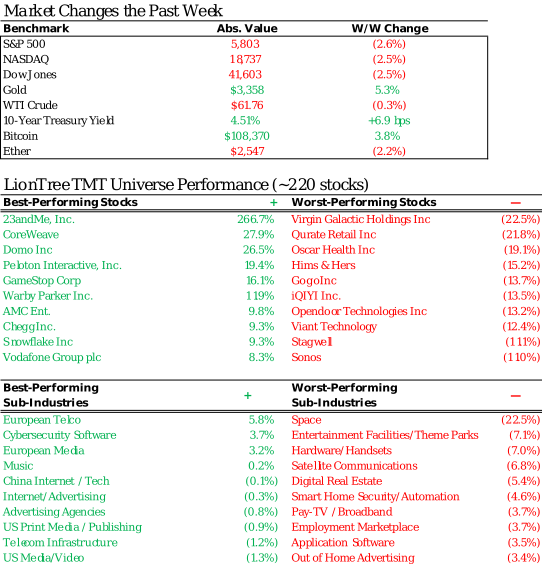
On the macro & markets front, the S&P 500 and Nasdaq fell ~2.5-2.6%, giving back some of last week’s gains. Investors initially shrugged off Moody’s US govt debt downgrade but President Trump now talking on Friday about a European 50% general tariff starting June 1st caused a stir.
Overall, it was a busy week, and we focused on the below in this edition:
- Google I/O: The Co Makes A Quick Sprint Forward In The AI Race
- How Much Energy Are All These AI Queries Using? Good Question!
- Connectivity Deal Making Is On Fire! The Latest Being AT&T’s Purchase Of Lumen’s Consumer Fiber Biz for $5.75bn
- Earnings Wrap: Double-Digit Adj EBITDA Beats In TMT Were More In Fashion Than Expected In Q1
- The Pedal Is Still On The Metal For Autonomous Vehicles
- Regarding Streaming Video, Ad-Free Is “Out” & Ad-Supported Is “In”
- Grab Bag: OpenAI Acquires io / NBCU Reportedly Makes Bid For MLB / Trump Threatens Tariffs On Apple And EU
Have a nice holiday weekend. It’s time to break out the BBQ!
Best,
Leslie

Google I/O: The Co Makes A Quick Sprint Forward In The AI Race
It is always exciting to listen to Google I/O’s keynote presentation and this year was not any different. The Co unveiled a slew of new product updates centered on the expansion of its Gemini ecosystem and the transformation of Search into a deeply intelligent, agentic experience.
Google’s Gemini has seen strong adoption/usage, especially with its Gemini 2.5 Pro model and newly announced tools like Deep Think, Jules, and Gemini Flash 2.5 are designed to push the boundaries of reasoning and efficiency. Google’s upcoming “agent mode” and “personal context” were key highlights and aim to help Gemini to become a truly proactive assistant, capable of handling complex tasks across apps and devices.
The outlook for Google’s search business has been at the center of debate for some time given potential competition from AI platforms, but we were particularly impressed by Google’s product updates in this area. The Co’s new AI Mode is viewed as “reimagining” the search experience by integrating real-time visual understanding, deep research, and personalized shopping. The Co’s demos in this area were particularly interesting (and we look forward to testing them out).
Project Astra, Mariner, and StarLine are being embedded into products like Gemini Live and Google Meet, while new creative tools like Imagen 4, Veo 3, and Flow aim to empower users to generate rich media with native audio and video (the Veo3 demos were pretty mind blowing – see link to some Veo3 videos if interested). Google also introduced Android XR, a new platform for AI-powered headsets and glasses, and a partnership with Warby Parker (which includes up to $170mn in investment) was a key highlight.
All in all, there is still a long road ahead in the AI race but we were constructive on the scale and scope of Google’s AI product updates at the event which keeps them in the forefront and the debate about susceptibility of the Co’s core search business may die down a little bit, at least for the time being.
-> Alphabet’s shares traded down -1.5% on the I/O day but had previously rallied up +15.1% since the low in early April; The shares are still -18.4% below the closing high on Feb 4th at $206.38
Some Key Updates On The Gemini Ecosystem
- # of developers: 7mn+ developers have built with the Gemini API via Google AI Studio and Vertex AI – a 5x increase since the last I/O; Gemini usage on Vertex AI is up +40x y/y
- New user disclosure: The Gemini app now has over 400mn MAUs, w/ usage of Gemini 2.5 Pro in the app up +45%
- Back in March 2025, Gemini had 350mn MAUs, according to an internal Google analysis (link)
- Other Gemini updates –
- Gemini Flash 2.5 is now available – optimized for speed and efficiency
- Deep Think mode pushes Gemini 2.5 Pro to new reasoning heights, excelling in math, code, and multimodal benchmarks
- Jules, the asynchronous coding agent, is now in public beta
- Gemini SDK is now compatible with MCP tools, enabling broader agentic capabilities
Google Makes Progress On Its Vision Is To Make Gemini A Personal, Proactive, & Powerful AI Assistant
- The Co annc’d Gemini Live, a real-time conversational experience w/in the Gemini app that allows users to interact with Google’s AI assistant through natural, spoken dialogue
- Gemini Live capabilities are now free in the Gemini app on Android and iOS
- In the “coming weeks,” users will be able to connect Gemini Live to apps like Calendar, Maps, Keep, Tasks
- Google is bringing Project Astra (universal AI assistant w/ real-world understanding) to their products: Gemini Live has Project Astra’s camera & screen sharing capabilities so users can talk about anything they see
- Rolled this out to everyone on Android and iOS this week
- Project Mariner (web-interacting agent that “gets stuff done” is coming to developers via Gemini API: Introducing multitasking (can oversee up to 10 simultaneous tasks) and the platform is using a feature called “Teach and Repeat” where users can show it a task once and it learns for similar tasks in the future
- Testers like Automation Anywhere and UiPath are already starting to build with it
- It will be available more broadly this summer
- Annc’d Google Beam, an evolution of its Starline 3D video calling tech, which uses multiple cameras and AI to create 3D image: The first devices will be launched w/ HP later this yr
-> Zoom shares fell as much as -2.4% on the day of the announcement
- Deep Research, as of this week, supports file uploads and will soon integrate with Gmail and Drive
- Canvas allows Gemini users to transform content into “dynamic” web pages, quizzes, infographics, and podcasts in 45 languages
- Introduced real-time speech translation in Google Meet (English/Spanish now; more languages and enterprise support coming soon)
- Imagen 4 and Veo 3 are now integrated into the app for high-quality image and video generation with native audio
- Imagen 4 is 10x faster than their previous model
- Veo 3 can essentially generate sound effects, background sounds, & dialogue
- Flow, a new AI filmmaking tool combining Imagen, Veo, and Gemini, is now live
The Co Will Be Bringing Agentic Capabilities To Chrome, Search & The Gemini App With Agent Mode
- An example of Agent Mode in the Gemini app is below…an experiential version of Agent Mode will be “coming soon” to subscribers –
- You want to find an apartment for you and two roommates in Austin
- You’ve each got a budget of $1,200 a month
- You want a washer-dryer or at least a laundromat nearby
- Normally, you’d have to spend a lot of time scrolling through endless listings
- Using agent mode, the Gemini app goes to work behind the scenes
- It finds listings from sites like Zillow that match your criteria and uses Project Mariner when needed to adjust very specific filters
- If there’s an apartment you want to check out, Gemini uses MCP to access the listings and even schedule a tour on your behalf
- And it’ll keep browsing for new listings for as long as you need
- Also, personalized “smart replies” are coming to Gmail…will be available this summer to subscribers
- Gemini in Chrome is rolling out to subscribers this week to Gemini subscribers in the US: It will offer contextual assistance while browsing
“Couldn’t Be More Excited About The Next Chapter Of Google Search”…AI Mode Is “The Next Big Step”
- AI Overviews have been scaling and is one of “the most successful launches in Search in the past decade”: Now serve 1.5bn+ users monthly across 200+ countries; In the US & India, they drive 10%+ growth in the types of queries that show them
- Lens grew +65% y/y w/ 100bn+ visual searches already this yr
- The Co was very bullish on its newly annc’d AI Mode which is a new tab in Search … “it’s a total reimagining of search”: Powered by Gemini 2.5, it enables longer, more complex queries and follow-ups and key AI Mode features include:
- Personal context is coming this summer: User will get personalized suggestions based on past searches and can opt-in (or out) to connect other Google Apps, starting w/ email from Gmail and other apps
- Bringing deep research capabilities: Expert-level, fully cited reports
- Complex analysis and data visualization for sports and financial questions is coming this summer
- Launching Live search: Using your camera, Search can see what you see and given you info as you go back and forth in real time; “It’s like hopping on a video call with Search
- Shopping experiences will be significantly enhanced as AI mode gives personalized shoppable options and also uses AI feature to see how styles look on you (Try it On); Their new visual shopping & agentic checkout features are rolling out in the “coming months”, and you can start trying on looks in Labs starting now
- Availability: AI Mode is now available to everyone in the US

Google Announces 2 New AI Subscription Plans
- Google AI Pro: Access to a full suite of advanced AI tools w/ higher rate limits and special features vs the free version
- Globally available today
- Google AI Ultra: VIP-tier plan w/ early access to features like 2.5 Pro Deep Think mode, Flow, and Veo 3 and plan comes w/ the highest rate limits
- Includes YouTube Premium and expanded storage
- Its available in the US now and will be globally available “soon”
Google Partner’s W/ Warby Parker On Its Smart Glasses
- Google Android XR platform supports a broad spectrum of devices for different use cases, from headsets to glasses & “everything in between”
- Built in collaboration w/ Samsung & Qualcomm
- Samsung’s Project Moohan headset launches later this year: The first Android XR device, Moohan gives you an infinite screen to explore your apps with Gemini by your side
- Android XR glasses: Glasses prototypes are in testing
- Annc’d that Gentle Monster & Warby Parker will be the first eyewear partners to build glasses with Android XR
- Features include real-time translation, contextual awareness, and navigation.
-> As part of this collaboration, Google committed up to $75mn for Warby Parker’s product development & commercialization costs; In addition, Google committed to investing up to $75mn in Warby Parker, at Warby Parker’s option and subject to reaching certain collaboration milestones; The first line of intelligent eyewear is planned to launch after 2025
-> Separately, but related in the smart glasses space, Apple is reportedly aiming to release its own smart glasses at the end of next year; The glasses would have cameras, microphones and speakers, allowing them to analyze the external world and take requests via the Siri voice assistant, and could also handle tasks such as phone calls, music playback, live translations and turn-by-turn directions (link)
How Much Energy Are All These AI Queries Using? Good Question!
While Google’s AI advancements at I/O this week were quite impressive and exciting (see Theme #1), the question about how much energy is needed to run these more complex AI queries resurfaced in our mind on the back of an interesting MIT Tech Review paper this week on this very topic. More and more of all energy usage is going towards data centers and more and more is going towards AI-specific servers.
From 2005 to 2017, the amount of electricity going to data centers remained relatively flat given that the additional power needs from the proliferation of new data centers to support the rise of cloud based online services like Facebook and Netflix was offset by increased efficiency. But the dawn of AI changed that curve. Data centers started getting built with energy-intensive hardware designed for AI, which led them to double their electricity consumption by 2023. All in all, an estimated 4.4% of all energy in the US now goes towards data centers, and an increasing amount is being used for AI -specific servers.
With the rapid improvement in AI capabilities, what will these power needs look like in the future? Our key takeaways from the paper are below and if you’d like to dig in further, this is the link to the MIT Paper.
- Data centers in the US are est’d to have used ~200 terawatt-hours of electricity in 2024 (4.4% of all the energy in the US) … this equates to roughly what it takes to power Thailand for a year
- AI-specific servers in these data centers are est’d to have used between 53-76 terawatt-hours of electricity
- On the high end, this is enough to power more than 7.2mn US homes for a year
- AI-specific servers in these data centers are est’d to have used between 53-76 terawatt-hours of electricity
- Estimating where this is going is a challenge given the lack of transparency and information on power usage of closed source models…the use case below was based on an analysis of various open-source models as a proxy
- As a simple use case…You’re running a marathon as a charity runner and organizing a fundraiser to support your cause and you –
- Ask AI 15 questions about the best way to fundraise
- Then you make 10 attempts at an image for your flyer before there is one you like
- And then you make 3 attempts at a 5 second video to post on Instagram
- All this would require an est’d ~2.9 kilowatt-hours of electricity
- That’s enough to ride 100+ miles on an e-bike (or ~10 miles in an avg electric vehicle) or to run a microwave for 3.5+ hrs
- The paper included some estimates on ChatGPT’s power usage as well…
- A single ChatGPT query requires 0.3 watt-hours, or 1,080 joules, per message
- 1bn queries per day for one year implies over 109 gigwatt-hours of electricity, which is enough to power 10,400 homes for a year
- Adding images implies an addtl 35 gigawatt-hours, which is enough to power another 3,300 homes per year
- And this does NOT include video generators
- And this is just for ChatGPT…let alone all the other models
- By 2028, the share of US electricity going to data centers could triple to 12% w/ more than half of the electricity going to data centers projected to be used for AI (power going to AI-specific purposes will rise to between 165 and 326 terawatt-hours per year)
- At that point, AI alone could consume as much electricity annually as 22% of all US households
- That would generate the same emissions as driving over 300bn miles – over 1,600 round trips to the sun from Earth
- Leading tech companies are trying to plan ahead –
- SoftBank, OpenAI, Oracle, and the Emirati investment firm MGX intend to spend $500bn in the next four years on new data centers in the US
- Anthropic has suggested that the US build an additional 50 gigawatts of dedicated power by 2027
- AI companies are also planning multi-gigawatt constructions abroad
- Tech companies are looking to nuclear power sources as well
- Meta, Amazon, and Google have annc’d goals to use more nuclear power
- They have joined a pledge to triple the world’s nuclear capacity by 2025
- Today, nuclear energy only accounts for 20% of electricity supply in the US, and powers a fraction of AI data centers’ operations
Connectivity Deal Making Is On Fire! The Latest Being AT&T’s Purchase Of Lumen’s Consumer Fiber Biz for $5.75bn
Deal making in the connectivity sector over the past 12 months has been on fire! Starting last spring, T-Mobile announced the formation of a JV with EQT Infrastructure to acquire Lumos in April 2024 and also announced the formation of a joint venture with KKR to acquire Metronet in July 2024. Verizon then announced the acquisition of Frontier in September 2024. Moving into 2025, Crown Castle announced it’s selling its Fiber segment to EQT and Zayo in March 2025, Charter and Cox last week announced a merger, and, now this week, AT&T announced that it is buying the vast majority of Lumen’s Mass Market fiber business. What a list! In the background, the connectivity sector has been a shining star as well given the defensive and domestic nature of business in the sector, making it an attractive place for investors to hide during volatile and uncertain times. Mgmt teams also have a lot more visibility to their operations than many other consumer oriented sub-sectors of TMT.
More specifically on AT&T’s deal this week, it had been speculated for some time so it was not a complete surprise (link). The strategic rationale makes sense in that AT&T will be able to expand its fiber reach and penetration into new regions and drive more wireless customers as well given expected uptake in converged bundled packages of broadband and mobile in these new areas and a separate FWA re-sale agreement with Lumen. Another aspect of AT&T’s plan post the close of this transaction is to bring on an equity partner, who will co-invest in other deals (and this unit will be deconsolidated from AT&T’s financials). They believes this structure is “consistent with its balanced approach to capital allocation – supporting the accelerated and capital-efficient expansion of AT&T Fiber outside of its traditional wireline operating region.”
This Lumen deal itself will be immaterial to AT&T’s overall financials during the next 12-24 months and AT&T reiterated its existing guidance. Longer term as the asset scales, AT&T expects the transaction to be accretive
See below for the need to knows regarding this transaction…(link/link)
-> AT&T share fell -0.9% in reaction; While Lumen’s stock rallied at much as +17.1%, it pared those gains through the day to end up only +0.8%; YTD, AT&T is up +20.4% (outpacing both VZ and TMUS up +8.3% and +10.0%, respectively), while Lumen’s stock is down -29.9%
- Deal basics
- Deal value: $5.75bn, cash
- Expected close: H1 2026
- What is AT&T buying and what is included in the deal?
- Effectively all of Lumen’s Mass Markets fiber business, made up of ~1mn fiber customers; This will expand AT&T’s fiber reach by 4mn+ locations across 11 states
- Includes last-mile fiber assets & central office network elements, “enabling a consistent AT&T Fiber experience within Lumen’s footprint”
- These assets generate $750mn+ in annualized revenue
- Lumen will support AT&T post-close via transitional agreements (~2 years) covering operations, IT, billing, and customer support
- AT&T will also receive long-term access to certain Lumen central offices, poles, and conduits
- AT&T will hold the acquired fiber network assets, including certain fiber network deployment capabilities, in a new, fully owned subsidiary (“NetworkCo”)
- Effectively all of Lumen’s Mass Markets fiber business, made up of ~1mn fiber customers; This will expand AT&T’s fiber reach by 4mn+ locations across 11 states
- What is Lumen keeping?
- Lumen retains its enterprise-focused infrastructure: national/regional fiber backbone, central offices, and real estate
- AT&T will bring in an equity partner for NetworkCo post the close of this transaction
- These acquired fiber assets will be held in a new fully owned subsidiary called NetworkCo
- But post close, AT&T plans to bring in an equity partner, selling partial ownership of NetworkCo, which will operate as a wholesale open access platform with AT&T as anchor tenant
- AT&T expects to identify an equity partner & close a transaction w/in ~6-12 months of closing the transaction with Lumen
- After bringing in the equity partner, NetworkCo will be deconsolidated from AT&T’s consolidated financial statements
- All acquired Lumen Mass Markets fiber customers will remain AT&T customers
- The deal will have an immaterial financial impact to AT&T’s consol adj EBITDA, EPS & FCF over the next 1-2 years
- AT&T reiterated its FY25 guidance (including buyback plans) & will maintain its leverage target (~2.5x net debt to adj EBITDA)
- The deal is expected to be accretive “long-term” as the business scales
- The deal will enable AT&T to accelerate its fiber plans and tap into locations outside its traditional operating region
- With Lumen’s Mass Markets fiber biz, AT&T’s total fiber reach will increase to 30 states and to 60mn customer locations by the end of 2030; This is double the amount of AT&T fiber locations today
- This includes expansion in metro areas such as Denver, Las Vegas, Minneapolis-St. Paul, Orlando, Phoenix, Portland, Salt Lake City, and Seattle
- AT&T believes it can increase fiber customer penetration in the acq’d footprint to the current penetration of AT&T Fiber which is in the 40% range
- Given AT&T will gain access to Lumen’s fiber construction capabilities w/in its ILEC footprint, it also plans to accelerate the pace at which fiber is being built in these territories
- With Lumen’s Mass Markets fiber biz, AT&T’s total fiber reach will increase to 30 states and to 60mn customer locations by the end of 2030; This is double the amount of AT&T fiber locations today
- AT&T also expects the deal to drive new postpaid wireless & FWA additions
- The geographies that AT&T is acquiring include some of the largest metro areas where AT&T has the lowest mobility share so there is opportunity to further penetrate
- Converged customers remain very attractive: T’s share of postpaid phone subs is 5ppts+ higher than their national avg where they offer AT&T fiber
- AT&T & Lumen also have separate agreements regarding re-selling FWA: Lumen will be able to resell AT&T’s residential w-less services technologies, such as via AT&T Air, to their legacy copper customers that won’t have the oppty to migrate to T’s fiber services
- The geographies that AT&T is acquiring include some of the largest metro areas where AT&T has the lowest mobility share so there is opportunity to further penetrate
- AT&T is confident about executing on the deal strategy
- AT&T “knows how to operate and build fiber networks at scale”
- It “has experience operating fiber networks that were decoupled from legacy infrastructure”
Earnings Wrap: Double-Digit Adj EBITDA Beats In TMT Were More In Fashion Than Expected In Q1
Given we reached the end of the Q1 earnings season, as always, we like to zoom out and take a look across our LionTree TMT and Consumer Universe of ~200 companies across 32 sub-sectors with market caps of $1bn+ to evaluate financial performance relative to Wall Street projections overall.
Despite all the headlines around inflation, tariffs, and shifting rate expectations, quarterly performance relative to expectations remained more or less consistent. Profitability and revenue beats were largely in-line with recent quarters, though there were some shifts in magnitude and distribution.
On the profitability side, 76% of companies beat consensus projections, up slightly from 74% in Q4, but what stood out more was the much higher magnitude, with 43% of companies delivering double-digits beats (vs 31% in Q4). The median EBITDA beat also widened to +4.4%, up from +3.3% last qtr, even as the avg beat moderated from +12.1% in Q4 to +9.7% in Q1.
On the revenue side, 74% of companies topped estimates, which was the same as in Q4, and 3% of companies posted double-digit revenue beats, up slightly from 2% in Q4. That said, the median sales surprise pulled back to +1.0% from +1.4% in Q4, while the avg ticked up to +2.0% from +1.7%.
Given these dynamics, slightly more companies (52%) traded up vs down (48%) following results, but fewer stocks made large moves in either direction. Overall, there are still a lot of uncertainties ahead but at least so far, more companies focused on delivering stronger profitability levels during this period.
See below for more on Q1 financial and stock performance of companies and sub-sectors within our LionTree Universe of TMT and Consumer stocks.
More Stocks Traded Up Post-Earnings Q/Q, Though Fewer Made Double-Digit Moves…Gogo, Groupon, & Oscar Health Shares Rallied The Most
- 52% of stocks traded UP post their reports, which was a step up from 46% in Q4 and 50% in Q3
- 14% traded UP double-digits in reaction to earnings, which was down from 15% in Q4 and 20% in Q3
- 9% traded DOWN double-digits in reaction to earnings, which was down from 12% in Q4 and 16% in Q3
- The top 3 BEST performers in reaction to earnings were –
- Gogo, up +45%
- Groupon, up +43%
- Oscar Health, up +30%
- The bottom 3 WORST performers in reaction to earnings were –
- Block, down -20%
- FuboTV, down -17%
- Liberty Latin America, down -15%
Of The Companies That BEAT Expectations In Q1…
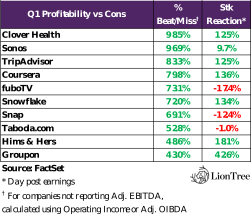
- Clover Health, Sonos & TripAdvisor had the largest % beats on adj EBITDA
- Overall, 76% of the companies in our Universe beat consensus on adj. EBITDA, and 43% had double-digit beats (vs 74% & 31%, respectively for Q4)
- The median adj EBITDA rose to +4.4%, up from +3.3% in Q4 (but was below +7.0% in Q3)
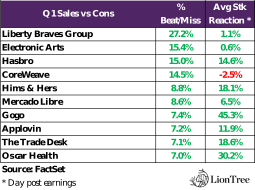
- Liberty Braves, Electronic Arts, and Hasbo had the largest % beats on Sales
- Overall, 74% of the companies in our LionTree Universe beat consensus on revenue (about in-line w/ 73% in Q1), but only 3% of those companies beat expectations by double-digits or more (up from 2% in Q4)
- That said, the median sales beat fell back down to +1.0%, after rising to +1.4% in Q4, which was up from +1.0% in Q3
Of The Companies That MISSED Expectations In Q1…
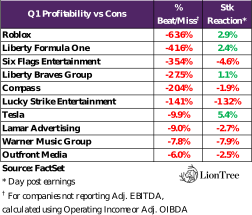
- Roblox, Liberty Formula One, & Six Flags had the largest % misses on adj EBITDA
- Overall, 24% of the companies in our Universe missed consensus on adj. EBITDA
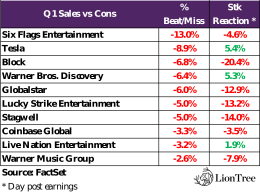
- Six Flags, Tesla, & Block had the largest % misses on sales
- Overall, 26% of the companies in our Universe reported sales in-line/lower than consensus
The Pedal Is Still On The Metal For Autonomous Vehicles
We continue to closely follow the progress of the autonomous vehicle industry and the race to mass commercialization is accelerating. There were several notable updates this week that we wanted to flag. Tesla CEO Elon Musk announced plans to launch a fully driverless robotaxi trial in Austin by the end of June. The initial rollout will be very limited, with around 10 vehicles on the road, but Musk expects a rapid ramp-up to 1,000 cars and expansion into additional cities within a few months if all goes well. That said, when it comes to Elon Musk, timelines need to be taken with a grain of salt.
Musk also addressed questions about the future at Tesla this week given his political advisory involvement in the last yr and reaffirmed his commitment to leading Tesla as CEO for at least the next five years.
While Tesla captured much of the spotlight in AVs this week, others also made notable moves – WeRide expanded its partnership with Tencent to further drive its robotaxi ambitions (with a focus on expanding globally), and Waymo announced that it surpassed 10mn paid robotaxi rides.
See below for more.
Tesla To Launch Driverless Robotaxi Trial in Austin by June As Musk Reaffirms Commitment To His Cos (link/link/link/link)
- Tesla is on track to launch a robotaxi trial in Austin, Texas, by June end, per Tesla CEO Elon Musk
- Expect a quick ramp up after a limited rollout next month: “We’ll start with probably 10 for a week, then increase it to 20, 30, 40… It will probably be at 1,000 within a few months”
- What cars/technology will be used? To start, Tesla’s robotaxis will be Model Y vehicles equipped with a forthcoming version of FSD, or full self-driving, known as FSD Unsupervised
- There will be no driver in the vehicle when the Robotaxi program launches in June
- The Cybercab, which was unveiled by the Co last October, will not be available initially, as those cars will likely be produced in 2026
- Launch in Austin will be “geo-fenced” to certain parts of the city: Robotaxis will be limited to certain parts of Austin and avoid intersections that the CO deems unsafe; “We are actually going to deploy not to the entire Austin region, but only the parts that are the safest”
- Plan to bring the robotaxis to Los Angeles and San Francisco following the planned Austin debut
- Update on Musk’s role at Tesla – he will reduce his work for Trump administration to focus on Tesla
- “My rough plan on the White House is to be there for a couple days, every few weeks, and to be helpful where I can be helpful”
- Will Musk still be CEO of Tesla in five years? “Yes, no doubt about that at all” -> Comes after a WSJ report earlier this month that Tesla’s board had reached out to several executive search firms to work on a formal process for finding Tesla’s next chief executive; Tesla later issued a denial and Musk criticized the article on X (link)
- Musk is also looking to increase his share of the Co to 25%: “That’s the number I’d feel comfortable at, because that’s where I have some control, but not so much control that I can’t be thrown out”
- Musk currently owns a 12.77% stake in Tesla, worth ~$140bn, according to FactSet
- On future political spending plans – “going to do a lot less in the future”: When asked why, Musk responded “I think I’ve done enough”
- On a potential merger b/w Tesla and xAI – that is not being considered but also is “not out of the question”
-> While not AV related, Musk also said his satellite internet service Starlink, which is currently owned and operated by SpaceX, could eventually stand alone as a separate public company (link)
Some Addtl Key Updates This Week In The AV Space
- WeRide is expanding its strategic partnership w/ Tencent Cloud to drive robotaxi commercialization (link)
- It will support WeRide’s autonomous driving R&D, robotaxi commercialization, and global expansion efforts
- It builds on an initial April 2024 agreement focused on co-developing cloud platforms and smart driving solutions for OEMs and Tier 1 suppliers
- The Cos will jointly develop intelligent driving solutions for intl markets: Tencent Cloud will provide localized, compliant cloud infrastructure to accelerate WeRide’s scaled commercial rollout of its autonomous driving products overseas
- WeRide’s Robotaxi svs will be integrated into Tencent’s platforms, including Tencent Smart Transportation Mini Program on Weixin/WeChat and Tencent Maps
- It will support WeRide’s autonomous driving R&D, robotaxi commercialization, and global expansion efforts
- Waymo has reached 10mn paid trips, doubling in five months (link/link)
- Half of those rides have taken place this yr
- The 10mn figure includes rides in Austin, Los Angeles, San Francisco and the Phoenix area
- Waymo is currently delivering 250k+ paid robotaxi rides a week, Alphabet said in its latest earnings report
- Waymo is not yet profitable but that the Co is “super focused on building a sustainable business
Regarding Streaming Video, Ad-Free Is “Out” & Ad-Supported Is “In”
The era of ad-free dominance, a hallmark of the early streaming boom, appears to be rapidly fading. Just two years ago, half of the Premium SVOD services didn’t even offer an ad-supported plan, and only about 1 in 3 subscribers were opting in to ad plans. But today, the landscape looks very different.
Ad-supported streaming options are surging in popularity, now making up nearly half (46%) of SVOD subscriptions, according to Antenna. At the same time, new research from Hub Entertainment Research shows that consumers are becoming increasingly price-sensitive, cutting back on individual premium services due to rising costs and content fatigue. Instead, they’re gravitating toward bundled offerings and value-driven packages to get more out of their streaming dollars.
Both reports highlight some compelling shifts. See below for more.
Ad-Supported Streaming Grows To Nearly Half Of SVOD Subscriptions, Per Antenna (link)
- Nearly half (46%) of subscriptions are ad-supported among the SVOD services that offer both ad-free and ad-supported options
- Ad-supported subscriptions GREW +32.7% y/y, while ad-free subscriptions FELL by -0.1% over the same period
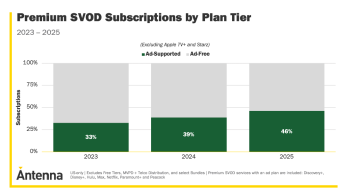
- 71% of net adds in the past 9 qtrs came from ad-supported plans
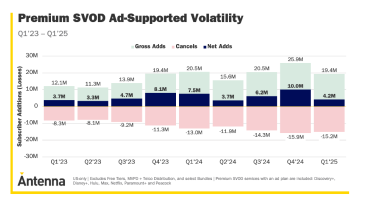
- Ad-supported net adds GREW by +7.6mn y/y: From 19.8mn in 2023 to 27.4mn in 2024
- Note that ad-supported net adds in Q1:25 were down -3.3mn y/y, driven by the exclusive NFL AFC Wild Card Game on Peacock in Q1:24, which drove a surge in ad-supported acquisition
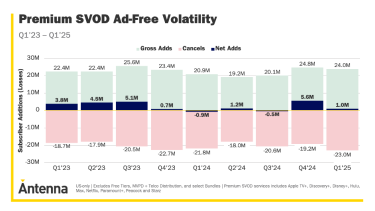
- Ad-free net adds FELL by -8.7mn y/y: From 14.1mn in 2023 to 5.4mn in 2024
Consumers Cut Back on Individual SVODs As Perceived Value Declines, While Bundling Drives Higher Engagement, Per Hub Entertainment Research’s “The Best Bundle” Report (link)
- 52% of consumers currently pay for the “Big 7” premium US SVODs: Netflix, Amazon Prime Video, Hulu, Disney+, HBO Max, Paramount+ and Peacock
- Which is DOWN from 61% last yr
- Why the cutback? “A reaction to increased prices and the fact that each offers an abundance of content”
- More consumers feel like they’re getting less value vs last yr
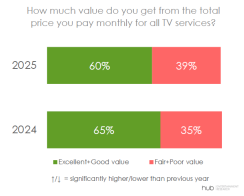
- Based on how much they’re spending, fewer users feel like they are getting excellent or good value (60%) vs last yr (65%)
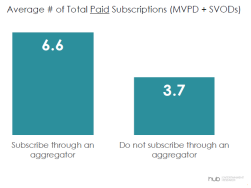
- Consumers that use aggregators have more paid svs overall
- Bundling increases paid svs consumptions – people who bundle through aggregators like Amazon or Roku use about three of more paid svs than non-bundlers
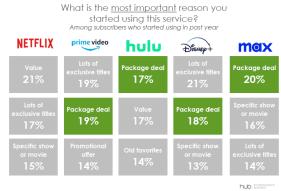
- Recent sign-ups are driven more by value (packaging and pricing) vs content (exclusive titles)
- More than specific content, “package deals” stands out as a top reason for starting to use paid SVODs (Netflix was the exception)
Grab Bag: OpenAI Acquires io / NBCU Reportedly Makes Bid For MLB / Trump Threatens Tariffs On Apple And EU
- OpenAI is buying iPhone designer Jony Ive’s AI devices startup io for $6.4bn in an all-equity deal (link/link/link)
- io is coming in-house, while Ive and his “creative collective” called LoveFrom will stay independent
- io was founded a year ago by Ive, along with Apple alumni Scott Cannon, Tang Tan and Evans Hanke
- LoveFrom was founded in 2019 by Ive after he annc’d he was leaving Apple
- How will io be integrated into OpenAI?
- Ive is taking on “deep creative and design responsibilities across OpenAI and io”
- io’s team of ~55 hardware engineers, software developers and manufacturing experts will now merge with OpenAI to work more intimately w/ the research, engineering and product teams in San Francisco
- OpenAI said it’s paying $5bn in the transaction, as it already owns 23% of the company
- Purchase is OpenAI’s largest thus far, and comes weeks after the Co agreed to buy AI-assisted coding tool Windsurf for $3bn; Prior to that, OpenAI acquired analytics database company Rockset for an undisclosed sum in 2024
- OpenAI products in the works? Per OpenAI CEO Sam Altman –
- “It’s a relationship and a way of working together that I think is going to yield products and products and products”
- “OpenAI is going to create a product at a level of quality that “has never happened before in consumer hardware”
- Competition for smartphones? “In the same way that the smartphone didn’t make the laptop go away, I don’t think our first thing is going to make the smartphone go away…It is a totally new kind of thing”
- The first devices are slated to debut in 2026
- io is coming in-house, while Ive and his “creative collective” called LoveFrom will stay independent
- NBCUniversal had reportedly made a bid for ESPN’s Major League Baseball (MLB) package (link)
- ESPN walked away from the package in February after exercising a clause to opt out of the final three years of its $550mn/yr contract after the 2025 season
- The move ended a 35-yr partnership with MLB and put the rights into play for others
- NBC is reportedly offering “significantly less” than what ESPN paid, in part because it isn’t seeking the intl and radio rights that ESPN licenses from MLB, or the rights to highlight clips
- ESPN was reportedly willing to pay $200mn/yr in a renegotiated pact, but the league declined, according to a previous WSJ report
- If the bid is successful…
- NBC would air games on Sunday night, the slot ESPN has occupied since 1990
- Games would also appear on NBC’s sister streaming service, Peacock
- NBC is also interested in the first round of the postseason and the annual Home Run Derby, which ESPN currently carries
- What rights does NBC have right now? National Football League and, starting later this year, National Basketball Association games on Sundays
- Per the report, when there are scheduling conflicts with other sports, MLB games would be streamed on Peacock
- ESPN walked away from the package in February after exercising a clause to opt out of the final three years of its $550mn/yr contract after the 2025 season
- Trump threatens steep tariffs on Apple iPhones and EU products (link/link)
- 25% import tax “at least” on iPhone not manufactured in the US, later widening the threat to any smartphone
- Later on Friday, Trump told reporters that his proposed tariff on Apple would also apply to “Samsung and anybody that makes that product,” apparently referring to smartphones
- Trump last week during his Middle East trip said he was displeased with Tim Cook, Apple’s CEO, over the Co’s plan to manufacture iPhones set to be sold in the US at newly built plants in India
- Apple’s iPhone is produced primarily in China, but the Co has been shifting manufacturing to India in part because that country has a friendlier trade relationship with the US
- 50% tariff on all goods sent to the US from the EU, starting June 1st
- The warning against the EU came just hours before the two sides were set to have trade talks – “Our discussions with them are going nowhere!” Trump wrote in a Truth Social post
- Trump last month announced a 20% tariff on most EU goods, but had halved it to 10% until July 8th to allow time for negotiations
- Not looking to negotiate, but added in an investment caveat: “I’m not looking for a deal – we’ve set the deal,” Trump said, but added that “If somebody comes in and wants to build a plant here, I can talk to them about a little bit of a delay”
- An update on overall trade talks with countries – “There are 18 important trading partners and, I would say, with the exception of the EU, most are negotiating in very good faith,” said Treasury Secretary Scott Bessen in a Fox News interview
- Talks are “far along with India,” and many Asian countries have presented “very good deals”
- “Over the next couple of weeks we’re going to have several large deals announced”
- 25% import tax “at least” on iPhone not manufactured in the US, later widening the threat to any smartphone
Stock Market Check
This Week's Other Curated News
Advertising/Ad Agencies/Ad Tech
- MNTN saw shares surge 65% post-IPO, raising $187mn. Shares opened at $16 and closed at $26.36. The Co, valued at ~$2.7bn fully diluted, offers a tech-driven platform for SMBs to advertise on streaming TV. Reynolds, as chief creative officer, played a key role in branding. MNTN spun off Maximum Effort but retained a creative svs contract (Yahoo Finance)
- Coca-Cola renewed its global marketing deal w/ WPP’s Open X, praising its “significant value.” The unit handles creative and non-North American media. Despite losing Coca-Cola’s $700mn North American media biz to Publicis in Dec., the renewal boosts WPP after a tough Q1 marked by a 0.9% rev drop and 4.4% fall in creative rev (Digiday)
- Publicis Groupe has acquired Captiv8, the world’s largest influencer tech platform, to build a connected influencer ecosystem. Captiv8, active in 120 countries, covers 95% of influencers w/ 5K+ followers and processes 2.5bn posts/yr. Combined w/ Influential and powered by Epsilon’s CoreID, the platform will unify creator strategies, commerce, and measurement (Street Account)
- Walmart’s global ad biz surged 50% YoY in fiscal Q1 2026, driven by Vizio integration. Excluding Vizio, ad rev rose 27%. Walmart Connect, its U.S. retail media arm, grew 31%. Ad & membership svs now form ~25% of cos profits. CFO Rainey emphasized diversified income helps offset tariff impact. Vizio boosts Walmart’s CTV capabilities, enriching data & brand ties, key in rivalry w/ Amazon. (Marketing Dive)
Artificial Intelligence/Machine Learning
- Anthropic annc’d Claude 4 AI models—Opus 4 & Sonnet 4—at its dev conf. These models excel in long-horizon reasoning, coding, and math. Opus 4, the more powerful, is API-only, while Sonnet 4 is free & paid. Claude 4 aims to boost cos rev from $2.2bn to $12bn by 2027 (TechCrunch)
- Microsoft has annc’d Aurora, an AI foundation model aimed at transforming weather forecasting w/ faster, more accurate predictions at lower computational costs. Trained on ~1mn hrs of atmospheric data, Aurora excels in forecasting air quality, ocean waves & extreme weather. It outperforms current systems in hurricane prediction, aiding disaster preparedness. Its ML-based design removes the need for complex simulations, w/ plans to expand into broader climate applications (New York Times)
- CoreWeave shares jumped 18% after annc’ing a $2bn debt offering priced at 9.25%, maturing in Jun 2030. The deal, upsized by $500mn from initial plans, was 5x oversubscribed. Proceeds will help repay existing debt. Co recently raised $17.2bn in equity and debt to support AI cloud infra expansion. Despite a wider-than-expected Q1 net loss, rev beat estimates, and Co plans major capex to meet AI demand (CNBC)
- Volvo will be the first automaker to integrate Google’s Gemini AI into its vehicles via Android Automotive. The AI assistant enables natural conversations for tasks like navigation, translation, and vehicle info, aiming to reduce drivers’ cognitive load. Volvo will also serve as a reference platform for Google’s future auto tech, gaining early access to features like high-def maps and voice-controlled HVAC (The Verge)
- Baidu posted a surprise Q1 rev jump amid China’s intensifying AI race, driven by strong demand for its cloud and gen AI svs. Rev rose 3% Y/Y to CNY31.5bn (~$4.36bn), beating estimates. AI Cloud rev surged 42%, offsetting flat online mkting. Co emphasized its focus on foundation models and AI infra, positioning itself against rivals like Tencent and Alibaba. Despite macro headwinds, Baidu reaffirmed its AI-first strategy to capture long-term growth (Bloomberg)
- Nvidia CEO Jensen Huang called US chip export curbs on China “a failure,” saying they spurred Chinese rivals like Huawei to accelerate AI chip development. Nvidia’s China mkt share fell from 95% to 50% in 4yrs. Huang criticized the AI diffusion rule and said degrading chips like the H20 for compliance was ineffective. He urged the US to boost AI diffusion to stay ahead. Trump admin is reversing prior restrictions, while China pushes local chip adoption to reduce foreign reliance (Financial Times)
- Apple plans to open its AI models to developers, aiming to spur a new wave of apps. Apple revealed it will allow devs to integrate its gen AI tech into third-party apps, a shift from its traditionally closed ecosystem. The move is seen as a response to rivals like OpenAI and Google. Apple’s strategy focuses on privacy and on-device processing, with tools expected to debut at WWDC in Jun (Bloomberg)
- The EU is preparing sweeping AI rules that could reshape how Big Tech operates across Europe. WSJ reported that Apple, Google, and Meta are adjusting to the bloc’s AI Act, which mandates transparency, risk assessments, and human oversight for high-risk AI. The law also restricts facial recognition and deepfake use. Tech cos warn of compliance burdens, while EU regulators argue it ensures ethical AI deployment and user safety (Wall Street Journal)
- Alibaba shares dropped sharply as US scrutiny intensified, with Trump’s new executive order targeting Chinese investments in strategic US sectors, including tech. The Nasdaq Golden Dragon China Index also fell 6.3%. Despite recent AI-driven gains, Alibaba’s ADRs plunged up to 11%. The Co had recently annc’d a $53bn AI infra investment over 3yrs. The selloff reflects rising geopolitical tensions and investor caution around Chinese cos amid U.S. regulatory pressure (Fortune)
Audio/Music/Podcast
- Amazon Music unveiled a new AI-powered search feature to enhance music discovery. Available in beta for select U.S. Unlimited subscribers, it uses Amazon Bedrock to deliver richer recommendations, curated collections, and AI-generated playlists. The tool deepens fan engagement by linking searches to artist insights, collaborations, and genre explorations (About Amazon)
- Spotify reported a boost in subs after enabling external payments on iOS in the EU, bypassing Apple’s in-app purchase fees. The change, driven by the EU’s DMA rules, allows users to subscribe directly via Spotify’s site. Co said early data shows higher conversion rates and improved user experience. Spotify has long criticized Apple’s 30% cut, and this shift marks a major win in its push for platform fairness (TechCrunch)
Cable/Pay-TV/Wireless
- Millicom (Tigo) signed a definitive deal to acquire Telefónica Móviles del Uruguay for $440mn, aiming to boost its South American footprint. The acquisition is expected to be EFCF accretive by 2026, reinforcing Millicom’s regional strategy (StockTitan)
- DIRECTV has made its cheaper “Entertainment” TV package harder to find online, instead promoting pricier options like “Choice” ($89.99/mo), “Ultimate,” and “Premier.” The “Entertainment” tier, offering 90+ channels, is still available but buried on the site. DIRECTV is also pushing new “Genre Packs” (e.g., “MyEntertainment”) starting at ~$35–$70/mo. The strategy appears aimed at boosting ARPU by steering users toward higher-tier plans (Cord Cutters News)
Capital Market Updates
- Venture capital is experiencing a bottleneck at the seed stage, per new Carta data. In Q1 2024, 46% of seed deals were bridge rounds—the highest ever recorded—up from 39% in 2023 and 31% in 2022. This trend reflects market volatility and a “Series A crunch,” as startups delay priced rounds amid valuation uncertainty. Series A deals dropped 79% from Q1 2022 to Q1 2025. Median time between Series A and B hit 2.8yrs, while founder dilution declined and investor protections like participating preferred shares rose (Axios)
Crypto/Blockchain/web3/NFTs
- Bill Zanker, longtime Trump associate, launched $Trump memecoin, generating $300mn+ in fees. He hosted a VIP dinner for top 220 holders, offering direct access to Trump. Critics call it a “pay-to-play” scheme, citing ethics concerns. The coin surged post-annc’t, w/ 80% held by a Trump Org. subsidiary. (Bloomberg)
- Former SafeMoon CEO John Karony was found guilty by a New York jury on three felony charges—conspiracy to defraud the US, money laundering, and wire fraud—after a two-week trial ending. Co-founders Thomas Smith and Kyle Nagy were also implicated; Smith testified against Karony, while Nagy remains at large. Karony could face years in prison (Cointelegraph)
- Bitcoin surged past $100K, up nearly 6% to $101,679, driven by optimism over a new US-UK trade deal and strong ETF inflows. Ether jumped 18%, Solana 10%, and Dogecoin 12%, reflecting broad crypto market gains. Since Apr. tariff policy shifts, BTC is up 17%, outpacing gold and equities. Analysts cite macro uncertainty, geopolitical tensions, and a pro-crypto US stance as key tailwinds. (CNBC)
- White House crypto czar David Sacks said the GENIUS Act could unlock trillions for the US Treasury by creating demand for Treasuries via regulated stablecoins. The bill passed a key Senate vote on May 21 and mandates full-reserve backing for stablecoins. Critics warn of Trump family conflicts, citing USD1 stablecoin backed by Trump Jr. Sacks called the bill a national economic strategy to strengthen the dollar online. (MSN)
- Circle is pursuing an IPO but is also in talks w/ Coinbase and Ripple for a potential sale. Sources said Goldman Sachs is advising Circle, which seeks S&P 500 inclusion. The co’s valuation could exceed $5bn. The crypto sector is seeing renewed M&A interest amid regulatory clarity and market recovery. Analysts say consolidation may accelerate as firms seek scale and compliance readiness (Fortune)
eCommerce/Social Commerce/Retail
- Walmart is cutting ~1,500 jobs across its US retail & global tech teams to streamline ops & boost agility. Most U.S. cuts affect end-to-end ops & Walmart Connect. In tech, some roles are cut while others are added to reduce complexity & speed up innovation. Execs cited the need to adapt to fast-evolving tech & sharpen focus on future retail experiences. The Co’s U.S. e-comm turned a profit in Q1, adding momentum to the restructuring (Retail Dive)
- Nike has laid off a “limited number” of global tech employees as part of a broader turnaround strategy under new CEO Elliott Hill. The move follows recent shifts to managed svs for systems, apps & product work. While exact figures weren’t disclosed, the Co emphasized it was a tough but necessary biz decision. The restructuring aligns w/ efforts to rebuild wholesale ties & diversify beyond DTC-heavy focus (Retail Dive)
- Pershing Square, led by Bill Ackman, took a new stake in Amazon while exiting Canadian Pacific. The Co’s Q1 13F filing showed Amazon as its only new buy. (MSN)
- Nike will resume selling directly on Amazon for the first time since 2019. The move aims to boost digital sales and reach more consumers via Amazon’s vast platform. Nike had exited due to concerns over unauthorized sellers and brand control but now returns under a new agreement focused on tighter distribution and brand protection (CNBC)
- Target’s Q1 rev fell ~2. 8% to $23.8bn, w/ merchandise sales down ~3.1% to $23.4bn and comps dropping 3.8%. Store sales declined 5.7% while digital rose 4.7%. Co cited tariff uncertainty and backlash from Jan. DEI changes as key headwinds. Exec shakeup includes exits of Chief Strategy & Growth Officer Christina Hennington and Chief Legal Officer Amy Tu. A new Enterprise Acceleration Office was annc’d to boost agility. FY guidance revised to low-single-digit sales decline (Retail Dive)
- Canada Goose’s Q4 rev rose 7. 4% Y/Y to CA$384.6mn ($277.1mn), beating expectations. Adj EPS hit CA$0.33 vs CA$0.23 est. Shares surged nearly 20% as Co pulled FY2026 guidance citing macro uncertainty and shifting consumer behavior. Co noted most products are USMCA-compliant, minimizing tariff impact. Leadership emphasized resilience amid past crises like 2008 and Covid, reaffirming brand strength and adaptability (CNBC)
- Nordstrom has gone private in a $6. 25bn all-cash deal led by the Nordstrom family and Mexico’s Liverpool, giving the family a 50.1% stake and Liverpool 49.9%. The move ends Nordstrom’s public trading era, w/ shares delisted from NYSE. Erik and Pete Nordstrom now serve as co-CEOs, while Jamie Nordstrom remains chief merchandising officer. The deal was funded via equity, cash reserves, and a $450mn loan. Shareholders received $24.25/share, a 42% premium over Mar.18’s closing price (WWD)
- Amazon introduced an AI-powered audio feature called “AI shopping experts” in its app, offering product summaries via a “Hear the highlights” button. The tool uses LLMs to convert product info, reviews, and web data into short audio clips, enhancing convenience for multitasking users. It complements other AI tools like Rufus and Shopping Guides. Currently limited to select products and users, broader rollout is planned (GeekWire)
- Shopify launched an AI-powered store builder that lets merchants create storefronts from a single prompt, part of its latest platform update. The tool generates ready-to-launch sites, which users can customize. New features include AI-generated banners, a public theme “Horizon” w/ AI-assisted design, and “Theme Blocks” for no-code customization. Sidekick, Shopify’s AI assistant, now supports voice chat, screen sharing, and mobile access, enhancing merchant support and productivity (TechCrunch)
- Amazon issued refunds and apologized to customers affected by years-old return issues, where some were wrongly charged or denied refunds. The Co cited internal system errors and pledged to improve transparency and customer trust. Refunds were issued proactively, and Amazon emphasized its commitment to correcting past mistakes. (Bloomberg)
- TJX Cos beat Q1 sales estimates w/ $13. 11bn rev and EPS of $0.92, topping $0.91 forecast. Despite tariff pressures, Co maintained FY26 outlook: EPS of $4.34–$4.43 and comp sales growth of 2–3%. Q2 EPS seen at $0.97–$1 vs. $1.03 est. Tariffs on pre-committed goods to weigh on margins. Off-price model, resilient demand, and sourcing agility help offset macro uncertainty (CNBC)
- Amazon CEO Andy Jassy said consumer demand and pricing remain steady despite new tariffs. Co is leveraging its scale and supply chain to minimize cost impact. Jassy emphasized Amazon’s ability to adapt quickly, noting no immediate price hikes. He also highlighted strong Prime engagement and resilient retail trends. (Bloomberg)
- Home Depot annc’d it won’t raise prices despite tariff pressures, as Q1 rev rose 9. 4% Y/Y to $39.9bn.S. comps grew 0.2% while overall comps dipped 0.3%. Operating income hit $5.1bn (+1.1%), but net income fell 4.6% to $3.4bn. Execs cited diversified sourcing—~50% U.S.-based—and no single foreign country to exceed 10% of purchases in a yr. EVP Billy Bastek said cos will maintain pricing. CEO Ted Decker noted customers focused on small projects amid weak housing mkts (Retail Dive)
- Shein cut prices across a wide range of styles weeks after raising them due to tariff concerns. Despite a threatened 145% tariff on Chinese goods, Shein assured customers they won’t pay extra at checkout. Shein emphasized its commitment to “simple, affordable, and all-in pricing.” The move follows a 90-day pause in U.S.-China tariffs. Rival Temu also reversed price hikes, shifting to local fulfillment to offset costs amid rising consumer price sensitivity (Fashion Dive)
- Trump urged Walmart to absorb tariffs instead of raising prices, amid his push for sweeping import duties if re-elected. Speaking in Washington, he criticized cos for passing tariff costs to consumers and said Walmart should “eat the tariffs.” (Reuters)
Electric & Autonomous Vehicles
- Waymo CEO Tekedra Mawakana earned $10mn in 2024, including $1mn base salary and $9mn in stock awards, per Alphabet’s proxy filing. Her pay reflects Waymo’s growth, w/ 4mn paid robotaxi rides in 2024 and expansion across Phoenix, SF, and LA. Waymo now covers 500+ sq mi and leads the US AV mkts. Mawakana’s comp aligns w/ Alphabet’s broader push to reward execs driving AI and mobility innovation, amid rising competition from Tesla and Zoox (CNBC)
- Uber & Waymo are launching autonomous rides in Atlanta using Waymo’s all-electric Jaguar I-PACE vehicles. Riders can join an interest list via the Uber app to be among the first to access the svc. The robotaxi coverage spans 65 sq mi incl. Downtown, Buckhead & Capitol View. Uber handles fleet mgmt incl. cleaning & charging, while Waymo manages tech & rider support. (Uber)
- Waymo, Alphabet’s self-driving unit, got approval from California regulators to expand its robotaxi svs across much of the SF Bay Area. The CPUC’s decision allows Waymo to offer 24/7 paid rides beyond SF into cities like Sunnyvale and parts of San Mateo County. (Reuters)
FinTech/InsurTech/Payments
- Britain will regulate BNPL lenders from next yr, requiring cos like Klarna & Clearpay to assess affordability & offer faster refunds. The move aims to protect ~10mn users from unregulated debt risks. BNPL will be treated like other credit products under new consumer credit laws. The gov’t says BNPL can aid financial mgmt if used responsibly, but critics warn it’s used for essentials like food & energy, risking debt traps. (Yahoo Finance)
HealthTech/Wellness
- Hinge Health, backed by Insight Partners, raised $437mn in its IPO, pricing shares at the top of the marketed range. The digital musculoskeletal care Co plans to use proceeds for R&D and expansion. Its platform, combining wearable sensors and virtual physical therapy, targets chronic pain. (Bloomberg)
Investor & Market Sentiment
- Hedge funds cut exposure to Magnificent Seven stocks in Q1, shifting toward China ADRs like PDD and JD. com. Nvidia, Meta, and Amazon saw biggest pullbacks. Goldman Sachs noted this rotation reflects valuation concerns and geopolitical hedging. Funds also added to energy and industrial names. The shift signals a broader diversification trend amid tech volatility. (Bloomberg)
Last Mile Transportation/Delivery
- DoorDash is discontinuing its AI voice ordering tech for restaurants, citing limited adoption and high operational costs. The product, launched to streamline phone orders using AI, failed to scale effectively. DoorDash said it will focus on core logistics and merchant svs. The decision reflects broader industry challenges in monetizing AI tools in food svs, despite initial enthusiasm (Bloomberg)
- Prosus, via MIH Bidco Holdings BV, launched a recommended all-cash offer to acquire all shares of Just Eat Takeaway. com (JET) at €20.30/share, a 63% premium to JET’s Feb 21 close. The offer, backed unanimously by JET’s boards, values the Co at ~€4.1bn. Prosus aims to build a Europe-based food delivery leader, leveraging AI & sector expertise. The offer period runs from May 20 to Jul 29, w/ an EGM scheduled for Tue (Jul.8) to discuss the deal (Just Eat Takeaway.com Newsroom)
Macro Updates
- The US Treasury will stop minting new pennies due to high production costs and declining demand. Making a penny costs 3.69 cents, and discontinuation will save $56mn annually. The last order of penny blanks has been placed, and once supplies run out, production will cease. Pennies remain legal tender, though retailers may adjust pricing.uptions (Bloomberg)
- Expectations for inflation over the next 12 months surged to 7.3%, driven by concerns over tariffs annc’d by Trump. Consumer sentiment dropped ~30% since Jan, w/ Republicans’ outlook falling 7% . Tariffs were cited by ~75% of consumers. Despite stable inflation and hiring, uncertainty over trade policy dominates. Current tariffs may raise prices by 1.7% and cost households $2,800. Walmart said it will raise prices due to levies. Long-run inflation expectations rose to 4.6% (Retail Dive)
Regulatory
- House Republicans passed Trump’s revised tax-and-spending bill after last-minute changes united moderates and hard-liners. The bill aims to extend 2017 tax cuts and reduce Medicaid and food aid spending. Speaker Mike Johnson secured support by balancing fiscal demands w/ political realities. The vote marked a major legislative win for Trump. (Wall Street Journal)
Software
- Salesforce is reportedly in renewed talks to acquire Informatica, though no deal is finalized. Sources say an announcement could come soon, but talks may still fall through or attract other bidders. Informatica shares surged on the news, but all parties have declined to comment. (Bloomberg)
- Zoom raised its FY rev forecast to $4. 61bn–$4.63bn, up from $4.60bn, citing strong demand for AI-powered tools like Zoom AI Companion. Q1 rev rose 3.2% Y/Y to $1.14bn, beating estimates, while adj EPS hit $1.35 vs $1.19 expected. Enterprise rev grew 5.3%, w/ 3,883 customers contributing >$100K in TTM rev. Co emphasized AI integration across svs to drive productivity and user engagement amid hybrid work trends (Reuters)
- Snowflake raised its FY outlook, projecting product rev of $3. 3bn–$3.35bn, driven by demand for new AI tools like Cortex Analyst and Document AI. Q1 product rev rose 34% Y/Y to $829mn, beating estimates. Co added 437 large customers (>$1mn TTM rev), totaling 2,395. CEO Sridhar Ramaswamy emphasized AI as core to Snowflake’s strategy, highlighting integration of gen AI and LLMs. Shares rose ~5% post-earnings (Bloomberg)
- Microsoft will globally unbundle Teams from Office 365 & Microsoft 365, extending its 2023 EU-only change to address antitrust concerns. Cos can now buy Office suites w/out Teams or add Teams separately. This follows Slack’s 2020 complaint that bundling hurt competition. Microsoft also pledged better interoperability w/ rival apps. The move aims to resolve EU regulatory scrutiny & promote fairer competition in collab tech (Telecompaper)
Sports/Sports Betting
- Disney has secured exclusive media rights for the UEFA Women’s Champions League in Europe, covering 42 matches/season from 2025-2027. The deal includes streaming on Disney+ and ESPN platforms. This move strengthens Disney’s sports content portfolio and aligns w/ its strategy to expand in European mkts. (Telecompaper)
Tech Hardware
- Motorola Solutions is in advanced talks to acquire Silvus Technologies for ~$4. 5bn, aiming to expand its secure wireless comms portfolio. Silvus, known for military-grade mesh networking tech, would bolster Motorola’s public safety and defense offerings. The deal aligns w/ Co’s strategy to deepen gov’t and critical infrastructure reach. Final agreement could be reached soon, pending due diligence. (MSN)
- Intel is exploring a sale of its networking and edge computing unit, aiming to streamline ops and focus on core chipmaking. The unit, which includes custom 5G and edge svs, generates ~$1bn in annual rev. Sources said Intel is working w/ advisers but a deal isn’t guaranteed. The move aligns w/ CEO Pat Gelsinger’s strategy to divest non-core assets and boost financial flexibility amid competitive pressures (Reuters)
- Chinese smartphone exports to the US plunged to their lowest level since 2011, w/ Apr shipments down 94% Y/Y to just $47mn. Bloomberg reported the drop reflects rising tariffs, geopolitical tensions, and U.S. importers shifting to non-Chinese suppliers. Brands like Xiaomi and Transsion are focusing on other mkts. Analysts say the decline underscores the deepening tech decoupling between the two nations (Bloomberg)
Towers/Fiber
- Openreach aims to reach 6.5mn premises in FY26, up from 4.5mn in FY25, by accelerating its fibre rollout. The Co plans to build at a rate of 6mn premises/yr by late FY26, w/ a peak of 7mn. It’s investing in tech, workforce, and supply chain to meet targets. The Co cont’d to expand its full fibre network, now covering ~14.5mn premises. (Telecompaper)
- Iliad posted 6% adj EBITDA growth in Q1, reaching €1. 13bn, despite a slowdown in France. Group rev rose 8.3% to €2.5bn, driven by strong performance in Italy and Poland. France saw modest 2.1% growth. The Co added ~872,000 new mobile and fixed subscribers across mkts. Capex stood at €546mn. The Co cont’d to invest in 5G and fibre expansion. (Telecompaper)
- Eurofiber is exploring the sale of its German FTTH unit, citing strategic focus on core mkts. The biz includes ~120,000 homes passed, mainly in North Rhine-Westphalia. Co aims to streamline ops and reallocate capital to higher-growth areas. The sale process is underway, w/ advisors appointed. Eurofiber cont’d expansion in Benelux and France, while reassessing non-core assets like the German arm (Telecompaper)
- Vodafone reported a FY net loss of €3. 7bn due to a 1.5% drop in adj EBITDA to €14.7bn and a €2.6bn writedown in Germany. Rev fell 2.5% to €36.7bn, impacted by lower handset sales and service rev in key mkts. The Co aims to simplify ops, cut costs, and focus on core mkts. CEO Della Valle said the Co is executing a turnaround plan, w/ growth in Africa and biz svs offsetting EU weakness. Free cash flow dropped to €0.5bn from €0.8bn (Telecompaper)
Video Games/Interactive Entertainment
- FTC has officially dropped its case against Microsoft’s $68. 7bn acquisition of Activision Blizzard, ending a legal fight that lasted nearly 2 yrs. The agency, after losing multiple appeals, concluded that cont’d litigation wasn’t in public interest. Microsoft hailed the move as a win for players and common sense in Washington, DC. (Reuters)
- Xbox launched the Retro Classics app exclusively for Game Pass users, adding 50+ classic Activision titles like Pitfall, River Raid, and MechWarrior 2. Powered by Antstream Arcade tech, the app supports multiplayer, achievements, leaderboards, and more. Available on Xbox One, Series X/S, PC, and cloud, it excludes Japan. Xbox plans to expand the library, reinforcing its commitment to game preservation and backward compatibility (Kotaku)
- Mario Kart World, launching w/ Switch 2, features open-world gameplay and 24-player races. Initially planned for Switch 1, devs scrapped it due to hardware limits, opting instead for more MK8 Deluxe DLC. The new title isn’t called MK9, aiming to evolve the series. Devs prioritized 60FPS for fluidity, rejecting compromises like lower resolution or frame rate. Prototyping began in Mar. 2017, with full dev starting later that yr (Kotaku)
- Hellblade 2, optimized for Xbox Series X/S, won’t get a PS5 or PS5 Pro release, as Ninja Theory remains focused on Xbox and PC. The game runs at 30FPS in 4K on Series X and 1440p on Series S, w/ no performance mode. Devs emphasized cinematic fidelity over frame rate, aligning w/ the game’s narrative-driven design. Despite fan demand, no plans exist for a PS5 port, reinforcing Xbox’s exclusive content strategy (Kotaku)
- After nearly 5yrs, Fortnite is back on the App Store for iPhone & iPad in the US. Epic Games annc’d the return on May 20, following a legal battle w/ Apple that began in 2020 over in-app payments. A recent court injunction barred Apple from blocking external payment links, prompting Epic to resubmit Fortnite via its Sweden entity. (9to5Mac)
- Take-Two shares fell 2. 5% after the co annc’d plans to sell up to $1bn in stock. The move aims to boost liquidity amid rising dev costs and upcoming game launches, including GTA VI. Analysts noted dilution concerns but acknowledged the co’s strong IP portfolio. CFO Lainie Goldstein said proceeds may fund strategic initiatives. (Bloomberg)
Video Streaming
- OnlyFans owner Fenix International is in talks to sell the Co to an investor group led by Forest Road at ~$8bn valuation. Talks began in Mar. and a deal may close in 1–2 weeks. The Co posted $6.6bn rev in yr ended Nov. 2023, up from $375mn in 2020. An IPO is also under consideration. (Money USA News)
- Streaming hit a record 44. 3% share of total TV viewing in Apr, up +15% Y/Y, while broadcast and cable fell 7% and 16%, respectively. Despite this, linear TV boosted hits like Grey’s Anatomy and The White Lotus. Grey’s logged 3.9bn mins across Hulu and Netflix, w/ Hulu’s S21 streams making up 10% of its total. The White Lotus drew 3.7bn mins on Max, and its S3 finale hit 6.2mn viewers across platforms. YouTube and Roku Channel also reached all-time highs (Deadline)
- BT is in advanced talks to sell its 50% stake in TNT Sports to Warner Bros Discovery, its US JV partner. A deal may be annc’d next week, aligning w/ BT’s FY earnings. The move would end BT’s decade-long sports broadcasting push aimed at boosting broadband. WBD, holding a buyout option till end-2025, seeks full control to bolster its European streaming launch in 2026. TNT posted a £187.5mn pre-tax loss in FY2024; BT values its stake at over £750mn, but sale may be below that (com)
