


It was a stellar week in the markets (the S&P 500 rallied a massive +5.3% and Nasdaq was up +7.2%) AND it was effectively the end to the Q1 TMT earnings season so what could be better than that?! 😊
With the huge rally, which reflected a rotation out of the defensives/least exposed to tariffs and into the previous laggards/most exposed to tariffs & most shorted, the S&P 500 is now only 3% below its all-time high in mid-Feb and Nasdaq is only 5% away from its mid-Dec record. The renewed optimism stemming from Monday’s better than expected temporary US/China agreement continued to build during the week.
On the fundamental front, it was busy as usual. We focused on the below updates, developments and themes in this edition:
- Cable Consolidation Finally Strikes Again…Charter + Cox
- Earnings Scorecard – Week 5
- While No One Likes A Delay, Take-Two’s GTV 6 Pay-Day Looks Even Brighter…
- Fox’s Steady As She Goes In FQ3 Though Comps Get Tough In Calendar H2
- China Tech Palooza PART I - Alibaba & JD.com Point To Strong Core E-Commerce Trends
- China Tech Palooza Part II - Tencent & TME Both Surprise On The Upside W/ Videogames & Music
- Airbnb + Uber Make More Steps In The Transition To Broader Lifestyle Apps
- Streaming Name Reveals Were Top Of Mind This Week Along W/ Key Streaming AVOD Updates
I also wanted to mention that Charter Communications, Inc. and Cox Communications today announced that they have entered into a definitive agreement to combine their businesses in a transaction that will create an industry leader in mobile and broadband communications services, seamless video entertainment, and high-quality customer service (see Theme #1 for more details). The transaction values Cox Communications at ~$34.5 billion.
LionTree is proud to have served as financial advisor to Charter Communications, Inc. on this transaction.
Lastly, on behalf of LionTree, I wanted to thank our hosts at the Saudi-US Investment Forum this week where our Chairman & CEO Aryeh Bourkoff joined a panel of global business and cultural leaders to discuss how culture, tourism, sports, and entertainment enrich our communities and drive innovation, investment, and international collaboration.
I hope you have a nice weekend.
Best,
Leslie

Cable Consolidation Finally Strikes Again…Charter + Cox
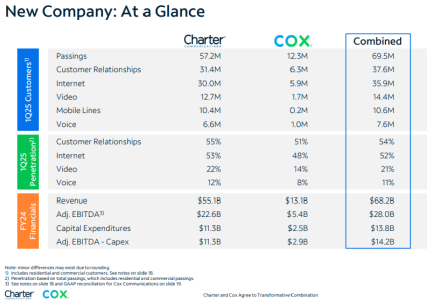
M&A has been gaining momentum in the TMT sector and the latest big deal came at the tail end of this week, with Charter Communications and Cox Communications announcing a $34.5bn merger transaction, which is one of the largest cable acquisitions in years. Charter is the second largest cable company in the US after Comcast, while Cox is also among the largest with 6mn subscribers. Coming together would widely expand the combined Co’s coverage, as Charter’s footprint includes New York City and Los Angeles, while Cox is a major player in cities like Boston, Phoenix and New Orleans (link).
See below for key aspects of the transaction. Click HERE for the press release and HERE for the presentation.
-> Charter shares closed Friday up +1.8% and is a top performer in the sector YTD, up +25%
Deal Val’n Overview
- Valuation is $34.5bn
- Multiple is 6.44x Cox’s 2025E adj EBITDA (same as Charter’s multiple at $353.64, the 60day VWAP as of 4/25)
Transaction Structure & Consideration
- Structure
- Charter to acquire Cox’s commercial fiber & managed IT and cloud businesses
- Cox Enterprises will contribute Coxs’ residential cable business to Charter Holdings, an existing subsidiary partnership of Charter
- Cox Enterprises will receive –
- $4bn cash
- $6bn in convertible preferred units (6.875% coupon, convertible into Charter partnership units, exchangeable for Charter shares)
- ~33.6mn common units in Charter’s existing partnership ($11.9bn implied value), which are exchangeable for Charter common shares
- Post the close of the transaction –
- Cox Enterprises will own ~23% of the proforma Co
- The combined entity will assume Cox’s ~$12bn in outstanding debt
- Will have ~3.9x net leverage, including the impact of the Liberty Broadband and Cox transactions
Financial Strategy & Synergy Tragets
- Charter plans to revise its long-term target leverage range to 3.5x–4.0x at closing, reflecting the larger balance sheet of the combined Co
- Expects to reach this range within 2–3 years post-close
- Currently expects ~$500mn of annualized cost synergies within 3 yrs of close, stemming from typical procurement and overhead savings
- Combined biz is expected to produce higher cash flow per passing and investment returns over time by –
- Creating and preserving more relationships on a fixed network
- Selling more products to each customer
- Reducing operating and capital costs per passing by lowering service transactions, churn and fixed cost leverage
Strategic Rationale & Competitive Positioning
- Better positioned to “aggressively” compete in an expanding and dynamic marketplace that includes –
- Larger, national broadband Cos with wireline and wireless capabilities
- Regional wireline and mobile competitors
- Global video distribution providers and platforms, and satellite broadband Co
- Better positioned for continued and expanded investment and innovation –
- In mobile, given the increased footprint
- In video, where Big Tech currently leverages global scale in content and distribution
- In advertising, where the transaction will expand oppties for advertisers of all geos and sizes and bring new competition in an area now dominated by Big Tech;
- In the business sector, the combined Co will have addtl coverage, but still remain a regional player competing against larger, national competitors
- Through greater product innovation in areas including AI tools and small cell deployment of licensed, shared licensed and unlicensed spectrum, bringing new and advanced services and capabilities to consumers and bizs
Customer & Product Integration
- Following the closing, Charter’s Spectrum products and svs will be made available across Cox’s ~12mn passings and 6mn existing customers
- Products launching in Cox territories include Spectrum’s Advanced WiFi, Spectrum Mobile with Mobile Speed Boost, the Spectrum TV App, Seamless Entertainment, and Xumo
- Cox customers will gain access to Charter’s “simple and transparent” pricing and packaging structure, including no annual contracts
- Cox customers will also benefit from Charter’s “industry-first” Customer Service Commitments, including –
- A 100% US-based customer service team available 24/7
- Commitment to fixing service disruptions quickly, including same-day technician dispatch when requested before 5:00 pm; if not, the next day
- Providing customers credits for outages that are 2+ hrs
- Putting “America first” by returning jobs from overseas and creating new jobs in the US –
- Adopting Charter’s sales and svs workforce model and returning Cox’s customer svs function to the US
- All employees will earn a starting wage of at least $20/hr and will gain access to Charter’s benefits
- Expanding Charter’s local Spectrum News stations in the Cox footprint, “bringing hyper-local, unbiased news coverage to more communities”
- The combined company will not own any national programming
Board Composition & Governance Changes
- 13 directors at closing (unchanged)
- The three current Liberty Broadband nominees on Charter’s board will resign at closing (as Liberty Bband will no longer be a direct shareholder at close)
- Advance/Newhouse will retain its 2 existing board seats, preserving its long-standing governance rights as a significant Charter shareholder
- Chris Winfrey will continue in his role as President & CEO
- Alex Taylor (Cox Enterprises CEO) will become Chairman of the Board
- Eric Zinterhofer (current Chairman of Charter) will become lead independent director
- Cox will have the right to nominate an addtl two board members to Charter’s 13-member board
Branding Updates & HQ Details
- Within a yr after the closing, the combined Co will change its name to Cox Communications
- Spectrum will become the consumer-facing brand within the communities Cox serves
- The combined Co will remain headquartered in Stamford, CT, and will maintain a “significant presence” on Cox’s Atlanta, GA campus following the closing
Earnings Scorecard – Week 5
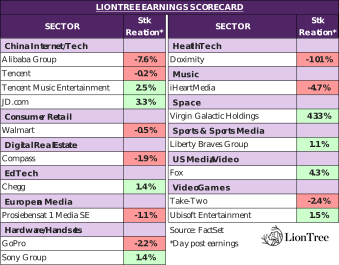
After a massive 85 companies in our LionTree Universe reported their earnings results last week, we took a big sigh of relief as the last few companies, 17 to be exact, posted their quarterly results this week. Similar to the last three weeks, earnings reactions were biased to the upside, as 9 companies (53%) traded up after their reports, and 8 companies (47%) traded down.
This week, it was China Tech that dominated the earnings circuit. Alibaba and JD.com went in opposite directions, trading down -7.6% and up +3.3%, respectively (see Theme #5), as did Tencent and Tencent Music Entertainment, though to a lesser degree, down -0.2% and up +2.5%, respectively (see Theme #6).
Fox finished out media earnings on a high note, trading up +4.2% post its print (see Theme #4), while Take-Two closed out the gaming reports, though on a slightly tougher note after falling -2.4% in reaction (see Theme #3).
While No One Likes A Delay, Take-Two’s GTV 6 Pay-Day Looks Even Brighter…
After taking a big hit on the back of the announced delay of Grand Theft Auto VI just a couple of weeks ago, Take Two (TTWO) shares have worked their way back post the release of a second trailer last week which created even more excitement about the title’s prospects than the first one. Trailer 2 became “the biggest video launch of all time” w/ 475mn+ views in 24 hours, which compared to Trailer 1’s “record-breaking” debut of 93mn in 24 hrs on YouTube alone. So while delays are never a good thing, getting the game right is the most important element and all signs point in that direction for GTA VI.
However, with the new release pushed out to May 26, 2026 (Take-Two’s fiscal year 2027), what should investors expect in the meantime? Mgmt was quick to point out that fiscal 26 net bookings will still show positive growth y/y despite GTV VI not being included. The Co plans to release 13 titles in fiscal 26 and growth will be underpinned by strong performance in its existing portfolio of games, with the biggest contributors being NBA 2K, the Grand Theft Auto series, Toon Blast, Borderlands 4, Match Factory, Empires & Puzzles, Words With Friends, the Red Dead Redemption series, and Zynga Poker…to note though, fiscal 26 will include costs associated with GTA VI, pressuring margins.
Beyond all the GTA VI talk, a broad range of key franchises powered the most recent qtr’s performance, which saw net bookings beat estimates by +2.1% and more notably, recurrent consumer spending surge +14% y/y, significantly exceeding guidance of +3% y/y, as NBA 2K, GTA Online and Mobile “all greatly exceeded our expectations.” While mobile gaming has been broadly challenged, TTWO has been outperforming with recent launches like Match Factory! and Color Block Jam already profitable and the DTC biz posting “record performance” in the qtr. The Co’s strategic partnerships with entities like the NBA, Tencent (where NBA 2K Online remains China’s #1 PC sports game and NBA 2K All-Stars leads iOS sports charts) and Netflix, are also helping expand the Co’s reach.
Overall, investors will be patiently waiting for a block buster GTA VI, which will be a material inflection, and the Co more broadly will have a robust pipeline of 38 titles that will be released through FY 28. While higher development costs are weighing on financials in the near term, strategies are being implemented to offset this pressure through operational efficiencies and cost reduction initiatives, with the aim of returning to historical margin levels as its pipeline matures.
See below for more on what we thought was most important for TTWO’s earnings and conference call…
-> TTWO fell -2.4% the day post earnings but closed the week ~flat; YTD the stock is up +23.2%
While Net Bookings Beat, The Surge In Recurrent Consumer Spend Was The Highlight Of FQ4
- FQ4 net bookings BEAT by +2.1%: Up +13.1% y/y (vs +2.6% y/y in FQ3) to $1.58bn
- Reflected better-than-expected performance from NBA 2K25; Zynga, led by Toon Blast, their hyper-casual mobile portfolio, and Match Factory; the Red Dead Redemption series, and Grand Theft Auto Online
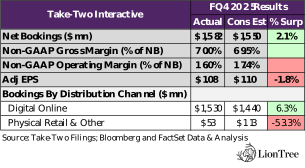
- Recurrent consumer spending growth was up +14% y/y (vs guidance of +3% y/y) and accounted for 77% of net bookings
- NBA 2K grew +42%
- GTA Online increased MSD
- Mobile increased MSD
- “These all greatly exceeded our expectations”
- Adj EPS of $1.08 was slightly below cons $1.10
Expect FY26 Top-Line Growth DESPITE Absence Of GTA VI Release / FY27 Is Expected To Be The Inflection Point
- FQ1 guidance was mixed (net bookings beat by +1.2%, but EPS missed by -24.2%): Net bookings range of $1.25-$1.3bn vs $1.2bn in the yr-ago qtr; Adj. EPS range of $0.20-$0.30
- Largest contributors to Net Bookings are expected to be NBA 2K, the Grand Theft Auto series, Toon Blast, Color Block Jam, Match Factory, Empires & Puzzles, Words With Friends, the Red Dead Redemption series, and Zynga Poker
- RCS +~7%, which assumes “strong” double-digit growth for NBA 2K; flat results for mobile; and a “modest” decline for Grand Theft Auto Online
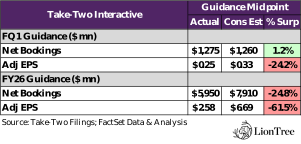
- FY26 guidance was dramatically below the Street (net bookings and EPS missed by -24.6% and -61.5%, respectively, at the mid-pt), as most estimates were not updated post May 2nd ann’cment about GTA VI delay: Net bookings range of $5.9-$6.0bn implies a +5% y/y growth at the mid-pt; Adj. EPS range of $2.45-$2.70
- Largest contributors to Net Bookings are expected to be NBA 2K, the Grand Theft Auto series, Toon Blast, Borderlands 4, Match Factory, Empires & Puzzles, Words With Friends, the Red Dead Redemption series, and Zynga Poker
- RCS ~flat y/y and represent 76% of Net Bookings
- Assumes HSD growth for NBA 2K, and declines for mobile and Grand Theft Auto Online
- Expect the Net Bookings breakdown from labels to be ~45% Zynga, ~39% 2K, and ~16% Rockstar Games
- Also expect OpEx growth of ~3% y/y, largely due to marketing expenses for current yr and future titles, but expect to deliver OpEx leverage as net booking growth is expected to outpace OpEx expansion
- Any impact to FY26 guide from impact of tariffs on console prices? “I think [we have] enough insight that we wouldn’t be meaningfully affected by any changes”
- Already have a “very substantial” install base for all their target platforms, expect for the yet to be launched Switch 2
- “It’s very difficult to predict where tariffs will land given how things have bumped around so far”
- “Feel reasonably confident that our guide wouldn’t be meaningfully affected unless tariffs ran off in a very different direction than we currently expect”
- Expect to return to historical margin levels (i.e., low-to-mid 20% op margins in the wake of the success of Red Dead 2) as the pipeline matures, despite rising development costs
- While higher development costs are impacting gross margins, have been making structural changes within the biz to offset these costs
- Working on cost reduction programs and operational efficiencies to support margin expansion as they build scale
- Expect expenses to fall this yr and margins to follow
- Looking further ahead – Fiscal 2027 represents “a massive inflection point” in the biz, “one that we believe will significantly enhance our multi-year financial profile”
- “We expect to achieve record levels of Net Bookings that will establish a new baseline for our business and set us on a path of enhanced profitability”
Coming Up In The Gaming Pipeline…~38 Titles Through Fiscal 2028
- Plan to release 13 titles in Fiscal 2026…
- Include 4 within the immersive core category
- Mafia: The Old Country will be introduced on Aug 8th; Preorders are off to a “strong start”
- Borderlands 4 is coming September 12th
- As always, will release next iterations of their annual sports franchises, NBA 2K and WWE 2K
- Also plan to bring to mkt 5 mobile titles, including WWE 2K for Netflix in the fall
- 4 new iterations of prior releases, including the recent release of Civilization VII VR for Meta Quest 3 and 3S, as well as Civilization VII for Switch 2
- Expect to deliver 25 titles throughout Fiscal 2027 and 2028 including –
- 17 immersive core releases, including Grand Theft Auto VI and 5 sports simulation games
- 4 mobile games
- 4 new iterations of previously-released title
Although Delayed, Consumer Reaction & Buzz Around GTA 6 is Sky High & The Title Should Be Materially Impactful In FY27
- Grand Theft Auto VI is expected to be released on May 26, 2026 (which is TTWO’s Fiscal Year 2027)
- Previously, the Co had said that the game was on track for a fall 2025 launch, though a specific release date was never set
- “Ambition and complexity” of the game “is greater than any previous Rockstar title”
- Consumer anticipation is “unprecedented” – Trailer 2’s cross-platform debut last week become “the biggest video launch of all time”, w/ 475mn+ views in 24 hrs
- That followed Trailer 1’s “record-breaking” debut of 93mn in 24 hrs on YouTube alone
Key Gaming Callouts In FQ4 – Maintaining Variable Pricing Strategy & Selectively Expanding Switch 2 Footprint / Continue To Execute On The Franchise Front
- Continue to employ a variable pricing strategy despite broader industry moves toward higher game prices
- Mafia: The Old Country was priced below industry norms ($50 – $60) to maximize reach
- “Our view is that if you create a huge hit and everyone wants it and everyone buys it, the revenue is going to take care of itself”
- Expanding support for Nintendo Switch 2, though title releases will remain selective and case-by-case
- Launching four titles on Switch 2, its broadest slate yet for a new Nintendo platform
- Historically, being a 3P in the Nintendo biz “has been challenging” but Nintendo has been “very forthcoming” in addressing that
- “We’re stepping up to because we have great optimism for the platform”
- But will continue to evaluate platform fit individually for every title
- We obviously want to be where the consumers are. But we would not necessarily bring every title to every platform”
- Launching four titles on Switch 2, its broadest slate yet for a new Nintendo platform
- NBA 2K25 posted “near-record” performance / Has sold nearly 10mn units to date (+7% vs NBA 2K24 during the same timeframe)
- Engagement grew “significantly”: DAUs +30%, MyCAREER daily players +40%, and avg games/user +80%; Franchise extensions also performed strongly across Apple Arcade, China, and iOS Sports Charts
- WWE 2K25 achieved Metacritic score of 84 on Xbox Series X (an all-time high for the series on the platform)
- RCS was up +20% y/y, boosted by WWE SuperCard and integration into WWE’s televised programming; Mobile and Switch 2 launches are planned for summer and fall, respectively
- PGA TOUR 2K25 launched “successfully” with a Metacritic score of 80 and is generating “significant” recurrent spending growth vs the prior iteration
- Civilization VII release is a “revolutionary new chapter in our esteemed strategy franchise” and “confident” that updates will deliver “outstanding results”
- Expanding access with launch on Meta Quest 3 and 3S and upcoming release on Switch 2
- Grand Theft Auto V surpassed 215mn units sold-in
- RCS was up +5% y/y, led by GTA Online’s new content and GTA+ memberships
- Red Dead Redemption 2 net bookings were up +23% y/y
- Continue to support Red Dead Online w/ “a series of rewards that engage their community further”
Profitable New Mobile Launches & “Record” DTC Results Underscore TTWO’s Strength Amidst A Tougher Mobile Mkt Backdrop
- Despite broader challenges in the overall mobile gaming mkt, TTWO is outperforming
- Driven by creative and publishing strength of teams at Peak, Rollic, and other Zynga studios
- Recent launches like Match Factory! and Color Block Jam are already profitable
- Also benefit from Zynga’s broader ecosystem, including shared best practices, data access, and cross-promotion capabilities
- Looking ahead – while their top titles had “outstanding results” in FY25, some moderation is expected in FY26 due to the maturity of those games
- Driven by creative and publishing strength of teams at Peak, Rollic, and other Zynga studios
- DTC biz delivered “record performance” in FQ4 / Highlighted “early” and “positive” signs from recent court rulings on DTC in mobile – “believe there is an even greater opportunity to expand this highly accretive channel given recent beneficial court rulings”
- Entered DTC biz in mobile immediately after acquiring Zynga, and it has become a “significant” and “material” part of the biz
- Reiterated expectations that the cost of 3P distribution will decline and mobile ecosystem will open up further over time, and “think the recent court rulings reflect movement in that direction”
- Peak’s Match Factory exceeding expectations through “first-class” live-ops execution and introduction of Mission Center, which drove “significant” player engagement
- Net Bookings rose “meaningfully” q/q and the title is profitable
- Toon Blast Net Bookings grew +7% y/y, its best qtr since Zynga acquires Peak in 2020
- Growth primarily driven by the introduction of the Cannon Fest event
- Rollic’s Color Block Jam scaled “rapidly” and is currently a top-10 download and among the top-grossing title on the US App Store
- Profitable within four months and is making an “impressive” contribution to mobile Net Bookings
- Empires & Puzzles showed signs of stabilization, supported by in game- economy improvements to support faster player progression and new feature developments based on player feedback
Netflix Is A “Terrific Partner” And Exploring Addtl Oppties To Expand Relationship
- Netflix’s “marketing power” + TTWO’s “incredible content” = “a great recipe for success”
- “They seem very serious about gaming and have shown that over and over”
- Have only partnered on “a few” title so far, but think there’s an oppty on a game-by-game basis to continue to bring titles to Netflix
- But NOT announcing anything at this point
- Partnership also includes media adaptations (i.e., upcoming BioShock movie) but “wouldn’t say that’s driving the partnership”
- Area that they’ve done some deals in the past, but “that’s sort of a nice-to-have, not necessarily a must-to-have for the partnership”
Fox’s Steady As She Goes In FQ3 Though Comps Get Tough In Calendar H2
Fox set a positive tone Monday morning delivering an across the board better than expected set of FQ3 results. We thought the biggest standouts from results were 1) FOX News had one of the highest rated quarters in cable news history (helped drive cable ad revs up +26% y/y) and momentum continues w/ April total ratings up nearly 30%; 2)
Affiliate subscriber declines continue to improve…have gone from ~8.7% y/y decline in FQ4 fiscal 24 to -7.8% in FQ1 fiscal 25 to -7.2% in FQ2 fiscal 25 to -6.5% in FQ3 fiscal 25; 3) Tubi revenue growth accelerated from +31% y/y in FQ2 to +35% y/y in FQ3 even with last qtr benefitting from political but at the same time there was no update on profitability timing targets; and 4) Fox’s DTC services aimed at cord never will be called Fox One and it is slated to launch before the football season with more detail coming in the new few months, though the Co did say pricing will be inline w/ the wholesale pricing.
As we have heard from other media conglomerates, there has been no real impact on the business from the macro.
Overall, it seems steady as she goes as Fox executes on it Sports & News strategy and its balancing act of making pivots in the DTC world, while not alienating or negatively impacting the traditional cable bundle. With that said, the Co will be hitting its seasonally tougher comps in the back-half of this calendar year.
See below for our key highlights and takeaways from the call…
-> Fox shares rallied +4.3% post results and remains up +13.4% YTD
FQ3 = Another Big Beat Qtr For Fox
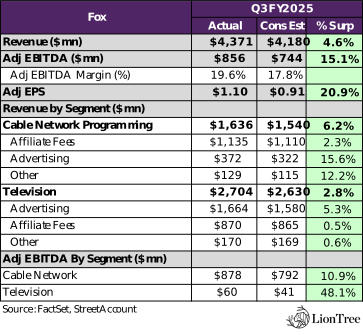
- Similar to last qtr, the Co beat Street expectations across the board w/ much higher margins the standout
- Total revs – beat by +4.6%: Grew +27% y/y
- Adj EBITDA – beat by +15.1%: Fell -4% y/y…had higher sports rights amortization & production costs due to the Super Bowl b-cast
- Adj EPS – beat by +21%
- Cable Networks – rev beat by +6.2% and adj EBITDA by +11%
- Rev grew +11% y/y
- Adj EBITDA grew +7% y/y
- TV Stations – rev beat by +2.8% and adj EBITDA beat by +48%
- Rev grew +40% y/y
- Adj EBITDA $60mn vs $145mn in last yr ago qtr…expenses incr’d +47%, driven by Super Bowl broadcast and cont’d investment at Tubi, both of which reverse in H2 of the fiscal year
- Bought back $800mn in the qtr (have bought back $6.4bn, or ~30% of total shares outstanding since the launch of the buyback program in 2019); Committed to the full $7bn authorization
Macro Is Not Impacting Fox’s Ad Business…
- FQ3 ad revs grew +65% y/y – led by the combination of a record-breaking Super Bowl, accelerating growth at Tubi and strong engagement and pricing at News
- Super Bowl brought in $800mn+ of gross ad revs
- Cable ad revs grew +26% y/y due to strength in FOX News linear ratings and digital engagement, and “supported by” healthy national and direct response pricing
- TV ad revs rose +77% y/y, primarily due to the impact of Super Bowl and Tubi
- National advertising scatter pricing is outpacing last year’s upfront rate
- FOX News Channel had one of the highest rated quarters in cable news history and momentum continues: In FQ3, the Co grew total day audience 48% in total viewers and 58% in the demo & reaching the highest quarterly share of cable news audience ever
- April trends are positive as well: April total ratings are up nearly 30%, prime time ratings up over 30% and prime time cable news audience share was in the 60% range
Slowing Subscriber Erosion Is Helping Affiliate Rev Growth & Optimistic On More Improvement From New Skinny Bundles
- Total affiliate revs grew +3% due to higher rates and improved subscriber declines for the 3rd consec qtr
- Cable affiliate fee revs rose +3% y/y…pricing gains from renewal outpaced the impact from net subscriber declines, which continued to improve (see below)
- TV affiliate fee revs rose +4% y/y…healthy growth in fees across both Fox-owned and affiliated stations, more than offset the impact from industry subscriber declines
- Subscriber declines continue to improve…have gone from ~8.7% y/y decline in FQ4 fiscal 24 to -7.8% in FQ1 fiscal 25 to -7.2% in FQ2 fiscal 25 to -6.5% in FQ3 fiscal 25
- “It’s too early yet to see the impact of the skinny bundles, but we are very optimistic about them”
Tubi Delivered Another “Outstanding” Qtr W/ +35% Revenue Growth
- Revenue growth accelerated from +31% y/y in FQ2 to +35% y/y in FQ3, even with last qtr benefiting from political
- Tubi engagement and viewership remains strong even post the Super Bowl
- FQ3 total viewing time (TVT) rose +18% y/y and accelerated to +24% y/y in April…retention & consumption trends at Tubi post the Super Bowl were “very encouraging”
- Have much higher % of cord nevers than other services: “65% of the Tubi audience is cord nevers – that’s higher than Roku. It’s higher than Pluto, It’s higher than Freebie, Max, Paramount+, or Peacock”
- Mgmt doesn’t think they are getting credit from the Street for this business: “The only frustrating part about the business is that we don’t get the appropriate valuation within our stock”
- No update or detail on when Tubi is targeted to turn profitable
Fox’ DTC Fox One Is Slated For Launch Before The Football Season
- Timing: Before the football season this fall…will share details in the coming months
- Pricing will be inline w/ their wholesale pricing
- Emphatically targeting the cord cutting community
- Losing a traditional cable subscribers to Fox One would be considered a “failure”
- Fox One will not engage in activities that undermine traditional distribution models.
- Fox One will also be available to every traditional subscriber of their services
- “We don’t want to compete with our distributors, that’s not our intent”
- Fox One will work with partners to achieve broad distribution, again focusing on cordless viewers
The Puts & Take In Fiscal 26 vs Fiscal 25
- In fiscal ’26 compared to fiscal ’25
- They won’t have the same benefit of political this year
- In fiscal ‘25, the Super Bowl was a deficit from an ad revenue vs rights cost perspective…this won’t be an issue in fiscal ’26
- FIFA will come through at the very end of the fiscal ’26 and into fiscal ’27
- “It’s too early to call” the extent to which they moderate the investment in Tubi versus the DTC investment, particularly that launch cost investment going into the early part of next fiscal year
- “We’ve got really, really nice tailwinds with our advertising business, particularly both at Fox News and Tubi, and then we’re also continuing to see solid tailwinds with our affiliate revenue growth”
China Tech Palooza PART I - Alibaba & JD.com Point To Strong Core E-Commerce Trends
It was Chinese Tech Palooza this week with Alibaba, JD.com, Tencent, and Tencent Music Entertainment (TME) all reporting and giving us a glimpse into key trends across ecommerce, cloud, gaming, and music in the country. At a high level, both JD.com and TME surpassed analyst expectations and their stocks responded positively. On the other hand, Alibaba missed consolidated revenue and adj EPADs projections and traded down, while Tencent shares were relatively flat in reaction to its consolidated quarterly financials.
First diving into ecommerce, Alibaba and JD.com both delivered better than expected trends in their respective businesses. Alibaba’s Taobao and Tmall Group (TTG) posted accelerating revenue growth to +8.7% y/y in FQ4 (vs +5.4% y/y in FQ3), beating cons by +3.5%, and adj EBITA in the unit grew +8.4% y/y, topping expectations by +6.7%. JD.com’s revenue also showed accelerating growth to +15.8% y/y (vs +13.4% y/y in Q4), beating cons by +3.8%, and adj EBITDA also surpassed cons by +8.8%.
Alibaba has been focused on improving monetization in many areas and particularly benefited from a higher take rate in the qtr. Also of note were the benefits that the Co realized from its investments into user growth. Initiatives have included price-competitive products, customer service, membership program benefits, and AI technology applications to enhance the user experience. The Co’s new Taobao Instant Commerce trial has also gone better than expected and is also an important path to expand the business looking ahead. Also of note was that despite the macro uncertainty, mgmt reiterated their guidance for quarterly profitability in the Co’s International ecomm business this fiscal year, which is a plus.
For JD.com, the top line was driven by strong domestic consumption, the govt’s trade in policies, tech innovation, supply chain efficiencies, and a continuous rollout of new products. The Co is also seeing strong growth in its supermkt category (also helped by the Chinese Lunar New Year) and is pushing hard on its on-demand retail and food delivery business, which is a natural extension, leveraging its existing infrastructure.
Outside of e-commerce, Alibaba’s Cloud segment is still seeing strong demand, with an acceleration in public cloud revenue growth and revenue from AI related products has maintained triple digit y/y growth for the seventh consecutive quarter. AI is “an opportunity that will define the next 10 to 20 years and will not be derailed by short term supply chain fluctuations.” However. the Co’s stepped-up investments in AI will pressure margins in the near term, which investors honed in on.
Lastly, Alibaba is also further optimizing their business portfolio by exiting non-core assets and are focused on shareholder returns. It expects to generate $2.6bn in max cash proceeds from divesting Sun Art and Intime and is distributing $2 per ADS in cash dividends this yr (amounting to $4.6bn). That combined with the $11.9bn in share repurchases, means a total of $16.5bn to shareholders this fiscal year.
See below for 2 sections for our takeaways and key points on 1) Alibaba and 2) JD.com and see Theme #6 for a deep dive into Tencent’s and TME’s results and what we thought were the most incremental takeaways as it relates to video gaming and music in China.
-> Alibaba traded down -7.6% after its report and ended the week down -1.5%; On the other hand, JD.com traded up +3.3%, but ended the week down -1.0%; YTD, Alibaba is still up +45.6%, while JD.com is down -3.2%
1) ALIBABA – see below for our thoughts on key themes, updates, and takeaways
Alibaba – After A Broad Beat Last Qtr, Delivered A More Mixed Set Of Q1 Results
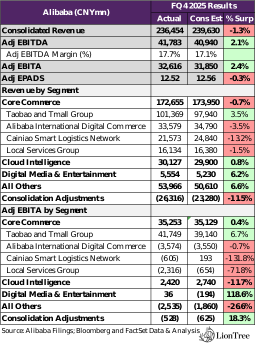
- Alibaba’s results were broadly mixed –
- FQ4 rev rose +6.6% y/y (vs +7.6% y/y in FQ3) and missed cons by -1.3%
- Adj EBITDA was up +35.6% y/y (vs +4.2% y/y in FQ3), topping cons by +2.1%
- Adj EBITA also finished +2.4% ahead of cons
- Adj EPADS of CNY12.52 missed cons by -0.3%
- By segment –
- Core Commerce (~73% of total rev) – MIXED:
- Rev incr’d +8.0% y/y in FQ4 (vs +8.9% y/y in FQ3) and missed cons by -0.7%
- Adj EBITA grew +18.0% y/y (vs +0.2% y/y in FQ3) and beat cons by +0.4%
- Cloud Intelligence (~13% of total rev) – MIXED:
- Core Commerce (~73% of total rev) – MIXED:
- FQ4 rev was up +17.7% y/y (vs +13.1% y/y in FQ3) and topped cons by +0.8%; Adj EBITA rose +69.0% y/y (vs +32.7% y/y in FQ3) and missed cons by -11.7%
- Digital Media & Entertainment (~2% of total rev) – BEAT:
- Rev grew +12.3% y/y in FQ4 (vs +7.9% y/y in FQ3) and beat cons by +6.2%
- Adj EBITA of +CNY36mn (vs -CNY884mn the prior yr qtr and -CNY309mn in FQ3) beat cons by +118.6%
- All Others (~23% of total rev) – MIXED:
- FQ4 rev incr’d +4.9% y/y (vs +12.9% y/y in FQ3) and topped cons by +6.6%
- Adj EBITA of -CNY2,535mn (vs -CNY2,818mn the prior yr qtr and -CNY3,156mn in FQ3) fell short of cons by -26.6%
- Consolidation adjustments (~-11% of total rev) – MIXED:
- FQ4 rev missed by -11.5%, while adj EBITA beat cons by +18.3%
Alibaba – Domestic Commerce Showed Better Than Expected Strength In FQ4
- Taobao and Tmall Group (TTG) outperformed expectations: Rev grew +8.7% y/y in FQ4 (vs +5.4% y/y in FQ3) and beat cons by +3.5%; Adj EBITA was up +8.4% y/y (vs +1.9% y/y in FQ3) and topped cons by +6.7%, primarily due to the increase in revenue from customer management svs (+12% y/y due to higher take rate), partly offset by the increase in investments in user experience and technology
- Alibaba’s main business focus is to stabilize its market share “in the mid to long term”
- The Co is making progress in its monetization strategy
- Quanzhantui (QZT) has allowed Alibaba to enhance the monetization of traditional advertising products that were previously less effective, particularly among certain merchants
- The Co implemented a 0.6% software service fee on Taobao, where previously it had charged nothing
- The Co identified a segment of merchants as white-label sellers, who had historically contributed less to monetization, but have now seen significant improvement in their rev
- Expects similar trend in next few qtrs
- Introduced commissions on payments, further bolstering rev
- The take rate benefited from the impact of a software service fee & increasing penetration of QZT and improvement of marketing efficiency
- Alibaba is utilizing AI to revolutionize the customer experience in search, deliver more accurate recommendations, and improve advertising efficiency
- Alibaba is working on “innovation-based forms of interaction and engagement for the future”: They believe they can create new forms of interaction and engagement; They are piloting products along these lines now
- Additionally, the Co is working on AI to benefit merchants
- Investment in the user experience is paying off…the Co saw “stronger momentum” in user growth in FQ4
- 88VIP members cont’d to increase by double-digits y/y, surpassing 50mn: The Co continues to focus on retention rate with growing profitability and increasing ARPU on a cohort basis
- Other user oriented strategic initiatives include price-competitive products, customer service, membership program benefits and AI technology applications to enhance user experience
- The Co is seeing a lot of momentum with its Taobao Instant Commerce trial
- Results have “vastly exceeded” mgmt expectations
- Co expects instant commerce to drive higher levels of user engagement with the Taobao app
- The Co will be investing “aggressively” in this business in the near term
Alibaba – Expects Its Intl EComm Business To Be Profitable On A Qtrly Basis This Coming Fiscal Year Despite The Macro Trade Uncertainty
- Results in Alibaba International Digital Commerce (AIDC) was weaker than expected
- FQ4 rev rose +22% y/y (vs +32% y/y in FQ3) and missed cons by -3.5%…the y/y growth was driven by “strong momentum” in its cross-border business
- Adj EBITA losses of -CNY3,574mn (vs -CNY4,085 the prior yr qtr and -CNY4,952mn in FQ3) missed cons by -0.7%
- Alibaba reiterated expectations to reach qtrly profitability in the international e-commerce biz in the coming fiscal yr despite the potential uncertainties in global trade regulations
Alibaba – AI-Related Product Rev Helped Accelerate Overall Y/Y Cloud Revenue Growth But Higher Spending Will Impact Margins Short Term
- The Co posted accelerating growth in Cloud rev to +18% y/y in FQ4 from +13% y/y in FQ3 due to faster public cloud revenue growth, including the increasing adoption of AI-related products
- AI-related product rev grew at a triple-digit rate for the sixth straight qtr
- Lingma, their AI coding assistant launched last year, has seen “strong adoption” among enterprise customers and delivered “robust” revenue growth
- There are 2 key AI usage trends w/customers –
- For large and mid-sized enterprises, AI applications are expanding from internal systems to more customer facing use cases
- Also, adoption of AI products is rapidly extending from large enterprises to SMBs
- “While uncertainties persist in the global AI supply chain, customer demand remains strong and unwavering”
- AI is “an opportunity that will define the next 10 to 20 years and will not be derailed by short term supply chain fluctuations”
- The Co will continue to invest & margins are under pressure: “We’re seizing the historic opportunity presented by AI and stepping up our investments in AI infrastructure and advanced technologies to further strengthen Alibaba’s global leadership in technology”
- FQ4 margins were slightly impacted by 1.9ppt vs FQ3 due to incr’d investments in technology and product development
- And margins will remain under pressure in the near term due to ongoing investments
Alibaba – Continues To Advance Its Foundational AI Models
- The Co remains fully committed to open source
- Launched the Qwen3 series in April, which is a new generation of hybrid reasoning models and is fully open-sourced; It’s ranked amongst the top performers globally on multiple authoritative benchmarks
- The Co has open-sourced over 200 models under the Qwen family, with more than 300mn downloads worldwide and over 100,00 derivative models, making it the world’s largest open-source model family
2) JD.COM – See below for our thoughts on key themes, updates, and takeaways
JD.com – Delivers Impressive Q1 Results
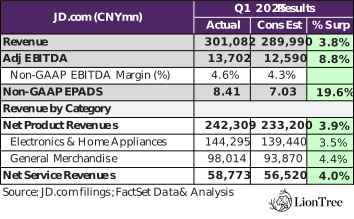
- Headline numbers surpassed expectations: Q1 rev was up +15.8% y/y (vs +13.4% y/y in Q4), beating cons by 3.8%; Adj EBITD topped cons by +8.8%; Non-GAAP EPADS finished a wider +19.6% above cons
- Net Product revs (~80% of total rev) – BEAT: Net Product Revs grew +16.2% y/y in Q1 (vs +14.0% y/y in Q4) and beat cons by +3.9%
- Electronics & Home Appliance rev topped cons by +3.5%: Q1 rev inc’rd +17.1% y/y (vs +15.8% y/y in Q4) driven by strong domestic consumption, govt’s policies, tech innovation, supply chain efficiencies, and continuous rollout of new product models
- General Merchandise rev also beat cons by +4.4%: Rev rose +14.9% y/y in Q1 (vs +11.1% y/y in Q4), as “healthy momentum” was driven by another double-digit y/y rev growth qtr from supermkt category; Chinese Lunar New Year was a driver
- Net Svs Revs (~20% of total rev) – BEAT: Q1 Net Svs Revs were up +14.0% y/y (vs +10.8% y/y in Q1) beating cons by +4.0%; Mktplace & mkting revs saw a meaningful pick up +15.7% y/y (vs +12.7% y/y in Q4), while logistics & other svs revs incr’d +13.0% y/y (vs +9.5% y/y in Q4)
- Net Product revs (~80% of total rev) – BEAT: Net Product Revs grew +16.2% y/y in Q1 (vs +14.0% y/y in Q4) and beat cons by +3.9%
JD.com – There Are Signs Of Stabilization In The Chinese Economy / Govt Stimulus Has Been Working
- There are signs of stabilization in China’s economy in Q1 w/ improved consumer sentiment and incr’d shopping frequency among users
- Growth of order volume and the user base in lower tier markets also continued to outpace that of higher tier markets on its platform
- The govt’ stimulus has encouraged consumption and stabilization of the economy
- The govt’s trade-in program not only boosted consumer demand & drove sales of home appliances and mobile phones, but also promoted the industry’s shift towards offering more high-end and intelligent product selections
- Outlook: The Co sees significant potential for the Chinese consumer market and expects very strong momentum of the electronic category, including mobile phone and home appliance categories in Q2
- The govt’s trade-in program not only boosted consumer demand & drove sales of home appliances and mobile phones, but also promoted the industry’s shift towards offering more high-end and intelligent product selections
JD.com – Seeing Accelerated Retail Revenue Growth & Strong Active Customer Trends
- JD Retail rev growth accel’d seq: Rose +16.3% y/y (vs +14.7% y/y in Q4) due to solid performance across all major categories
- The Co is making steady progress w/ the low-priced strategy & building out the 3P ecosystem: 3P order volume and 3P buyers incr’d strongly y/y
- Overall qtrly active customers cont’d to grow at a +20% y/y rate: Quarterly active customers have maintained a double-digit growth rate for six consecutive quarters
- Growth of user base expansion and order volume were higher in lower tier mkts vs higher tier ones this qtr
- The Co cont’d to experience improved NPS due to competitive pricing
- JD Retail’s gross margin improved for the 12th consecutive qtr as the Co further boosted its procurement capabilities and accelerated growth of high-margin rev streams
JD.com – Supermarket Category, On-Demand And Grocery Delivery Are Key Growth Vectors
- The supermarket category saw double digits growth for the 5th consecutive qtr: The total addressable market for the Chinese supermkt industry is “enormous”
- Experienced a robust promotion season during the Chinese Lunar New Year
- OUTLOOK: The momentum of the supermarket category is expected to “carry on throughout 2025”
- The Co is pushing hard into on-demand retail and food delivery: Believes that the on-demand retail and food delivery business is a natural extension from its core retail business
- Launched JD Food Delivery in Feb and results have been strong: Still in early stage, but already showing strong momentum, with daily order volumes nearing 20mn
JD.com – The Co’s Advertising Business Is Showing Accelerated Momentum
- Advertising rev maintained double-digits growth y/y with “accelerated momentum”
- The Co sees AI as a big driver for its ads business –
- AI large language model can enhance the ad algorithm and recommendation effectiveness, driving higher ad conversion rates and accelerating ad revenue growth
- Actively developing & implementing AI-powered advertising agents that can execute complex ad campaigns through simple command from merchants
- There is significant potential for monetization, particularly through AI large language model driven efficiency gains that will fuel sustainable long term growth
- There is great potential for AI adoption in advertising content generation
JD.com – Other Key Updates
- Expansion of JD Logistics: In March, JD Logistics officially launched its operations center in Hong Kong, marking a significant step-up in expanding the coverage of its express delivery network and boosting service efficiency in the region
- The JD PLUS program also recorded double digit y/y growth in both shopping frequency and ARPU in Q1
- The Co has also been driving AI and automation technologies across the demand, supply, and fulfillment aspects of its entire ecosystem
- This includes providing the right products with various delivery options, improving efficiency of its warehousing and fulfillment operation, and developing AI-enabled tools to create better cost effectiveness for its 3P merchants
China Tech Palooza Part II - Tencent & TME Both Surprise On The Upside W/ Videogames & Music
In addition to the eCommerce giants that reported this week (Alibaba and JD.com – see Theme #5), Tencent and Tencent Music (TME) provided updates on key trends in the China videogame and music markets, among other segments. Big picture, both Tencent and TME reported better than expected results within these businesses, especially the former given the Co continues to benefit from very easy comps in its domestic gaming businesses.
Similar to commentary out of Alibaba and JD.com, neither Tencent nor TME seem overly concerned about the macro environment negatively impacting their respective businesses, and Tencent articulated the view that the Chinese govt has a lot of room for additional stimulus as well. With that said, Tencent has been stock piling AI chips.
In terms of Tencent’s core domestic Videogame business (47% of the total VAS revenue), the strong +24% y/y growth was driven by its flagship games, including Honour of Kings and Peacekeeper Elite, as well as from recently released games such as DnF Mobile and Delta Force. While multi-player games are the majority of the Co’s gaming revenue, we’d flag that the Co is well positioned to benefit from growth in first person action games which are gaining momentum in China, especially with younger demos.
One thing that was also clear is that Tencent is aggressively implementing AI across its entire organization. The good news is that the Co is seeing tangible results with 1) improved ad targeting, which boosts ad revenue; 2) improved content recommendation, which boosts user time spent; 3) higher usage of AI within gaming, which boosts user engagement and thus game revenue; and 4) deployment of GPUs and AI across its computing infrastructure, APIs and platform solutions, which generates cloud revenue. The bad news is that some longer-cycle AI investments will take time to yield significant returns, hence the Co’s operating leverage will be negatively impacted in the near term (an investor sore spot).
For TME, its Music Subscription business grew a strong +17% y/y and was up +5% sequentially with the Co’s premium SVIP membership program helping to drive results, coupled with reduced promotional activity. Higher SVIP penetration is helping to drive ARPPU, which grew +8% y/y and topped analyst expectations. SVIP members are getting 1) premium sound quality and audio effect; 2) unique perks, including unique album discounts, special badges, early access to merchandise, and live events; and 3) long form content, such as audio dramas which is boosting retention. TME also posted “strong growth” in advertising revenue. The Co’s Social Entertainment Services business continues to be a big drag (fell -12% y/y) but it did manage to decline less than expected. Also, going forward, the Co will not be providing disclosure of operating metrics w/in this segment and “have shifted our strategic focus on to our core music business.”
All in all, investors were happy with the momentum in both Tencent and TME’s videogame and music businesses and the forward growth prospects. From a longer-term perspective, Tencent also has its sights on the ecommerce market as well which will be something we will be tracking.
See below for 2 sections for our takeaways and key points on 1) Tencent and 2) Tencent Music Entertainment (TME).
->Tencent traded up +2.8% after its results and ended the week up +3.5%; TME was up +2.5% post its print and built on those gains through the week to end up +18.0%; YTD, Tencent and TME are both up +23.1% and +46.4%, respectively
1) TENCENT- See below for our key takeaways and highlights from Q1 results
Tencent – Delivered A Mixed Consolidated Set Of Results But Gaming & Marketing Svs Growth Were Key Positives
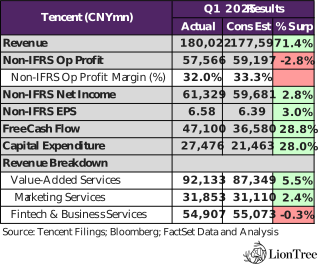
- Tencent’s headline results were mixed with stronger than expected revenue but lighter profitability: Total rev grew +12.9% y/y in Q1 (vs +11.1% y/y in Q4) and topped cons by +2.5%; But non-IFRS op profit was up +18.3% y/y (vs +21.0% y/y in Q4) and closed -2.8% below cons; Non-IFRS net income incr’d +21.9% y/y (vs +29.6% y/y in Q4) and beat cons by +3%
- Value-Added Svs (~51% of total rev) – BEAT: Q1 rev rose +17.2% y/y (vs +14.4% y/y in Q4) and exceeded cons by +6.3%; Gross margin incr’d +2ppts y/y to 60% (vs 56% in Q4), given a higher mix of domestic games rev
- Marketing Svs (~18% of total rev) – BEAT: Q1 rev was up +20.4% y/y (vs +17.5% y/y in Q4) and beat cons by +2.4%; Gross margin expanded +1ppt y/y to 56% (vs 58% in Q4) due to growth in high margin Video Accounts and Weixin Search rev
- FinTech & Biz Svs (~30% of total rev) – BEAT: Rev grew +5.0% y/y in Q1 (vs +3.2% y/y in Q4) and finished a slight -0.6% below cons; Gross margin incr’d +5ppts y/y to 50%, driven by improved cost efficiency in Fintech and Cloud Svs
Tencent – Recent Datapoints On The Consumer Were Positive
- Mgmt had positive comments on the consumer: “I think the big picture is that consumer spending has been fluctuating in the last several quarters, but the most recent data point is a fluctuation upward. And so, it is possible that fluctuation upward is reflective of overall consumer confidence and consumption activity stabilizing”
- But tariffs create an uncertainty: “I think we just have to see what will be happening in the next quarter”
- With that said, there is room for more gov’t stimulus: The govt has been “very supportive” with stimulus and “I think the Chinese government still have a lot of room for rolling out more stimulus”
Tencent – Domestic Gaming Business’ Strong Growth Is Benefitting From Easy Comps
- Domestic Games rev growth continues to benefit from easy comps: Q1 rev was up +24% y/y (vs +23% y/y in Q4) “against a low base” in Q1:24; Key driver were flagship games, including Honour of Kings and Peacekeeper Elite, as well as from recently released games such as DnF Mobile and Delta Force
- Honour of Kings achieved “record high” gross receipts given a higher % players making in-game purchases
- Peacekeeper Elite’s DAUs and gross receipts grew due to incr’d popularity of extraction shooter mode, complementing the original battle royale mode, as well as new a Tang Dynasty-themed setting and items
- Also highlighted strength in CrossFire Mobile, VALORANT
- Delta Force grew its PC plus mobile user base to a post-launch record level of 12mn peak DAU in April: It is now the sixth most popular mobile game by DAU and the highest DAU new game released in the last three years industry-wide
- International Games rev growth also accel’d seq: Q1 rev grew +23% y/y (vs +15% y/y in Q4), or +22% y/y ex-FX; Cited contributions from Brawl Stars, Clash Royal, and PUBG Mobile
- PUBG Mobile’s gross receipts grew by “teens% y/y”: The game benefited from Golden Moon-themed events and outfits, and collaborations with brands including Bugatti and the K-Pop group BABYMONSTER
- Call of Duty Mobile’s gross receipts grew y/y: Benefiting from top-tier operator outfit featuring halo and wings, and from Secret Cache, new engagement system where players unlock rewards by completing tasks and events
- PC version of Delta Force outside China steadily grew its user base, achieving a record level of concurrent users on Steam in May this year
- The mobile version of Delta Force is the second most downloaded mobile game in international markets since its launch on Apr. 21
- Plan to launch a console version of Delta Force in H2
Tencent – Future Growth Drivers For Gaming – AI, New Content, First Person Action Games
- AI will create substantial value in gaming
- Improving the player experience, especially in big multi-players games: AI to being used to help coach new players, to help accompany existing players, to help prevent cheating and hacking and so forth
- Improving content creation: Deploying gen AI into more content driven games will facilitate initially faster creation of content by the game studio itself
- New areas to be explored include user-generated content, varying quality of experiences, and dynamically created content where the game itself is spinning up new environments if the players choose to venture off the preset map
- Tencent is well positioned for growth in first person action games: First-person action genre represents 10-20% of gamer time spent in China which is much lower than the 40-50% in RoW; In certain younger demo cohorts in China, it is higher
- “Tencent is the leader” in first-person action games with titles such as Peacekeeper Elite, CrossFire Mobile, Call of Duty Mobile, VALORANT, and Delta Force
- With gross receipts growing and achieving record highs in evergreen titles, users are moving towards those first-person action games
Tencent – In Addition To Gaming, AI Is Playing A Significant Role Across Other Key Business Area
- AI in advertising –
- Upgraded its ad tech platform w/ enhanced generative AI capabilities such as ad generation and video editing tools to accelerate ad creation and digital human solutions, and to facilitate live streaming activities for content creators and merchants
- The Co is leveraging LLMs to enhance its system’s comprehension of merchandise and user preferences across its apps, ultimately improving ad recommendations
- Expect more ad views: AI can be used to deliver more engaging content to consumers, leading to increased time spent in the feed and, consequently, more ad views
- Tangible ROIs: Previously, banner ads achieved a roughly 0.1% click-through rate, feed ads achieved roughly 1.0% click through rate, but with the benefit of AI, it has been seen that the click-through rate on certain ad inventories can improve toward 3.0%
- AI in social networks –
- More AI features on Weixin: The Co is in early stages of rolling out AI features in Weixin to enhance the user experience such as for search, language input, and content generation
- Weixin Search now includes results powered by LLMs, including the fast-thinking model, HunYuan Turbo S, and the Chain of Thought reasoning models, HunYuan T1 and DeepSeek R1
- The share of the ad revenue contributed by Weixin Search is “on a good upward trend”
- The Co has the oppty to develop unique Agentic AI w/in the Weixin ecosystem, leveraging its social graph, communications, community features, and content platforms
- This AI would integrate transactional and operational capabilities across various application verticals, making it more specialized compared to general Agentic AI models
- AI in content creation –
- Providing AI tools so that content creators can generate images matching the text of their Official Accounts articles, and generate video effects for Video Accounts videos utilizing preset templates
- Reduced Mini Programs development time via an AI coding assistant for creating AI programs that supports natural language prompts and image inputs
Tencent – Near Term Operating Leverage Will Be Impacted By AI & GPU Investments
- “We are stepping up investments in AI in the form of capital expenditures as well as operating expenses”
- While the Co is already seeing tangible results from AI and GPU investments…
- Improved ad targeting, which boosts ad revenue
- Improved content recommendation which boosts user time spent and thus ad revenue
- Usage of AI within evergreen games, which boosts user engagement and thus game revenue
- Deployment across computing infrastructure, APIs and platform solutions, which generates cloud revenue
- … there will be time lag with some other AI and GPU investments, which will impact operating leverage: GPU and AI investments during this time will result “in a temporary smaller gap between our revenue and operating profit growth rate than we have achieved in recent quarters”
Tencent – Stock Piling AI Chips To Help It To Execute On Its AI Priorities
- The Co has a strong stockpile of chips which would be very useful in executing its AI strategy
- These chips will be used for applications which will give immediate returns, such as advertising and content recommendation
- Training large language models which require high-end chips, is the next priority, and mgmt. is confident that they have enough high-end chips to continue training thier models “for a few more generations going forward.”
Tencent – Ecommerce Is Another Potential Leg Of The Stool Long Term
- ECommerce is “a very long-term project with a very long runway”: The Co has a number of initiatives:
- Focused on enhancing the shopping experience through higher-quality products, better return policies, customer service, and competitive pricing
- Additionally, the Co aims to expand product supply by onboarding strong brands and motivated merchants while boosting traffic through live broadcasts which “will really convert more sales”
- Over time, Tencent seeks to create a unique Weixin eCommerce ecosystem, integrating Mini Programs, Mini Shops, Moments, search, gifting, and Official Accounts to strengthen transactions and merchant connections
2) TENCENT MUSIC ENTETERTAINMENT (TME) – See below for our key takeaways and highlights from Q1 results
TME – Slightly Better Than Expected Results
- Stronger than expected Q1 performance: Total rev were up +9% y/y (vs +8% in Q4) and beat cons by +1.2%; Both online music services and social entertainment beat expectations, but the latter remains a drag on growth, falling -12% y/y; Online music revs grew y/y to +16%
- Gross margins expanded to1% (vs cons 44.0%), up 3.2ppts y/y, primarily due to strong growth in music subscription revs (higher ARPPU), ad revs, social entertainment leasing membership, scaling owned IP, better monetization models w/ labels
- Online music avg revenue per paying user (ARPPU) was up +8% y/y and beat cons by +0.9%
- Expect cont’d focus on music business in 2025: Focused on growing music subscriptions by expanding SVIP memberships, expanding advertising business, diversifying offerings across the music value chain, strengthening partnerships with labels and artists, and investing in owned content and tech innovation
- “For FY25 expect y/y growth rate to accelerate from last year, and we will continue to expand our margin as well”
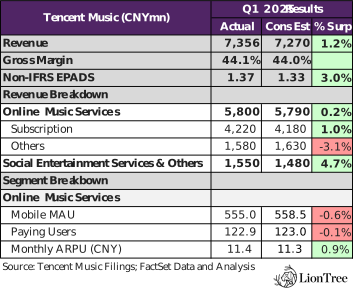
TME – Seeing Strong Growth In The Music Subscription & Ad Business BUT The Co Is De-Emphasizing Social Entertainment
- Online Music Services total revs grew +16% y/y (78% of total revs) & beat cons by +0.2% given upside in the subscription business
- Music subscription revenues (57% of total revs) grew +17% y/y and was up by +5% seq: Driven by cont’d expansion of the SVIP membership program and reduced promotional activity
- Monthly ARPPU for online music expanded a strong +8% y/y to RMB11.4 and beat cons by +0.9%
- Solid growth in advertising revenues: Achieved “strong growth” on a y/y basis, driven by growth in ad-supported model revenues, with more interactive features and enriched benefits while attracting more advertisers
- Also made good progress on artist-related merchandise sales and off-line performance
- 2025 comments: Expect both subscriber gains and the ARPPU expansion as well as steady advertising revenue growth and higher revenue from merchandise and concerts
- Music subscription revenues (57% of total revs) grew +17% y/y and was up by +5% seq: Driven by cont’d expansion of the SVIP membership program and reduced promotional activity
- Social Entertainment Services revs fell -12% y/y (22% of total revs) but it still beat cons estimates (by +4.7%): This is also an improvement from -13% y/y in Q4
- Going forward, the Co will cease disclosure of operating metrics w/in this segment – “We have shifted our strategic focus on to our core music business”
TME – Doesn’t Expect Macro To Impact Ad Rev Growth
- Mgmt is optimistic about the macro backdrop not impacting the business: “So, actually, we also observed the macroeconomic picture is looking right. So, for the online advertising business, no matter in Q1 of this year or the full year, at least from the operational perspective, we still maintain a very positive attitude on the advertising revenue for the whole year”
TME – SVIP Membership Is Yielding Strong Benefits
- “We are quite satisfied with SVIP business progress”
- What are SVIP members getting?
- Premium sound quality and audio effect (used by ~50% of the SVIP user base)
- Unique perks, including unique album discounts, special badges, early access to merchandise, and live events
- Includes long form content, such as audio dramas which is boosting retention
- Have seen strong growth momentum in SVIP penetration & ARPPU: “Paying user and ARPPU all demonstrate very good sequential growth”
Other Key Updates/Comments
- AI is elevating its user engagement: The Co intro’d an interactive commentary feature that transforms music charts into conversations, and raising fan emotion
- Users can also personalize music effects, switching between different vocals and instruments with one single click
- Adopted DeepSeek LLM to help evaluate content quality and the improved recommendation precision with user preferences
- Content updates/strategy
- Cont’d focus on expanding long-form audio business: It plays a complimentary role with the Co.’s existing subscriber base while growing the user base
- The podcast business in China remains limited vs markets like the US but it is growing: “We continue to keep an eye on podcast business. And for sure regarding its commercial value, still there will be some challenges”
- The Co’s self- and coproducer-proprietary content is “gaining increasing traction among music fans, offering a differentiated user experience that sets us apart from other music platforms”
Airbnb + Uber Make More Steps In The Transition To Broader Lifestyle Apps
Super-apps have been talked about for a long time, especially given their success in Asian markets, but they have been slow to gain steam here in the US. However, we have seen a steady migration in that direction with consumer app platforms edging out into adjacent services, deepening their offering to consumers. This theme went into hyper-drive this week with both Airbnb vs Uber making some big moves to further their transformation into broader lifestyle platforms, offering everything from shared commuting solutions and restaurant bookings to in-home massages and private chefs. While Airbnb and Uber have different approaches, both companies are clearly building toward deeper platform engagement and owning more of the user journey, whether it’s commuting to work, planning a night out, or curating a staycation. Overall, this expansion from a single vertical app to a deeper multi-vertical app is one that other consumer-based companies in the sector are likely to think hard about.
See below for our takeaways on what was unveiled in Airbnb’s 2025 Summer Release, as well as the announcements from Uber’s annual Go-Get 2025 event
-> Airbnb was up +2.9% the day of the release, while Uber closed down -1.4% on the day of its Go Get 2025 Event
Airbnb Introduced Airbnb Services, Airbnb Experiences, And An All-New Airbnb App (link)
- “Seventeen years ago, we changed the way people travel. More than two billion guests later, Airbnb is synonymous with a place to stay. With the launch of services and experiences, we’re changing travel again. Now you can Airbnb more than an Airbnb,” per Airbnb co-founder and CEO Brian Chesky
- Airbnb Services –launching with 10 categories in 260 cities, “with new offerings and locations dropping regularly in the Airbnb app”:
- The first 10 categories are –
- Chefs: Custom in-home meals from professional chefs
- Photography: Personalized sessions with experienced photographers
- Massage: Swedish, deep tissue, and reflexology by certified therapists
- Spa: Facials, scrubs, and more from licensed estheticians
- Training: Yoga, HIIT, and strength sessions with top personal trainers
- Hair: Cuts, blowouts, and styling from professional stylists
- Makeup: Everyday or event looks by makeup artists
- Nails: Manicures and pedicures by nail specialists
- Prepared Meals: Chef-made, ready-to-eat meals
- Catering: Full-service catering with custom menus and setup
- Services hosts are vetted for quality –
- Have an avg of 10 years of experience
- Have completed Airbnb’s identity verification process
- Required to submit relevant licenses and certifications
- DON’T need to stay at an Airbnb or be on a trip to get use Services
- The first 10 categories are –
- Airbnb Experiences –launching in 650 cities around the world, and adding more everyday
- Examples of Experiences can include –
- Landmark, museum, and cultural experiences
- Food tours, cooking classes, and dining experiences
- Outdoors, eater sports, and wildlife experiences
- Gallery tours, art workshops, and shopping experiences
- Workout, wellness, and beauty experiences
- Also introduced Airbnb Originals – “extraordinary experiences hosted by the world’s most interesting people, designed exclusively for Airbnb”: Examples include –
- Learn pastry-making at the renowned French Bastards bakery with chef Raphaelle Elbaz
- Play beach volleyball with Olympian Carol Solberg on Rio’s iconic Leblon Beach
- Transform into your anime alter-ego with Megan Thee Stallion in her Otaku Hottie Quest
- Designed to be social: Later this yr, customers will be able to –
- See who’s going before booking
- Message the group or individual guests during the experience
- Stay in touch afterward
- Similar to Services hosts, Experiences hosts are also vetted for quality –
- Hosts are assessed across areas like experience, their connection to the city, and guest feedback
- Process is ongoing – regularly review experiences “to make sure they meet our high standards”
- DON’T have to be traveling to join in – “we think Airbnb Experiences are so great, you’ll want to book them in your own city”
- Examples of Experiences can include –
- Introduced an all-new Airbnb app, built on a new tech stack from the grounds up “that allows hosts to offer homes, services, and experiences – and many more offerings in the years ahead”
- “Reimagined nearly every part of the app”, including –
- Explore tab: An all-new homepage to discover homes in popular destinations, experiences that fit your schedule, and services around the world
- Trips tab: An advanced travel itinerary with a schedule of your trip, details about your home, and the services and experiences you’ve booked
- Messages: A revamped messaging platform with photo and video sharing, and integrated payments for customizing services
- Profile: A redesigned Airbnb profile shows guests and hosts who have completed the identity verification process, and lets you share where you’ve traveled on Airbnb and see the people you’ve met along the way
- Also rebuilt the app for hosts to include everything they need to manage their home, service, or experience
- Airbnb Setup: A simplified listing creation tool makes it easy for hosts to submit a service or experience to Airbnb
- Today tab: An all-new reservations management tab makes it easy to see details about upcoming reservations to help hosts provide exceptional hospitality
- Calendar: A redesigned calendar features a new daily view with an hour-by-hour schedule, and includes real-time integration with Google Calendar
- Listings tab: New listing management tools for services and experiences make it easy for hosts to adjust every aspect of their listing, from location to pricing
- “Reimagined nearly every part of the app”, including –
Uber Launches “New Ways To Help You Save On The Things You Do Every Day” At Go-Get 2025 (link)
- Uber wants to make “things a little easier, a little more predictable, and above all, a lot more affordable” for users, per CEO Dara Khosrowshahi
- Route Share
- Offers pickups every 20 mins along busy corridors during weekday commute hours with up to 2 co-riders
- Fares are up to 50% cheaper than the cost of an UberX
- Also exploring partnering with employers to help make Route Share eligible for commuter benefits
- Ride Passes
- Price Lock Pass: For $2.99/mo, riders can lock in a price for a specific route and save up to $50/mo; Each pass protects the fare on a selected route for a 1-hr window, and customers can purchase passes for up to 10 routes every month
- “The easiest way to avoid higher fares due to weather, traffic, or construction”
- Prepaid Pass: Pay upfront for 5, 10, 15, or 20 rides on regular routes to unlock even deeper discounts; The more rides bought upfront, the more that is saved
- Ride passes will soon be available for teen accounts, “making the school run for parents and guardians easier than ever”
- Price Lock Pass: For $2.99/mo, riders can lock in a price for a specific route and save up to $50/mo; Each pass protects the fare on a selected route for a 1-hr window, and customers can purchase passes for up to 10 routes every month
- Commute Alerts and Hub
- Users can set up AI-powered Commute Alerts to get notified when it’s the best time to request – based on personal ride history, available drivers, and real-time pricing trends
- “Just enter your home and work details, and we’ll handle the rest”
- Starting this summer, all commute tools will live in the new in-app Commute Hub
- Users can set up AI-powered Commute Alerts to get notified when it’s the best time to request – based on personal ride history, available drivers, and real-time pricing trends
- Uber One Members Days + New Benefits
- Introduced Uber One Member Days, “a week-long celebration of epic deals, special promos, and big savings just for members”
- The first one is May 16-23, where members can access deals like 50% off shared rides, 20% off Uber Black, and 40% off Comfort Electric, with new deals each day of the week
- Adding more benefits to Uber One, including 10% Uber One credits back when customers use Uber Rent (including Turo) or take Lime rides on Uber
- Introduced Uber One Member Days, “a week-long celebration of epic deals, special promos, and big savings just for members”
- Uber Eats Savings Slider
- When you create a grocery list, Uber Eats will compare prices within the store or recommend a nearby grocery store with better deals on those items
- Just slide to the right to see better deals, confirm the swaps, and save
- Dine Out – “a new way to discover and claim in-person dining deals directly from the Uber Eats app”
- Teaming up with OpenTable to power reservations in the Uber Eats app in the US, Canada, Mexico, UK, Ireland, and Australia
- Uber One members will give exclusive access to prime tables at the top spots in town
- Can also book a ride to the restaurant in one tap, and OpenTable VIPs will soon be able to use their points on Uber and Uber Eats
- Shared Autonomous – teaming up with Volkswagen to launch the first shared autonomous ride
- Starting in Los Angeles in early 2026, Uber and Volkswagen will deploy the fully electric, fully autonomous ID. Buzz AD, “offering a new, affordable way to ride that’s shared, electric, and self-driving”
- “We can’t wait to expand access to it around the world”
Streaming Name Reveals Were Top Of Mind This Week Along W/ Key Streaming AVOD Updates
The upfronts are in full swing at the moment, bringing with them a wave of updates, which were interestingly not just on the advertising front, but also on platform branding. To start, Netflix revealed in its upfront presentation that global MAUs on its ad-supported tier have grown by 20mn+ since November to 94mn and according to Netflix’s calculation, the ad tier now reaches more 18-34 year olds than any other US broadcast or cable network. It also shared that its Ads Suite launches are continuing, with availability in all 12 ad-supported countries will be completed by June.
Also notable in streaming this week were some big name reveals, as well as name changes. Disney and Fox both revealed the name of their upcoming new DTC services. In the case of Disney, its long-awaited DTC streaming service, which has been referred to as “Flagship”, will simply be called “ESPN.” Details were also shared on the two subscription tiers that would be available at launch, as well as pricing. Fox also disclosed that its new DTC service coming this fall will be named FOX One.
Lastly, Warner Bros. Discovery announced that it will be changing the name of its streaming service Max back to the original name of HBO Max.
See below for the quick takes on Netflix’s, Disney’s and Warner Bros Discovery updates per the above and see Theme #4 for details on Fox One.
Netflix Shares Some Ad Related Milestones & Updates
- Netflix’s ad tier now reaches 94mn global MAUs + its leveraging Netflix Ads Suite (link/link)
- Key stats on ad-supported plan –
- Increased 20mn+ since its last update in Nov to reach more than 94mn global MAUs
- Ad members spend an avg of 41 hrs/mo on Netflix in the US
- The ad tier reaches more 18-34-yr-olds than any other US broadcast or cable network – Netflix calculated the figure by extrapolating the 94mn ad-viewing profiles, following a methodology Netflix says is used by other Cos, resulting in a total estimated viewership of 170mn
- “When you compare us to our competitors, attention starts much higher and ends much higher”
- “Members pay as much attention to mid-roll ads as they do to the shows and the movies themselves”
- When compared to the CTV avg, ads on Netflix have 8X higher brand favorability, 162% higher sales per impressions, and 3x higher purchase intent
- Update on Netflix Ads Suite –
- Now live in US and Canada
- Will be live in EMEA next week
- Will be available in all 12 ad-supported countries by June
- Can now target 100+ interests in 17+ categories
- Includes enhanced data capabilities, more buying options and deal types, expanded measurement, and creative formats (including AI-powered interactive ads like midrolls and pause screens launching by 2026)
- Key stats on ad-supported plan –
A Host Of Name Reveals & Names Changes Across Streaming This Week
- Disney reveals name and pricing for ESPN DTC svs (link)
- The new DTC service will simply be called “ESPN”
- Reasoning? “We kept coming back to our four letters…There’s power in our name. There’s trust in our name,” said ESPN chairman Jimmy Pitaro
- Two ESPN subscription plans – Unlimited and Select plans
- Unlimited includes full access to all ESPN content and networks; Priced at $29.99/mo or $299.99/yr
- Select includes all ESPN+ content; Prices at $11.99/mo or $119.99/yr
- Also offering bundling option
- Unlimited bundle (Disney+, Hulu, ESPN Unlimited): $35.99/mo with Ads; $44.99/mo w/ no Ads
- Select bundle (Disney+, Hulu, ESPN Select): $16.99/mo with Ads; $26.99/mo w/ no Ads
- Transition for existing ESPN+ users
- Standalone ESPN+ subscribers become ESPN Select subscribers
- Disney+, Hulu, ESPN+ bundle users become ESPN Select bundle subscribers
- Additional details, including the specific launch date, will be announced later this summer
- The new DTC service will simply be called “ESPN”
- Fox unveils the name of its new streaming service – “FOX One” (link): The svs will have live streaming and on-demand access to the full portfolio of FOX brands as well as the option to bundle FOX Nation within one platform
- See Theme #4 for details the Co shared on its earnings call
- Warner Bros. Discovery announced that its changing it Max’s name back to HBO Max (link): Follows WBD’s decision to drop “HBO” from the streamer’s name, rebranding it as just Max at launch in 2020
- “Returning the HBO brand into HBO Max will further drive the service forward and amplify the uniqueness that subscribers can expect from the offering”
- “It is also a testament to WBD’s willingness to keep boldly iterating its strategy and approach – leaning heavily on consumer data and insights – to best position itself for success”
Stock Market Check
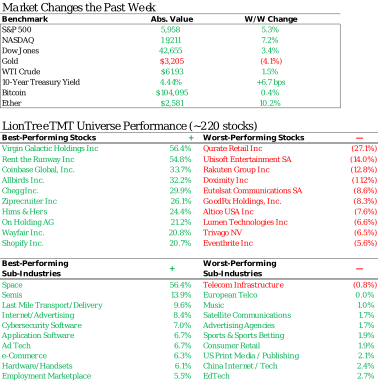
This Week's Other Curated News
Advertising/Ad Agencies/Ad Tech
- YouTube introduced an interactive product feed for shoppable TV ads, letting viewers browse & buy items directly on-screen. Feature appears as a carousel during ads, synced w/ brands’ product catalogs. Co aims to boost engagement & conversion on connected TVs. Brands like Wayfair & Walmart are early testers. Move aligns w/ YouTube’s push into eCommerce via Shorts & live shopping (TechCrunch)
- MNTN filed for IPO to raise up to $187mn, offering 11. 7mn Class A shares at $14–$16 each.4mn shares will be sold by the Co, 3.3mn by existing holders. MNTN, backed by Ryan Reynolds, targets SMBs via its CTV ad platform. Q1’25 rev hit $65mn, up 48% YoY; adj EBITDA rose to $9.4mn. Despite a $21.1mn net loss, margin improved to 14.5%. IPO proceeds will fund growth as CTV ad spend nears $33.4bn (Yahoo Finance)
- Microsoft plans to shut down its demand-side platform (DSP), formerly Xandr, by Mar 2026, citing a shift in priorities toward AI-powered advertising. The Co aims to replace the DSP w/ a chatbot-style ad-buying product powered by Copilot. Microsoft Monetize, its supply-side platform (SSP), will remain intact. The move aligns w/ its vision for conversational AI experiences and predictive design models in digital svs (Media Post)
- Amazon annc’d it will launch contextual AI-generated pause ads on Prime Video in Q4. These ads use ML to analyze content being watched, delivering relevant promotions—e.g., travel ads during a beach-set show. Two other formats—real-time retail signals & interactive call-to-action ads—will roll out in Q3. The goal is to make ads feel like natural extensions of the viewing experience (AdExchanger)
Artificial Intelligence/Machine Learning
- Meta is delaying rollout of its flagship AI model due to safety concerns raised by internal red-team tests. Co had planned to release the model, part of its Llama series, to researchers & cos in May. Delay reflects growing scrutiny over AI risks. Meta aims to ensure model aligns w/ safety standards before broader deployment. Execs say delay is precautionary, not technical (Wall Street Journal)
- OpenAI expanded its partnership w/ CoreWeave via a $4bn cloud deal to boost AI model training & inference. CoreWeave, backed by Nvidia, will provide GPU infrastructure to support OpenAI’s growing demand. Co aims to diversify beyond Microsoft’s Azure. Deal includes multi-yr commitment & reflects rising need for specialized AI cloud svs. (Bloomberg)
- China is tightening oversight of AI data centers, mandating operators to register w/ authorities & disclose computing power, energy use & AI model types. New rules aim to curb unchecked AI growth & align w/ national security goals. Co must also report foreign partnerships. Policy reflects Beijing’s push for greater control over AI infra amid global tech tensions (The Information)
- CoreWeave reported $981. 6mn in rev, exceeding analysts’ forecast of $852.9mn. Demand for AI infrastructure remains robust, w/ CoreWeave securing a five-yr strategic deal w/ OpenAI, adding $11.2bn to its rev backlog. The Co’s total rev backlog reached $25.9bn as of Mar. 31. (Reuters)
- OpenAI introduced GPT-4. 1 & GPT-4.1 mini in ChatGPT, enhancing coding & instruction-following capabilities. GPT-4.1 is faster than GPT-4o & excels in software engineering tasks. The models are available to ChatGPT Plus, Pro, & Team subscribers, w/ GPT-4.1 mini accessible to all users. OpenAI removed GPT-4.0 mini from ChatGPT. (TechCrunch)
- Salesforce signed an agreement to acquire Convergence. ai, an AI agent Co focused on adaptive digital automation. Convergence’s tech enables AI agents to handle web-based workflows & complex multi-step processes in real time. The acquisition will boost Agentforce, a key part of Salesforce’s AI roadmap, enhancing task automation. The deal is expected to close in Q2 FY26 (Street Account)
- Republicans introduced a budget reconciliation bill blocking states from regulating AI for 10 yrs, raising concerns from Democrats and AI oversight groups. Critics argue it benefits Big Tech and could nullify 500+ state AI laws. AI cos have lobbied for federal oversight to avoid fragmented state regulations. The proposal may face Senate opposition but could impact consumer privacy and misinformation (The Verge)
- AMD, Google & Uber stocks rallied after pledging $80bn investment in US-Saudi $600bn trade pact. The pact aims to boost AI, cloud, mobility & chip tech. The Co-led initiative aligns w/ Vision 2030, enhancing US-Middle East ties. Analysts see it as a strategic move to secure future tech dominance & diversify Saudi’s oil-dependent economy (MSN)
- HUMAIN, a PIF subsidiary, annc’d a strategic partnership w/ NVIDIA to build AI factories in Saudi Arabia, aiming to deploy 500MW capacity using NVIDIA GPUs. The first phase includes an 18,000-unit GB300 Grace Blackwell supercomputer. HUMAIN will also use NVIDIA Omniverse to drive physical AI & digital twins across industries. The collab includes large-scale AI workforce training aligned w/ Vision 2030 (Street Account)
- Google is developing a software AI agent and a Pinterest-like feature ahead of its I/O event. The AI agent is designed to assist users in completing tasks across apps, while the visual feature will help users save and organize content. (The Information)
- Nvidia will supply AI chips to Saudi Arabia’s HuMaIn for a major data center initiative, part of a broader $10bn tech investment. The deal, revealed by CEO Jensen Huang at the Saudi-US Investment Forum in Riyadh, aims to boost AI infrastructure in the region. AMD will also contribute chips and software. (Bloomberg)
- OpenAI and Microsoft are in tense talks to redefine their partnership as OpenAI eyes a public benefit corp (PBC) structure to attract funding. Microsoft, having invested $13bn, seeks tech access beyond 2030. Key issues include equity in the new PBC and renegotiating 2019 terms. OpenAI dropped plans to split its nonprofit and for-profit arms. (SiliconANGLE)
- Google’s Gemma AI models surpassed 150mn downloads, w/ over 70k variants created on Hugging Face, as shared by Google DeepMind’s Omar Sanseviero. Launched in Feb. 2024, Gemma aims to rival Meta’s Llama and now includes multimodal capabilities and support for 100+ languages. Despite rapid growth, Gemma trails Llama’s 1.2bn downloads. Licensing concerns persist due to non-standard terms affecting commercial use (TechCrunch)
- Perplexity AI is finalizing a ~$500mn funding round at a $1. 4bn valuation, backed by investors like Jeff Bezos and SoftBank. The funding will support expansion and infra scaling amid rising competition (SiliconANGLE)
- Apple plans to introduce an AI-powered battery management mode in iOS 19, designed to extend device lifespan by optimizing charging patterns and reducing battery strain. The feature will use on-device AI to learn user habits and adjust power usage accordingly. It’s part of Apple’s broader push for “Apple Intelligence,” which includes privacy-focused AI tools running locally on devices, setting it apart from cloud-reliant rivals (Bloomberg)
Audio/Music/Podcast
- YouTube launched a weekly Top Podcast Shows Chart in the US, updated every Wed, ranking by watchtime. Shows like The Joe Rogan Experience, Kill Tony & Rotten Mango lead. Co said podcasts now earn 1bn+ monthly views. Execs claim YouTube offers better CPM than rivals. (CNBC)
- Spotify enhances its AI DJ feature for Premium users by enabling English voice commands to personalize music playback. Users can now request specific artists, genres, or moods by holding the DJ button and speaking prompts like “play indie tracks” or “electronic beats for a midday run.” This update builds on Spotify’s AI Playlist tool and adds more control over music curation, though it may be less convenient in quiet settings (The Verge)
Cloud/DataCenters/IT Infrastructure
- Databricks annc’d plans to acquire Neon, an open-source database startup, for $1bn. Neon’s serverless Postgres tech will integrate w/ Databricks’ AI-driven data intelligence svs, enabling efficient AI agent deployment. The acquisition strengthens Databricks’ AI infrastructure, enhancing scalability & real-time data processing. Neon’s platform, founded in 2021, supports instant database provisioning & branching, optimizing AI workloads. (MSN)
Crypto/Blockchain/web3/NFTs
- Robinhood agreed to acquire WonderFi, a Canadian crypto platform, for $179mn in an all-cash deal. WonderFi operates Bitbuy & Coinsquare, managing ~$2.1bn in assets. The acquisition, expected to close in 2H25, expands Robinhood’s global crypto presence. WonderFi shareholders will receive C$0.36 per share, a 41% premium to its May12 closing price. (Bloomberg)
eCommerce/Social Commerce/Retail
- Walmart warned of higher prices due to new tariffs on Chinese goods, impacting toys, clothing & electronics. Co said it’s working w/ suppliers to minimize impact but expects some cost increases. Walmart emphasized its scale helps absorb shocks better than smaller rivals. Co aims to keep prices low but inflationary pressures remain (NPR)
- US retail sales barely rose in Apr, up just 0. 1%, signaling weak consumer spending. Core retail sales, excluding autos, gas, building materials & food svs, were flat. Co revs in furniture, electronics & online declined, while restaurants & bars saw gains. (Reuters)
- Dick’s Sporting Goods will acquire Foot Locker for $2. 4bn using cash & new debt. Foot Locker shareholders can choose $24/share in cash (~66% premium) or 0.1168 shares of Dick’s stock. The deal gives Dick’s access to younger, urban consumers & global mkts, strengthening its Nike sneaker position. Foot Locker will operate as a standalone unit, retaining brands like Champs & atmos (NBC New York)
- Shein lowered US prices after a temporary tariff cut, aiming to regain shoppers. Avg prices on 98 tracked items fell ~13% to $5.56. US consumers were notified, ensuring no tariff-linked fees at checkout. Temu added import surcharges in late Apr. The tariff on Chinese goods dropped to 30% from 145%, & small parcel tax from China/HK fell to 54% from 120%. (Bloomberg)
- The US plans to cut the de minimis tariff threshold on China shipments, targeting goods under $800 that currently enter duty-free. Annc’d the move aims to curb abuse by Chinese cos exploiting the loophole to flood U.S. mkts. The change could impact e-commerce giants & reshape trade flows. Critics argue it may raise consumer costs, while supporters say it protects domestic industry (Reuters)
- Amazon has annc’d a new deal w/ FedEx to fill the delivery gap left by UPS. The deal is expected to leverage FedEx’s extensive network, providing Amazon w/ a reliable alternative to UPS. This move comes as Amazon continues to expand its in-house delivery svs. (Business Insider)
Electric & Autonomous Vehicles
- Waymo, Alphabet’s self-driving unit, recalled 1,212 vehicles after collisions w/ roadway barriers due to a detection fault. The Co stated the issue was resolved via a software update, ensuring safer navigation. The recall follows an investigation by US auto safety authorities into Waymo’s fifth-gen automated driving system. Despite the incidents, Waymo maintains its tech enhances road safety, logging 250,000+ autonomous rides weekly. (Channel News Asia)
- Pony AI, an autonomous-driving Co, has confidentially filed for a Hong Kong listing to raise capital for expansion. The Co aims to limit the impact on its US-traded shares w/ this move. Pony AI previously raised $413mn in a US IPO in Nov. 2024. The Co recently annc’d a partnership w/ Uber to deploy robotaxis in the Middle East. (Bloomberg)
- Baidu plans to launch its driverless taxi svs in Europe, marking its first major international expansion. The Co is in talks w/ regulators in Germany and other EU mkts to deploy its Apollo Go robotaxis. Baidu aims to leverage its autonomous tech, already operational in China, to compete globally. The Co sees Europe as a key step in scaling its AV biz and cont’d AI integration (Wall Street Journal)
- Amazon’s Zoox issued a voluntary recall of 270 autonomous vehicles after a Las Vegas crash involving an unoccupied robotaxi and a passenger car. The incident, which caused minor damage and no injuries, revealed a software flaw in predicting other vehicles’ movements. Zoox paused driverless ops, deployed a software fix, and resumed svs after notifying U.S. regulators (DeepNewz)
Film/Studio/Content/IP/Talent
- MoviePass secured $100mn from Global Emerging Mkts to scale Mogul, a fantasy box office game where users act as studio execs predicting film success. Mogul, in beta, has 400K waitlist & aims for 200K users by end of May. Co plans to enhance gameplay w/ data-driven contests, digital collectibles & rewards. (Variety)
- Netflix is set to begin construction on a $1bn production studio at the former Fort Monmouth Army base in NJ, transforming the 292-acre site into a major East Coast content hub. The project includes 12 soundstages, office space, and backlots, aiming to boost local employment and attract global productions. Netflix secured the land in 2022 and expects the buildout to span several yrs, reinforcing its long-term U.S. production strategy (com)
FinTech/InsurTech/Payments
- eToro priced its IPO at $52/share, above its expected range, raising ~$310mn and valuing the Co at ~$4. 2bn. Nearly 6mn shares were sold by the Co, w/ another 6mn by existing investors. The trading platform, which scrapped a SPAC deal in 2022, has seen crypto rev more than triple to over $12mn in 2024. Net income surged to $192.4mn from $15.3mn (CNBC)
- Chime filed for a Nasdaq IPO under ticker CHYM, positioning itself as a tech Co, not a bank. In Q1, it posted $12.9mn net income on $518.7mn rev, up 32% YoY. Active members rose 23% to 8.6mn, w/ avg rev/member at $251. Chime earns from interchange fees via debit/credit card use. It offers high-yield savings, early pay access, and fee-free overdrafts. ~2/3 of users rely on Chime as their primary financial relationship (CNBC)
Handheld Devices & Accessories/Connected Home
- Chinese e-comm cos incl JD. com & Pinduoduo’s Temu are offering steep iPhone discounts—up to 351% off—amid intensifying price wars. A 128GB iPhone15 Pro was listed at ~$958 on JD.com, down from ~$1,192. Apple authorized the promos to boost sales in a slowing smartphone mkt. Discounts come ahead of China’s 6.18 shopping fest (Tues, Jun.18). Apple faces rising competition from Huawei & others in China (Reuters)
- President Trump urged Apple CEO Tim Cook to halt iPhone production expansion in India, advocating for increased US manufacturing. Trump stated he had a discussion w/ Cook in Qatar, emphasizing his preference for Apple to prioritize domestic production over India. Following their conversation, Trump claimed Apple would boost US-based manufacturing efforts (Bloomberg)
HealthTech/Wellness
- Mayo Clinic radiologists now use AI to assist in reading scans, not replace jobs. AI flags anomalies, helping doctors focus on complex cases. Co says AI boosts efficiency & accuracy, but human oversight remains key. Some staff worry about long-term job impact, but execs stress AI as a tool, not a substitute. (New York Times)
Last Mile Transportation/Delivery
- Uber & Prosus-backed iFood formed a JV in Brazil to merge food delivery ops, aiming to better compete w/ rivals like Rappi. Uber Eats will integrate into iFood, w/ Uber holding a minority stake. The deal, subject to regulatory approval, reflects Uber’s shift to focus on ride-hailing & logistics. iFood, already dominant in Brazil, will expand reach. (Bloomberg)
- Uber has won a multimillion-pound VAT reprieve after HMRC stopped demanding the company pay VAT on the full cost of rides following a legal setback involving Bolt. Both Uber and Bolt argue they should only pay VAT on their cut of the fare, similar to tour operators. This decision could lead to significant tax recoveries for ride-hailing firms if upheld, impacting the financial and legal landscape of the UK’s gig economy (Institute of Licensing)
Live Entertainment/Theme Parks/Concerts/Experiential
- Ticketmaster annc’d its “All In Prices” initiative, now showing full ticket prices—including service fees—before checkout to comply w/ the FTC’s junk fee ban. While face value and service fees are visible upfront, local taxes and delivery fees still appear at checkout. The move follows regulatory pressure post-2022’s Taylor Swift fiasco. Ticketmaster also improved queue transparency w/ real-time updates and wait estimates (The Verge)
Macro Updates
- The US-China trade war pushed global supply chains near a breaking point, per GEP’s Supply Chain Volatility Index. A steep drop in manufacturing orders followed a stockpiling surge, especially in North America. Despite a tariff pause, uncertainty clouds manufacturers’ outlook, dampening investment. The Index shows early signs of demand slowdown and shortages (CNBC)
- US and China agreed to a 90-day tariff pause and annc’d cutting US tariffs on Chinese goods from 145% to 30%—10% baseline + 20% on fentanyl-linked items. China will drop its 125% tariff to 10% and suspend non-tariff barriers. Trump warned tariffs could rise post-pause if talks stall. Retailers, c-stores, and restaurants expect short-term relief as the move eases supply chain costs and wage pressures (Supermarket News)
Metaverse/AR & VR
- Apple is prepping a Vision Pro update enabling users to scroll content using only their eyes. The feature, expected in visionOS 2.0, enhances hands-free control by tracking eye movement to navigate lists or pages. It builds on Vision Pro’s existing gaze-based UI, aiming to improve accessibility & immersion. Apple plans to unveil the update at WWDC (Mon, Jun.10) (Bloomberg)
Regulatory
- FTC voted 3-0 to delay enforcement of the “click-to-cancel” rule—part of the Negative Option Rule—by 60 days to Jul 14. The rule mandates cos to offer cancellation methods as simple as signup, especially for digital/physical subs. Originally effective Jan. 19, the delay reflects compliance complexity. Despite internal political shifts, FTC affirmed enforcement will begin Jul. 14, w/ potential future amendments (TechCrunch)
Satellite/Space
- AST SpaceMobile annc’d a $500mn Equity Distribution Agreement w/ major banks incl Barclays, UBS & BofA. The Co may sell Class A shares via “at the market” offerings on Nasdaq under symbol ASTS. Proceeds will support satellite-to-phone connectivity expansion. Agents will earn up to 3% commission per sale. The move boosts liquidity while advancing AST’s global broadband ambitions (StreetInsider)
- AST SpaceMobile aims to deliver continuous Sat2Phone connectivity via its BlueBird satellites by end-2026 in key mkts including the US, Africa, and Asia. The Co plans to launch 5 satellites in Q3 2025, w/ commercial service starting shortly after. The tech enables direct-to-device 5G broadband from space, targeting unserved areas. The Co is working w/ partners like AT&T and Vodafone (Telecompaper)
- The FCC is probing Charlie Ergen’s EchoStar over its 5G buildout, putting billions in spectrum at risk. SpaceX, eyeing the same airwaves, claims EchoStar underuses them. The clash escalates as Ergen shifts to satellite-to-phone services and regulatory tensions mount. (Wall Street Journal)
Social/Digital Media
- YouTube CEO Neal Mohan said Shorts rev per watch-hour now matches core YouTube in the US & other mkts, w/ some even exceeding. Growth driven by more ad impressions, AI-targeted placements & rising usage. In Q1, Shorts viewing rose 20% YoY. ~70% of channels now upload Shorts. YouTube also expanding ad tools & AI features like Dream Screen to boost creator engagement (Variety)
- TikTok annc’d “TikTok AI Alive,” an AI image-to-video tool that lets users animate static photos into short videos via the Story Camera. The tool adds motion, effects, and sound, e.g., drifting clouds or expressive gestures. AI-generated content will carry labels and C2PA metadata. TikTok emphasized safety, w/ moderation tech reviewing prompts and outputs before publishing (TechCrunch)
- Snap hosted its first “Under the Ghost” music event featuring Kid Cudi at its Santa Monica studio, where he performed unreleased tracks like “Neverland” for Snap Stars and superfans. The series aims to offer raw, intimate artist-fan engagement, not polished shows. Snap plans to expand w/ more artists and integrate ad opps like Sponsored Snaps and Total Takeovers to attract Gen Z/millennials and rival TikTok’s music influence (Social Media Today)
Software
- Apple launched CarPlay Ultra, debuting in new Aston Martin models in US & Canada. It integrates w/ all in-car screens, including instrument clusters, offering controls for AC, media, gauges & more via touch or Siri. Widgets from iPhone can be projected. Hyundai, Kia & Genesis to follow, but no timeline yet. Existing Aston Martins to get update soon (9to5Mac)
- Microsoft is laying off ~6,000 employees (~3% of its workforce) across all levels and geographies to streamline operations and reduce management layers. The Co had 228,000 employees as of Jun. The move, not tied to performance, follows strong quarterly results w/ $25.8bn net income. Washington state filings show 1,985 cuts at Redmond HQ. This is the largest layoff since 2023’s 10,000-role cut (CNBC)
Sports/Sports Betting
- Paul Allen’s estate officially began the sale of the Portland Trail Blazers, aligning w/ his directive to liquidate sports holdings and donate proceeds to philanthropy. The estate hired Allen & Co and Hogan Lovells to manage the process, expected to extend into the 2025–26 season. NBA Board of Governors must approve any deal. The sale doesn’t affect the Seahawks or the estate’s 25% stake in the Sounders (NBA)
- MotoGP is teaming up w/ Harley-Davidson to launch a new racing series aimed at expanding appeal in the U. The series, featuring Harley’s Pan America 1250 bikes, will debut in 2026 and run alongside select MotoGP events. It targets younger, lifestyle-focused fans and aims to blend MotoGP’s racing prestige w/ Harley’s iconic brand. The move supports Liberty Media’s broader strategy to grow MotoGP’s U.S. footprint (SportBusiness)
- Sportradar’s Q1 rev exceeded €300mn, driven by strong US growth where rev rose 65% Y/Y to €89. 7mn, now ~30% of total biz. Adj EBITDA rose 29% to €53.4mn. CEO Carsten Koerl credited in-play betting and U.S. market expansion. Sportradar also highlighted its AI-driven tech and partnerships w/ NBA and NHL. The co reaffirmed its 2025 outlook, expecting full-yr rev of €1.1bn–€1.2bn and adj EBITDA of €205mn–€215mn (SportBusiness)
- FIFA plans to expand the Women’s World Cup from 32 to 48 teams by 2031, following Brazil’s hosting of the 2027 edition. The move mirrors the men’s tournament expansion and aims to boost global participation and commercial growth. FIFA is also restructuring media rights sales, offering standalone WWC packages in key mkts like the U.S., and facing pressure over its Aramco sponsorship from over 100 female players (SportBusiness)
Tech Hardware
- Cisco beat Q3 estimates w/ adj EPS of $0. 96 vs. $0.92 expected & rev of $14.15bn vs. $14.08bn est., up 11% YoY. Net income rose to $2.49bn. Guidance for Q4: EPS $0.96–$0.98 on rev of $14.5bn–$14.7bn. AI infra orders hit $1.25bn YTD, ahead of schedule. Networking rev rose 8% to $7.07bn; security rev up 54% to $2.01bn, incl. Splunk. (CNBC)
- AMD annc’d a new $6bn share buyback plan, adding to its prior $5bn authorization from 2021, of which $1. 1bn remains. The Co aims to return capital to shareholders amid strong AI chip demand. AMD’s CFO said the move reflects confidence in long-term growth. Shares rose ~2% post-announcement. The buyback comes as AMD ramps up competition w/ Nvidia in the AI accelerator mkt (Reuters)
- The Trump admin is negotiating a deal to send hundreds of thousands of US-designed AI chips to Emirati firm G42, despite past scrutiny over its China ties. Talks, led by AI czar David Sacks, may allow G42 access w/ limited oversight, including chips for its OpenAI partnership. A separate deal w/ Saudi Arabia’s Humain will grant access to chips from Nvidia and AMD. National security officials warn of misuse, echoing Biden-era export controls (New York Times)
Towers/Fiber
- Deutsche Telekom raised its FY outlook after strong Q1 results & a stronger USD. Rev rose 0.3% YoY to €27.9bn, adj EBITDA AL up 5.1% to €10bn. Net profit jumped 23.4% to €2.2bn. T-Mobile US drove growth, w/ 1.2mn postpaid net adds. The Co now expects FY adj EBITDA AL of €42.9bn & FCF AL of €18.3bn. CEO Höttges cited strong US ops & resilient European biz (Telecompaper)
- Verizon cont’d its 5G expansion beyond C-band, focusing on AI, RedCap, & MIMO. SVP Lynn Cox stated at Connect(X) trade show that macro tower mods will finish in 18 months. The Co spent $50bn on C-band, doubling speeds & enabling FWA. Next steps include IoT, private networking, & AI svs like AI Connect. Cox urged regulators to ease cell-site permit rules. Industry concerns include mkts fluctuations & trade wars. New legislation may unlock 600MHz for 5G (Light Reading)
Video Games/Interactive Entertainment
- Nintendo Switch 2 launches at $450 on Jun 5, but NoA Pres Doug Bowser didn’t confirm if price will hold due to fluid tariff conditions. Despite new tariffs, Co annc’d $449 for base SKU & $499 for Mario Kart bundle to reassure buyers. Bowser emphasized Co’s aim to keep Switch 2 accessible amid mkts uncertainty. (Kotaku)
- Mobile gaming has become a boom-or-bust biz as user spending hits $111bn in 2024, up 2. 6%, but only a few titles dominate. Devs face rising costs & ad rev declines, forcing layoffs & closures. Games like Monopoly Go & Royal Match thrive, while others struggle. Apple & Google’s 30% cut adds pressure. Studios now rely on fewer hits, w/ UA costs surging. (Bloomberg)
- Sony may hike PS5 prices as it faces a $680mn tariff hit due to US import taxes. CFO Lin Tao said passing costs to consumers is possible. CEO Hiroki Totoki noted U.S. manufacturing as a long-term workaround. PS5s made in China face a 35% tariff, paused temporarily for 90 days. (Kotaku)
Video Streaming
- Disney’s ad-supported streaming platforms—Disney+, Hulu & ESPN+—reached 157mn monthly active users globally, incl. 112mn in US/Canada. Users are counted if they watch ads for >10s, w/ ~2.6 users/account. No de-duplication across platforms. Disney aims for transparency in ad-tier metrics. CEO Iger noted 60% of new subs opt for ad plans. CFO Johnston said growth will balance pricing & subs. Netflix & Amazon reported 70mn & 275mn ad-tier users respectively (TheWrap)
- Amazon Prime Video expanded its free Live TV section, adding hundreds of ad-supported channels incl. local news, PBS, and fan-favorite content like TMNT, Saved by the Bell, Hallmark Movies & More, AMC’s Mad Men & SpongeBob. The move follows Freevee’s integration into Prime Video. No Prime membership is needed to access, but Prime users get smoother integration. (Cord Cutters News)
- Amazon introduced ads on Prime Video in India, aligning w/ its global strategy. Users now see ads unless they opt for an ad-free add-on priced at INR699/mo. The Co aims to boost ad rev while offering choice. India joins markets like US, UK & Germany where ads were rolled out earlier. Amazon continues investing in local content to retain subs amid rising competition from Netflix & Disney+ Hotstar (Telecompaper)
- CNN is set to launch a new streaming svs in fall 2025, aiming to expand its digital reach beyond traditional TV. The Co’s CEO Mark Thompson revealed the svs will be tied to a CNN subscription product that debuted in 2024, offering unlimited access to CNN.com articles. Pay-TV customers w/ CNN in their package can access the new streamer for free. The Co previously invested $300mn in CNN+ before shutting it down weeks after launch (The Streamable)
- Peacock annc’d its NBA streaming debut for the 2025–26 season, offering an immersive, interactive experience. Features include Live in Browse for instant game access, Catch Up w/ Key Plays, Can’t Miss Highlights, and Peacock ScoreCard for gamified viewing. Performance View adds real-time stats overlays, while Courtside Live offers behind-the-scenes content. (Cord Cutters News)
- The top 6 SVOD cos in the US raised prices sharply between Aug 2022–Aug 2023. Ad-supported tiers rose 10% to $44.94/month, while ad-free tiers jumped 17% to $80.44/month. Netflix led w/ a 55% hike by removing its $9.99 ad-free plan. Disney+ and Hulu ad-free tiers will rise to $14.99 and $17.99 in Oct. Ultra-premium tiers like Netflix’s and MAX’s $19.99 plans offer UHD and more streams. SVODs now rival pay TV in cost, w/ Dish’s ARPU at $104.07 (nScreenMedia)
- Amazon annc’d that Prime Video’s ad-supported tier now reaches 130mn US users, up from 115mn. The platform will unveil new AI-powered ad tech at its 2025 upfront, including contextual ads that auto-generate copy, shoppable ads w/ pricing and reviews, and interactive formats like “subscribe now.” 88% of viewers also shop on Amazon, highlighting its commerce-streaming synergy. The ad expansion aims to boost engagement and sales (Hollywood Reporter)
- Peacock is discontinuing its $6/month Premium Plus add-on, forcing users—especially those on discounted annual plans like the $20 Black Friday deal—to either endure ads or upgrade to the full $140/yr Premium Plus plan. The change, annc’d via email on Fri (May 9), eliminates a popular workaround for cheap ad-free streaming. Affected users will be downgraded to ad-supported Premium unless they opt to pay more or request a refund (Cord Cutters News)
