


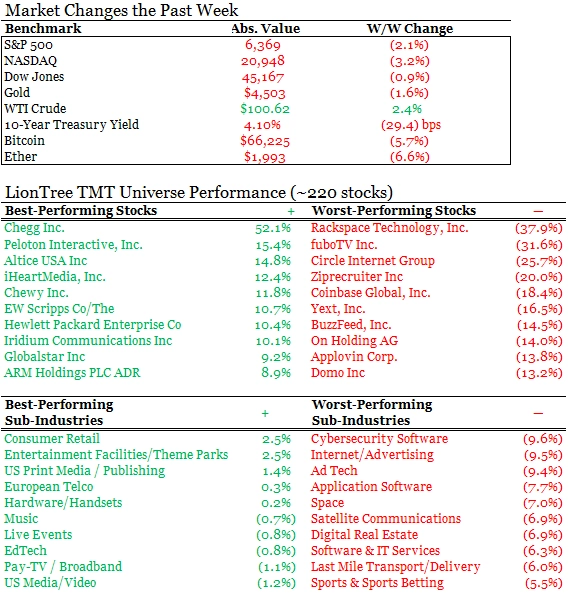
Market volatility spiked this week (the VIX hit 30) on the back of a continuation of geopolitical tensions and concerns which drove Nasdaq down a tough -3.2% and the S&P 500 down -2.1%. Meta falling -11.5% was a major drag in sector (see Theme #2) but selling pressure across the Communications Services sector was broad-based, followed by Tech sector. Outperformance came from Energy and more defensive sectors. Taking a step back, Nasdaq has been down in 10 of the last 11 sessions and is down -12% from its Oct peak, while the S&P 500 locked in its 5th straight weekly decline.
Within the sector, thematic updates and developments were actually a little quieter than usual but there were still several updates that made our cut this week. See below.
- Some AI Growing Pains Emerge, But Innovation Never Sleeps
- The Flood Gates Could Be Set To Open On Social Media Child Safety Lawsuits…
- Winning In Media Will Require Owning The Full Fan Journey…
- A Sneak Peak On What Is Likely To Come From Apple’s Upcoming WWDC In June…
- Grab Bag: Sports Prediction Mkt Headwinds / Netflix Raises Prices AGAIN / Unity Positively Pre-Announces
Have a nice weekend.
Best,
Leslie

Some AI Growing Pains Emerge, But Innovation Never Sleeps
The myriad of AI-driven software sell-offs have made it seem like enterprise software is being displaced rapidly, but a WSJ report that circulated this week suggests that change is more measured and that the market may be overstating the pace of replacement. In reality, many Cos are finding that core software systems are often deeply embedded in their processes and that it is complex or costly to rip out. At the same time, AI is changing how software is being used, with firms building on top of existing systems, adding AI-driven tools, and looking for ways to drive efficiency. In some cases, that means developing internal tools or “vibe-coding” customizations, as seen at EY and Cisco, rather than fully replacing existing vendors. With that said, Enterprise Cos are use AI as a lever to renegotiate contracts, improve pricing, and extract more value from existing software relationships.
In terms of broader AI products and strategies, it has not all been smooth sailing. OpenAI is shutting down its Sora video app, which had seen massive early popularity, to focus on other areas and, in commerce, the Co is pivoting its Instant Checkout feature and focusing more on product discovery instead. On the plus side, OpenAI’s advertising is already generating $100mn in annualized revenue within just six weeks since launch. Regarding models, Anthropic continues to raise the bar, and both companies are moving toward potential IPOs, with recent chatter suggesting Anthropic could launch as soon as October.
All in all, despite the big splashes that AI companies cause with every new launch, the impacts are unfolding more slowly than many expected. See below for more on the above, along with a quick update out from Google on a breakthrough that sent memory chip stocks down this week as well.
Despite The AI-Driven Software Sell-Off, Enterprise Software Isn’t Being Replaced As Fast As Feared…BUT Some Cos Are Using The Disruption As Leverage In Software Deals (link)
- Despite the AI-driven software stock meltdown, not all Cos are ditching their core biz software just yet, per some Co comments this week
- For Grant Thornton, the biz software they use right now is just too complex to replace with AI and would be too expensive to maintain
- Their current software is able to handle the complexities that large Cos deal with, including regulatory requirements, multiple geographies and languages
- Also, once Cos build their own software, they have to keep it updated and dedicate engineering resources toward the effort
- Per CIO Mike Kemp, “I’d much rather spend our internal dollars and effort building something that is truly cutting-edge and helps us grow”
- Pointed to the role of core biz software changing vs being replaced: Rather than functioning as the heart of how businesses operate, it shifts into becoming a source of corporate data; AI agents will lead that charge, becoming the means by which bizs interact with software
- For Grant Thornton, the biz software they use right now is just too complex to replace with AI and would be too expensive to maintain
- But that doesn’t mean they’re taking a passive approach to AI…some biz tech leaders, are vibe-coding smaller apps and customizations on their existing software to save $$
- EY doesn’t plan to get rid of its longstanding ERP software from SAP BUT it is vibe-coding and using AI agents to build its own customizations on top of it
- EY is able to save some of its $1bn annual tech budget by vibe-coding rather than purchasing upgrades directly from SAP
- Per Raj Sharma, a global managing partner for growth and innovation, “if this AI wasn’t there, vibe-coding wasn’t there, the agentic frameworks weren’t there, it would’ve taken another very costly, expensive upgrade of the SAP software”
- Cisco said they replaced a presentation software tool w/ its own AI agent saving the Co ~$5mn
- Cisco is also looking to replace other software vendors, some of which are costing the Co $50-$200mn/yr in subscription fees, with AI-created tools
- Per Thimaya Subaiya, executive VP of operations at Cisco, “you don’t need an application anymore, because an application just becomes part of the agent database”
- Lowe’s said that it needs to carefully spend its IT budget, and vibe-coding its own content-generation software is one way to do it
- Per chief digital and information officer Seemantini Godbole
- EY doesn’t plan to get rid of its longstanding ERP software from SAP BUT it is vibe-coding and using AI agents to build its own customizations on top of it
- And there is also evidence that AI disruption is being used as leverage against software companies
- At FedEx they are “not looking at this point for [software] to leave our enterprise” BUT the uncertainty over software’s future is a chance to re-evaluate how it is priced
- Per chief digital and information officer Vishal Talwar, they are “having proactive conversations with each of our partners to see how they plan to keep up”
- At FedEx they are “not looking at this point for [software] to leave our enterprise” BUT the uncertainty over software’s future is a chance to re-evaluate how it is priced
OpenAI Is Shutting Down Sora And Pivoting Its Commerce Strategy To Discovery, But Advertising Is A Bright Spot
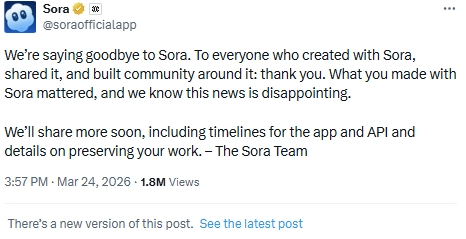
- OpenAI is shutting down its Sora video app…(link/link/link)
- Why? So that it can focus on other developments, such as robotics “that will help people solve real-world, physical tasks” and other forms of advanced AI, including “agentic” technology capable of autonomously completing tasks w/ little human oversight
- HOWEVER, there is also some speculation that cost was a factor in the decision: According to Sensor Tower data, since the platform’s launch, Sora made just $1.4mn in global net in-app revenues, compared to $1.9bn over the same period for ChatGPT and just a drop in the bucket for a Co the size of OpenAI, esp considering the massive costs associated w/ generating AI video
- OpenAI could also be doing this to minimize risk ahead of a potential IPO, since the Co is still unprofitable and pressure from competition is growing
- This news came just 6 mos after the Co launched the stand-alone app…: Was first made publicly available in late 2024, but it was when the Co launched Sora 2 and its stand-alone app last September that it got more mainstream attention
- Just days after this release, it took the #1 spot at the top of Apple’s app store
- OpenAI gave no indication it was working to wind down Sora: The Co published a blog post just a day before the announcement titled “Creating with Sora safely”, outlining ways it’s been working to make the app safer
- Timeline for shutting down and info on how to save content is still TBA: “We’ll share more soon, including timelines for the app and API and details on preserving your work”
- Why? So that it can focus on other developments, such as robotics “that will help people solve real-world, physical tasks” and other forms of advanced AI, including “agentic” technology capable of autonomously completing tasks w/ little human oversight
- …and as a result, Disney is ending its $1bn investment and partnership with OpenAI (link)
- Reminder, Disney & OpenAI annc’d a 3-yr licensing deal back in December…: which was set to make 200+ Disney-owned characters available for use in Sora-generated videos
- —and was originally set to invest $1bn in OpenAI equity, which it no longer will (reportedly no money ever changed hands in the planned deal)
- Another place where OpenAI ran into some bumps in the road was on the commerce side…. leading the Co to revamp its ChatGPT shopping experience with Instant Checkout (link/link)
- OpenAI is shifting its focus from “Instant Checkout” to product discovery: “We’ve found that the initial version of Instant Checkout did not offer the level of flexibility that we aspire to provide, so we’re allowing merchants to use their own checkout experiences while we focus our efforts on product discovery”
- As a reminder, OpenAI launched a feature called Instant Checkout last year that allowed consumers to buy products from retailers like Etsy, Walmart and Shopify directly within ChatGPT
- But OpenAI reportedly underestimated how difficult the enablement of transactions would be: It struggled to onboard merchants, show accurate data about products and introduce multi-item carts or connect loyalty memberships
- How does the new product discovery feature work?
- Instead of scrolling through pages of results, ChatGPT can help users find what they’re looking for based on their budget, preferences, and constraints, and surface products that fit
- They can browse visually, upload images as inspiration for similar items, and refine results conversationally until they land on the right option
- “What used to take hours of searching and tab-hopping now happens in seconds”
- The Co is powering the feature through extending Agentic Commerce Protocol (ACP) “to be the connective layer between merchants and users throughout discovery”
- Through ACP, merchants share product feeds and promotions so their catalogs are fully represented in ChatGPT
- Retailers including Target, Sephora, Nordstrom, Lowe’s, Best Buy, The Home Depot, and Wayfair have already integrated into ACP for discovery
- Over time, ACP will serve as a foundation for broader AI-native commerce experiences, including personalization, local availability, and ETAs
- The new experience is available in web browsers for all ChatGPT free, Go, Plus, and Pro users, with app access in iOS and Android to soon follow
- OpenAI is shifting its focus from “Instant Checkout” to product discovery: “We’ve found that the initial version of Instant Checkout did not offer the level of flexibility that we aspire to provide, so we’re allowing merchants to use their own checkout experiences while we focus our efforts on product discovery”

Source: OpenAI Press Release
- On the flipside, one place where OpenAI is making money is advertising…OpenAI’s ad pilot has reportedly surpassed $100mn in annualized rev in < 2 months (link/link/link)
- That rev has been generated from the < 20% of U.S.-based ChatGPT Free and Go users who are shown ads on a daily basis today, though ~85% of Free and Go users are eligible to see ads
- For advertisers: OpenAI has expanded to 600+ advertisers, and is on track to launch self-serve advertiser access in April
- The Co is now exploring expanding ads into other geographic regions, including Canada, Australia and New Zealand
- Ads represent an important source of rev as the Co preps for IPO: OpenAI execs have told investors that the Co expects to generate $17bn+ from consumers using ChatGPT in 2026, including making money from free users through advertisements (did not specify how much)
- How are consumers reacting to advertising? “We’re seeing no impact on consumer trust metrics, low dismissal rates of ads and ongoing improvements in the relevance of ads as we learn from feedback”, per OpenAI
- The Co is doubling down on its advertising efforts w/ key new hire…OpenAI annc’d earlier this week than it hired former Meta ad exec Dave Dugan to lead ads sales (link)
Anthropic Has A New Model In The Works + Some More Chatter On Reported IPO Timing
- Anthropic accidentally leaked its unreleased AI model “Mythos”, which is claims is its “most powerful AI model ever developed” but comes with “unprecedented cybersecurity risks” (link/link)
- The leak was due to “human error”: Anthropic said an unsecured, publicly searchable data cache made early drafts of content considered for publication accessible to the public
- Following the leak, an Anthropic spokesperson confirmed the model’s existence…:
- Said the new model represents “a step change” in AI performance and is “the most capable we’ve built to date”
- …BUT “given the strength of its capabilities, we’re being deliberate about how we release it”
- The model is currently being trialed by “a small number of early-access customers, who will explore the model’s cybersecurity applications and report back what they find”
- But the draft blog post said the new AI model poses significant new cybersecurity risks
- “We want to act with extra caution and understand the risks it poses—even beyond what we learn in our own testing”
- The system is “currently far ahead of any other AI model in cyber capabilities,” and “it presages an upcoming wave of models that can exploit vulnerabilities in ways that far outpace the efforts of defenders”
- The draft blog post also discussed a new tier of AI models called Capybara which are “larger and more intelligent” than Opus, but also more expensive
- Currently, Anthropic’s largest and most capable model versions are branded Opus; while slightly faster and cheaper, but less capable, versions are branded Sonnet; and the smallest, cheapest, and fastest are called Haiku
- Compared to its previous best model, Claude Opus 4.6, Capybara gets “dramatically higher” scores on tests of software coding, academic reasoning, and cybersecurity, among others
- A quick update this week on IPO chatter…Anthropic is reportedly now looking to go public as soon as October (link)
- The Co has reportedly had early discussions with banks about taking leading roles on a potential listing
- The listing could reportedly raise more than $60bn… as a reminder, Anthropic was valued at $380bin in a $30bn funding round that closed in February
- An Anthropic IPO is expected to happen before OpenAI: Bankers and lawyers who work on IPOs largely expect Anthropic to list shares before OpenAI does, as they believe public market investors would favor Anthropic’s focus on selling to developers and enterprises rather than consumers and its shorter projected path to profitability
- BUT OpenAI CEO Sam Altman has reportedly said privately he would prefer to list the Co before Anthropic goes public, according to people with knowledge of the comments
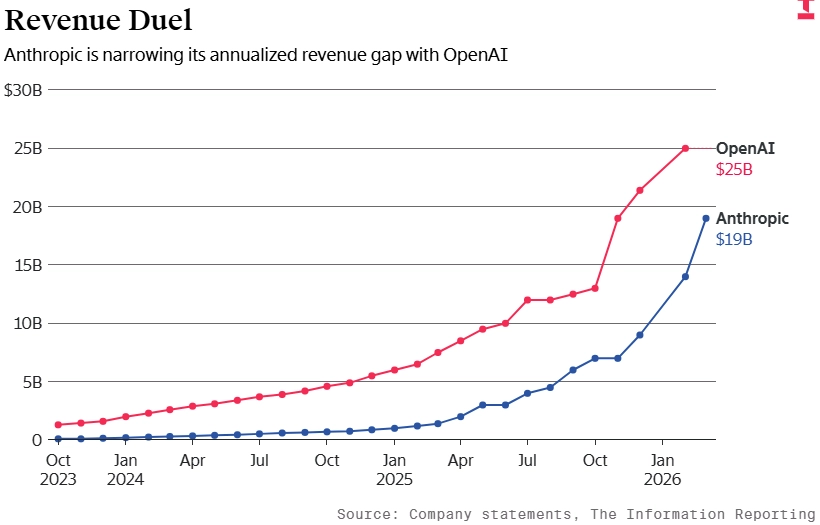
Image Source: The Information
Google’s New TurboQuant Caused A Memory Stock Sell-Off Given That It Is “Redefining AI Efficiency With Extreme Compression”
- Finally, an AI-component update caused some ripples this week…Google unveiled TurboQuant, a new compression method that it says could reduce the amount of memory required to run large language models by 6x
- The technique focuses on reducing the key value cache, which stores the past calculations of an AI model so it doesn’t have to run them again
- The technique is aimed at making AI models more efficient, which is a major goal of the leading labs
- Memory chipmakers got hit bad on the back of the news: Investors fear that this could reduce the demand for AI memory chips, which have been a critical component to train up huge LLMs from Cos like Google, OpenAI and Anthropic
-> The world’s two biggest memory chipmakers, SK Hynix and Samsung, fell -6% and nearly -5%, respectively in South Korea in reaction to the report; Japanese flash memory company Kioxia dropped nearly -6%; In the US, Sandisk fell -11% while Micron fell -7%, post the news as well.
The Flood Gates Could Be Set To Open On Social Media Child Safety Lawsuits…
Two jury verdicts this week pertaining to social media teen addiction and child safety marked a potentially important inflection point in the legal scrutiny facing social media platforms given the precedents set. In Los Angeles, a jury found Instagram and YouTube liable in a social media addiction trial and awarded $6mn in total damages, which is obviously a small amount, but important given that other suits are likely to follow.
With a greater financial impact, in New Mexico, Meta was ordered to pay $375mn in penalties after a jury found it violated state law in a case alleging the company failed to adequately protect minors from child predators.
In addition to these trial verdicts, Snap is coming under fire by officials in Brussels, which is accusing them of having an ineffective age-verification system that is meant to keep children under 13 off Snapchat.
All in all, legal actions and regulatory focus related to youths’ safety on social media platforms are likely to remain a key theme in the sector over the foreseeable future. Presumably, next up will be more of a focus on child safety as it relates to AI chatbots…
See more details about the trials below…
LA Jury Finds Instagram And YouTube Liable In Landmark Social Media Addiction Trial (link/link/link/link/link)
- Case background:
- A young woman identified as K.G.M., or Kaley, alleged that she became addicted to apps like Instagram and YouTube as a child
- The 20-year-old alleged that she suffered from severe body dysmorphia, depression and suicidal thoughts due to her use of the apps
- TikTok and Snap were originally part of the case, but they settled w/ the plaintiff before the trial began
- The trial started in late Jan. in LA Superior Court
- A young woman identified as K.G.M., or Kaley, alleged that she became addicted to apps like Instagram and YouTube as a child
- Penalty – the verdict in the case was a major win for the plaintiffs given that the finding validates the legal theory that social media sites or apps can cause personal injury
- The case framed social media products as being as addictive as cigarettes or digital casinos
- While the verdict award was only $6mn total (Meta $4.2mn and YouTube $1.8mn), it is on a per person basis and likely opens the floodgates for more to come
- What was Meta & Google reaction? They disagree w/ the verdict …both plan to appeal
- This case is the first of at least 9 bellwether trials selected from a group of thousands pending in CA state court, ~2,400 lawsuits against Meta and other social media Cos that make similar claims have been centralized in the CA federal court
- The federal litigation also include:
- Lawsuits brought by state AG’s alleging harm to their states
- And… cases by school districts that say social media addiction has caused costly disruptions and problems
- The federal litigation also include:
-> Meta’s & Alphabet’s stock fell -8% and -3%, respectively, in reaction to the news
Meta Must Pay $375mn For Violating New Mexico Law In A Child Exploitation Case After Jury Ruling (link/link)
- Case background:
- New Mexico AG Raúl Torrez sued Meta in 2023, following an undercover operation involving the creation of a fake social media profile of a 13-year-old girl
- Reportedly, the account “was simply inundated w/ images and targeted solicitations” from child abusers
- The state AG accused them of failing to safeguard kids who use its apps from child predators
- Penalty – the jury ordered Meta to pay the max penalty under the law of $5k per violation, totaling $375mn
- Meta did not agree w/ the verdict and “will appeal”
- Looking ahead…there is a 2nd phase of the trial, conducted w/o a jury, which will commence on May 4: A judge will determine whether Meta should fund public programs intended to address the alleged harm; The state’s lawyers are also urging Meta to implement changes including:
- Enacting effective age verification
- Removing predators from the platform
- Protecting minors from encrypted communications that shield bad actors
- Torrez said that a similar suit involving Snap, filed by his office in 2024, is still in the discovery stages and that his team was “able to overcome Section 230 motions” in both cases
- The tech industry has argued that the Section 230 provision should prevent them from being held liable
- What is Section 230? Section 230 of the Communications Decency Act protects online platforms (websites, social media, apps) from being treated as the publisher of user-posted content
- Separately but related, a federal trial in the Northern District of CA will commence later this year
- Multiple school districts and parents allege that the actions and apps of Meta, YouTube, TikTok and Snap caused mental health-related harm to teenagers and children
-> Meta’s stock fell -8% in reaction to the news and is down -20% YTD
News Of A European Child Safety Investigation Weighs On Snap Shares (link/link)
- What happened: Officials in Brussels accused Snap of having an ineffective age-verification system that would keep children under 13 off Snapchat
- It argues that the Co’s algorithm also often misclassifies users ages 13-17 as adults, then steers them toward inappropriate experiences
- Children and teens are automatically recommended to other users through the ‘Find Friends’ system, and push notifications remain enabled by default
- When creating an account, users are not offered adequate guidance on privacy and safety features
- What’s next? The Commission will now carry out an in-depth investigation
-> Snap’s stock fell -11% in reaction to the news and is down -51% YTD
Winning In Media Will Require Owning The Full Fan Journey…
Deloitte’s annual Digital Media trends report, which was published this week (post a survey of 3,575 US consumers), had some interesting data and perspectives we thought worth highlighting, Essentially, with discovery, engagement, and monetization increasingly decoupled, platforms will be more focused on fandom, aggregation, and AI to drive retention and lifetime value looking ahead.
See below for our takes on the most important parts of the report, and you can also see the full report here.
- Key digital media KPI stats
- Usage
- The avg consumer spends 6 hours on avg per day on media & entertainment activities
- SVOD adoption
- 90% of US households have a paid SVOD svs
- The avg is 4 services
- On churn and re-subscribing
- 41% of consumers cancelled a SVOD svs in the last 6 months
- 22% of consumers churned and then returned to the same SVOD service in the last 6 months
- Consumers’ view on social vs tradtl media content
- 32% of consumers say social media content is more relevant to them than traditional media content
- 33% of consumers say they feel a stronger personal connection to social media creators than to TV personalities or actors
- Usage
- Digital media players need to create more fandom as those consumers will spend more time and money on media
- Fans spend 51 more minutes per day (+16%) on media vs. non-fans
- Fans spend ~$71/month on streaming vs $56 for nonfans (and subscribe to more services)
- Social media drives discovery but conversion happens somewhere else: 44% of fans (and closer to 60% of Gen Z fans) say they discover content on social media (where engagement is monetized through advertising) and then go somewhere else to watch, listen to, or buy the full version
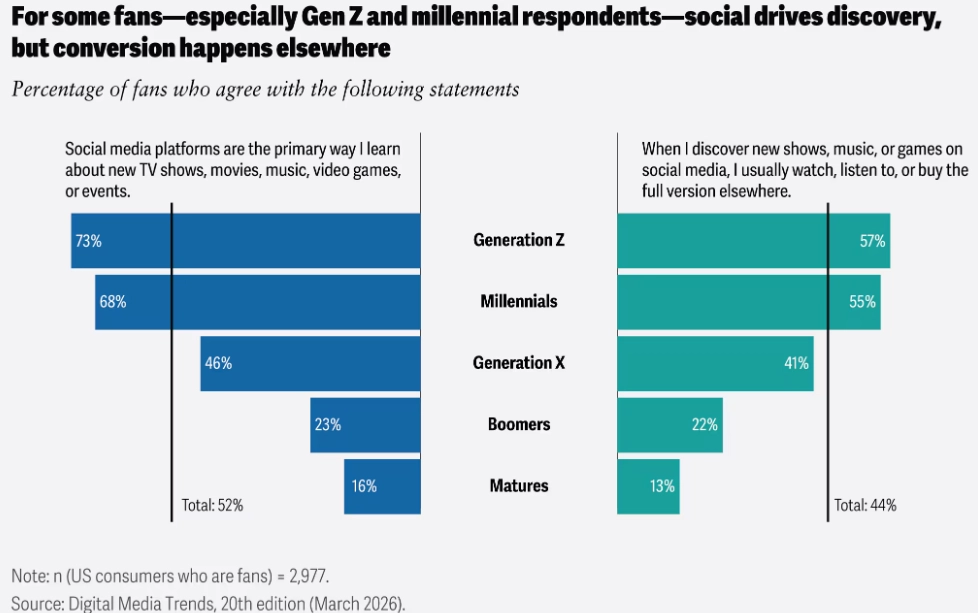
- 44% of fans (49% of Gen Z and millennial fans) wish they could aggregate all the content related to their favorite IP into one place
- This is pushing media Cos to embed modular experiences like social feeds, podcasts, commerce, creator content, or interactive games alongside primary content or IP
- Over time, rights portability systems (like blockchain) could support these cross-platform interactions and ensure monetization and attribution for original rights holders are preserved, which enables fans to engage within a single environment
- Current examples of this expansion include Spotify adding chat features and Disney+ and Netflix adding user-generated (or “vertical”) content to their homepages
- Future vision…
- A sports fan watching a game on a streaming service then posts about it on a social channel without leaving that interface
- This fan may listen to a post-game podcast, watch a creator video featuring their favorite player, and then follow a link to purchase a jersey or bobblehead
- And the provider now has visibility across all those touchpoints
- And a lot more valuable data on the consumer
- Gen AI should be a catalyst as well as it will…
- Enable media companies to deliver more and faster content (like highlight reels and summaries)
- Offer personalized and interactive experiences (like targeted ads and cocreation opportunities) at scale within their own environments
- Drive engagement by surfacing related content more effectively and connecting fragmented interactions into a coherent entertainment destination
- This is all assuming guardrails protecting IP are in place
- AI experimentation has just begun
- Amazon Prime Video is using gen AI to create recaps of their original content, complete with AI narration
- MLB, YouTube Live, and Fox One, are delivering similar highlight reels to users
A Sneak Peak On What Is Likely To Come From Apple’s Upcoming WWDC In June…
While Apple’s 37th annual WWDC is not happening until June 8–12, speculation is already mounting about a broad slate of software and possible hardware announcements. At the center of the noise is the long-awaited Siri overhaul, reportedly codenamed “Campos.” This update could turn Apple’s assistant into a more capable chatbot able to summarize information, read files, generate images, search the web, and act on personal on-device data.
Beyond Siri, rumors suggest Apple is preparing updates across iOS, iPadOS, macOS, watchOS, tvOS, and visionOS, with iOS 27 expected to be the focus. While WWDC is typically software-first, chatter this year also points to a possible hardware announcement, including updated Mac Studio models and new smart home products such as a HomePad hub and homeOS platform.
Please see below for a deeper dive into expected updates out of the upcoming event…
Apple 37th Annual WWDC Is Rumored To Bring The New Siri Update, Along With Other Improvements (link/link)
- The main attraction of the event is the rumored Siri reboot dubbed “Campos”
- The new version could offer a true chatbot experience that’s integrated into the Co’s upcoming operating systems (iOS 27 and everything else)
- The new Siri should be capable of:
- Searching through web listings
- Generating images
- Summarizing info
- Reading uploaded files
- Completing tasks using your personal, on-device data
- It could also get the screen awareness feature: Where Siri understands whatever is currently on your display and provides suggestions
- The updated Siri will be based on a custom language model derived from Google’s Gemini (Apple’s front-end feature, powered by Google’s back-end tech)
- It is also rumored to get a visual redesign, sort of an animated character w/ a “Clippy-like” personality
- The iOS 27, called “Snow Leopard”, is also rumored to be annc’d
- Reportedly, the internal directive is to comb through the operating system, kill bugs, rewrite legacy code, and streamline everything
- The payoff could be battery-life improvements, even on older iPhone models
- On Liquid Glass, iOS 27 is said to include a customization slider that lets users fine-tune the intensity
- iOS 27 is also rumored to prepare the operating system for the iPhone Fold
- It could bring side-by-side multitasking to iOS (for the first time)
- Could also rebuild first-party app layouts for the larger inner screen
- As well as broaden touch-interaction refinements across the operating system
- On the apps front: Could see a Calendar redesign w/ AI integration and smarter Photo collections, according to leaked code online
- Another update could be support for satellite-based 5G connectivity, vs satellite for emergency uses
- Possibly shipping w/ the iPhone 18 Pro is the capability to use Apple Maps navigation and send photos/videos over satellite
- Reportedly, the internal directive is to comb through the operating system, kill bugs, rewrite legacy code, and streamline everything
- For the rest of the fleet: iPadOS, macOS, tvOS, and visionOS 27 could all be getting updates
- iPadOS 27 could get Siri 2.0, the slider to adjust the Liquid Glass intensity, and likely benefit from the new app layout APIs built for the iPhone Fold
- MacOS 27 has the most to talk about, w/ recent rumors suggesting that macOS 27 will run exclusively on Apple Silicon (M1 or later), completing a transition Apple began in 2020
- It is also the last version to support Rosetta 2
- watchOS 27 could get better battery efficiency and AI-powered fitness coaching
- tvOS 27 could include Apple Intelligence
- And expect visionOS 27
- WWDC isn’t usually about new hardware, but speculation suggests that 2026 may be an exception with potentially…
- Mac Studio getting an upgrade
- There could be new models powered by the M5 Max and M5 Ultra chips (Apple’s first Ultra chip since the M3 Ultra, w/ up to an 80-core GPU)
- HomePad being unveiled w/ a 7-inch hub, an A18 chip, a 1080p ultrawide camera w/ Center Stage, and sensors to detect when someone is in the room
- A HomeKit security camera, and a unified smart home platform called homeOS that holds all the connected devices together
Grab Bag: Sports Prediction Mkt Headwinds / Netflix Raises Prices AGAIN / Unity Positively Pre-Announces
- Senators Schiff and Curtis are reportedly seeking to prevent CFTC-regulated entities, including Kalshi and Polymarket, from offering wagers on sports (link/link)
- The legislation is the first bipartisan Senate bill seeking to regulate prediction markets
- The bill also seeks to prohibit “casino-style games” from being listed on the platforms, such as slot machine games, video poker, blackjack and bingo
- The CFTC has argued it holds exclusive jurisdiction over event contracts as part of the commodities-derivatives market
- Sen. Adam Schiff said, “It’s time for Congress to step in and eliminate this backdoor which violates state consumer protections”
- Sen. John Curtis said “Too many young people in Utah are getting exposed to addictive sports betting and casino-style gaming contracts that belong under state control”
- This isn’t the first time Prediction companies have been pressured at the state level –
- NV recently secured a temporary restraining order blocking Kalshi from offering contracts tied to sports, elections, and entertainment (The Ninth Circuit recently denied Kalshi’s request for a stay in)
- AZ filed criminal charges against Kalshi, alleging it operates an unlicensed gambling biz, which Kalshi has disputed
- MA, MI, and other states have also pursued legal action, while Polymarket filed its own lawsuit against MI to prevent enforcement of state gambling laws
- The legislation is the first bipartisan Senate bill seeking to regulate prediction markets
-> DraftKings stock rose +7.2% in premarket trading early Monday morning after the news; Shares of Flutter Entertainment (the parent company of FanDuel), gained +9.4%
- Netflix is increasing their prices again (last price hike was in Jan 2025) (link/link)
- Ad-supported subs will be paying an extra +$1/mo, while standard and premium plans go up by +$2/mo
- Standard with ads: $7.99 à $8.99
- Standard: $17.99 à $19.99
- Premium: $24.99 à $26.99
- Also, monthly fees are going up for adding extra viewers outside your household
- With ads: $6.99 -> $7.99
- Without ads: $8.99 -> $9.99
- For context: Since 2016, the standard tier has nearly doubled in price ($9.99 à $17.99)
- The higher prices will be applied to both existing and new members
- New members who sign up will see the new plan prices starting Thur., Mar. 26
- The higher prices will roll out to existing members over the coming weeks
- Ad-supported subs will be paying an extra +$1/mo, while standard and premium plans go up by +$2/mo
-> Netflix stock rose +1% in reaction to the news
- Unity pre-annc’d better than expected Q1 revenue and adj EBITDA (link/link)
- Q1 rev is expected to be +1.3% above cons at the mid-pt: $505-$508mn vs cons of $500mn
- The outperformance is driven by Unity Vector, which is expected to increase +15% seq in Q1, as well as slightly better than expected performance in Create
- Grow rev BEAT by +3.8%: $352mn vs cons of $339mn
- Create rev BEAT by +1.3%: $155mn vs cons $153mn
- Q1 adj EBITDA is expected to be +6.9% above cons at the mid-pt: $130-$135mn vs cons of $124mn
- Unity also annc’d it will be “sunsetting the ironSource Ads Network”, effective April 30th, and that it has engaged a financial advisor to assist with the divestiture of its Supersonic game publishing biz
- Once completed, Unity expects these changes to result in faster revenue growth, increased adj EBITDA, and higher adj EBITDA margins
- Q1 growth expectations
- Strategic Grow rev (excludes the contribution from the ironSource Ads Network and Supersonic), is expected to increase +48% y/y, 2x the +24% y/y growth expected for total Grow in Q1
- Strategic Create revenue is expected to grow +14% y/y in Q1
-> Unity stock rose +14% in reaction to the news
Stock Market Check
This Week's Other Curated News
Advertising/Ad Agencies/Ad Tech
- Guardian US said higher programmatic CPMs drove 44% y/y rev growth in Feb, bucking flat mkts. Execs said gains came from pricing, not traffic, across open auctions and PMPs that supported rates and demand. The Co rebuilt ops around real-time data, curated marketplaces and tighter supply paths, positioning signal-rich inventory and retail signals as buyers reassess AI-driven disruptions. (AdExchanger)
- Samsung Ads and Amazon Ads annc’d a shoppable CTV partnership enabling viewers to add products or svs to their Amazon cart directly from Samsung TV Plus using a remote. Amazon’s Interactive Video Ad tech links to Samsung’s FAST platform. Starting Jul., advertisers can buy Samsung TV Plus inventory via Amazon DSP, w/ non-Amazon brands using send-to-phone prompts. (MediaPost)
- Omnicom launched an audit of programmatic ad svs platform The Trade Desk, w/ Publicis Groupe’s decision last week to stop recommending TTD after a failed FirmDecisions audit and alleged contract violations. TTD denied the claims and said Omnicom’s review reflects routine due diligence tied to transparency and performance. (MediaPost)
- Apple is reportedly planning to add ads to its Maps app, per Bloomberg’s Mark Gurman, w/ an annc’d possible this month and ads appearing on iPhones this summer. The move would mirror Google Maps and Yelp, letting brands bid on search placement. (Engadget)
Artificial Intelligence/Machine Learning
- Google annc’d Live translate w/ headphones is arriving on iOS, turning any headphones into a real‑time personal translator. Via the Translate app, users can hear instant translations while preserving the speaker’s tone and cadence. The feature supports 70+ languages and is expanding to more countries, incl France, Germany, Italy, Japan, Spain, Thailand and the U.K., enhancing travel and family conversations. (Google)
- OpenAI annc’d its US ChatGPT ads pilot surpassed ~$100mn in ann. rec. rev in under two months. The Co began testing ads w/ free users and Go subs in Jan., working w/ 600+ advertisers and saying privacy trust metrics were unchanged. Ads are labeled, don’t affect responses, exclude users under 18 and sensitive topics, and may expand to Canada, Australia and New Zealand despite a cautious rollout. (CNBC)
- Apple is planning to open Siri to rival AI svs beyond its ChatGPT tie-up, Bloomberg News reported. As part of an iOS 27 update, third-party assistants such as Alphabet’s Gemini or Anthropic’s Claude could integrate directly w/ Siri, letting users route requests by choice. The shift signals a change in Apple’s AI strategy to make iPhone a broader AI platform and could boost rev by taking a cut of third-party AI subscriptions. (Reuters)
- Google annc’d updates to the Gemini app that let users switch easily by importing memories and full chat history from other AI apps. Starting Mar. 26, 2026, consumers can bring preferences and context via a guided prompt, or upload a ZIP to cont’d past chats. The update renames “past chats” to “memory” and emphasizes secure, personalized use across Gemini and connected svs, reducing friction when changing AI assistants. (Google)
- Gap annc’d a partnership w/ Google Gemini to let shoppers buy Gap house brands directly inside the AI platform, becoming the first major fashion Co to enable in-chat checkout. Revealed [Tue, Mar. 24], the move targets consumers shifting from search to AI discovery. Product data is supplied by Gap for accuracy, checkout runs via Google Pay, and the Co manages shipping, w/ AI-powered sizing tools cont’d testing. (CNBC)
- Google annc’d Search Live is rolling out globally across 200+ countries and languages where AI Mode is available. First launched Jul. 2025, the feature lets users use phone cameras and voice for real‑time, back‑and‑forth help, powered by Gemini 3.1 Flash Live. Available in the Google app on Android and iOS, it supports follow‑ups, web links, Lens access, and deeper context-driven results. (TechCrunch)
- ByteDance annc’d its AI video gen model Dreamina Seedance 2. 0 is rolling out in CapCut, enabling creators to draft, edit and sync video/audio via prompts, images or refs. The launch starts in select mkts incl Brazil and Mexico amid IP concerns. The model supports up to 15-sec clips across six aspect ratios, adds safety limits, blocks real faces, embeds invisible watermarks, and will also reach Dreamina and Pippit svs. (TechCrunch)
- Coca-Cola CEO James Quincey and former Walmart CEO Doug McMillon told CNBC that AI advances influenced their decisions to step down. Both said the next wave of AI-driven transformation needs new energy and skills. Quincey, CEO since 2017, said future growth requires a leader w/ deeper AI focus, backing COO Henrique Braun, effective end of Mar. McMillon said he couldn’t finish the coming AI shift and passed Walmart’s top job to John Furner. (CNBC)
- A San Francisco federal judge granted Anthropic a preliminary injunction against the Trump administration, pausing a Pentagon blacklist and a directive banning agencies from using Claude. Judge Rita Lin said the actions likely amounted to illegal First Amendment retaliation after contract talks collapsed, citing efforts to cripple the AI Co. The order blocks enforcement while the case proceeds, w/ a final ruling months away. (CNBC)
- Google and OpenAI are racing to turn chatbots into shopping tools. Google annc’d Gemini-powered checkout deals, adding Gap Inc brands alongside Walmart and Target, letting users buy w/ Google Pay via its Universal Commerce Protocol while retailers handle shipping. (The Verge)
- Google annc’d Lyria 3 Pro, a new music generation model cont’d a month after Lyria 3. The Co said the tech lets users create tracks up to three minutes, versus 30 seconds, w/ better creative control and structure options like verses and choruses. Lyria 3 Pro is rolling out to the Gemini app for paid users, Google Vids, ProducerAI, and enterprise svs incl. (TechCrunch)
- OpenAI CFO Sarah Friar told CNBC’s Jim Cramer the Co is raising an add’l $10bn, taking a record round to >$120bn, above a $100bn target. Friar said demand for AI drove broad investor interest incl Microsoft and others, ahead of potential IPO plans. OpenAI cited strong consumer and enterprise rev growth, adj compute plans, and tougher biz choices to focus on profitability. (CNBC)
- Large enterprises aren’t ripping out core biz software despite AI fears. CIOs at FedEx, EY, Cisco and Lowe’s say they’re vibe-coding small apps and AI agents on top of vendors like SAP and Salesforce, using AI coding tools to customize workflows, cut license costs and pressure cos on pricing, while keeping systems of record for scale, compliance and data as agents become interfaces. (The Wall Street Journal)
- OpenAI is courting private‑equity firms w/ sweeter terms than rival Anthropic to form joint ventures that fund and speed enterprise AI adoption. The Co offers preferred equity w/ a guaranteed 17.5% return and early access to new models to offset high deployment costs and boost stickiness. (Reuters)
- Tencent launched ClawBot to integrate WeChat w/ the OpenClaw AI agent, intensifying China’s tech battle, Reuters reported. The tool appears as a WeChat contact for China’s top app w/ over 1bn monthly active users, letting users send commands for tasks like file transfers and emails. (Reuters)
- OpenAI is in advanced talks to buy power from Altman-backed fusion startup Helion Energy, aiming to meet AI’s surging demand. Talks could secure ~12.5% of output, equal to 5 gigawatts by 2030, scaling to 50 by 2035. Altman recused himself from talks and Helion’s board. (Axios)
Audio/Music/Podcast
- Spotify annc’d layoffs in its podcast group, cutting ~15 staffers, or 3% of headcount, mainly at The Ringer and Spotify Studios. The Co said the move aims to improve execution, speed and alignment, not cost cutting, as it cont’d investing in podcast biz growth, esp video and multiformat content. Spotify declined comment. Cuts follow prior reductions in Jun. 2025 and larger 2023–24 layoffs. (Variety)
- Spotify is beta testing Artist Profile Protection to curb AI slop being wrongly linked to real artists. The tool lets artists review, approve or decline releases before they go live, ensuring only approved tracks affect profiles, stats and recommendations. (TechCrunch)
- Spotify annc’d deeper AI bets to defend its biz as music catalogs commoditize. A new ChatGPT integration and Prompted Playlists let users chat for songs, pods and mixes, w/ opt‑in controls and no content shared for training. The Co says personalization boosts stickiness: its iDJ has ~90mn users and 4bn hours. (CNBC)
Broadcast/Cable Networks
- Former Google exec Matt Brittin was confirmed as BBC director general, replacing Tim Davie after his Nov. Ex-president of Google EMEA, Brittin said the role comes at a moment of risk and opportunity, pledging faster digital focus and audience reach. (BBC)
Cable/Pay-TV/Wireless
- Residential pay-TV rev in the Netherlands fell 1. 2% in 2025 to €1.74bn as subscriber numbers for TV svs kept slipping amid intensifying competition from SVOD and other online video svs. Telecompaper forecasts the decline to cont’d over coming yrs, warning that annual price increases are no longer enough to offset a shrinking customer base, leading to ongoing pressure across the residential pay-TV mkts. (Telecompaper)
- Telstra annc’d mobile price hikes for the 2nd time in 10 months, lifting post‑paid plans ~$4/mth and pre‑paid $5, incl Belong and Boost. Some cheapest plans rise >10%, w/ the 25GB bundle jumping from $52 to $61 (+17%) in a yr. The Co will drop its $50 Starter plan for new users, keep tiers rising, and says higher prices fund network investment, w/ a 10% discount from Jul. 1 for eligible concession holders. (Yahoo Finance)
- Iliad said it retained its lead among major European telecom groups for a 4th consecutive yr, as expected, after 3. 4% annual svs rev growth in 2025 across its ops in France, Italy and Poland. Full-yr operating FCF beat the €2bn goal to hit €2.25bn, up 23% vs 2024. (Telecompaper)
Capital Market Updates
- Elon Musk is discussing allocating up to 30% of SpaceX IPO to retail investors, about 3x typical levels, to help stabilize trading after debut. The cos CFO outlined a hands-on, lane-based syndicate, assigning banks by region and investor type, incl. Bank of America for U.S. retail, Morgan Stanley via E*Trade, and UBS/Citi abroad. Retail demand is expected strong, likened to the Google IPO, w/ valuation possibly ~$1.75tn; plans may change. (Reuters)
- Wall Street banks began the week w/ nearly $30bn of buyout junk debt to offload amid the most volatile mkts in months, but are now mostly finished. Led by JPMorgan Chase & Co., banks sold almost $15bn of risky debt on Tuesday to help fund the record leveraged buyout of video game-maker Electronic Arts Inc., after attracting $45bn of orders. (Bloomberg)
Cloud/DataCenters/IT Infrastructure
- Microsoft told managers in major cloud and North American sales groups to suspend new hiring, The Information reported, citing employees. Executives said candidates w/o offers should be halted to cut costs and boost margins. The freeze isn’t Co‑wide; teams building Copilot AI are still hiring. The move comes near FY-end amid heavy AI capex, slower cloud growth, and pressure to show returns. (Reuters)
- China Mobile reported rev of CNY 1. 05tn (~USD 152.2bn) in 2025, marking 0.9% yr-on-yr growth. Results showed cloud, AI and enterprise digital svs as key drivers, helping offset slower growth in the traditional telecom biz. Computing svs rev climbed to nearly CNY 90bn, up 11%, while intelligent computing svs rev alone surged 279%, highlighting strong momentum in higher-value digital and computing offerings, the Co said. (Telecompaper)
- OpenAI is pivoting from aggressive data-center buildouts to fiscal discipline ahead of a potential IPO. CEO Sam Altman cited outages, supply-chain issues and tight deadlines, pushing reliance on partners like Oracle, Microsoft and Amazon. After rattling mkts w/ ~$1.4tn plans, OpenAI now targets ~$600bn compute spend by 2030 versus $13.1bn rev. (CNBC)
Crypto/Blockchain/web3/NFTs
- Circle Internet Group shares slid ~20% as investors feared a U. draft Clarity Act could limit rewards on stablecoins, hurting USDC demand. The proposal may ban yield payments and complicate reward calculations, prompting concerns backed by bank lobbying from JPM and Citi. (Yahoo Finance)
eCommerce/Social Commerce/Retail
- Several retailers say inventory shrink has fallen from pandemic highs and, at some cos, returned to pre‑COVID levels. Executives at Target, Kroger, Dollar General and TJX told investors lower shrink is lifting margins and profits. Analysts say losses are multifaceted, tied to ops fixes and steadier supply chains, not only theft. The NRF previously retracted overstated crime data, while Appriss estimates ~$90bn in annual losses. (Retail Dive)
- H&M warned a prolonged Iran war could hit consumer spending and add inflation pressure, complicating its turnaround vs Zara and Chinese discounters. Shares fell up to 6.6% as soft Mar. sales offset higher Q1 profit. The Co posted adj operating profit of 1.51bn crowns, beating forecasts, while local-currency sales fell 1% and Mar. rev seen up ~1%. CEO said higher energy prices pose risks, though exposure to the Middle East is limited. (Reuters)
- Walmart annc’d a new in‑platform shopping experience in OpenAI’s ChatGPT using its commerce agent Sparky. Users can move from product discovery in ChatGPT to a Walmart checkout flow supporting account linking, loyalty and payment. (Retail Dive)
- PDD Holdings said Q4 net profit fell 11% y/y to 24. 54bn yuan ($3.56bn), missing estimates, despite rev rising 12% to 123.91bn yuan. The Co said perf could fluctuate as it invests heavily to support merchants and develop its supply chain amid fierce China e-commerce competition from Alibaba and JD.com. (The Wall Street Journal)
- Inflation has pushed higher-income shoppers toward dollar stores, giving chains new customer gains. Dollar Tree’s shift beyond $1 pricing, begun in 2021, helped protect margins and attract households earning ~$80,000+. Executives say growth spans all income cohorts, w/ higher earners favoring multi-price items. (Retail Dive)
Electric & Autonomous Vehicles
- Verne, Pony. ai and Uber annc’d a strategic partnership to launch Europe’s first commercial robotaxi svs, starting in Zagreb. The model combines Pony.ai autonomous driving tech, Verne fleet ownership and ops, and Uber’s ride-hailing platform, w/ on-road validation underway. Fare-charging prep has begun, regulatory approvals are in progress, and the cos aim to scale to thousands of vehicles as expansion cont’d across Europe. (Uber)
- Pony. ai annc’d plans to scale its Robotaxi biz in 2026, targeting >3,000 vehicles across 20+ cities globally, ~half overseas. The Co reported Q4 2025 Robotaxi rev up 160% yr/yr and fare rev up 500%+ as fleet grew to 1,446. It reached unit economics breakeven in Shenzhen and Guangzhou, citing dual engines in China and overseas mkts to drive growth. (Yahoo Finance)
- Zoox, Amazon’s self-driving start-up, is pushing a commercial robotaxi rollout across US cities. It aims to start charging riders in Las Vegas by late Jun., pending approvals, w/ San Francisco to follow. Zoox is expanding its SF geofence to cover ~50% of ride-hailing demand and boosting Las Vegas drop-offs incl. the airport. (Financial Times)
- Amazon annc’d it acquired Fauna Robotics, a NY-based startup making “approachable” humanoid robots. Fauna’s $50k Sprout bot targets consumer/biz use and is already backed by Disney and Hyundai’s Boston Dynamics. The Co’s ~50 staff will join Amazon as it expands its robotics biz, building on past M&A like Kiva and Rivr, and exploring personal robots amid rising competition from Tesla, 1X, Figure AI and others. (CNBC)
FinTech/InsurTech/Payments
- Mobile money hit $2tn in 2025, doubling since 2021 as active accounts grew to 593mn, per GSMA’s State of the Industry Report. The sector’s rising usage supports financial health via credit, savings & insurance svs. Sub‑Saharan Africa led growth. Despite gains, ~75% of accounts stay inactive monthly, w/ fraud & taxes limiting inclusion. (GSMA)
- Contactless mobile payments surged in NL as phone/watch transactions cont’d to outpace cards for the first time. Nearly six in ten POS payments were made via mobile devices in the past yr, up from ~four in ten in 2024. Data from Betaalvereniging Nederland highlights a strong shift toward mobile-first payment habits, marking a key transition in consumer payment prefs nationwide. (Telecompaper)
Handheld Devices & Accessories/Connected Home
- Apple annc’d iOS 26. 4 adding 13 enhancements for iPhone. The update brings 8 new emoji, Apple Music features like Playlist Playground (beta), Concerts discovery, offline music recognition, ambient music widgets, and full‑screen album designs. It also improves accessibility, keyboard accuracy, reminders, Family Sharing purchase options, Freeform image tools, plus bug fixes and security updates. (9to5Mac)
- Meta Platforms Co delayed launching Ray-Ban Meta Display smart glasses in the EU due to battery and AI rules and supply limits, leaving sales only in the US. EU law requires removable batteries by 2027, cutting space and features, while AI restrictions would limit functionality. Meta is seeking a carve-out and plans to double capacity in 2026 w/ EssilorLuxottica. (FashionNetwork)
Last Mile Transportation/Delivery
- Delivery Hero SE annc’d a deal to sell its Taiwan food delivery biz to Grab for $600mn cash on a cash- and debt-free basis, subject to regulatory approvals, w/ closing expected in 2H 2026. The transaction is the first milestone in the Co’s strategic review to unlock value and strengthen its capital structure via debt repayment and general purposes. (Delivery Hero)
Live Entertainment/Theme Parks/Concerts/Experiential
- Mojang Studios and Merlin Entertainment annc’d Minecraft World, an official Minecraft theme park revealed during Minecraft Live. The park is planned for 2027 and will be integrated w/ Chessington World of Adventures near London. (Kotaku)
Macro Updates
- The Paris-based O. E.C.D. said Thursday the war in Iran and closure of the Strait of Hormuz will lift oil, gas and other commodity prices, driving U.S. inflation to an avg 4.2% this yr, over 1 pp above its late-last-yr forecast. Across G20 mkts, inflation is seen at 4%, up 1.2 pp, while uncertainty weighs on growth. Global growth is forecast at 2.9%, unchanged, supported by AI spending. (The New York Times)
- China’s industrial profits surged 15. 2% in Jan.-Feb., extending a rebound from Dec., as faster factory activity and higher prices boosted rev, per NBS. High-tech manufacturing led gains, w/ profits up 58.7% on strong UAV and semiconductor earnings, while non‑ferrous metals and chemicals also rose. Officials cautioned that escalating geopolitical tensions and an oil price shock linked to Middle East disruptions could weigh on the outlook despite cushioning steps. (CNBC)
Online Travel
- Tripadvisor Co annc’d a cooperation agreement w/ Starboard Value, adding four new directors to its Board to boost value creation. Dhiren Fonseca and Andrew Cates join immediately, w/ two more to be nominated for the 2026 annual meeting. The Board expands from eight to ten members. (Tripadvisor)
Regulatory
- After losing to The New York Times in court, Defense Sec. Pete Hegseth rolled out new Pentagon press limits, shutting the long-used media workspace and barring credentialed reporters from entering the building w/o an escort. The move came three days after a federal judge ruled last Oct.’s rules unconstitutional under the First and Fifth Amendments; the Times said it will return to court for journalists. (TheWrap)
- The US FCC annc’d it will ban imports of all new foreign-made consumer routers, citing severe cybersecurity risks identified by a White House review. Existing models aren’t affected, w/ exemptions for devices the Pentagon deems safe. Reuters noted China holds ~60% of U.S. home router mkts. Officials cited exploits tied to Volt and Salt Typhoon hacks; lawmakers praised the move. China’s embassy had no comment. The order follows action on Chinese drones and scrutiny of TP-Link. (Reuters)
- Bernie Sanders and Rep. Alexandria Ocasio-Cortez annc’d legislation to pause all new AI data center construction nationwide until strong federal safeguards are enacted. The Artificial Intelligence Data Center Moratorium Act would block permits until Congress passes AI laws protecting workers and consumers, limiting environmental harm, and defending civil rights. (Axios)
- FCC approved Gray Media’s acquisition of three local TV station licenses from Allen Media Group—WLFI, WTVA and WTHI—part of a deal first annc’d in Aug. to exit Allen’s local TV biz and address debt. The original agreement covered 10 stations, with the rest still pending after delays beyond expected Q4 timing. (The Desk)
- A federal judge said the Pentagon’s treatment of AI Co Anthropic appears “troubling,” questioning Trump administration actions that annc’d a ban, labeled it a supply chain risk, and urged contractors to cut ties. The court said steps were not tailored to national security aims and could have simply stopped using Claude. (Axios)
- Online age checks may lead to a VPN crackdown, as lawmakers don’t want VPNs to bypass verification. It traces VPN tech origins from 1990s biz use for encrypted data tunnels, notes early work by Microsoft, AT&T, and Cisco, and highlights OpenVPN’s 2001 launch. (The Verge)
- Chinese IPOs in the US have stalled after a two-yr boom as regulators in China and the US tighten scrutiny over manipulation risks. Since Jan., only two Chinese Cos listed in New York vs 19 last yr, after 126 IPOs in 2024–25. Nasdaq raised standards, incl. a $25mn minimum, while China’s regulator slowed approvals. (Financial Times)
Satellite/Space
- Russia said it launched 16 low‑orbit satellites, marking the first operational batch for a planned global broadband system aimed at eventually rivaling SpaceX’s Starlink. State‑linked aerospace firm Bureau 1440 said the launch moves the project from trials to a comms svs. Russia lags far behind Starlink, which has grown to 10,000+ satellites, after post‑Soviet funding and management problems. (Reuters)
- American Airlines is seriously considering bringing back seat‑back screens on narrow‑body planes as part of an in‑flight entertainment and Wi‑Fi revamp, per people familiar. Talked w/ SpaceX’s Starlink and Amazon for connectivity and content, incl. Prime and shopping using miles. Move responds to pressure from Delta and United, after AA removed screens ~a decade ago to cut cost. Decision possible as early as next month. (CNBC)
- Starlink is reshaping in-flight Wi‑Fi, setting new performance benchmarks via 9,000+ LEO satellites delivering ~350 Mbps and <99 ms latency. Analysts say this lifts svs close to home broadband and pressures legacy GEO svs. Airlines increasingly switch providers, w/ broader free access likely by 2028–2030 in N. America and Europe. (Fierce Network)
- Amazon Leo VP Chris Weber said commercial svs are months away as the Co pursues an aggressive launch plan, with 200+ LEO satellites in orbit and 11 launches since Apr. 2025, aiming to double in the next 12 months. Ground stations are operational in initial coverage zones, expanding toward the equator later. (Fierce Network)
- Space Exploration Technologies Corp aims to file an IPO prospectus this week or next, citing The Information. Advisers expect the Elon Musk-led Co could seek to raise >$75bn, w/ individual allocation possibly above 20%, though structure isn’t final. (Reuters)
Social/Digital Media
- Two juries are weighing high-stakes kids-safety cases that could reshape liability for social media. A New Mexico jury heard closings accusing Meta of enabling child predators, which the Co denies. A Los Angeles jury is nearing a verdict on whether Meta and Google sold defective, addictive products. Unfavorable rulings could bring damages and penalties topping $2bn and spur more suits, as Meta cites efforts to protect youth. (The Verge)
- Instagram annc’d a long-requested update letting users rearrange photos or videos in a carousel after posting. Confirmed by Adam Mosseri, the edit option lets users tap the three-dot menu, select Edit, then drag items to change order and save w/out time limits. Feature rolls out from [Tue., Mar. 24], may take days by region, didn’t require an app update, and works only on new carousels; users can’t add new media, and older posts still only allow deletion. (PCMag)
- Instagram & Facebook will soon be filled w/ affiliate content as Meta annc’d new commerce features letting creators tag products directly in posts. FB starts w/ Amazon, adding Temu & eBay soon, while IG allows up to 30 shoppable items via creators’ own links if brands are in Meta’s catalog. (The Verge)
- Meta Platforms annc’d first‑ever stock options for top execs, tied to steep share‑price targets to retain talent and push aggressive AI growth. Filings show options vest only if shares jump ~88% to higher tranches needing a six‑fold rise, valuing the Co above $9tn. CEO Mark Zuckerberg excluded; several leaders eligible, plus $170mn in restricted stock; options expire Mar. 2031. (Yahoo Finance)
- Reddit annc’d new “human verification” rules to curb bots. Suspect accts must prove they’re human via passkeys, biometrics or IDs, though this isn’t sitewide. Reddit says its aim is transparency w/out hurting anonymity. Bot activity—spanning spam, narrative manipulation & fake clicks—continues to rise, prompting these steps as the Co avg’s ~100k removals/day. (TechCrunch)
- X annc’d changes to its rev-sharing policy to weigh engagement from a user’s home region, aiming to deter non-US users posing as Americans. Head of Product Nikita Bier said the move encourages locally relevant content and limits payouts for gaming US or Japanese audiences, its largest mkts. Location transparency exposed overseas pro-US politics accounts. (Engadget)
Sports/Sports Betting
- Netflix and NBC annc’d new MLB media packages as the 2026 season opens. NFLX will stream ~nine marquee events, incl. the Yankees-Giants opener, Home Run Derby and Field of Dreams game, paying ~$150mn over three yrs to “eventize” games w/out full-season risk. CMCSA’s NBC returns after ~25 yrs via a $600mn, three-yr deal, airing ~25 Sunday Night Baseball games plus exclusive Wild Card rounds, aiming for 2.5–3mn viewers. (Sportico)
- Sportradar Group AG annc’d Playradar, a new iGaming brand extending its iGaming biz by blending sports data, streaming and casino games for global operators. The Co will offer hybrid products w/ live and historical sports streams, casino mechanics and community interaction, plus virtual sports and classic games. (Sportradar)
Tech Hardware
- China’s chip sector shows faster‑than‑expected growth as the AI boom drives global semiconductor demand, pushing cos to expand capacity. Mature node output is set to reach 42% of global mkts by 2028. AI makes chips more complex, boosting needs for testing, packaging and optical interconnects. (Reuters)
- Intel and AMD may raise CPU prices by an avg 10%–15%, possibly higher, per Nikkei Asia. Intel annc’d to clients a hike is imminent, w/ AMD likely to follow, citing shortages, strong demand, and a shift toward server CPU output. Orders once filled in 1–2 weeks now take 8–12 weeks. (PCMag)
- Arm annc’d its first in-house data-center AI chip, the AGI CPU, marking a strategic shift beyond licensing IP. The chip targets agentic AI, w/ Meta as lead partner, and will be made by TSMC on 3nm. CEO Rene Haas said it could add ~$15bn in annual rev in ~5 yrs, lifting shares 6.5% after hours. (Reuters)
- Sony is close to a binding deal to sell a majority stake in its home entertainment biz to Chinese rival TCL Electronics, people familiar say. Talks are at an advanced stage, value the deal at ~ $1bn, and aim to annc’d a transaction as soon as this month. No final decision has been made, and discussions remain private. (Bloomberg)
- Elon Musk annc’d a record chip‑building plan dubbed Terafab at an Austin event, calling it the most epic effort yet. The project, a joint effort of Tesla, xAI and SpaceX cos, aims to produce 1 terawatt of compute per yr, much of it for space. It starts w/ an advanced tech fab in Austin to secure chip supply for AI, robots and space data centers, framing the move as a step toward a galactic future. (Axios)
Towers/Fiber
- KKR and BlackRock-owned GIP are among bidders for Patrick Drahi’s 50. 01% stake in French fibre network XpFibre, as he seeks asset sales to ease debt. Offers from KKR, GIP, Ardian and GIC-backed Vauban value the biz at €6bn–€8bn, below Drahi’s €9bn target. (Financial Times)
- Italy’s state-controlled postal svs Co Poste Italiane made a $12.50bn cash-and-stock bid for Telecom Italia, a move that could bring its ops and infrastructure back under govt ownership. Poste Italiane shares fell 3.10%, while Telecom Italia declined 2.65%. (The Wall Street Journal)
Video Games/Interactive Entertainment
- Unity annc’d prelim Q1 2026 results exceeding guidance, projecting $505mn–$508mn rev and $130mn–$135mn adj EBITDA, vs prior outlook. Outperformance driven by Unity Vector growth and stronger Create. Co will exit non-strategic ad biz, sunsetting ironSource Ads Network by Apr. 30 and exploring divestiture of Supersonic, aiming for faster rev growth, higher margins and profitability. Benefits cont’d. (Business Wire)
- Nintendo annc’d that starting in May 2026, Nintendo-published digital games exclusive to Nintendo Switch 2 will carry a different MSRP from physical editions, beginning w/ preorders for Yoshi™ and the Mysterious Book. The co said gameplay is identical across formats, but pricing reflects differing production and distribution costs, giving players more purchase choice. (Nintendo)
- Epic Games annc’d layoffs of over 1,000 staff, as Fortnite engagement fell, leaving the Co spending more than it earns. CEO Tim Sweeney cited ~ $500mn in cost savings, said AI wasn’t a factor, and pointed to costly Google and Apple legal battles. (Kotaku)
- Nintendo is cutting Switch 2 production by a third after weak US sales, Bloomberg reports. After a strong launch, sales lagged over the holidays, with U.S. performance 35% below expectations, prompting a cut from six mn to four mn units this quarter. Japan demand remains strong and Europe steady, but shares fell 6.3% in Tokyo. (Kotaku)
Video Streaming
- HBO Max launched in the UK and Ireland with a high-profile London event at Queen Elizabeth Hall, drawing top talent and execs including Casey Bloys. The debut gives local audiences access to HBO Originals such as The Pitt and upcoming series, w/ an exclusive Harry Potter trailer preview. Festivities closed w/ a world-first 500-drone show soaring ~394 feet above the Thames in central London. (The Hollywood Reporter)
- Roku annc’d its $3 Howdy ad-free streaming svs has launched on Prime Video, marking its first expansion beyond the Roku ecosystem. Launched in Aug. 2025, Howdy offers ~10,000 hours of content from partners incl. Lionsgate, Sony, Disney and Warner Bros., plus select Roku Originals. Access requires Prime or Prime Video. Roku said the move supports its goal of affordable, accessible entertainment. (TechCrunch)
- Google annc’d new Gemini features for Google TV, adding AI visual answers, topic “deep dives,” and narrated sports briefs. Visual responses show live scores and where to watch games, plus recipe results w/ video. Deep dives deliver narrated breakdowns across health, economics and tech. Sports briefs recap NBA, NHL and MLB. (TechCrunch)
- Netflix turned central Seoul into a global stage as K‑pop megastars BTS returned w/ a livestream comeback show, part of the US entertainment Co’s push into live events meant to “pull people together.” Leader RM opened w/ “Body to Body,” drawing on the folk song Arirang. (Bloomberg)
