


The markets, give or take, were flat in this shortened week with the observance of Juneteenth. Geo-political and macro concerns were front and center, in addition to the FOMC meeting. As usual, sector developments and updates remained in full force, and we focused on the below in this edition:
- Where Do You Get Your News? Social Media Reaches A High Mark
- 2025 US Ad Growth Is Not As Pressured As Magna Thought In March…
- Cannes Spurs A Slew Of New Ad Partnerships & Ad Platform Updates
- Netflix’s Taking A Page Out Of The Disney Playbook
- How Much Are Employees Actually Using AI At Work?
- Robotaxis Want To Take A Bite Out Of The Big Apple!
- Grab Bag: TikTok Deadline Gets Extended / JD.com Pushes Into The Hotel Biz / Senate Passes GENIUS Act
I’d also flag that this week marks LionTree’s 13th year and today marks the longest day of the year w/ Friday being summer solstice!
I hope you all have a nice weekend.
Best,
Leslie

PS. Reminder that we published the Summer edition of our quarterly LionTree’s Lens: Sector Insights & A Look Ahead last week. CLICK HERE to watch the ~20-minute video presentation and to access the full slide deck (if you have problems with the download just lmk).
Where Do You Get Your News? Social Media Reaches A High Mark
The Reuters Institute Digital News Report 2025 caught our eye this week, and with nearly 100k survey respondents across 47 countries, it offers a very comprehensive look at how people around the world are changing how they consume news today.
We read all 171 pages (so you don’t have to!) and here are 10 key takeaways that stood out to us, especially for anyone tracking media, tech, and audience trends (but link to the full report = HERE)
Our Highlighted Findings… A Picture Says A 1000 Words
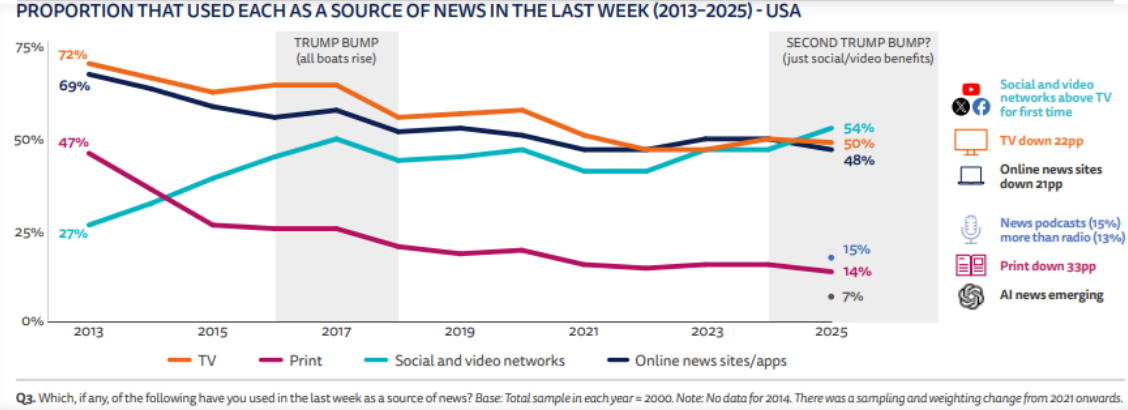
- In the US, social/video platforms overtook TV & websites as the top news source for the first time
- 54% of respondents in the US are accessing news via social media & video networks (+6pps), surpassing both TV news (50%) & news websites/apps (48%) for the first time
- Social media, video platforms (e.g. YouTube, TikTok) & aggregators are now dominant sources of news, especially among younger audiences
- This trend is also happening outside the US, but not as fast
- The proportion that use TV as a source of news continues to decline
- 54% of respondents in the US are accessing news via social media & video networks (+6pps), surpassing both TV news (50%) & news websites/apps (48%) for the first time
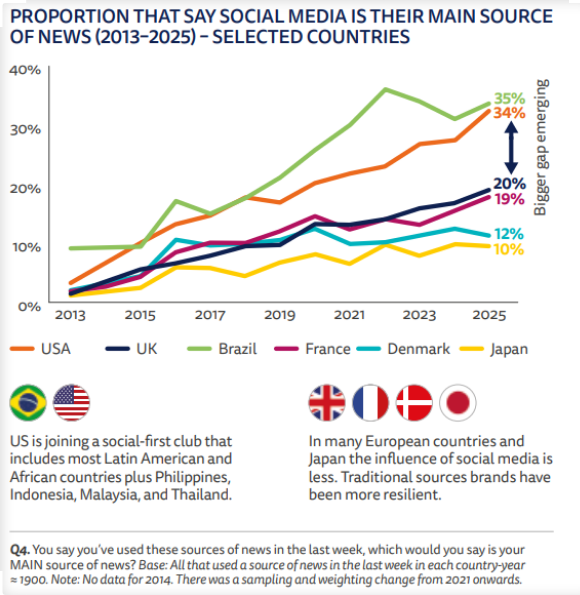
- Social media is now the MAIN news source for 35% of Brazilians and 34% of Americans
- Influencers and podcasters are reshaping public discourse, but are also seen as major sources of misinformation
- US: 22% said they came across news or commentary from popular podcaster Joe Rogan in the week after the inauguration, including a disproportionate number of young men
- France: News creator Hugo Travers (HugoDécrypte) reaches 22% of under-35s w/ content distributed mainly via YouTube & TikTok
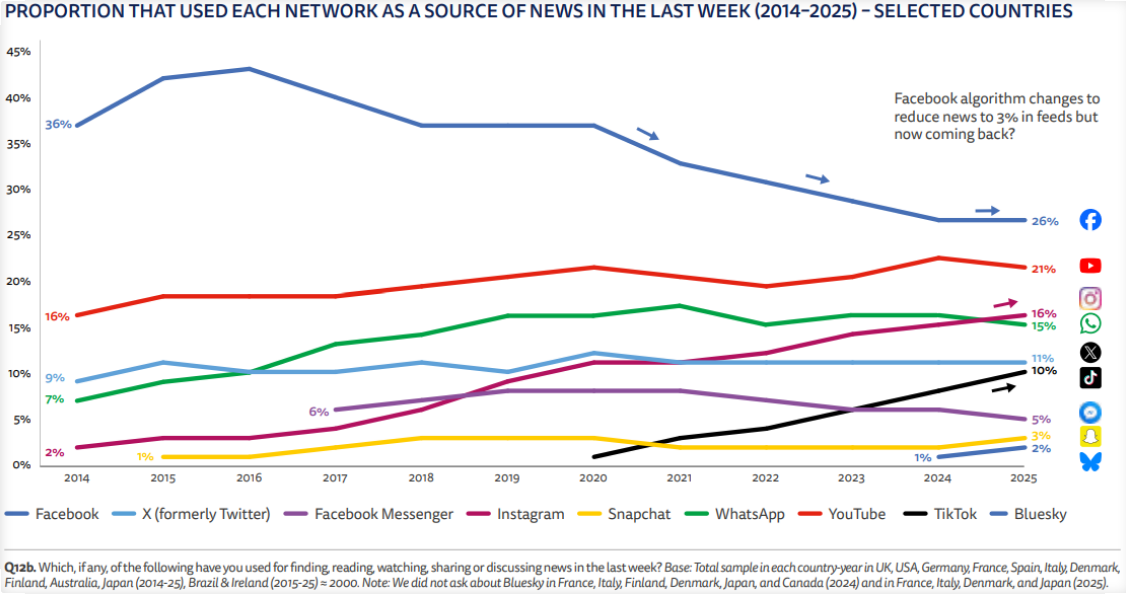
- News access is more fragmented than ever: 6 platforms now reach 10%+ of users weekly (up from just 2 a decade ago – Facebook and YouTube)
- 26% use Facebook each week for news (flat y/y)
- 21% use YouTube (down y/y)
- 16% use Instagram (up y/y)
- 15% use WhatsApp (down y/y)
- 11% use X (flat y/y)
- 10% use TikTok (up strongly y/y)
- TikTok is the fastest-growing news platform globally, especially in Asia and Africa
- Globally, 33% use TikTok for any purpose and ~50% of those use the app for news (17%)
- The fastest growth is in Thailand where almost 50% of the sample now uses TikTok for news, up +10pp y/y, and increases are especially strong w/ younger groups
- TikTok use is much lower in the US (12%) and Europe overall (11%), though again, stronger w/ younger demos
- Globally, 33% use TikTok for any purpose and ~50% of those use the app for news (17%)
- X (formerly Twitter) usage for news was flat globally but saw significant growth in the US (+8pp)
- X has not lost reach for news on aggregate across the 12 countries despite a widespread X-odus by liberals and journalists, including some prominent news organizations
- Threads, Bluesky, and Mastodon have made little impact globally, w/ reach of 2% or less for news
- Weekly YouTube use, for any purpose, is up +2pp y/y, in aggregate, to 63%, w/ news use stable at 30%
- Written news is still preferred, but more people are turning to video for updates
- Globally, 55% of people on avg still prefer text but 31% say they prefer to watch the news online & more than 1 in 10 (15%) say they prefer to listen to news BUT there is quite a difference globally
- More people say they prefer to watch rather than read or listen to the news in India, Mexico, & the Philippines
- The vast majority still prefer to read online news in Norway, Germany, and the UK
- Younger groups, especially those aged 18–24, are much more likely than older ones to prefer watching or listening to the news
- Across all markets, the proportion consuming social video has grown from 52% in 2020 to 65% in 2025 and any video from 67% to 75%
- Globally, 55% of people on avg still prefer text but 31% say they prefer to watch the news online & more than 1 in 10 (15%) say they prefer to listen to news BUT there is quite a difference globally
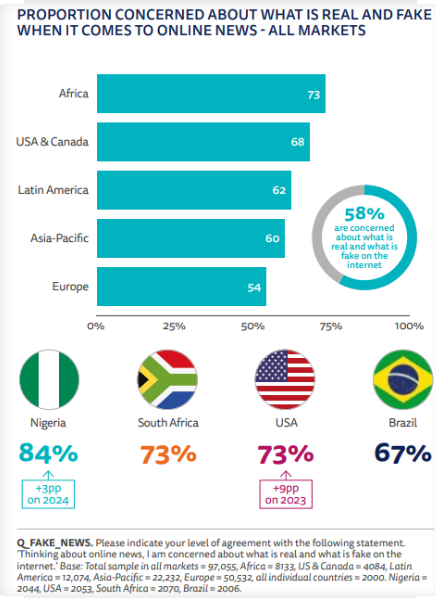
- Concerns regarding misinformation remain high – 58% of people are concerned about distinguishing real from fake news online
- Concern is highest in Africa (73%) and the US (73%), with lowest levels in Western Europe (46%)
- As mentioned, online influencers and personalities are seen as the biggest threat worldwide (47%), along with national politicians (47%)
- Trusted news brands and official sources are the most cited for fact-checking
- Younger users are more likely to use social media comments & AI chatbots to verify info
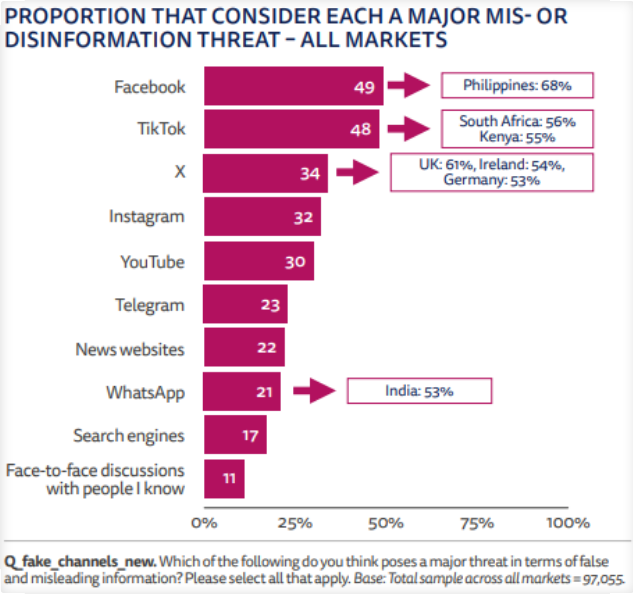
- Facebook and TikTok are considered top sources of misinformation across all markets
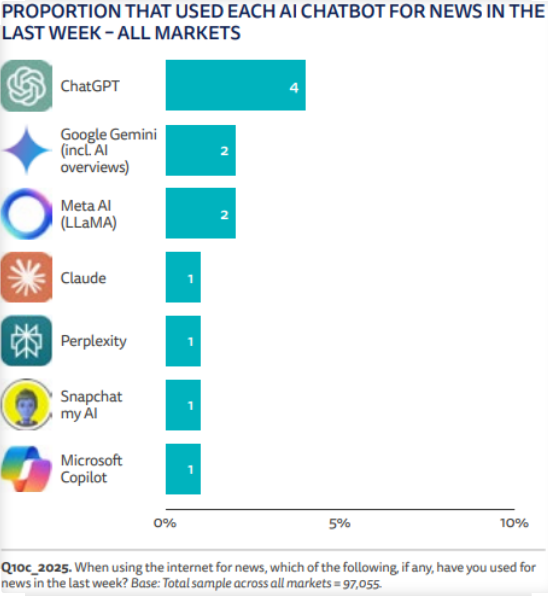
- ChatGPT is being used for news by only 4% of those polled, and all other Gen AI platforms are used to a lesser degree for that use case
- We’d note that a lot of the Gen AI platforms are not geared to pull up current news
- Audiences in most countries remain skeptical about the use of AI in the news and are more comfortable with use cases where humans remain in the loop
- Interest in AI personalization is highest for summarization, translation, and format adaptation (e.g. text-to-audio)
-> The report is based on a wide global survey conducted from mid Jan-end of Feb 2025 with a sample size of 97k
2025 US Ad Growth Is Not As Pressured As Magna Thought In March…
In March, Magna lowered its 2025 US ad growth projection from +5% y/y to +4.3% y/y (incl cyclical events) but this week tweaked that back up to +4.6% y/y growth. That was not all that surprising given that during the Q1 reporting season we, almost across the board, heard from advertising-based companies that they have yet to see any meaningful pullbacks in advertising as of that timeframe (but were cognizant that the environment could change given the fluid tariff and macro backdrop).
With that said, it is still below their estimate at the start of 2025 which, as mentioned, was at +5%. Magna this week also provided a new global forecast of +4.9% y/y for 2025 (incl cyclical events) which is also down from the +6.1% estimate at the start of the year. So bottom line, global and US ad revenue growth are both below the projections entering the year but the US is not as pressured as expected in March.
What about 2026? The global ad market is anticipated to re-accelerate to +6.3% y/y growth as the economy stabilizes and major events return, incl. Winter Olympics (Italy), FIFA World Cup (US), and US Midterms.
See the drill down on changes to Magna’s global and US ad growth forecasts for 2025 on both a cyclical and non-cyclical basis.
Relevant links:
Magna June 2025 Global Ad Forecast
Magna Dec 2024 Global Ad Forecast
Magna March 2025 US Ad Forecast
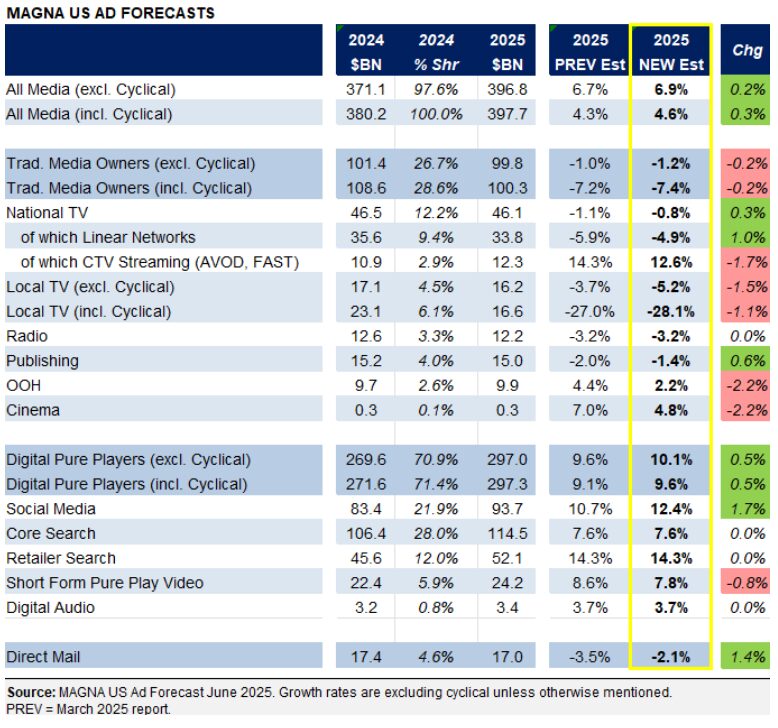
- Magna’s 2025 US ad growth estimate (incl cyclical events) was raised from +4.3% (as of March) to +4.6%, but it is still below the +5% growth forecast as of the start of the year
- Ex cyclical events, 2025 US ad growth projections incr’d from +6.7% y/y (March forecast) to +6.9%, reaching $397bn – the upgrade is due to strong 1Q25 performance (+9.1% excl. cyclical) and while growth will slow over the next 3 qtrs, it is expected to remain stable; All the below percentages are ex cyclical…
- Social media ad spend estimates were key upside drivers to the improved view from March to now: Digital ad spend coming from social media was revised up from +10.7% to +12.4%, which more than offset a slight negative revision to short form video ad revs (cut from +8.6% to 7.8%)
- Total digital ad growth was strong in Q1 (+13% y/y) and expect +10% y/y in 2025 to $297bn
- Search: +8% y/y in 2025
- Retail Media: +14%
- Social Media: +12%
- Short-Form Video: +8%
- For traditional media, 2025 estimates were slightly revised down from March, w/ local media ad spend projections cut the most (from -3.7% decline to -5.2%): The growth in CTV streaming was also revised down (from +14.3% to +12.6%) but lower losses in linear networks (-5.9% to -4.9%) helped to offset so the overall National TV ad revs declines were revised up from -1.1% to -0.8%
- Traditional media is projected to decline -1.2% in 2025
- National TV: -0.8% y/y (linear to fall -5%, but streaming up +12.5%)
- Local TV: -5.2%
- OOH: +2.2%
- Audio: -2% y/y
- Publishing: -1.4%
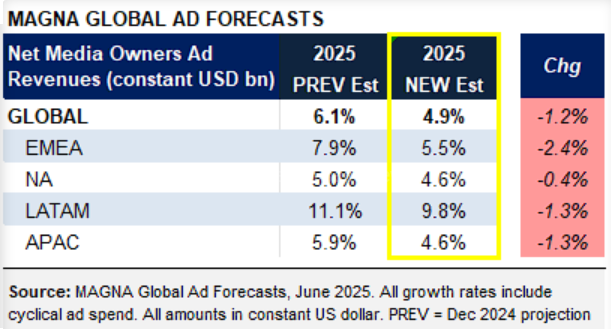
- Magna cut total 2025 global ad revs projections from +6.1% (December 2024 projection) to +4.9% to reach $979bn (incl cyclical events); This compares to +10.3% y/y growth in 2024 (helped by US Elections, Euro, Copa America, Summer Olympics); Non-cyclical ad spend is expected to slow from +8.9% y/y in 2024 to +6.2% in 2025
- But MAGNA still believes that most marketers will avoid repeating the over-drastic cuts seen during COVID and will maintain a balanced marketing and media mix to address consumer anxiety
- The negative revision also reflects the International Monetary Fund (IMF) cutting its 2025 global economic growth forecast from +3.2% as of October 2024 to +2.8% in its April 2025 update
- Export-based economies are particularly vulnerable to disruptions in international – Germany (0% expected growth) and Japan (+0.6%)
- EMEA saw the biggest % cuts in ad spend from +7.9% (December 2024 projection) to +5.5%
- Amer ad spend was cut by -0.4%
- Latam and APAC were both cut by -1.3%
- Expected global vertical performance in 2025 –
- At risk: Technology, Pharmaceuticals, Retail, and Automotive
- Resilient: CPG, Finance, Insurance, Telecoms, Healthcare, and Travel
- Drill down on global auto advertising…Project a -2% y/y decline (-3% in the US) in 2025 and believe 2026 will be pressured by the loss of US federal EV subsidies & new European regulations on Chinese vehicle imports
- MAGNA projects that premium long-form CTV streaming (Hulu, Netflix, Peacock, Prime, Joyn, RTL+, etc.) ad revenues now account for 15% of total long-form video ad revenue worldwide, totaling $23bn out of $155bn
- In more advanced markets like the UK and the US, this figure is already between 20-25%
- 2025 global regional drill down –
- Low single digit growth markets include Germany +3% & Japan +4% (higher exposure to disruption from trade)
- Other major manufacturing mkts may also be negatively impacted by a decline in US exports, including Vietnam, Mexico, and South Korea
- Trade hubs such as Singapore and Belgium may suffer from a reduction in the volume of global trade in the coming months
- Oil producers may be indirectly affected by the slowdown in Chinese and overall global demand
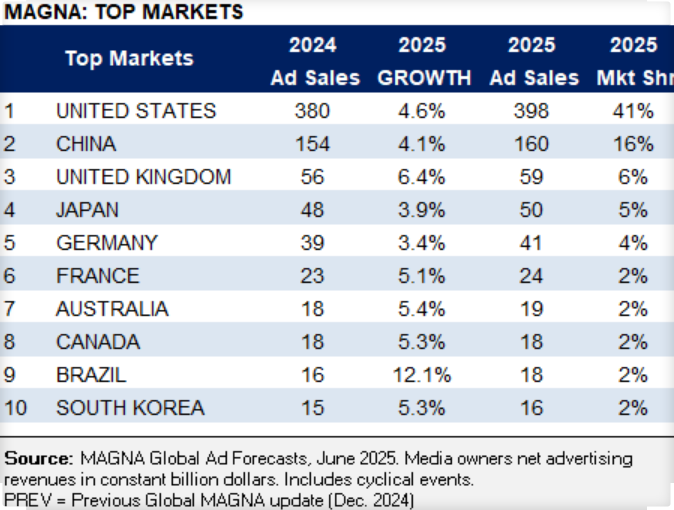
- The US ad mkt will grow +4.6% to $398bn (ex-cyclical +6.9%) as mentioned above – it remains the largest ad mkt in 2025, accounting for 41% of global ad spend, followed by China (17%), Japan, the UK, and Germany
- Together, these five largest ad markets concentrate 73% of global ad spend
- Mid to high single-digit growth markets include Canada / Australia/ France (+5%); Italy / Spain / UK (+6%); India (+8%)
- Low double digit markets include Brazil (+12%)
- Low single digit growth markets include Germany +3% & Japan +4% (higher exposure to disruption from trade)
- What about 2026? The global ad market is expected to re-accelerate as the economy stabilizes and major events return, incl. Winter Olympics (Italy), FIFA World Cup (US), and US Midterms
- Global ad sales are projected to rise +6.3% (incl cyclical event) surpassing one trillion dollars for the first time
- US ad market expected +7.8% y/y growth (+6.1% ex cyclical) to reach $429bn
Cannes Spurs A Slew Of New Ad Partnerships & Ad Platform Updates
It’s Cannes Lions week, and as expected, a wave of new advertising partnerships and platform updates were announced across the industry. Amazon was especially active, announcing integrations with both Disney and Roku that aim to broaden advertisers reach across its streaming inventory. Netflix expanded its programmatic capabilities with Yahoo’s DSP, while Omnicom revealed a series of partnerships, including with Disney, Amazon, PayPal, YouTube, Meta, and Walmart.
Over at the social media giants, after hinting at it for years, Meta finally took the plunge and announced that ads will be coming to WhatsApp for the first time. Meanwhile, Reddit introduced early-stage AI advertising features under its new Community Intelligence suite. And on the viewership front, YouTube Shorts hit 200bn daily views, while Tubi crossed 100mn monthly users.
More details are below.
A Whole Host Of Advertising Partnerships Unveiled At Cannes Lion This Week
- Amazon + Disney = Amazon Ads & Disney Advertising launch an integration between Disney’s Real-Time Ad Exchange (DRAX) and Amazon DSP (link)
- Gives buyers direct access to ad-tier inventory across Disney+ (126mn subscribers), Hulu (54mn subs) and ESPN+ (24mn subs) through Amazon’s DSP, while allowing them to leverage insights from both Cos to reach relevant audiences more efficiently
- For example, a pet food supplier can now target consumers that have an interest in buying pet food on Amazon and who also watch Disney
- Availability and timing: New integration will be available to all US advertisers that use Amazon DSP beginning in Q3:25
- Gives buyers direct access to ad-tier inventory across Disney+ (126mn subscribers), Hulu (54mn subs) and ESPN+ (24mn subs) through Amazon’s DSP, while allowing them to leverage insights from both Cos to reach relevant audiences more efficiently
- Amazon + Roku = Announced partnership creating “the largest authenticated CTV footprint” (link/link)
- Amazon’s demand-side platform (DSP) will be used to place ads on top-viewed platforms like the Roku Channel and Prime Video along with other services available via Roku and Fire TV operating systems
- The collaboration delivers logged-in reach to an est’d 80mn US CTV households, per ComScore data
- Early tests have shown “significant” results: Advertisers using this new solution reached 40% more unique viewers w/ the same budget and reduced how often the same person saw an ad by ~30%, enabling advertisers to benefit from 3x more value from their ad spend
- Availability and timing: New svs will be available to all US advertisers that use Amazon DSP by Q4:25
- Amazon’s demand-side platform (DSP) will be used to place ads on top-viewed platforms like the Roku Channel and Prime Video along with other services available via Roku and Fire TV operating systems
-> Roku closed up +8.4% on the day of the announcement
- Netflix + Yahoo = Netflix expands programmatic availability w/ Yahoo DSP (link)
- Enables buyers to purchase Netflix advertising through Yahoo programmatically
- Yahoo DSP will join The Trade Desk, Google Display and Video 360, and Microsoft as Netflix’s programmatic partners
- Availability and timing: Will be available later this yr in all 12 of Netflix’s ad-supported countries
- Enables buyers to purchase Netflix advertising through Yahoo programmatically
- Omnicom unveiled several deals, including w/ – (link)
- Streaming, retail & data-driven partnerships –
- Disney: Partnering to help brands capitalize on major live sports moments (i.e., NFL games) with increased personalization and relevance, using a custom algorithm built for Disney’s “Magic Words” tool
- Amazon: Leveraging Amazon’s expanded Thursday Night Football (TNF) audience data to enable more informed, real-time campaign decisions during TNF broadcasts
- PayPal: Connecting streaming TV ad inventory with PayPal’s cross-merchant purchase data, enabling clients to bid on live and pre-recorded streaming ads based on actual consumer buying behavior
- Influencer & social partnerships –
- YouTube: Previously only available as part of broader media buys, YouTube’s new partnership with OMC enables clients to directly target high-traffic livestreams and activate messaging across relevant influencers, powered by live signals integrated into Omnicom’s Influencer Discovery Agent
- Meta: Through Facebook’s Live Partnership Ads program, clients can boost creator-led livestreams into paid ads and gain insight into influencer performance to inform future activations on Omnicom’s Influencer Discovery Agent
- X: Tapping into X’s real-time trends data and using it for brand and creative execution on X, as well as for influencer discovery and activation
- Walmart: Gain access to Walmart’s audiences, which will then be used to accelerate the discovery of influencers who have a proven ability to drive purchases for the retailer
- Streaming, retail & data-driven partnerships –
Meta Annc’d Ads Are Coming To WhatsApp + New Advantage+ Features
- WhatsApp annc’d that it would start showing ads inside its app for the first time (link)
- Will appear within WhatsApp’s “Updates” tab, which allows users to share disappearing text, photo, voice notes, or video messages
- The Updates tab is used by as many as 1.5bn people each day
- That said, ads will not appear where personal chats are located
- What will be used to determine what ads are seen?
- Will use “limited” info like country or city, language, the Channels users are following, and how the user interacts w/ ads they see
- For users that have chosen to add WhatsApp to Accounts Center, WhatsApp will use ad preferences and info from across the user’s Meta accounts
- “Built these features in the most private way possible”
- Personal messages, calls, and groups the user is in will not be used to determine the ads seen
- Will “never” sell or share phone numbers to advertisers
- Personal messages, calls, and statuses will remain end-to-end encrypted
- WhatsApp also annc’d two other monetization features –
- Channel subscriptions: Users can subscribe to channels to receive exclusive updates for a monthly fee
- Promoted Channels: Enables business owners to pay to promote their channel’s visibility to new users
- The features will start to appear for users “over the next several months”…with an exception (see below)
- Will appear within WhatsApp’s “Updates” tab, which allows users to share disappearing text, photo, voice notes, or video messages
- WhatsApp ads will not in EU until 2026 (link): After Meta made the announcement on Monday (June 16th), the Irish Data Protection Commission said on Thursday (June 19th) that the Co will be delaying the launch in the EU until 2026
- “That new product won’t be launching [in] the EU market until 2026. We have been informed by WhatsApp and we will be meeting with them to discuss any issues further,” said Commissioner Des Hogan
- He added that the advertising model will be discussed with other data protection authorities “so that we can reflect back any concerns which we have as European regulators”
- That said, a spokesperson for WhatsApp said that the ads are a global update, being rolled out gradually
- “That new product won’t be launching [in] the EU market until 2026. We have been informed by WhatsApp and we will be meeting with them to discuss any issues further,” said Commissioner Des Hogan
- Also on Meta’s ad front…expanding Advantage+ with a new set of generative AI features for advertisers and agencies (link)
- Consistent branding at scale, enabling advertisers and agencies to integrate logos, colors, fonts, and more to customize their creative
- New video generation capabilities, enabling advertisers to transform images into dynamic videos with animations, text overlays, and music (still in the testing phase)
- Video highlights, in which AI pulls out a few key phrases and scenes to better convey a product’s value proposition (still in testing phase)
- New Business AI tools include voice capabilities, AI-generated prompts, and FAQ buttons for ads
- New ad placements on Instagram Stories and Facebook Reels (US only)
- Expanding the test audience for customer experiences such as Virtual Try-On, which showcases clothing on virtual models of different shapes and sizes
- Creative Sticker call-to-action (CTA) buttons allow brands to create customized stickers of products, slogans, and graphics with call-to-action elements
- Expect these new features to help drive performance for advertisers and agencies –
- Sales campaigns using the existing version of Advantage+ already see +22% average lift in ROAS
- Back-end AI innovations, such as Meta GEM (its generative ads recommendation model) are improving ad conversions by up to 5%
Reddit Rolls Out New AI Advertising Features
- Reddit intro’d Reddit Community Intelligence (link)
- What is it? A collective knowledge engine that turns Reddit’s 22bn+ posts and comments into structured intelligence for smarter marketing decisions
- Unveiled two early-stage products powered by Reddit Community Intelligence –
- Reddit Insights (Alpha): A “scalable, AI-powered social listening tool”; Shares real-time insights with marketers to help them identify trends and launch campaigns
- Conversation Summary Add-ons (Alpha): Allows brands to show “positive” user content under their ads
- Early tests already showing success: Conversation Summary Add-Ons resulted in a +19% higher clickthrough rate than standard image ads
- Reddit’s Community Intelligence will power more products to come
-> Reddit closed up +6.8% on the day it annc’d the ad tools and closed the week +18%
Ad-Supported Platform Viewership Updates From YouTube And Tubi
- YouTube Shorts now avg 200bn daily views (link)
- ~186% increase in daily viewership vs yr ago: In March of 2024, YouTube reported that its Shorts offering was averaging 70bn daily views since its launch in 2021
- Viewers are also watching 1bn+ hours of YouTube on their TVs daily
- For more than half of the top 100 most-watched YouTube channels in the world, TV is their most-watched screen
- YouTube also accounted for 12.5% of all TV viewership during in May, the largest share of overall viewership any streamer or channel, per Nielsen’s The Gauge report
-> YouTube CEO Neal Mohan also annc’d that Veo 3 will be coming to YouTube later this summer; Veo, Google DeepMind’s video generation model, allows users to create AI-generated backgrounds and video clips for Shorts; Previously, YouTube Shorts’ Dream Screen option ran on Veo, but the introduction of Veo 3 will improve the video quality of these backgrounds and give users the option of incorporating audio (link)
- Tubi exceeds 100mn monthly active users and surpasses 1bn hrs of total viewing time in May (link)
- Tubi also reached an all-time high of 2.2% of total TV viewing minutes in May 2025, according to The Gauge, which tracks monthly TV and streaming usage in the US
- More than 95% of viewing on Tubi is on–demand movies and TV shows, differentiating the platform vs other FAST platforms that skew towards live, linear channel viewing
- Nearly 1 in 4 Tubi viewers are watching a Tubi Original
- Over half of Tubi viewers are Gen Z or Millennials and 67% are cord cutters and cord nevers, according to the March MRI Cord Evolution Study, cited by Tubi
Netflix’s Taking A Page Out Of The Disney Playbook
Netflix pioneered the age of streaming, but in recent years it’s slowly but surely been on a path to transform into a broader entertainment company, branching into advertising, live sports, gaming, and more.
That evolution was at the top of our mind this week with two major announcements from the Co on the distribution and live entertainment front. In France, Netflix announced a “first-of-its-kind” distribution deal with TF1 Group, giving French subscribers access to both live channels and on-demand content from the country’s biggest broadcaster, all within the Netflix platform. And on the experiential side, Netflix revealed Las Vegas as the third location for its immersive Netflix House concept, a permanent space where fans can step into the worlds of their favorite shows. The first two locations are set to open later this year in Philadelphia and Dallas.
Netflix’s ambitions are clearly moving beyond just streaming, aiming to become a fully integrated media company that uses its IP to connect with audiences across a variety of platforms and experiences. In many ways, it’s following a playbook similar to traditional media giants like Disney and NBCUniversal, who have built their bizs around theme parks, broadcast TV, and streaming, but Netflix is putting its own modern spin on that formula. See below for more color on the updates.
- Netflix takes a step into broadcasting this week w/ a “first-of-its-kind partnership”….announces distribution partnership w/ France’s TF1 Group (link/link)
- BOTH live channels and on-demand content will be available to Netflix members in France as part of their existing subscription beginning Summer 2026
- Includes all 5 of its linear channels, as well as 30k+ hours of TV shows available on demand
- The carriage deal will enable French Netflix subscribers to watch major live sports matches, scripted dramas like Broceliandeand Erica, soap operas such as Demain nous appartient, and unscripted shows like The Voice
- TF1 network holds ~24% of the French linear TV market, higher than the domestic US market share for NBC, CBS, ABC, or Fox
- TF1 Group reaches 58mn monthly viewers through its broadcast channels and serves 35mn users on its TF1+ streaming service
- Back in 2022, Netflix co-chief Ted Sarandos said the streaming platform had surpassed 10mn subscribers in France
- TF1 does NOT expect the partnership to cannibalize TF1’s existing audience: Instead, per group CEO Rodolphe Belmer said the partnership is “highly positive for us”
- Financial details were not disclosed, but for Netflix, this deal may also contribute towards a legal requirement to invest a portion of its French revenue into French-language content (link)
- This is the first time Netflix has done such a deal, therefore the Co will first see how the partnership works before exploring further tie-ups with other broadcasters
- BOTH live channels and on-demand content will be available to Netflix members in France as part of their existing subscription beginning Summer 2026
-> Separately, but related, FOX annc’d its acquisition of Caliente TV, a leading sports broadcasting platform in Mexico. With the acquisition, FOX will develop a multi-platform business that will include the launch of a new Pay TV channel and an SVOD platform that will join Tubi, producing and distributing 3,000+ hours of original sports content. The deal also brings a broad portfolio of premium sports rights, including six Liga MX men’s clubs, ten Liga MX women’s clubs, UEFA Champions League, Premier League, CONCACAF Champions Cup, and more, expanding FOX’s presence across Latin America (link)
- Netflix is also making more moves in live entertainment/theme parks… the Co annc’d a third location for its Netflix Houses as it gets ready to open the first two later this year (link)
- What is Netflix House? “Spanning more than 100k sq ft, Netflix House is a permanent, yr-round home for fans that brings some of our most popular shows and movies to life…through first-of-their-kind immersive story-driven experiences”
- “Building on more than 40 previous live experiences for Bridgerton, Money Heist, Stranger Things, Squid Game, The Perfect Bite, and NETFLIX BITES, Netflix House is the next step, allowing fans of all ages to become the main characters in their favorite stories”
- Annc’d Las Vegas as its third destination and it is set to open in 2027: Will be located in the heart of the Las Vegas Strip at BLVD Las Vegas
- Also opening up the first two locations later this yr at King of Prussia mall outside Philadelphia and Galleria Dallas in Dallas
- Each location’s attraction will slightly vary, with Philadelphia currently set to open attractions based on Wednesday and One Piece, whereas Dallas will feature attractions built around Stranger Things andSquid Game
- Both locations will feature a store offering exclusive merchandise that will be refreshed regularly and NETFLIX BITES, a laid-back restaurant serving food and craft cocktails inspired by popular Netflix stories and characters
- What is Netflix House? “Spanning more than 100k sq ft, Netflix House is a permanent, yr-round home for fans that brings some of our most popular shows and movies to life…through first-of-their-kind immersive story-driven experiences”
How Much Are Employees Actually Using AI At Work?
There were also several standouts this week that furthered the debate about AI and the future structure of the workforce. First, a new Gallup Poll shed some light on the status of AI being used by US employees in the workplace. Namely, AI adoption has surged, with daily use doubling in the past year and nearly 1 in 5 employees now using AI a few times a week or more. Adoption is highest among white-collar workers, especially in tech, professional services, and finance, and among senior leaders, who are 2x as likely as individual contributors to use AI frequently. HOWEVER, only 16% of users strongly agree that their organization’s AI tools are useful, and most companies lack a clear strategy or policy for AI integration. Lastly, the vast majority of these employees are NOT worried about being replaced by AI.
But if they are listening to comments out of Amazon and taking note of a few other job cut announcements, perhaps they would be more worried. Fed Chair Jerome Powell also fielded a question on this subject at this week’s FOMC meeting.
See key updates on this theme below.
The New Gallup Poll On AI In The Workforce…(link)
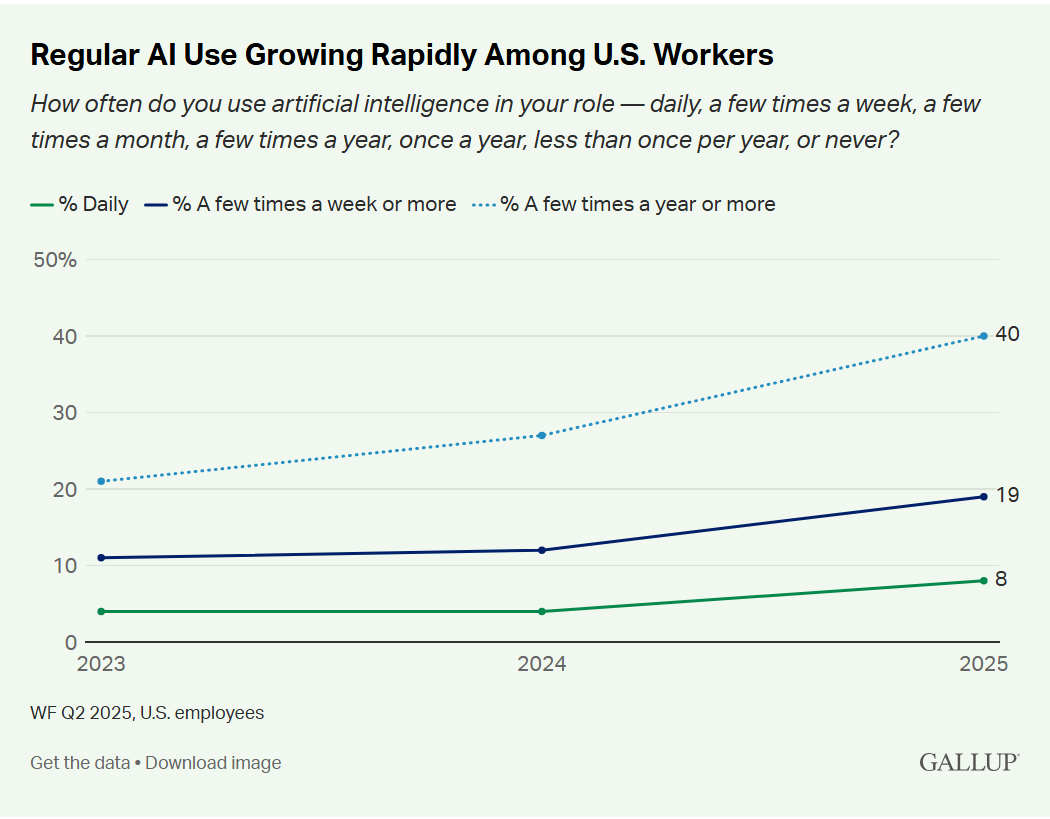
- The percentage of US employees who say they have used AI in their role based on frequency –
- A few times a year or more = nearly doubled, from 21% to 40%
- A few times a week or more = nearly doubled, from 11% to 19%
- Daily use = doubled in the past 12 months alone, from 4% to 8%.
- What types of jobs are seeing increased AI adoption? Primarily white-collar roles
- 27% of white-collar employees report frequently using AI at work, an increase of +12ppts since 2024
- 9% of production / front-line workers report frequently using AI at work, which is actually down from 11% in 2023
- The industries w/ the highest percentages of frequent AI users include –
- Technology = 50%
- Professional services = 34%
- Finance = 32%
- How about based on seniority levels? Frequent AI use is also more common among leaders (defined as managers of managers) at 33%
- They are 2x as likely as individual contributors (16%) to say they use AI a few times a week or more
- US employees overall are not worried about being replaced by AI
- Only 15% of employees say it is very or somewhat likely that automation, robots or AI will eliminate their job w/in the next 5 years, unchanged from 2023 and 2024 measures
- But employees view some industries as more at risk of AI eliminating jobs such as technology (21%), retail (21%), and finance (20%)
- Only 15% of employees say it is very or somewhat likely that automation, robots or AI will eliminate their job w/in the next 5 years, unchanged from 2023 and 2024 measures
- More firms are integrating AI into workflows than are actually providing a clear plan or strategy for doing so
- 44% of employees say their organization has begun integrating AI
- 22% say their organization has communicated a clear plan or strategy for doing so
- 30% of employees say their organization has either general guidelines or formal policies for using AI at work
- The benefits of using AI in the workplace are unclear at this point
- For those that are using AI, only 16% strongly agree that the AI tools provided by their organization are useful for their work
AI Related Job Cut Updates Of Note This Week
- Amazon CEO Andy Jass, in a letter to employee, touched on how the Co is leveraging and rolling out Gen AI across its business – at the end, he said…(link)
- Expect fewer employees…“we will need fewer people doing some of the jobs that are being done today, and more people doing other types of job…in the next few years, we expect that this will reduce our total corporate workforce as we get efficiency gains from using AI extensively across the company”
- He urged employees to… “be curious about AI, educate yourself, attend workshops and take trainings, use and experiment with AI whenever you can, participate in your team’s brainstorms to figure out how to invent for our customers more quickly and expansively, and how to get more done with scrappier team”
- There will be some left standing…“Those who embrace this change, become conversant in AI, help us build and improve our AI capabilities internally and deliver for customers, will be well-positioned to have high impact and help us reinvent the company”
- Microsoft reportedly is planning to cut thousands of jobs, particularly in sales, as it streamlines its workforce amid incr’d investments in AI: This press follows Microsoft’s previous round of job cuts in May, which affected about 6k employees (link)
- The layoffs are expected to be annc’d early next month per the report
- Fed Chair Jerome Powell at this week’s FOMC mtg when asked about the impact of AI on the workforce… (link)
- “This is something that has transformational potential and we are probably at the early stages. I think it is hard to know. Some optimists think it will make people more productive, and others think that it will be disruptive. I don’t have a house view on that”
- The question is about whether the technology will “augment” or “replace” labor, which is “really hard to know”
- BUT “I wouldn’t overread a couple of data points, because AI should be creating jobs at the same time”
Robotaxis Want To Take A Bite Out Of The Big Apple!
There were a few quick, but important, developments related to autonomous cars and robotaxis that made our top themes list this week. Namely…
Waymo Aims To Expand Into NYC & Also Expands Its CA Coverage By ~50%
- Waymo aims to expand into NYC (link/link): The Co annc’d plans this week to launch a fully autonomous robotaxi svs in NYC
- It applied for a permit from NYC’s Dept of Transportation to test vehicles w/ safety drivers
- If approved, this would be the first permit under the city’s new AV testing framework
- Current state law mandates a human operator be present and ready to take control of AVs
- Waymo is lobbying to change that
- A bill was introduced in the NY State Legislature earlier this year that would permit Avs w/out safety drivers “provided that the automated driving system is engaged and the vehicle meets certain conditions”; The bill is currently under consideration by the state Senate’s transportation committee
- Some lawmakers, like State Sen. John Liu, have expressed caution, suggesting NYC should wait for more results from other cities before proceeding w/ driverless testing
- NYC has its challenges for AVs w/ dense and busy streets
- AVs typically perform best in environments w/ clear signage, good weather, and predictable traffic behavior
- Next steps –
- While it waits for the permit, the Co will begin mapping Manhattan streets next month using manually driven vehicles
- It applied for a permit from NYC’s Dept of Transportation to test vehicles w/ safety drivers
- Waymo also expanded California coverage by ~50% (link/link/link): It added 80+ sq miles across SF, Silicon Valley, & LA, bringing the total coverage in CA to ~250 sq miles
- Service availability & limitations –
- SF & LA are fully public
- Silicon Valley is still in limited release
- SF & Silicon Valley zones are not connected – no cross-zone rides
- No svs to SFO or LAX; Coverage stops just short of airport zones
- Palo Alto & Santa Monica airports are included, but are minor
- Highway driving is available in SF for some users; Still in testing in LA
- Service availability & limitations –
- Waymo current status & plans –
- # of robotaxis it operates: 1,500
- Aims to add 2,000 more by 2026.
- Cities where commercially active: SF, LA, Phoenix, & Austin
- Plans to launch by 2026: Atlanta, Miami, & Washington, DC
- # rides: Provides over 250k paid rides weekly through its Waymo One service
- # of robotaxis it operates: 1,500
Amazon’s Zoox Moves Toward Full Production
- Amazon’s Zoox opened a 220k sq ft factory in Hayward, CA – its first full-scale production site (link/link/link): This complements a smaller Fremont facility used for test fleet assembly and sensor configuration
- Production scale plan: Currently producing 1 robotaxi/day; aims to scale to 10k/year (~3/hr)
- No timeline given for reaching full capacity
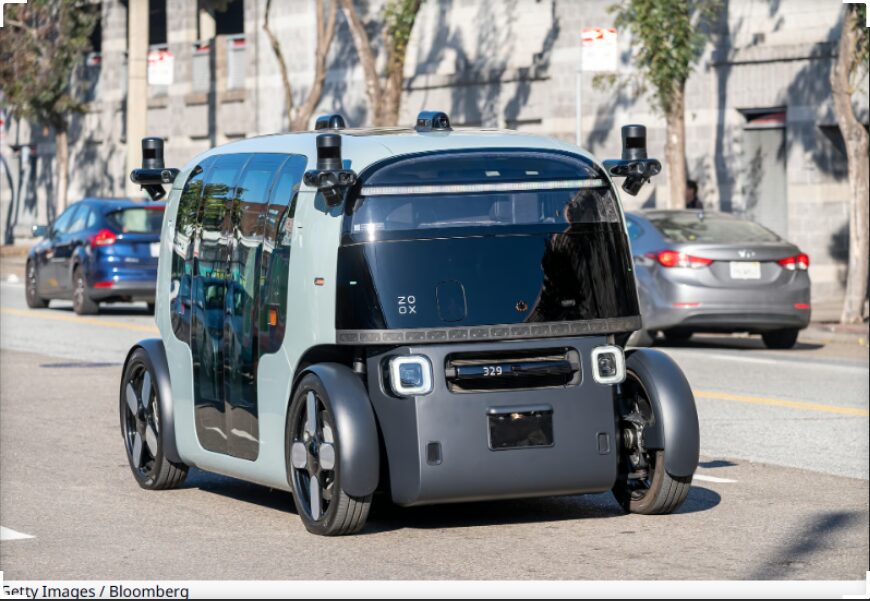
- Vehicle design dramatically contrasts Waymo and Tesla: It has “carriage-style” robotaxis w/ no steering wheel/pedals & seats 4 passengers facing each other (see picture below)
- Current status & rollout plans:
- Testing in: Foster City, SF, and Las Vegas
- Early rider program active in: Las Vegas; SF to follow later in 2025
- Paid public rides in: Las Vegas launch planned by end of 2025; SF launch planned for 2026; Austin & Miami are targeted for future expansion
- Plan to operate 500–1,000 robotaxis in small-to-mid-sized cities
- Riders will use an app to hail Zoox vehicles, similar to Uber and Lyft
- Production scale plan: Currently producing 1 robotaxi/day; aims to scale to 10k/year (~3/hr)
–> Tesla’s robotaxi launch in Austin is imminent (June 22) as well…
Grab Bag: TikTok Deadline Gets Extended / JD.com Pushes Into The Hotel Biz / Senate Passes GENIUS Act
- Trump extends TikTok sale deadline for a third time (link/link)
- TikTok now has until Sept 17th to find an American buyer: The previous deadline was June 19th
- While there is no clear legal basis for the extensions, so far there have been no legal challenges to fight them (link)
- TikTok reacts: “We are grateful for President Trump’s leadership and support in ensuring that TikTok continues to be available for more than 170 million American users and 7.5mn US businesses that rely on the platform as we continue to work with Vice President Vance’s Office”
- Extension doesn’t come as a surprise: Back in May, when asked about another extension, Trump said, “Probably, yeah. Probably have to get China approval but I think we’ll get it. I think President Xi will ultimately approve it”
- TikTok now has until Sept 17th to find an American buyer: The previous deadline was June 19th
- JD.com announces “JD Hotel PLUS Membership Program” (link/link)
- In “An Open Letter to All Hoteliers JD.com said –
- In recent years, the tourism market has become increasingly prosperous, and demand has been more diversified
- com wants to work w/ the hotel industry to offer supply chain svs and optimize costs in order to jointly grasp growth oppties as the hotel industry develops
- Hotel merchants who join the program will get up to 3 yrs of zero commission on the platform
- com aims to reduce the operational costs of hotels and restaurants by 2/3 through these svs
- Hotels can leverage JD.com’s 800mn+ high-spending users nationwide and the Cos alliances with 30k+ large and 8mn+ small and medium-sized suppliers
- JD.com has some experience in the sector: The Co launched flight booking services in 2011, established a travel channel in 2014, and has accumulated supply chain resources through investments in Chinese online travel agency Tuniu and strategic cooperation with Ctrip
- JD.com has reportedly been hiring for travel-related roles: Seeking candidates with experience at major online travel agency Ctrip or Meituan in particular, and offering salaries triple the industry norm for product managers, system architects, aviation operations, and other core roles, per Chinese media outlet The Paper
- In “An Open Letter to All Hoteliers JD.com said –
-> Trip.com fell -6.8% on the day of the announcement, while Meituan fell -3.2%
- Senate passes GENIUS stablecoin bill (link)
- What is the GENIUS Act? A bill that for the first time established federal guardrails for US dollar-pegged stablecoins and creates a regulated pathway for private Cos to issue stablecoins under strict guardrails, including full reserve backing and monthly audits
- The bull passed with a 68-30 vote
- Bill still needs to get signed into law: The bill will go to the House, which has its own version of a stablecoin bill dubbed STABLE; Both prohibit yield-bearing consumer stablecoins, but diverge on who regulates what
- The Senate version centralizes oversight with Treasury, while the House splits authority between the Federal Reserve, the Comptroller of the Currency, and others
- Reconciling the two could take a while, esp as House Republicans weigh attaching a broader market structure package, according to congressional aides
- What is the GENIUS Act? A bill that for the first time established federal guardrails for US dollar-pegged stablecoins and creates a regulated pathway for private Cos to issue stablecoins under strict guardrails, including full reserve backing and monthly audits
-> Circle shares closed up +33.8%, Coinbase surged +16.3% and Robinhood (which offers crypto trading) gained +4.5%; On the other hand, legacy payment stocks fell on the back of the news, with Mastercard closing down -5.4%, Visa down -4.9%, and PayPal down -3.0%
Stock Market Check
This Week's Other Curated News
Advertising/Ad Agencies/Ad Tech
- Dentsu has begun integrating AI-generated “synthetic audiences” into its media planning via a partnership w/ Evidenza, aiming to enhance speed, scale & insight depth. These bots mimic real consumer behavior, enabling faster, cost-effective research. The initiative blends synthetic data into Dentsu’s CCS panel, boasting a 0.87 correlation w/ traditional methods. (MediaPost)
- Sky, ITV & Channel 4 are launching a joint premium video ad marketplace in 2026, aiming to challenge Big Tech’s ad dominance. Powered by Comcast’s Universal Ads platform, the self-serve system lets SMEs run unified campaigns across all three broadcasters’ streaming/on-demand svs. It simplifies TV ad buying w/ biddable pricing & tools, targeting brands used to digital platforms. (The Guardian)
- The UK’s CMA launched a probe into the proposed $13. 25bn merger between Omnicom & Interpublic to assess potential harm to competition in UK ad mkts. The inquiry follows a formal notification from the cos. The CMA will decide by 13 Aug 25 whether to escalate to Phase 2. (Reuters)
- Google annc’d a beta test enabling 30-sec non-skippable ads in regular YouTube auctions, previously limited to premium Reservation buys. This move expands access to high-impact formats, allowing cos to use combo formats (15-sec, 6-sec bumper) w/ advanced targeting. It democratizes premium inventory, enabling deeper storytelling & real-time optimization. Viewer response remains uncertain as Google monitors metrics (Cord Cutters News)
Artificial Intelligence/Machine Learning
- Canada to invest $120mn to build AI chip packaging facility in Bromont, Que. , in partnership w/ IBM. Champagne said the project will create 280 jobs and boost Canada’s role in global AI chip supply chain. The facility will support R&D and advanced packaging, aligning w/ Canada’s $2.4bn AI strategy (Yahoo Finance Canada)
- Uber annc’d a major expansion of its AI data svs biz, Uber AI Solutions, offering global enterprises and AI labs access to its tech for smarter model training. New features include a global digital task platform in 30 countries, a data foundry for custom datasets, tools for agentic AI, and shared infrastructure for AI builders. Uber aims to be the human intelligence layer for AI, w/ plans for a plain-language interface to streamline AI training workflows (Street Account)
- Data labeling startup LlamaIndex has outpaced Scale AI in rev, reaching ~$60mn ARR w/o external funding. Its open-source tools gained traction among AI cos like OpenAI & Meta. Founder Jerry Liu, ex-Robust Intelligence, built LlamaIndex to simplify data integration for LLMs. (The Information)
- OpenAI warned that future models may pose higher bioweapons risks, especially enabling “novice uplift”—helping non-experts replicate known bio threats. While not predicting novel bioweapon creation, OpenAI is enhancing safeguards and testing under its preparedness framework. The Co plans to convene nonprofits and gov’t researchers to address these risks. (Axios)
- Midjourney launched its first AI video model, V1, enabling users to animate still images into 5–20 sec clips using motion prompts or auto synthesis. The tool supports both image-to-video and text-to-video, with low/high motion modes. The debut drew praise but arrives amid lawsuits from Disney & Universal over alleged copyright violations. Midjourney plans to expand into 3D and real-time AI. (VentureBeat)
- Microsoft may exit talks w/ OpenAI over its for-profit conversion due to unresolved issues like stake size and rev rights. While both sides meet daily, Microsoft could rely on its current contract—valid till 2030—if no deal is reached. OpenAI risks losing billions in funding if the switch isn’t approved by year-end. Microsoft is also diversifying AI partners, including xAI. (Financial Times)
- Google’s AI Mode now supports back-and-forth voice convos via Search Live, letting users ask follow-ups and get spoken responses. Accessed through the Google app’s “Live” icon, it enables multitasking and deeper exploration w/ on-screen links. Powered by a custom Gemini model, it uses query fan-out for diverse results. Future updates will add real-time camera-based queries, previewed at Google I/O. (TechCrunch)
- HarbourView Equity Partners is leading an $85mn investment in Animaj, an AI-powered kids & family media Co. France’s Bpifrance also joined the round. Animaj, co-founded by ex-Google exec Gregory Dray, uses GenAI tools to automate animation and revitalize global IPs like “Pocoyo.” The Co’s AI-driven model spans YouTube, Roblox, TikTok, Spotify & FAST channels. New funds will scale its tech and global reach (Variety)
- California lawmakers are reviving efforts to regulate AI giants, proposing new legislation that mandates transparency, safety testing, and accountability for AI systems. The bill targets cos like OpenAI and Google, requiring disclosures on training data and risk mitigation. Critics argue it may stifle innovation, while supporters stress the need for guardrails amid rapid AI adoption. (The Verge)
- AWS is challenging Nvidia’s AI dominance by scaling its custom chip strategy. Its Trainium2 chips now power Anthropic’s Claude Opus 4 via Project Rainier, which uses over 500K chips. AWS also upgraded its Graviton4 CPU, offering 600GB/s bandwidth. While Nvidia’s Blackwell outperforms Trainium2, AWS claims better cost-efficiency. Trainium3, launching later this yr, will double performance and cut energy use by 50% (CNBC)
- Amazon, Google, Microsoft & Meta are lobbying for a 10-yr freeze on state-level AI regulations, pushing for uniform federal oversight via a provision in Trump’s budget bill. They argue state laws hinder innovation and national competitiveness. Critics, including 140+ orgs and lawmakers, warn it’s a power grab that removes accountability and shields cos from consequences of harmful AI. The Senate may vote on the bill by Jul.4 (PYMNTS)
- Elon Musk’s AI startup xAI is burning ~$1bn/month, expecting to spend $13bn in 2025 as infra & chip costs surge. Despite raising $14bn since 2023, only $4bn remained by Mar 2025. xAI is now seeking $9.3bn in debt/equity, w/ plans to use over half in 3 months. Rev lags peers—$500mn in 2025 vs. OpenAI’s $12.7bn—but may exceed $2bn in 2026. (Bloomberg)
- Mattel is partnering w/ OpenAI to co-develop AI-powered toys & experiences across its brands like Barbie & Hot Wheels. The Co will use ChatGPT Enterprise to enhance product dev & employee productivity. The first AI-integrated product will be annc’d later this yr. Mattel emphasizes privacy & safety, aiming to inspire play while cutting costs—targeting $200mn in savings by 2026. (Retail Dive)
- Google’s Gemini app now supports video uploads for analysis on Android and iOS, letting users attach clips alongside prompts to ask questions or request descriptions. This expands Gemini’s multimodal capabilities beyond text, images & docs. The feature includes a full video player UI but isn’t yet live on web, and upload access varies by account/device. Gemini’s camera still can’t capture video. (9to5Google)
- OpenAI–Microsoft tensions have escalated as OpenAI considers accusing Microsoft of anticompetitive behavior and seeking a federal antitrust review. The rift stems from OpenAI’s push to restructure into a for-profit entity—requiring Microsoft’s approval—and its $3bn Windsurf acquisition, which Microsoft wants IP access to. OpenAI aims to reduce Microsoft’s rev share by 2030 and diversify cloud partners, while Microsoft resists losing control over AGI breakthroughs. (Wall Street Journal)
- Google, Scale AI’s top client, plans to cut ties after Meta acquired a 49% stake in the AI data-labeling startup, valuing it at $29bn. Google had planned to spend ~$200mn in 2025 but is now exploring alternatives due to concerns over proprietary data exposure. Other cos like Microsoft, xAI & OpenAI are also distancing. Scale AI earned $870mn rev in 2024. Meta’s move raises competitive concerns across AI mkts. (CNBC)
- BT Group CEO Philip Jansen warned that rapid AI advances could lead to significant job losses, especially in customer svs and back-office roles. He emphasized the need for reskilling as AI transforms biz ops. BT is already using AI to streamline processes, aiming to cut ~55,000 jobs by 2030. (Telecompaper)
Audio/Music/Podcast
- SiriusXM says marketing mix modeling (MMM) could unlock more digital audio ad spend—if brands get better data. Audio gets 25% of media time but just 8% of ad spend. To fix this, SiriusXM is integrating w/ Innovid to provide impression-level data, enabling parity w/ other digital channels. The goal: prove digital audio’s incremental reach and performance, especially when paired w/ social or CTV buys (AdExchanger)
Cable/Pay-TV/Wireless
- T-Mobile US annc’d 3 new prepaid plans under its Connect by T-Mobile brand, starting at $10/mo. The plans include unlimited talk/text and data options ranging from 1GB to 10GB, plus a $40/mo unlimited plan. Designed for budget-conscious users, the plans offer access to T-Mobile’s 5G network and are available online and in stores. The move aims to attract value-seeking customers amid rising wireless competition (Telecompaper)
- Trump Mobile annc’d T1 Mobile, a new wireless svs offering unlimited talk, text & data for $47. 45/mo. Launched on June 16th, it includes 5G via all 3 major carriers, device protection, roadside assistance, telehealth, & free intl. calling to 100+ countries. The Co emphasizes US-based ops, no contracts, & real-person support. A gold “T1 Phone” is set to debut in Aug. (com)
- SoftBank annc’d plans to sell 21. 5mn T-Mobile shares via a block trade, aiming to raise ~$4.9bn. The shares were priced at $224 each, a ~3% discount to the prior close. The move reduces SoftBank’s stake but supports its pivot toward AI investments, including potential $30bn in OpenAI and data infra. T-Mobile shares dipped post-annc’t, while SoftBank stock rose in Tokyo (Bloomberg)
Capital Market Updates
- Private equity firms are sitting on $1tn in dry powder as M&A activity stalls amid economic and geopolitical uncertainty, per PwC. Deal volume dropped 30% YoY in H1’25, w/ firms cautious due to high interest rates and valuation gaps. Sectors like tech and health care remain active, but exits are delayed. PwC expects a rebound in late 2025 if macro conditions stabilize and rate cuts materialize. (Reuters)
- Global IPO activity has slumped in 2025, w/ total proceeds down ~9. 3% YoY to $44.3bn due to U.S. tariffs, mkts volatility & high interest rates.S. IPOs fell 12% to $12.3bn, Europe plunged 64% to $5.8bn, while Asia-Pacific rose 28% to $16.8bn. On Wed(Jun.5), Chime surged on debut, signaling possible rebound. CATL led w/ $4.6bn raise. Analysts see late-yr recovery if mkts stabilize (Reuters)
- Goldman Sachs has lifted its 2022 self-imposed ban on SPACs, resuming underwriting for blank-check firms amid a resurgence in deal activity. The bank will assess deals case-by-case, possibly limiting sponsor partnerships. SPAC IPOs have raised $11.2bn YTD vs. $1.8bn a yr ago, though still below 2021’s peak. The move follows SEC’s tighter SPAC rules & a sluggish traditional IPO mkt, prompting investors to revisit SPACs as viable alternatives. (Bloomberg)
Cloud/DataCenters/IT Infrastructure
- Tencent is expanding its cloud biz in Europe by leveraging strengths in gaming, video streaming, and its WeChat super app. CEO Dowson Tong said Tencent aims to differentiate from U.S. hyperscalers by offering tech optimized for low-latency gaming, video, and super app hosting. The Co is targeting clients seeking multi-cloud setups and has already partnered w/ Orange in Africa to support its Max it app (CNBC)
- The Connecting Europe Broadband Fund (CEBF) surpassed 1mn premises connected via fiber in rural/semi-rural EU areas, boosting high-speed broadband access. Projects funded by CEBF reached 10% of homes in Slovenia, 8.6% in Croatia, 3.1% in Spain, and 0.9% in Italy. The initiative supports the EU’s digital goals by targeting underserved regions, accelerating gigabit connectivity and digital inclusion across member states. (Telecompaper)
- Google’s $32bn bid to acquire cloud security firm Wiz is under US DOJ antitrust review. The probe aims to assess potential impacts on competition in cloud svs mkts, as Wiz is a fast-growing player. The Co plans to integrate Wiz into Google Cloud to enhance its cyber capabilities. (Bloomberg)
- Amazon plans to invest $13bn in Australia to expand its AWS data center footprint across Melbourne and Sydney, aiming to meet rising demand for cloud and AI svs. The investment, part of a broader Asia-Pacific strategy, is expected to support ~11,000 jobs annually and boost local tech infrastructure. This move aligns w/ Amazon’s global push to scale AI capabilities and enhance cloud resilience (Bloomberg)
Crypto/Blockchain/web3/NFTs
- Chinese bitcoin mining machine makers, led by Bitmain and MicroBT, are establishing U. S. production hubs to counter trade barriers and reduce reliance on Chinese supply chains. Bitmain is building a $10mn facility in Houston, while MicroBT has partnered w/ a Pennsylvania Co for local assembly. The shift aims to meet rising U.S. demand and navigate geopolitical tensions, as Washington scrutinizes Chinese tech cos more closely (Reuters)
- Bitcoin mining costs surged past $70,000 in Q2 2025, up 9% from Q1, driven by rising energy prices and record network hashrate. TheMinerMag reports median production cost rose from $52,000 in Q4 2024 to $64,000 in Q1. Public miners focus on fleet efficiency, but firms like Terawulf & Bitdeer saw >25% cost spikes. Investors now favor cos w/ diversified rev beyond mining. (Cointelegraph)
- Truth Social’s parent, Trump Media & Tech Group, filed for a Bitcoin & Ethereum ETF w/ the SEC, aiming for NYSE Arca listing. The ETF, if approved, would track BTC & ETH prices, signaling the Co’s push into crypto mkts. The filing marks a strategic shift as the Co diversifies beyond social media. No timeline was given for SEC approval, and market response remains cautious (Reuters)
- Tron, founded by Justin Sun, will go public via a reverse merger w/ Nasdaq-listed SRM Entertainment, injecting up to $210mn in token assets. The move follows a paused SEC probe into Sun’s cos. Dominari Securities, linked to Donald Trump Jr & Eric Trump, orchestrated the deal. Eric Trump is expected to join Tron Inc. Sun has invested $75mn in Trump-linked World Liberty Financial, which issued stablecoins on Tron blockchain last week (Financial Times)
- Walmart and Amazon are exploring launching their own stablecoins in the US to bypass banks and card networks, cutting fees and speeding up payments. They’ve held internal talks and may join a consortium using an existing coin. Amazon is also weighing a proprietary token. Plans hinge on the Genius Act’s progress in Congress. Stablecoins could boost control over cross-border transactions and reduce reliance on Visa/Mastercard (Global Cosmetics News)
eCommerce/Social Commerce/Retail
- China’s extended 618 shopping fest failed to spark consumer excitement despite longer sales and deeper discounts. Major platforms like JD.com and Alibaba reported muted growth, reflecting weak consumer sentiment amid economic uncertainty. Analysts noted that shoppers prioritized essentials over big-ticket items. Retailers are now reassessing strategies as the once-vibrant mid-yr sales event loses momentum (Reuters)
- JD.com set new records during JD 618 as of Jun.18, with order volume surpassing 2.2bn and user count growing 100%+ y/y. JD APP’s DAU hit all-time highs, w/ 3C, home appliances, apparel, and beauty catgs leading mkts. JD Takeaway delivered 25mn+ orders/day via 120K+ riders. Logistics expanded globally, reaching 36 countries. Services like aircon repair surged 33x. Regional biz got boost through tailored local offerings and livestreaming rose 285% y/y. (weixin)
- TikTok Shop will host “Deals for You Days” from Mon(Jul. 7)–Sat(Jul.19), offering up to 50% off across categories. It’s launching a live price match program, giving cash back to select livestream viewers who find lower prices elsewhere. TikTok Shop’s U.S. sales have doubled y/y, w/ 83% of users discovering new products and 70% new brands. The platform expanded to Mexico, Brazil & Europe, reinforcing its lead in live shopping. (Retail Dive)
- 84% of U. S. adults plan to shop during Amazon Prime Day 2025, up from 81% in 2024. Gen X leads at 92%, followed by Millennials at 88%. Despite high intent, avg spend is expected to drop to $242 on Amazon and $188 at rival retailers. 28% will compare prices before checkout. Gen Z is using the event for big-ticket buys, while 16% of all shoppers are starting holiday shopping early. Parents are also prepping for back-to-school deals. (Chain Store Age)
- Sam’s Club faces mounting pressure to maintain its low-price strategy amid rising tariffs on Chinese imports. Executives are weighing price hikes or margin cuts as tariffs affect key categories like furniture and electronics. The Co’s private-label biz, Member’s Mark, may help offset costs, but analysts warn of long-term inflationary effects. (Wall Street Journal)
- Temu, owned by China’s PDD Holdings, faces scrutiny over data practices similar to TikTok’s. U.S. lawmakers and regulators are probing its data collection, privacy, and ties to China. The Co denies allegations, stating it complies w/ U.S. laws. Concerns include potential access by Chinese authorities and lack of transparency. The backlash threatens Temu’s rapid U.S. growth and raises broader questions about Chinese apps’ presence in Western mkts (Wall Street Journal)
- The EU has accused AliExpress of failing to curb illegal product sales, including counterfeit and unsafe goods, violating the Digital Services Act. The Co, owned by Alibaba, was flagged for not removing banned listings and lacking transparency in seller info. EU officials warned of potential penalties if compliance doesn’t improve. The probe highlights growing regulatory pressure on Chinese eCommerce platforms in European mkts (Bloomberg)
- Whatnot, a livestream shopping app valued at $5bn, is redefining eCommerce by blending auctions, sports card breaks, and influencer-driven sales. The Co’s rapid rise is fueled by Gen Z’s appetite for interactive shopping and collectibles. Competing w/ eBay, Whatnot’s model emphasizes community and entertainment. It’s now expanding into new verticals like sneakers and comics, aiming to become the go-to platform for real-time, social commerce (Fortune)
- Walmart is leveraging its $2. 3bn Vizio acquisition to create a shoppable TV experience, integrating retail into entertainment. Walmart U.S. growth chief Seth Dallaire described scenarios like ordering pizza while watching a movie on Vizio. The Co aims to expand rev via Walmart Connect by embedding ads & commerce into Vizio’s OS, while launching its own ONN TV brand later this yr. (Bloomberg)
- Amazon Prime Day 2025 will run from Jul 8 to Jul 11, marking the first-ever four-day edition of the annual sale. The event will feature “Today’s Big Deals”—daily themed drops from brands like Samsung, Levi’s & Kiehl’s—plus new offers every five minutes during select periods. Prime members can expect deep discounts across 35+ categories, including tech, fashion & home essentials. (The Verge)
Film/Studio/Content/IP/Talent
- Reese Witherspoon annc’d Sunnie, a GenZ-focused sister label to Hello Sunshine, at Cannes Lions on Jun 18. Sunnie will feature an advisory board of 20+ teen girls and aims to reflect GenZ’s voice across fashion, tech, and AI. Inspired by her nieces, Witherspoon emphasized youth-led storytelling and user-generated content. The move follows Hello Sunshine’s podcast deal w/ iHeartMedia and expands its mission to empower diverse creators. (Variety)
FinTech/InsurTech/Payments
- Klarna CEO Sebastian Siemiatkowski unveiled plans to evolve Klarna into a personalized “super app” using AI, blending financial and non-financial svs. The Co launched $40/mo mobile plans in the U.S. via Gigs, aiming to become a digital financial assistant. Klarna previously struggled w/ super app complexity, but AI now enables tailored UX. Siemiatkowski sees “tremendous opportunity” in AI to reshape daily banking. (CNBC)
HealthTech/Wellness
- RFK Jr plans to curb pharma ads on TV and radio, targeting a $10bn mkt. He aims to ban direct-to-consumer drug ads, citing rising drug costs and public health concerns. The proposal, annc’d, would reverse a 1997 FDA policy. Critics argue it may limit patient awareness, while supporters say it could reduce overprescription. The move could reshape pharma’s ad strategies and impact media cos reliant on such rev (Bloomberg)
- Anne Wojcicki, 23andMe’s co-founder and former CEO, has agreed to reacquire the Co for $305mn after losing a prior bankruptcy auction to Regeneron ($265mn). The deal follows legal and regulatory scrutiny, including objections from 27 state attorneys general. Wojcicki is funding the buyout personally via TTAM Research Institute. Despite past board resignations and a $666mn loss last yr, she’s doubling down on reviving the Co under a nonprofit model (Axios)
- Samsung is evolving its Galaxy Watch into a proactive health tool, unveiling four new AI-powered wellness features in the upcoming One UI 8 Watch update. These include a noninvasive blood test for antioxidant levels, cardiovascular health checks, personalized sleep coaching, and an AI running coach. The goal is to support healthier aging by contextualizing data from sleep, nutrition, activity & stress (CNET)
- State-run health exchanges in Nevada, Maine, Massachusetts & Rhode Island were found sharing sensitive health data—like prescriptions, dosages, and provider info—with tech cos including Google, LinkedIn & Snapchat via web trackers. Data was transmitted as users answered personal questions on insurance sites. After being contacted, Nevada & Massachusetts halted some data sharing. The findings raise serious privacy concerns (The Markup)
Last Mile Transportation/Delivery
- Tencent was reportedly eyeing a 40% stake in Kakao Mobility from financial investors like TPG and Carlyle, per Korea Economic Daily. However, Tencent has since denied interest in both Kakao Mobility and Nexon, calling the reports untrue. Meanwhile, VIG Partners, backed by KDB and other lenders, is advancing its own bid to acquire the same stake, valuing Kakao Mobility at ~$3.4bn. (Bloomberg Law)
Macro Updates
- The Fed held its key rate steady at 4. 25%–4.5% on Wed (Jun.18), citing persistent inflation and slower growth. Despite no change, the FOMC still projects two cuts in 2025, per its “dot plot.” GDP growth was revised down to 1.4%, inflation up to 3%, and unemployment to 4.5%. Chair Powell said the Fed is “well positioned to wait” for more clarity, noting tariff-driven inflation risks and resilient labor mkts. (CNBC)
- Trump slammed Fed Chair Powell, calling him “destructive” and a “real dummy” after the Fed held rates steady at 4. 25%–4.5%. Trump claimed Powell’s inaction is costing the U.S. “hundreds of billions” and said rates should be 2.5pts lower. He hinted at soon naming Powell’s successor, whose term ends in May 2026. Trump also floated appointing himself, saying he’d “do a much better job.” (CNBC)
- US retail sales fell 0. 9%, marking the steepest drop since Jan 2025, driven by a 3.5% plunge in auto sales as consumers pulled back after a pre-tariff buying spree. Ex-auto sales declined 0.3%. Despite gains in online (0.9%), clothing (0.8%) & furniture (1.2%) sales, broader spending slowed amid tariff-induced price hikes & economic uncertainty. Analysts expect further pressure on household spending in H2. (Bloomberg)
- US President Trump and UK PM Starmer annc’d a finalized trade deal at the G7 summit in Kananaskis, highlighting strengthened ties. Trump called the UK relationship “fantastic” while holding the signed doc. Starmer noted the deal includes agreements on auto tariffs and aerospace, though details remain undisclosed. (Reuters)
- Canadian PM Carney and US President Trump agreed to aim for a new Canada-US economic and security deal within 30 days, despite ongoing disputes over tariffs. Carney, elected in Apr. on an anti-tariff platform, seeks a fresh framework, while Trump insists tariffs remain. Talks continue amid tensions over steel, aluminum, and auto exports, w/ Canada warning of reprisals if no progress is made (Reuters)
Media Conglomerates
- Paramount has delayed a proposed $35mn settlement w/ Trump over claims CBS’s “60 Minutes” doctored a Kamala Harris interview pre-2024 election. The delay, tied to concerns it may appear as a bribe, complicates Paramount’s pending $8bn Skydance merger. Trump’s legal team, once open to compromise, has toughened its stance. CBS denies wrongdoing. Internal exec exits and Skydance’s planned CBS overhaul add pressure as Shari Redstone eyes a $2bn payout. (New York)
- Vodafone Group named Luka Mucic, former SAP CFO, as its new Group CFO and Executive Director, effective Sept 1. Mucic brings deep expertise in finance, tech, and international biz, including leadership roles at SAP and board positions at Heidelberg Materials and Qualtrics. His appointment comes as Vodafone undergoes strategic transformation focused on customers, simplicity, and growth. (Telecompaper)
- Warner Bros Discovery bondholders approved a plan to split the Co into two public entities, separating its studios and HBO Max streaming from its cable networks. The move, backed by up to 99% of certain bondholder groups, enables a new capital structure and $17.5bn bridge loan to repurchase debt. Most debt will remain w/ the cable unit, while the streaming biz gains flexibility to compete. (Wall Street Journal)
Satellite/Space
- Vi and AST SpaceMobile (ASTS) annc’d a partnership to launch Direct-to-Device satellite broadband across India. This will enable 4G/5G access via regular smartphones, no special hardware needed. Vi provides the terrestrial network; AST handles the satellite constellation. The initiative supports Digital India’s vision and aims to boost connectivity in remote regions (Street Account)
- Eutelsat (ETL. FP) and France’s Armed Forces Ministry signed a 10-yr framework agreement under the NEXUS program to provide LEO satellite svs for defense. Valued up to €1bn, it includes priority access to Eutelsat’s OneWeb constellation, mission hosting, and military-grade upgrades. The deal bridges the gap until IRIS² is operational, marking a strategic shift in France’s space policy by integrating civilian and military assets (Street Account)
- EchoStar shares surged ~48% after reports that Trump urged FCC Chair Carr & EchoStar Chair Ergen to resolve a dispute over 5G spectrum licenses. Carr warned Ergen to sell spectrum or risk revocation. Trump met Ergen, then summoned Carr, pushing for a deal to avoid EchoStar bankruptcy. Analysts say Trump’s intervention may delay FCC action & boost EchoStar’s chances for license extensions. (Light Reading)
Social/Digital Media
- Australia’s proposed ban on social media for users under 16 moved closer to reality after a successful tech trial. The gov’t plans to enforce age verification via digital ID checks, requiring platforms like TikTok, Instagram, and Snapchat to block underage users. The law, backed by 77% of adults, gives tech firms 12 months to comply. Critics, including Meta, argue it’s hard to enforce and may raise privacy concerns. (Bloomberg)
- Over 50% of Dutch consumers believe they should reduce screen time, reflecting growing concern over excessive social media and mobile phone use. Around 30% remain neutral, while just under 20% disagree. The sentiment spans large parts of society, signaling a cultural shift toward digital well-being and more mindful tech habits. (Telecompaper)
- The U. S. State Dept. resumed student visa processing after a 3-week pause, introducing stricter social media screening. Applicants must now make all accounts public for vetting, w/ consular officers checking for anti-U.S. sentiment or ties to extremist groups. Refusal to comply may lead to rejection. Critics warn of free speech concerns, while officials cite campus safety. Priority will go to physicians and students at low-foreign-enrollment schools. (Washington Post)
Software
- Salesforce is raising prices by 6% for Enterprise & Unlimited Editions of Sales, Service & Field Clouds starting Aug. 1, while mandating bundled AI via Agentforce plans ($125–$550/user/month). Slack’s Business+ jumps 20% to $15/user/month. The Co retired Einstein add-ons, pushing AI across CRM, Tableau & Slack. (Bloomberg)
- Adobe’s Firefly app is now live on iOS & Android, enabling users to generate/edit images & videos using AI tools like Text to Image, Generative Fill & Expand. It syncs w/ Creative Cloud for seamless mobile-desktop workflows. Firefly supports models from Adobe, OpenAI, Google & more, and includes Firefly Boards (web beta) for collaborative ideation. Content Credentials ensure transparency in AI outputs. (The Verge)
- Apple may face a fresh EU charge sheet over alleged non-compliance w/ the Digital Mkts Act (DMA), despite recent changes to its App Store policies. The EU Commission is preparing to escalate its probe, citing Apple’s restrictions on steering users to alternative payment options. If confirmed, Apple could face fines up to 10% of its global rev. The Co cont’d to defend its practices, stating compliance w/ DMA. (Bloomberg)
Sports/Sports Betting
- FIFA & DAZN annc’d global partnership to launch & operate FIFA+, a digital hub for football content incl. live matches, archives, docs & exclusive shows. DAZN to run a 24/7 news svs post-FIFA Club World Cup 2025, branding FIFA+ as “Home of Football.” Platform to cover 150+ men’s & women’s leagues & national teams. (RXTV)
- BetMGM upgraded its FY2025 guidance, citing cont’d strong momentum in iGaming and Online Sports. Net rev is now expected to exceed $2.6bn (up from $2.4–$2.5bn), and FY EBITDA is projected at $100mn+ (vs. prior goal of breakeven). Online Sports is set to be contribution-positive, alongside strong iGaming performance. BetMGM eyes $500mn EBITDA in coming yrs (MGM Resorts Investor Relations)
Tech Hardware
- Texas Instruments plans to invest $60bn+ to expand US semiconductor manufacturing, marking the largest foundational chip investment in U. S. history. The initiative includes 7 fabs across mega-sites in Texas and Utah, supporting 60K+ jobs. The Sherman, TX site alone will house 4 fabs. TI aims to meet rising demand for analog and embedded chips used in vehicles, smartphones, and data centers, partnering w/ Apple, Ford, NVIDIA & others. (Bloomberg)
- Meta and EssilorLuxottica will launch AI-powered smart glasses under Oakley and Prada brands, expanding their wearable tech lineup. Oakley’s version, teased on Instagram (Mon, Jun.16), targets athletes and may cost ~$360, offering more durability than Ray-Bans. Prada’s thicker temple designs suit smart components. The move builds on the success of Ray-Ban Meta glasses and deepens Meta’s push into fashion-forward wearables (CNBC)
- Apple may delay AirPods Pro 3 launch to 2026, per analyst Jeff Pu, marking a 4yr gap since Pro 2. Rumored upgrades include gesture-recognizing infrared cameras & health tracking features. Despite iOS 26 code hints, a 2025 release now seems unlikely. The earbuds may retain the $249 price tag, while offering improved audio & smart features. (TechRadar)
- Intel plans to lay off 15–20% of its factory workforce starting July, citing affordability challenges and weak financials. The cuts, confirmed in a memo by VP Naga Chandrasekaran, will affect global sites, w/ Oregon—home to 20,000 Intel staff—hit hard. The Co aims to streamline ops, reduce complexity, and refocus investments amid declining chip demand and AI competition. No voluntary buyouts are planned (OregonLive)
Towers/Fiber
- Liberty Broadband annc’d the spin-off of GCI Liberty, Inc. , setting Jun.30 (Mon) as the Record Date and Jul.14 (Mon) as the Distribution Date. Shareholders will receive 0.20 shares of GCI Group common stock per Liberty Broadband share. GCI Liberty will become a standalone public co, pending final approval from Alaska regulators by Jun.27 (Fri). Post-spin, GCI shares will trade under GLIBA, GLIBK, and GLIBB. Liberty’s shares remain unchanged unless Charter’s acquisition closes.(StreetAccount)
- KKR & GIC are final bidders for a 40% stake in a fiber-optic JV valued at €8–10bn (~$8. 6–10.8bn), co-owned by MasOrange (50%) and Zegona’s Vodafone Spain (10%). The JV, formed in Jan 2024, aims to reduce debt amid Spain’s telecom consolidation. Spain’s 95.2% FTTP coverage and high-speed infra appeal to infra-focused funds. A ratchet clause offers equity upside if rev falls below thresholds. (Tech in Asia)
- A new US Senate bill proposes tying $42. 5bn in BEAD broadband funds to a 10-yr moratorium on state AI regulation, forcing states to choose between AI oversight & federal broadband support. The bill adds $500mn to BEAD but may face hurdles under the Byrd Rule. Critics argue it undermines state autonomy & destabilizes BEAD, while revised rules shift funding away from fiber to satellite & wireless tech. (Fierce Network)
Video Games/Interactive Entertainment
- Nintendo shares surged 46% YTD, adding ~$39bn in value, fueled by strong demand for the newly launched Switch 2. The console sold 3.5mn units in 4 days post-launch, sparking global shortages. Nintendo aims to sell 15mn units by Mar.2026, though analysts expect more. The Switch 2 builds on its predecessor’s hybrid appeal, backed by iconic franchises and IP expansion into films and theme parks (CNBC)
- Nearly 2,810 Nintendo Switch 2 consoles worth over $1mn were stolen from a semi-truck in Colorado on Jun 9. The theft occurred at a Love’s gas station in Bennet, where the driver discovered the missing cargo during a pre-inspection. The shipment was en route to a GameStop in Texas. Authorities are still investigating, and the consoles’ high demand has made them a prime target for theft. (Kotaku)
- Xbox Game Pass adds Warcraft RTS Trilogy—Warcraft I: Remastered, Warcraft II: Remastered & Warcraft III: Reforged—for PC on Wed, Jun. 26, and Call of Duty: WWII for console & PC on Mon, Jun.30. These additions mark Microsoft’s continued integration of Activision Blizzard titles post-acquisition, expanding Game Pass’s strategy & shooter offerings. (Kotaku)
- Microsoft confirmed a next-gen Xbox handheld powered by AMD, featuring full backward compatibility and support for third-party stores like Steam. Xbox President Sarah Bond said the device is part of a broader “portfolio” strategy—spanning console, handheld, PC & cloud—built on Windows to unify gaming across platforms. The move signals a shift from closed ecosystems to a player-first, open platform. (Kotaku)
Video Streaming
- Streaming surpassed broadcast and cable for the first time in monthly US TV usage, accounting for 44. 8% of viewership in May, per Nielsen. Linear TV (broadcast + cable) held 44.2%. Since May 2021, streaming has grown 71%, driven by platforms like YouTube (12.5% share) and Tubi (100mn+ users). The shift reflects changing habits across age groups, incl. Gen Z and seniors, as traditional TV continues to decline (StreamTV Insider)
- A new Attest survey reveals 28% of Americans don’t watch live TV daily, up from 24% last yr. The figure jumps to 41% for those under 30. While 56% still watch 3+ hrs of TV daily, that’s down from 61% in 2024. Streaming dominates, w/ younger viewers shifting away from linear formats. Even among live TV watchers, most under 30s tune in for just 30–60 mins. Netflix, Amazon Prime & Disney+ remain top platforms (TVTechnology)
- Streaming surpassed cable and broadcast combined for the first time, accounting for 44. 8% of US TV viewership, per Nielsen. Cable and broadcast drew 24.1% and 20.1%, respectively. YouTube led w/ 12.5%, followed by Netflix (7.5%). FAST channels like PlutoTV, Roku Channel & Tubi made up 5.7%. Since May 2021, streaming usage has surged 71%, while cable & broadcast fell 39% & 21%. (New York Times)
