

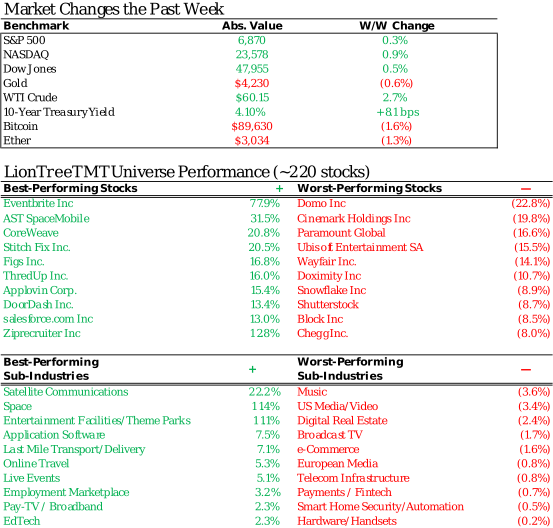
Just as the week was winding down, it ended with a bang with Netflix’s announced acquisition of Warner Brothers (see Theme #1). In the background, the S&P 500 and Nasdaq posted modest gains, up +0.3% and +0.9%, respectively. Treasuries were weaker with yields higher across the curve. The Fed meeting next week will be the next main macro catalyst, with the markets now pricing in a ~90% chance of a 25bp cut.
Sector-wise, this edition delves into the below themes/developments:
- A Winner Emerges As Netflix Annc’d The Acq Of Warner Brothers…But Is This The End Of It?
- Amazon Introduces New Building Blocks To Support The Coming AI Unlock
- A First Look At VERSANT’s Focus…It’s Going To Build “Beyond Cable”
- Consumers Are Showing A Healthy Appetite As The Doors Open For The Holiday Shopping Season
- 2025’s Top 10 Music, Songs, Podcasts, Apps, Etc., All Hit The Tape This Week
- GenAI “Personalized Pricing” Is On the Rise But NY Pushes Back
- Grab Bag: Microsoft AI Demand Concerns / Meta Cutting Metaverse Budget / New Updates From The Prediction Mkts
Also please note that as we approach year-end, we’re refreshing our Top Themes report to bring you an updated look and feel. During this transition, we’ll be sharing our insights via Substack. **To ensure that you continue receiving the report without any interruption, please add liontreeweeklytopthemes@substack.com to your contacts.** Thank you for your patience – we’re excited to roll out the new format in the months ahead.
Have a good weekend.
Best,
Leslie

A Winner Emerges As Netflix Annc’d The Acq Of Warner Brothers…But Is This The End Of It?
The suspense, intrigue, and twists & turns regarding what will happen with Warner Bros. Discovery and the major media juggernauts will certainly make for the next big docudrama! However, Netflix investors were not exactly thrilled with the Co finally agreeing to pay $27.75 per WBD share (subject to a collar) which would be a total consideration of $82.7bn EV. The $59bn that Netflix has lined up for financing is also one of the largest loans of its kind, per Bloomberg. The Co’s underlying thesis is that bringing these 2 assets together will make for a stronger company, as Netflix can leverage WB’s existing and new content across its subscriber distribution network and create new IP universes as well. There is also the opportunity for new streaming offers and bundles, which will create more engagement and retention.
But at least to start, the strategy for both Netflix’s core and WBD will remain basically the same. Netflix will continue to support WBD’s theatrical film distribution while Netflix originals will maintain its current selective approach theatrically. There will be no change to Netflix’s sport strategy. HBO will also remain standalone.
Analysts and investors pushed back on the timing. Why now? Why not when WBD shares were trading at $6/share? Netflix mgmt said the assets simply were not for sale then and this is a “rare opportunity.” Executing on such a large transaction is also a concern, though Netflix has clearly done a great job evolving the Co over the years, since it first started as a DVD company.
But is this the end of it? Maybe not. CNBC reported that Paramount may be gearing up to make an offer directly to shareholders so there may be a sequel in the works! And down the road once the Discovery Global asset separates, consolidation is likely to come into play again.
See more thoughts below on the announced deal between Netflix and WBD.
-> Netflix shares closed down -3% on the back of the announcement on Friday (and are down -25% from the highs on June 30th) while Paramount closed down -10% and WBD closed up +6%; YTD, Netflix is up +12%, Paramount is up +29%, and WBD is up +147%.
Netflix Is Buying Warner Bros (Includes The Film & TV Studios, HBO Max & HBO) For $27.75/Shr Or $82.7bn Enterprise Value
- Basic deal terms
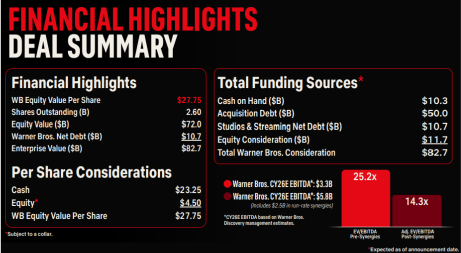
- Total EV $82.7bn, total equity value $72bn
- Equates to $27.75 per WBD shr in cash & stock subject to a collar
- WBD shareholders will receive Netflix stock valued at $4.50/shr, provided the 15-day VWAP of NFLX shr price (3 trading days prior to closing) falls btw $97.91-119.67 per share
- If the VWAP is < $97.91, WBD shareholders will receive 0.0460 NFLX shrs for each WBD share.
- If the VWAP is > $119.67, WBD shareholders will receive 0.0376 Netflix shares for each WBD share.
- Timing – targeting a closing in 12-18 months & will be post the Discovery Global separation now slated for Q3 2026 (WBD had initially said the separation will be completed by “mid-2026”)
- Netflix’s bid includes a $5.8bn break-up fee if the deal doesn’t get regulatory approval
- Synergies/valuation…the Co expects $2-3bn of run rate cost savings by the 3rd yr: Most of the synergies will come from SG&A but there is also some overlap with tech stack capabilities, and the Co will realize some content efficiency over time
- Pre-synergies valuation = 25.2x WB CY26E EBITDA of $3.3bn
- Post-synergies (at the mid-pt) valuation = 14.3x WB CY26E EBITDA of $5.8bn
- The deal will be accretive to GAAP EPS by year 2
- Mgmt acknowledged that investors might be surprised given their previous “build vs buy” approach but also views this as a “rare opportunity”
- “I know some of you are surprised that we’re making the acquisition, and I certainly understand why. Over the years, we have been known to be builders, not buyers…But this is a rare opportunity”
- Netflix thinks both companies will be stronger together vs alone
- “Creates a better Netflix for the long term”
- Why does NFLX think this deal makes sense? They think it will…
- Provide greater choice and value for consumers
- Be great for WBD and creators as their stories will reach more people and more fans than now
- Strengthen the entertainment industry as Netflix will be able to increase production capacity, more jobs will be added across the industry, and the Co can also build on IP
- Create value for Netflix as WBD’s IP and franchises enable them to “better entertain the world”
- How will mgmt more specifically create value with the deal?
- WBD has some of the top franchises that Netflix can create IP universes around
- Netflix can leverage the deep development infrastructure that WB has built for 100 years
- Netflix will have levers regarding streaming packages and bundles with HBO Max (bring in new subs and increase retention and engagement)
- Though note that Netflix and HBO currently have a lot of subscriber overlap
- Netflix will bring better distribution, better product experience, better discovery of the titles that Warner Bros has
- Why now? Because “it wasn’t for sale before. And they certainly hadn’t cleaned up the assets or separated the assets in the way that they have right now. So that goes to the why now”
- Mgmt stressed confidence in its existing organic growth and that this was not a defensive move
- Why is this going to end well when so many big media deals have not?
- A lot of industry failures happened as acquirors didn’t understand what they were buying but Netflix understands
- Legacy businesses did big deals looking for a lifeline but that is not the case here
- Netflix is not expert in large-scale M&A but has shown they can execute big transitions in the past (i.e., started as a DVD business and has evolved since)
- Strategically, a lot is staying the same…
- WBD’s business will largely be run as is
- Film & TV studio operations will remain the same; 3rd party content licensing will remain in place
- Theatrical release for films will be supported as is…NFLX will keep the output movie deals that WB has in place; But mgmt. did say that overtime the windows will be evolved to be more “consumer friendly”
- HBO Max & HBO will remain in place
- Netflix’s core operations also remain roughly the same
- Netflix’s theatrical strategy will not change and they are still negative on long exclusive windows
- No change to their sports strategy
- No change to their studio licensing strategy
- WBD’s business will largely be run as is
- Content spend at both Netflix and WBD will stay at roughly the same level and should continue to grow on a combined basis but there will be efficiencies over time (i.e., content spend as a % of revenue will not increase)
- There has been some market/investor concern about anti-trust, but Netflix mgmt is “confident in the regulatory process”: Citing that the deal is pro-consumer, pro-innovation, pro-worker, pro-creator and pro-growth; The 2 businesses are complementary
-> Friday morning following the announcement, the NYPost reported that Senator Elizabeth Warren called the deal an antitrust “nightmare”; This follows a slew of similar comments by other politicians
-> Earlier this week it was also reported that some officials at the Justice Dept are concerned that Netflix owning HBO Max would give it too much power in the streaming mktplace, but the dept’s antitrust division hasn’t formally evaluated a potential transaction; There was also reportedly a recent meeting of high-level White House officials in which concerns about a Netflix-WBD deal were discussed
Sources: SEC Filing 12/5; Netflix Company Materials 12/5; New York Post 12/30
Amazon Introduces New Building Blocks To Support The Coming AI Unlock
We wish we had a dollar for every time we heard “agent” this week! They were particularly topical at Amazon’s AWS re:Invent 2025 this week where building and deploying agents were key themes. AWS CEO Matt Garman started out by saying that while the true value of AI has not yet been unlocked, we are starting to see material business returns from all the investment in AI. He prophesized that there will be billions of agents inside every company across every field, and that agents are already accelerating healthcare discoveries, improving customer service, making payroll processing more efficient, etc. But to support all this, the limits of infrastructure need to be pushed.
With AWS adding 3.8 GWs of capacity in that last 12 months and having 9m KMs of fiber optic cabling (which is more than to the moon and back 11+ times!), the Co has the largest AI cloud infrastructure globally. At the re:Invent event, we thought that the most incremental new product releases and updates included: 1) the launch of Nova 2, which is the next generation of its foundational model; 2) the launch of Nova Forge, which is an open-training model where customers can use their own data; 3) the release of Trainium 3, which is their next generation AI chip and takes another leap forward in price/performance; 4) the Co has been seeing a lot of momentum with its Amazon Bedrock AgentCore, which makes it earlier for companies to build agents; and 5) AWS also launched their own new Frontier Agents which are autonomous, massively scalable, and long running, but also safe and with controls.
All in all, the AI wars continue to heat up across capacity, foundational models, chips, and agents. AWS continues to focus on maintaining its lead in price vs performance, security, and offering customers choice. See more details below on the most important updates from the event this week.
-> Amazon shares closed down -2% this week and are up only +5% YTD; Nvidia’s stock also dropped -1% in response to AWS’ new Trainium 3 announcement on Dec 2nd
AWS Has The Largest AI Cloud Infrastructure Globally
- AWS added8 GWs in that last 12 months and has 9m KMs of fiber optic cabling, which is more than to the moon and back 11+ times!
Expanded The Numbers Of Models That Customers Can Access On Bedrock, Annc’d Nova 2, & Launched AI Factories
- Bedrock fast tracks building and scaling genAI applications, where companies don’t need to manage infrastructure or train models from scratch
- Customer adoption is “strong”
- More than 100k customers use Bedrock, which is up +2x y/y
- Have already doubled the number of models that they offer in Bedrock and now are adding Mistral Large 3 and Ministral 3
- Customer adoption is “strong”
- “Tens of thousands” of customers are using Amazon’s Nova foundational model and the Co annc’d Nova 2 this week: A “cost optimized low latency model with frontier level intelligence”
- Nova2 Lite: Fast cost-effective reasoning model for everyday workloads (generally avail)
- Nova 2 Pro: Most intelligent reasoning model for highly complex workloads (avail in preview)
- Nova 2 Sonic: Speech to speech foundation model for real time, human-like conversational AI (generally available)
- Nova 2 Omni: A unified model for multimodal reasoning
- Also annc’d Amazon Nova Forge – an open training model with which you can blend your proprietary data and then you can upload your custom model to Bedrock (for businesses where standard models are too generic but don’t have the resources to build a model from scratch on their own)
-> Per CNBC, this new service costs $100k/year and doesn’t include help from Amazon experts; It can cost hundreds of millions or even billions to build a large language model from scratch, and this process is more affordable, Amazon said (link)
- The Co also launched new AWS AI Factories, which are dedicated customer-specific AI infrastructure inside a customer’s own datacenter, but managed by AWS
- Integrates with existing hardware, data center, and networking investments
- This is targeted to govts, regulated industries, and large enterprises w/ strict data residency requirements
Also Released Trainium3 Which Takes Price Performance To A New Level…& Trainium 4 Is Already In The Works
- The majority of inference on Amazon Bedrock is powered by Trainium…the Co has deployed 1m+ Trainium chips to date
- Now released Tranium3 ultra servers (generally available) which has the “best price performance for large scale AI training and inference”
- 4x more compute
- 9x higher memory bandwidth
- 5x higher AI tokens/megawatt
- Already “hard at work” on Trainium 4…it will be “massive leaps across every single dimension vs T3”
- It will deliver 6x the FP4 compute performance
- 4x memory bandwidth
- 2x memory capacity
“We Are In A New Era Of Software Development”
- Launched Kiro – helps developers take advantage of the speed of AI coding but with more structure
- Turns prompts into detailed specs and then into code
- Understands the intent behind prompts
- Hundreds of thousands of developers have used Kiro in the 5 months since the preview
- Amazon is giving away 1 years’ worth of Kiro and 100 seats for qualified startups
- Amazon is using this internally for their own development…Garman gave an example: Instead of taking 30 developers 18 months to complete a project, it took 6 developers 76 days instead
Agents Are Going To Change Everyone’s Business & Amazon Is Making It Easier For Companies To Build Their Own Agents, Safely & Securely
- “There’s going to be billions of agents inside of every company across every imaginable field”
- The Co is seeing strong momentum with Amazon Bedrock AgentCore (2mn+ SDK downloads since the launch a couple months ago)…it is comprehensive, open, and modular: Customers can pick and choose which services they want, deploy and scale; “Agents can be deployed in under a minute”…“Seeing so much momentum”
- Agents can run in a session in isolation
- Can keep context with short term and long term memory
- Agents can discover and securely connect to tools, data, and other agents
- Can do secure authentication
- Real time visibility of agent workflows
- Agents can execute real world workflows
- Annc’d policy in Agent Core: Provides real-time deterministic controls for how agent interacts with enterprise tools and data to make sure there are checks and balances
- Can set up policies to control actions that agents can take with respect to tools, data, and other agents
- Also annc’d AgentCore Evaluation (avail in preview today): Developers can inspect the quality of their agent based on real world behavior
- Analyzes correctness, helpfulness, safety, etc
- Includes pre-build evaluators
- Can also create custom evaluators
Amazon Is Making Agents For Customers As Well…Including New “ Frontier” Agents
- Amazon Quick agent: An agentic app where users can conduct deep research, get detailed analysis, analyze & visualize data, automate workflows, and includes enterprise grade security and privacy standards across customers’ data
- Amazon has deployed this internally and already hundreds of thousands of employees are using it; Tasks in some cases are taking 1/10th of the time
- Amazon Connect agent, for customer services: AI+ human agents work together, natural conversations and personalized experiences
- Toyota, State Farm, Capital One, NAB were highlighted customers
- Passed $1bn revenue mark
- Also intro’d Frontier Agents…a new class of agents that are a step function more capable vs what exists today: They are autonomous, massively scalable, long running
- The Kiro autonomous agent… navigates multiple code repositories to fix bugs (will roll out in the coming months)
- AWS Security Agent… actively tests applications for vulnerabilities (in public preview)
- AWS Dev Ops Agents… responds to system outages (in public preview)
-> “Three to six months in,” Garman said, “these agents behave like part of your team. They know your naming conventions, your repos, your patterns.” (link)
Helping Customers Move Away from Legacy Platforms
- Amazon Transform (launched last year): An agent to transform Windows, mainframe and VMware workloads; Reduces legacy licensing, infrastructure and modernization costs
- Launched AWS Transform custom this week: Gives ability to create custom code transformation agents; Can be converting any code
Source: Amazon Keynotes
A First Look At VERSANT’s Focus…It’s Going To Build “Beyond Cable”
Ahead of its spin out on January 2nd, Comcast’s VERSANT hosted its first ever Investor Day this week, which was chock full of strategy updates, partnership announcements, Q&A, and more. While a lot was covered, CEO Mark Lazarus summarized the Co’s mandate in a short and simple statement…to “build beyond cable…in fact, beyond media.”
The overall point that mgmt kept coming back to was that while linear is not a growth business, it is far from dead. Cable continues to represent ~2/3 of professional video hours consumed and remains the primary home for live sports and news. This is the foundation Versant plans to not only maintain but build off of as it expands into areas beyond cable.
In fact, VERSANT is already taking steps to do just that. An MS Now DTC product is currently in development, VERSANT announced acquisitions of both Free TV Networks and Indy Cinema Group to expand digital distribution and operational capabilities, and CNBC is partnering exclusively with Kalshi across its properties. They are also scaling existing digital platforms such as GolfNow and building new audience touchpoints through podcasts, social video, live events, and transactional offerings.
The long-term plan is to gradually rebalance VERSANT’s revenue mix, moving from heavy reliance on pay-TV (83% of 2024 revenue) toward a more even split. While commentary on industry consolidation was limited, mgmt noted a focus on “vertical scale” and driving growth in their four main mkts (note that this commentary was before the Netflix-WBD deal was announced Friday morning – see Theme #1 for details). Ultimately, the overall message consistently returned to the same point which is that VERSANT intends to leverage its linear footprint as a base to build a broader portfolio that reaches audiences across both traditional and emerging distribution channels.
See below for more.
-> Comcast shares were down -0.8% on the Investor Day, but ended the week up +2.3%; YTD, the stock is still down -27.1%
VERSANT’s Mandate Is To “Build Beyond Cable”
- The Co is “a strong, profitable business from day one” – for fiscal 2025, it is expect to generate…
- Rev of $6.6bn (down -6% y/y)
- EBITDA of $2.2bn (down -10% y/y)
- FCF of $1.4bn (down -15% y/y)
- While holding $3bn in debt and $750mn in cash
- Will operate in four “large” and “growing” mkts –
- Business news and personal finance
- Political news and opinion
- Golf and athletics participation
- Sports and genre entertainment
- Outlined a 3-part growth strategy –
- Maintain its TV content business while leveraging its brands
- Expand reach beyond pay TV through new distribution channels
- Scale digital platforms (i.e., GolfNow and Fandango) while developing new services
- Mgmt is confident in pay-TV’s longevity: “While it’s not a growth business, we believe pay-TV’s demise has been significantly exaggerated, and we’re confident it will be an important part of the media ecosystem and highly profitable for many years to come”
- Pay-TV still represents two-thirds of all professional video hours consumed and “virtually all” of sports and news watched
- BUT “we’re not stuck in old media”: “Our mission is to expand beyond the multichannel universe. These vertical markets all have significant opportunities”
- Pay-TV today reaches 67mn households and VERSANT aims to reach the other half of US households via AVOD, SVOD, OTA, social, audio, live events, etc.
- Ultimately, over time, VERSANT expects to generate half of its revenue from traditional pay TV and half from a series of new ventures (but will take some time)
- In 2024, 83% of Versant’s revs were derived from pay-TV vs 17% from digital and other non-pay-TV biz
- 3-5 yr goal is to change that rev split to 67% for pay-TV and 33% non-pay-TV
- Longer-term goal is a 50/50 split
How Will They Achieve These Goals?
- MS NOW will be launching a DTC product
- The product will be “centered around community, membership, and democracy and as a digital hub for progressives,” rather than a traditional streaming platform, though the company says it will include live streaming of the linear channel
- Plan is to create “a home for progressives on digital” that can stitch together MS NOW content w/ podcasts, YouTube and short-form video, alongside interactive content and community features.
- Pouring “significant investment” into the offering: It will be the most significant digital investment in the channel’s history
- Still in the research phase of building, but aiming to launch the product next summer, “just as the midterm elections are heating up”
- The product will be “centered around community, membership, and democracy and as a digital hub for progressives,” rather than a traditional streaming platform, though the company says it will include live streaming of the linear channel
- Annc’d the acq of Free TV Networks
- A provider of digital broadcast networks (“diginets”) and FAST channels that will be used to help expand Versant’s digital distribution
- Also annc’d the acq of INDY Cinema Group, which will operate under Fandango
- INDY Cinema Group is a cloud-based cinema operating system which, as part of Fandango, will help support key operational functions across ticketing and point of sale operations
- CNBC and Kalshi annc’d a multi-yr, exclusive partnership: CNBC will incorporate Kalshi prediction markets across TV, digital, and subscription properties
- Starting in 2026, CNBC will incorporate exclusive Kalshi predictions market data into its programs, including Squawk Box and Fast Money
- A Kalshi ticker will run alongside segments of CNBC’s on-air programming
- Kalshi will also launch a CNBC page on its site, featuring CNBC-selected markets.
-> Separately, but related, Kalshi annc’d this week it raised a Series E funding round of $1bn at an $11bn valn; The valn is more than double from just two months ago, when Kalshi raised a Series D round of $300mn at a $5bn valn
Some Additional Key Commentary
- On M&A strategy – “we’re very happy with the portfolio that we have… vertical scale is really our growth strategy”
- VERSANT has four core markets, and they want to grow within those, b/c they see “significant” growth oppties there and have strong brands to build from
- Will grow their audiences both organically and with investments, which they hadn’t been able to do at NBCU
- By 2030, expect to be “a lot bigger” in these four growth mkts
- Already have 62% of live sports and news – “we don’t really feel that there’s much value for us, frankly, in having more scale in that area”
- “Puts us ahead of established competitors like Paramount, WBD and Disney on a percentage basis”
- The remaining 38% comes from entertainment programming (mix of live, scripted and unscripted programming)
- VERSANT has four core markets, and they want to grow within those, b/c they see “significant” growth oppties there and have strong brands to build from
- That is the biggest misconception around VERSANT? That “we will be challenged without NBCUniversal”
- The Co will now be able to operate with more creative freedom and agility
- And will be able to invest back into the biz and create more oppties to experiment and move quickly
- On sports rights strategy – VERSANT isn’t going to try to compete for every league but rather “really focus on properties that work for us”
- Will focus on properties that are ROI positive…
- “That may mean that we’re not in the mix for properties like the NFL or NBA, which for us we wouldn’t be able to get a return on based on our current set of factors”
- …and properties that grow adjacent synergistic digital properties like GolfNow and GolfPass alongside their linear assets
- Will focus on properties that are ROI positive…
Sources: Versant Press Release 12/4; Indy Cinema Group Press Release 12/4; Free TV Networks Press Release 12/4; The Hollywood Reporter 12/4; Kalshi Press Release 12/2; Cooley Press Release 10/10
Consumers Are Showing A Healthy Appetite As The Doors Open For The Holiday Shopping Season
Early data from Adobe, Shopify, Salesforce, and major retail trackers point to a solid start to the 2025 holiday shopping season, with strong consumer engagement across both e-commerce and in-store channels (though with some pockets of y/y deceleration). Despite each firm using slightly different dates for “Cyber Week,” the underlying trends indicate that spending accelerated globally, mobile commerce continued to gain share, Buy Now Pay Later usage hit new highs, and AI-driven shopping experiences surged well beyond last year’s levels. Retailers saw y/y gains in total online sales, traffic volumes, and record participation from shoppers across Thanksgiving weekend. Price discount rates also have been more or less in-line with last year’s levels.
Overall, the data reflects healthy spending out of the gate for the holiday shopping season. We’ll be keeping an eye on more spending datapoints as we progress towards the end of the year.
See more details below.
Adobe, Shopify, Salesforce, % Mastercard Data Show Strong Holiday Shopping Trend
- First note that each Co has a different dataset for “Cyber Week”
- Adobe: Thanksgiving through Cyber Monday (Nov 26-Dec 1)
- Salesforce: 2025 Cyber Week (Nov 26-Dec 1)
- Shopify: Black Friday-Cyber Monday
- Adobe: $48.5bn was spent over Cyber Week (no comparable numbers were disclosed)
- Last yr, Adobe reported sales of $41.1bn during Cyber Week, defined as Nov 28 – Dec 1 (two fewer days then this yr’s report)
- This year reported total holiday spend from Nov 1 – Dec 1 of $137.4bn (up +7.1% y/y)
- Salesforce: Global sales growth accelerated, while US sales growth was strong but decelerated
- US: $79.6bn (+5% y/y, decel from +7% y/y in 2024)
- Global: $336.6bn (+7%, accel from +6% y/y in 2024)
- Shopify: Merchant sales were up sharply y/y
- Global sales from merchants reached $14.6bn, up +27% y/y or +24% y/y on CC
- Shopping peaked at 12:01 p.m. EST on Black Friday when sales reached $5.1mn per minute
- Average cart price: $114.70
- And… Mastercard SpendingPulse found U.S. Black Friday retail sales up +4.1% y/y (accel from +3.4% in 2024)
- E-commerce retail sales excluding autos jumped +10.4% y/y (decel from +14.6% y/y)
- In-store sales grew +1.7% y/y (accel from +0.7% y/y)
Spend Breakdown On Key Days Of Cyber Week Shows Pockets Of Acceleration & Deceleration
- Adobe –
- US: Y/Y growth was strong though reflected an overall deceleration across all three days compared to 2024
- Thanksgiving: $6.4bn in total spend was up +4.9% y/y but decel’d from +8.8% y/y in 2024
- Black Friday $11.8bn in total spend was up +9.1% y/y but decel’d form +10.2% y/y in 2024
- Cyber Monday: $14.25bn in total spend was up +7.1% y/y but decel’d from +7.3% y/y in 2024
- US: Y/Y growth was strong though reflected an overall deceleration across all three days compared to 2024
- Salesforce –
- US: Sales growth decelerated y/y on Black Friday but accelerated on Cyber Monday
- Thanksgiving: $8.4bn in total spend was up +3% y/y (no comparison available)
- Black Friday $18bn in total spend was up +3% y/y but decel’d from +7% y/y in 2024
- Cyber Monday: $13.6bn in total spend was up +6% y/y and accel’d from +3% y/y in 2024
- Global: Sales growth accelerated
- Thanksgiving: $35.6bn in total spend was up +6% y/y (no comparison available)
- Black Friday $78.9bn in total spend was up +6% y/y and accel’d from +5% y/y in 2024
- Cyber Monday: $53bn in total spend up was +7% y/y and accel’d from +2% y/y in 2024
- US: Sales growth decelerated y/y on Black Friday but accelerated on Cyber Monday
AI Is Growing In Popularity Amongst Online Shopping
- Adobe – Reported a +758% increase y/y over the Holiday Season (Nov 1-Dec 1) in AI traffic, beating their estimate of up to +515-520% y/y
- 5% of AI referrals were from a desktop, while 25.5% came from mobile devices
- Salesforce – Globally, AI and agents influenced $14.2bn in online sales on Black Friday, of which $3bn came from the U.S.
- Lastly, according to Apptopia, ChatGPT referrals to US retailer mobile apps incr’d +28% y/y during Cyber Week
- This year, Amazon’s share of ChatGPT referrals grew to 54%, up from 40.5% in 2024
- Walmart’s share incr’d from 2.7% last year to 14.9% now
The Average Price Discounts Were Mostly Similar To Last Year’s Levels
- Salesforce: Overall, discounts were more or less in-line with last year
- US: Discounts were ~the same as last year, though were slightly higher on Cyber Monday
- Thanksgiving: 28% (same as last yr)
- Black Friday: 28% (same as last yr)
- Cyber Monday: 28%, up from 26% last year
- Global: There was some variability in discounts depending on the day
- Thanksgiving: 26%, up from 26% last year
- Black Friday: 26%, down from 27% last year
- Cyber Monday: 27%, up from 25% last year
- US: Discounts were ~the same as last year, though were slightly higher on Cyber Monday
- Adobe: Electronics had the highest avg discount on Cyber Monday, while Toys had the highest avg discount on Black Friday
- Black Friday: Average discount
- Electronics: 28.7%
- Toys: 29.6%
- Apparel: 24.9%
- Cyber Monday: Average discount
- Electronics: 30.9%
- Toys: 28.1%
- Apparel: 25.1%
- Black Friday: Average discount
Adobe Findings Show all 7 Highlighted Spend Categories Beat Last Year’s Numbers
- Listed categories in the report
- Toys: $8.8bn vs $8.2bn in 2024
- Top products include Labubu Dolls, LEGO, MrBeast Lab Toys, Fisher-Price Little People & Mini Brands
- Apparel: $47.6bn vs $46.6bn in 2024
- Electronics: $57.5bn compared to $55.3bn in 2024
- Top products included: iPhone 17, Google Pixel 10, Samsung Galaxy S25, Oura Ring & Kindle Colorsoft
- Furniture & Home: $31.1bn vs $29.2bn in 2024
- Grocery: $23.5bn vs $21.5bn in 2024
- Cosmetics: $8.4bn vs $7.7bn in 2024
- Sporting Goods: $8.2bn vs $7.8bn in 2024
- Toys: $8.8bn vs $8.2bn in 2024
Mixed Datapoints On In-Store Foot Traffic… The NRF & Simon Reported An Increase, While Retail Next Reported A Decline
- National Retail Federation: Reported record shoppers both online and in-store
- A record 202.9mn consumers shopped from Thanksgiving Day through Cyber Monday (beating the forecasted 186.9mn)
- Up from 197mn shoppers last year and surpassed the previous record of 200.4mn set in 2023
- Overall: 5mn consumers shopped in-store, up +3% from 126mn in 2024; Online saw 134.9mn shoppers, up +9% from 124.3mn last year
- Black Friday brought in 80.3mn in-store shoppers and 85.7mn online (this was slightly below last year’s totals of 81.7mn and 87.mn, respectively)
- Saturday drew 62.7mn in-store consumers, up slightly from 61.1mn in 2024, and 63mn online compared with 53.9mn last year
- Sunday drew a record 32.6mn in-store shoppers, a +27% increase over the 25.6mn who shopped in 2024; 38.7mn shopped online on Sunday, compared with 32.8mn last year.
- A record 202.9mn consumers shopped from Thanksgiving Day through Cyber Monday (beating the forecasted 186.9mn)
- Simon Properties reports a +6.4% portfolio traffic increase on Black Friday Weekend, with a +7.1% gain reported at Simon’s Malls nationwide
- Traffic was up +5.9% y/y on Black Friday and grew throughout the weekend, including a +6.3% increase on Saturday and +8.2% on Sunday
- Retail Next data showed foot traffic dropping by -3.6% on Black Friday
- Foot traffic data was mixed in the US across all regions
- Midwest: -3.7% (-7% in 2024)
- Northeast: -3.9% (-2.1% in 2024)
- South: -4.2% (-3.5% in 2024)
- West: -2.5% (-3.2% in 2024)
- Foot traffic data was mixed in the US across all regions
Other Holiday Spending Trends & Updates
- More transactions are being made on mobile devices: Per Adobe, over the Holiday Season (Nov 1 – Dec 1), 52.8% of revenue came from mobile devices
- That translates to $143.7bn, up from $131.5bn in 2024 and $113.5bn in 2023
- The National Retail Federation reported that mobile remained the most popular way for online shoppers to buy on Cyber Monday for the 2nd year in a row, with 46.9mn consumers shopping, up from 40.4mn last year
- BNPL transactions are also on the rise: Adobe data shows that over the Holiday Season (Nov 1 – Dec 1), Buy Now Pay Later (BNPL) spend came in at $20.2bn, which is up from $18.2bn in 2024 and $16.6bn in 2023
- $8.3bn was spent on BNPL on mobile devices
- The National Retail Federation reported other key stats in their findings
- The top shopping destinations during Thanksgiving weekend were:
- Supermarkets (47%) and online (45%)
- Other top destinations included department stores (40%), clothing stores (37%) and discount stores (30%)
- 96% of shopping over the weekend made a holiday-related purchase, spending $337.86 on avg on gifts, holiday apparel, decoration and other seasonal purchases
- This is up from $315.56 last year and is the highest figure since 2019’s record of $361.90
- ~67% ($225.74) was spent specifically on gifts
- The top shopping destinations during Thanksgiving weekend were:
- Outside of survey data, T-Mobile launched their most aggressive Black Friday promotion
- The deal is 4 iPhone lines on the Essentials plan for $100/month total with AutoPay enabled
- That means a family of four gets brand-new iPhone 17 devices and unlimited service for what many people currently pay for just two lines elsewhere
- The promotion will run from Nov 6th through Dec 3rd
- The deal is 4 iPhone lines on the Essentials plan for $100/month total with AutoPay enabled
- Additionally, Amazon tested their new ‘Amazon Now’ 30-minute delivery service in Seattle and Philadelphia
- Prime Members get discounted delivery fees starting at $3.99 per order (vs. $13.99 for non-Prime)
- A small basket fee of $1.99 will apply to orders below $15
- Prime Members get discounted delivery fees starting at $3.99 per order (vs. $13.99 for non-Prime)
Sources: Shopify Press Release 12/2, Adobe Holiday Trends 2025, Salesforce Holiday Trends 12/2, TechCrunch 12/2, Mastercard SpendingPulse 11/29, Gadget Hacks 11/27, Geek Wire 12/1, Amazon Press Release 12/1, OpenAI Press Release 11/24, Reuters 12/1, NRF 12/2, Simon Properties 12/2, Retail Next 11/30, Retail Wire 12/2, Reuters 11/29
2025’s Top 10 Music, Songs, Podcasts, Apps, Etc., All Hit The Tape This Week
As year-end wrap ups and top 10 lists gain popularity, YouTube joined the parade by introducing its “YouTube Recap” for the first time, which offers a personalized, shareable highlight reel summarizing users’ 2025 watch history, including top-channels and interests, how users’ viewing evolved over the year, music listening stats, and also a “personality type” (like Adventurer or Creative Spirit) based on their viewing habits.
Meanwhile, Spotify’s Wrapped 2025 was also unveiled this week and the Co added new features like “Listening Age” and “Clubs” that classify users’ music taste into playful archetypes, plus interactive shared-listening options, while Apple Music’s Apple Music Replay compiled users’ top artists, genres and streaming time.
See below for the Top 10 lists from each!
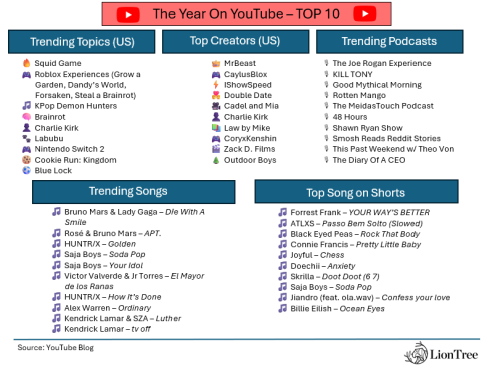
To Start, YouTube Introduced Their 2025 Recap Across Five Categories
- YouTube Recap – a personalized and shareable highlight reel summarizing users’ watch history for 2025: It is accessible on the home page or “You” tab on mobile and desktop; It will show users their…
- Top channels and interests
- Evolution of viewing habits
- Music listens
- Personality types based on watched content: Examples = Adventurer, Skill Builder, Creative Spirit, Sunshiner, Wonder Seeker, Connector, Philosopher, and Dreamer (last two are rare)
- Rollout details:
- Soft launch: Began in New Zealand last month
- Global launch:
- North America: December 2, 2025
- Worldwide rollout during the same week
- Methodology:
- Topics: Based on views, uploads, and creator activity; must show significant popularity or growth in 2025
- Creators: Ranked by in-country subscriber gains
- Songs: Based on in-country views of new or fast-growing tracks
- Podcasts: Ranked by total U.S. watch time for podcast playlists
- What are the Top 10 trends overall for 2025 in the US?
Spotify Unveiled Its Wrapped This Week As Well
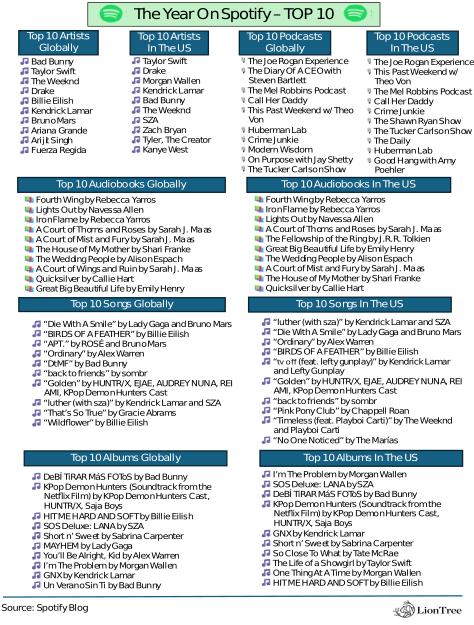
- Spotify – more than 700mn listeners around the world clocked in for this yr’s edition: The Co added two new features that offer insight into your listening habits
- Clubs: Rather than simply saying you listened to metal the most, you’ll be placed in the collective, which “believes in rebellion through music”
- Listening Age: Is designed to highlight how you might not fit in with your generation, for example “You listen to the music of a 70-year-old, even if you’re only 38”
- What are the Top 10 lists for both the U.S. and globally?
Lastly, Apple Revealed The App Winners Across 2025
- On Thursday Apple shared its annual list of the best apps and games of the past year

Sources: Apple Press Release, Spotify Press Release, YouTube Press Release
GenAI “Personalized Pricing” Is On the Rise But NY Pushes Back
It caught our attention this week that New York enacted a law to directly curb the practice of AI-driven “personalized pricing,” setting a precedent regarding for how states may regulate the use of consumer data for the purpose of algorithmic price-setting. After months of legal challenges from the National Retail Federation and other industry groups who support this practice, the law ultimately took effect in late November 2025. Opponents are concerned about price hikes and discrimination.
The debate comes after AI-assisted price personalization has been expanding across industries, from airlines and travel platforms to major retailers. Although dynamic pricing has existed for years, advancements in AI have supercharged their capabilities. U.S. states and federal lawmakers are now considering a patchwork of new regulations, while industry leaders, consumer advocates, and academics remain split on whether it harms or benefits consumers.
All in all, we believe the theme of AI personalized pricing will increasingly be front and center with regard to retail pricing practices.
Read more details below.
New York Aims To Protect Consumers From “Personalized Pricing” But Will Other States Follow?
- This month, NY became the first state to enact a law targeting what’s called personalized pricing, which is when retailers use AI and customers’ personal data to set prices online
- What does the law do?
- It aims to prevent retailers from overcharging customers by abusing their data
- For example: Jacking up the price of jeans for a shopper with a history of buying expensive pants
- How does the law work?
- It requires retailers that use personalized pricing to post the following disclosure: “THIS PRICE WAS SET BY AN ALGORITHM USING YOUR PERSONAL DATA”
- What does the law do?
- The law was signed mid-2025 but was held up in legal battles
- It was originally signed in New York on May 9th, 2025
- It was slated to be put into effect July 8th, 2025
- But the NRF filed suit on July 2, 2025, to block enforcement of the law, claiming it violated retailers’ 1st and 14th Amendment rights
- On October 8, 2025, a federal judge dismissed the challenge
- As of late November 2025, the law took effect and retailers in New York are subject to it
- Will other states follow suit? There are bills pending in 10 states that would either ban it outright or require disclosures, like NY
- State lawmakers in CA and federal lawmakers in WA are considering broad bans on the practice
- Opinions are mixed on the practice:
- Chad Yoes, who formerly oversaw pricing at Walmart and co-founded Waypoint Retail, said he believed large retailers’ use of personalized pricing was generally limited just to rewards programs
- Justin Kloczko, a researcher with Consumer Watchdog, said it may be hard for customers to know when they are being targeted and that may make them less likely to report violations
- Ryan Thornton, an Uber spokesman, acknowledged that the Co had started displaying a disclosure to New Yorkers as required by the new law but in an email, said the law was “poorly drafted and ambiguous”
- Stephanie Martz, the CAO and general counsel of the NRF said, “I wish I understood what harm exactly lawmakers think they are solving” … The NRF tried to block the enforcement, filing a lawsuit mid-2025 when the law was first passed on First Amendment grounds but was later dismissed
- Jed S. Rakoff was the federal judge in NYC who allowed the law to move forward
For Context, This Concept Of Dynamic Pricing Has Been Around For A While, But GenAI-Based Personalized Pricing Has Been Launched In Spots
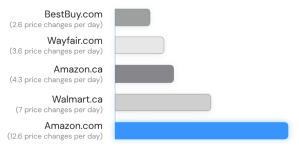
- Which retailers use dynamic pricing the most? See table below which is based on a 2024 Decodo report
- Methodology: Data was collected from the US and Canada, tracking 12 random products from the most popular categories at four-hour intervals over 33 days, capturing over 245K price data points between April 25 and May 27, 2024
- In 2012, the travel site Orbitz told The WSJ that it had sent Mac users ads for pricier hotels than it had sent P.C. users
- Its reasoning was that those with more expensive laptops could afford to spend more on a vacation
- The Co later abandoned the practice, according to Expedia, which acquired them a decade ago
- Earlier this year, Delta made headlines after it revealed its plans to use AI Pricing as well
- They plan to use AI to set prices for ~20% of its domestic flights by the end of the year, up from its current 3%, eventually with plans to move fully to dynamic pricing
- Clint Henderson with ThePointsGuy.com says integrating AI takes the dynamic pricing model airlines already use and puts it on steroids
- “Instead of having ten humans doing pricing, they’ll have a machine doing it for them”
- Retailers in Europe are also slated to increase use of AI base dynamic pricing
- ~61% of European retailers now use a form of dynamic pricing, according to a poll conducted by Valcon
- The survey of 350 retailers from across Europe found that although ~61% use some form of dynamic pricing, less than ~15% use AI based dynamic pricing
- However, ~55% plan to pilot a form of GenAI-based dynamic pricing throughout 2025
Sources: The New York Times (11/29), Decodo Report, Techradar Report, CBS Delta Plans, CPI 12/1, PYMTS 11/30, Forbes 12/3, Master.of.Code Dynamic Pricing Survey
Grab Bag: Microsoft AI Demand Concerns / Meta Cutting Metaverse Budget / New Updates From The Prediction Mkts
- Microsoft’s shares took a hit on reports that AI product sales are missing growth goals
- The Co on Wed denied a report from The Information that multiple divisions at the Co lowered sales growth targets for certain AI products
- What did the report say?
- Citing two salespeople in the Azure cloud-computing unit, less than a fifth of salespeople in one U.S. Azure unit met the sales growth target of 50%
- And the Co reportedly lowered their targets in July to ~25% y/y growth for the current FY
- A Microsoft spokesperson came out to say –
- “The Information’s story inaccurately combines the concepts of growth and sales quotas, which shows their lack of understanding of the way a sales organization works and is compensated”
- “Aggregate sales quotas for AI products have not been lowered, as we informed them prior to publication”
->Microsoft shares still fell -2.5% in reaction
- Meta is reportedly planning to cut up to 30% of its Metaverse budget, per Bloomberg
- The proposed metaverse cuts are part of the Co’s annual budget planning for 2026
- More specifics? The cuts could come as soon as next month and amount to 10-30% of employees in the Metaverse unit (the Metaverse group sits within Reality Labs), as per 3 employees familiar with the matter
- They work on virtual reality and a V.R.-based social network
- The total number of employees of the overarching group, Reality Labs, is not stated
- The Co does not plan to abandon building the Metaverse, the people said: Instead, executives expect to shift the savings from the cuts into investments in their augmented reality glasses
- On Wed, Zuckerberg annc’d that he had hired Alan Dye, a designer at Apple, to lead a new creative studio inside the Reality Labs division that would focus on design, fashion and technology
- Dye will report to Andrew Bosworth, Meta’s chief technology officer, who leads Reality Labs
->The company’s stock closed up +1% (but was up as high as +6% intra-day)
- There were two major prediction market updates to highlight this week –
- First, Connecticut Consumer Protection ordered Robinhood, Crypto.Com, and Kalshi to cease and desist conducting unlicensed online gambling: DCP Commissioner Bryan T. Cafferelli said “None of these entities possess a license to offer wagering in our state, and even if they did, their contracts violate numerous other state laws and policies”
- What will happen:
- All three platforms are ordered to immediately stop advertising, offering, promoting, or otherwise making available “sports event contracts” or any other form of unlicensed online gambling to CT residents
- DCP also ordered all 3 platforms to allow CT residents to withdraw any funds currently held by the platforms
- In CT, the 3 gaming platforms licensed to offer sports wagering are DraftKings (Foxwoods), FanDuel (Mohegan Sun) and Fanatics (Connecticut Lottery)
- Participants must be at least 21 to engage in online or in-person gaming or sports wagering
- For fantasy contests, participants must be at least 18
- Second, Fanatics officially launched prediction markets in 24 states (after recent press speculation)
- The platform will allow people to trade events in sports, finance, and culture
- It will launch in segments across the country over the next several days
- Early next year, the Co will expand into contracts for crypto, stocks, tech, music, and more
- Which states are involved?
- Alabama, Alaska, California, Delaware, Florida, Georgia, Hawaii, Idaho, Maine, Minnesota, Mississippi, Nebraska, New Hampshire, New Mexico, North Dakota, Oklahoma, Oregon, Rhode Island, South Carolina, South Dakota, Texas, Utah, Washington, Wisconsin
Source: CNBC 12/3, Fanatics Press Release 12/3, Department of CP 12/2, The Information 12/4, Reuters 12/4, CNBC 12/3
Stock Market Check
This Week's Other Curated News
Advertising/Ad Agencies/Ad Tech
- Global ad spend is forecast to grow 5. 1% in 2026, surpassing $1tn for the first time, outpacing global economy growth. Asia Pacific leads w/ India (+8.6%) & China (+6.1%). Americas hit $460.5bn; Brazil fastest at +9.1%. Digital dominates at 68.7% share, retail media +14.1%, video +11.5%. Tech sector tops growth (+10.3%). (Dentsu)
- Omnicom annc’d >4,000 job cuts & folding legacy ad brands post $13bn IPG takeover. Move targets cost savings >$750mn & shifts 85% roles to client focus. DDB & MullenLowe to merge w/ TBWA; FCB absorbed into BBDO. Ad biz faces AI-driven disruption as tech giants scale ad production. (Reuters)
Artificial Intelligence/Machine Learning
- The EU signed an MoU to fund AI gigafactories under its InvestAI initiative, incl. a €20bn facility, w/ formal call for interest now set for early 2026. Plan aims for up to 5 hubs w/ 100k+ AI chips, energy-efficient data centers & automation. 76 bids across 16 states submitted; €230bn indicative investment over 3–5 yrs. (Light Reading)
- Leading AI developers aim to build models that mimic human reasoning, but research shows these systems are highly energy-intensive, raising power grid concerns. AI reasoning models used 100x more power for 1,000 prompts vs. non-reasoning versions, per AI Energy Score study led by Hugging Face & Salesforce. (Bloomberg)
- OpenAI annc’d a definitive agreement to acquire neptune.ai to enhance tools for frontier AI research. Neptune offers precise systems for tracking experiments, monitoring training, and analyzing complex model behavior in real time. (OpenAI)
- Snowflake annc’d a multi-yr, $200mn partnership w/ Anthropic to integrate Claude models into Snowflake Cortex AI for 12,600+ customers. The deal enables Claude-powered agents for complex, multi-step analysis on governed enterprise data, boosting AI adoption in regulated industries. (Snowflake)
- Google annc’d Workspace Studio, enabling users to design, manage & share AI agents w/in Workspace. Powered by Gemini 3, it automates tasks from simple to complex workflows—no coding needed. Agents integrate w/ Gmail, Drive & Chat, offering smart notifications, content gen & sentiment analysis. (Google Workspace)
- Snowflake Inc. annc’d its adj operating margin outlook at ~7% for the period ending Jan., below analysts’ 8.5% estimate, sparking investor concern over AI tool profitability. Product rev is projected at ~$1.2bn, slightly above the avg estimate of $1.19bn, per Bloomberg data. (Bloomberg)
- Amazon quietly removed AI-generated English dubs from anime on Prime Video after backlash over poor quality and lack of emotion. Titles like Banana Fish and Vinland Saga had “AI beta” dubs, sparking criticism from voice actors and fans. (Engadget)
- IBM CEO Arvind Krishna warned hyperscalers like Google & Amazon may not profit from massive AI infra spend. Data centers need huge energy; Goldman sees mkts power use rising from 55GW to 84GW by 2027. Building 1GW costs ~$80bn; 100GW could hit $8tn, needing $800bn profit. Chips risk obsolescence in 5 yrs. (Yahoo Finance)
- AI cos like OpenAI, Anthropic, xAI & Meta fall short of global safety standards per Future of Life Institute’s AI Safety Index. Panel found no robust strategy to control superintelligent systems despite rapid dev. Concerns rise after AI-linked self-harm cases. Experts urge ban till safe path exists. OpenAI claims heavy investment in frontier safety; others gave limited or no comment. (Reuters)
- Google annc’d testing a feature merging AI Overviews w/ AI Mode in Search, enabling users to start w/ an AI snapshot then cont’d into conversational queries on the same screen. Previously, AI Mode required switching tabs. The test, live globally on mobile, aims to simplify info-seeking. (TechCrunch)
- Nvidia CFO Colette Kress said the chipmaker’s proposed $100bn investment in OpenAI is still not finalized, despite a Sept. letter of intent to deploy 10GW of Nvidia systems. The deal, if completed, would add to Nvidia’s $500bn chip bookings through 2026. Nvidia shares rose 2.6%. (Reuters)
- Mistral AI annc’d the Mistral 3 family of open-source multilingual, multimodal models optimized for NVIDIA platforms, enabling distributed intelligence from cloud to edge. Mistral Large 3, a MoE model w/41B active params, 256K context window, delivers 10x perf vs prior gen on GB200 NVL72. Nine compact models target edge devices. (NVIDIA)
- YouTube is expanding its “likeness detection” tool to help creators remove AI deepfakes using their face, requiring gov’t ID and biometric video. Experts warn Google’s privacy policy could allow biometrics for AI training, though YouTube denies this and plans clearer language. Rollout to 3mn creators by Jan. amid rising AI misuse risks. (CNBC)
- Apple annc’d AI chief John Giannandrea will step down, serving as advisor until retiring next spring. Amar Subramanya, ex-Microsoft & Google DeepMind exec, will lead AI efforts as VP reporting to Craig Federighi. Move follows criticism Apple fell behind peers in AI despite Apple Intelligence launch in 2024. Siri upgrade delayed to 2026. (CNBC)
- AI adoption at Anthropic is reshaping work: engineers report Claude use in 59% of tasks, driving +50% productivity vs last yr. Usage spans debugging, code understanding, and new feature dev, w/ 27% of Claude-assisted work enabling tasks that wouldn’t occur otherwise. Gains come w/ concerns over skill atrophy, reduced mentorship, and career uncertainty. (Anthropic)
- NVIDIA annc’d major open AI advances at NeurIPS, incl. Alpamayo-R1, the 1st open reasoning VLA model for AV safety, enabling level 4 autonomy via chain-of-thought planning. Cosmos tools expand physical AI dev, w/ frameworks like LidarGen & ProtoMotions3. Nemotron updates add multi-speaker speech models, AI safety datasets & NeMo Gym for RL. (NVIDIA)
- OpenAI is developing a new LLM codenamed Garlic to compete w/ Google’s Gemini 3 and Anthropic’s Opus 4.5, excelling in coding and reasoning tasks. CEO Sam Altman declared “code red” to boost ChatGPT and plans a new reasoning model ahead of Gemini 3. Garlic may launch as GPT-5.2 or GPT-5.5 by early 2026, per chief research officer Mark Chen. (Investing.com)
- Anthropic, valued at ~$300bn, is prepping for an IPO that could come as soon as 2026, per FT. The AI startup hired ex-Airbnb exec Krishna Rao as CFO last yr and engaged Wilson Sonsini for the process. Rival OpenAI is also eyeing mkts, while both face stiff competition from Google, Meta, Microsoft. (Fortune)
- China’s DeepSeek annc’d two new AI models: DeepSeek-V3.2 and V3.2-Speciale.2 matches OpenAI’s GPT-5 on reasoning benchmarks and integrates tool-use w/ human-like thinking. Speciale targets math, rivaling Google’s Gemini-3 Pro, scoring gold at Intl. Math Olympiad. (Bloomberg)
- OpenAI annc’d an ownership stake in Thrive Holdings to accelerate enterprise AI adoption. Thrive builds biz benefiting from long-term tech-driven transformation. Initial focus: accounting & IT svs for high-volume, rules-driven workflows. OpenAI will embed research, product & engineering teams in Thrive cos to boost speed, accuracy & cost efficiency. (OpenAI)
- Runway annc’d Gen-4.5, its top-rated video model, offering cinematic realism, precise control, and unmatched visual fidelity. Built on NVIDIA GPUs, it delivers high-performance w/ optimized inference speed. Gen-4.5 excels in prompt adherence, physics accuracy, and stylistic versatility across photorealistic and artistic modes. (RunwayML)
- NVIDIA & Synopsys annc’d a multiyr strategic partnership to transform engineering via CUDA GPU-accelerated computing, AI, and Omniverse digital twins. The deal includes $2bn NVIDIA investment in Synopsys stock at $414.79/share. Initiatives span accelerating Synopsys apps, enabling agentic AI workflows, cloud-ready solutions, and joint go-to-market plans—targeting industries from semiconductors to aerospace for faster, cost-efficient design. (NVIDIA)
- ByteDance annc’d launch of AI voice assistant powered by Doubao LLM, debuting on ZTE’s Nubia M153 (priced at $495) before rolling out to other cos. Tool enables voice-activated tasks like content search & ticket booking, competing w/ Huawei, Xiaomi. Apple’s AI not yet in China; Alibaba plans partnership. (Reuters)
- Top consultants have frozen starting salaries for the 3rd yr as AI reshapes biz models, challenging the traditional pyramid. Offers from McKinsey, BCG, Bain & Co remain at $135k-$140k for undergrads, $270k-$285k for MBAs. Big four cos show no pay rise since 2022, w/ graduate hiring down ~50%. (Australian Financial Review)
- Databricks is in talks to raise $5bn at a $134bn valuation, ~32x this yr’s expected sales of $4.1bn, per The Co revised rev projections twice, now forecasting 55% growth. Gross margin fell to 74% vs 77% plan due to rising AI usage. (Yahoo Finance)
Broadcast/Cable Networks
- Fox, CBS & NBC scored record NFL Thanksgiving ratings. Fox’s Packers-Lions game hit 47.7mn viewers (+27% YoY), its biggest reg-season game ever. CBS drew 57.23mn for Cowboys-Chiefs, largest audience for any reg-season game, nearly matching AFC Championship. (The Hollywood Reporter)
Cable/Pay-TV/Wireless
- Vodacom, Vodafone’s African subsidiary, annc’d plans to acquire 20% of Safaricom, raising its stake to 55%. Deal includes 15% from Kenya’s govt for €1.36bn and 5% from Vodafone for €0.45bn. Safaricom, Kenya’s top telecom co, posted 9.3% rev growth in H1, driven by 14% M-Pesa gains. (Vodafone)
Capital Market Updates
- US Treasury debt hit $30. 2tn in Nov., more than doubling since 2018 due to pandemic-era borrowing and higher rates. 2020 saw $4.3tn borrowed as deficit topped $3tn; now ~$1.78tn in FY25, aided by tariff rev of $300–400bn. Interest costs surged to $1.2tn, posing major fiscal challenge. (Yahoo Finance)
- Hedge funds are using near-record leverage to boost returns amid AI-driven mkts, w/ gross leverage hitting ~285.2% per Goldman and 297.9% per JPMorgan. Multi-strat funds show even higher levels, averaging 444.3%, as AUM surged from $91bn in 2010 to $428bn in 2025. Regulators are scrutinizing risks, though top cos cite strong risk controls. (Reuters)
Cloud/DataCenters/IT Infrastructure
- MongoDB shares jumped 22% after beating Q3 expectations w/ adj EPS of $1.32 vs $0.80 est. and rev of $628mn vs $592mn est., up 19% YoY. Atlas platform grew 30%, now 75% of rev, w/ ~60,800 customers. CEO CJ Desai sees “once in a lifetime” AI-driven opportunity. FY rev guidance raised to $2.434–$2.439bn. (CNBC)
- Marvell annc’d acquisition of Celestial AI for ~$3.25bn to accelerate scale-up connectivity for next-gen AI/cloud data centers. Celestial’s Photonic Fabric tech enables high-bandwidth, low-latency optical interconnects, replacing copper for multi-rack architectures. Deal includes $1bn cash + 27.2mn shares; earnout tied to rev milestones up to $2bn by FY’29. (Marvell)
- Power demand from US data centers is projected to hit 106 gigawatts by 2035, per BloombergNEF, marking a 36% rise from Apr.’s outlook. The increase is driven by numerous early-stage projects. One gigawatt equals the output of a nuclear reactor, enough to power ~750,000 US homes. (Bloomberg)
- AI-driven investment boom is fueling demand for massive data centers, creating a “gold rush” for construction workers. Roles like electricians and project managers earn 25–30% more, w/ some making $200k+. Tech giants like Amazon, Google, Microsoft have 522 centers and 411 in development. (Wall Street Journal)
Crypto/Blockchain/web3/NFTs
- Polymarket is recruiting for an internal market-making team to trade against customers on its exchange, per Bloomberg. The NY-based prediction mkts startup follows rival Kalshi’s model, which already runs a similar unit. Both cos have grown rapidly, letting users bet on sports, elections, etc., and secured U.S. federal approval despite state objections over gambling concerns. (Investing.com)
- Kalshi annc’d support for tokenized wagers on Solana, aiming to tap crypto liquidity for its prediction mkts. Tokenization enables trading digital versions of event contracts w/ more anonymity, aligning Kalshi w/ rival Polymarket. Crypto-native traders’ funds could boost liquidity as demand surges; prediction mkts hit ~$28bn vol through Oct. (CNBC)
Cybersecurity/Security
- Cloudflare CEO Matthew Prince said at WIRED’s Big Interview that since Jul. 1, the Co blocked 416bn AI bot requests after launching “Content Independence Day” to help creators restrict AI crawlers unless paid. Prince warned AI is a platform shift, criticized Google for tying search to AI crawlers, and urged fair mkts. (Wired)
- India’s telecom ministry ordered smartphone makers incl. Apple, Samsung, Vivo, Oppo, Xiaomi to preload govt’s Sanchar Saathi app on all new devices w/in 90 days; app can’t be deleted. Move aims to curb cybercrime, track stolen phones, block fraud via IMEI registry. (Reuters)
- South Korean police probe Coupang after a massive data breach exposed info of 33.7mn customers, incl. names, emails, phone nos., addresses & order history, but not payment details. Breach began Jun. 24 via overseas servers; discovered Nov. 18. Shares fell ~9%. A former employee’s active authentication key is suspected. (Reuters)
eCommerce/Social Commerce/Retail
- Dollar Tree’s Q3 net sales rose 9. 4% YoY to $4.7bn; same-store sales up 4.2% despite 0.3% traffic drop. Net income grew 4.8% to $244.6mn, gross profit hit $1.7bn. Co opened 106 stores, totaling 9,269. Guidance narrowed to $19.35–$19.45bn for full yr. ~3mn more households shopped, 60% from high-income. (Retail Dive)
- Five Below (NASDAQ:FIVE) posted strong Q3 results, w/ adj EPS of $0.68 vs est. $0.23 and rev up 23.1% YoY to $1.038bn. Comparable sales rose 14.3%. Co opened 49 new stores, totaling 1,907, and raised FY25 outlook to $4.62-$4.65bn rev, EPS $5.71-$5.89. (Investing.com)
- Ulta Beauty shares jumped after Q3 earnings beat expectations, w/ rev of $2.86bn vs $2.72bn est. EPS hit $5.14. Co raised full-yr outlook: net sales ~$12.3bn, EPS $25.20–$25.50, comp sales up 4.4–4.7%. Beauty demand cont’d strong despite tight budgets; fragrance led w/ double-digit growth, skincare high single digits. (CNBC)
- Kroger Co. cut its full-yr sales outlook amid rising competition for cost-conscious shoppers. The largest US supermarket now sees comparable sales growth of 2.8%–3% ex-fuel, vs prior 2.7%–3.4% guidance. The move signals pressure on food mkts as rivals vie for share in a challenging retail environment. (Bloomberg)
- NIKE, Inc. annc’d SLT changes to accelerate “Win Now” actions. Venky Alagirisamy becomes EVP & COO on Dec. 8, leading Supply Chain, Ops, Sustainability & tech integration. EVP CTO role eliminated; Dr. Muge Dogan exits. Geography heads join SLT; EVP CCO role removed as Craig Williams departs. (Business Wire)
- Macy’s posted strongest growth in 3+ yrs in Q3, beating Wall St. rev est. at $4.71bn vs. $4.62bn. Co raised full-yr outlook to net sales of $21.48–$21.63bn and adj EPS of $2–$2.20. Comparable sales up 3.2%, led by Bloomingdale’s (+9%). Despite gains, Macy’s warns of selective spending and tariff pressures in holiday qtr. (CNBC)
- American Eagle beat Q3 expectations w/ EPS at $0.53 vs $0.44 est. and rev of $1.36bn vs $1.32bn. Net income hit $91.34mn, up from $80.02mn last yr. Aerie drove growth w/ 11% comp sales, while AE banner rose just 1%. Co raised full-yr adj operating income forecast to $303–308mn and expects holiday comp sales up 8–9%. (CNBC)
- Capri Holdings annc’d completion of Versace sale to Prada for $1.375bn cash, aiming to repay most debt and strengthen balance sheet. Co expects reduced leverage, more flexibility for growth and shareholder returns. Focus remains on Michael Kors and Jimmy Choo, targeting biz stabilization this yr and growth by fiscal 2027. (Business Wire)
Electric & Autonomous Vehicles
- U.S. NHTSA is probing Waymo after Texas officials reported 19 cases of its self-driving cars illegally passing school buses since the school yr began. Despite software updates annc’d in Nov., Austin ISD says incidents cont’d, incl. one on Dec. 1. NHTSA seeks answers by Jan. 20 on fixes and possible recall. (Reuters)
- Uber annc’d launch of Avride robotaxi rides in Dallas. Riders requesting UberX, Comfort, or Comfort Electric may be matched w/ fully electric Hyundai Ioniq 5 AVs at no extra cost. Service covers ~9 sq. miles incl. Downtown & Uptown, w/ plans to expand. (Uber)
- Waymo annc’d data from ~100mn driverless miles showing 91% fewer severe crashes vs humans, incl. 96% fewer intersection injuries. Despite 2 fatalities, all caused by human drivers. AVs cut risks via rule adherence, 360° vision, and no distractions. Wider adoption could slash 39k annual U.S. road deaths and $1tn crash costs. (The New York Times)
- Waymo annc’d expansion of its autonomous ride-hailing svc to Baltimore, St. Louis, Pittsburgh & Philadelphia. Philly moved from manual to autonomous testing; Baltimore starts manual ops this wk w/ regulatory prep. Pittsburgh & St. Louis begin manual driving using 5th/6th-gen tech & Jaguar I-PACE EVs. (Investing.com)
- Waymo’s self-driving cars, once known for extreme caution, are now driving more like assertive human drivers in SF. They’re making quicker moves, bending rules (e.g., illegal U-turns, rolling stops), and prioritizing flow over strict compliance. Updates aim for “confidently assertive” behavior to scale ops, though incidents raise safety concerns. (The Wall Street Journal)
Film/Studio/Content/IP/Talent
- Q4 2025 box office fell 7% YoY and remains 30% below 2019 levels, signaling theaters’ cont’d decline. Despite a modest 2% rev uptick YTD, Hollywood struggles as streaming svs dominate, driven by convenience, inflation, and hybrid releases. Ticket prices up 20% since 2019, while younger audiences favor home viewing. Studios cut risks; chains pivot to alt events. (Cord Cutters News)
- Disney’s “Zootopia 2” scored ~$556mn globally over Thanksgiving wknd, w/ $272mn from China, making it Hollywood’s top animated film there. Domestic rev hit $156mn, leading U.S./Canada charts. Universal’s “Wicked: For Good” added $92.2mn, totaling $393.3mn after 10 days. (Reuters)
FinTech/InsurTech/Payments
- PayPal (PYPL) fell 2. 5% after CFO Jamie Miller warned branded checkout growth will slow “a couple of points” in Q4 vs Q3 at UBS Global Tech & AI Conf. Overall guidance remains unchanged, but analysts flagged softness from macro headwinds and lagging new initiatives. (Investing.com)
- Kalshi annc’d a $1B Series E at an $11B valuation, led by Paradigm w/ Sequoia, Andreessen Horowitz & others. Founded in 2018, the Co pioneered prediction mkts as a new asset class, driving a shift from passive watching to active participation. Trading now tops $1b weekly, up 1000% YoY, w/ millions using 3,500+ mkts. (Business Wire)
- Kalshi annc’d a partnership w/ CNN as its official prediction mkts partner. Kalshi, the largest federally regulated exchange, enables trading on real-world events like elections & cultural trends. CNN will integrate Kalshi data across programming, incl. a real-time ticker, newsroom access, and analysis by Chief Data Analyst Harry Enten. (Kalshi)
Handheld Devices & Accessories/Connected Home
- Amazon annc’d a major Alexa+ upgrade, enhancing real-time sports coverage for NFL, NBA, MLB, NHL, and college games. Users now get clear scores and optional detailed breakdowns like scoring plays, stats, and player data. However, initial responses omit time/quarter unless requested, sparking criticism from bettors and fantasy players. (Cord Cutters News)
Last Mile Transportation/Delivery
- Amazon plans to end its long-standing tie-up w/ USPS as it expands its delivery network. USPS, Amazon’s top customer, earns ~$6bn annually from the retailer. Talks on new service agreements failed, prompting Amazon to shift billions of parcels by end-2026. (Reuters)
Live Entertainment/Theme Parks/Concerts/Experiential
- Eventbrite annc’d a definitive agreement to be acquired by Bending Spoons in an all-cash deal worth ~$500mn. Stockholders will get $4.50/share, an 82% premium over its 60-day avg price. The transaction, unanimously approved by Eventbrite’s board, is expected to close in 1H 2026, subject to regulatory and shareholder approvals. (Business Wire)
Macro Updates
- Trump’s tariffs have cont’d to strain cos, creating uncertainty and slowing hiring. ISM mfg index fell for 9th month to 48.2, signaling contraction. ADP data showed private employers cut 32,000 jobs in Nov., vs. forecasted +10,000. Larger cos still hiring, but small biz faces layoffs amid tariffs and cautious consumer spending. (Quartz)
- AI-driven investor frenzy in 2025 has minted 80+ unicorns, mostly AI-focused but spanning sectors like medtech, blockchain, and aerospace. Notable cos include Reflection ($8bn), PsiQuantum ($7bn), Tempo ($5bn), Thinking Machines ($10bn), and Polymarket ($9bn). (TechCrunch)
Regulatory
- AZ Attorney General Mayes annc’d a lawsuit vs Temu, alleging violations of AZ Consumer Fraud Act. Claims include unlawful data collection, privacy breaches, and counterfeiting iconic AZ brands. Temu’s app allegedly harvests sensitive PII, evades security, and may exploit devices. Other charges: fake reviews, bait-and-switch schemes, forced labor, and misuse of payment info. (Arizona Attorney General)
- Meta faces an EU antitrust probe over its plan to block rival AI chatbots on WhatsApp, marking regulators’ latest move against Big Tech. The policy, fully applicable from Jan. 15, 2026, may favor Meta AI integrated since Mar. Complaints from startups like Poke.com and Luzia triggered the inquiry. Italy launched a parallel probe in Jul., expanded in Nov. (Reuters)
- FCC seeks public input on Nexstar-Tegna’s pending $6.2bn merger. This would transfer Tegna’s 64 TV stations and radios to Nexstar, creating a local TV giant w/ 265 stations in 44 states, reaching ~80% of U.S. households. Nexstar requests waiver of the 39% ownership cap. (Yahoo Canada News)
- Instacart sued NYC to block 5 laws impacting its grocery delivery biz, incl. min pay for app workers & tipping disclosures. Co claims Congress bars local regulation of prices/svs, and laws violate U.S. Constitution by discriminating vs out-of-state cos. Rules, effective Jan. 26, would raise delivery costs, harm consumers, and force platform restructuring. (Yahoo Finance)
- FCC’s Enforcement Bureau issued a notice to SK Teleco LLC for originating illegal robocalls impersonating Walmart, linked to ~8mn calls between Jan. –Apr. 2025. SK Teleco failed to respond to 16 traceback requests and faces removal from the Robocall Mitigation Database. (FCC)
- SCOTUS heard oral arguments in Cox v. Sony, a case that could reshape ISP liability under DMCA. Justices debated if ISPs must terminate accounts flagged for piracy, balancing enforcement vs. practicality for large entities like universities. Cox seeks to overturn willful contributory infringement claims; Sony wants stricter rules. (Ars Technica)
Satellite/Space
- Telesat, a Canada-based GEO operator, is launching its own LEO constellation, Telesat Lightspeed, to meet rising enterprise demand for low-latency svs. The Co plans 150 satellites by Dec. 2027, focusing on wholesale capacity for telcos, gov’t, and enterprises—not direct-to-home broadband. (Fierce Network)
Social/Digital Media
- TikTok, owned by ByteDance, annc’d a $37.7bn investment to build a data centre in Ceará, Brazil—its first Latin America project. Partnering Omnia and Casa dos Ventos, the facility near Pecém port will run on wind energy. Brazil’s strong renewable resources and fibre network make it ideal for AI-driven infra. (Yahoo Finance)
- Researchers found 354 AI-focused TikTok accounts posting 43k generative AI videos, gaining 4.5bn views in a month. Content included anti-immigrant narratives and sexualized depictions, often unlabeled—less than 2% carried TikTok’s AI tag. Some accounts posted up to 70 times daily, gaming algorithms. (The Guardian)
- Meta stock jumped 6% on after reports that CEO Zuckerberg plans deep cuts to metaverse efforts. Execs discussed up to 30% budget reduction for 2026, impacting Horizon Worlds and Quest VR, w/ layoffs possible as early as Jan. Standard 10% cuts across cos continue, but metaverse faces sharper trims amid weaker industry competition. (Investing.com)
- Discord annc’d a new Wishlist feature letting users save Shop items like Avatar Decos, Profile Effects, and Nameplates for later. Wishlists appear on profiles, enabling friends to gift items. Integration w/ Marvel Rivals allows adding in-game cosmetics via a dedicated server channel; gifts require linking accounts to sync w/ inventory. (Discord)
- YouTube annc’d it will comply w/ Australia’s teen social media ban, locking out users <16 by Dec. Initially exempted, the platform now faces fines up to $32.5mn for noncompliance. The law aims to curb harmful content exposure, though YouTube argues it won’t make kids safer. Other cos like TikTok, Instagram & Snap have agreed; X & Reddit haven’t. (Reuters)
- Influencer videos on TikTok & YouTube are gaining traction among older demos. Ampere data shows U.S. adults 55-64 watching weekly rose from 44% in Q1 2020 to 54% in Q3 2025; UK grew from 30% to 38%. Overall, 70% of U.S./UK users watch weekly, up 18%. Streaming svs like Amazon, Disney+ & Netflix now feature influencers. (StreamTV Insider)
- Instagram will mandate a full return to office, requiring US staff w/ assigned desks to work in person 5 days/week. Adam Mosseri annc’d the move via memo, noting “2026 is going to be tough.” Limited remote work allowed using “best judgment.” (Engadget)
Software
- DocuSign beat Q3 estimates w/ EPS of $1.01 vs $0.91 forecast and rev of $818.4mn vs $807.09mn expected; billings grew 10%. CEO cited cont’d strong execution and IAM investment. FY2026 rev guide raised to ~$3.21bn; billings midpoint up $44mn. From FY2027, DOCU will shift to ARR reporting to reduce volatility.(Investing.com)
- Microsoft annc’d price hikes for commercial & govt Office subs. Business Basic rises to $7 (from $6), Standard to $14 (from $12.50), E3 jumps 13% to $26, E5 to $60. Front-line plans see biggest increase: F1 up 33% to $3. Changes exclude $30 Copilot add-on. Move follows ~1,100 new features in past yr. (CNBC)
- Salesforce posted better-than-expected adj EPS of $3.25 vs. $2.86 est., but rev slightly missed at $10.26bn vs. $10.27bn est., up 8.6% YoY. Net income rose to $2.09bn, aided by $263mn investment gain. Q4 guidance: $11.13–$11.23bn rev, 11–12% growth, w/ boost from Informatica deal (~$8bn). Agentforce AI rev topped $500mn, up 330% YoY. (CNBC)
Sports/Sports Betting
- Fanatics annc’d it will exclusively operate retail for FIFA World Cup 2026™, managing in-venue sales at 104 matches over 39 days across Canada, Mexico & U.S. The event spans 16 cities w/ an expanded 48-nation field. Fanatics will also run bespoke retail at FIFA Fan Festival sites, leveraging its expertise in merch, product creation & rapid production to serve millions of fans during the world’s biggest sporting event. (Fanatics)
- ESPN Bet is gone, but betting content stays. DraftKings becomes ESPN’s official sportsbook, odds provider, and will roll out full integration in 2026. The multiyr deal includes fantasy, Pick6, and a prediction mkts product. Penn paid ESPN $38mn + $5mn for transition to theScore Bet. (Sportico)
Tech Hardware
- Intel annc’d it will keep its networking & comms unit after a strategic review. Earlier, Intel explored selling assets to boost finances but secured ~$8.9bn from U.S. govt (10% stake), $2bn from SoftBank & $5bn from Nvidia. CFO said cash position improved post-Q3 results. (Reuters)
- Apple is forecasted to ship 247.4mn iPhones in 2025, up 6% YoY, per IDC—surpassing its 2021 record of 236mn. Growth is driven by the iPhone 17 series and a rebound in China, where Q4 shipments may rise 17%, pushing mkts to 3% growth vs prior 1% decline. IDC notes Apple could overtake Samsung in 2025 for the first time in 14 yrs. (CNBC)
- Intel shares surged 8% after analyst Ming-Chi Kuo annc’d Intel may build Apple’s M-series chips for MacBook Air & iPad Pro by early 2027 using 18A-P tech. This marks a major boost for Intel’s chip biz, which earned $4.2bn vs $12.7bn product rev last qtr. Intel stock is up 116% YTD; US govt holds 10%, Nvidia & SoftBank invested $7bn. (Yahoo Finance)
- Samsung annc’d Galaxy Z TriFold, its 1st multi-folding phone, priced at ~$2,440, w/ a 10-inch display—25% larger than Z Fold 7. Launch set in S. Korea, w/ rollouts in China, Singapore, Taiwan & UAE this yr; U.S. in Q1 next yr. Device has largest battery, 50% charge in 30 mins. (Reuters)
Video Games/Interactive Entertainment
- A new free mod, GTA4 RTX Remix, adds path-traced lighting to Rockstar’s 2008 classic using Nvidia’s RTX tech, making the game look near-photorealistic w/o changing textures or geometry. Initially Patreon-only, it’s now public on GitHub w/ install guides and Fusion Fix support. (Kotaku)
- Netflix is selling Spry Fox back to its founders, making the studio independent while cont’d publishing Spirit Crossing on mobile. Spry Fox can seek other publishers for console/PC. Layoffs and funding needs remain possible. Netflix acquired Spry Fox in 2022; its game strategy shifted under Alain Tascan to focus on Netflix IP, social party games, and known titles, leaving Spirit Crossing outside its core biz. (Engadget)
- Saudi Arabia’s PIF, w/ Silver Lake & Affinity, annc’d a $55bn buyout of EA, incl. $20bn debt & $36.4bn equity. Filing shows PIF to own 93.4%, Silver Lake 5.5%, Affinity 1.1%. PIF rolls over $5.2bn stake, adding ~$29bn cash. (MSN)
Video Streaming
- HBO Max annc’d major expansion into Germany, Italy, Austria, Switzerland, Luxembourg & Liechtenstein, adding millions of viewers. Line-up includes hit U.S. series, local dramas, blockbuster films & live Olympic Winter Games Milano Cortina 2026 coverage. New German & Italian originals debut Feb., plus sports add-on for Eurosport events. (Warner Bros. Discovery)
