


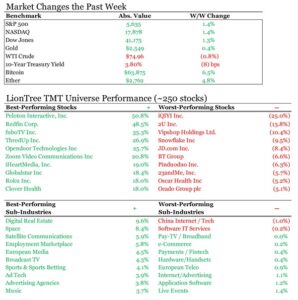
The markets are behaving into the final weeks of the summer (at least for now!) with the S&P 500 and Nasdaq adding to last week’s gains (were up +1.5% and +1.4%, respectively). The small cap Russell 2000 index outperformed, up +3.6%, which shows some nice broadening out.
News flow has started to ease post the hectic earnings season, but there were still a handful of meaningful updates and developments in the sector this week that we thought were incremental. This edition focuses on the below (all links are clickable):
- Another Twist In The Paramount Story…
- What’s Next For Venu & Future Of Direct-To-Consumer (DTC) Sports?
- Big Tech May Be Closing In On OpenAI Sooner Than Expected
- Record Breakers And Comebacks Across The Video Gaming Arena This Week
- Autonomous Vehicles Are Hitting The Gas Towards Widespread Adoption
- A Few Other Key Developments This Week – Olympics, Streaming, Upfronts, And Shoppable Commerce
*Please note that next week we will have a limited version of the LT Weekly Update and will resume the full update post Labor Day*
Enjoy the weekend.
Best,
Leslie

Another Twist In The Paramount Story…
Edgar Bronfman Jr. has made a bid for Paramount and reportedly raised that offer from $4.3bn to $6bn (link/link/link)
- What other terms are being reported?
- Bronfman apparently offered $2.4bn in debt and equity for National Amusements, matching the terms of Skydance’s purchase agreement
- The offer includes $3.2bn to pay down debt or to purchase non-voting Paramount shares held by investors other than the Redstone family for $16/shr cash
- It is believed that the bidding group led by Ellison will have the opportunity to submit a counter-offer
- Who is reportedly in the Bronfman consortium? Fortress Investment Group and Jeff Ubben, founder and managing partner of Inclusive Capital Partners
- Paramount confirmed that it received a competing bid from Edgar Bronfman, Jr. and his consortium…BUT didn’t disclose any offer details
- The “go shop” period is extended until Sept 5th for the consortium (originally slated to expire EOD Aug 21st)
- “There can be no assurance this process will result in a Superior Proposal”
- At the end of the week Skydance demands that Paramount stop negotiations, citing breach of deal terms (link): In a letter from its lawyers, Skydance accuses Paramount’s committee of directors of violating the terms of its deal by extending the “go shop” period
- Skydance is arguing that the bid wasn’t superior, as defined in the transaction agreement, and thus the committee shouldn’t have extended the window
- Additionally, under the terms of the agreement, the special committee was supposed to inform Skydance that it was extending the go-shop, which it failed to do, according to the letter
- “While Skydance is not currently exercising its right to terminate the Transaction Agreement, we reserve the right to do so in the future,” Skydance’s attorneys wrote in the letter, which was sent Thursday, Aug. 22nd
-> Reminder that Skydance has offered a $8.4bn deal that includes a merging the 2 companies; Ellison and Redbird committed $4.3bn to buy Paramount’s Class B shares for $15/shr cash each and pledged to provide a min of $1.5bn to the Paramount’s balance sheet.
-> Paramount ended the week up +3.3%, but is still down -23.2% YTD
What’s Next For Venu & Future Of Direct-To-Consumer (DTC) Sports?
Following up on the headlines that emerged late last week that Fubo surprisingly won a preliminary injunction against Disney, Fox, and Warner Bros as it relates to their upcoming direct-to-consumer sports JV, Venu, this week, court documents were disclosed in Fubo’s 8-K filing that detail the arguments and has a blow by blow of happenings before and during the hearing. There were several datapoints and snippets that we found interesting, which are outlined below, but there is certainly a lot more in the full document if you are interested in delving in (click here for the filing).
A Couple Of Fubo’s Mkt Share & Competitive Structure Arguments
- Fubo argues that the JV defendants’ control:
- ~54% of all US sports rights and 60%+ of all nationally b-cast US sports rights
- The control is closer to 80% of the rights to all nationally b-cast professional baseball, hockey, football, and basketball games and 98% of all playoff games
- Almost 3/4ths of the rights for the 5 big sports and college football
- ~54% of all US sports rights and 60%+ of all nationally b-cast US sports rights
- JV defendants’ “internal documents estimate that between 50-70% of the JV’s subs will be viewers who drop a current MVPD subscription to instead subscribe to the JV”…“One JV defendant” estimated that the JV product would still be “extremely profitable to its partners if just one new customer subscribed for every three customers who switched from their current MVPD”
- There are a lot of arguments about the industry practice of bundling media rights and Fubo being “forced to pay for unwanted non-sports networks that customers rarely watch as a condition to get the must have sports channels”
- The JV defendants agreed to not support another platform like the JV for at least 3 years
Some Cost Data On Sports Rights
- On avg, sports networks cost $1.30/sub per month for distributors to license while non-sports networks cost only an avg 71c/sub per month
- The most expensive network to license is ESPN at $9.42/sub per month
- RSNs range in fees from $3.50-8.50/subs per month
- TNT is ~$3/sub per month
Fubo Argues That The JV Product Poses An “Existential Threat” To The Co
- Fubo means “football” and subscribers are there mostly for sports
- More than 80% of the “first views” on Fubo are live sports
- Half of all first views are for Disney or Fox channels
- 92% of first views across all Fox channels are for sports content
- But Fubo’s least expensive package includes non-sports channels and is double the price for the JV
- Fubo estimates that it will lose 300-400k subs before the end of 2024 which would results in a revenue loss of $75-95mn
- Fubo had targeted break-even profitability wise in 2025, but that would be in jeopardy if the JV is launched
Separately, but related, Fubo announced a series of price hikes this week (link/link)
- The new packages and pricing will only apply to new subscribers, and existing Fubo subscribers will not be impacted
- $79.99 for the Pro plan
- Remains unchanged
- $89.99 for the Elite
- Upgraded to the “Elite with Sports Plus” plan, which now costs $99.99
- $99.99 for the Premier
- Replaced by the “Deluxe” package, which costs $109.99, and also includes the extra channels found in the Sports Plus add-on from Fubo.
- As a reminder, Fubo had raised priced across all of its plans by $5/mo back in January, which was the Co’s second price hike in < yr (link)
-> Fubo shares have rallied +35.3% since the news first hit about the injunction last Friday
Big Tech May Be Closing In On OpenAI Sooner Than Expected
Amid the massive investments and rising valuations in the AI space, ChatGPT has quickly gained widespread recognition. However, an analysis we came across implies a potential shift in the AI race by the end of the decade.
The study suggests that while ChatGPT has made remarkable strides, tech giants like Meta and Google are leveraging their vast, established platforms to position themselves as formidable contenders in consumer AI. The data suggests that these companies, with their extensive user bases and deep integration capabilities, have the strategic advantage to integrate AI more effectively into their existing digital ecosystems, potentially positioning them as the ultimate leaders in the AI race.
See below for some of quick takes we thought were the most impactful, and see the entire analysis HERE.
- Engagement-wise – ChatGPT’s weekly-to-monthly active user ratio is still far behind the tech giants: ChatGPT’s 40% is “impressive for a newcomer” but “a far cry” from the 80% mark of billion-user apps
- “Meta and Google’s suite – Instagram, WhatsApp, Gmail, Chrome – have sky-high engagement and massive user bases. These aren’t just apps. They’re digital empires, primed for AI domination”
- How can ChatGPT get to a billion users? Data suggests that for ChatGPT or any AI app to reach billion-user status, it needs to dramatically increase their WAU:MAU ratio to 80%+
“For entrepreneurs and investors eyeing the AI prize, consider this your reality check. The AI race isn’t just about demos, it’ll be about user adoption, engagement, and stickiness. And in that game, the tech giants already have a massive head start”
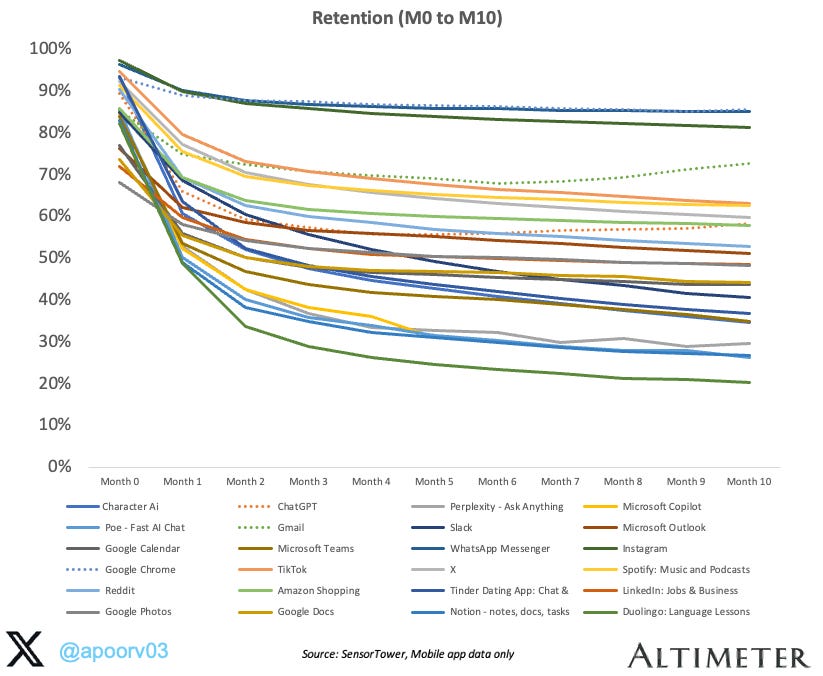
- Retention-wise – while Big Tech dominates, AI apps are showing promise, but still have ground to cover: Looking at 10-month retention, Google’s Chrome and Gmail have “smiling” curves, indicating increasing value to users over time, while ChatGPT was the third app in the dataset showing a “smiling” curve
- Most other AI apps show steeper drops in retention, “highlighting the difficulty of maintaining a user base in this competitive space”
- Time spent – “For AI-first companies, the path to widespread adoption may require either exceptional standalone experiences or strategic partnerships with platforms that already capture significant user attention”
- Meta and Google’s apps already command significant user time, providing a captive audience for AI feature integration.
- Incorporating AI into existing, heavily-used apps may be more effective than standalone AI applications in capturing sustained attention
- Companies like OpenAI must create compelling experiences that carve out time in users’ busy digital lives
Record Breakers And Comebacks Across The Video Gaming Arena This Week
There was some critical mass of key updates across the interactive entertainment space to flag this week. Starting with the record breakers, EA Sports College Football 25 became the best-selling game in the U.S. for 2024 in its debut, while Tencent-backed Black Myth: Wukong became the most-played game on Steam. Borderlands 4 is set to launch in 2025 on PlayStation 5, Xbox Series X|S, and PC, continuing the popular franchise with an all-new planet. Meanwhile, Fortnite returns to mobile after four years, re-launching via the Epic Games Store in the EU, amid ongoing legal battles. See details below.
- EA Sports College Football 25 becomes the best-selling game in US YTD in its debut month (link)
- Released on July 19th, it has already overtaken the third-person shooter game Helldivers 2, which came out Feb. 8, as the best-selling game of 2024 YTD
- It has also tripled the total lifetime dollar sales of the previous best-selling college football game, NCAA Football 07
- The game has also driven double-digit growth in July US video game spending, according to research firm Circana
-> Despite the news that the game had topped the charts, the market wasn’t impressed, with the stock ending the week down -0.5%; YTD, the stock is up +7.9%
- A Tencent-backed game has become the most-played game on Steam (link): The game, Black Myth: Wukong, is based on the Chinese mythological feature and classic novel “Journey to the West”; It was developed by Game Science, which is funded by Tencent, among others
- The title topped Steam’s most-played games chart w/ 1.4mn concurrent players hours after its release: The game was #1 on Steam’s China sales chart for the week of Aug 6-13
- Black Myth: Wukong has also been making a splash on Chinese social media: The hashtag “Black Myth: Wukong” ranked second on Weibo and accumulated 1.7bn views
- Several brands have already incorporated the game into their mkting: Including Lenovo Group, Luckin Coffee, and Didi
- Take Two’s Borderlands 4, the next iteration in the franchise, will officially launch in 2025, per 2K and Gearbox (link): The title will be released on PlayStation 5, Xbox Series X|S, and PC through Steam and the Epic Games Store; It is also available on wishlist now
- Borderlands 4 is the fourth mainline title and seventh overall entry in the franchise: Once again, players will assume the role of a legendary Vault Hunter from a first-person perspective, searching for secret alien treasure and blasting everything in sight
- The game will feature an all-new planet (link): The planet was revealed in a teaser trailer that premiered at gamescoms’ Opening Night Live
- The Borderlands franchise has sold-in 87mn+ copies to-date: Highlighted that “the Borderlands series is one of 2K’s most successful franchises ever”
- Borderlands 4 is the fourth mainline title and seventh overall entry in the franchise: Once again, players will assume the role of a legendary Vault Hunter from a first-person perspective, searching for secret alien treasure and blasting everything in sight
-> TTWO shares were up +2.9% in reaction and ended the week up +6.3%
- Epic Games’ Fortnite is available on mobile devices again after four yrs (link): After yrs of legal battles, the Epic Games Store, a third-party app store, was re-launched on Android devices and iPhones in the EU
- However, Apple and Google introduced “intentionally poor-quality install experiences” for third-party app stores: Per Epic Games, these require users to undergo multiple steps and to bypass “scare screens”
- The Epic Games Store is only available to iOS users in the EU: Given that the Digital Markets Act forces smartphones platforms to allow third-party app stores
- “The DMA required us to enable new capabilities for devs in the EU”, per Apple: The Co has “worked to make [these capabilities] as easy as possible for users while also trying to protect their privacy and security”
- Epic plans to charge devs a 12% commission to sell games on its store: This is much lower than Apple’s ~30% cut, though Apple also collects fees from all apps distributed via third-party stores
- Epic CEO Tim Sweeney – “The fight is far from over”: “… But this is tangible progress for devs and consumers who can begin to benefit from competition and choice”
Autonomous Vehicles Are Hitting The Gas Towards Widespread Adoption
The auto industry is evolving at a breakneck speed, and not only manufacturers, but ride-sharing Cos and regulators are taking steps to keep pace. We have seen a step up in activity in this emerging area as of late and this week, Waymo is cruising ahead, announcing its weekly paid robotaxi rides have more than doubled to over 100,000 across major US cities. Additionally, GM’s Cruise and Uber are gearing up for a 2025 launch of self-driving car rides through a new multiyear partnership, despite recent challenges, including a fleet-wide recall and ongoing federal investigations. In the electric vehicle arena, the EU has shaken things up by slashing planned tariffs on Tesla’s China-made EVs, a decision that could have wide-ranging implications for the European market and its domestic EV producers. See below…
- Waymo is now giving more than 100,000 paid robotaxi rides every week, which is double the 50,000 weekly paid trips the company reported in May (link/link)
- Trips are across San Francisco (where Waymo “serves the most trips”), Los Angeles, Austin, and Phoenix
- Waymo has ~770 vehicles in its fleet and operates the only commercial robotaxi svs in the US, Waymo One
- Highlighted that “over 14.8mnrider-only miles driven, the Waymo Driver was 3.5x better in avoiding crashes that caused injuries and 3x better in avoiding police-reported crashes than human drivers”
- GM’s Cruise and Uber announced a multiyear strategic partnership to offer self-driving car rides starting in 2025 (link/link)
- Cruise will provide Chevy Bolt self-driving vehicles to Uber, and the partnership will begin in a single, unspecified city
- Cruise didn’t say when exactly customers would see its vehicles on Uber’s platform, but a spokesperson said the partnership will follow the re-launch of Cruise’s own driverless service
- Uber has already partnered with Waymo on the ride-hail side of its operations, and Waymo vehicles have been available on the Uber app in Phoenix since October 2023
-> Also this week, U.S. auto safety regulators closed an investigation into the performance of Cruise’s robotaxis after it agreed to recall its entire fleet of 1,194 robotaxis in order to resolve the National Highway Traffic Safety Administration’s (NHTSA) investigation into alleged unexpected braking; Cruise stated it would fix the braking issues via a software recall that would affect all its self-driving vehicles in the US; While this recall has halted one probe, the unit is still under federal investigation by the SEC, following an incident in October 2023 where one of the self-driving cars critically injured a pedestrian in San Francisco (link/link)
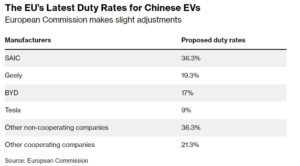
- EU cuts planned tariff on Tesla’s China-made EVs to 9%, lower than the 20.8% it had indicated in July (link/link)
- The European Union has lowered the planned tariff on Tesla vehicles imported from China to 9%, down from the originally proposed 20.8%, following Tesla’s request for recalculation based on specific subsidies it receives in China
- These tariffs, which are in addition to the existing 10% duty on imported electric vehicles, stem from the EU’s findings that Chinese EVs benefit from subsidies, posing a threat to European EV producers, and are part of the EU’s broader strategy to impose “definitive countervailing duties” on such imports
- The tariffs are expected to increase EV prices in Europe; The new tariffs are subject to approval by a majority of the 27 EU member states before 31 October and, if approved, will remain in effect for five years
A Few Other Key Developments This Week – Olympics, Streaming, Upfronts, And Shoppable Commerce
- Peacock added 2.8mn signups during the first week of the Olympics, per Antenna (link)
- Avg daily sign-ups to Peacock were 398k during the first week of The 2024 Olympics, which represented a 5.6x increase vs the 8-week benchmark
- In July 2024, Peacock drew 29% share of all Premium SVOD Gross Adds, up from the avg 16% share over the past 12 months
- The 2024 Paris Olympics drove 2.8mn sign-ups to Peacock, approaching the levels seen during major NFL events like the NFL Wild Card Weekend (3mn) and the Super Bowl (3.4mn)
- Additionally, some quick Peacock viewership stats, per Nielsen (link) –
- Viewership was up +33% in July vs June, per Nielsen, driven largely by the beginning of the 2024 Paris Olympics as well as Season 6 of “Love Island USA”
- Peacock accounted for 1.5% of all TV viewership in July, up from 1.2% in June, and the second-best share ever after the 1.6% it achieved in January 2024
- On broadcast, NBC‘s airing of the Olympics accounted for all of the top 5 and 7 of the top 10 telecasts of the month, led by an average 19mn viewers on July 28
- Only three days of Olympics coverage are accounted for in Nielsen report, indicating that August will likely build on these trends
- Netflix closes its upfront with 150% growth in ad sales commitments (link/link/link)
- Closed deals with “all major holding companies as well as independent agencies”
- Upfront commitments include investments “from all key categories”, including CPG, Tech & Entertainment, Auto, QSR, and Retail
- Closed partnerships for several upcoming films and series…: Including Squid Game, Wednesday, Outer Banks, Happy Gilmore 2, Ginny & Georgia, and Love is Blind
- …as well as deals around live events: Including WWE Raw, and the Christmas Day NFL games
- Secured multiple intl on-screen title sponsors for S3 of Bridgerton (6th most popular English-language TV series of all time), including Pure Leaf, Amazon Audible, Puig, Booking.com, Stella Artois, and Hilton
- Struck ad partnership for the most recent season of Emily in Paris with LVMH, COTY Gucci, Kaiku Caffee Latte, Aeromexico, L’Oreal, Google and Rakuten
- Expanded its programmatic offerings for advertisers to now include The Trade Desk, Google’s Display & Video 360, or Xandr (Until now, Microsoft has been Netflix’s exclusive partner powering its ad-supported tier)
- On track for launch of their in-house ad tech platform: Will be tested in Canada in November and launched globally in 2025
- YouTube expands its partnership with Shopify to onboard more brands into its affiliate program (link/link)
- What it means for Shopify merchants: Enables creators to showcase the merchant’s products at scale in their videos
- What it means for YouTube creators: Will now have access to thousands of new brands to tag in their content across YouTube (up from the “few hundred” brands they currently have access to); Also introducing a new Chrome extension for US creators in the YouTube Shopping affiliate program to save products while browsing a brand or retailer’s site, so they can be easily found when ready to tag in a video in Studio later
- Other platforms have been rolling out siliar social commerce features (link) –
- Wish introduced its Wish Clips feature in 2022, which lets users view product information and buy products in the app’s short-form videos.
- TikTok launched the TikTok Shop in the US in 2023, enabling businesses to showcase their products on the social media app
- Amazon Live debuted its shoppable, free ad-supported channel on Prime Video earlier this year, allowing viewers browse, shop and engage with content they’re watching on TV or their mobile devices
- Netflix and Google partner to bring shoppable integration to newest season of “Emily in Paris” (link/link/link)
- Viewers on all Netflix plans can use Google Lens to scan Emily’s looks and be directed to similar items to match her style
- Viewers on Netflix’s ad plan will also see –
- “Pause ads” that prompt them to scan an image on screen that takes them to a specific “shopping” page that highlights some of Emily’s clothes and accessories
- 15-second commercial spots, which will see Lily Collins reprise her role as Emily using Google Lens to help with fashion shopping.
- Google will also serve as the title sponsor of season 4 and will advertise in its previous three seasons
- The partnership marks the first time Netflix has allowed a sponsor to “co-brand” a pause ad on the service, as well as allowed title sponsorships on library content
Stock Market Check
This Week's Other Curated News
Advertising/Ad Agencies/Ad Tech
- Baidu’s revenue dipped 0.4% to 33.9bn yuan ($4.7bn) amid China’s economic downturn, reflecting challenges in transitioning from search ads to AI. While Baidu’s AI initiatives, including the “Ernie” language model, have contributed sales, they face fierce competition from Alibaba and Tencent. Baidu’s reliance on advertising remains pressured, and its AI ventures are expected to lose money for the next three years. (Yahoo Finance)
- Unilever is globally consolidating the creative accounts for its beauty and wellbeing brands into WPP. The consolidation means WPP will take on creative responsibilities for Clear, Dove, TreSemme, Sunsilk, Simple, Nexxus, Shea Moisture, Clear and Pond’s globally, while continuing its previous work on Vaseline. WPP already had responsibility for some of the Co’s biggest brands, mostly through its creative agency Ogilvy. (MM+M – Medical Marketing and Media)
Artificial Intelligence/Machine Learning
- Anthropic was sued by a group of authors, who accused it of training its models on pirated books. The proposed class action lawsuit was filed in a California court on Aug 19 and alleges Anthropic “built a multibillion-dollar business by stealing hundreds of thousands of copyrighted books.” In the lawsuit, the authors say that Anthropic used a sprawling, open-source dataset known as “The Pile” to train its family of Claude AI chatbots. (The Verge)
- China’s internet co’s are betting billions on incubating the country’s OpenAI challengers, w/ Alibaba and Tencent leading the charge. Since 2023, investors, including the country’s biggest tech cos, have valued at least six China-based startups developing large language models at more than $1bn each. Most of these unicorns, dubbed China’s six “Little Artificial-Intelligence Dragons,” have received capital from Alibaba and Tencent. (OODA Loop)
- Congresswoman Nancy Pelosi issued a statement laying out her opposition to SB 1047, a California bill that seeks to regulate AI. “The view of many of us in Congress is that SB 1047 is well-intentioned but ill-informed,” Pelosi said. The bill was recently amended to address concerns from critics, including AI Co Anthropic, and is currently headed to California’s Assembly for a vote. (TechCrunch)
- Google is upgrading its Gemini writing tools in Gmail to help users polish drafts that they have already written. Now, among other Gemini-powered “Help me write” options like Formalize and Elaborate, users can tap “Polish” to refine their emails, Google says in a blog post. The co has also added shortcuts that appear in the body of your emails on Android and iOS, making it more obvious that there are AI writing tools to use. (The Verge)
- More than half of Fortune 500 Cos have cited AI as a risk factor in their latest annual reports, per Arize AI. A survey of annual reports from the biggest US corporations are increasingly highlighting AI as a possible risk factor. According to a report from Arize AI, the number of Fortune 500 Cos that cited AI as a risk hit 281. That represents a 473.5% increase from the prior year, when just 49 Cos flagged AI risks. (Fortune)
- The growing demand for AI is prompting Cos like Microsoft, Google, and Amazon to explore converting old power stations and industrial sites into data centers. As finding suitable locations with sufficient power becomes harder, companies are turning to these sites, which are often designed for high power use. However, converting such sites can be complex, costly, and time-consuming, yet they present new opportunities for data center expansion. (Ars Technica)
Audio/Music/Podcast
- Alex Cooper and her top-ranking podcast Call Her Daddy have inked an extensive exclusive content deal w/ SiriusXM. The agreement means SiriusXM will pick up the exclusive advertising and distribution rights, content, events, and more for Cooper’s flagship podcast, as well the shows produced by Cooper’s Unwell Network. Terms of the deal were not released, but reports have suggested it could be worth $100mn+. (Insideradio.com)
- Apple Podcasts is expanding to the web. Users can access the new web app version at podcasts.apple.com in desktop web browsers, including Safari, Chrome, Edge, and Firefox. For the first time, Apple Podcasts users can access their Up Next queue, library of saved shows, and browse for new podcasts inside their PC web browser. Previously, only macOS offered a desktop Podcasts app experience. (9to5Mac)
Broadcast/Cable Networks
- DIRECTV’s 5-year deal with Disney is ending, and they’re seeking a new agreement similar to Spectrum’s, which includes Disney+ and ESPN+ for subscribers. DIRECTV wants flexible, lower-priced packages and an aggregated experience. The negotiations raise concerns about a potential blackout of Disney channels on DIRECTV, as happened with Spectrum, with the possibility of a last-minute deal being necessary. (Cord Cutters News)
- Night 1 of the Democratic National Convention drew 20.025mn viewers and 15.003mn households, surpassing the Republican National Convention’s 18.130mn viewers and 13.2mn households. The DNC broadcast also outperformed the first night of the 2020 DNC, which had 15.338mn viewers, indicating a strong start for the event. (NextTV)
Broader Media & Entertainment
- India’s antitrust body reached an initial assessment that the $8.5bn India merger of Reliance and Walt Disney media assets harms competition due to their power over cricket broadcast rights. The Competition Commission of India (CCI) has privately warned Disney and Reliance through a notice in which it has shared its concerns about their grip over rights to broadcast the favorite sport of the world’s most populous country. (CNBC)
- Liberty Media annc’d a public offering of 10,650,000 shares of Series C Liberty Formula One Common Stock (“FWONK”). Liberty Media also expects to grant the underwriters of the offering an option to purchase up to an addt’l 1,597,500 shares of FWONK. If the Acquisition is not consummated for any reason, the net proceeds from this offering would be available for general corporate purposes and attributed to the Formula One Group tracking stock. (BUSINESSWIRE)
Cable/Pay-TV/Wireless
- China Mobile surpassed the 1bn subscriber mark at the end of Q2 w/ the Co adding nearly 9.3mn new subs y/y. The Co’s user base is more than twice that of the world’s second-largest player Reliance Jio in India, which has 489.7mn, data from GSMA Intelligence showed. China Telecom was third w/ nearly 417mn mobile subs and Bharti Airtel fourth w/ 355.8mn, followed by China Unicom w/ 339.5mn. (Mobile World Live)
- China Telecom revealed financial results and key achievements that include its AI deployment strategy during the H1:24. China Telecom’s revenues rose 2.8% to RMB268bn in the first half. Net profit incr’d 8.2% to RMB21.8bn. Service rev of China Telecom rose 4.3% to RMB246.2bn. Mobile communications svs revs rose 3.6% to RMB105.2bn. Revs from mobile value-added and applications surged 17.1% to RMB18.1bn. (TelecomLead)
- Cox Communications asked the Supreme Court to overturn a lower court’s ruling that held the Co liable for its subscribers’ copyright infringement. The Supreme Court’s review “is needed to restore a uniform, nationwide copyright damages regime”, the Co said. The case, which began in 2018 when Sony Music, UMG, WMG, and other music giants sued Cox, aims to make it so ISPs including Cox are accountable for piracy committed by their subscribers. (NextTV)
- Ericsson expects to receive SEK10.6bn ($1bn) from the sale of number portability and data exchange services subsidiary iconectiv, a US-based unit it arranged to offload to Koch Equity Development. The sum stated would be booked as a cash benefit and includes settlements of taxes, transaction expenses, and other obligations. Ericsson explained it anticipates booking a one-off EBIT gain of ~SEK8.8 bn. (Mobile World Live)
- Kaleido Intelligence found that annual fraud losses from voice and operator messaging channels will decline to $17bn in 2028, an annual decline of 9% on 2024’s projected losses for the yr. A combination of declines in channel use and the shutdown of circuit-switched networks will encourage fraudsters into newer forms of fraud, including attacks on APIs and the use of AI to directly manipulate the telecoms network. (VanillaPlus – The global voice of Telecoms IT)
- MTN Group posted a half-year 2024 loss, weighed down by devaluation of the Nigerian naira and operational challenges in Sudan. The Co’s svs rev fell by 20.8% to 85.3bn South African rand ($4.78bn) from 107.735bn rand for the same period a yr earlier. The EBTIDA margin fell to 32% from 43.6% due to cost pressure from challenging conditions. At the end of the period, MTN’s total subscriber numbers were up 0.8% to 288mn. (Kenyan Wall Street – African Business and Global Finance)
- Nokia annc’d that it has been selected by TIM Brasil to expand its 5G radio access network coverage across 15 Brazilian states from Jan 2025. This partnership will increase the number of municipalities w/ access to 5G, bringing the benefits of secure, ultra-high-speed connectivity to a wider population. The expansion will also enable enterprises in these regions to digitalize their operations, fostering innovation and driving economic growth. (THEFASTMODE)
- Virgin Media O2 is launching a new mobile plan to help people on low incomes stay connected. The O2 Essential Plan is available for new and existing customers who receive a range of benefit payments, and comes w/ 10GB of mobile data, plus unlimited calls and texts for £10 per month. The plan can be taken as a 30-day rolling contract, has no activation or exit fees, and no price changes while customers receive benefit payments. (Virgin Media O2)
Cloud/DataCenters/IT Infrastructure
- Informatica annc’d Lumen Technologies successfully modernized on-premises PowerCenter workloads to Informatica’s Intelligent Data Management Cloud platform. This accels Lumen’s time-to-value and minimizes migration costs as well as effort in its expansion to the cloud. Informatica’s AI-powered IDMC platform allowed Lumen to work within a single platform to streamline network assets, cloud connectivity, security solutions, and collab tools. (Aithority)
- Microsoft lowered its cloud computing unit revenue forecast in a bookkeeping move, shifting money to its “productivity” software business. Microsoft said the change is intended to more closely align earnings reports w/ how the co operates when it comes to cloud services tied to its business computing unit. (BARRONS)
- Singtel and Bridge Alliance annc’d a partnership on Aug 19 that will take Singtel’s GPUaaS offerings to enterprises across Southeast Asia once it is launched later in 2024. The deal will allow Bridge Alliance member operators, which total 35 globally, to gain access to the GPUaaS offerings from Singtel. GPUaaS is a cloud-based solution that offers access to graphics processing units (GPUs) on demand. (The Straits Times)
Cybersecurity/Security
- Flight tracking site FlightAware blamed a “configuration error” for exposing a raft of personal info of its customers, including some of their Social Security numbers. The Co said in a notice that it identified the unspecified error on July 25, which exposed names, email addresses, and more, depending on what information users provided to the Co. In a separate notice, FlightAware said that passwords and Social Security numbers were also exposed. (TechCrunch)
- New details are emerging about a breach at National Public Data (NPD), a consumer data broker that recently spilled hundreds of millions of Americans’ Social Security Numbers, addresses, and phone numbers online. KrebsOnSecurity has learned that another NPD data broker that shares access to the same consumer records inadvertently published the passwords to its back-end database in a file that was freely available from its homepage until today. (SLASHDOT)
eCommerce/Social Commerce/Retail
- 31% of back-to-school shoppers are expected to go into debt for their purchases, up +2pp from 2022. That includes 24% of respondents who are using credit cards and carrying balances, and 13% who are using buy now, pay later svs like Affirm or Klarna. The people who said they feel pressured to spend more on school shopping than they’re comfortable w/ declined to 14% from 26% in 2022, while 18% of respondents said school shopping did or will strain their budget this yr, down from 31% 2 yrs ago. (Retail Dive)
- Amazon has launched a program allowing sellers using its fulfillment svs to issue product refunds w/out customers returning the item, according to an Aug13 annc’mnt. Fulfillment by Amazon Returnless Resolutions will help sellers avoid returns-related fees by cutting out the physical reverse logistics process and letting customers keep the items instead, the co said. Some products are ineligible for the program, including dangerous goods, heavy and bulky items, and those w/ an avg sales price above $75. (Retail Dive)
- Amazon’s drone delivery program’s tests have become a regular fact of life for residents of College Station, Texas. For the 127,000 people of College Station, the din from the drones has become a nuisance, per CNBC. “It sounds like a giant hive of bees,” John Case, who has lived in the town for 40 years, told CNBC. “You know it’s coming because it’s pretty loud.” (Yahoo Finance)
- California has enacted new laws to combat organized retail crime, developed in collaboration with retailers. The laws allow prosecutors to bundle stolen goods’ value across retailers to meet felony thresholds, permit arrests without witnessing the crime, and extend probation for theft. They also enhance penalties for possessing stolen goods and require online marketplaces to track high-volume sellers. These laws aim to tackle retail theft while preserving criminal justice reforms. (Retail Dive)
- During Walmart’s second-quarter earnings call, CEO Doug McMillon annc’d that the co is placing pressure on its suppliers to reduce their pricing so it can pass savings on to customers. Walmart will cut prices on more than 7,000 items across grocery categories as part of its “rollback” deals, according to Quartz. The statement comes at the same time as Walmart announced its projected sales growth for 2024 to move to between 3.75% and 4.75%. (Food & Wine)
- Lowe’s lowered its full-yr guidance after Q2 was hit by unfavorable weather and consumer sentiment. Q2 net sales fell 5.5% y/y to $23.6bn, w/ comps down 5.1%. Gross margin was about flat to last yr at 33.5%, and net earnings fell 10.8% to $2.4bn. For FY24, Lowe’s now expects total sales to land between $82.7-83.2bn , down from its previous expectation for $84-85bn; comps are expected to fall 3.5-4%, worse than the earlier 2-3% estimate. (Retail Dive)
- Macy’s cut its full-yr sales forecast, as the department store operator said it is contending w/ selective shoppers and more promotions. Macy’s said it now anticipates net sales of between $22.1bn and $22.4bn, which is lower than the $22.3bn to $22.9bn range it had previously anticipated. That metric includes owned and licensed sales, which encompass merchandise that Macy’s owns and items from brands that pay for space w/in its stores, along w/ Macy’s third-party online marketplace. (CNBC)
- Morrisons boss Rami Baitiéh admitted the supermarket “went a bit too far” w/ self-checkouts as it looks to pull back on the technology. The CEO said that the biz is “reviewing the balance between self-checkouts and manned tills” and is looking to remove some from its stores after installing too many. Baitiéh claimed the rise of self-checkouts had also driven more shoplifting at its supermkts. (Retail Gazette)
- Over 50% of the biggest online fashion retailers do not offer free postal returns. The consumer choice firm looked at the returns policies of the 20 biggest online fashion retailers, including Asos, Boohoo and Amazon and found that 12 do not offer free postal returns. The returns fees range from £1.99 to £3.99, w/ some fashion retailers having specific fees and processes for returning items, while others state it’s up to you to arrange and pay for postage. (Retail Gazette)
- Shein is considering selling its shares directly to the British public amid controversy around its possible £50bn stock market flotation on the London Stock Exchange. The co is understood to be in the early stages of examining a possible sale to retail investors alongside City institutions. Shein’s bankers are thought to be running the rule over proposals to sell directly to the public, however the plans are understood to be at an early stage and no decision has been made. (Retail Gazette)
- Target said that sales grew about 3% in its fiscal Q2, a return to growth after a prolonged stretch of sluggish sales and squeezed profits. The discounter beat Wall Street’s earnings and rev expectations, as shoppers made more visits to Target’s stores and website and bought more discretionary items like clothing. The co’s shares closed about 11% higher as Target showed improvement in generating profits. (CNBC)
- Target swung back to growth in the Q2 w/ sales rising 2.6% to $25bn, up from $24.4bn a yr earlier. Net earnings rose nearly 43% to $1.2bn, up from $835mn yr over yr. Operating income was $1.6bn for the quarter, up 37% from $1.2bn a yr ago. Traffic drove comparable sales growth, w/ overall comps rising 2% yr over yr in Q2, while store comps rose 0.7%. Digital comps rose 8.7%. Q2’s gross margin was 29%, compared to 27% a yr ago. (Retail Dive)
- ThredUp is testing out a brand-new peer-to-peer resale mktplace that takes direct aim at competitors like Poshmark, Mercari, and Depop. It’s unclear when exactly the new mktplace debuted, but it’s easy enough to find on ThredUp’s website. (The mktplace doesn’t appear as an option on mobile web or ThredUp’s app.) The mktplace appears to still be under wraps, as ThredUp hasn’t posted about direct listing on any official channels. (Modern Retail)
- Walmart and Burger King announced Thursday a new partnership to offer Walmart+ members a daily discount on digital Burger King orders, effective immediately, the companies said in a statement. The dining benefit includes 25% off digital orders daily and, starting in September, a free Whopper every three months with any purchase. To activate the deal, Walmart+ members must link their membership with Burger King’s free Royal Perks loyalty program. Once the accounts are linked, Walmart+ members can get the deal through Burger King’s app or website. (Retail Dive)
- Walmart opened up its Walmart Cross Border ocean shipping svs to Cos sourcing goods in China. Walmart Marketplace sellers can now use the Co’s ocean shipping svs to transport China-made goods to Walmart’s US fulfillment center network, taking advantage of its negotiated container freight rates and customs clearance capacity. It is only available to WFS sellers that source or manufacture goods in China. (SUPPLYCHAINBRAIN)
- Walmart sold its entire stake in JD.com, according to a person familiar w/ the matter. Walmart is exiting an eight-yr investment to focus on its own operations in China. A placement of the Walmart shares was fully subscribed, the person said, and at the top end of the offered range, would be worth $3.74 bn. Walmart plans to double down on its warehouse biz, Sam’s Club, in China after the stake sale. (Yahoo Finance)
- Shein is suing rival Temu, alleging the retailer stole its designs and built an empire using counterfeiting, IP infringement, and fraud. In its complaint, Shein alleges that Temu, owned by PDD Holdings, is “masquerading” as a legitimate online marketplace because it encourages its sellers to steal other brands’ designs and then prevents them from removing products from the platform, even after they have admitted to infringement. (CNBC)
EdTech
- The South Korean govt has plans to bring tablets w/ AI-powered textbooks into classrooms, sparking reservations among some parents. The tablets are scheduled to be introduced next yr, and by 2028, teachers are supposed to be using these AI textbooks for all subjects except music, art, physical education, and ethics. In response, 50,000+ parents signed a petition demanding that the govt’ focus less on new tech and more on students’ well-being. (TechCrunch)
EV/ Autonomous Vehicles
- Self-driving tech co WeRide delayed its plan for an IPO in the US, citing its need for more time to complete documents. WeRide was expected to offer 6.5mn ADS in the range of $15.50 to $18.50. It was looking to raise up to $440mn in a US listing that had been set for this week. The co was last valued around $5.11bn and has raised $1.39bn. (CNBC)
- Waymo revealed details about its newest “generation 6” self-driving tech. W/ new hardware and software integrated into Geely Zeekr electric vehicles, Waymo should be able to handle a wider array of weather conditions without requiring as many costly cameras and sensors. Waymo is currently working to scale in the US, w/ a fresh $5bn investment from Alphabet. (CNBC)
- Xiaomi reported its fastest pace of rev growth since 2021, buoyed by the initial success of its first electric vehicles and a global smartphone market bounceback. Sales rose a better-than-projected 32% to 88.9bn yuan ($12.5bn) in the Jun. quarter, boosted by roughly 6.2bn yuan of revenue from its EV division. Net income also beat expectations at 5.1bn yuan, after a one-time investment gain of almost 550bn yuan. But it booked an adjusted loss of about 1.8bn yuan from the autos arm. (Yahoo Finance)
Film/Studio/Content/IP/Talent
- Deadpool & Wolverine managed to hold off It Ends With Us to take the top spot at the Australian National Box Office for a fourth weekend in a row. The film’s $4.57mn brings its Australian box office to $54.7mn. Blake Lively’s It Ends With Us brought in $4.51mn in its second week, while Alien: Romulus took $3.43mn to take third place, despite knocking off Deadpool & Wolverine from the top of the box office in the US. (Mumbrella)
- Google, California lawmakers, and the California News Publishers Association have agreed on a $250mn plan to support California newsrooms, avoiding a state bill that would have forced tech companies to pay for news content. The five-year deal includes funding from Google and taxpayers, creating a News Transformation Fund to preserve local journalism. However, some lawmakers and journalist unions criticized the deal for being insufficient and lacking transparency. (NYTIMES)
- Warner Bros.Discovery plans to purchase and operate an $8.5bn film studio in Nevada, contingent on the approval of a state tax credit. The 34-acre “Warner Bros. Studio Nevada” will be located at UNLV’s Harry Reid Research & Technology Park and will include film and TV studios and a teaching facility for UNLV students. The project depends on a proposed $95mn annual tax credit over 17 years. (NextTV)
FinTech/InsurTech/Payments
- A proposed 30% mkt share cap in India’s Unified Payments Interface (UPI) segment is looking unlikely, said industry execs, w/ only a little over four months to the deadline. Several UPI newcomers have been told informally that the limit is unlikely to be put into effect and, accordingly, have started redrawing growth and investment plans, people briefed on the matter said. (The Economic Times)
- Adyen will offer the Fastlane by PayPal checkout experience to its enterprise and marketplace customers. The rollout of this offering will begin with Adyen’s customers in the US and then extend globally in the future. The addition of Fastlane by PayPal to Adyen’s platform will accelerate guest checkout flows, improve consumer shopping experiences, and enhance conversion for bizs using the platform. (PYMNTS.com)
- Amazon is considering shifting its payments offerings in India into a standalone app. Some execs at Amazon believe that a separate app w/ a singular focus could help the payments platform gain wider recognition in the country. However, sources cautioned that Amazon, grappling with many other challenges in India, may alter its plans and could still abandon the idea. (TechCrunch)
HealthTech/Wellness
- Neuralink said surgery for its second implant in a human “went well” and the patient is now able to design 3D objects and play video games like Counter-Strike 2. The procedure also appears to have successfully averted an issue that dogged the experience of the first patient, Noland Arbaugh, who had the unexpected complication of electrode threads retracting from his brain. The co said it was working on new capabilities for its brain interface device. (Yahoo Finance)
- Peloton’s Q4 revenue was flat at $643.6mn, with connected fitness products down -4% and subscription revenue up +2%. Operating loss improved 72% to $63.3mn, and net loss narrowed 87% to $30.5mn. For the full fiscal year, revenue fell 3.6% to $2.7mn, with losses reduced by over 50%. Memberships declined as marketing costs were cut. Peloton projects revenue declines and lower subscriptions in the upcoming fiscal year. (Retail Dive)
Last Mile Transportation/Delivery
- Didi Global swung to a profit of 1.4bn yuan ($196mn) in the Jun quarter, a welcome boost as it prepares for a potential re-listing in Hong Kong. The co saw rev climb 4.1% to 50.9bn yuan, after ride-hailing transactions hit a record. The results show that the co is gradually recovering from a tough few yrs. (CAIXINGLOBAL)
- Zomato, the Indian food delivery Co, has acquired the entertainment ticketing biz of financial svs firm Paytm for $244.1mn, signaling a strategic move to expand its “going out” offerings. As part of the deal, Paytm’s flagship app will continue to host these offerings for up to 12 months and 280 of its employees will join Zomato, the cos said. (TechCrunch)
Live Entertainment/Theme Parks/Concerts/Experiential
- Ten more states have signed on to the wide-ranging antitrust suit alleging monopolistic practices by Live Nation and Ticketmaster. The DoJ annc’d Indiana, Iowa, Kansas, Louisiana, Mississippi, Nebraska, New Mexico, South Dakota, Utah, and Vermont have joined the suit. 40 states and the District of Columbia are now included as plaintiffs in the case. The DOJ filed its amended complaint against the Co on Aug 19. (Pollstar News)
Macro Updates
- The recent downward revision of 818,000 U.S. payrolls, the largest since 2009, raises concerns about economic weakness, but current indicators don’t suggest a recession. Jobless claims and GDP data remain stable, unlike in 2009. The revisions may signal overstated job growth, but the Fed is likely to focus on more current data. Some economists believe the revisions might be overstated, adding uncertainty to the outlook. (CNBC)
Satellite/Space
- Project Kuiper, Amazon’s low Earth orbit satellite broadband network, is expanding its footprint at Kennedy Space Center in Florida as it prepares for a full-scale deployment of its satellite constellation. In 2024, Project Kuiper broke ground on a $120mn (€108mn) satellite processing facility, and now the team is investing another $19.5mn to expand its presence by adding a secondary support facility at the site — bringing its total investment in the site to nearly $140mn. (ADVANCED-TELEVISION)
Social/Digital Media
- A new feature annc’d by Instagram will allow users to add a song on their profile — much like Myspace in the early 2000s. The music added to a user’s profile shows up in the bio area, according to screenshots shared by Instagram. A song will be featured on a profile until the user removes or replaces it. But unlike Myspace, songs won’t autoplay — people viewing a profile w/ a song can play and pause the track. Instagram is launching the feature in collaboration w/ pop star Sabrina Carpenter. (The Verge)
- Elon Musk’s loans to buy Twitter have become the worst merger-finance deal for banks since the financial crisis of 2008-09, per a report. Seven banks involved in the deal, including the likes of Bank of America and Morgan Stanley, gave Musk’s holding Co ~$13bn to take X private in 2022. The WSJ reports that banks haven’t been able to sell the debt w/out taking huge losses, predominantly because of the Co’s poor financial performance. (Yahoo Finance)
- Elon Musk’s social media app, X, recently had 95 co-owners, including a Saudi conglomerate, the cryptocurrency firm Binance and entities associated w/ the rapper Sean “Diddy” Combs and the billionaire Bill Ackman, according to a list its lawyers filed in federal court. The list is the public’s first complete look at who co-owns the app since Musk bought the co and took it private in 2022. (NBC News)
- Meta has globally rolled out the ability to cross-post from Instagram and Facebook to Threads, aiming to streamline content sharing across its platforms. This feature, which became available after months of testing, allows users to post Instagram images and Facebook text posts directly to Threads. It’s designed to save time for content creators by reaching multiple audiences simultaneously, though some content may not translate perfectly across platforms. (TechCrunch)
- Ofcom is ramping up its hiring of online safety staff as debate continues over the ability of the UK to properly tackle the spread of misinformation online. The riots in parts of the UK earlier in Aug were fueled by the spread of misinformation in the wake of the stabbings in Southport. The violence was stoked by a number of false claims spreading online, including that the suspect was an asylum seeker who had arrived in the UK by boat last yr. (Yahoo Finance)
Software
- Snowflake raised its full-year product revenue forecast to $3.36 billion, driven by AI advancements attracting more clients. Despite this, shares dropped over 8% as the company didn’t raise its margin forecast. Snowflake left margins unchanged, awaiting GPU deployments. The firm authorized a $2.5bn share buyback and reported strong Q2 product revenue of $829.3mn, beating estimates. Snowflake is focusing on AI, including developing its own large language model, Snowflake Arctic. (Yahoo Finance)
- Zoom reported adjusted earnings for Q2 w/ per share price of $1.39, up from $1.34 in the same quarter of the previous fiscal yr, on rev of $1.163bn, up 2.1% yr-over-yr. Analysts had expected adjusted earnings per share of $1.21 on rev of $1.15bn. Enterprise rev in the quarter was $682.8 mn, up 3.5% yr-over-yr and online rev came in at $479.7mn, flat yr-over-yr. For its fiscal 2025 Q3, Zoom expects adjusted earnings per share of $1.29 to $1.31 on revenue of $1.16bn to $1.65bn. Analysts had expected earnings of $1.24. (SiliconANGLE)
Sports/Sports Betting
- Ariel Helwani is in advanced negotiations to join Yahoo Sports, per sources. Helwani told his followers on X earlier this week that he “decided to move on” from Vox Media and Spotify at the conclusion of his three-yr deals w/ both Cos, which expired on Aug 15. Helwani said it was difficult to turn down the offers he received from his previous employers, but he didn’t signal where he was headed. (Front Office Sports)
- Arizona generated $429mn in economic impact from hosting the Men’s Final Four in April 2024, per a new report. But Gov Katie Hobbs is “really concerned” it will be the last time Arizona gets to host a national sporting event of this caliber if voters approve what Republicans put on the ballot as the “Border Security Act.” Proposition 314 would allow state and local police to arrest those who enter the country at other than a port of entry. (The Daily Independent at YourValley.net)
- Bill Simmons said on his podcast that Jeff Bezos may explore a purchase of the Celtics, who were put on the mkt by owner Wyc Grousbeck and his partners last month. According to The Information, Bezos “has no plans” to bid on the Celtics. However, lost in Simmons’s report was the price tag that the league hopes the iconic franchise will fetch, whether from the billionaire Bezos or any prospective buyer. (Front Office Sports)
- Jake Paul vs Mike Tyson is set for an eight-round professional bout w/ two-minute rounds after being rescheduled. The bout will stream live globally and exclusively on Netflix on Nov 15 from the 80,000-seat capacity AT&T Stadium in Arlington, Texas. In the preliminary press conference, Paul and Tyson had plenty to say about the upcoming fight, and Tyson even landed a blow on Paul when things became heated. (ADVANCED-TELEVISION)
- Japanese baseball players are trying to make the path to playing abroad easier than it’s ever been before. The union for Japan’s major league is preparing a legal challenge that will attempt to change the league’s free agency system and give players control over their name, image and likeness. Nippon Professional Baseball has produced the likes of Shohei Ohtani and Kodai Senga, but players have lived under a somewhat restrictive system there. Free agency is also heavily restricted by the NPB. (Front Office Sports)
- The legal dispute between Warner Bros Discovery and the NBA is likely to stretch into the 2024-2025 NBA season, affecting TNT Sports as it operates in the final year of its NBA contract. Key dates include the NBA’s response to WBD’s complaint by August 23, and further legal filings into October. WBD alleges contract breaches after the NBA rejected its offer to match Amazon’s media rights deal. (Front Office Sports)
- The NFL is on the verge of allowing private equity into its ownership ranks. The league has scheduled a special meeting for Aug 27 in Minneapolis, where owners will likely vote on whether to approve the addition of private capital. The NFL has been discussing the 10% range, w/ some owners pushing for something closer to 5%, sources said. The NBA, MLB, MLS and NWSL all allow funds to hold up to 30% of a team’s equity. (Sportico.com)
- While building hype for the NFL season, which begins in two weeks, the league is also taking precautions against sports betting among its players, especially as the NBA and MLB have faced significant controversies this yr. The NFL will have investigators on-site during game days to scout for “suspicious activity,” according to ESPN. The NFL’s security team also monitors betting markets in search of suspicious activity, such as large swings in the odds of player props. (Front Office Sports)
- YouTube TV is offering a free Max subscription to customers who sign up for NFL Sunday Ticket, similar to last year’s promotion. Eligible subscribers must not have had Max in the past 90 days and must claim the offer before December 31, 2024. (Cord Cutters News)
Tech Hardware
- AMD annc’d the signing of a definitive agreement to acquire ZT Systems, a leading provider of AI infrastructure for the world’s largest hyperscale computing Cos. The cash and stock transaction is valued at $4.9bn, inclusive of a contingent payment of up to $400mn based on certain post-closing milestones. AMD expects the transaction to be accretive on a non-GAAP basis by the end of 2025 (Advanced Micro Devices, Inc.)
- Samsung has annc’d a new Odyssey gaming monitor lineup at gamescom that uses eye-tracking technology to convert 2D visuals into glasses-free 3D. The Odyssey 3D is set for a global release “w/in this yr” according to Samsung, and will allow users to “seamlessly switch between 2D and 3D modes” based on preference. (The Verge)
- Shanghai’s govt doubled its domestic chip investment fund, w/ the latest funding round increasing the total to ~CNY14.5bn ($2bn). The fund is supported by state-backed Cos located in Shanghai, which contributed CNY6.9bn to bolster China’s aspiration to lead the mkt, particularly as the need for advanced AI chips increases. The Shanghai Semiconductor Industry Investment was originally established in 2016. (RCR Wireless News)
- Texas Instruments stands to receive up to $1.6bn in funding from the US Department of Commerce for three semiconductor facilities as part of a move to boost the domestic semiconductor industry. The proposed direct funding from the CHIPS and Science Act will be used to help build TI’s 300mm wafer fabs already under construction in the states of Texas and Utah. (Silicon)
Towers/Fiber
- Telecom tower operator IHS Holdings Ltd is exploring a potential sale of its bizs in Rwanda and Zambia. Some proceeds from any disposals would be used to pay down debt. IHS operates 40,000 towers across Africa, LatAm and the Middle East, according to its website. IHS said in March that it’s working with advisers including JPMorgan Chase & Co. to evaluate strategic alternatives for the business across its portfolio and capital allocation priorities. (Yahoo Finance)
Video Games/Interactive Entertainment
- Microsoft is launching three new Xbox Series S / X console options in Oct. There’s the $449.99 white discless Xbox Series X, a 2TB “Galaxy Black” special-edition Xbox Series X priced at $599.99, and a $349.99 1TB Xbox Series S. All three models will be available in the US on Oct.15, w/ other markets to follow on Oct. 29. (The Verge)
- Nvidia will soon let users link an Xbox account to its GeForce Now streaming svs to enable automatic sign-in for supported games. Starting on Aug 22, the new account linking feature will mean users only need to sign-in and link an Xbox profile once so that it’s stored for all future GeForce Now sessions. Nvidia’s improvements for Xbox games on GeForce Now come just weeks after Microsoft integrated GeForce Now into its Xbox game pages on the web. (The Verge)
- Twitch’s mobile app users might have to pay a bit more starting on Oct 1. The co annc’d that Tier 1 and gift subscriptions in more than 40 countries will have a higher price on the iOS and Android apps. According to emails from Twitch shared by Dexerto and on Reddit, Tier 1 subscriptions will cost $7.99 per month, an increase from the current Tier 1 price on the app of $5.99 per month. The cost of Tier 2 and Tier 3 subscriptions will remain the same. (The Verge)
Video Streaming
- Horowitz Research found that an increasing number of budget-conscious consumers say they have cut back on subscription-based streaming svs in favor of FAST channels. Tubi, Pluto TV, Freevee, YouTube, and Roku were the top-used FAST networks by consumers surveyed in the study. 53% of FAST users say they have cut down on their paid streaming svs now that they have adopted FAST. (TVTechnology)
- Nielsen revealed that free streaming svs are rapidly gaining popularity among cord cutters seeking cost-effective options. Nielsen reports that Tubi has tied Disney+ as the fourth most-watched streaming svs in the US, each holding 2.1% of streaming traffic. The Roku Channel and Pluto TV also saw growth, contributing to a total of over 4.4% of streaming in July 2024. YouTube remains the most-watched service at 10.4%. (Cord Cutters News)
- Ampere Analysis has quantified that older seasons of Netflix series typically receive a huge catchup boost when new seasons drop. The Co looked at Netflix’s two massive 2023 ratings data drops, specifically examining older seasons of shows that had new episodes drop in the second half of 2023. On avg, viewership for these shows increased by 86% in the second half of the yr vs the first half. (NextTV)
