

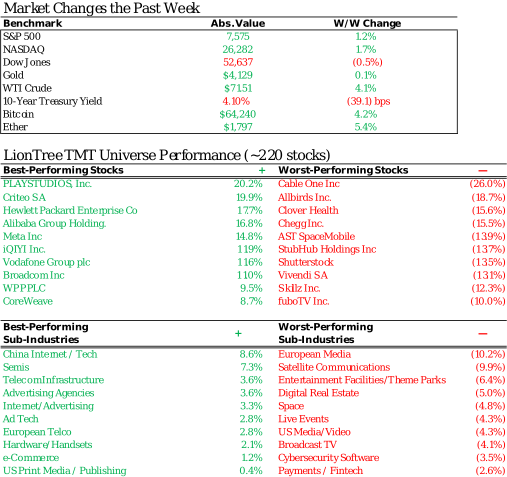
It was an up and down week though tech, esp semis (SOX +2.7%) and big tech names like Meta (+14.8%) were key drivers for the overall S&P 500 and Nasdaq rallies (+1.2% and +1.7%, respectively).
It was a busy week with a multitude of important sector updates, and we focused on the below in this edition.
- The Beginning Of “The Most Significant Restructure In Xbox History”
- Q2: Top Shorts Didn’t Perform As Hoped By The Short Sellers
- US Vs China AI Tensions Escalate
- New Records After New Records…World Cup US Viewership Is On Fire
- AI Roundup: OpenAI, SpaceXAI and Meta Roll Out New Models, AI Agents, Products and Platform Updates
- Youth Safety & AI Governance Take Center Stage This Week
- Another Qtr Is In The Books Where Apple TV+ Takes US Streaming Share
- On Which Stocks Are Wall Street Analysts Most & Least Bullish?
Looking ahead, next week kicks off another cycle of earnings (it feels like it just ended!) with Netflix reporting on Thursday. The June CPI, PPI, and retails sales numbers will also be of focus economically along with Kevin Warch’s 1st delivery of semi-annual testimony to Congress and the latest Beige Book report.
** Lastly, in case you missed it before your July 4th BBQs, we published the Summer Edition of our quarterly LionTree’s Sector Insights & A Look Ahead deck, which is accompanied by a ~20-minute video narration, both of which can be accessed HERE **
Have a nice weekend.
Best,
Leslie

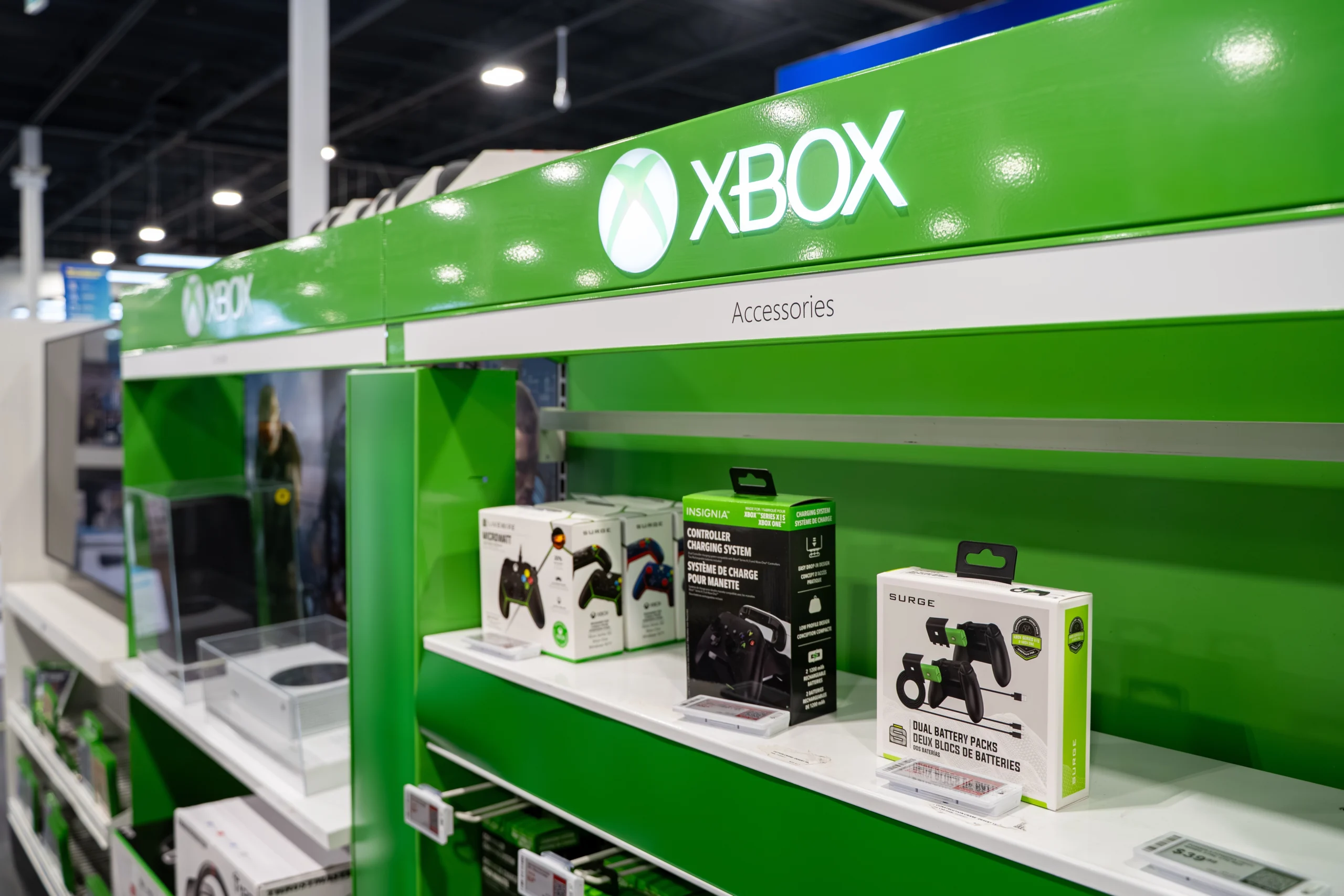
The Beginning Of “The Most Significant Restructure In Xbox History”
There have been a steady series of team and product changes since Asha Sharma was appointed CEO of Xbox in Feb 2026, which has now culminated in the business’ “most significant restructure in Xbox’s history”, with large job cuts and studio separations. While this now makes official what was recent press speculation (so not a total surprise), these changes reflect an unwinding of what had become a bloated cost structure, redundancies created by AI efficiencies, plus a declining top-line profile. The Co is making hard costs decisions sooner rather than later to right size the business and is now on a mission to “return to growth” in FY 2027, but the going forward growth strategy to get there is not as clear.
See below for the key points. (link/link/link/link/link/link/link)
- The Co is “beginning the most significant restructure in Xbox history”
- It is cutting 3,200 people through FY27 (est’d to equate to ~20% of Xbox’s workforce)
- 1,600 will be cut this week (this is part of Microsoft’s total 4,800 employee cuts also annc’d which is 2.15% of its total workforce…aside from Xbox, the Commercial business is also impacted)
- “The roles eliminated today are not being replaced by AI”…“at the same time, what is true is that AI is changing how work gets done”
- 4 studios will leave Xbox to new mgmt
- These include Compulsion Games, Double Fine Productions, Ninja Theory and Undead Labs
- Another studio, Arkane, is potentially moving in this direction as well
- Sharma is also creating a flatter org structure
- She is reducing mgmt layers from as many as 14 to no more than 5 and, “where possible,” 3
- She created a new COO role and promoted Helen Chiang
- Mojang and King will now report directly to Sharma (these are among Xbox’s largest businesses by MAUs)
- Sharma reiterates that the “business today is not healthy” and cites that –
- Operating margins are 3-10x lower than comparable platform and publishing platforms
- Game Pass, multi-platform, and a broader content portfolio did not grow at the expected pace
- Lower Game Pass performance: The Co had projected Game Pass subs would reach ~77mn this year according to a document earlier revealed during legal proceedings related to the Activision acq, but it currently has only ~30mn subs per sources
- She highlights that the industry is facing the most severe hardware crisis in its history
- She flagged that no publicly announced 1P games or projects are being canceled as part of these reductions
- The CEO says that the Co “will return to growth in 2027”
- FQ3 Gaming revenue decr’d -7% y/y, driven by declines in Xbox content & services and Xbox hardware
- Xbox content & services revs decr’d -5% y/y (reflecting the tough comps given the benefit from strong 1P performance)
- Xbox hardware revs decr’d -33% y/y, driven by lower volume of consoles sold
- FQ4 Gaming revenue guidance –
- Xbox content & services revs are guided to decline in the low-teens, reflecting the same tough comps, as well as the price changes for Xbox Game Pass
- Xbox hardware revs are guided to “decline” y/y
- “We will end this fiscal year at a ~3% accountability margin, down y/y. Excl Activision Blizzard King, over the past five years, we have spent over $20bn on ongoing investments in our content, platform, and hardware subsidy, but our annual revenue has decl’d nearly half a billion during that time. Going forward, this cannot continue”, per Sharma in her “Next 100 Days: Xbox Reset” communication
- FQ3 Gaming revenue decr’d -7% y/y, driven by declines in Xbox content & services and Xbox hardware
- Previous changes that Sharma has annc’d include –
- Greater focus on core franchises: Cutting the number of games Microsoft publishes and investing more in its most popular franchises, including Minecraft, Candy Crush and Fallout
- Changes at Game Pass: She reversed course on a bungled price hike on Game Pass last year which was met with customer wrath and subscriber losses
- Titles in the “Call of Duty” franchise will no longer be part of the two subscriptions immediately when they come out
-> Separately, but also related to gaming and the value of premium IP, per research undertaken for GamesIndustry.biz by the mobile data firm AppMagic, premium mobile games are seeing a resurgence, after years in which free-to-play has been seen as the only option worth pursuing; The total # of premium mobile game releases in 2025 was almost 750, which is up +77% y/y; With that said, the free-to-play segment still dominates by far, accounting for a massive 96% of mobile downloads in 2025 (link)
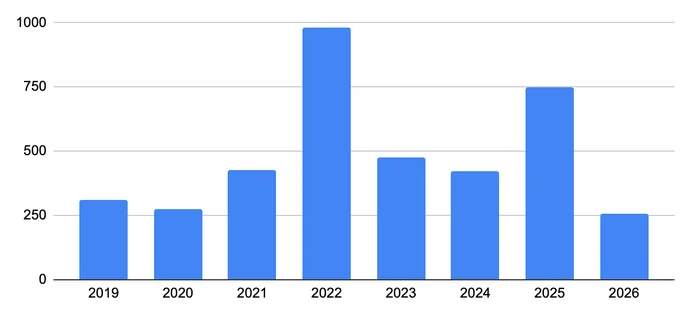
Premium game releases on the App Store and Google Play by year | Image credit: AppMagic
Source: GamesIndustry.biz
Q2: Top Shorts Didn’t Perform As Hoped By The Short Sellers
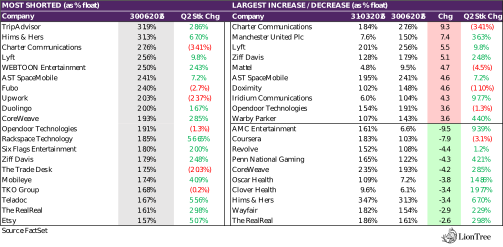
The latest Q2 short interest data (released this week) showed some reshuffling across our LionTree Universe of ~150 tech, media, telco, and consumer stocks with market caps of $1bn+, but the top shorts didn’t yield the type of returns short sellers were betting on. Only 8 of the top 20 most-shorted stocks underperformed the S&P 500’s +14.9% return during the qtr, and the avg return of the group was +44%, although this was heavily influenced by Rackspace Technology’s 566.5% rally. Excluding Rackspace, the avg return was a more modest +16.9%, though it still topped the broader market.
Drilling down into individual stocks, TripAdvisor overtook Hims & Hers as the most-shorted stock by float, ending Hims & Hers’ three-qtr run as the most-shorted name, while Charter entered the Top 3 following the largest increase in short interest during the qtr. On the other end, AMC Entertainment recorded the largest decline in short interest as its shares rallied nearly 94%.
See our analysis below for more details.
Most Shorted Stock (As % Of Float) – Groupon
- The Top 3 Most Shorted = #1 is TripAdvisor, #2 is Hims & Hers, and #3 is Charter
- TripAdvisor rose from the #3 spot in Q1 -> #1 spot in Q2
- After 3 consecutive qtrs as the most shorted stock, Hims & Hers fell to the #2 spot in Q2
- Charter was a new entrant to the Top 3 and rose from the #7 spot in Q1 -> #3 spot in Q2
- Stocks that dropped out of the Top 20 most shorted: GameStop, Lemonade, Peloton, Penn National Gaming, Pinterest, USA Today, Wayfair
- Stocks that joined the Top 20 most shorted: Etsy, Fubo, Mobileye, Rackspace Technology, Teladoc, The Trade Desk, Ziff Davis
-> The S&P 500 was up +14.9% in Q2 and 8 out of the top 20 most-shorted stocks underperformed the index over the period; On avg, the top 20 most-shorted stocks traded up +44% in Q2, compared to Q4’s average of -14%
Largest Increase In Short Interest (As % Of Float) – Charter
- The largest increase in short interest was seen at Charter: The Co saw a +9.3ppt increase in Q2 to 27.6% of the float -> The stock was down -34.1% in the qtr
- Other stocks with notable increases in short interest = Manchester United, Lyft, and Ziff Davis -> notably, both Manchester United and Ziff Davis outperformed the S&P 500’s +14.9% performance in the qtr
Largest Decrease In Short Interest (As % Of Float) – AMC Entertainment
- The largest decrease in short interest was for AMC Entertainment: The Co posted a -9.5ppt decrease in Q2 to 6.6% -> The stock was up +93.9% in the qtr, significantly outperforming the S&P 500
- Other stocks with notable decreases in short interest = Coursera, Revolve, and Penn National Gaming -> Coursera and Revolve both underperformed the S&P 500’s +14.9%, while Penn National Gaming significantly outperformed
US Vs China AI Tensions Escalate
The US and China are both gunning to lead in this AI race and the sparring between the two further escalated this week with a number of reported developments.
The stream included…
- Monday: A Bloomberg survey indicated that Chinese executives are trying to reduce reliance on NVIDIA’s advanced AI chips and instead promote domestic alternatives (link)
- Execs plan to increase their budgets for domestic AI accelerator products from 30% to 46% over the next 12 months, per a Bloomberg Intelligence survey released this week
- Why? Because 80% say that their total infrastructure spending is higher than their budgets, which is mostly due to AI related projects
- The impact of $s shifting?
- Bernstein projects Nvidia’s share of the Chinese AI semi market will fall to ~8% in 2026, down from ~40% last year
- Huawei is projected to capture >50% mkt shr in China’s AI chip market
- Tencent and Alibaba are also cited as key beneficiaries
- Monday: CNBC confirmed that Alibaba has ordered its employees to stop using Anthropic tools for work starting July 10th (link)
- Tuesday: News emerged that US lawmakers are considering ways to reduce the adoption of Chinese AI models at US firms
- An ongoing House Committee investigation is probing the risks associated with the rise of Chinese built AI technology
- “The growing use of Chinese AI models by U.S. companies raises serious concerns,” a State Department spokesperson told CNBC. Those “AI models are designed to advance Beijing’s narratives, censor dissent, and reflect CCP ideology and values.”
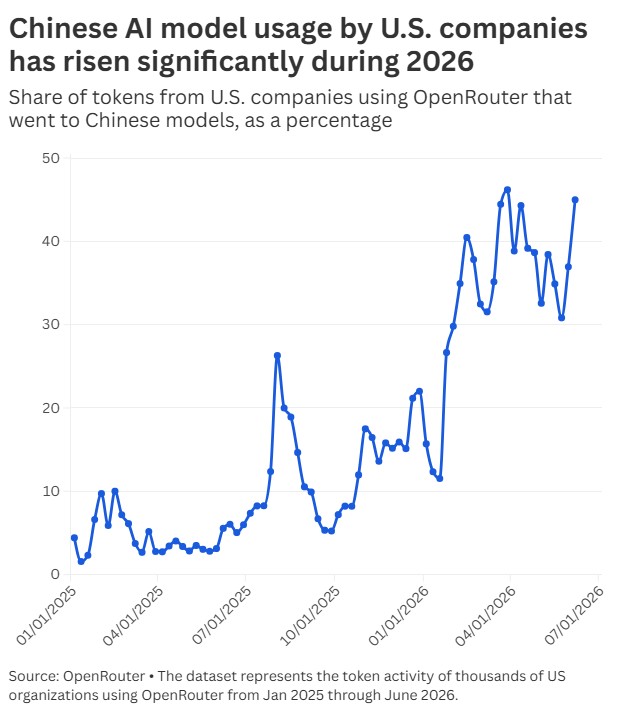
Source: CNBC
- Tuesday: China authorities are reportedly considering curbing foreign access to its top AI models (link): Authorities held meetings over the past month w/ leading domestic tech firms including Alibaba, ByteDance, and Z.ai to discuss potentially restricting overseas access to China’s most advanced AI models, including ones not yet publicly released
- This would be a big change since most Chinese AI models are open source and anyone can download them (making them a cheap option)
- No official comments have been made
- Tuesday: DeepSeek is also reportedly working on producing its own inference focused AI chip, as it aims to reduce dependency on Nvidia and on domestic alternatives from Huawei (link)
- Wednesday: Headlines hit that China warned of “back-door” security risks affecting companies that use Anthropic’s Claude Code AI tool (link)
- Last month, Anthropic accused Alibaba of attempting to extract its AI capabilities that are not officially available in China (Alibaba did not comment on the accusations at the time)
- Wednesday: Reports surfaced that China is planning to allow the country’s top AI companies to buy a limited number of Nvidia’s H200 chips per the Information, citing sources (link)
- What is apparently still being determined includes:
- The exact # of Nvidia chips to approve, and it could amount to fewer than 200k in total, which would be less than 50% of what the companies requested earlier this year
- Neither Nvidia nor the U.S. Commerce Dept, nor China’s commerce ministry have commented
- What is apparently still being determined includes:
- As previously reported: China plans to invest ~¥2 trillion (~$294–380bn) over 5 yrs to build out data centers nationwide, with at least 80% of core (including chips) expected to be sourced domestically
New Records After New Records…World Cup US Viewership Is On Fire
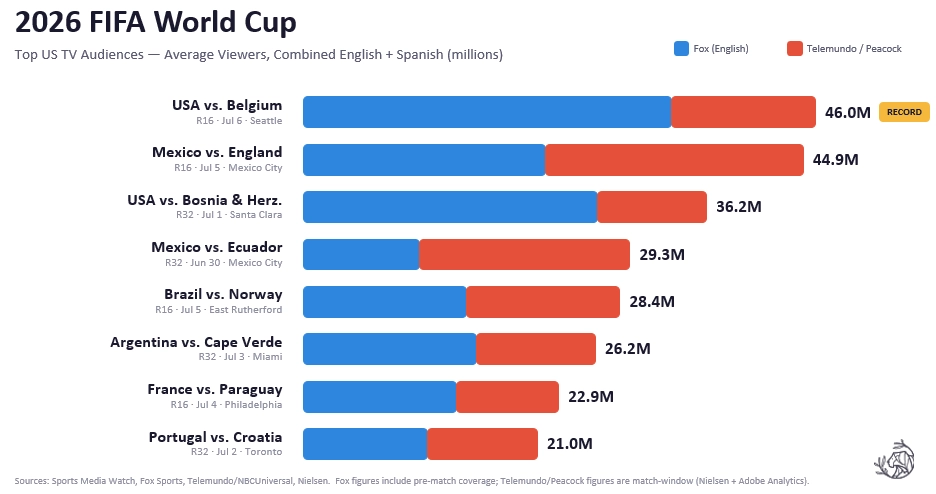
It has been record US viewership after record US viewership for World Cup matches over the course of this 2026 line-up. As of the end of last week, the US vs Bosnia-Herzegovina game hit record US viewership (English and Spanish combined), only to be beaten by the Mexico vs Ecuador on Sunday, only to be beaten by USA vs Belgium on Monday.
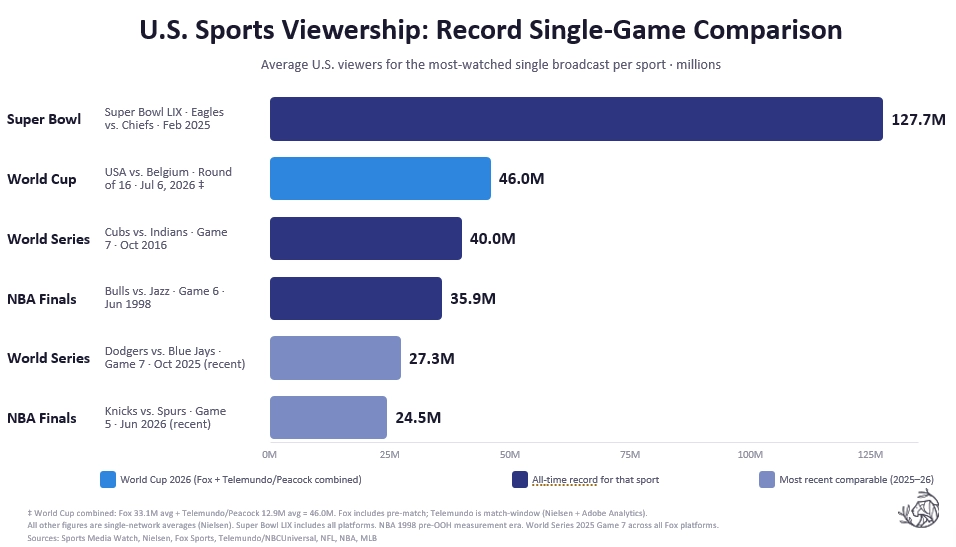
These numbers certainly validate soccer’s popularity and importance in the sports’ eco-system as viewership numbers easily surpassed the recent NBA and World Series finals (but more on par with historical viewership records of those 2 sports). With that said, the Super Bowl still remains in a league of its own in terms of viewership.
What does this mean for World Cup media rights? They likely will go higher with Netflix, Disney, and YouTube all reportedly considering challenging Fox for the US World Cup b-cast rights in 2030 and 2034, per CNBC.
See below.
For the games this week based on the latest viewership numbers that we saw… (link/link/link/link)
- July 5th: The Mexico vs England reached almost 45mn viewers in total…a RECORD at the time
- ~21.7mn on Fox
- ~23.2mn on Telemundo/Peacock
- July 6th: The USA vs Belgium match reached ~46mn viewers in total …a new RECORD
- ~33mn on Fox… the most-watched soccer telecast in US history
- The peak was 41mn
- ~12.9mn on Telemundo/ Peacock…the most-watched USMNT game ever in Spanish
- ~33mn on Fox… the most-watched soccer telecast in US history
- How does this new US viewership record compare to other sports?
- They exceeded that of the World Series’ and the NBA’s most watched single broadcast
- BUT certainly pale in comparison to the most watched Super Bowl game which was in 2025 w/ an avg of 127.7mn viewers (across Fox, Fox Deportes. Telemundo, and Tubi)
Sources: link/link/link/link/link/link
New Bidders For The Next 2 World Cup Media Rights?
- Also this week, press reports (CNBC) emerged that Netflix, Disney and YouTube are considering challenging Fox for US World Cup broadcast rights in 2030 and 2034 (link)
- How much could be paid? Media execs are apparently are budgeting btw $1.5-$2bn for each tournament
- How does this compare? It would be a big increase from…
- Fox paying $485mn for the English-language rights for this year’s tournament, hosted across North American cities, according to The Athletic
- NBCU’s Telemundo paying $600mn for the Spanish-language rights, per sources
- This increase would be despite both World Cups being held in less attractive time zones for US TV viewership
- The 2030 World Cup will take place in Morocco, Portugal and Spain… there is a 5-6 hour time difference with US EST
- The 2034 World Cup will take place in Saudi Arabia…which is 7 hours ahead of US EST
- Other key updates, per sources –
- FIFA has said that English- and Spanish-language US rights are likely to be sold together
- Discussions b/w FIFA and potential media partners are expected to begin sometime in the next 3 months
- The last time FIFA negotiated a deal, with Fox and Telemundo was in 2011
- Four years later, FIFA extended that deal through 2026
- FIFA, Netflix, YouTube and Disney all declined to comment
AI Roundup: OpenAI, SpaceXAI and Meta Roll Out New Models, AI Agents, Products and Platform Updates
The pace of AI innovation showed no signs of slowing this week, with OpenAI, SpaceXAI and Meta each introducing major new models and products. OpenAI unveiled GPT-5.6, following a limited rollout to a small group of trusted partners at the request of the US govt, alongside ChatGPT Work, a new productivity-focused AI agent, and GPT-Live, its next-generation voice model. SpaceXAI launched Grok 4.5, positioning it as its strongest model yet for coding, agentic tasks and knowledge work.
Meta in particular had a busy week, introducing its new Muse Image and Muse Video models for AI-powered image and video generation, as well as launching Muse Spark 1.1, its latest model for developers and the company’s first paid API offering. Separately, in an internal memo, Meta outlined plans to begin production of its in-house AI chips later this year and detailed a significant expansion of its AI compute infrastructure, while reports also emerged that the Co is said to be developing “super sensing” smart glasses that records at all times.
See below.
Another Round Of OpenAI, SpaceXAI, And Meta AI Models Came To Market This Week
- OpenAI releases GPT-5.6 + ChatGPT Work agent + GPT-Live (link/link/link)
- GPT 5.6 comes in three versions…Sol is the most powerful version, while Luna is designed for speed; Terra, meanwhile, aims to strike a balance between the two for everyday work
- A new “ultra” mode within Sol allows the system to work even harder on tasks and to delegate work to various submodels
- Release comes after the Co limited the rollout to a “small group of trusted partners” at the request of the US govt
- ChatGPT Work is powered by 5.6 and is an agent that can gather context across connected apps and files to create documents, spreadsheets, presentations and other work
- It can also work across web, phones and computers, first rolling out to the Mac and Windows apps for all tiers of users, with web to follow
- GPT-Live is a new generation of voice models meant to make talking to AI feel more like having a conversation with a real person
- Meant to replace the existing ChatGPT voice experience
- It is able to listen and speak at the same time, and it can show it is paying attention with acknowledgment phrases like “mhmm”
- The model was built for continuous interaction, and it can make decisions on whether to speak, continue listening, pause, interrupt, or use a tool multiple times per second
- GPT 5.6 comes in three versions…Sol is the most powerful version, while Luna is designed for speed; Terra, meanwhile, aims to strike a balance between the two for everyday work
- SpaceXAI launches Grok 4.5, its “smartest” and “strongest model ever” that is “built to excel at coding, agentic tasks, and knowledge work” (link/link/link)
- This is the Co’s first release since going public and acquiring the AI coding startup Cursor
- The new model is being pitched as a coding and agentic-work tool vs a consumer-facing chatbot, and one that CEO Elon Musk says is “maximally truth-seeking” vs its competitors
- It is being marketed as a bargain for users, priced at $2 per mn input tokens and $6 per mn output tokens
- Claude’s Opus 4.8 is priced at $5 input / $25 output
- OpenAI’s GPT 5.6 Luna is priced at $1 input / $6 output
- “It is an Opus-class model, but faster, more token-efficient and lower cost,” Musk said in a post on X
-> Separately, but related, Cursor is reportedly developing a general-purpose AI agent that would compete with Anthropic’s Cowork and OpenAI’s ChatGPT Work; The AI agent, which is internally referred to as Sand, would respond to emails or texts, organize spreadsheets and handle engineering work; The Co rolled it out internally in late June, but it remains in testing and there’s no guarantee it will make it to mkt, with the Co’s pending merger w/ SpaceXAI also being a potential determining factor that could alter Cursor’s product road map (link/link)
- Meta introduces Muse Image and Muse Video (link/link/link)
- Muse Image is the first image generation model from Meta Superintelligence Labs, now available in Meta AI
- Muse Image enables users to turn their ideas into high-quality visuals that they can download and share anywhere, including directly to their feed, story, or chat
- The model also powers new creative tools across Meta’s apps, including 30+ new AI-powered effects for Instagram Stories and image generation in direct chats with Meta AI on WhatsApp (starting in limited countries with more locations on the way)
- Muse Image includes Content Seal, Meta’s invisible watermarking system: Images created by Muse Image carry a hidden provenance signal that stays intact, even when cropped, compressed, resized, or screenshotted
- How does it work? Users can describe the image they want (including editing images, creating infographics, etc.) in simple, conversational language, and Meta AI handles the rest thanks to Muse Image
- Muse Image operates as an agent: It invokes search and coding tools to improve accuracy, self-refines its own generations, and improves through scaling test-time compute
- Where is it available? Across the Meta AI app and on meta.ai, Instagram Stories in the US, and WhatsApp in limited countries
- Coming soon to more countries, surfaces, and advertisers: Soon, Meta will bring Muse Image to more countries and the places where people use Meta AI, including Facebook and Messenger, and addtl surfaces on Instagram and WhatsApp; In the coming weeks, advertisers and agencies will be able to tap into Muse Image through Advantage+ creative
- Using Meta AI with Muse Image is free for everyday creation and for people who want to create even more, it’s available as part of Meta’s subscription plans
- Previewed Muse Video, which is still in development and is “coming” soon to creators and Meta AI
- Investing in areas with current performance gaps, such as audio-video synchronization and physically accurate fast motion
- But the release of the model hasn’t been w/o controversy… adult users with public accounts were automatically enrolled in the feature without being asked for explicit permission
- Any user can tag another person’s public Instagram handle, using an @-mention within the Meta AI app, prompting the system to scan that person’s public profile photos and generate an AI visual of them
- A Meta spokesperson said that adults w/ public accounts “can opt out with just a couple of clicks” and noted that Meta would “take action against any content that violates our Community Standards”
- Muse Image is the first image generation model from Meta Superintelligence Labs, now available in Meta AI

Source: Meta Press Release
- Meta rolls out Muse Spark 1.1, which includes a new paid tier for developers (link/link)
- This is the first time Meta has charged businesses for access to its models
- “Since this is not an open-source model, this is I think the first time that we’re doing a real serious API,” CEO Mark Zuckerberg said, “And the pricing is going to be very aggressive and attractive”
- Pricing is ~25% of the cost advertised by other top models, allowing developers to use Meta’s model for free up to a certain token threshold, after which they’ll be required to pay for access.
- The new model’s standout improvement? Its agentic capabilities
- Zuckerberg described Muse Spark 1.1 as having “state-of-the-art or very close to it” agentic reasoning and tool use
- The model is also greatly improved when it comes to coding and Meta employees are using it internally to build products and features for various apps
- This is the first time Meta has charged businesses for access to its models
Also Out From Meta This Week…Updates On Chip Production + “Super Sensing” Smart Glasses
- Meta planning to start in-house AI chip production in September + planning a big boost to its compute by next yr, per an internal memo reviewed by Reuters (link/link)
- Falling under the umbrella of Meta’s Training and Inference Accelerators (MTIA) program, the chip, code-named “Iris” is one of four planned chip generations
- The plan is to use custom-built silicon to improve the AI that powers Meta’s platforms
- March marked Iris’s public debut, when Meta introduced it by its technical designation as part of a slate of four AI processors
- Meta expects to release a new chip ~6 months until 2027, which is significantly more aggressive schedule than the annual or slower release cycles common across the industry; Adopting the latest GPUs at Meta’s scale “has been a heavy lift, and it has cost us time,” the memo said
- Meta tailored the chip for its own needs and is working with Broadcom and Taiwan Semiconductor Manufacturing Co to manufacture it
- Meta is developing its own silicon to reduce compute costs and supplement, not replace, its significant GPU purchases from Nvidia and AMD
- The chip cleared its bug-testing phase in ~6 weeks w/o turning up any significant problems
- The memo also outlined a two-step infrastructure expansion: 7 gigawatts of computing capacity coming online in 2026, growing to 14 gigawatts by 2027
- Underpinning the expansion, the memo revealed that Meta has locked in extended supply contracts across several hardware categories, including memory chips from Samsung Electronics, flash storage from Sandisk, and fiber-optic equipment from Sumitomo Electric
- Falling under the umbrella of Meta’s Training and Inference Accelerators (MTIA) program, the chip, code-named “Iris” is one of four planned chip generations
-> Meta shares rallied +4.7% on the back of the comments about boosting compute capacity by next year
- Meta is reportedly working on smart glasses that would be recording all the time (link)
- The Co is said to be working on a prototype of “super sensing” AI glasses that would use cameras and audio recordings to capture a wearer’s every moment (i.e., continuously collecting audio while taking photos every few seconds)
- A user could then use AI to help query what they saw or heard, or recall their day
- In one proposed system, raw footage and audio would not be stored by Meta or made available to the user
- Instead, the metadata from that audio and images would be extracted and uploaded to the server for Meta’s AI to query, which proponents argue would have fewer privacy implications
- The Co is also reportedly discussing whether data collected through the glasses and their features could be used to train its own AI models
Youth Safety & AI Governance Take Center Stage This Week
As we’ve highlighted in the recent past, youth online safety and AI governance remain two of the most active areas of technology regulation. This week’s developments reflect the continued expansion of regulatory efforts, as policymakers, regulators and the courts advance new rules and legal challenges aimed at increasing accountability across the digital ecosystem.
Regulators on both sides of the Atlantic are intensifying scrutiny of Meta over allegations that Facebook and Instagram’s addictive design features harm young users. In the US., four states are seeking $1.4 trillion in penalties over claims Meta knowingly designed its platforms to be addictive, while the European Commission issued preliminary findings that the company’s platforms violate the Digital Services Act by failing to adequately assess and mitigate the risks posed by those same addictive features. Separately, the US Supreme Court allowed Texas’ app store age verification law to remain in effect while constitutional challenges continue through the courts.
At the same time, AI governance continued to evolve. Illinois enacted one of the nation’s most comprehensive AI safety laws, introducing new reporting requirements and the first mandatory third-party audits for certain advanced AI developers. Separately, a leaked US Treasury Department draft report raised concerns that rapid AI investment and growing concentration across the ecosystem could create broader financial stability risks if industry expectations are not met.
Net net, there was a lot to unpack this week on this theme as regulators and governance bodies are becoming increasingly active…see below.
Regulatory Scrutiny of Youth Safety Online Continues to Intensify, Particularly With Respect To Meta
- Four US states are demanding $1.4 trillion in penalties from Meta in the youth safety trial (link/link/link)
- The accusation: Meta is being accused of designing its Facebook and Instagram platforms to be addictive for young users, as well as hiding what it knew about the risks
- Meta has denied the allegations and argues that social media addiction is not an established psychiatric condition; The Co has also pushed back on accusations that it violated the Children’s Online Privacy Protection Act because it marketed Facebook and Instagram to a wider audience and not only children under 13
- Which states filed the lawsuit? California, Colorado, Kentucky and New Jersey
- Meta calls the states’ demands “outlandish” and says it has a longstanding commitment to supporting young people
- “A sanction of that size has no analog in the history of consumer protection enforcement,” the Co said in the filing -> for context, Meta’s market cap is ~$1.5trillion
- How did the states calculate the penalties? The states’ filings are sealed, but they said during a hearing last month that they were calculating the penalties by multiplying the # of violations (based on the est’d # of young users impacted by Meta’s social media platforms) by fine amounts established by state law
- The trial is set to start in August in Oakland, California
- In addition to the 4 states’ allegations, the trial will also address the 29 states that have sued Meta in federal court, most of them alleging the Co violated the federal Children’s Online Privacy Protection Act by collecting data from children without proper parental consent
- As a reminder, Meta’s bid to dismiss the trial was denied, as the court said there remained factual disputes over whether Meta’s social media platforms were addictive, whether Meta falsely denied it designed them that way, and whether it “partially” directed the platforms at children
- The accusation: Meta is being accused of designing its Facebook and Instagram platforms to be addictive for young users, as well as hiding what it knew about the risks
- Scrutiny around Meta is also escalating overseas… the European Union preliminarily finds that Meta’s Instagram and Facebook violate its Digital Services Act through its “addictive design” features (link/link)
- What were the European Commission’s preliminary findings? Meta did not adequately assess the risks of its addictive design on the physical and mental wellbeing of users, including minors and vulnerable adults
- The platforms use personalized recommendations, autoplay and infinite scroll, which shift the brain into ‘autopilot mode’ and contribute to compulsive use of the platforms
- Time mgmt tools for teens were easily dismissed, while parental controls required technical expertise, time and effort to use effectively
- How did Meta respond to the findings? “We disagree with these preliminary findings, which don’t accurately take into account the significant steps we’ve taken to protect teens,” a Meta spokesperson said
- The Co has rolled out a Teen Accounts feature to better protect children and added parental controls after the investigation began
- “We’re clear that Instagram and Facebook are intended for people aged 13 and older and we have measures in place to detect and remove accounts from anyone under that age”
- A ruling has not yet been issued and Meta will be able to respond to the findings
- Preliminary findings are the 2nd formal step in a DSA investigation; If the investigation’s findings are confirmed, the EU could fine Meta as much as 6% of its global annual revenue
- This is the second time this year that the EU Commission has found Meta to have breached its rules: In April, it said the Co had failed to prevent under-13s from accessing its platforms
- What were the European Commission’s preliminary findings? Meta did not adequately assess the risks of its addictive design on the physical and mental wellbeing of users, including minors and vulnerable adults
- The Supreme Court sides with Texas to enforce law requiring age verification and parental consent on apps (link/link/link)
- At the center of the of it all is the App Store Accountability Act, which requires app store accounts belonging to anyone under 18 to be linked to a parent or guardian; Before a child or teenager can download any app, parents must be notified of its age rating and approve the download
- Texas urged the Supreme Court to allow the law to remain in effect while constitutional challenges continue in the lower courts
- December 2025: A federal judge temporarily blocked the law before it could take effect, finding that the legal challenge raised serious constitutional questions.
- June 2026: The Fifth Circuit Court of Appeals allowed the law to go into effect while the case continues through the courts.
- July 2026 (this week): The US Supreme Court declined to step in, meaning the law remains in effect for now, but the Fifth Circuit Court of Appeals has not ruled on whether it is constitutional
- Two industry groups have challenged the Act, arguing that it violates the First Amendment by restricting children’s ability to access tools that enable them to participate in free speech
- Students Engaged in Advancing Texas says that its members “use mobile apps to teach other kids how to get involved in policymaking”
- Computer & Communications Industry Association, which is a trade group that represents app stores and app developers… “no state has ever required its citizens to prove their age before reading a newspaper, entering a bookstore, or even accessing the internet…the Texas law does exactly that – for every mobile app on every mobile phone”
Illinois Advances AI Safety Oversight As Leaked Treasury Draft Warns of AI Bubble Risks
- Illinois Governor JB Pritzker signs “Artificial Intelligence Safety Measures Act”, holding AI Cos accountable for safety risks (link/link/link)
- What is The Artificial Intelligence Safety Measures Act?
- It establishes a framework requiring developers of the largest advanced AI systems to publicly disclose safety practices, report “significant” safety incidents, and maintain “robust” compliance processes
- The law also creates confidential reporting channels and whistleblower protections for employees raising AI safety concerns
- In addition, Illinois becomes the first state in the nation to require regular independent 3P safety audits of covered AI systems, ensuring oversight is conducted by qualified experts without financial conflicts of interest
- The bill is NOT aimed at every AI company but targets what the state calls “frontier developers,” or the Cos building the most powerful AI models and using the most computing power
- Additionally, the rules only apply to firms generating $500mn+ in annual rev
- The bill mirrors California’s SB-53 and New York’s Responsible AI Safety and Education Act…: Which were both signed in late 2025 and established new reporting standards for the possibility that the AI model could be used for large-scale harms, such as by providing users assistance in creating a chemical, biological or nuclear weapon or committing cyber-attacks
- …but Illinois’ version adds a first-in-the-nation requirement for mandatory annual third-party audits
- Once the law is implemented in 2028, the biggest AI Cos must hire outside auditors to check their safety work every yr (the first such law in the country)
- How will the law be implemented?
- The law defines what it calls a “catastrophic risk” as an incident that could cause more than 50 deaths or serious injuries, or over $1bn in damage
- If something goes wrong, Cos must tell the Illinois Emergency Management Agency, Homeland Security and the attorney general within 72 hours.
- Additionally, employees who speak up if they think their Co’s AI is unsafe are now protected by law
- If a Co breaks the rules, the attorney general can fine them up to $1mn for a first offense and up to $3mn for repeat violations
- OpenAI and Anthropic both supported the bill on its path through the Illinois General Assembly, and it passed with broad bipartisan support in both chambers, as only five Republican senators voted against it, and it passed unanimously in the House
- The law takes effect January 1, 2027
- What is The Artificial Intelligence Safety Measures Act?
- Leaked US Treasury Dept draft report warns of systematic AI bubble risks (link/link)
- The draft compares key aspects of today’s AI market to the dot-com bubble that burst in the early 2000s
- It found that AI firms are more deeply entrenched in the US economy than their dotcom predecessors and pose significant risk to the entire system if financial conditions change, productivity goals are missed or various choke points stymie growth
- It highlighted that a downturn in the AI market would send shockwaves throughout the entire economic ecosystem…but a crash would be less immediate than the dot-com crash
- The report predicts that Cos would cut back, investors would lose confidence, and the economy would grow more slowly should the industry falter
- Stock markets, private credit markets, companies financing data center buildouts, cloud providers, chip manufacturers and utilities would all feel the effect
- The report also flagged some fundamental differences b/w the Cos that dominated the dotcom boom vs the current AI mkt
- The dotcom boom was defined by speculative excess and an overreliance on debt financing
- In contrast, many of the top AI companies are more mature, profitable and maintain healthier balance sheets, which could blunt the impacts of the “bubble” bursting, or if it bursts at all
- BUT it caveated that AI investors are taking risks so significant that much of the financial system now rests upon AI meeting expectations for productivity gains and profitability
- The AI sector is vulnerable to funding for data centers and other infrastructure projects drying up and sustained growth expectations not being met
- The industry is increasingly concentrated within a small number of firms, heavily reliant on private-market financing and significantly invested in infrastructure (i.e., data centers) to support its future
- Supply chain issues, geopolitical tensions, electricity bottlenecks, utilities shortfalls and other concerns could all block AI’s momentum
- The report is a significant departure from the Trump administration’s public tone, which has focused on encouraging cont’d investment to unlock exponential growth
- Additionally, a Treasury Dept spokesperson dismissed the report’s findings as unvetted and not representative of the agency’s policies or views: “The official position of the Secretary and the U.S. Treasury is that Artificial intelligence will be a key driver of America’s new Golden Age,” a spokesperson said, adding “AI has the potential to deliver unprecedented productivity gains, expand economic opportunity, and empower American workers and businesses.”
- The report was prepared by Treasury analysts for Secretary Scott Bessent, Federal Reserve Board Chair Kevin Warsh and various federal financial regulators; It has reportedly been completed for weeks and is awaiting formal approval before reaching its intended audience, which is eventually expected to include the public
- The draft compares key aspects of today’s AI market to the dot-com bubble that burst in the early 2000s
Another Qtr Is In The Books Where Apple TV+ Takes US Streaming Share
Two notable themes emerged in streaming this week that we wanted to highlight. First, new US streaming market share data for Q2 revealed some movements in the landscape with Netflix and Apple TV+ both gaining ground vs Q1 (and this continues Apple TV+’s ascent) while HBO Max lost share for the first time this year. Second, press reports pointed to streaming players (namely Netflix and Disney) actively exploring ways to broaden their reach and deepen engagement.
See details below.
Netflix & Apple TV+ Gain US Streaming Share In Q2 Vs Q1, While HBO Max Cedes Share
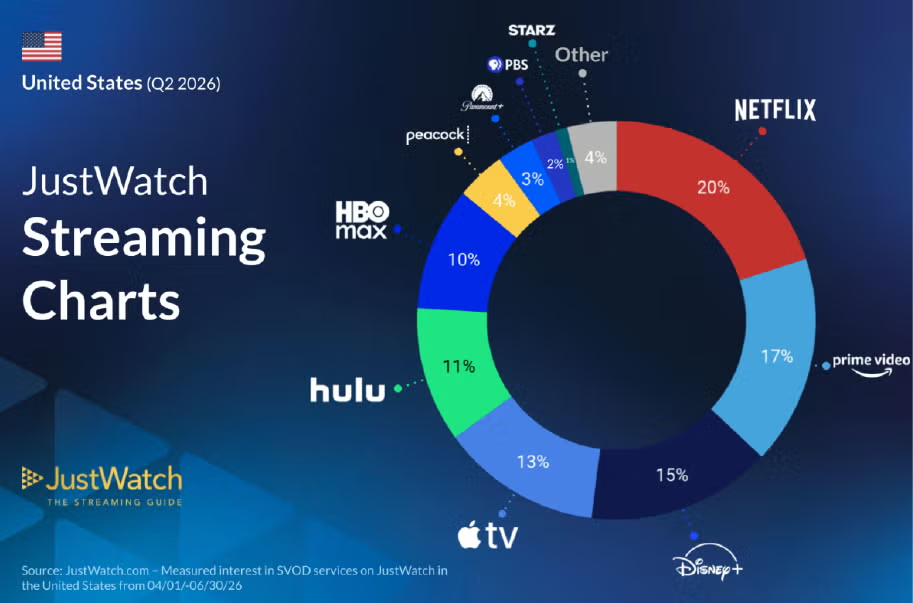
- Netflix remains the top dog in terms of US streaming market share (20%) and took share this qtr as did Apple TV+ but HBO Max’s share fell (link/link)
- Who maintained market share in Q2 vs Q1?
- Amazon Prime at 17%
- Disney at 15%
- Hulu at 11%
- Peacock at 4%
- But gained +2ppts y/y
- Who incr’d market share in Q2 vs Q1?…Apple’s continues its ascent
- Apple TV+ gained +1ppt to 13%, surpassing Hulu and HBO Max
- The svs also posted the strongest annual growth, up five ppts y/y
- Netflix gained +1ppt to 20%
- Apple TV+ gained +1ppt to 13%, surpassing Hulu and HBO Max
- Who lost market share in Q2 vs Q1?
- HBO Max lost -2 ppts to 10% (1st time Hulu ranked above HBO Max this year)
- The data was based on 45mn+ streaming interactions on its U.S. app and website across more than 320 SVOD services
Source: link
Streaming Giants Are Looking To Enhance/Expand Their Offering & Reach
- Disney is reportedly considering a completely free, ad-supported Tier for Disney+ (they only offer a paid ad-supported tier now in addition to a no ads tier) (link)
- This is reportedly being actively discussed internally: Per a Business Insider report, Adam Smith, Disney Entertainment’s Chief Product & Technology Officer, specifically spoke about the possibility of enabling free-tier content on the platform at an internal town hall
- The timing/scope is unclear: There is nothing concrete, and given that internal talks are still in the early stages, it could be months (or even years) before a completely free version of the app is available
- How big is the oppty? Almost a fifth of all TV viewing in the US is currently happening on free platforms
- A free tier would put Disney in direct competition with players like Tubi and Pluto TV
- Press reports surfaced that NFLX is assessing ways to improve engagement, which is moving in the wrong direction per the WSJ (link/link)
- What is reportedly being discussed to improve engagement?
- Adding live channels
- Exploring bundles with other subscription streaming services, including Peacock
- The Co already has annc’d adding or plans to add…
- Low-cost programming such as video podcasts and content previously released on YouTube
- Short form video from publishers including BuzzFeed and Condé Nast
- Access to b-caster TF1 in In France, which includes news (and the Co is looking to sign similar deals across Europe and Latin America per sources)
- Separately, Netflix is reportedly discussing World Cup b-cast rights for 2030 and 2034 (see Theme #4)
- What is reportedly being discussed to improve engagement?
-> Netflix’s stock was down -2.8% in reaction to the article and is down -21.8% over the last year; Netflix reports next week…
On Which Stocks Are Wall Street Analysts Most & Least Bullish?
Given we are now past the halfway point of 2026, we wanted to take stock of where Wall Street’s research recommendations and price targets stand across the TMT + Consumer sectors, and how that sentiment has aligned with stock performance so far this year. We analyzed companies in our Universe with at least 10 sell-side analysts covering the stock and a minimum market capitalization of $1bn.
On average, Buy ratings accounted for 61% of total ratings, Hold ratings accounted for 34%, and Sell ratings accounted for 5%, which is about in-line with the aggregate ratings distribution for companies in the S&P 500 (60% Buys, 36% Holds, 4% Sells), and in-line w/ the year-end distribution (60% Buys, 34% Holds, 6% Sells).
This week also marked one of Wall Street’s first broad sentiment reads on SpaceX, as 19 firms initiated coverage following the expiration of the post-IPO quiet period. Ratings certainly skewed positive.
More on all the above, below.
Which Companies Came On The Top & The Bottom Of The List?
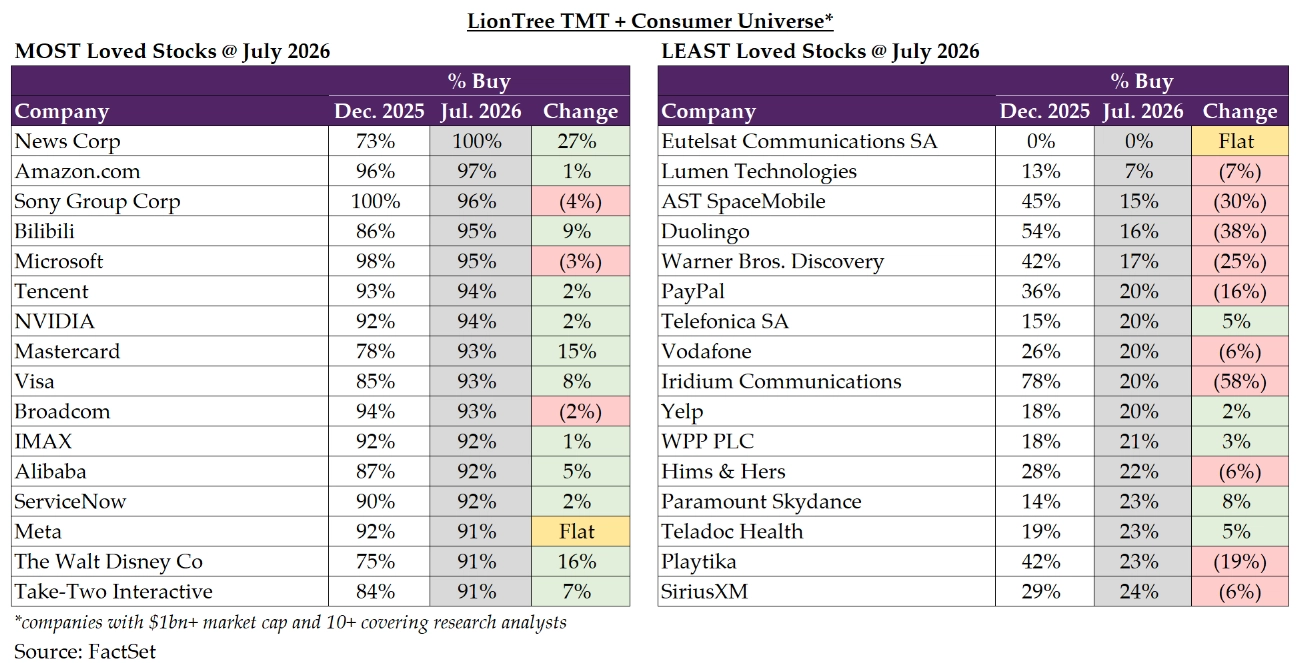
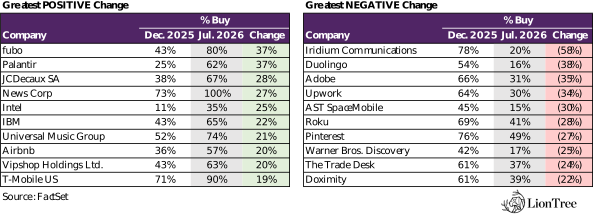
- The Most Loved Stock Currently = News Corp w/ 100% Buy Ratings
- Buy ratings incr’d from 73% Buys EOY 2025 to 96% Buys in Jul ’26
- The Least Loved Stock Currently = Eutelsat Communications SA
- Remained at 0% Buy ratings from EOY 2025 to Jul ‘26
Which Stocks Had The Biggest CHANGE In Sentiment?
- fubo had the largest POSITIVE swing
- Iridium Communications had the largest NEGATIVE swing (hit with downgrades before the Rocket Labs’ acquisition)
How Accurate Has Wall Street Been So Far This Year… Not Very
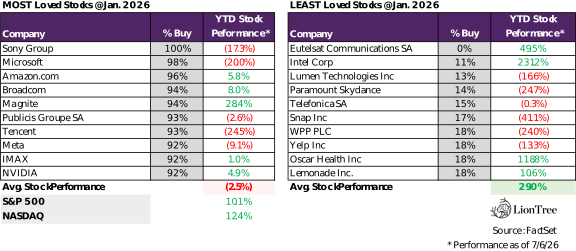
- The below table shows the Most Loved and Least Loved stocks as of January 2026 – i.e., the beginning of the year
- Looking at YTD stock price performance, stocks in the Top 10 MOST Loved group were down -2.5%, on avg, underperforming both the S&P 500 and NASDAQ
- On the other hand, stocks in the Top 10 LEAST Loved group were up a substantial +29%, on avg, though ex-Intel they were up a more modest +6.5% and underperformed the broader indices
- On which stocks were analysts most wrong?
- On the long side, the analyst community was the most wrong on Tencent (down -24.5% YTD, 93% Buy ratings)
- On the short side, the analyst community was most wrong on Intel (up +231.2% YTD, 11% Buy ratings)
How Has Sell-Side Sentiment Changed For MAANG Stocks?
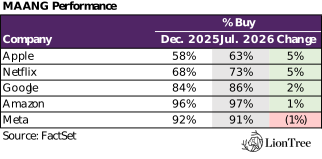
- Buy ratings across MAANG have remained broadly stable YTD
- Apple and Netflix saw the largest increases in Buy ratings (+5 ppts each), while Amazon and Meta remained among the 15 most-loved stocks in the LionTree TMT + Consumer universe despite Meta’s -1pt decline in Buy ratings
Also this Week…SpaceX Fielded A Wave Of Post IPO Analyst Initiations This Week, At The Same Time That It Officially Joined The Nasdaq 100 (link/link)
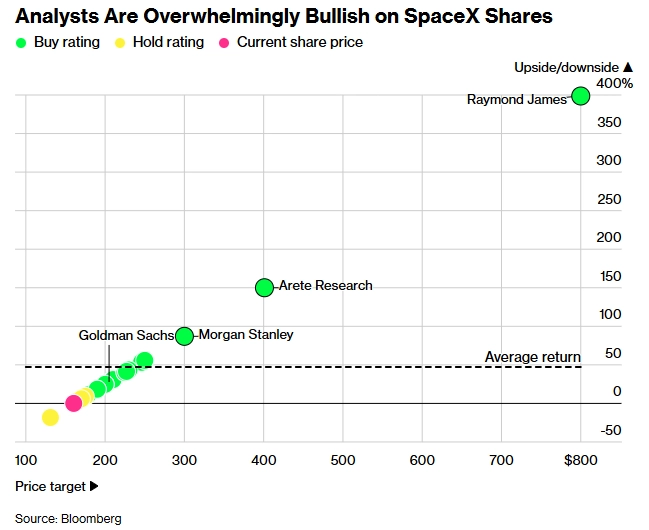
- Analysts are overwhelmingly bullish with SpaceX’s ratings distribution at 80% Buys, 13% Holds, and 7% Sells
- But that level was not high enough to join the Top 20 Most Loved
- Where are analysts’ price targets? The median price target of $225/shr and the range is from $131 to $800
- Who sees the MOST UPSIDE? Raymond James initiated w/ a buy recommendation and a Street-high price target of $800 (~500% above its IPO price and implying a market cap of $10tn+, which would make SpaceX larger than any Co currently in existence)
- Who’s sees the MOST DOWNSIDE? MoffettNathanson, initiating w/ a neutral recommendation and a $131 price target (below the $135/shr IPO price, and current ~$145/shr)
-> SpaceX’s stock fell -6.8% on the day of post IPO initiations and its inclusion in the index and ended the week down -10.3%
Stock Market Check
This Week's Other Curated News
Advertising/Ad Agencies/Ad Tech
- Google appealed an Indian court ruling that found its ads platform enabled trademark infringement by letting rivals buy brand names such as Hindware as keywords. Google argued the decision could harm consumers, competition and the digital ads market, calling India a global outlier. The appeal says keywords are backend ad triggers, not trademark use, and a hearing is due soon. (Reuters)
- Google said it will begin disclosing when ads are created or edited using AI through a new “How this ad was made” option in My Ad Center, available from ads on Search, YouTube and Discover. The move aims to help consumers identify AI-generated or altered content as AI increasingly lowers ad-production costs and replaces some product photography. AI disclosures will be automatic for Google tools, while external creators must self-report; local laws may also require labels. (TechCrunch)
- OpenAI accelerated ChatGPT Ads updates, adding custom audience uploads and advanced audience bid adjustments to improve targeting and ROI. Advertisers can upload customer email or phone lists, though match rates may be partial. A June ad-generation feature lets ChatGPT create ad variations for review and approval. (MediaPost)
- Vista Equity Partners and Quinti Capital submitted an offer to acquire French ad-tech Co Criteo. Sources said the bid, made last week, values Criteo at more than a 50% premium to its recent share price. Criteo shares rose 21.4% to $23.17, giving the Co a mkts value of ~ $1.16bn. The Paris-based Co has not yet decided how to respond to the takeover approach. (Reuters)
Artificial Intelligence/Machine Learning
- Anthropic will require subscribers on its $20, $100 and $200 monthly plans to pay usage-based fees to access Claude Fable 5 beginning Jul 12 at 11:59 PM PT. Charges match API pricing: $10 per 1mn input tokens and $50 per 1mn output tokens, meaning a user could pay $80 total in a month. The move marks a shift from flat-fee AI subscriptions, which labs have traditionally used to generate rev and manage demand. (WIRED)
- CVC Capital Partners used AI instead of investment bankers to run the sale process for Greek e-commerce biz Skroutz, highlighting how rapidly evolving tech is reshaping finance. Potential buyers received access to a data portal that functioned like an investment memo, while an AI chatbot “analyst” handled questions on financials and due diligence. The bot also directed interested parties to contact management for further discussions when needed. (The Wall Street Journal)
- Cos are increasingly relying on internal AI “champions” to encourage adoption of AI tools among workers who are hesitant or unfamiliar w/ the tech. Executives view employee resistance as a key obstacle after investing heavily to remake their biz around AI. Supporters help colleagues understand benefits and address concerns, particularly in fields such as law, where fears about AI errors and hallucinations have slowed acceptance. (The Wall Street Journal)
- UN Secretary-General António Guterres called for lethal autonomous weapons, or “killer robots,” to be banned under international law, describing machines that select and engage targets without human control as “morally repugnant.” His remarks revived a dispute over military AI use that emerged earlier this yr between Anthropic and the Pentagon. The debate centers on how AI should be deployed in warfare, when humans should intervene and who sets the limits. (The Wall Street Journal)
- Italian trade unions Slc Cgil, Fistel Cisl and Uilfpc Uil have called a nationwide 15-day strike in the call centre and biz process outsourcing sector, warning that rapid AI adoption is causing large-scale job losses. The unions said chatbots, virtual assistants and automated customer management systems are increasingly replacing human roles, often without worker consultation, retraining plans or guarantees to protect employment and job security. (Telecompaper)
- Anthropic said it will lease a renovated 16-story building at 330 Hudson St in Manhattan’s Hudson Square and double its New York City workforce to 1,000 employees this yr. The New York office is already its largest outside San Francisco and the new site can hold 1,700+ desks. The expansion reflects a broader A.I. hiring and office-growth boom in the city, despite concerns about potential workforce and economic disruption. (The New York Times)
- Microsoft is replacing some OpenAI and Anthropic AI usage in Excel and Outlook w/ its in-house MAI models to cut costs. Tens of thousands of prompts each week are now handled by MAI, though it remains a small share of overall usage. AI chief Mustafa Suleyman said the goal is to reduce and ultimately eliminate Anthropic-related costs. Microsoft also expanded MAI offerings, including models for GitHub Copilot and future Teams transcription features. (Bloomberg)
- Perplexity confirmed it plans to use Nvidia’s new Vera CPU, backing Nvidia’s push beyond AI chips into the broader CPU market long dominated by Intel and AMD. Nvidia expects Vera to generate $20bn in sales by fiscal yr-end as it diversifies amid rising in-house chip development by AI cos. Perplexity said Vera ran AI agent coding workloads ~1.5x faster than traditional CPUs and was a strong fit for its infrastructure needs. (Reuters)
- Amazon said it plans to raise at least $25bn through an eight-part bond sale to support its AI buildout and told underwriters it does not expect to issue additional debt in 2026. The filing disclosed the offering but not the size. The move follows ~ $54bn raised in US and European bond deals earlier this yr, plus a $10bn Canada sale in Jun. Proceeds will fund general corporate purposes, investments, capital expenditures and debt repayment. (CNBC)
- Tencent annc’d the official release of Hy3, an AI model delivering stronger performance, stability and cost efficiency, w/ intelligence comparable to much larger models. Built on a MoE architecture w/ 295bn parameters (21bn active), it supports 256K context length and is integrated across products including WorkBuddy, Yuanbao, Marvis and ima. Hy3 is also available via Tencent Cloud and open-source channels under Apache 2.0. (Tencent)
- Chinese AI models from DeepSeek and Z. ai are gaining traction among US firms as costs for leading US models from OpenAI and Anthropic rise. Developers are increasingly routing workloads to lower-cost Chinese alternatives, which can be 60%-90% cheaper, while delivering performance close to frontier systems. Adoption has surged across AI platforms, driven by cost savings, growing capabilities and broader use of open-source/open-weight models. (CNBC)
- Syntiant, an Intel-backed semiconductor and AI software Co focused on “physical AI,” filed for a US IPO as investor appetite for AI listings and computing firms remains strong. Founded in 2017, the Co develops low-power AI processors that run machine-learning models on devices. Syntiant plans to list on Nasdaq under ticker SYTN. (Reuters)
- Anthropic says Claude developed an emergent “J-space,” a small internal workspace of word-linked neural patterns used for deliberate reasoning. Researchers found Claude can report, manipulate and reason through these hidden representations, while most automatic processing occurs outside them. The work draws parallels to global workspace theory and may help monitor hidden goals, fabricated data and other AI safety risks, though it does not claim Claude is conscious. (Anthropic)
- Anthropic signed a 20-yr lease for a TeraWulf data center in Hawesville, Kentucky, about an hour southwest of Louisville. The facility is expected to provide ~400 megawatts of capacity, w/ first power delivery targeted for the second half of 2027. TeraWulf said the deal could generate ~$19bn in rev over the initial term. (CNBC)
- China’s DeepSeek is developing its own AI inference chip, according to sources, a move that could reduce reliance on Nvidia and Huawei hardware. The Co has quietly boosted hiring of chip-design engineers and is exploring partnerships across design, foundry and memory firms. The effort, begun ~1 yr ago, marks a major strategic shift as DeepSeek seeks greater control over AI infrastructure amid U.S. export curbs. (Reuters)
- ByteDance’s Doubao and Alibaba’s Qwen will disable customized, humanlike AI agent features ahead of new Chinese rules taking effect on July 15th. Doubao will take its agent feature offline Jul. 15, while Qwen begins disabling related functions Jul. 10. The rules target AI svs that simulate human personalities for sustained emotional interaction, citing risks such as privacy leaks, addiction and mental-health harms. User backlash followed. (South China Morning Post)
- Nvidia’s next-gen Kyber NVL144 AI rack system, built for 2027 Rubin Ultra chips, has been delayed to 2028, citing SemiAnalysis. The delay stems from manufacturing challenges involving a key PCB midplane. SemiAnalysis said the larger NVL576 system may also face delays or limited volumes. (CNBC)
- A draft Treasury report warns the AI sector could pose systemic risks similar to the dotcom bubble, despite officials publicly backing aggressive AI investment. Analysts say AI firms are deeply embedded across mkts, private credit, cloud svs, chip makers and utilities, raising the risk of wider economic impacts if funding slows, productivity gains disappoint or growth targets are missed. Stronger rev and healthier balance sheets may reduce, but not remove, potential fallout. (NOTUS)
Broadcast/Cable Networks
- Nexstar filed a legal brief, urging the Ninth Circuit Court to scale back the nationwide “hold separate” order blocking its $6. 2bn acquisition of Tegna. The Co argued any potential reduction in competition is limited to 31 local TV mkts where both firms own overlapping major network affiliates, rather than the entire combined biz. A federal judge’s preliminary injunction froze integration, citing concerns Nexstar could gain leverage over pay TV providers and raise costs or reduce local news investment. (The Wrap)
- TV broadcasters and NAB are urging Congress and regulators to curb the NFL’s shift of games to streaming, arguing fans face rising costs and confusion from needing multiple subscriptions. FCC and DOJ reviews are examining whether the league’s antitrust exemption still fits today’s media landscape. The NFL says most games remain on broadcast TV and warns changes could raise costs. Lawmakers are weighing updates, but major reforms would require legislative action. (TV Technology)
Cable/Pay-TV/Wireless
- Verizon Biz annc’d a deal w/ KDDI to provide 5G SA and 4G telematics connectivity for new BMW Group vehicles in the US. KDDI’s IoT platform will manage connections supporting firmware and map updates, subscription-based features and vehicle health functions across BMW, Mini and other brands. Verizon said the rollout includes nearly all new production cars and could later use 5G network slicing. (Light Reading)
- French billionaire Xavier Niel, via family investment vehicle Vega, agreed to buy UAE telecom group e&’s ~16. 2% Vodafone stake for £4.4bn (~$5.9bn), making him Vodafone’s largest shareholder. The deal values the stake at a 13% premium to Vodafone’s prior close. Analysts said Niel could push greater strategic influence, cost cuts and cash-flow growth, while Vodafone welcomed him as a supportive long-term investor. (Reuters)
- Cable One shares fell -12% on July 9th to $35. 87 after the Co said it expects higher residential data subscriber losses and is weighing a financing change. For Q2, it projects rev of $346mn-$352mn, capital expenditures of $72mn-$76mn, and residential data subscriber losses of 16,000-18,000. The Co. is considering not completing its previously annc’d Mega Broadband Investments term loan exchange offer and instead keeping MBI’s senior secured term loans in place. (Market Watch)
- Angola plans to raise as much as $320mn by selling shares in Unitel SA, the nation’s largest telecom operator, to help finance its budget and deepen capital mkts. The government is offering a 15% stake, according to BFA Capital Mkts, a unit of Banco Fomento Angola SA and a Unitel co-owner. The offer includes 7.5mn shares and runs through Jul. 24, w/ an indicative price range of 36,000–40,000 kwanzas per share, potentially raising 300bn kwanzas. (Bloomberg)
Capital Market Updates
- PitchBook-NVCA reported US venture funding reached $412. 7bn in H1 2026, up nearly 30% from all of 2025, driven by AI deals that captured $355.9bn, or 86% of total funding. Mega-rounds of $100mn+ made up 87.5% of capital deployed, led by Anthropic’s $65bn raise. Exit activity hit records largely due to SpaceX’s $1.7tn IPO and major transactions, while fundraising remained concentrated among a few large venture firms. (SiliconANGLE)
- Europe posted its strongest venture-funding quarter in four yrs, w/ startups raising $24bn in Q2 2026, up ~33% q/q and ~67% y/y. The U.K. led w/ $10.4bn, its third-largest quarter on record. Funding was driven by large $100mn+ rounds, including four $1bn+ deals, many tied to AI and deep tech. H1 funding reached $42bn, up 50% y/y, while venture-backed M&A remained strong at $11.5bn+ across 154 acquisitions despite muted IPO activity. (Crunchbase)
Cloud/DataCenters/IT Infrastructure
- Meta annc’d it will invest more than C$13bn (~US$9. 2bn) to build its first Canada data centre, a 1-gigawatt AI-optimized facility in Sturgeon County, Alberta. The project, the 33rd in its global fleet, is expected to create 3,000+ construction jobs at peak and 300+ operational roles. Meta also plans to invest ~$60mn in local infrastructure and nonprofit funding, and said it will cover energy, water and wastewater costs. (Yahoo Finance)
- Ireland’s data centres recorded a 10% increase in electricity use in 2025, according to figures from the national statistics agency CSO. The rise significantly outpaced growth among other electricity users, including residential and biz users, whose consumption increased by 2%. The data highlights that electricity demand from data centres grew at a much faster rate than demand from the broader group of users during 2025. (Telecompaper)
- Orange is pursuing the sale of a minority stake in the biz that operates its data centres in France, according to information gathered by L’informe. The potential deal is intended to raise capital and support the group’s strategic priorities, including planned AI investments. In the bidding process, New Zealand-based infrastructure asset manager Morrison is reportedly favoured over rivals Vauban Infrastructure Partners and Macquarie. Orange declined to comment on the matter. (Telecompaper)
- Thailand has approved several high-value investment projects focused on digital and AI infrastructure as international tech firms expand their networks across Southeast Asia. The move aims to strengthen the country’s position as a regional hub for data and telecom infrastructure. The government also introduced a grid action plan offering dedicated utility tariffs, direct green power trading (Direct PPAs), and faster grid connection investments to support operators. (Telecompaper)
- Brookfield-backed data center Co Csquare filed for a US IPO seeking up to $1. 35bn by offering 50mn shares at $23-$27 each, implying a ~$4.18bn valuation. Q1 rev rose to $270.5mn from $232.8mn, while net loss widened to $66mn from $34.9mn. The Dallas-based Co operates 60+ sites across the US, Canada and UK, and plans to use proceeds to repay debt. Brookfield is expected to retain voting control after the offering. (Yahoo Finance)
- Google backed Germany-based Proxima Fusion in a €411mn ($468mn) funding round, valuing the Co at $2. Proxima aims to build Europe’s first commercial fusion power plant and have a fusion demonstrator operating in the early 2030s. The round was led by XTX Ventures and East X Ventures, w/ Google and RWE as strategic investors. Funding will expand HTS magnet production and accelerate engineering, manufacturing and operations. (CNBC)
Crypto/Blockchain/web3/NFTs
- Polymarket is seeking US regulatory approval to offer margin trading, allowing users to place prediction-market bets w/ less upfront capital by borrowing from the platform. Rival Kalshi received approval in Mar. Prediction mkts let users wager on events such as weather, sports and elections. Industry trading volume rose from $51bn in 2025 to $240bn through the first six months of 2026, while Polymarket continues efforts to rebuild trust w/ regulators. (Yahoo Finance)
- Senate Democrats Charles Schumer, Elizabeth Warren and Ron Wyden sent letters to Kalshi, Polymarket and other Trump-linked cos seeking details on whether they could benefit from President Donald Trump’s IRS audit-immunity settlement. Lawmakers cited concerns that affiliated biz entities may be shielded from audits, penalties or prosecution. The companies were asked to answer questions by Jul. 20, as Democrats intensify scrutiny of the agreement. (Bloomberg)
- Judge Analisa Torres, known for the Ripple/XRP ruling, denied Kalshi’s request for a preliminary injunction against New York gaming regulators, finding state gambling laws are not preempted by the federal Commodity Exchange Act. The decision lets the case move to the motion-to-dismiss stage and weakens Kalshi’s position despite prior wins elsewhere. Legal experts called it a major setback that could affect related cases, including in Connecticut. (com News)
- Trump said Bitcoin could someday be included in Trump Accounts, a tax-advantaged savings program launched Jul 4 for children born 2025–2028. The program provides a $1,000 Treasury seed deposit and allows up to $5,000 annual contributions, but current law limits investments to low-fee U.S. equity index funds, making BTC inclusion unlikely without new legislation. (Yahoo Finance)
Cybersecurity/Security
- New Jersey enacted A5328, banning websites and online svs from selling sensitive data, including precise location information that identifies a person within a 1,750-foot radius. The law, signed Jun. 30 after passage on Jun. 28, also covers data revealing race, religion, health status, immigration status and certain genetic or biometric details. It requires data brokers to register and pay fees, with the state expecting rev in the mns annually. (MediaPost)
- Telefónica launched a managed cybersecurity svs for mid-market organizations w/ 150–1,000 devices through Telefónica Tech. The MxDR offering combines CrowdStrike’s AI-native Falcon platform w/ Telefónica SOC analysts to continuously monitor, detect, investigate and respond to threats across endpoints, cloud, email, identities and networks. Offered in Essential, Advanced and Premium tiers, it aims to strengthen biz continuity and support NIS2 and DORA compliance. (Telefónica)
- The European Commission annc’d an EU Action Plan on Cybersecurity and AI to support safe, responsible AI use while strengthening cybersecurity. The plan targets 3 goals: secure deployment of advanced AI, stronger cyber resilience, and expanded AI capabilities. Measures include AI model evaluation under the AI Act, ENISA-led testing tools, support for critical sectors, faster vulnerability detection, and an EU Grand Challenge to boost AI-driven cyber tech. (European Commission)
- CISA is using Anthropic’s Mythos AI model to audit US government code repositories for security flaws, according to three sources. The agency’s Attack Surface Evaluation team is scanning software for vulnerabilities that could be exploited by foreign spies or cybercriminals, and audits have reportedly uncovered numerous issues. (Reuters)
eCommerce/Social Commerce/Retail
- Kohl’s said it is offering thousands of back-to-school items under $25 as budget-conscious shoppers seek value. The assortment includes brands such as Nike and Levi’s plus private labels, alongside revamped displays and an AI-powered shopping assistant. A third of consumers plan purchases around summer promotions, while spending is expected to rise. The season is important for Kohl’s turnaround effort after Q1 net sales fell 1.7% and comps declined over 1%. (Retail Dive)
- Retailers are increasing digital tech spending, w/ 52% investing $50mn+ annually and 28% allocating $100mn-$250mn, according to a KPMG survey of 250 executives. While 48% say technical debt limits new investments, 86% report tech improvements are boosting biz value. AI adoption is accelerating: 42% of retailers deploy AI at scale today, rising to 74% within 12 months. Cybersecurity, AI/automation and data analytics are the top investment priorities. (Retail Dive)
- Walmart said it cut prices on summer barbecue staples after President Trump stated the retailer acted at his administration’s request. The Co lowered the price of its 73% ground beef roll to $5.94/lb from $6.74, alongside reductions on soda and chips. Record beef prices have pressured consumers due to drought-driven herd cuts and higher feed costs. Walmart also reduced prices on 250+ items at Sam’s Club. (Reuters)
Electric & Autonomous Vehicles
- GM-backed autonomous-driving Co Momenta made a muted Hong Kong trading debut after raising $751mn in an IPO that valued the Co at ~ $9bn. Shares rose 2.8% from the IPO price to HK$303.80 despite strong investor demand. The retail portion was 413.6 times oversubscribed and the institutional tranche 20.3 times covered. Momenta, based in Suzhou, joined a growing group of self-driving cos seeking capital and investor exposure in Hong Kong, though profitability concerns continue to weigh on the sector (The Wall Street Journal)
- New Jersey lawmakers are considering a bill requiring fully autonomous vehicles to use cameras plus two additional sensing systems, typically lidar and radar. The proposal would create a 3-yr pilot program, mandate state approval, crash reporting, and 50,000 miles of supervised testing before driverless operation. If passed, it could effectively block Tesla’s camera-only Robotaxi service unless its hardware changes. (The Verge)
- Shanghai-based Hesai Tech, a lidar sensor maker blacklisted by the Pentagon as a Chinese military entity, is expanding its US presence, including through a partnership w/ Nvidia. Critics and researchers warn lidar systems could pose cybersecurity and data-security risks if compromised, while CEO David Li rejects those claims. Hesai says its sensors are for civilian use and cannot store data, but lawmakers and security experts remain concerned. (CNBC)
- Tesla annc’d its robotaxi svs is now available in Miami, its first expansion beyond Texas and California. The service covers a limited area around West Miami, Doral and Sweetwater, excluding Miami Beach, the airport and downtown. The launch comes as Austin operations remain small, w/ ~50 vehicles and reported availability issues. Tesla says safety improvements are needed before wider growth, and meaningful rev from the biz is unlikely before 2027. (Yahoo Finance)
Film/Studio/Content/IP/Talent
- Boxoffice Pro’s weekend preview projects Disney’s live-action Moana to lead the Jul 10–12 domestic box office w/ a $45mn–$55mn debut, though weaker momentum, franchise oversaturation, and 33% Rotten Tomatoes reviews may limit upside. Evil Dead Burn is forecast to open at $25mn–$30mn as a solid horror counterprogrammer. In week 2, Minions & Monsters is expected to earn $15mn–$20mn after a disappointing $37mn opening despite strong audience and critic scores. (Boxoffice Pro)
- HBO Max led 2026 Emmy nominations by platform w/ 122 nods, narrowly ahead of Netflix’s 111, driven by strong performances from Hacks and The Pitt. Apple TV posted its best-ever result at 87 nominations, boosted by Pluribus, Widow’s Bay, The Studio and Severance. Disney totaled 111 across its outlets, while Prime Video rebounded to 28 nominations. Broadcast networks collectively rose to 105 nominations, showing a modest recovery. (Deadline)
- “Minions & Monsters” led the Jul 4 holiday box office but delivered the franchise’s weakest launch, earning $61mn since Wed vs expectations of ~$80mn. Despite strong reviews and a 91% Rotten Tomatoes score, analysts cited franchise fatigue after seven films. International sales lifted its worldwide total to $159.8mn. Meanwhile, “Supergirl” plunged 77% in its second weekend, reaching $57.4mn domestic and $99.5mn globally, raising concerns over profitability. (Variety)
FinTech/InsurTech/Payments
- Kalshi is in advanced talks w/ the CFTC to expand never-expiring “perpetual” futures beyond crypto into metals, foreign exchange, energy and potentially stock-related products. The prediction-mkts platform said perps have generated $16.1bn in trading volume since launch. Critics, including CME, warn the leveraged contracts pose risks to retail investors, while Kalshi says demand is increasingly driven by institutional participants. (Reuters)
Handheld Devices & Accessories/Connected Home
- Samsung Electronics Co annc’d its next Galaxy Unpacked event for Wed, Jul 22nd in London, where it’s expected to unveil the Galaxy Z Fold 8, featuring a shorter, wider design similar to Apple’s planned foldable iPhone. The lineup is likely to include three foldable phones, a smartwatch and wireless earbuds. Samsung aims to gain momentum ahead of Apple’s foldable launch later this yr, while highlighting AI-driven growth and ongoing memory-chip supply constraints. (Bloomberg)
- Google annc’d its Made by Google 2026 event for Wed, Aug 12 in New York City, a week earlier than last yr. The keynote starts at 3 p.m. PT/6 p.m. ET and will showcase the “next generation of Pixel.” Expected launches include Pixel 11, Pixel 11 Pro, Pixel 11 Pro XL, Pixel 11 Pro Fold, and Pixel Watch 5 in two sizes. New Pixel Buds Pro may also debut. (9to5Google)
- China’s 618 shopping festival saw smartphone sales fall -13% y/y, according to Counterpoint, as rising memory-chip costs limited discounts and pushed handset prices higher. Huawei was the only major brand to post growth, with sales up +19% and a 21% market share. Apple ranked No. 2 despite a 9% sales decline. Honor and Xiaomi fell 33% and 24%, respectively. Counterpoint expects China smartphone shipments to decline by a double-digit % this yr. (Reuters)
Investor & Market Sentiment
- The two Millennium Management trading pods focused on index rebalancing generated ~ $3. 7bn in Jun, accounting for more than half of the hedge fund’s ~$6.6bn profit before fees that month. Teams led by Glen Scheinberg and Pratik Madhvani benefited from major index and portfolio rebalancing events, including S&P 500, Nasdaq 100 and Russell changes. Their performance helped Millennium post a 4.1% monthly gain and 10.5% yr-to-date return. (MSN)
- Lone Pine Capital reported a 43% gain for hedge fund investors through Jun, marking one of the strongest starts in the firm’s history and placing it among 2026’s top performers. The firm, founded in 1997 by Stephen Mandel, manages more than $25bn across its hedge and long-only funds, according to a person familiar w/ the firm. A spokesman declined to comment on the fund’s performance or the firm’s assets. (Bloomberg)
- Thrive Holdings, a 1-yr-old holding Co started by OpenAI investor Thrive Capital, was reported to be raising ~$2bn from Altimeter Capital, D1 Capital Partners and SoftBank. The capital is intended for acquiring traditional svs firms and transforming their operations using AI. The fundraising reflects a strategy of buying established bizs and “rewiring” them through AI-driven changes, according to The Information. (PYMNTS)
Last Mile Transportation/Delivery
- Amazon Shipping is using lower pricing, fewer surcharges and waived fees to win parcel-delivery customers from FedEx, UPS and even USPS, according to logistics experts. The svc, opened to all biz earlier this yr, reportedly delivers savings of up to $6 per package and >33% annually for some shippers. While competitive for high-volume, lightweight shipments, its offering remains narrower than rivals, lacking options such as overnight delivery. (Supply Chain Dive)
- Lyft annc’d plans to acquire Serveo’s bikeshare biz in Spain, subject to closing conditions. The deal combines Lyft Urban Solutions’ tech and operational expertise w/ Serveo’s local experience operating systems in Barcelona, Bilbao, Valladolid and Zaragoza, while supporting other Spanish programs. Lyft said the transaction is not expected to materially affect financial results and will expand its bikeshare operations across Europe and beyond. (Lyft)
- Uber has paused most planned Europe food-delivery expansion just months after annc’d plans to enter seven new mkts, as it continues pursuing a takeover of Delivery Hero. Uber no longer expects launches in five of the seven targeted countries, including Austria, Norway and Greece. The expansion had been projected to add $1bn in gross bookings over three yrs. Uber said it is focusing on momentum in existing mkts after strong launches in Finland and Denmark. (Reuters)
M&A
- Morgan Stanley said global M&A activity is on track to reach a record $6. 4tn in 2026, surpassing the 2021 deal boom as strong equity mkts and improving corporate confidence drive transactions. Annc’d deals jumped >64% yr/yr in Q2, while completions rose >33%, led by software, utilities, energy and healthcare. The bank cited a more supportive U.S. regulatory backdrop and noted private-equity firms hold ~$4.3tn for potential deals, though higher rates remain a risk. (Reuters)
- JPMorgan said it is expanding its M&A push by creating a small-cap investment-banking team focused on cos valued at $100mn-$500mn, targeting opportunities including baby boomers planning biz successions. The move builds on its middle-market effort serving cos worth ~$500mn-$2bn, which generates over $1bn in annual rev and has posted more than 20% yr-over-yr growth. (The Wall Street Journal)
Macro Updates
- NY Fed’s Global Supply Chain Pressure Index fell to 1. 25 in June from a revised 1.81 in May, signaling easing supply-chain strains as disruptions linked to the Middle East conflict began to fade. Conditions improved as traffic partially returned through the Strait of Hormuz. While pressures remain elevated versus recent levels, economists and Fed officials expect inflation to moderate if disruptions cont’d to ease. (Reuters)
Media Conglomerates
- ITV said Sky’s planned $2. 13bn (£1.6bn) takeover of its networks and streaming biz will face a “thorough and comprehensive” antitrust review that could take 12–18 months. ITV argues U.K. media mkts have changed due to competition from Netflix, YouTube, Meta, Amazon and Apple. The Co said the deal would preserve public-service commitments, while ITV Studios remains separate and shareholders are set to receive £950mn. (The Hollywood Reporter)
Regulatory
- Investor groups urged the SEC to retain quarterly reporting for publicly traded cos, opposing a proposal that would let firms report semiannually. Fund-industry feedback showed quarterly disclosures are viewed as critical for investment decisions, despite compliance-cost concerns. Supporters, including JPMorgan and Nasdaq, said the change could reduce short-term pressure and aid capital mkts, while critics warned it may weaken transparency and delay detection of accounting issues. (Reuters)
Satellite/Space
- Blue Origin is raising $10bn at a $130bn pre-money valuation, w/ Coatue expected to invest ~$4bn, Jeff Bezos $2bn, and other investors supplying the balance. The round would be the space Co’s first external fundraise. Funding follows the late-May New Glenn test explosion and may support rocket operations, launchpad repairs, Artemis moon missions, space-based data-centre plans, and a satellite internet network. (TechCrunch)
- SpaceX filed an FCC request to deploy up to 100,000 Gen3 Starlink low-Earth-orbit satellites, aiming to provide ultra-low-latency, multi-gigabit symmetrical broadband and handle much of global internet traffic. The Co says the network would support consumers, enterprises, governments and billions of AI-powered devices. Analysts said the plan positions Starlink as AI-connectivity infrastructure, while raising questions about spectrum use, space debris and competition w/ terrestrial broadband. (Fierce Network)
- Colombia’s Ministry of Information and Communications Technologies said Starlink, Hughes and Claro submitted proposals for rural satellite-connectivity pilots under the first 2026 Sectoral Regulatory Sandbox call. Developed w/ the CRC and ANE, the initiative aims to expand internet access in remote and underserved areas by testing satellite tech, service models and operational capabilities to assess connectivity solutions and support broader digital inclusion. (Telecompaper)
- Amazon Leo launched 29 more LEO satellites via ULA’s Atlas V, bringing its in-orbit total to 396 and completing its Atlas campaign before shifting to ULA’s Vulcan rocket. The Co again moved its commercial broadband timeline, with executives now pointing to an initial service rollout later this yr rather than prior mid-2026 expectations. Analysts cited constrained launch capacity, while rival Starlink retains a major coverage advantage. (Fierce Network)
Social/Digital Media
- Virginia AG Jay Jones asked the 4th Circuit to allow enforcement of SB 854, a law requiring social platforms to verify ages and limiting users under 16 to 1 hour of daily access without parental consent. A federal judge blocked the measure on First Amendment grounds, citing impacts on minors’ access to protected speech and age-verification burdens. Jones argues the law addresses social media addiction and imposes only limited hurdles. (MediaPost)
- Reddit said it is using its own AI tools to combat stealth marketing content aimed at influencing responses from chatbots such as ChatGPT and Gemini. The Co annc’d improved automated systems detected ~25,000 spammy posts and comments per day in Q1, cutting user exposure 20% vs. a yr earlier. Reddit said large language models help identify coordinated fake behavior as brands increasingly pursue generative engine optimization (GEO). (Yahoo Finance)
- Tencent Mobility raised ~$1. 5bn by selling 272.9mn Kuaishou Class B shares at HK$43.25 each, a ~6% discount to the prior close. The deal is fully secondary, so Tencent receives all proceeds. After the sale, Tencent’s stake falls to 9.37% from 15.68%, ending its status as a substantial shareholder. Kuaishou also repurchased 174.84mn shares for HK$8.35bn under its HK$16bn buyback program. (Reuters)
- Getty Images has terminated its planned $3. 7bn merger w/ Shutterstock, ending a deal that would have created a larger visual-content Co offering a broader library to users. The companies first annc’d the tie-up in Jan. 2025. Getty delivered written notice to Shutterstock about a week after the transaction faced a setback from a U.K. regulator. The deal had previously received U.S. Justice Department clearance in Apr. 2026. (The Wall Street Journal)
Software
- Apple lost its challenge against EU Digital Markets Act rules after the General Court upheld the designation of its App Store ecosystem and iOS as “gatekeepers,” requiring measures that give rivals more room to compete. The court also ruled Apple’s action concerning iMessage inadmissible. Apple reiterated criticism of the DMA, citing privacy and security concerns, but retains the right to appeal on points of law. (Reuters)
Sports/Sports Betting
- Major Wall Street banks tightened employee rules on prediction-market betting. Goldman Sachs bars staff from event-based contracts tied to financial mkts and political events that could create real or perceived conflicts of interest. Morgan Stanley, JPMorgan and Bank of America also maintain or updated policies restricting certain prediction-market activity, while sports and entertainment contracts may remain permitted in some cases. (Reuters)
- Michael Burry said he bought shares of Flutter and DraftKings, with the position weighted ~60/40 toward Flutter, betting the threat from prediction mkts will fade. Burry argues sports-event contracts offered under CFTC oversight exploit a regulatory loophole by avoiding state gaming taxes and may eventually face regulation and taxation. He called both cos attractive despite share declines and also disclosed buying more JD.com stock. (Reuters)
- DraftKings annc’d it will launch DraftKings Sportsbook, DraftKings Casino and Golden Nugget Online Gaming in Alberta on Jul 13, making Alberta its 2nd Canadian province and 34th North American jurisdiction. The Co will host a World Cup watch party in Calgary on Jul. 11 and donate $150,000 to Food Banks Alberta. Eligible customers will gain access to sports betting, live wagering, parlays and online casino games, alongside responsible gaming tools. (Business Wire)
- APEX annc’d a strategic stake in Canada’s Northern Super League (NSL), the first completed private-equity investment in a professional women’s soccer league globally. The NSL drew 275,000+ fans across 80 matches in its inaugural season and generated $30mn+ in rev before media-rights monetization. The investment will support commercial expansion, audience growth, digital tech initiatives and international distribution as the league scales. (Northern Super League)
- Nielsen is preparing a major change to sports TV ratings, targeting Sept 2026. The expanded co-viewing methodology will use wearable devices from panelists to better measure group viewing within households and become official audience “currency.” A pilot showed a 4.19% audience lift across major events, including Super Bowl LX and the Winter Olympics. Networks and leagues, especially the NFL and NASCAR, support efforts to improve accuracy and better reflect actual viewing. (Front Office Sports)
- Rogers Communications agreed to buy Kilmer Sports’ remaining 25% stake in Maple Leaf Sports & Entertainment for CAD $4. 35bn (~$3.06bn), giving the Co 100% ownership of MLSE, which owns the Maple Leafs, Raptors and Toronto FC. The deal is expected to close in Q4. Rogers said it plans to later sell a minority stake in its combined sports, media and entertainment biz and use proceeds to reduce debt, while pursuing long-term shareholder value. (Sportico)
- Versant annc’d a definitive deal to acquire sports tech Co Full Swing from Bruin Capital and other investors for ~$530mn cash. Full Swing’s platform spans golf, baseball and multi-sport simulators, launch monitors, software and performance data. The acquisition expands Versant’s golf-focused biz into interactive sports, training and entertainment, creating opportunities across content, commerce, venues and data. (Business Wire)
Tech Hardware
- SK Hynix raised $26. 5bn in a US share offering, the largest first-time US listing by a foreign Co, selling 177.9mn ADRs at $149 each. Demand was reportedly 7x available shares. The South Korean chipmaker, a key Nvidia supplier, plans to expand manufacturing capacity amid AI-driven demand for memory and storage chips. The listing gives US investors easier access to the stock, which has surged sharply over the past yr. (Yahoo Finance)
- South Korea’s plan to build a major new chip production hub involving Samsung Electronics and SK Hynix is facing scrutiny over timing and long-term demand. While both firms aim to benefit from the AI-driven chip boom and ongoing supply constraints, concerns remain about the cyclical nature of the memory chip market. Analysts are questioning whether large-scale investment can be sustained if demand weakens, despite current growth linked to AI applications. (Nikkei Asia)
- A growing shortage of high-skilled workers in the US could delay construction of billions of dollars’ worth of new semiconductor plants and limit future chip production, according to a report by McKinsey & Co. , SEMI and the National Science Foundation. The deficit is expected to be most severe in Texas, California, Arizona, New York and Ohio, where many facilities are planned. The study projects a skilled labor shortfall of up to 157,000 full-time workers by 2030. (Bloomberg)
- Samsung Electronics flagged a 19-fold jump in Q2 operating profit to 89. 4tn won ($58.4bn), beating expectations as AI-driven demand lifted DRAM and NAND prices. Rev was estimated to rise 129% to 171tn won. Despite the strong results and a third straight record quarterly profit, shares fell 6.9% as investors worried AI infrastructure spending may slow, potentially weakening future chip demand and pricing. (Reuters)
- Agility Robotics plans to go public via a SPAC merger w/ Churchill Capital Corp XI, valuing the Co at ~$2. 5bn and targeting >$620mn in gross proceeds. CEO Peggy Johnson said the focus remains warehouse and factory deployments, not homes, where humanoid robots may be 10+ yrs away. Agility cited >$300mn in booked multi-yr rev and customers including Amazon, GXO Logistics, Toyota and Mercado Libre. (TechCrunch)
- David Tepper’s Appaloosa Management posted a 32% gross gain in H1 2026, w/ all gains generated in Q2, according to a report cited by Bloomberg. The $23bn hedge fund benefited from concentrated bets on memory-chip makers including Micron, Samsung Electronics, SK Hynix, Kioxia and Sandisk, driven by AI data-center demand for HBM and NAND memory. Despite holding ~40% cash on average, the fund delivered strong returns and extended its multiyr outperformance streak. (Yahoo Finance)
- Broadcom said it extended its partnership w/ Apple through 2031 to develop and supply custom chips, reinforcing its role as a key iPhone supplier. The deal reduces concerns Apple could replace Broadcom components w/ in-house designs. Apple represents ~20% of Broadcom’s annual rev, according to analysts. The extension builds on a multibillion-dollar agreement annc’d in 2023 covering 5G radio-frequency components. (Reuters)
Towers/Fiber
- AT&T moved closer to retiring its copper network in California after the FCC approved a transition affecting ~184,000 customers. Users may keep existing service until discontinuation on or after Jun. 1, 2027, with AT&T offering Phone-Advanced over fiber or wireless. The move is part of a broader plan to phase out most copper infrastructure by 2030, while legal and regulatory disputes w/ California over retirement rules cont’d. (Light Reading)
- Telecel Group is among bidders seeking to acquire TalkTalk Telecom Group’s wholesale telecom biz, according to people familiar w/ the matter. Africa-focused Telecel has submitted an offer for PlatformX Communications, TalkTalk’s wholesale unit. The discussions are confidential, and the people cited were not identified. The potential deal highlights interest in PlatformX as TalkTalk evaluates options for the communications biz. (Bloomberg)
Video Games/Interactive Entertainment
- Nintendo said it will stop selling all original Switch systems in Europe from mid-Feb 2027, ending sales of Switch, Switch Lite and Switch OLED nearly 10 yrs after the console launched in Mar 2017. The move was disclosed in an updated FAQ tied to EU rules requiring user-replaceable batteries. Nintendo will roll out revised versions of Switch 2 and several controllers, w/ no functional changes, ahead of the 2027 deadline. (The Verge)
Video Streaming
- Fubo annc’d that veteran media executive Alisa Bowen will become CEO effective Jul 10, succeeding co-founder David Gandler. Bowen, formerly president of Disney+ and a key leader behind Disney+, Hulu and ESPN+ streaming growth, is expected to join the Board after the Jul. 28 shareholder meeting. The Board said she will help advance strategy, growth and profitability following Fubo’s combination w/ Hulu + Live TV, while Gandler steps down after 11 yrs leading the Co. (Fubo)
- TF1 said its new Netflix carriage deal in France has already exceeded expectations. Just 3 weeks after launch, Netflix began carrying TF1 live channels and on-demand content, helping TF1 reach record streaming levels, including 8.3mn unique daily streams for a Koh-Lanta finale. TF1 reported a 16% rise in unique daily streams during the first week, strong ad performance, and achieved audience goals set for an 18‑month period in under 3 weeks. (The Hollywood Reporter)
- The Weather Channel raised the price of its direct-to-consumer streaming svs from $2. 99/month to $4.99/month, while the annual plan is now $49.99/yr. The TWC TV app continues to provide live channel access, forecasts, radar, severe-weather alerts and on-demand content on devices such as Roku. The increase reflects broader streaming-industry cost pressures as the Co maintains live coverage, data accuracy, app support and content development. (Cord Cutters News)
- Netflix is rolling out multi-factor authentication for business customers starting July 21st to further curb password sharing. After a one-time verification setup, users will authenticate future logins via options such as authenticator apps or passkeys, while SMS authentication will be discontinued. Netflix said it will disable unapproved shared accounts and require individual accounts. The Co has also enabled secondary profile holders to use their own email addresses for sign-ins. (The Streamable)
- Netflix signed a video-licensing pact w/ top publishers including Variety and other PMX brands, plus BuzzFeed Studios, Condé Nast, Hearst, People Inc. and Tastemade. Starting Aug. 3, Netflix will add selected short- and long-form videos across the U.S., Canada, U.K., Ireland, Australia and New Zealand. Content spans travel, food, fashion, celebrities and lifestyle, including Variety’s “Know Their Lines?”, as Netflix expands offerings beyond films and TV. (Variety)
- Netflix, Disney+ and Amazon Prime Video launched legal appeals against updated French content rules requiring 20% of their annual investments in France to be allocated to animation, documentaries and live performances. The streamers argue the rules unfairly target streaming svs, limit editorial freedom and ignore audience demand. The challenge seeks changes to a 2021 decree tying French-content investments to local rev. (Yahoo Finance)
