

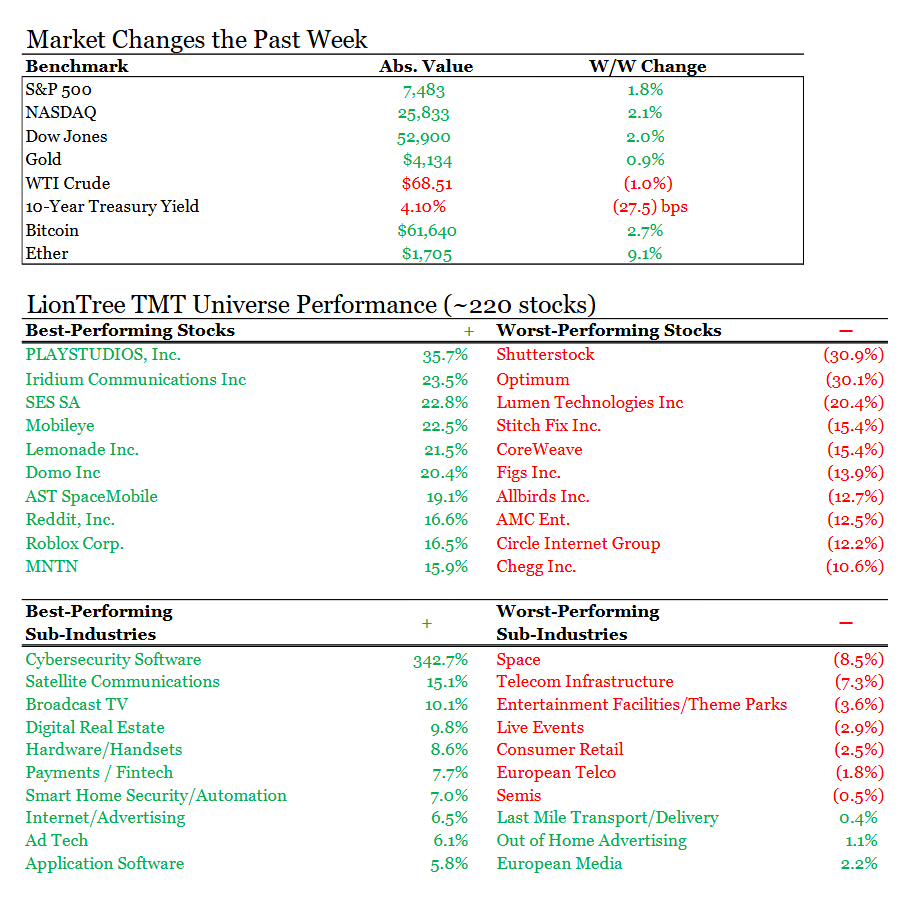
Strategic actions were in the spotlight in this shortened holiday week, which also saw the market further move higher. Big tech companies like Apple (+8.8%), Alphabet (+6.7%) and Meta (+5.9%) were key drivers to the Nasdaq’s +2.1% rally. The S&P 500 was close behind, rising +1.8%. There was also a lot of talk about the continued broadening of the market moves, which is healthy.
Fundamentally, we focused on the below in this edition.
** Also, I would like to flag that we published the Summer Edition of our quarterly LionTree’s Sector Insights & A Look Ahead deck last week, which is accompanied by a ~20-minute video narration, both of which can be accessed HERE **
Happy July 4th to you all!
Best,
Leslie

Does Comcast Now Set The Stage For More Deal Activity?
Just months after completing the spin-off of most of its cable TV networks into Versant Media and in a move that many have seen as a long time coming, Comcast has now annc’d plans to separate its media and connectivity businesses, which came as more of a surprise. NBCUniversal and Sky will be spun out into a standalone media company and the remaining Comcast will be a focused connectivity company. While management has been adamant that the transaction is intended to give each business greater focus and flexibility (vs paving the way for M&A), the announcement reignited speculation across the Street over what a more streamlined Comcast and an independent NBCUniversal could mean for future industry consolidation, particularly on the back of a steady stream of deal-related developments in the sector, including Fox and Roku last month, as well as Warner Bros. Discovery and Paramount (who beat out Netflix), Charter and Cox, and others.
See below for what we viewed as the most important aspects of the new deal. (link/link/link/link)
-> Comcast’s stock was up as much as +17% on the back of the announcement but pared back most of those gains to end the day up +4.5%; YTD, the stock is still down -15.1%
- Transaction basics…Comcast will separate into two independent publicly traded Cos through a tax-free spin-off of NBCUniversal and Sky
- Post-deal ownership –
- Comcast shareholders will receive stock in both Cos
- Post close, Comcast intends to hold onto as much as a 19.9% ownership shra in the new NBCUniversal for up to a year, at which point it expects to convert that position into proceeds
- Timing…the separation is expected to occur in mid-2027
- Post-deal ownership –
- Leadership –
- Mike Cavanagh (current co-CEO of Comcast) will become CEO of NBCUniversal
- Michael Angelakis (former CFO of Comcast) will become CEO of Comcast
- Angelakis is serving as Strategic Advisor until the deal close
- Brian L. Roberts (current co-CEO of Comcast) will continue to be actively involved in the leadership of Comcast and NBCUniversal, working in partnership with the CEOs of both Cos
- The independent NBCUniversal will house…
- Universal Pictures film studio
- NBC and Telemundo broadcast networks
- NBC News
- Peacock streaming svs
- Bravo cable channel
- British TV broadcaster Sky (Comcast acquired in 2018)
- Theme Parks
- The remaining Comcast will focus on…providing broadband, cable and wireless services to business and residential customers
- What is the strategic logic for the separation? “This is NOT about separating what we built together. It’s about positioning two exceptional businesses to move forward with greater focus, agility, and the ability to fully capitalize on the opportunities ahead”
- Results are on track: Mgmt noted that Q2 results should be “within” expectations, and that the spin is unrelated to near-term broadband performance
- “Both companies come out of this better off than they started”
- Comcast’s board contemplated three questions when considering the split… “And the answer we came back with was ‘yes’ to all counts”
- “One, can these businesses stand alone and have the heft to stand alone as separate companies?”
- “Two, do they have clear and viable capital allocation path to invest?”
- “And three, is now the right time?”
- But why is now the right time?
- “We previously believed that scale and the diversification benefits warranted operating these businesses as one company. We’ve now simply changed our mind about that.”
- “We just decided once you’re in go mode, you know, we want to go”
- Is the planned separation a step toward potential “strategic transactions” (i.e., M&A) for either Co? Mgmt says “absolutely not” …
- “This is the right move to put each company in the strongest position to create value, fully monetize its assets and aggressively pursue its own organic growth strategies”
- But on NBCU and Sky specifically…. the plan is “to build and invest for growth. We have the ambition…to pursue opportunities that keep us ahead of evolving consumer behavior … and we have the freedom now to explore adjacent businesses”
- …but Wall Street is very focused on the potential deal prospects
- Charter’s stock jumped +9% on the back of deal announcement; A merger of Charter w/ Comcast’s cable biz would create a giant in broadband, with complementary geographies
- Though some analysts view Charter’s $96bn debt load, and what they see as limited cost synergies, as deterrents
- Some analysts view NBCUniversal as more likely to be a buyer than a seller
- Netflix and Amazon were speculated by analysts as being potential bidders for NBCU
- Per Lightshed Partner’s Rich Greenfield, the spinoff was to “enable future acquisitions,” not to “sell either part of the company”
- Some analysts said NBCUniversal should consider acquiring parts of Sony Pictures Entertainment, the movie and TV studio of parent Co Sony Group of Japan
- Charter’s stock jumped +9% on the back of deal announcement; A merger of Charter w/ Comcast’s cable biz would create a giant in broadband, with complementary geographies
- …and several reports speculate that the Cos are already exploring a broad range of growth oppties
- NBCU is reportedly considering gaming and entertainment franchises for growth
- Comcast’s cable and connectivity biz is said to be well-positioned for technological investments that could take advantage of the massive surge in data centers and AI
- …but there are some structural caveats to take into consideration
- To preserve the tax‑free structure, NBCU would need to operate independently for at least a year after the spinoff, during which period it cannot pursue a sale or a merger
- At the same time, it could consider an M&A transaction sooner as long as the parties had not previously discussed a potential deal
Additional Key Connectivity Tie-Ups Emerge
Not only was the connectivity sector in focus because of Comcast’s announced separation, but there were also a couple other speculated and annc’d partnerships that emerged in the sector this week. See below.
A Charter & SpaceX Alliance? The Cos Have Reportedly Discussed A Mobile Phone Partnership In The US (link/link)
- SpaceX and Charter have reportedly held talks about partnering on a consumer mobile phone offering
- How would the partnership potentially work? Charter could run some of SpaceX’s phone traffic through its ground-based internet infrastructure, much as it does with its Spectrum Mobile offering presently
- SpaceX already offers its Starlink Mobile svs as a $10/mo add-on through T-Mobile, allowing text messages and internet-based calls from remote areas
- SpaceX reportedly told investors that it plans to launch a new Starlink mobile service for US consumers…
- During its recent IPO roadshow, the Co reportedly said that they were considering launching a Starlink retail product and could build its own terrestrial US mobile network
- The move would require Starlink to build a new retail offering by selling mobile contracts to individual customers, competing directly with the three big US network operators (Verizon Wireless, AT&T and T-Mobile)
- Also as a reminder… last Sept, SpaceX paid $17bn for EchoStar’s wireless spectrum licenses, which many viewed as laying the groundwork for an eventual retail wireless offering
- …and SpaceX President Gwynne Shotwell recently said in an interview w/ CNBC that “not everybody is going to need broadband, a Starlink broadband, in their homes. There’s lots of other options as well. But I think the numbers of users of Starlink Mobile will far exceed our Starlink broadband”
-> Charter shares were up as much as +9.4% on the day of the report (note that this was also the day the Comcast split was announced) and closed the week up +2.7%; SpaceX was up +7.2% on the back of the report and closed the week up +5.7%
-> Separately but related, this week, Amazon launched another 29 Project Kuiper satellites, bringing its total deployment to more than 390 satellites; The Co said it has now completed enough launches to begin offering broadband internet service later this yr (link)
Verizon And BT Group Are Merging Their International Enterprises In 50:50 JV Worth $4bn (link/link/link/link)
- Verizon & BT Group have signed an agreement to combine their respective international operations in a 50:50 joint venture, creating a new Co focused on multinational connectivity
- Structure – both BT and Verizon will hold equal voting rights + Verizon has agreed to pay BT an equalization payment of $625mn
- The JV will serve 3,000+ customers across 180+ countries, representing ~$4bn in combined annual rev
- It “will unlock significant scale efficiencies across the combined global network and service operation”
- “The parent companies will be better able to focus on their domestic markets, while providing support to the new joint venture as equal shareholders”
- The JV is “designed specifically for a cloud-first world in the age of AI”: Brings together…
- BT International, which serves multinational customers with “secure and resilient” communication and network svs around the world
- Verizon’s international portfolio, that includes wireline assets, private networks and cybersecurity consulting svs, but not the consumer wireless side of the biz that it’s best known for in the US
- Leadership – Martijn Blanken has been appointed CEO-designate of the new JV, conditional on the completion of the transaction
- Clive Selley will continue to lead BT International as CEO, “ensuring continuity of BT International’s ongoing transformation in readiness for the creation of the joint venture”
- Verizon’s leadership remains unchanged
- Timing – the transaction is expected to complete in 2027, subject to regulatory clearances and other customary closing conditions
- VZ provided updated Q2 guidance in relation to the announcement…
- In connection w/ the transaction and a reclassification of the intl biz assets, Verizon expects to record an est’d loss in the range of $700-800mn in Q2
- The transaction with BT is expected to be accretive to Verizon Business Group EBITDA in Q2
- …as did BT: BT cut its guidance for the 2027 fiscal year that ends in March as the international business and other divestments will be treated as discontinued operations
-> On the day of the announcement, VZ closed down -5.2%, while BT was up +0.6%; For the week, VZ and BT both ended down -8.6% and -3.8%, respectively
While AV Partnerships Dissolve
While new partnerships were forged this week in the connectivity sector, partnerships are being unwound in the AV space. Namely, Uber & Waymo are ending their robotaxi partnership in Phoenix. See details below. (link/link).
- Why end the partnership? Uber said the two Cos decided to end the deployment in Phoenix as it was the contracted end date
- Per Uber… “Phoenix was our first pilot market with Waymo and was an intentionally limited deployment, reaching just over a dozen vehicles dedicated to the program. We learned a lot from that collaboration, which helped us to quickly scale Austin and Atlanta, where hundreds of Waymo AVs are available exclusively on Uber and our coverage area continues to expand”
- Per Waymo… “This was a productive pilot that paved the way for future expansions and partnerships across the globe. After hundreds of thousands of trips with Uber, we have integrated these vehicles back into our Phoenix fleet, where they will continue to serve riders through Waymo, including our public transit integration with Via, and delivery with DoorDash”
- What happens to the Waymo vehicles on Uber’s network? They have already been integrated back in Waymo
- To note, Phoenix was the only city where Waymo operated directly and through Uber
- Uber also said it is preparing to launch a separate autonomous vehicle partnership in the city, though it did not name the partner
- To note…since their partnership expanded to Austin and Atlanta in 2025, the Cos have not announced addtl cities where they will work together, even as they continue to add to the fleets and operating area in those two mkts
- Waymo, meanwhile, has expanded to Nashville, Miami and other cities in Texas, where it works with alternative fleet managers and finds itself competing with Uber for passengers
Key AI Happenings This Week
Of course, AI updates and developments made our cut this week as well. See below for what we found most impactful.
Meta Is Reportedly Starting A Cloud Business To Sell Excess AI Compute (link/link/link/link)
- Meta is said to be developing plans for a cloud infrastructure biz, selling access to both AI compute power and models
- This is not the first time Meta has floated the idea…we had previously highlighted comments by CEO Mark Zuckerberg on the Co’s Q3:25 earnings call, and again in May during Meta’s annual shareholder meeting
- “It’s definitely on the table,” Zuckerberg told investors, adding that if Meta gets to a point where it has overbuilt AI infrastructure, “then that is an option that we have”
- Potential plans now being reported –
- Model-as-a-Service: Selling access to various AI models hosted on Meta’s infrastructure (such as its own Muse Spark models) similar to AWS’s Bedrock offering; Meta would operate the data centers and chips while charging developers for access
- Raw compute infrastructure: Selling access to raw, bare-metal computing capacity (i.e., similar to what Cos like CoreWeave do)
- This news comes just weeks after SpaceX, via xAI, annc’d similar plans
- In early May, SpaceX signed a deal with Anthropic to buy out all of the compute capacity at SpaceX’s Colossus 1 data center in Memphis
- SpaceX has signed similar leases since with Google and Reflection AI
- That strategy could help xAI generate $50bn+ in rev by 2028 and $100bn by 2030, according to an estimate by Bloomberg Intelligence
-> Shares of Meta jumped more than 9% in early trading on Wednesday (the day of the report), which is the stock’s biggest intraday gain since April, while CoreWeave shares fell as much as -14%; For the week, Meta closed up +5.9%, while CoreWeave finished down -15.4%
The Next Step In The AI Race…AI Devices? Updates From OpenAI And SpaceX This Week
- OpenAI teases new “Codex Micro” device “designed to supercharge people’s codex usage” coming July 15th (link/link)
- In a video posted to X, OpenAI shows a square-shaped device with several buttons, alongside the caption, “Your favorite Codex shortcuts are getting an upgrade”
- The device is built to complement Codex, OpenAI’s AI-powered coding assistant, by providing dedicated physical controls for common development tasks
- OpenAI is launching the device in partnership with Work Louder, a Co that sells an array of mechanical keyboards and macro pads with mappable keys, dials, and switches
- Note that this is NOT the AI-powered device OpenAI is working on with former Apple designer Jony Ive (OpenAI CFO Sarah Friar said in early June that the device would be revealed by the end of the yr)

Source: Business Insider
- SpaceX has reportedly developed and showed investors a prototype for a handset-like device designed to reshape AI interaction (link/link)
- The Co is said to have showed the prototype to some investors and other stakeholders ahead of the Co’s IPO
- The prototype, which features a sleek design that is slimmer than an iPhone, is reportedly designed to run on a proprietary operating system and integrate AI technology from SpaceX’s xAI
- The device would use a Qualcomm Snapdragon chipset
- SpaceX told investors that the project was at an early stage; The design could also change and it is unclear whether such a device will be made
- Musk said in January that a Starlink phone was “not out of the question at some point,” adding that such a device would be very different from current phones
- BUT to note…after the report of the new device development came out, CEO Elon Musk in a post on X responded “Utterly false” without elaborating
After The Fable 5 Pause, Anthropic Strengthens Government Relationships
- Anthropic reached a deal w/ the Trump administration to restore access to Fable AI model (link/link)
- Fable 5 was made available once again on July 1st across Anthropic’s platforms
- For Pro, Max, Team, and select Enterprise plans, Fable 5 will be included for up to 50% of weekly usage limits through July 7, after which it will be available via usage credits
- Anthropic will re-enable access on AWS, Google Cloud, and Microsoft Foundry “as quickly as possible”
- The trigger for the June 12th freeze was a cybersecurity finding after Amazon researchers reported a way to bypass Fable 5’s safeguards, prompting the model to identify software vulnerabilities and, in one case, produce code showing how one could be exploited
- To settle the concern, Anthropic trained a new safety filter, called a classifier, that watches for the exact technique in the report and blocks it
- The Co says it now stops that technique in more than 99% of tries, and the blocked requests get handed to the weaker Opus 4.8 instead, and the user is told
- Where does Anthropic’s relationship w/ the federal govt stand? In a letter to Anthropic viewed, Commerce Secretary Howard Lutnick said the Co had pledged to “proactively deter and address security risks associated with the models” and has agreed to work with the govt on “protocols and standards” for future models
- On the back of the incident…Anthropic is partnering w/ Amazon, Microsoft, Google, and other Glasswing partners to draft a consensus framework for assessing the severity of AI jailbreaks and how AI developers should respond to them
- The current proposal is to score a given jailbreak on specific criteria, and use that framework to calibrate their response to newly discovered jailbreaks
- Fable 5 was made available once again on July 1st across Anthropic’s platforms
-> On a similar note, the US govt is reportedly in advanced talks with leading AI companies to establish voluntary standards for frontier AI model releases, with an announcement possible as early as next week; The framework would reportedly set benchmarking and review standards for models with advanced cyber capabilities, establish release timelines to streamline future launches, and clarify who can access advanced models domestically and abroad (link)
- Anthropic is also partnering w/ California to expand AI use by govt workers in a “a first-of-its-kind collaboration that will help support state workers and responsibly adopt AI” (link)
- “AI should not replace the human work of government; it should help our workers move faster, solve problems more effectively, and deliver better results for Californians,” per California Gov Gavin Newsom
- What does the agreement entail? State agencies may access Anthropic’s AI productivity assistant, Claude, at a 50% discounted price, along w/ free workforce training and technical support from Anthropic staff
- The agreement also provides the same discounted offer for California’s local govts, including cities and counties
Grab Bag: Apple Device Launch Pipeline Is Filling Up / Activist Campaigns Accel’d In H1 / Global M&A Reached $2.6tn
- A couple of updates out from Apple this week…
- Apple said to be launching at least 5 new iPhone models through early 2027 (link/link/link)
- Apple is preparing one of its most significant iPhone product rollouts in yrs, with plans to introduce at least five new models between H2:26 and H1:27
- In H2:26…expected to launch iPhone 18 Pro and Pro Max, and foldable iPhone Ultra
- In H1:27…expected to launch the standard iPhone 18 and a new iPhone Air
- Apple has raised its production target for the foldable iPhone, and told suppliers to prepare to produce ~10mn this yr, up from an earlier forecast of 7mn-8mn units
- Apple has already secured components for ~80mn smartphones spread across new models for H2:26, including ~70mn iPhone 18 Pro and Pro Max models
- Apple’s total smartphone production for 2026 is expected to exceed 220mn units (vs late 2025, when it was estimated that Apple’s sales for the year would be ~247mn iPhones)
- Apple is also reportedly working on an upgraded iPad Pro line and redesigned entry MacBook Pro for 2027 (link)
- Apple is reportedly testing four new iPad Pro models targeted for a spring 2027 launch; The new models are said to keep the current 11-in and 13-in display sizes, and the updates will largely focus on internal improvements, including faster chips
- Apple is said to have already finished work months ago on a refreshed entry-level MacBook Pro, which is expected to release this yr…it will reportedly retain the current design, but come w/ a new base M6 chip
- Despite the near-term refresh, Apple is reportedly already developing a redesigned entry-level MacBook Pro for a potential H1:27 launch…the 14-inch model is expected to adopt the new chassis Apple is preparing for higher-end touchscreen MacBooks, and is likely to feature Apple’s next-gen M7 chip
- Apple said to be launching at least 5 new iPhone models through early 2027 (link/link/link)
- Global activist campaigns accelerated in H1:26, as investors increasingly pushed for M&A… (link)
- Activists launched 136 global campaigns in H1, up +5% y/y: 62 campaigns in Q1 was followed by an increased 74 campaigns in Q2
- The bulk of activity in H1:26 took place in the US, w/ 68 campaigns, up +13% y/y
- Elliott Investment Mgmt remained the busiest activist, launching 12 campaigns in H1
- Oasis Management, Dalton Investments, Irenic Capital Management and Palliser Capital were also busy and, along with Elliott, waged ~41% of all campaigns H1:26
- More than half of all global campaigns targeted technology and industrial Cos as investors believe these sectors are particularly exposed to disruption from AI
- What are activists increasingly demanding? M&A: As the investors pushed for changes, their most frequently requested demand was a sale (in H1:26, 21% of all campaigns called for a sale vs 14% in 2022)
- Activists also called on Cos to refresh their boards, return capital and improve strategy and operations
- BUT even as activists pushed aggressively for corporate changes, only two proxy fights went to a final vote and one major “withhold campaign” was recorded in H1:26, down from eight in H1:25
- With fewer fights going to a vote, activists also saw a -17% y/y drop in the # of board seats they won; Elliott was able to win 11 seats, while Starboard scored six and Engine Capital got five…all seats were negotiated through settlements
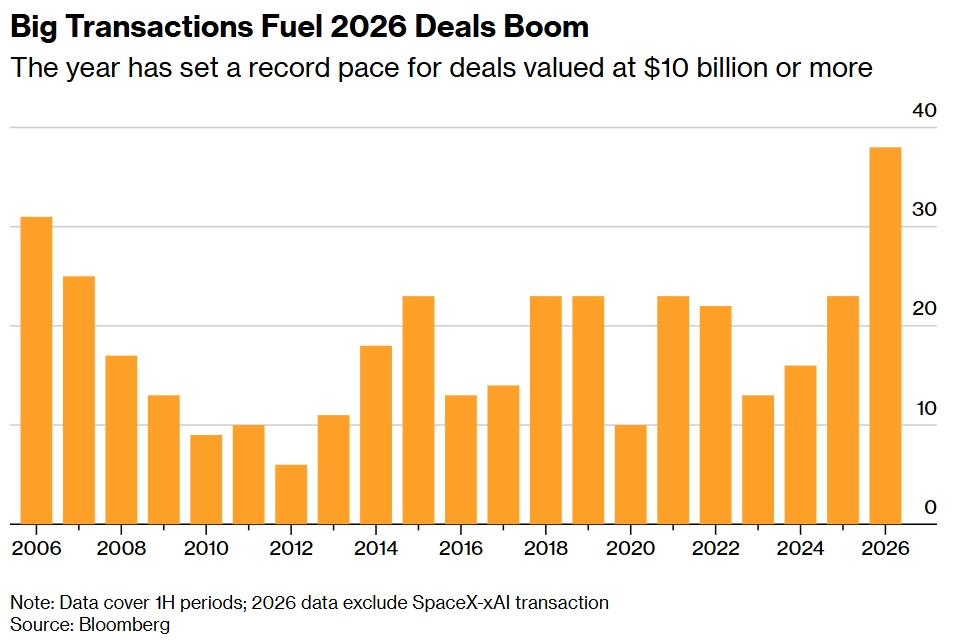
- …which showed through as global M&A grew ~+30% y/y to reach $2.6 trillion in H1:26 (link)
- That pace puts dealmakers on course to potentially pass the record $5.3 trillion achieved in 2021
- Big deals drove activity: Companies struck 38 deals valued at $10bn+ in H1:26, the most ever in a six-month period
- Also driving activity was a more favorable regulatory environment, which in particular is helping deals go through faster
- Additionally, in the age of AI, there’s a push for scale and a lot of the activity was across borders, particularly into the US, where AI, and other technological, innovation is largely developed and commercialized
Stock Market Check
This Week's Other Curated News
Artificial Intelligence/Machine Learning
- Anthropic annc’d Claude Sonnet 5, its most agentic Sonnet model yet, designed for planning, tool use, coding, reasoning, and autonomous task execution. Sonnet 5 delivers performance close to Opus 4.8 at lower cost, improves safety by reducing hallucinations, sycophancy, and misuse risks, and includes default cyber safeguards. It is available across Claude plans and APIs, w/ introductory pricing of $2 per mn input tokens and $10 per mn output tokens through Aug 31, 2026. (Anthropic)
- Apple CEO Tim Cook held a virtual meeting with EU tech chief Henna Virkkunen in an effort to resolve a dispute over Siri AI’s delayed EU launch. Apple says the Digital Markets Act prevented approval of its proposed “Trusted System Agent” framework and an 18‑month transition plan, while EU officials argue the DMA does not block new products. The talks were described as constructive, signaling both sides remain engaged in finding a path forward for Siri AI in Europe. (9to5Mac)
- Bank of England Deputy Governor Sarah Breeden said firms using AI for autonomous trading may eventually need “kill switches” or guardrails to prevent market disruption if systems fail. Speaking at an ECB conference, she warned AI could increase volatility during periods of stress through herding behaviour, as models react similarly to prompts. The BoE, Bundesbank and BIS are studying risks and possible safeguards for financial mkts. (Financial Times)
- OpenAI cut AI inference costs by ~50%, reducing the compute expense of generating ChatGPT and API responses. The Co is pursuing broader cost cuts, including its Jun. 2026 Jalapeño inference chip w/ Broadcom and a Batch API offering a 50% discount for non-real-time workloads. It also highlights quantization, caching and Mixture-of-Experts tech, noting inference spending could reach billions annually as usage grows. (Crypto Briefing)
- Research by Ramp and Revelio Labs covering 21,559 US firms found heavy AI adopters hired faster than peers. Cos spending ~$33.67 per employee on AI increased headcount 10.2% over 2 yrs, while low-intensity adopters spending ~$2.78 saw little change. Entry-level staffing at heavy adopters rose 12%, challenging fears that AI will eliminate junior jobs. Researchers noted the sample focused on tech-forward, white-collar firms and long-term impacts remain uncertain. (Yahoo Finance)
- Anthropic annc’d Claude Science, an AI workbench for researchers that uses existing Claude models rather than a new science-specific model. The platform connects to 60+ scientific databases, supports specialized assistants, fact-checking, reproducible code, and on-premises deployment. Anthropic is betting on workflow-focused AI svs to win scientific users, competing against OpenAI’s GPT-Rosalind and Google DeepMind’s science offerings. (TechCrunch)
- Google annc’d that Gemini’s personalized Nano Banana-powered AI image generation is now free for eligible US users, expanding beyond paid Plus, Pro and Ultra tiers. The feature uses Personal Intelligence, drawing on connected Google apps such as Gmail, Photos, YouTube and Search to create images based on user preferences and, if permitted, photos. The opt-in tool can be disabled, and follows broader Gemini feature expansions and growth to 750mn+ monthly active users. (TechCrunch)
- Amazon is expanding its AI partnership w/ Anthropic, making an immediate $5bn investment and offering up to $20bn more tied to commercial milestones. Combined w/ prior funding, Amazon’s total commitment could reach $33bn. In return, Anthropic plans to spend over $100bn on AWS infrastructure over the next decade, securing up to 5 gigawatts of compute capacity using Amazon’s Trainium and Graviton chips. (Crypto Briefing)
- DeepSeek annc’d DSpark, an MIT-licensed framework that speeds LLM inference by using semi-autoregressive drafting and confidence-scheduled verification. Applied to DeepSeek-V4 models, it delivered 51%-52% throughput gains and 57%-85% faster token generation in production tests. DeepSeek also released DeepSpec, a training/evaluation toolkit, enabling developers to adapt the approach to other open-weight models and improve AI serving efficiency. (VentureBeat)
- China’s tech workers are increasingly concerned that AI could replace their jobs as firms adapt to the new tech era. Rumours that Meituan might cut up to half of its product roles, though denied by the Co, intensified fears across the sector. Employees say “optimisation,” long used as a euphemism for lay-offs, now carries a new meaning tied to AI-driven workforce reductions. Similar staff cuts have reportedly affected firms including Baidu and Xiaomi. (South China Morning Post)
- Anthropic PBC received US approval to restore limited access to its Mythos 5 AI model after addressing Trump administration concerns over potential national security risks. In a letter seen by Bloomberg News, Commerce Secretary Howard Lutnick said the Co had worked w/ the US government to mitigate risks tied to the “Covered Models” and made significant progress. As a result, Mythos 5 may be released to certain trusted partners. (Bloomberg)
- Google has limited Meta’s access to Gemini AI models after Meta requested more computing capacity than could be supplied. The restriction, communicated around Mar., disrupted and delayed some internal AI projects and prompted staff to use AI tokens more efficiently. Other clients were also affected, though less severely. (Reuters)
Audio/Music/Podcast
- Tidal annc’d a new AI music policy effective July 15 requiring labels on music wholly or substantially created using AI. Fully AI-generated tracks will not receive royalties, and content tied to fraudulent activity, including artist impersonation or listener deception, will be banned. Tidal said the move addresses a surge in AI submissions, aims to protect artists and rightsholders, and will expand as AI-detection methods improve. (Variety)
Cable/Pay-TV/Wireless
- T-Mobile is moving customers on older 3G/4G-era plans to newer 5G plans, saying the change will unlock better network performance, video streaming, hotspot allowances and international calling benefits. Some users will pay ~+$4 per line, while a large portion will see no increase. The Co said retired plans cannot be restored and the shift will simplify ~1,100 billing codes to fewer than 100, helping speed new features and future 5G Advanced capabilities. (Fierce Network)
- Dish DBS, the satellite pay-TV unit of EchoStar, is preparing to file for Chapter 11 bankruptcy as soon as Tuesday, according to people familiar w/ the matter. The filing would support a restructuring agreement previously reached w/ major bondholders of the Dish Network unit. EchoStar, which also owns Dish TV and Boost Mobile, has been facing a $25bn debt load and yrs of subscriber declines. (The Wall Street Journal)
Capital Market Updates
- Bending Spoons, owner of Vimeo and AOL, priced its US IPO above range at $29/share, raising $1. 68bn and valuing the Co at ~ $18.4bn. The Italian software Co and existing holders sold ~58mn shares in one of Europe’s largest stock mkts debuts. CEO Luca Ferrari said the firm combines private-equity style acquisitions w/ tech development, having bought brands including Evernote, WeTransfer, Vimeo, Brightcove, Meetup and AOL. (Reuters)
- Q2 2026 delivered the highest number of venture-backed startup exits valued at $1bn+ since 2021, according to Crunchbase. SpaceX led the surge, completing the largest venture-backed exit ever, raising ~$75bn in its IPO and reaching a $2.1tn first-day market cap. Other major exits included SpaceX’s $60bn acquisition of Cursor, Cerebras Systems’ $5.55bn IPO, and Quantinuum’s $1.7bn debut. (Crunchbase)
- Japan’s IPO mkts hit a 15-yr low in H1 2026, w/ just 18 listings, the fewest since 2011, raising only $917mn, according to Dealogic. Even as the Nikkei 225 rose about a third this yr, activity remained weak. Bankers said volatility and limited AI-, data-centre- and semiconductor-linked start-ups may delay recovery, though activity could improve later this yr and next yr. (Financial Times)
Cloud/DataCenters/IT Infrastructure
- ByteDance is accelerating its Brazil expansion w/ a massive data center project in Ceara state, expected to become TikTok owner’s largest such complex outside China. The project is estimated at 200bn reais ($39bn), starting w/ 200MW of computing capacity and potentially reaching 1GW. Brazil’s renewable energy base and global cable links support its AI ambitions, though policy, trade, infrastructure and local opposition remain key risks. (Yahoo Finance)
- Digital Realty agreed to buy Blackstone’s stakes in three Northern Virginia data centers for $3. 5bn, paying $1.2bn cash and $2.3bn in shares. The deal increases Digital Realty’s ownership of two 96-megawatt facilities in Manassas and one in Sterling. The assets are valued at $7.8bn including debt and planned capex. The Co said the transaction should boost core FFO/share in 2027-2028 as development is completed and rents begin. (Reuters
Crypto/Blockchain/web3/NFTs
- A consortium backed by BlackRock, Google and Coinbase said Tuesday it is launching Open USD, a new dollar-backed stablecoin. The stablecoin is expected to be offered later this yr on Base, the Coinbase-affiliated blockchain, as well as on Solana and other networks. The initiative has drawn broad industry support, w/ ~140 cos signing up to use Open USD, including payments firms Visa, Stripe and Mastercard. (The Wall Street Journal)
- US President Donald Trump reported more than $1. 4bn in crypto-related income in a mandatory financial disclosure, including $635mn in royalties from Celebration Coins, linked to the $TRUMP meme coin, and over $500mn from crypto firm World Liberty Financial. His total disclosed income for the yr exceeded $2.2bn. The White House said Trump’s biz are held in a trust managed by his sons and denied any conflict of interest, citing support for making the US a crypto hub. (BBC)
- Crypto firms have spent $189mn to influence 2026 US midterm elections, exceeding the $170mn deployed in 2024 and accounting for over one-third of all corporate political funding so far. Fairshake, a pro-crypto super PAC, received $82mn. Public Citizen said crypto, AI, big tech and online betting interests have spent $294mn combined as the industry pushes for favorable legislation after recent policy gains in Washington. (Reuters)
- Robinhood Mkts cont’d its crypto push by annc’ing new products and expansion plans. In Europe, it will offer more perpetual futures tied to currencies, commodities and major ETFs. The Co is rolling out updated tokenized stocks that trade 24/7 and can be used as collateral, plus Robinhood Earn, a decentralized lending product offering estimated annual interest of 7% on dollar-backed stablecoins. (The Wall Street Journal)
- The UK Financial Conduct Authority annc’d sweeping crypto rules effective Oct next yr, requiring firms to hold capital against risky assets, conduct annual stress tests and prove resilience to market shocks. The framework extends oversight across trading, asset custody, consumer protection and risk management. (The Guardian)
eCommerce/Social Commerce/Retail
- France’s parliament passed legislation targeting ultrafast fashion retailers such as Shein and marketplaces including Temu. The law would impose fines on firms that sell large volumes of low-price clothing, part of efforts to reduce the environmental impact of cheap, high-volume apparel. It also seeks to curb the influence of these retailers, which have gained market share in France and increased pressure on traditional retailers. (The Wall Street Journal)
- Nike reported fiscal Q4 earnings and rev above expectations, posting adj EPS of $0. 20 on $10.97bn rev versus forecasts of $0.13 and $10.86bn. Net income rose to $1.07bn, helped by an expected $986mn tariff refund that boosted gross margin. North America rev grew 3%, while Greater China sales fell 12% to $1.30bn. CEO Elliott Hill said Nike remains committed to restoring growth in China as its broader turnaround cont’d. (CNBC)
- Amazon’s four-day Prime Day sale helped drive total US online spending to $26. 4bn, slightly above Adobe’s $26.3bn estimate. Spending across retailers rose 9.3% vs. last yr as Walmart and Target ran overlapping promotions. Electronics and apparel saw the deepest discounts at ~24%. Buy-now-pay-later accounted for 6.6% of orders. Numerator said average household spending on Amazon was $143, down 8.3% from last yr’s event, while Amazon said it was pleased w/ customer response. (MSN)
- GameStop said it will cont’d pursuing its unsolicited cash-and-stock bid for eBay valued at ~$56bn, despite eBay rejecting the proposal. CEO Ryan Cohen has argued a combined Co could better compete w/ Amazon and said he would lead the merged biz. GameStop signaled more details on strategy and operations are forthcoming and forecast fiscal 2026 adj EBITDA above $600mn, up from $345.4mn in fiscal 2025, helping lift shares in after-hours trading. (Reuters)
FinTech/InsurTech/Payments
- A Swedish court ordered Google to pay Klarna-owned PriceRunner ~14. 3bn Swedish crowns ($1.5bn; $1.97bn incl. interest) in antitrust damages, ruling that Google unfairly favored its own shopping svs in search results. The award, the largest in a Swedish competition case, was below the ~78bn crowns sought. Google said it disagrees w/ the decision and is reviewing legal options, while Klarna expects a lengthy appeal process. (Reuters)
Handheld Devices & Accessories/Connected Home
- Xiaomi, Oppo and Vivo have again lowered 2026 smartphone shipment targets as rising costs and unprecedented component shortages pressure the sector. Several Chinese handset makers informed suppliers of revised plans, w/ some outlooks reduced by up to 30%. The cuts reflect continuing strain on production and demand expectations, prompting brands to scale back forecasts for the yr. (Nikkei Asia)
Last Mile Transportation/Delivery
- Uber Technologies dismissed two leaders at its AI data-labeling biz, a division the Co has highlighted as a key growth driver. Naga Kasu, senior director of engineering, and Pankaj Kamat, director of product at Uber AI Solutions, recently left the Co, according to a person familiar w/ the matter. An Uber spokesperson confirmed the departures. The changes shake up the nascent AI-focused unit as Uber continues to develop the biz. (Bloomberg)
Macro Updates
- US job openings rose 9,000 to 7. 594mn in May, a two-yr high and above forecasts, signaling steady labor demand. However, hiring fell for a second straight month to 5.17mn, while layoffs increased, especially in healthcare and social assistance. Consumer views of the labor market weakened, w/ more Americans saying jobs were hard to get. Economists said conditions remain broadly stable, keeping the Fed focused on inflation. (Reuters)
- South Korea’s exports jumped 70. 9% y/y to $102.25bn in Jun, the fastest growth since 1978 and above forecasts, driven by an AI-fueled chip boom. Semiconductor exports surged 199.5% to $44.8bn, while computer sales rose 308.8%. Shipments to China climbed 92.1% and to the U.S. 78.6%. Imports increased 30.1% to $66.1bn, helping generate a record monthly trade surplus of $36.15bn and a H1 surplus of $138.3bn. (Reuters)
- Kevin Warsh said there would be “no changes” to Federal Reserve independence and pledged a firm focus on inflation and price stability. Speaking at an ECB conference in Sintra, the new Fed chair said the central bank would stay committed to its 2% inflation target and remain independent despite possible White House pressure to cut rates. (Financial Times)
- Consumer spending rose 0. 7% in May while inflation accelerated to a three-yr high, according to BEA data. The PCE index increased 0.4% for the month and 4.1% annually, while core PCE reached 3.4%. Personal and disposable income also rose 0.7%, signaling economic resilience despite weak consumer sentiment. The Atlanta Fed projects Q2 GDP growth of 2.5%. Traders now see an 80% chance the Fed raises rates by at least 0.25% before the end of 2026. (Retail Dive)
Metaverse/AR & VR
- Meta is imposing new “rate limits” on its AI smart glasses, effectively creating a soft paywall. Conversation Focus, a feature that amplifies a speaker’s voice in noisy settings, will be capped at three hours per month unless users pay $19.99 for Meta One Premium; subscribers get 15 hours. (The Verge)
Regulatory
- Google warned proposed EU Digital Markets Act rules could create privacy and security risks by requiring Android to allow rival AI assistants system-level access and by forcing Google to share anonymized search data w/ competitors. Google argues bad actors could exploit AI integrations and that search data may be re-identified through “linkage attacks.” The European Commission is weighing these concerns against efforts to curb Google’s dominance, w/ a final decision expected on Jul 27th (Ars Technica)
- The US Supreme Court agreed to hear Apple’s appeal of a contempt ruling tied to Epic Games’ antitrust lawsuit over App Store practices. A judge found Apple violated a 2021 injunction requiring developers be allowed to direct users to non-Apple payment options. Epic argues Apple’s later 27% commission and restrictions defied the order. The Court will review whether Apple can be held in contempt for breaching the injunction’s spirit rather than an explicit provision. (Reuters)
- The US Supreme Court ruled 6-3 that people have a reasonable expectation of privacy in cellphone location data, requiring law enforcement to obtain a search warrant for geofence requests to tech Cos such as Google. The court said users do not voluntarily share such data under the third-party doctrine. The decision limits broad “reverse” searches, requires probable cause, and sends the Chatrie case back to an appeals court for further review. (TechCrunch)
- The Supreme Court, in a 5-4 ruling, rejected President Trump’s bid to remove Federal Reserve Gov Lisa Cook while her challenge proceeds, reaffirming the Fed’s insulation from presidential control. Chief Justice Roberts said allowing removal at any time without notice or judicial review could undermine the central bank’s policy independence. In a separate 6-3 FTC case, the court expanded presidential authority to fire officials at other independent agencies. (The Wall Street Journal)
Satellite/Space
- SpaceX annc’d discounted Starlink svs in Memphis, offering internet plans for $27. 50-$65 per month, about half the standard $55-$130 rates, w/ no upfront hardware costs and sharable discounts. The move comes amid backlash tied to xAI data centers in Memphis and Southaven over pollution concerns. DOJ recently defended xAI in an NAACP lawsuit, while the Co agreed to resume a recycled wastewater plant project supporting Colossus operations and the TVA. (Yahoo Finance)
- Rocket Lab annc’d a definitive deal to acquire Iridium in a cash-and-stock transaction valuing the Co at ~$8.0 bn. The combination unites Rocket Lab’s launch and satellite manufacturing capabilities w/ Iridium’s global communications network, L-band spectrum, and 2.55mn+ subscribers. Management said the merger creates a vertically integrated space biz, expands recurring rev, and supports next-generation satellite svs. (Rocket Lab)
- The Trump administration has discussed a potential SpaceX stock donation to children’s savings vehicles known as Trump Accounts, expected to launch next week. SpaceX has not confirmed participation. Treasury is rolling out the program w/ BNY Mellon and Robinhood (Semafor)
- Starlink became the largest ISP in rural New Zealand, surpassing 85,000 subs after 46% growth and accounting for more than a quarter of rural broadband connections. The LEO satellite provider attracted 54% of users moving off copper, helped by ~180 Mbit/s download speeds and 35ms latency. Regulators said satellite tech is reshaping rural connectivity, though rural users still pay about NZ$13 more per month than urban customers. (Light Reading)
Social/Digital Media
- Meta annc’d that CMO Alex Schultz will become its first Chief Data Officer, a new role centered on AI analytics. Schultz said he will help reshape how the Co learns and makes decisions in the AI era by improving data foundations across AI-powered analytics, experimentation, research and decision-making. Speaking to Axio, he highlighted building a semantic data layer as a top priority for the next six months. Denise Moreno succeeds him as CMO. (MediaPost)
- WhatsApp has begun rolling out username reservations worldwide, letting users claim unique names before the feature launches later in 2026. Usernames will allow people to message others, join groups, and interact w/ biz accounts without revealing phone numbers, adding privacy controls. Meta is offering a claims process for creators, small biz, and organizations to match existing Instagram or Facebook handles. No username directory will exist, and optional username keys can restrict first-time contact. (9to5Mac)
- Australia’s government annc’d it has doubled the maximum penalty for social media Cos that fail to comply w/ its under‑16 social media ban, raising fines from 49. 5mn AUD to 99mn AUD (~$68mn). PM Anthony Albanese said big tech is not doing enough to meet the law. Despite >5mn youth accounts being removed or restricted since Dec., studies suggest many teens still access social media. (Engadget)
Software
- Microsoft plans to annc’d thousands of job cuts in coming days, affecting sales, consulting and some Xbox roles, according to people familiar w/ the matter. The reductions are expected to impact less than 2.5% of its 220,000-person workforce, smaller than last yr’s layoffs. The move reflects ongoing cost-control efforts as the Co increases AI spending; some affected staff may be offered new roles immediately. (Business Insider)
- South Korea’s KFTC alleged Google abused its dominant Android app-store position, saying its Games/Google Velocity Program (“Project Hug”) tied financial support to developers launching games on Google Play on terms at least as favorable as rivals. Regulators said the practice affected 14.16tn won (~$9.1bn) in rev and reduced competition, including for OneStore. Google denied wrongdoing; penalties could reach 6% of affected rev. (Reuters)
- Britain’s CMA proposed rules requiring Apple and Google to let app developers direct users to alternative payment methods outside their app stores, aiming to lower fees and boost competition. The regulator is also considering opening Apple’s NFC tech to support rival iOS payment and wallet svs. Google said recent Play Store changes already allow steering, while Apple warned the move could increase security and fraud risks. (Reuters)
Sports/Sports Betting
- NPR reported Meta CEO Mark Zuckerberg explored acquiring prediction-market leader Kalshi in 2025, but talks stalled amid disagreements and possible legal/ethical concerns. Meta has since cont’d development of Arena, a standalone prediction-market app using AI-generated questions and “play money” rather than real-money bets. (NPR)
- NBC Sports reported standout golf viewership as the Travelers Championship and KPMG Women’s PGA Championship delivered their best TV ratings in more than two decades. The Travelers final round averaged 4.2mn viewers across NBC and Peacock, the event’s strongest final-round audience in 24 yrs, peaking at 5.6mn viewers. The KPMG final round drew 1.4mn viewers, its highest audience in 21 yrs despite weather delays. (AOL)
Tech Hardware
- Apple is in talks to buy memory chips from Chinese suppliers ChangXin Memory Technologies (CXMT) and Yangtze Memory Technologies (YMTC) for devices sold in China, aiming to ease a global memory shortage that has driven price hikes across its products. CEO Tim Cook has appealed to Trump administration officials to limit political fallout. Both Cos are on a Pentagon blacklist, and any deal could trigger opposition from US national security hawks. (Bloomberg)
- South Korea unveiled AI-focused megaprojects to bolster its semiconductor sector. Samsung Electronics and SK hynix pledged 800tn won (~$519bn) to build a southwestern chip complex, while SK Group, GS Group and Naver plan 550tn won for AI data centers targeting 18.4GW capacity by 2035. The govt aims to expand chip production, packaging, AI infrastructure and physical AI, while promoting balanced regional development across Korea. (The Korea Times)
- Alexandria Ocasio-Cortez criticized Apple after the Co raised some MacBook and iPad prices by $200+, citing a memory-chip shortage tied to growing AI data-center demand. She argued Congress should pursue antitrust action, break up oversized tech firms, and strengthen consumer protections. AOC also warned that AI-driven data-center expansion could raise electronics and energy costs, spur layoffs, and threaten jobs. (New York Post)
- Jefferies says memory prices could jump 40–50% QoQ in Q3 2026 and another 30–40% in Q4 as global supply shortages persist and AI-driven demand remains strong. Prices are projected to rise 40–45% YoY in 2027, w/ meaningful relief not expected until 2028 when 15–20% new capacity comes online. Long-term supply deals may tighten availability for PCs, laptops, consoles and smartphones, keeping costs elevated across the tech industry. (Wccftech)
Video Games/Interactive Entertainment
- Xbox is cutting contracts w/ external vendors as part of broader cost-saving efforts ahead of expected mass layoffs and a reorganization. Contractors tied to Xbox’s Jun. showcase were told their roles were removed from next fiscal-yr budgets. Sources said Compulsion Games, Double Fine and Ninja Theory are involved in sale or buyout discussions, while staff across Activision Blizzard, ZeniMax and unionized teams face uncertainty. (Kotaku)
- Sony Interactive Entertainment annc’d that physical disc production for all new games releasing on PlayStation consoles will end in Jan 2028, reflecting a shift in consumer demand from physical media to digital purchases. Games released before Jan 2028 in disc format will not be affected. Future titles will be available digitally through PlayStation Store and retailers, while Sony says it will cont’d investing in access, choice, and innovation for players. (PlayStation Blog)
- Sony annc’d plans to shut down the PlayStation Store on PS3 and PS Vita. PS3 store access will end in select mkts, including Mexico, Honduras and Nicaragua, starting in Aug., w/ additional Latin American and Middle Eastern countries following later in 2026. A global shutdown for both consoles is set for Jul. 2027. Users will no longer buy new content afterward but can cont’d downloading previously purchased games for the foreseeable future. (The Verge)
- Microsoft is internally testing a Disc2Digital feature for Xbox that lets owners convert eligible Xbox One and Series X physical game discs into digital entitlements tied to the disc. Users could access benefits such as Xbox Cloud Gaming and Play Anywhere where supported. The feature preserves disc use but transfers entitlement w/ the disc, and may be key if future Xbox hardware launches without a disc drive. (The Verge)
- Sony said it does not intend to sell PS6 hardware at “significant losses,” signaling the next-gen console is unlikely to be heavily subsidized despite industry practice of recouping profits through game sales and subscriptions. Rising CPU, GPU and RAM costs have already driven PS5 price increases outside Japan. Sony said sales remain on track and demand has held up, but growing component costs could make PS6 pricing a major challenge ahead of its expected 2027 window. (Kotaku)
Video Streaming
- Roku cont’d expanding The Roku Channel in Jun 2026 by adding 12 free ad-supported live channels across adventure, lifestyle, history, anime and sports categories. New offerings include Extreme Living, All-Out Alaska, History Untold, Anime X, HiDive, FIFA Plus Women, Sports Illustrated and more. The additions strengthen Roku’s free TV lineup, giving viewers 24/7 access to outdoor, documentary, talk-show and sports programming without subscriptions (Cord Cutters News)
- NBCUniversal annc’d a pact making Starz available as an add-on subscription for select Peacock users at $11. 99/month. The bundle gives subscribers access to franchises including Outlander and Power on Peacock’s premium tiers. NBCU said the deal expands customer choice and engagement, while Starz said bundling helps broaden distribution. (The Hollywood Reporter)
- Australia’s ACCC sued Amazon, alleging unfair contract terms tied to ads introduced on Prime Video. The regulator said more than 1mn annual subscribers were affected between Nov. 2023 and Aug. 2025 after Amazon required customers to pay an extra monthly fee to keep the streaming svs ad-free. ACCC said ~850,000 prepaid subscribers received a downgraded, ad-supported svs during their term unless they paid more. Amazon said it is reviewing the case and cooperated w/ the investigation. (BBC)
