


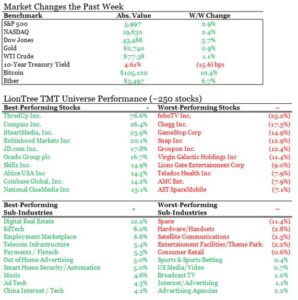
Hi all – it has been quite the seesaw in the markets since the start of the year, and following last week’s concerns about potential inflation and the interest rate cut trajectory, this week’s slightly lower than expected core CPI provided more comfort that we are on track. That coupled with other factors, such as very strong bank earnings, propelled the S&P 500 and Nasdaq up ~+2.5-2.9%. I’d also mention that potential Trump tariffs were in focus this week and we’d expect that to be front and center next week as well.
Activity in the sector will significantly step up with earnings kicking off in the space after the holiday long weekend.
- Reminder - 7th Annual LionTree Sector Themes Survey - Please Participate!
- Countdown to a TikTok Ban: Supreme Court Ruling Raises the Stakes
- Advanced AI Chips Are Becoming A Matter Of National Security…
- “MySports” = The New “Venu” + Other Key Sports-Related Updates
- Another Look At US Ad Spend Trends For 2025…Per IAB
- Grab Bag: Regulators Zero In On The Paramount-Skydance Merger/ IAC Spins Off Angi/ OpenAI Rolls Out Tasks
Best,
Leslie

Reminder - 7th Annual LionTree Sector Themes Survey - Please Participate!
Just a reminder that our 7th Annual TMT Themes survey is still live. We are gathering insights on areas such as the M&A & regulatory environment, the AI CapEx trajectory, the ARPU impact from a super-premium music subscription tier, the TikTok ban, autonomous vehicle penetration, Take-Two’s GTA launch, ESPN’s flagship DTC adoption, and more!
Overall there are ~20 quick questions and should take ~5-8min to complete. Also, as a reminder, our rule is that we send the survey results ONLY to those who participate!
**CLICK HERE** to participate.
-> Last year’s survey respondents underestimated the growth of the global ad market in 2024. 54% of respondents said that the broader ad market would grow in-line with Dentsu and GroupM’s projected +4.6-7.2% range, though both companies now predict 2024 will close showing a +6.8-9.5% y/y increase. Will respondents correctly predict ad market trends for 2025? For reference, HERE are last year’s survey results
Countdown to a TikTok Ban: Supreme Court Ruling Raises the Stakes
A US ban on TikTok moved one step closer on Friday, as the Supreme Court upheld a law that requires TikTok to find a new, non-Chinese owner or face a ban that is scheduled to go into effect this Sunday. While acknowledging TikTok’s role as a platform for expression and community for 170mn Americans, the Court sided with Congress, which deemed divestiture necessary to address national security concerns.
The law, set to take effect before President-elect Donald Trump’s inauguration on Monday, will remove TikTok from app stores and render it unusable over time unless sold to a non-Chinese entity. ByteDance has yet to signal willingness to sell, leaving TikTok’s future in the US uncertain. Enforcement of a ban will fall to the incoming administration, as questions remain about the feasibility of banning a major social media platform.
See below for the updates…
Supreme Court Rules In Favor Of The Law Requiring TikTok To Be Sold Or Banned
- The Supreme Court acknowledged that for 170mn Americans, TikTok offers “a distinctive and expansive outlet for expression, means of engagement, and source of community”
- BUT Congress was focused on national security concerns and that, the court said, was a deciding factor in how it weighed the case
- “Congress has determined that divestiture is necessary to address its well-supported national security concerns regarding TikTok’s data collection practices and relationship with a foreign adversary,” the court wrote
What Comes Next? It Remains To Be Seen…
- Under the law, TikTok would be made unavailable for download from the Apple and Google app stores in the US and network providers would have to block access to the website… (link)
- The requirements would eventually make the app “unworkable” over time without support and updates, according to the Justice Department
- …but TikTok reportedly plans on taking it a step further and will completely shut off the app for US users as soon as the ban is in effect (link)
- There’s no precedent for the US government blocking a major social media platform, so there are several questions about how the ban would work in practice and how exactly the govt would enforce it
The Biden Administration Will Leave Enforcement Of The TikTok Ban Up To Trump
- Where does Biden stand on the issue? “TikTok should remain available to Americans, but simply under American ownership or other ownership that addresses the national security concerns identified by Congress,” according to a statement issued by White House Press Secretary Karine Jean-Pierre
- “Given the sheer fact of timing, this Administration recognizes that actions to implement the law simply must fall to the next Administration, which takes office on Monday,” White House Press Secretary Karine Jean-Pierre further said
- The ban will take effect just one day before President-elect Trump is set to be inaugurated as US President, i.e., January 19th
President-Elect Trump Weighs In – “I’ll Be Making The Decision”
- “The Supreme Court decision was expected, and everyone must respect it. My decision on TikTok will be made in the not too distant future, but I must have time to review the situation. Stay tuned!” Trump said in a TruthSocial post (link)
- When asked if he would take measures to try and reverse the pending ban, Trump said he’ll “be making the decision…Congress has given me the decision, so I’ll be making the decision”
- The Supreme Court did note in their decision that Trump once wanted to ban TikTok
- “President Trump determined that TikTok raised particular concerns, noting that the platform ‘automatically captures vast swaths of information from its users’ and is susceptible to being used to further the interests of the Chinese government,” the court wrote
- Trump also confirmed he had a conversation with Chinese President Xi Jinping, saying they had “a great talk about TikTok and a great talk about many other subjects”
- On Thursday (Jan 16th), Trump’s incoming national security advisor Mike Waltz had said, “we will put measures in place to keep TikTok from going dark”
TikTok CEO Thanks Trump In Video After Ruling (link)
- In a video posted to TikTok just hours after the Court decision and shortly after the Biden administration said it would leave enforcement of the TikTok ban to the Trump administration, TikTok CEO Shou Chew praised Trump’s support
- “I want to thank President Trump for his commitment to work with us to find a solution that keeps TikTok available in the United States,” he said. “This is a strong stand for the First Amendment and against arbitrary censorship
- TikTok CEO Shou Chew reportedly plans to attend President-elect Trump’s inauguration and has been invited to sit in a position of honor on the dais, where former presidents, family members and other important guests traditionally are seated (link)
- Chew will join Mark Zuckerberg, Jeff Bezos and Elon Musk on the dais, along with other tech executives at the event, according to people with knowledge of the planning
Selling TikTok Is Still An Option, Though ByteDance Has Not Said That It Is Willing To Sell
- The law gives the president the option to extend the ban by 90 days…
- …but triggering the extension requires evidence that parties working on purchasing have made significant progress, including binding legal agreements for such a deal, and TikTok’s parent company, ByteDance, has NOT publicly updated its stance that the app is not for sale
- “Everyone – the Biden Administration, the incoming Trump Administration, even the Supreme Court – should continue working to find a way to find an American buyer for TikTok, so we can both free the app from any influence and control from the Chinese Communist Party and keep TikTok going, which will preserve the jobs of millions of creators,” Democratic Sen. Chuck Schumer of New York said on the Senate floor prior to the Supreme Court decision
- “It’s all about the money. If the price is right, the Chinese will sell it,” said Democratic Sen. Richard Blumenthal of Connecticut
- “If ByteDance cares about its users, the company will come to the table and help us make the deal of the century,” Republican Rep. John Moolenaar of Michigan and chair of the China Select Committee, said in a statement
- “I think somebody would buy it if China would sell it. That’s the problem. They’re preventing its sale. So, but I predict somebody will buy it…It’s entirely up to Beijing. I mean, there are willing buyers,” said Republican Sen. Josh Hawley of Missouri
- Hawley said he doesn’t care who buys the app, “just not somebody subject to the Chinese government”
- Democrats had tried on Jan 15th to pass legislation that would have extended the deadline, but Republican Sen. Tom Cotton of Arkansas blocked it (link): Cotton, Chair of the Senate Intelligence Committee, said that TikTok has had ample time to find a buyer
- “TikTok is a Chinese Communist spy app that addicts our kids, harvests their data, targets them with harmful and manipulative content, and spreads communist propaganda,” Cotton said
In The Meantime, TikTok Users Have Been Flocking To Another Chinese App, RedNote (link)
- What is Rednote? The Chinese-owned app Xiaohongshu, or “RedNote” was founded in 2013 and is a lifestyle platform “where over 300mn users every month share their life experiences,” according to a description on Apple’s app store
- The photo and video-sharing platform has often been compared to Instagram: It operates as a platform for e-commerce, a manual for tips on travel and fine dining, as well as a vehicle for users to share content from their everyday lives
- RedNote maintains only one version of its app, rather than splitting it into overseas and domestic apps, which is rare among Chinese social apps that are subject to domestic moderation rules
- In two days, 700,000+ new users joined Xiaohongshu, a person close to the company told Reuters
- US downloads of RedNote were up 200%+ y/y this week, and up +194% from the week prior, according to estimates from app data research firm Sensor Tower
- In a live chat dubbed “TikTok Refugees” on RedNote on January 13th, more than 50,000 American and Chinese users joined the room
- In a collateral benefit, subscriptions to Duolingo’s Mandarin Chinese courses have increased by 216% over this same period in 2024 (link)
- Lemon8, another social media app owned by ByteDance, also saw a surge: It was the second most-popular free app on Apple’s App Store list on January 14th; It also experienced a similar surge last month, with downloads jumping by 190% in December to about 3.4mn
Advanced AI Chips Are Becoming A Matter Of National Security…
As the race to develop advanced AI chips has been heating up around the world, governments have started to become more cognizant of the technology’s potential to not only rapidly produce content and drive scientific breakthroughs, but also transform economies and how militaries conduct warfare. Consequently, protecting and limiting the distribution of high-end AI chips has increasingly been viewed as a “critical” matter of national security. To this end, President Joe Biden’s administration proposed new rules earlier this week “designed to safeguard the most advanced AI technology and ensure that it stays out of the hands of [the US’] foreign adversaries” while “enabling the broad diffusion and [the] sharing of benefits with partner countries,” per Commerce Secretary Gina Raimondo. The framework builds on the Biden administration’s prior efforts to restrict exports to the country’s geopolitical rivals, including China and Russia, by closing loopholes that were used to skirt some of these controls. Furthermore, the new regulations apply to a much broader range of countries, though there are provisions in place to enable countries that align with the new agreements to raise the number of advanced GPUs that they can import.
Unsurprisingly, the response to the new rules from the US semiconductor industry was negative, as they risk “causing unintended and lasting damage to America’s economy and global competitiveness in semiconductors and AI by ceding strategic markets to [its] competitors,” according to Semiconductor Industry Association chief John Neuffer. A spokesperson from NVIDIA also deemed the proposal to be a “sweeping overreach” and argued that they would do nothing to improve US national security. Ultimately, it will be up to the incoming Trump administration to enforce the new regulations once they become effective 120 days from the announcement.
See below for more details.
- The Biden administration proposed new restrictions to limit other countries’ access to AI chips (link/link): The Interim Final Rule on Artificial Intelligence Diffusion aims to enhance US national security and economic strength by “thwarting smuggling, closing other loopholes, and raising AI security standards”
- 120 countries will be affected by the new export restrictions: Although the rules are mostly intended to be targeted at China, other countries that could have limited access include Mexico, Portugal, and Switzerland, among others
- The rule contains six key mechanisms to “catalyze the responsible diffusion of US tech” –
- No restrictions apply to chip sales to the US’ 18 key allies and partners: This allows countries w/ “robust tech protection regimes” and tech ecosystems aligned w/ US national security interests to “benefit from seamless large-scale purchases”
- Chip orders w/ collective computation power up to ~1,700 advanced GPUS do not require a license: These don’t count against national chip caps, given that the “overwhelming majority” of these are for “clearly innocuous purposes,” such as research
- Entities that meet high security and trust standards are HQ’d in close allies and partners can obtain highly trusted Universal Verified End User (UVEU) status: This means they can place up to 7% of their global AI computational capacity in countries around the world
- Entities that meet the same security requirements and are HQ’d in areas that aren’t in a country of concern can apply for “National Verified End User status”: This permits them to purchase computational power up to 320,000 advanced GPUs
- Non-VEU entities located outside of close allies can still purchase large amounts of computational power: Specifically, up to the equivalent of 50,000 advanced GPUs per country
- Governments that sign these arrangements can double their chip caps (up to 100,000 of today’s advanced GPUs)
- Actions against “countries of concern” include –
- Continuing to ensure that advanced semiconductors sold abroad are not used by countries of concern to train advanced AI systems
- Restricting the transfer to non-trusted actors of the model weights for advanced closed-weight models
- Setting security standards to protect the weights of advanced closed-weight AI models
- Enforcement will depend on the incoming Trump administration: As the new regulations are set to take effect 120 days after their publication on Jan 13
-> On a separate but related note, President Joe Biden also signed an executive order this week to provide federal support to address the massive energy needs required by rapidly growing AI data centers; To address the substantial power needs on a short timeframe, the order calls for federal sites owned by the Defense and Energy depts to be leased out to host gigawatt-scale AI data centers and new clean power facilities; The order also requires Cos using federal land for AI data centers to purchase an “appropriate share” of US-made semiconductors (link)

However, The New Rules Provoked Industry Backlash (link/link)
- The rules are a “sweeping overreach” per NVIDIA: The Co argued that the White House would be clamping down on “tech that is already available in mainstream gaming PCs and consumer hardware”
- “These rules would do nothing to enhance US security”: A NVIDIA spokesperson also claimed that the proposal would hurt innovation
-> NVIDIA shares fell -2.0% in reaction to the announcement but recovered to finish the week up +1.3%
- The Semiconductor Industry Association (SIA) expressed disappointment that the policy was “rushed out the door”: “The new rule risks causing unintended and lasting damage to America’s economy and global competitiveness in semiconductors and AI by ceding strategic mkts to our competitors,” per SIA President and CEO John Neuffer
- The new rule could fragment global supply chains and put US Cos at a disadvantage, per the Information Technology Industry Council
“MySports” = The New “Venu” + Other Key Sports-Related Updates
Hot off the heels of last week’s announcements regarding the merger between Disney’s Hulu+ Live TV and Fubo as well as Disney, Fox, and Warner Bros Discovery’s decision not to move forward with their Venu sports streaming joint venture, DirecTV revealed that it is launching MySports, a streaming multichannel video service that will offer consumers a sports skinny bundle that will include all the same channels as Venu, plus more. That said, the added content will also come with a heftier price tag, as MySports will normally cost $69.99/month compared to the $42.99/month proposed price for Venu, and the new service will only be available in 24 markets initially before distribution is expanded moving forward. Elsewhere across the sports streaming space this week, it was announced that Tubi will host Super Bowl LIX free of charge to subscribers to the service, while DAZN is reportedly nearing a $1bn investment from Saudi Arabia’s Public Investment Fund.
There were also some interesting developments pertaining to changes in ownership within the sports world. Along with sources indicating that Maverick Carter, a longtime business partner of Lebron James, is leading a group of investors seeking to raise $5bn to create an international rival to the NBA, news also emerged that Comcast is taking a minority stake in the 76ers as part a JV with Harris Blitzer Sports & Entertainment to build a new arena for the team and that Google CEO Sundar Pichai joined a consortium of tech executives to bid for a stake in a London-based Cricket team.
See below for more details.
- DirecTV is launching MySports, a streaming multichannel video svs (link): The svs will feature the same channels as Venu, plus others
- The package will include 40+ channels: Including ABC, NBC and Fox, as well as cable channels like ESPN, TNT, TBS, USA Network, and Fox Sports 1; NFL Network, NBA TV, and MLB Network will also be included as well
- The svs will not include any channels owned by Paramount: Such as CBS, among others; Otherwise, DirecTV has carriage agreements w/ Fox, Disney, WBD, and NBCUniversal, along with the major sports leagues
- MySports will be more expensive than that expected for Venu: MySports will cost $70/mo, which a good bit pricier than the $43/mo that Venu was targeting
- A limited time offer provides a $20 discount on the first three months: The offer also comes with a 5-day free trial period but ends on Feb 28, 2025
- MySports will only be available in a select 24 mkts: Though more mkts are “coming soon”; See the graphic below for the full list
- The package will include 40+ channels: Including ABC, NBC and Fox, as well as cable channels like ESPN, TNT, TBS, USA Network, and Fox Sports 1; NFL Network, NBA TV, and MLB Network will also be included as well
The svs is the “first of several genre-based options” that DirecTV plans to launch over the coming months: Per DirecTV CEO Bill Morrow
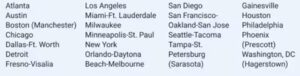
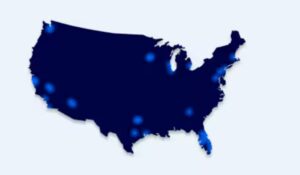
-> DirecTV’s head of communications and community, Jon Greer, also revealed that RSNs will be available as add-ons to MySports subscriptions later in 2025, appealing to the “next tier” of sports fans; Greer indicated that while MySports only includes ABC, Fox and NBC affiliates, those station groups could bring themselves into MySports in the future; Greer noted that 5 of MySports initial 25 mkts have all three of those local broadcast stations and that DirecTV will “look and ask if [it has] enough mkt size… for locals to actually activate the whole mkt” (link)
- Super Bowl LIX will stream on Tubi free of charge, per Fox (link): Tubi subscribers will be able to stream the game in 4K from the svs’ app on their phones or smart TVs on Feb 9, 2025
- This marks the first time that the Super Bowl will be available on Tubi: As well as the streaming svs largest live sporting event yet
- The game will also continue to air on other distribution networks: Including Fox, Fox Deportes, Telemundo, Fox’s website, and the NFL+ app
- DAZN is nearing a $1bn investment from Saudi Araiba’s Public Investment Fund (PIF), per Bloomberg (link): The investment would provide PIF w/ a minority stake in DAZN and value the Co at ~$10bn
- The investment would strengthen ties between Saudi Arabia and DAZN…: DAZN already broadcasts a wide range of sports from Saudi Arabia, including the Saudi Pro League (soccer), Saudi-funded boxing bouts, and the Six Kings Slam tennis exhibition event
- … And allow the country to further its ambitions in sports: Saudi Pro Leagues have invested heavily in playing talent; PIF and the SURJ sports investment venture have also backed LIV Golf, acquired Premier League club Newcastle United, and supported the WTA tennis tour
- The deal would provide DAZN more resources to expand its global footprint: the Co owns the domestic rights to top-tier soccer competitions in France, Germany, Italy, and Spain; DAZN is also the global distributor of the Uefa Women’s Champions League, several boxing promotions, and the NFL’s intl Game Pass
- The investment would strengthen ties between Saudi Arabia and DAZN…: DAZN already broadcasts a wide range of sports from Saudi Arabia, including the Saudi Pro League (soccer), Saudi-funded boxing bouts, and the Six Kings Slam tennis exhibition event
There Were Also Some Noteworthy Updates Pertaining To Sports Ownership
- A group of investors led by Maverick Carter is reportedly seeking to raise $5bn to create an international basketball league (link): The group is looking to raise the funds from private capital sources to form the league, which would rival the NBA; Carter has been a longtime biz partner of NBA star Lebron James
- Investment banks have already been tapped to raise the money: Sources indicate the funds could come from wealthy individuals and institutional investors, such as sovereign wealth funds
- There are already some high-profile backers, per sources: These include Skype co-founder Geoff Prentice, former Facebook exec Grady Burnett, and the investment firm SC Holdings, which is led by co-founders Jason Stein and Daniel Haimovic
- Details on the format of the league: It is envisioned to include 6 men’s teams and 6 women’s teams, w/ games occurring in eight cities around the world w/ two weeks in each city, a similar model to that of F1 races; Singapore has already been designated as one mkt
- Investment banks have already been tapped to raise the money: Sources indicate the funds could come from wealthy individuals and institutional investors, such as sovereign wealth funds
- Comcast bought a minority stake in the Philadelphia 76ers (link): The deal came as part of an agreement between Comcast and Harris Blitzer Sports & Entertainment (HBSE) to enter into a 50-50 joint venture to build a new arena that will be shared by the 76ers and the NHL’s Flyers in the South Philadelphia Sports Complex
- The new arena is set to open in 2031: Comcast will have the naming rights to the building
- There has been some disputes between HBSE and Comcast over the venue’s location: As Comcast, which owns the 76ers’ current venue, the Wells Fargo Center, wanted the team to stay, while HBSE and the team wanted to build a new $1.3bn arena
- The 76ers will remain in Philadelphia’s sports stadium district, per the agreement
- Comcast and HBSE will also work together to bring a WNBA team to Philadelphia
- Google CEO Sundar Pichai is reportedly joining a consortium of tech execs in bidding for a London cricket team (link): The group is submitting a bid of £80mn+ ($97mn+) for either the Oval Invincibles or London Spirit, per sources; The teams play in The Hundred, a short-form tournament in England and Wales
- Members of the consortium: The group is being led by Palo Alto Networks CEO Nikesh Arora and vice chairman of the Times Internet Satyan Gajwani; Other members include Microsoft CEO Satya Nadella, Adobe CEO Shantanu Narayen, and co-CEO of Silver Lake Egon Durban
- The England and Wales Cricket Board (ECB) is hoping to raise £300mn+ from the sales: The ECB opened a process last Sept to secure private investment into The Hundred’s eight teams; The franchises have been asked to rank two preferred bidders for the auction’s final round
- The ECB is looking to sell the 49% stake it owns in each of the 8 teams: Though the two London-based franchises have drawn the most interest
Another Look At US Ad Spend Trends For 2025…Per IAB
Following a few upgraded ad forecast estimates towards the later part of last year (which we detailed in our December 6 and December 13 editions), IAB published their 2025 Outlook on US Ad Spend with a few datapoints/ estimates that we wanted to flag.
See below and if you want to check out the full IAB deck…Click Here
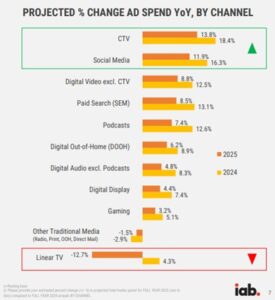
- Ad spend will continue to grow in 2025 (+7.3% y/y) but will be slower than 2024’s cyclical event-driven surge (+11.8%): Not a surprise but growth will be led by double-digit growth in CTV, social media, and retail media (CTV, social, search, and display projected to make up nearly 70% of ad spend in 2025)
- All digital channels will post growth this year
- Linear TV will dip sharply y/y due to the absence of cyclical events
- More specifically, retail media is projected to be the fastest-growing channel in 2025, growing 2x the rate of ad spend overall, but its growth rate is expected to drop the most y/y (down 10% pts)…
- Retail media is projected to grow 15.6% in 2025 but that is a decel from +25.1% in 2024
- “This indicates that while buyers still value benefits like proximity to commerce, closed-loop measurement, and integration with broader retailer buys, challenges such as ecosystem fragmentation, lack of standardization, and rising costs are likely prompting pullback”
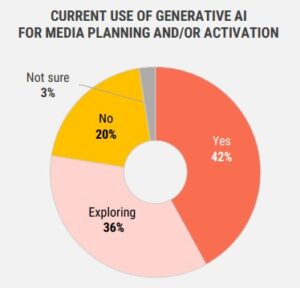
- A large portion of media buyers (80%) are using or exploring Gen AI tools for media planning and activation.
- “Agencies are more likely than brands to be using or exploring gen AI technology (83% vs. 71%) to streamline workflows, enhance processes, and improve client asset and deliverable production, among other applications”

- Within the video streaming ecosystem, buyers are most bullish regarding its evolution and growth while concerns with cross-platform measurement persist
Grab Bag: Regulators Zero In On The Paramount-Skydance Merger/ IAC Spins Off Angi/ OpenAI Rolls Out Tasks
- The Paramount-Skydance merger should be reviewed by the CFIUS, per the chair of the House China Select Committee (link): John Molenaar, chairman of the House China Select Committee, called for the Treasury Dept’s Committee on Foreign Investment in the US (CFIUS) to review the merger due to Tencent’s stake in Skydance
- Molenaar wants to “ensure the Chinese Communist Party is not further solidifying its hold on the American entertainment industry”: He outlined some of the below points as key reasons for his concerns –
- Preventing “rampant self-censorship” among Hollywood Cos: Molenaar cited testimonies from several Hollywood execs that revealed that studios have edited content, including CBS’ interview of Kamala Harris, to “curry favor w/ the Chinese Communist Party
- Tencent was also recently added to a US military blacklist: Earlier in Jan, the Dept of Defense designated Tencent as a Chinese military Co
- The proposal has bipartisan support: Senator Mark Warner, a Virginia Democrat, joined Molenaar, who is a Republican House rep from Michigan, in raising “serious concerns” about the deal and indicating that it “should absolutely prompt CFIUS scrutiny”
- Tencent would have less than a 5% stake in a combined Paramount-Skydance: Tencent would be a passive, non-voting investor in the merged Co, per sources
- Other parties are also pushing for more scrutiny –
- The FCC won’t rule out a national security review: “We’re going to look at all the issues that have been raised… at this point, sort of nothing is off the table,” per Brandon Carr, who has been nominated to be FCC chairman by president-elect Donald Trump
- The Center for American Rights: This watchdog media group previously filed an FCC complaint about the editing of the Harris CBS interview
- Investor Mario Gabelli is separately asking a Delaware court to force Paramount and Skydance to share more details about the merger
- Molenaar wants to “ensure the Chinese Communist Party is not further solidifying its hold on the American entertainment industry”: He outlined some of the below points as key reasons for his concerns –
-> Paramount Global shares were down -2.2% following the news and closed the week down -2.0%
- IAC announces plan to spin off home improvement firm Angi and reorganize leadership (link)
- The spin-off transaction will give IAC shareholders direct ownership of Angi, resulting in IAC and Angi becoming wholly separate entities: IAC expects that the spin-off will be in the form of one share/one vote common stock of Angi, eliminating Angi’s dual-class structure
- How does IAC benefit? Allows IAC mgmt to focus on its broader portfolio and new growth oppties; A simplified IAC is also expected to benefit from an enhanced ability to use its stock to make acquisitions and incentivize employees
- How does Angi benefit? Will have “a more attractive equity currency to accelerate growth…undiluted focus on its specific operating and strategic priorities, and streamlined decision-making”
- Timeline: The transaction is expected to close in H1:25 but no sooner than March 31, 2025.
- IAC CEO Joey Levin will transition to an advisory role and IAC will continue to operate w/o a CEO
- Joey Levin will leave his role as IAC CEO and become an advisor to the Co, with the transition expected to occur upon the completion of the spin-off
- Angi concurrently announced its appointment of Levin as Executive Chairman of Angi: He will serve as Angi’s senior executive in partnership with Angi CEO Jeff Kip, who will continue to report to Levin and the Angi Board of Directors
- Following Levin’s transition, IAC does not intend to appoint a new CEO: IAC’s CFO, COO, and CLO will report directly to Barry Diller, Senior Executive and Chairman of IAC
- The spin-off transaction will give IAC shareholders direct ownership of Angi, resulting in IAC and Angi becoming wholly separate entities: IAC expects that the spin-off will be in the form of one share/one vote common stock of Angi, eliminating Angi’s dual-class structure
-> IAC shares were up +0.7% on the announcement and ended the week up +2.6%
- OpenAI bring Tasks to ChatGPT in beta (link/link)
- “Tasks is a new way to ask ChatGPT to do things for you at a future time”: “Whether it’s one-time reminders or recurring actions, tell ChatGPT what you need and when–from a weekly news briefing to daily weather updates–you can schedule it ahead of time and ChatGPT will follow up”
- Availability: Tasks in beta will roll out globally across all versions of ChatGPT and on all platforms, with the tasks manager only available on the web version
- Some sample prompts to get users started with Tasks:
- Remind me that my passport will expire in 6 months from today.
- Give me a daily weather report for my area every morning at 7am.
- Every Friday, give me a list of things I can do over the weekend based on my location and the forecasted weather.
- Start my day with daily affirmations at 7am.
- My kids love knock-knock jokes. Send me one to tell them before bed every night at 6pm.
Stock Market Check
This Week's Other Curated News
Advertising/Ad Agencies/Ad Tech
- The Trade Desk annc’d a definitive agreement for the acquisition of Sincera, a leading digital advertising data Co that provides objective, actionable insights to the advertising ecosystem. This acquisition will empower publishers to provide the right range of data signals to maximize advertising demand and ad fill rates. W/ this acquisition, The Trade Desk’s platform will show publishers which data signals are most highly valued by advertisers. (StreetAccount)
Artificial Intelligence/Machine Learning
- The UK gov’t annc’d a £14bn AI Opportunities Action Plan led by PM Keir Starmer and AI advisor Matt Clifford. The plan aims to create 13,250 jobs and includes 50 recommendations, such as establishing growth zones and a national data library. Tech firms Vantage Data Centres, Nscale, and Kyndryl pledged £14B for AI infrastructure. The gov’t also plans to invest in a supercomputer to boost compute capacity twentyfold by 2030. AI integration is expected to enhance public svs and productivity. (Mobile World Live)
- Singtel annc’d free access to Perplexity AI search. Broadband, TV, and mobile customers can activate a free one-year subscription of Perplexity Pro, valued at SGD270 (~$197). CEO Ng Tian Chong noted the increasing use of AI search platforms for everyday tasks. The Perplexity Pro package offers various AI models, including OpenAI and Meta’s Llama 3.1. This move follows similar initiatives by SoftBank and SK Telekom, highlighting the growing trend of AI integration in telecom svs. (Mobile World Live)
- Google annc’d that it will integrate Gemini AI features into all Workspace plans, eliminating the previous $20-$30 standalone fee. As a result, Workspace plan prices will increase by a few dollars per month. For example, Business Starter will rise from $6 to $7 per user/month, Business Standard from $12 to $14, and Business Plus from $18 to $22. New customers will see the updated pricing immediately, while existing customers will be affected starting Mar. 17, 2025 (9to5 Google)
- Microsoft annc’d the launch of Microsoft 365 Copilot Chat, a new offering that integrates pay-as-you-go agents into the existing free chat experience for Microsoft 365 commercial customers. Copilot Chat, powered by GPT-4, allows users to perform tasks like market research and document analysis. Agents can automate repetitive tasks and biz processes, priced on a metered basis. This initiative aims to enhance AI transformation and provide greater flexibility for organizations (The Verge)
- Meta is facing a copyright lawsuit over the alleged use of pirated content from LibGen to train its Llama AI models. The lawsuit claims that CEO Mark Zuckerberg approved the use of this pirated dataset, despite internal concerns about potential backlash. The plaintiffs, including authors Sarah Silverman and Ta-Nehisi Coates, argue that Meta removed copyright information from the materials before using them. (The Verge)
Audio/Music/Podcast
- The global music industry reached nearly 5 trillion streams in 2024, according to Luminate’s 2024 Year-End Music Report. On-demand audio streams hit 4.8 trillion, up 14% from 2023. Growth was driven by emerging mkts, w/ Asia, Europe, and Latin America seeing significant increases. The US saw a 6.4% rise, led by new releases and pop music, especially from female artists like Taylor Swift and Billie Eilish. (Advanced Television)
- Bill Ackman’s Pershing Square has requested Universal Music Group to move its secondary listing to the US. Ackman believes a US listing will increase demand and valuation for UMG shares, attract more analyst coverage, and improve trading liquidity. UMG will launch an underwritten offering for the sale of certain shares owned by Pershing by Sept. 15, 2025 (Reuters)
- Drake has filed a defamation lawsuit against his longtime label, UMG, over Kendrick Lamar’s diss track “Not Like Us. ” The lawsuit targets UMG for promoting and monetizing the track despite knowing the allegations in the song were false. Drake seeks compensatory and punitive damages, emphasizing the impact on his personal and professional life (Reuters)
- Blackstone has hired financial advisers to explore the sale of song rights, including music from Bob Dylan, Adele, and Ariana Grande, aiming to fetch $3bn or more. Potential buyers include Apollo Global Management, Warburg Pincus, and Temasek Holdings. Blackstone’s portfolio, led by SESAC, collects royalties for thousands of songwriters. This move tests the market for performance rights, following TPG’s $3.3 bn sale of GMR (Yahoo Finance)
Broadcast/Cable Networks
- Sinclair annc’d deals w/ select creditors to boost liquidity, strengthening its balance sheet for long-term growth. The agreement includes a $650 mn revolving credit facility and refinancing options for term loans. CEO Chris Ripley highlighted the support from creditors and the financial flexibility gained, pushing meaningful maturity to Dec. 2029 and reducing first lien net leverage (The Hollywood Reporter)
Cable/Pay-TV/Wireless
- T-Mobile has entered into a definitive agreement to acquire Vistar Media, a tech solutions provider for digital-out-of-home (DOOH) ads. This acquisition includes Vistar’s intelligent marketplace and tech solutions for managing media campaigns across a global network of 1.1 mn digital screens. T-Mobile aims to enhance the DOOH industry by leveraging Vistar’s platform and its own customer insights, offering more addressable and measurable ad solutions (Advanced Television)
Capital Market Updates
- Rising Treasury yields are threatening the 2025 IPO market recovery, as higher yields reduce valuations for high-growth firms reliant on future profits. Companies may delay IPOs or sell at lower prices. Despite historical resilience to similar rate levels, volatility, spurred by strong jobs data and economic uncertainty, could dampen enthusiasm for new listings, with some firms opting to wait. (Bloomberg)
- Goldman Sachs estimates that US companies could spend ~$1.0tn on stock buybacks this yr, potentially boosting Wall Street. This follows significant inflows into money market funds, indicating investor caution amid market volatility (Reuters)
- Goldman Sachs CEO David Solomon advised startups to reconsider going public during the Cisco AI Summit in Palo Alto. He emphasized that startups can achieve significant scale and secure ample funding in private mkts, avoiding the challenges of being publicly traded. Solomon highlighted that Goldman Sachs is increasingly working w/ large private cos, such as Stripe, which raised $6.5 bn in 2023 (Financial Times)
Cloud/DataCenters/IT Infrastructure
- IBM annc’d its intent to acquire Applications Software Tech, a global Oracle consultancy, to enhance its Oracle Cloud capabilities. This acquisition will bolster IBM’s public sector and Oracle Cloud Application skills, aiding clients in biz transformations w/ Oracle Cloud Applications (The Fast Mode)
Crypto/Blockchain/web3/NFTs
- North Korean-backed hackers stole at least $659mn through multiple cryptocurrency heists in 2024, deploying IT workers to infiltrate blockchain cos as insider threats. The Lazarus Group conducted social engineering attacks and deployed cryptocurrency-stealing malware. Major attacks included a $235 mn hack of WazirX (Jul. 2024), $308 mn theft from DMM Bitcoin, and $50 mn each from Upbit and Radiant Capital. (TechCrunch)
- JPMorgan Chase CEO Jamie Dimon remains a vocal critic of Bitcoin, stating it has no intrinsic value and is used for illicit activities. Despite this, JPMorgan has benefited from Bitcoin’s growing role in finance, including participation in BlackRock’s Bitcoin ETF. Meanwhile, the bank is focusing on tokenizing real-world assets through its blockchain platform, Kinexys. (CoinDesk)
- President-elect Donald Trump is expected to sign executive orders on January 20 addressing crypto de-banking and repealing a policy that requires banks to list crypto as liabilities. The crypto industry has criticized Biden’s regulatory stance, and Trump’s team has made crypto a priority. Executives hope for swift action, with some expecting measures on day one. (CoinTelegraph)
- eToro has confidentially filed for a US IPO, potentially valuing the co at over $5 bn. This move follows a previously scrapped SPAC merger and recent funding rounds, positioning eToro for a favorable market entry (SiliconANGLE)
eCommerce/Social Commerce/Retail
- Amazon will shut down its “Prime Try Before You Buy” program on Jan 31, 2025. Launched in 2017 as “Prime Wardrobe,” the service allowed Prime members to try on clothes, shoes, and accessories before purchasing. Amazon cited limited item availability and increased use of AI-powered features like virtual try-ons and personalized size recommendations as reasons for the closure. This move aligns with CEO Andy Jassy’s cost-cutting efforts, which included significant layoffs and project cancellations. (The Verge)
- eBay annc’d that it has signed a definitive agreement to acquire Caramel, an end-to-end online automotive transaction solution provider. eBay Motors is the destination for enthusiasts looking to find a huge selection of auto parts and accessories, and this acquisition provides eBay buyers w/ a safe and trusted online platform to conduct vehicle purchases. The addition of Caramel will make buying and selling vehicles on eBay simpler than ever. (StreetAccount)
- Retail job cuts spiked during the 2024 holiday season, w/ major retailers like Macy’s and Kohl’s announcing significant layoffs. Macy’s plans to close 27 stores by Apr. and an e-commerce fulfillment center by May. Kohl’s will shutter 66 locations across 22 states. The cuts reflect broader challenges in the retail sector, including shifts in consumer behavior and economic pressures. Despite these challenges, some retailers reported strong holiday sales, driven by promotions and last-minute shopping. (Retail Dive)
- Target’s holiday sales rose 2%, with digital sales up 9% and traffic increasing 3%. While above forecast, its performance placed it in the middle of retail rankings. Heavy promotions helped boost sales amid competition from Amazon and Walmart, but profit guidance remains cautious. Executives also announced key retirements and role changes. (Star Tribune)
Electric & Autonomous Vehicles
- Amazon has started testing a new air traffic control system for its Prime Air delivery drones. The tests, conducted in Seattle, WA, and Pendleton, OR, use radar systems in the 9.3-9.5 GHz band to enhance air traffic monitoring around Amazon facilities. This initiative aims to ensure safe drone operations and improve the efficiency of drone deliveries. The FCC granted Amazon a two-year experimental license for these tests (Fortune)
Investor & Market Sentiment
- I Squared Capital is nearing a buyout offer for Hong Kong broadband provider HKBN Ltd, potentially sparking a bidding war with China Mobile Ltd. After starting due diligence in December, I Squared is assessing potential synergies and may submit an offer in the coming weeks. China Mobile had previously bid HK$5.23 per share for HKBN. HKBN’s shares have surged by over 40% since November, with a market value of about HK$6.9bn. (Yahoo Finance)
M&A
- In 2025, as interest rates and antitrust policies ease, large mergers and acquisitions (M&A) are expected to rise. However, a review of $10 billion-plus deals since 2020 reveals that most acquirers underperformed their industry benchmarks. Particularly in sectors like healthcare and finance, M&A often leads to poor returns. A few exceptions, like energy deals with synergies, have outperformed. CEOs often overestimate the value of mergers, making large deals risky. (Reuters)
Macro Updates
- The Producer Price Index (PPI) rose 0.2% in Dec., less than the expected 0.4%. Core PPI, excluding food and energy, was flat. Annual PPI increased 3.3%, driven by a 9.7% rise in gasoline prices. The report suggests easing inflation pressures. (CNBC)
- Goldman Sachs CEO David Solomon views the US economy as fragile, citing both growth opportunities and risks. He expressed optimism about the impact of deregulation and tax cuts proposed by President Trump, predicting increased business investment. However, he warned of risks from tightened immigration policies and trade tariffs. Solomon noted CEOs slowed investments under Biden-era rules but sees optimism in a shift toward growth-friendly policies. (Financial Times)
- US small biz confidence jumped to a six-year high in Jan, driven by improved sales expectations and reduced economic pessimism. The NFIB Small Business Optimism Index rose to 101.7, reflecting strong investment plans and easing inflation concerns. (Reuters)
- The Consumer Price Index (CPI) for Dec. 2024 rose 2.9% year-over-year, driven by higher food and energy prices, or a 0.4% month-over-month increase. Core CPI, excluding food and energy, rose 0.2% month-over-month and 3.2% year-over-year. The rise in energy prices, particularly gasoline, contributed significantly to the overall increase. (CNBC)
- The average rate on a 30-year fixed-rate mortgage in the US rose to 7.09%, the highest since May 2024, marking the fifth consecutive weekly increase, driven by rising Treasury yields and inflation concerns. The Federal Reserve’s slower pace of interest rate cuts and economic uncertainties have contributed to the surge in borrowing costs, impacting housing affordability and discouraging potential buyers (Reuters)
- Scott Bessent, Trump’s Treasury Secretary nominee, testified before the Senate, discussing economic policies, tariffs, and the importance of maintaining the US dollar as the world’s reserve currency. He mentioned that Russia, and particularly oil companies, can look forward to tougher sanctions under the Trump administration. (CNBC)
- The US Commerce Department reported that retail sales for Nov 2024 were $724.6 bn, up 0.7% from the previous month and 3.8% from Nov 2023. The report highlights growth in motor vehicle and parts dealers, and nonstore retailers (Retail Dive)
Regulatory
- The Biden administration added 16 entities to its trade blacklist, including 14 in China. The list includes Zhipu AI and Sophgo, linked to Huawei’s AI processor using TSMC-made chips. The US Commerce Department also tightened controls on semiconductor exports to China to prevent diversion to Huawei. Companies on the list cannot receive goods or tech exports without a license. (Reuters)
- Google has told the EU it will not add fact-checking to search results or YouTube videos, nor integrate it into its ranking or content removal practices, despite requirements from the EU’s new Disinformation Code of Practice. Google’s global affairs president Kent Walker argued that their current content moderation methods are effective and will continue to focus on enhancing existing tools. This stance comes amid global discussions on tech platforms’ role in content moderation. (Axios)
Satellite/Space
- Italy’s Telecom Italia (TIM) will withdraw its Premium Satellite svs due to a pricing dispute w/ Eutelsat. The svs, launched in 2020, provided satellite signals to remote regions in Italy, excluding Sicily and parts of southern Sardinia. TIM stopped selling the svs in Feb 2024. Despite efforts to delay the shutdown, Eutelsat terminated support, leading to the final date for svs availability (Advanced Television)
- A McKinsey study forecasts that the number of active satellites will reach 27,000 by 2030. The current trend shows annual launches of 3,500-4,500 satellites, nearing the projected 2030 maintenance demand. The study presents three scenarios: a drop in demand due to longer satellite lifespans, a base scenario w/ steady replacements, and a high prediction of 15,000 satellites launched by 2030. These forecasts exclude Russia and China’s planned broadband satellite svs (Advanced Television)
- Starlink, launched by SpaceX in 2019, is disrupting Africa’s internet market, offering affordable satellite internet in 16 countries. In at least five, including Kenya and Ghana, it’s cheaper than leading fixed ISPs. Starlink’s popularity in Kenya, with costs as low as $10/month, is driving rapid adoption, forcing competitors to lower prices, but raising concerns about monopolization and market impact. (Tech Giants)
- Government space budgets reached $135bn in 2024, according to a report by Euroconsult. This represents a 9% increase from 2023, driven by investments in satellite communications, Earth observation, and space exploration. The US led the spending, followed by China and Europe. Emerging mkts also contributed significantly to the overall growth. (Advanced Television)
Social/Digital Media
- The UK’s CMA has launched its first strategic market status (SMS) investigation under the new digital markets regime, focusing on Google’s dominance in search and search advertising. The probe will assess competition, innovation barriers, and potential market abuses, such as self-preferencing and exploitative data practices. The CMA aims to ensure fairness, innovation, and consumer choice by October 2025. (Advanced Television)
- Meta plans to cut ~5% of its workforce, targeting the lowest-performing employees. CEO Mark Zuckerberg stated the move aims to manage out underperformers more extensively. The company expects to achieve 10% non-regrettable attrition by the end of the current performance cycle. (Bloomberg)
- LinkedIn has introduced free AI tools for job hunters and recruiters, annc’d on Jan. 15, 2025. The new Jobs Match tool provides immediate advice on job openings, while a recruitment AI agent helps small businesses manage applications. Both tools leverage LinkedIn’s AI tech and first-party data, aiming to enhance the job search and recruitment process. These tools are available to all users, not just LinkedIn’s paying members (TechCrunch)
- Snap shares fell 5% after the FTC referred a complaint about its My AI chatbot to the DOJ. The complaint alleges the chatbot poses risks to young users, which Snap disputes as inaccurate and lacking evidence (CNBC)
- Xiaohongshu’s biggest shareholders are in talks to sell shares in the Chinese Instagram-like service at a valuation of at least $20 bn. This has drawn interest from Tencent Holdings Ltd. and other major investors. The potential deal comes as a US ban on TikTok looms, boosting Xiaohongshu’s appeal. The co, founded in 2013, now has ~300 mn monthly active users and is expected to double its profits to over $1 bn in 2024 (Bloomberg)
Software
- Databricks has secured $5bn in financing from private credit banks. This funding includes a $2.5bn debt from private credit lenders and a $2 n revolving credit facility. The financing will help Databricks offset tax burdens from stock sales and support its growth plans. The company aims to delay its IPO, leveraging private capital to maintain flexibility in a challenging market environment. (Middle-Market)
Sports/Sports Betting
- Comcast will move NBC Sports Boston and NESN from its basic cable plan to the premium “Ultimate” tier. This change impacts Xfinity subscribers, requiring them to subscribe to the most expensive package to watch local teams like the Boston Red Sox, Bruins, and Celtics. This move follows a trend of relocating regional sports networks (RSNs) to higher-priced tiers, citing rising sports programming costs. Critics argue this increases inaccessibility of sports content for average viewers (Cord Cutter News)
- Genius Sports annc’d the pricing of an underwritten public offering of 17,647,059 ordinary shares at $8. 50 per share on Jan. 15, 2025 (Wednesday). The offering is expected to close on Jan. 16, 2025 (Thursday), subject to customary conditions. Net proceeds, estimated at $144 mn after expenses, will be used for general corporate purposes, including potential acquisitions. (Stock Titan)
- WWE and TNA Wrestling annc’d a multi-yr partnership. This collaboration will allow wrestlers from both promotions to appear on each other’s shows, including WWE NXT and TNA Impact, enhancing talent exposure and viewer experience (Advanced Television)
Tech Hardware
- Samsung has annc’d a new year-round trade-in program for its Galaxy devices. This initiative allows customers to trade in their old Galaxy phones anytime, receiving instant credit towards new purchases. The program aims to boost sales and encourage eco-friendly practices by recycling old devices. Samsung’s move comes as part of its broader strategy to enhance customer loyalty and sustainability efforts. (The Verge)
- The Biden administration proposed new rules to regulate the export of AI chips, aiming to balance national security and economic interests. The framework restricts access to advanced AI chips in 120 countries, including Mexico, Portugal, Israel, and Switzerland. Commerce Secretary Gina Raimondo emphasized the need to preserve U.S. leadership in AI. Industry executives expressed concerns about potential impacts on global supply chains and U.S. companies’ competitiveness (AP News)
- Intel will spin off its venture capital arm, Intel Capital, into a standalone company in the second half of 2025, aiming to boost efficiency. Intel will remain an anchor investor. Established in 1991, Intel Capital manages over $5 billion in assets and invests in tech sectors like silicon, devices, cloud, and frontier tech. This move is seen as a “win-win,” providing new capital sources and fostering long-term partnerships. (Reuters)
- China is investigating whether the U. is unfairly subsidizing its chipmakers and dumping lower-end chips in global markets. The probe, initiated after complaints from local industry players, targets the U.S. Chips Act, which allocates $39 billion to encourage companies like Taiwan Semiconductor to build advanced chip facilities in the U.S. This investigation follows growing tensions over semiconductor supply chains and trade practices between the two countries. (Bloomberg)
Towers/Fiber
- A study by Juniper Research, annc’d on Jan 14, 2025 (Tuesday), forecasts global wholesale roaming rev to grow from $9 bn in 2024 to $20 bn by 2028. The growth is driven by the deployment of 5G standalone (SA) tech, enabling real-time monitoring of roaming connections. The report predicts IoT roaming rev will near $2bn by 2028, accounting for 10% of the global wholesale roaming mkt. (Advanced Television)
- Lightpath, an all-fiber connectivity provider, annc’d nearly $110 mn in AI-driven digital infrastructure sales to hyperscalers in 2024. By yr-end, its AI-related infrastructure pipeline totaled ~$1 bn. Demand from major hyperscalers for massive bandwidth drove sales across 10+ mkts. AI innovations are boosting connectivity needs, emphasizing low latency and network security. Lightpath’s dense network, spanning 10,800 route miles, supports AI deployments in NY, Boston, and Miami Metros. (PRNewswire)
Video Games/Interactive Entertainment
- Tencent and Ubisoft’s founding Guillemot family are considering creating a new venture to include certain Ubisoft assets. This move aims to boost Ubisoft’s value and expand Tencent’s gaming biz outside China. (Yahoo Finance)
- Matthew Ball’s “State of Video Gaming in 2025” report highlights a plateau in the gaming industry’s revenue growth, but PC gaming remains a bright spot, surpassing console gaming in revenue. PC’s continued growth is driven by its extensive game library, backward compatibility, and superior performance. Ball is optimistic about PC gaming’s future, particularly with the rise of portable gaming devices. (PC Gamer)
- Nintendo revealed the Switch 2 in a trailer, hinting at the upcoming Mario Kart 9. The trailer showcased the console’s design and teased new features, with a full reveal expected during a Nintendo Direct on Apr 2, 2025 (Kotaku)
Video Streaming
- Amazon Prime Video’s “Prime Vision with Next Gen Stats” is revolutionizing NFL broadcasts with AI-driven tools. Features like defensive alerts, pressure tracking, and coverage identification simplify complex strategies for viewers. Using machine learning and data from NFL’s Next Gen Stats, innovations like the “Madden view” skycam enhance analysis and engagement, reshaping fan experiences. (AP News)
- China Ruyi acquired a 30% stake in Beijing Yonghang Tech, the developer of Tencent’s “QQ Dance” games, for RMB 830 mn. CHINA RUYI hopes to obtain more attractive IPs and games through investment and biz expansion, w/ the ultimate goal of constructing a diversified product matrix. (AAStocks)
- Sling TV annc’d the launch of Unlimited DVR for $5/month. This feature, previously called DVR Plus, allows users to record unlimited content w/ a nine-month retention period. The service includes ad-skipping, cross-device accessibility, and exclusive Auto Record for sports, shows, and movies. This move aims to enhance user experience and keep Sling TV competitive in the streaming mkts (Advanced Television)
