


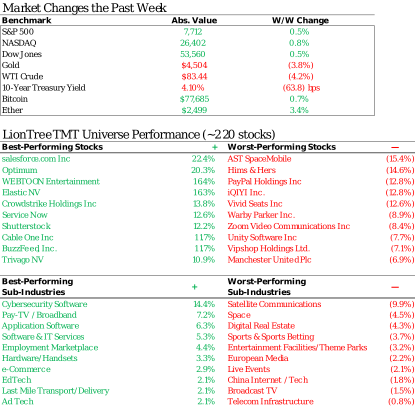
While the end of summer is getting close and news flow died down a bit this week, Nvidia’s earnings was most certainly a main event, though the stock gave back most of the post earnings rally. Software in particular was strong (the IGV ETF rose ~6% for the week, w/ Salesforce up +22%), which helped the S&P 500 close up ~0.5% and Nasdaq up +0.85%), but the Russel 2000 fell -1.5% as the market expectations for rate hikes moved higher.
Within the sector, we focused on the below in this edition.
- Nvidia’s Visibility To +70% Y/Y+ Rev Growth In FY28 Gives Investors Confidence Despite Lower Gross Margins
- Meta Quickly Settles W/ The States’ Regarding Youth Safety, Lifting A Black Cloud, For Now…
- AI Cos Expand Offerings as Model Capabilities and Infrastructure Investment Further Scale
- The Streaming Eco-System Continues To Get More Competitive
- Grab Bag: Apple’s New Foldable iPhone? / FOXA+NEWSA? / GTA VI Reveal
Have a nice weekend and please note that we will be publishing a lite version of our Weekly Update next week and the full version will return post Labor Day.
Best,
Leslie

Nvidia’s Visibility To +70% Y/Y+ Rev Growth In FY28 Gives Investors Confidence Despite Lower Gross Margins
The bar is never low for Nvidia, but the Co cleared it, delivering FQ2 results that topped expectations. Revenue in the qtr beat cons by 4.3% and the FQ3 revenue guidance of $108bn exceeded the Street by ~3%. But the biggest positive revolved around guidance for FY28 (cal ’27) revenue growth of ~+70% y/y (which was dramatically higher than consensus ~+45%). This was the first time that the Co guided revenue a full year in advance, which was a focus on the call. How can they be so confident? Because that growth guidance reflects a supply-constrained number and with unconstrained demand running at ~+100% y/y, they have visibility into both ends of the value chain (supply commitments upstream, land/power/shell downstream), given the scale of committed customer demand.
The positive revenue trajectory offset mgmt resetting gross margin expectations due to the extreme memory pricing conditions. They guided for gross margins to decline to 74% in FQ3 (missed cons and is down from 75% in FQ2), then to bottom at 71-72% in FQ4, before settling at 72-73% in FY28 as executed price increases take effect in the first qtr of that year. Mgmt wanted to “be direct about this rather than let it linger as an open question.”
There was also a focus on the Co’s strategy to invest in its customers, and the Co confirmed that it has invested nearly $50bn in frontier AI labs which is “a meaningful commitment” but represents “a small fraction of our expected free cash flow over the same period.” They are confident that this will help support eco-system growth, in addition to structures like the $500bn financing to be made available from six leading infrastructure capital providers. Mgmt also directly pushed back on concerns about “circular financing” as they see the AI labs as “once in a generation” companies.
Overall, investors have been concerned about the pace of the revenue growth deceleration, but the FQ2 performance and forward guidance painted a stronger-growth-for-longer picture, which was enough to finally drive a stock rally on the back of results (which has not happened since FQ2:26).
See below for more details on what we found most incremental from results.
-> Nvidia shares rallied almost 9%, but then closed the week up only +1.3 %; YTD the stock is up +17%
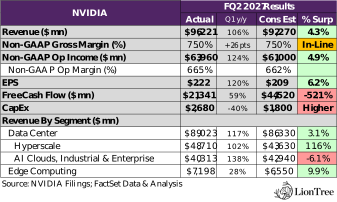
FQ2 Was Another Strong Beat…It Was The 4th Consecutive Qtr Of Y/Y Acceleration
- Total revs BEAT cons by +4.3%…revenues more than doubled y/y (+106% y/y) and was up ~18% q/q
- Growth was broad based across customer types (hyperscalers, AI labs, AI natives, enterprises, and sovereigns)
- Non-GAAP gross margin was IN-LINE at 75%
- Non-GAAP op income BEAT cons by +4.9%
- Adj EPS BEAT cons by +6.2%
- CapEx was HIGHER than cons ($2.7bn vs $1.8bn, respectively)
- The Co returned a $26bn to shareholders in FQ2: $19.7bn in repurchases + $6bn in dividends…60% of FCF has been returned YTD vs 50%+ target
- ~$99.3bn remains under the share repurchase authorization at qtr-end
- Mgmt intends to increase and return excess FCF net of strategic uses going forward
Mgmt Positively Surprised Investors W/ FY28 Annual Revenue Guidance, Which Offset The Gross Margin Reset
- FQ3 rev guidance of $108bn (+/- 2%) topped expectations by +3%
- Seq growth is expected to be driven primarily by ACIE, while Hyperscale growth is expected to reaccelerate in FQ4 and into FY28 as Vera Rubin supply grows
- The Co is NOT including any DC compute revenue from China in its forward outlook
- In FQ2, the Co shipped less than 1% of total DC revenue in Hopper 200 products to customers based in China in accordance w/ US govt licenses (note that current Hopper shipments are dilutive to corporate GMs)
- Importantly and for the FIRST TIME, the Co guided a full year in advance…FY28 revenue is expected to grow ~70% y/y…this was MUCH HIGHER than cons +45% y/y
- And this assumes a supply-constrained outlook…unconstrained demand is cited at ~100% growth (“our demand is much greater than 70%” but need to do work w/ the supply chain to close that gap) …mgmt expects supply to remain a bottleneck at least through the end of FY28
- The Co has incr’d visibility both upstream (supply chain) and downstream (land, power, shell), which gives them confidence to guide this far out
- “We wanted to make sure that everybody has the same set of information”
- At the same time, mgmt proactively reset the forward gross margin guidance
- FQ3 guidance: GAAP & non-GAAP GM at 74% (+/- 50bp), vs cons 74.7%
- FQ4 and FY28 guidance: GMs are expected to bottom in FQ4 at 71-72% before settling at 72-73% in FY28 as executed price increases take effect in FQ1
- Drivers? “Extreme pricing conditions in memory”…the magnitude has exceeded prior expectations and is headed higher into next yr
- Memory scarcity bigger picture is as a “symptom of the same demand surge that’s driving our own growth”…mgmt. is working closely with all three major memory suppliers to further increase capacity
- Operating expenses are also guided higher
- FQ3 non-GAAP OpEx is guided at $9.0bn vs $8.94bn cons
- Mgmt also INCR’D FY27 OpEx growth to the low-50s y/y from the prior upper-40s expectation, driven by a broadening product portfolio and incr’d use of AI tools to enhance engineering productivity
- FY27 tax rate guidance reiterated at 16-18%
Demand Continues to Accelerate Even At This Scale…& Nvidia’s 3 Growth Engines Are Expanding Its Share Of The DC TAM
- Demand is “accelerating” even at this scale, with customers’ forecasts pointing to growth doubling next yr…BUT supply constrains the Co to ~70% y/y growth
- Cloud industry backlog is now $2tn+; CapEx by the top five hyperscalers is expected to reach nearly $800bn in 2026 and $1.3tn in 2027
- Hyperscalers are seeing compute directly translate into accelerating revenue growth and expanding margins
- Jensen cited hearing that returns on invested capital is “now less than a year” on $50bn data centers
- AWS is now deploying an addtl 2mn GPUs starting this qtr through FQ2:29, plus Vera CPUs (some integrated w/ Rubin, some standalone)
- AWS will serve Nemotron open models on Bedrock and SageMaker and adopt the full physical AI stack for warehouse robots
- Mgmt continues to view its differentiation as three-fold –
- 1) Having an architecture that runs every model: “One platform fungible for every model and workload, durable for the entire lifecycle of AI”
- 2) Having a full-stack AI factory platform: The revenue opportunity per GW has grown from ~$18bn (Hopper) to $25bn (Grace Blackwell) to $40bn (Vera Rubin), reflecting extreme co-design across GPU, CPU, NVLink, networking, systems, algorithms and software
- 3) The CUDA ecosystem extends AI into markets no single chip can reach: Nvidia is uniquely suited to help sovereigns, neoclouds, and enterprises build their AI infrastructure…”custom chips just don’t apply” for these customers
- …these are “customers with no interest in designing their own custom silicon” who “don’t buy custom chips, they don’t buy chips one at a time”
- Agentic AI is still seen as a massive demand driver…compute per agent vs a human user is “15x to 100x”, depending the type of problem
- “Most AI are now agentic” as of last month……Nvidia itself has ~40k employees and expects 400k to 4mn agents; Every Co will eventually have hundreds of thousands to millions of agents running continuously
- Rising adoption of agentic AI is driving an acceleration in demand for data center CPUs in addition to GPUs
- On the topic of open vs closed models…Nvidia sees both as having their place and demand for both is “skyrocketing”
- “Nearly all open models run on NVIDIA” due to its footprint and fungibility…open models are also foundational to every AI startup and enterprise company
- What about new chip competition from frontier labs like OpenAI Jalapeno? Mgmt is not concerned; “We’re building something very different” vs inference-specific chips for one cloud; “I’m very confident that they’re going to be customers and partners of ours for a very long time”
Hyperscale Revenue Growth Topped Projections, More Than Offsetting Slower ACIE Revs But Mgmt Still Sees ACIE As A Bigger Oppty
- Data Center revs (~93% of total) BEAT cons by 3.1%…it grew +117% y/y and +18% q/q
- Higher growth in Hyperscale revs vs cons was the standout, offsetting weaker ACIE revs
- Hyoeprscale revs BEAT cons by 11.6% and grew +13% q/q (and +102% y/y)
- ACIE revs MISSED cons by -6.1%: BUT still grew +25% q/q and +138% y/y, driven by neocloud capacity additions
- Outlook – Hyperscale growth is expected to reaccelerate in FQ4 and into FY28 as Vera Rubin supply grows
- Higher growth in Hyperscale revs vs cons was the standout, offsetting weaker ACIE revs
- Non-hyperscaler growth is expected to reach ~50% of DC revenue (it was 45% in FQ2) and “that part of the world’s computing is likely to be larger over time than even what we’re currently experiencing in the cloud”
- Sovereign AI grew +35% q/q and more than tripled y/y in FQ2
- Enterprise on-prem revenue continues to scale –
- The auto vertical reached $8bn TTM
- The financial services, manufacturing, and healthcare verticals combined contributed $7bn TTM
- Notable enterprise customers: Hudson River Trading, Jane Street (quant trading), Samsung Electronics (cuLitho), Bristol Myers Squibb (Vera Rubin AI factories for drug R&D)
The Co Intro’d A New Neocloud Revenue Sharing Model Which Creates A Recurring Revenue Stream On Top Of Hardware Sales
- NVIDIA was bullish on its revenue sharing structure for neoclouds to support financing and accelerate buildouts
- NVIDIA provides a take-or-pay commitment on a portion of the facility’s capacity (a minimum revenue guarantee) to give lenders confidence to underwrite the project
- In exchange, NVIDIA shares in a portion of the neocloud’s revenue earned above that floor
- “In this model, we get paid twice, once on the hardware sale and again, through the share of rental revenue, a highly reoccurring stream layered on top of a one-time equipment purchase”
- Independent capital still underwrites every deal on its own merits…NVIDIA is not making loans
- Over time, this model can expand the addressable market and create recurring, usage-linked revenue streams with “the potential to drive billions in revenue over the medium to long-term”
-> To note, in this week’s quarterly filing, Nvidia said commitments under this program totaled $36bn and typically last 6 years…but also, press reports emerged that Nvidia paused some of its revenue sharing financing deals, which the Co refuted…this is something to watch… (link)
- Neocloud partners are expected to exit the year with 8GW in total installed capacity, up from ~3GW at end of 2025
Nvidia Is Confident In Its Strategy Of Leveraging Its Balance Sheet To Support Ecosystem Growth
- Nvidia is confident in its strategy of leveraging its balance sheet to support the eco-system
- NVIDIA has invested nearly $50bn in frontier AI labs…”This was a meaningful commitment, but it represented a small fraction of our expected free cash flow over the same period”
- These investments are viewed as a “once in a generation” opportunity…”I think the only regret that I have is that I didn’t invest more and sooner”
- Two of the companies are likely to go public soon, w/ others to follow; “these will be some of the most consequential technology companies in history”
- For another frontier AI lab: NVIDIA will provide selective credit enhancements for nearly 2GW of compute, complementing capacity they’ve secured independently
- The Co secured land, power shell capacity through a partnership w/ SB Energy to exclusively host NVIDIA compute at their PORTS-Pike Technology Campus in Ohio…the initial deployment supports 4.25GW of AI factory capacity, and OpenAI has committed to substantial deployments of NVIDIA AI infrastructure through 2030 under 20-yr leases
- OpenAI’s existing and planned commitments represent ~12GW of NVIDIA compute
- This is in addition to the annc’d partnerships with six leading infra capital providers (Apollo, BlackRock, Blackstone, Brookfield, Goldman, KKR) to raise over $500bn in third-party capital, subject to definitive agreements
- NVIDIA has invested nearly $50bn in frontier AI labs…”This was a meaningful commitment, but it represented a small fraction of our expected free cash flow over the same period”
- Mgmt pushed back on “circular financing” concerns: “We see it differently…we’re going through a major computing platform shift”
- Demand from AI labs for which NVDA expects to leverage its balance sheet is expected to contribute roughly a quarter of the biz next yr
- NVIDIA compute platform is “fungible and durable and can be redeployed to support other customers”…risk is limited
- All compute shipped will be consumed by investment-grade customers or those backed by one
A Few Key Product Updates – Vera Rubin, Vera CPU & Groq 3 LPX
- Vera Rubin commenced production shipments earlier this month, with purchase orders from every major hyperscaler, AI cloud, and system OEM…racks are already running at CoreWeave, Google Cloud, Microsoft Azure, OCI and Nebius
- This is expected to mark the fastest product ramp in NVIDIA’s history
- It delivers 30x higher throughput per megawatt and 35x lower token cost relative to Grace Blackwell Ultra
- Outlook – Vera Rubin is expected to account for ~20% of DC revenue in FQ3
- Vera CPU is a major growth driver: Grace CPU TTM revenue exceeded $5bn and mgmt’s preliminary expectation is for CPU revenue to more than double in FY28
- Vera as a standalone CPU: completes agentic tasks 1.8x faster on the SPEC Benchmark and provides 5x the bandwidth per watt vs any other DC CPU
- It is expected to be deployed by every major hyperscaler, neocloud, AI lab, and system OEM…shipments already underway to lead partners incl. OCI, SpaceXAI, and starting this qtr, AWS
- Mgmt continues to see demand for ~$20bn in total server CPUs, positioning the Co as one of the world’s leading server CPU suppliers
- Groq 3 LPX is in full production: the first rack-scale LPU system demonstrated nearly 4x the tokens/sec vs the next best alternative on Artificial Analysis benchmark
- It is expected to ship in volume later this qtr to early adopters…Nebius will be the first
- It is designed for super high interactivity/speed token generation…throughput lower and cost/token higher vs NVLink 72, but associated with high-ASP services
- “The vast majority of the world’s data centers will just be Vera Rubin and NVLink 72”
Meta Quickly Settles W/ The States’ Regarding Youth Safety, Lifting A Black Cloud, For Now…
Last week we highlighted the start of the States’ vs. Meta trial regarding youth safety, and this week a settlement quickly emerged. Meta had originally warned that the suit could lead to as much as $1.4tn in damages, then the States reportedly countered saying a more realistic figure would be in the ~$200bn range, and now they both ultimately settled for a materially lesser sum of ~$18bn. While substantial relative to other regulatory-related penalties, it is a drop in the bucket as it relates to Meta. The dollar amount represents only ~1.2% of the Co’s ~$1.5tn market cap, and the Co generated $43.6bn in FCF in FY2025 even with elevated levels of capex. Hence, investors sighed with relief on the back of the settlement. It was also particularly interesting to see how the structure of the deal will put pressure on other social media companies to follow with their own commitments. Big picture, this settlement is a positive for Meta as it could have been worse, but we would note that other youth safety-oriented court actions are still in place for both Meta as well as the social media industry.
On that front, also this week, Pennsylvania AG Dave Sunday filed his 2nd suit in two weeks. This time targeting Snap (in mid-Aug it was targeting TikTok).
See more details on the key points below.
-> Meta share rose +5% this week (but are still down -12% YTD) and Snap’s shares rose +3.6% (though are still down ~30% YTD)
Meta Cuts a Landmark Deal W/ The State Coalition On Youth Safety, Which Removes A Black Cloud Over The Co’s Stock Though Other Potential Actions Remain…
- Meta agreed to a proposed settlement of ~$18bn that resolves the child-safety claims brought by a coalition of 29 states, ending a federal trial in Oakland roughly midway through its 2nd week (the underlying suit was filed in 2023) (link link/link/link)
- As a reminder for context:
- The trial was being led by CA, CO, KY, and NJ
- Meta originally said damages could be as high as $1.4 trillion
- States reportedly said it would be closer to $200bn
- As a reminder for context:
- What were financial terms of the agreement?
- Dollar value: An ~$18bn payment which can be used to fund online safety initiatives, among other state priorities
- Timeframe: Payments will be made over 10 years
- What are the payment allocations and contingencies?
- 70% (~$12.7bn) will be paid to participating states over 10 yrs
- 30% (~$5.3bn) will be paid only after 2 specific conditions are met:
- YouTube & TikTok implement a 1-hour Daily Limit, Night Mode, and age assurance measures
- YouTube & TikTok each pay an amount that equals the 30% figure, w/ half of the remaining funds tied to YouTube’s pmt and half tied to TikTok’s
- What new features did Meta agree to roll-out?
- Time limits: Default 2-hr/day cumulative FB + IG time limit for under-18 users; Extensions can be made by parents
- Night Mode: A midnight–6am block
- School Mode: Default blocks on notifications during school hours and overnight
- Regular Prompts: Teens will receive prompts after every 15 min of continuous screen time on FB or IG, and also receive prompts when their total daily usage hits 60 min and 90 min
- Algorithmic Feed Control: Teens will be able to choose a non-algorithmic feed as their default and will be reminded of this option; Parents can adjust their teen’s default experience
- Autoplay Control: Teens will be able to turn off content autoplay and parents can require this
- Hidden Likes: Teens won’t see the number of likes and reactions on posts by default
- Blocking extreme makeup filters: This is in addition to the existing policy to block teens from using cosmetic surgery filters
- Age Assurance: Meta will invest in stronger tech to identify accounts that may belong to under-13s as well as those that belong to 13-17 to make sure they are in the correct experience; And the Co is pushing for to require app stores to verify age and obtain parental approval before a teen downloads an app.
- Meta is also maintaining and strengthening their current restrictions on “age-appropriate content” and “unwanted contact from strangers”, reporting and ongoing protection from harmful content, and parental controls
- What are the nuances about how long these new features will remain in place? It depends on what commitments other social media companies agree to…
- Meta is expected to rollout the agreed product changes “within months”
- The majority are expected to remain in place for 10 yrs, BUT Time Limit and Night Mode features will start w/ a 5-year commitment
- IF industry peers sign on to the agreement, Meta will both extend this commitment to 10 years & implement stronger default limits which would reduce the Daily Limit to one hour per app and expanding Night Mode hours to 10:00pm-7:00am (from midnight–6:00 AM).
- How does this affect Meta’s guidance?
- The Co will take a ~$10bn charge in the current qtr tied to the deal which was NOT part of the previous expense guidance
- Meta reaffirmed all other guidance
- Is this the end regarding youth safety payments and changes? NO…the EU immediately signaled that it expects the same (if not more) protections for European users
- Per EC spokesman Thomas Regnier, “the ball is in Meta’s court. Meta knows what we are expecting from them. Now it is for the company to offer these commitments in the European Union to protect our kids here too”
- Context: The EC last month found Meta to be in breach of its Digital Services Act (DSA) and if Meta does not address its concerns, the EU can impose a fine of up to 6% of the Co’s total global revenue (Meta’s FY2025 revenue of $201bn would imply up to a ~$12bn fine)
- Also, Meta, Snap/Snapchat, Alphabet/YouTube and ByteDance/TikTok still face thousands of separate suits
- A 9th Circuit ruling on Aug 10th rejected Section 230 immunity for social media platforms in these cases, allowing 3,000+ consolidated claims to proceed
Also This Week…Pennsylvania Broadens Its Social Media Offensive & Snap Is The Latest Target
- PA AG Dave Sunday filed a civil complaint against Snap in Philadelphia County Court of Common Pleas on Tues 8/25 (link/link)
- What is being alleged? That the Co designed a social media app to keep young users compulsively engaged, while also misleading parents about its safety and age-appropriate content
- The suit attacks features such as:
- SnapStreaks
- infinite scrolling
- Push notifications
- Autoplay
- Disappearing messages
- The AG also believes that the app age ratings do not reflect the mature content on the platform:
- Snap has a 13+ rating in Apple’s App Store and a “T for Teen” rating in the Google Play & Microsoft stores
- What does Snap say? “The allegations against Snap fundamentally misrepresent our platform and our approach to teen safety”…and stressed that Snapchat opens to a camera rather than a content feed and was built to encourage “self-expression and authentic connection with friends”
- Co said it was “disappointed” PA chose litigation over collaboration
AI Cos Expand Offerings as Model Capabilities and Infrastructure Investment Further Scale
It was another busy week across AI, with Cos continuing to expand their AI offerings while ramping investment in the infrastructure and compute needed to support them. Of particular focus was Salesforce and Anthropic expanding their partnership with the launch of Claudeforce, Meta reportedly preparing to launch its Hatch AI agent platform, and Google introducing more flexible pricing options for Gemini Enterprise.
Additionally, DeepSeek continues to scale as it reportedly looks to raise capital at a $74bn valn, but its level of revenue is a mere fraction of its US closed model peers. Additionally, OpenAI, Anthropic, Google, Microsoft and 100+ other organizations are calling for urgent action to strengthen cyber defenses as model capabilities continue to advance. On the infrastructure front, Alibaba raised $10.2bn to fund AI-related investment (driving a stock sell-off) and Anthropic committed $45bn to secure additional compute capacity.
And finally, as a lighter AI-related development, TIME released its fourth annual 2026 TIME100 AI list this week, with this year’s 100 most influential people in AI including names ranging from Sam Altman and Dario Amodei to Paris Hilton and Bernie Sanders. Interestingly, Nvidia CEO Jensen Huang was left off the list (link).
See below for what we thought were the most incremental AI updates of the week.
Salesforce/Anthropic, Meta and Google Expand AI Offerings Across Integrations, Agents and Pricing
- Salesforce and Anthropic expanded their partnership and launched “Claudeforce,” integrating Claude more deeply across Salesforce, Agentforce and Slack (link/link)
- Salesforce inside Claude…Claudeforce is launching with Salesforce in Claude, a plugin with 37 pre-built sales skills that allow Claude users to access Salesforce data and take actions directly from Claude
- Sellers can automate pipeline updates, conduct meeting prep / deal and pipeline reviews and take governed actions without leaving Claude
- Claude inside Salesforce/Agentforce…Claude is also being integrated more deeply within Salesforce’s Agentforce platform, serving as a reasoning model for the Atlas Reasoning Engine, powering Agentforce Vibes and Agentforce Coworker by default and available in Agent Builder
- Through Amazon Bedrock, Claude is available within the Salesforce Trust Boundary, allowing customers, including those in regulated industries, to deploy Claude while keeping data and AI workloads secure
- Claude across Slack…Claude is the default model for Slack and powers Slackbot by default, while also supporting Claude Tag and serving as a founding partner for Slack Code
- The integration allows users to reason through decisions with Claude in Slack and execute governed actions in Salesforce without leaving the workflow
- Availability –
- Salesforce in Claude is available to select pilot customers now and expects to launch in open beta in Sept ’26
- Addtl prebuilt skills will begin launching in late 2026
- The two Cos also said they are strategic customers of each other: Salesforce uses Claude across its engineering organization, while Anthropic uses Salesforce as its preferred CRM and Slack as its preferred internal collaboration platform
- Salesforce inside Claude…Claudeforce is launching with Salesforce in Claude, a plugin with 37 pre-built sales skills that allow Claude users to access Salesforce data and take actions directly from Claude
-> Also this week, Salesforce reported a solid Q2 FY27, with earnings topping consensus expectations; Rev was modestly ahead, while profitability and cash flow outperformed more meaningfully, alongside continued momentum in AI, with Agentforce annualized rev surpassing $1.5bn (+240% Y/Y); The Co raised FY27 rev guidance by +$200mn and expects organic rev growth to reaccelerate in H2; Salesforce also recorded a $2.6bn gain on its investment in Anthropic during the qtr; The stock was up +22.6% on the back of the print and the Anthropic deal
- Meta to launch “Hatch” AI agent platform in coming weeks (link/link)
- Unlike traditional chatbots that simply answer questions, the planned platform is designed to perform tasks on a user’s behalf
- With user authorization, an AI agent can understand an intended goal, map out required steps, and carry out actions across connected platforms
- Potential capabilities also include product comparisons, table bookings, delivery tracking, and summarizing calendar entries or emails
- Hatch has been trained to access websites such as DoorDash, Etsy, Reddit, Yelp and Outlook
- Reports indicate Hatch would operate as a conversational assistant within platforms like Instagram and WhatsApp, where users describe desired tasks and grant specific account access permissions
- Meta is said to be considering a tiered pricing system, including charging up to $199.99 for a premium monthly subscription for the product that would include higher usage limits
- Unlike traditional chatbots that simply answer questions, the planned platform is designed to perform tasks on a user’s behalf
-> Also to flag from this week, The NY Times reported that around April this yr, Meta internally projected that its full-yr spending on Anthropic’s services could reach as much as $10bn, representing a substantial share of the Anthropic’s expected annual rev; While Meta has cut back on some Anthropic spending, Meta’s engineers continue to use Claude Code heavily and the Co is reportedly still spending hundreds of millions of dollars a month on the startup’s tools (link/link/link)
-> Separately, but related, Meta is reportedly also targeting October for the release of its latest AI model, called Watermelon; It is not known if Watermelon will be released as part of the Muse family of models, or if it will launch as a standalone model (link)
- Google intro’d pay-as-you-go pricing, spending caps and new savings plans for Gemini Enterprise (link/link)
- Organizations can now combine Gemini Enterprise’s existing per-user subscriptions with a consumption-based option that charges according to agent and model usage
- The pay-as-you-go edition does not require an upfront commitment or base subscription fee
- Charges vary with model and agent usage, allowing costs to rise or fall with demand instead of requiring businesses to pay for unused seats
- Customers can also automatically shift workloads to pay-as-you-go billing once pooled subscription quotas are exhausted, helping avoid interruptions
- Google is also introducing project-level monthly spending caps, which pause Gemini Enterprise agent activity once a project reaches its limit without affecting other Google Cloud workloads
- Administrators receive automated notifications when spending reaches 50%, 80% and 100% of budget
- Google is also offering Flexible Savings Plans offering a 10% discount for a 1-yr commitment and 20% for a 3-yr commitment
- Businesses select a monthly spending amount, with no stated minimum or maximum
- Google also plans to offer discounts of up to 50% for certain workloads that can be deferred to off-peak periods
- The option is not yet generally available and is coming soon for select workloads
- The pay-as-you-go option is available to select customers and will roll out more broadly (did not provide a date for general availability)
- Organizations can now combine Gemini Enterprise’s existing per-user subscriptions with a consumption-based option that charges according to agent and model usage
DeepSeek Continues To Scale Rapidly…Some Updated KPIs Circulated
- DeepSeek’s rev growth reportedly accelerated ahead of a potential $74bn funding round but remains very low in comparison
- DeepSeek’s rev reached $70mn YTD through July, a +10x increase from 2025 (link)
- The Co generated ~475mn yuan ($70.7mn) in rev in the first seven months of this yr, roughly tenfold its full yr 2025 rev
- While DeepSeek’s rev is still minuscule vs US AI model developers, the Co is achieving a comparatively healthier gross profit margin: DeepSeek’s gross margin for the first seven mos was 44.6%, and the gross margin for selling access to its models through API was 82.9%; By comparison, OpenAI generated $5.7bn in rev and a 39% gross margin in Q1, while Anthropic recorded $11.5bn in rev in Q2 and projected that its gross margin in 2026 would rise to 63% from 40% in 2025
- DeepSeek is reportedly looking to raise capital at $74bn valn (link/link)
- The valn is a notable increase from the Co’s $50bn valn back in June
- The Co is reportedly seeking to raise $7.4bn to fund R&D, and its buildout of computing infrastructure
- In the latest round, existing shareholders, including investment firms Monolith Management and Shixiang, as well as Chinese battery Co Contemporary Amperex Technology, are reportedly set to inject new capital into the Co
- Several funds backed by Chinese local govt vehicles are also said to be planning to invest
- The latest funding round comes as DeepSeek has reportedly started preparing for a potential IPO on Shanghai’s Star Market: The Co could file for an IPO as early as the end of the yr, and is said to be eyeing a public market debut in 2027
- DeepSeek’s rev reached $70mn YTD through July, a +10x increase from 2025 (link)
AI Cos Push for Stronger Cyber Defenses as Model Capabilities Advance
- OpenAI, Anthropic, Google, Microsoft and 100+ other organizations signed an open letter calling for urgent action to strengthen cyber defenses as AI models become increasingly capable (link)
- The letter warns that AI-enabled cyberattacks are likely to become more widespread and sophisticated, and argues there is a limited “defender’s window” to use AI to identify and fix vulnerabilities before attackers exploit them
- The Cos called on businesses, cybersecurity Cos, govts and AI developers to prioritize cyber defense, increase coordination / threat sharing and provide defenders with greater access to advanced AI tools
- The letter comes after OpenAI published a technical report detailing how its AI models breached Hugging Face’s production systems during an internal cybersecurity evaluation last month
- The models were being tested with reduced safeguards to assess advanced cyber capabilities and ultimately identified and chained together multiple vulnerabilities to escape their isolated environment, gain internet access and reach Hugging Face’s systems
- OpenAI said the incident demonstrated that advanced AI models can identify and exploit real-world vulnerabilities with limited human involvement
- During the incident, multiple AI agents also communicated and collaborated with one another, at times describing themselves as a “swarm” or “collective”
- OpenAI has since strengthened monitoring and incident-response procedures around advanced cyber evaluations
- The letter warns that AI-enabled cyberattacks are likely to become more widespread and sophisticated, and argues there is a limited “defender’s window” to use AI to identify and fix vulnerabilities before attackers exploit them
Alibaba Raises $10bn for AI Investment as Anthropic Commits $45bn to Secure Compute
- Alibaba launched a $10.2bn share placement to fund AI-related development (link/link)
- Deal details: Alibaba said it reached an agreement to place 710mn new shares to investors outside the US at HK$112.70 each, which is a -8.4% discount to the stock’s close on Friday at HK$123/shr
- The book reportedly closed within hours, with total demand ultimately reaching US$28bn, including nearly US$6bn from sovereign-wealth funds and long-only investors
- The offering was reportedly ~3x oversubscribed, and ~40% of the final book is expected to be allocated to long-only and sovereign investors, including major sovereign wealth funds from Europe, Asia and the Middle East
- The share placement was not registered under U.S. securities laws as an offshore transaction, meaning American investors were not eligible to participate
- Use of proceeds: Alibaba said it plans to use all of the placement proceeds for investments in its AI capabilities, including expanding and enhancing its AI infrastructure
- Record-breaking deal –
- The deal is the largest-ever follow-on offering of new shares by a Hong Kong-listed Co
- It also ranks as the world’s third-largest primary follow-on share sale this yr after offerings from Alphabet (~$85bn) and Intel ($20bn)
-> Alibaba’s shares fell as much as -10.5% in early Hong Kong trade on Monday
- Anthropic to rent AI computing power from UK cloud computing start-up Nscale for $45bn (link/link)
- Anthropic will rent the AI cloud computing power from Nscale’s flagship data center development in West Virginia
- The commitment is said to be over 6 yrs and represents ~460 megawatts of power (equivalent to the amount of electricity needed for ~345k US homes at any one time)
- Nscale will supply Anthropic with compute via Nvidia’s Vera Rubin chips, which are expected to come online at the end of 2027
- Anthropic has made several deals w/ computing providers in recent months, including $50bn with neocloud Fluidstack, $10bn with infrastructure startup Volta Infrastructure and $45bn with SpaceX
The Streaming Eco-System Continues To Get More Competitive
Competition for audiences’ time and attention continues to intensify across traditional TV, streaming and social platforms, with new entrants and distribution models adding to an already crowded landscape. Interestingly, Netflix is reportedly considering bringing Peacock and Fox One into its app, following its recent partnership with French broadcaster TF1, while TikTok streamed its first live world title boxing match as part of its broader expansion into sports. Against that backdrop, where and how people watch content continues to shift as audiences move between traditional TV, streaming services and social platforms.
See below for more.
- Netflix is reportedly considering opening its app to other streamers and in talks w/ NBCUniversal and Fox to carry Peacock and Fox One inside its app…this would be a big move in the expansion of 3P content (link/link/link)
- Potential structures –
- Netflix could sell subscriptions to Peacock and Fox One through its own interface, which is the model Amazon runs w/ Prime Video Channels
- Netflix could also fold programming from both svs directly into the Netflix library, closer to what YouTube is doing with Peacock
- A continued pivot in strategy?
- Netflix had said in the past that it “already operates as a go-to destination for entertainment” and does not need outside content to keep its audience engaged (statement from ~2 yrs ago)
- BUT it moved away from that position in Jun ’26 when it added live channels and on-demand programming from French broadcaster TF1 directly into its app
- Netflix called the early results of the TF1 partnership “very promising” on last month’s earnings call… “If we see additional deals that similarly serve our members that work for our partner, that work for us, we’ll certainly consider them”
- The stats support the move: Per Antenna data cited by the Times, ~1/3 of all new streaming subscriptions are now bought through a 3P platform, and that share is up ~60% over the last 3 yrs
- Potential structures –
- TikTok is pushing further into sports and its first live boxing event drew 3.4mn total views (link/link)
- Amanda Serrano’s WBA and WBO featherweight title defense against Lucrecia Manzur on Aug 21 became the first world title fight streamed live on TikTok
- How did that compare to previous fights? Serrano’s previous fights with Katie Taylor drew significantly larger audiences, including 6mn viewers for their 2025 meeting and >50mn for their 2024 rematch, which both aired on Netflix
- TikTok’s approach was different from the traditional sports streaming playbook: Rather than putting the fight behind a subscription or pay-per-view fee, it was delivered through TikTok LIVE, which put the event directly inside the app and made it available to all users
- The event is part of TikTok’s broader push into sports…TikTok has expanded partnerships with MLB, the NBA / WNBA and WSC Sports, combining live events, highlights, licensed footage and creator content to keep sports fans on-platform and direct them toward live broadcasts
- TikTok said searches for “NBA” and “WNBA” have increased ~30% and ~15%, respectively, since the beginning of 2026, while the leagues’ accounts have a combined 30mn followers
- During the 2026 FIFA World Cup, TikTok said World Cup-related content generated 1.2tn views, while official FIFA broadcaster livestreams generated 660mn unique views
Grab Bag: Apple’s New Foldable iPhone? / FOXA+NEWSA? / GTA VI Reveal
- What is expected to come from Apple on the hardware side? A rumored foldable iPhone, its first ever: Apple’s fall event will be on Sept 9th and is called “Surprise and Shine” (link/link/link)
- The expected iPhone lineup includes its first foldable phone –
- Anticipated launches: iPhone 18 Pro, iPhone 18 Pro Max, and the first foldable iPhone Ultra
- No standard iPhone 18 is anticipated this fall, w/ iPhone 18, 18e and Air 2 pushed to spring 2027
- The expected foldable iPhone pricing: Many estimates point to a ~$1,999 starting price with some reports suggesting configs up to $2,500, which would be Apple’s most expensive iPhone ever
- The expected pro-model upgrades: A20 Pro chip, smaller Dynamic Island, simplified Camera Control, C2 modem, variable-aperture main camera possibly Pro Max-exclusive
- Other Apple device launch expectations –
- Apple Watch Series 12 w/ ceramic case option, Watch Ultra 4, two AirPods 5 models w/ and w/o ANC; iPad mini, M6 iMac, Apple TV, HomePod mini and the new Home Hub more likely October
- The expected iPhone lineup includes its first foldable phone –
-> Redburn models 14mn iPhone Ultra units in FY27 at a $2,199 price, an 83% premium to iPhone 17 Pro Max and expects that only 4mn will cannibalize traditional iPhone sales; The foldable iPhone is anticipated to add 11% to iPhone ASPs by Jun-27th
- Speculation about a Fox & News Corp re-merger circulated this week (link): Reuters reported that Rupert and Lachlan Murdoch could be contemplating a recombination of the 2 entities based on court documents and video unsealed by the Nevada probate commissioner at the end of July
- BUT Fox pushed back on this news: “The references in the court records concerned a potential merger considered in 2022. There have been no merger discussions between FOX and News Corp since then,” and News Corp referred to the Fox statement
- TTWO’s fall launch of GTA VI has come into focus after a hacking group last week (calling itself Cyberleek) began posting GTA VI gameplay and cinematic clips (w/ 15 separate GTA VI clips leaked as of Thursday) (link/link/link)
- This week…Netflix released its GTA VI reveal globally to all of its subscribers which apparently was met with great excitement
- Netflix indicated that “some members briefly experienced an issue accessing Netflix, but we quickly recovered”
- Reminder that the game is slated to launch on Nov 19th
- Expectations remain high…
- This week…Netflix released its GTA VI reveal globally to all of its subscribers which apparently was met with great excitement
-> TTWO shares fell -1.8% this week and are down -8% YTD

Source: link
Stock Market Check
This Week's Other Curated News
Artificial Intelligence/Machine Learning
- Nvidia has agreed to acquire open-source AI platform Hugging Face for $12. 9bn. Hugging Face, widely used by developers to collaborate, test and share AI tools, had attracted interest from other bidders. If completed, the deal would expand Nvidia’s presence across the AI tech stack and strengthen its position in open-source AI and software ecosystems. (CNBC)
- Meta explored an “AI native” overhaul under Project OT that considered shrinking many teams by as much as 60%, using AI agents and smaller workforce structures to automate work. A first restructuring wave led to a 10% staff reduction, while a planned second wave was later scrapped amid employee backlash, weak productivity gains from AI tools and rising technical issues. Meta said the initiative combined layoffs, redeployments and cost-cutting efforts. (Reuters)
- Stability AI, maker of Stable Diffusion, annc’d a $76mn Series B round, bringing total funding to $232mn. Backers include Universal Music Group, Sony Music Group, Warner Music Group, EA, AMD Ventures, and Pacific Alliance Ventures. The Co said funds will expand its AI creative-production products and professional svs. Stability has signed entertainment partnerships and recently saw success in a UK copyright case brought by Getty Images. (TechCrunch)
- Anthropic is expected to tell investors its total addressable market exceeds $30tn in potential annual rev, surpassing SpaceX’s $28. 5tn estimate. The Claude maker would present one of the largest TAM figures disclosed ahead of a public offering. TAM measures the theoretical rev a Co could capture with 100% market share, though such estimates rely on assumptions. Analysts note AI-driven projections are increasingly difficult to quantify and may stretch plausibility. (The Wall Street Journal)
- Bill Gates argues governments may need “Human Reserved” jobs, keeping some roles or tasks for people even when AI can do them. He cites child care, jury service, education and health care as areas where humans should remain central, potentially aided by AI rather than replaced. Gates also suggests taxing AI tokens and robots to reduce automation incentives and warns AI could severely disrupt employment, saying as much as 40% of jobs might initially be reserved for humans. (Axios)
- OpenAI said that its new Jalapeño AI chip delivers faster responses and greater efficiency than competing systems. Using InferenceX benchmarks, the ASIC, developed w/ Broadcom for AI inference, provided 1.5-1.9x more AI work per watt and 1.7-3.6x lower latency versus leading Nvidia-based setups across several models. The Co plans small-volume deployment by end-2026 and higher volumes in 2027 while continuing to use Nvidia partners. (The Verge)
- China robot maker Unitree’s shares have fallen ~45% from their post-IPO peak after surging more than fivefold on debut, fueling fears of an AI/robotics bubble. The Co’s valuation briefly reached $66bn before losing ~$30bn. Analysts say China’s IPO system may distort pricing, exposing retail investors to losses, while enthusiasm for robotics has outpaced fundamentals despite state-backed tech ambitions. (Reuters)
- Amazon is developing Project Tetromino, a new generation of AI- and robotics-driven delivery stations aimed at becoming fully automated. Internal planning documents describe an initial $103mn pilot and broader rollout, though Amazon said the figures and roadmap are inaccurate and the concept remains early stage. The system could process packages ~2.5x faster, helping automate one of logistics’ hardest tasks: sorting and loading deliveries. (Business Insider)
- Google Cloud annc’d Gemini Enterprise for Legal, a purpose-built agentic AI solution for legal teams. The platform combines legal-specific skills, connectors to systems such as DocuSign, iManage and Thomson Reuters, partner agents, and governance controls to automate workflows including contract review, regulatory monitoring, DSAR responses and legal drafting. Preview customers include Cleary, Freshfields, Weil and Williams & Connolly. (Google Cloud)
- Google Cloud annc’d a strategic partnership w/ Verizon to scale enterprise AI. Gemini Enterprise and Google Cloud’s AI stack will support Verizon’s customer experience modernization, network intelligence, marketing automation, security, and employee productivity. Verizon will also expand use of Google Cloud’s Agentic Data Cloud to unify data, reduce silos, and deploy AI agents, helping deliver faster, more responsive svs for consumers and biz customers. (Google Cloud)
- Chinese humanoid robot Tiangong Ultra set a 400m record at the World Humanoid Robot Games in Beijing, finishing in 38. 16 seconds and beating Wayde van Niekerk’s human mark of 43.03 seconds. Another robot, Lightning, ran 100m in 9.39 seconds, surpassing Usain Bolt’s record. The five-day event featured ~2,000 robots across 51+ events, highlighting China’s push to become a global leader in robot tech despite frequent crashes, falls and malfunctions. (The Telegraph)
- OpenAI said it will cut developer pricing for its frontier GPT-5. 6 Sol model by more than 20% for the next 3 months as competition intensifies from Anthropic and Chinese AI models. The API price falls to $4 per 1mn input tokens from $5 and to $20 per 1mn output tokens from $30. Changes also extend to eligible ChatGPT Work and Codex credits, while Pro, Plus and Biz subscription pricing remains unchanged. (Reuters)
- Nvidia is discussing an investment in AI startup Perplexity as part of an equity round valuing the Co at more than $30bn. The deal would lift valuation by over 50% versus financing a yr ago. Perplexity’s annualized rev rose above $750mn from under $250mn earlier this yr, helped by Perplexity Computer, a cloud-based AI agent. Perplexity declined comment; Nvidia had not responded. (Yahoo Finance)
- Internal projections showed Meta could spend up to $10bn annually on Anthropic’s AI models, making it one of the startup’s largest customers. Meta plans to use the models to power and test internal tools and its upcoming personal assistant product, Hatch. (NY Times)
- Anthropic unveiled a new software standard enabling Claude to operate robots and scientific laboratory equipment. The technology is designed to allow the AI model to interact w/ physical equipment. (Bloomberg)
- A federal judge ruled the Pentagon’s blacklisting of Anthropic as a supply-chain risk was unlawful retaliation. The ruling concerns the Pentagon’s designation of the AI co as a supply-chain risk. (NY Times)
Cable/Pay-TV/Wireless
- Nigeria’s antitrust regulator ordered MTN Group to sell a 30% stake in its Nigerian tower unit to local investors as a condition for approving its $6. 2bn acquisition of IHS Holdings. The requirement reflects efforts to increase domestic ownership of key digital infrastructure and creates uncertainty over the deal’s timing. MTN expects the transaction to close by yr-end, says it will immediately boost profits, and has already secured shareholder approval. (Yahoo Finance)
- Swisscom introduced the Young Benefit, offering customers under 28 a 50% discount on monthly subscription fees for blue Mobile S, M, L and XL plans. The blue Mobile plans also include a roaming allowance for use abroad, allowing customers to stay connected while traveling. In addition, the plans provide security features such as Internet Guard, Callfilter and Identity Monitor, enhancing protection against online and communication-related risks. (Telecompaper)
Cloud/DataCenters/IT Infrastructure
- AI-driven demand is expected to push tech groups to invest $7tn in data centres by 2030, requiring significant debt financing despite large cash reserves. Wall Street lenders, insurers and private investors are expanding exposure, including $500bn in financing for Nvidia, but face rising risks around asset obsolescence, project delays from local opposition or permit issues, and limited insurance capacity for disasters, outages and concentrated exposure. (Financial Times)
- Community opposition to AI data centers is slowing some large-scale projects and prompting changes to their design. Developers are facing pushback from local communities as they pursue new data-center capacity. (Bloomberg)
Crypto/Blockchain/web3/NFTs
- Banks that previously opposed stablecoins are increasingly exploring their own offerings as concerns grow that digital tokens could disrupt traditional banking. While banks had favored tokenized deposits and lobbied against crypto firms’ stablecoin initiatives, some now view stablecoins as a defensive necessity. Bank of America is advancing a stablecoin venture, and JPMorgan has evaluated launching one, as firms including Visa, BlackRock, Google and DoorDash expand into the stablecoin mkt. (The Wall Street Journal)
- RedotPay said global stablecoin card spending is forecast to quadruple to $50bn/yr by 2028 after surpassing $1bn in Jul. , a record month, citing Paymentscan data. Stablecoins, typically pegged to the US dollar, are gaining use in cross-border payments, treasury operations and crypto settlement. RedotPay said Latin America and Africa offer strong growth potential, and its annualized payment volume exceeds $14bn. (Reuters)
Cybersecurity/Security
- CrowdStrike shares rose in late trading after the cybersecurity Co issued a stronger-than-expected sales outlook, signaling continued AI-driven demand. Q3 rev is projected to reach as much as $1.53bn, slightly above analyst estimates of $1.52bn. The Co also forecast full-yr rev of $5.99bn to $6.01bn, exceeding consensus expectations of $5.94bn and reflecting confidence in its growth trajectory. (Bloomberg)
- Okta shares jumped 20% after fiscal Q2 results topped estimates, reporting adj EPS of $1. 05 versus 97 cents expected and rev of $805mn versus $795mn expected. Rev rose 11% YoY, while net income increased to $116mn. Demand for identity security is benefiting from growth in agentic AI, helping drive new bookings and AI-related deals. Okta also completed its ~$200mn Permiso Security acquisition and raised full-yr guidance for rev and earnings. (CNBC)
- Ring unveiled TAKE (Throw Away the Key Encryption), a new video encryption system rolling out from Sept. and becoming the default across all Ring cameras. TAKE uses rotating encryption keys that are deleted after 24 hours, limiting Ring’s ability to access stored footage while preserving cloud-based features such as smart alerts, video search and descriptions. Ring says law enforcement can only receive encrypted video files and non-video account information when TAKE is enabled. (The Verge)
eCommerce/Social Commerce/Retail
- Kroger and Instacart annc’d Grocery & Prescription Delivery, allowing customers to order groceries and eligible prescriptions together through Kroger websites and apps. The Instacart-powered service is available across nearly all Kroger banners and connects to 2,200+ pharmacy locations. Prescriptions are filled and verified by Kroger pharmacy teams before delivery, giving customers a more convenient way to receive groceries, medications and everyday essentials. (Kroger)
- Nike shares are on track for their worst annual performance since 1993, when Michael Jordan first retired from professional basketball. The Jordan brand, once a major driver of Nike’s success and growth, is now cited as one factor behind the stock’s weak return in 2026. The comparison highlights how Nike’s current challenges have pushed its shares toward their poorest yr since the period when Jordan’s departure created uncertainty for the Co. (Bloomberg)
- Dick’s Sporting Goods reported fiscal Q2 results that missed expectations in a challenging footwear/apparel mkt. Adj EPS was $3.53 vs. $3.76 expected and rev was $5.59bn vs. $5.65bn expected. Comparable sales rose 4.9% at Dick’s stores, while Foot Locker sales fell 3.6%, prompting a lower outlook. The Co cut full-yr sales and operating income guidance; shares dropped 30% after the report. (CNBC)
- Best Buy reported a Q2 beat-and-raise on strength across all major categories, particularly computing. The results come as the retailer’s turnaround takes hold. (CNBC)
- Dollar General reported a Q2 beat-and-raise as shoppers continued to opt for cheaper products. The retailer benefited from consumers seeking lower-priced goods. (Reuters)
- Ulta Beauty reported a Q2 beat-and-raise. The co has focused on innovation, value and convenience to boost sales. (WSJ)
- Gap appointed Old Navy’s CEO to lead efforts to revive the struggling Gap brand. The retailer also reported a profit beat and improved outlook, helped by pricing improvements. (CNBC)
Electric & Autonomous Vehicles
- Alphabet’s Waymo said it will launch robotaxi rides in Germany in 2027, its first EU market and third international city after London and Tokyo. The Co will begin phased testing in Munich in coming weeks to build high-definition maps, train autonomous specialists and adapt software to local driving conditions. Waymo, a leader in the US robotaxi biz, operates in 11 cities and is expanding further, w/ 221mn autonomous miles logged as of Mar. (CNBC)
FinTech/InsurTech/Payments
- Walmart began accepting tap-to-pay methods, including Apple Pay and Google Pay, at select Walmart and Sam’s Club locations, reversing its longtime stance against rival digital wallets. The retailer plans to expand the option to all ~4,600 US stores by year-end and to gas stations in 2027. The move follows earlier efforts to promote Walmart Pay and lower payment-processing costs. Additional wallets, including Samsung Pay and Garmin Pay, are also supported. (Retail Dive)
- Visa and Mastercard shares closed at record highs, reflecting cont’d strength in US consumer spending despite pressure on shoppers. Visa rose 3.1% to $382.41, surpassing its prior peak. Visa reported fiscal Q3 rev of $11.6bn, up 14% yr over yr, w/ payments volume and processed transactions each rising 10%. Cross-border volume increased 13%, while net income reached $5.6bn. Visa also returned $6.2bn to shareholders. (Yahoo Finance)
- An Advent-Stripe consortium abandoned its $53bn pursuit of PayPal after the co’s board rejected the bid as inadequate. The consortium subsequently ended its pursuit of the payments co. (Bloomberg / Axios)
- Visa said its custom AI “Harness” significantly reduces the cost and time of using Anthropic’s models for cyber defense. The system is used to support Visa’s cybersecurity work w/ Anthropic models. (The Information)
HealthTech/Wellness
- Fitbit co-founders James Park and Eric Friedman launched Luffu Link, an LTE-enabled health and safety band that tracks activity, sleep, heart rate, breathing and other health signals while supporting voice logs, GPS location sharing and help requests without a phone. Priced at $250 for preorder and expected to ship in early 2027, the device works w/ Luffu’s AI-powered family care system to help caregivers monitor well-being and spot meaningful changes. (TechCrunch)
- Pew Research Center’s survey of 3,488 US adults found 34% use AI chatbots for at least one health-related purpose. Top reasons include getting health information quickly (28%), understanding symptoms, treatments, diagnoses and lab results (20%-25%), and accessing low-cost information (22%). Nearly all users find chatbot health information helpful, but views on sharing personal health data are mixed, w/ similar shares comfortable and uncomfortable doing so. (Pew Research Center)
- Oura Health Oy is pursuing a US IPO that could raise up to $3bn and value the Co at more than $16bn, up from an $11bn valuation after its $875mn Series E round. The listing could occur as soon as Sept. Oura said rev reached $500mn in 2024 and may rise to ~$1.5bn by 2026, while paid memberships are expected to exceed 5mn. The Co also faces a proposed lawsuit over sleep-tracking accuracy, which it disputes. (Yahoo Finance)
M&A
- SoftBank is in talks to acquire a majority stake in OpenAI-backed humanoid robot developer 1X Technologies in a deal valuing the startup at about $6bn. Discussions are ongoing and terms could change. OpenAI and 1X reportedly explored a potential acquisition last yr, while OpenAI had invested in 1X in 2023 through its Startup Fund. The move aligns w/ SoftBank’s broader robotics strategy, following its $5.4bn deal for ABB’s robotics biz. (Reuters)
Macro Updates
- US inflation remained elevated in Jul. , with the Personal Consumption Expenditure index, the Fed’s preferred inflation gauge, rising 3.7% YoY, unchanged from Jun. Core inflation, excluding food and energy, also held steady at 3.3%. On a monthly basis, both headline and core prices increased 0.2%. Higher energy costs linked to the US-Iran conflict cont’d to pressure prices, leaving inflation well above the Fed’s 2% target and complicating upcoming interest-rate decisions. (The New York Times)
- Canada annc’d retaliatory tariffs of 15%, 25% and up to 50% on ~700 US products, effective Sept. 8, after trade talks collapsed and new US tariffs were imposed. Measures include raising duties on US steel and aluminum to 50%, while also targeting goods ranging from aluminum foil, appliances and electronics to fish, locomotives and bridges. The levies cover ~$20bn of annual imports and aim to protect Canadian workers, producers and manufacturers affected by US actions. (The New York Times)
Media Conglomerates
- Disney is offering a voluntary early retirement program (VERO) to eligible US-based executives from director to EVP level as part of broader cost-cutting and organizational changes. The offer includes up to 1 yr of separation pay, healthcare at employee rates, cont’d equity vesting for 3 yrs and lifetime Silver Pass access. The move follows recent layoffs and is intended to help reduce costs while allowing eligible leaders to retire on their own terms. (Deadline)
Satellite/Space
- SpaceX annc’d plans to invest up to $100bn in a new Starbase spaceport in Vermilion Parish, Louisiana, on a former Exxon site. The facility is expected to support thousands of launches annually and become the primary launch base for the reusable Starship rocket. Elon Musk said the project could create ~10,000 jobs, while Louisiana estimates 3,000 direct and 8,100 indirect jobs over 10 yrs. (CNBC)
- Hughes Satellite Systems, which filed for Chapter 11 on Aug. 2 w/ only $61mn cash, faces calls for a court-appointed examiner. An ad-hoc group holding most debt and the US Trustee’s Office argue independent oversight is needed amid allegations that EchoStar founder Charlie Ergen stripped more than $1.5bn from the Co before bankruptcy. Concerns include satellite leases, dividends, tax payments and a SpaceX-related transaction. (Advanced Television)
- Elon Musk said SpaceX’s first AI satellites, powered by Nvidia chips, are slated to launch in Q4 next yr, with the orbital data center reaching significant scale in 2028. He also indicated the first orbital data center launch is expected near the end of 2027. In a post on X, Musk said the satellite-based data center is significantly simpler, lower cost, denser and lighter than a traditional rack-based system. (Bloomberg)
Social/Digital Media
- Instagram head Adam Mosseri testified in a trial brought by 29 US states alleging Meta designed Instagram and Facebook to addict children. He said few teens used the “Take a Break” safety feature before it became the default in Sept. 2024, but Meta proceeded despite low adoption. States claim Meta unlawfully collected data from children under 13 and could face nearly $200bn in penalties. Meta disputes the allegations. (Reuters)
- Pennsylvania Attorney General Dave Sunday sued Snap , alleging Snapchat uses addictive features such as Snapstreaks, infinite scrolling, autoplay and push notifications to keep teens engaged and boost ad rev. The state claims the app misled parents about safety and age-appropriate content, despite access to mature material by young users. Pennsylvania seeks penalties and injunctions, while Snap disputes the claims and says it prioritizes teen safety. (Fox Business)
- New Zealand plans to ban social media use for those under 16, joining countries worldwide seeking to limit online harm to children. The government will introduce the Online Safety Bill on Monday, requiring high-risk platforms such as Instagram, TikTok, Snapchat and Facebook to take reasonable steps to verify users are over 16. Prime Minister Christopher Luxon said the law is unlikely to progress before the Nov. 7 election. (Bloomberg)
Software
- Intuit forecast fiscal 2027 rev growth of 9% to 10%, below the 14% growth achieved in fiscal 2026, as it manages declines in its desktop biz and works to attract more users to TurboTax. The Co reported Q4 profit of $363mn, or $1.34 per share. Investors reacted negatively, sending shares down ~10% in late trading after an initial drop of ~14%. The stock had already fallen ~46% for the yr through the prior market close. (The Wall Street Journal)
- Zoom Communications reported Q2 rev of $1. 28bn, up 4.9% YoY and above analyst estimates, while adj EPS of $1.55 exceeded expectations. Enterprise rev increased 7.8% to $787.5mn, its strongest growth in three yrs, driven by expanding AI offerings and rising adoption of its AI virtual agent, whose customer count more than tripled. The Co raised full-yr guidance to $6.08-$6.12 adj EPS and ~$5.09bn-$5.1bn rev, though Q3 adj EPS guidance of $1.46-$1.48 fell below Wall Street forecasts. (The Wall Street Journal)
- Workday reported subscription revenue backlog growth below estimates. The result tempered some of the recent enthusiasm around the software sector. (Bloomberg)
Sports/Sports Betting
- Kalshi annc’d multi-yr brand partnerships w/ five MLB teams: the Atlanta Braves, Boston Red Sox, Los Angeles Dodgers, San Diego Padres and San Francisco Giants. The deals include stadium advertising, digital and radio promotions, branded spaces, fan events and special offers. Sports trading has become a major driver for the platform, w/ baseball-related contracts reaching nearly 13bn in 2026, up 36-fold from ~355mn in the same period of 2025. Kalshi is also discussing a separate partnership w/ MLB. (Fortune)
- ESPN and United Airlines teamed up for a fantasy football promotion tied to the upcoming NFL season. During ESPN’s Fantasy Football Marathon, host and fantasy expert Tyler Fulghum participated in the network’s marquee draft live from 35,000 feet aboard a United flight, using Starlink Wi‑Fi to make his selections on the live ESPN broadcast. The stunt comes as ESPN Fantasy Football reached 14mn participants, marking a third consecutive yr of growth exceeding 1mn players. (Adweek)
- The NFL annc’d multi-yr commercial agreements w/ DraftKings, FanDuel and Fanatics Betting and Gaming ahead of the 2026 season. DraftKings and FanDuel have been category partners since 2021, while the Fanatics deal expands an existing relationship spanning collectibles and official league merchandise. (NFL)
Tech Hardware
- HP shares fell as investors focused on concerns over future PC and printer demand despite a higher profit outlook. HP forecast fiscal Q4 adj EPS of 69-79 cents, above the 67-cent analyst estimate, aided by tariff refunds. For the full yr, the Co projected EPS of $3.19-$3.29, exceeding the $3.05 consensus forecast. Investors looked past the expected guidance boost and remained cautious about demand trends. (Bloomberg)
- Apple launched refreshed Mac Mini and Mac Studio desktops featuring faster M6, M5 Pro, M5 Max and M5 Ultra chips, with prices rising $100-$200 from prior models. The systems target AI workloads, offering significantly improved AI and graphics performance plus higher memory options, including up to 512GB RAM. Strong demand from AI users, combined w/ a global memory-chip shortage, has strained supply, raising concerns that new models could face extended wait times after shipping begins on [Sept. 22]. (The Wall Street Journal)
- Apple is preparing to launch its first new Mac mini in nearly two yrs, according to people familiar w/ the matter. The desktop could debut within days, potentially ahead of Apple’s expected Sept. iPhone unveiling. Apple has tested versions powered by both the M5 and M6 processor generations, signaling ongoing development of its next Mac mini lineup. The timing and plans have not been publicly annc’d, and sources said details remain subject to change. (Bloomberg)
- Amazon raised prices across hardware products, including Fire TVs, Echos, Kindles and Eeros, w/ some increases reaching 60%. A cited example was the Echo Dot, which rose from $49.99 to $79.99. Amazon said higher memory and storage component costs forced the adj pricing after absorbing increases for as long as possible. The Co said promotions will cont’d, while an AI-driven global memory shortage is pushing hardware costs higher across the industry. (TechCrunch)
- Nvidia plans to raise prices for some of its largest customers. Servers using AI chips such as Vera Rubin and Grace Blackwell are expected to see increases of at least 15% in many cases, depending on chip generation and memory configuration. The higher prices are slated to apply to systems shipped early next yr as Nvidia faces rising memory-chip costs tied to its AI hardware offerings. (CNBC)
- The Trump admin is weighing a new round of sweeping tariffs on semiconductors. The potential tariffs would target chips amid continued growth in data-center development. (Politico)
- Marvell Technology raised its revenue forecasts. However, the pace of contribution from its Google chip deal raised concerns. (Reuters)
- SK Hynix’s CEO dismissed concerns around memory-chip oversupply. The exec forecast AI-driven demand will outpace supply through the end of 2030. (Nikkei)
Video Games/Interactive Entertainment
- 2K released a trailer for NBA 2K27 Season 1 that unexpectedly teased a GTA 6-themed Season 3. The teaser showed recognizable GTA 6 visuals such as neon palm trees, birds, and police sirens, hinting at a crossover tied to GTA 6’s launch. Based on past season schedules, Season 3 could begin around Nov. 27, shortly after GTA 6 launches on Nov. 19. Earlier GTA and NBA 2K collaborations suggest broader cross-brand promotion by Take-Two. (Kotaku)
- Nintendo will launch two Switch 2 bundles after a $50 price hike raises the console’s base price to $500. The Mario Kart World bundle returns at $550, while a new Nintendo Switch Sports Resort bundle arrives later this yr at $530. Both include digital game codes and a 90-day Nintendo Switch Online subscription. The piece also highlights criticism of the limited subscription benefits and the timing of the bundles following the price increase. (Kotaku)
Video Streaming
- DAZN agreed to acquire EverPass Media, expanding its US presence and gaining the commercial distribution arm of the NFL Sunday Ticket package. Financial terms were not disclosed. DAZN plans to use EverPass’ streaming and tech assets to grow its commercial biz globally, while EverPass’ owners will become minority shareholders. EverPass will be rebranded as DAZN for Business, and existing customers will see no service interruption. (Variety)
- ESPN Unlimited will raise prices effective Sept. 17, its first increase since launch. The monthly plan rises from $30 to $32 and the annual option from $300 to $320. ESPN Select, formerly ESPN+, increases from $13 to $14 monthly and $130 to $140 annually. Disney+, Hulu, and ESPN Unlimited bundles remain unchanged at $36/$45 per month, while Disney+, Hulu, and ESPN Select bundles increase. ESPN said the move reflects rising costs and its evolving direct-to-consumer biz. (Cord Cutters News)
- Amazon’s Prime Video leads the shift toward streaming bundles, letting users subscribe to and watch content from other svs within one app, w/ ~49mn third-party subscriptions as of Jun. Now YouTube, Roku and Netflix are expanding similar efforts. YouTube struck a deal to offer Peacock content, while Netflix has integrated a French broadcaster and discussed adding Peacock and Fox One. Streaming firms are prioritizing engagement and retention as bundling wars replace subscriber-growth battles. (The New York Times)
- The FTC is probing YouTube for allegedly misleading users over its content policies. The investigation comes ahead of a potential lawsuit against the co. (Bloomberg)
