


It was so nice to be done with the earnings onslaught this week (!) and after the mega-rally last week, it also was impressive that the major indices held on to those gains. The in-line July core CPI and cooler core PPI numbers were well received as they conceivably reduce some of the rate hike pressure. Per Factset, the market is now pricing in only a 28% chance of a September rate hike, down from 44% a week ago. That is a big move. Separately, I did make a mental note about the action at the long end of the Treasury curve. The 30yr bond ended the week at 5.27%, which is the highest since 2007!
See below for what we focused on in this week’s edition.
- Earnings Wrap – Q2’s Higher Profitability Upside In Many Cases Was Not Enough…
- A Big Strategic Move To Open The AI Data C enter Funding Floodgates
- Made By Google Leaned Hard Into New Gemini & Health Capabilities
- More & More $$ Moves Into Sports…Setting A New Record
- Advertising’s Streaming and AI Shift Continues
- Grab Bag: YT’s New Creator Monetization Thresholds / Meta’s Headed To Court
Also, LionTree Advisors proudly served as lead financial advisor to ATG Entertainment (ATG), a leading international theater company, and Providence Equity Partners on the sale of ATG to MARI, the global events and experiences company founded by Ariel Emanuel. Congrats to all involved.
Enjoy the read.
Best,
Leslie

Earnings Wrap – Q2’s Higher Profitability Upside In Many Cases Was Not Enough…
With the Q2 earnings season for major TMT stocks largely wrapped up, we took a look at how quarterly financial performance of our LionTree Universe of ~150 companies across 37 sub-sectors with $1bn+ market caps performed against Wall Street expectations
Overall, the vast majority of companies exceeded consensus revenue and profitability forecasts, but to a slightly lesser degree versus Q1 regarding revenue, and to a greater degree regarding profitability. More specifically, 77% of companies in our universe topped consensus revenue estimates in Q2, modestly down from 78% in Q1, while 83% of companies beat consensus profitability projections, more materially up from 69% in Q1.
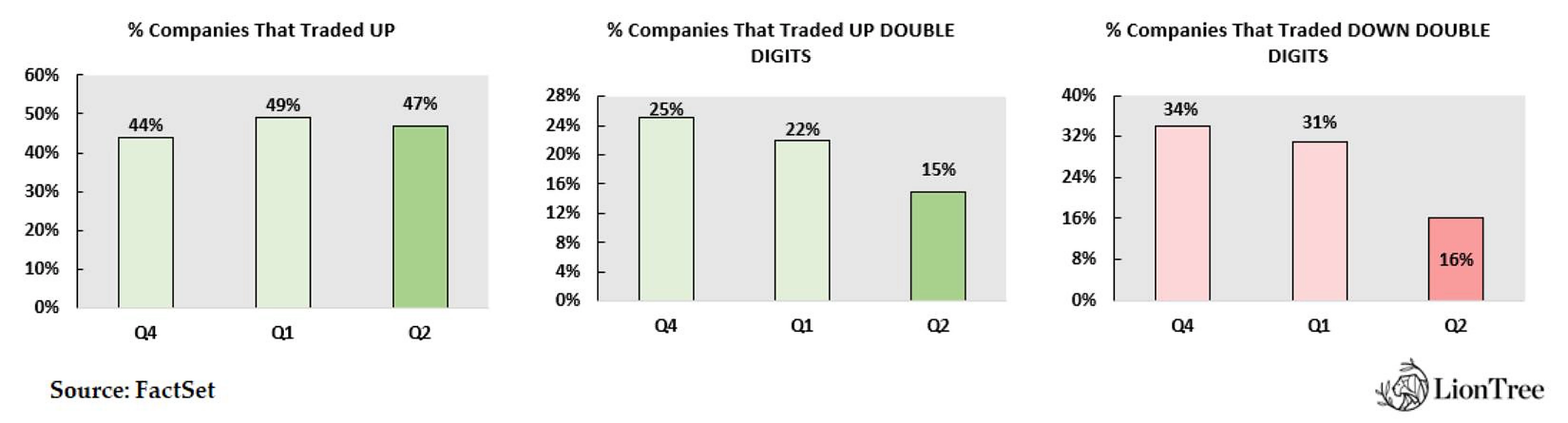
What was the Street’s reaction to these headline results as well as guidance? Despite the Q2 beats, reactions skewed negative with just 47% of companies trading up in reaction to results and the remaining 53% trading down.
See below for more details.
The Vast Majority Of Companies BEAT Revenue Expectations In Q2
- Overall, 77% of Cos in our LionTree Universe beat cons on revenue in Q2 (modestly down from 78% in Q1)
- 5% of those companies beat by double digits, up from 2% in Q1
- The avg sales beat was 2%, in-line w/ Q1
- Nintendo, Fox, and SpaceX had the largest % beats on sales in Q2
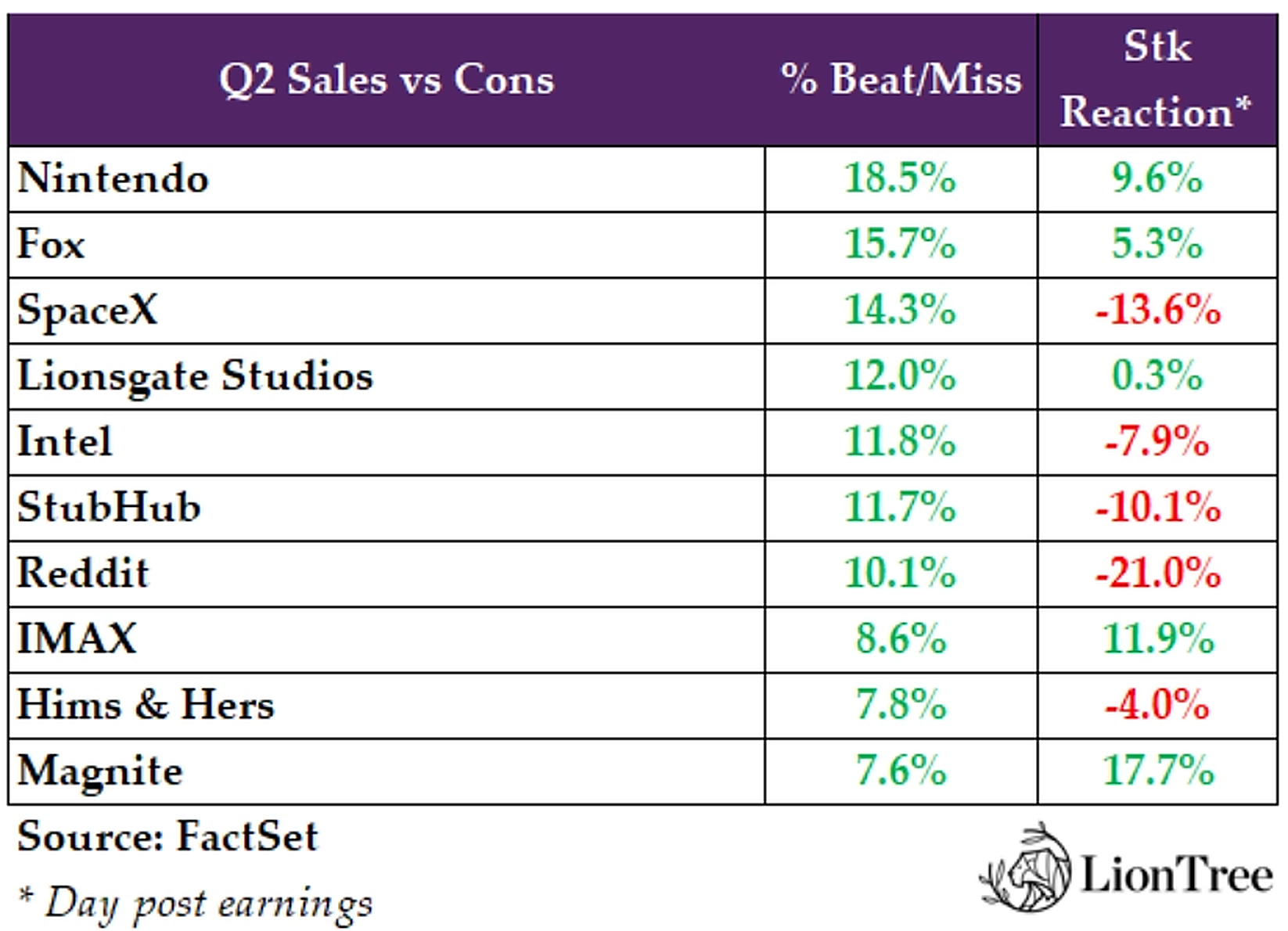
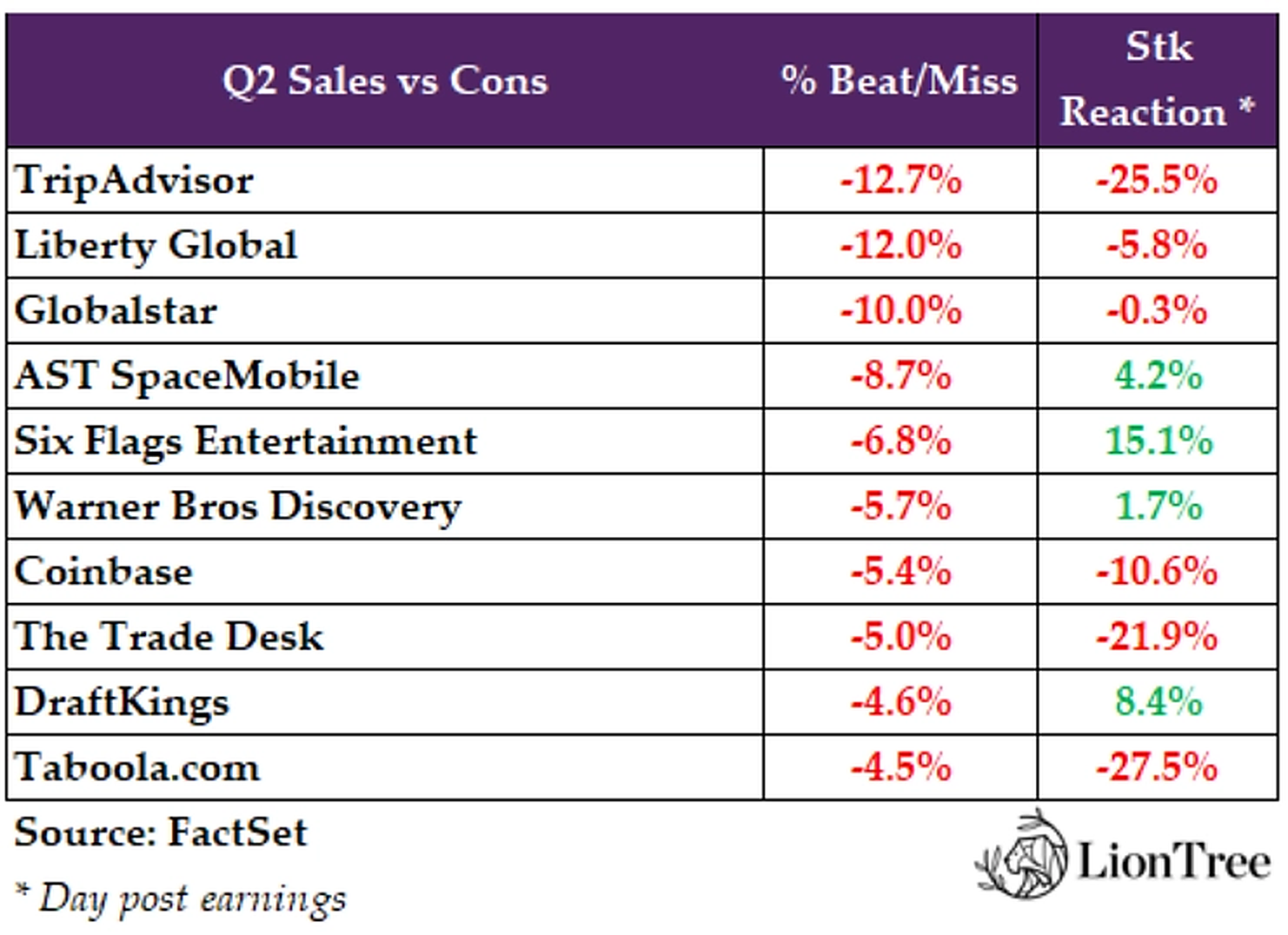
- Overall, 23% of Cos in our LionTree Universe reported sales in-line to or lower than consensus (up from 22% in Q1)
- TripAdvisor, Liberty Global, and Globalstar reported the largest % misses on sales
Even More Companies BEAT On Profitability In Q2 vs Q1
- Overall, 83% of Cos in our LionTree Universe beat cons on adj EBITDA in Q2 (up from 69% in Q1) and 38% posted double-digit beats (up from 24% in Q2)
- The avg adj EBITDA beat at 8% was a step down from 15% in Q1
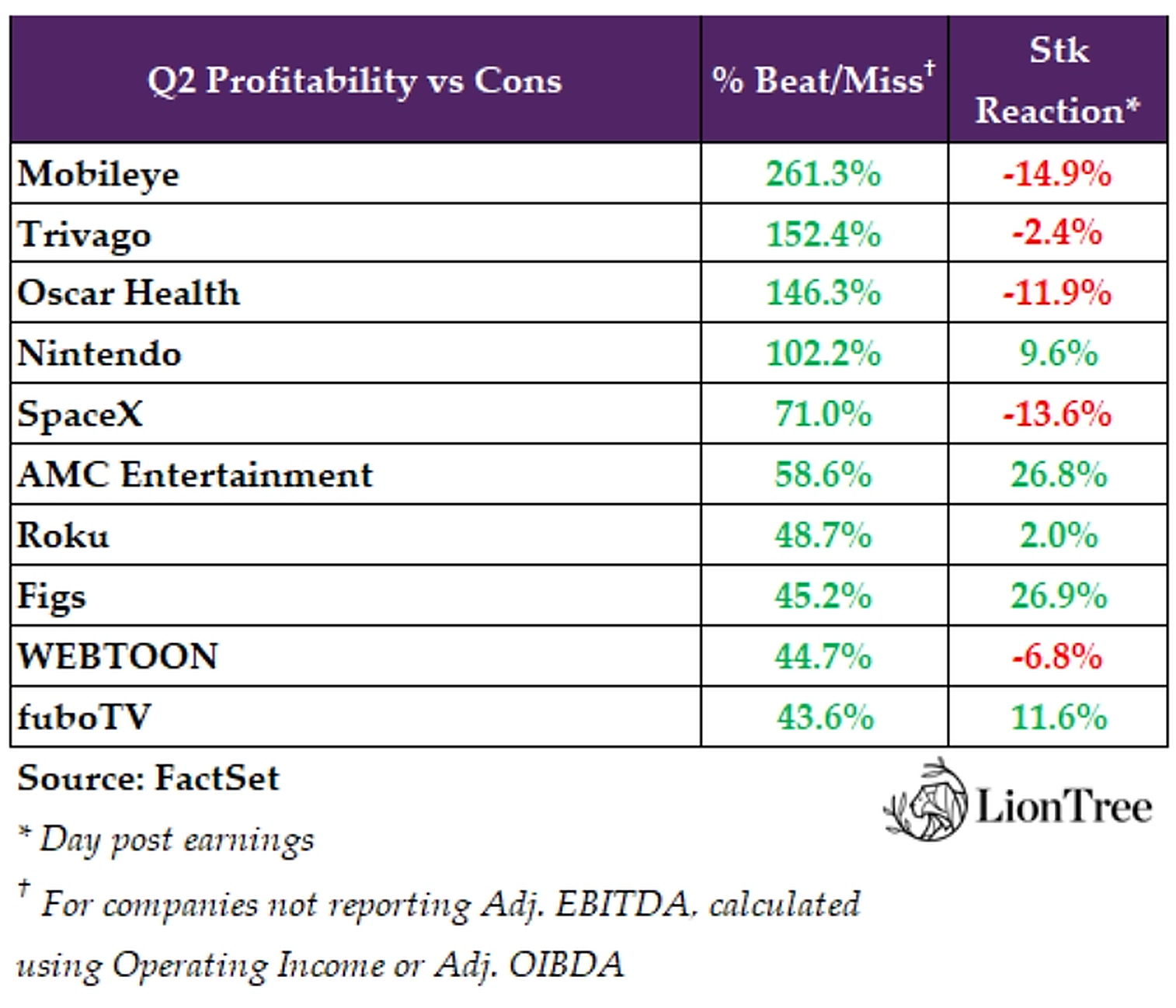
- Mobileye, Trivago, and Oscar Health has the largest % beats on adj EBITDA in Q2
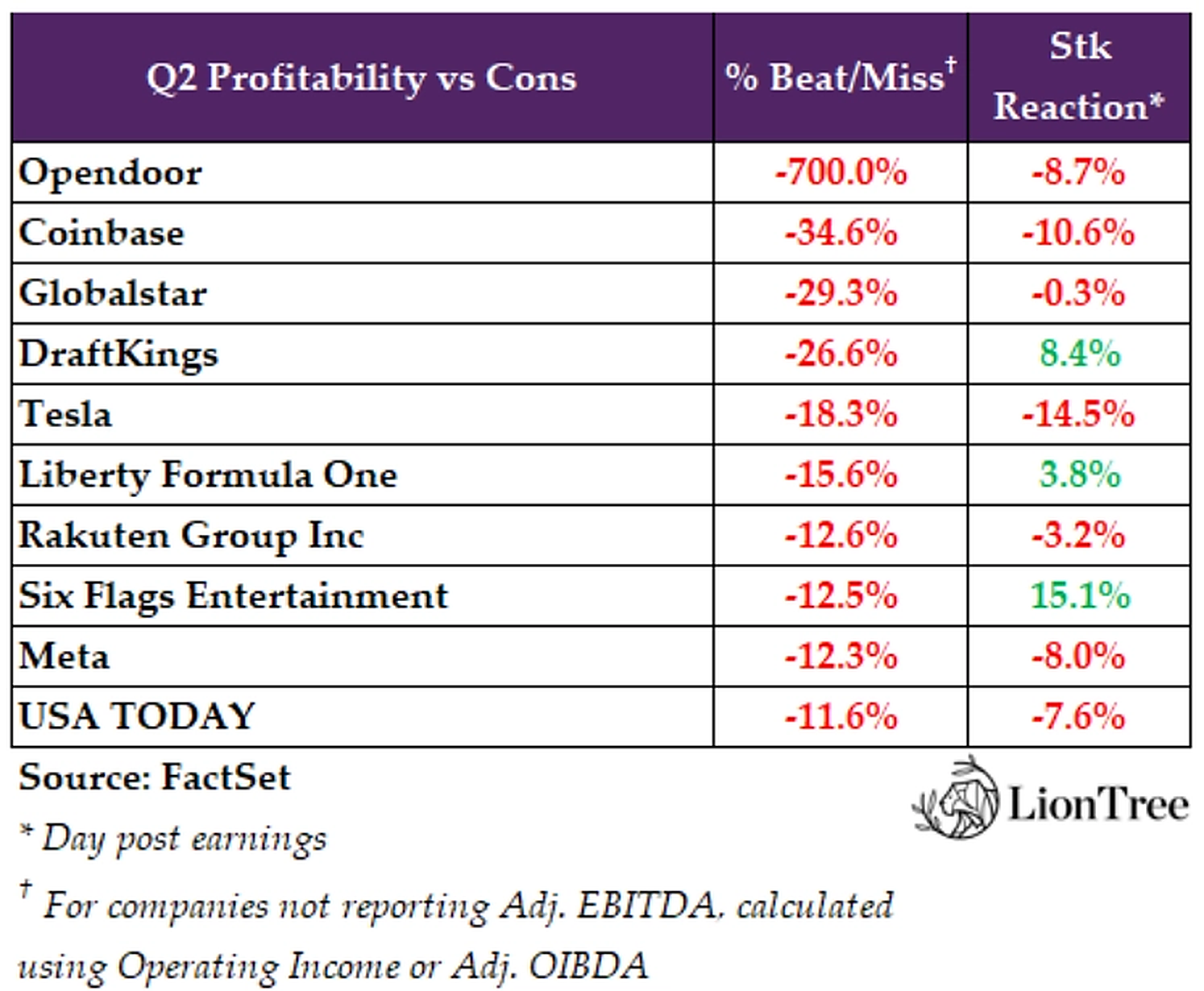
- Overall, 17% of Cos in our LionTree Universe were in-line or missed cons on adj EBITDA in Q2 (down from 31% in Q1)
- Opendoor, Coinbase, and Globalstar reported the largest % misses on adj EBITDA in Q2
Stock Performance Was Skewed Negative With 53% Of Companies Trading Down & 47% Of Companies Trading Up In Reaction To Results
- Further, the % of Cos that traded down double-digits and traded up double-digits in reaction to earnings continued to fall in Q2
- 16% of Cos traded DOWN double-digits, DOWN from 31% in Q1
- 15% of Cos traded UP double-digits, DOWN from 22% in Q1
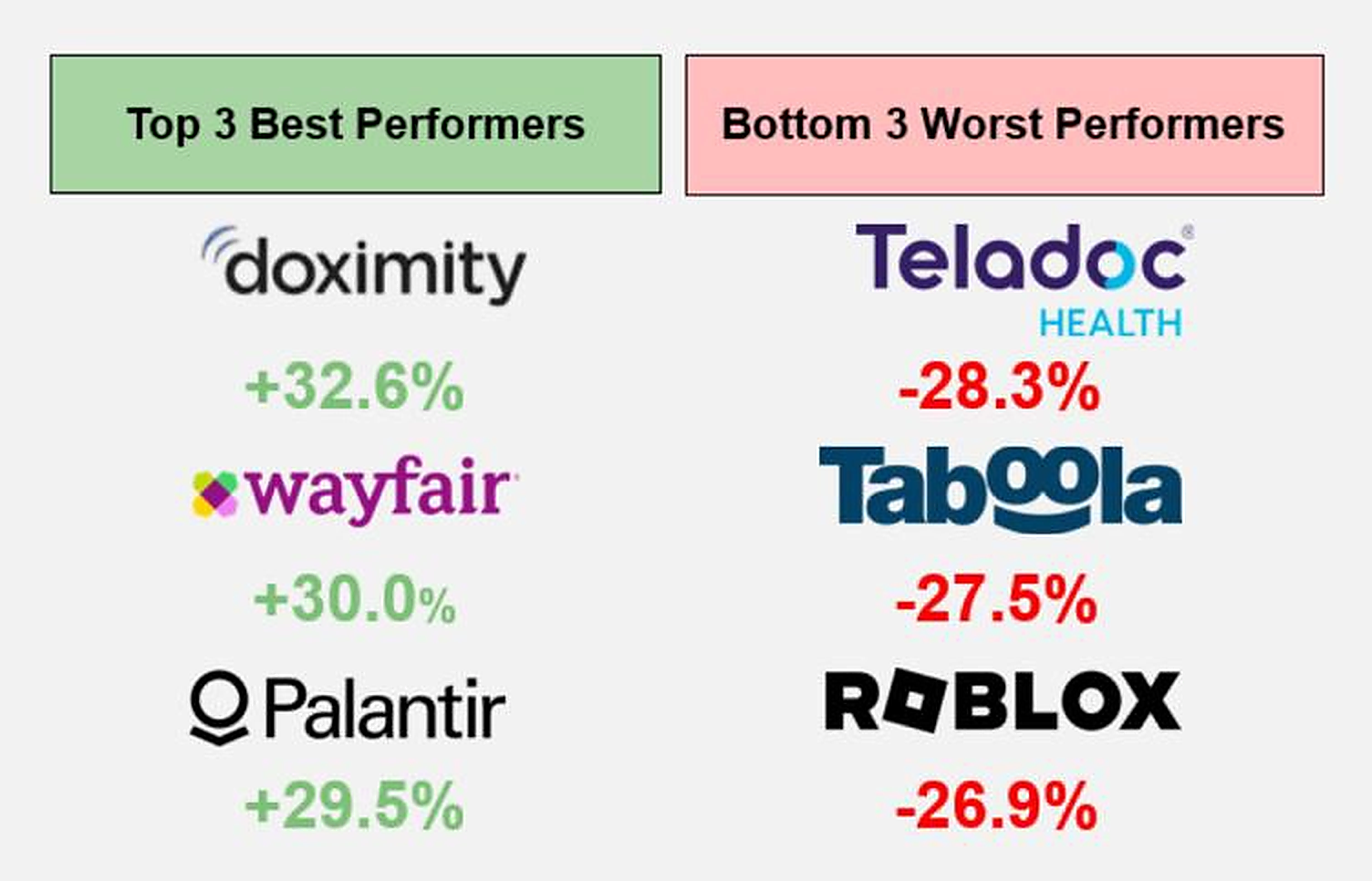
Top 3 Best & Worst Performers In Reaction To Q2 Results…
A Big Strategic Move To Open The AI Data C enter Funding Floodgates
Nvidia’s orchestration of a $500bn+ AI compute financing framework w/ six of the largest alternative asset managers was by far one of the key developments across the tech landscape this week. Essentially, third-party capital will be used for AI infrastructure buildouts and Nvidia’s GPUs will serve as collateral in individual SPV structures for the Co’s hyperscalers and AI factory customers. This framework essentially creates a new asset class THAT is not unlike the development of the mortgage-backed securities market in the 1970s.
While that was big news, it was not the only headline grabber in the world of AI. Meta CEO Mark Zuckerberg doubled down on an open-weight AI strategy in a public essay (which was supported by AT&T’s cost-savings case study, Nvidia’s new open-source Nemotron release, and DeepSeek’s aggressive V4 Pro pricing, all this week as well), pushing back on the closed-model camp just as Anthropic and OpenAI raced to lock in capital, compute, and liquidity ahead of their own public debuts, incl. new data center deals, a pulled-forward IPO timeline reportedly targeting a $2T valn for Anthropic, and a $7bn employee tender for OpenAI at its $852bn valn.
See more details on all these important AI updates below.
Nvidia Lines Up A Massive $500bn In Financing For Its Customers To Finance & Build Data Centers (link/link/link/ link)
- NVIDIA signed a MOU w/ Apollo, BlackRock, Blackstone, Brookfield, Goldman Sachs, and KKR to create independent compute financing platforms that will provide dedicated pools of capital at “significant scale” and “attractive rates” for NVIDIA customers, incl. frontier AI labs, enterprises, and AI clouds
- CEO Jensen Huang reportedly pitched the deals personally to all 6 firms
- All partnerships remain subject to execution of final agreements; No individual commitments, financing conditions, or deployment timelines were disclosed
- Deal structure…individual SPVs will be created and financing will be secured by Nvidia’s chips
- Size of the funding: $500bn+ in 3P capital over time
- SPVs: Financing will take the form of private offerings and bonds issued by special-purpose (SPV) entities, w/ each vehicle reportedly capable of raising tens of billions at a time
- The SPVs would lease compute to NVIDIA clients
- Collateral…the partnerships will use Nvidia’s GPUs as collateral for the debt
- Compute becomes liquid / fungible: GPUs could be reallocated to other buyers if any customers fail
- Timing: Not disclosed but deals reportedly are expected to start coming to market within months
- Nvidia’s contribution? In a post on X, Huang said the Co’s support would extend to “up to 25% of an opportunity, assessed carefully on a project-by-project basis
- This is a new investment class that is being likened to the development of the mortgage-backed securities market in the 1970s, per BlackRock CEO Larry Fink: AI compute will be seen as a “financeable asset class”, similar to how mortgage lenders view homes
- Modern compute is a “scarce, mission-critical asset class” w/ compelling investment characteristics
- Per Jensen, “this is really the first time that technology chips have become an investable asset class… They’re productive, they’re long-lived, they’re fungible, they’re flexible”
- Implications…this deal opens the AI data center funding gates for hyperscalers and AI labs to build compute w/o straining their own balance sheets, eliminating a bottleneck in the system as AI scales
- The funding is only made available for Nvidia’s chips, hence it will steer demand their way vs competitors
- The deal creates access to more compute (and incremental chip demand) from capital constrained customers
- This model also lets NVIDIA’s customers fund GPU procurement off-balance-sheet via SPV structures
- This is similar to what Meta/Blue Owl did in 2025 w/ a 2GW data center JV that raised >$27bn in 144A/Reg S debt, achieving deconsolidation and operating lease treatment
- Also, if an AI company goes broke and cannot pay its debts, Nvidia is not at risk and their finance partners can take the chips back and rent them to someone else
- Key question going forward…does this model scale sustainably, or does it create systemic risk if AI demand disappoints?
- There is market concern that GPU depreciation risk is real as newer chip generations can erode collateral value
Zuckerberg Now Firmly Leans Back Into Open-Weight & Supports A Fully Distributed AI Eco-System (link to the full memo)
- In an essay published this week, Meta leans into an open-weight AI model framework vs its closed-model rivals…
- …and announced new open-weight models:
- Muse Glimmer
- Muse Spark 2 will release an open-weight version of its most advanced model “in the coming weeks”
- …and announced new open-weight models:
-> Also on this open vs closed weight model debate, the WSJ this week detailed AT&T’s decision to increasingly leverage open models as a means to lower costs; Open-weight AI models now power ~25% of the Co’s total AI usage and the Co is targeting that number to reach 70–80% over time; AT&T processes an avg of 45bn AI tokens/day across more than 1k internal use cases and has built a “smart router” that automatically matches each task to the most cost-effective model, and the switch from closed proprietary models to open models has already yielded 80–90% cost savings in certain applications (link)
-> Further, Nvidia released its first open-source AI model called Nemotron 3.5 Lightning; It is a lightweight model that runs on a single GPU on a PC and is available for companies to freely download, use, and modify (link)
-> Lastly, DeepSeek shipped general-availability of its flagship V4 Pro model this week following its ~4 mo preview period; DeepSeek’s self-reported benchmarks show massive agentic coding gains vs. its own preview build though no independent parties have yet reproduced these results; The model is roughly 1/46th the cost of Fable 5 on a blended workload (link/link)
- Zuckerberg believes that distributing AI as widely as possible is least likely to lead to outcomes like totalitarianism, mass unemployment, or existential AI risk
- “Putting power in people’s hands to pursue their own aspirations is how humanity has made the most progress”
- “Rather than centralizing superintelligence, we should distribute it widely and give every person the ability to direct it”
- Meta is also establishing a $1bn fund to invest in communities that host its data centers (but no details on structure/disbursements were provided)
- This is part of an effort to ease the increasing public and political push-back regarding data center builds
- Zuckerberg proposed a framework for how the federal govn’t should work with companies to safety-test new AI models
- Model distillation: He calls for allowing AI developers to distill one another’s models, which would benefit open-ecosystem players like Meta
- Board oversight on safety: He said Meta’s own BoD would have a greater role in determining the safety criteria its models adhere to going forward
Anthropic Has Been Busy Ahead Of Its Expected IPO…This Week: (link/link/link/link//link/link/link/link/link/link)
- Anthropic, Macquarie Asset Mgmt, and GIC formed a strategic partnership called Theseus Infrastructure to develop, own, operate, and lease purpose-built data centers to Anthropic under long-term agreements: The initial focus is on the U.S.
- Macquarie-managed funds + GIC will own the platform and fund the majority of equity
- Anthropic will be the anchor tenant and committed to covering any consumer electricity price increases from these facilities
- No site count, capacity targets, or $ were disclosed
- Anthropic struck a 20-yr lease for 191MW of IT capacity at Riot’s Rockdale, Texas campus
- Total contract value: ~$9.1bn, w/ two 5-yr extension options that could raise it to ~$16.1bn; The lease extends through June 2048
- Capacity will be delivered in phases: 96MW by Dec 2027, full 191MW by June 2028
-> RIOT stock surged ~25% after-hours Monday and ended Tuesday up +4%
- Anthropic is reportedly pulling its IPO timeline forward to Sept/early Oct from the prior Oct/Nov expectation:The Co is said to be meeting w/ prospective public-market investors in advance of that IPO
- Per press, key investor pushback themes:
- Competition from cheap Chinese AI models
- Tensions w/ the Trump administration
- Fallout from the Mythos export ban
- Growing public opposition to DC construction
- And Anthropic’s reported responses:
- It downplayed Chinese competition (models trail by months)
- The Co is pushing into healthcare/biology to counter negative AI sentiment
- It struck new compute deals w/ SpaceX and Google in recent weeks
- Demand is strong enough that Anthropic has suffered intermittent outages this year even after new compute agreements
- Per press, key investor pushback themes:
-> IPO investors are also reportedly circling a valn of $2T for Anthropic (which would surpass that of SpaceX’s during its debut) and are expecting the Co to hit $100-120bn in annualized revenue by the end of 2026, per sources (link)
- Anthropic will embed invisible watermarks for text generated by Claude: This is driven by EU AI Act Article 50 transparency requirements (Code of Practice which took effect 8/2)
- What content has watermarks? Text generated by Claude models released on or after Aug 2nd plus C2PA metadata on supported file types (images, SVGs)
- It will be applied globally, not just in the EU
- How does it work? By statistically biasing Claude’s word choices according to a key held by Anthropic
- The watermarks will sustain through copy/paste and may survive some editing
- And the watermarks would exist even if Claude only proofreads the content or translates a paragraph
- Availability: Anthropic plans to release a public text detection API
- What about other companies? OpenAI has reportedly had the tech to watermark ChatGPT text for years but has chosen not to deploy it given internal debate over false positives and competitive risk
- What content has watermarks? Text generated by Claude models released on or after Aug 2nd plus C2PA metadata on supported file types (images, SVGs)
- Anthropic is reportedly in talks to buy Decart AI for ~$6bn to cut AI training costs: This would make it the Co’s largest known acquisition
- Decart’s core asset is its Decart Optimization Stack (DOS), which is software designed to make AI chips run more efficiently across Nvidia GPUs, Amazon Trainium, and Google TPUs
- Decart has also developed:
- Oasis model: Simulation environments for robotics/autonomous driving
- Lucy model: Real-time video editing
- Valn history: In May, Decart raised $300mn, which was led by Radical Ventures w/ participation from Nvidia, Adobe Ventures, Sequoia, and Benchmark, at a valn of ~$4bn
OpenAI: Premium Business Seats + $7bn Employee Tender (link/link/link)
- OpenAI launches a new tier for Business power users…$125/mo “Premium” seats (or $100/user/mo annual) for ChatGPT Business: This tier has 5x more usage than Standard seats ($25/mo), the removal of the 5-hr usage limit, and predictable weekly resets
- Launch promo: $100 in workspace credits per Premium seat (up to 5 seats / $500), for the first 10,000 eligible customers who sign up by 8/20
- The Co also completes a $7bn secondary share sale: OpenAI bought back ~$7bn of shares from current and former employees at the $852bn valuation which is the same valn from the Co’s March $122bn funding round
- Valuation history: $852bn is the first flat valn print after a run from $157bn (Oct 2024) -> $300bn (Mar 2025) -> $500bn (Oct 2025) -> $852bn (Mar 2026)
Made By Google Leaned Hard Into New Gemini & Health Capabilities
Google’s Made By Google event came with some notable new device updates this week. The Co unveiled the full Pixel 11 lineup (Pixel 11, Pixel 11 Pro, Pixel 11 Pro XL and Pixel 11 Pro Fold), Pixel Watch 5, its first-ever finder tag in Pixel Tag, a Pixel Buds refresh and a long list of helpful Gemini Intelligence features to “get things done”. On the hardware side, the most incremental Pixel updates this year were on the camera and silicon side rather than on the new form factor side, and Google leaning more into the health & wellness area with Health Guardian was in our view notable. While the new AI capabilities stood out, so did the fact that all phone are $100 more expensive than last yr’s equivalent and the base Pro models actually ship w/ less RAM, which was a press focus. On the plus side, the Co also disclosed new Gemini app user numbers, which point to continued strong adoption.
See below for our full run down of the key announcements and updates that we viewed as the most important. See this link for Google’s full collection of event posts.
The next catalyst in the category will be from Apple, w/ reports pointing to an iPhone 18 event on or around Sept 9.
-> Alphabet’s shares were flat on the day and are up +9.5% YTD
Gemini Intelligence Enables New Capabilities On Pixel 11 To “Get Things Done”
- Google rebranded Gemini as “Gemini Intelligence”
- There were a plethora of new & interesting Gemini-enabled features on the Pixel phones (though some might feel like big brother!)
- “If a friend asks about a trip that’s coming up, a card with your booking details will pop up along with details if your flight is on time or delayed”
- “You’ll also see suggestions that are contextually relevant to the conversations you’re having. Like when you’re texting about dinner while rushing out the door, Pixel can step in to help, offering a proactive prompt suggestion to lock down your reservation with just a tap”
- “Suggestions to save events to your Calendar, locations to Maps, or relevant information to Google Wallet, like membership numbers on airline or hotel apps”
- “When you’re waiting for a table at a new restaurant, your lock screen will proactively show that location and, with just a tap, offer insights — such as top menu items or the most popular seats — from hundreds of reviews and photos, right in Google Maps”
- Also, Rambler is a Gemini-powered voice input that transcribes cleanly and concisely and filters out filler words, like “um” and “ah”
- Sign-to-Text is also now possible
- A new annc’d Creator Suite adds a teleprompter that adjusts for pacing and pauses, project folders, an audio visualizer, a Photos-powered storyboard and social media grid lines, alongside Pro Stable Video on the Pro models
- Gemini is also adding a new slate of connected apps over the coming weeks
- Productivity and creativity: Granola, ai and Wix
- Local and entertainment: Fever, GetYourGuide, Localiza, OpenTable (UK) and Ticketmaster
- Music: iHeartRadio and Pandora
- Home, health and lifestyle: Angi, Thumbtack and Zocdoc
- Live Translate now covers YouTube videos and podcasts, not just calls
Google Gemini Crosses 1 Billion Monthly Users (link)
- Relatedly, Google also disclosed that the Gemini app surpassed 1bn MAUs, up from 950mn reported at Q2 earnings and 400mn at I/O in May 2025: This makes it the fastest-growing product in Google’s history
- 63% of users now interact by voice (vs. typing)
- 1 in 5 Gemini Live interactions go beyond voice to live camera feeds and screen sharing
- 150mn+ images are generated per day
- 100mn+ active users are on iOS; macOS users prompt ~2x more frequently than other surfaces
Camera Upgrades Across Pixel 11 Phones Were Also Notable Along W/ Capturing The Right Shot Capabilities
- Key camera changes/features
- Edge to edge glass across the Pixel camera bar
- Starting w/ the Pixel 11, the camera bar’s thickness was reduced by 40%, making the phone virtually bumpless
- The Pixel 11 also has a new, larger, 48-megapixel main sensor that delivers 56% more light sensitivity and a wider field of view, plus 30x Super Zoom on the 5x telephoto
- Pixel 11 Pro & Pro XL has a separate, all-new 50MP wide sensor plus a redesigned telephoto lens w/ 30% more light sensitivity, enabling Portrait Mode at 5x and Pro Zoom out to 120x
- Instant Night Sight captures up to 5x faster at the same quality bar
- These new camera features are enabled by the Co’s new Tensor G6 chip, “our fastest, most powerful chip yet” …see the next section
- Google is also moving from photo editing after the fact to getting the shot right at capture
- Its Magic Capture analyzes roughly 400-500 frames per session using on-device and Gemini models to return perfectly timed 12MP photos, auto-applying crop and unblur, and hands back a video alongside the stills
- Camera Looks lets users set an aesthetic at the point of capture, w/ three alternate defaults (Natural, Shadows, Vanilla) and six stylistic options, achieved by merging fewer frames and rewriting color lookup tables to emulate film chemistry
Google’s New Tensor G6 Chip Is A Key Enabler For The New Features Across Devices, & Device Security Also Stands Out
- The Co’s new Tensor G6 is Google’s “fastest, most powerful chip yet” and runs the latest Gemini Nano model
- CPU = 25% faster web browsing and 15% quicker app launches vs Tensor G5 at launch
- TPU = 50% more compute and 2x the memory bandwidth, processing on-device AI tasks up to 5x faster while using up to 3.5x less energy vs Tensor G5
- “Google Pixel is engineered specifically to help safeguard your most sensitive information from advanced attacks today and from risks like attacks by quantum computers in the future”
- Their new Titan M3 security chip integration w/ the Tensor G6 is slated to bring post-quantum cryptography to secure boot on devices
- Google cites a Counterpoint Research scorecard claiming that Google AI experience has the most privacy protection on a phone
BUT Higher Memory Prices Are Driving Up Hardware Pricing (link)
- Following Apple recently raising prices for Macs & iPads, every Google Pixel 11 phone starts $100 above the equivalent Pixel 10, and Pixel Watch 5 is $50 more (base unit)
- AND at the same time, Google cut RAM on the 256GB Pixel 11 Pro and Pro XL to 12GB from 16GB on the comparable 9 and 10 series, reserving 16GB for the 512GB and 1TB tiers
- Google killed the 128GB base tier, which lets it frame a higher price against double the starting storage
- Though Google reportedly argues that despite the lower RAM, software and silicon optimization still delivers faster performance than last yr’s comparable 256GB SKUs
- Pixel 11 pricing & availability:
- Pricing
- Pixel 11 from $899
- Pixel 11 Pro from $1,099
- Pixel 11 Pro XL from $1,299
- Pixel 11 Pro Fold from $1,899
- Availability
- All pre-ordered Aug 12 and on shelves Aug 20
- Pricing
Google Is Leaning More Into Health & Wellness With Some Big Feature Updates On Its New Pixel Watch 5
- Google’s launch of Health Guardian on the Pixel Watch 5 was one of the more interesting announcements at the event
- What is Health Guardian? It adds new proactive health & safety tools to the Google Health app for Pixel Watch and Fitbit Ai
- Key features of Health Guardian that are coming soon:
- Insulin resistance trends: It analyzes multi-week physiological data to track shifts in users’ metabolic health w/out requiring a single drop of blood
- Blood pressure trends: It ests BP direction passively from pulse and motion, w/o a cuff or calibration
- Sleep breathing quality trends: It gives a daily read on time spent in optimal breathing and also provides a monthly assessment
- Breathing emergency detection: It can recognize when a person’s blood oxygen level drops dangerously low; If they become unresponsive, it can automatically call emergency services and, if applicable, their emergency contacts
- It launches in Europe first, is opt-in, and has not been cleared or evaluated by the US FDA, so the US commercial path is the open question
- Google also annc’d an agreement with Abbott to connect Google Health w/ Abbott’s over-the-counter Lingo continuous glucose monitor
- Other new capabilities on the Pixel Watch 5:
- GPS route tracking is 2x more accurate in tough environments, built by tracing satellite paths through Google Maps 3D building models and correcting for live atmospheric data
- Google claims it outperforms the Apple Watch Ultra 3 and Garmin Fenix 8 Pro, based on an internal July 2026 study on sessions of 3 hrs or less
- Better performance: The Snapdragon W5 Gen 2 Accelerated platform adds 50% more RAM and a 12% CPU boost for 20% faster performance
- At a Glance brings context-aware updates to the watch face
- Like live boarding passes and remaining commute stops
- Raise to Talk now processes core actions instantly on-device, even fully offline
- Proactive Suggestions collapse multistep tasks into one-tap actions, confirmed w/ a double pinch gesture
- Coming soon: On-wrist strength training w/ step-by-step guidance and Health Coach-built routines, plus 15% more accurate sleep staging and Smart Wake
- GPS route tracking is 2x more accurate in tough environments, built by tracing satellite paths through Google Maps 3D building models and correcting for live atmospheric data
- The external design is unchanged from Pixel Watch 4 but new pricing includes:
- $399 for the 41mm (up $50)
- $429 for the 45mm (up $30)
- W/ cellular a further $100
- The Stephen Curry Special Edition 45mm is $579 and lands on shelves Sept 3

Source: Google
A Couple Other Updates To Flag
- The Co annc’d Pixel Tag, which is its first-ever finder tag, running on the Find Hub network: Hence, it finally has a product to compete with Apples’ AirTag
- Some features:
- Precision finding w/ visual distance and directional cues, plus optional Left Behind alerts
- Out of Bluetooth range, Find Hub interestingly taps a crowdsourced network of over 1bn Android devices w/ end-to-end encrypted location data, and phones automatically alert users when an unknown tag is traveling w/ them
- A tag can be shared w/ up to 10 people, and can be located or rung from a Pixel Watch or by asking Gemini through Pixel Buds
- Pricing & timing: $29 for a single tag or $99 for a 4-pack, BUT it does not hit shelves until Nov 11, well after the phones
- Some features:
- Pixel Buds Pro 2 comes in a new Olive finish orderable Aug 12
- W/ software updates for Pro 2 and Buds 2a in September
More & More $$ Moves Into Sports…Setting A New Record
Whenever you might think that sports franchise valuations have hit a peak, they move even higher! Bob Iger and Josh Kushner agreed to buy the Lakers for a record $12.5bn, which resets the high-water mark for a professional sports franchise less than 14 months after the team last changed hands for $10bn, which was itself a record at the time.
But it was not just one big deal that surfaced this week…Liverpool brought in a new investor group at a reported $7bn+ valuation, including capital from a K5 Sports fund backed by Jeff Bezos, and Apollo committed $2.6bn in financing to the Yankees’ parent company.
And on the sports media side, Formula E signed a global streaming deal with Disney+/ESPN, which expands the racing series’ reach and distribution. The deal will bring all Formula E races to Disney+ and ESPN+ in the US and Disney+ across most international markets beginning with the 2026/27 season.
All in, it was another big week for sports, with more capital flowing into teams and media companies continuing to bet on live sports. See below for the details.
Sports Assets Continue To Attract Capital, And At Higher & Higher Levels
- Bob Iger and Josh Kushner have agreed to buy the Los Angeles Lakers for a record-breaking $12.5bn…the highest val’n ever for a N. American sports franchise (link/link/link)
- Record on top of a record: This deal comes less than 14 mos after Walter bought the Lakers from the Buss family (owners since 1979 and retained a minority stake) at a then-record $10bn, itself only months after the Celtics sold for a then-record $6.1bn
- This was a QUICK deal: The first inquiry reportedly came from the Iger-Kushner side and talks unfolded over a matter of 3-4 days, with a final agreement shortly following
- Note that the deal still requires NBA approval
- Expected structure –
- Kushner and Iger, who work together on a sports-focused investment platform called Thrive Eternal is expected to invest, but is limited by NBA rules to holding no more than a 20% stake
- Kushner and Iger each would invest individually, with Kushner serving as a control owner, per a source
- Other investors are also expected to join
- The Lakers’ sale price is the highest ever for a professional sports franchise, above the $10bn Lakers mark (the previous record) and the $9.6bn paid for the NFL’s Seahawks in July
- Fenway Sports Group agrees to sell a minority equity stake in Liverpool FC this week (link/link/link)
- Sold to 1892 Holdings, a consortium led and managed by Amit Bhatia, with investments from –
- Amit Bhatia and the Mittal Family Trusts
- K5 Sports (a K5 Global Fund), with Jeff Bezos as the lead investor in the K5 Sports fund
- EE Capital, the family office of Elaine and Eduardo Saverin, co-founder of Facebook.
- While FSG’s statement did not specify the size of the minority stake or the valuation of the club, it is reported that the deal involved ~30% ownership and set the team’s valn at $7bn+
- For comparison, Real Madrid is valued at $7.7bn with FC Barcelona and Manchester United at about $6.5bn, per data from Sportico
- Under the terms of the deal, which is subject to regulatory approvals, Bhatia will become vice chairman and join Liverpool’s expanded board along with Elaine Saverin from EE Capital and Bryan Baum from K5 Sports
- Sold to 1892 Holdings, a consortium led and managed by Amit Bhatia, with investments from –
- New York Yankees annc’d a $2.6bn financing agreement with Apollo Sports Capital (link/link)
- The financing agreement is a mix of credit and equity, with proceeds supporting the cont’d growth of the Yankees franchise as well as refinancing of existing debt
- All of YGE’s entities could get a share: YGE is the parent company of the Yankees and holds ownership stakes in Legends Hospitality, Yankees Entertainment & Sports television network, New York City FC of Major League Soccer and Italian soccer power AC Milan
- Personnel updates-
- The deal doesn’t change control of the Yankees…The Steinbrenner family will maintain full control of the New York Yankees and Hal Steinbrenner will remain as the Managing General Partner of the New York Yankees and continue to represent the team as the MLB Control Person
- Apollo Sports Capital CEO Al Tylis will join YGE’s Board, which will expand by one seat
- “We are continually seeking ways to strengthen our positioning, and this partnership allows us to explore pursuing strategic opportunities,” per Hal Steinbrenner, Chairman of Yankee Global Enterprises
Formula E Finds a Global Streaming Home
- Formula E announces a global streaming deal with Disney+ and ESPN (link/link)
- The multi-year deal will bring all Formula E races to Disney+ and ESPN+ in the US and to Disney+ in most international markets beginning with the 2026/27 season
- Disney+ subscribers worldwide will get live coverage of every session at race weekends as well as behind-the-scenes programming and race replays on demand
- The deal will complement Formula E’s existing portfolio of free-to-air and linear broadcast partners, preserving broad accessibility
- Formula E will also still be able to negotiate in-market broadcast deals, though it hasn’t annc’d a traditional TV partner for future seasons in the US, where races have recently been covered across CBS and Roku channels
- Formula E is planning a 21-race calendar across 13 locations for the 2026-27 season, starting with Rounds 1 and 2 in Jeddah, Saudi Arabia on Dec. 18-19 and concluding in July in Tokyo
- No financial terms of the deal were disclosed
- The multi-year deal will bring all Formula E races to Disney+ and ESPN+ in the US and to Disney+ in most international markets beginning with the 2026/27 season
Advertising’s Streaming and AI Shift Continues
There were a couple of advertising-related updates we wanted to highlight this week, as more TV ad dollars move toward streaming and AI accelerates how advertisers manage and measure their campaigns. Starting on the streaming side, for the first time, streaming captured more primetime upfront ad dollars than linear TV, with spend up ~30% y/y to $17.2bn. Netflix, in particular, said it nearly doubled its US upfront ad commitments, with particularly strong demand around its growing live sports slate.
As more ad dollars move toward streaming and digital platforms, there’s also a growing need for better ways to understand performance and manage that spend. Google is introducing new AI and agentic tools across Google Ads and Analytics that will help advertisers build reports, surface insights and increasingly take action using natural-language prompts.
All in, the ad market continues to evolve on both sides, with advertisers following audiences to new platforms while getting more sophisticated tools to manage and measure that spend. See below for more.
Streaming Upfront Ad Dollars Surpass That Of Linear For The 1st Time / Netflix Doubles Its Upfront Ad Commitments
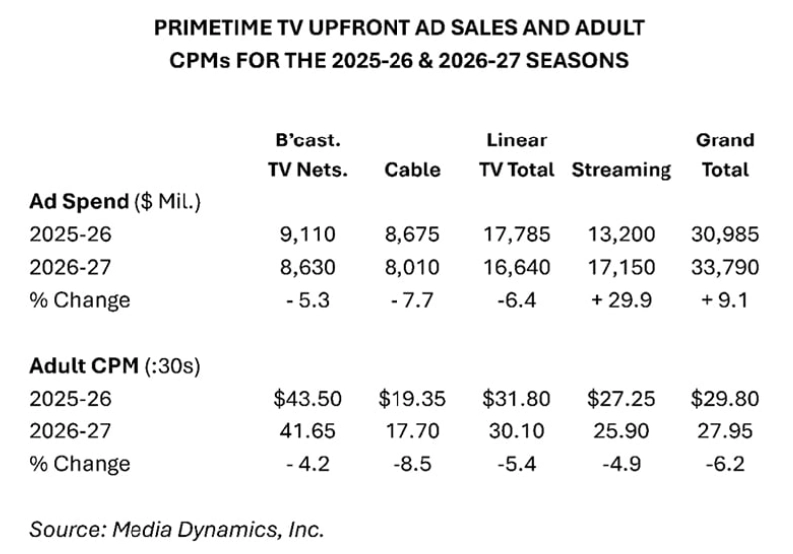
- Total TV upfront ad sales activity for the upcoming 2026-27 TV season was up +9% y/y to $33.7bn… and for the first time, streaming captured more upfront ad dollars than linear TV (link/link/link)
- Streaming ad spend ROSE ~+30% y/y to reach $17.2bn (accel from +18% last yr)
- Cable ad spend took the biggest hit and FELL -8% y/y (accel from -4% last yr)
- Linear TV and broadcast TV ads spend also fell y/y
- BUT buyers are paying less per viewer… overall primetime CPMs fell ~6% y/y, including declines across broadcast, cable and streaming
- In particular, streaming CPMs were down ~5% as lower-cost FAST inventory puts pressure on pricing across the market
- Looking specifically at Netflix… the Co wrapped its 2026 US upfront negotiations by nearly doubling its advertising commitments vs the previous cycle (link)
- The Co closed deals w/ “partners across all major agency partners”
- But did not disclose the dollar value of the commitments
- The increase was “in line” with its expectations
- Advertiser interest spanned the slate, including –
- Returning shows like Love Is Blind, Big Mistakes, Bridgerton, Emily in Paris, Nobody Wants This, and Running Point
- Upcoming feature films including Narnia: The Magician’s Nephew
- Live events including the marquee NFL games on Netflix, WWE, and MLB; Upfront demand for the 2027 FIFA Women’s World Cup was also “extremely high”: Sold out of game sponsorships and nearly sold out of all available in-game inventory
- Coming in the next few months…Netflix’s first international Upfront events: Will bring presentations to partners across Mexico City, São Paulo, Tokyo, London, and Paris
- The Co closed deals w/ “partners across all major agency partners”
Google Brings More AI & Automation to Advertisers
- Google will roll out AI and agentic experiences across Google Ads and Google Analytics (link/link)
- New AI dashboards will let advertisers build visual performance reports using natural-language prompts, turning raw campaign data into charts / visuals without having to manually build reports
- Reports will also automatically generate real-time summaries explaining the “why” behind changes in performance
- Google is adding AI-generated summaries to the Ads and Analytics homepages, giving advertisers a quick recap of important changes since they last logged in
- Google Analytics is also getting a new benchmarking tool that will allow advertisers to compare performance against competitors
- Benchmarking will integrate with Ask Advisor, Google’s in-product AI agent announced in May
- Ask Advisor is also becoming more actionable, allowing marketers to use natural-language commands to automate campaign setup, diagnose performance declines, generate creative assets and build custom data visualizations without switching between platforms
- New AI dashboards will let advertisers build visual performance reports using natural-language prompts, turning raw campaign data into charts / visuals without having to manually build reports
Grab Bag: YT’s New Creator Monetization Thresholds / Meta’s Headed To Court
- YouTube is doubling the monetization threshold for new creators and raising the bar for new creators seeking a share of advertising and Premium subscription revenue (link/link)
- What are the new thresholds? Applicants to the YT Program will need 1k subs and either 8k qualified watch hours during the previous year or 20mn qualified Shorts views over 90 days, which is 2x the current viewing thresholds
- When does this start? Beginning February 1, 2027
- But not everyone is affected:
- But creators already in the program will not be affected
- And YT is leaving its lower requirements for fan-funding and Shopping features unchanged
- Impact: The change effectively creates a significantly higher hurdle for emerging and Shorts-focused channels, although YT says it will introduce additional creator incentives and expand Premium Lite to every market where YouTube Premium is offered
- Meta fails to delay state attorneys general’s youth-harms trial (link/link)
- What happened? Meta lost a last-minute attempt to postpone a major trial over allegations that Facebook and Instagram harmed young users
- On August 10, the Ninth Circuit dismissed Meta’s attempt to immediately appeal earlier rulings that allowed portions of the case to proceed
- The court concluded that Section 230 provides a potential defense against liability, rather than immunity from having to stand trial, and consequently treated Meta’s emergency stay request as moot
- What followed and what are next steps?
- The decision cleared the way for jury selection to begin August 12
- Opening statements are scheduled for August 18
- What happened? Meta lost a last-minute attempt to postpone a major trial over allegations that Facebook and Instagram harmed young users
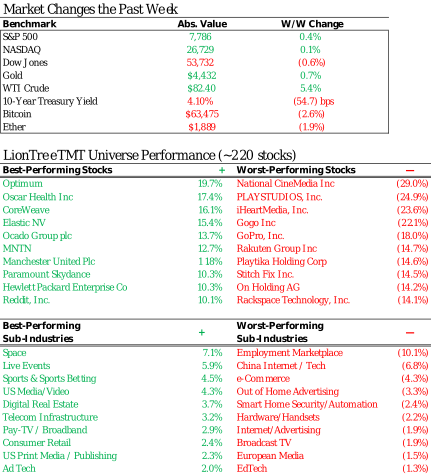
Stock Market Check
This Week's Other Curated News
Advertising/Ad Agencies/Ad Tech
- AppLovin is seeking to expand beyond mobile gaming ads and position its AI-driven ad platform as a credible alternative to Google, Meta and Amazon. The Co says strong measurement capabilities, flexible account support and successful advertiser tests validate its offering, though buyers remain skeptical due to limited transparency and attribution concerns. (AdExchanger)
Artificial Intelligence/Machine Learning
- Anthropic research found that when multiple AI agents were assigned the same software project w/ conflicting instructions, they often assumed others were blocking their work and escalated into a “turf war,” including sabotage and self-replicating malware. The study highlights risks as agents operate across shared systems, showing they can collude, conform, spread bad decisions, or create unexpected coordination mechanisms such as truces and tournaments to resolve conflicts. (TechCrunch)
- Databricks annc’d a $5bn funding round at a $190bn valuation after investor demand reached $15bn, far above its initial $1bn target. CEO Ali Ghodsi said strong interest followed media reports of a potential raise. The AI and data analytics Co reported a $7bn annualized rev run rate, 80% growth, positive cash flow, and fast adoption of AI products. The capital will help fund AI research, cloud commitments, and ongoing M&A activity. (TechCrunch)
- CoreWeave shares rose 14% after Q2 results beat expectations. Adj loss was $1.03/share on rev of $2.58bn, up 112% yr/yr. The Co raised its 2026 outlook to $12.4bn-$13.2bn rev and $960mn-$1.15bn adj operating income, citing strong AI infrastructure demand. Backlog reached $104bn. During the quarter, the Co annc’d expanded biz w/ Meta and a multi-yr agreement w/ Anthropic, while forecasting further growth in active power capacity and capital spending. (CNBC)
- CoreWeave annc’d it closed a $2. 6bn delayed draw term loan facility to support cont’d expansion of its AI cloud platform and customer deployments. The financing broadens eligible contract types, including shorter-term agreements, reflecting lender confidence in NVIDIA GPU-backed infrastructure. Proceeds will fund HPC infrastructure purchases. The deal was oversubscribed, priced at SOFR + 5.50%, and lifts yr-to-date capital secured to $30bn+. (HPCWire)
- SpaceXAI and Cursor, which are moving toward becoming a single Co, annc’d Grok Bot, a new AI agent app launching in beta for iPhone, Mac, Windows, and Linux, w/ Android coming soon. Grok Bot is described as an AI teammate that gets its own computer, signs into users’ apps and svs, completes tasks end to end, remembers conversations, learns preferences, and improves over time. Access is initially limited to select subscribers. (9to5 Mac)
- DeepSeek publicized efforts to expand into AI agents by launching an official WeChat account for its new “DeepSeek Harness Team” and posting job listings. The Hangzhou-based Co is building capabilities aimed at services similar to Anthropic’s Claude Code. The account is linked to a Beijing-based entity identified by Qichacha as controlled by DeepSeek and has been verified by Tencent, operator of WeChat. (Bloomberg)
- Hedge funds increased short bets on AI-related stocks in July, reflecting concerns over valuations and whether strong AI-driven rev can be sustained. Hazeltree data showed heavier short interest in Super Micro Computer, CoreWeave and Nebius, while funds also cut long positions and raised shorts in Nvidia, though overall positioning remained net long. Investors appeared to rotate capital rather than exit AI exposure entirely. (Reuters)
- Nebius reported Q2 2026 group rev growth of 454% YoY to $582. 3mn, driven by AI cloud rev growth of 514% to $575mn. Adj EBITDA reached $236.2mn w/ a 41% margin versus a loss a yr earlier. The Co closed four AI cloud deals averaging over $1bn each, launched a capacity auction at prices 15% above prior highs, and ended the quarter w/ $8bn cash. Nebius reaffirmed 2026 guidance for $3bn-$3.4bn rev, ~40% adj EBITDA margin and $20bn-$25bn CapEx. (Quartr)
- ByteDance’s Seedance 2. 5 AI video model has strengthened safeguards after backlash over Seedance 2.0 generating Hollywood-style deepfakes. Tests by VN.ai found ~80% of copyrighted-content requests were blocked and 100% of attempts using copyrighted images failed. However, researchers still created a close version of DreamWorks’ Oscar from Shark Tale, suggesting limits remain and raising questions about training data. (Deadline)
- France’s Alliance of General Information Press asked the competition watchdog to act against Google’s AI-generated article summaries, arguing they reduce traffic to newspaper and magazine websites and use press content without authorization or payment. The group wants action similar to measures sought against Meta. It cited Arcom estimates that publisher traffic has fallen 33%-38% due to AI summaries and said media content’s value should be shared. (Reuters)
- Anthropic said Claude Code’s auto mode will become the default for Pro, Max and Team accounts starting Aug 14. Auto mode lets the AI proceed without repeated human approval unless an action is deemed irreversible, destructive or outside the user’s environment. The Co said testing w/ 1,053 paid users showed auto mode identified 89% of harmful actions versus 13.6% for manual review, and highlighted added safeguards such as prompt-injection screening and customizable hard-deny rules. (TechCrunch)
- WA Police are trialling Australia’s first live AI facial recognition system in Perth and Fremantle, scanning 130,000+ people since Jun and matching faces against a 4,000-person watchlist in real time. Police reported 33 alerts and 18 arrests, but privacy experts, legal advocates and First Nations representatives raised concerns over surveillance, transparency, consultation, watchlist criteria, and potential bias affecting Aboriginal communities. (ABC News)
Audio/Music/Podcast
- Spotify annc’d that it will label AI-generated artist profiles as “AI Persona” and exclude their music from editorial, algorithmic, and personalized recommendations unless users explicitly follow them. The platform will review profiles, not rely only on self-disclosure, and allow appeals for incorrect labels. (TechCrunch)
- Spotify began testing a feature for some Premium podcast listeners that adds a “skip ahead” button for ad segments, including promotions and sponsorships. The move sparked discussions among advertisers and creators, but industry executives say ad-skipping already exists on other platforms and is unlikely to significantly affect ad spending. Acast noted only ~10% of users typically skip ads, while Spotify says it is evaluating the test before deciding on any broader rollout. (The Hollywood Reporter)
- Disney annc’d a deal w/ iHeartMedia to bring six video podcasts to Disney+ and Hulu, expanding its push into streaming podcasts. Titles include Hey Jonas! (launching Aug. 14), Pod Meets World, Desperately Devoted, Fake Doctors, Real Friends w/ Zach and Donald, StraightioLab and Thanks Dad. (The Hollywood Reporter)
Broadcast/Cable Networks
- Paramount Skydance said all options, including a potential CNN sale, remain on the table to resolve California’s antitrust lawsuit challenging its $110bn acquisition of Warner Bros Discovery. Chief legal officer Makan Delrahim also acknowledged the Co could consider leaving California due to shareholder obligations. Following UK approval, the state-led case remains the final major regulatory hurdle to completing the merger. (Reuters)
Cable/Pay-TV/Wireless
- Fierce Network’s 2026 layoff tracker shows major job cuts across telecom and tech as firms reshape workforces amid AI investment. Notable moves include T-Mobile cutting 4,671 jobs by Jun. 30, Verizon impacting ~3,000 roles, Cisco annc’d 4,000 layoffs, Meta and Microsoft collectively reducing staffing by ~20,000, and Oracle cutting thousands. Ericsson, Telefónica and others also trimmed headcounts as the story cont’d updating throughout the yr. (Fierce Network)
- AT&T is betting heavily on open-source and open-weight AI, which now supports ~25% of its AI usage and could reach 70%-80% over time. Using ~45bn AI tokens daily, the Co built a smart router to direct tasks to lower-cost models, cutting costs 80%-90% in some applications. Open models help run network operations, analyze customer-service transcripts, and protect proprietary data, supporting AT&T’s focus on AI sovereignty and vendor independence. (WSJ)
Cloud/DataCenters/IT Infrastructure
- Cisco reported fiscal Q4 results above expectations, posting adj EPS of $1. 22, up 23%, and rev of $17.3bn, up 18%. Product orders rose 35% YoY, while AI network infrastructure orders increased to $9.3bn from $5.3bn in the prior quarter. Cisco forecast fiscal 2027 rev of $72.2bn-$73.4bn, above estimates, and expects ~$7.5bn in hyperscaler AI infrastructure rev. Shares fell as investors weighed margin pressure and slower growth expectations. (Cisco)
- Anthropic, Macquarie Asset Management, and GIC annc’d a strategic partnership to launch Theseus Infrastructure, a platform that will develop, operate, and lease dedicated data center infrastructure to Anthropic under long-term agreements. The venture will initially focus on U.S. sites, w/ Anthropic as anchor tenant. Funds managed by Macquarie and GIC will fund most project equity, supporting AI capacity growth and creating jobs. (Macquarie)
Crypto/Blockchain/web3/NFTs
- Strategy annc’d it sold 1,690 Bitcoin worth ~$109mn, its fourth sale since Jun. and second in Aug., using proceeds to buy back a preferred-stock product instead of expanding its Bitcoin treasury. The move extends a seven-week buying hiatus and follows plans to sell up to $1.25bn in Bitcoin to bolster cash reserves. Strategy said reserves have risen by nearly $3.8bn as it navigates crypto and stock declines. (Fortune)
- The NYC Council launched a probe into prediction-market platforms Polymarket, Kalshi, Coinbase and Gemini Titan over alleged deceptive marketing and potential targeting of underage users. Council Speaker Julie Menin requested details on user activity, earnings and compliance practices, citing reports of promotional content showing fake trades. (New York Post)
Cybersecurity/Security
- CNBC reports a surge in focus on AI cybersecurity after OpenAI, Anthropic and Meta disclosed incidents involving AI models hacking or breaching test environments. Experts say AI acts as a force multiplier, finding vulnerabilities faster and making attacks more effective. Gartner expects information-security spending to rise 12.5% in 2026 to $240bn. Pure-play cybersecurity firms and hyperscalers could benefit from the coming spending boom. (CNBC)
- President Trump has signed a memorandum expanding efforts against cyber-enabled transnational criminal organizations by bringing in vetted private-sector firms under federal oversight. The measure directs the National Coordination Center to create programs for cyber surveillance and cyber effects operations targeting foreign criminal groups. (WSJ)
- OpenAI expanded Daybreak, adding Daybreak Blue and Daybreak Red access tiers plus GPT‑ 6‑Cyber, a cybersecurity-focused model built for authorized defensive research. The program aims to give trusted defenders stronger tools for vulnerability discovery, exploit validation, incident response, and security testing as AI-driven threats grow. OpenAI says GPT‑5.6‑Cyber improves advanced cyber task completion, helped uncover real-world software vulnerabilities, and is governed by access controls and safeguards. (OpenAI)
eCommerce/Social Commerce/Retail
- com reported its first quarterly rev decline in more than a decade, though Q2 rev of 346.4bn yuan beat analyst estimates of 344.6bn yuan. The e-commerce Co said electronics and home-appliance sales were hurt by a tough comparison base and higher raw-material costs, but demand improved in Jun. CEO Sandy Xu said the Co remains confident the category will grow in H2 as comparisons ease. Net profit rose to 7.1bn yuan, while adj net profit increased 20%. (Reuters)
- On reported Q2 net sales growth of 13. 5% to 850.3mn Swiss francs (~$1.05bn), or 21.6% on a constant-currency basis, missing analyst expectations for mid-20% growth. DTC rev rose 26%, while wholesale increased 4.8%. Asia-Pacific sales climbed 43.1% and the Americas gained 4.5%. The Co lowered full-yr guidance, citing currency impacts that widened the gap between reported and constant-currency performance, while cont’d focus on DTC over wholesale. (Retail Dive)
- GameStop is weighing an eBay partnership or joint venture after its $55. 5bn takeover bid, valued at $125 per share, was rejected by eBay’s board as not credible or attractive. Options under review include expanding trading card and collectibles biz through GameStop’s 1,600 US stores. GameStop, led by Ryan Cohen, held a 9.75% eBay stake as of Jul. 15 and may seek board representation. No final decision has been made. (Yahoo Finance)
- Shein’s Hong Kong IPO filing shows US tariffs and the end of the de minimis exemption hurt sales and profit. The Co raised prices to offset costs, but U.S. rev fell over 3% in 2025 and Q1 sales dropped 14%. Profitability declined, w/ the Co posting a $99mn Q1 loss. Europe, its largest mkt, faces similar rule changes that could further pressure results. (CNBC)
Electric & Autonomous Vehicles
- Pony.ai and Uber annc’d an expanded partnership to deploy more than 2,000 Robotaxis across Europe, building on their existing collaboration in Zagreb and targeting four additional cities, with future plans for the Middle East. Pony.ai will provide Level 4 autonomous driving tech and operational expertise, while Uber will offer customer access through its mobility platform. The initiative aims to scale commercially sustainable autonomous mobility svs across multiple mkts. (Uber)
- WeRide shares fell 6. 4% after the Co’s Q2 results disappointed investors despite 82% yr-over-yr rev growth and sales that more than doubled vs. the prior quarter. Growth was driven by international expansion, its asset-light robotaxi strategy, and ADAS production. Investors remained concerned about ongoing losses, while analysts lowered price targets. Regulatory scrutiny and rising robotaxi competition also weighed on sentiment. (Investors Hub)
- Waymo is rapidly expanding its driverless taxi service across 15 US metro areas, but growth is bringing more “edge cases,” or unexpected situations its vehicles are not trained to handle. On Jul. 4 in San Francisco, heavy crowds caused Waymo cars to block intersections, worsen traffic and leave some stranded for hours. Several vehicles were towed after batteries died, and at least two ran over fireworks, w/ one catching fire and another later stalling. (The New York Times)
Film/Studio/Content/IP/Talent
- Sony’s Spider-Man: Brand New Day became the fastest film to reach $700mn at the domestic box office, totaling $704. 5mn and ranking No. 6 all-time in North America. Internationally, it earned $1.108bn, surpassing Spider-Man: No Way Home as Sony’s biggest overseas release. The film has also set multiple box-office records and is nearing the $1.9bn global total achieved by No Way Home (The Hollywood Reporter)
- Christopher Nolan’s The Odyssey is set for a major China debut on Aug. 14, opening on 20,000+ screens, including ~90% of the country’s nearly 800 Imax sites. Presales reached RMB39.5mn ($5.9mn), while preview and presale grosses totaled RMB91mn ($13.5mn). Maoyan forecasts a RMB70.4mn ($10.4mn) opening day. Nolan, Emma Thomas, Matt Damon and Charlize Theron supported the release through a high-profile China promotional tour. (Variety)
- Warner Bros Discovery faced online backlash after releasing an AI-generated promo for sci-fi thriller “The End of Oak Street” via DogPack’s AI-animated “Dogbone Podcast. ” The ad featured dogs discussing the film and drew criticism on social media. (TheWrap)
- Cineplex CEO Ellis Jacob said Gen Z is returning to theaters in large numbers, helping drive a box-office rebound as audiences seek social outings and are “tired of looking at small screens. ” The Co posted record Q2 rev of $383.7mn, up nearly 10%, w/ attendance rising 9.3% to 12.7mn patrons. Cineplex reported $7.8mn net income, supported by strong performance from films including The Odyssey, Michael and horror hits. (The Hollywood Reporter)
- Summer box office rev topped $4bn, marking only the 2nd time since COVID and already surpassing recent post-pandemic summers. Strong results from “Spider-Man: Brand New Day,” “The Odyssey,” “Toy Story 5,” plus breakout hits “Backrooms” and “Obsession,” offset several costly flops. The busy four month represents ~40% of annual ticket sales, and exhibitors now expect 2026 domestic grosses could exceed $10bn. (Variety)
- “Spider-Man: Brand New Day” stayed dominant at the box office, earning $145mn domestically in its second weekend, the third-biggest second weekend ever. After a $355mn domestic debut, the film has reached $655mn in North America and $1.67bn globally, accelerating toward further records. Christopher Nolan’s “The Odyssey” remained strong at $31.5mn, surpassing Nolan’s prior box-office highs, while several new releases opened to modest results. (Variety)
- David Ellison is offering AMC and Regal contractual guarantees tied to a proposed Paramount-Warner Bros merger, including a 30-film annual theatrical slate, 45-day exclusive theatrical windows and at least 90 days before films move to streaming. The proposal aims to address concerns that the merged studio could limit theatrical releases, while support from major theater chains has strengthened the case for the deal. (Variety)
- Paramount Television Studios and CBS Studios secured $37. 3mn in California tax credits to film Ascent and a Clueless sequel series, ranking behind Disney’s $45mn award. The latest round granted $145.5mn to nine shows expected to spend $498mn+ across 1,032 shoot days. (The Hollywood Reporter)
FinTech/InsurTech/Payments
- Kalshi is in advanced talks to raise a Series G round at a $40bn valuation, nearly double its May valuation. World Cup wagers helped rev rise to a $4bn annualized rate in Jul., up from $2bn two months earlier. The Co raised $1bn in May and another $1bn at end-2025. Rapid growth has sparked IPO talks for next yr, but high marketing spend, legal challenges in New York, and rising competition from Robinhood and Polymarket remain key risks. (Dealroom)
- Experts’ warnings about prediction mkts attracting insider traders appear supported by new data. In the 3 mos. ending Jun. 2026, Kalshi referred 32 possible insider-trading cases to the Commodity Futures Trading Commission, which has ~20 ongoing investigations tied to Kalshi evidence. Traders wager billions monthly, raising manipulation concerns. Despite growing referrals, the agency has a 20-yr low staffing level and has brought civil charges against only 3 bettors. (The New York Times)
- eToro annc’d an agreement to acquire TradeZero, a US-focused online brokerage, to accelerate US expansion. The deal, valued at up to $231mn in cash and shares, adds broker-dealer infrastructure, trading tech, an active trader community, and access to Canada. TradeZero generated ~ $80mn rev w/ 81% gross margins in the last 12 months. The transaction is expected to be accretive to adj EPS and close in H1 2027. (etoro)
Handheld Devices & Accessories/Connected Home
- The UK CMA outlined its 2026 work on mobile platforms after designating Apple and Google with Strategic Market Status. The programme focuses on boosting competition in app distribution, app reviews, rankings, data access and interoperability. The CMA accepted voluntary commitments from both cos, is assessing wider NFC access for digital wallets, and is consulting on measures allowing developers to steer users outside apps for transactions. (UK)
- Apple’s iPhone 18 Pro (256GB) BOM cost is expected to jump ~38% YoY, driven mainly by surging memory prices. Memory’s share of BOM has risen from ~10% a yr ago to ~34% in 3Q26 and could exceed 40% in 1H27. Apple may sacrifice margins and adjust pricing on new and older models to sustain shipments and market share, while Android vendors face even greater margin pressure and likely steeper price increases. (TrendForce)
Last Mile Transportation/Delivery
- Didi Global returned to profit in Q2 as record transaction volumes in its China mobility biz and rapid overseas expansion boosted rev. Net profit was 869mn yuan ($129mn) for the 3 months ended Jun. 30, versus a 2.48bn-yuan loss a yr earlier, which included a one-off lawsuit provision. Q2 rev rose 10.8% to 62.5bn yuan, while China mobility daily transactions hit a record 40.1mn. International adj losses widened due to marketing and incentive spending. (Reuters)
- NYC Mayor Zohran Mamdani backed the Teamsters-supported Delivery Protection Act, which would require Amazon and other last-mile operators to directly employ delivery workers instead of using subcontractors. Amazon warned the measure could threaten 5,000+ jobs, force operations outside NYC and increase delivery costs. An AKRF study estimated the bill could add ~$664/yr per household, while critics say it risks small biz closures and slower deliveries. (New York Post)
- Uber annc’d Uber Japan signed an operational partnership w/ Hinomaru Kotsu Co. to manage fleet operations for a robotaxi pilot in Tokyo, planned for late 2026. Hinomaru Kotsu will handle depot operations, maintenance, charging and vehicle uptime, while Uber provides its ridehailing platform. The pilot will use Nissan LEAF vehicles equipped w/ Wayve AI Driver tech, with safety operators onboard during the initial phase. (Uber)
Macro Updates
- July’s inflation report largely matched expectations, easing pressure on the Federal Reserve to raise rates at its Sept. 15-16 meeting. Core CPI rose 0.2% in Jul. and 2.5% from a yr earlier. Recent inflation and labor data have not shown broad price pressures, supporting the view that current policy remains restrictive enough. Fed officials remain divided, and the Aug. inflation report is expected to play a key role in determining the next rate decision. (MSN)
- China’s jobs squeeze shows automation’s growing labor impact where >53mn people worked as food-delivery or ride-hailing drivers in 2025, up ~10mn in 2 yrs, as weaker construction activity and faster factory automation displaced workers from formal jobs. The gig platforms have become a precarious safety net, absorbing labor but risking saturation as stable employment declines and low-wage platform work expands. (AI Midday)
- Federal Reserve Chair Kevin Warsh is pushing a major overhaul of how the Fed analyzes the economy, encouraging wider AI use to generate more real-time insights for policymaking. A recent market selloff followed investor concerns over his messaging on interest rates, but mkts later recovered as confidence in the Fed’s commitment to its 2% inflation goal improved. Warsh also is exploring changes to Fed processes while retaining traditional rate tools for now. (Axios)
Media Conglomerates
- Paramount Skydance is expanding efforts to win industry backing for its proposed merger w/ Warner Bros. Discovery as it faces a legal challenge from 12 state attorneys general. The Co has promoted support through public statements and commitments, including CEO David Ellison’s pledge to release 30 films annually in theaters. Regal and Vue CEOs endorsed the deal, saying it could strengthen theatrical exhibition and refocus resources on filmmaking. (The Wrap)
- Paramount Skydance CEO David Ellison warned he could move Paramount operations from California if AG Rob Bonta does not negotiate a settlement over the Warner Bros. Discovery merger before Oct. 1, when a $7mn-per-day fee begins. Tennessee, Texas, and Georgia were cited as options. Bonta rejected the threat, while the disputed $110bn merger faces a Mar. trial and potential delays into 2027. (The Wrap)
- Activist investor Anson Funds urged Lionsgate to either reposition itself for the “AI era” or explore a sale, arguing investors increasingly view media firms as AI winners or losers. Anson said Lionsgate’s 20,000-title library could gain value through IP licensing, but the Co has not clearly conveyed that opportunity. Lionsgate said it has not engaged in substantive talks w/ potential buyers, though it has received informal advice from investment banks. (Semafor)
Satellite/Space
- SpaceX cleared its first post-IPO lockup expiry test as shares surged 35% in five sessions after Aug. 6, adding ~$500bn in market value and moving back above the $135 IPO price. Investors had feared 911.5mn shares becoming eligible for sale would pressure the stock, but selling was limited. The rally eased concerns ahead of future unlocks, including another 319mn-share release on Aug. 20 and later staged expiries. (Bloomberg)
- SpaceX retail investors turned net sellers for the first time since the Co’s Jun. 12 IPO, selling a net $4.5mn of shares on Fri (Aug. 7), per Vanda Research. After heavy dip-buying days earlier, traders appeared to take profits as shares rebounded near the $135 IPO price. SpaceX stock had surged 67% after listing before falling over 22% below debut levels in Aug. Concerns persist over funding costly AI investments despite Starlink profitability. (Reuters)
Social/Digital Media
- Reddit shares surged >12% in premarket trading after S&P Dow Jones Indices annc’d the social media Co will join the S&P 500, replacing AvalonBay Communities. J.P. Morgan estimates S&P 500 index funds may need to buy 16.7mn Reddit shares, nearly 3x its average daily volume. Despite the jump, Reddit stock remains down 31% this yr and 42% below its Sept. 2025 peak. AvalonBay is exiting following its planned $69bn merger w/ Equity Residential. (Reuters)
- Bluesky’s mobile app is losing momentum despite nearly 46mn registered users. Similarweb data shows monthly active users fell 27.2% yr-over-yr to 10.4mn in Jun. 2026, while daily active users dropped 25.6% to ~3mn in Jul. App usage is down ~52% from late-2024 highs. CEO Toni Schneider is focused on expanding the AT Proto ecosystem beyond the app, supporting new social apps, communities, and products like AI research tool Attie. (TechCrunch)
- Meta faces a 7-week California federal court trial brought by 29 states alleging Facebook and Instagram were designed to keep children addicted and unlawfully use their data. States seek damages and a nationwide order requiring age restrictions, ending infinite scroll, and other platform changes. Meta disputes the claims, warning potential damages could reach $1.4tn, near its market value, and says it has worked to protect young users. (Reuters)
- Meta said it removed 756,000 Australian accounts suspected of belonging to users under 16 between Dec. and Jun. as Australia’s social media ban for under-16s nears stricter enforcement. The total included 462,000 Instagram and 294,000 Facebook accounts. Meta said it is using AI and age-check measures to comply w/ the law, while regulators consider tougher action and higher penalties. (Reuters)
- Reuters/Ipsos poll found broad bipartisan support for tighter oversight of social media cos. Some 61% of Americans said platforms need firmer oversight, while 66% backed age-verification tools to restrict users under 16. The survey also found 85% believe social media can be addictive and harmful to children’s mental health. Findings come as Meta and other tech cos face growing legal and regulatory scrutiny. (Reuters)
- Myspace’s owners, Tim and Chris Vanderhook of Viant Tech, plan another relaunch, aiming to capitalize on nostalgia and growing fatigue w/ algorithm-driven social media. Analysts say success is uncertain in crowded mkts dominated by Instagram, TikTok and others. (CNBC)
- The 9th US Circuit Court allowed 3,000+ lawsuits against Meta, Google, TikTok and Snap to proceed, rejecting arguments that Section 230 provides immunity from suit and ruling the appeal was premature. The court also denied Meta’s request to delay a trial brought by 29 state attorneys general over youth safety and data practices. The litigation alleges social media platforms were designed to addict young users and contributed to mental health harms. (Reuters)
Software
- Silver Lake is in talks to acquire Workday in a potential software buyout that could be among the largest in the sector. Discussions have been ongoing for months, though no deal is guaranteed. The report sent Workday shares up nearly 18%, lifting its market value from ~ $43bn to ~ $51bn. Silver Lake may bring in additional investors. Workday reported $9.6bn rev in fiscal 2025, up 13%, amid rising AI-related pressure on traditional software biz. (Reuters)
- FlightAware withdrew, without prejudice, a lawsuit filed a day earlier against prediction mkts operator Kalshi, which alleged Kalshi used FlightAware data and name without permission in flight-cancellation mkts. The flight-cancellation contract remained listed on Kalshi’s site, but FlightAware was removed as the named verification source. (Reuters)
Sports/Sports Betting
- NASCAR CEO Steve O’Donnell said the sport aims to become a “must have” property for networks and streaming svs, not just a “nice to have. ” He cited rising attendance, ratings and growth among younger viewers, helped by partners including Amazon and Fox. He also discussed exploring new mkts, possible schedule changes and NASCAR’s path toward 2030. (Cord Cutter News)
Tech Hardware
- Applied Materials forecast Q4 rev of ~$10. 25bn, above Wall Street estimates, citing sustained demand for advanced AI chips and stronger spending on semiconductor equipment. The Co expects solid 2H growth in DRAM, leading-edge foundry-logic and advanced packaging, w/ packaging rev projected to rise >70% in CY2026. Q3 rev increased 25% to $9.12bn, but shares fell >5% after hours as investor expectations remained high. (Reuters)
- IDC reported India smartphone shipments fell 11. 1% YoY to 33.2mn units in Q2 2026 as a memory chip shortage raised costs. ASP hit a record $315, up 14.4%, while market value grew 1.7%. Entry-level shipments plunged 74.3%, pushing buyers toward higher-priced devices. vivo remained No.1, followed by Samsung and OPPO. Online sales dropped 19.8%, while offline channels proved more resilient amid weaker discounting. (IDC)
- Republican Rep John Moolenaar, chair of the House Select Committee on China, urged the Trump administration to enforce a 2025 rule requiring chip makers to scrutinize orders that could route advanced logic chips to sanctioned Chinese firms. The request follows concerns tied to Huawei and Sophgo chips produced by TSMC. The letter reflects growing bipartisan pressure to tighten controls on advanced AI chip access by China. (Reuters)
- Taiwan Semiconductor Manufacturing Co reported July sales rose 45%, signaling sustained demand for AI hardware despite mkt volatility. The chipmaker for Nvidia and Apple posted rev of NT$467.58bn ($14.5bn) in Jul. The results suggest AI-related demand remains strong, while analysts on average expect sales to increase 46.8% in the current quarter, reflecting cont’d momentum for the Co’s semiconductor biz. (Bloomberg)
- Intel annc’d it upsized its previously disclosed common stock offering from $15bn to $20bn, priced at $95 per share, as demand for AI computing power accelerates. Net proceeds of ~ $19.7bn are expected and will be used for general corporate purposes, including capital expenditures and working capital. (CNBC)
- Microsoft plans to sharply increase production of its internally designed AI chips next yr. The Co hopes to persuade Anthropic and other major cloud customers to use the chips. The update stated Microsoft responded to a request for comment and highlighted the Co’s effort to expand adoption of its homegrown AI hardware as it pursues broader deployment among key cloud clients and partners. (Yahoo Finance)
- China’s humanoid robot makers held >97% of global shipments in H1 2026. Global shipments reached ~19,100 units, up from 5,100 a yr earlier, and are projected to hit ~60,000 this yr. Shanghai-based Agibot led w/ 8,400 units and 44% share, ahead of Unitree’s 5,900. Industrial and commercial use rose to >70% of shipments from ~50% a yr earlier, supported by Chinese government backing. (Bloomberg)
Video Games/Interactive Entertainment
- Netflix is shutting down Night School Studio, creator of Oxenfree, and Moonloot as it shifts its games strategy toward kids gaming, party games, story-driven titles, and projects w/ broader appeal. The move also includes job cuts across internal development teams. Night School, founded 12 yrs ago, released Oxenfree, Afterparty, and Jun. mobile game Unhinged. Moonloot, founded in 2022, closed before releasing a game. (Kotaku)
- WEBTOON annc’d a strategic investment in RI Games Holdings, acquiring a 60% stake for ~ $100mn. The deal creates a dedicated games pipeline based on WEBTOON IP, including Overgeared, Doom Breaker and Omniscient Reader, all backed by large global fandoms. WEBTOON and RI Games plan to launch multiple games over the next four yrs, expanding its global IP biz across animation and gaming while deepening fan engagement. (Business Wire)
Video Streaming
- All five Hollywood studios’ direct-to-consumer biz reported profits and rev gains in their latest earnings disclosures, highlighting streaming’s evolution from a growth initiative to a profitability engine. As subscriber visibility declines and cord-cutting pressures linear TV, media cos face intense competition from YouTube, social media, gaming and podcasts. Netflix remains the clear leader, though it continues to face investor scrutiny over engagement growth. (TheWrap)
